

HUNGARY
July 2026

July 2026
• Hungary’s economy entered a stronger growth phase in early 2026, with GDP increasing by 1.7% year-on-year in H1, the fastest pace since late 2022 and a clear improvement from the previous quarter. Growth was mainly supported by robust performance in the services sector, while industry also returned to positive territory. Despite ongoing external challenges, the economy is expected to expand by around 1.6-1.8% in 2026.
• Inflation continued to moderate, with the annual CPI easing to 1.7% in June, remaining below market expectations. Slower price growth across food, services, and consumer goods, together with further declines in household energy costs, kept inflationary pressures contained, while core inflation remained stable at 2.0%, indicating a broadly balanced price environment.
• Supported by easing global risks, a stronger forint, and subdued inflation, the National Bank of Hungary reduced its policy rate to 5.75% in July, signalling a more accommodative monetary stance aimed at supporting economic activity.
• Meanwhile, labour market conditions remained resilient. The unemployment rate held steady at 4.5% in the April–June period, highlighting continued labour market tightness despite the gradual economic recovery.

• Industrial activity remained subdued in May 2026, with output declining 0.4% year-on-year as weakness across most manufacturing segments offset earlier gains, highlighting the sector's still-fragile recovery.
• In contrast, retail sales accelerated by 4.8% year-on-year, supported by rising household spending across a broad range of non-food categories, including furniture, electronics, pharmaceuticals, cosmetics, e-commerce, and renewed growth in clothing and footwear.
• Despite ongoing geopolitical tensions, financial market sentiment improved. The Hungarian forint strengthened to around HUF 360/EUR by the end of July, supported by postelection stability and still relatively high interest rates, while the 10-year government bond yield declined to around 5.5%, almost 150 basis points lower year-on-year, reflecting increased investor confidence.

• Escalating geopolitical tensions in the Middle East have renewed concerns over global energy supply, driving European natural gas prices above €58/MWh and Brent crude close to USD 88 per barrel at the end of July.
• Europe’s gas market remains under pressure as the region works to replenish storage ahead of winter, with supply risks intensified by QatarEnergy’s extension of force majeure on LNG deliveries to European buyers through at least September. At the same time, falling U.S. crude oil inventories and heightened geopolitical uncertainty have reinforced expectations of tighter global oil supply, supporting higher energy prices.
• The European Central Bank kept interest rates unchanged in July, adopting a cautious stance after June’s rate hike as easing inflation, softer wage growth, and moderating economic activity reduced the need for further immediate tightening. While energy markets remain volatile, the ECB expects price developments to remain broadly in line with its previous forecasts, although uncertainty remains elevated.
• Eurozone inflation slowed to 2.8% in June, with core inflation easing to 2.4%, reflecting moderating price pressures across most major economies. Although
inflation remains above the ECB’s 2% target, the latest data reinforce expectations of a more measured monetary policy approach.
• Meanwhile, Germany’s manufacturing sector showed renewed strength, with the PMI rising to 52.2 in July, its strongest reading in four months. The expansion was driven by robust output growth, improving domestic and export orders, stronger capacity utilisation, and increased front-loading of production, signalling a gradual recovery in Europe's largest industrial economy.
• Inflation in the United States eased more sharply than expected in June, with headline inflation falling to 3.5% and core inflation declining to 2.6%, supported by moderating energy price pressures following the temporary easing of geopolitical tensions. At the same time, the labour market remained resilient, with unemployment edging down to 4.2%, underscoring the economy’s continued strength.
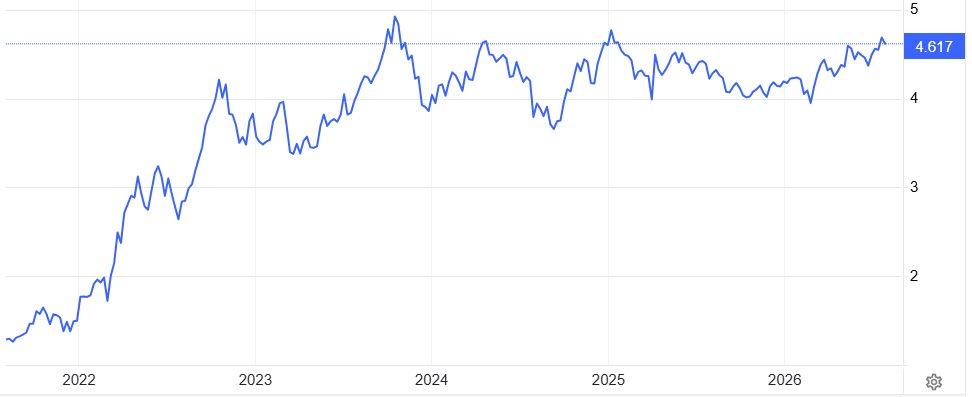
• Financial markets adopted a cautious stance ahead of the Federal Reserve’s July meeting. The 10-year Treasury yield eased to around 4.6% as investors largely anticipated unchanged interest rates, although markets continued to price in a meaningful possibility of an additional rate hike. Renewed tensions in the Middle East and rebounding oil prices have kept inflation risks in focus, reinforcing expectations of a datadependent policy approach.
Source: Trading Economics

Source: Colliers

This document has been prepared by Colliers for advertising and general information only. Colliers makes no guarantees, representations or warranties of any kind, expressed or implied, regarding the information including, but not limited to, warranties of content, accuracy and reliability Any interested party should undertake their own inquiries as to the accuracy of the information. Colliers excludes unequivocally all inferred or implied terms, conditions and warranties arising out of this document and excludes all liability for loss and damages arising there from This publication is the copyrighted property of Colliers and/or its licensor(s) ©2026 All rights reserved Colliers International Group Inc
Colliers Hungary
BEM Center
Bem József u. 1/B. Budapest, 1027, Hungary
Colliers | Budapest