





CollegiateParent has published this guide in partnership with the University of Pennsylvania. Our goal is to share helpful, timely information about your student’s college experience and connect you to relevant campus and community resources.
Please refer to the school’s website and contact information below for updated information in the guide or with questions about its contents. CollegiateParent is not responsible for omissions or errors. This publication was made possible by the businesses and professionals contained within it. The presence of university/college logos and marks in the guide does not mean that the publisher or school endorses the products or services offered by the advertisers.
©2026 CollegiateParent. All rights reserved.
CollegiateParent Dept# 5934 PO Box 25008 Bradenton, FL 34206-5008
Advertising Inquiries
�� (866) 721-1357
�� CollegiateParent.com/advertisers
Design by Grace Cassara
For more information, please contact: Office of Parent Outreach and Development/Penn Parents 2929 Walnut Street, Suite 300 Philadelphia, PA 19104
�� ( 215) 746-4646
Ȱ ppparent@dev.upenn.edu

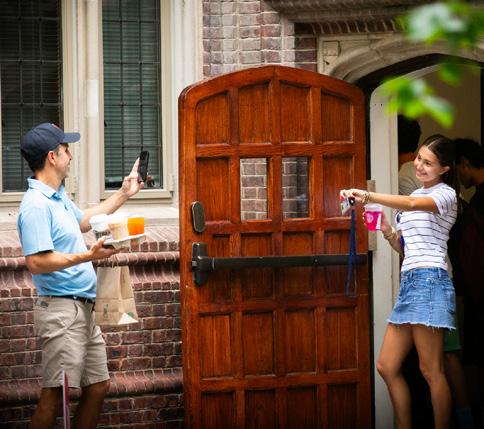





We are committed to partnering with you as you support your Penn student. Your student is embarking upon their academic career and student life as an independent adult. For many parents, this is uncharted territory. Therefore, our University partners created the following insights about this exciting transition.
Presented by Wellness at Penn
The transition to college is a time of excitement in the life of your child. University life can present new challenges, along with increased autonomy, exploration, and relationship-building. For most families, excitement about the transition also brings feelings of ambivalence and concern.
Staying informed may help you take proactive steps. Wellness at Penn’s
Student Health and Counseling team offers extensive services for students on campus. Counseling staff is also available to consult with parents.
Even though your student may express the need to be independent, they still need to know that you are available to talk. Discuss with them a reasonable plan for you to stay in touch on a regular basis whether it is through texting, emails, or phone calls.
Let your student set the priorities for some conversations. Ask open-ended questions and give them room to air concerns, share successes, or just simply talk. If you intend on visiting, plan in advance so the time that you have is meaningful.
Set up some time to talk to your student about expectations, e.g., frequency of communication, money matters, and so on. Negotiate a realistic plan.
College life is quite hectic, and most students find their time packed with academic and social obligations. Take the time to remind your student to take care of themselves physically and emotionally as well as academically. A balanced life that includes work, play, and rest is essential to a healthy student.
Conflicts are a part of the parent-student relationship, particularly as your student develops more independence at school. However, you may want to prioritize what is really important to you and decide which issues you are willing to let go.
Penn offers numerous resources to enhance your student’s experience while in college (see the Penn Resources section at the back of this guide). Penn is a big place, but you can help your student by suggesting various resources when you think it is appropriate.
The Family Educational Rights and Privacy Act (FERPA) protects the privacy of student educational records, which broadly includes information maintained by Penn that identifies a student. Students should be aware of their rights under FERPA, and faculty and staff should be aware of and follow their obligations under FERPA.
The University’s policy regarding the disclosure of student information to parents is based both upon legal requirements and the University’s philosophy that students should be treated as adults. The University generally will not share personally identifiable information (other than directory information) from a student’s education records with third parties, including parents or guardians, without student consent, except in limited
circumstances where such disclosure is permitted under FERPA and where the University determines in its discretion that disclosure is appropriate.
Disclosure is permitted:
z In connection with an emergency if knowledge of the information is necessary to protect the health or safety of the student or other individuals.
z If a student is a dependent within the meaning of Section 152 of the Internal Revenue Code of 1954 and the parent or legal guardian has submitted a written affirmation of guardianship.
z If a student is under the age of 21, information regarding the student’s violation of any University policy governing the use or possession of alcohol or drugs when certain circumstances are present.
z In other limited circumstances, as allowed under FERPA and its implementing regulations, as they may be amended.
In cases involving a health or safety emergency or a violation of a University policy regarding the use or possession of alcohol or drugs, a decision to notify parents or guardians about information contained in an education record — and the actual communications to the parents or guardians — will be made by the Office of the Vice Provost for University Life or another senior student affairs officer, and after consultation with the student’s school office and other appropriate offices. Whenever practicable, a student whose parents or guardians are to be notified will be informed before such notification occurs and given an opportunity to initiate contact with his or her parents or guardians.
In today’s world, it is important for students and families to understand and discuss risks to personal privacy, and ways to minimize those risks. Penn offers programs that give students choices regarding when and with whom their personal information is shared. See the Student Registration and Financial Services website for more information: srfs.upenn.ed u/parents.

The Penn Parent & Family Giving office is excited to welcome you to the Quaker Community! Parents and families are an essential part of the Penn experience, and the Parent & Family Giving Office is here to help you stay connected, informed, and engaged. Our goal is to foster meaningful relationships and create opportunities for families to feel at home at Penn while supporting their student’s undergraduate journey.
Penn Families Connect is the best way to stay connected throughout your student’s Penn journey. By joining, you’ll receive updates, news, and opportunities designed especially for Penn parents and families.
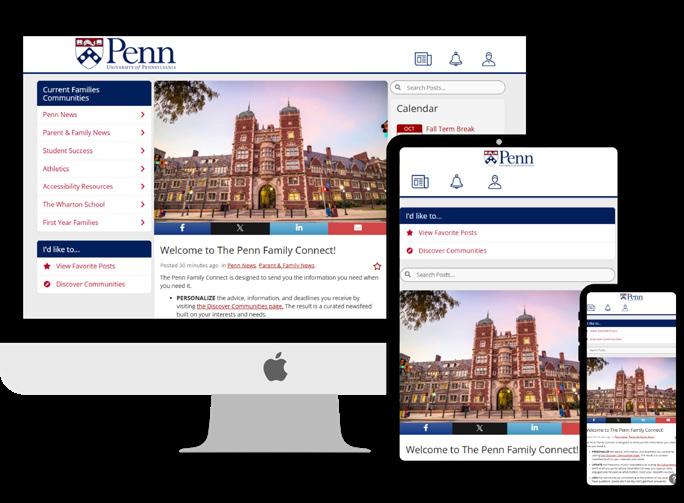
Contact Us: �� (215) 746- 4646
✉ DARProudParents@dev.upenn.edu �� giving.upenn.edu/parents
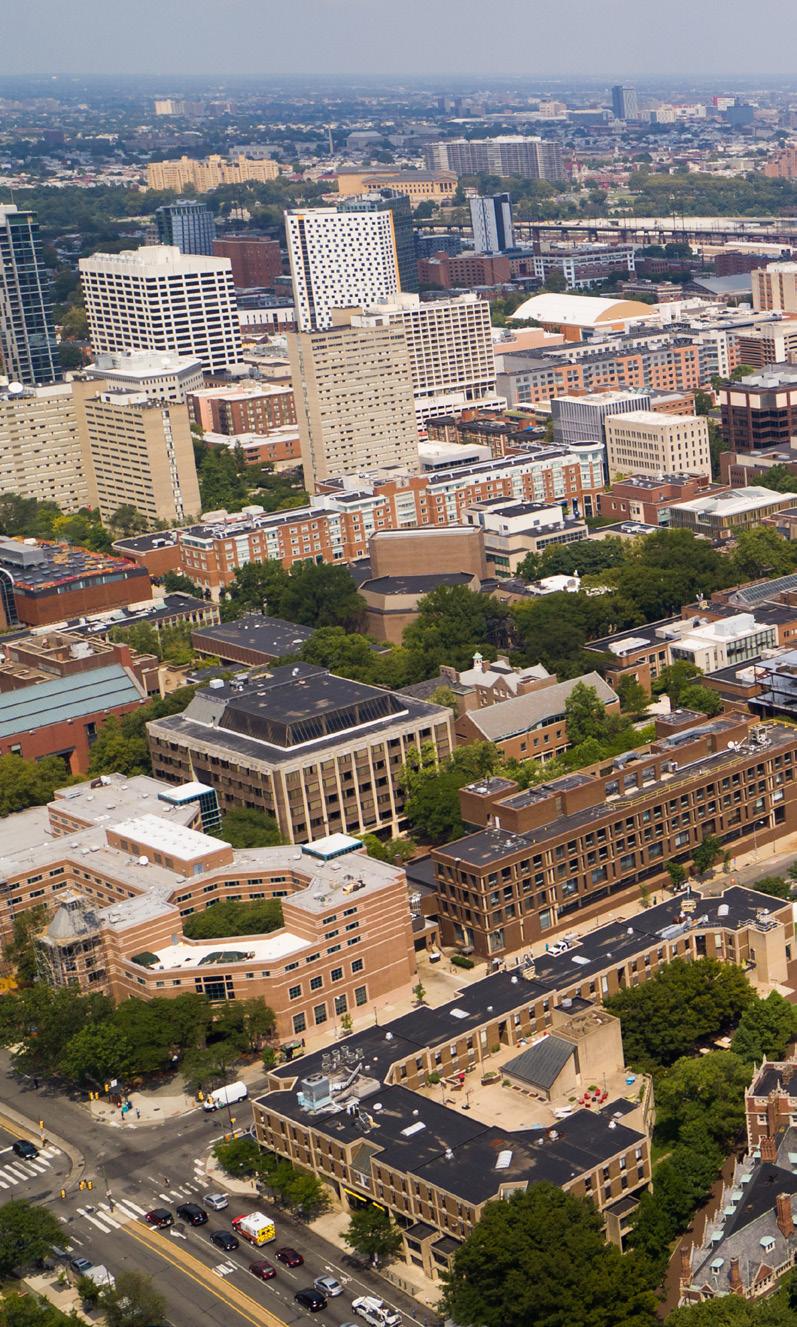
The University of Pennsylvania is a historic Ivy League school with highly selective admissions and a history of innovation in interdisciplinary education and scholarship.
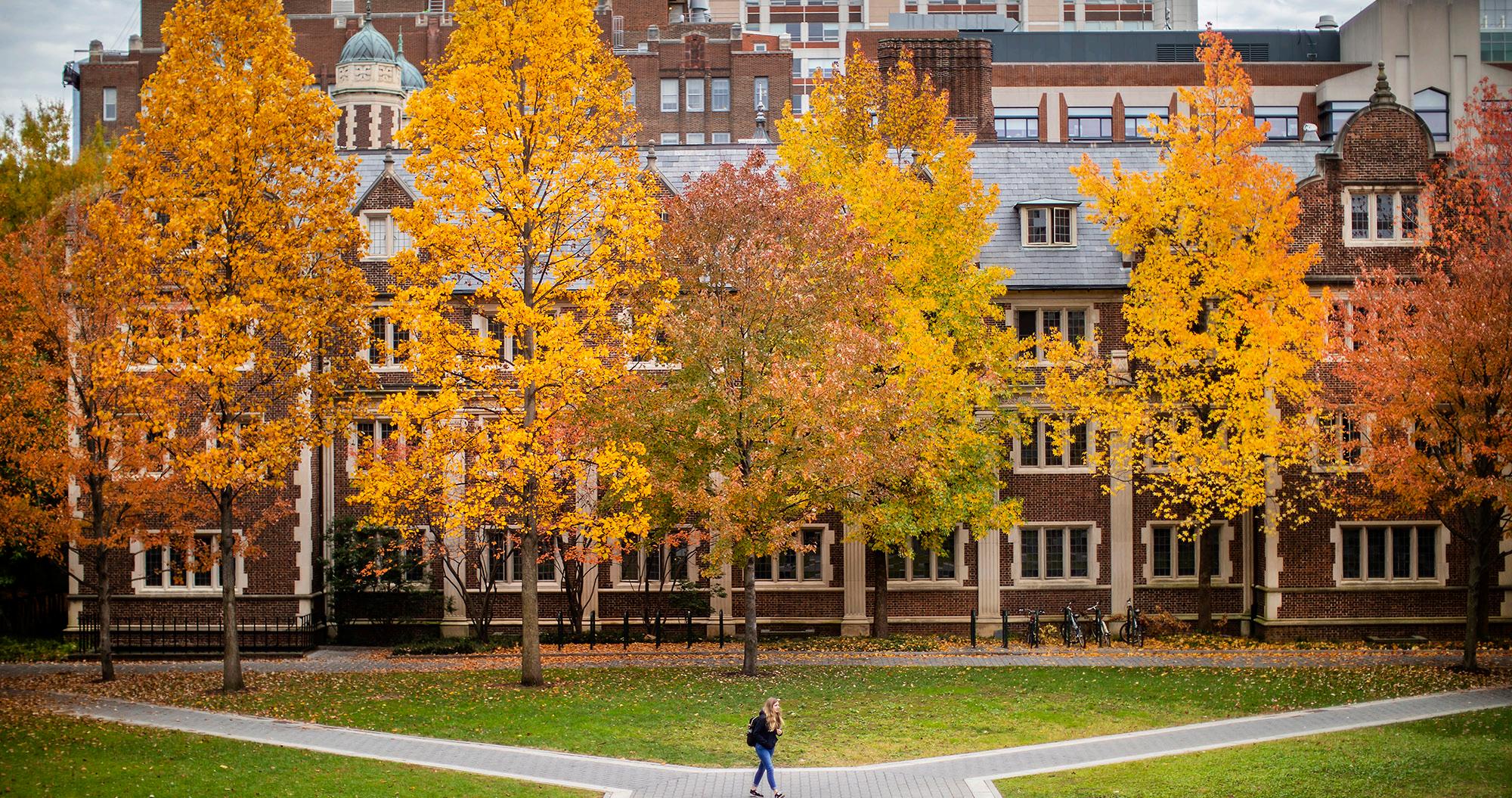
With its green lawns and landmark architecture, Penn’s beautiful West Philadelphia campus houses all of Penn’s activities, from student life, athletics, and academics to research, scholarship, and cultural life. All of Penn’s 12 schools and six centers are located within walking distance of one another. This geographical unity, unique among Ivy League schools, supports and fosters Penn’s interdisciplinary approach to education, scholarship, and research.
The University of Pennsylvania has the distinction of being the first university in the United States, created by Founding Father Benjamin Franklin. J. Larry Jameson is Penn's 10th president.
Penn’s sports teams are nicknamed the Quakers after the religion adopted by William Penn, who established Pennsylvania as a Quaker province. Today, we see the Quaker at Penn football and basketball games.
First held in 2019, U-Night celebrates the change in status as Penn Second-Years become rising Juniors. Just as firstyears celebrate Convocation, Juniors celebrate Hey Day, and Seniors celebrate Final Toast—our Second-Years have U-Night. The event features a lanternlighting ceremony, as well as free food, music, raffles, merch, and speeches from Class Board and special guests such as the Penn President and Provost.
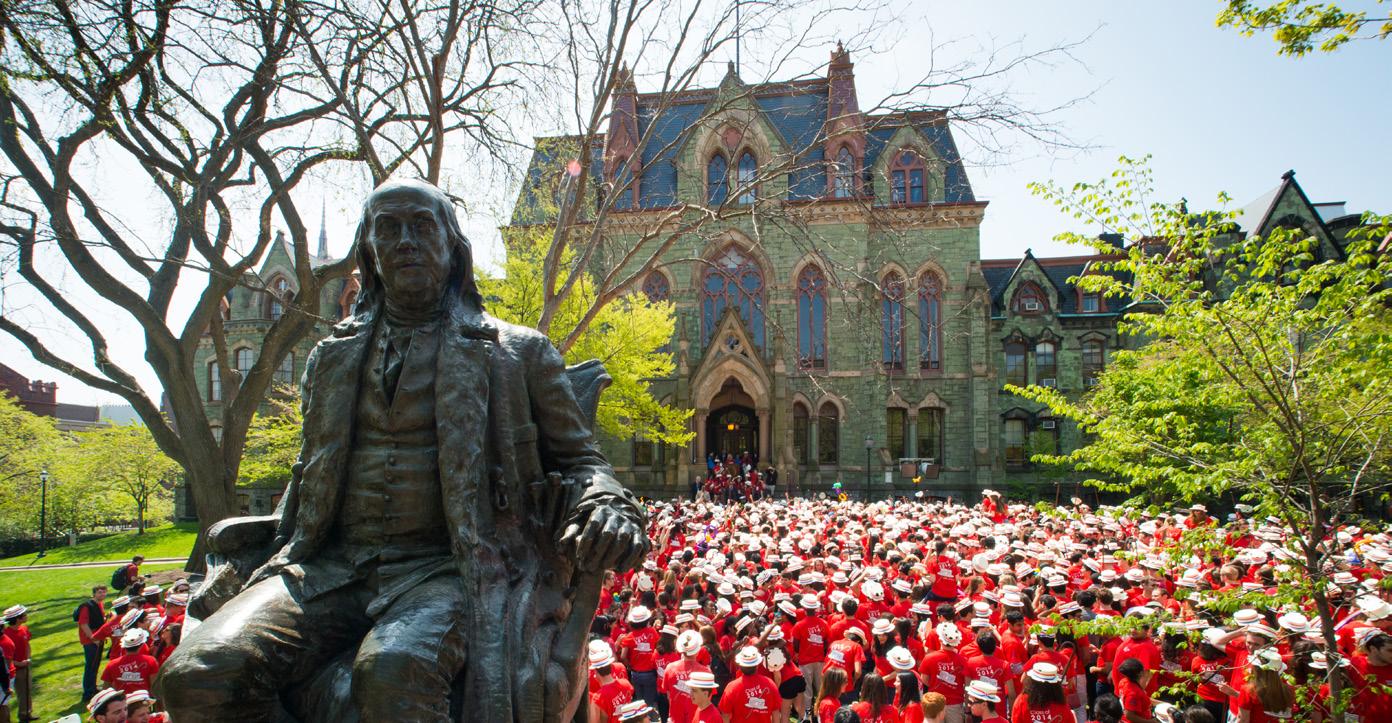
In 1916, Hey Day was established as a “Moving-Up” celebration to mark the advancement of each class. Hey Day has represented the official passage of the junior class to senior status and is characterized by marching students parading around campus wearing red t-shirts, carrying canes, and biting into fake straw hats.
In 1873, the first graduating class on Penn’s West Philadelphia campus established Ivy Day as a new tradition set aside for the senior class. As a vine was planted and an invocation pronounced, ivy became a lasting symbol for each year’s graduating class.
Of the international students enrolled in the Class of 2029, 18% are from Africa and the Middle East, 35% from Asia, 4% from Australia and the Pacific, 13% from Canada and Mexico, 11% from Central and South America and the Caribbean, and 20% from Europe.
The University of Pennsylvania has more than 70 academically based community service courses that are taught each year. The courses enroll approximately 1,800 undergraduate and graduate Penn students each year.
A charter member of the Ivy League, Penn offers varsity intercollegiate competition for men in 17 sports and for women in 16 sports.
With 209 research centers and institutes, research is a substantial and esteemed enterprise at Penn. The scale and interdisciplinary character of our research activities make Penn a nationally ranked research university.
Penn is home to over 6,000 professors. The faculty is home to nine MacArthur Award recipients, one National Medal of Science recipient, two Nobel Prize recipients, and four Pulitzer Prize recipients.
Penn Arts and Sciences, the University’s intellectual core, houses over 500 faculty in 27 departments in the humanities, social sciences, and natural sciences, covering diverse disciplines ranging from music to criminology, to chemistry and anthropology. The College of Arts and Sciences is the academic home of the majority of Penn undergraduates and provides 60% of the courses taken by students in Penn’s undergraduate professional schools. The College curriculum teaches students to analyze, communicate, and transform facts into knowledge that can be applied to any number of professions. Undergraduate offerings include 55 majors, signature interdisciplinary programs, and other academic opportunities.
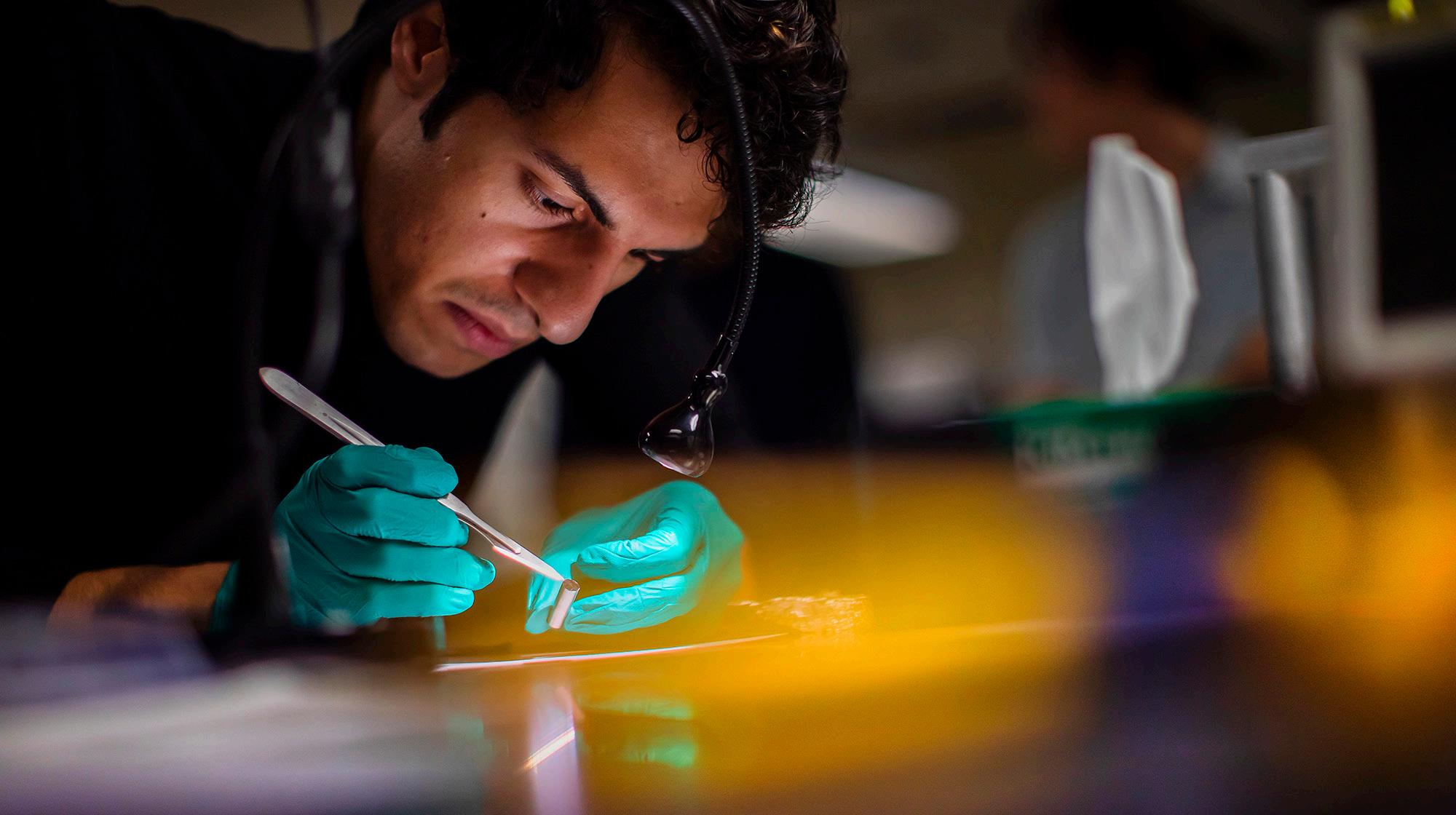
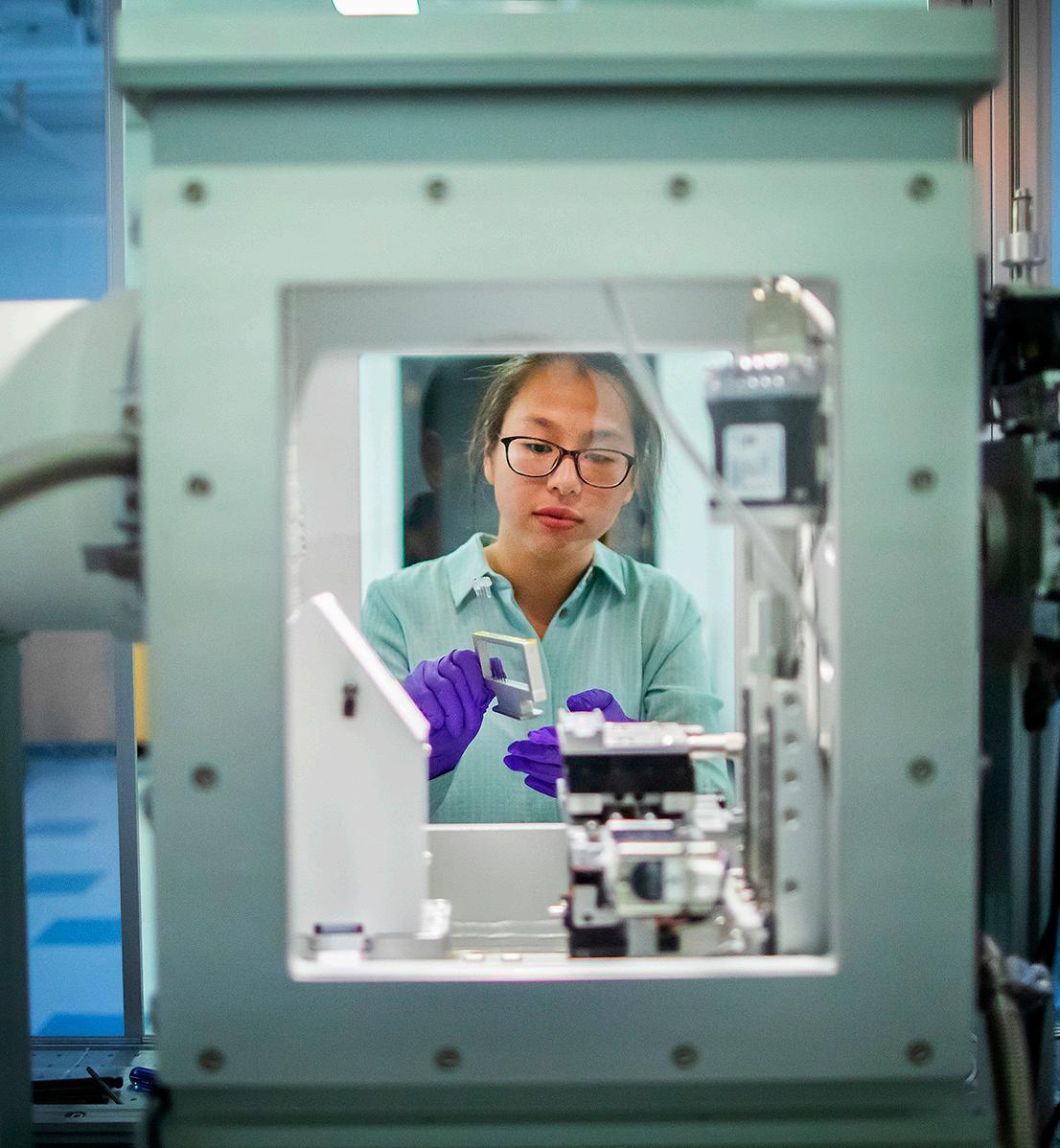
Founded in 1852 as the School of Mines, Arts and Manufactures, today’s School of Engineering and Applied Science is a vibrant part of the University. At Penn Engineering, world-acclaimed faculty, stateof-the-art research laboratories, and highly interdisciplinary curricula offer students an unparalleled experience. Undergraduate offerings include 15 majors and 55 areas of study. Innovation and technology drive the program and transform the fundamentals of what future engineers are learning. Penn Engineering students play a critical role in posing and tackling some of the most pressing problems that face our world today.

Penn Nursing is a premier academic and research institution renowned for advancing the frontiers of nursing science and patient care. Within their two undergraduate majors, Penn Nursing offers a number of unique and exciting resources, including a stateof-the-art simulation lab, classrooms with the latest hospital-based electronic health records (EHR) technology, and clinical experiences in the top-ranked Children’s Hospital of Philadelphia (CHOP) and Hospital of the University of Pennsylvania (HUP). Our students learn from leaders in nursing research, education, and practice who ensure Penn Nursing remains one of the top nursing schools in the world. At Penn Nursing, students become part of the next generation of healthcare leaders, prepared to care for patients, conduct landmark research, and make new strides in healthcare management and health policy.
Founded in 1881 as the world’s first collegiate business school, the Wharton School of the University of Pennsylvania is shaping the future of business by incubating ideas, driving insights, and creating leaders who change the world. With a faculty of more than 235 renowned professors, Wharton has 5,000 undergraduate, MBA, Executive MBA, and doctoral students. Undergraduate offerings alone include 20 majors. Each year 13,000 professionals from around the world advance their careers through Wharton Executive Education’s individual, company-customized, and online programs. More than 104,000 Wharton alumni form a powerful global network of leaders who transform business every day.






New Student Orientation
New Student Orientation (NSO) is a series of activities for families and students to help make a successful transition from high school to the University. NSO 2026 begins Wednesday, August 19 and concludes Monday, August 24. Classes start on Tuesday, August 25. Please visit the NSO website nso.upenn.edu periodically throughout the spring and summer for updates on the schedule of events and additional need-to-know information.
Office of New Student Orientation and Academic Initiatives (NSOAI)
✉ provost-nso-ai@pobox.upenn.edu
The First-Year Experience (FYE) program is a continuing set of events that will take place throughout the academic year. These events are designed to assist first-year students in feeling comfortable with their
new home. During NSO, PHINS (Peers Helping Incoming New Students) lead tours into the City of Philadelphia, and faculty, staff, and current undergraduate students introduce new Quakers to departments, resources, and research. To learn more, visit nso.upenn.edu / programs/first-year-experience
First-year seminars are an excellent introduction to academic life in the College and are highly recommended for first or second semester students. The primary goal of the First-Year Seminar program is to provide every first-year with the opportunity for a direct personal encounter with a faculty member in a small class setting devoted to a significant intellectual endeavor. While the seminars are not required, they do fulfill College General Education Requirements. Please visit college.upenn.edu/first-year-seminars for more information and course descriptions.


Students in the College have a strong network of academic advisors available to assist them throughout their undergraduate careers. Pre-major advisors help firstand second-year students navigate their entrance into academic and intellectual life in the College beginning with the issues of incoming first-years and continuing through the student’s exploration of a potential major. After declaring a major, students are assigned a major advisor affiliated with the program. All students are welcome and encouraged to speak with assistant deans for advising in the College Office. These advisors can help students explore the many options and opportunities available to College students, and they are available by appointment or on a drop-in basis throughout the year.
�� (215) 898-6341
✉ college@sas.upenn.edu
�� college.upenn.edu/advising-resources
All students in Penn Engineering are assigned to a faculty advisor and a peer advisor in their major. Students who are curriculum deferred are assigned professional advisors experienced in working with students who may still be deciding. Each undergraduate major or program has an assigned coordinator who can help students with most issues pertaining to their major. In addition, students can meet with professional advisors to discuss non-major related academic issues such as dual degrees, minors, study abroad, and accelerated master’s degrees, as well as to ask for help accessing academic and student support resources.
�� (215) 898-7246
✉ academic-services@seas.upenn.edu
�� ugrad.seas.upenn.edu

All students in the School of Nursing are assigned a faculty advisor and a peer advisor. Students also have access to professional staff advisors in the Office of Academic Affairs. Faculty advisors provide students with mentoring related to their career goals and serve as a resource for students to discuss the current issues, science, and practices of the nursing profession. The Office of Academic Affairs partners with the faculty advisors to provide information on registration, degree requirements, dual degrees, minors, study abroad, sub-matriculation, and University resources. Peer advisors help ease the firstyear transition into college and are available to answer their advisees’ questions about student life at Penn. Students remain in touch with their advisors throughout their undergraduate career.
�� (215) 898-6687
✉ advisor@nursing.upenn.edu
�� nursing.upenn.edu/students
All Wharton students are assigned to a professional academic advisor in the Undergraduate Division who can help them:
z Explore intellectual interests
z Develop suitable educational plans and goals
z Select appropriate courses and other educational experiences
z Understand institutional and degree requirements
z Connect with resources
z Work through any academic challenges
Advisors are available Monday through Friday by appointment and for drop-in advising during Advance Registration and other peak advising times. Peer advisors are also available for drop-in advising weekdays during the fall and spring semesters.
�� (215) 898-7608
✉ undergradinfo@wharton.upenn.edu
�� undergrad-inside.wharton.upenn.edu

Career Services helps Penn students define their career goals and take the steps necessary to achieve them.
Penn Career Services helps students with all aspects of their career journey, from the exploration phase (exploring career interests and learning about industries and job functions) to creating strong resumes and cover letters, refining interviewing skills, and negotiating offers. Professional advisors are also available to assist students in applying to graduate and professional school programs. Career Services offers a wide array of skill-building workshops, a large number of online resources and a variety of ways for students to connect with employers including interview schedules,
career fairs, employer information sessions, and a robust job and internship board. New Penn students will gain access to Career Services, including the ability to access the main Career Services platform, Handshake, and schedule appointments with career and pre-graduate school advisors once their first semester has officially started.
Parents can visit the Career Services “Parents” webpage careerservices.upenn.edu/channels/parents for general information and year-by-year advice.

It’s the start of your Penn journey, and no matter what your academic path, the Penn Libraries is here to support you every step of the way.
Our friendly, knowledgeable staff provide guidance and support for Penn students year-round. Librarians can help you develop your research skills, find the perfect resources for your project or paper, and get specific support in every academic discipline, from dentistry to design.
Our 19 library locations offer large tables in quiet study areas, lounges with soft furniture, reservable rooms and booths for groups, and more.
The Penn Libraries offers print and electronic books, journal and newspaper articles, videos, sound recordings, manuscripts, and even some textbooks.
And that's not all: you can also sign up for news subscriptions, try letterpress or 3D printing, and borrow equipment ranging from binoculars to musical instruments, all available to you at no extra cost as a Penn student.
Learn new skills to support your academic experience, explore unique items from our archives, or take a study break while connecting with your classmates.
Penn Libraries
ͤ 3420 Walnut St Philadelphia, PA 19104
✉ librarynews@upenn.edu
�� library.upenn.edu
Connect with us
B @upennlib on Instagram
A facebook.com/PennLibraries
�� Newsletter: alumni.upenn.edu/libsignup

Whether Penn students study abroad for a week or an academic year, they’ll come away with an entirely new frame of reference for understanding the world and their role in it.
Penn offers a wide range of programs to meet students’ personal and academic goals. Among the many offerings from across Penn, highlights include:
z Study Abroad (SA) program provides students the opportunity to establish themselves in a new global community through extended study for a semester, year, or summer. Penn partners with top universities worldwide in one of the most extensive undergraduate student exchange networks of any Ivy League university.
z Penn Global Seminars (PGS) combine an intensive semester-long campus seminar with a short-term international travel component led by the course’s instructor. These innovative and affordable programs offer all undergraduate students the opportunity to integrate immersive global travel into their Penn experience.
z The Global Research and Internship Program (GRIP) provides students the opportunity to intern or conduct research abroad for eight to 12 weeks during the summer. These experiential opportunities are available in a diverse range of industries and allow students to apply their academic knowledge to a global workplace.
z Penn Global Research Institutes (PGRI) provide outstanding undergraduate and graduate students the opportunity to conduct research abroad alongside Penn faculty. Participants work as part of a small research team, gain hands-on fieldwork experience, and receive funding to offset project and travel expenses.
Penn Abroad
ͤ 5th and 6th Floors 3935 Walnut St. Philadelphia, PA. 19104
�� global.upenn.edu/pennabroad


PennCard, the University’s ID card, has a prepaid debit feature called PENNCASH. Students can make online deposits and use PennCash for copying and printing at the library, or buying food and books.
They simply tap the card to pay . . . and you can relax. PennCash has got it covered.






Offering 60+ eateries, stores, and entertainment venues, Shop Penn provides a collection of retail options at every




International students play an important role at Penn as their presence enriches the academic and cultural experience inside and outside the classroom. Penn prides itself on having one of the largest populations of international students in the U.S., and the campus boasts a vibrant and welcoming home for our global community. ISSS is there every step of the way.
Soon your student will embark on a lifechanging journey. ISSS of Penn Global is one of the first and last offices that an international student will engage with at Penn. ISSS supports all international students from the time they request immigration documents, throughout their Penn journey, and in their professional lives beyond graduation.
The two core responsibilities of ISSS include immigration service and integration support. ISSS staff provides expert advice on anything related to immigration, including documents, travel concerns, and U.S. employment authorization. ISSS at Penn is unique compared to other universities, offering a range of integration initiatives and opportunities to connect with other students and campus resources to enhance the Penn experience.
Highlighted integration programs include: Forerunner, International Student Orientation, Welcome Picnic for New International Students, Intercultural Leadership Program, International Student Advisory Board, Your World@Penn Social Media Platform, and the Graduation Reception for International Students.
International Student and Scholar Services, Penn Global ͤ 3819 Chestnut Street, Suite 305 Philadelphia, PA 19104
�� (215) 898-4661
�� global.upenn.edu/isss
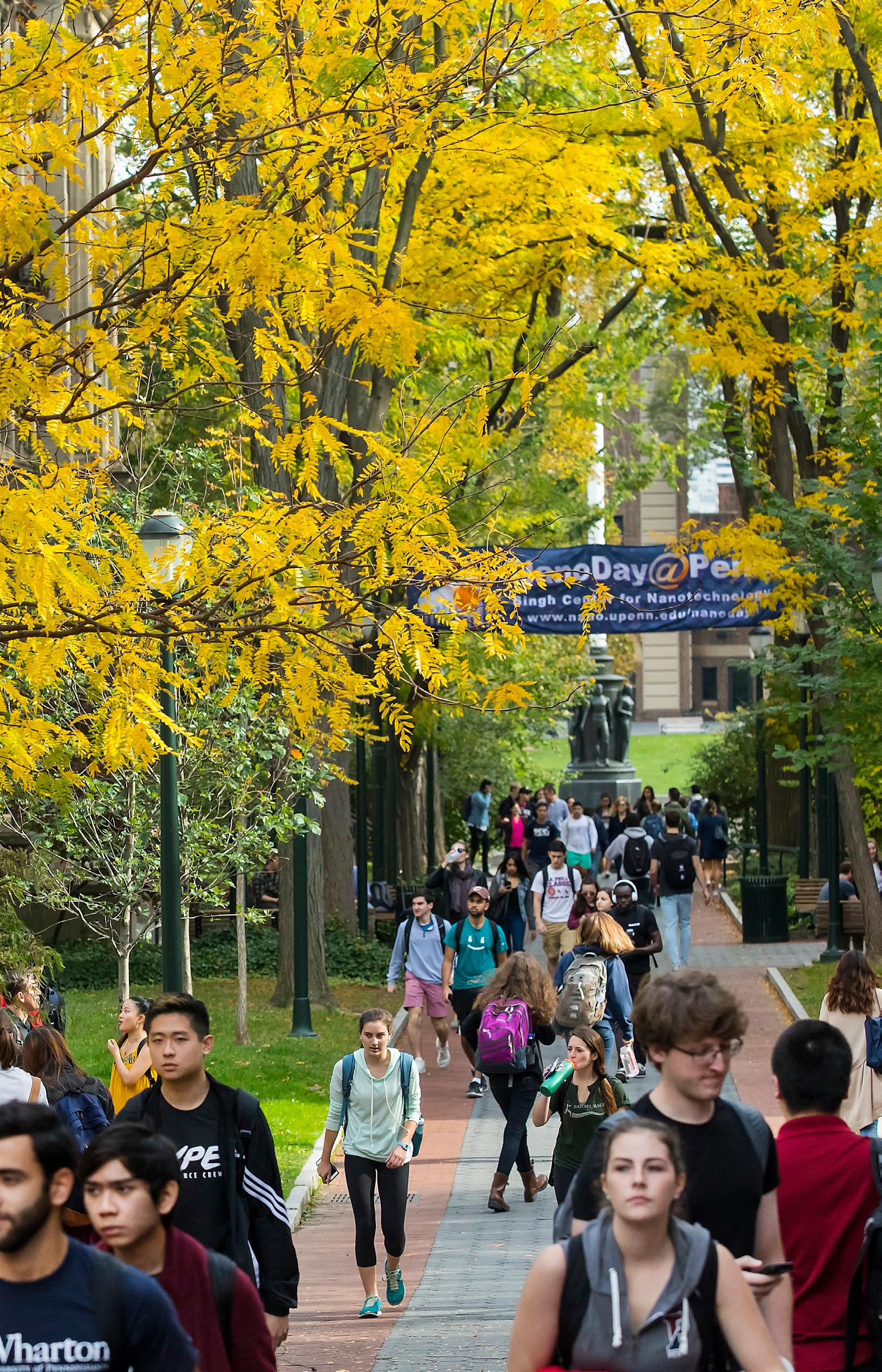
Parents and family members are often the first to hear about students’ academic challenges and stress surrounding assignments and exams. The Weingarten Center is Penn’s home for Academic Support and Disability Services. Accompanying students along their academic journey underscores the Weingarten Center's unified mission.
Learning specialists work with undergraduate, graduate, and professional students in individual learning consultations to build and strengthen study strategies as they engage with their Penn coursework. Areas of focused support include time and project management, organization, academic reading, research, and writing, problem-solving, and exam preparation. Students can meet with learning specialists for in-person or virtual 50-minute appointments or 25-minute inperson drop-in sessions. Group workshops that address the needs and interests of specific groups of students are also available throughout the year.
Tutoring Services offers Penn undergraduate students free, accessible, and convenient options to supplement their academic experience in a wide variety of courses. Qualified peer tutors will work with the student to better understand and engage with specific course content. Tutoring can be accessed through various formats, including individual or small group appointments and drop-in sessions depending on the course.
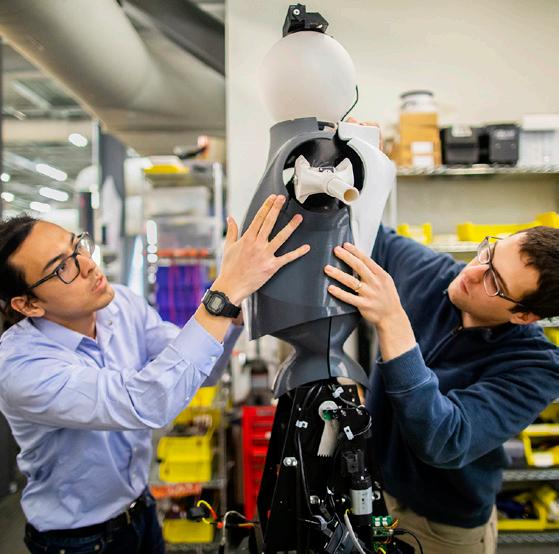
Disability Services supports students who self-identify with a disability in order to ensure equal access to all University programs, activities, and services. The process begins when a student requests an accommodation, provides documentation of their condition, and meets with a Disability Specialist. Students who receive accommodations work with the Disability Services staff to coordinate their academic accommodations as well as accessible housing, dining, communication, and technology. Through ongoing collaboration with the Weingarten Center, students learn to identify and utilize individualized accommodations and strategies that support their full participation in university life.
Weingarten Center
ͤ Stouffer Commons 3702 Spruce St, Suite 300
Philadelphia, PA 19104
�� (215) 573-9235
ˇ (215) 746-6320 for TDD
�� weingartencenter.universitylife. upenn.edu


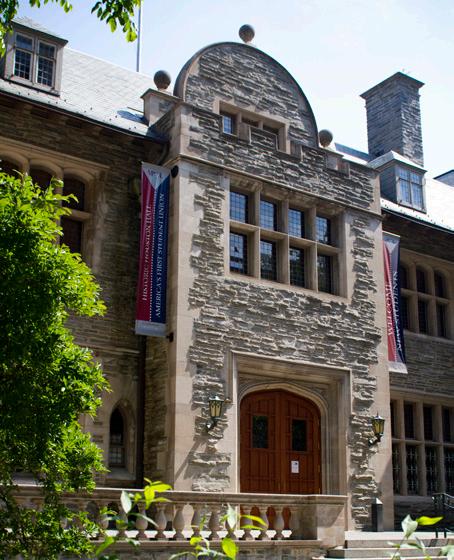



Student Registration and Financial Services (SRFS) is your onestop resource for financial aid, student accounts and billing, student employment, registration, student records, and veteran and militaryaffiliated student services.
Counselors from the SRFS Student Service Center are prepared to answer your questions via email, phone, and in person at the Franklin Building (3451 Walnut St). Financial aid counselors, student account specialists, or academic services team members are also available to assist when needed.
If you wish to speak to a staff member from any of the SRFS offices on your student’s behalf, they must indicate on Path@Penn that the University has permission to share academic and/or financial information with you.
For more information on any of the topics below, visit srfs.upenn.edu
Penn meets 100% of an undergraduate student’s demonstrated financial need with a financial aid package consisting of grants and work-study funding. Penn is the largest institution in the country to offer grantbased financial aid awards to traditional undergraduate students. If your student does not receive aid, keep in mind that Penn will review financial aid applications at any time during the undergraduate years if your family’s financial situation changes. The SRFS website has checklists for financial aid applications and details on both federal and private loan programs.
�� (215) 898-1988
✉ sfsmail@pobox.upenn.edu
�� srfs.upenn.edu/financial-aid
The Office of the University Registrar (OUR)
Using our electronic resources, your student can search and register for courses, check exam times and locations, view grades, request enrollment verifications, and order transcripts. Our knowledgeable and friendly staff are available to provide services by email and over the phone during regular business hours.
�� (215) 898-6636
✉ registrar@upenn.edu
�� srfs.upenn.edu/registrar
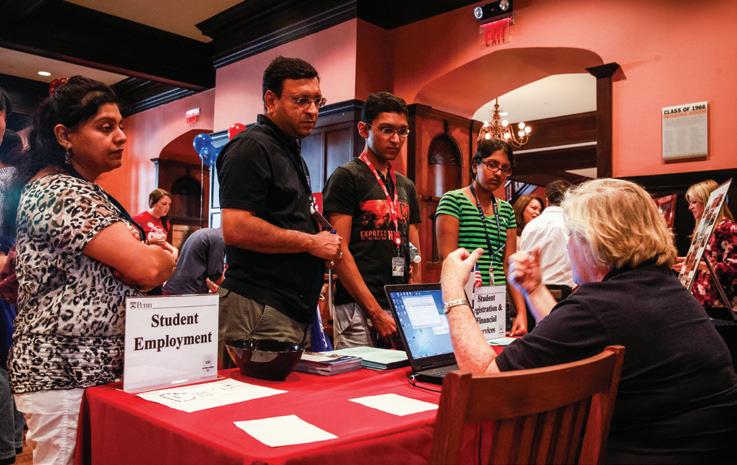
Student Employment, part of Student Financial Aid, provides academic year job listings, including both work-study jobs and jobs for students who do not receive a work-study award. International students will need to comply with certain immigration rules even for on-campus jobs. The Student Employment website includes more information on these guidelines.
✉ seomail@pobox.upenn.edu
�� srfs.upenn.edu/student-employment
Penn offers several payment plans and financing opportunities to assist with your student’s educational expenses. Families can select one plan, or combine several, to meet their needs. If you decide to borrow, we recommend federal loan programs (Federal Direct Loan for students and Direct PLUS Loan for parents), as repayment is more flexible. You can also enroll in a Penn Payment Plan and spread your expenses across four or five payments each semester.
�� srfs.upenn.edu/billing-payment/ financing-and-payment-plans
Outside scholarships (i.e., scholarships awarded from sources outside the University) can be an important resource. Penn students may pursue outside scholarships to avail themselves of additional financial flexibility. More information on outside scholarships, including their impact on a student’s needbased financial aid package, can be found on the SRFS website.
�� srfs.upenn.edu/financial-aid/outsidescholarships

Penn.Pay is Penn’s online billing system through which your student receives their student account bill. Your student can review new daily activity and opt to pay their bill online, securely and efficiently. To comply with federal regulations (FERPA), your student must invite you to be an Authorized User in order for you to access Penn.Pay.
Your student’s first bill is sent at the beginning of July, with a due date near the end of July (check the billing schedule on the SRFS website for exact dates). When the bill is ready, SRFS will send an email notification to your student’s University email address and to any authorized users associated with the account. Your student’s first bill will include all of their semester charges, including tuition, fees, housing, and dining. SRFS sends a new bill each month reflecting any additional charges.
Full payment of the student account bill is due by the date indicated on the statement. Students are responsible for paying any amounts not covered by financial aid, loans, outside scholarships, or payment plans. A late payment penalty of 1.5% of any past due balance will be assessed each month and may result in the account being placed on financial hold, which restricts future registration, diplomas, and transcripts. Payments can be made with a U.S. checking or savings account or your credit card.
Note that credit card payments are assessed a convenience fee. Penn does not receive any compensation or portion of the convenience fee. Personal checks are also accepted through mail or in person, or funds can be sent via a wire transfer.
Penn does not accept cash payments for student accounts.
�� srfs.upenn.edu/billing-payment
We strongly encourage you to review the SRFS Must-Do List with your student and have them complete it as soon as possible. The Must-Do List addresses your student’s safety on campus, privacy rights, signing up for Penn.Pay, and enrolling in direct deposit for easy payment of work-study funds and student account refunds.
�� srfs.upenn.edu/must-do
This SRFS initiative aims to enhance students’ financial well-being by providing personal finance education, tools, and resources. Our goal is to help students feel empowered to set financial goals, make informed financial decisions, and improve their financial behaviors. We believe every student should leave Penn with a plan for their financial future. Look for opportunities to engage with Financial Wellness during NSO, throughout the academic year, and online.
�� srfs.upenn.edu/financial-wellness
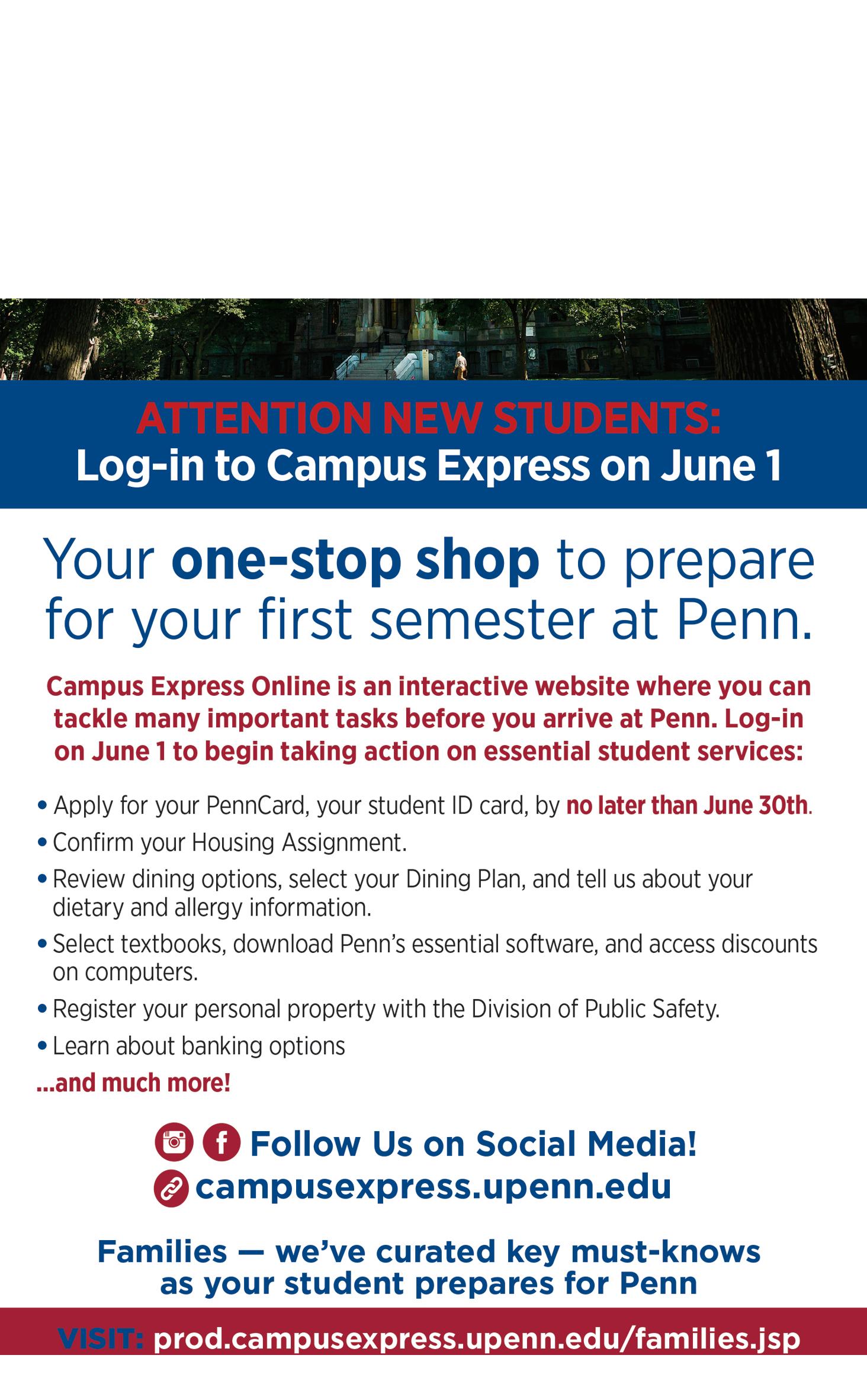
Campus Express at Penn® allows your student to sign up for many essential student services at Penn. Your student should first go to Campus Express Online, which opens June 1, 2026.
With Campus Express Online, students have direct access to many of the services they’ll need to make their life at Penn safe, convenient, and comfortable. They can apply for a University identification card, see their room layouts, confirm housing, download their free copy of Office 365 ProPlus, take advantage of educational discounts on computers, buy textbooks, register property, review resources related to banking and financial wellness, sign up for a dining plan, and learn about transportation options. To access Campus Express, students will need a PennKey. A postcard explaining all the online services is sent to the homes of all new students in May. Campus Express opens for newly admitted undergraduate students on June 1, 2026. Upperclass students can access the online services at any time.
Go to campusexpress.upenn.edu to learn more.





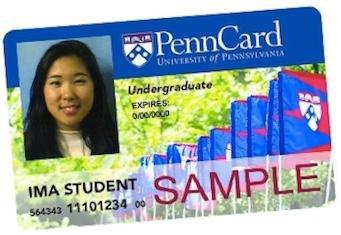
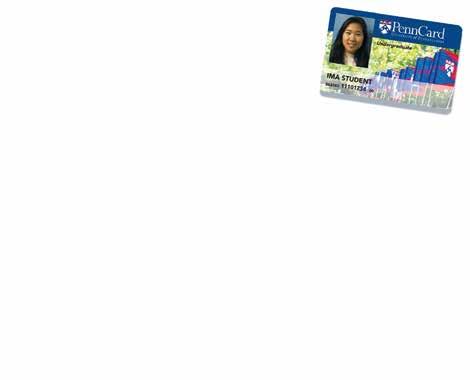
The PennCard is the official University of Pennsylvania identification card required for all students, faculty, and staff. The PennCard is used for many services, including building access, library services, campus transit, dining plans and Dining Dollars, recreational facility access, Student Financial Services (SFS) line of credit, and PennCash purchases.
Your student should apply for their PennCard as soon as Campus Express Online opens, beginning June 1 but no later than June 30, 2026
As a convenience, notary services, passport photos, lanyards and phone wallets, and postage stamps are available throughout the year at the PennCard Center, located on the second floor of the Penn Bookstore (3601 Walnut Street).
PennCash—an optional prepaid debit feature available on the PennCard—allows students to make cash-free purchases around campus quickly and conveniently. PennCash is easy to replenish and immediately available to make purchases at the Penn Bookstore and Penn Dining retail cafés, as well as access printers and copiers at Penn libraries and academic buildings. To load PennCash, students can log in to Campus Express and use a Visa or MasterCard, or transfer from their Student Financial Services line of credit. For more information, go to upenn.edu /penncash
The PennCard Access Code (PAC) is the four-digit number used in conjunction with the PennCard (the University’s identification card) to access many buildings on campus—most importantly, all residential buildings, students’ suites, and bedrooms. The University’s Information Systems and Computing Department randomly assigns each student a PAC they are advised to change to something that is both secure and easy to remember. Students can view and/ or change their PAC on Campus Express at campusexpress.u penn.edu .
PennKey is an individual’s username within the PennKey authentication system. Paired with an associated password, a PennKey is required to authenticate your student’s identity for access to many of Penn’s networked systems and services.
How does a student get a PennKey?
Students must first obtain a PennKey Setup Code, which Penn automatically emails to incoming students with instructions. This email will be sent to the email address used during the application process.
PennKey Setup Codes are temporary identifiers used to log in to the PennKey Registration application. A Setup Code expires once it’s been used or 30 days from the issue date, whichever comes first.
Once students receive their PennKey Setup Codes, they can go to isc.upenn.edu/ resources/pennkey-support/how-do-i-getpennkey for information on how to log in to the PennKey Registration application. Read about the Office of Information Security’s top three tips for securing your information at isc.upenn.edu/security/students
Through a special relationship with the University, PNC Bank offers a wide range of student-oriented financial services you may wish to consider. Key highlights include:
z Two full-service branches conveniently located within walking distance of campus (3535 Market Street, 200 S. 40th Street)
z On-campus ATMs and a coast-tocoast branch and ATM network
z PNC Simple Checking for hasslefree banking
z The ability for students to link their PennCard to their PNC account, eliminating the need for an extra debit card
z No monthly service charge if you are under 25 or have a qualifying direct deposit
z No overdraft fees
z The PNC Mobile app, which keeps your account at your fingertips
z International banking services, including U.S. account setup and multilingual support (240+ languages)
The PennCard Center
ͤ Penn Bookstore (2nd floor) 3601 Walnut St Philadelphia, PA 19104
�� (215) 417-CARD (2273)
✉ penncard@pobox.upenn.edu
�� upenn.edu/penncard
Visit pnc.com/penn for more information on banking with PNC*.
*There is no requirement by the University that students, faculty, or staff bank at any particular financial institution; all members of the Penn community can choose any bank they wish. In exchange for the opportunity to promote its programs to the University community, PNC provides Penn with financial contributions that Penn uses to sustain student programs and other University initiatives.
Visit PNC.com/locator to find a PNC or PNC Partner ATM near you where PNC customers can access money fee-free.
The 25-age waiver and/or 62-age waiver will be applied only if the date of birth for the primary or secondary owner(s) on the account meets the age requirement Qualifying direct deposit is defined as a recurring Direct Deposit of a paycheck, pension, Social Security, or other regular income electronically deposited by an employer or an outside agency. Credit card cash advance transfers, wire transfers, person-to-person transfers, transfers from one account to another, or deposits made at a branch, ATM, mobile device, or through the mail do not qualify as qualifying direct deposits. PNC does not charge a fee for Mobile Banking. However, third-party message and data rates may apply. These include fees your wireless carrier may charge you for data usage and text messaging services. Check with your wireless carrier for details regarding your specific wireless plan and any data usage or text messaging charges that may apply. Also, a supported mobile device is needed to use the Mobile Banking App. Mobile Deposit is a feature of PNC Mobile Banking. Use of the Mobile Deposit feature requires a supported camera-equipped device and you must download a PNC mobile banking app. Eligible PNC Bank account and PNC Bank Online Banking required. Certain other restrictions apply. See the mobile banking terms and conditions in the Digital Services Agreement.
©2026 The PNC Financial Services Group, Inc. All rights reserved. PNC Bank, National Association. Member FDIC UNIVERSITY OF PENNSYLVANIA
Q: Where does a new student pick up their PennCard?
A: Undergraduates will be given their PennCards when they move into their College House. Graduate students receive their PennCards either at their school orientation or at the Campus Express Center in Houston Hall during New Student Orientation.
Students who arrive on campus after New Student Orientation should stop by the PennCard Center, located on the second floor of the Penn Bookstore.
Important: Students must pick up their own PennCards in person. To receive a PennCard, they are required to present one of the following forms of original photo ID:
z Domestic students: Photo identification such as a driver’s license or non-driving photo ID card, issued by a U.S. state or territory; passport issued by the United States government; any other passport the student is entitled to hold.
z International students: Passport of the country of which they are a citizen or subject. Other forms of ID are not valid for PennCard pickup.
Q: When does a new student need to apply for a PennCard?
A: As soon as Campus Express Online opens on June 1, students should log in at campusexpress.upenn.edu and click “Your PennCard.” To ensure their PennCards will be ready for pickup during Move-In, students should finalize and
submit their PennCard applications as quickly as possible. After June 30, 2026, students will not be able to apply for their PennCards online.
Q: What can students do with their PennCards?
A: With a PennCard, students may:
z Enter campus academic and residential buildings
z Enter dining cafés, access dining plans, and preorder and pay through the Penn Eats dining app
z Make purchases using PennCash
z Link to a PNC Bank account, enabling PennCard to act as an ATM or bank-debit card
z Charge purchases to a Student Financial Services line of credit
Q: How safe is PennCash?
A: The value in a PennCash account is not stored on the card. If a PennCard is lost, the PennCash account is frozen as soon as the student notifies the PennCard Center (215-417-CARD) or the Division of Public Safety (215- 573-3333).
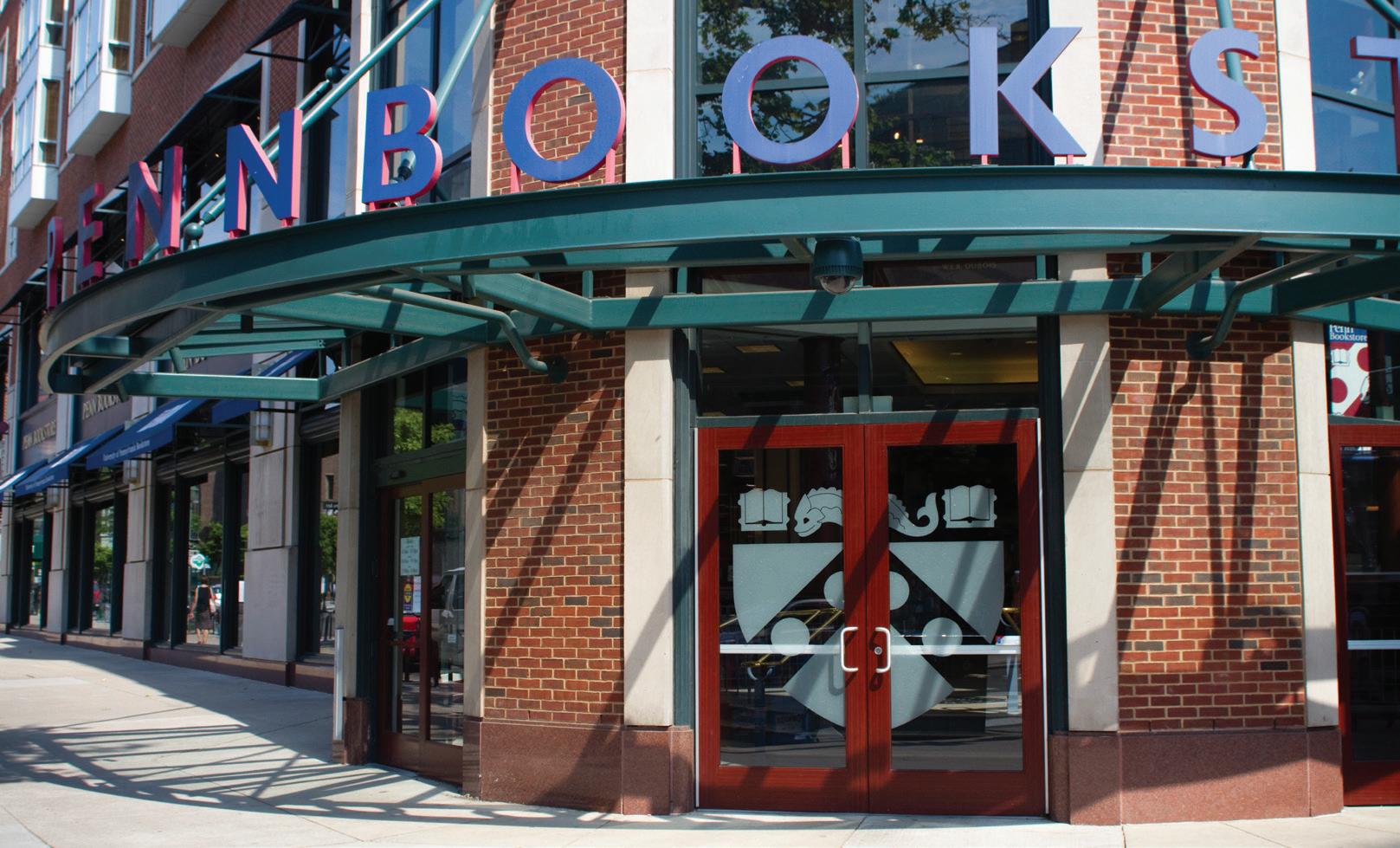
Penn was the first university to establish what many institutions still recognize as the model for today’s premier collegiate retail shopping experience.
The Penn Bookstore offers a unique assortment of products and services to specifically meet the needs of Penn students, parents, and families. In addition to textbooks and course materials, the Penn Bookstore is a go-to resource for technology products, school supplies, and a unique assortment of Penn-branded apparel and merchandise for the entire family.
With the Bookstore’s convenient online textbook purchasing system, students have the option of having their textbooks shipped directly to their home or picking them up at the Penn Bookstore when they arrive on campus. Pick-up orders will be available in the textbook department, packed and with a register receipt. Keep the receipt and textbooks can be returned for a full refund until the second week of classes.
There are numerous benefits to purchasing textbooks through the Penn Bookstore, which offers flexible formats including new, used, rental, and digital. The Penn Bookstore makes student savings a priority through a number of affordability initiatives. The
textbook rental program allows students to use the book in the same way as if they purchased it outright (e.g., ability to highlight and write in the margins). Renting a textbook may save up to 50% over the cost of purchasing a new book and, at the end of the semester, students can choose whether they wish to return the book or purchase it.
Used textbooks are another popular option. The difference between a new textbook price and a used textbook price is around 25%. Because used textbooks are in high demand, students are encouraged to make their purchases early to increase their chances of obtaining a used book.
The Bookstore’s online Course Material Concierge lets students know if new, used, rental, or digital versions of a text are an available option.

The Bookstore will match the price of any new, used, or rental textbooks sold directly from Amazon.com , BN.com , or local providers (this offer does not include 3rd party sellers or marketplaces). More information on the program is available at upenn.bncollege.com/we-price-match .
The Bookstore also offers many ways to pay. In addition to accepting all major credit cards—including Visa, MasterCard, American Express, and Discover—students can provide their PennCard number and charge their textbooks directly to their Student Financial Services or PennCash account. Students can also use a Barnes & Noble gift card toward textbook purchases!
With the Bookstore's generous return policy, your student never has to worry about a schedule change. Textbooks can be returned for a full refund until the second week of classes with the receipt. After two weeks and up to the first 30 days of the semester, textbooks can be returned with original receipt and proof of schedule change.
Located on campus, the Penn Bookstore offers a range of products that can help your student start life at Penn. In addition to essential course materials and school supplies, the Bookstore has all the basic necessities for any room or apartment, including lamps, desk and shelf units, electronics, and bed and bath accessories. Gift items are available, as are, of course, books! The Penn Bookstore carries thousands of fiction and non-fiction titles as well as a variety of periodicals and journals.
In addition, the Bookstore offers students and their families a way to show their Penn Pride! Our robust selection of Penn apparel includes sweatshirts, T-shirts, jackets, and hats, along with insignia merchandise like pennants, backpacks, water bottles, blankets, and so much more.
On the second floor, you’ll find a Starbucks café offering your favorite handcrafted espresso drinks, snacking treats, and heat-and-go sandwich options. Mobile ordering is available through the Starbucks app.
Penn Bookstore
ͤ 3601 Walnut St Philadelphia, PA 19104
�� (215) 898-7595
�� upenn.edu/bookstore






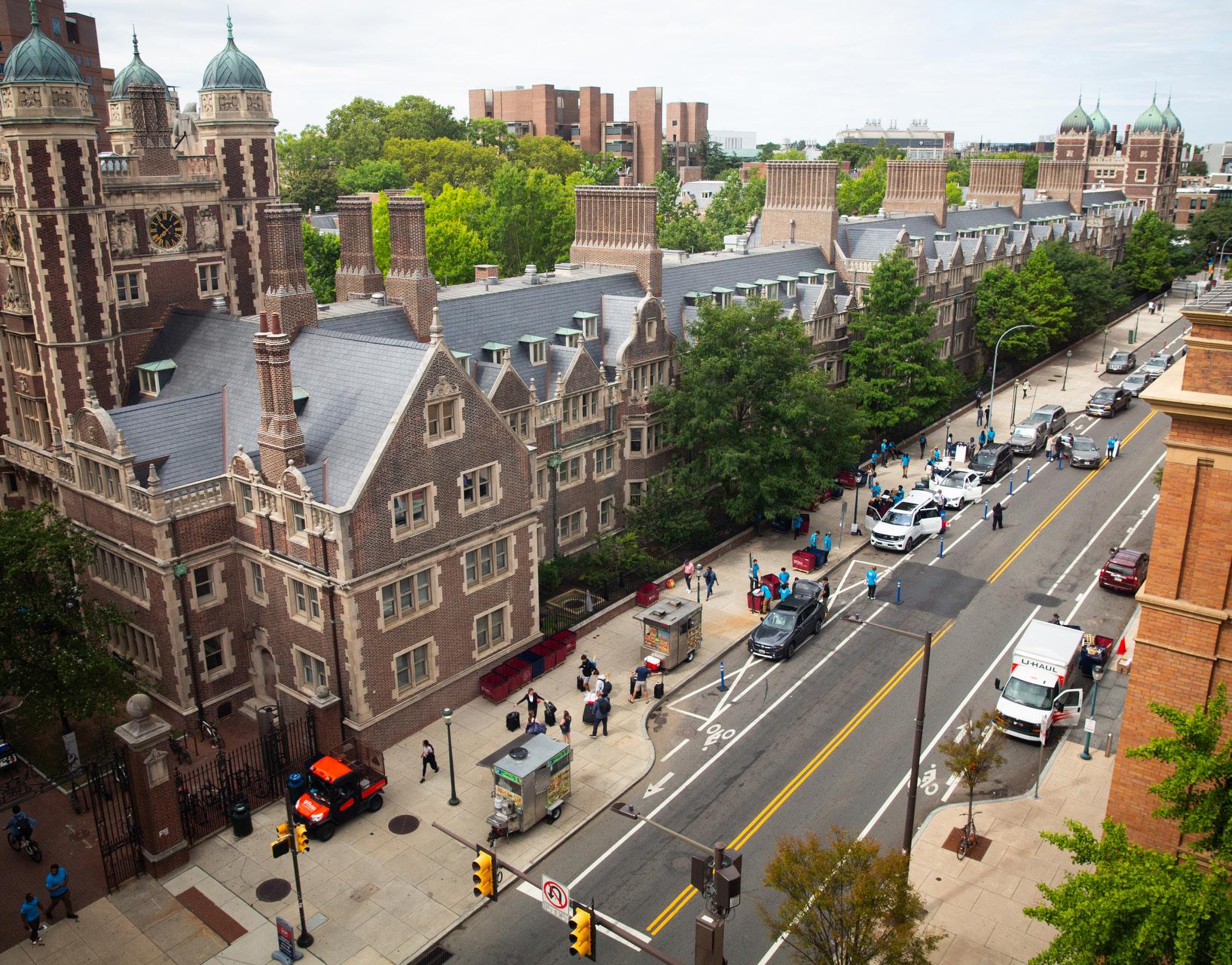
The University of Pennsylvania is supported by an integrated network of transportation options that make getting around simple and convenient.
Penn Transit , the University’s own transit system, helps students move safely and efficiently on and around campus. All Penn Transit services are free with a valid PennCard and run year-round (except on University holidays).
Penn Bus operates four fixed routes Monday through Friday: The Pennovation Works bus loops campus from 8 AM to 6 PM, and the East, West, and North routes travel between campus and the neighborhoods where students live, study, and gather from 4 PM to midnight (with the last bus departing at 11 PM).
Penn’s Evening Safety Shuttle is a free on-demand ride-share service that complements Penn Bus routes, operating daily from 7:30 PM (weekdays) or 6:30 PM (weekends) until 3 AM. Students request shuttles through the PennTransit Mobile app, which also allows riders to check schedules and track Penn Transit vehicles in real time from their phones. Download it via the Apple Store or Google Play.
Penn Accessible Transit (PAT) offers transportation for members of the Penn community with ongoing or temporary mobility needs. To gain access to PAT services, contact the Office of Disability Services at (215) 573-9235.
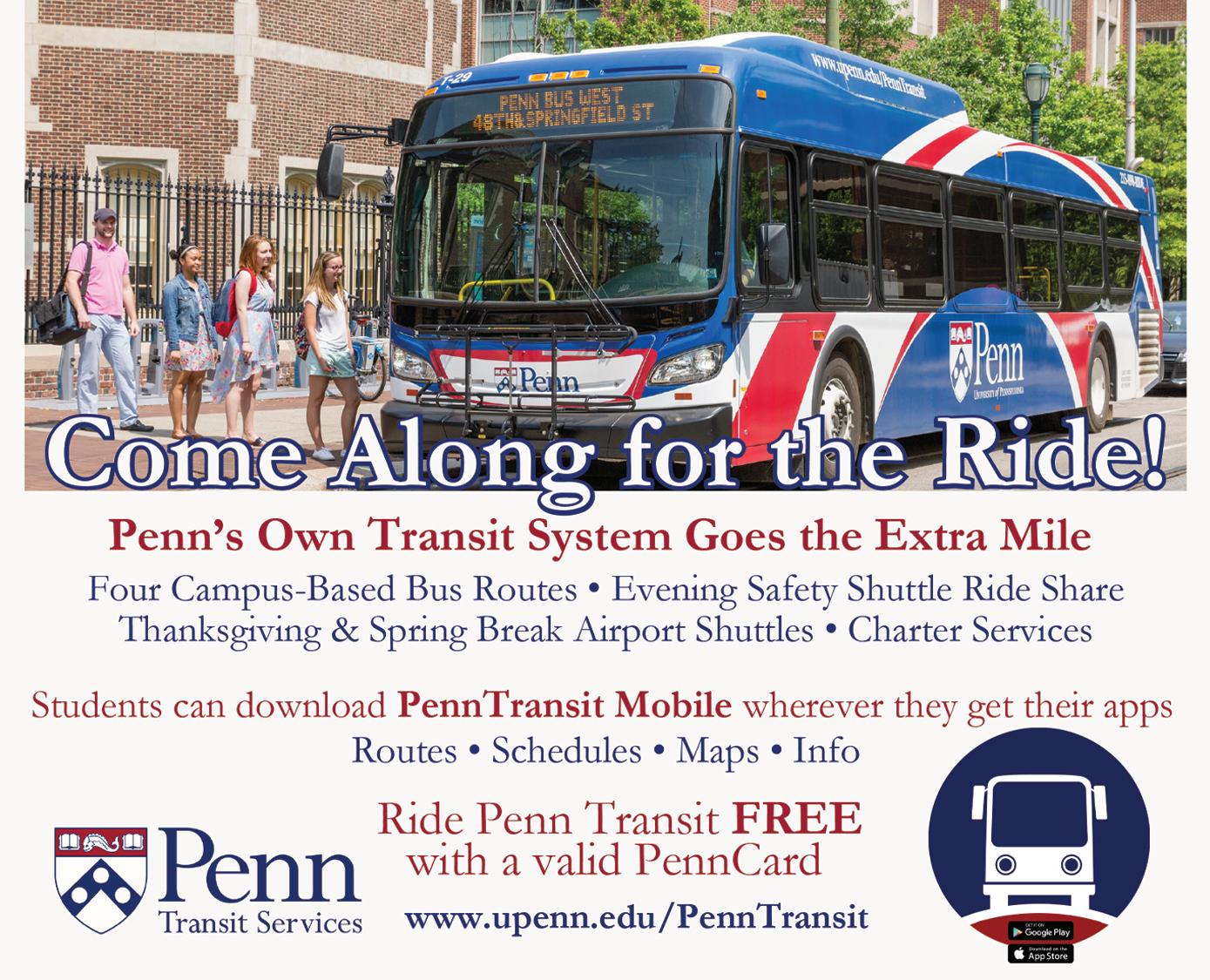
Students also have free PennCard access to two other neighborhood transit systems: Loop Through University City (LUCY) buses and the Drexel University bus system. SEPTA services are close by as well, connecting students with Philadelphia’s many cultural, shopping, and recreational destinations. SEPTA’s Airport Line runs every 30 minutes and stops at the Penn Medicine Station on campus as well as nearby 30th Street Station, making travel especially convenient.
For students who like to travel by bike, Indego Bike Share provides a convenient alternative to bringing a bicycle to Penn. Indego features more than 700 self-service bicycles at 250+ stations throughout
Philadelphia, including 6 on Penn’s campus. Students can purchase daily or monthly passes.
Finally, Walking Escort—a free service from Penn’s Division of Public Safety—makes specially trained uniformed security officers available to accompany students as they walk on or around campus 24/7.
Penn Transit Office
ͤ #520 Pennovation Works 3401 Grays Ferry Avenue Philadelphia, PA 19046
�� (215) 898-7433 Fax: (215) 573-4033
✉ transit@upenn.edu
�� upenn.edu/transportation




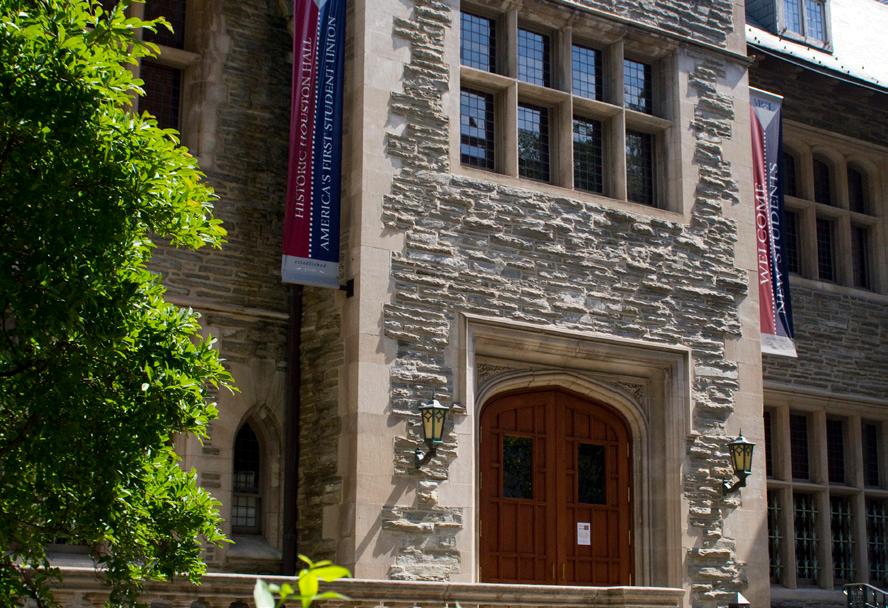
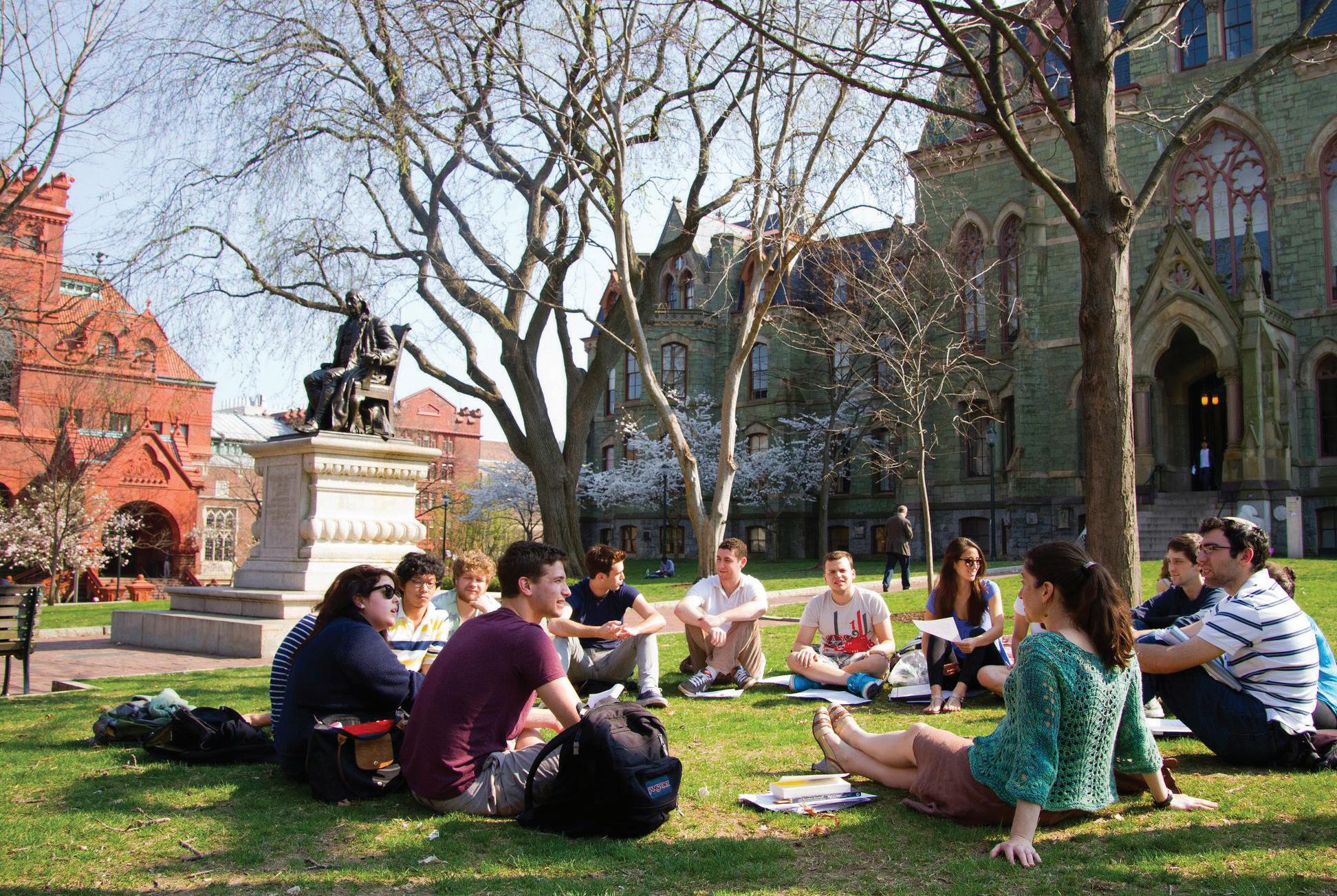
As the University’s foremost provider of student services and educational access, Division of University Life enhances the ability of Penn students to reach their fullest potential through diverse academic, personal, and professional development experiences in support of the Penn Compact.
The Division of University Life enriches the student experience beyond the classroom, offering opportunities for students to explore their interests, engage in meaningful experiences that shape their identities, build lasting connections, and find their place within the Penn community. Through leadership programs, social and cultural engagement, and comprehensive wellness and support resources, University Life fosters an environment where students grow academically, personally, and socially. From the moment they arrive on campus, students have access to a strong network
of support that helps them navigate challenges, discover themselves, and create a sense of home at Penn.
The 19 departments that make up the Division of University Life are organized into clusters. Collectively, the clusters are responsible for partnering to create a supportive and engaging student experience on campus.
Division of University Life
ͤ 3611 Locust Walk
�� (215) 898-6081
�� universitylife.upenn.edu
Through playful curiosity and exploration, University Life fosters engagement and leadership opportunities to promote personal growth and self-discovery for all students. Whether it’s Platt Performing Arts Center, Greek Life, Naval ROTC, student government, or one of the 800+ student clubs and organizations, students are equipped with the tools to make meaningful contributions to their communities, striving towards a life of purpose and fulfillment.
�� universitylife.upenn.edu/engagementleadership
University Life is home to six Cultural Resource Centers (CRCs) that enrich the campus environment through academic engagement, cultural celebration, and community building. These community hubs promote intercultural understanding and belonging. The centers work collaboratively to create welcoming and affirming spaces for all students to learn about themselves and their different communities on campus.
�� universitylife.upenn.edu/crc

University Life creates and sustains a culture of care and support for undergraduates, graduates, and professional students. From comprehensive mental health resource support and disability services to peer-led educational programs, students have access to multiple avenues for seeking assistance or guidance. It provides critical resources through a unique model of community care, case management, and education in collaboration with campus partners.
�� universitylife.upenn.edu/care-support
Each year, Penn holds Family Weekend, a time for you and your Penn student to enjoy events and activities oncampus. Family Weekend events traditionally include faculty presentations, campus tours, the chance to attend class with your student, and a wide variety of entertainment options. Family Weekend will take place October 23rd–26th 2026. Registration will open in the summer. Please visit osa.universitylife.upenn.edu/fw to check the status of any planned events, as well as register for the weekend.

Living on campus is an essential part of the Penn experience. Residential Services supports students living in the College Houses by managing residential spaces and connecting students to the resources that are central to campus life. On-campus living keeps your student close to where they learn, study, dine, socialize, and the services they need to thrive.
The Residential Services website, upenn. edu/housing , is updated throughout the year with con tact information, helpful links, and important dates for processes such as Move-In, Room Selection, Move-Out, and College House opening and closings that follow the University calendar.
Each College House is supported by a Residential Services Manager (RSM). The RSM manages the Information Center and is a great resource for students. The Residential Services staff provide guidance and assistance
throughout the year to help students navigate on-campus living, room selection, and off-campus housing resources if they choose to live off campus in the future.
Residential Services oversees many operations of campus living, including:
z Room assignments and billing processes
z Move-in and move-out coordination
z 24/7 front desk services through Residential Information Centers, which:
z Manage guest access
z Assist with room access and lock-outs

z Coordinate with Facilities and Real Estate Services on maintenance and repair issues
z Share College House-wide communications about services and community announcements
z Partner with the Division of Public Safety to ensure residential safety and security
z Mail and laundry services
Penn offers a two-year residential experience through its Second-Year Experience initiative, which includes a twoyear housing requirement. Students are required to live in a College House for their first four semesters, allowing them to fully integrate into the Penn community. Course units (CUs) or class standing will have no bearing on the requirement.
Residential Services supports this commitment by offering new and distinctive housing options that build on students’ first-year experiences in the College Houses. Students have the opportunity to live on campus through their fourth year at Penn.
Residential Services supports students throughout their housing journey at Penn beyond the College Houses. As students may consider off-campus living, Residential Services provides resources to help them make informed housing decisions. The Office of Off-Campus Services assists students by offering access to local rental listings, hosting an annual virtual offcampus housing fair, providing educational programs and individual advising, and sharing referral resources for questions related to landlords, tenants, roommates, and other aspects of off-campus living
Department of Residential Services
�� (215) 898-3547
✉ living@upenn.edu
�� upenn.edu/housing
Office of Off-Campus Services
�� (215) 898-8500
✉ ocliving@upenn.edu
�� upenn.edu/offcampusservices
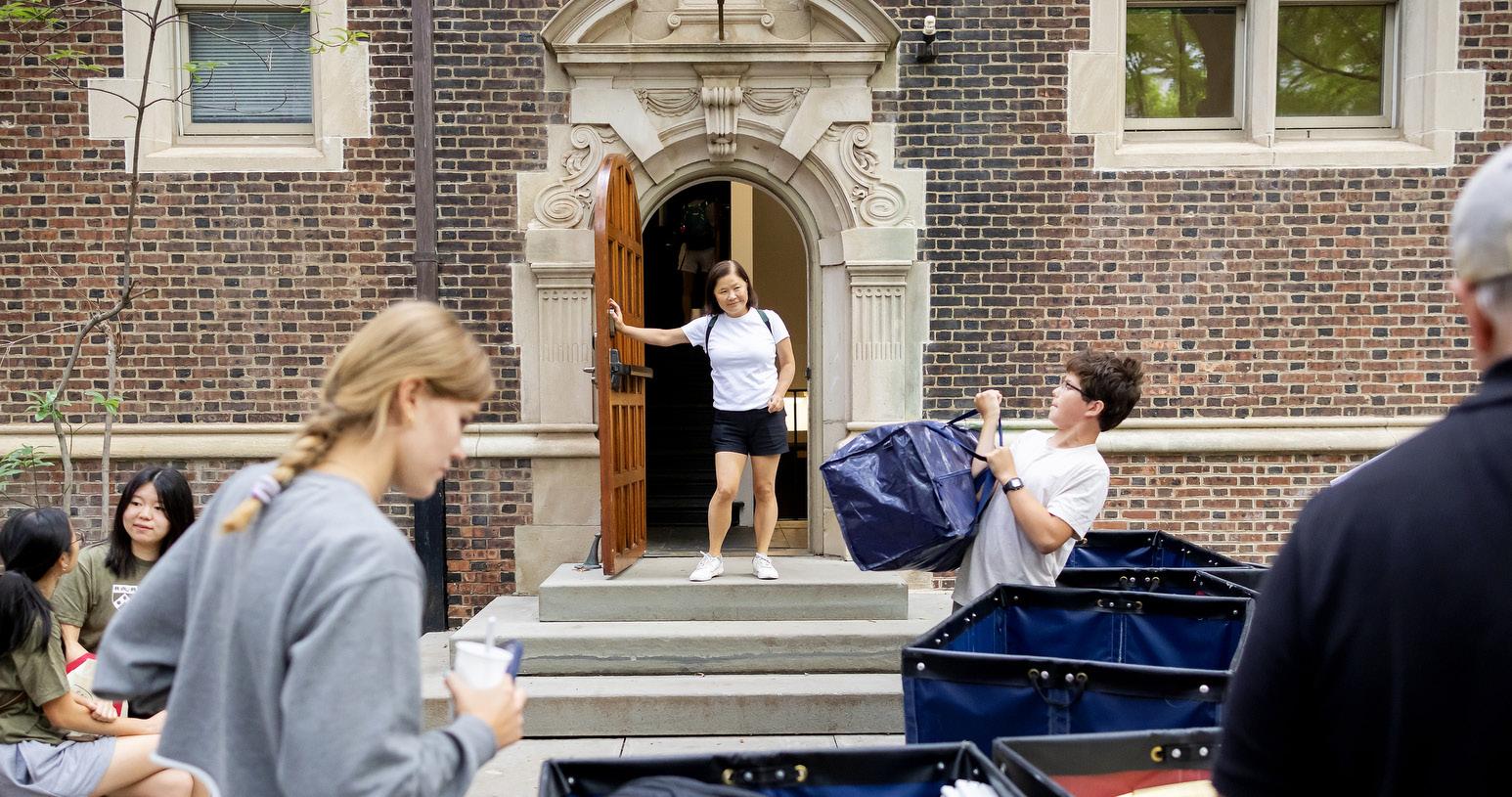
A student’s home is the cornerstone of college life, and at Penn there’s certainly a range of community options.
There are 13 College Houses, representing more than a century of architectural styles and offering a wide variety of accommodations, which serve as home to approximately 6,000 undergraduates.
College House life encompasses strong communities, close connections with live-in Penn faculty, fun and informative events, and leadership opportunities. The Houses also serve as contact points for student academic success and personal support via a 24-hour on-call system. CHAS works to provide an environment of belonging, conducive to academic success and enrichment for on-campus residents. Collectively, the Houses also offer over 25 smaller, tight-knit communities called Program Communities (PCs) that unite people who share a particular passion or
area of interest outside the classroom. From Women in Leadership to Healthcare Innovation, residents can gain enormous personal and pre-professional experience from membership in these communities. The Film Culture and Language & Culture Programs in Gregory, along with W.E.B. Du Bois' Zulu in Residence program, even offer academic credit for in-House participation. A complete list of communities is available online: collegehouses.upenn .edu/life.




Penn Dining is deeply committed to supporting your student’s health, wellbeing, and sense of belonging on campus. Dining is an important part of your student’s daily experience, and we take that responsibility seriously.
As the University’s food-service professionals, together with our partner, Bon Appétit Management Company, we oversee dining operations across campus and provide guidance on all food-related planning initiatives. Our mission is to deliver consistent, high-quality dining experiences for a diverse campus community. Penn Dining offers flavorful, nutritious meals in convenient campus locations, helping students feel nourished, connected, and at home at Penn.
Throughout all corners of campus there is a dining café located within 600 steps from where students live, work, and study. Meals center on fresh produce, whole grains, and lean and/or plant-based proteins, prepared with minimal amounts of healthy, plantderived fats. Vegan and vegetarian options are abundant throughout our cafés. Flavors are developed through skilled, healthy cooking techniques, with the use of fresh herbs and authentic spices, not through unhealthy shortcuts of using fat, sugar, salt, or processed foods.
Penn Dining believes good health is about the choices you make every day at every meal. Through creating conscious, healthy eating patterns, engaging with our community, and addressing the environmental issues surrounding food sourcing and food waste, we look at dining holistically. We focus on special dietary and nutritional needs through our on-campus Registered Dietitian Nutritionist.
With 14 locations on campus, students can explore a variety of dining options. Each
café has a unique feel and cuisine. Lauder College House offers a nightly featured entrée—a chef-curated special dish such as lobster mac and cheese. Quaker Kitchen (Gutmann College House) features a weekly rotating menu and a restaurant-like experience. Hill Café is known for breakfast all day and its weekend brunch. Parents and guests are always welcome to dine in any of our cafés.
Penn Dining takes our role in the community seriously by making socially responsible decisions in choosing produce, meat, seafood, eggs, and coffee. We also compost kitchen waste, use recycled materials in all our cafés, and donate leftover prepared food to organizations addressing food access in our community.
In addition to meal swipes and Dining Dollars, Penn Dining locations accept cash, credit, PennCash, and SFS credit in all residential and retail locations.
First- and second-year undergraduate students are required by the University to purchase a dining plan. First-year students can choose one of two plans. Second-year students can choose a first-year plan or a specific second-year plan. All plans are comprised of visits and Dining Dollars. Third- and fourth-year undergraduate students have the option to enroll in a dining plan and can choose between all available plans to find the best fit for their lifestyles.
Students can use their meal swipes (visits) in any of our six residential cafés, including 1920 Commons, English College House, Hill House, Lauder College House, Quaker Kitchen (Gutmann College House), and Falk Kosher Dining. Each time your student eats in a residential café, one visit is subtracted from the semester allowance. Additional visits can be purchased if your student runs
out. Guest visits are included as part of the semester allocation of meal swipes.
Dining Dollars can be used at any Penn Dining retail location across campus, including Starbucks and Gourmet Grocer in 1920 Commons, Houston Market in Houston Hall, Accenture Café in the Towne Building, Joe’s Café in Steinberg-Dietrich Hall, McClelland Café in the Quadrangle, the Pret-A-Manger in Huntsman Hall, Cafe West, the coffee bar in Gutmann College House, and the Farmer’s Market, located in front of the Penn Bookstore (Wednesdays, March–November). Dining Dollars can also be used at any of our residential cafés, although generally students use their visits at these locations. Each time a purchase is made, the amount is subtracted from your student’s Dining Dollars account balance. Additional Dining Dollars can be purchased if your student runs out.
Meal Exchange allows your student to use their swipes (visits) at most of our retail locations to get a complete meal. Meal Exchange is meant to provide an alternative option for students to utilize their meal swipes if scheduling or distance makes it difficult for students to get to a residential café for a meal. Meal Exchange is available at Gourmet Grocer, McClelland Café, Houston Market, Café West in Gutmann College House, Joe’s Café in SteinbergDietrich Hall, and Accenture Café in the Towne Building.
At Penn, we understand that each student is different, and therefore has different dining preferences. Each plan has the flexibility and convenience to meet students’ needs. Students can change their plans once
during the Dining Plan Change Period at the beginning of each semester.
When your student signs up for a dining plan on Campus Express, they will be asked to fill out a Special Dietary Needs Form.
Students are strongly encouraged to fill out this form so that the campus dietitian can assist them with their dietary needs. Bon Appétit at Penn Dining has a Registered Dietitian Nutritionist on staff who will be happy to answer any dietary questions you or your student may have.
Additionally, we have a Kosher café, as well as Halal and Jain food prepared on campus. Falk Café is our dedicated Kosher unit on campus. All food is prepared Glatt Kosher and under the supervision of the Community Kashrus of Greater Philadelphia. Kings Court English House is our dedicated Halal unit on campus. In partnership with Penn’s Muslim Student Association, Kings Court English House serves Halal meats within its All-YouCare-To-Eat café and prepares and seals all the grab-and-go Halal options you will find throughout campus. Our chefs will work with students to help meet any other religious dietary restrictions.
Have your student log in to their Campus Express account online at campusexpress.upenn.edu . When students log in, they will be able to select their dining plans. If they don’t choose a dining plan, they will be automatically assigned to our most popular plan. They can change their plans during the Fall Change Period, which takes place during the first three weeks of the semester.
Penn Dining Services �� (215) 898-3547 ✉ dining@upenn.edu �� upenn.edu/dining B @penndining

Your student has two convenient options to ship items to (and from) campus.
Mail and parcel delivery to the College Houses is managed by Residential Services. All other campus mail is managed by Penn Mail Services.
Amazon@Penn, located on campus at 3734 Spruce Street, offers a secure and convenient place for students to pick up Amazon orders. Amazon Student and Prime members also get Free Same-Day or OneDay Pickup on a wide selection of items. All Penn students are eligible to participate. Students shop for items they wish to purchase and, if they have a Free SameDay or Free One-Day account, choose Amazon@Penn as their shipping address during checkout. They will then receive an email or text message when their package is ready for pickup.
In order to ensure timely delivery, all parcels and mail sent to campus must use the official U.S. Postal Service address format. Specific information can be found at the Residential Services website upenn.edu/housing on the “Resources” page. Students should note that their mailing address is different than their campus residential address. Residents can contact housingmail@lists.upenn.edu for any questions about their mail service.
Residents can begin shipping their nonessential items to campus two weeks ahead of their move-in date.
Note: USPS “delivery confirmation” mail sent to campus is confirmed upon arrival at the Philadelphia Post Office before delivery to the Penn campus. In other words, a USPS confirmation of arrival does not confirm delivery to the student.








The dedicated members of the Division of Public Safety (DPS) are responsible for enhancing the quality of life, safety, and security of our community.
The Division of Public Safety delivers a comprehensive and integrated safety and security program in partnership with the community that we serve. Public Safety provides numerous resources to ensure your student’s experience at Penn is safe and secure.
Emergencies: (215) 573-3333 or 511 from any campus phone; 911 for Philadelphia police and fire departments.
General Information: (215 ) 898-7297
�� publicsafety.upenn.edu
Public Safety Security Officers will walk with your student anywhere in the Penn Patrol Zone. The FREE Walking Escort service extends between 30th and 43rd Streets and Market Street to Baltimore Avenue, 24 hours a day, 365 days a year. It also extends west to 50th Street and north/south from Spring Garden Street to Woodland Avenue, between 10 p.m. and 3 a.m. via the University’s partnership with the University City District Ambassador Program.
z Ask any Public Safety Officer on patrol or inside a building
z Call (215) 898-WALK (9255) or 511 (from campus phone)
z Use one of the many building and blue-light phones located on and off Penn’s Campus
�� publicsafety.upenn.edu/about/securityservices/#services
Penn Buses and Shuttles operate yearround except for holidays observed by the University, free of charge to all Penn community members holding a valid PennCard. Fixed route buses operate from 4 p.m. to midnight weekdays (Monday through Friday). Evening shuttles operate from 7:30 p.m.–3 a.m. seven days a week and offer door-to-door service via mobile app, PennTransit Mobile, which sends realtime vehicle location information directly to mobile devices.
Visit upenn.edu/transportation for more information.
The HELP Line is a 24-hour-a-day phone number for members of the Penn community who seek time-sensitive help navigating Penn’s resources for health and wellness.
Any member of the Penn community can utilize this service by calling (215) 898-HELP (4357). Calls are answered 24 hours a day, 7 days a week by Division of Public Safety professionals trained in mental health referrals by staff from Student Counseling.
Students dealing with the complex emotional challenges of university life can use the HELP Line to receive information and referrals to the many health and wellness resources at Penn, including Student Health and Counseling, Student Intervention Services, Public Safety, and
others. They may also call on behalf of a friend or acquaintance. Parents concerned about their student may also call the HELP Line for assistance.
The UPennAlert Emergency Notification System enables the University to quickly notify the Penn and surrounding Philadelphia community of critical information during significant emergencies. This is accomplished through three key methods: Personal Messaging; Siren and Public Address Systems; and the DPS Website.
Currently, the University can notify all Penn faculty, staff, and students through text messaging and email. The University also has siren and public address systems





in place to send a UPennAlert. When a UPennAlert is sent, the Division of Public Safety uses their website to provide current and continuous updates, acting as a central reference point for accurate information.
The effectiveness of the UPennAlert via personal electronic devices depends upon faculty, staff and student providing accurate and up-to-date personal contact information. Encourage your student to partner with the University in registering a cell phone number, as well as other emergency contact information, so that University officials can communicate in an emergency.
�� publicsafety.upenn.edu/pennready/ upennalert
Penn Guardian is a free app that is available to all Penn community members. It was developed by the University’s safety partner Rave Guardian, a service utilized on college campuses across the country.
Registering is easy — search “Rave Guardian” in the App Store for iOS devices or Google Play for Android devices. You will be prompted to enter your name, phone number, and Penn email address, which provides access to the University’s customized interface. Calls from a registered phone will allow Penn Police to determine your cell phone’s GPS location, which can decrease response time. This information will only be available to Penn Police if you call the PennComm Communications Center (PennComm) directly, either through the app or at (215) 573-3333
If a call is made to PennComm, and you are unable to speak — perhaps because of an allergic reaction — a call taker will send a text message to your phone. You can then communicate directly via text. The app also provides a confidential way to submit a tip to Penn Police — with a photo, if necessary — through a text message.
For more information, please visit the Penn Guardian website at publicsafety.upenn.edu / safety-initiatives/pennguardian .

The University of Pennsylvania is dedicated to providing a wide array of athletic opportunities at both intercollegiate and recreational levels that enhance the educational, physical and social well-being of Penn students.
The University of Pennsylvania fields 33 Men’s and Women’s intercollegiate sports teams. Penn students with a valid PennCard receive free admission to all Penn Athletics events including The Penn Relays, while supplies last. Penn Football and Basketball are the most attended events in the fall and winter social scene. The annual Homecoming football game, Big 5 basketball games and of course the PennPrinceton rivalry match ups make for some of the most exciting experiences for Penn students. Student ticket policies can be found at PennAthletics.com /students.
Gear up before getting to campus! Visit the Quaker Fan Shop at ShopPennAthletics. com to get the latest from your favorite teams. Parents wishing to tune in to watch web streams of Penn sporting events can do so on through ESPN Plus.
Penn Athletics Ticket Office
ͤ 235 South 33rd St, Weightman Hall Philadelphia, PA 19104
�� (215) 898-6151
�� PennAthletics.com/students
Penn Campus Recreation offers comprehensive programs and services to the University community. Activities include personal training, group exercise classes, premium classes, intramural sports, sport clubs, aquatics, massage therapy, an indoor climbing wall, an indoor golf simulator, and an outdoor adventure program. Campus Recreation provides an opportunity for individuals to pursue diverse recreational fitness and wellness activities during their time at Penn. Programs and services are offered in state-of-the-art facilities across campus including the David Pottruck Health and Fitness Center, Robert A. Fox Fitness Center, and Penn Park. For more information about the facilities, programs, and services of Penn Campus Recreation, please visit recreation.upenn.edu .
The Penn Squash Center and the Hecht & Hamlin Tennis Centers offer racquet sports services to the Penn community. Activities include court reservations, equipment rentals and private lessons. For more information on racquet sports offerings, visit pennracquetsports.com

Founded in 1963, ICA at Penn is committed to living artists and the cutting-edge art of our time. The museum presented Andy Warhol’s first solo exhibition in 1965 as well as significant shows of Agnes Martin, Robert Mapplethorpe, Glenn Ligon, Richard Artschwager, Karen Kilimnik, Lisa Yuskavage, and many others.
In The New York Times, critic Roberta Smith observed, “On a surprisingly regular basis, the tiny Institute of Contemporary Art ... mounts exhibitions that make the contemporary art adventures of many larger museums look blinkered, timid, and hidebound.”
ICA admission is always free.
ͤ 118 South 36th St Philadelphia, PA 19104
�� icaphila.org
Morris Arboretum & Gardens
Morris Arboretum & Gardens is a breathtaking oasis where nature is always changing. Explore vibrant seasonal gardens, winding woodland paths, bubbling
fountains, and an extraordinary collection of majestic trees all nestled on 92-acres in Northwest Philadelphia.
Perfect in every season, the Morris features special events and exhibitions throughout the year for visitors of all ages. Located just 13 miles from Penn’s campus, it is easy to reach by car, bike, or public transportation. General admission is free with a PennCard.
ͤ 100 East Northwestern Ave Philadelphia, PA 19118
�� (215) 247-5777
�� morrisarboretum.org
Founded in 1971, Penn Live Arts at the University of Pennsylvania is a major cultural destination and crossroads in the performing arts, connecting Philadelphia regional audiences and the University of Pennsylvania through exposure to innovative human expression in theatre, music, and dance.
ͤ 3680 Walnut St Philadelphia, PA 19104
�� pennlivearts.org


(University of Pennsylvania Museum of Archaeology and Anthropology)
Home to over a million extraordinary objects, the Penn Museum has been highlighting our shared humanity across continents and millennia since 1887. Highlights include the 25,000-pound red

Activities of interest for students include “Making Workshops,” research opportunities, the Great Lecture Series, internships, and fellowships, cultural film screenings, as well as the Clio Society. Named after the Greek Muse of history, the Clio society gives students a platform to enhance and strengthen their undergraduate experience through the Museum’s many resources. Clio brings together students who share a common interest in and appreciation for museums, culture, and art.








Campus
Operator
�� (215) 898-5000
Parking
�� upenn.edu/parking
Penn Transit Services
�� (215) 898-RIDE (7433)
�� (215) 898-WALK (9255)
�� upenn.edu/PennTransit
Weather Emergencies
�� (215) 898-MELT (6358)
Undergraduate Schools
The College of Arts and Sciences
�� college.upenn.edu
School of Engineering and Applied Science
�� seas.upenn.edu
School of Nursing
�� nursing.upenn.edu
The Wharton School
�� wharton.upenn.edu
Academic Advising
College of Arts and Sciences
�� (215) 898-6341
�� college.upenn.edu/advising
School of Engineering and Applied Science
�� (215) 898-7246
�� seas.upenn.edu/undergraduate/advising
School of Nursing
�� (215) 898-6687
�� nursing.upenn.edu/students
The Wharton School
�� (215) 898-7608
�� undergrad-inside.wharton.upenn.edu
Life at Penn
Alumni Relations
�� (215) 898-7811
�� alumni.upenn.edu
Career Services
�� (215) 898-7531
�� careerservices.upenn.edu
International Student & Scholar Services
�� (215) 898-4661
�� global.upenn.edu/isss/contact-isss
Netter Center for Community Partnerships
�� (215) 898-5351
�� nettercenter.upenn.edu
New Student Orientation & Academic Initiatives
�� (215) 898-7000
�� nso.upenn.edu
Office of the Chaplain
�� (215) 898-8456
�� upenn.edu/chaplain
Office of Fraternity and Sorority Life
�� (215) 898-5264
�� ofsl.vpul.upenn.edu
Office of Student Affairs
(including Family Weekend Information)
�� (215) 898-6533
�� osa.vpul.upenn.edu
Penn Abroad
�� (215) 898-9073
�� global.upenn.edu/pennabroad
Penn Athletics
�� (215) 898-6151
�� pennathletics.com
Penn Hillel
�� (215) 898-7391
�� pennhillel.org
Penn Student Agencies
�� (215) 898-6815
�� psa.vpul.upenn.edu
Penn University Life
�� (215) 898-6081
�� universitylife.upenn.edu
Weingarten Center
�� (215) 573-9235
�� wlrc.vpul.upenn.edu
Offices and Services
Wellness at Penn
�� (215) 898-7021
�� wellness.upenn.edu
Division of Public Safety/University of Pennsylvania Police Department Campus Emergency Number:
511 from any campus phone or
�� (215) 573-3333
Available 24 hours a day/365 days a year
�� publicsafety.upenn.edu
Office of the Registrar
�� (215) 898-6636
�� srfs.upenn.edu/registrar
Office of Undergraduate Admissions
�� (215) 898-7507
�� admissions.upenn.edu
Penn Dining
�� (215) 898-3547
�� upenn.edu/dining
Penn Parents Outreach and Development
�� (215) 746-4646
✉ ppparent@dev.upenn.edu
�� pennparents.upenn.edu
Residential Services
�� (215) 898-3547
�� upenn.edu/housing
Student Financial Services
�� (215) 898-1988
�� srfs.upenn.edu
Wellness at Penn: Student Health and Counseling Counseling:
�� (215) 898-7021 (24/7)
Medical care:
�� (215) 746-3535 (24/7)
�� wellness.upenn.edu/student-health-andcounseling
Wellness at Penn: Public Health and Wellbeing
�� (215) 898-0300
�� wellness.upenn.edu/public-health-andwellbeing