C
MYSTIC CIT Y
Collegian
TIMES SPRING 2015
JUJU Students Find
Magic and Mystery in Cameroon
INSTANT CHEMISTRY Fate’s Match Sequenced in Lab
TONGVA MYSTIC PLACES
Hallowed Ground under LACC
The Usual Suspects for Excellence in Journalism Since 1929 2015 Winners of California College Media Awards (CCMA)
ENROLL NOW! DESIGNERS, REPORTERS, ILLUSTRATORS, EDITORS, PHOTOGRAPHERS, CARTOONISTS - RADIO, ONLINE, MULTIMEDIA - LEARN IT ALL. Journalism 217-1, Publication Laboratory Journalism — 218-1, Practical Editing — Journalism 219-1, Techniques for Staff Editors Third Place for Best Newspaper Column: Byron Umana Bermudez Third Place for Best News Series, Non-Weekly Division: Clinton Cameron, Richard Martinez and Holly San Nicolas Second Place for Best Feature Story, Non-Weekly Division: Clinton Cameron Third Place for Best News Photo, Non-Weekly Division: Curtis Sabir Third Place for Feature Photo, Non-Weekly Division: Richard Martinez
SCAN QR CODE TO WATCH THE JOURNALISM 101 BROADCAST PROJECT
Do you snore? Have you had a Sleep Study?
We are performing a research study at Children’s Hospital Los Angeles on 13-21 year olds who are overweight, and who snore or have obstructive sleep apnea syndrome. Our study is aimed at finding out why there are different types of breathing problems during sleep and what causes them. The Study is being conducted by Dr. Biswas Joshi and Dr. Sally Ward. If you’re eligible, we’ll then ask you to come to the hospital and USC for special testing of your breathing responses during sleep and imaging of your neck while you sleep. Besides learning more about your health, you will get up to $250 for your participation!
To participate please call Research Coordinator: Alejandra Franquez (323)361-7315 CCI 10-00177 Principal Investigator: Dr. Sally Ward
2 Spring 2015 – Collegian Times
C
Collegian
LETTER
FROM THE
EDITOR
T
here is magic in these lands. Oracles and strongmen, queens who play jester and technicians of shadow and light walk among us – hidden in plain sight. Inside these pages, they emerge ready to share their stories, talents, imagination and majesty. Dare to look? I beseech you, dear reader; turn the page, for inside this magazine stories unfold to enthrall and transport beyond the world you thought you knew. Turn the page and witness the power of the people to rise in unison to demand change. Look into their eyes and see in them a powerful, hopeful supplication for a better future. Then, look inward as we explore the greatest enigma of the human condition: love. Is the secret to love hidden in our blood? Are soul mates sequenced deep within our DNA?
Turn the page and – through the eyes of L.A. City College students – experience what life is like for people in the African nation of Cameroon. Gaze upon its lush green landscapes where the Juju; men of magic and mystery walk the land and command the respect of all who encounter them. See them dance in a ritual whose purpose is privy only to them. Read on and meet the descendants of the once mighty and thriving Tongva tribe, whose deeprooted legacy in the City of Angels is finding new ways to rise up from beneath the dusty veil of our ever-bustling city. Welcome, dear reader, to our Mystic City. Uncover its wonders within. Richard Martinez Editor-in-Chief
ON THE COVER
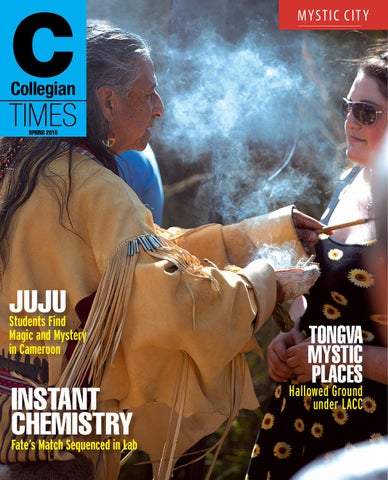
PHOTO BY JESSICA BRECKER Native American healer Danny Ramos performs a cleansing ritual at Kuruvungna Springs, a sacred Tongva site located on the University High School campus in West Los Angeles.
TIMES SPRING 2015
EDITOR-IN-CHIEF RICHARD MARTINEZ MANAGING EDITORS CLINTON CAMERON ANDE RICHARDS PHOTO EDITOR CURTIS SABIR REPORTERS JESSICA BRECKER EKATERINA GARBUZOVA JAKE CAMARENA PHOTOGRAPHER FRANCISCO VIDRIO ILLUSTRATOR JOSE TOBAR MULTIMEDIA PRODUCER DAVE MARTIN GRAPHICS CONSULTANT BEATRICE ALCALA ADVISER RHONDA GUESS
PHOTO COURTESY OF BRIAN BARTELT People in the Cameroonian village of Oku look on as Juju perform a ceremonial dance in 2013. Dancers wear ornate masks that hide their identities to the public.
The college magazine is published as a learning experience offered under the college journalism instructional program. The editorial and advertising materials published herein, including any opinions expressed are the responsibility of the student staff. Under appropriate state and federal court decisions, these materials are free from prior restraint by virtue of the First Amendment to the United States Constitution. Accordingly, materials published herein, including any opinions expressed should not be interpreted as the position of the Los Angeles Community College District, Los Angeles City College, or any officer or employee thereof. ©2015 Los Angeles Collegian. No material may be reprinted without the express written permission of the Collegian. Spring 2015 – Collegian Times 3
23
Fashion’s a Drag, Sister
CONTENTS REPORTERS’ NOTEBOOKS 5 16
Seer’s Visions Come into Focus Horses Energize Moscow Hippodrome
FEATURES 6 11 18 26
Photographer Gets His Shot City Origins: On the Trail of the Tongva Educating Minds, Opening Hearts to Cameroon Science of Love
PHOTOFOCUS 10
Status Quo: No Go
FASHION 22 24
Nunway: Sisters Strike a Pose at the Altar of Beauty Sizzle in Summer: Dress at your own Risk
4 Spring 2015 – Collegian Times
18
Going the Distance: LAX to Limbe, Cameroon
Reporter’s
Notebook
PHOTOS BY CURTIS SABIR Portrait of a psychic: Robert Cook has been available for readings to the citizens of East Hollywood since 2009. The palm reader has had visions of the future and past since he was a child.
SEER’S VISIONS COME INTO FOCUS
H
e had a vision. Before the earlymorning blaze, he dreamt of being a few doors away, coffee in hand at the donut shop just west of his psychic storefront on Santa Monica Boulevard. It is just footsteps from L.A. City College. Something told him to stay at the donut shop and drink his coffee. There were days when he would get his coffee for takeout and return to his psychic cubbyhole to sip his brew. Robert Cook’s home base is sandwiched between a tattoo parlor and a Pentecostal church that sells vitamins and health food products. First you CURTIS can get a crazy tattoo. Then, step out SABIR to the next storefront to find out what your future holds from Robert. Then repent, as you walk next door to nourish your soul and your body. Get it? The early-morning fire only caused smoke damage to the psychic’s store, but the tattoo parlor and the church sustained major damage. While the premonition of the fire was hazy, some visions are razor sharp. Like the vision he first saw during childhood. Robert says his earliest psychic vision is of World War II – ships ablaze and men jumping overboard. They run for their lives fleeing explosions and the scene of destruction. “They were jumping in the water looking for safety and trying to get to safety,“ Robert says of the chaos in his vision. “It makes trouble inside you forever. It stays with you forever. You never get rid of that feeling.” The visions left Robert with questions. He says he had to know, ”Why?” He did not have to go far to get answers. He says his grandmother, Anna-Marie, is also psychic, and they were very close when he was a child growing up in New York. “You know son, this is what’s [going to be] and this [is what’s going to be], and this is why you know things. You are going to learn how to handle it.” I came across Robert one day as I walked to campus. He is an elderly gentleman with steel-gray, mostly straight
hair. Age lines and the marks of life are chiseled into his face. Robert sat right at the door to his shop, observing the foot traffic that meanders by his storefront every day. Out of the blue he began to speak. “You can come take my picture any time,” he said. “Cool,” I replied as I noticed a two-foot high, red palm with a single ocean-blue star above each finger in the window behind him. Above the palm, sunshine-yellow letters spell “P-SY-C-H-I-C.” Behind Robert, a poster of a wizard with a long, white beard is visible. The wizard holds a staff with what appears to be a pearl set in a gold cap in his left hand. He extends a crystal ball in his right hand. I thought to myself this was worth a photo essay. Mind you, I am not a believer in people being able to tell the future just by looking at the lines on the palm of your hand, but all things spiritual have always fascinated me. Robert’s childhood vision also shows the war’s end. He sits back in his chair with his hands folded. He speaks slowly as he gazes back, reliving the moment. “Settling the war, being quiet, the after effects, the fix. To forgive and to make better, make better for everybody,” he says. “Don’t accuse everyone of the war. Those that were involved, they were partakers like you and me.” Robert’s visions are not always about death and destruction. Some are comforting and calm, like visions of “the lake.” They reassure a client that everything is going to be fine. One scene reoccurs. “[I see] a lake with small waves and sand, it means comfort, to be comforted,” he says. “When you walk there it’s warm, and people walk there because they need to be comfortable. And that’s what that vision means, comfort.” Whatever Robert says, I just let him talk. I do not feel it is my place to interrupt him. Here is a man who seems to have witnessed trials and tribulations in the physical world around us and beyond. He sees the things people hope for in their lives, and things they wish to avoid. He has made himself available to all who have a desire to know their future.
Guiding hands: Robert Cook advises his clients on a variety of issues from his psychic cubbyhole on Santa Monica Boulevard, near L.A. City College. Robert lives an austere life. Inside his space you will find a couple of metal-framed chairs, with black leather-like cushions. They are the kind you find in neighborhood doughnut shops. There is also a small couch and a living room chair with a folding TV dinner table placed in front. The walls are painted yellow, and salt and pepper tiles decorate the floors. A curtain sections off an area in the back. This stretch of Santa Monica Boulevard has been his home since 2009. One of his most memorable readings happened here. A woman with problems came to Robert for advice. He says he performed a reading. “She came back two or three days later and she wanted me to read her again,” Robert says. ”I said, ‘But that’s not you.’” “How do you know?” the woman asked. “Are you the twin sister, or what?” Robert asked. “Nobody knows that. How do you know that?” the woman asked Robert. “Because of the smell, Robert answered. ”You don’t have the smell.” “You can sense it?” the woman asked. “Yes,” he said. Spring 2015 – Collegian Times 5
PHOTOGRAPHER GETS HIS SHOT California was not immune to racist attitudes and unwritten Jim Crow laws, which enforced segregation during the 1950s. AfricanAmerican residents watched freeways built to bypass their neighborhoods rather than accommodate them. African-Americans often rented properties from white slumlords that were neglected and isolated from the rest of the city. A counterculture emerged from these conditions. Photographer Henry Walton preserved the character and integrity of this culture in black and white stills. He used a Hasselblad camera, an objective eye and a lens that managed to focus on how to include rather than isolate a community and its significance. 6 Spring 2015 – Collegian Times
PHOTO BY LUCA LOFFREDO Henry Walton stopped attending classes at Los Angeles City College after a photography instructor criticized him for using a black woman as the subject for a portrait assignment. Fifty years later and through a series of serendipitous encounters, Walton received an honorary degree last year. Walton’s graduation ceremony in June 2014 coincided with the 50th anniversary of the 1964 Civil Rights Act.
H
enry Walton aspired to be a photographer when he enrolled at Los Angeles City College in 1958. However, his time at the college was shortlived. He stopped attending classes after a photography instructor criticized one of his first assignments – a portrait of a black coed. The instructor deemed Walton’s subject “unacceptable” for black and white film. It was the instructor’s dismissal of his work, CLINTON Walton says, that discouraged CAMERON him from continuing collegelevel studies in photography. “Looking back on it now,” Walton says. “I realize I went into a state of depression. I didn’t recognize it as that at the time … I just stopped coming to school.”
An Eye for South Los Angeles Walton delved into the world of amateur photography in the 50 years after he dropped out of City College. His camera captured many historic moments of the civil rights movement in Los Angeles. He took rare photographs of the aftermath of the Los Angeles Police Department’s raid on the Black Panther headquarters in 1969. He drove an ambulance, which allowed him access to the scene at 4115 S. Central Ave. His photos of the Black Panther headquarters and surrounding area depict bullet-ridden windows, the message “Arm Yourselves” spray-painted next to a first story window of an apartment building and “Sons of Watts” stenciled onto an oil barrel in an alley nearby. “I also belonged to a group called the ‘Photographic Medium,’” Walton told the audience gathered at an exhibit called “My Old Familiar Places,” at the L.A. City College Da Vinci Gallery last
I GOT TO A PHONE BOOTH AND CALLED THE PRESIDENT [OF PHOTOGRAPHIC MEDIUM] AND I TOLD HIM WHAT WAS GOING ON, AND WE SENT A BUNCH OF YOUNG PHOTOGRAPHERS IN THERE AND TOOK PICTURES, AND ACTUALLY I THINK THAT’S THE ONLY RECORD OF THAT PARTICULAR EVENT.
-HENRY WALTON
year. The solo exhibit featured Walton’s original prints from 1965 to 1975. “I got to a phone booth and called the president [of Photographic Medium] and I told him what was going on, and we sent a bunch of young photographers in there and took pictures, and actually I think that’s the only record of that particular event,” Walton said. A local church purchased his photos of the LAPD raid and put them on exhibit throughout the U.S. and beyond – as far as Vietnam, according to Walton. From then on, Walton’s subjects included other activist groups. He photographed the United Slaves (US), a rival black power group to the Black Panthers, and the Sons of Watts, a group formed to monitor the police. He consistently focused his lens on the black community. Pictures of the Black Panthers and US reveal his ability to capture candid shots from rival organizations within the same community. Beyond South Los Angeles Throughout the years, Walton moved from South L.A. to the South Bay, the San Gabriel Valley, the San Bernardino Valley, and to the Westside neighborhood of Mar Vista. “I’ve been all around the Southern California area,” Walton says. “I am surprised I remember all of those places.” It was sometime between 2003 and 2006 that he moved to Macarthur Park near downtown Los Angeles. There he met Cori Alegria. He had no idea at the time that Alegria would play a key role in righting a past wrong. She responded to an ad in a newspaper from a filmmaker looking for local artists to feature in a documentary. Walton responded to the same ad. “We both showed up at the Rec. Center [in Macarthur Park],” Alegria says. “That was the beginning.” Soon after they met, Alegria helped Walton schedule shows and solo exhibitions at various galleries and venues, including the il Tramezzino restaurant at the UCLA Anderson School of Management. By 2012, his collection of photographs captured the attention of more than half a dozen galleries in Los Angeles. Walton’s Story Inspires Action It was at il Tramezzino that Alegria introduced Walton to Daniel Marlos, chair of the media arts department at Los Angeles City College. “I wanted to involve Dan Marlos,” Alegria says. “That’s what I do. I coordinate my people to meet.” Walton opened up to the photography professor. He told Marlos how one professor’s comment so
PHOTO COURTESY OF HENRY WALTON Henry Walton photographed this woman on the Los Angeles City College campus during the late ’50s. Walton’s instructor told him she was not an appropriate subject for black and white photography because of the color of her skin. Discouraged, Walton stopped attending the class and received a non-passing grade. long ago, caused him to abandon formal studies in photography. Walton’s story moved Marlos. He encouraged the photographer to complete the course he had started more than 50 years earlier, and assured him the experience would be different. “I told Henry to consider enrolling in my class,” Marlos says. “I would teach him how to expose film correctly, especially for people with darker skin tones.” Walton enrolled in Marlos’ class and completed it with an “A.” However, after taking into consideration Walton’s past treatment at the college and his contributions to the community, Marlos says he decided Walton deserved more than a passing grade in photography. “I thought that Henry was sort of like the perfect person to recognize what students were going through on this campus 50 years earlier and the obstacles that many of them may have faced at the time,” Marlos says. He submitted a resolution to the LACC Academic Senate to award Walton an honorary degree. On March 27, 2014, it passed 35 to one in favor of Walton. Walton’s graduation ceremony in June 2014 coincided with the 50th anniversary of the 1964 Civil Rights Act. It was no coincidence.
“I just thought it was really a nice opportunity to tie Henry’s personal struggles with civil rights and his personal documentation of the civil rights movement,” Marlos says, “as well as to honor him with a degree that he should have earned many years ago.” In the intervening years, Walton set aside his dream of a photography degree. He pursued other studies, and by 2003 he had earned an associate degree in political science from L.A. Valley College, and a bachelor’s degree and a master’s in human services from Springfield College in Massachusetts. An Honor Awaits at Commencement Walton arrived more than two hours early for the 2014 commencement ceremony in June. He found shade where he could as he waited in line to enter the Greek Theatre in Griffith Park. Cap-and-gown uniformity disguised the excitement and disorderly conduct in the line. Once it was time to enter, faculty members dressed formally in cap and gown restored order and the students marched in unison to the floor seating area. Cheers, screams and whistles from relatives, friends and supporters sounded out as graduates walked to their seats. Spring 2015 – Collegian Times 7
Walton sat with more than 500 fellow students. He waited through the national anthem, an invitation from the chancellor for students to take selfies, introductions and speeches, and then he heard his name called from the stage. “Henry Walton embodies perseverance,” California Senate President Pro Tem Kevin De León told the graduating students and their families and friends. “This is a man who has continued his love for photography, taking pictures of the beauty of South L.A.” Los Angeles Community College District Chancellor Francisco Rodriguez and LACC President Reneé Martinez presented Walton with his long overdue degree in applied photography. “Mr. Walton, on this 50th anniversary of the civil rights movement, we present this degree to you with great respect,” the chancellor said. “It is my great pleasure on behalf of the Board of Trustees of [the] Los Angeles Community College District to present this honorary degree to Henry Walton – an associate of arts in applied photography. Congratulations, Mr. Walton.” Walton maneuvered his way to the stage at a moderate and careful pace. He appeared humbled yet proud as he shook hands with the chancellor and the president and accepted his degree. “That’s better than my master’s,” Walton said, as he studied the degree. A Reunion at the Ceremony It appeared things had come full circle, until Walton heard a woman call his name. It was the voice of Homeselle Smith, one of Walton’s former classmates from the 1950s. She attended the ceremony to watch her goddaughter graduate. President Martinez’s final remarks echoed through the sound system, and drowned out Smith’s calls to Walton. “This marks the end of the formal graduation ceremony,” said Martinez as Kool and the Gang’s “Celebration” blasted through the sound system. “I know you want to go celebrate.” Smith’s voice competed with the commotion of the crowd and the music, but she finally got Walton’s attention from her wheelchair. “Henry! Henry!” she called. “I knew that was you.” Smith and Walton first met more than 50 years ago at Ben’s Café, a local restaurant where black students felt comfortable meeting. Smith studied English and poetry and was involved in the Watts Writers Workshop while Walton studied photography. “We felt comfortable there and in the Student Union,” Smith says. Walton entertained the idea that Smith’s image could have been the subject of the assignment his instructor rejected more than five decades ago. Smith, however, says it is not hers, and she is not familiar with whose image Walton captured. It remains a mystery. “It’s no longer a racial issue,” Walton said as he left the ceremony. “To call it an issue is too much. It was a particular racial point about which the guy was wrong, and history has proven him wrong. How many good pictures are there of dark skinned people, of black people, of people of every race, of every ethnicity of the world? That’s not what photography was about. He was simply looking from the wrong angle and seeing the wrong thing, and I’m sure over the years even he realized that.” 8 Spring 2015 – Collegian Times
IT’S NO LONGER A RACIAL ISSUE. TO CALL IT AN ISSUE IS TOO MUCH. IT WAS A PARTICULAR RACIAL POINT ABOUT WHICH THE GUY WAS WRONG, AND HISTORY HAS PROVEN HIM WRONG. HOW MANY GOOD PICTURES ARE THERE OF DARK SKINNED PEOPLE, OF BLACK PEOPLE, OF PEOPLE OF EVERY RACE, OF EVERY ETHNICITY OF THE WORLD? THAT’S NOT WHAT PHOTOGRAPHY WAS ABOUT. HE WAS SIMPLY LOOKING FROM THE WRONG ANGLE AND SEEING THE WRONG THING, AND I’M SURE OVER THE YEARS EVEN HE REALIZED THAT. -HENRY WALTON
PHOTOS COURTESY OF HENRY WALTON Left: A sidewalk view of the Los Angeles Black Panther Headquarters at 41st and Central Streets, hours after a raid by Special Weapons and Tactics Team (SWAT) on Dec. 9, 1969. Three SWAT Team members and three Black Panther members were wounded during the four-hour standoff. The raid marked SWAT’s first official mission in the country. Top: Two children pose on the front porch of a home located in Watts, California during the mid to late ’60s. Bottom: Female members of US (United Slaves), a political group that rivaled the Black Panthers, watch the first Watts Festival parade through the intersection of 103rd and Central Streets during the late ’60s. Spring 2015 – Collegian Times 9
STATUS QUO: NO GO
PHOTOS BY CURTIS SABIR
C
ivil unrest has become an unrelenting undercurrent of daily life. Tension simmers across political, racial and socio-economic lines, and in Los Angeles citizens have participated in, and witnessed protests that confront the issues that plague society. Tragedy The word “OUT” was written on masks that muzzled the mouths of protesters in Los Angeles’ Koreatown on May 18, 2014. Dressed in black and brandishing bright yellow signs, over 400 people echoed demonstrations staged in Korea and cities around the world. Protesters rallied against the inadequate response by the Park Geun-hye government to the fatal ferry accident that took place in Sewol, South Korea where hundreds of people, mainly high-school students, drowned on April 16, 2014. ANDE RICHARDS
Murder A Los Angeles coroner’s autopsy report exposed the muzzle imprint on the back of Ezell Ford, a mentally disabled man killed by police on Aug. 11, 2014. This revelation was the spark that ignited protest marches that spilled onto the 110 Freeway where protesters’ voices mingled in solidarity with the honking horns of commuters.
Beaten and killed for being themselves, transgender men and women and gender nonconforming people are murdered in increasing numbers. The epidemic of violence is not unnoticed, and many in the LGBTQ community responded with street marches that proclaim, “Trans lives matter!” Protesters emulated death; donning fake blood and lying down in the street, while others clutched signs with the message “Stop killing us.” Death by cop Marchers converged in downtown Los Angeles from points east, west, north and south. In the east, 19-year-old Kendrec McDade was shot by two Pasadena officers in 2012. In the west, 35-year-old Douglas Zerby was shot by two Long Beach police officers in 2010. In the north, 22-year-old Gabriel Lopez was shot by three San Fernando officers in 2014, and in the south, 25-year-old Ezell Ford was shot by the LAPD in 2014. Death by Cop protesters decorated cardboard coffins with messages, prayers, hand-drawn flowers and photos with the names of those who lost their lives at the hands of law enforcement. The rally cry was for accountability, education and reform.
Economy Protesters chanted “We want 15” to the beat of drums and the music of a full band that played on a truck parked outside a McDonald’s on April 15, 2015. Minimum wage has lagged behind cost-of-living increases for years. Labor leaders and community activists got organized and galvanized their voices to speak out for a living wage. The result: California is slated to be the first state to increase the minimum wage to $15 by 2020.
Acknowledgment The Centennial that marked the mass murders of the Armenian people by the Ottoman Empire, now Turkey, was celebrated with commemorative marches and ceremonies worldwide. One hundred sixty five thousand ArmenianAmericans crowded the streets in Mid-City Los Angeles to honor their ancestors with songs and poems. They waved flags and held photos of loved ones lost on a very different march – the notorious death marches. Their one demand was that Turkey own up to the genocide of their people.
Identity Aniya Parker slowly walked across the street and sat on the curb in her East Hollywood neighborhood after being fatally shot in the head on Oct. 2, 2014.
The fight continues with each new cause, incident or loss of life. People are awake and vigilant. They keep watch and take action. David still stands up to Goliath.
10 Spring 2015 – Collegian Times
CITY ORIGINS
On the Trail of the Tongva PHOTOS BY JESSICA BRECKER ILLUSTRATION BY JOSE TOBAR
Spring 2015 – Collegian Times 11
N
early 20,000 students and faculty crisscross the 49-acre campus of Los Angeles City College in a week. They have a problem. They are looking for something to eat. Some, go to El Pollo Loco across Vermont Avenue; others, walk to the vending machines where they pay $1.25 for a plastic bottle of water, or to Harry’s Mid-Eastern and Mexican Fusion food truck for a $2.75 fish taco, or a $4.95 salmon burger. They might take their purchase to the Quad to find a spot on the grass to sit and eat, as construction noise blocks out the sounds of JESSICA birds in the few trees left on BRECKER campus. What they do not know is that a freshwater creek once flowed right by campus full of sparkling clean water, rainbow trout and king salmon fresh for the taking. The hallowed ground beneath their feet grew lush with vast fields of grasses and wildflowers, wild grapes, wild rose hips and wild lettuce. Reeds and tulle grew in large, damp swampy areas called cienegas. Sycamore and willow trees lined the banks of rivers, streams, creeks and lakes, which teemed with fish. If ever there was a “Garden of Eden,” California was it. Present-day Los Angeles City College stands near the campground where Father Junipero Serra and Don Gaspar de Portola rested while they traveled from Mexico northward along the coast toward Monterey Bay in 1769. Serra took “El Camino Real,” or The Royal Road, which connected the early California missions from San Diego to Sonoma.
PEOPLE WONDER, ‘I THOUGHT YOU GUYS WERE EXTINCT,’ BUT WE ARE VERY MUCH ALIVE. WE ARE THOSE DESCENDANTS OF THAT ANCESTRY THAT WAS HERE 10,000 YEARS AGO. -CHIEF RED BLOOD, ANTHONY MORALES Southeast of the Quad and in front of Da Vinci Hall, a “Mission Bell” marks the path of the historic journey. According to an article on the City College website, the California Federation of Women’s Clubs plotted out a map in 1902 to commemorate the road that Father Serra and the early Spanish explorers traveled. They established more than 400 Mission Bells along the route. The historical society erected the first bell in 1906 at the Plaza Church in the Pueblo near Olvera Street in downtown Los Angeles. Another was placed on the City College campus. The 1966 inscription reads: “Father Serra and the Portola Expedition while traveling to Monterey in 1769, camped near the site of this campus. It is appropriate that Los Angeles City College should be located near the trail that was traveled by the Padres, California’s first teachers.” Today, students from all over the world come to L.A. City College, but few ever learn about the area’s native inhabitants. City College sits on an area once inhabited by the Tongva – L.A.’s original residents. The Tongva village of Cahug-Na or, “Place of the Hill,” spanned from modern-day Hollywood to Atwater Village. 12 Spring 2015 – Collegian Times
Spring 2015 – Collegian Times 13
“People wonder, ‘I thought you guys were extinct,’ but we are very much alive,” says Chief Red Blood Anthony Morales, Tribal Chairman of the Gabrieleno Tongva Band of Mission Indians. “We are those descendants of that ancestry that was here 10,000 years ago.” Tongva villages and holy places now lie buried beneath concrete and asphalt, and most people in Los Angeles remain unaware that the City of Angels was founded on the backs of its indigenous peoples. According to the Public Broadcasting Service’s (PBS) “Indian Country Diaries,” the Spanish whipped, branded, mutilated and executed hundreds and thousands of Native Americans. Hundreds more – in both the missions and surrounding areas – died from malaria, smallpox and other diseases the Spanish brought with them. Six thousand Native Americans were interred in the San Gabriel Mission from 1778-1865, according to a plaque at the entrance to the mission cemetery. “Many of them were stricken with the devastating cholera and smallpox epidemic of 1836,” the plaque reads.
WE PERFORM A LOT OF DANCES AND EACH DANCE IS SYMBOLIC. THE SONGS ARE ALSO SYMBOLIC – A COMMUNICATION WITH THE SPIRITUAL WORLD. -GUIDING YOUNG CLOUD, ANDY MORALES
Pieces of the Past Nearby, remnants of the Tongva’s history have surfaced in Laurel Canyon, a little over seven miles northwest of the L.A. City College campus. “It’s my understanding that [the Tongva] came up here in the summer mainly to escape the heat,” says architect and Website Editor for the Laurel Canyon Association, Rick Seireeni. “And of course they went places where there was water. This gave them yearlong access to fresh-flowing water without being too far from the marshy floodplain – the vast cienegas that filled the flatland between Baldwin Hills and Beverly Hills.”
WITH A LITTLE IMAGINATION, WE CAN PICTURE A TONGVA SETTLEMENT WITH REED HUTS AND A COMMUNAL SWEAT HOUSE NEAR A LITTLE STREAM AT THE SITE OF THE CHEVRON STATION AT SUNSET AND LAUREL CANYON BOULEVARD. -RICK SEIREENI, WEBSITE EDITOR FOR THE LAUREL CANYON ASSOCIATION Artifacts similar to those discovered in Laurel Canyon were found in Franklin Canyon, San Pedro and in downtown Los Angeles near the L.A. River, according to Seireeni. “With a little imagination,” Seireeni says, “we can picture a Tongva settlement with reed huts and a communal sweat house near a little stream at the site of the Chevron station at Sunset and Laurel Canyon Boulevard.” Ronny Reece, piano major and astronomy lab assistant at City College lived at the foot of Laurel Canyon near Sunset Boulevard in 1995, when a neighbor and friend invited him over. “In [my friend’s] backyard there was a remnant of the creek that came down from the hills,” Reece says. “We found arrowheads in the creek itself.” Reece says his friend collected the arrowheads and also found the type of grinding stones the Tongva once used. There are approximately 50 known village sites in the greater Los Angeles area, according to Michael D. Mauer, who has taught a class about California 14 Spring 2015 – Collegian Times
“Guiding Young Cloud” Andy Morales of the Gabrieleno/Tongva Tribal Council of San Gabriel, leads a sacred dance during “Life Before Columbus,” an annual Columbus Day festival held at Kuruvungna Springs, a scared village site located on the campus of University High School in West Los Angeles, California. The dance symbolizes a journey aboard a “ti’ at,” or traditional wooden canoe used by the tribe to traverse bodies of water in Los Angeles.
“They were buried in the fill as they developed this property,” he says. “They mixed the Native American artifacts in the dirt all around here.”
THIS WISE ELDER, THIS LADY ELDER, IN THE BACK OF THE CROWD, SHAKING VOICE, FRAGILE, SAID; ‘I KNOW WHERE TO HIDE [THE CULTURE] CHIEF, LET’S HIDE IT IN THE CHILDREN’ … AND HOW TRUE THAT IS, BECAUSE THEY ARE THE PROTECTORS OF THE CULTURE, THEY ARE THE ONES WHO ARE GOING TO CONTINUE THE CULTURE SO THAT IT WILL NEVER BECOME EXTINCT.
Tribal Rites Bridge Past to Present Surrounding tribes considered the Tongva “the enlightened ones,” according to anthropologist Alfred L. Kroeber, who became widely known as the father of California Indian studies following his fieldwork and 1925 “Handbook of the Indians of California.” According to Kroeber, the Tongva pass on most of their history and cultural knowledge through songs, dances, poetry and stories. “I don’t see enough of [the Tongva culture] because it was so destroyed,” says Rosanne Welch, professor of interdisciplinary general education at Cal Poly Pomona. “It’s taken a long time to rise again.” When she speaks about the Tongva, however, she seldom uses the past tense. “They’re redefining themselves for a new century,” Welch says. Chief Red Blood’s son, Andy Morales aka Guiding Young Cloud works to pass along the Tongva culture to the younger generation. He and his father lead a dance troupe that participates in cultural events for the public. “We perform a lot of dances and each dance is symbolic,” Andy Morales says. “The songs are also symbolic – a communication with the spiritual world.”
-CHIEF RED BLOOD, ANTHONY MORALES
Protectors of the Culture
Native Americans for more than 10 years at College of the Canyons in Valencia, California. He says some villages were seasonally occupied to take advantage of a particular, locally available food resource. “What’s usually said is [that the Tongva’s territory’s] north border is Aliso Creek, its south border Malibu-Zuma Beach, its east border the crest of the San Gabriels, and its west border was Catalina, San Clemente and San Nicolas Island,” Mauer says. Ten miles west of Laurel Canyon at Santa Monica Boulevard and Barrington Avenue, stands University High School. Native American and Spanish artifacts surfaced during construction of the school in 1924. Artifacts continue to surface to this day. In a small corner of the campus, a sacred freshwater spring continues to flow from the ground.
The land where the spring runs once belonged to a Tongva village, according to Angie Behrns, president of the Gabrieleno/Tongva Springs Foundation. “We’ve found grinding stones, arrow tips and knives and even pieces of pottery,” Behrns says. Behrns identifies as a Gabrieleno Indian and in the 1990s, she established the foundation to protect the small plot of land from encroaching developers. The Tongva consider the springs to be one of their last remaining sacred sites and regularly make it the centerpiece of ceremonial events. “I was [the] springs archaeologist here for three years while they were building the new gym project on campus,” says anthropologist Robert Porter. Artifacts emerged as soon as construction began, Porter says.
Sun Richmond, a suburban mother originally from Korea, brought her eight-year-old son, Caleb to the Southwest Museum of the American Indian to learn about Native Americans’ history. “Caleb is learning about California Native Indians in school right now,” she says. “So, we thought it would be helpful for him to see some things here.” However, Caleb did not know about the Gabrieleno/Tongva tribe that occupied the land where he and his mother stood, and the ground where so many L.A. City College students tread daily. His mother however was familiar with the name. “We live in Studio City,” she says. “We live very close from Tujunga and I didn’t know it was a name from the Tongva tribe, we didn’t know, so we’re finally here.” Richmond says she came her with her son to get an authentic experience, but also to get in touch with her own roots. “Especially that I’m Asian, I can relate myself to Native American[s],” she says. “I think it’s very important to inherit their history. There are different kinds of histories for all kind[s] of people, [and they] are very important, because otherwise we will forget where we are from.” Yet the Tongva are here, and many of them work to protect the sacred lands of their ancestors, even if they do not hold deeds to the land. President Barack Obama used his executive power to protect the San Gabriel Mountain Range by giving it national monument status on Oct. 10, 2014. “We still exist,” says Two Moons, a member of the Gabrieleno/Tongva Tribal Council of San Gabriel. “It was a blessing that the San Gabriel Mountains actually got chosen to be a National Park … the next step is to federalize the people it belongs to.” Richard Martinez and Clinton Cameron contributed to this story.
Spring 2015 – Collegian Times 15
Reporter’s
Notebook
PHOTOS BY EKATERINA GARBUZOVA
HORSES ENERGIZE MOSCOW HIPPODROME
C
hocolate mane flowing in the wind, the young, muscular horse looks free as the white thick foam flies from its mouth in a spray. Its gigantic, powerful “chest in soap” glistens in the sun. In a flash, the chocolate-mane horse wins by a head at the finish line over the EKATERINA shiny, black thoroughbred, silver GARBUZOVA medalist. Welcome to trotting at Central Moscow Hippodrome (CMH), the spirit and pride of Russia for almost two centuries. The CMH is the oldest horse racing track in the country and the world’s first trotting races. The Hippodrome celebrates its 181st anniversary in 2015. Near the finish line, a child’s blue eyes widen as her gaze locks on the horse’s movement every moment. The little girl with golden curls is named Vasilisa. The three-year-old looks on with apparent
16 Spring 2015 – Collegian Times
delight at several of the graceful horses. Her grandmother, Irina Zubenko also watches the spectacle. The 57-year-old doctor finally decided to come for the first time to the famous Central Hippodrome. “It is our first time here,” Irina says in Russian. “It is very sunny and festive in the Hippodrome, all horses are beautiful, and all riders are sporty. I am in a holiday mood.” To look at this spacious arena with three levels full of spectators, you are immersed in the moment of action trackside, and the connection between fans and drivers. The Hippodrome was originally constructed of wood, but a fire in 1949 destroyed the original building and it was rebuilt in 1955. The reconstructed Hippodrome features tall columns, molding, pictures of horses, horse sculptures and intricate details of little clay bumpers on the ceilings and walls.
The Hippodrome resembles the Roman Coliseum. The Hippodrome is not just for Russian people; tourists from around the world come here. They find drivers and horses from different countries. The roots of the Hippodrome stretch deep into the ancient history of Russia, at a time when Russia still had czars and graffs. Graffs were powerful and influential people in Russian history. Graff Orlov was one of them. He founded trotting at “Khodynka” field and made it the most popular place to go at that time. It is where the Central Moscow Hippodrome was built and opened on Sept. 12, 1834. “I will definitely come next time here because it is a spectacular sight of contests and competitions!” Irina said. “I am very proud that we have such a treasure as our Hippodrome!” It is interesting to find the Hippodrome located on Begovaya Street and Begovaya metro. Begovaya, means “Running” in Russian. The name fits perfectly and tells more about what is going on at the Hippodrome. Everyone in Moscow knows that they can go to the Hippodrome and see a beautiful competition of special breeds of horses from two continents. It does not fail to impress. The Hippodrome features Russian trotters, Orlov trotters, American trotters and French trotters. It is difficult to believe, but the Hippodrome tests about 1,000 head of trotters all year, even during the cold, challenging wintertime.
IT IS VERY COOL. YOU NEVER KNOW WHETHER YOU WIN OR NOT, BUT WHEN YOU WIN YOU UNDERSTAND THE IMPORTANCE OF THIS VICTORY. -OVANES NIKOGOSYAN CMH offers the main and highest paying prizes in the country for trotter horses. This includes the Russian prize “Derby,” “Bars,” “Elite,” and “Pion” and many other prizes. Arman Nikogosyan is in love with the Hippodrome. He is the 78-year-old father of famed Hippodrome driver Ovanes Nikogosyan. The elder Nikogosyan has been coming to the Hippodrome every Sunday for 58 years. It is the center of his life. He exchanged many apartments for the one he currently occupies with the view of the Hippodrome. From there he enjoys the spectacle of trotting from his window. He also brought his son to the Hippodrome at an early age to help him develop the same love of horses as his father. “I switched three apartments to get this apartment with a lovely view of the Hippodrome,” Arman says in Russian. “We got this apartment when my son was only four years old.” On a sunny winter day, a famous “Derby” winner, 46-year-old driver Ovanes Nikogosyan watches trotter horses race. He started his career at the Hippodrome when he was 25 years old. He continues to work as a horse driver. In 2002, he won one of the most important prizes awarded: the “Derby.” The American trotter horse that helped him win the Hippodrome’s biggest purse was a four year old named “Rulada.” It was the most exciting moment at the Hippodrome for Ovanes as officials entered his name in a special book of winners. “This victory was like the Olympic Games for me,” Ovanes says in Russian. “It is very cool. You never know whether you win or not, but when you win, you understand the importance of this victory.” Ovanes performed at other Hippodromes all around the world, including St. Moritz and the Paris Hippodrome. Horses are his passion. He visits New York horse auctions every year and buys horses for himself. Now Ovanes has an American trotter horse named “Macdonald Blue Chip,” a three-year-old bought at a New York auction. Nikogosyan’s father sees great potential in this horse and looks forward to victory. “I believe that today it is the second-best horse in the Hippodrome for its age,” Arman said. “I think that for the next year, it will be first and best among horses of his age.” Spectators flock to the Hippodrome to see drivers like Ovanes, but they also witness exciting entertainment between races. The variety often surprises attendees. Jumping, dressage, and polo also draw crowds to the Hippodrome occasionally. When the weather warms, crowds may even see camel races between competitions. There are sled dog races, greyhound races and pony competitions. In winter’s sun, there was a dancing show on the racetrack, with girls on four beautiful white horses, dressed as ballerinas in white costumes depicting a scene from the famous Russian ballet “Swan Lake.” Feathers from the white, down crowns on the top
Top: “Equestrian” Swan Lake: Girls ride with precision and grace as strains of Pyotr Ilyich Tchaikovsky’s ballet fill the air. Bottom: In antiquity, the Hippodrome stadium in Greece was the site for horse and chariot racing. of the heads of the graceful little girls flew in the wind. Majestic horses formed a perfect circle, and then moved into a straight line. This magnificent scene looked like a ballet, but instead of those tiny swan girls, dancing on the floor, they performed “Swan Lake” on horseback. The musical strains of Peter Ilyich Tchaikovsky’s composition appeared to move the audience during the show. The show of horses fascinated Irina and Vasilisa who could not tear their eyes from the performance. “[A]very nice show was presented by white horses and cute girls on top [of the horses] with the music from “Swan Lake,” Irina said. “It looked very impressive and festive.” At the CMH, it seems as if you are in the old days of czars and czarinas, when ladies wore long, lush skirts with tall hats, and hid their faces behind fans. One of the oldest Russian traditions is to attend trotter races on Sundays, when people are not working and can spend more free time here.
Gambling enthusiasts gather at CMH every weekend and hope for luck and the experience that will tell them which horse will win that day. The Hippodrome is a place where time stops. Everyone can feel it. However, time here flows slowly despite the sharp speed of horses. The taste of victory brings strangers together and loud voices echo joy and excitement. When you are at the Hippodrome you are completely immersed in this atmosphere. When you visit this monument of Russian history and architecture with its majestic columns and delicate machined stone horses on the roof, you realize that this place still holds many secrets of history. Back at the track, three-year-old Vasilisa smiles and claps her hands as the four white horses tap the ground with one hoof and toss their wavy, white manes forward to bow. “Wow,” says Vasilisa in Russian. No translation needed. Spring 2015 – Collegian Times 17
EDUCATING MINDS, OPENING HEARTS TO
CAMEROON Magic, healing and secret societies unfold as students follow their City College professor on a mystic road to West Africa. PHOTOS COURTESY OF BRIAN BARTELT
18 Spring 2015 – Collegian Times
A
nthropology professor Brian Bartelt – lovingly known to his students as Dr. “B” opened a secret world in SubSaharan Africa to two groups of students from L.A. City College in 2011, and again in 2013. He says LACC was at the forefront offering students the opportunity to study abroad in Cameroon. “The reason I believe so firmly JESSICA in the study abroad programs; I BRECKER believe this is the only way to make this world a better place,” Bartelt says. Juju Enforce Laws, Make Medicine Magic The sound of rattles is heard in the distance. Men, women and children run in the opposite direction of the sound, hiding behind cars, buildings, anything they can find. Others kneel in reverence. The rattles get louder as the Juju approach. The Juju are bigger than life. Wide mouths open below blank eyes that stare out from huge faces of wood stretching from grotesquely long necks. Now the Juju are upon you. “If the Juju comes by and doesn’t see you kneeling, or sees you looking at them, they will come and beat you sometimes, with sticks and stuff,” Bartelt says. “It can be intense.” According to Bartelt, the incredible masquerade
phenomenon – Juju – is made up of secret societies, and there are hundreds of different kinds of Juju in Cameroon alone. Each society specializes in a certain type of medicine. The Juju keep the medicine a secret, scare away anyone who might interfere with their rituals, and use magic to infuse the medicines with a “vital force” or “keyoi,” for spiritual potency. “It’s not just for show; it has function and keeps order in town. No one is supposed to know the identity of the Juju,” professor Bartelt says. “A lot of western scholars are guilty of looking at the mask tradition as meant to represent some so and so, or such and such a spirit, or a totem, or whatever. That’s the wrong way to interpret the Juju in Africa, because when you put on that mask, you become that thing. You’re not representing it, you become that. That’s another reason Juju are so feared and respected.” Juju comes from Jou jou, a word brought over by French missionaries and explorers that means toy. The French called all religious objects Juju, and the name stuck. Currently, however, Juju has come to mean the whole scope of traditional medicine in Africa and all that encompasses. Sometimes there is just one Juju dancer. Sometimes there are over a dozen. Shrouded in mysticism, they snake through the red and orange clay streets of the towns in formation. The Juju dancers serve many roles. For example, if someone failed to pay their taxes, the chiefdom, or fondom, would send out their Juju in place of a traditional police force. As a summons, a Juju spear would be left in the ground in front of the home of the offending party. The resident would have to go to the palace or invite more repercussions.
IF THE JUJU COMES BY AND DOESN’T SEE YOU KNEELING, OR SEES YOU LOOKING AT THEM, THEY WILL COME AND BEAT YOU SOMETIMES, WITH STICKS AND STUFF. IT CAN BE INTENSE. -BRIAN BARTELT ANTHROPOLOGY PROFESSOR still more or less a zoo,” Bartelt says. “It’s just a way for the zoos, [which] don’t get anything from the government, to continue their operation of trying to help these bush meat orphans,” Bartelt says. “You can pick which one you like, and if you want, you can inquire how that one’s doing, and they will send you an update every now and then.” A Trek off the Beaten Path Recalls the Past
Spear in hand and draped in a costume decorated with cowrie shells, a Juju dancer performs a traditional ritual in the village of Oku, Cameroon in 2013. There are many fondoms, and each one is run by a ruler called a fon, who serves as the spiritual judge of his people. Although the fons are under the jurisdiction of the Cameroon government, they remain semi-autonomous. The Juju who are sent out are feared, but they are also highly respected. In fact, respect is a key component of society in Sub-Saharan Africa. War and crime are often avoided thanks to the success of the Juju system. From East Hollywood to Limbe, Cameroon It is 8,121 miles from the City College campus in East Hollywood to Cameroon, a country located just above the earth’s equator, bordered by the Central African Republic, Nigeria, and Equatorial New Guinea. That’s a 30-hour flight from Los Angeles International Airport (LAX). From LAX the group of 13 students boards an airplane to Chicago and then on to Belgium. From Belgium, it’s another seven hours by jet to Cameroon. “Everything is quiet … [everyone is] tired too,” says Ingrid Panameno, a visual anthropology major at LACC who attended Study Abroad in 2013. Panameno says once they realized they had arrived, the group of 13 students woke up and began to applaud. “We started to yell, ‘we made it,’” Panameno says. Limbe Provides a Respite on a Black Sandy Beach The coastal town of Limbe lies 189 miles from the city of Yaunde, Cameroon’s capital. It was here that the
Study Abroad participants found themselves at the end of their long journey. “I loved the hotel in Limbe, it was classy, really French,” Panameno said. The sand is black from volcano ash [and] the ocean water is warm. We spent an entire day swimming and hanging out in the resort. ” Because the trip is so long, the students relax for a day at Hotel Seme Beach, in Limbe. The hotel is located on a beach under Mount Cameroon, a volcano. “It’s the most expensive part of the trip, because I want to kind of ease them into it,” Bartelt says. “The journey … from the time we leave the airport in L.A. until we get there. It’s hardcore, no rest. So, after this journey we deserve to relax.” Limbe Wildlife Center Shelters Rainforest Orphans While in Limbe, the Study Abroad group visited the “Limbe Wildlife Center,” which provides a home to baby primates whose parents were killed in the bush meat trade and cannot survive on their own. A guest can adopt an orphan at the preserve, and small yearly donations will go to support an orphan of one’s choosing. Bartelt adopted an endangered drill monkey named Danjuma. According to their website, Limbe Wildlife Centre rescues and rehabilitates 17 different species of primates, as well as birds, reptiles and mammals. Many of the species are facing threat of extinction. The center is not a safari park. “You have to understand that going in, because it is
In 2013, the Study Abroad group went to Bimbia, a coastal town in Cameroon’s southwest region. It has a rich history and is a 30-minute drive from Limbe. However, once they got to the thick rain forest there were no museums, signs or even roads to get to their ultimate destination: an old slave trading post. As the group members made their way they saw chains wrapped around posts, dilapidated canons, and old stone forts. “So these old forts, the chains and everything, are still in their original state of decay. It’s different than if you go to a place that is a tourist attraction,” Bartelt says. “Everyone was taking moments for themselves, it was so powerful, so intense, so emotional, so devastating, to see the physical remains of what was happening there, knowing that our ancestors did this. This is where we are from. Our country was built on the backs of slaves.” The location may not stay secluded for long. U.S. Embassy officers traveled to Bimbia in 2012 to meet with the Cameroon Ministry of Arts and Culture, about a plan to launch a project that would restore the city’s historic slave port. The project is one of the nine projects in Sub-Saharan Africa selected to receive funds from the “Ambassadors’ Fund for Cultural Preservation.” The site has a great cultural, historic and touristic importance to many Americans who have traced their origins to Cameroon, according to the website of the American Embassy in Yaounde, Cameroon. Once the slave port is restored, officials say it will help preserve the nation’s “collective cultural memory.” Finding a New Family in Bamenda Shoppers and vendors fill a lively marketplace while children in worn, but colorful clothing draw water at a water pump. Laundry sways on the lines to the rhythm of the activities of the town folk, who talk or make music on the porches of cottages that line rust-colored streets. Dr. “B” has built a trusting network of families in the city of Bamenda, located 206 miles from Limbe, or about a 4 and a half hour drive in a shuttle van. Each student spends eight days with a family to fulfill the fieldwork requirement of the Study Abroad program. “The highlight of every trip is the eight-day homestay,” Bartelt says. “You have everything from washing your clothes, beating them on rocks at the river, which is totally foreign to people in this country, to going to the market every day to make your meal. Here we have refrigerators and shelves and cupboards … there’s nothing like that in Cameroon. You get it fresh and you make it.” Paul Foncham has sincere eyes and a friendly face. He and Bartelt are close friends. Foncham hosts Study Abroad students in his home in Bamenda, and also shuttles them in a van around town while explaining the history of Cameroon, the land he calls home. Spring 2015 – Collegian Times 19
Fishermen work on a rainy day in the seaside city of Limbe, in the southwest region of Cameroon in 2013. Fishing is one of the region’s main industries.
THE HIGHLIGHT OF EVERY TRIP IS THE EIGHT-DAY HOMESTAY. YOU HAVE EVERYTHING FROM WASHING YOUR CLOTHES, BEATING THEM ON ROCKS AT THE RIVER, WHICH IS TOTALLY FOREIGN TO PEOPLE IN THIS COUNTRY, TO GOING TO THE MARKET EVERY DAY TO MAKE YOUR MEAL. HERE WE HAVE REFRIGERATORS AND SHELVES AND CUPBOARDS … THERE’S NOTHING LIKE THAT IN CAMEROON. YOU GET IT FRESH AND YOU MAKE IT. -BRIAN BARTELT ANTHROPOLOGY PROFESSOR In the film, “Innocents Abroad,” Foncham is seen from the point of view of Mattingly’s video camera, as he is leading him to his home through a narrow footpath sandwiched between tall corn stalks and clothes lines full of laundry. “I shot and edited the documentary and stayed with Paul,” Mattingly says. “He’s a great guy and we still stay in touch. [We] talk every few months.” Study Abroad students sit around the table of their host family, usually a mother, father, several children, and possibly an aunt, uncle or grandparent, as they feast on wholesome meals of fresh fish and chicken, which is almost always eaten with “fu fu” corn, a doughy dish 20 Spring 2015 – Collegian Times
made from corn flour, and “jama jama,” a dish made of boiled greens from the huckleberry plant. “My favorite thing was the roasted chicken and roasted fish from the street,” LACC student Jonathan Elias said of the food. “The hot sauce they put on it is amazing.” Last Stop Oku: A Place of Magic and Healing Oku is the last town the Study Abroad group visited. It is known as the spiritual heart of Cameroon, and is about an hour’s drive from Bamenda. In Oku, Study Abroad participants met a real life healer unlike any they may ever meet again. In 2011, a participant of the program, Jane Solaz, was caught on camera receiving a miraculous cure for emotional issues that plagued her prior to the trip. The ritual is documented in the film. David Nchinda, a skilled healer who Bartelt considers a mentor, says a prayer with Solaz before she receives various healing tinctures. “We are cleansing her spiritually of the curse she has,” Nchinda says in the film. Afterward, Nchinda declares the treatment a success. According to Bartelt, Solaz had previously struggled with horrible anxiety and other problems. “It was so bad I almost didn’t take her on this trip,” Bartelt says. “I’m glad I did, because this was exactly the type of person this program helps.” According to Bartelt, she is now a straight-A student at UC Santa Cruz, and no longer has to take medication
for her anxiety. She has also stopped smoking and drinking. A Case of Reverse Culture Shock “[People] said I was going to get culture shock going over there,” said Elias. “For me, it was more of a culture shock coming back.” At the end of the 21-day trip, some students say they had settled into life so well on the other side of the planet, they were in for a surprise upon their return. “The point is, a lot of [the students] realize the value of an education when they get back,” Bartelt says. “We visit some schools there where the whole class uses one textbook. So [the students] tend to take this trip, and then they transfer to a university, and now, having been in Africa, they realize the value of that gift, to be at the university, and they all do so well.” To find out more about study abroad programs in Africa, email professor Brian Bartelt in the LACC Social Science Department: bartelba@lacitycollege.edu To sponsor a bush meat orphan or inquire about volunteer work go to: www.limbewildlife.org To see the film “Innocents Abroad,” go to: www.youtube.com/watch?v=qLvYbpaANO0
O X F O R D
C A PAC I T Y
A N A LY S I S
FREE PERSONALITY TEST ARE YOU CURIOUS ABOUT YOURSELF? Test the 10 key personality traits that determine your future success and happiness, and find out how to improve them. What are your strengths and weaknesses?
STABLE STABLE
HAPPY HAPPY
A
B
COMPOSED CERTAINTY CERTAINTY COMPOSED
C
D
ACTIVE ACTIVE
E
RESPONSIBLE CORRECT CORRECT AGGRESSIVE RESPONSIBLE APPRECIATIVE AGGRESSIVE (CAUSATIVE) ESTIMATION APPRECIATIVE ATIVE) ESTIMA TION (CAUS
F
G
H
COMM COMM LEVEL LEVEL
J
I
IQ 200
+100 +90
150
+80 +70
125
+60 +50 +40
100
+30
Take the Oxford Capacity AnalysisÂŽ test and discover what holds you back from achieving your full potential.
+20 +10 75
00 -10
50
-20 -30 -40 -50
It is the only test of its kind that delivers a measurable, accurate analysis of your personality. Your future is determined by your IQ and personality. Know them. No obligations.
25
-60 -70 -80 -90 -100
0 A
C
D
E
F
G
INHIBITED IRRESPONSIBLE INHIBITED IRRESPONSIBLE
H CRITICAL CRITICAL
I
J
LACK OF LACK OF ACCORD ACCORD
WITHDRAWN WITHDRAWN
IQ
Or take the test on-line at:
Come in today. All are welcome. Church of Scientology of Los Angeles 4810 W. Sunset Blvd., Los Angeles, CA 90027
B
UNSTABLE UNSTABLE DEPRESSED NERVOUS UNCERTAINTY NERVOUS INACTIVE DEPRESSED UNCERTAINTY INACTIVE DISPERSED PERSED DIS
www.scientology.org/know SIZES AND PRICES
THE COLLEGIAN Los Angeles City College’s award-winning newspaper is a great way for you to reach the consumers that your business is targeting. Located in the heart of Los Angeles, adjacent to Hollywood, LACC is home to a large and diverse campus community. The Collegian publishes 5,000 copies per production run and is distributed throughout the campus and its surrounding areas, including Hollywood, Silverlake, Echo Park, West Hollywood and Downtown Los Angeles. Subscriptions Available.
2014 PUBLICATION DATES SEP
OCT
OCT
NOV
24
8
22
5
NOV
DEC
19
3
2015 PUBLICATION DATES MAR
MAR
APR
APR
4
18
1
15
6.5� x 5� B&W - $200.00 Color - $300.00
6.5� x 10� B&W - $350.00 Color - $550.00
1/8
1/4
13� x 10� B&W - $650.00 Color - $800.00
1/2
13� x 22� B&W - $900.00 Color - $1200.00
FULL
HOW TO GET STARTED •Select your size, style and positioning •Choose your run date Multiple run dates usually equal savings! •Create the ad Do you already have the ad created? Or would you prefer our award-winning design team to help you create it? •Arrange payment Cash is preferred. Please make all checks payable to: Los Angeles Collegian
LACC
WEATHER FORECAST WEDNESDAY THURSDAY
SATURDAY
MAY
29
13
CONTACT Email: advertising.collegian@gmail.com Phone: (323) 953 4000 ext. 2832
ADDRESS: Los Angeles City College Media Arts Department 855 N. Vermont Los Angeles, CA 90029
84/65
89/70 88/68
SUNDAY
APR
85/66
87/66
FRIDAY
Enrollment Drops to a New Low BY BYRON UMANA
Collegian Los Angeles
The Voice of Los Angeles
Wednesday, September
City College Since
1929
CALLING ALL
CLIPPERS FANS!
173 Number 1 24, 2014 Volume
PHOTO COURTESY
OF DANIEL MARLOS
Alligator Lizard Surfaces in Chem Basement Urinal
BERMUDEZ
new students at Enrollment by dropped approxiCity College has from last year, acmately 5 percent Walden, vice presicording to Dan affairs. dent of academic right now is “The biggest challenge fall,â€? said Walden the enrollment for on Council meeting after a College we we found when Sept. 8. “What that what was down ran the data, is or returning was not in continuing in the new students, students. It was filed an application those that had We come here ‌ and wanted to by that, especialed are a little baffl around us are ly since other colleges doing fine.â€? there are 18,559 As of Sept. 12, at City College and students enrolled renew students is the number of – 775 less than the ported to be 5,913 Trade-Technical previous year. L.A. and West College, L.A. Southwest are also College L.A. Community enrollment. new seeing a drop in Government Associated Student Boutros says she President Victoria the drop in with is disappointed attributes it to “unenrollment and sites on camsightlyâ€? construction campus maintepus and negligent nance. construction dis“Not only is the of noise and dust ruptive in terms in the air, but the particles floating problems that [air conditioning] a result have truly have occurred as success,â€? Boutros hindered student most of the sumsaid. “Throughout Union Building, mer, the Student study spots popular most one of our left without air conon campus, was
of Expert say siblings LACC. reptile may roam BY KENNETH JARA
Daniel Photography professor disan interesting Marlos made month when he covery earlier this San Bernardibaby encountered a The lizard, no alligator lizard. webbii, was Elgaria multicarinata in the basetrapped in a urinal Building ment of the Chemistry facilities where the photography are located. was caught off Marlos said he the small lizard guard at seeing urinal. slithering in the lizard will “An adult alligator foot long,â€? Marlos get at least a was about three said. “[This one] to four inches.â€? discovery, MarFollowing the the Natural los says he contacted confirm the to History Museum Greg Pauly, a herlizard’s species. the Natural Histopetologist with the lizard to ry Museum examined from. it came find out where widespread “This is the most so the L.A. Basin, lizard species in surprising that FLORES HUARINGA/Collegian it is not especially PHOTO BY ROCIO found at LACC,â€? they would be July 23. Attendees is a very recent Los Angeles on 19th visit to Southern Pauly said. “This be Obama’s College in downtown there should It was President Trade Technical hatchling. So, at Los Angeles president up close. other juveniles cheering audience for a chance to see the some adults and Daniel will see weather Obama greets a FH LQ President Barackthan two hours in 91-degree VLQFH WDNLQJ RIĂ€ nearby. Hopefully waited for more UVW YLVLW DW D /$&&' FROOHJH can contribute some more and as well.â€? &DOLIRUQLD DQG Ă€ those observations students should Pauly also said ditioning.â€? their safety that the college Boutros also says its not worry about an alligator needs to improve administration should they encounter the lizard if addressing the because marketing strategy a priority. lizard. He says is body side to side drop in enrollment feel that LACC moves its long I many believe it “Other than that, when they crawl, first sight, but of advertising, at is lacking in terms the adminismight be a snake that resemble a snake, but I am hopeful â€? although it may ball rolling soon, tration will get the it is not poisonous. at Trade ends well as the All’s well, that Boutros said. over the summer a Beach City Colmay have found Act during a speech For former Long alligator lizard businesses and how Opportunity Dooley there Marlos. to hear Kristen to thanks Investment lege student, new home temperatures a prospective the lizard to my WIOT, the Workforce braved 91-degree jobs. “I transported are several reasons not to enroll in Obama talks up 16-ounce, stainless to help fill existing faculty and supporters student might decide house inside a Chancellor said. tank, Marlos will form partnerships Tech College. Students, you say now,â€? the a community college.that it’s hard to the largest workforce steel film processing garden, my community colleges “When I say jobs, in California, and referred said. “I put it in the “In general, I feel largest district to Rodriguez. He college,â€? is a dangerous LACCD is the nation, according jewels.â€? apply to any community BY CLINTON CAMERON garden. The garden stood a betprovider in the “nine are the systems Bar- and training Tech as one of the district’s two-year com- place, but I thought it the she said. “Not only their website, President like urinal. before planet, day L.A. Trade entire on from every ter chance there than in the tickets online a system [on] the College. It to constantly down “We serve students ttendees reserved may happen L.A. Trade Tech “There is no other work in the adminRodriguez said. appearance at Students who counselors who as if and first appearalliga[college] system,â€? rack Obama’s [generally] act to Southern California District (LAC- munity his administra- upon any San Bernardino istration office by was his 19th visit the president and to help you. I feel walk of life.â€? the one found Community College his role in helping they have no time colleges. tor lizards like ance at a Los Angeles took office in 2008. or any other He acknowledged benefit most from community have to work and mohe that now people education. A lot are one in public education,â€? professor Marlos, the president’s those who CD) campus since get lined up along and tion assist we’re going to make L.A. numberthe place for the next gen- type of reptile or amphibian the have no time to earlier, people Fairfax Avenue [are undergoing] “Together photograph positioned to be Twenty-Four hourswho waited on the corner of of campuses lately is inconvenient. encouraged to fundraiser. The said. “L.A. is well the picture to path. Those chief on his way to a as the Rodriguez [educated] workers.â€? construction which is that usually torcade commander in animal and submit for a glimpse of Obama than two hours most up speech for the eration of call-and-re- the Natural History MuseumRep3rd Street received arrived early waited for more What I hate the ended his warm were able to see participate in a who Project, needed are full.â€? The chancellor People in this line the audience to next day, those a quick but the classes that are their Citizen Science of Southern soared to 91-degrees. he started it, asking believe the passing through cam- the way jobs and education. Since many people turn for the July temperature close and personal. After tiles and Amphibians atrascals@ holders to the for he said. a escorted ticket the president up publicized sponse I say education, you say now,â€? economy has taken California by emailing actually consid- thorough security check, volunteers “When Tech’s most highly Hall for Trade best, some may nhm.org. hold on Mariposa education 4 pus park behind er putting their for the crowd SEE OBAMA PAGE on having and event of the summer. a passionate plea while they focus Rodriguez made for the president. careers. Chancellor Francisco during his warm up speech maintaining their in a chant of Admissions According to Dean the state of to participate William Marmolejo,hold clues as to at first. When he there was problem was a problem, the economy might going. are noticed that there to get out of the Someone where the students is pretty he said we needed in Jefferson Hall. imme“When the economyrelationship disrupted classes students classroom right now. So, we inverse good, it is an for the incident that It moved through vents and caused left.â€? Marmolejo said. his class to the 9 p.m. diately have no suspects with enrollment,â€? As Ryan dismissed into the halljobs out there, So far, the sheriffs second floor restroom. evening of Sept. 11 shortly before “When there [aren’t] They go to area, he walked do? to the walls of a on the the spray Quadand noticed department chair what do people not obvious until way applied pepper spray some time, imand throat discomfort to evac13 years ble were affect his students. breathing Tchen helping school to buy them when the econculty happened had Bernadette diffi to his what began so to experience them and I said, uate the building. He relocated reprove their skills, described about “I was looking at they can find jobs. thought ago.â€? Gym for the Deputy James McKain omy gets better class started, stu- ‘Why are you coughing?’ I class to the Women’s Ryan improved.â€? An hour after BY CLINTON CAMERON the spray as non-lethal. to tell me it was mainder of his lecture. At first, it is sold The economy has Julie Holzner to they were just trying dents began to cough. “Technically speaking, idea of a connection Economics professor a film major at break time, and they continued so it is not conentertained the found on the of Sept Mike Olivarez, corroborate that got annoyed,â€? Pepper spray was Hall restroom over-the-counter, substance,â€? McKathe class on the terrorist attacks says the data could was attending in do it, and I actually a banned later it between pepper spray incident. walls of a Jefferson are caught, LACC “Then, a minute e incident sidered the incident. claim. 11 and the Ryan said. recession, which on Sept. 11 at 8:45 p.m. Th Angeles in said. “If the suspects facing dis- the evening of good Ryan said. I started coughing.â€? a last for concerned,â€? the class were be “During “We in the Los hit me and most likely “It was a normal to the doors for was documented log. they will said. “Then there “But nobody panicked.â€? from the school Those who sat closest sheriff ’s police while,â€? Olivarez need to treat the PAGE 4 County campus not say whether it ciplinary action first, then it spread cough, and then Sheriffs found no SEE ENROLLMENT would be a randompeople coughing, began coughing of terrorism. according to Authorities would men’s or women’s misconduct.â€? Joe Ryan preincident as an act rest of the room be two English professor evening with there would quickly,â€? McKain cough- to the who attended was sprayed in the “It was over that were five people Guido, a student to do someceded his lecture an- then there 12 people Jill restroom. classes with said. “If I were wanting until 9 recognize the 13th the ing. Before you know it, nally ac- the class. kind of thinking thing on 9/11, I wouldn’t wait Students left theirother ailments. a moment to 2 and they fi lives lost during “The teacher was and start coughing niversary of the coughing spells Center. something going we were just having a little highjinx,â€? Arts & Entertainment o’clock at night.â€? 3 of irritated throats the World Trade knowledged there’s didn’t notice that Some complained the building. The attacks on a moment of si- on in the air.â€? Opinion Guido said. “He 4 “I actually gave said. as they evacuated signs of trouwas notified. class began,â€? Ryan For professor Ryan, News 5 sheriff ’s departmentduring the evac- lence before of silently thought Campus Life 6 “We just kind No alarms sounded Sports uation.
OBAMA SUPPORTS TOOLS TRADE AT TRADE TECH
OF
A
9/11 Incident No
Joke for Jefferson
Hall Evacuees
INDEX
The deadline for all advertisement orders is one week before the publication date.
Spring 2015 – Collegian Times 21
NUNWAY: SISTERS STRIKE A POSE AT THE ALTAR OF BEAUTY PHOTOS BY RICHARD MARTINEZ
Model: Sister Dulce de Leche Designer: Haydee Gandar
22 Spring 2015 – Collegian Times
D
rag queens, all with faces painted bone white, with eyebrows and cheekbones sculpted on in dark, exaggerated arches and planes in fiery reds, fuchsias and cool, electric blues and greens. They stomp the runway in a haze of glitter and rhinestones. They strike a pose in surreal garb created for the show. This is Project Nunway. The Sisters of Perpetual Indulgence describe themselves as a worldwide collective of queer performance artists and social activists. The sisters use their talents to educate others RICHARD about safe sex and to advocate MARTINEZ for human rights. They also raise money for a variety of charities. The Los Angeles order hosts the fashion competition every year to raise money for two HIV/ AIDS advocacy groups: Being Alive L.A. and Life Group L.A. “I’m a sucker for great drag, especially when it’s avant-garde and really creative,” said Jai Rodriguez of “Queer Eye for the Straight Guy” fame. “There’s beards with glitter and full lashes and obviously the work they do is so important and so inventive – it’s a great charity. When you see them coming you know who they are … I’m probably going to leave with a lot of glitter on me.” The show’s theme, “Dreamscape: Surrealism in Fashion,” drew crowds and pushed local designers to create fashions really out of this world. “I was very inspired … I love that theme I think it’s great,” said Eric Glaser, one of the designers participating in the contest. “I did a ‘mer-maphrodite’ look. It’s quite surreal and very colorful.” Some queens stomped, while others sauntered down the runway, unhurried and blasé. Many of the gowns and costumes featured in the show would not be out of place in a Hollywood fantasy blockbuster, but the sisters owned the looks. Since for these queens, “more is more” is a habit.
Model: Jordan Frink Designer: Eric Glaser Model: Sister Bearonce Knows Designer: Glen Alen
DRAG IS SO FUN AND I LOVE SISTER DRAG, THEIR PAINT - THEIR MAKEUP IS PROBABLY SOME OF THE MOST SPECTACULAR PAINTING THAT I’VE EVER SEEN. IT’S JUST SO CRISP AND DELICIOUS. -CHICHI LARUE, FILM DIRECTOR Spring 2015 – Collegian Times 23
SIZZLE IN SUMMER
S
Dress at Your Own Risk PHOTOS BY BEATRICE ALCALA
pring into the season with fashion looks that will take you through the day and well into the night. For those extra hot days, complement your fashion sense with a floral sun dress. California spring and summer days can be unpredictable, especially when the temperature drops 30 degrees from day to night. When this happens, try knee-high black leather boots with a ’40s-styled, plum-colored floral minidress layered with a black, buttoned-down, longsleeved polo dress. Match your LYNN boots with a leather clutch in a JAMES summer color to give your outfit a spring feel. Austrian crystal stud earrings and a multi-colored straw hat will give you a perfect look. For a lunch date outfit, try a sleeveless, bellshaped dress with black, red and tan flower accents. Couple the dress with black open-toe sandals that have a wooden heel to complement the accents in your dress. Add flair by completing the look with a vintage copper necklace, gold bangles and pearl teardrop earrings. Nothing says springtime and summer like a nice day at the beach with a long-sleeved, micromini turquoise dress. Perfect for the breezy wind chill coming off the ocean. When accompanied by a stunning desert-brown wedge, an aqua blue print dress will feel like an everyday uniform. You can accessorize this with a short, silver-chained jade necklace and stud earrings. Add a matching color draw-string purse to finish it off. Weekend trips are fun during the spring and summer months. Having a camel suede buttoneddown jacket handy will do the trick for unexpected cooler temperatures in and out of planes and trains. Tailored black cotton shorts pair well with comfortable black velveteen loafers. You will never go wrong with a long, loose-fitting sleeveless summer dress. It is perfect for comfort and fun, and ideal for the heat in the day and cool evenings. Tribal prints on a dress like this turn it into more than just your typical beach dress. It creates personal flair. Ocean blue goes well with the desert brown, so I put the wedge with this outfit as well. Just a few suggestions for your spring and summer fashion: Dress at your own risk! 24 Spring 2015 – Collegian Times
Match your boots with a leather clutch in a summer color to give your outfit a spring feel.
Tailored black cotton shorts pair well with comfortable black velveteen loafers.
Spring 2015 – Collegian Times 25
SCIENCE OF LOVE In Chinese and Japanese mythology, a single red thread binds together two souls destined to be lovers. This thread may stretch and tangle, but it may never break. They call it the red string of fate. Are we indeed linked to our perfect match by a string of fate or a strand of science? 26
Spring 2015 – Collegian Times
O
ur heart pumps blood, our hands clench to make fists and our noses detect scents. No general-purpose organ exists in the human body. Evolutionary psychology, the basis for the relationship between dating and DNA says that the brain has specific compartments. Researchers, Leda Cosmides and John Tooby, JAKE two evolutionary psychologists CAMARENA claim that our brain is a computer, naturally designed to “extract” data from its environment. This scientific theory supports new claims made by instantchemistry.com and other dating sites that potential couples can be compatibilitymatched through their DNA via a spit kit. Wondering what love has to do with saliva and how genes fit in? More than just the first kiss, in the case of DNA matchmaking. According to instantchemistry.com, there are three parts to a human compatibility test: psychological compatibility, relationship satisfaction and long-term chemistry. Psychological compatibility depends on how well each partner’s core character matches. Relationship satisfaction depends on the body’s neurotransmitters. Do they have the ability to emit feelings of wellbeing and happiness within each partner? Long-term
ILLUSTRATIONS BY JOSE TOBAR compatibility depends on how well the couple’s genes complement each other. Complementary genes result in increased levels of physical attraction and long-term success according to Instant Chemistry. For example, Pepé le Pew prances the streets. He smells an excretion of love dust from a beautiful feline. Before the hair on her back raises, she escapes from his desperate love. Pepé must find new love. To expedite his capture of a feline who yearns for his affection, Pepé could spit into a test tube, seal up the results, mail them to a testing facility and wait patiently for the “purr-fect” match. For $129, Instant Chemistry analyses the results of two spit tests. If Pepé spends the cash for the test, he will also receive: “Tests for 6 gene variants in the HLA system that are associated with increased physical attraction and relationship success, tests for serotonin uptake transporter associated with emotional response and marital success and a personality test that assesses long-term compatibility.” Dr. Rochelle Sechooler, L.A. City College psychology department chair says there is still work to be done before DNA testing can be used to match humans for long-term compatibility. “We must become more knowledgeable on the subject,” she says. According to Sechooler, there is a love gene. When it comes to love, DNA matchmaking goes beyond longterm compatibility with one person. “Love is important for our biological well-being,” Sechooler said. “There are a lot of studies today about
LOVE IS IMPORTANT FOR OUR BIOLOGICAL WELL-BEING ... IT IS IMPORTANT TO THINK ABOUT LOVE, NOT IN A LOVE ATTACHMENT, BUT AS SMALL MICROMOMENTS OF LOVE THAT CAN BE EXPERIENCED WITH MULTIPLE PEOPLE. -ROCHELLE SECHOOLER LACC PSYCHOLOGY CHAIR biochemical changes that take place in love. It is important to think about love, not in a love attachment, but as small micro-moments of love that can be experienced with multiple people.” Sechooler, although skeptical about the validity of DNA matchmaking, says she would participate in a DNA compatibility test. She says it is an exciting time for biological psychology. There is a lot to be learned about the brain and its architecture. Sechooler identifies further gene-matching studies for genes containing “niceness.” Sechooler says that DNA matchmaking appears to have multiple match possibilities. For instance, maybe she wants a nice man not a long-term man. “There are genes in other mammals that confer what we call niceness,” Sechooler says. “You could get objective information on a person’s ability to be a nice person – being monogamous and nice to the kids. For example, a woman might simply say, “I’m not interested in compatibility. I’m just interested in men with “nice” traits.” Matchmaking scientists use just six gene variants to develop a result. However, they also test for “serotonin
uptakes.” LACC nursing major, Chris Magsanoc would deny the offer to be matched to his DNA mate. He will keep the six-gene analysis and the serotonin transponder advice at a great distance. According to Chris, he can find his own love. He says it is crazy that people participate. “It is really up to the person themselves to truly find somebody,” Magsanoc said. “I would assume it’s a marketing scheme to make some money.” Magsanoc does not deny that people will participate. Others agree, but are dubious. LACC Spanish major Karina Lezama says she has her own take on the language of love. “There is no such thing as the perfect person,” Lezama said. How [does instantchemistry.com] know what’s perfect?” According to Dr. Sara Seabrooke, chief scientific officer at instantchemistry.com the compatibility score they provide gives clients insight into their relationships. However, both Magsanoc and Lezama say they would not participate – even if the service were offered for free. “People in the world want to find a soul mate,” Magsanoc says. “Compatibility is that special person who can meet your needs.” Sites like singldout.com and instantchemistry. com capitalize on DNA sequencing technology to help people find compatibility or what Magsanoc calls a soul mate. More than 40 million singles access each other online through personals platforms, according to digital innovations news source mashable.com. Lousine Babayan majors in biology at Los
Angeles City College. She says she is still getting to know her boyfriend and would be willing to be DNA compatibility matched. Babayan says her age influences her decision to use DNA matchmaking services. “If I was 28 or 29, then I would consider this,” Babayan says. “I kind of believe the science behind it … Right now, I wouldn’t do it.” DNA matchmaking makes life easier for young people looking for a long-term partner, according to Babayan. She is not, however, hunting for a long-term match. She says she might use the service if it were free. But she says she may never show up for a pre-matched DNA date. “Probably because there will be too many candidates,” Babayan said. However, DNA matchmakers do not claim to create perfect relationships. Test results give couples the opportunity to take advantage of science, according to Seabrooke. “Take advantage of what science says and apply what you have learned here to nurture your wonderful relationship,” Seabrooke said in her article on instantchemistry.com Anthropology major David Diaz says preferences are passing. Like his peers, Diaz says DNA matchmaking seems ludicrous. He says people are constantly changing and that even a change in mood can make someone more or less susceptible to their attraction to another person. “Dating is too complex,” Diaz says. “At any different point in our life we might be receptive to a certain person or a certain quality. I think this is just a fad. Right now I am attracted to older guys. Maybe 15 years into the future I’m going to be attracted to much younger guys.” Spring 2015 – Collegian Times 27
C
MYSTIC CITY
Collegian
TIMES SPRING 2015
MEDIUM’S VISIONS Origins of a Psychic
SISTER ACT Drag Sisters Walk the Runway in Surreal Designs for Charity