CT Collegian Times 2016
seek refuge
iColor Printing Who We Are iColor Printing is a full-service printing company. We have a state-of-the-art facility and an expert staff that can deliver your print, direct mail or web project in a timely and professional manner.
What We Do: • Print on Demand • Direct Mail & Mailing Services • Web Design & Internet Marketing • Bindery & Finishing
Contact Us: 13000 South Broadway Los Angeles, CA 90061
T: 310.997.1452 E: info@iColorPrinting.net
Photo by Hector Lopez
FROM THE EDITORS
R
ichard is an award-winning editor and I really admired his work on the Collegian Times: Mystic City edition. So, when he asked me to join him in the production of this year’s issue, I was excited about the prospect. We met over winter break to brainstorm and we quickly agreed on a theme: “Seek Refuge.” Our feature reporter Clinton Cameron gains access into a community of homeless people living just across the street from our school. He gives us an intimate portrait of a very special Miss Ross. A little farther to the east, some formerly homeless animals find shelter at Planet Rehab. Like the sanctuary, this feature opens us up to a discussion about the challenges facing the environment, and the things we can do to make it better. Then, Richard started to layout our photo essays in the section titled “Common Space,” and I
began to see the beauty of L.A. neighborhoods. The life force of our city shines in the images. Our essays are really special and topical. The stories convey the unique personalities of the authors that penned them. Los Angeles is a city that breathes in new residents. One such newbie is Melissa Breccia. She has not allowed distance to make her distant from those she left across country. Sometimes it is hard to fit in where you’ve been all along. Byron Umana Bermudez takes us on a journey of self-discovery in “Misfits.” Coffee cup in hand, long-time resident Jake Camarena sketches an unusual narrative about his morning ritual in “Walk.” Jared Birdsong shares his thoughts about a villainous Kobe Bryant and the star player's time as leading man in Tinseltown. Then, we reluctantly say goodbye to Prince. His passing was a shock to our systems. Writing his farewell seemed awkward until
I simply relayed a personal and funny anecdote where he was a character. Water is the metaphor in “As Real as our Bodies.” Eve Moreno’s haunting images present the duality that lies within all of us. Our photo editor Shannon Godly enters the human psyche with a visual meditation on a few of the 60,000 thoughts that run through our minds daily in “Daydreams & Nightmares.” “Seek Refuge” has heart and style and presents current issues with unique perspectives. The execution of this magazine faced many challenges, but as the saying goes, it takes a village. We would like to thank iColor Printing, our adviser, professor Daniel Marlos, and professors Rhonda Guess and Ed Rice for your support. A special thank you to Jay Cortez who gave us tickets to the Bernie Sanders rally at the Wiltern Theatre. — Ande Richards Editor-in-Chief
| Collegian Times | 1
CONTENTS
JUNE 2016
28
This Place is for the Birds Gary Mitchell and Carlo Rios work with students to raise awareness about the environment at Planet Rehab. Their sanctuary in the foothills of San Dimas is equal parts classroom and magic.
22 A HOUSE IS NOT A HOME Jasmine Ross found a place to call home until neighborhood complaints led to the dismantling of her community. What happens to a person when no one looks out for them?
05 CULTURE ENCLAVES Los Angeles is a veritable cultural mecca. We all know this, so we challenged our photographers to look beyond the superficial and capture the soul of various L.A. neighborhoods. What they brought back amazed even us. Take a look.
2 | Collegian Times |
COLLEGIAN TIMES
34
seek refuge
Los Angeles City College Visual & Media Arts Department 855 N. Vermont Ave. Los Angeles, CA 90029
“BERNIE, BERNIE, WE WANT BERNIE!”
EDITORS-IN-CHIEF Richard Martinez, Ande Richards
Meet the people behind the man who took America’s youth vote by storm. Watch as Sen. Bernie Sanders mobilizes voters from all corners of Los Angeles.
MANAGING EDITOR Clinton Cameron PHOTO EDITOR Shannon Godly
IN THIS ISSUE COMMON SPACE 07 10 12 14
Thai Town Boyle Heights Venice Beach Worlds Within Walls
16 We're on the Island of Misfits 18 Walk 20 Distance Makes the Heart Grow
COLLECTIVE DISCORD 22
Home Sweet Home
28
An Oasis In San Dimas
L.A. Berns Not the Party I Want to Dance In
37
The Revolutionist
ADVERTISING DESIGNER Jimmy Martinez MULTIMEDIA CONTRIBUTORS Adrian Lara, Steven Lopez, Sandy Thomas
SEEK REFUGE Daydreams & Nightmares As Real as Our Bodies Prodigy, Anti-Hero, Iconoclast
44
It Was a Saturday Night, I Guess that Makes it All Right
COPY EDITOR Naomi Johnson
Photo by Erika Almanza
Musicians flock to Venice Beach. Their Sunday drum circles mimic the collective heartbeat of those who come to listen.
FACULTY ADVISER Daniel Marlos
Photo by Curtis Sabir
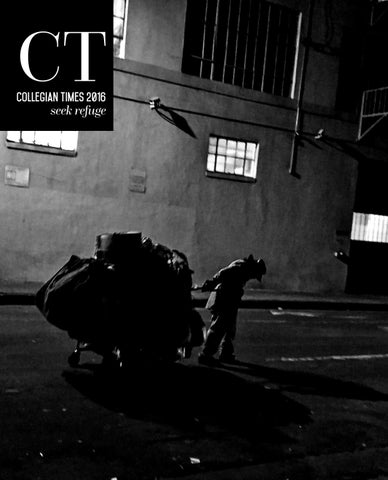
A hunched figure pulls an overloaded shopping cart on a quiet Los Angeles street. A security camera perched on a nearby building captures his journey.
ON THE COVER:
39 41 43
CONTRIBUTING PHOTOGRAPHERS Erika Almanza, Liam Hayes, Hector Lopez, Andre Roman Medina, Eve Moreno, Curtis Sabir, Henry Walton CONTRIBUTING ILLUSTRATORS Hannah Gehrels, Ashley McBroom, Sorina Szakacs, Jose Tobar
INDEPENDENT STREAK 34 36
CONTRIBUTING WRITERS Byron Umana Bermudez, Jared Birdsong, Melissa Breccia, Jake Camarena, Jessica Chortkoff, Gabi Lizzoli
The college magazine is published as a learning experience offered under the college journalism instructional program. The editorial and advertising materials published herein, including any opinions expressed are the responsibility of the student staff. Under appropriate state and federal court decisions, these materials are free from prior restraint by virtue of the First Amendment to the United States Constitution. Accordingly, materials published herein, including any opinions expressed should not be interpreted as the position of the Los Angeles Community College District, L.A. City College, or any officer or employee thereof. ©2016 Collegian Times Magazine. No material may be reprinted without the express written permission of the Collegian Times Magazine.
| Collegian Times | 3
THE MOON, COLLINS, EALY SCHOLARSHIP Designed to Assist Students in the Social Science Department with Completing their Education African-American Studies at Los Angeles City College affords a rich education in the history and culture of African-Americans. A skills certificate program is offered to students who take 15 units in required courses that obtain a grade of “C” or better. To be eligible you must fulfill the following requirements: • You must be a full-time social science major • Applicant must have a 2.75 GPA • Total units completed should not exceed 90 units • Plan to transfer to a four-year university or college
“Education is the passport to the future, for tomorrow belongs to those who prepare for it today.” - Malcolm X
N
COMMON SPACE
EIGHBORHOODS are places where you find a face that looks back at you in silent recognition, because people see themselves in you. A neighborhood provides a warm and familiar embrace to transplants in a new city. Tucked away in ethnic enclaves, people speak in their native languages. They fuse them with English creating melodic or dissonant tones depending on whose ear it catches. A variety of languages pepper main streets. Handwritten menus showcase the daily specials, and painted murals remind us of cultural icons gone before their time. Shopping center signs an-
nounce themselves in bright, super-sized neon. A neighborhood has flavor. Spicy curries, chicken tikka masala and samosas reflect the cuisine of India. Kabobs offer a taste of Armenia and pho brings you to Vietnam. In Los Angeles, a visit to a restaurant can replace dateline travel. Pot-bellied Buddhas with smiling eyes greet patrons in nail salons. Restaurants too showcase their favored deity, placing coins at their feet. Adorned with flowers, fruit and fragrant incense, the shrine is an offering to the gods. It is a petition for protection and favor. Architecture brands a neighborhood. Cool and dark Craftsman homes, Spanish Colonial Revivals, Tudors, Storybook houses and bungalows hold their own across the city in different stages of grandeur and disrepair. Parks, people and pets mark the streets with
their scents. Young families bring new energy to old neighborhoods and turn them on their heels. Old struggles crop up in writings on walls and on garbage cans in dimly-lit alleys. Shared sub-cultural experiences denoted by religion, sexual identity, or an attitude draw people together. In these collectives, the neighborhood takes on the role of the anthropological or the socio-political. These are places where one can reside with others who understand a particular journey. Outsiders teeter on the fringes of society. Some are shackled to drugs, and some to each other. They hang out at bus shelters and tag their solidarity on trees and freeway walls. These outliers seek refuge with each other. — Foreword by Ande Richards Illustration by Hannah Gehrels
| Collegian Times | 5
REGISTER TODAY! Fall 2016 Semester: August 29 - December 18 JUST $46 PER UNIT FOR CALIFORNIA RESIDENTS CONTACT US Monday - Thursday: 8 a.m. to 7 p.m. Email: admissions@lacitycollege.edu Room 100, Administration Building Friday: 8 a.m. to 2 p.m. Phone: (323) 953-4000 ext 2104 Los Angeles City College Fax: (323) 953-4021 855 N. Vermont Avenue Los Angeles, CA 90029
MISSION Los Angeles City College empowers students from the diverse communities it serves to achieve their educational and career goals by providing learner-centered pathways to success through transfer, career and technical education, and foundational skills programs.
THAI TOWN photo essay by | Curtis Sabir | Collegian Times | 7
“People here have found a way to stay connected to their roots. They fuse their Thai traditions with American customs.” Opposite Page: One of the Kinarra sculptures that flank the Thai Town corridor looks on from above as people bustle to and from their destinations on March 11, 2016. The Thai government gifted the sculptures to the city of Los Angeles. Bottom row: A shrine on Hollywood Boulevard attracts the devout on April 23, 2016. Visitors will sometimes leave food, water or incense as offerings.
AS I ENTER THAI Town to document life in the community, I am immediately drawn to the golden half-man, half-bird Kinarra lamppost sculptures that flank the neighborhood. They look down from their perch as they watch over and guard the community from harm. Just down the street, I see people bow in front
8 | Collegian Times |
of a shrine where a regal stone deity sits and holds court. Some walk by and leave offerings of food, water or incense, while others stay and pray. Today, Buddhist monks in bright mustard-colored robes assemble a gathering inside a warehouse. The sight reminds me of jummah prayer – a Friday prayer service where Muslims come together in a
show of communal solidarity. People here have found a way to stay connected to their roots. They fuse their Thai traditions with American customs. People in this community smile and greet each other and outside visitors equally. This is a place of peace. 
| Collegian Times | 9
Children play outside an apartment building in the East Los Angeles neighborhood of Boyle Heights on April 26, 2016. Boyle Heights remains one of the oldest Mexican-American communities in Los Angeles.
BOYLE HEIGHTS photo essay by | Andre Roman Medina I DECIDED TO PHOTOGRAPH Boyle Heights because of my family’s history and relationship with the neighborhood. My great-grandparents migrated to Boyle Heights in 1917, and to this day my family still has ties to this neighborhood. I have friends who live there, and I often attend local events. I have always found Boyle Heights to
10 | Collegian Times |
be a community that is proud of its heritage. However, it is a community on the brink of change. Real estate developments and demographic shifts mean the community is no longer a safe haven for the largely Mexican-American population. These families are now under the threat of being displaced. Where will they go? Farther east? Farther away from the city?
They are essentially being taken over. Boyle Heights has always been a place where generations of families could cultivate and celebrate their culture and heritage, while fostering resistance and progress. The spirit of Boyle Heights will always remain with the people who invested their time and love in the beauty that is their pueblo. Âś
Clockwise: Mariachi Plaza on East 1st Street and Boyle Avenue gets a visit from a local skater who performs a “hippie flip” over a bench in front of the plaza’s rotunda on April 26, 2016.
“The spirit of Boyle Heights will always remain with the people who invested their time and love in the beauty that is their pueblo.”
Passengers wait for the bus in front of “El Corrido de Boyle Heights,” a community mural at 2336 Cesar Chavez Ave. on April 26, 2016. Members of the East Los Streetscapers painted the mural in 1983. La Reina de los Mariachis statue pays tribute to Lucha Reyes, the Mexican movie star from the 1930s. Reyes emigrated from Mexico to Los Angeles in 1927.
| Collegian Times | 11
VENICE BEACH photo essay by | Erika Almanza
12 | Collegian Times |
Top row, left to right: Drummers trek through sand on their way to the weekly Sunday drum circle at Venice Beach on April 24, 2015. Musicians of all types and skill levels converge and play together at Venice Beach. Those who do not play an instrument join in the performance through dance. Bottom row, left to right: Venice Beach is known as a haven for those who defy social norms. “Amazing Ali” Chapman, “Bubble Boy,” Bob Heslip and bearded lady, Jessa Olmstead from the Venice Beach Freak Show pose for photos on April 17, 2015.
I THINK EVERYBODY GOES to the beach to find peace. However, I am not sure what I expected to find once I got to Venice Beach. I have heard that Venice is a place for freaks, and maybe it’s because of all the performers who make a living there. As soon as I arrived, I saw a group of people playing music and dancing on the sand. I stood there and listened. One of the men with the group approached me and told me there wasn’t a set number of musicians in the group. Instead, different people would come
in and join them at any point in their performance. They performed for people like me, he said, for people seeking inner peace. I immediately felt better and looked around the beach for the others looking for happiness like I was. Then, I saw the freaks. I saw the bearded lady first. She commanded attention in a big and beautiful green dress, which she accessorized with neon green eyelashes. She embodied peace and tranquility. “Bubble Boy” Bob Heslip – one of the men who worked at the Freak Show – told me he finally felt at home. Because of his skin condition, people usually
avoid touching him and the things he touches, but at the Freak Show he has a place to live and work. The “Amazing Ali” is gorgeous and so full of life. She allowed me to photograph her many times. They all made me feel welcome. From the outside looking in, Venice Beach is a place for freaks. But we all have a little freak inside, and that is why we go there. At Venice Beach we are one big family – free of judgment. Between the freaks, the musicians and the vendors, visitors are sure to find themselves entertained. Venice Beach is a place of full wonder. 
| Collegian Times | 13
Top row: Harriet Walker married six times and divorced six times. Only one ex-husband remains. She has four children and five grandchildren. One of her grandsons lives at home with her. Health issues force Harriet to visit doctors and hospitals often. Bottom row: Willie Mae Hickman married twice. The second marriage lasted 44 years until her husband passed away in 1998. She has three adult children: two daughters and a son. Hickman lives in the home that she and her late husband lived in for most of their time together. It has been remodeled and enlarged over the years. Her 62-year-old son lives with her and other family members make frequent visits.
WORLDS WITHIN WALLS photo essay by | Henry Walton SENIORS SEEK REFUGE LIKE everyone else in cities, towns and hamlets, in bustling crowds or in lonely isolation. But for the vast majority, that place turns out to be their home.
14 | Collegian Times |
Shared here are moments of comfort in the easy familiarity of the subjects’ homes. They read, watch TV or gaze out of the window in a reverie of remembered past. They live their slower
lives surrounded by religious, family and social icons. While the young look forward to an uncertain future, the seniors look back over a definitive remembered past. Âś
ADVERTISEMENT
Katrina’s Legacy
The Black nation and the people of the world confront the u.s. Empire and its genocidal climate crimes Eric Mann Katrina’s Legacy: Genocidal Climate Crimes is the culmination of Eric Mann’s tenyear exploration and organizing in support of the Black Nation in New Orleans. It is based on his revolutionary theory and practice at the intersection of the Black, Third World, and Climate Justice revolutions.
Katrina’s Legacy integrates Black Revolutionary Thought, urban sociology, environmental and climate studies, U.S. and Third World history—informed by Mann’s decades of work with the Congress of Racial Equality, Students for a Democratic Society, the United Auto Workers and the Labor/Community Strategy Center. Mann’s last two books --The Seven Components of Transformative Organizing Theory and Playbook for Progressives: The 16 Qualities of the Successful Organizer theory challenge Saul Alinky’s narrow, instrumentalist Rules for Radicals. Katrina’s Legacy provides the history, strategy and tactics for movement organizers today.
In 2006, Mann wrote Katrina’s Legacy: White Racism and Black Reconstruction in New Orleans and the Gulf Coast. It has been used by movement groups, college and high school faculty. Now Frontlines Press is publishing Katrina’s Legacy: The Black Nation and the People of the World Confront the U.S. Empire and its Genocidal Climate Crimes. The new edition, 400 pages, also includes the 2006 edition in entirety. The original Katrina’s Legacy focused on New Orleans in the wake of Katrina, an essay on Black history from 1865 to the present, the fight for a Black nation, and environmental and climate justice demand development.
The new edition of Katrina’s Legacy goes beyond Naomi Klein’s general critique of capitalism and climate change to situate the Sixth Extinction in the White, Christian, European/U.S., feudal, capitalist, imperialist economic, social, and ideological system. Mann argues that U.S. and European imperialism went beyond the exploitation of labor to carry out genocide and genocidal climate crimes as coherent policies. This is reflected in a gripping chapter: “Hurricane Katrina: Anatomy of a Genocidal Climate Crime.” Mann analyzes the recent United Nations Framework Convention on Climate Change where the Strategy Center played an active role. He challenges President Obama’ destructive role in Paris as American Deceptionalism in the chapter “What Are We Going to do about the United States.”
Katrina’s Legacy ends with structural demands: Self-Determination and Reparations for the Black Nation, the immediate return to New Orleans of 100,000 Black internally displaced people, cutting U.S. Emissions by 50 percent of 1990 levels by 2025, No Cars and Tanks in L.A. and the U.S. to challenge the auto and military colossus. Mann argues that we need a Third Revolutionary Reconstruction at the intersection of Black, Third World, and Climate Justice Movements. We urge you to buy copies and spread the word. Get Katrina’s Legacy today: ISBN 9781944241827 $25.00
Eric Mann
Director Labor/Community Strategy Center Host Voices from the Frontlines on KPFK Pacifica 90.7fm eric@voicesfromthefrontlines.com For more information call Channing 213-387-2800
Order your copy of Katrina’s Legacy today from Frontlines Press
voicesfromthefrontlines.com/katrinaslegacy
We’re on the Island of Misfits column by | Byron Umana Bermudez
16 | Collegian Times |
To this day, my fondest childhood memories are of the times when I would sit in front of the TV while my mother put up the Christmas tree. Every year she would decorate the tree and place the nativity scene. Then, we would watch holiday movies; my favorite was “Rudolph the Red-Nosed Reindeer.” To me, “Rudolph” was Christmas.
M
Y FAVORITE SCENE is when Rudolph runs away and finds himself on the Island of Misfit Toys. On this island he meets a winged lion that travels the world in search of unusual toys. The lion provided sanctuary for them. As the story progresses, Rudolph and his elf friend embrace the toys and come to accept themselves as misfits. The theme of the movie is clear: Misfits deserve to be accepted and loved. I always identified with the “misfits” the most. I went through life never truly belonging to one group or the other. The most difficult time was when I was discovering my sexuality. I knew that society told me to like girls. So, I tried it. To say it was not for me would be an understatement. It was not until my first committed relationship with a boy that I began to identify as gay. I knew the minute I identified as gay, the community I grew up in would not accept me. So, I tried to find refuge in the LGBT community. I thought that a community whose members faced the same scrutiny as I would be more accepting of the real me. It was a harsh lesson to learn that judgment and ridicule run rampant in the gay community.
If you did not belong to one of these groups you simply did not belong. I came to realize the ideal man in each of these groups was one who displayed masculinity. I found this ironic because many of the men I was talking to displayed both masculine and feminine traits. In trying to fit in, I started to compare myself to other gay men. I subjected myself to their judgmental ideology. I became someone I did not recognize. I would judge and ridicule gay men for the attributes that made them special and unique.
“We are a band of misfits; society’s forgotten children, and we should be the example of acceptance.” I wielded words like “flamer,” “passive,” “slut,” “ugly” and “tranny” against the people around me. A part of me hated who I had become. The irony of having to defend myself from a society that did not accept me, only to become part of a group that did not accept each other was too much. I remember seeing an episode of Tyra Bank’s
“I thought that a community whose members faced the same scrutiny as I would be more accepting of the real me. It was a harsh lesson to learn that judgment and ridicule run rampant in the gay community.” Everyone seemed to fit a type. You have your twinks, bears, Latin papis and leather daddies, pretty boys, gym-rats and more. It was overwhelming to discover just how many subcultures a person could fall into, and it did not stop there. I felt like I had gone back to high school.
“We know that society has often viewed the gay community harshly,” Tyra told her audience. “But it was shocking to see how severely the gay community judge themselves. So, a social experiment was set up to put everyone together in a place called the ‘Gay Kingdom.’” Representatives were chosen to exemplify the different types of people one would encounter in the LGBT community. These representatives would choose the kingdom’s “King,” “Queen,” “Jester,” “Cook,” “Pauper,” “Concubine” and “Villain.” Within seconds the “representatives” sided with social conventions when assigning the roles of “King” and “Queen.” The “King” was a masculine male archetype, and the “Queen” was a feminine female archetype – the lipstick lesbian. This proceeded to be the trend. Everyone, for better or worse, accepted the title given to them. Even the bisexual male, who was labeled the “Pauper,” embraced the title only after a minor verbal disagreement. It was not until the group decided to name the “Concubine” that I witnessed an act of integrity and strength. “I think everybody, even in the gay community ... look at transgenders as how will they get a job?”
talk show called “Gay Kingdom,” where she tackled this very idea. In the show she gathered members of the community – gays, lesbians, bisexuals, transgender individuals, drag queens – and asked them to rate each other in a hierarchy.
said Sasha, the transgender representative. “Society will judge us. Oh I don’t want to work with her she used to be a man, but now she is a woman. They’re very confused, and they’re uneducated about it. I own my own business … for years people always, always, say, ‘they must be hookers, and they must be prostitutes.’ Well I’m here to take a stand and say you know what, not all of us.” To my surprise, I related very much to her message. It was empowering to see someone finally say: Enough is enough. From then on, I decided I was not going to let other people determine who I could hang out with, and what box I fit into. Little by little I began to explore other aspects of the community. Rather than seeking refuge in people who walked, talked and acted like me. I saw myself in the misfits. A person once told me, if you want to be better, you must be friends with people who make you better. I did not understand what that meant until I began to purge toxic people out of my life. We are a band of misfits; society’s forgotten children, and we should be the example of acceptance. For the record, I accept you. 
| Collegian Times | 17
18 | Collegian Times |
WALK column by | Jake Camarena illustration by | Sorina Szakacs
If I snooze for nine more minutes, morning will start without me; so I rise. I uncover myself and crawl off the foot of the bed. Once in the restroom, I strike a match and light a single candle. I stand shirtless in front of the mirror and push the toothbrush through the foam across my teeth with my eyes poised at halfmast. I breathe deep. The fresh sensation of a clean mouth reaches my lungs. I am awake.
O
UTSIDE, DEW DRIPS from plant stems as a dull blue blankets the sky. In my left hand I hold a cup of coffee warm to the touch. A hood that covers my ears rests on my head, and relaxed cotton pajamas secured at my waist drape to my ankles. One step at a time, I launch myself out into this dim L.A. morning. Lonely street lanes await hustling vehicles. Black bins filled with trash sit at each driveway's end. Men move from trash bin to trash bin, dragging plastic carts behind them. Their small wheels, shaved by miles of uneven road, play out a rough staccato on city pavements. I have seen some of these faces before. “Good morning,” says the shoeless man, both his arms stretched deep inside of an open trash bin. He handpicks his breakfast and fishes out a plastic bottle of flat soda. While chewing, he unscrews the cap and tilts his head back to savor someone else’s old drink. I reach a set of trash bins where I stand in contemplation. In which direction should I go? Groomed cement paths lead me through the neighborhood. I stare left, down a footpath that flanks an empty intersection. I look right, at a stairway through some trees. I take a sip from my cup. For no particular reason, today I choose left. So, I walk. “Hi,” says the woman speed-strutting down the sidewalk. Her poodle, groomed like a front yard fern, prances next to her. Houses arranged to display the best of mankind face one another. Some sit slumped with broken glass. Others, stand imperially awaiting a magazine cover shoot. Next door, I walk past a handwritten sign hammered into the rocky fill that replaced the once
drenched and abundantly green lawn. The sign beckons. “For rent: Beautiful upper-unit, one bedroom, $2,500 per month, plus $2,500 security deposit,” the sign reads. Trees and domestic shrubs share the ground with the remnants of the city’s nightlife. I take an-
Sudden motor sounds turn quickly into a hum of hundreds of tires rolling across the pavement. Traffic begins. Cars slow to a crawl and eventually move at snail speed. Horns accompany loud music seeping from closed windows, and vehicles sway hastily carrying morning drivers. I walk. The paved path up the hill before me seems flat against the mountains in my sight. Many traverse the shallow slope on foot. Running shoes slow as they pass me. Those that rush the path, gasp deeper now. Beyond the hill, a chain-link fence secures a large grass field. Park rules welcome visitors at the gate. “Do not play organized sports,” the sign reads. “No dogs. Smoking prohibited.” I enter the park. My presentation alone may not be enough for a morning infraction. As long as I walk the man-made path before me, and refrain from organizing a picnic with a game of tug-ofrope, square patrons may only converse in their heads about the stain on my sweats, or the distaste-
“All around me, isolated morning walkers share mostly pronounced smells of exhaust and pet excrement. Sometimes we make eye contact.” other sip from my cup and continue down the path. Above the morning’s hatching bustle, a bright velvety orange begins to creep in on the blue in the sky. All around me, isolated morning walkers share mostly pronounced smells of exhaust and pet ex-
ful way my sweater slouches off my shoulders. Thankfully, I chose against my habitual morning smoke. Inside the park, I walk left. A barbed wire fence stands taller than I, running along a two-mile pe-
“A barbed-wire fence stands taller than I, running along a two-mile perimeter around a cement hole. Through the fence links, I see Los Angeles. I stand there and take a sip from my cup. Then, I walk." crement. Sometimes we make eye contact. “Vrrooom,” a vehicle – balanced low on shiny wheels – darts past me. Cold air chases the lowrider, blowing the tame hair on my head toward the sky.
rimeter around a cement hole. Through the fence links, I see Los Angeles. I stand there and take a sip from my cup. Then, I walk. 
| Collegian Times | 19
hours a day on the phone – and it still was not long enough. This was an extreme inconvenience to our families, but we only saw each other a few times a year so it was a necessary compromise. Today we live almost 3,000 miles apart, but never miss out on important events. In a few weeks, I will head east to watch Matt graduate.
“We make sacrifices for each other. Sometimes while sleeping on his floor I inhale the cat hair that has coagulated on the carpet, but I always suffer silently to avoid waking him. In return, Matt deals with my hair constantly appearing in unexpected places." Matt was the singular child on this earth who not only enjoyed going to the dentist - as wild as the thought of someone enjoying the dentist seems - but also decided that the experience was so great he wanted to become one himself. Later this year he will begin dental school, and I believe he will become a dentist that people genuinely look forward to seeing. I have learned so much from Matt. He is one of the greatest influences in my life. Out of all of the things that I have learned over the past 13 years with him, the most important one is that love provides a closeness that cannot see distance.
My best friend Matthew Desiderio and I sit with Santa Claus on Dec. 22, 2015 at the Moorestown Mall in New Jersey. Santa didn't ask us what we wanted, but it was probably because he was too busy enjoying our sweaters.
Distance Makes the Heart Grow column by | Melissa Breccia IN FOURTH GRADE I heard the most important introductory question of my life: “Do you want my phone number?” Even at nine years old, everything Matt said was so indicative of his personality. He wasn’t asking me for my number, he was asking for permission to give me his. There were no stages of development to our friendship. We didn’t meet each other; we found each other. After spending nearly every day of just under
20 | Collegian Times |
one year together, Matt’s family left the row-homed blocks of South Philadelphia for the suburbs of New Jersey. I remember envisioning that when the time came I would chase after the moving truck while crying hysterically, but that didn’t happen. Maintaining any type of long-distance relationship is hard, no matter your age. However, when people are meant to be a part of one another’s lives, distance will not make you distant. Matt and I spent anywhere from eight to 12
“We knew, even in fourth grade as we knelt down beside the bookshelf exchanging numbers, how important we were going to be in each other’s lives." This has been especially significant to me over the past two and a half years since my move to California. Although I am thousands of miles away from a lot of people I love, I never feel that far. Most roommates live together, but Matt is my long-distance roomie. We share a mental space and have almost all of the same thoughts. We knew, even in fourth grade as we knelt down beside the bookshelf exchanging numbers, how important we were going to be in each other’s lives. Thirteen years is a decent amount of time to have known someone, but no matter how many years or lifetimes we share, it will never be enough. 
COLLECTIVE DISCORD
S
TACKED one a little higher than the other, buildings arranged like blocks populate the city grid. Stainless steel sculptures house concert halls. Frank Gehry's genius resides in his architectural showstoppers. Trendy hotels and hipster dwellings thrive along historic Beaux Arts and Art Deco structures. Inside the walls of these buildings occupants busily go about their day. Black puffs of smoke escape yellow school buses and choke motorists caught in their wake. Food trucks festoon sidewalks as savory aro-
mas elicit hunger pangs. Pedestrians saunter down the street and stop to get a meal. They find a park to rest and eat as wild parakeets fly overhead. The birds maneuver through the trees as they scope the scene and eavesdrop on people below. Tents dot city streets like flowerbeds in suburban neighborhoods. Home to the largest transient community in the country, the homeless epidemic in Los Angeles is at critical mass. Policymakers work to alleviate the problem, but the solution does not come quickly enough. War veterans, people with mental health issues, drug users and former foster children comprise the homeless demographic.
This cacophony of steel, cars and people resonates – it has a distinct rhythm shared by all who live here. Outside the city, an animal haven struggles to care for itself. A crow named Russell and a tortoise named Alan freely move about Planet Rehab. Animals coexist seamlessly. They are an example to the humans around them. Planet Rehab is a small movement ready to effect big changes in our environment. They join in the struggle to alleviate our collective discord. — Foreword by Ande Richards Illustration by Jose Tobar
| Collegian Times | 21
Home Sw
story by | Clin photos by | C
22 | Collegian Times |
weet Home
nton Cameron Curtis Sabir
| Collegian Times | 23
Among bicycles, stuffed animals, laptop computers, radios, books and piles of clothing, a large pink and red cloth umbrella towered over two tents. The people that lived on the 700 block of Vermont Avenue owned these items. Their belongings overflowed from shopping carts and spilled onto the sidewalk.
J
ASMINE ROSS – pronounced rose – sat on a lawn chair underneath the umbrella with her legs crossed. Her towering presence could have been attributed to her height or attitude. On a windy afternoon in March, she put all activity with surrounding residents on hold. “I’m a star,” Ross said as she posed for pictures and answered interview questions. “I’m shining right now.” Ross lived as a man prior to becoming homeless a year ago. She refers to her transition as her “graduation,” and uses the exact date, “3-17-15” to refer to it like an anniversary. In the west-central San Fernando Valley neighborhood of Winnetka, she began to refer to herself as Jasmine and other times as Nikoveli. When she lived with her mother, she was Nick. “The name I was born with is Willis Demetrius Traves the Fifth,” Ross said. “[But they called me Nick] because I’m the fifth.” When the subject of her family came up, she appeared apprehensive and fell silent as she contemplated seeing her three brothers and two sisters. She had not seen any of her siblings in more than a year. That was before she began cross-dressing full time.
booty shorts and her man, well I’ll say my new stepdaddy, I guess he was offended.” From her mother’s home to the streets, Ross became homeless immediately. She started living on the streets of Winnetka where she engaged in low-level drug dealing. More than 15 years prior, she joined the South Central Los Angeles gang Harlem 30s Crips where she went by the name “Li’l Indo.” In Winnetka, she continued identifying openly as a member of the Harlem 30s strictly for street credibility and protection. Her female persona however, remained hidden. “I would have never walked outside like this,” Ross said as she gestured to her outfit: a short, white cotton dress with a floral lace pattern. Eventually, gang hostility forced her to leave the area. She said the local gangs accused her of infringing on their territory. “I stumbled in some shit that obviously I didn’t even know what was going on,” Ross said. “‘Cause I know that people wanted to tax me for selling drugs. You know what I mean?” To avoid possible consequences, Ross headed south to Hollywood. TENT CITY BLUES Ross’ choice of words to describe her experience in Hollywood masks the reality of being homeless. She had “roommates,” a “place” and “stayed” at locations without ever having a permanent address or a roof over her head. After Ross arrived in Hollywood, she lived
“It would be totally different. It would just feel weird as me being Jasmine in front of everyone like that.” - Jasmine Ross “It would be totally different,” Ross said. “It would just feel weird as me being Jasmine in front of everyone like that.” A HOUSE IS NOT A HOME A 2011 national transgender discrimination survey compiled by the National Center for Transgender Equality and the National Gay and Lesbian Task Force shows that out of 6,456 respondents, more than half faced rejection from their families. Nineteen percent of those polled became homeless as a result of being transgender or gender non-conforming. A year ago, Ross became one of them. “My mother, she kicked me out ‘cause I was tryin’ to just cross-dress at her house,” Ross said. “I was trying to be Jasmine at her house and I was kicked out, because you know I wore some little
24 | Collegian Times |
with “Texas” on Santa Monica Boulevard. Shortly after she moved in with him, Los Angeles County Sheriffs forced them to leave. Her next move to Vermont and Melrose Avenues resulted in another visit by the sheriffs. Again, they forced her and her roommate out. Eventually, she found “Chris” and joined him on Vermont Avenue, between Monroe and Marathon Streets. “Before I came [to Vermont], there was already like five tents,” Ross said. “There was really no agreement. It was just like people come and people go. That’s just how it was.” Once the encampment grew in size, complaints by local community members and businesses elicited a response from the city. In late October 2015, a notice posted by the Los Angeles Sanitation Department warned those living on the Vermont Avenue sidewalk to remove their belongings for a
street cleanup. It was one of four signs placed strategically around City College’s Parking Lot 1 on the east side of Vermont Avenue. Sanitation workers wore gloves and face masks as they began work at 9 a.m. on Oct. 25, 2015. They made their way up the sidewalk through the encampment from Monroe to Marathon Streets and discarded trash and unattended personal belongings. Larger items like couches required two or more workers. They loaded items into bins that were then picked up by city dump trucks. Police officers cordoned off the area with yellow police tape as the city employees stayed busy clearing the area. HOPE FOR THE HOMELESS Los Angeles Police Department officers Matthew Zeigler and Victor Gutierrez visited the Ver-
Jasmine Ross lived in a tent in the 700 block of Vermont Avenue outside Los Angeles City College’s Parking Lot 1. A March 23, 2016 cleanup by sanitation workers forced her to move. Ross said sanitation workers tossed away some of her belongings including food, a stove, a portable heater, a laptop and several mobile devices.
mont dwellings during the street cleanup. They offered assistance to anyone needing housing. Unique, an African-American transgender woman seemed receptive to their help. “Unique, what if we got you an apartment?” Zeigler asked as Gutierrez took down the police tape. “If you get me an apartment, not only will I be extremely grateful, I will also pay my bills and do what I need to do,” Unique said. Zeigler promised to visit the same location within the week to speak with Unique and other homeless individuals interested in finding housing. When Unique spoke with representatives from the Los Angeles Homeless Services Authority (LAHSA) that week, she declined their offer for housing when it excluded her partner. She said she decided to remain homeless, rather than accept LAHSA’s offer and live away from her partner.
“Before I came [to Vermont], there was already like five tents. There was really no agreement. It was just like people come and people go. That’s just how it was.” - Jasmine Ross Ross had a similar conversation with Zeigler. However, she remained unclear concerning specifics regarding a permanent housing situation. Still, she said she was open to looking into housing assistance programs. She claimed a housing program would provide incentive to look for a permanent home. She anticipated that participation in a program would in-
crease her chances to qualify for Section 8 vouchers and lead to an affordable place to live in Los Angeles County. “I am thinking about looking into it just because I wanna just do a program,” Ross said. “However, I need to do it to get me some Section 8. I needs me some Section 8 and I’ll be great. [Then, I will] have me a place.”
| Collegian Times | 25
Officers from the Los Angeles Police Department Rampart Division arrest a man on March 23, 2016 on the corner of Vermont Avenue and Monroe Street for suspicion of selling drugs.
Ross remained on the streets long enough to see a March 23, 2016 cleanup displace her and the entire tent city community. “I was given 72 hours to move my shit or they would move it [themselves,]” Ross said. “In the midst of all that, I lost my tent. I lost food, [a] stove, a portable heater, laptops – well one laptop, iPhone, iPod Touch, Blackberry tablet and some other things, and I watched that shit get thrown in the garbage.” STREET EVICTION Without government assistance, Ross remained on the streets. She moved behind the Yoshinoya restaurant on the corner of Melrose and Vermont Avenues. Restaurant employees became familiar with her as a regular customer and so did property management. Ideal Management – the property management company in charge of the mini-mall where Yoshinoya is located – threatened to call the
26 | Collegian Times |
“I was given 72 hours to move my shit or they would move it [themselves]. In the midst of all that, I lost my tent. I lost food, [a] stove, a portable heater, laptops – well one laptop, iPhone, iPod Touch, Blackberry Tablet and some other things, and I watched that shit get thrown in the garbage.” - Jasmine Ross police if Ross refused to leave. “I’m going to try not to see [property management] this week ‘cause I have two warrants – little misdemeanor warrants,” Ross said. “I’m not trying to see the police like that.” Ross disappeared from the corner of Melrose and Vermont Avenues less than a month after the March cleanup. Rumors among the local homeless
population suggest she may have been arrested. Most of Ross’ property disappeared, including five shopping carts full of electronics, three large tarps and several household appliances. All that remained was a large collection of colorful T-shirts, wigs, undershirts, panties and socks spread out over the black asphalt behind the minimall lot. 
Up to 40 people made their home on Vermont Avenue outside the gates of Los Angeles City College’s Parking Lot 1 between Monroe and Marathon Streets. The City of Los Angeles Sanitation Department schedules periodic cleanups that temporarily displace the occupants. There are 46,874 homeless people currently living in L.A. County, and 34,527 live unsheltered, according to the latest count by the Los Angeles Homeless Services Authority (LAHSA).
| Collegian Times | 27
28 | Collegian Times |
AN OASIS IN SAN DIMAS story by | Ande Richards photos by | Richard Martinez and Ande Richards
| Collegian Times | 29
A recently rescued alpaca is in distress. Severed from his longtime companion, he pines for a goat. His rescuers empathize with him because they too are in love. They go back to the alpaca’s original home to retrieve his friend. Now, Benjy the alpaca and his friend Buddy the goat live at Planet Rehab in the city of San Dimas. Just 25 miles east of Los Angeles, the cozy sanctuary sits on land that pushes up against the foothills of the San Gabriel Mountains.
G
ARY MITCHELL and Carlo Rios run Planet Rehab. Gary already had his hand in conservation. As Director of Sustainability for Metro, he provided environmental education and implemented sustainability goals for Disney Channel, Google and Blue Shield among other major companies in Los Angeles. Now, the couple’s lives revolve around animals, which is fitting considering they met on the dating
site Plenty of Fish. Gary says the “Science Friday” radio show inspired him to start the organization.
30 | Collegian Times |
“I was actually driving my car and listening to NPR. This was back in 2002, it was ‘Science Friday’ and Ira Flatow was interviewing Michael Oppenheimer who happens to be a professor at Princeton University and one of the leading climatologists,” Gary says. Gary had been a loyal supporter of different environmental organizations for quite a few years, but now he was seeing things in a new way. “Michael was talking about the effects of global climate change,” Gary says. “He was talking about species that were disappearing, that were having to migrate away from the equator and it freaked me out. I had no idea that things were as bad as they were. So, I thought maybe I could do something a little better than just write a check. So, I started Planet Rehab.” Planet Rehab’s human inhabitants coexist seamlessly with more than 350 animals on a small lot of land. Dogs roam the compound indifferent to the
tortoise crossing their path. A shiny black crow flies overhead and perches on a welcoming shoulder. Many of the animals at the sanctuary are rescues. Native birds and animals are rehabilitated and released back into their natural ecosystems when possible. A typical morning at the shelter begins with Gary bringing Carlo a cup of coffee. Carlo says they spend an hour connecting with each other before the real work begins. “We ask each other how we’re feeling, did we sleep well, what’s your schedule for the day?” Carlo says. “We religiously watch the ‘Today Show’ and afterward we throw the coffee grinds from our morning coffee into plants - we start off by reusing.” Soon they hear a knock at the door, and with that the volunteers begin to filter in according to their schedules. Carlo heads out to work and leaves Gary to connect with the helpers. HELP IS ON THE WAY Volunteers are vital to the sanctuary's success. They come from local schools and churches and occasionally from Volunteer Match, a website that pairs volunteers with organizations in need of assistance. “We work with local schools and teachers, especially the science teachers,” Carlo says. Gary assigns the kids duties – attend to hatching eggs, check on a sick animal, this animal needs to be fed, this one cleaned. Volunteers that have worked at Planet Rehab for a while are considered “seniors.” They have a schedule to follow and Gary does not micro manage them.
Opposite page: Gary Mitchell communes with sun conures Kiki and Koko. The species loves the attention and closeness from their owners. Top: Planet Rehab Co-Director Carlo Rios takes care of the birds inside one of several aviaries on the Rehab compound. Daily activities at the animal sanctuary involve feeding the animals and maintaining their habitats.
“We create a space where there is a presentation of emotional experiences that will inspire people to make meaningful changes,” Carlo says. The volunteer’s interactions with the animals teach them about the greater environmental issues that plague planet earth. They become experts on several ecological topics by caring for the animals and their habitats. “The goal of Planet Rehab is to educate youth, and allow them to develop skills that volunteering can foster like integrity, passion, compassion, love and simple emotional connection,” Carlo says. We want them to be ambassadors and leaders in their communities and for the planet.” CATTLE KILLS THE RAINFOREST Autumn Slater attends high school and volunteers at Planet Rehab because of her interest in ecology. She says she has learned much about geography and the issues that affect different ecosystems from taking care of several species of birds at Rehab. She reaches into the aviary for a small bird and cradles it in her hand as she speaks.
“He was talking about species that were disappearing, that were having to migrate away from the equator and it freaked me out. I had no idea that things were as bad as they were. So, I thought maybe I could do something a little better than just write a check. so, I started Planet Rehab.” - Gary Mitchell “Kiki and Koko came from the Amazon rainforest in Brazil, and one thing I really love is how beautiful they are,” Autumn says. “The Amazon rainforest is a very diverse place. It’s really unfortunate because the cattle industry is cutting down around 56 million acres of the rainforest a year. They’re cutting down trees to make room for their cows to graze. The worst thing is the trees don’t grow back.” Carlo says Autumn used her experience at Planet Rehab as the subject of her college admis-
sion essay to Humboldt State University. “She presented to the committee in person and spoke with such knowledge and confidence – so of course she got in,” he says. MONARCHS, MILKWEED, MIGRATION Gary and Carlo placed rows of potted milkweed plants throughout sections of the compound to attract monarch butterflies.
| Collegian Times | 31
“The goal of Planet Rehab is to educate youth, And allow them to develop skills that volunteering can foster like integrity, passion, compassion, love and simple emotional connection.” - Carlo Rios
Drucker School of Management. She is an important resource for the sanctuary. Her good reputation and longevity in the community position her to help the organization recruit potential board members and funders. She is a surrogate mother to Gary, and gave him away at his wedding ceremony to Carlo. The wedding took place outdoors at Planet Rehab where Benjy, Buddy, Rocket, Niko, Russell Crow and Alan the tortoise witnessed the nuptials. JUST SAY NO TO PLASTIC Alyssa Jurkevics sports bright red hair, similar to the crown of the Phoenix chicken standing in the coop in front of her. She met Carlo and Gary four years ago when they visited International Polytechnic High School to speak to her ecology class. “When they started talking about environmental issues I was very intrigued and very concerned,” Alyssa says. During her time at the sanctuary, she’s learned about the havoc plastic creates in the ocean. “Plastic bags are especially harmful,” Alyssa says. “Plastic gathered up can attack the phytoplankton, which gives us oxygen. It is estimated 56 percent of our oxygen comes from phytoplankton.” OCEAN MATTERS
It is estimated that 96.5 percent of the North American monarch population has disappeared. Milkweed is the only plant a monarch will lay eggs on, and the only plant their caterpillars can eat. Looming extinction of the iconic orange and black monarch butterfly is one of the reasons college student Hannah New volunteers at the sanctuary during school breaks. “We’re trying to save the monarch population because they’re currently endangered,” Hannah says. “There are certain companies that grow [genetically modified organisms] and GMOs have the capability to grow in certain pesticides, but the milkweed plant is unable to survive in that environment. This is an issue because milkweed plants are the only thing the monarch will eat.” President Barack Obama shares Planet Rehab’s concern for the endangered butterflies. In 2015, he committed $3.2 million and unveiled plans to create a 1,500-mile monarch corridor. It will mimic their migration path from Mexico to Canada. It will be lined with milkweed to provide refuge and food. VEGANS USE LESS WATER Planet Rehab’s resident raccoons Rocket and Niko play and frolic behind the wire mesh of their wooden shed. Nearby, an attractive man with shoulder-length blond hair cleans up after the shelter’s dogs.
32 | Collegian Times |
Austin Rapp has known Carlo since he was six years old. When he made the decision to move to Los Angeles for his acting career, Carlo and Gary gladly welcomed him into their home. Austin has been a vegan since before he came to Planet Rehab. He says that a vegan diet is not only healthy, but it allows him to feel good about his connection to animals and the planet. “Being vegan is a health choice,” Austin says. “It encourages a healthier plant-based diet, but the environmental factor is even more important. It takes 2,000 gallons of water to produce a pound of beef, but it only takes 200 gallons of water to produce a pound of vegetables.” THE ELDER STATESWOMAN “My favorite thing here is the variety,” says Sally Aiken. “The energy of everyone, Gary’s patience with the volunteers - his creativity is phenomenal. I admire him greatly.” Planet Rehab's “oldest kid” was an elementary school teacher in Ohio before moving to Los Angeles in the late ‘70s. Cutbacks triggered by Prop 13 prevented her from a teaching career in L.A., so she worked part time at Claremont Graduate School as a receptionist. Then she became secretary of admissions, then head of admissions, and finally registrar at the
“Hands Across the Sand” is an international ocean protection movement. Planet Rehab was the first group in California to participate in the event. Volunteers take an annual trip to the beach and enlist sponsors to offset transportation and meal expenses. Funds are also used to buy metal Planet Rehab water bottles and T-shirts. Anything left over is used to maintain the animal sanctuary. “Hands Across the Sand” breaks down into two parts: the protest and the cleanup. First, all participants stand on the beach with their arms linked in solidarity. This is how they stage a non-violent protest against offshore oil drilling. Then they start the cleanup. Volunteers separate trash into two piles: trash that gets thrown out and trash that gets recycled. Common items discarded on the beach are Styrofoam cups, plastic spoons and plastic bags. JUNGLE FEVER Gary and Carlo want to increase their outreach and expand geographically. Ultimately, the couple would like to build an eco-habitat in Costa Rica. Costa Rica is home to a protected rainforest and is the ideal place for Carlo and Gary to advance environmental actions. According to a recent United Nations Environmental Program report, 150 to 200 species are becoming extinct every day. Gary and Carlo's plan is to protect rainforest territory on the Caribbean coast. They want to breed species at risk of extinction, and then release the offspring into the protected rainforest. Gary says they have more than 40 years of experience breeding exotic species. They want to move soon. They say they plan to make their Costa Rica haven an eco-educational facility. The couple says they are limited in San Dimas to how much they can affect the bigger ecological equation. For now, however, their focus remains on education. 
INDEPENDENT STREAK
I
N MANY WAYS, seeing the first African-American hold the highest office in the United States was like seeing the first man walk on the moon. It validated the “American” in African-American and upset the political norms that used to be reserved for a certain type of insider. So, who is next – a woman, a socialist or a reality TV star? Today’s political front-runners have a way of mimicking the old circus clowns that all magically fit in the back of a Volkswagen Beetle. Not one is
immune from playing the clown. A little bit of comedy and tragedy, a smile and a frown mask every campaign promise. Orwell turns in his grave as America struggles to distinguish the difference. More than eight years ago, the momentum behind President Barack Obama’s message was irrefutable. It carried its own weight all the way through his first term, and limped through the remaining four years of his second term. The candidate that most exemplified the feeling
of hope from Obama’s early campaign was Bernie Sanders. His campaign spoke to America’s millennials in much the same way as Obama’s first campaign. A fresh political perspective that appealed to the newest generation of voters came from the oldest candidate running. Is it ironic? Is it comedy? Is it tragedy, or all of the above? — Foreword by Clinton Cameron Illustration by Jose Tobar
| Collegian Times | 33
L.A. Berns story by | Jessica Chortkoff photos by | Eve Moreno and Liam Hayes
W
HEN I FOUND out Bernie Sanders was in town for a last-minute rally at the Wiltern Theatre in Koreatown, I couldn’t get there fast enough. Sanders supporters crowded the theater long before he arrived, and even though we were packed in like sardines, it didn’t
feel that way. Once he arrived, he was greeted with thunder-
34 | Collegian Times |
ous chants of “Bernie, Bernie, we want Bernie!” I saw mostly young students, but peppered throughout the crowd I saw older supporters. What struck me the most was how friendly and happy their faces looked. For Shantale Ramirez, a public health major at Cal State Northridge, this coming election will be the first in which she is old enough to vote. I talked to her because she had a big smile and a huge poster featuring Sanders in a Che Guevara wig. She also sported a temporary tattoo of the
presidential hopeful wearing a Robin Hood cap. “I’ve always been a Bernie supporter,” she said. “I’m just really passionate about what he is saying, the way he shows it – I feel like it’s sincere.” Her friend, Balcaceres Castillo, a 19-year-old aerospace engineering major at Santa Monica City College agreed. He said he was there to support the Hispanic community, but that he also wants to learn more about Sanders. “I see that he’s the type that doesn’t really try to hide anything from the people,” Castillo said. “He
just represents everybody.” As I exited the rally, I joined a crowd gathered outside the theater. They cheered, waved banners and elicited a cacophony from the drivers stuck in the heavy traffic on Wilshire Boulevard. Outside, I approached two nurses from National Nurses United (NNU), the largest union of registered nurses in the United States. The union advocates for easy access to healthcare, water and healthy food as a basic human right. While speaking with them I decided to bring up something Sanders talked about that night: wages. NNU supporter, Dolly Wilson, talked to me about why the $15 an hour minimum wage hike is so important. She said that the public is not very aware of what poverty means for health. “Your zip code can actually determine your life expectancy, and it’s not right, that is not what America is about,” she said. Her friend, Marcella Crowley, who is also a registered nurse, said people like herself will be retiring in the next five to 10 years, which will provide many
job openings for today’s young people. I asked her why most “Berners” were so young. “I think when you are young you are willing to work for change,” Crowley said. “As you get older ... people get jaded because they see it’s a long process.” Crowley said she participated in the fight for the $15 minimum wage increase in California. The minimum wage has passed, but it will be raised in small increments each year, and will not reach $15 until 2022. She said she was very disappointed at that outcome, but is glad it passed. “I think you have to realize nothing changes overnight,” Crowley said. “Like what Bernie says, you cannot give up on it, and you gotta keep working for it, because if we don’t do it, nobody is going to do it.” Crowley said older folks like her should never be complacent. “Go outside the box,” she said, “if they really hear what he has to say, they would support him. He’s just so honest about what he says he wants to do. We have to be the change.” 
Clockwise: Bernie Sanders supporters show up en masse outside a rally for the Vermont senator at the Wiltern Theatre on March 23, 2016. Attendees record the senator’s speech at the Wiltern Theatre on March 23, 2016. Sanders spoke to the audience about wages and access to healthy food among other topics. Scores of Sanders supporters cheer as the senator espouses his views on police culture, education spending, institutionalized racism and immigrant and LGBTQ rights at a rally at Lincoln Park in East Los Angeles on May 23, 2016. Artist and poet Kor Element performs at a South Los Angeles rally for the presidential hopeful on April 17, 2016. At the same rally, local musical group Samara the 7th perform a remixed version of their song, “Bern Down for What.”
| Collegian Times | 35
NOT THE PARTY I WANT TO DANCE IN
I
dashed across campus with my wheelie bag in tow, late for class and half running. I took quick notice of a group gathered around a table in the Quad. Once in class, my cultural anthropology professor presented us with a guest speaker. I realized she was the young woman at the table I whizzed by earlier. Our guest was there to talk to us about registering to vote and checking our party affiliations. She talked up presidential hopeful Bernie Sanders and also gave us information about the American Independent Party (AIP). That caused me to perk up. Our guest explained that AIP is an ultra-conservative, right-wing party. Apparently, if voters are not careful when choosing a political designation in California, they can be automatically enrolled in the AIP. It can happen if a voter simply checks the first box on the list. I was curious and wanted to learn more about the AIP, so I went to their website and read their manifesto. It almost made the AIP sound like a party I could support. “We believe in liberty and justice for all under God,” the statement read. “We want to keep America independent and safe. We will protect the family, marriage and work. We believe in individual responsibility and free enterprise. We must obey our Constitution and promote Declaration of Independence principles. We are true American Independents.” However, as soon as I focused on what the words really meant, I knew there was no way I could be part of this party. I believe the Constitution should evolve as our society grows and that it should incorporate new concepts. If we stuck to original versions of the Constitution, as a black person I would still be considered three-fifths of a person – for the purposes of representation – and as a woman I would not have the right to vote. AIP supports the 2nd Amendment right to bear arms and I am in agreement with them on this point only. We differ on just about everything else. The AIP does not separate church and state. They believe marriage is between men and women only and they are pro-life. I believe in the separation of church and state, I believe that marriage is for two people who love each other regardless of their gender and I am pro-choice. The AIP is best known for its 1968 nomination of former Gov. George Wallace of Alabama. He was a segregationist. Enough said. Until this point, I thought I was registered as an Independent. I checked my party affiliation – I was a member of the AIP. Yikes! I was not the only one fooled into joining the AIP. A news story that appeared in the April 18 issue of the LA Times reported that celebrities such as Emma Stone, Demi Moore and boxer Sugar Ray Leonard
36 | Collegian Times |
column by | Ande Richards illustration by | Ashley McBroom
said they believed they registered as Independents. Furthermore, a poll conducted by the Times found that up to 73 percent of AIP voters surveyed did not realize they were affiliated with that party. Our Sanders supporter urged us to join the Democratic Party, but that did not seem right to me since I do not consider myself a Democrat.
parties: American Independent Party, Democratic Party and Libertarian Party. However, NPP voters who wanted to vote for Republican candidate Donald Trump would have had to switch party affiliation. The Republican Party decided not to give NPP voters the ability to request a crossover ballot.
“I believe the Constitution should evolve as our society grows and that it should incorporate new concepts. If we stuck to original versions of the Constitution, as a black person I would still be considered three-fifths of a person – for the purposes of representation – and as a woman I would not have the right to vote.” Nevertheless, I did want to vote for Sanders. I immediately went online and changed my party designation, not to Democrat, but to No Party. Voters who are registered to vote without stating a political party preference are known as No Party Preference (NPP) voters. In the most recent primary election, California NPP voters received a non-partisan ballot which had no presidential candidates listed. However, upon request, an NPP voter could cast a presidential ballot for one of the following
In this country, we are privileged to have the opportunity to vote for our representatives, but we must be vigilant about keeping up with the rules involved in the process. I voted during the primary and because I was aware of the rules I felt confident about the process when I was at my polling place. Maybe one day there will be more options for representation. In the meantime, I will vote my conscience and will not be tricked into being counted as a member of a group I deem reactionary. 
The Revolutionist column by | Gabi Lizzoli photos by | Ande Richards
Four years ago, I had no care or concern for politics. I felt like my vote didn't count, and there was little I could do to make a difference. That was until I heard about an Independent senator from Vermont named Bernie Sanders talking about a "political revolution." I INSTANTLY WANTED to learn more about this man and his message, so I joined every Sanders Facebook group I could find. By the end of the night, I was a part of 13 different groups. I spent many nights watching YouTube videos featuring Sanders. The more I learned about him, the more I realized his message was worth fighting for. I truly believe that Sanders is the voice of the people. Everything he has been fighting for as a senator aligns perfectly with my personal beliefs. He is in favor of affordable college tuition and universal healthcare. He voted no on the war in Iraq, and he voted against the Wall Street bailout, and he marched with Dr. Martin Luther King Jr. I was excited about the prospect of belonging to something so honest and truthful. Finding Sanders is like finding your favorite band, and in my eyes he is bigger than a rock star. The next Saturday, I attended an event called a Barnstorm in Mid City at Pan Pacific Park, and decided to join the group to see how I could get involved. I met an organizer named Monty Markland and found my passion for voter registration. The next Thursday I attended a training session
in Norwalk at the L.A. County Registrar-Recorder's Office. Upon completion of training, I officially became a certified deputy registrar. I studied everything I could to become an expert in voter registration – even after the training session.
For the first time in my life, I felt like I belonged to a force for good, working toward a better future that would be rooted in truth, justice and equality for all. Next, I turned my attention to Los Angeles City College. I am an LACC graduate, and I wanted to bring my knowledge and passion back to my alma mater. I found myself supported by the Associated Student Government, the Black Lives Matter chapter and many of my former professors. My favorite part of the process is checking a student's voter status, helping them register, and then giving them a Sanders campaign button and sticker followed by a huge high five. I have learned that my voice does matter, and
“I have learned that my voice does matter, and that I have the ability to organize and unite the people in my community to create change starting from the bottom up.” The following week back at the Barnstorm, I was training volunteers to conduct voter registration drives in their own neighborhoods. Everything had become a fire hose of information, and I was meeting incredible people dedicated to the Sanders campaign. Soon after my training, I found a core group of activists called Team Bernie L.A. and joined them at the “March and Rally for Bernie Sanders” event. The energy was amazing.
that I have the ability to organize and unite the people in my community to create change starting from the bottom up. I'm looking forward to my future as an activist and political revolutionist thanks to Sanders. Without him, I would never have imagined myself so deeply involved in grassroots activism. Sanders truly is my hero. I will continue to support this political revolution for the rest of my life. 
| Collegian Times | 37
H
SEEK REFUGE
umans experience separateness in the confines of their minds, but there are millions of human beings here on planet earth. What if it were possible to catch a glimpse at the thoughts of others? Would this horrify or amuse? Or simply project humanity's internal discourse? Waves push in and recede at the shoreline. The sound is a soothing mantra of peace. A day at the beach is often a respite from a nonstop lifestyle. Even quietly listening to rain imparts a sense of calm.
38 | Collegian Times |
The human connection to water is undeniable – it constitutes 50 to 75 percent of the body. A person can survive for three weeks without food, but only three days without water. The choice is obvious. Honor the connection to oneself and to the environment or perish. People place icons on pedestals. They tear them down, and reinstate them. It is a strange social quirk. Stars in the sporting world serve as proxies for archetypes in existence since antiquity. One modern day anti-hero ends his career this year, but leaves behind an indelible mark. His legacy reads part Greek tragedy, part novella and part comic book – he will be missed.
A Prince’s reign comes to an end. His small stature and gender non-conforming style were met with bewilderment, when at just 23 years old concert goers booed him off the stage as he opened for the Rolling Stones. The prolific musician left behind a brilliant legacy for millions of fans worldwide. Like many geniuses he was atypical in both appearance and behavior. His sly smile and infectious satirical sense of humor belied his creative force field. He was a one-man revolution. No pomp and circumstance marked his exit. Prince lives through his art and in the hearts of his fans. Foreword by Ande Richards
DAYDREAMS & NIGHTMARES photo essay by | Shannon Godly
| Collegian Times | 39
Five years ago, a therapist told me she had read people experience about 60,000 thoughts a day. This figure, whether real or imagined, helped me begin to understand the impact of constant mental processes – both conscious and subconscious – on one’s emotions.
S
IXTY THOUSAND THOUGHTS PER day would undoubtedly create an extraordinarily complex maze of emotions within one conflicted and stressed person. This is all a very loosely scientific way of saying that it is inherently human to have trouble balancing this complicated system of emotions every single day, especially when most parts of the
40 | Collegian Times |
system often stay tucked away and inaccessible. Then there are dreams, which add even more complexity to understanding our emotions. Are dreams only a reflection of our waking life? Do nightmares introduce new fears into our subconscious? Do happy dreams put us at ease, even after we wake? Curious about these questions, I used photography to create a visual representation of the inter-
section of thinking, feeling and dreaming. Each image is a double exposure on film – a choice I made to capture the often-surreal visual language of dreams. My intention is to let the viewer swim around a little in the shadowy mind of the subject, and maybe find familiarity in an unsettling world of fear, desire and frustration. 
AS REAL AS OUR BODIES The Water Liberation photo essay by | Eve Moreno
| Collegian Times | 41
“A
S REAL AS OUR Bodies” aims to elevate environmental justice issues through portraits of people of color. This project consists of double exposures captured via medium and large format film cameras. I expose for a portrait, and then expose a portion of the natural world. “As Real As Our Bodies” allows the viewer to
42 | Collegian Times |
transcend beyond the natural world in a way that makes the flesh crave an intimate connection to Mother Nature. This connection may only be possible when people start to preserve the planet’s resources, and work together to maintain a healthier environment. These photographs are part of my “Water Liberation” series. Their purpose is to inspire viewers to preserve water and discover ways to reverse the
pollution water sources have been exposed to. My subjects for this series are queer people of color living and thriving in Los Angeles. Amber – who can come off as feminine – is actually masculine at heart. Santiago, who is feminine is perceived as masculine. These queer folks are redefining their gender identity. They navigate their lives authentically and embrace the fluidity of their gender expression. 
Prodigy, Anti-Hero, Iconoclast: Kobe Bryant’s Reign Comes to an End column by | Jared Birdsong illustration by | Ashley McBroom
Steph Curry – the NBA’s reigning MVP – and the Golden State Warriors made history in April by breaking the 1996 Chicago Bulls’ single-season wins record. Yet that same night, the world tuned in to watch Kobe Bryant and the worst team in the Western Conference demonstrate why they remain the league’s hottest show.
S
INCE KOBE ANNOUNCED his retirement early in the 2015-2016 season, sports writers have been reflecting on his career to determine where he fits in the league’s pantheon of alltime greats. Magic Johnson and Kareem Abdul-Jabbar introduced a new style of play. They redefined the modern era of basketball, and transformed the sport into a full screenplay with a story arc that included struggle, disappointment and the good-guys winning in the end. This was especially true in Los Angeles. Kareem was the strong and silent big guy, while Magic was the charismatic leader. Jack Nicholson and Dyan Cannon led the trend of A-list celebrities who watched the Lakers courtside to experience the drama firsthand. The Lakers and the New York Knicks, Tinsel Town vs. the Big Apple; the Lakers and the Boston Celtics, the new vs. the old; the Lakers and Detroit Pistons, the industry vs. industry. By the time the Kobe and Shaq era of the Lakers was fully realized, not only were A-list celebrities attending as many games as possible, but being seen at a Lakers game became a way for B, C and D-list celebrities to prove that they had made it. However, no other Los Angeles celebrity has captured the Hollywood story like Kobe. As a child sports prodigy, Kobe came into the league straight out of high school. One of the first things he did to make his story larger than basketball was to take teen celebrity Brandy Norwood to her prom. For most people outside the sports world, it was the first time that they had heard of Kobe. Over time, Kobe quickly became a key member of the Lakers franchise and a marketing gold mine for corporations. As Kobe and the Lakers won more games and championships, the more polarizing a figure he became. His story now revolved around his personality on and off the court. Sports writers and columnists wrote about him in a manner that often went well beyond basketball. Kobe the conquering hero ripped the hearts out
of any team that dared to believe they could ever be the center of the basketball universe. For fans of other teams, he was the bratty, narcissistic, ballhog and Michael Jordan wannabe. It was easy and necessary for fans of other teams to see him in that regard. Making him the villain made him easier to boo. Vilifying him made his accomplishments less impressive in the eyes of his detractors. It made his shortcomings and failures more indicative of his character than his talent. To Kobe’s credit, he fully embraced his role as the villain. Indeed, Kobe was motivated by the hate, but so were the haters. Kobe believed in the highly emotional and heated adversarial aspect of the game. Opposing fans cheered and pushed their teams to stop him, to put him in his place and to end his story.
“Unlike the Superman figure Michael Jordan embodied – where the outcome of every contest seemed preordained – Kobe gave us a story more like Batman’s, full of hubris and humiliation, able to soar but unable to fly, capable of great deeds, but incapable of reaching the highest peak." Unlike the Superman figure Michael Jordan embodied – where the outcome of every contest seemed preordained – Kobe gave us a story more like Batman’s, full of hubris and humiliation, able to soar but unable to fly, capable of great deeds, but incapable of reaching the highest peak. That’s the character – the leading man. Kobe is our kind of iconoclast. He challenges basketball orthodoxy. He could have played up-tempo basketball like Steve Nash, or he could have stuck with the fundamentals like Tim Duncan. He could have succumbed to the pressure to be the pass-first, make-your-teammates-better superstar like Lebron James.
By playing isolation hero-ball, Kobe became a hero. By being unafraid of the big moment, we got big moments. In his final game on home court, fans encouraged Kobe to take as many shots as his hobbled body could manage. They asked him to fight through the pain coming from his injured shoulder, his blown out Achilles, his surgically repaired knee and disfigured fingers. In that game, Kobe took 50 shots. Fans wanted him to go out the way he came in: Firing. He gave us one final curtain call as he played defiantly and undeterred in the face of naysayers. He knew the show must go on. 
| Collegian Times | 43
It was a Saturday Night I Guess that Makes it All Right column by | Ande Richards illustration by | Ashley McBroom
W
E WALKED ACROSS the street from my apartment on Havenhurst Boulevard in West Hollywood to the hotspot at the time, Roxbury. It took us a couple of minutes to cross the famous – sometimes notorious – Sunset Strip to arrive at the nightclub’s door. Entry into the club was selective, but my best friend Barbara knew the doorman. We said hello with big smiles, and bestowed Hollywood kisses on the cheek of the man at the door. The velvet rope was released and we were invited in. Once inside we made our way into the elegant restaurant where we were seated in the middle of the dining room. We were young, beautiful and a pleasing centerpiece. We ordered entrées and wine, and when it was time for dessert we invited the handsome man dining alone at the next table to join us. I had been making eyes at him all night and he happily came over and enjoyed a glass of wine with us. Our bill came and Barbara gave the server her mother’s Discover credit card. It came back. Declined. Our new friend, Herman, offered to pay the bill, but we both vigorously stopped him from doing so. Instead, we had our server call the manager over. The manager that night was Simon, one of the partners at the club, and a Barbara admirer. Simon came over, looked at the bill, looked at us, shook his head side to side and said with a sigh, and a tone of parental disapproval, “girls.” He signed off on our meal and wished us a good night. We left a tip for our server and then I led the charge to our next phase of the evening. We walked to the back of the dining room and went through the kitchen and up a flight of stairs that magically led directly into the VIP room. There, another gorgeous man stood guard. This time I knew the doorman. At the bar, Barbara and I were treated to complimentary shots named for the world-famous boxer Mike Tyson. Many shots later we were feeling no pain. I headed to the dance floor with Herman, and Barbara remained in the VIP room. I expected Herman to dance with me, but instead he told me he’d find someone to dance with me and that he’d watch. I thought this was a bit odd, but I shrugged it off. So I’m dancing with Herman’s dance-partner pick and I look to my right and there he was – his royal badness, The Purple One, The Artist, dancing like everyone else in the club – Prince. The night could not get any better. I was dancing next to my all time favorite artist – I love my life. My dance moves were on point and I was admiring my idol dancing, but without the awkwardness of fanning out. My proclamation about the night not getting any better was right.
44 | Collegian Times |
Herman, who had walked away came back and said I should go with him to the VIP room. I said not right now I’m dancing next to Prince. He continued to plead with me, and I said again, as if he couldn’t hear me, BUT I’M DANCING NEXT TO PRINCE! Finally, I looked him in the eye and realized that whatever was going on must be serious. Back in the corner of the small VIP room was Barbara on the floor flailing her arms and legs and making weird noises. Everyone was gathered around looking down on her with concern. I walked over to her and yelled, “GET UP WHAT’S WRONG WITH YOU? PRINCE IS IN THE NEXT ROOM.” Barbara had briefly dated Prince, and was the star of his video for the hit single “Insatiable” from the “Diamonds and Pearls” album. My commands to Barbara were met with looks of disapproval from other guests and wait staff. Next, I hear Herman say very dramatically, “SOMEONE CALL 911.” My buzz – officially killed. Four fine-looking firefighters and paramedics showed up. They had trouble restraining my 105-pound friend as she fought them like she was Mike Tyson. We leave the club, her on a stretcher and me by her side. The paramedic apologized for the restraints he placed on her wrists and ankles, but explained she was kicking and biting them. He asked if I would like to ride with them to the hospital.
The next day the handsome doctor – yes, everyone that night was fine – that attended to Barbara assured me that she hadn’t been drugged. He said the lack of oxygen in the room, combined with the alcohol we consumed and her high level of stress created a perfect storm for an anxiety attack. We were both experiencing stress at the time and that night out was our naughty treat – gone wrong. Prince’s music has been the soundtrack to most of my adult life. He was there when my ex-husband, on a dare from me, climbed the base of the Eiffel Tower – it was a different era. We were in Paris to see Prince’s “Sign o’ the Times” concert and vowed to see him in every city of his European tour. I lived in London at the time and it seemed to us like the logical thing for any real fan to do. Sadly, we separated before Prince’s next city tour date. One day after he had moved out, my ex came over and played Prince’s “Adore” over and over and over again without saying a word to me. He had no words, so he used Prince’s. I too have no words for my deep heartfelt sadness at the loss of this great artist. ¶ “You own my heart and mind I truly adore you If God one day struck me blind Your beauty I’d still see Love is too weak to define Just what you mean to me.”
Obelisks
danielmarlos.com
& Odalisques
CT Collegian Times 2016
seek refuge