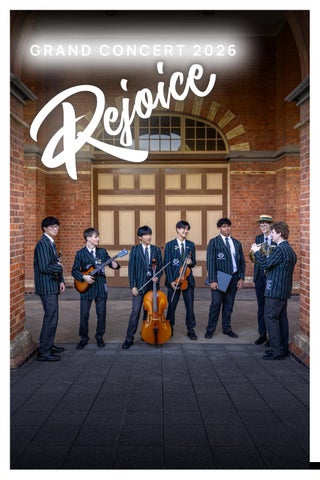
GRAND CONCERT 2026
GRAND CONCERT 2026 | Rejoice
1
BRISBANE BOYS’ COLLEGE
Grand Concert 2026
Content
2
3
Welcome
8
Big Band
10
BBC Concerto Competition Winner 2026
12
Collegians
14
Camerata
16
Family and Friends Choir
18
Outdoor Entertainment
19
2026 Darren Middleton Songwriting Competition Winner
22
Symphonic Band
24
College Strings
26
Combined Item
28
College Symphony
30
Family and Friends Orchestra
Welcome
Welcome to the 2026 Grand Concert – Rejoice It is with immense pleasure that I welcome you all to this year’s Grand Concert, aptly titled Rejoice. This theme captures the spirit of celebration that lies at the heart of music—the shared joy of performance, the uplift of harmony, and the deep satisfaction that comes from collective achievement. Each note performed and every melody brought to life this evening reflects countless hours of dedication, discipline, and passion from our talented students and committed staff. Music has always been a powerful expression of joy, capable of lifting our spirits and uniting us in ways that transcend words. As Johann Sebastian Bach once remarked, “The aim and final end of all music should be none other than the glory of God and the refreshment of the soul.” This sentiment speaks to what we celebrate tonight—the joy of creation, the energy of performance, and the shared experience that connects us all through music. An opportunity to Rejoice in the magnificence that is every BBC concert. This evening, we celebrate not only the musical accomplishments of our students but also the friendships they have nurtured, the guidance of their mentors, and the unwavering support of a community that encourages them to flourish. As we gather in this spirit of rejoicing, we are reminded of music’s extraordinary ability to inspire, to unite, and to bring joy to our lives. I extend my heartfelt thanks to our Head of Performance Music, Mr Theo Kotzas, and to all our music staff for their tireless dedication. I also acknowledge with gratitude the continued support of our Music Support Group, parents, and friends. Your encouragement and commitment have played an essential role in bringing this event to life. On behalf of Brisbane Boys’ College, I invite you to sit back, relax, and enjoy the exceptional performances our students have prepared. Let us rejoice together in the power of music and the joy it brings to our community. Mr Andre Casson | Headmaster
GRAND CONCERT 2026 | Rejoice
3
It is my pleasure to welcome you to the 2026 Grand Concert, Rejoice. While the Performance Music Department is alive with activity all year, full of diverse events and opportunities, this occasion is something quite special. The chance for BBC students to join with students from Clayfield College and Fairholme College, alongside our Family and Friends ensemble, is something truly worth rejoicing. Music accompanies us through all of life’s most significant moments, birthdays, weddings, and times of farewell, and tonight is a celebration of that shared experience. It is a reminder of the joy, connection and inspiration that music and community bring. Thank you to Head of Performance Music, Mr Theo Kotzas, Administrator Jenny Hageman, and the entire team of talented, collegial and deeply committed music educators. The richness they bring to our community is something we all benefit from. I hope you enjoy the evening. Ms Kate Albury | Head of Co-curricular – Culture and Enrichment
4
“There is music in the air, music all around us; the world is full of it, and you simply take as much as you require.” – Edward Elgar It is with great pleasure and excitement that I welcome you to Grand Concert 2026 – Rejoice. This year’s title acknowledges our individual and collective emotions when experiencing something that brings genuine happiness and joy. As we are all aware, listening to and participating in the performance of live music can, and often does, bring feelings of inexplicable happiness and joy. Something that is so beautiful that we want to cry, something that is so exciting that it makes us want to sing, jump or dance uncontrollably. This is the true power of Music. The program this evening, brings to the stage, works that are considered cornerstones of the concert hall as we know it today. One of these will be the combined performance of excerpts from George Frideric Handel’s masterpiece The Messiah; a work that brings joy and excitement and features his triumphant Hallelujah Chorus. We will also hear performances from our winner of the 2026 Darren Middleton Songwriting Competition- Nicholas Riemann, the dynamic energy of our Big Band and Symphonic Bands and our Family and Friends Choir and Orchestra. This year we acknowledge the thirtieth anniversary of the BBC Concerto Competition. A unique and very challenging event that asks its performers to deliver a full concerto or song-cycle in the final round of competition. We were thrilled to hear the three finalists and congratulate Voice student Lachy Brown on winning the 2026 competition. We welcome Lachy Brown to the stage this evening. We welcome and thank our friends from Clayfield College and Fairholme College as they join BBC in this year’s combined performance. I would like to thank our Headmaster Mr Andre Casson, Ms Kate Albury (Head of Co-curricular - Culture and Enrichment), and members of the College Executive and College Council for their support of the BBC Music Program. A huge thank you to our hard-working families of the Music Support Group. Thank you also to the families and supporters of the BBC Music students.
GRAND CONCERT 2026 | Rejoice
5
A special thank you to the talented and dedicated staff of our Music program. They are among some of the finest Music educators and performers this country has to offer. Congratulations to our performing musicians for working to make tonight a tremendous success. We look forward to your performances. Finally, I would like to thank our Seniors for their wonderful contribution to BBC Music and take this opportunity to wish them all the best as they move to the next exciting chapter of their lives. We look forward to welcoming you back to the Music Department sometime in the near future. Thank you for joining us this evening. Please enjoy Grand Concert 2026 – Rejoice. Theo Kotzas | Head of Performance Music Thank you to the Queensland Youth Orchestra Organisation for allowing us to use the Old Museum Building for the purposes of our program photos.
6
Good evening and welcome to the college’s 2026 Grand Concert. Over the past 12 months, I have personally witnessed many of the musicians that will perform this evening, grow and develop as musicians and work hard to bring the performances you will hear tonight from page to collaborative performance. Grand Concert has and will continue to be a special moment for all of our musicians, however, I can speak from experience when I say that for our seniors, it has a particular bittersweet feeling this year. When discussing the theme for this years Grand Concert, both Nick and I thought it to be only appropriate to pick a theme that was representative of the entire music department and quickly came to a unanimous decision which was thankfully met with the same enthusiasm upon presenting our choice to our Head of Music, Mr. Theo Kotzas. I am proud to announce that this year’s theme is “Rejoice”. For our seniors to rejoice in their final performance at the college, for our younger boys to rejoice in their development and growth over the past year, and for our staff to rejoice in the knowledge that their unending support and tutelage is received with appreciation greater than can be expressed in this welcome. Now is the time for us all to rejoice in the successes and lessons that 2026 has brought us all. I invite everyone tonight to join us in our rejoicing and reflect on your own successes and lessons in the past 12 months, rejoicing in your own development. To the musicians whom I have played with over the past 9 years, rejoice in your achievements and your losses because your losses are lessons which make success. To the all the staff who have made this evening possible, your endless support, time, and knowledge is what compels us to turn our losses to lessons and rejoice in your incredible capacity to shape the minds of the next generation of musicians. It has been an absolute honour to be able to support and learn from you all as the 2026 Music Captain. Please enjoy the performance and rejoice alongside our 2026 BBC Music cohort and staff in this event that is really a celebration of the joys and inspiration that comes from music and our wonderful community. I wish you all the best and encourage you all to rejoice! Lachy Brown | 2026 Music Captain
GRAND CONCERT 2026 | Rejoice
7
Big Band Conductor : Mr Stuart Bent Get Smart Irving Szathmary (1907-1983) arr. Roger Holmes Originally composed by Irving Szathmary for the classic television series Get Smart, this arrangement by Roger Holmes captures the unmistakable energy and humour of the show’s famous theme. It features punchy brass writing, driving rhythms, and colourful ensemble textures. The music moves with the quick-witted character of the television series, balancing sophistication with a playful sense of fun.
Mack the Knife Kurt Weill (1900-1950) arr. John Berry Few songs have travelled as successfully from the theatre to the jazz stage as Mack the Knife. The song was written by Kurt Weill, with lyrics by Bertolt Brecht, for their groundbreaking 1928 musical The Threepenny Opera. Based on John Gay’s earlier The Beggar’s Opera, the work satirizes crime, poverty, and respectable society through a combination of biting wit, memorable melodies, and popular musical styles. John Berry’s arrangement captures the swaggering character of the tune while giving the familiar melody a vibrant big-band treatment. Since becoming a jazz standard through Louis Armstrong’s 1956 recording and especially Bobby Darin’s spectacular 1959 version, “Mack the Knife” has remained a favourite of performers and audiences alike.
Take the ‘A’ Train Billy Strayhorn (1915-1967) arr. Alan Baylock Written by Billy Strayhorn in 1939, Take the ‘A’ Train became the signature piece of the Duke Ellington Orchestra and one of the defining compositions of the swing era. The title refers to the New York City subway’s A train, which carried passengers from Brooklyn through Manhattan and into Harlem. Strayhorn was reportedly inspired to write the piece after Ellington gave him directions to reach his home using the subway. From that simple journey came one of the most recognizable melodies in jazz. Alan Baylock’s challenging arrangement brings this classic to life with the energy and sophistication of a modern jazz ensemble. The familiar melody is surrounded by crisp ensemble writing, driving swing rhythms and dynamic contrasts. The arrangement captures the excitement of a big band in full flight while allowing the individual sections of the ensemble to contribute to the musical conversation. More than eighty years after its composition, Take the ‘A’ Train remains an enduring symbol of New York, the swing era, and the extraordinary musical legacy of Duke Ellington.
September Maurice White (1941-2016) Al McKay and Allee Willis arr. Mark Taylor Written and recorded by Earth, Wind & Fire in 1978, the song became an international hit and one of the most recognizable dance tracks of its era. Driven by an infectious groove, bright horn lines, and an instantly memorable melody, September combines elements of funk, soul, R&B, and disco into a celebration of rhythm and movement. Its exuberant character and repeated vocal refrain have helped make it a perennial favourite across generations. Mark Taylor’s arrangement brings the song naturally into the jazz ensemble setting, retaining its unmistakable groove while adding the punch, colour, and flexibility of a big band. Strong sectional writing, rhythmic accents all aid to maintain the relentless energy of one of popular music’s most enduring party songs. 8
GRAND CONCERT 2026 | Rejoice
9
2026 Concerto Competition Winner Lachlan Brown (Year 12) Associate Artist (Piano) : Mr Mac Johnson On Wenlock Edge Bredon Hill R. Vaughan-Williams (1872-1958) (Text by AE Housman) Lachlan has been studying classical voice under the direction of his teacher Brett Holland for the past 9 years and is currently working toward completing his Trinity College London Associate Music Performance Diploma. As well as his solo studies, he is currently the youngest member of the Australian Voices recently returning from performing in both Adelaide and Melbourne. Outside of his vocal performances Lachlan also composes music. Lachlan was recently afforded the opportunity of having one of his major works performed by the Queensland Conservatorium Wind Orchestra.
10
GRAND CONCERT 2026 | Rejoice
11
Collegians Conductor : Mr Simon Schmidt Associate Artist (Piano) : Mr Brett Sturdy O Isis und Osiris (chorus of priests from the Magic Flute) Wolfgang Amadeus Mozart (1756- 1791) The Priest’s Chorus (No. 18) in Act II of Mozart’s The Magic Flute is a solemn, homophonic ensemble for male voices, embodying unity, calm, and spiritual authority. Sung by the brotherhood, it invokes wisdom and guidance for Tamino and Pamina as they undergo trials. The music’s balanced phrasing and restrained dynamics create an atmosphere of ritual and contemplation. These qualities reflect strong Masonic influences: Mozart, himself a Freemason, incorporates ideals of fraternity, enlightenment, and moral self-improvement.
German text O Isis und Osiris, welche Wonne! Die düst’re Nacht verscheucht der Glanz der Sonne! – Bald fühlt der edle Jüngling neues Leben, bald ist er unser’m Dienste ganz gegeben. Sein Geist ist kühn, sein Herz ist rein, Bald wird er unser würdig sein.
English Translation O Isis and Osiris, what bliss! Dark night is banished by the sunlight, Soon the noble youth will feel new life; Soon he will be wholly devoted to our service. His spirit is bold, his heart is pure, Soon he will be worthy of us.
Sound Off Paul Rardin Sound Off by Paul Rardin is a whimsical, rhythm-driven dialogue between an R&B singer and a member of the British aristocracy, as moderated by a US Army drill sergeant. The latter invites each of the four sections of the choir to ‘sound off’ in their unique range and style (R&B singer), in the hopes of persuading the other three sections (aristocrat) to embrace the notion of the ‘house party’. By the end, the aristocrat joins in the good-natured fun, albeit with some embarrassment afterwards, and the piece concludes with a final sound-off that fades into the distance. Rardin’s inventive writing highlights the voice as both a musical and rhythmic instrument, resulting in a vibrant, contemporary soundscape that showcases precision, teamwork, and expressive character within a spirited and entertaining choral framework.
12
GRAND CONCERT 2026 | Rejoice
13
Camerata Conductor : Mr Dominic Fitzgerald Associate Artist (Piano) : Mr Brett Sturdy Verleih uns Frieden (Grant Us Peace), MWV A11 Felix Mendelssohn (1809–1847) Composed in 1831, Verleih uns Frieden (“Grant Us Peace”) is one of Mendelssohn’s most affecting sacred miniatures. Setting Martin Luther’s German paraphrase of an ancient Latin prayer, the work is a heartfelt plea for peace: “Grant us peace graciously, Lord God, in our time. There is none other who fights for us but You alone.” Although written in an era marked by political uncertainty across Europe, its quiet message has retained a timeless resonance. Rather than seeking dramatic effect, Mendelssohn allows the music to unfold with remarkable restraint. Long, arching vocal lines and luminous harmonic writing create an atmosphere of serenity, while moments of gentle intensity emerge naturally from the text before subsiding into profound stillness. The influence of the great Lutheran tradition—particularly J. S. Bach—is unmistakable, yet the work speaks in Mendelssohn’s own unmistakably lyrical voice. In little more than five minutes, Verleih uns Frieden achieves an extraordinary sense of dignity and hope, offering a simple but deeply moving meditation on humanity’s enduring longing for peace.
Three Hungarian Folk Songs (Nos. 1 & 3) Mátyás Seiber (1905–1960) Born in Budapest, Mátyás Seiber occupied a fascinating position between the worlds of folk tradition and twentieth-century modernism. A student of Zoltán Kodály and a contemporary of Béla Bartók, Seiber shared their conviction that the authentic folk music of rural Hungary possessed an artistic richness equal to the greatest works of the classical tradition. After leaving Hungary in the 1930s, he settled in Britain, where he became an influential teacher and composer, writing music that ranged effortlessly from concert works to film scores and even jazz. The Three Hungarian Folk Songs are graceful settings of traditional melodies whose apparent simplicity conceals remarkable sophistication. The first song is a tender expression of youthful affection, while the third is buoyant and irresistibly playful, its dancing rhythms and sparkling energy capturing the exuberant spirit of Hungarian village music. There is an unmistakable sense of joy in these miniature scenes, reminding us that folk song was as much a vehicle for celebration as it was for storytelling. Throughout, Seiber preserves the natural contours of the original melodies, surrounding them with harmonies of warmth, colour and gentle modernity. These charming and engaging works offer a glimpse into a musical culture where song was woven into everyday life, transforming ordinary human experiences into music of enduring vitality and beauty.
14
GRAND CONCERT 2026 | Rejoice
15
Family and Friends Choir Brisbane Boys’ College - Camerata and Collegians Clayfield College - Canzona Fairholme College - Chamber Choir Conductor : Mr Simon Schmidt Associate Artist (Piano) : Mr Brett Sturdy Bohemian Rhapsody Freddie Mercury (1946–1991) arr. SATB Choir by Mark Brymer Released by Queen in 1975, Bohemian Rhapsody is one of the most celebrated songs in popular music. Blending ballad, opera, and rock into a single dramatic work, it broke convention and became an enduring classic. Rather than following a traditional verse-and-chorus structure, the rhapsody song form unfolds as a dramatic musical journey, moving seamlessly through contrasting styles and emotions. Mercury himself described the work as a “mock opera,” reflecting its playful blending of classical and popular traditions. Mark Brymer’s SATB arrangement captures the song’s iconic contrasts, rich harmonies, and theatrical energy, allowing choirs to recreate the vocal brilliance of the original recording. Both entertaining and musically rewarding, it remains a crowdpleasing showcase of the power and versatility of the choral voice.
16
GRAND CONCERT 2026 | Rejoice
17
Outdoor Entertainment Rock Band - Yes, Indeed Members : Nicholas Riemann, Daniel Hockey, Ethan So Yes, Indeed is a 3 piece Rock group consisting of Ethan So, Daniel Hockey and Nick Riemann. The band has been playing together for 4 years now, often covering bands such as Red Hot Chilli Peppers, The Cure, Muse and Korn, showcasing their versatility and musicality. Yes, Indeed started when the three boys got together during lunch breaks, and just jammed out to music, frequently running through Creep by Radiohead and For Whom The Bell Tolls by Metallica. After these years, Yes, Indeed has become a staple in the BBC Rock Band community.
18
2026 Darren Middleton Songwriting Competition Winner Nicholas Riemann : Yr 12 Nicholas has always enjoyed music at BBC, starting his musical journey in the Music Every Day program in Grade 3, before learning to play viola. Later, after being exposed to the BBC Rock Band program, he was inspired to start learning guitar and started up a band of his own. He has enjoyed being a part of the BBC Rock Band program. His first experience was joining the band Yes, Indeed with his friends at the end of Year 9. Yes, Indeed has gone on to play a multitude of concerts, the Darren Middleton Songwriting Competition, as well as contributing to the annual themed concert. After growing his skills and knowledge as a musician, Nicholas decided to start writing his own songs. Currently, he is working on recording and producing an album consisting of 10 tracks. The song that won him the 2026 Darren Middleton Songwriting Competition hopefully being the title track.
GRAND CONCERT 2026 | Rejoice
19
20
GRAND CONCERT 2026 | Rejoice
21
Symphonic Band Conductor : Mr Stuart Bent El Camino Real (A Latin Fantasy) Alfred Reed (1921-2005) arr. Robert Longfield Alfred Reed’s exciting Latin fantasy El Camino Real has become one of the most frequently performed contemporary concert band works. The title, Spanish for “The Royal Road,” refers to the historic roadway connecting the Spanish missions established throughout California during the Spanish colonial period. Rather than depicting the road itself, Reed uses the title as a musical gateway into the rich traditions of Spanish and Latin-inspired music. The result is a vibrant celebration filled with passionate melodies, brilliant orchestration, and energetic dance rhythms. The composition follows a traditional fast–slow–fast design. The opening bursts to life with bold fanfares and driving rhythms inspired by the jota, an energetic Spanish folk dance characterised by its lively pulse and festive character. Reed combines brilliant brass fanfares, flowing woodwind passages and colourful percussion to create an exhilarating and dramatic opening. The central section provides a striking contrast, replacing the excitement with a broad, lyrical melody influenced by the fandango. Although more reflective, the music retains its unmistakable Spanish flavour through its harmonies and graceful rhythmic accompaniment. Tension gradually builds toward the finale, where themes from the opening return with renewed energy. Rapid exchanges between sections, sparkling percussion, soaring brass lines and powerful climaxes propel the work toward its exciting conclusion.
On A Hymnsong of Philip Bliss David R. Holsinger (1945 - present) Written in 1989, this piece is based on the beloved hymn “It Is Well with My Soul.” There is extraordinary power in this hymn, stemming from the grief surrounding its creation and its enduring message of peace, faith and trust in the midst of suffering. Holsinger shares the melodic material throughout the ensemble rather than assigning it exclusively to one section. The melody moves organically from one group of instruments to another, allowing different instrumental colours to give the tune new meaning. Moments of intensity are carefully balanced by passages of calm, with the ultimate aim of achieving a fundamental sense of serenity.
Swarm Brian Beck (1976-present) Brian Beck’s Swarm is an energetic and engaging work for concert band that explores one of the most fundamental principles of ensemble music: communication. From its opening moments to its conclusion, the piece challenges musicians to listen, react and contribute to a constantly changing musical conversation. Beck treats the band as a single entity, with musical ideas moving rapidly from one group of instruments to another. The title suggests movement, activity and collective behaviour. A swarm is made up of many individuals, yet its overall motion can appear unified and purposeful. Beck translates this idea into music through an ensemble in which individual parts continually interact. Melodic fragments and rhythmic motives are passed from one section to another, creating a constant sense of motion. 22
GRAND CONCERT 2026 | Rejoice
23
College Strings Conductor : Mr Theo Kotzas Introduction and Allegro , Op 47 Edward Elgar (1857-1934) Soloists – Matthew Jung (Violin 1), Aoxuan Min (Violin 2), Bryan Kang (Viola) and Evan Wei (Cello)
English composer Sir Edward Elgar was invited by a close friend to write a work that would showcase the virtuosity of the string players in the newly formed London Symphony Orchestra. In the letter of request, the author challenges the composer to include a fugue, a scherzo – (a real bring-down-the-house” torrent of a thing such as Bach could write … That would sell like akes.) Not being able to resist a challenge, in 1905, Elgar delivered the momentous Introduction and Allegro Op 47 written for String Quartet and String Orchestra. A model adapted from the standard 18th century Concerto Grosso form of the Baroque period. It premiered in the Queen’s Hall, London, with Elgar himself, the conductor. Of the work, Elgar wrote that whilst thinking of writing a string piece, he stood on a cliff contemplating the main tune and heard singing in the distance. He couldn’t make out the tune but thought it might be Welsh. Elgar used his memory of this in the Introduction and later the Coda. Elgar later wrote, (“My idea is that music is in the air, music is all around us, the world is full of it, you simply take as much as you require.”) Sir Edward Elgar, along with Ralph Vaughan Williams and Gustav Holst are thought of as having defined the true English ‘sound’ during the turbulent years around World War I and II. Their music depicted both the patriotic themes of a proud nation and at the same time, the reflective and lush colours of a country confused by mourning and hope of better times. Their catalogue of works is a guide to what is regularly programed and performed in concert halls around the world. The Introduction and Allegro is a demanding and challenging work. The use of a quartet of soloists that seamlessly blend with the bigger string orchestra is a masterstroke and at the same time one of its greatest challenges.
24
GRAND CONCERT 2026 | Rejoice
25
Combined Item Messiah George Frideric Handel (1685-1759)
Brisbane Boys’ College - College Strings Brisbane Boys’ College - Camerata Clayfield College - Canzona Fairholme College - Chamber Choir Conductor : Mr Theo Kotzas Choir Director : Mr Dominic Fitzgerald Glory to God • Surely He Hath Borne Our Griefs • Hallelujah Few works in the Western musical tradition have attained the enduring stature of George Frideric Handel’s Messiah. Premiered in Dublin in 1742, the oratorio traces the Christian story not through dramatic action or individual characters, but through reflection and contemplation. Its power lies in Handel’s remarkable ability to transform words into sound, creating music of extraordinary emotional directness, architectural grandeur and inexhaustible vitality. The three choruses heard this evening reveal Handel’s extraordinary command of musical contrast. Glory to God bursts into life with effortless luminosity, the soaring upper voices suggesting the brilliance of the heavenly host before yielding to music of striking repose. The celebrated words “and peace on earth” are set with remarkable restraint, Handel allowing simplicity rather than splendour to convey their quiet authority. Joy and stillness are held in delicate equilibrium, each giving meaning to the other. If Glory to God is music of radiant proclamation, Surely He Hath Borne Our Griefs inhabits an altogether darker landscape. The relentless rhythmic drive, uncompromising harmonic language and severe contrapuntal texture create an almost physical sense of burden. Handel’s genius lies not in depicting suffering sentimentally, but in allowing the architecture of the music itself to bear its weight. Every phrase presses forward with inexorable purpose, making the eventual release all the more compelling. The Hallelujah Chorus requires little introduction, yet its familiarity should never obscure its remarkable craftsmanship. Its power lies not simply in moments of grandeur, but in Handel’s ability to balance bold, declamatory writing with passages of energetic counterpoint, gradually building a sense of momentum and inevitability. The music unfolds with confidence and purpose, culminating in a conclusion that continues to inspire performers and audiences nearly three centuries after its first performance.
26
Together, these three choruses form a remarkable musical journey—from radiant proclamation, through reflection and adversity, to an overwhelming expression of joy. While their origins are sacred, the emotional landscape they inhabit speaks far more broadly to the shared human experience. In a concert celebrating the spirit of Rejoice, Handel’s music reminds us that the deepest expressions of joy are seldom naïve or uncomplicated; rather, they emerge most powerfully through resilience, gratitude and hope. We are delighted to present these performances in collaboration with guest musicians from Clayfield College and Fairholme College, whose participation enriches this shared celebration of great repertoire.
Glory to God (Luke 2:14) Glory to God in the highest, and peace on earth, goodwill towards men.
Surely He Hath Borne Our Griefs (Isaiah 53:4–5) Surely He hath borne our griefs, and carried our sorrows! He was wounded for our transgressions, He was bruised for our iniquities; the chastisement of our peace was upon Him.
Hallelujah Chorus (Revelation 19:6; 11:15; 19:16) Hallelujah! Hallelujah! Hallelujah! Hallelujah! Hallelujah! For the Lord God omnipotent reigneth. Hallelujah! The kingdom of this world is become the kingdom of our Lord, and of His Christ; and He shall reign for ever and ever. King of Kings, and Lord of Lords. And He shall reign for ever and ever. Hallelujah! Hallelujah! Hallelujah! Hallelujah! Hallelujah!
GRAND CONCERT 2026 | Rejoice
27
College Symphony Conductor : Mr Theo Kotzas Symphony No 7 in A Major, Op 92 Ludwig van Beethoven (1770-1827)
1 – Poco sostenuto, Vivace The Seventh Symphony written in 1811-1812, with a dedication to Count Moritz von Fries, was premiered in 1813 as part of a charity concert for soldiers wounded in the Battle of Hanau. It’s composition and premiere soon followed Wellington’s defeat of Napolean at the Battle of Vitoria. Beethoven conducted the premiere with an orchestra that featured many prominent musicians of the day. The symphony was immediately embraced by audiences with the second movement (Allegretto) being a favourite. Coinciding with Wellington’s defeat of Napoleon at the Battle of Vitoria, it is thought that the rhythmic vitality of the symphony and its folklike melodies may have helped its popularity. The first movement has a longer than usual introduction that features strong and bold chords linked by scalic passages and long notes grouped in 2-bar phrases. The dramatic opening then leads to the exciting Vivace. Beethoven also works through the primary keys of each of the four movements in the Introduction – poco sostenuto. The Vivace is built around a 6/8 time-signature and features a rollicking dotted rhythm that is played in every section of the orchestra without ever stopping. The movement also has Beethoven’s trademark chromaticism and dramatic statements built around his swirling dynamics. The use of the Scotch Snap or Lombard Rhythm, was believed by audiences to suggest a more rustic flavour as the rhythmic tool used folk music by the Scottish, Irish and Welsh. The Sonata Form structure of this movement is almost perfectly crafted by Beethoven; introduction, exposition, development, recapitulation and the coda. The Seventh Symphony is often thought to be another ‘music protest’ written by Beethoven in response to Napolean’s attack on Europe. This work was in the list that celebrated the downfall and eventual defeat of Napolean. (Key information from University of Rochester – Eastman School)
28
GRAND CONCERT 2026 | Rejoice
29
Family and Friends Orchestra Conductor : Mr Theo Kotzas Radetzky March Op. 228 Johann Strauss Snr (1804-1849) arr. Clark McAlister (1946-present) This popular march was written by Strauss Snr in 1848 and was dedicated to Field Marshal Joseph Radetzky von Radetz to commemorate his victory at the Battle of Custoza. It is believed that on their return from battle, Radetzky’s troops were singing the folk tune that was later used as the Trio section. Tradition is such that when the Radetzky March is now performed, the audience becomes involved with clapping and stamping of their feet.
30
GRAND CONCERT 2026 | Rejoice
31
Performers Lists Big Band
Connor Crick – Russack
Baritone Saxophone
Bryan Kang
Alto Saxophone
Jonah Lee
Trumpet
Ethan Seymour
Alto Saxophone
Martin Chen
Trumpet
Pavan Thiruchelvam Tenor Saxophone
Sebastian Pace
Trumpet
Sanuk Athuraliya
Tenor Saxophone
Dominic Bassford
Trumpet
Elliott Sharp
Baritone Saxophone
Cameron Rozmanec Trumpet Noah Chew
Trumpet
Sebastian Pace
Trumpet
Nicholas Rek
Trumpet
Jonah Lee
Trumpet
Lachy Brown
French Horn
Cameron Rozmanec Trumpet
Felix Holland
French Horn
Dominic Bassford
Trumpet
Mitchell Warman
Trombone
Mitchell Warman
Trombone
Joshua Bailey
Trombone
Joel Won
Trombone
Dalton Barnes
Trombone
Joshua Bailey
Trombone
Zac Wang
Trombone
Dalton Barnes
Trombone
Joel Won
Euphonium
Zac Wang
Drumkit
Alex Yun
Tuba
Shumo Grygoruk
Guitar
Louis Ko
Percussion
Rayyan Hamid
Guitar
Harrison Ma
Percussion
Alistair Yu
Bass Guitar
Steven Shen
Percussion
Han Tsai
Keyboard
Leo Kleibacker
Percussion
Dharran Srilingam
Percussion
Nicholas Hughes
Percussion
Symphonic Band Sean Yun
Flute/Piccolo
Christopher Ashley
Flute
Martin Xiao
Flute
Josh Ati
Helix Leung
Flute
Dominic Bassford
Hallbert Lau
Flute
Lachy Brown
Jasper Lau
Oboe
Myles Brown
Ethan Seymour
Clarinet
Emerson Brown
Lucas Derrick
Clarinet
Hyunjin Cho
Elliot Hade
Clarinet
Kobe Chu
Fred Lee
Clarinet
James Cousins
Sam Shen
Bass Clarinet
Matthew De Saram
Bryan Kang
Alto Saxophone
Lucas Derrick
Pavan Thiruchelvam Alto Saxophone
Chengze Du
Sanuk Athuraliya
Alto Saxophone
Hudson Gardiner
Elliott Sharp
Tenor Saxophone
Samaksh Garg
Lawrence van Rosendal
Tenor Saxophone
Camerata
Albert Ge Shumo Grygoruk Luke Hockaday
32
Daniel Hockey
Collegians
Felix Holland Jack Holmes
Josh Ati
Shrikar Hoskere
Dominic Bassford
Nicholas Hughes
Lachlan Brown
Judah James
Samaksh Garg
Xavier Khandaker
Albert Ge
George Kotzas
Daniel Hockey
Roy Li
Ewan Mahoney
Laurance Lightfoot
Nathan Maina
Sonny Liu
Oliver Marschke
Ewan Mahoney
Harry McPherson
Nathan Maina
Lachlan Moore
Oliver Marschke
Nicholas Riemann
Harry Mcpherson
Ashaaz Shaikh
Lachlan Moore
Ollie Shelton
Timmy Morgans
Chris Sun
Kshitij Mutyala
Will Wetherston
Aryan Potukuchi
College Symphony
Henry Poyner Ostyn Reardon Nicholas Riemann Oliver Rowden Kyle Schofield Ashaaz Shaikh Ryan Shanabrook Oliver Shelton Dhurrun Srilingam Chris Sun Ethan Talluri Roman Tauialo Aayush Veeravel Lochan Vignesh Tom Wang Zac Wang William Wetherston Lachlan Wilkinson Brighton Xu Iain Yu Alistair Yu Max Yue
Matthew Jung
Violin
Noah Kim
Violin
Liam Beak
Violin
Ho Jin Han
Violin
Noah Matsuda
Violin
Noah (Nam Ho) Kim
Violin
Daniel Xu
Violin
Aoxuan Min
Violin
Cameron Strickland Violin Han Tsai
Violin
Alistair Yu
Violin
Ian Yu
Violin
George Kotzas
Violin
Flynn Noble
Violin
Hugh Jenseo Kim
Violin
Min Kim
Violin
Barry Zhang
Violin
Elvis Shu
Violin
Benji Tran
Violin
Marcus Teo
Violin
GRAND CONCERT 2026 | Rejoice
33
Ian Lee
Violin
Evan Meng
Violin
Hyunsung Cho
Violin
Matthew Jung
Violin
Bryan Kang
Viola
Liam Beak
Violin
Nicholas Riemann
Viola
Ho Jin Han
Violin
Noah Jin
Viola
Hugh Kim
Violin
Josh Ati
Viola
Min Kim
Violin
James Cousins
Viola
Noah Kim (Nam Ho)
Violin
Braxton Bendzala
Viola
Noah Kim
Violin
Joseph Rosario
Cello
Noah Matsuda
Violin
Evan Wei
Cello
Aoxuan Min
Violin
Chengze Du
Cello
Cameron Strickland Violin
Yerik Ye
Cello
Han Tsai
Violin
Ethan Bailey
Cello
Daniel Xu
Violin
Joshua Ward
Double Bass
Ian Yu
Violin
Brayden Edwards
Double Bass
Alistair Yu
Violin
Rupert Gooding
Double Bass
George Kotzas
Violin
Gabriel Tong
Double Bass
Evan Meng
Violin
Lachy Brown
French Horn
Bryan Kang
Viola
Felix Holland
French Horn
Nicholas Riemann
Viola
Jonah Lee
Trumpet
James Cousins
Viola
Martin Chen
Trumpet
Noah Jin
Viola
Alex Yun
Tuba
Joseph Rosario
Cello
Joel Won
Trombone
Bryan Cheng
Cello
Ethan Zhang
Trombone
Chengze Du
Cello
Marlon Chen
Trombone
Evan Wei
Cello
Sean Yun
Flute
Yerik Ye
Cello
Christopher Ashley
Flute
Ethan Bailey
Cello
Hallbert Lau
Flute
Brayden Edwards
Double Bass
Jasper Lau
Oboe
Rupert Gooding
Double Bass
Sam Shen
Clarinet
Joshua Ward
Double Bass
Elliot Hade
Clarinet
Nicholas Hughes
Percussion
Lucas Pan
Percussion
Brighton Xu
Percussion
34
College Strings
GRAND CONCERT 2026 | Rejoice
35
Special Thanks Senior School Music Captain – Lachlan Brown Senior School Music Vice Captain – Nicholas Riemann BBC Music Staff for their dedication Associate Artist (Piano) Mr Brett Sturdy and Mr Mac Johnson The AV team for all of their assistance. The Music Support Group members and parents for their dedication to this event, and for arranging refreshments The BBC Marketing Department for the advertising and program Mr Alex Jamieson and team for film and production Mr Brodie Grogan for the photography Mrs Helen Jackson BBC Archivist Parents, friends and staff of BBC who have made this evening, and this year, such a musical success Clayfield College Canzona Choir and Mrs Angela Lockyer Fairholme College Chamber Choir and Mr Alexander Dixon To all of the members of our community who performed with the Family and Friends Ensembles The Headmaster, Mr Andre Casson and Head of Co-curricular – Culture and Enrichment , Ms Kate Albury and the College Executive for their continued support of the BBC Music Program And lastly, to our musicians for all of their hard work and dedication to making tonight’s concert a truly wonderful performance
36
Big Band
Camerata
College Symphony
GRAND CONCERT 2026 | Rejoice
37
2026 Music Staff Head of Performance Music and Head of Strings Mr Theo Kotzas Performance Music Manager Mrs Jenny Hageman Head of Department - The Arts Mr Stuart Quill Asst. Head of Department –The Arts Mr Dominic Fitzgerald Classroom Music Mr Stuart Quill Mr Dominic Fitzgerald Mr Adam Kehl Mrs Sarah Muchall Ms Maree Hennessy Ms Kate Albury - Head of Co-curricular – Culture and Enrichment
Ms Krysten Rowe - Asst. Head of Department the Arts
Strings Mr Theo Kotzas - Head of Strings Mr Alex Jamieson Mr Jason Tong Mr Stephen Tooke Ms Marian Heckenberg
38
Guitar Dr Paul Ballam-Cross Mr Tyler Cooney Woodwind Mrs Bernadette D’Arcy - Head of Woodwind Dr Nathaniel Smorti Dr Michal Rosiak Brass Mr Stuart Bent - Head of Brass and Percussion
Ms Ysolt Clark Mr Sean Mackenzie Mr Andrew Mc Naughton Percussion Mr Russell Pearce Vocal Mr Simon Schmidt – Head of Choral Mr Brett Holland Piano Mr Brett Sturdy Mr Christian Gante Mr Mitch Fairlie Ms Roya Halavati
College Strings
Collegians
Symphonic Band
GRAND CONCERT 2026 | Rejoice
39
40