
Sheldon A. Neeley Mayor
Sheldon A. Neeley Mayor
On behalf of the City of Flint Business and Community Services, we are pleased and excited to extend our wholehearted support for the Northeast Flint Community Choice Plan. This innovative initiative represents a vital step forward in our community's ongoing revitalization and growth. We firmly believe that the plan will have a transformative impact on the residents of Flint, particularly those in the Northeast area, and will significantly contribute to the city's broader economic, social, and environmental well-being.
The Northeast Flint Community Choice Plan aligns with the City of Flint’s ongoing efforts to create a more vibrant, inclusive, and sustainable future for all of its residents. As a community, we have faced many challenges over the years, but we continue to work together to build a stronger, more resilient Flint. This plan is an essential component of that vision, addressing long-standing issues such as affordable housing, access to quality jobs, community safety, and economic opportunity.
We believe the Northeast Flint Community Choice Plan will complement our broader efforts to revitalize the City of Flint. It offers a holistic approach that integrates housing, economic development, education, public services, and community engagement. The success of this plan will have lasting benefits, not only for the Northeast Flint neighborhood but for the city as a whole.
As a partner in the growth and development of Flint, the City of Flint Business and Community Services is committed to supporting the implementation of this plan. We will continue to work collaboratively with stakeholders, including local businesses, residents, and nonprofit organizations, to ensure that the goals of the Northeast Flint Choice Plan are realized.
We fully endorse this vision for the future of Flint and look forward to the positive outcomes it will bring. Please do not hesitate to contact us for any further information or assistance as you move forward with the implementation of this important initiative.
Sincerely,

Emily Doerr Director, Department of Business and Community Services
edoerr@cityofflint.com (810) 880-3371 (city cell)


3820 Richfield Road, Flint, Michigan 48506
Phone: (810) 736-3050 tax: (810) 736-0158
On behalf of the Boards of Commissioners, Flint Housing staff, and our partners, we are excited to present the Northeast Flint Neighborhood Transformation Plan for northeast Flint.
The plan exemplifies true community, transparency, and partnership between our city’s institutions, community organizations, neighborhood groups, residents, and stakeholders from all walks of life. The plan embraces the authentic culture, ideas, hopes, vision, and lived experience of all who live, work, and invest in our community.
We are privileged to have gained a deeper understanding of the essence and fabric of northeast Flint its residents and their families, especially our River Park Apartments community. It has been an honor to collaborate and build upon the incredible work that local organizations are already doing to support and strengthen this community.
We are grateful to our residents, partners, stakeholders, staff, and neighbors who have shared their experiences, resources, and time with us during this process.
I am pleased to present this transformation plan and report that Northeast Flint is ready and awaiting its revitalization. We look forward to working with the City and all of our partners as we continue to implement the community‘s vision and establish a neighborhood where all residents will thrive!
Sincerely,
Damon E. Duncan CEO of Flint Housing Commission
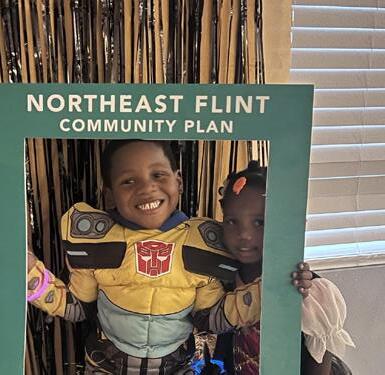
The Northeast Flint Community Plan is a testament to the many voices united in service to their neighborhood. It embodies the resilience and dedication of all stakeholders—lifelong residents, children, employers, local organizations, and civic leaders—who contributed to this vision for a brighter future.
The Northeast Flint Community Plan is a testament to the many voices united in service to their neighborhood. It embodies the resilience and dedication of all stakeholders—lifelong residents, brighter future.
Your dedication to this two-year effort has been invaluable, and we extend our heartfelt gratitude to everyone who contributed their time, energy, and insights. Through your active participation in community engagement, public meetings, and various activities, you’ve helped shape a vision centered on equity and equality. Thank you for your unwavering commitment to restoring and revitalizing the Northeast Flint community.
to everyone who contributed their time, energy, and insights. Through your active participation in community engagement, public meetings, and various activities, you’ve helped shape a vision centered on equity and equality. Thank you for your unwavering commitment to restoring and revitalizing the Northeast Flint community.
Steering Committee, Task Force and/or Stakeholder Interview Participants
Over two-dozen individuals and organizations took part in Steering Committee and Sub-Committee meetings through-profit ers.
• Ashley Capital
Steering Committee, Task Force and/or Stakeholder Interview Participants
• R.L. Jones Community Outreach Center
• Charles Stewart Mott Foundation
• Robert Brown
Over two-dozen individuals and organizations took part in Steering Committee and Sub-Committee meetings through-profit ers.
• Communities First
• Ashley Capital
• Community Foundation of Greater Flint
• Charles Stewart Mott Foundation
• Communities First
• Environmental Transformation Movement of Flint
• Community Foundation of Greater Flint
• Flint Development Center
• Flint Institute of Arts
• Environmental Transformation Movement of Flint
• Flint & Genesee Economic Alliance
• Flint Development Center
• Flint LISC
• Flint Institute of Arts
• Flint MTA
• Flint & Genesee Economic Alliance
• Flint Neighborhoods United
• Flint LISC
• Flint River Watershed Coalition
• Flint MTA
• Genesee County Habitat for Humanity
• Flint Neighborhoods United
• Genesee County Land Bank Authority
• Flint River Watershed Coalition
• Genesee County Habitat for Humanity
• Genesee County Parks Department
• Genesee Health Coalition
• Genesee County Land Bank Authority
• GST Michigan Works!
• Genesee County Parks Department
• In the Beginning, First Ward Project
• Genesee Health Coalition
• Keep Genesee County Beautiful
• GST Michigan Works!
• Metro Community Development
• In the Beginning, First Ward Project
• Keep Genesee County Beautiful
• Ladel Lewis, 2nd Ward Council Member
• Mott Community College Workforce Development
• Metro Community Development
• Neighborhood Engagement Hub
• North Flint Neighborhood Action Council
• Office of Economic Development University of Michigan - Flint
• Quincy Murphy, 3rd Ward Council Member (In Memoriam)

• Ruth Mott Foundation
• Mott Community College Workforce Development
• Neighborhood Engagement Hub
• St. Luke N.E.W. Life Center
• North Flint Neighborhood Action Council
• Sylvester Broome Empowerment Village
• Uptown Reinvestment Corporation
• Office of Economic Development University of Michigan - Flint
• Quincy Murphy, 3rd Ward Council Member (In Memoriam)
• R.L. Jones Community Outreach Center
• Robert Brown
• Ruth Mott Foundation
• St. Luke N.E.W. Life Center
• Sylvester Broome Empowerment Village
• Uptown Reinvestment Corporation
The project team would like to recognize the four resident ambassadors for their support and leadership throughout the planning process. Ambassadors engaged with residents during meetings, door-to-door engagement to ensure surveys were filled out and supported the community throughout the process.
• Petimia Metcalf
• Shenika Hamiliton
• Audrina Biddle
• Geri Clark
Flint Housing Commission Team
• Jason Borror (former Director)
• Beth Dimmig
• Donisha Humphrey
• Doug Peters
• Jamar McKenzie
• Jeanette Brown
• Faten Latimer
Planning Process Efforts
• Office of Economic Development University of Michigan - Flint for help with data collection and assessment
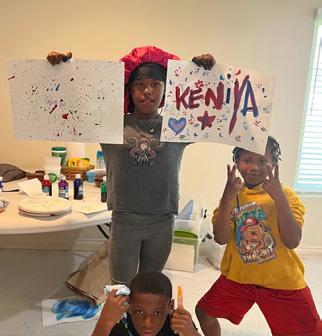
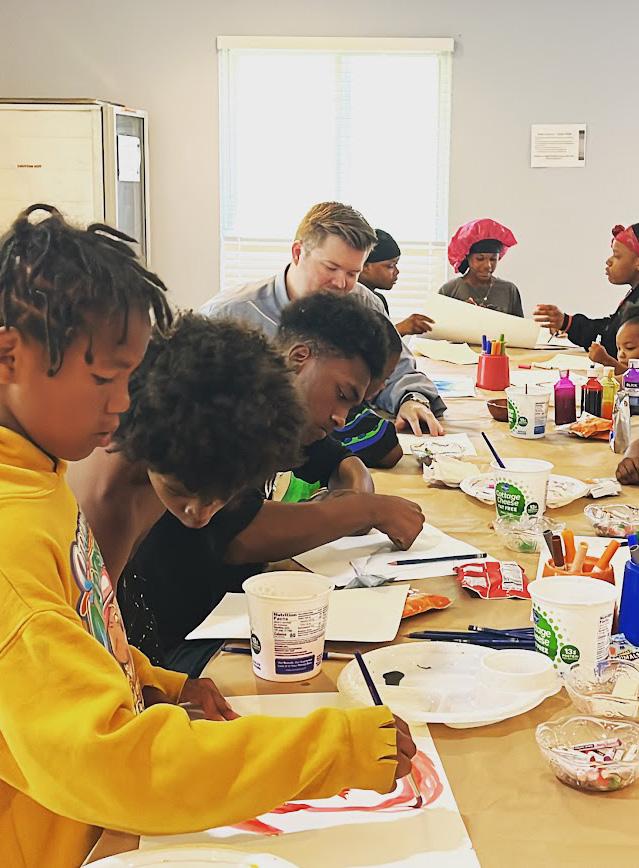
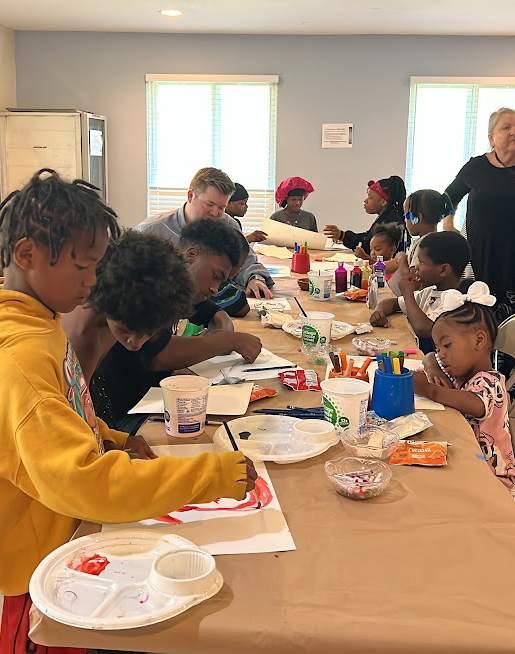
• Flint Institute of Arts for organizing arts events during the engagement sessions for encouraging the residents to participate
The project team would like to recognize the residents of River Park Apartments for their insights, feedback, and collaboration throughout the planning process. Residents engaged with long questionnaires and surveys, provided invaluable feedback to design alternatives, and informed both the people and neighborhood portions of the plan.
City of Flint Team
• Emily Doerr
• Dequan Allen
• Mikesha Loring
• Ashly Harris
• Lord Aeck Sargent - Lead
• Collabo Planning - People
• ROWE Professional Services Company
• Duvernay + Brooks LLC
• Progressive Companies





The Flint Housing Commission and the City of Flint received a $500,000 Choice Neighborhoods (CNI) Planning Grant from the U.S. Department of Housing and Urban Development in December 2022 for developing a revitalization plan for the River Park Apartments and the northeast Flint neighborhood. The two-year, communitydriven process aimed to create actionable strategies for northeast Flint’s revitalization, targeting the core CNI areas of People, Neighborhood, and Housing. Facing years of disinvestment, this area has benefited from local organizations’ dedicated redevelopment efforts in recent years. The Planning Team collaborated closely with these groups, fostering a process that included all community members and aligned with ongoing neighborhood efforts. Residents played an integral part in the decision-making. Equipped with valuable information and viable opportunities, they were empowered to contribute to the vision and help shape the future of their community themselves.
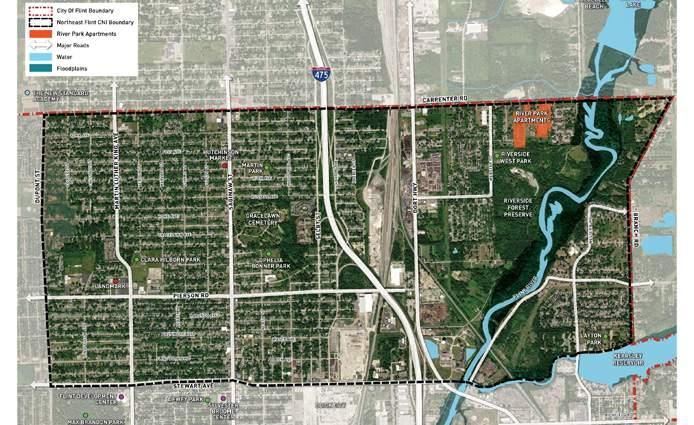
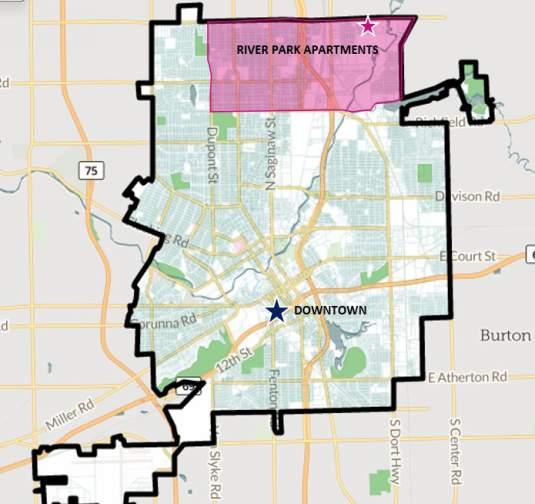
The Northeast Flint Community is located at the northeastern edge of Flint, about 2.5 miles north of downtown. It is primarily a residential area with limited retail activity along Saginaw Street and Carpenter Road. The neighborhood’s high rate of vacant parcels and underutilized properties present both challenges and significant opportunities for revitalization.
Carpenter Road is the only east-west route that goes through the entire neighborhood, highlighting
forest preserve, creating significant disconnections. The forest, a valued community asset, holds potential for further activation and better integration into the neighborhood to bridge existing gaps and create a cohesive community fabric.
While there is currently no active school in the area, this provides an opportunity to establish new educational and community spaces. Concerns about air quality, particularly following the addition of the Ajax Plant, have brought residents and leaders
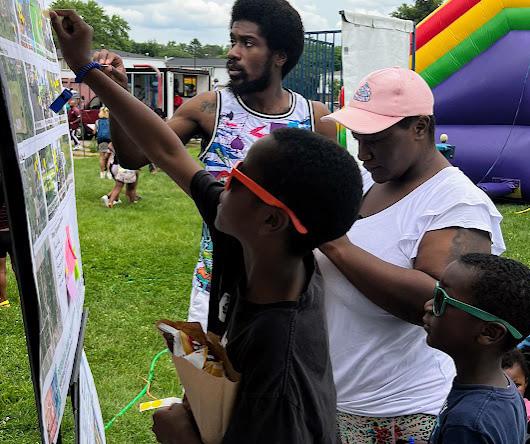
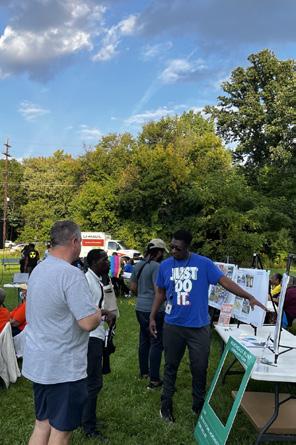
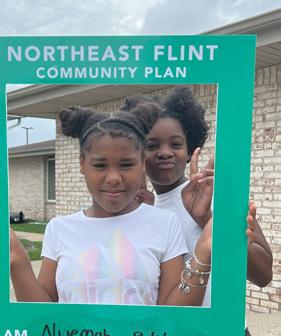
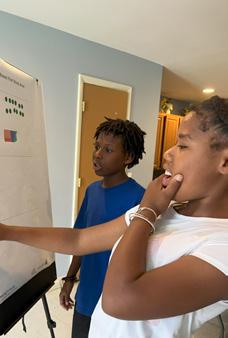
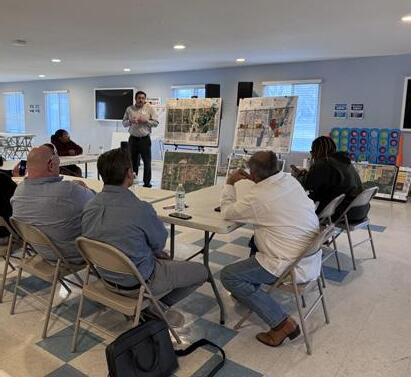
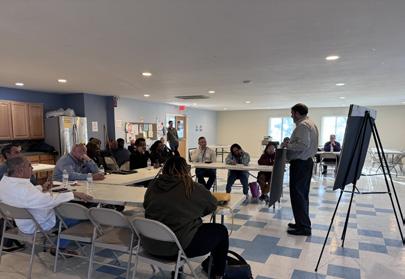
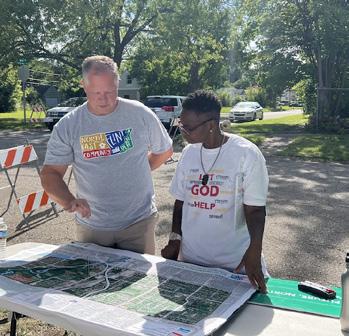
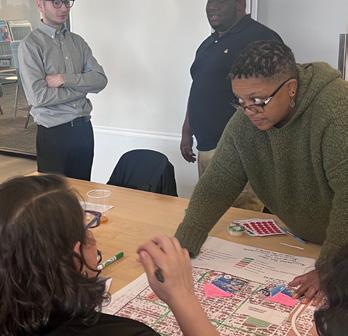
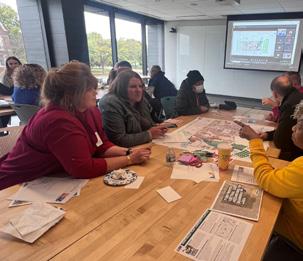
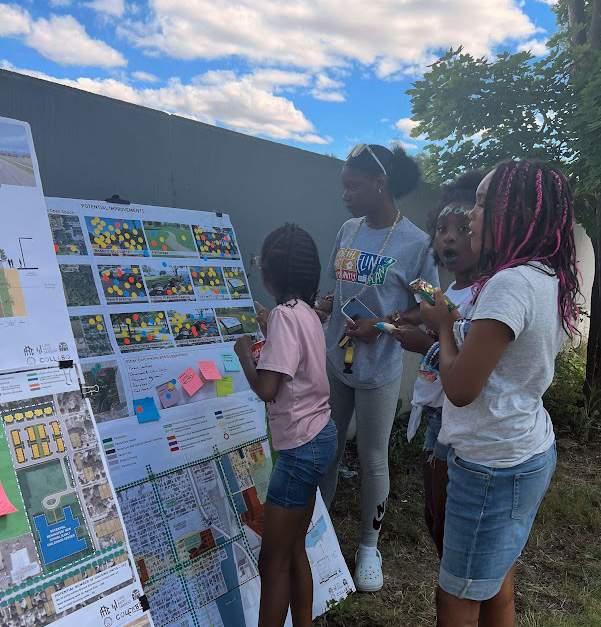
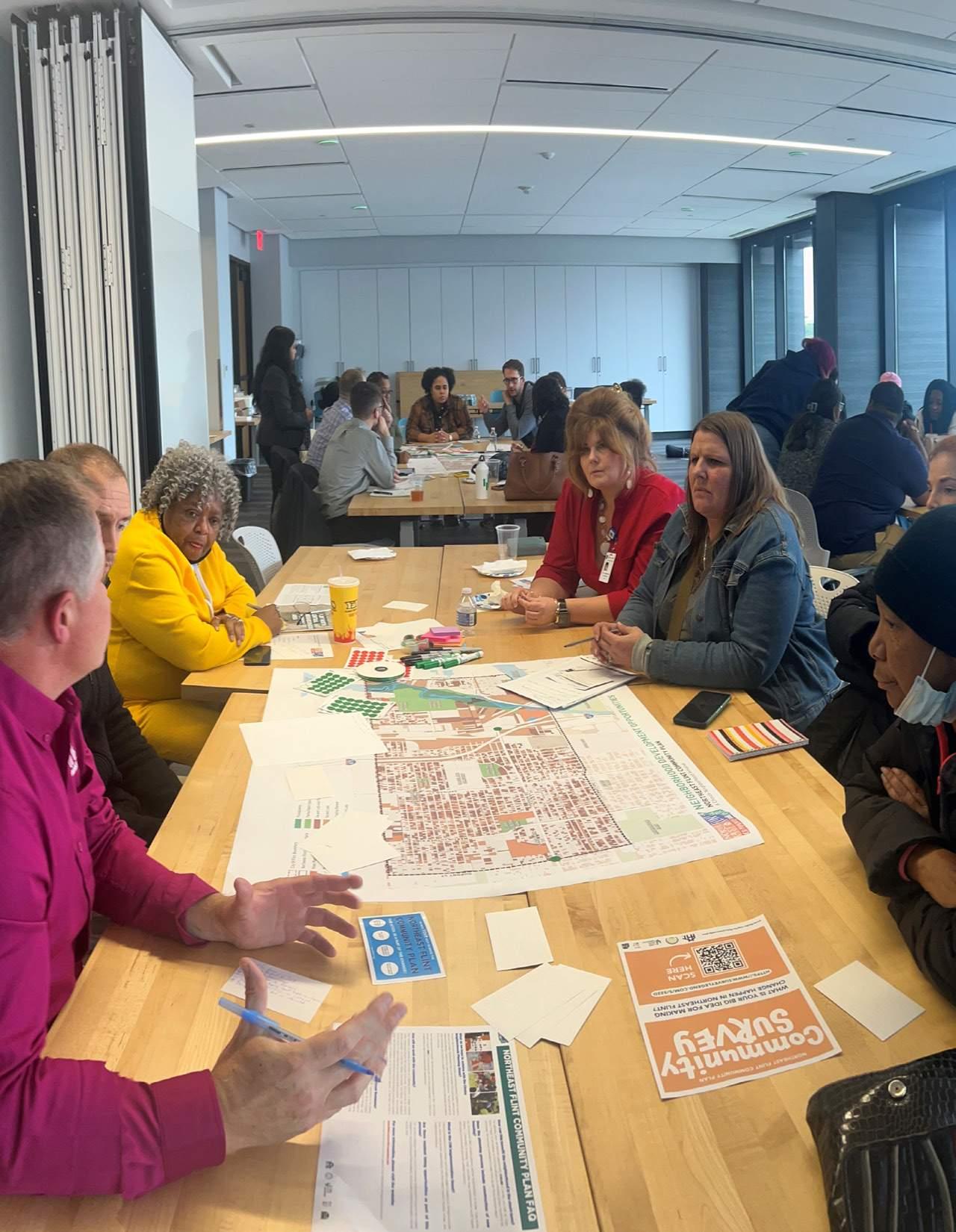
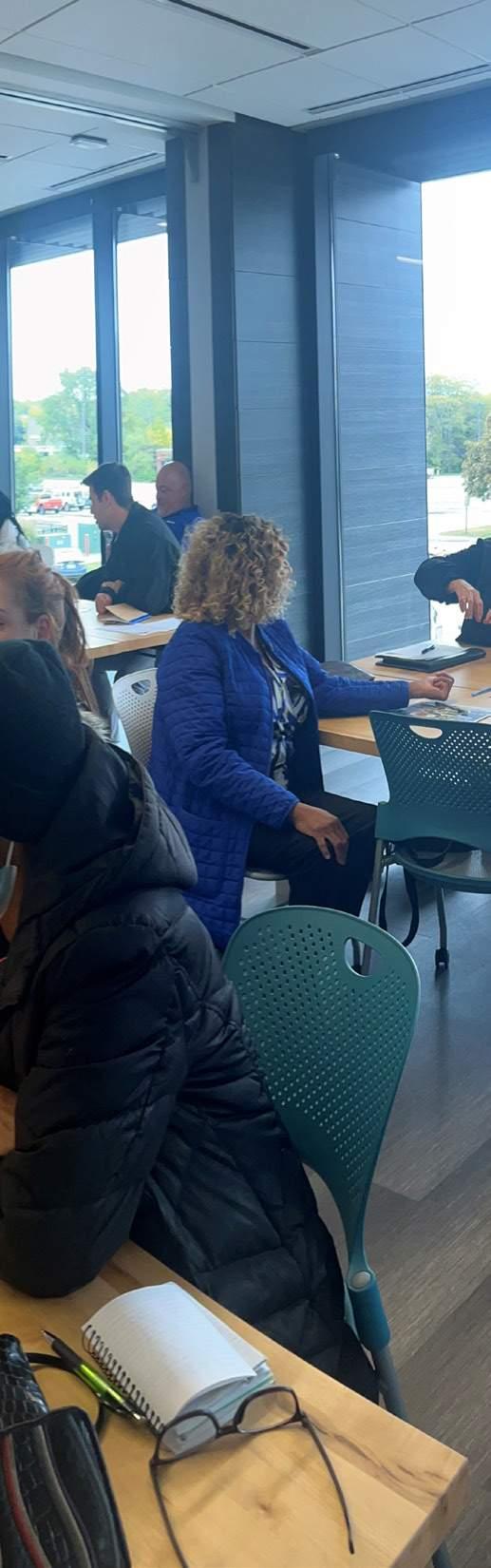
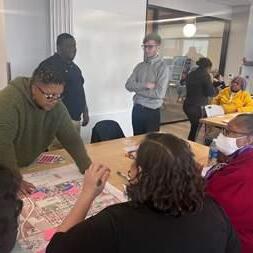
The community engagement process was central to shaping the Northeast Flint Transformation Plan. It involved extensive collaboration with residents, stakeholders, and community organizations to ensure the plan reflects local priorities and needs.
• Steering Committee: Composed of city officials, Flint Housing Commission staff, River Park residents and key stakeholders to guide the planning process.
• Task Forces: Focused on specific areas such as housing, people, and neighborhoods to develop targeted strategies.
• Community Ambassadors: Local residents acted as liaisons, sharing information and collecting feedback from their neighbors.
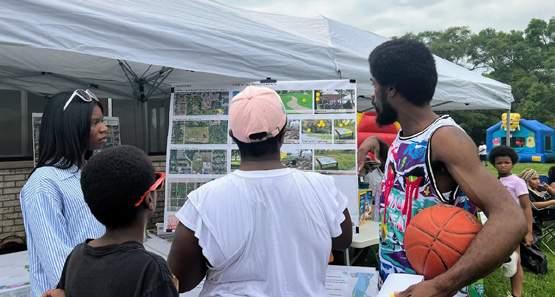
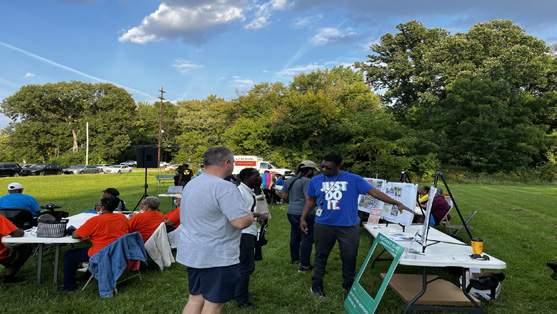
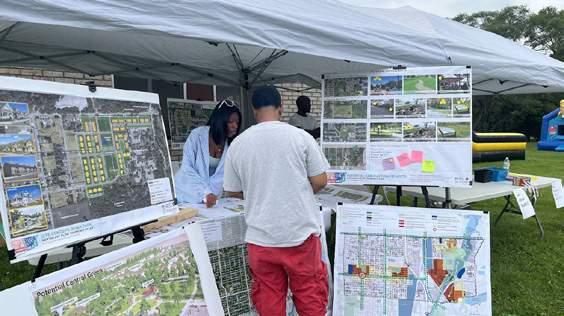
The Planning Team actively participated in local events and organization meetings to share updates and gather feedback, bringing the engagement directly to the community.
The People Plan includes a range of strategies intended to improve the quality-of-life for Target Housing residents, as well as Northeast Flint neighbors. The People Plan focuses on items prioritized by residents within the topics of education, health & safety, and employment & job training. These priorities include some of the following:
• Connect Residents to existing job training programs
• Repurpose Carpenter Road School
• Create on-site after school program
• Increase outreach to youth workforce training programs
• Monitoring and remediating air pollution
• Connect local churches with resources to become childcare providers
• Create nutrition and physical activity
programs
• Create an adult education program
• Create an on-site health and wellness clinic
• Create a police station in a vacant unit at River Park
• Create an on-site homework assistance program
• Create a resource center to connect residents to employment opportunities
• Empower the resident council
• Establish a small business start up program
• Increase outreach to FHC’s FSS program
FHC will lead the implementation of the People Plan while strengthening relationships with the current and new residents.
The main goal of Neighborhood Plan, as identified by the community and residents, was to create a well-connected, safe, and attractive environment with enhanced infrastructure, green spaces, and transportation options.
Goal 1: Strategize revitalization efforts for maximum impact
• Utilize Neighborhood Development Framework to guide sustainable growth
• Encourage and promote infill opportunities
• Increase affordable homeownership opportunities
• Provide support for existing homeowners and business owners to maintain / improve their properties
Goal 2: Establish better connectivity and accessibility
• Develop a network of priority corridors for improvements. The community developed specific streetscape improvements for Carpenter Road and Pierson Road.
• Improve pedestrian safety and experience.
• Install pedestrian crosswalks at all major intersections and a mid-block crosswalk infront of Clara Hilborn Park
• Connect Websters Road to Russell Avenue – potentially through a pedestrian bridge
• Connect safely across Dort Highway
• Enhance the River Trail connections and accessibility
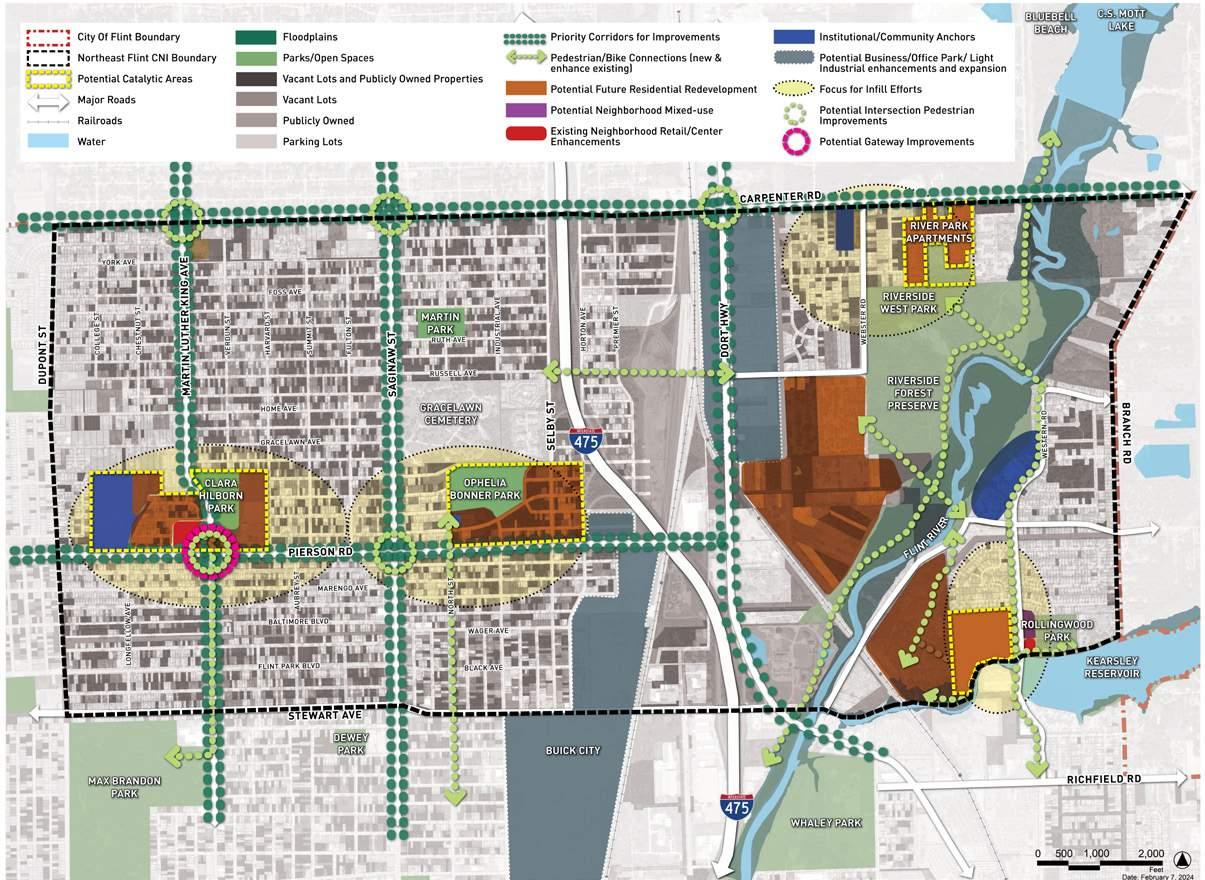
• Connect to the Rollingwood neighborhood
• Connect to the new Buick City redevelopment
• Connect to the existing parks
• Connect safely to the Kearsley Reservoir
• Improve transit and trail connectivity.
Goal 3: Establish a Network of functional and wellprogrammed open space for all ages
• Enhance and maintain existing parks
• Integrate new open spaces and pocket parks within new redevelopments
• Develop a connected network of open space.
Goal 4: Enhance neighborhood identity and community pride
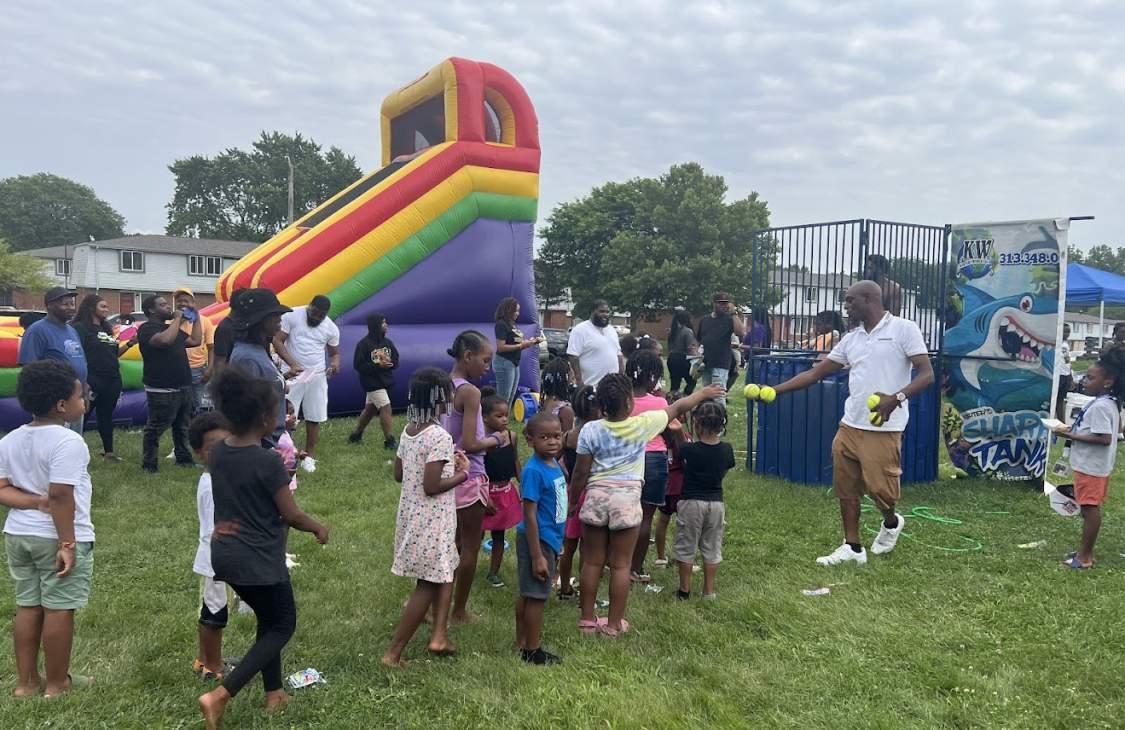
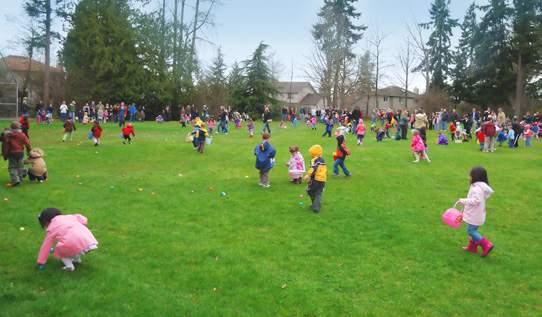
• Organize regular community events
• Enhance existing or create new community gathering spaces where residents can gather and interact
• Invest in public art and wayfinding opportunities
• Expand/supplement neighborhood communication channels
Goal 5: Address any environmental concerns
• Establish a system for monitoring air quality
• Incorporate physical improvements such as landscape buffers, etc.
The City of Flint will lead the neighborhood strategies, leveraging the support and collaboration of local community organizations, stakeholders, and residents to ensure the success and sustainability of the initiatives.
The main goal of Housing Plan, as identified by the community and residents, was to provide safe, affordable, and high-quality housing options while promoting mixed-income development.
Goal 1: Transform distressed housing into a highquality mixed-income community
• Redevelop River Park Apartments into a sustainable mixed-income community.
Goal 2: Add new housing options to spur revitalization and ensure long-term viability
• Expand housing options with off-site catalytic redevelopment.
• Encourage infill housing development within the neighborhood.
HOUSING PROGRAM
• Target ~ 380 units
• One-for-one replacement of existing units (180 units)
• Mixed-income and mixed-use community
• Resident amenities
• Build-first strategy for implementation
Goal 3: Incorporate diverse housing types to cater to different demographics within the neighborhood
• Integrate various housing typologies, scales, and unit sizes throughout Northeast Flint
Goal 4: Build an energy-efficient and resilient community
• Promote energy-efficient development and green building techniques for healthy living
• Incorporate green infrastructure and site sustainability strategies.
• Incorporate best practices to create a safer community.
FHC will lead the implementation of the Housing Plan, with a Housing Developer (or developers) selected to carry out the housing development in multiple phases.
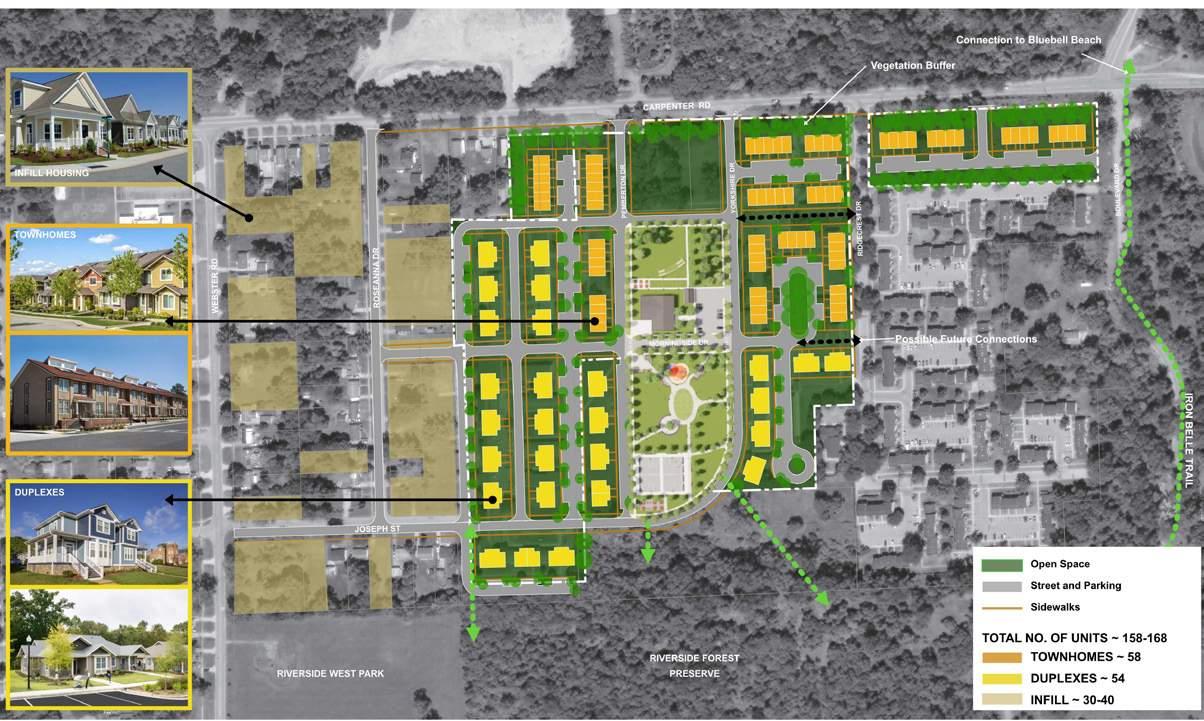
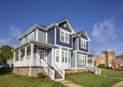
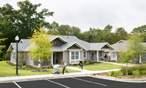
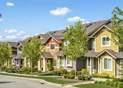
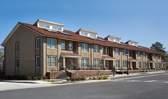
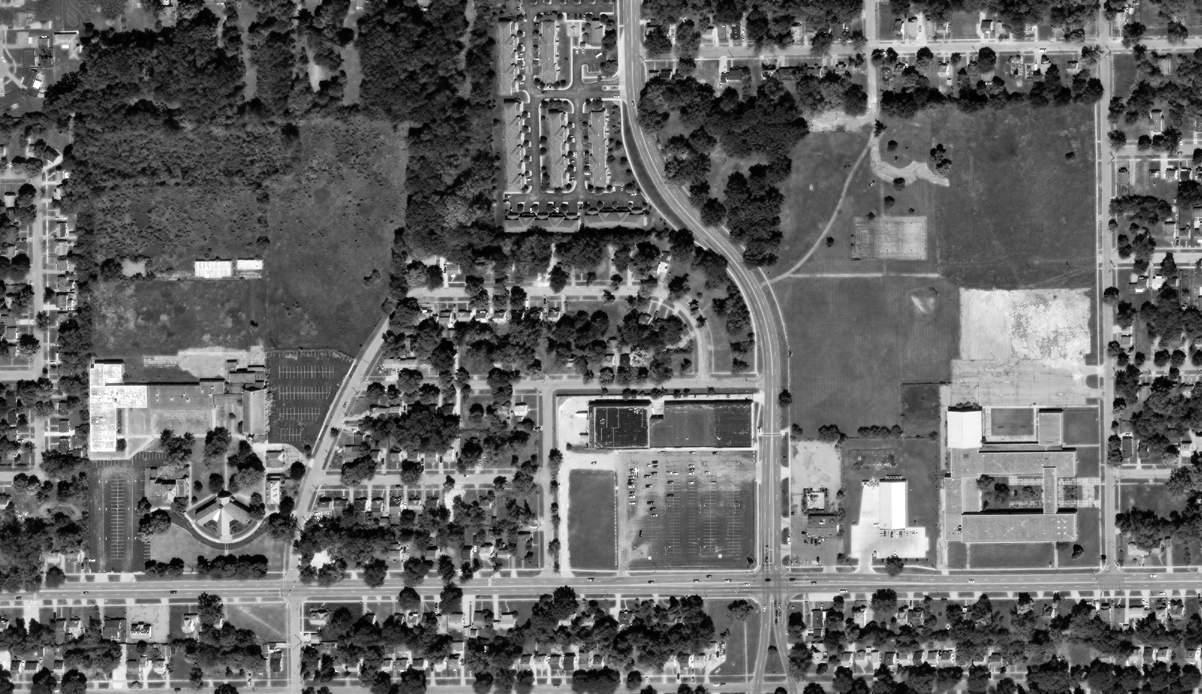




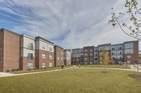
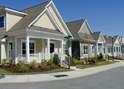
The community prioritized open space enhancements as the focus of the Choice Neighborhood (CN) Early Action Projects, seeking to equitably distribute investments across three neighborhood parks near the two catalytic sites. FHC is currently formalizing budget estimates to finalize the planned upgrades for River Park, Riverside West, and Clara Hilborn Park. The community also played a significant role in prioritizing the specific improvements for each park. These efforts will be led by FHC in collaboration with the City of Flint, Keep Genesee County Beautiful, and the Park Adopters for Riverside West and Clara Hilborn Park. The improvements are scheduled for implementation in late summer 2025.
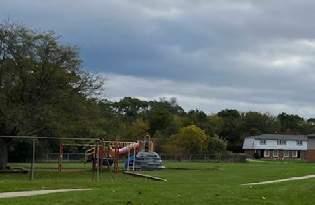
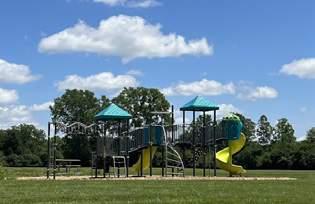
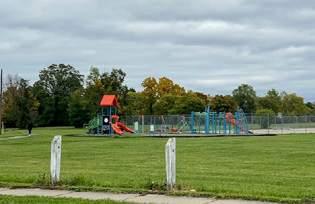

• Supplement Keep Genesee County Beautiful’s efforts to install new playground equipment
• New basketball courts
• Supplement efforts to install new parking lot
• A new trail connection to River Park Apartments with lighting
• Grill with seating / signage
• Improve existing pathways
• Grill with seating/ signage
With the planning effort for the Northeast Flint Community Plan complete, the next phase is focused on implementation, turning the vision for the neighborhood into reality. Numerous exciting projects are either in progress or in the planning stages, positioning the Northeast Flint Community Plan to drive meaningful transformation. However, successful implementation will require significant additional funding and the continued commitment of many stakeholders to achieve the vision and outcomes outlined in this document.
Progress is already underway, with resources dedicated to advancing housing redevelopment, improving key infrastructure, and enhancing public spaces. To advance the strategies that focus on families, FHC will take the lead in managing the supportive services plan, while the City of Flint will oversee neighborhood improvement efforts. FHC will also continue to lead the housing redevelopment, working with the city, county, and state for additional capital support. Crucial partners, including local organizations, businesses, and community groups, will contribute to the overall success of the plan, ensuring the continued growth and revitalization of the Northeast Flint neighborhood.
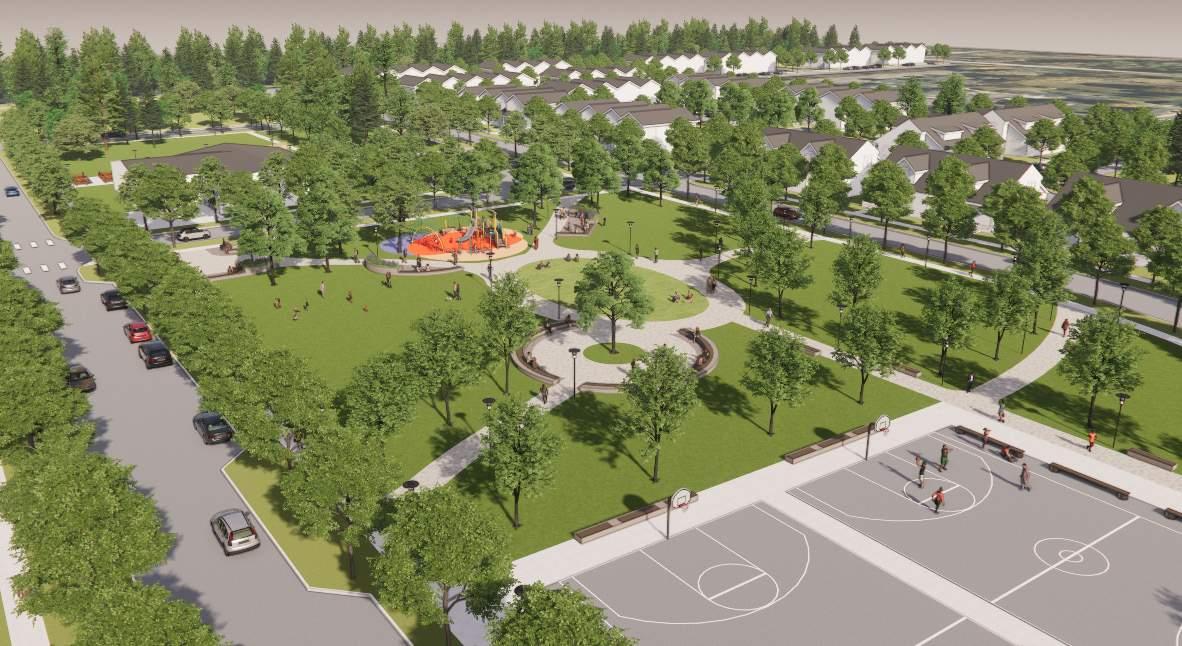
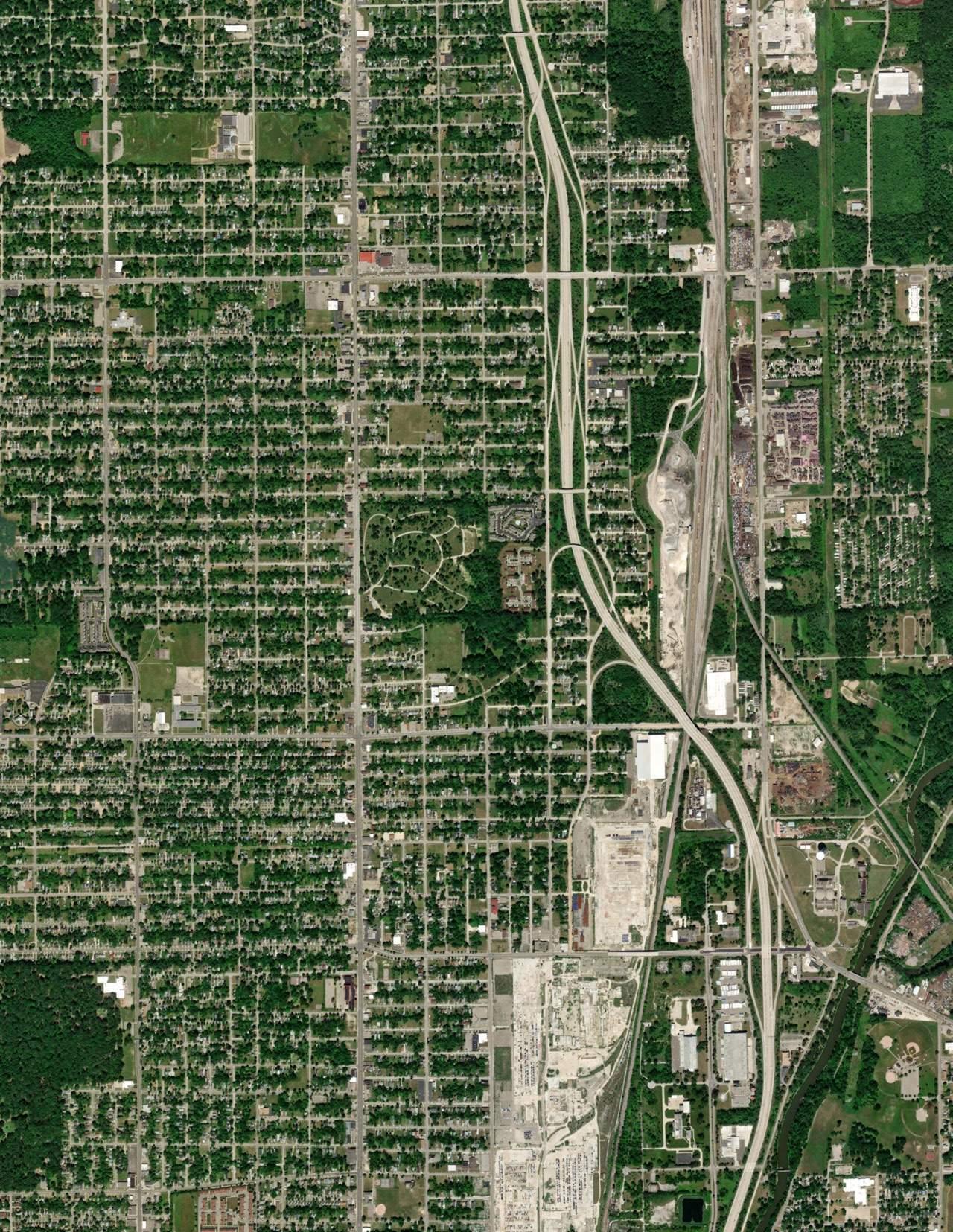
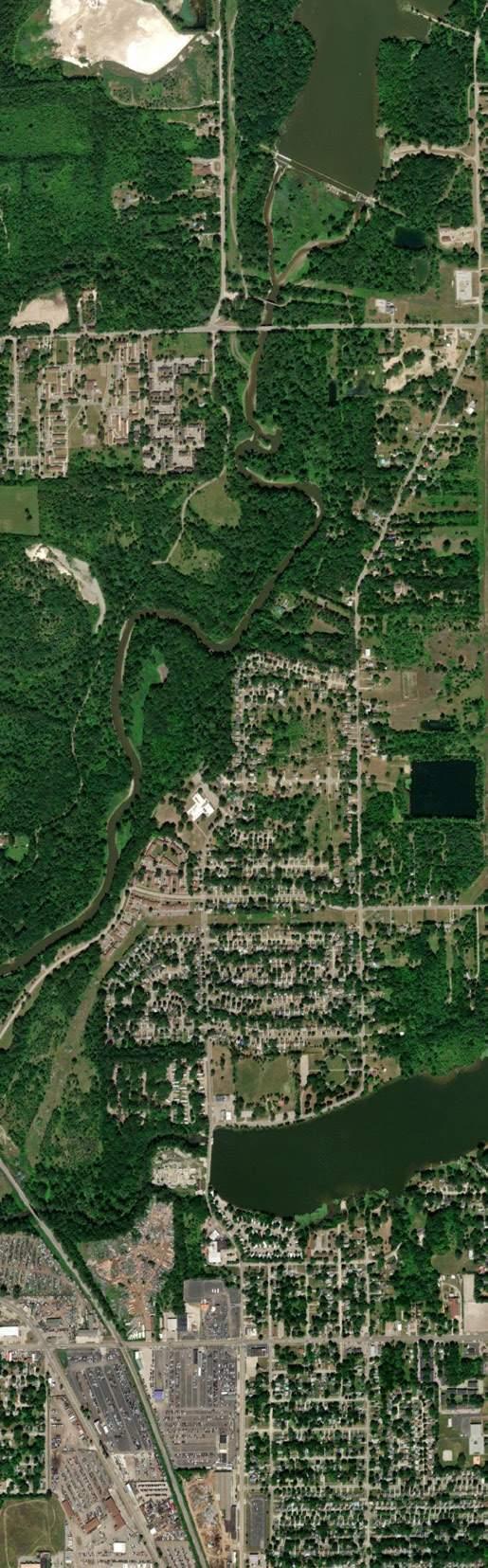
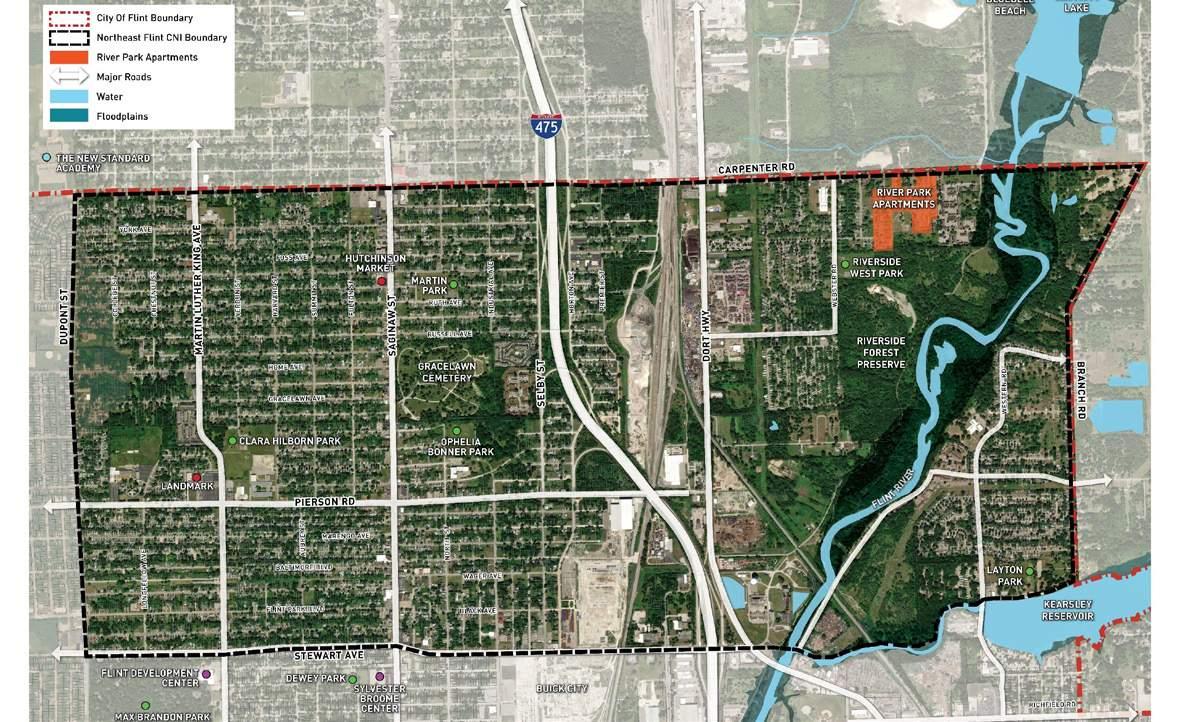
The Northeast Flint Community is located at the northeastern edge of Flint, about 2.5 miles north of downtown. The study area is bounded by Flint’s northern city boundary along Carpenter Road to the north, Branch Road to the east, Stewart Road to the south, and Dupont Road to the west.
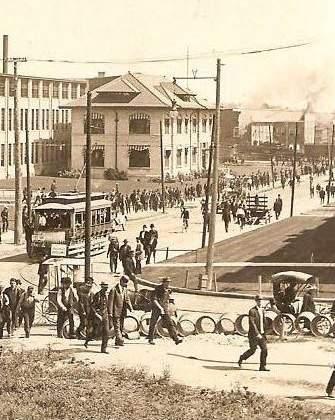
In the 19th century, Flint thrived as a major agricultural center and became a hub for automotive manufacturing in the 20th century with the establishment of Buick Motor Company in 1903 and General Motors (GM) in 1908. By the 1950s, Flint housed the largest GM manufacturing complex. Many educational institutions in Flint today were established in the early 1900s. The Flint park system was developed in the 1920s by Josiah Dort, known as “The First Citizen of Flint,” and Frederick Law Olmsted, the legendary landscape architect best known for designing Central Park in New York City. The city was thriving in terms of education, economic prosperity, and automotive manufacturing. The University of Michigan-Flint was established in 1971, expanding its footprint in downtown Flint throughout the 70s.
However, Flint’s decline began in the 1960s. The construction of I-475 tore through a predominantly Black neighborhood, St. John’s Neighborhood, also known as “the Black Wall Street,” splitting Northeast Flint in half. The closure of GM and Buick in 1999 led to a drastic economic decline. The Flint water crisis further exacerbated the city’s struggles, driving many residents away and eliminating nearly all value from residential properties. From 2013 to 2022, Flint’s population declined by 20%, from 99,758 to 79,865. The COVID-19 pandemic accelerated this decline.
Similar to other parts of the city, Northeast Flint has faced significant challenges from economic decline. Years of disinvestment and limited transportation access to amenities and job opportunities have spurred the community to work actively on fostering
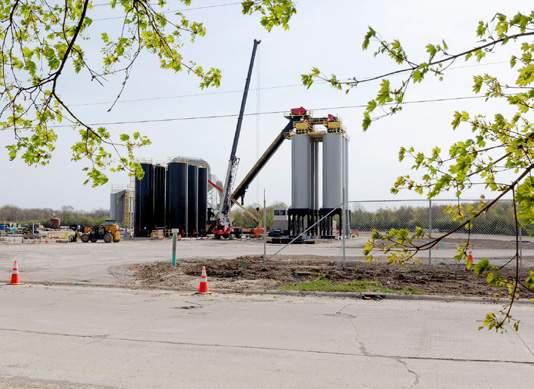
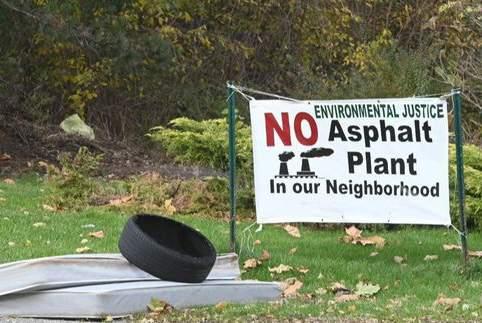
economic growth and promoting development. Various community organizations and institutions act as the voice of the community, collaborating to bring positive change and address residents’ pressing needs. Recently, a significant driver for the North Flint CNI grant application was the approval of a new asphalt plant immediately north of River Park by adjacent Genesee Township, causing resident concerns regarding air and water quality.
Despite these crises, Flint residents remain resilient. Local philanthropy and government have invested heavily in building capacity among grassroots nonprofit and neighborhood organizations to advocate for change based on residents’ needs.
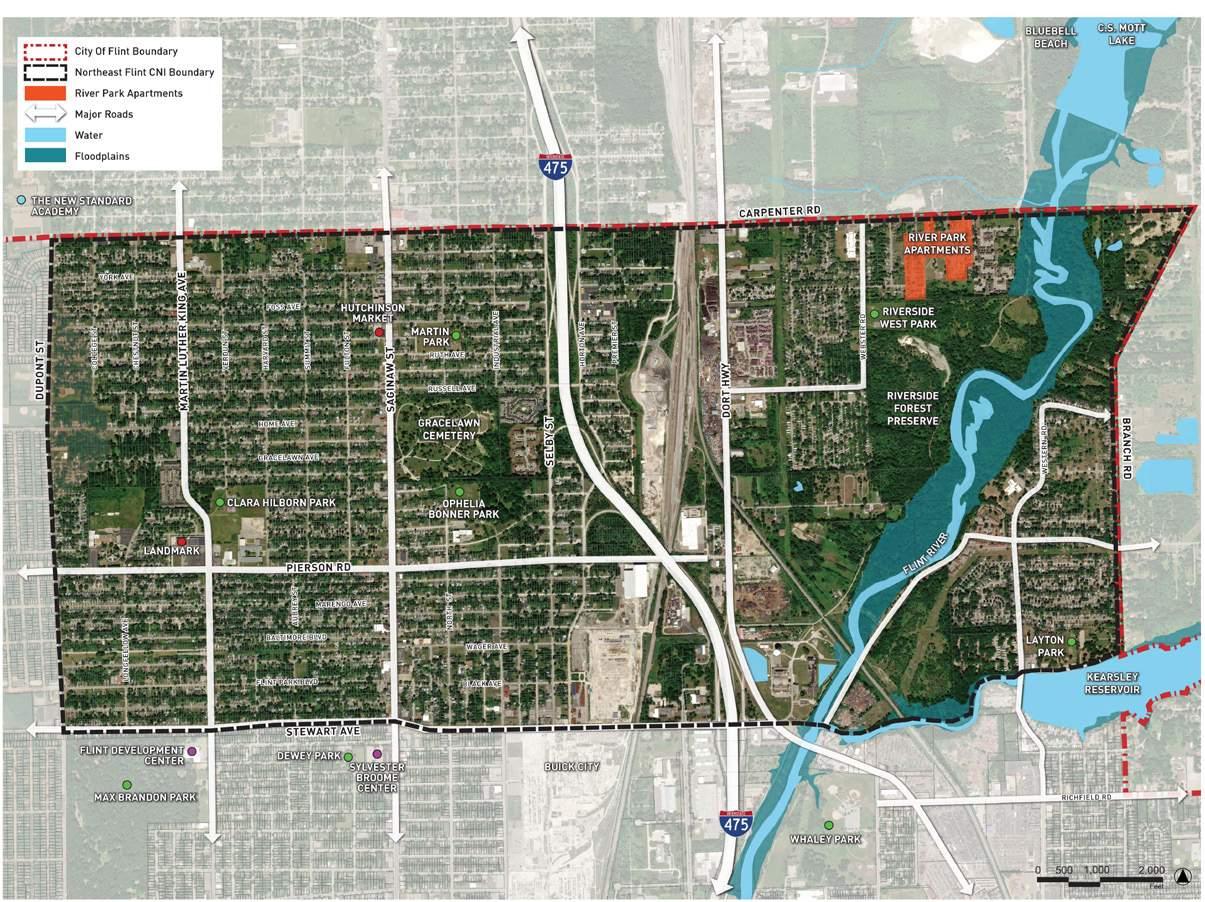
The Northeast Flint Community Plan intends to build upon the efforts, programs, and local community projects that have preceded the Choice Transformation Planning effort.
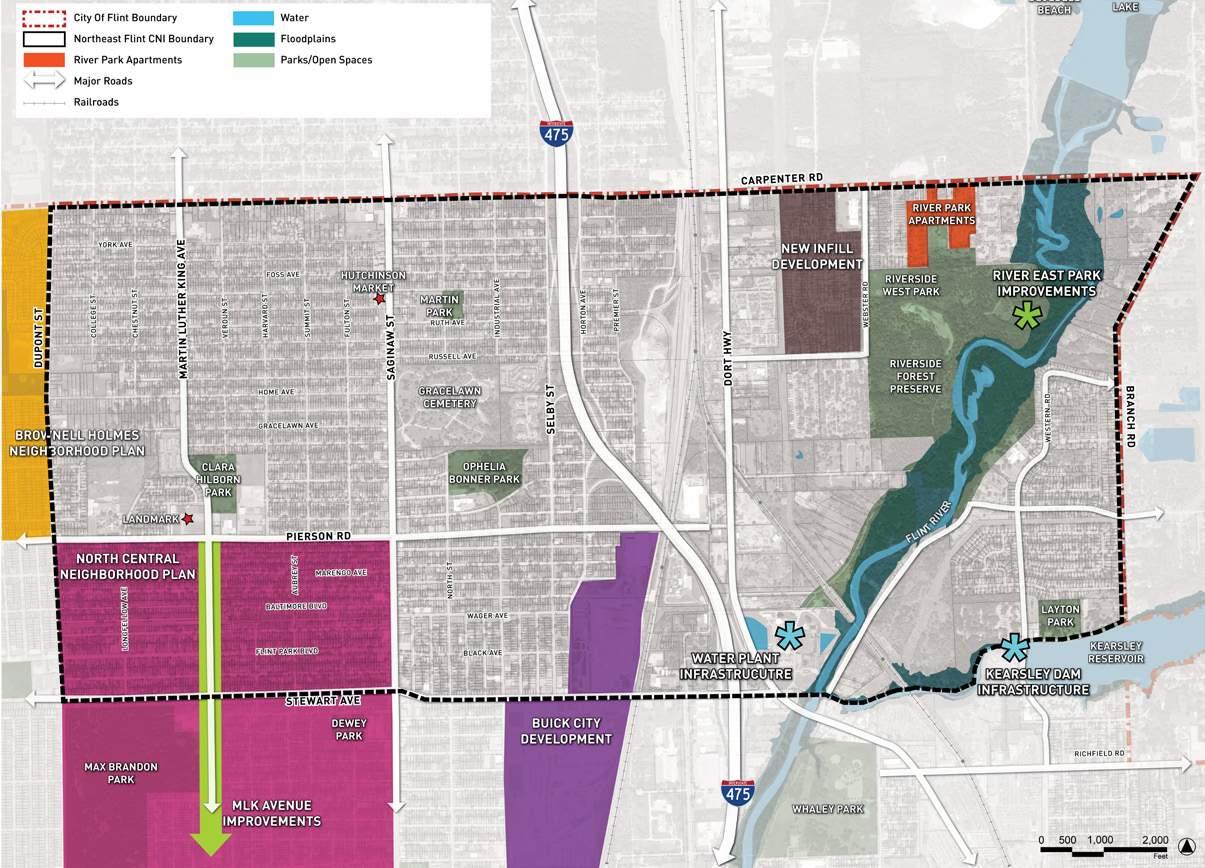
Pierson Road Corridor Plan
North Central Neighborhood Plan
Brownell Holmes Neighborhood Plan
Buick City Redevelopment
MDOT I-475 Improvements
Potential New Infill Development
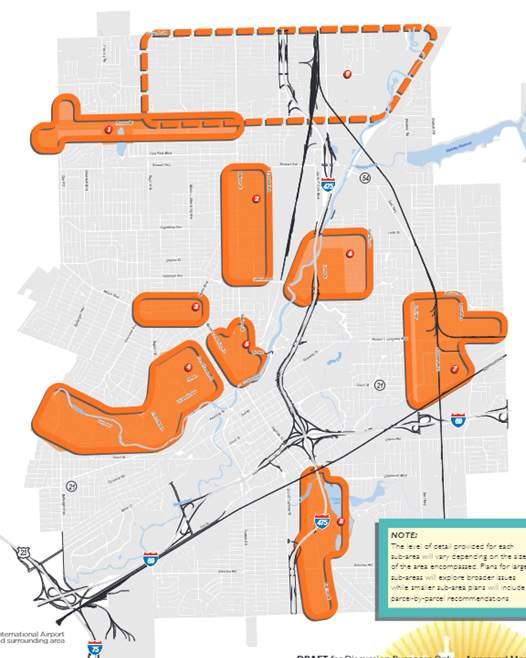
The 2013 Imagine Flint Master Plan is a comprehensive plan developed by the City of Flint to guide the city’s growth and development. The Imagine Flint Master Plan aims to provide a strategic framework for the city’s future, assessing various aspects of urban planning, economic development, housing, transportation, and community visioning.
Imagine Flint identified eight sub-areas (pictured right) for further studies, including priority and catalytic redevelopment sites and public infrastructure improvements. One potential Neighborhood Plan Area sub-area covers most of the Northeast Flint Community Plan boundary.
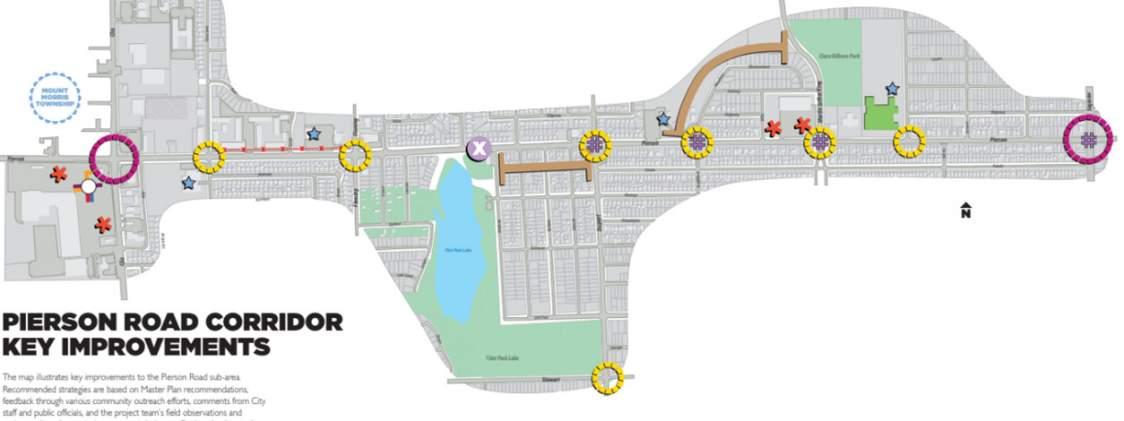
The Pierson Road Corridor Sub-Area highlights several improvements within the Northeast Flint Neighborhood, including:
• The Landmark Grocery and the attached retail center as an opportunity for infill redevelopment
• Bryant Elementary School as a major green innovation incubator, focused on job creation.
• Pedestrian improvements several intersections
• Create a city gateway at the intersection of Pierson Road and Saginaw Street.
• St. Agnes property as potential for new redevelopment and housing
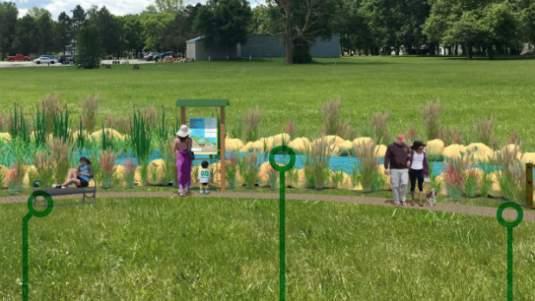
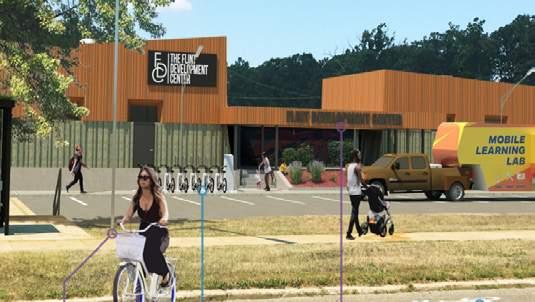
Within the Imagine Flint Master Plan, several Neighborhood Planning Initiative (NP) profiles were assessed. Two of the City of Flint’s NPI Plans overlap with the boundaries of the Northeast Flint Community Plan. The NPIs identify strategies to combat the resident-identified challenges.
The North Central Neighborhood Plan and the Northeast Flint neighborhood intersect at Stewart Road between Dupont Road and Industrial Avenue. Both neighborhoods experience overlapping socioeconomic challenges, including land vacancies, crime, lack of programmed open spaces, and transportation difficulties related to inadequate bus shelters, deteriorated infrastructure, and a lack of pedestrian infrastructure.
The Brownell Holmes Neighborhood sits directly next to the Northeast Flint neighborhood. While both neighborhoods are directly next to each other, transportation between the areas is limited. Access and connectivity is the biggest challenge facing the Brownell Holmes neighborhood.
The Imagine Flint Master Plan called for Atherton East public housing to be redeveloped into a more modern and safe housing option for Flint families.
In 2015, the City and FHC led a community planning process, the South Flint Community Plan (SFCP). The SFCP is a community-driven transformation plan that outlines projects to make the Imagine Flint Master Plan a reality in southeast Flint, with detailed strategies for new housing, neighborhood improvements and supporting residents’ well-being and self-sufficiency. In July 2018, the City and FHC were awarded a $30 million Choice Neighborhoods Initiative (CNI) implementation grant to rebuild Atherton East in more desirable locations in south and north Flint, primarily on vacant public land, and to improve education, safety, and economic outcomes for neighborhood residents.
Since awarded in 2018, all former Atherton East residents have been relocated and Clark Commons
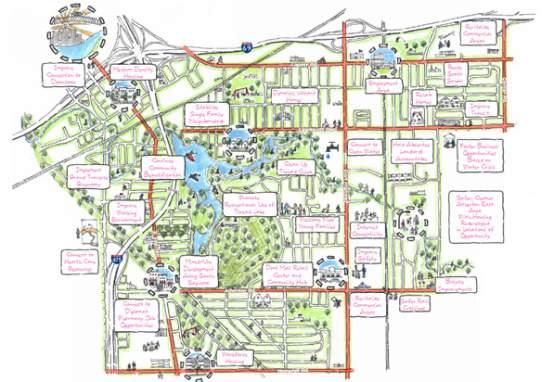
is in the second of planned three-phase build out plan, with some families already living in completed units. As the plan is implemented, the Northeast Flint Planning Team places a special focus on observing and learning from the experience, to ensure the Northeast Flint process is successful.
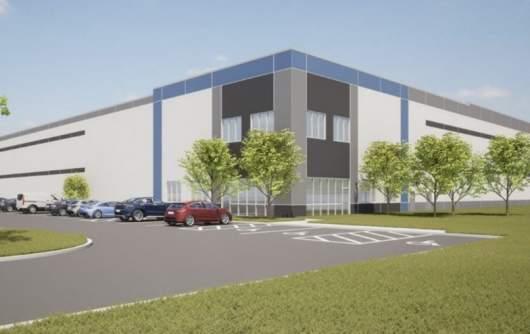
Buick City was established in the early 20th century as an integral part of General Motor’s operations in Flint until its closure in 1999 and abandonment in 2010. The Buick City site sat idle for 13 years until Ashley Capital, a privately owned real estate firm, purchased most of Buick City for a $300 million redevelopment project. Ground broke in Flint’s Commerce Center Park in June 2023 and the first building is expected to be completed in 2024. At the end of the entire project, the old Buick City will house 10 buildings covering a footprint of 3.5 million square feet and could provide 3,000 new jobs to Flint residents.
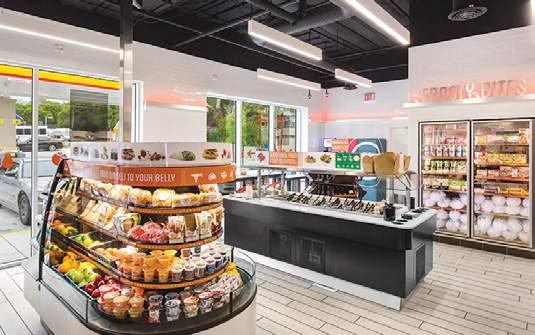
A run-down mini mart on Carpenter Road has a planned new life as a fuel station and expanded convenience store with fresh meals and a produce section. Owner Robert Brown expects to break ground in 2024. Brown is also considering infill housing development along the Webster Road area.
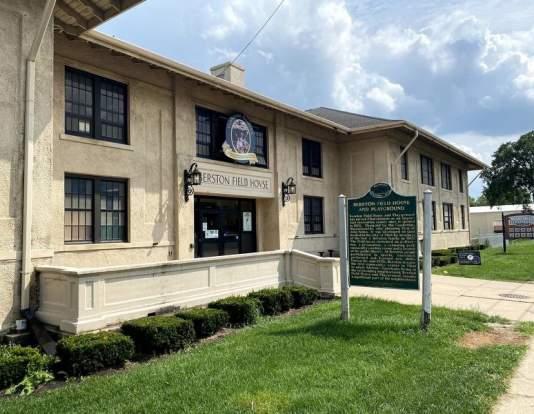
The Berston Field House was built in 1923 on land donated by children of Flint land developer and philanthropist, Neil J. Berston. Mr. Berston, at the turn of the century, had the foresight to buy and transform farmland into the residential neighborhoods surrounding what is now Berston Field House. The field house was named in honor of this generous visionary, and after over 100 years of existence, the building remains structurally sound as is Berston’s place in the community among its patrons who range from the very young to senior citizens.
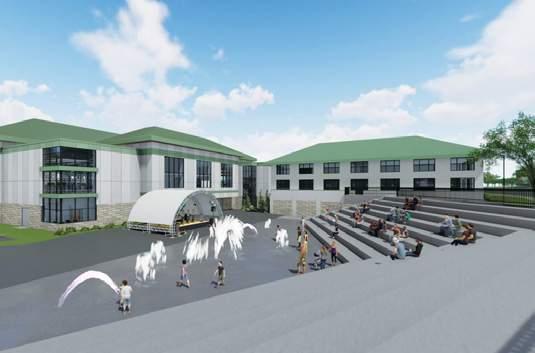
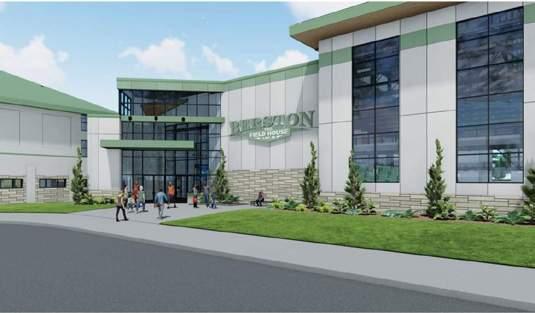
A $30 million renovation broke ground in October 2023, featuring a 57,000 square foot addition with a stateof-the-art gymnasium, including basketball courts and an elevated walking track, boxing gym, art and music rooms, dance studio, bike room, locker rooms, and a community room. Land was acquired for the outdoor addition of basketball and pickleball courts, softball diamonds, a soccer, lacrosse, and football field, an amphitheater, splash pad, playground, and more parking.
The first phase is expected to be complete by April 2025. The second phase, focused on renovation of the current Berston Field House building at 3300 N. Saginaw Street, will follow within a year of phase one completion.
The City of Flint Capital Improvement Plan (CIP) provides an overview of planned capital improvements, consistent with the goals of the City’s master plan.
The Martin Luther King, Jr. Avenue corridor features a proposed $7.5 million total reconstruction with storm sewer upgrades, new sidewalks, driveway reconfigurations, ADA ramps, and signals from Pierson to Downtown.
The Kearsley Dam does not have budgeted project costs, but a proposed widening and rework of the existing dam is included within the CIP.
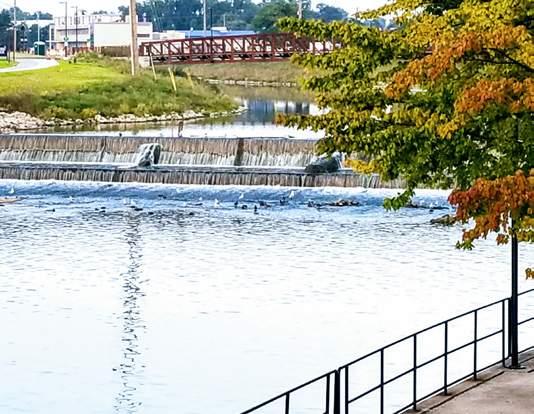
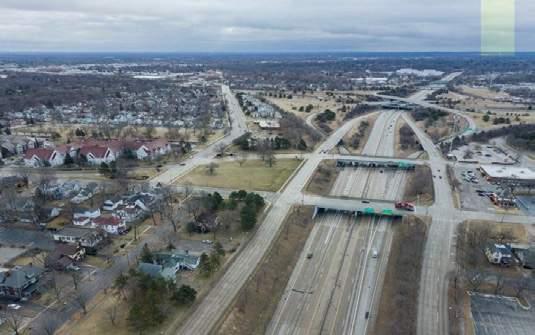
The Michigan Department of Transportation (MDOT) plans a $300 million improvement to eight miles of I-475 from Bristol Road to Carpenter Road, through the Northeast Flint neighborhood boundary, from 2024 to 2027. The construction project will support 3,810 jobs. The project includes bridge repairs at the I-69 interchange and along the freeway.
Several alternatives are proposed, though MDOT has not announced the final selected alternative as of June 2024. Flint residents seek improvements that remedy the damages caused by the freeway’s original construction over 50 years ago, such as conversion into a surface boulevard or right-of-way reductions with excess land returned for housing, commercial, and park development.
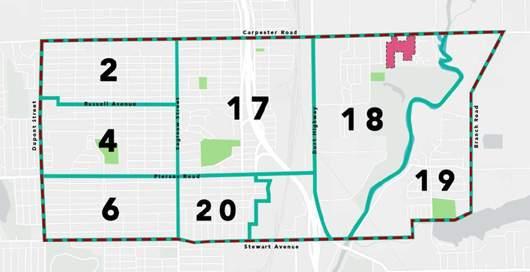
Neighborhood demographic data was gathered from US Census data for census tracts 2, 4, 6, 17, 18, 19, and 20.
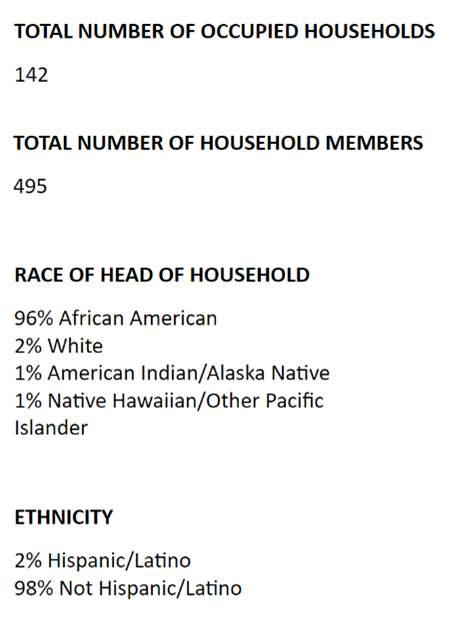
FLINT TOTAL POPULATION - 80,628
NORTHEAST FLINT TOTAL POPULATION - 10,401
RIVER PARK TOTAL POPULATION - 495
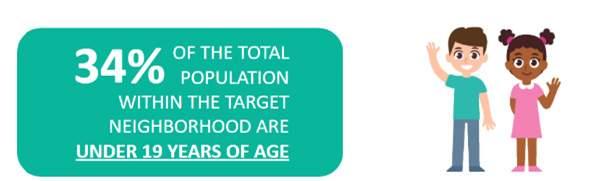
Overall, there is a large population of young people both across Northeast Flint and within the River Park Apartments. A mixed-income housing redevelopment and enhanced youth and educational programming will benefit this generation.
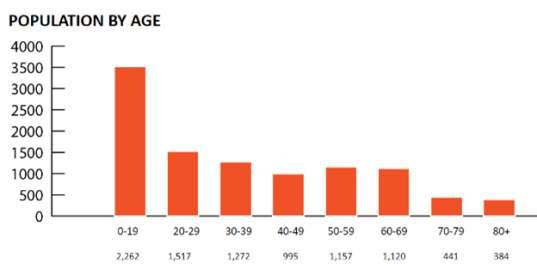
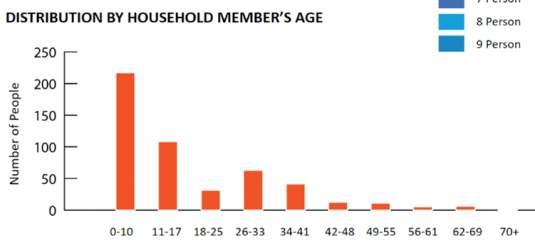
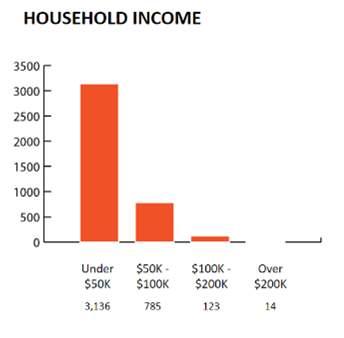

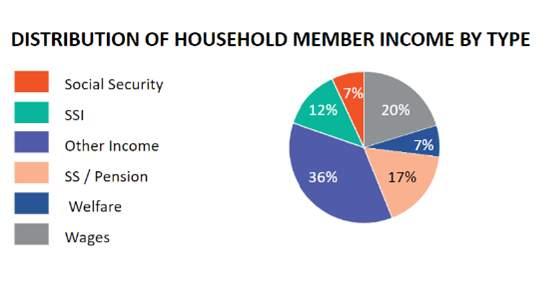
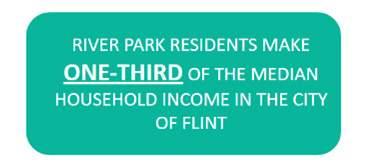
The City of Flint median household income is $37,102 for 2023. In the Northeast Flint neighborhood, the median income is $25,074, and the River Parks Apartments median household income is only $13,115. Only one-infive River Parks households earn wage income.
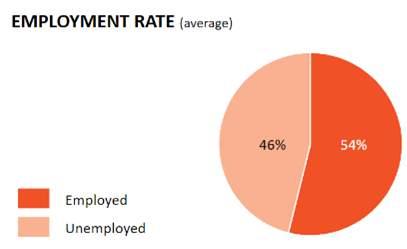
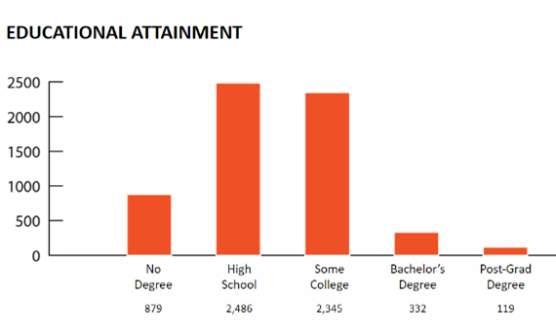
Roughly 86% of residents in the Northeast Flint neighborhood hold a high school diploma, and about 2,300 residents attended some college. 332 residents hold a bachelor’s degree. Despite this, 46% of residents are unemployed.

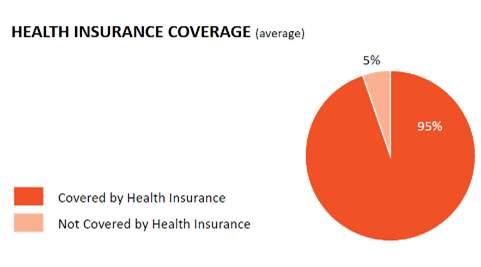
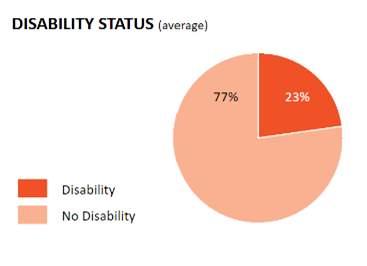
The residents of Northeast Flint are above the national healthcare coverage rate of 92%, with about 95% of residents holding some form of health insurance. Additionally, about 23% of residents have a disability, which is around the national average of one-in-four adults with a disability.

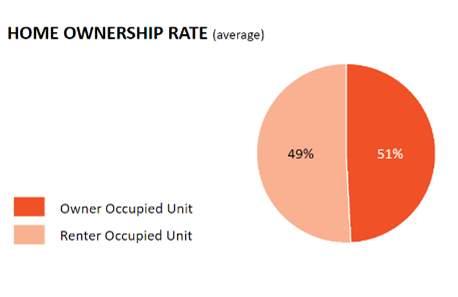
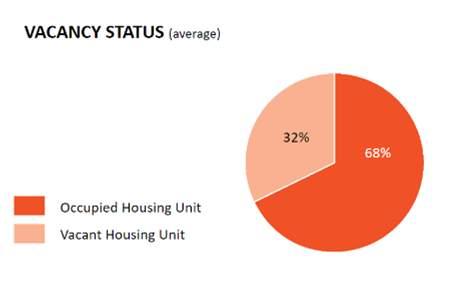
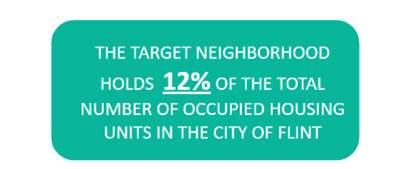
Though 68% of parcels within Northeast Flint are known to be vacant, roughly half are owner-occupied. Of the vacant parcels, many are city-owned and are ripe for redevelopment and infill.
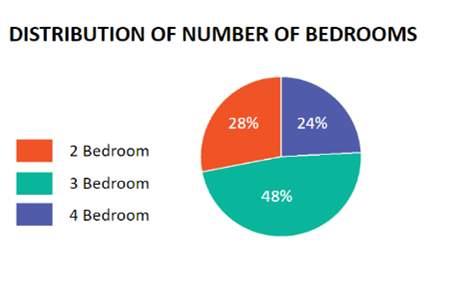
Within the River Parks Apartments, two-, three-, and four-bedroom units are available. Many families are underhoused into smaller units or fewer bedrooms than needed to live comfortably.
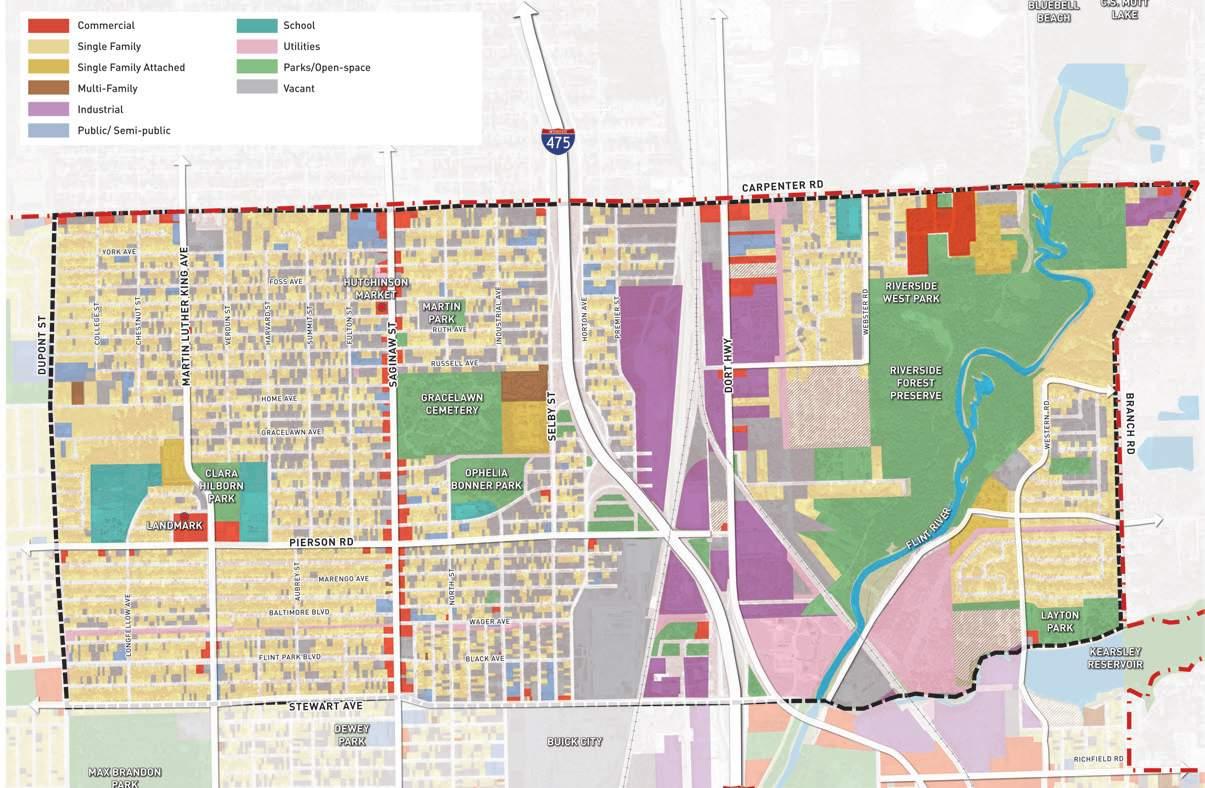
The Northeast Flint Community is primarily a residential neighborhood, with limited retail along Saginaw Street and Carpenter Road. Its unique characteristic includes significant industrial areas in the middle of the neighborhood, which isolate the eastern and western sections. There are multiple open spaces scattered throughout the neighborhood,
including the Riverside Forest Preserve. The fabric of the neighborhood is disrupted by a high rate of vacant parcels and properties in poor condition. There is no active school in the neighborhood, which has been identified as a major challenge for revitalization efforts.
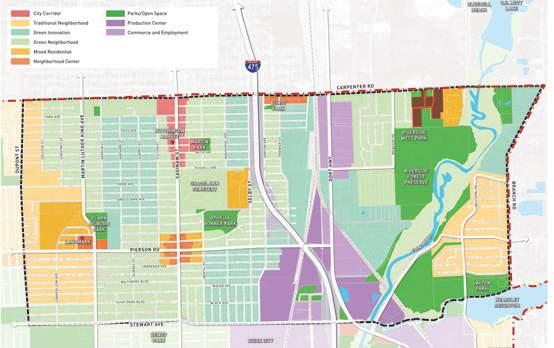
Imagine Flint developed a place-based land use map to guide future land use decisions. The intent was to create a flexible tool for the city to review and promote innovative approaches to redevelop the vast expanse of vacant properties and address blight conditions. The map designates the majority of the neighborhood as Green Neighborhood or Green Innovation categories, with a few neighborhood commercial nodes aligned with existing anchors. The City is beginning a process to update the plan with community input in 2024.
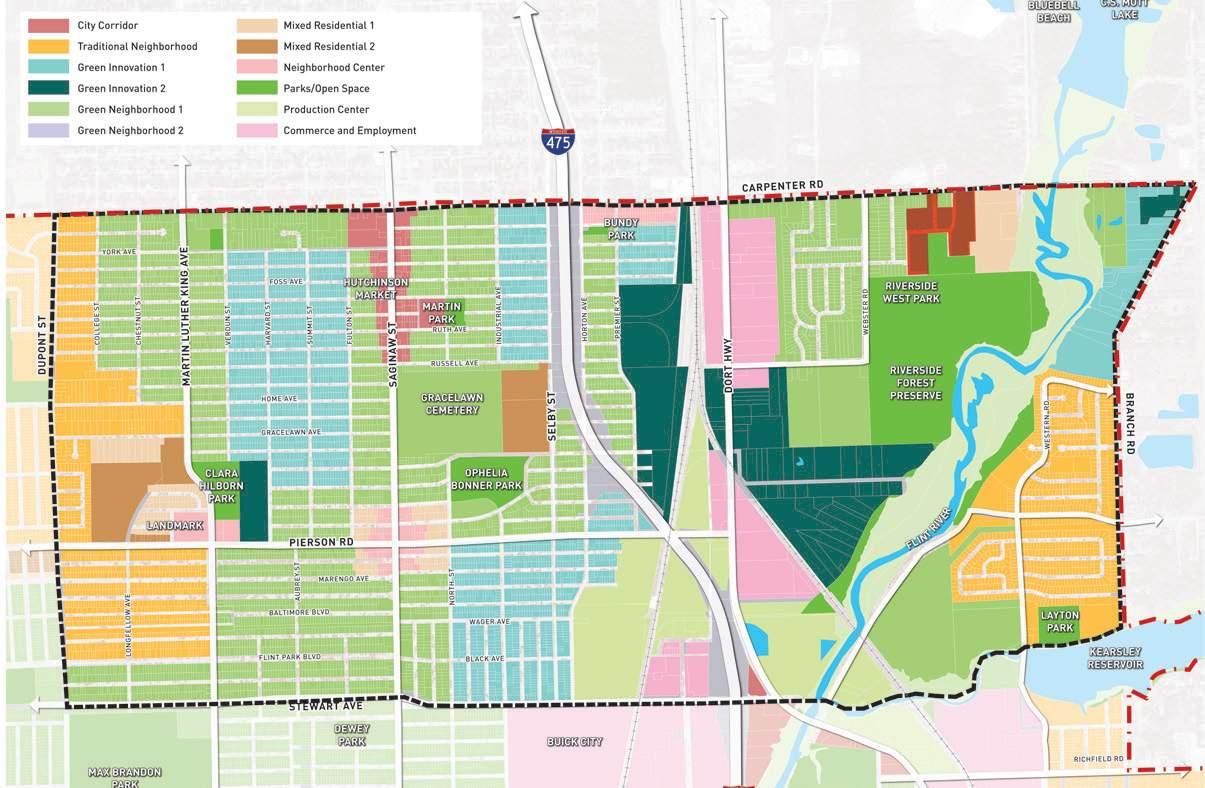
The Zoning map aligns with the City’s Future Land Use map. The City of Flint Planning Department has recently begun to re-examine the city’s plan and its subsequently implementation via a new zoning ordinance. The City of Flint Planning Commission recommended rezoning of nearly 800 properties along commercial corridors from residential zoning districts to commercial or mixed use districts that reflect the historic use of the properties and provide opportunities for reinvestment. Continued refinement of the zoning ordinance and land use plan is expected over the coming years.
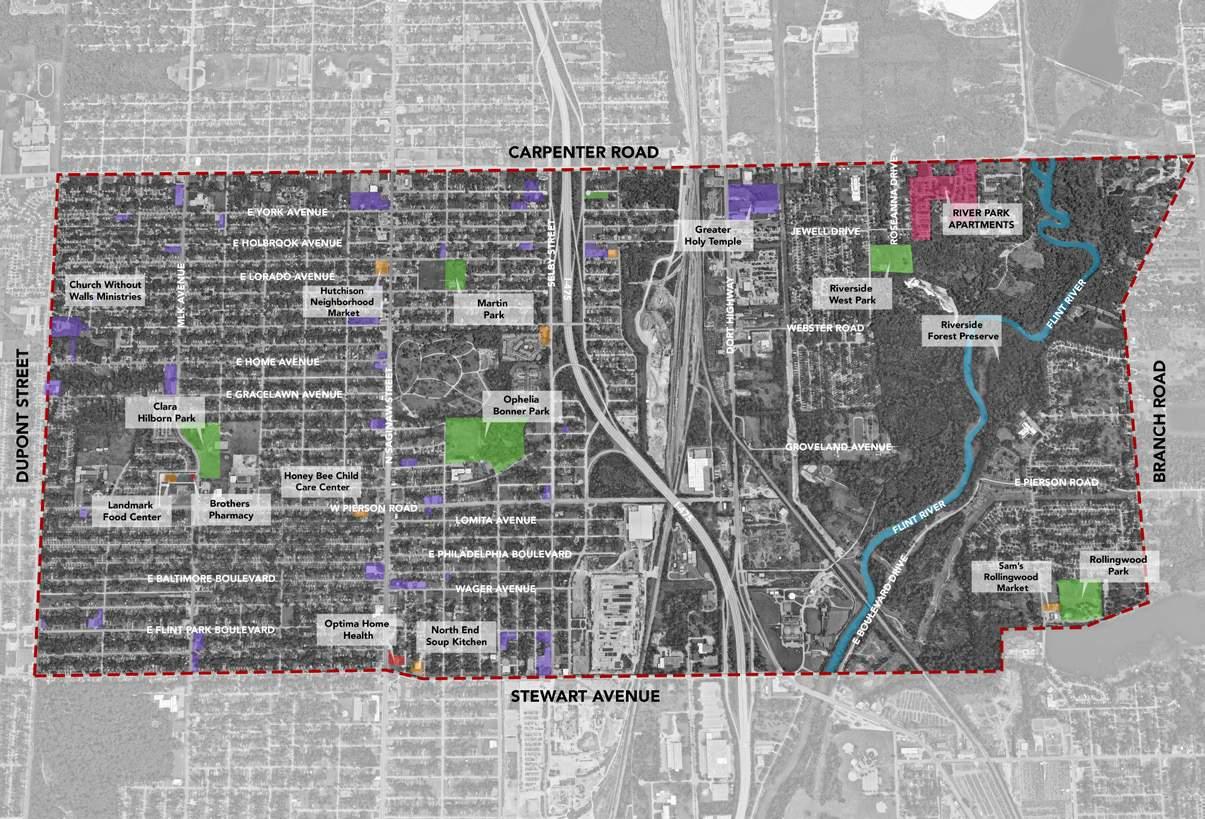
The Northeast Flint neighborhood has very limited amenities and services, with no currently operational schools within the neighborhood boundary. While there is no major community center within the neighborhood, there are three in close proximity: Sylvester Broome Empowerment Village on Saginaw Street, near Dewey Park; Flint Development Center on Martin Luther King, Jr. Street, near Max Brandon Park; and the Berston Field House on Saginaw Street, where a major renovation and expansion are underway.
The major assets of the Northeast Flint community are the open spaces and religious institutions. The forest preserve and Iron Belle trail east of I-475 are major draws into the community, both for residents and as potential tourism opportunities. Several local religious and community institutions advocate for and support the community, and are located regularly throughout the Northeast Flint neighborhood, but mostly west of I-475.
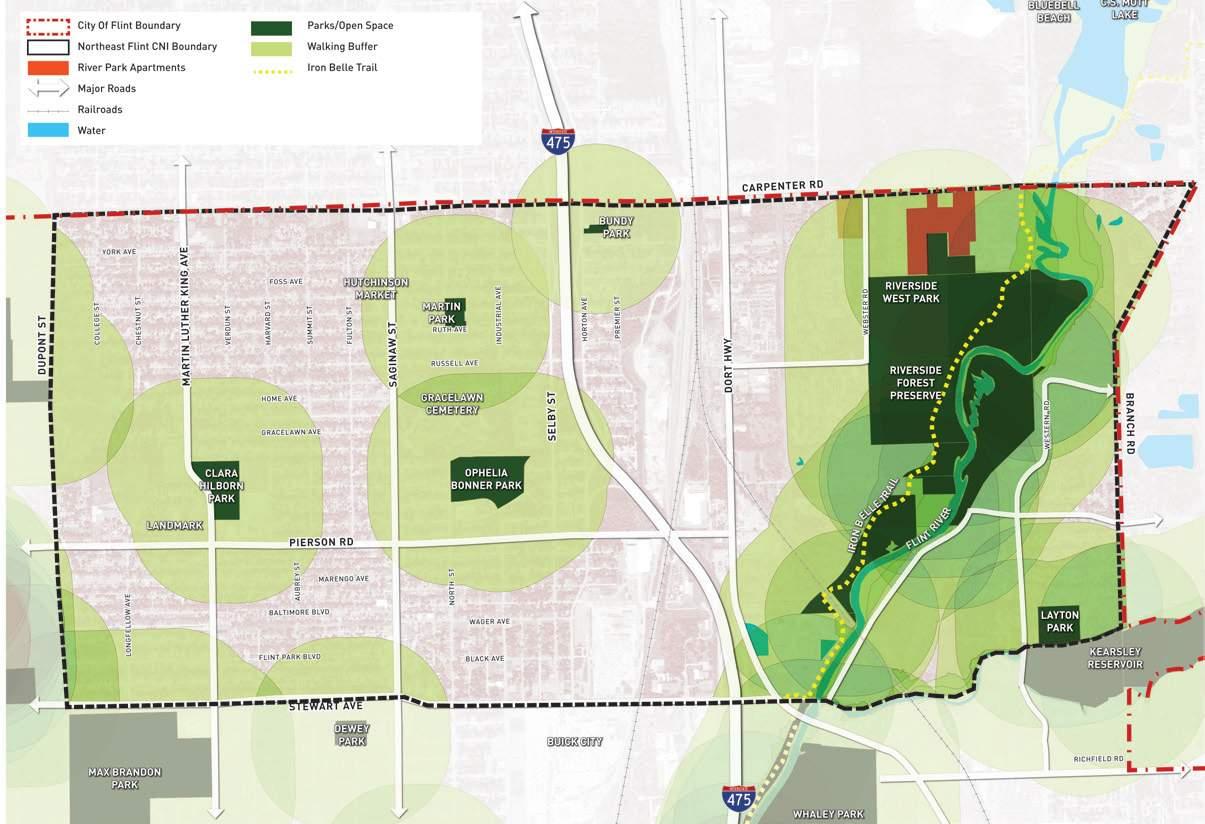
The Northeast Flint study area’s primary and most significant asset is its open space, which includes six parks, one regional trail, and a forest preserve. However, some portions of the neighborhood west of I-475 are not within walking distance of an existing city park. Although the forest preserve is a major destination and asset for the community, residents have expressed concerns about accessibility. The City and Genesee County are looking to improve the recreational aspects of the Flint River and improve access. Additionally, the Northeast Flint community is near Bluebell Beach, a significant regional destination with a sandy beach and splash pad.
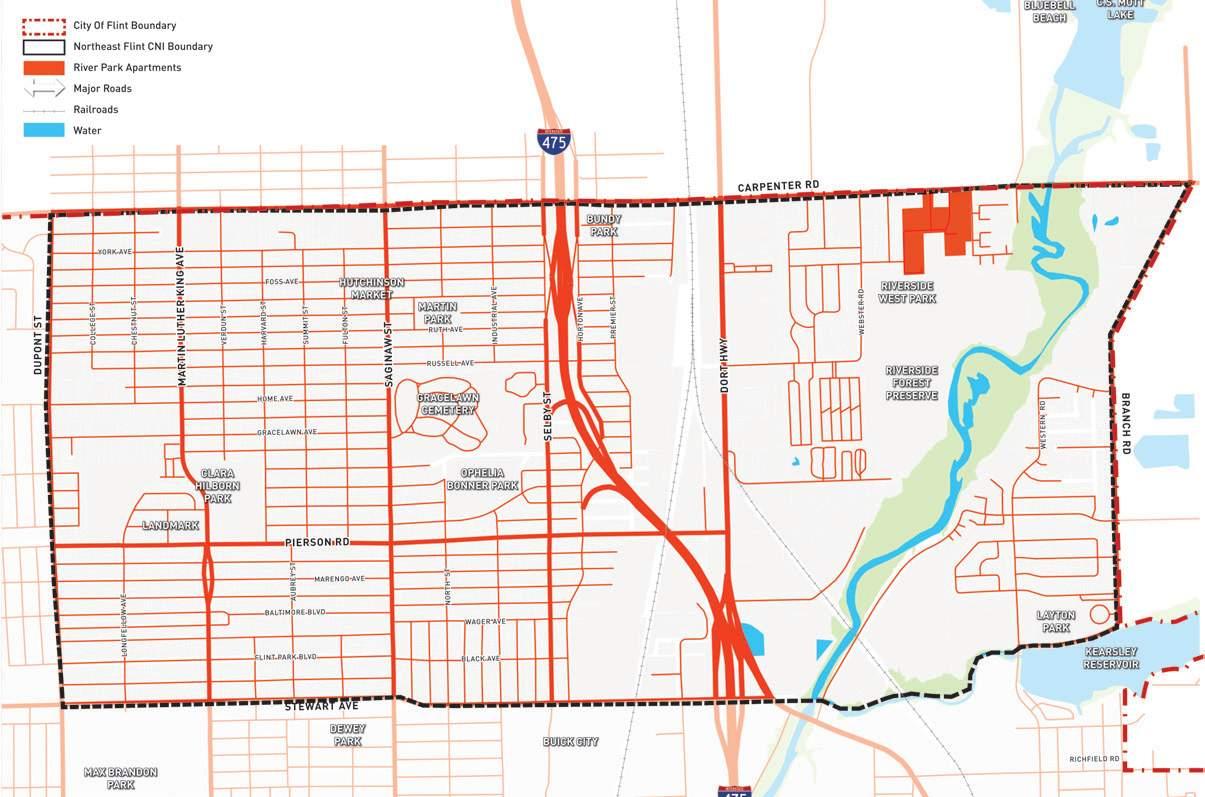
The Street Network Map (above) clearly illustrates the biggest challenge of the Northeast Flint neighborhood- a lack of connectivity, which has resulted in the neighborhood being divided into three distinct areas. A traditional neighborhood grid exists toward the west, with a few larger blocks due to institutional, commercial, and open spaces. The neighborhood is split in the middle by I-475, a railway, and Dort Highway. There are larger blocks to the east due to industrial properties and open spaces, including the forest preserve. The forest further disconnects the southeastern portion from the rest of the neighborhood. Carpenter Road is the only eastwest road that goes through the entire neighborhood. Saginaw Street, MLK, and Pierson Road were identified as priority corridors by the community.
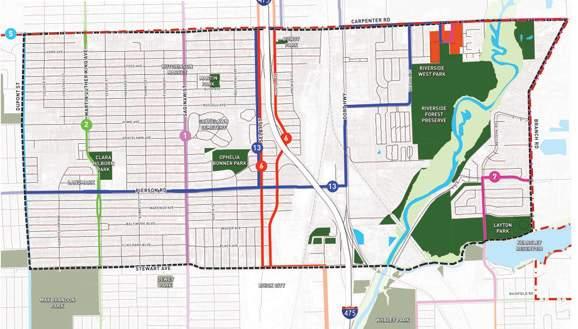
The area is served by six transit routes (inset map), only one of which runs east-west and is one of two routes serving the River Park Apartments. The Mass Transportation Authority is embarking on a process to evaluate the existing routes and access, and has been a regular participant in discussions to understand the Northeast Flint community needs.
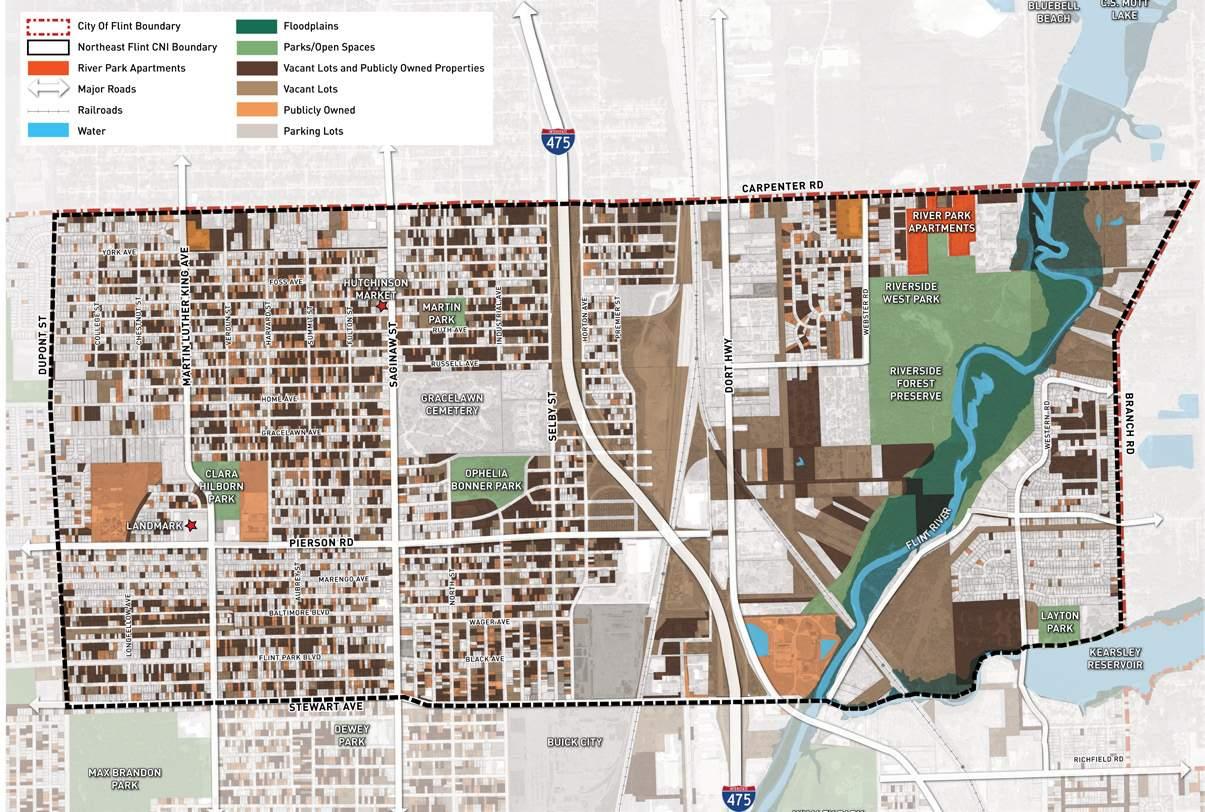
As illustrated above, a significant number of properties are vacant or have unoccupied buildings in poor conditions, contributing to a sense of blight across Northeast Flint. About 40% of these properties are publicly owned, mainly by the Land Bank Authority, City of Flint, or the School Board, which pose opportunities for catalyst sites to promote new development and provide much-need amenities and diverse housing options for a mix of incomes and age groups. On the other hand, areas with properties in good and fair conditions and existing community assets can become the focus of new concentrated infill developments, to channel resources where there is already private and public investments.
With the industrial area integrated within the northeast Flint community, air quality has always been a significant concern for residents, a concern which was heightened by the new Ajax Plant. In June and August 2023, EPA Region 5 conducted shortterm monitoring using its mobile monitoring truck in Flint. The EPA monitored near several facilities in response to requests from the community, focusing on hydrogen sulfide (H2S) and methane. They also collected air samples in canisters that were then analyzed in a laboratory for 75 volatile organic compounds (VOCs).
The EPA detected hydrogen sulfide in a few different areas, but the readings did not last more than a few seconds and were not repeated when the truck returned to the same locations. The EPA also reviewed the canister sample results from the laboratory, and all measured VOCs were below levels that would cause human health effects from short- or long-term exposure to the air in the area.
A Housing Market Analysis was conducted for the Northeast Flint Choice Neighborhood Initiative (CNI) Study Area in Flint in September 2024. The analysis was carried out to support the creation of new housing within the neighborhood. The purpose of the housing market analysis is to provide insights into the potential demand for market-rate and affordable housing in the area and how it could be successfully integrated into the neighborhood over the next five years.
The complete study has been included in the Appendix.
1. Northeast Flint will need 125 additional rental units and 38 additional for sale units by 2028.
2. Currently an estimated 27 individuals both live and work in the neighborhood, while 2,395 residents work elsewhere, and 566 work in the neighborhood but live elsewhere. Creating more employment opportunities could increase housing demand.
3. Projected rental demand among extremely low-income households remains high. New developments should target rental rates of $250 per month for these households. There is also a rental gap in the $35,000 - $75,000 household income range, which would rent at $875 - $1,250.
4. The projected median household income of $30,000 can afford to purchase a home for $85,000, based on today’s home mortgage landscape.
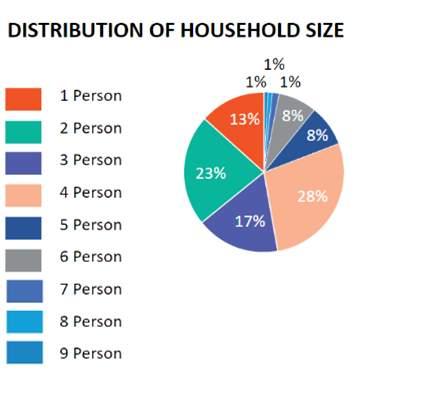
5. The neighborhood has about 1,200 more 1-person households than 1-person homes. Building more studio and 1-bedroom homes could create new opportunities for larger households to move to the neighborhood and occupy existing 3- and 4-bedroom houses.
NORTHEAST FLINT COMMUNITY PLAN A Choice Neighborhood Initiative
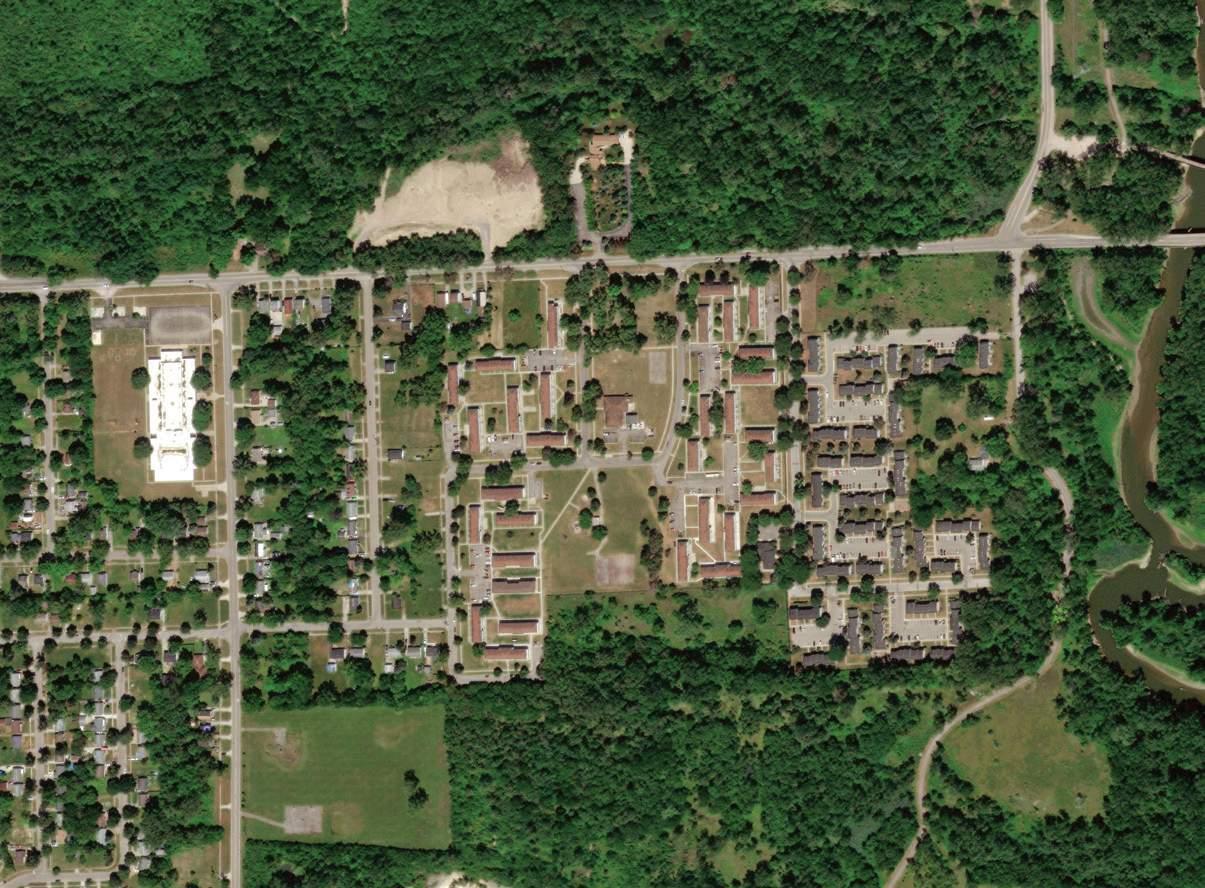
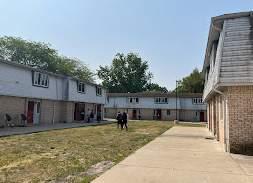
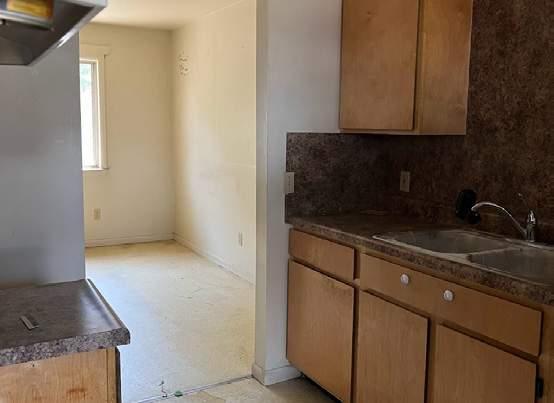
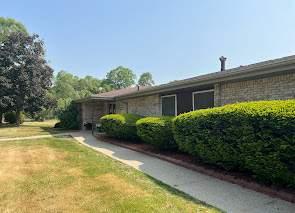
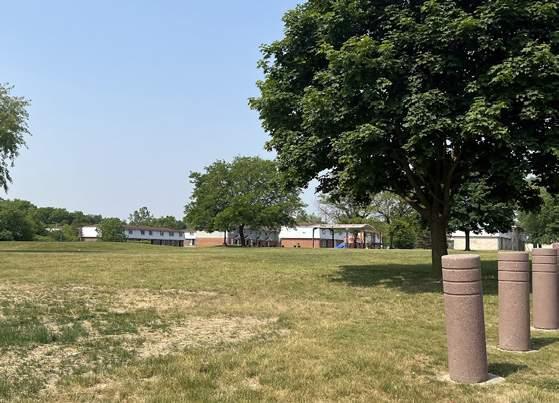
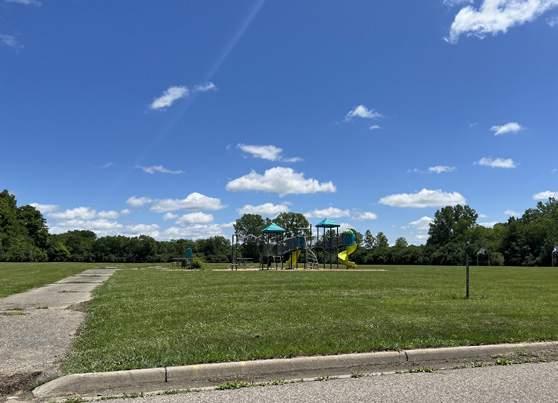
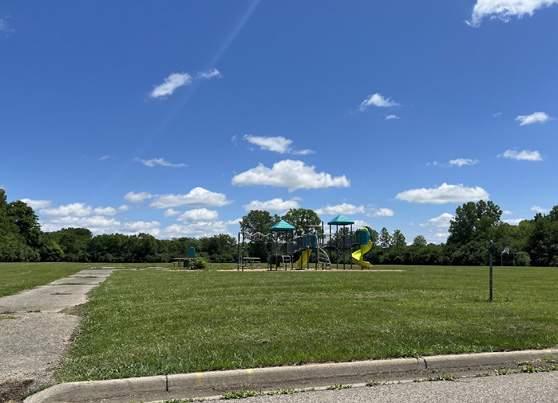
The redevelopment of the FHC’s River Park Apartments is the focus of the Northeast Flint Choice Neighborhood Initiative. Located at the northern edge of Flint, the site is bordered by the Riverside Forest Preserve to the south, providing access to an attractive natural feature but isolating the apartment community from the surrounding neighborhoods. On-site amenities include a community room and a playground on the adjacent city-owned parcel. Keep Genesee Beautiful, through a grant, plans to install upgraded playground structures in Fall 2024.
There are significant deficiencies in the building structure, interior finishes, site, and systems due to age and regular wear and tear. The CNI Plan aims to replace 100% of the River Park housing units both onsite and throughout the Northeast Flint neighborhood as part of new mixed-income developments.
Site Developed Site Area
Total Building Floor Area
Number of Buildings
Number of Stories
Number of Units
of Occupied Units
• Resident Meetings
• Project Kick-off Meeting
• Resident Meeting Phase 1: Project Initiation May - Jun 2023
• HUD Site Visit
• Initiate Community Ambassador Program
Phase 2: Discover Jun - Oct 2023
• Conduct Stakeholder Interviews
• Establish Steering Committee and Task Force Groups
• Conduct Existing Conditions Assessments
• Identify assets, issues, and opportunities
• Conduct Residents Needs Assessment Survey
• Discuss potential Early Action Project Ideas
• Steering Committee Meeting
• Task Force Group Meeting #1
Phase 3: Visualize Oct 2023 - Feb 2024
• Steering Committee Meeting
• Goals and Objectives for People, Neighborhood and Housing Plan
• Community Design Workshop
• Steering Committee Meeting
• Preferred Framework Plan and Strategies
• Catalytic Projects and Community Improvements
• Task Force Group Meeting #3
Phase
• Draft Transformation Plan
• Steering Committee Meeting
• Community Meeting
• Implement an Early Action Project
• Neighborhood Framework
• Site Development Alternatives
• Task Force Group Meeting #2
• Resident Meeting
Feb - Jun 2024
• Resident Meeting
• Finalize Early Action Projects
• Preliminary Implementation Strategies/ Action Plan
Jun - Dec 2024
• Finalize Implementation Plan and Lead Organizations
• Continued Resident and Community Engagement Plan
• Final Transformation Plan
Community Ambassadors
Flint Housing Commission City of Flint
River Park Residents
Neighborhood Task Force
Steering Committee
Planning Coordinator
Lord Aeck Sargent, COLLABO, ROWE
Housing Task Force People Task Force
Choice Neighborhood Planning Grant Awarded
Resident Meeting
Meeting
Project Kick-Off With Planning Coordinator HUD Site Visit
Stakeholder Interviews
Transformation Plan Outline with Content submitted to HUD
Neighborhood & Housing Meeting #1
Steering Committee Meeting #1 People Meeting #1
Meeting
Neighborhood & Housing Meeting #2
Steering Committee Meeting #2
Meeting #2
NAC Grazing in the Grass Event
SBEV Fall Fest
River Park Trick or Treating
Neighborhoods United Meeting North Flint Neighborhood Action Council (NAC) Meeting
Resident Needs Assessment Survey Initiated
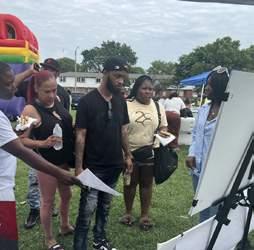
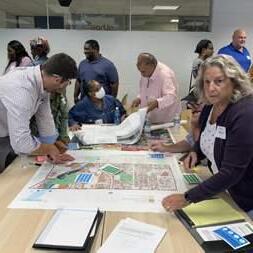
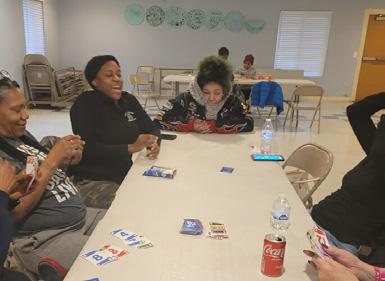
Game Night
Tour
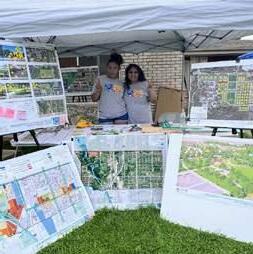
Steering Committee Meeting #3
Catalytic Site Stakeholder Work Sessions
Resident Meeting Community Meeting
Neighborhood & Housing Meeting #3 People Meeting #3
Work session with City and City Departments DRAFT Plan submitted to HUD
Meeting
Fest Porch Fest Genesee County 20th Celebration of Beautification Back to School Community Event
Plan submitted to HUD
Steering Committee Meeting #4 Resident Meeting
United Community Rally
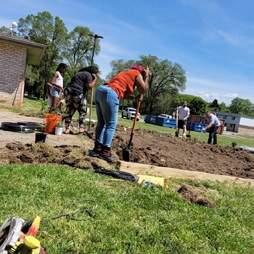
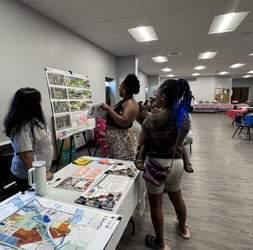
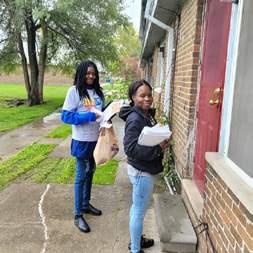
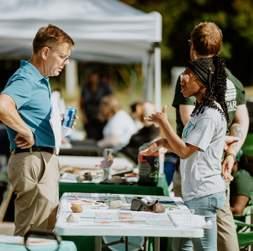
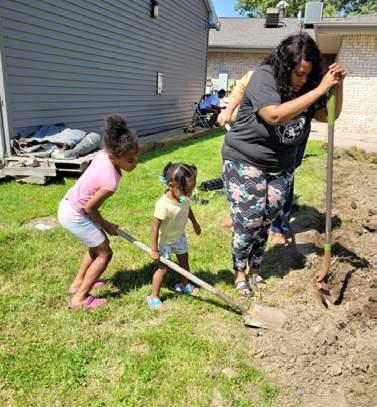
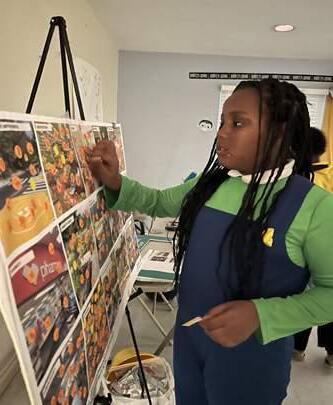
The Needs Assessment Survey was conducted with River Park Apartment residents starting in October 2023. A game plan for survey collection was developed including goals, coordination, and incentives. The Planning Team aimed to collect at least 65% of households (out of 130 occupied units) during a two month period. The Community Ambassadors played a vital role, assisting the Planning Team in distributing information to residents about the survey. Community Ambassadors shared flyers and distributed the survey to each household. In order to incentivize residents to participate in the survey, a $10 gift card from a local grocer, Landmark Food Center, was given to each household. Residents who completed the survey were also included in a raffle for a chance to win three $100 gift cards.
As surveys were completed, a tracking sheet was updated, allowing the Team to follow the progress and try to target those who hadn’t filled out the survey. The survey collection period was extended in order to reach more residents. Other efforts to collect surveys included promoting the survey during “Resident Game Nights” held every first and third Friday of the month. As well, the Planning Team joined the Ambassadors, going door to door to spread the word about the survey. Ambassadors and FHC staff also held office hours in the lobby of the Community Room to assist residents with filling out the survey. With multiple strategies implemented for survey collection, 51% of households have participated in the survey, as of June 2024. The Flint Housing Commission (FHC) is actively working to collect additional responses.
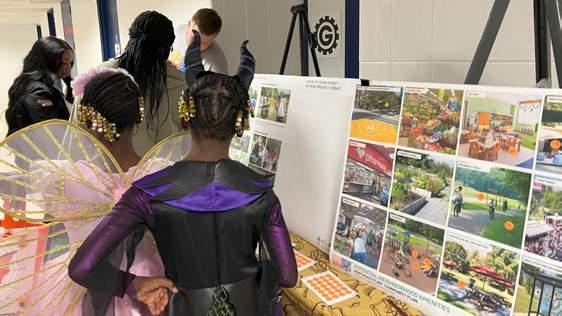
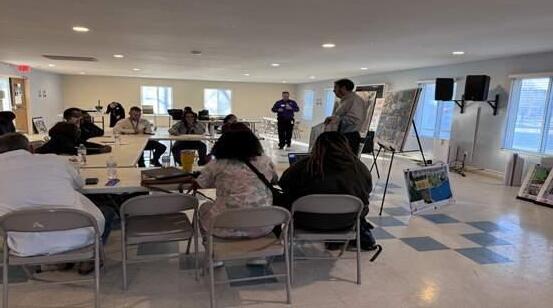
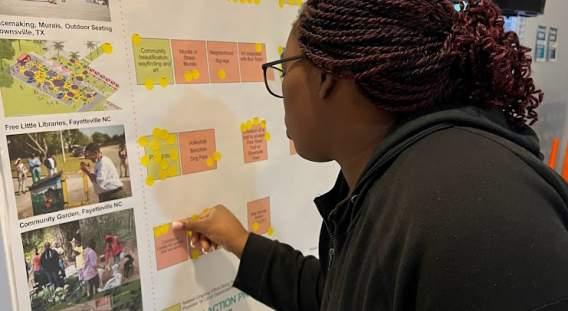
TASK FORCE MEETINGS
STEERING COMMITTEE MEETINGS
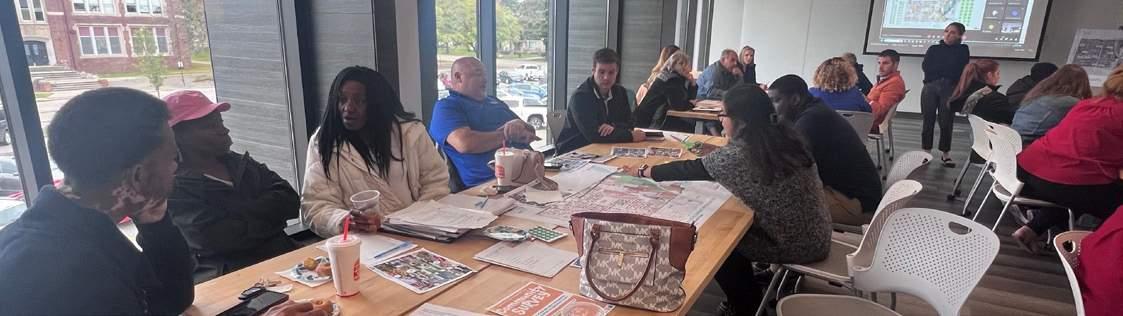
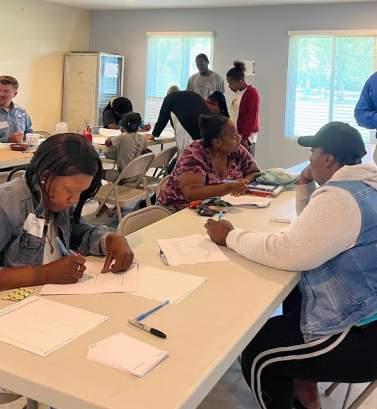
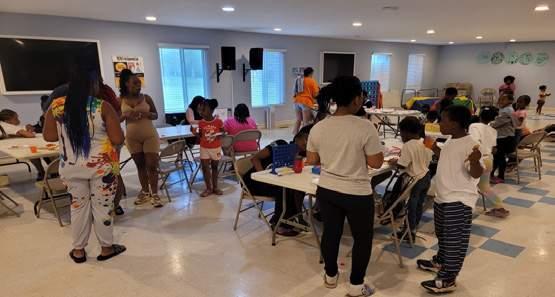
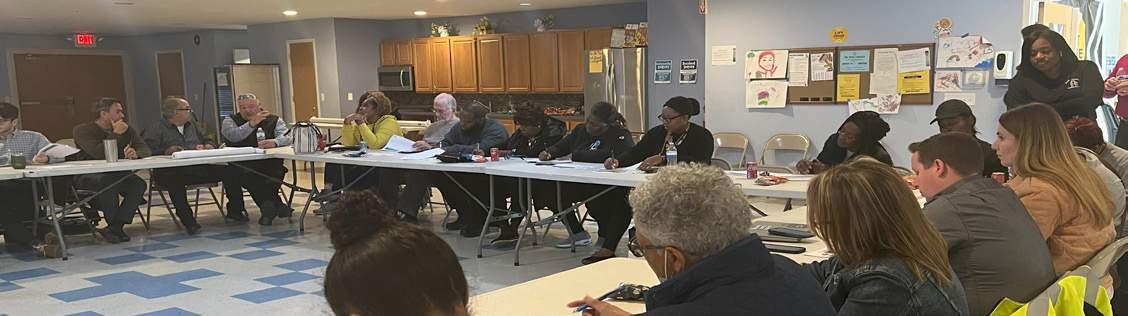
Neighborhood and Housing Task Force Meeting. October 17, 2023.
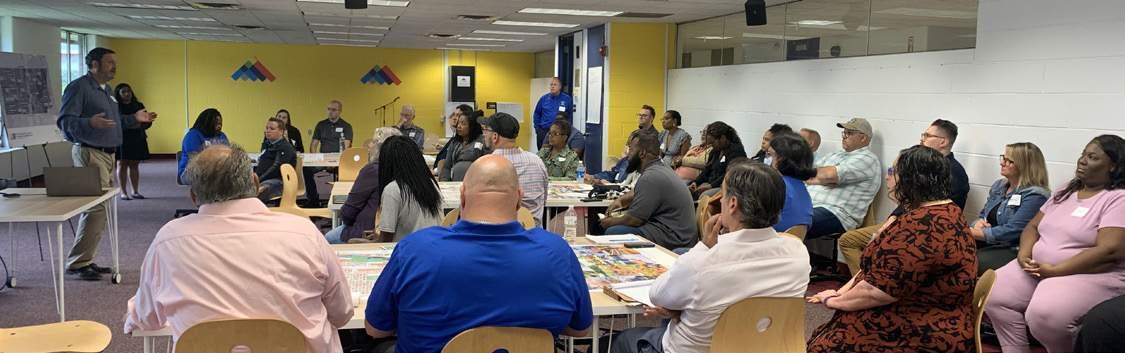
People Task Force Meeting. November 09, 2024.
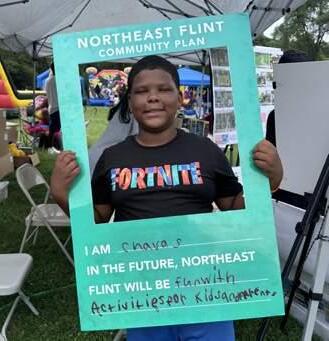
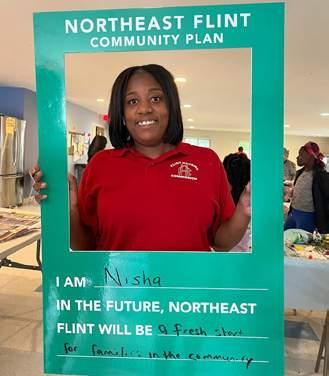
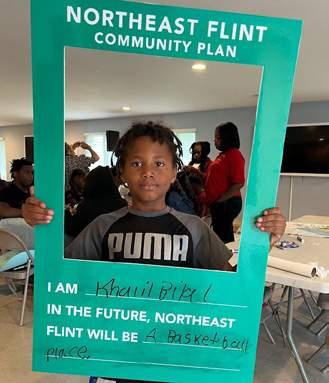
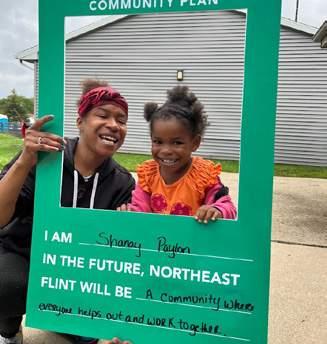
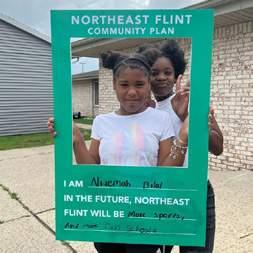
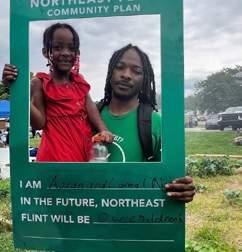
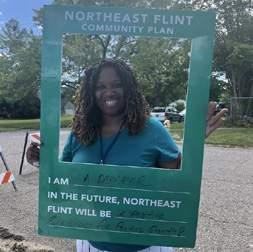
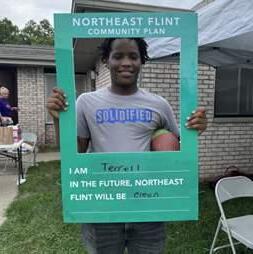
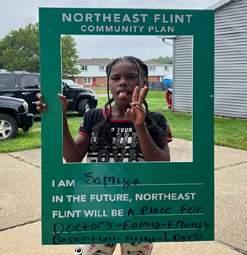
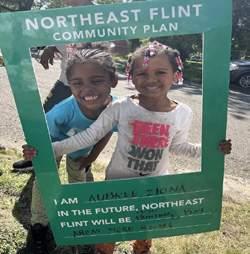
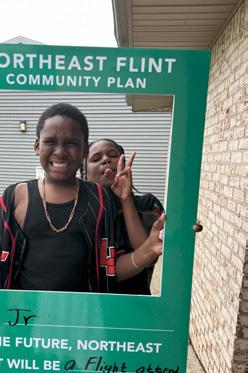
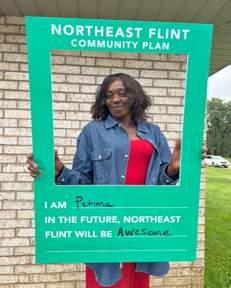
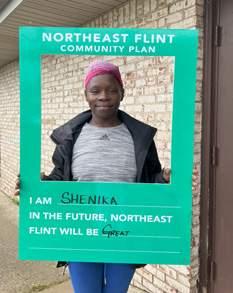
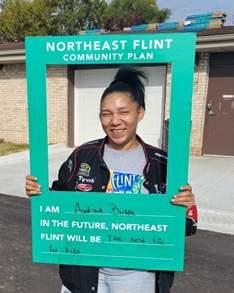
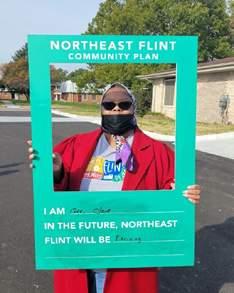
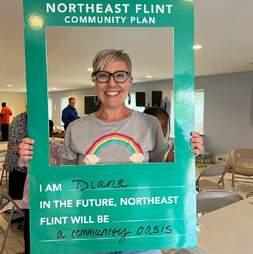
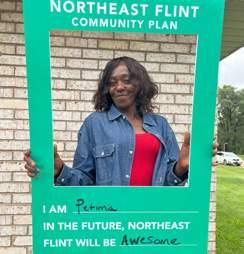
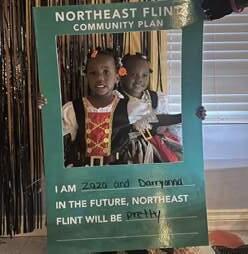
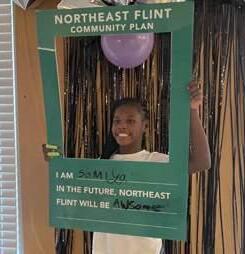
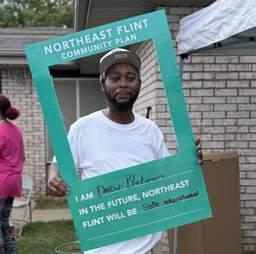
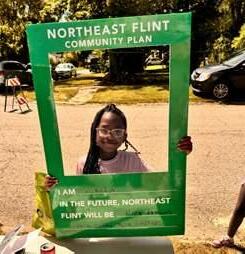
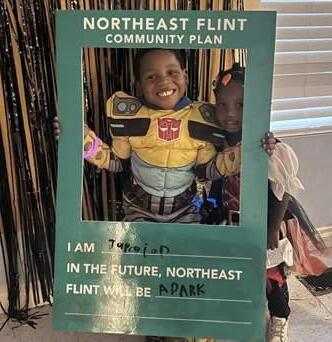
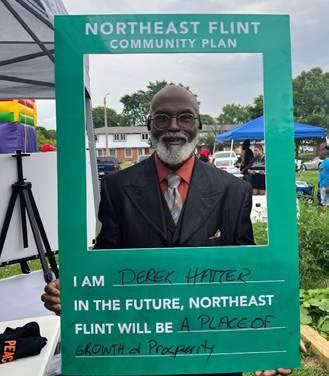
In the Future, Northeast Flint will be...
“AplaceforDoctor’s–family–friends–basketball–football”
“Moresportsandmorefunschools”
“Nice”
“Acommunitywhereeveryonehelpsoutand worktogether”
“Avibrant,thriving community”
“OurChildren’s” “Green”
“Abasketballplace”
“Acommunityoasis” “Agreatplacetolive”
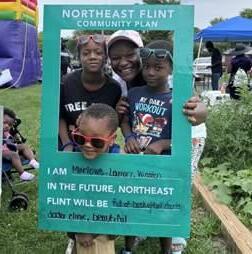
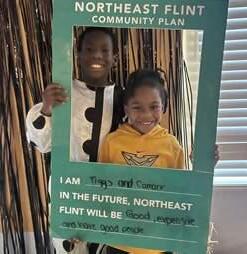
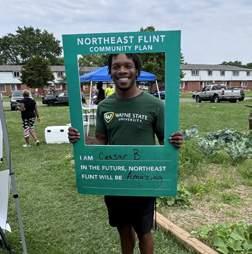
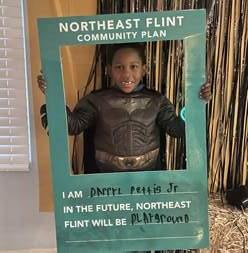
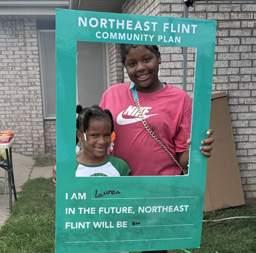
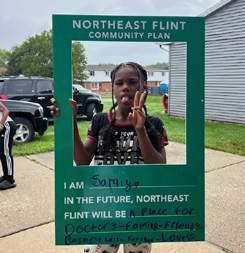
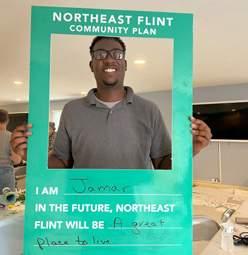
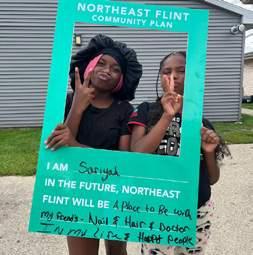
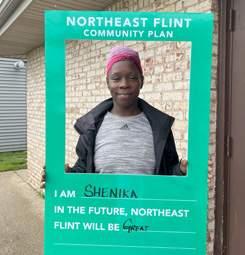
“Fullofbasketballcourts,doctorclinic,beautiful”
“Awesome”
“Safe,Educational”
“Aplaceofgrowthandprosperity”
“Aplacetobewithmyfriends–nail&hair& doctorinmylifeandhappypeople”
“Funwithactivitiesforkidsandparents”
“Afreshstartforfamiliesinthecommunity”
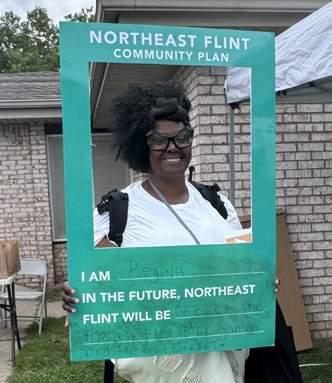
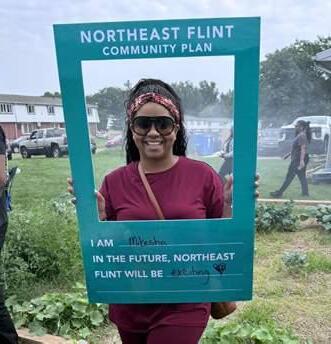
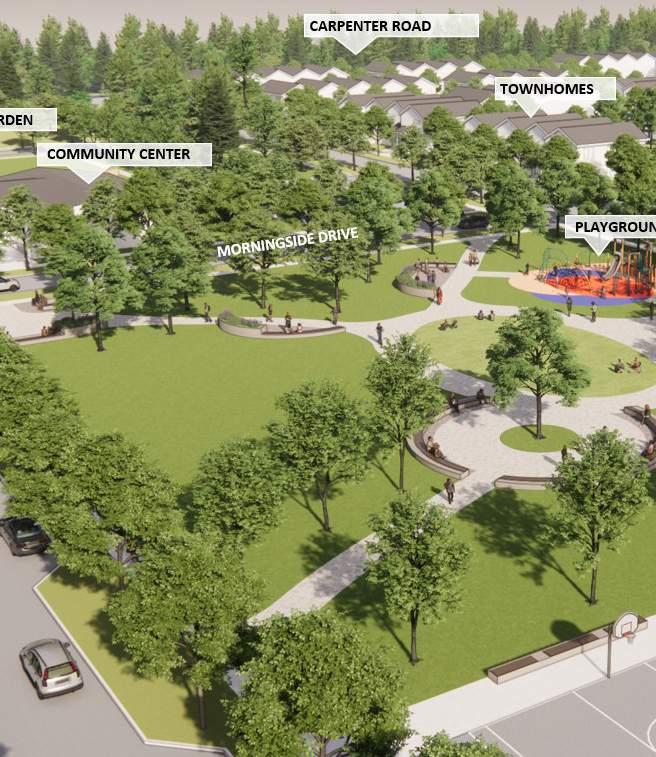
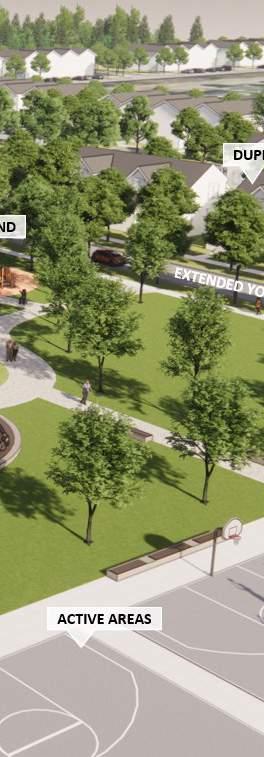
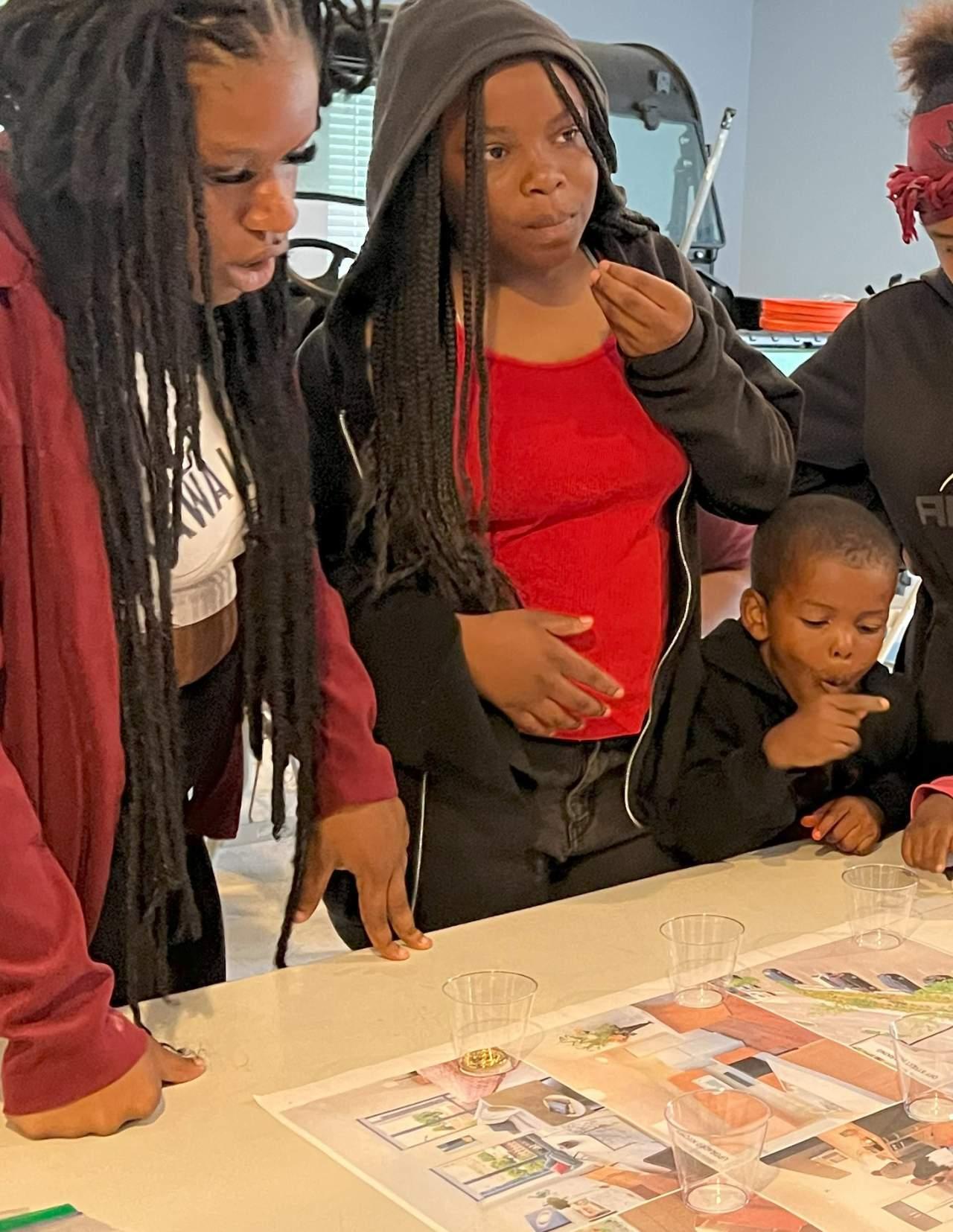
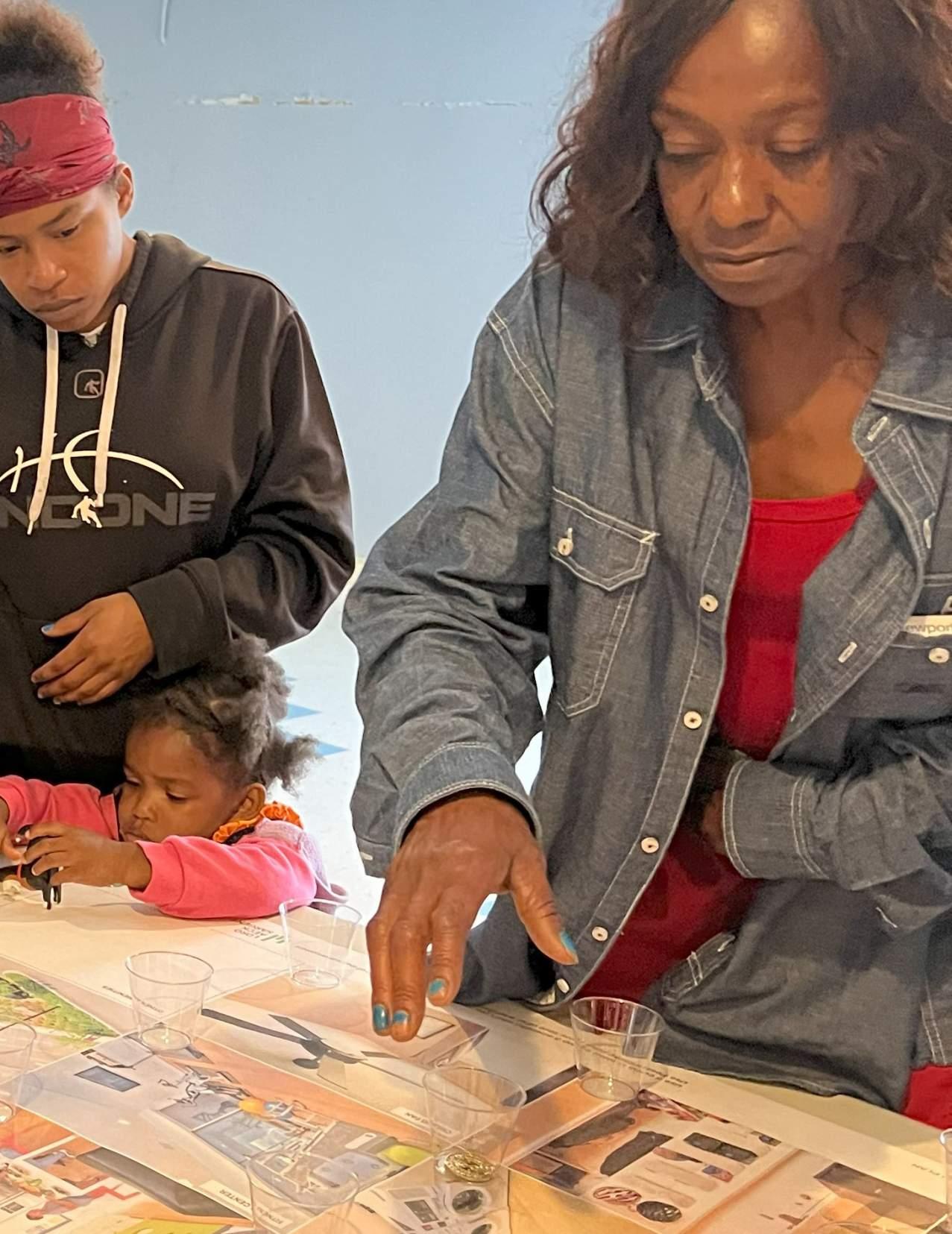
The People Plan includes a range of strategies intended to improve the quality-of-life for Target Housing residents, as well as Northeast Flint neighbors.
Strategies are organized into categories relating to Education (including Early Learning and School-Aged Education, and Adult Education), Health and Safety, and Employment and Job Training. Each People category includes a series of impact statements, baseline metrics (collected from the Resident Needs Assessment Survey), and expected outcomes in order to track success. Strategies include potential lead and supporting partners, as well as potential resources that could be utilized for implementation.
• Create an on-site homework assistance program
• Create an on-site after school program
• Enhance resident participation to existing adult education programs
• Re-purpose Carpenter Road School
• Connect local churches with resources to become childcare providers
Health & Safety:
• Create nutrition and physical activity programming
• Create an on-site health and wellness clinic
• Monitoring and remediating air pollution
• Empower the Resident Council
• Create a Strong Neighborhood House in a vacant unit at River Park
• Increase outreach to FHC’s FSS program
• Increase outreach to youth workforce training programs
• Create a resource center to connect residents to employment opportunities
• Connect residents to existing job training programs
• Connect residents to a small business start up program
The Education Plan focuses on activities that will be undertaken to ensure all children living in the Target Housing sites will enter kindergarten ready to learn. These services will help to enroll, track and support the attendance of children from birth to kindergarten in high-quality, evidence based early education programs. These programs will utilize statewide program standards that demonstrate high expectations of program excellence commensurate with nationally recognized standards and are linked to the State’s licensing system. Programs outlined in
• Local children enter kindergarten ready to learn. Children attend highquality early childhood programs, and parents and caregivers have the tools to foster positive experiences optimize early childhood development.
• Local children are proficient in core academic subjects, and graduate high school college- or careerready, and scholarship opportunities and paid internships are available for local students.
the Plan are intended to actively engage parents as partners in early learning. The Education Plan is also intended to ensure all school-aged children living in the Target Housing sites are proficient in core academic subjects, attending school consistently, and are graduating from high school college- and career-ready. The final component to the Education Plan is to offer quality adult education programming to parents of the target housing site.
56% have at least a high school diploma / GED
12% are enrolled in college / technical / vocational school
Residents with kids have the following childcare arrangements:
Early Head Start, Head Start Program, and Childcare in home from self
Residents with kids ranked the following youth programs for greater youth participation: After School Program, Arts / Music, Boys and Girls Scouts
59% of school aged children attend a Flint Public School
Most needed things in the neighborhood are: Grocery, Clothing Store, and New School
• 70% within 5 years
• 20% within 5 years
• Expanded childcare offerings within the neighborhood
• Expanded and accessible youth programs and higher overall participation
• N/A
• Identify and integrate these elements into the Neighborhood Plan
1. Create an on-site homework assistance program
The Plan recommends creating a homework assistance program at the River Park Apartments through a partnership with the Ruth Mott Foundation. The Ruth Mott Foundation’s mission is to advocate, stimulate, and support community vitality. Their goal is to help residents of the neighborhood create and sustain opportunities to contribute and thrive. With a focused, place-based approach to philanthropy, the Foundation has been able to engage residents and build partnerships. Through a series of community forums, the Foundation was able to narrow their focus on providing funding opportunities to address youth, public safety, economic opportunity and neighborhoods. Youth funding opportunities focus on youth development programs outside of school hours and job training and employment.
In 2023 the graduation rate for North Flint students was 22.6%. This is a significant decrease from the 67% rate the Foundation began tracking for North Flint in 2013. Several factors have contributed to the decrease in graduation, including the closing of the two high schools in the neighborhood and the COVID-19 pandemic. Residents would like to see an increase in the graduation rate raise to 100%, seeing all of their children be successful. In order for this to occur, an increase in involvement in education, tutoring, and literacy programs is necessary.
Providing an on-site homework assistance program could ensure that students have better access to the necessary resources and tools to be successful

in school. Students need access to cable internet, Wi-Fi, and other technology products (i.e. laptops or tablets) to be able to complete their homework. A computer lab could be set up in the existing community room, enhancing the small technology hub currently on site. Students would be able to check out a laptop or use a computer during dedicated hours of operation after school. The Ruth Mott Foundation could provide assistance with establishing partnerships with schools or organizations to hire on-site tutors. Tutors could work with students in a group setting by grade levels or assist individual students who need more one-onone time. A more permanent, dedicated space could be introduced in the redevelopment of the River Park Apartments for an enhanced afterschool program.
Timeline
Potential Lead Partners
Potential Supporting Partners
• 0-2 Years
• Flint Housing Commission
• Ruth Mott Foundation
• Mott Community College
• United Way of Genesee County
• Flint Public Library
• Sylvester Broome Empowerment Village
• Flint Development Center
• Berston Field House
• Flint & Genesee Literacy Network
Potential Resources
• Ruth Mott Foundation
• Temporary Assistance to Needy Families (TANF)
• Charles Stewart Mott Foundation
• United Way of Genesee County
• Title I Supplemental Educational Services
• Federal Food and Nutrition Programs
• Out-of-School Time Grant
2. Create an on-site after school program
In tandem with the on-site homework assistance program, the Plan recommends creating after school programming at River Park Apartments. Residents with school-aged children ranked the following as programming their youth would most likely participate in: after school programs, arts/music programs, and Boys and Girls Scouts. After school programs in North Flint are located just outside of the Choice boundary. Community centers like the Sylvester Broome Empowerment Village or the Flint Development Center are about 4 miles away from River Park Apartments. Transportation is currently provided to students from the schools to these centers. However, River Park Apartment residents have children that attend both public and charter schools. This creates an issue for transportation as there are varying dismissal times from each district. That, along with the current hours of operation for after school programming may limit participation from students. Additional transportation options to and from the existing after school programs could increase participation from River Park Apartment youth.
Alternatively, creating on-site after school programming could ensure that youth have the ability to participate in these programs. Art, music or sports programming could be provided on site in partnership with local organizations. As part of the Early Action Project, River Park will be creating new basketball courts. Sports programming could be
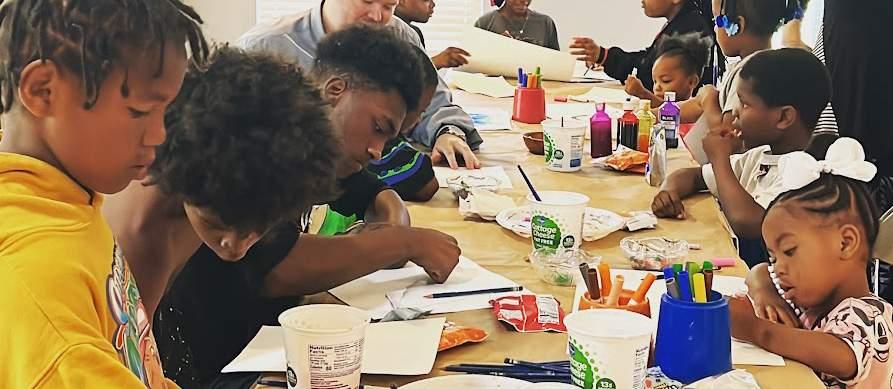
developed for youth that are interested in learning how to play. FHC staff has hosted a number of game nights throughout the planning process that have been well attended by all residents. Game nights in partnership with Flint Institute of Arts (FIA) have seen the most participation as youth residents take part in these activities. Enhancing the existing partnership with the FIA could result in arts programming for K-12 students. New partnerships could also be created through connections from the Ruth Mott Foundation or to organizations close by. Youth would have a more direct connection to these activities at no cost.
Potential Lead Partners
Potential Supporting Partners
Potential Resources
• Flint Housing Commission
• Ruth Mott Foundation
• Flint Institute of Arts, Flint
• Institute of Music Mott Community College
• United Way of Genesee County
• Flint Public Library
• Sylvester Broome Empowerment Village
• Flint Development Center
• Berston Field House
• Flint & Genesee Literacy Network
• Ruth Mott Foundation
• Temporary Assistance to Needy Families (TANF)
• Charles Stewart Mott Foundation
• United Way of Genesee County
• Title I Supplemental Educational Services
• The 21st Century Community Learning Centers (21CCLC)
• Federal Food and Nutrition Programs
• Out-of-School Time Grant
The Flint & Genesee Literacy Network’s (FGLN) mission is to seek out, convene, align, and build capacity in partners who improve the lives of individuals, children and families of Flint and Genesee County by radically raising literacy levels. The Literacy Network supports programs that contribute to multi-generational literacy and promotes the benefits of literacy across one’s entire lifespan. The FGLN focuses on Adult Education programs that target Adult Secondary Education (ASE), Adult Basic Education (ABE), English Language Acquisition (ELA), Integrated ELA and Civics Education (IELCE), and Literacy Councils. The ASE program helps learners achieve the education needed to obtain a high school equivalency credential and transition to college, training and/or employment. In partnership with the Literacy Network, the Plan recommends creating stronger connections with the FGLN’s adult education program in order to meet the needs of FHC residents. 56% of residents at River Park Apartments have at least a high school diploma or GED. Adult education provides an opportunity for mature students to improve or achieve education levels equivalent to those of high school graduates. Incorporating an adult education program for River Park Apartments can
56% HAVE AT LEAST A HIGH SCHOOL DIPLOMA / GED
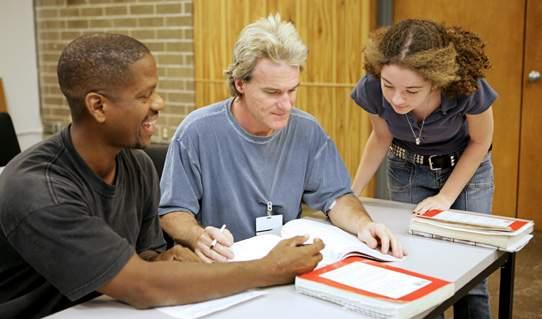
help residents achieve their academic goals, allowing them to later pursue higher education or training. FGLN has 10 Adult Learning Centers (ALC) throughout the City that are designed to address the individual needs of adult students through adult education programs and activities. Each site is equipped with a designated site coordinator that provides volunteer tutors and adult learners with support services and guidance to assist in meeting their goals.
Increasing outreach to the FGLN’s adult education programming can help River Park residents learn more about resources near them. There are about four ALCs in or around the target neighborhood. FHC can partner with the ALC located at the Higher Quality of Life Ministries to connect residents to the adult programming located there. Transportation services to and from the ALC location could encourage greater participation from residents. Alternatively, online options could also be included to connect residents to tutors from one of the sites. Utilizing the community room as a computer lab, residents could easily connect online to the courses provided by the FGLN’s adult education program.
Timeline
Potential Lead Partners
Potential Supporting Partners
• 0-2 Years
• Flint Housing Commission
• Flint & Genesee Literacy Network
• Mott Community College
• Ruth Mott Foundation
• United Way of Genesee County
• University of Michigan-Flint
• Flint Development Center
• New Life Center
• Michigan Reconnect
Potential Resources
• Workforce Innovation and Opportunity Act (WIOA) Adult Program
• Section 107a Adult Education Innovation Program
• Adult Basic Education Grant
The Flint School District, in an attempt to address its budgetary deficit, began to downsize the district by closing schools throughout the city. Since 2008, many schools have been closed,resulting in changes to school attendance and enrollment as students affected by closures were assigned to new schools matching their zip code. The closure of Carpenter Road School in 2015 left Northeast Flint without a public school. Many of the students that attended Carpenter Road School were shifted to Brownell/Holmes STEM Academy, located on the western boundary of the City of Flint. Others moved to a completely different school district. Today, only 59% of River Park Apartment school-aged children attend a Flint Public School, none of which are in the choice boundary.
Under the Board of Education’s ownership, many closed school buildings were left vacant and blighted. Others were burned or torn down, resulting in vacant lots. Since its closure, Carpenter Road School has been untouched, with residents hoping to reuse it for the community. Recognizing that a school could not be re-opened in the area and seeing the need for community amenities, the Plan recommends repurposing the school as a neighborhood hub. In partnership with the School Board of Education, the school could be purchased
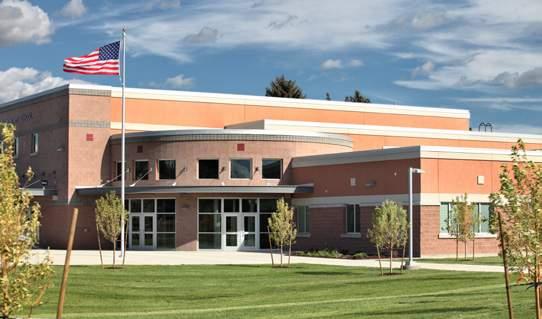
or leased by the City of Flint as a community center, with an emphasis on youth programming and/or health services.
According to the Flint Property Portal, the school building is in good condition. Residents would like to see the building be repurposed before it is unsalvageable. The building could potentially be reutilized, keeping the original spaces intact. For example, the gym could be kept for recreation and some classrooms for homework assistance or arts programming. Other classrooms could be retrofitted into clinic spaces for physical or mental health services. Partner service organizations could also utilize the space as satellite offices. A large room could be used to host community events or be rented out for personal celebrations. Sustainable partnerships with organizations that could run and maintain the programs is an important aspect to this strategy. The activation of the school could bring back a celebrated amenity in the neighborhood.
•
•
•
5.
The target neighborhood is considered to be a “child care desert”, according to the child care mapping project completed by the Michigan State University in 2022. In the 48505 zip code, on average, more than three children competed for one slot in a nearby licensed child care facility. Residents with children generally care for their kids at home or enroll them into a Head Start Program. With only two child care facilities in the neighborhood, it is difficult for parents to enroll their kids in these facilities. Aside from a lack of facilities in the area, residents have pointed out that cost, lack of trust, and lack of transportation contribute to not utilizing existing child care facilities. Residents have expressed a need for a space that is safe, free or low cost, and is within the neighborhood. The Plan recommends connecting local churches with resources to become child care providers.
In May 2022, the Michigan Department of Lifelong Education, Advancement, and Potential (MiLEAP) launched the Caring for MI Future, a statewide effort to help child care entrepreneurs open 1,000 new or expanded child care programs by the end of 2024. The initiative focused on providing entrepreneurs with resources on what they needed most to open and expand their child care businesses. Resources included helping find and renovate spaces, startup funding, helping recruit staff, and supporting the creation of a business plan. In November of 2023, the child care program goal was surpassed and 1,089 new child centers were opened and 2,159 home-based providers expanded their programs across Michigan. In Genesee County, a total of 287 child care centers are active, including 53 new centers since the program began. As the Caring for MI Future program continues to track its success, the
Plan recommends creating a similar program modeled on this successful approach at a local level. The child care program can be adapted to reach out to local religious organizations in order to incorporate child care services in their facilities. Places of worship such as St. Francis Prayer Center and Foss Avenue Baptist Church are active community partners. They provide residents with resources such as diapers, food, and clothing giveaways. If applicable, these organizations could participate in the program and get the necessary licensing to open a child care center that caters to the needs of the community. A partnership with Mott Community College’s early childhood certificate program could incentivize residents that attend these churches to look into training and employment in the neighborhood.
Timeline
Potential Lead Partners
Potential Supporting Partners
• 2-5 Years
• Flint Housing Commission
• Department of Lifelong Education, Advancement, and Potential
• St. Francis Prayer Center
• LISC
• St. Luke’s N.E.W. Life Center
• Foss Avenue Church
• Calvary Baptist
• Ruth Mott Foundation
• United Way of Genesee County
• Flint Community Foundation
• Childcare Network
Potential Resources
RESIDENTS
• State of Michigan Childcare Relief Fund Act
• Flint Kids Fund
• Child Care and Development Fund (CCDF)
• Child Care Fund
• Child Care and Development Block Grant (CCDBG)
• Child Care Stabilization Program
The Health and Safety Plan includes a set of activities that will result in improved physical health, safety outcomes and regular health care access for individuals and families living in the Target Housing sites. Health strategies consider individual family needs and goals, as well as structural barriers that impede routine healthcare use. Services will seek to support and connect uninsured adults and children to health insurance and ensure adults and children have a healthcare facility where they regularly go when they are sick or for general health concerns
other than an emergency room. Strategies are also designed to ensure that adults and children receive ongoing care and appropriate treatment for chronic conditions as well as preventative healthcare. They also work to connect children and adults to trauma-informed care and mental health services. Safety strategies aim to increase visibility in the neighborhood and encourage resident participation in the neighborhood association.
• Residents have health insurance coverage and access to high-quality preventative and primary medical care.
• Residents experience a strong sense of well-being and have the resources needed to support their health.
• Residents have access to affordable and healthful food options.
• Residents feel safe when walking around the neighborhood.
• 39% of residents have a physical or mental disability
• 87% have health insurance
• 41% of residents have good health
• Residents use Hamilton Community Health Network for their health care needs
• Depression is the most reported health condition followed by asthma and extreme stress or anxiety
• 32% eat fruits or vegetables 3-4 times a day
• Lack of time and lack of walking / exercising spaces in the neighborhood keep residents from being more physically active
• 68% of residents wish the Ajax Asphalt Plant had not been built near their homes
• N/A
• 95% within 5 years
• 65% within 5 years
• N/A
• Increased access to health programs that help to prevent and treat these conditions
• 50% within 5 years
• Development of walking and exercise area as part of the Neighborhood and Housing Plans
• Monitoring and continual remediation of any negative impacts associated with the Plant
IMPACT STATEMENTS BASELINE METRICS
• Continued.
• 49% of residents are extremely concerned about the impact on their health from the Ajax Asphalt Plant
• Residents use bottled water for drinking and cooking
• 47% feel somewhat safe in the neighborhood during the day
• 31% feel somewhat safe in the neighborhood at night
• 69% view the police as someone they can call when they need assistance
• Crime residents have experienced in the neighborhood: Bullying, Assault / Physical Attack, Car Break-In
• Monitoring and continual remediation of any negative impacts associated with the Plant
• Monitoring of water quality to ensure safe drinking standards
• 65% within 5 years
• 50% within 5 years
• 75% within 5 years
• Top improvements residents feel would make the community safer: Better security cameras, Better street lighting, and Community block watch program
• Community policing focused on prevention of these crimes
• Integration of safety features within new housing development
The Plan recommends creating nutrition and physical activity programs along with pedestrian and open space improvements at River Park Apartments. With a food insecurity rate of 16% (2022) in Genesee County, only about one third of residents at River Park Apartments eat fruits or vegetables 3-4 times a day. The closest grocery store to the target housing site is about 3.5 miles away, or a 20 minute bus ride that passes every 60 minutes. Residents have expressed the need for more access to healthy foods. Residents have also expressed interest in programming around staying active. Lack of time and lack of walking or exercising spaces in the neighborhood keep residents from being more physically active.
The Crim Fitness Foundation envisions Genesee County as a safe and active community with equitable access to opportunity. The Fitness Foundation recognizes that health is influenced by many factors. Some of these factors include physical features in the neighborhood and access to equipment, such as owning a bike. Crim’s Active Communities team works to create safe, healthy and equitable communities through long term interventions of policy, systems and environment change. The Crim Fitness Foundation offers programming for all ages. Programming includes the Crim Nutrition Program that works with communities to teach the importance of fruits, vegetables, low-fat dairy, whole grains and lean protein. The Fitness Foundation currently serves 17 schools, the Flint Farmers Market, Meijer grocery store and 4 food pantries.
In partnership with the Crim Fitness Foundation, FHC can provide on-site nutrition and physical activity programming to residents, through technical and programmatic assistance. Residents have expressed interest in nutrition programs that educate them on growing their own food, how to cook healthier meals, and how to shop on a budget. The Fitness Foundation could engage residents by adapting their Nutrition Program on-site and with the needs expressed by the residents. Residents could also create and maintain a
community garden on-site. An education garden can help residents in growing and accessing healthy foods in order to connect with the land and each other.
Physical activity programming on-site would be intended to get residents up and moving. The Crim Training Program is a 15-week guided training program that consists of weekly training sessions to help prepare residents for the Crim 10 Mile, Half Crim or 5K. With assistance from the Fitness Foundation, residents could create their own Crim Training Program with an end goal of participating in the annual Crim Race. Trail connections to the Flint River through the Iron Belle Trail would allow residents to form their own walking group in the neighborhood. They could take full advantage of the green space that is a notable asset in the community. Residents would have the support and accountability from their neighbors to complete the program.
Timeline
Potential Lead Partners
Potential Supporting Partners
• 0-2 Years
• Flint Housing Commission
• Crim Fitness Foundation
• Keep Genesee County Beautiful
• LISC
• Edible Flint
• MSU Extension
• Sylvester Broome Empowerment Village
• R.L. Jones Community Outreach Center
• FlintDevelopment Center
• Genesee County Meet Up and Eat Up
Potential Resources
• Community Health Impact Program
• Flint Kids Fund
• Community Foundation
• Health and Human Service Grants
• MI Building Healthy Communities Step
• Up for School Wellness Program
• The Gus Schumacher Nutrition Incentive Program
• State Physical Activity and Nutrition (SPAN)
• High Obesity Program
Residents have mentioned the lack of health centers in Northeast Flint, including clinics, pharmacies or hospitals. The target neighborhood includes only two health centers, Oak Street Health Clinic and Flint Community Medical Center. However, only 3% of residents utilize either one of those clinics, while 45% reported utilizing Hamilton Community Health Network, which is located just west of the Choice boundary. The need for a health clinic in the neighborhood is evident given that only 41% of residents consider themselves to have good health.
The Greater Flint Health Coalition (GFHC) is a nonprofit organization with a mission to improve the health status of residents and to improve the quality and cost effectiveness of the healthcare system in the community. GFHC’s role is to serve as a neutral community-institutional partnership and multifaceted collaboration. GFHC offers programming such as the Mid-Michigan Community Access Programs (CHAP), Commit to Fit, Racial and Ethnic Approaches to Community Health (REACH) and many more. The Plan recommends creating a health and wellness clinic at River Park Apartments in partnership with GFHC.
GFHC has the resources and knowledge to establish a health and wellness clinic within the redevelopment of River Park Apartments. The clinic could provide residents with basic medical care, including mental

health resources. The top reported health conditions among residents are depression, asthma, and extreme stress or anxiety. As the Ajax Asphalt Plant continues to operate in the neighborhood, residents have noticed an increase in symptoms to existing medical conditions, most notably asthma. The on-site clinic could help residents devise a plan that helps to manage their symptoms. The clinic would be able to provide assistance with preventative and routine check ups to residents without having to worry about transportation. Additional partnerships with local organizations could also provide the clinic with resources and information regarding mental health. Organizations like Umbrellex could provide specialized residential services including individual or group therapy and respite care that can begin to address some of the issues with resident’s conditions or symptoms.
Timeline
Potential Lead Partners
Potential Supporting Partners
• 2-5 Years
• Flint Housing Commission
• Greater Flint Health Coalition
• Genesee Health System
• Crim Fitness Foundation
• Urban Renaissance Center
• Hamilton Community Health Network
• McLaren Flint
• Hurley Hospital
• United Way of Genesee County
• LISC
• Oak Street Health
• Genesee Health Plan
• Umbrellex
• North Flint NAC
Potential Resources
• Strengthening the Safety Net
• Blue Cross Blue Shield of Michigan Foundation
• MDHHS Free Clinic Funding Program
• Health Center Program
• National Health Service Corps
Located in Genesee Township, on the opposite side of Carpenter Road, the Ajax Asphalt Plant has raised many health concerns among residents. The biggest concern residents voiced was around the air pollution the plant would produce in the neighborhood, especially affecting residents that live in River Park Apartments. 49% of residents voiced that they are extremely concerned about the impact on their health. About two thirds of residents wished the plant had not been built near their homes. Local organizations such as the Environmental Transformation Movement of Flint, among others, were active in organizing residents to take action to stop the construction of the asphalt plant in the neighborhood. The organizations provided residents with information about the Plant, as well as encouraging residents to contact the Michigan Department of Environment, Great Lakes & Energy (EGLE) to voice their concerns and/or sign petitions. Despite their efforts, the Ajax Asphalt Plant was approved for an air quality permit allowing for construction, and has been operational since spring of 2023.
Since the opening of the plant, the environmental community has continued to work towards providing residents with some solutions to combating the air pollution. Conversations around placing air monitors in the neighborhood have been established between
68% OF RESIDENTS WISH THE AJAX ASPHALT PLANT HAD NOT BEEN BUILT NEAR THEIR HOMES

the City of Flint and local organizations. The Plan recommends that the Flint Housing Commission join in the efforts to monitor and remediate air pollution in the neighborhood. FHC could continue educating River Park Apartment residents about how this affects their health and provide information and resources around air pollution. FHC and residents could work with the City of Flint and EGLE to learn about other remediating efforts that can be done in the neighborhood to help, especially providing health resources to residents with existing health conditions (such as asthma) that are exacerbated by the plant’s pollution. A push in air monitors in the neighborhood could lead to potential partnership with the Ajax Asphalt Plant to provide resources for installation.
Timeline
Potential Lead Partners
Potential Supporting Partners
• 2-5 Years
• City of Flint
• Flint Housing Commission
• Environmental Transformation Movement of Flint
• Michigan Department of Environment, Great Lakes & Energy, Environmental Protection Agency (EGLE)
• Ajax Asphalt Plant
• Industrial Corridor
• St. Francis Prayer Center
• Michigan United
• C.A.U.T.I.O.N
• Flint Rising • North Flint NAC
• Flint River Watershed Coalition
• EPA Community Change Grants
• Make it in Michigan Competitiveness Fund
• Climate Pollution Reduction Grants Program
• Inflation Reduction Act
• Environmental and Climate Justice Program
• Community Change Grants
The Plan recommends empowering the River Park Apartments resident council. The current resident council is composed of 5 of board members. The resident council holds monthly meetings to focus on creating family-friendly events and activities, such as holiday dinners, game nights, art activities for youth, and more. The resident council aims to help improve the experience of the residents at River Park Apartments by allowing them to have a space that they can connect and receive the help they need. In order to continue providing these services to the residents, the resident council could benefit from training to build their capacity around engaging residents.
Northeast Flint has many organizations that could help strengthen and empower the resident association. The North Flint Neighborhood Action Council (NAC) exists to address issues related to safety, education, communication, housing, and beautification by bringing together residents, block neighborhood associations, and organizations to develop responses for North Flint. NAC has programming that helps strengthen neighborhood associations, partner organizations or individuals’ capacity and outreach in
the community. Programs such as the Symposium or Building Capacity, which focus on providing residents with information and tools to improve or maintain the well-being of a given community, can support the resident association to move forward. NAC can provide the resident association with an adaptive version of these programs to the association board. The training could also be open to residents that would like to learn more about leadership work.
Aside from the training, NAC can assist the resident council in leveraging partnerships with other organizations in North Flint and the City to continue putting on events and programs for residents. The resident council could create new programs and events or adapt existing ones that would benefit the residents. NAC could also assist the resident council with applying for additional funding that could help with their events and programming. The resident council could become active members of the NAC and continue to work together to help improve the North Flint community.
“PROVIDE MORE SUPPORT TO THE TENANT BOARD”
• Flint Housing Commission
• The North Flint Neighborhood Action Council
• The Neighborhood Engagement
• Hub
• Ruth Mott Foundation
• Community Foundation of Greater Flint
• R.L. Jones Community Outreach Center
• Flint Neighborhoods United
• Neighborhood Small Grants
• Bridge Builders Neighborhood Microgrants
• Choice Neighborhood Implementation Grant
10.
Building a bridge between police and the community to improve relations and help curb crime is a key goal of the Flint Master Plan. In 2021, the City initiated a program to open substations in each quadrant of the city, bringing police, volunteers, and community members together in one space. Residents could utilize the space to get community resources, host neighborhood watch meetings, or report a complaint. The advantage of the substations was to increase visibility in the neighborhood and allow officers to be in the community. Residents would be able to see cruisers drive around the neighborhood and station themselves at the substations which added another level of safety. The substation in North Flint, however, is currently closed.
47% of River Park residents feel somewhat safe in the neighborhood during the day. About one third feel somewhat safe in the neighborhood at night. 69% view the police as someone they can call when they need assistance. However, response rates from the police and fire department are low in the neighborhood. More trusted police presence and better relations with the police department could help make the community feel safer. The Plan recommends creating a Strong Neighborhood House in a vacant unit at River Park Apartments and/or within the redevelopment proposed in the Plan.
The Strong Neighborhood House would be a more informal place where police and community members could come together. Residents would be
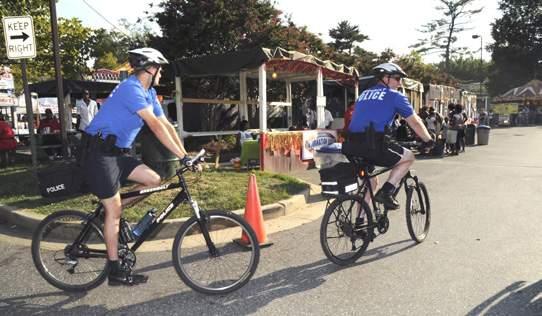
able to receive resources on safety, host smaller neighborhood meetings, and report a complaint or issue. The space would help to foster improved police presence in the area without the feeling of a more traditional station or substation. Trusted police presence in the target housing site could help deter unwanted criminal activity coming from the outside. In South Flint, a police officer is embedded in the community as he lives and works there. His presence makes the community feel safe as he also works on building trust with the community, especially through youth programming. A similar model could be adapted on site with positive police presence throughout the late evening. The police department could provide assistance with obtaining better security cameras and improving lighting in the area. Events could also be put on by the police department to educate residents on how to report a crime, how to start a block watch program or other resources on crime prevention. Presence from the Genesee Park Rangers, who already monitor the Riverside Forest Preserve, could also help make the community feel safe when police are unable to be on site.
Supporting Partners
Potential Resources
• City of Flint Fire Department
• Genesee County Park Rangers
• Ruth Mott Foundation
• CDBG (community police officers)
• Ruth Mott Foundation
• Office of Community Policing (COPS) Grants
• Community Policing Development (CPD) Microgrants Program
• Smart Policing Initiative (SPI)
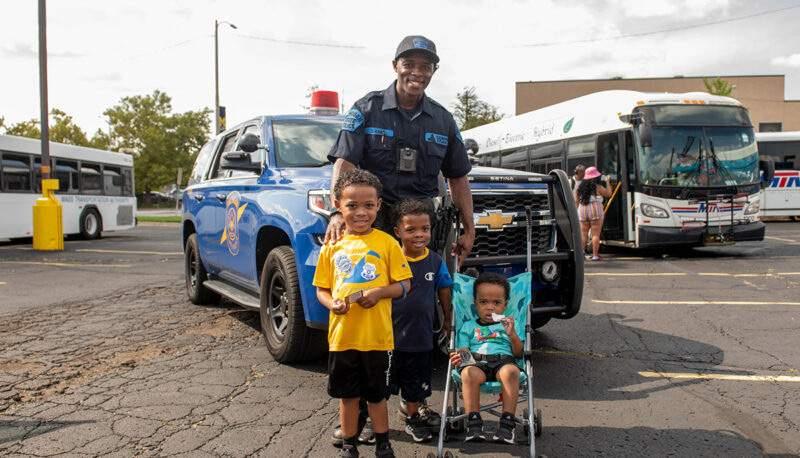


The Income & Employment Plan seeks to result in increased income and employment for Target Housing residents, especially employment in living wage jobs. The Plan seeks to help strengthen the career pathway pipeline available to workable adults (including those who are unemployed, underemployed, or fully employed but seeking career advancement) that is tailored to resident needs and goals.
• Break down traditional silos.
• Enable strong supportive services to ensure that people find training programs successful.
• 31% of residents have a checking or savings account at a bank or credit union
• Supplemental Security Income (SSI) is the main source of income for 19% of residents
• 17% have a full-time job
• Transportation is the main barrier to finding and keeping a job followed by affordable child care / daycare
• Top job skills of residents: health care, customer service, hospitality, and daycare
• 50% within 5 years
• N/A
• 30% within 5 years
• N/A
• N/A
Family Self-Sufficiency (FSS) is a HUD program that helps public housing and voucher residents obtain employment that will lead to economic independence and self-sufficiency. Public housing agencies (PHAs) work with local partners to develop a comprehensive program that gives participating FSS family members the skills and experience to enable them to obtain employment that pays a living wage. The head of household enters a five year contract with the PHA during which the PHA establishes an escrow account for the family. The contract specifies goals and services for each family and requires that the head of household seek and maintain suitable employment during the 5 years. When FSS families pay a higher rent due to a higher income, the difference in increase between the old rent and the new rent amount is credited towards the escrow account. Upon completion, the amount of the FSS account is paid to the head of the family. The Plan recommends increasing outreach to the Flint Housing Commission’s Family Self-Sufficiency Program.
The FSS program at River Park has an open enrollment for head of household members. The FSS coordinator works with each family, case by case, to assess the needs of each resident. The coordinator works closely with the head of household
31% OF RESIDENTS HAVE A CHECKING OR SAVINGS ACCOUNT AT A BANK OR CREDIT UNION

to determine and set goals and to overcome barriers. Meetings are set throughout the year and include supportive service assistance and resource sharing for going back to school or finding employment. In order to increase participation, the FSS coordinator could set specific enrollment dates throughout the year. This would give residents a timeframe in which they can hold themselves accountable to enroll in the program. This could also allow residents to apply to the program with other participants that would become a cohort for that timeframe. Residents could keep each other accountable and become a network of support as they go through the program.
Currently, the FSS coordinator does outreach to the residents through flyers and word of mouth. Enhancing outreach methods could also increase participation. Outreach to the program could be done during resident meetings or events to increase participation. Social media outreach through Facebook could target residents that are more tech savvy and are more likely to receive information online. Spotlight posts from past participants through newsletters or flyers could show other families the success the program has. Residents would love to see their neighbors succeed.
12.
Flint & Genesee Education & Talent provides programs that support talent retention, attraction, and development in Genesee County. By building a solid foundation of personal, academic, and careeroriented skills, the programs offered through Education & Talent prepare the current and future workforce. Education & Talent offers youth programs that allow middle and high school students to find employment throughout the year. In partnership with Education & Talent, the Plan recommends increasing outreach to youth workforce training programs.
TeenQuest is a free, pre-employment leadership and training program open to 9th-12th graders attending a Genesee County school. The after school program covers core employment competencies that every employer looks for in an employee. These include resume and interview skills, as well as employment skills that will prepare them to be stand out employees. Students who complete the TeenQuest program are then automatically enrolled to participate in the Summer Youth Initiative (SYI). The SYI program helps teens apply the knowledge they obtained from TeenQuest to apply to summer jobs. Students are able to earn extra income, explore future employment opportunities, and learn timemanagement skills and organization.
During the school year, middle and high school students are able to participate in Career Prep Workshops. Workshops covered are based on grade level and are adjusted to support the career development curriculum being used in each school. Students are able to supplement or add these workshops to the regular curriculum. Workshops can cover the following topics, business etiquette, job search and networking, applications, resume and interview preparation, how to keep a job, and social media and workplace ethics.
successful. The programs provided by Education & Talent would allow youth to get ahead and learn about alternative opportunities after graduation. The programs would also keep students busy, whereas in the neighborhood they wouldn’t have many things to do as it pertains to recreation or general programming. Schools could work with Education & Talent to host career nights at the schools, allowing for parents and students to gather and learn more about the programs. Flyers and other literature could be sent out to parents via the students or through text blasts from the school. As well, additional transportation, from the schools to home, would allow participants to have more flexibility in joining the after school program.
Leveraging a stronger partnership between Education & Talent and Genesee County schools would allow students to take full advantage of a great opportunity to join the workforce at a young age. Better outreach and communication from the schools to students and parents about the available opportunities would increase enrollment and participation. Parents would like their children to learn financial responsibilities early on to be Timeline
Potential Lead Partners
Potential Supporting Partners
• 0-2 Years
• Flint Housing Commission
• Flint and Genesee Education and Talent Organization
• Sylvester Broome Empowerment Village
• Genesee Career Institute
• Flint Genesee Job Corps
• AmeriCorps
• Get Them Started Young
• Mott Community College
• Ruth Mott Foundation
• Communities First
• LISC
• GST Michigan Works!
• Flint Development Center
• Flint Public Schools
• M.A.D.E. Institute
• Flint Strive
Potential Resources
• ARPA funding
• Ruth Mott Foundation
• Genesee Area Focus Fund
• Flint & Genesee Chamber Foundation
• Charles Stewart Mott Foundation
• United Way of Genesee County
• Michigan Department of Natural Resources
• Workforce Pathways for Youth
13. Create a resource center to connect residents to employment opportunities
Only 17% of River Park residents are currently employed full-time and 19% receive Supplemental Security Income (SSI) as a main source of income. Most jobs offered in the neighborhood are entry level with low pay. Higher paying jobs require licenses, certifications, and years of experience. Many residents do not have access to the resources or current capacity to seek employment and/or apply for a job. To help connect residents to employment opportunities, the Plan recommends creating a resource center, which would operate under the role of the People Plan engagement manager.
GST Michigan Works! is an agency operating workforce development programs designed to assist employers in finding skilled workers, and job seekers prepare for, find and retain employment. GST Michigan Works! offers many services to those seeking employment, including access to career/resource centers, assessment tools, resources and workshops, and many more services. Residents working with GST Michigan Works! are able to seek assistance at the Service Center located in Downtown Flint.
The engagement manager would be in charge of assisting residents with preparing for employment. They could connect with a GST Michigan Works! coordinator to help residents create action plans around their employment needs. The coordinator would work with residents with no employment history and residents who are looking to get back into the workforce. The coordinator would assist residents with building a resume, writing a cover letter, and with job interview skills. The engagement manager would focus on case management work, including overcoming certain barriers for employment. Transportation is the main barrier residents reported having to finding and keeping a job, followed by affordable child care. The engagement manager would be in charge of working with residents to bridge these gaps where possible. As well, the engagement manager could assist residents with basic life skill development necessary for them to be prepared to enter the workforce.
Timeline
Potential Lead Partners
Potential Supporting Partners

Potential Resources
• 0-2 Years
• Flint Housing Commission
• GST Michigan Works!
• Mott Community College
• Ruth Mott Foundation
• LISC
• Community Foundation of Greater Flint
• University of Michigan-Flint
• Flint Development Center
• St. Luke’s New Life Center
• United Way of Genesee County
• Choice Neighborhood Implementation Grant
• Michigan Workforce Training Center Equipment Grant Program
• The Michigan Department of Labor and Economic Opportunity
• Workforce Development (LEOWD) Integrated Education and Training (IET) Initiative
14. Connect residents to existing job training programs
The Plan recommends connecting residents to existing job training programs throughout the City of Flint. Whereas the resource center prepares residents to begin to look into the workforce, this strategy focuses on connecting residents that are ready to work with job training programs. The engagement manager could help connect residents to training programs that work best with their skill sets. The top skills River Park residents have are around health care, customer service, hospitality, and daycare. Existing training programs that include these skill sets include Mott Workforce and Economic Development, GST Michigan Works!, and Flint Healthcare Employment Opportunities, among many others.
The Mott Workforce and Economic Development’s mission is to empower individuals and provide the necessary support to pursue education and training leading to gainful employment and advancement in their career pathways. Mott Workforce Development partners with employers to match their workforce skill needs with highly qualified candidates and engage in community improvement initiatives. The Adult Career Pathways (ACP) program provides low- to middle-skilled individuals the training and credentials needed to enter and advance their career in target career pathways. These pathways include healthcare, information technology, advanced manufacturing, and human services. With a range of training programs, Mott Workforce Development could be an ideal start for many residents.
Support from the Mott Workforce Development would help remove barriers to their programming. Outreach to the training programs and access to the respective locations (MCC Campus or other training sites) is needed. Transportation to and from the training programs through extended hours from the MTA or MCC shuttle buses would help residents be more flexible in attending the training sessions. Alternatively, hybrid access using a computer lab on-site would allow
residents to connect to the training programs online when appropriate.
Additionally, Mott Workforce Development can utilize its Mobile Learning Lab (MLL). The MLL is a 48foot long trailer that makes education and training more accessible by eliminating transportation and technology barriers to students. The 1,000 sq ft trailer can be reconfigured to fit lab and classroom space and comes equipped with wireless internet, chromebook computers, and a flexible advanced manufacturing lab. The MLL programs include robotics, computer literacy, adult education, and much more customized training. When appropriate to the needs of the residents, the MLL could be brought to the River Park Apartments for convenience.
Potential Lead Partners
Potential Supporting Partners
Potential Resources
• Flint Housing Commission
• Mott Workforce and Economic Development
• Flint Healthcare Employment Opportunities (FHEO)
• Ruth Mott Foundation
• Communities First
• Flint Development Center
• GST Michigan Works!
• Mass Transportation Authority Flint
• Greater Flint Health Coalition
• M.A.D.E. Institute
• Flint Strive
• Flint Innovative Solutions
• Tire Project
• Ashley Capital
• Buick City
• Perkins Grant
• The Michigan Statewide Targeted Apprenticeship Inclusion and Readiness System (MiSTAIRS)
• Workforce Innovation Opportunity Act fund (WIOA)
• Community Project Funding
• DOL Building Pathways to Infrastructure Jobs Grant Program
Metro Community Development Center’s mission is to build partnerships to create economic opportunities to promote vibrant and prosperous communities. Metro fosters entrepreneurs and grows small businesses. They provide capital and technical assistance, offering business service solutions including assistance with insurance, merchant processing, web design, managed technology, ecommerce, and payroll and benefits. Metro also offers the BizBOX program, a small business educational program that offers a combination of funding, and the needed technical assistance to prepare individuals to start a business and keep it afloat. BizBOX works with those that are interested in restaurants, retail, manufacturing, and service providers. In tune with the skills sets residents currently possess, BizBOX could help residents that would like to start their own business. The Plan recommends connecting residents to a small business start up program in partnership with Metro and other local organizations.
The closest businesses to River Park Apartments are a liquor store and a Dollar General a mile up the street. Residents have to travel west or outside of the target neighborhood before reaching a local business to shop or spend time in. Residents have expressed interest in seeing small local businesses open in their neighborhood from fellow resident entrepreneurs. Most business resources, including business incubators, are located in Downtown Flint. With minimal outreach, residents are unaware of the resources available to them.
Lack of transportation to the Downtown also limits the ability to take advantage of these resources for those that are aware. Outreach to programs like BizBOX could begin to encourage residents to look into entrepreneurship as a viable step towards generating income and starting a career. In partnership with Metro, BizBOX programming could be made available to residents on-site. Courses can be organized on site through the engagement manager, allowing for coordination based on availability of residents. Alternatively, transportation to and from BizBOX locations could also encourage residents to participate in this program. Interested residents could connect to this program through the engagement manager.
Potential Lead Partners
Potential Supporting Partners
Potential Resources
• Flint Housing Commission
• Metro Community Development Center
• Ruth Mott Foundation
• Flint Chamber of Commerce
• Communities First
• LISC
• GST Michigan Works!
• Flint Development Center
• 100K Ideas
• Flint and Genesee Economic Alliance
• Flint SOUP
• SIPI
• Flint & Genesee Chamber Foundation
• 100K Ideas
• Moving Flint Forward Small Business Grant Program
• Small Business Revolving Loan Fund
• Kiva Lending
• U.S. Department of Commerce
Minority Business Development Agency
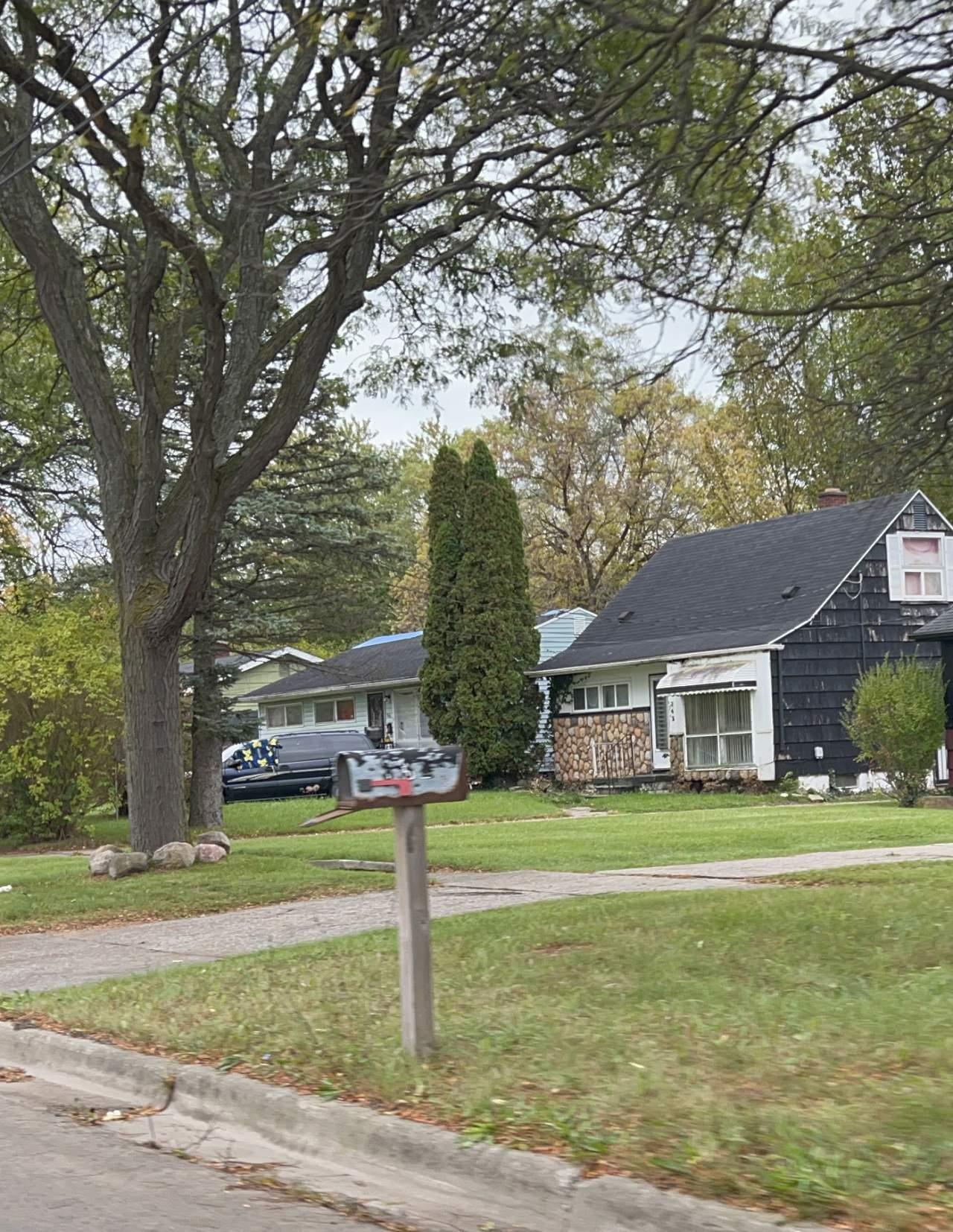
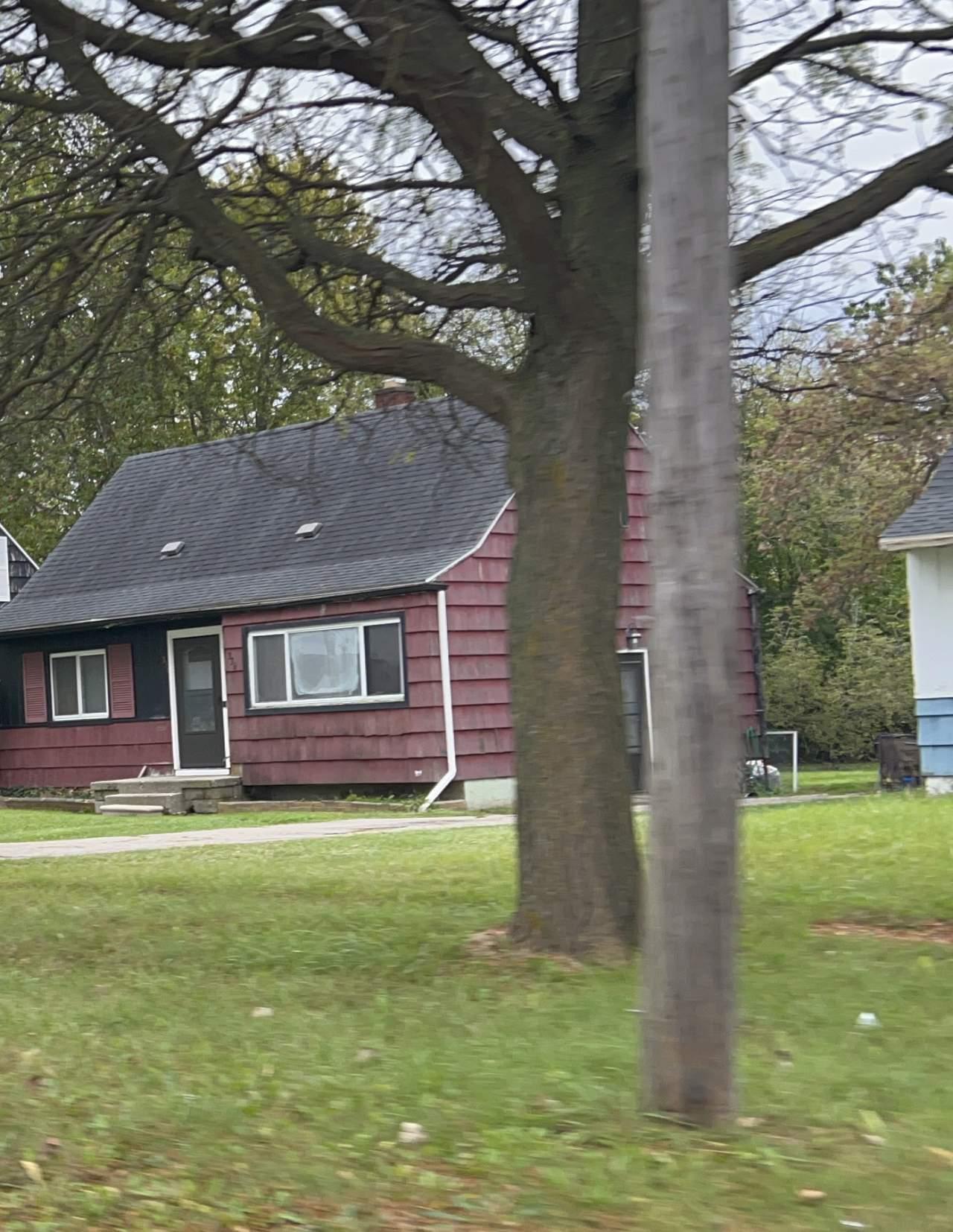
The Neighborhood Plan focuses on identifying key strategic improvements to transform the distressed areas into viable, mixed-income communities supplemented by access to well-functioning services, high-quality educational programs, services, public assets, public transportation, and access to jobs.
Key Strategies
Strategize revitalization efforts for maximum impact.
Establish Better Connectivity and Accessibility.
Establish a Network of Functional and wellprogrammed Open Spaces for All Ages.
Enhance Neighborhood Identity and community pride. Address any Environmental concerns.
The Northeast Flint neighborhood faces significant challenges, including widespread blight and a disrupted neighborhood fabric due to vacant blocks and physical barriers such as highways, industrial zones, and forests areas. 68% of the study area is vacant and 45% publicly owned. The Genesee County Land Bank has already demolished numerous blighted structures and is in the process of demolishing more. Given the extensive scale of distress, discussions with residents and community members have led to the consensus to concentrate revitalization efforts on strategic locations to achieve realistic and impactful change.
These discussions formed the basis for developing a Neighborhood Development Framework, which identifies four catalytic areas along with areas to focus infill redevelopments. The Planning Team developed site development frameworks for each catalytic area to explore the potential development capacity. These frameworks were validated with input from area stakeholders and residents. The residents and community members were also asked to prioritize two out of the four sites for implementing the Choice Housing Program. River Park Apartments and the MLK/Pierson Area were identified as the top two. The frameworks created for the other sites will serve as guides to help local developers or organizations redevelop privately.
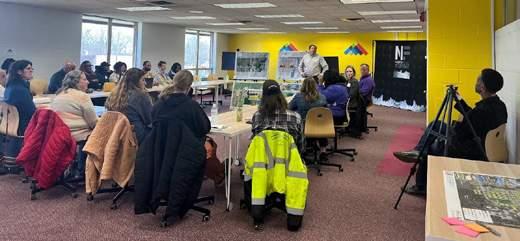
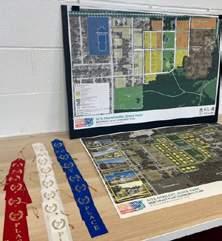
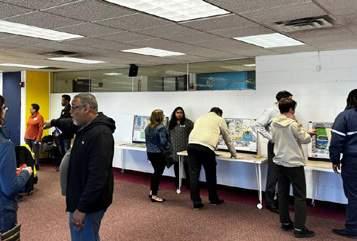
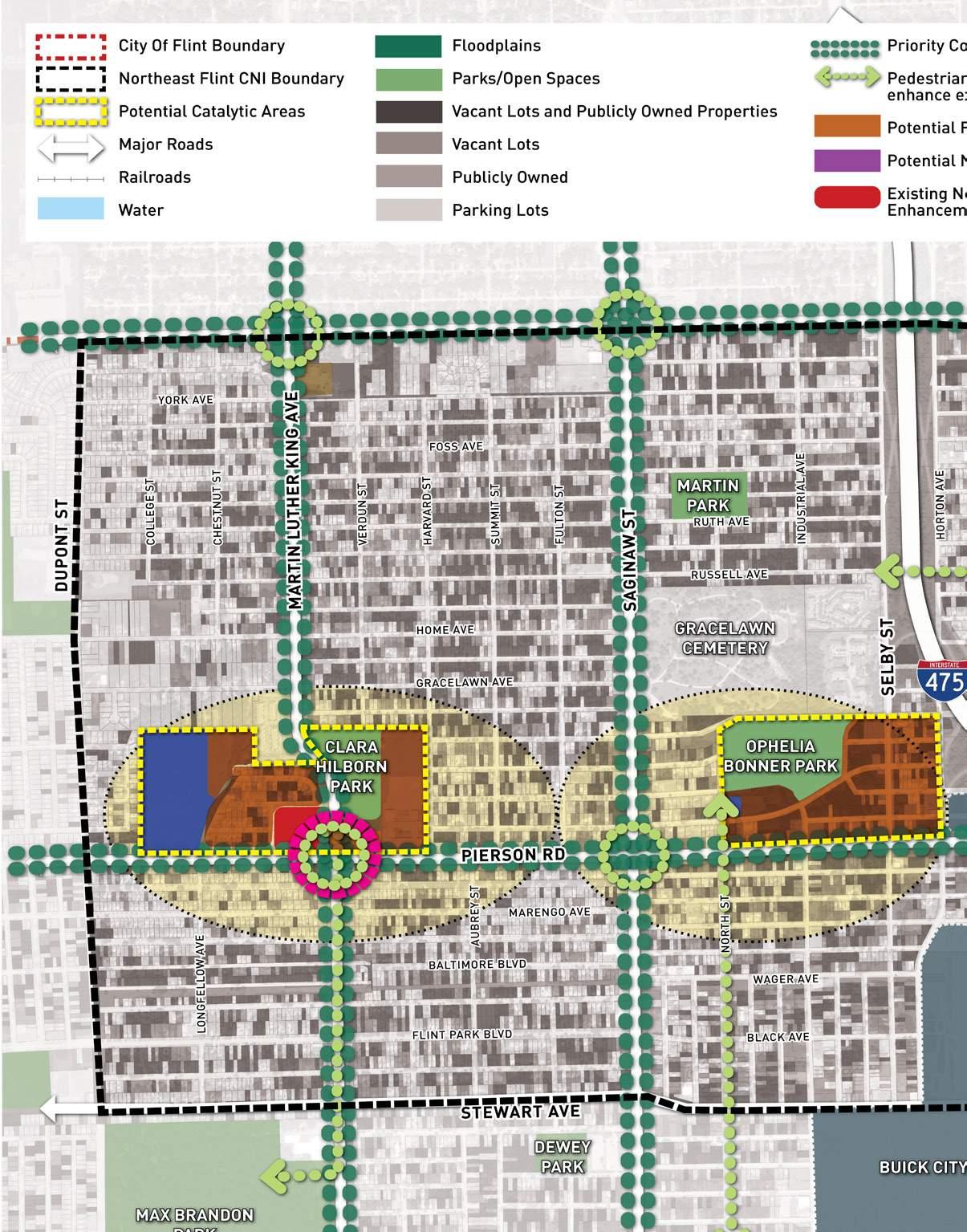
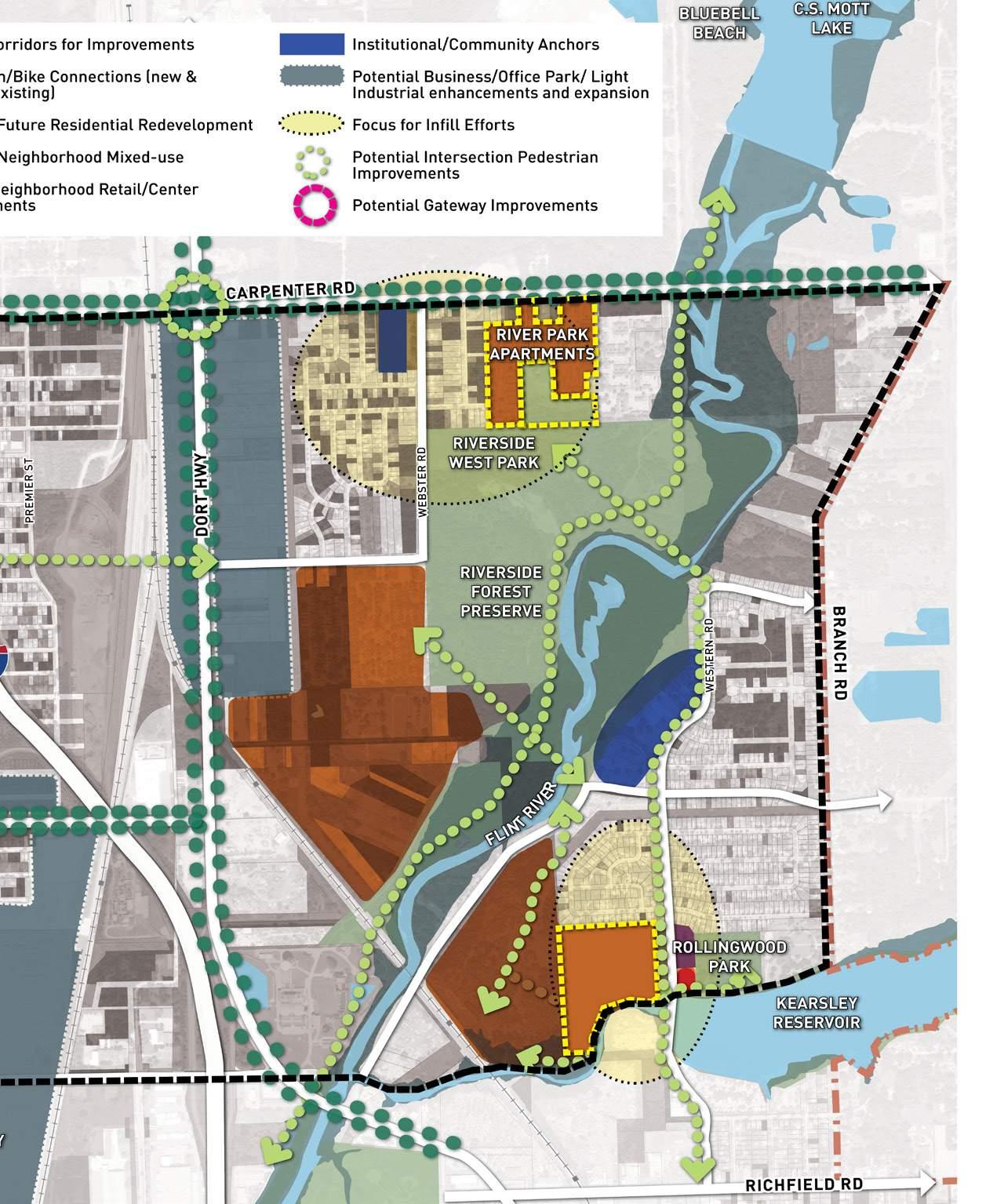
The catalytic areas include:
Residents and stakeholders have expressed a strong preference for maintaining housing and enhancing amenities in the current River Park area. With potential private investment interests, available infill opportunities, and access to regional assets, this site was prioritized, particularly by the River Park Apartment residents.
The framework proposes reducing the density on the River Park Apartments site by integrating a mix of low-density housing types and implementing a few infrastructure alignment changes to enhance connectivity with the adjacent neighborhood. The framework also integrates the vacant and publiclyowned parcels in the adjacent neighborhood, unoccupied Carpenter School Building, Riverside West park and the city-owned property along Carpenter Road. The details of this conceptual framework are explained in the Housing Plan.
Potential Number of Housing Units ~ 158-168
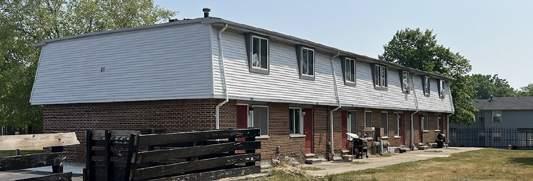
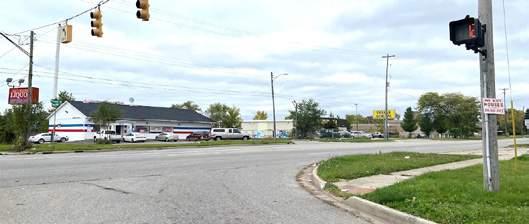
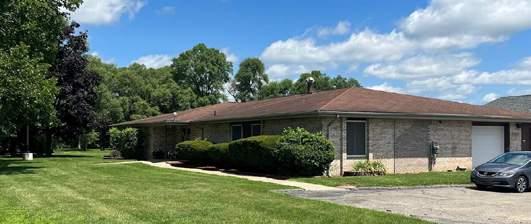
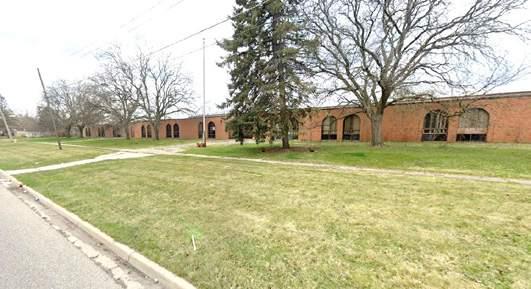
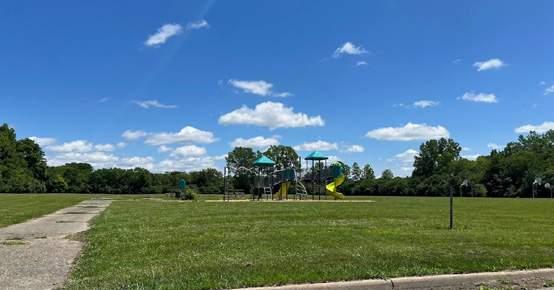
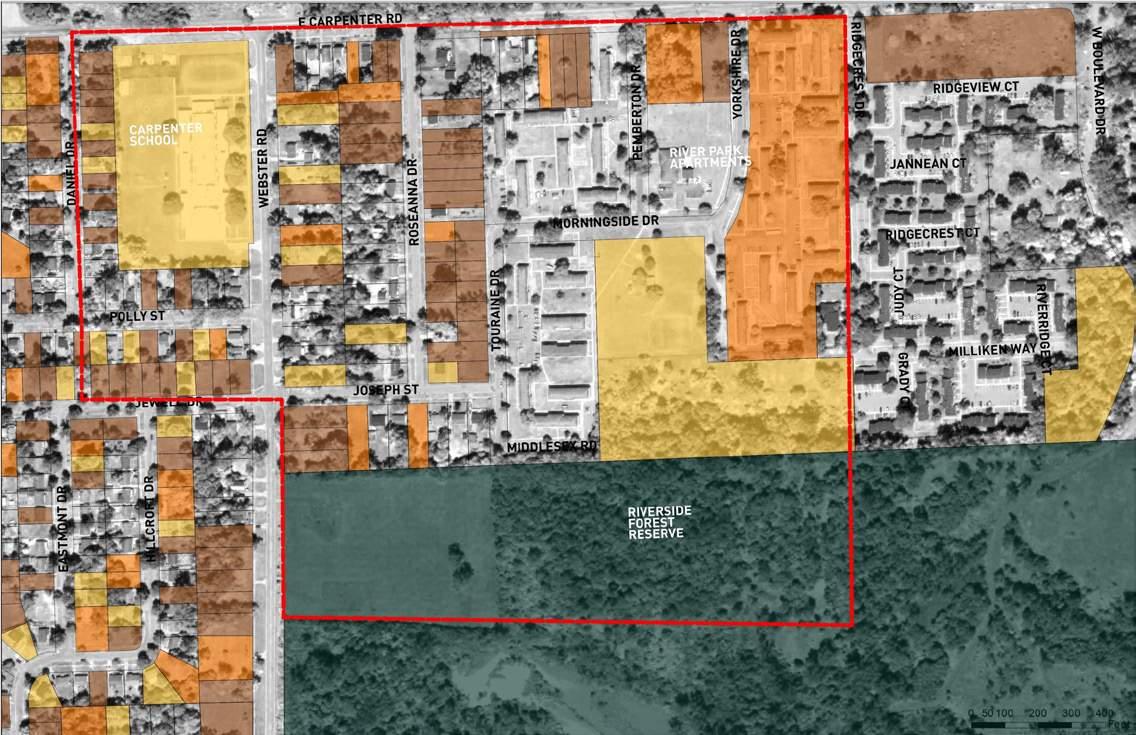
This area was preferred by the community due to the availability of larger publicly-owned properties, proximity to an open space, limited retail including a grocery store and a clinic, and its strategic location along two main corridors within the neighborhood. This area has the potential to transform into a neighborhood hub with a new educational anchor, identified as a major missing element. We are awaiting further discussions with the appropriate authorities to assess the feasibility of a neighborhood school and the redevelopment of the School Boardowned Bryant Elementary School site. More details on this area are included in the Housing Plan.
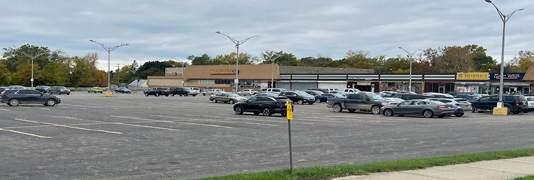
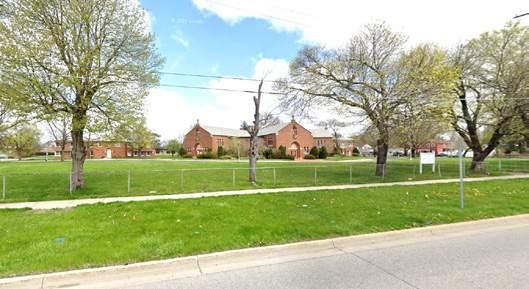
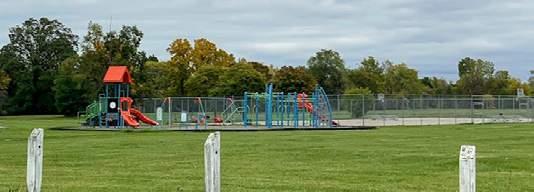
Potential Number of Housing Units ~ 250-300
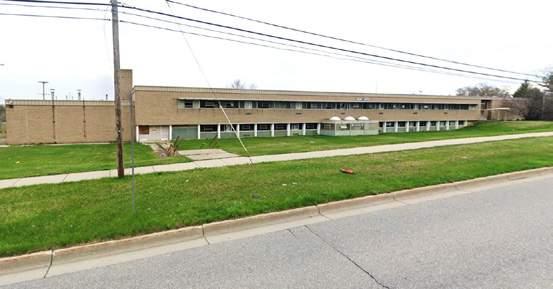

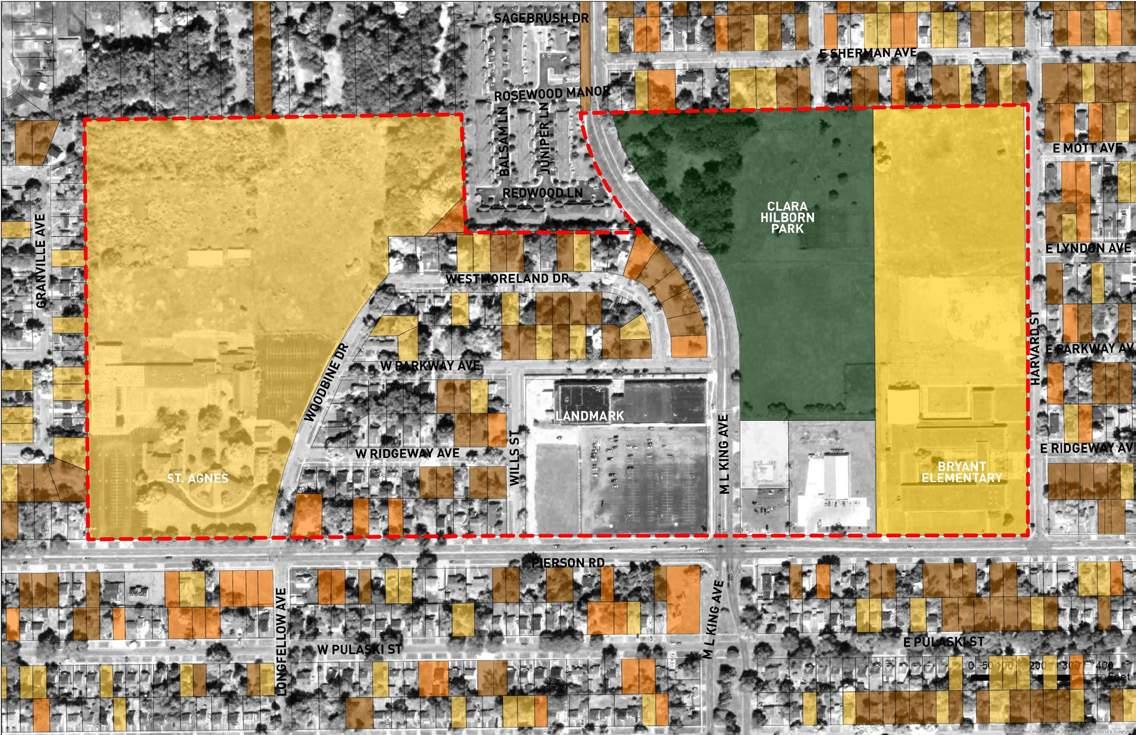
This area has been chosen as a catalytic site due to its significant redevelopment potential. The majority of the land is either vacant or publiclyowned, and the existing neighborhood fabric and infrastructure are already in place. Key opportunities include its adjacency to Ophelia Bonner Park, the unoccupied Jefferson School building, access to the interstate, and proximity to the future Buick City Redevelopment, which is poised to become the largest employment center in the area. Local investments have already cleared some blighted properties, and there is potential for a local church to locate in the northern part of this area.
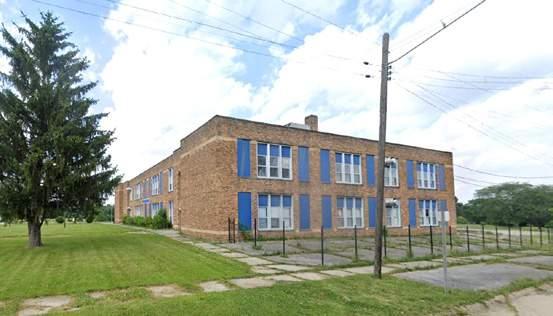
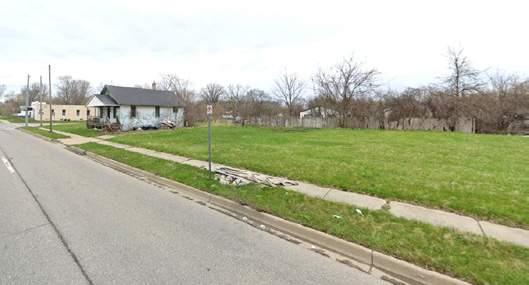
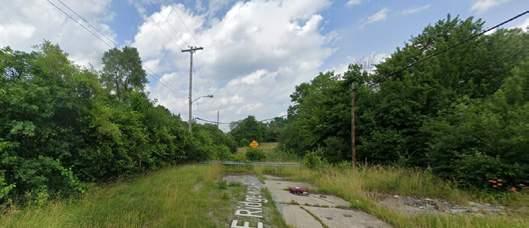
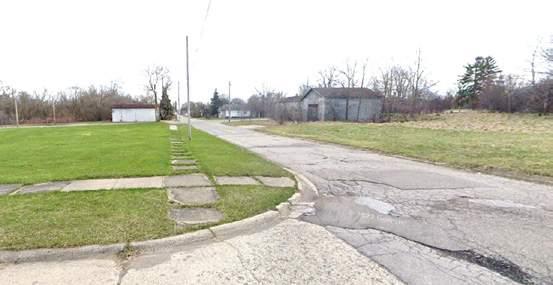
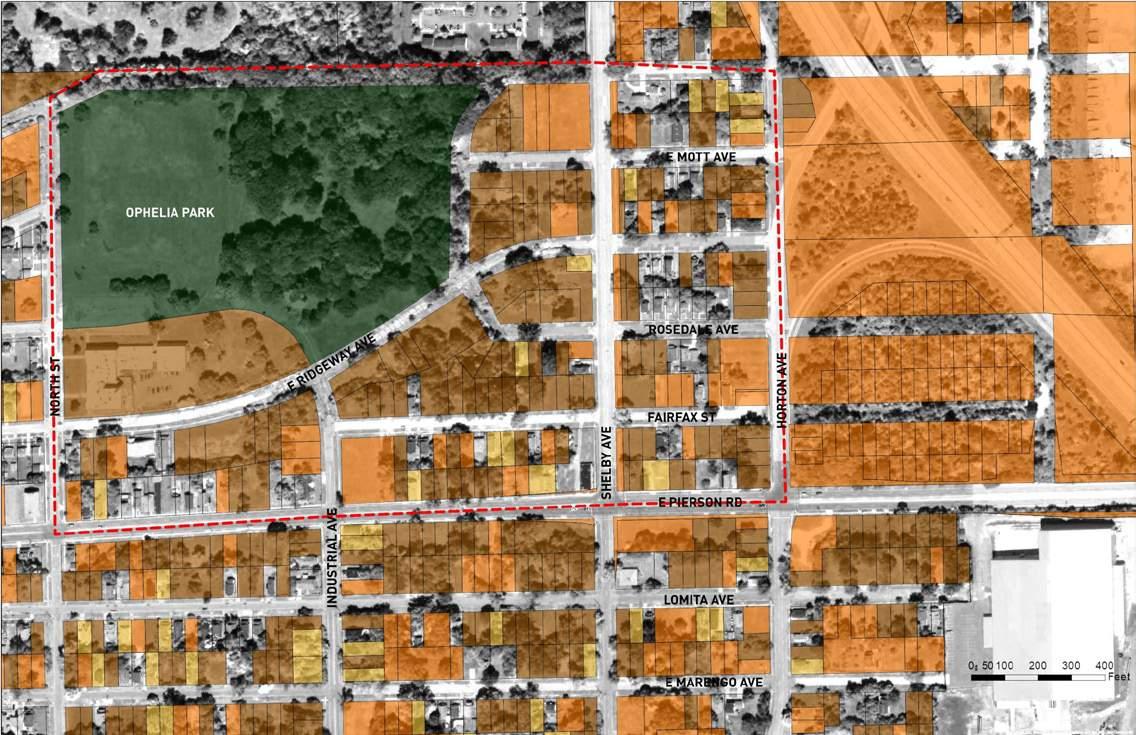
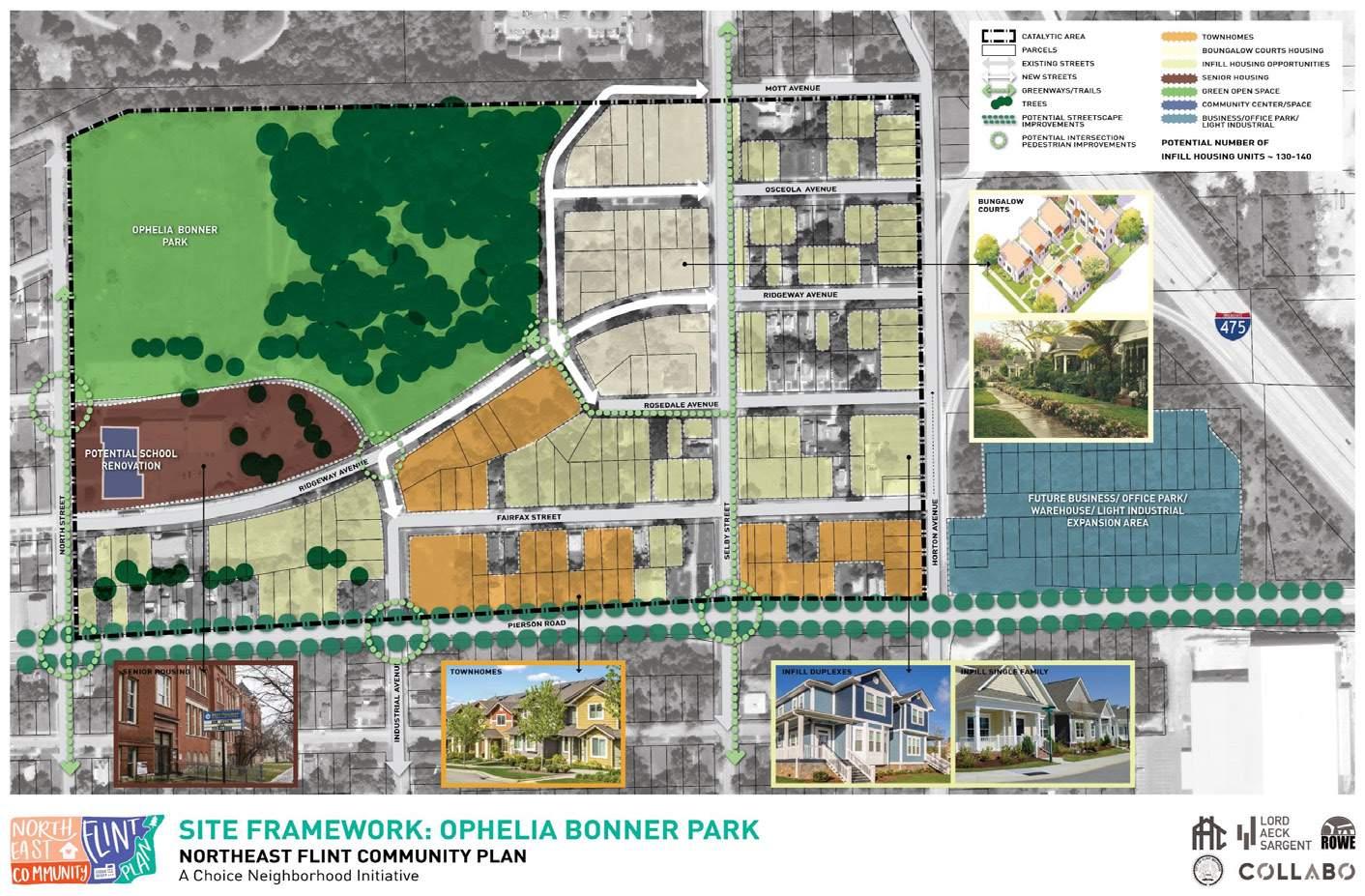
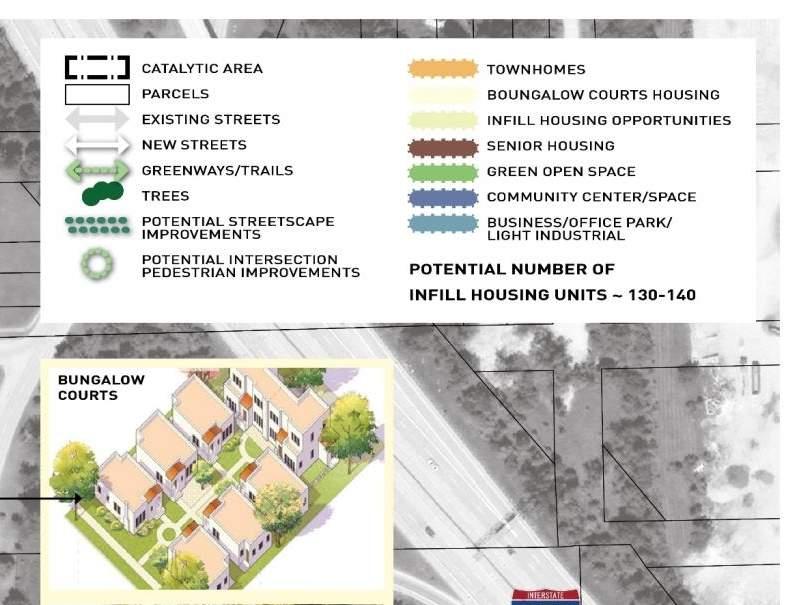
The proposed Framework Plan illustrates how different types of housing can be integrated into this area. Townhomes can be positioned strategically along major roads, such as Pierson Road, and near open spaces. The unoccupied Jefferson School building can be renovated to incorporate senior housing and a community center. Cottage homes
are well-suited for some of the contiguous blocks, while duplexes or single-family homes can fill in the remaining areas. Some of the streets in the northern part that were closed off will need to be reconnected to enhance connectivity and access within the neighborhood.
The city-owned Shadyacre site, located near a stable neighborhood with attractive assets such as the Kearsley Reservoir and the Forest Preserve, was formerly a mobile home park. It has since been cleared for redevelopment. The proposed Framework Plan integrates townhomes and duplexes with internal open spaces connecting to the forest areas. A trail network can help connect the Reservoir, Rollingwood Park through the new proposed development to the Iron Belle Trail to the west. There are additional development opportunities along Western Road, which can further contribute to the transformation of this area and support the commercial development in the corner.
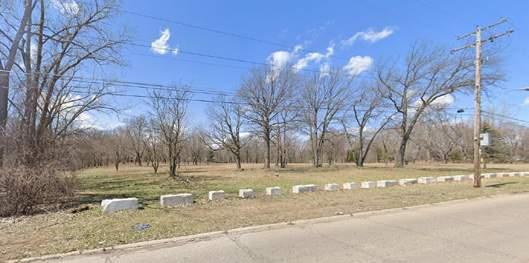
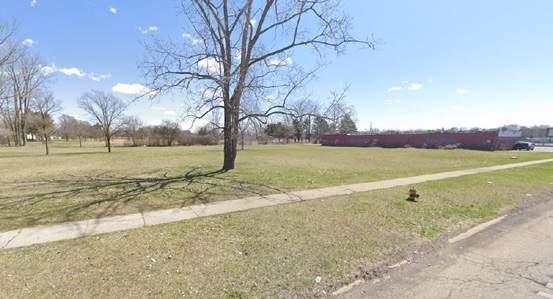
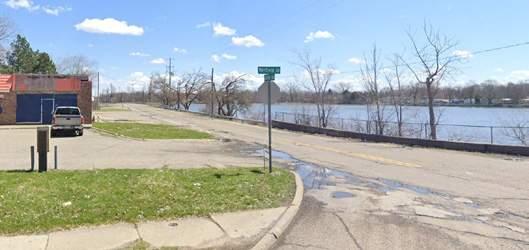
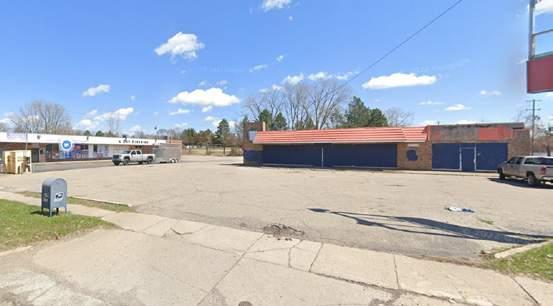
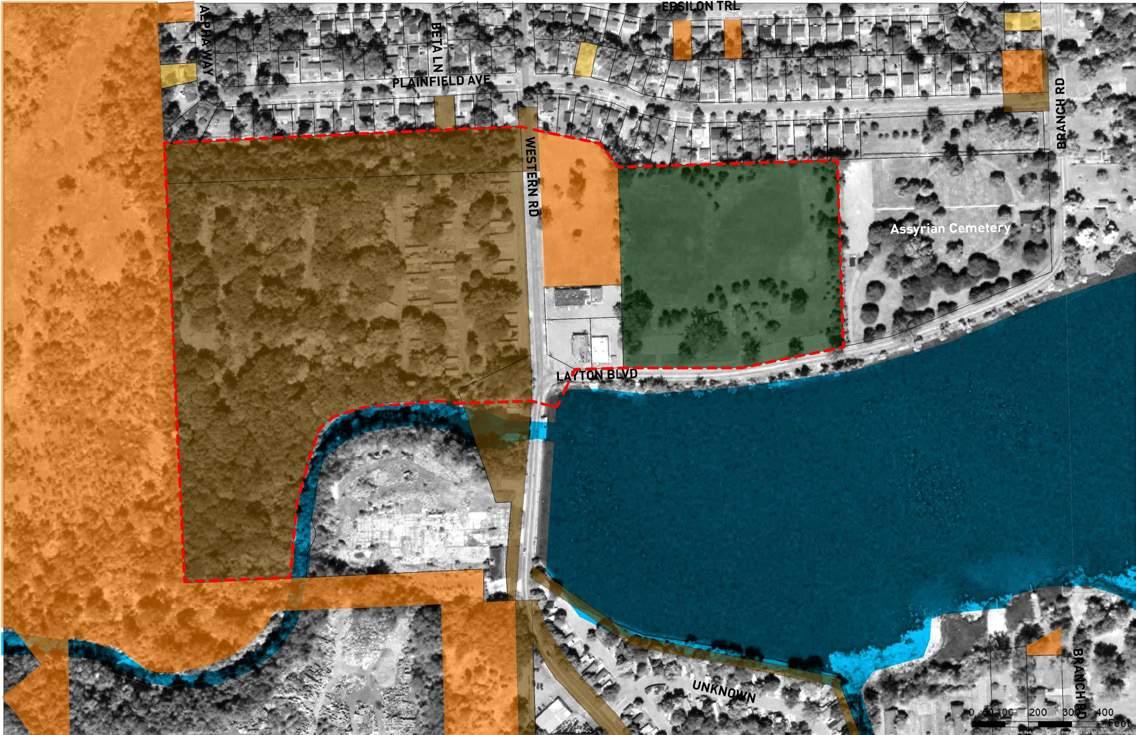

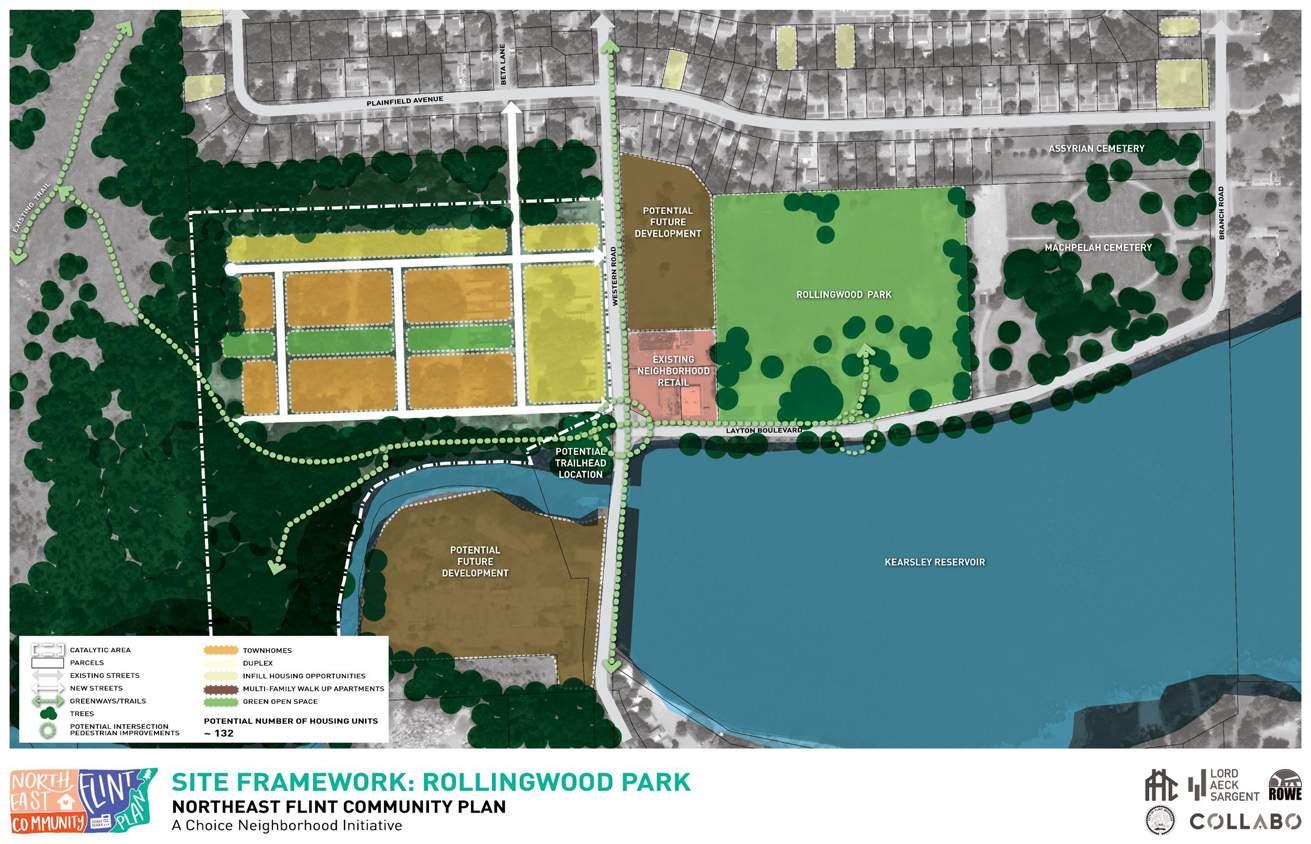
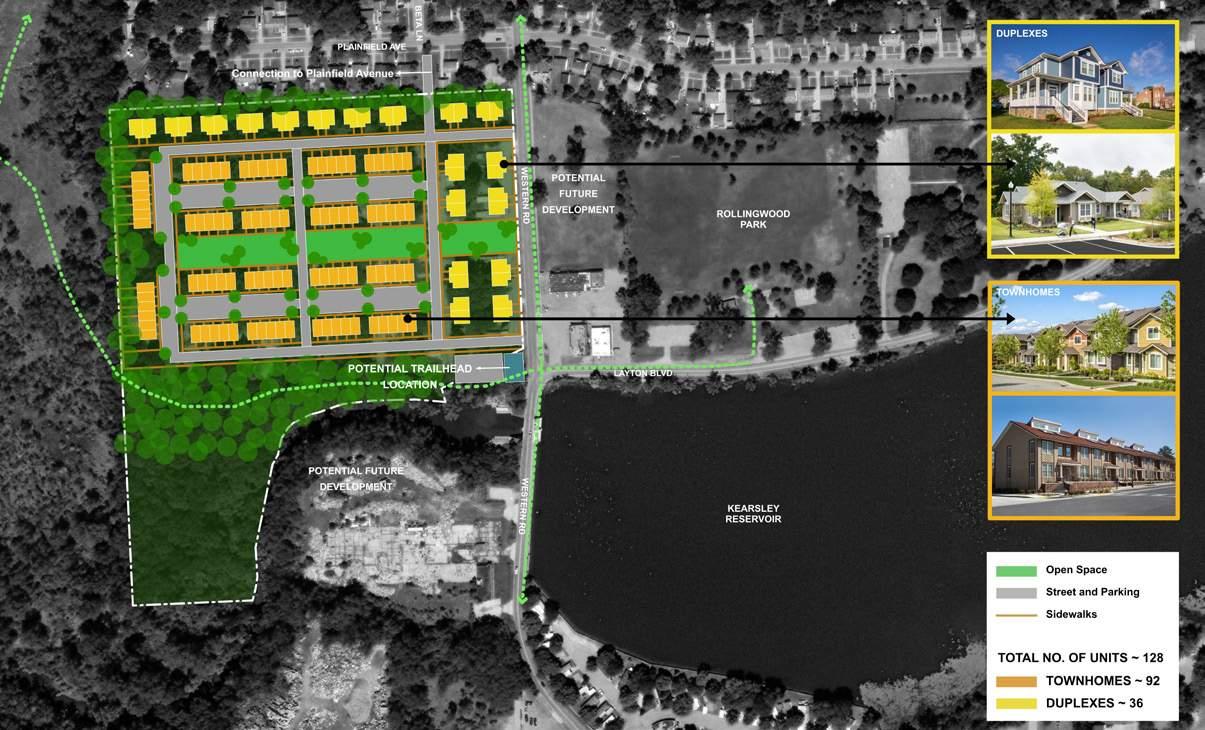
The Northeast Flint neighborhood faces significant challenges due to numerous vacant and poorly maintained properties. However, this situation also presents an opportunity to focus on infill for neighborhood stabilization. Residents and community members have identified priority areas for targeted infill development to achieve a more effective outcome, rather than spreading efforts too thinly across the entire area. These priority areas are either adjacent to or within the identified catalytic zones, or near existing amenities or neighborhood anchors, building on current investments and momentum. Repurposing some of the unoccupied
school buildings could play a crucial role in the neighborhood infill strategy. Engaging with the School Board and community stakeholders will help determine the best uses for these buildings. Suggestions from community meetings include repurposing them as elementary schools, childcare centers, or community centers with flexible spaces for various amenities and services. Collaboration between the City of Flint, Genesee County Land Bank, local organizations, developers, and property owners will be critical to identify measures and feasible incentives to accelerate these efforts.
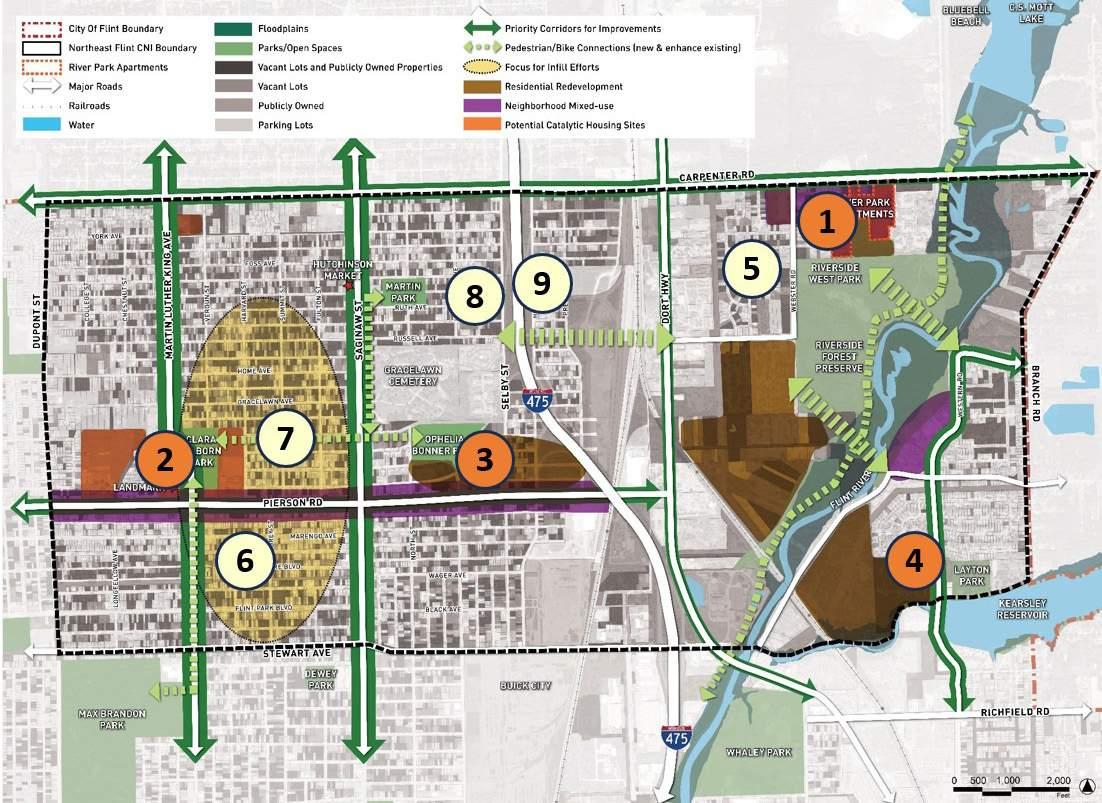
Homeownership is a vital component of a stable neighborhood. Homeowners are deeply rooted in their communities, invested in their properties, and committed to preserving home values and neighborhood character. This plan aims to preserve and expand homeownership opportunities, in addition to creating quality, affordable, and mixed-income rental housing.
Navigating the complexities of homeownership can be challenging, especially for first-time buyers with limited access to resources and capital. Homebuyer education programs are essential in preparing individuals for the intricacies of financing and maintaining a home.
Collaborate with the City of Flint, Genesee County, the State, and organizations like Habitat for Humanity to educate the community about existing programs such as the MI Home Loan Program, MSHDA Down Payment Assistance, and Genesee County Habitat for Humanity’s construction and renovation program. Expanding these initiatives and making them more accessible will support new homeowners, sustain neighborhood stability, and promote long-term investment in the community.
1.4 Provide support for existing homeowners and business owners to maintain/ improve their properties
In addition to attracting new homebuyers, retaining existing homeowners and business owners is critical for the stability of any neighborhood. Many current residents have lived in the neighborhood for 20 years or more, providing a rich connection to its history and culture.
Maintaining a home can be a significant financial burden, and residents cannot always afford necessary improvements. Deferred maintenance can lead to a perception of blight. Providing access to grants and low-interest loans for repairs and improvements will be crucial for maintaining home values and supporting long-term homeowners. Some of the existing programs include the City of Flint’s Home Improvement Program, the Flint Home Improvement Fund, and MSDHA Homeownership Programs. Ensuring that residents are aware of these programs and understand the application process will be tremendously beneficial.
Similarly, making business improvement programs more accessible to existing businesses will support economic development and revitalization. Some of the existing programs include the City of Flint Economic Development Façade Improvement and Small Business Incentive Programs. Promoting these initiatives and aiding businesses in navigating the application process will enhance the overall economic health of the neighborhood.
2.1 Develop a network of priority corridors for improvements.
The residents and community members identified a list of priority corridors to focus streetscape infrastructure improvements on. The corridors identified for improvements are:
• Pierson Road
• Carpenter Road
• Saginaw Street
• Martin Luther King Avenue
The community collaborated further to explore the specific streetscape improvements for:
Carpenter Road
The improvements focuses on maintaining the landscaped buffer between the street and sidewalks, but widening the sidewalk to include a bike lane. Potential improvements also calls for better street lighting and proper bus stop amenities. There is a
potential to collaborate with the Genesee County to implement these improvements.
Pierson Road
The improvements focuses on reducing four lanes of traffic to two lanes. This would help with traffic calming, improve pedestrian safety and change its character into a neighborhood street. Reducing the number of lanes will also enable integrating on-street parallel parking and bike lanes. The improvements also includes wider sidewalks, landscaped medians where feasible and street lighting and trees. These improvements are also applicable to the Martin Luther King Avenue, especially along the Clara Hilborn Park.
The Planning Team met with the City Engineer to update them regarding the proposed streetscapes and receive feedback to confirm the feasibility of these improvements.
The residents and community members have identified specific pedestrian improvements and connections and they include:
• Installing pedestrian crosswalks at all major intersections and a mid-block crosswalk infront of Clara Hilborn Park.
• Connecting Websters Road to Russell Avenue – potentially through a pedestrian bridge.
• Connecting safely across Dort Highway
The Mass Transit Authority (MTA) is actively involved in updating its master plan for the city and has been a key participant in community meetings. Residents have highlighted the need for improved bus stop amenities, particularly along Carpenter Road. Additionally, residents have expressed the desire
• Enhancing the River trail connections and accessibility.
• Connecting to the Rollingwood neighborhood
• Connecting to the new Buick City redevelopment
• Connecting to the existing parks
• Connecting safely to the Kearsley Reservoir
for better access to the Forest Preserve, Iron Belle Trail, and the river. Keep Genesee County Beautiful is currently exploring ways to activate the river edge, and a continuous network of trails would further enhance these efforts.
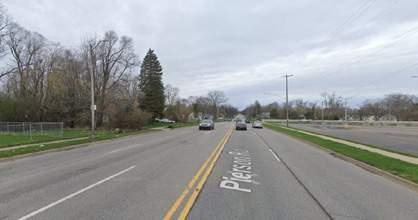
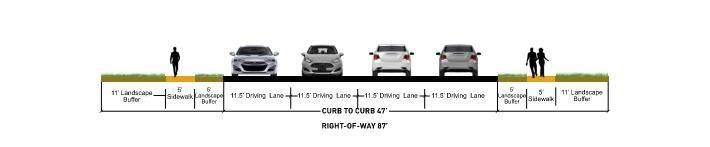
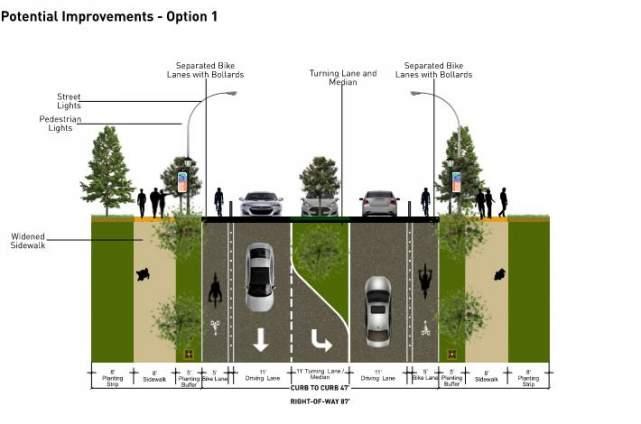
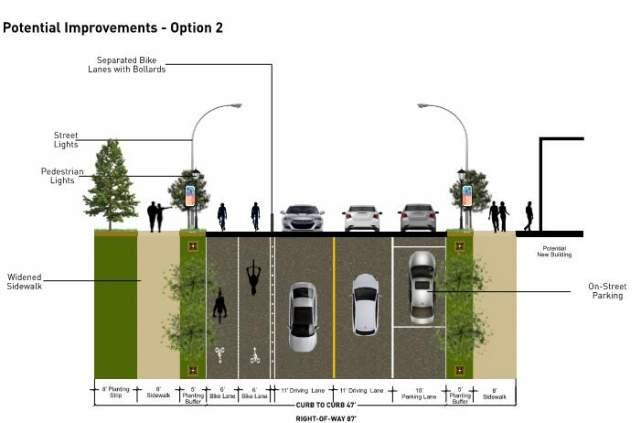
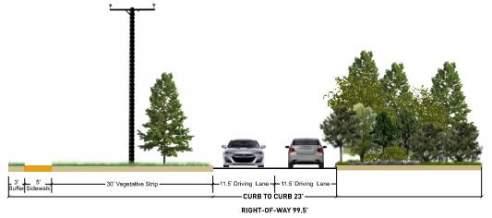
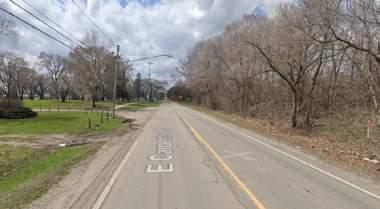
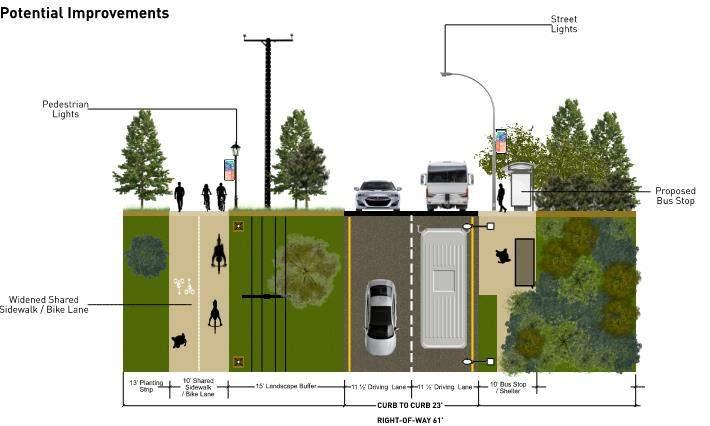
NOTE: ADD LOCATION OF IMPROVEMENTS IN A MAP
Public open spaces play a crucial role in fostering community engagement and providing recreational opportunities, which are vital for the identity and liveliness of a neighborhood. The Northeast Flint area boasts numerous open spaces, managed by Keep Genesee County Beautiful. They collaborate with the community and park adopters to identify improvements and programs to enhance these areas further. These discussions have also influenced the selection of early action projects, with a strong community preference for enhancing neighborhood parks within the catalytic areas. The Planning Team, in collaboration with Keep Genesee County Beautiful, park adopters, and residents, prioritized a list of early action projects for implementation. FHC is now in the process of finalizing the budget and schedule for construction/installation.
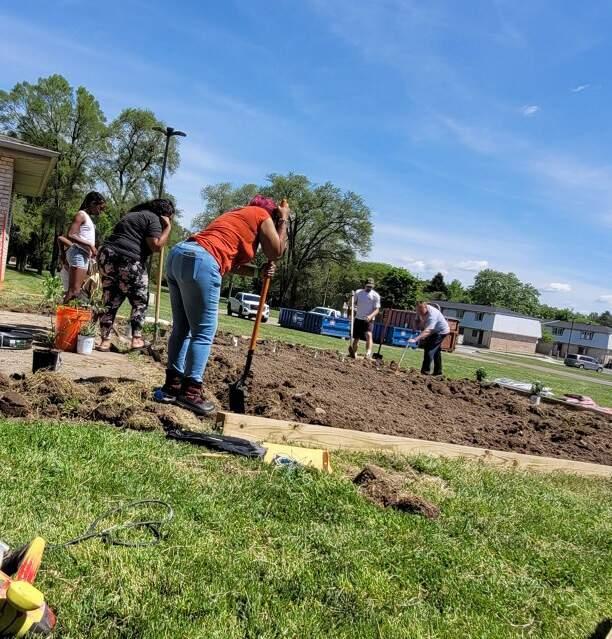
The proposed redevelopment plans for the catalytic areas include a deliberate integration of various community open spaces for all ages and needs. These spaces encompass amenities such as a community center, playgrounds, pavilions, plazas, and outdoor seating areas. Furthermore, the plans feature a combination of hardscaped flexible event spaces and softscape green areas, alongside walking trails, community gardens, and spaces for active recreation.
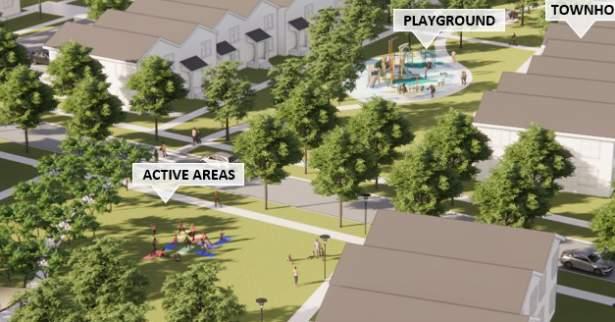
3.3 Develop a connected network of open spaces
Expand existing and create new biking/walking trails, greenways and sidewalks to connect all the open spaces, within Northeast Flint and into adjacent neighborhoods.
The community prioritized open space enhancements as the focus of the Choice Neighborhood (CN) Early Action Projects, seeking to equitably distribute investments across three neighborhood parks near the two catalytic sites. FHC is currently formalizing budget estimates to finalize the planned upgrades for River Park, Riverside West, and Clara Hilborn Park. The community also played a significant role in prioritizing the specific improvements for each park. These efforts will be led by FHC in collaboration with the City of Flint, Keep Genesee County Beautiful, and the Park Adopters for Riverside West and Clara Hilborn Park. The improvements are scheduled for implementation in 2025.
Redeveloped River Park
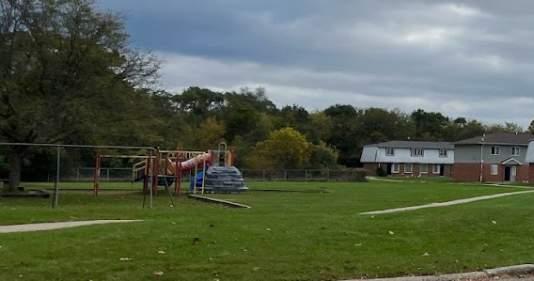
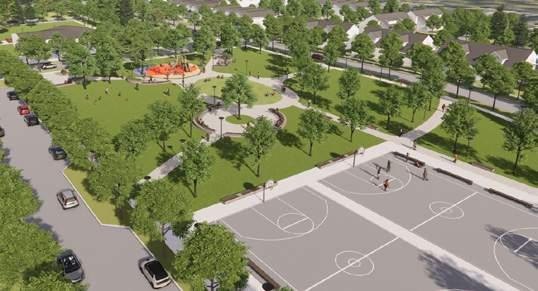
Potential Improvements
• Supplement Keep Genesee County Beautiful’s efforts to install a new playground equipments
• New basketball courts
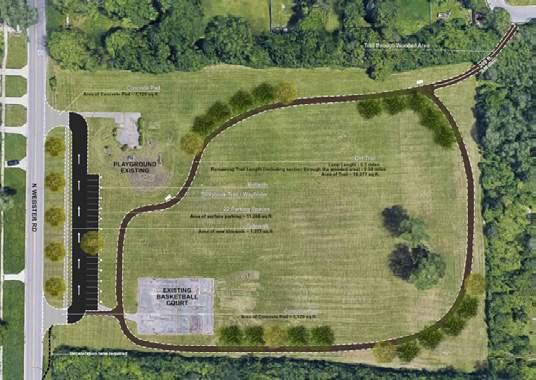
Potential Improvements
• Supplement efforts to install a new parking lot.
• A new trail and trail connection to River Park Apartments with proper lighting
• Grill with seating / signage
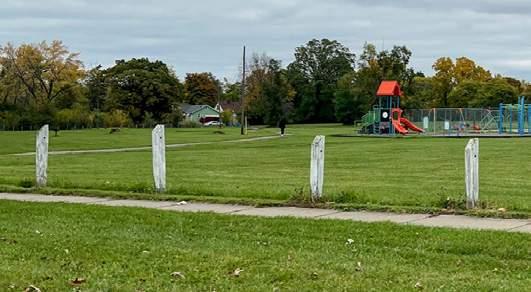
Potential Improvements
• Improve pathways
• Grill with seating/ signage
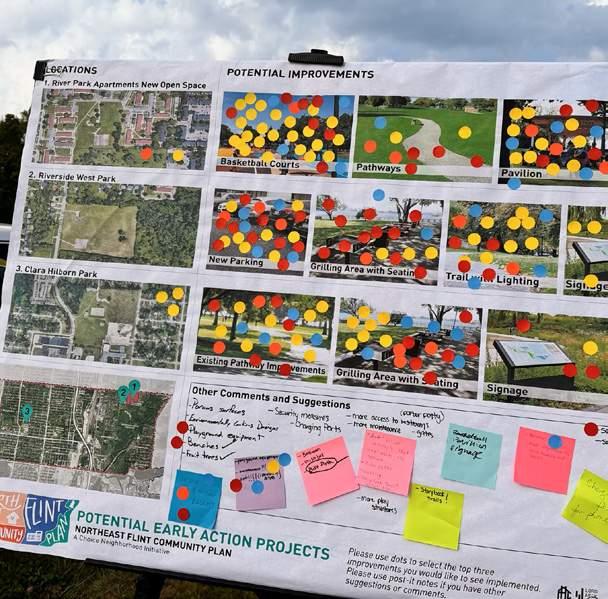
4.1 Organize regular community events
Build upon existing community events such as block parties, NAC’s Grazing the Grass, Sylvester Broome Empowerment Village’s (SBEV) Fall Fest, and many more to engage and reach out to the entire Northeast Flint neighborhood. These events provide an excellent platform to foster community spirit, encourage local participation, and promote neighborhood cohesion. Leveraging these gatherings can help disseminate information about neighborhood initiatives, gather feedback from residents, and build stronger connections among community members.
4.2 Enhance existing or create new community gathering spaces where residents can gather and interact
Several community centers and open spaces throughout the neighborhood are already being used for various events. There is potential to revitalize under-used areas, unoccupied buildings and parking lots, such as at the Landmark Grocery into vibrant hubs for social interaction and community events.
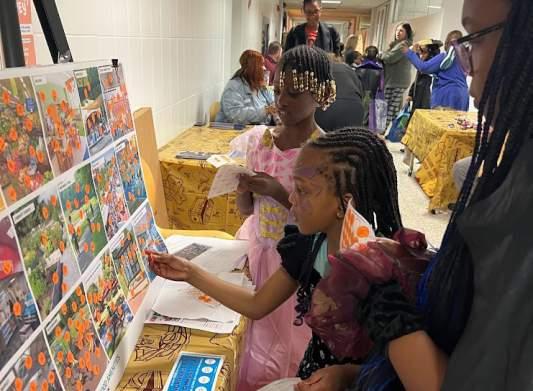
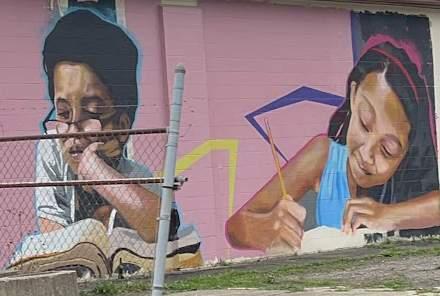
4.3 Invest in public art and wayfinding opportunities
Flint has a vibrant arts scene with beautiful murals throughout the city. Collaborate with organizations like the Flint Institute of Arts and NAC to expand public art and wayfinding in the Northeast Flint neighborhood. Public art can beautify spaces, celebrate local culture, and foster community pride, while wayfinding can make the area more accessible and highlight key landmarks. A potential location for a gateway art installation is the prominent corner of MLK and Pierson Road. Together, these efforts can enhance neighborhood identity and create a stronger sense of community.
4.4 Expand/supplement neighborhood communication channels
NAC and similar organizations already employ effective communication methods to engage residents and business owners across the neighborhood. They can supplement each other to further expand their outreach to facilitate greater connectivity, information sharing and build community relationships
The location of the new asphalt plant by Ajax Materials Corporation on the border of Flint and Genesee County has raised significant concerns among residents and environmental groups. Their primary concern is the potential negative impact on air quality around the River Park area. The City of Flint, in collaboration with state agencies such as the Michigan Department of Environment, Great Lakes, and Energy (EGLE) and the Environmental Protection Agency (EPA), has been monitoring the air quality around the site closely. Establishing a regular and systematic monitoring process will help address these concerns more effectively.
The Flint Housing Commission is also considering installing a monitor at the River Park Apartments site for continuous air quality monitoring.
Implementing physical enhancements, such as maintaining a landscape buffer, strategically planting trees to create an air quality barrier, and incorporating significant tree cover and landscaped areas within the proposed River Park redevelopment, would help mitigate the impact effectively and enhance overall air quality.
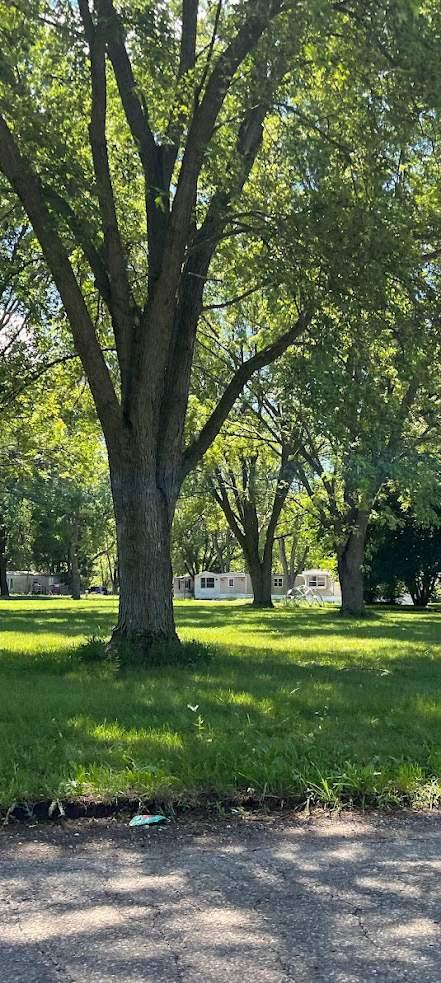
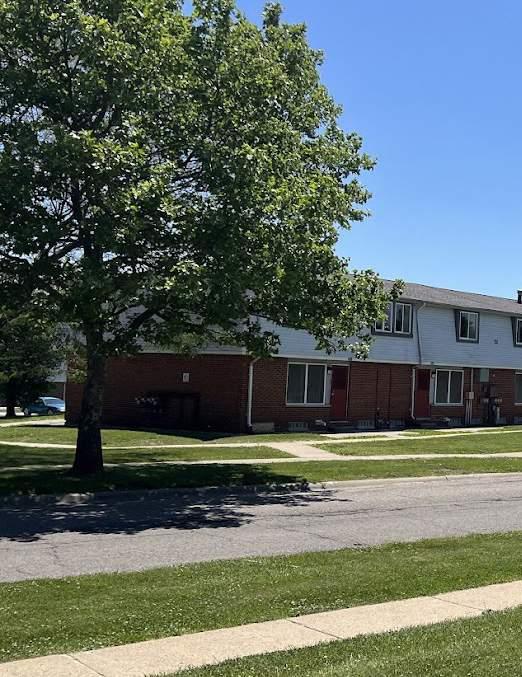
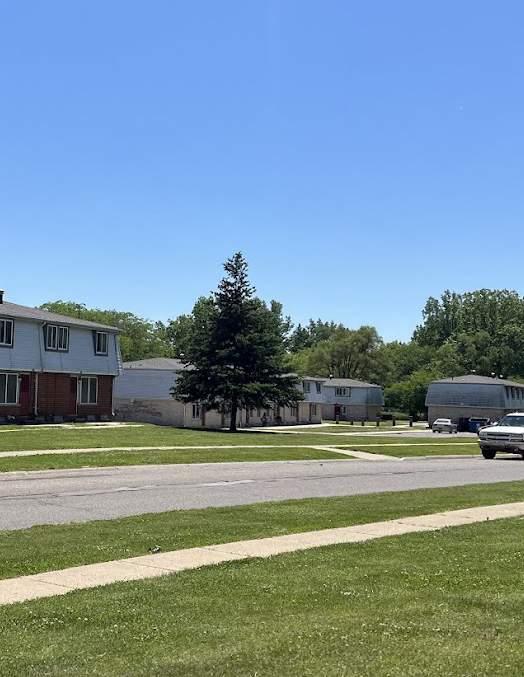
The Housing Plan contains strategies for redeveloping the River Park Apartments site and a catalytic site within the Northeast Flint neighborhood. The redevelopment will transform the distressed housing into high-quality, energy-efficient, mixed-income homes with modern amenities to meet family and senior needs through all stages of life.
Key Strategies
Transform distressed housing into a highquality mixed-income community. ADD new housing options to SPUR revitalization and ensure long-term viability. Incorporate diverse housing types to cater to the different demographics within the neighborhood.
BUILD AN ENERGY-EFFICIENT AND RESILIENT COMMUNITY.
PREPARE RIVER PARK & NORTHEAST FLINT RESIDENTS FOR THE REDEVELOPMENT OF THE COMMUNITY.
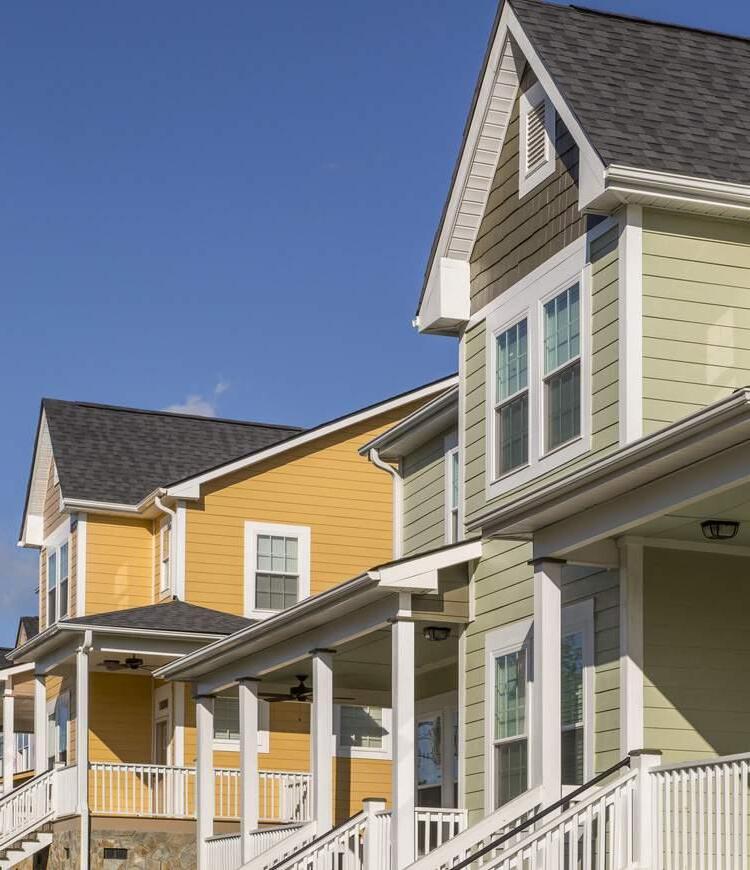
The Planning Team collaborated with community stakeholders, River Park residents, and community members to develop site development frameworks for the catalytic areas, based on the following critical elements:
• Walkable blocks
• Connectivity
• Diversity of housing options
• Mix of uses
• Density compatible with the surrounding neighborhood, with appropriate transitions
• Community amenities and open spaces
• Complete streetscapes encouraging multimodal transportation
• Parking accessibility
• One-for-one replacement of existing units (180 units)
• Mixed-income and mixed-use community
• Incorporates resident amenities
• Responds to community priorities
• Financial feasibility
• Build-First Strategy for implementation
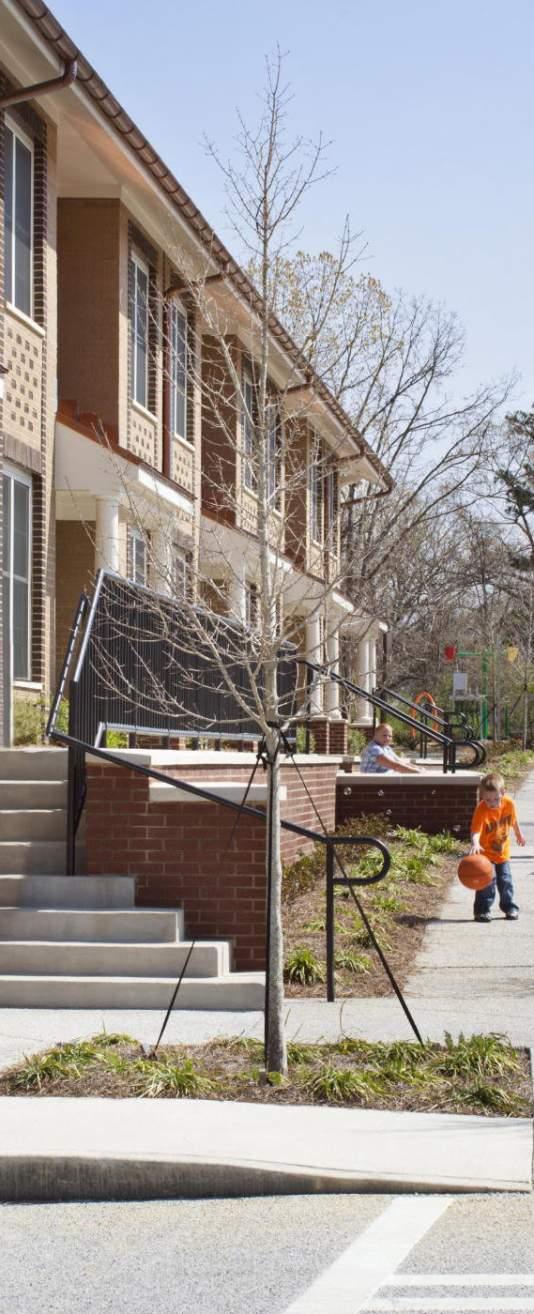
Redevelop River Park Apartments into a sustainable mixed-income community.
The River Park residents and community members helped identify the top two priority catalytic sites for implementing the housing plan, with River Park being identified as the top priority.
The Preferred Plan proposes a total of approximately 160 housing units, with 112 units located on the River Park Apartments site. The remaining units are planned for city-owned property along Carpenter Road and adjacent vacant parcels in the neighborhood.
The plan incorporates a variety of housing types, such as townhomes and duplexes, to provide residents with more choices. It also integrates resident amenities in a community center, which will include flexible space for hosting services like a temporary health clinic.
To address the issue of being isolated from the rest of the neighborhood, the plan proposes several

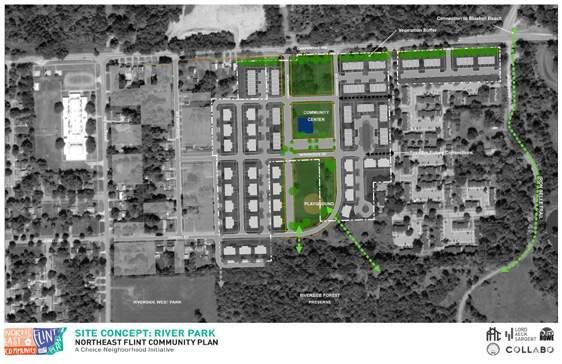
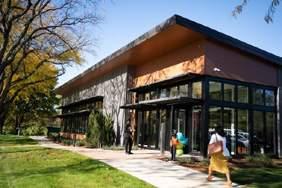

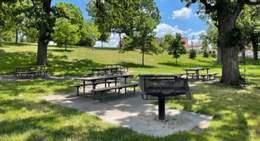

infrastructure improvements:
• Extending Pemberton Drive and Yorkshire Drive to connect to Joseph Street.
• Extending Morningside Drive westward, using two vacant parcels owned by the Land Bank Authority, to connect to Roseanna Drive. Morningside Drive can also be extended eastward to connect to the adjacent multifamily development, although River Park residents were not in favor of this connection at this time.
• Creating new trail connections to the existing Iron Belle Trail.
The open space is centrally located within the development and will feature various amenities for all ages, based on resident input. Potential features include a playground, basketball courts, walking pathways, seating areas, grill areas, a community garden, and plaza spaces for events.
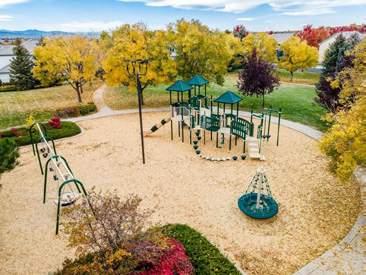

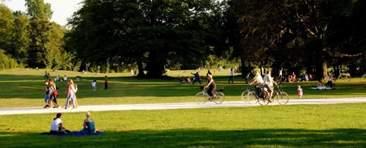

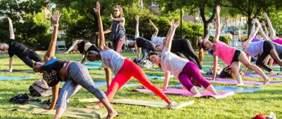

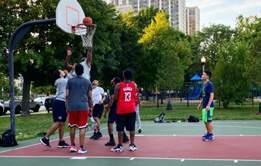

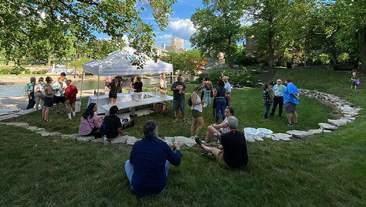

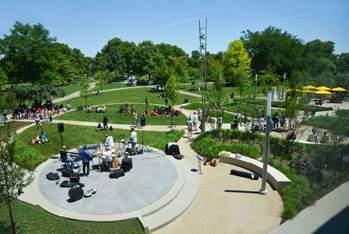

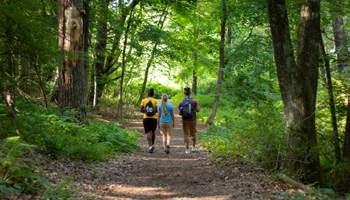



Overall, small-scale duplexes will line the eastern edge of River Park Apartments to “step-up” in scale from the existing character to more dense homes to the northwest.
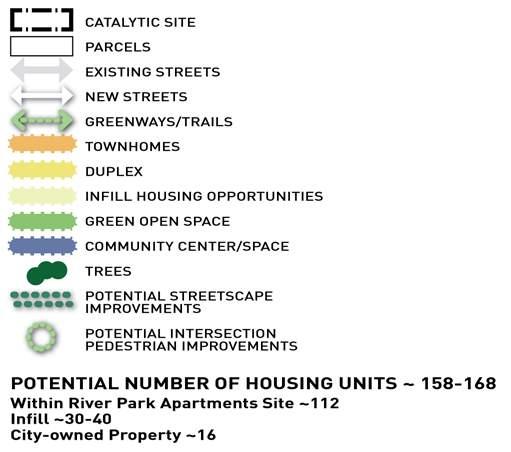
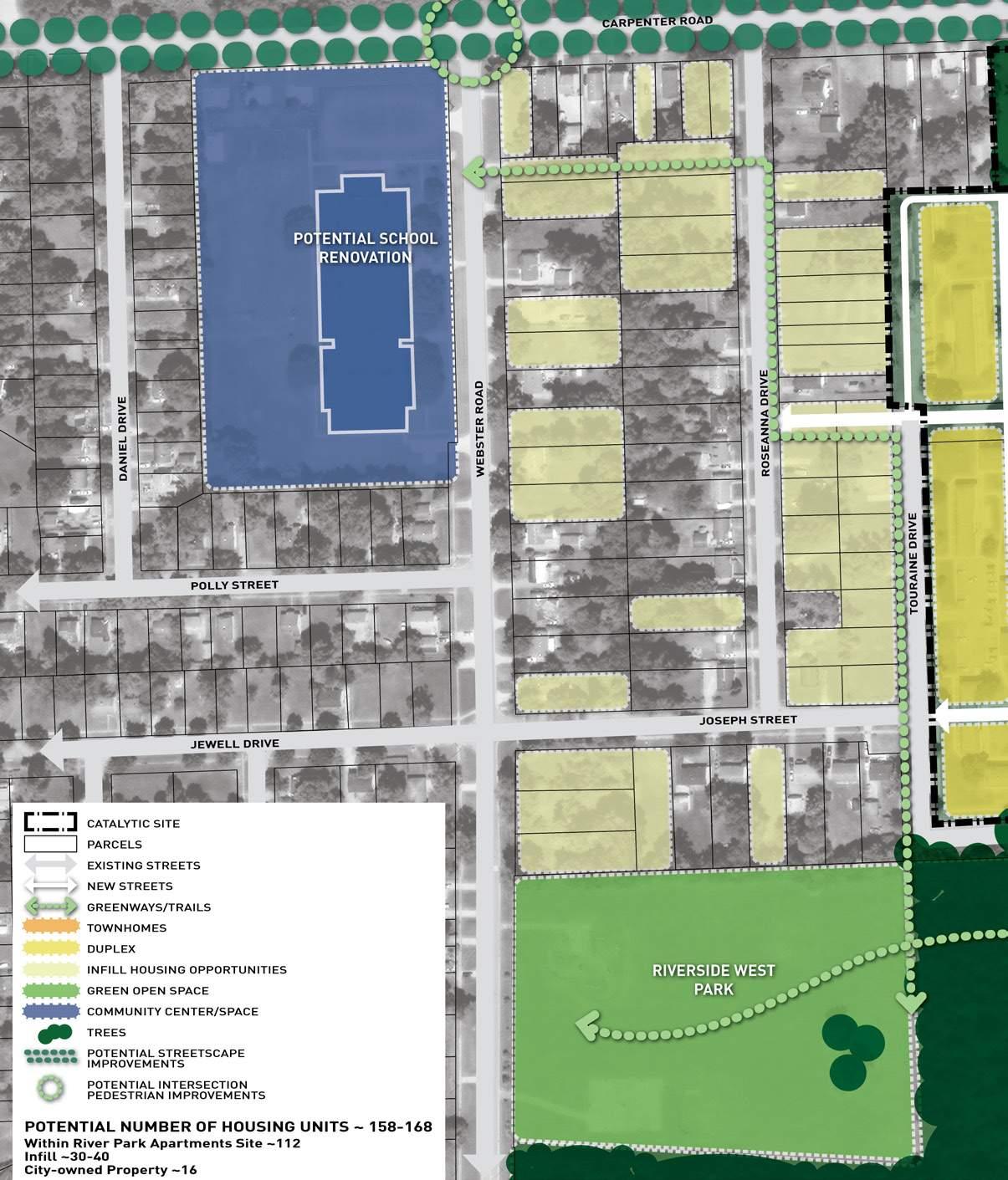
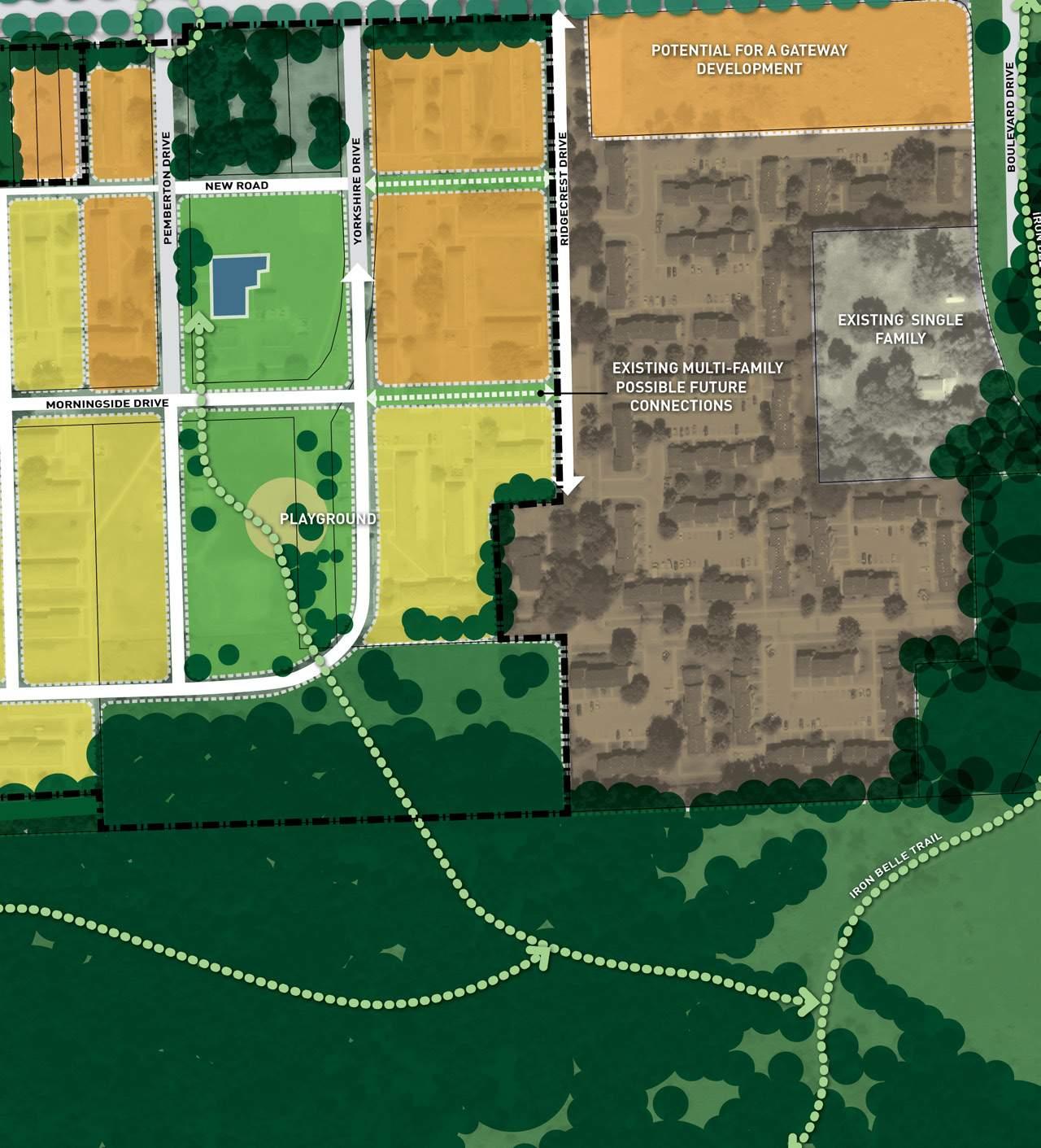
Site Concept: River Park
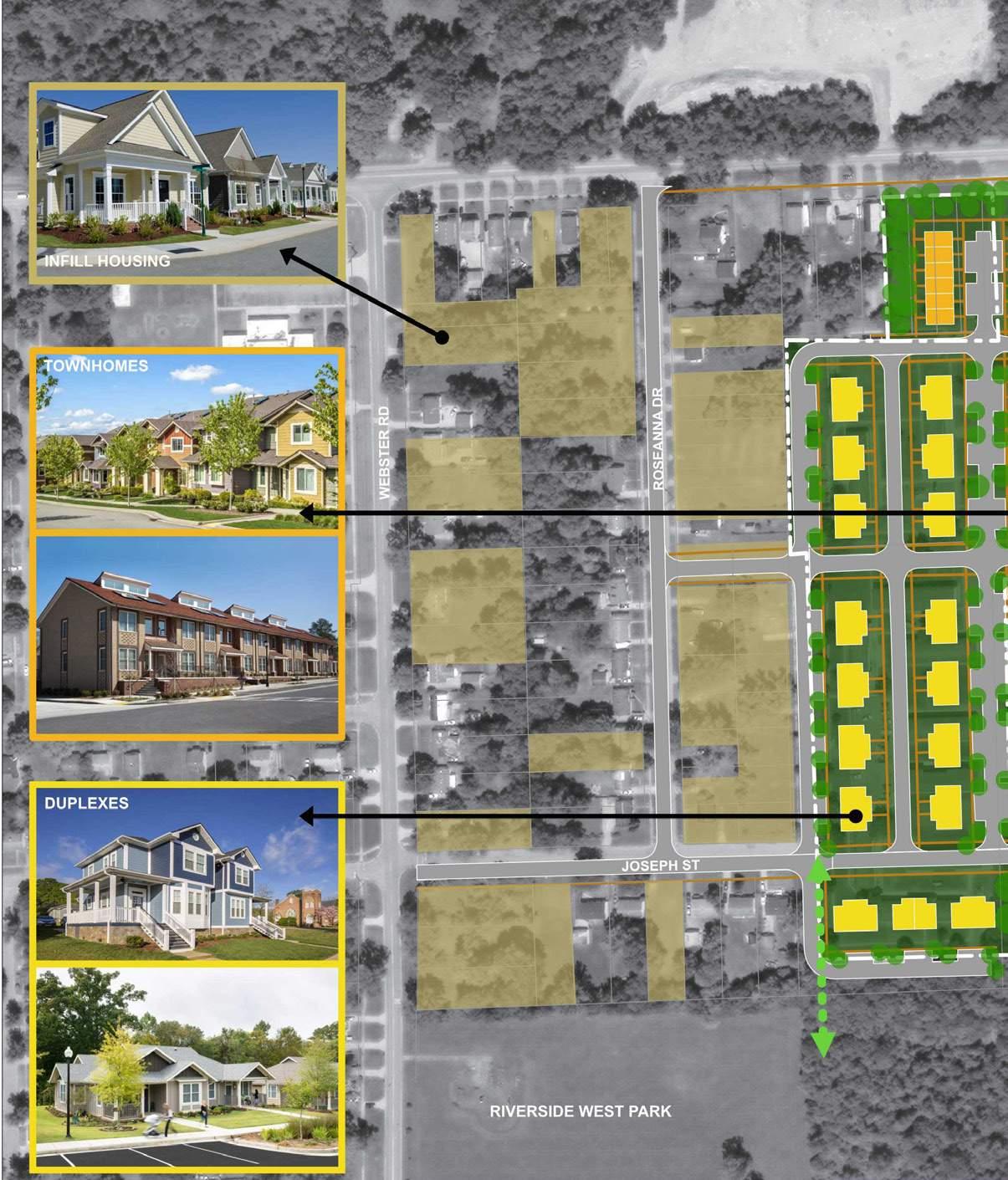
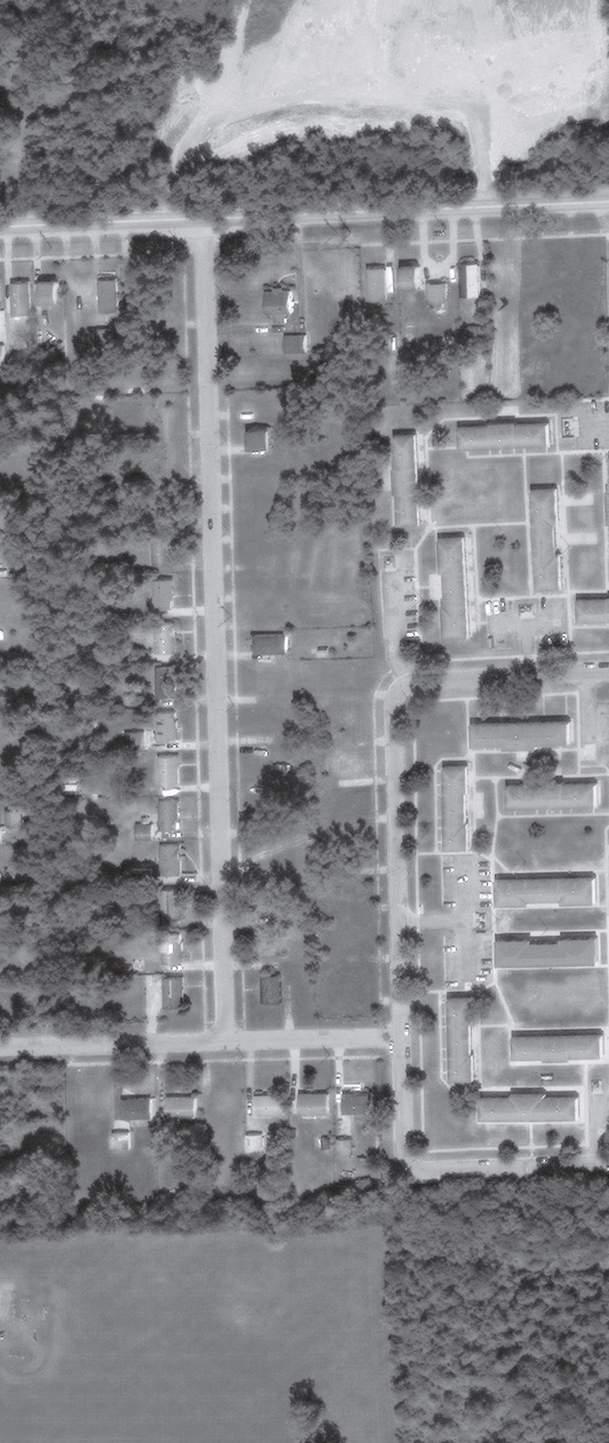
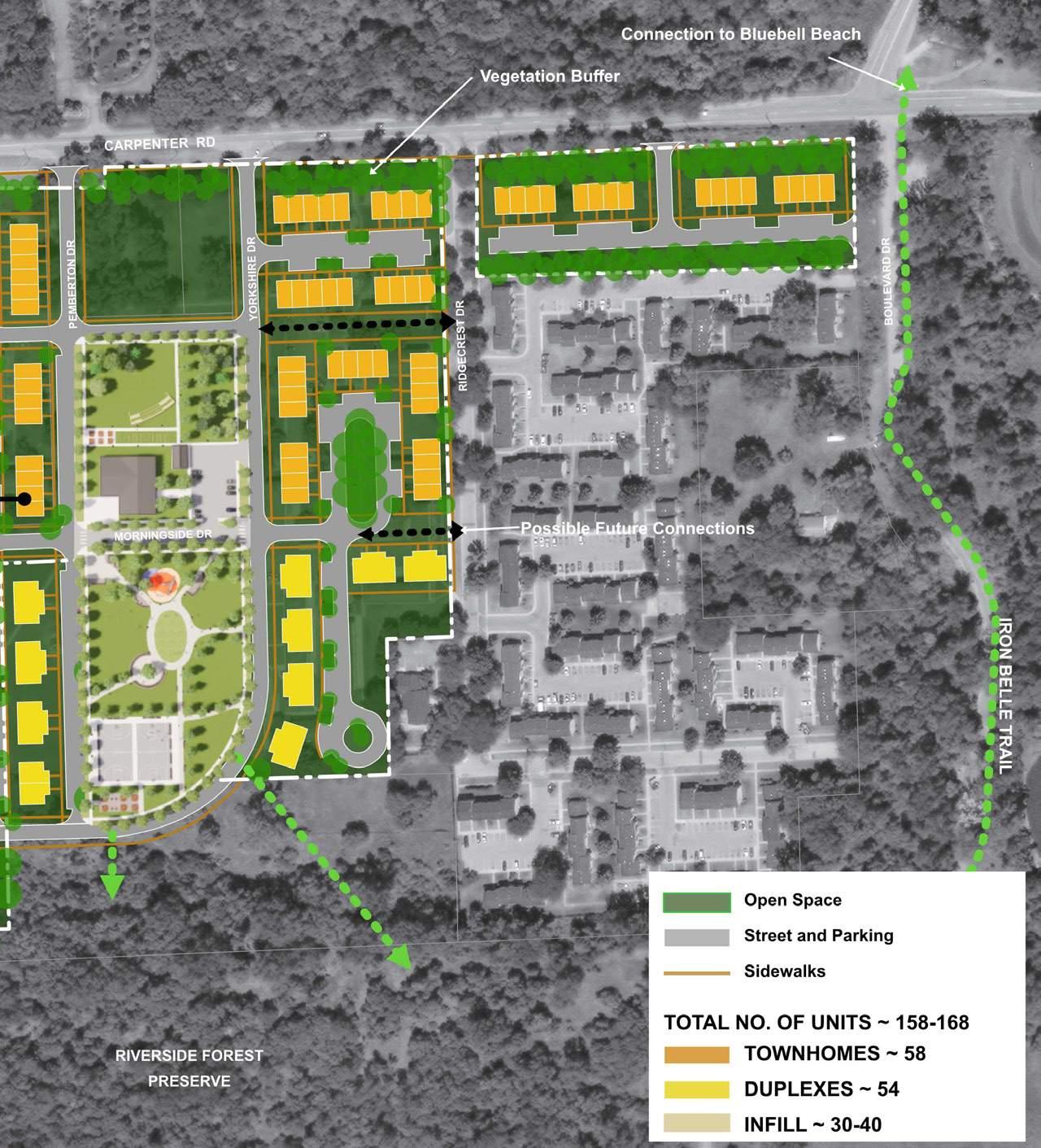
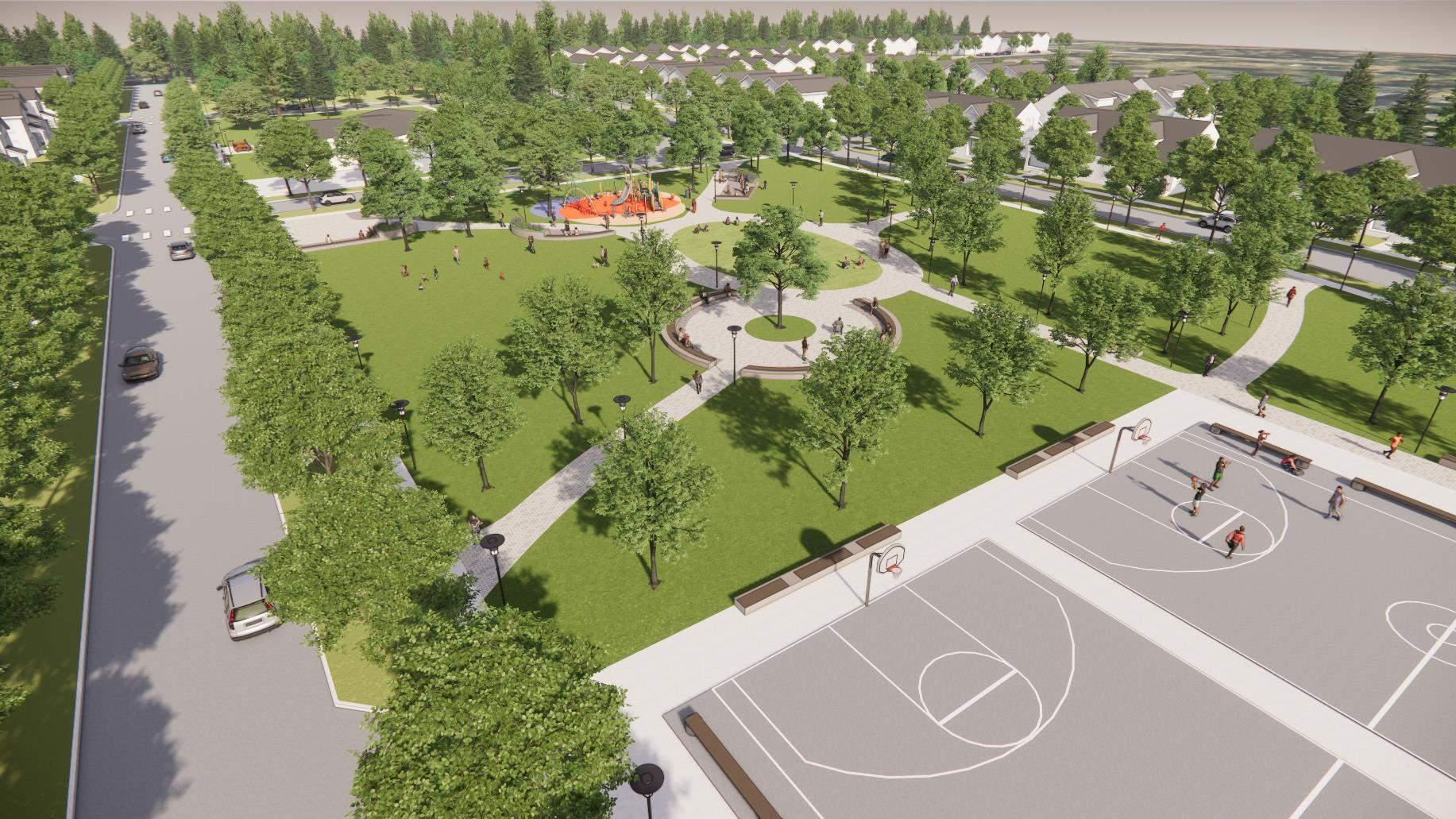
The MLK/Pierson corridor area was identified as the second priority site for redevelopment. Its central location near the limited retail establishments within the neighborhood and the availability of large parcels make the site a prime candidate to evolve into a future neighborhood hub for the Northeast Flint area. The xx-acre St. Agnes site, owned by the City of Flint, and the former Bryant Elementary School property (xx acres), owned by the School Board, are currently vacant. These properties offer a catalytic opportunity for significant development, including new housing options and the integration of an educational anchor, which is currently lacking in this neighborhood. Prioritizing these vacant sites for the initial phases opens up the opportunity to build first, facilitating the relocation of residents to the new development before demolishing the units in River Park. A meeting with School Board to discuss the opportunities and partnerships is pending.
The Framework Plan Options for the MLK/Pierson area differ in the location of the educational anchor and senior housing. Option A locates the educational anchor at the former Bryant Elementary School site and senior housing at the St. Agnes site, while Option B has the educational anchor at the St. Agnes site and senior housing at the former Bryant Elementary School site. In both options, the northern sections of both sites are planned to incorporate new housing, supported by resident amenities, such as new open spaces, and infrastructure improvements, such as:
• Realignment and northern extension of Woodbine Drive
• New streets to break the St. Agnes superblock and aligning with proposed and existing street network
• Extension of Westmoreland Drive and Parkway Avenue to the new aligned Woodbine Drive, to expand the single family neighborhood fabric
55% OF RESIDENTS HAVE CONSIDERED MOVING TO ANOTHER PART OF THE CITY OF FLINT
• Connectivity improvements into Clara Hilborn Park from the east, including a new street and extension of existing neighborhood streets, such as Mott Avenue, Lyndon Avenue and Parkway Avenue to improve access to the new development on the Bryant Elementary School site
• Incorporation of diverse open spaces tailored to the needs of both senior housing and family housing residents
• Streetscaping along Pierson Road and Martin Luther King Avenue
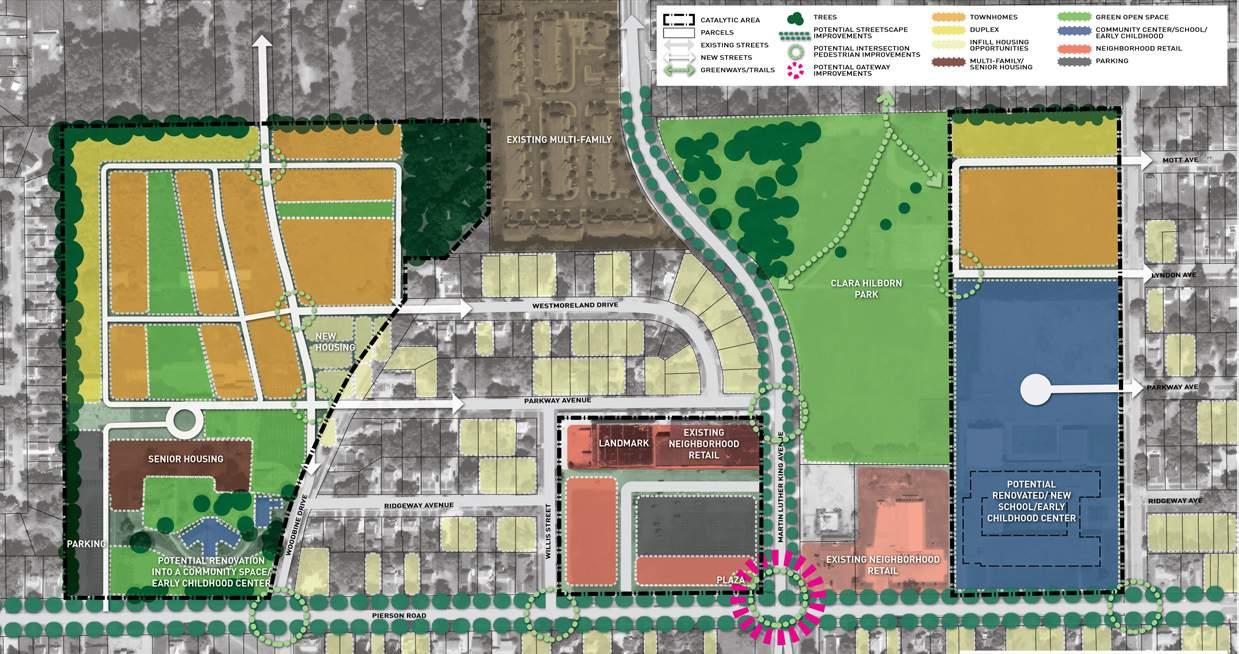
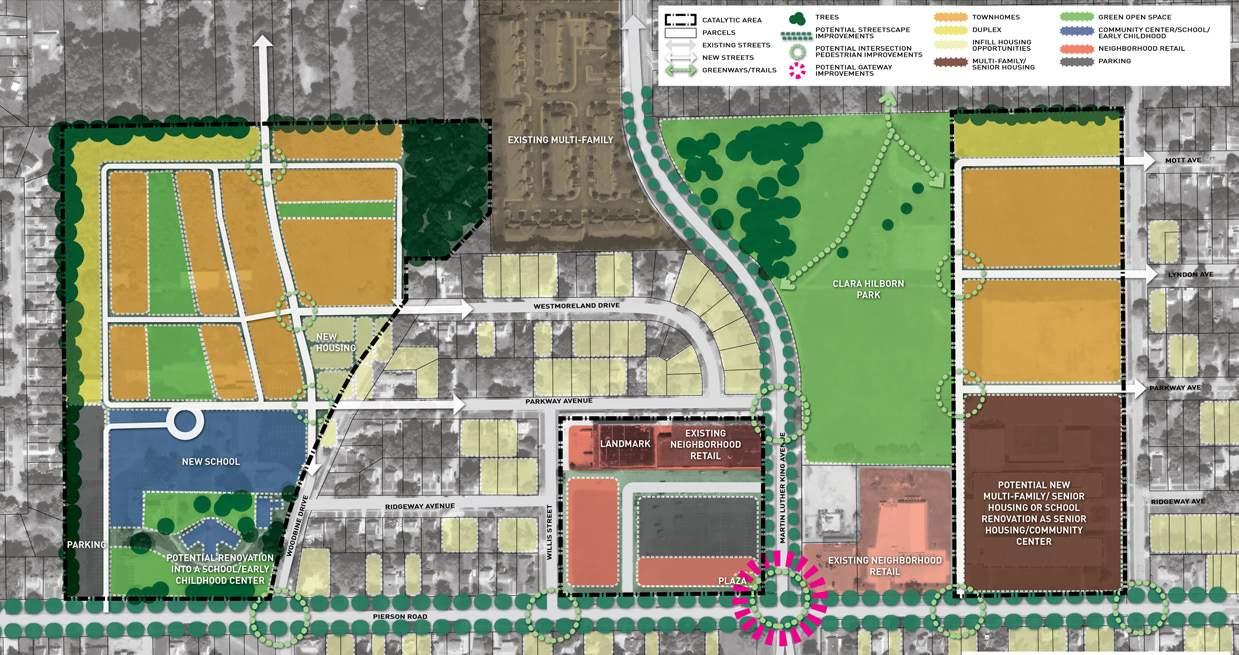
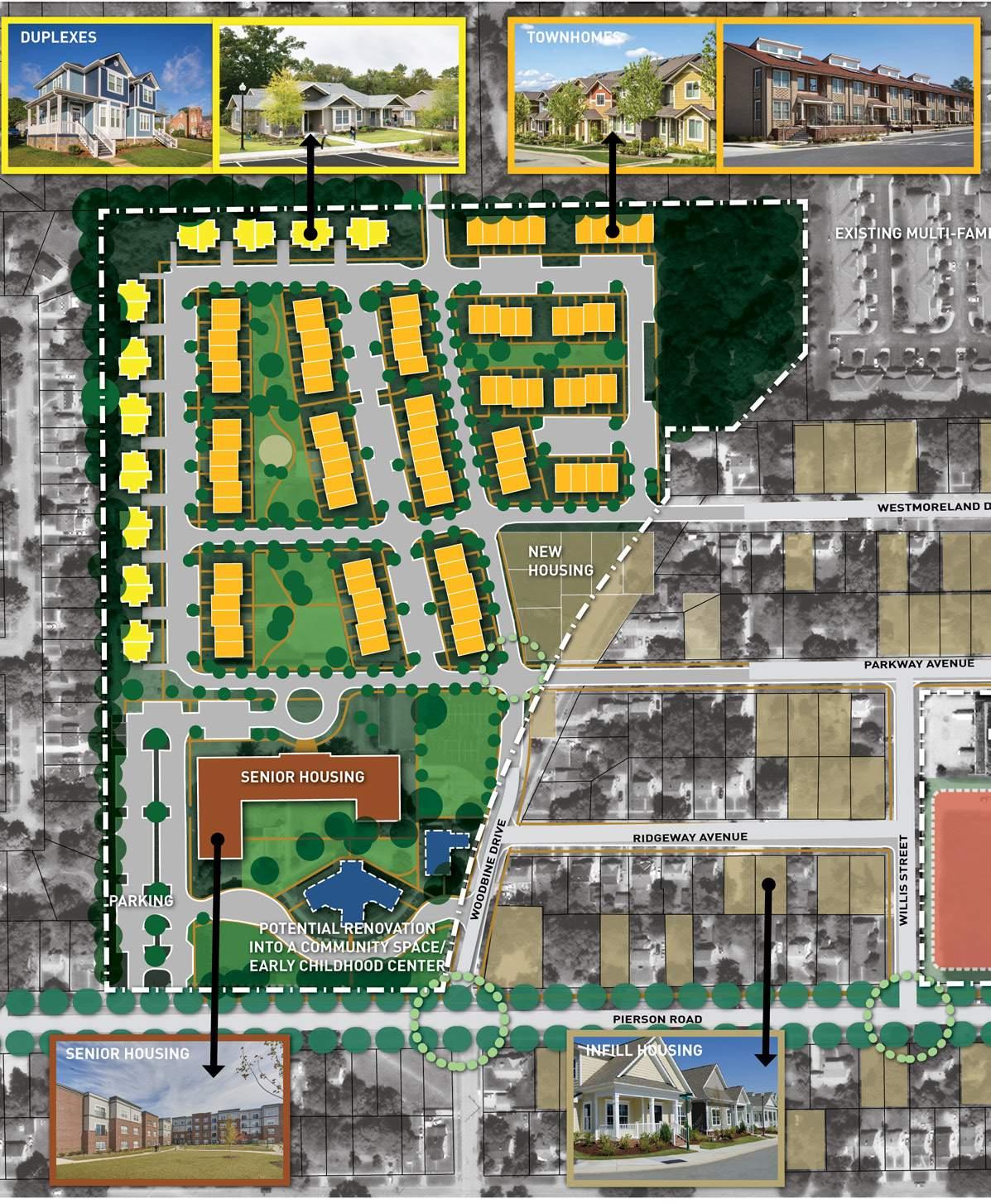
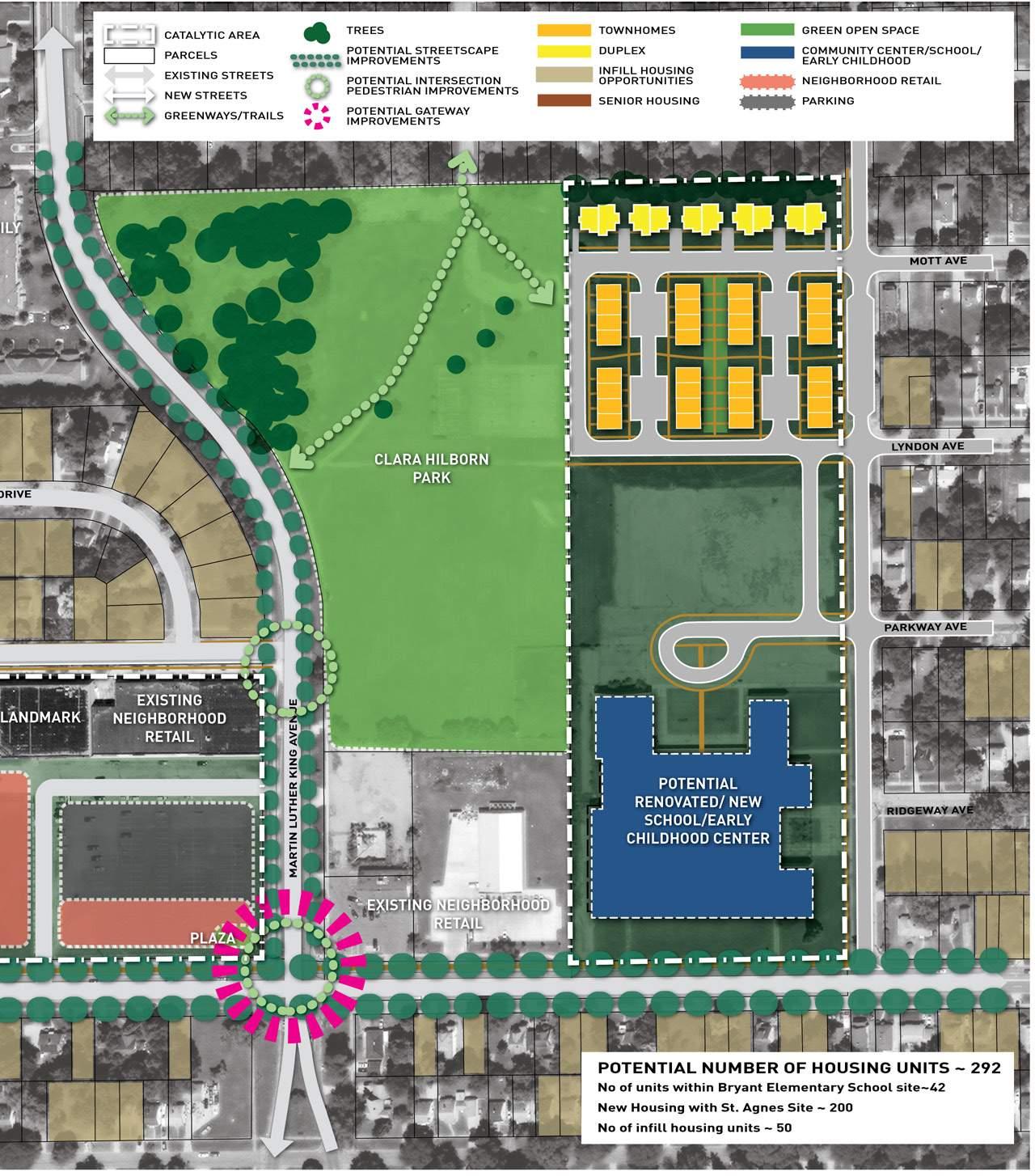
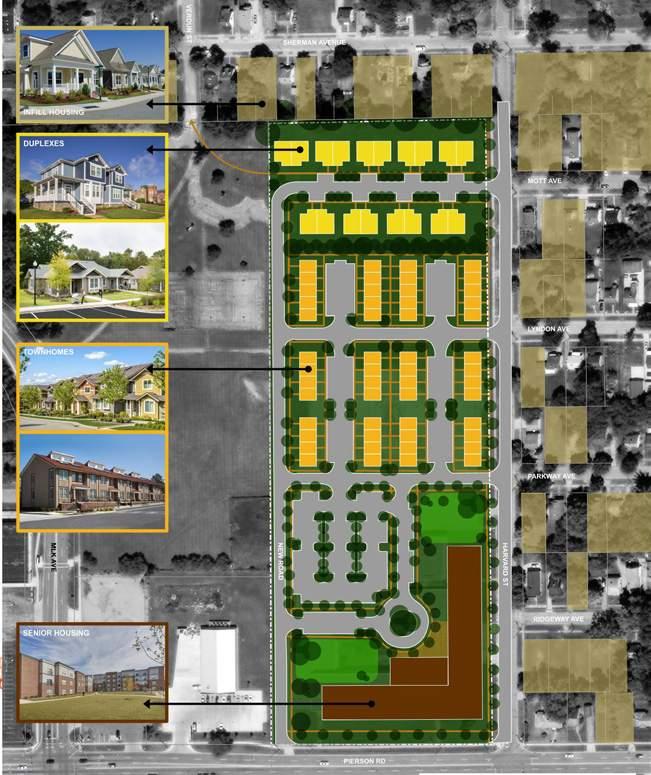

Bryant Elementary School Site Concept Framework Option B
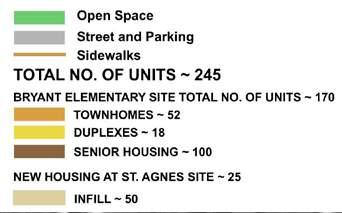
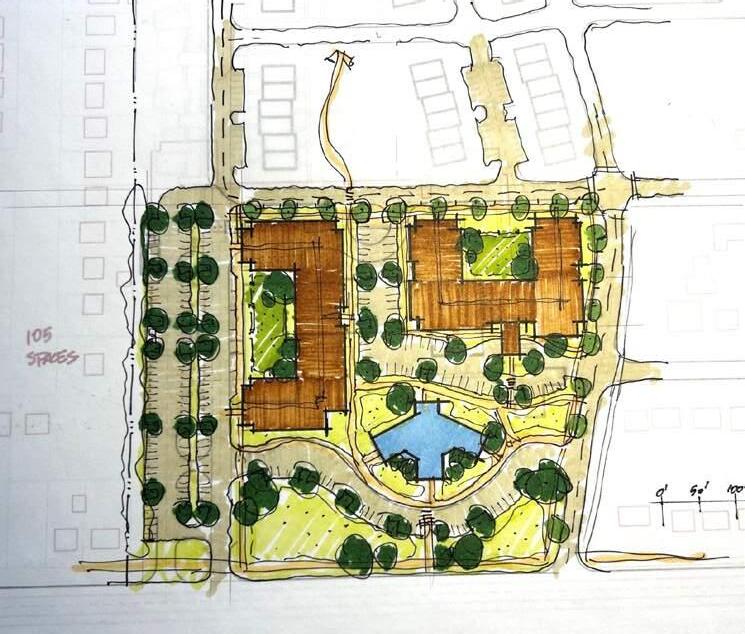



The Planning Team also explored a third scenario (Option C), which proposed increasing the density along the Pierson Road frontage of the St. Agnes site, which brings the total number of housing units on the St. Agnes site to 290. Option A was selected as the preferred option by the community.
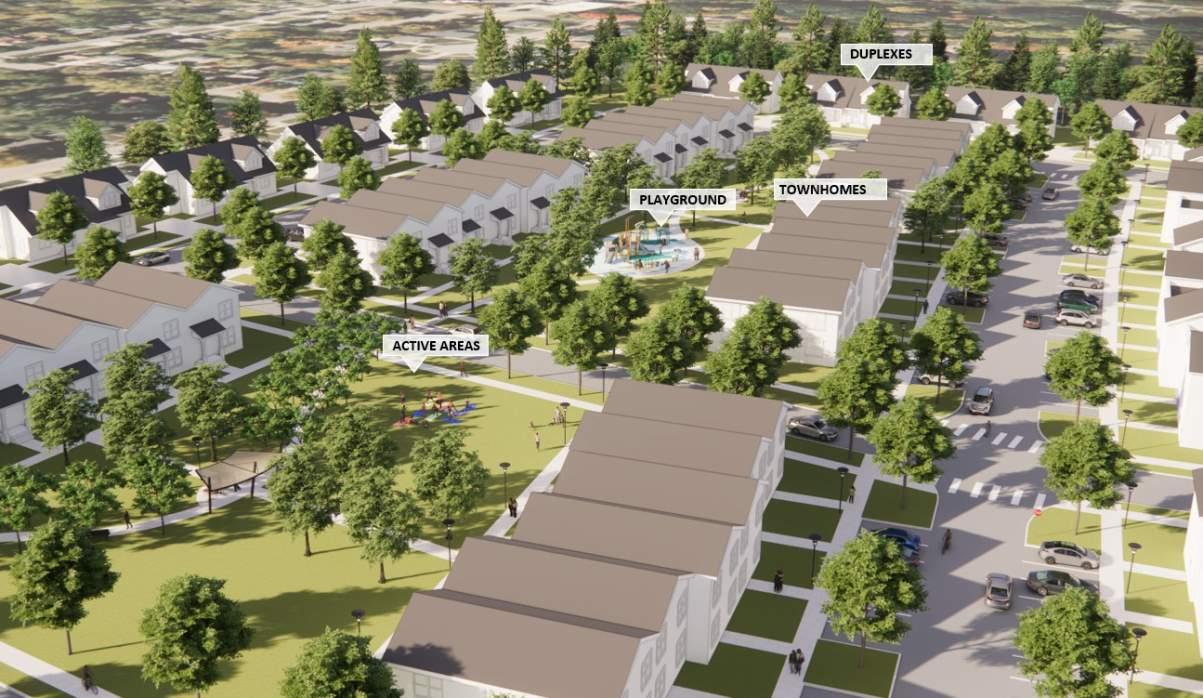
2.2: Encourage strategic infill housing development within the neighborhood.
The community has a significant amount of vacant or publicly owned properties scattered across the neighborhood. Targeted areas were identified around the four catalytic sites (see: Neighborhood Plan) to focus strategic infill redevelopment to build upon the momentum of the catalytic developments.
For successful implementation, Northeast Flint partners will identify local developers and land owners to redevelop the infill sites and promote homeownership opportunities.
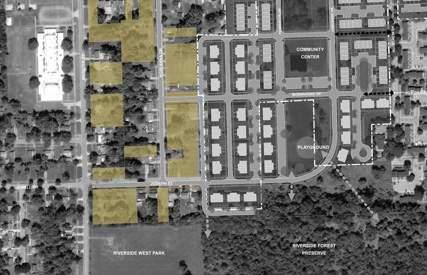
Integrate various housing typologies, scales, and unit sizes throughout Northeast Flint.
The plan integrates diverse housing typologies which are compatible to the existing fabric of the neighborhood. Each catalytic area is designed with a mix of housing types, ensuring proper transition buffers from the adjacent single-family neighborhood blocks. The substantial number of vacant properties presents an opportunity for infill housing, further increasing the options for the community. A mix of bedroom sizes are scattered throughout the different typologies – duplexes, townhomes, infill and senior housing, ensuring a wide variety of choices and compliance with dispersion requirements of the Fair Housing Act and International Building Code.
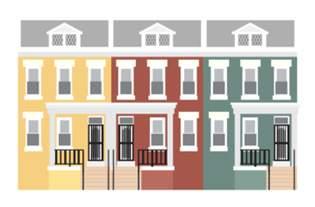
TOWNHOMES AND SINGLE FAMILY HOMES ON A LARGER LOT ARE THE HOUSING TYPES THAT WOULD BEST SERVE RESIDENT’S HOUSEHOLD AS PER THE NEEDS ASSESSMENT SURVEY
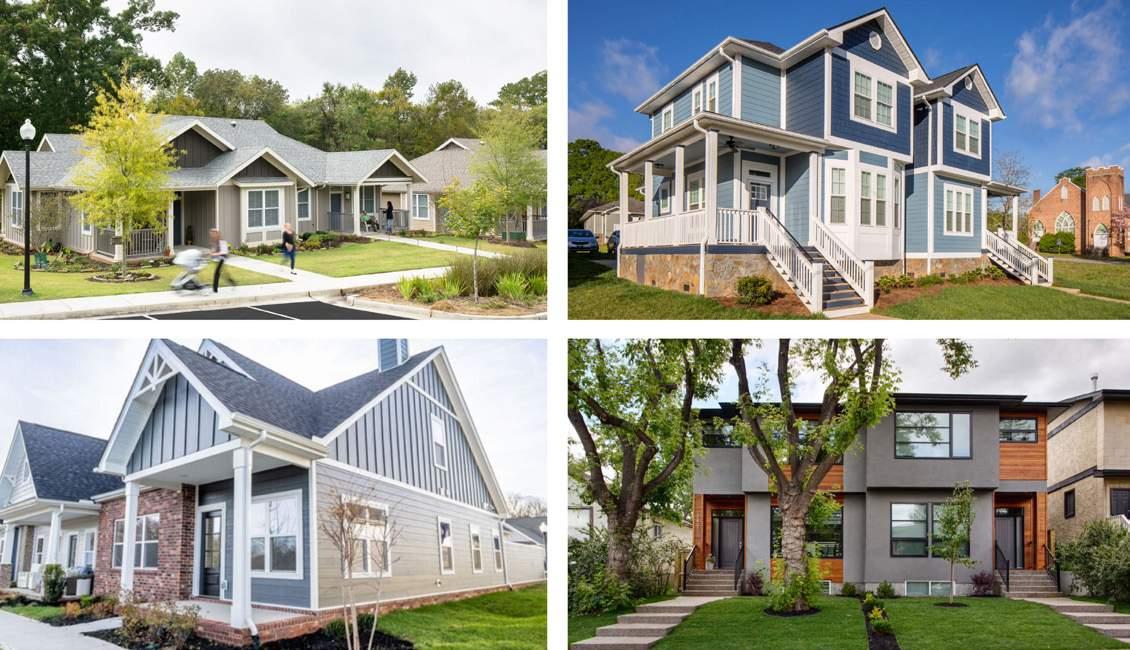
1 bd
2 bd
3 bd 152 units
4 bd 76 units 20%
5 bd 0 units
Table: Proposed Unit Mix
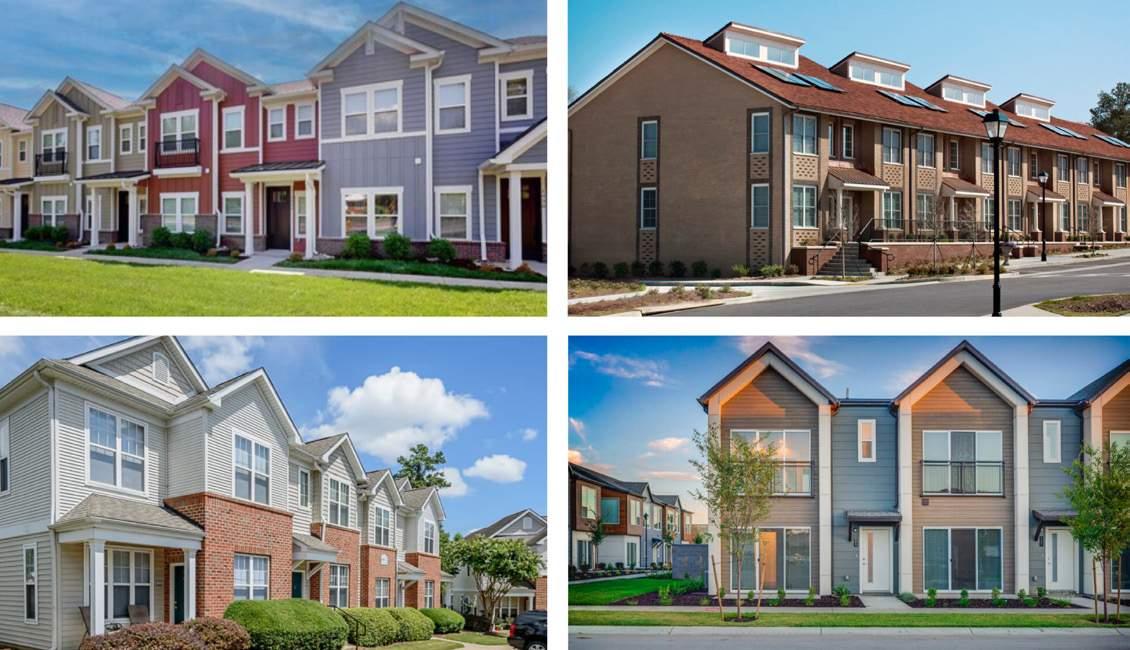
Precedent Images for Townhomes
A variety of housing types are proposed throughout Northeast Flint.
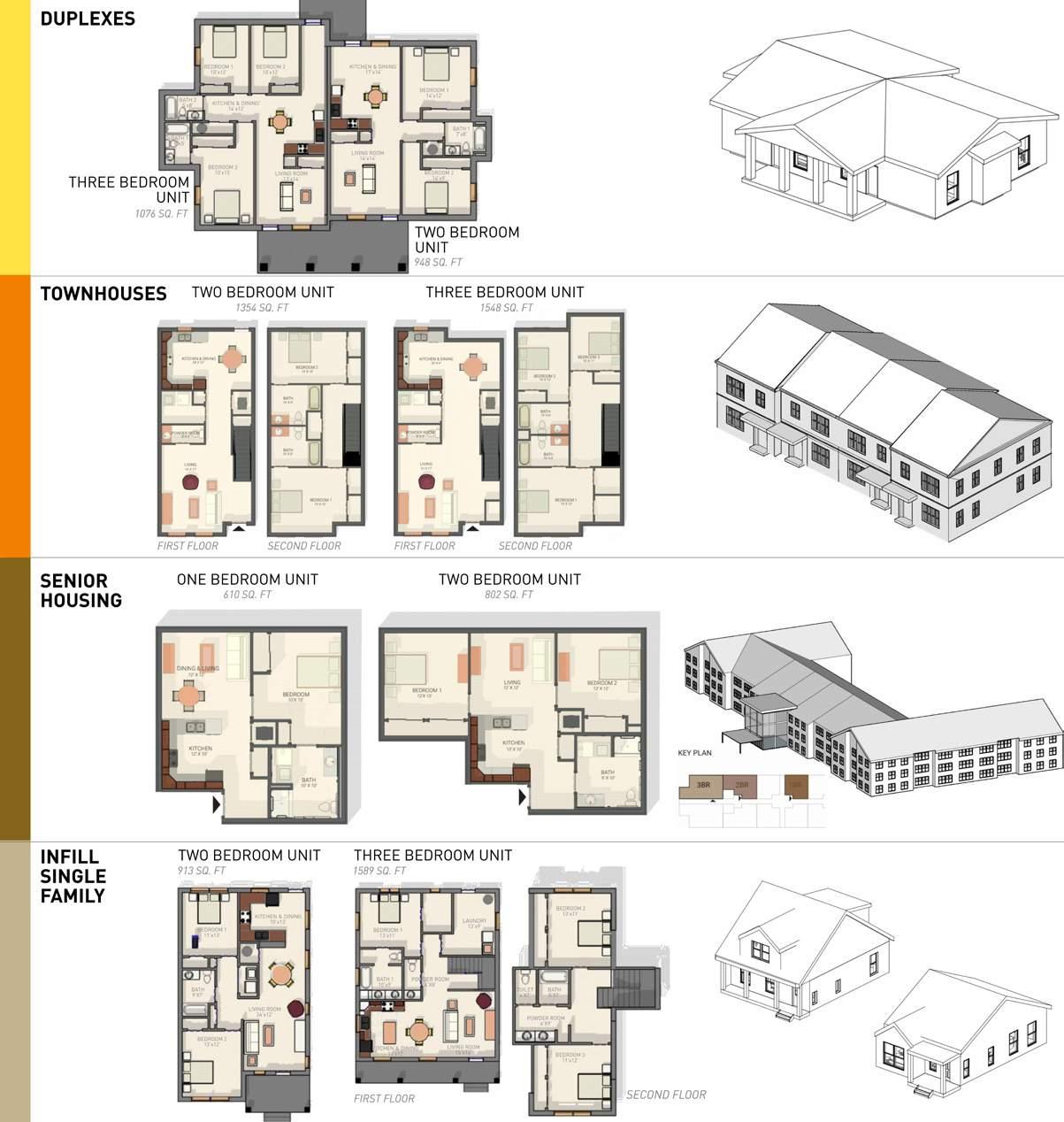
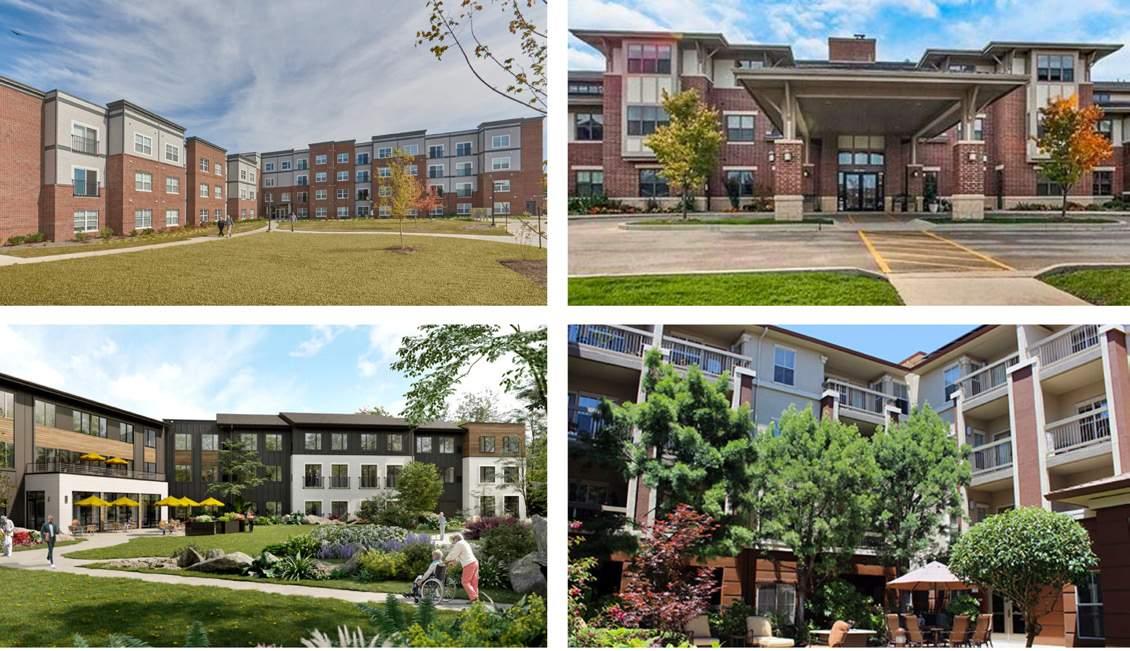
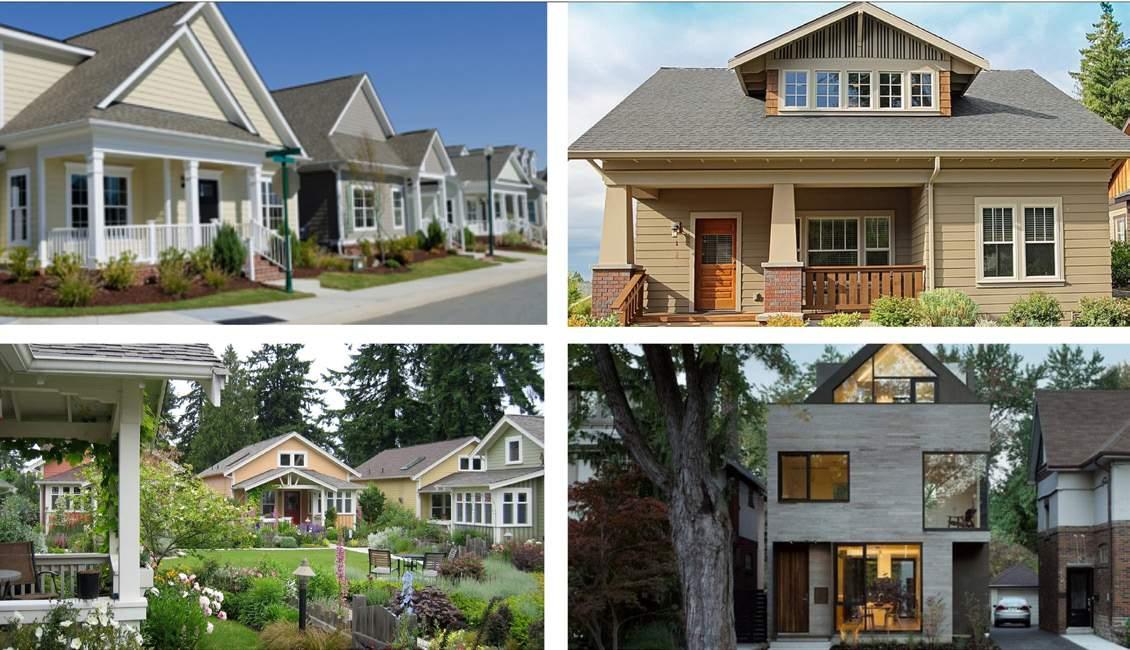
4.1 Promote energy-efficient development and green building techniques for healthy living.
Any new development should meet the basic standards of sustainability and resiliency. The following sustainable design principles can be incorporated into the design of the buildings: Exterior:
• Cool roofing products to reduce the heat island effect found in urban climates.
• Rapidly renewable insulation in the exterior wall cavity.
• Flashcoat of spray-foam insulation at the backside of the exterior sheathing, which reduces the amount of air infiltration from the exterior.
• Thermally insulated, double paned windows with a low solar heat gain coefficient.
• Durable exterior material selections, which may include masonry, cement-fiber siding, and metal panels.
• Sunshades and canopies to appropriately respond to the buildings’ solar orientation.
Interior:
• Energy-efficient Heating Ventilation and Air
• Conditioning (HVAC) systems.
• ENERGY STAR rated appliances and lighting.
• Low-flow plumbing fixtures.
• Formaldehyde-free insulation.
• Low - Volatile Organic Compound (VOC) paint and interior finishes.
• Interior walk-off mats reduce the amount of contaminants tracked into the living space.
• Rapidly renewable flooring tile.
• Tile flooring, carpet and drywall to have high recycled content.
• Mold resistant drywall in wet areas.
• Tile flooring adjacent to exterior doors.
• Durable structural systems, such as concrete and steel framing, in lieu of wood construction.
• Sealants to control fire, sound, and provide an air tight barrier between each dwelling unit.
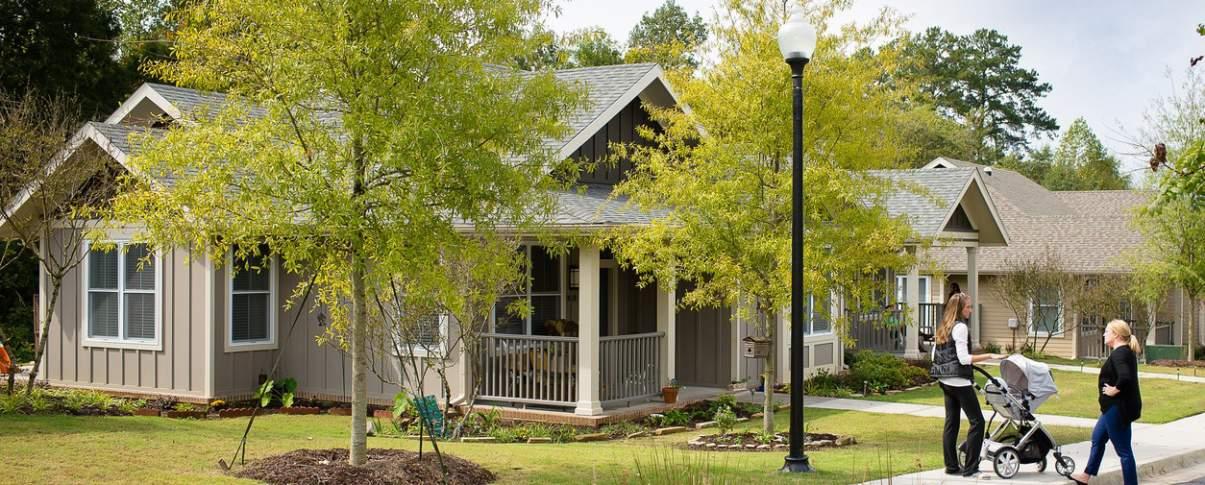
4.2: Incorporate green infrastructure and site sustainability strategies.
To enhance environmental resilience and promote sustainable living, any new development will incorporate green infrastructure solutions and support clean energy initiatives, such as:
• Implement sustainable stormwater management systems, including permeable pavers, raingardens, bioswales, etc.
• Utilize native plants
• Install Electric Vehicle (EV) charging stations where feasible, including within new developments and public areas, such as the Landmark grocery store parking lot.
4.3: Incorporate best practices to create a safer community
Safety was one of the prime concerns of the residents so Crime Prevention Through Environmental Design (CPTED) principles were incorporated to the site plan and housing design:
• Natural surveillance has been integrated into the site and housing design by creating “eyes” on the front of the building with windows, porches and balconies facing the street. Avoiding defensible areas.
• All open spaces are located along main streets, with buildings facing it, enhancing its visibility and making it safer.
• Clear delineation of public (sidewalks, open spaces, etc.) and private (driveways, porches, etc.) areas by using different materials reinforces the difference in the spaces and guides people and vehicles to and from the proper entrances.
• Including adequate streetscaping and lighting along all streets and public spaces.
• Proper maintenance of landscaping, lighting and other features is vital to ensuring that CPTED elements serve their intended purpose.
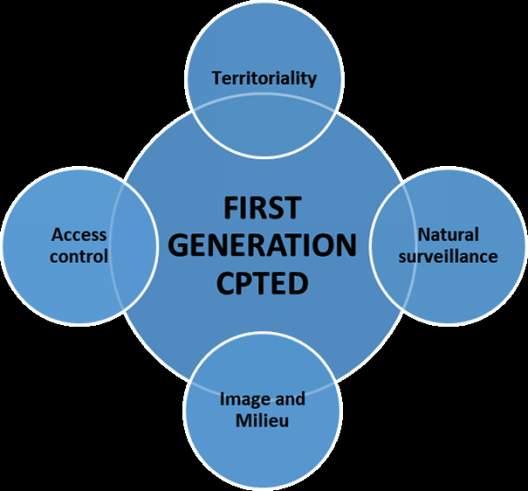
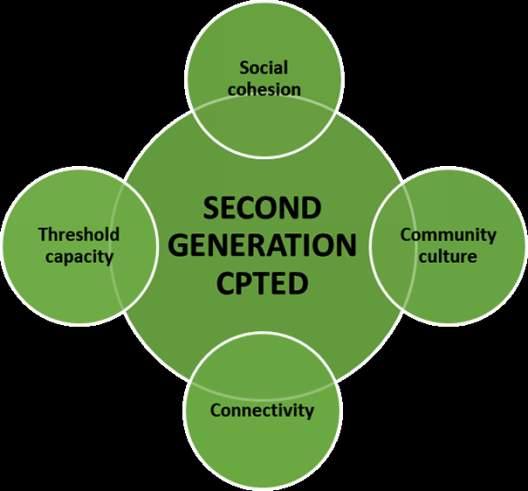
CPTED Principles
Source: https://www.cpted.net/Primer-in-CPTED
5.1 Develop a “Build-First” phasing strategy and educate the residents
The potential Phasing Plan envisions five phases, beginning with a build-first strategy on the vacant St. Agnes property during phases one and two to minimize disruption to residents and their families. The plan carefully balances factors such as preserving affordability, leveraging funding sources, and addressing market potential However, the phasing plan is subject to change as funding and/or new development opportunities emerge.
Detailed Phasing Plan information is included in the following page.
79% OF RESIDENTS ARE INTERESTED IN RETURNING TO A RENOVATED UNIT
Once the Phasing Plan is finalized, FHC and the selected Housing Developer will collaborate with the Housing Advocate (as outlined in Chapter 5) to create and implement a comprehensive relocation strategy. The Housing Advocate will work closely with River Park residents, meeting regularly and providing consistent communication to ensure a smooth, wellsupported relocation process that prioritizes resident needs and concerns. More detailed information regarding FHC’s commitments and responsibilities for the relocation process can be found in Chapter 5.
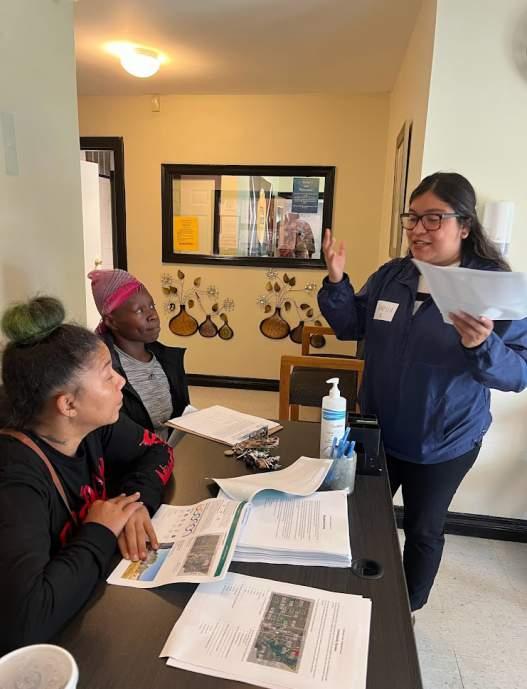
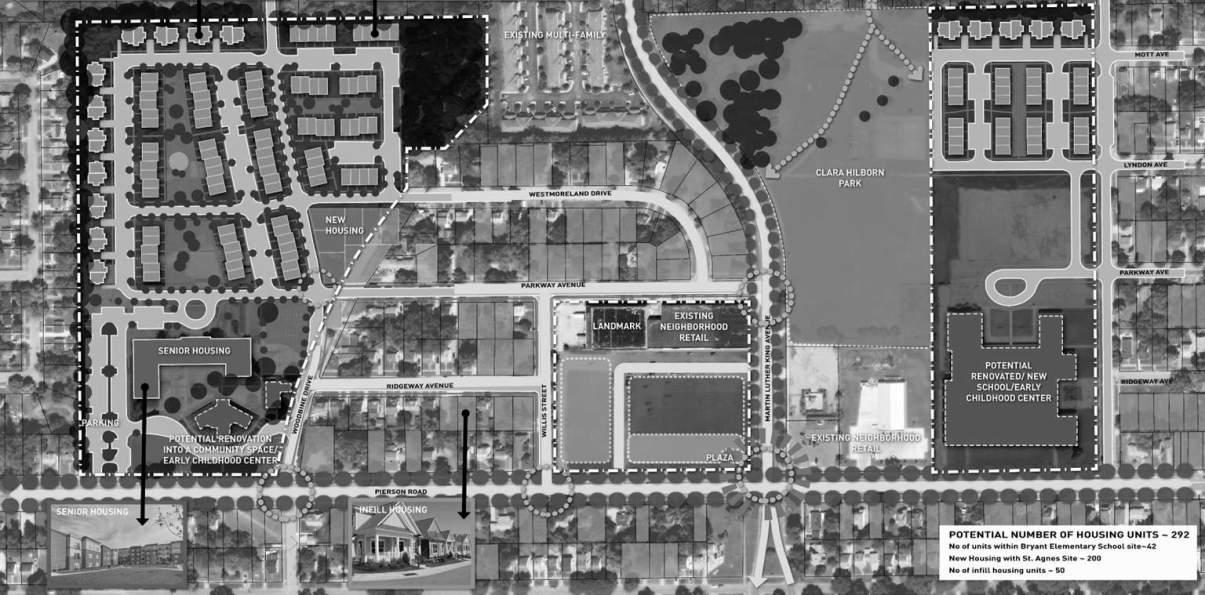



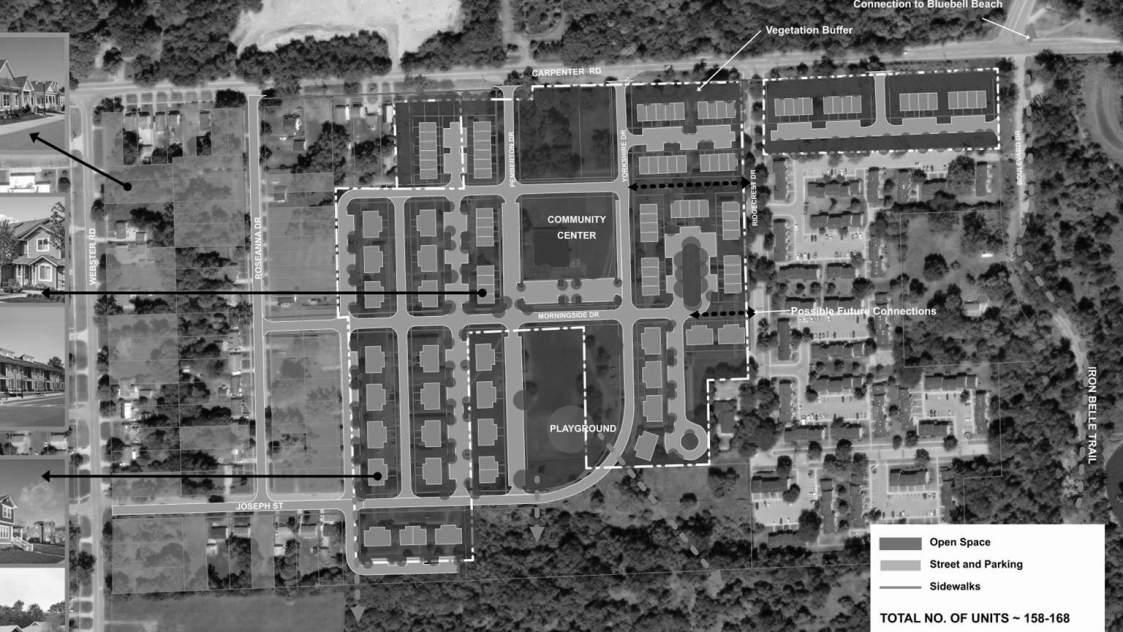






*Only 131 out of the 180 units in River Park are occupied
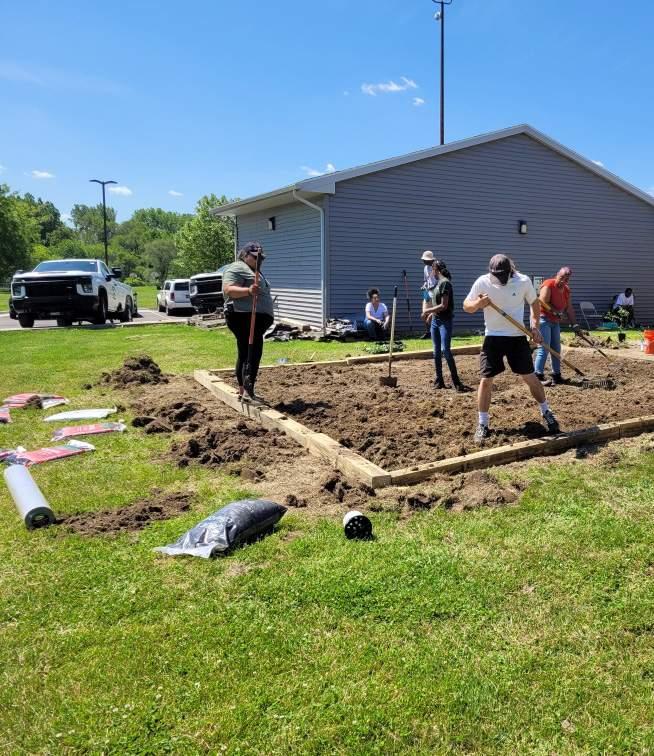
The planning process successfully brought together local residents and area partners to develop aspirational yet actionable goals and strategies for transforming northeast Flint. The plan already has momentum, with various organizations continuing to invest in the neighborhood. However, the complete realization of all the specific priorities identified in this Plan is likely to take 10-15 years or more, depending on financing and market conditions. Collaboration and coordination between the key partners would be the cornerstone of the successful implementation of the Plan.
The Flint Housing Commission (FHC) and City of Flint will lead the main components of the Plan - people, neighborhood and housing, and will continue to build on the partnerships developed during the planning process to effectively implement the specific strategies outlined during the planning process. They are working and will continue to work with public and private agencies, philanthropic organizations, business, cultural entities and a variety of community stakeholders to gather and leverage the resources needed to support the financial sustainability of the Plan and build community support for and involvement in its implementation.
The existing Steering Committee, comprised of leadership from nearly 20 community organizations, Community Ambassadors, FHC and City staff, will evolve into an Implementation Advisory Committee (IAC). During the implementation phase, the IAC will meet quarterly to provide strategic guidance, review progress on activities to ensure that they address community needs and catalyze investment in a way that produces measurable beneficial outcomes to
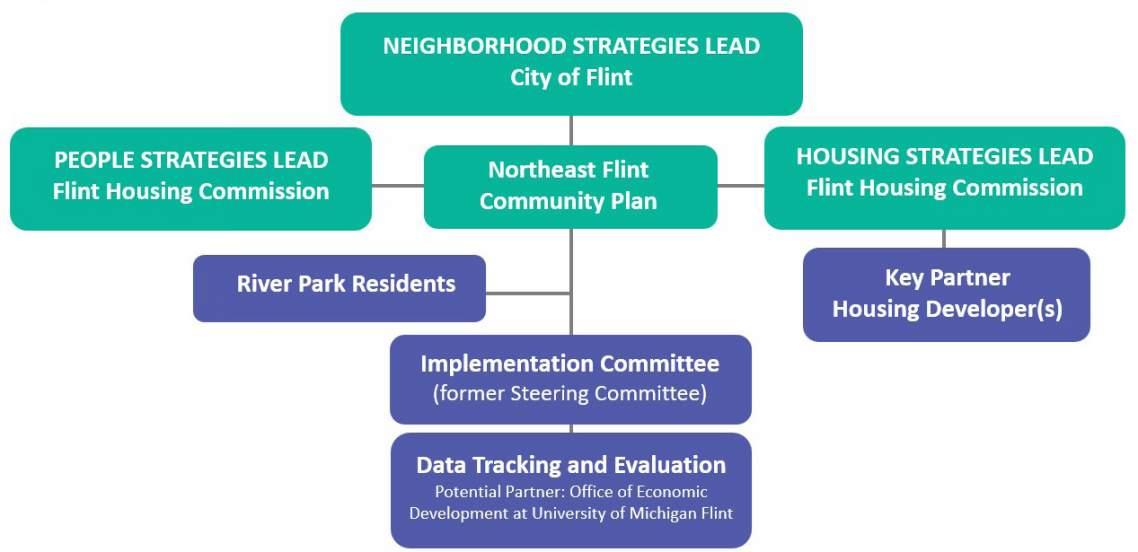
residents and the overall neighborhood. Representatives from the Lead entities will remain in active communication with the IAC, attending meetings and providing updates on progress quarterly.
FHC and the City of Flint will develop a data tracking and sharing strategy to help project partners and funders measure progress and assess the impact of the implementation efforts. The Office of Economic Development at the University of Michigan-Flint has been identified as a potential partner for this initiative. FHC and the City will confirm their participation, finalize the performance measures identified for each strategy during the planning process, and establish the data collection and sharing approach. This data will enable partners to monitor
the progress of the individual strategies and identify early on when strategies may not be working and need to be revised. The lead entities will use this data to produce an annual report for the community, providing updates and evaluating progress as Choice implementation activities are underway.
FHC and its implementation partners are committed to keeping Northeast Flint residents informed and actively engaged. They will continue to host meetings with River Park residents and the broader community to gather input and provide updates as early action projects are executed and implementation activities progress.
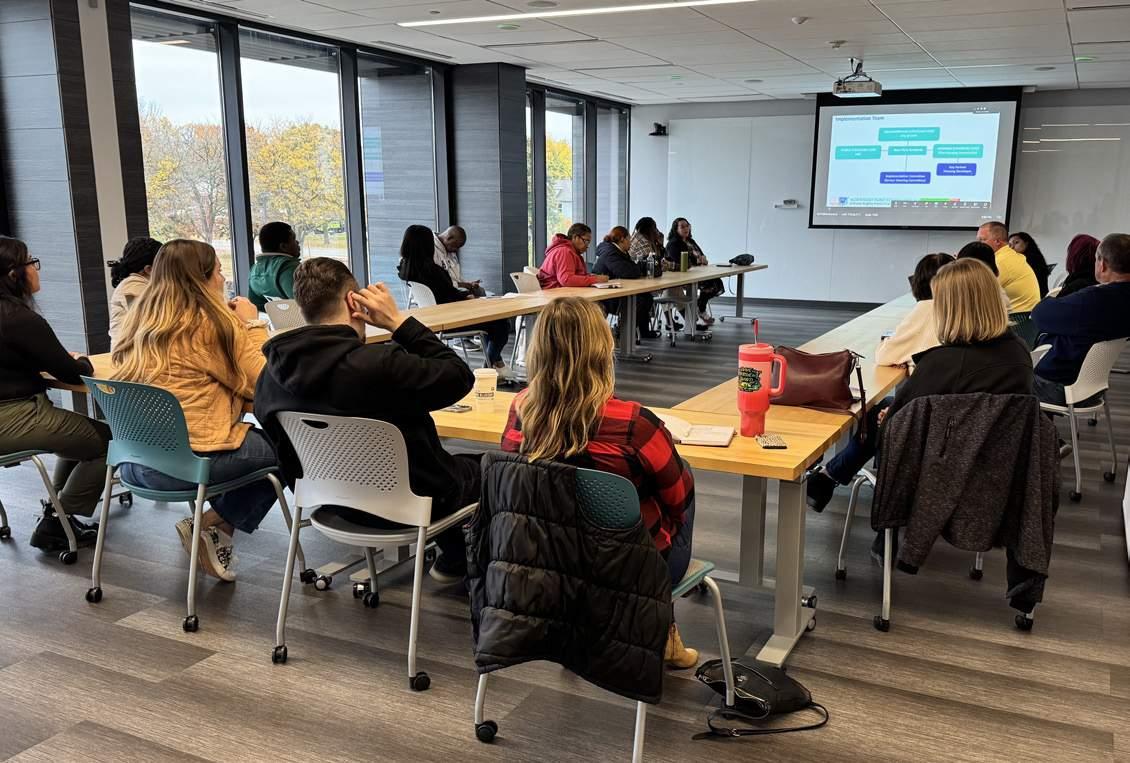
The Flint Housing Commission (FHC) will serve as the primary entity for managing day-to-day operations, focused on assisting target residents and families within the Northeast Flint Choice Neighborhood. It will implement new and expanded programs in early childhood and school-age education, health and wellness, and economic mobility. FHC has effectively employed various strategies to support HUD’s objectives of enhancing employment, income, health, and educational outcomes for children. By executing the South Flint Community Plan (Choice Neighborhood Implementation Grant) in collaboration with the City of Flint and local partners, FHC has developed a comprehensive understanding of its responsibilities, organizational capacity requirements, and essential foundations for effectively executing the CN-specific People plans and strategies.
FHC aims to ensure the stability and prosperity of all residents by fostering equitable opportunities for families and children. The Commission will adopt a framework that prioritizes strategy development aimed at achieving stability and promoting thriving outcomes for families. This framework, shaped by previous CNI experiences, is:
• results-oriented and based on data, establishing clear performance indicators and utilizing data to monitor progress and make necessary adjustments
• focused on building trust and addressing disparities while acknowledging the impact of race, class, and culture on the opportunities available to vulnerable families
• collaborative, recognizing that the ability to reach consensus and make collective decisions allows leaders to align their efforts and drive progress toward desired results
• capable of managing both adaptive and technical challenges that may hinder alignment among families, community partners, and stakeholders in neighborhood revitalization efforts
All activities related to supportive services will be coordinated with Housing and Neighborhood Implementation Entities to ensure alignment with revitalization timelines and fulfill Section 3
objectives, which are crucial due to the strict CN timelines and requirements for relocation and reoccupancy. FHC will implement case management initiatives, establish partnerships with supportive service providers, and develop a resource strategy aimed at ensuring the long-term sustainability of the People Strategy. Our implementation framework revolves around the following key roles:
• Resident Advocate
• Engagement Manager
• Housing Advocate
• Operations and Data Manager
• People Implementation Committee
The ultimate goal of service coordination is to maximize the collective impact of supportive service providers by integrating programs and services, enhancing collaboration centered on these key roles, and leveraging aggregated data.
FHC will introduce and provide on-location case management services through a dedicated Resident Advocate for all target residents within 60 days of receiving a CN Implementation Grant award. This case management service will be accessible to all original River Park residents, as well as future occupants of CN housing following redevelopment. The Resident Advocate’s primary responsibilities include:
• Cultivating supportive relationships with residents to deliver personalized and culturally appropriate assistance in managing complex issues. This involves assessing individual needs and selecting effective problem-solving strategies.
• Engaging with each River Park Apartments household to establish a personal working rapport.
• Fostering an environment of trust and transparency within the community.
• Ensuring residents have a comprehensive understanding of the upcoming processes and potential changes.
• Offering guided support to help residents access desired services or resources necessary for achieving their personal goals.
The Engagement Manager will perform a thorough evaluation of each participant to identify their specific requirements, strengths, and goals related to employment, education, health, financial progress, and stable housing. All targeted adults and youth who are not in school will work closely with an Engagement Manager to create an adaptable yet time-bound plan towards achieving their personal objectives.
The information gathered from this assessment will guide the establishment of specific goals in housing, employment, education, and health, as well as determine the necessary support services. The level and frequency of Engagement Manager services will be adjusted based on the assessed risk levels of each participant.
To boost participation in the offered programs and services, Engagement Managers will collaborate closely with support service partners (including flexibility to add new partners), property management firms, and resident leaders. This collaborative approach ensures a comprehensive and tailored support system for each participant, maximizing their potential for success across various life domains.
The Housing Advocate will collaborate with residents to ensure a seamless transition and relocation process for each household. Their responsibilities include:
• Assess risk factors affecting housing stability (e.g., late rent, overdue utilities, lease compliance issues, aging in place)
• Evaluate financial capability, transportation needs, and required locational amenities, including schools
• Work proactively with the City of Flint, FHC, and the selected Developer to develop a relocation plan and resident education process in compliance with HUD regulations
• Coordinate with each household head to address individual relocation and reoccupancy goals
• Provide mobility support services to ensure original residents have the necessary advice, information, financial resources, and service support for their moves
• Help target households identify housing needs and relocation preferences
• Facilitate access to relocation assistance
• Develop proactive plans to address and mitigate potential risks or barriers related to the move
• Coordinate with schools to minimize disruption for families with school-aged children
• Address factors that could negatively impact residents’ relationships with landlords, including rent payment and lease compliance
• Identify and resolve barriers to setting up utility services in new homes
• Discuss and plan for logistical challenges, especially for seniors, disabled residents, and other vulnerable individuals
4. Support for Permanent Relocation for residents opting for a permanent move from the neighborhood using a Housing Choice Voucher:
• Provide additional coaching to ensure relocation to neighborhoods of opportunity
• Assist in finding areas with high-performing schools and access to necessary supports and services, including transportation
• The Housing Manager will continue to support these families in their new neighborhoods to ensure their well-being and prevent isolation
• FHC will partner with the City of Flint, the selected Developer, and other stakeholders to identify high-quality housing options
• Work with reputable landlords to provide residents with a range of choices for informed decision-making
This comprehensive approach aims to support residents throughout the relocation process, ensuring their needs are met and their transition is as smooth as possible.
The Operations and Data Manager will implement a comprehensive performance tracking system to monitor both individual participants and family units. This system will integrate implementation and outcome data, providing Engagement Managers and Housing Advocates with a clear, real-time overview of families’ progress towards their objectives.
This approach will ensure timely, consistent follow-ups with participants, allowing for prompt identification and resolution of any obstacles hindering goal achievement. The implementation data will track residents’ engagement frequency and the types of programs or services they utilize.
Data collection occurs at the point of service, recording crucial dates such as enrollment, participation, completion, and termination. The system will capture outcome data, including participant milestones, assessment scores, and academic or job-related achievements. Additional data points will be collected such sample indicators (i.e. how often do children visit the dentist) and/ or resources sharing (i.e. distributing a flyer with information about an upcoming health fair).
FHC will disseminate both quantitative and qualitative data gathered by the Engagement Manager. This information sharing aims to facilitate informed decision-making regarding potential program or operational adjustments, enhancing service accessibility and utilization.
The FHC team will collaborate with a Principal Education Partner and key service providers to align data across various service areas, enabling comprehensive outcome tracking. This coordinated approach will provide a holistic view of participant progress and program effectiveness.
The People Implementation Committee will be composed of highly capable partners committed to supporting the People Strategy. Its primary objective is to leverage and enhance existing relationships with residents, private and public sector stakeholders, and supportive service partners.
This Committee will operate as a dynamic learning community, meeting on a regular basis and employing iterative, results-driven methodologies. Its functions include:
• Continuous review of outcomes
• Identification and resolution of service gaps
• Sharing of lessons learned
• Coordination of strategic efforts
FHC will request Committee members to:
• Assess their individual progress and results
• Suggest innovative approaches
• Justify any required support
• Articulate their specific role in strengthening implementation efforts
Moreover, the Committee will contribute to research, local policy, and practice development by leveraging field experience. Progress towards achieving the People Strategy’s goals will be evaluated and disseminated to HUD and other CN grantees, thereby informing broader research, policy, and practice initiatives.
While the service network will primarily focus on families, it will also develop services to address the needs of residents in the surrounding neighborhood.
FHC will lead the implementation of the Housing Plan, and is in the process of preparing a Housing Developer Request for Proposal (RFP) to create a pool of qualified developers to executing the Plan in multiple phases. The RFP is anticipated to be released by February 2025, with the selection of developers finalized, by March 2025.
The Housing Plan identifies three key sites for redevelopment: River Park Apartments and its surrounding vacant parcels, St. Agnes, and the former Bryant Elementary School property. River Park Apartments is owned by FHC, while St. Agnes is owned by the City of Flint. FHC will need to collaborate with the Genesee County Land Bank Authority, which owns the majority of the vacant parcels adjacent to River Park, and the City of Flint, which owns the property south of Carpenter Road, between Ridgecrest Drive and Boulevard Drive and the park south of River Par Apartments, to establish site control. The Genesee County Land Bank Authority has been an active and consistent partner throughout the planning process and is wellacquainted with the Plan’s recommendations. FHC will also need to engage with the School Board, which owns the former Bryant Elementary School site, to understand their long-term goals for the property and explore the possibility of establishing a partnership
The City of Flint is in the process of updating its Imagine Flint Comprehensive Plan. FHC and the Housing Developer will work with the City to ensure that appropriate zoning is in place for the housing sites, in alignment with the updated plan. They will also collaborate with the City to implement the infrastructure improvements identified by the community, ensuring these enhancements are completed to support the success of the redevelopment projects.
To minimize disruption to residents and their families, a build-first strategy will be employed, prioritizing construction on vacant parcels and properties. Following that strategy, the Plan recommends five phases, which has been described in Chapter 4,
section 5.1. When the Housing Developer is selected, the phasing and financing plan will be revisited and finalized. The Housing Advocate will work closely with River Park residents to ensure a smooth and supportive relocation process.
Flint Housing Commission and the City of Flint are committed to this revitalization effort and will be relying on a variety of funding sources to bring this project to fruition. The following resources have been identified as viable funding opportunities and will be pursued. Flint is a unique community in that its philanthropic resources are greater than many similarly-sized communities. The City of Flint currently relies upon philanthropic resources to meet a variety of essential needs given the city’s limited revenue. The consequence is that are unique opportunities to leverage private-publicphilanthropic transformational projects like those envisioned by this plan.
It is important to note that the State of Michigan’s 2022 statewide housing plan has called for at least 115,000 new housing units to come online across the state, including new construction and rehabs. The state continues to roll out new funding programs to meet this demand, and the FHC and City of Flint will monitor updates from MSHDA and the State of Michigan as they establish new funding resources.
FHC and the City of Flint intend to pursue a future Choice Neighborhoods Implementation Grant which could provide approximately $40 million towards the implementation of the Northeast Flint Community Plan. This funding source is subject to annual appropriations by Congress.
FHC will commit public housing resources to developing replacement units in addition to financing demolition, relocation and associated supportive services. This could include Repositioning and Development Assistance (RAD) conversions, which would change funding sources for the FHC and will provide alternative revenue streams from HUD for project implementation.
LIHTC equity is expected to be a primary source of funding for all residential development phases. The housing plan assumes a combination of 9% and 4% LIHTC. Maximizing the number developments produced with 9% credits will reduce the need for other funding sources and subsidies to fully implement the plan. This financing plan assumes that multiple rounds of tax credits will be necessary.
The State of Michigan’s Public Act 381 of 1996 allows for tax increment financing to be applied to housing development activities. For example, a development that provides housing affordability to the community is eligible to be reimbursed for the gap between the cost to construct and the sales or rental prices. This reimbursement comes annually for a set period of time from the new taxes generated by the development. The City of Flint’s Brownfield Redevelopment Authority has historically approved tax increment financing for housing developments.
MSHDA’s availability of housing funds is always changing, however the Authority is committed to bringing at least 140,000 new housing units online across the state. With that goal in place, MSHDA has created new funding programs to address gaps in financing:
• Multifamily Housing Revenue Bonds
• HOME Investment Partnerships Program: Supports affordable housing development.
• HOME Funding: HOME funds can be used to provide home purchase or rehabilitation financing assistance to eligible homeowners and new homebuyers; build or rehabilitate housing for rent or ownership; or for “other reasonable and necessary expenses related to the development of non-luxury housing,” including site acquisition or improvement, demolition of dilapidated housing to make way for HOME-assisted development, and payment of relocation expenses.
• Missing Middle Housing Program: Although currently dormant, the recently utilized Missing Middle Housing Program provides grant funding to fill gaps in housing development projects in exchange for housing affordability.
• Housing and Community Development Fund: For 2025-2026, MSHDA has $50 million in funding available through its Housing and Community Development Fund. This fund is specifically set aside to implement the state’s housing plan and both produce and preserve housing.
Northeast Flint is a designated opportunity zone, which is an economically distressed community that makes new investments within the area eligible for preferential tax treatment. Developers can leverage the area’s status as an opportunity zone to secure funding from private investors who may otherwise not consider investing in projects in Northeast Flint.
The City of Flint, Flint Housing Commission, local foundations, and private developers can create development projects that leverage the resources of all three to facilitate housing production. For example, the City of Flint can contribute city-owned land to a housing project, a foundation can provide grant funding, and a private developer can utilize implementation expertise. Together, this approach makes a development project financially feasible for all parties.
Flint-based organizations like LISC (Local Initiatives Support Corporation) and Metro Community Development provide low-interest loans and grants for housing and commercial projects. New Markets Tax Credits can provide credits to a development project in Northeast Flint that has a community development component to it. This can include affordable housing, mixed-use developments, job creation projects, and commercial components that provide neighborhood amenities, like grocery stores, job training centers, and similar non-residential uses.
Offers tax-foreclosed properties for redevelopment and participates as a collaborative partner on targeted redevelopment opportunities. The Land Bank is another potential entity in a public-private partnership development.
FHC and the City of Flint will explore partnerships with local and national foundations in support of the Plan, in particular the Ruth Mott Foundation and Community Foundation of Greater Flint are local organizations that focus their giving on the City of Flint and surrounding area, while the Charles Stewart Mott Foundation is a much larger foundation with an international presence, who gives a significant amount of funding to projects in Flint each year.
Michigan Economic Development Corporation (MEDC):
MEDC offers several community development programs oriented toward the redevelopment of traditional neighborhoods and downtowns:
• Community Revitalization Program (CRP): CRP provides grants and low-interest loans to redevelopment projects that are located in or adjacent to traditional downtowns and high-traffic corridors. These grants and loans typically support mixed-use development within these areas.
• Revitalization and Placemaking (RAP): MEDC has offered the RAP grant for the past several years. Again focused on higherdensity corridors and downtowns, the RAP grant can be used both for development projects and public amenities.
Federal Grants and Loans:
• Infrastructure Investment and Jobs Act (IIJA): Provides funding for water systems, roads, broadband, and other infrastructure projects.
• Community Development Block Grants (CDBG): Federal funding for infrastructure improvements and community development in low-income areas.
• Department of Transportation (DOT) RAISE Grants: Funds transportation infrastructure projects, including roads, bridges, and transit systems.
State and Regional Programs:
• Michigan Department of Transportation (MDOT):
• Funds local road and bridge improvements.
• Programs like Transportation Economic Development Fund (TEDF) support projects that boost economic development.
• Michigan Clean Water Initiative: Provides funding for water and wastewater infrastructure improvements.
Environmental and Green Infrastructure Financing:
• EPA Brownfields Program: Provides grants for cleaning up and redeveloping contaminated sites.
• State Revolving Funds (SRFs): Low-interest loans for water and sewer projects, such as the Drinking Water State Revolving Fund (DWSRF) and Clean Water State Revolving Fund (CWSRF).
• Energy Efficiency and Conservation Block Grant Program (EECBG): Funds sustainable infrastructure upgrades.
• Municipal Bonds: Issued by local governments for infrastructure improvements, often supported by Flint’s tax base or utility revenues.
• General Obligation Bonds: Backed by Flint’s taxing authority to fund large-scale public works.
• Tax Increment Financing (TIF): Captures the increased property tax revenue from redevelopment areas to finance infrastructure improvements.
• Michigan Economic Development Corporation (MEDC): Offers programs like the Redevelopment Ready Communities (RRC) program and Infrastructure Grant Program.
The Plan assumes that, over time, the City will undertake several of the neighborhood initiatives proposed in the Plan utilizing a variety of funding resources.
Sources of Matching Funds:
Ruth Mott Foundation:
• Provides grants focused on enriching the quality of life in Flint, with a strong emphasis on North Flint neighborhoods.
• Supports arts and cultural projects, including public art, community-based art initiatives, and creative place-making.
Charles Stewart Mott Foundation:
• Offers funding for arts education, cultural programming, and projects that enhance Flint’s vibrancy.
• Focuses on improving community vitality and supporting public art and cultural initiatives.
• Community Foundation of Greater Flint
• Offers a range of grant programs from many funding resources to support communitybased projects.
Flint Public Art Project:
• Aims to create and install public art throughout Flint. The organization often collaborates with artists, residents, and local organizations to fund murals and wayfinding initiatives.
Greater Flint Arts Council (GFAC):
• Provides grants for community art projects, art education, and public art.
• Coordinates programs like the “Paint Flint” mural initiative and supports art-based community development.
Michigan Arts and Culture Council (MACC):
• Offers project-specific grants for local governments and organizations in Flint to fund public art, cultural programming, and creative wayfinding projects.
Michigan Economic Development Corporation (MEDC):
• Public Spaces Community Places: Offers matching grant funding for placemaking projects, including wayfinding, signage, and creative place-branding initiatives. Flint projects have successfully used this program in the past.
• Community Revitalization Program: The program promotes community revitalization through the provision of grants, loans or other economic assistance for eligible projects.
Crim Fitness Foundation:
• Focuses on enhancing Flint’s walkability and bikeability.
• Provides funding or support for wayfinding systems linked to trails and green spaces like the Flint River Trail.
Keep Genesee County Beautiful:
• Offers grants for beautification projects, including community signage and directional wayfinding that aligns with broader community improvement goals.
Community Development Block Grants (CDBG):
• Allocated by the City of Flint, these funds can support placemaking and wayfinding as part of broader community development efforts.
The Northeast Flint Community Plan will be implemented in phases to minimize disruption for the current River Park families. FHC’s experienced staff will collaborate with Housing Advocate and resident coaches to provide relocation services and mobility counseling, ensuring a seamless transition. A comprehensive relocation plan will be developed in partnership with residents, ensuring full compliance with the Uniform Relocation Act and addressing the specific needs of each household. FHC commits to:
• Adhere to the Uniform Relocation Act (The Uniform Relocation Assistance and Real Property Acquisition Policies Act of 1970, or “URA”) which applies to the relocation of a tenant because of reconstruction.
• Employ the services of a qualified Housing Advocate (Relocation Specialist) to individually assist each household in assessing their unique housing needs and finding an appropriate unit for temporary relocation or relocation.
• Provide each tenant to be relocated a copy of FHC’s Relocation Plan and provided a minimum of 90 days written notice prior to relocation date.
• Develop an appropriate and adequate schedule of timelines for “move-out notices”, based on the phasing for the proposed property redevelopment.
• During any period of demolition, renovation or construction, no tenant shall be required to relocate from a unit without FHC complying with the components of this agreement, unless that tenant is being evicted for a violation of the lease agreement – including but not limited to nonpayment of rent.
• Not impose a charge upon a tenant of a unit that will be reconstructed or demolished for: 1) any incidental physical damage to a unit, but may charge for severe damages to a unit or any fixtures or appliances; 2) cleaning of the unit, but may charge for unreasonable amounts of garbage or filth left behind.
• Provide each tenant to be relocated with the services of a moving company to pack and move the tenant’s belongings, or a pre-determined stipend to arrange for such professional services.
• Not seek an additional security deposit from a tenant for a temporary relocation unit, or for a reconstructed unit should they choose to move back to a replacement housing site postredevelopment.
• Provide financial assistance for utility hookups for units where residents are temporarily relocated. With specific regard to any potential temporary tenant displacement and relocation from FHC properties, FHC shall abide by the following agreements and make its best effort to use best practices in relocation to minimize disruption for tenants.
• Should FHC receive a Choice Neighborhoods Implementation Grant, and thus Tenant Protection Vouchers, FHC will offer any FHC residents that will be temporarily displaced the choice of either a Housing Choice Voucher or another FHC public housing unit.
• Make every reasonable effort to help households who wish to stay in the Northeast Flint neighborhood to find a comparable unit within the neighborhood. FHC will assist the household in finding an available and appropriate unit in the neighborhood where their Housing Choice Voucher can be used. FHC will work to ensure that the household secures a unit at one of FHC’s other public housing properties, based on a pre-
determined admissions priority plan.
• Tenants will be offered a unit for purposes of temporary relocation that will not exceed the rent, utilities, or any other fees currently paid by the tenant (but for changes in tenant household income, fair market rent, salary, household or other qualifying factors), unless FHC pays for such costs and fees or there is agreement regarding such between FHC and tenant.
• Continue to calculate the tenant’s rent at 30% of adjusted gross income, both during temporary relocation and potential re-occupancy at redeveloped sites.
• Work closely with the Flint School District to minimize disruption of student’s school schedules.
• Develop an appropriate priority plan in collaboration with the Housing Advocate, to offer temporarily relocated FHC tenants the first right to return to newly redeveloped units at replacement housing sites. Allow residents in good standing to retain the right to return to replacement housing until all phases are completed.
The community prioritized open space enhancements as the focus of the Choice Neighborhood (CN) Early Action Projects, seeking to equitably distribute investments across three neighborhood parks near the two catalytic sites. FHC is currently formalizing budget estimates to finalize the planned upgrades for River Park, Riverside West, and Clara Hilborn Park. The community also played a significant role in prioritizing the specific improvements for each park. These efforts will be led by FHC in collaboration with the City of Flint, Keep Genesee County Beautiful, and the Park Adopters for Riverside West and Clara Hilborn Park. The improvements are scheduled for implementation in late summer 2025.
Create an on-site homework assistance program
Create an on-site after school program
Enhance resident participation to existing adult education programs
Flint Housing Commission, Ruth Mott Foundation
Repurpose Carpenter Road School
Flint Housing Commission, Ruth Mott Foundation
Mott Community College, United Way of Genesee County, Flint Public Library, Sylvester Broome Empowerment Village, Flint Development Center, Berston Field House, Flint & Genesee Literacy Network
Flint Institute of Arts, Flint Institute of Music, Mott Community College, United Way of Genesee County, Flint Public Library, Sylvester Broome Empowerment Village, Flint Development Center, Berston Field House, Flint & Genesee Literacy Network
Connect local churches with resources to become childcare providers
Flint Housing Commission, Flint & Genesee Literacy Network
Flint Housing Commission, Flint Board of Education, City of Flint
Flint Housing Commission, Department of Lifelong Education, Advancement, and Potential, St. Francis Prayer Center
Mott Community College, Ruth Mott Foundation, United Way of Genesee County, University of Michigan-Flint, Flint Development Center, New Life Center, Michigan Reconnect
Mott Community College, The North Flint Neighborhood Action Council, Ruth Mott Foundation, United Way of Genesee County, Flint Institute of Arts, Sylvester Broome Empowerment Village, RL Jones Community Outreach Center
LISC, St. Luke’s N.E.W. Life Center, Foss Avenue Church, Calvary Baptist, Ruth Mott Foundation, United Way of Genesee County, Flint Community Foundation, Childcare Network
0-2 Years
0-2 Years
Ruth Mott Foundation, Temporary Assistance to Needy Families (TANF), Charles Stewart Mott Foundation, United Way of Genesee County, Title I Supplemental Educational Services, Federal Food and Nutrition Programs, Out-of-School Time Grant
Ruth Mott Foundation, Temporary Assistance to Needy Families (TANF), Charles Stewart Mott Foundation, United Way of Genesee County, Title I Supplemental Educational Services, The 21st Century Community Learning Centers (21CCLC), Federal Food and Nutrition Programs, Out-of-School Time Grant
0-2 Years Workforce Innovation and Opportunity Act (WIOA) Adult Program, Section 107a Adult Education Innovation Program, Adult Basic Education Grant
Residents with kids ranked the following youth programs for greater youth participation: After School Program, Arts / Music, Boys and Girls Scouts
Residents with kids ranked the following youth programs for greater youth participation: After School Program, Arts / Music, Boys and Girls Scouts
56% have at least a high school diploma or GED, 12% are enrolled in college/technical/vocational school
2-5 Years
Ruth Mott Foundation, Community Center Grant, Out-of-School Time Grant, Flint Rotary Club, Promise Neighborhoods (PN) Grant
59% of school aged children attend a Flint Public School
2-5 Years State of Michigan Childcare Relief Fund Act, Flint Kids Fund, Child Care and Development Fund (CCDF), Child Care Fund, Child Care and Development Block Grant (CCDBG), Child Care Stabilization Program
Residents with kids have the following childcare arrangements: Early Head Start, Head Start Program, and Childcare in home from self, Provide safe, free or low cost day care assistance
Create nutrition and physical activity programming
Create an on-site health and wellness clinic
Flint Housing Commission, Crim Fitness Foundation
Monitoring and remediating air pollution
Flint Housing Commission, Greater Flint Health Coalition
Keep Genesee County Beautiful, LISC, Edible Flint, MSU Extension, Sylvester Broome Empowerment Village, R.L. Jones Community Outreach Center, Flint Development Center, Genesee County Meet Up and Eat Up
Genesee Health System, Crim Fitness Foundation, Urban Renaissance Center, Hamilton Community Health Network, McLaren Flint, Hurley Hospital, United Way of Genesee County, LISC, Oak Street Health, Genesee Health Plan, Umbrellex, North Flint NAC
Empower the Resident Council
Create a Strong Neighborhood House in a vacant unit at River Park
City of Flint, Flint Housing Commission, Environmental Transformation Movement of Flint
Flint Housing Commission, The North Flint Neighborhood Action Council
Flint Housing Commission, City of Flint Police Department
Michigan Department of Environment, Great Lakes & Energy, Environmental Protection Agency, Ajax Asphalt Plant, Industrial Corridor, St. Francis Prayer Center, Michigan United, C.A.U.T.I.O.N, Flint Rising, North Flint NAC, Flint River Watershed Coalition
The Neighborhood Engagement Hub, Ruth Mott Foundation, Community Foundation of Greater Flint, R.L. Jones Community Outreach Center, Flint Neighborhoods United
City of Flint Fire Department, Genesee County Park Rangers, Ruth Mott Foundation
0-2 Years Community Health Impact Program, Flint Kids Fund, Community Foundation, Health and Human Service Grants, MI Building Healthy Communities Step Up for School Wellness Program, The Gus Schumacher Nutrition Incentive Program, State Physical Activity and Nutrition (SPAN), High Obesity Program
2-5 Years Strengthening the Safety Net, Blue Cross Blue Shield of Michigan Foundation, MDHHS Free Clinic Funding Program, Health Center Program, National Health Service Corps
32% eat fruits or vegetables 3-4 times a day, Lack of time and lack of walking / exercising spaces in the neighborhood keep residents from being more physically active
2-5 Years Environmental Justice Impact Grant, EPA Community Change Grants, Make it in Michigan Competitiveness Fund, Climate Pollution Reduction Grants Program, Inflation Reduction Act, Environmental and Climate Justice Program, Community Change Grants
Depression is the most reported health condition followed by asthma and extreme stress or anxiety, 41% of residents have good health, 45% of residents use Hamilton Community Health
0-2 Years Neighborhood Small Grants, Bridge Builders Neighborhood Microgrants, Choice Neighborhood Implementation Grant
68% of residents wish the Ajax Asphalt Plant had not been built near their homes, 49% of residents are extremely concerned about the impact on their health from the Ajax Asphalt Plant
Provide more support to the Tenant Board
2-5 Years CDBG (community police officers), Ruth Mott Foundation, Office of Community Policing (COPS) Grants, Community Policing Development (CPD) Microgrants Program, Smart Policing Initiative (SPI)
47% feel somewhat safe during the day, 31% feel somewhat safe at night, Top improvements to make the community safer: Better security cameras, Better street lighting, and Community block watch program
Increase outreach to FHC’s FSS Program
Increase outreach to youth workforce training programs
Flint Housing Commission
Flint Housing Commission, Flint and Genesee Education and Talent Organization
LISC, GST Michigan Works!, R.L. Jones Community Outreach Center, ELGA Credit Union, Dort Credit Union
Sylvester Broome Empowerment Village, Genesee Career Institute, Flint Genesee Job Corps, AmeriCorps, Get Them Started Young, Mott Community College, Ruth Mott Foundation, Communities First, LISC, GST Michigan Works!, Flint Development Center, Flint Public Schools, M.A.D.E. Institute, Flint Strive
Create a resource center to connect residents to employment opportunities
Flint Housing Commission, GST Michigan Works!
Connect residents to existing job training programs
Connect residents to a small business start up program
Flint Housing Commission, Mott Workforce and Economic Development
Flint Housing Commission, Metro Community Development Center
Mott Community College, Ruth Mott Foundation, LISC, Community Foundation of Greater Flint, University of Michigan-Flint, Flint Development Center, St. Luke’s New Life Center, United Way of Genesee County
Flint Healthcare Employment Opportunities (FHEO), Ruth Mott Foundation, Communities First, Flint Development Center, GST Michigan Works!, Mass Transportation Authority Flint, Greater Flint Health Coalition, M.A.D.E. Institute, Flint Strive, Flint Innovative Solutions, Tire Project, Ashley Capital, Buick City
Ruth Mott Foundation, Flint Chamber of Commerce, Communities First, LISC, GST Michigan Works!, Flint Development Center, 100K Ideas, Flint and Genesee Economic Alliance, Flint SOUP, SIPI
0-2 Years Choice Neighborhood Implementation Grant, Community Services Block Grant Funds, Affordable Housing and Supportive Services Demonstration
0-2 Years ARPA funding, Ruth Mott Foundation, Genesee Area Focus Fund, Flint & Genesee Chamber Foundation, Charles Stewart Mott Foundation, United Way of Genesee County, Michigan Department of Natural Resources, Workforce Pathways for Youth
31% of residents have a checking or savings account at a bank or credit union
Communication between the Schools and students/parents on workforce training opportunities
0-5 Years Choice Neighborhood Implementation Grant, Michigan Workforce Training Center Equipment Grant Program, The Michigan Department of Labor and Economic Opportunity, Workforce Development (LEO-WD) Integrated Education and Training (IET) Initiative
0-2 Years Perkins Grant, The Michigan Statewide Targeted Apprenticeship Inclusion and Readiness System (MiSTAIRS), Workforce Innovation Opportunity Act fund (WIOA), Community Project Funding, DOL Building Pathways to Infrastructure Jobs Grant Program
Transportation is the main barrier to finding and keeping a job followed by affordable child care / daycare, 17% have a full-time job, Supplemental Security Income (SSI) is the main source of income for 19% of residents
Top job skills of residents: health care, customer service, hospitality, and daycare
2-5 Years Flint & Genesee Chamber Foundation, 100K Ideas, Moving Flint Forward Small Business Grant Program, Small Business Revolving Loan Fund, Kiva Lending, U.S. Department of Commerce Minority Business Development Agency
Top job skills of residents: health care, customer service, hospitality, and daycare
Utilize Neighborhood Development Framework to guide sustainable growth
Encourage and promote infill opportunities
Increase affordable homeownership opportunities
Provide support for existing homeowners and business owners to maintain / improve their properties.
Flint Housing Commission, City of Flint
City of Flint, Genesee County Land Bank Authority
Genesee County Habitat for Humanity, Metro Community Development
City of Flint, Genesee County Habitat for Humanity
North Flint NAC, Genesee County, Habitat for Humanity, Neighborhood Engagement Hub
Genesee County Habitat for Humanity, Flint LISC Emerging Developer Program, North Flint NAC, Metro Community Development , Local Credit Unions.
Flint LISC, North Flint NAC, Regional Housing Hub
North Flint NAC, MI Small Business Development Center, 100K ideas
Develop a network of priority corridors for improvements.
Improve pedestrian safety and experience.
Improve transit and trail connectivity.
City of Flint North Flint NAC, Neighborhood Engagement Hub, Crim Fitness Foundation--Safe & Active Genesee
City of Flint North Flint NAC, Neighborhood Engagement Hub, Crim Fitness Foundation--Safe & Active Genesee
City of Flint, Flint MTA, Genesee County Parks
“Friends of” organizations, Flint River Watershed Coalition
5+ years
1 - 2 years
1 - 5 years
CDBG, Ruth Mott Foundation, Flint BRAND, CFGF Neighborhood Small Grant
Emerging Developers, CDBG, Metro Community Development, Local Credit Union
MSHDA, Local Credit Unions
Today Flint Home Improvement Fund, MSHDA, Flint Economic Development Corporation, Moving Flint Forward
3 - 5 years
City of Flint, State of Michigan, Corridor Improvement Authorities, Build MI Community
Today CDBG. MDOT, MDNR (trails), Consumer’s Energy (Lighting)
Number of projects completed; funds invested in neighborhoods.
Number of building permits issued, new commercial spaces opened, percentage of parcels publicly owned.
Number of new owner occupied units
Number of building permits issued, property condition
Today MDOT, MDNR, Ruth Mott, CS Mott, Public Spaces Community Places, Safe Routes to School
Feet of bike lane/sidewalk added, distance of roadways redeveloped, funds invested
Feet of bike lane/sidewalk added, distance of roadways redeveloped, funds invested
Feet of trail added/enhanced, bus stops added/enhanced, bus route frequency
Enhance and maintain existing parks.
Integrate new open spaces and pocket parks within new redevelopments.
Genesee County Parks, Keep Genesee Beautiful
City of Flint, “Friends of” organizations, Genesee County Land Bank Authority (Clean & Green)
Develop a connected network of open spaces
Flint Housing Commission
Genesee County Parks, Keep Genesee Beautiful, City of Flint
City of Flint, Keep Genesee Beautiful
North Flint NAC, Neighborhood Engagement Hub, “Friends of” organizations, Crim Fitness Foundation--Safe & Active Genesee, The Disability Network
Timeframe
Today
Genesee County Parks, MDNR, Ruth Mott Foundation, CFGF Neighborhood Small Grants
Projects completed, funds invested
5+ years
Genesee County Parks, MDNR, Ruth Mott Foundation, CFGF
Acres/area of park space added
1 - 5 years
City of Flint, Genesee County Parks, MDNR, Ruth Mott Foundation, CFGF Neighborhood Small Grants, United Way of Genesee & Shiawassee
Distance of new pathways added/ improved
Strategies Partners Lead Organizations
Organize regular community events
Enhance existing or create new community gathering spaces where residents can gather and interact
Invest in public art and wayfinding opportunities
Expand/supplement neighborhood communication channels
North Flint NAC, Neighborhood Engagement Hub
North Flint NAC, Neighborhood Engagement Hub
City of Flint, Keep Genesee Beautiful, “Friends of” organizations
City of Flint, Keep Genesee Beautiful, “Friends of” organizations
North Flint NAC, Neighborhood Engagement Hub
North Flint NAC, Flint Neighborhoods United
Flint Public Art Project, Flint Institute of Arts, City of Flint, Greater Flint Arts Council
City of Flint, “Friends of” organizations
Strategies Partners Lead Organizations
Establish a system for monitoring air quality
City of Flint, EGLE, US EPA Flint Environmental Transformation Movement, Flint Housing Commission, Michigan United
Incorporate physical improvements Flint Housing Commission, City of Flint
Genesee Conservation District, Flint River Watershed Coalition
Today Flint BRAND, CFGF Neighborhood Small Grants
1 - 5 years
Flint BRAND, CFGF Neighborhood Small Grants, Fair Food Network (Grocery)
Today Flint BRAND, CFGF Neighborhood Small Grants, CDBG, Michigan Arts Council, Greater Flint Arts Council
Number of events annually, number of participants
Number of events annually, number of participants
Number of installations
Today Ruth Mott Foundation, CFGF Neighborhood Small Grants
Reach of posts/channels, participation in events
1 - 3 years
MDNR, US Forest Service, Arbor Day Foundation
Number of trees planted, tree cover
Redevelop River Park Apartments into a sustainable mixed-income community
Developer, Flint Housing Commission Resident Council, North Flint NAC
Expand housing options with an off-site catalytic redevelopment
Encourage strategic infill housing development within the neighborhood
Developer
Developer
Genesee County Land Bank Authority, City of Flint, Flint Community Schools, North Flint NAC, Neighborhood Engagement Hub
Genesee County Habitat for Humanity, Flint LISC Emerging Developer Program, North Flint NAC, Metro Community Development, Local Credit Unions
5+ years
MSHDA, CS Mott, Metro Community Development, Brownfield
5+ years
MSHDA, CS Mott, Metro Community Development
Number of new housing units
1 - 5 years
Emerging Developers, CDBG, Metro Community Development, Local Credit Unions, Catholic Charities, Continuum of Care
Number of new housing units
Number of building permits issued, percentage of parcels publicly owned.
Integrate various housing typologies, scales, and unit sizes throughout Northeast Flint
City of Flint, Genesee County Land Bank Authority
Genesee County Habitat for Humanity, Flint LISC Emerging Developer Program, North Flint NAC, Metro Community Development Local Credit Unions, Michigan Community Capital, State Land Bank
Promote energy-efficient development and green building techniques for healthy living
Incorporate green infrastructure and site sustainability strategies.
Incorporate best practices to create a safer community
City of Flint, Genesee County Land Bank Authority
Developer, Flint Housing Commission, City of Flint, Neighborhood Engagement Hub, North Flint NAC
Developer, Flint Housing Commission, City of Flint, Neighborhood Engagement Hub, North Flint NAC
Genesee County Habitat for Humanity, Flint LISC Emerging Developer Program, North Flint NAC
Genesee County Habitat for Humanity, Flint LISC Emerging Developer Program
Genesee County Habitat for Humanity, Flint LISC Emerging Developer Program
Timeframe Metrics Funding Resources
1-5+ years Emerging Developers, CDBG, Metro Community Development, Local Credit Unions
Number of building permits issued, percentage of parcels publicly owned.
mmunity
Timeframe Metrics Funding Resources
1-5+ years CDBG, Ruth Mott Foundation, CS Mott Foundation, Consumers Energy Foundation
Number of homes retrofitted, energy star ratings in new builds
1-5+ years
Many
1-5+ years
Many
Use LEED ND guidelines and project checklist for reference
Use of CPTED principles in new developments
HUD Choice Neighborhood Initiative Northeast Flint Community Plan Transformation Plan
December 2024
Flint Housing Commission
City of Flint
Flint, Michigan