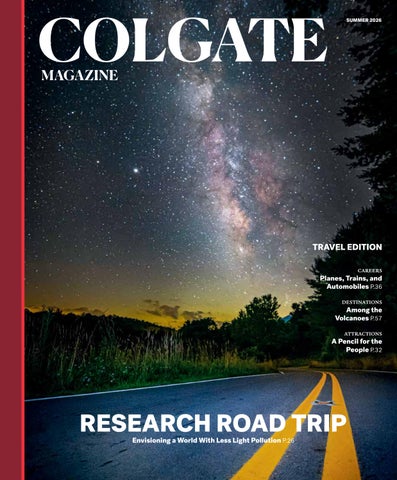

RESEARCH ROAD TRIP
Envisioning a World With Less Light Pollution P.26


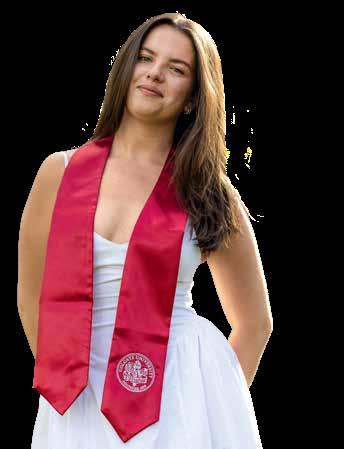
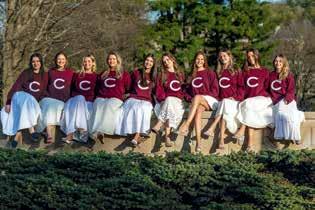
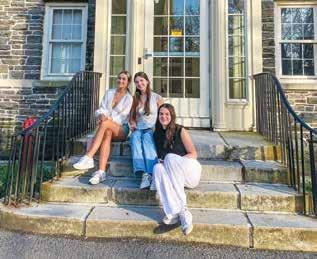
Rite of passage: The commencement Torchlight Procession marks seniors’ transition from students to alumni — a tradition they’ll revisit at reunion for years to come. look
Read
SUMMER 2026
Headspace
In his poetry book, Neurocabin, Brett Stuckel ’04 writes about the raw discomfort, heavy uncertainty, and surreal medical ordeal of having brain cancer.
Is Embarrassment a Necessary Condition for Growth?
Emma Hanlon ’27 suggests that it can be rewarding to look foolish sometimes.

Drawing a Line Through Time
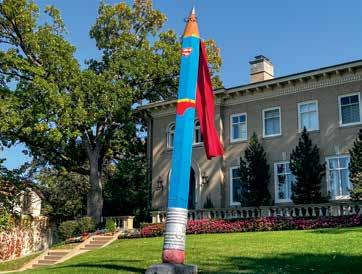
A Pencil for the People
John ’92 and Amy (Erickson) ’92 Higgins P’28 turned a fallen oak in the yard of their Minneapolis home into a civic celebration.
on the ‘Best Three Years of Your Life’
Upon graduation, Antonia Shannon ’26 reminisces about her time at Colgate.
A Colgate-led initiative aims to preserve
Gut Check
In two separate studies, Colgate researchers are exploring how the microbiome acts as a mirror to show what’s happening in the body.
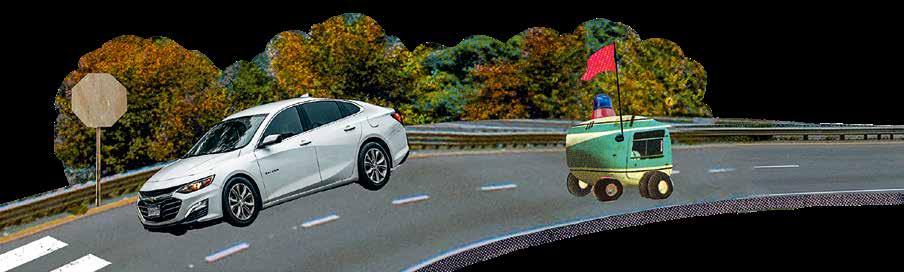
Planes, Trains, and Automobiles
From self-driving cars to zero-emission trains, alumni are on the forefront of the transportation industry.
Ally Song ’26, p.17
What They Taught Us
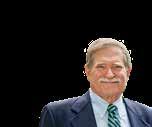
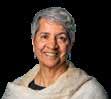
Alumni honor some of this year’s retiring professors by telling us how their mentors shaped their futures — and, in some cases, their children’s futures as well. 44


Dream Weaver
As creative director of Proenza Schouler, Rachel Scott ’06 is the first Black woman to lead a luxury fashion house and has developed a celebrity following with her own line.
54
The Elvis Effect
In her first book, Lili Rodriguez ’76 explores the world of Elvis tribute artists and the fans who love them.
56
Among the Volcanoes
For Steve Johnson ’93, what started out as a craft beer enterprise has expanded into a brewhouse and beach club in Guatemala.
57

Not Your Grandfather’s USO
A new series by Bob ’83 and Mack ’13 Woodruff sheds light on an 85-year-old organization.
59
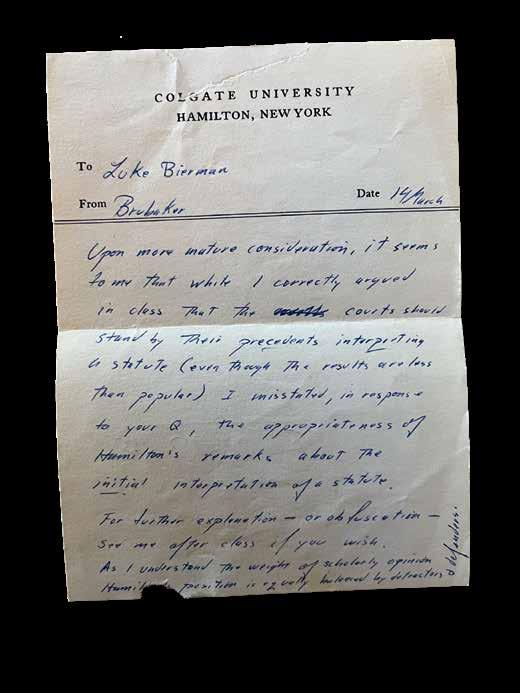

Read about the WWII letters of George Thomas ’45 as well as “The Many Lives of the Phi Psi House.”
Cover: This image was taken by Philip Kay, who is a contributing photographer in Professor Jeff Bary’s forthcoming book about people’s connections to the dark night sky. “This was the result of four years’ worth of attempts to get this photo,” Kay says, “due to weather conditions, fog, camera issues, and the alignment of the Milky Way core. If you miss the small window to get this shot, you have to wait until the following year for another chance. This image is looking due south to see the core of our home galaxy rising up over the horizon and in line with Highway 80 as it winds through the mountains of western North Carolina.”
Interim VP for Communications
L. Hazel Jack
Director of University Publications
Aleta Mayne
Assistant Director, University Publications
Mary Donofrio
Assoc. VP for University Communications Mark Walden
Senior Art Director Karen Luciani
University Photographer Mark DiOrio
Communications Specialist Kathy Jipson
Contributors: Kelli Ariel, asst. dir., web and digital platforms; Travis Clines, advancement communications mgr.; Stephanie DeVries, communications mgr., centers and institutes; Bernie Freytag, creative dir.; Dave Herringshaw, sr. digital production specialist; Garrett Mutz, sr. designer; Rodrigo Santiago, sr. mgr., communications and creative media; Amber Springer, web content specialist; Rebecca Taurisano, assistant dir., advancement communications
Printed and mailed from Lane Press in South Burlington, Vt. Colgate Magazine Volume LV Number 3
Colgate Magazine is a publication of Colgate University. Online: colgate.edu/magazine Email: magazine@colgate.edu Telephone: 315-228-7407
Change of Address: Alumni Records Clerk, Colgate University, 13 Oak Drive, Hamilton, NY 13346-1398 Email: advrecords@colgate.edu Telephone: 315-228-7453
Opinions expressed are not necessarily shared by the University, the publishers, or the editors. Colgate University does not discriminate in its programs and activities because of race, color, sex, pregnancy, religion, creed, national origin, ancestry, citizenship status, physical or mental disability, age, marital status, sexual orientation, veteran or military status, predisposing genetic characteristics, domestic violence victim status, or any other protected category under applicable local, state, or federal law. For inquiries regarding the University’s non-discrimination policies, contact Renee Madison, Title IX coordinator and vice president for equity and inclusion, 13 Oak Drive, Hamilton, NY 13346; 315-228-7014.
Christopher Ross ’10, p.102
Padma Kaimal Barry Shain
Linck Johnson
Stanley Brubaker
President’s Message
Notes From the Campus
AI Has No Weather
It has become something of an emerging conventional wisdom that the liberal arts might be among the strongest antidotes to the limitations — and temptations — of artificial intelligence. What is essential about a liberal arts education (judgment, discernment, inquiry, interpretation, and the work of learning how to think) is precisely what is missing from the polished paragraphs and instant summaries that can now be generated, in seconds, by Claude or ChatGPT.
I agree with that position. At Colgate we believe in the habits of mind formed by reading carefully, asking better questions, testing claims, arguing with evidence, and learning in the presence of others. These are not ornamental skills. They are the core of an education.
But the argument is incomplete.
The strength of a liberal arts college lies not only in its curriculum. It also lies in its place
At Colgate this is manifested everywhere and every day. It is there on arrival day, when families move boxes and lamps and too many belongings into residence halls, and when students first begin to understand that this hillside will become part of their lives. It is there on autumn afternoons, when students walk to class through changing leaves or gather at athletics fields. It is there in the beauty of Willow Path in the first, early snow. It is there on Broad Street, where students pass classmates, coaches, deans, and friends, and where the academic and social lives of the University constantly meet. It is there at Senior Sunset, when members of the graduating class gather one last time before commencement weekend begins and see, almost all at once, the arc of their years here.
These moments are not separate from a Colgate education. They are deeply part of it.
This is one of the great strengths of residential liberal
arts colleges and one that matters especially now. Places like Colgate are intentionally human in scale. Students know one another. Faculty members know students. The distance between a classroom conversation, a dining hall conversation, a walk across campus, and a late-night argument among friends is not very far. Social life and intellectual life do not remain neatly separated. They blur, and in that blurring, education deepens.
That may be one of the reasons the physical campus matters so much in this AI age. The campus is itself part of the education.
Artificial intelligence is astonishing in its ability to answer, summarize, and compose. But it has no weather. It has no hillside. It has no memory of a first-year student arriving with too many boxes, or of a senior standing with classmates at sunset, suddenly aware that four years have passed. It does not know what it means to walk through Willow Path in the snow, to recognize a professor crossing the quad, to linger after a seminar because the conversation has not quite ended, or to pass someone on Broad Street who, over time, has become part of one’s life.
So yes, the liberal arts curriculum matters profoundly in this AI age. It teaches students how to question, discern, and judge. But at a place like Colgate, those habits are strengthened by the campus itself: by its scale, its beauty, its rituals, its seasons, and the thousand ordinary encounters that make an education feel less like a transaction and more like a life.
Perhaps that is one of the quiet gifts of a residential liberal arts college now. It asks students to be somewhere.
And in an age when so much can be generated without place, without body, and without community, that may be one of the most powerful forms of education we still offer.
— Brian W. Casey
“Places like Colgate are intentionally human in scale. Students know one another. Faculty members know students. The distance between a classroom conversation, a dining hall conversation, a walk across campus, and a late-night argument among friends is not very far.”
Visit colgate.edu/ president.
Editor’s Letter
Dear readers, In the summertime when so many are vacationing, Colgate Magazine is celebrating the season of travel. We talked to alumni working in the transportation industry about prevailing topics like the unpredictability of flying, as well as what the future holds with self-driving cars and decarbonizing rail transit. We rode the memory train with alumni as they reminisced about traveling abroad with their favorite professors.

And in honor of the U.S.’s 250th anniversary, we’re taking you on a road trip through America, from seeing the Milky Way along the Blue Ridge Parkway to celebrating the sharpening of a 20-foot pencil in Minneapolis to meeting Elvis in Las Vegas. Abroad we talked to Darryl Nirenberg ’81, the U.S. ambassador to Romania; Steve Johnson ’93, owner of Cerveceria Catorce in Guatemala; and Bob ’83 and Mack ’13 Woodruff, who have a new docuseries about USO entertainment overseas. Meanwhile, some of our student-athletes have been representing the Raiders in other countries, such as women’s rowing in England. We hope you enjoy taking this tour from the comfort of your couch — or your beach blanket. Let us know what you think of the summer issue: magazine@ colgate.edu.
— Aleta Mayne
2026 Readership Survey Results
In the spring we sent a survey to readers via email. Here are the results:
1,296 responses
Gender: 56% male, 38% female, <1% nonbinary/transgender, 5% preferred not to say
Age: 44% 65+, 26% 50–64, 18% 35–49, 5% 25–34, 2% under 25
Race/ethnicity: 86% white, 9% other/prefer not to say/no response, 2% Asian, 2% Black, 1% Hispanic/Latino/Latina
Engagement: 65% read every issue, 23% read most issues, 10% read occasionally, 1% never read the magazine; 61% read exclusively in print, 30% read mostly in print, 5% read equally in print and online, 4% read mostly or exclusively online
Favorite article topics, in order: alumni endeavors, campus life, faculty activities, current students, research projects, fundraising
What do you like most about Colgate Magazine?
A sampling of comments:
→ I am the daughter of an alum, so the Scene (as I still call it) has always been part of my life. A year ago, I moved to a city 763 miles from my family and friends. So little was familiar here — even the junk mail was different. Then one day the Scene came through my
Letters
Campus Hot Spots
Enjoyed the sidebar (“’Gate Slang,” spring 2026, p. 19). Chob is all well and good, but we spent a lot of time at the previous Case Library snack spot, a room full of vending machines that was located in the belly of the building and went by the name Smoke & Coke. I guess we were allowed to smoke in there? And if you stopped in hoping to catch a glimpse of your crush, it was called by its other name, the Scope & Hope.
Anne “Milan” Geluardi ’89 Louvau
Another Colgate Character
The article surveying novels that feature Colgate (“An Enchanted Haven: Colgate in Contemporary Fiction,” spring 2026, p. 8) has added some interesting titles to my reading list. I wanted to point out an omission: Joyce Carol Oates’ 2020 novel, Night. Death. Sleep. The Stars. follows an upstate New York family in the aftermath of a tragedy. The eldest son, Thom, is a Colgate graduate with a degree in business administration and fond memories of Greek life. Oates also included a Colgate student
as a character in her short story collection Night, Neon Noah Benner-Potash ’15
What readers are saying on social media:
In response to “A Decade on the Hill” (spring 2026, p. 30) where President Brian W. Casey reflects on his first 10 years at Colgate: What an amazing decade it’s been! Ah, to be a Colgate student again.
Nazma Muhammad ’96 Rosado
Comments on “To Whom Much Is Given, Much Is Expected” (fall 2025/winter 2026, p. 40): What a wonderful read. So glad to know your story, Solomon (as a fellow alum and daughter of greater Buffalo, I’m glad that Buffalo IS where you landed, and can’t wait to check out your parents’ restaurant on my next visit home!).
Chrissy Hart ’05
So wonderful to see the skinny kid from class become this amazing young man!
Associate Professor of History Noor-Aiman Khan
mail slot, and I wanted to hug it. It was like a friend surprising me with a visit.
→ It is the main way I keep up with my school. I value it enormously.
→ The first thing I always read is the president’s letter. President Casey does not let the grass grow under his feet. We are blessed to have his leadership.
→ It is visually beautiful — captures the finest visuals from campus (touches the nostalgic heart, not just the brain).
→ I like that it’s in print. I consume all my other news online and appreciate the break!
→ It is the tangible embodiment of what I love about the school.
→ I love showing my kids the cool things that alumni are up to.
→ It’s arguably the best piece of snail mail I get. Perfect blend of nostalgia and keeping me informed about the Colgate community. Please continue investing in this robust, print alumni publication. We received several comments expressing concern that this survey was conducted because the print publication is in jeopardy, so we want to assure readers that our motive was only to hear readers’ feedback. Thank you to those who participated.
Illustrations by Oliver Weiss
Voices
Lying on a table sideways, with a flap of his skull open, Brett Stuckel ’04 conversed with a resident sitting on the floor at Penn Medicine.
Stuckel was answering the resident’s casual questions about life and travel, as though they were two acquaintances at a café rather than a patient and doctor in a sterile Philadelphia hospital room.
poetry
Headspace
In his book, Neurocabin, Brett Stuckel ’04 weaves the raw discomfort, heavy uncertainty, and surreal medical ordeal of living with brain cancer into poignant verse.
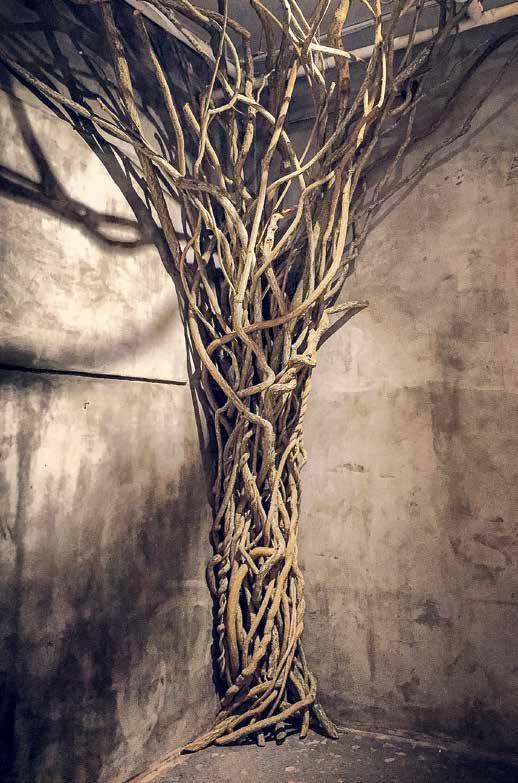
“Those vines are technically poisonous, but they have been sculpted into a beautiful work,” Stuckel says of the sculpture that became the cover image for Neurocabin. It represents “a bit of optimism out of a horrible situation.”
It was two days before the new year — Dec. 30, 2019 — and Stuckel was undergoing a craniotomy to have an egg-sized tumor removed from his brain.
“The surgery was in the left temporal lobe, the language center, which is the reason they want you awake and communicating,” he explains.
“It was wild … a liminal, never-hadit-before, hopefully never-have-it-again experience.”
His brain cancer first made its presence known on Nov. 25, 2019, the Monday before Thanksgiving. It was almost 5:30 p.m. and Stuckel was having an end-of-the-workday conversation with his boss at Thermo Fisher Scientific, where Stuckel is a technical writer in biopharma services.
As he writes in his new poetry book, Neurocabin, he “couldn’t dig up name of boss’ boss, showed headshaking escalating freakout” — Stuckel was having a seizure.
Besides a hospital, his office was the next-best place for the event to happen because the company, which packages and stores pharmaceuticals, has a rapidresponse team on-site for medical emergencies. “I was really lucky to be there when everything hit.”
They rushed him to the ER and he spent three days in the hospital; following the surgery in December, he started proton radiation in February 2020. In the poem “33 sessions,” Stuckel writes: “and I wait, alone, for the zap of protons, and I see blue laser spaghetti / the stitch changes with every shot, and I smell it / passing through plastic, the mask, pulling the horn of the nose in wet-knotted brain / or see avalanche rainbows rise from the floor of my eyelids.”
Stuckel has long been a writer. At Colgate, the psychology major took a poetry class with Professor Peter Balakian and wrote for the Maroon-News and the student literary magazine, Portfolio. He attended the Colgate Writers’ Conference in 2016 to workshop some of his flash fiction. Professionally, he’s done technical and grant writing, and he’s had his poetry, chapbooks, and flash fiction published.
Through the University of Pennsylvania’s Writing a Life program at the Abramson Cancer Center — which he discovered
Charlie baker (sculpture); Petra Somers (Stuckel)
while going to a radiation appointment — he found a supportive community and creative outlet for processing his feelings around the experience. “Writing a Life showed me that when I need to vent or deal with whatever emotion of the day this is bringing up, writing is a fantastic way of doing it,” Stuckel says.
He honed his skills through the program, led by cancer survivor and now-retired UPenn English Professor Deborah Burnham, as well as by working closely with poet Jane Huffman, whom he met through the Twitter lit community. His work started getting picked up by niche publications like Magnets and Ladders, a literary magazine “showcasing the voices of writers with disabilities,” and Rogue Agent, “a journal for work that inhabits the body.”
The positive responses “encouraged me to keep going and focus on the book,” he says, adding, “cancer gives the fear of impending doom. I felt like there was this clock ticking and [I had] to get something together before I die.”
Stuckel submitted copies of the book to only seven publishing companies, and Spuyten Duyvil — a New York City indie publisher — responded quickly. The editors wrote in their acceptance letter: “The SD team was cored out by this courageously compelling work and would be honored to publish it.”
Neurocabin is centered around his experience with brain cancer but, he says, “[it] goes beyond just talking about cancer and tries to address the questions that cancer raises in all of us, [like] questions about time.”
Having finished chemotherapy in mid-2021, Stuckel gets scanned every three months for signs of recurrence — a process he’ll endure for life because brain cancer is rarely, if ever, considered to be in remission. Side effects from the surgery and radiation, such as dysphasia (impairing his speech) and memory impairment, also persist.
“You’re not going back to the person you were before,” he says.
Still, through the book, he hopes for “a bit of optimism out of a horrible situation” — a message he aims to convey through the cover art. The sculpture, created and photographed by his friend Charlie Baker, is made from invasive bittersweet vines. “[It represents] a lot of the experience we deal with with cancer, where so many cells are dead or at risk,” Stuckel says. “Those vines are technically poisonous, but they have been sculpted into a beautiful work.”
The following poems from Neurocabin represent two points along his journey.
Wish
Cancer in a starlike cell wiggles, chasing health,
while octopushing on the love of dark almond chocolate,
the programmed foot on a Hyundai’s pedal,
the pillow’s massage that sinks the brain from ears and eyes
to a dream that fires the accreted career,
fills walls with the neighbor’s clanking babybath,
issues a locker on concrete floor.
Greed for the good is good, said a star-stealer
poking peace into retreat, leaving only the mission
to find it, sneak it back inside the curling lines of lobes
before a twinkle slithers.
Catalogue
I need a gray wool hat to hide the question-mark scar that curves around my words and drops below my sideburn.
I like every person smiling at me and the world I forget to smile at, and I like their promise of thirty percent off because I want every bit possible off the shelves and balance sheets of the skull.
I want to worry about clothing and whether to buy shirts designed to be worn untucked or not, to return to worries that stem from how to spend and when to wear new hats and not what’s growing underneath.
Is Embarrassment a Necessary Condition for Growth?
By Emma Hanlon ’27
In a recent interview, actor Austin Butler discussed overcoming embarrassment and embracing authenticity. In an unlikely place — while dancing at a party — Butler received advice that has stuck with him throughout his public-facing career.
“Somebody very close to me … said ‘embarrassment is an under-explored emotion, go out there and make a fool of yourself,’” Butler recalled. “Just go for it. Feel that feeling — that feeling of cringe — and go out there and do it. Everything you want is on the other side of that.”
At first, I thought the idea seemed counterintuitive, if not absurd. Many of us — myself included — spend a lifetime trying to avoid embarrassment. I knowingly curate the version of myself that others experience, especially in moments that feel vulnerable or uncertain — defaulting to a version of myself that feels easier to like. But what if embarrassment is a necessary condition for growth?
I ask this question as someone who is easily embarrassed. From spilling a salad onto a new outfit to stumbling over my words in class, I have a mental highlight reel of moments I would prefer to forget. In reality, these incidents are small and fleeting, but in the moment, they carry an oversized weight. These were times I found myself wishing for a Harry Potter–style invisibility cloak.
Butler speaks of a different kind of embarrassment, though. He’s referring to moments where we hold back — creating more palatable yet duller versions of ourselves.
His comments made me think about how we protect ourselves from embarrassment. I realized that embarrassment is actually vulnerability in disguise — it doesn’t feel noble or poetic in the moment. To be embarrassed is to be seen fully, imperfectly, and without control. And yet, the discomfort that accompanies embarrassment often signals that something important is at stake,
whether it be our image, our relationships, or some personal risk.
For college students, especially those of us at a small liberal arts college, dating can be where feelings of embarrassment are most paralyzing. When connecting with someone new, there’s no script to follow. We can’t control how they feel about us — but we certainly try to control how they perceive us.
In a way, encouraging people to go out and embarrass themselves is at odds with the nonchalance epidemic that dominates today’s romantic culture. We’re told to play it cool or hide our feelings until they can be revealed perfectly. But that “cool” exterior often comes from the fear of looking foolish — or more accurately, a desire to protect our pride.
Dating, or asking someone out, inherently risks embarrassment. It’s having
the courage to show someone you like them before knowing if they’ll ever like you back. And down the line, it’s allowing someone to see “foolish” sides of you. It’s an admirable yet scary risk to seek an intimate connection.
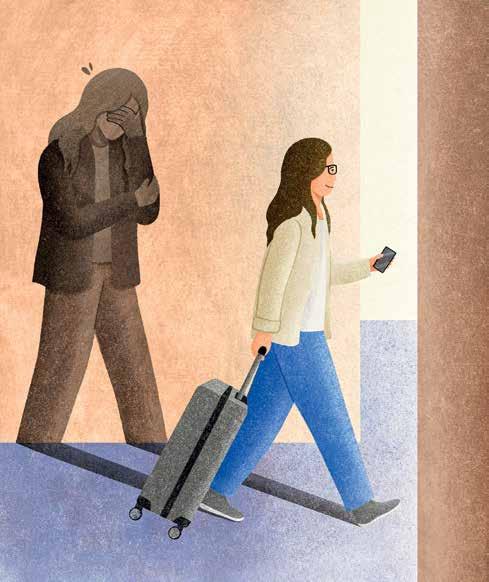
I was once standing at baggage claim next to someone I had noticed on my flight back home from studying abroad. We spent all day in the same places without ever acknowledging it, and it started to feel too coincidental to not say something. After staring at our suitcases, I worked up the courage to point out our matching carry-ons — both aggressively orange. While waiting for our bags, we discussed our college experiences and ended up debating our favorite Christmas movies. He was easy to talk to in a way that felt rare.
When my suitcase finally came around, I
stubbornly insisted I could grab it myself. As I reached for it, I could feel him watching, and I suddenly became hyperaware of myself. I began to panic: The bag was heavier than expected, and I was struggling to keep up with the moving conveyor belt. I should have just let him help me. Instead, once I finally got it down, I laughed it off and admitted, “That was embarrassing.”
As we started walking out, I thought about asking for his number — he lived near me, it seemed too coincidental. There was a moment where it would have made sense, but I held back. I didn’t want to taint the memory in my head by risking awkwardness. It felt safe to end the exchange as easily as it had begun.
When we exited baggage claim together, our parents appeared almost simultaneously, running to pull us into hugs. We made eye contact in a brief moment of mutual realization. And then it was over.
This is where Butler’s advice becomes less absurd and more practical. When he prompts his audience to “make a fool of yourself,” he isn’t encouraging recklessness or humiliation for its own sake. Instead, Butler emphasized that embracing embarrassment will allow us to put ourselves out there confidently and authentically. Ultimately, it’s about developing a tolerance for discomfort and recognizing that embarrassment can be a sign of growth.
At its core, embarrassment is about letting go of control. It happens in the moment where you can’t manage how you’re seen; it’s where the carefully constructed version of yourself slips. But, letting the veil fall and relinquishing your grasp on tailored impressions is exactly what Butler is suggesting.
Then, embarrassment doesn’t become something to avoid. Instead, it signals that we’re abandoning curated versions of ourselves — even if it’s just for a moment — and stepping into something more honest. In a society that associates perfection with connection, we often forget that it’s actually the imperfect and unscripted moments that bring us closer together.
Reflecting on the ‘Best Three Years of Your Life’
By Antonia Shannon ’26
any seniors, including me, find ourselves reflecting on the past four years at Colgate before graduation. A phrase that gets tossed around a lot here is “Colgate is the best three years of your life,” and I would have to agree with that. At a school where being a first-year is uniquely hard, Colgate makes up for it in the subsequent three years.
A lot of the things we complain about are the things we’ll start to realize we will miss the most when we leave campus. We complain every winter about the weather, dodging patches of ice and trekking up the hill in blizzards. (Central New York winters never quite get easier.) We complain about the distance from “civilization” and how little we have in Hamilton. We get annoyed about how far the airport is and how challenging it is to get there.
And yet, with the calendar winding down, we start to reminisce about Willow Path after a snowstorm, the picturesque fields that surround us, and the value of living in a small town like Hamilton.
necessarily been the
This article was originally published in the Colgate Maroon-News, of which Emma Hanlon ’27 is head editor of “Baker’s Dozen.” Hanlon is from Averill Park, N.Y., majors in political science and economics, and is involved in the Colgate Dance Team.
college experience that my 17-year-old self had pictured, but I can tell you without a doubt that it’s the one I am glad I ended up with. I expected to be at a big state school in some warm climate, so it wasn’t an easy decision to make when I chose to ultimately lean into the Colgate experience. But it is a decision I constantly thank my past self for.
The last few years on one of the most beautiful campuses in the country, with the people I find myself surrounded by, is something that I wouldn’t trade for warmer weather, easier access to a major city, or an additional few thousand undergraduate students. There is something about the way Colgate students love college that I haven’t heard in stories told by high school friends, and we are lucky to have that experience here. A lot of the reasons why we have such a tight-knit campus and school pride come from a lot of the things we complained about throughout our time on campus.
So, students: I urge you to take a little longer walk to class, stroll around the golf course and enjoy the scenery, and reflect on what might end up being some of the best years of your life. We have a lot to be grateful for from this school. These things that we probably take for granted every day here will be some of our favorite memories.
Antonia Shannon ’26 hails from Winnetka, Ill., majored in political science and religion, and will attend the University of Edinburgh for a master’s in religious studies. This article originally appeared in the Maroon-News.
SCENE
Commencement
‘Soul, Love, Joy, and Taste Will Matter Even More in the Future’
At Colgate’s 205th Commencement, keynote speaker Ole Obermann ’93, global head of Apple Music, told the Class of 2026: “Your personal relationships will become even more important in the future.” He expressed hope that, alongside the knowledge
graduates have gained at Colgate, they can also take with them human connections, chance encounters, and serendipitous classes that no algorithm or artificial intelligence could provide. “And Colgate has prepared you very well for that,” he said at the May 17 ceremony. “Colgate attracts and trains great minds with an extraordinary ability to interact with others. Make sure you connect the dots that Colgate puts out there for you.”
Calling attention to the transformations that will accompany the expansion of artificial intelligence, Obermann maintains a belief in the importance of human imagination and experience.
“There is a growing sentiment that AI can take over creativity as stories, scripts, songs, and designs become automated,” he said. “I feel exactly the opposite is true. Soul, love, joy, and taste will matter even more in the future.”
In remarks the day before at the baccalaureate service, University President Brian W. Casey stressed the lifelong importance of addressing the question “What are you committed to?” Casey explained the significance of the query by specifying that “a commitment is different from a preference, which can be lightly held, and it is different from a plan, which often changes. A commitment asks something of us. It’s deeper somehow. It can hold you steady
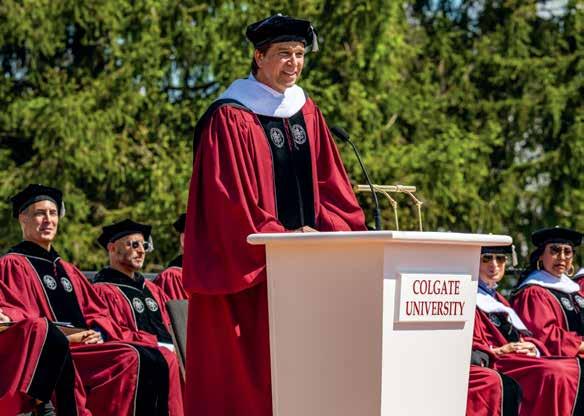
when the next step is not yet visible.”
Such positions, he further noted, arrive in a variety of forms and at unexpected junctures, for “part of the wonder of life is that our commitments can emerge and deepen over time. Some are chosen. Some are discovered. Some arrive through loss. Some arrive through love. But I hope Colgate has helped you begin to know yours.”
Also addressing the class at the May 16 service, journalist Ann Curry — who was awarded an honorary doctorate at Sunday’s commencement ceremony — encouraged the class to find sources of consolation amid life’s inevitable chaos. “I encourage you to collect your own consolations,” Curry urged the graduates. “Choose what most resonates with you. Keep them close…. They will grow. And you might well find you can breathe easier during your worst of times and feel inspired toward your best of times.”
— Katie Child
Commencement speaker Ole Obermann ’93 created a playlist of 13 songs for the graduates on Apple Music: apple.co/4xJVEBo
Class of 2026
→ 767 undergraduates earned a bachelor of arts degree
→ 9 awarded a master of arts in teaching, four with distinction
→ Valedictorian: Peter Flynn McGrath of Washington, D.C.; summa cum laude, physics major and German minor; high honors in physics; elected to Phi Beta Kappa
→ Salutorian: Andrew Reinhard Hatfield of New York, N.Y.; summa cum laude, economics major and computer science and mathematics minors
→ 33 elected to Phi Beta Kappa
→ 168 summa cum laude
→ 257 magna cum laude
→ 140 cum laude
Ole Obermann ’93
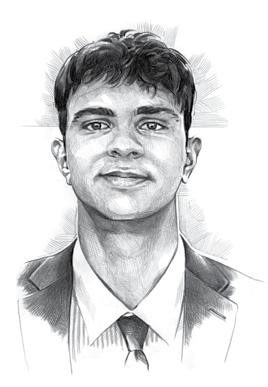
This year’s graduating class included Sohail Nabi ’26, who tragically passed away in a kayaking accident in the Adirondacks the weekend
before graduation.
Nabi was the first graduate recognized in the commencement ceremony. His academic adviser, Maura Tumulty, professor and chair of the Department of Philosophy, accepted the diploma on his behalf.
Classmates and other members of the campus community reflected on Nabi’s life in a candlelight vigil held in Memorial Chapel a few days earlier.
Nabi was a political science and philosophy double major from Yonkers, N.Y. One of his professors, David Dudrick, the George Carleton Jr. Professor of philosophy, spoke of Nabi’s kindness and sharp wit in the classroom. Dudrick, who received a Torch Medal from Nabi, said he struggled with the words to describe him, but always landed on the word “sweet” for a gentle
young man who seemed to always be thinking. “I had the privilege of having Sohail in four classes. Sohail’s philosophical thinking informed his life. His interest in philosophy was deep, abiding, and also sincere. Sohail had a philosophical spirit,” Dudrick said.
President Brian W. Casey added, “Sohail represented Colgate at its very best. He was curious. He was kind. He wanted to make the world a better place, truly. It’s heartbreaking that he will not have the opportunity to contribute all that he could have to his family, to his friends, to his community and beyond. But he certainly did make Colgate a better place while he was here among us. I will miss his gentle smile in Lawrence Hall, or [seeing him] walking across the quad, always thinking.”
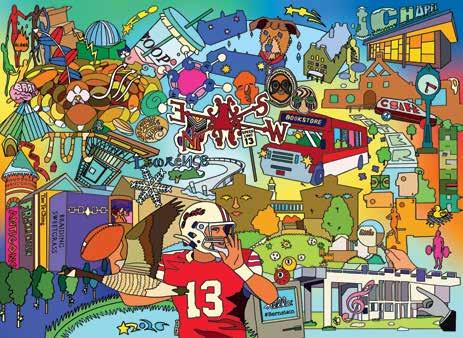
How many can you find?
Check your answers at colgatemagazine.com.
There are more than 40 Colgate landmarks represented in this illustration by Xinjian Qiu ’27.
Qiu, a physics major and studio art minor, left Colgate in May to continue his education at Columbia University through its 3-2 engineering program. “Each semester, I’ve created a series of highly saturated illustrations to document and reflect on new
Bernie
knowledge I’ve learned and new experiences I’ve encountered,” he says.
“As I [was preparing] to leave Colgate, I wanted to use that same visual language to preserve my memories of campus and create a personal farewell piece.”
Qiu gave prints of the illustration to some of his professors as a thank-you.
“I had always hoped to become a campus tour guide, but with limited time outside of classes, I never had the chance,” he adds. “In a way, this project became my own version of that — an opportunity to guide new students and visitors through Colgate, but through my own artistic perspective.”
1
Harshitha Talasila ’26 and Robert Patch ’26 each received this year’s Colgate University Alumni Corporation 1819 Award.
2
Women’s volleyball played teams in Austria, the Czech Republic, Italy, and Slovenia in May.

3
Incoming first-year Samuel Lyne represented Great Britain in the 2026 International Ice Hockey Federation Men’s World Championship in Switzerland.
4
A summer faculty/staff meditation series was offered by University Libraries.

5
Tracey Hucks ’87, MA’90, Harvard professor, was elected to the American Academy of Arts and Sciences.
6
Catherine Chen ’26 won the 2026 James Harrison Steedman Memorial Fellowship in Architecture, receiving $100,000 for international travel and research.
Illustrations by Bruce Morser ’76 (Nabi); Xinjian Qiu ’27 (Map);
Freytag (13 Bits)
7
Professor of Art Elizabeth Marlowe is part of the 2026–27 cohort of Getty Scholars to do provenance research.
8
Career Services was awarded the 2026 National Association of Colleges and Employers Excellence Award for its innovative approach to teaching networking.
9
Treyvhon Saunders ’26 signed an NFL undrafted free-agent contract with the Houston Texans.

10
The Colgate libraries joined an inaugural cohort of 19 university libraries in signing a Statement of Shared Practice on AI and Archives.
11
Varsity men’s rowing finished first at Dad Vail Regatta.
12
Folk musicians Jake Xerxes Fussell and Sam Amidon played at the Palace Theater in late April.

13
Professor of Educational Studies
Mark Stern received the 2026 Balmuth Award for Teaching.
Picker
Student Curators Mark the Semiquincentennial
Glancing around the corner of Dana Arts Center’s second-floor gallery, panels of red, brown, and blue stood out against white walls and concrete. They were interrupted by flashes of color from clustered artworks and by bright white headings like “These Self-Evident Truths?” and “We the People.” The White House demanded attention in the vibrant Zombie Nation Herd Immunity by Frank Buffalo Hyde, while Andy Warhol’s black-and-white screenprint of a civil rights protest beckoned visitors to the back. A supersized passage from The Declaration of Independence erased any doubt: This exhibition was about America.
The introductory text was structured like a letter, with the exhibition’s title styled as the signature and its subtitle as postscript: Talk soon, America: letters to a land of promise and paradox. But the exhibition’s wide range of artwork and subject matter assured visitors that while it may be America’s semiquincentennial, this letter is still being written.
Like museum curators across the country, the seven students in Nicholas West’s MUSE 300: Museum Curating class were given the task of creating an exhibition related to this anniversary. They started the semester with online exploration of Picker Art Gallery’s collections and those of the Longyear Museum of Anthropology. Picker’s collection alone contains more than 11,000 items, making it challenging to narrow down which works to include.
The resulting collection of artwork was organically
multimedia, with a broad mix of paintings, prints, photos, and sculptures. The tone of the pieces also varied.
“When we were putting together the exhibition, we didn’t want it to be primarily just critical or just a celebration,” says Brooke Vena ’28. For example, Julia Bihari ’27 used Fritz Eichenberg’s Subway to contemplate immigrant experiences and the bringing together of people from different walks of life, while Vena’s label for Peter B. Jones’ Another Broken Treaty emphasized the suffering experienced by Indigenous communities.
This juxtaposition was characteristic of the exhibition as a whole. A few steps past the introductory text hung a painting of the USS Constitution by Lee Brown Coye, and nearby, the words “liberty is not anarchy” jumped out from an engraving by cartoonist Thomas Nast. While these works depict 19th-century events, the exhibition was quick to note that America’s story started long before then. Those framed works were immediately followed by sculptures from contemporary Indigenous artist Cannupa Hanska Luger. In Rounds, Luger transforms 18 ceramic bullets into miniature works of art.
Just among the W’s, artists as distinct as William Earle Williams, Carson R. Waterman, Cosmo Whyte, and Brett Weston were put in conversation with each other. But the exhibition went a step further.
“We thought it would be interesting if we also asked our viewers to participate,” says Salem Sokpoli ’26. “That way, they could feel like they were a part of the story we were telling.” At the heart of the gallery, handwritten letters hung from a triple clothesline. In this section, titled “Dear America…,” museumgoers were invited to “Write your own letter to ‘America’ — not as a single definition, but as an idea, a place, a history, and a set of lived experiences that continue to unfold.” Like the curated works, these attendee letters contained hope for the future but didn’t shy away from the painful experiences of many Americans past and present. Many letters mentioned inequality; most were conflicted and full of questions; some talked about home; one youthful scrawl quoted from the musical Hamilton
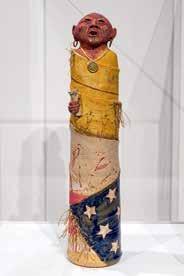
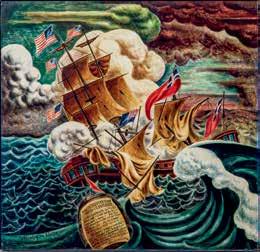
Above: Another Broken Treaty, Peter B. Jones, 2010; Left: The Constitution and the Guerriere, Lee Brown Coye, 1942
“We didn’t want it to come across as an afterthought because I think one of the most important parts about this exhibition is not forcing, but encouraging the visitor to reckon with their own thoughts of America,” says Vena.
The exhibition opened Feb. 12 and ran through May 3. Since the start, Vena relished seeing more letters appear every week, including those from a middle school field trip. “It makes me so happy to see that people are really engaging with the concepts that we have [presented].”
Engagement was also a key theme for Bihari. “I want to make history something that’s meaningful for everyone,” she says, emphasizing the need for this exhibition to also be accessible to the broader regional community beyond Colgate.
“I want people to leave feeling like they have learned something, they have considered something, but that there is hope and there is a chance for them to impact their communities,” Bihari says. “And I don’t want people to leave thinking America is just one entity.”
Nor were the students of MUSE 300. The group came from a variety of disciplines, counting several museum studies minors, art history and history majors, and even a neuroscience student.
“I’ve done work at Picker in the past because I’m a gallery attendant,” says Vena. “But being able to get on the inside and learning more about the process of how exhibitions come to fruition was really valuable.”
After learning to write succinct, informative labels, honing their eye for details like paint color and typeface, and discussing themes from patriotism to inclusivity, the students will enter all future exhibitions with a more critical and curatorial eye.
“I’m definitely going into museums with more gratitude and with more inspiration to work in the museum field,” says Sokpoli.
— Acadia Klepeis

Crafting Climate Awareness
More than 30 crafters from across campus and the community created “tempestries” to highlight the yearly temperature changes for significant dates in Colgate’s history for a Longyear Museum of Anthropology exhibition this past spring.
Tempestry: The Art of Climate Data featured crocheted and knitted tempestries of local climate data from 1913 to the present. The Colgate Tempestry Project was a yearlong collaboration between Entrepreneurship and Innovation, the Environmental Studies Program, the Residential Commons, University Museums, and the Center for Women’s Studies, as well as various other Colgate students, faculty, staff, and alumni.
Professor of Geography Mike Loranty and Assistant Director of Sustainability Julia Sparks organized data collection for the project, using daily temperatures from the National Oceanic and Atmospheric Administration, with additional data from
Weather Underground and local weather stations.
In addition to the tempestries, the exhibition featured photos of crafters working on their projects as well as a “Climate Pledge Tempestry” where visitors could contribute to a tempestry made up of different yarn colors representing a personal commitment to various sustainable actions.
The Longyear Museum hosted an opening reception and arts networking hour on April 10 as part of Arts, Creativity, and Innovation Weekend on campus. The opening was also a part of Colgate’s annual celebration of 13 Days of Green, hosted by the Office of Sustainability.
The exhibition was part of a broader initiative developed by the Tempestry Project, founded by Asy Connelly and Emily McNeil, who visited campus for an environmental studies brown bag in September to kick off a version of the project at Colgate. They shared the history of the initiative and gave attendees a chance to view
Residential Fellow Marissa Bordonaro ’24 an opportunity to combine her love of crafting with her passion for climate awareness and sustainable practices. Bordonaro hosted workshops throughout the fall and early spring for students and others on campus to work on their projects. “One of the most fulfilling parts of crafting for me is the community I have been able to connect with,” Bordonaro says. “Sharing the practice and knowledge of crafting has a special kind of magic to it. Through the workshops, I was able to connect with, learn from, and even teach dozens of crafters, all working toward the common goal of turning data into artwork for climate awareness.”
Jessie Farrell ’24 says she believes art is a reflection of society and community, and can also help to shape both. “We can all look up climate data over the years, but it is different to spend hours knitting a tempestry, changing out colors each row, and watching the data unfold,”
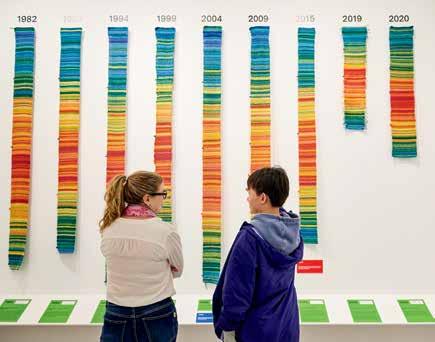
examples of finished tempestry pieces. Crafters from around campus and in the community began work on their individual tempestry projects last fall.
The project gave Senior
Farrell says. “Knowing my piece will hang alongside others, each made with the same care, reveals our shared connection to this place and our environment.”
— Stephanie DeVries
Longyear
Course
How (and Why) to Buy a Work of Art
Sixteen Colgate students, one professor, and one museum director travel to New York City with a budget of $8,000. Their mission? To acquire a work of art for Colgate’s Picker Art Gallery collection. Which one will they choose?
The project was part of Professor Elizabeth Marlowe’s ARTH/MUSE 254: How (and Why) to Buy a Work of Art, a new class that introduces students to the many considerations — from the aesthetic and ethical to the pedagogical and financial — that shape museum decisions about which works of art to acquire.
“This is a highly unusual class with a strong experiential learning/authentic assessment component,” says Marlowe. “Thanks to the generosity of the Hilda and Oscar Lasdon Art Acquisition Endowment, established by Elizabeth S. Lasdon ’76, our students are learning by doing.”
The students spent the first eight weeks of the spring
semester preparing for the trip to New York City. They visited printmaking classes and met art dealers and artists via Zoom during class. They also worked closely with Nicholas West, codirector of University Museums and curator of the Picker Art Gallery, to understand the strategies and vision behind the museum’s collection.
“We learned that a key priority is selecting work that can engage a broad and diverse audience across campus,” says Norah Hendrickson ’27. “Many students aren’t familiar with the Picker, so choosing pieces that can resonate beyond art-focused audiences, like those in STEM fields, can help demonstrate how relevant and accessible art can be.”
On the weekend of April 11–12, the class traveled to Manhattan and Brooklyn to attend the International Fine Prints and Drawings Association Print Fair — the largest art fair in the world dedicated to prints and drawings — and the Brooklyn Fine Art Print Fair, respectively.
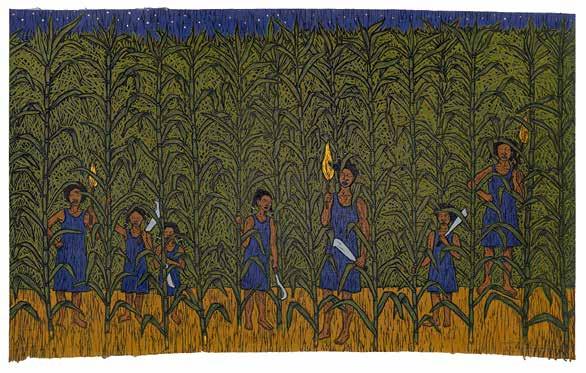
← Alison Saar, 2025, Razin' Cane II [24/24]. Linoleum cut and screen print on vintage sugar sack, 19 5/8 x 30 1/4 inches. Printed and published by Tandem Press. © Alison Saar
Sustainability
Numbers That Matter
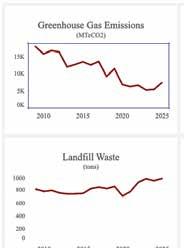
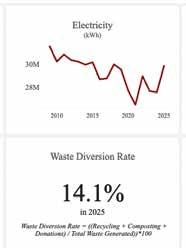
The Office of Sustainability has launched an online dashboard that displays a series of metrics, including Colgate’s greenhouse gas emissions, electricity and water usage, and composting efforts.
“The more informed we are, the more sophisticated our program is and the better off we are as a campus,” says Associate Provost for Sustainability John Pumilio.
“At first, I was definitely nervous talking to the vendors,” says Oscar Brown ’26, “but then after realizing just how excited they were about our interest and knowledge, I never wanted to stop.”
The students compiled a shared wish list of approximately 40 of their favorite pieces and then spent the final weeks of the semester narrowing the list down to four. They worked in teams to prepare acquisition proposals for each of the final four artworks.
On April 30, each team pitched its proposed artwork to an audience of more than 125 Colgate community members in an event the students named Art Tank, which concluded with a vote. The winner: Razin’ Cane II, a linoleum cut and screen print on a vintage sugar sack by contemporary artist Alison Saar.
Salem Sokpoli ’26, a member of the team of students who delivered the winning pitch, says, “I am very excited about the many different ways the Colgate community can and will engage with the piece.”
— Jasmine Kellogg
To that end, the office recognized that it needed to find better ways to make its data visible and accessible. With 18 panels of information, the new dashboard helps to raise awareness by quantifying Colgate’s success in its sustainability efforts. It paints a picture of the overall decline in greenhouse gas emissions as Colgate electrifies its campus. It also points out yearly fluctuations, which can be related to weather or campus infrastructure upgrades like the on-campus heating plant.
From forestry management to transportation and green buildings, “we have moved forward on many different
Donor Elizabeth Lasdon ’76 just celebrated her 50th Reunion
fronts all at once,” Pumilio says. “When you collectively look at the whole program, we have become a leader in higher education, not because we’ve done one major thing, but because we’ve done dozens of things well.”
The University achieved carbon neutrality in 2019, and it has continued to look for areas of improvement — a task that becomes more challenging each year. The Office of Sustainability is now in the process of updating its Sustainability and Climate Action Plan, a strategic road map for advancing Colgate’s sustainability efforts as the campus continues to decarbonize and build climate resilience.
Broader information sharing is one goal in the forthcoming plan, and the dashboard is the first step toward achieving the objective. “Hopefully, the dashboard will inspire additional questions and conversation,” Pumilio says.
The site is designed to be updated annually — as ever, the Office of Sustainability is intent on ensuring that progress made today in all of its initiatives can be built upon by future staff and administrators.
“It’s something that has to endure beyond a single professional career, a single presidency, a single plan,” Pumilio says. “The real challenge is building systems, cultures, and commitments that persist over many, many years. That continuity is what ultimately creates lasting impact and a really strong program over time.”
— Emma Hanlon ’27
Lacrosse
Drouin Joins the Atlas
The New York Atlas signed undrafted rookie Hunter Drouin ’26 early in the 2026 Premier Lacrosse League season. He is one of six rookies on the 27man roster and is the only rookie attackman on the team.
“Getting picked up by the Atlas was a dream come true,” says Drouin. “Putting on all the gear for the first time didn’t feel real. There are guys on this team who I idolized growing up, and now I get to call them teammates.”
At Colgate, he was team captain and one of the most decorated players in program history. At the conference level, he was a two-time First Team All-Patriot League selection (2024, 2025), a Second Team AllPatriot League honoree in 2026, a member of the 2026 Preseason All-Patriot League Team, a 2026 Patriot League Offensive Player of the Week selection, and a 2026 Academic AllLeague selection.
He finished his collegiate career having appeared in 58 games with 53 starts, totaling 105 goals, 53 assists, and 158 points while adding 17 man-up goals, two game-winning goals, 89 ground balls, 208 shots on goal, and 12 caused turnovers.
Nationally, Drouin earned All-America


In June four former Colgate women’s hockey players were drafted in the 2026 Professional Women’s Hockey League (PWHL) draft:
• Casey Borgiel ’26 was selected 22nd overall to PWHL Detroit, joining former Raider Sydney Bard ’24.
• Elyssa Biederman ’26 also went to a new expansion team after being selected 30th overall to PWHL Hamilton. Biederman reunites with
honorable mention recognition from Inside Lacrosse, the United States Intercollegiate Lacrosse Association, and USA Lacrosse in both 2024 and 2025, while also receiving honorable mention honors from Nike Lacrosse Media in 2025 and 2026. Prior to
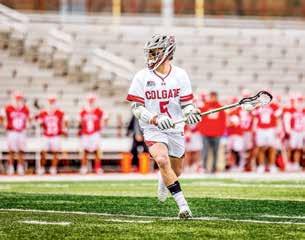
his senior season, he was named a USILA Preseason Third Team All-American, earned preseason All-America honorable mention recognition from USA Lacrosse and Inside Lacrosse, and was selected to the Tewaaraton Award Watch List. He also earned a spot on the USILA Division I National Team of the Week during the 2026 season.
“At Colgate I was able to play against some of the most talented and competitive players in the country,” says Drouin. “All those days have prepared me for my pro career, and I am forever thankful for Colgate.”
— Ashley Hudak

Kayle Osborne ’24 and Allyson Simpson ’24 in Hamilton, Ontario.
• Alexis Petford ’26 heard her name called with the 53rd pick and she is headed to PWHL Las Vegas.
• Neena Brick ’25 was the final Raider selection with the 59th pick in the draft by the Ottawa Charge.
Colgate’s four selections are the most for the Raiders since the 2024 draft and the third-most in the ECAC.
Hockey
Four Raiders Drafted Into PWHL
Brick Borgiel Petford Biederman
Rowing Finishing the Season With a Landmark Trip to England
For the first time since 2000, women’s rowing headed abroad, to England where they competed in the Reading Amateur Regatta and the Women’s Henley — considered the pinnacle of women’s rowing.
Nineteen teammates spent two weeks across the pond, beginning June 8, rowing on the River Thames and sightseeing. The Raiders
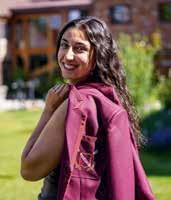
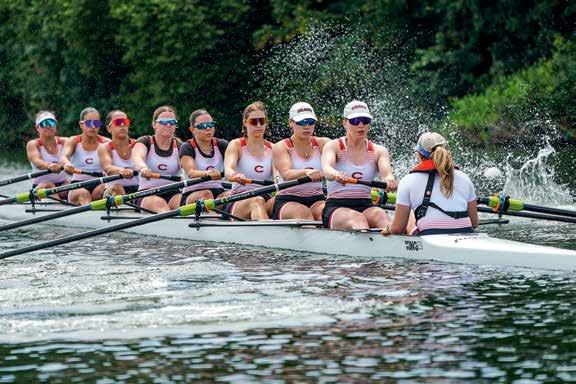
brought two eights’ worth of rowers and two coxswains, plus a spare rower.
The three-day Henley features a 1,500-meter race that cuts through the most iconic stretch of the River Thames. “The race format is knockout dual racing, with the winning team advancing until only one team stands as the winner,” Head Coach Jim Lister explains.

Henley — founded in 1988 to provide an international racing regatta for women — draws more than 2,000 rowers from the U.K. and the world each year. “The town is getting busier by the day as race day approaches, and the course is filling up more and more,” Claire Chesnut ’27 wrote on the team travel blog.
Spectators follow a dress code, which includes wearing “Henley jackets” and sun hats, which creates a formal atmosphere unlike any rowing event. The Raiders donned special fitted blazers with their initials embroidered on the pocket.
Don Ferencz ’74 wore a kilt as he greeted the team with bagpipes on Henley Bridge
when they headed toward time trials on their first day; he’d done the same for Colgate’s team in 2000.
The Raiders had two boats compete in the Friday time trial: the First Varsity Eight, coxed by Kat Metcalf ’26, and the Second Varsity Eight, coxed by Victoria Reale ’28. The 1V8+ advanced to Saturday’s race against Glasgow University. Colgate was one of 16 boats to advance to Saturday’s race. The 1V8+ was also one of four American crews to advance to the next round.
The 2V8+ concluded its season at the time trials, finishing approximately 2 seconds behind Sheffield University Rowing Club and Liverpool University Boat Club.
Saturday, in a closely contested race, Glasgow narrowly edged the 1V8+ in the final stretch and advanced, concluding Colgate’s 2025–26 season. Despite the conclusion of the Raiders’ season, the 1V8+ finished among the top 16 boats at the regatta.
“[It was an] amazing effort from both boats,” Lister says. “We are very proud of the commitment from the rowers
to challenge themselves in a time trial format and for the coxswains to steer an excellent course along the wooden booms with their blades feet away.”
The team balanced its hard work with some time off to sightsee, including a day off to visit London and other places around the region. They toured the grounds and museum at Wimbledon, and had lunch at the home of co-captain Marie Clausen ’26, who hails from London.
“As our time in Henley came to an end, we reflected on how special the experience had been and how grateful we are for the opportunity to compete at such a historic event and share it with teammates, coaches, and especially our graduating seniors,” Sarah Slember ’26 reflected on the blog. “Although our time in Henley is ending, the memories and friendships made here will stay with us, and we head home carrying both the experience of racing and the people who made it unforgettable.”
Team members received special fitted blazers with their initials embroidered on the pocket.
Don Ferencz ’74

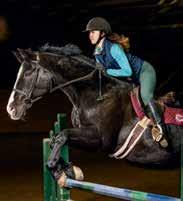
Song, an economics and classics double major, never missed a single horse show in all her four years on the team.
Ally Song ’26 brings home
Colgate’s first Cacchione Cup
Every week during the academic year, Ally Song ’26 made the short trip off campus to the picturesque Whispering Hill Equestrian Center in nearby Cazenovia. There, Colgate’s club equestrian team comes together to spend time with the horses and prepare for Intercollegiate Horse Show Association competitions, where they regularly face off against teams from surrounding colleges — many of them varsity programs.
She competed both on the flat, where riders are judged for their form while commanding the horse to walk, trot, and canter, as well as over fences, guiding a horse around a course of jumps. Riders receive points based on their placement in a class: seven points for first place, five for second, and so on.
This season, Song’s dedication turned into something historic.
She emerged as Colgate’s firstever Cacchione Cup Champion, awarded to the rider who accumulates the highest number of total points across the region’s 11 schools.
How did you first get into riding?
“I started when I asked my parents to bring me to pony camp when I was 7. I became addicted
right after. I got my first horse named Beau — a really naughty pony who used to buck me off all the time. But I loved it, and I started competing and getting more and more serious. I knew I wanted to ride in college, and Colgate had a club team, along with many other things I was looking for in a school, so it felt like a perfect fit.”
What was the transition to Colgate’s program like?
“The style of coaching here is more relaxed than my barn back home, which was a highpressure environment. Though [this different style of teaching] felt foreign at first, it ultimately helped me rediscover my original love for the sport.”
What stands out about the equestrian community at Colgate?
“People come from a variety of levels, backgrounds, and majors.
I made many of my first friends at Colgate through the team, ones I still have today.”
How did it feel to win the Cacchione Cup?
“I’ve always known about it, but I never thought I was in the running until this year, when my coach told me right before my very last show. I was actually head-to-head with another rider for the cup, and when I won, I was extremely proud.”
What’s next for the equestrian team?
“Over the past four years, we’ve gotten much more competitive as a program. We’ve been consistently beating varsity teams, and I’m hoping that having a Cacchione Cup winner will help bring in more funding and allow the team to keep growing.”
— Norah Hendrickson ’27
Academics
Colgate Institutes of Advanced Study
The University’s four institutes for advanced study continue to develop opportunities for faculty and students to engage in meaningful research as well as strengthen connections with alumni and other scholars. The institutes play a vital role in bringing students and faculty together across the disciplines to increase engagement on campus and with the broader world.
The Kraynak Institute for the Study of Freedom and Western Traditions
The Kraynak Institute has embraced an intense period of institutional consolidation, strategic redefinition, and programmatic growth this academic year, including the formal renaming last fall in honor of its founding director, Professor of Political Science Robert P. Kraynak. After celebrating the 20th anniversary of the Center for Freedom and Western Civilization in 2024, the center was elevated to an Institute for Advanced Study at Colgate, recognizing the center’s enduring contributions to the University. The institute’s guiding mission is to cultivate intellectual diversity within a liberal arts education, now with the expanded reach and resources of an institute.
“A mark of the institute’s strength is that it continues to operate within Colgate’s identity as both a liberal arts college and research-oriented university,” says institute co-director and Associate Professor of Art Carolyn Guile. “Its role is to convene faculty and students in sustained intellectual engagement around foundational questions of freedom, democracy, and Western cultural traditions.”
The institute has been focused on three interrelated objectives: advancing a classical liberal arts education grounded in foundational texts, artistic expression, and enduring questions of human nature and the good life; supporting rigorous inquiry into free speech, free enterprise, and constitutional democracy, particularly


in the American tradition; and extending these commitments beyond the classroom through student mentorship, public programming, and intellectual community building.
This year the Kraynak Institute has made substantial progress in each domain, Guile says, particularly through well-attended public events, new faculty dialogues, and expanded student research opportunities. She says the institute will continue to work on visibility, program continuity, and longterm structural development through the cultivation of new faculty relationships, the development of new programming, and the creation of new courses such as the Kraynak Institute capstone seminar under the aegis of Colgate’s Arts and Humanities division.
Continuing its mission to cultivate intellectual diversity within a liberal arts education, the Kraynak Institute launched its inaugural capstone seminar in the spring, Arts, Letters, and Liberty in Enlightenment Europe and America, taught by Guile. Focusing on the early modern and Enlightenment eras with a particular emphasis on America, students examined how arts and letters have animated early expressions of democracy in the West and what they teach us about nascent political and religious freedoms, cultural heritage, and national independence.
To expand their understanding of how arts and letters have shaped public thought and taste, in March the class traveled to Washington, D.C., where they engaged with America’s founding documents, studied the origins and monuments of the National Mall, explored
Iranian-American journalist and women’s rights activist Masih Alinejad gave a talk, “Breaking the Silence on Free Speech in Iran.”
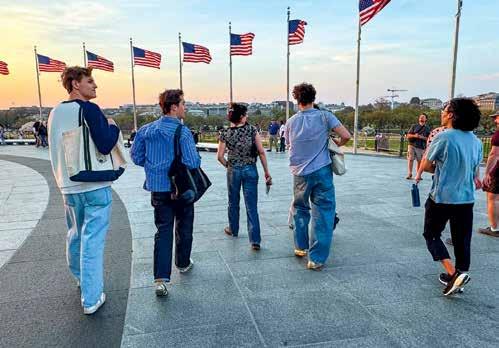
national art museums, and visited the Library of Congress.
“I chose the occasion of America’s semiquincentennial year to create this course,” Guile says. “The thoughtful discussions about civic freedoms, the humanities, and statecraft made for a deep engagement with the subject matter that I hope will enrich the students’ lives in the years ahead.”
At the end of the course, Guile and the students recorded an episode of Colgate’s 13 podcast where they discussed the lessons learned from these founding documents. The students also created podcasts of their own to share their personal perspectives on how they engaged with the materials as part of their final projects. Guile says the introduction of a capstone seminar represents a significant step toward a distinctive institute-based curriculum engagement, combining rigorous academic content with experiential and public scholarship components.
Also, this summer, 12 students were named James Madison Fellows and will pursue research projects with faculty mentors through the institute. The Kraynak Institute is also sponsoring three additional students who will attend the International Security and Intelligence (ISI) Program through Cambridge University, which allows students to learn directly from intelligence experts in the field. The institute expanded its support for an additional student to attend the ISI program this year, after sponsoring two
students to participate in the inaugural program last summer.
This year the institute also established two new student internships to support operations and expand student-led outreach, helping to enhance the institute’s operational capacity and visibility, particularly through informal student networks and digital channels. One of the interns, Bayard Young ’26, was also the recipient of the 2026 Brian Horey ’82 Civic Freedom Award, recognizing outstanding contributions to the study of freedom and Western traditions. Throughout his matriculation at Colgate as an English major with minors in architectural studies and French, Young has demonstrated a sincere commitment to free speech and open debate, embracing every opportunity with the curiosity, courage, and civility that are the hallmarks of an engaged student,
colleague, and citizen, Guile says.
The Kraynak Institute maintained a robust calendar of lectures, debates, and cultural programming aligned with its mission this academic year. Signature events last fall included the Constitution Day Debate in September, addressing the question of constitutional crisis in contemporary America, featuring nationally recognized legal scholars; a talk by Neetu Arnold from Manhattan Institute, “The Cost of Silence: Restoring Viewpoint Diversity in Higher Education”; and a multiday residency by philosopher Jennifer Frey on the nature and purpose of liberal education.
Speakers welcomed to campus in the spring provided intellectually diverse viewpoints, including those of IranianAmerican journalist and women’s rights activist Masih Alinejad, who shared her story with the audience — along with a video clip of her highlights as an activist — before participating in a moderated discussion with Guile about “Breaking the Silence on Free Speech in Iran.” Guile explains that the institute’s focus made Alinejad a natural fit to bring to Colgate. “We are interested in free speech and freedom of expression,“ Guile says. “This event provided an opportunity to have a conversation about what that means in direct relation to a context where both of these things have been and continue to be severely limited, and as offered from the perspective of a person who is intimately familiar with those limitations and their consequences.”
Kraynak Institute co-director and George Carleton Jr. Professor of Philosophy David Dudrick also brought Brandon Warmke, associate professor of humanities at the Hamilton School for Classical and Civic Education at the University of Florida, to campus for the lecture “Is the
“The thoughtful discussions about civic freedoms, the humanities, and statecraft made for a deep engagement with the subject matter that I hope will enrich students’ lives in the years ahead.” — Professor of Art Carolyn Guile
The Kraynak Institute’s inaugural capstone seminar, Arts, Letters, and Liberty in Enlightenment Europe and America, taught by Prof. Carolyn Guile, traveled to Washington, D.C., in March.

Academy in Need of Radical Reform?” which shared his critique of the lack of conservative perspectives in higher education. Warmke works on various moral, social, and political topics in both philosophy and psychology, including moral responsibility, forgiveness, free expression, and public discourse.
“He puts forward thoughtful arguments that are often in support of positions disfavored in the academy,” Dudrick says. “As a result, he gives us the opportunity to engage in the sort of productive disagreement needed for an authentic pursuit of the truth.”
The institute co-sponsored a lecture and reception with guest curator Olena Speranska for the spring exhibition at the Clifford Art Gallery titled Ukrainian Wartime Posters, 2022–2025: The Way of Resistance. The exhibition — coordinated by Guile with additional support from the Department of Art, the Colgate Arts Council, the Louis Rakin Fund of the Department of Political Science, Core Communities, and Russian and Eurasian Studies — featured more than 300 graphic works of Ukrainian wartime posters created to counter propaganda, sustain public morale, and document military events and war crimes. Sponsoring the exhibit builds on Colgate’s ongoing engagement with contemporary Ukrainian cultural figures and continues a series of public programs exploring artistic and literary responses to war.
Guile underscored the exhibition’s relevance to contemporary debates
about democracy and sovereignty. “These posters are striking artistic testimony about the impact of war on personal and civic autonomy,” she says. “They harness free artistic expression to confront and respond to matters of life and death that resonate well beyond Ukraine. At a moment when transatlantic relationships are being actively reconsidered, the exhibition creates space to reflect on the shared ideals that undergird cultural self-determination and national sovereignty.”
Guile says the support of the external advisory board continues to complement the institute’s academic efforts and is essential to advancing the institute’s directives, particularly in development and long-term planning. She described the 2025–26 academic year as “a successful integration of the Kraynak Institute’s legacy identity and institutional purpose, demonstrating clear strengths in intellectual programming, faculty engagement, and student development with activities designed to align with Colgate’s broader mission and contribute meaningfully to the University’s academic culture.”
Guile says this coming academic year, the Kraynak Institute will continue to focus on translating strong programming into sustained institutional presence, broader visibility, and long-term financial support.
“With deliberate attention to governance, outreach, and development, the Kraynak Institute is well positioned to continue to evolve as a durable and distinctive center on campus for the study of freedom and Western traditions,” Guile says.
The Lampert Institute for Civic and Global Affairs
With three new programs, the Lampert Institute is expanding its opportunities for underclassmen to apply the tools of a liberal arts education to the most significant public policy issues of the day. The initial cohort of six Lampert Institute Summer Fellows are pursuing opportunities that cultivate early, inquirydriven engagement with major global questions. This fall there will be a new Lampert FSEM titled Ethics and Economics and a new Sophomore Residential Seminar focused on India as a rising global power, with travel in January to Bengaluru and New Delhi.
These new student programs build on the success of the Lampert Scholars program, which attracts some of Colgate’s most gifted students. All of this year’s 2025–26 Lampert Scholars received Latin honors at commencement, along with several national and university fellowships and scholarships. The incoming scholars have begun their research projects and internships this summer and will continue to participate in activities throughout their senior year. Scholars will also have opportunities to meet with the institute’s guest speakers, including leading experts in media, AI, national security, and STEM.
“The Lampert Institute has always been an invaluable space for students who want to immerse themselves in balanced analysis, engage with diverse points of view, and connect their academic work to real-world application within a policy sphere,” says Storing-Hou Director of the Lampert Institute Chad Sparber. “We are excited about recent contributions from Edgar ’62 and Robin Lampert P’10, Michal Kosta ’71, and other alumni who have allowed us to expand our programming across class years.”
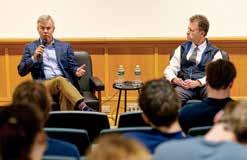
The Lampert Institute held a national security conversation with Gen. Bryan P. Fenton (left) and Michael O’Hanlon, the 2025–26 Lampert nonresident fellow.
Ukrainian Wartime Posters, 2022–2025: The Way of Resistance, in Clifford Gallery
Picker Interdisciplinary Science Institute
Under the directorship of Professor of Biology and Mathematics Ahmet Ay, the Picker Interdisciplinary Science Institute (ISI) continues to promote collaborative research that brings together expertise from disparate disciplines to address complex scientific problems. This year Picker ISI awarded more than $250,000 in funding to faculty and students through three major grants, one minor grant, two microgrants, and an interdisciplinary training grant.
Also, three students are pursuing interdisciplinary research projects this summer with external academic mentors and Colgate faculty as part of the inaugural Picker ISI Scholars program.
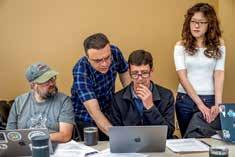
In June, Picker ISI hosted a two-day faculty and student workshop focused on AI-powered machine learning support for research, funded through an interdisciplinary training workshop grant awarded to Associate Professor of Computer Science Noah Apthorpe. The workshop, in collaboration with Information Technology Services, provided an opportunity for more than 20 faculty and students to learn about AI and machine/deep learning and connected participants with resources to continue their exploration. Picker ISI has shared the workshop materials, including video lectures on Moodle, for all faculty, and is planning future workshops to train more faculty and students in interdisciplinary skills.
“This year, Picker ISI expanded its programs to reach faculty and students at every level, introducing new training initiatives, scholarly leave grants, and microgrants,” Ay says. “I am confident these will advance our mission — and we look forward to creating even more opportunities ahead, such as bringing a Picker ISI fellow to campus to spark interest in the interdisciplinary sciences.”
The Upstate Institute
Staff of the Upstate Institute played a vital role in a campuswide effort to earn Colgate’s 2026 Carnegie Community Engagement Classification, which recognizes the University’s steadfast commitment to community engagement and partnerships. A new Community Engagement Working Group has initiated the process to establish a permanent Community Engagement Council this fall, which will serve as the long-term coordinating and advisory home for civic partnerships and socially responsive scholarship.
Upstate Institute Director Julie Dudrick, who helped lead the 2026 Carnegie Classification Steering Committee, says, “This designation affirms that community engagement is central to Colgate’s mission and underscores the depth, reciprocity, and sustained collaboration we share with organizations throughout our region. We are proud of this recognition, and we are even more excited for what comes next.”
Anna Sims Bartel — a community engagement expert who has led Colgate’s Community of Practice, supporting 10 faculty in community-based teaching — has been appointed to serve as the Gretchen Hoadley Burke ’81 Endowed Chair for regional studies for the 2026–27 academic year. Dudrick says, “By establishing a permanent council and working closely with Anna, we will institutionalize our efforts to amplify and elevate all types of community engagement across the University.”
In addition, this summer’s cohort of 18 Field School fellows have started their research projects locally and in the Adirondacks and will spend 10 weeks working closely with community organizations. In July, Banfi Vintners Professor of Economics Nicole Simpson joined Dudrick in leading the Upstate Institute as faculty director, taking over the position from Professor of Biology and Environmental Studies Catherine Cardelús. — Stephanie DeVries

Picker’s AI workshop
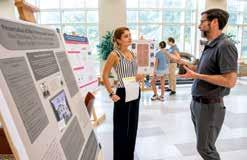
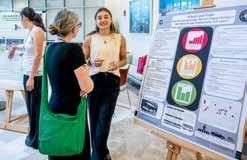
The Upstate Institute 2025 summer poster session
Zachary O’Donnell ’27 worked on a project with the Upstate Institute involving potato leafhopper populations.
Breaking New Ground: the Carey Center
Colgate ushered in a new era in June, breaking ground on the Carey Center — a transformative 97,250-square-foot athletics facility that will serve as the cornerstone of the University’s Division I athletics program.
The naming of the facility recognizes a leadership gift from Chase Carey ’76; his wife, Wendy; and their children, Steve ’12 and Tara ’13. This project is also supported by significant philanthropic investments from additional donors, including Steve Errico ’85, P’16,’18 and his family.
The ceremony featured remarks from both Carey and Errico; former chair of the University Board of Trustees and facility donor Michael J. Herling ’79, H’24, P’08,’09,’12; President Brian W. Casey; Vice President and Director of Athletics Yariv Amir ’01; and Head Volleyball Coach Ryan Baker.
“Some of Colgate’s greatest memories stem from supporting teams competing for championships,” Carey said. “Our student-athletes deserve facilities and resources that match that high standard.”
Designed by Robert A.M. Stern Architects in partnership with Grace Design Studios, the Carey Center will centralize athletics functions that are currently dispersed across campus, creating a high-performance hub for all 25 teams.
“[The Carey Center] will be the largest capital project this campus has undertaken, both in terms of size and cost,” Amir said. “It will be the home to

six Colgate varsity sports, but it will also serve as a hub for Colgate athletics, bringing together resources and programming that are shared by all student-athletes, including sports medicine, strength and conditioning, nutrition, academic support, and more.”
Errico said, “The student-athlete experience at Colgate is truly unique; it pairs the desire to excel in a sport with discipline, teamwork, and lifelong community. It teaches you how to handle hardship and, crucially, how to balance rigorous academics with a full-time athletics commitment.”
Preliminary construction has begun and it is expected to be complete by the fall semester of 2028. Beyond the Carey Center, the future vision for the athletics neighborhood includes room for an outdoor green space and Raider Walk to form an athletics quadrangle, transforming the area into a cohesive athletics and recreational environment.
“I truly wish to thank the Carey family, the Cronin family, the Errico family, and all those who have supported the creation of the Carey Center with Cronin Court and Errico Arena,” said President Brian
W. Casey. “The tradition of having our student-athletes not only competing at the highest level of competition but also with excellent facilities is only possible because of our generous alumni and friends.”
— Jordan Doroshenko
Key features of the Carey Center
→ Errico Family Arena: A 1,650-seat performance venue for basketball and volleyball, featuring a center-hung video board and state-of-the-art broadcast capabilities; home to Cronin Court
→ A new strength and conditioning center that is 75% larger than current facilities in Huntington Gymnasium
→ A dedicated western wing for the football program, including locker rooms and meeting spaces that will be unique within the Patriot League
→ A centralized space for sports medicine and nutrition to help improve efficiency for student-athletes
From left: President Brian W. Casey, Stephen Errico ’85, P’16,’18, Chase Carey ’76, P’12,’13, Michael J. Herling ’79, H’24, P’08,’09,’12, Vice President and Director of Athletics Yariv Amir ’01, and Head Volleyball Coach Ryan Baker participate in the Carey Center groundbreaking.
Events
Arts, Creativity, and Innovation Weekend Inspires
Award-winning actor, producer, and CEO Tracee Ellis Ross helped kick off this year’s Arts, Creativity, and Innovation (ACI) Weekend. She joined Vice President and Chief of Staff to the President L. Hazel Jack for a conversation in Memorial Chapel sponsored by the Kerschner Family Series Global Leaders at Colgate.
Ross, a veteran performer and founder of PATTERN Beauty, explained how her creative background as an actor informs her business leadership. “So much of what I learned as an actor is around giving myself space to play, to learn, to trust my instincts, to not worry about what other people think is so much of what informs how I lead, how I’ve built a team, how I learn and grow as a CEO.”
Throughout the weekend, the community engaged in a robust schedule of performances, lectures, exhibitions, and the 14th annual Thought Into Action (TIA) Entrepreneur Showcase and pitch competition, part of the Entrepreneurship and Innovation program. Networking sessions and panel discussions connected students with alumni, forging professional relationships across various industries.
Alumni and faculty led panel discussions on the intersection of creativity and industry. Panelists spoke about the seeds that were planted during their undergraduate studies, their professional journeys after Colgate, and the implications of artificial intelligence for creative careers.
“There is no linear path in anything but certainly not in creative fields,” said Imani Ballard ’18, content creator at Tubi and panelist for the Storytellers in Film and Media session. “I want you to know it’s OK to fail. With every role you hold, it gets you closer to the dream you’re forming.”
In Bernstein Hall, scholars from the Benton, Alumni Memorial, Office of Undergraduate Studies, and Lampert Institute presented their research at a poster session.
The weekend’s musical centerpiece was the Barbara Clement Gould and Katharine Elizabeth Gould Memorial Concert, featuring Carole Bufford, the Bosworth
There
is no linear path in anything but certainly not in creative fields.
Imani Ballard ’18
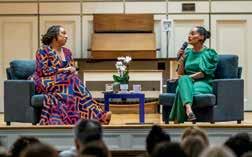
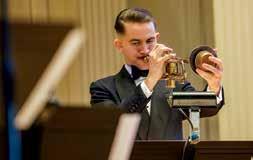
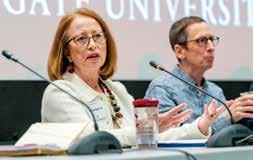

String Quartet, and James Langton’s New York All-Star Big Band.
ACI Weekend attendees also enjoyed a conversation with Langton and Buffard on performance, film screenings with Ralph Arlyck ’62 and Kevin Heffernan ’90, P’27, tours of Picker Art Gallery with student curators, an open mic night, and a performance by the Colgate University Orchestra, led by Conductor Marietta Cheng.
The weekend culminated with the 14th Annual TIA Entrepreneur Showcase. Gus Coldebella ’91, chief legal officer of Castle Island Ventures, moderated the panel of entrepreneurs, including the Colgate University Entrepreneur of the Year Viraj Puri ’03, co-founder and chief executive officer of Gotham Greens. Other panelists included Lila Sullivan ’17, president and co-founder of Flourish Plant; Sara Brooks, co-founder of Goldilocks; and Heffernan.
Carolyn Strobel-Larsen, director of entrepreneurship and innovation, introduced the Weiner Family Entrepreneur in Residence Jen Martin, co-founder of Pipcorn. Martin leads the TIA program and mentors pitch competition participants. Ventures included EchoScape, founded by Mike Ahearn Wilcox; Hatch Pay, co-founded by Fletcher Goodell ’26 and Anders Larson; MajiSafi Solutions, founded by Agnes Ndanu ’28; and PLNT, founded by Porter Comstock ’26.
After deliberating, the panel awarded the $10,000 cash prize to Comstock with PLNT, a robotics solution to modernize the plant nursery industry’s inventory management
“This year’s ACI Weekend demonstrated the incredible range of arts activity happening at Colgate,” says Christian DuComb, associate dean of the faculty for faculty recruitment and development and associate professor of theater. “All of these events created opportunities for students, faculty, alumni, and distinguished guests to learn from one another and share their passion for the arts. Artists and entrepreneurs have a creativity in common, so there was wonderful synergy taking place throughout the weekend.”
— Rebecca Taurisano
1. L. Hazel Jack (left), vice president and chief of staff to the president, interviews multihyphenate Tracee Ellis Ross. 2. The Barbara Clement Gould and Katharine Elizabeth Gould Memorial Concert 3. Madeline Bayliss ’76 and Prof. Joel Sommers participate in the Human Creativity and Artificial Intelligence panel. 4. Agnes Ndanu ’28 pitches MajiSafi Solutions during the TIA Entrepreneur Showcase.
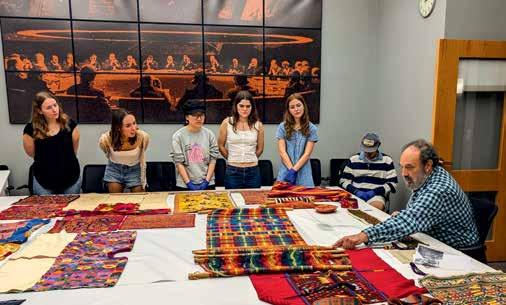
Philanthropy
The Fabric of a Life
Avibrant narrative of color and history has found a permanent home in the Longyear Museum of Anthropology. For Robert Aberlin ’66, his donation of a significant Latin American textile collection is a full-circle moment. The dyed fibers and intricate weavings represent a professional and personal journey that began for Aberlin in a Hamilton classroom more than 60 years ago.
His trajectory is a classic liberal arts success story: a spark of curiosity, ignited in him when he was an undergraduate, eventually defined a global career. Aberlin’s path was set in motion by a specific encounter with Latin American literature and history, guided by the late Associate Professor of Romance Languages and Literatures Emeritus Jorge Manuel Chavarri.
Aberlin arrived at Colgate in 1962, a time of immense global shift. While navigating his studies, he found himself drawn to the Spanish language and the complexities of the landscape in Central and South America. It was Chavarri who first introduced him to the literary giants and historical nuances of the region.
This academic foundation deepened during Aberlin’s junior year, when he traveled through Colombia and Chile on an off-campus study program. He recalls the stark contrast of his environments — gaining fluency in Colombia and
witnessing the poverty of the Chilean people — while he was a volunteer worker. These experiences were the building blocks of an expanding worldview.
“Life isn’t about finding yourself,” Aberlin reflects. “It’s about creating yourself.”
Armed with the cultural competency and linguistic skills forged at Colgate, he joined Chase Manhattan Bank, climbing the ranks to eventually manage a massive Latin American and international portfolio.
His career followed a map of the region he had grown to love. Aberlin held various high-level positions, including deputy country manager in both Argentina and Costa Rica. His life abroad was marked by historic moments, such as navigating the tensions of the Falklands War with his wife, Mary Beth, and their children, Phoebe and Noah.
After retiring from the world of banking, Aberlin’s leadership continued as he served as the CFO of Poly Prep Country Day School in Brooklyn for two decades.
Despite his global travels, Aberlin’s ties to Hamilton never frayed. He was instrumental in producing the documentary Broken Brotherhood, which tells the story of Colgate graduates who served in Vietnam. This project led to the establishment of a Vietnam Memorial Scholarship Fund, honoring 20 alumni who died in service during the Vietnam War, including one of Aberlin’s roommates and three lacrosse teammates.
Aberlin now serves on the Alumni Council, is a member of the Presidents’ Circle, and he received the Wm. Brian Little Award during this year’s reunion weekend, which also marked his 60th Reunion.
“Alumni like Robert are the cornerstone of Colgate philanthropy,” says Kim Harris, vice president of advancement. “His dedication to this institution — whether through financial support, the donation of precious artifacts, or the gift of his time — shows there are many ways to give back to Colgate so that future generations of students can experience the same place to ‘create themselves’ as Robert did.”
However, it is his donation to the Longyear Museum of Anthropology that offers the most tactile connection to his undergraduate days. The textiles he collected throughout his career — more than 20 pieces from Guatemala, Panama, Peru, and Argentina and representative of the very cultures he studied under Chavarri — now serve as primary source material for today’s students.
The textiles stand as a testament to a career built on international understanding, proving that a single course can stretch across a continent and a lifetime.
— Rebecca Taurisano
The Aberlin textile collection is now available to explore online through the University Museums’ database, eMuseum, at emuseum.colgate.edu/ search/aberlin.

Robert Aberlin ’66 gives an overview of his textile collection to a museum curating class.
Introducing The Kendrick
Construction is complete on Colgate’s newest building, The Kendrick, at 18–22 Utica Street in downtown Hamilton. The complex features 41 apartment units, office, retail, restaurant, and outdoor seating space. It helps address the need for additional housing for employees of the University, the local school district, and the local hospital.
Most of the apartments are now occupied, creating a lively new residential community in the heart of the village. On the commercial side, four first-floor tenants include Clio, an Italian/Mediterranean restaurant; LaGreca’s Meat Market; The Partnership for Community Development; and office space for a University department.
At 78,000 square feet, The Kendrick will boost energy, activity, and foot traffic downtown and enhance both the streetscape and the sense of connection in the village of Hamilton. The building, its tenants, and the public community courtyard are expected to serve as a catalyst for the growth of additional local businesses.
— Dan DeVries



A Message From Kim Harris, Vice President for Advancement
Lately I’ve been thinking about how deceptively simple the advice to “be present” truly is.
Staying rooted in the “now” is challenging when we have both the past and future vying for our attention. I, myself, can be guilty of looking to the future in such a way that I forget the power of the present, and, conversely, looking backward without appreciating the lessons that helped me arrive where I am today.
Gratitude, as always, bridges the past, present, and future for me, and the past year has only increased those feelings. That holds true personally as well as professionally.
Despite the headwinds facing higher education, Colgate’s third century is proving to be a time of vision, investment, and growth. The University’s forward-looking focus and the strengths we draw from the past unite to support a position of strength, one that makes Colgate stand out among many other colleges across the nation.
The Campaign for the Third Century began with an ambitious goal of raising $1 billion, and in September 2025, we surpassed the three-quarter mark. Just nine months later, by June 2026, Colgate had raised $838 million from alumni, families, and friends. Thank you.
We’ve seen the fruits of your generosity come to life across campus. Fiscal Year 2026 brought about the opening of Peter’s Glen, construction of Fox House on Broad Street, and the long-awaited groundbreaking for the Carey Center. Thanks to philanthropic support of Colgate alumni, these projects embody Third-Century Plan priorities: enhancing campus, improving residential life, and supporting athletics.
Colgate alumni have also made generous commitments to financial aid, opening the University’s doors wider to welcome the finest students from all backgrounds. And numerous gifts to support Colgate’s faculty and institutes will strengthen the academic enterprise for the future.
Meanwhile, the University continues preparations for the launch of the Colgate Union, expanding our commitment to discourse and dialogue as a foundational principle of the liberal arts.
This spring we celebrated the newest members of the James B. Colgate Society and honored the inaugural class of the Founders Circle, those who have contributed $13 million or more throughout their lifetimes. I am humbled to witness the impact these donors have had on the University, using philanthropy to connect their own past experiences to the Colgate of today and tomorrow.
Reflecting on all these accomplishments brings me to contemplate the University’s future. As I often remind my colleagues in advancement, while we will certainly celebrate surpassing the billion-dollar mark, our work will continue after that momentous day because our true goal is realizing the complete vision of the Third-Century Plan.
Achieving that goal will happen thanks to your collective investment and shared belief in the University’s mission. The Colgate community has brought the University to where it stands today. Together we’ll move Colgate forward as it becomes the best version of itself.
Thank you for your partnership — past, present, and future.
Discover
Envisioning a World With Less Light Pollution
A
Colgate-led initiative aims to preserve dark skies.
ark skies” — areas minimally impacted by artificial light — are becoming harder to find as light pollution intensifies worldwide, dimming the stars and negatively impacting ecosystems.
Jeff Bary, professor of physics and astronomy, has made preserving dark skies a personal mission. Being from Appalachia and raised in West Virginia, Bary grew up under the dark skies he now sees disappearing.
“People for thousands of years have had these intimate connections to the night sky, and we are losing that on a grand scale over a short period of time,” Bary says.
His work on the issue began through a multidisciplinary lens. Upon being awarded Colgate’s Sweet Family Chair in 2022, he hosted the symposium, “Dark Skies in Appalachian Identity, Culture, and Sense of Place,” in 2024, which brought together a wide range of voices, from poets and composers to filmmakers and astronomers. “It was so radically multidisciplinary,” Bary says.
That experience led to further collaboration on the topic. While speaking at a session of the Appalachian Leadership Institute dedicated to “Building Regional Culture and Tourism,” Bary connected with George Ivey, director of the Blue Ridge Parkway Foundation, which had received a grant from the Appalachian Regional Commission that included funds to assess the night sky conditions along the 469mile parkway spanning Virginia and North Carolina. From that partnership, the Dark Skies Survey was born.
The project focuses on gathering data on
sky brightness at different points along the parkway — information that will be mapped out and analyzed to identify both areas of concern and locations with exceptionally dark skies. These findings could help communities reduce light pollution and potentially earn dark-sky certification through DarkSky International, a global authority on light pollution.
During spring break, Bary invited students on a trip to collect data while exploring Appalachian culture and landscapes in Virginia. Over the course of the trip, the group — six Colgate students, Bary, Professor of Geography Mike Loranty, and students and faculty from Wellesley College — covered approximately 120 miles of the Blue Ridge Parkway. At night they stopped every few miles to measure sky brightness using specialized detectors and inventoried lighting at visitor centers and lodges along the parkway. During the day, they hiked sections of the Appalachian Trail, went ziplining, sampled regional food and music, and danced at a Friday night jamboree at the famous Floyd Country Store.
Kate Murphy ’26, who has taken Core Appalachia with Bary and Loranty and participated in a previous trip to the region, described one particularly memorable night collecting data near the North Carolina border. “We stood in silence for a long time at one of the pull-offs, just observing the night sky,” Murphy says. “The night sky was so dark, and as Professor Bary pointed out various stars, I realized what an astounding opportunity this was.”

Off the Blue Ridge Parkway in Old Fort, N.C., the Milky Way arch is visible in the springtime in the early morning hours. The core of the galaxy comes out of the south and rises up, arching over the east and setting just before the north. The tree in the middle is unofficially known as “The Wise One” and is the skeleton of an old Table Mountain pine.
In addition to data collection, the group hosted community meetings to educate residents about light pollution and offered practical ways to reduce it. For Loranty, who attended school in West Virginia and has since been deeply connected to Appalachia, those moments were especially meaningful.
“There are a lot of people in the region who care about this,” he says.
Loranty adds that these conversations underscored a broader point about why dark skies matter. “The night sky has positive mental and physical health benefits that are harder to quantify but extremely important, along with being an ecosystem service.”
Bary echoed this sentiment, reflecting on the deeper human significance of dark skies. “There is a real sense of awe people get from experiencing a truly dark night sky,” he says. “With that, there is this sense of perspective that comes with it that we all need: that there’s something larger than ourselves that

also connects us to one another in ways that transcend space and time.”
The data collected during the trip will contribute to a larger, ongoing effort involving partner institutions, including the University of North Carolina-Asheville, Appalachian State University, Western Carolina, Mayland Community College, Radford University, and the University of Virginia as well as amateur astronomers. Loranty will be assisting with mapping the data that will help identify optimal stargazing locations as well as areas where lighting practices could be improved.
Beyond its impact in Appalachia, Bary hopes the project will inspire reflection closer to home. “I hope that getting students involved will get them thinking about their environment here on campus, because there are things that we could do here to improve the skies and our local environment.”
— Norah Hendrickson ’27
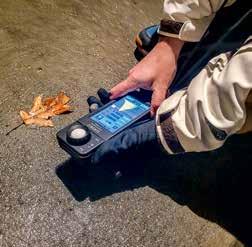
Colgate researchers used handheld spectrometers to inventory lights along the parkway. The instrument measures the brightness and color temperature and displays a spectrum of light that illustrates the amount of blue light emitted by a fixture. Blue light is unhealthy for humans because it disrupts the hormones that signal our body that it’s time to sleep. This color of light contributes to sky glow more so than yellows and reds, hiding our views of stars and the Milky Way. The team will share its data with the Blue Ridge Parkway Foundation, National Park Service, and local communities to improve parkway lighting.
A floodlight at the Peaks of Otter Lodge registers 1391 lux and 2912 kelvin.
How Blue Light Threatens the Blue Ridge

Epidemiology
Gut Check
In two separate studies, Colgate researchers are studying how the microbiome acts as a mirror to show what’s happening in the body.
Looking South for Brain Health
When we hit our heads but develop no signs of concussion, we’re likely to breathe a sigh of relief, assuming we’ll be fine. But our bodies may be undergoing changes we can’t see or feel as the communities of microbes in our digestive systems shift in response to the trauma.
In both humans and mice, research shows concussions are associated with changes in the gut microbiome — a population of microorganisms that helps regulate digestion, behavior, the immune system, and other aspects of health. A team of Colgate professors and
student researchers wondered whether nonconcussive head impacts could be linked with similar changes.
In a study that followed six Colgate football players through a season of play, the researchers found the first evidence that minor hits to the head can affect the diversity and composition of the gut microbiome. Their findings were published May 6 in the journal PLOS One.
“It’s not impossible to imagine that these kinds of events have whole-body effects, and it’s important to figure out how to reverse that,” says Aziz Zafar ’23, who majored in biology and is now pursuing a
PhD in medical bioinformatics at Columbia University. “Scientists are working not just on probiotics, but also on exact cocktails of microorganisms that could replenish the gut after specific health challenges. Further characterizing how the head and the gut are linked is a step in the right direction.”
The study might also help identify a microbiome “signature” that makes it easier for doctors to diagnose brain injuries, even in the absence of other symptoms, explains Ken Belanger, the Russell Colgate Distinguished University Professor of biology.
“These findings are relevant not only to
Illustration by Dan Page
These findings are relevant ... to anyone who experiences a nonconcussive head bump... .
Ken Belanger, Russell Colgate
DisTINGUISHED University professor of biology
athletes,” he says, “but also to members of the military and anyone who experiences a nonconcussive head bump in a car accident or a slip on the ice.”
In the study, football players wore helmets fitted with Riddell monitors that tracked head impacts and their level of force — secured with the help of Zack Pelland ’23, a football player who majored in neuroscience and took the lead on designing the study. Pelland, who had interned with Riddell, obtained institutional review board approval and then collaborated with Colgate coaches and players. He learned more about how hits to the head were associated with microbiome shifts by using genomic sequencing to analyze 226 fecal samples provided by the players.
Through surveys submitted with each sample, the research team tracked how factors such as sleep, stress, and diet may have affected the athletes’ microbiomes. Then, Zafar and his mentor, biology and mathematics professor Ahmet Ay, used statistical modeling to remove those elements from the equation, isolating the effects of nonconcussive head impacts.
“This kind of careful adjustment is essential in human studies, where you can’t control every variable the way you can in a lab experiment,” Ay says.
The team found that certain bacteria populations in the microbiome — some of the same types that shift after severe brain injuries — became either more or less plentiful within the three days following a substantial nonconcussive impact and also cumulatively across the football season.
It’s too soon to say, though, whether nonconcussive head impacts caused the changes or what the fluctuations might mean for people’s health.
“We don’t know if these changes are positive and preventive, possibly helping
with recovery, or negative, because there are prior data linking these organisms to neuroinflammation,” Belanger says.
Still, the findings could help resolve uncertainty about whether smaller head impacts even have the potential to meaningfully affect health, says Pelland, who is now pursuing an MD/PhD at the University of North Carolina-Chapel Hill.
“Shifts in these bacteria are hard to analyze at a population level because everyone’s gut microbiome is different,” he says. “The fact that we were able to see systemic changes after nonconcussive head impacts is interesting and worth exploring.”
Further insights will come from a larger football study Belanger conducted, which included 14 players who provided a total of 1,000 fecal samples, and his recently
The global hunger crisis affects more than 8% of the world’s population, hitting hardest in developing nations, according to a 2025 United Nations report.
Bineyam Taye, associate professor of biology and global public and environmental health, and his student Angie Zhu ’26 conducted a study examining how household food insecurity influences the gut microbiome composition of Ethiopian schoolchildren. It was supported by a grant from the Picker Interdisciplinary Science Institute and conducted in spring and fall 2025; their findings were published in the online journal Nutrients last February.
Many previous studies have discussed the long-term, often intergenerational impact food insecurity has on human health using demographic or economic indicators. However, limited data are available examining food insecurity through the lens of the gut microbiome, particularly in nonEuropean populations. Taye and Zhu took a biological approach to better understand the gut microbiome structure of Ethiopian schoolchildren. The team collected fecal samples, extracted and sequenced microbial DNA, and analyzed the resulting profiles to identify which microbes were most prevalent among food-insecure children.
Zhu is an applied math major with minors in computer science and biology; she conducted this work in Taye’s global health epidemiology laboratory and has since been accepted to the PhD program at Tufts University, beginning this fall. She led the computational analysis by
completed study involving Colgate women’s ice hockey players.
The initial study idea was conceived through the Robert H.N. Ho Mind, Brain, and Behavior Initiative (MBBI), which brought Belanger and Steve Chouinard, senior associate athletics director for health and performance, together to consider where their research interests might intersect. It was also facilitated by Riddell, whose leadership team includes several Colgate graduates.
“It’s so great to be at an institution that fosters these connections,” says Belanger, who chaired the MBBI committee at the time. “It’s been fun to work across areas of expertise and to have this collaboration lead to a really interesting outcome.”
— Beth Fand Incollingo
processing raw sequencing data, identifying patterns in microbial composition, and producing publication-quality figures and figure legends. She also led all coding and data analysis, and worked alongside Taye throughout the manuscript writing process, including drafting and editing the literature review.
“In microbiome studies, we can perform all kinds of data analysis and obtain huge piles of figures and results,” Zhu says. “The challenging part then becomes digging through all of the data analysis to extract the interesting results to interpret and shape a cohesive story.”
The research revealed that household food insecurity is associated with a distinct and predictable gut microbiome composition. Limited food variety, consumption of disliked food (potentially through emotion and stress-related physiological responses), and reduced meal size emerged as factors tied to microbiome shifts. Additionally, Taye and Zhu identified the genus Sutterella as a potential biomarker for food insecurity.
Looking ahead, this research opens the door for a multidimensional understanding of food insecurity. Further studies could examine additional risk factors and diagnostic indicators, including a deeper investigation into Sutterella.
“In the future,” Taye says, “the composition of the gut microbiome, along with social and economic development indicators, may provide new ways to better understand the hunger crisis.”
— Kaitlin Dowling ’29
The Biological Signature of Hunger
Drawing a Line Through Time
The humble Ticonderoga pencil’s epic origin story
Picture this: It’s the Proterozoic Eon. Earth is a stark, mostly lifeless place — little oxygen in the atmosphere, no plants. The Moon is closer in the sky, so tides are stronger. A string of volcanic islands line what is now the North American East Coast, sprouting up where two tectonic plates slowly grind against one another. Between those islands and the mainland, thick mats of mucous-like cyanobacteria thrive in a shallow inland sea that today makes up the Adirondacks. Sediment repeatedly buries the bacteria; then new colonies encrust the fresh material. So it goes for millions of years.
“Then, there’s an event: the island arc comes slamming into North America,” says William Peck, professor of Earth and environmental geosciences. The sea gets “accordioned” toward the mainland and compressed and heated. The organic matter buried in the seabed loses its nitrogen and hydrogen, leaving only carbon atoms behind, floating through hot fluids and “trying to find other carbons.” Eventually, all that carbon solidifies into graphite deposits where it waits, undisturbed, until the 19th century, when the Dixon Ticonderoga company digs it up, bakes it with clay, and encases it with yellow-painted wood inscribed with green lettering. It’s the humble Ticonderoga pencil’s epic geologic origin story.
More than a billion years after the Proterozoic, in 2017, Peck leads his class through the archives of the New York State Museum, and a metal cabinet catches his eye. He grabs the curator and asks, “Are those Alling’s graphite rocks?” The curator responds, “Oh yes, come see,” and opens up the cabinet. “It’s full of these rocks collected in 1917,” Peck remembers, “and that’s pretty awesome.” Pretty awesome because most of the New York graphite mine sites geologist Harold Alling surveyed in the early 20th century are filled with rubble now and inaccessible. With the scientific tools of his
day, Alling wasn’t able to determine exactly how the Adirondacks’ graphite formed beyond that basic story — why was some buried in sedimentary rock, while other deposits were encased in igneous granite? He theorized all the graphite was born from that inland sea, but some had “remobilized” when it met molten granite later. In the cabinet, Peck saw an opportunity for an interesting class project: finding out if Alling was right.
Over several summers, Peck and his students traipsed through forests, accompanied by U.S. Geological Survey scientists, to collect more graphite samples from abandoned mines throughout New York. Then, back in the lab at Colgate, donning masks and aprons, they pulverized and heated samples they collected as well as fragments from the museum collection and ran them through a mass spectrometer. They studied the ratio of stable carbon isotopes 12C and 13C. More 12C in a sample means the graphite has the fingerprints of photosynthesis — it came from plant life. More 13C means the origin was inorganic and not related to life. The graphite from sedimentary rock mines had the plant
signature, as Alling had guessed. But the graphite found in granite did not. “That was a surprise,” Peck says.
The finding, published online in March in the Geological Society of America Bulletin, adds a new chapter to graphite’s story in the Adirondacks. Millions of years ago, the North American continent “drifted” south
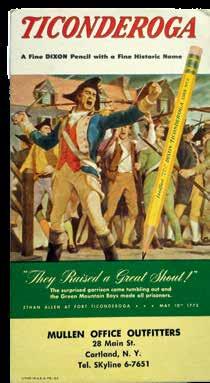

of the equator and crashed into the Amazon Craton, Peck says. The graphite buried within it was unchanged because graphite is inert and stable under high temperatures. But the pressure and heat of the collision also caused melting deep in the crust and produced granites, which contained their own carbon and formed new igneous graphite. A century-old mineral mystery solved at last.
The finding also has implications for graphite mining. “Understanding how and why graphite is found in some places and not others is really important for exploration,” Peck says.
Today, demand for graphite is soaring. The mineral’s structure — those flaky laminated layers that rub off onto paper from a pencil — is perfect for housing lithium ions in a battery’s anode during repeated charge/ discharge cycles. Some Tesla models contain more than 50 kilograms of graphite in their batteries. Most of the graphite used in the U.S. today is mined elsewhere — mainly in China. All of the dozen or so New York graphite mines that ran during Alling’s time have been shut down for more than a hundred years. But national security concerns and political
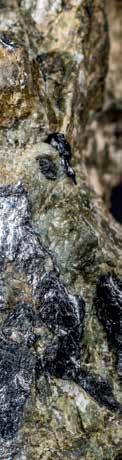
tensions with China are increasing demand for U.S.-mined graphite.
“It’s motivated by the same geopolitical factors that the war in Iran and oil and gas prices are motivated by right now,” says Peck. “We get very concerned about supply chains during war.”
Graphite’s history in the U.S. is closely entwined with the history of war and geopolitics throughout the 19th and 20th centuries. Graphite demand first surged during the Civil War, when the mineral was mainly used as a metal lubricant, for crucibles in foundries and to lubricate wood stoves. The popular invention of the pencil allowed soldiers to write home without carrying an ink pen and pot, Peck says. Then, amid World War I, the government commissioned Alling’s survey to find graphite in the Adirondacks after German blockades cut off imported sources — then mainly from Sri Lanka. Following the war, the Dixon Ticonderoga company commissioned patriotic magazine advertisements featuring Revolutionary War imagery. World War II saw similar anxieties over domestic graphite access. Peck sees echoes of that history today.
“We’re not going to mine the Adirondacks; it’s parkland now, and the deposits are pretty small,” Peck says. But a new mine owned by Titan Mining will soon open in St. Lawrence County in northwest New York.
Geologists often work on “minerals you need to spend five minutes explaining even what the mineral is,” says Peck — like the most recent mineral he studied, wollastonite: a fibrous calcium silicate used to strengthen paint and make plastic phone cases springy. Graphite — a tale of wars and mines and mountains and batteries — stands out in contrast. In his book-lined office at Colgate, Peck picks up a yellow pencil from his desk. “It’s a Dixon Ticonderoga,” he says. “It’s a neat little piece of history.”
— Christian Elliott

1. In the years following the end of World War I, the Dixon Ticonderoga pencil company commissioned patriotic ads depicting heroic deeds tied to Fort Ticonderoga.
2. In the Adirondacks, crystals of graphite formed both from buried organic material and from volcanic fluids when their host rocks were subjected to extreme temperatures.
4. Rocks collected as part of a 1917 New York State Museum study of Adirondack graphite were used to examine historic mines.
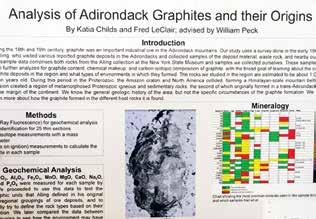
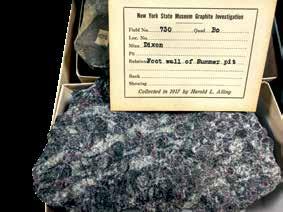
5. Students examine the abandoned Rock Pond mine, now in the Pharaoh Lake Wilderness Area.
6. At Colgate’s summer research symposium, students presented their findings and the research results were published in the Geological Society of North America Bulletin in March.
3. The invention of the pencil allowed Civil War soldiers to write home to loved ones.
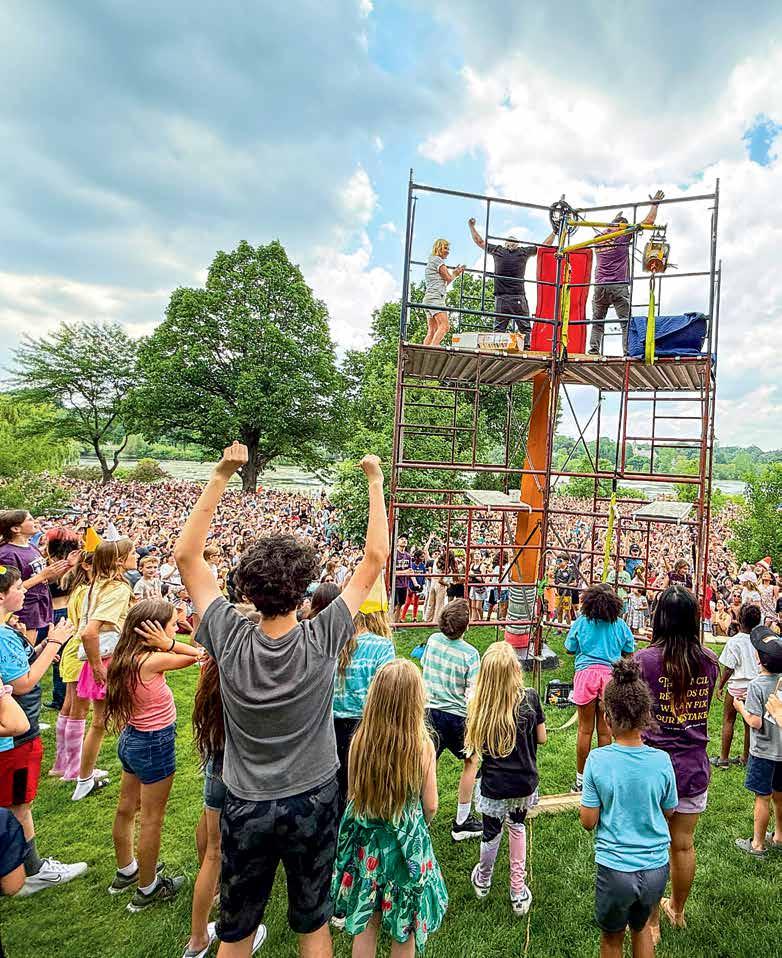



A PENCIL FOR THE

BY Joel Hoekstra
One Saturday last June, more than 6,000 people gathered outside John ’92 and Amy (Erickson) ’92 Higginses’ stately old home on Lake of the Isles in Minneapolis, Minn. Some wore pointy hats. Many waved yellow No. 2 pencils. Others spread blankets on the lawn or danced to the sound of a DJ as they waited for the ritual to begin.
Shortly after 1 p.m., all eyes swiveled to the top of a scaffold in the middle of the lawn. The scaffold encased a 20-foot sculpture shaped like a pencil, and at the point stood the artist and an assistant, who heaved a giant red “sharpener” into place and began to turn it in a circle. As they raised it, revealing a crisp new point, and the first foot-long shavings floated down into a sea of outstretched hands, a chant went up: “Pencil! Pencil! Pencil!” The crowd lost its collective mind.
Minneapolis-St. Paul has borne a heavy load in recent years, from the killing of George Floyd in 2020 to the federal immigration enforcement actions that rattled the Twin Cities last winter. So the Higginses’ annual party, built around a giant pencil sculpture whittled from a storm-damaged tree, offered something the news cycle could not: permission to be unserious in public. People mingled on the lawn, ate cookies and ice cream, and went home lighter than they came.
“It’s just such a joy-bringer,” says neighbor Sara Lefens Donaldson ’82. “It’s a very Minneapolis thing — inviting friends and strangers onto your lawn for some free, goofy fun.”
The Roots of the Rite John and Amy met at Colgate and married two years after graduation. Work led them to both coasts before they settled in the Twin Cities, where Amy grew up, in 2007. Until recently, John managed a biotech firm, commuting regularly to California. Amy, who previously worked in financial management, managed their children, now in their twenties.
In June 2017, the Higginses watched in horror as a summer storm decapitated the 180-year-old bur oak in their front yard. “It was a perfect morning, and then the temperature dropped 30 degrees and the sky turned green,” John says, recalling how the wind picked up, snapping off the massive tree’s crown and leaving only the trunk, tilted but still upright. “It was surreal. It was heartbreaking.” Neighbors offered their condolences. “Everybody would ask, ‘What are you going to do with it now?’” Amy recalls.

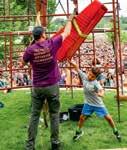
Adding to the party atmosphere at sharpening events: ice cream, T-shirt giveaways, and music from the University of Minnesota Pep Band and DJ Jake Rudh, who spins tracks by Minneapolis native Prince.
imagined a pop-art sculpture: a fork, a knife, a baseball bat, an exclamation point. (No north-woods kitsch, they agreed, like a bear or eagle or loon.) Then someone said, “What about a pencil?” and that was that. “Once it pops into your brain, it seems obvious,” John says. The pencil idea had something the others didn’t: It was a living sculpture. It would shrink over time, they decided, due to annual sharpening — an excuse for a party. Eventually, too, the wood would weather away and the whole thing would vanish back into the earth. Its mortality was part of the charm.
Finding a woodworker willing to transform the tree proved difficult, however. Much like Minnesotans themselves, bur oaks are notoriously stubborn creatures. “They’re massive, and they’re super strong,” John says of the species, once common in the Midwest. “The work is more intricate and mathematical than you’d think. You have to do it all outdoors without moving the trunk, and you only have one chance. You can’t start over with another piece of tree and put it there. It’s complicated.”
Most artists blanched at the Higginses’ idea, but Curtis Ingvoldstad, of Big Woods Sculpture in southern Minnesota, accepted the challenge with relish. In April 2022, he got to work. “Every day for five weeks, Curtis would park his big red truck in front of our house,” John says. “He’d haul out four or five chainsaws, and he’d be out there from 8 till 5, always willing to take a break when people stopped to ask what he was doing or how progress was coming along.” Slowly, a form emerged from the trunk. Finished with yellow, gray, and pink paint, there it was: a 20-foot Trusty pencil, balanced on its eraser.
Writing a New Chapter
To celebrate the sculpture’s unveiling in 2022, the Higginses put up a few signs inviting the neighbors. To their surprise and delight, more than a hundred people showed up, and the crowd has grown every year since. Minneapolis mayor Jacob Frey has attended the annual “sharpening” event, and Minnesota Congresswoman Ilhan Omar recently spoke about it on the House floor, praising the Higginses for “[seeing] opportunity in the face of disaster, turning a knockeddown tree into an incredible community gathering. Their optimism is an inspiration to us all.”
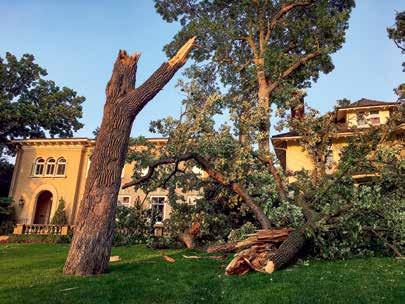
So the Higginses began brainstorming what the damaged tree — still 25 feet tall — might become. They
In 2025 a filmmaker inquired about making a short movie about the pencil. It ended up winning Best Documentary Short at the 2026 Santa Barbara International Film Festival, qualifying it for 2027 Oscars consideration. The pencil was also the subject of a feature in Smithsonian magazine in 2025 and has its own Instagram account, occasionally posing for snapshots in costumes: a Superman outfit, for example, or a purple Minnesota Vikings uniform.

Artist Curtis Ingvoldstad and an assistant perform the annual sharpening using the 4-foot-tall, 100-pound sharpener Ingvoldstad also created. While the oversized sharpener is purely theatrical, the sculpture is whittled down 3–10 inches each year; the worn tip is discreetly replaced with a freshly sharpened one while faux shavings rain down on the crowd.


As word about the pencil has spread, its popularity has surged. In summer the parade of curious tourists outside the Higginses’ home is more or less constant. “I have to brush my hair before I go out to get the paper,” Amy says.
“It’s ridiculous that what started out as just having the neighbors over has become an event that draws more than a thousand people,” says Mary Liddicoat ’89, a neighbor. “But the nonsensicalness is the point. There’s no politics, no agenda. It shows how hungry people are to have community — especially in this city.”
The Higginses couldn’t be more pleased with the reception of their Trusty No. 2. “We’re not changing the world, but the pencil has definitely taught us something about the need for community and our need for joy,” Amy says. “We all need both of those things to survive.”
“THE PENCIL HAS DEFINITELY TAUGHT US SOMETHING ABOUT THE NEED FOR COMMUNITY AND OUR NEED FOR JOY. WE ALL NEED BOTH OF THOSE THINGS TO SURVIVE.”
Amy (Erickson) ’92 Higgins
Joel Hoekstra is a writer based in Minneapolis. He has lived in the city, known for its shimmering lakes, vibrant theater scene, and the iconic sculpture Spoonbridge and Cherry, since the mid-’90s.

In addition to John ’92 and Amy (Erickson) ’92 Higgins P’28, Colgaters Ellie McGoldrick ’27 (far left); John and Amy’s daughter, Jane Higgins ’28; and neighbor Mary Liddicoat ’89 (far right) were among the revelers at this year’s “sharpening” in June.


Planes, Trains, and Automobiles
The cars you drive, the subways you ride, the trains and planes that whisk you to faraway destinations: Colgate alumni are behind them all. How does the work they do make your life safer, faster, and more enjoyable? What challenges have they faced in their careers? What transportation problems do they solve that you may never have thought of? Colgate Magazine finds out.
By Ellen Ryan and Aleta Mayne
EYES OFF THE ROAD: SELF-DRIVING CARS
data sharing, says Krista Tissot ’20, a senior product manager at General Motors whose work focuses on fully autonomous and assisted driving systems.
Human error accounts for approximately 94% of all
“I think companies can do a good job from a publicity perspective [by] sharing their statistics very transparently and broadly about what their safety and collision rates are,” she says. “Then the public might be able to better understand that these cars are on the road all the

language — computer programming — when she joined Amazon after college. While part of Amazon’s Retail Undergraduate Program, Tissot learned programming languages through internal training, as well as external work and online courses.
During this time, she discovered that she was interested in technical work and operations. “Autonomous driving was particularly interesting and exciting,” she found, so Tissot joined Cruise LLC in fall 2021. The self-driving car company was acquired by GM, where she now focuses on its Super Cruise technology.
Working remotely from LA (although GM is headquartered in Detroit), Tissot describes her role as “improving the reliability and overall drive and quality that come out of these technologies.” She collaborates with the engineering, data science, operations, and the data labeling teams to “measure how the system performs and identify improvement areas, so we continue to build a safer and smoother product.”
The company is working in phases. Currently GM offers assisted driving features — think hands-free steering, automatic turn signals, and safe stop — in select models. But it aims to roll out more features and is working toward “eyes-off” and full autonomy. “Our ultimate goal is to develop the ability for vehicles to navigate complex environments without human oversight,” according to its website.
When she’s not meeting with various teams, Tissot tests the technology in a simulation environment — “almost like a video game,” she explains, to see that “the car drove this way in this particular scene and trying to identify if there’s any pattern or anomalous behavior that I’d like to flag for our engineering partners.” In addition to the safety advantages, testing in a simulated environment is more cost effective and it allows for increased data collection. “As an example, you may want to understand how the car is performing on left turns, and you can run 10,000 or 20,000 simulated events with slightly different tweaks in the scenario to understand in aggregate how the car performs on that turn,” she says.
Another component of Tissot’s job is “writing SQL queries and building databases that allow the performance data to be aggregated, easily analyzable, and then subsequently sent downstream to machine learning models that take that data and produce metrics surrounding different components of the car’s performance.”
People are “understandably a little bit hesitant about self-driving cars,” Tissot notes, which is why it’s important for
companies to take steps to build public trust.
The payoff is worth it, she believes. “Self-driving cars have the potential to do a lot of good in terms of increasing safety on the road,” she says. They also can provide opportunities for people with disabilities or
those who are unable to drive, Tissot adds.
And for those who have long commutes to work, “we’ll be able to give people [who] are commuting an hour each way [the ability] to focus on other items. I think that’s a really powerful tool: to give people time back.”
“ Self-driving cars have the potential to do a lot of good in terms of increasing safety on the road.”
— Krista Tissot ’20
FROM BRAZIL TO SERBIA: SAFETY FIRST
Working in the auto business since 1994, Tom Vallone ’92 has had a front-row seat to the modernization of the industry in recent decades. Today he is global director of safety at Stellantis (the fourth-largest automaker with 14 brands, including Alfa Romeo, Fiat, Jeep, Chrysler, and Peugeot), but he started out as an environmental engineer with GM and Chrysler.
He remembers one of the first assembly plants he worked at, in Detroit, where they were making the Dodge Viper. “It was a hand-built, 700-horsepower sports car; there were about 120 people there, and the cycle time was about 120 minutes. We would produce six cars a day.”
A year later when he was promoted and moved to Toledo, Ohio, to work at Chrysler’s largest assembly plant, “we would produce six cars in about six minutes,” he remembers. “There were over 6,000 people working there. The complexity of the operation was an engineering miracle.”
Vallone also thinks back to his first car at age 16, a 1977 powder-blue Monte Carlo, and compares it to the Jeep Grand Wagoneer he drives today. “The technology is amazing. It has sensors all around it; it will tell me
if I am too close to a parked car, but it’ll also warn me if there’s a car too close to me as I’m driving. If I get distracted, it will turn itself back into the lane. And with my adaptive cruise control on, it will slow itself down and speed itself back up to my chosen speed and will steer itself around curves in the highway. Wow.” What’s more: “Cars don’t rust anymore, due to the coating technology.”
Something else Vallone couldn’t have predicted at a younger age: that a global pandemic would boost his career. When COVID-19 shut down the world, Vallone was assembly division manager for environmental health and safety at Fiat Chrysler. As such, he was on a small team thinking through the logistics of reopening the company’s manufacturing locations, and he was appointed to be a delegate for the National Association of Manufacturers. “I met people from all over the world — big manufacturers from oil, aerospace, food, all sorts of things — working on the same problem,” he says. One particularly memorable meeting was when then–U.S. Vice President Mike Pence joined a call. “That was pretty neat.”
Within just a couple of months, “we had figured out a way to meet all of the CDC recommendations and run our plants,” Vallone says. Shortly after, Fiat Chrysler merged with Peugeot Citroën to create Stellantis, and he was promoted to lead global safety for the 800-location corporation. Vallone oversees safety standards for all of the company’s sites, including manufacturing, engineering, R&D, and the dealerships. From crash tests and high-speed test tracks to inclementweather evacuation routes, he’s in charge of occupational safety across the board.
Importantly, he ensures that Stellantis’ standards are met equally at all of its sites around the world — which is challenging because regulations in Brazil differ from those in Serbia, for example.
A geology major who grew up in Detroit, Vallone started his career as an environmental consultant on contamination sites. He transitioned from field work into regulatory work, handling waste management compliance. Through on-thejob connections, he joined GM and became the technical expert on water and waste regulations before joining Chrysler as an environmental health and safety manager. “It was the first time I had any experience with administering safety programs rather than just being one to follow them,” he recalls. His role at Stellantis now focuses solely on human safety, not environmental regulations — which, he says, “I kind of miss from time to time, but … I found that I have an aptitude for this and I enjoy it. Environmental work is more about process, and safety is more about people; it’s about human dynamics and how they react to their surroundings. And I like working with people, so I like my job.”


PATHS OF LEAST RESISTANCE: DESIGNING FOR BIKES, BUSES, AND BETTER LIVING
Although most people don’t think too deeply about how streets and roads are designed, Jim Sebastian ’87 considers them to be a high-stakes puzzle where the right placement of a bike lane or a curb extension cannot only make life better, but it can also save lives. Sebastian is senior planner in Toole Design Group’s Mid-Atlantic office, based in Silver Spring, Md. Toole Design describes itself as a midsize, woman-owned planning and design firm that aims to help people of all ages and abilities enjoy walking, biking, and access to transit. Sebastian is a political science major who has a master’s in public policy/environmental policy and spent years with local government-planning agencies before joining Toole Design five years ago.
What might surprise alumni about firms like yours?
“That there is so much work to do in this space. State, county, and municipal departments of transportation bring in Toole and similar firms to design multimodal roadways (for vehicles, pedestrians, bikes, buses, etc.), bike lanes, bridges, drainage. We coordinate with government, engineers, architects, planners, and other parties; hold community meetings; create hundreds of pages of written plans for construction companies to bid on; and so much more. My own role is creating plans and designs for new or improved trails, bike plans for cities and counties, pedestrian safety projects, and more, mostly in the midAtlantic region. Right now I’m working on a bike plan update in D.C., a trail in Alexandria, and a street redesign in D.C.”
What’s one example of an everyday street design challenge?
“Say you’ve got a sidewalk next to a street with a parking lane in between. Where do you put the bike lane for everyone’s maximum safety and efficiency? Between the traffic and the parking lane? Between the parking lane and the curb? What happens at the intersection? Maybe you need to raise the bike lane and arrange it so people can get across to the bus stop.
“For pedestrian safety, safer intersections now mean removing a bit of parking before it so both pedestrians and drivers can see more. Using artwork — a planter or colorful paint — can help make this obvious, plus adding curb extensions for walkers’ safety.”
What portion of traffic crashes are due to poor design and what portion to driver error?
“That is a tough one. On one hand, studies have claimed that most crashes are due to human error. (We like to say there are no accidents; someone was usually doing something wrong.) But on the other hand, some studies have shown that bad design is responsible for a good chunk of traffic crashes. The truth is that it is usually a combination of factors. Most importantly, good design can help reduce human error. We can’t solve the traffic safety crisis without better design.”
What is a sure sign of poor street design?
“Here’s a classic one you might see in a city. The street has been widened from two lanes to four [and then] six, but the sidewalk on either side is still 5 feet wide. There’s no tree buffer. All the snow gets thrown there. The dirt and street mess have nowhere to go. The population has become denser, with more apartments; people are passing each other tightly in a heavy car and truck environment.
“A fix in the intervening years would have taken out a lane or two, widened the sidewalks, added tree boxes and benches, maybe added a bike lane, maybe streetcars. Then it’s much more pleasant and usable for everyone.”
HOME IS WHERE THE HANGAR IS
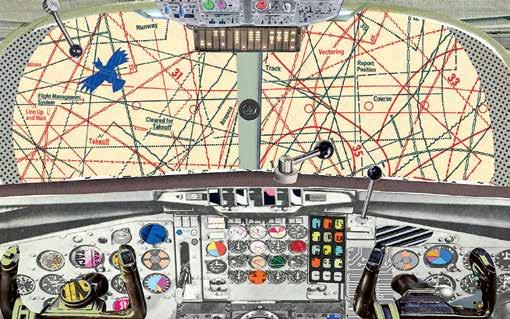
(later Expressjet), then Continental, which merged with United in 2012. He captains a Boeing 737 and has flown worldwide.
An aviation family: “My grandmother’s brother was an aviation pioneer in the late 1930s and taught my grandfather to fly. My grandfather transitioned from a full-time farmer to a civilian flight instructor during World War II, then trained military pilots in Georgia. Back in New Jersey, he plowed a hayfield into a small airport, set up a flight school, and taught my grandmother and their four kids to fly. My grandmother soloed at age 59. All four kids soloed at age 16 and earned private pilot licenses.
“My father was a TWA pilot for 35 years. I got my license and became a flight instructor. Shortly after college, I met my wife — she was one of my students. She became a flight instructor, too, and our three kids continue the tradition. Our daughter just became an Air Force ROTC second lieutenant. Our boys, ages 19 and 16, have both soloed. That’s nearly 100 years of aviation in the family. We still live next to the airport (though it changed hands five years ago), own two little airplanes, and take day trips here and there. For me, it’s a hobby as well as a job.”
For pilot W. Holland Fritsche ’97, the cockpit isn’t just an office — it’s a family legacy, passed down through generations of pilots that began with his grandfather plowing a New Jersey hayfield into a runway. Fritsche is in his 28th year as a commercial pilot — first with Continental Express
On 9/11: “That beautiful Tuesday, I was flying Expressjet from Newark to Charleston, S.C. On approach, we heard chatter about a small plane hitting the World Trade Center. Airliners started pulling into Charleston. I phoned home and got the real story. Surreal. Dozens of flight crew folks gathered in a breakroom, watching events on a 13-inch TV.
“I was worried about so many Colgate
friends who worked in New York City. The phone lines were jammed. My crew got hotel rooms, picked up clothing … ever since, I pack an overnight bag because we were there until Friday, when we could rent a car and get home.”
Best and worst aspects of piloting: “What I have appreciated most is the flexibility of a job that’s not 9-to-5. There’s been plenty of time between trips to coach Little League, rec volleyball, and my boys’ football teams. I’ve been a part of my kids’ lives and never missed a major family event. A lot of that depends on seniority. The biggest downside, I’d say, is the same as for the public — the unpredictability and frustration caused by bad weather, mechanical breakdowns, and other unfortunate circumstances. For instance, I just got back from Denver, which was supposed to be a one-day trip. Weather caused a diversion to Colorado Springs for refueling. I got on the aircraft intercom and told the passengers, ‘I want to get home as much as you do.’ After all, I had to stay over a day and missed a college visit for my son.”
Sky-high confidence: “One thing I’ve enjoyed most over the years is teaching people. I’ve kept my flight instructor certificate active for 30 years. I would encourage everyone to try their hand at flying, with at least the goal of flying solo once. It builds self-confidence, self-reliance, and adaptability, all while forcing greater development of situational awareness, forward thinking, and speeding up the reaction of your mind and reflexes. I’ve taught a lot of people how to fly, and every one had a glow of satisfaction and accomplishment after that first solo flight.”
DECARBONIZING RAIL TRANSPORT
While most U.S. trains still run on diesel, Hollie Knox ’90 is helping Stadler U.S. Inc. usher in a zero-emission era of hydrogen- and battery-powered transit. Knox has been the Philadelphia-based deputy general counsel and strategic project director for Stadler U.S. Inc., the U.S. subsidiary of a Swiss rail manufacturer, since 2024. The political science major earned a law degree and worked in private practice and in-house counsel, primarily as a labor and employment attorney. Her move into transportation came in 2015 when she shifted to Amtrak, starting in compliance, then moving into procurement, rising from principal contract specialist to senior director of Rolling Stock, and ultimately into capital delivery where she became a vice president responsible for Amtrak’s Airo fleet.
You’re both a company lawyer and a strategy leader. That sounds like two different jobs.
“It is sometimes two different roles. Having previously worked on the buyer side (in procurement for Amtrak), I am consulted internally and able to offer advice from a buyer’s perspective on how best to respond to certain aspects of train and maintenance procurements. I also work with the sales and execution teams from Stadler’s service/ maintenance division on preparing and refining scopes of work to ensure that successful long-term contracts are put into place.
“When I came over from Amtrak, where I’d done a lot of procurement and acquisitions, I wanted to put a toe back into the legal side as well. The legal side of my job relates largely to responding to requests for proposals, usually from local transportation agencies, to purchase trains and/or maintenance service for trains. After the Stadler team evaluates the technical specifications and other proposal documents, we submit a proposal. If we are selected as the preferred bidder, we move into contract negotiations.”
What’s the future of passenger rail in the United States?
“It’s already here in some places. For
example, the first hydrogen-powered train in U.S. revenue service, the Stadler FLIRT H2, operates in San Bernardino, Calif. The train consists of two passenger cars, which can seat [a total of] 108 passengers — more with standing room — with a modular power pack between them, which holds the fuel cells and hydrogen tanks.
“The fuel cells convert the hydrogen into electricity. The current gets passed on to a drive battery, which moves the train. It has a maximum speed of 130 km an hour, or about 79 mph. Stadler set the Guinness World Record with the FLIRT H2 in March 2024 by traveling 1,742.7 miles on a single tank of hydrogen, operating for 46 hours without refueling, at the Transportation Technology Center in Pueblo, Colo. We’re decarbonizing rail transport.”
What else is happening in this futuristic, green-energy mode?
“Right now almost all U.S. passenger rail transportation is diesel powered. Fortunately, states like California are prioritizing greener energy and looking to Stadler for its innovative technologies. A few years ago, Caltrain started service with Stadler KISS (double-decker) electric, multiple-unit trains that run between San Jose and San Francisco. And Caltrans (California Department of Transportation) and CalSTA (California State Transportation
Agency) together ordered 10 four-car, zero-emission, hydrogen-powered rail vehicles from Stadler. In addition, Stadler is building battery-powered commuter trains for Metra Chicago.”
Why is Europe so far ahead of the U.S. in high-speed rail?
“World War II wiped out European track, which then had to be rebuilt. So they have a lot of track dedicated to passenger service and can run at much higher speed and produce a more comfortable ride. Ours is much older. Plus, most of our passenger track is not dedicated; it’s almost all shared with freight railroads. Amtrak’s Acela is dedicated, but that’s very regional. There are a few high-speed rail projects in early stages, but for those to be successful, you need lots of space, lots of money, and political will, among other things.”
What do you think makes trains the best mode of transport?
“They are more comfortable and allow you to be more productive during your travel time; you can stand and even walk around and pull out a laptop or tablet to get some work done. They help reduce traffic and emissions on the roads, plus many of the newer trains with hydrogen, battery, or electric power provide a cleaner alternative to driving.”
— Hollie Knox ’90
Keeping BART on Track Through Seismic

As part of this role, Goetz oversaw BART operations while the system was seismically retrofitted to handle both the San Andreas and Hayward faults. This meant protecting electrical, communications, and rails as well as people and keeping BART running
“ It’s great to be able to contribute to community cohesion and collaborate on a common goal: a safe transportation system.”
— Karen Goetz ’77
nearly two decades before equal marriage became the law of the land.
“I got a lot of crap at work early on for being queer,” Goetz muses. “By the time I retired, we all earned mutual respect and admiration. It’s great to be able to contribute to community cohesion and collaborate on a common goal: a safe transportation system.”
Since retiring from BART in 2018, Goetz has been consulting on transit projects. When Colgate students contact her for advice on a career in transportation, her focus is on the gulf between academic concepts and practicalities. “Above all, you need hands-on experience in the field,” she says. “Get an internship with a transit agency. Many have summer programs that expose college students to different areas.”
This campus mainstay has deep routes
Wondering if the Colgate Shuttle is running today? Unless it’s Christmas Day or New Year’s Day, the answer is yes. Colgate launched its own transportation department on Aug. 28, 2024, after decades of outsourcing the service to private vendors.
During the past two years, the system has been adjusted and expanded to meet the needs of those who study, work, and live on campus and around the village of Hamilton. Its routes extend to New Hartford, Syracuse, Boston, and New York City.
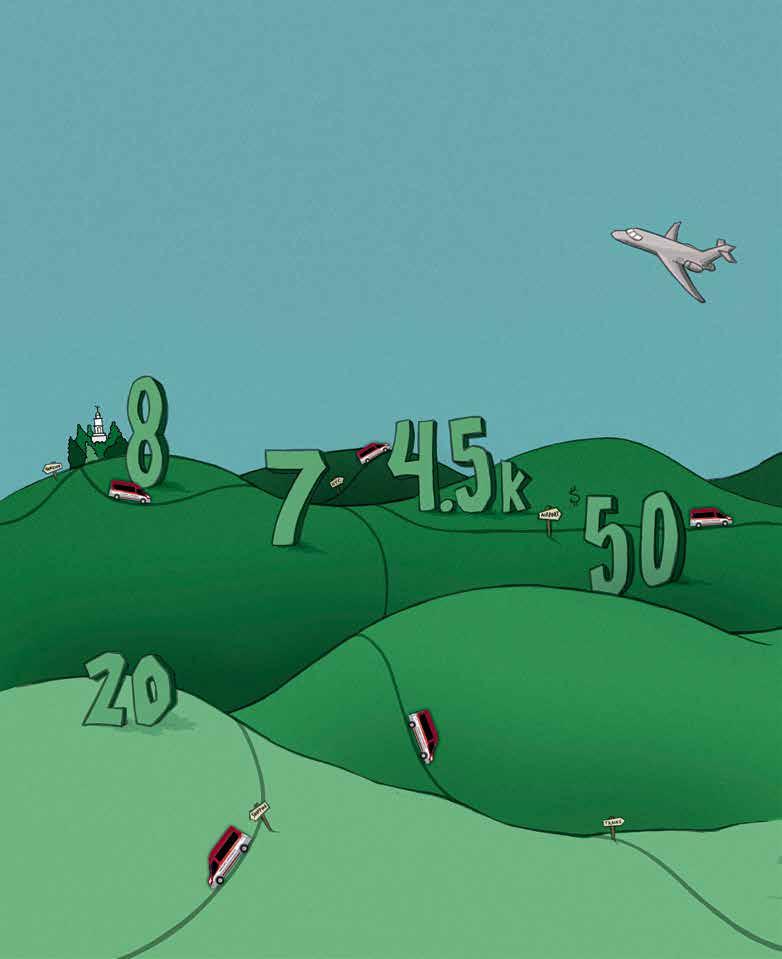
8 VEHICLES: four with 22-passenger capacity and four with 12-passenger capacity
20 drivers total: two full-time, 12-month drivers; eight fulltime, 10-month drivers; and 10 parttime drivers
On-campus shuttle runs 7 a.m.–2:30 a.m., SEVEN days a week
Total mileage on all vehicles since 2024: 346,294 (as of the reporting period)
More than 4,500 people transported annually to and from the airport and Destiny Mall in Syracuse
Destiny Mall shuttle operates every Saturday, leaving at noon and returning at 6 p.m.
Airport & train station: $50 per trip for students, $100 for official Colgate business, $150 for community members/visitors
12- and 22-passenger vehicles (all vehicles) drive approximately 200,000–250,000 miles annually
Local shopping shuttle runs 10 a.m.–8 p.m., seven days a week
What They Taught Us
One of the hallmarks of a Colgate education is forming enduring relationships with professors who become mentors and even friends after graduation. We talked to alumni who wanted to honor some of the professors who retired this year. Those graduates told us how their former profs not only contributed to an unforgettable college experience but also shaped their futures and, in some cases, their children’s futures.
Padma Kaimal
Barry Shain

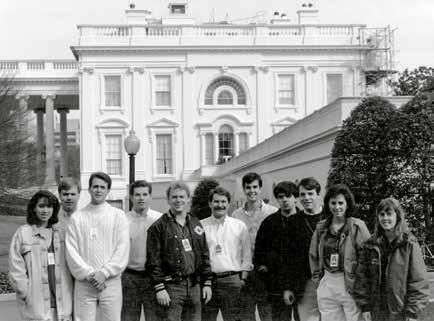
Stanley Brubaker, Professor of Political Science
Passing the Torch
While at the Hamilton home of his former student Luke Bierman ’79 in the spring, Professor Stanley Brubaker pulled a book off the shelf and a short letter he’d written 50 years ago fluttered out. In it, the professor was briefly clarifying a response he had given in class to a question Bierman asked about The Federalist Papers — along with an invitation to continue the discussion after the next class.
“We looked at it and laughed,” Bierman says of the spring serendipity, “but it was very scholarly. It was very to the point.” The retiring political science professor and his first high honors student — now an accomplished professor himself on the brink of replacing Brubaker in the classroom — were catching up after the elder’s retirement party.
The note was not simply a funny flashback — for Bierman, it signified the seriousness of the class. “It wasn’t just something you did for 50 minutes; it was something you thought about all the time.” That Brubaker took the time to find out Bierman’s student mailbox number, write the letter, and send it, spoke volumes. “It reflects the teacher’s role,” Bierman says. “This is something that is imbued in us, is important to us as educators, and we’ll do whatever’s necessary to
The 1991 Washington, D.C., Study Group
Linck Johnson
Stanley Brubaker
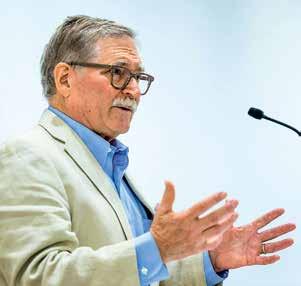
help somebody understand something.”
Bierman, who had a varied career as a lawyer and political scientist before joining academia, speaks as an educator himself. He’s been at Elon University School of Law since 2014 as a professor and dean and then in fall 2024 became Colgate’s A. Lindsay O’Connor Chair of American Institutions in the Department of Political Science. This fall he returns to Colgate to teach political science, including Brubaker’s famed constitutional law course.
The two have kept in touch sporadically over the years. In fact, Bierman recalls another memorable note Brubaker wrote to him, in 2016, after Bierman penned a Wall Street Journal op-ed, “Eight Justices Won’t Do—but Six Were Fine for 1789.” His op-ed discussed President Barack Obama’s nomination of Merrick Garland to replace the late Justice Antonin Scalia and the argument that the Supreme Court
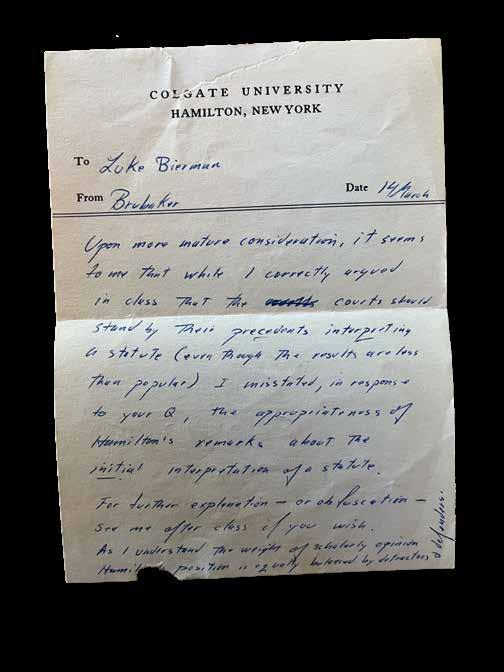
must have nine justices — a topic Bierman covered decades earlier as a student in his paper “Why Nine? This Bench Isn’t Big Enough for the 10 of Us.” A few days after the op-ed was published, Bierman received a “very curt” postcard from Brubaker stating, “I’m glad you finally did something with your high honors paper.”
Humor aside, the postcard demonstrated something more: His former professor remembered the topic of his thesis almost 40 years later and reached out. In this time of “great transformation” in education, Bierman says, “the importance of institutions of learning, the role teachers play for their students, the way in which teaching is serious work, the conveying of knowledge from generation to generation — it’s all something I think Stan would resonate with and that I, unknowingly as a 19-yearold, have taken away.”
In a booklet for Brubaker’s retirement, approximately 90 alumni wrote in with congratulations, memories, and expressions of gratitude. Here are some:
“You didn’t just teach us politics; you taught us how to lead within it. You have left an indelible mark on this country through the generations of students you sent out into the world.”
— Darren Bearson ’96
Upon more mature consideration, it seems to me that while I correctly argued...
“Professor Brubaker’s seminar marks a before and after in my relationship with language. I have never looked at a word since without wondering about its many interpretations — and the way those interpretations shift depending on the reader and the situation. His class crystallized the throughline of my education at Colgate: the critical exploration of human creation and expression.”
— Javier R. Calvo Mendoza ’12
“I’m in my 16th year teaching and, for the last five years, teaching civics. I constantly tell my eighthgrade students stories from my time in D.C. and describe working in the Supreme Court, which was my internship that semester. My
students can’t believe how quickly I can pull constitutional law facts out, and it’s because of the standards Professor Brubaker had for us. I know that my passion for studying government and civics was built in that semester, so I’m forever grateful.”
— Kathleen (Shaughnessy) ’10 Cooper
“There are only a few people in my life I would describe as lifechanging. Professor Brubaker is one of them. At Colgate I served as president of College Democrats. Professor Brubaker and I were on opposite sides of the political spectrum, but he always treated me with dignity and respect. When I said I wanted to do an internship in the Clinton White House instead of an executive branch internship, he readily agreed. And he helped me obtain a congressional internship that later led to a paid internship. Most importantly he taught me the value of critical thought and looking at all sides of every argument. This served me well when I returned to D.C. to attend law school at American University and later went on to work in the Senate (culminating as the deputy staff director of the
Luke Bierman ’79 still has a letter Professor Stanley Brubaker sent him 50 years ago.
Professor Brubaker:
→ taught at Colgate since 1976
→ began leading the Washington, D.C., Study Group in 1986 and led 20 groups
→ Distinguished Teaching Award, Alumni Corporation, 2008
→ founding director of the Institute for Philosophy, Politics, and Economics (now the Lampert Institute)
→ founding director of the Forum for Constitutional Government of the Kraynak Institute
→ counts five married couples among his students, including one couple for which he officiated: Dan Fichtler ’08 and Jenn Frey ’08 (below)

Senate Commerce Committee) and positions in both the Obama and Biden administrations. I also served in the U.S. Army Reserve JAG Corps, recently retiring at the rank of lieutenant colonel. (Something I would have never done had Professor Brubaker not challenged my beliefs in the various ways to best serve your country.) Overall, Professor Brubaker represents the best in academia and scholarship.”
— Christopher Day ’95
“The D.C. Study Group was a deciding factor in my choice to attend Colgate, and 20 years later, that experience with Professor Brubaker continues to shape my life. As just one example, a group of us who became friends through that study group have maintained a daily group chat where we continue to wrestle with and debate the issues Professor Brubaker helped us understand — often pointing back to specific lessons, texts, or conversations from that semester. His love of the constitution was infectious and the opportunities he gave us, from being able to discuss the constitution with Antonin Scalia to his thoughtful assignments
that put us in the shoes of policymakers took my future career in Washington, D.C., from an aspiration to a practical reality. I remain so grateful to Professor Brubaker for his quiet temperament, seriousness, kindness, depth of knowledge, care for teaching, and decades of work to train us to be leaders rooted in constitutional values.”
— Ben Suarato ’07
“Professor Brubaker’s Washington Study Group ’06 launched my 20-year career in public service that has spanned the Senate, New York Fed, CIA, and State Department.”
— Bob Fitchette ’07
“As part of my practice [representing the City of New York in appellate litigation involving constitutional and statutory challenges to city laws], I frequently argue in court, and I often recall that my first argument was in [Brubaker’s] class, where [he] presided as chief justice in full judicial robes. That experience taught me the joy of oral advocacy and profoundly shaped my professional aspirations.”
— Geoff Curfman ’10

Padma Kaimal, Batza Family Chair in Art History
The Gift of a Global Perspective
April Oettinger ’94 read in a recent issue of Colgate Magazine that her former professor Padma Kaimal has been named the Batza Family Chair in art history — a coincidence because Oettinger teaches her own art history class at Goucher College in the Batza room. “What a small world,” Oettinger wrote in an email to Kaimal last February.
She also wanted to thank Kaimal because now, as a professor herself, “I think about my relationship with my own students, and I need to remember to thank the people who took me under their wing,” she says.
In Oettinger’s college days, the study of art history looked different than it does today, she says, crediting Kaimal with “giving me my first glimpse of a global perspective” and teaching the subject with an interdisciplinary approach.
“Padma was object-centered and could draw from a single object a whole web of threads that linked in with broader cultures of faith,


ritual, place, nature, gender, materiality, and global travel,” she says. “That was formative for me,” adds Oettinger, who wears many hats at Goucher, including chair of the art history, literary, visual & material culture department, as well as director of humanities and interdisciplinary studies.
Although she took only one course with Kaimal, on South Asian art, “it was the gift that kept on giving and expanded the way I thought about the study of visual culture.”
When she messaged Kaimal last winter, Oettinger also wanted to tell her the exciting news about her forthcoming book, Animating Nature: Lorenzo Lotto and the Art of Landscape in Renaissance Venice, 1500–1550 (Pennsylvania State University Press, January 2027).
Oettinger says Kaimal introduced Venice “as
Professor Kaimal:
→ taught at Colgate since 1988
→ has written two books
→ was named professor of the year, Colgate chapter of the American Association of University Professors, 2022
→ Distinguished Teaching Award, Alumni Corporation, 2014
→ Led a Sophomore Residential Seminar to India in 2017 and Benton Scholars to India in 2010
→ helped lead a trip for 27 faculty members to India in the winter of 2012
→ Favorite places on campus: “Willow Path, of course; Lineberry pool too”
an entrepôt of the world historically between East, West, the African continent, Northern Europe, and so on in trade roots.” That base knowledge facilitated Oettinger’s further explorations while on the Venice Study Group with Professor Ross Ferlito and more recently in writing Animating Nature.
“My work with Padma left a lasting impression on me as a professional in the field,” she says. “[It’s what] I strive to bring into my own teaching in a small liberal arts school.”
Ripple Effects
As a palliative care physician in California, Gretl Lam ’12 draws on her spirituality and knowledge of various religions when she
consults with patients and their families about end-of-life care. “It takes a very specific personality to go into this specialty,” she says. “We don’t see a lot of patients get better; spirituality helps ground us in understanding and thinking about the meaning of life and death.”
But Lam wasn’t always at peace with religion. “My family practices a traditional Chinese Buddhism that’s mixed in with local Chinese practices and traditions,” she says of her upbringing. Kaimal’s South Asian history classes and spending time studying with the professor in India “helped me see Buddhism in a different way.” Lam explains that she learned about the beginnings of Buddhism in India that spread into China, Korea, Japan, and Thailand. “It helped me have a totally
Gretl Lam ’12 and Professor Padma Kaimal in India in 2010.
Inset: Lam has brought knowledge of Indian culture — which she learned from Kaimal — into her marriage.
new perspective on Buddhism as a religion that was not just limited to my family’s scope,” she says. “The classes helped me find my way back to it on my own terms.”
Kaimal also introduced Lam to art history, which she ended up minoring in despite “knowing nothing about how art history works or how to appreciate art” initially. But “I remember her being very warm, enthusiastic, supportive, and nonjudgmental,” Lam says. She felt Kaimal conveyed the message of “There’s no expectation that you need to know anything; just be here, be curious, be excited to learn.”
It had been a decade since she last contacted Kaimal when Lam reached out last year to thank her for yet another way the professor’s lessons carried into her future. Lam married an Indian man, and “he and his family were so impressed by my knowledge of Indian culture,” she says. It even played a role in her wedding planning as she incorporated Indian culture into the ceremony. Lam sent Kaimal her wedding photos and noted, “Isn’t it funny how life works out this way?”
A Foundation in Museums
“A crash course in museology” is how Becky (Ruderman) ’07 Kusovitsky describes the semester she spent with Kaimal and 14 other students on the London Study Group. Kaimal led the troupe through museums in that city as well as Bath, Cambridge, and Oxford to learn how different institutions are organized. “It gave me a foundational understanding,” says Kusovitsky, who’s been working for museums since graduation
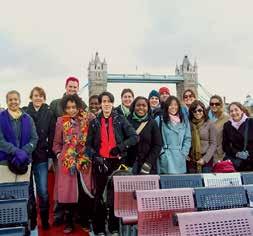
and for the past seven years has been The Museum of Modern Art’s department manager of Media and Performance. Engaging in the topics in such an immersive way, the students “really got to
know her,” Kusovitsky says of Kaimal. “She’s kind and caring, genuine, but also a very rigorous professor and scholar. She expected things to be done to a high standard, but was also gentle about it. She was very approachable, but you had to do good work if you wanted to do well in her class.”
Mapping a Windy Path
“Early on during FSEM India, Padma gathered us around a table in Little Hall and spread a large sheet of paper across the center. As she talked us through the scholarly articles she was reading, she jotted key ideas into bubbles, drawing lines between recurring themes and surprising connections as they emerged. Slowly, the page became a woven map of ideas: a living conversation between scholars and the questions they inspired. It made research feel like a new, never-opened puzzle. Today, I still brainstorm new projects and write by pulling out my large piece of paper (or, these days, a virtual whiteboard).
“Beyond the classroom, Padma became a trusted mentor. She encouraged me to venture beyond what seemed safe and to say yes to experiences I hadn’t planned for.
“Since graduating, I’ve had a number of adventures, few of which are what I imagined when I first arrived at Colgate. I’ve worked with a small nonprofit in rural Gujarat, spent a summer as a high school trip leader in Rajasthan, studied Indian art at the graduate level, worked for a decade in the humanitarian sector, and now lead a team at a science- and education-focused nonprofit. Padma’s influence has been important throughout my windy path. She showed me how to build arguments from evidence rather than forcing information into a predetermined frame (a skill I’ve relied on in every professional role). She helped me to embrace new chances and possibilities (an important reminder in learning and in life).
“Seeing Padma at reunion and receiving her family’s holiday letters are bright punctuation marks in my year. Hearing about everything from her lifeguard shifts at the pool to her work helping the new University of Nepal develop a liberal arts curriculum is a reminder to keep giving back and to keep saying yes to new things.
“I feel especially grateful to Padma when I pick up my pen or take the next big leap into something unknown. (As a frequent returner to India, I’m also very eager to make progress, slowly but surely, visiting highlights from her Hindu Temple Architecture curriculum.) Everyone should be lucky enough to have such a wonderful mentor and teacher.”
— Coco Vonnegut ’13

“As she talked us through the scholarly articles she was reading, she jotted key ideas into bubbles, drawing lines between recurring themes and surprising connections as they emerged. Slowly, the page became a woven map of ideas: a living conversation between scholars and the questions they inspired.”
Becky (Ruderman) ’07 Kusovitsky (far right)
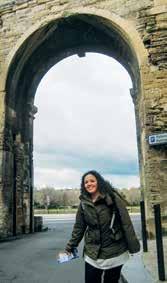
Barry Shain, Professor of Political Science
Thinking Three Steps Behind
Vanessa (Persico) ’09 Konoval remembers the end of her senior year — it was “a hectic time” — when she was in Professor Barry Shain’s honors seminar. “We had turned everything in and we were ready to dust our hands, sit back, call it a win, and just wait for our diplomas and our little fancy sashes,” she jokes. But when Shain walked in, he announced: “What I’m seeing is not honors-level work. You guys are going to need to do one more revision.” Konoval remembers: “We were just like, ‘You’re freaking kidding me.’
“But he expected the best of us,” she continues. “He made himself perfectly clear in saying, ‘You have to do the work.’ And so we did.”
In all of her experiences with Shain — three classes, four years as his research assistant, and a semester on the Geneva Study Group — “he didn’t mince words,” she says. “He’s a great speaker and very engaging, but he’s not going to step around it if he feels like he’s not getting 100% from somebody.”
Another classroom memory she has is from the intro
course Politics and the Moral Vision. It was toward the beginning of the semester and “the class was a little logy,” she says. “I remember him trying to rev us up and he said, ‘You’re all just sitting there like I’m speaking ex cathedra I’m not. I’m a scholar with an ax to grind.’” Konoval says, “I’ll never forget him saying that. I thought, ‘OK, so I’ll get out my own ax. Let’s figure this out.’”
Konoval “didn’t really agree with him most of the time,” but she enjoyed debating Shain, and she saw that in other students too. “He’d get under your skin. People would stay after class all the time to talk to him and say, ‘Hold on, what about this? What about that? What about the other thing?’ The conversation continued.”
Even while working with him on his book, she’d sometimes go to his office, hold up something he’d written, and prompt him to give more background on the ideas, saying, “Where did you get this?”
These experiences have helped the political science major in her law career — a path she decided to pursue while on the Geneva Study Group — as a prosecutor, a deputy city solicitor in Philadelphia, and now an attorney with Progressive Insurance’s in-house counsel.
Here are some lessons from being Shain’s student that have stuck with her:
• “To back up what I’m saying … to come into the conversation with receipts.”
• “Disagreement doesn’t have to be acrimonious.”
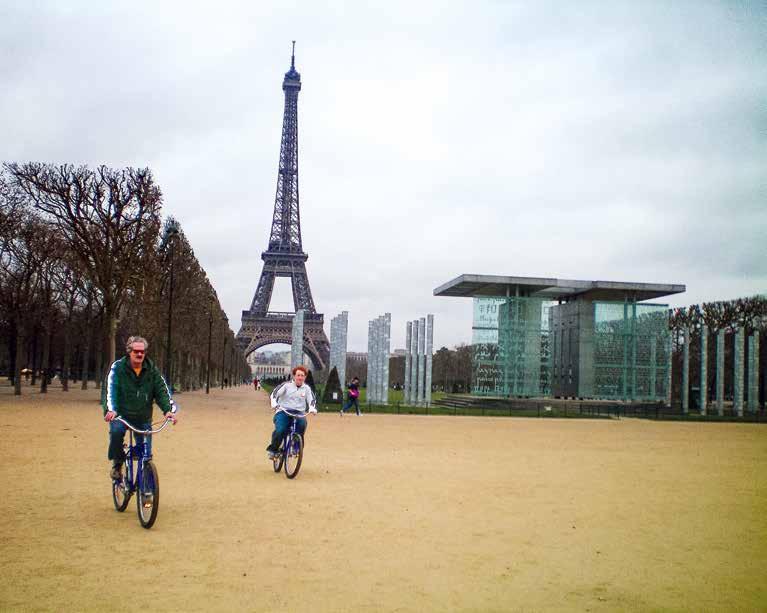
Professor Shain:
→ taught at Colgate since 1989
→ has written four books
→ led the Geneva Study Group four times between 2003–16
→ teaching awards include: 2001 IFC/Panhellenic Lifetime Achievement Award, 2004 Greek Community Faculty of the Year Award
→ says his favorite class was POL SCI 151: The Politics of Moral Vision, “in which I taught likely 1,000 or more students over the years”
→ says his favorite memories are of “long, usually overnight train rides with my Geneva Study Group students”
Vanessa (Persico) ’09 Konoval in Avignon, France, while on the Geneva Study Group (below). Professor Barry Shain and Brian Thompson ’09 in Paris.
• “On a more substantive level, I learned about moral vision and the concept, because really what he was teaching was political philosophy.”
• “If you figure out where somebody’s coming from as far as base points of view, that can tell you more about what they’re thinking and what they’re going to think next. People always talk about thinking three steps ahead. Sometimes you have to think a few steps behind. You have to turn around and see, where did this start? That has served me well in my career and negotiations.”
Vanessa Persico ’09 married Stanley Konoval ’09 in August 2014 at Memorial Chapel; Professor Barry Shain attended and Chaplain Mark Shiner officiated.
Practicing Law
Max Waller ’21 also remembers the rigor of Shain’s classes, and he, too, was a research assistant on one of Shain’s books. At press time, the political science and economics major was finishing law school at the University of Chicago, studying for the bar exam, and preparing to head to California to practice class-action defense. Here’s what he had to say about his experiences in Shain’s classes: “He never lowered his standards. He taught an introduction to politics 100-level class that, in my opinion, should have been labeled a 200- or 300-level class. It was an incredible amount of work, but I loved the class. He taught my seminar for my political science major as well. It was an analysis of the American Revolutionary time period, a massive dig into incredible historical sources from decades ago. That class, along with a couple others, really made me want to be a lawyer. It showed me that I could handle law school on some level, just the sheer amount of reading that was extraordinarily dense and complicated, written in the 18th century. The most memorable part was the records of the Federalist Convention, the Constitutional Convention of the United States Constitution. We did a deep dive into them. It was an incredible experience to go through with someone who has such an amazing understanding of the time period; there are a couple of phrases that you don’t think are important but because he’d been immersed in the literature of the 1700s for 20 years, he could pick [them] out and go into detail to provide a complete understanding. To learn from somebody like that was truly incredible. I went to his office hours frequently; there was lots to talk about, learn, and understand.” The main takeaway for Waller as he begins his law career? “Commitment and hard work are rewarded.”
Max’s dad, Bill Waller ’91, wrote about his favorite professor, Stanley Brubaker, in Brubaker’s retirement book and noted that Brubaker’s guidance persuaded Max to attend Colgate.
Continuing the Conversation
In January 2017, Evan Winter ’07 had just returned to the U.S. after working in finance in India for five years when

“That class ... really made me want to be a lawyer.”— Max Waller ’21
he sent Shain a package. “Dear Professor Shain,” he wrote, “I must apologize for a few things.” Winter was returning two volumes of Nietzsche’s complete works that Shain lent him almost a decade prior, apologized for not keeping in touch, and thanked him belatedly for introducing Winter to his mentor and launching his career. “I am indebted to you for this,” he wrote.
Along with the letter and books, Winter was sending Shain As It Is, Vol. II, a collection of Tibetan Buddhist teachings by Tulku Urgyen Rinpoche. “It would be great to discuss ideas sometime in the near future,” Winter wrote. He also included a few African bracelets for Shain’s wife and daughter.
“I had to send him some gifts out of guilt because I kept his book for 10 years,” he says now. “And I just wanted to share some of the more compelling things I discovered. I went to India, in part, because I really wanted to explore.”

Evan Winter ’07 sent Professor Barry Shain As It Is, Vol. II 10 years after graduation for a future discussion topic.
A political science and German major, Winter says he’s “been a bit of a nomad” and describes himself as an entrepreneur. He began his career with a finance company in Germany after Shain introduced him to the owner, who became Winter’s aforementioned mentor. The recent grad spent a year in Germany before joining the company’s U.S. subsidiary in Miami and then headed to India to work for the commodity business Cargill.
“Educationally what I took from Colgate the most is the exploration of things you don’t really question,” Winter says, citing his study of the Constitution as one example. He often visited Shain during his office hours, where conversations about history veered into discussions about philosophy and morality. “He’s not a philosophy professor, but he has that quality and he thinks deeply about interesting things,” Winter says.
“He completely transformed how I viewed early American history. It’s helped me educate and have interesting conversations with my children about that period.”
Linck Johnson, Charles A. Dana Professor of English
For five decades, Linck Johnson introduced Colgate students to what he describes as the “richness and complexity of American literature.” Yet the memories former students share rarely focus on scholarship alone. They recall a professor who, often alongside his wife, Susan Belasco, encouraged them to see learning as something larger than the classroom, whether while leading generations of students through London in his study group, in spirited discussions of literature, or in conversations — and friendships — that continued long after graduation.
→ Tell us how a Colgate professor influenced your life: magazine@colgate.edu
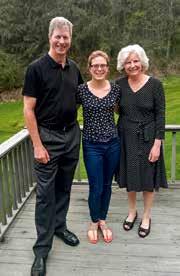
“I took Engl 244A in fall 2013, my sophomore year. Professor Johnson had so much passion for the texts we explored and cared deeply about fostering engagement with the course materials. I was never one for poetry, but I recall feeling like maybe, for the first time, there might be poetry out there that could capture my imagination; even now, his lessons on Carl Sandburg’s ‘Fog’ and Robert Frost’s ‘The Road Not Taken’ often come to mind.
“A year later, I started my semester abroad in London with Professor Johnson and a small group of fellow students. Linck, as I have come to know him, and his incredible wife, Susan, could not have done more to make us feel comfortable and cared for so far away from home. I remember Professor Johnson emphasizing to us that while we should stay on top of assignments, this time in London must be spent experiencing London.
“Professor Johnson knew that learning is about so much more than reading books. And yet, the books we read made an indelible impact on my life. From Oliver Twist to The Lonely Londoners, these texts enriched my experience of such a fascinating and complicated metropolis.

“It was my time in London (and a fall break trip to Scotland) that inspired me to apply for a graduate program in the U.K. I could not imagine studying British literature anywhere else after my semester abroad. While London can take some of the credit (it is an incredible city, after all) most of the credit must go to Professor Johnson. Without his guidance and encouragement, I would not have taken advantage of everything the city had to offer.
“Since graduating, I have been lucky enough to keep in touch with Linck and Susan. Gracious hosts and now gleeful grandparents, these academics have modeled what it means to be respected scholars and kind human beings. I now work at a university and can promise that that is a rare and precious combination.
“I am so grateful to have been Linck Johnson’s student and now, 10 years after graduating, honored to consider him a friend.
“P.S. I would be remiss not to mention Professor Johnson’s superb collection of turtleneck sweaters. Those garments are stuff of legend!”
— Allison Bean ’16
“My Colgate experience was undoubtedly richer thanks to Professor Johnson. When I presented the idea of joining his study abroad group in London as part of my English literature minor (rather than the signature major experience it was meant to be), he believed in my vision and allowed me to join. Linck became a mentor, sharing his passion both for life in London and the literature we studied, challenging us to develop as linguists and essayists in our own right. It’s been great to catch up with Professor Johnson and Susan whenever I’m back on campus (and even once in London!), and I’m thankful for their support throughout my time at Colgate and beyond.”
— Dylan Pulver ’16
“Before I arrived at Colgate, my dad gave me a piece of advice: Find a professor you really like and take every class you can with them. For me, that was Professor Linck Johnson.
“I came to Colgate with a four-year plan focused on two points: I would be a staff member on the Maroon-News and would major in political science. Within my first two years, I was serving as news editor and preparing to apply for the Washington, D.C., political science study group. Along the way, I’d been following my dad’s advice and had taken several classes with Professor Johnson.
“One day after class that sophomore spring, Professor Johnson asked whether I was considering an off-campus study program, letting me know that he was leading the 2017 London English study group. I explained my intention to spend the semester in D.C. He smiled and said, ‘You’ll have plenty of time to live in D.C. after college, but how often do you get the chance to live in London?’ That conversation changed everything.
“In London, Professor Johnson became a mentor and a steady presence. When I experienced an unexplained seizure within our first two weeks in the U.K., he and his wife, Susan Belasco, went above and beyond, meeting me in [the ER] and supporting me after with care and compassion. Their concern extended well beyond academics and demonstrated a model of empathy and kindness that still guides me today.
“Due to my health, I stayed close to London rather than traveling across Europe like many of my fellow students. Instead, I spent each weekend exploring the city and connecting with people outside our program, which allowed me to meet my future husband. I fell in love twice that semester — with London and with Jake.
“By the time I returned to campus for my last year at Colgate, Professor Johnson
was my academic adviser and I was a double major — political science and English. Toward the end of my senior year, Professor Johnson was a source of encouragement when I considered returning to London to pursue a master’s degree.
“Nearly a decade later, that future is my present. My husband and I have been married for four years and live in London. Professor Johnson and Susan were invited to our wedding and later became the first American visitors to our new flat. I work in Holborn, minutes away from Russell Square, where our study group was held all those years ago.
“So much of the joy I have today can be traced back to Professor Johnson’s invitation to join his study group in London. His teaching, mentorship, and support have shaped my life in ways I will always carry with me.”
— Megan Leo
’18
“Professor Johnson is one of the greatest gifts of my Colgate experience. My happiest Colgate memories are from the London 2014 study group. I met some of my best friends on that trip, but I also formed a lasting relationship with Linck and Susan.
“In London, Linck gave me a true love of World War I history and literature. His passion for the city, literature, history, and the entire experience of learning in London was contagious. I still read World War I books, both from the period and contemporary works, and whenever a new WWI movie comes out, the friends I made on that trip and I go see it together (it’s become a bit of a running joke). I’m not sure Linck knew he was creating a lifelong literary commitment [in us], but here we are.
“One of my favorite Linck memories is from a trip to Stourhead. Susan and I were the group’s resident photographers. I was
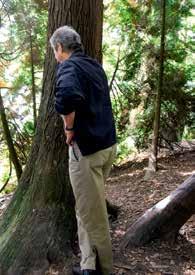
taking pictures of everyone when Linck casually leaned against a tree and said, ‘Life is just one big photo-op, isn’t it, Lizzie?’ Of course, I immediately took this photo. My friends and I still say that line all the time.
“After London I took an American literature course with Linck. He is one of those rare professors who makes you feel
Professor Johnson:
→ taught at Colgate since 1976
→ led the London study group five times from 2009–22
→ favorite courses to teach include Antebellum American Literature, the American Novel, and the Great War and British Culture, taught in London
→ a leading Thoreau scholar, he received the Thoreau Society Medal in 2023
→ turtleneck aficionado (“His collection is epic,” writes one former student.)
not only that the work matters, but also that you matter. Recently I was speaking with a fellow member of the Alumni Council, Class of 1993. She was telling me about the single English class she took during her time at Colgate and how the professor wrote her a very sweet and encouraging note that she still has. Without missing a beat, I knew instantly the professor was Linck.
“Linck may be most often found in a turtleneck and blazer, but underneath the very distinguished uniform is someone wonderfully witty, quick with a joke, deeply kind, and incredibly generous with his time. And while this is a tribute to Linck, it is impossible not to mention Susan, who is an absolute gem: wise, warm, thoughtful, and genuinely caring in a way that makes everyone around her feel lucky to know her.
“When I graduated, I felt pretty unmoored. I was trying to decide whether to pursue graduate school, look for a position at Colgate, or move to New York City to work in entertainment. Naturally I turned to Linck and Susan. With their advice and encouragement, I chose to move back to New York. Since then, they have remained a guiding light through several job transitions and my eventual master’s degree, always offering a steady, thoughtful perspective.
“It has been incredibly special to see our relationship grow from professor and student to mentor and mentee, and finally to genuine friendship.
“Linck has shaped the way I think, the way I read, the way I remember my time at Colgate, and the way I understand what it means for a professor to truly care about their students. I feel so incredibly lucky to know him.”
— Elizabeth “Lizzie” Marino ’16
REndeavor
Dream Weaver
achel Scott ’06 had a brief but memorable first encounter with Vogue editor Anna Wintour.
While an intern at the magazine, she saw the always-immaculate Wintour briskly stride toward her in a hallowed Condé Nast hallway. Scott’s heart raced. Wintour stopped, looked her up and down, then kept walking.
Flash forward two decades and Vogue regularly gushes about Scott in its pages. In February, the magazine called her Diotima line “a craft-led New York label known for its captivating crochet work and sensual take on tailoring.” In March a multipage spread extolled her “historic” appointment as creative director at Proenza Schouler.
For Scott, Vogue’s embrace reflects the remarkable rise of Diotima, the label she founded in 2021, and of Scott herself. Known for handcrafted crochet, sharp tailoring, and political statements, Diotima has earned some of the industry’s highest honors, with Scott redefining what success can look like in a business often driven by spectacle and scale. Diotima’s ascent also led to Scott taking the helm at Proenza Schouler — the first Black woman to lead a luxury fashion house. And she’s earned a devoted following of A-list fans along the way.
“A Diotima woman is sensual and autonomous, with eroticism and reverence for the handmade,” says Scott. “She’s independent and strong. I hope to become her.”
Scott’s path didn’t seem so certain back in 2021, when she struck out on her own after 18 years in fashion, most recently as vice president of design for contemporary
womenswear label Rachel Comey.
She was taking a huge risk. Her venture was self-financed, and Scott worked solo on her line out of her home in Crown Heights, N.Y. With no budget for a runway show, she only could afford intimate presentations, displaying her designs in fashion editors’ offices and nondescript conference rooms.
Diotima’s staff soon expanded to six women. Her first hire was her best friend, Shinae Lee ’06, as strategy and operations manager. The two had been virtually inseparable since the first day of Colgate orientation when Scott observed Lee crouching for an hour rather than stain her gray Juicy Couture tracksuit by sitting in the grass.
They clicked instantly, both double majors in French and art and art history, and often studied together deep into the night, sometimes falling asleep on the sofa in Little Hall, waking up to incoming students.

“We always knew we wanted the same trajectory,” says Lee, who was willing to work for Diotima unpaid in the early days.
“We have creative brains, and Rachel also understands the business side of starting a brand. She’s very curious, observant, hardworking, and dedicated. She doesn’t take shortcuts.”
In fashion, men get opportunities. Women must make them for ourselves and for other women.
Scott named her mother, Ruth, who once ran a clothing boutique in Kingston, Jamaica, as Diotima’s production manager. Scott relies on women in Jamaica to hand crochet her garments.
“In fashion, men get opportunities,” she says. “Women must make them for ourselves and for other women.”
Her persistence paid off. As a runner-up for the 2023 Vogue Fashion Fund honor (the finalists decided, in part, by Wintour herself),
Fashion
Now creative director of Proenza Schouler, designer Rachel Scott ’06 shred and reknit her career and personal life.
After Colgate, Scott studied fashion at the Istituto Marangoni in Milan, followed by stints at major labels Costume National, J. Mendel, and Elizabeth and James.
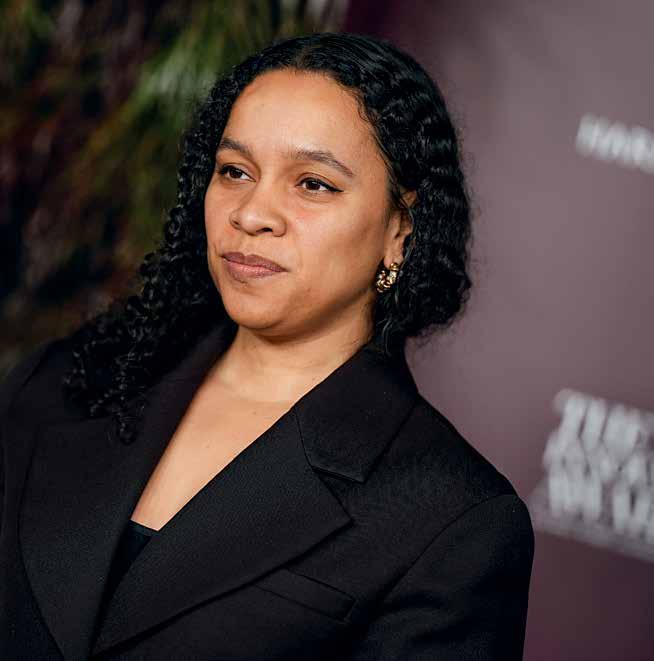
Scott received a prize of $100,000. That same year, she won the prestigious CFDA award for Emerging Designer. In 2024 she gasped upon reading a text, mid-appointment, that she’d been nominated for the vaunted 2024 CFDA award for Womenswear Designer — which she later won.
Now she manages not only Proenza Schouler womenswear, but also the brand’s shoes and handbags, with a staff of 80. She’s a rarity as a woman heading two distinct design houses, staging two catwalks twice a year during New York’s fall and winter fashion weeks.
Her designs quickly found favor among the city’s tastemakers. Earlier this year, Rama Duwaji, New York City’s first lady and wife of Mayor Zohran Mamdani, attended only one show during New York Fashion
2021, while married to a man, she met and fell in love with Chaday Emmanuel, an LGBTQ community activist who also hails from Jamaica. Scott came out and divorced. Emmanuel proposed in Grand Cayman, and they married in 2024, both wearing custom Diotima. They live in Brooklyn with their cockapoo pup, Romeo Gigli, named after the Italian fashion designer. When there’s time, they binge Italian films by Pier Paolo Pasolini.
“Though it’s been an uphill struggle, becoming a successful designer has meant so much to me,” Scott says. “My life is about work, and the fun part is doing it.”
— Michele Meyer
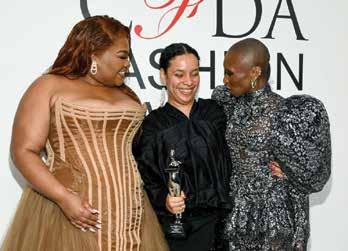
Week: Diotima’s. Duwaji also wore the label in the December 2025 issue of New York Magazine. In May 2026, Eva Chen, Meta’s vice president and Instagram’s director of fashion partnerships, wore a cobalt silk Proenza Schouler gown to the annual Met Gala, and for the after-party, a scarlet Diotima minidress. Actress Tessa Thompson and WNBA pro Angel Reese are fans too.
Amid her recent rise to prominence, Scott’s personal life has had its own share of stretching, unraveling, and rebuilding. In
Scott celebrated with actresses Da’Vine
Randolph
and Cynthia
at the 2024 CFDA Awards after taking home one of the night's top honors: American Womenswear Designer of the Year.
Scott (left) and Lee (right) became fast friends after meeting at Colgate in 2002. Lee is now Diotima's strategy and operations manager.
(Left)
Joy
(left)
Erivo (right)
(Above)

















BOOKS
As a cultural anthropologist, Lili Rodriguez ’76 has spent a lifetime studying why people do what they do. That instinct followed her to a Las Vegas chapel in 2023, where she and her longtime partner were married by a young, handsome Elvis.
“This guy was in his early 40s. Elvis had been dead for more than four decades,” Rodriguez says. “I’m sitting there wondering, why would anybody his age want to make a living this way?”
The question became an obsession — and eventually, a book.
Published last fall and written in collaboration with Marian Keijzer Steennis,




No matter [your age], when Elvis touches your face, you’re a teenager again.
late ’60s listening to the Beatles and the Doors. An anthropologist with a long career in consumer research, Rodriguez says Elvis reappeared on her radar in 2022, when the Baz Luhrmann Elvis biopic — and soon after, her Las Vegas wedding — sparked a deeper curiosity.

The Elvis Effect
Lili Rodriguez ’76 explores the performers and fans sustaining the mythology of an enduring American icon.

“It’s the first topic that’s gripped me enough to make me want to understand the phenomenon.”
She started her research with “All Shook Up,” a long-running Elvis tribute show in Las Vegas, then traveled to a three-day Elvis festival in Scottsdale, Ariz. What she expected — a tame crowd of Baby Boomers reliving the past — wasn’t what she found. Nearly all the performers were young, some in their 20s and 30s, born long after Elvis’ death. The fans were surprisingly diverse, too, and packed theaters and convention centers with the same frenzied energy that defined Elvis’ concerts at his peak.
At one show early in her research, Rodriguez recalls the “electric” moment the performer appeared on stage. Women rushed forward, screaming, crying, straining for a moment of contact. “I’m sitting in the audience going, ‘You know that’s not Elvis, right?’” Rodriguez says. “But it didn’t matter.”
Echoes of Elvis: Elvis Tribute Artists and the Fans Who Love Them traces a two-year deep dive into the world of Elvis tribute artists (not “impersonators,” Rodriguez notes — a distinction that reflects their focus on preserving Presley’s music and legacy). To report it, she interviewed more than 50 performers, 45 fans, and dozens of musicians, photographers, and others connected to the scene, weaving their stories into a nuanced portrait of the subculture she initially struggled to understand.
For Rodriguez, the subject was an unlikely one. “I didn’t grow up an Elvis fan,” she says. Raised in New York, she came of age in the
The deeper she went, the more Rodriguez came to understand that these performers weren’t parodying Elvis, but were deeply committed, highly skilled musicians, dancers, and singers. Many discovered Elvis as children, often through a parent or grandparent, and describe the experience in near-mythic terms. One young performer told Rodriguez that hearing “Blue Suede Shoes” for the first time felt like being “struck by lightning.”
Off stage, many tribute artists study Presley obsessively and can track the evolution of his look — sideburns, jumpsuits, jewelry — with meticulous precision. At one event, Rodriguez recalls, a
by Remie Geoffroi
Illustration
performer watched another take the stage and immediately spotted a flaw: this Elvis was wearing the wrong gold ring for the era he was portraying. “They’re like walking encyclopedias,” Rodriguez says.
She notes that mastery of Presley’s catalog and persona is only part of the craft; the ability to interact with audiences is just as essential. At concerts, performers often move through the crowd, serenading audience members, holding women’s hands, touching their faces, and kissing their cheeks.
“I began to understand how that connection is a huge part of the appeal,” she says. “No matter [your age], when Elvis touches your face, you’re a teenager again.”
Indeed, many of the tribute artists Rodriguez interviewed also perform in nursing homes and hospice centers, offering comfort as much as entertainment. The work is rarely lucrative (costumes alone can cost thousands of dollars), but for many, it becomes central to who they are. “It’s not a job for them — it’s a passion,” she says.
At the same time, Rodriguez found that people project onto Elvis what they want to see. Because he died at 42, his image never had to contend with aging or decline, like other iconic artists of the era.
“He never got old, so in a way, he’s become a symbol of a moment in time,” she says. “He represents a more innocent America that doesn’t exist anymore and those good family values.”
Perhaps that’s why, Rodriguez posits, the community has a strong evangelical Christian overlap, with some framing Elvis through a spiritual lens. Performers often start their shows by invoking “the greatest entertainer who ever lived” while gesturing skyward, as if addressing him directly.
For Rodriguez, that mythology helps explain his endurance. Nearly 50 years after his death, Elvis remains globally recognizable; in her reporting, Rodriguez interviewed performers and fans from Denmark, Norway, Scotland, Mexico, and Australia. “They worship Elvis in the same way Americans do,” she says.
Since the book’s release last year, Rodriguez continues to frequent Elvis conventions and festivals, holding book signings and reconnecting with the performers and fans she’s come to know well — no longer just studying the phenomenon but, occasionally, falling under Elvis’ spell herself.
“You see somebody turn a certain way on stage,” she says, “and for a second, you see it. You see Elvis.”
— Mary Donofrio
Among the Volcanoes
Steve Johnson ’93 tapped into a need and brought craft brewing to Guatemala.
Steve Johnson ’93 experienced his “lightbulb moment” in 2012, a few years after moving to Antigua, Guatemala, with his wife and two young children. He was drinking beer with a friend who owned a pair of successful sports bars there. They both acknowledged the beer was “awful.”
At the time, the craft beer movement in the United States was entering its heyday, with more and more independent, artisanal breweries concocting innovative, flavorful products. The market in Guatemala, by contrast, was dominated by a single brewing company that produced the “national beer,” a pale lager.
“Can’t anybody get good beer in this country?” Johnson recalls lamenting with his friend. “Then we looked at each other and said, ‘How about us?’”
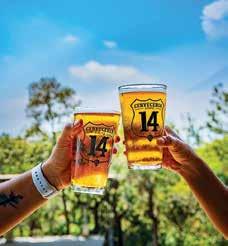
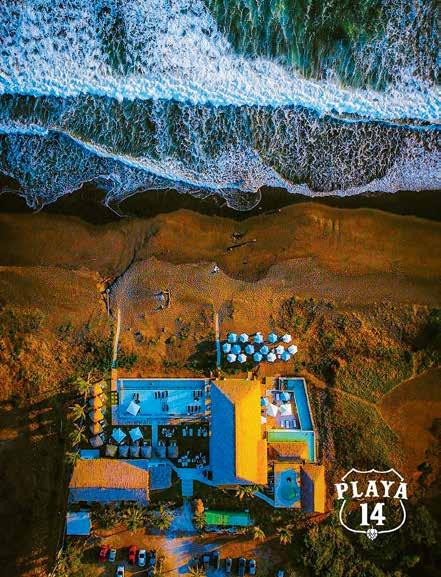
Johnson’s La 14 brewery is situated on 7 acres surrounded by three volcanoes — one of them active.
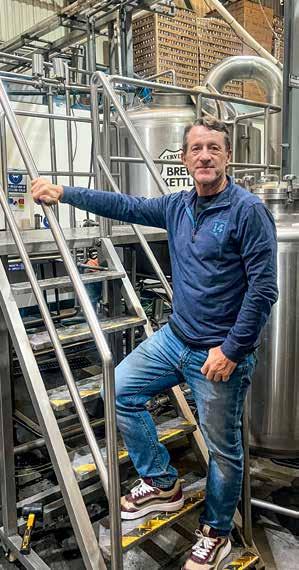
Before long, they had imported an entire shipping container of beer from Brooklyn Brewery and were trying to market it around town. “We called it the ‘Soviet sales model’ because there were only two choices, Brooklyn IPA and Brooklyn Lager: ‘You like this one or you like this one?’” Johnson says, affecting a Russian accent. No one wanted much of either, as it turned out. Even after they added Abita, from Louisiana, and Rogue, from Oregon, to their selection, “it was still a crummy business,” he says. By 2016, they were getting ready to throw in the towel. Instead, they decided to try their hand at producing their own beer. After raising capital and obtaining a government permit — a process that took two years — they purchased a 7-acre coffee farm surrounded by three volcanoes, one of them active. On it, they constructed
a brewery, added a small bar (for the view), and hired a renowned brewmaster with whom they worked to develop five distinctive flagship beers. Ceveceria Catorce (“Brewery 14” in English, named in part for National Route 14, the highway that borders it), one of the country’s first craft breweries, opened in 2018.
Today, La 14, as it is known, features a 15-barrel brewhouse, a taproom, a games area (Johnson and his partner wanted the place to be family friendly), a café, food trucks, and an amphitheater with live music most nights. Before it opened, Johnson guesstimated that La 14 might attract 40 customers a day; it wasn’t long before the daily volume rose to 10 times that number. Approximately 97% of their customer base is Guatemalan, he adds proudly.
Johnson and his partner also recently opened Playa 14, near El Paredón, a formerly sleepy black-sand beach town that has become popular with sunbathers and surfers. Playa 14 beach club features pools, dining areas, and bars serving La 14’s signature craft beers. Today La 14 also produces its own brand of still and sparkling water as well as a low-sugar soda. “We try to keep a finger on the pulse of which way the world is going,” Johnson says, noting that they recently created a hard seltzer, named
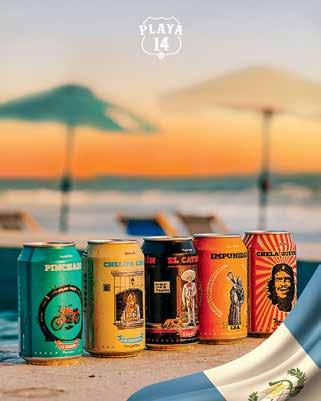
Offshore, in keeping with the current trend. Johnson earned an MBA in 2002, but he started his first business venture — selling candy out of a disused shipping container
in the family’s driveway — when he was 10. Several years and businesses later, during his junior year of college, he and his brother started The Big Iguana Co., importing and selling “itchy Ecuadorian sweaters and Afghan gloves and mukluks that never quite shook the odors of their origins.” The two used to drive up and down the East Coast, targeting “[Grateful] Dead concerts, festivals, and any college campus that would let us in.” That included Colgate, which allowed them to peddle their wares during events held on Whitnall Field. After graduating from Colgate, in the early 2000s, he and two classmates, Eric Hade ’93 and Paul Sisson ’93, co-founded Thames Street Capital Group, a real estate development business in the Baltimore-D.C. area that boomed until the 2008 bust.
All of which might lead you to categorize Johnson as an entrepreneur, but it’s a label he is quick to reject. “I would not describe myself as entrepreneurial,” he says. “I would describe myself as anti-wanting-to-sitin-a-cube-in-some-giant-office-buildingtaking-meetings.” This allergy to corporate strictures has shaped Johnson’s relaxed company culture and structure — which he describes as “flat” — and his laid-back leadership style. He only reluctantly admits to his title being “president.”
But in mid-2025 — what Johnson calls “the tipping point” — that changed. With 127 full-time and 78 part-time employees; a newly hired COO; and a general manager of food and beverage, conventional business practices like job titles, job descriptions, and contracts became necessary.
One relatively recent hire is Jenny Lundt ’19, whom Johnson met when she sat down at the bar one day and asked if he happened to know Steve Johnson. (Lundt, who had come to Guatemala for a temporary job, had perused the Colgate alumni directory for local connections and found Johnson’s name.) The moment epitomized something that Johnson treasures about his alma mater: “The bond you form with Colgate people is unlike any I’ve seen at any other college,” he says. “I can call somebody up and say, ‘Do you know anybody in this business?’ I never get ‘Oh, geez, who are you?’ or ‘Talk to my secretary.’” Johnson hired Lundt, and she is now a project manager overseeing the launch of Offshore and updating the company website.
Fortunately for him, being at the helm of such a thriving brewery hasn’t dampened Johnson’s enjoyment of beer — or dulled his palate. When asked why La 14’s Dale Pale Ale is his favorite, Johnson smiles and says, “Because it’s the best beer in the world.”
— Sarah C. Baldwin
IDocumentary
Not Your Grandfather’s USO
f asked to describe the United Service Organizations (USO), the body formed in 1941 by President Franklin D. Roosevelt to boost the morale of U.S. service members, you might conjure an image of the Andrews Sisters or Marilyn Monroe on a stage, looking out over a sea of young men in uniform.
International correspondent Bob Woodruff ’83 and his son, cinematographer Mack Woodruff ’13, have set out to give that image a refresh. In a year that marks the 85th anniversary of the USO as well as the 250th anniversary of the signing of the Declaration of Independence, the pair are at work on a three-part series tentatively titled American Valor that aims to shine a light on life at American military bases around the world through the lens of the USO.
“The USO brings relaxation and relief to troops who have been deployed overseas, far from home and their families,” says Bob, who in 2009 reported on Admiral Mike Mullen’s USO Tour for ABC News. “It doesn’t get enough attention.”
The organization currently has more than 27,000 volunteers providing services in some 260 locations globally. Celebrities who have volunteered in recent years include Bryan Cranston, Scarlett Johansson, Carrie Underwood, and Toby Keith.
In January 2026, the actor and stand-up comedian Gabriel Iglesias, better known as “Fluffy,” performed at Yokota Air Base and Misawa Air Base in Japan. The Woodruffs were there to film both performances as well as Iglesias’ flight in a Lockheed C-130 Hercules, a large military transport aircraft, with members of the Air Force. “He put on a hell of a show,” Mack says. “He had everybody in stitches.”
In May Mack and Bob flew to Camp Casey in South Korea, where Jeopardy! host Ken Jennings (who grew up and attended school in Seoul) held an Inside Jeopardy! Live on Tour event and interacted with active-duty service members on the base.
Details about the third location in the series were still being worked out at press time, but each segment will air on ABC News Live and then become available for streaming on Hulu. The series is scheduled
to air around Veterans Day 2026.
The Woodruffs’ dedication to supporting service members and veterans runs deep.
In 2006 Bob, then 45 and co-anchor of ABC World News Tonight, was traveling in Iraq with the U.S. Army’s 4th Infantry Division when an improvised explosive device struck his vehicle. Over the course of his monthslong recovery from a traumatic brain injury, Woodruff became aware of the challenges many service members and veterans face when seeking access to treatment and services. The next year, he, his wife, Lee McConaughy ’82 Woodruff, and other family members established the Bob Woodruff Foundation to provide resources and support for post-9/11 veterans, service members, and their families.
“We all feel like we owe a lot to the military … because they truly saved my dad’s life,” says Mack, who was a first-year in high school when his father was injured. “So we try to give back whenever we can.”
American Valor is not the first “Woodruff and son” collaboration. In 2019 they filmed a travel series for National Geographic called Rogue Trip, in which they traveled to six countries troubled by conflict, including Lebanon, Papua New Guinea, and Ethiopia, focusing on people and traditions rather than on war. In 2023 they traveled to Iraq together to produce the ABC News documentary After the Blast: The Will to Survive, about Bob’s return to the site where he was almost killed. And their ABC News Live series Last Lands, which debuted in 2024, focused on the people fighting to preserve endangered national parks and Indigenous territories in developing countries.
Bob, who majored in English and played lacrosse at Colgate, credits the school’s liberal arts education for equipping him with the intellectual flexibility to pivot from his first career as a lawyer to the one that stuck — international journalism. “It’s fantastic getting to see these countries with my son. He’s just a remarkable shooter.”
“I never take for granted being able to work with my dad,” Mack says. “I know I’m going to look back on these times as some of the best ever.”
— Sarah C. Baldwin

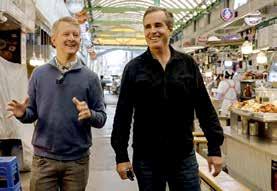
While filming on Army bases in South Korea and Japan, Bob Woodruff ’83 — with son Mack ’13 behind the camera — interviewed service members and USO volunteers, including Jeopardy! host Ken Jennings (bottom photo), who brought his interactive show to Camp Casey in South Korea.
A new series by Bob ’83 and Mack ’13 Woodruff sheds light on an 85-year-old organization.
SALMAGUNDI
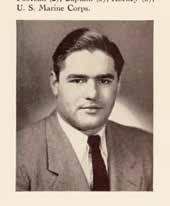
The Letters of George Thomas ’45
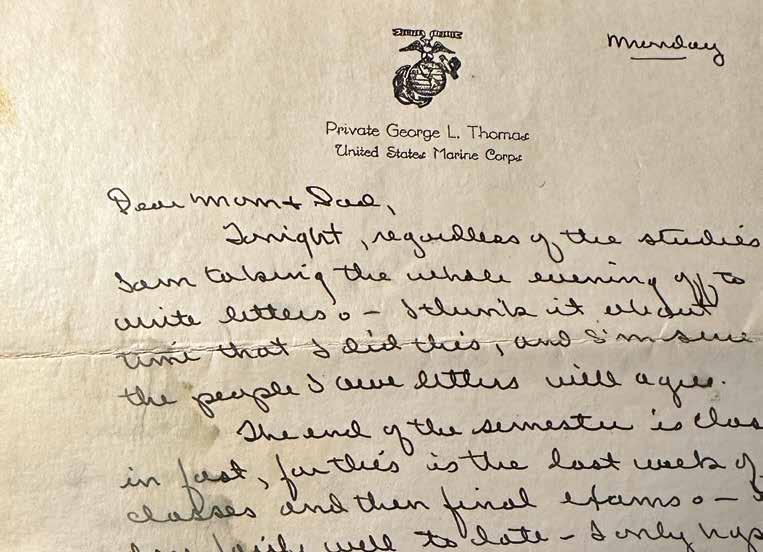
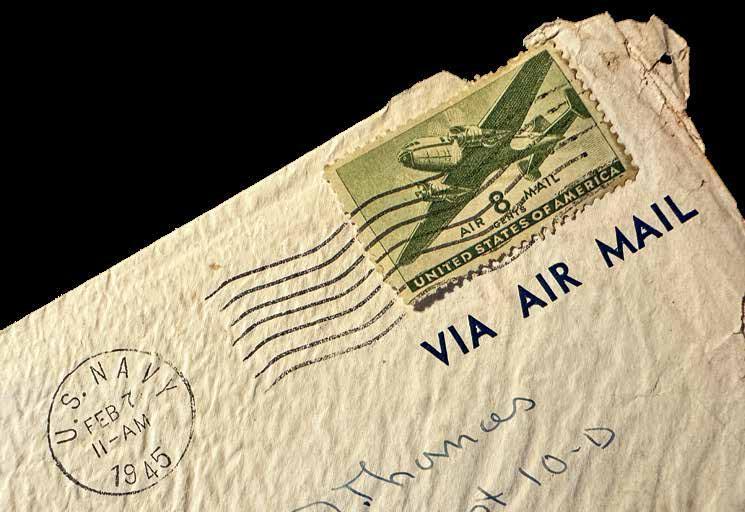
When Hurricane Helene flooded Jess Dickerson’s family home in Florida in 2024, the cleanup felt like triage. Boxes of photos and memorabilia were pulled from muddy water, much of it destroyed. But amid the debris, Dickerson found something remarkable: a binder filled with wartime
letters written by their grandfather, George L. Thomas ’45.
“Here were these envelopes with 1945 airmail postmarks,” Dickerson says. “I realized I was holding letters he had written from the war.”
The discovery launched Dickerson into an ongoing project to preserve and transcribe the letters, which Thomas sent home to his mother during World War II.
Thomas, who grew up in Freeland, Pa., had been a standout football player at Colgate in the early 1940s. Playing right guard for the team from 1942–43, he was widely respected on the field and eventually named captain. Like many of his classmates, however, Thomas left Colgate before graduating to join the combat overseas. During the Battle of Okinawa, Thomas, a Marine, was
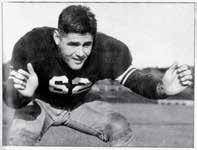
shot through the chest, the bullet exiting through his back. The wound kept him hospitalized for nearly a year.
According to family lore, Thomas’ parents were mistakenly notified that their son had been killed, says Dickerson. Months later, when Thomas called home after returning stateside, his mother thought the voice on the phone was a cruel prank.
Only when he used a childhood nickname — “Sonny” — did she believe it was truly him.
Despite the hardship of war, Thomas’ letters reveal a surprisingly light tone. He wrote about daily life, the weather, and even facial-hair experiments — “I’m raising a beard; a mustache is too common,” he joked in one note. Football, too, remained on his mind.
“He’s constantly referencing the game,” Dickerson says. “Football was the thing that kept him connected to home and to the future.”
After the war, Thomas returned to Colgate determined to both earn his degree in economics and rejoin his teammates on the field. But the injuries to his lungs made it impossible to play a full game. After attempting to compete in the 1945 season, he stepped aside and the team made him an honorary captain. Shortly after graduation,
Thomas wed Patricia Young, whom he met through a fellow Marine. The couple settled in the Tampa area, where they raised four children and Thomas built his career in sales and real estate.
For Dickerson, who knew their grandpa as a jovial family man before his death in 1996, the letters have revealed another side — a young man navigating war with humor, discipline, and a deep loyalty to Colgate and his team.
“I think writing those letters and staying connected to home is how he got through it,” Dickerson says.
Now, by preserving the correspondence and sharing his story, Dickerson hopes the legacy of George Thomas — football captain, Marine veteran, and devoted Colgate alumnus — continues to inspire.
— Mary Donofrio
The Many Lives of the Phi Psi House
Ahead of Phi Kappa Psi’s 50th Reunion in May 2025, Bob Griffith ’73 embarked on a “labor of love,” immersing himself in the history of the fraternity’s chapter houses. Drawing from University archives, photographs, and historical records — and with support from Professor of Art Emeritus Bob McVaugh and known history buff President Brian Casey — Griffith compiled his findings into a glossy 28-page booklet, A Chapter House Journey, tracing nearly a century of brotherhood and architectural change.
“These houses have served as fraternity chapters, an infirmary, military barracks in two wars as well as surviving a devastating fire in the 1940s,” writes Griffith, who served as the chapter’s president from 1971–73. Above all, he remembers the house as a “home away from home” that helped generations of Phi Psis build “friendships and bonds like no other environment on campus could.”
→ The 1914 house helped shape Broad Street.
According to Griffith’s research, Phi Psi's Broad Street house in 1914 “set many of the architectural parameters” that later fraternity houses on the row would follow.
→ A fire devastated the residence in 1947. The building was badly damaged in what was believed to be a furnace-related blaze. After nearly a year of restoration work, the rebuilt residence opened during Colgate’s 1948 Winter Carnival.
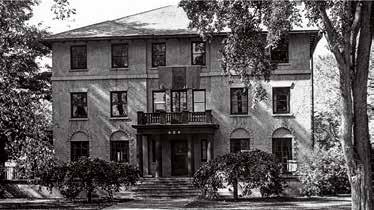
SOME HIGHLIGHTS FROM HIS RESEARCH:
→ The postfire renovation came with a spirited upgrade. Along with modernized finishes and social spaces, the rebuilt Phi Psi featured a spacious basement bar. Griffith’s explanation: “They had to put the jukebox somewhere!”
→ Phi Psi went full mid-century modern in the 1960s. The fraternity underwent an ambitious renovation in 1965, trading its “traditional mansion look” for a boxier mid-century design. Some brothers were nostalgic for the residence’s
formerly spartan, adobe-colored exterior, invoking the phrase “Remember the Alamo.”
→ Phi Psi housed women students in the 1970s. As finances tightened and membership declined, Phi Psi temporarily opened its residence to 25 women students to help meet debt obligations and fill unused space.
→ Eyes on the Future Colgate’s Phi Psi chapter officially closed in 1982 after succumbing to financial
pressures. While the house will soon be demolished, last year’s 50th anniversary celebration gave former residents a chance to “say goodbye,” Griffith says. But rather than dwell on the building’s fate, the brothers are looking ahead. “We’re excited to see what comes next,” he says.

Griffith’s A Chapter House Journey is now part of Colgate’s digital archive special collection and the archive at Phi Psi’s national headquarters.
Broad Street Chapter House
greek life
Sharpen a 20foot pencil in Minneapolis p.32
Row in a regatta on the Thames p.16
Lead field trips at Assateague State Park p.85
Botanize in the Sierra Nevadas p.106
Acquire art in NYC p.14
Uncover WWII letters in Florida p.112
Serve as U.S. ambassador to Romania p.81
Run the Spurs’ scoreboard in San Antonio p.62
Film a USO event in Seoul p.59

Interview Elvises in Vegas p.56
Oversee train operations in San Fran p.36
Open a cerveceria in Guatemala p.57
Meet Messi in Miami p.102