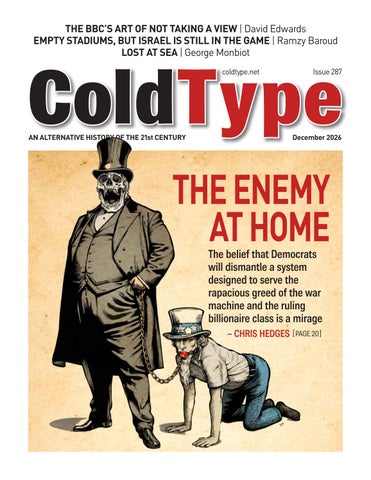
THE BBC’S ART OF NOT TAKING A VIEW | David Edwards EMPTY STADIUMS, BUT ISRAEL IS STILL IN THE GAME | Ramzy Baroud LOST AT SEA | George Monbiot
ColdT ype coldtype.net
AN ALTERNATIVE HISTORY OF THE 21st CENTURY
Issue 287
December 2026
THE ENEMY AT HOME The belief that Democrats will dismantle a system designed to serve the rapacious greed of the war machine and the ruling billionaire class is a mirage – CHRIS HEDGES [PAGE 20]
IT’S TIME TO REIN IN LETHAL AI DRONES | Rebecca Gordon OSAMA BIN LADEN AND THE DEMISE OF AN EMPIRE | Chris Hedges WHY BRITAIN BACKED PINOCHET’S CHILE COUP | Mark Curtis
ColdT ype coldtype.net
Issue 285
AN ALTERNATIVE HISTORY OF THE 21st CENTURY
October 2026
ED SHEERAN, THE RAPPER, AND THE BILLIONAIRE
Jonathan Cook
9/11 REPORT GOT ME BANNED FROM THE GUARDIAN Greg Palast
TAXPAYERS DON’T WANT TO PAYFOR NEW SPORTS STADIUMS J.C. Bradbury
AN ALTERNATIVE HISTORY OF THE 21st CENTURY Read all 287 Issues of ColdType at www.coldtype.net/reader.html and www.issuu.com/coldtype 2 ColdType | December 2026 | www.coldtype.net
DECEMBER 2026 | ISSUE 287
INSIDE INSIGHTS
5 One free murder, Dusty, Sly and me Rory O’Connor 7 Israel blocks aid as floods ravage Gaza tent city Steven Prager 9 Getting rid of the machinery of oppression John & Nisha Whitehead 11 What I want to see now the election is over Del Stone Jr 12 UN demands action on threat of ‘killer robots’ Jessica Corbett 13 No, we don’t all share guilt about Palestine’s agony Nigel Yates 14 It’s time to get US troops out of Gulf states Binoy Kampmark 15 Hurwitt’s Eye Mark Hurwitt
ColdType 7 Lewis Street, Georgetown, Ontario, Canada L7G 1E3 Contact: Tony Sutton editor@coldtype.net Subscribe: For a FREE subscription e-mail editor@coldtype.net Back Issues: www.coldtype.net/reader.html or www.issuu.com/coldtype Disclaimer: The contents of the articles in ColdType are the sole responsibility of the authors. ColdType is not responsible for any inaccurate or incorrect statements they may contain ©ColdType 2026
Condemned by their own words – Page 32
ISSUES 16 The art of not taking a view.....................................David Edwards 22 Lost at sea.................................................................. George Monbiot 24 The enemy at home.......................................................Chris Hedges 28 The stadiums are empty, but Israel is still in the game .......................................................................................... Ramzy Baroud 30 Tiny African state shames Western superpowers ..................................................................................... Medea Benjamin 32 Why Israel should be afraid of Myanmar genocide ruling ........................................................................................ Jonathan Cook 38 Like a global atomic war, but in slow motion ..................................................................................... Tom Engelhardt 41 Lagos Moon ............................................................ Hamilton Wende 44 Cuba under siege as Trump escalates economic war ..............................................................................................Julia Norman 48 When we say affordability, we mean inequality ................................................................................Gwen Frisbie-Fulton 51 That’s All For Now! ................................................................... Mr Fish Cover Art: Mr Fish ColdType | December 2026 | www.coldtype.net
3
4 ColdType | December 2026 | www.coldtype.net
NEWS | VIEWS | OPINIONS
INSIGHTS T
he recent release of memoirs from aging actors Dustin (Look at Me) Hoffman and Sylvester (The Steps) Stallone brought to mind my own strange foray into Tinseltown decades ago, which intersected with them both in unexpected but illuminating ways. The story involves not only those two Hollywood stars, but also a major studio and its top executives, the Colombo crime organisation, a Mafia kingpin/hitman and his wife, a former hatcheck girl at the famed Copacabana nightclub, (once owned by Mob boss Frank Costello,) and a surprising offer of “one free murder.” At the time I was making documentaries for PBS Frontline, but growing disenchanted with the non-fiction field. Naively figuring the grass would be greener in LaLa Land, I resolved to try to make a move into movies, figuring my skills might translate. I was friendly with Jack Newfield, a columnist at the New York
RORY O’CONNOR
One free murder, Dusty, Sly and me A journalist’s adventures in Hollywood
Post at a time when Big City tabloids still sold millions of copies – and their star writers like Jack were hugely influential. Jack had also been working with Frontline and periodically called me to suggest topics for films we might make together. But since he was already working with another producer there, that wasn’t possible. Besides, I told him, I wanted to make feature films instead. Neither one of us had any idea how to do that. Fortunately, however, Jack was close friends with Nick Pileggi, the screenwriter of such acclaimed films as Goodfellas and Casino, both directed and co-written by Martin Scorsese. If we could come up with a suitable idea and a serviceable “treatment,” Nick said he would help. Meanwhile, Jack was busy investigating the case of one Sonny Franzese, a high-ranking member of the Colombo family. Imprisoned at the time for “one of the few crimes I didn’t commit,” Franzese ColdType | December 2026 | www.coldtype.net
5
INSIGHTS and his associates claimed he had been framed by J. Edgar Hoover and were agitating for his release. After Jack wrote about the case in the Post, Sonny was granted parole. Weeping with gratitude, his wife Tina called with her thanks, telling Jack “None of the lawyers could do anything – but you did. You’ll always have one free murder with us!”
er client of ours.” Would we meet him to discuss it? Soon a limo was picking us up and driving across the Hudson to Edgewater to meet Sylvester Stallone. Tired of being typecast as either Rocky or Rambo, “Sly,” as he told us to call him, was then trying to reinvent himself as a “seri-
W
hen Jack told me about the phone call I instantly blurted out, “That’s the movie!” We quickly cobbled together a brief outline and contacted Pileggi. He thought there might be something there – but we would need to get “attachments” to get it made. In Hollywood-parlance, that meant finding a star to “attach” to the script. We knew no stars, but Pileggi did. He soon connected us to “Dustin Hoffman’s guy,” a playwright and Oscar-nominated screenwriter named Murray Schisgal, who cowrote Tootsie. The meeting went well, although Schisgal told us we “still needed a third act.” Hoffman, or “Dusty,” as Schisgal told us to call him, agreed to become attached and offered us six figures to write a script. On the strength of our attachment, we were able to get an agent at William Morris and were on our way – or so we thought. Then there was a problem. Instead of $100,000, there was a zero missing suddenly – Hoffman was now offering only $10,000. We were outraged at the duplicity, although the agent reassured us that “This happens all the time.” Fortunately, he said, he had “taken the liberty of mentioning your project to anoth-
6 ColdType | December 2026 | www.coldtype.net
ATTACHMENTS: Sylvester Stallone (above) and Justin Hoffman
ous actor,” playing an overweight, partially deaf sheriff of a small New Jersey town who comes into conflict with corrupt New York City police officers living there in the film Cop Land. We met in his trailer with Sly, his wife Jennifer Flavin, and his agent. At their request we began acting out some of the proposed scenes, with Stallone stopping us occasionally to make comments and
ask fairly astute questions. Then it was time for him to go back to work, and the limo whisked us back to midtown Manhattan. The next day our agent called. “I don’t know what you said to Stallone, but he wants to make the movie,” he told us. “So does Universal Pictures – and they’ll pay you $250,000 to write it.” It turned out there was a slight problem, however. “Dusty” was now claiming the entire project was his idea and he wanted to make it without us. As a result the entire deal was delayed for nearly a year until Universal persuaded him – presumably with a cash payout – to go away. Now we were really on our way – or so we thought. We wrote a script for a thriller, as asked. Then Sly demurred. “I thought you was writing a buddy movie,” he complained in one of his many phone calls to me. No problem, I told him. The contract called for a rewrite anyway, so we rewrote it as per his request. Meanwhile there were hiccups at the studio. Stallone’s old agent Ron Meyer ran Universal then, which is presumably how our film got the green light in the first place. But a succession of executives under him kept getting replaced, as our film languished. We rewrote it again and again, while Sly and Kevin Misher, the studio executive in charge, bickered and tried to get each other thrown off the project. “Why did you ever get Stallone?” Misher asked. I explained repeatedly that without his attachment, we wouldn’t even be talking. Although Misher soon rose to be head of production at Universal, and although we wrote re-
INSIGHTS wrote and “polished” the script several times, in the end it was all for nought. Stallone gave up his dream of becoming a serious actor and went back to playing superheroes. Misher left to form his own production company on another lot – then bought our script in “turnaround” and tried to resuscitate it. Until recently, I heard from him regularly about his plans to move ahead with other stars like “Bobby” DeNiro. Sonny Franzese was released
from prison when he was 100 years old and died three years later. There’s no such thing as a free murder. CT
Rory O’Connor is a New York Citybased media executive, awardwinning journalist, filmmaker, and author. He is the co-founder and president of Globalvision and has overseen seven television series. His programming has aired in more than 100 countries
vember 9 that more than 150,000 tents were ready to be sent to Gaza, where it said more vacuum trucks and mobile dewatering pumps were urgently needed. At least 70,000 tents were flooded in a single day over the November 7-8 weekend. At least one infant reportedly drowned. A mother and her two children, along with three other children from the same family, were killed when a sandbank collapsed onto their tents. “Over the weekend, while families slept, water flooded their tents and engulfed entire camps,” said Ahmad Alhendawi, Save the Children’s regional director for the Middle East and North Africa. “Children shivered in the bitter cold without winter clothing, and families lost the few belongings they had left. It is heartbreaking, and it was entirely foreseeable.”
I CLEANING UP the mess in a flooded Gaza tent city in November. Israel blocked delivery of new tents, repair materials and mobile homes
STEPHEN PRAGER
Israel blocks aid as floods ravage Gaza tent city
A
s severe floods ravaged Gaza in November, Israel continued to block the entry of tents, repair materials, and mobile homes despite the
aid provisions of the October 2025 “ceasefire” agreement. The United Nations Office for the Coordination of Humanitarian Affairs (OCHA) reported on No-
nitial reports said a sand dune has collapsed onto two families sheltering in a displacement camp in Deir al-Balah, central Gaza, leaving several people trapped beneath the sand. “Israel is restricting access to shelter materials and has rendered 65 percent of Gaza off-limits. People have no safe place to go,” said Wassem Mushtaha, who leads Oxfam’s response in Gaza. The group has performed emergency maintenance on rainwater drainage networks and supplied tools for repairs. He said that “urgent access is needed for spare parts, engine oil, pipes, and heavy machinery, in addition to shelter materials, to avoid more people being killed this winter.” Most buildings in the territory ColdType | December 2026 | www.coldtype.net
7
INSIGHTS were destroyed in Israel’s genocidal war over the past three years. Of the Gaza residents who are living in makeshift shelters, according to Save the Children, about 1.2 million people, including over 560,000 children, are living in “critical or catastrophic” conditions, including flimsy tents and improvised structures that are often ill-equipped to handle the elements. “Tents and tarpaulins are not the answer to Gaza’s winter,” said Jan Egeland, secretary-general of the Norwegian Refugee Council. “They cannot withstand heavy rain and strong winds, and many are already worn out after months of use far beyond their intended lifespan.” OCHA reported that no emergency shelter kits were available in Gaza because Israeli authorities had rejected timber shipments. “Palestinians have the right to receive the assistance they need,” Egeland said. “States must press Israeli authorities to uphold their obligations and facilitate the entry of humanitarian aid and essential
BY THE NUMBERS
materials. Palestinians must not face another winter without adequate shelter. They cannot wait.” Strong winds tore away makeshift shelters, while families waded through centimetres-deep floodwaters as rain soaked their few remaining belongings.
T
he ceasefire agreement called for 60,000 mobile homes and prefabricated shelters to be allowed into Gaza to house displaced families, but Israel has allowed almost none to enter. “All the tents are now damaged, torn, and covered in mud,” said Jaber al-Kaseeh, a man in his 70s whose family was forced to flee their tent in central Gaza’s azZawayda area after floodwaters began rushing in. “We urgently need tents, tarpaulins, plastic sheets, mattresses, blankets, and carpets to protect us from the difficult days ahead,” he told Al Jazeera.
W W W. I N E Q U A L I T Y. O R G
“We keep hearing about tents and tarpaulins being distributed, but we have received nothing,” he added. “We had hoped the mobile homes and temporary housing units promised under the ceasefire deal would allow us to rest and return to a life of safety and peace. But it was all just words in the air. We have seen nothing.” Over the past two winters in Gaza, dozens of people – among them at least 26 children, including newborns – have died from hypothermia due to a lack of adequate shelter. “This is not simply the result of bad weather,” Alhendawi said. “Tents, shelter kits, and fuel are waiting at Gaza’s borders while children sleep in floodwater because the Israeli authorities are blocking their entry. This is a choice, and children are paying the price.” “As the occupying power, Israel has a legal obligation to ensure civilians receive the supplies they need to survive,” he added. “Instead, it is depriving families of the most basic means to protect their children, and it must be held accountable for any child deaths that result.” “Israel’s ongoing genocide has resulted in the near collapse of all functioning systems in Gaza,” Mushtaha said. “Governments must insist that Israel allows for unimpeded access to recovery and repair materials to restore essential infrastructure and ensure Palestinian-led reconstruction efforts across Gaza.” CT
Stephen Prager is a staff writer for Common Dreams – www.commondreams.org - where this article was first published
8 ColdType | December 2026 | www.coldtype.net
INSIGHTS ising safety and security above all. Behind those promises lies a machinery of surveillance, detention, censorship and intimidation. The parallels to the modernday American police state’s methods for entrenching its powers are hard to ignore: exploiting fear, demonising dissent, turning security into a blank check and treating constitutional restraints as inconveniences.
A JOHN & NISHA WHITEHEAD
Getting rid of the machinery of oppression “There is something terribly wrong with this country, isn’t there?” – V for Vendetta
A
revolution can topple a tyrant without dismantling tyranny. An election can replace a president without curbing the powers of the presidency. A new political majority can inherit the instruments of repression and adapt them to their own purposes. In other words, what good is a political change if the weapons of oppression merely change hands? After a midterm election that saw billions of dollars spent on
political advertising and a Democratic wave sweep Republicans out of power in Congress, Americans have once again been promised a new direction. But the question that must rightfully be asked is: what comes next? Twenty years ago, V for Vendetta offered moviegoers a terrifying glimpse of a future in which government surveillance was everywhere, dissent was dangerous, the media served as an instrument of state propaganda, and the promise of safety had become an excuse for stripping people of their freedoms. Released in 2006, V for Vendetta depicts a future Britain ruled by Norsefire, a fascist regime prom-
s director James McTeigue observed in a recent interview marking V for Vendetta’s twentieth anniversary, the political circumstances may change, but the methods used by authoritarian governments remain remarkably consistent, and the same struggles over executive authority, government control and the suppression of dissent continue to resurface. “It’s always the same playbook,” McTeigue warned. Other dystopian films drive the point home that we cannot vote our way out of tyranny if we keep voting to hand someone else the keys to the police state. In Land of the Blind, released the same year as V for Vendetta, a soldier helps overthrow a brutal ruler, only to watch the revolutionary leader establish another repressive regime. In The Hunger Games, President Snow’s defeat does not automatically bring justice. President Coin, who leads the rebellion against him, proposes another Hunger Games – this time using the children of the defeated Capitol. Although the names and uniforms change, the logic of cruelty remains. ColdType | December 2026 | www.coldtype.net
9
INSIGHTS The politicians come and go. The machinery of government remains. By “government,” I’m referring to government with a capital “G”: the entrenched Deep State, the sprawling network of agencies, contractors, surveillance systems, security bureaucracies and accumulated powers that is largely unaffected by elections and increasingly insulated from accountability. What one president puts in place, the next inherits. What one political party condemns when it is out of power, it may find remarkably useful once it controls the machinery of government. Consider what has remained largely unchanged despite decades of elections, campaign promises and assurances that this time things will be different. The surveillance state no longer needs a camera on every street corner. Americans carry much of the technology needed to moni-
tor their movements in their own pockets. Meanwhile, the militarisation of America’s police forces continues. Through federal equipmenttransfer programmes, local law enforcement agencies have gained access to military equipment and capabilities.
W
e are still contending with an enormous system of prisons, jails and detention facilities; laws that criminalise an ever-expanding range of conduct; and government agencies that too often treat due process as an obstacle to enforcement rather than a constitutional obligation. Nor have successive administrations managed to dismantle the military-industrial complex, end the government’s dependence on endless military commitments abroad, curb its appetite for taxpayer dollars, or sever the cozy
G R E E D AT A G L A N C E
10 ColdType | December 2026 | www.coldtype.net
W W W. I N E Q U A L I T Y. O R G
relationship between government power and corporate profit. The war machine keeps running. The surveillance apparatus keeps expanding. The government contractors keep collecting their checks. And the taxpayers keep footing the bill. All the while, we are encouraged to believe that everything will change if only we elect the right people. This is the illusion of freedom: we are free so long as the government permits us to be free, but our constitutional protections can be suspended whenever government officials utter the magic words “national security.” The Founders understood something that Americans seem to have forgotten: the greatest danger to freedom is not simply who holds power, but how much power government is permitted to wield. That is why they established a system of checks and balances, dividing authority among three coequal branches of government – the executive, legislative and judicial branches – and placing constitutional limits on each. Unadulterated power in any branch of government is a menace to freedom. The newly-elected Congress has an opportunity to provide a meaningful constitutional check on executive power. It can investigate government abuses, demand accountability, exercise its legislative authority and refuse to rubber-stamp an imperial presidency. But if the new majority merely substitutes partisan retribution for constitutional accountability, or defends the same abuses when they serve its own political inter-
INSIGHTS ests, the machinery of tyranny will remain intact. There is no ten-step plan for recovering a free society. If there were, however, the first step would be simple: stop treating politics as a spectator sport and do your part to defend freedom principles in your own community. Stand up for your own rights, of course. But more importantly, stand up for the rights of those with whom you disagree. Defend freedom when the speaker is offensive, the accused is unpopular or the person being targeted has a different race, religion, nationality, immigration status, politics or point of view. The Bill of Rights is not a reward for good behaviour or a privilege reserved for people who think like us. Don’t play semantics. Don’t justify. Don’t politicise it. Don’t excuse constitutional abuse because your pre-
ferred party happens to be in power. When officials sidestep the Constitution, demand that they obey it. That’s their job. Make them do it. It requires a government that is forced to play by the rules of the Constitution – and a citizenry willing to hold those in public office accountable when they don’t, no matter which party is in power. CT
John W. Whitehead is a constitutional attorney and founder and president of The Rutherford Institute. His most recent books are Battlefield America: The War on the American People, A Government of Wolves: The Emerging American Police State, and a novel, The Erik Blair Diaries. Whitehead can be contacted at staff@rutherford.org. Nisha Whitehead is the Executive Director of The Rutherford Institute
D E L S TO N E J r
What I want to see now the election is over
W
hat happened in the US mid-term election on November 3 was not a ringing endorsement of the Democratic Party. What happened was a blunt denunciation of Donald Trump, the Republican Party, MAGA, conservative extremists and Christian terrorists. The Democrats just happened to be in the right place at the right time to benefit from the ire of
voters. They should not mistake their election victory as a free pass to do whatever they want or, in two years they will suffer the same fate I can’t speak for the rest of America, but I can darned sure speak for myself and will be happy to tell you what I want and don’t want in my government. I am tired of being lied to by my government. I do not want to live in a kleptocracy where tax dollars
leave my chequing account and end up in the pockets of crooked politicians. And I’m sick to death of childish, immature, governance. I do not believe in political philosophies rooted in extremism, be that hate, identity, or exclusion. I don’t want my government trying to force any one set of religious beliefs on me. America is NOT a Christian nation, and it is none of the government’s business who believes what. There is room at the proverbial table for ALL religions. I like the idea of America being the good guy on the world stage. I like the idea of America standing up to bullies. I don’t like dictators, despots and strongmen. I want our government to help our citizens when they need help, but I don’t want it to help so much that people stop trying to help themselves. I want our government to embrace science and medicine, to preserve our environment, and to do everything it reasonably can to slow the march of climate change. I want the money out of politics. I want the billionaires, tech bros and corporations put in their place. I want everybody in America to pay their fair share of taxes. I don’t want a strutting, pompous banty rooster like Donald Trump destroying everything that is good about America. I want the rest of the world to look at America with trust and admiration, because at the end of the day we really are a decent people, and I think we showed that on November 3, 2026. CT
Del Stone Jr. is a former newspaper editor, columnist and fiction writer who lives in Fort Walton Beach, Florida ColdType | December 2026 | www.coldtype.net
11
INSIGHTS JESSICA CORBETT
UN demands action on threat of ‘killer robots’
E
choing recent demands from advocacy groups around the world and the United Nations’ human rights chief, outgoing UN Secretary-General António Guterres last month reiterated his call for governments from across the globe to agree to a legally binding instrument on lethal autonomous weapons systems, or “killer robots.” “For over 40 years, the Convention on Certain Conventional Weapons has reflected a fundamental principle: Even war has limits,” Guterres said in his address to the Seventh Review Conference of the High Contracting Parties to the CCW in Geneva. He added: “Across the decades, the convention has helped reduce human suffering caused by weapons such as mines, improvised explosive devices, incendiary weapons, and explosive remnants of war. “But the nature of warfare is changing. New technologies – including autonomous weapon systems – present new humanitarian, legal, ethical, and security challenges,” he continued. “We must ensure the convention remains fit for today’s world. This review conference is an important opportunity: To strengthen and achieve universal participation in the convention and its existing protocols; to uphold and reinforce existing protections; and to update the convention to meet today’s challenges.”
In his explicit call “to seize this moment” and establish a legally binding instrument on killer robots that includes “clear prohibitions and restrictions,” the UN chief highlighted that “the elements formulated by the group of governmental experts on this issue provide a strong foundation on which to build. “Take action to prevent the use and spread of these merciless weapons,” he declared at the start of the five-day conference, held every five years. “We must never stop shielding civilians from the carnage and devastation of armed conflict, and preventing unnecessary suffering. Together, let’s put humanity and protection first.”
G
uterres’ speech followed Volker Türk, the UN high commissioner for human rights, who said that “the international community has critical choices to make, right now, about the future of armed conflicts and the role of human beings in decisions over the use of force. I call on states to urgently agree on binding international rules to regulate autonomous weapons and protect human lives – before it is too late. “A machine must never have the power to decide whether a human being survives or dies,” argued Türk. “Human judgment and responsi-
12 ColdType | December 2026 | www.coldtype.net
bility must remain at the centre of decisions involving the use of force. Machines cannot understand the value of human life, assess context in the way humans can, or make the complex judgments required by international law. Nor can objects be held accountable when things go wrong. “In order to protect the right to life of their populations, states must take measures to reduce the proliferation of potentially lethal weapons for unauthorised use,” he continued. “Prohibiting the development or deployment of autonomous weapons designed or used to target human beings would be the most effective way to give effect to this obligation. “The choice before states is clear,” Türk added. “They need to seize this moment to begin negotiations on a legally binding instrument containing clear prohibitions and restrictions. The longer the international community waits, the more difficult it will become to establish meaningful safeguards – and it may be too late.” UN News noted that “not all countries agree on controls, although UN General Assembly Resolution 78/241 from December 2023 confirming that lethal autonomous weapons systems must respect the laws of war received support from 152 countries, with four against and 11 abstentions.” Those who voted against were Belarus, India, Mali, and Russia – which, under Russian President Vladimir Putin, launched an ongoing full-scale invasion of Ukraine in February 2022. Ukraine voted for the resolution, as did the United States, while Iran and Isra-
INSIGHTS gress, states parties finally have an opportunity to move from discussion to action. “A time‑bound treaty negotiation process,” Coyle asserted, “is the only credible way to ensure UN member states effectively respond
to the existential dangers posed by autonomous weapons systems.”
Jessica Corbett is a senior editor and writer for Common Dreams, where this was first published – www.commondreams.org Nigel Yates
el were among the countries that abstained. Nearly three years later, with more than 74,000 Palestinians dead from US-backed Israel’s genocidal assault on the Gaza Strip and thousands more recently killed across the Middle East due to US President Donald Trump and Israeli Prime Minister Benjamin Netanyahu’s illegal war on Iran, their governments are working against what the UN leaders are urging. As the Guardian reported in early November, “Russia, the US, and Israel, among others, are pushing against the review conference setting a timetable for a legally binding instrument,” just months after Ukraine accused Russia of using an artificial intelligence-guided drone that “struck a propane tank at a fuel station in Zaporizhzhia.” Among those calling for action, as the newspaper pointed out, are organisations such as the International Committee of the Red Cross, US-born Pope Leo XIV, and “a coalition of 50 states including Ireland, Italy, Brazil, Mexico, France, and Germany.” Amnesty International, Human Rights Watch (HRW), and Stop Killer Robots jointly warned last month that “the failure of states to take decisive action on autonomous weapons” at the conference “would leave civilians dangerously exposed to rapidly advancing military technologies.” Verity Coyle, HRW’s deputy crisis, conflict, and arms director, said that “after years of stalemate largely due to some states weaponising the consensusbased decision-making under the CCW against meaningful pro-
REMEMBERING: Rally to commemorate the 77th anniversary of the Palestinian Nakba at Dunedin, New Zealand, in May 2025
N I G E L YAT E S
No, we don’t all share guilt about Palestine’s agony
J
onathan Cook is one of the world’s most experienced political journalists. His reporting on the Middle East, alongside late associates John Pilger and Robert Fisk, has given us a clearer understanding of the complexities of the region and the corrupt policies of Western governments towards it. From 2001 he lived in, and reported from, Nazareth in occupied Palestine, which gives his work a uniquely informed perspective. His credentials are impec-
cable. That is why his latest article – describing his impressions of the film NAZA (ColdType issue 286) – is puzzling. In this article, Cook implies that we all share a dark, collective guilt about the reprehensible situation in Palestine. He writes that the film isn’t about the tangible, visible horror of Gaza but “something more hidden, something closer to home. ... the horror lurking within each of us. What German-Jewish philosopher Hannah Arendt called ‘the
ColdType | ,November 2026 | www.coldtype.net
13
INSIGHTS banality of evil.’” Further, “NAZA ... serves as irrefutable proof of our own monstrosity. Our societies watched it all and did nothing. We are all guilty.” With great respect to Mr Cook, I find this kind of hand-wringing absurd and unhelpful. This obscene war on Palestine - like the wars on Iraq and Vietnam - has been opposed by many millions of ordinary people throughout the world. Even here in Dunedin, New Zealand - about 15,900 km from Palestine - there have been numerous marches and rallies since late 2023. Perhaps it goes without saying that “we” the people didn’t start this war, supply the weapons, drop
the bombs, invent the AI targeting or give diplomatic cover for genocide. We would stop the war if we could but, what passes for “democracy” doesn’t give us the opportunity. We are never consulted about foreign policy, anyway, even if we ever were. Surely the guilt should be laid at the feet of the politicians who control the military machinery, who pretend it’s all about Israel’s right to exist, or are afraid of being labelled “antisemitic” or of being exposed in the Epstein files? It would be a great place to start. CT
Nigel Yates is a semi-retired photojournalist living off-grid near Dunedin, New Zealand
BINOY KAMPMARK
It’s time to get US troops out of Gulf states
P
resumptions of friendship and guarantees in international relations are never secure and rarely lasting. Even when they are given the stamp of firm endurance, a closer look will find greater benefits accruing to one party over the other. When one needs to persuade a weaker power into surrendering real estate and valuable terrain for the more powerful counterpart to use, always employ the terminology of “joint-facility”, “joint-operations” or some such. That will go a long way into validating the mendacity of an arrangement. The Gulf Arab states are the lat-
est to learn this lesson from the United States, whose guardianship credentials have been looking particularly shabby of late. Having not sought the conflict with Iran that the US, in collusion with Israel, started at the end of February, they now face the prospect of a diminished American presence once hostilities with Tehran end. For decades, the Gulf Cooperation Council states sought to create a defence order based on gluttonous arms purchases and extensive offerings to US military personnel in terms of bases and facilities, the assumption being that this would guarantee them
14 ColdType | December 2026 | www.coldtype.net
against attack. While the presumptive attacker in that case was Iran, the GCC states did not spare diplomacy in attempting to mollify Tehran, adopting a conscious policy of distancing from US-Israeli policy. The presence of US forces, in offering that insurance of security, also encouraged those in the Gulf region to advertise grandly as destinations for stable investment, capital and labour (however shoddy the conditions), sheltered by the comforts of the US imperial shield. The American promissory note guaranteeing Gulf security was spectacularly invalidated in the opening days of March. Shortly after the first US-Israeli strikes hit Iranian soil, retaliation from Tehran came in an expansive spray of attacks on GCC states. These caused fires in the vicinity of luxury accommodation in Dubai. Kuwait’s international airport was disrupted. The Aramco facility in Ras Tanura, responsible for the production of more than halfa-million barrels of oil per day, was targeted and damaged. As the strikes continued, it also became clear that the exorbitantly priced defences long marshalled by the states came to very little. Sophisticated anti-missile technology, for instance, could barely account for swift, stealthy drones of cheaper make yet devastating effect. By mid-July, the US itself had used up over 1,700 Patriot interceptors and over 200 THAAD missiles in the Middle East. The debate among the policy wonks and wags is that American influence in the region has not only received a bruising, but a bruising with consequence. “For the first time since the great pow-
INSIGHTS ers dismembered the Ottoman empire a century ago,” declares The Economist with haughty certitude, “the Middle East’s overarching order will no longer be imposed from afar.” American attempts to shape the region had “run their course.” As with previous powers – Britain, France, Russia – the US would still be involved in so far as its interests demanded it. Force and interventions were not to be permanently shelved. “But it will abandon its role as architect.” The pages of Foreign Affairs are also filled with the symptoms of imminent troop withdrawal. Dana Stroul, former Deputy Assistant Secretary of Defense for the Middle East in the Biden administration, suggests moving US forces (the stock weasel word is always “redeployment”) away from the Persian Gulf. Michael Fuchs, former Special Assistant to President Joe Biden and former Deputy Chief of Staff to Vice President Kamala Harris is even more blunt in light of the “failed Iran War,” suggesting it to be a “spur for a long-overdue withdrawal.” The debate favouring withdrawal from the Gulf has gathered such momentum as to worry the coterie of jodhpur imperialists who still insist on the sacrosanct role of US power. F. Gregory Gause III of Texas A&M University is almost panicked by this outbreak of Middle East retreatism, proposing that “a better option would be a prudent reconsideration of the US basing structure in the Gulf, engaged in jointly with the Gulf states that continue to want to host and support the American presence.” To add formidable insult to
smarting injury, President Donald Trump is also of the view that the costs of the catastrophe he was instrumental in unleashing should be covered by regional allies. Making the absurd claim that Washington protected these states in the first place, having demonstrably shown the opposite to be the case, Trump told CBS News that they “are going to pay us back any and all costs that we’ve had for the war.” Without the US, “they would not exist.” Just to add some fiery topping to the commentary, the president also bracketed Israel in their company. “Without us, Israel would not exist.” The focus on the part of the Gulf states will invariably be one of introspection followed by arrangements for an intra-defence system sharpened by the lessons of the Iran War. Collaborative associations with other states – Tur-
HURWITT’S EYE
key and Pakistan, for instance – are bound to become even more attractive (witness Riyadh’s move in that direction with the Mecca Joint Defence Agreement), though any military component will be hampered by a continuing addiction to American weapons systems that require continuous technical support and maintenance from Washington. Then there is the GCC Unified Military Command, formerly known as the Peninsula Shield Force. Its effectiveness, always subsidiary given the heavy reliance on American brawn, may be revisited. To do that, however, the Gulf states will have to set aside their own grumbling differences – indeed, a tall order. US power, in the meantime, will continue to be eclipsed. CT
Binoy Kampmark lectures at RMIT University, Melbourne, Australia MARK HURWITT
ColdType | December 2026 | www.coldtype.net
15
Simon Walker / No 10 Downing Street
D AV I D E D W A R D S
The art of not taking a view The BBC’s chief political writer claims her work is free of bias. But her own words suggest otherwise
T
o be fair to the BBC’s Laura Kuenssberg, she admits that her new book, Pay Attention,(published by Corsair), is not “an academic tome.” Even so, it beggars belief that someone who was the corporation’s political editor (2015-2022) and who currently hosts BBC One’s flagship Sunday morning politics show, Sunday with Laura Kuenssberg, could say this of the Israel-Palestine crisis: “If you started reading all the books, watching all the documentaries and listening to all the podcasts that seek to get to the bottom of the decades-old clash, you would be busy for the rest of your life. And I don’t propose to add to those arguments here.” (p.45) If the public isn’t paying Kuenssberg between £395,000 – £399,999 (as of 2025) to “get to the LAURA KUENSS BERG: Is she re bottom” of the crucial isally ‘impartial’ sues of our time and “to add to those arguments,” what on earth is it paying for?
16 ColdType | December 2026 | www.coldtype.net
On her show last year, Kuenssberg said this of the genocide in Gaza: “Often when it comes to the debate about Gaza, it gets very binary and very aggressive very, very quickly and there’s sort of no room for nuance.” But how can anyone be in a position to judge what does or does not constitute “nuance” if they haven’t read the books and watched the documentaries “to get to the bottom of the decades-old clash”? If Kuenssberg had done that research, she might feel shocked that she ever suggested that one should respond to a genocide with “nuance.” And she might feel ashamed that she had ever described a classic case of genocidal settler colonialism as a “clash.” In Pay Attention, Kuenssberg refers to “the conflict in Gaza.” (p.85). As Norman Finkelstein has pointed out, Gaza is not a conflict, a war. In a war, there is often collateral damage, and of course massacres of civilians, but the primary goal is the destruction of the opposing army. By contrast, in a genocide, the primary target is the civilian population itself, as has been the case in Gaza. This is one reason why Amnesty International, Human Rights Watch, the International Federation for Human Rights, the Lemkin Institute for Genocide Prevention, the International Association of Genocide Scholars, as well as Israeli and Palestinian Human Rights Groups like B’Tselem and Physicians for Human Rights–Israel, and UN Bodies and Special Rapporteurs, have all described Gaza as a genocide. In January 2024, in response to a detailed submission
Presumably, Kuenssberg imagines that her reluctance to advance arguments is evidence of her objectivity from South Africa, the International Court of Justice issued a landmark preliminary ruling that there was a “plausible risk” of genocide. Kuenssberg mentions Gaza just five times in passing. One of the mentions appears in a reference to “Hamas’s abhorrent attacks on Israel on 7 October 2023 and Israel”s subsequent flattening of Gaza…” (p.45)
I
f Hamas’s attacks were “abhorrent,” what adjective should we use to describe Israel’s literal obliteration of Gazan society? Certainly, “genocidal” could be added to describe “Israel’s subsequent genocidal flattening of Gaza.” But the words “genocide” and “apartheid” do not appear in relation to Gaza in Kuenssberg’s book. The word “civilian” is also absent, so there is no mention of the deliberate,
even gleeful generation of vast Palestinian civilian casualties, including 20,000 children killed and 44,000 injured, that has shocked the world. In the Guardian, Gaby Hinsliff outlines Kuenssberg’s criticism of political mismanagement of immigration, commenting: “What’s interesting about this argument – with which readers may agree or disagree – is that it is an argument, one of the few times she seemingly feels strongly enough to advance one.” Presumably, Kuenssberg imagines that her reluctance to advance arguments is evidence of her objectivity. She writes: “I work for the BBC; I’d never express a view about which political tribe has got the right, or the wrong, ideas.” (p.83) But is this so? Consider her analysis of foreign policy. On 8 March, on her Sunday morning show, Kuenssberg said to Seyed Ali Mousavi, the Iranian ambassador to the UK: “Since we last spoke, your government has killed thousands of its own people in the streets who had the courage to stand up to protest against the suffering that they have been experiencing at the hands of the regime. Thousands of people were killed. How on earth do you justify that, Ambassador?” Kuenssberg continued: “Just this morning, I looked at many of the images and watched some of the videos from what happened to protesters in your country in January. I looked at images and videos, verified independently [sic] by our colleagues at BBC Verify, that show body bags littered over the courtyard of a mortuary, the Kahrizak Forensic Medical Centre in Iran. I saw images of young, old, teenagers, people killed by your government, beaten faces, bloodied bodies, gunshot wounds.” ColdType | December 2026 | www.coldtype.net
17
She concluded aggressively: “How on earth do you justify that and sit there today saying, ‘Our people have some complaints’? Your government killed thousands of their own people and the world saw that.” Not much nuance or impartiality here, especially given the open US and Israeli admissions of direct involvement in the violent protests.
D
gy Nuanced strate KEIR STARMER:
espite numerous comments of this kind, Kuenssberg writes that while newspapers do take positions, broadcast media do not: “Turn on the BBC or click on its website, or go to any of the traditional broadcasters, and you can expect something different. Accurate information and explanation. We are not perfect, but we bust a gut to try.” (p.119) The truth is that, like all “mainstream” media, the BBC busts a gut to propagandise for the “Good Guys” against the “Bad Guys,” as labelled by powerful state-corporate interests. It is a deep bias that is camouflaged behind JEREMY CORBYN: Propaganda blitz passionately stated fig leaves of this kind: “And there is no news organisation in this country in which it is more important that we do not, as individuals, take a view.” (p.9) But BBC journalists do “take a view” all the time. Thus, in Pay Attention, Kuenssberg posits the difficult choices facing UK politicians after the US and Israel “commenced airstrikes on Iran” (p.45): “Follow our supposed best mates, America, or don’t? Stand up against a murderous regime, Iran, ZACK POLANSK that’s attacked the UK, I: Media bias or don’t? Help the Israeli government, which pulverised Gaza after 7 October,
18 ColdType | December 2026 | www.coldtype.net
or don’t?” (p.45) Of course, by “commenced airstrikes”, Kuenssberg means that the US and Israel launched an unprovoked, illegal war of aggression, the supreme war crime. While we might struggle to remember when Iran has “attacked the UK,” many of us can recall that the US and UK overthrew Iranian democracy in a military coup in 1953 and have been waging a merciless economic war on the country ever since. Kuenssberg is allowed to “take a view” in declaring Iran a “murderous regime.” If she said the same of the murderous Israeli regime that has obliterated Gaza or the murderous US regime that has devastated the entire region (and far beyond), she would not long be sitting where she is sitting. She is even allowed to “take a view” on Iran that completely reverses the truth of the historical record: “They have shown for years to be completely disinterested in negotiation or respecting international rules and regulations.” Anyone who has ever heard of the Joint Comprehensive Plan of Action, to which Iran was a signatory in 2015, knows how completely bogus this view is. Regarding the foreign policy options on Iran and Gaza, Kuenssberg writes that former prime minister Sir Keir Starmer sought to avoid “binary choices” to “pursue a nuanced strategy” (p.45). The single word title of Peter Oborne’s searing 2025 book on the UK government’s role in Gaza, Complicit, indicates that Kuenssberg’s idea of “nuanced” is itself lacking “nuance.” Repeatedly, indeed too much, Kuenssberg doth protest her im-
partiality: “No one tells me what to say. No one tells me what not to say. We do our best every day, using the evidence we can find, to give you the fairest and most accurate account of what’s going on.” (p.9) “In all my years of reporting at the BBC, no editor or boss had ever told me what, or what not, to say.’ (p.92) ‘Working for the BBC – it’s worth saying again – I’ve never been told what to say. I’ve never been told what not to say.” (p.119) Even Alan Rusbridger, then Guardian editor and no radical, saw through this red herring: “If you ask anybody who works in newspapers, they will quite rightly say, “Rupert Murdoch,” or whoever, “never tells me what to write,” which is beside the point: they don’t have to be told what to write… It’s understood.”
I
f the claimed refusal to “take a view” is non-credible in relation to foreign Official Enemies, the same is true of domestic Official Enemies – the dissident political commentators and politicians targeted by the establishment as a threat to the corporateowned status quo. This Kuenssberg categorically denies: “Political parties of all colours are treated with the same approach… The BBC is independent because it is paid for by the public, who have a right to know what’s true.” (p.119) But political parties are not “treated with the same approach.” Kuenssberg writes of a salient recent example: “Under Jeremy Corbyn, many in the Labour Party believed that the leadership tolerated racism against Jewish people, which was explained away by genuine and legitimate arguments against some of the Israeli government’s behaviour, and historic
Kuenssberg dismisses the claim that Corbyn and Polanski are cynically targeted with claims of antisemitism by a hostile media concern for the plight of Palestinians. Corbyn’s team always rejected that… But Corbyn’s handling of the allegations of prejudice and the anger of many Jews was disastrous.” (p.101) The claim that Corbyn’s handling of the crisis was “disastrous” is very much taking a view, one that has been strongly contested. And if Kuenssberg hasn’t “started reading all the books, watching all the documentaries and listening to all the podcasts” on Israel-Palestine, one wonders how she can distinguish Corbyn’s opposition to Israeli crimes from his supposed tolerance of antisemitism. She adds: “The Greens have also already struggled to fend off allegations of antisemitism.” (p.86) Kuenssberg dismisses the claim that Corbyn and Polanski are cynically targeted with claims of antisemitism by an inherently hostile media: “It’s no surprise, if a leading politician tells their supporters that the “mainstream media” is working against them, that after a while some of those supporters will start to absorb that message and believe it to be true.” (p.117) Alternatively, not just supporters but neutral observers might “believe it to be true” because it is blindingly obvious. When we were monitoring the media assault on Corbyn from 2015 onwards, we were astonished at how patiently Corbyn “turned the other cheek” in dignified parliamentary fashion, presumably believing the smears were beneath him - as it turned
out, a fatal strategic blunder. Kuenssberg adds: “For ten years, Donald Trump has stood on stages in the United States and said that the media are bad, they’re lying to you, and it’s all fake news. Jeremy Corbyn, with the help of some influential left-wing news sites, attempted a version of that here. Nigel Farage has tried a similar tactic with Reform…” (pp.118-119) She warns: “Every time you hear a politician attack the “mainstream media,” pay attention to what they are really up to.” (p.119) It is a pretty basic logical error to conflate Trump and Farage’s criticism of the media with Corbyn and Polanski’s. They might all be advancing equally idiotic arguments, but they might not. In fact, it takes little effort to unearth the numerous careful, credible media studies that have strongly supported Corbyn and Polanski’s claims of structural media bias. In 2016, The London School of Economics Media and Communications Department analysed media representations of Corbyn in eight British newspapers from 1 September - 1 November 2015. Their conclusion: “The results of this study show that Jeremy Corbyn was represented unfairly by the British press through a process of vilification that went well beyond the normal limits of fair debate and disagreement in a democracy. Corbyn was often denied his own voice in the reporting on him and sources that were anti-Corbyn tended to outweigh those that support him and his positions. He was also systematically treated with scorn and ridicule in both the broadsheet and tabloid press in a way that no other political leader is or has been. “Even more problematic, the British press has repeatedly associated Corbyn with terrorism and positioned him as a friend of the enemies of the UK. The result has ColdType | December 2026 | www.coldtype.net
19
been a failure to give the newspaper reading public a fair opportunity to form their own judgements about the leader of the country’s main opposition. The overall conclusion from this is that in this case UK journalism played an attack dog, rather than a watchdog, role. This is unhealthy from a democratic point of view and poses serious ethical questions as to the role of the media in a democracy, especially when it concerns the legitimate contestation of the Government of the day.” This was even before the truly crazed propaganda blitz focusing on Corbyn’s supposed antisemitism threw the kitchen sink, the plumbing and the gutter, including alleged fears of an actual, Corbynled, second Holocaust of Jews, derailing Corbyn’s leadership of the Labour Party. A key focus of Kuenssberg’s book is to suggest that, at the opposite ends of the political spectrum, Farage and Polanski are united by their shared extremism: “The more contemptuous voters are of conventional politicians, the more attracted they are to those with less experience, whether it’s Nigel Farage or Zack Polanski.” (p.46) Less experience doesn’t sound so bad, but Kuenssberg goes on to warn that both are promoting “a revolutionary way of doing things,” “unfamiliar ideologies,” with ideas that “range far beyond anything that would have been considered the norm.” (p.87) These are politicians with “unusual CVs” (p.6) who are “putting forward policies that a couple of decades ago would have seemed completely off the wall.” (p.7) Her conclusion: “Perhaps Polanski and Farage have more in common than they’d like to admit. In truth, they both profit from dividing the crowd.” (p.87) Does Kuenssberg here “take a
A focus of Kuenssberg’s book is to suggest that, at the opposite ends of the political spectrum, Farage and Polanski are united by their shared extremism view” in a way that is supposedly off-limits to BBC journalists? Hinsliff makes the obvious point in the Guardian: “… she has outed herself as a moderate centrist merely by pointing out that ideas now advanced by both Reform and the Greens would once have been considered completely off the wall.” In turn, Hinsliff has outed herself as someone who fails to see that “moderate centrist” is a contradiction in terms in an age of Perpetual War (Iraq, Libya, Syria, Venezuela, Iran), genocide and climate collapse – apocalyptic horrors that “range far beyond anything that would have been considered the norm.” In a Telegraph review, Ella Whelan concluded: “Kuenssberg’s advice to Burnham and Badenoch, if they want to ward off Polanski and Farage, is to “work out how to connect with you [the public], and more importantly… work out what they want to say.” This is hardly revolutionary, or even interesting, stuff.” (Ella Whelan, “Highlight: The journalist frames her political memoir as a paean to the everyman, but her plea for attention dismisses the public’s very vocal opinions,” Telegraph, 2 November 2026) In the Sunday Times, Josh Glancy agreed, noting that Kuenssberg’s “prose is dogged by cliché. In one sentence alone, a news cycle reaches “fever pitch” before being followed by a “bombshell” revelation that will “tug on your heartstrings.”
20 ColdType | December 2026 | www.coldtype.net
“Language gripes aside, the bigger issue here is that I fear it is almost structurally impossible for a serving BBC journalist to write an interesting book about Westminster politics.” (Glancy, “What’s gone wrong with our politics?; Laura Kuenssberg is a sharp operator but is too impartial to be a great political memoirist”, Sunday Times, 8 November 2026) The problem being the author’s determined “cleaving to the Reithian necessities of impartiality and balance.” True, if by “Reithian” we mean the “impartiality” indicated by Lord Reith’s comment in his diary during the 1926 General Strike: “They [the government] know they can trust us not to be really impartial.” Kuenssberg’s first post on X celebrating the publication of her book has received eight reposts from her 1.2 million followers in the first five days. Thus far, a single solitary reader has posted a one-star review on Amazon: “I could forgive it an element of popular style, if there were any style. I am about a third of the way though, and it is a penance. I was much looking forward to some insight , after the author’s long career, but this is just stream of consciousness stuff.” The public response speaks volumes about the actual popularity of the safe pairs of hands that are promoted to the very highest levels of “mainstream” media outreach. CT
David Edwards is co-editor of Media Lens and author of A Short Book About Ego… and the Remedy of Meditation, Mantra Books, 2025. He is also author of the forthcoming political science fiction novel, The Man with No Face, to be published by Roundfire Books on 30 March 2027. This article first appeared at www.medialens.org
ColdType | December 2026 | www.coldtype.net
21
G E O R G E M O N B I OT
Lost at sea The utter madness of how conservation charities support wildlife-killers against the living planet
D
rumroll please. I am about to unveil the species of fish that’s best to eat if you want to protect the living seas. Ta-dah! It’s … I hope that clears things up. Unfortunately, over the past few years, a noisy industry has developed to tell you otherwise. You’re doing the planet a favour if you eat mackerel, sorry, cod, I mean haddock, no coley, make that pollock – oh, whoops! These choices might make you feel better about yourself. But they do nothing but harm to marine wildlife. The fish you should choose is none of the above. Cause, could I introduce you to effect? In April, the Marine Conservation Society, through its Good Fish Guide, suggested you stop eating cod and eat hake instead. Six months later, it lamented that hake is now overexploited thanks to “increased fishing pressure,” and downgraded its sustainability ratings. How on earth did that happen? Beats me. The society now gives bluefin tuna caught in the UK a green rating, which means the “most sustainable seafood option;” let the killing continue. Yet, as the government told me last year, “there are no estimates of the number of bluefin tuna in UK waters.” As a leading marine conservation charity notes, “it’s not yet clear if populations have reached sustainable levels that can withstand increas-
es in commercial fishing pressure”. Which charity? Ah yes, the Marine Conservation Society. We also know that very large animals are especially vulnerable to population collapse and extinction. How did a “conservation” charity end up advising us to eat marine megafauna? What next? Eco-friendly whale meat? Another group, the Marine Stewardship Council, slaps its happy fish logo on your packet of fish fingers, and you feel like a good person, which doubtless you’re trying to be. A little while later, you discover that your fish-friendly fish turns out, astonishingly, to be unfriendly to fish. Who knew? In November, the council recertified Antarctic krill as sustainable, despite the fact that, once again, we know far too little about the likely impact of the industry, while the major fishers refuse to make fundamental concessions to lessen that impact. Krill underpin the entire Southern Ocean ecosystem, feeding the great whales whose numbers had at last begun to recover, as well as seals, penguins and other seabirds. The giant fishing ships operate among the major whale pods, and compete directly with them for prey. A fishery that could take down everything gets the blue tick of approval. Macmillan Cancer Support doesn’t certify lung-friendly cigarette smoking. Age UK doesn’t advocate slaughtering elderly people. Why do our conservation and an-
22 ColdType | December 2026 | www.coldtype.net
imal welfare groups (the RSPCA with its “assured” labels on slaughtered livestock is another astonishing example) so often side with the killers against the creatures they were founded to defend? In the 19th century, the fishing industry claimed that ploughing the seabed made it more productive. Now we know that the seabed in many places was once as rich and complex and multi-storied as a rainforest, and that dragging trawl nets or scallop dredges across it, as has happened almost everywhere, smashes this delicate system, which can take centuries to recover. But it’s as if the old myth persists. Perhaps this is why bottom trawlers are still allowed into marine protected areas, and why Greenpeace is left to do the job of the government, by dropping boulders on the seabed to try to stop them. But guess what? Fish caught in these “protected” places get the same sustainability rankings as fish caught outside them. There are plenty of organisations trying to reconcile marine protection with the demands of the fishing industry. But where are the major groups campaigning for an end to commercial fishing? It’s never going to be good for the ecosystem, however it’s done, just as tobacco is never going to be good for your health. And surely, whatever we’re seeking to achieve, we should bargain high?
Instead, we must make do with calls to tweak the killing industry. Of these, the new report by Oceana is a useful guide to just how bad things have got. What it shows, broadly speaking, is that the bigger the boat, the bigger the problem. Inspections at sea of fishing vessels over 12 metres long found them breaking the rules 66 percent of the time, while smaller boats, under 10 metres, did so just 10 percent of the time. The infractions are devastating. Oceana’s report shows that in 2025, an estimated 100,000 tonnes of fish from UK quota stocks, much of it saleable, were dumped dead or dying overboard. Why? Because once you’ve caught your quota of one species, you have to stop fishing. So if you’re targeting a more valuable one, you dump the first fish and carry on. The truth goes overboard. At least 80 percent of the plaice caught between 2023 and 2025 in the Irish Sea were dumped, which could be why their population is now classified as “critically low.” This practice could be stopped
almost immediately if governments insisted that every boat carries remote monitoring equipment, which is extremely cheap and makes enforcement very easy. But despite conservation groups demanding this for many years, all the UK governments still mostly side with the law-breakers against more responsible fishers. Why? Oceana discovered that in the 2024-25 financial year, only 1.5% of the infringements discovered by inspections at sea resulted in a financial penalty. The total value of the fines imposed was £28,000: probably less than a single large boat makes just once by breaking the rules. Most law-breakers got “verbal advice.” That’ll learn ’em. Worse still, we’re paying for it. The biggest boats – which are the most likely to break the rules – also get the biggest fuel tax subsidies. Between 2012 and 2022, Oceana shows, an average of 27 fishing ships over 40 metres long harvested £230 million in these subsidies, or £8.5 million per vessel. The more damaging they are, the bigger the benefit: bottom trawlers use
the most fuel, so they get the biggest subsidy. Owners of the large boats tend to be extremely hard to identify, as they often hide behind a network of shell companies. But they’re likely to be very rich. Last year the five companies with the biggest fishing quotas made combined profits of £125 million. Why are we helping them to plunder our seas? None of this seems to land, partly because we’re simultaneously being assured that by continuing to eat fish – including fish caught by subsidised, rule-breaking trawlers smashing up protected areas – we’re doing the world a favour. Why do some “nature defenders” seem to prioritise the fishing industry over the recovery of broken ecosystems? They too have become lost at sea. CT
George Monbiot’s latest book, written with Peter Hutchinson, is Invisible Doctrine: The Secret History of Neoliberalism. This article first appeared in the Guardian. George Monbiot’s website is www.monbiot.com
ColdType | December 2026 | www.coldtype.net
23
The enemy at home The belief that Democrats will dismantle a system designed to serve the rapacious greed of the war machine and the ruling billionaire class is a mirage
P
ower does not rest in the Congress. It does not rest in the courts. It does not even rest in the imperial presidency. It rests in the hands of Wall Street financiers, Silicon Valley, private equity firms, the fossil fuel industry, the predatory health care and pharmaceutical giants, agribusinesses and, most of all, the war industry. No mainstream politician, including Bernie Sanders, dares utter a word against our entrenched militarism. If you do, you end up like Ralph Nader, who was turned into a pariah by a compliant media and our corporate-indentured political parties. Nader spoke the truth. He paid for his honesty. We are about to witness the largest increase in war spending in American history with a proposed $1.5 trillion budget. The average taxpayer already shells out over $4,000 a year to the war industry as consumer and environmental agencies are dismantled, health care and education are defunded and programs such as Medicaid and food stamps (the Supplemental Nutrition Assistance Program)
are slashed. The new Pentagon budget will hand $58.5 billion to artificial intelligence and military command-and-control centres and see the effective merging of the United States and Israeli military industrial complexes. Seventyfour percent of the increase in the proposed $1.5 trillion budget will go to private contractors, including those who are building massive data centres on military bases. None of this is good for us or good for the planet. The Pentagon, powered by the fossil fuel industry, is the world’s largest institutional polluter, emitting an estimated 66 million metric tons of carbon dioxide in 2024.
A
mericans, meanwhile, struggle with rising prices – nearly 30 percent of people go into debt to buy groceries. An estimated 114,174.
24 ColdType | December 2026 | www.coldtype.net
Mr Fish
CHRIS HEDGES
Americans die each year due to lack of health insurance or inadequate health care while a single-payer universal health care system could cover every American, save more than 100,000 lives a year, and reduce annual health expenditures by $1.04 trillion, or nearly 20 percent. Twenty-five percent of Americans are functionally unemployed. The minimum wage remains frozen, despite Democratic Party promises to raise it, at $ 7.25 an hour. The elites use war not only for personal enrichment, but to stifle class conflict. War, as W.E.B. Du Bois said, diverts the poor from their real interests. It funnels national frustrations into the “heroic” battle against a common enemy. The nationalist cant, with its endemic racism, seduces those who are alienated or on the margins of society into feeling they suddenly belong. It entices them to sacrifice themselves for a “noble” cause. They became the architects of their own enslavement. They march like sheep into war’s purgatory. By the time they wake up, it is too late. They are cast aside, as so many of our veterans
The corporate vultures are, as I write, descending on Congress. They are meeting with Democratic Party leaders and holding out promises of millions in cash have painfully discovered, like human refuse. But as a tactic to consolidate power and enrich the billionaire class, it is unbeatable. Wars will only be curtailed, if not halted, when we nationalise the weapons industry and dramatically reduce the military budget. Until then, nothing, absolutely nothing, will change. Indeed, things will only get worse. No one in Congress – or any other branch of government – will do this for us.
T
he masters of war sitting in the boardrooms of Boeing, General Dynamics or Northrop Grumman are not praying for peace in the Middle East or coexistence with China and Russia. The generals – who build their careers by orchestrating wars and post military careers enriching themselves working for defence contractors – are not seeking a cessation of global conflicts. They are seeking hundreds of billions in taxpayer dollars and government debt to fuel the self-defeating cycle of endless war. The corporate vultures – especially the war makers – are, as I write, descend-
ing on Congress. They are meeting with Democratic Party leaders and holding out promises of millions in cash. They will corrupt, neutralise and compromise most. They will destroy the careers of the very few who refuse to do their bidding. They hold the real power. They have no intention of surrendering it. The manufacturing of weapons systems and the waging of war are the chief activities of the US government. It is no longer one among other means of advancing the national interest. War and violence are how we speak to the rest of the world. The “shadow world,” – as the author Andrew Feinstein calls it in his book on the global arms trade – is defined by staggering levels of corruption, deception and senseless death. It is lawless and unregulated. Its criminal activities, cannibalisation of national budgets and secrecy are sanctified in the name of “national security.” Lockheed Martin, RTX (formerly Raytheon Technologies), Boeing, General Dynamics, Northrop Grumman, BAE Systems, Leonardo, Airbus, Rheinmetall and ThyssenKrupp, along with Google, Microsoft, Amazon, Palantir, Goldman Sachs, Citibank and Exxon, are the state. We, including our political class, are the vassals. The voters can send whoever they want to Congress, but until these corporations and the billionaire class are regulated, taxed and controlled, until their vast monopolies are broken up, until we stop squandering half of all discretionary spending on war, nothing will change. Nothing. Civilisations, as the historian Arnold J. Toynbee argued, “die from suicide, not by murder.” They are disembowelled by an uncontrol-
ColdType | December 2026 | www.coldtype.net
25
Gage Skidmore
lable and unaccountable military that drains state budgets and plunges dying empires into one military debacle after the next. These decaying civilisations finally collapse from within. This is where we are headed. The corporations, and the billionaires who run them, buy and trade politicians, academics and journalists like Pokémon cards. Their lobbyists write the legislation. They own the media. They have stifled the academy, shutting down free speech and purging critics. Judges offer them unlimited power. To defy them – and I speak from personal experience – is to be cast into the wilderness. The military-industrial complex, as Karl Liebknecht said of German imperialists on the eve of World War I, is the enemy within. Making a Killing: How the West Profits from Slaughter in Gaza and Yemen, co-authored by Andrew Feinstein, Ruth Rohde and Jack Cinamon – with contributions from Paul Holden and Professor Anna Stavrianakis (published by Verso) – examines the global arms trade in the Middle East. The authors estimate that $130 billion was made from arms exports by Western nations to Saudi Arabia and the United Arab Emirates during the war on Yemen and over $50 billion from Israeli foreign military procurements. “RTX Chairman and CEO Christopher T. Calio made $18 million in 2024, after being appointed halfway through the year, while his compensation package surged to almost $25 million in 2025,” the authors note. “His predecessor, Gregory Hayes, was remunerated to the tune of nearly $22 million in 2023. Lockheed Martin CEO and former US Air Force pilot Jim Taiclet, who was deployed in Sau-
Former Democratic House Speaker Nancy Pelosi, is not any better. She made an estimated $38.6 million profit in one year from her stock trading di Arabia while serving during the Gulf War, earns an annual package of more than $23 million. Since his appointment in 2020 he has raked in more than $136 million in total Lockheed Martin compensation.” Phebe Novakovic, the CEO of General Dynamics, has a net worth estimated at $420 million, up $270 million since 2020. But it is not only the CEOs who profit. Members of Congress and their families traded between $24 million and $113 million worth of Pentagon contractor stocks in 2024.
R
epresentative Josh Gottheimer from New Jersey – a Democrat – is a former Clinton speechwriter and a close ally of House Democratic leader Hakeem Jeffries. Gottheimer, who is heavily funded by the proIsrael lobby and an ardent Zionist,
26 ColdType | December 2026 | www.coldtype.net
traded $22 million worth of stock in the top 100 Pentagon contractors, including Microsoft – which received $414 million from the Department of Defense in 2023 for software and cloud computing services – Northrop Grumman and IBM. Gottheimer serves on the House Permanent Select Committee on Intelligence and the House Financial Services Committee. He is well placed to know which defense companies are enriched by government contracts and which are not. Former Democratic House Speaker Nancy Pelosi, is not any better. She made an estimated $38.6 million profit in one year from her stock trading, the most of any lawmaker, in 2024. These politicians run the Democratic Party. They carry out the same illegal insider trading and have the same conflicts of interest as the Republicans and the Trump White House. Hunter Biden is no less odious than Donald Trump Jr. and Eric Trump. “Honeywell – which provides sensors and guiding devices to assist the Israeli military in airstrikes in Gaza – is the most commonly held arms company stock among members of Congress, followed by RTX, the company that makes missiles for Israel’s Iron Dome, among other weapons systems,” the authors write. Members of Congress, they report, “made more than 13,300 trades totalling over $635 million in 2025.” The arms trade, the authors illustrate, has created an unelected, shadowy cabal of foreign policy, corporate and military officials, along with academics, who – no matter who is in the White House or the Congress – feed the military beast. This cabal, many parked in think tanks funded by the defence industry and given prominent platforms
F
ear is the only language these vampires understand. This is a dark fact about human nature. It is why
Herman Hiller / Library of Congress
on cable news channels, preach endless war. They ensure the fabrication of bombs, missiles, warplanes, drones, ships, tanks and guns. They ship these weapons around the globe. They sustain the interconnected network of cuttingedge, high-tech systems of information warfare and surveillance, powered by data processing centres, cloud technologies and artificial intelligence. Once these weapons and tools of surveillance are tested on Palestinians or Yemenis, they are brought back to manage and surveil us – an imperial boomerang abolishing what is left of our civil liberties and freedom. The tyranny empire imposes on others, as Thucydides reminded us, it finally imposes on itself. The choice, as Rosa Luxemburg pointed out, is socialism or barbarism. If we do not dismantle global capitalism, if we do not free ourselves from the tentacles of the war industry, we will descend into the Hobbesian world of totalitarian capitalism, failed states, mass migrations, endless war, ecocide and permanent immiseration. The genocide in Gaza is the harbinger of this coming dystopia. It is a stark message by the industrialized nations to the Global South, especially with the breakdown of the climate. The message is this: “There are no rules. International Humanitarian Law is dead. The strong will annihilate the weak. We control the world’s resources and most of its wealth. We will not relinquish it. Your suffering and lives are meaningless to us. Defy us and you too will be slaughtered.”
“You get freedom by letting your enemy know that you’ll do anything to get your freedom; then you’ll get it” – Malcolm X Richard Nixon was our last liberal president. Nixon was not a liberal. He was devoid of empathy. He lacked a conscience. But he was scared of movements. He knew the power of the strike. It is not our job to take power. It is our job to create radical movements to hold power in check. Without these movements, we are doomed. “You get freedom by letting your enemy know that you’ll do anything to get your freedom; then you’ll get it,” Malcolm X told young civil rights activists from Mississippi 51 days before his assassination on February 21, 1965. “When you get that kind of attitude, they’ll label you as a ‘crazy Negro,’ or they’ll call you a ‘crazy nigger’ – they don’t say Negro. Or they’ll call you an extremist or a subversive, or seditious, or a red, or a radical. But when you stay radical long enough, and get enough people to be like you, you’ll get your freedom…So
don’t you run around here trying to make friends with somebody who’s depriving you of your rights. They’re not your friends, no, they’re your enemies. Treat them like that and fight them, and you’ll get your freedom; and after you get your freedom, your enemy will respect you. And I say that with no hate. I don’t have hate in me. I have no hate at all. I don’t have any hate. I’ve got some sense. I’m not going to let anybody who hates me tell me to love him.” The disease of permanent war and militarism is devouring the guts of our nation. These forces snuff out democracy. They turn culture into nationalist cant and sentimental kitsch. They turn education and the media into echo chambers for the rich and the powerful. They wreck the economy. They immiserate the citizenry. They pump toxins into the air, soil and water. They strip us of our liberty. They foster moral nihilism. War is the apotheosis of this corporate rule, designed to exploit people and the natural world until exhaustion or collapse. And time is running out. If we don’t transform this system we, and most other species, will go extinct. Literally. We must mobilise to defeat these forces. This means organised mass disruptions of government and commerce as we have seen in France, Spain and India. If we remain supplicants, if we hope desperately for a feckless political class to save us, the barbarians will triumph. CT
Chris Hedges is an awardwinning journalist who was a foreign correspondent for 15 years for the New York Times. He hosts the Chris Hedges Report podcast at www.chrishedges.substack.com
ColdType | December 2026 | www.coldtype.net
27
RAMZY BAROUD
The stadiums are empty, but Israel is still in the game The boycott of apartheid South Africa offers vital lessons for transforming popular solidarity with Palestinians into meaningful political pressure on Israel
T
hough any form of isolation of those responsible for genocide is welcome, the growing movement for a sporting boycott of Israel has yet to translate solidarity into meaningful isolation. Two recent developments illustrate this. The first was the decision by Alkmaar, a Dutch city north of Amsterdam, to bar visiting supporters of Israeli football club Hapoel Be’er Sheva from attending its October 15 2026 Europa League match against AZ Alkmaar at the AFAS Stadium. This move followed the violence surrounding the November 2024 Ajax-Maccabi Tel Aviv match in Amsterdam, when Israeli supporters were filmed chanting racist slogans, tearing down Palestinian flags and confronting local residents. Such behaviour is hardly unfamiliar among sections of Israeli football supporters, whose racist chants against Palestinians have included the notorious “Death to Arabs” and “Burn down your village.” During last year’s violence in Amsterdam, Maccabi Tel Aviv supporters were also filmed chanting that there were “no children” left in Gaza. These expressions of racism are increasingly encountering resistance from international audiences,
many of whom no longer accept Israel’s carefully cultivated image of democracy, civilisation and moral exceptionalism. The genocide in Gaza has shattered those illusions. But Israeli supporters are also confronting another reality: growing isolation and the realisation that their presence is increasingly unwelcome in sporting spaces they once took for granted. Rather than prompting introspection, such resentment is manifesting itself in further hostility, confrontation and racist abuse.
The Irish ent solidarity movem its has made clear orting opposition to sp h engagement wit ate a team from a st responsible for genocide The second development came when Ireland’s UEFA Nations League fixture against Israel on October 4, was relocated to Serbia and played behind closed doors. The Football Association of Ireland cited operational and security concerns. But the writing is on the wall: the growing solidarity movement in
28 ColdType | December 2026 | www.coldtype.net
Ireland has made clear its opposition to sporting engagement with a team representing a state responsible for the genocide in Gaza. Combined with recurring demonstrations at international sporting events involving Israeli teams, Palestinian flags raised by supportive crowds and growing demands for Israel’s exclusion from international competitions, these developments suggest that sport is becoming an increasingly important arena for solidarity and boycott. However, the question remains: Is any of this enough? The answer may lie in the South African experience, where sporting solidarity eventually evolved into a comprehensive international boycott.
I
nternational campaigns to boycott apartheid South Africa began gaining momentum in the 1950s, gradually spreading across academic, activist and political circles. The organised sports boycott began taking shape in earnest in 1959, with the establishment of the South African Sports Association, and soon became a defining feature of the broader boycott movement. The conventional wisdom has since been that white South Afri-
ColdType | December 2026 | www.coldtype.net
29
Amnesty International
can society only truly felt one must remain realisthe weight of internatic: these powerful, proftional isolation when the it-generating bodies are sports boycott took hold. unlikely to make moral This argument is valid but choices unless sustained some important nuancpressure compels them to es must be understood. do so. Years of intellectual and Individual athletes, political groundwork however, have already were essential to expand demonstrated the moral the activist base and build courage that these instithe networks that eventututions lack, often placing ally made the sports boytheir convictions above cott possible. personal gain, fame and In other words, the even their careers. groundwork preceding Among them is Algerithe sports boycott was inan judoka Fethi Nourine, dispensable. Without it, who received a 10-year South Africa might never suspension after withhave been excluded from drawing from the Tokyo the 1964 Olympic Games Olympics rather than risk and ultimately expelled facing an Israeli oppofrom the Olympic movenent. Sudan’s Mohamed ment in 1970. Abdalrasool also refused The international reto compete against the sponse remains far below same Israeli opponent, the level of solidarity ex- Amnesty International is one of many international organisa- withdrawing from his tended to those living under tions that called for Ireland to withdraw from recent EUEFA scheduled Olympic bout. apartheid in South Africa Champions League games against Israel Equally deserving of One can confidently arrecognition is Irish goalgue that Palestinians have Considering that what is taking keeper Gavin Bazunu, already established the foundaplace in Palestine goes beyond apartwho refused to participate in the tions necessary to make their boyheid into genocide, one can argue recent Nations League fixtures cott movement truly global, exthat the international sporting reagainst Israel. “My decision is panding as it has beyond academsponse remains far below the level based purely on my personal belief ic circles into other popular arenas. of solidarity extended to those living that the killing of innocent people But South Africa’s anti-apartheid under apartheid in South Africa. is wrong,” he declared. movement had an advantage that Countries supporting PalesThe truth remains: with or withPalestinians have yet to secure. In tine have not declared a comparaout spectators, as long as Israel 1976, more than 20 African counble collective boycott of sporting is allowed to compete, the aparttries boycotted the Montreal Olymevents involving Israel, nor have heid state will continue finding pics over New Zealand’s sportthey barred countries supporting its way back into the internationing relationship with apartheid Israel’s genocide in Gaza. al sporting community – without South Africa. This was followed a Israeli teams continue to comaccountability and without even year later by the Gleneagles Agreepete, facing the consequences of ending the ongoing genocide in ment, through which Commonpopular anger rather than coordiGaza. CT wealth governments committed nated action by governments and themselves to discouraging sportinternational sporting bodies to Ramzy Baroud is a journalist, ing contacts with South Africa. hold Israel accountable. author and the editor of the Over time, the boycott tightened While pressure must continue to Palestine Chronicle. His latest its grip, leaving apartheid South Afmount on FIFA, UEFA and the Inbook, Before the Flood, was rica increasingly isolated from the ternational Olympic Committee, published by Seven Stories Press. international sporting community. among other sporting institutions, His website is ramzybaroud.net
MEDEA BENJAMIN
Tiny African state shames Western superpowers As the world’s most powerful nations challenge the reach of international courts, The Gambia shows that the pursuit of justice need not depend on military might
O
30 ColdType | December 2026 | www.coldtype.net
Yassin Abdumonab/EPA
n November 19, the Western democracies, but thanks egal. You can drive across its narpresidents of three of to the determination of the smallrow width in an hour or two, and the world’s most powest country on mainland Africa. its population of fewer than three erful countries – DonThe ICJ and ICC are the world’s million is smaller than that of Los ald Trump, Vladimir two most prominent internationAngeles. Yet this small African Putin and Xi Jinping – met in al courts. Both are based in The country took on Myanmar, a naShenzhen, China, and found comHague, but they serve different tion with nearly 20 times its popmon ground on a deeply troubling purposes. The ICJ, the United Naulation, and brought the suffering issue: limiting the reach of internations’ highest court, settles legal of the Rohingya before the world’s tional justice. Their joint declaradisputes between countries, while highest court. tion emphasised the imThe Gambia is no human munity of government ofrights paradise. It emerged ficials and warned that from more than two decthe International Crimiades of dictatorship in 2017, nal Court (ICC) must not but still struggles with coroverstep its authority, ruption, restrictions on proraising serious concerns tests and harassment of about efforts to shield journalists. What makes its powerful leaders from acachievement remarkable is countability. that a country facing its own But on that very same democratic shortcomings day, thousands of miles was willing to stand up for away in The Hague, one victims thousands of miles of the world’s smallest away. countries, The Gambia, Much of the credit bewon a historic victory for longs to Abubacarr Taminternational justice. The badou, The Gambia’s forInternational Court of Rohingya refugees thank The Gambia for its role as they mer justice minister, who Justice (ICJ) ruled that watch a live broadcast of the ICJ Myanmar genocide ruling had previously worked on Myanmar had commitprosecutions related to the ted genocide against the Rohingya the ICC prosecutes individuals acRwandan genocide. After visiting Muslim minority during its brutal cused of genocide, war crimes and Rohingya refugee camps in Banglamilitary operations in 2017. crimes against humanity. Togethdesh in 2018 and hearing survivors For the first time in its 81-year er, they are pillars of internationdescribe mass killings, rape and history, the ICJ found a nation dial justice. villages burned to the ground, he rectly responsible for committing I have visited The Gambia. It recognised chilling parallels with genocide. And this landmark rulis a narrow strip of land wrapped Rwanda. ing came not at the initiative of a around the Gambia River and surWith support from the Organisuperpower or one of the wealthy rounded almost entirely by Sensation of Islamic Cooperation and
international lawyers, The Gambia brought Myanmar before the ICJ in 2019. Seven years later, the court ruled that Myanmar had committed genocide, ordering reparations, accountability for perpetrators and measures to protect the Rohingya. And here is the bitter irony: neither this landmark genocide case nor the one against Israel was initiated by the powerful Western democracies that so often lecture the world about human rights. The case against Myanmar was brought by The Gambia. The case against Israel was brought by South Africa, another country of the Global South, which accused Israel of violating the Genocide Convention through its devastating military assault on Gaza. Some European countries eventually joined the proceedings, but Washington has continued to arm and defend Israel, even as South Africa presses its case before the world’s highest court. The ICJ has already issued binding provisional orders directing Israel to prevent acts prohibited under the Genocide Convention and protect Palestinians in Gaza. Israel rejects the genocide allegations, and a final judgment has yet to be delivered. But the ruling against Myanmar offers hope that South Africa’s case, too, could eventually produce a historic judgment. There is an even deeper irony involving the International Criminal Court. For years, the ICC was criticised for disproportionately targeting Africa. In fact, every person it has convicted since its creation in 2002 has been African, including defendants from Congo, Uganda, Mali, Sudan and the Central African Republic. African governments questioned why their leaders faced international prosecution while officials responsible for wars in Iraq, Afghanistan and elsewhere escaped
accountability. But now that the ICC has issued arrest warrants for Russian President Vladimir Putin and Israeli Prime Minister Benjamin Netanyahu, and previously investigated allegations of war crimes by US forces in Afghanistan, the court is facing fierce retaliation. In November 2026, ICC judges closed the part of the Afghanistan investigation that could have examined US military personnel, although prosecutors have appealed. Neither Russia, China nor the United States has ever joined the ICC, but all three governments have found common ground in questioning its authority. China emphasises national sovereignty and limits on international jurisdiction. Russia has ignored the arrest warrant for Putin and has prosecuted ICC officials.
T
he United States has gone even further in its efforts to undermine the institution. Biden denounced the arrest warrant for Netanyahu as “outrageous.” Trump called it “baseless” and launched a ruthless campaign to cripple the ICC itself, imposing sanctions on its judges and prosecutors. Secretary of State Marco Rubio has denounced the ICC as a threat to American sovereignty, warning that prosecuting Netanyahu could open the door to prosecuting US leaders and soldiers. He has urged other countries to join Washington’s campaign against the court and vowed, “We will teach the ICC the full meaning of American resolve.” South Africa has also faced Washington’s wrath. Trump ordered a halt to US aid, explicitly citing South Africa’s genocide case against Israel among his grievances. His administration also expelled South Africa’s ambassador
to Washington, while sweeping US trade tariffs added to the country’s economic pressures. This exposes the fundamental hypocrisy of an international order in which powerful governments invoke the law when it serves their interests, but trample on it the moment their own leaders or allies face scrutiny. It also exposes one of international justice’s greatest weaknesses: courts can issue rulings, but they have no police forces to enforce them. They depend on governments to uphold their decisions, and countries can defy those decisions with little consequence. Myanmar may resist complying with the ICJ’s judgment, just as Israel has disregarded the court’s binding provisional orders. Yet these limitations make the determination of countries like The Gambia and South Africa all the more important. They have shown that the fight for international justice cannot be left to nations with the greatest military might, economic wealth or political influence – or to Western governments that so often proclaim themselves defenders of human rights while shielding their allies from accountability. And they are showing us how international justice is supposed to work: even the smallest and least powerful nations should be able to hold powerful governments accountable for their crimes. It is African nations – nations that fought hard battles for their own freedom and are still grappling with the devastating legacy of colonialism – that are once again at the forefront of the struggle for justice. This time, on the world stage. CT
Medea Benjamin is a co-founder of the peace group CODEPINK and the human rights organisation Global Exchange ColdType | November 2026 | www.coldtype.net
31
J O N AT H A N C O O K
Why Israel should be afraid of Myanmar genocide ruling The ICJ’s finding undercuts Israel’s defences over Gaza – and exposes the western states that cheered one verdict while arming the other genocide
T
here are many reasons why Israel will be deeply worried by the International Court of Justice’s finding on November 19 that the military junta in Myanmar committed genocide against the Rohingya minority nearly a decade ago. The president of the world’s highest court, Yuji Iwasawa, concluded that Myanmar had the “intention to destroy” a substantial part of the Rohingya population and tried to hide its crimes through “extensive destruction of evidence”. During so-called “clearance operations“ in 2017, Myanmar’s security forces from the Buddhist-majority state of Myanmar killed at least 10,000 Rohingya, a Muslim minority, and drove more than 700,000 from their homes in northern Rakhine state. Most found refuge in Bangladesh. Entire villages were erased, evidence destroyed by burning bodies and bulldozing sites, and the Rohingya subjected to campaigns of rape and sexual violence. Myanmar failed to prosecute the perpetrators. So what are the implications for another prominent genocide case being considered by the ICJ, this one brought against Israel by South Africa, and backed by more
than a dozen other countries, including Ireland, Belgium, Spain and the Netherlands? Back in January 2024, just weeks into Israel’s onslaught in Gaza, the World Court found a “plausible risk” that Palestinians there were being subjected to genocide. It also imposed a series of provisional measures on Israel to ensure its military did not commit genocidal acts, that aid was allowed in, that all incitement stopped, and that the destruction of evidence was prevented. Israel ignored all of these obligations.
F
irst, the ICJ ruling against Myanmar has set a legal precedent. It is the first time the court has found a state guilty of genocide. It clears a path for the United Nations court to make the same finding, based on even more damning evidence, against Israel. The bar for establishing genocide has always been higher than for proving war crimes or crimes
Nine pages of South Africa’s ICJ submission were quotes from Israeli leaders expressing genocidal intent towards Gaza’s civilians
32 ColdType | December 2026 | www.coldtype.net
against humanity because, critically, it requires demonstrating intent by the state under investigation. In ruling against Myanmar, the court noted that the regime had encouraged anti-Rohingya hate speech, portraying the minority as “sub-human” and posing a “violent threat.” This rhetoric, in the view of the judges, exposed the deeper reasoning behind Myanmar’s “clearance operations.” In Israel’s case, it should be easier to establish intent than it was with Myanmar. Nine pages of South Africa’s 84-page submission (59-67) to the ICJ were quotes from Israeli leaders, from the prime minister down, expressing genocidal intent towards Gaza’s civilian population. As is often pointed out, this was the most publicly confessed crime in history. Prime Minister Benjamin Netanyahu compared Gaza’s Palestinians to Amalek. In the Bible, the Israelites are ordered by God to kill every last Amalek man, woman and child, leaving no one alive. In other words, to commit a genocide. Former Defence Minister Yoav Gallant called the people of Gaza “human animals” and insisted they be denied all food, water and fuel. President Isaac Herzog declared no one in Gaza, not even its children, to be innocent: “It is an en-
Photo AI generated
CONDEMNED BY THEIR OWN WORDS: Israel’s Defence Minister Yoav Gallant called Gazans ‘human animals,’ Prime Minister Benjamin Netanyahu compared Gaza’s Palestinians to Amalek, who were, in the Bible, ordered by God to be slaughtered, and President Isaac Herzhog, who declared that no one in Gaza, not even its children, was innocent
tire nation out there that is responsible. It is not true this rhetoric about civilians not aware, not involved. It’s absolutely not true.” The record of genocidal incitement by Israel’s leadership is indisputable.
S
econd, the ICJ rejected Myanmar’s defence that its violence was a justifiable response – that it was counterterrorism – following violent attacks by fighters from the Arakan Rohingya Salvation Army. The judges ruled that the junta could be pursuing more than one strategy at the same time, and that its military actions to kill rebel fighters could run in parallel to a wider policy of targeting the civil-
ian population. This is precisely where Israel’s narrative is likely to come unstuck. Israel and its apologists prefer to start the clock with Hamas’s oneday breakout on October 7 2023 from long-besieged Gaza – effectively a concentration camp for Palestinians engineered by Israel over the preceding decades. Hamas’s short, bloody attack inside Israel did not initiate the violence. As the ICJ found in a sep-
Israel has committed crimes systematically against the Palestinian people for decades – and long before October 2023
arate advisory opinion in 2024, Israel has committed crimes systematically against the Palestinian people for decades – and long before October 2023. That includes an illegal and brutal military occupation, the forced transfer of Palestinians from their homes so Jewish settlers can colonise their land, the prolonged siege of Gaza, and a violent regime of apartheid rule against Palestinians. More specifically, Israel has claimed its carpet-bombing of Gaza, and its destruction of essential civilian infrastructure – homes, hospitals, schools, government offices, bakeries, agricultural land – is warranted by its efforts to “eradicate Hamas.” In the Myanmar ruling, the ICJ showed it is likely to give short
ColdType | December 2026 | www.coldtype.net
33
shrift to such rationalisations. Israel could carry out operations to eradicate Hamas, or disarm it, and still be committing genocide. In fact, it could do so precisely to remove the possibility of resistance to its war crimes and make the task of committing genocide easier.
T
hird, Myanmar argued that, if its goal was genocide, it could have killed far more Rohingya than it actually did. Estimates are that the junta’s actions most likely killed between 1 and 2 percent of the Rohingya people. The ICJ found, in accordance with the 1948 Genocide Convention, that genocide is not a numbers game. Once intent to destroy a people in whole or part is established, other practices – such as preventing births, forcibly displacing the population, and making their lands uninhabitable – also qualify as genocide. Israel and its apologists have wilfully sought to mislead about the convention’s definition, treating the Holocaust as the only model of what a genocide looks like. Their argument rests heavily on the false idea that genocide is indeed about numbers, and that Israel would have wiped out everyone in Gaza were it actually bent on genocide. Netanyahu has regularly articulated this sentiment. In August 2025, for example, he told a press conference: “If we had wanted to commit genocide, it would have taken exactly one afternoon.” Again, the ICJ is unlikely to entertain this as a defence. Netanyahu’s logic intentionally obscures the obvious fact that, in an age of international law, states like Myanmar and Israel have a vested interest in concealing their genocidal intent both by carrying
Independent witnesses have testified that soldiers appear to be playing games, competing to show off their prowess as snipers out their crimes incrementally and by offering military rationales as a cover story. In this regard, the court rightly pre-empted any argument that committing one crime, such as forcibly transferring a population – ethnically cleansing them – could serve as a defence against being found guilty of the crime of genocide. Israel will not be able to argue, for example, that it did not commit genocide and instead that it caused just enough horror – slaughtering and maiming hundreds of thousands of Palestinians, and levelling all infrastructure – to incentivise Gaza’s people to leave the enclave. Based on the Rohingya ruling, the number of dead in Gaza is sufficient to qualify as genocidal violence. The known death toll, at nearly 75,000, is more than 3 percent of Gaza’s population – and double the percentage of known Rohingya fatalities at the hands of Myanmar’s junta. The Gaza estimates, however, are likely to be a severe undercount, given that many Palestinians were buried under rubble or vaporised by US-supplied 2,000 lb bombs. It is also a count of those killed by Israeli weaponry, not those who have died as a result of the dire conditions Israel has engineered in the enclave. The Israeli military’s own assessments are also damning. According to their tally, revealed in August 2025, more than four in five of the dead were civilians, not Palestinian fighters.
34 ColdType | December 2026 | www.coldtype.net
F
ourth, the ICJ found that Myanmar had committed genocide in three of the convention’s five categories: mass killing; causing serious bodily and mental harm through torture, physical injuries and sexual violence; and preventing births within the group by targeting children and reproductive organs. Israel has clearly committed crimes on a significant scale in these same three categories, plus it has violated an additional, fourth category of the convention. As noted earlier, both numerically and proportionally, Israel has killed more Palestinians than Myanmar killed Rohingya. UN bodies have repeatedly found that Israel has caused serious bodily and mental harm to the people of Gaza. Nearly one in ten Palestinians there are known to have been maimed by Israel’s attacks, and nearly everyone has been left with deep mental scars from Israel’s relentless bombing campaigns, the equivalent of unleashing at least six Hiroshimas over the tiny enclave. In addition, thousands of Palestinians – men, women and children – have been seized from Gaza and held in detention camps where torture and sexual violence are reported to be rife. Inmates often emerge severely malnourished. In June, a UN commission of inquiry concluded that Israel was deliberately targeting children in Gaza. It said these acts “form part of a deliberate strategy to destroy the future of the Palestinians in Gaza by targeting their children.” Independent witnesses, such as international doctors volunteering in Gaza, have testified that soldiers appear to be playing horrifying games in which they compete with each other to show off their prowess as snipers.
Alisdare Hickson
“LITERALLY GENOCIDE”: London demonstrators call for an end to the Israeli occupation and slaughter in Gaza and the West Bank Each day, according to the doctors, the soldiers target a different body part: the neck, the abdomen, the testicles. The ICJ also has plenty of evidence to find against Israel in an additional category in the Genocide Convention, that of creating conditions destructive to life. In Myanmar’s case, the ICJ ruled that evidence the Rohingya had been confined in internment camps where they were denied basic healthcare was not sufficient to meet this fourth category. In Israel’s case, by contrast, Palestinians have not only been denied access to health services. Israel has systematically gone about destroying the entire healthcare system and blocking the entry of medicines and medical equipment. It has subjected the people of Gaza to sustained starvation, creating widespread malnutrition that scientists warn will cause lasting genetic harm. It has blocked the entry of equipment to repair water and sewage
systems Israel has destroyed, exposing the people to contaminated groundwater and the spread of disease. It has also blocked tents, blankets and mattresses desperately needed as winter sets in. As Oxfam and the Conflict and Environment Observatory reported on November 23, by reducing Gaza’s buildings to rubble through the use of many tens of thousands of tonnes of explosives, Israel has created a “toxic wasteland,” one that will expose the enclave’s inhabitants to grave health dangers for “generations to come.” On these and many other grounds, the ICJ can find Israel has violated the Genocide Convention even more comprehensively than Myanmar.
F
ifth, as part of the genocide finding against Myanmar, the World Court factored in a wider context of systematic discrimination by the Buddhist majority against the Roh-
ingya that reinforced suspicions of genocidal intent. These discriminatory policies included eroding the Rohingya’s human rights through restrictions on movement and the blocking of humanitarian aid, and limiting married couples to two children. Other matters served similarly as circumstantial evidence, especially the concealment and destruction of evidence, a failure to prevent civilians from committing atrocities alongside security forces, and a reluctance to prosecute perpetrators. As noted earlier, the ICJ has already found Israel guilty of operating a decades-old system of apartheid against Palestinians. That included blockading Gaza by land, sea and air for nearly two decades, strictly controlling who could go in or out of the enclave. Israel was also forced to admit in 2012 that it had imposed a near-starvation diet on the people of Gaza starting four years earlier. In the words of a close adviser to the prime minister of the time, Ehud Olmert, the goal was “to put the Palestinians on a diet, but not to make them die of hunger.” In 2015, the UN warned that Gaza, under Israel’s severe restrictions, would soon become “uninhabitable”, that Israel had sought to de-develop the enclave, and that the enclave’s aquifers were quickly becoming contaminated by seawater, posing a threat to the health of the population. Israel has sought to conceal its crimes in Gaza by refusing to allow entry to foreign journalists to report on what is happening there. Meanwhile, it has killed local Palestinian journalists in unprecedented numbers in an attempt to stop them from documenting its crimes. Israel has repeatedly been caught in lies designed to cover up its atrocities and has sought to destroy
ColdType | December 2026 | www.coldtype.net
35
incriminating evidence, including by secretly burying Palestinian victims of its violence in mass graves. The UN found in March 2025, for example, that the Israeli military had buried in a mass grave 15 emergency workers who it had picked off “one by one” after ambushing their vehicles. The crews had been coming to the aid of another team attacked by the Israeli army earlier that day in Rafah. The UN noted that Israeli bulldozers had crushed the ambulances and then covered them with sand. Similarly, Israel attacked and seized two large hospitals in Gaza, Nasser and al-Shifa, in early 2024. After its forces pulled out, large mass graves were found close by both. At Nasser Hospital, three mass graves contained 392 bodies, including those of women, children, the elderly and injured people. Evidence was found of “field executions” and mutilations of some of the dead. As with Myanmar, such atrocities by Israeli soldiers go uninvestigated and unpunished. Even after a video showed five reservists anally raping a Palestinian prisoner with a baton, causing him severe internal injuries, the Israeli military dropped all charges. Also like Myanmar, Israel has let civilian groups from its Jewish population collude in its genocidal violence without punishment. Farright groups have regularly been allowed to mass at crossing points to block the delivery of critically needed food. On repeated occasions, they have looted the aid. In summer 2024, at the height of these blockades, it was found that three of the groups were being rewarded by Israel and the US with special tax-deductible status for donations. In these and all other cases of
Western states’ have failed in their duty to prevent an even more obvious genocide in Gaza than the one in Myanmar suspected atrocities, Israel has refused access to outside investigators, just as it has journalists. It has continued that policy even after agreeing to a ceasefire in October 2025 – a ceasefire it has entirely ignored. More than 1,670 Palestinians have been killed in Gaza during the ceasefire period. Israel’s aversion to transparency is likely to incriminate it further in the eyes of the ICJ’s judges, just as it did for Myanmar. The court has shown in its latest ruling that it is ready to fill evidential gaps, even if it means drawing on arm’s-length investigations by UN agencies and international and local human rights bodies. There is a wealth of damning evidence already. The ICJ is also likely to accept the growing body of confessions made by Israeli soldiers of their involvement in atrocities and the systematic use of violence against the people of Gaza through AI, as set out by whistleblowing intelligence officers in a recent documentary, NAZA. It is not just Israel, however, that has reasons to be fearful of the Myanmar judgment. Several western states, including Britain, Canada, France and Germany, backed the genocide case against Myanmar at the ICJ initiated by The Gambia. Separately, the US assessed in 2022 that Myanmar had committed genocide against the Rohingya. On November 19, Ed Miliband, the UK foreign secretary, welcomed the ICJ ruling, ordered the expul-
36 ColdType | December 2026 | www.coldtype.net
sion of Myanmar’s defence attache and threatened “further action.” Four days later, Britain formally recognised the genocide and sanctioned five Myanmar generals. The US noted that it had been the “leading donor for the Rohingya refugee humanitarian response,” and that it shared “grave concerns over the continued abuses of human rights” of the Rohingya. Western states’ hypocrisy is fully on show. They have failed in their duty to prevent an even more obvious genocide in Gaza than the one in Myanmar, despite the World Court warning them of the “plausible risk” in January 2024. Not only that, but the genocide in Gaza would have been impossible without active help from the US, Britain and Germany in supplying the weapons used to kill Palestinians en masse, providing intelligence to Israel and offering diplomatic cover. The case against Myanmar took seven years to reach its conclusion after The Gambia brought it to the ICJ. If a similar timeline is followed in Gaza’s case, Israel may not be found guilty for another three or four years. Israel can do a lot more damage to the enclave and its population in the meantime. The Myanmar case should prove to western states that they need to act now. It should galvanise a response. Instead, hypocrites to the bitter end, western capitals will carry on backing the current genocide in Gaza as they lament the earlier one in Myanmar. CT
Jonathan Cook’s latest books are Israel and the Clash of Civilizations: Iraq, Iran, and the Plan to Remake the Middle East (Pluto Press) and Disappearing Palestine: Israel’s Experiments in Human Despair (Zed Books). His website is www.jonathan-cook.net
ColdType | December 2026 | www.coldtype.net
37
T O M E N G E L H A R DT
Like a global atomic war, but in slow motion Climate change is a slow-motion nuclear-like catastrophe, unleashing deadly heatwaves and violent weather. And, as stubborn politicians refuse to abandon fossil fuels, humanity races towards extinction
I
n February 1982, in the New Yorker, Jonathan Schell imagined and described what a Russian twenty-megaton nuclear bomb (1,600 times the yield of the bomb that destroyed the Japanese city of Hiroshima at the end of World War II) might do if it hit New York City (his hometown and mine), though its radioactive fallout would have reached significantly farther. That one bomb, he wrote, “would probably doom upward of twenty million people.” He then described just what that nightmare might be like in all too vivid detail. (”If the wind was blowing at 15 miles an hour, fallout of lethal intensity would descend in a plume about 150 miles long and as much as fifteen miles wide.”) Given the nuclear arsenals that nine nations on this embattled planet of ours now possess (with undoubtedly more to come), god knows what a nuclear war might be like so many years later, other than a potentially world-ending experience. Of course, since he wrote that, it’s become all too clear that we humans have managed to come up with a second way to do in this world of ours, which we’ve all too mildly labelled “climate change.”
(Unfortunately, it won’t just be “change,” but a long-term catastrophe of an almost unimaginable kind.) In many ways, climate change might be considered the equivalent of nuclear weapons already going off around this planet of ours, just in remarkably slow motion. And by the way, to give Schell full credit, more than 40 years ago, he was already aware of that phenomenon, too, writing then: “Nuclear explosions are far from being the only perturbations in question; a heating of the global atmosphere through an increased greenhouse effect, which could be caused by the injection of vast amounts of carbon dioxide into the air (for instance, from the increased burning of coal), is another notable peril of this kind. But a nuclear holocaust would be unique in its suddenness.” At that time, Schell was almost
38 ColdType | December 2026 | www.coldtype.net
The equivalent n of a slow-motio n broke atomic war has et out on this plan is and the fallout heat, heat and more heat
uniquely focussed on the two ways we humans could do ourselves in and on what he then so strikingly called “the fate of the Earth,” which sadly couldn’t have been more accurate or potentially worse. And yet so many years later, on a planet growing ever hotter ever faster and, in weather terms, ever more violent, we and our leaders still largely haven’t absorbed what’s happening, not truly. And because that potentially world-ending time frame is indeed proceeding in what might be considered slow motion, in comparison to the nuclear hell of atomic weaponry, it’s hard even to take in. Still, it’s important for us to start imagining that, in some strange sense, the equivalent of a slow-motion atomic war has already broken out on this planet of ours and the fallout (so to speak) is heat, heat, and more heat (and, of course, increasing weather chaos). Unfortunately, even so many years after Schell wrote that passage, because climate change is relatively slow, it simply hasn’t received the end-of-world attention it deserves. Now, so many years later, the devastation is beginning to be felt. Only recently, for instance, as a headline in the UK’s Guardian – a
rare news outlet that actually has a “climate crisis” section – put it, Heat killed ‘staggering’ 50,000 people in Europe’s cities this summer, scientists warn. (“Hot weather marked by relentless heatwaves killed nearly twice as many people as it did in each of the two next most dangerous years.”) Yes, 50,000 deaths and, remember, that’s just in Europe –and it’s only going to get worse. And the major power that’s still pouring fossil fuels into the atmosphere in a stunning fashion without making the slightest effort to promote green energy, is, of course, my country, the increasingly disUnited States of America. At least, that other great power China, while itself still pouring stunning amounts of greenhouse gases into the atmosphere, is also hard at work creating and control-
ling the global green-energy market.
I
magine, at just such a moment, that my country re-elected as president a guy who openly insists that climate change is a made-up and fraudulent phenomenon, or as he put it at the United Nations last year, “the greatest con job ever perpetrated on the world.” Someday, who will
Who will even believe how hard it was for us to ous take in the obvi s disaster that wa in looming, even if slow motion?
even believe how difficult it was for our version of humanity to take in the obvious disaster that was looming, even if in slow motion? When, I wonder, will we begin to think of climate change as a slowmotion version of atomic warfare? Try as a start just to take in those 50,000 dead people in Europe’s cities and then consider the fact that that’s just the beginning. As long as we humans continue to fight wars (which pour fossil fuels into the atmosphere in a stunning fashion) and burn vast quantities of oil, natural gas, and coal to power our everyday lives (not to speak of the huge Artificial Intelligence data centres now being set up globally), things are only going to get so much worse. And mind you, while those 50,000 deaths were certainly reported in places like the New York Times, they ColdType | December 2026 | www.coldtype.net
39
weren’t generally considered headline or front-page news (or the TV or online equivalent thereof). And count on this: no one in the mainstream would ever use a headline like: “50,000 dead in the equivalent of a slow-motion nuclear catastrophe.” But imagine this as well: those 50,000 dead are just the bare beginning of this nightmare, since we all know (or at least should know) that this planet, however slowly, is only going to get ever hotter, as our weather grows ever wilder and more brutal. That, of course, will be especially true if the major countries on this planet continue to be led by figures like Donald Trump and Vladimir Putin who simply don’t give a – and it’s an appropriately hellish word – damn about climate change. After all, “my” president has gone out of his way to dismiss the phenomenon, while essentially doing whatever he could to further the use of oil, coal, and natural gas. Not surprisingly, he’s also slashing the budget and staff of, and tak-
ic and Atmospheric Administration (NOAA). In that sense, though he’s seldom portrayed this way, he’s quite literally the president from hell. And (no surprise) climate change proved to generally be a hushed-up subject in the recent mid-term congressional races. Likely as not, it won’t even be a significant issue in the next American presidential election either (especially, of course, if Donald Trump does run an unprecedented fourth time for an unprecedented and unconstitutional third term in office).
THE JONATHAN SCHELL READER: On the United States at War, the Long Crisis of the American Republic, and the Fate of the Earth By Jonathan Schell Published by Nation Books US$24.99
ing a wrecking ball to, the agency in the government that has focused on the climate, the National Ocean-
GET YOUR FREE SUBSCRIPTION TO COLDTYPE
Send an email to: editor@coldtype.net – write SUBSCRIBE in the Subject line 40 ColdType | December 2026 | www.coldtype.net
I
n truth, we now need the TV, movie, and online equivalents of George Orwell’s 1984 or Aldous Huxley’s Brave New World for the climate. It’s as if – because it’s all happening in slow motion – we can’t take in what’s happening to us and, worse yet, if you’re of a certain age (like me), what’s likely to happen in the undoubtedly far more violently overheating world that our children and grandchildren are likely to experience. Face it (if only we could!), strange as it may seem, the equivalent of a global atomic war has indeed broken out on this planet, just in slow motion, and it’s time to pay significant attention to it before everything gets so much worse. If only, back in 1982, readers had been paying more attention to Jonathan Schell when he began to focus on “the fate of the Earth,” we might indeed be in a far different situation today. CT
Tom Engelhardt created and ran the website TomDispatch.com for 25 years. His latest book is A Nation Unmade by War. Tom’s post-TomDispatch essays are at www.tomengelhardt.substack.com
Hamilton Wende
H A M I LT O N W E N D E
Lagos Moon Beyond choking traffic, sprawling shanties and stark inequalities, is a city whose riches lie in the resilience, resourcefulness and generosity of its people
F
rom the air there is the cobalt blue of the Atlantic, then a strip of sandy beach with green shrub beyond the high-water mark. Beyond that, the narrow grey ribbon of a road running along the coastline. From the edge of the road inland stretches an immense collection of undistinguished buildings of simple construction: warehouses, small, white-walled houses, the occasional multi-storey building and thousands of tin shanties. All these edifices are jumbled together in a seemingly random array. This is Lagos. Chaotic, far-flung and with few distinguishing features that stand out. It is clear,
even before you arrive, that to understand Lagos you cannot rely on a travel guide of any sort, you will need someone to be your guide. The city is not beautiful. I used to live in Japan and it occurs to me that Tokyo and Lagos are both densely populated cities with tens of millions of people living in each, but they are polar opposites of the human experience. Two utterly different ways to organise a society. The first thing to understand about Lagos is that it is as much part of the south Atlantic world as it is part of Africa. The distance between it on the bulge of Africa and the easternmost bulge of South America in Brazil is about the same distance as Johannesburg to Lagos.
To see this is a key to comprehending the true scale of Africa – something that has only recently been given its due by the UN accepting a new, more accurate map of the world, showing Africa in a way much closer to representing its real dimensions. And within those true dimensions are the vast and varied experiences of its people.
T
he airport is bewildering. My flight is delayed and we arrive late. Touts assail you the minute you emerge from the immigration desk. Somehow one of them knows where my luggage is. I pick it up and walk through customs. Jumoh, the taxi ColdType | December 2026 | www.coldtype.net
41
Hamilton Wende
driver I had arranged in advance from the hotel, is not there. I have no cash on me to pay another driver. My phone is not picking up signal from the Nigerian networks, leaving me unable to call anyone. I am thrown into a mass of hustling people. Somehow, in the underground parking lot, someone takes pity on me. I explain I have no money. He is disappointed, but helps me all the same. Miraculously, he knows Jumoh and has his number stored in his phone. He calls Jumoh and there is a conversation I don’t understand. He turns to me. “Come.” He takes my bag from me and begins to walk through the maze of the parking lot. Cars are hooting, people are yelling. The heat is oppressive. I am sweating under my formal jacket. I decide to follow my instincts – to trust him. I have little other choice. I am immediately lost in the turmoil that surrounds me. But I follow this man doggedly. Somehow, we find a clapped-out Toyota sedan driving slowly down one of the parking aisles. It is Jumoh. My guide throws my bag into the back of the car and I climb in the passenger seat. He waves through the window as Jumoh slowly steers through the tumult of people and cars surrounding us I have learned the first lesson of Lagos. Put the prejudices you may have even unconsciously brought with you aside. The true measure of Lagos is the people you meet and their generosity of spirit. Jumoh and I are in the car heading towards my hotel on Victoria Island. A full moon, yellowed, even golden, in the haze shines out over the intermittently lit city. I snap a picture through the wind-
screen and put it up on Facebook calling it “Lagos Moon.” My phone has also started working and within minutes, while I’m still in the car a friend from London who is a successful business owner responds: “Love Lagos. Such entrepreneurial people. Great food!”
I
’m here to cover the inaugural African International Defence Exhibition (Afridex) so there is no time to sightsee. I’m up at 6:00 the next morning to register for the event. The next four days are a blur. Up early, meet my new driver, Razak and off to the exhibition to gather stories. Things are unsettled on the first morning. But the exhibition soon gathers pace. There are exhibitors from over 100 countries and over 20 000 visitors over the four days. It is a significant success, and shows just how big a regional – and both a continental and international player - Nigeria is. Everyone I meet goes out of their way to be helpful and friendly. But Lagos remains imperturbable. Its immensity stands unmoved by this world class event. Every morning early Razak speeds me through the hideous traffic to get to the exhibition before the official open-
42 ColdType | December 2026 | www.coldtype.net
ing time. The city is waking up. People who live in shanties are emerging into the hot sun. Food vendors are stirring pots that are just beginning to steam. People walk through the traffic selling toys, books, windscreen wiper blades, perfume, inner tubes for bicycle tyres. There is no limit to the determination of Lagosians to find ways to survive. And some prosper very well. It strikes me from the air-conditioned privilege of my hotel and exhibition in air-conditioned marquees surrounded by cordons of armed security that Lagos exists on two levels. One is the open chaos of the streets where no one pauses in fighting for the hope of a better life. The other Lagos is a city of interiority, where the people who do have a better life are shut off from those who don’t. Below the window of my hotel is a tent city of homeless people. They wake at the same time I do and, as I pull the curtain aside, I see them folding the flattened cardboard boxes they sleep on, and stack them against a wall in a potholed alley. Some are relieving themselves against the same wall. Nearby a woman struggles with a large cow with wide spreading horns and a rope tied around her neck. She pulls at the animal who won’t move. Her frustrated yelling is silent through my plate glass window. Down in the breakfast room we hotel guests dine in silence, looking at our emails on our smartphones, or scrolling through Facebook. The breakfast room looks out onto a parking lot filled with expensive cars – Porsche 4x4s and Toyota Land Cruisers jostle for space. That is what I see of Lagos. Worlds shut off from one another. I am reminded of the post-modern consciousness of Italo Calvi-
Hamilton Wende
no’s Invisible Cities. This world is an invisible city to the woman pulling the recalcitrant cow, and we see her reality only through glass. The stories we tell each other here are never heard outside on the streets. And their frustrated cries are merely silent gestures for us. What is true for Lagos is largely true for Johannesburg, too, and for so many cities in the global South. It is a whirlwind of anarchy held at bay by walls and guns. I have to leave on the fourth evening. A short visit indeed. I tell myself I am aware of the reality of the world on the streets, and I arrange with Razak to pick me up nearly four hours before my flight. He texts me as I am sitting in the lobby. “I’m on my way coming to your side.” “But we said 6:00 PM” I text back. “I know, but little traffic,” he responds. Lagos traffic at its zenith of rush
hour. There are no words to describe it. It is so measureless, so choking, so all-encompassing that it is a phenomenon in itself. Razak is a superb driver. Actually, everyone around him is, too. In a helter-skelter, wild, gonzo ride we finally get to the airport. I am indeed late and barely make my plane. He should have been there earlier. But Lagos is bigger than he is, and it is definitely bigger than my plans were. He just couldn’t get to me on time, but he somehow managed to get me to the airport. The drive was an experience – like riding a childhood roller coaster – that you never forget, and which changes your view of the world even just a little bit, forever. The traffic is so bad it is almost a force of nature and driving through it is like confronting a hurricane. To negotiate it as a driver is a physical and mechanical ballet that requires all your wits. To confront it, day after day, like Razak does is a
form of human resilience that is utterly demanding. It would wear most of us down. As I was checking in for the flight, he sent me a message. “My regards to your family over there.” I had to smile and respond in kind. His wife is expecting their first baby soon, and Razak is doing his best to secure his child’s future, and the best way open to him is to be a driver. My friend was right. Lagos is a place to love. Not its poverty, not its walls, not its invisible spaces, but in the people you meet within them. CT
Hamilton Wende is an award winning writer, filmmaker and journalist. He has made films for National Geographic, CNN, BBC and Al Jazeera, and published nine books based on his travels as a war correspondent in Africa and the Middle East. His website is www.hamiltonwende.com
ColdType | December 2026 | www.coldtype.net
43
JULIA NORMAN
Cuba under siege as Trump escalates economic war Threats of military intervention continue as US piles on sanctions that UN Human Rights experts say are turning the island into ‘a silent Gaza’
F
rom economic strangulation and increasingly overt CIA operations, to explicit threats of military force, the Trump Administration’s campaign to overthrow the Cuban government is entering a particularly dangerous phase, with ordinary Cubans continuing to bearing the brunt of the devastating consequences. Last month, Trump made headlines when he declared on the Hugh Hewitt radio show that he wants to “get Cuba done“ when asked whether “freeing Cuba” would require military force. When Hewitt pressed him on whether he would pursue a week-long military campaign against the island nation, Trump added that he would “certainly consider” it. Though the remarks might be dismissed as yet another instance of Trumpian bluster, they come amid a broader escalation by the administration that makes them considerably more alarming. On November 5 Secretary of State Marco Rubio announced yet another round of sanctions against Cuba, targeting additional oil-shipping networks, Cuban state import and technical-support entities, and a handful of Chinese suppliers. Eight entities and two individuals were designated, while five associated vessels were identified as blocked
property. Among those targeted were Cyprus-based Caroil Transport Marine, which manages oil tankers; Panama-based Tentacool Commercial; and CubaElectronica and Tecnosime, Cuban state enterprises responsible for electronics imports and technical services. In addition, the Department of the Treasury issued economic sanctions targeting “any foreign person” whom Marco Rubio or Treasury Secretary Scott Bessent may determine operates, or has operated, in “the electronics, manufacturing, marine, and technology sectors of the Cuban economy.” These measures are pursuant to Trump’s May 2026 executive order, which vastly broadened the scope of potential US sanctions against Cuba. The order allows Bessent to extend sanctions to “any other sector” of the Cuban economy deemed necessary, and the authorisation to impose sanctions against foreign financial institutions that knowingly facilitate or conduct “significant transactions” on behalf of persons designated under the order, without establishing any clear threshold for what constitutes “significant.” The State Department claims that its latest “sweeping sanctions on Cuba” are intended to target those “who support the Cuban regime’s security apparatus and those responsible for repression in Cuba
44 ColdType | December 2026 | www.coldtype.net
and other threats to US national security.” The sole justification offered for these extraordinarily hostile measures amounts to a jumbled assortment of antiquated, unsubstantiated accusations that barely withstand scrutiny: “The Marxist regime in Havana relies on a web of state-owned enterprises, joint ventures, and offshore intermediaries to keep this system running; its foreign backers supply the military equipment that helps sustain the regime’s military forces and enable its brutal repression, while propping up its persistent efforts to threaten, infiltrate, and subvert the American homeland.”
W
hat these supposedly persistent efforts entail, or how the ordinary commercial activities of foreign businesses could possibly warrant such sweeping and consequential restrictions, remains conspicuously unspecified. Instead, the State Department appears to expect the American public to accept that a government’s reliance on public enterprises, corporate partnerships, and international supply chains is, in itself, evidence of a national security threat. Apparently, the mere invocation of Marxism, foreign business interests, and the American homeland
Juliakeanephoto / Instagram
SANCTIONS A HEALTH RISK: Mounting piles of refuse accumulate along residential streets in Havana, attracting rats and flies, while some residents have resorted to burning garbage in densely populated neighbourhoods is expected to spare the Department the inconvenience of making an actual argument. The administration’s pretence that Cuba constitutes a national security threat has been repeatedly dismantled by independent international experts, whose assessments expose the glaring disconnect between Washington’s rhetoric and the available evidence. In August, experts convened by the UN Human Rights Council discredited the State Department’s July 2026 report, entitled Cuba: The Capital of 21st-Century Communism, stating that it “offer[ed] no concrete evidence that Cuba supports terrorism or subversive activity.” They further clarified that “only political and ideological considerations appear to justify the continuation of coercive measures.” In June, another body of UN hu-
man rights experts issued an explicit condemnation of the Trump administration’s escalating sanctions, describing them as an attempt “to change the constitutional order of a sovereign State through threats and coercion [that] echo colonialera practices,” and as reflective of a “broader regime-change strategy encompassing the decades-long embargo on Cuba.”
T
he irony, of course, is that the Trump Administration is doing precisely what it accuses Havana of doing: ‘threaten, infiltrate, and subvert the [Cuban] homeland.’ The New York Times reported in August that a CIA task force comprising case officers, cyber specialists, intelligence analysts, and covert field officers is operating in
Cuba to fragment the ruling government and force political and economic change on the island. Marc Polymeropoulos, a former CIA deputy chief for operations in Europe and Eurasia, told the Miami Herald that the task force was likely “prepping the environment to do either military action or covert action,” clarifying that “covert action doesn’t mean a coup. It can mean influence operations.” Marco Rubio has since taken the extraordinary step of publicly soliciting CIA collaboration, casting aside the clandestine conventions that have characterised the US government’s decades-long pursuit of sabotaging Cuba’s socialist government. On October 23, he took to X to invite Cubans seeking political change to work directly with the agency, writing: “To those who seek to create pos-
ColdType | December 2026 | www.coldtype.net
45
itive change in Cuba – now is the time. The disappointment of failed promises, corruption, and the privileged lives of only a few; seize this opportunity to create the change you desire through a discrete partnership with the CIA.” The CIA subsequently posted a Spanish-language video explaining how individuals could submit information to the agency, including instructions on using a VPN, private browsing, and an unassociated email account. Cuban Deputy Foreign Minister Carlos Fernández de Cossío derided the campaign as “public recruitment for the CIA,” adding, “there must be a great deal of desperation or misery within the agency for it to be forced to sell its services like a tube of toothpaste.” Though the Cuban response was laced with sarcasm, the wider context was much more ominous. At a rally in Florida that same day, Trump suggested that US warships returning from Iran could head to Cuba and that Rubio would be sent in to “finish up the deal.” These remarks echoed Trump’s earlier declaration this year, that “whether I free it [Cuba], take it, I think I can do anything I want with it.”
thuggishness: “You understand who you’re dealing with? This is America. Back up.” The confrontation on October 27 preceded the following day’s UN General Assembly vote, which once again called for an end to the US economic, commercial, and financial embargo against Cuba. The resolution passed by 130 votes to 17, with 25 abstentions, marking the 34th time the Assembly has called for the embargo to be lifted. Support was nevertheless markedly lower than in the previous year’s vote, which passed 165 to 7, with 12 abstentions, as a result of an intensive US campaign of diplomatic pressure on member states. Though the resolution is nonbinding, as the power to lift the embargo ultimately rests with the US Congress, the vote underscores the
T
breadth of international opposition to US policy toward Cuba. It contrasts with a Trump administration growing increasingly brazen and unabashedly interventionist in its ambitions to overthrow Cuba’s government, even as its policies contribute to ever-worsening humanitarian crisis across the island. Addressing the General Assembly the previous month, Rodríguez had traced the island’s deepening humanitarian crisis to the cumulative effects of punitive US measures, particularly the fuel restrictions imposed in January. He accused the Trump Administration of blocking aid and intimidating foreign businesses into abandoning investments in Cuba, warning that
he Trump Administration’s imperial arrogance toward Cuba was once again on full display the following week at the United Nations General Assembly, where US Ambassador Mike Waltz and Cuban Foreign Minister Bruno Rodríguez Parrilla clashed during debate over the longstanding US blockade. As Waltz levelled accusations of corruption against the Cuban government, Rodríguez directly challenged his remarks, eventually approaching the front of the Assembly to call the US ambassador a liar. Waltz responded with another blunt display of the administration’s characteristic
The lack of electricity has led to deterioration of essential services across Havana, most visibly in the breakdown of rubbish collection
46 ColdType | December 2026 | www.coldtype.net
“the economic warfare is aimed against the people” and described the policy as collective punishment. He also invoked the 1960 Mallory Memorandum, an internal US government document advocating the deliberate creation of hunger, desperation, and economic hardship to undermine the Cuban government. “The executioner blames the victim,” he said, turning the administration’s national security argument on its head: “Cuba is not a threat. The blockade is.” This is hardly an exaggeration. Trump’s January threat to impose tariffs on countries supplying oil to Cuba has engineered a full-blown energy crisis in an island heavily dependent on imported fuel, with consequences that now permeate virtually every aspect of daily life for the Cuban population.
B
y August, blackouts already lasted between 12 and 30 hours, alongside repeated nationwide grid collapses. Public transportation and cultural activities have halted, while key industries, particularly tourism and hospitality, have been devastated, with tens of thousands of jobs lost. Nearly a year into the administration’s campaign, households are struggling to put food on the table, as access to the most basic necessities is being choked off. Even more alarming are the less visible consequences of prolonged fuel shortages, financial precarity, and the collapse of the power grid. The lack of reliable electricity has compounded the deterioration of essential municipal services across Havana, most visibly in the breakdown of rubbish collection. Collections that once took place weekly now occur just once a month, raising serious concerns about the spread of mosquito-borne and gastrointestinal diseases.
The strain on Cuba’s healthcare system is especially severe. According to a report submitted by Cuba to the UN Human Rights Council, more than 100,000 people were awaiting surgery as of May, while 32,000 pregnant women faced immediate health risks. Shortages of raw materials have also left 300 of the country’s 395 domestically produced medicines unavailable. Ventilators in neonatal intensive care units have reportedly operated without functioning backup batteries, forcing medical staff to ventilate infants manually during power cuts. Even before November’s wave of sanctions, UN human rights experts were warning the administration to de-escalate and “cease all threats” against the island, cautioning that Cuba risked becoming a “silent Gaza.” Yet the State Department continues to insist that “the identification of these new sectors targets the regime and those who enable it, not the Cuban people.” It is well established that, in practice, sanctions can be as deadly as war. Taken together, they constrict the very resource arteries through which Cuba sustains its most basic public services and meet the everyday needs of its population. The United States has a long and shameful history of deliberately manufacturing humanitarian crises in Cuba. Under Trump 2.0, however, that campaign has taken an even more brutal form, treating ordinary Cubans as expendable pawns in Washington’s imperialist pursuit of regime change and fulfilling Marco Rubio’s longstanding personal vendetta against the island.
T
he latest efforts to isolate Cuba have not gone unchallenged. China, one of Havana’s longstanding allies, called for an end to the US blockade
and reaffirmed its support for Cuban sovereignty. Speaking at a regular Foreign Ministry briefing in Beijing on September 28, spokesperson Guo Jiakun said: “No matter how the international landscape evolves, China will firmly support Cuba in exploring the socialist development path suited to its national conditions and in safeguarding national sovereignty and opposing external interference.” That position was reiterated during Cuban Foreign Minister Bruno Rodríguez Parrilla’s visit to Beijing. Following talks with his Cuban counterpart on November 11, Chinese Foreign Minister Wang Yi reaffirmed that China would “firmly support Cuba in safeguarding its national sovereignty and legitimate rights and interests, and in opposing sanctions, blockades and external interference.”
UN human rights experts warned the US to “cease all threats,” cautioning that Cuba risked becoming a “silent Gaza” Notably, China’s support for Cuba has become entangled in Trump Administration’s expanding sanctions campaign. The November designations include two Chinabased companies, China National Electronic Import and Export Company and Beijing H&C Technologies, which the US accuses of supplying military-related components and surveillance equipment to Cuba. The sanctions campaign is thus aimed not merely at isolating Cuba, but at punishing those who might help it survive, underscoring the use of sanctions as an instrument of geopolitical coercion while escalating tensions with Beijing. Democratic control of both chambers of Congress in January could
open the door to legislation repealing economic sanctions, ending Trump’s oil blockade, and barring funding for unauthorised military operations against Cuba. In September, a coalition of 50 organisations (including CODEPINK) called on Hakeem Jeffries and House Foreign Affairs Committee ranking member Gregory Meeks, to force a vote on an existing War Powers Resolution aimed at ending Trump’s unauthorised aggression against Cuba. There is, however, little doubt as to how far the Trump administration is prepared to go to force the political change it sees fit. With the very notion of domestic and international rule of law, let alone its enforcement, increasingly rendered meaningless, and the administration demonstrating flagrant contempt for the most basic principles of human dignity, national sovereignty, and public welfare, there is little reason to believe the federal government will refrain from further escalating its violence against the Cuban people. It is only a matter of when and under what pretext, the current administration will take another dangerously consequential step in its imperial calculus. Against this backdrop, the response of other states, Congress, and civil society to Washington’s escalating economic warfare and explicit threats of military aggression takes on an urgency of its own. Above all, ordinary Cubans stand to pay the ultimate price for an administration that is willing to make their suffering limitless and sees their lives as expendable. CT
Julia Norman is a Californiabased writer, researcher, and advocate working in the climate and environmental sector. This article was first published on the CODEPINK Substack channel at https://codepink.substack.com ColdType | December 2026 | www.coldtype.net
47
G W E N F R I S B I E - F U LTO N
When we say affordability, we also mean inequality In a deeply unequal economy, working people can never get ahead
W
hen I lived in Fountain Square, a small neighbourhood on the southside of Indianapolis, it was poor. The big old Victorian houses were dilapidated and cavernous to heat against the cold, Midwestern winters. I remember the little girl up the street telling me that she and her siblings slept around a big kerosene heater in the living room on the coldest nights. I felt alarmed, but I knew these are the choices parents have to make when living paycheck to paycheck. When I left the neighbourhood, the first hints of gentrification were coming: Two houses had been fixed up, their gingerbread trim painted sage green, and an article in the newspaper described them as “Wabi-sabi chic.” What’s that mean? A neighbour asked. I have no idea, I said.
T
his summer I went back to visit Fountain Square. The neighbourhood has, indeed, gentrified. Some of the more grand homes have been renovated to their previous turn- ofcentury glory, and houses deemed unsalvageable have been replaced by tall new metal and glass modern monstrosities. Some of my old neighbours who owned their houses have
been able to stick it out; their smaller, dingier, houses sit wedged between all the newness. But the most striking change in Fountain Square is not its rehabilitation, but it’s homelessness. A friend had been telling me about the growing homeless camps in the neighbourhood, but I wasn’t prepared for the scale. One camp had recently been torn down, but along the edge of the neighbourhood near the rail road tracks were lines of tents making up what can only be described as a shanty town.
Fountain Square is now a study of differences – new, landscaped infill houses line the streets, while tents line the alleyway When I lived here everyone was broke, but broke still got you a shitty house to rent. You could swing rent if you worked regular shifts at the Village Pantry, Lo Bills, or the bowling alley. You could get a mortgage if you worked at the local steel plant or in the county government. But now those same people, working those same jobs, couldn’t even get a room in the neighbourhood where they’d been all their lives. Walking through Fountain
48 ColdType | December 2026 | www.coldtype.net
Square is a study of stark differences – new, landscaped infill houses line the streets, while tents line the alleyways. As different as they are, it’s clear to me that these two realities are tethered tightly together; an uncomfortable hand-in-hand.
T
he change between when I lived there and now is a story of wages – the federal minimum wage hasn’t been raised since 2009. It’s also a story of inflation and a housing crisis that has taken hold in almost every pocket of our nation. But no matter how you tell the story, it shouldn’t be told without a full cast of characters: You can’t just talk about the suffering of “the least of these” without also talking about those who are doing just fine. Democrats just swept back into power by astounding margins by campaigning on affordability: the affordability of gas, of groceries, of childcare, healthcare, and housing. Thank God, I thought. These people are finally speaking to people like me. But while affordability helped voters feel seen, the buzz-word was vague enough to also diffuse blame. Some candidates blamed Trump’s tariffs, some blamed oil prices and the war. Trump blamed Biden, and Biden blamed supply chains. Many candidates didn’t even bother naming a
DiscoverWithDima
GOING UP! Fountain Square in Indianapolis has seen a surge in housing development, but that surge has priced out nowpoorer people who can no longer afford to live in the neighbourhood in which they’ve spent their whole lives culprit, they spoke instead as if the affordability crisis is just another Midwestern thunderstorm that the wind has blown in. I don’t know any economists, but I do know plenty of teachers and HVAC repair guys, CNAs and single moms trying to rub two pennies together. We know that for all the talk of supply and demand, stock market and interest rates, the actual math of the American economy is the equation evident in Fountain Square: Some people’s fortune comes at everyone else’s expense. So when affordability wins at the ballot box, it’s because we want cheaper gas and eggs, but it’s also
because this inequality is drowning us. This Fall, American Airlines announced that they are going to increase the luxury seating options on their planes, meaning the awkward shuffle back towards economy class will take that much longer. This is the opposite of the WalMart economy that, as much as I
When there’s enough rich people willing to pay, then the airlines don’t really need to bother with the Regular Joes anymore
hate it, I understand: Lots of cheap shit, lots of cheap people. Everyone in America will shop at a Wal-Mart at some point, but very few of us will ever fly first class. Fifty years ago, the airlines needed to pack more people in and make their services accessible to a broader swath of the public to stay afloat, but today’s K-shaped economy has changed all that: When there’s enough rich people willing to pay, then the airlines don’t really need to bother with the Regular Joes anymore. They can take us or leave us. When I first heard this about airplanes I was surprised. In this economy? I thought to myself. Af-
ColdType | December 2026 | www.coldtype.net
49
I
Indiana Landmarks
ter all, this week alone I got messages from two neighbours asking if they could borrow $50, one for gas until he got his paycheck, the other for a space heater because she had no heat. But that’s when I remembered that as the upper line in the K goes up, the lower line goes down – these incredibly different economic experiences aren’t the least bit independent of each other. The more first class seats sell, the more texts I’ll get requesting $50 bucks. “Fountain Square, before I lived there, looks about the same as when I did in the 1980s,” writes Gwen Frisbie-Fuller. Now it’s rapidly becoming unaffordable
’m not mad at any particular “top of the K” individual or family, but part of the affordability crisis poor and working class people are experiencing is because the spending of the wealthy is shutting us out. Prices will always chase top-end purchasing power, meaning that so long as a small segment of the population can pay more, the rest of us no longer are necessary customers to be dealt with. Their first-class seat is shrinking my economy-class leg room, and their metal and glass in-fill home is driving my old neighbour’s rent up. Fountain Square used to be evenly and regularly poor. Now it’s both wealthy and destitute. Is that progress? Widening inequality is not a good future for any of us; it erodes trust, weakens our democracy, and slows growth. But even as affordability was part of nearly every candidate’s stump speech, inequality is not a word most Democratic candidates uttered. But every plumber, teacher, dry-waller and IT guy working Door Dash on the side is talking about it. We know that affordability and inequality are inex-
tricably linked. When working people voted for “affordability,” we meant grocery store prices, but we also meant we want tectonic shifts that could reshape class in America. We know that it makes no sense to talk about affordability without talking about class and it makes no sense to talk about solutions without talking about reigning-in corporate power.
Fountain Square used to be evenly and regularly poor. Now it’s both wealthy and destitute. Is that progress? When the new Congress gets sworn in, this mandate cannot be met through tweaks around the edges, such as restoring SNAP and ACA subsidies. Real demands must be made of both big corporations and the wealthy: Raising the minimum wage, enacting wealth taxes, breaking up monopolies and passing the
PRO Act. And we need to go even bigger still, separating basic needs like healthcare, childcare and utilities from the market, and finally, treating them like the public goods they are. A few days after visiting my old neighbourhood, I was still trying to make sense of what I saw: one block a BMW parked in a garage, the next block an elderly couple living in a van? So, I looked up the basic data. The numbers show that the area really has improved: over the nearly two decades since I left, unemployment has decreased, household income has increased, and home values are up an astronomical 400 percent. By all measures, Fountain Square really is doing well… but only if we look over the heads of the hundreds of people who have been shut out. CT
Gwen Frisbie-Fulton is a North Carolina-based writer and organiser who writes about working-class people and grassroots movements
l Read more of Gwen Frisbie-Fulton’s Working Class Stories at www.workingclassstories.substack.com
50 ColdType | December 2026 | www.coldtype.net
THAT’S ALL FOR NOW! | MR FISH
ColdType | December 2026 | www.coldtype.net
51
Subscribe to ColdType For your FREE subscription email editor @ coldtype.net – Write SUBSCRIBE in the Subject Line
IT’S TIME TO REIN IN LETHAL AI DRONES | Rebecca Gordon OSAMA BIN LADEN AND THE DEMISE OF AN EMPIRE | Chris Hedges WHY BRITAIN BACKED PINOCHET’S CHILE COUP | Mark Curtis
ColdT ype coldtype.net
AN ALTERNATIVE HISTORY OF THE 21st CENTURY
Issue 285
October 2026
ED SHEERAN, THE RAPPER, AND THE BILLIONAIRE
Jonathan Cook
9/11 REPORT GOT ME BANNED FROM THE GUARDIAN Greg Palast
TAXPAYERS DON’T WANT TO PAYFOR NEW SPORTS STADIUMS J.C. Bradbury