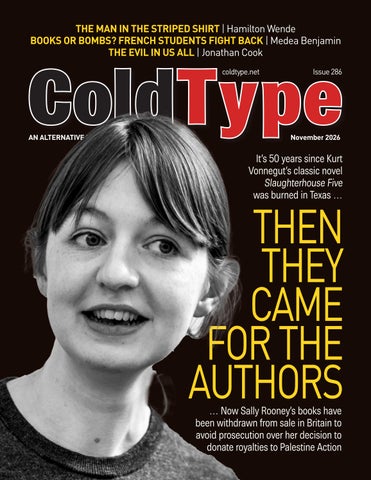
THE MAN IN THE STRIPED SHIRT | Hamilton Wende BOOKS OR BOMBS? FRENCH STUDENTS FIGHT BACK | Medea Benjamin THE EVIL IN US ALL | Jonathan Cook
ColdT ype coldtype.net
AN ALTERNATIVE HISTORY OF THE 21st CENTURY
Issue 286
November 2026
It’s 50 years since Kurt Vonnegut’s classic novel Slaughterhouse Five was burned in Texas …
THEN THEY CAME FOR THE AUTHORS … Now Sally Rooney’s books have been withdrawn from sale in Britain to avoid prosecution over her decision to donate royalties to Palestine Action
IT’S TIME TO REIN IN LETHAL AI DRONES | Rebecca Gordon OSAMA BIN LADEN AND THE DEMISE OF AN EMPIRE | Chris Hedges WHY BRITAIN BACKED PINOCHET’S CHILE COUP | Mark Curtis
ColdT ype coldtype.net
AN ALTERNATIVE HISTORY OF THE 21st CENTURY
Issue 285
October 2026
ED SHEERAN, THE RAPPER, AND THE BILLIONAIRE
Jonathan Cook
9/11 REPORT GOT ME BANNED FROM THE GUARDIAN Greg Palast
TAXPAYERS DON’T WANT TO PAYFOR NEW SPORTS STADIUMS J.C. Bradbury
AN ALTERNATIVE HISTORY OF THE 21st CENTURY Read all 286 Issues of ColdType at www.coldtype.net/reader.html and www.issuu.com/coldtype 2 ColdType | November 2026 | www.coldtype.net
NOVEMBER 2026 | ISSUE 286
INSIDE 5 Why UK Greens’ ‘Zionism is racism’ vote matters Ramzy Baroud 7 Decoding Israeli buzzwords in a time of genocide Norman Solomon 8 Is border secure? Perhaps Marjorie has the answer Del Stone Jr 9 Want to save democracy? Start by saving journalism Sonali Kolhatkar 10 Europe flails under an epidemic of billionaires Craig Murray 12 The conceit – and expense – of total domination William J. Astore 14 Largest corporations paid lowest-ever tax rates Brett Wilkins 15 Hurwitt’s Eye Mark Hurwitt
ColdType 7 Lewis Street, Georgetown, Ontario, Canada L7G 1E3 Contact: Tony Sutton editor@coldtype.net Subscribe: For a FREE subscription e-mail editor@coldtype.net Back Issues: www.coldtype.net/reader.html or www.issuu.com/coldtype Disclaimer: The contents of the articles in ColdType are the sole responsibility of the authors. ColdType is not responsible for any inaccurate or incorrect statements they may contain ©ColdType 2026
Hamilton Wende
INSIGHTS
The man in the striped shirt – Page 26
ISSUES 16 And then they came for the authors.............................. Paul Bond 20 Slaughterhouse-Five – still censored after 50 years ............................................................................................. Susan Farrell 24 UK’s crazy plan for fighting environmental disaster ....................................................................................... George Monbiot 26 The man in the striped shirt ............................... Hamilton Wende 30 NAZA is not just about Israel and Gaza. It’s about the evil in us all.......................................................... Jonathan Cook 34 South Africa’s apartheid victims still await justice .............................................................................................. Mark Waller 38 Freedom Flotilla activists begin new mission to Gaza ................................................................................... Elizabeth Murray 43 Sportwashing strikes again – Rwanda and Formula One .................................................................................... Binoy Kampmark 46 Books or bombs? French students fight back .......................................................................................Medea Benjamin 48 When Americans stop seeing the warning signs ...................................................................... John & Nisha Whitehead 52 Nina Simone’s forgotten collaboration with poet ...............................................................................................Jason Miller 55 That’s All For Now! ................................................................... Mr Fish Cover: Sally Rooney. Photo: Chris Boland / www.chrisboland.com ColdType | November 2026 | www.coldtype.net
3
4 ColdType | November 2026 | www.coldtype.net
NEWS | VIEWS | OPINIONS
INSIGHTS T
he UK Green Party has put the conversation back on track: the problem is not the lack of creative solutions to the Israeli occupation of Palestine. The problem is Zionism itself. To appreciate the significance of Motion A105, adopted by the Green Party of England and Wales at its annual conference on October 4, consider its basic tenets. The party is now formally antiZionist. It endorses the Palestinian right of return, supports one democratic state throughout historic Palestine, reaffirms its commitment to the Boycott, Divestment and Sanctions movement, distinguishes anti-Zionism from antisemitism, and calls for a full arms embargo against Israel. Though the decision may seem revolutionary within British politics, it is hardly revolutionary when examined against the history of Palestinian dispossession, which began long before the Nakba of 1948. Indeed, the Greens are not the first to equate Zionism with racism. That history owes much to Africa’s anti-colonial movements and its struggle against apartheid. Ideas once dismissed as radical are increasingly challenging the boundaries of mainstream British politics In 1975, the Organisation of
➤ RAMZY BAROUD
Why UK Greens’ ‘Zionism is racism’ vote matters Above: Green Party leader Zach Polanski. He’s Jewish – and a vocal critic of Zionism. He was not present for the Party conference’s Zionism motion
African Unity, meeting in Kampala, Uganda, drew explicit parallels between the racial systems governing South Africa, Zimbabwe and occupied Palestine, identifying their common imperialist origins. This position helped lay the groundwork for UN General Assembly Resolution 3379, adopted on November 10, 1975, which determined that Zionism was a form of racism and racial discrimination. Under intense American and Israeli diplomatic pressure, the UN eventually reversed that determination in 1991. Israel, however, was not required to dismantle the discriminatory structures that had prompted the original condemnation. The revocation changed the UN’s position, not the realities confronting Palestinians. Those who yielded to American pressure in 1991 must therefore confront a troubling question of moral responsibility: Did their decision help legitimise the political structures that have sustained Palestinian dispossession, occupation and settler colonialism? The Greens have now reopened that historical debate. But they have also done something more consequential. By adopting the motion with 1,022 votes in favor and 813 against, party members demonstrated that ideas once disColdType | November 2026 | www.coldtype.net
5
INSIGHTS missed as radical are increasingly challenging the boundaries of mainstream British politics. Yet within this achievement lie important fault lines, revealing the nature of the struggle ahead. Four of the party’s five MPs opposed the resolution. More tellingly, Sandy Ruthven, chair of Amnesty International UK’s charitable trust, resigned his Green Party membership altogether. In explaining his decision, Ruthven accused the party of seeking to court the hard-left vote while failing to confront prejudice within its own ranks. His resignation exposes a contradiction worth examining, particularly given his association with an organisation that has already documented Israel’s apartheid against Palestinians. Due to the genocide in Gaza, the Greens have effectively declared that the time for carefully managed criticism has passed In February 2022, Amnesty International published a landmark report concluding that Israel maintained an institutionalised
➤ BY THE NUMBERS
6 ColdType | November 2026 | www.coldtype.net
system of oppression and domination over Palestinians that amounted to apartheid. That recognition was belated but critically important. Apartheid, however, does not emerge in an ideological vacuum. It is sustained by political assumptions about belonging, sovereignty, demographic control and the unequal distribution of rights. The question, therefore, is not merely whether Israeli apartheid exists but what political principles made its establishment and perpetuation possible.
T
he Zionist movement emerged in late 19th-century Europe as a nationalist project seeking a Jewish homeland, eventually pursuing Jewish statehood in Palestine. Its implementation ultimately led to the mass displacement of Palestinians in 1948. The connection between that foundational project and the discriminatory structures documented by Amnesty is impossible to
W W W. I N E Q U A L I T Y. O R G
ignore. How, then, can the likes of Ruthven condemn apartheid without confronting the ideology that underpins it? And if that ideology is not Zionism, what is it? The larger issue, however, is not a lack of historical know-ledge among Britain’s political and intellectual elites. Rather, these elites have long positioned themselves as guardians of the permissible discourse on Israel and Palestine – a narrative that accommodates occasional criticism, sometimes even harsh condemnation, but rarely permits a fundamental challenge to the political structures themselves. The Green Party’s grassroots have now challenged that conventional wisdom. They have crossed the boundary separating what may be criticised from what must remain politically untouchable. Due to the ongoing Israeli genocide in Gaza, the Greens have effectively declared that the time for carefully managed criticism has passed. In doing so, they have opened a political space that others may eventually occupy, including the Labour Party, which is divided between its historically progressive grassroots and an increasingly centrist leadership whose policies, particularly on Palestine, have become virtually indistinguishable from those of the political right. The vote could also encourage similar debates across Europe, challenging political parties to confront the relationship between Zionism, antisemitism, Palestinian rights and the future of historic Palestine. But perhaps the Greens’ most consequential contribution is that they have challenged the very premise of the debate. For dec-
INSIGHTS ades, international diplomacy has focused overwhelmingly on finding solutions while leaving the ideological foundations of the existing political order largely unexamined. The Greens have reversed that approach, essentially declaring that no political solution in Palestine, however idealistic or supposedly pragmatic, can coexist with Zionism. The backlash against the Greens was, of course, expected. But so too is the growing determination
of British voters to challenge the boundaries of permissible debate across the political spectrum. This could finally open the way for a serious conversation about how the world can hold Israel accountable. CT
Ramzy Baroud is a journalist, author and the editor of The Palestine Chronicle. His latest book, Before the Flood, was published by Seven Stories Press His website is ramzybaroud.net
➤ N O R M A N S O LO M O N
Decoding Israeli buzzwords in a time of genocide Boynton
N
early two years ago, Human Rights Watch and Amnesty International released in-depth reports documenting that Israel had committed genocide in Gaza. Months later, Israeli human rights groups did likewise. Support for Israel has declined steeply among Americans, but its defenders continue to maintain a siege of buzzwords against Palestinian rights. As historian Rashid Khalidi emphasised in his book Brokers of Deceit: How the US Has Undermined Peace in the Middle East, “language matters.” Standard terms and tropes “are the essential building blocks of a lofty and solid edifice of denial of an entire narrative, of the existence of an entire people, which is basic to the affirmation of a formidable counter-reality.”
Prominent groups, notably the Anti-Defamation League, the American Jewish Committee, AIPAC and Christians United for Israel – along with allies in Congress, the Executive Branch and the punditocracy – rely on the same buzzwords to defame critics of Israel and deny its systematic crimes against Palestinian people. For instance: l “Antisemitic” At the top in the rhetorical toolbox, a blunt instrument for smear-
ing Israel’s critics no matter how true their accusations – and no matter the absence of evidence of bigotry against Jewish people. l “Blood libel” A high-dudgeon epithet for equating valid condemnations of Israel with 900-year-old antisemitic craziness. l “Held to a higher standard” A catchphrase to evade realities of Israel’s ongoing large-scale crimes against humanity and the fact that Israel uses enormous US military aid to impose apartheid, ethnic cleansing and genocide as matters of policy. l “Homeland for the Jewish people” In other words: Palestinians will not replace us. l “Indigenous” So, even Jewish Americans who recently moved to Israel are indigenous, unlike Palestinians whose ancestors have been living in Palestine for the last hundreds of years. l “Jewish and democratic state” It can’t be oxymoronic just because it’s an oxymoron. l “Peace process” The process of Israeli expansion that has brought war and more war, with the US government functioning as “Israel’s lawyer” while arming Israel with massive quantities of weapons and continuing to make Israel (in the words of a recent Congressional Research Service report) “the largest cumulative recipient of US foreign assistance since World War II.” l “Self-defence” A term reserved for Israelis but certainly not Palestinians. l “Terrorism” When Palestinians kill Israeli civilians but not when Israelis kill Palestinian civilians in vastly greater
ColdType | November 2026 | www.coldtype.net
7
INSIGHTS numbers. l “Renounce violence” A demand routinely made of Palestinian organisations but not of the Israeli government. l “Israel’s right to exist” The standard gotcha question “Do you believe Israel has a right to exist?” can be answered with clear questions: “Do you think apartheid South Africa had a right to exist?” . . . “Do you think ethnic cleansing has a right to exist?” . . . “Do you think genocide has a right to exist?” . . . “Do you think the tens of thousands of Palestin-
ian children killed by |the Israeli military had a right to exist?” CT
working.” Too bad she wasn’t wearing the same furry little callgirl number she wore on February 7, 2023 during Joe Biden’s State of the Union address, when she screamed “Liar!” She would have fit right in with the X Deep Throat zeitgeist of Anything-Goes-So-Long-AsIt-Doesn’t-Make-Donald-TrumpLook-Like-An-Idiot (which is becoming harder and harder not to do).
Norman Solomon is the national director of RootsAction and executive director of the Institute for Public Accuracy. The paperback edition of his book War Made Invisible includes an afterword about the Gaza war. His new book, The Blue Road to Trump Hell: How Corporate Democrats Paved the Way for Autocracy, is free in e-book formats (see Page 23)
S
➤ DEL STONE Jr
Is border secure? Perhaps Marjorie has the answer
8 ColdType | November 2026 | www.coldtype.net
Wikimedia
T
hese are the three signs of the coming apocalypse: 1. Frogs fall from the sky. 2. Gas stations lower their prices. 3. Marjorie Taylor Greene says something most reasonable-minded people would agree with. Such was the case on September 26 when former-US Congresswoman Greene posted the following on Elon Musk’s propaganda sump, the app formerly known as Twitter – now X (it should be XXX, given the volume of pornography it hosts) – in response to news stories about a caravan of Central American migrants headed toward America’s southern border: “We have not seen a caravan headed to the US southern bor-
Marjorie Taylor Greene screams “Liar” during Joe Biden’s State of the Union address in 2023 der in several years, why now? Oh yeah, there is an election coming and the GOP needs to scare you into voting because nothing else is
he’s right. For the past six months I’ve been seeing posts online from ordinary, low-T, low-IQ, high blood-alcohol level Americans that say something to this effect: “I’d like to thank MY president, Donald J. Trump, for securing our southern border from the hordes of illegal aliens and migrant caravans wanting to come up here and harvest our food and re-roof our houses! I don’t care if my tomaters cost three times as much as they should, as long as they wasn’t touched by no illegal alien or migrant caravan person. “Now all those jobs can go to good old-fashioned, hard-working, red-blooded, white-skinned Americans – of course, that wouldn’t be ME. I’ve got this tricky knee and bulging disc in the small of my back. But I just know there’s plenty of good old-fashioned, hard-working, red-blooded, white-skinned Americans who’d love to get out in that there tomater field and work 12 hours a day picking tomaters for $7 an hour!” Even Trump has been bragging about his border prowess. In a speech earlier this year, he said, “The border is secure,” and added
INSIGHTS that even the Democrats agree the border is secure. But over the past few weeks I’ve been seeing videos online that scream, “NEW MIGRANT CARAVAN HEADED TO SOUTHERN US BORDER,” with the implied subhead, “Rapists, murderers, drug dealers and gang members are coming for YOUR sons and daughters!” So let me ask: Is the border secure? Not secure? Maybe it’s like the Strait of Hormuz – open today, closed tomorrow. I don’t understand. If the southern border is secure, why is a migrant caravan a threat? Won’t those caravaners approach America’s very secure southern border and just bounce off it, like bullets off Cap-
tain America’s shield? By the way, do you know how many people are in that migrant caravan headed toward the US southern border? About 600. Donald Trump’s Border Patrol arrests that many migrants every two days, so it’s not like Genghis Khan is headed for the border. I have a solution to the border problem: Let’s build a wall out of Donald Trump’s bullshit. That wall would be so high that nobody could climb it. But then nobody would want to. CT
Del Stone Jr. is a former newspaper editor, columnist and fiction writer who lives in Fort Walton Beach, Florida
➤ S O N A L I K O L H AT K A R
Want to save democracy? Start by saving journalism Boynton
J
ournalism is experiencing one of its worst crises when it’s needed the most. Overall, news consumption is dropping. And it’s worse among young people, who largely get their news through social media, not news outlets. People under 30, more than any other age group, trust social media sources of news. The problem is that it’s hard to tell if your favourite social media source is a citizen journalist or a paid promoter. In a recent indepth report, the New York Times revealed that social media platforms are rife with accounts that
are paid to promote campaigns parading as personal opinion. Rather than hire well-known influencers with huge followings, politicians and organisations are now hiring huge numbers of accounts with smaller followings. “Functioning more like birdshot than a single bullet,” the Times explained, “these high-volume social media campaigns represent the new vanguard of modern political influence, saturating the internet with a topic until it is all but unavoidable.” A perspective that appears popular online may well be the result of this digital “astroturfing.” A decade ago, many Americans blamed the Russian government for insidious meddling in American politics using armies of paid content pushers. Now the same tactic is being deployed by campaigns and non-profits. This disturbing trend goes hand-in-hand with a shocking decimation of journalism. A June 2026 study found that the number of journalists per capita in the United States fell by more than 80 percent since 2002, and those jobs that remain are increasingly focused on sports and crime rather than public policy, government, or other issues.
A
s out-of-work journalists turn to freelancing, the situation for piecemeal work is equally grim. The National Writers’ Union recently found that freelance pay remains stagnant even as the cost of living has more than doubled. Desperate to make ends meet, some independent journalists might attempt to garner large ColdType | November 2026 | www.coldtype.net
9
INSIGHTS enough followings on social media to monetise their work – only to find that they have to play to algorithms designed to lift up rage bait and polarising content. If our views are shaped by paid content creators, and there are fewer journalists to investigate issues of concern, we face a future where opinions are bought and paid for by those with the deepest pockets. We cannot continue this way. Democracy will die if we have no good answer for funding journalism that is hard-hitting and trustworthy.
can open city-run grocery stores, can localities do something similar for newsrooms, while preserving the critical editorial independence necessary for good journalism? The answer is “yes.” Media expert Victor Pickard has touted an ambitious and innovative plan for “Public Media Centers” in local communities around the US that are “federally guaranteed but locally owned and controlled.” Study after study proves that journalism fuels and promotes a strong democracy. It’s no wonder that authoritarianism is rising
T
➤ C R A I G M U R R AY
o address the crisis in journalism, California Governor Gavin Newsom recently signed AB 2222 to strengthen local journalism. Under the law, qualifying news outlets in California will receive $20,000 per journalist, capped at five journalists, plus $15,000 for every additional journalist. This might cover pay raises in a state where $100,000 a year is considered a “low-income” wage _ and where the median salary for journalists is under $53,000. But while the bill’s intentions are laudable, this is too little too late. Thousands of journalists have already left their field. For decades, the federal government diverted a minuscule sliver of the national budget to publicly fund broadcast media through the Corporation for Public Broadcasting. President Donald Trump took a sledgehammer to that modest and very limited source of funding, ending it in July 2025. What then, is the answer? If New York City Mayor Mamdani
at the same time that journalism is dying. If we want to save our democracy, we must save journalism. CT
Sonali Kolhatkar is host and executive producer of Rising Up With Sonali, an independent syndicated TV and radio show. She’s an award winning journalist and author of Talking About Abolition: A Police Free World is Possible, and Rising Up: The Power of Narrative in Pursuing Racial Justice. This article was distributed by www.otherwords.org
Europe flails under an epidemic of billionaires
I
t takes a lot to get tens of thousands of people to riot. For it to happen simultaneously across several countries points to a supranational underlying cause, as opposed to local grievance at an egregious state injustice. That the temporary collapse of authority and restraint will allow some opportunists to loot is an inevitable consequence. That does not make theft the cause. There is a reason that, in every western democracy during the last 20 years, neoliberal politicians have campaigned under the slogans “Hope,” “Change” or their various synonyms, and translations. It is because very highly paid PR consultants have told them that
10 ColdType | November 2026 | www.coldtype.net
what the people lack, what the people need, what the people desperately crave, is hope and change. Riot and rebellion are acts of extremely high risk which are the resort of the otherwise hopeless. When I was studying history, a core part of the curriculum was the cross European revolutionary waves of 1830/1, 1847/8 and 1870/1871, against which you can precisely pin dozens of cross European events including the overthrow of Charles XII, the Hungarian Rebellion and the Paris Commune, and their pale reflections in the UK such as the Great Reform Act and Chartism. We were told that these waves of rebellion coincided with poor harvests, which is true. It is only a decade or so ago I
INSIGHTS learned that they also coindo of the wealthy, who benefit cide precisely with the waves from lower costs of certain less of cholera epidemics which necessary items that explain the swept across Europe into official inflation measure being Central Asia. much lower than the lived expeMy point is merely to illusrience of most people. trate that it takes a great deal This is an officially acknowof pain and hopelessness to ledged though little published force people in the streets to reality. The wars in Ukraine and attempt to defy their governIran are directly responsible for ments with physical force. much of the inflation. They are In his short but superb essay however a consequence of the on the education protests that concentration of wealth, not a sparked rebellion in France, separate factor. Thomas Piketty includes this Billionaires make money from devastating passage. war. They make money from “To justify the inadequaweapons and from lending to cy of education funding, and governments. They make money in particular the decrease in from military and security conspending per student, the tracts. The make money from government and its supportReform Party leader Nigel Farage is reminded who high hydrocarbon prices, They ers argue that France cannot af- is responsible for problems with today’s Britain make money from asset value ford to invest more.” fluctuations between hot war and They are making two reasoning nary people are in slow but apparnegotiation. Billionaires drive war. errors. Public debt has indeed risen ently irreversible decline. This is The social democratic compact from 20 percent of GDP in 1970 to indeed due to an epidemic sweepthat underlay western democracy is 120 percent today. But at the same ing the western world. It is an epifatally fractured. Public provision is time, private wealth has grown demic of billionaires. despised and eked out grudgingly much more dramatically: It has In the UK, just 50 families hoard where the politicians whom the bilgone from 300 percent to 600 permore wealth than the poorest 50 lionaires control see it as absolutely cent of GDP, with extreme concenpercent of the population – over unavoidable to keep the serfs quiet. tration among the wealthiest finan36 million people. To pretend that Discontent is everywhere. It does cial fortunes. this mindboggling inequality of not always show the same face, and In other words, France’s nationwealth is beneficial, and in no way some of those faces are ugly. But al wealth – the sum of private and related to the prevalence of poverthe current status quo cannot and public assets minus private and ty, requires intellectual dishoneswill not stand, and there are facpublic debts – has never been so ty of an extreme level. Yet it is the es and voices of courage and hope, high, not only in absolute terms but neoliberal orthodoxy of our times many of which have been heard in also as a percentage of GDP (which and subscribed to by all the major Europe these last few weeks. CT itself has never been higher). In UK political parties. other words, France has never been As everybody knows, domestic Craig Murray is an author, richer. The problem to solve is simfuel cost inflation in the UK has inbroadcaster and human ply one of distribution. creased by 90 percent during the rights activist. He was Precisely the same is true in the past four years. Inflation on food British ambassador to UK. It has never been richer. The and rent has increased by over 25 Uzbekistan from August 2002 problem is of distribution. It is true percent. to October 2004 and rector across the western world. These inescapable necessities of the University of Dundee The living standards and the form a much higher proportion of from 2007 to 2010. His web site prospects of betterment for ordithe spending of the poor than they is www.craigmurray.org.uk ColdType | November 2026 | www.coldtype.net
11
INSIGHTS Boynton
➤ W I L L I A M J . A S TO R E
The conceit – a nd expense – of total domination
A
strange conceit of American exceptionalism is the naked ambition of fullspectrum dominance. The idea is this: America must dominate every realm of potential conflict, land-sea-air as well as space and cyber and any other realm you can imagine, for that is the only way Americans can truly be “safe.” Such a conceit comes with a hefty price tag as Pentagon spending soars toward $1.5 trillion a year. But money is the least of it. The heftiest price tag is the constant state of warfare (and preparations for yet more war) that has characterised US foreign pol-
icy since 1945. That, and the erosion of personal liberty and freedom and the hollowing out of the American middle- and working classes as money flows upward to war contractors in the service of boundless imperial ambition. There’s a god-like quality to this ambition, the idea America must be omnipotent, dominating all realms of warfare, and omniscient, sweeping up all data everywhere, in an unapologetic quest for global reach and global power together with the unapologetic exercise of that murderous power against people generally having brown or black skin and therefore treated as
12 ColdType | November 2026 | www.coldtype.net
inferiors. With only slight exaggeration, the US government can be said to be projecting power everywhere and helping ordinary Americans nowhere. Destruction is favoured over construction. Enriching the already rich is the goal even as the impoverished are made poorer. US taxpayers, in the old days known as citizens, are paying through the nose for un-needed weapons systems (Sentinel ICBMs, B-21 nuclear bombers, Golden Dome), unwanted wars (Vietnam, Afghanistan, Iraq, Iran), and an imperial structure of force projection that virtually guarantees the violence will be unending. This imperial structure, with its goal to control all, to know all, to dominate all, is supported by Democrats and Republicans. Critics of this structure, present in both parties but in small numbers, are attacked and otherwise kept on the margins.
N
one of this is new. In the early 1960s, Senator George McGovern, a decorated bomber pilot during World War II, argued against the pursuit of nuclear “overkill” and called for substantial cuts to defence spending and reinvestment in civilian infrastructure. In support of this initiative, he cited Republican President Dwight D. Eisenhower’s militaryindustrial complex warning of January 1961. McGovern’s initiative was quickly abandoned as the Johnson administration ramped up its disastrous war in Southeast Asia. Nearly a decade later, with
INSIGHTS Southeast Asia ravaged if not defeated, McGovern urged his fellow citizens to “come home,” to stop the folly of overseas wars and ever-increasing military budgets. He was overwhelmingly defeated by Richard Nixon in the 1972 Presidential election. Ever since that defeat, the Democratic Party has conspired to silence candidates who are antiwar and who dissent from the idea of imperial dominance. Dennis Kucinich comes to mind here. Even moderate calls for reform from candidates like Bernie Sanders are dismissed as naive or dangerous. The result has been Democrats like Obama, Biden, Hillary Clinton, and Harris who openly embrace “good” wars (Afghanistan, for Obama) and who eagerly celebrate military lethality (Harris). Meanwhile, the Republican Party never met a military budget increase it didn’t like. Rare indeed are voices like Ron and Rand Paul and Thomas Massie who question the wisdom of endless wars and their adverse impact on rights and freedoms here. What is to be done? Bernie Sanders called for a political revolution, surely a correct call, but he was neutered by the establishment of both parties. Elizabeth Warren spoke of “big, structural changes,” but that was for the domestic economy; her foreign policy was basically that of Biden/Harris. A few rogue Republicans speak up against the Iran war today, but rare indeed are those who openly call for major cuts to war spending. In short, electing our way out of imperial dominance and colossal war and weapons spend-
ing is unlikely. Many many people (myself included) have written sensible articles calling for deep cuts to military spending, but good ideas that go against the grain gain little traction without a strong and concerted movement behind them. America desperately needs a coordinated mass movement against endless war and massive military spending, yet the “powers that be” keep doubling down on yet more wars and even more massive war spending. That same establishment continues to multiply US “enemies.” It may be Iran today, but Russia and especially China always loom, with North Korea and other “rogue” states held in reserve just in case. The sheer folly and massive expense of it all will likely lead to the end of the (however imperfectly practiced) American democratic experiment. That’s a grim conclusion, I know, but I’m less than hopeful as the tools America has used in its unjust wars overseas
are now increasingly applied in the “homeland” against alleged dissenters. Remember when “dissenters” used to be called concerned citizens? Remember when war was considered to be bad and weapons spending was seen as the unwisest of ways to spend our resources? America doesn’t have to be a warrior-state or in a state of constant war. A “silent majority” of Americans clearly doesn’t want endless war and outspokenly wants better lives for their children. But better days will not come if this majority remains silent or otherwise demobilised.
A
s Ike said in 1961, the main obstacle is the military-industrial complex (MIC), to which he added Congress as an abetter and accomplice. That complex in 65 years has greatly added to its power and cultural penetration. The term
➤ G R E E D AT A G L A N C E
W W W. I N E Q U A L I T Y. O R G
ColdType | ,November 2026 | www.coldtype.net
13
INSIGHTS
UP
EMBEDDED. WEAPONS OF MASS DECEPTION
DA TED HOW THE MEDIA FAILED TO COVER THE WAR ON IRAQ
MICIMATT adds the intelligence “community,” the media, academe, and think tanks. To that we might add the sporting world, Hollywood, video games, and now wildcard tech billionaires. All these interests conspire to absorb trillions of dollars from US taxpayers, ostensibly in the name of national security, while waging or supporting endless war. Ike said only alert and knowledgeable citizens, actively participating in democracy, could compel the MIC to curb its worst and most grandiose ambitions. Sadly, this is precisely why the American people are constantly lied to, especially about wars, why so much is kept hidden or “classified,” and why people are encouraged to salute smartly and let the military experts handle everything. Even worse, the very idea of
Largest corporations paid lowest-ever tax rates
NEWS DISSECTOR / MEDIACHANNEL.ORG
ColdType
Get these – and six more complete books by Danny Schechter – all in pdf format – free from ColdType Download your copies at www.coldtype.net/ SchechterBooks.html
William J. Astore is a retired lieutenant colonel (USAF). He blogs at Bracing Views – www.bracingviews.com
➤ BRETT WILKINS
DANNY SCHECHTER
Free books by Danny Schechter
active citizenship is now degraded; the only “duty” apparently left is voting, where you’re encouraged to vote Democrat or Republican and otherwise to reject any third-party candidate who may be antiwar as irrelevant if not invalid (and possibly un-American). Our ultimate security doesn’t reside in guns or other weapons or in boundless violence. It resides in strong institutions committed to the rule of law in which individuals of character stand up and speak out against abuses of power. Come home, America, to a land of generosity and hope and peace. Be an alert and knowledgeable citizen. And act. CT
S
ome of the biggest US corporations paid an effective federal income tax rate of just 10.4 percent last year as Republican legislation passed by President Donald Trump disproportionately benefited businesses and the superrich while eviscerating key social programs, a study published Thursday revealed. The 706 corporations examined by the Washington, DC-based Institute on Taxation and Economic Policy (ITEP) reported
14 ColdType | November 2026 | www.coldtype.net
a combined $1.88 trillion in US profits in 2025, yet paid less than half the statutory federal corporate income tax rate of 21 percent. Of those companies, the study found that 114 paid no federal income taxes at all. Those 706 companies collectively paid current federal corporate income taxes equal to just 10.4 percent of that $1.88 trillion, “the lowest effective rate that ITEP has uncovered in over 40 years of analysing corporate income taxes,”
INSIGHTS according to the analysis. The study attributes this to two major tax laws enacted under Trump: The 2017 Tax Cuts and Jobs Act – derided at the time as the “GOP Tax Scam” – slashed the statutory corporate income tax rate from 35 percent to 21 percent, while the so-called One Big Beautiful Bill Act passed by the Republican-controlled Congress and signed by the president last year expanded and made permanent the 2017 cuts. “These findings show just how dramatically the corporate tax system has been tilted in favor of the nation’s wealthiest and most powerful companies,” ITEP senior fellow Matt Gardner, who co-authored the report, said in a statement. “At a time when lawmakers claim the country cannot afford investments in families and communities, some of the most profitable corporations in American history are paying little or nothing in federal income taxes,” he added. “This is not an accident. It is the predictable outcome of deliberate policy choices that have steadily eroded the corporate tax base.” Among the report’s key findings: l The 114 companies that paid no current federal income tax last year include Tesla, Walt Disney, CVS, Citigroup, United Airlines, and DoorDash; l 258 corporations paid effective tax rates below 7 percent, or less than one-third of the statutory rate; l Those 258 companies reported $683 billion in US profits but paid an effective federal income tax rate of just 1.7 percent; l The 706 corporations studied
received $198 billion in federal tax subsidies by paying less than the statutory 21 percent rate; l They also benefited from an additional $263 billion in tax savings attributable to the 2017 reduction of the statutory rate from 35 percent to 21 percent; and l Just 25 corporations accounted for more than half of the 2025 tax subsidies, with Alphabet ($18.9 billion), Microsoft ($18.7 billion), Amazon ($17.4 billion), and Meta ($13.9 billion) among the largest beneficiaries. While proponents of subsidies claim they are necessary to encourage investment, the new study raises questions about why some of the nation’s most profitable corporations should receive billions of dollars in taxpayer subsidies while vital
➤HURWITT’S EYE
social programs upon which tens of millions of Americans rely, like Medicaid and food stamps, suffer historic cuts under Republican legislation. “Congress has repeatedly chosen to expand tax breaks for corporations that are already extraordinarily profitable,” said Steve Wamhoff, ITEP’s federal policy director and co-author of the report. “Rather than continuing to subsidize corporate investments and reward aggressive tax avoidance, lawmakers should close these loopholes and ensure that large corporations pay a meaningful share of their profits in taxes.” CT
Brett Wilkins is a staff writer for Common Dreams – www.commondreams.org – where this was first published
MARK HURWITT
ColdType | November 2026 | www.coldtype.net
15
Left: Sally Rooney. Photo: Chris Boland / www.chrisboland.com
➤ PA U L B O N D
And then they came for the authors
Sally Rooney’s books are withdrawn from sale in Britain to avoid prosecution over her decision to donate royalties to Palestine Action
Main photo: Irish author Sally Rooney
B
ritain’s Labour government’s antidemocratic proscription of Palestine Action as a terrorist organisation has led to the withdrawal from sale in the UK of books by Sally Rooney, to avoid repression of her protest against the genocide in Gaza. A bestselling and award-winning Irish novelist, Rooney pledged to give royalties and earnings from her considerable UK sales to Palestine Action. This exposed her and her publisher to prosecution under the Terrorism Act 2000 –the same legislation used to criminalise PA – for giving financial aid to a proscribed group. Under “circumstances where Faber cannot pass on UK earnings to Sally Rooney for her work,” the
16 ColdType | November 2026 | www.coldtype.net
Photos: Wikipedia
Clockwise, from top left: Normal People, Rooney’s awardwinning novel; Jacqui Smith, UK Minister of State for Skills: “Proscribing Palestine Action has consequences. This is one …”; Yvette Cooper, former Home Secretary, nnnounced the ban on Palestine Action, making it an offence to express support for the group; Sarah Helm, author: “God help us authors who support Palestine”
publisher said, they had mutually agreed to the withdrawal of her books from UK sale. Other authors can also be targeted. Responding to Adam Boulton’s accusation on Sky News that Rooney’s actions were “anti-Jewish,” the journalist and author Sarah Helm tweeted, “God help us authors who support Palestine and Palestine Action. Sounds like Adam would have all our books swept off the shelves in a jiffy.” Helm, the author of Gaza: The Long Road to Destruction, 18702024 (2025) who has also interviewed Zionists critical of its settlement project, is the wife of Jonathan Powell, who Powell served as adviser on national security, foreign policy and intelligence to both Keir Starmer and Andy Burnham. Following demands by Zionist groups, she is now being
investigated by the Metropolitan Police “to determine whether any further police investigation may be required.” Downing Street responded by declaring, “These views are held by an individual who does not represent the government in any capacity.”
B
aroness Jacqui Smith, Minister of State for Skills, said the “very careful process… the Home Office went through” in proscribing Palestine Action “has consequences. This is one of those consequences.” Smith was explicit that this was political censorship, and the Labour Party remains committed to it. Discussing Rooney’s books, she said “the government’s first responsibility is to the security of the country.”
Palestine Action was proscribed by Keir Starmer’s government after activists entered an RAF base and spray-painted two military aircraft to protest British complicity in the Gaza genocide. Then Home Secretary Yvette Cooper announced the ban in June 2025, making it a criminal offence to be a member of or express support for the group. The former “crime” carries up to a 14-year sentence. Banning Palestine Action, a group principally targeting Israeli military supplier Elbit Systems, was aimed at deterring all opposition to the genocide and Labour’s complicity. Thousands were arrested, most for peacefully holding placards reading “I oppose genocide. I support Palestine Action.” Under section 13 of the 2000 Terrorism Act, this carries a potential sentence of ColdType | November 2026 | www.coldtype.net
17
six months’ imprisonment. Arrests continued even during a judicial review into the decision. Rooney has been a principled opponent of the Gaza genocide and the repression of opposition to it. She compared Israeli forces firing on an aid distribution site with Palestine Action’s protest action: “One of these actions involved the intentional use of lethal violence against civilians, resulting in the deaths of 23 loved and irreplaceable human beings. The other involved no violence against any living things and resulted in no deaths or injuries. The UK government has now announced its intention to deal with one of these incidents as a terrorist offence. Guess which.” In February 2026, the High Court ruled the proscription unlawful and disproportionate. Rooney hailed the judgment as a “victory for civil liberties.” The High Court judges, however, rejected proscription only because the group’s actions had “not yet reached the level, scale and persistence” to justify it, opening the way for a government appeal. The Court of Appeal overturned the High Court decision in June, reinstating the proscription. It defended deference to the Home Secretary on matters of “terrorism” or “national security.” Palestine Action co-founder Huda Ammori called this “one of the most extreme attacks on free speech and the right to protest in modern British history.” More arrests followed, including at the Labour Party’s conference. Almost 4,000 people to date have been arrested. Burnham is as committed as his predecessor to war and repression. When the ban was imposed, Rooney wrote of her “intention to go on supporting Palestine Action, which is not a proscribed or otherwise prohibited group here in the
“One of the most extreme attacks on free speech and the right to protest in modern British history” Republic of Ireland.” She pledged to donate royalties and earnings from UK sales and television adaptations to the group. If that made her open to prosecution for supporting terrorism, she added, “so be it.” Rooney is a major internationally recognised author. Her second novel, Normal People (2018), has sold more than 1 million copies in the UK alone. It won the Costa Book Award, Irish Novel of the Year in the Irish Book Awards (which named her Author of the Year in 2024), and Encore Award, amongst others. It was adapted into an award-winning BBC Three/ Hulu miniseries, as was her novel Conversations with Friends (2017). Her books are a major part of Faber’s income. Last year, her titles accounted for just over 10 percent of UK money spent on Faber books. Even without any new publication this year, her books have constituted nearly 5 percent of Faber’s takings in UK bookshops. That she can be targeted in this way shows that no one is safe.
R
ooney has always recognised possible repercussions. In September 2025, she cancelled a trip to London to accept the Sky Arts Award for Literature for Intermezzo (2024), amid concerns she could be arrested for supporting Palestine Action. Last November, in a witness statement to the High Court, she warned that her existing books could disappear from British bookshops and she might be
18 ColdType | November 2026 | www.coldtype.net
unable to publish new work in the UK. That is now happening. She is not being threatened over the content of her books, but over her opposition to genocide. Ahead of the proscription, she wrote of the implications of using the Terrorism Act: “[M]ere membership of the group would constitute a crime. In fact, even supporting the group purely in words – as I am doing now – could also constitute a serious legal offence… Financial dealings with members and supporters may also be illegal, even if the individuals concerned have done nothing against the law other than belonging to or express support for a protest movement.” She noted that the Act’s definition was vague enough to include property damage, even in the absence of any threat to human life. “If the government proceeds down this path,” she warned, “any ordinary person in the UK could in theory be sent to prison simply for expressing verbal support for non-violent activism. Quite aside from the broader principle, this would represent an alarming curtailment of free speech.” Cutting off Sally Rooney’s royalties looks like financial sanctions against a political dissident – are there other examples of banks or companies freezing money to punish activists, and where could this trend lead for workers’ organisations? Rooney wrote before proscription that “I admire and support Palestine Action wholeheartedly – and I will continue to, whether that becomes a terrorist offence or not.” She has since written, “I have made every effort to be honest with the public about my beliefs and intentions, and I am wholly prepared to accept the consequences.” Those consequences have involved cutting off her income from British companies by threatening
them with the same legislation. Last November, she said the production company behind her BBC productions had warned they could not legally pay her royalties if she was using them to support Palestine Action. Facing the same threat, Faber said the legislation had “led to circumstances where Faber cannot pass on UK earnings to Sally Rooney for her work.” “To sell a writer’s work and not be able to pass on earnings is an unconscionable situation for a publisher,” they said, so “we have taken the decision that we can no longer supply her works in the UK in any format. We remain the proud publisher of her remarkable body of work, which we will continue to sell in other territories.” Rooney explained that “the fulfilment of contracts to publish my work in the UK could now constitute a serious criminal offence. After a process of consultation and deliberation, and with my full agreement, my publisher Faber has therefore determined that it can no
longer supply my work within the UK.” Booksellers can sell remaining stock, but this is effectively a ban. Ammori said, “Sally Rooney being unable to publish her work in the UK marks a new low in the escalating assault on free speech caused by the proscription of Palestine Action.” She continued “A world-renowned author fearing arrest and being forced to remove her books from our bookstores, exposes the chilling consequences of this authoritarian law, which has been used to make over 3,700 arrests for simply holding seven-word signs.” (There have been more arrests since).
I
ndex on Censorship’s Jemimah Steinfeld said, “We have already seen how the proscription of Palestine Action has infringed on our freedom to protest and now we are seeing it infringe on our freedom to read. This comes the week after
Banned Books Week, revealing another threat to the UK’s publishing industry.” The government is placing culture at the mercy of its criminal policies, which are coming into conflict with an increased determination to speak out against genocide and war. Sally Rooney’s case points to the threats levelled against artists and their livelihoods. It takes this form with Rooney because of her explicit financial support for Palestine Action, but the threat will be extended to any who speaks out, including prominent musicians like Robert Del Naja of Massive Attack, Brian Eno, Bob Vylan and Kneecap. Forcing through the government’s ferocious agenda in the face of such criticism makes economic sanctions against cultural opponents ever more likely as a weapon of class rule. CT
Paul Bond wrote this story for t he World Socialist Web Site at www.wsws.org
UPDATE: Leading UK authors show support for Sally Rooney
C
hildren’s books are at risk of being withdrawn from circulation after two Children’s Literature Laureates pledged their royalties to Sally Rooney afterHer publisher was forced to remove her stories from British shelves. Chris Haughton, Ireland’s Children’s Literature Laureate, and author of Oh No, George!, said he “fully supports” Ms Rooney, adding “Palestine Action have done more to block the illegal arms sales to Israel than any other organisation in the UK. “I will be using proceeds from my own UK book sales to donate to Sally Rooney in support. It’s up to her what she does with it.” And Welsh Children’s Literature Laureate Nicola Davies added: “I’ve spent 30 years writing about the natural world for children and being involved in children’s literacy and well-being. I can’t say that I am standing up for the children of Wales if I allow
the children of Gaza to be murdered and mutilated without comment.” Saying she will donate the royalties from her book The Day War Came, Ms Davies added: “Sally is free to do what she chooses with them, including giving them to help the work of Palestine Action.” A spokesperson for Defend Our Juries, which campaigns to overturn the proscription, said: “A child can understand that the deliberate killing of thousands of Palestinian children is wrong. “And that the jailing of people as terrorists for trying to stop that killing is wrong. “The loss of children’s books from Britain’s bookshops would signal a further descent into madness.” Mr Haughton and Ms Davies are among over 850 authors, illustrators, poets and editors to sign an open letter in support of Ms Rooney. CT – Morning Star
ColdType | November 2026 | www.coldtype.net
19
➤ S U S A N FA R R E L L
Slaughterhouse-Five – still censored after 50 years More than 50 years after a North Dakota school district burned copies of Kurt Vonnegut’s Slaughterhouse‑Five, the anti‑war novel is still being censored
B
ruce Severy, a full-bearded, idealistic 26-yearold, moved from Southern California in 1973 to the small town of Drake, North Dakota, where he had accepted a job teaching English at the public high school. He, his small family and their menagerie of pets settled into a large house across from the school. Severy’s progressive bent showed in the curriculum he taught. Insisting that his students should learn “how to think, not what to think,” he assigned his sophomore literature class contemporary fiction to read, including Kurt Vonnegut’s Slaughterhouse-Five, a strange and quirky anti-war novel published four years prior. While Severy chose works that he believed could help his students make sense of the problems confronting society, they clashed with the conservative values of his new home. A parent eventually complained about profanity in Slaughterhouse-Five. In November 1976, the Drake school board voted unanimously to remove the book from school premises. School officials told students to turn in their copies, and
their lockers were searched if they refused. The district went on to burn 32 copies of the novel in the school furnace. As a Vonnegut scholar, I’m fascinated by the backlash to Slaughterhouse-Five, which is now widely taught in high schools and colleges across the country. Even though the US Supreme Court eventually weighed in on Vonnegut’s novel, there are direct parallels between that controversy and the politics of school censorship cases today, which continue to target Slaughterhouse-Five, among countless other works. News of what happened in Drake
50 YEARS OF BANNINGS. Cover of Kurt Vonnegut’s anti-war novel Slaughterhouse Five
20 ColdType | November 2026 | www.coldtype.net
spread quickly in the press. Those who objected to the school board’s actions made comparisons to Nazi book burnings. The school district’s cause wasn’t helped by the fact that the superintendent’s last name was Fuhrman – evoking Adolf Hitler’s formal title, Führer – and the school board chairman’s last name was McCarthy, reminding the public of Joseph McCarthy, the disgraced anti-communist senator who sought to purge and censor Americans from all walks of life. When Kurt Vonnegut learned of the case, he was both angry and saddened. In a letter to the Drake school board, he insisted his books were “not sexy” and did not argue “in favour of wildness of any kind.” Instead, “they beg that people be kinder and more responsible than they often are.” He informed the board that he was a decorated World War II veteran who had fought against nations that hate books and burn them. He never received a reply.
T
he North Dakota incident, while the most egregious attempt to censor Vonnegut, was not the only case of its kind.
© Kurt Vonnegut, Jr National Portrait Gallery, Smithsonian Institution
SELF PORTRAIT of Kurt Vonnegut hangs in the National Portrait Gallery at Washington’s Smithsonian Institution As Slaughterhouse-Five made its way into high school and college curricula, it faced a backlash by parents and school boards who argued the novel was obscene and immoral. Its irreverent treatment of Christianity was deemed blasphemous, while its unsparing portrayal of the US military’s bombing of Dresden, Germany, was condemned as anti-American. The book has been challenged as recently as January 2026, when the ACLU filed a lawsuit on behalf
of Vonnegut’s estate after Utah’s “sensitive materials law” gave school districts a mechanism to ban the novel.
C
ensorship cases involving Slaughterhouse-Five are complex because they have occurred almost entirely in high schools rather than colleges. Schools must balance their responsibility to decide what material is appropriate for younger stu-
Slaughterhouse-Five faced a backlash by parents and school boards who argued the novel was obscene and immoral dents with students’ First Amendment rights to receive information and ideas. One important case dealing with these issues made it all the way to the US Supreme Court. In 1976, several board members from the Island Trees School district in Long Island, New York, reacting to a list of “inappropriate” titles publicised by a conservative activist group, objected to 11 books held in the districts’ school libraries or included in the curriculum. Seven of the books were written by authors from minority ethnic or religious groups, including titles as seemingly inoffensive as “Best Stories of Negro Writers,” edited by Langston Hughes, and the young adult novel “A Hero Ain’t Nothing but a Sandwich” by Alice Childress. The 11th book on the list was Slaughterhouse-Five. At a press conference, school board member Frank Martin read excerpts from the novel out loud, focusing on a passage where one of Vonnegut’s characters, Kilgore Trout, reimagines the story of Christ’s crucifixion. Trout claims that this revised story actually offered a better moral than the original Gospel story: It teaches people to be kind to everyone, not just the well connected. Martin, however, declared that even if the rest of the book told the best story in the world, he wouldn’t want it in the school library “with this stuff in it.” Five high school students, led by 17-year-old Steven Pico, soon
ColdType | November 2026 | www.coldtype.net
21
filed a lawsuit against the district, claiming the book removal was unconstitutional and that their First Amendment rights to freely receive information had been violated. The case wended its way through the lower courts for years, before it came to the Supreme Court in 1982. Board of Education v. Pico was a tangled case. The justices wrote seven separate opinions and did not definitively settle the First Amendment issues. But a 5-4 majority did determine in favour of the students who argued that their case should have received a full trial rather than a summary judgment years ago. As the only Supreme Court case to date involving censorship in school libraries, Pico, while a limited ruling, did set out general guidelines still used today. The decision affirmed that school districts have the authority to supervise the education of students in their care and may remove materials that are, in the words of Justice William Brennan, “pervasively vulgar” or educationally unsuitable. But such a decision may not be based on a school district’s objections to the ideas expressed in the books. Books may not be removed on narrowly partisan or political grounds, and removal must comply with the “transcendent imperatives of the First Amendment.”
Surprisingly, many of the school censorship cases today still focus on the same old issues affecting Slaughterhouse-Five over 50 years ago That figure rose to 3,362 in 2022– 23 and nearly tripled to 10,046 in 2023–24. Since then, the numbers have dipped somewhat but are still alarmingly high. Surprisingly, many of the school censorship cases today still focus on the same old issues affecting Slaughterhouse-Five over 50 years ago – profanity, sexual content and violence. John Green’s “Looking for Alaska” has been the most frequently banned book
D
espite the fact that the justices ruled that books cannot be banned on partisan or political grounds, book banning has been on the rise in America since 2020. The literary and free speech advocacy group PEN America documented 2,532 instances of book bans in public schools in 2021–22.
Kurt Vonnegut objected unsuccessfully to efforts to remove his works from school curricula (Photo: Library of Congress, Prints & Photographs Division, photograph by Bernard Gotfryd)
22 ColdType | November 2026 | www.coldtype.net
in schools since 2021, mostly because of a brief, awkward sexual encounter between two main characters. But fiction and memoirs focusing on gender identity and LGBTQ+ issues have increasingly become targets of censorship, abetted by right-wing parental rights groups like Moms for Liberty. George M. Johnson’s memoir All Boys Aren’t Blue and Maia Kobabe’s autobiographical graphic novel Gender Queer are among the most banned books in schools in recent years.
A
nd like the majority of the books banned in the Pico case, books by Black authors remain high on the list of school censorship cases. Nobel Prize-winning author Toni Morrison’s first novel, The Bluest Eye, appears among the top 10 banned books since 2021, and her Pulitzer Prize-winning Beloved comes in at No. 26. Ironically, Beloved was also named the single best work of American fiction since 1980 in a 2006 poll of writers and literary critics. Kurt Vonnegut believed in and argued for First Amendment rights his whole career. In 1976 he told students at Connecticut College that language and literature were “holy” to him. He thought schools should resolve to expose children to all sorts of opinions and information, to make better citizens. But he wasn’t too hopeful. Arguing against book banning, he wearily concluded, was like “attempting to explain America at its bravest and most optimistic to orangutans.” CT
Susan Farrell is Professor of English at the College of Charleston, South Carolina. This article was first published at www.theconversation.com
A New Book by NORMAN SOLOMON from ColdType and Progressive Hub
➤ AUTHOR NAME
Headline in here in here chghghg
“This book scrutinizes how the behaviour of many Democrats assisted Trump’s electoral triumphs. That scrutiny is important not only for clarity about the past. It also makes possible a focus on ways that such failures can be avoided in the future.”
Subhead
THE BLUE ROAD TO TRUMP HELL How Corporate Democrats Paved the Way for Autocracy
By NORMAN SOLOMON With cartoons by Matt Wuerker
The sordid and tragic truth of how the Democratic Party enabled the Trump cult to seize control of the US government. Download a FREE PDF at www.coldtype.net/BlueRoad.html or at www.blueroad.info l Print copy now available 38 ColdType | May 2026 | www.coldtype.net ColdType | November 2026 | www.coldtype.net
23
➤ G E O R G E M O N B I OT
UK’s crazy plan for fighting environmental disaster Instead of taking responsibility, the UK government is passing crucial resilience roles to the public, and failure is inevitable
W
ould you mind fixing the Nationmal Health Service And while you’re at it, could you please build an anti-missile system in your garden? Then regulate the banks, replace the water mains, tax the very rich and use the proceeds to rebuild our schools. Well, come on people: what are you waiting for? I exaggerate, but this isn’t very far from the approach taken by the UK government’s Prepare campaign. Crucial functions, way beyond the scope of individual action, are dumped on our doorsteps while those in power fail to act. As a result, our national resilience is arguably lower than at any time since the second world war. At the Labour conference at the end of September, Prime Minister Andy Burnham promised “a Britain where people feel the country has got their back again.” To make good on that pledge, he will have to change almost everything. It’s not that the advice offered by Prepare – a government campaign designed to promote readiness for emergencies – is irrational. But when the state is absent or working against us, households and communities cannot fill the gap. The campaign tells us, for example, to conserve water during
droughts by turning off the tap while brushing teeth, or taking a shower instead of a bath. For sure. Every citizen should do their duty. But the government has at the same time declared data centres “nationally significant infrastructure projects” that can be forced through the planning system, despite two startling facts. The first is that even Water UK – the body representing those paragons of environmental responsibility the water companies – has said there isn’t enough water to support the new data centres.
One in nine new homes are being built in areas at risk of flooding, according to data from insurance giant Aviva The second is that, as a freedom of information response reveals, the government has no idea what they are being used for. You could be turning off your taps so the water can be used to nudify celebrities. Talking of droughts, the government’s National Risk Register seems seriously out of whack. It estimates the risk of a drought with a moderate impact occurring in the
24 ColdType | November 2026 | www.coldtype.net
next five years at just 0.2-1 percent. What?? It also estimates the risk of heatwaves with a “significant” impact – by which it means between 200 and 1,000 deaths – at only 1-5 percent over the next five years. The government estimates there were 2,877 heat-associated excess deaths in England during this year’s hot weather in May and June. There were a similar number of deaths in the heatwave of 2022. But never mind: the Prepare campaign advises that “if you live in a home that is more likely to overheat … contact your local council, your letting agency or Citizens Advice to find out what help and support they can provide.” Good luck with that. In the meantime, the “future homes standard” is at last due to come into force in March 2028, but thanks to lobbying by the building sector, according to some practitioners it still won’t deliver new homes matched to the climate challenges we face. And local authorities have been blocked from demanding anything better, thanks to the same corporate pressure. Survive floods, the Prepare campaign tells us, by “packing a ‘grab bag’ of essentials in advance,” moving “valuable items upstairs” and making “changes to your property to reduce the damage flooding
Water UK – the body representing the water companies – has said there isn’t enough water to support the new data centres hicles. All, once again, in response to lobbying. As for food resilience, the Prepare campaign scarcely mentions it, except to say we should stock some “non-perishable food that doesn’t need cooking” in our homes. Last month, a group of anonymous senior food executives warned that, in the face of “material reductions in yield, quality and reliability of supply,” their industry was “defaulting to quickfix crisis management” rather than taking a strategic, long-term approach. “At present, we are seeing companies either consistently lob-
by against necessary regulations or stay silent,” they said. The result is a likely failure to address an existential threat. There was much in Burnham’s speech that delighted me, especially his listing of deregulation as one of the five great evils putting Britain on “the wrong path.” That’s a break with 47 years of policy, in which all governments have dismissed essential public protections as “red tape” that must be cut. The Tories were still at it in their own annual conference early last month – telling us, in effect, they are here to burn it all down. But, like Keir Starmer, Burnham has tied his own hands by pledging to “stick to our fiscal rules.” These rules did not come from government. They were developed by Westminster junktanks and pushed into being by the media. As Guardian columnist Larry Elliott has argued persuasively, they are unnecessary and self-defeating. The threats to our resilience are the same as the threats to our democracy: what Burnham called “that sense of the powers-that-be pulling against the people, not with them.” We’ve had five decades of lobbyists shaping policy, with devastating consequences for our ability to withstand crises. Willing to play our part as we may be, we cannot do the work of government. CT
George Monbiot’s latest book, written with Peter Hutchinson, is Invisible Doctrine: The Secret History of Neoliberalism. This article first appeared in The Guardian. George Monbiot’s website is www.monbiot.com
ColdType | November 2026 | www.coldtype.net
25
Boynton
can do”. But one in nine new homes are being built in areas at risk of flooding according to data from insurance giant Aviva, and a recent high court judgment reveals that the law prevents local authorities from blocking such developments, even if they fail a crucial safety test. These are not the starkest examples of public exhortation colliding with government failure. The Prepare campaign tells us to help stop the spread of avian flu by washing hands “with soap and water” after feeding wild birds. Fine. But at the same time, at the behest of lobbyists, the government is pushing a “poultry sector growth plan.” This will multiply the number of super-incubators of avian flu: namely the factory farms rearing chickens. As the Scientific Task Force on Avian Influenza and Wild Birds points out, poultry farms are where highly pathogenic bird flu first arose. Through their growth and intensification, the spreading of their manure on fields and its runoff into rivers, we could scarcely devise a better formula for generating new variants of the virus and the attendant ecological disasters. Oh hang on, we could: the shooting industry is still allowed to breed tens of millions of pheasants and partridges in similar conditions each year, then release them into the countryside to mingle with wild birds. But do wash your hands. You’re also advised to “reduce your exposure to air pollution.” How? The government is allowing new homes to be equipped with wood-burning stoves, building huge and pointless new roads and consulting on radically delaying the transition to all-electric ve-
Hamilton Wende
BASRA, IRAQ: Somewhere inside the bank four shots rang out. A group of men swarmed around the entrances . . .
➤ H A M I LT O N W E N D E
The man in the striped shirt 23 years ago I was in Basra when the US and British troops invaded. It was an extraordinary experience and a harbinger of the murderous chaos to come
B
urned out tanks and artillery pieces lie twisted and blackened on the road to Basra. Their barrels are still facing south, towards the direction the American and British forces came up. Abandoned uniforms are crumpled on the desert sands, live ammunition shells are scattered across the ragged tarmac of the road. Most of these weapons were destroyed by coalition jets, their crushed steel skeletons a reminder of how futile Iraqi resistance proved to be, and how devastatingly powerful the
American and British advance was. This area of southern Iraq was a wasteland of salt-encrusted mud. It had been a rich marshland, but Saddam Hussein drained the marshes in the early 1990s to punish the people here for rising up against him after the Gulf War. Now it is an environmental disaster, so vast and so bleak it is hard to bear. The terrible heat shimmers off the acres of dry, cracked earth. All along this road people cheer the British and American military vehicles that drive patrols. But many are hungry and even more
26 ColdType | November 2026 | www.coldtype.net
are thirsty, desperately thirsty. They plead with outstretched hands yelling “mayi, mayi,” (“water, water”) as the armed convoys thunder relentlessly past them. For days now, since the fighting ended, there has been no water in Basra. A few small tanker trucks from the Red Crescent bring some relief, but the desperate crowds with their empty buckets and dented cans soon drain the tankers and there is nothing left for the others. Angry men gather around us at one empty tanker, jostling us as they shout. One of them holds up
Hamilton Wende
THREE TANKS roared down the street and lined up in front of the bank. They lowered their barrels and took aim . . .
his baby girl. “Two days,” he yells, his face taut with fear and rage. “For two days she has had no water.” “We are not happy about British troops here, because we have no water,” someone else shouts. “Bring water and then it is okay.” We climb back into our armoured Land Rover and continue our journey on to Basra. The crowd mills uncertainly in the dust behind us. These are a people trapped between the horror of their past and an unimaginable future. Saddam Hussein is gone, forever. They believe that now, at last. And there can be no doubt that the overwhelming majority of people in Iraq are happy to see him gone. In the centre of town a man drives up to me and hands me a pink rose. Women wave and ululate. Most of the men greet us with a wave. Two weeks ago, when I first came to southern Iraq, the American troops were bogged down on
Desperate crowds with ns buckets and ca rs drain the tanke g thin and there is no left for the others the road to Baghdad and Fedayeen militia were roaming the streets at night. The people were fearful then, the memory of their betrayal by America in the uprising of 1991 holding them back. Now that the fierce resistance from the Baath party loyalists is finally over, there is genuine relief to see the Americans and British. It is a mixed feeling, desperate people at the water truck made clear, but there is a real sense here that the nightmare of Saddam Hussein’s rule is over. But there is nothing yet to replace him. Every day there is vio-
lence and looting on the streets. As we drove into Basra, groups of young men swarmed around the intersections. They were carrying rocks, wooden poles and steel pipes. The passing cars are at the mercy of their whim. They cheered and waved us on as we drove, but the day before Canadian colleagues had their windows smashed with rocks because they had not given out their water to the crowd.
I
n the centre of Basra black smoke poured out of the windows of one of the banks that was being looted. Papers and smashed furniture littered the street in front. We stepped out to film. Somewhere inside the bank four shots rang out. A group of men swarmed around the entrances. One of them, wearing a striped shirt, was carrying an AK-47. It was the beginning of an extraordinary and
ColdType | November 2026 | www.coldtype.net
27
Hamilton Wende
THE SOLDIERS chased the man in the striped shirt . . . Their guns trained on him, they yelled frantic instructions . . .
chaotic drama that unfolded in front of our camera. From the side of the bank a crowd of men dragged a looter. They tugged him across the road and into a waiting bus. We followed as it drove off through the streets of Basra. Inside the dilapidated bus, we could see the mob pummelling and beating the man. A row of British Challenger tanks stood at the end of the street. The bus stopped. The beating continued. The silver glint of a knife flashed in the hand of one of the mob. The bus had broken down. In a surreal moment of horror, the men left off their beating and pushed the bus down a back alley, away from the tanks and away from our cameras. We will never know the victim’s fate. Then the tanks began to roll. Looking for some clarity on the situation we had told the officer on top of one of the tanks that there had been a shooting in the bank.
At first, he had not seemed interested. But then he decided to investigate. Three tanks roared down the street and lined up in front of the bank. Slowly they lowered their barrels and aimed them at the bank building. The soldiers were taking no chances; only 48 hours before they had lost two of their men in shootouts with the last pockets of Fedayeen militia. A crowd began to gather. “No shoot, no shoot,” they yelled. “Not militia.” Others began to gesticulate and mime the death of a person and point the inside the bank. The tanks held their fire. An infantry platoon moved in. They sur-
28 ColdType | November 2026 | www.coldtype.net
The man in t the striped shir ha walked past wit oulder. bag over his sh ander The tank comm ordered him over
rounded the tanks and the nearby buildings, holding their assault rifles at the ready. The air was filled with tension. Bizarrely, the man in the striped shirt walked past a tank. He was carrying a bag over his shoulder. The tank commander ordered him over. The man approached the tank while the machine gunner trained his weapon on the man. “Open the bag!” the commander said. The man took a step too close to the tank and made as if to hand the bag to the commander. The commander yanked out his pistol, cocked it and aimed it at the man. “GET BACK!” The man was confused. The soldiers feared a suicide bomber. “GET BACK!” the commander screamed, holding his pistol up. The man took a few steps back. “Open the bag. Turn it upside down!” the commander yelled. The man did as he was told. Piles of looted Iraqi bank notes tumbled out. Desperate people from
Hamilton Wende
A CROWD of young men came from the bank, hands in the air. Some carried the body of of a looter shot inside the bank
the watching crowd darted forward and grabbed the bank notes off the ground. The soldiers on the tank screamed, pointing their guns in a dozen different directions. But they held their fire. The people scrambled into the safety of the crowd. The man in the striped shirt had melted into the crowd. For a few moments a stunned silence hung over the scene. The tank barrels were still aimed at the bank. A shout rang out. The soldiers began to sprint into the alleyways behind the tanks. We followed them as they chased the man in the striped shirt. They ran him down in a garbage-strewn corner. Their guns trained on him, they yelled frantic instructions to kneel down with his hands on his head. He didn’t understand. He was begging, pleading, for his life as he knelt down in the filthy gutter and kissed one of the soldier’s hands, over and over. “We’re not going to kill him,” the officer told their interpreter. “Tell
him that.”The soldiers led him away for questioning. Almost certainly he was the ringleader of a gang of looters.
W
e emerged from the dark alley. A crowd of young men were coming out of the bank. They were moving down the street with their hands raised in the air for the tanks and the machine gunners to see. Some of them were carrying the body of a looter who had been shot inside the bank. No one knows exactly what happened deep inside the smoking ruin of the bank. We do know that
He was ing begging, plead lt e kne for his life as h er tt down in the gu r’s ldie and kissed a so d hands, over an over
someone tried to open the vault with a rocket grenade. There was an argument between the looters. This man was killed. The body of his friend still lay trapped inside the vault. Perhaps we will never know any more than this. His death is one of the thousands of untold stories of this war. They chanted allah akhbar la illaha ella allah, the Arabic dirge of death as they approached the tanks. The soldiers let them pass. The crowd disappeared into the streets and houses of Basra with their broken, mournful, burden. CT
Hamilton Wende is an award winning writer, filmmaker and journalist who has made films for National Geographic, CNN, BBC and Al Jazeera amongst others. He has published nine books based on his travels as a war correspondent in Africa and the Middle East, and two children’s books. His website is www.hamiltonwende.com
ColdType | November 2026 | www.coldtype.net
29
➤ J O N AT H A N C O O K
The award-winning new film silences us not because of the monstrosity of what Israel did but because it serves as irrefutable proof of our own monstrosity
NAZA is not just about Gaza. It’s about the evil
I
have just seen NAZA, a documentary in which 24 Israeli intelligence officers and soldiers are filmed explaining how, over the past three years, they went about systematically wiping Gaza off the map. They did so while nearly every western capital either chose to keep silent or actively assisted in the slaughter. The filmed interviews take place at night, on the roof of a building in central Tel Aviv. The participants’ faces are masked by darkness, while, in the background, unidentifiable human figures can be seen going about their business in lighted apartments and offices: watching television, hanging the washing, seated at a desk. Unlike the Venice Film Festival, where the film received a record 25-minute standing ovation, the sold-out screening I attended greeted NAZA with stunned silence. The credits rolled. The lights went up. We traipsed to the exit. No one said a word. That seemed a much more fitting response than the one in Venice. Ever since, I have been pondering what exactly our stunned silence meant. Was it shock at the horrors inflicted on Gaza? Not really. Barely any of the destruction and mass-killing was shown. We have seen far, far more of the genocide live-streamed on our phones. Was it the fact that none of the interviewees appeared to regard the official figure of nearly 75,000
30 ColdType | November 2026 | www.coldtype.net
dead in Gaza, and 175,000 maimed, a Hamas-inspired fiction, as the Israeli government continues to claim, with the western media following suit? In fact, the strong impression conveyed by these military insiders is that the true death toll is likely to be far higher. Was it the astonishing lack of selfawareness and reflection among most of the interviewees, who spoke drily – mostly indifferently – about the technical aspects of Israel’s innovative AI systems, which drove target selection to destroy homes and kill Palestinians on an unprecedented, industrial scale? Selected from more than 100 Israeli military personnel who spoke to the film-makers off camera, the chosen 24 included some who had helped engineer what they called a “factory” for murdering Palestinians. Others operated this production line, killing by algorithm, as though, in their words, they were playing a “video game.” According to the interviewed soldiers, for every person suspected of being in Hamas, however junior their status, Israel authorised the killing of between 20 and more than 100 NAZA – the Hebrew acronym for Palestinian bystanders, including women and children. When Hamas carried out its one-day attack on Israel in October 2023, the Israeli military claimed the group had around 30,000 fighters. In addition, Israel – and its AI machinery – con-
Poster for the award-winning documentary NAZA, which exposes how Israeli soldiers target and assassinate Palestinian civilians with cold indifference
Israel and in us all
ColdType | November 2026 | www.coldtype.net
31
We were stunned, I think, by the realisation that the 24 Israelis up on the screen – each of whom admitted, often dispassionately, sometimes a little proudly, carrying out the most monstrous of crimes – could have been our son or daughter, our brother or sister nected a far larger portion of the population to Hamas, if only because individuals worked for the Gaza government’s political, bureaucratic and administrative arms, from school teachers to doctors and nurses. The film’s interviewer, Yuval Abraham, put to one interviewee a simple observation about the maths. According to the logic of Israel’s NAZA doctrine – permitting potentially dozens of civilian deaths for every Hamas-linked target – almost the entire 2 million inhabitants of Gaza were viewed as acceptable “collateral damage.” The intelligence official mulled this point for some time, as though it had never occurred to him, before agreeing. Was the stunned silence our distaste at Israel’s decision to launch strikes on Hamas suspects at the very moment when the largest possible number of civilians would be killed alongside them? Israel called one of its main AI programmes “Where’s daddy?” because, by tracking the location of phones and listening into calls, the system was able to flag when suspects were most likely to be at home, spending the night away from the fighting, with their families. One interviewee provided an example of a 12-year-old girl who phoned to tell her mother that daddy was home and asked when she would return to the house. The words “daddy” and “return” were enough to trigger an alert by the AI system, setting up a military strike. Such attacks, the officer confessed, are designed to kill children and neighbours within the blast range. Several interviewees carrying out the surveillance noted hearing children in the home of a suspect shortly before they authorised an attack. Others heard the screams of children immediately after the explosion, mutilated by the blast or in shock from the mangled bodies around them, or both. At one point in the film, the camera breaks off
32 ColdType | November 2026 | www.coldtype.net
from the interviews to circle in on the Israeli military’s headquarters, the Kirya, amid the glinting skyscrapers of central Tel Aviv. According to the laws of war, the Kirya could be a legitimate military target. Its location intentionally risks turning the residents of Israel’s largest city into human shields. By contrast, Palestinian militants sleeping at home with their families are not a legitimate military target. Yet the “Where’s daddy?” programme entailed Israel making human shields of Palestinian children on an industrial scale, in the grossest of violations of international law. Was the stunned silence our discomfort at the soldier who readily confessed that Israel had committed a “genocide” in Gaza – and that from the outset his goal, and that of everyone he worked with, was to kill as many Palestinians as they could get away with. In his words, he personally used Israel’s military AI systems to oversee the killing of “thousands” of Palestinians. He called this period of his military career “insanely fun.” Another interviewee who was responsible for the mass-murder of Palestinians observed that, not only was he serving in Israel’s most prestigious intelligence unit, 8200, but that he had secured one of the unit’s most prized jobs. He noted how envious other officers were of his position in the automated killing machine. Was the stunned silence our revulsion at the fact that interviewee after interviewee rationalised their participation in the slaughter and maiming of many tens of thousands Gaza’s children with variations of the excuse “I was just following orders”? One called himself a “small cog” in the machinery of murder. Was the stunned silence our unease at the participant who noted that he had been raised to hate Germans because of the Holocaust, but then admitted that he was now struggling to see the difference between what the Nazis did and what he had
done in Gaza? Was the stunned silence borne of audience recognition that AI’s frictionless, impersonal acts of surveillance, target selection and execution in Gaza are already being rolled out much closer to home? That clever, career-minded, obedient young people, just like the ones who engineered Israel’s AI system of absolute control, of inescapable surveillance, of unfeeling murder are designing the same automated system of judge, jury and executioner for us? What we see on the screen is the prototype for a new kind of AI-enhanced security state, one that will serve as a Pitiless Panopticon in which we are all prisoners. One where even the democratic pretence of rulers being accountable to the ruled collapses. The audience’s shock, I suspect, was at all these things. But there was an even deeper reason why NAZA left us speechless. This film isn’t about the tangible, visible horror of Gaza – a horror we have seen so much of over the past three years on our screens. It was about something more hidden, something far closer to home. This was about the horror lurking within each of us. What the German-Jewish philosopher Hannah Arendt called “the banality of evil”. We were stunned, I think, by the realisation that the 24 Israelis up on the screen – each of whom admitted, often dispassionately, sometimes a little proudly, carrying out the most monstrous of crimes – could have been our son or daughter, our brother or sister. The only reason to applaud, it seemed to me, was to drown out the still, small voice of one’s conscience asking, “Might I have done as they did?
Might my children?” NAZA is a gut punch not because it tells us anything we did not already know or suspect about Israel and Gaza. The enclave’s Palestinian journalists showed us daily the evidence of the genocide, before each was picked off by Israel’s AI machinery – in the largest slaughter of media personnel ever recorded. No, the film tells us something far more shaming. It tells us who we are. It tells us exactly what the pillars of our western “civilisation” stand on. Today’s western privileges were built on a long history of naked, racist colonialism – of greed, of pillage, of slavery, of genocide – that we have never truly renounced or forsaken. Israel continues that tradition for us, both in sharpening colonialism’s technical efficiency with endless, murderous experimentation on a captive Palestinian population and in obscuring our own complicity in this barbarity. That is the reason why it was so effortless for our leaders to collude in Israel’s genocide: to supply the bombs, to pass on the intelligence, to provide the diplomatic cover, to excuse the “excesses,” to crush the protests. NAZA silences us not because of the monstrosity of what Israel did but because it serves as irrefutable proof of our own monstrosity. Our societies watched it all and did nothing. We are all guilty. CT
Jonathan Cook’s latest books are Israel and the Clash of Civilizations: Iraq, Iran, and the Plan to Remake the Middle East (Pluto Press) and Disappearing Palestine: Israel’s Experiments in Human Despair (Zed Books). His website is www.jonathan-cook.net
READ THE BEST POLITICAL ESSAYS BY EDWARD S. HERMAN www.coldtype.net/herman.html
ColdType | November 2026 | www.coldtype.net
33
➤ MARK WALLER
South Africa’s apartheid victims still await justice Thirty years after South Africa’s Truth and Reconciliation Commission began its work, hundreds of the cases it passed to prosecutors have never been resolved, and most of the compensation it recommended for victims was never paid
N
okuthula Simelane, a courier for uMkhonto weSizwe (Spear of the Nation), the armed wing of the African National Congress, was 23 years old when she disappeared after being lured to the Carlton Centre in Johannesburg and abducted by members of the Security Branch of the South African Police on September 11, 1983. She was held for about five weeks in various apartments and a farm near Johannesburg. Tortured throughout her ordeal, Nokuthula was last seen badly injured, lying cuffed in the boot of a police car. “She was very beautiful,” one of the men involved in her abduction later testified. “But by the time they were finished with her, she could not be recognised.” Her remains have never been found. The officers involved applied to the Truth and Reconciliation Commission (TRC) for amnesty. The TRC was convened in 1996 and continued to work until 2002. Chaired by Archbishop Desmond Tutu, it toured South Africa, hearing thousands of testimonies, mainly from apartheid victims or their loved ones In May 2001, the TRC Amnesty Committee granted amnesty to the
Archbishop Desmond Tutu chaired South Africa’s Truth and Reconciliation Commission
Retired Judge Sisi Khampepe heads the Commission of inquiry into allegations of attempts to stop prosecutions of TRC cases applicants for Nokuthula Simelane’s abduction. It granted amnesty for torture to two of them, refusing it to the three officers – Willem Coetzee, Anton Pretorius and
34 ColdType | November 2026 | www.coldtype.net
Frederick Mong – who led the operation. The Committee found they had lied about how long and how severely Simelane was tortured, so they had not made the full disclosure the law required. None of the applicants applied for amnesty for her killing. The legal position was clear. Three men had been refused amnesty for torture, and nobody had sought it for murder. Yet charges against them were only laid in 2016, fifteen years later. Two of the accused have since died without standing trial, while the trial of the other two has been delayed by a dispute over who should pay the accuseds’ legal fees and by a long inquiry into whether Coetzee is fit to stand trial. In February this year, Nokuthula’s sister, Thembi Simelane, was the first witness before a new judicial commission of inquiry into allegations of attempts to stop the investigation or prosecution of TRC cases. The Khampepe Commission – named for its chair, retired Constitutional Court Judge Sisi Khampepe – is now examining why cases like Simelane’s stalled and whether they were deliberately blocked by the government of presidents Thabo Mbeki and Jacob Zuma. Thembi Simelane told the com-
Many families believed South Africa’s Truth and Reconcilition Commission would tell them what had happened to their loved ones during the dark days of apartheid, hold those responsible to account, and bring a measure of closure
TORTURED, THEN MURDERED: The only known photo of uMkhonto weSizwe courier Nokuthula Simelane, who was murdered by apartheid security forces in 1983. Her killers have never faced trial mission that the state had betrayed her family, and that all she wants is her sister’s remains. Her case is one of hundreds that were never properly followed up.
T
o understand why this matters, we must recall the aims of the TRC. South Africa held its first democratic election in 1994, after dec-
ades of apartheid rule and statesponsored violence. While staging mass trials of apartheid criminals involved in death squads, disappearances and torture would, it was thought, have risked destabilising the negotiated settlement that led to democracy, ignoring the crimes would have been an even greater injustice, denying victims any acknowledgement or redress. The compromise was the TRC.
By focusing not just on truth-telling, but also on reconciliation, it aimed to heal the traumas predominantly experienced by black communities and help unite a deeply divided society. Much hope was invested in it. In the early days of freedom and democracy, many families believed it would tell them what had happened to their loved ones, hold those responsible to account, and bring a measure of closure. Public hearings began in 1996, and the TRC heard statements from more than 21,000 people. It had three tasks: 1. To record the truth about gross human rights violations between 1960 and 1994. 2. To grant amnesty to people who fully disclosed politically motivated crimes, and 3. To recommend reparations for victims. Some of what emerged was horrifying. Matthew Goniwe, Fort Calata, Sicelo Mhlauli and Sparrow Mkonto, known as the Cradock Four, were community leaders in the Eastern Cape. They were abducted in June 1985 and murdered by security police, who then burned their bodies while boozing and relaxing. But no one was held responsible at the TRC. The Cradock Four’s families were still go-
ColdType | November 2026 | www.coldtype.net
35
ing to court in 2008 to demand prosecutions. Across the country, many similarly horrific cases have never been followed up. Amnesty was a bargain. Perpetrators who told the whole truth could be freed from prosecution, while those who were refused amnesty, or never applied, would face trial. The TRC received 7,112 applications and refused most of them. In 1996, the Constitutional Court upheld the arrangement as a cornerstone of the negotiated settlement, but stressed that the state was equally committed to reparations.
T
he TRC’s own report said that amnesty without an effective reparations programme would be a gross injustice, and it called for a “bold prosecution policy” towards those refused amnesty. The TRC left behind two promises – prosecution and reparations. Thirty years on, neither has been fully kept. The story of the TRC is one of inadequate and unfinished business. No one seems to know how many cases the TRC referred to the National Prosecuting Authority (NPA). The figure most often used is about 300, but it could be closer to 400. In 2024, justice minister Ronald Lamola told Parliament that the NPA had no definitive list. It had identified 158 or 159 cases, of which 21 had been finalised. In 2003, two prosecutors picked 150 cases for immediate investigation, including Simelane’s and the Cradock Four’s, but almost nothing has since happened. In 2021, the NPA set up a dedicated TRC component, and inquests have been reopened into the deaths of anti-apartheid activists,
MURDERED: Two of the Cradock Four – Fort Calata, second from right, and Matthew Goniwe, right – who were murdered by security police in 1985, are accompanied home by two activists after being released from earlier detention by South African security police in 1984 including Ahmed Timol and Neil Aggett. By May 2025, seven criminal cases were on the High Court roll, but few have reached trial, and Joao Rodrigues, the man charged with Timol’s murder, died in 2021 before it began. Most referred cases have never produced a prosecution.
Former National Prosecuting Authority head Shamila Batohi has told the Commission that the NPA was subject to political interference Evidence before the Khampepe Commission points to several causes, some disputed. The most serious allegation is that the government decided in the early 2000s not to pursue these cases. Prosecution guidelines introduced in 2005 let the NPA head stop a prosecution that might harm reconciliation.
36 ColdType | November 2026 | www.coldtype.net
The High Court struck the guidelines down in 2008, after a challenge by Simelane’s sister and the widows of the Cradock Four. Other witnesses described a police service that would not cooperate. Dockets went missing, and in the Simelane case the police refused to pay the accused’s legal costs, which effectively stopped the prosecution. Former president Mbeki denies that he or his government ever tried to halt or delay TRC cases, and blames the NPA for not using its own powers. But former NPA head Shamila Batohi has told the Commission that the NPA was subject to political interference in the early years.
T
he Khampepe Commission was set up in May 2025, after 25 families and survivors went to court, arguing that political interference in the prosecutions violated their rights. The government agreed to the inquiry before the case was heard. The
Commission must establish whether, why and by whom attempts were made since 2003 to stop investigations or prosecutions of TRC cases. Progress has been slow. Hearings only began in February 2026, after months lost to a challenge by former presidents Zuma and Mbeki, which the Constitutional Court dismissed in August this year. The deadline now runs to 18 December. However, the Commission can only make findings and recommendations. Whether they lead to charges depends on the NPA and the courts. Many suspects and witnesses have already died. The TRC’s initial report recommended that victims receive about R21,000 (US $1,340) a year for six years, along with community reparations, medical help and education support. It estimated the cost at about R3 billion and proposed a once-off wealth tax on business. The government dragged its feet. Then, in April 2003, President Mbeki announced a once-off payment of R30,000 to each identified victim, about a quarter of what the TRC had recommended. He rejected the wealth tax. Payment has been incomplete.
The TRC identified 21,676 people as victims, and roughly 17,400 received the grant. In February 2026, the Justice Department was still urging unclaimed beneficiaries to come forward, while the President’s Fund, which pays the grants, had built up more than R1 billion. One estimate is that around 100,000 people with legitimate claims were never identified. In 2022, survivors occupied the steps of the Constitutional Court demanding reparations.
go to the families personally, but to a trust for truth and justice work, monitoring of police and prosecutors, and memorials. No current process is examining why reparations were set at a fraction of what the TRC recommended, why identified victims were left unpaid, or what became of the community reparations. Nokuthula Simelane’s family shows the debts of injustice and redress in one story. Her killers were refused amnesty for torture, and no amnesty was ever sought for her death. The state still has not found her body, and her family has been left to pursue the case themselves for decades. Unless these matters are dealt with speedily, together with hundreds of other similar cases, the TRC process will go down in history as one of failure, mirroring the scrappy and contradictory nature of South Africa’s post-apartheid reconstruction. CT
The families are seeking R167 million in constitutional damages for the state’s failure to investigate and prosecute So the TRC left two debts: justice and redress. The justice debt is now before the Khampepe Commission, which is due to report after it winds up on December 18 2026. Separately, the families are seeking R167 million (US$10.18 million) in constitutional damages for the state’s failure to investigate and prosecute. None of that cash would
Mark Waller is a UK-Finnish national who lives in Pretoria, South Africa and works as a freelance journalist, translator and editor
GET YOUR FREE SUBSCRIPTION TO COLDTYPE IT’S TIME TO REIN IN LETHAL AI DRON OSAMA BIN LADE ES | Rebecca Gordo N AND n WHY BRITAIN BACK THE DEMISE OF AN EMPIRE | Chris Hedges ED PINOCHET’S CHILE COUP | Mark Curtis
ColdT y pe coldtype.net
AN ALTERNATIVE
HISTORY OF THE
21st CENTURY
Issue 285
October 2026
ED SHEERAN, THE RAPPER, AND THE BILLIONAIRE Jonathan Cook
9/11 REPORT GOT ME BANNED FRO M THE GUARDIAN Greg Palast
TAXPAYERS DON ’T WANT TO PAYFOR NEW SPORTS STADIUMS J.C. Bradbury
Send an email to: editor@coldtype.net – write SUBSCRIBE in the Subject line ColdType | November 2026 | www.coldtype.net
37
➤ E L I Z A B E T H M U R R AY
Freedom Flotilla activists begin new mission to Gaza Their predecessors have been kidnapped, detained and tortured by Israeli soldiers, but sailor-activists prepare for another mission to besieged enclave
A
new Freedom Flotilla, led by the aptly named Tenacity, set sail from the English port of Bristol in September and began its voyage to Gaza in yet another attempt to break Israel’s siege and blockade. A significant percentage of the ship’s passengers and crew from many countries including Denmark, Norway, Spain, Ireland, France, the UK, the United States and Palestine (currently living in Sweden) – have been kidnapped, detained and tortured by Israeli soldiers on previous Gaza-bound solidarity missions. Nevertheless, they are determined to challenge Gaza’s isolation. Tomás Alberto Moraté Serna, from Spain, is the captain of the Tenacity. Kidnapped, brutalised, tortured and deported by Israel in April 2026, he is back for the same reasons he joined the Gaza mission in the first place: “I am not happy with what I see in the world, and I need to do my part to transform it.” Serna is primarily an environmental activist, but he is keenly aware that environmental and climate concerns overlap with ending wars. Knowing that Israel is daily murdering Palestinian men, women and children amid governments’ silence and/or complicity impels him to sail with the Freedom Flotilla
once again. The flotilla’s slogan is “When governments fail, we sail.” Colm Byrne, first mate aboard the Tenacity, also experienced violence at the hands of Israeli soldiers on a previous mission. He sails again “because there’s still kids being slaughtered and degraded,” he said. “And there’s no sign of it ending. This should not be happening in 2026.” Asked what he would say to the Palestinian people, Byrne, who
I would see Israeli soldiers nian chasing Palesti e children down th of streets, clouds g tear gas hangin in the air hails from Ireland, stated: “I’d apologise for the Western world’s lack of response. I would let them know that the majority of the people of the world are on their side. We [the Gaza-bound Freedom Flotilla Coalition] represent those people.” Another crew member who experienced Israel’s violent seizure of Gaza-bound boats in April 2026 told me he has received several written death threats from Israel in the mail warning him that his
38 ColdType | November 2026 | www.coldtype.net
life will be in danger if he is again apprehended by Israel on the high seas. For him, sailing again is an act of resistance against Israel’s crimes against humanity.
F
or me, sitting at home during a genocide is not an option. In the 1980s I was stationed in Amman, Jordan for two years, working as an editor for the US government’s media translation office – then known as the Foreign Broadcast Information Service and later the Open Source Center. As part of my duties, I travelled periodically to the US Consulate in East Jerusalem (a diplomatic outpost which no longer exists) to collect the local Arabic language newspapers for translation. The trip usually entailed spending one or two nights in East Jerusalem. It was during the time of the first Intifada, and most Palestinian businesses shuttered their doors at 1 pm in a nonviolent protest against the Israeli occupation. An eerie silence often pervaded those afternoons, when the streets were deserted. In the early evenings I would often see armed Israeli soldiers chasing Palestinian children down the ancient cobblestone streets as clouds of tear gas hung in the air. I saw Israeli soldiers yanking a
Lucia Mazarraza Saalvear
that prevailed among the government and think tank communities in Washington, DC. On one occasion I witnessed an entire room of Middle East experts giggling at the reference to Israel’s need to occasionally “mow the lawn in Gaza” (a euphemism for killing civilians). I remember being told by an Iraqi-American who attended war games at the US Army College ahead of the US invasion of Iraq in March 2003 that none of the people in the room gave thought to the hundreds of thousands of Iraqi civilians who would be killed in these scenarios. Sailing with the Freedom Flotilla Coalition boats has given me a platform to help educate the public on our mission as well as on measures that everyone can take on a daily basis to help bring about a change in Israel’s behaviour, such as participating in the Boycott, Divestment and Sanctions movement (BDS).
T READY FOR ACTION: Crew of the Gaza-bound Kate/Tenacity in dry dock in Santander, Spain pending engine repairs, on September 11, 2026 shopkeeper from behind his store counter and hauling him away in an armoured vehicle. An Israeli policeman riding a very large horse once drew dangerously close to me as I walked in the park; he menaced other pedestrians in a similar fashion. And from my hotel window one morning, I awoke to the sight of a blackened Palestinian car in flames. (Israeli and Palestinian vehicles can be identified by their colour-coded license plates.)
I visited several Palestinian families in their homes and learned about the Israeli poisoning of local water wells, the denial of housing permits and other cruelties designed to make life unbearable for Palestinians and encourage them to leave. From that time, Palestine began to occupy a place in my heart. My time among the Palestinians helped me to become more aware of the pro-Israel biases in the US media and the militaristic mindset
he Tenacity (also known by her previous moniker Kate) is a 56-yearold fishing vessel. It has visited ports in Kinsale (Ireland); Camaret-surMer and Brest (France); and Castro Urdiales, Bilbao, Santander and Vigo (Spain). It plans to winter in a Mediterranean harbour and continue on to the final leg toward Gaza in spring 2027, joined by one or two other boats en route. While Tenacity bears a modest amount of aid for the people of Gaza, its mission is not primarily humanitarian. It is to break Israel’s siege on Gaza; to demonstrate that peoples of the world stand united with their Palestinian brothers and sisters who endure unimaginable suffering in their resistance to Israel’s oppressive and criminal practices; to stand against Israel’s gen-
ColdType | November 2026 | www.coldtype.net
39
Catherine Verbruggen
ocide and wanton detention and torture of innocents; and to apply political pressure on world governments to cease their active complicity with Israel’s brazenly criminal conduct in Gaza and the West Bank. We attempt to educate people at each port on our route. Activists have engaged intensively with local peace groups, trade union associations and other solidarity organisations, as well as the public. Local communities have hosted press conferences, colloquia, public forums, street actions and other activities in support of the boat’s mission to Gaza, providing a platform for FFC activists to publicize their efforts. Grassroots organisations in each port city generously donate to Tenacity’s mission in any number of ways, offering gifts to the boat of local food, homemade treats, showers and homestays for crew/ passengers, logistical support, as well as clothing and food for the children of Gaza. I have found it remarkable how many parents have brought along their young children for boat tours. Beyond the excitement of boarding a boat and the fun of sitting in the captain’s chair, they want their children to be aware of the violence Israel is inflicting on innocent children just like them. The Tenacity activists rotate the many chores aboard, most important of which is the 24-hour watch while at sea and in port to report any surveillance activity on the boat or sightings of hostile drones or sea vessels. We also guard against the potential sabotage of the boat’s engine or propeller. Several flotilla boats in previous years were clandestinely disabled by saboteurs, so the risks are real. But the most important aspect of this mission is to draw international attention to the plight of the Pal-
GIVING: Elizabeth Murray (centre), conducts a boat tour in Bilbao, Spain estinians, which seems to have disappeared from mainstream news headlines despite the accelerated and extremely violent ethnic cleansing project underway in both the West Bank and Gaza.
Parents want their ware children to be a el Isra of the violence is inflicting on children just like them Activists aboard the Tenacity understand that change cannot be accomplished overnight – but that persistent political pressure on international governments is bound to yield results, especially when coupled with economic pressure through the BDS movement. Israel’s increasingly violent reaction to a boatful of unarmed civilians only
40 ColdType | November 2026 | www.coldtype.net
underscores its desperation and further diminishes what remains of any favourable public opinion toward Israel in the international community, which has already shifted dramatically against it. The activists and those in solidarity with them form a family of nonviolent resisters who draw strength from one another and who revel in their growing community of nonviolent resistance to genocidal oppression. As one crew member told me: “I never feel more alive than when I am on these missions.” CT
Elizabeth Murray served as Deputy National Intelligence Officer for the Near East in the National Intelligence Council before retiring after a 27-year career in the US government, where she specialised in Middle Eastern political and media analysis. She is a member of Veteran Intelligence Professionals for Sanity (VIPS)
ColdType | November 2026 | www.coldtype.net
41
42 ColdType | November 2026 | www.coldtype.net
Screenshot
PRESIDENT’S CHOICE: Formula One fits into Rwanda’s bigger ambitions, says Paul Kagame at the announcement of a sponsorship deal that will take international motor racing to his country in the 2030s
➤ BINOY KAMPMARK
Sportwashing strikes again: Rwanda and Formula One Deal to take motorsport to Africa ignores country’s shameful political record
T
yrants and demagogues love sports and the governing bodies that preside over them. Despite strictures, injunctions and warnings about dealing with unsavoury regimes, a sporting body or organisation can always be relied on to ignore the fine print of their charters and make a dash for the revenue till. While the candidates for such a list are long – the International Olympic Committee and the world footballing body FIFA figure with amoral sprightliness in that regard – Formula One (F1) has shown
itself to be most promiscuous. In its October 13 statement, FI glows with the announcement that motor racing will “return to Africa for the first time since 1993.” Then, the apartheid government of South Africa, one nearing expiration, still offered their good services to F1 to run the tournament as part of a controversial tradition. (The South African Grand Prix had been something of a fixture since the 1960s, barring the interrupting hiccup in the latter 1980s.) In a ten-year agreement with the Rwandan government, the Formula 1 African Grand Prix will become
a part of the racing calendar in the early 2030s, beginning its first race at the still-to-be-completed Bugesera circuit. “The new track will be developed to FIA Grade 1 standards as part of a wider sports, tourism, infrastructure, and commercial development project led by the Rwanda Development Board.” The language of the announcement resembles the best traditions of sporting colonialism on the hunt for willing consumers. “Africa represents one of the most exciting growth opportunities for the sport, with more than 100 million fans
ColdType | November 2026 | www.coldtype.net
43
Steffen Prödorf / Wikimedia
already following F1 across the continent, and almost 6 percent of fans in key Sub-Saharan African Markets under the age of 35.” The project is celebrated as beneficial with its promise of creating “a legacy of supporting tourism, attracting investment, developing local talent and creating new opportunities for communities and businesses.” F1 also praises Rwanda for its appeal “as one of Africa’s leading destinations for international events, successfully hosting major sport and global gatherings.” These include, amongst others, the UCI Road World Championships, the ICC Women’s Challenge Trophy, the 2023 FIFA Congress and the Basketball Africa League. The Rwandan President, Paul Kagame, heaped praise on the project. As is a tendency befalling many African leaders, the decision of one country is treated as having been made for the benefit of an entire, neglected continent. “Today belongs to Africa. For more than three decades, the world’s premier motorsport championship has raced without this continent, and that changes with this agreement.”
W
hat, then is there not to like? The answer: much and more besides. For one thing, the motorsport body, despite stipulating the need to respect “internationally recognised human rights in its operations globally” in its own charter, has decided
F1 also praises Rwanda for its appeal “as one of Africa’s leading destinations for international events” to overlook the distinct unpleasantness of the Kagame regime, one not above using arbitrary detention, torture and stomping on free speech. In its 2026 accounting of the country’s human rights record, Human Rights Watch (HRW) notes continued attacks on freedom of expression and association, including the arrest of Victore Ingabire of the unregistered opposition party Development and Liberty for All (DALFA-Umurinzi) in June. Among the charges she faces are forming a criminal group and planning activities with the purpose of inciting public disorder. HRW also notes a lack of progress in investigating the “suspicious deaths of disappearance of critics, journalists, and opposition activists.” Kigali’s spotty record on protecting refugee and migrant rights is reiterated. In terms of foreign policies, a stern eye is trained on the ongoing support for the notorious M23 armed group in eastern Congo, responsible for “mass summary executions, arbitrary detention, torture, forced labor, forced recruitment including child recruitment, forced deportations, sexual violence, and intimidation of journalists and activists.”
44 ColdType | November 2026 | www.coldtype.net
In June, the Democratic Republic of Congo filed a case against Rwanda in the International Court of Justice concerning “abuses attributable to Rwanda over a period extending from 1996 to the present day.” These were perpetrated “as part of a campaign of genocide and serious, widespread human rights violations waged by the Rwandan authorities in eastern Zaire, and subsequently in eastern Democratic Republic of the Congo” most directed at “Hutus present on Zairean, and subsequently Congolese, territory following the genocide against the Tutsi in 1994.” Other ethnic groups, including the Nyindu, Bembe, the Lega, the Nande, the Hunde and the Bashi, are also alleged to have been targets. In its response to the Formula 1 African Grand Prix agreement, Amnesty International was particularly vocal, with its UK Head of Campaigns, Felix Jakens, adamant that Rwanda was “buying into the world’s biggest sports to polish its image and deflect from its appalling human rights record” at home, and its deplorable military policy in eastern Congo, including ongoing support for the M23 armed group.
K
agame’s Rwanda, however, is relentlessly ambitious when it comes to cultivating the international sporting market. The F1 announcement is in keeping with a broader strategy, one that is doing wonders to burnish Kigali’s image as a responsible investor and reliable international citizen. The English Premier League, for instance, has shown itself most enthusiastic about that state’s forays into the competition, notably
Wikimedia
Premium Partner” of PSG at least till 2028. Clearly, the entreaties by Congo’s persistent Foreign Minister Therese Kayikwamba Wagner to end “blood-stained” sponsorships between such clubs and Kigali have yielded patchy results. Hearteningly, the fans at these clubs have not remained silent. At Arsenal, a fanbase group calling themselves Gunners for Peace thought differently from their administrative grandees, having campaigned for an end to a deal that funded “a brutal militia committing atrocities against thousands of innocent victims in Eastern Congo.” In the sharpest of barbs featuring their rivals of old, the group even began a “Visit Tottenham campaign to highlight just how wrong Visit Rwanda is.” Wrong, and yet, for those in
F1 more than just right. As Fédération Internationale de l’Automobile (FIA) president Mohammed Ben Sulayem told BBC Sport Africa, “When people cannot get what they want, they always blame it on sportswashing.” With bemoaning critics boxed and dismissed, motor racing’s top poohbah expressed a sneering sentiment shared by sporting governors the world over: “I honestly don’t care about what they say.” CT
Binoy Kampmark was a Commonwealth Scholar at Selwyn College, Cambridge. He currently lectures at RMIT University in Melbourne, Australia. Email: bkampmark@ gmail.com
TOP: West Ham’s Alejandro Garnacho wears the Rwanda logo on his shirt front. RIGHT: Arsenal’s defender Gabriel, has the Rwanda logo on his shirt sleeve
Wikimedia
through its £20 milliona-year Aston VillaVisit Rwanda sponsorship deal involving merchandise, tourism and the provision of coffee. This more than happily replaced the previous sponsorship arrangements with Arsenal Football Club, which concluded an eight-season partnership in June this year worth £10 million a year. In a media release, the Club praised the agreement in gushing terms as exceeding “the original goals” in “promoting conservation and sustainable tourism, inspiring millions of supporters to discover the country, and creating a lasting foundation for tourism growth.” On the European continent, Rwandan sponsorship has also left its mark on Germany’s premier football club, Bayern Munich, and France’s Paris Saint-Germain (PSG). The former ended its commercial ties with Visit Rwanda in August 2025 preferring to focus on expanding its youth academy in Kigali but Visit Rwanda, according to its own website, remains “a
GET YOUR FREE SUBSCRIPTION TO COLDTYPE Send an email to: editor@coldtype.net – write SUBSCRIBE in the Subject line ColdType | November 2026 | www.coldtype.net
45
Screenshot
STREET LIFE: Smoke billows from a torched vehicle as students taunt police officers during a recent demonstration in Paris
➤ MEDEA BENJAMIN
Books or bombs? French students fight back From the classrooms of France to the halls of Congress, the question is the same: Will our governments invest in life – or war?
F
or many weeks, high school students across France have been taking to the streets demanding more investment in their education. They want more teachers, smaller classes, decent school buildings and a public education system that works for poor and working-class students. Their struggle comes at a moment when France faces mounting pressure to cut public spending while dramatically increasing
its military budget. The question at the heart of this uprising goes far beyond education: Will France invest in its young people – or in missiles, weapons and war? Books or bombs? What began in the Paris suburbs quickly spread to more than 1,000 schools and, on October 6 more than 250,000 people took to the streets in demonstrations supporting the students. The government’s response has deepened the anger. Instead of ad-
46 ColdType | November 2026 | www.coldtype.net
dressing students’ demands, authorities unleashed riot police, tear gas, grenades and mass arrests. More than 6,500 people have been arrested since the protests began, most of them minors. Some young protesters have suffered horrific injuries, including a 15-yearold who lost his hand after a police grenade exploded. Amnesty International has condemned what it calls the “disproportionate” use of force against young people peacefully demand-
ing their right to education. The contrast is striking: Students are asking for teachers and decent schools, while the government deploys riot police against them – and finds billions more for its military. The student movement is unfolding just as NATO is pressuring European governments to massively increase military spending. Under intense pressure from Washington, NATO leaders agreed in 2025 to a staggering new target: 5 percent of each member country’s GDP by 2035. At least 3.5 percent is supposed to go directly to military expenditures, with another 1.5 percent devoted to militaryrelated infrastructure, cybersecurity and “resilience.”
T
his represents an enormous shift from NATO’s previous 2 percent target, which many members already struggled to meet. For countries facing growing deficits, heavy debt and deteriorating public services, such an increase comes at a steep price. France provides a glaring example. The country has nearly $4 trillion in public debt – roughly 119 percent of GDP, one of the highest levels in Europe. To tackle its deficit, the government has proposed approximately $48 billion in spending cuts and tax increases, putting already strained public services under even greater pressure. Yet even as the government demands belt-tightening, its proposed 2027 budget increases military spending by approximately $7.2 billion in a single year, compared with just $1.2 billion more for education. The education budget would also eliminate 1,588 permanent teaching positions. Imagine being a 16-year-old sitting in an overcrowded classroom,
with a leaking ceiling and no regular teacher, hearing that your government cannot afford better schools – but can somehow find billions more for weapons. France’s own fiscal watchdog has pointed out that increases in central government spending are being driven largely by rising interest payments, contributions to the European Union and increased military expenditures. NATO officials insist that this massive military buildup is necessary to protect Europe from Russia and other threats. But the notion that Russia is poised to invade France is absurd, and the push for ever-greater military spending raises a fundamental question: What kind of security is the French government actually providing if their schools, hospitals and other public services are left to deteriorate?
Students are asking for teachers and decent schools. The government uses riot police against them – and finds billions more for its military . . . France is not alone. Students and teachers in Belgium, Spain and Portugal have also taken to the streets over education funding and working conditions, reflecting growing frustration across Europe with governments that claim there is not enough money for basic public services. An entire generation is being asked to accept austerity while Europe embarks on one of its largest military buildups since the Cold War. Political leaders may insist that education and military spending are separate issues. But they compete for the same limited public resources. And some French students are
already making that connection themselves. Protest signs have declared “money for schools, not war” and “fund high schools, not genocide,” linking their immediate demands to the broader question of what – and whom – the government chooses to fund.
T
hese young people are challenging the very definition of security. NATO measures security in tanks, missiles, drones and ammunition. The students are demanding another kind of security: decent schools, equal opportunity, and a society that invests in their future instead of sacrificing it to an endless arms buildup. Their demands should resonate throughout the NATO alliance, including in the United States, where public services are under attack while Trump seeks a staggering 54 percent increase in the military budget. That’s why CODEPINK and allied groups are organising a Taxpayer Uprising in Washington, DC, November 10–12, bringing people into the halls of Congress to demand a fundamental reorientation of the country’s national priorities. Instead of funnelling ever more tax dollars into war and weapons manufacturers, the US government should invest in healthcare, education, affordable housing, green energy and a sustainable future. From the classrooms of France to the halls of Congress, the question is the same: Will our governments invest in life – or in war? Books or bombs? CT
Medea Benjamin is the co-founder of the peace group CODEPINK and the human rights organisation Global Exchange. Follow her on Twitter at @MedeaBenjamin
ColdType | November 2026 | www.coldtype.net
47
➤ JOHN & NISHA WHITEHEAD
When Americans stop seeing the warning signs We have been persuaded to barter freedom for promises of security, rationalising government wrongdoing because we are told the alternatives would be worse increasingly aggressive exercises of government power as necessary demonstrations of strength and resolve. The Constitution was never intended to protect only the innocent, the popular, the patriotic, or he spectacle of public exthe politically acceptable. Its reecutions. Deadly military straints on government power matstrikes on foreign counter most when the government is tries. Innocent civilian dealing with people whom society lives lost to war. Aggreshas already condemned. sive ICE raids. Government offiYet what happens when the pubcials accused of using their powers lic becomes so accustomed to govto intimidate political opponents. ernment overreach, corruption and Public office increasingly entangled brutality that it no longer recognizwith private financial interests. es them as warning signs? What Government leaders becomes of a constituWhat makes it so troubling is the extent who glorify violence, tional republic when its spew hatred, stir up raleaders and citizens stop to which the public is encouraged to cial prejudice, provoke asking whether governaccept increasingly aggressive exercises ment actions are lawcivil unrest, and stoke of government power as necessary discontent. ful, justified or necessary, This is what it looks and concern themselves demonstrations of strength and resolve like when a nation losonly with whether those es its way. over decades, under Republican actions punish their enemies, adWhen cruelty is mistaken for and Democratic administrations vance their political interests or courage, vengeance for justice, and alike. Presidents have expanded preserve their sense of security? the taking of human life for a demexecutive authority, waged undeonstration of strength. clared wars, authorised drone killWhen government officials tell ings, built surveillance networks, you not to believe your own eyes militarised domestic policing, and e are witnessing a political and ears about the state of the invoked national security to justify culture in which demanding due world around you, when they inextraordinary powers. process for an accused criminal sist that the truth is a lie and the What makes the present moment is treated as defending criminallie is truth, you’ve stumbled into a so troubling is the extent to which ity, questioning a military strike is dystopian reality in which, as John the public is encouraged to accept equated with sympathy for the en“You see them on the street. You watch them on TV. You might even vote for one this fall. You think they’re people just like you. You’re wrong. Dead wrong.” – They Live
T
Lennon rightly concluded, the government is “being run by maniacs for maniacal ends.” When so-called Christians and self-professed defenders of morality insist that we must accept the lesser of two evils based on exaggerated fears of what might happen if their political opponents gain power, rather than confront the abuses unfolding before our eyes, remember this: the lesser of two evils is still evil. This is not simply about Donald Trump. The machinery of the American police state has been assembled
W
48 ColdType | November 2026 | www.coldtype.net
emy, and opposing government cruelty is portrayed as weakness. The government doesn’t have to abolish the Constitution outright when it can persuade the public that certain people should no longer be entitled to its protections. That is how constitutional rights cease to be rights at all and become privileges granted or withdrawn at the government’s discretion. And that is how a population becomes conditioned to accept the unacceptable. We’re living in two worlds. There’s the world we see – or are made to see – and then there’s the one we sense and occasionally catch a glimpse of, which bears little resemblance to the propaganda-driven reality manufac-
tured by those in power and amplified through an increasingly fragmented media landscape. Indeed, what most Americans perceive as life in America – privileged, progressive and free – is a far cry from the reality of a nation where economic inequality persists, government power continues to expand, and freedom is increasingly subjected to the demands of surveillance, security and control. All is not as it seems. Monsters with human faces walk among us. Some of them wield extraordinary government power. This was the premise of John Carpenter’s film They Live, released in November 1988, which remains unnervingly, chillingly appropriate for our modern age.
Best known for his horror film Halloween, Carpenter’s larger body of work is infused with a strong anti-authoritarian, anti-establishment, laconic bent that speaks to the filmmaker’s concerns about the unravelling of our society, particularly our government. Time and again, Carpenter portrays the government working against its own citizens, a populace out of touch with reality, technology run amok, and a future more horrific than any horror film.
I
n They Live, two migrant workers discover that the world is being subliminally controlled and exploited by aliens working in partnership with
ColdType | November 2026 | www.coldtype.net
49
an oligarchic elite. All the while, the populace – blissfully unaware of the real agenda at work in their lives – has been lulled into complacency, indoctrinated into compliance, bombarded with media distractions, and hypnotised by hidden messages beamed out of television and various electronic devices, billboards and the like. Sound familiar? It is only when homeless drifter John Nada, played by the late Roddy Piper, discovers a pair of special sunglasses that he sees what lies beneath the elite’s fabricated reality: control and bondage. When viewed through Nada’s lenses, the wealthy and powerful who appear human are revealed as monsters exploiting the citizenry. Likewise, seemingly mundane advertisements conceal subliminal, authoritarian messages. Magazine racks scream “CONSUME” and “OBEY.” Money proclaims “THIS IS YOUR GOD.” Other hidden messages reinforce the same demands: CONFORM. SUBMIT. STAY ASLEEP. WATCH TV. DO NOT QUESTION AUTHORITY. NO INDEPENDENT THOUGHT. This indoctrination campaign engineered by the elite in They Live is painfully familiar to anyone who has studied the workings of an authoritarian state. A citizenry that does not think for themselves, obeys without question, is submissive, does not challenge authority, does not think outside the box, and is content to sit back and be entertained is a citizenry that can be easily controlled.
I
n this way, the message of They Live provides an apt analogy for the distorted vision of life in the American police state – what philosopher
Slavoj Žižek has characterised as the invisible structures of domination that sustain the appearance of freedom. Tune out the government’s attempts to distract, divert and befuddle us and tune into what’s really going on in this country, and you’ll run headlong into an uncomfortable truth: government corruption and power have expanded far beyond the restraints the Constitution was intended to impose. And the corruption is not always hidden. What happens when public office, private wealth and political influence become so intertwined that ordinary citizens can no longer distinguish whose interests their government is serving? What happens when those conflicts are repeatedly exposed, yet the public becomes too distracted, too divided or too politically invested to demand answers? This is where the warning of They Live becomes especially relevant. The danger is not simply that powerful interests might conceal what they’re doing. It’s that they can operate in plain sight, confident that enough people will refuse to see – or refuse to care. We have allowed the government’s corruption, brutality, selfdealing and abuses go on for too long. While this has been true of both parties, it has become painfully evident under the Trump administration. Desperate to hold onto power, the powers-that-be continue to advance a series of carefully contrived narratives, threats and emergencies to justify expanding their authority, encouraging the public to fear one another, distrust our own judgment, and accept increasingly invasive government powers as the price of safety. Fear is the great enabler of
50 ColdType | November 2026 | www.coldtype.net
authoritarianism. Fear of terrorists. Fear of criminals. Fear of immigrants. Fear of foreign enemies. Fear of domestic extremists. Fear of one another. Every new threat becomes another justification for expanding government authority, weakening constitutional safeguards, and demanding greater obedience from a frightened public.
T
his is how government power expands in plain sight. The targets are portrayed as threats. The government’s actions are defended as necessary. Those who question its methods are accused of defending criminals, undermining public safety or siding with the enemy. And with every exception made to constitutional restraints, the public becomes a little more accustomed to powers it once would have considered intolerable. Surveillance becomes security. Censorship becomes protection. Militarised policing becomes public safety. Indefinite detention becomes national defense. And killing becomes justice. For too long, Americans have been persuaded to barter their freedoms for promises of security, rationalising government wrongdoing because they are told the alternatives would be worse. But no matter how you rationalise it, the lesser of two evils is still evil. The greatest danger is not merely that government officials may abuse their power. It is that ordinary people may become so accustomed to those abuses that they lose the ability – or the willingness – to recognize them for what they are. This brings us back to They Live, in which the danger posed is not simply the alien conspiracy but the
population’s willingness to remain asleep and controlled. Again, not so different from our own. As one of the characters points out, “The poor and the underclass are growing. Racial justice and human rights are nonexistent. They have created a repressive society and we are their unwitting accomplices. Their intention to rule rests with the annihilation of consciousness. We have been lulled into a trance. They have made us indifferent to ourselves, to others. We are focused only on our own gain.”
In other words, it’s time to get active and take a stand for what’s really important. Stop allowing yourselves to be easily distracted by political spectacles and manufactured fears. Stop treating constitutional rights as privileges reserved for people you agree with. Stop excusing government abuses merely because the victims are unpopular or the perpetrators share your political loyalties. As we make clear in Battlefield America: The War on the American People and its fictional counterpart The Erik Blair Diaries, all the trappings of the American poe, too, are encouraged to lice state are now in plain sight. focus on our own pleasures, prejuThe greatest danger is not that dices and political victories, while the monsters have become so remaining indifferent to the sufferadept at hiding among us. It is that ing of others. Our poor and underwe have become so conditioned to classes are also growing. Injustice is their presence, so accustomed to growing. Inequality is their abuses, and so willThe warning signs are no longer buried growing. A concern for ing to excuse their corruphuman rights is nearly tion that we no longer recbeneath elaborate disguises. They are non-existent. We too ognise them for what they unfolding in courtrooms, detention facilities, have been lulled into are. government offices, financial disclosures a trance, indifferent Wake up, America. to others. The governIf they live – the tyrants, and daily news reports ment doesn’t have to the oppressors, the invadconvince everyone that its actions tentions. The Constitution was iners, the overlords – it is only beare lawful, just or humane. It merely tended to bind government power, cause “we the people” sleep. CT has to persuade enough people that not magnify it. those being targeted deserve whatSo where does that leave us? John W. Whitehead is a ever happens to them. The characters who populate Ccnstitutional attorney founder Nor does corruption have to be Carpenter’s films provide some inand president of The Rutherford concealed when it can be rationalsight. Institute. His most recent books ised, dismissed, or excused as the Underneath their machismo, are the best-selling Battlefield unavoidable cost of keeping one’s they still believe in the ideals of libAmerica: The War on the American preferred political leaders in power. erty and equal opportunity. Their People, the award-winning A This is perhaps the most disturbbeliefs place them in constant opGovernment of Wolves: The ing parallel to They Live: a popuposition with the law and the esEmerging American Police State, lation that has been shown what is tablishment, but they are nonetheand a debut dystopian fiction happening, yet remains unwilling less freedom fighters. novel, The Erik Blair Diaries. to confront the implications. When John Nada destroys the Whitehead can be contacted The warning signs are no longer alien hypno-transmitter in They at staff@rutherford.org. Nisha buried beneath elaborate disguises. Live, he delivers a wake-up call for Whitehead is the Executive They are unfolding in courtrooms, freedom. As Nada memorably deDirector of The Rutherford detention facilities, government ofclares, “I have come here to chew Institute. Information about The fices, financial disclosures and daibubblegum and kick ass. And I’m Rutherford Institute is available at ly news reports. all out of bubblegum.” www.rutherford.org
W
And still, too many people choose to look away. We can convince ourselves that we are different from the victims of government abuse. That we are too law-abiding, too patriotic, too respectable, too insignificant to become targets ourselves. We can tell ourselves that the government means well, that extraordinary measures are necessary, and that those caught in the machinery of state power must have done something to deserve their fate. But every exception made to someone else’s rights weakens the protections intended to safeguard our own. That was the warning behind the Bill of Rights. The founders understood that government officials could not be trusted to restrain themselves simply because they professed good in-
ColdType | November 2026 | www.coldtype.net
51
➤ JASON MILLER
Nina Simone’s forgotten collaboration with poet Strong creative bond between the High Priestess of Soul and Langston Hughes, innovative leader of the black literary renaissance in Harlem during the 1920s
M
legendary black performance artists. Simone’s performance that day went on to inspire his poem “To Be Somebody”: Little girl Dreaming of a baby grand piano (Not knowing there’s a Steinway bigger, bigger) Dreaming of a baby grand to play Simone’s big booster
A
s Simone matured into adulthood, she and Hughes became close friends. Once she permanently moved to New York City in 1959, the two routinely visited each other’s homes. Wikimedia
any music fans know that Nina Simone’s 1965 hit I Put a Spell on You helped establish the 32-year-old singer as the “High Priestess of Soul.” Few probably realise that it was Langston Hughes – the pioneering poet and face of the Harlem Renaissance – who had encouraged Simone to record it. As a Langston Hughes scholar, I’ve spent the past six years documenting Hughes’ largely overlooked friendship with Simone. I explore the creative bond they shared in my newest book, Don’t Let Me Be Misunderstood: Nina Simone, Langston Hughes, and the Birth of Black Power, which details how the two supported and inspired each other. The seeds of this relationship were planted in 1949, when Hughes delivered a lecture featuring his own poetry at Simone’s high school in Asheville, North Carolina. Simone – then known by her birth name, Eunice Waymon – was just 16 years old. As part of the programming, Simone played the piano. Hughes was impressed. Even though she was just a teenager, Hughes saw her as a “somebody” – a budding talent who would one day join figures such as classical singer Marian Anderson in the pantheon of
Cover of Nina Simone’s 1967 album, The High Priestess of Soul, her rendition of various gospel and soul songs
52 ColdType | November 2026 | www.coldtype.net
Hughes’ relationship with Simone remained strictly professional. As far as scholars know, the poet did not harbor romantic feelings for her. Simone performed at clubs across New York City, including the famous Village Gate in Greenwich Village. And her debut album, Little Girl Blue, was well received in 1959. But Hughes also used his considerable fame to elevate the rising star. He secured her a spot at the 1960 Newport Jazz Festival, where she performed songs like Trouble in Mind and Little Liza Jane. Hughes himself wrote the final song of the festival, Goodbye Newport Blues, which Muddy Waters’ pianist, Otis Spann, sang. At the conclusion of the festival, Hughes and Simone slipped off to the nearby Rebel Festival, an “anti-festival” organised by jazz icons Charles Mingus and Max Roach. There, Simone joined Little Richard for an impromptu performance. Later that year, Hughes published an article in the black newspaper The Chicago Defender, headlined “Spotlight on Nina Simone.” A regular columnist, Hughes rarely devoted an entire article to one artist. And with a cultural status in 1960 that rivalled that of Oprah Winfrey’s today, Hughes’ endorsement of Simone’s talent as a
Boynton
CREATIVE BOND: Langston Hughes “used his considerable charm to elevate rising star” Nina Simone on her path to fame singer, performer and pianist carried exceptional weight. The article was important for another reason. At the time, Simone couldn’t seem to shake comparisons to Billie Holiday, who had died in 1959. Like Holiday, Simone sang with a husky, blues-inflected voice. And like Holiday, she had covered I Loves You Porgy, a song from George and Ira Gershwin’s Porgy and Bess. Hughes put those comparisons to rest. In repeatedly highlighting Simone’s masterful piano playing – an instrument over which Holiday had no command – he was able to signal that Simone was completely unlike “Lady Day.” Not only did quotes from the review appear on Carnegie Hall concert posters advertising Simone’s performances, but a revised version of the article also ended up being included as the liner notes on the back of Simone’s 1964 album,
Broadway-Blues-Ballads. Beyond using his considerable fame to elevate Simone, Hughes also inspired her songwriting. Largely known as a poet, Hughes considered himself a songwriter as well. But he never achieved the same stature or success as a lyricist, which ended up being a source of some frustration. Still, roughly 60 of his songs were eventually recorded by a variety of artists, and he provided Simone with more than a dozen original lyrics of his own.
I
n 1964, Hughes suggested Simone consider singing the lyrics of an obscure song that his personal assistant, George Bass, uncovered while preparing archival material for his radio show broadcast. Bass went on to quietly copyright the unpublished folk song himself.
Simone performed the song, See-Line Woman, for the first time at a March 21, 1964, concert in Carnegie Hall, where Hughes was in attendance. Often spelled various ways – “Sea-Lion,” “C-Line” or “She-Lyin’” – the tune describes sex workers who greet sailors as they arrive in port, with their different-coloured dresses conveying the services they are willing to provide: See-line woman (See-line) Black dress on (See-line) For a thousand dollars (See-line) She wail and she moan (See-line) Sometime between November 1964 and January 1965, Hughes approached Simone in person with a new concept. Buoyed by his success at pitching See-Line Woman, Hughes sug-
ColdType | November 2026 | www.coldtype.net
53
gested what he called Incantations for Nina Simone. These were what Hughes titled “Songs of Enticement, Bewitchment, Voodoo, Hoodoo, Conjuration, Bedevilment” and, most importantly, “Spell Casting.” In one song he’d written – which Hughes titled You Cast a Spell on Me – he imagined Simone as a witch riding a broomstick brewing magic potions. It included uninspired lyrics such as: I’ll work my black and white magic And the other color, too, So come on, baby bunting, Let me cast a spell on You.
I
Cover of Don’t Let Me Be Misunderstood, Jason Miller’s book on Nina Simone and Langston Hughes.
t’s easy to see Hughes’ suggestions as an effort to typecast Simone as a hypnotic black woman. And perhaps there was an element of that at play. But Simone accepted the concept, which she saw as a nod to Hoodoo, a set of African American folk-magic traditions that developed primarily in the American South. And she found a way around using Hughes’ verses, turning instead to I Put a Spell on You, which the eccentric R&B singer Screamin’ Jay Hawkins had recorded in 1956. I Put a Spell on You ended up becoming the title track of Simone’s album, which she released in June 1965. It helped forge her identity as a sultry, mysterious singer and
eventually served as the title of her 1991 autobiography. Over the years, when Simone performed the song live, she would sometimes leave the stage, only to return in a trance, as if she possessed the hypnotic powers of a spiritual shaman. Simone’s follow-up album, 1967’s The High Priestess of Soul, featured a startling cover that continued the Hoodoo theme: Simone appears as a sorceress smoking a pipe. Fans and critics have been responding to her spellbinding performances ever since. Simone may have passed on
Hughes’ version of You Cast a Spell on Me, but the poet would get another chance a year later. In 1966, Hughes gave a copy of a poem he had written to Simone. He wanted to know if she would be interested in performing it. Simone agreed, and Hughes was in the audience at the Lincoln Center’s Philharmonic Hall on Nov. 22, 1966, when Simone performed Backlash Blues for likely the first time. Simone received a standing ovation, and Backlash Blues became a staple of her performances. It was later featured in the 2021 Academy Award-winning documentary film Summer of Soul. After Hughes died in May 1967, Simone added a new verse during her live performances of the song, paying homage to its author: “Nina, keep on workin’, till they open up the door. One of these days, when the doors are open wide, Make sure you tell ‘em where it’s at, so they’ll have no place to Hide.” CT
Jason Miller is a Distinguished Scholar at North Carolina State University. His work has been featured on the ABC and NBC National Evening News, CNN, BBC, NPR, and The Rachel Maddow Show. This article was first published at www.theconversation.com
READ THE BEST OF JOE BAGEANT www.coldtype.net/joe.html 54 ColdType | November 2026 | www.coldtype.net
THAT’S ALL FOR NOW! | MR FISH
ColdType | November 2026 | www.coldtype.net
55
Subscribe to ColdType For your FREE subscription email editor @ coldtype.net – Write SUBSCRIBE in the Subject Line
IT’S TIME TO REIN IN LETHAL AI DRONES | Rebecca Gordon OSAMA BIN LADEN AND THE DEMISE OF AN EMPIRE | Chris Hedges WHY BRITAIN BACKED PINOCHET’S CHILE COUP | Mark Curtis
ColdT ype coldtype.net
AN ALTERNATIVE HISTORY OF THE 21st CENTURY
Issue 285
October 2026
ED SHEERAN, THE RAPPER, AND THE BILLIONAIRE
Jonathan Cook
9/11 REPORT GOT ME BANNED FROM THE GUARDIAN Greg Palast
TAXPAYERS DON’T WANT TO PAYFOR NEW SPORTS STADIUMS J.C. Bradbury