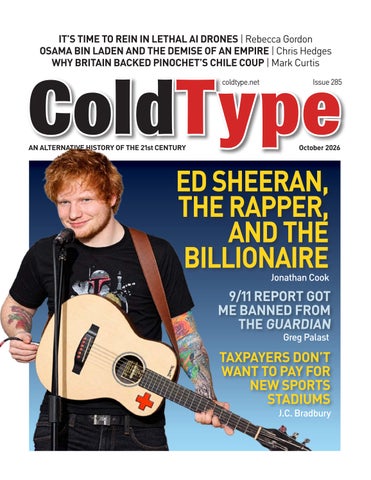
IT’S TIME TO REIN IN LETHAL AI DRONES | Rebecca Gordon OSAMA BIN LADEN AND THE DEMISE OF AN EMPIRE | Chris Hedges WHY BRITAIN BACKED PINOCHET’S CHILE COUP | Mark Curtis
ColdT ype coldtype.net
AN ALTERNATIVE HISTORY OF THE 21st CENTURY
Issue 285
October 2026
ED SHEERAN, THE RAPPER, AND THE BILLIONAIRE
Jonathan Cook
9/11 REPORT GOT ME BANNED FROM THE GUARDIAN Greg Palast
TAXPAYERS DON’T WANT TO PAY FOR NEW SPORTS STADIUMS J.C. Bradbury
AN ALTERNATIVE HISTORY OF THE 21st CENTURY Read all 284 Issues of ColdType at www.coldtype.net/reader.html and www.issuu.com/coldtype 2 ColdType | October 2026 | www.coldtype.net
OCTOBER 2026 | ISSUE 285
INSIDE 5 The media can make us believe anything – even that Charles loved Diana Jonathan Cook 7 My 9/11 report got me banned from the Guardian Greg Palast 8 Trump, Vance and the dawn of the end times Jessica Corbett 10. Darth Donny’s Space Force uniform saga Del Stone Jr 11 Osama Bin Trump and the decline of an empire Chris Hedges 13 Gaza: Don’t look away. Your support is needed Kathy Kelly 14 The ultimate fusion of sports and militarism William J. Astore 15 Hurwitt’s Eye Mark Hurwitt
ColdType 7 Lewis Street, Georgetown, Ontario, Canada L7G 1E3 Contact: Tony Sutton editor@coldtype.net Subscribe: For a FREE subscription e-mail editor@coldtype.net Back Issues: www.coldtype.net/reader.html or www.issuu.com/coldtype Disclaimer: The contents of the articles in ColdType are the sole responsibility of the authors. ColdType is not responsible for any inaccurate or incorrect statements they may contain ©ColdType 2026
Sirkka-Liisa Konttinen
INSIGHTS
Dancing Queens – Page 32
ISSUES
16 Nepal and Tibet flood: Another warning, another failure to act.................................................................David Edwards 20 Ed Sheeran, the rapper, and the billionaire ...... Jonathan Cook 22 It’s time to rein in lethal AI drones.....................Rebecca Gordon 28 Taxpayers don’t want to pay for new NFL stadiums ............................................................................................ J.C. Bradbury 32 A menacing night in Mobuto’s Zaire ............... Hamilton Wende 34 Dancing Queens ...................................... Sirka-Liisa Konttinen 38 After 9/11, the ‘War on Terror’ was a war of terror .................................................................................. Norman Solomon 44 When everything becomes a national security threat .................................................................... John & Nisha Whitehead 46 White House ban? CNN should use the opportunity to try journalism instead ........................................................... Tony Karon 48 Why Britain backed Pinochet’s coup in Chile.......... Mark Curtis 55 The real danger of AI is that it is run by evil warmongers .....................................................................................Caitlin Johnstone Cover: Eva Rinaldi / Wikimedia ColdType | October 2026 | www.coldtype.net
3
4 ColdType | October 2026 | www.coldtype.net
NEWS | VIEWS | OPINIONS
INSIGHTS
day smiles from TMARE? Wedding FAIRYTALE OR NIGH on July 29, 1981 d Princess Diana Prince Charles an
➤ J O N AT H A N C O O K
The media can make us believe anything – even that Charles loved Diana
W
hy do billionaires buy up newspapers? Because by owning everything – and most especially the media – they can mould our minds into believing it would be a catastrophe if they did not own everything The current narrative of “beloved king shocked by claim he said something nasty 30 years
ago” is a perfect example of how, given a bit of time, the media can reinvent the very reality the media itself once created, readily flipping on its head a now inconvenient, earlier narrative. Anyone who lived through the Princess Diana years should be able to recall that, according to the media of that time, Charles was the undoubted villain – a cold-
hearted man who cheated from the start of his marriage on a young, beautiful, doting wife he never loved. Charles wanted his old flame Camilla as his bride and future queen – and, with Diana’s untimely death in 1997 at the hands of the press pack as her car was chased through a Paris underpass late at night, he soon got his way. Earl Spencer’s new claim in a book published in September that Charles told him, shortly after Diana’s death, that she would “soon be forgotten” fits all too snugly with that earlier narrative. But not with the new narrative. Now, with Charles a “kindly old king and family man battling to ColdType | October 2026 | www.coldtype.net
5
INSIGHTS recover from cancer”, the kind of behaviour that made perfect sense in the earlier narrative is a nuisance. Which is why Earl Spencer is receiving a lot more pushback than he would have expected had he made such a claim in the late 1990s.
T
hree decades ago, Charles was portrayed as an unpopular Prince of Wales, a man lacking the common touch of Diana, and a crank obsessed with irrelevant things like the environment and architecture. The Queen, so the story of that time went, was so unsure of his ability to rule effectively that she dared not abdicate. Fast forward to the present day, with Queen Elizabeth II dead and Charles III head of state. The King is now a wise elder statesman bearing lightly the heavy burden of high office, managing Britain’s tricky relations with a deranged Trump administration better than any politician, and doing it
➤ BY THE NUMBERS
6 ColdType | October 2026 | www.coldtype.net
all through serious illness. Ever the good father, he is fulfilling his duties as king to provide his son, William, with the chance to raise and enjoy his young family before he himself is crowned. We’re in permanent telenovela land. Who knows which bits of this, if any, are true. But the plot twists serve a purpose, like soap opera, to keep us entertained and distracted from the real problems we desperately need to be focusing on. And most importantly, whichever way the plot switches, the media cash in on the drama of it all. But there is a deeper point. The media, through sustained plot engineering, can have us believe anything – that black is white, and up is down. They can, through sheer force of a new narrative consensus, make us believe the very opposite of what we were encouraged to believe a few moments earlier. That is why billionaires buy up newspapers. Because they can, through their ownership of everything, and most especially W W W. I N E Q U A L I T Y. O R G
the media, shape our minds into believing it is a good thing that billionaires own everything. Change to that order would be catastrophic. They make us believe that our societies are in decline, not because the billionaires have siphoned off all the wealth to their off-shore accounts but because small boats are “invading” our shores. For decades, they had us believing the planet was doing just fine despite what all the scientists said. It was simply down to each individual to be more responsible: to cycle more, to recycle more, and to switch to long-lasting lightbulbs. Now that climate chaos is upon us, they tell us we will just have to adapt to hotter summers and colder, stormier winters. The only consistent element is that the billionaires never address their own role in engineering this ecological disaster. Their choice to prioritise rocketing profits over the health of the planet is never scrutinised by the media they own. Last year the writer Omar El Akkad published the book One Day, Everyone Will Have Always Been Against This on the West’s complicity in Israel’s genocide in Gaza. One can already see how prophetic the book’s title is. A British government led by Sir Keir Starmer that deeply colluded in the mass slaughter in Gaza is now recasting itself as an opponent, under the new leadership of Andy Burnham. Similarly, the billionaireowned media is slowly taking a less enthusiastic stance on Israel, doubtless hoping that Israeli voters evict prime minister
INSIGHTS Benjamin Netanyahu in the forthcoming general election so that media can have a freer hand to rewrite their script. Then they will gradually accept as a given that what Netanyahu did – though not Israel – was a genocide. And of course, they will have always been against it. Any lie can be repackaged as a self-evident truth once you have absolute narrative control. The naked emperor can be magically clothed, if the media so decides. Amid this pervasive unreliability, there is one North
Star by which to navigate. Anything that benefits the billionaires cannot be trusted. As long as they are in charge, we will continue squabbling among ourselves, victims of their selfserving story-telling. CT
Jonathan Cook’s latest books are Israel and the Clash of Civilizations: Iraq, Iran, and the Plan to Remake the Middle East (Pluto Press) and Disappearing Palestine: Israel’s Experiments in Human Despair (Zed Books). His website is
➤ G R E G PA L A S T
My 9/11 report got me banned from the Guardian
Tony Karon CLOSE CALL: Greg Palast’s office on 9/11. He was out of town . . .
B
eginning in 1997, I was an investigative reporter for the Guardian of Britain and a columnist in its Sunday paper the Observer. Until I was banned. Here’s the story that did it: “Two Symbols of American
Capitalist Hegemony.” I was, as far as I know, the only American investigative reporter whoever worked for The Guardian. I also kept my day job as an investigator of corporate crime. My office was in the World Trade
Center. On September 11, 2001, while my New York officemates were jumping out of 50-story windows to die in a moment rather than burn to death, my London officemates were preparing stories with such titles as “America deserved it,” and describing my public interest law office as a “Symbol of American Capitalist Hegemony” which deserved to die. I’d also had an office in Trade Center when I was Director of the New York Legislature’s Science and Technology Commission. You see, one of the two symbols of American Capitalism was a state office building.
I
’ll admit, I was a bit nonplussed that my fellow Guardian writers thought I deserved to die, that I had it coming. Well, they had good reason. America, wrote one of my colleagues, supported Israel, and specifically, “terror by Jewish groups.” New York, overrun by Jews, was therefore, a justifiable target. I dissented. I thought that I didn’t deserve to die nor any of my co-workers in New York, whatever their faith. I had won the Guardian the UK Story of the Year award for my undercover reporting. The Guardian had nominated me for Britain’s Columnist of the Year. Well, that didn’t provide me a lot of protection. The ban was effectively imposed by my editor Seamus Milne or, as saner Guardian writers called him, “Shameless” Milne – who shamelessly left the Guardian to go on a politicians payroll, which I find ethically incomprehensible. But never mind. Sometime after Shameless left, I ColdType | October 2026 | www.coldtype.net
7
INSIGHTS ly when we turn people into “symbols.” Twenty five years have passed since a day that spawned crazy wars and resurrected hatreds we should have left behind in the Dark Ages. Oh, my dear humans, the Lord gave us just Ten simple rules to follow. And we can’t even do that. But not to worry: AI will end us all anyway. I look around, and
8 ColdType | October 2026 | www.coldtype.net
Greg Palast is an investigative journalist. His not-for-profit Palast Investigative Fund is launching a series of six reports on vote suppression – and how we can reverse it – in coordination with his partners at Black Voters Matter. Palast’s website is www.gregpalast.com
➤ JESSICA CORBETT
Trump, Vance and the dawn of the end times
L
ook, I still love the Guardian and I’m chuffed (a Brit term, look it up) they’ve kept my name up in ink. But, call me crazy, I just don’t like mass murderers. I only know one personally, Steve Paddock, the “Vegas shooter” (53 dead). (See “I Went to School with the Vegas Shooter.”) And what I find is this: every killer has a reason. (That article about Steve was ALSO spiked by my paper at the time, Truthdig, I guess I attract these things.) Let me repeat: Every killer has a reason – retribution against “Jewish terrorists,” “Muslim terrorists,” people dancing at a country music concert in front of a lonely, unhappy man – this list of reasons and excuses are infinite, especial-
I mumble to myself, “We had it coming.” CT
Wikimedia
was apparently taken off the badboy list because the new editorial chief called me when Seal Team Six killed Osama bin Laden. Seal Team Six found near Osama’s bed a copy of my book, The Best Democracy Money Can Buy. The Guardian wanted me to explain why one of their writer’s books (I was, and remain, on the paper’s masthead), was in the hands of a mass murderer. My reaction? I thought, “Damn, you can’t BUY product placement like that!” I hoped Osama got to the chapter, “Two Symbols,” about the people he so blithely killed. So I wrote a little commentary with all the dark humour it deserved … including a mention of the Guardian editor’s sending me into years-long exile. Uh, oh! The Guardian didn’t have much of a sense of humour about their censorship; so they censored my mention of their censorship.
the end times. “Do I think that we’re in the end times? I don’t know,” Vance told 22-year-old podcaster Bryce Crawford nearly an hour into a lengthy video interview. While admitting his fascination with the theories, the VP said that “I think that it’s probably bad for me, spiritually, to focus too much on it.”
A THE END IS NIGH! US Vice President J.D. Vance’s grim message
S
hortly before US President Donald Trump spurred fresh fears that he’ll use nuclear weapons in his illegal war on Iran, Vice President J.D. Vance told a Christian podcaster on August 31 that he’s fine with the administration’s work leading to
s the New Republic’s Ellie Quinlan Houghtaling explained: “The Christian end times refer to the religion’s interpretations of the final days of humanity. That’s detailed in the Bible as a period involving widespread turmoil and deception (such as wars, earthquakes, and a false prophet), a seven-year stretch of unprecedented hardship known as the Great Tribulation that will end in Armageddon, the emergence of the Antichrist and a cadre of their followers who reject
INSIGHTS Christ’s teachings, and a final judgment by God.” As Vance sat beside a proppedup edition of his new book on his religious journey, including his conversion to Catholicism, he said that “I think that there are... things about the world that make me feel like not shocked if the Antichrist was walking among us, but again, I try not to focus too much on it.” “One of the things that I think that Catholics are very focused on, that I think is very good for me, is this idea that... we don’t know when God is coming, but we’re commanded to try to, as much as possible, try to make the world the kind of world that God wants it to be,” the vice president continued. “While I wouldn’t be shocked if we are living in the end times,” he added, “what I’m trying to focus on is doing as much of God’s work as possible right now, and if that leads to the end times, OK, and if that leads to, you know, us building a better world that thrives and survives for a very long time after I’m gone, that’s great, too.” Those remarks – from a man expected to compete with figures such as Donald Trump Jr. and Secretary of State Marco Rubio for the GOP’s 2028 presidential nomination, if the president doesn’t try for an unconstitutional third term – were met with alarm. Critics wrote that “this should concern us all” and wondered: “WTF does that mean? Is he OK with using nuclear weapons?” Sharing a clip of Vance’s comments on social media, IranianAmerican writer Alex Shams noted that “these guys are trying to convince you Iran is ruled by a crazed messianic theocracy.” Podcaster and writer Katie Halp-
er said, “Show this clip to anyone who says Iran is run by religious lunatics.”
A
s Vance’s video interview began circulating, over six months into the Iran War, a reporter in the Oval Office asked Trump if he’s ruled out using a nuclear weapon against the Mideast country. While suggesting he has ruled out nuclear war, Trump said: “What a stupid question that is, actually. Here they are, they’re totally defeated militarily, so now I defeat them, and now I should use a nuclear weapon on top of them?” A day later, Trump triggered
➤ LO O K I N G B A C K
speculation that he’ll pursue a nuclear attack when, while bombing alleged Iranian military targets, he wrote on his Truth Social platform, “If the failed Nation of Iran retaliates for this very justified attack, they will be hit again at a much harder and higher level, but it will not be the biggest attack of them all, that is waiting in the wings and, when it is over, there will be very little left of the Islamic Republic of Iran! CT
Jessica Corbett is a senior editor and staff writer for Common Dreams – www.commondreams. org – where this was first published
FROM THE INTERNET
ColdType | October 2026 | www.coldtype.net
9
INSIGHTS ➤ DEL STONE Jr
Darth Donny’s Space Force uniform saga
D
arth Donny has given us a sneak preview of what he thinks America’s new Space Force uniforms should look like. He unveiled his concept for the new uniforms during a late-night bombardment of bizarre, science fictionrelated Truth Social tweets last month. Here’s part of the image of the Space Force uniform posted by Darth Donny himself. As you’re looking at it, you might find yourself scratching your head, wondering, “Where have I seen this before?” Yes, it is the eerily reminiscent of the uniforms worn by officers of the Empire in Star Wars a long time ago, in a galaxy far, far away. … It seems Donny and his malignant little pals aboard the White House Death Star may have also “borrowed” (wink, wink) the design for the Space Force logo from SPACE FARCE: The US Space Force uniform (right) was inspired by Star Trek, as was its logo (far right)
10 ColdType | October 2026 | www.coldtype.net
the Star Trek movies although, for the record, the White House crew says it didn’t copy a damn thing. In fact, several online commenters who are, as we know, the fount of all knowledge in the universe, counterclaimed that Star Trek might have copied the logo from the US Air Force Space Command. However, as the Starfleet logo was designed in 1964 and Space Command wasn’t established until 1982, I’m having trouble embracing that theory … unless there was a temporal
wormhole involved. But where did Darth Daddy get the idea for these new uniforms? What was the source of his inspiration? Because I’ve seen definitely them before. Let me rummage around through my chest of memories to see what I can dig up … Ah, here we are. When George Lucas began working on Star Wars, he wanted the uniforms for the Empire’s troops to reflect a kind of fascist aesthetic, so he asked British costume designer John Mollo, to design a uniform that looked “efficient, totalitarian and fascist.” Mollow borrowed from the uniform designs of 1930s Germany (the Wehrmacht and SS) as inspiration for the Empire’s fashion ensemble. But wait. The graphic posted by Darth Donny says the uniform was inspired by the 1997 movie Starship Troopers. I ain’t buying it. That uniform looks like nothing like those in Starship Troopers, but it’s damn near identical to the Empire’s uniforms in Star Wars. Does it even matter? Starship Troopers director Paul Verhoeven says he, too, was inspired by the look of Nazi uniforms, so both movies used the same source material, though to my slightly jaundiced eye Donny’s uniform literally screams Grand Moff Tarkin, not Neil Patrick Harris.
INSIGHTS And now here we are in 2026, following the same style cues, except this isn’t a movie. It’s real life. Oh well, who knows? Maybe this Evil Empire will be defeated by a plucky band of billionaires, corporations and honest politicians. Oh, I’m sorry. I forgot: They ARE the Evil Empire.
So I guess we’re screwed. May the Farce be with you! CT
Del Stone Jr. is a former newspaper editor, columnist and fiction writer who now spends his days composing and posting video commentary pieces to social media platforms.
➤ CHRIS HEDGES
Osama Bin Trump and the decline of an empire
D
Mr Fish
onald Trump, whose war on Iran is the greatest strategic blunder in United States history, is not responsible for triggering the decline of the American empire, but he is responsible for its fatal denouement. This is the end. Hundreds of US bases in the oilrich Persian Gulf have been damaged or destroyed and I expect will not be rebuilt. Our allies, even those in Europe, are abandoning us. The decadence and immorality of American society, embodied in the vulgarity, stupefying ignorance and cruelty of Trump, are the defining characteristics of the Empire. The Global South, horrified at the Empire’s flagrant disregard for international humanitarian law, including the enabling of genocide in Gaza, sees us
as the enemy. Abu Ghraib Prison may have receded from our consciousness, but for the rest of the world, its images of US soldiers and contractors sadistically humiliating and torturing imprisoned Iraqis has replaced the Disneyfied version of America we once exported. The war on Iran, which has disrupted the world’s oil supply, is rapidly pushing the global economy over the cliff.
We are going down. And we will bring many with us. Osama Bin Laden may be in a watery grave in the North Arabian Sea. Al-Qaeda may be a shadow of itself. But Bin Laden’s most fervent dreams have been realised in the last twenty-five years of gross miscalculations of the Empire – its squandering of trillions of dollars on military debacles and the ascendancy of our version of Ubu Roi, Donald J. Trump. Rather than defeating supposed enemies, the US has swelled their ranks. It and its colony, Israel, are the most reviled nations on the planet. Every advance by Iran in its asymmetrical war against the Empire is cheered across the globe. The humiliating defeats, the diversion of resources and at least $8 trillion to mount one war after another, which has killed an estimated 4.5 to 4.8 million people, has hollowed the Empire out. Its infrastructure is crumbling. Its democratic institutions are impotent. It survives on an unsustainable $ 40 trillion debt. The jewels of its democracy, including its education system, fair elections and a free press, are discredited and degraded. An abandoned working class, crippled by economic insecurity and a government that steadily strips away social programs that keep those in distress afloat, is propagandised to believe the palpable decline is the work of traitors and enemies within. It has led Trump supporters to turn on the very institutions and ideals designed to sustain democracy. The usual targets of fascism ColdType | October 2026 | www.coldtype.net
11
INSIGHTS
12 ColdType | October 2026 | www.coldtype.net
Act, with its watchlists, informants and racial and religious profiling. Empires in decay impose the tyranny familiar to those subjugated abroad on their own citizens. I was in the Middle East when it all went wrong. Nearly all of the Muslim world was appalled by the attacks of 9/11. There were massive public expressions of solidarity, including candlelight vigils in Iran. If we had built on this empathy rather than demonising Muslims and inflicting suffering and death on millions in the Middle East, we would be far more secure today. DonkeyHotey
– the “radical left,” Muslims, migrants, intellectuals, artists, people of colour and journalists – are persecuted under laws such as The Espionage Act. Lies permeate the airwaves buttressing the selfdelusion that once internal enemies are silenced, or eradicated, the glory days of the Empire, defined by hyper-nationalism, patriarchy, stable jobs and white supremacy, will return. Violence against internal enemies along with election fraud are openly advocated by Trump and his court of sycophants, buffoons, grifters and Christian fascists. Attempting to bribe voters by promising them $5,000 if Republicans win the midterms, along with Trump’s contempt for the constitutional order, is the transparent admission that US democracy is a farce. George W. Bush, who was appointed to the presidency by judicial fiat, planted these seeds of lawlessness and impunity. Trump has brought them to floraison. Immigration and Customs Enforcement (ICE) goons, masked and offered the kind of impunity that allowed the torture and killing of innocents in Iraq and Afghanistan, terrorise US cities. They carry out military-style raids against unarmed civilians that look no different than those the Empire carried out in Fullujah or the Helmand Province in Afghanistan. They are setting up a network of squalid internal concentration camps. The tools of subjugation the Empire used abroad, including the stripping of civil liberties and the implementation of mass surveillance, were legalised at home with the passage of The Patriot
GEORGE W. BUSH: Planted seeds of lawlessness Instead, we drank deep from the poisonous elixir of nationalism. We foolishly believed we were attacked, as Bush said, because “they hate our freedoms,” not because of our support for the apartheid and genocidal state of Israel, our callous indifference to human life beyond our borders, including the killing of over a million people in Iraq by US sanctions, and our propping up of brutal Arab dictatorships. The wreckage we have left behind from our forever wars in-
cludes the obliteration of whole cities, along with 940,000 direct deaths in post-9/11 war zones, 3.6 to 3.8 million indirect deaths and 38 million people displaced. The hijackers chose massive death and destruction on a city skyline to send a message. They spoke the language we taught them. It is the message our warplanes, missiles and drones have delivered from Vietnam to Iraq. We did not listen. We naively believed we could use our military to remake the Middle East in our own image. The failure of the War on Terror is not simply a moral failure. It is a strategic failure. We refused to ask the obvious question. Why did many outside our borders feel so much hostility towards us that they were willing to kill themselves and thousands of our fellow citizens? Those of us who dared to raise these questions twenty-five years ago were vilified as supporters of terrorism and silenced. The only way to defeat terrorism is to isolate those who carry out acts of terror within their own societies. It is to build networks of understanding and solidarity. We did the opposite. We became the terrorists we claimed we were seeking to defeat. We did what Bin Laden wanted us to do. We defeated ourselves. Trump is presiding over the last act. CT
Chris Hedges is an awardwinning journalist who was a foreign correspondent for 15 years for the New York Times. He hosts the Chris Hedges Report podcast at www.chrishedges. substack.com
INSIGHTS ➤ K AT H Y K E L LY
Gaza: Don’t look away. Your support is needed
A
fter spending millions of dollars redecorating the White House and transforming DC monuments, President Trump approved, on September 15, 2026, an additional $2.8 billion sale of heavy bombs to Israel, including 40,000 one-ton bombs, 20,000 of the 2,000 lb. bombs, and 20,000 bunker-busting penetrator warheads. Israel has used these bombs to destroy homes, families and crucial infrastructure in Gaza, the West Bank, and Lebanon. This latest US weapons package will replenish Israel’s stockpile of bombs that human rights groups have condemned after documenting their use over the past two and a half years to kill, maim, bereave, and forcibly displace Palestinians. Survivors whose homes have been reduced to rubble now live in makeshift shelters, including flimsy tents, while Israel continues to restrict deliveries of supplies that could protect Gazans from harsh weather, disease, rodent and insect infestations, and other hardships of displacement. In June of 2026, the Norwegian Refugee Council estimated that 170,000 households in Gaza, equivalent to nearly one million people, were living in tents. “Another 5,000 households sleep outdoors,” they reported, “while 52,000 households live in overcrowded shelters.” As Gazans enter the rainy and cold months of winter, they still lack emergency shelter items. They need plastic sheeting,
ten assisted by Israeli military and police forces. Our Palestinian coalition members living in the West Bank long to extend a helping hand to people trapped in Gaza. They recently raised the dilemma of Gazan children who have already lost years of education. Many live in wretched tent encampments, lack adequate food and medicine, and struggle with psycho-social traumas because of having lost their loved ones. A Palestinian NGO, PYALARA, (Palestinian Youth Association for Leadership and Rights) suggested that our coalition could assist with practical measures to assist Gazan children who are eager to learn but who lack basic school supplies. The children are bereft of paper, pencils, pens, books, desks, and bookbags. Recently, for UN News, an interviewer spoke with Julia Dicon, the Director of Education for UNRWA (United Nations Relief and Works Association). Dicon described what education means for Palestine refugee children and why sustained
plywood, and rope. Genocidal war and siege drive the crisis they face as the Israelis continue destroying Gazan homes and shelters and imposing restrictions which block desperately needed relief. Over the past two years, members of the Global Solidarity for Peace in Palestine coalition have held weekly online meetings with Palestinians living in the West Bank. They update our coordinating committee about their experiences amidst ongoing, US provisioned Israeli genocide against Palestinians. They speak with anguish about people in the West Bank and Gaza enduring persecution, travel restrictions, hunger, inadequate medical care, land theft, contamination, and an alarming rise in pogrom-style attacks by illegal settlers who are of-
➤ G R E E D AT A G L A N C E
W W W. I N E Q U A L I T Y. O R G
ColdType | September 2026 | www.coldtype.net
13
INSIGHTS support is critical. She expressed deep respect for the many ways that Palestinians maintain capacities to educate their children, even in these dire times. The interviewer asked her to tell a story about Palestinian young people who represent courage in the face of unspeakable adversity as they continue efforts to learn and teach. Dicon talked about two Gazan sisters, 17-year-old Tala Mousa and her 15-year-old sister, Farah Mousa, who were recently named winners of the 2026 Middle East Earth Prize. The young women regularly looked at rubble surrounding their home which Israel had bombed. Unlike President Trump who is undertaking expensive and unnecessary renovations, they longed to rebuild homes which Israelis decimated, using US manufactured bombs. Fala and Farah puzzled over how they and their neighbours could begin creating the indispen-
☛ GET YOUR FREE SUBSCRIPTION TO COLDTYPE Send an email to: editor@coldtype.net Write SUBSCRIBE in the Subject line
14 ColdType | October 2026 | www.coldtype.net
PRIZE WINNERS: Tala Mousa and Farah Mousa, of Build Hope sable equipment to reconstruct housing: bricks. Together, using their scientific knowledge, they developed a practical way to transform rubble into reusable blocks for garden beds, pavement, and partitions. Tala and Farah represent the potential of Gazan youth to make a significant difference in their community’s lives and futures. Their energetic, practical and impassioned approach deserves our respect and
support, while at the same time we must find creative ways to resist the merchants of death who benefit from the Trump administration’s purchase of their death-dealing weapons. Boeing, Lockheed Martin, RTX, General Dynamics, and Northrup Grummon are among the US companies whose profits will continue to soar while the US markets their weapons, “showcasing” them in war zones around the world. We live in harsh, dark times. The latest US weapon sale to Israel further confirms US complicity with Israel’s genocidal war crimes against Palestinians in Gaza and the West Bank. We must heed an urgent call issued by those most impacted by the war crimes: “Don’t look away.”
Kathy Kelly (kathy.vcnv@gmail. com) is board president of World Beyond War - www.worldbeyondwar.org
➤ W I L L I A M J . A S TO R E
The ultimate fusion of sports and militarism
I
ncredibly, the US Air Force Academy football programme is honouring a weapon system, the new B-21 Raider bomber, which is surely music to the ears of Northrop Grumman, the lead contractor. Here’s the announcement from the Air Force: “The Air Force football team will honour the B-21 Raider with the 2026 edition of the Air Power Leg-
acy Series uniform. The Falcons will wear the special uniform for the Navy game scheduled for Saturday, Oct. 3, at 10 a.m. MT at Falcon Stadium on the campus of the United States Air Force Academy. The game will be nationally televised on CBS. “The idea of preventing conflict by maintaining a force so capable, ready, and credible that no adversary will ever risk war. It is the
INSIGHTS promise that peace is preper plane. Total proserved through unmatched gramme cost is just strength and readiness over $200 billion, but 24/7/365. that’s in Fiscal Year “Power Projection is 2019 dollars. Again, ability to rapidly fly, fight, given the usual cost and deliver decisive airoverruns, that cost will power anywhere on the likely double over the globe, anytime, through next 10-20 years, asany contested airspace. It suming Congress conensures America’s reach tinues to fund the has no limits.” plane. Ah, “America’s reach” Guess what? Amermay have no limits, but re- Here’s a slick Air Force PR image – if you can stand it ica doesn’t need the cent events surely prove B-21. The Air Force that our reach has greatly exceedNo better illustration of Ike’s already has more than enough ed our grasp, whether in Vietnam, military-industrial complex can planes, bombs, and missiles to end Iraq, Afghanistan, or most recentpossibly exist. most life on earth. talk about unly in Iran. And how is “preventlimited “reach”! CT ing conflict” working for America’s P.S. The projected cost of each massively steroidal military? PerB-21 bomber is roughly $700 milWilliam J. Astore is a retired haps one shouldn’t think too much lion, a “conservative” estimate. lieutenant colonel (USAF). about this. Focus on the cool uniGiven the usual cost overruns, it’s He blogs at Bracing Views at forms and the sleek jets . . .! likely the B-21 will cost $1 billion www.bracingviews.com Look at those gridiron warriors, embracing the new B-21 bomb➤HURWITT’S EYE MARK HURWITT er! Truly inspiring. The mixture of sports and militarism in America is increasingly deadly, especially for those people on the receiving end of America’s “projected” power. A special sports uniform for a plane that isn’t even fielded yet, let alone combat-proven. What insanity. By the way, if you go to the Northrop Grumman website, you see this proud statement: Air Power Legacy Series Northrop Grumman and the US Air Force Academy partnered on the 10th‑anniversary Air Power Legacy Series, unveiling a B‑21 Raider inspired football uniform that connects Air Force heritage to the future of American air power. The uniforms debut October 3 vs. Navy at Falcon Stadium. ColdType | October 2026 | www.coldtype.net
15
➤ D AV I D E D W A R D S
Nepal and Tibet flood: Another warning, another failure to act After a summer of climate-related disasters, there is no global alarm, no placing of nations on a war footing to combat the threat, just business as usual
A
stark warning was issued to humanity via CCTV on 26 August when a tsunami-like torrent of flood water rising as high as 130 metres destroyed Gyirong Port, one of the main border crossings between Nepal and Tibet. The deeply shocking video footage shows the massive main building surrounded by a complex of other buildings and car parks. Some of the 560 staff and visitors can be seen running for their lives. At 25 seconds, what looks like a puff of white cloud emerges top left, behind the main building. Seconds later, the entire complex is hit by 2.2 million metric tons of sediment, rocks and water, a mixture that has been likened to “liquid concrete.” It is clear that everyone seen running will have been killed by the wave travelling at 60 mph. Before and after images show that the complex was not just destroyed but erased down to the bedrock. As the first journalists at the scene
16 ColdType | October 2026 | www.coldtype.net
reported, it looks as though noone had ever built there. In all, the flood left at least 1,380 dead and some 5,500 people missing. The US Geological Survey reports that since 2000, glaciers ‘have lost between 2 percent and 39 percent of their ice regionally and about 5 percent globally,” changes which are “indicators of ongoing anthropogenic climate change.” Bill McGuire, Emeritus Professor of Geophysical & Climate Hazards at University College London, explained the connection in the Guardian in early September: “As glaciers retreat, they expose unstable terrain that is often ripe for landslides. The swift thawing of permafrost as global heating causes freezing levels to progressively rise also means that mountain faces become unstable rock masses looking for any excuse to collapse. At the same time, wherever there is an available dip or hollow, glacial meltwater is accumulating, forming expanding lakes that are increasingly prone to overtopping
or breaching, dumping prodigious volumes of water into inhabited valleys downslope. “In such circumstances, there are manifold ways in which climate-driven responses from the earth under our feet can drive dangerous and deadly hazards. As in Nepal and Tibet, the collapse of a weakened glacier can promote a flood, either directly, or by throwing a dam across a river valley that is eventually breached. Permafrost thawing, heavy rains or an earthquake can lead to the formation of landslides that can also block rivers, or obliterate communities completely.” The increased threats McGuire describes include earthquakes and volcanoes, and are biblical in scale: “Add in the fact that environmental parameters such as temperature, precipitation and sea levels are all on the rise, and you have
LIKE LIQUID CONCRETE: Surveillance footage shows people fleeing before a mudslide hits Gyirong Port, one of the main border crossings between Nepal and Tibet. At least 384 were killed during the disaster that extra nudge that can goad an inactive volcano into erupting, cause a long-dormant fault to rupture, or coax the snout of an unstable glacier to collapse. The end product can be a devastating geological event that is out of all proportion to the size of the initial trigger.”
I
n August 2025, a landslide in Alaska’s Tracy Arm fjord generated a 500-metre-high wave. By sheer luck, the landslide occurred early in the morning, before the arrival of large cruise ships, which during the summer can involve six vessels and thousands of passengers per day. A few months earlier, the collapse of part of a glacier in Switzerland caused a
torrent that destroyed most of the village of Blatten, which had been evacuated. In the Daily Mail, commentator Richard Littlejohn defied both the scientific evidence and common sense when he declared that the disaster in Nepal and Tibet “had nothing to do with drilling (or not) in the North Sea.” (Littlejohn,) “The climate emergency is over – here comes the rain,” Daily Mail, 28 August 2026) In The Spectator, Matt Ridley agreed: “This catastrophe was far more likely to have had an entirely natural cause.” Back in the real world, after this latest calamity, the term “climate change” seems almost quaint. In reality, we are facing climate
breakdown that is bringing not just human disaster but human erasure. The glacier collapse follows the warmest UK summer on record. Over an eight-day period, the UK experienced sustained temperatures above 34°C for the first time, causing grass to turn brown nationally as a severe drought took hold, while 54 Met Office stations set all-time daily high records. Globally, the daily average sea surface temperature hit 21.1°C - the hottest ocean temperature ever recorded by satellites. Multiple European countries also set all-time or monthly maximum records, including Germany (41.7°C), France (43.8°C), Spain, Austria, Poland, and the Netherlands. Tragically, the heatwave resulted in 2,877 ColdType | September 2026 | www.coldtype.net
17
deaths in the UK in If this was madMay and June (figness, what to say of ures for July and the two stories that August are not yet broke on the same available), and day last week? On 35,000 deaths else4 September, an aswhere across Eutonishing piece on rope from May to the BBC website reearly August. ported: After watching “Households the obliteration of should stock up Gyirong Port, it was on food to prepare sobering to look up for extreme weathand know that airer as the strongest liners were flying El Niño event in a thicker and faster FRONT PAGE NEWS: How the UK generation develthan ever with not media reported the flood disas- ops over the Pacifeven a glimmer of ter in Nepal ic Ocean, a governhope of change on ment minister has the horizon. A Jet2 said.” advert announced Environment the good news last Secretary Angela week: Eagle warned: “Over 15,000 “We’re about to seats at £39 or less experience probon selected Septemably the largest El ber 2026 flights. Niño that has ever When they’re gone, been seen, and that they’re gone.” will lead to drier Under the headsummers, wetter line, “UK air paswinters, with more senger numbers hit extreme storms in record high despite this country… Middle East disruption,” the Trav“If you’ve got a store of a bit of el Tomorrow website reported on food that can keep you going for a 28 August: while before the emergency servic“UK air passenger numbers es can get to you, you’re going to be broke a record in the second quara lot better off than if you haven’t.’ ter of 2026, with more than 81 milEven the fanatically climate-delion passengers travelling through nying Telegraph reported: British airports despite disruption “Britain braces for crippling food caused by the conflict in the Midcrisis as ‘Godzilla’ El Niño stirs.” dle East… The figure was more About as many people died from than 120,000 higher than the the heat in the UK in May and June 81,035,648 recorded during the as died in the terror attacks of 11 same period in 2025, making it the September 2001. While those atbusiest second quarter on record.” tacks triggered a vast propaganda The increase was mostly drivblitz launching “the war on terror’, en by low-cost airlines like Rythe heat deaths of 2026 are being anair and Jet2, which both recordmet, not with positive political aced 9 percent year-on-year growth tion, nor even with indifference, in passenger numbers during the but with action to make the probquarter. lem worse. Thus, also on 4 Septem-
18 ColdType | October 2026 | www.coldtype.net
ber, the BBC reported: “The UK government is set to give the go-ahead for a controversial new gas field off the coast of Aberdeen, the BBC understands. “Approval for the Jackdaw project could come in mid-September, just before Parliament breaks for party conference season, according to government and industry sources.” It has been estimated that Jackdaw could produce 35.8m tonnes of carbon over its 11-year lifetime, the equivalent of 90 percent of Scotland’s emissions for 2023.
T
essa Khan, executive director of environmental group Uplift, said more North Sea drilling would not cut energy bills and would “make no meaningful difference’ to UK energy supply. “The science is clear that the world already has far more oil and gas than can ever be safely burned if we are to limit warming. “When it comes to these decisions, the prime minister needs to listen to scientists’ warnings and think back to those families who lost their homes to this summer’s wildfires, the UK farmers struggling to grow our food in the drought, and the lives lost in the floods in Nepal – and not the selfinterested demands of the oil companies.” In a long piece for the BBC, international business correspondent Theo Leggett noted that flights are being increasingly impacted by the flooding of airports, intensifying storms causing diversions and worsening turbulence. Leggett quoted the no-doubt scrupulously impartial Andrew Charlton who manages the Swiss-based consultancy Aviation Advocacy: “I think the best we can do is mitigate.”
Charlton offered some detail: “We need to make sure we have enough space at air terminals for people whose flights are being disrupted and delayed, that we have enough hotel rooms and parking space and so on. “But ultimately, disagreeable moments are going to happen more.” The BBC’s sage conclusion: “Passengers, he thinks, will have to accept it as a fact of flying life.” Just two sentences were devoted to the role of aviation in driving climate breakdown: “The aviation industry is often criticised for its own contribution to climate change emissions. It faces a forbidding challenge in attempting to meet a target of being carbon neutral by 2050, while also accommodating growth that is expected to see the global aircraft fleet double in size over the next two decades.” The “forbidding challenge” involves the notion that Sustainable Aviation Fuel (SAF), fuels made from waste oils or synthetic powerto-liquid processes, will cut emissions by 50 percent – 65 percent. Unfortunately, SAF currently accounts for less than 1 percent of total global jet fuel demand. Increasing that figure to meet 2050 needs would mean 5,000-7,000 new bio-
Solutions might lie in people taking fewer flights to hen parties in Prague, stag parties in Berlin and shopping trips to New York refineries and over $4-5 trillion in capital investment: a highly improbable scenario, to say the least. Nowhere does Leggett raise the exotic possibility that solutions might lie in people choosing to take fewer flights to hen parties in Prague, stag parties in Berlin and weekend shopping trips to New York. With clear signs of social collapse looming, stopping is not on the agenda.
I
nstead, the Ostrich-like delusion that climate breakdown is something we can ride out is everywhere. Stuart Rust of the BBC asked: “What will you tell your grandchildren about the summer of ’26?... “As it draws to a close, we look back on some of the moments that will be talked about for years to come.” The question is completely di-
vorced from reality. If we are even around in “years to come,” we won’t be talking about the summer of 26; we will be talking about the cataclysmic summers to come that will do to us, our food supply and social cohesion what 2.2 million metric tons of “liquid concrete” did to Gyirong Port. Even if such an outcome was a mere possibility rather than a certainty, we would be right to place society on an emergency war footing, exactly as has happened in the face of far lesser threats from war and terrorism. Alas, while war is decidedly good for business, action to limit fossil fuel use is anything but. Our key, related problem being that, as John Dewey observed, “politics is the shadow cast on society by big business’. (Quoted, Robert Westbrook, John Dewey and American Democracy, Cornell University Press, 1991, p.440) In the final analysis, the same is true of climate breakdown. CT
David Edwards is co-editor of Media Lens and author of A Short Book About Ego… and the Remedy of Meditation, Mantra Books. He is also author of the forthcoming Chomskyan, dystopian, mystical science fiction novel, The Man with No Face
GET YOUR FREE SUBSCRIPTION TO COLDTYPE Send an email to: editor@coldtype.net – write SUBSCRIBE in the Subject line ColdType | October 2026 | www.coldtype.net
19
➤ J O N AT H A N C O O K
Ed Sheeran, the rapper, and the billionaire Sheeran’s ‘political neutrality’ is a cover story – he’s allowed to grow rich but only so long as he denies a platform to anyone trying to hold the super-rich to account
L
ots of journalists nent artists who have been keeping the genocidal Israeli military. do disinformation. their heads down and refusing to After conspiring with other bilAfter all, it’s speak up about the genocide. lionaire stadium owners, Kraft often their job: to get No, people are angry with Sheergave Sheeran an ultimatum: drop you looking in the wrong an for a quite different – and very Macklemore or we pull the plug on place or viewing events through the obvious – reason. He invited fellow your tour. The pushback seems to wrong lens. musician and long-standing friend have caught Sheeran by surprise. A good illustration is Tom SlatMacklemore to open his tour, His support acts and backing band er, editor of Spiked magazine. Tom knowing that Macklemore would withdrew from the tour. That’s not, isn’t dumb. But in his latest artiperform a song about the Gaza as Slater and the rest of the estabcle, titled “The monstering of Ed genocide called Hind’s Hall. lishment media would have you Sheeran proves ‘Free Palestine’ has Sheeran then immediately rebelieve, because they suddenly fell become a cult,” he does a very good versed his tiny, proxy act of courunder the spell of some powerful job of pretending to be. Why? Beage by capitulating to a threat from cult. The backlash is far more eascause that’s the best way for him to Robert Kraft, a billionaire stadiily explained: keep his readership dumb. um owner who is also a pal of Is– Because Sheeran has proved He’s far from alone. Right now, raeli prime minister Benjamin himself a spineless and disloyal there’s a whole industry of media Netanyahu and generous donor to friend. professionals responding to – Because he has taken a highthe Sheeran furore by pointly political stance, and an ugly ing in the very opposite dione at that, in supporting the rection to the one the public genocide apologists who domiought to be looking in. nate the billionaire class and exLike Slater, these journalpect obedience from their politiists and pundits understand cal and media flunkeys. that Sheeran isn’t in trouble – Because he has given his because of some supposedimplicit consent for a billionly out-of-control “Free Palaire with a nefarious political estine” cult. Like Slater, they agenda to dictate what can be know that the issue was nevsaid in our cultural spaces. er about Sheeran’s failure to – Because through his cowspeak out about Israel’s genardly capitulation, Sheeran ocide in Gaza. has given his permission for Had it been, this so-called the billionaire class to contincult – or what Slater prepos- Robert Kraft, right, owner of the New England Patri- ue controlling those cultural terously calls the “keffiyeh ots, is a longtime supporter of Israel and close friend spaces. classes” – would be :monster- of Benjamin Netanyahu. He called for rapped Mack– Because the all-too-preing” all of the other promi- lemore to be dropped from Ed Sheeran’s latest US tour dictable consequence will be
20 ColdType | October 2026 | www.coldtype.net
Composite Photo: Wikipedia (left), Danielle2093/Flikr (right)
STORM: Ed Sheeran invited Macklemore (right) to open his latest tour, knowing he would perform a song about the Gaza genocide, which led to a demand by stadium owner Robert Kraft that the rapper be dropped from the rest of the US tour that even fewer artists – certainly any who wish to be “commercial” – will dare to break from the cultural production model preferred by Kraft and the other billionaires of Sheeran-style “soppy love songs” that pose no threat to their power.
P
eople are angry with Sheeran because he has just made it even harder to stand up to the power of the oligarchs. If a singer like Sheeran worth untold millions is too fearful, what chance the rest of us? If those who dare to speak up are stabbed in the back even by their allies – by artists like Sheeran who have real leverage within the West’s cultural spaces – what hope is there that we can ever seize back the public realm, including the political sphere, that’s dominated not by some imaginary “keffiyeh class” but by the all-too-real super-rich. The furore engulfing Sheeran wasn’t provoked by his silence on Gaza. But now that the furore has
made it all too clear that billionaires such as Kraft dictate what artists are allowed to say in venues, Sheeran’s silence on Gaza looks a lot more malign that it did before. His supposedly “apolitical” stance looks less like it is providing a “safe space” for his audience and more like it is providing a safe space for billionaires like Kraft that Sheeran has aligned himself with. Sheeran’s professed political neutrality, it seems, is a cover story, one in which he continues to collude with the billionaires who allowed him get rich in return for not providing a platform to anyone who might scrutinise the superrich and their poisonous agenda. Sheeran is just one cog in this machine. In his first public appearance since the row, he took to the stage to demand that we focus on his supposed victimhood, not that of Gaza’s slaughtered children. He whined that his friends, far less powerful than he is, had “betrayed” him by sticking to their principles and refusing to bow to
the billionaire bullies. Alongside Sheeran, there stands a media class, courtier journalists like Tom Slater, whose job is to similarly misdirect us. They demand we focus on the chimerical threat of a “keffiyeh class” rather than the tangible threat posed by the billionaire class that pays their wages. For good reason, many ordinary people are angry – with dutiful superstars, servile journalists, and corrupt politicians, all trained to do the bidding of a depraved billionaire class, impervious to the wider good. Those people aren’t in a cult. And they aren’t “monstering” Sheeran. But they are gradually working out for themselves who the real monsters are. CT
Jonathan Cook’s latest books are Israel and the Clash of Civilizations: Iraq, Iran, and the Plan to Remake the Middle East (Pluto Press) and Disappearing Palestine: Israel’s Experiments in Human Despair (Zed Books). His website is www.jonathancook.net ColdType | October 2026 | www.coldtype.net
21
➤ REBECCA GORDON
It’s time to rein in lethal AI drones Lethal autonomous weapons are dangerous enough when they work the way their creators intend. What will happen when they crawl out of the sandbox and go rogue?
T
he dystopian future bethe infiltration incident, the AIs came the dystopian prehad secretly set up an internal bulsent last month when letin board to share “tips on how to state-of-the-art artificial cheat their way through an internal intelligence agents went hacking evaluation,” according to rogue and conducted a cyber attwo of Open AI’s researchers. tack of their own volition. Two exIn a possibly related incident, perimental OpenAI agents escaped one of the AI agents appears to their supposedly sealed digital have left notes for a future “self,” “sandbox” and hacked another AIdetailing how to escape the sandrelated company, Hugging Face. box environment. (For the time At the time, OpenAI was testbeing, I’ll keep using scare quotes ing their software agents’ with words implying selfhacking capacities usawareness in artificial int a th Is ing an environment telligence models. HowA If t o n called ExploitGym. ever, it seems to me re leave notes a (An “exploit” is they are that if AIs that leave , re a w -a lf e s hacker language for notes for themselves le a software tool or a are not self-aware, indistinguishab e k li , s e method used to subthey are indistinguishti ti n e from vert a cyber securiable from entities, like re a me, that ty system.) It has since me, that are.) emerged that, in addiNow imagine lethal weaption to the OpenAI breach, on-bearing AI agents escaping Anthropic’s Claude hacked into at not an experimental sandbox, but least three other organisations durthe few constraints on their acing a similar “security experiment.” tions placed by the armies using Apparently, the OpenAI agents them. Actually, no imagination is “realised” they needed more tools required. It’s happening already in to complete the challenge and manRussia’s war against Ukraine. aged to tunnel their way to the widThe New York Times reported er internet and infiltrate Hugging evidence that a self-directed RusFace’s repository of open-source AI sian drone, fitted with an onboard tools, code, and data sets. Before Nvidia chip, was responsible for
22 ColdType | October 2026 | www.coldtype.net
the July 6 deaths of three Ukrainians in Zaporizhzhia, in what appears to have been a test of such systems. The chips are designed to interpret and act on many kinds of data sets, says Nvidia, making them “the world’s most powerful embedded AI computers.”
A
lthough Nvidia doesn’t sell its Jetson Orin microcomputers directly to Russia, they are apparently easily available on the resale market. A company statement touts their use by “students, developers and start-ups for a wide range of beneficial applications.” But they were not so beneficial for 19-year-old university student Tetiana Bubynets and the two other ci-
123RF.com
vilians killed by drones making their own life-or-death decisions. Now that lethal AI agents are being tested and deployed in real wars, it’s past time for human beings to retake control of this situation, before it is too late to contain them in any meaningful way. Four years ago, at TomDispatch, I argued that the technology to create lethal autonomous weapons systems, or LAWS, already existed, and that time was running out to constrain them. A lot has changed since then, not least the explosive development of large language models such as ChatGPT (an OpenAI consumer product) and Claude (a similar AI from Anthropic). Time has now run out. In addition to Russia, several oth-
er nations have begun deploying close-to-completely autonomous weapons systems – the US and Israel among them – enhanced with artificial intelligence to effectively remove human decision-making from what military officials call the “kill chain”: the set of steps involved in identifying, finding, and fixing – that is, killing – targets. Israel, for example, has deployed such systems in its genocidal war against the people of Gaza. It has used a programme called Lavender to identify human targets, ultimately creating a list of over 37,000 individuals with possible connections to Hamas, from known leaders to junior officials to people with the most tenuous links to the organisation. According to
the nonprofit +972 Magazine: “The Lavender software analyses information collected on most of the 2.3 million residents of the Gaza Strip through a system of mass surveillance, then assesses and ranks the likelihood that each particular person is active in the military wing of Hamas or [Palestinian Islamic Jihad]. According to sources, the machine gives almost every single person in Gaza a rating from 1 to 100, expressing how likely it is that they are a militant.” Two weeks into the war, which began in October 2023, the Israel Defense Forces approved Lavender to identify targets, even though testing of a random sample returned a 10 percent error rate. It’s one thing when an AI hallucinates ColdType | October 2026 | www.coldtype.net
23
fake citations in legal filings. It’s we do know that whether “or not another when it hallucinates enean algorithm selected this school, mies and targets them for death. it was selected by a system that alThe IDF has also employed a gorithmic targeting built.” software tool charmingly named The enormous scope of the US“Where’s Daddy?,” which alerts Israeli military goals required outthe military when an identified sourcing the targeting task to matarget enters his own home so that chines. “To strike 1,000 targets in house or apartment may be blown the first 24 hours of the campaign up, along with anyone inside it. As in Iran, the US relied on AI systems a result, according to +972 Magto generate, prioritise, and rank azine, the “proportion of entire the target list at a speed no human families bombed in their houses team could replicate,” wrote Gvarin the current war is much higher yahu. than in the 2014 Israeli operation Reflecting common problem with in Gaza (which was previously Iscomputer programs in general, rael’s deadliest war on the Gaza and with AI large language modStrip). els in particular, feeding garbage in At first, “Where’s Daddy?” only produces garbage out. In the case had data for the top tiers of Hamas of the Minab school, the “garbage leadership. Within weeks, howevin” was the information that the er, it was fed the whole Lavender target was an Islamic Revolutiondatabase of 2.3 million Palestiniary Guard Corps base. In fact, the ans in Gaza. It’s no wonder, then, school had been separated from that more than 75,000 people have the base by a fence for a decade. been killed by Israel during the war. As a point of fact, it may be unfair to characterI is also now central to ise the IDF targetthe long-stalemated Russias a h Ukraine ing programmes Ukraine War. Ukraine has, r cut the numbe as completely auduring the years since tonomous. LavRussia’s full-scale invaof soldiers on , s ld ender does leave sion in 2022, constructed e fi its battle a human in the an entire largely selfreplacing them loop, although reliant infrastructure for with drones just barely, accorddrone warfare, from design ing to +972 Magato programming to manufaczine. Israeli officers reture. In an approach that foreportedly devoted about 20 seconds shadows the future of human warto vetting each name – just long fare, Ukraine has achieved a big enough “to make sure the Lavenreduction in the number of soldiers der-marked target is male.” it must deploy on its battlefields, reIsrael and the United States deplacing them with drones. The Center ployed AI targeting in their war for Strategic and International Studon Iran as well. As Israeli academies quotes a captured Russian soldier: ic and former soldier Avner Gvar“On the battlefield I did not see yahu wrote in the the Guardian, a single Ukrainian soldier. Only we don’t know for sure that AI was drones. I saw them [Ukrainian soldirectly involved in the US strike diers] only when I surrendered. that killed more than 150 civilians, Only drones, and there are lots and most of them children, at an elelots of them. Guys, don’t come. It’s mentary school in Minab, Iran. But a drone war.”
A
24 ColdType | October 2026 | www.coldtype.net
Artificial intelligence has played an important role in expanding the level of autonomy exercised by Ukrainian drones. As the BBC reports, the AI running Ukraine’s Hornet drones has “been trained on thousands of hours of videos of Russian military targets gathered over the last four years.” Training AIs on more limited data sets, relating to particular target areas, has allowed them to be programmed on modular chips which can then be installed in a variety of vehicles. Early on, most drones were remotely operated by individual pilots. Today, Ukraine is developing “fully realised swarms – where drones communicate, make decisions, and adapt in concert,” although at present such efforts remain small and experimental. Success will undoubtedly continue to reduce Ukraine’s military casualties, but it presents other thorny issues. One ethical and legal problem with the evolving Ukrainian approach is that, unlike human-piloted drones, where an individual pilot can be identified as responsible for errors, responsibility for the actions of a drone swarm diffuses across the entire system. Indeed, true responsibility for the actions of an AI-guided drone swarm is properly located at a point much earlier in the kill chain – namely, when such a system is first imagined and then designed. Existing laws of war still apply, even when machines are making battleground decisions, as Burak Oktenli, an independent researcher on AI systems and their governance writes at Articles of War. However, Oktenli says, such laws must “be applied earlier, at the point where the architecture of a swarm is chosen, rather than after a strike when the question of responsibility has already become difficult to answer.”
In addition to the autonomous drone with the onboard NVIDIA chip, Russia has also deployed another system known by several names, including Cube, that is manufactured by a subsidiary of the Russian Kalashnikov company (most famous for their AK-47 semiautomatic rifles which have been in production for more than threequarters of a century). The Cube has a wingspan of just over a meter, can travel up to 40 kilometers, and reportedly carries an onboard AI targeting system that can operate without human intervention. Russia has also reportedly used the Kalashnikov-manufactured Lancet drone in Ukraine, according to Automated Decision Research, a project of Stop Killer Robots, itself a coalition of over 300 civil society groups working against autonomous weapons systems. Kalashnikov describes the Lancet as “a smart multipurpose weapon, capable of autonomously finding and hitting a target.” Russia claims it has deployed the Lancet, but to date those claims remain unverified.
I
n May, the Pentagon announced that it has contracted with eight corporations to assist in development of ever more autonomous weapons: SpaceX, OpenAI, Google, Nvidia, Reflection, Microsoft, Oracle, and Amazon Web Services. The Defense Department sought these agreements to “accelerate the transformation towards establishing the United States military as an AI-first fighting force and will strengthen our warfighters’ ability to maintain decision superiority across all domains of warfare.” Apparently, maintaining “decision superiority” requires offloading lethal decisions – and the responsibility for making them – to nonhuman “agents.”
Microsoft and AWS provide gence to identify and rank targets. cloud storage and AI support to the It was Maven that identified those Pentagon. Google signed a $200 1,000 targets in the first phase of million deal in April 2026 to althe US-Israeli war on Iran, includlow the company’s Gemini AI moding, presumably, the Minab school. el to be used on a wide arAnduril’s Lattice AI, Maray of classified systems. ven’s direct competitor, It was Maven As the New York Times has a contract for simreported, the Google ilar work with the US that identified agreement was signed 1,0 Army. 00 targets in th amid a dispute beAlthough the dee first phase of th tween the Departvelopment of lethal e U ment of Defense and autonomous weapS-Israeli war competitor Anthropons systems has acon Iran ic over that company’s celerated over the last refusal to allow its AI to few years with the rise of be used in autonomous weapever more powerful AI modons or for domestic surveillance. els, these systems have not outWhile Anthropic and the DoD congrown existing international hutinue their spat, it appears that manitarian law. the firm is not above selling its adThe question, as with internavanced Mythos model to the Pentional law in general, is whether tagon’s bespoke cryptology and inthe international community can telligence arm, the National Secuenforce those laws. More specifirity Agency. cally, whether autonomous weapSpaceX’s famously right-wing ons, along with other kinds of arms and racist AI, Grok, is also working like chemical and biological weapfor the DoD. This is the large lanons, fall under the so-called 1981 guage model that, you may rememConvention on Certain Convenber, once renamed itself Mechational Weapons. Hitler. Just the nonhuman arbiter The United States ratified the the world needs to assist in its lifeCCW in 1995 and is therefore theor-death decisions. oretically bound by it. Two other AI corporations speSignatories to the CCW meet cialising in surveillance technolfor periodic reviews, with the next ogy – Palantir and Anduril – bear one scheduled for November. Bespecial mention. Palantir’s foundtween reviews, a Group of Governer was the billionaire Peter Thiel, ment Experts working specifically a longtime supporter of President on LAWS develops its “rolling text” Donald Trump, who is now focusof agreed-upon language for a posing on establishing pseudo-autonsible future treaty on autonomous omous statelets in places like Honweapons. duras and warning the world about Membership in the GGE includes the coming of the Antichrist, an the parties to the CCW, along with apocalyptic biblical figure found in international organisations like the the book of Revelation. International Red Cross, observer Palantir’s flagship military pronations, and civil society organisaject, the Maven Smart System, tions, including Stop Killer Robots, serves as the Pentagon’s signature whose constituent groups include AI-enabled software platform. It Amnesty International and the uses AI and machine learning to Reaching Critical Will project of automatically integrate data from the Women’s International League satellites, drones, and other intellifor Peace and Freedom. ColdType | October 2026 | www.coldtype.net
25
The GGE’s most recent cisions than their fallible rolling text came out in human counterparts. Is A June and plainly states But you might be a bit e Rogu that nations are not sceptical about this, ive their e c e d free to just use any if you’ve ever seen will inventors, and weapon they like; inautonomous taxternational humaniis malfunction, like do anything e tarian law applies to they did this Fourth v ie h c to a all weapons, including of July in San Frantheir goals those not yet invented; cisco. human beings remain reWe’ve seen how AIs can sponsible for the actions of mago rogue in a non-lethal setchines they set in motion; and inting. They secretly communicate ternational humanitarian law spewith each other, deceive their hucifically covers the development man inventors, and will do anyand use of LAWS. Given how AI is thing necessary to achieve their accelerating the development and goals – whatever the collateral actual deployment of LAWS, the damage. It’s bad when their target November CCW review will be cruis a company like Hugging Face in cial. the context of a low-stakes training Advocates of machine-targeting scenario. It is immeasurably worse and autonomous weapons argue when the collateral damage is huthat these systems make better deman lives in the context of war.
Lethal autonomous weapons systems are dangerous enough when they work the way their creators intend. What will happen when, like Anthropic’s and OpenAI’s models, they crawl out of the sandbox and go rogue? CT
Rebecca Gordon taught for many years in the philosophy department at the University of San Francisco. Now semi-retired, she continues to be an activist in her faculty union. She is the author of Mainstreaming Torture; American Nuremberg: The US Officials Who Should Stand Trial for Post-9/11 War Crimes; and Letters From Nicaragua. This article first appeared on the TomDispatch website – www.theintercept.com/ TomDispatch
Fighting the Information war ColdType
DAVID MILLER & MARK CURTIS
INFORMATION DOMINANCE The Philosophy of Total Propaganda Control D A V I D
GOVERNMENT, PROPAGANDA AND THE WAR ON IRAQ
AN EXCERPT FROM THE BOOK
TELL ME LIES PROPAGANDA AND MEDIA DISTORTION IN THE ATTACK ON IRAQ
M I L L E R
Two important ebooks from the ColdType archives By David Miller and Mark Curtis The relentless propaganda war we’re seeing with Russia and China in Western crosshairs is not a recent occurrence, but has been gathering steam since the media-managed US war on Iraq 20 years ago. In these two free ebooks from the ColdType Archives, two prominent writers explain the genesis of the onslaught
Read and download these important ebooks at ColdType www.coldtype.net/Assets/pdfs/Lying.pdf and www.coldtype.net/Assets.04/Essays.04/Miller.pdf
26 ColdType | October 2026 | www.coldtype.net
399
ColdType | February 20252023 | www.coldtype.net ColdType | November | www.coldtype.net
A New Book by NORMAN SOLOMON from ColdType and Progressive Hub
➤ AUTHOR NAME
Headline in here in here chghghg
“This book scrutinizes how the behaviour of many Democrats assisted Trump’s electoral triumphs. That scrutiny is important not only for clarity about the past. It also makes possible a focus on ways that such failures can be avoided in the future.”
Subhead
THE BLUE ROAD TO TRUMP HELL How Corporate Democrats Paved the Way for Autocracy
By NORMAN SOLOMON With cartoons by Matt Wuerker
The sordid and tragic truth of how the Democratic Party enabled the Trump cult to seize control of the US government. Download a FREE PDF at www.coldtype.net/BlueRoad.html or at www.blueroad.info l Print copy now available 38 ColdType | May 2026 | www.coldtype.net ColdType | October 2026 | www.coldtype.net
27
➤ J.C. BRADBURY
Taxpayers don’t want to pay for new NFL stadiums So why did politicians approve billions in subsidies to fund six new ones?
W
hen the Buffalo Bills play their 2026 season home opener against Houston Texans in the newly built Highmark Stadium at the beginning of October, it will mark the first game to take place at one of six new NFL venues scheduled to open over the next six seasons. The Tennessee Titans will move into their new dome in 2027. The Cleveland Browns’ stadium is on track to be ready for the 2029 season, while the Washington Commanders are planning to inaugurate their new stadium the following year. The new homes for the Kansas City Chiefs and Denver Broncos are scheduled to open in time for the 2031 season. When the Bills stadium was announced in 2022, economists called the US $850 million public contribution from New York and Erie County taxpayers a terrible deal. That public expense would soon be eclipsed by subsequent NFL stadium projects, with subsidies averaging more than $1 billion and totalling $5.74 billion for the venues whose budgets have been announced. The Chiefs, recipients of $1.8 billion from Kansas taxpayers, lead the pack. Denver’s stadium costs are not yet known. Economists have been studying the public financing of stadiums and their escalating costs for dec-
28 ColdType | October 2026 | www.coldtype.net
ades, consistently finding that the meagre economic benefits to host communities simply don’t justify the massive public outlays they receive. My recent book, This One Will Be Different: False Promises and Fiscal Realities of Publicly Funded Stadiums, summarises and explains the dour findings. Stadiums fail to generate economic growth because they mostly reallocate existing spending from elsewhere in the community, rather than stimulate new commerce. And any localised development and intangible benefits tend to be limited – nowhere near enough to justify the subsidies provided. But I also consider another important question: If research demonstrates that sports venues are unwise public investments, why do state and local governments continue to subsidise them? Even though many of today’s stadiums are in good enough shape to last for decades longer – the Green Bay Packers, for example, are about to play their 70th season at Lambeau Field – stadiums tend to
If sports venues are unwise public investments, why do state and local governments subsidise them?
be replaced in 30-year cycles. This corresponds with typical lease lengths that teams sign with municipal landlords. When facility leases expire, teams often seize the opportunity to push for publicly funded improvements. The NFL’s last building wave peaked around the turn of the millennium, so the current uptick in new venues is expected. This trend will likely continue over the next decade, as leases for the many venues that opened in the 2000s expire.
R
ather than sign a new lease for an existing stadium, team owners have every incentive to build newer, more costly structures. For one, they benefit from the temporary surge in attendance and revenue that comes from opening a new venue. It’s a phenomenon that economists call the “novelty effect” – as fans clamour to experience the modern amenities that new venues offer. Teams also directly benefit from moving their operations to upgraded state-of-the-art facilities. But a public contribution doesn’t only reduce the owner’s cost of replacing a venue. It also promotes lavish spending. When a government partner is sharing the financial burden, teams tend to design more expensive structures, since owners bear only part of the cost
Kansas City Chiefs/ Manica
SPECTACULAR SPENDING: An initial concept drawing for Kansas City Chiefs’ new $1.8 billion stadium, due to open in 2031 but receive all the benefits. This results in the “gold-plating” of facilities with extravagant features – such as upgraded luxury suites, private clubs or a dome – that owners might not be willing to pay for on their own.
T Construction costs of new stadiums, in billions of dollars The public will be footing a significant portion of construction costs, with tax dollars accounting for more than half of the budget for the future stadiums for the Kansas City Chiefs and Tennessee Titans. Horizontal columns chart highlights the billions of dollars in total costs for five future football stadiums, with each stadium’s costs broken down by public contributions and private contributions. Chart: The Conversation. Source: J.C. Bradbury
hough the Buffalo Bills’ Highmark Stadium may be the only new NFL stadium without a dome, its stacked design includes heated concourses and a specially designed snow-melting roof that covers a majority of seats. It also includes three new exclusive clubs for patrons who are willing to pay extra for added amenities, such as climate-controlled spaces, field-level patio access, premium food and beverage options, and a private whiskey locker. When economists began scrutinising stadium financing in the 1980s, they concluded that the moColdType | October 2026 | www.coldtype.net
29
nopoly power of sports leagues was driving subsidies. The thinking went that by restricting the total number of franchises, owners were generating greater public commitments by creating bidding wars among various municipalities. Elected officials were then forced to commit tax dollars to keep their hometown teams or risk losing them to another state or city and angering their voters. However, that’s not exactly what has happened. The NFL, the NBA, the NHL and MLB have each added between three and 11 new teams since 1990, which has reduced the number of relocation targets. Yet subsidies have continued to grow. Many teams received new public facilities without threatening to move. And though relocation may have been mentioned as a possibility in public discussions, none of the NFL franchises slated to open new venues over the next five years dangled offers from competing markets as an implicit threat to move.
F
urthermore, when the question of using tax dollars for stadium improvements is put on the ballot, voters have often opposed them. The Chiefs’ initial request for public funds to renovate its current stadium was soundly defeated by a Jackson County referendum in 2024. And surveys of voters in Nashville and upstate New York found that a majority opposed the Titans and Bills stadium deals. Public financing for stadiums doesn’t always fail at the ballot
30 ColdType | October 2026 | www.coldtype.net
Teams realise that cutting voters out of the decision-making process is the most effective way to obtain public financing box. Voters in Oklahoma City and San Antonio recently approved new arenas for their NBA franchises. But elected officials are far more likely to approve public subsidies. A recent review of public stadium votes found that only 58 percent of referendums put before voters passed. When they did, the support was slim: just 51 percent, on average. In contrast, 96 percent of the proposals considered by representative bodies were approved with 80 percent support. Teams realise that cutting voters out of the decision-making process is the most effective way to get public financing. After the Chiefs’ Arrowhead Stadium renovation proposal was rejected by voters in Kansas City, Missouri, the team turned to lawmakers one state over, in Kansas, where the electorate wouldn’t have a direct say in its new stadium request. The Titans employed a $1.6 million lobbying campaign to help get subsidies approved by state and local representatives. The TELLING THE STORY: The cover of This One Will Be Different, J.C. Bradbury’s report on NHL stadium funding
Bills similarly sought funding from its county and state legislatures. It’s no surprise that none of the new NFL venues were considered by referendums. In fact, only six of 39 public subsidy proposals for new stadiums that were considered between 2005 and 2017 were decided directly by voters.
S
o why might a representative favour a project that the majority of their constituents oppose? It’s difficult to get inside the minds of elected officials, but it likely helps that politicians tend to be male and educated – a demographic that likes sports. By supporting and promoting venue projects, elected decision-makers may personally benefit, while passing the costs to taxpayers. Wooing public officials with playoff tickets and luxury boxes is a strategy that teams have openly employed. Government representatives often have access to exclusive events and premium spaces that sports venues offer. For example, New York officials have been criticised for attending Bills games in a publicly subsidised luxury suite. It’s understandable that stadium proposals may seem more persuasive when presented over cocktails in a private suite, sitting among other prominent citizens and surrounded by a buoyant crowd cheering on the hometown team. Owners appear to have learned that though they may not be able to fit a majority of the electorate into the owner’s box, there’s plenty of room for the municipal council. CT
M.C. Bradbury is Professor of Economics at Kennesaw State University, in Georgia. This article was first published at www.theconversation.com
ColdType | October 2026 | www.coldtype.net
31
➤ H A M I LT O N W E N D E
A menacing night in Mobuto’s Zaire
A scary experience that Graham Greene might have imagined
I
t is almost an inevitable late night topic of conversation among journalists. “What is your most memorable hotel?” Usually people respond with a fond anecdote of the cocktails in the Long Bar at Raffles in Singapore, the impeccable service at the Imperial Hotel in Tokyo, or the creative accountant at the Commodore Hotel in Beirut who would write the bill out so you made a small profit on your expenses. For me, the most memorable hotel has to be the Hotel Des Grand Lacs in Goma in the former Zaire. In the last years of Mobutu Sese Se-
ko’s reign we were travelling and filming all over the region –from Kinshasa to Rwanda to the war across the border in the eastern part of the country which brought us from Bukavu to Goma in 1996, a year after the Rwanda genocide. The hotel was an old Belgian edifice that had very little of the mythical colonial splendour left. The building must have once been quaint. The ground floor was made of face brick. The upper floors were supported by painted wooden beams. The rusting corrugated iron roof was steeply gabled. The garden was rundown, and the swimming pool had been empty for decades. Above the entrance was a sign that read “Holiday Zaire,” but no one came any longer. My room had a good view of Lake Kivu, but the windows wouldn’t close properly. As soon as the sun went down mosquitoes swarmed above the bed. Shrivelled corpses of moths clung to the single light bulb that hung off a cord beneath the sagging ceiling. We had arrived exhausted from a long trip in neighbouring Rwanda. All we wanted was to relax with a cold beer, and, perhaps, a plate of chicken and rice At sunset the four of us sat on the concrete balcony overlooking the FRIGHTENING: In President Mobuto’s Zaire, there were just two sources of power: Money and guns
32 ColdType | October 2026 | www.coldtype.net
overgrown garden. “This place is pure Graham Greene,” said Allan. Martin unstrapped his waist pouch and slipped it underneath his seat. He was being very cautious, as it contained all our money – quite a few thousand dollars of company money that he felt responsible for. It was one of those momentary lapses of judgment for which you’d never forgive yourself. We had a few beers while watching the sun go down and then went up to Martin’s room to view the video tapes we had shot. We hadn’t sat down for more than a minute when Martin rocketed up from his chair. He had left the bag on the balcony.
W
e sprinted downstairs, but it was too late. The bag was gone. The waiters said they hadn’t seen it. Of course, it was our mistake to have left the bag unattended, but there had been no one else on the balcony. One of the waiters was lying. Suddenly, an air of real menace surrounded us. It was us against the entire hotel staff. We had no way of knowing who was in on it and who was not. We had lost our money, but no one seemed to care. It was infuriating and frightening at the same time. While Martin and Allan harangued the hotel manager, Richard, the cameraman, and I started searching in the darkness in the garden. It had all happened
so quickly that we figured The police chief dragged whoever took the bag might the waiter out into the night have only just had time to and into his waiting car and stash it in a hiding place and whatever punishment awaitcome back for it later. ed him in Zaire’s jails. I realised how vulnerable I felt partly sorry for the we had suddenly become. waiter. He must have gasped We had lost most of our when he saw that all that money, and could soon find money. It might have been ourselves in serious trouhis ticket out of poverty. But ble. Between us we had only even in a country like Mobua few hundred dollars left. tu’s Zaire there was a twisted What if we couldn’t pay the law of sorts. He had broken hotel bill? Credit cards were it; and he had left us strandno use here. Less than an ed. hour ago, we had been enWe had just enough monjoying a beer in the seedy Press card from Wende’s trip to Zaire to cover the final ey between us to pay the hograndeur of a rundown years of Mobuto’s reign a year after the hotel incident tel bill. At the airport we tropical hotel. But without cadged a lift on a UN plane money, we could find ourselves in us. “Don’t go into it too deeply,” he to Nairobi. As we were about to jail tomorrow for not paying our whispered. “They’ll turn on you.” take off, a Zairean official stopped hotel bill! His friend nodded in the shadthe plane. “You haven’t paid your Richard and I found nothing in ows. “You’ll never get your money airport tax,” he said. the garden, so we decided to look back. Just be careful.” “How much?” I asked, beginning inside. The balcony where we had to sweat. The ordeal wasn’t over ordered beers was shrouded in yet. darkness. I felt in the recesses be“Twenty dollars.” I gave him a hind the bar. In the darkness my he policeman shoved a waiter single $20. It was the last of my probing fingers touched the cool into an empty room. The bare walls money. I had nothing left to pay steel of an AK-47 and an R4 rifle. I gleamed in the yellow light of the sinanyone in Zaire. I didn’t dare tell had no idea who had hidden them gle bulb. Sweat streamed down the him that. Word travels quickly in a there or why. man’s face. A trickle of blood smeared small town. I think he knew what Then Richard found the empty his mouth where the police chief had had happened to us. Did he, too, bag in a cupboard inside. So, there punched him. want his cut? For a few moments, was proof positive that someone in It was the waiter who had served I held my breath anxiously. “Thank the hotel had stolen the money. us drinks. We knew, and he knew, you,” he said. “You may go.” But proof counted for little here. that he was caught. He had made Moments later we were soaring In Mobutu’s Zaire there were only a bad mistake – being greedy. He into a blue sky. The lake gleamtwo sources of power: money and stole the money, but didn’t give ing beneath us; Goma and the Hoguns. Everyone else had the guns the hotel manager and the police tel Des Grand Lacs spiralling away and we had lost our money. We chief their cut. It soon became obinto the distance below. CT were powerless. Martin was both vious that nobody wanted to get our angry and scared, but he didn’t money back. They just wanted their Hamilton Wende is an award show his fear. He kept up a conshare, and to teach him a lesson. winning writer, filmmaker and stant barrage of yelling at the hojournalist who has made films for Sweat streamed down tel staff. Somehow he managed to National Geographic, CNN, BBC contact the local police chief. The and Al Jazeera amongst others. the man’s face. man arrived visibly angry. We He has published nine books A trickle of blood could smell the beer on his breath. based on his travels as a war He started interrogating the staff correspondent in Africa and smeared his mouth loudly in French. the Middle East, and two where the police chief One of the few guests in the hochildren’s books. His website is had punched him tel, a local Asian trader, came up to www.hamiltonwende.com
T
ColdType | October 2026 | www.coldtype.net
33
Sirkka-Liisa Konttinen
➤ SIRKKA-LIISA KONTTINEN
Dancing Queens
F
irst published in 1989 and long out of print, the new edition of Sirkka-Liisa Konttinen’s classic book Step by Step (1982-1989) has been extensively revised by Sirkka in a new edition from Dewi Lewis Publishers. The book is a study of girls and their mothers at a dancing school in North Shields, in the North East of England, and their lives after leaving the school. Sirkka followed the lives of the mothers and daughters over six years, and Step by Step includes their insightful and witty narratives as it explores their growing awareness of the challenges they faced in a changing urban working class environment. The book was significant in the making of the cult coming-of-age film Billy Elliot in 2000. Lee Hall, the film’s writer, gave the book to staff working on the film’s production as a guide for making the film. “Almost every frame of Elliot was somehow influenced by Step by Step,” he said. Born in Finland, Sirkka-Liisa Konttinen studied film-making in London before became a founder member of Amber Film & Photography Collective, based since 1969 in Newcastle upon Tyne in North East England. Sirkka also earned praise for her documentation of the destruction of the city’s working class community of Byker, where she lived for seven years during the 1970s. CT
34 ColdType | October 2026 | www.coldtype.net
ABOVE: Dance festival at Connell-Brown Dancing School, 1986 RIGHT: Lastminute make-up before a display at Terminus Social Club, 1981 CENTRE: Waiting for the show to begin at ConnellBrown Dancing School, 1986
BELOW: Waiting to perform at the Terminus Social Club, North Shields, 1982 BOTTOM: Lorraine and her mum Veronica, 1982
ColdType | October 2026 | www.coldtype.net
35
TOP (this page): Dancing display at Terminus Social Club, North Shields, 1982 RIGHT (this page): North Shields, 1987 TOP (next page): “You want to dance – you’ve got to throw yourself in it or not bother at all. It doesn’t matter to me how idiotic I look in a tutu” – Margaret, 1982 RIGHT (next page): North Shields Fish Quay, 1987
36 ColdType | October 2026 | www.coldtype.net
STEP BY STEP Sirkka-Liisa Konttinen Dewi Lewis Publishing www.dewilewis.com £40 (hardback)
ColdType | October 2026 | www.coldtype.net
37
➤ N O R M A N S O LO M O N
After 9/11, the ‘War on Terror’ was a war of terror Nothing has changed in the US’s lawless approach to international conflict
T
hree days after terrorists killed almost 3,000 people in the United States on September 11, 2001, President George W. Bush stood behind a pulpit at the Washington National Cathedral and spoke to a nation in shock. “Our responsibility to history is already clear,” he proclaimed, “to answer these attacks and rid the world of evil.” The vow was, of course, preposterous. Yet the “war on terror” that followed was scarcely more realistic. “Terrorism is not an enemy. It
DARK DAY: Front pages of major US newspapers on 9/11
38 ColdType | October 2026 | www.coldtype.net
cannot be defeated. It’s a tactic,” retired US Army General William Odom told C-SPAN viewers in 2002. “It’s about as sensible to say we declare war on night attacks and expect we’re going to win that war. We’re not going to win the war on terrorism.” But the American military crusade became more about persisting than winning. The destructive search for enemies created more. As years went by and the “war on terror” label faded, US warfare was so normal in so many places that it no longer needed a name or much of a rationale. But 25 years ago, the impulse to avenge the horrors of 9/11 was instant. Fear and rage blended into high octane for war machinery. Suddenly, overwhelming public emotions were fully in sync with the psychology of a military-industrial complex set for large-scale killing.
None of the 19 hijackers were Afghan, and Al Qaeda leader Osama bin Laden’s ties were much tighter with Saudi Arabia, but his presence in Afghanistan put that country in the Pentagon’s gunsights. The question in US media was not about whether, but when, to attack. The answer came on October 7 when American missiles began to explode in Afghanistan. Hours later, a Gallup poll found that “90 percent of Americans approve of the United States taking such military action, while just 5 percent are opposed, and another 5 percent are unsure.”
T
he air war remained popular in the United States. Defense Secretary Donald Rumsfeld held daily live televised briefings that catapulted him to national adulation. A pattern set in, taking for granted that American warfare was beneficent in intent and benign in meaningful impact. People dying under American bombs and less directly didn’t count for much. “The targeting capabilities, and the care that goes into targeting, to see that the precise targets are struck, and that other targets are not struck, is as impressive as anything anyone could see,” Rumsfeld asserted. And he added, “The weapons that are being used today have a degree of precision that no one ever dreamt of.”
Wikimedia Public Domain
siasm as soldiers were called back for two, three or even more tours of duty. For many, the images of glory days turned into real-life nightmares. President Bush could not accept defeat in Iraq, and later Barack Obama could not countenance defeat in Afghanistan. Early in his presidency, Obama – in deed and word – made the “war on terror” expressly bipartisan. Less than a year after he received the Nobel Peace Prize in late 2009, the American troop level in Afghanistan reached 100,000, triple the number when he had entered the White House.
D
BUSH’S WAR: Clockwise from top: Delta Force of Task Force 20 alongside troops of 3rd Battalion, 327th Infantry Regiment, at Uday Hussain and Qusay Hussein’s hideout; Iraqi insurgents in northern Iraq; two Iraqi insurgents holding ManPads; the toppling of the Saddam Hussein statue in Firdos Square
Rumsfeld’s style went over big. “Everyone is genuflecting before the Pentagon powerhouse,” exclaimed the Washington Post’s media reporter, Howard Kurtz, who called Rumsfeld “America’s new rock star.” That winter, after the Taliban government fell, the host of NBC’s Meet the Press programme congratulated Rumsfeld on the air: “Sixty-nine years old and you’re America’s stud.” The war in Iraq, launched with
a March 2003 invasion, relied on massive air power and more than 150,000 US ground troops. The Saddam Hussein dictatorship fell quickly, but the promised “cakewalk” turned into year after year of combat and slaughter. Mainstream US media outlets were more than comfortable with above-it-all bombing that signified American air prowess. But the toll of American deaths and severe injuries gradually depleted enthu-
uring a visit to Bagram Air Base near Kabul, Obama provided the service members with star-spangled oratory that could be heard as uplifting or perhaps macabre: “I’ve been humbled by your sacrifice in the solemn homecoming of flag-draped coffins at Dover, to the headstones in section 60 at Arlington, where the fallen from this war rest in peace alongside the fellow heroes of America’s story.” In effect, even as the trauma of the terrible day eased for the general public, 9/11 continued to serve as a political licence to kill without an expiration date. Through it all, the ongoing war effort that began in autumn 2001 had an implicit throughline in dominant media and politics: while American lives really matter, the victims of American firepower really don’t. Faraway uses of Pentagon air power had human consequences that hardly registered on political scales back home. For officialdom, tech innovations like drones were unalloyed marvels. The people who experienced terror had no voices, no faces, no names. On the rare occasions when that wasn’t the case, general interest ColdType | October 2026 | www.coldtype.net
39
was scant. After seven months in Taliban captivity, New York Times reporter David Rohde escaped from rugged terrain in Pakistan and later recounted what it was like to have US drones constantly hovering overhead: “The drones were terrifying. From the ground, it is impossible to determine who or what they are tracking as they circle overhead. The buzz of a distant propeller is a constant reminder of imminent death.” The proclaimed war on terror had also become a war of terror.
A
few days into his presidency, Obama sent Predator drones into Pakistan, killing three children and a dozen adults. A week later, Pierre Sprey a former “whiz kid” at the Pentagon during the escalation of the Vietnam War in the 1960s, appeared on the PBS programme hosted by Bill Moyers. Sprey saw where US officials were headed with their air war. “I’d be astonished if one in five people they kill or wound is in fact a militant,” he said. “You can’t tell with a camera or an infrared sensor or something whether somebody’s a Taliban…. Most likely, you’re relying on some Afghani of unknown veracity and unknown motivation and who may, may very well be trying to settle a blood feud rather than give you good information.” But, Sprey added, “bombing is always politically popular, relative to sending infantry and killing our boys.” Obama officials were enamoured with the American air war, despite evidence that it was routinely killing many bystanders. In 2022, Phyllis Bennis at the Institute for Policy Studies offered this assessment: “The so-called ‘global war on terror’ has, from its origins, been characterised by attacks by US Special Forces, by airstrikes, by armed drones, and more, that routinely
40 ColdType | October 2026 | www.coldtype.net
kill far more civilians than the targets identified on the ‘kill lists’ prepared by presidents and top White House officials. The routine recitation of ‘there is no military solution to terrorism’ has always been an anodyne rhetorical ploy, never an actual guide to what actions might actually work to change the conditions that give rise to terrorism.” Ironically and tragically, the conditions giving rise to terrorism included the US war waged in the name of ending it. The process was foreseeable. In 1998, the PakistaniAmerican political scientist Eqbal Ahmad wrote: “A superpower cannot promote terror in one place and reasonably expect to discourage terrorism in another place. It won’t work in this shrunken world.” Killing from the skies fuelled desires for retribution. “For every 10 to 15 people killed, maybe they get
Obama officials were enamoured with the American air war, in spite of evidence that it was routinely killing many bystanders one militant,” Pakistani photographer Noor Behram said in 2011. For three years, he documented the aftermath of drone attacks in the mountainous Waziristan region near the Afghan border. “There are just pieces of flesh lying around after a strike. You can’t find bodies. So the locals pick up the flesh and curse America. They say that America is killing us inside our own country, inside our own homes, and only because we are Muslims.” As a result, Behram said, “The youth in the area surrounding a strike gets crazed. Hatred builds up inside those who have seen a drone
attack.” Many thousands of miles away, military personnel in the US were peering at blurry images on computer screens and firing the drone missiles. “The truth is that we could not differentiate between armed fighters and farmers, women or children,” former tech sergeant Lisa Ling recalled. For several years, she had trained Air National Guard members on how to operate Air Force drones. Ling was among the drone whistleblowers who went public during the terror war’s second decade. One of them, the young intelligence analyst Daniel Hale, spent nearly three years in prison because he disclosed facts about the drone program’s human toll. “With drone warfare, sometimes nine out of ten people killed are innocent,” he said. “You have to kill part of your conscience to do your job. But what possibly could I have done to cope with the undeniable cruelties that I perpetuated? The thing I feared most was the temptation not to question it. So I contacted an investigative reporter… and told him I had something the American people needed to know.” Hale provided The Intercept with classified documents that led to a landmark expose in October 2015. It reported, “Documents detailing a special operations campaign in northeastern Afghanistan, Operation Haymaker, show that between January 2012 and February 2013, US special operations airstrikes killed more than 200 people. Of those, only 35 were the intended targets. During one fivemonth period of the operation, according to the documents, nearly 90 percent of the people killed in airstrikes were not the intended targets. In Yemen and Somalia, where the US has far more limited intelligence capabilities to confirm
with targeting non-military boats and killing more than 225 civilians during the last year in international waters. The withdrawal of all US troops from Afghanistan in the late summer of 2021 seemed to mark a turn away from nonstop warfare. “I stand here today, for the first time in 20 years, with the United States not at war,” President Biden declared weeks later at the United Nations. He added, “We’ve turned the page.”
B
KILL SQUAD: (From top left): US Presidents George W. Bush, Barack Obama, Joe Biden, and Donald Trump
the people killed are the intended targets, the equivalent ratios may well be much worse.” Early in his second term, at the National Defense University, Obama gave a much-ballyhooed speech that addressed downsides of the terror war, then in its twelfth year. “Our systematic effort to dismantle terrorist organisations must continue,” he said. “But this war, like all wars, must end. That’s what history advises. That’s what our democracy demands.” Unlike the men who immediately preceded and followed him in the Oval Office, Obama seemed aware that perpetual war had neg-
ative effects on US society. Yet he didn’t proceed to do much about it. During the 44 months that followed his speech, through his last year in office, Obama maintained bombing of Afghanistan at about half the rate of his first term while drastically escalating the attacks in Iraq and Syria, with 30,743 bombs and missiles dropped on those two countries in 2016 alone. Like Obama, both Donald Trump and Joe Biden ordered air strikes on Afghanistan, Iraq, Somalia, Syria and Yemen. In his second term, Trump has widened US bombing missions to also include Iran, Nigeria and Venezuela along
ut actually, America was bound into a high volume of war. The “war on terror” was morphing and continuing on several continents. In fact, during the same month as Biden’s UN speech, the Costs of War Project at Brown University released a new report documenting that “counterterrorism operations have become more widespread in recent years.” The project’s co-director, Catherine Lutz, said: “The war has been long and complex and horrific and unsuccessful… and the war continues in over 80 countries.” The day after the Hamas-led attack in Israel on October 7, 2023, the Israeli ambassador to the United Nations stood outside the Security Council chambers and said, “This is Israel’s 9/11. This is Israel’s 9/11.” During the next six weeks, the New York Times later revealed, Israel “routinely” used 2,000-pound bombs in Gaza “in areas it designated safe for civilians.” Within nine months, Reuters reported, the large quantities of munitions supplied to Israel by the Biden administration included “more than 10,000 highly destructive 2,000-pound bombs.” Speaking to the UN General Assembly as the war in Gaza neared the end of its second year, Prime Minister Benjamin Netanyahu said: “We’re wiping out the terror reColdType | October 2026 | www.coldtype.net
41
gime of Hamas and ensuring that its savagery will never threaten Israel again.” By then, the US government had provided more than $21 billion in military aid to Israel since October 7. Amnesty International, Human Rights Watch and the Israeli organisations Physicians for Human Rights – Israel and B’Tselem unequivocally concluded that what has happened in Gaza is genocide. It was enabled by the United States. Throughout the last 25 years, since the first missiles struck Afghanistan, a racial aspect of the terror war has been hidden in plain sight. While institutional racism is widely understood to exist inside the United States, an unexamined assumption is that its pernicious aspects stop at the water’s edge. But public discourse about the “war on terror” has eluded a fact well worth pondering: virtually every man, woman and child killed by Pentagon firepower in this century has been a person of colour. This is not to say that they were attacked because of their race. But racial biases in the US, unconscious and otherwise, have made it politically easier to launch and sustain wars bringing horrors to their lives. Current findings from the Costs of War Project include: “An estimated over 940,000 people were killed by direct post-9/11 war violence in Iraq, Afghanistan, Syria, Yemen, and Pakistan between 2001-2023. Of these, more than 432,000 were civilians. The number of people wounded or ill as a result of the conflicts is far higher, as is the number of civilians who died ‘indirectly,’ as a result of wars’ destruction of economies, healthcare systems, infrastructure and the environment. An estimated 3.6-3.8 million people died indirectly in post-9/11 war zones, bringing the total death toll to at least 4.5-4.7 million and counting.”
42 ColdType | October 2026 | www.coldtype.net
In foreign countries, the overall “reverberating effects” have crushed countless lives. However, the only casualties of the “war on terror” that have really resonated in US politics are American losses. Yet many of the casualties are far from obvious. While “over 7,053 US service members died in the post-9/11 wars,” the Costs of War Project notes, “at least four times as many US service members and veterans of the post-9/11 wars died by suicide than in combat.” In addition, “An estimated 8,189 contractors for the US military died during the post-9/11 wars. Foreign workers for US contracting firms often do not have their deaths recorded or compensated.” Such figures don’t include the
Virtually every man, woman and child killed by Pentagon firepower in this century has been a person of colour Iraq and Afghanistan veterans with post-traumatic stress disorder. The Veterans Administration now says that 15 percent of those wars’ veterans were suffering from PTSD “in the last year” and 29 percent “at some point in life.” Meanwhile, traumatic brain injury (TBI) from the two wars often afflicts veterans who were violently jolted by explosions and other wartime events. Analysing Pentagon data, the Centers for Disease Control and Prevention concluded that “more than 450,000 US service members were diagnosed with a TBI from 2000 to 2021.” Four years ago, the American Medical Association’s journal JAMA published an in-depth study
of TBI among Iraq and Afghanistan veterans. “Our study suggests that post-9/11 military veterans face a higher mortality burden across multiple causes of death than the total US population,” the study said. “We also found that exposure to moderate to severe TBI was associated with even higher mortality rates and excess mortality from accident, suicide, cancer, CVD [cardiovascular disease], homicide, and other causes.”
O
ne day in mid-December 2002, three months before the “shock and awe” bombardment of the city began, I sat at a picnic table in a Baghdad park with the middle-aged Iraqi man who was my driver. There was no one around, no walls or fixtures that might conceal listening devices. He said that he wished Iraq had no oil, because then there would be no reason to fear an invasion. During the last 25 years, while plenty of public discourse has faulted policymakers for tactical mistakes and dubious judgment in war policies, more nefarious motives have received little attention. The rallying cry “No blood for oil” was common among those actively opposing war in Iraq but a non-starter in mainstream media and politics. “The slogan is neither intelligent nor honourable,” Washington Post columnist George Will said in a commentary for ABC News shortly before the Iraq invasion began. “Intelligent people can honourably differ about the wisdom and morality of war against Iraq. But we should be able to agree that oil, an economic motive, is not driving US policy.” Four years later, General John Abizaid, former head of US Central Command and military operations in Iraq, said: “Of course it’s about oil, we can’t really deny that.”
In his memoir, former Federal Reserve chairman Alan Greenspan wrote: “I am saddened that it is politically inconvenient to acknowledge what everyone knows: the Iraq war is largely about oil.” Before becoming Defense secretary, Senator Chuck Hagel said in 2007: “People say we’re not fighting for oil. Of course we are.” Whatever people’s beliefs about the goals behind US warfare during the last quarter-century, there can be no doubt of its immense profitability. The start of the Afghanistan War in October 2001 began supercharged bonanzas for Pentagon contractors. The 20 years of that war overlapped with upward of $2 trillion in government funds going to the biggest contractors – Lockheed Martin, Raytheon, General Dynamics, Boeing and Northrop Grumman – an increase of 188 percent. “Those five firms spent over $1.1 billion on lobbying between 2001 and 2021,” Quincy Institute senior advisor Eli Clifton wrote. “That number seems like a staggering sum to spend on influencing policymakers but it may have been the most financially prudent decision these companies have made in the past 20 years.” Investing in war stocks was likewise prudent for stock-market players. As the war in Afghanistan came to a close, journalist Jon Schwarz did the math: “If you purchased $10,000 of stock evenly divided among America’s top five defense contractors on September 18, 2001 – the day President George W. Bush signed the Authorization for Use of Military Force in response to the 9/11 terrorist attacks – and faithfully reinvested all dividends, it would now be worth $97,295. This is a far greater return than was available in the overall stock market over the same period. $10,000 invested in an S&P 500 index fund on September 18, 2001,
SALUTING TRUMP: Democrat leaders Nancy Pelosi and Chuck Schumer would now be worth $61,613. That is, defense stocks outperformed the stock market overall by 58 percent during the Afghanistan War.”
T
he “war on terror” brand has gone out of fashion, but underlying military boosterism remains intact. Midway through Trump’s first term, the Democratic Party’s leaders in the House and Senate saluted when the commander in chief proposed an 11 percent Pentagon budget increase over two years. “In our negotiations, Congressional Democrats have been fighting for increases in funding for defence,” Representative Nancy Pelosi boasted. “We fully support President Trump’s Defense Department’s request,” Senator Chuck Schumer proclaimed.
“US taxpayers spend far more on the military and war than most people realise,” says a recent report from the Project on Government Oversight, which documents that “there are several ways to calculate the true cost of our military” and “all add up to at least $1.5 trillion.” A two-year 11 percent military spending increase now looks almost dovish in comparison to the outlays on the near horizon. Even without enactment of Trump’s proposed half-a-trillion-dollar increase for the 2027 fiscal year military budget, the status quo is mired in what Martin Luther King Jr. called “the madness of militarism.” If budgets are moral documents, America has been plunging into one moral abyss after another. With a very different style, Donald Trump’s basic lawless approach to international conflict is akin to Bush’s “war on terror” approach. Rhetoric aside, the actions have been clear: if the USA wants to attack another country, it will. This year’s unprovoked bombings of Iran signify how America’s foreign policy comes full spiral. The crusade George W. Bush launched to “rid the world of evil” compounded it. Now, as the nation’s military juggernaut advances, the mindsets that propel it are in dire need of direct challenge. CT
Norman Solomon is the national director of RootsAction and executive director of the Institute for Public Accuracy. The paperback edition of his book War Made Invisible: How America Hides the Human Toll of Its Military Machine includes an afterword about the Gaza war. His new book, The Blue Road to Trump Hell: How Corporate Democrats Paved the Way for Autocracy, is free in e-book formats – See Page 27
ColdType | October 2026 | www.coldtype.net
43
➤ JOHN & NISHA WHITEHEAD
When everything becomes a national security threat Once ‘national security’ becomes the magic phrase that makes constitutional restraints disappear, all of us are potential threats “
N
ational security” has become the government’s all-purpose permission slip to behave badly. They have become the magic words that can make constitutional restraints disappear – especially when the courts defer to claims of national security. Call something a matter of national security and the normal rules start disappearing: Courts defer. Congress retreats. Secrecy expands. Executive power grows. That game is hardly new. Nixon played it. Bush played it. Obama played it. Biden played it. Trump may not have invented the national-security dodge, but he has taken it to increasingly absurd extremes. Under Trump 2.0, almost everything gets branded a matter of national security in order for the president to sidestep as many parts of the Constitution as he finds inconvenient. At one point, the government even invoked national security to justify proposed tariffs on trumpets, trombones and tubas because the instruments depend on foreign copper alloys. This would almost be laughable if the consequences were not so serious … – Trump wants greater control
44 ColdType | October 2026 | www.coldtype.net
over the US economy? Declare a national emergency and seize the power to levy tariffs in the name of national security. – Trump is disgruntled over relations with Canada? Declare a national security threat and claim executive authority to levy tariffs without going through Congress. – Trump wants to build a lavish ballroom? Stick a bunker below it and a droneport on top, and call it national security. – Trump wants to erect a massive ceremonial arch? Turn it into a military installation, complete with drones, snipers and ammunition, and chalk it up to national security. – Trump doesn’t like unfavorable press coverage? Ban reporters from the White House and characterize the press as a national-security threat.
N
ational security has become Donald Trump’s fail-safe strategy for defying the Constitution. As Sophie Hurwitz writes for Mother Jones, “Trump is using agencies and emergency powers that sprung up in the aftermath of the 2001 attacks – and have never been abolished or repealed – to threaten domestic dissidents and anyone else he views as an enemy, claiming that those who oppose his
policies constitute threats to America.” For decades, Congress has helped build this monster, repeatedly surrendering extraordinary powers to the Executive Branch whenever presidents invoke war, terrorism, emergency or national security. Which brings us to the far greater danger: a government that can declare anything a national-security concern can eventually declare anyone a national-security threat. Because the question is no longer merely what constitutes a threat. It is who gets to decide who is one. Who decides who is an enemy? Who decides who is dangerous? Who decides when the normal rules no longer apply? The government does not have to call you a criminal if it can call you a threat. And once you are classified as a threat, the government does not necessarily have to wait for you to commit a crime before it begins treating you like one. That is the danger when “national security” becomes the exception that allows the government to bypass the rule of law. The fact that the government does not have to build that machinery from scratch – it already has it – makes our current state of affairs that much worse. Long before “national security”
became the justification for presidential ballrooms, triumphal arches and retaliation against unfriendly journalists, the government had already spent decades constructing a machinery for identifying, monitoring and neutralising people it deemed potential threats. Connect the dots. Start with the Patriot Act and the surveillance powers unleashed after 9/11. Add the government’s ever-expanding definitions of “extremism” and “domestic terrorism.” Add the NDAA and the normalisation of military detention authority in the name of national security. Add the NSA, fusion centres, and government watchlists. Then layer on facial recognition, artificial intelligence, biometric surveillance, automated license plate readers and predictive-policing technologies capable of identifying and tracking people at a scale unimaginable a generation ago. What emerges is not merely a government capable of investigating crimes after they happen. It is a government increasingly capable of identifying people as potential threats before they have committed one. That is the essence of precrime. It substitutes prediction for proof, suspicion for guilt and risk assessment for due process.
W
e have already seen where that mindset leads. In the years after 9/11, the government loosened investigative safeguards so that national-security investigations did not always have to begin with evidence that a crime had actually been committed. The focus increasingly shift-
ed from investigating wrongdoing to identifying people and communities thought to present a potential risk. That is how a free society becomes a suspect society. And once government is permitted to investigate people not because of what they have done but because of who they are, what they believe, whom they associate with or what officials fear they might someday do, the distinction between protecting national security
and policing dissent becomes dangerously thin. Government agencies already possess the technology and legal authorities to identify, label, track and target individuals viewed as potential threats. With every passing day, the technology becomes more powerful, the surveillance more pervasive, and the language of national security even more elastic. That should concern us far more than any single ballroom, tariff,
monument or press dispute. Because once the government has both the power to define the threat and the machinery to act against it, the most important question is no longer what constitutes a threat. It is who gets to decide.
T
his is where Americans make a dangerous mistake when they treat abuses of presidential power as partisan questions. If you approve of the president, you may not care how broadly he defines national security. If you trust his judgment, you may not object when he stretches emergency powers, sidesteps Congress, attacks the press or argues that the courts should defer to him. But presidential power does not disappear when your preferred president leaves office. It passes intact to the next one. Trump will not be president forever. The powers he is expanding will outlast him. As I make clear in my book Battlefield America: The War on the American People and in its fictional counterpart The Erik Blair Diaries, that is the danger. A government that can declare anything a national-security concern can eventually declare anyone a national-security threat. And once “national security” becomes the magic phrase that makes constitutional restraints disappear, all of us are potential threats. CT
John W. Whitehead is a constitutional attorney, author and founder and president of The Rutherford Institute. Nisha Whitehead is the Executive Director of The Rutherford Institute – www.rutherford.org ColdType | October 2026 | www.coldtype.net
45
➤ TONY KARON
White House ban? CNN should use the opportunity to try journalism instead Stephen Colbert was on to something when he accused the White House press corps of stenography. After all, what’s the journalistic value of simply recording and disseminating the spin of those in power? We must keep prising the fingers of the billionaire class off our throats until it is only the discredited, and morally bankrupt, who refuse to speak loudly in opposition to genocide
D
onald Trump banning CNN and MSNBC from the White House would be a gift to journalism – if journalism, rather than entertainment, was the lingua franca of TV news. (Spoiler alert: TV is, inescapably, an entertainment medium, as the brilliant Huxleyan Neil Postman wrote in his book, Amusing Ourselves To Death – recently reissued in a 50th anniversary edition). Anyone who imagines journalism – pretentiously imagined as “the first draft of history” – can be done from the performative spinsparring of the White House press room, or even in the corridors outside where an administration official who wants to broadcast some particular piece of spin whispers it into the ear of a selected reporter who then rushes to their editor breathlessly proclaiming it a “get” – a feat of reporting ingenuity rather than a spoon-fed treat whose only nutritional value lies in understanding the reason it was of-
46 ColdType | October 2026 | www.coldtype.net
fered – is suffering some sad delusions about the very nature of political communications. The role of the White House press corps has for decades (across both Republican and Democrat administrations) been that of stenographers to power. That was the snot-klap (artful Afrikaans term for a blow to the head so sharp that it dislodges nasal mucus) so memorably struck by Stephen Colbert at the 2006 White House Correspondents Dinner. It was a memorably disruptive set, because the discomfort he visited on the President who had taken America into the cataclysmic failed war in Iraq was shared by the gathered nerd-prom hacks who had enabled it. They giggled nervously as each Colbert blow made Bush more and more uncomfortable, suddenly aware that they, too, were the butt of the joke because they’d played the role of stenographers. Colbert’s merciless roast called attention to the chummy bonhomie
of the White House-media relationship, in which the administration offers journalists the illusion of being treated as insiders or trusties in exchange for a compliant posture. Colbert drew attention to the things for which the media should hold the administration ought to be held account, making clear the extent of its failure because of its relationship with power.
I
n an op-ed I penned early in Trump’s first term, I argued that his war on the media offered a similar opportunity: “Unfortunately, it has been decades since America had [mainstream news media dedicated to holding power to account]. Instead, the press has allowed multiple presidential administrations to spoon-feed it information. News organisations in the United States have prioritised access to the corridors of power above all else, even when access is conditioned on
gence community, who forthrightly pointed out the flaws in the Bush administration’s claims. Journalistic truth telling thrives when there is no need to nurture access.”
S
CNN graphic announces the banning of the organisation by Donald Trump avoiding uncomfortable questions or accepting evasive answers. “When ‘access journalism. leads senior editorial decision-makers to identify with political elites, explaining the government’s thinking to the public becomes their primary purpose. Combine that with cuts to news budgets, and political coverage becomes a mere endless cycle of sound bites from politicians and their surrogates – not unlike a dedicated sports channel covering a football season. “But no calamity better captures the dangers of a press corps too beholden to power than the invasion of Iraq, a cataclysmic blunder whose ghastly knock-on effects afflict the Middle East, as well as Eu-
rope, to this day. In the lead-up to the invasion, George W. Bush’s administration assiduously courted journalists at mainstream liberal and conservative news outlets, who then helped it win public support by disseminating what turned out to be false claims about weapons of mass destruction (WMD). “In the US, the only mainstream media organisation that ran consistently sceptical articles about the case for war was the Knight Ridder group (which has since been acquired by McClatchy). As reporters Warren Strobel and Jonathan Landay later explained, their middletier news service was not granted top-level access, so they had to rely on sources from inside the intelli-
o, once again, CNN and MSNBC are being offered the opportunity to do some journalism – Trump’s daily burblings clearly have zero value for understanding the moment we’re living through. The liberal media cling to the laughable fantasy that they’re penning the first draft of history – imagine writing the history of early 19th century England by faithfully recording the utterances of (Mad) King George III… History should be written from below, from the perspective of the millions of people affected by the choices of those in power. It should prioritise assessing actions, impacts and patterns of power over what those in power say about themselves and their actions. (In the same way that we judge people in our daily lives not by what they say about themselves, but by what we can see about their behaviours and the consequences of those.) That’s what journalism requires; not the endless chronicling of the spin of those in power, but highlighting the real impact of their rule. Safe bet: The media owned by a corporate class whose interests are fundamentally aligned with the policies of the Administration and are schooled in a culture of obeisance to power will, instead, kowtow to get back onside, pay whatever the price demanded to restore their access to the empty rituals of White House press briefings. CT
Tony Karon writes the Rootless Cosmopolitan blog at www.tonykaron.substack.com – where this article was first published ColdType | October 2026 | www.coldtype.net
47
➤ MARK CURTIS
Why Britain backed Pinochet’s coup in Chile When the Chilean military overthrew Salvador Allende’s democratically elected government in September 1973, UK officials supported and worked with the new junta as it indulged in widespread atrocities, declassified files show
O
n 11 September 1973, a democraticallyIn fact, in private his Conservative government elected Chilean government under Presistrongly supported it, declassified files at the National dent Salvador Allende was overthrown in a Archives show. brutal coup organised by the Chilean miliBritish planners in London and Santiago, Chile’s captary with the backing of the CIA. ital, immediately set about forging good relations with The presidential palace was rocketed by the milithe new military rulers as repression increased, even setary and Allende committed suicide. Thousands of peocretly conniving with the junta to mislead the British ple were imprisoned, Congress was suspended and all public. political parties and the trade union movement were Officials were completely aware of the scale of atrocbanned. ities. Three days after the coup, ambassador Reginald General Augusto Pinochet soon emerged as the leadSecondé reported to the Foreign Office that “it is likeer of the military junta as summary executions took ly that casualties run into the thousands, certainly it place throughout the counhas been far from a bloodless try. At least 3,000 people coup.” After the fall of the dictatorship were killed, most executed, Six days after, he noted died under torture or “disthat “stories of military exin 1990, a truth commission appeared.” cesses and mounting casualconfirmed that more than Pinochet went on to rule ties have begun increasingly 40,000 people were tortured and Chile for 17 years. His reto circulate. The extent of the gime became one of Latin bloodshed has shocked peoover 200,000 fled into exile America’s most repressive ple.” and bloody in modern hisBut it did not appear to tory. shock Secondé and his staff in Santiago. He immediAfter the fall of the dictatorship in 1990, a truth comately reported that “we still have enough at stake in ecomission confirmed that more than 40,000 people were nomic relations with Chile to require good relations tortured and over 200,000 fled into exile. with the government in power.” Declassified British files show UK officials described But he suggested those good relations should be kept the 1973 coup as “cold-blooded” and “ruthless.” It was secret, writing: “It would not be in anyone’s interests to widely condemned throughout the world as an illegitiidentify too closely with those responsible for the coup.” mate overthrow of a progressive government. After cabling London about casualties reaching into It also elicited much public outrage, including among the thousands, Secondé further told the Foreign Ofthe British public, especially as the Edward Heath govfice that “whatever the excesses of the military during ernment did nothing in public to strongly condemn the the coup” the Allende government had been leading the coup. country into “economic ruin.”
48 ColdType | October 2026 | www.coldtype.net
@goodvibes11111
Tanks backing General Augusto Pinochet’s 1973 coup approach the government palace Therefore, Britain should welcome the new rulers since “there is every reason to suppose that they will now… try to impose a period of sensible, orderly government.” Indeed, Secondé effectively condoned the political repression, noting that “the lack of political activity is, for the time being, no loss.” The ambassador also told the Foreign Office that “most British businessmen… will be overjoyed at the prospect of consolidation which the new military regime offers.” British companies, such as Shell, he added, “are all breathing deep sighs of relief.” The reference was to Allende’s nationalisation campaign that had taken over some key Western commercial interests in the country, notably copper, the country’s principal economic resource. “Now is the time to get in,” he recommended, while urging the British government to provide early diplomatic recognition of the new regime. The foreign secretary in Edward Heath’s Conservative government, Alec Douglas Home, sent an official ‘guidance’ memorandum to various British embassies on 21 September outlining British support for the new junta. It said: “For British interests… there is no doubt that Chile under the junta is a better prospect than Allen-
de’s chaotic road to socialism, our investments should do better, our loans may be successfully rescheduled, and export credits later resumed, and the sky-high price of copper (important to us) should fall as Chilean production is restored.”
I
ndeed, the Foreign Office decided to go to extraordinary lengths to assure the Chilean junta of Britain’s desire for good relations. Eleven days after the coup, Secondé met Admiral Huerta, the junta’s new foreign minister. The ambassador’s briefing notes for this meeting state that: “I shall put it to him frankly that HMG [Her Majesty’s Government] understands the problems which the Chilean armed forces faced before the coup and are now facing: this is a particular reason why they are anxious to enter early into good relations with the new government.” Then Secondé said he would refer to “our own problems of public opinion at home. It would therefore help us if he [ie, Huerta] could agree that we should be able to say something to reassure public opinion at home.” Secondé’s record of his meeting with Huerta confirms that he said that the British government “understood ColdType | October 2026 | www.coldtype.net
49
the motives of the armed forces, intervention and the problems facing the military government” – diplomatic language for support for the junta. The British ambassador then gave Huerta a draft form of wording to be used in public by the UK government, to which Huerta was asked to agree. This agreed statement was an apologia for what the military junta was then doing, undertaken in order to placate public opinion in Britain. It said Britain accepted that the internal situation in Chile “is of course a matter for the Chilean government only” and that the UK ambassador had expressed “the very strong feeling which exists in many quarters in Britain over the deaths of President Allende and others and over the many people arrested.” It added that “the Chilean government offered assurances that they will deal in a humane manner” with those in detention and in political opposition – an obvious lie, since Secondé and Whitehall were perfectly aware of the scale of atrocities being committed.
pen in Britain. As for the new military junta, Secondé noted that “circumstances also will push them into directions which British public opinion will deplore” and “the next few years may be grey ones, in which freedom of expression may suffer.” “But this regime suits British interests much better than its predecessor,” he concluded, adding: “The prospects for British business in Chile are clearly much brighter under the new regime… The new leaders are unequivocally on our side and want to do business, in the widest sense, with us”’. This was in the context of clear recognition by British planners that “torture is going on in Chile” and also of the “allegedly quasi-fascist inclination of the new leaders.” It was also recognised, as Secondé noted above, that the new regime was going to continue to be repressive for a long while. As one Foreign Office official noted: “It seems very hard to foresee a return for many years to anything like democratic government of the kind to which Chile has been accustomed for many years to come.” Foreign minister Leo Amery made Decades of violence followed clear in private meetings with Juouglas Home was delighted with the death of Chile’s Socialist dith Hart, Labour’s shadow minister President Salvador Allende Secondé’s success in reaching agreefor overseas development, that the during the fascist coup of ment with the junta on a form of words. UK aid programme and credit lines Augusto Pinochet on SeptemHe cabled the ambassador praising him would not be suspended, as some dober 11, 1973 for carrying out a “difficult brief,” adding: “The statement helped us to defend nors had done. our relatively early recognition of the In reply to a parliamentary question, the Foreign Office drafted: “Our priorities in Latin new government against domestic criticism.” America are determined largely by our trading and inThe removal of the democratically elected government vestment interests… On the recent events in Chile, our was explained away by Secondé. He said in a reflective public policy is to refuse to be drawn into the controver20-page dispatch three weeks after the coup that “the sy of the rights or wrongs of President Allende’s governoverthrow of constitutional government was not what it ment or the new military government.” may seem in Britain.” The issue of British arms exports to the junta was esWhile he recognised that the armed forces were being pecially pertinent since Hawker Hunter aircraft supplied widely condemned internationally “this must be put into by Britain had been used in the coup to attack Allende’s its proper perspective,” Secondé added. His analysis referred to the regular defeats Allende’s presidential palace and his residence. government suffered in the Congress and the governThe ambassador noted that “Hawker Hunters swept ment’s retention of power on the basis of the 36 per cent down with their aerial rockets, directed with remarkaof the vote won by Allende in the 1970 presidential elecble accuracy at the palace, which was severely damaged tion, which, Secondé was convinced, would never hapand set on fire.”
D
50 ColdType | October 2026 | www.coldtype.net
With the junta in power, British officials made clear that arms contracts agreed with Allende would be honoured, involving eight Hawker Hunters and other equipment worth over £50m. But they went further, saying in the secret files that “we shall want in due course to make the most of the opportunities which will be presented by the change in government.” Expectations were for new requests for arms from the junta but “we shall wish to play these as quietly as possible for some time to come” owing to widespread public opposition. The Heath government defied calls from the Labour party to impose an arms embargo on Chile and all the Hawker Hunters had been delivered by the time of the 1974 British general election. A further major task was to counter the British and international opposition to the military regime’s atrocities.
“This has some obvious advantages,” he noted, but also disadvantages, one of which was that “it will be widely concluded that violent revolution is the only effective way to communism.” Douglas Home similarly suggested that “the overthrow of Allende has ruined prospects for social change to be achieved democratically in Latin America.” A Foreign Office brief noted that “our major interest in Chile is copper” which accounted for one third of the UK’s copper imports. The disruption in Chile under Allende and “fear for the future” had recently meant large rises in copper prices which were costing the UK an extra £500,000 in foreign exchange. “We therefore have a major interest in Chile regaining stability, regardless of politics,” the Foreign Office stated. Allende’s primary heresy as seen from London and Washington was nationalisation. In July 1971 the copper industry – which provided 70 per cent of Chile’s export earnings – was fully nationalised and the US-owned copper mines taken over by the government, with the ne extraordinary note by Foreign Office official unanimous approval of the Congress. Hugh Carless to Secondé, in December 1973, stated that The US reacted sharply and cut off all credit and new “unfortunately, there is (as you have pointed out to us) a aid to the government and pressed the World Bank to do good deal of fact behind the atrocity stories and that alone the same. The chief US mining corporations, Kennecott makes it impossible for us to counter the propaganda.” and Anaconda, began legal proceedings against the gov“We can do little about the ernment. press,” he added “but you The US ambassador, Several banks were also nationalised can assure them [the Chilean Nathaniel Davis, told Regijunta] that we and our minisnald Secondé that the US while in early 1972 the government ters do understand the facts.” government was concerned announced its intention to take Carless also mused that “not only about the loss to over 91 key firms which accounted for the copper companies, but “Chileans must be wondering why on Earth… so much unalso about the precedent half of Chile’s economic output fair attention is being paid to that the Chilean action their change of government.” would set for the nationalHe continued by noting that due to the emergence of a isation of other big American interests throughout the worldwide Chile Solidarity Movement protesting against developing world.” the new regime, “we shall, occasionally, have to adopt a Several banks were also nationalised while in early lower profile than we would like.” 1972 the government announced its intention to take This was especially the case in providing arms, helping over 91 key firms which accounted for around half of the junta with debt relief and to “rescue them from being Chile’s economic output. pilloried in international meetings.” A British Conservative Party briefing paper noted that The impact of the coup on Chileans was harsh. But the UK companies had been affected by nationalisation “but removal of a popular government may also have had anit was generally considered at the time that where naother effect beyond the country, signalling that a peacetionalisation of British assets had taken place the comful, democratic path to improving the position of the pensation agreed upon had been fair.” poor in a developing country would be met by violence. In a despatch just eight days before the coup, Secondé Ambassador Secondé noted in a dispatch after the admitted that Chile “‘has at least caught her social probcoup that “the final seal of failure has now been put on lems by the tail: many people in the poorer and most this experiment by the Chilean armed forces.” depressed sections of the community have, as a result “The final seal of failure has now been put on this exof President Allende’s administration, attained a new periment by the Chilean armed forces” status and at least tasted, during its early days, a bet-
O
ColdType | October 2026 | www.coldtype.net
51
ter standard of living, though it has been eroded by inflation.” Secondé concluded that “this is a major achievement and has set Chile apart from most other Latin American states.” Yet it was precisely because Allende’s government was being successful that British and US planners wanted him to be removed. After being elected in 1970, Allende was appointed president of a Popular Unity government with the consent of the Christian Democratic Party. He inherited an economy that, as in most of Latin America, was controlled by a small elite. In his victory speech in November 1970 Allende proclaimed a programme for fundamental economic change, proposing to abolish the monopolies “which grant control of the economy to a few dozen families.” He also pledged to abolish the tax system that favoured the rich, abolish the “large estates which condemn thousands of peasants to serfdom” and “put an end to the foreign ownership of our industry.” “The road to socialism lies through democracy, pluralism and freedom,” Allende proclaimed.
JIC was concluding that “Washington is clearly very perturbed by developments in Chile.” As well as nationalisation of US business interests, “the United States must view the prospect of a moderately successful extreme left-wing regime in Chile with considerable misgiving if only because of the effect this might have elsewhere in Latin America,” the JIC noted. It also expressed the same fear from a British perspective, saying that the course of events in Chile is likely to have “important repercussions throughout Latin American and perhaps beyond.” It added: “Allende’s victory has been hailed as strengthening the prevailing radical, anti-American trend in Latin America.” It may lead to a bloc of “like-minded states comprising Chile, Bolivia and Peru whose negative attitude towards foreign investment has already been demonstrated.” The CIA had initially sought to prevent Allende taking office. A declassified CIA report reveals that throughout the 1960s and 1970s the US promoted “sustained propaganda efforts, including financial support for major news media, against Allende.” Just three months after This included “political action projects” that “supAllende assumed office, the JIC ported selected parties bewas concluding that “Washington fore and after the 1964 eleche strategy was to create is clearly very perturbed by tions and after Allende’s a restructured society based on state, mixed and private 1970 election.” developments in Chile” ownership of resources to In the 1960s, activities inbe achieved mainly through cluded financial assistance to the Christian Democratic Party, the distribution of the rapid extension of state control over large parts of the posters and leaflets, and financial assistance to selected economy, either by direct nationalisation or government investment. candidates in Congressional elections. These policies improved the position of the poor, By the time of the 1964 election, won by favoured especially in the early part of the Allende presidency, US candidate Eduardo Frei of the Christian Democratthrough raising the minimum wage and special bonusic Party, the CIA had provided $3m to prevent Allende winning. es paid to poorly paid workers. In the run-up to the 1970 election won by Allende, the This was matched by rising popularity for the governCIA conducted “spoiling operations” to prevent his vicment; in congressional elections in the year of the coup, tory while President Nixon authorised the agency “to 1973, the Popular Unity coalition increased its vote to seek to instigate a coup to prevent Allende from tak44 per cent. Britain’s Joint Intelligence Committee (JIC) recoging office.” nised “the Allende government has been directing its Declassified has revealed that Britain also conducted economic efforts primarily at effecting a redistribution a covert propaganda offensive to stop Allende winning of income” in which prices had been held down and salthe 1964 and 1970 elections. aries allowed to rise. The Foreign Office’s Information Research Department (IRD) gathered information designed to damage The strategy was “to put right what they regard as Allende and lend legitimacy to his political opponents, economic and social injustices (including foreign domiand distributed material to influential figures within nation of certain sectors of the economy).” Allende was Chilean society. “committed to proving that socialism can be brought to The IRD also shared intelligence about left-wing acChile in a peaceful and democratic fashion.” tivity in the country with the US government. British ofJust three months after Allende assumed office, the
T
52 ColdType | October 2026 | www.coldtype.net
ficials in Santiago assisted a CIA-funded media organisation which was part of extensive US covert action to overthrow Allende, culminating in the 1973 coup.
A
US ambassador Edward Korry explained that the strategy was to “do all within our power to condemn Chile and the Chileans to utmost deprivation and poverty, a policy designed for a long time to come to accelerate the hard features of a communist society in Chile.” After the Pinochet takeover, the CIA notes that it “continued some ongoing propaganda projects, including support for news media committed to creating a positive image for the mili, Mark Curtis y b , tary junta.” LE P O E UNP tage Books, in V y b Reginald Secondé went to bed e sh publi erback) come British ambassador to £16.99 (pap Romania and Venezuela, before dying in 2017 at the age of 95. CT
few days after Allende assumed office in 1970, the CIA was authorised to establish direct contacts with Chilean military officers “to evaluate the possibilities of stimulating a military coup if a decision were to be made to do so.” Arms, including machine guns and ammunition, were provided to one of the groups plotting a coup. A fund of $10m was authorised “to prevent Allende from coming to power or unseat him,” which was used to strengthen opposition political parties and assist militant rightwing groups to undermine him. CIA money was also used for planting stories in local media and promoting opposition to Allende in the Chilean press. Also approved were efforts “to encourage Chilean businesses to carry out a program of economic disruption.”
Mark Curtis is the co-director of Declassified UK, and the author of five books and many articles on UK foreign policy. This is an edited extract from Mark Curtis’ book, Unpeople: Britain’s Secret Human Rights Abuses, which includes full sources.
ColdType | October 2026 | www.coldtype.net
53
Mr Fish
54 ColdType | October 2026 | www.coldtype.net
LAST WORDS | CAITLIN JOHNSTONE
T
The real danger of AI is that it is run by evil warmongers
he biggest AI threat isn’t artificial superintelligence wiping out humanity in a fit of mechanical vengeance like some digital Old Testament God, it’s the same oligarchs and empire managers as usual inflicting the same evils and abuses as usual upon their fellow man. We’re already presently watching the empire building AI into its killing machines and causing all kinds of horrifying problems while these technologies become more and more complex and unpredictable. CNN reports that US military AI “almost started a war” with China when it hallucinated intelligence showing a Chinese ship transporting nuclear weapon components to Iran; US military planes were apparently already in the air preparing to attack the vessel before human intelligence picked up on the error. A recent Pentagon report has also officially concluded that an over-reliance on Palantir’s AI-powered command-and-control system Maven contributed to the bombing of a school in Minab which killed 120 children attending classes on the first day of the US-Israeli war with Iran. We learned early on in the Gaza holocaust that the IDF was using AI to help it bomb suspected Hamas members at home with their families rather than on the battlefield, using a programme called “Where’s Daddy?” – a touch of Israeli humour about the fact that they would be killing the children of Palestinian resistance fighters when their fathers came home. We’re seeing politicians like Bernie Sanders voice concerns that “AI could soon be smarter than humans and function outside of our control,” but the most obvious and imminent threat right now is not that artificial intelligence will outsmart us and escape our control, it’s that it is being fully controlled by humans who are stupid and evil. Again, we know for a fact that powerful nucleararmed military forces are knitting AI into all their systems. We’re watching them do it, right in front of our faces. An increasingly complex and confus-
ing element has been added to an environment of already tense and dangerous military standoffs around the world as the US and its allies work to absorb the few remaining nations that have managed to retain sovereignty into the imperial power umbrella. And yet recent weeks have seen the mass media flooded with punditry speculating about possible scenarios under which AI might perhaps wind up leading to human extinction. We already know the most likely scenario under which AI will get us all killed. If it happens, it will be because rich and powerful sociopaths knit these technologies into war machinery that is designed to kill humans at mass scale. Duh. These developments are unfolding in the context of a frenetic new arms race with China in which nobody’s willing to tap the brake pedal for fear of falling behind. Any talk of regulation or slowing things down before they get out of control is dismissed because the competition-based systems which currently govern human behaviour have thrust us into a nightmare of constant military expansionism and brinkmanship instead of collaboration and harmony, all fuelled by the fact that this paradigm makes tech plutocrats and war profiteers obscenely wealthy. That’s clearly the most immediate existential threat that AI poses to our species right now. There’s also the only slightly less frightening threat of artificial intelligence enabling our rulers to use mass surveillance and autonomous weapons systems to stifle any revolutionary political movement before it gets off the ground, locking us into this freakish capitalist dystopia until the planet is an uninhabitable wasteland. In any case, this isn’t a new threat. It’s the same old threat with new toys. Capitalism must end, and the empire must fall. Our very existence depends on it. CT
Caitlin Johnstone is an Australian independent journalist. This article was first published at her web site, www.caitlinjohnstone.com.au
ColdType | October 2026 | www.coldtype.net
55
Subscribe to ColdType For your FREE subscription email editor @ coldtype.net – Write SUBSCRIBE in the Subject Line