5 The strange story behind the birth of Citizens United Greg Palast
7 When did Canada vote to spend billions on war? Yves Engler
8 Israeli arms firm back in UK after MPs scandal Martin Williams
9 It’s getting hot, hot, hot –and not just the weather Tom Engelhardt
9 By the Numbers Inequality.org
11 Putting pressure on super-rich polluters Chuck Collins
11 Greed at a Glance Inequality.org
13 Hurwitt’s Eye Mark Hurwitt
Cold Type
7 Lewis Street, Georgetown, Ontario, Canada L7G 1E3
Contact: Tony Sutton editor@coldtype.net
Subscribe: For a FREE subscription e-mail editor@coldtype.net
Back Issues: www.coldtype.net/reader.html or www.issuu.com/coldtype
Disclaimer:
The contents of the articles in ColdType are the sole responsibility of the authors. ColdType is not responsible for any inaccurate or incorrect statements they may contain
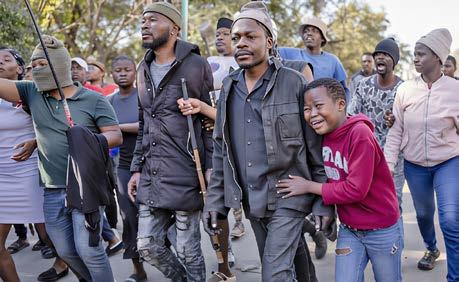
Who’s behind attacks on South Africa’s immigrants? – Page 41
ISSUES INSIDE
Fighting back on data centres Gwen Frisbie-Fulton
It’s time to kill the UK’s great carbon capture con George Monbiot
Independence Day with the drag queens of Fire Island
Chris Hedges
An intimate reckoning with the Weather Underground Frida Berrigan
Big Brother state is here, but we don’t realise it yet
Jonathan Cook
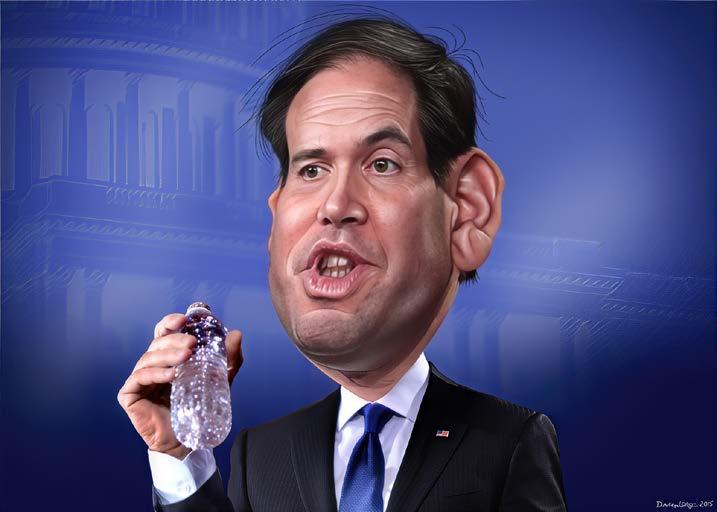
Rubio gets ‘bolshie’ about International Criminal Court
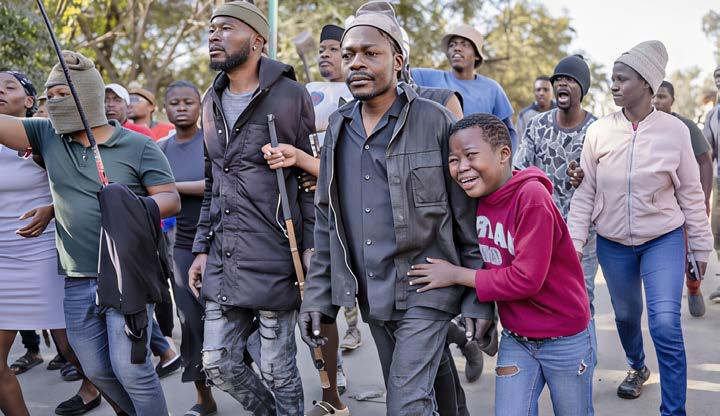
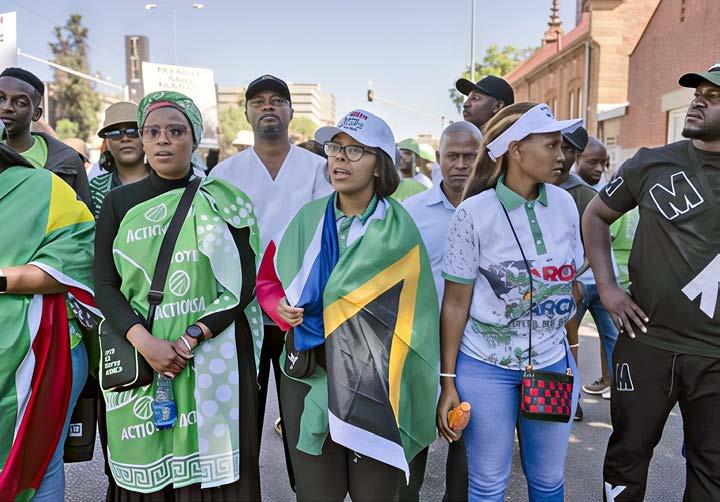
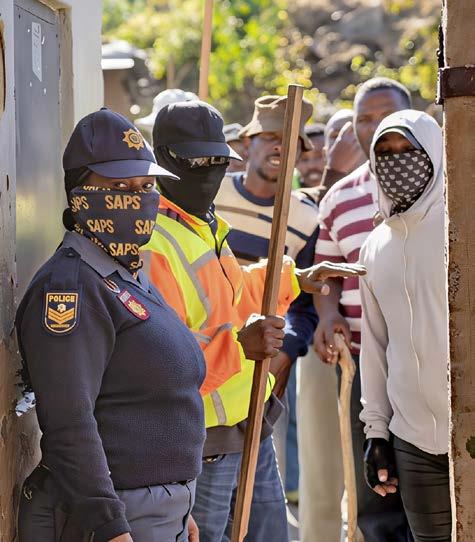
Binoy Kampmark 41 Who’s inciting attacks on foreigners in South Africa?
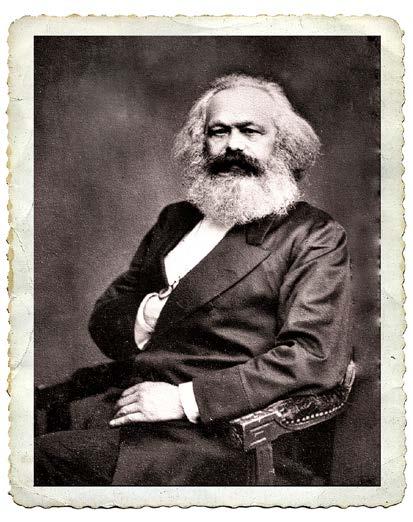
Mark Waller 46 The Trump administration’s snuff-film fixation Nick Turse 50 A chat with Karl Marx about Donald Trump Norman Solomon 52 ‘We don’t make jokes here’ Dwayne Booth
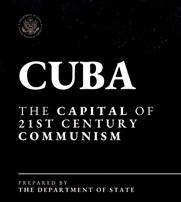
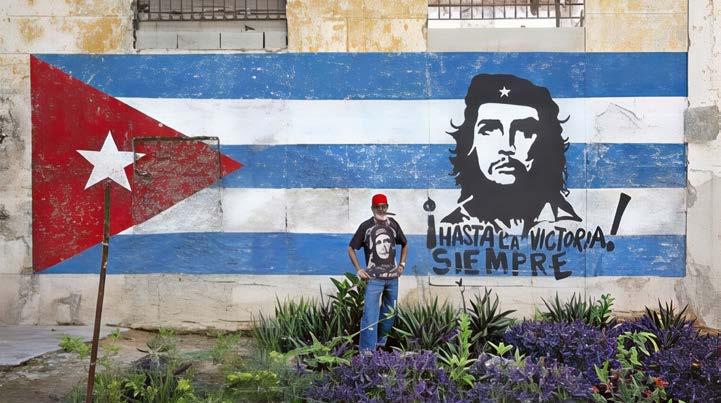
56 US accuses Cuba of creating 50 years of left wing politics
Lee Camp
59 Inventing fake threats so we won’t fight the real monsters Caitlin Johnstone
Ihsaan
INSIGHTS
Here are two ways an American can make a citizen.
1.Take your partner out for a nice dinner and a romantic dance.
2.Once home, with no light but candles, remove unnecessary clothing, and let Nature guide you.
3.Roughly nine months later, a citizen arrives…
…OR,
1.Spend $75 online to set up a Limited Liability Corporation in Delaware.
This would be a damn funny joke if it weren’t true.
According to Supreme Court dicta in Citizens United v. Federal Election Commission, that $75 is all you need to make an American a person under the 14th Amendment to the Constitution.
We know that the 2010 Citizens United case claimed that corporations are people, too. They can donate to political candidates, that is, purchase elections. There’s no other way to put it. But there are two problems with the corporationsare-people assertion:
1.I’ve never heard of a corporation that lost its legs in Vietnam
2.Corporate citizenship is a complete fraud.
Thom Hartmann, the historian and talk show host, has put on his Sherlock Holmes’ deerstalker hat and discovered that the Citizens United decision was based on the fraudulent reporting of a key Supreme Court case way back in 1886. A corrupt clerk working for the Supreme Court combined with
➤ GREG PALAST
The strange story behind the birth of Citizens United
a dodgy Justice to falsely state that corporations are “people.”
That is NOT what the Justices decided in the 1886 case But in 2010, the corporate bum-lickers on the Court cited this fraudulent “precedent” of corporate citizenship – and put America’s elections up for sale.
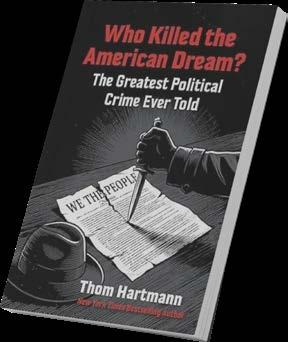
Hartmann’s newly-released book, Who Killed the American Dream: The Greatest Political Crime Ever Told (Barrett Koehler 2026) is a rip-
pin’ detective story whose power is in its hard history. Hartmann explains, and he’s on solid ground here, that Citizens United is based on a fabricated reading of the Supreme Court’s 1886 decision in Santa Clara County v. Southern Pacific Railroad Company.
Before you run away screaming that Hartmann’s story suggests too much legalese, in fact, he’s written a film-worthy, gripping, story which is, in its weird way –think The Sting with a bad-guyswin ending – very entertaining.
The plot line kicks off with this: Hartmann’s in a law library (the kind of the thing he does) and looks up the case on which Citizens United was based. He opens the Southern Pacific Railroad case and finds a head-scratcher: There is NOTHING in the opinion which grants corporations human-hood.
Nothing. Citizens United and the other crazy corporate citizenship cases are based on…nothing. Well, not nothing. There is what’s called a “head-note,” something written by the official court reporter that asserts it is a fair summary of the case.
In 1886, the Court Reporter had, in cahoots with a wily Justice, Stephen Field, monetarily greased by railroad interests, simply made it up. That is, “summarized” the Santa Clara case in a way that ignored the actual written conclusions of the court.
This is a big deal. A REALLY BIG deal. The corrupt court reporter wrote: “The defendant Corporations are persons within the in-
INSIGHTS
tent of the clause in section 1 of the Fourteenth Amendment to the Constitution of the United States.”
Corporations are persons?!? Lots of corporations have been convicted of felony crimes – but I’ve never seen a corporation breaking rocks on a chain-gang.
OK, a little legalese is needed here. Every case has a head note drafted by a (hopefully) honest court reporter. But the head note has absolutely ZERO legal weight. It’s just an easy blurb for paralegals in a hurry. Like an old TV Guide summary of an episode of Gray’s Anatomy.
But, the court reporter, J.C. Bancroft Davis, working with his railroad buddies and the under-handed Justice Field, concocted a head note that granted personhood to these fictional entities known as corporations. I think Bancroft and Field would have made Tinkerbell a citizen, but Disney hadn’t made the movie yet.
The effect of Citizens United has been devastating to say the least. Now corporations can pull out their checkbooks and swamp your vote with millions of dollars in “donations.” Who do you think a politician will listen to: you with your one puny vote or Daddy Warbucks with a wallet thicker than a Big Mac?
The header granting corporations personhood was, like any Big Lie, repeated and cited often enough that it simply became the law of the land.
And the consequences are nothing short of evil. Corporations are, under the 2010 Citizens United decision, treated the same as people –people made out of flesh and bones. Under former law, convicted murderer Charles Manson could not do-
nate to a political campaign from prison … but under Citizens United, Charles Manson & Co. could write big cheques to buy a pardon.
In 2011, I discovered a donation to support Republican Mitt Romney’s run against Barack Obama through Restore Our Future PAC came from a limited liability corporation called “F8 LLC.”
The company only showed $87,000 in sales for the year but managed to donate a cool million dollars to the Republican campaign, Who was behind this million dollar payment? Investigators with the Campaign Legal Center dubbed the executive “John Doe.” Want to know who’s behind the GOP? Ask Mr. “Doe.”
Under Citizens United, Al Qaeda Inc. may donate as well as Putin & Sons. In the 2010 argument over Citizens United, Justice Ruth Bader Ginsberg asked how Americans can tell if the government of China is funding candidates via incorporated front groups in the US. Chief Justice Roberts said that would be up to Congress – that is, the very politicians bought by a Chinese front or “F8 LLC.”
How odd, Trump has argued that kids born in the US to immigrant parents aren’t Americans, but Corporations born in the Cayman Islands and registering in Wyoming have citizenship rights.
So, RBG’s question suggests a solution that’s less of a heavy lift compared to Hartmann’s call to amend the Constitution. Congress can allow corporations to donate if they certify and prove they have no foreign owners.
That would be a bit of a problem for Citibank. Saudi Arabia’s Kingdom Holding just bought $450 million of Citibank stock and more is
controlled by Prince Alwaleed bin Talal. Would the Saudis try to influence American elections? Does a bear….?
Under current law, I can’t give to a candidate without stating my name and address. We don’t need a Constitutional Amendment to require that corporations that donate to campaigns list all their shareholders.
Right now, I’m completing my film about how the Brothers Koch stole $6 billion in oil from the Osage Nation. They bought their way out of a criminal indictment by literally purchasing themselves a new Congress through a corporate shell called “Triad.”
At the time, corporate donations were a go-to-jail felony, but the Kochs slithered away until Citizens United, when their fake corporate front was legalised.
So what’s the problem with corporate cash in campaigns? This: Wise men have said, “Corporations have neither bodies to kick nor souls to damn.” Corporations are artificial creatures that feel no pain but can inflict it. And they do.
And what truly should make you ill is, as Hartmann lays out, the legal case for Citizens United was a fraud, a scam, a con, a bamboozle. CT
Greg Palast is an investigative journalist. His not-for-profit Palast Investigative Fund is launching a series of six reports on vote suppression – and how we can reverse it – in coordination with our partners at Black Voters Matter Fund, the NAACP of Georgia, Transformative Justice Coalition and the late Rev. Jesse Jackson’s RainbowPUSH. Palast’s website is www.gregpalast.com
INSIGHTS
➤ YVES ENGLER
When did Canada vote to spend billions more on war?
The monsters who’ve armed Israel throughout its genocide in Gaza are giving themselves greater capacity to intimidate and kill internationally. As forest fires burn out of control across Canada and ever more people sleep on the streets, the Canadian government is devoting unprecedented sums of public resources to a militarist conception of ‘security.’
On July 16, Prime Minister Mark Carney announced $2 billion for more light armoured vehicles. The General Dynamics Land SystemsCanada contract will increase Canada’s LAV force from 360 to 550.
Two days earlier, Defence Minister David McGuinty announced $30 million over two years to create a research facility to develop drone capabilities.
Overseen by Canadian Joint Forces Command, the innovation centre will be dedicated to developing unmanned military systems.
And on July 15, the Liberals said they were joining the UK/ Italy/Japan Global Combat Air Programme (GCAP) to develop a sixth-generation stealth fighter jet.
Canada will initially be an “observer” in the GCAP, which will spend tens, maybe hundreds, of billions of dollars on developing a more advanced warplane over the next decade. Canada’s role in GCAP is on top of ever-expanding fighter jet procurement, which has grown from a planned 65 jets under Stephen Harper to as many as 140 under Carney.
The government has also announced a $800 million purchase of cruise missiles for Canada’s
F-35 fighter jets. The Joint Missile Strike produced by US-based Raytheon and Norway’s Kongsberg may also be employed on Canada’s new submarines, according to a Canadian Defence Review article headlined “Canada’s Joint Strike Missile Acquisition Could Establish a New Era of Multi-Domain Precision Strike Capability.”
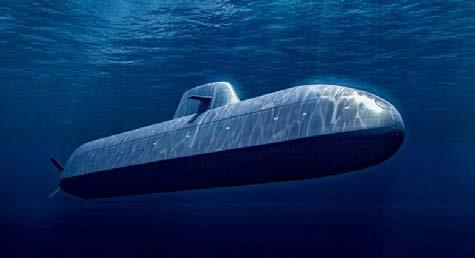
Expected to cost $100 billion over their life cycle, the TKMS/ Kongsberg Type 212CD submarines Canada recently selected will likely be capable of launching cruise missiles some 300 kilometres.
Alongside a slew of other ongoing procurements, the recently announced arms will boost the military’s capacity to kill internationally. As I detail in Stand on Guard for Whom: A People’s History of the Canadian Military, Canadian soldiers have participated in belligerent wars in Sudan (1884), South Africa (1899), World War 1 (1914), Korea (1950), Iraq (1990), Yugoslavia (1999), Afghanistan (2001) and Libya (2011). (While more complicated then officially described, World War II was ultimately morally justifiable.)
Despite the history of Canadian warfare and Ottawa’s continued complicity in horrific crimes in Gaza, there’s been little push back against expanding Canada’s war fighting capacity. Rather than engage in a debate about militarism, with all sides represented, the Carney government is manufacturing consent for war through a propaganda system mostly paid for by tax dollars that would be better spend on desperately needed social services.
They claim we need to spend on military might to defend our
SEA MONSTERS: TKMS/Kongsberg Type 212CD submarines have been chosen as a key part of Canada’s latest round of ‘defence’ spending
INSIGHTS
‘democracy’ but the people who are profiting from all this don’t even believe in real democracy. They believe in one dollar, one vote capitalism. And the military machine that Canada is building will invariably be used to wage war
alongside the US Empire. Who voted for that? CT
Yves Engler is an author and political activist based in Montreal. His website is www.yvesengler.com
Israeli arms firm back in UK after MPs scandal
ABritish weapons firm owned by the Israeli government has been brought back to life, after its lobbying activities were exposed by Declassified last year.
RUK Advanced System Ltd is registered in London, but records show it is a subsidiary of Israel’s state owned arms giant, Rafael.
In October, documents were filed with Companies House to shut the business down, following our investigation. But it’s now been revived
–and claims to be supplying British armed forces.
Last year, DeclassifiedUK revealed how RUK pumped money into the All-Party Parliamentary Group (APPG) on Defence Technology, which promised “opportunities to network with MPs.”
Our investigation triggered an inquiry by Westminster authorities, which confirmed that parliamentary rules had been breached.
The inquiry found that the donation had been part of a “PR and
marketing campaign” by RUK, which “resulted in a foreign government temporarily part-funding” the group of MPs.
The APPG quickly disbanded, while RUK deleted its website. Documents were later filed for the company to shut down, but the application has since been withdrawn and RUK’s website has now re-appeared.
Labour MP John Trickett told Declassified: “It is extremely concerning that a company owned by a foreign government was able to fund a British parliamentary group. The Standards Commissioner was right to take action.”
He added: “Now this company has returned, there should be full transparency about its operations in this country.”
Products advertised include missiles with “unprecedented” lethality and a defence system for tanks which has been tried and tested in combat “along Israel’s borders.”
The company’s website says: “We deliver the most technologically sophisticated, operationally powerful, precisely-adapted, and cost-effective solutions to fill the unique combat requirements of the British MOD and Armed Forces.”
However, questions remain over the nature of the business and where it is based.
RUK says its products are “made in the UK” and submitted evidence to Parliament last year describing itself as “a UK manufacturer.”
But our investigation last year found no evidence that the company had any manufacturing facilities in the UK.
The address given in official company documents is a service address, with no RUK staff present.
➤ MARTIN WILLIAMS
INSIGHTS
And when we eventually tracked the company to a tiny building on a technology park in Farnborough, it appeared to simply be a small office.
The latest financial accounts, from 2024, show that it only employed five people at that stage –and at least some of these individuals have since left the company.
Searches of LinkedIn have failed to identify any current employees at all, except for the director, Yoram Aldo Aron. Neither Aron, nor Ra-
fael, responded to Declassified’s request for comment. CT
Martin Williams is Declassified UK’s chief investigator. He previously worked for the Guardian, Channel 4 News and openDemocracy, where he was UK Investigations Editor. His book, Parliament Ltd, exposed widespread corruption in British politics and sparked multiple inquiries by Westminster authorities. This article was first published at www.declassifieduk.org
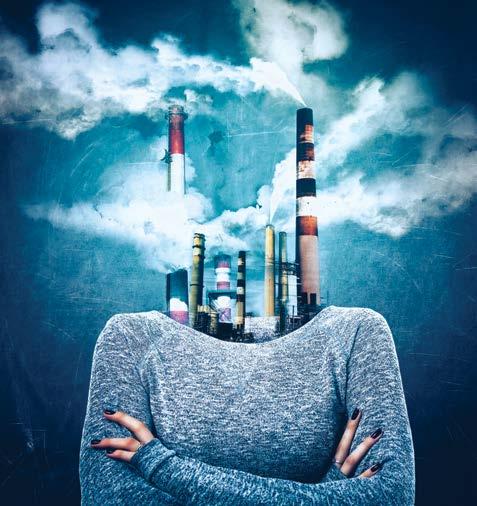
It’s getting hot, hot, hot –a nd not just the weather!
Let’s face it: Donald Trump should be considered an atomic bomb of a president (potentially all too literally, even if in slow motion, thanks to climate change). When it comes to actual atomic weaponry, he’s been threatening for a while first to restart the testing of nuclear weapons, which the US stopped 33 years ago, and then (at least implicitly) to use just such a weapon against the Iranians.
In April, in fact, he insisted that, if Iran refused to reopen the Strait of Hormuz, “a whole civilization will die tonight, never to be brought back” – only to later deny that he meant he would ever consider using an atomic weapon against that country.
Of course, once upon a time in school (think the 1950s), the young Donald Trump, like me, must have “ducked and covered“ under his
desk in preparation for a potential Soviet atomic attack on our city (New York). During those Cold War years, of course, atomic testing was considered normal, while our country and the Soviet Union were indeed facing off globally in a remark-
ably threatening fashion. But no ducking and covering now, not from our president anyway.
Once upon a time, in the last century when I was an editor at Pantheon Books, I published Unforgettable Fire: Pictures Drawn by Atomic Bomb Survivors.
Then, at the invitation of the Japanese editor of that book, I visited Hiroshima and went to the museum there dedicated to my country’s nuclear devastation of that city and Nagasaki to end World War II. I’ll never forget that dead 12-yearold’s charred lunchbox or that human shadow etched in stone by the atomic blast.
In all those years, I never quite imagined that there might be a slow-motion version of atomic warfare on this planet, which we’ve come to mildly label “climate change.” (It should, of course, be called something more like “climate catastrophe” or “climate hell.”)
Nor had I ever quite imagined that we would elect a president seemingly intent on making it happen ever more quickly and severely. After all, he’s pushed remark-
INSIGHTS
ably hard to further fossil-fuelise our world. As Juan Cole noted all too aptly at his Informed Comment website, just as the 250th anniversary of this country’s founding was passing, “Trump’s promotion of coal burning and cancellation of wind turbines makes him the Benedict Arnold of America’s current struggle.”
These days, of course, nine countries have nuclear arsenals (enough weapons to wipe out any number of Earth-sized planets), and Donald Trump has recently been at war with Iran, the country he feared might become the tenth.
Yet, in the 80 years since my country ended World War II by dropping atomic bombs on the Japanese cities of Hiroshima and Nagasaki, killing more than 200,000 people (including an estimated 38,000 children), consider it a miracle that another of those weapons has never been used, although since the first nuclear test in 1945, there have been more than 2,000 other “tests” in which such weapons were exploded, which have, of course, sent cancer-causing radiation across the planet.
But don’t push that miracle idea too far, since it turns out that we humans proved all too capable of coming up with another way to devastate this planet, a distinctly slow-motion version of atomic warfare.
In fact, at this very moment, I’m sitting in an air-conditioned room writing this piece, while the world more or less burns outside my window. Recently, high temperature records were tied or broken across 21 states in my country. (The same, by the way, has been true across much of Europe, the part of the planet re-
putedly heating fastest in this increasingly strange world of ours, with Spain only recently topping a record 113 degrees Fahrenheit.)
I’m thinking, of course, of climate change and, sadly, at this very moment, when it comes to that version of warfare against this planet, there really is no ducking and covering (unless you count air conditioning, which uses electricity and so only makes matters worse).
If you happened to live in Europe recently or in the midwestern and eastern parts of the United States where temperatures rose to striking heights or simply went crazy.
In short, it’s increasingly hot, hot, hot, damagingly so on this planet of ours, and Donald Trump, the second time around, not only doesn’t give a damn (an all too appropriate term under the circumstances) but seems remarkably intent on making this planet hotter still.
At least, to look on the bright side, climate change did make something of a mess of his celebration of the 250th anniversary of American independence, or was that the 250th anniversary of Glorious Donald?
When it comes to him and the possibility of either a potentially devastating nuclear war or a fossilfuelised heat war on this planet, he seems willing to engage in worldending activities as long as they’re in slow motion and, at 80 years old, he (like me) won’t be around to experience the resulting holocaust, which he has, of course, termed a “green energy scam” and a “hoax.”
Yes, make no mistake about it, while he’s officially ended that 33year moratorium on nuclear testing, that may be the least of our problems. Whatever other recent presidents have (or haven’t) done in terms of climate change, he seems remarkably intent on doing so much worse by wildly promoting fossil fuels, while doing everything he can to dismiss anything that might make this planet less hot, including wind and solar power of any sort. In the process, he’s giving imperial decline a new meaning by turning what’s left of imperial power on this planet over to China, which now controls so much of green energy development and production.
If his dreams (oh, sorry, nightmares) come true, he will certainly be known historically (if, of course, there is any “historically” then) as the president of the United States who did his best to end it all – even if in slow motion).
Under the circumstances, we should consider Donald Trump the human equivalent of a slow-motion atomic bomb. CT
Tom Engelhardt created and ran the website TomDispatch.com for 25 years. His latest book is A Nation Unmade by War. Tom’s postTomDispatch essays are at https://tomengelhardt.substack.com
Gage Skidmore
DUMB TALK: Donald Trump
INSIGHTS
Putting pressure on the super-rich polluters
After nearly two decades of tracking the American private jet industry at the Institute for Policy Studies, we launched the Private Jet Accountability Project with a Tax Private Jets campaign during the final games of the 2026 FIFA World Cup.
IPS has been tracking the emissions impact of mega-events, such as the Super Bowl and Davos for many years. But this year’s World Cup might be the biggest of these events yet, starkly illustrated by FIFA Chief Gianni Infantino burning up the atmosphere with multiple jet flights a day.
We have launched a new tool the Private Jet Emissions Tracker (PJET), and the first tranche of data was released under the banner, Red Card for Private Jets at FIFA World
Cup, for the semi-final and final matches in New Jersey on July 18 and 19.
The Tracker is an open-source
sousveillance (surveillance from below) software that lets anyone measure jumps in private jet-travel associated with events such as a Masters golf tournament, Kentucky Derby horse-racing, Davos trade talks, or football’s Super Bowl.
We are tracking the number of planes and estimated emissions from increased activity at each major event, comparing previous weeks, months and years to see how much activity is driven by the World Cup. We are working with artist and programmer Kyle McDonald who created the Apocalypse Early Warning System.”
As wealth inequality accelerates, so has demand for private jets. Manufacturing of new luxury jets has risen while the resale market has grown even more robust. There is also growing pressure on local airports to expand the capacity to accommodate the growing number of private jets.
There are an estimated 977
INSIGHTS
billionaires (and one trillionaire) who call the United States home with a combined wealth of over $9 trillion. We know from our research that the median wealth of a private jet owner is $190 million and that fractional jet users have median wealth of $140 million.
These wealthy private jet moochers are super-polluters, with the highest level of carbon emissions of any humans on the planet. Their selfish behaviour undermines the solidarity required
to transition our societies away from fossil fuels.
The Private Jet Accountability Project (PJAP) is working to:
l Eliminate federal and state tax breaks for private jet travel;
l Make private jet users pay the real costs of their selfish behaviour, including airport fees and the real environmental impact of their carbon pollution;
l Stop taxpayer-subsidised expansion of private jet facilities and local airports.
The private jet lobby is very powerful in the US. The National Business Aviation Association, and its state affiliates, represent the interests of private jet owners, operators, and manufacturers. That bloc has won massive tax breaks for jets and blocked popular efforts to require private jets to pay their fair share.
Across the US, local airports –some which service no commercial flights – are pressing to expand private jet hangers, runways, and infrastructure. Hanscom Field outside Boston – the biggest private jet airport in the northeast US – has seen a proposed private jet hanger expansion opposed by a massive grassroots campaign.
Here are some early examples from our research into private jet pollution at the recent World Cup contest:
l June 3, Ivory Coast vs. Norway in Arlington Texas: 61 percent above the average CO2 emissions for similar days during the past five years, pollution excess of 6.35
INSIGHTS
kilotons of emissions, equivalent to approximately 1,344 gas cars driven for a year (per EPA calculator)
l July 1, US vs. Bosnia Herzegovina in Santa Clara: 879 private jet operations netted an 83 percent increase in emissions over a five-year average for South Bay air fields; the 3.03 kt excess carbon emissions is equal to about 36.4 tanker trucks full of gasoline.
l July 5, Norway upset Brazil in NY/NJ stadium, where the final will be held: 54 percent above average emissions (1,994 private jet operations) with 6.2 kt excess CO2, more than 31 rail cars worth of coal burned. (Note: A lot of wealthy people are already in NYC – and may have come for things other than the World Cup.)
l July 6, US v. Belgium, in Seattle: 818 private jet operations emitted an excess of 3.5 kt, a 119 percent increase over 5-year averages. The Spain-Portugal match on the same day saw 1,939 private jet operations, emitting 3.68 kt more of carbon pollution than average.
World Cup fans have seen just how spread out and poor quality the US public transit system is. Part of the problem is the super-rich private jet class have “opted out” of ground transportation (and an overburdened commercial aviation sector) with no stake in paying for a better system for all.
Private jet owners have created 10 to 20 times more fossil fuel pollution flying to the hottest World Cup in history than commercial aviation passengers. Our data shows the number of private jets landing in Dallas, Atlanta and New Jersey for the World Cup semi-final and final games and calculates the added
carbon pollution of these joyrides.
Average fans should not have to subsidise the billionaire highflyer lifestyle by propping up FIFA and paying for public airways and
public runways that the wealthy use.
We are calling on FIFA to ban private jets from future World Cup games, honour its ‘carbon neutrality by 2040’ pledge by cutting unnecessary air traffic, and make future World Cups accessible, grounded, democratic and built around fans, not billionaire VIPs.
After the release of our data, we will work to make the Jet Tracker an accessible interactive tool. Watch taxprivatejets.org for findings and @taxprivatejets on social media for shareable graphics. CT
Chuck Collins is the director of the Program on Inequality at the Institute for Policy Studies and author of Burned by Billionaires: How Concentrated Wealth and Power Are Ruining Our Lives and Planet
➤ HURWITT’S EYE
MARK HURWITT
MULTIPLE DAILY FLIGHTS : FIFA Chief Gianni Infantino
➤ GWEN FRISBIE-FULTON
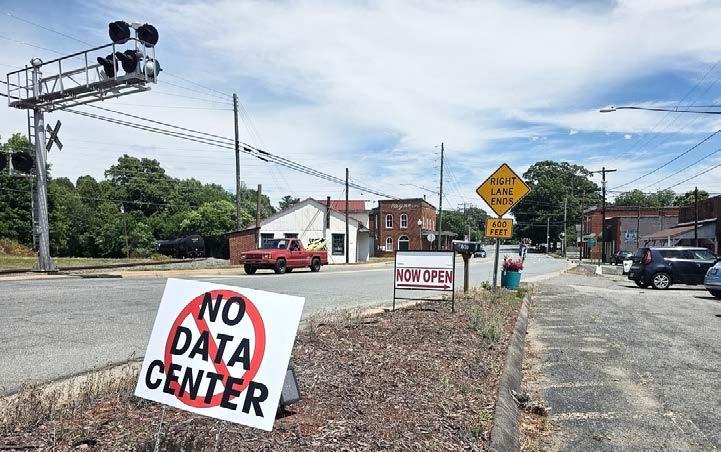
Fighting back on data centres
Working-class people in small towns across America are fighting the construction of data centres. This is the story of one of those communities
Carol tells me she drives like a turtle, but she’s whipping around the turns of North Carolina’s rural Forsyth County roads nonetheless. She’s been driving them all her life.
As she drives, she tells me what I’m seeing. This is the house where her cousin lives; this is where soand-so had a farm. She points out the library and tells me about the time she socked a bully there and got banned for a week as a kid.
Six generations of Carol Newsome’s family land is sprinkled between the roads and neighbourhoods. She points out the old cabins, the acreage, and tells me the history. Her great-great-granddad’s house is the oldest still-standing house in town.
Rural Hall is small, but growing. There are about 3,000 residents now, but Carol remembers it from the ’70s, before it became incorporated.
Carol’s dogs bark wildly as we
pull into her driveway. She points to a stand of trees across the road, nestled up to the railroad tracks. Once she was offered money for that stretch of land to build an truck access for an industrial area. “But I guess the trees and the pileated woodpecker are just more important to me than money,” she laughs.
The trees, pinned between a pallet company and the tracks, remain lush and green.
But it’s not Carol’s property that she’s brought me here to see. It’s the
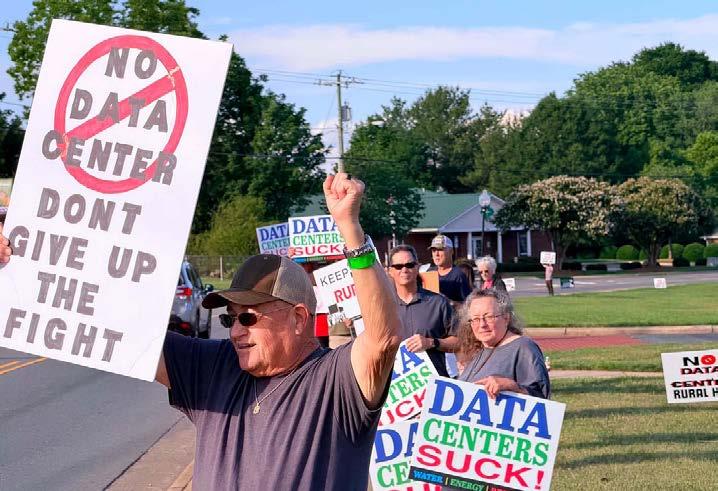
FIGHTING BACK: Residents protest the proposed data centre in Rural Hall, North Carolina
Photo: Robb
land just beyond those trees. That’s the land that is now being sold: the old Wall family farm.
And that’s why I’m here in the late June heat, in a small town in rural North Carolina: 129 acres of controversy.
Earlier this spring, Nancy Jones got a notice in the mail from Forsyth County about the Wall farm, which sits just across the road from her property. Everyone within 500 feet of the property received notices the same day.
The notice was about a zoning change that would turn the farmland into industrial property. “There was a map on the back in a square that was yellow, and that was
the proposed property for rezoning,” says Nancy. “Then all the way around that was a green area, and it showed everybody’s homes. And there mine was.”
Nancy moved to Rural Hall from northern Virginia a decade ago to find a quieter, more peaceful place. She lives here in a modest home with her daughter and grandchild on a few acres. “We’ve got chickens, we’ve got gardens, my daughter is a beekeeper. We love our little plot of land.”
It’s a good place to live; a slower pace than where she came from. Now Nancy says it feels like she’s being chased.
A second letter came, this time from a company called Montrose, saying it wanted to build a hyperscale data center on the farm. The
neighbours dug around and found that Project Iron Spur would include three buildings totalling 1.3 million square feet and standing 84 feet tall. In other words, you’d be able to see the data center, with racks of air conditioners stacked on top, whirring to keep it cool, over the tree line. “It would be the only thing higher than steeples,” says Carol.
While not part of the town proper, Wall Farm is surrounded on nearly all sides by Rural Hall. Churches, a cemetery, and several small neighbourhoods all back onto the farm, which is 130 acres of gently rolling pasture with a creek running through its middle.
Because it’s rural land and the town is diffuse, it’s hard to describe how this land is smack in the middle of Rural Hall until you are there driving these roads with Carol. As you step out the doors of Abe’s Market, or put flowers on a grave at Nazareth Lutheran, or run the flag up the pole in front of town hall, you are looking right at Wall Farm.
“To build a data center here makes no sense. It’s like they don’t care at all about us,” says Nancy.
So when she got that letter, Nancy yelled downstairs, where her daughter Jean was working. “I yelled so loud she probably thought someone had died.”
Jean came up and looked at the letter. Like her mom, she had left northern Virginia and later Colorado because everywhere she lived, she kept getting hemmed in. “What bad luck is this?” Jean remembers thinking as she stared at the map.
“I told my mom: we can’t allow this to happen,” says Jean. The family didn’t want to – and couldn’t afford to – keep moving.
Jean thought maybe if they told the neighbours how bad these data centres are, they would convince them to oppose it. “I was getting ready to make flyers and go post them on people’s doors, but then,
BEING CHASED: Nancy Jones, her daughter, Jean, and her granddaughter
Gwen Frisbie-Fulton
that same night, somebody came to our door and handed us a flyer.”
That was the good news of the day: They weren’t going to have to convince anyone this was a bad idea for Rural Hall. Everyone already knew.
“It’s hard to fight something when they won’t tell you what it is,” says Randy Adams.
Randy’s wife first told him about the data center – she had seen Carol post about it on Facebook. Carol runs a Facebook page called the Independent Hall Monitor, where she religiously posts about developments in local government. Like many small, rural places in America, the Rural Hall doesn’t have local journalists or a local paper. So, it was Carol who was watching a Council Meeting and caught the town manager’s brief mention of a “rezoning request” in the very last minutes before they adjourned.
While Randy had lived here a long time, he had never had the time to pay much attention to local politics. He’d spent his career as a truck driver, the last 21 years at UPS in neighbouring Greensboro. “It was a 45-minute drive to get there, 45 minutes to get back, and no days were less than 10 hours. I couldn’t do anything but work at UPS, you know, take a bath, swallow my food, sleep six hours, and then it was time to go back to work.” He certainly never had the time to watch hours of town council meetings, so Carol’s posts had become a go-to source for the Adams and many of their neighbours.
But for all those years he couldn’t be involved in his community, Randy knew he was going to jump in now. “I had seen some stuff about data centres, but didn’t really lock in. I thought, well, that’s bad,” he said. “When I heard it was here, I thought, oh no, we don’t, we don’t want this at all.”
For Randy, it was the gall of it
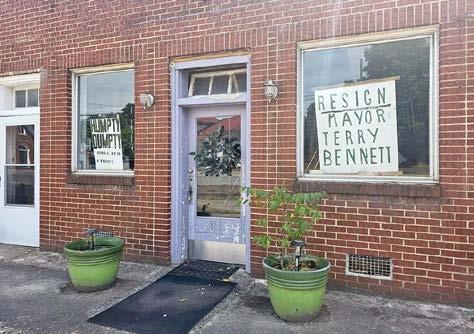
ANGER: Terry Bennett, the mayor of Rural Hall, who has appeared hostile towards residents who have become involved in protests, is under fire
all. He’s spent his whole life living in this little corner of North Carolina, raising his family, working hard, and being a good neighbour. To him, the data center was all about outsiders who didn’t understand – or care about – their little slice of heaven or their lives.
“To have somebody in another part of the country see this land,” he says, “and then hire somebody to put in a permit for something that we don’t want without any discussion, like they’re going to ram it down your throat, and they try to be so slick, it’s like a Kafkaesque story.”
Randy didn’t know the mayor of Rural Hall personally, but knew he lived on the road behind him. He figured that the mayor, Terry Bennett’s main job was to hear from constituents and protect the town. So he looked up his number and gave him a call.
“I called him up to see what he knew about it,” explains Randy. “And he starts going… this thing is not going to bother anybody. I don’t know why you’re upset. What’s the problem here?” Randy realized the
mayor knew very little about the project.
“I said [to the mayor] you were elected to protect us. All these fireworks and parades and all that stuff is great, but that’s not what you were elected for. You were elected to protect this town, and this is where you should step up.”
When the mayor and the council had little to offer except that “things will be fine,” Carol, Nancy, Jean, Randy, and a growing number of other residents were left to fill in the gaps. They began researching other data centres of the same size and scale to see how they had impacted local communities. Had they lived up to their promises of increased tax revenue? Did they create any local jobs? Or did they drive up electrical prices and use up local water? Nancy bought a decibel reader and visited other data centres of similar size to measure the noise.
What they found out didn’t look good for Rural Hall.
“If it hadn’t been for Carol and people like her, this would probably win with no problem,” says Randy. “We wouldn’t even know what was happening. They’d probably be tearing the ground up over there right now.”
Gwen Frisbie-Fulton
It was March 10th that Carol posted about the proposed data center on the Independent Hall Monitor Facebook page. By the end of the week, a petition was circulating, and days later, a private Facebook group called No Data Center Rural Hall was created as a central digital place to communicate from. Some residents wrote letters to the editor for the nearby Winston-Salem Journal, and others began canvassing neighbourhoods around Rural Hall.
The letter Nancy had received from Montrose included a meeting date when the developer would describe the project. Despite the developer’s attempts to limit the number of people invited, people in town felt like everyone should have the chance to attend. As they knocked on doors and spread the word online, they invited people to come out. They started a GoFundMe, pooling resources for a rental van to get people who don’t drive to the meeting.
On March 30th, the meeting was packed. People who couldn’t get in held a rally outside. This was new for Rural Hall; it’s a know-your-neighbour-but-mind-your-own-business kind of town. Carol says a couple of retired police officers had gotten involved. “I said we need to have a rally outside the library before the developer’s meeting, and a couple of the guys said, ‘we can’t protest!’ I said, ‘it’s not a protest, we’re just making people aware that this is happening!’”
One retired officer agreed to come so long as it was just holding signs and afterward approached Carol and said: “This was great! I’m so pumped! When are we doing it again?”
They did do it again… and again and again. The residents began holding weekly citizen-led meetings about the data center, rotating facili-
For the first time in memory, so many people showed up at town hall meetings that cars had to be parked on the lawn
tators so new people got a chance to lead and new voices could be heard. They created three teams that people could plug into: Research, Communications, and Strategy. For the first time in memory, so many people showed up at town hall meetings that cars had to be parked on the lawn.
I came to Rural Hall knowing the general concerns about data centres: They make noise and drive up local residents’ electric bills. They guzzle water and bring very few, if any, jobs.
I also came with ties to this area of the South. I live one county over, went to high school right up the road, spent summers swimming in the nearby Yadkin River, and I’ve hiked Pilot Mountain countless times, which I can see off in the distance as Carol drives me around.
I also arrived knowing a bit about small town organising. I’ve been part of and written about hundreds of grassroots organizing campaigns here in North Carolina and across the country; I’ve sat in on town council meetings from Georgia to California. And, importantly, I’ve seen what industry and corporate America does to our towns: I’ve seen polluted water come out of people’s kitchen sinks, Dollar Generals shut down mom and pop groceries, an opioid crisis ravage holler after holler, and paychecks so low you can’t believe this is the United States.
So on one hand, I knew what I would be writing about. But on the other hand, I was struggling to un-
derstand: Why data centres? With all the bullshit small towns deal with, what is it about data centres that broke the camel’s back?
Randy, Carol, and I were sitting around the big wooden kitchen table in Carol’s family cabin. It was hot outside, but with the thick log walls and the doors open, it was comfortable inside. Soon, a young couple, Amberlee Mabe and Andrew Rojas, joined us. Carol made another pot of coffee.
Amberlee’s mom got the zoning notice. The data center would be built a stone’s throw from her back door. Amberlee worries about this – about her mom’s health next to a large industrial site and about the house losing all its value. She’s afraid that her mother, who lives on a fixed income, will lose all that she’s got. Her house is paid off, her bank account is slim; she hadn’t planned to have to start again.
It all seems so unfair, how people can work their whole lives to get a little something and have it all destroyed by some company they’d never heard of. But when I ask Amberlee and Andrew why they’ve become involved in this fight against the data center, it doesn’t only have to do with Amberlee’s mom.
There is something more existential happening in these anti-data center fights. There’s general anxiety about AI and technology; a real sense that who wins in the future being built is already set.
This future is being built without our consent. “They’re shoving AI in everything, so it’s unavoidable,” says Andrew. “And then later on they kind of push it on us, like, oh, well, you’re relying on data centres so that’s why we have to build them. But we didn’t ask for this technology, we didn’t ask for it to be in everything, and we certainly didn’t ask
for this data center.”
And, Carol points out, the people who they are fighting against – the mayor, the city council, the planning boards, even the developers and their lawyers and all their middlemen – none of them actually want the data center either. “There is just money to be made, bags of money, and they figure that someone needs to grab those bags of money before this thing is or isn’t built.”
It’s as if everyone is racing towards a future that none of us designed and none of us really want. We get the sense this future isn’t designed for us, but we are running towards it anyway. That’s how little power we all feel.
“There’s a subconscious thing there,” explains Randy. “Because I think almost everybody feels like everything’s going so fast you can’t keep up. It is, and this is a way to strike at that.”
Their first win came when the Forsyth County Planning Board recom-
mended denial of the rezoning request. “Now that’s only a recommendation; the County Commission needs to vote on it still,” warns Carol.
Their next win was the Rural Hall Town Council voting to pass a resolution opposing data centres – well, it was sort of a win. “It was a Mickey Mouse resolution,” says Randy. “It barely said anything at all.”
Still, the resolution passed unanimously, and Mayor Bennett was quoted by a local TV station saying: “It’s obvious we are against the data center coming here.” While local residents weren’t so sure they trusted this resolution, it was obvious that their pressure on local leaders was working.
In Rural Hall, and everywhere, small-town lawmakers seem to be caught by surprise by data center opposition. They are, truly, bumbling through. Council members seem
bowled over by industry representatives who are paid to perform a certain song-and-dance routine, and then are shocked when community members step up and say “no.” In Rural Hall, the mayor seems downright upset by their constituents weighing in: he has repeatedly threatened to shut down meetings and throw people out.
And it turns out that everyone who was suspicious of the resolution was right. Only weeks after passing the no data center resolution unanimously, in late June the council reversed course and negated the resolution. Only one council member voted against the new resolution and stuck with his previous vote.
What changed? After the County Board recommended the zoning not be approved, Mayor Bennett said the developer assured him that they could get the land annexed into Rural Hall, directing additional tax revenue to the town.
SIGN OF THE TIMES: Downtown Rural Hall, a community whose existence is threatened by a new data centre
Of course, one would think annexation would be a decision that a developer wouldn’t control.
To Carol, Nancy, Jean, Randy, Amberlee, and Andrew, it sure feels like they are being cut out of power. Clearly, conversations are being had, and decisions are being made in places where the people are not allowed in, but big corporations are.
Carol is filing public records requests to find out what back-door conversations are happening; the group is considering filing complaints over public meeting violations. “We’re fighting something, we’re fighting somebody, and they won’t tell us what they’re going to do and how they’re gonna do it,” says Randy. “It never crossed their mind that they would actually have to tell us either. But they do.”
All over the country small-town residents are getting a big lesson in democracy.
The United States has more than 3,000 operational data centres, and that number is expected to grow substantially in the years ahead. More than 1,500 new data centres are in various stages of development nationwide, and, as they become a harder and harder sell, 67 percent of planned data centres are now in rural areas, like Rural Hall.
“It feels like they want to come here because they think we don’t have the power to defend ourselves,” says Carol.
“And because our local government doesn’t even seem to know how to stop them,” adds Randy. “But they’re wrong,” Nancy laughs.
Many of the people here are organizing around something for the first time – and getting a crash course in how to muck through
They will keep up the pressure on until Project Iron Spur is dead. Their petition has over 5,000 signatures, more than town’s population
meeting minutes, plat maps, and public record laws. They are seeing the inner workings of government up close – and seeing who has power and who doesn’t. Sometimes it seems like the local government is learning alongside them. A recent public records request response included an email from the town clerk to the town manager asking: “Hey, I just wanted to make sure it’s okay that I send the map sent to us about the data center to Carol?”
They’ve been able to turn to other North Carolina communities for advice and guidance. Boone, Canton, and Kings Mountain have all passed data center moratoriums, as have Gates and Chatham counties. Neighbouring Stokes County is currently fighting a data center; in the March primary, incumbents who had supported a massive data center complex in Walnut Cove were resoundingly rejected – an outcome politicians in Rural Hall might want to pay attention to.
The residents of Rural Hall are committed to keeping the pressure on until Project Iron Spur is dead and gone. Their focus is on July 30th, when the Forsyth County Board of Commissioners will vote on the rezoning. Their petition currently has more than 5,000 signatures, exceeding the town’s population. Even in the sweltering July heat, they continue to knock on their neighbours’ doors and table at local events, making sure that eve-
l Read more of Gwen Frisbie-Fulton’s Working Class Stories at www.workingclassstories.substack.com
ryone in Rural Hall has the opportunity to know what’s happening at the heart of their town, and how they can help stop it.
Regardless of what happens with the old Wall farm, the residents of Rural Hall have unlocked something exciting and new here. This has always been a friendly, community-minded place, but it seems like money and power have called most of the shots – often at the expense of the hardworking folks. “I think we are starting to see that doesn’t have to be the case and we have bigger power together,” says Carol of the organising they have done.
Randy is in awe of how so many people have shown up in just a few quick months: “I would have said, before this data center thing arrived, that if there had been some big project and somebody said, ‘Do you think we could get the community together?’ I’d have said, ‘Absolutely not.’ But I was wrong.”
“I did not realise how much of Rural Hall existed,” says Amberlee. “I just thought it was so much smaller and now meeting people from every age group, demographic, family, like it’s just… it’s amazing, and like we can all come together for this one thing.”
“I do think data centres are going to be what reunites the United States,” says Jean. “It’s like, oh, wait, we actually do have things in common. So, at the end of the day, you know, when we look back on this 10 years from now, we’ll be able to say, you know, maybe it was kind of a good thing, because we’re gonna be OK. CT
Gwen Frisbie-Fulton is a North Carolina-based writer and organiser who writes about working-class people and grassroots movements
➤ GEORGE MONBIOT
It’s
time to kill the UK’s great carbon capture con
The numbers are simply mind-blowing: Up to £264 billion for a climate ‘solution’ that will increase emissions. Has the government lost its mind?
The numbers are simply mind-blowing: up to £264 billion for a climate “solution” that will increase emissions. Has the government lost its mind?
David Burnham, the UK’s new prime minister will be looking for money? Well, here’s £21.7 billion lying on the ground. The government could cancel its deranged, disastrous carbon capture and storage (CCS) programme at no cost to public welfare: in fact, it would greatly reduce the harm we will suffer.
Sorry, did I say £21.7 billion? That’s the figure the government has been putting in its press releases for spending on this programme between now and 2050. But this covers only the first phase of the project.
The climate experts Dr Andrew Boswell and Simon Oldridge worked through the data produced by the government’s Climate Change Committee, which was scattered across different spreadsheets, and discovered that the projected cost of the full CCS programme between now and 2050 is £264 billion.
Yes, £264 billion. More than a quarter of a trillion. This cost will be divided between the public and private sectors. Given the record of CCS programmes so far, we can expect the public to carry most of it.
An investigation by the House of Commons Public Accounts Committee found that roughly 25 percent of the public costs of CCS will be borne directly by the government, while the remainder will come from extra levies on our energy bills. The government should explain to the electorate that it intends to slap up to £198 billion on our bills. Then see how that lands.
Even this might not be the end of it. Buried in an arcane side document is a government commitment to pay a “premium” for the hydrogen produced by the CCS programme for 15 years. This commitment is uncosted, but could run to tens of billions more.
But surely CCS is essential for cutting carbon emissions? That’s how the government has pitched it. On the contrary, this programme will massively increase them. The Climate Change Committee claims that the role of CCS is “limited to sectors where there are few, or no, alternatives.”
But this is simply untrue. Its own data shows that only between 5 percent and 6 percent of the CCS deployment in the UK will be used to address the emissions of industrial sectors such as chemicals and ce-
ment, whose impact is hard to abate (though even here there are partial alternatives).
The great majority of CCS will be attached to new fossil fuel-burning power stations, wood-burning power stations and hydrogen production from fossil gas. In fact, almost all the projects in the government’s first tranche are for fossil fuel-based schemes.
But there are abundant alternatives to these highly destructive plans. Given the speed at which battery technology is evolving, enabling a balanced and reliable electricity supply without any use of fossil fuels, the committee’s claim is bunkum.
Its insistence that we need hydrogen made from fossil gas is also baseless. Its own figures show that producing hydrogen from gas with CCS will cost twice as much by 2050 as producing it from the electrolysis of water, using renewable electricity.
The new CCS plants will mean massively more gas use than the UK would otherwise have required. Ultimately, that means more imports of liquefied natural gas (LNG). We now know that, thanks to methane leakage along the production and transport chain, LNG has higher emissions than coal. Two-thirds of its greenhouse impact occurs be-
fore the gas arrives in this country. So that’s all right then – it doesn’t count towards our national figures.
If the real aim were to cut emissions, we would push fossil fuel use in the electricity sector down to zero, and scale up renewables and battery storage instead. The net effect? Much lower climate impacts and much lower bills. Instead, the programme will greatly ramp up both. Why?
Well, the whole thing has been built the wrong way round. It appears likely to be the result of massive lobbying by fossil fuel companies.
In 2023 alone, as the key decision on deployment loomed, the oil companies Equinor, BP and ExxonMobil attended 24 meetings with Conservative ministers to discuss CCS. Why? Because they know it’s the only way they will be permitted to keep burning gas. Governments
have sought to find a way of meeting their demands while adhering to the climate budgets, so lo, a £264 billion white elephant is born.
As the Climate Change Committee admits, “gas with CCS accounts for around half of the remaining demand for fossil fuels in 2050” in the UK. In other words, this is their lifeline.
And now we know something else: that the scientific credibility of CCS as a climate solution was shaped by the oil company BP. Investigative work by ProPublica and Drilled discovered that BP both financed and helped steer one of the most famous of all climate papers.
The “Wedges” paper, published in 2004, became a foundation of government policy around the world. It purported to show how climate sta-
bilisation was compatible with continued fossil use. And one of the major policies its plan relied on was carbon capture and storage.
BP’s chief executive suggested the “wedges” concept. Another BP executive was so heavily involved that the scientists suggested he should be named as co-author. He declined: the industry tries not to leave fingerprints. The paper greatly oversold CCS, presenting it as “already deployed at an industrial scale.” In reality, it had barely been tested. Yet it underpinned three of the 15 climate actions the paper proposed.
Since then, there has been a long record of shiny promises followed by partial or total failures. In the UK alone, three attempts (the 2005 Peterhead plan, a 2011 demonstration project and a 2012 funding competition) have been abandoned, thanks to cost escalation and infeasibility. As the Public Accounts Committee remarks, the government “is taking a high-risk approach by backing first-of-a-kind, unproven technologies with large amounts of taxpayer and consumer funding.”
But success is not the point. The point is to provide a gigantic, publicly-funded reason for the fossil fuel industry to stay in business. Guess who the lead operator of the government’s first CCS cluster is. Hello, BP.
So we come round full circle. From cradle to grave, this programme appeases the world’s most antisocial and destructive sector. The wasted money, the lost years, the lost lives: for how much longer will this farce continue? And how many more warnings will the government ignore? CT
George Monbiot’s latest book, written with Peter Hutchinson, is Invisible Doctrine: The Secret History of Neoliberalism. His website is www.monbiot.com –this article first appeared in The Guardian
➤ CHRIS HEDGES
Independence Day with the drag queens of Fire Island
How I spent the Fourth of July with some of the few sane people left in the United States
Iam on a boat with 100 drag queens travelling from the gay enclave of Cherry Grove on Fire Island, New York, to the neighbouring community of the Pines. They have staged this “invasion” every year since 1976, after a drag queen was denied service at a restaurant. Incensed by the discrimination, a group of 17 drag queens from Cherry Grove piled into a water taxi and travelled to the Pines before storming the restaurant.
The invasion is part political statement, part party. But in the age of Trump, when drag queens, people who identify as transgender, immigrants, feminists, people of colour and the so-called radical left are demonised and targeted, the invasion is at once outrageous and poignant. It captures the best of the United States of America – what it means to be a patriot and what compassion, individual liberty and a civil society looks like.
If I was going to celebrate the nation’s 250th birthday, it could only be here.
“Just last year, the Kennedy Center featured Drag Shows specifically targeting our youth –THIS WILL STOP,” Trump posted on Truth Social last year, later announcing he would allow “NO MORE DRAG SHOWS, OR OTHER ANTI-AMERICAN PROPAGANDA.”
Former Miss Fire Island 2022, Zelina Duval, is wearing a topaz sequin gown, stiletto heels decorated with rhinestones and huge flower droplet earrings with a matching ring and bracelet. She has an auburn wig and long, black false eyelashes. Like the other drag queens, she instantly sees through Trump.
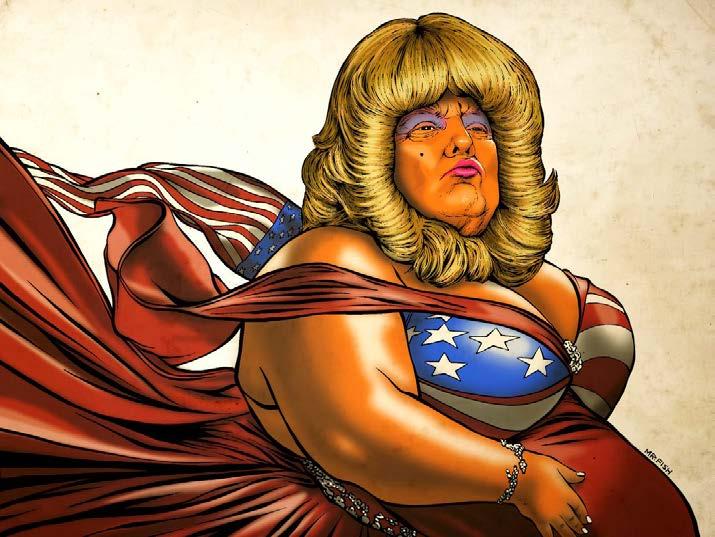
“Trump’s a queen,” Zelina says. “We all know. He wears makeup, bronzer and highlighter. He has a new costume every day.”
“Our founding fathers wore wigs, heels and makeup,” says Paige Monroe, dressed in a champagne sequin gown, a honey-blond wig, rhinestone earrings and redolent in Cap Camarat perfume. “Drag is nothing new. It has been with us since the beginning of time. In ancient Greece and Japan, men played women’s roles.”
Trump’s gaudy ballroom, his smothering of the Oval Office in gold leaf and gold ornaments, his finicky concern about the colour of his drapes, his penchant for old
There was an ‘underwear dance party,’ where in the morning, blurry eyed men told me their underwear swiftly became optional
show tunes, his love of the gay national anthem YMCA by the Village People, his 1950s aesthetic of men in dark suits and black Florsheim shoes and his Mar-a-Lago women, whose surgically enhanced bodies sport huge breasts, puffed up lips and taut death masks, could be transferred to any of the evening drag shows held next door to my hotel at the Ice Palace.
The shows are very loud. They often don’t end until 4 a.m. The hotel staff leave ear plugs on the nightstand. It helps. A little.
During this Fourth of July weekend there was an “underwear dance party,” where in the morning, blurry eyed men told me their underwear swiftly became optional. There was also Alaska Thunderfuck’s “Fourth of July Alien Invasion Party.” Alaska sang selections from her albums Anus and Poundcake. Songs included Your Makeup in Terrible, This is My Hair, and one song, whose refrain, repeated over and over, was I fucking love you.
The frequent sexual liaisons – the Ice Place has a curtained off area for those who want immediate and often anonymous gratification – mirror the promiscuity of the Epstein Class, but with one important difference: Epstein’s girls and women
were trafficked and enslaved. Here, relations are consensual.
Fascism is an inverted form of camp. Its evil side. It is devoid of irony and humour. It takes itself seriously. It uses exaggerated, theatricalised art to turn a leader – like any drag queen – into a larger-thanlife persona. The outward forms are the same. But fascist camp is about instilling obedience. Drag queen camp is rebellious. Drag queen camp seeks to expand human possibilities and identities. Fascist camp crushes identities into narrow, state-approved moulds of good and bad, man and woman, patriot and traitor.
“Trump doesn’t know its camp,” says Bob Levine, who arrived in Cherry Grove in 1955 and has been performing for 70 years under his alter ego, Rose Levine. He was one of the original 17 drag queens who
invaded the Pines. At 93, he is still performing. His next show at Cherry Grove Community House and Theatre is on August 5. It is the oldest continually operating gay summer theatre in the country.
He was here in the 1960s when police sent undercover officers to entrap gay men. Once arrested, the men’s names were published in the papers. Most were fired from their jobs.
“So many lives were destroyed,” Levine says.
As rights are rolled back, as all who do not conform to the Trump administration’s rigid definition of what it means to be a man or woman are attacked, the darkness of the past becomes that of the present.
Thom Hansen, known in drag as
“Panzi,” is dressed as the Statue of Liberty. She wears a long green gown, has a towering white wig with a crown and a small torch. In 1976, Panzi was one of the drag queens who stormed the Pines.
As our boat enters the harbour at the Pines, hundreds of people line the docks. They clap and cheer. Docked boats let out loud blasts. Sirens wail.
A singer in shorts wearing red, white and blue socks on the dock sings The Battle Hymn of the Republic. He changes the lyrics to, My eyes have seen the glory of the coming of the queens. When he closes with The queens are marching on, the crowd erupts in sustained cheers.
Panzi disembarks. She stands on the pink carpet rolled out on the dock. She grips a microphone. Signs in the crowd read: “We will not be
erased.” “We the People Means Everyone.” “Drag sets our imagination free.” “Fuck Fascists.” “Fuck ICE.”
“The invasion was founded because someone here in the Pines did not allow a trans woman to dine in a restaurant,” she says to the crowd. “That’s all history. We all love each other, well, most of you anyway. If you have phones on, if you are recording this, send these recordings to our little trans brothers and sisters in fucking Texas, Wisconsin, Illinois, Minnesota and Washington because they are alone. They need to know we are there with them. I will fight until I die for their freedom and mine.”
The crowd roars in appreciation.
“I love you Panzi,” a man screams.
“I love you too!” Panzi replies. “Are you pretty? Do you have a big dick?”
The drag queens who disembark are announced to the onlookers. There is a group of men dressed as “trad wives.” They have brown and blond wigs and matching beige dresses. There are crosses dangling from their necks. They are holding wicker baskets and are wearing straw sun hats. There is a group of drag queens who call themselves “America’s Sweethearts,” carrying blue pompoms and dressed in blue and white cheerleader outfits. There is a drag queen in a short green skirt with a sash that reads, “Best Ass.” A group of men in shorts wear white hard hats with the words “Trad Repair.” Sophya Medina, Miss Fire Island 2025, wearing her sash and crown, disembarks to sustained applause.
There is a group of men dressed as ‘trad wives.’ They have brown and blond wigs and matching beige dresses. There are crosses hanging from their necks
to do anything. I don’t understand it. I don’t understand why the immigrant community doesn’t rise up. Why don’t the Black and Hispanic communities rise up? Why don’t ethnic communities rise up? Everybody is quiet. The LGBTQ community is quiet. If we all get together
We fought for where we are today. If this movement stops, we won’t have a place to be who we are. We get tired, like ‘Oh my gosh, when is the change going to happen?’”
The melancholy was a constant theme.
“Back in 1984, I was 15 years old,” says Flaggarina Ivanna Diamond, this year’s Cherry Grove Homecoming Queen. “I was on a ninth-grade field trip at Sailors Haven’s Sunken Forest. One of the boys points to Cherry Grove. I didn’t know anything about Cherry Grove. I didn’t even know it existed. At that time I’m this closeted gay, teen boy. And there’s a lot of homophobia at the school. The boy says ‘Watch out, those guys, they’ll grab you.’ I’m praying as hard as I can, ‘Oh please grab me, please grab me, please grab me.’ And after all these years, Cherry Grove did grab me. It grabbed my heart.”
and rise up, it might mean something. But people are terrified. In my day we were rebels. We fought. We burned cars, for God’s sake. We broke windows. But nowadays, I don’t know. They are rolling us back to the 1950s.”
There are many here who have been rejected by their families and communities. For them, gay enclaves such as Cherry Grove are like oxygen.
Fascism is not only a poisonous political movement. It is a poisonous cultural and social movement. It eliminates the space for those who do not submit to the narrow definitions of what it means to be a citizen, a man, a woman or a patriot. It ruthlessly crushes independent lives and identities. It leaves in its wake loneliness and trauma. Fascism begins with the marginalised and demonised, but it does not stop there. It destroys community after community until we are orphans in our own land.
“I keep praying that the administration and the policies will change,” Panzi tells me later. “Everybody is praying for that, but nobody wants
“Why can’t we have a country where it’s just okay to be yourself?” asks Basit Noor, an oral surgeon who moved to New York from Pakistan after repeated death threats. “Why should anyone feel endangered for being themselves if it’s not hurting anyone? We fought for our rights. We fought for our freedoms.
I wanted to be in my country on July Fourth before it disappeared CT
Chris Hedges is an award-winning journalist who was a foreign correspondent for 15 years for the New York Times. He hosts the Chris Hedges Report podcast at www.chrishedges.substack.com
AUTHOR NAME
Headline in here in here chghghg
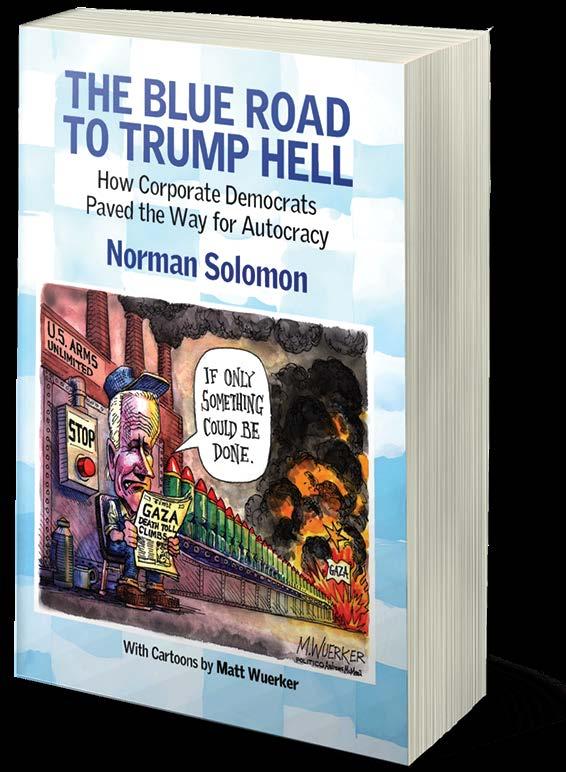
“This book scrutinizes how the behaviour of many Democrats assisted Trump’s electoral triumphs. That scrutiny is important not only for clarity about the past. It also makes possible a focus on ways that such failures can be avoided in the future.”
Subhead
Corporate Democrats
the Way for Autocracy
By NORMAN SOLOMON
cartoons by
Wuerker
➤ FRIDA BERRIGAN
An intimate reckoning with the Weather Underground
Zayd Ayers Dohrn’s book – Dangerous, Dirty, Violent and Young – about his Weatherman parents deals honestly with US political violence in the 1970s
Looking for a quintessentially American book to read this summer? As we celebrate and/or mourn the 250th birthday of the most militarised, most violent, (almost) most corrupt, most polluting, most inequitable and most sad nation on the face of the Earth, I am reading Dangerous, Dirty, Violent and Young: A Fugitive Family in the Revolutionary Underground. Zayd Ayers Dohrn’s new book about his Weatherman parents is more than just a great beach read (which it also is, literally). It is the most appropriate book to read instead of subjecting yourself to a PTSD-triggering fireworks display.
It chronicles a small group of revolutionaries who used dynamite, bombs and guns to blow up buildings, statutes and police cars, break people out of prison and generally make mayhem half a century ago. But it is not just history to view on the page. It says so much to our MAGA moment.
It is a story of history, conscience and memory at a time of AI slop, official lies and active amnesia. It is a story of youthful rebellion against the Vietnam War that matures into revolutionary sabotage, political violence and life “underground” that eventually settles into careers in education and law outside of the mainstream. It is the story of surviving
some of the most harrowing political moments of the last half century. It is a story of a family.
I grew up in a very different corner of the left than Ayers Dohrn. There were no drug-fuelled orgies, shootouts with the cops or days of rage in the Catholic left. But there was a similar stridency, urgency and seriousness about my family life. There was jail and prison and fear of FBI infiltration and dirty tricks. There were people with no last names who showed up for a meal or a night and headed back into the underground. We also survived separation and secrecy, and I am also not raising my children on the knife’s edge of the revolution. So, Ayers Dohrn’s effort to tell his family’s story with truthfulness, curiosity and distance landed so very true for me.
Who were the Weathermen? They’ve been memorialized countless times on screens small and large, most recently (sort of) in One Battle After Another. But in real life, they were mostly white, mostly college educated, mostly middle-class young people who had been part of Students for a Democratic Society, or SDS, before splintering off from that group in the summer of 1969 to join forces with the Black Panthers and incite revolu-
tion, laying waste to what they left behind. They felt like they had tried everything else!
In recounting this episode, Ayers Dohrn was able to use FBI notes and communiques to highlight their role in fomenting the clash between the more progressive and radical factions, manipulating members into all-out conflict with one another and essentially destroying SDS. Ayers Dohrn quotes Weatherman faction leader Mark Rudd reflecting that it was “the single greatest mistake I’ve made in my life … scuttl[ing] America’s largest radical organisation – with chapters on hundreds of campus[es], a powerful national identity and enormous growth potential – for a fantasy of revolutionary urban guerrilla warfare.” What could have been is not explored.
At this point, we’d need speculative fiction to spin out the possibilities of true solidarity between the largely white, campus-based antiwar movement and the Black Panther Party and its affiliates. It sure scared the FBI! In fact, in a memo to agents in the field, FBI Director J. Edgar Hoover wrote that SDS and the Black Panther Party working together would “pose a formidable threat. … It would be a definite advantage if these two groups were alienated.”
This story is told with cinematic depth, gleaned from Ayers Dohrn’s
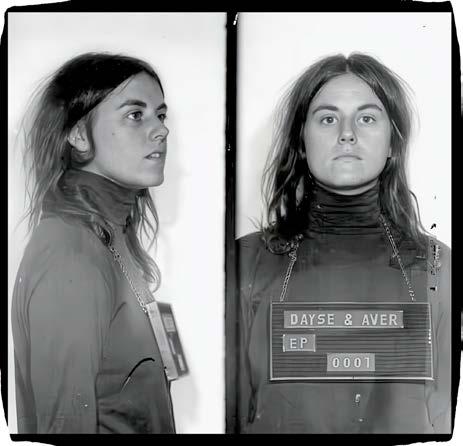
ABOVE: A 1969 mugshot of Bernadine Dohrn from an arrest at a Chicago protest, later circulated by the FBI.
LEFT: Cover of the book, Dangerous, Dirty, Violent & Young
interviews with participants and from declassified FBI files. The new organisation was small, secretive and “fiercely committed to following the leadership of the black vanguard, to fighting the police and to going out, if necessary, in a blaze of revolutionary glory.”
The mostly middle-class, young, white activists had been working on many fronts for years, but their “organising and peaceful protest had failed to stop the war.” They were going to try something new – but actually it wasn’t new. It was old. It
was violence. And, for a time, it was street riots against the police and property damage during protests. But then their friend and Black Panther leader Fred Hampton was assassinated by Chicago police and the FBI in a barrage of 90 bullets. And then the horrors of the My Lai massacre were revealed, and as 1969 became 1970, the Weathermen declared war on the United States.
Ayers Dohrn describes a series of bombings at the homes of judges, banks and police stations, and a complicated plan in New York City’s West Village that would have brought the carnage of Vietnam to a military Officer’s Ball at Fort Dix in New Jersey. The Fort Dix plan was thwarted not by the FBI or a rival faction of revolutionaries, but by chemistry. The bombs went off in the 11th Street townhouse the revo-
lutionaries were using as a temporary safe house (while the parents of one of the Weathermen were on a St. Kitts vacation). Three Weathermen were killed in the blast and the house was obliterated. Bill Ayers’ girlfriend at the time was among the dead and he carried that grief and memory into Ayers Dohrn’s life. As a little kid, Zayd remembers going with his father to lay flowers at the site every year.
Recalling that loss, Ayers Dohrn asks his father how he contemplated killing people with those bombs. Bill Ayers responded that “We often said things like, ‘I need to be a tool of the revolution.’ … Or ‘I need to be an instrument of the rebellion.’ And that instrumentalising of our lives was more than a weakness. It was a horror.”
That realisation and the other reflections Ayers Dohrn is able to elicit from his parents as they think back on their roles as revolutionaries are the backbone of this book. Bill and Bernardine Dohrn are able to reflect, see mistakes and missteps, explain their priorities, and accept responsibility for the harms they inflicted because they survived and so many other people who were part of this splinter movement did not.
It is difficult and brave that Zayd Ayers Dohrn contends with violence and memory without letting anyone – even his mother and father – off the hook. Against the backdrop of an administration and a president that can’t remember, or won’t admit to, crimes of three sentences ago, he holds his father and mother to a high standard. And they can take it. They survived the days of rage and purity tests and self-criticism sessions and the run-ins with the law and stretches of prison and dirty tricks that so many others did not.
His mother, Bernardine Dohrn, is
now living with dementia, as is my own mother, and I found his present-day conversations with her the most poignant and difficult of the book. Memory threads all the way through this book. What do we remember? Why do some memories stick?
Ayers Dohrn began his reckoning with family history in an extraordinary 10-part podcast called Mother Country Radicals, which was Fred Hampton’s term of endearment for the Weathermen. But as he researches his own past and excavates his own memory, there are things that don’t add up, don’t stitch together, memories that don’t bear up to scrutiny. There are contradictions that he can’t square.
Once the podcast was released, he received letters, diaries and phone calls from old fellow travellers. These new resources, along with 7,833 pages of FBI files, convinced him that there was more to the story and he sat down to write. The book is more in-depth, intimate and searching than the podcast. Ayers Dohrn is less star struck by his parents’ bravado too. Now, he is a parent, too, noting decisions that Bill and Bernadine made that put the family in jeopardy, that were hard for him, that caused him pain. He sees and feels the impact of his parents’ choice of the revolution over parenthood. “Over and over, you can see the same pattern, repeated: Asked to choose between solidarity and family, revolution and love, my parents and their comrades chose the cause almost every time.”
Family lore had it that Bill and Bernardine hung up their revolutionary bonafides when they became parents. But the documents Ayers Dohrn received after the podcast aired show that was not true. They continued to take risks even after they became parents of Zayd and his younger brother Malik. One memorable camping trip in
‘Asked to choose between solidarity and family, revolution and love, my parents and their comrades chose the cause almost every time’
West Virginia as a family turns out to be a trip to case Alderson Prison for Women where Black Panther leader Assata Shakur was serving out her sentence. She was eventually liberated from prison in another operation and Bill Ayers played a small – but very risky – role in that while Bernardine was home with Zayd.
Ayers Dohrn confronted his dad by asking: “What would have happened, not only to him but to me, my mother and my unborn brother?” Ayers responded: “It was a difficult decision. It felt monumental, it felt important. We were pretty clear that Bernardine would be with you. … But yeah, it was, in retrospect, really risky. And really on the edge.” But in the end, Bill Ayers played his part, “Because it mattered. Because the world needed it to happen.”
They continued to do legwork for the Black Liberation Army and other radical groups like Action Five even after they informally adopted 14-month-old Chesa Boudin. That should have been a clear warning to stop. Kathy Boudin and David Gilbert, Chesa’s parents, had acted as getaway drivers for an Action Five robbery on a Brinks armoured truck in October 1981. The job quickly went off the rails and three people injured, and three others were killed – Nyack police officers Edward O’Grady and Waverly Brown, and Peter Paige, one of the team from the Brinks truck. Boudin and Gilbert spent decades
in prison for their crimes while the Ayers Dohrn family raised their son.
I described this book to a friend, and she got stuck on the word underground. “Wait,” she demanded, “you mean they lived underground, like moles or Hobbits?” No, they lived under assumed names, worked cash jobs, had fake IDs. They were on the run from the FBI, facing jail time and family separation. They had disappeared from “normal society” and were dependent on friends and fellow travellers for support.
A striking moment in the book comes when Ayers Dohrn recounts that at one of his father’s off-thebooks jobs, as a longshoreman in San Francisco, he gets the sense that something is about to go down. Bill Ayers saw men on the rooftops and by the union hall, standing out in their cheap suits and cop-loafers. But he was already at the docks and there was nowhere to run. The docks are all of a sudden swarmed with police and his co-workers started yelling “La Migra! La Migra!”
“It only took a few minutes; the feds rounded them all up, chasing them to the edge of the water or just tackling them down to the concrete of the parking lot. And they let all the white people go” Ayers Dohrn recounts.
The officials were not looking for Bill Ayers, of the Weathermen. They were rounding up undocumented immigrants. Ayers Dohrn writes that his father had “always assumed, with the self-centred paranoia of a federal fugitive, that he was the only outlaw hiding out on the docks. … But it turned out that half of the men on his crew were invisible, even to him. They were all living on a different plane, off the grid. Undocumented. Underground.”
In his autobiography To Dwell in Peace, my uncle, Father Daniel Berrigan writes that while he was underground, avoiding a prison sentence for the Catonsville 9 action
Mahmood even compared this future to the “panopticon” – a reference to 18th-century philosopher Jeremy Bentham’s perfect prison: a central watchtower (the state) surrounded by a circle of windowed cells where the inmates (the public) would be visible at all times.
Bentham understood that this was not just about physical control. As he observed, the sense of being constantly observed would be a “new mode of obtaining power of mind over mind.” The inmates would police their own behaviour to avoid punishment.
Starmer’s successor, Andy Burnham, is reportedly keen to keep Mahmood a key figure in his govern-
ment. But this isn’t about a single government minister.
Mahmood is the symptom of a deeper malaise, not its cause. The architecture of the new systems of control, as well as the erosion of freedoms and the cultural traditions that supported them, were already well advanced when she was appointed to the Home Office.
Whoever holds the reins of power in the months and years to come will be able to exploit these existing powers to the maximum, and then extend them further.
Once the spirit of authoritari-
anism takes hold, it becomes ever harder to stuff it back into the box. Only concerted mass protest can remind the state where ultimate power resides. And it is precisely this kind of protest that is being demonised and criminalised one step at a time.
If it is possible to identify a single moment when the new authoritarianism moved out of the shadows, it was some 15 years ago. That was the moment the state launched its protracted campaign against Julian Assange to vilify and incarcerate him.
The founder of the whistleblowing platform WikiLeaks had incensed the United States and its loyal Brit-
NOT TERRORISM: Protesters gather outside the Royal Courts of Justice in London on June 15 when the ban on the activist group Palestine Action was ruled lawful by the Court of Appeal.
ish sidekick by publishing details of war crimes in Afghanistan and Iraq both wanted to be kept secret.
It was probably no coincidence that, at the time, Starmer was head of the Crown Prosecution Service and making repeated trips to meet Washington’s most senior law officers. Contrary to protocols, records of these discussions were destroyed by his officials.
We will never know what instructions Starmer was given by the US regarding Assange. But a possible clue survived the further, and highly irregular, destruction by Starmer’s department of related correspondence between UK and Swedish prosecutors from that time.
One of the few surviving emails is revealing. It shows that Sweden was considering dropping an investigation into Assange for lack of evidence, as he was holed up in the Ecuadorian embassy in London fearful of what lay in store.
Starmer’s staff, who were supposed to be neutral arbiters between Sweden and Assange’s legal team, angrily told the Swedes: “Don’t you dare get cold feet!!!”
In another email, the same CPS official told Swedish counterparts: “Please do not think this case is being dealt with as just another extradition.
Later, with the active connivance of the UK and its courts, the US showed its true hand. Washington began extradition proceedings on the preposterous grounds that Assange had committed “espionage” by publishing details of its war crimes.
Assange was caged in a high-security prison in London for years, often unable to meet his lawyers, his health failing, on a trumped-up, nakedly political charge.
This was a terrifying, unprecedented assault on the right of journalists to publish evidence of state wrongdoing in the public interest.
And yet the billionaire-owned media could barely stifle their yawns.
There was a two-fold gain from Assange’s decade-long abuse and the trampling of his legal rights.
First, it established a very visible precedent in which the rule of law was turned on its head. The roles of victim and victimiser were reversed.
Assange, who had published incontrovertible evidence of US and British war crimes, was the one behind bars. British officials who approved and hid those crimes not only evaded justice but were free to hound and smear Assange.
This has been the theme ever
since, as the British state has intensified its curbs on speech and protest, with Israel’s slaughter of Palestinians often serving as the testing ground for authorising this new crackdown.
In the second half of the 2010s, Jeremy Corbyn – Starmer’s predecessor as Labour leader – found himself and his supporters roundly vilified as “antisemites.”
Why? Because they tried to bring attention to Israel’s criminal actions – a forewarning of what was to come, as Israel unleashed what legal experts, Holocaust scholars, human rights groups and United Nations investigators have all concluded is a genocide in Gaza.
In a properly functioning democracy, those who smeared Corbyn and other critics of Israel would have been permanently discredited.
Instead, UK officials – the same officials colluding in Israel’s current crimes by shipping arms to Israel, by carrying out surveillance flights to guide Israel’s bombing campaigns against Gaza’s civilians, and by offering diplomatic cover –simply stepped up the demonisation campaign.
As millions of Britons took to the streets, the Starmer government –and the British state behind it – not only labelled them as antisemites but radically rewrote the statute books to criminalise opposition to Israel’s genocide.
Direct action group Palestine Action, which had been targeting Israeli arms factories operating on UK soil, was proscribed as a “terrorist” group equivalent to al-Qaeda and Islamic State.
Holding placards protesting the genocide, as thousands of respectable British citizens did, became “support for terrorism,” risking a jail term of up to 14 years.
ANDY BURNHAM: Little change expected from new leader
KEITH STARMER: Replaced as UK Prime Minister
Britain continues to actively support Israeli state terrorism.
But it was those ringing the alarm – those trying to stop these shipments, those opposed to British collusion in Israeli state terrorism, or those simply appalled by the undermining of basic rights to protest –who were arrested and charged as terrorists.
Meanwhile, documents show Elbit Systems continues to enjoy unrestricted access to British government officials.
Second, in stigmatising and isolating Assange for publishing details of US and UK war crimes, the British state was able to draw its own fake distinction between “good” and “bad” journalism – a distinction the billionaire-owned media was only too happy to embrace.
Assange, whose independent platform WikiLeaks had held Washington and London’s feet to the fire for committing war crimes, had in the process shamed the establishment media for their unwillingness to do likewise.
He exposed the extent to which corporate journalists, dependent on access to the rich and powerful for stories, conspire in the covert, unaccountable ways power is exercised by the state.
The media are not watchdogs; they are lapdogs, representing the interests of the billionaire class.
The British state – and its security services – made clear they would not tolerate truly independent or critical media that could expose their hypocrisies or bring them to book.
In response, the billionaire-owned media not only hung Assange out to dry. It joined the government in a chorus of claims that independent outlets were either peddling “fake news” or serving as “Kremlin assets” spreading “disinformation“.
The British state – and security services – made clear they would not tolerate independent or critical media that could expose their hypocrisies
It amplified the pressure from politicians on social media platforms, the billionaires’ new plaything, to tighten their algorithms to hide independent journalists, and stymie these dangerous new competitors in the battle for truth.
Similarly, corporate media cheerled the government’s decision to ban Russia Today, the Russian state’s news channel. It quickly became all but impossible for UK audiences to hear Russia’s version of events in the mainstream media, as Britain and European states built the case for permanent confrontation with Moscow.
The European Union imposed an even more draconian ban – upheld this month by the EU’s Court of Justice – that makes it a criminal offence to repeat any information reported by RT, and other banned outlets, even if demonstrably true. The law’s purpose is to supposedly “protect public order and safety.”
In recent weeks, two prominent US commentators, Cenk Uygur and Hasan Piker, have been denied entry to the UK over their criticisms of Israel. Uygur was due to speak at an Oxford University debate.
In this new authoritarian climate, truth is defined as whatever the state wants their citizens to know. Meanwhile, disinformation – “Russian propaganda” or “antisemitism” – is whatever those same states insist their citizenry must not hear.
This is a brazen reversal of 350 years of the western Enlightenment, with its professed belief both in the primacy of reason and that ideas
must be tested through debate and critical scrutiny.
Now it matters not what is being said, but only who is saying it.
And unsurprisingly, the billionaire-owned, western media has endorsed this new regime. After all, its voice – representing the interests of the super-rich – is guaranteed a hearing.
No surprise, then, that this same privileged media corps has continued to meekly accept its exclusion from Gaza by Israel as the biggest crime in modern history unfolds –even now, in the midst of a supposed ceasefire that Israel keeps breaking.
Because what matters is who is allowed to speak: Israel, not Gaza’s Palestinians, whether what Israel says is true or, as invariably turns out to be the case, a lie.
In line with this precept, the billionaire-owned media has barely raised a murmur as Israel has mass-slaughtered Gaza’s journalists in unprecedented numbers – killing more of them than in two world wars, Vietnam, the Yugoslav wars and Afghanistan combined.
The lives of Palestinian journalists – like the reporting they have had to do alone under Israel bombardment – count for nothing in the western media because of who they are.
Genocide – the what – has been erased as a crime because it is we –the West – who are helping to carry it out.
The Committee to Protect Journalists, reportedly facing a political and donor backlash, scrapped last year its annual Global Impunity Index – which measured where journalists are murdered with impunity – after it became clear Israel would top the rankings.
Now the same committee is being accused of caving in to these pressures by raising doubts about who counts as a journalist in Gaza –doubts that will serve to embolden
Israel, which claims that Palestinian journalists, indeed all Palestinians, are terrorists in disguise.
The who has to be rewritten because the what cannot be denied.
The same story is unfolding in the UK, where independent British journalists have been detained at the airport or had their homes raided at dawn by counterterrorism police for “wrong-think” about the Gaza genocide and British complicity in it. They too face up to 14 years in jail.
That has sent a chilling message to other journalists, those that lack the protection of a billionaire patron or the state, about what can be said.
None of this is, or will be, confined to Gaza. The upending of Enlightenment values, as should be clear by now, is part of a much bigger political project to normalise and entrench this creeping authoritarianism.
The proscription of Palestine Action and placard-holding has paved the way for the British state to designate any opponent – challenging its lawbreaking or contesting its right to dictate truth – as a criminal or a supporter of terrorism. A precedent has been set, and now approved by the UK courts, that will be hard to reverse.
The state has many tools at its disposal, some of which it is already wielding, again to no protest from billionaire-owned media “watchdogs.”
A particularly powerful one is “debanking”: forcing individuals or groups who disrupt the narrative of western state moral and legal authority out of the financial system, driving them into a kind of purdah that makes it near-impossible for them to function in the modern, western world.
Notably again, Assange and WikiLeaks were an early victim of the use of debanking as a politi-
cal weapon. Washington imposed sanctions in late 2010, shortly after WikiLeaks exposed US and British war crimes in Afghanistan and Iraq, cutting off almost all of its donor revenue.
Sanctions – what some describe as a “financial death penalty” –have already been imposed on several judges and staff of the International Criminal Court over the issuing of an arrest warrant against Israeli prime minister Benjamin Netanyahu for committing crimes against humanity in Gaza.
UN legal expert Francesca Albanese, at the forefront of highlighting western complicity in Israel’s geno-
cide, has also been debanked.
In Britain, Palestinian and Islamic-run charities have long faced harsh restrictions on their ability to operate financially, usually on the basis of claims that they may be funnelling donations to proscribed groups.
But this has gradually expanded to mainstream Palestine solidarity organisations and to individuals caught up in the ban on Palestine Action.
In an even more disturbing, if predictable, development, Lloyds Bank has now debanked the Canary , a leftwing publication whose criticisms of Labour’s capture by Big Business have long proved a thorn in the party bureaucracy’s side. The Canary can no longer pay staff, and its news operation is in jeopardy.
This is the same Canary that the Labour Together project led by Morgan McSweeney – who propelled Starmer to power on behalf of the billionaire-friendly, pro-genocide Labour right – identified early on as a threat. His mantra was reportedly: “Destroy the Canary or the Canary destroys us.”
As investigative journalist Paul Holden sets out in his book The Fraud, which documents Labour Together’s covert, law-breaking operations, McSweeney almost succeeded in destroying the Canary. He created an astroturf group, Stop Funding Fake News, that lobbied advertisers to boycott the publication.
Labour Together under McSweeney’s successor, Josh Simons, would then launch a smear campaign on Holden and refer him to British security services as a supposed Kremlin asset.
Like a bad penny, Simons has turned up again, this time giving up his Makerfield seat for Andy Burnham to return to Westminster. Simons is now one of Burnham’s political advisers.
This systematic assault on the
Francesca Albanese: debanked over Israel genocide charges
JULIAN ASSANGE: Debanked, then jailed, for whistleblowing
right to scrutinise the British state’s action have been extended to the legal profession too.
Last month, Dan Kovalik, a respected US human rights lawyer and professor, was detained at Liverpool airport by counterterrorism police and questioned over his criticisms of western foreign policy in Gaza and Iran.
Fahad Ansari, a British human rights lawyer, was detained by police last year on return to the UK from a family holiday in Ireland under Schedule 7 of the draconian Terrorism Act of 2000.
Both men had their electronic devices seized, despite protests that this was unlawful and violated their privileged lawyer-client communications.
Ansari’s detention appears to be a blatant act of political retaliation and intimidation. He had made legal representations challenging a Home Office decision in 2021 to expand the proscription of Hamas to its political wing. Hamas has never launched a military operation in Britain.
For the submission, Ansari had assembled a group of experts to argue that the expanded proscription – long desired by Israel – was having a profoundly chilling effect on the work of lawyers, scholars, human rights groups and journalists in documenting and discussing Israeli crimes in Gaza.
Five UN legal experts wrote protesting the abuse of Ansari’s rights as a lawyer, warning that “such measures threaten to criminalise, stigmatize and have chilling effects against lawyers and legal associations carrying out lawful work in national security and counter-terrorism matters.”
That seems to be precisely the point. Harassing lawyers is a feature, not a bug, of Britain’s new authoritarianism.
An even more visible victim of this new assault on the legal profes-
Authoritarian states permit few restraints on their ability to impose their will. Independentminded lawyers and juries are such a brake
sion is the highly respected barrister Rajiv Menon.
He has worked on some of the most important human rights cases of modern times, challenging failures and abuses of power by the state in relation to the murder of black teenager Stephen Lawrence, the deaths of nearly 100 Liverpool football fans at Hillsborough, and the 72 victims of the Grenfell Tower fire.
He is currently facing contempt of court proceedings after making a closing speech in January that persuaded a jury not to convict six Palestine Action defendants of any of the charges brought by the British state against them. In 2024, the six had targeted an Elbit factory.
It is believed to the first time that a lawyer has been prosecuted for contempt of court over a closing speech. Garden Court Chambers, where Menon has practised for three decades, said the proceedings had sent “shock waves through the legal profession.”
It warned of a severe chilling effect on barristers, who might be more reluctant to mount a strong defence, especially in politically charged trials, for fear of reprisals.
All of this should be seen in the context of the government’s equally unprecedented moves to erode the cornerstone legal principle of the right to trial by jury.
Authoritarian states permit no meaningful restraints on their ability to impose their will. Independentminded lawyers and juries are just such a brake.
But perhaps the most sustained assault by the British state has been on the rights to protest and assembly, making it increasingly dangerous to express a view in the public space.
Since some two million people took to the streets to oppose Britain’s illegal invasion of Iraq in 2003, new ways have been sought to restrict the ability of ordinary citizens to raise their voice against the abuse of governmental and state power.
Recent legislation allows police to ban protests because they are “too noisy” or cause “serious unease.” Disruption has been redefined to now include hindrance to any daily activity. Protests can be barred if they have a “cumulative” impact.
These are all inherent features of protest. The mass demonstrations against Britain’s illegal attack on Iraq were noisy, disruptive and repeated – as have been the marches against Britain’s collusion in Israel’s genocide in Gaza.
By judging the legality of protest according to these selective and largely subjective criteria, the state has given the police huge latitude to decide which protests should be criminalised and which allowed. It is hardly surprising then that the police are currently concentrating their efforts on the anti-genocide marches, which highlight British collusion in Israel’s crimes.
Facial recognition technology –pioneered by Israel against Palestinians – is being rolled out too, normalising the Panopticon state so beloved by Mahmood.
Where is all of this leading? The answer is to a new piece of legislation that was hurried through parliament by the home secretary.
The National Security (State Threats) Act gives the state unprecedented powers to proscribe groups,
as it did with Palestine Action, but now without having to claim to have evidence of a terrorist threat.
The home secretary can make such a designation unilaterally, without any parliamentary oversight, simply because he or she claims the group is a “hostile” foreign state actor that poses a threat to national security or public safety.
Mahmood has already done so with the Iranian Revolutionary Guard Corps (IRGC), effectively Iran’s military.
Further, anyone who works with or receives a “material benefit” –defined to include “information” – from a proscribed group can be jailed for up to 14 years. That includes expressing support for the group or sharing information it has provided.
Simply hosting an event where someone expresses support for the group could open one to prosecution, as could posting something on social media that the British state claims is a hostile foreign state “talking point” – whether or not the information is true.
Once again, this is an assault on the most fundamental of Enlightenment values.
In the National Security Act, it matters only who is passing on the information, not what the information is, or whether it is truthful. There is no public interest defence, such as exposure of criminality by the British state or its allies.
There is no exemption for journalists, lawyers, scholars or human rights groups. It will be impossible for them to do the most essential part of their job: digging out information, testing claims from one side against the other’s, and allowing audiences to determine the truth.
Assuming Hamas is declared a hostile foreign actor, as seems all but certain, journalists will be barred from collecting details of Palestinian casualties from Gaza’s
The National Security Act gives the state carte blanche to criminalise anyone who scrutinises or challenges its moral or legal authority
health ministry or speak to doctors there. Why? Because the Hamas government runs the health ministry and hospitals.
Worse, it would be impossible for journalists to visit Gaza to investigate Israeli crimes – something that will delight Israel – because such a visit would need to be organised through the Hamas government. To do so would risk 14 years in jail.
The same will be true for reporting from Iran or Russia, if the home secretary so decides.
The only apparent carve-out will be for journalists who get approval from the British government beforehand.
That should ensure that only the most compliant, access-driven journalists, belonging to state and billionaire-owned media, will be able to engage with “hostile” foreign actors – in ways the British state can be sure will best represent its interests.
Under this new law, the search for truth, and potentially the truth itself, will be criminalised.
The National Security Act systematises all the other developments we noted earlier. It gives the state carte blanche to criminalise anyone who scrutinises or challenges its moral or legal authority.
Who should be in uproar over this monstrous legislative assault on the right to search for truth, to hold the state accountable, to act as a watchdog on the abuse of power?
If the billionaire-owned media did any of the above, news outlets would be leading the pushback. As it is, they are mostly silent – because they do none of these things.
It will be independent journalists, commentators, lawyers and human rights activists who will be picked off one by one, sending a message to everyone else to keep their heads down.
Starved of real information and critical scrutiny of the British state’s actions, the public, so it is hoped, will become more ignorant, more docile, more passive as their rights are steadily stripped away.
As the climate crisis intensifies, as resource wars accelerate, as austerity at home bites deeper, the finger will be pointed not at the real culprits – the super-rich, their media and the captured state – but at earlier victims of the West: those fleeing from the wars we initiated, from an increasingly unstable climate our inflated consumption provoked, and from a paucity of resources following centuries of colonial theft.
While we are encouraged to blame “the immigrants,” or “the Muslims,” or “the left,” or “the Israel haters,” the state is in a race to erect a scaffolding of control to protect itself before we wake up to the deception.
Time is running out on all fronts. The lack of urgency to address these crises is not because the crises don’t exist, but because our passivity has been engineered. The truth is we are already in the Panopticon, and our minds are already deeply fashioned for obedience. CT
Jonathan Cook’s latest books are Israel and the Clash of Civilizations: Iraq, Iran, and the Plan to Remake the Middle East (Pluto Press) and Disappearing Palestine: Israel’s Experiments in Human Despair (Zed Books). His website is www.jonathan-cook.net
Rubio gets ‘bolshie’ about International Criminal Court
US media release is filled with careless distortions and ugly inaccuracies,
not least
in the sovereignty it claims to understand and defend
Why are they so afraid?
The Trump administration, pathologically obsessed about the exaggerated reach of the International Criminal Court, have decided to take to the barricades.
In a July 13 media note released by a spokesperson for the US State Department, something akin to a declaration of war was made against the Hague-based tribunal. Secretary of State Marco Rubio was getting bolshie about it, announcing “a sweeping campaign to dismantle the threat posed by [the court] to US sovereignty.”
The effort promises to “feature a whole-of-government response to systematically disable the ICC’s ability to operate, target American servicemen or officials, or otherwise threaten American sovereignty.”
The late Henry Kissinger, who argued most stridently against the establishment of such a criminal court, would no doubt have approved. He, more than most, would have feared some eventual accounting for his own egregious crimes against international humanitarian law while serving the White House.
The alarmist tone of the announcement is palpable. The ICC was seeking “to become an unaccountable global arbiter – positioning itself above and beyond
the nation state as a supranational enforcement arm of a globalist bureaucracy empowered to prosecute American servicemen and officials at will.” (This has a whiff of familiarity to it, given that the Department of Justice under Trump’s steering hand has been prosecuting, at will, individuals perceived to have wronged him in the past.)
The media release is filled with careless distortions and ugly inaccuracies, not least in the sovereignty it purports to understand and defend.
The ICC, for instance, “claims authority to prosecute and even imprison American servicemen and officials operating on behalf of America’s national interest.” The body claims no explicit power to do so, given that jurisdiction is only exercisable over State Parties.
The United States, in company with such states as Russia, China, India and Israel, have not appended their signatures to the Rome Statute. It follows that no such threat is credible except in instances when the service personnel of such countries conduct war on the territory of a State Party.
For that reason, arrest warrants have been issued against Israel’s Prime Minister Benjamin
Netanyahu, his former Defence Minister Yoav Gallant, and Russian President Vladimir Putin. Even then, enforcing such warrants, as the record shows, remains patchy and vulnerable to the political and legal interpretations offered by member states.
US military personnel have, similarly, caught the eye of the ICC in 2020 for their activities in Afghanistan, though the subsequent investigation also focused on alleged crimes committed by the Taliban and Afghan government it replaced. It took only a year for the ICC to essentially abandon the American aspect of the investigation and focus, instead, on the alleged transgressions of the Taliban and the former Afghan government.
Rubio’s opinion piece in the Wall Street Journal is also cratered with an embarrassing inability to understand the role of a tribunal that has the support, however imperfect, of 125 member states.
He regards the judges as hailing from “random countries”; the court and its allies as determined to seek “near-unlimited reach, empowered to override the courts and constitutions of the US and other sovereign states – and to prosecute and arrest our citizens.”
Failing to mention the shift in focus of the 2020 investigation into al-
leged infractions against international law in Afghanistan, he took grave exception to the remarks of the chief prosecutor, Fatou Bensouda, that American authorities had been tardy in conducting their own prosecutions.
“In effect,” snorts Rubio, “Ms Bensouda was anointing herself the final judge of US military policy and the entire US justice system.” Hardly.
Asomewhat hysterical note is struck in Rubio’s assessment of the court’s supporters. Like a sinister fifth column of operatives, the tribunal “is backed and run by a powerful network of leftist non-government organizations, smug globalists, and hostile Third World governments
united by their enmity towards the US.”
For the most part, the Secretary tries to make good the image of the American republic as a bullying, thuggish nation state indifferent to the strictures of law. He cannot understand the fuss made about the extrajudicial murders of alleged “narcoterrorists” in Latin America and the Caribbean, the shoddy practices of the administration in deporting “violent criminals to El Salvador,” or that organisations might
A shift in EU immigration strategy shows that some European leaders don’t want to just flatter Trump; they want to imitate him as well
wish that “apparent war crimes” committed against Iran by the US might be investigated.
“Independence is our birthright,” he pompously asserts. “We don’t intend to trade it for rule by a self-appointed priesthood of ‘international law.’”
It was therefore incumbent that Washington work along with allies to “dismantle the ICC – brick by brick, if necessary.”
This dismantling effort seems hyperbolic. The Trump administration has already sought to blunt the court’s functions and hound its officials. Even before Rubio’s announcement, the administration has been aggressively seeking to stem the reach of the court and the effectiveness of its officials.
On February 6, 2025, for instance, President Donald Trump issued Ex-
ecutive Order 14203, allowing the sanctioning of any person or organisation engaged in any efforts of the ICC “to investigate, arrest, detain, or prosecute a protected person without consent of that person’s country of nationality.”
Protected persons include, among others, current and former members of the US Armed Forces; current or former elected or appointed officials of US government; and any other person currently or formerly employed or working on behalf of the US government. The personnel of US allies also fall within the definition.
The sanctions listed in the order included the blocking of property and assets within the United States “as well as the suspension of entry into the United States of ICC officials, employees, and agents, as well as their immediate family members, as their entry into our Nation would be detrimental to the interests of the United States.”
ICC Prosecutor Karim Khan was the first to be designated as a sanctioned individual, though the list would swell to include members of the judiciary, including Second VicePresident Reine Alapini-Gansou from Benin, Uganda’s Solomy Balungi Bossa, Peru’s Luz del Carmen Ibáñez Carranza and Slovenia’s Beti Hohler.
The Open Society Justice Initiative accurately notes the effect of such sanctions, being “tantamount to a financial death penalty.” These entail the freezing of US assets in bank accounts, a denial of access to credit cards, relevant online plat-
forms, banking services and health insurance, and the inability to attend speaking engagements in the US.
Three of the sitting judges –Bossa, Alapini-Gansou and Canada’s Kimberly Prost are seeking declaratory and injunctive relieve against Executive Order 14203 in the US District Court for the Southern District of New York.
The State Department media note suggests more of the same, flavoured with a villainous menace. The entire US government diplomatic corps is to become a public relations arm “highlighting the abuses of the ICC and the risks posed to Americans” and urging member states to withdraw from the Rome Statute.
Nations with partnering arrangements with American law enforcement and the military, and those enjoying “the benefits of the US security umbrella” will also be pressed “to reject the ICC’s purported authority to prosecute American officials and servicemen.”
States refusing to reject the au-
thority of the ICC while still relying on American assistance would be subjected to greater scrutiny, while countries not a party to the Rome Statute would be encouraged to “leverage their diplomatic networks to take similar actions alongside us.”
ICC personnel would be subjected to continued visa revocations and travel bans, while the tribunal and “affiliated organizations” will be subjected to further sanctions. It will be a time for war criminals and offenders of international law to rejoice.
All institutions, supposedly underpinned by protocols and principles, are at the mercy of Trump’s broad reading of executive power, one fickle and petulant. His office has also become a source of obscene self-enrichment, inuring this administration to giddying levels of corruption.
“I’ve made money, I’ve made a tremendous amount of money, more than I would have ever thought I would have made,” he boasts.
For a person who relishes breaching laws and flouting regulations, it is little wonder he, along with his insufferable cronies, have such an animus against a world court that, for all its faults and blemishes, remains a worthy project in international law and human rights. CT
Binoy Kampmark was a Commonwealth Scholar at Selwyn College, Cambridge. He lectures at RMIT University in Australia Email: bkampmark@gmail.com
➤ MARK WALLER
Who’s inciting attacks on foreigners in South Africa?
Critics accuse Israel of stoking up xenophobic violence as payback for Pretoria’s involvement in ICJ accusations of Israeli genocide in Palestine
Thousands of foreign nationals from several southern African countries continue to head to repatriation centres, fleeing South Africa in the wake of rolling protests staged by antiimmigrant groups. The protests started on 30 June, the date announced by the main nativist organisation, March and March, as the deadline for undocumented foreign-
ers to leave the country.
Most of the protests have been peaceful, but as they become weekly events at the behest of March and March, violence has increased, with protestors turning to vigilantism, invading homes and small businesses, demanding to see residence and other permits, chasing people away and setting fire to properties.
Several people have been killed, including a South African man at-
tacked because he spoke Tsonga –a South African language also spoken in Zimbabwe and Mozambique.
As intended, fear and intimidation among migrant communities have spread well beyond the sites of the March and March protests.
Initially, people from Malawi, Mozambique and Zimbabwe gathered in their thousands on the streets or in parking lots outside embassies, stuck for days without food, water
IN TEARS: A young boy cries as his father, accused by March and March supporters of being an undocumented immigrant in South Africa, is escorted to a police van
or other basics, waiting for transport to their countries or to repatriation centres. Families, single mothers with babies, elderly couples, school-age kids, all hauling meagre hastily-packed bags. Crisis NGOs stepped in to hand out essentials.
The government then opened a vast repatriation centre in Musina, close to the Zimbabwean border crossing in northern Limpopo. It shelters large numbers of people waiting for processing by units of freshly recruited Department of Home Affairs staff.
By late July, around 160,000 foreign nationals had been repatriated, either voluntarily or following their detention as illegal immigrants. Of these, around 108,000 were returned to Zimbabwe, 47,000 to Malawi and 2,000 to Mozambique.
Meanwhile, Nigeria and Ghana arranged flights for 1,490 and 920 of their citizens, respectively. The numbers will grow in the coming weeks and months as March and March and others step up their campaign.
While the anti-migrant protests and the torrents of overheated social media are real enough, many in the media, civil society and the left have questioned what is really behind this new wave of xenophobia. “March and March claims to be non-violent, to uphold human rights, and to be fighting only for the law to be enforced. But the movement has delivered nothing but suffering for South Africans and immigrants,”
wrote the online news site GroundUp in a recent editorial.
March on March, led by the awardbedecked radio presenter and populist social media influencer Jacinta Ngobese-Zuma (no relation to the former president), was launched in March this year.
It describes itself as “a citizen movement advocating for stronger immigration enforcement and protecting opportunities for South African citizens.” The organisation’s website and publicity state that the target is to end the presence in South Africa of undocumented foreigners.
But Ngobese-Zuma and others in March and March and its affiliates frequently broaden this to include foreigners in general – and not just any foreigners, but specifically poor
THE LEADER: Jacinta Ngobese-Zuma (centre with glasses), founder of March and March, during the protest in Pretoria
people from other African countries.
Ngobese-Zuma’s Instagram and other social media posts often refer to crimes allegedly carried out by foreigners, but ignore the systemic problems of South Africa’s crisisridden immigration and documentation system. In one reel, she films her thumbs-up and okay gestures to a video by the far-right misogynist influencer Andrew Tate. In it, Tate rants that unfettered immigration is a deliberate government conspiracy to bring in ‘brokies’ from abroad to inflate the existing ‘brokie bubble,’ creating ‘super brokies’ so that the rich will get richer from society’s overall impoverishment.
In another post, referencing the plight of nationals from Lesotho who are now prevented from com-
ing to work in South Africa, Ngobese-Zuma complains that South Africa is “carrying the burden of so many countries.”
According to Ngobese-Zuma and her supporters, the cost of hosting migrants is destroying South Africans’ access to jobs, public health services and primary and secondary education. It is also responsible for the high rate of violent crime.
Other groups involved in stoking
In 2020, Action SA leader Herman Mashaba alleged there were then more than 15 million illegal immigrants in the country
the recent xenophobic protests have taken this same line. One such group is Operation Dudula, which incites mob vigilantism against African migrants and targets their presence in schools, health centres, and microbusinesses.
Others, such as South Africans for Constitutional Reform (SACR), lobby for a re-introduction of the death penalty and for the rights contained in the Constitution to be designated for South African citizens only.
The SACR also argues that the preamble to the Constitution must be changed. The preamble quotes the 1955 Freedom Charter, adopted during the anti-apartheid struggle, which states “South Africa belongs to all who live in it.”
This, says the SACR, unfairly entitles non-South Africans to the whole bag of constitutional rights. These groups are also backed by a cluster of right-wing political parties, including Action SA, the Patriotic Alliance, the Inkatha Freedom Party and former president Jacob Zuma’s Umkhonto weSizwe Party. The vigilante group Operation Dudula is now also registered as a political party.
The claim common to all of them is that South Africa’s problems stem from the vast numbers of people from other African countries pouring into South Africa, and that this is why jobs, services and crime levels are in the dire state they are.
In 2020, Action SA leader Herman Mashaba alleged that there were then more than 15 million illegal immigrants in the country. The number went viral, despite being debunked several times by Africa Check and others. In 2021, another viral claim alleged that there were 26 million migrants in the country, 43 percent of the population.
In July this year, Mashaba revised
KEEP OUT: A police officer blocks vigilantes from entering a home in Alexandra township to check for what they claimed were undocumented immigrants
his numbers and claimed, citing the statistics office Stats SA, that there were 3,1 million undocumented foreigners in the country. This has now become the go-to figure used by nativist groups. However, as an official statistic, it refers to all people without proof of legal identity, which includes vast numbers of South Africans.
The last census, conducted in 2022, estimated that there were about 2,4 million migrants in the country, about 3.9 percent of the population, which is slightly above the global average of 3.7 percent estimated by the United Nations.
Stats SA reckons that there are 8 million officially unemployed people in the country as well as 4 million people euphemistically categorised as ‘underutilised,’ which means the same thing. The nativist claim that immigration causes unemployment therefore doesn’t stack up.
There is also no evidence that the country’s high crime rate is driven by foreigners but plenty to suggest that anti-immigrant groups spread fake news. Africa Check recently reported that Gayton McKenzie, the leader of the Patriotic Alliance, lied when he shared a picture of a heavily armed man in a war zone in Somalia. McKenzie, the government arts, sports and culture minister, had said the man was threatening South Africans in Soweto.
The weak spot in the government’s handling of immigration lies in its failure to enforce basic immigration laws by tackling corruption at borders and in the Department of Home Affairs. March and March and others have put Cyril Ramaphosa’s centre-right coalition on the defensive, forcing it to scramble to clean up border management and repatriate nonSouth Africans forced from their homes by vigilante intimidation.
This has given credence to Ngobese-Zuma and other demonstrators’ louder, clearly dubious claims. Ramaphosa has tried to stress that people from other parts of Africa are not to blame and that the spirit of ubuntu (mutuality) thrives, but he’s been largely drowned out by the noise from the new far right that March and March and its allies represent.
There is plenty of opposition to the narrative by progressive organisations who detect dubious intent in the current wave of protests.
As the Daily Maverick reported of the 30 June protest, “civil society groups and individual citizens responded by generating a social media storm to disrupt xenophobic narratives.”
The justice minister suggested that South Africa’s involvement in the ICJ case accusing Israel of genocide may be behind the disruptions
One of the groups is Counter X, created following a hackathon on 27 June. It uses coordinated, community-driven content amplification to tackle online xenophobia in an effort, it says, to resist the “organised campaign of fear — and a lot of it isn’t even real people. It’s bots, built to make hate look bigger than it is.”
Many detect outside interests at play in the targeting of migrants, including increasing discrimination against minority indigenous communities. In early July, justice minister Mmamoloko Kubayi suggested that South Africa’s involvement in the International Court of Justice case accusing Israel of genocide against Palestinians may be behind March and March’s disruptions. While there are no tangible smoking guns to show, there are hints that there might be.
In January, the Times of Israel published a blog by the prominent zionist writer Grant Arthur Gochin titled “Africa must fragment, South
STOP THE ATTACKS: A picket against anti-immigrant sentiment at St George’s Cathedral in Cape Town in May 2026
Matthew Hirsch / GroundUp
➤ NICK TURSE
The Trump administration’s snuff-film fixation
Twenty years ago, US military officials condemned terrorist ‘snuff’ films. Now its leaaders post them
Half a decade later and I still remember his voice. A young man lies on the ground, begging, pleading, screaming as another man, swinging a machete, forces him to place his right arm on a small wooden bench. The attacker wants to make things easier on himself.
But it was never going to be easy. The assailant begins hacking away. Swinging the panga again and again and again, taunting his victim as he delivers the blows. It unfolds slowly. You learn that even for a strong man with a large, sharp blade, it’s difficult to amputate an arm. Excruciatingly difficult.
It’s got to be the longest one minute and 18 seconds ever. After the final swing, you see the victim kicking his legs back and forth – in a way I’ve never seen another human move – writhing in agony on the ground.
For a while, my sources in conflict zones, and others who knew I investigated atrocities, would regularly send me such gruesome videos. There was the man lying in a street in the Democratic Republic of Congo as an assailant with a machete attempts to cut off his leg below the
knee; I can still remember the exact sound of his cries. There’s the video of the captured Kurdish fighters. I recall how the second woman to be killed – just before she’s shot, point blank, in the head – watches the execution of her comrade. She doesn’t plead or cry or even flinch.
I would dutifully watch the videos, analyse them, and then pitch an article if I could make something of the footage. “You are going to die,” said a Cameroonian soldier, speaking to a group of women he referred to as “BH” – shorthand for the terrorist group, Boko Haram. In that video, which I reported on for The Intercept back in 2018, soldiers force their victims to kneel, including a woman with a toddler strapped to her back. One of those men directs the tiny girl to stand next to her mother. He then pulls the little girl’s shirt over her head, blindfolding her. You can guess what follows.
Videos of war zone violence, from Myanmar to Ukraine to the Middle East, have proliferated even more in the years since. Drones chasing panicked soldiers, or even toying with
their quarry, before killing them, have grown into a popular modern motif. And graphic video of ambushes, executions, and traditional trophy “photos” are a commonplace. This type of footage, which used to lurk at LiveLeak and deeper recesses of the internet, is now more ubiquitous, circulating in more accessible online locales like Reddit.
Watching footage of such slaughter comes with a price. In 2015, Eyewitness Media Hub conducted a survey of people who often work with graphic “user-generated content.” Even back then, more than half of the 209 respondents reported that they viewed distressing media several times weekly. Twelve percent of the responding journalists and almost a quarter of the human rights and humanitarian workers said they viewed such traumatic content daily. Forty percent of respondents said that viewing such distressing images and video had a negative impact on their personal lives, leav-
“I LOVE THE SMELL OF DEPORTATIONS IN THE MORNING…” – Screenshot of President Donald Trump’s Apocalypse Now post on Truth Social on September 6, 2025
ing them with feelings of isolation, flashbacks, nightmares, and other stress-related symptoms. One quarter reported high or even very high “professional adverse effects.” More recently, a 2023 study of 300 Pakistani journalists found more than 66 percent reported experiencing indirect trauma.
“Intrusive recollections – re-seeing traumatic images one has been working with – are not unusual,” wrote Gavin Rees at the Dart Center for Journalism and Trauma, where I was once a fellow. “Our brains are designed to form vivid pictures of disturbing things, so you may experience images popping back into consciousness at unexpected moments.”
Strange as it may sound, some gruesome videos have had more staying power than horrors I saw in person.
I’ve certainly found this to be true. As a conflict and crisis reporter, I saw some disturbing things in the
field which lodged in my brain. But strange as it may sound, some gruesome videos have had more staying power than horrors I saw in person. It’s a phenomenon that I’ve also encountered among other journalists, soldiers, veterans, and witnesses of war violence.
I once knew a man who saw something incredibly traumatic – an almost unthinkable atrocity – which his mind blocked out almost entirely. He watched a movie where nearly the same type of murder-spectacle played out and was horrified. He told me that after watching the film, he couldn’t believe someone would do such a thing – and yet, he had seen exactly that same horror show.
In recent months, my laptop has been filling up with a different type of snuff film. The footage is very similar to those Cameroonian clips: defenceless people being slaughtered as the murderers film. In these cases, however, the videos are shared not by some low-ranking murder-
er or accomplice-in-arms. The first of them was posted on social media by the commander-in-chief of the US armed forces, President Donald Trump. Several later videos were posted online by self-styled Secretary of War Pete Hegseth. The most recent clips have been shared by a military command headed by a fourstar Marine Corps general, Southern Command chief Gen. Francis L. Donovan.
Under Operation Southern Spear, the US military has conducted more than 60 attacks on so-called drug boats in the Caribbean and Eastern Pacific Ocean, killing more than 200 civilians, since September 2025.
Experts in the laws of war, as well as members of Congress from both parties, say the strikes are illegal, extrajudicial killings. These summary executions are a deviation from the standard practice in the long-running US war on drugs, in which law enforcement agencies generally detained suspected drug smugglers and brought them to trial. After each of these double or triple or mass murders, Trump, Hegseth, or SOUTHCOM have posted a video of those civilians being executed from above.
Snuff films have become a signature of the second Trump administration. Just eight days after Trump took office for a second time, Sebastian Gorka, the senior counterterrorism director on the National Security Council, said he presented Trump with a target in Somalia. “Kill him!’” Trump replied, and the man was slain in an airstrike. “He declassified the video because the president wanted to post it. So he posts the video of the hammers of hell being dropped on this ISIS leader,” Gorka recalled with a laugh. “President puts it on Truth Social. … He got 120 million
likes in like 18 hours. And at the bottom of that post, he wrote, ‘We will find you and we will kill you.’ Which we have made into the motto of our directorate.”
This cavalier attitude toward turning murder into online content stands in stark contrast to past US military responses to videos of killings released by foes. Twenty years ago, US military officials condemned terrorist “snuff films” – snipers filming their kills – in Iraq. And when it came to a video of two dead American troops shared online, the USled Multinational Division Baghdad “condemn[ed] the release of the video in the strongest of terms.” The command added: “It demonstrates the barbaric and brutal nature of the terrorists and their complete disregard for human life.”
Adecade later, as the Islamic State group released shocking execution videos, one of Hegseth’s predecessors – Chuck Hagel – expressed revulsion at the group’s spectacle of slaughter. “I think regardless of your background, your experience, just as a human being with having some sense of decency and respect for human life and other people, it makes you sick to your stomach,” he said of the group’s videos of the killing of defenceless civilians. “But it again reminds of the kind of brutality and the barbarism that is afoot in some of these areas of the world.”
But Gorka – back then the national security editor of Breitbart News – had a different takeaway. He also mentioned ISIS’s brutality but seemingly with more than a hint of admiration. “Every American, everybody who stands for the values of this republic needs to watch these videos because then you understand the nature of the threat of the brutality of the people we’re facing,” he said of ISIS’s snuff films in 2014. “It’s
When the Iran war began, military officials began spoon-feeding Trump so-called highlight reels of strikes on targets
very, very slick. Think about one thing – just two weeks ago, Ayman al-Zawahiri, the head of al Qaeda, issued a 55-minute lecture in Arabic. … That’s not going to bring you recruits. That’s not going to further your cause as a jihadist. These people do instant little messages. They do these short videos. They have a very, very professional audio/visual social media crew.”
Whether or not Gorka has been the driving force behind the snuff film fixation, the Trump administration seems to be larded up with MAGA minions channelling their inner ISIS. When the Iran war began, military officials began spoon-feeding Trump so-called highlight reels of strikes on targets, according to reporting by NBC: “The daily montage typically runs for about two minutes, sometimes longer, the officials said. One described each daily video as a series of clips of ‘stuff blowing up.’”
The White House has then taken such footage and spliced in clips from action films, TV shows, and video games to create online content. In one, the White House combined clips from Nintendo’s Wii Sports with videos of attacks on Iran. Another – captioned “STRIKE” – featured a former professional bowler, anthropomorphic AI bowling pins labelled “Iranian regime officials,” a fake fighter jet, and real airstrike footage. Videos of airstrikes were also combined with short clips – Gladiator, Braveheart, John Wick, Superman, Better Call Saul, Dragon Ball Z – to create JUS-
TICE THE AMERICAN WAY, a video posted by the White House and eagerly shared online by top administration officials. It ends with a voiceover saying “flawless victory” – an audio clip from the video game Mortal Kombat.
“Hey White House, please remove the Tropic Thunder clip. We never gave you permission and have no interest in being a part of your propaganda machine. War is not a movie,” Ben Stiller, who directed and starred in the movie Tropic Thunder, featured in the aforementioned Justice video, wrote on social media. Three months later, the White House’s murderous mash-up remains on X.
The White House employs a media strategy that melds influence operations with influencer culture, muddying the news cycle, laundering lies, and countering critical coverage by flooding the zone with shoddy propaganda, TikTok-style memes, rancid AI slop, and music videos. “We’re here. We’re in your face. It’s irreverent. It’s unapologetic,” Kaelan Dorr, a deputy assistant to the president who runs the digital media team, told the Washington Post last year, after countering criticism of its brutal antiimmigrant policies with social media that turned federal viciousness into a joke. The Trump administration’s viral war porn provides another layer of calloused cruelty obscuring the human costs of America’s global killing spree.
In a 2002 New Yorker essay on images of the suffering wrought by war or torture, Susan Sontag reflected on photographs of black victims of lynchings from the 1890s to the 1930s. “The lynching pictures tell us about human wickedness. About inhumanity. They force us to think about the extent of the evil unleashed specifically by racism. In-
trinsic to the perpetration of this evil is the shamelessness of photographing it,” she wrote. “The pictures were taken as souvenirs and made, some of them, into postcards; more than a few show grinning spectators, good churchgoing citizens, as most of them had to be, posing for a camera with the backdrop of a naked, charred, mutilated body hanging from a tree.”
The Trump administration’s snuff films are no less dehumanising or shameless – even if the victims are censored in the footage –and the cheering replies on social media celebrating the boat strikes and murder memes are the modernday equivalent of those churchgoers’ grins.
But unlike the singular images of horrific violence meted out on black victims across the US, we are – 100 years later – drowning in endless videos of boat strikes and drone attacks and impacting missiles and bombs dropped on apartment buildings. The voyeuristic nature of the content dehumanises the victims and debases us all.
Trump, Hegseth, Gorka, and Donovan might be immune to any shame, regret, or guilt. Serial killers – people who murder a series of
victims over a period of time – often lack empathy or remorse. But the entire kill chain involved in strikes and the propaganda apparatus that transforms footage of murders into social media content is filled with thousands of people – military personnel, members of the intelligence community, White House workers, and others – for whom these videos might not be so easy to dismiss and forget.
Most of the Trump administration’s boat strike footage plays like the movies of his childhood, flickering black-and-white footage, and the movies of his parents’ youth, silent films. You don’t hear the explosion of a missile’s impact or the cries of the wounded and dying. In that respect, it’s different than a homemade
video of a young man having his arm hacked off with a machete. Those sounds, those cries got stuck in my head – more so than even the visual horror. The Americans who make the snuff films possible might be spared this. But in the end, that might actually be worse.
A veteran once told me of a murder he replayed again and again in his head for the rest of his life. Like the boat strike footage, he said there was no sound. That’s what he said was so terrifying. This veteran always saw the victim, mouth agape, screaming in agony. But he could never conjure a soundtrack. It was awful. Unnerving. Maddening. Agonising. It caused his head to ache, his chest to tighten, and his guts to twist into knots. This horrific hush was deafening. He told me that, decades and decades later, it was –above all – this “silent scream” that tortured him. CT
Nick Turse is the author of Next Time They’ll Come to Count the Dead: War and Survival in South Sudan and the new managing editor of Tomdispatch, now online at The Intercept – www. theintercept.org – contact him at nick.turse@theintercept.com
➤ NORMAN SOLOMON
A chat with Karl Marx about Donald Trump
How the left’s obsession with the rambling and contradictory illusions of one man has resulted in forgetting the inherent cruelty of capitalism
Corporate media outlets love to fixate on individuals and their personalities instead of exposing how the anti-democratic power of the rich exerts huge leverage over politics. So, Donald Trump’s rambling and contradictory delusions have been perfect for distracting from the inherent cruelty of capitalism.
Meanwhile, the left has struggled to come to terms with the colossal importance of this individual, even though in theory the interplay of social forces determines history rather than just one guy. How can we think through this contradiction? Dialectics, of course. So, I consulted with Karl.
Norman Solomon: You’ve downplayed the importance of the individual in history. But the United States now has as president an individual who transformed power relations and the political landscape.
Karl Marx: I can assure you that he did not do that by himself. Power relations are class relations. And by the way, I never said individuals are irrelevant to history. I exhorted individuals to get involved in changing history.
NS: President Trump has rolled back gains from the last hundred years and more. Also, he’s mentally unsta-
ble, to put it mildly.
KM: The basics still hold. As I wrote in 1869 about a situation in France where a cult existed around a tyrant, the class struggle “created circumstances and relationships that made it possible for a grotesque mediocrity to play a hero’s part.”
NS: But now one highly dangerous and unhinged person has taken control of the US government. And he got there with a majority of votes of the working class. It’s been a huge shock to have a virtual psychopath as president.
KM: Those you would call liberals like to disconnect such poisoned flowers from their historic roots. Victor Hugo was like that, as with so many commentators in your day, endlessly heaping their derision on the despicable despot. Hugo excelled at bitter and witty invective against Louis-Napoléon Bonaparte after the coup d’etat. As I pointed out, “The event itself appears in his work like a bolt from the blue. He sees in it only the violent act of a single individual. He does not notice that he makes this individual great instead of little by ascribing to him a personal power of initiative unparalleled in world history.”
NS: Actually, Trump does seem to insanely wield destructive power in ways unparalleled in world history.
KM: But he did not obtain that power through his own will. If you fixate on an individual personality, you’ve lost the historical plot.
NS: One sociologist, Dylan Riley, recently commented: “From a Marxist perspective, much of the left-liberal critique of contemporary American politics can be viewed as essentially petty bourgeois. It revolves around moral arguments advocating for equal opportunities and less social division and conflict.” And he added: “I think that Marx’s central point on this is to emphasize the importance of class struggle as the mechanism through which any class compromise is actually imposed. And if you miss that point then your politics are disabled from the getgo.”
KM: First, I’m glad to say that I am not a “Marxist,” given how much idiotic rubbish has been babbled by some who so label themselves. You can look it up, “Ce qu’il y a de certain, c’est que moi, je ne suis pas Marxiste.” But that aside – yes, certainly, there is just no way to reasonably talk oneself around the primacy of class struggle. The phrase might sound overly polemical to petty-bourgeois ears in the America of the 21st century, but that’s the most powerful engine driving history. You can deny or evade it, but you can’t really avoid it.
NS: Trump is a voraciously narcissistic capitalist, but he’s also flagrantly racist and misogynist.
KM: Of course, capitalism functions to oppress and divide the working class. Systems of racism mean more profits for the few. Likewise, women are exploited and underpaid for their labor. I wrote about this extensively.
NS: The horrible fact remains that we are now oppressed by an extremely reactionary vicious president aspir ing to become an unlim ited tyrant. And he har bours special hatred for women and people of colour, with horrendous social impacts.
KM: Class struggle failed to result in the needed remedies to appalling human conditions, with some special victimizations within the working class. On this point, we could leave the last words to my comrade Friedrich Engels, who wrote in 1890: “The ultimately determining element in history is the production and reproduction of real life. Other than this neither Marx nor I have ever asserted. Hence if somebody twists this into saying that the economic element is the only determining one, he transforms that proposition into a meaningless, abstract, senseless phrase. The economic situation is the basis, but the various elements of the superstructure – political forms of the class struggle and its results, to wit: constitutions established by the victorious class after a successful battle, etc., juridical forms, and even the re-
flexes of all these actual struggles in the brains of the participants, political, juristic, philosophical theories, religious views and their further development into systems of dogmas – also exercise their influence upon the course of the historical struggles and in many cases preponderate in determining their form.”
NS: So, you and Engels agreed that many different forces shape history, yet one individual can conceivably make all the difference at certain junctures?
KM: Fred clarified his point further this way: “We make our history ourselves, but, in the first place, under very definite assumptions and conditions. Among these the economic ones are ultimately decisive. But the political ones, etc., and indeed even the traditions which haunt human
minds also play a part, although not the decisive one.” And he went on: “There are innumerable intersecting forces, an infinite series of parallelograms of forces which give rise to one resultant – the historical event.”
NS: Well, right now the historical event that keeps happening often seems to be dominated one way or another by Donald Trump.
KM: Even if it seems that way, the main propellant of a current event can often look obvious while unfolding as optical illusion. As I noted back in 1843, “The demand to give up the illusions about its condition is the demand to give up a condition that needs illusions.” Never forget that a few live in obscene luxury while billions live in immiseration and billions of others are barely able to scrape together the essentials of life. The struggle between classes might seem an antiquated concept, but nonetheless it is the main factor that undergirds history, past, present and future.
NS: Some people complain that’s what you always say.
KM: That’s because it’s always true. CT
Norman Solomon is the national director of RootsAction and executive director of the Institute for Public Accuracy. His new book, The Blue Road to Trump Hell: How Corporate Democrats Paved the Way for Autocracy, is free in e-book formats – See Page 25
➤ DWAYNE BOOTH (MR FISH)
‘We don’t make jokes here’
How the changing focus of satire might be affecting our collective participation in democracy and activism
“A person reveals his character by nothing so clearly as the joke he resents.” – Georg Christoph Lichtenberg
Most ideologies turn to shit when material ised and shoehorned into everyday use.
Equality is fine until you’re asked to share your sand wich, wardrobe, person al time, or bank ac count.
White suprem acy can be a thrill I’m sure until your bigotry is worn away by sufficient exposure to the language and cus toms of BIPOC populations, which is when you suddenly find yourself able to decipher what was incomprehensible before and is now as rich and beautiful and human as your newly liberated heartbeat.
Wokeism is charitable until your fear of unintentionally offending those prone to wilfully misreading the context and intent of your words contribute to a degradation of lan guage itself.
But that’s not what this is about. It’s about jokes and how the chang ing focus of satire might be affecting our collective participation in Amer ican democracy and activism these days.
Let’s start here. For some un known reason my crotch has been lighting up at the security check points at airports for the last three
years. Not once, not twice, but every time, totalling, until my most recent flight to Seattle when the body scanner finally decided to respectfully see right through me, eight times.
The first time was
the humourless TSA agent in dish gloves who was pointing his accusatory finger at the flaming square on the stick-em-up silhouette on his monitor, “Does it matter if it’s only sometimes used as a weapon?”
Staring back at me and saying through a moustache that looked as if it had been cloned from his eyebrows making him appear capable of being three times as disinterested, then belittling, then enraged as the average person, “We don’t make jokes here.”
Assuming incorrectly that this would be a once in a lifetime experience, or at least something I’d have to endure with the infrequency of a root canal, I shut my mouth and succumbed to my groping with all the stoicism of a mouldering kiwi set before a sexless molester of bruised fruit, the whole time silently arguing with the logic of the scolding I’d just re-
After all, as a demographic not known for its sense of humour, wasn’t it obvious that a radicalised religious martyr hellbent on sharing his or her suicide with as many people as possible would be the least likely to make a joke at an airport security checkpoint?
Had I been the type to rig my testicles to explode as a
demonstration of my religious devotion to God’s eternal love – as if having my vas deferens suddenly explode across the glasses and forehead of a nearby agnostic leaning in to take his first bite of a delicious sandwich would be just the thing to get him to dedicate his life to the divine path – I probably wouldn’t have said to the TSA agent at LAX when my privates once again sounded the alarm, “Since when did they start recalibrating these machines for size?”
The thing about hate-fuelled creeds and death cults is that they’re not very imaginative, the single most important feature of fanaticism being its inability to comprehend that there could exist an alternative point of view capable of sustaining its own separate credibility – a feature absolutely essential for joke-making.
After all, what are jokes – discounting their obvious function as social emollients there to help add lubrication to our everyday interactions – but a way to recognise and even celebrate the innumerable incongruities that exist between our desire for order and predictability in a universe loathe to provide such reliable continuity?
perienced the discomfort of suddenly needing to move our bowels in a place inconvenient to do so, whether we’re attending a busy gathering where there is a row of lopsided portable toilets swarming with flies or a single bathroom at a busy restaurant that seems never without a long line or we find ourselves scurrying into an empty stall in an airport restroom seemingly modelled on the contemplative silence of an art gallery only to notice we’re flanked on both sides by the feet of strangers who are frozen by the same fear that we’re griped by, namely the apprehension that, even prior to the devastating kerplunk, the unpuckering necessary to initi-
and circumstances, for example, having to do with our desire to freely express our non-normative sexual appetites or our profound dismay with the customs and traditions of our own society or a political system we’re forced to endure that relies on the strict stratification of a population comprised of equals deserving commensurate access to the same rights, dignity, and privilege yet are denied?
While refusing to abide by any and all dehumanising restrictions curated by those in power, or at least those claiming to be in the moral majority, to curb free speech and prevent us all from saying exactly what we think and feel about things we find disagreeable is an option in that rare situation when we allow our impulses to guide our behaviour without apology, most times we simply say nothing and swallow all our complaints, both minor and major, about the everyday occurrences that contradict our pride and sense of self-importance – why?
Jokes are a way for us to expose and then share our innermost thoughts and feelings and talk about our common experiences in a way that decorum often discourages, either through metaphor or unadorned bluntness.
For instance, while we’ve all ex-
ate our relief will be as audible as the unplugging a peach pit, manners and propriety and sheer embarrassment will insist we refrain from acknowledging the recurring urge let alone expounding upon the execution of the wholly natural and unavoidable biological process universal to us all.
This is grossly unfortunate for what does it say for the other subjects and circumstances similarly natural and unavoidable and entirely organic in our lives – subjects
Why not use those tiny injustices and delightful pokes at our dignity to commemorate the common vulnerabilities that link us together much more than the self-serving little tin whistle salutes we periodically use to advertise whatever talents we might possess as unique individuals?
Isn’t life made much more interesting when we turn the ordinary and mundane into something funny and worth repeating? Thanks to my friend Brendan, I will never pass a bottle of Yoo-hoo without remem-
bering his suggestion for the new and more accurate title of Hideousbrown-chocolate-water.
Whenever I accidentally dribble coffee on my shirt while driving, according to my pal Nick, I’ve just experienced something called a java frontend. Case in point, I will never tire of replaying the time when my girlfriend, now wife, said to me at the end of an afternoon housewarming party while seeming to reset the alignment of her lower vertebrae, “I think it’s time to go.”
Immediately recognising the telltale signs of somebody who didn’t want to befoul the spanking new ambience of a freshly renovated bathroom festooned with flowers and brand-new hand towels, I asked if it had to be right away, still holding a blueberry scone and a glass of orange juice.
“Yes,” she said, “I got one licking at the flap.” What an amazing gift to be handed such a spectacular phrase capable of reshaping an awkward situation and turning it into something weirdly poetic and miraculously purged of shame!
Thus, with jokes we have at our disposal a technique for emancipating one’s inarticulateness and turning it into articulation, of transforming the unsayable into the sayable, something not only joyful but also crucial for the preservation and perpetuation of a free society.
After all, for a joke to make sense it must first recognise and have some understanding of the implicit reality that its punchline is going to reframe or contradict, which is usually a reality that exists by imposition rather than natural manifestation.
Take for instance any joke made at the expense of an authority figure, whether we’re talking about a king, president, parent, pope, or priest.
The idea that a person, any person, should be immune from either
Satire today, in all its many forms, seems to place a greater emphasis on amusement and laughter than in past decades
personal assessment or mockery because his or her title or social status exempts them from having to suffer the humiliation of equal treatment is ridiculous and could only have come from those at the top of a hierarchical power structure or those who aspire to claim such a position, which given the metastasis of capitalism throughout the body politic, is unfortunately most of us. (Two priests are out driving one night when they get pulled over by a police officer. The cop approaches the car and says to the driver, “Sorry to pull you over, Father, but we’re looking for a couple of child molesters.”
The two priests look at each other and have a few quiet words with each other. The driver turns back to the policeman and says, “Alright, officer, we’ll do it!”)
Understand that those obsessed by the power and influence of money and status are people who see egalitarianism as an impediment to their ability to exploit and control and manipulate others into passivity and servitude. Verily, every single movement organised to demand recognition of the basic truth of our essential sameness as equal human beings has been crushed by those who imagine themselves superior to what they often refer to as the rabble, the faceless masses, the unwashed, even scum.
Using humour, satire in particular, to ridicule such a detestable point of view is essential and has been happening for a long time, thank goodness, often to great and in some circumstances lasting effect. That
said, as a coherent form of protest and civic involvement, satire has changed dramatically in America, most markedly since the end of World War II. Of course, that is not a particularly bold or telling statement, as over the course of 70 years just about everything has changed.
Communication technologies have advanced tremendously, affecting everyday life as well as major events around the world, often supplanting fact with fiction, sometimes inventing decoy realities so disconnected from our everyday experiences that real reality has been downgraded and turned into a rather gray and dozing affair that is increasingly easy to ignore.
Social norms and behaviours are vastly different than they were in the 1990’s and early 2000s, let alone the 1940s, ’50s, and ’60s. Indeed, a countless number of examples of these alterations, mutations, and degradations could be listed here, though chief among them would be how the erosion of American democracy has disrupted our collective ability to use something like satire to alter the course of our falling through an ever-widening abyss exacerbated by our exponentially expanding sense of uselessness.
Satire today, in all its many forms from cartoons to books, from movies to stand-up, from TV skit comedy to street protests, seems to place a greater emphasis on amusement and laughter than in past decades, likely because our desire to seek relief from what feels like an uptick in universal misery has taken priority. What do these changes in how we examine our politics using humour reflect about how we as citizens initiate political conversation and, ultimately, how we engage with American democracy, itself?
Is there really a significant differ-
ence between an artist and his or her audience, between what is said and what is heard? Do all differences arise mutually and conspire to create the only complete truth worthy of consideration, the crest of a wave always needing a trough, a pole always needing a corresponding opposite, a front needing a back, a now needing a then, comedy needing tragedy?
Indeed, there is always the worry that satire rendered in service of laughter will create a sense of emotional relief that discourages people from holding onto just enough rage to get them to partake in the difficult and often unrewarding work of petitioning, striking, and organising effectively against those people, institutions, and ideologies that initially inspired their outrage.
That said, even in contemplation of that danger, a good satirist will be adept at refra-ming difficult and controversial issues as jokes, making them finally accessible to those who might’ve been too intimidated to engage with certain cultural and political issues in the past.
consideration of weighty issues? Does the artform seek to convey information, reveal corruption, and promote positive change or is its focus on burlesque and frivolity and making fun of politicians and public figures outpacing its effectiveness as a gamechanger?
Does contemporary satire trivialise the issues at hand more than it encourages participation in American democracy, thereby contributing to the creation of a passive audience and disengaged population no more likely to alter the course of hu-
ties of contemporary communication?
Indeed, while democracy in the United States isn’t completely dead, there’s an argument to be made that it soon will be if we continue killing off the need to have one.
Of course, as the demand for greater and more efficient displays of automated living accelerates hand in glove with the exponentially growing processing speed of our impatience – an impatience, that is, manufactured by big business and media conglomerates with our consent, our desire to satiate our need for distraction and material possessions having been amped into a mania simulating the speed of forward momentum when really its freneticism comes from the panic of confinement, the adrenalin rush emanating from frustration more than elation.
Both are true and apply to different demographics depending on where they are situated on the continuum that moves us from inaction to action, from being dissuaded from sticking our necks out for truth, justice, and love and being persuaded that our only choice is to work tirelessly to, in the words of humorist Finley Peter Dunne, comfort the afflicted and afflict the comfortable.
The question, therefore and finally, is this: Is satire providing useful information or deterring serious
man history away from its own demise than a theatre full of moviegoers would be convinced of its ability to pacify ET with the good news of his resurrection or alert King Kong of his terrible fate?
With the steady decline of straight journalistic sources and platforms such as magazines and newspapers and the increase of social media and piecemeal entertainment outlets, has it become necessary for satire – what used to be recognised as a thrilling hybrid of philosophy, activism, and critical thinking – to simply adapt to the abbreviated modali-
Look at it this way: The broadest dictionary definition of democracy is this: a framework of governance built on the principle that power resides with the people. But what happens when, for the sake of seeking more precision regarding how best to comprehend the civic circuitry of the United States over the last 100 years, we replace the word people with the word customer?
In a cruel instant we eliminate the possibility of negotiated understanding and cooperation between engaged citizens to reveal a fully inculcated consumer base conditioned to respond, not initiate.
And that’s no joke. CT
Dwayne Booth (Mr Fish the cartoonist) lives in Philadelphia, PA. He blogs at The Independent Ink –www.theindependentink.substack.com
➤ LEE CAMP
US accuses Cuba of creating 50 years of left wing politics
No, it’s not a joke. It’s the new McCarthyism, brought to the American people by Marco Rubio and his chums in the State Deprtment. Be very afraid . . . !
Acountry with just 3 percent of the US population and less than 1 percent of its GDP is miraculously responsible for everything the American empire has opposed since 1960. That’s what Marco Rubio’s State Department wants you to believe in its new McCarthyist a report, Cuba: The Capital of 21st Century Communism.
Cuba, it claims, is the most powerful country in the world. It created every left-wing and/or activist group in the United States over the past 65 years. Every Latin American coup or regime change that the US didn’t carry out itself was also Cuba. Every idea someone has had that didn’t jibe with the US war machine, also Cuba.
Here’s a short, non-exhaustive list of everything Cuba gets blamed for in this 100-page unhinged State Department slop.
l Everything that’s ever happened in Latin America that the US didn’t like – Cuba did it.
l The Rise of Hugo Chavez in Venezuela – Cuba did it.
l The rise of the Sandinistas in Nicaragua – Cuba did it.
l All anti-war or pro-civil rights activism in the US in the 1960s and 70s – Cuba’s fault.
l The Black Panthers – Cuba did it.
l Black Lives Matter – Cuba.
l Angela Davis –Cuba.
l The Anti-ICE movement – Cuba.
l The Pro-Palestine movement – You guessed . . . Cuba.
l Code Pink (i.e., a bunch of women dressed in pink saying we shouldn’t kill each other) – Cuba did it.
l Ben Cohen of Ben & Jerry’s – Cuba did it. (I’m not kidding.)
l Jeremy Corbyn – Cuba probably did it but they aren’t sure.
l Socialism – Clearly Cuba.
l The Vagina Monologues – Cuba’s fault. (Again not kidding.)
l Making that little heart symbol with your fingers when you’re taking a photo — Cuba started that.
Honestly, this report (cover shown above) has to go down as one of the saddest, most harebrained documents that the US State Department has ever pumped out (which is saying a lot). Over 100 pages, they try to lay out the case that Cuba is responsible for endless terrorism, extremism, and “building a sprawling revolutionary network,” but Rubio and his sociopaths can’t seem to find any evidence (even the exaggerated kind) after the year 1980 – which, I will remind you, was 46 years ago.
The report says: “The Cubans de-
voted themselves to recruiting, cultivating and mobilising a global coalition of activists, intellectuals, and political groups around this cause, building a sprawling revolutionary network that shaped a disproportionate share of America’s most famous and influential extremist movements, from the Black Panthers and the Weather Underground through to Antifa. Today, that network continues to maintain ties to powerful leftist non-profits, anti-ICE collectives, socialist groups, and Marxist militant organisations across the United States.”
Basically, they’re saying, “We don’t have any real evidence that Cuba has any influence over modernday activists like anti-ICE collectives and socialist groups, so we’ll just say they ‘shaped’ and ‘inspired’ those things.” (It’s kinda like how chefs from 18th-century France “created” Jeffrey Dahmer because both were into unique recipes.)
Ironically, the Cuba report also accuses Cuba of doing things the US has been well known for. “The
fingerprints of this era of Cubanbacked terror are still imprinted on Latin American politics today.”
Yes, it’s Cuban-backed terror that had such an impact in Latin America. Not US-backed terrorism, mercenaries, assassination squads, etc. In order to get fired up about Cubanbacked “terror,” you’d either have to believe the US wasn’t involved in such things or you’d have to believe only the US gets to do such things. (I support the latter reasoning. Only we, the US, get to murder, terrorise, and destroy Latin Americans!)
Apparently the State Department incels also didn’t realise that in some of their descriptions of Cuba’s many horrible deeds, they were admitting to the US occupation of Latin American countries.
“The Sandinista Revolution was one of Havana’s great victories in the hemisphere. In 1979, the Sandinista National Liberation Front (FSLN) – named for Augusto Sandino, a Nicaraguan folk hero who led a guerilla war against US occupation in the early 20th century –
overthrew Nicaragua’s Somoza regime and established a revolutionary junta.”
So they don’t deny it was a US occupation. This begs the question: Who has more right to Latin American countries? The US or Latin Americans? Hmmm.
This next excerpt again shows the State Dept. accidentally admitting to US imperial war games.
“…the CIA later independently confirmed – that virtually every spy the CIA had recruited inside Cuba since the Bay of Pigs in 1961 had actually been a double agent working for Havana. For more than 20 years, the CIA had been utilising what it believed was intelligence from dozens of US spies in Cuba; what it had actually received was a curated stream of disinformation crafted by the Cuban regime.”
So we’re supposed to be furious that Cubans inside Cuba didn’t just allow the US colonisers to spy on them and collapse their govern-
ment? What assholes Cubans are for working to stop us from pillaging their country!
Little Marco’s middle-school-level conspiracy report then devolves into quoting unknown sources who say Cuba caused every protest in America ever.
“‘Name any disturbance in the United States – on campus, in the streets, anywhere – and I’ll name you the leaders of it who have been to Cuba.’ – Unnamed State Department official, 1970”
And yes, one of the main brands of “evidence” highlighted again and again throughout the narrative is the fact that someone somewhere once visited Cuba. If you visit Cuba, that immediately makes you a Cuban mercenary – even if you are just a tourist from Cincinnati who likes cigars and old cars. You’re a goddamn Marxist revolutionary. Donald Trump himself has been to China multiple times. Clearly he’s a Maoist. And one of the Fast & Furious movies was filmed in Cuba. That makes Vin Diesel a Trotskyite. And god forbid you ever tried to
Hand painted mural showing the Cuban flag and Che Guevara in Havana, Cuba
Carol Highsmith / US Library of Congress
organise a solidarity campaign to help the starving people of Cuba under assault by the deranged US empire. That clearly means you drink baby blood out of a goblet with a hammer and sickle on it.
“The March 2026 ‘Nuestra América Convoy’ was a major flashpoint for the international left, mobilising by air, land, and sea (as organisers put it) to transport goods to Cuba in defiance of US sanctions. 120 organisations from across 33 countries joined the caravan. Participants included a suite of influential progressives from the United States and across the world, including Hasan Piker; Amazon Labor Union founder Christian Smalls; a delegation from the Democratic Socialists of America; former UK Labour Party leader Jeremy Corbyn, former Spanish deputy prime minister Pablo Iglesias; several other current and former members of European Parliament; and Isra Hirsi, campus activist and daughter of Representative Ilhan Omar (D., Minn.).”
Never mind that the US government has been guilty of economic terrorism against the island nation for generations. And the UN has voted overwhelmingly to end the Cuban embargo even though it has little power to do so. Some years, the only countries voting against ending the embargo were the US and Israel. (Two of the most moral governments in the world.)
The State Dept. then argues the Cuban Institute of Friendship with Peoples, or “ICAP,” is the “nexus of Cuban intelligence.”
“One of ICAP’s major US counterparts is the National Network on Cuba (NNOC), a coalition of more than 60 American groups – including the Democratic Socialists of America, National Lawyers Guild,
If you’ve ever lobbied for peace or diplomacy or an end to imperialism or human suffering, then you’re a goddamn Cuban intelligence officer!
Code Pink, and Communist Party USA – which is formally committed to lobbying for an end to the US embargo and other ‘imperialist’ policies against Cuba.”
That’s right – if you’ve ever lobbied for peace or diplomacy or an end to imperialism or human suffering, then you’re a goddamn Cuban intelligence officer! This web of terror (i.e., holding up signs depicting a bomb with an X through it), of course, includes “Pastors for Peace” and Code Pink.
“Code Pink: Women for Peace was co-founded in November 2002 by Medea Benjamin (born Susan Benjamin, 1952), Jodie Evans, Diane Wilson, and others as a protest arm of the organised opposition to the looming Iraq War.”
And god forbid you’ve ever hung out with someone from Code Pink!
“The pivotal event in Code Pink’s relationship to foreign regimes, however, was Jodie Evans’ 2017 marriage to Neville Roy Singham himself. The wedding, which featured a “revolutionary love”-themed brunch and custom museum, demonstrated how central the activist power couple had already become on the American far left: The event’s guest list, as the New York Times wrote, “was a ‘Who’s Who’ of progressivism. Photos from the event show Amy Goodman, host of ‘Democracy Now!’; Ben Cohen, co-founder of Ben & Jerry’s ice cream; and V, the playwright formerly known as Eve Ensler, who wrote The Vagina Monologues.”
They all went to a wedding?! Holy
shit! What’s next — A jihadist baby shower?! Wow, we’re running out of red thread to connect all these terror networks. We’ll have to switch to mauve.
“The Democratic Socialists of America (DSA) serves as a particularly potent illustration of the ideological victory of Cuba’s effort to position itself as the spiritual capital of Third Worldist radicalism.”
Yep, the State Dept. has no evidence of anything. They just feel that Cuba is behind the “ideological victory” of the DSA, which maybe helped six people get elected in the US once.
And finally, we come to the report’s conclusion, in which the morally bankrupt authors act as if they presented proof of anything after 1980, other than the fact that they’re clearly off their meds.
“Today, Cuban agents and operatives maintain a foothold in hundreds of front groups, activist organisations, solidarity centres, and ideological NGO and nonprofit networks. These groups collectively represent one of the single largest, most sophisticated and dangerous vectors for hostile foreign influence in modern American history. Many of the most significant upheavals in recent American political history – from the George Floyd riots to the rise of Antifa to the explosion of pro-terrorist activism on American college campuses – can be linked, in some way, shape, or form, to Cuban influence.”
Yes, even the response to the murder of George Floyd was caused by Cuba. Not by the understandable outrage at a US law enforcement official executing an innocent man in broad daylight. No, not that. It was the goddamn Cubans! CT
Lee Camp’s Daily Dose of Sanity videos and columns are now available at substack –https://realleecamp.substack.com
LAST WORDS | CAITLIN JOHNSTONE
Inventing fake threats so we won’t fight the real monsters
The empire managers make up fake problems to solve because the empire is the source of all the real problems
Western politics is mostly just empire managers making up fake problems to fight so they don’t have to address the real problems:
l Can’t stop waging wars or the western empire will collapse. So they make up fake threats from dictators and tyrants and take action to stop them.
l Can’t stop inflating the military budget and circling the planet with more and more war machinery or the military-in dustrial complex will stop reap ing profits. So they tell you to be afraid of Muslims and “terrorists” and Russia and China and take action to protect you from them.
l Can’t stop polluting the world and destroying the biosphere or capitalism will perish. So they split us into two mainstream warring factions arguing about culture war wedge issues and promise to protect each faction from the oth er side.
cause the oligarchs run the empire. So they fearmonger about “communism” on the right and tell the centrists that the leftists are costing them elections.
l Can’t stop ramping up authoritarianism and eroding the civil liberties of the citizenry or else they won’t be able to suppress future revolutions. So they cite unpopular people and groups as reasons why the authoritarianism is necessary to protect the public while constructing a giant cage of surveillance and control around eve-
l Can’t stop supporting Israeli atrocities or they’ll hamstring their hegemonic agendas in west Asia and make an enemy of the Zionists. So they create a boogie man of “antisemitism” and set up envoys, inquiries and task forces dedicated to stopping it.
l Can’t get money out of politics and stop wealthy oligarchs from using their riches to manipulate western politics to their advantage, be-
Can’t stop coercively extracting resources and labour from the global south because that’s the whole reason the empire was set up in the first place. So they tell everyone the immigrants are the source of all their problems and make western politics revolve around immigration policy. The empire managers make up fake problems to solve because the empire is the source of all the real problems. They make up fake monsters to protect us from because they themselves are the real monsters. They make up imaginary ghouls and goblins lurking around every corner because they don’t want us looking up and seeing the real bastards who are poisoning our world. CT
Caitlin Johnstone is an Australian independent journalist. This article was first published at her web site, www.caitlinjohnstone.com.au