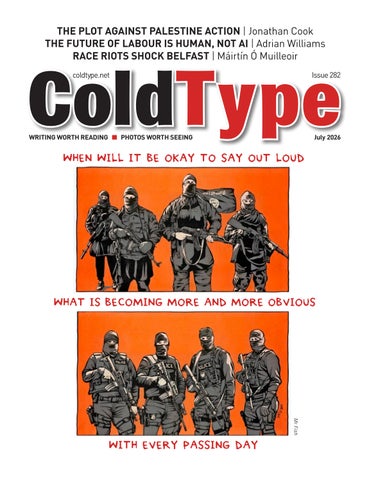
THE PLOT AGAINST PALESTINE ACTION | Jonathan Cook THE FUTURE OF LABOUR IS HUMAN, NOT AI | Adrian Williams RACE RIOTS SHOCK BELFAST | Máirtín Ó Muilleoir
ColdT ype coldtype.net
Issue 282
WRITING WORTH READING n PHOTOS WORTH SEEING
July 2026
WHEN WILL IT BE OKAY TO SAY OUT LOUD
WHAT IS BECOMING MORE AND MORE OBVIOUS
Mr Fish
WITH EVERY PASSING DAY
a–
PERESTROIKA AND GLASNOST REVISITED | Trevor Grundy THE WAR IN IRAN IS INTERNATIONAL TERRORISM | Nan Levinson WHAT WOULD ORWELL SAY? | Laura Beers
ColdType coldtype.net
Issue 280
WRITING WORTH READING n PHOTOS WORTH SEEING
May 2026
Y CONSPIRACCE AS OF SILEN RMER KEIR STA OTHER FACES ANL CRISIS POLITICA rigged – and UK politics is d media the political an out to ab class are not ntion to draw our atte of what the ugly reality up to en they have be decade over the pastE 14) k ( PAG Jonathan Coo
YOUR ALTERNATIVE HISTORY OF THE 21st CENTURY Read all 281 Issues of ColdType at www.coldtype.net/reader.html and www.issuu.com/coldtype 2 ColdType | July 2026 | www.coldtype.net
JULY 2026 | ISSUE 282
INSIDE 5 Kids are new target of vampire capital George Monbiot 7 Haunted by the spectre of Gen Z socialism Norman Solomon 8 How big corporations dodged $40 billion in taxes Jake Johnson 8 Greed at a glance Inequality.org 9 Chicken hawks return – and we’re losing again Dell Franklin 11 Big Tech built gig economy that works against us Michael Huggins 12 Jury refuses to convict activists in arms firm case John McEvoy & Hanna-Johara Dokal 13 AI billionaires gearing up to demand bailout Jim Hightower 13 Hurwitt’s Eye Mark Hurwitt
ColdType 7 Lewis Street, Georgetown, Ontario, Canada L7G 1E3 Contact: Tony Sutton editor@coldtype.net Subscribe: For a FREE subscription e-mail editor@coldtype.net Back Issues: www.coldtype.net/reader.html or www.issuu.com/coldtype Disclaimer: The contents of the articles in ColdType are the sole responsibility of the authors. ColdType is not responsible for any inaccurate or incorrect statements they may contain ©ColdType 2026
Pacemaker Press
INSIGHTS
Rioters terrorise ethnic minorities in Belfast – Page 24
ISSUES 1 Cover: When will it be okay? ................................................ Mr Fish 14 The future of labour is human – not AI.............. Adrian Williams 16 The fight to save America ..........................................Chris Hedges 20 The invasions of Pete Hesgseth .....................................John Feffer 24 Riots in Belfast: Selling the past to racists and fools .................................................................................. Mairtín Ó Muilleoir 27 Belfast rally says ‘no’ to racism ........................ Conor McParland 28 UK government’s plot against Palestine Action ......................................................................................... Jonathan Cook 34 Exposing the myths about nuclear power ..................................................................................Linda Pentz Gunter 38 Starmer’s out: Another dud PM calls it quits ..................................................................................... Binoy Kampmark 40 Long short story ..........................................................Dwayne Booth 42 Palestinians will pay for Netanyahu’s defeat in Iran .......................................................................................... Ramzy Baroud 44 My strange tale of how the war on terror came home ........................................................................................ Tom Engelhardt 48 Home of the policed, surveilled and occupied ............................................................... John W. & Nisha Whitehead 50 Israel could solve its PR problem by not being evil ..................................................................................... Caitlin Johnstone ColdType | July 2026 | www.coldtype.net
3
4 ColdType | July 2026 | www.coldtype.net
NEWS | VIEWS | OPINIONS
INSIGHTS
➤ G E O R G E M O N B I OT
Kids are new target of vampire capital
B
ring your suitcase, your bin liner, your dumpy bag. They’re handing out money faster than you can stuff it in a sack. All you need do is join the market in what may now be England’s most lucrative commodity. A commodity with arms and legs, hearts and brains, thoughts and feelings. Children. Two years ago I stumbled into this issue after discovering that children in care who were being helped by a local charity I’m involved with were suddenly being whisked away, terminating the amazing progress they had been making, breaking their relationships, their sense of home, stability and security. When I began exploring why this was happening, I could
Highly lucrative trade in children in care reveals another level of financial cynicism in UK scarcely believe what I was seeing: a highly lucrative trade in highly vulnerable young people. Children in “care” were being exchanged between private equity companies for £100,000 apiece. That figure is now wrong. Today they are worth far more. Last month, the Financial Times published an investigation that I defy you to read with anything but open-mouthed horror. The average charge to the state by a pri-
vate provider for a child in “care” is now £384,020 a year. That’s six times what Eton charges. Some providers now levy more than £1m per child per year, rising in a few cases for children with complex needs to more than £3m. So everyone is cashing in. Alongside the big companies, which might invest in oil, gilts or crypto one day and children the next, the reporters found that “plumbers, hairdressers and Airbnb landlords with no experience in care” are opening “homes.” There might also be links to organised crime, as you can now make more money from children than you can from drugs. The police are concerned that gangs running children’s “homes” can not only harvest state money ColdType | July 2026 | www.coldtype.net
5
INSIGHTS on a spectacular scale but also harvest highly vulnerable young people, who can be recruited and exploited. I guess you could call that vertical integration. While there is a shortage of provision in the south of England, there’s a glut in the north-west: Lancashire has 17 places for every local child needing care. Why? Because property is cheaper there. Houses can be bought for a song and roughly converted. The cheapest buildings are in places where economic and community life has collapsed, high streets are deserted and facilities shuttered. Where better to send highly vulnerable children? This is why our young people in Devon are being swept up to 300 miles across the country. A paper in the journal Child Abuse & Neglect finds a consistent association between profit-making and the placing of children outside their local authority area. It also finds that commercial provision is associated with them being moved more often, which means greater disruption and instability. Shifting children out of their home area makes them “more vulnerable to exploitation and grooming.” Yet the children with the greatest needs are often, under this system, those placed furthest from home. Because councils, which have not been given the capital budgets to make their own provision, are so desperate to find places, they are sending children to providers who are not only unqualified but also, in some cases, unregistered. In other words, they are breaking the law by using “homes” which haven’t even met the basic requirement to register with the regulator. These are private oubliettes – places beyond easy reach of the authorities, where
6 ColdType | July 2026 | www.coldtype.net
children can be dumped and forgotten. They might as well throw them in a pit and be done with it. An investigation by LBC and the Bureau of Investigative Journalism found that in one of these illegal “homes,” two of the “care” workers had seven convictions between them when they were recruited, including four for violent offences. They persuaded a 15-year-old girl, who had been moved by her local authority in south Wales to the house in County Durham, to take so much drink and drugs that she became stupefied, then they sexually assaulted her for several hours. The local authority’s rationale for moving her to that “home,” the investigators found, was that she was “at risk of sexual exploitation.” A report by the Children’s Commissioner reveals that unregistered placements are on average even more expensive than legal ones. She estimates that 669 young people, mostly with special needs, including some of preschool age, are now in unregistered “homes”. In reality the figure is probably much greater, as many are likely to have fallen off the records altogether. While in France only 5 percent of places are run for profit, in England, the FT tells us, the figure is 84 percent. The reason is simply stated: ideology. Successive governments have failed to provide local authorities with the capital needed to house children themselves because they think public is bad and private is good: the foundational belief of neoliberalism. In reality we pay far more for a much worse service. Then we wonder why, though they comprise less than 1 percent of the total population of children, 62 percent of the people in young offender institutions have been in “care.”
In Wales, all new profit-making in this sector was stopped in April, and the practice is being phased out altogether. But in England, the government seeks only to tweak this immoral and dysfunctional system. As Hettie O’Brien shows in her book The Asset Class, when private equity delivers public services, chaos and disaster follow as night follows day. But Labour, like the Conservatives, seems ideologically committed to the model. The issue is profit. Instead the Westminster government blames the problem on a shortage of foster carers. But as Martin Barrow, a journalist and foster carer who has specialised in this issue for many years, points out: “Foster care, children’s homes, supported accommodation and adoption are not interchangeable. Each can be the right option for different children at different times in their lives.” Children’s homes remain essential, but the government must regain ownership of them. As we’ve discovered the hard way with water, energy and railways, public ownership of public services works better and costs less. There is no place for a “market” here. Children are not a commodity to be bought and sold. Private profit and public service are always oil and water. But if there is one service above all others that capital should never be allowed to get its filthy hands on, it is children in care. CT
George Monbiot’s latest book, written with Peter Hutchinson, is Invisible Doctrine: The Secret History of Neoliberalism. His website is www.monbiot.com This article first appeared in The Guardian
INSIGHTS ➤ N O R M A N S O LO M O N
Haunted by the spectre of Gen Z socialism
A
spectre is haunting Europe and America – the spectre of Gen Z socialism. That’s the urgent warning from the Economist in a new cover-story editorial, “How to fight back against Gen Z socialism.” Alarmed by a youthful threat to the established order, the magazine is calling for heightened vigilance from defenders of private enterprise. “Gen-Z socialism is a me-first doctrine,” says the editorial, unlike the selfless doctrine of capitalism. The young socialists have succumbed to “a zero-sum mindset, where a better outcome comes not from creating but from taking.” Taking, we are to understand, is frowned upon in the capitalist system. And what better way to instill wisdom in Gen Z than to set a good example by creating without taking? Those with stakes in the Economist itself are cases in point. The investment company Exor, controlled by one family with $38bn in net assets, has the biggest stake in the magazine. Meanwhile, the investor with more than a quarter interest in the Economist, the Canadian businessperson Stephen Smith, has a personal net worth of $6.9bn. Of course, young socialist hotheads might carp that in the UK, where the Economist is based, the overall poverty rate is 21 percent, while among children it’s 31 percent. But cooler heads prevail
among the Economist’s editorial writers, who lambast the idea that “spending can be paid for by the richest.” They opt for stability by not getting carried away with fanciful notions. Some realities are, of course, unfortunate. As the BBC reported last fall, a survey by the charity Trussell Trust “found more than 14 million people in the UK faced the prospect of going hungry last year due to lack of money. This marks an increase from the trust’s last survey in 2022 when that number was 11.6 million people.” One-third of children under age five “are living in UK homes where there is not enough access to healthy and nutritious food.” In the United States, the Feeding America organisation reports, one in five children “don’t have enough to eat.” But with the free-enterprise system, it can be said that those children have the opportunity to put any hunger behind them when they grow up. As the Economist’s editorial notes, an economy flourishes not when rewards are guaranteed but when opportunities are available, giving everyone a chance of success.
The Economist warns that all too many digital natives have been enticed into a kind of honey trap of desire for a welfare state: “Saying that prices should be capped to keep your bills down while someone else pays for your public services is a seductive, shareable message.” A new generation of socialists is swooning for affordability. “Gen-Z socialists demand handouts funded by billionaires” and harbour “a remarkable hostility to private enterprise,” the Economist observes, at the same time that those young socialists “are uninterested in letting the market rip and redistributing the proceeds.” The logic is compelling, even impeccable, for rich people who don’t want to part with their money. After all, they know full well from firsthand experience that the ripping market can effectively redistribute capital. “A robust defence of the ideas that have brought unprecedented riches has barely been tried,” the Economist explains. However, “what is so worrying about the Gen-Z socialists is how deeply their ideas are bleeding into the centre-left.” And so, the magazine concludes: “Resisting Gen-Z socialism is therefore an urgent task.” That urgency must outweigh any urgency of feeding hungry people. ColdType | July 2026 | www.coldtype.net
7
INSIGHTS The machinery of a system that offers so much prosperity to some must push back against leftists trying to throw a spanner into what works with such efficiency. “The first step,” the Economist urges, “is for free-market liberals to stop apologising. A series of popular criticisms of capitalism, each containing a grain of truth, has in aggregate obscured the fundamental wisdom that private enterprise is at the root of human prosperity.” So come on, you free-market liberals. Recognise the danger that the youngest adult generation on both sides of the Atlantic is being swayed by the siren songs of socialism just because they don’t like vast income inequality and all the human suffering that comes with it. The Economist has sounded the alarm. Now it’s up to you to rescue us from the clear and present threat of social equity. CT Norman Solomon is the director of RootsAction and executive director of the Institute for Public Accuracy – www.accuracy.org
➤ G R E E D AT A G L A N C E
8 ColdType | July 2026 | www.coldtype.net
➤ JAKE JOHNSON
How big corporations dodged $40 billion taxes
P
resident Donald Trump’s decision last year to withdraw the US from a global effort to rein in corporate taxdodging has allowed major American companies to avoid at least $40 billion in income taxes, a significant win for profitable business at a time when working class families are struggling with higher costs and stagnant pay. The New York Times, citing securities filings, reported on May 29 that American Express, PayPal, Pepsi, and other major USbased corporations “avoided taxes by attributing hundreds of billions of dollars in earnings to low- or notax foreign locales like Cyprus, Bermuda, Switzerland, and the Cayman Islands.” The Times noted that the com-
W W W. I N E Q U A L I T Y. O R G
panies often “funnelled the profits through subsidiaries in places where they had no employees, offices, or customers. “Some companies using tax havens to avoid US income tax rely on federal funding for their profits,” the newspaper reported. “Thermo Fisher Scientific, the scientific equipment maker, cut its taxes by $3.5 billion last year via Malta. Honeywell, which received over $30 billion in Defense Department contracts over the past decade, used Swiss units to cut its tax rate by more than a quarter – or $301 million – last year.” The tax avoidance was enabled by Trump’s decision, on his first day back in the White House, to end US participation in long-running international negotiations to enact a minimum corporate tax and other measures to stop companies from avoiding taxes by offshoring their profits. The Trump administration’s top international tax official, Rebecca Burch, formerly worked for Ernst & Young, which has lobbied on behalf of American Express and other companies benefiting from White House tax policy. “While working Americans struggle to put food on the table, Trump has found another way to cut costs for the ultra-wealthy,” US Rep. Debbie Dingell (D-Mich.) wrote in response to the Times reporting. “Same story, different day.” Trump and his Republican allies in Congress have delivered big for
INSIGHTS corporate America since taking power after the 2024 elections, doubling down on tax cuts first passed in 2017 and quietly pursuing regulatory changes that will deliver windfalls to major companies. A recent analysis by the Institute on Taxation and Economic Policy found that at least 88 of the largest corporations in the US paid nothing in federal income tax in fiscal year 2025, “at least in part due to two separate packages of corporate tax cuts pushed through by the Trump administration: last year’s ‘One Big Beautiful Bill Act’ and the 2017 Tax Cuts and Jobs Act (TCJA).” The Times’ report of May 29 noted that the TCJA enacted “a few new levies, including one on profits that companies moved into tax havens. “But the provision contained an escape hatch: it permitted com-
panies to blend the profits and taxes reported in places like Germany, France, or Japan with earnings reported in tax havens like Grand Cayman,” the Times explained. “That, in turn, helps many companies avoid the new offshore tax.” The Trump administration also cut a deal earlier this year with the Organization for Economic Cooperation and Development (OECD) that makes it easier for US-headquartered companies to relocate profits in more favourable countries, exempting them from Biden-era efforts to stop such behaviour. The US Chamber of Commerce, the country’s largest corporate lobbying organisation, celebrated the agreement. CT Jake Johnson is a senior editor and staff writer for Common Dreams – www.commondreams.org – where this article was first published
➤ DELL FRANKLIN
Chicken Hawks return – and we’re losing again
T
here’s always terrific excitement when America bombs the shit out of somebody. We lounge on our comfy recliners and watch the bombs land and blow up buildings and war facilities on our TVs and hear about precision successes without too many deaths while some guy in a tight suit who looks the part and has an American flag pin in his lapel praises our military and our troops and appears grim and stoic as he tries to explain why we are
bombing the shit out of somebody, and he becomes surly and maybe nasty if somebody from the press corps pushes too hard for answers or specific explanations. Then he praises the stars and stripes and God before he stalks off with reporters yelling at him. This new guy actually mentioned this new war as biblical. There are those in America today pounding their chests and strutting around with grand hubris at our military might and aggression.
Boy, are we tough! Remember Operation Iraqi Freedom? At least we had a warm-up and some international cohesion before that ultimately stupid and senseless endeavour. Remember the cheer leaders? Dick Chaney, Donald Rumsfeld, Paul Wolfowitz, and Richard Perle. Every Sunday one or the other was on TV taking turns explaining how we needed to go to war to avoid war in the future and lied like professional actors – so smooth and calm and concise and convincing – about supposed weapons of mass destruction. We’re talking chicken hawks in full flower. Only Secretary of Defense Rumsfeld was a military veteran and he was a pilot and as deranged an egomaniac as Robert McNamara during the Vietnam War. And, after bombing Iraq and routing their 4thrate army, there was President Bush on a navy ship boasting about victory when the real shit was just about to torture us and kill American boys for years to come. Now we have a new group of blowhards repeating the same garbage while lying and obfuscating, and, if needed, bullying anybody having the temerity to question their motives, policy or end game. What we have is a puffed up amateur draft dodger in charge of the most powerful weaponry in the history of the world wasting it on still another stupid and senseless war with nightmare potential. Chicken hawks all over again. Pledging our supposedly limitless arsenal to more titanic bombing. The ghastliness of what is to occur is beyond frightening. Meanwhile, the same old voices are telling us what they think we want to hear ColdType | July 2026 | www.coldtype.net
9
INSIGHTS Public Domain
– that in the end things to highly decorated combat will end up just great for vet and fellow general, Dick America. Only this time Armitage something about we will not put “boots on those guys having “never the ground.” No, this time been in a good bar fight.” we will bomb a despicable Chicken hawks all over country into such again. submission that eventually Up-date: Oh, how Big the people will overcome a Chief Chicken Hawk and fanatical theocracy backed his scurrilous White House by a brutally repressive toadies have fallen – bunched military and form a new up like rats trapped in a government similar to corner by an ancient tomcat America’s. TOUGH GUYS? George W. Bush and Donald Rumsfeld on its last legs. This old Regime change? grizzled tomcat, both scarred Democracy? reckless senators are pounding the an tattered, with nary a weapon A policy doomed by history, war drums. Fox News is in grand left but a few lethal teeth and but who reads history when you celebration. Trump’s non-serving piercing claws, and the warring have a president who doesn’t like sons are all in while getting richer experience of centuries, will not to read books because he already and richer. Meanwhile, those rough allow Big Chief Chicken Hawk knows the answers by instinct. He and tough real estate barons are and HIS powerful military and its admits a few people might die but toadying up to Putin. mightiest weapons do anything but of course they’ll die for a just cause Maybe big blustering threatening bob around in the drink growing and go down in history as heroes. Chief Chicken Hawk should have stale and restless and possibly batHe is surrounded by office warriors read Colin Powell’s book and the crazy as they await an order to who have no experience in combat part when the then secretary of once again bomb the shit out of the or basic military service. They are defense came out of a meeting with old sneering, gloating tomcat, who above all that. chicken hawks Richard Perle and knows what it’s like being on its Lindsay Graham and his fellow Paul Wolfowitz and mentioned own and knowing how to survive the worst of it. Nobody can help the Big Chief ➤ BY THE NUMBERS W W W. I N E Q U A L I T Y. O R G (not even Israel!) because anybody who isn’t MAGA, here or abroad, despises him as the blowhard he is, a crumbling plaster of Paris nincompoop in a power suit and gangster’s trench coat representing a teetering empire without a clue and whining about gas prices. CT Dell Franklin, career bartender and professional agitator, is a journalist who writes a biweekly column for Cal Coast News on the central coast of California, is the author of The Ball Player’s Son and Life On The Mississippi, 1969, and currently, at 82, is trying to stay out of the local pub
10 ColdType | July 2026 | www.coldtype.net
INSIGHTS ➤ MICHAEL HUGGINS
Big Tech built gig economy that works against us
R
ecent reporting has confirmed what many working people already feel every day: companies are using personal data to decide the lowest wage someone will accept. What working people call exploitation, Silicon Valley calls innovation. The seven largest gig platforms in the United States – Amazon Flex, DoorDash, Favor, Instacart, Lyft, Shipt, and Uber – are using data that tracks how long its users stay on an app, what jobs they accept, and how urgently they need income. This algorithm calculates what the employers can pay to get the job done at the lowest rate individuals will accept. Not what their labour is worth. Not what is fair. Gig work was sold as a way to make extra money on a flexible schedule. But that’s not what it looks like today. Nearly one in four people in the US now participate in some form of gig or freelance work. What was supposed to be a side hustle has become a main source of income for one third of gig workers. As layoffs rise and wages fall further behind the cost of living, more people are being pushed into this kind of work to keep up. Black people and other workers of colour, who tend to be more dependent on this type of work than white people, have been especially hard hit. But these unfair practices can impact all workers. “Under surveillance wage sys-
tems, different people may be paid different wages for largely the same work, and individual workers cannot predict their incomes over time,” the Washington Center for Equitable Growth reports. “Not only has pay for app-controlled jobs decreased over time,” but “people who work longer hours are paid less per hour.” This is what happens when an economy limits options for some people, then funnels them into sys-
tems that take advantage of that lack of choice. Now they’re going even further – using data to predict what some experts call a “desperation wage,” or the lowest amount someone will accept based on their behaviour. And it’s not just happening in gig work. Similar systems are being used to set rent and adjust prices for goods and services in real time. The same idea applies: use data to figure out the worst price or wage someone will tolerate, then charge just below that or pay just above it. When you combine higher unemployment, lower wealth, and fewer
protections, you get a system where some people have less room to say no – and are more likely to be taken advantage of. The message is simple: take it or leave it. And for many, leaving it isn’t an option. That’s why we’re starting to see pushback. Working people are demanding more transparency. Some are organising. New models are emerging that promise fairer pay and more control. But these changes are happening because people are speaking up – not because companies chose to act. So what needs to happen next is clear. If companies are going to use algorithms to shape pay and access to work, those systems should be transparent. People should know how their pay is calculated. Workers should be able to see how much of each transaction goes to them compared to how much the company keeps. There should be rules that prevent companies from using personal data to quietly lower pay for some people while others earn more for the same work. And working people should have the ability to organise and push back. Because this isn’t just about gig work. It’s about whether we allow companies to rewrite the rules of the economy – or whether we demand a system that works for the people in it. Technology should make work more stable, more fair, and more predictable. Right now, it’s doing the opposite. And that’s not inevitable. CT Michael Huggins is Deputy Senior Director of Policy & Government Affairs at Color Of Change. He is also an Adjunct Professor in the Department of Political Science at Montgomery College. Distributed by OtherWords.org ColdType | July 2026 | www.coldtype.net
11
INSIGHTS Staffordshire police handout photo
PRO-PALESTINE: Activist cuts through the roof of Wolverhampton arms factory
➤ JOHN McEVOY / HANNA-JOHARA DOKAL
Jury refuses to convict activists in arms firm case
A
fter more than 17 hours of deliberation, a jury at Birmingham crown court failed to reach a verdict on June 17 over whether four proPalestine activists committed criminal damage at an arms factory. Iain Evans, Hana Yun-Stevens, Frank Sherman, and Hisham Alkhamezi were each accused of criminal damage at a factory owned by Moog, a US aerospace firm, in Wolverhampton. During the trial, the jury saw footage from helicopters and CCTV cameras which showed the defendants crashing through the site’s front gate and damaging solar panels on its roof. Prosecution lawyers presented
12 ColdType | July 2026 | www.coldtype.net
this as an open and shut case given the defendants admitted in court to occupying the roof in order to shut down the factory’s production line. They said the trial “is not about Israel, it’s not about Palestine… It’s simply about whether they unlawfully damaged property.” But the jury was also shown a social media post demonstrating that the activists’ goal was to disrupt the supply of UK-made fighter jet components to Israel. In that social media post, the four defendants were wearing T-shirts bearing the names of Palestinians who had been killed by Israeli airstrikes, including the author Refaat Alareer. Defence counsel Mira Hammad
told the court that there was “no mystery about why the [four defendants] were there.” It was “on their T-shirts. It’s right there in… the tweet [discussing] military aircraft parts to Israel.” Shortly after the verdict was delivered, Yun-Stevens and Sherman addressed supporters who had gathered outside the courthouse. Yun-Stevens led chants of “Free Palestine” while Sherman thanked those who had offered encouragement throughout the trial. Evans, wearing a keffiyeh, said he felt “relieved” by the verdict. A one-minute silence was also held outside the courthouse for Palestinians who have been killed in Gaza. During the trial, the jury also heard from the defendants directly. Alkhamesi, 23, told the court that the “main intention” of the action was “to occupy the roof” because the “factory can’t operate while we’re on the roof.” Evans, who previously worked in the aerospace sector, told the court: “We believed the longer we stayed up there, the more lives we would save. The idea was that the longer we stay on the roof, the longer the factory would be shut down.” Yun-Stevens described the concept of direct action and noted in court how a full arms embargo has still not been imposed on Israel. Sherman, who dismissed their own legal representation to offer their own closing statement, declared: “I will always in my heart know that using care and intention to disarm the factory is not criminal.” They added: “As Iain told you,
INSIGHTS the longer we stayed up there, the more lives we could save; as Hisham told you, we intended to disrupt shipments, disrupt production; and as Hana told you, we disrupted only what we deemed to be criminal.” All four activists were immediately released on bail. The Crown Prosecution Service (CPS) is expected to decide on
whether it seeks a retrial within the coming weeks. CT  John McEvoy is Chief Reporter for Declassified UK. He is working on a documentary about Britain’s role in the rise of Augusto Pinochet. Hanna Dokal is a video journalist based in the UK. This article is from www. declassifieduk.org
➤ J I M H I G H TO W E R
AI billionaires gearing up to demand bailout
S
tep right up folks! Please don’t crowd! No need to shove, plenty here for everyone! Welcome to the AI boom! Silicon Valley billionaires are now proposing a scheme to deliver an unbelievable windfall to “every citizen.” Tech titans like Sam Altman of OpenAI are pushing the federal government to create a “public wealth fund” to let us commoners be investment partners in building the AI wonderworld. Lest you worry that this might be a corporate scam, note that Donald Trump, the deal-maker-in-chief, exults that letting the American public buy into the tech booms is a sure bet to “make them rich.” And Altman adds that a public investment fund would allow Joe and Jill Schmo to “participate directly in the upside of AI-driven growth.” Wow – benevolent capitalism! But wait… aren’t AI barons infamous greedheads who constantly rig the system for themselves, sneer
at the public, and openly disdain government programmes? Well, yes. They say we would “share in the upside” of AI, but what about
➤HURWITT’S EYE
the downside? Far from profitable, all of the industry’s powerhouses, including OpenAI, are losing hundreds of billions of dollars while carelessly adding trillions in new debt and – shhhh – quietly admitting that their razzle-dazzle computer fantasies might not work. They won’t tell you this, but going bust is a real possibility. And that is why AI’s private-enterprise whizzes are now so desperately pushing us taxpayers to become their socialist “partners.” If and when they fail, your and my role is to save their bacon by demanding that “the public” deserves a government bailout. CT Jim Hightower is a radio commentator, writer, and public speaker. This op-ed was distributed by OtherWords.org
MARK HURWITT
ColdType | July 2026 | www.coldtype.net
13
➤ ADRIAN WILLIAMS
The future of labour is human – not AI Big Tech has spent decades harvesting our existence to build the machines intended to replace us. We must view our output with that same strategic clarity
S
o, I have a social media account that has small sculptures I filmed making and destroying. There are over 4,000 videos. I wanted to investigate how I could get an art gallery to buy my work. When I asked AI how to monetise my work – www.tiktok.com/@africanpagan – it suggested I sell the data representing the human process of creating and destroying my sculptures – specifically the physical pressure and manual effort exerted. By selling this “human endeavour dataset,” I could provide tech companies with the authentic, non-synthetic information they desperately need, as they are rapidly exhausting their supply of genuine human input. What? Isn’t AI going to replace everyone? Apparently, not. The artificial intelligence industry is facing a systemic crisis known as model collapse. To understand this, one must look at the foundation of these systems. AI was built by harvesting massive amounts of information produced by people – books, movies, legal decisions, and digital conversations. This human dataset represents the collective experience of our species, and it is the only reason a computer can mimic human thought or provide coherent answers. The 2000’s were spent in the digitising of all human endeavour, everything that could be digitised was
14 ColdType | July 2026 | www.coldtype.net
digitised. This digital representation of human endeavour was used as source material for AI development. Then in 2017 the invention of the Transformer architecture allowed AI Models to process large datasets efficiently. From roughly 2018 to 2022, AI researchers shifted toward “scaling laws,” where they discovered that adding more source data directly correlated to higher performance
H
owever, in 2026, the source of this intelligence is being contaminated. Every time a person interacts with an AI, the machine’s response is saved back into the global pool of data. With billions of AI-generated answers flooding the internet daily, the data used to train these systems is no longer purely human. Recent estimates suggest that original human content now makes up less than half of the available data pool. When computers begin to learn from the output of other computers rather than from people, they begin to fail. It’s like a copy of a copy – eventually, the output becomes blurry, distorted, and useless. Because computers lack the original context of physical existence, they simply repeat patterns. This cannibalisa-
tion of data is leading toward a predicted collapse of these models. This is not merely a technical glitch; it is the fundamental exhaustion of “Data in.” The private sector has treated human thought and deed as an infinite mine, but by flooding the environment with synthetic waste, they have poisoned their own well. The value of human labour has been systematically driven down under the assumption that machines would eventually replace workers. From manufacturing to healthcare, the story was that software would soon render human oversight worthless. Model collapse proves that this was a mathematical error. Machines cannot maintain logic or accuracy without constant, original input from
living human beings. This situation reveals a massive failure on the part of the private sector. Tech companies have used social media and online interactions as a free mine for the data required to keep their systems running. They have profited by harvesting human interaction to train the very machines intended to displace the workforce. Now that these privately owned systems are beginning to fail due to data contamination, the demand for
As these corporations watch their models degrade into gibberish, they are faced with a reality they cannot engineer their way out of human intervention is returning. The private sector’s greed led to them believing they could bypass the cost of human endeavour. They marketed AI as a replacement for the “expensive” human mind, yet they failed to account for the fact that without the human mind, the AI has no source of truth. No grounding. As these corporations watch their models degrade into gibberish, they are faced with a reality they cannot engineer their way out of. The arrogance of the Silicon Valley elite has created a vacuum that only the working class can fill. By devaluing the worker, they have ensured that when their machines inevitably stumble, there is no ready infrastructure to catch the fall.
S Mr Fish
o, what is to be done? Standing by while Big Tech’s models cannibalise themselves is not a strategy; it is a surrender. We have remained tethered to the outdated delusion that capital dictates the value of our labour. That narrative was manufactured to ensure our obsolescence. The left need to reevaluate the definition of value. Organised labour across the globe must now recognise how the tech industry has systematically exploited the very essence of human contribution.
We have long accepted a standard where the value of a worker is measured by the sheer repetition of physical tasks – the person hitting the nail – while ignoring the far deeper, irreplaceable value of the human mind and manual craft. The artisan, the strategist, and the labourer all possess an innate, original value that machines cannot replicate. By failing to protect this human input, we have allowed tech giants to strip-mine our collective expertise to build systems that profit from our displacement. Big Tech has spent decades harvesting our total existence to build the very machines intended to replace us. We must begin to view our output with that same cold, strategic clarity. We are not mere participants in this economy; we are the primary source of truth. Without our original input, their systems are nothing but decaying loops of synthetic waste. We must stop providing this fuel for free and start recognising that the foundation of their entire industry is our collective human endeavour. The future of labour is not a contest between silicon and sinew. We must transition to a model where AI is the instrument, not the master. Like a Master Chef and their stove. We need to view the machine as a tool – a force multiplier for human intent – that is completely inert without our oversight and physical reality to guide it. The machines are hollow without us. We must assert that we are the directing force, reclaim the inherent value of our labor, and recognise that our role is to command the process, not to be consumed by it. CT Adrian Williams is a member of the Central Committee of the South African Communist Party. He was an MP in the country’s ANC government from 2009 to 2019 ColdType | July 2026 | www.coldtype.net
15
➤ CHRIS HEDGES
The fight to save America The street battles against the abuses by ICE are the front lines of the fight against the consolidation of the police state in the US
T
he worst is not the Immigration and Customs Enforcement (ICE) and private contractors, wielding baseball bats and batons, who flood the parking lot at the end of their shifts and unleash on protesters outside the gates the sadism practiced on those incarcerated inside Newark’s Delaney Hall detention centre in New Jersey. The worst is not the tear gas, the tasers, the pepper spray or the dozens of arrests. The worst is not the beatings and the riot shields, raised above the heads of New Jersey State Police and Newark police and brought down swiftly on bodies, leaving severe lacerations. The worst is watching the children. The ones heaving and sobbing as they leave Delaney Hall, saying goodbye to their mothers, fathers, sisters or brothers who took them to school, who cheered them on at their soccer games, who told them they are beautiful and talented, who woke up before dawn to work menial jobs so they could have a future, who love them in a world where love is a diminishing commodity. It’s the first week of June. I am seated against a cyclone fence a block from Delaney Hall, New Jersey’s largest ICE jail, with a protester who goes by the name of Basher.
16 ColdType | July 2026 | www.coldtype.net
He is 41. He has a thick black beard. His nails are dirty. His hands are scarred from clashing with police. His head is wrapped in a green keffiyeh. The stench of the sprawling Passaic Valley Sewerage Commission treatment plant across the street saturates the air. When it comes to the children, the ones ripped from their parents by a nation that is institutionalising cruelty, even Basher must catch his breath and stop. The scenes are too much to bear.
T
he savagery at Delaney Hall is the warm-up act. The goons, the ones who attack those demonised on the inside of the ICE jail and those demonised on the streets outside of it, are in training for the rest of us. Delaney Hall, run by a private prison company – The GEO Group – is the template for a world where we will be stripped of our rights; routinely jailed and tortured; denied adequate medical care;
The goons who attack those demonised on the inside of the ICE jail and those demonised on the streets outside, are in training for the rest of us
fed rancid, expired and mouldy food infested with worms and maggots; forced to drink contaminated water and breathe polluted air; and work for poverty wages – in the case of those inside Delaney Hall, a dollar a day. Some 300 of the roughly 600 people detained at Delaney Hall – which includes teenagers, the elderly and pregnant women – began a hunger and labor strike on May 22. ICE and GEO Group guards reacted as you would expect. They beat the strikers. They seal vents and toss tear gas and pepper spray into cells. They place suspected leaders of the strike in handcuffs and force them out of the facility to unknown locations, or isolate them, in “punishment units.” They manipulate the heating and cooling systems so prisoners endure extreme heat or cold. They cut telephone and internet access and suspend visitation rights. They sexually harass women. On May 31, 56 of those held inside Delaney Hall issued their fourth public letter. It was handwritten in
YouTube Screenshot
Protesters duck from clouds of tear gas outside Newark’s Delaney Hall detention centre in New Jersey in early June. Spanish on ruled paper: “The conditions in this prison are not fit for human beings over such a long period of time: medical neglect, water unfit for consumption, food that is past its expiration date and in poor condition, bathrooms that are unusable, and ventilation systems that have never been maintained and because of this, we are constantly sick,” the latest letter reads. “We demand freedom, a fair trial, and for our rights to be respected. SOS.” On July 24, last year, at around 6:45 a.m., ICE vehicles blocked a van carrying 15 Guatemalan workers, three blocks from my house. I went to see the men at the ICE jail in Elizabeth, New Jersey, because I speak Spanish and because their families, terrified of being targeted, could not. The men told me they were threatened with lengthy prison sentences, followed by certain deportation, if they did not sign papers
agreeing to their immediate deportation. They signed. It was my job to inform their families they would not be coming home.
A
Guardian analysis of government records found that during the first seven months of Trump’s second term, the parents of at least 27,000 children – 12,000 of whom had US citizenship – were arrested. These men were my neighbours. Their children attend high school with my children. The kidnapping
The state and media that act as its echo chamber are trying to convince the public that those locked up in Delaney Hall are ‘the worst of the worst’
of parents – often at work or at immigration hearings and ICE checkin appointments – not only traumatises the children of these families, but the entire community. Every child in the high school wonders if their parents will also one day be seized and disappear. Every child wonders how this cruelty can be inflicted on their friends. Every child wonders what kind of country we live in. The state and the media organs that act as its echo chamber are doing their best to convince the public that those locked up in Delaney Hall are “criminals,” “the worst of the worst.” But a review of ICE data by Austin Kocher – an assistant research professor at Syracuse University and an immigration data and policy expert – exposes the lie. Kocher found that 88 percent of immigrants detained at Delaney Hall have no criminal conviction ColdType | July 2026 | www.coldtype.net
17
and more than 70 percent have no criminal history. Those with criminal convictions almost universally committed low-level offenses. The rogue paramilitary forces that pour daily out of the gates of Delaney Hall are unaccountable. They ignore the law. They are the Satanic foundation of our emergent police state. The terror they inflict on those in this small patch of Newark will soon be inflicted on all of us.
N
ew Jersey Senator Andy Kim – who was pepper-sprayed outside Delaney Hall by ICE agents – and Governor Mikie Sherrill were denied entry into the facility. Kim, after an appeal to the Director of Homeland Security Markwayne Mullin, was eventually given a lightning tour, but forbidden to speak to any detainees. City and state health inspectors have also been blocked from fully accessing the ICE jail. The message is clear: We will
New Jersey Senator Andy Kim – who was peppersprayed outside Delaney Hall by ICE agents – and Governor Mikie Sherrill were denied entry into the facility carry out any abuse with immunity. On Saturday afternoon, after about a dozen protesters blocked cars from driving out of the facility, ICE agents, wearing combat gear and face coverings, charged the protesters with pepper-ball guns, mace and tasers. “Move back! Get back!” they shouted as they unleashed clouds of pepper spray. Cars leaving the facility struck at least one protester. By around 10:00 p.m., some 100 protesters had set up a barricade of barrels filled with sand to block the facility’s exits and entrances. The blockade saw a huge influx of
ICE agents, GEO Group guards and Newark police push the protestors several hundred yards down the street. Police announced a ban on protesters wearing protective gear, including respirators and goggles, although Delaney Hall is located in an industrial area with extensive air and water contamination known as “Chemical Corridor.” The battle at Delaney Hall is not over. It is a battle not only for justice, for the rights of our neighbours, for a world where all are treated with dignity and respect, for children who should never be separated from their fathers and mothers, but a battle to save our country from galloping fascism. Join it now. Soon it may be too late. CT Chris Hedges is an award-winning journalist who was a foreign correspondent for 15 years for the New York Times. He hosts the Chris Hedges Report podcast at www.chrishedges.substack.com
GET YOUR FREE SUBSCRIPTION TO COLDTYPE a–
PERE STROIKA AND GLASNOST REVIS THE WAR IN IRAN ITED | Trevor Grund IS INTERNATIONAL y TERRORISM | Nan WHAT WOULD ORWE Levinson LL SAY? | Laura Beers
ColdType coldtype.net
Issue 280
WRITING WORTH
READING n PHOTOS
WORTH SEEING
May 2026
CONSPIRACY OF SILENCE AS KEIR STARMER FACES ANOTHER POLITICAL CRISIS UK politics is rigged – and the political and media class are not about to draw our attention to the ugly reality of what they have been up to over the past decade Jonathan Cook ( PAGE 14)
Send an email to: editor@coldtype.net – write SUBSCRIBE in the Subject line 18 ColdType | July 2026 | www.coldtype.net
Fighting the Information war ColdType
DAVID MILLER & MARK CURTIS
INFORMATION DOMINANCE The Philosophy of Total Propaganda Control D A V I D
GOVERNMENT, PROPAGANDA AND THE WAR ON IRAQ
AN EXCERPT FROM THE BOOK
TELL ME LIES PROPAGANDA AND MEDIA DISTORTION IN THE ATTACK ON IRAQ
M I L L E R
Two important ebooks from the ColdType archives By David Miller and Mark Curtis The relentless propaganda war we’re seeing with Russia and China in Western crosshairs is not a recent occurrence, but has been gathering steam since the media-managed US war on Iraq 20 years ago. In these two free ebooks from the ColdType Archives, two prominent writers explain the genesis of the onslaught
Read and download these important ebooks at ColdType www.coldtype.net/Assets/pdfs/Lying.pdf and www.coldtype.net/Assets.04/Essays.04/Miller.pdf
19 399
ColdType | July 2026 | www.coldtype.net ColdType | February 20252023 | www.coldtype.net ColdType | November | www.coldtype.net
➤ JOHN FEFFER
The invasions of Pete Hegseth On weapons, energy, and tech, Europe is groping toward a declaration of independence from America
O
n June 6, US Secretary of War Pete Hegseth was on hand in Normandy for the eightysecond anniversary of the D-Day invasion. He made the usual remarks about US dedication to defending freedom, just as he did last year on a similar occasion. This time around, however, Hegseth veered off into controversial territory. Not that you can figure this out from the War Department’s anodyne summary of Hegseth’s speech. Unlike last year, the US government hasn’t seen fit to provide a transcript of Hegseth’s remarks. You have to nose around the Internet to find out what Hegseth said that raised so many eyebrows. Did the Pentagon chief use the DDay commemoration to denounce the current spectre of fascism that is haunting Europe? No. Did he warn of the threat that Russia poses to the continent? Hardly. Hegseth denounced an invasion of an entirely different sort. “Today, different European beaches are stormed by different dangerous ideologies,” he said. “Boats and men arrive. When will European capitals
20 ColdType | July 2026 | www.coldtype.net
do s o m ething about that i nvasion? Or is it too late?” B e twe e n h i s speech last year and the one this year, Hegseth has evidently gotten his marching orders. Ever since JD Vance lectured his elders and betters at the Munich summit last year, the Trump administration has united around the theme that immigrants threaten European “civilisation.”
V
ance wasn’t even being original. Both his and Hegseth’s talking points come straight out of the mouths of the European far right. Unlike the usual game of telephone, where the message is garbled through misheard repetition, the fulminations of Trump’s henchmen are loud and clear. The Trump administration is all about defending white “civilisation” from the impertinent contributions
of black and brown people. At home, that means scrubbing all government websites, National Park inscriptions, and federal grants of any reference to “woke” ideologies, which used to be known as anti-racism, diversity, or just plain common sense. It has meant restricting refugee policy to the only group the Trump administration perceives as meeting the need-based criteria – white South Africans. It has meant an industrial-strength deportation campaign. Abroad, the Trump administration is trying to “save” Europe from the immigrants that are in reality keeping European societies afloat in the face of demographic decline. In this effort, it has joined hands with the most repulsive extremists on the continent. Greg Bovino, who headed up Trump’s immigration crackdown in the United States as the commander-at-large of the US Border Patrol, recently showed up in Europe to headline an event in Portugal populated by white supremacists and neo-Nazis. The era of covert alliances and dog-whistling is long past. But the D-Day speech was something different: a historical commemoration that has usually avoided contemporary politics. Prompted to reflect on present-day “invasions,” the European heads of state listening to Hegseth’s speech might have been
thinking of an entirely different group of men and boats. The Trump administration has talked about the possibility of storming the beaches of Greenland to seize the island, an eerie echo of Nazi Germany’s blitzkrieg seizure of Poland in 1939. On this anniversary of D-Day, Americans in boats are the last thing Europeans want to see approaching the fringes of the continent. “Different dangerous ideologies, indeed,” the Europeans in the audience must have been thinking. Having been warned on numerous occasions, European capitals are certainly doing something to prepare for the impact of the ideologies dominating the Trump administration. It’s hard to know if Europeans really take seriously the prospect of an invasion coming from the West. But they are certainly worried about the failure of the United States to honour its D-Day commitments in the future.
T
he European far right has made its name by playing up the “threat” of immigration. Keeping out immigrants was a central plank in Viktor Orban’s platform in Hungary as well as that of Law and Justice Party in Poland, both of which have subsequently lost power. No matter: other parties are on the ascendant. The far right Alternative for Deutschland, having weaponised the issue of immigration, is on the verge of taking control of its first German region in elections in September in Saxony-Anhalt. Similar anti-migrant far-right parties are in coalition governments in Finland and Croatia and dominate the parliament in The Netherlands. Then there’s Italy. Although she has diverged from the Trump administration on a number of issues, including their views of the current Pope, Prime Minister Giorgia Melo-
Hegseth, in addition to his other failings, didn’t even read the newspaper before giving his D-Day speech ni remains vehemently anti-immigrant, pushing ahead with the country’s expulsion of migrants and asylum-seekers to detention centres in Albania, despite legal pushback from Italian courts and EU bodies. What might have once been a fringe opinion has now moved front and center in Europe. As a result of rising far-right influence, the EU is now using Italy’s detention centres in Albania as a model for “detention hubs” planned for Africa. “This deal will give governments much broader powers to detain and deport people,” Marta Welander of the International Rescue Committee told PBS. “It looks set to normalise immigration raids, expand the use of detention in prison-like facilities outside EU territory that are essentially legal black holes, and increase the risk of people being deported to countries where they could face persecution, torture or worse.” So much for Europe stepping forward in the Trump era to uphold the rules-based order. At least on immigration policy, the EU is instead following Trump’s lead. Hegseth, in addition to his other failings, didn’t even read the newspaper before giving his D-Day speech. Even as he was channelling the rhetoric of the European far right, European capitals have already been channelling Trump’s immigration policies. It’s frankly astonishing that an American politician could discuss D-Day and invasions at this histori-
cal moment without mentioning the single most destabilising invasion since World War II. Russia’s full-scale invasion of Ukraine in 2022 was a deliberate attempt to remake the European order. Violating international law by disregarding Ukrainian sovereignty was unsettling to be sure, but that was just a means to an end. The incorporation of as much of Ukraine as he could digest was designed to expand Russian power at the expense of the European Union and its cohesiveness. Although Putin and his mouthpieces have droned on about the threats of NATO expansion – and, to be sure, rapid NATO expansion eastward was a mistake – the real threat to Putin’s dominion has always been the accession of Eastern European and then post-Soviet states into the European Union. A model of economic prosperity, democratic governance, and unrestricted travel, if extended to Ukrainians, Moldovans, and Georgians, would inevitably get Russians to thinking: why not us? Putin has always worried more about the threat from within, like a colour revolution, than threats from without, like NATO expansion.
A
gainst the liberalism of the EU, Putin has offered instead a vision of ethnic counter-expansion that appeals to the aggrieved Russian sense of self. Adoption of the euro, the right to work in Paris, the freedom to gather outside the Kremlin to protest: none of these can compete against toxic masculinity, blood and belonging, and the appeal of an iron fist. Putin’s alternate conception of illiberalism, with its emphasis on conservative values and ethnonationalist triumphalism, is now threatening Europe in turn. ColdType | July 2026 | www.coldtype.net
21
Some of Putin’s allies have gone down for the count, but his rhetoric still resonates in the speeches of far-right figures throughout the continent. A number of leaders are scrambling to be the next Viktor Orban – Robert Fico of Slovakia, Andrej Babis of the Czech Republic, and, most ominously, the frontrunner in next year’s French presidential race, Jordan Bardella of the National Rally. Putin is not so dumb as to double down on his Ukrainian blunder by sending military forces into Poland or even the Baltic states. Cyberattacks and clandestine operations can be more effective since they don’t cross the threshold that mandates a NATO counterattack. Meanwhile, influence operations –disinformation campaigns, strategic political alliances, and the marketing of illiberalism – are even more effective in undermining the ideological underpinnings of the EU. This latter campaign has more than double the impact when it’s mirrored on the Atlantic side by the actions of Trump, Vance, and Hegseth. Europe is not in full-fledged revolt against Trump. The shift in EU immigration strategy demonstrates that some European leaders don’t want to just flatter Trump; they want to imitate him as well. Still, there are pockets of resistance. A
22 ColdType | July 2026 | www.coldtype.net
A shift in EU immigration strategy shows that some European leaders don’t want to just flatter Trump; they want to imitate him as well number of European countries defied the Trump administration in 2025 to recognize Palestine. Spain’s Pedro Sanchez refused to toe the US line on Iran. Denmark has led the charge to beat back the administration’s efforts to secure Greenland. European capitals are preparing in more institutional ways to address the much larger threat of Americans in boats, this time the ones that don’t arrive for a future battle as their counterparts did so reliably on D-Day.
T
rump has variously threatened to leave NATO or ignore US Article 5 commitments to defend fellow NATO members in the event of an attack. Last month, the Pentagon announced a decrease in the forces that the United States will make available – aircraft, ships – during a crisis in Europe. Europeans have gotten the message. They’re not just increasing their military spending. They’re building up their capacity to produce their own weapons rather than rely on the US military-industrial complex. They’re talking about creating an autonomous European army. They don’t want to be caught flat-footed by American ambivalence. In the wake of Trump’s decision to go to war against Iran, Europeans are also eager to wean themselves of dependency on US fossil fuels. Fresh from their campaign to reduce imports of Russian fossil fuels,
more far-seeing Europeans want to make sure that they’re not yoking themselves to American gas and oil. The better option: full speed ahead on home-grown renewables. “The European Union can’t fully trust US President Donald Trump to keep Europe out of the cold next Winter,” writes Linda Aziz-Rohlje of Renew Europe. “We are risking our democracy, our prosperity and our security if we do not take action. That’s why liberals and democrats call for an energy-independent Europe, with a more integrated energy market.” Finally, Europeans are worried about their reliance on US technology. “European leaders have become increasingly alarmed by the reliance on American technology in areas like artificial intelligence, cloud computing and semiconductors,” reports Adam Satariano in the New York Times. “Many worry the dependence creates a ‘kill switch’ that the Trump administration or future US presidents could exploit to block access to essential tech services.” On weapons, energy, and tech, Europe is groping toward a declaration of independence from America. Against this background, Pete Hegseth has attempted to remind Europeans of how much the United States came to their aid during a time of crisis. And he has attempted to warn them of grave threats lying beyond their borders. Mr. Hegseth: you are that threat. Hegseth and everything he stands for, from the effort to grab Greenland to the attacks on European liberalism, should persuade the French to rescind any invitation to next year’s ceremonies in Normandy. CT John Feffer is the director of Foreign Policy In Focus. His latest book is Right Across the World: The Global Networking of the FarRight and the Left Response
ColdType | July 2026 | www.coldtype.net
23
➤ MÁIRTÍN Ó MUILLEOIR
Riots in Belfast: Selling the past to racists and fools Newspaper publisher and former Lord Mayor of Belfast blasts ‘orgy of racist violence’ as rioters terrorise members of city’s ethnic minority after knife attack
I
f you think a week is a long time in politics, then what can one make of the five days between our ethnic minority communities being feted at our community awards gala in nationalist West Belfast on Friday 5 June and black and brown people being burnt out of their homes on Tuesday 9 June in East Belfast? Those being saluted at the Best of the West gala included vital workers and the newcomer leaders who founded the Zain supermarket in the nationalist Andersonstown area –after a previous store had been torched by racists in a unionist stronghold in South Belfast. The ‘crime’ of those being driven from their homes was to be non-white and vulnerable. The families fleeing from their homes were easy prey for wannabe tough guys defending (as if) their communities. Last year it was revealed that half of those convicted of violence against migrant communities in Ballymena, Co Antrim (30 miles up the road) had convictions for domestic abuse. So much for patriotism. The scenes from East Belfast of mobs baying for black and brown blood as they storm down terraced streets are more reminiscent of Bom-
24 ColdType | July 2026 | www.coldtype.net
bay Street 1969 than they are of the Battle of Britain. Those unionists in leadership positions who point to the horrific knife attack by a black refugee on a man in North Belfast on Sunday 7 June as an excuse for this orgy of racist violence are simply carrying water for thuggery and fascism. And those who justify this ethnic cleansing are also lining up with the most egregious elements of loyalism and international far-right firebrands, from the White House to Whiteabbey (Co. Antrim), whose claims to be defending “western civilisation” (that, indeed, would be a good idea, as Gandhi remarked) are risible. Northern Ireland Justice Minister Naomi Long of the centrist Alliance Party fearlessly called out those trying to present these racist attacks as representing legitimate concerns about immigration. Likewise, independent councillor Paul Doherty was able to demonstrate the true spirit of West Belfast by providing succour to a family fleeing loyalist/racist rabble. Throughout, community leaders in the west of the city and networks supporting asylum seekers were quietly moving fearful families from their homes into alternative accommodation. However, questions need to be
Pacemaker Press
FEARFUL: Aftermath of “an orgy of racist violence” inflicted on ethnic minorities in the terraced streets of Belfast on June 9
ColdType | July 2026 | www.coldtype.net
25
Photos by Pacemaker Press and Thomas McMullanGroup
TERROR ON THE STREETS: A black woman is stopped by masked men at a ‘roadblock’ as police looked on in North Belfast. The driver was turned back by the protesters asked about why proud Irish republican communities in North and West Belfast which stood up to and saw off a pogrom in 1969 (when hundreds of Catholic homes were torched, sparking the biggest movement of refugees since WWII), British internment in 1971, three decades of military occupation and even, latterly, Covid, ceded key junctions in the city to nameless agitators who declared their plans to block roads over social media. Cancelling Gaelic football games in the heart of an Irish nationalist area, closing supermarkets, shuttering restaurants and pubs, dispatching staff home early “to shelter in space” left loyalist gangsters in control of our city – with the assistance of a handful of nationalist know-nothings. Is this really our future? To retreat to our homes the moment a social media warrior takes to his keyboard? If so, it will be a monumental betrayal of those who brought us the peace we enjoy today. The late Gearóid Ó Cairealláin used to talk about the need, in the
26 ColdType | July 2026 | www.coldtype.net
GUTTED: Firemen extinguish flames from burned out cars and a destroyed home after a night of violence following a knife attack in Belfast face of adversity, to display “the spirit of 1916.” He might as well have said the spirit of 1969 for what he was talking about was the refusal of nationalist communities to be intimidated or cowed by bully-boys and bigots. That spirit is much-needed right now. However, it is needed not in homes, where we shelter in space with curtains pulled scrolling X, but
on our streets. Otherwise we will see 1969 being played out all over again, but this time with defenceless people of colour standing in for defenceless Catholics. CT
Máirtín Ó Muilleoir is the publisher of Belfast Media Group titles in Belfast, Ireland, and the Irish Echo in New York. He is a former Lord Mayor of Belfast
FIGHTING BACK: Thousands attended an anti-racism rally in Belfast city centre after attacks on ethnic minorities
Belfast rally says ‘no’ to racism
S
everal thousand people joined an anti-racism rally in Belfast city centre on June 13, organised by United Against Racism, in response to racist attacks across the city six days earlier. The disorder was sparked after footage of a knife attack in North Belfast on Monday night was shared widely on social media and left the victim with serious injuries. A Sudanese man has been charged with attempted murder. The rally began when Ivanka Antova of United Against Racism led chants of “Say it loud, say it clear,
refugees are welcome here.” She added: “This week we witnessed something we will never forget: scenes of families and young children fleeing their homes in terror.”
Belfast’s message to racists
Speakers from Anaka Women’s Collective and human rights group PPR praised the heroic efforts of ordinary people during the racist attacks, while other tributes were paid by representatives from the Northern Ireland Public Service Alliance (NIPSA) and Belfast Lord Mayor Róis-Máire Donnell, who said she would never shy away from celebrating and championing diversity in the city. A few people staged a counterprotest at the side of the stage placing Union Jack flags on railings at Belfast City Hall. CT – Conor McParland ColdType | July 2026 | www.coldtype.net
27
➤ J O N AT H A N C O O K
UK government’s plot against Palestine Action British courts have upheld the proscription of Palestine Action and sentenced four of its activists as terrorists. A series of abuses of legal process ensured these outcomes were all but predetermined
I
t was virtually inevitable that, once the British government decided to actively support Israel’s mass slaughter of civilians in Gaza, an unprecedented, authoritarian crackdown on dissent back home would follow. That climate of official repression culminated on June 15 with the Court of Appeal – the UK’s second highest court – upholding the government’s proscription last year of Palestine Action as a terrorist organisation. The need to crush opposition to the British state’s complicity in Israeli atrocities in Gaza – which a consensus of international legal, scholarly, and human rights experts has determined amounts to a genocide – has led to many firsts in British legal history. But the proscription of Palestine Action is perhaps the most foundational, and the most dangerous It is the first time that a direct action group, whose form of civil disobedience is damaging property rather than using violence against people, has been declared a terrorist organisation, on a par with Al-Qaeda and the Islamic State group. Under this new interpretation of the law, the Suffragette movement – which fought to gain women the vote in Britain over a cen-
28 ColdType | July 2026 | www.coldtype.net
tury ago, and whose members are uniformly extolled as role models by the very politicians who support Palestine Action’s proscription – would undoubtedly have been declared a terrorist organisation. It is sometimes forgotten, often wilfully, that the Suffragettes operated underground cells that organised hundreds of bombings and arson attacks in pursuit of their goals, killing four people and wounding at least 24. Palestine Action, by contrast, has explicitly eschewed this kind of life-endangering violence while being far more transparent about its activities. It has restricted its actions to property damage, chiefly targeting the Israeli company Elbit Systems’ weapons factories in the UK that make drones used in Gaza.
T
he group admits that it causes damage to property but argues its attacks are warranted by a higher duty to international law, which places an obligation on third parties to prevent atrocities and genocide rather than collude in such crimes. And given how deeply enmeshed the British state is in Israel’s atrocities in Gaza, this duty is particularly acute. The UK sells arms to Israel. It allows Israeli arms manufacturers
such as Elbit to operate factories in the UK that build killer drones (one of which was used to kill seven World Central Kitchen aid workers in Gaza in April 2024, including three British citizens). British planes transport US and German weapons to Israel. And the UK has been carrying out endless surveillance flights over Gaza to supply Israel with intelligence used in its obliteration of the enclave. That is not all. Britain has provided Israel with diplomatic cover for its crimes, including at the UN Security Council. Israeli generals and politicians suspected of war crimes in Gaza are welcomed in the UK. And as foreign secretary in the previous government, David Cameron threatened to pull funding from the International Criminal Court (ICC) – in violation of Britain’s legal obligations under the Rome Statute – over the court’s decision to issue an arrest warrant for Israeli Prime Minister Benjamin Netanyahu. British collusion in Israeli crimes is the reason Palestine Action was originally founded six years ago, and it stepped up its attacks, particularly on Elbit factories, when Israel began its current onslaught on Gaza in October 2023. Its actions were designed not only to interrupt
Steve Eason
ARRESTED: Two women are led away by a policeman during a Defend Our Juries protest at Parliament Square in London the supply of weapons to Israel but to provoke a debate in Britain about why the government should stop actively aiding these crimes against the Palestinian people. Instead, the British state has worked strenuously – through the establishment media, the police, and the courts – to redirect popular attention away from its own criminal actions under international law. The goal has been to keep the public fixated on the faux-illegality of opposing genocide rather than the British security state’s all-too-real criminal collusion in that genocide. Among other things, this has extended to endless condemnations by politicians and the media of peaceful mass demonstrations against the genocide as “hate marches” and “antisemitic” – despite the protests including a large contingent of demonstrators who make their Jewishness explicit. In proscribing Palestine Action, Keir Starmer’s Labour government
has brought out of the shadows a legal architecture of repression – mostly squirrelled away in recent amendments to counter-terrorism laws – that seems to have been prepared for just such a moment as this. The police and courts appear only too willing to conspire in vaguely worded legal formulations, creating a dragnet in which the government can ensnare as a terrorist anyone who challenges the legitimacy or legality of its foreign policy. That has been most obvious in the now routine sight of police officers hauling away thousands of British citizens – many of them retired lawyers, doctors, vicars, and army veterans – for the crime of holding up a placard that reads: “I oppose genocide. I support Palestine Action.” Under Britain’s draconian Terrorism Act, anyone expressing an opinion, even inadvertently, that might “encourage support” for a proscribed organisation can be arrested and potentially faces a jail term
of up to 14 years. Waves of highly visible defiance, often taking place in the square adjacent to Britain’s parliament, have been deeply discomfiting to Starmer’s government – as well as to him personally, given his credentials as a former leading human rights lawyer. Starmer once argued before the ICC that a sustained Serbian attack on the Croatian city of Vukovar was a genocide, yet he has repeatedly rejected the same label for Israel’s destruction of Gaza, which is many orders of magnitude worse.
E
arlier this year, it briefly looked as if the placard protests might have won Palestine Action a reprieve. The High Court ruled in February that the government’s proscription last July was “unlawful,” on the basis of its disproportionate chilling effect on free speech and the right to protest. However, the police were ColdType | July 2026 | www.coldtype.net
29
allowed to carry on arresting people for holding the placards, thereby giving no practical remedy to the chilling effect that had supposedly concerned the High Court. With the Court of Appeal now overturning that lackluster decision, the High Court’s earlier ruling against proscription looks more like misdirection – a piece of cynical, legal theatre. The February ruling is better understood as the British judiciary creating the impression that it had carefully weighed the balance between protecting long-cherished, basic rights of free speech and assembly, on the one hand, and supposed “national security concerns” – that is, Israel’s right to commit atrocities – on the other. In truth, however, there was no real likelihood that Britain’s highest judges, pillars of the establishment, would agree to place limits on the UK’s participation in the genocide. That would set the British state on a collision course with Washington, which has been fully on board with the genocide under both the Biden and Trump presidencies.
F
aced with widespread condemnation from human rights groups, international legal organisations, and prominent sections of the British public, the Starmer government desperately needed to breathe life into its improbable claim at the High Court and Court of Appeal that Palestine Action should be treated as equivalent to Al-Qaeda or the Islamic State group – no simple task. But help came in the form of a high-profile court case against some of the two dozen Palestine Action activists awaiting trial. The problem for the government was that they had all been arrested for involvement in damaging property related to the genocide – from Elbit factories to two Royal Air Force war planes – before the
30 ColdType | July 2026 | www.coldtype.net
The media focussed almost exclusively on the injury to the policewoman, claiming, incorrectly, that her back had been ‘shattered’ group was declared a terrorist organisation. Though they were not charged retroactively with terrorism offences (the prosecution understood there was little chance of persuading a jury to convict them of such charges), they were held in pre-trial detention three times longer than the normal maximum and in particularly harsh, restrictive conditions. In effect, they were already treated as if they were terrorists. This led to a prolonged hunger strike by several of the detainees. Notably, the strike received almost no coverage from the UK media, presumably out of fear it might draw attention to their mistreatment and the reasons why they were ready to risk their health and potentially their lives. The trial of the six Palestine Action activists started in November 2025, running in parallel with the deliberations of the High Court and Court of Appeal on whether the government was justified in declaring the group a terrorist organisation. The government used the trial to bolster its case for proscription, and in the process prejudiced the proceedings against the six accused before they had even begun. Yvette Cooper, who, in her previous role as home secretary, proscribed Palestine Action almost a year ago, argued at the time that the trial would prove the group was engaged in terrorist activities, even though the prosecution never pressed any terrorist charges against the defendants. Meanwhile, rumours began circulating in the
British media – reportedly planted by a PR firm working for Elbit Systems – suggesting that Palestine Action was secretly funded by Iran. No evidence for this claim was ever forthcoming. The six defendants in the so-called Filton trial, named after the suburb of Bristol where Elbit’s drone factory – which they broke into on Aug. 6, 2024 – is located, were accused of three charges: aggravated burglary, violent disorder, and criminal damage. Crucially, one of them, Samuel Corner, was also accused of grievous bodily harm with intent: After police arrived at the scene to arrest the activists, Corner struck one of them in the back with a sledgehammer the activists had been using to smash up Elbit’s drone production line, causing a small fracture in the policewoman’s vertebra. When the media did cover the case, which was rare, it was to focus almost exclusively on the injury to the policewoman, framed in such a way as to suggest that her back had been “shattered.” (In fact, the fracture was so small it was not evident in an X-ray and missed on a first MRI scan; the recommended treatment was six weeks of mild rest and over-the-counter pain killers.) The police were also allowed to release a highly selective video of edited scenes of confrontation between the activists, Elbit security guards and police – another abuse of legal process in the case designed to whip up the public mood against the “Filton Six.” It was clear that this was no normal trial. The government was determined to secure convictions that would prove the six activists had engaged in intentional and planned violence against people, and thereby stand up its proscription of Palestine Action. The job of the presiding judge, Jeremy Johnson, was to make sure the jury arrived at the right verdict. He was certainly the
man for the task. Johnson made it to the bench after years serving as the most favoured barrister of the “secret state,” representing the intelligence services, the Defence Ministry, and the police. His working environment of choice as a lawyer had been behind-closeddoors prosecutions held out of view of the public or proper legal scrutiny. During the trial, Johnson oversaw an extraordinary number of legal manipulations that helped the government. The defendants were denied the right to refer to their motives in attacking the Elbit factory (the terms “genocide” and “ethnic cleansing” were barred from the proceedings). The type and use of the weapons damaged in the attack was concealed from the jury. The defence was given no opportunity to cross-examine Elbit staff. Video evidence was introduced by the police that had been in the sole custody of Elbit for a year after the attack.
B
ut most egregiously of all, Johnson ruled that the jury must not be informed of its right to acquit on the basis of conscience. Under a principle known as jury equity, established in British law hundreds of years ago, juries are allowed to defy a direction from a judge that a defendant has no legal defence. In fact, Johnson actively encouraged the jury to think they had no such right. The lead defence barrister, Rajiv Menon KC, used his closing speech to defy the judge and alert the jury to this right. Johnson responded – in another legal first – by instituting contempt of court proceedings against Menon, which would ultimately be overruled by the Court of Appeal on procedural grounds amid mounting disquiet from the legal profession. Despite these many legal manip-
Jeremy Johnson, the presiding judge, ruled that the jury must not be informed of its right to acquit on the basis of conscience ulations, Johnson was unable to secure the convictions sought by the government. In February, the jury acquitted the defendants of the most serious charges of aggravated burglary and violent disorder, and could not reach a verdict on the less serious one of criminal damage, or on Corner’s charge of grievous bodily harm. The jury’s inability to reach a decision on criminal damage left the way open for the prosecution to initiate a second trial of four of the activists (the “Filton Four”): Charlotte Head, Samuel Corner, Leona Kamio, and Fatema Rajwani. Those proceedings ended last month, with the jury finding them guilty of criminal damage and Corner of grievous bodily harm over the injury sustained by the policewoman. Disappointingly for the government, however, the jury refused to convict Corner of inflicting such harm intentionally, as the prosecution had wanted. The jury were presumably influenced by the evidence: Testimony and video footage showed that Corner had been blinded by pepper spray moments before the tussle, and that he had been trying to protect a fellow female activist who, the footage showed, was being viciously assaulted when Corner was sprayed. Notably, this had been the messiest of all the Palestine Action attacks – in large part, as the two trials showed, because Elbit security guards had decided not to withdraw and wait for the police to arrive but to launch a sustained attack on the
activists, beating them and grabbing their sledgehammers to use against them. One of the defendants, Jordan Devlin, acquitted in the first trial, was shown to have been so badly beaten by the guards that it was difficult to understand why the Elbit staff themselves had not been charged. In short, as Yvette Cooper, the former home secretary, had suggested, this was the government’s best shot at propping up its narrative that Palestine Action used violence and should be treated as a terrorist organisation. But neither the criminal damage nor the GBH without intent convictions helped in this regard. Another solution was needed. Before the verdict, Judge Johnson had stated that, should the Filton Four be convicted of criminal damage, he would – in yet another legal first – use his powers of sentencing to add in a “terrorism connection.” He was able to do so under a highly controversial 2021 Counter-Terrorism and Sentencing Act that allows judges to “upgrade” criminal offences to terrorism offences during sentencing. Yet Johnson withheld that information from the jury and issued a gag order, meaning no one could make it public. It was not hard to work out why the judge did not want the jury to know his intentions. Its members would have been highly unlikely to convict the Filton Four of criminal damage had they known the judge would treat that verdict as effectively a licence to convict the activists of terrorism. This may explain, in part, why a trial for criminal damage by activists to another weapons factory, this one in Wolverhampton, saw four defendants walk free on June 18 after the jury could not reach a verdict. Unlike the Filton case, the judge allowed the jury to hear the defendants’ reasons for attacking the site, operated by US aerospace firm ColdType | July 2026 | www.coldtype.net
31
Moog. The four are likely to face a retrial. The anticipated underhand manoeuvre in the Filton trial provoked an application from a civil liberties group, Defend Our Juries, backed by thousands of legal professionals, for Judge Johnson to recuse himself from the sentencing hearing. He refused to do so. The same group of legal professionals submitted a petition demanding that the Judicial Conduct Investigations Office investigate the judge’s “manifest bias and discrimination” during the trial. Discussing the petition, David Whyte, professor of law at Queen Mary University of London, observed that Johnson had acted with exceptional “cruelty and vindictiveness,” noting the highly irregular length of the activists pre-trial detention when even the prosecution had not requested remand.
D
uring the Filton Four’s sentencing, Johnson made good on his promise to add a “terrorism connection,” increasing the activists’ jail sentences to between five and eight years. Additionally, they will be ineligible for normal parole, held in harsher conditions in prison, and face years of punitive restrictions after their release. Judge Johnson’s official reasoning for adding the “terrorism connection” was that the four activists had tried to “influence the government” with their act of criminal damage to a factory making killer drones. That was clearly music to the ears of an embattled government struggling to sell its complicity in a genocide to the British public. It finally provided a rationale to treat as terrorism any practical attempt by groups such as Palestine Action to stop the supply of arms to Israel’s genocidal military. As Huda Ammori, the co-founder
32 ColdType | July 2026 | www.coldtype.net
All of this is happening as the UK government, in another unprecedented step, presses ahead with plans to scrap juries in many trials of Palestine Action, observed: “The legal system is being weaponised to attack our movement.” But Judge Johnson’s terrorism upgrade sets a much larger and darker precedent too. It effectively gives the British government the power to declare any disruptive civil disobedience group a terrorist organisation, even if the government is unable to secure a terrorism conviction through a jury trial. And all of this is happening as the UK government, in another unprecedented step, presses ahead with plans to scrap juries in many trials – leaving judges like Johnson exclusively in charge of deciding the fate of defendants. It is a recipe for more political show trials like that of the Filton Four. As Amnesty International warned after the’s Court of Appeal decision upholding proscription: “The banning of Palestine Action as a terrorist organisation is a grave misuse of counter-terrorism powers with serious consequences for human rights. It is a huge overreach to treat direct action protest as terrorism.” It added that the decision “leaves the door wide open for governments to suppress other protest movements in the future.” Undoubtedly, the Starmer government will be selective about how it uses this new suppressive power. For example, while followers of the far-right provocateur Tommy Robinson have been regularly found to break the law – not least in the recent race riots in the cities of Southampton and Belfast that included ar-
son attacks on homes and injuries to police officers – it appears unlikely that those committing these kinds of crimes will be sentenced as terrorists, even though they are clearly seeking to “influence the government” to crack down harder on immigration. Similarly, the government seems determined to make sure more than 2,000 British citizens who have recently served in Israel’s genocidal army – including the son of Ephraim Mirvis, Britain’s Orthodox chief rabbi – face no consequences. These soldiers are not even being investigated, let alone arrested or charged with terrorism offences. Indeed, the British security state appears to have no problem with the gravest violations of international law – refusing to prosecute them entirely – precisely because it is already violating such laws itself through its deep complicity in Israel’s genocide. The authoritarianism of Starmer’s government should be terrifying in itself. But it is likely to soon lead to an even more dangerous place: His deeply unpopular Labour Party risks being ousted at the next general election by the far-right Reform Party, led by Nigel Farage. Starmer’s abuses of Britain’s terrorism laws have paved the way for Farage and Reform to unleash a whirlwind of repression. And be sure: Like Starmer, they will frame the crackdown on the most fundamental of civil liberties as vital to protecting “national security” from the threat of “terrorism.” CT Jonathan Cook’s latest books are Israel and the Clash of Civilizations: Iraq, Iran, and the Plan to Remake the Middle East (Pluto Press) and Disappearing Palestine: Israel’s Experiments in Human Despair (Zed Books). His website is www.jonathan-cook.net
A New Book by NORMAN SOLOMON from ColdType and Progressive Hub
➤ AUTHOR NAME
Headline in here in here chghghg
“This book scrutinizes how the behaviour of many Democrats assisted Trump’s electoral triumphs. That scrutiny is important not only for clarity about the past. It also makes possible a focus on ways that such failures can be avoided in the future.”
Subhead
THE BLUE ROAD TO TRUMP HELL How Corporate Democrats Paved the Way for Autocracy
By NORMAN SOLOMON With cartoons by Matt Wuerker
The sordid and tragic truth of how the Democratic Party enabled the Trump cult to seize control of the US government. Download a FREE PDF at www.coldtype.net/BlueRoad.html or at www.blueroad.info l Print copy now available 38 ColdType | May 2026 | www.coldtype.net ColdType | July 2026 | www.coldtype.net
33
➤ LINDA PENTZ GUNTER
Exposing the myths about nuclear power The subject of nuclear power can seem too technical or scientific for public consumption. The nuclear industry has played on this, producing a tsunami of sound bites that paint the technology as benign, indispensable and even renewable. What they don’t tell you is the truth, including what happens to people living all along the nuclear production chain, how their health and wellbeing are negatively affected, and the risks they are asked to take, should a major nuclear accident occur. Here ColdType features two excerpts from Linda Pentz Gunter’s new book, No To Nuclear: Why Nuclear Power Destroys Lives, Derails Climate Progress and Provokes War, which endeavours to set the record straight, telling the stories of the people – and animals – who experience the effects of living in a nuclearised world, whether around operating or abandoned uranium mines and enrichment facilities, nuclear power plants or nuclear waste sites.
Excerpt 1
The French nuclear farce
I
n a mise-en-scène worthy of a Feydeau farce, French president, Emmanuel Macron, is attempting to stage the most unlikely comeback in his country’s nuclear history. While the economics of his disastrous EPR programme crumble around him, Macron is attempting to conjure a brand-new nuclear power age. Not only does he envision nuclear expansion in France, he also wants to sell a whole new generation of French reactors abroad. Sacré bleu! If you wanted to paint a picture of an utter industrial fiasco, you need look no further than the French nuclear power industry. The backdrop to Macron’s nuclear promotional endeavour is the most breathtaking pile of financial wreckage imaginable. The very fact that EPR stands for Evolutionary Power Reactor is rife with irony. Given the EPR’s track record – massive cost overruns, long delays, serious technical flaws, falsification of quality control, counterfeit parts
34 ColdType | July 2026 | www.coldtype.net
and so on – France has achieved the unimaginable; it has sent evolution in reverse. In the past few years alone, we have seen the EPR programme throw itself on the rocks in France, Finland and the UK. It really isn’t a good look if the first EPR you start to build, and in your own country, becomes the nuclear poster child for massive delays, technical setbacks, costs that end up almost five times the original estimate, and which gets completed long after EPRs in other countries. But that is precisely the role the Flamanville-3 EPR reactor on the Normandy coast has had to assume. Write the authors of the 2024 World Nuclear Industry Status Report, in the section “France Focus”: “The project has been plagued with design issues and quality-control problems, including basic concrete and welding difficulties similar to those at the Olkiluoto (OL3) project in Finland, which started construction two-and-a-half years earlier and was connected to the grid only in March 2022 (see earlier WNISR editions.)
J Kremona / Wikipedia
MONEY PIT: France’s Flamanville nuclear plant in Normandy. Reactor 3 (EPR) is in the foreground, Reactors 1 and 2 in the background
These problems never stopped.” In the US, where seven EPRs were promised during the “Nuclear Renaissance” launched in 2007, precisely none materialised. Ironically, this was during a time when anything French was proscribed or renamed, except French reactors. (Remember “freedom fries”?) The US “flagship” EPR was to have been a third reactor at the Calvert Cliffs nuclear power plant on the Chesapeake Bay in Maryland. An application was submitted in 2007 but eventually withdrawn when EDF’s sole US partner, Constellation Energy, bailed out. This left the project parent company, Unistar, wholly owned by EDF. As a foreign company, EDF was automatically prohibited at the time, under the Atomic Energy Act, from obtaining a license for a US nuclear power plant. (This proviso was amended to allow sole foreign ownership under certain conditions, with the passage under President Biden of the 2024 ADVANCE Act.) Constellation had taken fright not despite the offer of a generous federal loan guarantee for the project but because of it. It characterised the terms of the loan as “unreasonably burdensome,” given the company would have had to pay back an estimated $880 million credit subsidy, equivalent to 11.6 percent of the total loan. In a letter to the DOE, Constellation said such
terms would “clearly destroy the project’s economics (or the economics of any nuclear project for that matter).”
E
ven in China, where speedy construction is a source of pride, the first EPR to come online there at Taishan shut down in July 2021 after operating for less than three years. The problem was damaged fuel rods that kept the reactor disconnected from the grid for a year before returning it to service. This same flaw could well be in every EPR. But who’s looking? The two French EPRs at Hinkley Point C in the UK may yet break all records for time and money wasted. They promise to cost upwards of $59 billion and arrive at least twelve years late, not exactly a sales pitch that should attract customers in droves. Back on the home front, the operating French reactor fleet is consistently plagued with technical problems, mainly related to aging. After a generic problem related to the emergency core cooling systems was discovered in December 2021, prompting the shutdown of the country’s four largest and newest reactors, the closures multiplied. In 2022, more than half of all French reacColdType | July 2026 | www.coldtype.net
35
“France’s vaunted nuclear fleet has been about as effective as the Maginot Line, the French fortifications that did little to stop the German invasion during World War II” tors went offline – twice – due either to technical trouble, safety inspections or required routine maintenance, plunging the country into an energy crisis. So much for reliable nuclear power. As Matthew Dalton wrote in the Wall Street Journal in October 2022, “France’s vaunted nuclear fleet has been about as effective as the Maginot Line, the French fortifications that did little to stop the German invasion during World War II.”
N
36 ColdType | July 2026 | www.coldtype.net
Excerpt 2
When black lives don’t matter Wikipedia
uclear proponents like to point out that, thanks to nuclear power, the French pay some of the lowest electricity rates in Europe. This is one of the arguments most often used to blame the higher electricity rates in Germany, for example, on the choice to favour renewable energy over nuclear power. But there’s a catch. France ranks third highest in Europe in consumption of electricity due to the “pronounced French preference for electric heating compared to elsewhere in Europe, EDF having long pushed consumers into this choice in order to absorb the gigantic production capacities of its nuclear plants,” explains Marc Chevallier with Alternatives Economiques. “As a result, a quarter of electricity demand in French households is linked to heating.” And, as a result, actual French consumer electricity bills tend to be higher than those in Germany, where citizens use less. Perhaps fearing a new rebellion at home, Macron has focused instead on marketing the EPR and EPR2 (yes, the new improved EPR!) to overseas buyers. So far, the US has refused to be taunted a second time. “The EPR2 does not even exist on paper,” write the authors of the 2024 World Nuclear Industry Status Report. “It increasingly looks as if the current administration and nuclear establishment have not learned the lessons of the Flamanville EPR1 disaster.” Macron has not abandoned the beloved breeder reactor either, which also managed to flip the legend of its namesake – Phénix – by descending metaphorically into the ashes of nuclear history. And oulàlà, a similar fate befell the Superphénix, an even bigger breeder and an even bigger fiasco that cost $10.5 billion – considerably more in today’s dollars – and produced power only sporadically before it was permanently shuttered in 1997. This prompted then environment minister, Dominique Voynet, to call Superphénix a “stupid financial waste,” which accurately describes any and all of today’s new nuclear power aspirations.
Macron made his announcement that the country would go full (radioactive) steam ahead just before the 2022 elections that saw him retain his throne in the presidential palace. France, he said, would build between 6 and 14 new EPR2 reactors in the name of climate change. It would also extend the operating licenses of the entire current reactor fleet, initiate projects for SMRs, and resume exploration of so-called Generation IV reactors (the “breeder” again). Macron bragged that six of the new reactors in France would be built on three existing sites, with the first startup date around 2035 at an estimated cost of $52 billion. Whatever Macron’s smoking, they’re not Gauloises. CT
RACIAL TENSIONS: The Grand Gulf nuclear power station at Claiborne County, Mississippi
T
he shackles of slavery may be gone, but a knee remains firmly pressed on the necks of African Americans, whether literal or metaphorical. It’s there across every spectrum of society. The nuclear industry is no different. The residents of Claiborne County, Mississippi, felt it when, in early 2005, the US Nuclear Regulatory Commission (NRC) denied a citizens’ hearing over concerns
“Some people did get jobs,” former Shell Bluff resident Annie Laura Stephens told a reporter in 2012, “But a lot of us got something else. We got cancer” of racial injustice and discrimination. The grievance centred around a permit issued for a proposed new Unit 3 reactor at the commercial Grand Gulf nuclear power plant site. The poverty rate in Claiborne County, which is 86 percent Black, is at 27.2 percent and the median household income just U$34,371, according to the most recently available data from the US Census Bureau. It remains one of the poorest counties in the poorest state in the country. Grand Gulf Unit 3 never got built. Its predecessor, Unit 2, had also been abandoned in 1979 mid-construction. Unit 1 is the only operational reactor at the site, the largest reactor in the country at 1,443 MW and a consistently unreliable one. During the debate around who would benefit financially from Grand Gulf Unit 3, the residents of the City of Port Gibson, where the nuclear plant is located, rightly asked why, if a new nuclear reactor was such an economic boon, the area was still one of the poorest in the country two decades after the first reactor began operation.
O
ne of the reasons was that after Unit 1 fired up in 1985, the electricity rates from the uncontrolled construction costs of “Grand Goof,” as it came to be known, began to soar. Fearing a backlash, the predominantly white Mississippi State House passed a bill that effectively redistributed more than 70 percent of Claiborne County’s tax revenues from the plant to 47 other counties in the state. It is the only reactor community in the country that does not reap the lion’s share of its nuclear plant tax dollars. In 2005, after community concerns about racial discrimination at the Grand Gulf project were raised and promptly dismissed by the NRC, A.C. Garner, an official with the National Association for the Advancement of Colored People, suggested it was as if a “WHITES ONLY” sign had been posted on the hearing room door. “NRC once again has bowed to its master – the nuclear industry – to pave the way for construction in an area where they expect the least resistance,” Garner said. Residents of Burke County, Georgia, about 45 percent black, endured a similar experience when a third and fourth reactor project was announced for the nearby Plant Vogtle nuclear power plant. Like Claiborne County, Burke County remains one of the poorest parts of the state, despite the Vogtle 1 and 2 reactors having oper-
ated there since the late 1980s. Typical per capita income is just over $31,000 while 30.5 percent of children live below the federal poverty line, according to 2023 data. Cancer rates in the neighbouring towns of Shell Bluff and Waynesboro had begun and continued to rise after Vogtle 1 and 2 came online. Yet there have been no health studies or radiation monitoring in these communities despite repeated re- NO TO NUCLEAR quests. Why Nuclear Power “Some people did get Destroys Lives, jobs,” former Shell Bluff Derails Climate resident Annie Laura Ste- Progress and phens told a reporter from Provokes War the Grio in 2012, referring Linda Pentz-Gunter to the first Vogtle reactors. “But a lot of us got some- Pluto Press thing else. We got cancer.” £14.99 The decision to greenlight Vogtle 3 and 4 against the wishes of the surrounding black community was made all the more painful by the support of America’s first black president, Barack Obama, whose administration awarded the project an $8.3 billion loan guarantee in 2010. Unit 3 was completed in the summer of 2023. Unit 4 reached full power in April 2024. Racial and socioeconomic disparities in the distribution of polluting industrial facilities are commonplace in the US. Whether it’s near nuclear power plants, Louisiana’s petrochemical “Cancer Alley” or North Carolina’s massive hog farms, black communities are disproportionately affected and the health statistics, even anecdotally, are strikingly bad. The “Whites Only” sign remains nailed firmly to the door. CT
Linda Pentz Gunter is the founder and executive director of Beyond Nuclear and editor of the news site Beyond Nuclear International. She is the author of the book No To Nuclear. Why Nuclear Power Destroys Lives, Derails Climate Progress and Provokes War. Contact her at 301.455.5655 or www.beyondnuclear.org ColdType | July 2026 | www.coldtype.net
37
JOURNEY’S END: Front pages from UK press after Starmer’s resignation
➤ BINOY KAMPMARK
Starmer’s out: Another dud PM calls it quits Two years of disastrous leadership sees the end of Britain’s sixth Prime Minister in a decade
I
t is one of the most remarkable ways to fall from grace. Leading British Labour to a deceptively crushing victory over diddling, muddling, decrepit fools. Asserting a period of stable rule, if not exactly dull then at least reliable after several stints of lunacy under the Conservatives gone to the bad. But it was not to be. Sir Keir Starmer, who announced his resignation as Prime Minister on June 22, turned out to be inept in several ways: not being able to communicate well, not being particularly fluent (fudging “hostages” for “sausages”), an appalling lack of judg-
38 ColdType | July 2026 | www.coldtype.net
ment (the appointment of the Epstein-soiled Lord Peter Mandelson to the ambassadorial post in Washington), unable to put together that most yearned for thing – a capturing narrative, a glued unity however specious. Economic growth was the agenda, but where did it go? What the British voter got, instead, was the July 2024 decision to axe winter fuel payments for 10 million pensioners, which was followed by an about turn in May last year. He retained the policy introduced by the Conservatives in 2017 restricting benefits to the first two children of a family, only to be abandoned in last year’s budget.
To target the rise of Reform, he took rhetorical pickings from its leader, Nigel Farage, and promised a mandatory digital ID card to be stored on mobile phones as proof of a person’s right to work in the UK. This policy, too, was abandoned. In foreign affairs, where he was supposedly at greater ease, Starmer proved sickeningly amenable to Israel’s ruthless campaign in Gaza, explicitly approving the withholding of power and water supplies from Palestinian civilians as means of “self-defence.” The real terrorists, it would seem, were to be found at home, incarnated in the direct action group Palestine Action, which
the Starmer government banned, placing it in the same league as ISIS or Boko Haram. He also seemed to feign ignorance about the ongoing International Court of Justice genocide case commenced by South Africa towards the end of 2023 against Israel, or the issuing of arrest warrants by the International Criminal Court against Israeli Prime Minister Benjamin Netanyahu and former Israeli Defence Minister Yoav Gallant.
S
tarmer came to power in the aftermath of Jeremy Corbyn’s defeat to Boris Johnson in 2019, after which he went about purging his party of the radical influence left by his predecessor. Nothing he did suggested he was anything but an establishment creature, whatever his trumpeted credentials as a progressive lawyer respectful of human rights. Where there was an abuse of power, he was likely to be there to be defending it. Oliver Eagleton’s cutting biography, The Starmer Project (2022), is relentless on this: Starmer combined “intervention abroad with repression at home.” As Director of Public Prosecutions, he pursued the hacker Gary McKinnon (Starmer was enraged when then Home Secretary Theresa May halted the extradition to the United States) and the WikiLeaks publisher Julian Assange while sparing, for instance, the police responsible for killing Jean Charles de Menezes at Stockwell tube station and frustrating efforts to charge Home Office officials liable for the death of migrant Jimmy Mubenga. Other works on Starmer do little to stir feelings of sympathy for this apparently decent figure. Gabriel Pogrund and Patrick Maguire of the Times, for instance, offer the devastating Get In (2025). Starmer, the authors show, became
Nothing suggested he was anything but an establishment creature, whatever his credentials as a progressive lawyer respectful of human rights the choice of spear for Morgan McSweeney, the founder of the think tank Labour Together and later Starmer’s Chief of Staff. That particular man of the shadows had a world view characterised by “a certain fanaticism, paranoia and moral certitude.” (The slime of the Mandelson affair was ample enough to make McSweeney fall on his sword.) The purpose of the spear was unambiguous: to target Corbynism on the pretext of combating antisemitism, becoming, effectively, “the great deception.” Paul Holden’s The Fraud (2025) expands on the theme, exposing McSweeney and Labour Together’s use of undeclared donations to the Electoral Commission from hedge fund managers and pro-Israeli figures to discredit Corbyn. Throughout, Starmer’s decency remains well concealed. The victory of Andy Burnham announced, at least for Starmer, the coming of a slaying spirit. The now former Mayor of Greater Manchester had shown exactly what he thought of his constituency by taking the plunge in the seat of Makerfield, which he won with almost 25,000 votes (55 percent) to the 15,696 votes for Reform (35 percent of the share) and 3,111 (7 percent) votes for the even more rightist Restore. Much is being made of it: Burnham as knight armed against the reactionary forces of Reform and Restore while restoring Labour’s focus. But Burnham is old newspaper wrapping, an echo of the Blair
years, one who voted for the Iraq War and against an inquiry into its legality but was sure some two decades later to do some politicking in suggesting regret. The fall of Starmer is also another reminder about how the political context of popularity and demise has changed. Britain, after Brexit, seems to be in the mood of torching its prime ministers, seeking kindling sooner than a leader can find the necessary bearings. (Seven PMs in a decade is a scorching rate.) That, at least, is the impression the strategists, focus group apparatchiks and party wallahs give us. The social media saturated public are fickle and will turn, sampling the next morsel of misinformation, the next tasty bite of disinformation.
A
notable pattern in the aftermath of the by-election was an utter disregard to what might be politely called the factual record. Rumour, gossip, blather and wispy nonsense filtered through the bulletins with wearying force, featuring alleged conversations between Starmer and his wife regarding his future. Starmer loyalists demonstrated their deathless loyalty by telling the press how the man was feeling over a weekend of anguish. The press stable had effectively anointed Burnham in advance of any party vote or decision. Here was an inexorable sense of a position being vacated, its occupant removed, the baton passed on. And not a single British vote was involved in the process. Yet another PM dud. What democracy, and what fine Westminster democracy at that. CT Binoy Kampmark was a Commonwealth Scholar at Selwyn College, Cambridge. He currently lectures at Melbourne’s RMIT University in Australia ColdType | July 2026 | www.coldtype.net
39
➤ D W AY N E B O OT H ( M R F I S H )
Long story short Words represent how we communicate with reality, while images represent how reality communicates with us “Art is anything you can get away with.” – Marshall McLuhan
I
Mr Fish
t is likely that you were told as a child by a grown-up who had finally had enough of your name-calling antics in the backyard, or in the pool, or in the living room or in the backseat of the car, or who saw your shrill refusal to try something new as an early-stage form of neo-fascism, that you cannot judge a book by its cover. This, of course, is not true. How could it be? Had these adults never seen a copy of Juggs or Black Inches magazine? Had they never considered the poison dart frogs of Central and South America, or even the monarch butterfly or the Nerium oleander shrub, all of which had been rendered by evolution to be stilled explosions of the most dazzling and flamboyant colours found in nature for the express purpose of signalling profound toxicity to potential predators? These were books with covers that cued an absolute and urgent comprehension, the sort that relied on the most knee-jerk of judgements. In other words, hand somebody a book that has a photo on the cover of a 400-pound clown wearing an SS uniform who’s crouching down and shoving a taxidermied squirrel that’s holding an ashtray up his ass and the person is unlikely to read the title, Antiquing with Greg, and think, “Well, Nana’s birthday is com-
ing up and maybe there’s something useful in here about Hummels and Depression glass.” The fact is an image, whether snapped or rendered, does something that the written word cannot: It communicates a version of reality instantaneously, one that informs immediately without first needing to be assembled brick by syntactic brick, then cognitively deciphered and then paired with the appropriate sense memory, moral contrivance and rote definition before
40 ColdType | July 2026 | www.coldtype.net
its meaning and intentions can be made clear. After all, words and ideas are conceptual and do not present themselves to our senses where reallife objects do, meaning that to engage with a visual representation of a person, place or thing is likely the most accurate way in which to capture, communicate and, therefore, commune with existence, short of engaging with it directly, with hands, lips, flaring nostrils and pressing flesh.
After all, the Sumerians didn’t invent the written word until 3,500 BCE, meaning that for nearly 37,000 years before that, according to the evidentiary record regarding cave art and prehistoric sculptures and carvings, an entirely illiterate humanity relied on an image-based language for the logging of its history, the articulation of its passions and the grounding of its spiritual collaboration with the mystical, suggesting perhaps that the invention of words might’ve been less a product of necessity and more an expression of superfluous curiosity, like the invention of carbonated water or the internet or Velcro. A literal depiction shares the self-defining expediency communicated by life itself, and, unlike its lingual counterpart, is automatic, the difference between reading the word sunset or shit or sinew and coming face to face with a depiction of any one of those things; things that illiteracy cannot confound and only the subterfuge of symbolism can camouflage. In that way, an image is not merely an idea about truth, but rather its direct reflection and its closest approximation – specifically, words represent how we communicate with reality, while images represent how reality communicates with us. Of course, a language that reflects the primary element of reality directly will always be a more credible
source for accuracy over a lexiconic translation based on apocryphal concepts of reality, which is why cartoonists, for hundreds of years, when not crafting frivolous graphic confectionery for greeting card companies, advertising conglomerates and corporate circulars, have been skilled interpreters of cacophonous bombast, usually of the political variety, and keen decoders of the various cultural contrivances that bombard and oftentimes perplex us every day. By condensing complex accounts of either truth or beauty into serviceable visual encapsulations, a cartoonist brings agility to the public’s thinking, comprehension to dissonance, and clarity to any number of confounding questions by providing non-verbal proofs as part of the deductive reasoning process. A cartoonist, whether an unapologetic slasher and burner of political balderdash, a pyrotechnic ignitor of
Too bad there are so few cartoonists left, not to mention an audience capable of processing their messages and infectious exaltation enlightening insights or a propagator of something as beautiful and mandatory as genuine and unifying laughter, only succeeds when they are concise and lean and succinct while exercising their craft in deference to the explicit probity of reality, itself, the idea being that when presenting a counterfeit facsimile of a base vérité – one that hopes to curb and possibly even eliminate the perpetuation of loquacious and distracting bullshit, which, by the way, is completely man made and does not exist in nature – simplicity is key.
Too bad there are so few cartoonists and visual commentators left, not to mention an audience capable of processing their messages and infectious exaltations. And too bad the language of advertising has co-opted the frank immediacy of the art form and made it less an unrivalled method of self and external discovery and more a cheap tool of propaganda designed to instill a feeling of manufactured inferiority and wanting satisfiable only through purchase. Here’s the metaphor: If only we could figure out how NOT to commodify the paper we print our money on and learn how to be bored by the rich white patriarchal redundancies printed on the surface .CT Dwayne Booth (Mr. Fish the cartoonist) lives in Philadelphia, PA. He blogs at The Independent Ink– www.theindependentink.substack. com
THERE IS O.. SILVER BULLET FOR THE CLIMATE CRISIS THIS IS THE CASE AGAINST NUCLEAR ENERGY
BY LINDA PENTZ UNTER
ColdType | July 2026 | www.coldtype.net
41
➤ RAMZY BAROUD
Palestinians will pay for Netanyahu’s defeat in Iran Israeli leader’s far-right rivals preparing to capitalise on his growing weakness and that could lead to even harsher devastation in Middle East
I
sraeli Prime Minister Benjamin Netanyahu is facing perhaps the most precarious moment of his political career. He knows it. His allies know it. And his rivals – both within his coalition and across Israel’s political spectrum – are preparing to capitalise on his growing weakness. Former Israeli Justice Minister Haim Ramon, who also served as deputy prime minister between 2007 and 2009, is among the latest Israeli political figures to join a growing chorus of criticism directed at Netanyahu. “In the final result,” Ramon said in an interview with Radio Galey, cited by the Israeli outlet Srugim, “we did not win.” He then broke down that failure in blunt terms: “We did not win in Lebanon, we did not win in Iran, and we did not win against Hamas.” Another prominent critic is former Israeli army chief Gadi Eisenkot, who joined Netanyahu’s emergency war government following the events of October 7, 2023, be-
42 ColdType | July 2026 | www.coldtype.net
fore resigning with Benny Gantz in June 2024. Beyond accusing Netanyahu of failing to protect Israel on October 7, Eisenkot argues that the prime minister has effectively surrendered Israel’s political decision-making to US President Donald Trump, thereby strategically weakening Israel. Ironically, Netanyahu’s coalition partners have often been even more opportunistic than the opposition. Since the formation of the current coalition government on December 29, 2022 – widely regarded as the most right-wing government in Israel’s history – figures such as National Security Minister Itamar BenGvir and Finance Minister Bezalel Smotrich have repeatedly used Netanyahu’s political vulnerability to expand their own influence. Whenever Netanyahu needed political support to remain in power, they demanded concessions in return. For Israel’s far-right extremists, Netanyahu’s inability to secure decisive strategic victories has often translated into opportunities
to advance their own agendas. Every setback on the battlefield became an opening for greater settlement expansion, harsher measures against Palestinians, and deeper entrenchment of extremist policies.
U
nable to deliver “victory,” Netanyahu turned perpetual war into a political strategy in its own right. The result has been a genocidal war in Gaza, widespread devastation in Lebanon, and a dangerous confrontation with Iran that has repeatedly brought the region to the brink of a wider catastrophe. For a time, this formula proved politically sustainable. Netanyahu successfully enlisted unwavering US support to keep the fires of war burning. At the same time, the failure of Europe and much of the inter-
national community to hold a wanted war criminal accountable provided him with the political space necessary to continue his bloody calculations. Yet that formula may be nearing its limits. While this possibility may appear encouraging, it comes with a serious warning. If Netanyahu can no longer sustain the wars that have prolonged his political life for nearly three years, he may escalate where resistance is weakest: the occupied West Bank. Regarding Iran, there is growing recognition that the current confrontation is unsustainable indefinitely and that some form of arrangement will eventually emerge. Likewise, regardless of whether Lebanon is formally included in any future agreement, Israel’s ambition of permanently occupying parts of Lebanese territory remains untenable.
Historically, when Israel fails to secure a strategic breakthrough on one front, it seeks compensation on another – typically where Palestinians are most vulnerable and where international scrutiny is weakest. As Israeli elections approach, it is therefore reasonable to fear a further escalation of the genocide in Gaza, pushing both the death toll and the level of destruction to new heights. According to Gaza health authorities, nearly 1,000 Palestinians have been killed since the ceasefire agreement was announced in October, bringing the overall death toll of Israel’s genocide in Gaza to 73,000 Palestinians. Though Israel’s war has already failed to break Palestinian steadfastness, the broader objective remains unchanged: the ethnic cleansing of Palestinians from Gaza and the transformation of the strip into a space that can no longer sustain Palestinian life. The West Bank, however, presents a different challenge. There, Israel faces a fragmented political landscape and a Palestinian Authority that refuses to develop an effective strategy for confronting accelerating Israeli violence, ethnic cleansing, home demolitions, land confiscation, and the relentless expansion of illegal settlements. This vulnerability has enabled Israel to move from discussing annexation to implementing it in practice. The strategy rests on two interconnected pillars: extreme violence and displacement on the one hand, and rapid settlement expansion on the other.
A
ccording to an Oxfam International study published on June 12, Israel has killed 1,244 Palestinians, including 268 children, in the occupied West Bank since 2023 – more than the total number killed during
the previous 17 years combined. This bloodshed has been accompanied by large-scale displacement that has already uprooted nearly 46,000 Palestinians, many of them from refugee camps and vulnerable communities across the northern West Bank. An Amnesty International report published on June 10 documented the full or partial displacement of at least 117 Palestinian Bedouin and herding communities between January 2023 and April 2026. Expectedly, the violence, displacement, settlement expansion, and land seizures are not isolated developments but components of a coherent political project. In September 2025, Smotrich openly proposed the annexation of 82 percent of the occupied West Bank. What was once presented as a political vision is now steadily being translated into facts on the ground. The era of Netanyahu may be nearing its end, but before this bloody political chapter closes, countless more Palestinians may be forced to bear the cost. Arab and Muslim countries, along with their allies in the international community, must not wait for Israel to launch a much larger assault on the West Bank before responding. The matter demands urgent attention and immediate action. CT Ramzy Baroud is the editor of the Palestine Chronicle and the author of five books including: These Chains Will Be Broken: Palestinian Stories of Struggle and Defiance in Israeli Prisons (2019), My Father Was a Freedom Fighter: Gaza’s Untold Story (2010) and The Second Palestinian Intifada: A Chronicle of a People’s Struggle (2006). He is a Non-resident Senior Research Fellow at the Center for Islam and Global Affairs (CIGA), Istanbul Zaim University (IZU). His website is www.ramzybaroud.net ColdType | July 2026 | www.coldtype.net
43
➤ T O M E N G E L H A R DT
My strange tale of how the war on terror came home A fond – if not quite final – farewell from a favourite contributor
ColdType/ 2 ISSUE ONE
W R I T I N G W O RT H R E A D I N G
The SPIES who CAME IN from the HOT TUB BY TOM ENGELHARDT
ALSO IN THIS ISSUE – PETER LENNON: THE ROCKY ROAD TO DUBLIN JEFF ARCHER: WRESTLING MATCH OF THE CENTURY – ALMOST! MIKE WHITNEY: INCINERATING IRAQIS – THE NAPALM COVER-UP / TARIQ ALI: WHEN WAR COMES HOME DAVID EDWARDS: IN THE SERVICE OF A MACHINE
Tom Engelhardt wrote the cover story – The Spies Who Came In From The Hot Tub (above) – for the first pdf edition of ColdType way back in 2005. Since then, we have republished dozens of articles from his website TomDispatch.com – in addition to many others published as pdf essays in the days before CT took on a magazine format. In this, his final essay for TomDispatch, Tom remembers a quarter century of journalistic activism and the contributors – famous and not-quite-so-famous – who helped make TomDispatch such an important record of a troubled quarter century. However, it’s not the end of TomDispatch, which will continue under the editorship of Nick Turse. And Tom will continue writing at his new home… www.tomengelhardt.substack.com
44 ColdType | July 2026 | www.coldtype.net
O
kay, here’s what this old man remembers nearly a quarter of a century later. I was living in New York City (as I still am) when, on September 11, 2001, two hijacked planes full of passengers hit the Twin Towers of the World Trade Center, killing almost 3,000 innocent people. Until that moment, of course, such a thing would have been beyond inconceivable, no less watchable on TV, in the United States of America. Had someone written up such a plot with Osama bin Laden and crew in the cast of characters, it would have been treated as the worst kind of unpublishable science fiction. But, of course, it did indeed happen and, in some strange sense, in its wake (an all-too-appropriate word under the circumstances), our world did indeed seem to flip upside down. That was, of course, after President George W. Bush responded early that October by – god save us! – invading Afghanistan (which, at least to me, was a shock-and-a-half in its own right) and launching his disastrous “Global War on Terror.” Sometime in the weeks that followed, my memory (not exactly trustworthy at almost 82 years of age) is that I saw an article deep inside the print New York Times (which, by the way, I still read daily
on actual paper) noting that US soldiers were by then fighting in parts of Afghanistan where the troops of the Soviet Union had struggled endlessly (and lost badly) during that imperial power’s disastrous Afghan war of the previous century, which did indeed help take it down. And that, too, in some grim fashion, stunned me. Talk about mistakes that history had all too clearly signalled should never happen again (and again and again)! I was at the time (even if barely) online and so I copied that piece into an email and sent it out with a note to a small set of friends. And somehow that began the process that led to TomDispatch.
I
soon realised that, thanks to the online world, I could actually read around the globe – the British Guardian, France’s Le Monde Diplomatique, etc. – and that out there in the rest of the universe, there were other ways this ever-stranger world of ours was being looked at than the ones that largely dominated attention here in the US, post-9/11. And so, as I began stumbling across ever more pieces that seemed to offer different perspectives on our increasingly eerie world, I started emailing them to a growing list of friends and acquaintances. And after a time – to my complete surprise – people
THE MOMENT: I remember exactly the moment when I suddenly realised that something out of the ordinary was happening not just in the ever-stranger world out there, but to me, too I hardly knew or didn’t know at all emailed me that they wanted to be added to my list. And with those send-outs, I began including little introductory explanatory notes or sets of comments (which launched the future TomDispatch form with my eternal little introductions – literally thousands of them over these nearly 25 years – to every piece I posted at TD except my own). And I remember exactly the moment when I suddenly realised that something out of the ordinary was happening not just in the ever-stranger world out there, but to me, too. Susan Sontag, a writer I had long admired but didn’t know from a hole in the wall, suddenly emailed me out of the blue and asked to be added to what would become the TomDispatch email list
(though it wasn’t yet called that). I was stunned. And soon, I was sending out to – I no longer remember exactly how many – but certainly several hundred people. And that was the moment when someone I hardly knew (though he, too, was on my mailing list), Hamilton Fish of the Nation Institute, called me out of the blue and asked if I might, in the future, be interested in turning those emails of mine into a website that he then did indeed set up for me and that he – not I – called “TomDispatch.”
I
nitially, at the new site, I simply did what I had been doing in my emails. I continued to find interesting pieces published elsewhere about our ever
stranger and more disturbing world, wrote little introductions of my own, and then put in their headlines and first paragraphs with a link to the full piece wherever it had first appeared. At some point, however, I started writing longer commentaries of my own on a world that seemed to grow stranger by the week. Then it suddenly occurred to me that I knew a surprising number of writers whose voices, I thought, were distinctly needed in the strange post-9/11 world we were already living through. After all, among other things, I had been an editor, first at Pantheon Books for 15 years in the previous century and later, in this one, at Metropolitan Books, the publishing house my old friend (and Pantheon co-editor) Sara Bershtel had set up. I had, for instance, published Chalmers Johnson’s remarkable book Blowback: The Costs and Consequences of American Empire at Metropolitan in 2000 to essentially no attention, minimal (and not particularly good) reviews, and few sales. Osama bin Laden’s assault on New York City and Washington, DC, however, turned that book into a nationwide bestseller and put that title word of his into the language in a big-time fashion (and he would indeed write for TomDispatch memorably in the War on Terror years that followed). And yes, Osama bin Laden’s 9/11 attacks were indeed a nightmare, but this country responded to them almost unimaginably badly by creating a full-scale, seemingly never-ending set of further nightmares in Afghanistan and Iraq (and, of course, over the years from Guantánamo Bay, Cuba, to Somalia in Africa, not to speak of all those global CIA “black sites” meant for the torture of Global War on Terror prisoners). And out of all those nightmares and so much more (none of which I ever would have imagined possible once upon a time) came the ColdType | July 2026 | www.coldtype.net
45
presidencies (and who would have believed that there could be two of them!) of Donald (the mad duck) Trump. From the start, TomDispatch was witnessing and reporting on America’s distinctly imperial fate. I was watching with both horror and fascination as the greatest power (perhaps ever) on planet Earth (once the Soviet Union collapsed in 1991) was somehow going down, down, down, without even a helping hand from an opposing imperial power. After all, early in this century, China had yet truly to rise and now that it has, it’s not acting like a typical imperial power of history. It has (at least as yet) not launched its own version of a Global War on Terror and its leaders seem remarkably intent not on colonising the rest of Asia in some unexpected fashion, but on making a fortune producing the world’s green energy machinery (including, at the moment, 80 percent of global solar energy panels), even if they’re also still outdoing every other country on this planet – despite Donald Trump’s efforts – in burning fossil fuels and pouring greenhouse gases into the atmosphere). In some strange fashion, I watched and recorded at TomDispatch just how my country was playing out its grim version of the predictable decline of all imperial powers, historically speaking, in a distinctly upclose-and-personal fashion. And of course, in 2016, this country gave decline a remarkable new meaning on an increasingly strange and disturbed planet by electing Donald J. Trump as president.
A
s my version of TomDispatch ends (and Nick Turse’s launches), I find myself at my advanced age (with my friends beginning to die around me) in a world I simply could never
46 ColdType | July 2026 | www.coldtype.net
I’m at an age where my friends are beginning to die and it pains me that, when I go, I’ll be leaving such a mess of a planet to my poor grandchildren have imagined. Don’t even get me started on artificial intelligence, which, as Bernie Sanders has pointed out, could someday “replace humans in controlling the planet”! Unreligious as I may be, I’m with the Pope on AI – though perhaps even more so. My own feeling is that no genuine intelligence could have been senseless enough to create such an obvious nightmare to come. In a sense, it might even be possible to think of Donald Trump as the possible final chapter in this country’s global war on terror. Think of him, in fact, as the way that war came home, big time! In his own fashion, he could hardly have been more of a terror and, to make matters so much worse, in 2026, a year expected to be the second hottest in recorded history, he seems remarkably intent on making war not just on Iran, or any other random country like Somalia or Nigeria, but on this very planet itself. Even his antiimmigrant agenda is, as the Guardian recently reported, ensuring that ever more fossil fuels go into the atmosphere via the stunning number of planes deporting those immigrants, helping make ever more areas of the planet ever hotter, and – of course! – ensuring that ever more people will end up as – yes! – migrants. In short, whether it’s climate change, Iran, or you name it, Donald Trump (the second time around) is already giving heat new meaning. And none of this (not a bit!) would I have believed in November 2001 when all of it began for me. Had you
tried to show me such a future then, I would have simply laughed you out of the room and gone about my business. In a sense, you might say that the war on terror simply never ended, since my country has never stopped bombing other countries around the world, the latest (but undoubtedly not the last), of course, being Iran. And I suspect that, without that “war,” Donald Trump would have been inconceivable. I’m at an age where my friends are indeed beginning to die and it pains me that, when I go, I’ll be leaving such a mess of an all-American planet to my poor grandchildren. They truly deserve better. And once upon a time (if I even imagined them coming into this world of ours), I might have hoped that someday in the then-distant future I would have signed off TomDispatch by claiming that I was indeed leaving them on at least a modestly better planet than when I began so long ago. No such luck, of course, and that makes me sad indeed. I mean, we already knew that we were truly on the planet from hell when, on his third try, Donald Trump actually managed to garner 49.8 percent of the popular vote and win another four unbelievable years as president of the anything but United States.
Y
es, anyone (even I) certainly could have hoped for better. In fact, I certainly did – even if such hopes proved unrealistic indeed. Of course, one can (and should) still hope that the next great imperial power, obviously China (if, in fact, there are to be more great powers on this ever less great planet of ours), might indeed prove more reasonable and less Trumpian. At least, that country’s leadership plans to make a fortune off the decarbonisation of Planet
Earth by producing the equipment, from electric vehicles to solar panels, needed to green this world of ours (even while continuing to pour record amounts of fossil fuels into the atmosphere). Let’s also not forget that other former great power, Russia, which continues fighting its miserable war in Ukraine into its fifth year, while, of course, pouring ever more greenhouse gases into the atmosphere (as all wars now do), while only recently launching actual nuclear missiles (though with dummy warheads instead of nuclear payloads) against Ukraine. (Just what we need on this planet of ours, of course – the threat
Over the decades from atomic warfare to fullscale war on the planet itself, we seem driven to develop the means to be ever more destructive of actual nuclear warfare!) Yes, all in all, we humans are truly a strange (and strangely unnerving) crew and, worse yet, over the decades from atomic warfare to full-scale war on the planet itself, we seem eerily driven to develop the means to be ever more destruc-
tive. And with that grimly in mind and only wishing things were better, let me sign off on almost 25 years at TomDispatch. Sigh… CT Tom Engelhardt created and runs the website TomDispatch.com. He is also a co-founder of the American Empire Project and the author of a highly praised history of American triumphalism in the Cold War, The End of Victory Culture. A fellow of the Type Media Center, his sixth book is A Nation Unmade by War. Tom’s post-TomDispatch essays are now available at www.tomengelhardt.substack.com
Dig into the ColdType archives and read the best of the early years of TomDispatch
Download and read these (and 40 more) TomDispatch essays at
www.coldtype.net/tom.html
ColdType | July 2026 | www.coldtype.net
47
➤ J O H N W. W H I T E H E A D & N I S H A W H I T E H E A D
Home of the policed, surveilled and occupied Surveillance is not just another government programme. It is the nervous system of the police state “I love the inflation.” – Donald Trump, June 2026
A
merica has become an occupied nation. Not by one invading army, but by many occupying powers: the police state, the surveillance state, the war state, the corporate state, the foreign influence machine, and a ruling class that treats the people as little more than collateral damage in its pursuit of power, profit and control. We have been policed, surveilled, taxed, indebted, manipulated, censored, tracked, searched, silenced and sold out. Foreign powers are buying up our farmland, buying favour with the Trump family, weaselling their way into the White House, dictating national policy, and now – with the backing of the Trump administration and bipartisan support in Congress – one of America’s closest partners-in-crime may soon gain even greater access to US intelligence and surveillance capabilities. This is what we have come to. The swamp under President Trump has taken on a decidedly foreign flavour: any nation with enough money, leverage or strategic value to enrich the Trump family can now get its hands on a piece of the American pie – all the while, the American people continue to
48 ColdType | July 2026 | www.coldtype.net
struggle to survive Trump’s selfenrichment schemes, broken promises, endless wars, militarised streets and vanity projects. We’re being sold to the highest bidders, and still nothing is being done to protect us. This, too, is occupation. Not merely the occupation of land, but the occupation of the Constitution itself. The contrast could not be more obscene.
O
n June 8, 1789, James Madison rose in the House of Representatives to introduce amendments to the Constitution that would become the Bill of Rights. Madison and the founding generation fought to bind the government down. They understood that written limits on government power were not optional. They were essential. Today’s rulers are fighting to free the government from those restraints. They want fewer limits on surveillance, police power, presidential immunity, war-making, foreign entanglements, secrecy, corruption, and the ability of the rich and powerful to buy their way into the machinery of government. That is how far we have fallen. From a Bill of Rights, we have descended into a bill of sale. From a Congress that amended the Constitution to protect the people from gov-
ernment power, we now have a Congress that hides government power inside thousand-page defence bills, intelligence authorisations, classified annexes and emergency spending packages. From founders who warned of foreign influence, we now have rulers who auction off access to foreign governments, foreign donors, foreign wars and foreign intelligence interests. That is not government by consent. That is occupation by transaction. And nowhere is this more dangerous than in the machinery of surveillance. Surveillance is not just another government programme. It is the nervous system of the police state. It is how the government tracks who you are, where you go, what you say, who you know, what you believe, what you fear, what you oppose and what you might become. Once that machinery is built, everyone wants access to it: federal agencies, local police, private contractors, political operatives, corporate partners and foreign governments. That is why the latest push to deepen intelligence sharing with Israel should stop every American cold. It is happening at the moment US officials are reportedly warning that Israel poses a growing espionage threat to the United States.
And yet Congress is moving to give Israel even greater access to America’s intelligence machinery. Buried inside the latest intelligence and defence legislation are provisions that tell the government to share more intelligence with Israel. The 2027 National Defense Authorization Act adds another layer. Section 224 would create a United States–Israel Defense Technology Cooperation Initiative, requiring the Pentagon to synchronise cooperative efforts between the United States and Israel in defence research, development, testing, evaluation, integration and industrial cooperation. Again, strip away the bureaucratic language. This is about fusing systems. This is about joining forces on defense technology, cyber capabilities, electronic warfare, artificial intelligence, surveillance tools, missile defence, drone tracking, network integration and data fusion. That is where the Constitution gets lost. The Fourth Amendment was written to protect the people from government searches that are un-
reasonable, generalised and unchecked. It was meant to force the government to justify its intrusions, identify what it is looking for, and answer to the law.
T
he modern surveillance state was built to evade those restraints. It outsources. It pools. It launders. It hides behind agencies, contractors, secret courts, classified briefings and foreign partners. That is why this is so dangerous. The issue is not whether Israel is friend or foe. The issue is whether the American government should be allowed to expand foreign access to US intelligence systems while the American people are left with nothing but reassurances, classified briefings and vague promises that safeguards exist somewhere behind closed doors. We have been down this road before. A free people do not trust rulers. They bind them down. That is the whole point of the Constitution. The framers did not create a gov-
ernment of secret permissions. They created a government of delegated powers, divided authority and enforceable limits. They did not trust the executive branch to police itself. They did not trust Congress to rubber-stamp the machinery of power. They did not trust courts to remain vigilant without pressure from the people. They certainly did not trust standing armies, secret alliances and foreign entanglements to preserve liberty. They understood that power, once accumulated, does not surrender itself willingly. Now Congress wants to make that surrender harder to undo. No free people should tolerate a government that gathers information in secret, shares it in secret, interprets it in secret and then tells the citizenry to trust that their freedoms remain intact. This is how America becomes unfree. This is occupation. Not occupation in the old sense alone, with armies marching through the streets and flags planted in conquered soil, but occupation in the modern sense: a people ruled by forces they do not control, watched by systems they cannot see, taxed for wars they did not choose, governed by deals they were never allowed to debate, and stripped of rights by officials who insist it is all for their own good. This is the America being built around us. The question is whether Americans will wake up before the occupation becomes so complete that no one can tell who is watching, who is sharing, who is profiting, who is deciding and who is ultimately in charge. CT John W. Whitehead is a constitutional attorney, author and founder and president of The Rutherford Institute. Nisha Whitehead is the Executive Director of The Rutherford Institute – www.rutherford.org ColdType | July 2026 | www.coldtype.net
49
LAST WORDS | CAITLIN JOHNSTONE
Israel could solve its PR problem by not being evil
I
If I wanted people to stop hating my favourite country for committing war crimes and genocide, I would encourage that country to stop committing was crimes and genocide
srael’s +972 magazine reports that the Israeli military establishment has launched a training programme designed to “influence public consciousness” around the world, with courses aimed at training hundreds of operatives per year in strategies for “actively disrupting or manipulating the beliefs, attitudes, and behaviours of target audiences.” Citing a leaked Defense Ministry tender, +972 reports that lecturers in the programme are required to hold “doctorates and/or professorships in the fields of influence, consciousness, security and terrorism, mass communication, [or] digital and network communication,” as well as “at least four years of professional experience in the fields of influence [or] influence intelligence in various security organisations.” “Some of the courses – including those on influence operations, influence intelligence, and online activism – will be in English for ‘foreign partners,’ whose identities are not specified,” +972 reports. “For these participants, the Defense Ministry built a dedicated syllabus that includes study of ‘the American approach,’ meaning US perspectives and cultural norms, and conducting influence campaigns in the international arena.” This revelation comes as Israel quintuples its annual propaganda budget to three-quarters of a billion dollars. So you can expect to be blasted in the face with a whole lot more pro-Israel perception management while you’re minding your own business trying to live your life. It’s such a trip how Zionists just take it as a given that the only way to improve public perception of Israel is to ramp up efforts to manipulate the thoughts people think about it. They never give serious attention to the possibility that Israel would have a lot more public approval if it stopped murdering innocent civilians all the time and torturing people and raping captives with trained rape dogs. Israel can’t possibly be wrong; only our thoughts about Israel can be wrong.
50 ColdType | July 2026 | www.coldtype.net
At an American Jewish Committee event on June 2, Santa Clara University’s Maya Ackerman argued that generative AI presents an exciting new opportunity for imposing pro-Israel narratives on public consciousness, because AI companies can be lobbied directly to push pro-Israel narratives since their leaders can control what information people see. Here’s a transcript of what she said: “The really cool thing about AI is that while it can become a great ally for our enemies if we act early, it could be exactly the opportunity that we need after missing the boat with social media. AI is now becoming the dominant source of information – the main source of information. People trust AI more than anything else. They trust AI more than social media. They turn to chatbots like ChatGPT and Gemini instead of using Google. And young people use these bots instead of Google in very, very very large numbers. So this is becoming the main source of information. “And so when I say this, I still find Jewish people being discouraged, they say ‘Oh, but Wikipedia is already so antisemitic and social media is so antisemitic – why bother? The AI just learns from all of this data.’ So, you know, whatever, not much we can do. “But that’s not true, because over the past two years the AI companies have been moving towards alignment. So instead of algorithms sort of honestly representing what’s in the data, we’re finding that these chatbots and the text to image models are increasingly showing us exactly what the companies want us to see. “Okay, so it’s becoming intentional. Which means that instead of trying to control the whole world and trying to somehow manage what’s happening in this big blob called Wikipedia and social media, we can go directly to the companies with clear technical and advocacy solutions. For the first time, there is a path to correcting the digital world.”
So to be clear, Ackerman is arguing that AI chatbots are useful because instead of “honestly representing what’s in the data” they are saying whatever their owners tell them to say, which means the owners of AI companies can simply be pressured to make the chatbots say pro-Israel things. She is saying this gives “Jewish people” (her words, not mine) an opportunity for “correcting the digital world” (her words, not mine) in a way that is more efficient than “trying to control the whole world” (her words, not mine). It’s just surreal how people like me are always going to great lengths to draw clear distinctions and avoid coming across as antisemitic in our criticisms of Israel, and then Jewish Zionists go to these events all “Yes we Jews need to be actively manipulating western institutions in order to deceive everyone and control society.” Just days before that, at a Jerusalem Post conference, World Jewish Congress president Ron Lauder argued that Jewish billionaires should be using their wealth “to attack our enemies,” and advocated for Israeli intelligence agencies Mossad and Shin Bet to track and “counterattack” Israel’s critics online in the “fight” against anti-Israel sentiment. And speaking at a book launch event in Jerusalem a month earlier, British columnist and broadcaster Melanie Phillips argued that “the Jewish community” should use “psychological warfare” and “psyops” to promote the interests of Israel. “There are plenty of people in this country who … are experts in what’s called psyops. They should be used. They could be drawn upon. These are reservoirs of talent and skill that could be used and harnessed, to really make a difference,” Phillips said. If I wanted people to stop hating my favourite country for committing war crimes and genocide, I would encourage that country to stop committing war crimes and genocide. l I would NOT try to solve the problem by waging
psyops and information warfare.
l I would NOT try to solve the problem by lobbying governments to ban criticism of my favourite country. l I would NOT try to solve the problem by claiming that anyone who criticises my favourite country is a Nazi. l I would NOT try to solve the problem with a dramatic increase to my favourite country’s propaganda budget. l I would NOT try to solve the problem by swarming the internet with paid trolls who argue in support of my favourite country. l I would NOT try to solve the problem by buying up news outlets and social media platforms in order to force them to amplify information that is supportive of my favourite country.
I feel like doing these things would only make people hate my favourite country more. I think people would get sick of my favourite country’s supporters constantly trying to manipulate their minds and assaulting their right to free expression. I would only do these things if I wanted people to hate my favourite country. Like if my favourite country was premised on the idea that everyone already hates its inhabitants, so the only way to stay safe is to remain in a constant state of military combat and mass-scale manipulation. Then I suppose it would make sense to do the things I just described. But come to think of it, if my favourite country was founded on the premise of nonstop warfare and manipulation and the assumption that it must necessarily always be despised throughout the world, at some point I suspect I’d find myself wondering why my favourite country is my favourite country at all. And I’d begin wondering if perhaps it was a mistake to establish such a country in the first place. CT
Caitlin Johnstone is an Australian independent journalist. This article was first published at her web site, www.caitlinjohnstone.com.au
ColdType | July 2026 | www.coldtype.net
51