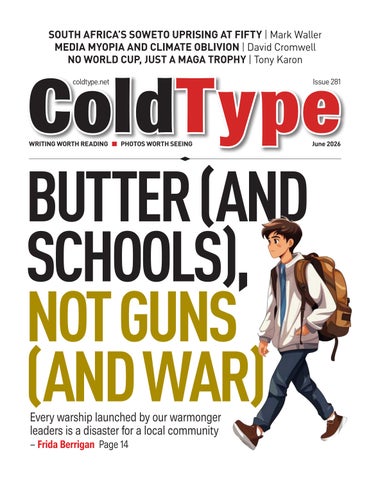
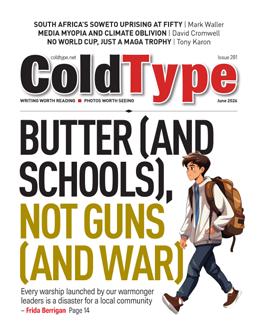
NOT GUNS (AND WAR)
Every warship launched by our warmonger leaders is a disaster for a local community
– Frida Berrigan Page 14


INSIDE
INSIGHTS
5 The US must end its illegal strikes on innocent boats
Farrah Hassen
6 Now’s the time to get big money out of politics
George Monbiot
8 US overseas military bases and the New York Times
William Astore
8 Greed at a glance Inequality.org
9 Street Life Duncan Cumming
10 Ted Turner: The Devil behind
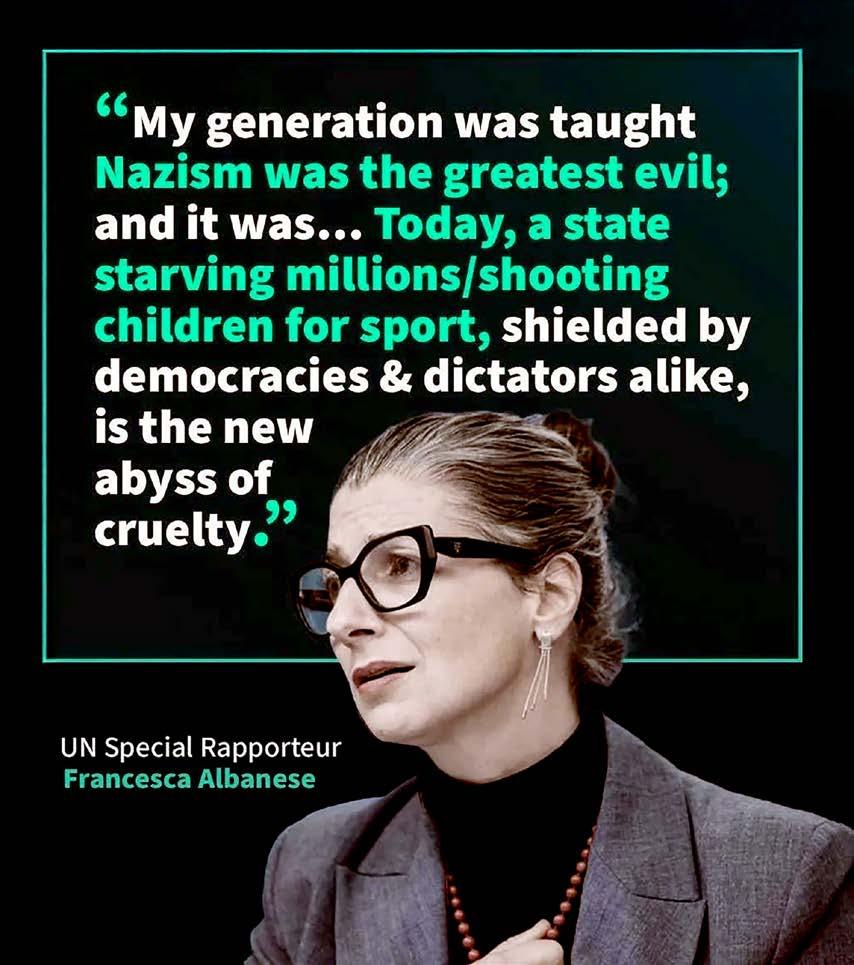
11 Judge blocks sanctions on UN’s Francesca Albanese Shireen Akram-Boshar
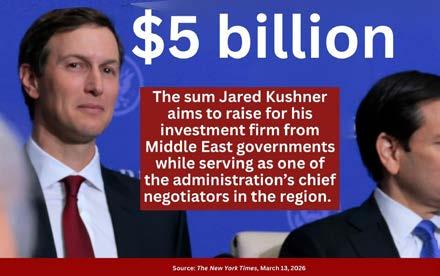
13 How Zionist billionaires sank Thomas Massie Lee
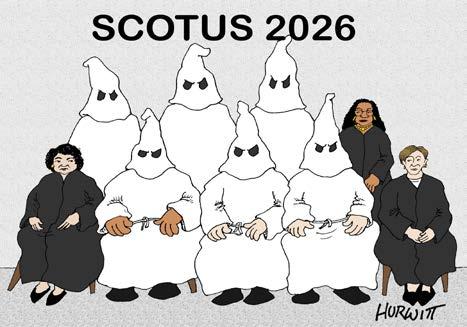
13 Hurwitt’s Eye Mark Hurwitt
ColdType
7 Lewis Street, Georgetown, Ontario, Canada L7G 1E3
Contact: Tony Sutton editor@coldtype.net
Subscribe: For a FREE subscription e-mail editor@coldtype.net
Back Issues: www.coldtype.net/reader.html or www.issuu.com/coldtype
Disclaimer:
The contents of the articles in ColdType are the sole responsibility of the author(s). ColdType is not responsible for any inaccurate or incorrect statements they may contain
©ColdType 2026

INSIGHTS
➤ FARRAH HASSEN
The US must end its illegal strikes on innocent boats
The US military has been carrying out extrajudicial killings in the Caribbean and Pacific over the past nine months with impunity.
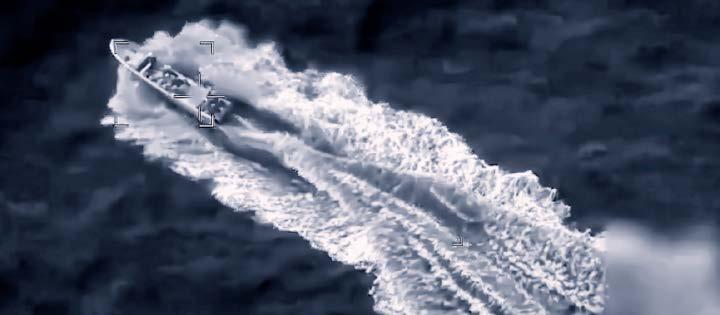
On May 8, an attack struck another boat in the eastern Pacific, killing two people and leaving one survivor. US Southern Command claimed “the vessel was transiting along known narco-trafficking routes” and “was engaged in narcotrafficking operations.”
According to The Intercept, there have now been 58 such boat strikes since last September that have killed at least 193 people. As with the May 8 attack, the names and
nationalities of most of these victims remain unknown.
The Trump administration has accused civilian boats of transporting narcotics to the US and says its killing “narco-terrorists.” But the Pentagon has provided no evidence for these claims or any indication that the people killed posed an imminent threat.
International and US law do not allow the use of the military to kill civilians suspected of crimes. Boat bombing on the high seas is not a legitimate law enforcement operation. Nor is it curbing the flow of drugs into the United States, as Trump claims, or combating the
DEATH BLOW: US Southern Command video shows a US military strike on a boat in the Eastern Pacific on April 26, 2026
root causes of drug use.
Even if the boats did carry drugs, the appropriate response would be to lawfully intercept and detain the suspects and afford them due process of law.
In a desperate attempt to provide legal cover for these murders, the Trump administration is asserting that the US is engaged in an “armed conflict” with unspecified drug cartels – the same kind of broad legal authority invoked by the George W. Bush administration in its post-9/11 “war on terror.”
But there is no armed conflict in the Caribbean or the Pacific. The people on those boats are civilians who are not legitimate military targets. “You just can’t call something war to give yourself war powers,” noted University of Pennsylvania professor Claire Finkelstein.
Legal and human rights experts agree.
Last October, UN High Commis-
INSIGHTS
sioner for Human Rights Volker Türk condemned the boat strikes. “None of the individuals on the targeted boats appeared to pose an imminent threat to the lives of others or otherwise justified the use of lethal armed force against them under international law,” Türk said in his October 31 statement.
Despite unsubstantiated, fearmongering claims, investigations have shown that several of those people killed were fishermen trying to make a living for their families.
On January 20, the US attacked the Ecuadorian fishing boat La Fiorella. None of the eight fishermen aboard have been seen since.
Survivors have also endured abuse. In separate Pacific attacks on Ecuadorian fishing boats in March, 36 survivors said they were “abducted and tortured by American forces and taken by boat all the way to El Salvador before being returned to Ecuador,” according to an investigation by Drop Site News
“They handcuffed us, put hoods over our heads and pushed us around. We were terrified they were going to kill us,” recalled Johnny Sebastián Palacios, one of the survivors, in an interview with the Guardian.
The US must immediately end these boat strikes and take accountability for the harms caused to the victims and their families. And Congress must do its job of conducting oversight to ensure transparent and independent investigations of these strikes.
When federal immigration agents killed American citizens earlier this year, we saw all too clearly the risks of letting the government shoot people and call them “terrorists.” It leaves all of us less secure, undermines the rule of law, and can’t be allowed to become routine.
Farrah Hassen, J.D., is a writer, policy analyst, and educator. This op-ed was distributed by www.OtherWords.org
“concerned about the possibility of corruption” among politicians. A further survey concluded that political donors are believed to wield the most influence of any elite faction. Disillusionment with politics drives people into the arms of the extreme right. This is paradoxical, as it tends to be highly receptive to the ultra-rich.
I’m prompted to write this column by Tom Burgis’s powerful investigation for the Guardian into Reform UK’s relationship with Christopher Harborne, who is based in Thailand. Remarkably, Harborne has provided about two-thirds of all Reform’s donations since its foundation: more than £22 million altogether. The rules in Britain limit the amount a party can spend in an election year, but set no cap on the proportion a single funder can provide. In theory, one person could supply its entire budget. At what point do we decide that a political party is, in effect, owned by a donor?
Now’s the
time to get big money out of politics
How do we know whether political funding is corrupt? Mostly, we don’t. A plutocrat delivers a sack of cash to a political party. A few weeks later, it announces a policy that happens to favour the donor’s business. Are the events linked? We might suspect it; we cannot prove it. But the suspicion itself is corrosive and demoralising.
The current funding system, perhaps more than any other factor, turns us away from politics, breeding disillusionment, alienation and cynicism. A survey by the UK’s Electoral Commission last year found that only 18 percent of respondents believed spending and funding are transparent. A government survey in December discovered that 87 percent of people are
I can’t prove that Harborne’s money has bought special favours from Reform, and make no suggestion of illegality. But there is also no way of proving that this funding is not connected to Nigel Farage’s enthusiasm for cryptocurrency, which appears to be Harborne’s principal source of wealth. The not-knowing is just as corrosive as the knowing.
Like the Tories, Reform has also taken lavish funding from very rich people who are hostile to climate action. Both parties now evince the same hostility. Which came first, the hostility or the funding? Does it matter? Whether a party changes its policy in response to donations or attracts big donors because of its policy, it’s equally damaging to democratic trust.
➤ GEORGE MONBIOT
INSIGHTS
The same applies to Labour’s relationship with City donors, which might help explain its newfound enthusiasm for deregulating finance, despite the warnings of 2008. As Transparency International has documented, political parties in the UK “are increasingly becoming dependent on a small number of very wealthy donors,” “Dependent on” can easily mean “beholden to.” In very few cases has corruption been demonstrated. But that’s not the point. The problem isn’t that such relationships are illegal. The problem is that they are not.
The trust crisis was exacerbated by the Conservatives, who, without providing a coherent rationale, raised political spending caps and handcuffed the regulators. As the admirable Spotlight on Corruption has discovered, the Electoral Commission’s investigations have declined by 89 percent since 2019, while the police, without a dedicated unit and clear powers, do almost nothing. No one has ever gone to prison in Britain for breaching electoral finance laws. The highest criminal fine yet levied is a pathetic £6,000. The regulator’s budget in this country is about £1 per voter. In Australia it’s £24.
The higher caps set by the Tories triggered an even more intense scramble for private money: our representatives now often seem to spend more time soliciting funds than soliciting votes. Regulatory corrosion has made it even harder to spot the difference between a “permissible” donor and an “impermissible” one, and to stop foreign agents infiltrating our politics.
The representation of the people bill seeks to address this crisis. But to read the relevant sections (58-63) is to be struck by their extreme
complexity and obvious loopholes. In response to the Rycroft review on foreign interference, the government has decided to cap annual funding from voters living abroad at £100,000 each, and stop donations being made in cryptocurrency. But how can anyone be sure that a billionaire based abroad isn’t channelling money through a resident, or an untraceable crypto payment isn’t turned into sterling before it lands in a party’s account? Continued regulatory chaos and public distrust are locked in.
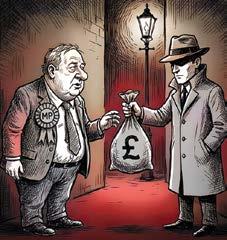
I believe that any attempt to distinguish between “good donors” and bad, resident and foreign, is futile. Any major donor is a bad donor, as their economic power undermines democracy. Given the transnational nature of capital, distinctions based on residence become meaningless. And what’s to stop an AI program splitting a big donation into a thousand small ones that don’t need to be reported at all?
There’s a simple way of sorting all this out. It works as follows. The only money a party can receive is a standard fee (say £25) for membership. The government then matches that fee on a fixed multiple. For instance, if you have 100,000 mem-
bers each paying £25, and the multiple is three, your annual budget is £10 million. And that’s it: no other sources permitted. The parties would agree between themselves, with public input (perhaps a citizens’ assembly), on what the membership fee and multiple should be.
At a stroke, this sweeps away all the complexities of permissible and non-permissible donors, residence requirements, currency types, ultimate origins and spending caps. Instead of raising money, politicians would spend their time raising membership: reconnecting with the public and broadening their base. We would become equal political citizens, and our system would be transparent and intelligible. It would belong to us, not the billionaires.
The cost to the exchequer? Perhaps between £20 million and £50 million a year. The costs of the current system are incalculable, as the entire state is harnessed to it, creating endless dysfunction.
It doesn’t solve every aspect of billionaire influence: for instance, it wouldn’t have stopped Nigel Farage taking another £5 million, in this case for his own use, from Harborne before he became an MP. But this simple measure would, I believe, do more than any other to give politics back to the people. Democracy demands that we eliminate not only the dodgiest and most obscure sources of donor money, but all of it. CT
George Monbiot’s latest book, written with Peter Hutchinson, is Invisible Doctrine: The Secret History of Neoliberalism. His website is www.monbiot.com This article first appeared in The Guardian
➤ WILLIAM ASTORE
US overseas military bases and the New York Times
You can’t make this stuff up. The “liberal” New York Times has now explained why the US has so many overseas military bases in the Middle East and elsewhere.
Anton Troianovski, who covers global diplomacy, writes:
“The Persian Gulf war in 1991 ushered in the era of permanent, large-scale military bases in the Middle East – in part to protect oil supplies. The rationale evolved to include crushing Al Qaeda, promoting democracy and fighting the Islamic State. The bases are part of a military network spanning the globe that officials say helps project America’s economic and political power. Russia and China also have global ambitions, but their military footprint is much smaller. Russia’s
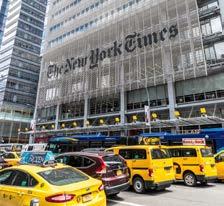
“All the propaganda that’s fit to print”
main military presence outside the former Soviet Union is in Syria, where its influence has declined after the fall of the Assad regime in 2024. China has an African base near the Red Sea and is expanding elsewhere – Cambodia, for instance.”
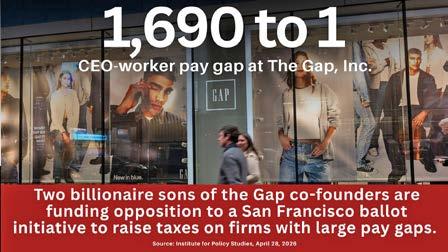
Where to begin?
1. The US military has had a large military presence in the Middle East beginning with the Carter Doctrine in 1980, if not decades before then. Israel and Iran (from 1953 to 1979) were the main US proxies in the region. The NYT’s answer suggests the large permanent US military presence dates only from 1991 and was almost an accident of that war. At least the answer mentions oil, though US designs weren’t so much about “protecting” the oil – more like securing or stealing it.
2. Yes, the rationale sure did “evolve.” But there’s no mention of how the growing US military presence in the region inspired the 9/11 attack on the US in 2001. Osama bin Laden specifically called out the US military’s presence in Islam’s sacred areas as inflammatory and intolerable.
3. “Promoting Democracy.” How has that worked in Iraq? Libya? Syria? Elsewhere? Sorry, democracy isn’t spread by Hellfire missiles and decapitation strikes.
4. “Officials say” the US global network of 800 or so military bases (no number or cost figures provided by the NYT) helps “project” economic and military power. At least the NYT said “project” and not “protect.” No mention here of the effectiveness of these bases in defending the United States. Consider this a tiny burst of honesty from the NYT about how these bases are truly intended to project power.
5. Then there’s the kicker about Russia and China having “global ambitions,” even though “their military footprint” is much (MUCH!) smaller overseas. We’re taking a handful of bases compared to nearly a thousand for the US empire.
INSIGHTS
By the way, here was the original question addressed to the NYT:
Why does the United States maintain so many military bases in the Middle East? How do we compare with Russia and China? How many military bases do they have in foreign countries? | Tom Ahlberg | Gig Harbor, Washington
Poor Tom Ahlberg. He can’t even get a simple and straight answer. I think I can provide one:
Acting as an imperial hegemon, the US seeks to dominate the Middle East while serving the expansionary designs of Israel. The US global military presence is both grossly larger and more aggressive than the regional postures of Russia and China. While the US military has roughly 800 military bases worldwide, costing in the neighbourhood of $65-$75 billion yearly just to maintain, Russia and China have only a handful of military bases in foreign countries. (My AI friends tell me that China has exactly one, whereas Russia has roughly twenty, mostly in former Soviet republics.)
Why couldn’t the NYT provide an answer somewhat like my cut at it? It’s not hard. Well, leave it to the “radical left” NYT to be so critical of US militarism, imperial ambitions, and murderous foreign wars. Yes, that’s sarcasm.
New slogan for the NYT: All the propaganda that’s fit to print. CT
William J. Astore is a retired lieutenant colonel (USAF), professor of history, and a senior fellow at the Eisenhower Media Network (EMN), an organisation of critical veteran military and national security professionals. His website is www.bracingviews. com
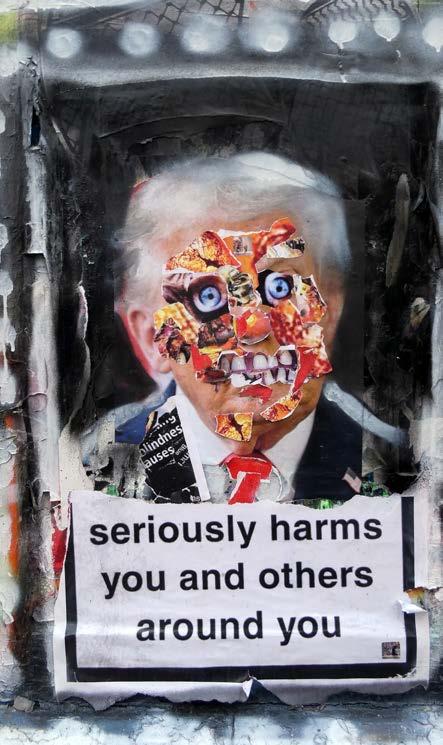
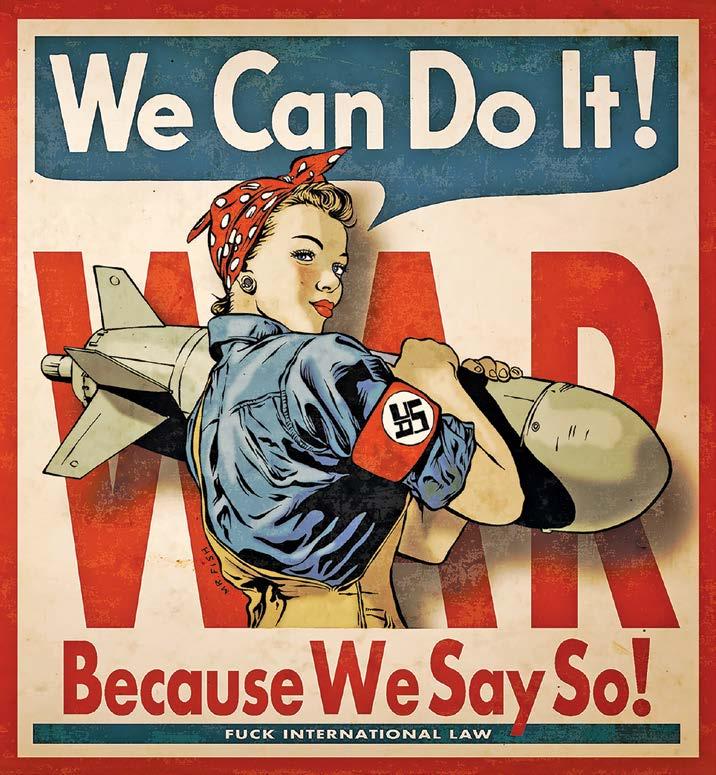
BE AFRAID! Poster from a London street highlights a message the world ignores at its peril: Think Iran. Think Venezuela. Think Cuba. Think on …
➤ STREET LIFE DUNCAN CUMMING
➤ BINOY KAMPMARK
INSIGHTS
Ted Turner: The Devil behind Cable News
Being very much the allAmerican figure that he was, the passing of Ted Turner was bound to enliven the cliché machine with the usual, clotty descriptions: the philanthropist, the conservationist, the yachtsman, sporting proprietor and twentyfour hour news pioneer.
“He thought big and lived large,” observed Guardian US columnist Margaret Sullivan with irritating triteness.
“He was the original,” added former CNN journalist Christiane Amanpour, barely an improvement.
“He made us all strive for his vision of a better world.”
No doubt the hagiographers will be kept busy with words of statuary on various aspects of his life in due course.
One contribution of his should not be spared a good beating. As the man behind the first 24-hour news network, he has much explaining to do.
The time when news could be rationed to times of the day did, at least, concentrate the mind on those behind producing it. Care would be taken assembling the items that would be delivered by an almost affected hauteur on air. This all changed when the news about events became news about news.
Turning news into a twenty-fourhour affair had the effect of treat-
ing virtually everything before the camera into something worth mentioning and reporting about.
Nothing in this world of “Chicken Noodle News” could be too trivial anymore; every item, however tedious, deserved its place in Andy Warhol’s span of 15-minute fame, from inane car chases to watching paint dry.
After Turner’s launching of the Cable News Network (CNN) in 1980, events of varied relevance and proportion could receive the around the clock exposure live coverage offered.
Relentless, even ghoulish footage beamed across the network of the Space Shuttle Challenger as it exploded 73 seconds after taking off in 1986. In 1987, an 18-month-old Jessica McClure gave voyeuristic delight to viewers over 58 hours of coverage after falling into a well in Midland, Texas. Eyes were glued to
screens wondering if “Baby Jessica” might be rescued. The efforts of rescuers were also the subject of interest.
The argument about cable television news ever being factual is a moot point. CNN’s coverage of the 1991 Gulf War only served to illustrate how subservient a news outlet could be to official narratives.
The fact that news had become a continuous and unceasing affair merely concentrated the messages of the administration of President George H. W. Bush, turning CNN into an uncritical annex of the war. Douglas Kellner’s The Persian Gulf TV War is a bracing account of this fact, a polemic against media complicity with establishment drip feed.
The US military establishment had certainly learned chastening lessons from the Vietnam War, keeping the wandering media hacks on a short lead.
The unsuspecting Wolf Blitzer, who continues to labour at the network with perennial sunniness, uncritically recalls in an interview with Poynter the cultivating roles played by the panjandrums of war. “The top Pentagon leadership –Defense Secretary Dick Cheney, Chairman of the Joint Chiefs of Staff Gen. Colin Powell and other senior leaders were quickly reaching out to me – a newcomer and relatively junior reporter at the Pentagon – to brief me on the state of the war.”
This was no time for critical analysis from news reporters. A conduit, a medium, was what was needed, and a twenty-four-hour organ was there to oblige. The likes of Cheney and Powell, accordingly,
John Mathew Smith / Wikipedia
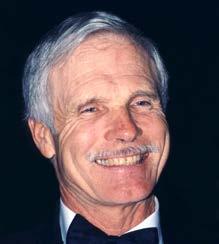
CABLE KING: Ted Turner
INSIGHTS
“knew that everyone around the world was watching CNN and they wanted their analysis reported.” The icing of propaganda was complete with another realisation, not that Blitzer ever clicked. “It also became very evident to me the top Pentagon brass knew that Saddam Hussein’s military leaders in Baghdad were watching CNN.”
That unceasing nature of the broadcasts also turned the journalists in the war news cycle into minor celebrities offering minor contributions.
CNN’s Bernard Shaw was hardly doing much in the way of investigative journalism bunkered in the Al Rasheed Hotel in Baghdad as the bombs of Operation Desert Storm started falling. Limited as he was, he offered that line media watchers remember: “The skies over Baghdad have been illuminated.”
The cable news coverage also served to exsanguinate the conflict, turning it into a simulation, a crude video game notoriously theorised by the French sociologist Jean Baudrillard as La guerre du Golfe n’a pas eu lieu (The Gulf War Did Not Take Place).
With CNN as pioneer, snapping upstarts were bound to follow. By January 2002, Fox News had surpassed the network in the cable news ratings despite being available in 10 million fewer homes. The news in terms of substance had ceased to exist, its undertaker being Fox CEO and chairman Roger Ailes. In its place rose the ranting hysteric and jabbering pontificator, full of what might politely be called “views.”
With constant news coverage firmly in place, the time was ripe for a figure capable of seducing and even shaping it. Donald J. Trump
did so with a sinister gusto, the first politician to become the news cycle. With tacit collusion, CNN and other cognate news networks fed and oxygenated the property tycoon’s fickleness, the capriciousness, the rants. Every comment, however asinine or vapid or vulgar, warrants mention, analysis, a comb through by perfumed pundits eager to pursue a “fact check.” A Stockholm Syndrome of sorts developed between the network and the reality television star turned President.
With news as surfeit and saturation, the Turner legacy is one we
could have done without. With its tendency to feed us stories thin, uneven and occasionally interesting in continuous fashion, the twenty-four-hour news beast is limping towards the Museum of Media Relics. The studied, rationed podcast and the conspiratorial slime of social media continue to usher it along its doomed way. CT
Binoy Kampmark was a Commonwealth Scholar at Selwyn College, Cambridge. He lectures at RMIT University, Melbourne, Australia ➤

SHIREEN AKRAM-BOSHAR
Judge blocks sanctions on UN’s Francesca Albanese
AUS federal judge on May 14 temporarily blocked the Trump administration’s sanctions on Francesca Albanese, a UN expert on the occupied Palestinian territories, con-
cluding that the sanctions violated her right to free speech after she called for Israeli officials to be charged with war crimes.
US District Judge Richard Leon said that the sanctions against Al-
RIGHTS VIOLATED: Francesca Albanese, UN expert on Palestine
Rafael Medeiros / Wikimedia
INSIGHTS
banese violate her right to free speech, as they aimed to “punish” and “suppress disfavoured expression” after her recommendations to the International Criminal Court (ICC).
“Albanese has done nothing more than speak!” Leon wrote. “It is undisputed that her recommendations have no binding effect on the ICC’s actions – they are nothing more than her opinion.”
Albanese had called on the ICC to issue arrest warrants for Israeli leaders involved in the genocide in Gaza – including Israel’s National Security Minister Itamar Ben Gvir, Finance Minister Bezalel Smotrich, and Defense Minister Israel Katz –after outlining how each of these figures played a part in the “infliction of collective torment and settler colonial genocide” in Gaza since October 7, 2023.
US Secretary of State Marco Rubio imposed sanctions on Albanese in July 2025 based on Trump’s executive order targeting those “directly engaged” with ICC investi-
BY THE NUMBERS
gations into Israel’s crimes in Gaza.
The executive order came after the ICC issued arrest warrants for Israeli Prime Minister Benjamin Netanyahu and former Israeli Defense Minister Yoav Gallant for their crimes in Gaza.
The sanctions on Albanese have drastically affected her life; she has described them as imposing a “civil death.” The sanctions led to the seizure of her apartment in Washington, DC, where she had lived with her husband and daughter, prevented them from returning to the US, and froze them out of international banking systems.
In Albanese’s own words, “Even outside the US, it means financial exile. I cannot hold a bank account. I cannot make bank transfers. My email address was shut down.”
“My ties with the universities I had collaborated with – Georgetown and Columbia – were severed,” she continued, speaking in an interview last month. “I am treated by the United States as an
international drug trafficker, punished without due process, without any opportunity to defend myself. There are fines of up to 1 million dollars for anyone who provides goods or services to me. My husband works for a US-based organisation. My daughter was born in the US and holds American citizenship. All of us have been affected.”
In imposing sanctions on Albanese, Rubio claimed that she had “spewed unabashed antisemitism,” while decrying her allegations that Israel is committing genocide in Gaza.
Left-wing economist Yanis Varoufakis wrote of the repression Albanese faced due to her outspokenness on the genocide: “Smears. Investigations. Vicious editorials. Frozen bank accounts. Dispossession of the only apartment she had ever owned. The machinery of the respectable turned to crush her.”
The US has also sanctioned at least 11 ICC judges, who described the effects it has had as leaving them and their families “wiped out economically and socially.”
Leon’s preliminary injunction against the sanctions halts travel bans and banking restrictions on Albanese.
Albanese wrote on X after Leon’s decision: “The interim by the US judge gives me respite but the battle is not over. ICC judges and Palestinian NGOs remain sanctioned with no recourse to justice. The stakes are incredibly high.” CT
Shireen Akram-Boshar is a socialist writer, editor and Middle East/ North Africa solidarity activist. This article first appeared on the Truthout website at www.truthout.org
INSIGHTS
How Zionist billionaires sank Thomas Massie
Surly scallawag Congressman Thomas Massie just lost his Republican primary race in Kentucky on May 19 . Yes, this makes Donald Trump very happy. But in losing this race, Massie exposed the entire US political system and its true owners.
This was the most expensive primary race in the entire history of the United States. Over $32 million was spent on ads alone in a primary race that Massie normally wins by over 50 percentage points.
The incredible amount of money dumped into the race did not come from “average” Kentuckians. Well, the millions paying for Massie’s ads did, but the millions promoting challenger Ed Gallrein did not. Those millions came from pro-Israel groups and pro-Israel mega-donors.
Trump hates Massie mostly because he was the top republican force behind revealing the Epstein Files. Without him, the Epstein bill likely would not have passed.
However, that’s not what caused Massie to lose his job. The egregious behaviour that got him booted from Congress was essentially voting against and whistleblowing on the Israel lobby. He talked about the power of AIPAC and other Israellinked groups on Congress. He revealed that every Congressperson has an AIPAC babysitter who walks them through how they’ll be expected to vote on every bill.
Massie refused to do what the Israel lobby wanted. Major pro-Israel
pro-Trump donors like Paul Singer and Miriam Adelson (born in Israel) saw this as their cue to buy Massie’s seat in Congress. And they did just that. Massie’s loss shows without a shadow of a doubt that:
a. Money can buy US elections even when one candidate is an international rockstar and the other is an unknown non-verbal hairpiece who no one likes.
b. Pro-Israel donors have money to buy said elections. Revealing the truth about Israel’s power over the US government is enough to activate those donors.
c. Advertising (whether true or false, but mostly false) can influence large swaths of people to vote
against their interests.
d.) The USA is not a democracy or republic but an arcade game for billionaires – put in enough quarters and they’ll win every game eventually.
Here’s the deepest truth all Americans need to come to terms with: Billionaires can and will buy EVERY election they care to. This does not mean billionaires buy every election. Many elections they don’t care to flood with money because the likely winner is already a proIsrael, pro-capitalist, hack. And the likely runner-up is the same. But, when a Thomas Massie arrives on the scene, causing trouble for Israel or AIPAC, then those billionaires will spend as much money as needed to remove the thorn in their side. No, the US is not a democracy. It’s not a republic. It’s an oligarchy. When push-comes-to-shove, most Americans have zero say in what happens.
Only billionaires do. CT
➤ LEE CAMP
➤ HURWITT’S EYE MARK HURWITT
➤ FRIDA BERRIGAN
Butter (and schools), not guns (and war)
Every warship launched by our warmonger leaders is a disaster for a local community
Guns or butter. Butter or guns. Can we have both? If not, which should come first? Consider it one of those chickenand-egg conundrums of modern society.
“Guns” is the stand-in for a wellfunded military and “butter” for all the human goods, comforts, and needs of a society.
Economists, politicians, and generals have long considered the balance of guns and butter. Wage too many wars, produce too many arms, and there won’t be enough money to keep a nation decently fed and comfortable. Produce too many consumer goods, meet everyone’s needs, and a nation might find itself ill-prepared and vulnerable in the face of a possible attack or even invasion. Everyone from Nazi propagandist Joseph Goebbels to British Prime Minister Margaret Thatcher has had something to say about the balance of guns and butter (or, more likely, the lack of it).
No surprise, but I like butter and don’t like guns. I have long been attracted to the graphics produced by groups like the National Priorities Project (NPP) and Brown University’s Costs of War Project that dramatise the opportunity costs of war investment in the United States. At some point, one of those groups created a pen that had a long scroll on a
pull-out flap inside it. At parties, as you were discussing the military budget, you could take out that pen and unfurl a long bar graph comparing US military spending to the budgets for education, healthcare, and infrastructure. Neat trick, right?
These days, NPP has a new factsheet that offers a breakdown of how the cost (so far) of Trump’s Iran “escapade” could have been so much better spent:
l Covering Medicaid for all 14 million people at risk of losing their insurance,
l AND the Supplemental Nutrition Assistance Program, or SNAP, for all four million people at risk of losing food assistance, including 3.5 million due to new work requirements for older people and caregivers,
l AND expanding Medicaid to an additional 10.3 million people.
Those numbers are based on the Pentagon’s request for $200 billion in supplemental funding for the Iran war effort. Defense Secretary Pete Hegseth was on Capitol Hill on April 30, supporting a lowball estimate of the war costs as a mere $25 billion (and worth every dollar!) and asking for support for an inconceivable $1.5 trillion for Trump’s war machine
in fiscal year 2027. Guns vs. Butter? More like guns force-fed foie gras and caviar and sautéed in the world’s most expensive butter.
If I ever got a tattoo, it would probably be of this line from President Dwight D. Eisenhower’s 1953 “Chance for Peace” speech: “Every gun that is made, every warship launched, every rocket fired signifies, in the final sense, a theft from those who hunger and are not fed, those who are cold and are not clothed.”
Eisenhower gave that speech 73 years ago (even as military budgets increased significantly while he was president) and yet the words ring truer than ever today. In reality, I’m unlikely to get a first tattoo at the age of 52, but I did see all of this up close and personal a couple of weeks ago at my Connecticut town’s school board meeting.
For months, school board members had been ringing an alarm bell about their budget. After years of scrimping and shaving, layoffs and early retirement packages, they were no longer able to economise their way to a balanced budget, and so were considering a “nuclear option”: closing one of our local schools.
Community members rallied, testified, and harangued. Busloads of kids joined our superintendent at the state capitol to ask for more sup-

“Every gun that is made, every warship launched, every rocket fired signifies, in the final sense, a theft from those who hunger and are not fed, those who are cold and are not clothed”
- President Dwight W. Eisenhower
port for our schools. For the last two months, everyone in my neighbourhood has been talking about this, and on a Monday night a few weeks ago, the school board held a public meeting to make an ultimate decision about what to do.
I drove there over streets riddled with potholes, past new luxury apartments built as “workforce housing” for the engineers at General Dynamics Electric Boat, where a new class of nuclear submarines (12 boats for $132 billion) is now being designed. Those $2,200-a-month studio apartments overlook a gas station, train tracks, and a low block of struggling businesses in a flood zone.
The school budget gap (more than $7 million) is there for all the usual reasons, made more extreme because we’re living through what, in the age of President Donald J.
Trump, can only be considered the cratering of imperial America globally and the volume is up to 11 on everything.
In these years, the line items for staff health insurance, building utilities, and a host of other costs have skyrocketed. The contributions from the state of Connecticut aren’t even close to keeping pace. The whole enterprise is built on the backs of local property owners and our taxes are already far too high.
The place most likely to be shuttered was CB Jennings School, right up the road from my house, which has (for the rest of this school year, anyway) 338 students. All but 30 of those students qualify for free or reduced-fare lunches, meaning they come from low-income households.
The school population includes 149 “multi-language learners” and 66 special-education students.
The 338 kids there would be divided between the other two elementary schools in our neighbourhood. The fifth graders would all go to the local middle school (which itself was to be consolidated from two buildings into one) and the eighth graders to the local high school.
Teachers and custodians, principals and paraprofessional educators, social workers and secretaries will all be moved around, too. Routines will be broken, friendships and collegial collaborations disrupted, teaching teams split up.
There will be a great jostling for parking spaces, offices with windows, and classrooms that face out of (or into) the sun. September will be stressful indeed and no one is happy.
Who bears the brunt of all this disorder? The answer: the kids who pay no taxes and make no policies. The little ones who are already deemed behind when they show up for kindergarten and need all the help the professionals there can give them. The tween ones who just want to see their friends, show off their new braids, learn to play the trumpet, and get first place in the spelling bee. The older ones who need the breakfast, lunch, and snacks that are served at school. The ones who bring the light and the joy of learning with them every day.
The lives of those little ones and their slightly bigger siblings are all soon going to be subjected to massive disruptions.
Of course, those “massive disruptions” are only so in relative terms. They’re but a minor hiccup compared to what’s happening in the lives of children throughout Iran during President Trump’s war on their country.
Icry about the war against Iran every day. (Truly!) The terror and the horror buzz through my head at the weirdest times: as I run errands, work in my garden, perform my school-crossing guard duties, and greet my young walkers. All this daily predictability and precious stability, the gorgeous ho-hum of the daily grind that has been stolen from the people of Iran by our war. I look at pictures of Iranians cleaning up around buildings reduced to rubble and trying to go about their lives amid the catastrophe and I’m filled with awe.
I finished by saying we all have to work so much harder to stop this war as well as fund our schools and that the two were connected
How would I ever begin again after surviving a rocket attack? Would I be able to extract the broom from the wreckage or ever brew tea again?
I tried to put such images aside when I went into the school board meeting that fateful night. When it was my turn to speak, I had three points to make – one minor, one second-hand, and one massive. I was nervous. My first point was easy. I argued that the school at the edge of the city should close instead of Jennings, which is more centrally located.
My second point was awkward. My 12-year-old had written a speech, but then refused to read it and was whispering contradictory instructions to me as I got up for my turn to speak.
miles away.
I tried not to think about the room full of parents and teachers behind me, but I still felt uncomfortably out on a limb making my geopolitical points during our local school board meeting.
Despite my doubts, however, I continued, noting that between February 28 – when my country started that terrible, illegal war – and March 27, the United States had fired 850 Tomahawk missiles at targets in Iran. And mind you, each one of those missiles comes at a cost to taxpayers of more than $3 million.
My three minutes of time were running out, so I rushed through the next part, mentioning that our senator, Richard Blumenthal, estimated at the beginning of April that Trump’s war is now costing US taxpayers $1 billion dollars a day! And that’s before we factor in the longterm economic consequences of oil and gas price rises, disruptions to the global supply chain, and the cratering of my country’s already teetering standing globally.

Finally, I got to my third point. Facing a semicircle of board members, I tried to channel the gravitas of President Eisenhower by pointing out that the Trump White House began its war against Iran by hitting a primary school with a Tomahawk cruise missile and killing 165 civilians, most of them schoolgirls. And I pointed out that decisions like the one to start a war with Iran ripple all the way to our coastline –destabilising our local world and stealing from our kids, too.
Closing an elementary school or having a massive budget hole are not our only two options, I said. We could instead be living in a society that prioritises keeping elementary schools open and fully funded instead of bombing schools 6,700
I finished up by saying that we all have to work so much harder to stop this war as well as fund our schools and that the two were connected. This budget gap would be a difficult dilemma under the best of circumstances, but against the backdrop of war and calamity, it feels indicative of a much deeper problem than a few million-dollar local budget holes. As I concluded. I made eye contact with the school board members and thanked them for their time.
Making my way back to my seat, I noticed that I was a little sweaty and that my hands were trembling. Why was I so nervous? Why was that so hard?
Eisenhower’s speech is a rhetorical master class, well worth revisit-
ing in this age of imperial fiat by tweet. Ike went on to intone: “This world in arms is not spending money alone. It is spending the sweat of its labourers, the genius of its scientists, the hopes of its children. The cost of one modern heavy bomber is this: a modern brick school in more than 30 cities…. We pay for a single destroyer with new homes that could have housed more than 8,000 people… This is not a way of life at all, in any true sense. Under the cloud of threatening war, it is humanity hanging from a cross of iron.”
After some formalities and hearing from a handful more people, the school board voted to shutter the CB Jennings Elementary School, a remarkably modern school in the heart of our city with a new playground and a beautiful library. The vote was unanimous. The board members were sad but resigned. It was treated as an inevitable but unfortunate outcome or even as a forward-looking, resolute action. They were “doing something” in the face of a huge budget gap.
And indeed, the school budget will be back in the black – for now – once a $1.4 million shortfall is settled by cutting more positions, shaving costs, and looking for grants. Meanwhile, the local schools that remain are indeed closer to a balanced budget (at least until utility costs spike even higher and yet more global war-making costs hit home in this country).
The cost of the war against Iran is just one reason to be against it. The wanton violence, the indiscriminate death-dealing, the gold-plated hubris, and the gargantuan stupidity of Trump and crew, as well as the massive long-term impacts of the closing of the Strait of Hormuz, are something to try to take in.
Every war is bad, stupid, and represents a colossal failure of the imagination, but this one, with the
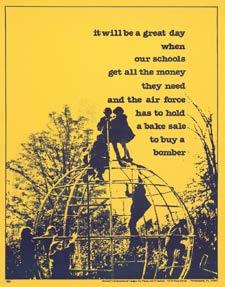
WELL-WORN POSTER: “It will be a great day, when our schools get all the money they need, and the Air Force has to hold a bake sale to buy a bomber”
Trump trademark on it, should be considered the ur-war to oppose, resist, and refuse to pay for. And sitting in that makeshift meeting room of the New London Board of Education, I felt like a tightly wound, somewhat muted Cassandra, requesting that people who are probably against the war, too, somehow consider it part of the reason we are being called upon to close a school and reduce the quality of our kids’ education.
We have a well-worn poster in the back hallway of our house. It’s an image of kids playing on a metal jungle gym alongside the words: “It will be a great day, when our schools get all the money they need, and the Air Force has to hold a bake sale to buy a bomber.”
A bake sale to buy a bomber? A car wash to get a Tomahawk? A dime drive for the next generation of nuclear submarines? This administration’s officials aren’t even pretending to enlist the public in support of their latest war, nor did they
even try to get Congress to rubberstamp it. They care that little for democracy, the rule of law, or even our hearts and minds. This White House grows fat on our outrage, our protest gestures, and our well-mannered critiques. They are printing money and telling lies in a frenzy of impunity that will (hopefully) finally be checked by the November elections. But there is so much violence and scapegoating and scare-mongering coming out of Donald Trump’s White House and his Florida compound that many people are checking out on all of it just to carry on with their lives. But nothing now is NORMAL and we can’t allow ourselves to normalise any of it.
How do we stop this war? How do we redirect the money being wasted into the schools and health centres, bike lanes and sustainable-energy infrastructures that we all so desperately need? How do we take care of those victimised, maimed, and orphaned by our military? How do we take care of those rendered homeless, stateless, limbless by our wars? The answer: We do something to protest, undermine, and challenge militarism every day. We work to connect those faraway wars, framed as invisible or normal or too complicated for us to grasp, to our everyday lives. We make all the awkward speeches we can. We hold up homemade antiwar signs. We refuse to pay for the wars we oppose. We continue to demand that butter, not guns, schools, not heavy bombers, homes, not destroyers be the focus of our lives. CT
Frida Berrigan is the author of It Runs In The Family: On Being Raised by Radicals and Growing into Rebellious Motherhood. She has three children and lives in New London, Connecticut, where she is a gardener and community organiser. This essay was first published at www.tomdispatch.com
➤ TONY KARON
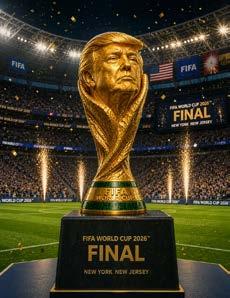
There’s no World Cup this month, just a MAGA trophy
FIFA boss Infantino has created a highly profitable Trump-rules tournament that bears little resemblance to the spirit of the World Cup as we knew it
Imagine that the BBC chose to ignore the opening ceremony of the 2026 World Cup hosted by Canada, Mexico, and the United States, and to instead devote an hour of programming to the moral – and physical – hazards of staging a part of that tournament in the US,” Daniel Levy and I wrote in the Nation four years ago, drawing attention to Western media’s hypocritical treatment of Qatar 2022.
“How safe can visiting fans really feel, the presenter might ask, in a country where the authorities are unable or unwilling to prevent them from being shot dead on any day of the week in a mall, in a gay nightclub, in a church, synagogue, mosque, or anywhere else? And how safe are visiting Black fans (those lucky enough to get visas) in a country with shocking levels of racist police violence?
“How could visitors really feel comfortable enjoying a sports festival in a country where, on any given day, 2 million people are behind bars, more than half a million are homeless, and 41 million face hunger – in the world’s richest country, which spends more on arming its military than the next nine countries combined (and which has shown an unfortunate willingness to unleash that military abroad to
disastrous effect and with scant regard for international law)? A country where one in six women has been raped or sexually assaulted, but where legal protection of women’s bodily autonomy is being systematically eroded…
“There’s more than enough for an hour of gripping television there, but it’s a hypothetical, of course. We all know the BBC would never question the bona fides of any Western country as a World Cup host. Nor is the BBC alone: The Western mainstream media has a habitual inability to step outside of the self-serving narratives spun by its own rulers.”
Fast forward four years, and the morbid symptoms we noted above are even more dire. Not only that; there are new, and monstrously troubling ones that, if they applied elsewhere, would certainly disqualify any non-Western country from hosting the World Cup:
l Mass shootings, i.e. when four or more victims are killed or wounded, continue apace: There were 134 in the United States during the first four months of 2026 – an average of more than one a day (Source: Gun Violence Archive)
l Police killed 371 people during the first 120 days of 2026, with Black people three times more likely to be the victims (during the same period there were just four days on which
nobody was killed by police) (Source: Gun Violence Archive)
l 45 people have died in ICE custody since Trump’s second term began, while its officers have killed a further 8 people and wounded at least 19. (Source: ACLU)
l To the 2 million people typically behind bars on any given day in the US, now add a further 60,000 detained in ICE facilities, 71 percent of them with no criminal convictions; and some 6,200 children having been detained by ICE since Trump’s inauguration. (Source: ACLU)
l Many visitors from Africa and Latin America holding valid visas have been detained and held for days or even weeks, simply because of their origins – it’s not hard to see that any World Cup visitor from those continents, or with family roots there, could fall prey to the racist profiling of ICE. (Source: Multiple reports)
l That’s if fans from many of those countries can get visas to enter the US. Haiti, Iran, Ivory Coast, and Senegal may have qualified for the tournament, but their fans are prohibited by a visa ban. Fans from a number of other qualifying nations will be required to post a $15,000 bond – this may even apply to players from these countries. Extra screening (meaning a probable no) will be applied to fans of Egypt,
Ghana, Jordan, Morocco, Uruguay, Uzbekistan. And, of course, further arbitrary denials of entry are widely expected at points of entry. (Source: Multiple)
l And that’s before we even get to the ideological screening. Visa applicants are required to submit five years’ of their social-media output for scrutiny. Recent State Department guidance tells officers to look out for those who “bear hostile attitudes toward our citizens, culture, government, institutions or founding principles.” And then there’s “anti-Semitism,” which the US government defines as including challenging the racist, genocidal state of Israel. So it sounds like the intent is to deny entry to anyone who, like most of humanity, demands Palestinian freedom and an end to Israel’s genocide, or opposes the illegal and unprovoked US war on Iran. (Source: Amnesty International)
l Homelessness: It’s now an average of 771,000 a night; food insecurity or hunger now affects 48 million people, meaning 1 in 7 people in America and 1 in 5 children. But the government is planning to spend $1.5 trillion on its military in the next year, which has in Iran and Venezuela demonstrated what Daniel and I wrote about “an unfortunate willingness to unleash that military abroad to disastrous effect and with scant regard for international law.”
l Even the weather raises the likelihood of an abnormal World Cup: It’s being held during peak thunderstorm season across Eastern and Southern North America –a threat exacerbated in recent years by global heating. A single strike of lightning within a 13 km (8 mile) radius of a stadium requires that the game be stopped for a minimum 30 minutes, the field and uncovered stands vacated, and any further lightning strikes in the same area reset that 30-minute clock. There’s a
significant risk of matches being disrupted by up to one-hour midgame delays, which can seriously alter the outcome. Four matches were disrupted in this way during last summer’s Club World Cup. (Source:
The Athletic)
FIFA’s failure to challenge the US human rights record or seek guarantees for the safety of visiting fans from state violence has been condemned by human rights groups. “Attacks on immigrants and those visiting the United States are at an all-time high,” the American Civil Liberties Union warned in a statement last December. “ICE is con-
ducting raids across the country, tearing families apart, deporting thousands without due process, and holding an unprecedented number in inhumane detention centres, including on military bases. The host cities of the upcoming World Cup are among the most heavily impacted – with cities like Los Angeles and Chicago facing extreme surveillance, National Guard deployment and immigration enforcement activity. The Trump administration actions threaten our communities and tourists-fans alike – and FIFA has unique leverage to push for change not to whitewash and capitulate.”
That statement condemned Infan-
tino’s unfathomable decision to invent a “FIFA Peace Prize” and award it to Trump – a pally relationship clearly in violation of FIFA’s ethics that require political neutrality, particular when it comes to sitting leaders.
“The FIFA Peace Prize is presented annually on behalf of the billions of football-loving people from around the world to a distinguished individual who exemplifies an unwavering commitment to advancing peace and unity throughout the world, through their notable leadership and action,” Infantino in a sentence remarkable for the number of falsehoods it contains (besides the inconvenient Trump wars, there was no FIFA Peace Prize before Infantino invented it for Trump, and the billions of football fans around the world and the Federations that represent them were never consulted).
“This is what we want from a leader” Infantino gushed at the award. “You definitely deserve the first FIFA Peace Prize for your action for what you have obtained in your way but you obtained it in an incredible way and you can always count, Mr. President, on my support.” The absurdity of these statements is evident every day, and has made many in FIFA deeply uncomfortable. But Infantino is a MAGA fan boy. He celebrated Trump’s 2025 inauguration with a video message declaring “Together we will make not only America great again, but also the entire world.”
God save football from Infantino. But hey, FIFA is projecting that it will earn some $11 billion from this year’s tournament. And clearly, that buys a lot of supplication. CT
Tony Karon writes the Rootless Cosmopolitan blog at www.tonykaron.substack.com – where this article was first published
➤ CHRIS HEDGES
Trump’s Iranian nightmare
Trump’s catastrophic miscalculation in Iran and refusal to accept the inevitability of defeat
is pushing us towards a global depression and ensuring the suffering and immiseration of millions
America’s newest quagmire in the Middle East is like its old quagmires in the Middle East. It is based, as were the wars in Afghanistan and Iraq, on a gross misreading of our adversaries, a catastrophic failure to understand the limits of imperial power and no discernable strategy. It swells the profits of the war industry, wasting billions of public funds, alienates our allies and erodes the global power and prestige of the United States.
Dying empires, governed by the corrupt and the incompetent, are blinded by militarism and hubris. They are unable to read the world around them. They stumble into self-defeating cul-de-sacs – as we did in Iraq, Afghanistan and earlier in Vietnam – where military adventurism accelerates self-inflicted wounds.
The war on Iran is one more chapter in our precipitous and ultimately fatal decline.
Tehran’s 10-point temporary ceasefire proposal – brokered by Pakistani mediators and presented to the US 40 days after war against Iran had begun – is tantamount to surrender terms. It demands the end of US and Israeli attacks, including in Lebanon. It calls for the
removal of US military bases and installations from the region. It solidifies Iran’s control over the Strait of Hormuz. It refuses to abandon uranium enrichment. It calls for the end to sanctions and termination of anti-Iranian resolutions by the United Nations Security Council and International Atomic Energy Agency. It also requires release of frozen assets – estimated at $100 billion –and reparations for the US and Israeli attacks.
This is too bitter a humiliation for the US and Israel to accept.
Within hours of the Iranian proposal, Israel – determined to sabotage any agreement – launched a devastating air attack against Lebanon. The attack, which was carried out over 10 minutes, included the bombing of central Beirut. It involved 50 fighter jets and 108 airstrikes that dropped around 160 bombs, killing
The lightning and unprovoked massacre, is a potent reminder that Israel has no intention of allowing this war to end
350 people and wounding 1,000 others. The lightning and unprovoked massacre, known as “Black Wednesday,” is a potent reminder that Israel has no intention of allowing this war to end. With the US not ready to admit defeat, and Israel’s bloodlust, we are in for a very rough ride.
Iran submitted an updated proposal last month, which Trump said is “totally unacceptable.”
But Iran, with its stranglehold over the Strait of Hormuz, can afford to wait. The longer it maintains its blockade over shipping – roughly 20 percent of the world’s oil and liquified natural gas flows through the Strait of Hormuz – the more global economic pain it inflicts.
There is no good outcome for the US.
The Trump administration’s obstinacy and Israel’s determination to resume attacks on Iran ensures that the global economy will barrel towards a global depression.
The World Bank projects a 31 percent increase in the cost of nitrogen fertilisers which are produced in the Gulf and transit through the Strait of Hormuz this year if the war continues. This ensures a huge rise in food costs.
Shortages are already shutting down global manufacturing and production. The fragile, interde-
pendent global supply chains are seizing up.
This economic ecosystem, as Iran has shown, is easy to destroy. It will be very hard to piece back together.
Iran suffered devastating blows to
its civilian infrastructure and economy – including residential areas, schools, health centres, police stations, churches and synagogues and energy, decimalisation plants, steel and pharmaceutical facilities – as well as its military assets, including parts of its navy, air force and missile launch capabilities. It endured
“decapitation strikes” against senior political and military leaders at the start of the war, which included the assassinations of the Supreme Leader of the Islamic Revolution, Ayatollah Ali Khamenei, the secretary of Iran’s Defence Council, Ali Shamkhani, and the chief of staff of Iran’s armed forces, Abdolrahim Mousavi,
among others.
None of the US and Israeli objectives, however, have been met.
The new Iranian leadership – centred around the Islamic Revolutionary Guard Corps (IRGC) – is more defiant and intransigent than the previous leadership.
Iran maintains control over the Strait of Hormuz. It charges as much as $2 million for every oil tanker passing through it. These tariffs –which Iran introduced as part of its demand for war reparations – must be paid in Chinese currency, part of an attempt by Iran, China and Russia to break the hegemony of the US dollar. Iran also retains significant missile and drone stockpiles and enriched uranium, which it has warned it will increase to 90 percent purity if attacked again.
Iran is the clear winner of Operation Epic Fury. Trump is the clear loser. The dilemma is that Trump’s penchant for inventing his own reality means he is unlikely to acknowledge his blunder and negotiate a way out of the debacle he created.
Trump, without Congressional approval, has already squandered at least $29 billion on the war, according to the Pentagon, although analysis by Stephen Semler of Popular Information places the figure closer to $72 billion.
The human cost is already high. US and Israeli strikes have killed more than 3,300 Iranian civilians, including at least 221 children. Over three million Iranians have been displaced, along with over one million Lebanese from Israel’s ongoing bombardment and ethnic cleansing of southern Lebanon. There are, at the same time, over two million displaced Palestinians from the genocide in Gaza and another 1,100 killed and 40,000 displaced Palestinians in the occupied West Bank.
Millions of people are at risk of falling into dire poverty because of the war, according to the United Nations Development Program
Fuel shortages and supply disruptions are crippling countries in Asia, with Thailand facing panic buying and rationing at some petrol stations. Vietnam and South Korea are scrambling to secure alternative crude and fuel supplies. Japan, which relies on the Persian Gulf for roughly 95 percent of its crude oil imports, has had to dip twice into its strategic reserves since the war started in February.
The rise in price of liquefied petroleum means cooking fuel prices have increased by about seven percent for domestic use in India, but have skyrocketed by around 76 percent in the commercial sector. This has resulted in production cuts and job losses in the garment and textile sector in India, as well as in Bangladesh and Cambodia.
There are shortages of helium, aluminium and naphtha, also transited through the Strait of Hormuz. These shortages have seen production declines, including among microchip manufacturers, construction firms and the plastic packaging sector. Steel mills in India and automakers in Japan have cut production. Tens of thousands of workers across the globe have already lost their jobs.
Asian airlines, along with many on the European continent – including those from Germany, Turkey and Greece – are loading extra fuel at their airports, cutting flights and raising surcharges with the doubling of the price of jet fuel. The United Arab Emirates – one of the world’s richest states with sover-
eign wealth funds that total more than $2 trillion – has asked the US for a “Wartime Financial Lifeline” in the wake of missile-damaged gas fields and a halt to shipping in the Strait of Hormuz, according to the Wall Street Journal.
Millions of people, especially in Asia and Africa, are at risk of falling into dire poverty because of the war, according to the United Nations Development Program.
The US, which is a net exporter of oil and natural gas, has been relatively insulated from the global shock, although gasoline prices have risen by around 40 percent to more than $1.20 a gallon. The average US diesel price has increased by nearly 50 percent, surpassing $5.60 a gallon. But it is only a matter of time before the breakdown of the global economy ravages the US.
The Trump administration is pushing us towards a global depression with all of the social and political instability that comes with a catastrophic financial crisis.
Trump is desperate. He spews out expletive-laden threats to Iran on social media, writing “Open the Fuckin’ Strait [of Hormuz], you crazy bastards.” He also posts AI-generated images showing the US military obliterating the Iranian military. He has threatened to bomb Iranians “back to the stone age where they belong,” and lambasts his critics as traitors:
“When the Fake News says that the Iranian enemy is doing well, Militarily, against us, it’s virtual TREASON in that it is such a false, and even preposterous, statement.” He declared on Truth Social, “They are aiding and abetting the enemy!”
This screed was followed by an image of a map with Venezuela overlaid with the US flag. The caption read: “51st State.”
Before leaving for China, Trump claimed: “We have Iran very much under control… We’re either going to make a deal or they’re going to be decimated. One way or the other, we win.”
The rants are pathetic and unhinged. But they are also ominous.
The US is building up troop levels in the region. It has deployed the Tripoli Amphibious Ready Group with the 31st Marine Expeditionary Unit – composed of about 3,500 sailors and Marines – in addition to transport and strike fighter aircraft and assault and tactical assets. It has deployed the Boxer Amphibious Ready Group along with about 2,500 Marines from the 11th Marine Expeditionary Unit equipped with F-35B Lightning II Stealth Fighters, MV22B Osprey, tilt rotors and attack helicopters.
The US has also sent around 2,000 paratroopers to the Persian Gulf and is reportedly considering augmenting these forces with an addi-
tional 10,000 troops.
A resumption of the bombing, coupled with even a limited ground assault, would ensure a long and costly war. It will fulfil Israel’s objective – which seeks to bomb Iran into a failed state – but will be another mortal blow to the US empire.
Aground assault on Kharg Island – which lies 16 miles off Iran’s coast and serves as the country’s main oil storage and export terminal, processing around 90 percent of the country’s oil exports – would send
seismic shock waves through the global economy. And if US troops attempt to seize Iranian territory, Iran will deploy its arsenal of anti-ship cruise missiles, ballistic missiles, underwater drones and mines, making any occupation deadly.
We are in serious trouble.
The management of the conflict is far beyond the capabilities of the buffoons within the Trump administration. They prefer global misery and carnage to defeat. By the time they face the inevitable, they will have left mounds of corpses in their wake.
The tragedy is not that the empire is dying. The tragedy is that the empire is bringing so many innocents down with it. CT
Chris Hedges is an award-winning journalist who was a foreign correspondent for 15 years for the New York Times. He hosts the Chris Hedges Report podcast at www.chrishedges.substack.com
➤ GWEN FRISBIE-FULTON
Everything is a scam
Our one-sided economy allows poor and working people to be shafted every day. But does anyone care?
Iclimbed over the chain-link fence to my neighbour’s yard, a fistful of twenties in my hand. Al, who lived next door, had replaced some rotting boards on my deck while I was at work. Al’s apartment was a lean-to tacked on to the neighbour’s house, enclosed but built with no foundation and flimsy. He worked for the landlord’s roofing company, and I’m pretty sure he got the apartment in lieu of pay.
He was smoking on his doorstep. His big, leathery, tanned shoulders – Al was shirtless for nine months of the year – were drooping, his head hanging between his knees.
“Thanks for your help, buddy,” I said, holding the cash out to him. But he shook his head. I pushed the cash towards him again. He brushed it away. “Why not? It looks great!” I said, nodding towards my deck. “Because I pawned your circular saw.” I had left my tools out for him to use.
“Dude, that was my dad’s saw!”
“I know! I’m so sorry,” he said, standing. “I’m going to get it back!”
“Please do.”
Al didn’t move. I realised he needed the money from me to go get the saw out of the pawn shop. I handed it to him, but he still stood there. “What?” I asked.
“I also need a ride.”
We drove to the American Cash and Pawn at the edge of our neighbourhood. It stood between Kroger and the laundromat where it cost $20
a week to do two loads, because the half-broken dryers would eat your quarters until you finally went home defeated with your jeans still wet. Al went into the pawn shop and soon came back out grinning and waving my saw above his head. He’d set things right and I appreciated that.
I still think about that day and the strange economy we live in. Everything had worked out fine for me: I went to bed that night with a repaired deck and all my tools locked up in the shed. But Al came out ten dollars short of what he could have made that day – the pawn shop charged him a “storage fee” for the saw even though it was only there one afternoon.
I don’t know why Al couldn’t wait until I was home to pay him. Maybe he bought some food, maybe a loan from someone else came due, maybe he bought beer. It’s not my business. But Al and I lived in a neighbourhood where the only places to get cash were pawn shops and payday loan places. The closest bank was miles away – and Al didn’t have a debit card, a credit card, or a job that paid him in checks, anyway.
Most places I have lived have been like this. My current neighbourhood has three pawn shops, one check-cashing center where you can also prepay a cell phone, and a dollar store. We’ve been waiting for a Pig-
gly Wiggly to open in the vacant strip mall behind my house since 2020. The sign is up, but the store remains empty, like a fresh-food mirage.
Most of the businesses offered to low-income working-class neighbourhoods – and increasingly small, rural towns – in the US are predatory, scammy, and trap us in terrible cycles. When rent is due, and payday is still a week and a half away, a payday loan can have an APR of 390 percent. Appraisal fees at a pawn shop could be $50, and a check-cashing operation might charge you 10 percent. I’ve sat on my porch and watched a neighbour’s Rent-A-Center couch get repoed, her children’s crayons falling out of the cushions as it was loaded into a truck and driven away.
So when I was recently walking through my hard-up neighbourhood with a friend, she commented on the Trump 2028 pinned on a fence, saying, “Don’t they know he’s a scam?”
All I could think was, “Well, yeah. Of course, they know that.”
Trump has bewildered so many Americans with his brazen swindles, schemes, and cons. From Trump University to the Stop the Steal donation funnel to NFTs, crypto ventures, and betting markets, it’s hardly controversial to say this administration is running some pretty stunning grifts. To a lot of folks, it feels shocking that he’s allowed to get away with it.
But to many other Americans, we

DEBT TRAP?: Canadian loan shop offers help to cash-strapped residents: a $100 loan over 14-days for a dollar. However, reading the small print shows that after this first loan, the cost of a $100 loan is TWENTY-ONE DOLLARS – for 14 days!
hardly blink an eye. After all, grifts are what we’ve long been left with. Our bosses, banks, landlords, and even that little kid who knocks on your door selling candy for his basketball tournament are all running a con. I usually shrug and give the kid $5 for a Hershey bar anyway.
Poor and working people are usually the mark of all these scams, and we know it, too. It’s not like we think what’s happening is fair or that we like it, but it is familiar. We’ve long been left to navigate these cons alone, paying “risk mitigation” fees to property owners and overdraft fees to banks. We’ve long been told it’s our problem to figure out. All these cons are perfectly legal, but
cons nonetheless.
We also know that us being conned down here helps others up the line; we know that people who have 401(k)s profit when the company my neighbour works at doesn’t give him a raise, and that people who own their homes benefit when the family renting up the street is priced out.
A scam over here makes money across town; we get it.
My neighbour Al was no dummy. Like so many others, he tried to stay one step ahead in the game he was being forced to play. One summer, he had an ever-changing series of cell phones, taking advantage of a “first week free” offer and making sure to return them on the sixth, never the seventh, day. Al was a resolutely good man – I’ll never forget
l Read more of Gwen Frisbie-Fulton’s Working Class Stories at www.workingclassstories.substack.com
him using some vouchers he had to get newborn clothing for my son when I was pregnant. I didn’t ask him to; he just did it.
So, besides the inconvenience, I never much minded that Al pawned my saw; I know it had more to do with where we lived than it ever had to do with him.
So, why would someone in a poor or working-class neighbourhood support Trump? I wish they wouldn’t, of course, because we will never win against the size and scale of his grift. But I’m not surprised when people try to line themselves up with what they think might be the winning team –when you don’t feel like you have power, it’s not crazy to get in with the bully. A huge percentage of the US has been left to endure systems that skim, squeeze, and extract from us. One way out might be to get in on the hustle, to take your shot at coming out ahead, even when the odds are absurdly long.
If we are going to be outraged by the grift, we need to be outraged by all the grift, not just the spectacle at the top. We need to be outraged at the $60 application fees for apartments that never materialise; the wage theft that goes unpunished; 29.99 percent APR credit cards and car loans. Let’s get serious about the billionaires scamming our tax system; about Polymarket bets and insider trading; about Congressional stock trading; about the tech and utility monopolies that always stand to win and gain while ordinary people like Al and me and you and, yes, the family with the Trump flag pinned to their fence absorb all the consequences. CT
Gwen Frisbie-Fulton is a North Carolina-based writer and organiser who writes about working-class people and grassroots movements. She publishes her blog Working Class Stories at www.substack.com
Tony Sutton












JUNE 16 – THEN AND NOW
The Soweto Uprising at 50
Mark Waller tells how protests by schoolkids against apartheid education plans changed everything in South Africa
On June 16, if you visit a grocery store or any other South African workplace that doesn’t grant staff days off on public holidays, you’ll see employees dressed in their old school uniforms. The older the employee, the more faded and tight-fitting their uniform is likely to be.
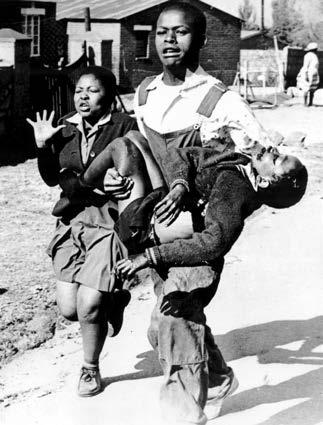
This has become a tradition, a poignant way to mark what is now celebrated as Youth Day and commemorate the anniversary of the 1976 Soweto protests by thousands of black school pupils against the apartheid regime in which many young people lost their lives. June 16, 1976, is almost as well known outside South Africa as it is within the country. Sam Nzima’s famous photograph of Mbuyisa Makhubo carrying a bloodied, fatally wounded 12-year-old Hector Pieterson, accompanied by Hector’s distraught sister Antoinette Sithole, was published the next day by the World newspaper. Soon after, it hit newsrooms and front pages worldwide.
For many people, the image put Soweto – Johannesburg’s South-Western Townships – on the map as the lo-
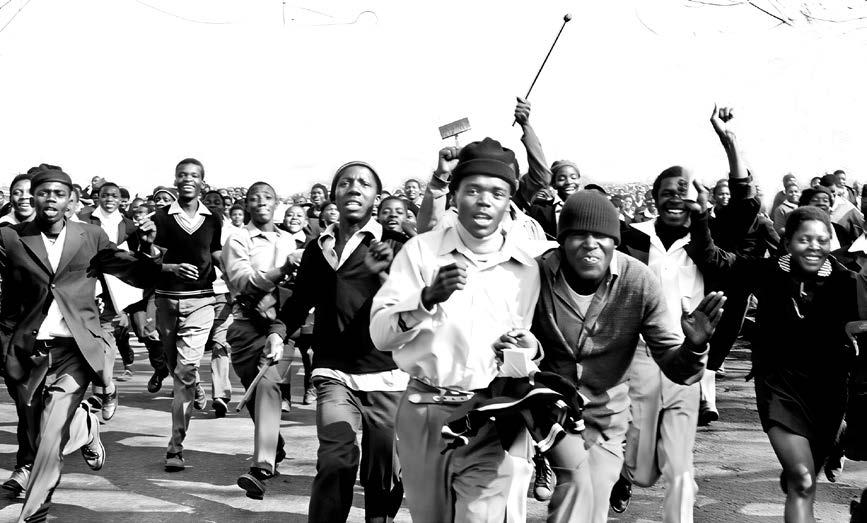
BELOW: Students take to the streets on June 16, 1976
cus of the anti-apartheid struggle.
Hector was one of many school children in Orlando West to be shot by apartheid police that day. The first casualty was probably 17-year-old Hastings Ndlovu, who was shot in the head as he led a group of protesters some distance away from where Hector fell. At the time, the official death toll was 23, but other estimates suggest that as many as 200 students were killed and about 700 were injured on June 16.
Hector and Hastings were among the young people taking part in a peaceful, boisterous, almost celebratory, protest march by pupils from Morris Isaacson High School, Orlando West Junior School and Phefeni Junior Secondary School, which had planned to converge on Orlando Stadium.
The march was intended as a high point of a campaign by the South African Students Movement and, locally, the Soweto Students’ Representative Council Action Committee, against the introduction of Afrikaans as the compulsory language of instruction for key primary
“Natives must be taught from an early age that equality with Europeans is not for them,” said South African Prime Minister Hendrick Verwoerd
and high school subjects, initially at selected schools.
The white regime was intent on deepening the use of Afrikaans as the main language in South Africa, alongside English. Indigenous languages were given more leeway in the corralled “homelands,” or bantustans, that served as labour reserves for the white state while dividing the black population by language and ancestral identity.
But in the rest of the country, where the African workforce was confined in large dormitory townships as noncitizens, these languages were sidelined.
In general, education for black learners was designed to be substandard, tailored to a lifetime of menial work. English was the lingua franca in their under-resourced schools, something that the regime sought to erode by mainstreaming Afrikaans.
The plan was based on a 1968 policy proposal by the Broederbond, the secret society of exclusively Afrikaner males that had promoted Afrikaner ascendancy since 1914. Titled Afrikaans as a Second Language for the Bantu (Bantu was the derogatory term for black people and was used in all official documents), the proposal prompted the Department of Bantu Education to recommend that the ‘broeders’ it employed must ‘continuously’ pursue the ‘use of Afrikaans in Bantu education.’
The Department came under the jurisdiction of the Department of
Native Affairs, created in 1953 by one of apartheid’s chief architects, Hendrik Verwoerd, himself a Broederbond member.
Verwoerd was explicit about the purpose of education for blacks: “Natives must be taught from an early age that equality with Europeans is not for them.” Making Afrikaans a main language of school instruction was one way to ensure this.
The upshot was that in 1974 the Minister of Bantu Administration and Development M.C. Botha decreed that Afrikaans would be compulsory as a medium of instruction in black schools from Standard 5 (today’s Grade 7) upwards.
The reaction by school heads, ad-
ministrators and teachers was overwhelmingly negative, apart from anything else for purely practical reasons.
In the 1970s, the government spent one-tenth as much per capita on black education as it did on white children. Thirty per cent of black schools had no electricity, 25 percent had no running water, and less than half had plumbing. With their meagre resources compared to whites-only schools, black schools were ill-equipped to comply with the diktat that meant restaffing schools with teachers able to teach subjects like maths and social sciences in Afrikaans.
The contempt with which the policy was imposed was undisguised. Deputy Minister of Bantu Education Punt Janson declared: “I have not consulted the African people on the language issue and I’m not going to. An African might find that the ‘big boss’ speaks only Afrikaans or only English. It would be to his advantage to know both languages.”
The students and activists, many of them stimulated by the rise of Black Consciousness, were acutely aware of the wider context of the language issue. They understood that it was not incidental to apartheid, but was structural, connecting ideology, political economy, spatial control, and cultural domination into a single interlocking system violently and malevolently enforced. Language control allowed the segregationist regime to exclude people of colour from politics and the economy. After 1948, Afrikaner prime ministers tried to reduce the influence of English, with its seemingly
VICTIM: Mbuyisa Makhubo carrying a bloodied, fatally wounded 12-year-old Hector Pieterson, accompanied by Hector’s distraught sister Antoinette Sithole
The protest march, part of a three-day school boycott, was big, drawing pupils from schools along the route, but it was neither violent nor a threat
open-ended vocational potential, while the indigenous languages were given almost no political significance.
But, crucially, in the black townships, Afrikaans was seen as a dead end, the language of the oppressive bureaucracy that black and other population groups designated ‘nonwhite’ had to endure. It was the language of the pass office, the detention cell, the labour bureau, the police, the madam scolding her maid, the baas berating his garden boy.
It explains why black South Africans had such a strong dislike of Afrikaans and why its negative connotations persist even now. For black communities and the youth of Soweto in 1976, Afrikaans was not a neutral language used in teaching; it was the language of brute injustice and coercion.
This was starkly reflected in the police tactics used on June 16. The protest march, designed as part of a three-day school boycott, was big, drawing pupils from different schools along the route, but it was neither violent nor a threat. Less knuckle-headed policing would have been unobtrusive and given the marchers space. But the apartheid way of confronting black opposition was always violent, predetermining violent resistance. The security police officer who ordered the shoot-tokill response to the protest was Theunis ‘Rooi Ruis’ Swanepoel, notorious throughout the freedom struggle as the regime’s torturer in chief.
Nicknamed ‘Red Russian’ for his parboiled, hatchet-like visage, Swanepoel had led the security police raid on Lilieslief farm in Rivonia

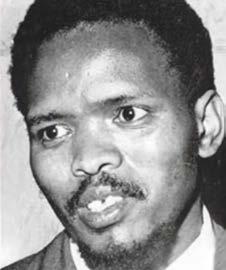
in 1963 that saw the arrest of the leaders of the African National Congress’s armed struggle against apartheid. He helped to develop the regime’s interrogation techniques, for which he’d been trained abroad by the French.
His name crops up repeatedly in the recorded testimonies of countless activists who were tortured by the apartheid police, including Win-
nie Mandela, or were murdered while in detention. Swanepoel always argued that the security forces should be given a free hand to fight what he and the rest of the regime saw as a communist threat in the demands for equality. His decision on June 16 to use deadly force against young kids was calculated and supported. As the protest changed to resistance against heavy-handed policing, Swanepoel escalated the state’s response. “I made my mark,” he later said. “I let it be known to the rioters I would not tolerate what was happening. I used appropriate force.”
Over the following months, the Soweto protests spread beyond the township and became a series of rolling uprisings that marked a turning point in the liberation struggle. These were also met with deadly force. Again, estimates of the number of people killed vary. The regime’s one-man inquiry, conducted by Justice Piet Cillie and taking until 1980 to issue its findings, put the death toll at 575 people between 16 June and 28 February the following year. However, the International Defence and Aid Fund identified 617 killings between 16 June and the end of 1976 and stated that the true number must have been over a thousand.
Unlike today, where the mass killing of children by Israel – apartheid South Africa’s closest equivalent – is ignored by its imperial supporters, international condemnation of the Pretoria regime in 1976 was swift and unanimous. On June 18 and 19, country after country lined up at the United Nations Security Council to condemn the killings and apartheid rule.
VICTIM: Nelson Mandela’s wife Winnie was tortured by security police
MARTYRED: Students took to the streets again in 1987 after the murder of Black Consciousness leader Steve Biko in prison
Thousands of young people streamed into neighbouring frontline states in search of training and weapons with which to fight the white regime
Pik Botha, Pretoria’s slick UN representative and supreme gaslighter, countered that the Council was basing its deliberations on “far-fetched, emotional and unsubstantiated allegations,” and launched into a defence of the regime’s education policy by comparing spending to the lowest common denominator of impoverished African countries.
The problem in South Africa, he argued inconsistently, “is basically not one of race, but of nationalism. There is white nationalism and there are several black nationalisms… My government’s principle aim is to make it possible for each nation, black and white, to achieve its fullest potential, including sovereign independence…” It was a tacit defence of the regime’s bantustan policy. The protests in Soweto, he said, quoting the apartheid prime minister, John Vorster, were “a purposeful effort to bring about a polarisation between white and black.” The government’s job, Botha continued, was to “maintain law and order as a first step.”
His line was that it was the “rioting” that “was responsible for the deaths and destruction,” but up until the shooting of Hector Pieterson the protests had been merely boisterous.
As South Africa’s Truth and Reconciliation Commission (TRC) reported in 1998: “It was Pieterson’s death that fundamentally transformed the nature of the student protest from a peaceful march into a violent confrontation with the government’s security forces.”
Historically, Botha and Swanepoel reflect two sides of
Afrikaner nationalism, still evident: the latter, stridently unapologetic and defiant to the end; the former, guilefully shape-shifting.
Botha left the UN in 1977 to become South Africa’s foreign minister, later switching to the “liberal” end of apartheid’s ruling National Party, advocating an end to his country’s race-based laws and, once he saw that the terrain was shifting decisively, the transition to democracy.
In 1994, Nelson Mandela gave Botha the mineral and energy portfolio in the first democratic government, which he held until he retired two years later. Oleaginous and loquacious, his vision of the postapartheid transition matched that of the UK’s Margaret Thatcher and US President Ronald Reagan: do away with the trappings of racism but
keep the economic system unaltered. Botha was utterly enamoured of Thatcher. “She had quite attractive breasts,” he later recalled.
The final phase of the 1976–77 uprising began when students across the country took to the streets in response to the murder of Black Consciousness leader Steve Biko in prison in September 1977. On 19 October, the government responded by banning 17 organisations, many associated with the BC movement. But banning organisations merely altered and honed the nature of resistance to apartheid, driving some underground, others into exile networks.
As the repression unleashed in Soweto intensified and spread, thousands of young people left the country, streaming into neighbouring frontline states in search of training and weapons with which to return home to fight the white regime.
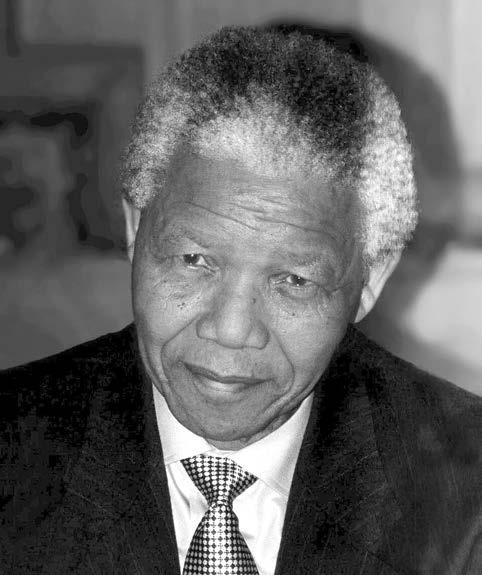
Many found their way to the ANC and joined its armed wing, uMkhonto weSizwe (Sear of the Nation). Most of the new recruits, beginning with the June 16 Detachment, were sent to MK camps in Angola, and small numbers were infiltrated back into South Africa to carry out armed operations, later sharpened into the highly effective MK Special Operations Unit.
June 16 was both part of the confluence of struggle and resistance and its catalyst. It was in part impelled by the demands of the workers’ movement and trade union ac-
FAMOUS WORDS: Nelson Mandela declared after South Africa’s liberation, “We know too well that our freedom is incomplete without the freedom of the Palestinians”
tivism spurred by the mass strike in Durban three years earlier, which eventually led to the creation of the Congress of South African Trade Unions in 1985. It was also part of the upsurge that led to the formation of the United Democratic Front in 1983, which brought together nearly 600 organisations representing about 1.5 million people.
The South African government is marking the 50th anniversary of the Soweto protests with a year-long programme “aimed at honouring the sacrifices the 1976 student uprising.” The tag lines for this are immersed in aspirational intangibles: “RESET@50 – The Future Calls” and “Our national commitment to the future, for freedom lives in every generation.” According to the government news agency, SA News, the themes highlight “the critical role of young people as drivers of inclusive growth, social cohesion and national renewal.”
How all this is supposed to square with the stark findings of the International Labour Organization that South Africa has the world’s worst
youth unemployment is anyone’s guess. The country’s youth face deepening hardship, but are served little more than neoliberal fixes to the crises the system engenders, packaged in feel-good platitudes to hollow out any trace of radical opposition. Sooner or later this will rebound on those in power.
Perhaps the most distressing echo from 1976 concerns how an apartheid state treats the children of a people it considers racially inferior. In 1978, the International Commission of Jurists condemned the “inhuman conduct” of the South African authorities towards young children, “held for long periods without parental access and, in many cases, even without parental knowledge of their whereabouts; children under 13 were placed in solitary confinement and some at least were subject to police brutality.”
On June 16 and after, the apartheid police specifically targeted children, and in the months that followed, thousands were arrested, detained and tortured. The practice was unprecedented, and increased in the 1980s. “Sometimes, entire
schools were arrested en masse,” stated the TRC report. Of the 80,000 people detained between 1985 and 1989, 48,000 were under twenty-five years old.
The only recent parallel is the situation in Palestine: the detention and torture of thousands of Palestinian children by Israel, the deliberate shooting by snipers of young Palestinians in the chest and head. Israel was apartheid South Africa’s closest ally. The two shared a common purpose, the Zionist and nationalist Afrikaner projects mirroring one another in their fantasies of an ethno-lebensraum.
Alongside the mass events of remembrance and commemoration of June 16 in South Africa this year, there’s a need to look beyond the country’s borders and note that Mandela’s famous words – “We know too well that our freedom is incomplete without the freedom of the Palestinians” – now carry an even stronger resonance. CT
Mark Waller is a UK-Finnish national who lives in Pretoria, South Africa and works as a freelance journalist, translator and editor
Castro charge signals new low in US-Cuba policy
The hypocrisy of indicting Raúl Castro is staggering, given the long history of anti-Cuban extremists operating from US soil to wreak havoc on the island
Apparently the Trump administration has decided that what Cuba really needs right now – after decades of economic strangulation, CIA assassination attempts, sabotage campaigns, invasions, sanctions, blackouts, shortages, and more than half a century of failed regime-change policy – is the indictment of 94-year-old revolutionary icon Raúl Castro.
The United States and Cuba do not have to be enemies. In fact, just 10 years ago, the two countries were normalising relations. I was in Panama City at the 2015 Summit of the Americas when Barack Obama and Raúl Castro famously shook hands, marking the first substantial public interaction between leaders of the two countries in decades. Obama said, “The United States is not interested in being prisoners of the past,” while Raúl Castro thanked Obama for taking steps toward normalisation and called him “an honest man.” The opening was a win-win for both countries: an influx of US tourists, a flourishing of private businesses, and new openings for civil society. Then came Donald Trump, who sent relations spiralling downward once again.
Fast forward to today, with the indictment of Raúl Castro for allegedly ordering the 1996 shootdown of the Brothers to the Rescue planes
that left four men dead. I was in Cuba at the time leading a group of US CEOs interested in investing on the island. The next day, we were supposed to meet with Fidel Castro. But after the planes were shot down, the meeting was cancelled and the business executives rushed to take the next flight back to Miami.
It was a tragic and regrettable incident – not only because of the lives lost, but also because it hardened political attitudes toward Cuba for years to come, paving the way for the codification of the US blockade into law.
But it’s critical to understand the context.
The group’s leader, José Basulto, was a veteran of the disastrous 1961 Bay of Pigs invasion with a long history of anti-Cuban militancy. He openly admitted, “I was trained as a terrorist by the United States.” The group repeatedly violated Cuban airspace and dropped anti-government
After the planes were shot down, the meeting was cancelled and the business executives rushed to take the next flight back to Miami
leaflets over Havana. Basulto himself declared after one such mission: “We want confrontation.” Between 1994 and February 1996, the Cuban Ministry of Foreign Affairs and Cuban civil aviation authorities documented more than 25 serious and systematic violations of Cuban airspace by aircraft associated with Brothers to the Rescue.
The Cuban government repeatedly warned Washington, the FAA, and international aviation authorities that these flights were illegal and dangerous. US officials knew the risks. The National Security Archive’s declassified records, published on May 19, 2026, reveal that high-level US officials understood that continued Cuban airspace violations could lead to disaster.
An FAA email from January 22, 1996 – one month before the shootdown – explicitly warned of the “worst case scenario” that “one of these days the Cubans will shoot down one of these planes.” The same document acknowledged that State Department officials understood the overflights could “only be seen as further taunting of the Cuban Government.”
On February 23, 1996, White House Cuba adviser Richard Nuccio warned National Security Advisor Sandy Berger that “tensions are sufficiently high within Cuba… that we fear this may finally tip the Cubans
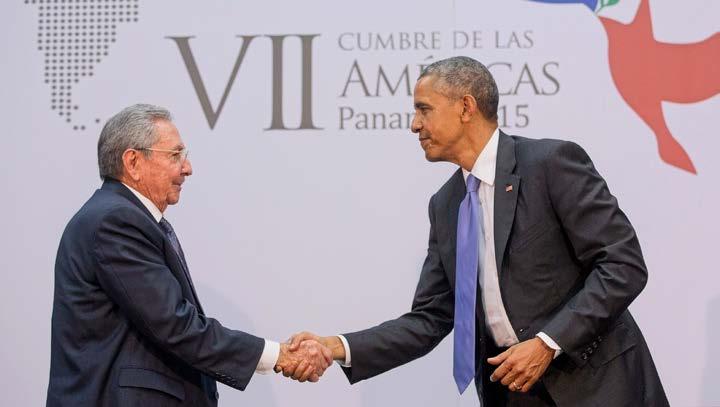
toward an attempt to shoot down or force down the plane.” Yet the FAA refused Nuccio’s request to ground the flights.
While there is disagreement over whether the planes were ultimately shot down in Cuban or international airspace, the pilots had reportedly filed a false flight plan and again approached Cuban airspace despite direct warnings from Cuban controllers.
The hypocrisy of indicting Raúl Castro nearly 30 years later is staggering, given the long history of antiCuban extremists operating from US soil to wreak havoc against the island with bombings, sabotage, and airline terrorism. In 1976, terrorists bombed Cubana Flight 455, killing all 73 people onboard, including the entire Cuban national fencing team. In 1997, a 32-year-old Italian tourist was killed in a hotel bombing aimed at destroying Cuba’s tourism industry. Yet the men implicated in these horrific acts,
including Orlando Bosch and Luis Posada Carriles, were protected by US authorities and allowed to live freely in Miami.
And let’s remember: the same US government now pursuing charges against Raúl Castro has itself been carrying out deadly strikes on alleged drug-smuggling boats in the Caribbean and Pacific, strikes that have killed at least 193 people since September 2025, with no transparency or due process.
This new indictment is simply a cynical escalation in the long US effort to force regime change in Cuba. Will Washington try to use it as a pretext to invade the island and “extract” Raúl Castro, as it did with Nicolás Maduro in Venezuela? Will
The US should lift the sanctions, and allow Cubans – not Washington politicians or Miami hardliners –to decide Cuba’s future
it once again send US troops to occupy Cuba, as it did in 1898, 1906, and 1912? Will it ignite a civil war? We have no idea.
But we do know this: despite unfounded allegations to the contrary, Cuba poses no threat to the United States. And the United States has absolutely no right – zero – to interfere in Cuba’s internal affairs.
Raúl Castro is 94 years old. Let him live out his final years in the country where he was born and for which he fought his entire life. Instead of tightening the blockade and pushing Cuba toward greater poverty, instability, migration, and despair, the United States should finally abandon its failed policy of domination, lift the sanctions, and allow Cubans – not Washington politicians or Miami hardliners – to decide Cuba’s future. CT
Medea Benjamin is the co-founder of the peace group CODEPINK and the human right organisation Global Exchange. Follow her on twitter at @MedeaBenjamin
BETTER DAYS: President Barack Obama meets with Cuban President Raúl Castro at the Summit of the Americas in Panama City, April 11, 2015
White House
Any aliens who have been monitoring radio and television transmissions streaming outwards into space from Planet Earth over the past few decades will likely be intrigued, bemused or simply horrified at humanity’s headlong drive towards climate catastrophe.
No matter the urgent warnings from climate scientists, the power of billionaires, financial speculators and corporations maintains a deathlike grip on governments around the world. Amid the occasional flurry of big business greenwashing and government rhetoric about ‘climate protection’ and ‘eco-friendly’ initiatives, billions of people are being held hostage by the forces that are dragging everyone to the edge of the climate abyss.
New warnings about climate change do, of course, occasionally appear in the press. But rarely, if ever, are there prominent and sustained front-page headlines and news-leading television coverage. Rarer still are impassioned editorials, high-profile presenters and commentators demanding the substantive, radical changes that are needed to avoid the most damaging predicted impacts of business as usual.
In May, the Royal Albert Hall hosted a 100th birthday party for naturalist David Attenborough, Britain’s most beloved broadcaster. Celebrities showered him with love and praise: Leonardo DiCaprio, Judi Dench, Olivia Colman, Emily Eavis, Chris Martin, Ben Fogle, Raye, Kate Winslet. And Paddington Bear. Attenborough sat in the royal box, alongside Prince William. King Charles delivered a handwritten message from Balmoral Castle via a “cavalcade of creature couriers,” including eagles, a red
➤ DAVID CROMWELL
Billions of people are being held hostage by forces dragging us all to the edge of the climate abyss
Media myopia as we hurtle towards climate oblivion

squirrel, a hedgehog, otters, ducks, a fox and deer, thanks to the wonders of CGI. All very nice; all very Disneyfied.
For many years now, Attenborough has been warning about the dangers of mass consumption, pollution, worldwide species loss and global warming. These subjects are clearly of great concern to him, although he started ringing the alarm bell very late.
But the evening gave a wide berth to such uncomfortable topics. “Life on Earth?” The climate crisis must be happening on a different planet entirely.
As Jonathan Liew, a Guardian sports journalist and columnist, pointed out: “This is, of course, the Attenborough with which our public discourse is most comfortable: depoliticised, universally adored, a man-sized Paddington Bear fit only for our veneration. Who teaches us about tree frogs and seal cubs and stick insects and asks for nothing in return.”
Of course, what Liew called “public discourse” is the tightly con-
strained media space permitted by state and corporate power.
Liew continued: “And perhaps there are more difficult questions to negotiate here: the extent to which he has been a force for the meaningful and revolutionary change he seeks, and the extent to which his broad, inoffensive appeal has been more hindrance than help, allowing the powerful to feign concern for the planet while shirking the tough and bloody compromises required to secure it.”
To his credit, Attenborough has been eloquent and impassioned in recent years about the climate crisis. He addressed the COP26 climate summit in Glasgow in 2021, saying that: “We are already in trouble. The stability we all depend on is breaking. This story is one of inequality, as well as instability. Today, those who’ve done the least to cause this problem, are being the hardest hit. Ultimately, all of us will feel the impact, some of which are now unavoidable.”
But, even five years on, as the climate crisis worsens, the topic was

deemed unmentionable by the organisers of Attenborough’s 100th birthday party.
In February, a new scientific report warned that runaway global warming is closer than had previously been thought. We are heading for the “point of no return” after which we would be locked into a hellish “hothouse Earth.” Climate “tipping points” would be triggered, producing rapid heating, which would lead to a domino effect of yet more tipping points and feedback loops. These include the melting of the Greenland and Antarctic ice sheets, drastic dieback of the Amazon rainforest and the weakening, and possible shutdown, of the Atlantic ocean conveyor belt known as the Atlantic Meridional Overturning Circulation (AMOC).
The scientists stated that: “Earth’s climate is now departing from the stable conditions that supported human civilisation for millennia.”
The world has already experienced a global average temperature
rise of over 1.3C since pre-industrial times and is likely to surpass the Paris Agreement “limit” of longterm average heating of 1.5C in the next few years. Current government and business policies are pushing us towards 2-3C of global warming, if not more, by 2100.
But, if trigger points are breached and runaway global warming occurs, we are talking about much higher temperature rises, perhaps 10C or more. This would mean almost unimaginable catastrophic effects on the climate system, global agriculture and societal infrastructure; not to mention the extinction of humans. Scientists have warned that even a rise of 3-4C means that “the economy and society will cease to function as we know it.”
Bill McGuire, Professor Emeritus of Geophysical and Climate Hazards at University College London, put things in grim perspective via X: “We are already locked-in to a return to Pliocene [around 2.6 to 5.3 million
years ago] conditions (3C hotter and (eventually) ~ 20m sea-level rise)
“Keep going as we are, and hotter Miocene [5.3 to 23 million years ago] conditions will result
“Beyond this a return to early Eocene [around 48 to 56 million years ago] hothouse beckons - and potential oblivion.”
During the Eocene, the global average temperature was well over 10C higher than present. Oblivion would hit humanity long before such a temperature rise occurred.
In May, yet another deeply disturbing scientific study revealed that the risk of AMOC reaching a tipping point by 2100, after which its shutdown would be inevitable, is as high as 50 per cent. Previously, this was considered “a low likelihood event” of around five per cent. But even this should be held in perspective. How many of us would board a plane knowing that there was a five per cent chance that it would crash?
AMOC, of which the Gulf Stream is the best-known component, is a vital carrier of warm water from the tropics to high latitudes in the North Atlantic, returning cold water southwards. It is a primary source of heat for western and northern Europe, leading to the temperate climate. AMOC connects with other ocean current systems in a global network that transports heat, water, nutrients and carbon around the planet. Any disturbance to AMOC, far less its collapse, would have devastating global consequences for climate, agriculture, infrastructure and even for the habitability of Earth.
Professor Stefan Rahmstorf of the Potsdam Institute for Climate Impact Research in Germany, who has studied AMOC for 35 years, said: “This is an important and very concerning result. It shows that the ‘pessimistic’ models, which show a strong weakening of the AMOC by 2100, are, unfortunately, the realis-
tic ones, in that they agree better with observational data.”
He added: “I now am increasingly worried that we may well pass that AMOC shutdown tipping point, where it becomes inevitable, in the middle of this century, which is quite close.”
To emphasise: the tipping point may be much earlier than 2100; it could happen by 2050, or even sooner. The vital point here is that scientists increasingly agree that the “safe window” to stabilise the current by halting emissions is closing far faster than previously thought. And the public likely does not even realise it.
Rahmstorf had previously said that a collapse must be avoided “at all costs.” Now he added: “I argued this when we thought the chance of an AMOC shutdown was maybe 5 percent, and even then we were saying that risk is too high, given the massive impacts. Now it looks like it’s more than 50 percent. The most dramatic and drastic climate changes we see in the last 100,000 years of Earth history have been when the AMOC switched to a different state.”
In an English-language video for the German DW news channel, Rahmstorf explained the importance of AMOC for European and global climate, and the significance of the latest alarming results. He warned that we should expect more climate extremes in heat, cold, drought, floods and storms.
If and when the AMOC collapses, the impact on agriculture in the northern hemisphere will be devastating. The drop in harvest yields for key crops could be as high as 50 per cent. Mass starvation is a very real possibility.
A few days after the disturbing new AMOC report came out, Guardian columnist George Monbiot noted: “Last week delivered the biggest news of the year so far, perhaps the biggest news of the century. But
The drop in harvest yields for key crops could be as high as 50 per cent. Mass starvation is a very real possibility
partly because billionaires own most of the media, most people never heard it. We might find ourselves committed to a civilisation-ending event before we even learn that such a thing is possible.”
Before Monbiot’s column in the Guardian, the paper had published a piece on the report by Damian Carrington, its environment editor. Two other UK national papers covered the study: the Daily Mail and the Independent. Channel 4 News covered the topic in a news broadcast. Amazingly, that was about it for the entirety of the establishment media. The fact that deeply disturbing findings about a likely collapse of a vital component of the climate system were not given wider, extensive and sustained coverage is a devastating indictment of mainstream journalism.
Even worse, when the report came out, the BBC preferred to push Reform-style propaganda about “migrants making false claims to stay in UK.” This was given prominent placing on the front page of the BBC News website. We could not find a single report on the BBC News website (although there was an article about it in the BBC Science Focus Magazine). That is simply appalling, particularly for a supposed “public service” national broadcaster.
Scientists are warning, as loudly as they possibly can, that the present economic system of rampant capitalism is destroying the very
life-support systems that made Planet Earth a habitable environment for humans to evolve and flourish.
Professor Bill McGuire, whose new book, The Fate of the World: A History and Future of the Climate Crisis, was published last month, writes: “In our current predicament, [global warming] is set to bring about nasty and unwanted shocks and surprises, which are the last things we need right now, and the signs are already there. The ramped-up heat is acting to accelerate melting of the polar sea ice and land-based ice sheets, increase methane degassing from northern hemisphere permafrost and significantly slow the AMOC. Via positive feedback loops and the crossing of tipping points, such domino effects can and do magnify abrupt climate change and its ramifications.”
In his book, McGuire also points to the devastating effects of climate change on the human body.
It is not just rising temperatures that should concern us, he says, but the lethal combination of heat and humidity: “If you can’t sweat, you die – and quickly. A combination of heat and humidity is measured on what’s called a wet-bulb thermometer, which provides a far better estimate of the heat we actually feel than a normal, dry-bulb instrument.
“The critical value on a wet-bulb thermometer is 35°C, because at this level of heat and humidity the human body cannot lose heat by sweating as the surrounding air is already saturated with water. Anyone exposed to such conditions, super-fit or not, resting by the pool in the shade or working in the fields, will start to experience their internal body temperature climbing rapidly, ultimately leading to or-
gan failure and death in 6 hours or so.”
He adds: “All of the threats and problems of the modern world will be multiplied and magnified, from physical and mental health to poverty and inequality, to mass migration, civil strife, conflict and war. Global heating is not only tearing apart our climate but shattering the social and economic constructs that keep our world functioning, albeit in a sort of mad-cap way, and stop everything falling apart.”
McGuire relates that he knows from conversations with fellow scientists that: “many feel desperately sad and frustrated about where our world is headed and the bleak future we are bequeathing our children and their children, and I am no different. Knowing what I know, it is no longer possible to see my kids with-
Imagine that we had a sane media system. That could just mean the difference between human survival and human erasure
out wondering just what incarnation of hell they will have to face in later life.”
Look at the daily, hour-by-hour obsessing over the endless manoeuvering within the Labour government; every single statement from ministers and their allies scrutinised by the Westminster bubble of political correspondents.
Imagine that, instead of focusing on short-term melodramas, leading news organisations rigorously
probed politicians, day in and day out, about the climate crisis.
Imagine that news editors and journalists relentlessly challenged the government about current policies that are bringing us closer to the brink of climate chaos.
Imagine that reporters investigated and exposed the deep reluctance and state-corporate obstacles, including the establishment media, that are blocking alternatives to climate Armageddon.
Imagine, in other words, that we had a sane media system. That could just mean the difference between human survival and human erasure. CT
Davis Cromwell is co-editor of medialens – www.medialens. org – where this article was first published

➤ DWAYNE BOOTH
The Con
“Unhappy is the land that breeds no hero! No....unhappy is the land that needs a hero.” – Bertolt Brecht
FThere’s no reason for a political cartoonist to worry about government oppression when the Comic-Con Convention hits town “
or all intents and purposes, we are almost certainly doomed as a free thinking society, having had our ability to think freely obfuscated by the constant interruption of a top-down narrative that requires we spend our lives doing nothing but reacting without thinking of the behaviour and misbehaviour of our most revered and most reviled celebrities in politics and popular culture.
Of course, this is neither a particularly insightful observation, nor is it new, which can simultaneously mean its obviousness mixed with its longevity makes it as exactly true as identifying the sky as being blue, while also making it untrue because doom, once normalised by existing unchanged for an extended amount of time, can only become less apocalyptic and atrophy into a dully throbbing annoyance that one can decide to ignore or not.
I had this thought
while looking through old journals and coming upon something I wrote almost 20 years ago after being invited to the Comic-Con in San Diego as a participant on a panel about the future of political cartooning following the democracy-ending era of George W. Bush – you know, the good ol’ days.
Lou Ferrigno is a fucking asshole, that’s what I’m taking home with me
from the 2007 Comic-Con, a fucking ass-hole!”
The speaker was a forty-something-year-old adolescent, freckled, strawberry-blond hair, bald and sweating bullets, his pale skin appearing fair enough to sunburn inside the pop of a flashbulb.
He was referring to the musclebound deaf actor who was famous not so much for his acting but more for his willingness to have his bovinity spray painted green, atomised into an IQ debilitator, and shot through an electromagnetic wave into millions of television sets across America during the late ’70s and early ’80s.
Mr Fish
He threw down his plastic bag of comic books and collapsed into his cafeteria chair.
“The fucking opposite of Jonathan Harris (Dr. Smith from Lost in Space), I swear to fucking Christ! The opposite!”
His 300-pound friend absorbed the fury of the rant with a shrug and sat down and cracked open a Diet Coke. He drank it through the pink slit in his beard.
“Lou Ferrigno?” I said, sitting opposite them at a communal lunch table
set up just beyond the snack bar in the main exhibition hall at the San Diego Convention Center, home, for almost forty years, of the ComicCon International.
I was relaxing with a Vitamin Water and looking over some notes that I’d written on a napkin pinned to my knee from the pressure of my pen point during my two-and-half hour drive from Los Angeles for a panel I was on about editorial cartooning. A dainty pair of Asian women sat quietly next to me making origami swans out of junk flyers.
“Yeah,” said the guy. “He’s charging twenty-fucking-dollars for a Polaroid! Turns out the Incredible Hulk is an incredible dick.”
“He’s here?” I asked.
“Yeah, the motherfucker.”
“You should’ve said to him you’d give him forty dollars if he can say Egg McMuffin legibly.”
“Right,” replied the Hulk-hater, laughing suddenly mopping his head with his naked palm, “or sixty dollars if he could turn back into what’s-his-fucking-name, Bill Bixby.”
“And then talk about My Favourite Martian,” said his friend.
“Or The Courtship of Eddie’s fucking-Father. What else was Bill Bixby in?”
I shrugged, unable to understand how easily I’d fallen into a circle jerk around Bill Bixby.
I’d got to the Convention Center two hours earlier, having walked in behind a rotund Captain America whose costume was a one piece that tied in the back like a hospital gown, and was offered a free Smallville tote bag that was truly immense; large enough, I imagined, to smuggle the carrier’s inner child into the great hall where it could be released amid the many booths bursting with toys, anime, collectibles, books, comics, video games, figurines, movie chotzchke, TV memorabilia, and twenty dollar Polaroids, its eyes like pinwheels, its
Properly bosomed and as demur as royalty, Princess Leila wore a goatee and real cinnamon buns on either side of his head
appetite for bright plastic and flashing lights and deaf C-list celebrities manic and grotesque and insatiable.
I declined the tote bag. My costume? Dignity. And looking around I half expected to be hounded all day by convention attendees blown away by the uniqueness of my disguise, demanding that I share the sewing pattern with them.
Inside the crush of people, which the Comic-Con officials would put at 125,000 by the end of the weekend –a new record – that had swept me along with them for the quarter mile from the parking garage that morning, I’d overhead a middle aged man dressed as some sort of space lizard in a blue Speedo and green leotard say enthusiastically to another middle aged man who was dressed in a silver body stocking, boots and star spangled cape, “My wife thinks I’m nuts, but I tell her that it’s just me stepping out of the closet once a year – give me a break!”
I turned to look at his outfit, which most certainly seemed as if it had been put on inside a closet; a dark closet, I figured, that had to spill directly out onto the sidewalk, for anybody willing to cram himself into a Speedo that small would be unable to move through a house where he might catch a glimpse of himself reflected in a mirror, a window, or even the chrome of the toaster.
“Right on,” said the other guy. I turned back around to the sound of a high-five being clapped through gloved hands.
And when everybody cheered at a Wookie riding by in the backseat of one of the many rickshaw bicycles I’d noticed shuttling conventioneers everywhere around town, their applause inspiring him to stand up and to do a Tarzan yell and to pound his chest triumphantly, my annoyance at both his shortness and his bravado quickly spread to a deeper annoyance with myself for being angry at the character crossover:
Chewy, even if he was 5’4”, wouldn’t act like Johnny Weissmuller, not even with a gun to his head, you lousy cocksuckers!
I savoured my rage, repeating the thought over and over again against my will, until my concentration was broken by the sight of the male Princess Leia riding next to the chestthumping buffoon.
Properly bosomed and as demur as royalty, he wore a goatee and real cinnamon buns on either side of his head, raisons and all.
Two hours later, during the Q & A portion of my panel, a woman asked me, after seeing ten of my angriest cartoons projected onto a screen the size of a dead sail, if I was afraid of the US government.
I looked past her at the helmeted stormtrooper in the very last row rummaging through his shopping bag and remembered a quote from Tolstoy’s War and Peace: “Whatever question arose, a swarm of these drones, without having finished their buzzing on a previous theme, flew over to the new one and by their hum drowned and obscured the voices of those who were disputing honestly.”
“No,” I said, “not exactly.” CT
Dwayne Booth (Mr. Fish the cartoonist) lives in Philadelphia, PA. Occasionally, he laughs his head off. His mother has no idea what he’s up to. She cries easily. Fish blogs at The Independent Ink– www. theindependentink.substack.com
➤ WILLIAM DEBUYS
Never-ending nightmare of the US Border Wall
Flooded with cash, drained of sense in Trump’s America
Aleading preoccupation of the first Trump administration has all but slipped from view. Except when ostensible conservatives speak out against it, the major media have scarcely breathed a word on the subject. But it’s still there, 30 feet tall, aspirationally 1,952 miles long, obliterating habitats, dividing families, and sucking down public funds faster than a carrier-based air squadron.
The media’s lack of attention is understandable. All-too-real wars of choice and metaphorical wars against science, universities, and the environment have dominated airtime and headlines. The rise of a new medievalism in medicine and the abrogation of international trade and security agreements have also won attention. Add to all of that a federal paramilitary kidnapping people, even from what still passes for the halls of justice, while murdering the occasional protester, and one’s journalistic cup runneth over.
The meta-story of the US government’s comprehensive abandonment of its Enlightenment heritage needs telling, too. Goodbye to empiricism and the troublesome scientific discourse it produces. Goodbye as well to empiricism’s political collaterals, including the “created equal” credo of the Declaration of Independence, which the current regime finds distinctly irritating.
There is simply too much to report on as the new monarchy, as if in a sped-up nature film, blossoms flowerlike, its palace under renovation, the king’s signature being prepared to grace the currency, and myriad kickback mechanisms whirring like gold-plated turbines to enrich an aristocracy of tech bros and oil emirs.
It’s not just logical but inevitable that Donald Trump’s border wall, a major story during his first administration, has essentially fallen out of the news. Rest assured, though, that the world’s least pragmatic and most performative construction project continues to prosper.
Modern border management relies on three tools: human patrols, remote detection backed by quick response teams, and the construction of physical obstacles. Smart gatekeepers coordinate those tools to maximise effectiveness and minimise cost. But there’s no need for thrift in Trumpworld. The One Big Beautiful Bill Act, or OBBBA, which Trump signed into law last July 4th, negated all need for fiscal restraint. Among other things, it appropriated $46.55 billion for border wall construction, $7.8 billion for US Customs and Border Protection (CBP) agents and their vehicles, $6.2 billion for high-tech border surveillance, and a hefty $10 billion for anything else
border-related. The total: $70.55 billion. Those funds will be available through Fiscal Year 2029. By comparison, the government will spend about $10 billion less over that same period to fund the entire Department of the Interior, which manages half a billion acres of surface land as well as the continental shelf and vast subsurface mineral deposits.
Such border largesse means the Department of Homeland Security (DHS) can go all-out on all three tactical approaches at the US-Mexico border – patrol, surveillance, and a wall – without troubling to eliminate redundancies, tailor tactics to the environment, or streamline coodination. Daddy has proudly given DHS his credit card.
In a victory-lap cabinet meeting four days after enacting the OBBBA, Trump told Kristi Noem, then still his DHS secretary, “You’re loaded up on the border.” He essentially admitted that the bill’s munificence demonstrated power, not budgetary acumen, adding, “We had zero [migrants] come in last month, so I am not sure how much of it we want to spend. You may actually think about saving a lot of money because the wall is largely built.” The president then continued with fact-free claims that the migrant population abounded with murderers and mental defectives.
Notwithstanding Trump’s comments, DHS administrators and the
contractors who are their most immediate constituents show no sign of leaving money on the table. At the border, their blank-check funding meets a matching regulatory void – the most extensive waiver of laws and regulations in American history. In addition to suspending laws intended to protect the environment, wildlife, national parks, national wildlife refuges, lands sacred to Native Americans, and historic and cultural sites, the Trump administration has also waived more than 60 contracting and procurement regulations. In the name of a national emergency, which is no emergency at all – illegal border
crossings (as measured by apprehensions) have indeed plunged – the president has stripped the playing field of all boundaries and opened the door to cronyism and corruption.
Under showers of money and in the absence of restraint, a single border wall is no longer viewed as adequate. Double-walling has become the norm and certain select areas now boast triple walls. With no cap on costs, whole mountaintops, rugged and unvisited, have been sheared apart to make way for the standard 30-foot-tall, steel-bollard wall, even at costs exceeding $41 million per mile, or almost
$8,000 per foot. Meanwhile, the Border Patrol’s terminally bored agents (giving new meaning to bored-er) sit behind the wall in white trucks, looking at their phones and incubating their haemorrhoids.
It’s easy to think of the mostly arid US-Mexico border zone as empty, but biologically it’s a busy place. The grasslands of the San Rafael Valley in Arizona, for instance, are home to 17 threatened and endangered species. For years, existing vehicle barriers, bolstered by remote detection technology, have allowed jaguars, ocelots, mountain lions, mule deer, and other wildlife to move back and forth across the valley’s 30 miles of border and disperse according to their ancient ways. A network of 60 remote cameras along that stretch, monitored by the Sky Island Alliance, recorded just one possible migrant per camera every 20 months. Besides being easily patrolled, the valley is also heart-stoppingly beautiful. Nonetheless, DHS intends to double-wall all of it. In addition to bifurcating the wildlife habitat and scarring a gemlike landscape, the wall builders will extract large amounts of groundwater to make concrete for the wall’s foundation, almost certainly desiccating wetlands that are hotspots of biodiversity. And for nothing, save symbolism, bragging rights, and contractor profits.
No detail illuminates the mentality behind border enforcement better than this: in cooperation with US Customs and Border Protection, military elements at Fort Huachuca, Arizona, are now engaged in “the largest Concertina wire (C-wire) emplacement in US territorial history.” “C-wire,” or “razor wire,” is designed to lacerate any flesh, human or animal, that comes in contact with it. Fort Huachuca soldiers are deploying 43,000 rolls of it, the larg-
KEEP OUT: Layers of Concertina wire are added to existing barrier infrastructure along the US-Mexico border near Nogales, Arizona
est single purchase ever.
Usually C-wire is used atop a wall or fence to prevent people from climbing over. Ominously, it’s now being spread on the ground, sometimes in areas where there is no wall, but also in front of the wall and between double walls – a policy of pure viciousness, not necessity. Someone should explain this deployment to the bighorn sheep of California’s Jacumba Mountains, which are now separated from their key Mexican waterhole by thickets of the nasty stuff, which will become ever more camouflaged and treacherous as grass and brush grow throughit.
For treachery, however, it’s hard to top CBP’s plans to “secure” 536 miles of the border in Texas by mooring a chain of cylindrical buoys, linked end to end, down the middle of the Rio Grande. Once in place, the array will look like an orange sausage, five feet in diameter, floating on the river. The anchors and mooring lines, of course, will be invisible. What could possibly go wrong?
This ill-conceived plan offers a retro-snapshot of American life before the National Environmental Policy Act (NEPA) became law in 1970, back when strip mines and other land-wrecking ventures could be launched with no evaluation of their impact, no public involvement, and no second opinions as to their necessity. The waiver of NEPA and every other environmental constraint means that no modelling of the “Buoy Wall’s” hydrodynamics (that is, its reaction to flooding), if any exists, has been made public.
The Rio Grande International Study Center in Laredo, Texas, however, commissioned its own study. The results are unequivocal. The Buoy Wall will be a debris trap during floods, as when a hurricane lod-
Thousands of people living adjacent to the river in Laredo and other communities in both Mexico and the US will be put at risk
ges over the region. It will redirect flows of water and raise water levels, especially in places where it’s paired with river-crowding segments of the wall. And if a section of buoys should break loose from the sandy, unstable riverbed, the likelihood of disaster will soar.
Geomorphologist Mark Tompkins, who authored the report, concludes, “Failures will cause catastrophic flooding, damage and destruction to property, and risks to the health and safety of people near the river corridor.” Thousands of people living adjacent to the river in Laredo and other communities in both Mexico and the US will be put at risk.
Walls have their place. They can be effective in urban areas. But DHS startled more than a few onlookers with plans to build a wall among the cliffs and arid wildlands of Big Bend National Park. Even the sheriffs of West Texas, one of the reddest regions in the country, got riled up. Although DHS may yet fall back to a more sensible “detection technology” alternative for the national park, it has failed to communicate a clear decision, while nearby private lands and Big Bend Ranch State Park remain at risk.
Even worse uncertainty may be brewing in Arizona, where the lands of the Tohono O’odham people, whose presence predates the border by many centuries, are spread on either side of the line. The tribe’s exemplary cooperation with border authorities includes tribal enforcement teams that have helped keep illegal crossings at a historic
low. But the rigid minds and hungry contractors of the “CBP industrial complex” remain unsatisfied. The agency’s “smart wall map” indicates that it aims to build a double wall across the Tohono O’odham reservation, splitting apart families, clans, and longstanding webs of relationship.
And then there’s the unhappy Roman Catholic Diocese of Las Cruces, which serves Sunland Park, New Mexico. Walls have long separated El Paso and Sunland Park from the Mexican city of Ciudad Juárez. However, there is an unwalled gap at Monte Cristo Rey, a steep-sided peak long considered impractical for barrier construction. Not now, though. Blasting for the Border Wall began on Cristo Rey in March, in time to appal the thousands of Holy Week pilgrims who visit the statue of Christ the King on the mountain’s summit.
The land available to CBP, however, is not sufficient to finish the job on Cristo Rey, and the adjacent landowner, the Catholic Church, refuses to sell. CBP claims it may assert the right of eminent domain, while the church has said it will fight, although its best tool for resistance, the Religious Freedom Restoration Act, has predictably been among the many laws waived by DHS.
On a recent trip to the border, I visited one of the most exquisite places in the entire Southwest. To get to it, I drove 40 miles on dirt roads across broken, arroyo-carved desert. The Border Wall was almost always in sight.
Apart from the roadway itself, the commonest evidence of a human presence were signs at the approach to each arroyo: DO NOT ENTER WHEN FLOODED, which is good advice in an area where flash floods from local thunderstorms can sweep away a heavy truck. All the arroyos
that the road crosses are also crossed by the Border Wall. Floods pile tons of debris against the wall and sometimes the accumulated weight is enough to push the structure down. CBP continues to experiment with designs for swinging water gates, but a durable solution remains unproven.
Between a pair of “lay-bys” – bulldozed flats where the wall contractor has assembled fleets of eighteenwheelers, excavators, scrapers, dumpers, pickups, bulldozers, loaders, and cement trucks – I veered down a rough track to a steel gate and let myself in. A little way beyond that, I stopped my car beside a lazy creek at the bottom of a canyon. White-barked sycamores and cottonwoods, just coming into leaf, towered overhead. Amid their shadows, the air smelled of duff and wet sand. The birds were not just singing, they were yelling. When I opened a birding app on my phone, the birdcall IDs scrolled by like movie credits.
The canyon has a perfectly good name, but I’ll call it Paradox Canyon in recognition of the contrast between the vigorous life it contains and the brutalist-walled horizon looming above it. During the first Trump administration, the nearest mountain peak was cleaved open like a watermelon, leaving the landscape not just scarred but grotesquely amputated.
The current contractor, Fisher Industries, is no stranger to disassembling and rearranging mountains. Besides installing the standard bollard wall, Fisher is pouring a concrete patrol road at the foot of the wall, portions of which, rising above Paradox Canyon, are so steep that, absent the paving, no wheeled vehicle can climb.
The next mountain, however, is too steep even for a patrol road. The previous contractor’s employees dubbed the peak “Widow Maker,”
The mindset behind the wall is the same as that which spawned the Iran war. Both are exercises in unchecked power
and the zigzag scars of switchbacks and ledges by which they gained access to the path of the wall make it easy to understand why.
Fisher is the largest player in the wall-building business. Based in North Dakota, it was the contractor for “We Build the Wall,” a crowdfunded enterprise that got its promoters, including Steve Bannon, a longtime Trump ally, convicted for fraud. “We Build the Wall” funded Fisher to build 3.5 miles of wall on private land beside the Rio Grande near Mission, Texas. The Department of Justice and the International Boundary Waters Commission subsequently sued Fisher for shoddy work and violation of the boundary treaty with Mexico. The suit has since been settled, Fisher having agreed to make immediate repairs and carry out future repairs subject to the forfeit of a $3-million bond.
The Paradox Canyon rancher whom I came to visit is philosophical about the wall. The assault on his land began at the end of Trump I and, after a Biden-era pause, has resumed at full strength. The “shock and awe” accompanying Trump’s resumption of office, he says, left no room for negotiating a more sensible path forward. He believes that the symbolism of the wall is its real power, as it channels the fears of the MAGA faithful. The wall, he says, stands for more than shutting out migrants and narcos. It stands for shutting out other complex things, possibly complexity itself. It represents Trump’s promise to his base
that their worldview will be fulfilled.
My rancher friend feels that his present task is to weather the storm of wall-building and await a time when wiser heads prevail, when the rush to spend and build might yield to thoughtful redesign, when gaps for wildlife might be installed and properly monitored, and when the wall’s proponents and its enemies might find a “third path.”
Meanwhile, the excavators, scrapers, bulldozers, and haulers carry on. From concertina wire to counter-functional buoys, from mountain blasting to free-wheeling billion-dollar contracts, the mindset behind the wall is the same as that which spawned the Iran war. Both are exercises in unchecked power. Both were conceived with disdain for the complexities of the real world. Both serve rhetorical as much as tangible purposes.
The war with Iran has confounded Trump’s expectation of a quick victory. Thousands of gravestones will be its monument. The Border Wall, in its own slow way, will provide another sort of monument. It won’t be the graves of those who died crossing it or flanking it by sea, for they will rarely be marked at all. And it won’t be the local extinctions of plants or animals, for they will simply vanish. It will instead be a tottering, linear, soulless version of Stonehenge – think of it as America’s Steelhenge – built on sand and made of haste, fear, and avarice.
It will memorialise Trump’s success in making America less and less great. CT
William deBuys is the author of 10 books, including A Great Aridness and The Last Unicorn, which compose a trilogy that culminates with The Trail to Kanjiroba: Rediscovering Earth in an Age of Loss. This article was first published at www.tomdispatch.com
➤ EDWARD CURTIN
Every thing we don’t need to know, and a few we do
Truth will disappear behind propaganda. Artificial intelligence and the digital world have been created by corporations and the state to control our minds
“And there are those who claim that Big Data will supplant Sapiens and drag him helplessly along like a straw in the mighty flow of information. We will then be close to knowing almost everything we don’t need to know.” – Roberto Calasso, The Unnamable Present, 2017
Onerous it is and more onerous it will be when AI relieves us of the burden of knowing anything except how to ask AI the answers to everything. The weight of thinking for oneself, reading books, and living in natural reality will be lifted. Siri, Alexa, and the other AI assistants will usher us conveniently into virtual “reality” –an insubstantial world – where all anxieties will be tranquillised by trivia and the natural flow of time will be replaced by pointillist beeps of agitated inattention.
And most importantly: truth will disappear behind propaganda, for artificial intelligence and the digital world have been created and are controlled by the technology companies and government intelligence agencies that together with the corporate media are our controllers. Their mission is mind control: MK Ultra writ large for everyone.
Calasso wrote the words quoted above nine years ago, and I wrote the previous paragraphs in the fu-
ture tense. But let us get up to date and realize that the future is now, even as we remember that the Internet grew out of the Pentagon’s Advance Research Project Agency (ARPANET) in the late 1960s when there were many warnings that the development of digital computer technology would lead to repression and surveillance, not emancipation.
“Hey, Siri, why am I asking you anything?” is not a question that many ask today.
There is a reason the smart phones are called smart: they are designed to make everyone stupid, but only stupid people would fail to grasp this. Everyone has a reason why they must have a smart phone. Cram people’s heads full of useless information and watch them spin. Henry Thoreau understood this in reverse long ago when he wrote in his essay, Life Without Principle: “It is so hard to forget what it is worse than useless to remember.” Today, no one can remember anything, so there is no need to forget. The useless washes minds night and day. It’s here and gone simultaneously, the ultimate evanescent mind bubbles popping incessantly.
So what is worth knowing?
It is a good question. But it is superseded by a prior question: What
is important to ignore? Censorship today is primarily accomplished by flooding people with pointless information. Therefore, it behooves us to know how to avoid this inconsequential data.
Surely the first step is to ignore social media as much as possible and never to ask AI any questions. Then to avoid the corporate media’s reporting and nonsensical articles aimed at leading audiences down the primrose path where “relaxing” fiddle-faddle follows the fear-mongering headlines. And to dispense with “smart” phones, which are the current surveillance and distracting machines essential to the process of creating inattention and stupefaction in their users. Laptop computers are bad enough, but at least one can’t carry them in one’s pocket.
Smart cellphones are self-imposed cells, the keys to which are not carried by their owners. This is so obvious that it isn’t. Behind such tools lie the gullibility of those fooled by their jailers. Yet to suggest the abandonment of these phones seems so ridiculous and impossible that it proves their power over those who can’t imagine living without them.
As to the prior question, let me answer succinctly. Knowing the following will save one much time and psychic energy.
l The United States is an imperial warfare state built for endless war.
l It wishes to rule the world as the only empire.
l Its wars against Russia and Iran will not be ending since they are part of a strategic war plan to defeat China as well. There will be no “deals” that result in less than total victory.
l Israel is a US forward operating base in the Middle East. Their coordinated wars of aggression and Israel’s expansion are aimed at controlling the region.
l All mainstream media reports to the contrary are lies meant to lead people on, to have them think peace is possible when only war is planned. Temporary ceasefires are part of the war planning.
l This strategy is endorsed by both the Republican and Democratic parties, who serve the interests of invisible financial forces who own the country and control its economy. Though the parties and their leaders may disagree on tactics, they agree on the strategic plan to continue the wars on Russia, Iran, and China to maintain US world dominance.
century for complete confirmation of this bipartisan consensus
l The only small hope that these endless wars – really one strategically connected war – can be stopped is for a genuinely radical and deeply informed anti-war movement to arise in the US and for the multipolar countries to realize that the US has no intention of stopping its wars and for those countries to bond together like steel in their opposition to the US’s agenda.
Don’t be distracted and tranquillised by digital trivia and all the
of recognition that ravishes one. It is what Nietzsche said was a place of truth, “a mobile army of metaphors” far beyond normal discourse or conceptual thinking. I mention it because it is essential to experience, a place where art opens the heart and mind to the sublime. Let this digression of mine seem jolting as we skip through what is not worth knowing and what is. Let it seem as enigmatic as it is meant to be. The wars are as much spiritual as physical, a truth certain artists have always known. We are always by the way on the way.
Daniel Berrigan, S.J., a Jesuit priest, friend and mentor and antiwar poet of the spirit, died ten years on April 30, 2016.. He had a way of reminding us with his dissident life and blunt words of essential truths. Here are a few:
l Essential to their control is the digital propaganda war waged against ordinary people whose minds must be captured and assuaged through lies and an overload of trivia.
l Central to this mind control is using the Internet and digital devices to control people’s thinking by creating confusion, distractions, fear, hope, and despair in alternating narratives. Elections are a key part of this “hopey” propaganda. Study the US wars of just the 21st
things you don’t need to know. Attention must be paid to the few essentials, as with the political ones above. Beyond those, however, and far deeper in a place of epiphanies, are what the extraordinary Roberto Calasso, in Literature and the Gods, calls “absolute literature,” which is knowledge accessed only through literary composition “in search of an absolute, and that thus draws in no less than everything, and at the same time it is something absolutum, unbound, freed from any duty or common cause, from any social utility.” It is writing that one has to read, to enter, whose luminescence vibrates in the mind where a second reality opens up and sends shivers
“The only message I have to the world is: We are not allowed to kill innocent people. We are not allowed to be complicit in murder. We are not allowed to be silent while preparations for mass murder proceed in our name, with our money, secretly It’s terrible for me to live in a time where I have nothing to say to human beings except, “Stop killing.”…Our plight is very primitive from a Christian point of view. We are back where we started. Thou shalt not kill; we are not allowed to kill. Everything today comes down to that everything.” CT
Edward Curtin is a sociologist, researcher, poet, essayist, journalist, and novelist. His latest book is At The Lost and Found:: Personal & Political Dispatches of Resistance and Hope, published by Clarity Press
➤ JOHN & NISHA WHITEHEAD
We, the victims
Who pays when the government weaponises its power against its own people?
One way or another, the American taxpayers always get screwed by politicians eager to spend our hard-earned dollars on programmes and projects that do little to improve our lives, safeguard our freedoms, or secure our future.
Donald Trump – billionaire trustfund baby/reality TV showman who transformed himself into a populist champion of working-class Americans – is no different, and in many ways worse, than the politicians who came before him. Trump has given new meaning to government corruption, graft, grift, profiteering, self-dealing and pay-to-play politics.
From the proposed White House ballroom and its taxpayer-backed security upgrades, to the high-dollar UFC spectacle planned for the White House lawn, to pardons that function less like mercy than loyalty rewards, to government access increasingly conditioned on political obedience, Trump has turned the presidency into a private rewards programme for himself, his donors, his allies and his enforcers.
Every new abuse is wrapped in the language of patriotism, security or justice. Every bill lands, sooner or later, on the backs of the American people. Thus, rather than draining the swamp, Trump has shown himself to be the veritable swamp monster, mired in the muck and determined to keep it that way.
Trump’s latest grift? A taxpayerfunded slush fund, dressed up as
justice, purportedly to compensate those who claim they were targeted by the “weaponisation” of the Biden Justice Department and Democrats.
As part of the same settlement, the government also reportedly agreed to bar the IRS from auditing Trump, his family, the Trump Organisation and related entities over tax filings and claims predating the agreement – a breathtaking act of self-protection disguised as legal closure that helps shield the president and his empire from the very kind of government scrutiny ordinary Americans are expected to endure without complaint.
Taken together, the payout fund and the audit shield expose the real purpose of this so-called antiweaponisation crusade: not to end weaponised government, but to decide who gets protected by it, who gets paid by it, and who gets crushed by it
Read between the lines of the deliberately vague information provided about this “Anti-Weaponisation Fund,” which will be seeded with $1.776 billion in taxpayer funds, and it starts to look suspiciously like a fund to reimburse those convicted, investigated or politically inconvenienced for crossing legal lines in service to Trump’s agenda.
The message is unmistakable: commit crimes that benefit those in power, and those in power will absolve you, reimburse you, excuse
you, or reward you. These are not miscarriages of justice being corrected. They are protection payments, signals to future operatives: do what we need you to do, and we will take care of you.
But who will compensate us for the damage done when the government weaponises its powers against us? Who will compensate the people surveilled without warrants, raided without cause, censored for their views, bankrupted by fines and fees, brutalised by militarised police, jailed without due process, dragged through the courts, disappeared into detention centres, or treated as enemies of the state for exercising their constitutional rights?
Who will compensate the victims of a police state that has been weaponised by Republicans and Democrats alike? That is the real question.
The Trump administration claims this fund is about redressing government weaponisation. Yet at the very same time, it is weaponising the government against the citizenry: against protesters, immi-
DonkeyHotey

grants, law firms, judges, journalists, universities, critics, whistleblowers, and anyone else who stands in the way of executive power. This is what it means to weaponise the government:
l When the government turns its power against its own people –through surveillance, retaliation, censorship, and intimidation – it ceases to serve the public and becomes a weapon of oppression.
l When protesters are snatched up, arrested, prosecuted or surveilled for challenging government policy, that is government weaponised against dissent.
l When immigrants are rounded up, chained, deported or detained without meaningful due process –without being properly identified, charged, heard, or allowed to challenge the government’s claims – it is government weaponised against due process.
l When law firms are punished for the clients they represent, barred from federal buildings, stripped of security clearances, threatened with the loss of con-
Rather than ‘draining the swamp,’ Trump has shown himself to be the veritable swamp monster, mired in the muck and determined to keep it that way
tracts, or pressured into providing hundreds of millions of dollars in legal services aligned with the administration’s priorities, that is government weaponised against the right to counsel.
l When judges are derided, defied or threatened for ruling against the president’s agenda, that is government weaponised against the separation of powers.
l When universities are threatened with funding cuts, investigations and ideological purges for failing to toe the government’s line, that is government weaponised against academic freedom and independent thought.
l When journalists and critics are branded enemies, liars, radicals, criminals or traitors for questioning official narratives, that is government weaponised against the First Amendment.
l When government websites, archives, agencies and public records are rewritten, scrubbed or politicised in order to reshape history, control memory, and enforce ideological obedience, that is govern-
ment weaponised against truth.
l When the president threatens other nations militarily, talks openly about seizing foreign lands, stirs up international tensions, rattles the war drums, and then claims wartime powers at home, that is government weaponised against peace, liberty and constitutional restraint.
Trump, adept at twisting facts and spinning lies, insists these endruns around the rule of law are for our safety. This is the devil’s bargain that we are being asked to enter into with Trump: empty promises and a one-way street to a dictatorship in exchange for our freedoms. There can be no doubt about the nature of what is taking place right now.
This is government weaponised into war. President Trump’s justification for defying the courts and doing whatever he wants in pursuit of his political agenda (arresting protesters, carrying out mass arrests and deportations, muzzling critics, seizing funds, dismantling agencies, usurping congressional powers) is that “this is war.”
Trump may be using the language of war to bypass the Constitution at every turn, but the only war being waged is a war against the Constitution, the rule of law and the American people. Likewise, this so-called Anti-Weaponisation Fund is not justice. It is hush money for the powerful, paid for by the powerless. It is the weaponised government rewarding its own while leaving the rest of us to foot the bill. CT
John W. Whitehead is a constitutional attorney, author and founder and president of The Rutherford Institute. Nisha Whitehead is the Executive Director of The Rutherford Institute –www.rutherford.org
➤ HANK KENNEDY
How comics taught us to love – and hate – war
\While many are propaganda for domestic recruitment and foreign influence, other graphic serials have underscored the brutality of service and US policies
When it comes to propaganda, no weapon is left on the table. Film, radio, the internet, and print have all been enlisted to promote this or that party line. Comic books are no exception to this rule, and the military, State Department, and Central Intelligence Agency have all made ample use of comics over the past 80 years.
The relationship between the national security state and comics began during World War II, a period often considered the Golden Age of Comics. As historian Paul Hirsch details in his masterful Pulp Empire: the Secret History of Comic Book Imperialism, the quasi-governmental War Writers Board worked with the Of fice of War Information to propagandise for the war effort. The results were mixed. Attempts to promote racial tolerance towards African-Americans on the homefront sat uneasily with racist dehumanszation of the Japanese enemy abroad, who were always depicted as inherently evil.
encouraging readers to buy war bonds, recycle rubber and scrap iron, and donate blood. Nevertheless, he was investigated by Army Intelligence. Had the Man of Steel turned traitor? Not exactly. After Superman writer Alvin Schwartz used the term “cyclotron” in a story, the War Department became concerned the writer was receiving leaks from the Manhattan Project. In truth, he had simply recalled the term from an old issue of Popular Mechanics. The Cold War was the most productive period in the relationship. During the war on the Korean peninsula, Korea My Home appeared with the blessing of the State Department to explain US war aims to the Korean people and demonise the North. In his Truth is our Weapon, Edward W. Barrett of the State Department said that “more than 700,000 copies” of Korea My Home were produced.
ganda comics. A comic book by Will Eisner instructed American and South Vietnamese troops on the use of the M-16. Comic books were used to explain American war aims, or even to publicise a guerrilla commander, Phung Hoang, who readers should look out for as part of the shadowy Phoenix Program, a CIA and special forces operation to “neutralise” leading South Vietnamese Viet Cong insurgents via capture, torture, and targeted killing.
Contrast this with commercial war comics that presented such a harsh, brutal view of the Vietnam conflict that Naval Intelligence banned them as “designed to undermine morale.” EC Comics, publisher of Two-Fisted Tales and Frontline Combat, was investigated by Army Intelligence and the FBI because G-Men determined their Korean War comics were “detrimental to the morale of combat soldiers and emphasises the horrors, hardships, and futility of war.”
Superman was probably the most supportive of the war effort, even
During the Vietnam War, the Vietnamese were showered with Agent Orange, napalm, and propa-
Publisher Jim Warren accused the military of “censorship of the worst kind” after his rendition of Frontline Combat and Two Fisted Tales titled Blazing Combat was banned from being sold on overseas military bases. Will Franz, writer of The Lonely War of Captain Willie
Schultz, reported that a young man cited him and the title by name when he registered as a conscientious objector during the war. Franz claimed that reports from the draft board made their way back to the serial’s publisher, Charlton Comics, which decided to kill it.
These acts failed to eliminate comics critical of the war. When US troops first arrived, most comics echoed the pro-war line of titles like Tales of the Green Beret and Jungle War Stories, but that didn’t last. The Legion of Charlies, part of the underground comix movement, contrasted the leniency given to the perpetrators of the Mai Lai massacre with the treatment of murderer Charles Manson. Even Iron Man, the superhero born in the conflict, appeared in antiwar stories as op-
position to the war increased.
Meanwhile, the Commer cial Comics Company was a major contractor with the US for propaganda comics aimed at luring nonaligned nations away from Communism. The title The Free World Speaks was aimed at Africans and Asians and showed Stalin as an octopus ready to encircle a helpless globe. The problem was that Commercial Comics also pub lished comics defending segregationist Dixiecrats like George Wallace at home. It was hoped that non-white readers would not be able to connect the two.
Commercial Comics reappeared
1983 US invasion of Grenada. Using a fictitious cutout (an organisation that hides official involvement) the Victims of International Communist Emissaries, the CIA to produced Grenada: Rescued from Rape
Cover and inside spread from US propaganda comic Korea My Home
and Torture. Smiling Grenadians welcome US troops by declaring, “Thank god! And thanks to President Reagan and our freedom loving neighbours!”
With its appearance coming shortly before the first post-invasion election on the island, the attempt to influence the political pro cess was obvious.
Also during the late Cold War, the Freedom Fighter’s Manual tar geted the contra forces attempting to overthrow the leftist Sandinistas in Nicaragua. The CIA-produced comic provided instruction on how to undermine the government. Some recommendations were non-violent, such as faking illness to avoid essential work. Others were decidedly less so: readers were instructed on how to make molotov cocktails and firebombs.
EXCITEMENT IN WAR
Eclipse Comics counterattacked against the Reagan administration’s support for the contra war with Brought to Light: Thirty Years of Drug Smuggling, Arms Deals, and Covert Action. One half, The Secret Team, was written by comics legend Alan Moore (V for Vendetta, Watchmen) and illustrated by the equally legendary Bill Sienkiewicz (Daredevil, Elektra).
Eclipse took a risk by publishing Brought to Light. An earlier title published with the Central Committee for Conscientious Objectors, Real War Stories, attempted to show the downsides of military service.
Moore and Sienkiewicz again contributed, but it was the segment The Elite of the Fleet that proved most controversial. An ex-pose of Navy hazing, it showed the process of “greasing,” or sexual as sault via the barrel of
(above): Even Superman was roped in to help the US propaganda machine in the Vietnam war. BELOW: Fighting Reagan’s war
a submachine gun. The Pentagon sued in order to stop publication, claiming that greasing was a myth. The lawsuit was dropped when the Navy’s own records proved that “greasing” did, in fact, occur.
Comic book propaganda did not cease throughout the post-9/11 forever wars. To sell the US occupation of Iraq to Iraqis, comics were produced with the help of the US Army targeting young people, including a 2008 comic produced by the Lincoln Group – a military contractor since outed for planting favourable stories in Iraqi newspapers – glorifying the US-trained Iraqi special forces. Marvel produced multiple Iraq War propaganda comics. First was 2004’s Guard Force, featuring the Army National Guard rescuing hostages from nebulous foreign terrorists.
2005’s Combat Zone was written by Karl Zinsmeister, who became a top policy advisor to George W. Bush. In 2006, Marvel partnered with the DoD to salute “the real heroes, the men and women of the US military” with a special issue of the Avenger s.
Even defence contractors have tried getting into the game. A collaboration between Northup Grumman and Marvel was only nixed after widespread public backlash. Since Pete Hegseth has taken over as Pentagon honcho, a decidedly anti-comics atmosphere reigns. The Pentagon’s official newspaper Stars and Stripes has eliminated its comics section, to much reader dismay. Will this mark the end of comic book propaganda’s seemingly never ending battle to win overseas hearts and minds? CT
Hank Kenned’s work has appeared in the Comics Journal, Current Affairs, FAIR, the Progressive, and others. He writes on comics, cartoons, and their connections to history and politics. This article first appeared at www.responsiblestatecraft.org
LAST WORDS | CAITLIN JOHNSTONE
The empire strikes back – again
The empire’s war on activism and journalism continues to escalate as the Trump administration targets left-wing streamer Hasan Piker and antiwar activist Medea Benjamin for the crime of bringing humanitarian aid to Cuba.
This is yet another act of aggression in the same onslaught that has seen inconvenient truth-telling and expressions of moral clarity attacked and undermined throughout the western world at every juncture in recent years.
It is not separate from the steadily increasing escalations of internet censorship we’ve seen in the wake of Gaza, Ukraine, Covid, January 6, the 2016 US presidential election, and any other excuse the imperial narrative managers could find.
– It is not separate from the Trump administration’s efforts to deport non-citizens for criticising the state of Israel.
– It is not separate from the efforts to stomp out pro-Palestine protests and university campus demonstrations.
– It is not separate from the arrests of activists in the UK on terrorism charges for saying the words “I support Palestine Action.”
– It is not separate from activists facing criminal charges for saying “From the river to the sea” in parts of Australia and Germany.
– It is not separate from imperial efforts to crack down on BDS activism and outlaw boycotts of Israeli products.
– It is not separate from Israel’s ban on foreign press from entering Gaza, nor is it separate from Israel’s systematic extermination of Palestinian journalists within Gaza.
– It is not separate from the artificially manufactured hysteria about “antisemitism” in western society and the efforts of western governments to silence criticism of Israel in the name of protecting Jews.
– It is not separate from Israel’s massive increase in its hasbara budget this year and the armies of paid trolls we’ve seen swarming online discourse.
– It is not separate from the nonstop barrage of imperial propaganda we see every day from the
plutocratic press justifying every war and slandering every dissident.
– It is not separate from the way imperial oligarchs like Jeff Bezos, Elon Musk and Larry Ellison buy up news outlets like t he Washington Post and CBS and social media platforms like TikTok and Twitter in order to manipulate the way the public thinks, acts, and votes.
– It is not separate from the way tech platforms have been manipulating algorithms to hide dissident sources of information from the public and using bogus “fact checking” firms to suppress unauthorised facts.
– It is not separate from government secrecy measures which forbid the public from knowing what their rulers are doing, and which aggressively punish anyone who tries to reveal inconvenient facts.
The empire is waging a relentless war on intellectual clarity and on moral clarity, because truth and morality are its enemies.
They do not want us to have unobstructed vision, lucid minds, functioning empathy centres and wellformed consciences, because if we did, we would instantly dismantle the empire brick by brick.
This is why they go after anyone who tries to expand the consciousness of western society using activism and journalism. In an empire built on lies and fuelled by human blood, telling the truth is seen as treason and doing the right thing is seen as insurrection.
The only sane response to such a dystopian situation is to join in the revolution. Help spread unauthorised ideas and information. Take action to spread awareness of the abusive nature of the empire. They’re trying to keep it all in the dark, so we need to bring it all into the light.
They wouldn’t be fighting so hard to suppress truth and compassion if it didn’t present an immediate existential threat to their power structure. CT
Caitlin Johnstone is an Australian independent journalist. This article was first published at her web site, www.caitlinjohnstone.com.au