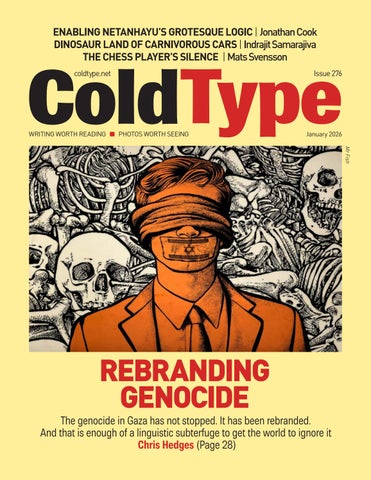
ENABLING NETANHAYU’S GROTESQUE LOGIC | Jonathan Cook DINOSAUR LAND OF CARNIVOROUS CARS | Indrajit Samarajiva THE CHESS PLAYER’S SILENCE | Mats Svensson
ColdType coldtype.net
WRITING WORTH READING n PHOTOS WORTH SEEING
Issue 276
January 2026
Mr Fish
REBRANDING GENOCIDE The genocide in Gaza has not stopped. It has been rebranded. And that is enough of a linguistic subterfuge to get the world to ignore it Chris Hedges (Page 28)
2 ColdType | January 2026 | www.coldtype.net
JANUARY 2026 | ISSUE 276
INSIDE
5 Americar: The dinosaur land of carnivorous cars Indrajit Samarajiva 7 The richest 10% own three quarters of world’s wealth Jake Johnson 8 How corporate Democrats made Trump inevitable Norman Solomon 9 Greed at a Glance Inequality.org 10 Susie Figgis: Revolutionary recruit in fight for freedom Ronnie Kasrils 11 WashPost wants to protect owner from wealth tax Bob Lord 12 Hurwitt’s Eye Mark Hurwitt 13 Oil tankers, military draft, and news propaganda Caitlin Johnstone
ColdType 7 Lewis Street, Georgetown, Ontario, Canada L7G 1E3 Contact: Tony Sutton editor@coldtype.net
Duncan Cumming
INSIGHTS
Arresting thoughts – Pages 26 to 32
ISSUES 14 Bondi Beach attack: How Western allies are enabling Netanyahu’s grotesque logics .................................Jonathan Cook 18 Rebranding genocide..................................................... Chris Hedges 22 Apocalypse soon?..........................................................William Astore 26 Arresting thoughts!… ......................................... Duncan Cumming
Subscribe: For a FREE subscription e-mail editor@coldtype.net
32 World Cup is running dry ....................................................Will Shoki
Back Issues: www.coldtype.net/reader.html or www.issuu.com/coldtype
38 A farewell to sports ..................................................... Robert Lipsyte
Disclaimer: The contents of the articles in ColdType are the sole responsibility of the author(s). ColdType is not responsible for any inaccurate or incorrect statements they may contain
44 The geopolitics of Trump’s Venezuela campaign .................................................................................................John Feffer
©ColdType 2025
35 American justice at Guantanamo Bay ........................ Fred Hazelis 42 Mincing our words ....................................................George Monbiot
48 The BBC edit no one will resign over ........................Des Freeman 51 THE BIG READ – The chess player’s silence ....... Mats Svensson Cover Art: Mr Fish ColdType | January 2026 | www.coldtype.net
3
4 ColdType | January 2026 | www.coldtype.net
NEWS | VIEWS | OPINIONS
INSIGHTS
BIGGER AND BIGGER: “Bro, you don’t make cars. You make World War tanks with cupholders”
➤ I N D R A J I T S A M A R A J I VA
Americar: The dinosaur land of carnivorous cars
A
merican cars are becoming fossil-fuelled fossils, and America is becoming an isolated dinosaur island. The most popular American cars are not even cars, they’re trucks, and they’re barely trucks, more like luxury lorries that cost as much as a house. American trucks keep getting bigger and bigger (while
the truck beds stay the same size or get smaller). This has led to an arms race that looks like a T-Rex running. Trump complains that the world doesn’t buy American cars, but bro, you don’t make cars. You make World War tanks with cupholders. American cars are a global anomaly. Your average American truck
takes shits bigger than your average European car, while your average Chinese vehicle is a different species entirely, electric and lightly armoured. Where I live and across most of the Global South, most people don’t even use four wheels at all (trishaws have three, bikes have two, and feet have none). America, however, had a whole genocided ColdType | January 2026 | www.coldtype.net
5
INSIGHTS continent to evolve on, and have produced this predatory species called the ‘work’ truck. As an example, this photo (right) is my wife next to a Dodge Ram. The strike zone is her entire body. I was hit by a car when I was a teenager and it just took out my bike. I was hit by a trishaw as an adult and I took out the trishaw. But if you get hit by an American car, your whole body is gone. And forget children, you could fit a small classroom up in front of these cars and they won’t even see them. Most of the world does not have cars like this because WTF. People around the world have work trucks and they do not pick up their children in the same vehicles. If you wouldn’t take your children to a construction site, why would you take the construction site to them? Americans are proud of appearing to work, and do not care about killing children, even their own. At the same time, one wouldn’t bring your living room to a construction site, and that’s what American trucks are built to do also. They have a full four seats, and a truck bed that still carries roughly the same amount of stuff old trucks used to carry, and which most of the time carries nothing. These are not work vehicles but appearance-of-work vehicles, which broadly describes the American economy. Given market pressures – ie the fact that these trucks can easily cost $100,000 – American vehicles might regress to the global mean, but not with Trump’s regressive policies. Trump has cut EV subsidies and dropped all the environmental fig leaves, and American carmakers are dropping EV
6
ColdType | January 2026 | www.coldtype.net
“This is my wife next to a Dodge Ram … The strike zone is her entire body” models and pretences accordingly. Besides a carnival barker like Elon Musk, America has never had a serious EV strategy and hates public transport (which solves the problem rather than just electrifying it). Liberals would pretend like they cared, but now even their pretentious virtue signalling is gone. After deciding that climate change is gay, America is hitting the gas, like in the movie Thelma and Louise, straight off a cliff, yee-haw. America is becoming an isolated fossil-fuel island, full of giant cars and small brains. Trump’s trade tirades have created geographical isolation which, as Darwin said, is ripe for new speciation. American cars were already a breed apart, but they’re getting even more inbred and retarded now. When I watch American car shows (which I do) I am increasingly mind-boggled. What are they even talking about? The cars start at $50,000, would not fit in any
parking space I know, and are offensively ugly. I am increasingly confused watching these shows, which appear to be a historical nature documentary about fossil-fuelled monsters. I do not see future cars in America, I see dinosaurs, hit by the Dumbasteroid and yet still lumbering on. Note that you can’t pin all of this on Trump. Trump is just the id of America, they’ve been idiots all along. America has long been a gas station with nukes, as John McCain accusedly confessed. Barack Obama bragged about making America a net oil exporter and Trump’s braggadocio is longstanding American policy, shorn of hypocrisy. And so the future of America looks like Mad Maxistan, monstrous cars driven by heavily armed people. CT Indrajit Samarajiva was born in Canada, raised in America, and lives in Nugegoda, Sri Lanka. He blogs at www.indi.ca
INSIGHTS ➤ JAKE JOHNSON
The richest 10% own three quarters of world’s wealth
A
landmark report on global inequality published last month shows that the chasm between the richest slice of humanity and everyone else continued to expand this year, leaving the top 0.001 percent – fewer than 60,000 multimillionaires – with three times more wealth than the poorest half of the world’s population combined. The global wealth gap has become so staggering, and its impact on economies and democratic institutions so corrosive, that policymakers should treat it as an emergency, argues the third edition of the World Inequality Report, a comprehensive analysis that draws on the work of hundreds of scholars worldwide. Ricardo Gómez-Carrera, a researcher at the World Inequality Lab, is the report’s lead author. “Inequality has long been a defining feature of the global economy, but by 2025, it has reached levels that demand urgent attention,” reads the new report. “The benefits of globalisation and economic growth have flowed disproportionately to a small minority, while much of the world’s population still face difficulties in achieving stable livelihoods. These divides are not inevitable. They are the outcome of political and institutional choices.” The richest 10 percent of the global population, according to the
latest data, own three-quarters of the world’s wealth and capture more income than the rest of humanity. Within most countries, it is rare for the bottom 50 percent to control more than 5 percent of national wealth. “This concentration is not only persistent, but it is also accelerating,” the report observes. “Since the 1990s, the wealth of billionaires and centimillionaires
A tiny minority has unprecedented financial power, while billions are excluded from even basic economic stability has grown at approximately 8 percent annually, nearly twice the rate of growth experienced by the bottom half of the population. The poorest have made modest gains, but these are overshadowed by the extraordinary accumulation at the very top.” “The result,” the report adds, “is a world in which a tiny minority commands unprecedented financial power, while billions remain excluded from even basic economic stability.” The report comes as the world’s
richest and most powerful nation, led by President Donald Trump, abandons international cooperation on climate and taxation and works to supercharge inequality by slashing domestic and foreign aid programs while delivering massive handouts to the wealthiest Americans. Jayati Ghosh, a member of the G20 Extraordinary Committee of Independent Experts on Global Inequality and co-author of the forward to the new report, said in a statement that “we live in a system where resources extracted from labor and nature in low-income countries continue to sustain the prosperity and the unsustainable lifestyle of people in high-income economies and rich elites across countries.” “These patterns are not accidents of markets,” said Ghosh. “They reflect the legacy of history and the functioning of institutions, regulations and policies – all of which are related to unequal power relations that have yet to be rebalanced.” Reversing the decades-long trend of exploding inequality will require the political will to pursue obvious solutions, including fair taxation of the mega-rich and bold investments in social programs and climate action, which is disproportionately fuelled by the wealthy. “The choices we make in the coming years,” the report says, “will determine whether the global economy continues down a path of extreme concentration or moves toward shared prosperity.” CT Jake Johnson is a senior editor and staff writer for Common Dreams – www.commondreams.org – where this article was first published ColdType | January 2026 | www.coldtype.net
7
INSIGHTS ➤ N O R M A N S O LO M O N
How corporate Democrats made Trump inevitable
➤ BY THE NUMBERS
8
ColdType | January 2026 | www.coldtype.net
Elena Ternovaja
T
en years after Donald Trump first ran for president, he stands at the helm of Titanic America. How did this happen? No factors were more pivotal than the outlooks and actions of the Democratic Party leadership. Scrutinising them now is vital not only for clarity about the past. It also makes possible a clear focus on ways to prevent further catastrophe. Here’s actual history that corporate Democrats pretend didn’t happen: 2016: Hillary Clinton offers more of the status quo. Her allies in the Democratic Party pull out all the stops so she can win the party’s presidential nomination. With a big assist from the Democratic Na-
HILLARY CLINTON: Status Quo tional Committee, she prevails over the strong primary challenge from Bernie Sanders – but her campaign trail goes downhill from there. After rallying behind Sanders’s genuine progressive populism, many young people don’t trust the pseu-
W W W. I N E Q U A L I T Y. O R G
do-populism of Clinton’s campaign. She has earned a millennial problem, and it prevents her from becoming president. 2017: Democratic Party leaders can hardly blame themselves or their nominee for the virtually unbelievable circumstance of the Trump presidency. A critical focus on Clinton’s cosiness with Wall Street won’t do. Neither will critiquing her thinly veiled contempt for the progressive wing of the party. But blaming Trump’s victory on Russia becomes an obsessive theme. 2018: The Democratic leadership is mapping out a battle plan for the midterm elections in November. At the same time, a key priority is to thwart the inside threat posed by progressive forces. Establishment Democrats are keeping a watchful eye and political guns trained on Bernie Sanders. 2019: Democrats take control of the House, and a large cast of political characters is off and running for the party’s presidential nomination. Sanders and Senator Elizabeth Warren are at the left edge, while more than a dozen others jostle for media attention. For elites determined to retain undemocratic power, seeing either Sanders or Warren in the Oval Office would be the worst possible outcome. 2020: Early in the year, the economic populism of the Sanders campaign continues to catch fire, while many forces team up to function as fire extinguishers. The Democratic Party establishment acts to smother the grassroots blaze. After Joe Biden’s fifth-place finish in the New Hampshire primary puts his campaign on life-support, rescue comes eighteen days later from South Carolina, where Biden wins
INSIGHTS a landslide primary victory – and then several corporate-friendly contenders quickly drop out of the race and effusively endorse him. When Biden clinches the nomination, progressives largely close ranks behind him to defeat Trump. Biden squeaks through. 2021: President Biden’s first year includes backing and signing legislation with real benefits for tens of millions of Americans. But his resolve dissipates. Before the end of the year, he abandons Build Back Better legislation that would have been transformational. Notably, Biden withdraws all US troops from Afghanistan in late summer – but overall he opts to fuel militarism, with ever-higher Pentagon spending instead of devoting adequate resources to meet human needs and protect nature. The president goes full speed ahead with “modernisation” plans for ever more dangerous nuclear weapons that already have a pre-overrun price tag of $1.7 trillion. 2022: Biden relapses into his customary “moderate” political mode, while his capacity to speak coherently weakens. Party discipline, internalised by Democrats in Congress, precludes independentminded leadership as they begin to proclaim that Biden should run for re-election. Conformity of groupthink and fear of retribution from the White House keep people quiet. 2023: A real-life Shakespearean tragedy unfolds as Biden throws down a gauntlet to run for re-election even while his mental frailty becomes more evident. Enablers ignore the party’s base, with polls continuing to show that most Democrats don’t want him to be the next nominee (including 94 percent of Democrats under 30). A common
➤ G R E E D AT A G L A N C E
canard – pushed by Biden’s coterie of sycophants – contends that because he defeated Trump once, he’s the best person to do it again; the claim ignores the fact that Trump 2020 represented an unpopular status quo, and Biden 2024 would represent an even more unpopular status quo, as “right track / wrong track” polling makes crystal clear. Soon after Hamas attacks Israel on October 7 and the Israeli military starts its siege of Gaza, Biden begins to further alienate many of his party’s usual voters by massively boosting US military aid as the slaughter of Palestinian civilians escalates. 2024: Among top Democrats, denial about Biden’s evident cognitive infirmity grows along with the infirmity itself. Even after Biden’s disastrous debate performance in late June, the political reflex of dissembling prevents him from bowing out for another 28 days. That leaves 107 days for the newly installed nominee Kamala Harris to pick up the pieces before Election Day. At first it seems that she might find ways
W W W. I N E Q U A L I T Y. O R G
to depart from coming across as Biden’s yes-woman, but there is no such departure. Nothing epitomises the Harris campaign’s moral collapse more than her insistence on echoing the Biden line about Gaza while the US continues to arm Israel’s military as it methodically kills Palestinian civilians. In the process, Harris chooses to ignore both human decency and polls showing that far more voters would be likely to cast their ballots for her if she were to come out against sending more armaments to Israel. Electoral disaster ensues. In November, two events showed the huge contradiction between the potential for true progressive change and the dire reality of feckless Democratic Party leaders. When socialist Zohran Mamdani won election as mayor of New York after running as a Democrat, he said: “If there is any way to terrify a despot, it is by dismantling the very conditions that allowed him to accumulate power. This is not only how we stop Trump; it’s how we stop the next one.” A week ColdType | January 2026 | www.coldtype.net
9
INSIGHTS later, eight members of the Senate’s Democratic caucus surrendered to Trump, betraying efforts to defend Obamacare and a healthcare status quo that still leaves tens of millions uninsured or underinsured. The capitulation meant that the nation’s healthcare crisis would get even worse. Craven and conformist Democratic Party leadership – colouring inside corporate lines while enmeshed with rich backers – hardly offers a plausible way to defeat the Trump forces, much less advance a humane political agenda. Saving the country from autocracy requires recognising and overcoming the chokehold that Democratic leaders
have on the party. This timeline is drawn from my new book about the 10-year political descent into the current inferno, The Blue Road to Trump Hell, which is free as an e-book or PDF at www.BlueRoad.info and at www.coldtype.net/BlueRoad.html. CT Norman Solomon is the national director of RootsAction and executive director of the Institute for Public Accuracy. The paperback edition of his book War Made Invisible: How America Hides the Human Toll of Its Military Machine includes an afterword about the Gaza war
➤ RONNIE KASRILS
Susie Figgis: A revolutionary recruit in fight for freedom
W
ith the success of films such as Gandhi, The Killing Fields and The Mission under her belt, Susie Figgis, who came to be regarded as one of Britain’s most highly acclaimed casting directors, arrived in Zimbabwe in 1986 to work on Cry Freedom, the Donald Woods film about Steve Biko. A year later she was back in Africa casting A World Apart, about South African revolutionaries Ruth First and Joe Slovo, written by their daughter Shawn. Much later, in a free South Africa, Susie did the casting for Robyn Slovo’s film Catch A Fire also written by Shawn.
10
In 1986 the South African struggle against apartheid and Susie’s future husband were beckoning. During her time in Harare, she met many in the ANC community (a fertile hunting ground for extras to play security police). Back in London she was introduced to exile Eleanor Kasrils who wasted no time in recruiting Susie into her underground support network. For the next four years until the democratic breakthrough in South Africa, Susie relayed secret communications, transferred funds and put up comrades passing through London. For three decades from 1960 to
ColdType | January 2026 | www.coldtype.net
1990, the city was a hive of ANC activity, not only as virtual headquarters of the global Anti-Apartheid Movement to publicly isolate the Pretoria regime through the boycott, divestment and sanctions campaign, but in support of the ANC’s clandestine struggle within South Africa. Susie fitted well into the role Eleanor tailored for her. Driven by her sense of justice and passion for those fighting for freedom and independence, she carried out sensitive tasks assigned to her with flair, wit and a sense of a fulfilment outside her movie career. She was not some dilettante living out her fantasies sprung from a career in the movies, but responded with a deadly serious motivation to assist in a just cause in which she deeply believed. Eleanor remarked how Susie’s canny eye and judgement of character, which made her a legend in the field of casting sensational movie roles, assisted her in acute observations of the character of the underground recruits she helped take care of. Assisting Eleanor in finding an appropriate disguise for an activist or a last-minute courier who could deliver funds and false documents to someone in Johannesburg. They would kick off their heels and sip G&Ts toasting another success Not even Susie’s closest colleagues ever guessed at her real-life enactments. She was aware there could be dire consequences, kept her lips tightly sealed, and proved to be a rock Eleanor could rely on when reverses occurred in South Africa or when apartheid agents were on the trail in London. In 1988, Bill Anderson was based in Lusaka working in MK military intelligence, under Ronnie Kasrils’
INSIGHTS command, and flew to London to meet a contact from South Africa. Eleanor handed him the keys to a safe house where she said he wouldn’t be disturbed as the owner was abroad. It didn’t turn out like that. A day later in walked Susie, back early from Paris where she had just broken up with a current boyfriend. Covers blown, Eleanor, Susie and Bill went out to dinner. The rest is history. After 35 years of marriage to Bill, mother to Anu and step-mum to Ntsiki, Susie died in London aged 77, on December. 12. While her collaborators in the film industry and loving friends are gathering around to celebrate her life, and the impact of such films as The Crying Game, The Full Monty, and Harry Potter, we should also put down a marker in history for this honorary South African. There is a rich legacy in Britain to scores of internationalists who assisted the ANC and SACP in underground work in the struggle for a non-racist, democratic South Africa. Books, education packs, and
a documentary film by that name have been produced. They are known as London Recruits. The name of unforgettable Susie Figgis can be added to that heroic list. CT Ronnie Kasrils was a member of the national executive committee of the African National Congress from 1987 to 2007, and the country’s minister for intelligence services from 2004 to 2008.
Susie Figgis: Fought in struggle for South Africa’s freedom
➤ B O B LO R D
WashPost wants to protect owner from wealth tax
T
he Washington Post editorial board dedicated its Thanksgiving Sunday column to congratulating the people of Switzerland for voting against a proposed tax on inheritances and gifts in excess of 50 million Swiss francs, or about $62 million.
Taxing giant inheritances and gifts, or otherwise taxing the ultrarich for that matter, the Post writers contended, would wreak havoc on the Swiss economy by causing the rich to flee, and would be “complicated and inefficient.” Because placing a value on exotic assets (the Post’s words) would be so terribly
difficult, property taxes and consumption taxes are “far fairer.” Yes, better to tax teachers on their clothing purchases than to ding a billionaire on the gift of a Picasso painting to her kid. The real point of the editorial, though, was its closing paragraph. There, the Post writers implied, rather blatantly, that US voters should reject any 2028 presidential candidate (the Democratic candidate, obviously) who would reduce the whopping exemption from federal estate and gift taxes ($30 million for a married couple) so as to “make a political point of taxing the rich” rather than “prioritising healthy public finances.” At no point did the Post editorial board mention that the paper’s owner, Amazon founder and quartertrillionaire Jeff Bezos, is the planet’s fourth-wealthiest human – nor did the authors mention that Bezos stands to benefit more from their tax policy prescriptions than nearly anyone else. It’s merely the latest example of the Post editorial board aligning itself with Bezos’s interests and causes without disclosing any potential conflict of interest to readers. In October, its writers stood up for Donald Trump’s glitzy ballroom construction project, without initially mentioning that Amazon has helped fund it. The editorial board also called out the Washington, DC, government for “stalling on selfdriving cars,” without disclosing that Amazon’s autonomous driving company, Zoox, had announced plans to test its cars in the District of Columbia. Forbes’s Realtime Billionaires list estimates Bezos’s wealth at $245 billion. If you arrived in this hemiColdType | January 2026 | www.coldtype.net
11
INSIGHTS sphere with Columbus in 1492 and increased your wealth since then by a million dollars each day while managing to live to the ripe old age of 533, you’d still be $50 billion poorer than Bezos. The Post editorial board’s policy prescriptions seemingly were tailored to address Bezos’s particular tax situation. “Taxing work is not ideal,” the editorial declares, “but an income tax is easier for a government to maintain than claiming unrealised gains that are part of someone’s estate.” Bezos’s wealth, you see, is almost all in the form of unrealised gains. As of a Sept. 30 SEC filing, he still held about 885 million Amazon shares, which have a total current value of over $200 billion. His original investment in those shares in 1994, no more than $200,000, has increased in value over a millionfold. That’s an annual average increase of over 50 percent per year.
If you arrived with Columbus in 1492 and increased your wealth since then by a million dollars a day while living to the age of 533, you’d still be $50 billion poorer than Jeff Bezos And how much income tax has Bezos paid on his $200 billion of remaining Amazon gains? Zero. What happens to those gains if Bezos dies? Under current law, they vanish. Neither Bezos’s estate, nor anyone who inherits the Amazon shares, would pay income tax on the gains. Even when they sell the
➤HURWITT’S EYE
12
ColdType | January 2026 | www.coldtype.net
MARK HURWITT
shares. And the Post editorial board – which Bezos exerts significant control over as the paper’s owner – wants us to believe it’s better we keep it that way because it’s easier for the government to maintain the income tax on workers’ wages. In 2021, ProPublica revealed that Bezos, with wealth already well into the billions, paid zero in federal income tax in 2007 and again in 2011. In fact, in 2011, the US Treasury cut him a check for $4,000 for the child tax credit, a benefit intended to help low- and middle-income American families. Between 2006 and 2018, ProPublica reported, Bezos’s total tax liability was just 1.1 percent of the $127 billion increase in his wealth over that period. In the four years following ProPublica’s expose, Bezos’s wealth has approximately doubled. Two more doublings and Bezos will be a trillionaire. In 2024,, Tim Murphy of Mother Jones remarked on Bezos’s unusual honesty, upon completion of his first space flight, when he thanked Amazon’s employees and customers, who “paid for all of this.” It was extraordinary, Murphy noted, for Bezos “to point with a smile to a p hallic rocket ship that goes nowhere new and assert that this is what delivery drivers peed in a water bottle for.” “But this is the nature of oligarchy,” Murphy explained: “Your sweat is their jet fuel.” The nature of oligarchy indeed. Also in the nature of oligarchy category: using your own newspaper to make the Orwellian suggestion to voters that a presidential candidate who would tax your soon to be trillion-dollar fortune would be failing
INSIGHTS to prioritise public finances. Fortunately, few voters are likely to follow the Post’s advice. Readership at the Post, according to recent reports, is collapsing. Imagine that. CT
Bob Lord, an Institute for Policy Studies associate fellow, currently serves as senior vice president for tax policy at www.patriotic millionaires.org
into Bolivia this year, and now they’re hurrying to push regime change in Caracas and Havana while they’ve got a right wing tyrant in office with a cowardly secretary of state. The hope is to force the entirety of Latin America into full alignment with the empire before Trump leaves office. I have ➤ C A I T L I N J O H N S TO N E no idea if they’ll succeed. – – – – – – l The US House and Senate have agreed to make registration for the draft “automatic,” which will simplify the drafting process if the empire decides to throw the youth of America into a horrific new miliS forces have seized an oil pre-existing military agendas in tary conflict. The US is making its tanker carrying 1.8 million both regions, and they’re seizing it biggest draft policy change in 45 barrels of oil from Venbefore their attention has to turn to years so it’s easier to force Ameriezuela to Cuba as part of bigger geopolitical fish. cans to fight and die in a massive its ongoing series of warmongerYou often hear US imperialwar, just as the New York Times ing escalations against the Maduro ists saying that obtaining regime editorial board launches a series government. explaining why the US When asked what must prepare for war with would be done with the China. oil, President Trump told The latest edition of the press, “We keep it, I the New York Times’ arguess.” guments for the need for Meanwhile Chuck more US militarism is titled Schumer is refusing to “This Is The 21st Century oppose Trump’s regime The seized oil tanker, The Skipper off the coast of Barcelona, Arms Race. Can America change interventionVenezuela, around November 2025 TankerTrackers.com Keep Up?,” which argues ism against Venezuela, that “Congress needs to exand CNN just had former US intelchange in Venezuela will help pand funding for research and deligence official Beth Sanner on to achieve it in Cuba as well; Senavelopment into technologies with proclaim that the Trump administor Rick Scott recently told 60 Minmilitary applications.” tration’s act of piracy “is absolutely utes that if Maduro is successfully “To counter the growing threat, normal.” So Trump’s opposition in ousted “it’ll be the end of Cuba,” America must simultaneously win the political-media class are putting and “America is gonna take care the race to build autonomous weapno inertia on this. of the southern hemisphere and ons and lead the world in controlThe US pirating a Cuba-bound oil make sure there’s freedom and ling them,” the editorial board tanker from Venezuela illustrates democracy.” writes. Fun times. CT how the empire is hurrying to shore Stealing the oil hurts both Cuba up control over Latin America in and Venezuela, who are the two Caitlin Johnstone is an the same way the US and Israel are primary enemies of the US empire Australian independent quickly shoring up control over the in the Americas because of their journalist. This article was first Middle East. There’s an opportustrongly socialist governments. published at her web site, nity to shove through a bunch of They got a right wing government www.caitlinjohnstone.com.au
Oil tankers, military draft plans, and news propaganda
U
ColdType | January 2026 | www.coldtype.net
13
➤ J O N AT H A N C O O K
Bondi Beach attack: How Western allies are enabling Netanyahu’s grotesque logic The Israeli prime minister is blaming Australia for fuelling ‘antisemitism’ by recognising Palestine – and establishment media are all too keen to air his views
I
sraeli Prime Minister Benjamin Netanyahu drew precisely the wrong conclusion from the December 14 terror attack at Bondi Beach – and western leaders and media are once again buying into his warped logic. Predictably, Netanyahu aimed to exploit the attack – in which more than a dozen people were killed by two gunmen at a Hanukkah celebration in Sydney – to implicitly justify Israel’s slaughter and maiming of tens of thousands of children in Gaza over the past two years. Netanyahu said he had written to the Australian prime minister, Anthony Albanese, a few months earlier to blame him not only for supposedly failing to tackle antisemitism in his country, but for fuelling it by recognising Palestinian statehood. Quoting from the letter, he said: “Your call for a Palestinian state pours fuel on the antisemitic fire. It rewards Hamas terrorists. It emboldens those who menace Australian Jews and encourages the Jew hatred now stalking your streets.” In other words, Netanyahu holds any leader who makes a concession, however rhetorical, to the Palestinian people responsible for violence
14 ColdType | January 2026 | www.coldtype.net
directed towards Jews. And he does so even if the concession is in accordance with international law and a recent International Court of Justice ruling requiring Israel to immediately end its unlawful occupation of the Palestinian territories, including Gaza. That puts plenty of other world leaders in Netanyahu’s sights, including Britain’s Keir Starmer, France’s Emmanuel Macron and Canada’s Mark Carney, alongside the leaders of Ireland, Spain, Portugal, Belgium and Norway. All have recently recognised Palestinian statehood. You might imagine that they would be keen to push back against Netanyahu’s suggestion of a link between the killings in Australia and the recognition of Palestinian rights. After all, he is implicitly stat-
It in no way justifies the Bondi Beach attack to refuse to accept Netanyahu’s flawed logic, and to search for the real causes of such violence
ing that the slightest effort to relieve Palestinian suffering inexorably leads to attacks on Jews. Presumably, then, the West should leave Palestinians to suffer indefinitely. As if prisoners of Stockholm syndrome, western leaders appear only too ready to concede to Netanyahu’s twisted reasoning. Even Albanese, directly blamed by Netanyahu for the killings, weakly rejected the accusation, stating only that “overwhelmingly, most of the world recognises a two-state solution as being the way forward in the Middle East”.
T
he first thing to note is the extraordinary fact that Netanyahu’s arguments about the Bondi Beach killings are receiving such a sympathetic airing by western media. Remember he is not a disinterested party, though you would never know it from the coverage. In the immediate wake of the attack, two major US publications, the New York Times and the Atlantic, hurried to publish articles echoing Netanyahu by suggesting a linkage between the cause of Palestinian
HORROR AT BONDI BEACH: Front pages from Australia and the UK justice and anti-Jewish terror. International human rights groups, UN legal experts and genocide scholars are all agreed that Netanyahu has overseen a two-year genocide in Gaza. He himself is  wanted for crimes against humanity by the International Criminal Court, in part for using starvation as a weapon of war against the enclave’s population. But this suspected war criminal – a fugitive from justice – is being given a platform by every western
news outlet to turn reality on its head and blame others for a supposed “crisis of antisemitism” he is centrally responsible for stoking. The criminal isn’t just being allowed to get away with his crimes. He is now the one being allowed to tell us who must be put on trial.
N
otice, too, the response from western leaders. See how quick they are to condemn an antisemitic terror
attack, and how loudly – compared to how reluctant they have been for two years to even admit that the slaughter of tens of thousands of Palestinians and the starvation of two million more has even taken place. This looks, once again, like deepseated western racism towards Palestinians, Arabs and Muslims, more than it does a problem of antisemitism in the West, as Netanyahu claims. It in no way justifies the Bondi Beach attack to refuse to accept NetColdType | January 2026 | www.coldtype.net
15
anyahu’s flawed logic, and to search for the real causes of such violence. Misdiagnosing those causes, as Netanyahu prefers, means the wounds that led to the violence will continue to fester. There is every reason, as we shall see, to believe that this is exactly what the Israeli prime minister wants. Netanyahu’s grotesque logic – that abiding by international law in regard to Palestine leads to violence against Jews – makes sense only because for years, western leaders have conspired in a narrative that openly conflates criticism of Israel with hatred of Jews. Britain’s chief rabbi, Ephraim Mirvis, was quick to echo this theme. He told the BBC that the Bondi Beach attack was a consequence of Israel being “demonised.” He called for further legal and police crackdowns on protests against Israel. This is the same chief rabbi who concluded in early 2024, as the numBelow: Days after the shootings, Sydney’s Daily Telegraph turns its anger on the government
16 ColdType | January 2026 | www.coldtype.net
Mirvis praised Israeli troops in Gaza as “our heroic soldiers,” apparently forgetting that he is Britain’s chief rabbi, not Israel’s ber of Palestinians killed by Israel in Gaza already stood at 23,000: “What Israel is doing is the most outstanding possible thing that a decent, responsible country can do for its citizens.” He praised Israeli troops in Gaza as “our heroic soldiers,” apparently forgetting that he is Britain’s chief rabbi, not Israel’s. He thereby conflated the Jewish people with Israel – something that would be denounced as antisemitic were a critic of Israel to do it. In fact, it has always been Israel’s goal to present itself as representing the interests of Jews everywhere, including those who are citizens of other states – and even the significant number who refuse to recognise the legitimacy of Israel’s ethnic supremacist agenda. Israeli leaders finally got their way in recent years with the widespread adoption of a new definition of antisemitism, formulated by a pro-Israel group called the International Holocaust Remembrance Alliance (IHRA). The IHRA’s muchcriticised definition offers 11 examples of “antisemitism,” seven of which relate not to hatred of Jews, but to criticism of Israel. This radical re-
imagining of antisemitism opened the floodgates, just as Netanyahu and others hoped it would, to the claim that antisemitism was an increasing problem in western societies and needed aggressive action to tackle. It meant that the more cruelly Netanyahu and Israel treated Palestinians – including by committing genocide in Gaza – the more pro-Israel lobbying groups could trumpet surveys that showed a steep rise in “antisemitism.”
S
uch “antisemitism,” of course, was not necessarily rooted in prejudice towards Jews. It was more usually an expression of anger towards a violent, highly militarised, out-ofcontrol and utterly unaccountable state that is oppressing and killing Palestinians in the name of Jews everywhere. For example, in 2024, deep into Israel’s Gaza genocide, the AntiDefamation League, a prominent pro-Israel lobbying group, carried out a survey that identified 9,354 “antisemitic” incidents across the US – the highest number since it began keeping records in 1979. The significant point was buried in the small print. For the first time, a clear majority of those incidents “contained elements related to Israel or Zionism” – the ideology of Jewish ethnic supremacism that is used to justify Israel’s long oppression of the Palestinian people. In other words, a majority of these “antisemitic” incidents would most likely not have been considered antisemitic before the adoption of the IHRA definition. Similarly, the BBC reported this week that the UK’s Community Security Trust, another pro-Israel group, has found record levels of anti-Jewish hate crime using the IHRA definition, noting that this
“began to increase immediately after the 7 October 2023 attack by Hamas on Israel.” Indeed, the Trust noted in 2024 that 52 percent of the 3,528 “antisemitic incidents” it recorded were “rhetoric” that was “either directly referenced or was linked to Israel, Gaza, the Hamas terror attack on 7 October 2023 or the subsequent Middle East war”. It notes that those 1,844 rhetorical outbursts compared to just 246 in 2022. With anti-Israel sentiment formulated as “antisemitism”, it was inevitable that “antisemitism” would increase during Israel’s genocide. Moral people oppose genocide. In fact, it would have been deeply shocking if “antisemitism,” thus defined, had not risen. The devaluing of what antisemitism means has proved its worth over the past two years. By conflating criticism of Israel with antisemitism, Israel, its lobbyists, western governments and the media can now, in parallel, conflate entirely justified protests against Israel’s crimes with entirely unjustified terror against Jews. Netanyahu has been keen to blame social media for the rise of this new kind of “antisemitism” –because for the first time, it has allowed Palestinians and their allies to live-stream Israel’s racism and thuggery.
U
nsurprisingly, greater exposure of Israeli criminality has fed more anti-Israel sentiment, especially among western youth. It has also fuelled a greater sense of urgency that western governments must be pressured into ending their active collusion in the genocide. This healthy, ethical, democratic impulse is then denounced as a “crisis of antisemitism” – one that needs urgent action. Mirvis was at the forefront of
Unsurprisingly, greater exposure of Israeli criminality has fed more anti-Israel sentiment, especially among western youth efforts to weaponise the Bondi Beach attack, calling for anti-genocide protests – or what he termed “globalising the intifada” – to be crushed. He told the BBC: “What is the meaning of ‘globalise the intifada?’ I’ll tell you the meaning … it’s what happened on Bondi Beach yesterday.” In fact, “intifada” is the word Palestinians have used for decades to describe their struggle to liberate themselves from what the world’s highest court ruled last year was Israel’s unlawful occupation, violent oppression and apartheid rule of Palestinians. Palestinians want to “globalise” their struggle by replicating the kind of international solidarity that overturned South Africa’s apartheid rule. But efforts in the West to promote a boycott and sanctions movement against Israel, echoing the one against apartheid South Africa, have been vilified as Jew hatred too. In fact, western leaders have treated all forms of protest – however non-violent – against Israel and its genocide as illegitimate, and as the wellspring of a new “antisemitism.” The Palestinian solidarity movement has been painted as racist and violent, whatever it does. It doesn’t take a genius to surmise that the stifling of non-violent protest risks provoking violence instead. We could call this the Palestinians’ dilemma: over decades, Israel has crushed largely non-violent struggles - such as the First Intifada in the 1980s, and the 2018 Great
March of Return – thus encouraging a turn towards the violence of October 7, 2023. Once again, explaining violence does not justify it. But explanations are necessary. They are the first and most important step in finding ways to mitigate the very circumstances that feed violence. That means there is a duty on us all to try to identify the true causes of violence, and not simply close our minds by listening to those like Netanyahu whose interest is in offering self-serving rationales designed to excuse their own criminality. When the true causes of violence are understood, a proper debate can be had. Efforts can be made to address those causes – precisely the course of action Netanyahu and western leaders wish to avoid at all costs in regards to Palestine. Why? Because the search for the roots of that violence land firmly at their door. Millions of people feel utterly powerless in the face of the most documented genocide of all time. Millions see their governments actively aiding Israel as it bombs civilians, ethnically cleanses whole communities, and starves children. Western leaders and media do not want you angry about any of this. They want you to exclusively voice your anger for the victims of the Sydney gunmen, while silencing your rage over the murder of tens of thousands of innocents in Gaza by Israel and its western partners. But you do not have to choose. You can be angry about both. CT Jonathan Cook’s latest books are Israel and the Clash of Civilizations: Iraq, Iran, and the Plan to Remake the Middle East (Pluto Press) and Disappearing Palestine: Israel’s Experiments in Human Despair (Zed Books). His website is www.jonathan-cook.net ColdType | January 2026 | www.coldtype.net
17
➤ CHRIS HEDGES
Rebranding genocide The genocide in Gaza has not stopped. It has been rebranded. And that is enough of a linguistic subterfuge to get the world to ignore it
F
irst, it was Israel’s right to defend itself. Then it was a war, even though, by Israel’s own military intelligence database, 83 percent of the casualties were civilians. The 2.3 million Palestinians in Gaza, living under an Israeli air, land and sea blockade, have no army, air force, no mechanised units, no tanks, no navy, no missiles, no heavy artillery, no fleets of killer drones, no sophisticated tracking systems to map all movements, or an ally like the United States, which has given Israel at least $21.7 billion in military aid since Oct. 7, 2023. Now, it is a “ceasefire.” Except of course, as usual, Israel only abided by the first of the 20 stipulations. It freed around 2,000 Palestinian captives held in Israeli prisons – 1700 of whom were detained after Oct. 7 – as well as around 300 bodies of Palestinians, in exchange for the return of the 20 remaining Israeli captives. Israel has violated every other condition. It has tossed the agreement – brokered by the Trump administration without Palestinian participation – into the bonfire with all the other agreements and peace accords concerning Palestinians. Israel’s extensive and blatant flouting of international agreements and international law – Israel and its allies refuse to abide by three
18 ColdType | January 2026 | www.coldtype.net
sets of legally binding orders by the International Court of Justice (ICJ) and two ICJ advisory opinions, as well as the Genocide Convention and international humanitarian law – presage a world where the law is whatever the most militarily advanced countries say it is. The sham peace plan – “President Donald J. Trump’s Comprehensive Plan to End the Gaza Conflict” – in an act of stunning betrayal of the Palestinian people, was endorsed by most of the UN Security Council in November, with China and Russia abstaining. Member states washed their hands of Gaza and turned their backs on the genocide.
T
he adoption of resolution 2803 (2025), as the Middle East scholar Norman Finkelstein writes, “was simultaneously a revelation of moral insolvency and a declaration of war against Gaza. By proclaiming international law null and void, the Security Council proclaimed itself null and void. Vis-à-vis Gaza, the Council transmuted into a criminal conspiracy.” The next phase is supposed to see Hamas surrender its weapons and Israel withdraw from Gaza. But these two steps will never happen. Hamas – along with other Palestin-
ian factions – rejects the Security Council resolution. They say they will disarm only when the occupation ends and a Palestinian state is created. Prime Minister Benjamin Netanyahu has vowed that if Hamas does not disarm, it will be done “the hard way.” The “Board of Peace,” headed by Trump, will ostensibly govern Gaza along with armed mercenaries from the Israel-allied International Stabilization Force, although no country seems anxious to commit their troops. Trump promises a Gaza Riviera that will function as a “special economic zone” – a territory operating outside of state law governed entirely by private investors, such as the Peter Thiel-backed charter city in Honduras. This will be achieved through the “voluntary” relocation of Palestinians – with those fortunate enough to own land offered digital tokens in exchange. Trump declares that the US “will take over the Gaza Strip” and “own it.” It is a return to the rule of viceroys – though apparently not the odious Tony Blair. Palestinians, in one of the most laughable points in the plan, will be “deradicalised” by their new colonial masters. But these fantasies will never come to fruition. Israel knows what
See no evil. Hear no evil. Speak no evil – Mr Fish it wants to do in Gaza and it knows no nation will intercede. Palestinians will struggle to survive in primitive and dehumanizing conditions. They will, as they have so many times in the past, be betrayed. Israel has committed 738 violations of the ceasefire agreement between Oct. 10 and Dec. 12, including 358 land and air bombardments, the killing of at least 383 Palestinians and the injuring of 1,002 others, according to the Government Media Office in Gaza and the Palestinian Health Ministry. That’s an average of six Palestinians killed daily in Gaza – down from an average of 250 a day before the “ceasefire.” Israel said it killed a senior Hamas commander, Raed Saad, in mid-December, in a missile strike on a car on Gaza’s coastal
road. Three others were also apparently killed in the strike.
T
he genocide is not over. Yes, the pace has slowed. But the intent remains unchanged. It is slow motion killing. The daily numbers of dead and wounded – with increasing numbers falling sick and dying from the cold and rain – are not in the hundreds but the dozens. December saw an average of 140 aid trucks allowed into Gaza each day – instead of the promised 600 – to keep Palestinians on the edge of famine and ensure widespread malnutrition. In October, some 9,300 children in Gaza under five were diagnosed with severe acute malnutrition, according to UNICEF. Is-
rael has opened the border crossing into Egypt at Rafah, but only for Palestinians leaving Gaza. It is not open for those who want to return to Gaza, as stipulated in the agreement. Israel has seized some 58 percent of Gaza and is steadily moving its demarcation line – known as “the yellow line” – to expand its occupation. Palestinians who cross this arbitrary line – which constantly shifts and is poorly marked when it is marked at all – are shot dead or blown up – even if they are children. Palestinians are being crammed into a shrinking, fetid, overcrowded concentration camp until they can be deported. Ninety-two percent of Gaza’s residential buildings have been damaged or destroyed and around 81 percent of all structures are damaged, according to UN ColdType | January 2026 | www.coldtype.net
19
X / @infinite_jaz
estimates. The Strip, only 25 miles long and seven-and-a-half miles wide, has been reduced to 61 million tons of rubble, including nine million tons of hazardous waste that includes asbestos, industrial waste, and heavy metals, in addition to unexploded ordnance and an estimated 10,000 decaying corpses. There is almost no clean water, electricity or sewage treatment. Israel blocks shipments of construction supplies, including cement and steel, shelter materials, water infrastructure and fuel, so nothing can be rebuilt. Eighty-two percent of Israeli Jews support the ethnic cleansing of the entire population of Gaza and 47 percent support killing all civilians in cities captured by the Israeli military. Fifty-nine percent support doing the same to Palestinian citizens of Israel. Seventy-nine percent of Israeli Jews say they are “not so troubled” or “not troubled at all” by reports of famine and suffering among the population in Gaza, according to a survey conducted in July. The words “Erase Gaza” appeared more than 18,000 times in Hebrewlanguage Facebook posts in 2024 alone, according to a new report on hate speech and incitement against Palestinians.
The newest form of genocidal celebration in Israel is the sprouting of golden nooses on the lapels of members of the far-right political party Otzma Yehudit, Israel’s version of the Ku Klux Klan, including one worn by National Security Minister Itamar Ben-Gvir
T
he newest form of genocidal celebration in Israel – where social media and news channels routinely chortle over the suffering of Palestinians – is the sprouting of golden nooses on the lapels of members of the far-right political party Otzma Yehudit, Israel’s version of the Ku Klux Klan, including one worn by National Security Minister Itamar Ben-Gvir. They are pushing a bill through the Knesset which seeks to mandate the death penalty for Palestinians who “intentionally or indifferently causes the death of an Israeli citi is the sprouting of golden nooses
20 ColdType | January 2026 | www.coldtype.net
on the lapels of members of the farright political party Otzma Yehudit, Israel’s version of the Ku Klux Klan, including one worn by National Security Minister Itamar Ben-Gvizen,” if they are said to be motivated by “racism or hostility toward a public,” and with the purpose of harming the Israeli state or “the rebirth of the Jewish people in its land,” the Israeli human rights group Adalah explains. More than 100 Palestinians have been killed in Israeli jails since Oct. 7. If the new bill becomes law – it has been cleared through its first reading – it will join the wave of more than 30 anti-Palestinian laws enacted since October 7. The message the genocide sends to the rest of the world, more than a billion of whom live on less than a dollar a day, is unequivocable: We have everything and if you try and take it away from us, we will kill you. This is the new world order. It will look like Gaza. Concentration camps. Starvation. Obliteration of infrastructure and civil society. Mass killing. Wholesale surveillance. Executions. Torture, including the beatings, electrocutions,
waterboarding, rape, public humiliation, deprivation of food and denial of medical care routinely used on Palestinians in Israeli prisons. Epidemics. Disease. Mass graves where corpses are bulldozed into unmarked pits and where bodies, as in Gaza, are dug up and torn apart by packs of ravenous wild dogs. We are not destined for the Shangri-La sold to a gullible public by fatuous academics such as Stephen Pinker. We are destined for extinction. Not only individual extinction – which our consumer society furiously attempts to hide by peddling the fantasy of eternal youth – but wholesale extinction as temperatures rise to make the globe uninhabitable. If you think the human species will respond rationally to the ecocide, you are woefully out of touch with human nature. You need to study Gaza. And history. If you live in the Global North, you will get to peer out at the horror, but slowly this horror, as the climate breaks down, will migrate home, turning most of us into Palestinians. Given our complicity in the genocide, it is what we deserve. Empires, when they feel threatened, always embrace the instrument of genocide. Ask the victims of the Spanish conquistadors. Ask Native Americans. Ask the Herero and Nama. Ask the Armenians. Ask the survivors of Hiroshima or Nagasaki. Ask the Indians who survived the Bengal famine or the Kikuyu who rose against their British colonisers in Kenya. Climate refugees will get their turn. This is not the end of the nightmare. It is the beginning. CT Chris Hedges is a Pulitzer Prize– winning journalist who was a foreign correspondent for 15 years for the New York Times.. He is the host of the Chris Hedges Report podcast at www.chrishedges.substack.com
A New Book by NORMAN SOLOMON from ColdType and Progressive Hub
“This book scrutinizes how the behaviour of many Democrats assisted Trump’s electoral triumphs. That scrutiny is important not only for clarity about the past. It also makes possible a focus on ways that such failures can be avoided in the future.”
THE BLUE ROAD TO TRUMP HELL How Corporate Democrats Paved the Way for Autocracy
By NORMAN SOLOMON With cartoons by Matt Wuerker
The sordid and tragic truth of how the Democratic Party enabled the Trump cult to seize control of the US government. Download a FREE PDF at www.coldtype.net/BlueRoad.html or at www.blueroad.info l Print copy now available ColdType | January 2026 | www.coldtype.net
21
➤ W I L L I A M J . A S TO R E
Apocalypse soon? No matter how many bunkers we build, no matter that the world’s biggest bunker tunnelled out of a mountain still exists, nothing will save us if we allow the glitter of nuclear weapons to flash into thermo-nuclear brightness
I
t’s been 20 years since I retired from the Air Force and 40 years since I first entered Cheyenne Mountain, America’s nuclear redoubt at the southern end of the Front Range that includes Pikes Peak in Colorado. So it was with some nostalgia that I read a recent memo from General Kenneth Wilsbach, the new Chief of Staff of the Air Force (CSAF). Along with the usual warrior talk, the CSAF vowed to “relentlessly advocate” for the new Sentinel ICBM (intercontinental ballistic missile) and the B-21 Raider stealth bomber. While the Air Force often speaks of “investing” in new nukes, this time the CSAF opted for “recapitalization,” a remarkably bloodless term for the creation of a whole new generation of genocidal thermonuclear weapons and their delivery systems. (Take a moment to think about that word, “creation,” applied to weapons of mass destruction. Raised Catholic, I learned that God created the universe out of nothing. By comparison, nuclear creators aren’t gods, they’re devils, for their “creation” may end with the destruction of everything. Small won-
22 ColdType | January 2026 | www.coldtype.net
der J. Robert Oppenheimer mused that he’d become death, the destroyer of worlds, after the first successful atomic blast in 1945.) In my Cheyenne Mountain days, circa 1985, the new “must have” bomber was the B-1 Lancer and the new “must have” ICBM was the MX Peacekeeper. If you go back 20 to 30 years earlier than that, it was the B-52 and the Minuteman. And mind you, my old service “owns” two legs of America’s nuclear triad. (The Navy has the third with its nuclear submarines armed with Trident II missiles.) And count on one thing: it will never willingly give them up. It will always “relentlessly advocate” for the latest ICBM and nuclear-capable bomber, irrespective of need, price, strategy, or above all else their murderous, indeed apocalyptic, capabilities. At this moment, Donald Trump’s America has more than 5,000 nuclear warheads and bombs of various sorts, while Vladimir Putin’s Russia has roughly 5,500 of the same. Together, they represent overkill of an enormity that should be considered essentially unfathomable. Any sane person would minimally argue for serious reductions in nu-
clear weaponry on this planet. The literal salvation of humanity may depend on it. But don’t tell that to the generals and admirals, or to the weapons-producing corporations that get rich building such weaponry, or to members of Congress who have factories producing such weaponry and bases housing them in their districts. So, here we are in a world in which the Pentagon plans to spend another $1.7 trillion (and no, that is not a typo!) “recapitalizing” its nuclear triad, and so in a world that is guaranteed to remain haunted forever by a possible future doomsday, the spectre of nuclear mushroom clouds, and a true “end-times” catastrophe.
M
y first military assignment in 1985 was at Peterson Air Force Base in Colorado with Air Force Space Command. That put me in America’s nuclear command post during the last few years of the Cold War. I also worked in the Space Surveillance Center and on a battle staff that brought me into the Missile Warning Center. So, I was exposed, in a relatively modest way (if anything having to do with nuclear weapons can ever be considered “modest”), to what nuclear war would actually be like and forced to think about it in a way most Americans don’t. Each time I journeyed into Cheyenne Mountain, I walked or rode
through a long tunnel carved out of granite. The buildings inside were mounted on gigantic springs (yes, springs!) that were supposed to absorb the shock of any nearby hydrogen bomb blast in a future war with the Soviet Union. Massive blast doors that looked like they belonged on the largest bank vault in the universe were supposed to keep us safe, though in a nuclear war they might only have ensured our entombment. They were mostly kept open, but every now and then they were closed for a military exercise. I was a “space systems test analyst.” The Space Surveillance Center ran on a certain software programme that needed periodic
testing and evaluation and I helped test the computer software that kept track of all objects orbiting the Earth. Back then, there were just over 5,000 of them. (Now, that number’s more like 45,000 and space is a lot more crowded – perhaps too crowded.) Anyhow, what I remember most vividly were military exercises where we’d run through different potentially world-ending scenarios. (Think of the movie War Games with Matthew Broderick.) One exercise simulated a nuclear attack on the United States. No, it wasn’t like some Hollywood production. We just had monochrome computer displays with primitive graphics, but you could certainly see misColdType | January 2026 | www.coldtype.net
23
sile tracks emerging from the Soviet Union, crossing the North Pole, and ending at American cities. Even though there were no fancy (fake) explosions and no other special effects, simply realising what was possible and how we would visualise it if it were actually to happen was, as I’m sure you can imagine, a distinctly sobering experience and not one I’ve ever forgotten. That “war game” should have shaken me up more than it did, however. At the time, we had a certain amount of fatalism about the possibility of nuclear war, something captured in the posters of the era that told you what to do in case of a nuclear attack. The final step was basically to bend over and kiss your ass goodbye. That was indeed my attitude.
R
ather than obsess about Armageddon, I submerged myself in routine. There was a certain job to be done, procedures to be carried out, discipline to adhere to. Remember, of course, that this was also the era of the rise of the nuclear freeze protest movement that was demanding the US and the Soviet Union reach an agreement to halt further testing, production, and deployment of nuclear weapons. (If only, of course!) In addition, this was the time of the hit film The Day After, which tried to portray the aftermath of a nuclear war in the United States. In fact, on a midnight shift in Cheyenne Mountain, I even read Tom Clancy’s Red Storm Rising, which envisioned the Cold War gone hot, a Third World War gone nuclear. Of course, if we had thought about nuclear war every minute of every day, we might indeed have been cowering under our sheets. Unfortunately, as a society, except in rare moments like the nuclear freeze movement one, we neither considered nor generally grasped what
24 ColdType | January 2026 | www.coldtype.net
We had a vocabulary of words and euphemisms to avoid thinking too deeply about the unthinkable or our possible role in making it happen nuclear war was all about (even though nine countries now possess such weaponry and the likelihood of such a war only grows). Unfortunately, that lack of comprehension (and so protest) is one big reason why nuclear war remains so chillingly possible. If anything, such a war has been eerily normalised in our collective consciousness and we’ve become remarkably numb to and fatalistic about it. One characteristic of that reality was the anaesthetising language that we used then (and still use) when it came to nuclear matters. We in the military spoke in acronyms or jargon about “flexible response,” “deterrence,” and what was then known as “mutually assured destruction” (or the wiping out of everything). In fact, we had a whole vocabulary of different words and euphemisms we could use so as not to think too deeply about the unthinkable or our possible role in making it happen.
A
fter leaving Cheyenne Mountain and getting a master’s degree, I co-taught a course on the making and use of the atomic bomb at the Air Force Academy. That was in 1992, and we actually took the cadets on a field trip to Los Alamos where the first nuclear weapon had largely been developed. Then we went on to the Trinity test site in Alamogordo, New Mexico, where, of course, that first atomic device was tested and
that, believe me, was an unforgettable experience. We walked around and saw what was left of the tower where Robert Oppenheimer and crew suspended the “gadget” (nice euphemism!) for testing that bomb on July 16, 1945, less than a month before two atomic bombs would be dropped on the Japanese cities of Hiroshima and Nagasaki, destroying both of them and killing perhaps 200,000 people. Basically (I’m sure you won’t be surprised to learn), nothing’s left of that tower except for its concrete base and a couple of twisted pieces of metal. It certainly does make you reflect on the sheer power of such weaponry. It was then and remains a distinctly haunted landscape and walking around it a truly sobering experience. And when I toured the Los Alamos lab right after the collapse of the other great superpower of that moment, the Soviet Union, it was curious how glum the people I met there were. The mood of the scientists was like: hey, maybe I’m going to have to find another job because we’re not going to be building all these nuclear weapons anymore, not with the Soviet Union gone. It was so obviously time for America to cash in its “peace dividends” and the scientists’ mood reflected that. Now, just imagine that 33 years after I took those cadets there, Los Alamos is once again going gangbusters, as our nation plans to “invest” another $1.7 trillion in a “modernised” nuclear triad (imagine what that means in terms of ultimate destruction!) that we (and the rest of the world) absolutely don’t need. To be blunt, today that outrages me. It angers me that all of us, whether those like me who served in uniform or your average American taxpayer, have sacrificed so much to create genocidal weaponry and a distinctly world-ending arsenal. Worse yet, when the Soviet Union collapsed in 1991, we didn’t even
try to change course. And now the message is: Let’s spend staggering amounts of our tax dollars on even more apocalyptic weaponry. It’s insanity and, no question about it, it’s also morally obscene. That ongoing obsession with total destruction, ultimate annihilation, reflects the fact that the United States is led by moral midgets. During the Vietnam War years, the infamous phrase of the time was that the US military had to “destroy the town to save it” (from communism, of course). And for 70 years now, America’s leaders have tacitly threatened to order the destruction of the world to save it from a rival power like Russia or China. Indeed, nuclear war plans in the early 1960s already envisioned a massive strike against Russia and China, with estimates of the dead put at 600 million, or “100 Holocausts,” as Daniel Ellsberg of Vietnam War fame so memorably put it.
T
ake it from this retired officer: you simply can’t trust the US military with that sort of destructive power. Indeed, you can’t trust anyone with that much power at their fingertips. Consider nuclear weapons akin to the One Ring of Power in JRR Tolkien’s The Lord of the Rings. Anyone who puts that ring on is inevitably twisted and corrupted. Freeman Dyson, a physicist of considerable probity, put it well to documentarian Jon Else in his film The Day After Trinity. Dyson confessed to his own “ring of power” moment: “I felt it myself. The glitter of nuclear weapons. It is irresistible if you come to them as a scientist. To feel it’s there in your hands, to release this energy that fuels the stars, to let it do your bidding. To perform these miracles, to lift a million tons
Even after their service, many veterans still want to go up in a warplane again or take a tour of a submarine, a battleship, or an aircraft carrier for nostalgic reasons, of course, but also because you want to regain that captivating feeling of being so close to immense – even world-ending – power.
T William Astore’s new book, made up of the 110 pieces he wrote for TomDispatch, is American Militarism on Steroids: The MilitaryIndustrial Complex, Unbounded, Uncontained, and Undemocratic. It is available as a Kindle e-book at www.amazone.com – Price $10
of rock into the sky. It is something that gives people an illusion of illimitable power, and it is, in some ways, responsible for all our troubles – this, what you might call technical arrogance, that overcomes people when they see what they can do with their minds.” I’ve felt something akin to that as well. When I wore a military uniform, I was in some sense a captive to power. The military both captures and captivates. There’s an allure of power in the military, since you have a lot of destructive power at your disposal. Of course, I wasn’t a B-1 bomber pilot or a missile-launch officer for ICBMs, but even so, when you’re part of something that’s so immensely, even world-destructively powerful, believe me, it does have an allure to it. And I don’t think we’re usually fully aware of how captivating that can be and how much you can want to be a part of that.
he saying that “power corrupts, and absolute power corrupts absolutely” may never be truer than when it comes to nuclear war. We even have expressions like “use them or lose them” to express how ICBMs should be “launched on warning” of a nuclear attack before they can be destroyed by an incoming enemy strike. So many years later, in other words, the world remains on even more of a nuclear hair-trigger, the pistol loaded and cocked to our collective heads, just waiting for news that will push us over the edge, that will make those trigger fingers of ours too itchy to resist the urge to put too much pressure on that nuclear trigger. No matter how many bunkers we build, no matter that the world’s biggest bunker tunnelled out of a mountain, the one I was once in, still exists, nothing will save us if we allow the glitter of nuclear weapons to flash into preternatural thermonuclear brightness. CT William J. Astore, a retired lieutenant colonel (USAF) and professor of history, is a senior fellow at the Eisenhower Media Network (EMN), an organisation of critical veteran military and national security professionals. His personal substack is Bracing Views. His video testimony for the Merchants of Death Tribunal is available at this link. This article first appeared at www.tomdispatch.com ColdType | January 2026 | www.coldtype.net
25
➤ DUNCAN CUMMING
Arresting thoughts
I
t only took a few days after Australia’s Hannukah Bondi Beach attack for UK cops to begin arresting people chanting “globalise the intifada,” – a call not to “Kill Jews,” but, rather, to end the 78-year un-ending, persecution of Palestinian by a succession of Zionist regimes in Israel. The arrests signal the latest state action to quell dissent and introduce legislation that, among other things, will bring in digital ID, limit the right to trial by jury, and restrict freedom of speech, thought and movement. Duncan Cumming’s photographs show how London’s street artists are joining other concerned citizens in resisting these attacks on fundamental rights by Keir Starmer’s increasingly-authoritarian government – TS
26 ColdType | January 2026 | www.coldtype.net
Above: An obvious truth, although the authorities often seem ignorant Below: Where the real power lies. Many of Britain’s politicians seem keen to follow Next Page: When pensioners become the enemy, who is next?
ColdType | January 2026 | www.coldtype.net
27
Above: A reminder that history has a beginning of repeating itself
28 ColdType | January 2026 | www.coldtype.net
Above: Spoof sign signals the danger UK society is facing from repressive laws Left: Online safety – or first step to totalitarianism? Far Left: A reminder tof the part boycotts played in bringing down the Apartheid regime in South Africa
ColdType | January 2026 | www.coldtype.net
29
Below: One way end the migrant problem that the right wing media claims is the biggest problem facing Britain today
30 ColdType | January 2026 | www.coldtype.net
Above: A plea for the release of Palestine leader Marwan Barghouti, known as the Palestine’s Nelson Mandela, who has been jailed for 23 years by Israel Left: How to fight authoritarian power? Begin by recognising – and decrying – its deep threat to society
THE PHOTOGRAPHER Duncan Cumming is based in London, and has been photographing graffiti and street art since the 1990’s. Find more of his photos at www.flickr.com/duncan
ColdType | January 2026 | www.coldtype.net
31
➤ WILL SHOKI
World Cup is running dry The future of football may be easier to discern in Abidjan or Rabat than in the gilded theatres of Washington DC
T
he FIFA World Cup draw is never meant to be that interesting. It is usually a bureaucratic step in a long tournament cycle, the closest football comes to a government tender: a series of pots, someone in a suit, and balls drawn slowly from bowls. Yet on December 5 at the Kennedy Center in Washington, this familiar piece of administrative theatre was inflated into something closer to a coronation. Andrea Bocelli opened the evening with “Nessun Dorma;” the stage was washed in the sort of gold lighting that flatters no one but suggests importance; and three heads of state were positioned behind colour-coded podiums that looked borrowed from a daytime game show. Before a single team was drawn, the tone had already been set. Gianni Infantino worked the crowd as if auditioning for a different job. He invited Americans to chant the name of their country, then repeated the exercise for Canadians and Mexicans, producing a manufactured unity that sounded more like a focus group than a World Cup. The programme moved briskly, featuring video montages, celebrity cameos, and musical interludes. What had once been a procedural ritual was now padded with the kind of extras that usually accompany product launches or national conventions.
How the Scottish newspaper The National reported Trump’s award
32 ColdType | January 2026 | www.coldtype.net
And presiding over it all, of course, was Donald Trump. He did not simply attend; the event bent itself around him. A new “FIFA Peace Prize” (created months earlier, with no clear criteria) was presented to him onstage, its gold-plated globe resting on raised hands “considerably larger than the Nobel,” as Reuters noted. The trophy stood on its own plinth bearing his name in capital letters. Trump placed the medal around his neck before Infantino could assist, a gesture that captured the spirit of the evening: an institutional ceremony rearranged to flatter a single person’s self-image.
The pageantry was deliberate. The draw had been relocated to Washington at Trump’s request, and the production worked hard to match the atmosphere he prefers: loud, brash, compliant, and unembarrassed by excess. Bocelli’s aria opened the evening; Infantino’s call-and-response chants followed; and the Village People closed the night with “YMCA.” The sequence created a strange composite of sporting ritual and campaign spectacle. Football sat somewhere in the background, present but overshadowed by the needs of the show. It was an inversion of the usual dynamic: not politics intruding on sport, but sport volunteering itself for political use. FIFA has long insisted on its political neutrality. Players who lift their shirts to reveal a slogan or gesture in support of a cause risk fines or suspensions. The organisation repeats the refrain each time it justifies a ban or reprimand: football cannot be used to take sides. But the principle is applied unevenly. Russia was permitted to host the 2018 World Cup months after annexing Crimea, and it was only suspended from global football in 2022 once its full-scale invasion of Ukraine made inaction untenable. Israel, by contrast, has faced no sanctions despite the scale and vis-
WORLD CUP FEVER: Donald Trtump receives the FIFA Peace Prize from the organisation’s boss Gianni Infantino ibility of its genocide in Gaza. The award to Trump made this pattern harder to ignore. It was presented less than a day after his administration carried out another extrajudicial strike in the Caribbean. It also followed his remarks describing Somali immigrants as “garbage,” which drew swift condemnation across the US and abroad. None of this disrupted the ceremony. Infantino delivered the prize with the confidence of some-
one offering a formal endorsement, praising Trump’s “action” and “care for the people,” and presenting the World Cup as a platform aligned with those claims. Much of the excess functioned as a distraction from unresolved problems surrounding the 2026 tournament. Trump has repeatedly signalled that host cities could lose matches if they fall out of favour – an uncertainty that undermines the basic planning required for an event
of this scale. His administration’s hostile immigration policies further complicate matters. Some qualifying nations (such as Haiti and Iran) have citizens who face travel bans or visa restrictions, a contradiction that sits uneasily beside FIFA’s rhetoric of global inclusion. Unlike Russia in 2018 or Qatar in 2022, both of which eased entry for supporters from across the global South, the US presents significant barriers to anyColdType | January 2026 | www.coldtype.net
33
one without a Western passport. For many fans, the simple act of attending a World Cup match will be far more difficult in 2026 than it has been at any recent tournament.
T
he truth is, the World Cup has never floated above politics. It emerged as a tool of statecraft almost as soon as it was invented. Uruguay used the inaugural tournament in 1930 to anchor its centenary celebrations and announce itself as a modern republic. Mussolini transformed 1934 into a fascist exhibition, complete with merchandising campaigns and an oversized alternative trophy minted for his own benefit. Argentina’s junta treated 1978 as a referendum on its authority. Brazil’s military regime folded the 1970 team into its national mythology, and the oil-rich states of the past decade (such as Russia and Qatar) and decades to come (Saudi Arabia) turn hosting rights into instruments of soft power. Even supposedly benign hosts – from post-independence nations seeking recognition to rising economies courting investment – treated the tournament as a stage on which to project a version of themselves. The 2026 tournament reflects a different kind of world, shaped less by rising political ambition than by fragmentation and strain. The US approaches the event with an inward-facing political climate, a restrictive border regime, and an undercurrent of civic volatility that sits uneasily beside the promise of welcoming millions. Even its relationship with its co-hosts carries this tension. Canada and Mexico appear in FIFA’s materials as equal partners, yet in American politics they are more often treated as extensions of domestic debate: a source of border anxiety in Mexico’s case, or an afterthought in Canada’s.
The 2026 tournament reflects a different kind of world, shaped less by rising political ambition than by fragmentation and strain
34 ColdType | January 2026 | www.coldtype.net
The country can still command global attention, but the conditions of that attention have changed. The assumptions that once sustained a “global festival,” such as mobility, stability, and a sense of shared purpose, now rest on increasingly uncertain ground. This matters because the US is not just another host. It is the place where many of the forces reshaping the globe – migration, securitization, racialisation, spectacle, technological fragmentation – appear in their most distilled form. To stage the world’s largest communal ritual inside this environment is to expose the state of that ritual itself. The World Cup relies on assumptions about openness, shared meaning, and international coordination that no longer hold, and perhaps have not held for some time. That is the deeper unease surrounding 2026. The incoherence is not simply Trump’s doing, nor FIFA’s. It reflects a larger truth: the world the World Cup was designed for is slipping away. The tournament still carries the shape of a universal event, but the conditions that made universality plausible have thinned. Hosting the world inside America makes this tension visible. The 2026 edition of the World Cup also exposes the limits of the form. The event is now so large, so dispersed, and so entangled with the priorities of powerful states that its promise of common purpose feels increasingly brittle. The draw in Washington hinted at a tourna-
ment organised less around global connection than around geopolitical tension and domestic volatility. What will come of that is yet to be seen.
R
ight now, though, our attention will shift to the African Cup of nations (AFCON}, the final of which takes place on January 18. This tournament is hardly sheltered from the forces reshaping football; Morocco, this year’s host, faces scrutiny over state spending, domestic repression, and the unresolved question of Western Sahara – all of which surfaced in the recent GenZ212 protests of a few months ago. Yet AFCON retains something the World Cup has shed. Its scale keeps it close to the societies that animate it. The distance between the event and everyday political life is shorter; conflicts around inequality, governance, and belonging remain visible rather than submerged beneath the machinery of a global spectacle. As Maher Mezahi put it last year ahead of the Ivorian edition, the tournament is a vessel that people continue to fill with their own meanings and histories, rather than an event defined entirely from above. This is why AFCON deserves as much attention as the World Cup. In a moment when global rituals struggle to cohere, smaller tournaments still reveal how football operates as a political form, and how it can mobilize, unsettle, and occasionally unite. They show us the stakes rather than smoothing them over. And they remind us that the future of the game may be easier to discern in Abidjan or Rabat than in the gilded theatres of Washington DC. CT Will Shoki is the editor of Africa Is A Country – www. africaisacountry.com – where this article was first published
➤ FRED MAZELIS
American justice at Guantanamo Bay A lawyer’s account of his struggle on behalf of a victim of the ‘war on terror’
T
he US naval base at Guantanamo Bay in Cuba became, after the 9/11 attacks in 2001, the site of a vast and open-ended extra-legal operation used by the ruling elite in Washington to expand imperialist war powers and cultivate nationalism and Islamophobia within the US population. Guantanamo was selected precisely because it lay outside ordinary US jurisdiction. Prisoners classified as “enemy combatants” were held without any recourse to constitutional protections or the Geneva Conventions. Hundreds were held without charge or legal counsel. The Bush administration claimed the president could hold prisoners indefinitely without bringing them to trial or even spelling out the reasons for which they were being held. Interrogations at Guantanamo were characterised by methods that amounted to torture – extended isolation, sensory manipulation, use of dogs and other abuses. A series of court challenges to the conditions at Guantanamo won some limited judicial victories, including the right of the detainees to seek habeas corpus protection. The legal wins were partial, how-
ever, and were followed by government appeals and other measures, including the establishment of military tribunals that functioned in essence as another means of shielding official government crimes.
M
any books have been written about Guantanamo over the nearly quarter-century that it has been used as an American Gulag. Guantanamo: Honor Bound to Defend Freedom was a documentary about the horrific abuses at the prison, and it was also turned into a play that ran offBroadway in New York City some 20
years ago. The Mauritanian is a powerful 2021 film that told the story of Mohamedou Ould Salahi, an innocent man held at Guantanamo for more than 14 years. Through the Gates of Hell, by Joshua Colangelo-Bryan, was published a month ago. While also dealing with the struggle against official injustice at Guantanamo, it takes a slightly different approach from most accounts, as a first-person account of the three-year struggle by an American attorney to secure the freedom of several detainees at Guantanamo. These clients came from the island nation of Bahrain, and had been swept up on the flimsiest basis in the initial operations that filled the prison with hundreds of men, the vast majority of whom were innocent of any offence, much less the attacks of 9/11. Colangelo-Bryan was successful after several years of strenuous efforts that are detailed in this book. Meanwhile his clients continued to face awful conditions, including the uncertainty of not knowing when or even whether their brutal incarceration would ever end. The book focuses on one detainee in particular, Jaber Mohammed. Finally released ColdType | January 2026 | www.coldtype.net
35
in 2007 – without, of course, an explanation or apology – Jaber lost five years of his life to Guantanamo. Colangelo-Bryan, an associate in the New York office of a mid-sized international law firm, was assigned this case more than 20 years ago, in 2004. Jaber Mohammed had already spent two years at Guantanamo. The attorney – somewhat bored, as he acknowledges, by commercial litigation – is eager to take up the assignment for pro bono work to defend the principles of legal representation and habeas corpus. He does not know exactly who he will be representing, and it takes a little time to build up trust with Jaber.
T
he prisoner had been told by some of his fellow detainees, “don’t talk to lawyers,” on the assumption they were from the CIA. The attorney is somewhat surprised, therefore, by how outgoing and approachable his client is, under the circumstances. They are eventually addressing each other by first name. Colangelo-Bryan is ultimately able to draw out an account of some of the abuse, both physical and psychological, that Jaber has endured. He was originally picked up in Afghanistan, where he had gone on a weekend trip sponsored by the Saudi regime. The mistreatment in Afghanistan continued systematically at Guantanamo. Jaber finds even the retelling of his story traumatic. “He said that during one interrogation, his questioner had draped Israeli and US flags around him, telling him that there was a holy war between Christians and Jews on the one hand, and Muslims on the other,” Colangelo-Bryan writes. “He talked about being shortshackled (meaning one’s ankles and wrists are shackled to a bolt in the floor) for hours.” These are only small examples of
36 ColdType | January 2026 | www.coldtype.net
Sinking into depression over the years of his detention at Guantanamo, he attempted to commit suicide on nine different occasions the torture and attacks that Jaber faced, and which are graphically described. Among the most dreaded was the actions of the Immediate Response Force, “a team of five soldiers, wearing helmets, face masks, chest protectors, and shin guards, tasked – supposedly – with subduing unruly detainees.” This entailed brutal and bloody beatings, often to a state of unconsciousness. When Colangelo-Bryan speaks to Jaber and carries out his own examination of the various “allegations” which the US government was using to justify holding him under such inhuman conditions, he quickly realises that there is absolutely no basis for Jaber’s detention. Strictly speaking, this “case” doesn’t even amount to a frame-up – since a frame-up would necessarily involve evidence, even if it were concocted! Among the few things Jaber could rely upon was a devoted family back in Bahrain. He endured the loss of his father while in Guantanamo, but his brother and mother are a source of encouragement, and he is reminded of the daughter whose absence from his life is especially painful. Colangelo-Bryan is able to make several trips to Bahrain, where he meets Jaber’s family. Jaber, by his own description, is a very social person, and the isolation, day after day and year after year, has an understandable impact on his emotional health. Sinking into depression over the years of his detention at Guantanamo, he attempted to commit suicide on nine different occasions.
One chapter in the book is titled, “The Purpose of Guantanamo is to Destroy People, And I’ve Been Destroyed.” Jaber’s aim at a certain point becomes one of calling attention to the unbearable state of affairs by killing himself and having his lawyer witness it. A large part of Colangelo-Bryan’s efforts are devoted to convincing Jaber not to commit suicide – to give him hope that he will soon be released, even as the attorney himself wonders when or whether that will be. In answer to a court filing from the attorneys concerning the conditions of Jaber’s confinement, the authorities responded with obfuscation that insulted common sense. In answer to the clear facts of Jaber’s almost total isolation, for instance, they wrote that he had “established a cordial relationship with members of his interrogation team.” The detainee was prevented from having any communication with other detainees, but the authorities wrote that he could talk to guards through his feed tray slot! While there were certain US court decisions granting detainees the right to file habeas corpus petitions, these rulings were always appealed, with delays lasting many months. Eventually Colangelo-Bryan realises that justice is highly unlikely through the courts, and he shifts most of his work over to what he calls “Plan B,” namely fighting to make the conditions facing Jaber and the other detainees known to a wider audience. This is directed primarily to the government of Bahrain, itself a notoriously authoritarian regime in which a Sunni minority rules through a monarchy over a Shia Muslim majority.
T
he aim is to bring pressure to bear on the government so that it will in turn get the US authorities to
agree to repatriation of the Bahraini prisoners. Finally, on July 16, 2007 – nearly three years after Colangelo-Bryan had begun work on the case - comes word that Jaber has been flown to Saudi Arabia, where he is reunited with his family before returning to Bahrain. The US authorities maintain the fiction that they are releasing the “dangerous” detainees into the custody of the Bahrainis, but Jaber and the others are freed almost immediately. In a brief Epilogue, the author explains that Jaber – by this time 18 years after his release from Guantanamo – works for a private company and lives with his wife and family in Bahrain. “Although I suspect he’s gotten a speeding ticket or two, he hasn’t had any other trouble since arriving home,” the author reports. “Jaber and I are still in touch.”
T
hrough the Gates of Hell raises crucial political issues, although they are only touched on in the book. Guantanamo, the site of crimes against humanity, remains open to this day. About 780 prisoners ended up being held there, most for many years. The vast majority are completely innocent of any involvement in attacks on US interests, but have never faced trial or been given the opportunity to prove their innocence. Only about 15 detainees remain at the prison. However, as Colangelo-Bryan explains, the base is now being used by the second Trump administration to house undocumented immigrants before they are deported. There is much in this book that both foreshadows and reminds the reader of the unprecedented measures being taken on a daily basis by the fascistic administration in Washington. The recent death of Dick Cheney highlights the horrific legacy of
Cheney developed the doctrines of preemptive war and the legal rationales for torture, indefinite detention and the surveillance state Guantanamo. As vice president for two terms under George W. Bush, beginning in 2001, Cheney was a major architect of the crimes conducted under the rubric of the “war on terror.” He had major responsibility for the “American injustice” detailed in this book. Not only did he never face justice himself, however; his death has been the occasion for official tributes, above all from the leadership of the Democratic Party. Former Vice President Kamala Harris called him “a devoted public servant,” and others added their own fulsome praise. These tributes demonstrate that, although Cheney may have been the architect, the war crimes and attacks on democratic rights – as later shown by the record of both the Obama and Biden administrations – are the product of both political parties of the US ruling class. Whatever the bitter disputes between Cheney and Trump, the former vice president paved the way for Trump. Cheney developed and defended the doctrines of preemptive war and the legal rationales for torture, indefinite detention and the surveillance state.
As Colangelo-Bryan sums up the Bush-Cheney administration’s policy, the government could “(1) detain foreigners who had not knowingly done anything against the US, wherever those foreigners were found around the globe; (2) hold them at Guantanamo for as long as it wanted as ‘combatants;’ and (3) subject them to treatment we would scream about if inflicted on US personnel – all without any court having authority to say anything about it.” Trump, as we know, has taken this lawlessness to new extremes, snatching “foreigners” in the US and sending them to concentration camps in El Salvador, threatening rival capitalist politicians with death for “treason,” and boasting about repeated assassinations of unnamed victims on the high seas, among other outrages. These are not simply the policies of one individual. As noted, the Democrats have also paved the way for them. The policies have been adopted by a desperate ruling class presiding over a dying social order. They are the actions of a system that cannot rule as it has in the past, which is forced to declare open war on the working class all over the world, and which has forfeited its right to rule. CT Fred Mazelis writes for the World Socialist Website, focusing on topics such as history, culture, and political analysis. This article was published on the organisation’s website – www.wsws.org
GET YOUR FREE SUBSCRIPTION TO COLDTYPE Send an email to: editor@coldtype.net – write SUBSCRIBE in the Subject line ColdType | January 2026 | www.coldtype.net
37
➤ R O B E R T L I P SY T E
A farewell to sports Winning and losing are not so clear anymore
I
n the year I was born, 1938, the White Christian males who ruled the sports world considered their various games and pastimes as definers of righteousness, crucibles of character, and a preparation for dominance in business and war. Anyone who played but didn’t look like them was an interloper, clearly operating with some kind of performance enhancers. That was made clear in a book published that very year by one of the premier sportswriters of his time, Paul Gallico. It was called Farewell to Sport and in it he declaimed that the “colored brother” was so good at boxing because he “is not nearly so sensible to pain as his White brother. He has a thick, hard skull and good hands,” that New York Yankee slugger Babe Ruth, “like all people who spring from what we call low origins… never had any inhibitions,” and that the reason basketball “appeals to the Hebrew… is that the game places a premium on an alert, scheming mind and flashy trickiness, artful dodging, and general smart aleckness.” I was particularly struck by his observation that Mildred (Babe) Didrikson Zaharias became one of the greatest athletes of the century (and in so many sports!) “simply because she would not or could not compete with women at their own best game – man-snatching. It
38 ColdType | January 2026 | www.coldtype.net
was an escape, a compensation. She would beat them at everything else they tried to do.” The backstory to that observation holds a key to the more general misogyny in sports then, if not in society in general. During a friendly golf game, Gallico and Zaharias were talked into a footrace by the famous sportswriter Grantland Rice. The Babe ran Paul into the ground and he rarely wrote about her again without mentioning her muscles, Adam’s apple, and loud voice. After all, how could a real woman beat a real man?
B
y the time I read Farewell to Sport at age 15, Gallico had produced several sappy bestsellers, including The Snow Goose. At the time, I was a mere four years away from answering an ad for a copyboy job at the New York Times sports department. My first year at the paper, 1957, would prove a turning point for New York sports fans in their realisation that the industry by no means returned their devotion. After all, the elopement west that year of the New York Giants and Brooklyn Dodgers (to become the San Francisco Giants and the Los Angeles Dodgers) was considered a total betrayal. Hadn’t those teams been part of our extended families? Wasn’t loyalty to them promoted almost as a Judeo-Christian duty?
On the other hand, expansion also made the big leagues national and kicked off the boom that lifted sports into the highest levels of entertainment (where it now resides). And in that context, consider what follows an old sportswriter’s meditation on sports at the end of a tumultuous political year – with its tribalism, violence, false narratives, and dangerous entertainment – that seems to have made what was once my prime area of study superfluous. After all, who really needs a Super Bowl (or a sportswriter) after Trump’s mob of fans attacked the Capitol on January 6, 2021, and were rewarded with a ticker-tape parade of pardons by the re-elected mobster-in-chief on January 20, 2025? Sometimes, I think I’d like to run this past Gallico. Was his bigotry just the expression of a sportswriter of his times, or was he an early Trumpist? In 1938, sports were generally considered a positive force for the national psyche, a way for children to learn courage and self-control, old people to find blissful nostalgia, and families to discover congenial areas of communication. In fact, it was there that we would then all find a unifying language. The melting pot may have been a myth, but we would all come together in the ballpark. I came to call that web of aspirations and attitudes SportsWorld (the title of one of my books) and thought
Werner Kunz
The Fenway Stadium in Boston is the Holy of Holies for a real Red Sox Fan. of it as an imposed infrastructure meant to help contain our natural energies, divert our political passions, and socialise us for work, war, or depression. In my years as a sportswriter for the Times, I came to wonder if the values of sports were faintly in the best interests of this country, much less any individual – and, in the end, came to believe that they’re not. Winning is everything? Think where that’s taken us. In a Trumpian world where White Christian males have renewed their manifest destiny of ruling over everything as they drive the ball toward that goal line, the character of everything else has indeed changed, and sports, at least as we once imagined it, is gone. Growing up as a casual spectator rather than a participant – my Dad and I went to the library together, but never played catch – my take on the games I came to cover as a reporter would prove to be sociolog-
ical rather than fan-based. I never bought into games as gauges of courage, manhood, or success. In fact, there were too many questions I found I couldn’t take for granted. My favourite example: the first time I covered the annual major college national basketball tournament – dubbed March Madness, I thought, to pardon its excesses in advance – I noticed how many top teams fielded three or four Black players on their starting fives from student bodies that were routinely 90 percent White.
O
ther sportswriters shrugged when I mentioned it, not because they necessarily thought the point irrelevant but because it had become too routine to mention without annoying editors (who believed that our readers didn’t care). And I think it was true that most didn’t care because they hadn’t been conditioned to see
sports as anything but a dreamworld. If you covered horse-racing, would you note it every time the owners of those horses were predominately upper-class Whites, the trainers middle-class Whites and the stable hands mostly men of colour (and a few White women)? It is what it is, as we were told on ESPN. And then there was sports gambling, illegal at the time except in Las Vegas, yet still the pumping heart of the fans’ game. The first time I covered a pro basketball game at New York’s Madison Square Garden in the early 1960s, I was confused by some Knicks fans (you could tell by the team jerseys they so often wore) cheering when the other team scored. I finally asked an older sportswriter what to make of that and he gave me a funny look before saying, “the spread,” and patiently explaining that more sophisticated fans often bet on the disparity of the final score rather than simply who won or lost. ColdType | January 2026 | www.coldtype.net
39
Betting was then so verboten as an obvious corrupter of the purity of games that several baseball and football stars were suspended for seemingly harmless gambling or simply associating with casinos. And that came to be considered hypocritical, since everybody gambled. It should be legal, fans insisted. Now, of course, almost every sports entity has an official connection with an online gambling site and there have already been betting scandals in basketball and baseball. I lasted 14 years in my first stint in the Times sports department. After I left, I found that I missed the people and the paper, but not sports itself. I rarely watched games. Most of my next 20 years were spent writing books and appearing on television which, while less satisfying than newspaper writing, was considerably easier. And when I did do a sports piece for TV, my subjects tended to treat me with far more respect. The jocks wanted to be on TV, too. In fact, one shrewd old football coach, Eddie Robinson of historically Black Grambling State University, made a deal with me – full access with camera and crew to his locker room in return for his players having a Q&A session with us on how to break into TV. These days, former players and coaches dominate sportscasting (as they undoubtedly should). Their insider insights go further in enhancing the entertainment of the event than anything most everyday sportscasters might do. During the 20 years between my gigs at the Times – 1971 to 1991 – it seemed as if performance-enhancing drugs, traumatic brain injuries, and the commercialisation of amateur sports made far greater inroads than the most obvious positive trend, the growth of women’s sports, particularly pro basketball’s WNBA. However, in 2024, when the women’s league finally produced
By the end of high school, the best quarterbacks and point guards were already on track to becoming millionaires a transcendent superstar, Caitlin Clark, jealousy with overtones of racism marred the story. Perhaps the saddest trend of those years, though, was the increasing elitism of even school sports, as recess play for every kid came to be displaced by ever more resources going into the creation of potential stars. The ever-fatter kids who most needed supervised athletics all too often remained indoors, snacking over video games, while their athletically gifted siblings went off on travel teams. The best of them would also face sweeping changes caused by steroid use, brain trauma, and new rules passed by Congress in 2021 that enabled colleges to pay their athletes for the use of their names, images, and likenesses. By the end of high school, the best quarterbacks and point guards were already on track to becoming millionaires through shadowy confederations of agents, college athletic departments, and booster clubs without even having to turn pro.
A
relatively new wrinkle, the tranfer portal, now enables college athletes to switch schools, creating a complicated and highly commercialised college sports environment, particularly in the revenue sports of football and basketball. The SportsWorld that awaited my return to Times daily sports writing in 1991 was already a distinctly more market-driven, sophisticated place. It was far harder by then to
40 ColdType | January 2026 | www.coldtype.net
access athletes. No more congenial drinks in a hotel bar after a game. Interviews were now generally set up by press agents. In those years, however, one of my best times was a season I spent covering the National Association for Stock Car Auto Racing, better known as NASCAR, travelling the South, and learning about stock car carburettors from some of the most accommodating stars I had ever met in sports. That sport was then trying to gentrify itself for a new northern urban audience. At the first NASCAR cocktail party I attended, I bellied up to the bar, asked for a glass of white wine and got a wink and the reply, “Any kind of Bud you’d like.” Nine months later, toward the season’s end, the reply was, “Chardonnay, Pinot Grigio, or Sauvignon Blanc?” And that tells you so much about where car racing, like so many other sports, was heading. Perhaps the most emblematic moment of the mercantile new times for sports was basketball star and sneaker salesman Michael Jordan’s famous line, “Republicans buy shoes, too,” to explain his refusal to back a Democratic Senate candidate against a notorious racist. That line would be endlessly decoded as the shameful selfishness, understandable neutrality, or tragic suppression of the era’s premier athlete and salesman. Each of those interpretations held some credibility for me, since Jordan laboured long and hard to overcome early failures and fulfil the big three promises of corporate sports to their followers – thrilling entertainment, a modern model of behaviour (and consumption), and membership in a fan base that offered a kind of cultish sense of belonging. And yet, until recently, athletes, like factory workers, never owned the means of production. And none of them ever achieved Donald Trump’s level of idolatry in his early ascendency. The bestsell-
ing sports narratives tended to flare and disappear. Trump, however, proved to be the comeback player of the century. I remember one night in 1998 being in a Bronx sports bar with several Latino friends watching the Chicago Cubs’ Sammy Sosa and the St. Louis Cardinals’ Mark McGwire hammering out their homerun competition. It was a thrill to see that high-stakes, warmhearted face-off – Sosa, the dark-skinned Dominican poor boy versus Mc Gwire, the big, pale California dentist’s son vying for the late Roger Maris’s 1960 record of 60 homers in a season. What fun! How American! I didn’t know Sosa or McGwire, but I had known and liked Maris. (A New York boy, from my earliest days I had been a Yankee fan.) For me, it was the rare connection of a fan. What I suspected but didn’t know then was that both Sosa and Mc Gwire were probably juiced on steroids at the time, part of a generation of athletes driven by the need to produce bigger numbers. Mc Gwire eventually won that homerun race, hitting 70 to Sosa’s 66. I could later imagine the surly slugger Barry Bonds, a far better player than either Sosa or McGwire, seething at the attention they were getting and wondering if he needed a chemical boost, too. Five years later, Bonds, by then considered the poster boy for steroid use in baseball, hit 73 homers and still holds the record. With both home run and base-stealing records, he was one of the most complete baseball players ever (with or without chemical help), but he’s better known now for the controversy over his proposed election to the Baseball Hall of Fame. The case against his induction has probably been fuelled as much by his unpleasant and uncooperative interaction with teammates, fans, and sports journalists as by his steroid
Sometimes, I think sports were replaced by Trumpism on Jan 6, 2021, when his supporters enacted their own Super Bowl at the Capitol use. If the sainthood of election and the emoluments and celebrity that go with it are to have meaning beyond just technical superiority, how can Bonds, McGwire, and Sosa, much less Pete Rose, who actually bet on his own games, be included? Or maybe in 2025, a case can be made for Rose as a good fit. As I wrote recently, he “was another of the thugs who mugged us on the dark road to dishonour and – yes, in Donald Trump’s case – even possibly tyranny. So stopping his beatification is just the sort of thing we need to do if we hope to put his version of manhood into the Hall of Shame and transform ourselves into the patriotic beast that will strike Donald Trump out.”
M
uhammad Ali, the biggest story of my sports writing career, died in June 2016. A few months later, Colin Kaepernick, the San Francisco 49ers’ quarterback, sat and then knelt during the national anthem before a preseason game. It was a protest against racism, more particularly against the police shootings of unarmed Black men. My initial reactions were similar to those I had watching John Carlos and Tommie Smith raise black-gloved fists from the Olympic podium in Mexico City. First, I thought that this would be an extension of Ali’s effect and then I wondered: Is this all there is? It was, of course, even more complicated than that. Just as Ali, Carlos, and Smith paid a great per-
sonal price for their principles and courage, Kaepernick was blackballed from the National Football League. The talented Super Bowl quarterback never played after the 2016 season and most sportswriters made little fuss about it, while colluding in the effort to turn Ali into a teddy bear of history, another beatified sports hero. But this time, the stakes were higher. Democracy was also up for grabs and the White Christian males who ruled sports in 1957 were now ruling the country as well. What better metaphor could there be for that than football’s dominance as the new national pastime, its violence mirrored in the language and actions of the second Trump administration? In any sane country, flag football would have replaced the concussion game by now. Lots of luck on that, I’m afraid. Continuing to batter the brains of young men is as morally bankrupt a way of life as continuing to send them off to senseless wars. Sometimes, I think sports were terminally replaced by Trumpism on January 6, 2021, when his mob of supporters enacted their own Super Bowl at the Capitol. And that – excuse me for using the word – sporting event got its own ticker-tape parade a little over four years later when President Trump pardoned them all. Eighty-seven years after my birth and the publication of his era-defining Farewell to Sport, I wonder what Paul Gallico would have thought about that. CT Robert Lipsyte is a former sports and city columnist for the New York Times. He is the author, among other works, of SportsWorld: An American Dreamland and, most recently, the young-adult novel Rhino’s Run. This article first appeared at www.tomdispatch.com ColdType | January 2026 | www.coldtype.net
41
➤ G E O R G E M O N B I OT
Mincing our words The absolute madness of proposed new European food rules
M
ost of what you eat is sausages. I mean, if we’re going to get literal about it. Sausage derives from the Latin salsicus, which means “seasoned with salt.” You might think of a sausage as a simple thing, but on this reading it is everything and nothing, a Borgesian meta-concept that retreats as you approach it. From another perspective, a sausage is an offal-filled intestine, or the macerated parts of an electrocuted or asphyxiated pig or other animal – generally parts that you wouldn’t knowingly eat – mixed with other ingredients that, in isolation, you might consider inedible. For some reason, it is seldom marketed as such. But to the legislators of the Eurpean Union, a sausage can now have only one meaning: a cylindrical object containing meat. Never mind that cylindrical objects containing no meat have been marketed under names such as “Glamorgan sausage” (selsig Morgannwg) for at least 150 years. Never mind that even Germans once felt the need to call animal sausages mettwurst, to distinguish them from other kinds. Never mind that almost everyone knows what “veggie sausage,” “vegan sausage” or “plant-based sausage” mean. A recent survey of 20,000 Dutch people found that 96 percent are not confused by such terms, which is probably a higher percentage than those who can
readily distinguish left from right. The consumer must at all costs be protected from an imaginary threat. For the same reason, members of the European Parliament decided, burgers must also contain meat. It happens that no one is sure why a burger is called a burger. They were once called “Hamburg steaks,” but no clear link to Hamburg has been established. Nevertheless, before the term was abbreviated, meat patties were widely known as hamburgers, whose literal meaning is an inhabitant of Hamburg. If “veggie burgers” are misleadingly marketed, so is any burger not made from the minced inhabitants of a north German city. Last month, the European Council and European Commission tried and failed to make sense of all this. They were unable to agree a common position with the European Parliament, and bumped the decision to this month, when a new council presidency will have to deal with it. I can’t blame them. You cannot make sense of a senseless policy.
T
he parliament’s food literalism is remarkably selective. Given the time of year, perhaps I should point out that there is no meat in mincemeat, which is used to fill mince pies. Many years ago there was, but the meat component fell out of fashion. Minced meat, by contrast, is meat – I’m sure that’s not confusing. Similarly, sweet-
42 ColdType | January 2026 | www.coldtype.net
breads are meat, but sweetmeats are not. None of these terms appear to cause any problems for legislators, though they have insisted that the only permissible definition of meat is “edible parts of the animals referred to in points 1.2 to 1.8 of Annex I to Regulation (EC) No 853/2004,” which is, let’s face it, how it’s commonly understood by shoppers across the EU. If a vegetarian hotdog is to be ruled out, as the parliamentarians demand, on the grounds that it contains no meat, the meat version should be ruled out on the grounds that it contains no dog (but horse should in some cases be permissible). They might also be shocked to discover that there is no beef in beef tomatoes, butterfly in butterfly cakes, cottage in cottage pie, baby in jelly babies or finger (mostly) in chocolate fingers. And don’t get me started on buffalo wings. All this must be deeply confusing to shoppers Like Wednesday Addams who, when offered girl scout cookies, asked whether they contain real girl scouts, we puzzle every day over what such names really mean. Human beings are entirely incapable of pattern recognition, derived and secondary meanings, metaphor or conceptualisation. Language never evolves, and nor does food. This is why, when confronted with “pigs in blankets,” “toad in the hole” or “spotted dick,” people curl up on the floor, banging their heads and moaning weakly (OK, there might be other reasons). Everything
have a long history. In the 19th century, the US dairy industry managed first to get margarine declared a “harmful drug,” then had its sale restricted under the 1886 Oleomargarine Act. It’s reassuring to know that legislators made just as good use of their time then as they do now.
T
can have only one meaning, and this meaning must be what legislators say it is. If you are thinking “benefit of Brexit,” I’m sorry to disabuse you. If the European Council and Commission eventually decide that terms such as veggie burgers and vegan sausages are to be banned in the EU, they are likely to be banned in the UK as well, for fear of jeopardising trade agreements. Already, after a court interpretation of a previous European decision, terms such as oat milk, soy butter and vegan cheese are prohibited on UK labels, but not – because consistency is for
suckers – coconut milk or peanut butter. So what explains the selectivity? Lobbying. The decision in the European Parliament is a response to pressure from the meat and dairy industries, which have long been seeking to stamp out competition. It has no more to do with preventing confusion than a Rocky Mountain oyster has to do with a marine bivalve. It’s about protectionism. This is why peanut butter and coconut milk are still legal: they seldom compete directly with animal products. These anti-competitive practices
he livestock lobby is immensely powerful. Its campaigns are reinforced by right-wing influencers, who wage war against a wide variety of plant products (vegetable oil, soya, almonds, avocados, any plant-based meat substitute), often on entirely spurious health or environmental grounds, while conveniently ignoring the far greater impacts of animal products on human bodies and the living planet. The food industry knows that words are a powerful weapon. If Moses had promised the Israelites a land of mammary secretions and insect vomit, I doubt many would have followed him to Canaan, though these are accurate descriptions of milk and honey. It knows that if plant-based foods have to be marketed under alien and alienating names, this will depress their market share. The livestock lobby seeks to normalise and naturalise the cruel, grotesque, planet-wrecking realities of its industry, while casting plant-based foods as unnatural and wrong. As usual, it has made minced meat of European legislators. Though I should point out that I don’t mean that literally. CT George Monbiot’s latest book, written with Peter Hutchinson, is Invisible Doctrine: The Secret History of Neoliberalism. His website is www.monbiot.com. This article first appeared in The Guardian ColdType | January 2026 | www.coldtype.net
43
➤ JOHN FEFFER
The geopolitics of Trump’s Venezuelan campaign The increasing pressure on Venezuela is a signal to China to reduce investments i n the hemisphere, and a warning to Latin American states to toe the line – or else
D
onald Trump certainly has global ambitions. He is using tariffs to remake the global economy. He is withdrawing the United States from as many multinational organisations in order to destroy the liberal international order. And he has alternated between confronting adversaries (like Iran) and brokering ceasefires (like the one in Gaza). But he also has hemispheric aims – to consolidate US hegemony in America’s “backyard” of Latin America and the Caribbean. In some ways, these aims are merely his global ambitions writ small. Here, too, he is slapping tariffs on allies and adversaries alike. He has threatened to withdraw the United States from multinational pacts like the Organization of American States. He has embraced autocratic friends – Nayib Bukele of El Salvador, Javier Milei of Argentina, Daniel Noboa of Ecuador – and sought to punish anyone who has stood up to him, including Lula in Brazil and Gustavo Petro in Colombia. In this context, his policy toward Venezuela seems to be a departure from his usual approach to US adversaries, which has usually involved transactional negotiations (as with North Korea and Belarus)
or, more frequently, threats and non-military actions (as with China and Russia). In recent months, by contrast, the Trump administration has attacked nearly two dozen boats in the Caribbean and eastern Pacific Ocean, and killed more than 80 people, most of whom the administration has attempted to link to Venezuela. The United States has put a price ($50 million) on the head of Venezuelan leader Nicolas Maduro. It has sent considerable firepower to the region, including F-35 jets, eight Navy warships, a special operations vessel, a nuclear-powered attack submarine, and the aircraft carrier USS Gerald R. Ford, along with approximately 10,000 US soldiers and 6,000 sailors. To top it off, the administration has also advertised its dispatch of a CIA mission to Venezuela. This military force is sufficient to conduct a sustained air war against Venezuela. But an amphibious assault or ground invasion would require at least 50,000 troops, according to CSIS, so that doesn’t seem to be on the horizon yet. Trump has suggested that war is unlikely, but he rarely reveals his plans beforehand. For the time being, then, this show of force seems designed to scare Maduro into stepping down or embold-
44 ColdType | January 2026 | www.coldtype.net
en the opposition and/or elements of the military to seize power. Elsewhere, the administration has not hesitated to threaten military action (as in Greenland) or even use force (as in Iran). But the campaign against Venezuela is of a much greater magnitude. The declaration of a “war” against “narco-terrorists” provides the administration with an almost unlimited justification for killing anyone deemed a threat to US national interests. Trump has periodically criticised previous administrations for their involvement in “forever wars,” a populist message that struck a chord with many voters. Yet this new version of the forever war on drugs, with an ill-defined set of targets and no clear timeline, has not elicited much criticism from Trump’s Republican supporters. A vote in the Senate to invoke the War Powers Act failed by a slender margin, attracting only two Republican votes.
A
t first glance, Trump’s singling out of Venezuela seems more opportunistic than strategic. The Venezuelan government, particularly after the presidential elections in 2024 revealed widespread discontent with the regime, is relatively weak.
administration. However, the Trump team is not entirely unified on its approach to Venezuela. A neo-isolationist wing has been lobbying against regimechange strategies. Until recently, Trump’s envoy to Venezuela Richard Grinnell was pushing this line, and Maduro was more than receptive to a diplomatic solution. According to the New York Times, Maduro “offered to open up all existing and future oil and gold projects to American companies, give preferential contracts to American businesses, reverse the flow of Venezuelan oil exports from China to the United States, and slash his country’s energy and mining contracts with Chinese, Iranian and Russian firms.” Even this generous offer, bordering on the sycophantic, failed to move Trump. Opportunism doesn’t fully explain the magnitude of the Trump efforts in and around Venezuela. Nor does a well-known animus toward Maduro that dates back to Trump’s first term. Although Trump’s instincts are generally transactional, he does from time to time make geopolitical calculations. In this case, Venezuela attracts his attention because, unlike Cuba, it lies at the crossroads of several obsessions: immigration, drugs, fossil fuels, and China. The Venezuelan economy suffers from the highest inflation rate in the world and a serious erosion in living standards. Just as Trump bombed Iran only after Israel had made such a mission virtually risk-free, he is pressuring Venezuela because its modest size, military weakness, and unpopular government makes it an easy target. But Cuba, too, is suffering from similar internal challenges, and it has not (yet) merited a full-scale US pressure campaign. Venezuela has supplied Cuba with
oil for the last two decades, keeping its economy from collapse. But that trade has declined substantially, from 56,000 barrels per day to only 8,000 in June 2025. Key actors in the Trump administration, particularly Secretary of State Marco Rubio, have long championed regime change in Cuba. So, one possible explanation for the campaign against Venezuela is its capacity to further isolate Cuba and possibly trigger regime change there as part of a new domino theory held by elements of the
C
hina is now South America’s leading trade partner and number two for Latin America as a whole. The region sends China raw materials such as soybeans, copper, and oil in exchange for manufactured goods. China’s Belt and Road Initiative has funnelled considerable investments into mining, agriculture, and infrastructure projects throughout Latin America. Beijing has also opened up mulColdType | January 2026 | www.coldtype.net
45
tiple lines of credit for countries in the region. Venezuela is the largest borrower, having taken on $60 billion in debt to China, twice the size of the next leading recipient, Brazil. The Trump administration is focused on delinking the US economy from China. Its greater ambition is to delink the entire hemisphere, beginning with North America. Its strategy so far in negotiations with Canada and Mexico, which will proceed either bilaterally or trilaterally through the renegotiation of the US-Mexico-Canada Agreement, has been to close off Chinese access to North American markets by blocking the transshipment of Chinese finished products, reducing the quantity of Chinese parts and components in the supply chain, and restricting Chinese investment into manufacturing sites that then export to the United States. Trump is obsessed with Chinese attempts to enter the North American market through these backdoors, even though the Chinese use of these strategies is quite modest. US trade negotiators have been pressuring their Mexican and Canadian counterparts to block these entry points into the US market.
T
rump is putting similar pressures on other Latin American leaders. He started by pushing Panama to withdraw from China’s Belt and Road Initiative. More recently, he has been focusing his attention on Argentina, which is China’s second largest trade partner in the region after Brazil. China has invested in several major infrastructure projects in Argentina, including two hydroelectric dams, a space observatory, and another planned nuclear power plant. Trump, meanwhile, has extended a $20 billion bailout package to Milei to forestall an economic crisis while making clear his preference to see
The Brazilian government has refused to back down from its prosecution of former president Jair Bolsonaro in the face of higher US tariffs Argentina downgrade its relationship with China. There has been much talk of Trump falling back on a geopolitical strategy of “spheres of influence” by which China focuses on Asia, Russia on its “near abroad,” and the United States on the Americas. Such a division of the world perhaps appeals to Trump’s preference for looking at geopolitics as business by other means, with different regions functioning like corporate territory. But Trump is not withdrawing the United States from the rest of the world. He has secured mineral rights in Ukraine, negotiated US involvement in a transportation corridor between Armenia and Azerbaijan, and established agreements on minerals with the “club of nations” (Australia, Cambodia, Japan, Malaysia, Thailand). And his administration is doubling down on its containment of China – through alliances, expansion of Pacific bases, and increased Pentagon spending. Meanwhile, Trump’s approach to the Americas is running up against considerable resistance. Mexico has asserted its sovereignty with respect to its economic relationship to China and its rejection of US military intervention against narcotraffickers. The Brazilian government has refused to back down from its prosecution of former president Jair Bolsonaro in the face of higher US tariffs. Even Ecuador, where President Daniel Noboa has a strong ideolog-
46 ColdType | January 2026 | www.coldtype.net
ical affinity for Trump, can’t afford to jeopardise its relationship with China, which has involved considerable trade, investments into infrastructure, and $11 billion in loans. Trump’s effort to reduce Chinese economic influence in the region has less to do with any “spheres of influence” geopolitical strategy and more to with the president’s desire to reduce US dependency – and by extension, hemispheric dependency – on Beijing. He wants US corporations, US goods, and US capital to occupy the first position in Latin America, not in the sense of globalised production but in a huband-spoke system where all key decisions and manufacturing takes place in the United States.
D
onald Trump won reelection largely because of his focus on domestic issues, especially immigration, drugs, and energy policy. He deliberately downplayed international issues except to promise to end various wars that were costing the United States money and arms. Venezuela, however, ticks off many boxes on Trump’s domestic to-do list. Even though the country is not the main source of either cocaine or fentanyl entering the United States, Trump has portrayed the Venezuelan criminal operation Tren de Aragua and the Maduro government as key perpetrators killing Americans with drugs. He has also used Tren de Aragua to vilify immigrants and made a big show of deporting Venezuelans allegedly connected to the gang to a highly dangerous prison in El Salvador (few if any of those deported had any such connections). The administration’s order terminating Temporary Protected Status for approximately 300,000 Venezuelans living in the United States made multiple
mentions of Tren de Aragua. Venezuela has the largest proven reserves of petroleum in the world – five times more than the United States. US oil companies, primarily Chevron, have worked with Venezuela’s state-owned oil company to produce and ship petroleum. Trump initially severed that relationship, only to quietly reinstate it in July. At the same time, the Trump administration imposed an additional tariff on countries importing Venezuelan oil. Nevertheless, Venezuelan oil exports recently surged to a five-year high, led largely by sales to China and helped by Chevron’s involvement in production.
T
rump, meanwhile, has pushed forward his own expansion of US fossil fuel interests, opening up new areas of drilling, providing tax incentives to gas and oil companies, reducing regulatory oversight, and weakening clean energy competition. But any long-term reorientation of the US economy back to oil will require access to other sources. Russia is out of the equation for the time being. The Middle East is unpredict-
The increasing pressure on Venezuela is a signal to China and other powerful actors to reduce their investments in the hemisphere able. Venezuela is problematic if the government there decides to restrict Chevron’s access or give preferential treatment to China or some other client. So, regardless of how conciliatory Maduro might be at the moment, the Trump administration wants to ensure secure access to Venezuela’s deposits well into the future. The Trump administration has framed its rush to secure critical raw materials such as lithium, rare earth elements, and oil as part of its competition with China. But China has long anticipated the centrality of key minerals – for instance, taking over the processing of rare earth elements from the United States some decades ago – and is moving quickly away from its own dependency on fossil fuels. So, the Trump administration is both too late and too focused on the
wrong target. Nor is Venezuela China’s most important partner in Latin America. But the Trump administration might be going after Maduro as the weakest link. According to the Chinese adage, one must kill the chicken to warn the more powerful monkeys. The increasing pressure on Venezuela is a signal to China and other powerful actors to reduce their investments in the hemisphere and, even more so, a warning to other Latin American states that they’d better toe the Trump administration line – or else. John Feffer is the director of Foreign Policy In Focus as well as the Global Just Transition project at the Institute for Policy Studies in Washington, DC. He is the author of several books, including Right Across the World: The Global Networking of the FarRight and the Left Response, and his work has been published in The New York Times, Washington Post, Foreign Policy, Newsweek, and many other publications. This article is co-published by the Andean Region Office of the Rosa Luxemburg Foundation and Foreign Policy in Focus (FPIF)
GET YOUR FREE SUBSCRIPTION TO COLDTYPE Send an email to: editor@coldtype.net – write SUBSCRIBE in the Subject line
ColdType | January 2026 | www.coldtype.net
47
➤ DES FREEMAN
The BBC edit no one will resign over Failure to air footage of Israeli soldiers executing unarmed Palestinians shows the corporation’s true bias
W
hen it was revealed in November 2025 that a BBC programme edited a section of Donald Trump’s speech on January 6, 2021 to reinforce the idea that the freshly deposed president was calling on his supporters to take violent action at the US Capitol, both the director general and head of news resigned and the corporation immediately apologised for its behaviour. Shortly after this, the BBC was guilty of a far less dramatic, but equally revealing dodgy edit that will lead to no resignations and no apology because, far from undermining the BBC’s editorial values, it’s an everyday expression of the corporation’s deployment of “due impartiality” when it comes to reporting Israeli violence. On November 27, Israeli forces executed two unarmed Palestinian men in Jenin in the occupied West Bank, an event captured in full on CCTV and replayed on headlines across the globe. The BBC reported the story across all its news platforms, including on its main TV news bulletin that night. Yet the BBC cut away just before the soldiers opened fire. “We’re going to lose the pictures at this moment,” reporter Jon Donnison said on air.
The BBC didn’t “lose the pictures”; it decided deliberately not to show them. Its own guidelines say: “In the immediate aftermath of an event involving death, suffering or distress, the use of more graphic material may be justified to provide a reasonable account of the full horror.” Moreover, Donnison went out of his way to qualify the actions of the soldiers saying that the men “appear to be surrendering” and then “appear” to be ordered back into a building from where “Israeli soldiers appear to open fire and shoot them dead at point-blank range.”
O
ther news outlets, however, transmitted pictures of the whole assassination and even inside Israel itself, Haaretz used far more direct language in its reporting: “Israeli Border Police officers were filmed on Thursday, fatally shooting two Palestinians in the West Bank city of Jenin after they had surrendered.” Neither the word “appear,” nor any conditional phrases are used anywhere in the story. That the BBC’s shameful coverage of the execution came immediately after the top-level resignations is no accident. This is because the dossier, written by former Sunday Times journalist Michael Prescott that
48 ColdType | January 2026 | www.coldtype.net
claimed to expose the BBC’s deeprooted liberal bias, was in part focused on alleged anti-Israeli content at the BBC’s Arabic service. Of course, Prescott’s dossier makes no mention whatsoever of the various reports – not least the very comprehensive studies of BBC reporting by the Centre for Media Monitoring, let alone regular analysis by Declassified UK – that have identified a systematic bias against Palestinian perspectives and a significant privileging of Israeli lives over Palestinian ones. It makes no reference to the role of prominent board member Sir Robbie Gibb, the former director of communications for Conservative prime minister Theresa May and former owner of the pro-Israel Jewish Chronicle. According to Ben de Pear, the producer of Gaza: Doctors Under Attack, the documentary that was originally commissioned and then dumped by the BBC for not meeting its editorial values around impartiality, Gibb’ influence has been decisive in “distorting” the corporation’s coverage of Israel and Gaza. In reality, far from being proPalestinian, the BBC, along with government more generally, is far more comfortable with the geopolitical role and status of Israel as a long-standing ally of the West than
YouTube Screenshot
“SHAMEFUL COVERAGE” – The BBC was slammed for its description of Israeli soldiers executing two unarmed Palestinian men after their surrender in Jenin on November 27, 2025 it is with Palestinian resistance. Its coverage reflects this lack of impartiality. But it is also terrified of antagonising Israeli officials. Writer Daniel Trilling spent months interviewing BBC journalists for his detailed study of the corporation’s coverage of Gaza and found plenty of evidence amongst editors and middle managers of “an intense desire not to offend the Israelis.” Trilling quotes one senior reporter saying that the BBC is “terrified of the pro-Israel lobby and of [UK] government criticism”. Another journalist tells him that, in the early days of the genocide, editors and managers were arguing: “But what else is Israel supposed to do?” This is not a position welcomed by ordinary BBC staff, many of whom
have been outraged by the BBC’s coverage of Gaza. For Karishma Patel, a 5 Live presenter who resigned in protest at the corporation’s output, many of her colleagues were pressured into remaining silent. “Working at the BBC on Gaza over many months, I watched many journalists make crucial decisions within this culture of fear…I watched too many gently dislocate from the critical journalistic burden of speaking truth to power,” she said. Trilling, too, writes that a “culture of fear permeates everything. People are scared of losing their jobs.”
B
ack in 2004, the Glasgow University Media Group argued that reporting of the region was “dominated
by Israeli accounts” and that BBC journalists spoke to them of ‘“waiting in fear for the phone call from the Israelis” (meaning the embassy or higher), of the BBC’s Jerusalem bureau having been “leant on by the Americans,” of being “guilty of selfcensorship” and of “urgently needing an external arbiter.” Little has changed. One producer told Trilling that the Israeli embassy “are just bastards to [BBC] staff, bullying them,” and added – just as the Glasgow researchers had warned – that “if a story critical of Israel went out on the BBC’s rolling news channel, the embassy would be on the phone within minutes to complain.” As the journalist Peter Oborne recently told Declassified UK, the BBC remains “paralysed by Israeli pressure.” ColdType | January 2026 | www.coldtype.net
49
For a time last summer, the BBC was prepared to be more critical of the actions of the Israeli government. This was in line with the UK government’s increasing frustration with Israeli Prime Minister Benjamin Netanhayu’s unwillingness to stop the genocide and a recognition that Israel was far from a stable or reliable ally. Yet once the “ceasefire” was signed on October 10, the BBC then lost interest in following up any criticism of Israel. Like many other mainstream news organisations, it dutifully reports the fact that 70,000 people have been “killed in Gaza” since 7/10 (of course still noting that this is according to the “Hamas-run health ministry”). It even reports that Israeli strikes continue to kill Palestinians while simultaneously observing that “[b]oth sides have accused each other of violating the ceasefire deal” as if there is some kind of equivalence between Israeli and Palestinian forces. What it is far more reluctant to do is to scrutinise Israel’s conduct and to seek to hold Netanhayu’s regime to account for its genocidal behaviour. This is illustrated by the sharp decline in the number of stories focused on what the Israeli embassy would not want the BBC to talk about. While the total number of stories in UK media in the six weeks be-
Once the “ceasefire” was signed on October 10, the BBC then lost interest in following up any criticism of Israel fore and after the start of the “ceasefire” has remained remarkably stable (33,910 versus 33,830 according to the Nexis database), BBC coverage in some key areas has fallen dramatically in relation to overall trends. For example, the number of stories on ‘Israel’ and ‘genocide’ has fallen by 50 percent in UK media since 10 October, yet stories on BBC World have declined by 81 percent (from 297 to 56) and on the BBC News Channel by 75 percent (from 262 to 64).
R
eports that mention “killed in Gaza” have declined by 20 percent across UK media. On BBC World, however, they have fallen by 63 percent (from 52 to 19) and on BBC News by 41 percent (from 41 to 24). Stories focused on “Israel” and “war crimes” have decreased by only 7 percent across UK media in general according to Nexis. Yet they have dropped by 60 percent on BBC World (from 58 to 23) and by 62 per-
THE BEST OF JOE BAGEANT Read 80 of his best essays at www.coldtype.net/joe.html 50 ColdType | January 2026 | www.coldtype.net
cent on BBC News (from 48 to 18). In those areas most damaging to the Israeli government, the figures show that BBC coverage is decreasing significantly faster than the average rate of decline. At one level, this isn’t a surprise given that mainstream news, where it covers the conflict at all, is likely to fixate on more “dramatic” aspects of the conflict – on starving bodies, wrecked hospitals and perilous queues for food. So even though Palestinians are still being killed throughout Gaza and the West Bank, you might expect ratingsdriven news to “look away” after the signing of the “ceasefire.” But this is also further evidence that leading news organisations like the BBC are simply following the government’s agenda – of turning their attention to other conflicts with “higher” priority for the west. It’s no accident that while there have been just nine press releases on Israel/Gaza issued by the Foreign Office since 10 October, there have been 29 releases focused on Russia/ Ukraine. A rigorous and impartial news organisation would be asking some tough questions of the protagonists of genocide and occupation, even – in fact, especially – after a highly fragile ‘ceasefire.’ Instead, we have a news and current affairs landscape which, apart from the very occasional insightful or heartbreaking report, is happy to move on to the next conflict and to resume business as usual: turning away from any systematic analysis of Israeli atrocities. CT Des Freedman is a Professor of Media & Communications at Goldsmiths, University of London and a founding member of the Media Reform Coalition. This article was first published by Declassified UK at www.declassifieduk.org
THE BIG READ
➤ M AT S S V E N S S O N
The chess player’s silence The question is what do we choose to do – we who see, we who know, we who can no longer say that we did not understand
T
here is something profoundly absurd in the way world’s leaders choose to view Israel’s genocide in Palestine. No, it didn’t begin in 2023, it started 75 years ago in 1948, when more than 700,000 Palestinians were driven from 500 villages during brutal massacres carried out by Jewish terrorists. It was in this chaos that the state of Israel was established. I have recently returned to the book All That Remains, first published in 1992 and reprinted several times since. On more than 600 pages, the fate of each village is documented: its history, how the inhabitants were expelled, and what happened to the place afterwards. Reading it in 2025 is a shattering experience. Every page is a stark reminder that these villages were once living communities, full of people who had dreams of the future. Then came the catastrophe – al-Nakba – when dreams were transformed into a nightmare of eternal suffering and an endless longing for something that no longer exists, something destroyed . . . ——————— THE PHONE RINGS. I see no number. “Hello, who are you?” “Call me K. I’m calling from Gaza.” I am silent for a moment. “Do I know you?” I ask. “No,” answers K, “but we’ve met.” He continues: “Do you remember the old man, the chess player? You know, the old man you used to meet down by the Al Deira Hotel, near the sea.” “Yes,” I reply, “of course I remember him. He used to sit there with two other older men; they were always playing chess.”
“Do you remember a little boy who used to bring coffee and home-made bread?” “Yes, of course I do. I remember a cheerful twelveyear-old – was that you?” “Yes, that was me,” says K. “But now I have a family, a wife and three children. Until recently, I also had a home, a safe place, something to return to. I no longer have that. We were forced out of our house in 2024 just before Israeli terrorists destroyed it.” “Why are you contacting me?” I enquire. “The old man – the chess player – was my grandfather. He asked me to contact you. I promised him I would, and now I’m doing it. He died a few months ago, in the middle of an Israeli attack, one of many who died that day. We had been forced to leave Gaza City. We walked slowly because grandfather was old and tired, so it took longer. “One evening, during the march, he began to speak, to tell us about a journey he had once made with his father, mother, and siblings. He began by saying: ‘I have made this journey before. Then I was twelve years old. It was 1948. We, too, were driven out by terrorists.’ “He had never spoken about that time; it had always been too difficult, too heavy. But now, during Israel’s actions, everything changed. He felt his time was running out, and it became important for him to tell us, to make us understand what he had lived through. At the same time, he was saddened that his children and grandchildren were now being forced to go through what he himself had experienced – as he said, the same terrorists, only now behaving much worse. “Grandfather said that he had thought about it every second, day and night, and he was heartbroken when he realised that we were now going through the same trauma.” “Why are you calling me?” I ask again. “It’s been so ColdType | January 2026 | www.coldtype.net
51
THE BIG READ
The Church of the Nativity had been under siege for five weeks. Israel had cut off electricity, water, and food supplies. Palestinians inside the church were detained long since we met – almost 20 years.” K repeats that it was his grandfather’s wish. He said the old man had got my phone number during our first meeting. He asked K to try to contact me, to retell what had happened in 1948 and explain what was happening now. Then the call broke off in the middle of our conversation. I hoped K would call again; I hoped nothing had happened to him. Now I had time to think back to my meetings with the chess player. I searched through my notes and began digging into my memory. I wrote down what I remembered . . . ——————— IT WAS LATE AFTERNOON. The year was 2004. Soon the sun would set over the Mediterranean. Everything was still, beautiful. At the time, Gaza was a worn-down place filled with oppressed, impoverished people. In my notes I had written: “Some young boys are playing football; an old man is on his way home with his fishing rod and a bag of fish. Three women come down to the beach and call out to their boys; I am about to head back to the hotel. Over there, some men are sitting and playing chess. Soon the call to prayer will sound, the sun is beginning to sink, the sand is warm. “Above our heads floats a large balloon, tethered to the ground by a cable, following what happens below, monitoring all my – and everyone else’s – movements. I knew it was an aerostat, but I came to call it ‘an eye in the sky’ – one that sees everything, hears everything, documents everything, and is capable of photographing me or intercepting my phone calls. “It became clear that just knowing it was always above me made me cautious. I moved differently, walked slower. Several of my friends no longer wanted us to meet outdoors, the balloon making it clear that there was no such thing as being ‘out in the open. . .” I had the day off that Friday. First, I walked south along the road toward Rafah. I didn’t get as far as I had hoped. I was invited into a family’s home for strong coffee; the coffee led to a conversation about what had happened in Bethlehem in 2002. Since I had only arrived in Palestine in 2004, I didn’t know much about the events in Bethlehem. So my host became the storyteller, and I listened. His brother, who was Christian and lived in Bethlehem, had told him about those terrible days around the nativity scene in Bethlehem. The Church of the Nativity had been under siege for
52 ColdType | January 2026 | www.coldtype.net
five weeks. Israel had cut off electricity, water, and food supplies. Palestinians inside the church were detained. Some were sent to Gaza, others were imprisoned. There were also some international activists in the church who were expelled from the country. My host had wished that I could confirm these events and add to his account, but I was the one trying to understand, taking in all the information and trying to process my experiences. . . I thought I was well prepared when I arrived for my new assignment at the Swedish Consulate in Jerusalem. I had read a number of books, watched many old films, asked questions at the Ministry of Foreign Affairs, Sida, and various Swedish organisations, and I’d met people who had broad knowledge of the situation in Palestine and Israel. After arriving in Jerusalem, I searched for a reasonable explanation for the Israeli crimes that I began to witness – crimes that had been going on for so long. I travelled north, to Qalqilya, where the wall – that dreadful wall – had just reached. I began to see the violations, instigated by Sharon and his criminal gang, and carried out by young men and women. Men and women who were in the wrong place – they should have been in school, at university, or at work building a future, not being broken down by their own violence and oppression. I started to realise that for a long time I had been deceived, by people who had not known, had not understood, or had simply lied. It felt as if many had not wanted me to understand what lay behind the Palestinians’ situation. And I had believed them . . . ——————— IT WAS DURING my second visit to the Gaza Strip that I experienced stark contrasts in my encounters between the occupier’s young boys and girls ‘guarding’ the Erez crossing and all the Palestinians who lived under Israeli oppression. Erez is an unpleasant place where young women and men openly show that they trust no one, their tone is harsh and unfriendly. It was as if the young Israelis had taken a course in how to humiliate the ‘other.’ Everything seemed to be permitted. I felt I was reliving my short visit to Moscow in 1975 when it was a place where important democratic principles were absent. I could see understood how terrible the occupation was, but at that time I did not understand the reality of the suffering of the oppressed Palestinians. But I could sense it. Each day I became more observant of
THE BIG READ
what I saw. I paused, waited, sometimes sat still for long stretches, just watching, letting time pass while the humiliation grew clearer and clearer, even though, as a diplomat, I had privileges and was spared the violations, I constantly felt ill. I saw what was happening. I saw the fear in the eyes of Palestinians. I sat for a long time watching the gaze of a young Israeli woman as an old man was humiliated when he was taken aside to wait, a wait that could last almost indefinitely. She looked straight through me as if I did not exist; I saw a terrifying joy, a happiness on the edge of madness. At that moment, I recalled what the artist Sigfrid “Siffran” Södergren had once taught me in the Congo: “Mats, you must have patience. Do not rush. Sit down. Observe the poverty, the oppression. Do not look away when people are humiliated. Do not leave – stay as long as possible, remain still. Sometimes you should put your camera back in the bag.” . . . ——————— SO, YES, I vividly remember the chess players I met when I was just on my way to the Al Deira, a beautiful boutique hotel. One of the men called me back. We
greeted each other, and he said he wanted to offer me a cup of coffee. He said he had seen me that morning when I was walking south. He pulled out a white plastic chair and asked me to sit down. The back legs sank into the sand. He was waiting for his turn to play a game. A small boy came with coffee and warm home-made bread. The man poured me half a cup of coffee. Behind me was a house, its wall warmed by the sunlight, the air fanned by a cool breeze. The wall was painted yellow, the paint was beginning to peel, fading into a pale pink. I asked my host if he had lived long in the Gaza Strip. He told me that he was twelve when he came here, in 1948. “We, all three chess players, were forced here in 1948,” he said. “I came with my parents.” The old man, who had just started a new game, moved a pawn and began to tell me about another time, about a house in a village east of Tel Aviv. He recalled how his parents and elders, together with relatives and friends in the village, had built a community with everything a society needs. Water flowed from a small mountain into a pool in the village, just in front of the mosque close to their house. Their house had two floors. The upper floor was private, but on the ground floor were gathered their most prized possessions: fine wooden furniture, paintings on the walls, thick rugs on the floor. His grandfather had ColdType | January 2026 | www.coldtype.net
53
THE BIG READ
The old die – that is our fate – but the young will not forget. They will carry with them a shared history that will never be forgotten, one that will never die been responsible for the building of the small village school and was an important member of the mosque. I asked why his family had fled, but he became silent, not wanting to speak about it. I met him on several other occasions, but he never wanted to tell me about that dark day. He could speak about all the beautiful things, he could dream himself back there, but he could never talk about the day when Jewish terrorists drove away his family’s hopes for the future. He didn’t want to talk about what he had relived every day and every night since 1948. ——————— I RETURNED TO GAZA regularly, where I would find him playing chess with his friends – the same spot, always three people. It was then, for the first time, that I truly understood that almost everyone I met when visiting Gaza was a refugee. Either they had fled themselves, or they were children of refugees. They shared a common history. It struck me, as I sat there talking with my host, that Ben Gurion had been terribly wrong. He had promised that the old would die and the young would forget. How wildly mistaken he was. Yes, the old do die – that is our fate – but the young will not forget. They will carry with them a shared history that will never be forgotten, one that will never die. Israel may kill and destroy much, but they have never understood the strength of collective memory. Now Israel is adding to that collective history with yet more suffering: over 60,000 murdered, almost everything destroyed, and what has already been bombed to ruins is bombed once more. The suffering is so immense that it cannot be described. Many of us try, but we all fail. I think of all those who have lost an arm, a leg, an eye – and those who survived, but only to enter a life of psychological darkness. Reports arrive every day. Just this morning, I read about crushed small children, children whose bodies had been shredded by shrapnel . . . ——————— K CALLS AGAIN. Several hours have passed. He tells me that they had followed the Israeli instructions for safe shelter, and he and his family had gone south. When they arrived in the so-called safe zone, it felt secure, quiet, for a few hours: no bullets whistling through the
54 ColdType | January 2026 | www.coldtype.net
air. But that respite didn’t last long; they were fired upon from the air. It turned out that Israel does not keep the promises it makes. He didn’t put it in those words, but it felt as if he wanted to say that he was constantly living inside the Israeli lie. That lying had become the of the President in Israel. One could call it the politics of lies. Where he was now turned out to be just as dangerous as Gaza City. When they had walked south, they had seen many dead people – including women and children – and even more injured. K says that it was then his grandfather began to tell his story. He went back to another time. The Great War was over. Large parts of Europe lay in ruins, and now it was their turn. What had happened across Europe – all the destruction, all the killing, all the suffering – was now happening in 1948 in Palestine. Grandfather’s story, K says, resembles so much of what they are experiencing now . . . ——————— THE TERRORISTS OF 1948 had awoken the village by firing shots at the rooftops. They forced the families out of their homes, made them hand over everything – only allowing them to take one suitcase per person. There was much screaming and harsh words from the terrorists. They gathered all the people in the small square, beat his father, and threatened his mother, and frightened the children. All the animals had to be left behind. People who refused to leave their homes were taken away, some were never seen again. The Palestinians were filled with fear, terror, and despair. The terrorists were heavily armed and prepared to use their weapons. It was only when everyone was gathered in a group that things calmed. The people were promised they would soon be able to return; the elderly and sick, and those who could not walk, were lifted onto trucks and taken away. Some of them did not come back. K and I promised to talk again as soon as possible. I still had many questions to ask. However, there have been no more conversations, K has not called back, and I don’t know why. The most likely explanation is that the network has gone down where he is. I can only hope that is all it is. If not, he might have been killed . . . ——————— IT BECOMES PAINFULLY clear that we do not learn from history, either from others’ or from our own.
THE BIG READ
Violence and expulsion do not create security – only new generations of grief and hatred. No wall, no army, no lies can erase the memory of grief and injustice 1948 and 2025 resemble each other in ways that are disturbingly alike. Israel uses the same methods. Then, as now, the message was simple,, stark: leave or die. This is not about a state that wants to be part of a global community where together we build a better future. Already in 1948, just after the Great War had ended, the actions of the Israeli organisations were permeated by violence. And it has continued. Year after year, violence has triumphed, while Israel has expanded economically, politically, and militarily. For a long time, Israel has also had the international community at its side. But they seem not to understand that times are changing; the shared horrors of the Second World War lie far behind us. It is no longer selfevident that Israel will continue to enjoy the support that has been taken for granted since those days of victimhood. In the same way that the German Nazis, after the Second World War, tried to hide their actions by fleeing, of injustice creating new identities, and avoiding confrontation with their past, Israeli soldiers will carry with them terrible memories. The young women and men who take part in today’s expulsions and killings in the West Bank or in Gaza will remember the shots they fired at defenceless women and children, and how they stood by in silence as innocent families were driven from their homes. The settlers’ children see what their
parents are doing and what they witness will sink in, return, and haunt them for the rest of their lives. What happened in 1948 is not just history – it is the present. Al-Nakba never ended, it is still continues in every bombed street, in every lost home, and in every child who grows up with the same fear that their grandparents once carried. This is what we must understand: violence and expulsion do not create security – only new generations of grief and hatred. No wall, no army, no lies can erase the memory of injustice. The collective memory lives on, from grandmother to grandchild, from 1948 to 2025 and beyond. The question is no longer what Israel does or does not do. We all know that – we get daily reports. They can be read in Ethiopia, Bangladesh, Canada, Laos, or Sweden, everywhere. The real question is what do we choose to do – we who see, we who know, we who can no longer say that we did not understand” CT Mats Svensson, a former Swedish diplomat, writer and photographer has been following the occupation of Palestine since 2003. He is the author of Crimes, Victims and Witnesses – Apartheid in Palestine (Real African Publishers), and Apartheid is a Crime – Portraits of Israeli Occupation (Cunepress, 2020). He is now working on a third book. Mats can be reached at isbjorn2001@hotmail.com
GET YOUR FREE SUBSCRIPTION TO COLDTYPE Send an email to: editor@coldtype.net – write SUBSCRIBE in Subject line ColdType | January 2026 | www.coldtype.net
55