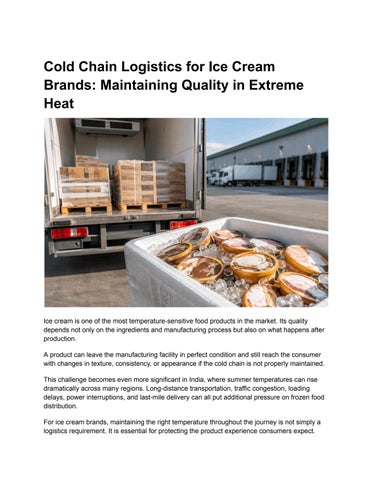
Cold Chain Logistics for Ice Cream Brands: Maintaining Quality in Extreme Heat
Ice cream is one of the most temperature-sensitive food products in the market. Its quality depends not only on the ingredients and manufacturing process but also on what happens after production. A product can leave the manufacturing facility in perfect condition and still reach the consumer with changes in texture, consistency, or appearance if the cold chain is not properly maintained. This challenge becomes even more significant in India, where summer temperatures can rise dramatically across many regions. Long-distance transportation, traffic congestion, loading delays, power interruptions, and last-mile delivery can all put additional pressure on frozen food distribution. For ice cream brands, maintaining the right temperature throughout the journey is not simply a logistics requirement. It is essential for protecting the product experience consumers expect.
Why Ice Cream Requires Exceptional Temperature Control Ice cream is particularly sensitive to temperature fluctuations because its texture depends on a carefully controlled combination of water, fat, air, and other ingredients. When the product is exposed to unsuitable temperatures, ice crystals can grow and affect its smoothness. Repeated temperature fluctuations can lead to recrystallisation, resulting in a grainier texture and faster melting. Once this deterioration occurs, bringing the product back to the correct temperature does not necessarily restore its original quality. This makes temperature consistency one of the most important priorities in cold chain operations for ice cream manufacturers and distributors.
Extreme Heat Creates Additional Challenges India's summer conditions can make frozen food transportation considerably more demanding. When outdoor temperatures climb above 40°C, refrigeration systems need to work continuously to maintain the required conditions inside storage areas and vehicles. Traffic delays can further increase the amount of time products spend in transit. A refrigerated truck waiting in traffic, an overloaded distribution centre, or a delayed loading operation can all create potential temperature risks. For ice cream brands, summer should therefore be treated as a period requiring additional planning rather than simply another season of normal operations.
The Cold Chain Does Not End at the Warehouse A common misconception is that maintaining the correct temperature inside a cold storage facility is enough. In reality, ice cream can be exposed to temperature variations at several points after leaving the warehouse. These include: ● ● ● ●
Loading and unloading operations Vehicle transfers Distribution centres Temporary staging areas
● Retail storage ● Delivery to stores ● Quick-commerce and last-mile delivery Even a short period outside the required temperature range can affect a highly sensitive frozen product. This is why the entire journey needs to be considered when designing a cold chain for ice cream.
Transportation Needs More Than Refrigerated Vehicles Refrigerated transportation is a critical component of frozen food logistics, but simply using a reefer vehicle does not guarantee product quality. Vehicles need to be properly maintained, pre-cooled, monitored, and operated according to the requirements of the cargo. Loading procedures are equally important. Ice cream should not remain exposed to high ambient temperatures while vehicles are being prepared or positioned for dispatch. Route planning also matters. During extreme summer conditions, avoiding unnecessary delays and identifying potential traffic bottlenecks can help reduce operational risks. A well-managed transportation system combines appropriate equipment with disciplined processes.
Monitoring Temperature Throughout the Journey Temperature monitoring gives ice cream brands greater visibility into what happens to their products after dispatch. Instead of relying solely on manual checks, businesses can use monitoring systems to identify temperature deviations during transportation and storage. This allows logistics teams to investigate questions such as: ● ● ● ● ●
When did the temperature begin to rise? How long did the deviation continue? Did it happen during transportation or loading? Was a particular warehouse responsible? Are similar issues occurring on the same route?
Such information can help companies identify recurring weaknesses and improve their supply chain operations.
Protecting Ice Cream During Last-Mile Delivery The growth of quick commerce and online food delivery has created a new challenge for ice cream brands. Consumers increasingly expect frozen products to arrive quickly and in good condition. A delivery vehicle or two-wheeler operating in extreme heat can expose products to significant ambient temperatures during the final stage of the journey. This makes last-mile planning especially important. Businesses may need appropriate insulated containers, suitable delivery windows, efficient routing, temperature monitoring, and strategically positioned inventory to minimise exposure during final delivery. The last mile may be the shortest part of the journey, but it can have a significant impact on the final product experience.
Retail Freezers Are Part of the Cold Chain The cold chain does not end when an ice cream shipment reaches a retailer. Display and storage freezers represent the final stage before the product reaches the consumer. Poorly maintained equipment, frequent door opening, overloading, or incorrect temperature settings can compromise product quality. Ice cream brands should therefore consider retailer-level freezer performance as part of their broader quality strategy. Regular checks, clear operating guidelines, and appropriate freezer maintenance can help reduce the risk of deterioration at the point of sale.
Preparing for the Peak Summer Season Successful ice cream brands do not wait until temperatures rise to address cold chain challenges. Preparation should begin before the peak summer season. Businesses can review refrigeration capacity, assess vehicle availability, test backup power systems, analyse high-risk routes, position inventory strategically, and strengthen monitoring processes ahead of periods of increased demand. Seasonal forecasting is also important.
Ice cream consumption typically increases during hot weather, which means logistics networks may need to handle higher order volumes while operating under more demanding environmental conditions. Planning capacity in advance can help prevent last-minute pressure on warehouses, vehicles, and distribution teams.
Building Stronger Food Supply Chain Infrastructure India's growing frozen food market requires logistics infrastructure capable of supporting products across increasingly complex distribution networks. Reliable cold storage, temperature-controlled transportation, monitoring technology, efficient distribution centres, and experienced operational teams all contribute to maintaining product integrity. For businesses seeking dependable food supply chain solution infrastructure in India, choosing a logistics network designed specifically around temperature-sensitive products can make a meaningful difference. The objective should be to create a connected system where storage, transportation, distribution, and monitoring work together rather than operate as isolated functions.
Quality Is More Than What Is Made at the Factory An ice cream brand can invest heavily in ingredients, recipes, manufacturing technology, packaging, and product development. But if the product is exposed to unsuitable temperatures during distribution, much of that investment can be compromised. Consumers may not know where the problem occurred. They simply notice that the ice cream does not taste or feel the way they expected. That is why maintaining the cold chain is ultimately about protecting the consumer experience. ColdStar‘s temperature-controlled logistics capabilities can help ice cream businesses manage the challenges associated with frozen product storage and distribution. From controlled storage and transportation to distribution planning and temperature visibility, a properly designed cold chain helps brands protect quality even when India's summer conditions become extreme. If your ice cream distribution network needs stronger temperature control, better visibility, and dependable frozen logistics, contact us to discuss a solution built around your business requirements.