Холодная наука – рецензируемый научный журнал, который станет отличным выбором для специалистов впрофильных отраслях, кандидатов и докторов наук, ученых.
Периодичность выхода журнала – ежемесячно.
Информация, представленная в журнале, опубликована в авторском варианте. Орфография и пунктуация сохранены. Ответственность за информациюнесут авторы материалов.
Статьи размещаются на сайтах е-LIBRARY, Google Scholar и КиберЛенинка.
Электронная версия журнала доступна на сайте научного издательства “Холодная наука” – https://coldscience.ru/
Cold Science is a peer-reviewed scientific journal that is an excellent choice for specialists in related fields, candidates and doctors of science, and researchers.
The journal is published monthly.
The information presented in the journal is published in its original form. Spelling and punctuation are preserved as submitted by the authors. The authors are responsible for the content of their materials.
Articles are indexed in e-LIBRARY, Google Scholar, and CyberLeninka.
The electronic version of the journal is available on the website of the Cold Science Publishing House – https://coldscience.ru/
Редакционнаяколлегия
Барбашов Николай Николаевич
Кандидаттехническихнаук,доцент
Болдина Ольга Борисовна
Кандидаттехническихнаук,доцент
Буйвол Полина Александровна
Кандидаттехническихнаук,доцент
Капралова Дарья Олеговна
Кандидатбиологическихнаук,доцент
Медведева Елена Александровна Доктор медицинских наук, доцент
Романишина Татьяна Сергеевна
Докторэкономическихнаук,доцент
Смирнов Александр Петрович
Кандидаттехническихнаук,доцент
Хачатуров-Тавризян Александр
Евгеньевич
Докторхимическихнаук,профессор
EditorialBoard
Barbashov Nikolay Nikolaevich CandidateofTechnicalSciences, AssociateProfessor
Boldina Olga Borisovna CandidateofTechnicalSciences, AssociateProfessor
Smirnov Alexander Petrovich CandidateofTechnicalSciences, AssociateProfessor
Khachaturov-Tavrizyan Alexander Evgenyevich DoctorofChemicalSciences,Professor
SIDOROV
SCALABLE WEB APPLICATIONS: A COST-EFFECTIVENESS STUDY USING MICROSERVICE
UDK 004.04
SECTION –TECHNICAL SCIENCES
Mozharovskii Evgenii bachelor’s degree, Lomonosov Moscow State University Russian Federation, Moscow
LORA AND QLORA IN LLM FINE-TUNING FOR CUSTOM CODING
APPLICATIONS: EFFICIENCY AND SCALABILITY
Abstract: The article discusses the use of Low-Rank Adaptation (LoRA) and QuantizedLow-RankAdaptation(QLoRA)methodsintheretraining oflargelanguage models (LLM) for specialized programming tasks. The similarities and differences between the LoRA and QLoRA methods are discussed. The advantages of these methods in the context of improving the efficiency and scalability of retraining, as well as their impact on the quality and speed of models are investigated. A comparison of traditionalapproaches andproposedmethodsiscarriedout,emphasizingtheirpotential for reducing computational costs and optimizing resources while maintaining high accuracy and performance in applied tasks. Examples of practical use of LoRA and QLoRA methods in various fields are given.
Keywords: Low-rank decomposition (LoRA), quantized low-rank decomposition (QLoRA), large language model, fine-tuning, custom coding.
INTRODUCTION
Artificial intelligence and machine learning technologies continue to transform various fields of human activity, including software development. One of the significant achievements in this area is large language models (LLM), such as GPT-3 and GPT-4, which demonstrate capabilities in natural language generation and understanding.Thesemodelsnotonlyenhancetheprocessofautomatictextgeneration but are also widely applied in programming tasks, enabling developers to automate routine tasks and increase productivity.
Because LLM are trained on broad and generalized datasets, fine-tuning is essential for creating applications specific to particular domains. Traditionally, this fine-tuning process required significant computational resources and time. However,
the emergence of innovative methods offering efficient alternatives has drastically reduced these requirements. Among these methods, low-rank adaptation (LoRA) and quantized low-rank adaptation (QLoRA) stand out. This paper aims to explore the potential of applying LoRA and QLoRA methods for fine-tuning LLM in the context of custom coding applications, and to analyze their efficiency and scalability compared to traditional methods.
MAIN PART. LARGE LANGUAGE MODELS
The term LLM refers to machine learning models that utilize deep learning techniques and vast amounts of training data to understand and generate natural language. Their ability to grasp the meaning and context of words and sentences enablesLLMto excelattaskssuchas textgeneration,languagetranslation,andcontent summarization. They are trained on massive datasets, typically containing billions of words from various sources, such as websites, books, and articles. This extensive training allows LLM to comprehend language nuances, grammar, context, and even some aspects of general knowledge.
These models operate by receiving input data, such as a command or query, applying knowledge derived from extensive training data, and then using neural networksto accuratelypredictandgeneratecontextually relevantoutput.They arebuilt on a transformer architecture based on neural networks to understand the relationships between words in sentences. Transformers utilize encoders to process input sequences and decoders to handle output sequences, both of which are layers in their neural network. Existing fine-tuning methods vary in complexity, required resources, and efficiency. Table 1 presents the main approaches to LLM fine-tuning, along with their advantages and disadvantages.
Table 1. Key approaches to LLM fine-tuning, their advantages, and disadvantages 1
Method
Description Advantages Disadvantages
Traditional fine-tuning Involvesfurthertrainingofthe modelonaspecificdataset. High accuracy on specifictasks. Requires substantial computational resourcesanddata.
Transfer learning The model is initially trained onalarge,generaldatasetand then fine-tuned on a smaller, specializeddataset.
Tokenhedging Special tokens added to the beginning of input sequences to transferspecificknowledge intothemodel.
Regularization method
Use of regularization techniques, such as dropout andL2regularization.
Use of external modules Integration of external modules or libraries, such as cachingorexternalknowledge bases.
Reduces time and resourcesrequiredfor training.
Enables rapid adaptation without fullretraining.
Improves generalization capability.
Enhances performance without requiringretraining.
Potential challenges with knowledge transfer.
Limited accuracy oncomplextasks.
Requires finetuning of hyperparameters.
Complexity in integration and additional resource requirements.
From the author's perspective, the choice of LLM fine-tuning method depends on the specific task requirements, available resources, and expected outcomes. It is important to consider both the advantages and disadvantages of each method to effectively apply models to specific programming tasks. The LoRA method may be preferred when it is necessary to retain knowledge gained from training on large datasets and to adapt the model to new data without significantly increasing complexity. On the other hand, if reducing the model size and enhancing its efficiency are priorities, the QLoRA method might be more suitable. It is also crucial to consider available resources, such as memory and computational power, as each method has its own requirements for these resources 2
LORA AND QLORA AS LLM FINE-TUNING METHODS
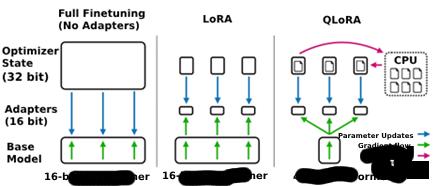
Advanced fine-tuning methods for large LLM, such as LoRA and QLoRA, significantly enhance the efficiency and scalability of the fine-tuning process for specialized programming applications. The LoRA method was first proposed in 2021 byresearchersfromMicrosoftResearch.Intheirpaper«LoRA:Low-Rank Adaptation of Large Language Models» the authors introduced an approach that allows large language models to be adapted to new tasks using low-rank matrices [3]. The QLoRA method was introduced in 2023 as a further development of the LoRA idea, combining low-rank adaptation with quantization. This method is aimed at achieving maximum
performance with minimal cost, making it particularly attractive for large-scale and distributed systems (fig. 1).
Figure 1. Mechanism of LoRA and QLoRA functioning
Both methods have quickly gained popularity due to their efficiency and ability to significantly improve the quality of fine-tuning large language models for various applied tasks [4]. These methods are based on the idea of reducing the dimensionality of model weights while retaining their informational value, which allows for a reduction in the dimensionality of the training dataset without losing meaningful information.
The LoRA method represents an innovative approach to fine-tuning. The main idea of LoRA is to use low-rank matrices to adapt the model's weights to new tasks or training conditions. Fine-tuning an LLM using the LoRA method involves updating only a small number of parameters.Thisprocess consistsofseveral steps.The first step involves replacing the model's weight matrix WW with the product of two low-rank matrices AA and BB (��≈��×��W≈A×B). Typically, the rank of these matrices is significantly smaller than the original size of the weight matrix, reducing computational costs. After decomposing the weights, the model is fine-tuned on a specific dataset. Since only the low-rank matrices AA and BB are updated, this significantly reduces the memory required to store gradients and intermediate values. The updated matrices AA and BB are multiplied to obtain the updated weights WW, which are then integrated back into the model.
The advantages of the LoRA method include improved scalability of model finetuning, reduced risk of over fitting, decreased training time, and more efficient use of
computational resources. Thanks to its adaptability and optimization capabilities, LoRAhas becomean importanttoolfordevelopers andresearchers working with LLM in various applied fields.
The QLoRA method enhances LoRA's efficiency by incorporating quantization techniques, further reducing memory and computational requirements. The main goal of QLoRA is to improve the efficiency and performance of model fine-tuning by using low-rank matrices to approximate the model's weights. This reduces the number of parameters that need to be updated during fine-tuning, thereby decreasing computational costs and the risk of over fitting. QLoRA applies weight quantization, which is the process of converting the model's weights to a less precise format (e.g., lower precision floating-point), reducing memory usage and speeding up computations. This is particularly useful for working with large models in distributed systems and on resource-constrained devices.
By utilizing NVIDIA's unified memory feature, QLoRA can more efficiently handle GPU memory spikes, ensuring a smoother training process. Key advantages of QLoRA include:
• Reduced computational costs: the combination of low-rank adaptation and quantization significantly decreases the computational and memory requirements for fine-tuning.
• Accelerated training process: smaller data volumes and improved computational efficiency shorten the model fine-tuning time.
• High performance: despite the reduced precision of weights due to quantization, the model maintains high quality and adaptability thanks to the use of low-rank approximations 5
The use of LoRA and QLoRA not only enhances model performance during finetuning but also promotes more efficient deployment in real-world applications, where quick training and high adaptability to changing conditions are required. These methods open new opportunities for developers by reducing model fine-tuning time and improving overall performance with minimal resource expenditure.
COMPARATIVE ANALYSIS OF LORA AND QLORA
Both LoRA and QLoRA are based on the idea of decomposing a matrix into lowrank components to reduce the dimensionality of the training dataset without losing meaningful information. This allows the model to adapt to new data without significantly increasing complexity. LoRA and QLoRA are used to fine-tune LLM on small datasets and improve their performance. They allow the knowledge gained from training on large datasets to be preserved and the model to adapt to new data without significantly increasing complexity. The differences are presented in Table 2.
Table 2. Differences between LoRA and QLoRA
Characteristics LoRA
Number of low-rank components
Scalability
Computational complexity
Accuracy
Fixed Number of Low-Rank Components
Medium, suitable for mediumscalemodels
High, as it requires matrix decomposition into low-rank components, which may demand additional computationalresources.
High accuracy due to effective fine-tuning of specific model components
Mediumaccuracy,balancingbetween computational efficiency and performance, but can be fine-tuned furtherforbetterresults
Thedescribedsimilaritiesanddifferencesmakeeach method suitablefordifferent situations and tasks, and also allow us to evaluate their advantages. The LoRA and QLoRA methods can be easily scaledtowork withdifferent sizes of datasets and LLM models. This makes them universal tools for fine-tuning LLM and ensures their applicability to various types of data, including text, numeric and mixed 6.
PRACTICAL APPLICATIONS OF LORA AND QLORA
The LoRa and QLOR methods provide important advantages in MO, especially when fine-tuning LLM Examples of their practical use cover various fields, enhancing the accessibility and efficiency of model adaptation.
Natural language processing: Using LoRA and QLoRA methods to adapt LLMs, such as GPT, to work in chat bots and virtual assistants, allow you to increase
the accuracy and relevance of responses, while minimizing computing resources. For example, virtual assistants on smartphones can be adapted to understand specific terminology or user accents. The American company Amazon uses LoRA to adapt the natural language processing models of the Alexa voice assistant to different regional accents and dialects, improving speech recognition and understanding without significant computational costs 7.
Computer vision: In medical diagnostics, LoRA and QLoRA are used to adapt models that classify medical images such as X-rays or MRIs. This enables quick and accurate disease identification, assisting doctors in diagnosis. In security systems, QLoRA helps adapt models to detect suspicious objects or faces in real time using surveillance cameras 8
Internet of things (IoT): QLoRA is used to adapt models running on smart devices like home assistants or wearables. This allows for ML tasks such as voice recognition or health data analysis with minimal energy consumption.
Industrial applications: LoRA and QLoRA help adapt models for monitoring and controllingprocessesinfactories.Thesemodelscan predictequipmentfailures and optimize production processes in real time
Mobile applications: LoRA and QLoRA help adapt models to provide recommendations based on user behavior, even with the limited computational resources of the device. This improves user experience by offering more accurate and personalized recommendations.
An example of the use of LoRA and QLoRA methods is the company OpenAI, known for its advanced AI research and GPT model development 9 The implementation of the LoRA method has significantly reduced the memory and computational resources requiredtoretrainthemodel forspecifictasks.Inthefinancial sector, the model is trained on specific data such as financial reports and customer queries using LoRA. This allows ChatGPT to be quickly and efficiently adapted to work with financial terms and specific queries.
The application of LoRA and QLoRA methods in real-world applications demonstrates their ability to improve the performance and efficiency of ML models, making them accessible for use in various fields and on resource-constrained devices.
CONCLUSION
LoRA and QLoRA methods offer powerful tools for the efficient adaptation and deployment of large ML models. Their use can significantly reduce computational costs while maintaining high quality and accuracy of results. This opens new possibilities for applying ML in various fields, making it accessible even for resourceconstrained devices.
In the future, LoRA and QLoRA methods are expected to continue to evolve, findingmoreapplicationsinreal-worldscenarios.Theirversatilityandefficiency make them an essential component of the modern ML landscape, contributing to technological advancements and improving the quality of life.
REFERENCES
1. Mao Y., Ge Y., Fan Y., Xu W., Mi Y., Hu Z., Gao Y. A review of LoRa for large language models // arXiv: 2407.11046. 2024. P. 112-117.
2. Kong R., Li Q., Fang X., Feng Q., He Q., Dong Y., Wang W., Li Y., Kong L., Liu Y. LoRa-Switch: Improving the efficiency of dynamic LLM adapters through joint system and algorithm design // arXiv: 2405.17741. 2024. P. 151-157
3. Hu E.J., Shen Y., Wallis P.,Allen-Zhu Z.,LiY., Wang S.,Wang L., Chen W. Lora: Low-rank adaptation of large language models // arXiv:2106.09685. 2021.
5. Inouye D., Lindo L., Lee R., Allen E. Applied automatic tuning to LoRa hyperparameters. 2024. P. 221-230.
6. Zhang F., Pilanchi M. Rimanov Pre-trained LoRa for fine-tuning baseline models // arXiv: 2402.02347. 2024. P. 478-457
7. Amazon launches new Echo, Echo Dot with clock and Echo Studio in India, rolls out new Alexa features // URL: https://www.digit.in/news/general/amazon-
launches-new-echo-echo-dot-with-clock-and-echo-studio-in-india-rolls-out-newalexa-features-50368.html/amp/ (date of application 14.06.2024).
8. Bobunov A. Development of test automation methodologies in the financial sector: a comparative analysis of approaches in the USA, Europe and Asia // Cold Science. 2024. No. 2/2024. P. 61-70.
9. Israfilov A. Cybersecurity in the automotive industry: vulnerabilities and protection // Sciences of Europe. 2024. No. 145. P. 60-63.
слова: Стек-технологии (СТ), управление проектами, системы управления проектами (PMS), оптимизация
TypeScript, React, Mobx.
Dudak Aleksei specialist’s degree, Tomsk State University of Control Systems and Radioelectronics Russian Federation, Tomsk
EFFECTIVE PROJECT MANAGEMENT USING MODERN STACK TECHNOLOGY
Abstract: This article examines the use of modern stack technologies (ST) for effective project management in the field of software development. Advanced technologies such as TypeScript and React are analyzed and their role in improving the efficiency and quality of management within organizations. Key features of the tools and their contribution to improving the productivity and adaptability of project management are discussed. Practical examples and cases of implementing these STs in American companies are given.
Keywords: Stack technologies (ST), project management, project management systems (PMS), process optimization, TypeScript, React, Mobx.
Figma/figjam Работа с векторной графикой, совместная работа со специалистами над диаграммами.
Предоставляет
множество
данных о
различных
технологиях,
доступность
обмена
информацией.
Обеспечивает
глубокое
понимание
производительнос типриложений.
Единыйвзглядна всю ИТ-среду, помогающий быстро выявлять проблемы.
Широко
распространен среди специалистов.
Сложность
отслеживания изменений.
популярными инструментами
Может быть
дорогостоящим, сложным в настройке и использовании
Дорогостоящий, сложный в настройке и использовании
Не подходит специально для визуализации технологических стеков. Особую актуальность
процессах эффективного управления проектами.
Интеграция с разными
инструментами (мониторинг, CI/CDит.д.).
Поддерживает интеграцию разных инструментов, включая средства совместной работы и инструменты управления проектами.
развертываниюновых
технологий // Вестник науки. 2024. № 4(73). URL: https://cyberleninka.ru/article/n/analiz-rynkakratkosrochnoy-arendy-nedvizhimosti-vliyanie-ekonomicheskih-faktorov-ivnedrenie-innovatsionnyh-tehnologiy (дата обращения: 25.06.2024).
2. Малыхин Н. И. Оптимизация производительности с помощью Hibernate Cache: стратегии, преимущества и проблемы // Актуальные исследования. 2021. Т. 31. № 58. doi: 10.5281/zenodo.11193274.
3. Global Sales Tech Stack Market Growth (Status and Outlook) 2024-2030 / Market Research Reports // https://www.marketresearchreports.com/lpi/global-salestech-stack-market-growth-status-and-outlook-2024-2030 (дата обращения: 03.07.2024).
4. Садыкова
//
24-24.
5. Nikulchev E., Ilin D., Gusev A. Technology stack selection model for software design of digital platforms // Mathematics. 2021. Vol. 9. No. 4. P. 308.
6. Al Mazrouei A., Berengueres J., Márton G. Tools to Manage the Technology Stack. Available at SSRN 4585028. 2023 Sep 10.
8. Ts-migrate: A Tool for Migrating to TypeScript at Scale / Medium, the Airbnb Tech Blog // URL: https://medium.com/airbnb-engineering/ts-migrate-a-tool-formigrating-to-typescript-at-scale-cd23bfeb5cc (дата обращения: 10.07.2024).
9. Crafting a high-performance TV user interface using React / Medium, Netflix Techblog // URL: https://netflixtechblog.com/crafting-a-high-performance-tv-userinterface-using-react-3350e5a6ad3b (дата обращения: 15.07.2024).
A COMPARATIVE ANALYSIS OF COMPONENT-BASED ARCHITECTURES IN WEB DESIGN FOR SCALABLE APPLICATIONS
Abstract: The paper presents a comparative analysis of different approaches to the use of component architectures in web design with a focus on their applicability in scalable applications. Popular frameworks and libraries are reviewed, their main characteristics are evaluated, and the limitations and challenges of scaling applications are identified. Possible solutions to these problems are given. The key features of each architecture, their advantages and disadvantages in creating scalable web applications are highlighted.
In the rapidly evolving world of web development, building scalable applications has become essential for businesses and organizations to maintain their competitive edge. Scalability ensures that digital products can handle increasing workloads, whether in terms of user traffic, data processing, or functionality extension. To meet these demands, component-based architectures (CBA) have emerged as a powerful solution, allowing developers to build applications by dividing them into modular, reusable components. These elements can function independently and be integrated seamlessly, promoting easier maintenance, testing, and scalability.
These architectures stand in contrast to traditional monolithic approaches, where the entire application is developed as a single, interdependent unit. While monolithic systems often lead to rigid and cumbersome systems, CBA provide a more flexible and efficient way to manage complex interfaces and interactions within web applications.
The aim of this paper – to conduct a comparative analysis of CBA in web design for scalable applications, assessing the key characteristics and features of each approach.
MAIN PART. ANALYSIS OF DIFFERENT APPROACHES AND FRAMEWORKS FOR UTILIZING CBA
Intoday’swebdevelopmentlandscape,theabilitytoscaleapplicationsefficiently is essential for meeting user expectations and ensuring long-term viability, as the demand for scalable applications continues to grow across various IT fields, including big data [1]. The implementation of CBA has become a widely adopted approach for tackling scalability challenges in mobile and web apps [2]. These architectures are not limited to the front end and are increasingly being used in server-side technologies, much like Swift [3]. Integration of CBA provides developers with tools to create flexible, maintainable, and high-performance applications capable of managing growing demands.
A full-fledged framework developed and maintained by Google Angular offers a comprehensive suite of tools for building robust web applications. It provides out-ofthe-box solutions for routing, state management, and dependency injection, making it a powerful tool for complex, large-scale applications. Angular’s change detection mechanism, based on zone.js, allows for efficient DOM (Document Object Model) updates. However, Angular applications tend to have a larger initial load time compared to lighter frameworks like Vue.js or React due to the inclusion of numerous built-in features [4]. Angular encourages the development of reusable, modular components. The use of TypeScript provides additional structure, helping teams manage large, scalable applications with well-defined interfaces and services.
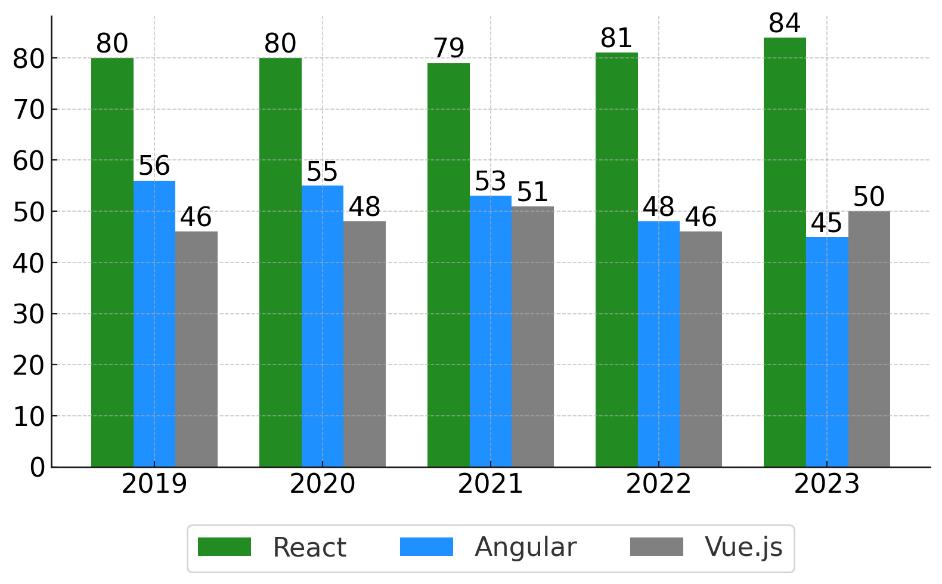
One of the most widely used component-based libraries and frontend frameworks in web development is React. It is used by approximately 4,3% of all websites, with a 5,4% market share among JavaScript libraries [5]. It adopts a declarative approach to buildinguserinterfaces, meaningthat developersdescribewhat the userinterfaces (UI) should look like at any given time, and React handles the necessary updates. One of its coreconcepts is theVirtualDOM, alightweight representationoftherealDOM, which allows React to efficiently update only the parts of the interface that have changed. Such features cause its constant popularity and adaptation among frontend developers (fig. 1).
Figure 1. Front-end frameworks ratios over time, worldwide, % [6]
React offers a modular structure where components are highly reusable across differentparts of an application. This reusability makes it easier to maintain large-scale applications. React’sstructureallowsforapplicationstoscalehorizontallybybreaking down complex UI into smaller, manageable pieces. This structure is ideal for scalable applications, as developers can isolate individual components, enabling independent scaling and optimization.
Vue.js is a progressive framework that emphasizes simplicity and flexibility. It allows developers to adopt its features incrementally, making it suitable for projects of various sizes. Vue.js bridges the gap between React’s flexibility and Angular’s comprehensive feature set, offering a middle ground for developers looking for an approachable yet powerful framework.
It uses a reactive data binding system and a Virtual DOM similar to React, allowing it to perform well in terms of speed and responsiveness. It tends to have a smaller footprint than Angular, making it suitable for performance-critical applications. Vue’s core can be extended with official and third-party libraries for routing and state management, allowing for incremental adoption of features.
Svelte takes a uniqueapproach to CBA by shifting much of thework usuallydone inthebrowser(likeupdatingtheDOM)tocompiletime.Thisresultsin amoreefficient runtime, as applications written in Svelte produce smaller and faster bundles. While Svelte is excellent for creating fast and lightweight applications, its relative newness
in the ecosystem may make it less tested for large-scale enterprise applications. As the framework matures, it is gaining traction for larger projects.
It’s essential to understand that each framework offers unique characteristics tailored to various project needs. The choice of an approach often depends on factors like application size, complexity, and developer familiarity. The table 1 provides a concise comparison of the strengths and trade-offs of popular frameworks.
Table 1. Benefits and drawbacks of using different CBA methods and techniques
Approach/Framework
Advantages
React(Libraryapproach) Highly flexible and customizable. Strong ecosystem with third-party libraries. Reusability through modular components. Virtual DOM for performanceoptimization
Easy to integrate into existing projects. Simple and flexible for both small and large-scale projects. Two-way data binding andreactivedatasystem.
Svelte (Compile-time approach)
No Virtual DOM, resulting in smaller, faster bundles Reactive components are easy to create and use. Performance is optimized at compile time. Simplified state management withoutexternallibraries
Disadvantages
Requires additional libraries for complete solutions (e.g., routing, state management) Steeper learning curve due to JSX syntax. State management becomes complexinlargeapps
Steep learning curve, especially fornewdevelopers.Largerbundle size and more complex setup. Performance overhead with changedetectioninlargeapps
Smaller ecosystem compared to React and Angular. Fewer enterprise-level tools and plugins. Flexibilitycanleadtoinconsistent codeifstandardsarenotenforced
Smallerecosystemandcommunity support. Fewer third-party tools and resources available. Limited adoption in enterprise-level applications.
Each of these CBA offers distinct advantages and trade-offs when applied to scalable web applications. React is a flexible, widely adopted library with a rich ecosystem, making it ideal for projects that require extensive customization. Angular, while more complex, provides a comprehensive set of tools for enterprise applications. Vue.js offers a balance of simplicity and power, appealing to developers who want flexibility without the overhead of Angular. Svelte brings performance optimizations by shifting work to compile time, though its ecosystem is still growing.
CHALLENGES IN IMPLEMENTING CBA AND THEIR EFFECTIVE SOLUTIONS
While CBA provide powerful tools for building scalable web applications, developers often face challenges when attempting to scale these applications. These constraints stem from both the nature of component-based development and specific limitations inherent in the frameworks themselves.
As applications scale, managing state becomes one of the most significant challenges in CBA. State refers to the data that is shared across components and updated in response to user interactions. In small applications, state management can be handled locally within individual elements, but as the application grows, the need for centralized state management becomes critical. Angular, with its built-in services and dependency injection, handles state more effectively at the enterprise level, but developers often face challenges when trying to synchronize large amounts of state across multiple components.
The overhead associated with rendering, updating, and managing components can lead to performance degradation. Each element requires memory and processing power, and complex user interfaces with many interactive elements can cause excessive re-renders or slow UI updates. Vue.js, while lightweight and efficient for small applications, can face performance issues when too many reactive components are involved. Vue’s reactivity system, which tracks dependencies, can become a bottleneck when the application grows and multiple dependencies need to be tracked across different components. Improper use of React’s re-rendering mechanisms can lead to inefficient updates, especially when elements are not properly memorized using tools like React.memo or useMemo.
Maintaining the codebase can also become increasingly difficult. Without careful planning, it is easy to accumulate technical debt, where the architecture and elements become difficult to manage, extend, or refactor. In React, the component tree can become deeply nested, making it hard to track how data flows through the application.Largenumbersofpropspasseddownthroughseverallevelsofcomponents canresultintightlycoupledcode,makingrefactoring anddebuggingmorechallenging.
Vue.js, whilesimplerinsyntax, can alsosuffer fromscalability issues when developers adopt poor component design patterns. The flexibility of Vue allows for a variety of approaches, which can result in inconsistent code if not standardized across a team.
In large projects involving multiple teams, coordinating the development of components across different parts of the application can be a challenge. Communication breakdowns between teams can lead to duplicated elements, inconsistent styles, and conflicting implementations. React, being a library rather than a full framework, relies heavily on additional tools and libraries to fill gaps in functionality (e.g., routing, form handling). This can result in different teams using different tools, leading to inconsistencies across the application. A complete framework Angular offers more built-in functionality and standardization across the application, making it easier to scale across teams. Strict adherence to Angular’s conventions can slow down development if teams are not aligned on best practices.
These architectures often encounter heightened security risks, particularly when CBA are widely implemented in cloud-based and other information-sensitive environments [7]. Developers need to be cautious about exposing sensitive data or creating vulnerabilities within individual components. React and Vue.js applications, in particular, are prone to cross-site scripting attacks if user input is not properly sanitized. The widespread use of third-party libraries can also introduce vulnerabilities if not properly vetted.
As applications grow in complexity, various issues such as state management, performance bottlenecks, and maintainability arise. However, with the right strategies and tools, these challenges can be effectively mitigated, ensuring that CBA continue to provide scalability and modularity (table 2)
Table 2. Possible solutions for each limitation in scaling applications using CBA
Challenge
State management complexity
Frameworks affected Solution
React,Vue.js The use of state management libraries like Redux (React) or Vuex (Vue.js). The use of Context API (React) or NgRx (Angular) for betterstatemanagement.
Component overhead and performance degradation
Codebase maintainability and technicaldebt
Scaling across multiple teams
Allframeworks Theimplementationofmemoizationtechniques (React: React.memo). The optimization of changedetection(OnPushstrategyinAngular). The use of lazy loading and code splitting to reduceinitialloadtimes.
Allframeworks The adoption of best practices like Atomic Designorcomponent-drivendevelopment. The use of TypeScript, ESLint, and Prettier for codingstandards.
Allframeworks The creation of shared component libraries using tools like Storybook or Bit. The establishment of coding standards and documentationforconsistency.
While CBA offer many benefits in terms of scalability and reusability, they come with their own set of challenges. By addressing issues such as state management complexity, component overhead, and maintainability, developers can build scalable and efficient digital products. Effective tracking of system behavior is essential to identify performance bottlenecks and issues, e.g. by using different test automation methods [8]. Proper planning, use of tools and libraries, and a focus on best practices are key to overcoming these challenges and successfully scaling CBA.
CONCLUSION
The implementation of CBA has revolutionized modern web development by offering modular, reusable, and scalable solutions for building complex applications. Frameworks and libraries like React, Angular, Vue.js, and others have each adopted unique approaches to utilizing CBA, providing developers with various options depending on the requirements of their projects. Scaling applications with CBA also presents challenges, including state management complexity, component overhead, and maintainability issues. By adopting effective solutions such as proper state management tools, performance optimization techniques, and coding standards, developers can overcome these challenges and ensure that their applications remain scalable and efficient. As web applications continue to grow in complexity, the choice ofCBAframeworkwilldependheavilyonprojectgoals,teamexpertise,andlong-term maintainability.
REFERENCES
1. Ogarkov A. Application of big data analytics to improve business customer service // Innovacionnaya nauka. 2024. №7-1. P. 61-65.
2. Ponomarev E. Analysis of the impact of using mobile applications for bill payments on the timeliness of payments and financial discipline of users // Cold Science. 2024. № 5/2024. P. 5-14.
3. Mozharovskii E. Swift for server-side development // Cold Science. 2024. № 4/2024. P. 5-14.
4. Kaushalya T., Perera I. Framework to Migrate AngularJS Based Legacy Web Application to React Component Architecture // 2021 Moratuwa Engineering Research Conference (MERCon). 2021. P. 693-698.
5. UsagestatisticsandmarketshareofReactforwebsites / W3Techs// URL: https://w3techs.com/technologies/details/js-react (date of application: 01.07.2024).
6. Front-end Frameworks / State of JavaScript 2023 // URL: https://2023.stateofjs.com/en-US/libraries/front-end-frameworks/ (date of application: 03.07.2024).
7. Tiumentsev D. Application of cryptographic technologies for information protection in cloud services // Stolypin Bulletin. 2024. Vol. 6. №. 3.
8. Bobunov A. Approaches to monitoring and logging in automated testing of financial applications // Sciences of Europe. 2024. № 142. P. 62-66.
UDK 004.4
Aluev
Andrei master’s degree, Ural Federal University Russian Federation, Ekaterinburg
SCALABLE WEB APPLICATIONS: A COST-EFFECTIVENESS STUDY
USING MICROSERVICE ARCHITECTURE
Abstract: This paper investigates the cost-effectiveness of using microservice (MS) ar-chitecture in the development of scalable web applications. The advantages and disadvantages of this method compared to monolithic systems are analyzed. Specialattention is paid totheaspects ofreduced operatingcosts,flexibility and im-proved scalability. Specific examples of MS architecture implementation in Amer-ican companies aregiven, which demonstrates its practical usefulness and role in successful development of software solutions.
In the era of digital transformation, the demand for efficient web applications is growing rapidly. Reliable traditional monolithic architectures often struggle to meet the demands of modern software systems, particularly in terms of scalability, flexibility, and resource efficiency. As a response to these challenges, microservice (MS) architecture has emerged as a popular alternative, allowing applications to be broken down into smaller, independent services. This decentralized approach enables the flexible development, deployment, and scaling of individual components.
Adopting MS involves certain complexities, such as the need for more advanced management of dependencies, communication between services, and orchestration of distributed systems. Despite these challenges, many organizations have turned to MS as a means of improving the economic efficiency of their software systems. The costeffectiveness of this architecture stems from its ability to optimize resource usage, reduce technical debt, and improve operational agility, leading to long-term financial benefits. The purpose of this article – to conduct a cost-benefit study on the use of MS architecture in the development of scalable Web applications.
MAIN PART. COMPARISON OF MS AND TRADITIONAL ARCHITECTURES: KEY ECONOMIC AND PERFORMANCE ASPECTS
As modern web applications continue to grow in complexity, the choice of architecture plays an important role in determining not only their performance but also their elasticity and long-term sustainability. As improving system efficiency and scalability is gaining increasing attention among IT specialists [1]. Two primary architectural models dominate this space: monolithic and MS, with the latter method constantly gaining popularity among developers. The global MS architecture market size reached $3,7 billion in 2023, and is projected to reach $11,8 billion by 2032 [2]. Despite its growing adoption, MS architecture introduces new complexities in areas such as system orchestration, inter-service communication and monitoring, that is essential for ensuring the performance and stability of the system [3]. To fully understand the trade-offs between these two architectural models, it is essential to analyze key aspects.
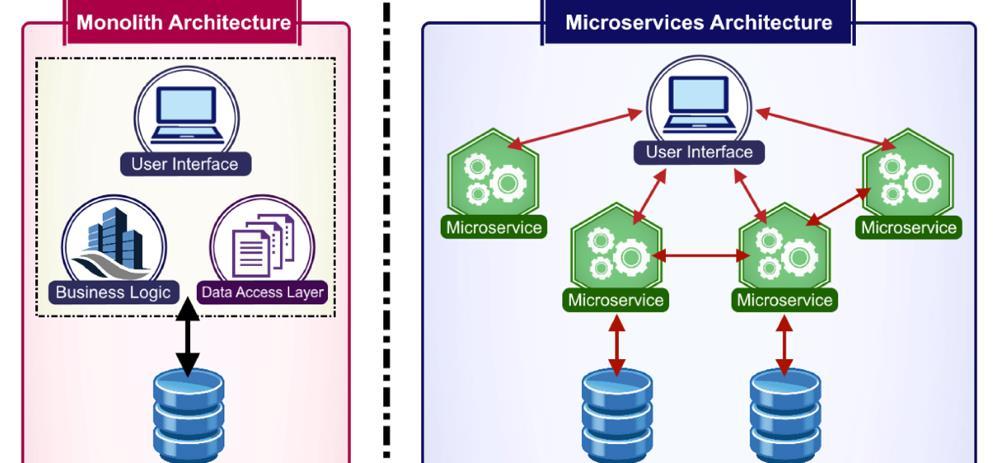
The scalability of a web application is one of the most important considerations in selecting an architecture. Adjusting a monolithic application typically requires duplicating the entire infrastructure on new servers, which can be inefficient since only a portion of the system may need additional resources. This approach often leads to resource wastage, increased costs, and complex load-balancing mechanisms, since monolithic architectures are inherently limited in terms of scalability because they are designed as single, tightly coupled systems (fig. 1).
Figure 1. A visual representation of a monolithic versus MS architecture [4]
ThemodularnatureofMSarchitecturesallowsthemtoexcelinthischaracteristic. Each service is a standalone component that can be scaled independently based on
specificdemands.Thisapproachcanimprovetheprivacyandsecurityoflargevolumes ofdatabyisolating services,whichhasbecomeanimportanttaskin theIT industry [5]. Services handling user authentication can adjust separately from the inventory management service, allowing for more granular control over resource allocation. This not only reduces costs by optimizing resource use but also prevents over-provisioning of resources where it is not needed [6]. By focusing on economic efficiency, MS help businesses remain agile and resilient under uncertain market conditions, aligning with sustainable business strategies [7].
In terms of development flexibility and speed, traditional architectures often hinder these aspects, since the entire application is built and deployed as a single unit. Even minor changes or updates require a full redeployment of the entire system. This increases the risk of introducing bugs and slows down the development cycle. While MS enable independent development and deployment of individual services. This allows multiple teams to work in parallel on different parts of the application, reducing dependenciesandbottlenecks.Teamscanadoptdifferenttechnologiesorprogramming languages for different services, optimizing each service for its specific function. The decoupled nature of MS leads to faster development cycles and more frequent deployments, which is significant for rapidly evolving web applications that need to continuously adapt to changing user requirements or market conditions.
Performance studies of these two architectures show that monolithic systems generally perform better in terms of loading and system resource management [4]. Meanwhile, MS architectures handle scripts more efficiently and process complex operations more effectively, which is valuable for large, scalable applications that require modular service management (table 1).
Table 1. Performance testing result of MS and monolithic architectures [4]
Other studies also demonstrate that MS consume more CPU (7,85%) and network resources (4,5 B/s) comparing to traditional architectures,2,39% and 3,13 B/s, respectively [8]. Although MS are more efficient in terms of storage usage and disk writing operations, they offer better resource isolation and memory efficiency.
Monolithicarchitecturespresentasignificantriskwhenitcomesto faultisolation and system resilience. A failure in one part of the system can potentially take down the entire application, leading to increased downtime and higher recovery costs. This is particularly detrimental for large-scale web applications and mobile apps, where continuous uptime is critical for maintaining user satisfaction and revenue [9]. In contrast, MS architecture provides better fault isolation. Since each service operates independently, afailure inoneservicedoesnot necessarily affect others.This enhances system resilience and reduces downtime, leading to a more stable application environment.
While MS architecture offers clear advantages in scalability and resilience, it also comes with its own set of challenges, particularly in terms of infrastructure and operational costs. Such architectures often require more complex orchestration tools, monitoring systems, and inter-service communication frameworks. Managing a distributed system introduces overhead in terms of both operational complexity and resource consumption.
The long-term economic benefits of MS often outweigh the initial costs. The ability to scale specific services independently leads to more efficient resource use, reducing overall infrastructure costs. MS facilitate more flexible use of cloud resources, allowing companies to take advantage of cloud-native features like autoscaling and container orchestration (e.g., Kubernetes) to further optimize costs.
THE CHARACTERISTICS OF COMPANIES' TRANSITION TO MS ARCHITECTURE AND THEIR ECONOMIC RESULTS
The architecture of MS has become a widely adopted approach in modern software development due to its ability to enhance scalability and resource optimization in both technological and changing environmental landscapes [10].
Which is why many large companies have shifted to MS to manage their growing technological and operational demands.
One of the most popular video services Netflix transitioned from a monolithic architecture to MS to manage the complexity of its global streaming platform more efficiently. This allowed the company to scale individual services independently, optimizing resources and reducing operational costs. To monitor its MS ecosystem, Netflix developed Mantis, a real-time stream processing system. Mantis allows engineers to detect and respond to issues quickly by processing vast amounts of data in real time, ensuring high system reliability and reduced downtime. This led to significant cost savings and enhanced user experience by maintaining service stability [11].
A technology company Amazon shifted to MS architecture to better manage its growing and complex e-commerce platform. By breaking the system into independent services such as payment processing, inventory, and product search, Amazon could scale each service independently, optimizing resources and improving operational efficiency. This transition reduced costs, particularly during peak traffic periods like Black Friday, by efficiently allocating resources to high-demand services. Moreover, Amazon Web Services (AWS) provides numerous services, such as AWS Lambda and Amazon ECS, which are specifically designed to support MS architectures for other organizations [12].
A transportation company Uber adopted MS architecture to efficiently manage the increasing complexity of its platform as it expanded globally. To manage the complexity of its vast MS ecosystem, Uber developed DOMA (Domain-Oriented Microservice Architecture). DOMA helps Uber organize its services around business domains, allowing for clear ownership and faster deployment cycles. By grouping related services, Uber can more effectively manage and scale operations like rider dispatch, payments, and real-time tracking, leading to improved system resilience and reduced operational costs across its platform [13].
These cases demonstrate the significant economic benefits, including reduced infrastructure costs and improved agility in system maintenance and development. As
more organizations continue to transition to MS, the architectural model proves its value in addressing the growing technological demands of modern businesses.
CONCLUSION
The shift from monolithic to MS architecture represents a fundamental transformation in the development of scalable web applications. This transition to MS offerssignificantadvantagesintermsofeconomicefficiency.Byallowingindependent scaling and reducing operational complexity, MS not only optimize resource usage but also contribute to long-term cost savings. The analysis of real-world implementations demonstrates the practical value of adopting MS in complex, high-demand environments. The economic advantages of MS architecture make it an attractive option for organizations looking to build flexible and cost-effective web applications in modern rapidly changing technological landscape.
REFERENCES
1. Pshychenko D. Evaluation of the effectiveness of implementing AI-based CRM systems // Innovacionnaja nauka. 2024.№ 7-2/2024. P. 40-45.
2. Microservices Architecture Market Report by Component / IMARC / URL: https://www.imarcgroup.com/microservices-architecture-market (date of application: 04.07.2024).
3. Bobunov A. Approaches to monitoring and logging in automated testing of financial applications // Sciences of Europe. 2024. #142. P. 62-66.
4. Tapia, F.; Mora, M.Á.; Fuertes, W.; Aules, H.; Flores, E.; Toulkeridis, T. From Monolithic Systems to Microservices: A Comparative Study of Performance. Appl. Sci. 2020, 10, 5797.
5. Korostin O. Innovations in the automation of electronic message processing for maritime shipping // Cold Science. 2024.№ 6. P.22-30.
6. Bushuev S. Economic aspects of Big Data: analysis of data privacy protection methods // Cold Science. 2024.№ 7. C. 25-35.
7. Solovyev K. Developing sustainable business strategies in conditions of global economic uncertainties // Cold Science. 2024.№4/2024. P. 41-49.
8. Asrowardi I , Putra S D , Subyantoro E. Designing microservice architectures for scalability and reliability in e-commerce // InJournal of Physics: Conference Series. 2020. Vol. 1450. № 1. P. 012077. IOP Publishing.
9. Ponomarev E. Analysis of the impact of using mobile applications for bill payments on the timeliness of payments and financial discipline of users // Cold Science. 2024. № 5/2024. P. 5-14.
10. Uliankina I. Methods and tools of strategic planning to enhance climate resilience of businesses in the USA // Innovacionnaya nauka. 2024.№ 8-1. C. 51-56.
11. Open sourcing Mantis: a platform for building cost-effective, realtime, operations-focused applications / Netflix Technology Blog // URL:https://netflixtechblog.com/open-sourcing-mantis-a-platform-for-building-costeffective-realtime-operations-focused-5b8ff387813a (dateofapplication:19.06.2024).
13. Introducing Domain-oriented microservice architecture / Uber Blog // URL: https://www.uber.com/en-DE/blog/microservice-architecture/ (date of application: 27.06.2024).
UDK 371.3
SECTION – INTERDISCIPLINARY RESEARCH
Erkenkizi Dinara master’s degree, KIMEP University Kazakhstan, Almaty
THE RELATIONSHIP BETWEEN INTERNET ACCESS, DIGITAL SKILLS, AND ACADEMIC PERFORMANCE OF RURAL STUDENTS: A STUDY OF GPA, SAT, AND EDUCATIONAL ASPIRATIONS
Abstract: This article analyzes the importance of the internet and digital technologies in the educational process. It examines the disparities in internet access between urban and rural students and its impact on academic performance. The study investigates digital skills as a factor of success and their correlation with Grade Point Average (GPA) and Scholastic Assessment Test (SAT) scores. Examples are provided to illustrate the relationship between educational aspirations and access to the internet and digital skills.
Keywords: Internet access, digital skills, academic performance, rural students, Grade Point Average (GPA), Scholastic Assessment Test (SAT), educational aspirations, technology in education.
INTRODUCTION
Having access to the internet has become essential in daily life, including in the field of education. Educational organizations globally harness digital technologies and online resources for instructional purposes. Students who have excellent digital skills can utilize a variety of sources of knowledge, self-learning tools, and assistance from teachers. Nevertheless, not all students, especially those residing in rural regions, have equal access to this procedure. The lack of digital literacy and the digital divide in rural areas greatly hinder the academic success and future career prospects of students.
The problem of uneven internet availability in rural regions has many layers, impacting education and socio-economic factors. In 2023, the Federal Communications Commission stated that around 22% of rural households in the USA are still without high-speed internet, which hinders educational opportunities for
students in those areas [1]. This study shows that urban students can gain advantages from fast internet and various digital resources, while rural students may encounter obstacles like slow connections, unreliable access, or no service at all. This article aims to examine how internet access and digital skills impact the academic performance of rural students, resulting in disparities in educational opportunities and affecting Grade Point Average (GPA) and Scholastic Assessment Test (SAT) scores.
MAIN PART
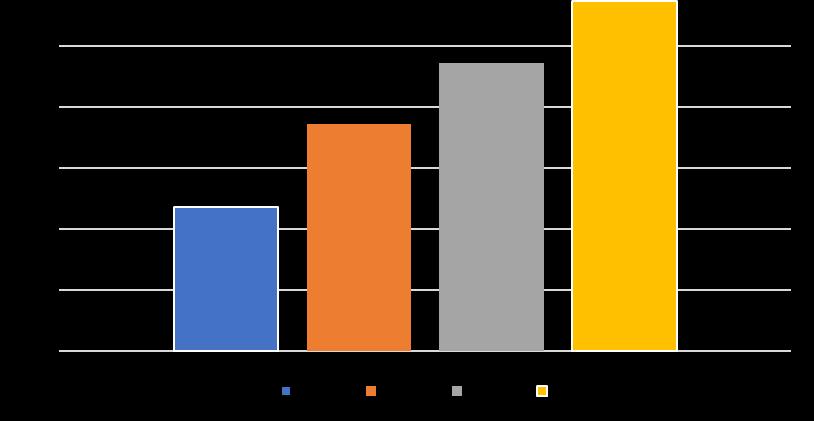
The internet plays a crucial role in education, transforming traditional learning approaches and opening new opportunities for students and educators. According to the Pew Research Center, the number of internet users in the USA in 2023 is 318,66 million people (fig. 1).
Figure 1. Number of internet users in the USA, million
The internet allows students to acquire knowledge from diverse sources worldwide, owing to the vast amount of information it provides. Websites like Coursera and Khan Academy, as well as online libraries and educational platforms, provide chances to learn various subjects without being restricted by location or time. Another important role of the internet is to facilitate collaboration and communication throughout the educational journey. Digital platforms like Zoom and Microsoft Teams enable virtual classes, seminars, and discussions to be conducted online [2]. Analytics and AI algorithms can be utilized to generate individualized learning plans that cater to the distinct requirements of every student. This method helps students understand material more effectively and get better outcomes by letting them study at their own speed and concentrate on particular areas that need more work. Moreover, the internet
provides more chances for ongoing education and self-guided learning. In a fastevolving job market, it is crucial to have adaptability and a readiness to gain new abilities.
INTERNET ACCESS AND ITS IMPACT ON ACADEMIC PERFORMANCE
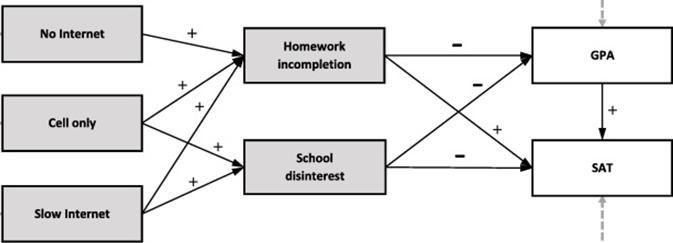
In the era of globalization and digitalization, the internet plays a vital role in influencing the quality and availability of education. Internet access is closely connected to important educational success indicators like GPA and standardized SAT scores, which are determined by grades and exam results. A study conducted in Michigan demonstrates that students' academic performance can be greatly influenced by internet access. This is especially important for rural students, who frequently encounter restricted internet availability (fig. 2).
Figure 2. Relationship between internet access and student academic performance
This study found a strong link between SAT scores and access to the internet. Students who do not have internet access typically score 0.04 points lower (p < 0,01) and 0,65 percentile points lower on the SAT (p < 0,05). Students who have slow internet at home tend to have an average score on the SAT that is 0,04 points lower (p < 0,01) and a ranking that is 0,71 percentile points lower (p < 0,01). Students who have fastinternetathometendtohaveaGPAof3,18,muchhigherthanthosewithoutaccess (2,81) or only mobile access (2,75). Not having fast home internet greatly affects GPA and grades in certain subjects, but not in math and science [3].
Instances from literature support the idea that there is a notable correlation between academic performance and internet usage. An examination released in the «Journal of educational computing research» assessed how internet availability affected the academic success of students from different regions in the USA. Having
internetaccess athomewas discovered toboostexampass rates by12-15% andelevate the average GPA by 0,3-0,5 points [4].
Having access to the internet plays a crucial role in determining a student's academic performance. Using the internet to access educational materials, online courses, and resources for exam preparation can enhance students' performance in metrics like GPA and SAT. This highlights the importance of guaranteeing equal internet access for all students in order to give them equal chances for academic achievement.
DIGITAL SKILLS AS A FACTOR OF SUCCESS
Accesstotheinternetallowsstudentstotakeadvantageofavariety ofeducational resources,online classes,andtoolsthat can greatly improvetheirskills andknowledge. Nevertheless, having only internet access is not enough without the essential digital skills that allow students to efficiently make use of these tools.
Digital skills refer to a collection of competencies and understanding needed for utilizing digital technologies efficiently. Skills such as computer operation, internet navigation, information search and analysis, digital content creation and editing, as well as interaction and communication in digital environments are all part of the mix. These abilities are growing in significance in today's society, where technology plays a key role in various areas of life and work [5].
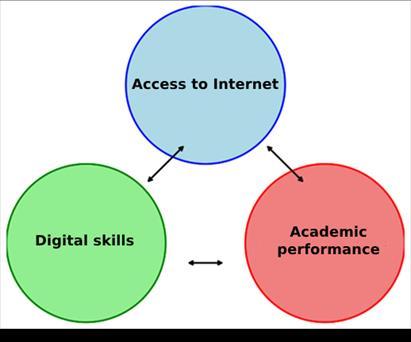
The quality and depth of students' knowledge is directly affected by their ability to efficiently locate, sift through, and examine information from different sources. Having digital skills enables students to use online courses, virtual classrooms, and educationaltoolswithconfidence,whichinturnimproves theiracademicperformance. Hence, a clear correlation exists between academic performance, internet access, and digital skills (fig. 3).
Figure 3. The relationship between internet access, digital skills, and academic performance
The arrows demonstrate how internet access helps to develop digital skills, leading to improved academic performance, which then encourages more use of the internet and digital technologies.
Research from the Benton Institute for Broadband & Society shows that a student with digital skills slightly below average performs 7 percentile points lower on the overall SAT score, 5 percentile points lower in math, and 8 percentile points lower in reading and writing, as per real data. Moreover, high school students who possess advanced digital skills achieve a GPA that is 15% higher than their peers with limited digital skills [6]
Accessing the internet and acquiring digital skills are crucial elements that impact students' academic success. However, in order to maximize effectiveness, bothof these elements must be combined. In a quickly changing digital environment, the use of the internet and digital technologies is crucial for education and preparing for future professional endeavors. The arrows illustrate how access to the internet fosters the development of digital skills, which in turn positively impacts academic performance, and how successful academic outcomes stimulate further use of the internet and digital technologies [7].
EDUCATIONAL ASPIRATIONS AND THEIR CONNECTION TO INTERNET ACCESS AND DIGITAL SKILLS
The internet expands students' perspectives by providing information on different career options, schools, and courses. Students with internet access are better informed about their choices and, therefore, set higher educational aspirations for themselves. They have a stronger understanding of the requirements for their career goals and are actively pursuing admission to renowned academic institutions.
Students' educational aspirations are the goals and ambitions they have in relation to their education. These may include aspirations to enroll in a particular college, earn a specific degree or occupation, or achieve success in a scholarly area. Educational goals reflect a person's motivation for self-improvement and career advancement through acquiring knowledge.
Variousfactors,suchas familyincome,parentaleducationlevels,accesstoschool resources,andinformationonhighereducationopportunities,influencetheeducational goals of rural students. Rural students often lack access to information on scholarships, programs, and college admission opportunities, which restricts their aspirations.
Research from the Benton Institute for Broadband & Society suggests that 47% of students who lack home internet or only have mobile internet plan to pursue education beyond high school [8]. Students with digital skills slightly below average have a 29% decreased likelihood of intending to complete a college or university program. In contrast, students with advanced digital skills are more likely to aspire to a career in a STEM (Science, Technology, Engineering, and Mathematics) or STEAM (Science, Technology, Engineering, Arts, and Mathematics) field. Those with slightly below-average digital skills are 19% less likely to show interest in a STEM-related profession.
CONCLUSION
The study findings highlight the important impact of internet availability and digital competencies on the academic success of students in rural areas, as shown by their GPA, SAT scores, and goals for further education. In a fast-changing digital economy, the internet is crucial for students to reach educational resources like online
courses and exam prep platforms. Research results indicate that students who have reliable access to fast internet and well-developed digital skills tend to achieve better academic outcomes and have more ambitious educational aspirations.
Insufficient internet access and a lack of digital skills have been observed to add to the increasing educational inequality between urban and rural students. In remote regions with limited or no internet access, students encounter extra obstacles in their academic pursuits, which can hinder their performance and lower their educational goals. The study findings highlight the importance of implementing inclusive initiatives to enhance digital infrastructure in rural communities and enhance students' digital literacy. Some of these measures may involve boosting investments in internet infrastructure, offering digital literacy classes, and ensuring all students have access to up-to-date digital resources.
Taking into account the cultural and social factors that impact internet usage in education is crucial, as is conducting additional research to create optimal methods for closing the digital gap. Incorporating these strategies into rural education systems can greatly improve students' academic results and help them reach their educational aspirations, ultimately promoting equal educational opportunities nationwide.
REFERENCES
1. Internet Access (U.S. Market) // URL: https://www.tadviser.ru/index.php /Article:Internet access_%28 market_sHOW%29 (date of application 30.06.2024)
2. Kuznetsov I. A. Data Security and Privacy in Mobile Applications Developed Using Machine Learning Technologies // Cold Science. 2024. No. 2/2024. P. 5-13.
3. Hampton K.N., Robertson C.T., Fernandez L., Shin I., Bauer J.M. How Differences in Internet Access, Digital Skills, and Media Use Are Related to the Outcomes of Rural Students: GPA, SAT, and Educational Aspirations // Telematics and Informatics. 2023. Vol. 63. P. 101-106.
4. Bauer J.M., Hampton K.N., Fernandez L., Robertson C.T. Bridging the Homework Gap in Michigan: The Role of Broadband Internet Access for Student Success and Career Prospects. 2022 P. 105-112
5. Bukhtueva I.A., Solovyev K.A., Mozharovsky E.A., Khatyanov S.A., Kostoreva A.S. Overview of Artificial Intelligence Solutions for Enhancing Corporate Efficiency // Economics and Management: Problems, Solutions. 2024. No. 7. Vol. 1. P. 177–185.
6. Kaldarulo M., Mossberger K., Howell A. Community-Wide Broadband Deployment andStudentAcademicAchievement //TelecommunicationsPolicy.2023. Vol. 47. No. 1. P. 102445.
7. Mozharovsky E.A. Integration of Large Language Models (LLM) in Mobile Applications // Innovative Approaches in Modern Science: Collection of Articles from the Materials of the CLIX International Scientific and Practical Conference «Innovative Approaches in Modern Science». Moscow, Publishing House «Internauka», 2024. No. 3(159).
8. Croker T., Kleitch D. Homework Gap and Academic Achievement in Science in High School: An Ecological Perspective for Policymakers and Practitioners // National Journal of Youth Protection and Resilience. 2023. Vol. 6. No. 1. P. 1-12.