T H E
Ocellus
M
ic
I ha ssu el e 4 m 5 as 20 2
0
PUPIL PHOTOGRAPHY
Tom Blackmore (First Form, Vanbrugh) writes: My favourite photo to date has got to be this one of a stag in Richmond Park in the middle of a mating call - it was so cold that morning, with fog in the air and frost on the ground, that it looked more like the Brecon Beacons! Read about and see more of Tom’s photographic adventures on page 8.
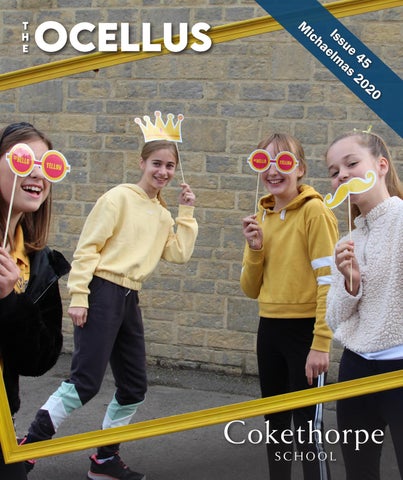
Front cover image: Emily Pratt (First Form, Feilden), Amelia Palmer (First Form, Feilden), Poppy Lloyd (First Form, Feilden) and Freya Winfield (First Form, Feilden) are framed up for a photo during #HelloYellow, Young Minds’s mental health awareness event in October 2020. The Ocellus is produced by the Communications Department, Cokethorpe School. Edited by Mr W Griffiths and Mrs L Williams
HEADMASTER’S WELCOME I doubt that, in the last 100 years, there has been a New Year so laden with hope and expectation. 2020 was truly miserable, with few redeeming features, and, once our present lockdown setback rescinds, we all hope that 2021 is going to free us from its constraints and our rising anxieties. It would be easy to list the things we would want to banish from our experience of the last year. It is much harder to count its blessings, but I am going to try to rise to that challenge! First of all, the year brought confirmation of our inherent vulnerability. We were riding high in so many ways as 2020 came in, and yet we have been laid low by a microscopic virus. It may be hard to see this as a blessing. We know better now that our bodies and our social and economic structures have frailties that need to be protected. They say pride comes before a fall, so we may now be more careful about our steps. A much more obvious blessing is a new found awareness of our inter-dependence and how much we have to be thankful for, and to whom. We are thankful for the company and support of friends and family, we are thankful for the doctors and nurses in the NHS and care-workers, we are thankful for the spontaneous generous acts of local heroes. The poet John Donne once said (or was it Hugh Grant in About a Boy?) that no man is an island. We are more aware now of the importance of cherishing those around us.
placed into the care of others. We owe them our lives and our nurture. Sometimes this past year, we have had to resist the suggestion that they are expendable. I think it was Pope Benedict who reminded us that ‘the quality of a society, a civilisation, is judged by how well older people are treated’. Finally, there is the environment that surrounds us. It is a delicate thing that sustains us, and we meddle with it at our peril. If we didn’t know that before, we certainly do now. So, I propose that 2020 has provided us (...or gifted as John Lewis would have it) four simple New Year resolutions – to shun hubris, to celebrate our mutual dependence, to love and value our elderly, and to fight harder to safeguard our environment. If 2020 helped us learn these lessons better, then it was not all bad. In keeping with the first and second of these resolutions, we have considered the nature of this publication, what it provides to you and what we might do to improve our offering in this regard. I trust you will find something of interest in this new approach over the coming pages.
Hopefully, we have an enhanced understanding of the love and care we should give to our elderly relatives, our parents and grandparents, some of whom we have
IN THIS ISSUE... putting mental health in the frame
pages 5-7
global perspectives on education pages 10-11 Concerts on camera: music in lockdown
pages 20-21
pupil perspectives: sixth form at cokethorpe
Pages 28-29
1
2
Approaches to learning in a digital age Mr Uglow, Director of Studies, discusses the symbiotic relationship between traditional approaches to teaching and the burgeoning opportunities for integration of technology into the modern classroom. There is, and I suspect there always has been, a tendency to seek a dichotomy between those educators (and commentators) who advocate a traditional approach to the school experience, and those who categorise themselves as ‘progressive’. The latter caricature the former as hardliners who advocate learning by rote and excessive teacher direction, whilst the former lampoon the latter as cuddly advocates of restorative conversations and pupil-led learning. It is a false dichotomy. A good school recognises that traditional methods can sit happily and effectively alongside more modern approaches, and excellent teachers work hard to find the balance.
My colleagues and I have also come to recognise and appreciate the power of OneNote and Teams – not just in the delivery of remote lessons, but also in providing pupils with opportunities to collaborate to create a piece of work, in allowing teachers the opportunity to provide ‘live’ feedback, and in enabling the sharing of resources in a way that reduces reliance on printing. I also recognise the power of the internet as a resource – and our responsibility as educators to teach children how to use this resource effectively. Like many colleagues, I’m excited by the opportunity to develop links with schools around the world, adding depth and variety to the learning experience.
This is particularly true when it comes to embracing digital technology. As a trainee teacher, I spent my second placement in a London school that had invested hundreds of thousands of pounds in installing interactive white boards in every classroom, removing existing ‘manual’ boards to force teachers to embrace the new technology. It caused chaos. Any teacher will tell you their own story about the over-zealous embrace of the latest idea or gadget, as leaders seek to ‘keep up’ with developments from within the sector and beyond. It is, then, with a degree of trepidation and caution that we proceed with our plans to integrate the use of Surface devices into the Senior School. Having used a Surface Pro for the past two years, I know that there is much to commend them as a device – they are versatile, quick and light-weight. I know that using the Office 365 suite on a Microsoft product offers a much-enhanced experience over relying upon the web-based version.
3
However, I also appreciate the importance of listening, of discussion, of face-to-face interaction. Like many of my colleagues, I understand that observing body language and facial expressions provides hugely important insights into a child’s state of mind and engagement with the task set. I understand the value in learning to spell correctly, rather than relying on spellcheck, of learning facts and deepening understanding of concepts rather than relying upon the internet as a ‘quick win’. And so, it is important that, as we embrace
4
the many ways in which devices will enhance the learning experience for pupils, we do not see them as a panacea or the answer to all questions. The big question that needs to be asked before decisions are made in any school is ‘what effect will it have on learning?’. We firmly believe that embracing technology will have a positive impact on learning, but we proceed with caution, understanding the need to retain traditional teaching methods that are evidencebased and effective, working cohesively with the new.
putting mental health in the frame The emotional and mental wellbeing of our pupils is always a priority at Cokethorpe. With the inevitable impact of the pandemic on the wellbeing and mental health of children, now, more than ever, it is imperative to support and talk about issues surrounding mental health.
All lessons fit into one of three topics: health and wellbeing, relationships, and the wider world. This means that we can cover a number of different subjects, allowing for personal development as well as fostering empathy with different situations, both on a national and international level.
Miss Gardiner, leader of our WIT Programme, explains why we held a ‘Hello Yellow’ focus week shining a spotlight on mental health, and how our WIT Programme supports pupils throughout their school life.
In the Second Form, these foundations are built upon, exploring social media, celebrity culture and its impact on mental health, as well as exploring ethical issues such as fast fashion.
What is the WIT Programme and how does the provision differ from other schools? WIT stands for Wellbeing and Integrity Toolkit and is similar to other PSHE or Life Skills provisions that you may have seen in other settings. What makes Cokethorpe different is our commitment to our six leadership pillars: integrity, courage, judgement, empathy, responsibility and ambition. They underpin all of our WIT sessions as they are fundamental in helping our pupils and students develop emotionally. How is the Programme run alongside academic subjects? The WIT Programme is run differently to other subjects as it is run predominantly by tutors, every Friday during period 2. This allows for a bond to develop between groups, and for a safe, trusting space to be established. Having the whole School in WIT at this time allows for a sole focus on social and emotional development, in a very busy academic timetable.
What could pupils expect to cover during their WIT sessions? Do these differ for year groups? Yes, the WIT Programme is designed to explore a breadth of topics which are built upon year after year. An example of some of the topics that pupils study throughout their time in the Senior School are detailed below: In the First Form, pupils focus on e-safety, resilience and forming positive relationships.
Third Form pupils focus on responsible, respectful relationships, consent and financial decision-making. Pupils follow a spiral curriculum and cover a number of these topics again in the Fourth Form, revisiting them in an age-appropriate way accounting for their growing maturity. There is also a focus on taking responsibility for their own health, both physical and mental, as well as empathising with others who are living in difficult situations worldwide; understanding immigration and refugee status are an integral part of their wider-world learning. Once pupils reach the Fifth Form, the emphasis moves to techniques for managing examination-related stress, as well as a focus on making responsible and informed choices in relation to relationships, substances and their personal health. WIT in the Sixth Form is structured slightly differently as it is primarily discussion based. Topics range from religion, to gender, sexuality, race, social media, peer
5
pressure and politics. Students are encouraged to formulate ideas on the topics and discuss their thoughts – sessions are lively and thought-provoking and have really allowed the maturity of our Sixth Form students to shine through. Is the WIT Programme purely classroom-based? No, the WIT Programme is also supported by external speakers alongside the classroom-based lessons. External speakers add another dimension to the lessons and discussions held in classrooms. Speakers often relate their personal experiences, which not only gives pupils an insight into other people’s lives, but also gives them tangible, real life examples and perspectives on the topics they discuss in classrooms. We also schedule a number of Chapel services every year, as well as Careers sessions for all year groups. Our Sixth Form students enjoy six enlightenment lectures per year, which explore a number of different topics, the theme this year was ‘how to survive…’. Where possible, we also like to arrange practical activities for pupils, such as Yoga for wellbeing and CPR training. Both offerings were very popular with our Fourth Form last year. What are your plans for the development of the WIT Programme? In the longer term, I intend to plan for more student interaction – a small group of Lower Sixth students are currently in training to become Digital Leaders, with the intention of helping younger pupils to navigate a difficult digital world. I would also like to arrange for a volunteer programme to develop alongside the WIT programme, as well as establish a number of charity fundraisers every year. Many of our external speakers visit us from local charities, so it would be fantastic to be able to support them.
6
On a personal level, how has WIT benefitted you? This is my second year leading the WIT programme, and it has been rewarding to see it grow. WIT is all about helping our pupils and students develop emotionally, socially and spiritually, gaining a greater understanding of themselves as well as the wider world around them. It has been great to see them discussing important topics and sharing advice, as well as further educating themselves about subjects that they may have previously avoided. There is no doubt that WIT is influential in developing our well-rounded,
conscientious and kind Cokethorpe pupils and I am proud to be a part of this. What was the inspiration behind holding a focus week on mental health? World Mental Health Day is held on 10 October every year. It seemed particularly important to draw attention to this day in 2020 as the need for mental health support has increased significantly due to the pandemic. Months of lockdown have had a huge impact on families across the globe, financially, physically and of course, mentally. The impact of this on our children having been isolated from their friends, the disappointment of not finishing exams, and the ways in which they have had to adapt to not only new ways of learning, but also new ways of living, cannot be underestimated. We felt as a School that this would be an opportune time to organise a week of activities to encourage our pupils to openly discuss mental health and highlight the importance of pupils’ wellbeing, empowering them to feel confident talking about mental health in an open forum. It is pertinent, now more than ever, to normalise conversations around mental health and mental illnesses, and to introduce pupils to some strategies to look after their own health and wellbeing. What is the significance of the term ‘Hello Yellow’? #HelloYellow is a campaign launched by youth mental health charity Young Minds to raise awareness of issues surrounding young people’s mental health, as well as fundraising for financial support for the charity. On Friday 9 October 2020, the Senior School, along with thousands of other schools and groups, played our part in raising funds and awareness for this fantastic charity. The idea behind encouraging everyone to wear yellow is to demonstrate to young people that everyone has mental health, and no one should feel alone in dealing with it or feel uncomfortable talking openly about it. Pupils and staff were invited to wear yellow on World Mental Health Day and give a small contribution for doing so. I am delighted to say that this raised a whopping £1,200 for Young Minds. How did #HelloYellow week take shape at Cokethorpe? We organised a rota of activities which took place throughout the week. These began in morning Registration with virtual lunchtime meditation classes
through Teams with Miss Dodson, followed by a breathing techniques class at break time with Ms Griffiths. Hot chocolate and biscuits were offered at lunchtime to different year groups on different days by the Housemasters, with the aim of giving pupils a mood boost and providing a space for pupils to sit together and chat. We also invited a speaker from the ‘Self Esteem Team’ to visit, who gave talks to different year groups on various topics throughout the day. First to Third Form pupils heard a talk on understanding mental health and recognising signs of mental illness, Fourth to Fifth Form pupils were given advice and strategies for dealing with exam stress and Sixth Form students were given everyday tips and methods for combating anxiety and depression. We also co-ordinated a number of activities encouraging pupils to think about factors that contribute to mental wellbeing. These included creating a mood scale – defining how you feel at your best and at your worst, and tracking it. We also explored the importance of managing sleep, nutrition and exercise and practical ways to do this when you lack motivation. For Sixth Form students we focussed on the benefits of using things that you enjoy as a way to help with revision. For example, taking revision notes and testing your friends whilst meeting each other for coffee, or creating revision competitions with your peers. There was also a photobooth for First Form pupils on Friday which they thoroughly enjoyed, as illustrated by the fantastic photo on the front cover! What does Cokethorpe do through WIT in order to make pupils more aware of prioritising mental health and identify symptoms of mental ill-health? All topics in WIT are designed to be age-appropriate and as previously highlighted, these are revisited and built upon from the previous years. Pupils are encouraged not only to focus on their own wellbeing and mental health, but raising awareness of different subjects, issues and factors contributing to this also enables pupils to recognise symptoms in peers and friends. This is crucial in tackling mental health issues among young people. Building relationships between peers,
reducing any stigma attached to mental health issues and encouraging open conversation and discussion empowers young people, providing the tools to overcome anxieties, stress and difficulties they may experience growing up. What is Cokethorpe doing to continue to address the mental wellbeing of its pupils? There is a strong pastoral support system in place for pupils across the School, with a number of people and resources available to them should they have any concerns. Pupils are encouraged to talk to their tutors or their Housemasters if they have anything they want to discuss, as well as the School Counsellor who is available for appointments. The Peers Mentor Scheme is also available, with a dedicated team of Sixth Form students elected to support pupils. How can pupils get involved if they have suggestions for what they would like to see in the WIT programme? Pupils can email cmg@cokethorpe.org with any recommendations or suggestions for the WIT programme. We are keen to encourage pupils to put forward their ideas. Where can parents find information on supporting their children with anxiety, stress and worry? Hello Yellow have a parents phone helpline and email helpline: www.youngminds.org.uk/contact-us/parentshelpline-enquiries/ - 0808 802 5544. Mind have information for parents - www.mind.org.uk/ information-support/for-children-and-young-people/ information-for-parents/ - help for mental health problems.
7
A Photographic Awakening Tom Blackmore (First Form, Vanbrugh), explains the roots of his passion for photography. I first got into photography when my sister found one of my dad’s old cameras; I started to get interested and asked her if I could have a go. My first photo was actually of a pair of Adidas trainers, though I have moved on a bit since then! I was surprised by the quality of the shots I captured, and felt this was something I would really enjoy pursuing. It has been a hobby for a little over a year now. My dad bought me my first professional camera about six months ago and I have been delighted with some of the photos I have been able to take with it. I really take photography seriously, whether I am photographing landscapes, nature - like the deer (Inside Front Cover) - or more abstract shots such as the bubble and the pouring drink you can see here. Pupils’ creativity will be showcased in each issue of The Ocellus, please email the Communications Department if you would like to put your work forward. Email: comms@cokethorpe.org
8
cokethorpe conversations Mrs Smith, School Counsellor, discusses the approaches to her work in a challenging year. It is coming up to my fourth year of working as School Counsellor at Cokethorpe and almost fourteen years since I began counselling in schools. Over the years I have worked with hundreds of children for a variety of reasons, but this year presented a new challenge. A challenge that most of us had not seen coming. The pandemic has shattered life as we knew it. The isolation, uncertainty, changes in home life, financial insecurity and health implications are obvious impacts. How this was going to affect our pupils has always been very much in our minds. In September, I met with teachers and discussed the potential impacts of the pandemic and what to look out for over the coming months. Mental health needs do not develop immediately but take time and distance to show, so the next six to twelve months are going to be crucial for supporting children and young people to process their experience and come out the other side. While many children will have fared very well during the pandemic and journeyed through it showing their resilience and adaptability, there will be some who have struggled, or who are beginning to feel the toll of months of uncertainty. While it might sound dramatic, the pandemic has been the very definition of a traumatic event. It was sudden, overwhelming, and altered our sense of security. There was also loss as our normal way of life eroded. The typical impacts of trauma and loss are anxiety, change in mood, low energy, withdrawal from social contact, tearfulness,
difficulty in concentration, tiredness, angry outbursts that seem out of character, irritability, hypervigilance, sleep disturbance, diminished interests. It is a rather lengthy list. But also a list of totally normal responses to a situation like this. One of the most important parts of my, and the teachers, role in the School now is helping normalise the experience for children and young people. When your world has been turned upside down, when you are not allowed to go to school, when you are not allowed to see your friends and the adults in your life are potentially struggling, it is normal to feel anxious and unsettled. Complicated further by continued uncertainty, it is also normal to feel tired, emotional and low. At School, we have encouraged tutor time to be a talking space, regularly creating opportunities to acknowledge the enormity of the situation and the losses experienced in a pragmatic way. This is important so that our pupils do not feel there is something wrong with them if they are struggling. It is okay to not be okay at a time like this. There are several ways that we support children and young people at Cokethorpe. While having a counsellor in school is now commonplace across the UK, I am pleased we offer this service to our pupils. Counselling is available for those that are finding their normal ways of coping are no longer working and need a little extra support to help make sense of their feelings. I offer weekly, 40 minute sessions, and the service has always been well used. I am also very proud to be managing the peer mentoring service which is now in its third year. Peer mentors must apply and interview for the role. Those selected partake in a two-day training course with listening skills at the heart of it. For some pupils, talking to a peer feels easier and more relatable. This year, it felt more important than ever that the programme be running, and we have been creative in ensuring it does without year bubbles mixing.
9
global perspectives on education Mr Ettinger, Headmaster, considers the changing international educational practices in a geo-political context, and the impact of the pandemic on them. Recently, I was delighted to attend the bi-yearly Alliance for International Schools conference that meets to explore topical issues in global education. Hosted by an affiliated school, this year was the turn of the International School of Geneva, arguably the first International School in the world, and one of the small group of founding schools of the International Baccalaureate. No Alpine vistas on offer, however, since the event was held via Microsoft Teams. The theme of the conference centred on The United Nations and Sustainable Goals in Education. Plenary sessions consisted of formal addresses by stimulating and knowledgeable speakers and there was also time allocated to meeting in small and informal groups exploring specific themes in detail. There were eight groups in total, each one addressing a specific topic and I participated in the group that discussed “Rethinking International Education: Learning for the World in local context.� I chose it because I have become increasingly fascinated by the ways in which older iterations of International Education are being influenced and changed by what is happening in those countries where there is a huge proliferation of International Schools, such as China.
10
The understanding of International Education that grew out of schools like the International School of Geneva was essentially a product of the liberating and expansive aftermath, for some countries, of the Second World War combined with the challenging presence of the Cold War. In my opinion, it was essentially western in origin and liberal humanist and globalist in its philosophical underpinnings. I have no problem with that, but I do have a problem in that it had, in its early forms, little connection with the East, or indeed the South. Some of its practitioners were almost colonial in outlook. People with such orientations find it natural to talk of the Middle East, and the Far East, for example, as if these directions and the places to which they refer have some absolute connection. But practices and perceptions have shifted. We heard from a statistician from ISC Research that the growth in International Schools worldwide will mean that in the next ten years we shall need to find 500,000 more teachers to fill this expanding market. This is not new news, and other researchers have produced similar projections but where will this half a million come from? In the early years of International Education, and perhaps until very recently, the assumption would have been that many if not most of these new teachers would have been drawn from English-speaking, predominantly ‘white’ countries. That is no longer the case. In my group discussions, I heard from Heads of Chinese and Indian schools that they were employing more and more local teachers who were fully bilingual or multilingual, whose English was impeccable, and who combined local and global perspectives on life and on their pedagogy in truly exciting ways. It is clear that local contexts are impacting on older versions of International Education with powerful and innovative force.
A colleague from India spoke with passion about how she knew her culture deeply, and other, English-speaking cultures as well. She said that she loved Kalidasa and Shakespeare, Tagore and the great English poets as well as the rich traditions of Indian theatre, music, and dance, and those of Europe. Speaking of her European and American colleagues, she exclaimed: ‘I am more international than they are.’ Passion always blurs fine distinctions, of course, and a global gaze can be developed by anyone, anywhere, but perhaps now is the time to start talking of Europe as the Middle West, and North America as the Far West. The true impact of the COVID-19 pandemic will not be known for many years, I suspect. Internationalism, one might argue, is one of the causes of its spread; after all, if international travel were less hardwired into our psyche, both as holiday makers and machines of business, perhaps it would have been more easily contained. However, our response to the challenges of the pandemic, and the absence of travel, is key. In many respects, the connections I outline above are now closer than ever before. We can connect immediately with our partner schools in Sweden, Canada, France and Spain, sharing lessons, experiences and ideas in a way that, previously, I would have imagined could only truly happen as part of a visit – with all the cost, both financial and environmental, attached. I sincerely hope that this is not the death knell of the school trip. It is, rather, another opportunity – and one that we at Cokethorpe are excited to embrace.
11
taking centre-stage: the nutcracker Mr Camidge OC, Gap Year Assistant, recounts the challenges faced, satisfactions had and incredible efforts made by the Junior School in preparing a play for film. During the Michaelmas Term, I had the privilege of working with the Junior School to produce their Christmas production, or in this case film, entitled The Nutcracker: An Unprecedented Adventure. Due to the surprises 2020 brought us, we had to rethink the traditional way the children get to perform and enjoy the arts. But, as always, the Junior School community stepped up to the challenge of filming and although we had our fair share of issues, everyone thoroughly enjoyed the experience. The professionalism and focus that all the children showed through our weeklong takeover of various locations throughout the School was extraordinary. The process of film creation can be a long and laborious one at times, but without exception, every class was exemplary.
12
Some highlights include the triumphant battle between The Rats and The Toy Soldiers performed by Year 6, the Waltz of the Flowers performed by Year 1 and Year 2, and the Party sequence excellently portrayed by both Year 5 classes. These performances were aided by the fabulous costumes provided by our resident costume mistress Mrs Mace. We hope the children thoroughly enjoyed the process and relished the novel experience of being involved with a film production. However, a special thank you must be given to Miss Cudd who stepped in to teach Music and Drama in the Junior School during the first half of this term. Her energy and
creativity inspired all the children, and her enthusiasm was the driving force behind the project. We would also like to thank Mrs Black for all her support during the process along with the entire Junior School Staff for their cooperation. As part of the new programme of Gap Assistants, I feel very privileged to be involved and I hope we can continue to find innovative ways to keep the children dramatically thriving. You can view The Nutcracker: An Unprecedented Adventure below, or through the School’s YouTube account.
Watch The Nutcracker: An Unprecedented Adventure by clicking on the link below.
13
meet the school: Miss brigham What do you do at the School? Head of Outdoor Education, managing Outdoor Education Games, Duke of Edinburgh and Outdoor Learning in the School. When did you join? January 2020. What made you join Cokethorpe? The opportunity to develop an Outdoor Education programme, sharing my love for all things outdoors and adventure in a school that celebrates a diverse and rich education. What did you do before you joined Cokethorpe? I had been recently teaching Geography in a Secondary school but have spent ten years before this leading expeditions all over the world for young people, summiting peaks, canoeing in the Mongolian steppe or trekking through equatorial jungle.
What is your biggest fear? A lot of common fears such as spiders, darkness, being lost or heights are part of my daily life. However, after spending a lot of time in rainforests and jungles – I’m not a huge fan of centipedes. What’s on your bucket list? An 8000m+ mountain summit, cycling across one or several continents, climbing El Capitan in Yosemite, USA (a 1000m rock climb!)…it’s a long list! If you could swap jobs with someone at Cokethorpe, who would it be and why? If I could, I wouldn’t. I love my job! But if I had to I would swap with someone on the Maintenance Team, I love being outside and around nature, I’m fairly handy with DIY too so would enjoy that. Do you have any unusual talents? I can balance five spoons on my face – I might need to try again to see if I can improve my record!
Outdoor Education at Cokethorpe: What is it all about? Outdoor Education can have a variety of meanings and applications and that is actually the essence of what we do at Cokethorpe! During Games, our Outdoor Education options are Climbing, Sailing, Kayaking, Shooting and Base Camp, all of which allow competitive and non-competitive opportunities. We are out and about every week around the county, visiting real rock crags, paddling on local and not so local rivers and canals, visiting shooting grounds or sailing on the local reservoir. Not only do we make the most of the wonderful venues in our vicinity we also use the brilliant facilities on the Cokethorpe School grounds; three shooting areas for clays, pistols and air rifles; a purpose built climbing and abseiling tower; various orienteering courses; fitness suites for training and our very own Thames side property ready for all our kayaking and canoeing.
14
Cokethorpe conversations Mrs Black, Head of Junior School was recently interviewed by Mr Griffiths, Head of Marketing, about her career to date, her pedagogical ethos and plans for Cokethorpe Junior School. Where did you work before joining Cokethorpe in 2018, and have you always worked in education? I have always worked in teaching, yes. Like so many teachers, I am the child of teachers and I grew up always dreaming of being the Head of a junior school; that was my ambition from about five-years-old, when I was besotted with my own Reception teacher, Mrs Gordon. I went from my degree into teaching in the Londonbased independent schools’ sector. After a few years, we made the decision as a family to look for a different environment for our children to grow up in – there was almost an underlying sense of aggression in the delivery of education in London; I think there is a British competitiveness about it, that starts even with NCT groups! We wanted something more expansive, both intellectually and by way of setting for our children’s upbringing. I have always wanted to work somewhere that I would want to send my own children. Professionally, it is also important to find somewhere that fits your ethos, both for the School and for your own fit; it is almost like dating, the fit must be right for both parties. We were fortunate: Cokethorpe provided all of this for us in spades. How have your past experiences influenced how you’re looking to embellish the ethos of the Junior School? Many of those schools I worked at previously have
similarities to Cokethorpe, though I think the most significant difference lies in the selective nature of entrance to them. Partly based on the volume of potential pupils, those London schools looked to be quite selective far earlier than I think is preferrable, and as a result they had cohorts of children with similar objectives and abilities. One of Cokethorpe’s great strengths, and something in keeping with my own ethos, is the breadth of interests and abilities across different areas at the School. We do of course have high expectations academically, as does every school you go to, the difference in a school with a purely academic focus is just how constrictive that can make the experience for both teachers and for pupils. And does that breadth allow for a more dynamic classroom? If you are looking to test for entry at seven, or five or even three, it is no great surprise that the curriculum becomes more prescriptive, with a view to passing those tests, especially in Maths and English. If you can find a more holistic way of considering children and whether they are going to be a good fit for a school that doesn’t hinge on their essay writing abilities, their reading comprehension or their maths, then there is much more room to maintain a broader curriculum. I really believe that if the experience pupils have across a curriculum is varied and stimulating, drawing on their own interests, that is going to generate a level of motivation that will feed into their work. When you get this right with the younger ones especially, they learn almost by osmosis, they do not even realise how much they are advancing, and their long-term outcomes are far more positive. It is for a comparable reason that we opt to have mixed ability classes for the majority of the children’s lessons. They learn by bouncing ideas off one another, and it is really important that they model their ideas, their writing and their discussions for one another as well as their teacher demonstrating how to do this. That is what the creative curriculum approach you employ in the Junior School is all about, isn’t it? Absolutely. It is really about making links between the different subjects they are learning to a chosen
15
theme, finding ways of making it real to them with real world references. It is also important for children to be able to own their learning and get into that stimulated, creative flow where time just seems to pass. The learning they experience in that state is of a far higher quality than the child who is thinking about a deadline for a paper they have to complete, because that’s ‘what school is about’. A good example is learning to write a formal letter in Year 3. Rather than writing a response to an essay or article they’ve read, why not make it a reply to something they are really passionate about? The environment is a hot favourite at the moment. We follow what I would call the national curriculum plus. We teach all the subjects on the national curriculum, but we look to go beyond it, both in terms of the syllabus of those subjects and the breadth of subjects on offer. We have specialists teaching arts, music, drama, sports and languages. Languages is very much part of that ‘plus’, we have introductions to a different language for one term each year alongside French, with Spanish, German and Italian covered. Latin is also introduced in Years 5 and 6 as well. You mention the environment, of course, Outdoor Learning is a big part of the Junior School experience here; how does that sit within the wider construct of the creative curriculum? I was lucky enough to be involved in some training when Forest School was relatively new to the UK and remember thinking how special the provision was; it is something every child should have the chance to experience. Just exploring and being creative. The benefits of that outdoor experience, whether through Forest School or one of our many other activities that have grown out of it, are so wide-ranging. Often, we might see a child who is more reticent in the classroom who will go outdoors and become a leader, cherishing the space. There seems a conventional wisdom that certain developmental stages pass in conjunction with school years; a child in Year 1 no longer wants to dress up or climb. I do not buy into that. This is the same with Outdoor Learning, there is something to gain for children of all ages from being outdoors. We have worked closely with Miss Brigham to develop a curriculum for Outdoor Learning that builds on that Forest School ethos and ties into our classroom-based learning.
16
Developing good emotional intelligence and emotional strength is so important, what approach do you take here? RULER is a scheme that I am really passionate about. It was developed at the Yale Centre for Emotional Intelligence, and is widely used in US schools, but there are only very few that have embraced it over here so far, so we are somewhat pioneering. It is essentially about recognising, understanding, labelling, expressing, and regulating emotions, and about teaching emotional literacy as explicitly as we would anything else that we teach in School. We start the School year creating a class charter, where each class discusses how they want to feel when they are at School and how they should behave to feel that way in School. The children have ownership of that document and they all sign up to it. It really underpins our behaviour management in the School because a teacher can refer to it and it is a powerful tool. Equally, we use mood meters as a means of furthering comprehension on the range of emotions, and that there are not really such things as negative or positive emotions, they are simply emotions, and behind every emotion there is a need. How we handle them and how they affect us is where the negative or the positive comes into it. We will all experience the full spectrum of emotions at some point in our lives, learning how to handle them and how to change them, should we want or need to, is really important. You also use the Cokethorpe Characters to discuss traits and values? That is right, the values we learn in the Junior School through the Cokethorpe Characters lead on to the leadership traits that underpin the values of the whole School. Each characteristic of learning is represented by an animal. We focus on one per half term and that particular trait covers the whole Junior School, with references throughout their learning and the formal functions such as Assembly. The children, even in the younger years, benefit from playing lots of sport. Why is that important? Early years sport here is integral, and that does include the youngest year groups. For them, it comes back to those fundamental building blocks, they are learning and developing those skills they need for successful gameplay that they will need from Year 3 upwards. The Pre-Prep focus a lot on agility, strength, motor responses
and ball skills, across a range of different sports, moving on to specific sports practice and matches from Year 3. We have a programme for those subsequent year groups that introduces them to 24 different sports, including anything from volleyball to table tennis; the wider point of this is to instil sporting and physical confidence beyond those core competitive school sports. It helps ensure enjoyment of sport for its own sake; though we do have a good number of pupils here who are already competing in their sports to a high standard and it is important that we support them in those endeavours as well, whether as part of the equestrian team, the rugby team or the netball team.
able to offer even more breadth to our existing clubs and groups. We will be looking to bring that in for next September.
Looking back on your two-and-a-half years here so far, what stands out for you? We really overhauled our curriculum, bringing in the creative curriculum I mentioned earlier. I think that is really significant because it supports the individual child and prepares them well for their ongoing learning. It has also delivered a stronger sense of academic drive and rigour. Introducing RULER was also important to me.
What do you do at the School? Head of Geography, President of the Common Room, First XI Football Coach, World Challenge School Leader, Fourth Form Tutor.
Honestly, we have also been a little hampered by the pandemic as to some of the things we wanted to bring in, but I am so proud of the way we have responded to this, especially during that first lockdown last spring. Having gone from a sense of minor foreboding and a fear that the children would lose out so much from learning remotely online over what they gain in the classroom, the response was immense, and it proved a really stimulating environment for our pupils and our staff. Nothing will replace being in the classroom, of course, but they all worked to make remote learning a strong second, and that went right down to our Reception class who were logging on to Teams to join their classmates and their teacher each day without any problems at all. It was impressive.
What do you enjoy most about working at Cokethorpe? Varied days, great pupils and caring colleagues.
And what are you most excited about in the coming year or so? I have been working a lot lately with the Director of Co-Curricular to develop our programme further in the Junior School. The AOB programme in the Senior School is really well defined and structured, whilst we have a programme built more around the children’s interests and the availability of providers at any given time of day. By having something a little more structured we will be
meet the school mr capel
When did you join? In Michaelmas Term 2008
Who are your heroes and why? Nelson Mandela and Jurgen Klopp - both are outstanding leaders, have positive attitudes and they clearly care about people. What’s your favourite way to spend a day off? Watching Liverpool FC, walking the dog or going for a bike ride. If you were stranded on a desert island and you could take one of your colleagues with you, who would it be and why? Mr Joiner because of his good conversation and laid back nature. What could you not live without? Radio 5 Live! If you were a superhero, what would be your superpower? Being able to see into the future.
17
cokethorpe creativity What is There? There’s something inside me, something small, The thing that makes me stand up tall, Maybe it is determination, all proud and strong, Maybe it has been something all along, Who knows what it is? I know I don’t, Because even though I know not, I think it might be, quite a lot, A lot, I think, Of love, so blink, And look around at what we’ve found, It’s everywhere, here and there, So love is what is there. (it’s not somewhere over the rainbow, it is here) Words by Flo Adepoju (Fourth Form, Harcourt) Image by Tilda Wyatt (Fifth Form, Swift)
Stay Safe My piece, Stay Safe, is inspired by the Coronavirus and the concerning situation that we all found ourselves in during 2020. The most life threatening COVID-19 symptoms are shortness of breath and lung damage. My piece attempts to draw attention to the importance of staying safe by surrounding lungs with life. The fragile nature of the chicken wire represents the vulnerability of the lungs to COVID-19. The flowers symbolise life and the single subtle coloured bee depicts the circle of life. Anna Pratley (Fourth Form, Feilden)
18
Crocs of cokethorpe Year 4 Predators Projects Two of the many fabulous pieces of work done on the Predator topic by Year 4 are below. Well done to all.
Colin Stevenson, a Herpetologist from Crocodiles of the World came to Cokethorpe with: a bearded dragon, affectionately known as Barry, a royal python named Ethel and Tommy, a tomistoma, Indonesian and Malaysian crocodile to support our Year 4 Predator topic.
Georgia Cross (Gwyn)
In our friendly environment, the bearded dragon did not need to flare its beard for protection, nor did it need to change colour to camouflage itself. We were honoured by royalty in the form of Ethel, a royal python! She graciously and calmly moved across the wooden floor, ensuring that we could all relax in her presence. Last but not least, an incredibly rare crocodile emerged from the final box. Expertly, Mr Stevenson showed his understanding of this species so that we could touch and study it, close-up. This unique experience has boosted our knowledge of reptiles. Thank you so much to Mr Stevenson and his precious, reptilian pals! Written by 4VM Emmy Perry (Symonds)
19
Concerts on Camera: Music in Lockdown
Cokethorpe Music Department are wellversed at delivering fantastic performances from our most talented musicians, however the past year has brought them a whole new set of challenges. How do you move a subject like music where group performance is so intrinsic, to the virtual world? Director of Music, Mr Hughes explains to Mrs Williams, Communications Officer. How has the pandemic affected the Department? The impact the pandemic has had on live music, theatre and creative arts in general is well-documented. Being unable to congregate in groups has rendered much of the live performance redundant and drastically restricted the possibilities of groups performing together, not least because of the audience. Ensemble performance is so important to our musicians as individual performers, and to our audience of staff, parents, pupils and friends who form such an integral part of every concert and recital. Despite the obvious limitations the pandemic has brought, it has also made us more adaptable, resilient and creative in the ways in which we overcome the challenges it has presented, bringing our musicians together to perform.
20
How did you manage to put together the St Cecilia Concert? During the first lockdown, parents, grandparents, friends and pupils of the School were invited to send in recordings of themselves singing and playing their chosen instruments for their contribution to the St Cecilia Concert. This formed the ‘Community Orchestra’, a newly created group of singers and musicians from across our School community, offering the chance to join together and perform. The performance was premiered through YouTube on Thursday 19 November and was a culmination of what the Cokethorpe School musicians had been working on over the lockdown and during the summer. The concert began with Dr Winkley’s newly formed Fourth Form Jazz Band. The group were put together for the concert so that Year Group bubbles could be maintained, and they played their contribution to the concert in The Shed where they were afforded adequate space to socially distance. The group performed Tequila by Daniel Flores. It was then the turn of the soloists, who performed their pieces in the Chapel which were recorded individually. Caellum Sharp (Third Form, Vanbrugh) kicked off the solos with a violin sonata by Handel, followed by Poppy Stewart’s (Fifth Form, Gascoigne) vocal performance of I Dreamed a Dream by Schonberg. Sasa Wilson (Fifth
Form, Feilden) performed a Romance by Shostakovich, then Jamie Wehrle (Fifth Form, Queen Anne) sang Linden Lead by Vaughan Williams. Anna Pratley (Fourth Form, Feilden) played Prelude by Finzi on the clarinet and Olivia Stacey (Upper Sixth, Swift) closed the solo section of the concert with Beau Soir by Debussy. The concert culminated in a performance by the Community Orchestra who played Finlandia by Sibelius. How did you put the group performance together? I had to record a backing track, which was sent out to all the members of the Community Orchestra. The musicians then listened to the track on headphones and played along, recording their performance. This enabled us to keep the musicians both in time and in tune. After that, the audio was compiled first, and then the video added. The final film was premiered on YouTube. How well have pupils adapted to online and socially distanced concerts? Pupils have adapted incredibly well to the changes the pandemic has made to live performances. Being unable to play together as an ensemble has undoubtedly had an effect on pupils, however, the new approaches to performing have given pupils the opportunity to focus on other key skills of performance, such as tuning and getting timing accurate. Since the beginning of the first lockdown in March 2020, have the Music Department co-ordinated any other live performances virtually? We have undertaken a number of fantastic virtual performances from the beginning of lockdown. The first of which were the May Day Madrigals, where two performances were recorded remotely. This was followed by two virtual Chapel Services presented by the Reverend Howard from different locations around the School, which featured both readings and solo performances from pupils. I think it is fair to say Reverend Howard is a natural in front of the camera, he clearly has two callings! The men of the Cokethorpe Choir then performed a farewell piece to long-serving Cokethorpe stalwart Mr Fenton, also a committed and esteemed member of the Choir who sang as a bass in many concerts over the years as well as accompanying the Choir on their tours abroad. The farewell was played during the leavers speeches on the last day of the Summer Term. The Concert Band played Hallelujah by Leonard Cohen in June in the same format as the Finlandia was recorded for the St Cecilia Concert.
If you want to see another outstanding example of our musician’s talent, look no further than the rendition of the musical Hairspray which can be seen on the School’s YouTube channel. Before the summer holidays, Head of Music, Miss Mitchell collated individual pieces from pupils to create a musical masterpiece. Recorded from their home locations, pupils brought the true spirit of Cokethorpe creativity and the passion of Hairspray to the screen. I must also take this opportunity to thank their families, who need to be credited as stage hands, providing off-site backstage support with props and filming! There is a rumour that you may have been moonlighting as part of a newly formed trio? The rumours are true! At the end of the term the ‘Bridge House Trio’ was formed, comprised of myself, Mr Ramsurn and Dr Winkley who recorded a virtual concert in the Chapel played to a grateful audience for the Bridge House Care Home in Abingdon.
St Cecilia Concert, November 2020
Upper Sixth Carols, December 2020
21
academic focus: the epq What are the benefits of the EPQ programme? Mr Waldron, EPQ Coordinator explains. The Extended Project Qualification (EPQ) is an optional programme involving the exploration of a topic chosen by the student, and leading to a 5,000-word essay or an artefact. It is worth half an A level and is highly prized by universities for the academic skills it promotes. Last year, the artefacts included a house built using primitive technology, a traditional Japanese kimono, and a clock radio; the essay topics included the extinction of the dinosaurs, 9/11 conspiracy theories, early political philosophy, the psychology of music, and the history of Portsmouth harbour.
Ruben Hammond (Upper Sixth, Harcourt) explains the challenges and pleasures of his own experience of the EPQ. Rather than spending my summer holiday sitting around sunbathing and binge watching Love Island, I decided to start my EPQ project (possibly a slightly ambitious one): building a four metre diameter mud hut in my garden. The plan was to use only my bare hands and the materials around me but it soon became obvious that I was going to have to rely on modern technology as well as considerable help from my parents. I began by digging the circular foundations which was filled with rubble. On top of this I started to assemble a dry-stone wall using old stone lying around our property. This nearly killed me and I can honestly say I never want to build a dry stone wall again!
For 2021, 28 Lower Sixth students have proposed projects ranging from the economic consequences of COVID-19 to the sociology of basketball; from cryptocurrency to criminal justice reform; and from drag queens to Death Row. To help make this possible, we offer all Lower Sixth students a course covering the necessary academic skills of organisation, research, writing, and presentation. The students then have a year to research and develop their ideas, before completing the project in December of their Upper Sixth year. The EPQ programme allows our students to extend their curiosity into new and fascinating areas, and to master a range of key skills from project-management to academic research. In short, the EPQ makes them better learners, and better candidates for university.
22
The next step was to build the walls out of cob – a mixture of sand, clay and straw. Unfortunately, all this had to be mixed by hand (or rather by feet!) as it just did not bind properly in a cement mixer. Windows and doors and even a wood burner were locally sourced from neighbours and council tips and were buried into the cob as we progressed with the build.
crazy idea I had back in the spring has actually become a reality and I can’t wait to spend my first night in it. Now all that’s left is to have a house warming party, although I think my mother has other ideas...
Many sleepless nights were had worrying about the roof structure but we finally opted for an octagonal design and the whole family was dragged out to be a part of the Amish-style barn raising which happened just before the start of the new term in September. Over the last few months, I have finally managed to make the roof watertight by adding a membrane and wooden batons. All that remains, is to fix on cedar wooden tiles-which will have to be done between rainstorms and windy weather, as the roof Is nearly 5m high at the top. It is amazing to think that the
‘It has been extremely rewarding guiding Ruben through his EPQ. Firstly, I enjoyed ‘digging out’ from my memory my fading knowledge of construction from labouring jobs in the summers of my youth and then took pleasure scrutinising and guiding his plans. I also enjoyed helping him document his progress, reference his research correctly and teaching him how to hone his presentation skills. However, the real reward for me has been to see Ruben develop such a burning passion and to mature so much in a relatively short space of time. I feel there is no greater recompense than to see a student develop their confidence, self-belief and pride. I would not be at all surprised to see Ruben on Grand Designs in the future, either building another magnificent structure or presenting it with aplomb.’ Dr Flaherty
23
school news VR Day Due to the restrictions of the pandemic, it was difficult to find somewhere meaningful to take the Year 3 children on a School trip this term.
They battled elephant-riding Carthaginians, saw the close construction of an aqueduct and felt as though they were amidst the roar of the Colosseum fighting a gladiator for their survival. Stuart Gent, founder of Prime VR and a former teacher, used his teaching skills very effectively. Knowledgeable on every topic, he paused the 3D videos, to question the children or answer their questions. All the children were captivated, and the staff enjoyed the experience too. Miss James
Christmas Counts: the Pre-Prep Nativity This year, the Pre-Prep Nativity was filmed in our beautiful School Chapel so families would still be able to watch the performance. Situated fortunately far from Earth’s tectonic plates, fault lines and The Ring of Fire, our lovely West Oxfordshire location doesn’t lend itself to a field trip to support their Natural Disasters topic. How could I take the children to a volcano to experience first-hand the geology and the wonder and awe? While researching, I discovered Prime VR, a company who specialise in educational workshops using virtual reality headsets. They could bring volcanoes to us! Two weeks later, Year 3 were sitting in the Modern Languages Room at Cokethorpe Junior School whilst scaling the erupting Tolbachik volcanic complex in Russia. Serendipitously, Prime VR also had workshops in the topics studied by the children in Years 4, 5 and 6. Year 4 were able to roam amongst predators, and assess the adaptability of animals and their habitats. Year 5 orbited the Earth and circumnavigated planets in the Solar System and Year 6 adventured through the rainforests of Borneo (very surprised at one stage by a 3D life size gorilla!) Year 3 enjoyed an extra experience at the end of the day: in anticipation of next term’s topic they were able to re-don their headsets and time travel to the Forum and the Senate of Ancient Rome.
24
Christmas Counts contained all the usual ingredients including Mrs Mace’s exceptional costumes. The Chapel, with its stunning architecture, was transformed into different locations for filming, including Bethlehem town, a hillside, desert and stable. The three narrators certainly impressed as they re-told the traditional story. A rather bossy Census-Taker was busily carrying out Caesar’s urgent decree that everyone should be counted, including citizens and animals. Mary and Joseph spoke their lines confidently as they made their way to Bethlehem, where a rather stern Innkeeper directed them to his lowly stable.
Reception Class were adorable in their sheep costumes and were always camera ready. As if by some Christmas magic, they transformed into shimmering angels in front of the amazed Shepherds. The Census-Taker found several people and animals to count, including three travelling Wise Men and a funny camel. After following them to the stable, he realised that this baby was something very special indeed.
Cross-Curricular Days Pupils in the First Form and Second Form spent time in various different departments within the School, exploring the theme of Race and Diversity in their CrossCurricular Days.
Christmas Counts included lots of wonderful counting songs. This year, Pre-Prep were brilliantly inventive and danced to the songs instead, although one socially distanced group song, the poignant One Baby, was permitted. All the children performed beautifully and worked seamlessly around the unusually cold conditions and technical aspects, demonstrating great resilience.
Pre-Prep’s Smelly Smoothies Pre-Prep enjoyed a wonderful day at the Environmental Centre at Sutton Courtenay, which is run by The Wildlife Trust.
They enjoyed learning all about animals’ ‘super senses’ and how they survive and thrive in the wild. They also had fun collecting little toy mice to feed their chicks and spent time in the herb garden selecting different herbs to make a ‘Smelly Smoothie’. It was a lovely sunny day and no better time to be out and about in the local environment enjoying the natural world.
The aim of these days was to demonstrate to pupils that all subjects in our curriculum are linked and, although they all attend individual lessons divided up into a timetable, the skills and knowledge gained are relevant across all of them. It was also intended to highlight the huge diversity in race, culture, way of life and religion that we as humans experience both here in the United Kingdom and across the world.
The pupils participated fully in the activities and demonstrated real enthusiasm for all of the tasks involved, and showed awareness of other people’s opinions, backgrounds and cultures. This was also an excellent opportunity for them to demonstrate one of Cokethorpe’s six leadership traits, empathy, which they did tremendously well.
25
The Crawford Relay
Getting Ready for the Oscars
The Michaelmas Term saw the entire School come together, socially distanced, to watch the much anticipated Crawford Relay House competition. This is always an exciting and competitive event, not even COVID-19 could put a stop to the House teams racing around the School cheered on by their peers and staff; the Cokethorpe spirit was truly electric.
The Young Film Academy came into School to deliver a One Day Film School to Third Form pupils, allowing them to experience a practical introduction to filmmaking and visual media creation.
Each year group raced against each other, with Housemasters being more tactical this year to ensure they selected the best possible runners. The race was extremely close, as this year each runner was individually timed, these times were then added together to form an overall House finishing time, preventing anyone really knowing who was in front. As the entire School went back to classrooms for the presentation of the cup via Teams a nervous excitement was evident. Once Mr Sheer had interviewed Miss Woodcock in a Sky Sports style the winners were announced, missing the record by only a second, Swift were crowned the champions bringing an end to the first half term.
Pupils really enjoyed the morning’s workshops, where they learned about film history, screenwriting and camera work. However, I think that it was, perhaps, the onscreen fight choreography session later in the day that provided the most fun. Pupils then worked in teams to create their own Ten-Shot Silent films, all in time for a Film Festival and awards ceremony.
Results First - Swift Second - Queen Anne Third - Vanbrugh Fourth - Gascoigne Fifth (Equal) - Harcourt and Feilden Miss Woodcock
26
The Third Form impressed our judges (Mr Stevens, Mr Sheer and our Deputy Head of School, Alice Woodwards (Upper Sixth, Swift)), with their creativity, camera skills and use of props - although Mr Stevens commented that he was somewhat concerned by the pupils’ focus on guns, theft and death! Mrs Orton
General Knowledge put to the Test ‘The Sixth Form General Knowledge Competition was an exciting start to the academic year, jostling the more sluggish mental climate of the summer break in many of us. Six teams were reduced to one over five matches, which were conducted in the University Challenge style of a starter question bequeathing a set of three further questions to the team of the person who answered correctly. These questions took a wide range of subjects; from US state capitals, to artists’ pseudonyms, to elements named from Ancient Greek words. The tense final between Queen Anne and Feilden, was won with the former seizing an iota of headway and winning by 10 points after 25 minutes of fierce button pushing to secure the right to answer starter questions. It was shown by then that the greatest virtue of a team, if it is to be successful, is diversity; the scientist, the athlete, the classicist, are all key to prosperity. Also, the occasion was enhanced by the guestquizmaster-ship of Mr Fenton. What better warm up to the year can there be than a test of mental agility and digital velocity?’ Sam Elek (Upper Sixth, Queen Anne)
Getting a Flavour for the Sixth Form ‘On Tuesday 24 November, Fifth Form pupils experienced a Taster Day held in the School, giving us an insight into life in the Sixth Form.
The day began with a fascinating and thought-provoking Question and Answer session with BAFTA nominated filmmaker, Chris Atkins, who was sentenced to five years in prison for tax fraud. Chris talked us through his life in Wandsworth Prison, discussing the effect of prison on inmates and his work with the other prisoners. Each of us then had four taster lessons of our choice. We all enjoyed the smaller class sizes and the more focused learning. These were then followed by a current affairs quiz, a chance for everyone to bring out their competitive edge. Our day concluded with a selection of life skills AOBs. We learnt a wide range of skills, from how to shake someone’s hand to how to make a Chicken Caesar Salad. The day was thoroughly enjoyed by everyone, giving us food for thought as our mocks and A Level choices approach.’ Jamie Wehrle (Fifth Form, Queen Anne)
meet the school mr gaertner What do you do at the School? Year 6 Form teacher. When did you join? 2005 part-time. If you weren’t a teacher at Cokethorpe, what would you be? Volunteer worker around the world What did you do before you joined Cokethorpe? Retail Manager in Milton Keynes, PGA Golf Professional, Area Sales Manager for Wilson Sporting Goods. Tell us something we don’t know about you? I have an Egyptian father and a Zimbabwean mother. What did you want to be when you were small? Professional tennis player. What four celebrities (living or dead) would you invite to your dinner party? Sir David Attenborough, Gary Player, Matt Groening, Lady Gaga.
27
pupil perspectives: sixth form at cokethorpe Members of the Fifth Form took the opportunity to ask their burning questions to members of the Sixth Form about what they can expect next year. What was the biggest change when transitioning from Fifth Form to the Lower Sixth? The biggest change between the two years has got to be the extra responsibility given to you for your own education. Fabian Study periods were the biggest change for me. They give you chance to get on with homework and independent study which is helpful given the higher expectations of you as a Sixth Form student. Sam In what way has Cokethorpe Sixth Form given you more independence? The Sixth Form gives you more independence in many aspects of school life, however, I would say the main one is taking responsibility for your own work. Teachers are there to help when you ask for it, but the way you structure your work and study periods is very much your own responsibility - you learn to become more independent, preparing you for later life. Amelia In what ways do you use the Sixth Form support teachers? The Sixth form teachers are very accessible, their doors are always open if and when you need them. Izzy I have used the support teachers mainly for help with my UCAS application. However, I know some of my peers have used the Sixth Form support teachers to help with revision timetables and find better ways to structure their work, particularly in preparation for exams. Amelia
28
What differences have you found in the studentteacher relationships? The smaller class sizes have definitely enhanced my student-teacher relationships, making it easier to learn and ask for help. Sam Personally, I have found that you are treated more like a young adult, which makes the whole learning experience more engaging. Especially with mocks and exams coming up, they have been super supportive and understanding. Izzy Have you found the amount of work has increased, if so any tips on how to keep on top of all the work? The amount of work has increased, but so should your ambition and desire to finish it. I find the best way to control it is to do the work the day it is set, and to use your study periods. It is important to remain organised too - always know what homework or revision you have, how long it will take and when you plan to do it. Fabian My tip to keep on top of the work you are assigned would be to keep revisiting old content, so that you do not feel overwhelmed when you get to exams. Sam Have you found the food portions have increased as you go into the Sixth Form? Personally, I haven’t noticed any change but I am pretty certain that the boys in my year would say it has! Amelia It is great to get into lunch a bit earlier, there are always plenty of options on the salad bar if you need that little bit extra. Fabian I haven’t noticed any change, but I think the food has been great this year. Sam
Have you found the AOB programme useful and what is different? The AOB programme is almost like a secondary WIT session - it covers real life topics, relevant to our age. Fabian
Energising, dependable and hospitable. Izzy
So far I have done Public Speaking, CV Writing and Etiquette. We have also had sessions on how to use study periods effectively and interesting Enlightenment Lectures including, Teenage Psychology and Everyday Maths. Sam
Thank you to our Fifth Form pupils Lucas Bennett (Queen Anne) and Gemma Croker (Gascoigne), Lower Sixth students Fabian May (Vanbrugh) and Sam Cruttenden (Swift) and Upper Sixth students Izzy Coles (Swift) and Amelia Leslie (Gascoigne).
For the Upper Sixth the last AOB on Tuesdays has been particularly useful as we have used the time for UCAS applications and personal statements. We have been given advice on our applications as well as guidance and support for effective revision techniques. Izzy Would you recommend the EPQ and if so, why? The EPQ is a big commitment to make but does offer big rewards. It not only enriches your university application by demonstrating discipline and organisational skills, but also prepares you for the type of independent study undertaken at university. Sam I think it is a brilliant opportunity in terms of independence, finding something you are interested in and exploring it further. At the start of Lower Sixth, you are given group tutorials that explain it in much more detail, but I think if you are interested you should go for it. If you feel overwhelmed, you always have the Sixth Form staff and your supervisor to support you. Izzy I would highly recommend the EPQ as it doesn’t take much of your time up if you structure it correctly, you get to write about something you are interested in so it gives you a great opportunity to learn more on your chosen subject. Amelia If you were to describe life at Cokethorpe Sixth Form in three words, what would they be? I would describe the Sixth Form as valuable, enjoyable and manageable (if you keep on top of your work!). Fabian I would describe Cokethorpe Sixth Form as, engaging, fun and challenging. Sam
Exciting, challenging and social. Amelia
Staff news Michaelmas Term Leavers
Mr D J Laver is leaving after three years with the Modern Foreign Languages Department and will be joining Tetten Hall College, Wolverhampton. Mr M A Davies has retired having joined Cokethorpe Junior School from St Joesph’s College, Ipswich in 2017 as Head of PE and Games.
Welcome
Mr L Marot is joining the Modern Foreign Languages Department. Mr Marot will be at Cokethorpe until the end of Summer Term 2021.
Congratulations
Mr Joiner and his wife Abi on the birth of their daugther, Alice (8lb 11 oz) in July 2020. Mr and Mrs Ramsurn on the birth of their daughter, Nushka (6lb 1oz) in August 2020. Miss Love and her partner on the birth of their son, Arlo in September 2020. Mrs E Smith and husband Ed on the birth of their son, Barnaby Felix Jack (8lb 14oz) in September 2020.
Online Open Days
Parents are welcome to join prospective families in attending our next Online Open Days. The whole School Open Day will take place on Saturday 6 March, with the Sixth Form specific Online Open Day following on Saturday 20 March. Contact the Admissions Office for details: admissions@cokethorpe.org.
Cokethorpe School Witney, Oxon OX29 7PU Tel: 01993 703921 Email: admin@cokethorpe.org The Ocellus | Issue 45 | Michaelmas Term 2020 Edited and produced by the Communications Department. Published by Cokethorpe School.