sport football: The heart of britain
technology sci-fi: the shaper of worlds
environment a deep dive into tribal culture Summer Edition 2021
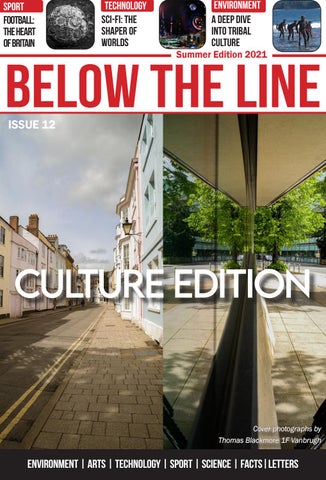
Below The Line ISSUE 12
issue 12
Culture edition
Cover photographs by Thomas Blackmore 1F Vanbrugh
environment | arts | technology | sport | science | facts|LETTERS
environment
life as they know it: a deep dive into tribal culture Currently, there are more than 100 tribes globally that live in complete isolation to the rest of humanity, living lives that have not changed for thousands of years. Many people have tried to make contact with them; most have failed, violently. What has provoked these hostile reactions and why are they so adamant to remain excluded from the rest of society? Sam Farr investigates. men on the shore who had been killed by the natives.
Imagine you are living thousands of years ago: basic tools and weapons have been made; fire was a gift from the gods. Now, imagine a helicopter flies over you, rotor blades spinning ferociously. You would surely feel it was the gods coming to praise or admonish. The Sentinelese are a remote tribe who live only on North Sentinel Island, a tiny landmass in a remote part of the Indian Ocean. The tribe has been residing there for over 60,000 years. The helicopter they saw approaching was there in hope of recovering the bodies of two
2
Many similar attacks by tribes upon visitors have been reported from around the globe. There are stories of brutal tribal celebrations and sacrifices, of violence, even of cannibalism. Some of these are no doubt just stories. But what is certain is that these tribes live ‘off the grid’, untouched by modern day technology and globalisation. But why do visitors provoke such a violent reaction? Is it simply their confusion at the sight of iPhones, GPS navigation and guns? Or is something deeper, more meaningful, even symbolic, at work in these attacks? To fully understand the significance of what’s going on, we need some background about these. The Sentinelese, currently residing on the North Sentinel Island, are infamous for these attacks. Multiple different skirmishes have been documented over hundreds of years. A few of the major events that hint at what might in fact be happening, and the possible reasons for such a resistant reaction to the world beyond their idyllic bubble.
from the editor
The world has been a tough time recently. According to Professor Chris Witty, the Government’s Chief Medical Advisor, it seems as if we will have to live with the existence of Covid-19 in our lives for some time to come. Yet, to paraphrase Winston Churchill, it does seem as if we are at the end of the beginning in our battle against the virus. We all got through it in different ways. Some of us took to ‘doing Joe Wicks’, bouncing around our living rooms. Others ate lots of peanuts to get through another session on a screen. If I hadn’t had lots of TV show to binge on, then I know I would not have got through it. Up and down the country, the pattern was repeated: people getting all the DIY done; redesigning the garden; learning a language. Many of us got a little culture into us.
Continued on page 17...
Cokethorpe School | First, Second, Third and Fourth Form Pupils
environment What better place to start than the first known sighting of the island? In 1771, a British surveyor by the name John Ritchie passed the island on an East Indian Company hydrographic survey vessel. He decided to take note of the island’s appearance: ‘from the south west corner of Andaman, lies a fine low Island covered with trees; it is a league long, and two miles broad; and if we may judge from the multitude of lights seen upon the shore at night, it is well inhabited; this Island is marked as North Sentinel in the plan; and it is between the Latitudes 11 32′ ‘and 35’ N.’ Fast forward to the 1880s. By now, the island had been sighted and visited multiple times, some with dire consequences. But at the end of the nineteenth century a party was led by Maurice Vidal Portman who made some significant in-roads into understanding their world. Maurice Vidal Portman was a British naval officer, who is best known for documenting several Andamanese tribes between 1879 and 1901 when he was posted as a superintendent of the Andaman Island Penal Colony. The Sentinel Islands are a part of the Andaman archipelago, a string of islands scattered in a line between Burma and Sumatra in the India Ocean. During his time as a colonial administrator of the Andaman Islands, Portman took a large number of photographs of the Andamanese, including some at the request of The
British Museum (at his own expense) and the Government of India (on payment). Portman also undertook an expedition to the North Sentinel Island to contact the previously uncontacted tribe inhabiting the island. The party traipsed through the island, in search of natives. After some time, they found a network of pathways and several freshly abandoned villages. He later noted: ‘Methods of cooking and preparing their food resemble those of the Onges, not those of the aborigines of the Great Andaman.’ He said that it was almost like the whole population of the island had fled the forest. Eventually, after several days of laborious searching, they located six individuals: an elderly couple and four children. They were captured and taken to Port Blair. Sadly the six individuals all got sick, and the elderly couple died. The explorers quickly realised that the Sentinelese were completely untouched by modern chemicals, gases, and diseases, so they hurriedly transported them back to the island. Maybe this is where part of the wariness comes from? The fact that we brought back sick children who released unheard of viruses on them. Maybe, even if we didn’t realise, we started the conflict, and they reacted in self-defence? What’s even more fascinating is the fact that since the kidnapping (and returning) of the kids, the Sentinelese have acted ruthlessly hostile towards strangers arriving on the island, normally greeting them with a barrage of arrows before they even landed. Only a handful of
times since the incident have they not immediately reacted, and those were when the people arriving offered gifts of food and livestock. Shockingly, over a century after the kidnapping, with a whole new generation in charge, an Indian contact expedition established the first peaceful contact with the Sentinelese – since described as the ‘last first friendly encounter’ in history. Pandit, one of the gentlemen on board of the ship, later shared in an interview that: ‘they voluntarily came forward to meet us – it was unbelievable. They must have come to a decision that the time had come. It could not have happened on the spur of the moment.’ It does seem suitably fitting (though in some ways wrong) that a tribe that had only been hostile before would be the ones to initiate first contact now. It has been over a century since the initial kidnapping of the natives and a whole generation has passed since then. Every tribesperson alive who had witnessed the events first-hand has died. Perhaps they decided enough was enough; or it was time to meet with the ‘others,’ the ones who arrived with guns and steel and cruel weapons. Or, and this possibility seems less likely, their sudden friendliness wasn’t one of compassion, but one of deadly intention. Only time will tell. No-one knows the future plans of the Sentinelese. Yet all possibilities are equally terrifying.
Summer 2021 | Below The Line
3
technology
Sci-fi: THE SHAPER OF WORLDS
Patrick West explores sci-fi throughout the ages, how it has shaped the world we live in and how it will mould the future.
Star Trek, Star Wars and Avatar: these are just some of the most well-known movies of all time, but how do they reflect and shape the world we live in? To understand that, you need to understand the history of the genre and how it has created a reality. Many historians consider the first sci-fi book to be the Epic of Gilgamesh, which is also one of the first books ever written. It was produced sometime between 2700 and 2500 BCE, and was written across twelve clay tablets. In it, metal birds
4
are described which are like planes in the modern era. It also explores what it is to be human, which is a common theme in sci-fi today. It also describes a great flood which is popularised by the Bible and the story of Noah. In this a survivor of the flood (Uta-napishiti) helps Gilgamesh navigate and rebuild in this postapocalyptic world. It also had technologies that we would now think primitive, but in those days were the equivalent to floating cities. For example astrology, which didn’t come around properly for thousands of years to the way we know it. In context at this time
in Mesopotamia, religion was not a noun it was life (sci-fi bit coming up). They believed that humans were created to serve the gods and they were moulded out of clay to reproduce. But like always due to our rebellious nature we populated the Earth so fast that the gods sent droughts, plagues and floods to control us. This reflects the society of Samaria at the time as they may have been smart but the technological advances were centuries in the future.
Cokethorpe School | First, Second, Third and Fourth Form Pupils
technology From then sci-fi died down as religion started popularising the idea that everything is an act of God and that it all happens for a reason. This then changed with ‘Frankenstein’ by Mary Shelly in January 1818. This has themes of people playing God; this reflects the views of many people at that time as science was on the rise and people with extreme beliefs thought that people were acting as God through the research of science and learning how the world worked. From the 1900s to nowadays sci-fi has exploded in popularity. It has also reflected people’s fears of what the world could become. In its time Star Trek was so popular because the space race was nearing the end and everyone was excited about the ‘final frontier’. However this also fuelled
people’s fears of the unknown and consequently created ideas of sentient species on other planets bent on the destruction of the human race. I personally feel that this drove innovation all the way up to now as lots of people had an underlying fear of annihilation via aliens in their flying saucers. You may well have heard of a movie called Avatar (not the anime). Avatar is about the human race on another planet where the sentient species are one with nature; however the humans cut down the jungle. The final scene of the movie is when the native species try and stop the human bulldozers form destroying the planet. I believe that the director and writers of this movie wanted it to reflect the world as it started to discover climate change. For example in the last scene there are bulldozers and other heavy machinery, just like pictures you see of the Amazon rainforest. Avatar is
the second highest-grossing (how much it made) movie of all time after Avengers Endgame (another sci-fi). When I watched this movie, there were climate protests all the time; however when the movie was made the people in power had not acknowledged climate change as a real threat to the world. Another more recent movie is Tenet which is about the control over time. I believe that it is a possibility that in the future humans are going to try and control time to use for their own purposes. It also reflects a world in which time is falling away and people are making mistakes they want to correct. Science fiction has been around as long as science and throughout history it has reflected the world we live in and helped shape the future that we are experiencing.
Summer 2021 | Below The Line
5
Science
The laws of manipulation: sneaky psychology tricks
Harry Adams explores the human mind and how to exploit its weaknesses. timing (knowing when to strike,) and how to strike. He could win battles by merely being there, he didn’t even have to raise his sword or draw his bow because people thought that he was invincible. This man was terrifying and that is why we remember him today. Your reputation becomes your legacy, so take care of it because one day it may be all that is left of you. Over the past few weeks I have been reading ‘The 48 Laws Of Power’ so that you don’t have to. This book is about how to play your cards and when to use them. This article contains my favourite laws of power, so without further ado, here we go. Your reputation precedes you, guard it with your life I know it’s a cliché but its true. There are many generals and leaders who have won battles sheerly because of their reputation. If you want a foothold in this world then take my advice, there is nothing more important to you than reputation to do the ground work for you. For example, arguably the best military leader in history was Genghis Kahn and we still remember him today as the man who used his practical and tactical brilliance to crush his foes and recruit new soldiers. He did this by mastering the art of
Control the options The best deceptions are the ones that appear to give the person a choice; your victim will feel like they are in control but really they are your puppet. Put them on the horns of the dilemma, where every way they turn will end in death. A famous technique is known as colouring the choices. It may sound odd but once I explain it I am sure that we are all guilty of using it. If you give the victim two genuine choices but paint them in a different light to what they actually are, they may never notice. This was a favoured technique of Richard Nixon’s advisor. He would give the president all of the options but would leave out information here and there on the options that he disliked and perhaps added in a few details to make his idea sound more appealing. If it was extreme then he would blatantly lie about the option that he deemed a bad idea to make it
6 Cokethorpe School | First, Second, Third and Fourth Form Pupils
sound even worse. If you can pull this technique off, then it will only work to your advantage (until you get caught!). Make your accomplishments seem effortless If you look like you’re trying too hard to excel at what others find difficult, then people will think that you are a book worm, try too hard or are just boring. But if you can never show them the secret to your power then people will take you as a natural born genius. What you’re aiming for is to be like a racehorse jockey: from afar you will seem to be controlling the horse effortlessly and look like everything is going according to plan, but up close you may be fighting with the horse and barely holding onto the reins. This might be if you are about to have a big test: if anyone asks, say that you did no revision but in reality you have been doing many hours of revision. This will make your achievements more impressive. You mustn’t force the idea that you did no work because then people simply won’t believe you. Well that is all when it comes to my favourite laws of power. I hope that you enjoyed reading and that you learnt something.
environment
The railway i bet you never knew existed The Witney railway nowadays has been forgotten, but in the past it served as a crucial transportation hub for goods coming from all over the UK. George Keates finds out about its history and how there might be a fighting chance of it being recommissioned. On 14 November 1861 the first ever train station in Witney was opened to the public as the terminus of the Witney railway. The history of this line has been really uncovered to the people living in Witney and surrounding areas. A bid to save the railway and to put Witney back on the map again is raising awareness and so far has been supported highly. The station, which was situated on Station Road in Witney, was originally owned by the East Gloucestershire railway group. In its early days the station was a relatively small one, but in 1873 a new station was unveiled which was constructed out of Cotswold stone. Compared to the original station, which was made of timber, it was a lot sturdier and more appealing to the users of the railway. The station had a signal box, a ticket office, a waiting area and two platforms. The history of the line was really quite outstanding and in the January of 1940 King George the VI arrived to inspect troops stationed in the Witney area
and this was a very successful visit. The line was also a hugely important place for goods coming from the surrounding areas, so things such as food could be easily transported to the other major stations to be
The biggest problem the station faced was the increasing popularity of cars which meant goods and passenger numbers declined, the line then playing less of a crucial role. By the early 1960s the line was fighting to survive and then on the 18th of June 1962 the line closed and the station was abandoned and in 1965 full closure commenced and the line was removed. The station was demolished and industrial units were constructed in its place. The cultural shock of this matter affected many people as having a railway which helped provide lifelines and helped local business grow to a larger level.
distributed to battle. The line was also very popular, with 40% of traffic on the line in the 1920s being passenger services. In 1957 the station handled 44,000 tons of goods and a staggering 66,000 parcels. But passenger numbers had declined to only 7,000 during the same period.
But there is a future for the line. A group of people have put in a bid to reconstruct the railway and have a connection from Carteton to Witney to Eynsham, where a new Park and Ride is being installed. The line is still quite a few years off, but in the future you never know when you might be on the Witney railway.
Summer 2021 | Below The Line 7
sport
Formula one across the ages
Edward Cale explores how the culture of Formula One safety has evolved through the decades and the way the sport has been changed forever. concerns and fewer people dying. Since Ayrton Senna’s death in 1994 only one more driver has been killed to this present day. The driver killed was Jules Bianchi, he went off in the wet and slammed into the back of a telehandler, which was recovering another car that had gone off. Since then, no other deaths have occurred because the safety of the cars has improved so much.
Formula 1 safety regulations have changed over time to improve the sport and have resulted in fewer fatal accidents. This means that in the 71 years of people racing all for that special win and World Championship, drivers have gradually raced in safer conditions. At the start in the 1950s Formula 1 was very dangerous, with drivers crashing out in the unsafe and unreliable cars that were not built to go into a barrier quickly. Furthermore, drivers only wore trousers, leather jackets and a pair of goggles. This resulted in many tragic deaths and lifechanging injuries. For example, in 1950 Raymond Sommer had a massive steering failure and the car overturned at a corner on the track Haute-Garonne Grand Prix in Candours, France and he
was instantly killed. Also, in the 1950s, marshals were there to attend and help drivers, and to recover cars, so they wouldn’t affect racing. It made it safer so drivers would not crash into other cars. Between 1950 and 2021 the culture of the sport has changed. In the 1950s driver were treated like fighter pilots in the war. It was basically accepted that they might die racing, and driver safety was not a consideration. On average, there were 2-3 deaths per year, and it did not matter to the FIA and race control because it was so regular, and no one cared much. In the 1973 season, Sir Jackie Stewart’s teammate, François Cevert was cut in half in a horrific accident. After that Stewart argued that there should be far more safety
8 Cokethorpe School | First, Second, Third and Fourth Form Pupils
In 2018 the halo was introduced that would mean drivers’ heads would be safe, for example in the Belgian 2018 Grand Prix, Fernando Alonso went over the top of Charles Leclerc. If the halo had not been there, then Leclerc’s head would have been squashed. In 2020 Romain Grosjean almost died, after he careered into the barriers on the Bahrain circuit and a fireball erupted. Everyone in the Formula 1 paddock and teams really cared. In the 1950s and 60s, the death of a driver was accepted; now it clearly is not. The culture of Formula One has changed from a gladiatorial contest in which death was seen as an inevitable part of the challenge, to a sport where the safety of drivers and spectators is paramount.
sport
Football: the heart of britain
The recent fan protests about the European Super League has made Henry Cook think deeply about what football mean to us as a country and how it has changed throughout the years. Football began its uprising in Britain during the middle of the 19th century and took the nation by storm. People would train their skills and work toward the goal of playing for their hometown, city or even village. By the turn of the century money was given in small amounts, around £10 a week, but pride was the main goal and motive in football, leading many young men to strive to become the best in their local area. However in 1961 this changed and, in my opinion began the steady downfall of football. Johnny Haynes became the first player to be paid £100 per week. He played for Fulham and in the 1959–60 season, they finished tenth in the top division, which until finishing ninth in the 2003–04 season was their highest-ever league position. Following the abolition of the £20 maximum wage in 1961 he became Britain’s first footballer to earn £100 per week. At this point, football changed, not just for the players, but for the fans. Many people saw their favourite player move to another club for a higher salary and decided to go and support that club instead. This caused the sense of union to be
lost, and a feeling of betrayal for fans, causing violence to become a factor at football matches. It started to escalate in the 1970s as organised hooligan firms started to appear. Birmingham had ‘Zulu’s, Zulu Warriors’, Chelsea had their
‘Headhunters’ and West Ham United had the “Inner City Firm”. In 1975, fighting between Spurs and Chelsea fans made the national news. Leeds were banned from Europe for fighting in the European Cup Final against Bayern Munich in Paris, and Manchester United were banned for two years in 1977 for fans rioting before, during and after their UEFA Cup match with St. Etienne. A full-scale riot broke
out between Millwall and Ipswich fans as debris fell from the sky and many innocent people were injured. Passion and the growing realisation that football was not just a game, it was a job, a lifestyle and a serious matter to rival others popular sports at the time such as rugby, caused the nation to unite but drift apart at the same time. Money, salaries and club wealth rose and rose, and is still rising to this current day. Clubs were killed because of it. People and players were physically and emotionally injured by it. And football itself is being killed by it. Clubs tried recently forming the European ‘Super League’, for only the most elite clubs, and for what? Yes, money. At the current time, there is still a glimmer of hope, shining through these dark clouds, and the sense of unity is still alive. The World Cup ignores money and focuses solely on unity as a nation. Many fans, such as myself, stick with our favourite clubs, no matter how badly they do, keeping that very sense of unity alive. Football is in a dark time, but I truly believe, if we carry on pushing forwards with unity in our hearts, Football can live on as the greatest sport of all time.
Summer 2021 | Below The Line
9
Science
The science of music Humans seem to have a fundamental need to come together and play or listen to music. But what effect does this experience have inside us? What is it that makes us crave music? Oscar Luckett explores what it is that music fulfils in us.
I’m fairly sure that if you had a room filled with 100 people, they would all say they enjoy playing, listening to or creating music. It seems to be that a basic love of music is coded into every human being that has, does or will ever live. But what exactly is it that we enjoy about music? Is it the music itself, or the experience? Probably one of the most important aspects of our musical enjoyment, is experiencing music together. There is a lot to love about playing solo music: all the attention on you, exploiting your musical talents, knowing that if you make a mistake everyone will notice because there is no one else to cover your mistake! (Ok, maybe that last one isn’t so good, but the rest of them are brilliant!) But playing or listening or making music with other people, that is much more enjoyable. Most people enjoy being in the company of other fellow creatures. (Did I say
creatures? Sorry, I meant humans.) Spending time with people you like increases your levels of endorphins (happiness hormones), as does creating, playing or listening to music. Therefore listening to, playing or making music with your friends must be exactly what you need to make you feel good. Then of course there is the more psychological side of things. What is it in the science of music that stimulates the release of endorphins? Music has been and is still used as a form of therapy. In America, music therapy was used to help soldiers and casualties from World War 2 recover and deal with PTSD (Post Traumatic Stress Disorder). It has been used to help patients deal with terminal illnesses and to help patients cope with pain. Julie Pollman from Child Life Services at the Peterson Family Foundation Music Therapy Program in San Francisco said that ‘Parents have reported that music was the only thing to bring a smile to their
10 Cokethorpe School | First, Second, Third and Fourth Form Pupils
child’s lips during their hospital admission.’ All in all, I believe that there isn’t one set thing that causes music to be so good for us, but I do think that the effects can be improved tenfold if we experience music with other people. So maybe next time you’re sat in a room plugged into your headphones, why don’t you grab a speaker of some kind and just turn up the volume so everyone can enjoy the sweet tunes. But a quick word of warning…don’t start a karaoke unless you want your ears to fall off.
environment
The culture that nearly ended a community George Keates looks back at Witney’s largest culture back in the day, the blanket trade. This huge industry that grew from the town we all know, ironically nearly destroying its founding place. Read on to find out more. Witney has had a very noteworthy history: it has had many ups and down, but the largest historical moment which Witney has been involved in began back in the Middle Ages with local people weaving blankets out of wool sheared from sheep on the surrounding farms. These blankets were made to the highest standard possible and came in many variations. These new and stylish blanket slowly gained a popularity which spread throughout the community. People came in hundreds to the small weavers to purchase these blankets. These blankets were made from local wool, water accumulated from the River Windrush and many other local resources. The people weaving the blankets were locals; therefore unemployment rates declined, and many people were now earning twice as much money as they were previously earning. This was down to supply and demand, as the more people wanted these blankets the more materials were needed, and this meant more local industries were drafted in to support this, whether it be more farmers
or transport companies coming in to assist. Back in the 1940s the war was raging across Europe, supplies were being sucked out of the general public’s circulation, with winter bedding in demand in 1941 as soldiers needed supplies to keep them warm and alive. To help combat this the UK’s Joint War Commission sanctioned the usage of blankets to help keep soldiers warm. In a turn of events, Witney blankets were chosen to step up to the task and weave blankets for the soldiers. With the war raging and Germany and its allies carrying out a series of bombing raids, industrial areas supplying the UK and its allies were being hit. Therefore, the next target was Witney and the blanket factories. As weeks went on, the tension grew and people living in Witney started to think about the possibility of bombing as the raids had now gotten closer. Then on the 21st to 22nd November 1940 two
bombs landed on Church Green overnight, causing a huge impact. Luckily no one was significantly injured and the factories were unharmed. This meant the supply of blankets was not damaged and continued to assist the soldiers fighting on the fronts. As a result of the Witney blanket trade, Witney itself was nearly obliterated, but the war efforts continued. At one time there were five factories, the main being Early’s of Witney. It finally closed its doors in 2002 and hung up its weaving tools. But even now we are still surrounded by the remains of the industry, whether it be the buildings where the blankets were produced, or the stories remembered by the people living at the time. Witney’s cultural heritage survived Nazi bombs, and endures to this day.
Summer 2021 | Below The Line
11
technology
video gaming careers Tye Hickey explores the different types of careers that make up video games.
A video game developer creates, develops, and programs video games. There are lots of different types of games from flash to arcade games to cross-platform game consoles.
create interactive narration, and develop the game’s mechanics. Rivalry is fierce, and you may need to acquire experience and insight over a long period before reaching this level.
Game Designers
Game designers analyse requirements, design, and write new software programs and communicate with programmers involved in the project. They deliver plans to create storylines and characters through to completion. Game designers work as part of a team that includes game developers, programmers, game artists, animators, and testers.
First spot on the list of dream occupations for game careers is a game designer. Individuals who work in this occupation create ideas, build prototypes,
You do not need a degree to become a game designer, but the majority of game designers do have a degree. Games-specific degrees are particularly useful,
A video game can take years to develop and involves a range of roles. There are several stages, including creating and designing a game’s look and how it runs, animating characters and objects, creating audio, programming, testing, editing and producing.
12 Cokethorpe School | First, Second, Third and Fourth Form Pupils
including computer games art, design, or mathematics. Entry to game design is commonly either through a junior games designer position or following promotion from a quality assurance testing role. Salaries start at £18,000 rising to £65,000 for a senior game designer. Game Developer Working in games development involves the creation and production of games for personal computers, games consoles, arcade games, tablets, mobile phones, and other handheld devices. You need a passion for games, technical skills, and the ability to work on your own and with a team to succeed. With a large games company, you
technology may focus on a particular area of programming such as graphics or artificial intelligence. With smaller producers there’s little difference between a developer and designer, and your job may incorporate both programming and designing. Most developers have a degree; five GCSEs including Mathematics, English, and a Science subject, plus at least two relevant A levels from Mathematics, Physics, Computing, or Technology. Starting salaries are around £19,000 to £25,000, and with a few years’ experience increase to between £35,000 to £50,000. Senior developers can earn more than £75,000. Animators Artists and specialists make video games wake up on the screen. Animators take the objects created by 2D and 3D artists and breathe life into them by making them move. Working from the designer’s storyboard, they create the movements for characters, vehicles etc. Animators add personality,
emotion, and realism to the game. They liaise with clients and develop animation from their concepts, create storyboards that explain the script and narrative, they create 2D sketches, artwork, or illustrations, and then use technical software packages, such as Flash, 3ds Max, Maya, Light Wave, Softimage and Cinema 4D. Salaries in video game animation start at £18,000, rising quickly with experience. Animators with ten years’ experience can earn more than £36,000. Sound Engineers Sound engineers combine technical knowledge with creativity and an excellent ear to produce high quality sound. They are responsible for everything you hear when playing a game. They make the environmental and animal sounds, from the rustle of leaves to the roar of deep-sea creatures. Sound engineers communicate with designers to understand their artistic visions and design, set up and test audio equipment, conduct individual recordings using a mix of consoles to create all the various sounds.
Starting salaries are around £15,000. More experienced sound engineers can expect to earn between £20,000 and £40,000. Writers Video game writers combine their skills in fiction writing and coding to create a unique position. A video game writer is part of the overall video game design team. They write the storyline and character backstories that accompany the gameplay, graphics, and other technical elements of the video game. A writer is not as involved in the design as they create a story inside the design which has been provided to them. Game writing is about teamwork. The team works together, and every department has their needs and contributes their pieces. Sometimes game levels need to be re-written, trying to make them better each time. The best level got removed because even though it was fun, the art team was behind schedule and the level does not exist. Video game writers will have some background in software development.
Summer 2021 | Below The Line
13
arts
reflections
Tom Blackmore shares some of his artistic photography with us.
14 Cokethorpe School | First, Second, Third and Fourth Form Pupils
arts
London Design Biennale Review Eddie Comerford reviews the London Design Biennale.
The London Design Biennale is the response by some of the world’s best and most imaginative designers to the theme of ‘Resonance’ set out by the Biennale’s artistic director, the legendary designer Es Devlin. She is best known for her work designing stages for some of the biggest and most influential singers and bands, including Adele, Beyoncé and The Weeknd. The result of this response is truly phenomenal: around 30 countries and cities have produced pavilions on display throughout Somerset House which surround the Forest For Change in the middle courtyard. There are some real standouts
in the mix, including Latvia’s pavilion in which you whisper a secret into a box and a writer in the box produces a short literary piece based on your secret. Another standout comes from Guatemala who have produced singing tubes which visitors are invited to spin to create their own noises. My favourite has to be Austria’s pavilion, ‘Tokens For Climate Care’ in which you use a website to choose three words related to helping the climate which are then put through an AI software to produce a laser line drawing projected onto a disc on the floor. A particular highlight of the event was the welcome speeches
to open the event given by the founder of the event, the artistic director, Es Devlin. The legendary writer Richard Curtis who used a quote which has really stuck with me from the climate activist Greta Thunberg, saying that ‘we know how to fix the climate crisis, the problem is not putting changes into action.’ I would thoroughly recommend the Biennale to everyone, especially those who are invested in helping to save the environment. The London Design Biennale runs until the 27th June at Somerset House with tickets at £22 and concessions available.
Summer 2021 | Below The Line
15
lETTERS TO THE EDITOR Dear Editor, For the past few years the culture of plastic has become to be a problem. And I think that we can solve this by helping at school. Here are some ideas that I have in mind: using cardboard packaging instead of plastic, and start to recycle more items, like plastic bottles or turn an old object into something new.
It is very cheap and you can use it to socialise with friends. It is like tennis just a lot faster paced and more sociable if you want it to be. I hope that someday table tennis gets the recognition of some of the biggest sports like football. Yours faithfully Luke Taylor
Another way of helping this problem is to teach younger children about this aspect, from Primary school upwards. And by putting our input we could have a greener and healthier school. Yours faithfully, Lucy Webber
Dear Editor, Over lockdown, being inside a lot made me realise how boring it is without sport. Over the second part of lockdown (when we were allowed outside once a day) I realised there were so many different activities that I have never tried. There are many different activities- such as badminton or volleyball that aren’t watched around the world but my favourite is table tennis.
16 Cokethorpe School | First, Second, Third, and Fourth Form Pupils
lETTERS TO THE EDITOR Dear Editor, Trams should be reinstated back into heavily populated cities across the UK, because trams could well help the next step in our economic and cultural development. The benefits of trams are numerous: they run off electricity lines not any fuel; they are efficient and quick; they are very helpful to people who cannot afford
a car; they are comfortable to ride in and they never get stuck in traffic just like cars do, especially in cities. Another thing is even if people cannot afford cars what if they cant afford a train ticket. Trams will sort that they are fully free to the public. Yours Zachary Wheeler
Dear Editor, I have been giving some thought to things that we should value in our country. Personally, I really value the existence of the corner shop. They are a great place to meet up with friends and buy things that would usually cost more anywhere else. Another thing I value about our corner shops is that the shop owner with always be able to start a conversation with you and give you good deals. I also believe that they represent all the different foods from different countries, because they always seem to be selling things that other places don’t offer. I think that the weather is very unique in Britain and sets the scene very well. A common type of weather in the UK is cloudy and rainy. This weather makes us different from other countries that have generally hot weather. The rain is also very good for plants and creates rivers, which are great for swimming and sailing, both of which are a big part of British culture. In conclusion, I think that we should value all of the above more than we do, because they mean more than we understand. Yours, James Colling
Summer 2021 | Below The Line
17
lETTERS TO THE EDITOR Dear Editor,
Dear Editor,
Something that I have done ever since I was four years old, that I am very thankful to my mum and dad for making me do, is praying. In almost every Vietnamese household you will see something called an altar. Throughout the year it is tradition, that we gather a bowl of fruit and place it on the altar along with an incense burner, at least one vase for flowers, and a main place for the offering which is normally the fruits and/or small chocolates, biscuits etc. The reason why we do this is to honour our ancestors and loved ones. Hanging next to the altar or sitting on them are photos of family members who have passed away.
I’ve noticed that here in our nation’s schools, dress codes seem to become stricter. I understand that here at Cokethorpe we should attend School in formal attire as we represent Cokethorpe; however, I would question how formal any of us should be and how much can it affect our persona?
When we pray, we thank them for everything we have, we give grace that not everyone has the same privileges, then we pray for good fortune for the future. I am glad that my parents made me do this starting from a young age, and educated me about this topic early, because especially people around my age, now forget how lucky and blessed we truly are. I believe while we are still growing up, still relying on our parents to pay for our education, clothes etc we must give gratitude as we were born into this privilege, we are the fortunate ones. Yours faithfully, Kacy Nguyen
I sincerely believe that being able to express our identity through looks: for example hair colour, ear piercings (and clothes on home clothes day in a school) - will allow us to find out who we are and who we want to be. In a school setting, surely having an extra piercing or blonde hair when it’s naturally brunette will not affect learning but in fact will make students more keen to learn now that we are comfortable in our own skin?
For me personally, it has given me lots to be excited about when I go to training or when I go to a match. Some of the benefits of playing cricket are: 1. It is good for your mental health. 2. It keeps you fit and active. 3. It is and can be a socialising sport. 4. It is a world wide played sport with healthy competition and a goal in life if you want to become a professional cricketer. I hope that this can help to change people’s views and mind on the sport and allow both girls and boys to play a sport that we all love. Yours faithfully, Charlotte Hopkins
Yours faithfully, Bryony Wyatt
Dear Editor, Since a young age I have loved playing cricket. It has come to my attention that not all schools are allowing girls and boys to have the freedom that some of them may want, to play soft or hardball cricket.
18 Cokethorpe School | First, Second, Third, and Fourth Form Pupils
Dear Editor, I would like to propose we enter more languages into the curriculum of school. It would be a good idea to make students more multilingual as it will help them in future life. Students should have a choice about which languages they do and should be allowed to do as many as they want. It will open up a
lETTERS TO THE EDITOR lot of opportunities for various careers, it will also give the chance for pupils to look at different cultures.
Continued from page 2...
I come from a family which speaks a second language which you don’t hear that often, Maltese, and I think lots of families speak second languages and it would bring us together if we could learn each others language.
Culture is simply what we as humans do; it’s the human world we make, shape and create. Culture shapes our view of the world. Culture is what shapes how we view events past and present. Interactions of cultures can change complete countries. Culture is so powerful that it is feared by some regimes and encouraged by others. Culture hasn’t stopped just because of a virus. It’s flourished because of it.
Yours faithfully, Felix Pool
Some pensioners mastered FaceTime so they could talk to their grandchildren; some teenagers read Camus novel ‘The Plague’; and a lot of infants watched an awful lot of Pepper Pig whilst their parents juggled the cooking, or teaching, or meetings.
I admit I have binged on my fair share of Netflix television dramas and black-and-white movies over lockdown. But I’ve missed the ‘being in it together’ experience. Being at the end of a screen just wasn’t the same as being with a peers in a classroom. Yes, as a school, I think we can say we acquitted ourselves well. Lessons, activities and sports continued. And the school culture will have changed are a result of lockdown. Already, we’re discovering new ways to do things. Far from shrinking, fading or dying, the Cokethorpe culture thrived. Still, I know that the moment the new blockbuster movies open in the cinema, I won’t hesitate to go and see them, even if it involves grappling an sticky drink in one hand and a pungent pile of popcorn in another, and putting up with the annoying group in the ninth row who insist on shouting though the loud bits. But hey, that’s the culture for you.
ays We alwe new welcom so if writers ld like u you woin the o j to get in team, ch tou
Chief Editor: Patrick West
Writers and Contributors: Harry Adams Tom Blackmore Edward Cale Eddie Comerford
Meet the Team Co-ordinators: Mr Elkin-Jones
Designer:
Mr Allen
Mrs Maline
Henry Cook Sam Farr Tye Hickey George Keates Oscar Luckett Anthony Skelly
Summer 2021 | Below The Line
19
interview
interview with an author Anthony Skelly visited the webpage of the acclaimed author, Lauren St John. Lauren writes children’s fantasy books about adventure, based on her life experiences and people she has met. This is what he found out. Did she really have a pet giraffe when she was growing up? Yes, she really did, and she was called Jenny. Laura could get within about six feet of her but was unable to touch her. Her family lived on a farm that had a hundredacre game reserve on it and she used to spend hours and hours there riding her horse, reading, painting or just watching the animals. Once, she was sitting leaning against a tree, lost in a book, and Jenny came up behind her and put her head around the trunk. Laura looked up and saw a pair of giraffe eyes level with hers! I wonder who got the bigger fright, Laura or the giraffe? Whichever it was, Laura says that the magic of the moment has stayed with her ever since. Has she ever ridden a giraffe? Well, no! (Giraffes are not horses, after all!) But Laura says she would like to, if it
were completely surrounded by big mattresses so she would have a soft landing if she fell off. (Sensible!) Having said that, she does have a dream: to race through the moonlight on a sweet-natured white giraffe like Jenny. How did she become a writer? Laura spent most of her school days staring out of the window (haven’t we all, at some point?), dreaming about being a pop singer or a famous horse rider, and trying to come up with ever-more ingenious ways to get out of doing homework and escaping from the grounds of her boarding school. She left when she was 16, but she absolutely loved reading and had a wonderful, inspirational English teacher (of course!). Those two things meant that
20 Cokethorpe School | First, Second, Third, and Fourth Form Pupils
she always had it in her head that she would write a book one day. Her mum persuaded her to go to journalism school when she was 18 and she wrote her first book two years later. Which is better: writing for children or adults? Laura absolutely loves writing for children, and finds it incredibly rewarding. She gets wonderful letters from kids and it helps to motivate her when she’s battling to meet a deadline. At the same time, Laura has loved travelling around the world researching and writing her adult non-fiction books. She has ridden tour buses across America with music legends like
interview Emmylou Harris and Steve Earle (you may never have heard of them, but your parents will!) and stood on the 18th fairway at Augusta watching some of the greatest golfers in modern times stride to victory. Her first adult novel, The Obituary Writer, came out in June 2013. She took four years writing it in her spare time and she was very excited and nervous when it was finally published. I can’t wait to read it!
after she read a newspaper article on folk singer, Laura Marling. That night she was lying in bed and thought: Laura Marlin would be a cool name for a girl detective. It suddenly occurred to her that there hadn’t been a girl detective to reckon with since Nancy Drew, which at
that point was true. Now, of course, there are loads. When she woke up the next morning the whole plot for Dead Man’s Cove was in her head, and she wrote the first chapter that day. Read the full interview here www.laurenstjohn.com
Where does she get her ideas? People always ask writers where they get their ideas from, but most writers have too many ideas. Laura says she certainly does. She says that every other week she thinks she could possibly do a book on a singer she thinks is amazing, or maybe investigate an injustice that she’s read about, or maybe she should write a new children’s book series on… Laura likes to keep her secrets. Laura feels that inspiration comes from the world around us, from newspaper or magazine articles (it’s definitely true that fact is stranger than fiction), from world events, from things that move us deeply, and from conversations with friends and family. Sometimes ideas come seemingly out of nowhere. For instance, the idea for Dead Man’s Cove came to her
Summer 2021 | Below The Line
21
arts
arts Reviews
Over the last few months, many theatres have produced several amazing online shows. In this article, Eddie Comerford looks at some of the best shows from the past few months.
Treason the musical ‘Treason the Musical’ is a new concept musical with songs written by Ricky Allan and a book by Kieran Lynn. They have recently released a concert version of this new musical recorded at Cadogan Hall in London, featuring an all-star cast made of West End performers ahead of a full production coming next year. An album made of five of the songs from the musical is available from Spotify and other streaming services now.
The musical opens with narration from Debris Stevenson, who also narrates key points throughout the story. Her rap-like narration brings a modern feel to this story. A stand-out performance in the show comes from Daniel Boys as King James, seen recently in ‘Falsettos’ at The Other Palace, whose song comes early on in the show, introducing us to this character. Another key performance comes from Oliver Tompsett, most recently seen as William Shakespeare in ‘& Juliet’ as Robert Catesby, a key conspirator against the government.
22 Cokethorpe School | First, Second, Third, and Fourth Form Pupils
The music in this show comes from a variety of genres, blending rap (from Stevenson’s narration) to pop. It also includes more traditional folk reminiscent of the Tudor times in which this story is set. A key song which I particularly liked in this concert was ‘Taking Things Into Our Own Hands’ which comes following King James breaking his promises to the Catholics worried about their persecution.
arts BKLYN BKLYN is a new production of Mark Schoenfeld and Barri McPherson’s musical produced by Lambert Jackson Productions. It features an all-star cast of West End performers, including Marisha Wallace, currently starring in ‘Hairspray’ at the London Coliseum. BKLYN tells the urban fairy tale of Brooklyn, a character who first comes to the US as a young girl trying to find the father she has never met. It takes place on the streets of New York City and looks back to Brooklyn’s childhood, growing up in Paris after losing her
mother at an early age. These stories are told by five homeless musicians living by Brooklyn Bridge. The highlight of this production is the set design by Andrew Exeter and video editing by Sam Diaz. It brings the streets of New York to the Ugly Duck space in London. This is particularly shown in the number ‘Once Upon A Time’ performed by Emma Kingston as Brooklyn. You can find this number on WhatsOnStage’s Youtube account. Another standout number comes near the end of the musical when Brooklyn is going up against the diva-like character, Paradise (played by
Marisha Wallace) at the iconic Madison Square Garden. Unfortunately, I have to criticise some parts of this show. I felt that the sound design was poor throughout most of the performance. I really struggled to hear some parts which caused me to lose focus at times. Unlike most streaming shows that I have watched, there were no subtitles. I also feel that the source material and some of the music throughout this show is not of a high quality, but this is not the fault of the production company who have done a brilliant job with several of their previous productions.
barnes’ people
‘Barnes’ People’ is a set of four monologues written by the acclaimed writer Peter Barnes. They were first broadcast on BBC Radio from 1981 to 1990 featuring cast such as Dame Judi Dench. They have been brought back under the spotlight by the incredible Original Theatre Company featuring a new allstar cast. The monologues are streaming on Original Theatre Online until the 31st July with each monologue available to purchase for £10 or £35 for the series of 4.
stars Jon Culshaw, known for his role hosting ‘Dead Ringers’ on BBC Radio 4. It is definitely the most noteworthy of the four. Culshaw plays an aging ventriloquist talking to his puppets. It gives an interesting take on the mental health of this man and Culshaw does an amazing job portraying him. Whilst it may be a little strange, it was curiously captivating. The second monologue is ‘Rosa’ performed by Doctor Who’s Jemma Redgrave. This is my favourite of the quartet of monologues. Redgrave gives an impassioned performance as the exhausted doctor after spending 20 years watching the patients in her care home fade into nothing, spending her days filling in constant paperwork. She is absolutely incredible in this role and owns the stage even with an empty audience.
The first monologue in this series is ‘Billy & Me’ which
The third monologue is ‘Losing Myself’ performed by the
presenter Matthew Kelly. He plays a retired doctor sat alone on a bench in a London churchyard speaking to an old friend. This piece brings out the huge emotion and sadness of the character feeling lost not knowing where to go forward in life. The final monologue in the series is ‘A True Born Englishman’ performed by Adrian Scarborough, known for his roles in ‘Miranda’ and ‘1917’. He plays Leslie, a man who has been employed as a footman at Buckingham Palace for 30 years. He reveals the secrets of this role in a piece (which was originally banned by the BBC). Scarborough gives a stellar performance as he speaks with pride of this time spent serving royalty. All in all, there is still lots to see; I encourage you to add a bit of culture to your life and go watch!
Summer 2021 | Below The Line
23
MAD FACTS There are over 6,000 languages spoken in the world today, many of which are spoken by fewer than a few hundred people.
French people have the longest life span for women, the third longest for men.
Mexicans celebrate New Years Eve by eating 12 grapes at the stroke of midnight.
Puero Ricans invented the Pina Colada - the delicious coconut based drink.
The United States spends three times more on their military than the next three countries combined.
Italians are very superstitious and for them, nuns and ambulances are associated with death!
Siberia is home to approximately 25 percent of the world’s forests that span an area larger than the continental U.S., making Russia the largest producer of most of the world’s oxygen.
In some Asian countries such as China, Korea or Japan, a sign of approval and appreciation of someone’s cooking is to slurp the soup loudly.
Spain has the lowest population density in all of Europe. It is five times larger than the UK in physical size yet has 33% fewer people.
In France people tend to enjoy a cheese tasting plate accompanied by a good red wine after meals.
Africa is the most linguistically diverse continent in the world.
In Germany, you will see people knocking on their table rather than clapping to applaud at the end of a master class or a really good meeting.
24 Cokethorpe School | First, Second, Third, and Fourth Form Pupils