politics battling brexit?
environment quality over quantity
technology How to build a starship
Lent Edition 2021
Below The Line issue 11
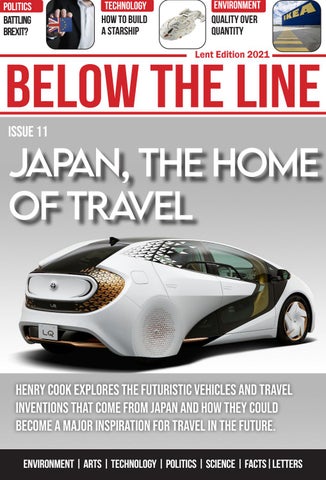
japan, the home of travel
Henry Cook explores the futuristic vehicles and travel inventions that come from Japan and how they could become a major inspiration for travel in the future. environment | arts | technology | Politics | science | facts|LETTERS
technology
Japan, the home of travel
Henry Cook explores the futuristic vehicles and travel inventions that come from Japan and how they could become a major inspiration for travel in the future.
from the editor
Have you ever been sitting in a car or on a bike and thought how boring travelling can be? Have you ever wanted to cruise down the streets in style on a ‘Back to the Future’ style hoverboard? Though many people think this concept is something that will forever stay in sci-fi movies, it could well become a reality… Travel is one of the biggest areas of competition in the current world as many companies strive to make their vehicles faster, stronger and better for the environment. Companies such as Tesla and Jaguar are embarking on many electrical car projects to save the planet, whilst brands like Ford and Range Rover are trying to make stronger and more
2
reliable cars to tackle tough terrains. However, while these companies steal the spotlight for travel, some major travel breakthroughs come from lesserknown companies. I am going to shed some light on some of these, focusing on the home of wacky technology; Japan. The first product I want to talk about is the vehicle I previously mentioned, the hoverboard. The Japanese car company Lexus has created a functioning hoverboard by using maglev tech (hovering on a track) integrated into the board, along with superconductors, magnets, and liquid nitrogen. The board is not yet ready to be used freely in public, as it needs an intricate track of magnets to be
This issue of ‘Below the Line’ is focusing on new horizons. We have articles on the future of travel and how to build a starship; nuclear energy and a robot revolution, climate change and the importance of recycling and reusing, as well as a round up of the arts, including an interview with the author Robert Muchamore. For the first time we have a piece of fictional writing by a Cokethorpe pupil. With the return to normality on the horizon it feels like we are going back to how we were before Covid-19, but I believe that we have jumped forward not back in almost every way, so it is probably better to look forward instead of back. Humanity as a whole has decided that, even though we were in lockdown, science has not stopped: we recently witnessed the Continued on page 17...
Cokethorpe School | First, Second, Third and Fourth Form Pupils
technology
on the ground where you want it to travel and needs to be refilled with liquid nitrogen every ten minutes, however it certainly proposes a concept and Lexus have made a breakthrough in the future of floating travel. Now, you might be thinking, ‘Oh, I’m always going to stick to my trusty bike.’ This next invention may be for you. A small, unnamed Japanese company has made a creative and clever way to keep your bike safe. ‘The Bisecu’ is a small circular device that goes in the middle of the front wheel of your bike. Its aim is to tackle the growing problem of bike theft. It connects to your phone via an app and alerts you when the bike has been hit or moved. Furthermore, it auto locks and unlocks as your phone becomes near or far from your Bisecu and
it can even track how far you ride and the calories you’ve burnt. The Bisecu is looking to be a super smart device that will advance bike travel. Finally, everyone has heard of concepts for self-driving cars and they have seemed like a thing of the far future for years; however, in the 2019 Tokyo Car Show, Toyota showcased a space-age looking car which gave us a glimpse into the future of self-driving cars. The Toyota LQ is a self-driving, electric-powered hatchback of the future. (It was formerly dubbed the ‘Concept-I’.) The car has its own artificial intelligence assistant named Yui, which will reportedly be able to sense the driver’s emotional state and alertness. According to Toyota, Yui will have a wide range of ‘human-machine interactions’ at its disposal,
including in-seat functions designed to increase alertness or reduce stress, in-vehicle illumination, air conditioning and even a fragrance dispenser! You can also put it in charge of your music playlist and chat to it about a range of topics. In addition to a digital friend, the LQ will come with an autonomous driving system, meaning it can practically drive itself. So, what do you think about the future for travel? Would you be comfortable standing on a liquid hydrogen-powered hoverboard or driving down the motorway in an AI controlled car? One thing is for sure however, that the future of travel is forever evolving, and the only way is up (literally).
Lent 2021 | Below The Line
3
technology
How to Build a StarShip
The prospects of space exploration have been widely researched. Companies like Virgin Galactic and Space-X are already exploring the possibilities, but could we go further? Oscar Luckett finds out what you need to create an inter-stellar starship. ‘Space, the final frontier’. The famous words of Captain Jean Luc Picard. It is funny to think that until a few years ago, we thought that Earth was the final frontier, but we are slowly making our way to the stars and beyond. Sure, we still have a long way to go. At the moment, you can spend a short amount of time in space, within the Earth’s atmosphere, in a small shuttle craft, strapped in your seat, (We’re not quite at Millennium Falcon level quite yet), but I am sure we can do more. How can we do more? How can we create a proper starship? Probably the most important thing needed in order to survive in space is oxygen. As you will already know, living organisms need oxygen to survive. A human can survive an average of three minutes without oxygen, so a constant supply is needed. The
4
most common method of creating oxygen in space is the electrolysis of water. This means the water is broken down into its two components, hydrogen and oxygen. But how is it done? Basically, a current is run through the water which separates the oxygen molecule from its hydrogen molecules. Even though this method would require a lot of water in constant supply and would probably take a while to produce enough oxygen for a crew of people on a starship, it still works. However, oxygen is not the only thing you might want to have to feel comfortable on board a starship; for example, gravity. So, how do you make artificial gravity? Obviously gravity is not necessary to survive in space, the ISS (International Space Station) doesn’t
have gravity and the people who walked on the moon were in hardly any gravity at all. But many people who return to Earth from the ISS have very weak muscles and lose lots of bone cartilage, so having gravity might be a good idea. To create artificial gravity, we would need the ship to be spinning. So, artificial gravity would probably work better on a space station. The spinning action would push us against the side of the station so the whole thing would have to be on its side. So, we’ve covered oxygen and gravity. But what if you want to move
Cokethorpe School | First, Second, Third and Fourth Form Pupils
technology around? What if you want to fulfil the romantic dream you had when you were five, of flying a Star Destroyer through the galaxy? For that, you would need some form of propulsion. You could use rockets, but it would take you years to get anywhere. There must be a faster way, right? There is.
Meet the light sail. It works as a huge mirror. When light moves through space it
has momentum. When it hits a reflective surface, like the light sail, it transfers some of that momentum onto the sail, and seeing as
there is no resistance in space, it launches the sail forwards. I suppose we can safely say that there is still a long way to go in the world of space exploration, but with technology advancing all the time, who knows when we’ll be soaring through the stars. Now where did I leave my space suit?
Lent 2021 | Below The Line
5
Science
Is nuclear energy the future?
Harry Adams explores the powers of nuclear energy in an age where ‘green’ is all the rage.
Nuclear energy is not as destructive as one would normally think. In fact, nuclear energy is cleaner then most and the most powerful energy source on the planet. To start off, the process that we use to harvest nuclear energy is known as nuclear fission. This is a clean process that relies heavily on water for cooling. This process is highly efficient, operating at an average of 93% capacity factor. This factor is comparing what the factory is capable of producing compared to what it is currently producing. When compared to the capacity of a coal power plant, which operates at a whopping 37% 75%, this means that even at its best, it is not even competing with the average of a nuclear power plant.
slowing the use of nuclear power. What could we use nuclear energy for? Pretty much anything when given the correct modifications. For example, back in the 1950s America was experimenting with
So why don’t we use nuclear energy as an alternative? Well, the answer is complex. There is no simple reason why we do not tear down the coal factories and raise the nuclear industry now. But as always, there are other contributing factors. For example, some regions like the Middle East export billions of pounds worth of fossil fuels such as oil and gas. With these factors in hand we know that the use of clean fuel alternatives is being delayed and even sometimes being flatout denied. This is preventing or
the possibility of nuclear-powered space travel. This later became known as project Orion. These rockets worked by using a series of nuclear pulses created by
6 Cokethorpe School | First, Second, Third and Fourth Form Pupils
fission. These rockets were intended for interplanetary space flights. Many of these rockets were known as SSTO’s (single stage to orbit) and were incredibly powerful. Project Orion, though, had many flaws in its design and concept. Every time the rocket took off it would be the equivalent of detonating a 10-megaton nuclear bomb. This was of course bad news, because it would only be a matter of time before nuclear fallout occurred and the world flooded with radiation. But potential lethal cancer in astronauts was not the reason that this project was eventually shelved. It was that the government couldn’t see the point of putting thousands of tons of payload into orbit. They also wanted to focus on the moon landing instead of nuclear propelled rockets.
Science
Get ready for the robot revolution
Patrick West explores the reality of robots and how they have advanced to do the riskiest jobs on earth. There are countless movies about robots taking over the world. Now, with developments in technology, this may just come to fruition. Boston Dynamics has been developing a wide variety of robots including a humanoid robot called Atlas and a robotic dog called Spot. Atlas is a humanoid robot, which means it is a robot that looks like a human. It is 1.5 metres tall and weighs 80kg. Atlas has 28 hydraulic joints; these allow it to do all sort of movements that humans can do. For example, it can run upstairs, dance like a pro and do backflips and parkour. So, now we have a robot that can do parkour, run and be coded to fight with every fighting style ever, I know what you’re thinking: ‘All hail Atlas the robot!’ However, the UN has passed laws to help prevent the creation of robotic armies. This law means that robots like the Atlas will only be used for search and rescue in situations where it is dangerous for humans. But Spot the robot is a friendly unit that is only for helping. It is good for the environment as it runs on battery power. It is designed to go into tight
spaces where a robot with wheels or humans just can’t make it. Spot is designed with 5 sets of 5 cameras, 2 sets on the front and 1 on each of the other sides. This allows the robot to perceive the world in 3D and 360
degrees around it. Spot is controlled remotely using an adapted android tablet with joysticks and buttons. Unlike a remote-controlled car, you can’t crash it, as when it sees a solid object it swerves to avoid it. Spot can be controlled from another continent with only a second of delay. Spot has two rails on its back,
on which you can attach specific devices for different scenarios. The real-world use of Spot is from power plants to repairing gas leaks, as one of the attachments designed by Boston Dynamics to carry objects around a factory with ease. It can also be used to assess the structural stability of a building before humans enter, creating safer working environments. Spot and Atlas do not learn but use 3D images of their surroundings. They then use a set of pre-coded movements and autonomously decide how to put those movements to use in those specific situations. This allows the Robots to be more versatile and means they do not need as long to be ready for a situation unlike artificial intelligence which requires it to have been in that situation before that moment. Although robotics is progressing at phenomenal speeds, we do not have to worry about the robot Armageddon as these machines are still relatively slow, clunky and can only operate for a few hours.
Lent 2021 | Below The Line
7
environment
How can we make space a resource? Felix Pool explores space and the solar system and the question of utilising and accessing the resources it has to offer.
The Moon and planet Mars are the two most visited places in space in this day and age by humans and their scientific experiments. Twelve humans have visited our Moon, yet no human being has been on the surface of Mars, although there have been five rovers. These two planetsare the most likely to have harvestable resources and are in the most accessible places in our solar system. In this article I will endeavour to answer the following question: How can we make space a resource? Mars and the Moon are largely made up of silicone, oxygen, magnesium and various irons, although their most useful resources are iron, titanium,
nickel and aluminium. 90% of all metal used in industry today is iron. Titanium is very important because it is used in the making of aircraft, space craft and missiles because it is as strong as steel but much less dense. Nickel is used in lots of alloys such as stainless steel and can resist corrosion even at high temperatures. Aluminium is used in a variety of objects such as cans, foils, kitchen utensils, window frames, beer kegs and aeroplane parts. All these items are essential to daily life and industry. The most challenging question is how we access the resources to make these items. Of course, there are many spacecraft that
8 Cokethorpe School | First, Second, Third and Fourth Form Pupils
can reach the Moon and Mars but a tool that can access these resources would be very heavy so any mission to gather them would have few other side tasks and crew members. The priority of any spacecraft attempting this would be creating a space where a large vehicle or tool can be stored and can easily enter and exit the spacecraft. In conclusion, right now the world is burning fossil fuels and causing global warming at a dangerous pace, and harvesting other planets’ resources could be the only other option for our planet in the future.
environment
The challenge of preventing climate change
Archie Clarke investigates the challenge climate change poses and the difficulty we have in preventing its damage to the Earth. Climate change is the major factor that will affect my generation. We need to cut the amount of greenhouse gases we put into our atmostphere and we need to do it now. Easy to proclaim; harder to actually do. So what are our options? Carbon Emissions Carbon emissions are a major contributor to air pollution. Although many European countries have cut down on these, other Asian and American countries are increasing. China is continuing to build power plants, but China is a main resource for all materials for the rest of the
world so it is hard to use climate friendly materials. What materials are climate friendly? Trees are an everlasting solution to climate change. Cutting them down decreases the amount of CO² they can consume. Cork and bamboo are sustainable materials we also need to protect. How can you help? Electric cars are a step in the right direction by not putting so much carbon into the atmosphere. You can also help by using renewable energy for
example: having solar panels put on your house. You can also repair your broken things and consume less materials and think ‘do I really need something new?’ Conclusion In conclusion I think that with time, humans can prevent climate change and it is going to be a fascinating 50 years, but we do need to act before it is too later. A few decreases might not matter in our country but it could affect crops, living conditions and untimately the survival of people.
Lent 2021 | Below The Line
9
environment
Refuse and Reuse Emma Campbell looks into the problem with food packaging and what measures could be taken to address it.
Food Packaging: what’s the problem? Currently, it is estimated that the UK uses 5 million tonnes of plastic each year, roughly half of which is packaging. So how can we reduce this number? Think about the last time you ate. How much of your food was packaged in plastic? Probably most, if not all of it. Why is plastic used in the first place? The simple answer is because it keeps food fresh. For meat it is important but still not essential as there are alternatives. For example, you can shop more locally from a farm shop or butchers. They often have their food packaged without plastic. Then it is your job to take a reuseable container or bag to carry it home and store it safely.
The big idea. People could easily reduce the amount of plastic that they use. Knowing that it is a problem and taking small steps (like not buying the fruit or vegetables with plastic around them.) I appreciate that this will not get rid of the problem completely. Instead of plastic, paper or cardboard could be used for everything bar liquids and meat. For liquids it is simple - just taking the same bottle that you have used previously and refill it at eco-friendly shops.Some scientists have found ways to use compostable or even edible pouches. Compostable plastic is now quite commonly used and could be used more widely if manufacturers were to use it in all food production. It is possible for us to use compostable packaging or no
10 Cokethorpe School | First, Second, Third and Fourth Form Pupils
packaging at all. Just having the knowledge to change the way you shop could make a significant difference until big retailers can be persuaded to change.
environment
Quality Over Quantity
Amelia Atkinson looks at the throwaway culture we seem to have adopted and the effect this is having on our environment. Introduction Throughout the 21st century, the market for buying and selling of fast-moving consumer products has grown considerably, but as more people are buying new products more frequently, it is having a major impact on the environment. As we are purchasing more new items, we are barely reusing or recycling the products we either already own or are donated to charity shops. Modern furniture is a consumer product that is generally thrown away rather than recycled because of the quality of the products. These items are the most damaging to the environment because the most common material
used to make furniture is wood. That is why the ‘circular economy’ is extremely important for the manufacturing and usage of products made from natural resources. Fast Furniture and the environment Disposing of products has a major impact on pollution and landfill. One of the most common large items you see in landfill is furniture, which is one of the easiest things to recycle. Once people see that their furniture is starting to get old or out of fashion, they throw it out and easily replace it with new. How much furniture are we actually wasting?
In the UK alone, we throw out around 22 million pieces of furniture a year, and according to research, only 1 out of 10 people attempt to repair their damaged or broken furniture. The trend for fast furniture means that we are no longer inheriting family heirlooms but choosing to shop at Ikea for the latest trends. Conclusion In conclusion, in order to stop using our planet’s limited natural resources we must re-educate the consumer to reduce, reuse and recycle their furniture rather than opt for the cheaper mass-produced items that are most damaging to the environment.
Lent 2021 | Below The Line
11
at Home
extreme reading
During Lockdown 3, our pupils found some interesting places to enjoy reading their favourite books. Here are some of their extreme reading locations...
12
Cokethorpe School | First, Second, Third and Fourth Form Pupils
at home
Lent 2021 | Below The Line
13
Science
5G explained
Lockdown demonstrated how much we depend upon excellent digital infrastructure and just how poor some of that existing infrastructure actually is. 5G heralds a bold, bright era for improved mobile links for us. But, as Anthony Skelly explains, whilst there is much to be excited about, it does have its limitations. it seems like those customers (i.e. lots of us) will experience the same problem with connections and service reliability as we always did.
5G is the next generation of cellular networking which promises faster data speeds and a higher capacity for devices, meaning if you are in a crowded area your connection won’t become ‘spotty’ (your signal, that is, not you personally). Quite a lot of Android devices can connect to 5G networks, since the top chip maker Qualcomm has, as of 2020, made companies buy both their chip and 5G modem. So in order to make use of what they have paid for, the mobile phone manufacturers must ‘bake’ 5G modems and antennae into their products. This is one of the key reasons that phone prices have shot up in the past couple of years. So far, in 2021, the 5G rollout hasn’t covered much of the country. But with the announcement of the new iPhones a few months ago, which pumped millions of 5G-capable devices into the market,
14
carriers will really need to start implementing greater coverage by building new masts and cell points around cities. But there is a problem. The upper band of 5G can be blocked by small objects such as trees, or even rain in extreme situations. This is because that band of 5G which gives the fastest speed uses a high frequency, higher than the previous generation, 4G, meaning that 5G needs a much more powerful connection than its predecessor, but also that its range isn’t as far as 4G. Fortunately, there is a lower band of 5G, which is faster than 4G but not as fast as the upper band, which has a longer range and will need to be used to cover wider areas. These areas will include places such as villages, where it is not possible to install cell points everywhere. Given that some parts of the nation – like Oxfordshire – are still remarkably rural in nature,
Another problem is that 5G uses significantly more battery than 4G, meaning companies must either fit their phones with larger batteries or find a way of consuming less power when on a 5G network. Apple recently came up with their own solution. They created an algorithm on iOS 14 which allows the phone to step down to 4G if the phone is not doing something that benefits from a faster connection. Users have the option to have 5G always on, use the smart mode, or have 5G turned off. So far this year, 5G service hasn’t had a far reach across the nation. But with the announcement of the new iPhones a couple of months ago, pumping millions of 5G capable devices into the public, carriers are expected to start implementing greater coverage for the growing market. Be wary, though, when your carrier starts offering 5G plans: they may be expensive. It seems like the infrastructure revolution may be on hold a little longer.
Cokethorpe School | First, Second, Third and Fourth Form Pupils
politics
Battling Brexit? The UK is facing a war on two fronts: the Covid-19 pandemic and Brexit. George Keates takes a personal look at that what he feels Brexit might mean for him now, tomorrow and in the future. All views are his own. We all know we have been hit hard by this raging pandemic. The number of people who have lost their lives makes for sombre nightly reading on the news, as does the monstrous number of confirmed cases. But, as the population has been restricted in their work and schooling during this crisis, the government has also had to undertake the mammoth task of getting a Brexit deal and then acting upon it in order to secure the UK’s future. Let’s go back to Thursday 23 June 2016, when the EU Referendum took place. The United Kingdom came out to vote on one issue: whether to stay in the European Union or to leave it. The Referendum result was – as we know - 52% to leave and 48% to stay, reversing roughly 44 years of membership, longer than the lives of all the people who wrote this magazine, and most of those who will read it. This narrow victory took another four, long years to truly enact, as a transition period, separation agreements (and a couple of Prime Ministers) came and went, until an UK-EU agreement was reached just before Christmas 2020. The first Prime Minister to leave over the Referendum was David Cameron, who left
shortly after the result, taken aback that the result did not go the way he expected. He was followed by Theresa May (our second female Prime Minister). She came under heavy pressure from her own party, as the deal became less and less likely to be achieved. We are still in the early stages of beginning our new ‘independent’ life as a nation. But the deal the UK government reached with the EU is either considered successful or terrible, depending on your political viewpoint. Some industries, like fishing, have been impacted heavily. There are now longer delivery times from the UK into European countries, meaning the fish can be likely to go out of date and not sell. And this is just one example. A worry that some foresee is that in leaving the European Union, UK exports may decrease by up to 2%. Modelling suggests that many more people will be more cautious when buying from the UK and may risk the future survival of some of our industries.
to leave ‘could possibly include a technical recession’. Economic output would contract for at least two consecutive quarters. This possibility, which, even at the time, many other economic forecasters thought unlikely, did not in fact materialise. While the UK’s economic growth has slowed since June 2016, there has been no recession as a result of Brexit, but as a result of the Covid-19 pandemic.
The long-term risk is the same in the way that it is uncertain what could happen. The short-term economic forecasts have attracted much attention and criticism as a result of the economy not entering a recession, which the gloomiest pre-referendum forecasts suggested. Some people have cast doubt on all the predictions that have been made by economists about the likely economic consequences of Brexit. So, it is really a waiting game to see what comes next. In the medium term, there is still a With the UK and Europe already large uncertainty about what is going disagreeing on the vaccine to come. Before the Referendum, rollout across the world, and the Treasury predicted that a vote for the European Commission Brexit would lead to an immediate challenging the movement of recession. Then the Bank of vaccines outside the EU, who England’s central forecast was for knows what the future may hold? the UK economy to keep growing, but the Bank’s Governor, Mark Carney, said that the risks of a vote
Lent 2021 | Below The Line
15
lETTERS TO THE EDITOR Dear Editor The ever-growing presence of social media over the last year has really emphasised the ongoing struggle of young people’s lives after education, as well as the importance of protesting for our environment and change in society. I think that schools should create a space in the curriculum for ‘life skills and world affairs’ allowing pupils to learn the essentials of independence: buying your first home, applying for a job and how to pay bills. Branching from this, some lessons could be more focused on specific topics, for example global warming or the Black Lives Matter movement, encouraging a young audience to become keen activists with more understanding. Currently our Cokethorpe WIT programme covers some of these issues; however, I think the lessons should be more frequent and interactive and as important as core subjects like English and Maths. Yours faithfully, Maddie Abbs-Wood
is that schools should be teaching and normalising recycling to pupils to encourage them to recycle so it becomes nothing out of the ordinary. This will make a huge difference to the Earth’s future. Teaching this in school would be very beneficial to pupils and will impact Earth in the future. In America, the national recycling rate is 34% and this needs to be changed. By encouraging pupils from a young age to recycle it will become a norm and you would be frowned upon if you didn’t recycle. Recycling will impact climate change which not only impacts the earth but hugely impacts the animals and their habitats. Many animals’ habitats are being destroyed which is causing them to be extinct.
possibly in the summer. In School after the Coronavirus has died down a bit more and there is no longer the requirement to wear a mask, I suggest that within the School, we continue using some of the safety precautions which are currently in place. An example of this is the hand sanitiser stations around School, but get rid of other precautions such as the one-way systems and year specific spaces. I also would suggest that if a person is suffering from an illness such as a cold and decides to remain in School, that they are encouraged to wear a mask to prevent others catching this. Yours faithfully, Eddie Comerford
By everyone recycling daily it would mean all these problems with climate change and animals could be resolved and the world would be much healthier. Yours faithfully, Romilly McIntosh
16
Dear Editor
Dear Editor,
There are many futuristic ideas I have when looking ahead after the pandemic and school life. My idea
I am writing to you today to suggest a new idea for when we return to some sense of normality,
Cokethorpe School | First, Second, Third and Fourth Form Pupils
Dear Editor, As a child, I learnt to swim. However, I recently learnt that this is not the same for everyone, as one in three adults are unable to swim properly. Furthermore, I was shocked to find out that on average ten people drown every day, with two of them being under the age of 14. I feel that schools should take more of a role in combating this by constructing swimming
lETTERS TO THE EDITOR pools on their site where they can. This could provide an important opportunity for novice swimmers to learn the basics. In addition, schools could have their own swimming teams to compete in galas and events, giving pupils a chance to do something different from a school’s main sports. Having a swim might also be a really fun way to spend your lunchtimes or free periods.
Continued from page 2... launches of the Space-X starship. As a School we have embraced the new technology and software with the use of Teams and the Surface Pros popping up around the School. I personally have been torn about going back to School as I enjoyed extra time in the mornings, where I would usually be travelling into School. However, having face-toface contact with my friends has lifted my spirits tenfold. I believe that we chose the right theme for this issue: with the place we are in and what is behind us, it feels like the sun is rising on a spring day after a night of storms. Chief Editor: Patrick West
We a welco lways m writer e new you w s so if ou to join ld like team, the ge touch t in
I know this is a big ask and undertaking for schools at this difficult time, but I feel it would have an immensely positive impact for all. Yours faithfully Isabella Carter Co-ordinators:
Mr Elkin-Jones
Mr Allen
Tye Hickey
Sam Farr
EmmaCampbell
Felix Pool
Henry Cook Anthony Skelly
Eddie Comerford
Archie Clarke
Meet the Team Designer: Mrs Maline
Amelia Atkinson George Keates
Oscar Luckett
Amelia Pratley
Harry Adams
Lent 2021 | Below The Line
17
book interview
Robert Muchamore Book Interview As ‘New Frontiers’ is the topic for this term’s Below the Line newspaper, what better way to celebrate than to talk about the modernising of a timeless classic; Robin Hood. Robert Muchamore is the bestselling writer of the Cherub series and its Prequel; The Henderson’s Boys. As a long-time fan, Sam Farr was thrilled to receive a reply from Robert. Robin Hood is a legendary heroic outlaw known as Robin of Locksley. The earliest mention of this hero is found in the B text of William Langland’s Piers Plowman, dated to about 1377. Robin has appeared in many television adaptions and has been played by actors like Kevin Costner, Russell Crowe and Taron Edgerton. It is said he lived in Sherwood Forest and regularly fought against his enemy, the Sheriff of Nottingham. He is known to steal from the
the Robin Hood legend is fact or fiction but we do know that the events are partly true. Robert Muchamore has brought the Robin Hood legend to the 21st Century with his new series. Who better to educate you about the Robin Hood series and his other books then the writer himself? Enjoy. Why did you decide to reinvent and modernise Robin Hood? I’ve always enjoyed Robin Hood stories, but I thought a modern version of the Robin Hood legend would be interesting, especially as Robin is known for taking from the rich to give to the poor and there is so much debate about equality going on right now.
Who is your favourite character? rich and give to the poor. It is to understand how
18
Probably my favourite character in hard any of my books is Summer in the much of Rock War series. She was really
interesting to write because she wanted to be famous, but also had to care for her sick grandma and the problems that created made her a really interesting character to write about. Flash is probably my favourite character in the Robin Hood books. Where do you see the series going? I’ve planned Robin Hood as a twelve-book series, though I currently only have a publishing contract for four. So hopefully lots of people buy and enjoy the first books, then I’ll hopefully get the opportunity to write the whole series of twelve. How often do you write? A Robin Hood book typically takes about two months to write, though I have to put in lots of planning and research before I can start and that is often the hardest part. When I’m writing a book, I typically start work
Cokethorpe School | First, Second, Third and Fourth Form Pupils
book interview around 10.00am and finish when I get hungry and want to make dinner! What are some of your favourite books? I always say my favourite book is Catch 22 by Joseph Heller. As a kid I loved Asterix books. When writing a book, do you base scenery and location on places you have travelled to or is it made in your head? Do you travel to find a place to base a book off of? I do all of those things. Sometimes I research a specific location, like I did with Kyrgyzstan where some of the later Cherub
books are set. But Robin Hood is set in a slightly skewed version of the modern-day world and I’ve made Sherwood Forest about 100x bigger than it is in real life. There you have it! An exclusive interview with the author. I hope you enjoyed this and maybe you have been persuaded to pick one of Robert’s books up. What I find the most enjoyable about Robert’s books is the fact that you can relate to the characters across all of his books so well because of the great character development. Many of the feelings portrayed by the protagonists are ones we’ve all felt before and that is why I enjoy his books so much. With Robin Hood, he has reinvented the
tale and provided fresh action to all lovers of the Robin Hood legends and his books. He has, in my opinion, brought the spirit of Robin Hood back to life. By making Robin twelve years old, he explores Robin’s childhood and the feelings every person has at some stage growing up; sadness, angst, joy and many more. By doing this, we begin to see Robin not as a thief helping the poor and a fighter, we see him as being a child dealing with many emotions and divided loyalties whilst trying to help everyone. That is what I love about this Robin Hood series.
Lent 2021 | Below The Line
19
short story
it should have been me Amelia Pratley has developed a story idea, using her outside surroundings to enhance more descriptive sections. Here is an exerpt.
With a devastating gunshot echoing throughout the pristine grounds like a discordant symphony, the pheasant collapsed to the ground, its corpse resting peacefully amongst emerald ferns as the ghost of its dying cry lingered upon its features. Letting out a sigh of indignation, a young man of brooding demeanour - the conductor of this performance in particular - picked up the carcass with his own, pallid hands and gazed upon it as he waited for whatever twisted chord followed. This man - cursed with the eyes of someone whose sanguine blood carried just as much internal conflict through his veins as it did vitality - was called Callahan Eastaughffe, and lurking beyond his ghostly,
20
freckled skin and hair as ebony as raven feathers, was the fractured soul of a son who was never quite good enough. A grand, Victorian mansion stood there observing the scene like a grandfather clock, so ancient and intricately put together that such a centrepiece could only sit and count the sheer amount of seconds it had been left there to decay. Two pampered topiaries towered either side of a worn, cobblestone staircase that trailed all the way up to the house’s entrance. Flowers dotted the surrounding lawns like loose buttons in a sewing tin, bringing a wonderful array of colour to an already vibrant and verdant landscape. With his caramelesque eyes fixed
upon his youngest son’s hunched frame, Lawrence Eastaughffe stood there - a stark monument with a warm shotgun tucked under his left shoulder - allowing him to take the reins and deal with the prize of this hunt, alone. Lawrence was a fiery-eyed man of shorter stature and beside him stood a petite woman, covering her eyes to shield them from what was happening just before her - after all, there was nothing the mother hated more than to see her own son kill. ‘You ought to wrap it up in cloth, Callahan,’ the older man instructed from where he stood, ‘I’m sure Hugo will be delighted to see a braised pheasant on his plate by this evening.’ The ebonyhaired male fell deep in thought
Cokethorpe School | First, Second, Third and Fourth Form Pupils
short story for a moment; he seemed to have forgotten about his older brother’s awaited arrival. Perhaps the most notable reason to remember the house’s two brothers was due to the truly striking differences between them. On the one hand, dusty-haired Hugo, the eldest of the pair had been gifted with the sort of charm that meant everyone in the room laughed at every word he uttered. It was for this reason that he had married as young as twenty, and if it weren’t for the ring on his left hand, he could enchant any woman with a simple smile. He was the most perfect example of a lord’s son you could possibly ask for and nobody could ever try to deny that fact. At only nineteen, however, the younger of the two dedicated
the majority of his time to studying and reading in the house’s library. After all, Callahan was a blossoming botanist whose mind ached for newfound knowledge; his mother’s son, truly. In fact, perhaps the most significant difference between the two brothers was the location of their minds themselves. While Hugo’s rested very firmly on his shoulders, Callahan’s frequently found itself drifting through blue skies and clouds as white as snow. He preferred the comfort of his daydreams to the real world. There was no doubting the fact that Hugo was the more favourable of the two and for that reason, Callahan loathed him. Perfect Hugo... Beautiful, ambereyed, bitter, selfish Hugo… Yet there he was. Successful, his father’s favourite, heir to everything.
Callahan wanted him dead. The destructive and acidic thoughts polluting the younger man’s mind wanted nothing more than to see his own knife piercing his brother’s right carotid, setting free the malevolent spirits that ran rampant through his conscience and drove misery into his own soul. After all, nobody but Callahan had seen the demons that corrupted Hugo firsthand; Callahan couldn’t control the feelings he had towards his brother... they controlled him. ‘It should’ve been me,’ the boy muttered as yet another, untouchable image of his brother danced amongst his thoughts, before at last swaddling the deceased bird in a cloth he had received from his father.
Lent 2021 | Below The Line
21
arts
digital theatre Eddie Comerford reviews an online production of Hymn, performed at the Almedia Theatre.
Hymn – Almeida Theatre Review Hymn is a new play written by Lolita Chakrabarti and directed by Blache McIntyre for the Almeida Theatre in Islington. It stars Adrian Lester, known for roles such as Othello at the National Theatre, and Danny Sapani known for his roles on such shows as Killing Eve. It was broadcast live from the empty auditorium at the Almeida Theatre throughout the end of February. The show is bookended by two funerals, the first for Gil’s
22
(Lester) dad and we first meet this character performing the eulogy in tribute to his father. At the end of the funeral, Benny (Sapani) approaches Gil with the suggestion that this man who Gil sees as his hero could be his father as well, with the two men being brothers. What then follows over the next 90 minutes is an emotional study into a developing friendship between the two men. Many songs are sprinkled throughout the show including ‘Lean On Me’ sung beautifully
by the two characters with Gil accompanying on piano. Whilst the two men never come within two metres of each other, the closeness that develops between these men is expertly developed by Lester and Sapani. The emotional ending can only be experienced by watching the show and I cannot recommend it enough to those of you reading this. I hope that this emotional piece can be replicated in front of a live audience.
Cokethorpe School | First, Second, Third and Fourth Form Pupils
weekly lockdown challenge
weekly lockdown challenge During Lockdown, the Modern Foreign Languages department challenged pupils to be creative with a variety of weekly lockdown challenges. Here are some of the winning entries for the various challenges each week. The challenges included a variety of different themes, all linked to MFL. In week one, the pupils were set the task of creating a Spanish dish. In week two, the pupils had to build a famous French landmark, from anything they had at home. In week three, the pupils were challenged to create sweet and savoury crepes and galletes. In week four, the task was to make a flag of a Spanish speaking country. In the final challenge, pupils were tasked with creating the outline of Spain or France.
Lent 2021 | Below The Line
23
MAD FACTS Wild dolphins call each other by name.
Ancient Romans used urine to whiten their teeth.
The next total solar eclipse will be on the 23 September 2090.
Cheese is the most shoplifted food in the world. Hedgehogs pick up their skirt to run.
In the time it takes to play the song ‘500 miles’, the ISS will travel 500 miles.
Police chased a serial killer who didn’t exist for 20 years (spooky).
Humans are the only animals that blush.
Barn owls are the only birds who can consistently fly at 5mm off the ground.
Ice cream is a solid, a gas and a liquid all at the same time.
By 2050 the population of the planet will be 9.7 billion.
24
Ninja warriors could use cats’ eyes to tell the time of day. It was due to the many subtle dilations of the pupil during the day.
Cokethorpe School | First, Second, Third and Fourth Form Pupils