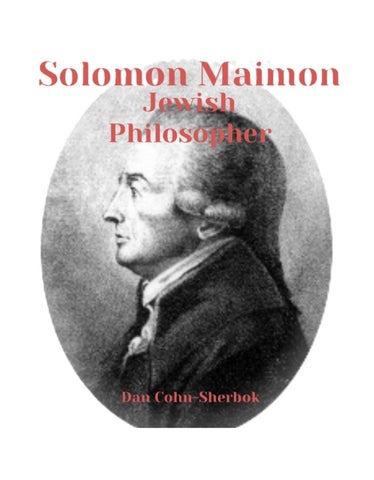
BOOK ONE
Chapter I Leaning upon the dilapidated railing of his porch, Heimann Joseph watched the sun trace its arc westward in the sky, silhouetting the water mill on the river Niemen, and finally melt into a sea of darkness. destiny.
Such seemed his own
The buildings comprising his estate had fallen
into decay from age and required repair.
The harbour and
warehouse which were used for vessels that came from K~nigsberg in Prussia were also in a state of degeneration.
Though
according to the terms of the farm's lease, the landlord was to repair everything and put it in a condition fit for use, he unfortunately resided in Warsaw and could give no attention to the improvement of his holdings.
Indeed, his
stewards were interested only in the improvement of their own condition rather than of their landlord's property.
Although
they burdened the farmers with all sorts of exactions to be used specifically for the improvement of the farms, they spent the money for their own advantage. Despondently Heimann Joseph recollected his fruitless attempts to ameliorate his state of affairs by remonstrances to the stewards themselves.
"But sirs," he would
say, "you don't recognize the severity of my plight.
If
nothing is put into proper condition according to the lease, then I'll be unable to make enough to pay my rent!"
-2-
Watching this Jew gesticulate in protest of unjust treatment, the stewards smiled secretly to themselves and made promises which they never fulfilled. "Of course we understand" they said.
"How dread-
ful that these problems have passed unnoticed!
But be
assured that your farm will receive the necessary repairs. We're happy that you've brought this deplorable state of affairs to our attention!' Days, weeks, months elapsed but nothing was done so that Heimann Joseph was forced to present his plea to the landlord's local agents and begin anew the same futile cycle of events. As Heimann Joseph stared into the night, he saw the faces of his brothers glow in the darkness. lot!" he thought.
"The ungrateful
"Tenants of the villages belonging to my
farm, living permanently with me under the pretense of assisting in the labor, and yet refusing to pay their rents at the end of the year.
Scoundrels!
May God blast your bones!"
The
injustice of the stewards and his own brothers burned in his heart, and he was filled with bitterness and hatred. Though Heimann Joseph felt himself victimized by destiny, the truth was that had he borne the injustice of his situation instead of seeking justice from more powerful litigants, he could by his own resources have rebuilt his farm. Thereby he would have insured for himself financial solvency and avoided certain perils.
-3-
One day a rich Polish nobleman with an entourage of servants was passing over a bridge leading to the farm, but the supports were in such a bad stat~ that the entire structure collapsed, spilling horses and riders into the swamp.
The
Count cried out when he saw the calamity, "Seize the owner!" he said.
"Drag him to the bridge!" Four men then took hold of Heimann Joseph who was
working nearby in the fields and laid him out on the planks that remained of the bridge.
The Count then took a piece of
rope, but before he flogged Heimann Joseph he offered him a word of contempt. "Jew," he said, "know that your are fortunate! going to spare your life. death.
You really deserve a lashing to
See what you've done to my men, my animals and my
possessions through your carelessness. my trip.
I'm
And, you've delayed
I have a long journey to make today.
Out of my
kindness, I'm going to give you a light punishment." Then the Count began to beat Heimann Joseph mercilessly until his shirt was crimson-red from the blood of his wounds. To avoid such woes, one of the workers at the farm was stationed to keep watch at the bridge, so that, if any noble were passing, and an accident of this sort should happen, the sentinel might bring word to the house as quickly as possible. Then the entire family could have time to take refuge in the neighbouring wood.
When this happened, which was not
-4-
infrequently, everyone would run panic-stricken, shouting words of terror into the forest where often they were obliged to remain the whole night in the cold air, till one after another they returned to the house the following morning.
Be-
sides the terror and consternation into which the family was thrown by such a flight into the woods, the empty house would be plundered by the nobleman and his men.
Beer, brandy and
mead would be guzzled, food and animals carried off, and religious objects desecrated.
menorahs would be smashed and
the pieces scattered on the wooden floor, talesim torn into shreds, and holy books burned in the fireplace.
After such
devastation, the male members of the family attempted to rescue tractates of the Talmud from the flames of the hearth. Such a calamitous domestic condition could have been avoided had Heimann Joseph been more economical in matters of great importance rather than in trivial affairs.
The annual
produce of- the fields, pasture-lands and gardens as well as the income from the sale of grain and hay were sufficient for the needs of his family, yet Heimann Joseph wasted both time and effort on minor details.
A typical example of his mis-
management concerned the burning of candles.
The master of
the house considered it an extravagance to burn wax or tallow candles.
Their place had to be taken by thin strips of
resinous pine, one end of which was stuck into the chinks of the wall, while the other was lit, thereby starting fires and causing damage.
Such a disasterous policy of unwarranted
-5-
waste coupled with Heimann Joseph's unwillingness to face an inevitable reality -- the unscrupulousness of his landlord's stewards -- were merely manifestations of his imcompetence in worldly affairs, a trait he shared with his wife.
Like
h~r husband, having no suspicion of evildoing, she would lie down in her clothes when she was tired from her household chores, all her pockets full of money.
The housemaid took
advantage of this negligence by emptying the pockets of half their contents.
Amazingly, Heimann Joseph's wife seldom
noticed her loss. Unfortunately, Heimann Joseph was considered a rich man, which he really could have been had he known how to make the most of his opportunities.
He was envied and hated by
all, even by his own family; he was abandoned by his landlord; he was oppressed in every possible way by the stewards, and cheated and robbed by his own domestics as well as by strangers.
In short, he was "the poorest rich man" in the
whole of Poland. The culmination of such misfortune occurred near the end of Heimann Joseph's life.
The priest in the village was
an ignorant blockhead who had scarcely learned to read or write.
He spent most of his time with his parishioners at
the inn where his drunken, blood-shot eyes smoldered even redder with rage as he spoke venomous words of malice against the Jewish farmer.
His fat jowls quaked tempestuously as· he
thundered, and his long red hair danced like flames in the
-6-
heat of his passion.
The source of this invective appeared
to be the fact that he had previously always let the liquor he drank at Heimann Joseph's inn be charged to his account, though he t1 a d no intention of paying.
At last he was denied
credit, an d thus he sought personal revenge. " f11 y f e 11 ow Ch r i s t i an s , " he s a i d t o hi s p a r i s h i on e rs ,
"this h s re's my plan to do God's work by punishin' this Jet·J, t his d o~ ned blasphemer who torments us through his high prices and lack of credit just as his ancestors tormented our Saviour. There ' s a be a ver-trapper who's right now livin' somewhere's a r o u nd t ho town of r ir since he's catchin' beavers on the riv e r a nd tr a d8s his furs with this accurs ed Jsw, Joseph. sp i ed him
2t
I
mid night makin' his way to the Jew's house in-
stead of deliverin' the pelts to the manor.
Let's get the
tr2pper, 2nd make him help us get our revenge." The Christians who were seated with the priest smiled at one another with bemused expressions and drew their chaits nearer the table.
A tall fellow with dirt-encrusted blond
ha ir leaned toward the minister and in a half-drunk tone asked, "And what'll happen to the poor Sheeny?" In a
ui
his per , Father Dim i tr i exp 1 a in e d his p 1 an .
" Lfa
pay the trapper to make a visit as usual to Heimann Joseph, but instead of a beaver, the bag he delivers '11 contain the body of a dead man! cemetary ..
I can get one easily enough from the
Then tell the police that Heimann Joseph killed a
man to use his blood for some Jew ritual.
A quick search of
-7the house, and they'll see we're tellin' the truth," A feeling of adventure and delight swept through this group as they agreed to the proposal.
"For the sake oF our
Saviour whom they nailed to the cross," a small moustached farmer emphatically stated.
"Let's us carry out God's will,"
they triumphantly agreed. On the first of the month, under the white light of the new moon, the trapper made his way across the fields to the proprietor's house. "Reb Heimann Joseph, you there?" "i~ot so loud, my good man. my porch for your arrival.
I've been waiting here on
How have your prospered?
What pelts
have you brought me?" "Trappin's been damn good this week on the river. Look how heavy this bag is -- what a catch I've brought you." "Good, good.
IYly God, it is heavy!
Let me strike a
match so we can come to some agreement over the price; I must see what kind of beaver this gigantic fellow is." "Hell no, Reb Heimann, not tonight! I trust you to deal fairly with me as always.
It ain't necessary. Let's talk about
it tomorrow. As usual, Heimann Joseph innocently agreed, not suspecting any foul paly.
Leaving the bag in a corner of the
room, he fell asleep.
Hardly had he begun to doze when suddenly
loud knocking aroused him. "LIJho' s there at this ungodly hour?" he cried out.
-8-
"Allright, allright, I'm coming."
As he opened the door, a
mob of peasants led by the priest flooded into the room. Christ-killer! screamed.
Bloodhungry Jew!", Father Di:ni tri
"Search his house.
Find the innocent victim!"
In a moment the house was reduced to shambles; peasants were everywhere, tearing up the beds, ripping clothes from the closets, upsetting furniture and household goods until at last the priest himself found the trapper's bag in a corner of the room. Heimann Joseph shuddered as he saw the mob ravage his home; he was certain that he had been betrayed at the manor on account of his secret trade in beavers, but how great was his horror, when the bag was opened, and instead of a beaver, there lay the corpse. "No, it cannot be!" he cried aloud. fathers, it's not so. plot.
I'm innocent.
"Oh God of our
I'm the innocent victim of some horrible It's not my doing.
By everything sacred,
I swear I'm innocent!" The terror-stricken Heimann Joseph would have collapsed, but was supported by two large farmhands who bound his hands behind his back and placed his feet in stocks.
They then
threw him into a wagon and drove to the town of Mir while Joseph's wife stood helpless and stupefied on the doorstep. As was his custom, Heimann Joseph protested his innocence and pointed to the injustice he had suffered. one planned this whole affair," he said.
"Some-
"Someone with a
-9-
grudge against me trumped up this horrible accusation." Such was the tenor of his defense when he was cast into a dark prison bound in iron chains, and also at the trial in the criminal court.
He related the events exactly as they
had happened and demanded that the beaver-trapper should be examined, too.
He, however, was nowhere to be found; he was
already over the hills andfar away.
The judge, nonetheless,
was deaf to Heimann Joseph's appeal and ordered him three times in succession to be brought to torture, although the old man continued steadfastly in his original assertion. Through good fortune it happened that the trapper was eventually found and examined.
Since he immediately denied
any knowledge of the affair, he was put to the test of torture. Thereupon he at once confessed the entire story.
He declared
that, some time before, he had found this dead body in the water, and was going to bring it to Father Dimitri for burial. The priest, however, had said to him, "There's plenty of time for burial.
You know the Jews are bastards and are damned to
all eternity.
They crucified our Lord Jesus Christ, and they
still seek Christian blood, if only they can get it for their Passover.
They use it for their matzo, their Passover-cake.
You'll be doing a good thing, performing God's justice, if you can smuggle this dead body into the house of the damned Jew farmer.
This will lead to his arrest and imprisonment.
I've such an interest in this righteous act that I'll even pay you for your trouble."
-10-
Upon hearing his confession, the judge condemned the trapper to be punished by whipping.
Heimann Joseph was set
free, and the priest remained in his place, though he merely received a sharp rebuke rather than a prison sentence.
Such
was the nature of justice in eighteenth century Poland. Convinced that his release from prison was divinely ordained rather than a happy incident, Heimann Joseph composed in Hebrew an epic poem retelling the whole event and singing God's goodness.
He even declared that the day of his deli-
verance should be celebrated in the family every year and that this poem should be recited in the same way as the Book of Esther at Purim.
Such enthusiasm over the triumph of a Jew
contrasted sharply with the despondency of the masses of Polish Jews who were still mourning the Chmielnicki massacre. In this manner the unworldly Heimann Joseph lived for many years on the farm which had become the property of his family.
By Jewish ceremonial law the right of property in an
estate or Chazakah is acquired by three year's possession and this right was respected even by Christians in the territory of Prince Radzivill where Heimann Joseph and his family dwelt. By virtue of this law, no other Jew could try to get possession of the farm by an offer of higher rent without bringing upon himself Jewish excommunication. Though Heimann Joseph continually complained about being in difficult circumstances, his three daughters were well dowered and married to men of high social status.
His two
-11-
sons Moses and Joshua were married in a similar fashion, and when the master of the household became old and enfeebled by the hardships to which he had been exposed, the management of the entire farm was given to his two sons jointly.
Since
the sons were of entirely different temperaments and inclin a tion -- moses tho elder was of a strong bodily constitution but inferior intelligence, while Joshua was the opposite they consequently could not work well together and their pattern of mutual conflict resembled that of the Biblical J a cob and Essau.
In this regard as a result of one of the
unfortunate disasters that occurred to the family of Heimann Joseph, the younger son Joshua fell victim to a torture that undermined his health. Once when the bridge collapsed and the household retreated as usual to the safety of the forest, Joshua who knew nothing of the accident stayed behind alone, playing at the back of the stove.
When the inflamed traveler came into
the house, he ordered his men to search every corner of the house, and the child was found behind the stove.
Since the
traveler could find (o'Q} one else on whom to vent his wrath, he asked Joshua if he would drink brandy, and when the boy refused, shouted, "If you will not drink brandy, then you shall drink water."
Thereupon he ordered a bucketful of water to be
brought and forced the child, with threats and lashes to drink it down. "Drink, you damned little JeL\J," he said.
"Let me see
-12-
all of it flow down your cursed throat.
May your God save
you now; and don't think you'll escape until you've finished the last drop.
The sting of my lash will encourage you."
Not surprisingly, this treatment brought on a fever which lasted a whole year, destroyed Joshua's health, and t~ereby drove him to scholarly pursuits which merited him special.consideration.
Animosity between the brothers thus
had its origin early in their youth as a result of Joshua's jealousy of moses' physical stamina and moses' jealousy of Joshua's learning and delicate treatment.
But not only had
Joshua to face his brother's hostility, he also had his fnther's parsimony to endure. Once when scholarly Joshua ordered for himself a rabbinical suit which required finer material than that used for common clothing, Heimann Joseph was quick to lecture him on the vanity of the world. Pointing a long, sun-parched forefinger toward hia younger son, the old man reminded him of the frugality of their ancestors.
"Our forefathers," as he was accustomed to say,
"knew nothing of these new-fashioned costumes, yet they were devout people.
Did Abraham or Isaac or Jacob or the countless
righteous men after them ever have a coat of striped woolen cloth, or leather hose, or buttons; yet .1'..£!:! must have all these things!
Joshua, you'll bring me to beggary; I'll be thrown
into prison on your account. man.
What's to become of me?"
Woe is me.
I'm a poor, unfortunate
-13-
Intoning his argument in the traditional singsong rabbinic manner, the pale scholar defended his cause. father, you don't understand my position.
"But
Have I a choice
but to dress in the manner appropriate to my role in the c O mmun i t y ?
I n 8 a ba r,1 e t z i a , i s n ' t i t wr i t t e n t hat " 0 n e mu s t
rob one's belly and adorn the body," and what could be the meaning there but that one should do this out of respect for a scholarly status?" "fi1 y
s on , I a g re e t hat s c ho 1 a r s mu s t b e re s p e c t e d in
the com~unity, but why should they dress themselves as if they were Torah scrolls bedecked with ornaments to be admired by the congregation?" "father, let's assume that the economy of a household is well arranged.
Does it matter then at all if one lives
sparingly or luxuriously as long as one lives within the confines of his income?
As the sages of blessed memory said,
"One should eat vegetables and fear no creditors, rather than eat duck and hide."
Is the point they were trying to make
that one should refrain from fine food? one should live within one's means?
Isn't it rather that
father, your misfortunes
arise not from extravagance, but from the fact that you allow yourself to be plundered through negligence." "I've heard enough of this!
There's nothing further
to discuss; I've made up my mind, and I won't tolerate any frivolous innovations." Due to the ~arrow academic demands and restrictions
-14-
of Joshua's profession, he was not particularly suited to running the farm.
He merely kept accounts, made contracts,
heard legal cases, and attended to similar matters.
To save
him from financial peril, Heimann Joseph, seeing in his youngest son a reflection of himself, arranged a marriage for him with a lively young girl who had a head for business and a worldly outlook.
Though small of stature, Joshua's wife
radiated a sense of power and determination; her deep black eyes, framed by long chestnut
colored hair, suggested mystery
and at the same time a keen intellect.
Her unusual beauty
distracted even the most diligent scholars who studied from time to time with her husband.
It was not unusual for one of
these bearded men, glancing fleetingly at the dutiful woman attending her household chores, to break his fluid rhythmic chant and movement over the worn pages of his Talmud. Joshua himself looked upon his wife Esther with a deep reverence, and on Sabbath . Eve, when she covered her eyes with her hands before the Sabbath candles, her tears glistening in the glow of the flames, she appeared to her husband like the Sabbath bride herself.
Lighting the candles, and moving
her arms over them in a gesture of embrace, she seemed to draw to herself the holiness that rose from their brightness. And when Joshua recited the words of Proverbs:
"A woman of
valour, L11ho can find?
For her price is far above rubies ... ,"
he was truly moved.
Yet, there lurked beneath her submissive
surface a portion of her soul which he could not understand.
-15-
There was a secret part of her being which she never disclosed even to her husband; there werG times when she would drift off into that hidden recess, that secluded, distant part of her self, and lose all contact with the external world.
It was
as though she achieved a mystical union with some inexplicable essence, her eyes clouded, and her mouth curved into an enigmatic expression.
Joshua first noticed this puzzling aspect
of his wife's bearing in the bridal chamber on their wedding night.
Like all Jewish grooms, he was acquainted only on a
scholarly, theoretical level with connubial behavior; he was truly at a loss for what to do and say.
But saving him from
embarrassment and self conciousness as he began to recite phrases from the Song of Songs that he had memorized precisely for this occasion, his wife put her lips upon his and whispered, "Joshua, my husband, my love," and without words they melted into one flesh.
And then as Joshua struggled to concentrate
on Torah and to be in a mood of supreme holiness as enjoined by Jewish law, he noticed that his wife seemed to be in a distant
place as her face assumed an expression of rapture.
But it was not only during their love making that Esther had this air of mystery; several times her husband questioned her about it, but she always smiled and said it was nothing.
Chapter II Two years after their marriage, a son was born to Joshua and Esther. very easy.
He was a large baby, but his delivery was
He had the coloring of his father, and the temper-
ament of his uncle moses.
During his first years, he showed
no signs of interest in learning; he always preferred to play in the woods rather than listen to his father attempt to give him so me introduction to Jewish learning. "See, Joseph," his father would say, "these are the letters of the Hebrew alphabet which you'll learn at school when you're three.
Try to say them after me."
"Papa," Joseph would say, "how pretty the sky is today." "Joseph," his father would respond, "listen to Luhat I have to say.
You're not paying attention."
"Papa," his son would protest, "I'm tired.
Please, I
want to go into the forest and play." On the ninth of Sivan, 1753, a second son was born. Unlike his brother, this child was small and frail and had his mother's deep black eyes.
When she first saw him, she
laughingly exclaimed, "How can we show him off at the bris, he looks like a plucked chicken?"
Her humor, however, hid the
fact that the birth had been difficult.
Though the midwife
encouraged her to shriek and moan in labor -- "Scream, child, and try hard!" she would say -- the pains were so extreme
- -- --
-17-
that they seemed to be punishments from God,
At one moment
the delivery seemed so difficult that the women from the family in the adjoining room were ready to go to the cemetary to beg their ancestors to help Esther in her travail.
The
men, too, were prepared to go to the synagogue and say the appropriate psalms. Fortunately, however, the child was born before such desperate action became necessary, and eight days later, a midst gaiety and warm words of congratulations, the parents rejoiced at the circumcision of the new addition tD the family, But like the birth, the ceremony was not without complications. When an old friend of the family, Reb Menachem, who was to have the honor of sucking the first drop of blood, put his lips to the wound, he began to choke and had to be revived by the father himself. There were problems, too, that arose during the first few months after the child's birth.
On the Sabbath after the
delivery, the child was to receive the name Solomon.
It so
happened that the Haf torah was from the mournful book of Ecclesiastes, a book attributed to King Solomon.
Those
assembled could not help associating the newborn Solomon with the despondent old monarch, and a melancholy note was struck on an otherwise joyful occasion.
Furthermore, Joshua worried
that too much praise had been bestowed upon his son, and he feared the power of the evil eye; also, he noticed that his child laughed to himself at night, a sign that he might be
-18-
playing with the demon Lilith, Adam's first wife. Nonetheless, despite these ominous portents, Solomon grew into a strong, healthy, playful child with a perpetual inquisitiveness and sharp mind like his parents.
When the
child was three, Herr Piliezki, one of the agents who undertook the purchase and delivery of goods for the higher nobility, while having tea at Heimann Joseph's home, entreated Solomon to call his mother by the nickname given her by the merchants. "Solomon," he said with a lighthearted smile, "I'll give you this piece of sugar if you will say •mama Kuza', a term pregnant with sexual overtones. Solomon, knowing by previous experience that his mother would scold him if he called her by this name, refused to comply when she was in the room.
Herr Piliezki made a sign
to her to go into an adjoining room.
As soon as she had shut
the door, Solomon went up to the shaffer and whispered in his ear, "~1ama Kuza."
Herr Piliezki insisted, however, that
Solomon should say the name aloud and promised to give him a piece of sugar for each time that he spoke it.
Accordingly,
Solomon, with a victorious ring in his voice said, "Herr Piliezki wants ~e to say 'Mama Kuza;' but I won't say 'Mama Kuza', because God punishes anyone who says 'Mama Kuza'. Thereupon, the boy was rewarded with three pieces of sugar. When Solomon became older, he was brought to the dardeki kheyder, the Jewish school for small children, to join his brother, Joshua, who sat with him during his first
-19-
lesson, noticed that his son concentrated on the Hebrew letters of the prayer book without the uniual inducement of candies and coins.
But it was during the hours of twilight when the
melamed or children's teacher went to the shul for the afternoon prayers that Solomon's creative intellect shone most brightly.
Sitting in the darkness by the stove or huddled
together on the study benches, the children listened with fascination to Solomon's stories about strange beasts and g ig anti c angels burning with fire who touched men and turned thGm into pure spiritual beings. Though Solomon turned out to be a gifted student, as his father suspected from the very first day of kheyder, Jo shua was dismayed by his son's questions. Cne day, in Solomon's sixth year, Joshua began to study the Sible with his younger son.
Starting with the first
verse, Joshua read out loud, "In the beginning God created the Heaven and the Earth ... " "But Papa," the youth interrupted, "I don't think that this is the real beginning. 'Bereshis',
You started out with the word,
'In the beginning,• but that can't be the beginning!
Because if God created the Heavens and the Earth, then someone would have likewise had to have created God.
Papa, who created
God?" "My son, God was not created by anyone. from all eternity.
He has existed
He is the first and the last, and besides
Him, there is none other.
As the Psalmist said,
'Before the
-20-
mountains were brought forth, or ever thou hadst formed the earth and the world, even from everlasting to everlasting, thou art God.'" "Did He exist ten years ago then?"
Solomon asked.
"L!Jhy, yes, my son, not only ten years, but even a hundred years ago." "Therefore," Solomon continued, "God is already a thousand years old?" "3ilence!
Enough of your words!
God is, as I've said,
eternal." "But," Solomon insisted, "God must surely have been born at sor.ie time." "I've heard enough of this.
There's nothing to dis-
cuss; I have made it quite clear, God is forever and ever." Other theological questions troubled Solomon as well. One day walking home from school with his brother Joseph, Solomon questioned him concerning a passage he had seen in the Proverbs. "Joseph," he said, "in the Proverbs we read this verse: 'For the ways of man are before the eyes of the Lord, and He ponders all his goings.'
What does this mean?"
"IJJell," his brother began with a trace of elderly condescension, "the meaning is quite clear, I think. everything that man does. Adam and Eve.
God sees
Remember the story in Genesis about
They couldn't hide from God, and they were
punished because God kneLU that they'd disobeyed Him."
-21-
"You're saying then that God knows all of man's actions. Every one.
Then He must know them before they take place."
"I don't know.
I guess so."
"It must be, since God is supposed to have knowledge of everything, and if He is forever and forever as Papa says, then His knowledge must likewise be forever and forever. Joseph, look at it this way.
But
You mentioned the garden of
Eden; doesn't it say in Genesis that Adam and Eve could eat from the tree in the midst of the garden if they wanted to?" "Yes," his brother answered. "Then, man can do as he wants, but is punished if he does the wrong thing:• "Yes, I agree." "But Joseph, don't you see the problem?
God's know-
ledge is forever and ever, and He in this way knows everything, even before it takes place.
But if this is so, how can man
choose what he wants to do, and receive punishment if he chooses the wrong thing, since God Himself knows what each man is going to do?
And Joseph, doesn't it seem evil of God to punish a
person if God knows what his action will be before he is born?" "Solomon, I don't understand your questions.
You seem
to be saying things that would anger Papa and the melamed, and I really don't see what you're trying to prove by all this talk." If the truth be known, Joseph, who was more like his uncle Moses than like his father, resented his brother's penetrating mind and ability in school.
One day while playing
-22-
together at home, Solomon engaged his brother in a conv e r sation which drew out Joseph's hidden anger. "Joseph," Solomon asked while his black eyes fl a s hed with inquisitiveness, "we've learned that God is good and merciful; in the Shemoneh Esreh prayer, we recite his qualiti es of kindness.
But if He is truly like this, why is there so
much suffering, why so many horrible things in the world.
Ho w
can God permit people to die, if their families are so sad afterwards?" "Solomon, stop with all your questions:
Stop it!
I
can't stand to hear you say all these wicked things about Go d . What would Father do to you if he heard?
He'd take out t he
lash, that's what!" "I was only curious to know ... ", Solomon replied meekly . "~~ell, you'd be better off if you just li s tened to what those who are older than you say is right and true." Solomon's inquiries were not confined mer e ly to t he realm of theology, but concerned worldly matt e rs as we ll.
On
one occasion he was reading the story of Jaco b and Esau in th e Bible, and in this connection, his father quot e d a r elevant passage from the Talmud where it is s a id, "J acob and Esau divided bet ween them all the bles s i ngs of the world .
Esau
chose the ble ss in g s of this lif e ; Jacob , on the c ontrary , t hose of the future life; and sinc e we are descended fr om J a c ob , we must give up all cl aim to t emporal blessin gs ." Pu z z l ing over the signific ance of this p assage , Solomon
-23-
thought to himself, ''Why in the world would Jacob have made such a choice?
I know that that I love the pleasures of this
life, playing with my friends, walking in the woods, reading at school, waiting for Shabbos with all its special qualities to come; these things I know because I've experienced them, but I don't know what the future world is like. not nearly so nice.
And who . can say?
Perhaps it's
It's better to chose
what one knows, rather than what one doesn't know at all.'' After this meditation, Solomon interrupted his father, who was expounding the meaning of the talmudic passage, and said with indignation, ''Jacob shouldn't have been such a fool; he should've chosen the blessings of this world:" As was to be expected, Solomon received from his father a box on the ear and a reprimand, but though it silenced the child, it did not remove his doubt. It happened also that one day Prince Radzivill, who was a great lover of the chase, came with his entire court to hunt in the neighbourhood of the village.
In the party was
his daughter, a beautiful, shapely maiden with golden hair that shimmered in the sunlight.
This young princess, in order
to enjoy her afternoon rest, went with the ladies of her court, the servants in waiting and the lackeys, to the very room where Solomon was sitting behind the stove.
Struck by the
magnificence and splendour of this retinue, the vivid colors of the women's riding costumes, the handsome leather suits of the men, and overwhelmed by the elegance of the princess,
-24-
Solomon exclaimed to his father in pure delight, "Oh, how beautiful!" In order to calm his son and at the same time confirm in him the principles of the Jewish faith, Joshua whispered in his ear, "In the other world, the princess will kindle the st o v e for us .
/\ s t he sages s a i d in t he nH sh n ah , ' This wor 1 d
is only the vestibule to another.'
Therein we Jews who have
kept Cod's laLu will find our reward." The effect of these words on the young Solomon was very profound.
On the one hand, he believed his father and
rejoiced in the fact that there would be such future happiness in store for him and for his family, yet at the same time, he felt pity for the lovely princess who was destined to perform such ~ark.
Gut most difficult of all to conceive was how
this beautiful princess, in such splendid and ornate clothing could ever be reduced to the role of lighting fires for poor Jews.
This paradox weighed heavily on his mind until he was
distracted by a childhood game, but it was never entirely forgotten. Solomon's talents were not confined to the intellectual sphere alone; his acute sensitivity, sparked by the glories of nature that surrounded him on the farm, led him to aesthetic pursuits.
Though he had never seen a work of art in his
father's home, he was fascinated by the drawings of trees, foliage and birds that he discovered in several of the Hebrew books on his father's shelves.
This primary interest was
-25-
strengthened by a Hebrew book of fables, in which the animals were depicted in luxurious woodcuts with deep, rich colors. On seeing these pictures, Solomon thought to himself, "How magnificent this all is! draw like this. the farm.
It's so beautiful; if only I could
There's so much to draw, so many animals on
If only I could put down on paper what my eyes see!"
In this burst of excitement, Solomon traced all the figures in the book with diligence and exactness.
Upon seeing what
his son had done, Joshua admired his skill and said, "My son, you're an artist, I see.
Your copies are very nice, indeed."
"Father," Solomon responded, "I want to draw all the ani~als in the village; the cows, the chickens, everything. And I want to draw nature, too.
See how pretty this picture
is of the letter bes with trees surrounding it!" "Solomon, you want to become a painter? will you do such a thing.
Never. Never
God is the supreme artist; it's
man's function to serve Him through study, not through this childish play.
You must study the Talmud and become a rabbi.
He who understands the Talmud understands everything. have no more of these foolish thoughts!
I'll
Come, let us resume
our study of the Bible with the commentaries." Despite this initial discouragement, Solomon continued his interest even when the family found it necessary to move to Sukoviborg, a small town on the river Niemen near his former home.
Here there was a manor-house with several
beautifully tapestried rooms which were never occupied because
-2 6-
the landlord resided elsewhere and very rarely visited the place. Whenever Solomon could, he used to steal away from home to copy the figures on the tapestries.
On a cold winter day while
Solomon made one of these ventures to the old house. The snow was falling heavily as a bitter cold wind tore its way through the wooded land, across open fields, and beat against old thatched huts.
In the midst of this blizzard,
Solomon, dressed in heavy woolen garments, trudged through deep drifts of snow, his minute dark form outlined against the solid white expanse.
Slowly he approached a large stately house,
abandoned for the winter. drawing paper.
Once inside, Solomon took out his
Holding the pad in one hand while he copied
the figures on the wall, he began his artistic exercise.
Since
there was no heat in any of the rooms, his fingers soon were numb, and after a short time his entire body was almost frozen.
It was only through good fortune that Solomon was
rescued from this danger by the caretakers of the mansion who happened to be making an inspection that particular afternoon; to their horror, they found the youth nearly frozen in his drawing position. When Joshua was informed of his son's activities, he gave him a severe lecture.
"Solomon," he said, "there is a
story told about the great sage Hillel who, when he was unable to afford to attend a scholarly lecture, positioned himself on the roof of the lecture hall so that he might hear what was said.
It so happened that it was mid-winter, and Hillel
-27-
nearly froze to death before he was rescued by several Jews who noticed that some object was blocking the skylight of the building.
From then on Hillel was able to attend the
lectures without paying since he exhibited such a quest for knowledge.
But you!
Look at what you've done!
out from the house without informing anyone.
You went
Your mother
was terrified to death, and I myself thought you might have been kidnapped as part of some horrible Christian plot.
And
th e n, not to study Torah, but to copy some ridiculous weavings on a ta p estry at a house where you were unwelcome in the first place.
Ta k e the example of Hillel to heart; if you expose
yoursel f to such danger, it should be for the sake of study or so ~ e other mitzvah, not for such frivolity.
That's enough.
Let me never hear of you drawing again, or you'll feel the edge of the lash. Thus ended the youth's career as an artist.
In his
own mind Solomon thought that had his father been more understanding, he might easily have _become a great painter, though not an exact one, for he had not the patience to work out his drawings in laborious detail.
Chapter III Leafing through his father's volumes of the Talmud, Solomon found his place in the tractate Kiddushin.
In the
branches outside the small room where, following his father's explicit comr:.and to "study Talmud day and night", he bent over the difficult words of the text, bitds sang their melodious songs.
Though distracted by the sunlight which danced across
the pages of the ancient book and by the cries of the birds which beckoned him to come out and play, Solomon steadfastly tri8d to pursue his study, keeping in mind the saying of Shimon b. Yochai that he who is engaged in the study of sacred texts and lifts his head to regard the creations of nature is as one ~orthy of death.
Nonetheless, as he pondered the
labyrinthine path of the argument, his mind drifted to other subjects. "Let me see," he thought to himself, interpretation of this Mishnah text:
11
LJJhat is the
'All obligations of the
son upon the father, men are bound, but women are exempt, but all obligations of the father upon the son, both men and women are bound.'" From this mishnah passage, Solomon did not gain even a shred of meaning. of black ink.
The Hebrew passed before him like a blur
His eyes glanced upward and watched a crow
swoop through the sky and land gently on one of the limbs of
-29-
a tall, twisted oak outside the window.
The breeze stirred
the leaves as Solomon heard his grandmother's voice call to him from the kitchen, "Solomon, are you studying?"
she asked.
"Your father will ask you questions about the Talmud when he returns for Shabbos.
Study mein kind, so he won't be dis-
appointed." Turning back to the yellowed page, Solomon mumbled an unintelligible response to his grandmother indicating that he was engrossed in study.
"Now, what can this possibly mean?"
he thought to himself.
Using the technique he taught himself
for analyzing any complicated passage, Solomon began to probe the text.
First, he assumed that the words made sense, but
that to unlock their meaning he had to put himself in the place of the person who had written them.
It was like reading him-
self into the page; he visualized himself as the author who was trying to communicate an idea, and thus, the idea became his own.
"All obligations of the son upon the father, men are
bound, but 11Jomen are exempt."
"This can only mean," Solomon
reasoned, "that sons are supposed to do certain things for th eir fathers.''
Looking at the qemoro which commented on this v e ry
problem, Solomon saw that the commentator had the same notion. "l>Jhat is the meaning of 'All obligations of the son u po n the father'?"
the qemoro asks.
"Shall we say, all o b l igations
which the son is bound to perform for his fat he r?
I f this is
so, are daughters exempt from perfor min g t hese obligations, and the responsibility re s ts only wit h the son? "
-30-
"All right," Solomon thought, "the Talmud is asking how it would be possible for the Mishnah to conclude that only sons are responsible for doing certain obligations for their fathers.
If I were the author, I would know that
daughters have to do certain things for their fathers, so this is clearly the wrong solution.
'All obligations of the
son upon the father men are bound.'
Both the qemoro and I
originally assumed that this meant that sons are bound to do certain things for their fathers, but this is wrong. just the opposite.
It's
The author is saying that fathers have
upon themselves the obligation of doing certain things for their sons. exempt."
And since only men are fathers, women must be
Looking down at the gemoro commentary directly below
the mishnah, Solomon saw that the commentator had reached the same conclusion, 'Rab Judah said, "This is the meaning of the phrase, "All obligations of the son which lie upon the father to do to his son, men are bound, but the women who are mothers are exempt."'"
"Aha," Solomon thought to himself, "that is
why the fi1ishnah says that 'all obligations of the father upon the son, both men and women are bound.'
In both these phrases
the word 'upon' means 'lie upon'; therefore, everything that must be done for the father must be done by both daughters and sons."
Following the comment of Rab Judah, Solomon saL'J
that he had made the same observation, "Rab Judah said, is its meaning:
'This
All precepts concerning a father, which are
incumbent upon a son to perform for his father, both men and
- - -- - -- - - - --
------ -
-31-
women are bound thereby.'" "Now if I were the author of this passage, what kind of things would I be thinking about?
What does a father do
for his son, and what do children do for their fathers? me think.
Let
Well, a father teaches his son Torah, and children
must honor their parents as the fifth commandment states." Looking at the text, Solomon saw that he was correct again. Though he had skipped certain passages in the commentary which did not concern the direct interpretation of the Mishnah, Solomon was satisfied that he had solved the riddle of the beginning of the mishnah text. Leaning back in his chair, Solomon closed his eyes, and listened to the sounds of the forest.
"I will rave to go
back and learn the rest of the pages I skipped, the material in between the direct answers to the question concerning the i n t en t i on o f t he au t ho r o f t he rni s h n ah . "
S k i mm in g t h e /\ram a i c
commentary of the qemoro, Solomon saw that it concerned such questions as "Is the grandfather obligated to teach his grandsons Torah?" and "At what verse is the Torah divided in the middle?" Solomon yawned and felt his eyelids become heavy. Though he was challenged by the puzzle of the mishnah text, he had no interest in the contents of the subject under study. His youthful eyes blurred as he thought about the subjects he had studied during the past year.
How utterly bored he was
by the topics; the laws of sacrifice, of purification of for-
-32-
bidden meats, of feasts and so forth. child who was not even eight years old!
What a burden for a In these large tomes
such questions as, "Hotv many tvhi te hairs can a red cow have, and yet remain a red cow?" or "If one is at the top of a tree, does he have to descend to say his morning prayers?" put Solomon to sleep.
Though he was often excited and delighted
at th e intellectual power and adroitness of the rabbis, he could not tolerate the dry topics under discussion.
The hair-
splitting logic fascinated him, and he was quick to see the nuanc e s of problems involved in the discussion of a particul a r su b ject, but he yearned for content of a loftier and mor e t he ological nature.
At times he would come to a theo-
logical section of the Talmud, and his mind would be ablaze with inter e st, but these sections would be very short and usu a lly mere digressions from the main topic of jurisprudence to which the discussion would rapidly return. Looking at the wooden cupboard which contained his father's sacred text, Solomon saw his future, his destiny. He was to make the Talmud the foundation of his life, the object of his continual study.
This was his father's wish,
it was the directive of the community; yet it was not his own desire.
True, he possessed an analytical mind, capable of
untying
the strands of a complex discussion of the Talmud; he
himself saw that he could penetrate deeper into the text than his older brother, Joseph.
But he felt himself trapped, locked
into a pattern of existence he could not tolerate.
Like
-33-
thousands of Jews before him, he sensed that he would have to follow a prescribed route leading to ordination as a rabbi and then to a life of study of Jewish law. Solomon turned and looked out the window.
He listened
to the sounds of the forest and wondered what world lay outside his village.
Was it a world of Jewish youth studying
from the folios of the Talmud?
He had heard about the evil
life of the non-Jews in the large cities of Poland, of their wild women, of their lack of adherence~ God's law, of their merciless treatment of the Jews.
But what had he heard?
Merely bits and pieces of discussions between his parents and the older members of the family.
Once, late at night, lis-
t ening in the darkness when he should have been asleep, he h ea rd the muffled voice of his grandfather Heimann Joseph describe the details of his dealings with the nobility of the province and with his landlord who resided in Warsaw.
Fas-
cinated, Solomon imagined the awful events that had taken place.
How he longed to be free of the yoke of study so that
he might discover far-off lands and meet people other than members of his own family.
Though the thoughts of such an
adventure terrified him, he could not help dreaming of it. And as he drifted in the land of his imagination, his eyes glazed with contemplation of the mysterious and the unknown,. the door banged open, and his brother entered the room. "Solomon," he said, "you don't look as though you're studying very diligently.
Is it that uninteresting?"
-34-
Aroused from his daydream of foreign lands and peoples, Solomon looked at his brother with a startled expression. scared me," he said.
" I did n ' t hear you coming .
very interesting, Joseph.
fJ o ,
"You
i t ' s not
I'm doing the section in Kiddushin
about obligations of sons upon fathers and fathers on sons." "Do you know vJhen Papa will be returning from his trip to the city?" Joseph asked. "I think he's supposed to come back just in time for Sh2bbos.
I'll have to finish this section before he returns.
I'm sure he'll ask me a thousand questions about the contents. Joseph, tell me.
Wouldn't you like to go outside the village
and see the big world; wouldn't you rather do that than sit inside and study the Talmud?" "HoLU can you ask such a question, Solomon? that we must study the Talmud. thing is found.
It's a sea in which every-
That's what Papa tells us.
Talmud knows everything.
You know
Who knows the
How can one be a good Jew if he
doesn't study?" "I know, I know," Solomon answered.
11
6ut I'm not
asking what Papa says; I'm asking if you really like to sit over these pages.
Do you really like it, Joseph?
"Of course I like it. what else would I do?
I must like it.
Really?"
And if I didn't,
Just play outside like the gentile boys?
How can you even think about abandoning these holy books? They're God's law.
Do you want to abandon God, too?
where do you think you'd go?
And just
What do you know of the big
-35world as you describe it?
You'd be afraid even to step out-
side the farm much less the village or beyond.
Solomon,
I
just don't understand your crazy ideas." Lool>ing away from his brother, Solomon gazed once again at the far hills on the horizon and lost himself in the world of his imagination.
Chapter IV Though Solomon was confined to studying at home, he was able to achieve some sense of exploration by reading. Joshua had forbidden his son to read any book other than the Talmud, but Solomon was able to disobey this command easily since his father was occupied most of the time with the business of the farm and could therefore not have constant surveillance over his activity.
One afternoon, while his father
was in the fields, Solomon raided the cupboard which contained his father's books; there he found four which attracted his attention.
The first was a Hebrew chronicle entitled Zemach
David (The Offspring .£f. David) by the Chief Rabbi of Prague, Rabbi David Gans, who was also a colleague of the astronomer Tycho Brahe at the Conservatory of Copenhagen.
The second
book by this same rabbi was an astronomical supplement to Zemach David, the third was the historical work of Josephus, and the fourth was a history of the persecutions of the Jews in Spain.
Solomon was amazed as he read about these hitherto
unknown subjects, but the work that most attracted his attention was the astronomical treatise. "How large the universe is!" he thought to himself. Though he had no conception of mathematics, Solomon nevertheless struggled to understand what he was reading.
Again, as
in the case of the Talmud, he tried to read himself into the
_ , _ _ _ _ _ _ _ _ __ _ _iiiiiiiiiiiiiiiiiiiiiiii--iiiiiiiiiiiiiiiiiiiiiiiiiiiiiiii~------iiiiiiiiiiiiiiiiiiiiiiii.;iiiiiiiiiiiiiiiiiii--==:=
-37-
system of thought.
"Here is a description of the phases of
the moon," he thought aloud.
"If I were writing this book,
I would begin by showing how the moon looks different at different times of the month. is.
That must be what this drawing
The Hebrew is an explanation of where the month is
divided ... "
This was his procedure in attempting to comprehend
the nature of the universe as described in Rabbi Gans' book. Since there were only a few beds in Solomon's home, it was necessary for him to sleep with his grandmother, whose bed stood in the study.
Since Solomon was obliged during the
day to occupy himself solely with Talmud and dared not be seen with any other book, he devoted his evenings to astronomical study.
Wany times he had wanted to ask his father questions
about the text he was reading but could not understand, but he knew that he could not reveal his curiosity lest he be severly punished, and his father probably would not have been able to provide any information on the subject anyway.
Thus,
after his grandmother had gone to bed, Solomon put some fresh wood on the fire, and secretly took out the treasured volume of astronomy. Finding herself alone in bed, his grandmother would usually beckon her grandson to her.
"Solomon," she would say,
"your poor, old grandmother is cold.
It is late, why do you
continue to sit in front of the fire and read? Keep your grandmother warm.
Come to me.
You can study tomorrow."
"But grandmother," he pleaded, "I'm so interested in
.,.,
-38-
what I'm studying.
And you know that the rabbis encouraged
students to engage in Torah both day and night.
You see, I'm
doing God's will by reading." "Solomon," she sighed, "your grandmother is cold. needs you.
She
It's not right that you should leave me alone; for
the sake of your grandfather, may he rest in peace, come to me so that I won't have to spend the last years of my life suff~ring at night." Solo8on was touched by this last plea of his grandmother, especially as he remembered his grandfather Heimann Joseph, who had recently died.
He felt guilt over his negligence.
Yet he could not help looking at the drawings of the heavenly spheres, of their patterns of interaction as they traced their courses in the sky, and he turned a deaf ear to his grandmother's plaintive requ8st. "How beautiful the universe is," he thought to himself. "How great must be the mind of the Holy One, Blessed Be He to have created such marvels!
A mind greater than all the rabbis
of the Talmud put together!"
Wide-eyed, he read the Hebrew
of the text, struggling to understand the complicated formulae. And as he read this Hebrew, other words of Hebrew from the ancient Jewish past kept repeating themselves in his mind: 11
The Heavens dee lare the glory of God; the firmament shotus
His handiwork." After several evenings of study, Solo~on came to a description of the celestial sphere and its imaginary circles, designed to explain certain astronomical phenomena,
:
The author
-39-
advised the reader to make a globe or armillary sphere since the many circles could not be represented in a plane figure except inaccurately by straight lines.
Therefore, Solomon
resolved to make such a sphere out of twisted rods,
He had
to take care, how0ver, that his father would not discover that he was spending his time making such a construction, and he therefore hid his armillary sphere in a corner behind the cupboard before he went to bed. His grandmother occasionally awakened and noticed that Solo mon was occupied in constructing a geometric structure out of twisted rods laid upon one another rather than in Hebraic studies.
She asked him one evening what he was making.
omon," she said, "what are you doing there? strange object your're putting together?
Sol-
What is this
Come to your grand-
mother, and cease from this playing so that your grandmother tu
ill be L'Jarm." Taken by surprise at his grandmother's tone Solomon
tlJ
a s s p e e ch 1 e s s .
11
I t ' s , i t ' s n o t hi n g , " h e s t am me re d .
" I , ah ,
am making ... ah ... go back to sleep, Grandmother, I'll be with you soon," Disturbed at hergrandson's nightime activity, Solomon's grandmother did not hesitate to tell Joshua that his son had made strange ball of some sort and was hiding it behind the cupboard,
He went at once to search for the construction, and
finding it, questioned Solomon thoroughly, he asked his son.
"L~hat is this?"
"Is it some kind of plaything you've made
-40-
instead of doing your studies?" Faced with the fact that his interest in astronomy was no longer hidden, Solomon explained in detail what he had been learning.
"No, Papa," he responded, "it's a globe."
"And what are you doing with a globe, my son?" "Papa, you know the book by Rabbi Gans in your library, the one about astronomy?" "Don't you know," Joshua replied angrily, "that all books except the Talmud are forbidden to you. learned the entire Talmud by now?
Have you
If so, let us have an exam-
ination ... " "No, father," Solomon interrupted, "of course I don't know the entire Talmud.
I know that there is so much to learn,
and I don't mean to question the importance of Talmud; it's just that ... " "It's just what?"
Joshua asked sharply.
"It's just that I want to learn about the universe, about the heavenly spheres, about God's beautiful creation. Look, Papa, at the drawing in the book and the globe I've made." Although Joshua disapproved of his son's action, · he was curious to see what Solomon had made.
Moreover, since
Joshua had no talent for science, he was impressed that his youngest son could understand a book that he had never read. "See, Papa," Solomon continued, "it's impossible to draw the lines that I've made out of twisted rod on a piece of paper.
That's why I needed to make this sphere.
See how
-41-
everything fits together.
Look at that line on the drawing.
This is the same line on the globe," Solomon said as he held up the structure for his father's inspection. Although Joshua was puzzled by his son's explanation, he did see that Solomon took the field of astronomy seriously, and he was pleased with his son's efforts.
Yet, assuming the
duty of a good Jewish father, he felt it necessary to impress upon him the necessity of engaging in Talmudic studies so that he could one day become a rabbi like his father. "Solomon," he said, "you have remarkable talent, but you know that this is a waste of time. pare to the world of the Talmud.
Astronomy cannot com-
It's the divine law.
What
could be more important!" "But, Father," Solomon protested, "I'm studying God's creation.
Didn't He create the Heaven and the Earth?
I'm only
trying to understand how the universe is put together.
Didn't
God say that His creation was good?
So, too, it must be good
to see how He constructed it." " ffl y son," his father answered "man's task is to study God's law, not His creation.
As Rabbi Ishmael said,
'the
study of Torah is not like a debt that one can discharge by paying a fixed amount and be done with it; it is an abiding duty from which no one has authority to
release himself.'
You cannot therefore study Torah during the day and be done with it so that you can pursue other interests at night. must be an all-consuming fire.
It
So, Solomon, I expect you to
refrain from these secular studies; from now on you must con-
-42-
centrate on what God has given and commanded that you study, not on what you out of your own conceit think is important." So saying, Joshua left Solomon, and in the father's mind the matter was settled once and for all, despite the fact that Solomon paid no attention to his words, and thought only of the celestial spheres that he had been studying,
Chapter V "Read!," Jossel shouted.
Roused from his slumber,
Isaac accidently knocked the Bible off his bench. J o s s e 1 s c r e am e d , " h o tu d a r e y o u fa 11 a s 1 e e p ? "
"fool!"
Wi t h t he s e
words, the lash sliced the air and cut into Isaac's back; in such a way did the melamed, the teacher of Jewish children at the Khu me sh kheyder, wield his power. "You, Solomon, it's your turn, read!"
Solomon looked
up wit h f8ar at his teacher, at the ominous figure who sat befor o hi m in a dity shirt, holding between his knees a bowl in wh ich h e ground tobacco with a huge pestle.
How often he
had seen that same pestle come crashing down upon the fingers, back or head of students who fumbled in their reading.
fre-
aunetly Jossel became so infuriated that he would flog children till they began to bleed, tear at their ears with his strong hands, or gouge their eyes with his hard knuckles.
Solomon
thus tre mbled whenever it was his turn to recite, and he hated the melamed with the greatest passion. Though most students viewed Jossel as an evil monster, they could not understand that his cruelty was the result of his personal misfortune.
Though Jossel as a child had been
given the traditional Jewish education, he lacked any ability to handle complicated texts and could therefore not continue furthering his own studies and at the same time pursue another
-44-
occupation.
He was reduced to make a living from his know-
ledge, an action frowned on by Jewish tradition (''One must not make a spade of Torah," it is said), and he was thereby demeaned by the Jewish community.
Though his services were
necessary, the community had only disdain for the melamed who "sold what should have been given away for nothing," namely the study of the holy law.
To add to his misery, his
wife continually complained of their precarious financial position.
Often she would taunt her husband after a hard day's
labour:
"So, Jessel, tell me
today?
Or did they teach you?
tu
hat did you teach your students Do they know that you have to
teach them because you don't know enough to teach advanced students?
Do they know that 'one who cannot even tie a cat's
tail becomes a melamed'?
Come, Jessel, eat what I've pre-
pared for you on the meager wages you earn." "Enough, Rivka," he would say.
"I've had enough of
your criticism and complaining. " ffo, my husband, and I suppose you like the fact
that
I have to steal bread and butter from your students so that we'll have enough to eat." "Rivka, we've talked about all this before." "I suppose you think that I take pleasure in telling the children that the cat stole their food rather than the truth -- that I'm forced to become a thief because my husband can't support his family? Had Solomon been aware of Jossel's humiliation and
-45-
suffering, he might have more easily understood why his teacher vented his personal frustration and hostility upon his students. "Read, Solomon!" Jossel said again. Swaying and chanting the words in a fixed melogy, rocking backward and forward, Solomon read aloud first the biblical text, and then the commentary.
"'In the beginning,'"
he intoned, "'God created the Heavens and the Earth.'" explanation of the verse is as Rashi states,
The
'At the begin-
ning of the creation of Heaven and Earth, when the Earth was without form and void, and there was darkness God said, "Let there be light."
Now, the text does not intend to point out
the order of the acts of creation, that is that the Heavens and the Earth were created first, before anything else, for had it intended this meaning it should have had a different gram matical construction, (Bereshiso) "At first God created," etc.
Therefore you just admit that the text teaches nothing
about the earlier or later sequence of the acts of creation."'" As soon
as Solomon finished, his teacher asked him,
"So,~• Solomon, what tuas troubling Rashi?" Trembling for fear that he would make a mistake, Solomon responded, "The problem concerns the first word, 'Bereshis,
'in the beginning.'"
"Good, so?" "Well, the question is, were the Heavens and the Earth the first things God created or was there something out of which God created the Heavens and the Earth?"
-4G-
"Yes, go on." "In other words, was there something there, I mean in the universe, before God created the Heavens and the Earth? Or did He create them out of nothing?" "Good, so what is the ansLuer?" "Rashi gives the answer clearly," Solomon said. says,
"He
'the proof that the Heavens and the Earth were not the
first thing created is that the Heavens were created from fire and water, from which it follows that fire and water were in existence before the Heavens.'" "So, Solomon, horn do we then translate the biblical text?"
Jossel asked. " L!Je should read,
'In the beginning of God's creating
the Heavens and the Earth ... ' because in this way, we show that the Torah opens with God's creating the Heavens and the Earth, not with God creating the Heaven and the Earth first, before anything else, for we have seen that God must have created water and fire before the Heavens and the Earth." "Not bad, Solomon, not bad at all," Jossel responded after Solomon's long explanation. Sinking into his chair, Solomon gave a sigh of relief. He had escaped the wrath of the "scourge of God" as people in the village called Jossel.
He had even received the highest
praise which Jossel seldom gave hi~ pupils:
"Not bad at all."
This was the prize, and at the same time the phrase that meant that no punishment was to follow the reading.
-47-
Despite the tension of the classroom, Solomon liked the challenge of grappling with the text, trying to squeeze out its implicit meaning.
Most of all, he liked to receive
praise from his tyrannical instructor while his fellow students looked at him with eyes full of envy and resentment. Nevertheless, Solomon found in his path tremendous obstacles which were an intrinsic part of the kheyder system. The fact that there were no dictionaries and that grammar was not taught at all meant that Hebrew had to be explained by means of Yiddish, which itself was full of defects and grammatical inaccuracies, and therefore little progress was made toward a precise understanding of the language of the texts.
Unfortunately, grammars and critical commentaries
on the Bible, such as those written by Rabbi David Kimchi and Ibn Ezra, were hardly ever used. What plaqued Solomon most, however, was Jossel's strict adherence to the literal interpretation of the biblical stories.
One afternoon Jossel asked Solomon, "1.ilhy does it
say in the text concerning Adam and Eve that God asked Adam who'd told him he was naked?
What's the significance of the
question?" "It's as Rashi says," Solomon answered, "Rashi commerits,
• The phrase, "\JJho told you?" means "from where did
you receive the knowledge that there was shame in being naked.'''" In other words," Solomon continued, "man had no knowledge that there was any shame in being naked before he ate from the
-48-
forbidden tree.
To know that there was shame in standing There-
naked he would have had to taste the forbidden fruit.
fore, by his statement to God Adam gave away the fact he'd eaten from the tree.
But of course this is only a fable."
"And just what do you mean by that?" "L Jell, everyone knows that serpents don't talk, and 1
the whole story about Adam and Eve and the serpent only illustrates that man shouldn't disobey God," Solor:ion answered. "Uhat is this you're saying?" Jossel screamed. "3ut you don't really believe it's true, I mean the part about the serpent talking, do you?" Solomon asked meekly. "L'Jhat king of question is this?" Jossel shouted. course I believe it:
"Of
Would the Holy One, Blessed Be He, lie?
LiJould f:"ioses, our teacher, write anything but the truth?" "But ... ," Solomon protested. "There's not a word, not a letter, not a vowel which isn't divine.
And you, a mere child, doubt the truth of the
divine word, of the writing of our greatest prophet. never again utter such blasphemy:"
may you
And Jossel struck Solomon
across the face with his lash, and pounded the pestle into the back of his neck until blood began to flow and mingle with his tears.
L
Chapter VI "/\11 right," Solomon's father said, "let's get the cargo moving.
We've spent enough time packing up all the
herring." II
The city of Koenigsberg in Prussia was filled with merchants from all over Eastern Europe.
Jews and gentiles
mingled at the docks, bargaining with one another, laughing together, putting their arms around one another as they walked and talked.
One would have thought that no animosity
could have possibly existed among them, but it was only business -- the transactions that began early in the morning and continuted throughout the day -- which masked the deep-seated hostility running beneath the surface.
"The dirty kike," one
gentile LlJould say to another, "he always tries to rob me of my very last penny.
11
"The goyim are all the same,
11
one Je\iJ
tuould say to another, "they're still trying to persecute us for what was done to their Saviour thousands of years ago. Look how much I'm charged for my purchases:" It was in this trading center that Joshua made a purchase which eventually cost him his entire farm and all his holdings.
While loading the vessels he had bought onto
a ship OLlJned by Prince Radzivill, he thought to himself, "The time is ripe for this merchandise; I feel in my bones that
I am going to make a phenomenal profit:"
Unfortunately,
-50-
Joshua, like his father Heimann Joseph, was not a practical man, and his confidence had no sound basis.
Had he been more
astute, he would have realized that by shipping his goods on a boat owned by his landlord, he would be putting himself at the mercy of the same unscr~pulous agents who had previously victimized. his father. Thus, when he returned home and went with the bill of lading to obtain the goods after the ship docked, the agent Schachna absolutely refused to let him take them.
"I'm sorry,
Herr Joshua," he said, "it's impossible for you to have the merchandise." "What do you mean?" the herring; it's mine. rightly mine.
Joshua protested.
"I've paid for
You can't refuse to give me what's
Look, here's the bill of lading which I got in
II
l<oenigsbcrg; there can be no misunderstanding." "The bill of lading has no importance for me," Schachna replied. "L1Jhat :
ment!
Wha t ' -s t hi s?
I t ' s p r o o f , i t ' s a 1 e g a 1 d o cu -
Look it's signed and dated and describes the contents
of the shipment.
And here, here is where it says how much I
paid." "Let me see the paper," Schachna said coldly. Taking it out of Joshua's hands, Schachna tore it into pieces and tossed them quickly into the flames. Dumbfounded, Joshua could only stammer, "I ... I ... can't believe you have done this.
It ' s ... it ' s ... u·n i magi nab 1 e .
0h ,
-51you'll pay fer this. cf robbery.
You can never get away with this sort
Never, we'll go to court, and I'll win."
Burning
wi~h anger, Joshua slammed the door as he left Schachna's office.
Though he wauld have liked to have hit the agent in
his rage, Joshua knew that there were more rational means by which to gain his objective. As Joshua had threatened, the case was taken to court, but it was a long and costly affair.
Under Polish law he was
compelled to make a trip to K~nigsberg, which he did the following year, in order to obtain a certificate from the custom-house, showing that he had shipped the said goods in a
vessel of Prince Radzivill's under the control of Herr Schachna. As soon as Joshua arrived back at the village, the agent was summoned to court, but Schachna found it convenient not to make an appearance. the verdict.
Therefore, Herr Joshua was award e d
Making it clear that Joshua had been the victi m
cf unfortunate circumstances, the Judge stated, "It is evid e nt that you are the party to whom restitution must be mad e .
It
is the will of this court that Prince Radzivill's agent mu s t, in accordance with the dictates of Polish justice, r e l ease the said cargo to you immediately. King,
As r e present a tiv e of the
I decree this case closed." In spite of all this legal for ma lity, P oland suffered
from a wretched administration of ju s ti ce -- particul arly with regard to its Jewish p op ul a ti on .
Th erefcre , Joshua had
no power to execute th e decision of the court , and from this
-52-
successful suit he did not even recover the costs.
And to
this exasperating situation was added the fact that by his suit Joshua had made of Herr Schachna an enemy who desired to persecute him in every possible way.
Unfortunately for Solomon's
family, this Schachna was able to accomplish very easily since by intrigue Schachna got himself appointed steward of all the Radzivill estates situated in the district of ~ir. Resolved to ruin Joshua, he waited patiently for a convenient opportunity to carry out his revenge. A Jew named Schwersen who lived in the vicinity of rn ir had had his eye on Joshua's farm for many years.
Known
as th e bigg0st scoundrel in the entire province, Schwersen had no scruples about enriching himself by overlooking the laws of Chazakah in order to dispossess the old legal Jewish farmers.
Since he occupied himself mainly in the examination
of farms in the neighborhood, he knew how to gain possession of the most lucrative among them by offering their stewards the bribe of a higher rent.
Unfortunately for Joshua, a
certain financial situation enabled Schachna and Schwersen to join forces against him.
Joshua's uncle Jacob, who lived
in another village belonging to the farm, had become indebted to Schwersen for the amount of about fifty thalers.
Since he
could not discharge the debt when it fell due, his creditor Schwersen came with some servants of the manor to Jacob's home. "We've come to see your husband," Schwersen said to
-53-
Jacob's wife as he mounted the steps leading to the house. "I hope you don't mind if my men come with me; we have an important matter to straighten out." Though terrified at the sight of these threatening figures who poured into the hallway, Jacob's wife tried to be cordial, "Yes, please come in," she said. will be right with you.
"!Yiy husband
Let me tell him you're ho,re."
Rushing up the stairs, Jacob's wife was out of breath when she entered the bedroom where Jacob stood half-dressed. "Jacob," she said trembling, "they've come.
What shall we
do?" Hiding his own fear and attempting to calm his wife, Jacob said with confidence, "Don't be afraid, Sarah, Trust in the Lord.
Our creditor will give us another extention
as
usual." As Jacob descended the stairs, however, he was filled with gloorr..
"It's the end," he thought to himself.
finished.
What can I do?
violent.
What will they do to Sarah?
matters like this.
"I'm
My God, I just hope they won't be
Lord, help me.
She's not strong '. in
Be with me."
As Jacob appeared the men rose from their seats. Schwersen was the first to speak. know why we've come.
"Reb Jacob," he said, "you
Let's not waste any time, do you have
my money or not?" "Can't we discuss the matter, gentlemen?"
Jacob said.
"Perhaps we can reach some equitable solution to ••• "
-54-
"Just answer the question directly, Reb Jacob," Schwersen interrupted.
"Let's not play games with one another."
"Not only do I have to face Christian malice," Jacob thought to himself, "but I have to be confronted by this Jewish tyrant, this Jewish ignoramus who can't speak or read a word of Hebrew.
How can one Jew dare to persecute another
when we all live in this boiling pot of hatred?" "L~ e 11 , "
5 c h we r s en s a i d , b r e a k i n g J a co b ' s f 1 ow o f
thought. "Herr Schwersen," Jacob responded, "times haven't been good.
There's been little rain; the crops have suffered ... " "Listen, Jacob, I don't have time for such stories.
I'm interested only in collecting the money you've owed for quite some time.
You've had your last extension."
"But ... "
"I see that you've nothing to give us.
In that case
my men will be forced to seize your family savings which I know you've deposited in that cauldron," he said as he pointed to a large kettle in the corner of the room.
Though it was
supposed to be a secret that Jacob had placed his money in this cauldron, the Christian maid who worked in his home had been bribed to tell Schwersen about its contents. Shocked that Schwersen knew of his cache, Jacob saw that he needed to act quickly.
"Herr Schwersen," he said,
"I don't have enough money even in that cauldron to pay you the required amount.
But this is what I can do.
If you'll
-55-
give me until this evening, I think I'll be able to borrow the difference and in this way pay off my debt." Reluctantly, Schwersen agreed. Reb Jacob, we'll return this evening.
"All right, all right, But be sure, for the
sake of your own safety, that you keep your word." In great consternation, Jacob peered through the window and watched Schwersen and his men ride off.
"Sarah," he
said to his wife, "we must go immediately to Joshua's farm. There we can hide our money in the marsh.
Otherwise we'll
lose everything." "Jacob," she said, her lips trembling, "will we be safe?
What will they do with us?
I'm afraid, Jacob.
Hold me.
11
Taking his wife in his arms, Jacob pondered the future. He had no idea what would happen to him, yet he was impulsively driven to care for the money it had taken him so long to save. "Come, Sarah, all will be well," he said.
"Let's put the
kettle in the wagon." Before nightfall, Jacob and his wife successfully buried the cauldron in a secret place in the marsh behind Joshua's house without telling anyone else. Suspecting that Jacob would not keep his promise, Schwersen followed him and his wife to the marsh.
However,
the cauldron had been hidden by the time he arrived.
He
searched all over the area, but could find it nowhere.
"Look
again," he said to his men in desperation. where.
Now find it!"
"It's here some-
After hours passed, Schwersen called
-56-
to his men. for now."
"Enough.
L!Jho knows where it is?
Let's stop
Irritated at his failure, and breathing vengeance
against Joshua, who he believed had rescued Jacob, he rode to town.
The next morning he took the steward Schachna a gift
and offered to pay double the rent for Joshua's farm besides promising Schachna an annual voluntary present. " ~7 y good Herr S ch a ch n a , greetings ! " with a boLu.
"How good to see you again.
Schwer sen s a i d
How's your family?
I presume everyone is well?" "All is exceptionally well, Herr Schwersen, and your family?" "Excellent," he responded. wine, the kind I know you like.
"I've brought you some
Please take it as a token of
my appreciation for all the help you've given me in the past." "HoLU kind of you," Schachna said with a broad smile. " Tha n k you so v e r y mu c h !' " No t a t a 11 , me i n He r r , " S c h uJ e r s en s a i d . • "N ow I ' v e come to see you about a particular matter." "Yes, please feel free," Schachna said as he fondled t h e LU i n e b o t t 1 e . "It concerns the farm of Herr Joshua." "/\h, that accursed wretch!
Yes, I know him and his
land very well." "Well, Herr Schachna, I'd like to make you an offer. I'm willing to pay double his rent and at the same time give you a little present each year for his farm.
What do you say?
-57You ' · d
be rid of th i s pest , and I ' d gain some good property . Pleased with the offer and mindful of the disgrace
that Joshua had brought upon him, Schachna agreed on the spot. "Yes," he said, "I do like your idea. exactly as it stands.
I accept your plan
From now on the farm and the neighboring
property L'Jill be under your management." In this way all of Joshua's property -- his barns full of grain, his cattle, all the buildings -- was lost even before the end of his lease.
When he heard the news of his eviction,
he turned white with rage and fear. " f.!y God, it's not true!" he exclaimed.
"They can't
do this to me; I have chazakah.
I'll fight! I'll take it to
court!
No, it cannot be.
I'll plead for justice!
no right .•.
Oh, God in Heaven, what will I do?
lost, the land of my father. of
t•J i
nt er .
We ' 11 f r e e z e .
We can't go now.
They have
It will be It's the dead
r,1 y Go d , n o , n o . . . "
Driven from their lodgings, Joshua and his family faced the prospect of wandering like nomads, like the ancient Israelites in the wilderness.
Though the entire community lamented "What
the fate of Joshua's family, nothing could be done. can we do?"
one of their Jewish neighbors sighed.
II
It 's
hopeless." Even the old and faithful gentile servant of the family, Gabriel, who was eighty years old, insisted sorrowfully on going with the family.
"Y-ou can't leave me," he said firmly.
"It was I who carried Heimann Joseph when he was a child.
I'm
-58-
going VJhere you go." "But Gabriel," Joshua protested, "it will be a hard winter, and we don't know where we'll go." "It's of no concern to me," Gabriel responded. coming, too.
"I'm
I'm part of this family; its fate is my fate."
Reluctantly, Joshua agreed, though Gabriel did not travel long with the family.
His advanced age, his grief over
the misery that had befallen his loved ones, and the severe weather proved too much for him; he died after ten miles and was buried in an open field.
Chapter VII "/\re you all right, Solomon?" Esther said to her son. Trembling in the bitter cold wind, his shoes wet with snow, Solomon squeezed his mother's hand, and looked at her wi th b 1 a ck , mourn f u 1 eyes ,
" I ' 11 be a 11 r i g ht , 0, am a , don ' t
worry," he said with teeth chattering. The family had just buried Gabriel, and the men were now tired and hungry,
As they saw the marker of his grave
disappear in the blizzard, they looked at one another,
"Shall
this be our fate, all of us?" Joseph thought to himself.
The
world seemed covered with a white blanket; no sign of life could be seen anywhere,
As the party moved onward along the
road, the trees overhead, their branches heavy with fresh fallen snow, looked like the vaults of a synagogue.
"Be
strong and of good courage, children," Joshua said to his family,
"The Lord in His mysterious Luay is watching over us.
He'll not hide His face from those who seek Him; He'll help us in the hour of our distress," "But, Papa, what will we do?
It's so cold, and Lue
don't know where Lue're going," Solomon said tearfully, "Don't despair, my son," his father answered, Lord won't forget us. wilderness, land,"
"The
We're now like our ancestors in the
But have faith; there'll surely be a promised
-60As he said these last words, there appeared as if from nowhere a small village at the bottom of a deep valley. Dropping to his knees in the snow, Joshua offered a prayer to the God of his fathers. · "Our Father, you've provided for us,
in the hour of our need you've listened to our sup-
plication.·.. Encouraged now,
the family held onto one another as
the snow fell more heavily than before.
Silhouetted against
the whiteness of their surroundings, Joshua, Esther, Joseph and Solomon cried tears of joy. "Papa, you were right!"
Solomon exclaimed.
"The Lord
has worked a miracle for us as He did for Moses and the Children of Israel in the desert." "Joshua, we're safe," his wife said with a deep relief. "3ut Father," his older son said,
"we must hurry.
Night
will come soon, and we can't afford to delay. "Yes, come," Joshua said, "you're right.
Lile must
arrive there before nightfall." The village that the family had come upon was owned by two landlords; one part was already leased, but the landlord of the other part had as yet no buildings to lease. was in the process of contruction.
He
Weary of his winter wan-
dering, and afraid of what further dangers he might have to confront, Joshua felt he had no choice but to sign a contract to lease a house which was yet to be built, and meanwhile, t i l l the house was finished,
to'take up quarters in a
reconverted
-Glbarn. When he saw the dilapidated structure which once had served as the barn for the animals of the village, Joshua shuddered.
"f:1y God," he said, "what a place!"
Turning to
his wife who was staring at the broken stalls and empty window frames, he took her hand in his.
And then as their gaze
met, they both began to smile, and all at once they both broke into 1 aught er .
"Joshua , " s·h e said , "i t ' s the worst p 1 ace I
have every seen!" " Ye s , " h e r e s p on d e d , " i t ' s t he wo r s t . It's terrible, incredible.
The v e r y tu o r s t !
Esther, I don't believe it."
And
as their parents laughed hysterically, the two sons looked on in confusion. After braving the hard Polish winter, the family finally was a b le to ~ave into their new home. destined to fail.
The house had not been put together well
and was constantly in need of repair. of deep melancholy.
Yet, everything seemed
Esther fell into a state
The winter months, full of anguish and
difficulty, rueighted heavily on her spirits.
Despite her
husband's comforting, optimistic words, she was full of anxiety about ho~ the family would be able to subsist.
For hours she
would sit beside the stove and stare into space.
Her beauty
began to fade as she became thinner and thinner, and ev e ntually she became so weak that she could not feed herself.
Her once
lively temperament disappeared; she became withdrawn and silent. Looking at his wife seated like a corpse by the
wind □ ~ ,
< :2Joshua resolved to take drastic steps to bring his wife back to health.
"I can't bear to see Esther this LUay," he thought
t O h i ms e 1 f .
" S om e h ow I mu s t
f i nd a
uJ
a y t o s e n d he r t o a
doctor Lvho'll be able to lift her spirits."
He had heard of
a celebratod specialist at Novgorod who had an excellent reputation for curing mental disorders.
Seeking advice as to
what to do, he asked one of his neighbors for his opinion. 11
Re b /\ b r ah am , " J o s h u a s a i d , " my uJ i f e i s , as y o u k n ow ,
in a very bad state.
She's changed so drastically that I
hardly even know her myself.
She's become so thin and weak
and hardly ever says a word.
Let me ask you, and please keep
everything we discuss in confidence, do you know of the famous specialist i)r. Scholomov in Novgorod?" "Yes, I do," his friend answered. "I've heard," Joshua continued, "that he has great success with his patients.
I've hardly any money, but I think
I can b o r r o tu e n o u g h t o s e n d he r t o h i m.
liJ ha t
do you t h i n k 7 "
After a few moments' hesitation, Abraham responded. "Reb Joshua," he said, "I myself am very skeptical about what I have heard.
If you really want my opinion, I'll tell you
what I think.
Our ancestors had no specialists trained in
mental disorders; they had only their faith in the living God and the words of the sages.
Yet, though they suffered the
most horrible tragedies, they were always able to revive their spirits.
There was no test, no misfortune that was too hard
for them.
Look, too, at the biblical story of Job.
He lost
-63-
everything, his family, his fortune, his health, and yet trusting in the Lord, he was able to retain his integrity and confidence.
So, too, you must try to counsel your wife through
the words of our tradition.
Certainly, you're a learned man,
a rabbi, this shouldn't be such a difficulttask for you." Influenced by his neighbor's advice, Joshua attempted to help his wife himself. me."
"Esther," he would say, "look at
But she would make no movement.
would plead, "all will be well. Lord in Heaven.
"Esther, my wife," he
Trust in me, trust in the
I know everthing will turn out fine."
But
his entreaties were met with only a cold silence. Finally, Joshua in his despair was driven to send his wife away to Novgorod.
His wife's illness eventually had
reached such proportions that he had no choice.
After
the
first month in their new home, Joshua was awakened one morning to the sound of his wife's moaning.
Curled up in a corner of
the room, she began to let out long moaning sounds.
Terrified
that she was desperately ill, Joshua rushed immediately to her side, but as he came near her, she turned against him, sinking her fingernails into his face as she screamed, her black eyes flashing hatred and horror, and finally collapsed into his arms. Throughout his mother's sickness, Solomon had an almost morbid interest in the progress of her mental disease.
Fascin-
ated by her abnormal behavior, he used to watch her for hours. "Solomon, you're a wretch!" he thought to himself.
"Here's
your mother suffering, and you sit staring at her, watching her
-64-
wither away."
Yet he could not stifle his insatiable curiosity.
Though he hated himself for doing so, he even kept notes outlining the development of her mental illness and her eventual lapse into insanity. After several months had passed, to the relief and joy of Joshua and his two sons, his wife returned home from Novgorod healthy and happy.
Though Joshua questioned her con-
tinually about what cure had taken place under Dr. Scholomov's guidance, she only smiled and kissed him saying, "Joshua, it's all past.
Everything is fine now.
Come, we've so much work
to do." At this time Solomon was sent to school at Iwenez, about fifteen miles from his parents' new home. began to study the Talmud exclusively.
There he
Since David, the chief
Rabbi of this small town, was related to Joshua, his father gave Solomon a letter of introduction asking that the boy be put in the charge of an able teacher.
Rabbi David, known for
his breadth of knowledge and sympathetic understanding of students, was only too happy to comply with Joshua's desire and offered also to give some attention to Solomon's progress. One Sabbath afternoon, when Solomon was invited to Rabbi David's home, he unburdened himself of the difficulties that he had encountered at schools
during a discussion con-
cerning a passage in Kiddushin, Solomon seemed to his teacher to be disturbed about something as he recited.
"All right,
Solomon," Rabbi David said, "novJ you said that a man may
-65-
betroth a woman through himself or through his agent.
The
gemoro asks why it's necessary to say that he may do so through himself, if it states explicitly that he can do so through his agent.
IJJhat is Rabbi Joseph's answer?"
Lost in his own thoughts, Solomon did not even hear the question. "Solomon," his teacher said with a troubled expression, "this is very unlike you. is quite clear.
f.'ly question is very simple, the text
What's wrong, my son?
It's not difficult for
me to see that something is troubling you.
Tell me -- maybe
I can help." "Rabbi David," Solomon replied, "I like you very much, and I want you to like me,
But I'm afraid that if I tell you
what is bothering me, you'll be mad at me." 11
[·~ 0,
Solomon, please tell me; I'm ready to listen, and
I L'JOn' t be mad at you.
I promise.
Now, tell me the truth."
"lJ e 11 , Ra b b i , I kn ow t hat t o b e a t a 1 mu d i s t
honored position that one can have. not even the greatest riches,
i s t h e mo s t
Nothing else is important,
If a rabbi like you enters a
place where there are other Jews, everybody stands.
I know
all this, but ... " "But what, Solomon?" his teacher asked. "Rabbi, I don't like the Talmud.
Please forgive me
for saying these words, but they're true." "Tell me, Solomon," the rabbi asked gently, "why don't you like the Talmud?"
-66-
"Rabbi Eleazer, my teachGr, makes it so uninteresting. I like the times we -- you and I
spend together on Shabbos,
but when I study with hir., during the week, it's horrible." "What's so horrible?" his teacher asked. "L!Jhen we discuss in class," Solomon answered, "we' re expected to know both Rashi's commentary and the tosaphos on the text we're studying. t at or s as
uJe 11 .
t e x t s o t ha t
tu
At times, we read the othercommen-
Each week we're supposed to memorized the
e kn ow i t b y he a r t . "
"Yes," Rabbi David said. " But that's all we ever do.
We never try to understand
the difficulties of the argument; we never try to see how the com ~ entators differ and why.
The only time we discuss the
topic is when we have to explain why a certain word or figure of speech is used, but these questions have nothing to do with the discussion itself.
And when we make mistakes or ask ques-
tions that the teacher doesn't like, he beats us." "So, Solomon, tell me, why do you think your teacher is this way?
L~hy don't you examine the central arguments?"
"I don't know, but I think it's because he hasn't prepared the lesson, and also because he himself doesn't understand the text." "And why do you say that he doesn't understand the text, Solomon?"
Rabbi David asked.
"Because when
r . dispute with him over a translation
or over a point in the argument, he never listens to me."
-67-
"What does he do then?" "He tells me to be quiet or he hits me and says to me,
'a child shouldn't be too inquisitive, he must see to it
merely that he memorizes his lesson and not ask so many questions.'
But I know that I'm right.
are good ones.
I know that my questions
Please forgive me, Rabbi David, but I must
say that at times I know the problems in the discussion much better than Rabbi Eleazer." Recognizing that Solomon's education was suffering as a result of his teacher's mediocrity, Rabbi David decided to take him as his own student.
Despite the fact that the chief
rabbi was an old man, and was therefore not able to sustain a conversation for a long period of time, he nevertheless delighted in challenging his young pupil with the most difficult questions concerning the interpretation of a text.
Unlike
Solomon's former teacher, Rabbi David conversed with Solomon on the main subject of the discussion in the Talmud and then asked the boy to analyze the various commentators' viewpoints. When Joshua learned that his son was studying with his famous relative, he was overjoyed.
And when Rabbi David wrote a
letter telling him how proficient his son was in his studies, Joshua was ecstatic. "Esther," he said to his wife, "listen to this. hardly believe what the chief rabbi has to say:
I can
'my dear
relatives, how good it was to receive your son as a student. I am only too happy to havB him under my tutelage. tell you of his progress in Talmud.
I want to
Though he is only nine
-68-
years old, he discusses the arguments like a man.
Never in
my entire career as a Rabbi, have I encountered such a penetrating mind on the part of a student.
There is no doubt in
my mind that he will one day be a great Talmudist.
He is
forever taking an argument and examining it from every conceivable standpoint; there is nothing which escapes his vision. There have been several times during the past months when Solo mon has even taught his teacher, and I have been reminded of the saying of the sages, "~1uch I have learned from my teachers, and more than that from my colleagues, but most have I learned from my students."'" Full of pride, Joshua put the letter down, and both parents rejoiced in their good fortune.
Yet, within the
hidden recesses of his soul, Joshua harbored a secret resentment that he could not acknowledge even to himself.
Never in
his own career as a student had he received such words of praise nor had any of his teachers made such a glorious prediction about his future as a scholar. his younger son.
Joshua was jealous of
Chapter VIII " f,1 y Go d : " t he p r i n c e e x c 1 a i me d ,
place!"
"W ha t a b e a u t i f u 1
On a bright July morning Prince Radzivill and an
entourage of servants were traveling through mohilna, a small hamlet four miles from the royal residence at Nesvim.
Bor-
dered by the river Niemen on one side, and by a forest of stately trees on the other, this village was ideally adapted for trade and shipbuilding, and as the Prince passed by on horseback, he calculated how to make use of this property. "There's no doubt," he thought to himself, "that this district has innumerable advantages; here workers could build ships from the available timber, and the place could serve as an excellent trading center.
Moreover, the land is rich in productive soil.
Farmers would easily be attracted by such conditions. a profit to be had here. UJ
There's
I could use the extra income very
e 11 ; Go d kn o L1J s , I n e e d i t ! " When the caretaker of the farm, whose family had for
generations been in possession of this fertile and lucrative property, heard that the Prince was planning to make the land available to anyone who desired to settle there, he was furious. "No, no," he told his wife, "such an action won't take place! It can't be.
I'm merely a link in the chain of caretakers that
stretches for generations. as it is of the Prince's."
It's as much a part of our family
-70-
"~~hat can you do?" his wife asked. "I don't know. peration.
I just don't know," he said in des-
"The Prince can do whatevEJr he vJills, there's no
one, no court, to which I can appeal.
I fear I'm lost; it's
hopeless." " 3u t , " h i s
VJ
i f e s a i d , " you co u 1 d t r y t o i n f 1 u e n c e
the agents of the Prince to divert his attention from the matter.
Certainly, it's not a major concern.
Perhaps he'd
just forget about his plan." "Ruth," the caretaker said to his wife, "there's so @sthing in ~hat you say.
At least, it's worth a try."
Following his wife's advice, the caretaker approached the ag2nts with a number of plans.
"Sirs," he would say, "I've
brought you some fine timber which should prove valuable to you in the construction of ships."
Or bringing agricultural
products from the farm he would use the same devious tactic. "Gentleliien," he would say, "please take some of these vegetables and some of these animals for your family. you a wagon-full of goods.
I've brought
You know I've no request to make;
I only hope that you'll get the Prince to stop thinking of making my farm free property.
If you do, I'll be able to
keep furnishing you with fine products, and I, too, will benefit from having the entire land at my disposal." The agents, happy with the existing arrangements, prevented the Prince from carrying out his proposal for nearly a year.
However, the Prince, who grew more desperate in his
- - ~ - ---------
- 7 1-
quest for additional income, finally put his plan into action, Everyone who so desired he announced, was at liberty to settle in the district, surrounding and including Mohilna, and to pursue any kind of trade with the accompanying provision that he was even to be free from all taxes for the first six years. As was to be expected, such a generous offer was well received, and when Joshua learned about the Prince's plan, he d e c i cJ e d t hat hi s f am i 1 y s ho u 1 d s et t 1 e in f1l oh i 1 n a .
" Es t he r ,
t hi s i s a
11 1 ~
r:1
a r v e 1 o u s c ha n c e , " h e s a i d t o hi s wi f e .
lived long enough here,
Je've
There's really nothing to keep us in
this villagG; we should take advantage of this God-given op p ortunity." "Joshua," his wife replied, "I'm sure you're right, but how will we earn enough there so that we can live decently? And who will teach Solomon now that Rabbi David has passed away?" "I know; these are serious problems. recovered from the loss of his teacher.
Solomon hasn't
I'd heard that Rabbi
David was consumptive, but I never knew that he was in such a delicate state of health.
I just hope that the extra strain
of teaching Solomon didn't contribute ... " "Joshua," his wife interrupted, "this is all in the past.
And you know from his letter hos much your relative
enjoyed teaching Solomon.
It was a pleasure, not a burden.
Perhaps it even gave him something to live for. we have to concern ourselves with the present."
At any rate
I
-72-
"Yes, but I think there is a solution," he responded."
I can easily teach both my sons.
And pershps I could even
obtain some kind of teaching position in the beginning to help us along, but first I must make a journey to see the caretaker so that I can obtain his consent to settle in ruohilna. It's just a formality, but it must be done." "You should have no trouble," his wife said.
"The
caretaker is a brother-in-law of your uncle, and I would assume that he'd be delighted to have a relative as a neighbor." As Esther rightly guessed, the caretaker greeted Joshua with outstretched arms and emphasized how delighted he would be to h2ve him settle in the area.
"Reb Joshua," he said
upon hearing his proposal, "of course I give you my consent. You've no idea how happy it will make me and my family to have a relative nearby.
/\nd let me tell you quite frankly, I've been
full of fear that on the announcement of the Prince's wish people would stream in from all sides and push me out of my possession.
Would that only -my relatives would settle here
rather than absolute strangers!" Happy to hear such words of encouragement, Joshua shook his relative's hand with excitement and enthusiasm.
"Good,"
he said, "then it's settled." "And Reb Joshua," his relative added, "if there's anything I can do for you, don't hesitate to ask.
You know we're
always here to help." Though Joshua was at first received by hls relative
-73-
in this friendly manner, as time passed the caretaker changed' his attitude.
Since no one but Solomon's father offered to
settle in Mohilna, he realized that his fear of being dispossessed was entirely groundless.
Clearly, the prince was
too burdened with State affairs in Warsaw to be able to carry out his plan.
Thus the caretaker began looking upon Joshua
as a burden, an intruder with whom he would have to share what he had before owned alone.
In order to prevent Joshua
from coming, the caretaker built a splendid house and succeeded in persuading the Prince to order that no newcomer should receive any rights until he had built a similar house. Despite the caretaker's attempt to frustrate their plans, Joshua and his family settled in Mohilna. looked upon Joshua's family as vagrants.
The former
"They're nothing
but wandering tramps," he would say to his tui fe.
"Now they've
corae to disturb me, to eat up my possessions like parasites. The entire lot is a plague, a plague of devastating locusts!" On the other hand, Joshua looked on his relative as a despicable tyrant.
"He's nothing but an ignoramus," Joshua
would say to his wife.
The revocation of the original consent
he had given made Joshua's blood boil.
"Look at him, trying
to restrict my rights, trying to obstruct every move I make," he would say.
"May his bones rot!"
Since Joshua was the only scholar in the area he was given the position of chief rabbi in a small synagogue which was erected after he arrived.
By means of this office, he had
-74hoped to correct his relative's conduct, but unfortunately his efforts were of no avail. As chief rabbi he was also in a position to take talmudic students and to teach his sons as well.
In this
reg a rd, however, Solomon proved to be more than a match for his father.
Though ho was only nine years old at the time,
he could nevertheless understand the Talmud and its commentari Bs correctly and took delight in questioning his father's conclusions.
"Father," he would say, "Don't you see that
~a bb i Nah ~ an and Rabbi Simeon Ben Gamaliel don't disagree over th2 m2i n issue?
It only seems as though they disagree
i n thB ~n~or o, but as Rashi and the other commentators imply this isn't so in reality.
They don't say explicitly that they
do not disa g ree, but that's the direction of their thinking. Look a t the Tosaphos." Since Joshua L\Jas busy with his many du t i ·e s , he did not have time to prepare the text as thorough 1 y as his son, and Solomon derived a childish pleasure from seeing his father totally at a loss to interpret a passage, perplexed over his son's questions and over the inherent intricacies of an argument. When Joshua saw his son smiling at him over the pages of his Tal~ud as he struggled to untie the threads of a discussion, his resentment turned to anger, and he SL\Jore never to teach his son again.
"Let him try to learn without me,"
he thought to himself.
"It would be an impossible task.
here he is sneering at his teacher.
The ungrateful child!
And
-7 5 Such presumption should not go unpunished."
In this way, the
chief rabbi of Mohilna, the scholar of the Talmud, both hated and feared his own son despite himself.
Nonetheless Joshua
could not help but feel pride at his son's accomplishment, and was therefore unable to carry out the con.templated threat of punishment. Solomon, too, was ambivalent about the entire situation. Though he liked to see his father grimace and suffer under the impact of his analytic probing, he disliked what he saw in himself.
Often he would think, "Solomon, why don't you leave
your father alone?
Doesn't he have enough problems without
having to face such humiliation?" his devilish inclination •
. ---
Yet, he could not resist
Chapter IX "No, don't kill me!"
The demons pursued Solomon as
he tried to run through the dark forest.
The more he struggled,
the mora tightly he was bound to the earth as if tied by the cords of his own sins.
Suddenly, they encircled him, their
wings so large that they seemed to cover the entire sky. "Thief!" they cried.
Together they lifted their knives, and
in one swift lunge, a thousand sharp points plunged into Solor:ion' s heart. Panting and terrified, Solomon woke from his dream. They had almost killed him, the dark spirits that lurked in the depths of the woods; they had amost destroyed him because of his iniquity.
Lying down again in the safety of familiar
surroundings, he began to doze.
Again, he was being chased,
yet this time by his fellow schoolmates.
A sea of black
figures, sidecurls bobbing up and down in the fury of movement, seemed to crash upon him, and as the scene came into focus, Solomon saw that he had metamorphosed into a pig. was trapped into a corner.
He
They moved closer, mocking him,
screaming at this pink animal that they despised.
In horror,
Solomon began to squeal, louder and louder, until the sound became deafening.
And then as Solomon looked up, he saw the
butcher's knife slice the air, and he felt the blade cut into the flesh.
-77-
"Solomon," Joshua said as he shook his son, "are you all right?
You've just had a bad nightmare.
going to be fine." eyes.
Everything is
Terrified, Solomon looked into his father's
"You screamed so loud," Joshua said, "you woke us both,
y o u r mo t he r an d me .
LlJ h at a ho r r i b 1 e d re am y o u mu s t ' v e ha d . "
Relieved to find himself in the protection of his father's arms, he held his father tightly, laying his head on Joshua's chest.
Though his dream had ended, he still felt a
special pain gnawing inside him.
The pain was not the result
of a physical injury; it was the wound of a guilty conscience. And as the tears flowed down his face, he remembered the events of the last few days. Never before had he been seized by the desire to steal, but there was something about the caretaker's medicine box that he couldn't resist.
Perhaps it was the unusual glazed
painting on the top, but at any rate, he had no intention of taking the money inside it.
When Solomon saw that it was full
of small change, he was heartsick. he thought to himself.
"How can I steal money?"
"It's so dishonest.
I just want the
box, but I can't leave the change, otherwise they'll know that it's gone."
Since no one was in the caretaker's house,
Solomon saw that it would be simple to run with this prize but he was reluctant to take the money, particularly when he realized that it belonged to one of the children of the household.
"Here I've come to play with the caretaker's children,"
he thought to himself, "but instead I'm stealing their belongings!"
-78-
Despite the fact that he had only contempt for his action, Solomon could not resist the temptation, and he took the medicine box and its contents with him. As Solomon stepped onto the porch of the caretaker's home, he saw his young friends playing by the road.
"How can
I be so unrighteous?" he thought, and as he waved to them, the holy words of the Bible pounded inside his head: not steal"
"Thou shalt
"Thou shalt not covet" -- and he vJas deeply
ashamed. Like a fugitive fleeing for his life, Solomon ran the entire way home, and when he saw that no one was around, he buried the box in the garden by the side of the barn.
"It will
be safe here," he thought, "and I'll be able to dig it up later."
Indeed, Solomon felt relieved when he saw the box dis-
appear from sight; it was as though his immoral act had disappeared with it. That night Solomon could not sleep.
He tossed from
side to side, and as he began to doze, the images of the care- taker's children came to haunt his dreams. he thought to himself. money.
"I can't stand this,"
"It wasn't right for me to take the
Adam couldn't hide his sin from God, and though what
I've stolen is buried, it's not hidden from God's sight. certainly be punished."
I'll
Tortured by guilt, Solomon resolved
that night to return what he had taken, and he set out in the darkness to dig up the medicine box.
As he ventured into the
darkness, Solomon was filled with courage; he was sure that he
-79-
was doing a righteous act, a nd therefore he had no fear of what might lurk be hind the shadows cast by the moon.
/\s
he?
approached th e place where he had hidden the box, he heard a dog howl in the distance. he re as sur e d himself. he bega n to dig.
"There's nothing to be afraid of,"
The wind was cold, and he shivered as
Quickly he removed the dirt and rushed back
into the house with the medicine box clutched tightly to his chest. Th o nex t morning, after a good night's sleep, Solomon r e co n sid e r e d his decision of the night before, bo x :
11
i1 e
3
a i d t o hi ms e 1 f ,
" Th e d raw i n g s a r e s o n i c e ; I ju s t
can't be ar t o pa rt with this tr e asure. min e ; I ri, u s t
"What a pretty
Yet the money isn't
return it somehow."
jith tho coins in his pocket, Solomon set out for the car et ak Gr' s h ouse.
When he arrived, he noticed that the entire
family was outside, and thus entered through the back to ths room wher8
h□
had originally found the medicine box.
He
decided to place the money on the shelf of the closet, but since the shelf was rather high, Solomon had to stand on an old chair • stored in the closet,
All at once, the chair collapsed, and
Solomon fell, dropping the coins all over the floor.
Hearing
the crash, the entire family rushed inside to see what had happened.
When the caretaker saw Solomon sprawled out, sur-
rounded by gold coins, he exclaimed, "What is this? you doing here, Solomon?" "I ... r ... fell," Solomon stam1:1ared.
L'J hat aro
-80-
"Explain yourself," the caretaker asked with anger. "LJJhy are you in the closet, and what is all this money doing on the floor?" Rocognizing that he had no choice but to tell the truth, Solomon said, "Sir, I've done a terrible thing.
Please for-
give me, but I accidently saw a beautiful medicine box in this room y es terday, and I just couldn't resist taking it.
I
knovJ I've dong a horrible thing, but ... " "S o
LIJ hat
are you do in g now? " t he care taker asked .
"You see," Solomon said, "I recognized that I did the wron g thing so I'm returning the money. " ;1 n d t he b o x , wh e re i s i t ? " t he ca re t a k e r a s k e d .
" UJell ... I ... uh ... " "1'\ha," the caretaker said, "you 're ready to bring back the money, but not the container. this?
What kind of honesty is
Is it any less an act of thievery if you return only
part of what you've stolen?" "Solomon's a thief!" the caretaker's son exclaimed. "Robber:
Thief!" the rest of the children joined in.
"Enough, children," the caretaker said.
"Solomon will
be punished adequately when his father, the chief rabbi, learns of his son's activity. training.
See, this is the product of his
Our chief rabbi, the holy man of mohilna, has reared
a er i min a 1 ! " When Joshua heard about his son's behavior, he was shocked.
"I can't believe it," he said to his son Joseph.
-81-
" The r a b b i ' s s on :
I ' m di s gr a ce d .
l~ hat
can I d o ? "
Recognizing that this was a perfect opportunity to vent his animosity toward his brother, Joseph said with righteous conviction, "Solomon must be severely punished so that he'll never do such a thing again." Burning with rage, Joshua took off his belt and called Solomon who was hiding underneath his bed. Robber," his father called.
"Come here, Herr
Aware that he had to face the
inevitable, Solomon slowly made his way to the room in which his father was preparing to beat him.
Seeing his father's
coat strewn across a chair, Solomon knew that his father had removed the garment so that he might more easily inflict the p u n i s h me n t .
" Com e he re ," ..b97 u a s a i d c o 1 d 1 y , " n ow we ' 11 s e e
how courageous the talmudic scholar is." Joshua began to lash his son.
With these words,
Blinded by his anger, Solomon's
father did not even realize that he was cutting his son's flesh with the buckle of his belt. When Joshua finished, he lectured Solomon, who was sobbing in the corner of the room, "Remember, my son, what the Rabbis have said.
'He whose hands are smeared in robbery will
call upon God but will not be heard.'
God won't listen to
your pleas unless you refrain from such iniquity. sinned, Solomon!
You've
There's only one course to follow.
repent, and promise God that you'll never steal again.
You must Know,
too, Solomon, that you have a responsibility to me as well. Don't forget that I'm the chief rabbi in this village.
What
--82-
will people say if they know that one of my sons is a thief?" Though Solomon's nightmares were caused by guilt concerning these events, he could not overcome the temptation to possess beautiful objec~s.
When Russian soldiers were quar-
tered for some time in mohilna they were allowed to purchase new clothing and sell their old uniforms.
Solomon's brother
and his cousin Beer were given brass buttons by a distant relative, and since these buttons were considered a fine decoration, they were sewn on their socks in place of the wooden buttons that they had before. Green with envy, Solomon pleaded with his father for justice.
"Papa," he said with passion, "it's not right that
Joseph and Beer have just isn't fair.
so many buttons and I have none.
It
Please make them give me some."
Since Joshua saw how unhappy his younger son was, he agreed to ask Joseph and Beer to give up some of their brass buttons. dO •
"All right, Solomon," he said, "I'll see what I can
11
Confronting Joseph, Joshua said, "l\low listen, I know that you and Beer were given these buttons as a present, but look at your brother. so important.
See how sad he is.
The buttons aren't
Be a good lad and give him a few so that he'll
leave us in peace." "But, Papa," Joseph protested, "the buttons were a gift to us.
It's not right that we have to give them away.
We don't ask for everything that Solomon has.
Please, Papa,
-83-
let us keep all of them." " fil y s on ,
b e g e n e r o u s wi t h wha t y o u ha v e .
F o r t he s a k e
of peace in the family," "But, Papa ... " "I have spoken.
[\low do as you' re told."
When Solomon learned of his father's decision, he was e 1a t e d .
" i'J DL'J
I ' 11 ha v e but t on s 1 i k e t he Russi an so 1 die rs , "
he thought to himself.
Though he knew how greedy and covetous
he was in this entire affair, the fact that he was to have something very attractive overcame his sense of fairness. Joseph and Beer, however, could not get over their loss.
"Look, Beer," Joseph said, "we're the victims of in-
justic e .
S o 1 CJ 1r. o ,1 di. d n ' t cfo 3 e :r v a t ho s a bu t t on s , an d we we r e
forced to give them up." " S o wha t can
LU
e do? "
"Let's go again to my father. tell him how l'Je've beenwronged.
He's a just man.
Let's
I'm sure he'll listen."
With firm resolve, the two boys confronted the chief rabbi.
"Father," Joseph said determinedly, "we've come to
present our case before you as a rabbi.
~ y brother's been
given something he didn't rightfully deserve.
Is this justice?
If this fair?" "Joseph," his father said, "you're taking this matter much too seriously.
After all, they're only a few brass buttons.
But if it will make you happy, I'll tell you what you can do. I can't take the buttons away from Solomon, but if you can
-84-
devise some scheme by which to remove the buttons from Solomon's socks, then you may have them back. no force will be allovJed.
But remember that
11
Delig~ted with his father's words, Joseph thought of a plan.
Spying Solomon walking in the garden, both boys
rushed up to him and said, "Solomon, you've done a terrible thing:
You've sewn the bottons on your woolen socks with
linen instead of woolenthread.
This is a transgression of the
law prohibiting the combination of wool and linen. go about this way.
You can't
Let us help you so you won't be punished
for disobeying God's law." Bewildered, Solomon watched as they pulled the buttons off his socks, and ran with them back to the house. "rJo, you can't do this:" he cried. on with the right thread.
"You must seLu them
They're not yours to take.
Give
them back:" Pursuing them into the house, Solomon screamed, "Give them to me or I'll tell Papa."
Despite Solomon's threat,
the boys ran up the stairs into the bedroom and locked the door behind them. Seeing his father sitting in the kitchen, Solomon approached him and said, "Papa, Joseph and Beer have stolen my buttons.
They told me that they were sewn on with linen
rather than wool, and they tore them off my socks.
Tell them
to give me my buttons." "Solomon," Joshua said with a smile, "you've let yourself be deceived.
This is quite out of character for you.
I
-85can only say that I the future."
hope you'll be wiser and more careful in
Chapter X The synagogue where Joshua was the rabbi was a small wooden structure with a sloping thatched roof.
Inside, the
ark was c a rved from pine, and the bimah was formed out of cruving b aro q ue pillars.
Here, the few Jews of ~ ohilna came
to pray, and on the Sabbath, men from neighboring communities where t hs ra was no house of worship, came to fill the ranks of the con g regation. ~h en e ver Solomon sat among this group of Jewish men he knew th a t he was the object of attention.
One man would
say to the p e rson sitting next to him, "See that boy.
That's
the rab bi's son.
A tal-
I've heard that he's a real genius.
mudic scholar at the age of nine!
Some people say that he
even knows part of the Talmud better than his father." In such a highly-charged atmosphere, Solomon felt self-conscious.
Though he liked the fact that all eyes were
upon him, he nevertheless felt uncomfortable as the object of so much discussion.
"Papa," he would say during the
prayers, "are these men talking about me, or am I imagining it?"
" No, my son," his father would respond with pride,
"you're not imagining it.
Don't you know that you're a
famous personality in this district? your ability as a talmudist.
They're talking about
But come, the Lord is waitin g
for our prayers; let's not discuss such matters during th e
-87-
service," One Sabbath morning when the sky was overcast and the synagogue was particularly cold, Solomon reflected on the content of the prayers he had been saying.
The
time for the
Shemoneh Esreh prayer arrived, and as the congregation rose, Solomon pondered the nature of what he was about to do.
"Here
I am," he thought to himself, "ready to praise God for His glory and to ask Him for favors,
How similar this is to what
I do when I want something from my father.
First I tell him
how wonderful he is, and then I a~k him for what I want, and that's the same technique Lue use here in synagogue." thought of his own devioµsness,
As he
he was troubled that the Jews
he saw swaying back and forth, covered by their prayer shawls, were no different than he, and that their trickery was directed to the Holy One Blessed Be He.
"How deceitful we all are,"
he thought to himself. ~hen Solomon came to the qualities attributed to God, he was puzzled,
"God is supposed to be great, mighty, and
awesome, the 'father of His children Israel,' and the 'King of Kings.'
Yet He has no form, and is 'without beginning and
end' as we read in the Yigdal.
Now, it's all a confusion to
me; I don't understand it," When the service ended, Solomon left with his father, and as they walked home in the cool air, Solomon began to question his father concerning the service, " I ha v e some questions to as I< you .
f',1a y
"Papa," he said,
I ask you n mu? "
"Of course, Solomon," Joshua answered, "but we'll have to keep walking as we talk since your brother is sick at home, and I want to return as quickly as possible to find out how he is.
But tell me, are the questions about what we have
been studying in Talmud?
It is a very interesting section we
have been doing, don't you think, Solomon?" "YGs, Papa, but my questions are about the service this morning, not about the Talmud.
Is that all right?"
"Yes, certainly, do you want to know something about the liturgy?" " i~ o, Papa, I'm confused about the prayers." "Surely you must know what they mean, my son." "Yes, but I want to ask about what they say about God. Please don't be mad at me." "I'm not mad," his father said. "LiJell, this is what I was thinking. as great, mighty, and awesome.
We describe God
We say, too, that He's the
'father of His children Israel,' the 'King of Kings.'
Isn't
this true?" "Yes, it is so.
No only that, but He's also a savior, a
helper, a protector, and a shield.
Yet, Solomon, you should
be careful, as the rabbis counsel, not to go to excess in counting the praises of the Lord for it is written,
'Who can
utter the mighty acts of the Lord, or Proclaim all His praise?' Indeed, it's for this reason that one utters only three attributes of God in the first benediction of the Shemoneh
-89-
Esreh rather than a multitude.
You know the story in Berachos,
don't you, about the man who ascended the pulpit in the presence of Rabbi Hanina?
He recited the words,
'The Great,
~ ighty, Awesome, Exalted, Brave, Strong, True, Fearful, and Powerful God.'
The Rabbi waited until the man finished, and
then he said to him, i, 1a k e r?
'Have you completed the praises of your
/\ s f o r t h e f i r s t t h r e e a d j e ct i v e s t ha t you u s e d , i f
f., oses had not included them in the Torah, and if the f11 en of the Gre a t Assembly had not included them in the Sher. oneh Esr e h, we should not have said them at all, for who can say enough praises of God?
It's like a king who possesses millions of
silvor pieces.'
Wouldn't this be a derogation of him?"
When his father finished, Solomon resumed his questioning.
" J ut, Papa, let me ask you, isn't it true that one
says all these things about men.
That is, a man is great or
p o L'Je r f u 1 o r f e a r f u 1 o r b r av e? " "Yes, that's true, but ••. " "Well, Father," Solomon interrupted, "then God is described, even by these three adjectives in the Sh em oneh Esreh, as a man.
[i,oreover, He is a father, and a father can
be only a man.
We say, too, that God is the 'King of Kings.'
A King is always a man.
Now, I realize that no Jew thinks
that God is a man in fact, but if we describe God in all these human ways, then we're forced to think of God as a person, as a man.
And that surely is not the correct way to think of the
'Creator of the heavens and the earth.'"
-90-
"[11y son, on one thinks that God is a human being,
These
descriptions are only approximations," "Yes, father, I realize 'that, but look at it this Luay, We say that God is without beginning and without end, that at the beginning of the service, has no for m,
We said
We said, too, that He
These certainly are not qualities that men have,
r:; en are born, and men die, and men have a very definite form, So, Papa, if we describe God as a man in certain ways and as something which is not human in other ways, then how are we to conceive of God? thing else,
He ends up half-human, and half some-
I really have no idea Luhat God is then,"
"Yes, Solomon, there are difficulties, believe with faith,
But you must
I have no difficulty in knowing what God
is like," "But Father, this isn't the end of the problem,
How
does one know that such and such qualities can be applied to God and such and such qualities cannot,
For example, how do
I know that God is brave and strong or good and true, and yet that he has no beginning, and ever, without end,
You have said that God is forever
But couldn't I be just as right to say
that God had a beginning and will have an end,
Why is your
judgment more correct than mine? "Solomon, it says in the Holy Scriptures that God is without beginning and without end,
It's the divine word, not
my own opinion." "I have other questions, too, Papa,
If God is infinite,
-91-
then how can we ascrib0 finite qualities to Him.
This seems
like a contradiction, for how can one attribute such finite qualities as 'strong' or 'great' to what is infinite?
more-
over, how can God have the emotions of a finite man?
If God
is 'angry' or 'kind' like a man, how can He be the infinite 'master of the universe?'" "I can tell that you have other questions to ask, Solomon.
Continue," Joshua said. "Yes, I have a lot of questions." Solomon responded.
"Papa, we say that God is a unity.
When we say in the Shema,
'Hear O Israel, the Lord our God, the Lord is One,' isn't that what we mean?" "Yes," his father said, "that's so." "3ut, Father," Solomon continued, "if God is One, then how is it possible to say that He has all these attributes? For example, if I say that God is brave, or strong, or that he has mercy, doesn't God need to be made up of many parts to have all these qualities?
That's to say, if a man is strong,
then he must have arms and legs and a body which are strong, or if a man is angry, he must have a mouth to yell with or an arm to strike with.
But God is a single unit, One, and
how can that which is One have all these qualities? another problem, too.
There's
If God really is a single unit, if God
is p~rely One, and we say He has such and such a quality then we're making him ore than One. splitting him up into parts!"
We're making him many things,
-92-
"f\lo, my son," his father responded.
"This isn't true.
Let me give you an example so that you'll see where you've made your mistake.
Think of a volume of the Talmud.
If I
hold a single volume of the Talmud in my hands, how many volumes do I have?" "One," Solomon answered. 11
/\nd hmv many pages are there?" Joshua continued.
" fi': an y
p a g e s , " S o 1 om on an s VJ e re d .
"Good," Joshua said, "and how manycovers does the volume have?" "Tt1Jo covers, Papa." "LJ e 11 ,
s e e , " hi s f a t he r con t i nu e d , " we ha v e a s in g 1 e
entity, the volume of the Talmud, which is made up of many parts.
The fact that it has many pages, many words, two covers,
and so forth, doesn't make it any less a unity, one book. God is like this. time One.
And
God has many aspects, but He is at the same
You see, there L\Jasn't such a problem after all."
"I understand what you're saying, Father, but I don't think you're right," Solomon said.
"It's true that a book
can be a unity while having many parts, but this isn't the case L\Jith God.
Let's look at your example.
The book has a lot of
pages; it's composed of a lot of different things. where contains the unit one. it is one. to the book. unit.
But it no-
It is you, Papa, who say that
You're taking this number 'one' and applying it And the number 'one' has no parts; it's a single
But nowhere does the book contain that simple unit which
-93-
can't be divided up.
You see, in the case of God, one doesn't
look at many things, like the pages of a book and its covers, and say that it is one. His very nature.
God is pure unity.
He is One.
Th2t's
And since it's His nature to be One, to be
something which can't be divided up into parts, it's not right to give hi m many attributes and by doing so divide him into pieces.
Do you see what I mean Father?" "It's not too clear, Solomon." "~JG 11 , Fath e r , 1 et me ask you another question .
If
God is strong and mighty and has mercy on his children, then ~hy doesn't Ha stop people from suffering?
Why did Grandpa
have to suffer so much at the hands of the agents of the Prince? Dr why do the Jews, God's chosen people, have to suffer?
If
God is good and all powerful, then what is the reason He permits all these terrible things to happen?
Maybe He's not so
powerful after all?" " No, Solomon, you're entirely wrong about this.
You've
forgotten that God rewards His righteous people in the world to come.
In the afterlife, divine judgment is made.
This
world is only an entrance to that future life." "But Papa, doesn't it say in the Shema that if we keep God's laws, then he we'll be rewarded with a good rainfall in the appropriate season. in the world to come:
Surely, we won't be praying for rain And if you're rewarded in this world
for keeping God's commandments, then it's only logical that you'll be punished if you don't keep God's commandments.
But
we know that people are punished in this world even when they do keep God's commandments. I think.
The contradiction is very clear,
Either God is not so all-mighty or the prayerbook
is uirong." "Solo mon," his father said, "how can you _ say such things!
Of course you know that God is all-mighty and that
the prayerbook is 1nithout flaws." "Father," Solomon said, "I have only one more question. f'1, ay
I as k it?"
"All right, Solomon, but just one more.
\JJe're nearly
ho me." "The pr a yerbook says that God does things for men, that He has a definite role in their lives, read th a t tha t
For example, we
'God cures the sick,' that 'He frees the captives,'
' He o iv e s p e ace to His creatures,' that 'He comforts the
oppressed.'
Now, my question is, how do we know when God,
and not man, has acted?
And if God does all these things, then
how is man able to have free choice? to make this more clear,
Let me give an example
We read in Exodus that God hardened
Pharaoh's heart, and made him take back his word.
for this
reason the Egyptians chased the Israelites to the Red Sea." "IJJhat then is your point, Solomon?" his father asked. "L1Jell,
Papa, if God hardened Pharaoh's heart, then
Pharaoh had no choice about it.
You could even say that Phar-
aoh didn't do the wrong thing, an act for which he'd be punished, because it was God who directed him.
I want to know
- 9 5then how man can do what he wants?
And I want to know where
God leaves off making decisions and man begins.
HGw can we
know whether a man has made a decision or God has made it for him?
Did Pharaoh know that he didn't harden his own heart,
but that God did it for him?" Though Joshua was somewhat annoyed by his son's continual questioning, he was intrigued by the subtlety of his reasoning. "Come," he said, "let's hurry. home.
"We've taken too long to get
Your mother will be angry.
And we must thank the Lord
for the food He's given us before it gets too cold."
Chapter XI "One must not look at a virgin if he finds pleasure in her beauty, nor at a married woman even if she be ugly ... for he who looks at a woman will eventually come to carnal sin ... and he who passes a coin from his hand to her with the intent of looking at her, will not escape the punishment of Hell."
Solomon contemplated these words from the Shulcha Aruch,
The Code of Jewish Laws, as he watched the young Jewish maid who worked in his home bathe by the river.
"The heart and
the eye are two agents of sin; the eye sees and the heart desires."
The tradition echoed in his memory as he felt with-
in himself desires that he had never known before.
"Gaze not
upon a maiden lest you be trapped ... Turn away your eye from a beautiful woman:" 11
f11y
God," Solomon thought, "I mustn't stare at her:"
Yet he could not help himself, and his eyes were riveted to her form.
Soft curves, the fullness of her breasts the round,
firm shape of her hips tantalized him; he wanted to touch her, to press his lips against hers, but he was shocked by his own lust.
As she turned and ran toward the river, Solomon thought
of the words of the sages:
"It is better to walk behind a
lion than behind a woman." The leaves of overhanging branches touched his face as they swayed in the afternoon breeze, and he dreamed that they
-97-
were Deborah's fingers stroking him. he could hear her say.
"Come, let's make love,"
"Come, Solomon, let us lie together.
No one will see us here; no one will know.
Come, kiss me,
take me.". "No, no, I won't succumb. man imagined himself saying. You'll lead me astray.
Never.
It's a sin," Solo-
"I know what you'll do to me.
He thought of the words of Proverbs
what they warned would happen to an innocent young man:
"she
caught him and kissed him and with an impudent face and said to him,
'Come let us take our fill of love until the morning.'"
J\nd he thought:
"i\lo, it won't happen to me!
Leave me alone.
Harlot!" The day was hot, and Solomon began perspiring as he stood by the river. sunlight:
Deborah's black hair glistened in the
Solomon studied her naked body.
he whispered, "but I can't help myself. thing so beautiful!"
"Forgive me, Lord,"
Never have I seen any-
The tapestries he had copied when he was
a child, the drawings in his father's Hebrew books, the carving on the medicine box he had stolen, were nothing compared to this magnificence.
As he looked on, he struggled to remember
the prayer that Rabban Gamliel had said in defiance of the law. When he saw a beautiful woman, he pronounced a benediction in praise of God who had fashioned so exquisite a creature. Though Solomon had not meant to spy on Deborah, he chanced to walk by the place where she bathed two or three times a week.
Ever since this young girl entered Joshua's
-=--
-98-
home, Solomon had been stirred by her beauty, but it was here, when she stood naked, that Solomon became completely enraptured. Mindful of the strict talmudic laws prohibiting such behavior, he desired to flee but he could not; he remained standing out of sight, as though rooted to the spot.
But finally, fearful
that he might be observed, Solomon managed to muster enough determination to return home.
Slowly he climbed the stairs
to his room and collapsed on his bed, immersed in sweet and pleasurable memories. That night Solomon had a dream unlike any he had ever had before.
Deborah, completely nude, approached him, took
his hand and led him to a bed of soft grass by the river.
He,
too, was undressed, and the sound of birds singing their melodious songs rang in his ears.
Together, they lay down, and
Deborah's flesh touched his as they held each other.
Gently
touching her breasts, he heard himself recite words from the Sano .Q.f Sonqs:
"Thy two breasts are like two young deers that
are twins which feed among the lilies."
And as he looked into
her eyes, he saw that he was gazing at his mother's face.
Sud-
denly, he felt the dew from the grass all over his body and heawoke from his dream trembling.
As he looked at himself, he
realized that he was in fact wet all over, and he remembered in fear the words of the Shulchan Aruch: discharge semen in vain.
"It is forbidden to
This is a graver sin than any other
mentioned in the Torah ... as a punishment for this iniguity, children die when they are young."
Chapter XII "Don't you know it's true? arranges marriages!"
It's God, not man, who
Joseph protested.
"Look, Solomon, let
me tell you a midrash which proves that I'm right.
There once
lived a Roman matron who asked Rabbi Jose ben Halafta, 'What has your God been doing since He finished making the world?' 'He's been matching couples in marriage,' the Rabbi replied. 'Is that his occupation?' the matron asked. easily do it as well,
'Why, I could
I possess many male and female slaves,
and in a very short while I could pair them together,'
'You
may think it's simple,' Rabbi Jose responded, 'but it's as difficult for God as parting the Red Sea,' do?
So what did she
She summoned a thousand male slaves and a thousand
female slaves, set them in rows, and announced who should marry whom.
In a single night she arranged marriages for all of
them." "So what happened?" Solomon asked. "The next day they came to her, one with a broken head, another with gauged-out eyes, a third with a broken leg, and so forth.
She asked them with amazement, 'What happened?'
One female said, 'I don't want him.' A male said, 'I don't want her.'
When she heard all the gruesome stories concerning
the events of the past night, she sent for Rabbi Jose ben Halafta and said to him, 'Truly, the task of arranging
-100-
marriages is more difficult than I thought.
Your God must be
very wise, indeed!'" When his brother, who had married recently finished speaking, Solomon smiled incredulously.
From his own recent
experience, it appeared that God had very little to do with his father's matrimonial schemes, and Solomon was skeptical of his brother's notion when he considered the events of the past few months. The caretaker had two sons and three daughters.
The
eldest daughter was already married, but the second, Pessel, who was near Solomon's age, was an ideal candidate for marriage.
The peasants of the village even saw a resemblance
between Pessel and Solomon's features and conjectured that there would be a match between them, children had a mutual affection.
In addition, the two
One day, walking by the
river, Solomon broached the topic of marriage.
"Pessel," he
said as he tossed a stone into the water, "have you noticed that people have been talking about us?" "Yes, she said. "And what do you think they've been saying?" he asked as he looked across to the other side of the river. "Solomon, I think they're making plans," she answered. "Plans for what?" "Solomon, I think they're planning for us to get married," she answered blushing. "Well, what .Q.Q. you think, Pessel?" Solomon asked without
-101-
looking at her. "l>Je always have a good time when we play together, And I like you,
But I don't know what marriage is like,"
"Neither do I," he said, And I think it would be very nice.
"But I do like you, Pessel. Just think," he said with
enthusiasm as he turned toward Pessel and took her hand, "this way I wouldn't have to sneak away from my Talmud studies so that we could play in the forest." Suddenly a frog leaped out from under a log, and they were distracted from their discussion of plans for the future. "Come on," Solomon shouted, "maybe we can catch it!" Though Solomon and Pessel considered the matter settled, circumstances prevented the match from taking place.
By ill
luck Rachel, the youngest daughter of the caretaker's, fell into a cellar and dislocated one of her legs.
Although she
completely recovered, the injured leg remained slightly crooked. fearing that it might be difficult to find a husband for this crippled child, the caretaker insisted that she marry Solomon. "Ruth," he said to his wife, "we have a problem.
I've been
worried what we will do with Rachel now that she limps. won't be easy for us to find her a good match.
It
But I have a
plan." "Tell me what you're thinking," his wife responded. "Well, it's common knowledge that Pessel is supposed to marry Solomon, but since there's nothing definite about this, I think it could be arranged that Solomon would marry
-- - -- -
-102-
Rachel, and perhaps we could find a wealthier candidate for Pessel.
You know I'm ·not very happy about having the damnable
rabbi as an in-law, but Solomon is a fine prize.
One day he'll
be a great talmudic scholar, and he already knows our Rachel. It would be much simplier than having a matchmaker try to find a husband; she'd probably not find anyone with Solomon's yichus. moreover, since Pessel is the most desirable of the two, we might find a wealthy family to become our relatives." With this plan in mind, the caretaker confronted Joshua 2nd tried to convince him that Solomon should marry his youngest daughter.
"Rabbi Joshua," he said when he met
him walking ho me after morning services. talk to you about. talk now?
"I've something to
I don't want to keep you, but could we
It's something quite important."
Sensing that the caretaker wanted to discuss the match between his son and Pessel, Joshua consented. course," he said.
"Of course, of
"It's such a beautiful morning; let's take
a little walk toward the woods." As they headed out along the main road, wooden carts loaded with goods from all over the district passed by on their way to market.
Seeing these two bearded men dressed in black
walking in the early morning light, a driver would cross himself and say, "where're these Jews headed for so early in the day?
They're sure not on their way to market, they've no
merchandise.
IYlaybe they're on their way to meet the Devil:"
"Yes, it is a fine day," Joshua said, "but what is it
-103-
you wanted to talk to me about?" "Well, Rabbi," the caretaker answered, "it's about my daughter and your son ••• " "I had an idea that was on your mind," Joshua inter"And I want you to know that you have my full consent.
rupted.
Nothing would make me happier than to see Solomon married to Pessel." "No, Rabbi Joshua, you don't understand.
That's not
what I had in mind." "It isn't?" Joshua asked with a startled expression. "Why, everyone expects that such a match ... I mean, I would have thought that you desired that Pessel ... " "No, Rabbi Joshua, I'm referring to my youngest daughter Rachel.
You see, I want you very much to be my in-
law, but I was planning to betroths Pessel to the son of a family who are distant relatives. to my proposal.
But Rabbi, please listen
Rachel will have a very large dowry, and
Solomon will become a wealthy man.
I promise first to give
you thirty thalers as a fixed sum for the dowry.
Second, I'm
willing to make Solomon the joint heir of my entire fortune. And lastly, I'll provide Solomon with anything he might need for the rest of his life.
Never, God willing, will he be
forced to earn a living instead of studying Talmud; he'll always be free of any financial problem. Rabbi?
What do you think,
Is this not a generous offer? Dumbfounded, Joshua didn't know what to say.
"Well,
-104-
I ... I just don't knovJ ... 11 he muttered. "And another thing, Rabbi," the caretaker interjected. "Both you and I knotU we've had a continual battle ever since you and your family moved to Mohilna.
But if you decide to
accept my plan, be assured that this feud will immediately stop. v1
Our families will become in-laws, and such quarreling
i 11 do u s n o go o d . " "I must think," the rabbi said.
"You'll just have
to let me consider the whole matter." "Certainly," the caretaker responded. the conditions of the marriage. sure you'll agree. offer again.
"But remember
They're very good ones, I'm
I'm not sure you'll ever have such an
You've no idea how happy it would make me to
have such a son-in-law as Solomon.
He's indeed a brilliant
talmudist, and he has great promise for the future.
Think it
over carefully, Rabbi." "(lly God," Joshua thought to himself as he walked home, "I just don't know what to do.
There is no doubt that such a
match would be suitable, but it's not what I originally hoped. Solomon will be disappointed too.
Yet, he would be secure for
the rest of his life; he'd never know the kind of misfortune I've had to endure." As he neared his home, Joshua saw his wife standing on the porch waiting for him. been worried.
"Joshua," she exclaimed, "I've
Where have you been?
long to return from Shachris!"
You've never taken so
-105-
Smiling at his wife's unwarranted concern, Joshua comfarted Esther.
"Nothing is tJJrong, my love," he said.
"But
come, 11Je' ve a very important matter to discuss." Sitting at the kitchen table, Joshua told his wife of his relative's proposal. lem.
"Esther," he said, "LUe have a prob-
I 0as stopped on my way home from the synagogue by Nach-
man, I was sure that he was going to discuss the possibility of Solomon marrying his eldest daughter, but guess tJJhat he tJJanted to talk about?" "Joshua, you know I dislike the caretaker.
There's
no doubt in my mind that every sin in engraved on his bones; whenever he speaks, it's like the hissing of a snake, s u re t hat
tu
ha t e v e r h e ' s s a i d
j_ s n ' t
I'm
f o r o u r be n e f i t . "
"Esther, though I agree with you in principle, in this case he made us very fine offer,
He told me this morning that
he wanted to betrothe his youngest daughter to Solomon, and her dowry 11JOuld be.,," "Joshua," his wife protested, "Your relative is a ooniff!" "Wait, Esther,
Listen to what Rachel's dowry will be,
First, Nachman promised to give thirty thalers; secondly, he promised to make Solomon a joint heir to his fortune, thirdly, he promised to provide Solomon with enough to live on the rest of his life, and lastly, he assured me that this family feud which has been going on for years would finally end, this is a handsome offer, don't you think?"
Now,
-lO S-
"Forgive me, Joshua, but when I hear you talk this way, I hear the voice of your own father. the same.
You sound exactly
You mean to say that you trust the word of this
man after what he's done to you?
You can't believe him!
You'll just be falling into his trap.
Heimann Joseph, may
he rest in peace, did just the same, and he lost all his possessions in the process.
You must learn from your father's
mistakes, Joshua." Indignant at his wife's criticism of his father and of his
O l!Jn
judgment, Joshua asked angrily, "So, what is his
trap, if you know so much?" "I'm sorry, Joshua," his wife ansLue~ed tenderly.
"I
didn't mean to insult you or your father, but I'm only worried about Nachman's intentions.
He's as crafty as a weasel.
I'm
sure he won't keep his promises; they're as empty as the air he breathes." "So, why would he want Solomon to marry Rachel? "I'm sure it's because of her leg, Joshua.
He knows
that it would be difficult to find her a good match," "I fear you're right, Esther," Joshua said.
"He knows
that Solomon is a fine scholar, and he wants him to be part of his family. community.
This will give him a certain standing in the
You know, it makes little difference to me that
Rachel limps; she's a fine girl, and probably would make Solomon a good wife." " Of course, it doesn't bother me either.
Yet, if such
-107-
a marriage were to take place, I'm sure we'd never be able to obtain the dowry he spoke about.
And can you imagine what it
would be like to have Nachman as an in-law.
The plague would
be better:" "You're right.
Yes, we've no choice.
Now that I
think about it, I see why he didn't want to marry Pessel to Solomon.
He told me that he was planning to arrange a mar-
riage for her with a distant relative, but it could have as easily been to Solomon, and he could have married Rachel to the distant r e l a tive whoever he might be, that no such relative exists. who is from a rich fa mily.
But I've an idea
He's just waiting for someone
That way he'll be able to marry
his daughter into money, and thereby enhance his own financial position. offer.
You're right; we've no choice but to refuse his
But perhaps I can convince him to change his mind.
I
still think Pessel and Solomon should be betrothed as I originally expected even though it means we'll have our crafty Nachman as an in-law." Since Nachman was determined to match Rachel with Joshua's son, he would not listen to the rabbi's suggestion that Pessel, in place of her younger sister, be betrothed to Solomon.
"No," he would say, "I've given you my offer.
either Rachel or no one.
Don't be a fool.
It's
What difference
does it make, if you have the same dowry." Since Joshua refused to give his consent to such a match, the feud between the families became more intense.
Soon,
-103-
however, a new match was arranged and the former dispute was eclipsed by new concerns.
A wealthy and learned Jew from
Schmilowitz learned of Solomon's accomplishme~ts and desired to betroth his only daughter to the rabbi's son, sight unseen. Replying to Herr Levowich concerning the proposed match, Joshua concluded with a passage from the Song of Songs:
"The thou-
sand are for you O Solomon, and two hundred for those who keep the fruit of the vineyard" -- Joshua meant that he was to receive two hundred oulden as part of the dowry while Solomon was to receive one thousand gulden.
Such were to be the
conditions of the agreement. In accordance with tradition Joshua made a journey to Schmilowitz and saw his future daughter-in-law.
OOhen he first
looked at her, he was overwhelmed; she was not at all as he had expected.
Rather than being a beautiful young girl, she
was very fat with a pock-marked face, and to his complete dismay, she was even taller than he.
"How can I do such a thing
to my son?" Joshua asked himself.
"The rabbis even counsel
that a man should not marry a woman who is ill-suited to him. Oh well," he rationalized, "who knows, maybe Solomon would like her."
And as he looked at the luxurious furnishings of
his future in-laws' home, he decided that the match would not be so bad after all, and he calculated how to make an extra profit from this alliance.
"At least I can prosper financially
even if I won't inherit a lovely daughter-in-law," he thought to himself.
-109-
When the marriage contract was completed, Herr Levowich handed Joshua the two hundred gulden in accordance with the statement in his letter.
"There you are," he said smiling,
"it's exactly as you indicated in the beautiful letter that you sent to me, Rabbi Joshua. of scholarship.
It truly was a wonderful piece
How I appreciated the eloquence and erudition
you used in weaving together biblical and talmudic verses.
A
true work of art!" "Oh no, there must be some mistake," Joshua said with apparent surprise.
"I didn't mean for you to take the passage
from the Song .Q.[ Songs literally.
I was obliged to limit my-
self to two hundred gulden so as not to spoil the vers~ itself. But I meant to indicate that I should in fact receive twice that amount.
I'm so sorry that there's been a mistake."
"Rabbi, you must be jesting," Levowich replied. "No, no, that's the very truth.
I just assumed that
you would realize that two hundred gulden is not a very large amount.
Certainly a man of your means knows that •.. " "Rabbi Joshua," Herr Levowich interrupted, "you're a
difficult man.
But if this is your wish, so be it.
is precious enough to me.
Solomon
I am willing to pay the difference."
So ended the transaction in which Solomon's matrimonial fate was decided, and Joshua left the village of Schmilowitz pleased with the arrangement.
In his pack he had the
four hundred gulden. as well as several presents for his son including a cap of black velvet trimmed with gold lace and a
-llD-
Bible bound in green velvet with silver clasps.
When he arrived
home he greeted his son and wife with these words, "Solomon, I congratulate you.
You are a groom.
fi1azel Tov !
look what presents Herr Levowich has sent!
Look, Solomon,
have you ever seen such a finely decorated Bible? a cap, too,
Isn't it magnificent?
Esther,
And here's
/\nd, Esther, most important
of all, see what I got for my share of the dowry:
four hun-
dred aulden!" " But Joshua, I thought you were to receive only half that amount.
That's what you told me when you wrote the letter
of acceptance." "I know, I know.
But vJhen I saw the splendor of their
home and surroundings, I realized that it wasn't enough. I suggested a more equitable sum. there was no problem.
So
It was really all right;
Reb Levowich could well afford it; other-
wise I'd have been perfectly satisfied," Later that evening, when Joshua and his wife were alone, she asked him about her future daughter-in-law. me Joshua, what kind of bride will she be? substitute for Pessel?
"So D!:!,, tell
Is she a good
Will Solomon be pleased?"
Reluctant to tell her the whole truth, Joshua was vague in his answer.
"Well," he said, "she's not the lovliest young
girl I've ever seen; in fact, she's on the homely side,
But
she comes from a good family, and I'm sure she'll make Solomon a good wife. family.
In addition, he'll be well provided for by her
You see, Solomon has nearly forgotten about Pessel,
I.
-111-
and my fears that he'd be terribly upset when he learned he couldn't have a match with her have been quickly dispelled. I feel certain that he will be happy with this new arrangement. Don't worry, Esther."
With these words, Joshua put his arms
around his wife and fell fast asleep, wearied by the day's travel. The next few weeks were spent in busy preparations for the coming joyful event.
Solomon began to think about the
verses he would use for his wedding speech and how he would combine them together into an eloquent and learned presentation. Esther began to bake the cakes she was expected to take with her to the wedding and to prepare the preserves she would send. All at once, however, a letter arrived which cut short all this activity. "VJhat is it?" Esther asked v;hen her husband opened the letter from Herr Levowich.
"r:i y d ea r f r i en d s , " J o sh u a read o u t 1 ou d .
" I don ' t know
how to tell you of my grief during the past few days.
Thus,
let me say quite simply, it was God's will to visit Golda with smallpox.
It pains me to write of her death.
I'm sure that
you can understand how deeply disturbed I have been.
Please
forgive me if I say no more at this moment, but I thought you would want to know, Sincerely, Emmanuel Levowich." "No, I don't believe it:" Joshua exclaimed.
"Why I
just saw her less than a month ago, and she was perfectly
-112-
healthy.
How horrible:
The poor man.
We must try to do some-
thing to help him in his grief." "The poor man.
What a misfortune.
Smallpox.
It's
unbelievable," Esther said. "There'll be no marriage," Solomon said.
"It is sad,
Papa, what can we do?" As husband, wife, and son sat together in silence, each was thinking his own thoughts. "LV e 11 , i t ' s n o t so bad a f t e r a 11 , " t hough t Jo s h u a . I'm four hundred qulders ahead, and Solomon has some very nice gifts.
/\nd I am glad he didn't have to marry such an ugly
girl; I can just imagine what his expression would have been when he lifted her veil at the marriage canopy." "□ y:"
Esther thought to herself.
"Now that I've done
I
all this cooking, Solomon's fiancee is dead, will spoil.
All my pastry
The cakes and preserves will perish.
All my
labor for nothing:" "Well, at least I have a nice new cap and a pretty Bible," Solomon thought.
"/\nd I can eat some of my mother's
cakes; I won't have to wait so long. some without getting caught.
I just hope I can steal
As for my marriage speech, I'm
sure I'll be able to use it some other time."
Chapter XIII Through mismanagement, Joshua's financial position deteriorated day by day.
His rabbinical income was negligible,
and his salary from the few students who studied with him amounted to a mere trifle.
Esther began to worry, and she
relapsed into a state of depression.
As the months passed,
she became thinner and thinner, and Joshua was filled with anxiety.
"I just can't keep everything in good order," he
thought to h i ms elf, "particularly since Esther isn't well. If only I kn ew how to manage my finances in a more satisfactory wa y:" Recognizing that he needed to have more students, he decided to move once again to the town of Nesvij.
Though his
wife suffered in the bitter cold of winter, Joshua felt he had no choice but to change their residence.
In this village,
Solomon's father opened up a school of his own with his son as an assistant.
"Esther," he said to his ailing wife, "things
will be all right now. worry.
There's no longer any need for you to
We've trusted in the Lord, and He's been good to us.
Now I have my own school, Joseph's married, it's time for Solomon to find a wife.
I only wish that you were well and
could share this joy with me."
Despite the fact that Joshua's
financial situation improved, Esther remained confined to bed since she had contracted pneumonia in the middle of winter.
J
-114-
In this small town th e re lived a Jewish widow who owned a tavern which was frequented by men from throughout the district.
She had heard of Solomon's fame as a talmudist,
and she desired to make a match between the rabbi's son and her own daughter. you.
"Sarah," she said, "this is the match for
Of all the young Jewish boys in this entire area, Reb
Solomon is the most brilliant. plan to convince his father.
If we can only figure out a We must act quickly!"
~he n th e inn k e e per, Madame Rissia, presented this plan t o he r r e l ati v e s, she received little encouragement.
"Look,
Rebe cc a ," h e r si s t er s aid, "you've no idea what you' re asking. Reb Sol omo n ' s f a t he r isn't just an ordinary man; he was the Chi e f Rab bi o f fil o h iln a .
Do you think he'd settle for the
da ughte r o f a wi d o we d tavern owner?
No offense, but I just
don' t t h i n k t h er e 's even the remotest possibility." " f1y wif e's right," Madam Rissia's brother-in-laLu add e d.
"You h a ve to remember that he will make fantastic
dem ands o n you.
Could you possibly afford to support Reb
Solomon wh ile he continues his studies?
And where will you
ever be a b le to find enough money to provide a large enough do wry?
Rebecca, give up your farfetched notions!" "There's one other point, Rebecca, which you should
know about," her sister said.
"I've heard talk . myself that
the most prominent and wealthy Jewish families have their eye out for this young Ta l mudist. butcher's son?
What about Reb mendele, the
I've heard that he's quite a good tal mudic
-115student, too." Undaunted, Ma dame Rissia hounded Joshua with her proposal.
"Rabbi," she would say, "you've no idea how L'Jonderful
a couple Reb Solomon and my daughter Sarah would be. give c a reful consid e ration to my offer.
Please
And as for any demands
concerning a dowry that you raight make, you can be assured t h a t t he y'll b e fulfilled.
I don't mean to rush you in this
decision , but tJhy l\Jaste time? ~J ha t
and a ll would be se ttled.
You could say yes right now, d o yo u t hi n k , Rab b i ? 11
Annoy e d by he r i mpor t unings, Joshua refused his consent on t h e p r et ense that he needed more time to consider the ma tter . One c old day Joshua and his son walked to the end of
t ,e ro _d u ic
passed by their home.
co m~? Solo mon asked .
"When will the carriage
"I'm so a nxious to get to tOLIJ n."
" So am I, Solomon, but I don't think the next one ui ll co -r; e fo r at l e as t ha lf an hour." "Half an hour!" Solomon exclaimed . · "LVe 'll freeze to death by th e n, Papa ." "I
kn o w.
\JJ e 11 ,
to wait at the inn.
tu
e . ha v e on 1 y on e ch o i c e .
We ' 11 ha v e
Be lieve me, I don't want to get into a
long conv e rsation vJi th f, iadame Rissia, the innkeeper, but I don't think there's any oth er solution.
Give me your hand,
my son." When Solo mon and his father entered the tavern, ~adame Ri s s i a L'J as o v e r j o ye d .
" LJ h y ,
Ra b b i , VJ ha t a s u r p r i s e ! 11 s h 9
-116-
said.
what a schol a r he 'll be so me day, dotun,
Ye s, he is pale;
"And th is mu s t be your f afll ous son.
L~ ha t
tu o u 1 d y o u 1 i k e
But come,
P lease sit
t o d r i n k , Ra b b i ? "
"Th a nk you for your kindn e ss," Joshua responded, "but my son and I ar e me r e ly wa iting for the next carria g e to to wn." " 0 h u1 e 11 ,
you ha ve qui t e a
wa i t ,
p 1 e as e ha v e s ome a 1 e .
It's the be s t we ha v e in the entire tavern, hou se ,
/\nd it's on t he
Now , Ra b b i, t e ll me -- you've never met my dau ght er,
ha v e you ? " " We ll , n o I ha ven't,,," "~ or.i e he r e , ~a "' r a h ,' " r·11 a d a me Rissia called. s a id , " i sn ' t she a f i ne o irl?
"See," s he
~Jhat a fine wife she'll make!
Lo o! , Sa r ,Jh , this is Reb Solo mon, the r abb i's son,
Do n 't
t he y mc, ke a n i c e p a ir ? " " Dea r Lad y , I think the carriage will be coming soon; we re a l l y must g o ,
I h ope you,,, "
" Wh y Rabbi , you just arrived, and the carriage won't be he r e for a t le as t h a lf an hour, co mfort ab l e ,
Just sit and make yourself
Now look at th e se two children, wouldn't they
make a nice match?
Hmmm, what do you think, Ra b bi?
have your consent?
Really, how can you resist when you see
Do I
them together?" "Pap a ," Solo mon said in a whisper, "what's going on? I don't understand." "Everything's under control; don't worry," Joshua answered.
"I'll explain it all later,"
-
-
- -=----- --
c
-117"Are you talking it over with your son, Rabbi?
Good.
I always think it's better when the groom is pleased beforehand." " i\J ow ,
r,1a dam e , " J o s h u a s a i d f i rm 1 y , " we ' v e on 1 y come
to escape the bitter weather.
We're really waiting for trans-
portation to town, and I don't want at this time to discuss any matrimonial ... " As Joshua was speaking, the Chief Rabbi of Nesvij, the elders of the congregation and many of the most prominent gentry burst into the tavern.
" ri1 a z e 1
To v :
Cong rat u 1 at i on s :
Aha, here is the future bride and · groom!" they shouted. "Drinks for all.
It is time to celebrate."
This group of
men had been invited to a circumcision at the house of a distinguished Jew near the inn, and when Madame Rissia saw Joshua and his son approaching the tavern, she sent her own son to invite the Chief Rabbi and his entourage to celebrate a betrothal. "It is a happy occasion, Rabbi, why are you so distraught?" the Chief Rabbi asked. Overwhelmed by the entire situation, Joshua could barely speak.
"Why ... why ... there must be some mistake.
There's no betrothal.
I'm sorry, but you are misinformed.
I ... I ..• just don't understand." The excitement died at the Chief Rabbi spoke softly to Joshua.
"Yes, I understand," he said sympathetically,
"you've only settled the preliminary agreement.
You still
-118need to write out the contract.
Why not let me help?"
" No, no Rabbi, nothing has been settled. given my consent.
I haven't
You see, my son and I were just waiting
inside the tavern for the carriage to arrive, and we.,." Since the chief rabbi was half-intoxicated from the circumcision festivites, he was not in full control of himself.
When he heard Joshua's words, he became enraged, and
interrupting him, said with passion. making sport of us?
"ll.lhat is this?
We've been invited to a betrothal, and
you can't decide whether to give your consent. foolishness is this?
You' re
What kind of
You're Rabbi Joshua, isn't that correct?
Just who do you think you are?
How dare you play games with
these prominent men who've come here to celebrate with you?" "Rab b i," Joshua protested. been a grave mistake. any of you. quence.
"Please forgive me.
There's
I certainly wouldn't want to trouble
It's true I'm a Rabbi, but that's of no conse-
I'm merely a humble Jewish teacher trying to make my
living here.
Please excuse this misunderstanding; it wasn't
my intention at all to mislead you." 11
\JJhat's this you say?" the chief rabbi replied.
of no consequence you're a Rabbi? thing?
"It's
How can you say such a
A teacher of God's law looks at his position as having
no meaning?
L\lhat kind of blasphemy is this?"
"No, Rabbi, that's not what I meant.
I was only trying
to say that ... " The Nesvij rabbi recognized now that Joshua had not
/
-119in fact initiated the invitation to attend the betrothal.
He
knew he had no right to insist that the marriage take place, but he sympathized with Madame Rissia and took a new approach. "Herr Joshua," he said, "forgive me if I've been overbearing. It's just that I find it difficult to understand why you're so reluctant to give your consent to this match.
Look at this
fine girl; there's no doubt in my mind that she would make your son a wonderful wife.
Did you know that she comes from
quite an honorable family?
Her grandfather, her father and
her uncle were all learned men and rabbis.
And I'm sure
~adame Rissia would comply with any demands that you might make concern i ng a proper dowry.
Isn't that so, Madame?"
Fa c e d with such formidable pressure and embarrassed before th e s e dignitaries, Joshua felt compelled to give his consent.
The marriag e contract was made out, and in it, Madame
Rissia made her daughter heir to the tavern and all its belongings as a bridal portion and promised to board and clothe t he newly-married couple for six years.
Solomon received as
an additional present a complete Talmud worth three hundred thalers and many other gifts. Though Joshua was not ·entirely pleased with this arrangement, he nonetheless was relieved of the burden of ma i n t a i n i n g hi s y o u n g e st son .
"L~ e 11 , i t ' s set t 1 e d , " he t ho u g ht
to himself as he rode in the carriage for toLUn. validity in what the Chief Rabbi said. so bad."
"And there's
All in all, it's not
-120-
"Papa," Solomon said, "that girl, Sarah, is to be my wife then? it.
It all happened so quickly.
I just couldn't believe
Is it arranged?" Reassuring his son, Joshua said, "Yes, Solomon, the
marriage contract has been completed. your Lui f e.
Sarah is going to be
She's a lovely girl, don't you think, Solomon?"
"Yes, Papa," he said, "I guess so." Weeks passed, however, and Joshua heard nothing further from f1adame Rissia.
"Esther," he said to his wife, "I just
don't understand why we haven't heard from our future in-law. VJhat could have happened?" "Should she have contacted us first?" his wife asked. " UJell, when we left the tavern, she told Solomon she would send for our entire family, and she would send him several presents she didn't have with her in the tavern at the time.
Her parting words were, 'you' 11 be hearing from me
in the next few days.'
I would've spoken to her immediately
were it not for the fact that she seemed to insist on taking the initiative." "Lllhat do you think, Joshua?" Esther asked.
"Do you
think she might have changed her mind?" "I'll tell you what I think. woman from the moment I met her. dear Nachman.
I haven't trusted this
She's a mirror-image of our
Now that we've escaped him, we've come upon a
person just as unscrupulous.
At any rate, I'm sure she's
trying to escape from the conditions of the dowry.
I had a
-121feeling that she really couldn't afford to undertake the kind of responsibility involved." "Do you really think she'd try to do that?" "I'm convinced of it. us.
Otherwise she'd have sent for
As far as I'm concerned the betrothal is off." "Can you really do such a thing, Joshua?
Isn't there
a written agreement?" "Of course, Esther, but it's good only so long as b o t h p a r t i e s f u 1 f i 11 t h e i r o b 1 i g a.t i on s . " Certain that his judgment was correct in this affair, Joshua entered into another betrothal arrangement.
Herr
Dukor, a rich caretaker, who used to bring liquor to Nesvij for sale, needed lodging, and when Joshua saw him at morning services, he invited him to stay at his home. guest," he said.
"Please be our
"You'll be no trouble at all."
" But I don't uJant to be a burden," the caretaker protested. "You're no burden," Joshua insisted. pleasure.
"It Lvill be our
Indeed, you may help to liven my wife's spirits.
She's not been well, and perhaps seeing a guest may cheer her up.
And I want you to meet Solomon, my son." "How old is he, Herr Joshua?" And I'm very proud of him.
He'll
"No, really?" the caretaker said with interest.
"Tell
"He's nearly twelve. soon be ordained a rabbi."
me about him."
-122-
"IJJell, it isn't really proper for fathers to praise their sons, but I can't help saying that his command of the Talmud is really incredible.
He amazed me at times."
"I do want to meet him," the caretaker said. When Joshua spoke so highly of his son, he actually had no ulterior motive with regard to matrimony,
However,
the caretaker, after discussing Talmud with Solomon during his short stay at Joshua's home, was convinced that this youth was the right choice for his daughter.
But instead of
spe ak ing dir e ctly concerning his desire, he planned to make Joshua his d ebto r and thereby force him to consent to his union.
" He rr Joshua," he said, "you've been so kind to me
during my stay in Nesvij that I'd like to offer you some barrels of whiskey o n credit. t ak e your time .
It's not necessary to pay me immediately,
Perhaps you'll be able to make a profit, and
I'll give t hem to you at a special price." Delighted with the offer, Joshua quickly agreed,
How-
ever, as months passed and the day of payment approached, Joshua found himself in difficulty.
Though he had been able
to sell the barrels and had made a small profit, the money was quickly eaten up by domestic needs,
Esther's doctor had to
be paid, and the number of his students began to decrease. Thus, Joshua was unable to discharge his debt to Herr Duker. When the caretaker came and reminded Joshua that he owed him money for the liquor, the rabbi pleaded for more time.
"Have
patience with me," he said, "things haven't been going well,
I'
-123-
and I just don't have the funds.
But the situation is sure
to improve, and then I'll be able to pay you." "Herr Joshua," the caretaker said, "I' 11 speak you quite frankly concerning this matter.
uJi th
Your circumstances
are growing daily worse, and I don't see any possibility of your being able to clear off your debt. fore is this.
You have a son, and I have a daughter who is
the sole heiress of all my property. alli a nc s .
The best thing there-
Let's enter into an
By this means not only will your debt be wiped out,
but a su m to be set by yourself will be paid you in addition, and I'll try to help you improve your financial situation as far as I c a n ." As was expected, when Joshua heard this plan, he was overjoyed. fully agree.
" LVh y ,
t ha t ' s v e r y k i n d o f you , " he s a i d , " I
l·J o t h i n g co u 1 d p 1 e as e me mo re . "
Immediately the marriage contract was formulated in which Herr Dukor promised to pay Joshua fifty thalers, and in addition the bill for the debt was destroyed. After his visit to Joshua's home, the caretaker stopped at the inn owned by madame Rissia since he had to collect several debts in the vicinity.
Proud of the match she had
contracted between her daughter and Solomon, and unaware that she had been remiss in contacting Joshua, Madame Rissia be ga n to boast about her future son-in-law.
"Let me tell you, Herr
Dukor" she said as she set down the bottle of brandy that he had ordered, "about my daughter Sarah's betrothal.
--
··- - - - --
The fat:-ier
-124-
of the bridegroom is a great scholar, a nd I've heard that his son is even better than he.
People say he's almost frightening
in the way he s o quickly understands the Talmud.
They say he
knows the answers even before the questions have bee n asked. Someday he 'll be a great man, I'm sure.
I've no idea how
happy I a r.i ! " " I also , thank God," replied the caretaker, "have m2·d e a g o o d c ho i c e f o r my d a u g ht e r .
l1J he n
I f i rs t me t t he
young man, ! couldn't believe my ears when I heard him di s cu ss a difficult passage of the Talmud which I myself have been rec e ntly s tudyin g .
Whe n I read the commentaries to the agru-
men t , I had no idea what the solution to the problem was . That's
hy I c h o se t o p resent my future son-in-law with this
parti cul a r pass a ge .
And imagine this!
Although he hadn't
~tudied the discussion in great detail, he anticipated what questions t he co mme ntators would ask as well as how they'd solve the pr o b lem in the text. a penetrating mind. t e x t . . h i ms e 1 f .
Never before had I seen such
It was almost as if he'd written the
/\ s you can
tu
e 11 i magi n e , I , too , am v e r y hap p y . "
"P e rh aos I knol'J the young man you're speaking a bout. I t sou n d s a s t ho u g h he ' d be we 11- kn o ttJn a r o u n d he re ,
11
r,, a dam e
Rissia said. "You ha ve, I'm sure, heard of the celebrated scholar, Rabbi Joshua, and of his young son; he's my daughter's bridegroom." " LJ hat ! 1
11
fil ad am e
Riss i a shrieked .
"It's impossi b le.
-125-
Reb Solomon is to be my Sarah's bridegroom!" " i~ o ,
y o u mu s t
be mi s t a k e n , f,1 a dame , " He r r Du k o r s a i d .
"I've just come from Rabbi Joshua's house, and everything's been settled." " He c an ' t g et aLU a y
VJ
i t h t hi s ! " r,1a dame Ri s s i a e x c 1 a i me d .
"Look, sir," she said, taking the marriage contract out of a drawer in the chest where she kept her valuables. is
tlJ
"See, this
r i t t e n p roof t hat I ' m co r r e c t . " ThR c a ret ak er then showed her his own contract, and
they be g a n disputing who had the rightful claim upon the rabbi's son.
"I wa s first," she cried. " '.·Jo ,
my d e a r
tlJ
"See, look at this date."
om an , " t h e care t a k e r re s p on de d , " I ha v e
the le g a l right si nce I've just spoken vJith the boy's father." ~-a d 3me Rissia in desperation finally took the matter to court and wo n her case.
When Solomon heard the details of
these ma trir.,onial schemes that had been concocted during the past r.i on t hs, he couldn't help but smile,
"Is this what always
happens wh en one is betrothed?" he asked himself. toJhat marriage tuill be like?"
I wonder
Chapter XIV
" r,1 y mo t he r i s d y i n g , " S o 1 om on t ho u g ht as he 1 o o k e d a t Esther lying on the bed. the family.
The room was filled with members of
As enjoined by the law, some men were discussing
the Tor ah ; ot hers were reading Psalms, prayers and supplications. As Solomon moved closer to his mother, oblivious of what was going on around him, he felt empty,
"I've never seen anyone
die," h8 t 1ou gh t to himself as he looked at his mother's pa llor. Su dde nly the room became silent; no one moved. on e turn e d a nd loo k ed toward Joshua's wife.
Every-
"I think she's
stopp e d b re a thing," Solomon heard someone say.
Slowly Joshua
appro a ch e d his wife and placed a light feather above her nostrils.
"Li g ht the candles," he said, "she's gone."
at once, the me n broke into wailing.
All
And as they recited the
prayer, " 2oruch Dayyan ha-emes," they ripped their garments. Solomon's eyes filled with tears.
The angel of death
had come for his mother, and in that moment when her soul departed, Solomon remembered his relationship with her during the years when he had been a child.
The warmth of her touch,
the softness of her voice, the tenderness of her caress filled his me mory.
He could see her holding his hand as the entire
family walked through the blizzard when they had been evicted from their farm.
He remembered, too, the twisted face of his
-127-
mother when his father took her away to Novgorod to be cured by the doctor there.
Guilt mixed with his tears as he thought
of the notes he kept describing the progress of his mother's insanity.
"VJhy didn't I help her?" he thought.
"She needed
me, but I just watched her sit alone by the stove." Amid s t the cries of his father, brother, and relatives, he thou g ht of the voluptuous body of Deborah the maid servant who used to work for his parents.
He remembered the dream in
which he had fondled her breasts and found himself gazing into his moth e r' s face.
Deborah and his mother had become one,
and he wa s as ham ed.
Covering his face with his hands, Solomon
thought, too, of his forthcoming marriage and the slender figure of h is future bride, and he began to sob uncontrollably.
Chapter XV "Look, Solomon, you'll just have to come to the ceremony," Joseph insisted.
"Everything is ready.
All the
guests have arrived, and the rabbi can't be kept waiting.'' " ~J o, not yet, Joseph," Solomon prot~sted.
"Not until
Papa comes!" "Solomon, don't be a fool. for him
.I..
t,O
•
arrive.
We've waited a whole day
Maybe something happened on the way, and
he was ju st un ab le to free himself. everybody is waiting.
Who knows?
But, Solomon,
I've heard people say that if you don't
co me soon, they'll send a troop of soldiers and drag you to the c hupoah_." "Joseph, I just can't get married VJithout my father here.
Can't you understand?
How would you have felt if you'd
been married with no parents at the ceremony? don't have any choice.
See, I just
Papa told me he had some affairs to
attend to and he'd come back right away.
I just don't under-
stand why it's taking so long." "Solomon, for the memory of our mother, may she rest in peace, don't be so stubborn!" Full of apologies, Joshua finally arrived.
"You can't
imagine VJhat problems I encountered," he said as he stepped out of the carriage.
"I had no idea I'd be detained . so lone.
I'm sorry to have kept you all Luaiting.
.J
Please forgive me!"
-129-
Since Solomon had been fasting the entire day, he was quite weak when the marriage festivities began.
As he was
escorted to the courtyard of the synagogue by a group of attendants, he felt faint and nearly collapsed in the road. As Solomon waited for the ceremony to begin, he notic e d that they were arranging the marriage canopy outside.
It was a
large wool t a llis elaborately embroidered and held up by four poles.
Sudd e nly he was pushed forward by a throng of guests
who wer e c a rrying lighted candles.
As Solomon took his place
und e r the c a nopy, he he a rd several people shout, "They're 1 e a d i r1 g i n t he b r i d e :
Lo o k how 1 o v e 1 y s he i s : "
VJhen he s a VJ
her wh i te form mov e toward him, Solomon thought of his mother. " Ho Lv b e a u t i f u 1 s h e mu s t ha v e b e en : " he w hi s p e re d t o hims e 1 f . "l:Jill Sa r ah be a s gentle?" he wondered. Aft e r th e r ab bi pronounced the betrothal benedictions and the coupl e drank from the same cup of wine, Sarah circled Solomon seven times in accordance with the tradition.
Watching
her walk around him, Solomon's mind drifted off, and he thouoht of the celestial spheres he had studied in his father's book on astronomy.
Smiling, he imagined that he was the sun being
circled by the pl a net earth. t hough t t o hi ms e 1 f . own.''
"Such should be my role," he
"n1 y w i f e ' s 1 i f e mus t rev o 1 v e a r o u n d my
Remembering the custom that a man may insure lordship
over his wife by stepping lightly on her foot during the ceremony, Solomon was ready to execute such a gesture wh~n bride returned to her place next to him.
However, before he
his
-1 3 0-
could even raise his shoe, he felt his wife's foot upon his. The pain of her crushing step was so excruciating that he almost let out a scre am , but was inhibited by the formality of the occasion.
His physical pain was accompanied by the
mental a nguish of the i mm ediate intuition that he would forever be under the rule of his wife. After Solomon placed a golden ring on his wife's finger and r e cited the oath of consecration, Solomon was ready to bre a k the gl a ss from which he and Sarah had drunk wine.
When
he he a rd t he l a st word of the rabbi's benediction, he brought his foot do wn wit h such force that he fell off balance and mis s e d t he g l as s completely.
It was only on his third try,
th a t he s ucc e ssful sh a ttered the goblet, and with a sigh of relief the crowd shouted but words of congratulations amidst em braces, l a ughter and tears. During the feast that followed the marriage ceremony, Solo mon a nd his bride were led away to their bridal chamber. Terrified at the prospect of consummating the marriage, Solomon spoke haltingly to Sarah.
"I know," he said, "that ... that ...
we must ... well ... that we are supposed to make love, but I just ... well, I just don't feel like that's what I want to do right now." " S o l o mo n , " h i s n e Lil b r i d e , " I u n d e r s t a n d .
But come,
kiss me." Astounded by his wife's boldness, Solomon stood across the room from her frozen like a statue.
"I ... I can't" he
-131-
muttered.
"IJJhere is my courage?" he thought to himself.
II
I
once wanted so much to hold Deborah, but I just can't move, What kind of a husband will I be?"
As he thought of the
passion he had felt when he saw the housemaid stand naked by the river, he was mad at himself.
"L~hen it was against the
law, I was aroused, but now that the law demands it I can't do a thing!" "Solomon, don't just stand there," Sarah said with a h i n t o f mo ck e r y i n he r v o i c e .
" I t ' s Go d ' s
LIJ
i 11 . "
beg a n to undress, her new husband began to tremble,
As s he Images
of his moth e r and grandmother flashed through his mind.
Faint
from hunger and petrified at the thought of what Sarah was expecting of him, Solomon collapsed in the corner of the bedroom. 'Jhen the bride's family heard what had transpired in the brid al ch amb er, they all conjectured what must have been the cause of Solomon's fear and impotence. "He must have been thinking impure thoughts," one aunt hypothesized. "I think he was just exhausted by the tension of the entire marriage.
I know what I felt like when I Luas a groom,"
an uncle said. "Perhaps he was overcome by the demons," another suggested. "It was the evil eye," another said emphatically, "No, you're all wrong," Sarah's grandmother said.
-132-
"Solomon must h a ve o a ten so me light food like salted fish or veget a bles t h e d a y before the marriage. his desire.
That's what killed
Believe me, I've had plenty of experience when
it co mes to these things, and there's no doubt in my mind. He should'v e had so me roasted garlic or eggs.
It's just too
ba d nobody a sked me." Whe n ma da me Rissia heard all these explanations, she decid e d th at Sol om on had to be taken to a witch in order to be cur e d, b u t it wa s with great difficulty that she obtained J os hua ' s
cons ent .
" i"l y Go d , woman , " he f i n a 11 y s a i d a f t e r
being p e st e r e d to d eat h, "all right, all right, take him. Just l 2 a ve
iil B
i n p ea ce."
Chapter XVI
When Solomon saw the witch who was to stimulate his sexual appetite 9
"The ugliest woman I * ve
shocked.
he
ever seen,11 he thought to himself as he stared at her long 9 matted hair and protruding teeth.
"See," she said to him 9 new wif e,
See,
too.
Mwe111 arouse passion in your
This fresh wax I've moulded into a young girl.
these are her sexual organs,
on the breast and the back. for a full day.
Go 9
and I've written her name bury the figure and leave it
Then 1*11 show you what to do.
But go, bury
it in the garden near the big tree.11 When Solomon returned from his mission 9 the witch spoke to him again.
"No如 it1s your turn, Reb Solomon,M she
said qrinnino.
"Hqw different this is from the Talmud,M Solomon thought to himself as he contemplated these magical pro
cedures . "Solomon, pay attention!M hladame Rissia shouted when
she saw that her son-in-law was not looking at the witch, MThere are several things that me must do 9 the witch said with emphasis.
nothing to worry about;
"Don't be afraid.
you111 feel no pain.
young man,M
There 1s
Are you ready,
child?*1
"Yes," Solomon responded with reluctance•
-134-
"Take this copper plate and this glass goblet.
Now,
I want you to fill this glass with your perspiration and then
can recite a spell over it.
give it back to me so I
have to hide it in a place where your bride walks by.
you can do this later t
You111
But
and don11 forget to put the copper
plate inside the goblet •
This is the first thing you must do.n
"How ujill it ujork?** Solomon asked.
111s a secret f
Solomon•
But this is what you must
You must cut your finger and toe-nails and some of
do next.
your pubic hair,
burn it to a powder,
nine days and nights,
leave it standing for
mix it with mater, and then drink it
before you make love.11
vjould taste horrible,H Solomon said with a grimace• Solomon,H Madame Rissia said,
"you'll drink
it:"
MPladame Rissia," the witch said, a hen and tear its heart out. Solomon1s.
"you'll have to buy
Then place its tongue under
This is a cure that always works."
When Solomon thought of actually going through with
this magical rite f
he felt nauseous.
"I think 11m going to
be sick," he said. MThere are two more things you must do, Solomon,
you want to solve your problem,M the witch continued.
if
"First,
you must take some blood from the heart of a guinea-pig,
leave
it in a dish until it dries up 9 and then inject the dried blood
-135-
in to the quill of a feather.
You must then place this quill
secretly between yourself and your ujife when you're together in bed.
Second,
and most important,
you1ve got to put some
thing like the blood of a guinea-pig or the hair of a mole in
your bride 1 s vagina
vjhi le
If you follow all these
you 1 re having intercourse with her .
directions,
you1 re sure to love your
wife with the hottsst passion and you111 never care for any
one else.n
Although Solomon looked upon these remedies with dis dain and skepticism,
to his amazement,
they did in fact arouse
his sexual appetite . I L When Sarah saw that Solomon was sexually stimulated,
nAt
she was overjoyed•
summate our marriage.M on top of his uji f e, "Ry God,"
"Finally we 111 con
But when Solomon fumblingly climbed
she noticed that his penis was enormous.
she said to herself,
scholar be so
large?H
as huge as a horse.
MI
last, H she said.
"how can such a pale,
"Solomon," she said fearfully,
thin "you're
I ' m afraid you111 hurt me."
am?" he asked.
"I
don't have anything to compare
myself with. ** "Solomon” HAt last,”
I'm afraid,H Sarah said trembling.
he thought to himself with a feeling of
virility and masculine triumph,
as he penetrated her,
"I've conquered my tu i f e. n
he felt that he had conquered his mother-
in-law as well. "Solomon,
And
I want you to go deeper,
but I 1m scared.”
-136-
Filled with delight at his new discovery9 Solomon thrust himself into her, till amid sighs and moans of pleasure 9 he reached a climax.
in his arms 9
As he leaned back on the bed 9 his wife
he felt ashamed•
Looking at the naked white body
which lay across his, he sank into despair as he thought of his mother who used to hold him at night when he was afraid.
And as Sarah looked at him with tenderness, he saw in her eyes those of his mother.
Chapter XVII Leaning across one of the tables at Madame Rissia1s
tavern 9 some of the Catholics in the village discussed angrily the actions of Prince Radzivill• '•Just unbelievable!M one peasant exclaimed to his
neighbor.
A disgrace!
What the hell's the world comin * to?M
“So tell me what • s happen • raise yer voice •
I*m dyin1
Don1 jes stan1 there and
to know the details•
Get on wi•
it J
"Well, there I was at mass with my mhole family•
And
while we was prayin * . . . wellt you jes won1 believe it." "Com已 on,
1*11 believe it," the neighbor protested
with impatience• "All of a sudden 9 there1 s a lot of noise and everyone
looks around at the back of the church.
And guess who * s
arrived?w
MLet•s not play these silly guessin• games9 jes get on wi• it."
"Couldn't believe my own eyes9 but the church starts fillin * with soldiers•
Seemed like hundreds of soldiers•
way 9 these men make an aisle see -- an in between them that
Prince walks till he come to the front 01 the church.
You
shoulda seen the look on the priests * faces when all them soldiers arrivedj l don1 think nobody knew the Prince was
Any
-138aroun'・”
HSo?
The fuckin1 point already!
What happen then?"
••Well 9 the Prince is dressed up all fancy, don' ya know -- velvet n1 fur n1
jewels n1 a gold trim like.
everythin1s out of place.
His cape is stained an his wig's
twisted over to one side of his head.
soused•
Staggerin *
But
No mistakin1 it -- he1 s
And then f that Fuckhead
to the altar.
unbuttons hi s f ly, he does, an1 right in front of the whole congregation -- tAJomen! n' children -- he pees all o'er the altar and the priest! n
"No:" the neighbor shrieked with laughter.
why, that1s the damn funniest thing I ever hear.
HHoly Mary,
He didn1
really, did he?" "Look, L u k e ,n the first peasant said with hostility f
"it weren't no joke t1 see.
must a thought•
Imagine what my wife and children
A grown man carryin1 on that way•
IFn' he
weren11 the Prince he 1d be punished9 maybe even killed.
If
he were you or me 9 thisf d be his last day to walk the earth.M HSo, tell me 9 what did they do?
The priests and the
soldiers and the people in church?n ^Everyone uuas horrified.
You'd haft a see the priest1 s
Face after he1 d been soaked by the Prince1 s piss.
That
fuckin1 Prince must a been drinking day n1 night 1 cause the place was really flooded.n
"What did people do?" the neighbor asked again. "Well, the soldiers quickly run up to him an1 carry
-139-
him out.
moves.
But everyone1 s so stunned, in the beginnin1 nobody But think of that!
That1s how the goddamn nobles act 9
the motherfuckers taken everythin1 me got with their fuck1n
taxes.
We pay so • s that they c1 n desecrate our church.
I hate
'em:"
God,
The feeling of revulsion and anger that the peasant expressed was shared by the clergy and the prominent citizens
oF the town•
Gathered together at the inn where the Prince
was staying,
these men confronted him with his horrendous
deed when he became sober.
"Your Highness t H the eldest priest began, "I've been in charge of this church for over twenty years 9 and in my
entire time here,
I•ve never seen such disgraceful behavior.
I don11 have to remind you that you were in a house of God, of our Savior•H "Look, Father,1* the Prince repliedf "I don't even
remember being in the church.
Everything1s a complete blank.
The only way I know what you1 re talking about is because my
men told me what I did. horrible thing,
I was •
I apologize;
I realize it was a
but I just was so drunk, I didn't know where
I * m sure you understand.
We can do something good for
your church by way of compensation.11 "And what would that be?" the priest asked. "I • 11 issue an edict that the Jews of this district
will have to pay a special tax to support the Church.
I 111
say that since I provide protection for them, they must show
-140-
their gratitude by contributing to the welfare of the church.
How does that sound?
See, ujhat I 1 ve done will work for your
benefit •" When the decree was proclaimed, the Jewish population
was utterly shocked •
"Oh no,11 one Jew said to his co-
n11 isn 11 enough we 1 re taxed so that we hardly
religionist •
have anything on which to live, but now we111 be forced to
give up even more.
When vji 11 it stop?11
11 God knows," the other Jew responded• the reason me have this new taxation?
"Well,
"Why now?
What's
Does anybody know?"
I heard it has something to do with what hap
pened at the church.
You know the story about the Prince?1*
"Doesn't everybody?*1 the first Jem answered• a typical action by a goy•
Theyf ve no respect even for what
is supposed to be holy to them•
people doing the same thing?
"Such
Can you imagine one of our
Particularly someone who1s a
leader of the community?11 "The reason 9
11 ve been told, is that the Prince was
forced by his priests to do something beneficial for the church.
And instead of giving them money out of his own pockets, he calculated a way to give the church funds without any hardship
on himself. n
"That seems to be our destiny,M the other Jew said with despair.
"Will there ever come a day when no longer we111
be at the mercy of these persecutors.
Shrugging his shoulders, the first Jew said forlornlyf
"Who knows?
Certainly it won11 happen in Poland.M
Chapter XVIII
HLook out, Solomon!H
Sarah shouted as her mother
tossed plates 9 glasses and silverware at him.
"ShUs a maniac!M
Solomon thought as he crawled underneath the table•
"Why do
I have to endure such torture?
"Hqlu dare you criticize my cooking:" bladame Rissia screamed.
"You ungrateful good-for-nothing•
do is sit over your books all day long•
All you know to
God forbid you should
help me and your wife:" "Look," Solomon said9 a change.11
"I just wanted something new for
Peering out from underneath the tablecloth, Solomon
pointed at the pot on the stove.
"It's the same thing we've
had all week•••" Suddenly Solomon felt a blow on the back of his head• Reaching around he grabbed his mother-in-law who was bending
over him and pulled her to the ground.
'•Stop it you twolM Sarah yelled. any peace in this house?
"Why can *t we have
Is this any way for a rabbi to act?
Stop it f do you hear me!11
Pulling Solomon by the hair, ffladame Rissia spit into his face and smashed his head against one of the table legs.
••Take that,11 she said, "that'll teach you:"
in the heat of anger, Solomon picked up one of the pans lying on the floor and hit Madame Rissia across the shoulders.
-142"For God * s sake 9 stop it Solomon 911 Sarah shouted in
nLeave my mother alone ; she * s an old uioman.
desperation •
How can you be such a beast?" The battle between Solomon and Madame Rissia began on the first night that he moved into his wife's home.
Usually Sarah came to her mother * s defense despite the fact that Madame Rissia nearly always initiated the argument and
F inally 9 Solomon in self-defense devised a plan
was wrong.
to save himself from such humiliation•
Rising at midnight,
Solomon crept into his mother-in-law^ room one evening and
hid underneath'her bed•
Placing to his lips a large vessel
shaped like a horn that he had brought with him to his lips, he rebuked her for the treatment she had given her son-in-law. do you know who I am?
I'm the spirit of
Esther, your son-in-law Solomon * s mother.
Youf re an ungodly
Rissia 9
Rissia 9
woman 9 Rissia.
be punished!
Why do you treat him so badly?
Surely you111
If you don't change your vjays9 then your end is
near at hand, and youfll be condemned for all eternity•n
When
Solomon finished speaking 9 he got out from beneath the bed 9
pinched madame Rissia on the arms and face, and swiftly left the room before she awoke.
The next morning Madame Rissia was deeply disturbed. When she saw her son-in-law9 she said to him9 ,,Solomon 9 please
forgive me•
11ve been terrible to you, and now I know that
I * ve been an evil woman• woman.11
Have pity in your heart on an old
And when Madame Rissia saw Sarah, she told her about
— 143-
the .dream ujhich she had had the preceding night • she asserted,
"It's true,11
"Solomon's mother really did come to me.
Look,
do you see these bruises 9 n she said pointing to the marks left
by Solomon from the night before 9
Hthere1s no question that
her spirit came to haunt and punish me.
Oh, I've been so
terrible!n
"Mother,
control yourself 911 Sarah said when she saw
that her mother was trembling with fright.
What on earth hap-
pened?"
H11 was just terrible , H Wadame Rissia answered.
MI
was sound asleep, and all of a sudden I heard a voice cry out
to me.
11 said ,
1 Rissia 9
Rissia, I am Solomon 1 s mother. 1
And
then she told me that I would die if I didn * t treat Solomon
better.
The sound of the voice was just awful; it was just
what the dead sound like when they return to visit the living•
God, God, how scared I was!H When Solomon saw that his plan was successful9 he was
exuberant•
himself•
"At last there * 11 be some peace 9 n he thought to
However, his evaluation was premature, because only
a few weeks after Madame Rissia had fasted in repentence and begged on Esther * s grave for forgiveness, she began tormenting her son-in-law anew.
And soon plates, glasses and silverware
were flying across the kitchen once again•
Chapter XIX At the age of eleven Solomon had been ordained a
rabbi •
In addition to his knoujledge of the Talmud, he iuas
familiar aith certain aspects of astronomy 9 history and mathematics.
His soul burned with a passionate desire for know-
ledge > and he was continually restless.
One day at the home
of the Chief Rabbi of Nesvij, he stumbled across a single book which changed his entire life.
In a dusty corner of the
rabbi's bookshelf, Solomon spied a thick volume written by the Rambam 9 ths medieval philosopher Maimonides t whose com
mentaries Solomon had previously studied.
"What's this?** he
asked the Chief Rabbi• "Gh, that book. the rabbi answered.
A very dangerous volume f Solomon,"
,fYou1 d be much better off spending your
time studying the Talmud."
"It's dangerous?1* Solomon asked with interest. "Jell, yes. There aren't many copies of the work in these parts -- I obtained this one from the library of an old
Jew who1d been a close friend of my father• through it,
11 ve only looked
but it1 s very difficult to understand.
The original
was written in Arabic, and the translation is by Samuel Ibn
Tibbon tuho lived at the same time as Maimonides.
You know 9
the whole Jevjish world was split into two opposing camps after the publication of this book!M
-145"Nq, really?M Solomon said wide-eyed. "Jews were divided in their reactions to the Rambam's
approach.
You see, this book is a philosophical treatment
of certain ideas concerning God and prophecy.
From what I 1ve
heard, the Rambam relied too heavily on the Greek philosopher
Aristotle and thus became confused in his understanding of certain principles of Judaism.
Looking at the mysterious book, Solomon was possessed with an overwhelming desire to discover its contents. he asked,
"may I borrow it?
be very careful with it.
MRabbi,H
I won't keep it long, and I'll
I realize it's very valuable.n
Sensing that Solomon might become deeply influenced
by this controversial work, the chief rabbi was reluctant to
lend it to the young scholar.
"Solomon," he said, MI hope
you111 understand 9 but I can11 give it to you •
You might be
overwhelmed by the errors in the Rambamf s thinking.
You
should read such a book only when you become older."
When Solomon heard these words, he mas dejected.
must read this book,11 he thought to himself •
"I
"This will be
the first thing I've stolen since I made off with the care
taker 1 s medicine box. he reasoned,
There was no excuse for doing that,"
"but this is an entirely different situation.
I'd be taking it to broaden my knouiled ge 9 and I ' d return it
when I was finished reading it.
How could God punish me f or
trying to study the words of the Rambam• Determined to take the book 9 Solomon thought of a
-146plan which he executed on the following Sabbath.
Knowing that
the Chief Rabbi would be away during the afternoon 9 he went
to his house and asked the rabbi * s wife if he could look at a volume of the Olidrash in his bookcase.
"It's a special
commentary on a topic that my father and I mere discussing911
he said.
"Could I look at it for a moment?11
Happy to see
the young rabbi engaged in Torah, the rabbi's wife lead him
into the study.
"Ah, yes,
here it is," he said as he took
the book by fGaimonides off the shelf and put another volume
in its place •
"Thank you very much f n Solomon yelled as he
walked briskly by the kitchen with the book hidden under his coat.
"You're welcome 9 Rabbi Solomon 9 H the Rebbetzin said
as she heard the door slam shut.
"That's strange,H she
11 he was here for only a minute.
Well f he
must have immediately found what he was looking for.
What a
thought to herself,
strange lad!
How quickly he left without letting me walk him
to the door.
He must be very shy, but perhaps that1s because
he 1s so brilliant.H
When Solomon arrived home, he secluded himself up
stairs and opened the book to the title page. tha PerDlmxrd," he read aloud.
"The Guide of
A very strange title f H he
thought to himself.
111 wonder exactly what the reader would
be perplexed about •M
Glancing at the introduction, Solomon
was struck by the opening words from the Psalms and Proverbs:
Cause me to know the way wherein I should walk 9 For unto Thee have I lifted my soul.
-147Unto you, 0 men 9 I call, And my voice is to the sons of men.
Incline thine ear, and hear the words of the wise, And apply thy heart unto my knowledge. "Hmm," Solomon mused,H I wonder why the rabbis would have
censored a book which begins this way?"
through Maimonides1 purposes.
As Solomon glanced
introduction, he saw that the book had two
The first was to explain the meanings of certain
terms occurring in books of prophec y
and the second was to
explain very obscure parables in these same books. Solomon thought 9
nthis should be very interesting, but I don't
exactly see what the Rambam is talking about.
become clearer as I continue ・"
the statement 9
Reading on 9 Solomon came to
but with great exactness and exceeding
and with cars to avoid failing to explain any
obscure point.”
Delighted with Maimonides1 quest for pre
cision f Solomon thought 9
written•
Maybe it will
"the diction of this Treatise has not been
chosen haphazardly 9 precision,
"Well,"
"this is the way a book should be
Every word should be important.
If only I could
write with such care!M
Turning to the first chapter, Solomon read:
"It is
on account of intellectual comprehension that it is said of
man:
11n the image of God He created him•1
Yes," he thought t
Mthere1 s no doubt that this is the meaning of the passage from
Genesis.
I never thought of it in this way, but it1 s true.
Rian is created in t he image of the Holy One, Blessed be He because man can think, he can reason•
This is what makes man
-14 8different from the rest of the animals.
And if it1 s man's
mind which elevates him and links him to the Almighty > then I must be serving God if I study this book.H Leafing through the Guide, Solomon came upon a section
which caught his interest.
"There are three opinions with
regard to the eternity of the world.
The first opinion 9
which is the opinion of all vjho believe in the Lauj of Koses,
is that the world was brought into existence after having been absolutely non-existent.
The second opinion f which is the
opinion of the philosophers, is that it is absurd that God would bring a thing into existence out of nothing.
The third
opinion, which is the opinion of Aristotle, is that the ujorld
was not created from nothing but that it is eternal.11 11 How strange! H Solomon thought.
"I don't see how one
could prove any of the three points of view.
There1 s no ujay
I could ever know if the Holy One created the world out of nothing or if matter is eternal •
We read that Hakodosh
Bcruch Hu of the heavens and the earth, and if Jews believe that created the world from nothing, they must use this belief
as proof that God exists.
But 9 since I can11 know if the
Almighty really did this, I can11 use this belief as a proof.n
Though Solomon felt guilty that he could not readily accept the opinion of "all who believe in the Law of Hoses" as Maimonides wrote, he had to follow his own reasoning.
"I just
can11 see how I'm supposed to make any decision since my know ledge is limited,11 he assured himself.
-149Turning to a section further on in the second part of the Guide, Solomon continued reading.
"The opinions concerning
prophecy are like their opinions concerning the eternity of the vjorld.
I mean by this that there are three in number.
The first opinion, which is the opinion of pagans and some Jews, is that God chooses whomever he desires and turns him
into a prophet.
11 makes no difference vjhether this individual
is educated or ignorant, young or old, as long as he is moral.H "Well," Solomon thought,
"I guess I must be one of those Jews
since this is my belief.
Amos, for example 9 mas no prophet.
He said so himself. fruit. mission.
He was just a shepherd and a gatherer of
And the Lord just chose him and sent him on his
What other opinion could there be?
in the text."
111 s all so clear
Turning over the page 9 Solomon continued •
second opinion is that of the philosophers.
"The
11 affirms that
prophecy is a certain perfection in the nature of man •
According to this opinion it is not possible than an ignoramus should turn into a prophet; nor can a man not be a prophet on
a certain evening and be a prophet on the following morning.
Things are rather as follows:
When 9 in the case of a superior
individual who is perfect with respect to his rational and moral qualities, and his imagination is perfect as well, and when he has received the proper training, then he will nec
essarily become a prophet.n
"Odd:" Solomon thought aloud.
"The Rambam seems to
be saying that prophecy is the result of some sort of perfection,
-150-
something that can be gained through learning, and that one becomes a prophet without God having anything to do with it.
If a person becomes a prophet by necessity, then God has no role in the process.
God doesn11 choose him at all!
see what the third opinion is.
Let's
The third opinion f n he read,
"is the opinion of our Law and the foundation of the Jewish
faith.H "Aha,” Solomon thought, 11 the second opinion has nothing to do with Judaism 9 ** but as he continued reading, he saw that
he had wrongly prejudged the text.
11 it is identical with the
philosophic opinion (the second opinion) except in one thing.
For we believe that it may happen that one who is fit for prophecy and prepared for i t should not become a prophet, on
account of the divine command.
To my mind this is like all
the miracles and takes the same course as they do.M
"How peculiar!n Solomon thought to himself. read anything like this before. at a miracle.
"I've never
What a strange way to look
The Rambam says that when the Almighty prevents
a person who is fit to be a prophet from becoming a prophet f
this is a miracle.
I always thought a miracle took place
when He performed some event which went against the laws of nature, like the parting of the Red Sea.
But what is meant
here isn't that God did something against these laws of nature, but rather that He merely stopped nature from continuing along
its normal path.
According to the third opinion, then, pro
phecy is a natural event 9 like rain falling or the stars
-151-
moving in the Heavens. intervening.
11 takes place without the Holy One
I don11 know if I agree or disagree, but I 1 ve
got to study this some more... 11
As Solomon was pondering these new ideas, Pladame Rissia's voice interrupted his flow of thought. she shouted 9
Hcome down right away!
Shalcsh Seudos.
"Solomon
111 s time for the
Don't waste time; we f re ready.M
That night after Haudoloh service, the ceremony sep arating the Sabbath from the rest of the week, Solomon
quickly put away the silver candlesticks, the spicebox and
the ujine gobi巳t so that he could return to his study. Arranging wood in the fireplace, he had the feeling that he "I feel I 1 ve done
was reliving an experience from his past.
this all before ,M he thought.
But suddenly he remembered
when he was a child and had to study about astronomy late at
night so that he ujould not get caught.
Smiling to himself,
he considered the ridiculousness of the situation.
"When
will I be free of this secrecy 9 when will I have no f ear of reading what I want?** he asked himself.
Again he was holding
in his hands a forbidden book > and a feeling of rebellion
surged
ujithin
him, enflaming his interest.
"Now, where was I?" he thought.
the Rambam's description of prophecy.M
”Oh yes, I was reading Attempting to find the
place where he had stopped, Solomon came to a passage which he
found confusing.
"'God is the intellect as well as the intel
lectually cognizing subject 9 and at the same time the
-152intellectually cognized object •
Solomon asked himself.
Now what can this mean?"
The Rambam seems to mean the Almighty
is three things at the same time.
He is the divine mind.
guess that * s what God is most of all.
I
Particularly if man is
similar to God in that he thinks.
Well, now, the divine mind
must do something 9 it must think.
This must be ujhat is meant
by the term
intellectually cognizing subject. 1
then has to be the Holy One himself.
The subject
But what could God
The Rambam says that the Almighty is also the intel
think?
lectually cognized object •
IF this is so, He must think about
The subject and the object become one and the same.
Himself.
That must be the meaning of what follows after the passage I
just read,
1 these three notions form in Him, may He be exalted,
are one single notion in vjhich there is no multiplicity• 1 Yes, perhaps it1 s so , H Solomon speculated.
"God's essence must
be to be a mind ujhich has for its object of thought its own
self.
The Holy One Slessed be He1s activity is to think Him
self .
11 does sound odd, but I can see what the Rambam was
trying to say.” "No囚》vjhere1 s the section on prophecy?** Solomon asked
himself.
Di a y b e i t was closer to the front.
And as he searched
through the book, he came to another section which caught his
attention .
111 There are ten separate intellects. . .the
spheres
are nine according to the reckoning of the philosophers ;
namely, the one that encompasses the universe, the sphere of
the fixed stars, and the spheres of the seven planets.
The
-1E3tenth intellect is the Active Intellect. 1
What in the vjorld
could this mean?11 Solomon asked himself.
"What are all these
intellects and spheres?
universe?
Is he referring to the order of the
I • ve heard somewhere that there are supposed to be
a certain number of spheres and intellects which govern them that compose the universe.
Ten intellects and nine spheres.
That gives each intellect one sphere to rule except the last. Why?
Oh, y es,
the tenth intellect is the Active Intellect,
that must mean that it rules the lowest sphere, which is the
Earth."
Looking back over the text, he saw that his guess was
correct.
hlaimonicies had written:
n Aristotle affirmed unques
tioningly that there exist separate intellects whose number
is equal to that of the spheres, and that each intellect is the mover of the corresponding sphere.11
"Good,” Solomon thought to himself.
"So there are ten
intellects and ten spheres, but what is their exact relation
ship?
How doss each intellect affect each sphere?11
down the page to find the answer Solomon read:
Looking
"it follows
necessarily that God brought into existence the first intellect,
tuhich is the mover of the first sphere.
Again the intellect
that causes the second sphere to move has as its cause and
principle the first intellect, and so on.H
HSo Almighty God is the cause oF this entire process,11
Solomon thought.
"That makes sense 9 since He1s the ruler of
the heavens and the earth.
But how did He bring the first
intellect into existence?11
Searching for the answer Solomon
-154found these words,
Hthe world derives from the overflow of
God and He has caused to overflow to it everything in it that
is produced in time.
In the same way it is said that He
caused His knowledge to overflow to the prophets.n MiAlell,
that answers the question.
The maker of the
universe thinks about Himself as an object, and in the process an overflow is produced which is the first intellect.
This
first intellect is the mover of the first sphere and the
cause of the second intellect which is the mover of the second sphere 9 and so on down through the tenth sphere which must
be the Earth.
"Now if this is all true,11 Solomon reasoned f "then
what's the relationship between God and all these intellects and spheres?
Particularly the last sphere which is the earth?"
After skimming the Guide, Solomon finally found the answer to his question •
"The universe,n he read, "exists because the
existence of the Creator 9 and the latter continually endows
it with permanence.
Accordingly 9 if the nonexistence of the
Creator were supposed 9 all that exists would likewise be non
existent; and the essence of its remote causes f of its ultimate ef f ects 9 and of that which is between these 9 would be abolished.H
"Yes," he thought y 11 this is clear, I think.
the ultimate cause of everything.
The Holy One is
That we1ve seen•
He also
sustains His creation by a continual overflow.
Without God,
you might say, the world mould cease to exist.
But what can
be meant by the term 1 remote causes * ?
Remote means 1 far away.
-155-
I guess the Rambam means to say God is the most remote cause. 11 says here that
1 God,
is the remotest cause.1
That must
mean that every action has as its ultimate source the Almighty who is,
the Rambam says here f
1 the primary cause.1n
Putting the book aside, Solomon leaned back in his
chair while the flames of the fire danced in the fireplace 9
and he pondered what he had read.
source of the universe•
thought is Himself 9
"The Almighty then is the
He thinks, and the object of His
the divine mind.
In doing so y He over-
flows and His overflow becomes the first intellect which is
the mover of the first sphere and the cause of the second in This process goes on until the Active Intellect is
tellect .
produced which is the mover of the last sphere which is the
earth.
So God in this process is the remote cause 9 the final
source,
but He1s got no role beyond being this continual over
flow which sustains the world•
Him,
Everything is derived from
but He doesn11 interfere among all the intermediary
causes •
Yes,
I think I see it all;
it's quite simple and much
clearer than before .11 "Now,
I read previously that God causes his knowledge
to overflow to the prophets in the same way that the world is
derived from God's overflow•
Where was that passage I was
reading?M
Turning ahead9 Solomon finally found his place in
the text.
MAt last,11 he sighed,
Mhere it is.
1 The true
reality and essence of prophecy consist in prophecy being an overflow from God, may He be cherished and honored, through
the mediation of the Active Intellect, toward the rational faculty in the first place and thereafter toward the imagin
ative f acuity.
This is the highest degree of man and the
ultimate perfection that can exist for his species. 1
difficult,11 Solomon thought to himself •
threads of his theory?
That1s
"Can I untangle the
The Rambam said that God Almighty is
the remote cause of the universe and that He doesn1t choose
whomever He ujacts to be a prophet.
Rather, a prophecy itself
is obtained after study and is part of the natural order of the world.
The Holy One really has nothing to do with the
process unless He desires that the person not become a prophet•
But He can11 make a person a prophet.
You become a prophet
only if you1ve achieved the highest degree of perfection pos sible.
Now 9
i f God overflows and in so doing creates the
universe, his overflow also sets the natural world in such an
order that it becomes possible for a man to reach this highest stats of perfection so that he can become a prophet. that's it,n Solomon said aloud.
Yes,
"God provides the world with
a natural order so that man can become a prophet which is the
highest perfection man can obtain•
And this means that when
it says in the Torah that God caused the prophet to do some thing ,it doesn11 mean He had direct contact with the prophet,
only that He's the ultimate cause of the prophet1s action f the
remote 9 not the proximate or direct cause•n
Looking at the
end of the second part of the Guida Solomon saw that his observation was confirmed by rtlaimonides* own words:
HAll
-157proximate or direct causes are described in the books of the prophets to God.
And according to their manner of expressing
themselves f it is said of such and such an act that God did
it or commanded it or said it.H "These terms then ,11 Solomon reflected 9 "like 1 saying 9
• speaking , *
or 1 commanding
literally.
They only point to the Hakodosh Boruch Hu as the
most remote cause
-- they're not to be interpreted
He who created and sustains the universe
but doesn * t play a direct part in its operation.M
Dazzled by Maimonides1 explanation t Solomon felt as
though a new world had opened up to him.
"I never looked at
the Holy One in this way," he thought.
"How am I to describe
Him?
I f He doesn11 enter directly into the affairs of men?
What can this remote cause be like?H
With this question in
mind 9 while the embers in the fireplace burned white, Solomon fell asleep over the pages of Maimonides 1 Guide,11
Chapter XX When the sun broke through the windows of the upstairs study Solomon was asleep at the table where he had been reading
the night before.
His head rested against the hard wooden
corner and his hands were spread out before him, his fingers
gently touching the edges of the book•
Suddenly9 the crow of
a rooster awakened him from his slumber.
"Ifly God,M he said
to himself as he looked at the golden light of the rising sun f "I fell asleep.11
Picking up the book which lay before him,
he thought to himself 9 "Well, I might as well continue where
I left off.
I 1 d gotten to the part about God Almighty as a
cause of prophecy.
Oh yes, I was wondering what He must be
like if He1s the ultimate 9 remote cause•
I don11 know if the
Rambam discusses this topic -- I'm sure he must; 1*11 just
have to see if I can find the right place in the text." Turning to the first section of Maimonides1 book,
Solomon read, M God 9 may He be exalted 9 is one in all respects ; no multiplicity should be posited in Him; there is no notion
that is added to His essence.n loud, "Yes, there it is.
Exuberant 9 Solomon said out
That1s what I always thought!
If
God is a unity, One 9 then He can't be described as having many attributes.
But then vjhat does Scripture mean when it attri
butes certain qualities to Him?" he wondered. Torah can * t be wrong."
"Surely the
Reading on 9 Solomon f ound the answer
-159to his question:
"the
numerous attributes possessing diverse
notions that are found in Scripture which describe God9 may
He be exalted 9 are mentioned in reference to the multiplicity
of His actions and not because of a multiplicity subsisting in His essence.11
"That's the answer then," Solomon reasoned.
"The attributes are of God * s action 9 not of His essential nature, because God cannot be divided up into attributes since
Hef s One.
This is what I was once trying to explain to Papa.
As in the case vjhere certain expressions like 1 God said1 or 1 God commanded • are used in the Torah to point to God as the
ultimate cause, so here, too 9 certain attributes used in
Scriptures do not directly describe the Holy One but only point to His creation which He has produced as an ultimate 9
remote cause•
more clear.
Here * s an example that makes this whole idea *Fire melts some things f makes others hard, cooks
and burns 9 bleaches and blackens •
He uiho does not know the
nature of fire thinks that there subsists in it six diverse activities•
However9 he who knoms the nature of fire9 knows
that it performs all these actions by virtue of one active quality, namely , heat.1
"I think I understand all this 9 M Solomon said to him self 9 "but if itf s the case that those qualities attributed
to Hakodosh Eoruch Hu only describe His actions and not the
Holy One Himself, I have to return to my original question: •What is God like?11
How can I describe Him?"
Continuing his investigation, Solomon read:
"when we
-leosay that God is One,
the meaning is that He has no equal and
not that the notion of oneness attaches to His essence.11
"How
"The Rambam doesn1t even think
curious,n Solomon thought•
that the notion of oneness can be attributed to God.
But
this doesn1t mean that the Almighty has multiplicity.
It
only means that the Rambarn doesn1t want to attribute the
qaulity of being Cns to God.
But vjhat in the vjorld can one
say about God if one can11 even say that He is One?°
Turning to the next chapter, Solomon read, Mthe description of God, may He be cherished and exalted, by means
of negations is the correct description •
On the other hand,
if one describes God by means of affirmations, one implies that He is associated with what He is not and implies a deficiency in Him.H
"Oh,
I see," Solomon thought to himself.
MYou can11 say that God is One;
God is not a multiplicity.
butes like
instead you have to say that
You can only use negative attri
'God is not a substance1 or 1 God is not finitef
in order to describe Him.
wants to say this.
And I understand why the Rambam
He knows that only God Himself can attain
knowledge of His own essence 9 but that God1 s reality is hidden
f rom man1 s gaze.
I remember once Papa told me a story about
somsone who came before Rabbi Haninah and recited many adjec
tives like "great," "mighty," "strong,” etc. ,
• •.
Aftervjards
Rabbi Haninah told him that he had said too much.
This must
have been because Rabbi Haninah knew that positive attributes could never really describe God's essence.11
-16 1Suddenly, Solomon realized that this new conception of God answered many of the questions he had asked his father when they were returning f rom Sabbath morning services •
the terms in the Scriptures are not taken literally
111 f
he
thought, Hthen the Almighty no longer resembles a man •
They
have to be vieiued as describing His actions t since one can only describe God by negative attributes, by saying what He God also has no multiplicity, and therefore, no affir
is not •
(native attribute can be applied to Him for that would add to His essence.
And, too 9 since God is a remote cause, creating
and sustaining the universe, He has no direct role in human
affairs.
He formed the natural world and left it to function
according to divine laws ; then He isn11 responsible for the
suffering and evil that exist in the world, since He's not the
direct cause. action.
And he also isn11 the direct cause of human
He1 s only the indirect f remote cause 9 since He's the
ultimate cause and principle of everything.M Stirred from his deep concentration, Solomon heard the
sound of his ujife and mother-in-law in the kitchen. be early morning 911
he thought to himself.
1111 must
All at once 9 the
rasping sound of his mother-in-lawfs voice grated against his ears.
"Solomon," she said, "what are you doing up there studying
so early in the morning.
you woke me up.
I heard you talking to yourself, and
What kind of crazy business is this?11
n Frothing , nothing,M Solomon mumbled.
"I'vm got to
return to what I•ve been reading,H he thought to himself.
"工
-162-
just couldn * t face seeing this horrible woman after reading
the sublime words of the Rambam.H Turning to the end of the Guide, Solomon read the con
clusion of the book taken from Isaiah: Then the eyes of the blind shall be opened• And the ears of the deaf shall be unstopped. The people that walked in darkness have seen a great light; They that dwelt in the land of the shadow of death 9 Upon them hath the light shined. ARIEN "Amen," Solomon ujhi spered to himself.
"I've been one oF the
blind, one of those who lived in darkness, but the Rambam has been my light,” Solomon thought •
"Houj great he must have been!
He was like the prophet who has achieved the highest perfection that a man can reach.
If only I could attain such wisdom!H
And as Solomon sat gazing out the window at the horizon > he vowed to himself that the quest for knowledge would be his
life1s purpose.
"I'll be his disciple/* he said aloud.
Pioses ben Oiaimon will be by guide."
"Rabbi
And as he looked at the
cover of the book that lay before him, he thought to himself. "From now on >
I'm no longer Solomon ben Joshua 9 Solomon the
son of Joshua;
1*11 be Solomon ben Waimon, Solomon the son of
Maimon.
Yes , Solomon Maimon will be my name.11
Chapter XXI
Though Solomon was inclined toward the rational approach of hioses ben Maimon he was nonetheless fascinated by the mystical writings of the Kabbalists.
When he found out
that Reb Mordechai, a distinguished Jew in his village 9 was adept in the Kabbalah, he lost no time making his acquaintance.
One af ternoon, however, after perusing a book on Kabbalah that
Mordechai had left in the synagogue f Solomon wrote him a letter expressing his longing to become a student of the
Kabbalah•
When Reb Mordechai received Solomon1s letter, he was overjoyed.
"Dinah," he said to his new wife r "there's a young
rabbi here who wants to learn about the Kabbalah.
what he has to say:
Listen to
11 have been extremely interested in
studying the sacred science so that I might have some know
ledge of the essence of the Holy One Blessed be He and how to influence nature by means of His manifold names.
You have no
idea how pleased I would be if you could assist me in obtaining
books that I might be able to study.1H
"You have some books that you could lend him 9 don11 you fuordechai?H his wife asked.
M0f course. him have them.
Of course.
11d be only too happy to let
First, he should study the Shaarei Orah which
will explain the names of the spheres and how these spheres
-164are applied to the Talmud and the Torah.
He should also
look at the Pard-s of Rabbi Moses Kordovero and the work of
Rabbi Isaac Luria's student, Rabbi Hayyim Uital, the £z Hayyim, Yes, he must study all these books.
1*11 ask him to come
speak with me so that we can arrange a time for him to study here in our home.
"You won11 let him take them home with him?" his wife asked•
"Ko, I don11 think that would be a good idea.
These
books once belonged to my grandfather and were given to me by my father.
to them.
I can11 take the chance that something would happen It's not that I don't trust this young scholar ;
it1 s only that I'd feel more comfortable if I knew that they
didn't leave our house.
Do you mind, Dinah?
I'm sure he
won't be in the uiay." "N。,no, (Yiordechai.
Do what you think is best,M
Dinah responded. When Solomon received Mordechai1s invitation, he was elated.
"Ulhat a letter,M he thought to himself.
MHe says
that my soul must be derived from the world of the Almighty1 s
Divine emanation since I show such zeal without any outside encouragement.
Well f vjho knows?
At least 1*11 get to learn
about this mysterious science.n When the Kabbalistic scholar and his beautiful young
wife saw for themselves hcvj diligent Solomon was, they tuere
amazed.
—16 5—
MHe
"What dedication,H Mordechai said to his wif e. just sits there day and night poring over the pages • **
Solomon1 s tendency to stay late and read by candle light came, however,
to be an inconvenience to Reb Mordechai
and his wife since the study was located in the corner of the "他y
bedroom.
he leave?
God," Hordechai thought to himself, "when will
I want to fulfill my duty as a husband, but I
can * t make love to my wife while Solomon1 s sitting in the same room.
When ivill he go home?1*
While Solomon1s mind was elevated above the sphere
of sense, Dinah like her husband could only think of how her sensual desire was being thwarted by this studious rabbi.
Finally, in exasperation, she said to her husband f "Nordechai, forgive me for being so direct, but it1 s been over a week now
since Rabbi Solomon has become an occupant of our bedroom•
And f Mordechai, I want you.
You1 re my husband, and I want
Can11 me do something?
you to love me, and I want to love you.
Kissing his wife tenderly and holding her close to him in bed, fuordechai whispered into her ear.
more of this either.
"I can' t take any
Though I don11 want to, 1111 just have
to let him take these books home•
I
sure that nothing will
happen to them 9 anyway.M
This decision pleased Solomon immensely•
At last he
was free to pursue the Kabbalah at his leisure in his own study vjit hout feeling guilty about disturbing anyone.
Solomon,
however 9 underestimated the impact that this continual study
-166-
of sacred texts was having on his own married lif e.
iAlhen
Sarah saw her husband return home the next day with a load of books under his arm > she decided that it was time for them
to discuss his life as a scholar.
"Solomon:" she yelled at
him as he approached the porch.
"Come inside f we have some
thing to talk about.n Putting the books down on the path a few yards from
the porch steps, Solomon said, "I'll be there in just a second.
You have no idea how heavy these volumes are • drop.
I 1 m ready to
Aly arm has fallen asleep, I think.11
"Hurry up 9 Solomon,11 Sarah said with impatience.
11 All right,
I * m coming . n
As Solomon entered the house, Sarah rebuked him for
being out all night.
111 suppose this is another example of
how you plan to spend the rest of your life.
read, Solomon.
Don11 you care about us?
forgotten that I 1 m your wife?
All you do is
About me?
Have you
Did it ever occur to you that
I might want a little attention now and then?H 111 1 ve been studying , M Solomon answered meekly •
"UJhat
could be more important that these holy books?"
nHe, that1s what," his wife
answered angrily.
"But …" "UJhat kind of marriage is this, Solomon?
posed to study;
I know that.
You're sup
But that doesn11 mean you 1 re
supposed to forget about your married life.
Has it occurred
to you that you haven11 slept in the same bed with me for over
-167-
two vjeeks?
bride?
I s this any way for a husband to treat his new
I know that it's necessary according to the Law that
a husband please his wife!
What kind of a husband are you,
Solomon?
MSolomon 9 don't just stand there stammering, explain tuhy you1 ve been avoiding mm."
Not knowing what to say, Solomon picked up his books f
and quickly walked up the stairs to his study• "Solomon, Solomon,M his wife shrieked.
way to act.
"This is no
Why won't you ansvjer me when I talk to you.
Solomon, you 1 re ruining our marriage!H Shutting the door behind him, Solomon took out one
of the treasured books of the Zohar, thereby losing himself in his reading so that he would not have to think about his wife f s demands.
to himself•
"She's so much like her mother f H he thought
"Why did my father have to make such a choice?M
he sighed•
Turning to the front of the book he began to read, 11 in the beginning -- when the will of the King began to take effect,
he engraved signs into the heavenly sphere that sur
rounds him.
Within the most hidden recess a dark flame issued
from the mystery of the Infinite, like a fog forming in the unformed -- enclosed in the ring of that sphere, neither white nor black, neither red nor green, of no color whatever.
Only
after this flame began to assume size and dimension, did it
-168produce radiant colors.
From the innermost center of the
flame sprang forth a well out of which colors issued and
spread upon everything beneath, hidden in the mysterious
hiddenness of the Infinite.n
When Solomon finished reading the passage y he set the book down before him. to himself.
"I
"It's all very beautiful,H he thought
like all the colors, and the image that this
description depicts.
But I think I've read enough of this.
11 just doesn11 make as much sense as the Rambam or even as much sense as the commentaries.11
Though Solomon was discouraged by his introduction to the Kabbalah during the short time that he studied at Reb Mordechai * s home,
he nevertheless continued to borrow
books from him until he decided with finality to turn his
interest toward another part of the Kabbalah,
"Enough of
the theoretical Kabbalah,M he thought to himself one day.
"Perhaps practical Kabbalah will be more interesting.H When Reb fnordechai learned that Solomon wanted to
pursue another aspect of Kabbalah9 he said, "Solomon, let me tell you about the wonders of practical Kabbalah.
I don11
want you to talk to anyone about this f but i t * s possible for me to become invisible by certain preparations •H "No?" Solomon said with wonder.
"You mean that I
could become invisible, that I could see others, but they wouldn1t be able to see me?"
''OF course;
there's nothing difficult about it."
-169Delighted at such an idea, Solomon resolved to
accomplish this amazing feat.
"Perhaps 1*11 be able to punish
h: a dame Rissia for all the horrible things she1 s done to me.
I * d be executing divine justice;
I•m sure it would be God's
will,H he thought to himself.
F ollowing Reb Riordechai's instructions, Solomon fasted for three days in succsssion and every day he said certain
Kabbalistic prayers .
I feel so weak,
Finally Solomon thought,
"I'm invisible .
but I must accomplish my mission.n
Spying his mothor-in-law walking along the road leading
to toujc, ha decided to follow her until she came to a wooded
He planned to seize her there and push her
area by the river.
into the water while at the same time yelling, "I am the spirit
of Solomon1s dead mother. warning.
Nouj,
You haven11 paid attention to my
you111 have to pay for your misdeeds!M
As Solomon walked on the road, he felt as though hs
were walking on air.
"No one can see me,11 he thought.
even the birds or the cows in the fields!n
"Not
Exultant at his
new physical state, Solomon forgot that he had not eaten in days and felt a special resurgence of strength.
The road
turned abruptly and Solomon watched Madame Rissia follouj its path through the forest.
Quickly he ran up behind her and
grabbed her by the legs.
Turning around she beat him with her
shopping basket.
,,Solomon , you ungodly wretch! n she shouted.
"How dare you do such a thing? me in the road!
Sneaking up and trying to trip
Here, take that!M
Uli th these words, the old
-170-
woman kicked her son-in-law in the stomach and pushed him into the river. "My God J Solomon thought as he felt himself falling
into the ujater,
”I don't believe it.
11 just didn't work!M
When Solomon pulled himself out of the river and lay down on
the grass, aching from the bruises he had receivedf he thought to himself 9
111 must see Mordechai.
I 1 ve got to find out what
vjen t wrong ." The next day Solomon walked to the house of the Kab-
"Look, Reb Mordechai , H he said.
balist.
work.
11 Your theory doesn 11
I wasn * t invisible at all!" 111 f you observed all my instructions, then I can * t
explain tuhat happened.
Did you recite prayers before you went
to sleep?M "I recited them all day, but not just before I fell asleep •"
nThere .
That1s the answer!n Reb Mordechai exclaimed.
Determined to become invisible, Solomon followed the
same ritual the next day.
F inally 9 after three days of fasting,
he went to the House of Study where he resolved to hit one of
his comrades ujhoE he particularly disliked.
"He's so ignorant 9
and he makes such pretences that he1 s a scholar•
This will
show him that he should watch his ways," Solomon thought to
himself.
When Solomon approached him from behind, however,
and gave him a blow on the back of the head, the youngster
turned around and pounded Solomon in the face.
"What in the
-171world are you doing,
you good-for-nothing!1* he screamed •
You come upon me while I•m not looking•
"What's this?
If
you want to fight, let's go outside and do this the right way, Solomon •"
With a black eye 9 Solomon approached Mordechai for
the third time •
"Now,
process is dangerous.
listen here,11 he said. See what I look like!
"This whole
This is the
result of your crazy idea that I can become invisible.H
"Rabbi Solomon,M Mordechai responded, "you must be doing something wrong.
I never have any problem•
You1 re sure
you followed my instructions carefully?"
"One more time 9 one more time will I try this,"
Solomon responded with a resolute spirit. After three more days of exacting preparation9 Solomon was ready to venture outside as an invisible man.
however 9
This time,
he planned no violect act 9 but decided merely to go
to the House of Study to see if he would be observed.
As he
entered the old wooden buildingf a young student approached him and said,
"Rabbi Solomon 9 11 ve been having terrible prob
lems with this passage from the Talmud•
11 concerns the
question of what benedictions one is supposed to say When Solomon saw that he was not invisible9 he walked
immediately out of the House of Study and ran straight to Reb Mordechai1s home.
"fvm tried this whole thing three times 9
and it hasn11 vuorked.
I think it's impossible to become in
visible ;the whole thing is a big lie."
-172-
"Rabbi Solomon 9 I•m sorry to say this, MReb Iflordechai said coldly 9 "but I can't explain this otheruvise than
by supposing that you1 re unfit to become invisible•"
Angry at himself for having wasted so much time in this futile process 9 Solomon thought to himself 9 "This is
all ridiculous.
There * s no use in studying either the theo
retical or the practical Kabbalah.
Enough of the occult!
From now on 9 11 m only going to study pure science • be the road to truth.M
That must
Chapter XXII
nLet me see," Solomon thought out loud9 Hthis is an Aleph f
so this must be the first letter of the German
Latin alphabets •n
and
Determined to master foreign languages so
that he would be able to gratify his desire for scientific
knowledge 9 Solomon was forced to learn the letters of Latin Finding several
and German by a kind of deciphering process•
alphabets in some of his father1 s Hebrew books, he was able
to see how certain letters of one language corresponded to
the letters of the other language 9 and finally 9 he combined these foreign letters into words and phrases. After a considerable time, Solomon resolved to .attempt
to read some German books and thereby try out the German
reading skills that he had taught himself.
When he discovered
that the rabbi of a neighboring town, who in his youth had
lived for a while in Germany, had a fair library9 he made a trip to ask him if he would be able to borrow several volumes.
"Sarah," Solomon said,"工,m going to take a carriage to town 9 and then I have a long journey to make."
••Solomon, it *s the middle of winter.
walk in all this snow?
You expect to
You111 freeze to death.
And you don•t
have good enough boots."
"Sarah. I 1 m leaving >n Solomon said vjith determination. 111 * ve made up my mind. H
-174-
HIs this going to be a short trip like the last one?" Solomon * s vjif e asked mockingly •
"I suppose you 1 re going to
go over a hundred miles just to see some Hebrew book like you did last summer• "Sarah,
my God, Solomon 9 have you lost your mind?”
I 1 m going to see Rabbi Hirsch9 and itf s not
He has some German books I want to read.M
so far away.
"Ha:" Sarah laughed•
"What do you knoiu about German?
All you can read or speak is Yiddish and Hebrew.
How do you
expect to read German?11
11 As a matter of fact," Solomon said defensively9 "I can read German•n
"UJhat? no teacher.
Houj is that possible?
Certainly you • ve had
What goy would teach a poor Rabbi?
nI taught myself 9 Sarah," Solomon answered with pride. Now I just want to see how well I can read.11
"Solomon," his wife said, "you're a fool.
You're sup
posed to spend your time with the Talmud, and you1 re supposed to support your family as iue 11 •
Why waste your time with
German?11 "Sarah, your mother promised as part of your dowry that she * d support us •
Have you forgotten?
job; she * s broken her word.
This isn11 my
There * s no reason why 11m forced
to teach, and why I have to inspect Torah Scrolls in order that
we might be able to eat•
I*m supposed to be free to pursue
my studies, to have time for reading German.H
HPlease leave my mother out of this,11 Sarah said
-175-
"You're my husband and you should take care of me
bitterly.
as well as our new-born son David•
You plan to leave us and
go off to obtain some stupid German books•
Solomon.
You1 re cruel,
You 1d probably just let us starve9 wouldn11 you?
Don•t you think I have enough trouble?
and 1*11 be alone•
Now, you111 be gone f
David1 s only two months old9 and already
you1 re willing to leave me with all the responsibility.
I
wouldn•t be surprised if some day you just left and never came back•"
11Y ou * 11 be fine , S arah,
Your mother is here to help
you, and you knovj l canf t do anything anyway •
I'll be back
in less than a week."
"Solomon," his wife whined, "you can11 do this to me..."
Without replying9 Solomon put on his winter clothes and left the house amid his wife1 s complaints and sobs.
Though
he felt guilty about leaving his new-born son y Solomon could not resist the temptation to pursue his study.
When he
started out from town on his long hike, he remembered the trip he had taken vjith his parents and brother when they were
evicted from their farm• himself•
"Will I always be a nomad?" he asked
n11 seems my destiny is to be like the ancient
Israelites who wandered through the desert for forty years
searching for the promised land• land will be for me;
the desert•
mother.
I wonder what the promised
certainly my life now is as desolate as
God, how I hate being a slave to my wife and her
They * re my taskmasters 9 I wonder if the Egyptians
-176-
could have been more cruel?
lAlell 9 at least I have my interest
in science to sustain me."
As Solomon trudged along the snow-covered road, he thought of the time he had walked to the caretaker1 s mansion in order to copy the drawings on the tapestries 9 and he smiled to himself.
HWell, he thought, I guess 1111 never be a
renowned painter.
How funny Papa was with his story about
Hillel, as though I did something horrible by trying to learn how to draw•
If he knew what I *m doing now, I don11 think he1d
be very happy either•
11m sure he1d say,
you abandoning the Talmud? and night! •
'Solomon, why are
You should concentrate on it day
Oh well 9 he just can * t understand.11
Toward nightfall9 Solomon reached Rabbi Hirsch1s home. When Solomon knocked on the door, the rabbi greeted him with
warmth and enthusiasm.
"Come in 9 come in,H he said.
MYou
must be all but frozen to death from walking so long in the
cold.
Here, take off your wet clothes and stand by the fire."
"Thank you 9 Rabbi Hirsch,M Solomon said as he took off
his heavy boots •
I • m really not so cold; all that walking kept
me warm."
111 was so happy to receive your letter.
Do you realize
that in the 31 years since 11 ve returned from Germany 9 not one person has ever asked to see my German books.
Tell me, my
son, where did you ever learn to read German?
Did your father
teach.••?”
Hl\lof no," Solomon interrupted, "I taught myself by com-
-177paring the German alphabet with the Hebrew.
I'm not really
sure that my method has been successful; that1 s the reason I • m so interested in trying to read the books you have•M
"That's quite incredible 9 M the rabbi said in amaze
ment •
"You mean to say that you've never heard German spoken y
you1ve never had a German teacher?M
HYes, that1s correct•
Oh, I 1 ve heard people speak
German in the street but I couldn11 understand what they were saying•
I really only know how to read*
At least 9 I hope
I do.”
HI must say that I'm a bit sceptical 9 but you1 re welcome to whatever books you1 d like to take•M Looking through the rabbi1s collection 9 Solomon came
upon four books that attracted his attention.
"With your
permission Rabbi,M he said, "I'd like this book on optics 9 and this one on general physical science 9 and these two on
medicine.n HAre you sure you want these books?11 the rabbi asked with a shocked expression.M
They 1 re very difficult, parti
cularly for someone who1s never read German before•
How about
some simple stories like these books for children I received in my youth?
Of course you won't learn as much9 but• •.11
MNo 9 thank you, Rabbi Hirsch,H Solomon responded 9 "but
I think I'll be able to understand them•
At least, I'd like
to try• tl "Solomon,
listen,11 Rabbi Hirsch said, "why don11 you
-178remain here a few days, and that way I can help you if you have any p roblems.
visitor,
My wife will be delighted to have a
and perhaps we'll have an opportunity to discuss
some talmudic work I 1 ve been doing.
If d be interested in what
you have to say about my interpretation of a particular prob
lem I 1 ve been studying with some of my students.11
Delighted at the opportunity of having guidance in his
reading of German, Solomon readily accepted.
Though he found
the reading excrutiatingly hard and mearisome in the beginning, he was able» after several days, to follow most discussions in the books although he did not know every uuord.
Foilowing
the same method that he had used in studying the Talmud and the work of Maimonides9 he attempted to anticipate the arguments
as well as the answers.
say to himself, be the pioblem?"
"Noiu, if I were the authorf M he would
"what would I be troubled about?
What would
Trying always to step inside the system of
thought, Solomon endeavored to express the thoughts of the author in his own words and to fill in the missing gaps•
By
this method9 the system became his own, and he was able to
perceive it as a unified whole.
At the end of the week, Solomon set out for home early enough to be able to arrive before the Sabbath.
Though it has
been snowing continually since his arrival at the rabbi1 s
house 9 on the Friday morning that he departed the sun rose over white fields of snow.
uHow beautiful nature is:" Solomon
thought to himself as he walked on the open road with the
-179-
German books in his pack.
TGoved by the glory of the dawn,
Solomon felt that he was at the threshold of a new existence•
"It's the dawn of a new period in my life," he thought as he made his way through the heavy snowdrifts•
"What took you so long?11 Sarah shouted when Solomon entered his home•
What did you do 9 so worried I
"Look at yourself 9 you1 re wet all over! fall into a pile of snow?
Oh, Solomon 9 I was
How can you do this to me?"
"What kind of a greeting is this?11 Solomon asked•
"Lum
been away for days, and the first thing you do is yell at me." MAnd just what should she do?" Madame Rissia said as
she entered th 2 kitchen and saw Solomon taking off his boots in froot of the stove.
"工
suppose you expect her to be pleased
that you just left with no excuse and stayed away for almost
a week.
Do you suppose that she should be overjoyed at the
sight of you?” in silence 9 Solomon looked with hatred at his two adversaries •
nI 1 m going upstairs to study the books I brought
back,11 he said.
"What:" Solomon1s mother-in-law shrieked, said turning to her daughter. son or care to see him.
"Sae," she
"He doesn11 even ask about his
This is the bastard you1 ve married!n
nPlease 9 mother,H Sarah said, "don't use such language.11
M0h, yes," Solomon said with a feeling of guilt•
is he?
Hotw is David?
"How
I don11 know why I forgot•11
"Go see him, Solomon 9 ,f Madame Rissia said with disgust •
-180"He's asleep in the bedroom•H After Solomon had looked at Davidy he retreated to
his study where he opened up the volumes he had taken from
"Where was I?" he asked himself.
the generous rabbi•
yes 9
"Oh
I was reading about the origins of storms •11 After several weeks. Solomon finished all four books 9
and he felt he had found a key to all the secrets of nature• "How ignorant these Jews are," he thought to himself as he looked at his co-religionists.
11 They believe they can control
nature by means of incantations, magic, amulets t divination. How stupid!
If they only knew the truth.11
Attempting to dispell the ignorance that he saw around him > Solomon tried to demonstrate to his neighbors the fallacies in their thinking.
One afternoon 9 he struggled to teach a
fellow Talmudist that the earth was round. "Ha:" the talmudist exclaimed•
where your theory is false•
"See, here r this is
You say the world is round.
But
if this were the case 9 then those on the bottom of the earth would fall off 9 only those on the upward part would be able
to stand up straight •
You expect me to believe that people
on the bottom walk upside down?" "No, no," Solomon protested•
"You don't understand•
The idea of over and under are not to be interpreted literally. They are only figures of speech.
The earth is round 9 and
every body on it is pulled toward the center, not toward empty space• fl
-181"What?
HYou think that everything is pulled toward the
a smile• center.
round f
This is very amusing," the talmudist said with
Look, right?
I'm a simple man.
You see this stone?
It fs
Well, when I put anything underneath it
falls off.
You expect me to believe that the earth is any
different•
No, Solomon 9 the earth is flat, and we all walk
on its flat surface•
of f •
IF me come to the edge 9 we111 all fall
Doesn * t that make more sense than your fantastic and
absurd theory?H
Undaunted 9 Solomon continued his quixotic attack upon the ideas of his colleagues•
One morning9 Solomon took a
walk with some of his friends.
11 happened that a goat lay
across the road and blocked the way•
Taking his walking stick
and raising it up in the air, Solomon beat the goat until it bleated loudly• "For God1s sake, leave the poor thing alone > Solomon 9 H
"Can't you see that you * re hurting
one of his friends cried.
it?
All me have to do is walk around it.
Come on 9 Solomon•M
"No, you1 re entirely wrong about this f M Solomon said
"You honestly believe that the goat feels pain when
firmly• I hit it?
That1 s nonsense.
The goat is merely a machine.
I've studied all about it in a book on physics by a famous
scientist named Sturm•M When Solomon1s peers heard this explanation, they broke
into hysterical laughter.
M0h, that1 s very funny.
"Very goodt Solomon,H they roared.
The goat is a machine211
-182"What's so funny?" Solomon asked with contempt•
"Ry
theory is true 9 ask any physicist and he111 tell you•M H But, Solomon,H one of his friends said, "don't you How could it possibly
hear the goat cry when you strike it?
be a mere machine?**
"Ah, but don't you see that it's no different than a musical instrument?
Look, when I beat a drum 9 it cries, too •M
"Oh, Solomon 9 you1 re very Funny," another of his
friends exclaimed.
"You should really try to get a job as a
jester for weddings•n 11 took only a short time for reports of this incident
to spread all over the town t and it was rumored that the young
rabbi had become mad since he held that "a goat is a drum." Not only mas Solomon considered strange on account of
this theory, but people spoke with dismay about vhis interest
in medicine •
One one occasion 9 Solomon examined a Jew who
was suffering from a particular ailment.
Looking up the
symptoms in the large medical dictionary he had obtained from Rabbi Hirsch9 Solomon tried to discover the cause and the
method of its cure•
In addition 9 Solomon tried to inf er the
presence of other accompanying symptoms•
the old Jew lying in bed before h.im«.
"Yes," he said to
This is the cause•
Now
if you111 only follow this cure, you should be well in only a meek.
By the way you must have a headache•
You do 9 Reb
Jacob, don't you?" MNo, Rabbi Solomon, I don't," the old man responded.
-183"That's impossible.
You must•
Now concentrate•
Does
your head hurt?11
"No, I assure you, Rabbi Solomon 9 I have no headache •M
"Look, Reb Jacob." Solomon said impatiently9 11 it says
right here that you must have a headache. scholarly medical book be wrong?
Hom can this
Just listen•
MIn the case
of this disorder, we find that a strong pain in the area of the upper part of the brain.o•n
Hl
Chapter XXIII
HMoses 9 I think you're exactly right 9 n Solomon said
to his best friend as they leaned back on the soft green grass
by the river.
"There's no doubt about it."
"Yes," Moses continued9 nthe scholars pursue know ledge not for its own sake9 but because it serves as a tool
for gaining povjer and prestige•
Anyone who thinks a rabbi
feels that the Law is being honored when people rise in his presence is only kidding himself•
He wants people to honor
him; he likes the Peeling of being an important man•
Solomon 9
it1 s all just a big contest for status and control•
Religion
and erudition are merely a means to an selfish end, and
believe me 9 that end has nothing to do with honoring God.
the Zohar it states that 9
In
1 Those who learn for the sake of
learning find the Torah smeet; those who learn for ulterior motives find it bitter0 *
I don11 think I've ever met a man
in our village who didn11 have a bitter taste in his mouth!11
MYou know, Rioses, I think the same thing applies to morality.11 good?
Do people act righteously for the sake of doing
No, they only do such an act if they111 be rewarded for
their action.
Constantly we're told that the rewards are in
the world to come.
I remember once when I was a child, my
father told me that the Jews would receive special treatment
in the world to come; there, Christian princesses will be
-185their servants and light stoves for them.
But not only is
this opinion false, it points to the reason why moral laws
are followed.
selves ; end.
111 s not because they 1 re good in and of them
it * s because they * re a means toward some profitable
Let me give an example to prove my point.
If I were
lying right here starving, and a Jew could help me only by
violating certain laws, do you think he1d do it?
I am con
vinced he wouldn11,for he1d thereby forfeit the spiritual reward which hinge upon the performance of these laws•
other words ,
In
I 1 m saying he'd be motivated by selfish needs f
not by a humanitarian interest•u
"That's a very good example 9 Solomon f n Ploses said, smiling •
11 But there are other motivations as mell.
Let me
tell you a story about an incident I witnessed not too long ago•
You remember when there mas a plague of smallpox?
Well,
the elders of the city held a meeting in which they tried to
discover what type of sin must have caused the disease•
Since
I was walking near the building where the inquiry was being hsld 9 I looked in the window and watched the proceedings.
And
Before a panel of judges, a widow
you know what I sauj? pleaded her innocence.
This woman was accused of having
intimate relations with some servants of the manor.
Ths only
evidence presented was that these people were in the habit of
drinking at her house, but there was no proof that she was guilty of any sin.
She protested that she merely received
them in a courteous and pleasant manner.
And then what do
一工2 6 一 you think happened?11
.
"Rhat?” "Just as she was about to be acquitted, an elderly
matron came rushing f orward to ujhere the tuidow was sitting >
and pointing a finger at her,
screamed,
ture her until she confesses! 1
1 Torture her!
Tor-
Now, Solomon f let me ask you.
Do you think that this matron made such a fierce complaint against the widow merely because she1d been seized by a holy zeal for righteous judgment?
Never!
That1s not the answer!
I'm convincsd she mas enraged because the widow was a beau
tiful worn an,
You see,
and she was jealous of her physical attractions t
jealousy can be as strong as influence as the desire
for spiritual rewards.n
"Yes," Solomon said f know moral action is based,
"工'm sure you1 re right.
And you
too, on the fear of punishment.
Once my mother-in-law was afraid of being punished because of the way that she'd been treating me.
guilty because of her iniquity?
Do you think she felt
Do you think she apologized
to me because she was truly sorry?
No, she made penance only
because she ujas afraid of what ujould happen to her.
And the
proof of all this i s that after a few wmeks passed, when the
fear of divine punishment dwindled, she resumed her previous mistreatment.
I guess f
oses , it1 s the same with nearly every
one ;people act out of fear of punishment, not out of the
desire to do good.11
Looking at Solomon with a sad expression, Rioses
-187-
continued his discussion of the hypocrisy of the world.
at the entire Jewish community 911 he said.
11 Look
"It's supposed to
be based on holy principles, but that certainly isn11 the case
in reality.
Everybody in the community is dependent on the
elders and the rabbis for every aspect of his life• my opinion, you knovj why it1 s this way?
And, in
Because the rabbis
and the elders want to have a11-controlling power.
And not
only that 9 but they want to separate themselves from the masses of Jetvs they tax so heavily•
You and I have gone
through the educational process that secures status within
the community, but think about it.
What about all the Jews
ujho either intellectually or financially weren11 able to pursue talmudic studies?
They work hard at menial tasks t and
they1 re regarded with condescension by the scholars.
111 s a
vicious circle in ujhich the educated are jealous of their own position and separate themselves from the masses.
In
addition 9 they control the entire system which protects their hold on power within the community.
They permit those who
qualify to join their ranks, and then these newcomers, when they are older, and the other elder men have left the circle
of the elite t begin the cycle all over again.
And, as I said
before, though the entire operation of the system is theo retically supposed to function for the sake of high principles,
in reality it functions only to serve those who control it. Am I right or wrong9 Solomon?*1 ••I'm afraid what you're saying is true, Moses.
And
-188-
the sad part is that both of us are trapped in this horrible
structure•
We 1 re both fifteen , we both have families, we 1 re
both talmudic scholars, and we both do exactly what is expected. Someday
vje111
probably become just like the men who are now
elders of our village•
Is there any way out?"
"Well, Solomon,M Moses answered, "one thing is certain. VJe1 re different in that we understand how the system operates ; me see the evil of it, and we1 re willing to discuss what uje
see so clearly.n 11 You know ,11 Solomon said , "there's one thing that1 s been bothering me •
I wanted to talk to you about it -- it fits
in with all the things we1 ve been saying.
You know about the
funeral of Reb Simon, the rich merchant who lived in Mir.
My
father and brother and I just traveled there for his funeral since my father once traded with him.
largest funeral I 1 d ever seen.
Anyway, it was the
11 seemed as though every Jew
in this whole province was there.
The rabbi spoke about him
during the service and described him as though he were a saint.
But I know from the way my father spoke about him when he was
alive that he was a thief and completely dishonest.
the saying that,
You know
1 a man should not tell lies in the hour of
death. 1
Well, the preacher certainly didn11 follow the sages1
advice.
At any rate, you know vjhy so many people came to the
funeral and why such things were said in the eulogy?
11 was
because Reb Simon was one of the richest Jews in Mir.. The
rabbi knew that his family were big contributors, and he wanted
-189-
to have a piece of the inheritance for himself and for his synagogue.
Do you think that honor is paid to those who deserve
it because they are righteous men?
Not at all.
Even if a
person were one of the thirty-six righteous men in a generation, he wouldn't have such a funeral unless he were rich besides.
111 s all for money! take about it. men ! **
Money speaks quite loudly f make no mis
And it talks loudest in the company of religious
He paused. "信oses,
I have a final question to ask you,M Solomon
said after some moments of contemplation.
give me an honest ansujer. sincerity of others.
M And you have to
We've been talking about the in
But what about us?
You uumer dirty old
clothes, and I walk around in shoes split up the middle.
we're content.
But
We complain that the general population is
concerned ujith material things, with things of no consequence. And ujb sit here by the river, and pass judgment.
pass judgment on ourselves.
But let1 s
If we1 re honest, then we have to
admit that this contemplative life of ours is the result of
our indolence and inclination to idleness which we sesk to defend by all sorts of rationalizations about the vanity of
the ujorld.
We1 re content with the way we look because we can't
alter our outujard appearance without first fighting against
our tendency to be idle.
And furthermore, with our pretence
of contempt for everything outside ourselves, me nonetheless both harbor a secret wish to be able to enjoy better food and clothing than me do at present.
We reproach everyone as vain
-ISO-
men addicted to pleasures of ths senses.
But how can we
justify our alleged superiority over them when we merely
follow our inclination and they follow theirs? or right, my friend?
Am I wrong
Be honest with me and tell me the truth.n
When Mose3 heard Solomon 1s words, be broke • into
laughter.
M0h , Solomon ,11 he said, "you really are funny.
Here we are engaged in a deep conversation about the faults
of others,
and out of the blue f you begin to focus on our o/n
weaknesses and faults .
Solomon,
Of course you 1 re right.
you1 re truly a good friend.
You know me so well, and you're
able to look at yourself critically, too. our friendship such a good one! guilty of everything you say.
That * s what makes
What can me do?
We1 re
I fear, however, that there1s
nothing that vjg can do to change our mode of life.
But at
least uje can face our oujn motivations quite honestly.
But
listen, as long as we're being so truthful, let me tell you what I've been thinking.
I 1m afraid, Solomon!
What * s going
UJe don't pray any more at all.
It's been
nearly a month since I've gone to daily services.
You know
to become of us?
what a great transgression this is?"
11 There1 s no reason to fear anything, Mosms," Solomon responded.
"But how can you say that?
We've both learned that
one is punished for failing to pray.M "You kn。% that 11ve been studying the Rambam,M Solomon replied > and he says that our duty is merely to achieve 1 the
-191-
attainment of perfection through the knowledge of God and the imitation of His actions. 1
Prayer in this sense is simply
the expression of our knowledge of the divine perfections9
and is intended only for the common man who cannot by himself reach this knowledge;
understanding.
therefore it1s adapted to his limited
fuoreover 9 prayer doesn * t achieve the ends
which the common man assumes it will accomplish .
When one
prays, God doesn1t listen in the way that a father listens to the requests of his sons.
When a father hears these reouests f
he decides ujhether to grant them or not.
God isn't human.
like this.
He has no ears, and He doesn1t
act on the requests made of him.
Universe,
But God isn11 at all
He • s the master of the
the force that sustains it, the first and ultimate
cause of everything.
Do you think the Holy One 9 Blessed be
He, would be concerned with the petty desires of the Jews in
our tovjn?
Do you think He'd bother to attend to the ridicu
lous whims of my mother-in-law, for example?
all this.
God stands above
And it's our role to contemplate Him and thereby
strive to reach perfection.
such a task,
Of course, we can never complete
but in the words of Rabbi Tarphon 9
'it's not
incumbent upon a person to complete the work, but he' s not free to desist from it! 111 "Do you really think so?11 Rioses asked.
And with these
words, he took his friend1s hand f and together they lay down by the bank of the river.
As Solomon felt Noses1 hand touching
him, caressing him 9 he flushed.
Yet he could not disentangle
-1S2himself from his Friend's grip.
Suddenly, he felt an over
whelming urge to embrace Moses.
Though filled with guilt f
Solomon could not resist the temptation, and he slowly put
his lips on his friend's mouth, as they both fondled each other's genitals.
Yes, this is real love,H Solomon thought
to himself as he rolled on the ground.
were as gentle:n
"If only my wife
Chapter XXIV
When Solomon observed the rabbis who lived near him 9 he was convinced of the validity of Moses1 cynicism• all pious frauds,11 he would say to himself.
"They're
Searching for
some sort of religious purity t Solomon became interested in
a new group of fanatics who had appropriated for themselves the ancient name -- "Chasidim," 11 the Pious•11
Howeverf when
Solomon became aware of the extreme behavior of these fol
lowers of a wonder Rabbi to whom they gave the mystic name Baal Shem Tov, he temporarily abandonded his interest in them. One afternoon, when Solomon was visiting his father f Joshua
said,
"Let ms tell you about the most amazing incident that
This will convince you of the absurdity
took place last meek•
of this strange group of Jews who have the audacity to call
themselves 1 Chasidim.1
They 1 re crazy, absolutely meshuoeh,
They should call themselves 1 the Crazy * rather than claim virtuous qualities.
Anyway, let me tell you what happened.
I woke early as usual and went to the barn to milk the cows.
And imagine what I savj!
Lying in a stack of hay was an old
Jew with torn black clothes.
He was asleep y and when I tried
to wake him up, he just wouldn't stir.
And when I touched
him, I realized that he was merely skin and bones; and believe me, there wasn11 much skin.
one so emaciated.n
I don 11 think I 1ve ever seen any
-194"UJho was he, Father?" Solomon asked.
n I looked at his face which was covered with hair; he had a full white beard vjhich came down to his chest, and I
realized that it was Reb Simon of Lubtsch.
I've never seen
the man before, but had heard of him on account of his piety.
The description that I remembered fit him exactly.
But I
must tell you about the acts of penance that he observed.
11 * s
said he fasted daily for six years and avoided eating for supper
anything that came from a living thing.
Imagine that!
In
addition, he wandered continually, without stopping for more
than tvjo days in one place.
Moreover, he wore a hair-shirt
next to his skin."
"What an interesting man he must be,11 Solomon said with
fascination. "But there's more, my son, M Joshua continued.
"Reb
Simon felt that he1 d not be doing enough to satisfy his con
science unless he further observed the 'T'shubath Hamishkal,1 the penance of weighing, which requires that there be a par
ticular form of penance for every sin.
I 1 m sure you're f ami-
liar with this, aren't you, Solomon?" "Yes," his son answered.
HUlell, he's reputed to have found by calculation that the number of his sins was too great to be atoned f or, and so
he decided to starve himself to death.
I found all this out
after he found his way into the barn.
At any rate, I finally
revived him and brought him something to eat.
But you know
-19 5-
what he said, Thank you,
but
have no choice. 11
I
wouldn11 listen to me. thing else,
He said,
this strange man?
So I
'No,
no,
I pleaded with him,
ho might eat it.
At this point I had no idea that and I assumed that he was
either delirious or that he didn * t like the food I 、
returned with some other Food, uj e a k,
he was terribly
and so I
saw?
of the road,
brought.
he was gone.
I knew
felt sure that I 1 d find him on
the road not too far from the house.
and do you know what I
but he
thought that if I found some
he1 d taken a vow of starvation,
But when I
I can11.
So,
There he was,
I ran after him,
lying in the middle
his hand clutched around the Zohar,
dead from
,
utter exhaustion J H
story made a deep impression on his son, but
Joshua's
it was not until Solomon actually came into personal contact
with a Chasid that he became fully aware of the peculiarities
One evening on his way home from the House of
of this group. Study in Nesvi j,
Solomon came upon a Jew who was wearing a
large amulet
around his neck and' muttering to himself.
of a sudden,
he threw his arms up in the air and began to dance
in the road. Pastam,
Laughing hysterically,
Paspasim ,
he exclaimed,
All
1 Anaktamf
Dionsim:1"
"What in the tuorld is going on?" Solomon asked aloud. "Aha,” see them?
wings!
I
the Jew replied.
"See,
frightened them away.
Did you see?H
there they go.
Did you
Look at them flap their
,
"What are you talking about?" Solomon said with horror.
-19 6-
Turning around,
Lilith , n
shreiked .
he
the Jevj pointed to the sky. "She 1 s come for me !
Taking out his knife,
1*11 kill her!f,
he slashed at the air until with a tri
he announced,
umphant gesture,
"It's
"I've done it.
She 111 bother
rnenornore.n "Would you mind telling me what this is all about?"
Solomon said as
he watched these crazed actions.
HI 1 m Jossel of Klezk , H the Jevj answered.
you * ve heard of me.
I
have dedicated my life to bringing
about ths advent of the Alossiah. calling to me .
You see .
what he * s telling me . name,
11 is time .
Soon .
I'm making a way for him.
That1 s
That1 s God * s
It scares away the world of
Didn11 you see them go?
demons.
Listen 9 I hear him
Shhh.
Listen .
said in the beginning.
I
"Surely
And Lilith,
that most hor
rible demon altuays comes to torment me when I 1 m near the forest at night.
The demons!
from coming.
They1 re the ones who keep the Msssiah
They put obstacles in his path.
But I must stop.
Who are you?" "I'm Solomon the son of Rabbi Joshua. He 1s ... n
father?
"Wait:” Jossel said with eyes burning,
host! Aha,
I
must drive them off with stones.
you see I
There,
Do you know my
stuck the ugly fellow.
"Satan and his
Here 9
Go away!
take that!
Lsave me!
take that!H After several minutes,
of mud by the side of the road.
Jossel collapsed,
"Here,
into a puddle
let me help you,
-197-
Solomon said as he watched this pitiful figure wallow in the
dirt.
Giving him a hand y
HTell me,”
”工
he said,
"do you always act this way?"
do what I
I 1ve slept on
Solomon wiped the mud off his face.
thorns.
can .
I * ve fasted,
I • ve rolled in snow,
This is my duty to God as a Chasid,
111 s my duty , H Jossel said
I f only the Messiah would come .
with determination.
nYou * 11 spend your life like this then...?H 3efore Solomon could finish his question f Jossel rose
once again. wings,
the
"Her巳 they come!
sound of their cries.n
waving his knife in the air,
against the
Listen•
Do you hear their
Jumping up and down and
Jossel began anew his incantations
evil spirits.
My God," Solomon said to himself as he turned to flee from this madman,
"if only the Piessiah would come so that he
could rest in peace!n
Chapter XXV As time passed, Solomon1s financial position began to
deteriorate.
Like his grandfather and his father before him,
Solomon had no ability when it came to economic affairs, and he found himself continually in financial straits.
When he
announced to his wife that he had no choice but to leave her
mother1s home for a neighboring village where he could earn money by teaching the children of a Jewish farmer, she was so
infuriated that she would not speak to him.
"Why did I marry
this horrible fell。囚?" she asked herself.
"He never pays any
attention to me or to the family!
Now he1 s about to abandon -
me.
Leaving his home in silence, Solomon considered what
he had one.
"Here I am leaving my mother-in-law whom I hate,
my wife who despises me, and my son David whom they111 surely
But what can I do?
teach to hate me. must take this job.
I have no money.
I
Well, at least I'll be free of the con
stant nagging I face at home•H
Overcome by a feeling of loneliness 9 Solomon thought of his existence as a t almudic
scholar and rabbi.
know why I'm trapped in this role. a waste of time;
Talmudic study is basically
it' s pure science that I love.
I be able to continue the reading I've begun?
responsibilities now•
"I don't
But houj vjill I have so many
Why doesn1t anyone understand me?
一 199Certainly Papa would be horrified to know houj I f eel.
only Talmud, Kabbalah too is meaningless.
Not
There1s really
only one Jewish sourpe I can tolerate — The Guide of the Perp 1巳xed• "The Jewish community!
How right Moses was in his
contempt for the rabbis and the elders.
corrupt to the very core.
The vjhole system is
The educational system is barbaric •
Superstition and intolerance are everywhere.
Even this new
groups of Jevjs, the Chasidim, are utterly mad.
Where can I
turn?
There seems no hope anywhere•n All at once, Solomon saw an old woman drive by on a
cart in the opposite direction.
mother!n he thought.
She looks just like my grand
Remembering the nights that he had spent
away from her while he worked on his astronomical sphere, he smiled to himself.
the cold.
her.
"How funny she was when she complained of
I guess I was a little selfisht though.
And my mother, too.
were together.M
I do miss
How secure everything was when we
Suddenly a cold wind began to blow f distracting
Solomon from his thoughts as he bundled up in his heavy over coat •
When Solomon saw the home where he was to be employed as a family tutor, he was shocked.
The one-room hovel in
ujhich the household lived was full of smoke black as coal. There ujas no chimney in the dwellingf only a small hole in the roof which was hardly ever opened.
The windows were made
of narrow strips of pine laid crosswise over one another and
-200covered with paper.
Dirty washing and other filthy pieces of
clothing were hung on poles throughout ths hut so that the smoke might kill the vermin.
In addition, sausages were hung
up to dry, and the fat constantly trickled down on the heads
of people below.
In the corner f tubs of sour cabbage and red
beets stood alongside vats of water.
In this part of the
room 9 the farmer * s wife kneaded bread, cooked and baked, and milked the couj.
In the center of the room9 everyone sat on
the bare ground vjith their heads bent over so as not to be suffocated by the smoke.
"Nmlcorno, ujelcome 9 Rabbi Solomon 911 the farmer said as he opened the door for the young rabbi •
The farmer was a man
of about fifty whose entire face was overgrown with hair as
black as the smoke ujhich filled the room9 and vjhose enormous paunch ujas covered by dirt-encrusted rags. home;
I hope you will like it.
"Well, this is my
And these are my children,,f
he said as he pointed to a group of half-naked boys and girls
huddled by the stove. Shuddering ujith disgust 9 Solomon set down his bag next to the wall.
"Oh no,11 he thought to himself.
have imagined anything worse:"
"I couldn 11
Though the entire family uuas
nearly illiterate and exceedingly poor, the farmer1s brother,
who had recently died, left a small amount of money to hire a tutor for the children.
Unfortunatelyf Solomon could find
no other work and was forced to settle for the few coins he
was given as a salary.
From time to time9 Solomon left this
-201horrible existence in order to bring the few thalers he earned
as a salary to his family in Nesvij.
But when he entered his
mother-in-lavu^ house, he stepped into the same kind of tor menting environment that he had always known.
His wife berated
him for the small amount of money he brought home, and his mother-in-law yelled at him for dirtying her home with his
filthy clothes•
"Why don't you take better care of yourself?n
she would scream•
nHow can you walk around looking like that?
What do you think the neighbors will say?" Degraded by the entire situation 9 finding nothing but
humiliation at home and squalor in the farmer * s hut, Solomon
was miserable •
nGod 9 how I hate this!11 he thought to himself.
Echoing the words of Jeremiah, he wished that he had never been
born •
"Cursed be the day when I was born," he whispered to
himself » nlet not the day when my mother bore me be blessed.M In addition to this personal suffering, the Russian soldiers
contributed to the misery of the farmer1s entire household. One evening a Russian soldier came to the hut drunk. entering he demanded to be fed.
Upon
nWhat *ve you got to eat? he
roared.
••Here, here Yury," the farmer1s wife said•
"This is
some grain and butter." Pushing the dish away, the soldier shouted, “more butter!
I want butter!11 Fearing that there might be violence if she did not
obey, the farmer1s wife conceded to his demand.
-202Grabbing the dish out of her hands 9 Yury poured all the butter in the cersal bowl.
"Whiskey: Now!M he yelled•
Terrif ied 9 the farmer1 s wife brought him a whole bottle.
Taking it by the base 9 he shattered the top off in
stead of opening it and poured the entire contents into the
same bowl.
M Give me more stuff. ■
Tobacco 9 salt and pepper.
Bring them all here,H he commanded.
Finally he mixed all
these ingredients together, and then picking up the concoction >
he demanded that the farmer drink some of it.
lout?
Eat,
Isaac!" he screamed!
MWhere is the
"We'll both eat it:"
After
he had devoured several spoonfuls, he began to strike the farmer in the mouth and then pulled his beard*
"Open up f Jew 9
and finish this broth,H he commanded as he pulled Isaac * s mouth open and poured some of the mixture down his throat •
F inally, the soldier fell to the floor in a drunken stupor f and the bowl shattered, spilling its contents over his large
frame.
Faced with debasement wherever he looked9 Solomon began drinking.
At first he approached with a sense of fear
and curious interest the home-made whiskey which the Farmer
kept near the vats of water.
There had always been wine for
the Sabbath in Solomon1 s home, and he had tasted liquor on
such occasions as circumcisions and weddings9 but the thought
of drinking in order to escape the misery of his surrounding
had never occurred to him• he grimaced.
When he first tasted the whiskey >
"It's the most awful thing 11ve ever tasted v M
-203-
he said• "Come now 9 Rabbi Solomon 9 n the farmer said when he saw the pale scholar1s pained expression•
nGo ahead9 drink•
11 * s God 1 s sup reme gift to those who suffer.11
Soon Solomon felt warmer and his head began to spin. When he tried to walk to the corner of the room, he nearly
toppled to the floor.
"This is what it must be like to be
drunk," he thought to himself.
As the world spun around him 9
Solomon felt relaxed for the first time in nearly a year.
All
at once the poverty of the farmer1s dwelling9 the humiliation he felt in his own home 9 the overwhelming pain of loneliness all seemed to fade auiay.
In front of the green bottle, Solomon
was happy, and he cried tears of joy in his stupor.
In the beginning, Solomon drank only in his deepest
depression;
it was a luxury he rarely afforded himself.
But
as time passed 9 he could not resist the temptation to forget about his personal situation 9 and escape into the world of his
Fantasy.
"Yes, the Jews must be aware of the limitations of
their life here 9 ,f he would say to himself when he had drunk a considerable amount•
knowledge of God.
"Superstition everywhere9 and no true
If only I could help them.
develop a system to elucidate everything. mission.
And I must know for myself.
Yes9 1111
That will be my
Truth shall be my guide 9
the beacon in the dark night of ignorance!M Convinced of the validity of this idealistic goal9
Solomon wanted to tell the farmer of his quest•
"Listen," he
-2C4-
said in a drunken t one, "I've something to tell you 9 Reb I have a plan.
Isaac.
Jews.
11 will change the lives of all the
You see 9 our people live in the shadow of a theology
and philosophy which are absolutely without any validity.
Now,
what I would like to do is to show..:'
Before Solomon could finish his thought, the farmer
interrupted.
"Back to your drinking.
discuss anything important•
You 1fe in no state to
And anyway f I don11 understand
what you 1 re talking about.n Deeply hurt f Solomon retreated to the table where he had been drinking.
reasoned.
"Such a man as this I could save,11 he
MI want so much to communicate with him!
he1d give me a chance•
There1s so much to do.
IF only
Ue could be
so much more content if me could only reform the existing
Jewish society •,f Looking at the bottle of whiskey, Solomon smiled to
himself.
"Your taste is so sweet, so comforting 9 how much
like my friend Moses.
in nearly a year・”
I haven * t seen him
Studying the flowing curves of the bottle 9
he thought of his wife. love •
I wonder how he is •
"It's been so long since we've made
I can't stand to be around her with her mother always
interfering.
Yet, I long for her, to caress her, to know her.
Ah, well, my gentle bottle, you • 11 have to serve as a sub stitute.
all.
And maybe you1 re not such a bad substitute after
I never hear you argue with me.
You just stand there
offering me your comfort whenever I want it.
-205-
After more than a year had passed in the Farmer's house, Solomon became oblivious to the progress of his stu dents .
1111 • s hopeless, anyway. M he told himself .
,fThey 1 re
incredibly stupid 9 and they won11 prepare the lessons.
All
they want to do is to go out and play with the goyim.M
The
only thing which sustained him in the wretched conditions of
the farmer * s hovel was the whiskey that he drank every day.
Although he often forgot about the lessons f and stopped taking care of himself, he nonetheless felt happier than he had been in years.
Sitting alone in a corner of the room f Solomon
would laugh to himself as he fantasized how he ujas going to improve the spiritual condition of his fellow Jeujs•
Chapter XXVI Despite his encounter with Jossel of Klezk, Solomon
Nevjs
considered Chasidism as a possible source of comfort•
of the development of Chasidic sects as well as miraculous stories about the founder of the movement and his disciples
were on sveryone1s tongue.
One afternoon while walking back
to the farmer * s home from a visit to Nesvij, Solomon encountered a Chasid who rekindled his former interest in this distinctive
Jewish group.
As he was walking .by the river, Solomon sauj a
man yelling at his donkey. eaten enough grass.
waste.H
"You foul beast,H he said, "you'u 巳
Let's move on •
I don11 have time to
The donkey , however , was oblivious to his master1s
command, and continued pulling the tueeks up, his head lowered
to ths ground.
"You filthy animal! H his o tun er shouted.
"You've
had enough already:" When Solomon saw this sight, he was amused, and he walked over to the man to see if he could help.
"Is there any
thing I can do to haip Reb Yid?" he asked.
"No, no," the man replied•
won11 listen to reason •
"This stupid animal just
He's determined to hav e his own way.
Just like my own wife.” Hearing such a comparison f Solomon laughed.
know exactly ujhat you mean!n Solomon said•
vjhere are you going?"
"Yes, I
"But tell me 9
— 20 7—
"I 'am on my way to Su!<oviborg. nYes,n Solomon answered.
Do you know the place?”
grandfather once owned
but that was a long time ago.
a farm there,
Tell me, why are
you going to that tiny village?11 "Well,” he responded, Rebbe,
discuss
"I'm a follower of the Sukoviborg
and there is a small group of us gathering there to ujhat
to do about the attacks we1 ve been receiving from
the rabbis in these parts."
"I'm interested in all this f H Solomon responded, I must tail you,
Reb Yid,
"but
that my experience with the Chasidim
has not bsen very good." "Oh really,n the Chasid said defensively.
"Uhy?
What do you mean?" "Do you know Reb Jossel of Klezk?" Solomon asked.
no wonder!
Look f you imagine every one of us is
He * s crazy.
like Jossel?
Please don 11 make any judgments on
the basis of that character.
Do you know that he * s at present
being treated by the physician of Prince Radzivil.” "Nell,
tell me about the Chasidim then.M
just new to the group f 11 the Chasid replied. really don11 know that much,
a Chasid can join.
I
but anyone who wants to become
As some of my friends say, any person who
feels a desire for perfection or wishes to remove any obstacles in the vjay of gaining this highest state can apply and auto matically become a member.
It's not necessary that he confess
his moral weaknesses or mention anything about his earlier
-208life, because nothing is unknown to the superiors of the group. They can see into the human heart and discern everything that
is concealed in its secret recesses.H HTe 11 me about some of your doctrines, M Solomon said. ,,Well,
let me say first that all the teachings of the
Chasidim are divine.
Indeed, when any of the teachers of our
sect speak they don't prepare anything beforehand f since the
words they speak come directly from God and aren1t creations of the individual teacher.n
Fascinated, Solomon said, an example of such teachings.
"I would appreciate hearing
Could you give me one?
Clapping his hand on his brow as if he vjere waiting for inspiration from the Holy Spirit, he turned to Solomon and
said,
"You know the phrase from Psalms:
'Sing unto the Lord
a new song, and his praise in the congregation of the pious
ones. 1
The 1 pious ones• -- the ' Chasidim1 -- and so our rebbes
explain the verse in this way:
'The attributes of God as the
most perfect being must surpass by far the attributes of every
finite being.
Consequently, His praise must likewise surpass
the praise of any finite being.
Till the present time the
praise of God consisted in ascribing to Him supernatural oper ations , such as the discovery of what is concealed the fore
seeing of the future > and what God wills to happen.
Now, how
ever ,the pious ones, the Chasidim 9 are able to perform such supernatural events, and we must f ind some new praise which
is proper to God alone.11
-209Impressed by this mode of explaining Scripture 9
Solomon asked the Chasid if he would be able to meet individuals
capable of performing supernatural actions. M0f course 9 M the Chasid ansmered 9 "I'll be only too
happy to secure an invitation for you at the home of the famous Mohlina Rebbe > Rabbi Baruch.M Several weeks latert Salomon received a letter that he was invited to have dinner at the home of Rabbi Baruch on
the following Sabbath.
"Perhaps this will be a solution to
the miserable life I • ve been leading 9 M he thought •
MIndeed 9
almost anything mould be better than this existence.M On Er — u Shobbost Solomon set out for the Chasid1 s home
in Mohlina•
Arriving in the town, he went immediately to see
Rabbi Baruch9 but at the door of the large hsme where this
Chasid lived he was told that he mould have te uiait until dinner t© spsak with the leader of the local Chasidim.
"I'm sorry 9 M
the servant said, "Rabbi Baruch is detained at the moment.
Please come back for the Sabbath dinner. opportunity to speak with him.
Then you111 have ample
Though there *11 be several
people at dinner, he111 have several things to say to you directly.
You should look upon the meal as a type of special
intervieuj.
You'll understand what I mean when you * re here • M
"What kind of enigmatic greeting is this?" Solomon wondered.
"What will he say to me?
mean by a special interview?M
And what does the servant
Filled with these questions9
Solomon uiandered through town until the time arrived for the
-210evening service.
As soon as prayers uere over, he hurried to
the Rabbi * s home from the synagogue.
When Solomon arrived,
he noticed that there ujere a large number of distinguished
guests who had come from all over the province.
mately a half an hour, satin.
After approxi
the Rabbi appeared, clothed in white
He gave each newcomer an individual greeting, and
then the entire company of men sat down to eat in silsnee.
"How strange! 11 Solomon thought to himself.
"No one talks.
I wonder uhy we hsvg to keep so silent."
As soon as the meal was over, Rabbi Baruch held his
hand f er some time upon his brow in deep concentration f snd then he pointed to each person at the table and called him by
name and mentioned the name of his residence.
was singled o u t,
As each person
he was told to recite a uerse from Scripture.
When the Rebbe had gone all the way around the table f he wove
together these various versss into a unified discourse in which each verse had some reference to the spiritual life of
ths person tuho reci tsd it. Proverbs,
Solomon had chosen a verse from
,f Incline your ear unto wisdom, and apply your hsart
to understanding,” and when Baruch came to this verse in his talk,
he said,
"Therg are times vjhen a man must listen to the
sound of his own heart.
He must pursue knowledge even in the
face of seeming insurmountable obstacles.
The fruit of his
labor will then be wisdom and understanding, and he alone will
know that he has discovered the truth.
him, and he vjill be his own guide.M
His heart will lead
-211VJiien Solomon heard these words, he ujss astonished.
HHow can this Chasid knouj about me?" he asked himself.
nHe
has spoken what I 1ve always felt but never really put into Each man at the table shared the same amazement as
words.H
Rabbi Saruch referred to each person individually.
finished,
When he
the entire group was so awed that no one could speak.
When Solomon left fu o h l i n a , he was determined to become
Never before had he seen such a phenomenon.
a Chasid.
Riding
back on the carriage, Solomon was so full of enthusiasm that he could not rsfrain from discussing the events of the dinner with a passenger uho was riding opposite him.
"Excuse me
Reb Yid,” he said as they began their journey, "but I must
tell sorncono about the miraculous event I tuitnessed this evening.
Do you mind? Smiling,
I
just can 11 restrain myself.11
the elderly passenger said,
name is Rabbi Jose.
"OF course.
fuy
I • m on my way to visit an ailing sister
in Nesuij.” "Oh," Solomon said f that1s where I live.
Perhaps I
know who she is.n
"Her name is Yenta.
She's the wife of the chief rabbi."
"Oh yes,H Solomon sai d. know her husband.
know my father.
"Yes,
"I've never met her f but I
I 1m Rabbi Solomon ben Joshua.
Perhaps you
He was once the chief rabbi of Nohlina."
yes,11 Rabbi Jose said.
I've heard of you as well.
"I've heard of him, and
When you were only eleven or so,
I was told that you were the most promising talmudic scholar
-212in this entire district.
I see you * re a rabbi now; you must
have pursued the Talmud diligently then. you experienced this evening.
But tell me what
I 1m anxious to hear.”
As the coach bounced along the dirt road 9 Solomon told his f ellovj passenger about the rebbe1 s discourse.
When
he finished speaking, Rabbi Jose leaned forward and said,
"Rabbi Solomon,
I don't mean to disillusion you, but you've
been the victim of a fraud. Rabbi Baruch,
How do you think this man, this
got his information?
Do you really believe
that his speech iuas divinely inspired?
No, Rabbi Solomon.
have watched this same process many times. once.
I
I, toof ujas duped
I f you analyze the contents of the discourse itself,
you111 see that the principles are basically false.
They1ve
told you nothing new, I 1 m sure, and some of their doctrines are just ridiculous.
But most significantly, the way this
Rabbi was able to know information about each person at the meal was by means of correspondence and spies•
During the
time that you luaited for an invitation, a considerable amoun t of investigation took place so that Rabbi Baruch would be
informed when you arrived.
Look, there * s a very important
principle to keep in mind when evaluating such an event.
God can perform miracles, not man.
Only
It's for this reason tue1 re
warned in Scripture not to believe a prophet if he relies on miracles to prove the validity of his prophecy.
11 m sorry
that I have to dispell your illusion, Rabbi Solomon.n When Solomon heard these words, he was terribly upset.
-213Yet he was not completely convinced by Rabbi Jose * s argument,
and he wanted to see for himself if such deceit truly existed
Thus 9 during the next week, he again
among the Chasidim•
traveled to biohlina to be with the Chasidim for morning During the ShEoneh Esreh, one of the Chasidim
services.
arrived late.
HUlhere have you been 9 Moshe?" the man sitting
next to Solomon asked. HWe II, my wife just had a girl, and I couldnf t leave.M
n A girl, maz — l t ov,M the group of men shouted •
nCon-
oratulations , H Solomon joined in.
Disturbed by the commotion y Rabbi Baruch came out of
his study and asked what was the cause of the noise. "「ioshe's wife
answered,
just had a baby girl," one of the men
"and we've been congratulating* him.11
”A girl!11 Rabbi Baruch shouted with indignation.
"He
ought to be whipped!H
"But, Rebbe,11 Pfioshe protested, "it's God's will; I had nothing. . .11
Before he finished9 however9 the Chasid seized him and threw him to the floor. him unmercifully.
He then took off his belt and beat
All except the victim were hilarious over
the entire affair, and when Rabbi Baruch had finished, he shouted 9
"Noui brethren, serve the Lord with gladness.H
As Solomon watched this travesty, he sickened. cruel!n he thought.
"I guess Rabbi Jose must have been right.
There1s nothing for me here.M
ended,
"How
As soon as the morning service
he left the group with the resolution to abandon it forever.
Chapter XXV11
"Look, Reb fflendele,,f Solomon said, HI must get to Konigsberg.
Please help ma."
"Calm down and tell me again Rabbi, why you1 re so
determined to make this voyage.11 Catching his breathf Solomon began once more, ”田y finances are completely depleted,H he said 9 Mand I no longer
have a job teaching children the Bible and Talmud."
”Gh you were a melamed, then?11 the scholar asked. "No,
"I was employed
Reb Mendele,11 Solomon ansiuered.
in the home of a farmer as a tutor for his children.n MYou decided to leave there and travel for Konigsberg?n
"Not exactly,n Solomon said.
HI hated what I was doing,
and in my misery I began to drink a lot. know ujhat happens.
And then f well f you
I was so unhappy that I just couldn11 stop,
and I began to be negligent about the lessons.
I was employed
there for nearly three years, but I just couldn1t remain any
longer, and Reb Isaac 9 the farmer, saw that I was terribly distraught and could no longer handle my duties. mutual agreement that I left.
11 was by
But now 11 ve resolved to go to
Prussia. "Well, Solomon f tell me what you plan to do there.
You just can't travel to such a far-away place without having some idea what you111 do when the ship lands.11
-215-
11 Yes , proposal.
** And I have a definite
I know, H Solomon said.
I want to study medicine, and in this way I vjill
Y ou know there's no Jm/ish
be able to help the Jews here.
physician in the enti.re region. H H Yes,
I
know, Solomon,
but I never had any idea that
you were interested in medicine.H "N巳 11,” Solomon continued , interest,
r,that isn 11 really my main
but I 1 ve always had some interest in being a doctor
ever since I
read two German books on physiology,
And there1 s
a great need for informed physicians here to take the place of the ignorant quacks who occasionally kill people with their
cures.M "Yes,
I agree.
But tell me what is your main interest
if it1s not medicine.n n Reb Fiend 巳工 e," Solomon siad,
"I'va always been most
interested in theology and philosophy.
This is my real love.
And I know that I 1 d be exposed to the main currents of intel
lectual thought in Germany at the same time that I studied medicine.
You see y
this uuay I would prepare myself for a
humane profession and at the same time study what I love most.H
"Rabbi Solomon, are you sure this is what you want?"
Reb Mendele asked.
11 Yes ,11 Solomon answered , question in my mind.
"I'm convinced.
There 1 s no
Please consider how important this is
to me." "Y巳s,
I understand, Rabbi.
Your motives are quits
-216noble.
1*11 speak to some of my friends who are going to
make this trip in a short while.
The^ re merchants, and they fl
have goods they want to sell in Konigsberg.
I guess you know
all about this , though , don ' t you?**
"Yes," Solomon answered t 11 it1 s common knowledge •
I
knew that these men were your friends y and it was because of this that I spoke to you directly.
I knew you would under
stand , and I hoped you1d influence them to take me along.H
** I see •
You 111 hear from me soon .
Don 11 worry ;
everything will work out fine, I 1m sure•
When Solomon received word that he would be traveling on the merchant ship, hs was overjoyed • to himself 9
M At last," he thought
"工'll be free to leave this terrible existence.n
Quickly f Solomon wrote a note to his wife explaining the reason for his departure•
Then he packed his clothes and
took the carriage to the port.
The vessel owned by the mer
chants was being loaded at the dock, and as Solomon walked up to the ship, he saw sailors shouting to one another and lifting up crates of goods.
"Now:
cable,n one man would shout.
"Keep it moving.
that stuff1 s fragile.
Just take hold of this
Ulatch out,
Don11 you know how to read?
Look at
the, writing on the box!M The sight of this activity, the clean, exhilarating smell of the sea, the anticipation of the voyage, all this
stirred within the young rabbi, and he was overcome with
excitement.
Walking up to one of the dock-hands t he asked,
-217-
"I'm supposed
to go on this vessel,
HHe * s over there .
You can talk to him,”
Hhom should I
see?n
The steward with the red shirt.
the sailor replied,
"Thank you," Solomon said as he turned away in the
direction of where the steujard was standing.
clothed figure with a long beard approach him,
saw this black
he smiled to himself.
"This must be the Jew Reb fuende19
He certainly does look like a rabbi," he thought.
mentioned.
"Sir,” Solomon said f
"I'm the friend of Reb 侪endelm
who is to travel on your ship.
Joshua.
hope
I
"Yes, "No, room.
y es,
won,t be any inconvenience to you•n I've been expecting you," the steward said.
uJhy don11 you set your bag down here?
of i t for you. like
asked as he ground.n
area ;
I
My name is Rabbi Solomon ben
you won't be any inconvenience at all.
Would you
When the steward
We
We1 ve plenty of
I 111 take care
should be embarking later this afternoon.
something to drink while you wait?" the steujard
took a bottle of brandy from a box lying on the
This is a case of some of the finest liquor in this
the merchants always give us plenty when we transport
their goods.”
H Yes ,
that ujould be very nice,H Solomon said.
a mug out of the box, tell me"
he asked,
Taking
the steward poured Solomon a drink.
"have you ever had such good ujine,
Rabbi?"
Savouring the taste, Solomon shook his head. he said,
"Nouj,
"it's ths best I ever had.n
nI 1 ve heard from Reb Fuendele that you're interested
-218in pursuing medicins.
Is that right?"
"Yes," Solomon said,
but I
want
"I would like to be a doctor,
to study other scientific subjects in Germany as
well. n
% "Good,"
your voyage, I
the steward said.
and I
can do for y ou,
I hope you enjoy
"Well,
wish you every success.
I f there1 s anything
You know Reb (G e n d e l e is a
please ask me.
good friend of mine,
and I'm only too happy to do something
For a f riand of his.
Now,
to my work.
if you * 11 excuse me,
I must get back
Otherwise we'll never be able to leave today."
When ths ship cleared the port, Solomon felt a deep sense of anxiety and guilt. when I
I wonder what will happen to me
arrive in Germany,M he wondered.
"I hate to leave by
son without a father.
But I 1m sure that he111 survive in
Madame Rissia * s home .
3ut there's one thing for sure,n Solomon
thought as he smiled to himself,
survive
‘工 would never be able to
there•" Slowly the town of Nesvij faded into the distance.
houses ujhich were so familiar to him blurred together,
The
and soon
the entire village became merely a small dot on the horizon. And as Solomon
left the coast of Poland f
he had the f eeling
that he ujould never return again.
And in leaving Poland t
left behind him his Rabbinic past.
The world of the Talmud,
of the shts11,
of Jews steeped in tradition;
would soon enough fade into oblivion.
all this,
he
too,
BOOK TWO
Chapter I "Oh,
that1s very good,H the medical student said.
"You want to study to be a doctor!
Just how do you propose
to be able to understand the German texts. they 1 d
ujri11en
Or did you think
in Yiddish?*1
At this remark f several fellow students roared with
laughter.
"No, only the books for Jewish doctors are written
in Yiddish f particularly those doctors who were born in Poland,11 another student said laughing. "Come now, how do you truly expect to study here?
You
aren't exactly dressed in the garments of the medical pro
fession ,H still another of the students said 9 looking at
Solomon's tattered clothes. "Let me just say," the first student said with emphasis "you might be able to get a job just speaking•
I *ve never be
fore heard such an interesting mixture of Hebrew t Yiddish f Polish,
German and Russian•n HLook, Saul," the second student said, n1e t1s give this
Polack scholar an opportunity to read•
Here f take this copy
of Herr fflendelssohn1s Phaedo, and give us the pleasure of
hearing how you read German.11 •• A splendid idea!11 Saul said with enthusiasm.
H0h, God,” Solomon thought to himself. ever come here?
il ■■ aMMimm
"Why did I
The doctor doesn11 have time to speak with
-220me so he turns me over to his students who find pleasure in
tormenting me.
text.
What can I do?
I might as well just read the
I won't be any worse off then I am now.
That's for
sure•" When Solomon began reading y the students again burst into loud laughter.
11 Have you ever heard such an accent?M
Saul asked his colleagues.
"It's just incredible!
Hey, I
have an idea, why don11 you translate the text from German into Hebrew and then give us an explanation of the subject
in Hebrew 9 too.
How doss that sound?M
HAll right 9 M Solomon said trembling.
When Solomon finished with his translation and com mentary, the students were aghast•
"Have you ever heard such
Hebrew?11 one of the students said dumbfounded•
"Not only did he translate the text flawlessly9 that1 s the best exposition I have ever hear of Mendelssohn1 s ideas.
Did you every study this before?" Saul asked•
"No,” Solomon said, n11 ve never read Mendelssohn•11
"Tmll me your name again, I'm Jacob •
This is Noah.
This is Saul9 and that1s Ezra over there,M Jacob said,pointing
at his friends•
"Where did you ever learn to read Hebrevj like
that?" "My name is Solomon ben Joshua.
I *m a rabbi, and I
learned Hebrew like every child in Poland in the kheyder.M
"GodJ1 Noah said, "your Hebrew is just beautiful; I've never heard anything like it.11
-221-
"So , you 1 re a rabbi," Saul said•
"UJhy didn 11 you tell
us that in the beginning?**
HYou didn 11 ask," Solomon responded• "Look, I 'm sorry.
Ule really were terrible.
Please
forgive us for our lack of hospitality.11 11 You really do want to be a doctor, Rabbi Solomon?** Ezra asked.
H Yes, of course 911 Solomon said.
with that purpose in mind•
MI made this trip
The reason I came to the house
of Dr. Cohen is that I mas told he was the most prominent if
Jewish physician in Konigsberg.M "Solomon, vue can be of help to you I think,11 Saul said f
"but first f we1 ve got to get you some clothes.
If
you111 excuse ms for saying so 9 the jacket and pants you1 re wearing look like they1ve been through several wars.
We1 ve
got some old clothes that ar白 in pretty good condition around here 9 don't we Noah?"
"Sure," Noah said, "you can have my woolen coat if
you want,
Rabbi.
I never wear it any more•H
HThere 1 s no problem about this ,11 Saul continued. addition, you111 need a place to stay in Konigsberg. want, you can sleep on the floor here •
HIn
If you
It fs plenty hard, but
you won11 mind, vjill you?11
0veriuhelmed by the sudden turn of events9 Solomon was speechless •
^Ulell. • .of course, thank you...11 he stammered.
"No川,look f Rabbi Solomon,n Saul said , "this is really
-222not the right place for you to start medical studies.
should go to Berlin.
You
First you should take the ship to
Stettin and then to Frankfurt-on-the-Oder. easy to travel to Berlin.
Then it111 be
Do you know anyone there?*1
"Oh yes, Herr Hyman who once lived in my village.M
nGood.
Don 11 worry 9 we 111 help you arrange everything.
Eut only on one condition,11 Saul said smiling. "UJhaLs that?" Solomon asked, fearful that he would
be unable to fulfill the condition. , you111 just have to teach us how to translate
Herr fhendelssohn,n Saul anstuered as he put his arm around the young scholar. J hen Solomon pulled out from the dock in Konigsberg y
he uiaved to his netu friends.
us know ujhat happens. n
"Good luck," they shouted.
"Let
"Just speak Hebrew,M Noah said, and
the entire group broke into laughter. Although Solomon was told in Konigsberg that the trip
to Stettin
vjould
take at most fourteen days, the voyage lasted
nearly five vjecks on account of contrary winds.
During the
entire time, Solomon uas seasick, and had only toast, herring 9
and a flask of ujhiskey to sustain him.
The only other passenger
on board was an old woman who sang hymns all day long•
Unfor-
tunately, Solomon could not understand the German of the crew, and they could make no sense out of his conglomeration of
Yiddish, Polish, and Russian.
Without liquor to comfort him
in his misery, Solomon nearly went out of his mind.
In order
-223to keep his sanity, Solomon began writing a commentary on the
Guide to the Porplexmcl which he had stolsn from the rabbi of
Nesvi j but had -never had courage to return. .each morning,
As dawn broke
he took out his book and wrote on the hard
stuffed baos tuhich served as a mattress.
VJ hen Solomon finally reached Stettin, exhausted and he mas told that he had to travel to Frankfurt on
famished,
Carrying his bag on his shoulder, Solomon started out
foot.
in the hot summer sun.
But after only a mile, he collapsed
under the shads of a lime tree and began to weep.
hungry!
I 1 m so tired!
"工'm so
I don' t have any money and I scarcely
What am I to do?
know the language people are speaking!
After
crying himself to sleep, Solomon awoke as the sun began to set. Feeling someiuhat better,
he started out once again, and before
nightfall he reached an inn• Solomon thought to himself.
MAt last, a place to stay," Only when he entered the inn did
he remember that it was the ninth of Av, a fast day commemo rating the destruction of the T emple. but I
"I know I should fast,
just don11 think 1*11 be able to survive unless I have
something in my stomach, H Solomon said to himself.
11 Anyway ,
I guess it1 s justified even under the law since a person who
is sick is not bound to fast.
felt so bad. to eat?
I
And I don't think 11 ve ever
But how in the world am I going to get something
don * t have any money.
pawn either.H
I haven't got anything to
After a few moments reflection, Solomon remembered
that he had an iron spoon in his pocket.
"Waybe I can trade
-224-
this for some ale,11 he thought. he said,
nP lease help me.
I'm in the most unfortunate cir
I 'm traveling to Berlin in order to study to be
cumstances .
a doctor.
When he saw the innkeeper,
But I have no money.
for over a month,
I *ve been traveling by ship
and I 1 ve had almost nothing to eat.
Could
you spare some ale or beer and a small slice of bread?*1
Looking at the worn-out figure before her, the inn keeper could not help feeling sympathy, but at the same time, she was not in the habit of giving free food to strangers. "I'm sorry,H she said,
"but this is no place for charity.M
nP lease ,11 Solomon said,
have is this iron spoon.
"I'm starving.
Look, all I
Would you give me something for it?H
he said showing the innkeeper the old piece of metal. "Really,
I have no use for a spoon,M the innkeeper
said. "You don't understand -- I think 11m going to die. Please help me.
You don't want a dead man on your hands, do
you?” "For God's sake," the innkeeper said, H1111 take your spoon.
Here,
drink this beer and you can have this crust of
bread."
iAlolfing the food down ravenously f Solomon asked, "Is there anywhere I could sleep tonight?
I don't have any monay f
but. . . M
"You can sleep in the barn.
dred yards down from the inn•
It1s located about a hun
-225Overjoyed, Solomon picked up his pack and walked to the barn.
When he entered, he thought of the injunction con
cerning the night of the ninth of Av s
MA man should deprive
himself of some comfort when he goes to sleep on Tisha B1 Av.M
"Well,” Solomon thought to himself, "even though I haven't fasted, I 1 ve at least kept one of the commandments.
Yes, the
ancient rabbis of blessed memory would be proud of me if they
could see this barn!" I n the morning, Solomon felt refreshed and he began
his journey anew.
After walking several miles f he came to a
synagogue tuhere Jews were chanting biblical lamentations over the destruction of Jerusalem.
When Solomon saw these men
sitting on the floor swaying back and forth in mournful prayer, he could not help but fantasize that they were mourning for him.
Joining them in reciting the book of Lamentations,
Solomon thought of the anguish of his own past f the difficulty
of his present existence, and the ominous specter of the future
as he read the sacred words:
"For these things I weep.
Rly
eye runs with water, because the comforter that should relieve
my soul is far from me.
Behold O Lord, I am in distress.
teeth are broken with gravel stones.
My
I am covered with ashes.
After the prayers and singing, Solomon felt much better
and he resolved afterwards to seek out help from fellow Jews. "We all know what suffering is," he thought to himself t "and
surely after such a day of lament, my Jewish brethren twill take pity on me."
When Solomon found the Jewish schoolmaster of
-226the city,
he explained to him that he was making a voyage to
Berlin to study medicine. master exclaimed,
Upon hearing this,
the school-
nTo Berlin to study secular sciences:
do you abandon the Talmud, mein kind?
Ulhy
Wouldn1t you rather
study God's lauj and become a rabbi? "Sir,” Solomon responded,
"I am a rabbi.M
"Vcu ar巳?” the schoolmaster asked with astonishment. "Well why didn11 you tell' me?
You ujere ordained in your home
“
town in Poland?** "Yes," Solomon answersd.
"|Yiy father is a rabbi, and
I studied the Talmud with him as well as several other rabbis
in our district.
Iwenez,
Have you ever heard of the late rabbi of
Rebbi David ben AvShalom, peace be on him?" **You studied with him?
Of course I have heard of him.
He was a great scholar and a fine teacher.n
"工
studied with him a short time before he died.
thick I w a s actually his last pupil.
I
After I studied with
him, my father who also was a chief rabbi was my teacher. I ivas eleven ,
I was ordained. . . H
"At the age of eleven?*1 the schoolmaster interrupted. "Well,
yes,
I guess that is quite young f M Solomon said.
11 At any rate, you must be extremely tired from your trip and very hungry from the fast.
IJould you like to dine
with a friend of mine this evening?
I'm sure he ujould be only
too happy to have you with him.n
"Yes,
yes,” Solomon said with zeal,
"that would please
— 227ne very much. Also,
** Good.
let me give you a letter of introduction
to the schoolmaster in the next tomn you111 travel through.
I'm sure that you111 be interested in meeting him •
Now,
look 9
why don11 you stay at my home this evening and set out on your journey tomorrow?
This way you * 11 have a place to stay after
you return from the dinner at my friend1s home where my wife
and I are also going.
Since tomorrow is the Sabbath, you111
bs able to celebrate it with the schoolmaster.
How does that
sound?”
Overjoyed,
Solomon quickly accepted.
The next day Solomon rose early in the morning and set
out for the neighboring village where he was well received by the local Jewish schoolmaster and paid the highest respect
during the evening service in the synagogue.
After the service
ended,
one of the richest Jews of the town approached him and
said,
"Rabbi Solomon, you would pay my family a great honor
if you joined us for the Sabbath meal."
With eagerness Solomon accepted and walked with the Jeuj to his horns tuhich was close to the synagogue.
on your way to Berlin? "Yes,
the Jew asked.
Herr Ruben,11 Solomon said,
medicine there.
"So, you1 re
"I want to study
Originally I had intended to study in Konigs
berg ,but some medical students I met there told me I•d be
wiser to begin my studies in Berlin.11 "Tell me,
Rabbi,
how is it that you became interested
-228-
in being a doctor?
Was this a childhood ambition?"
"No,” Solomon said,
"actually I just recently decided
to go to Germany, to study medicine.
To tell you the truth,
I've always been interested in philosophy and theology.
But
I realized that if I were to study in Germany, I would have
to follow some practical course of studies.
I hope while I *m
there to pursue philosophical and theological interests as
well.**
"Ah, I see.
Have you done much reading in philosophy?
I am quite interested in metaphysics myself.M "Bell," Solomon said, MI am most interested in the
Have you ever read the Guide of the Perplexed?n
Rambam.
"Yes, of course,11 Herr Ruben answered,
"But I find
it hard to believe that as a rabbi in Poland you were able to obtain such a book.
I thought only Jews in Western Europe
were allowed to possess and read such a work•11
MI vjas fortunate to come across a copy," Solomon said
with embarrassment. the Guide«
MActually I 1 ve written a commentary to
On the ship, I had plenty of time to write and...M
"Here we are, Rabbi; this is my home 9 M Herr Ruben said. "I'm sorry to interrupt this discussion9 but I know that my
wife will be angry with me if we keep her waiting.
You know
how women are about food they1 ve been preparing all day for
Shabbos.11 VJhen Solomon entered the house, he was overwhelmed by the splendor of the furnishings•
Never before had he seen
-229-
such a gracious home:
carpets in every room, paintings hung
throughout the house, and furniture delicately carved out of handsome stained wood.
"What a difference from the Farmer's
hovel!11 Solomon thought to himself. "Leah,” Herr Ruben said to his wife, 11 this is our guest, the distinguished Talmudist, Rabbi Solomon•M
"Lm pleased to meet you," Herr Ruben1 s wife said.
"I very happy you could join us•
My husband told me before
he left for services that he hope that you would be with us
this evening•11
11 And this is my daughter, Dinah," Herr Ruben said as he put his arm around a lovely girl of about twelve who tuas
wearing a beautiful flowing dress•
table.
"Come, let1s sit at the
Here Rabbi Solomon y why don't you sit between Dinah
and myself."
After chanting the blessings over the wine and bread,
Harr Ruben told his ujife and daughter about Solomon1 s plans
for the future. "Well," Leah said, "you must have found Ruben, my hus
band ,an attentive audience.
in philosophy•
He has always had a great interest
He1 s always trying to explain what he has read
to me, but I must confess that it1s all over my head.
I really
don•t understand a thing•H
"Don,t believe a word of it, Rabbi” Herr Ruben said f 11 my wife is only being modest.
She just doesn11 want me to
think that she knows more about it than I do, vjhich is probably
-230-
the case.
But I am interested in what you said as we were
coming inside.
You have written a commentary on the Guide?
That1s quite fascinating.
Tell me, 11 m most interested in
your opinion about one problem in the Guide that has always troubled me.
You know the Rambam disagrees with Aristotle
concerning the creation of the world.
The argument is in the
second part somewhere around chapter 15.
At any rate, what
do you think of the Rambam1s criticism if I may be so bold as
to ssk you without giving you an opportunity to look at the
passage bafore you ansujer?" "Oh, it's really quite all right, n Solomon said, 111 1 v e
been troubled by the same section as tuell.
When I was a child,
I first road this section quite superficially.
My basic
reaction then was that it was impossibla to aigua the case for
or against creation at all.
I had the feeling then that the
human mind was limited in its scope > and for this reason 9 it could not determine whether the world was created out of nothing
or not.
Then 9 as I began to read the Rambam on a deeper level,
I realized that fundamentally he held the same point of vievj•
Throughout his discussion > Maimonides emphasizes the f act that Aristotle is not entitled conclude from the nature of the world
as it is in actual existence anything as to the nature of the origin of the vjorld as a whole. • •11 As Solomon was speaking, he noticed suddenly that Dinah
ujas making faces at her father.
At first he did not know how
to interpret this, but glancing down at the dirty suit of rags
-231-
that he was tuearing, he became aware that it mas the odor of his clothos and body ujhich was ths cause of her discomfort. The nights spent in stables on bare straw and on board ship
had taken their toll9 and now caught in an appallingly
embarrassing position 9 Solomon did not know ujhat to do. Deciding that an early exit would be least painful, he thanked
the family for their hospitality immediately after the meal was over, and resumed his journey to Berlin•
Chapter II Uhec Solomon saw the Rosenthaler Tor, the gate which
marked the entrance to Berlin, H At last! u he t houoht.
he was filled with excitement.
"The end of my journey has come."
What Solomon did not know was that Jewish beggars were not For this reason the Jewish community
allowed in the city.
had built a poor house in which all Jews who desired to enter the Prussian capital were questioned by Jewish elders con cerning their desire to settle there.
The inquiry led either
to their being taken into the city or sent forward on their journey.
Wh巳n Solomon was conducted into this house, he was
amazed and f Tightened.
The re were people everywhe re .
Old
women with children clothed in rags sat on the stairs ; Chasidic
men,
their earlocks shaking with passion in the heat of a
discussion,
gesticulated wildly and pulled each other1s lapels;
other Jews prayed loudly while a group of vagabonds told lewd
stories .
“God, what a madhouse ! H Solomon thought.
Lonely
and afraid, Solomon looked around desperately for someone with ujhom he might discuss his personal peril.
observed a man who, "Excuse me,
At last, he
to judge by his dress, was a rabbi.
sir,11 Solomon said,
"Yes," the man replied,
"but are you a rabbi?"
Hmy name is Hirschel ben Ari,
and I am the rabbi of a small congregation near here.H 'fiy name is Solomon ben Joshua, and I am a rabbi also.
-233You don't know how relieved I am to find someone to talk to here.
don't know a soul.H
I
"Where are you From?” Rabbi Hirschel asked• H Originally I 1 m from Poland, from a small village near
I've come to Berlin in order to study medi
the town of Pi i r.
cine ,but I
see that this isn11 a simple task.n
no f
"No,
from Poland?
i t1 s not, n the rabbi answered.
Quite a long trip to make.
"You are
Did you come by
That1 s the route that many people take.n
ship to Konigsberc?
but the trip was absolutely terrible.
"Yes,
I orig
inally planned to stay in Konigsberg f but at the suggestion
of several msdical students, Konigsberg,
I came here.
Jews were very kind to me.
On my way from
But it looks as though
my luck has changed.M
"Ch,
said.
nI
that1s not necessarily true,M Rabbi Hirschel
have some influence here, and I think I might be
able to help you." "Rmally?” Solomon asked.
"You can11 guess how much
I'd appreciate it.M
"But tell me, do you have interests other than medi
cin e ?M
As a rabbi,
study.
Is there any subject in which you are particularly
you must have done a great deal of talmudic
interested?*1
"Well”
to speak quite frankly,11 Solomon said,
is not my main area of interest.
For philosophy and theology.
"Talmud
I 1ve always had a great love
Actually, I recently wrote a
-234commentary on the Guide? of the Perplexad • if you•d be
I
have i t ujith me
interested in looking at it.H
n0f course,
of course," the rabbi said.
"Here," Solomon said as he took the manuscript out of his soiled pack.
"The handwriting is somewhat illegible since
I wrote most of
it on a ship which continually rocked back and
It was just terrible,
forth.
don't think I 1ve ever been so
sick•..” 11 Hmnimm,H
Rabbi Hirschel muttered as he looked over
Solomon 1s commentary. esting ,
indeed.
I
can see that y o ur r e deeply influenced by
the Ranbam•s thought,
11 ,
I
"This is very interesting, very inter
Isn1t that so?"
yss , ° Solomon said.
first read the Guide as a child,
would take
Joshua,
I
his name for my own.
"As a matter of fact, when I decided that one day I
Though 11nl really Solomon ben
prefer the name Solomon Waimon.
Someday,
I hope to
call myself only by that nan<?.n
nI mind if I
see.
Let me ask you,
Rabbi Solomon.
rsad over your manuscript?
Would you
I'm very curious to knouj
what you have to say." "Certainly," Solomon said. be disappointed.
"Although I hope you won't
I'm not sure really how good it is.
I mould
be interested in your critical evaluation.11
Since Solomon assumed that Prussia was an enlightened country with no prejudice against unconventional thought,
he
was unable to foresee that the rabbi with whom he spoke was
-235an orthodox zealot who immediately concluded that this radical Polish rabbi should not be admitted into Berlin.
That after
noon ,he vjent to town and informed the Jewish elders about
Solomon * s heretical mode of thinking.
nGentlemen,n he said,
HI mat a young rabbi from Poland this morning who intends to publish a nevj edition of the Gui de of the P 日 rp lexmci with his oujn commentary.
Though he claims that he's come here with
the desire to study medicine, it1 s self-evident from speaking
with him that he ujishes to spread unorthodox thinking among
our people.
He told me that his main interest is philosophy,
not the Tslrnud.
Now, tell me, my distinguished colleagues,
isn't this a danger sign?
I think you1 ve no choice in the
best interests of the Berlin Jewish community but to ask him to continue his journey elsewhere.11
Convinced by Rabbi Hirschel1s argument, the elders refused Solomon1s request to study medicine in Berlin.
cannot give you permission to enter our city
"We
they said.
"There are too many medical students already f and we have
also heard that you have an interest in the philosophy of
Maimonides.
This tue cannot tolerate •11
When Solomon heard these words, he was shocked. scoundrel!n he thought.
"He deceived me •
"The
The informer.
rabbinic friend who was so sympathetic to my commentary.
what can I do?
My
Novj
Where can I go?n
Solomon sadly walked out of the poorhouse into the streets outside the Rosenthaler Tor gate.
Sitting down in the
-236road, he began to cry•
It was a cool evening in August9 and
those who took a stroll outside of the city looked contemp
tuously at the ragged Jew with a long dirty beard who was
sobbing at their fest.
Several people stopped to see if they
could be of help» but they were unable to understand Solomon1 s
strange jargon•
Though the soldiers on guard merely surveyed
him with a professional callousness» as time passed9 they noticed that he no longer moved*
one guard said to the other.
of the poorhouse•M
MHe1s either dead or sick,"
"We better tell the overseer
When the overseer came outside9 he saw
that Solomon had a fever and had collapsed9 and he ordered two of his workers to carry him insids.
"We'll leave him on
this cot overnight 911 he said, "and then if he feels better in
the morning 9 he 111 have to leave•H
To Solomon• s chagrin9 when he woke the next morning his fever had disappeared9 and he was forced to isave• will I go?" he asked himself• end?1'
"Where
"Will my life as a nomad ever
Chapter III
Looking around the inn which was not far from Berlin 9 Solomon Found an empty table.
Taking out the thaler that the
elders in Berlin had given him when he was sent on his way, he ordered some als.
All at once9 he felt someone(s hand on
his back, and when he turned around9 he saw the face of a whiskered Jew in torn rags•
"Do you mind if I join you Reb Yid?M the Jew asked. Startled, Solomon didn1t know what to say.
"Well," the Jow said, Mit looks as though you*re on
a long trip •w
When the innkeeper brought a glass of ale for
Solomon 9 the Jew ordered one for himself as well.
mind, do you? join you«
"You don11
I really have no moneyt and I would like to
I can see that you would like some Jewish company.
Am I right?”
;
•'Yes, I guess so." Solomon said reluctantly*
MSo how's business where you come From?" th® Jew asked• "Business?
What business?11 Solomon said with a puz
zled expression• MThe schnorrinq business.
You know, begging.
You* re
a professional beggar, aren•t you?" "A beggar!M Solomon exclaimed.
Looking at himself he
realized that it mould not be difficult to make such a mistake•
"No. actually 9 M he said 9 "I'm a rabbi •
I came to Germany from
-238-
Poland in order to study science•H
"A rabbi!M the Jeui exclaimed. don• t look like a rabbi• such rags on a rabbi •
"Well, you certainly
You know, it's a shame to waste
They * d be perfect for schnosrina."
Solomon flushed.
"Look. I didn11 ask you to sit here
and insult me. M
"Rabbi, I'm sorry," the Jeui said, "I wasn't trying
to be funny, really.
You're dressed in perfect
I mean it•
form to go out begging.11 '•Unfortunately911 Solomon said sadly, "I fear I will
probably have to beg.
I have no money or friends to help mm."
"What's so bad about begging?** the stranger asked.
"I consider it completely demeaning9H Solomon res ponded.
"Even in the most miserable circumstances 9 I • ve never
done such a thing•M "Noui just a minute," the Jeui responded.
"You have
this opinion because you don't know the first thing about
schnorrinc.
Begging is an art.
I *d say that it is even one
of the greatest of all arts.M
HUlhat! H Solomon exclaimed. ••See, you just don • t know a thing about it•
You have
the same prejudice as everyone who1 s never tried his hand at
it." "How can you say it• s an art?*1 Solomon asked with dis belief.
"All you have to do is stand on the road and hold out
your hand or a hat."
-239-
•*That just goes to show houi little you understand about begging9 Rabbi.
If you were a beggar9 you•d starve to
Because I know the trade> I manage to earn a good
death. living."
••You really think I • d have trouble?** Solomon asked uneasily*
"Well. Frankly, yes.
week.
But look.
Yes9 alone you wouldn11 last a
You know the Torah and Talmud.
team•
You1 re a scholar। right?
I have a plan•
Together we could be a great
I could use your learning*
People would be much more
inclined to give us something if they thought we were scholarly 9
religious men.
And in small villages we could produce an
impression of widespread misery9 of the destruction of our
tomn by fire 9 by persecution or some such calamity. the expression 9
martyrs• •
You know
'Ons beggar might be a liar; two together are
Ule f d be quite successful9 I think."
MAnd what would I have to gain by such a partnership?
Beyond the things you mention?1* Solomon asked. MWell> you don•t know the roads.
good places to beg in this area*
when you • ve been refused*
You don•t know the
You don*t know what to say
And most importantly 9 you don * t
know a thing about the ways oF the morld•
That I'm sure oF,
particularly if you are a rabbi•M "Yes, I think there*s a lot of sense in what you say, and I think you*re probably right that we should go together, but what do you mean that I don't know a thing about the world?
-240I want you to know..."
"Good. I *m glad you accept my offer,M the Jew said. ••Incidentally 9 my name is Nathan.
Now I • 11 explain to you
what I mean about the ways of the world. Rabbi•M MCall me Solomon.
11• s not necessary to use my title
if wefre to be fellow beggars. "Solomon," Nathan began again9 "I'm sure you have very
sublime notions of man •
* He
• He was created in God9 s image •9
is by nature good9 v and so on and so forth.
Am I right?"
"Well, yes9 approximately. • • N "See, I knew it•
Your mind has been destroyed by what
you• ve learned to such an extent that you*re unable to see people as they really are or the world as it really is.
I'm
sure that you consider the notions of our faith as true•
Well9
if you• ll excuse me for saying such a thing to a learned man
like yourself 9 you•ll need to study human nature more care
fully •
Then you • ll be free of all the garbage that has pol
luted the books of our religion.
You know, I fm so grateful
to my parents that they never forced me to have a traditional
Jewish education•
If I had, I would never have become such
a successful beggar.
But let me get back to the main point•
In order to perform well on the road9 you must dispense with certain illusions.
First of all, and this is really the
cardinal rule, one cannot believe in a just God.M MWhat•s this you say?" Solomon said with dismay•
thought we were going to discuss schnorrinq• not theology.
"I
-2411*11 have you knoui that I • vq studied very sophisticated theo logical treatises 9 and.••M
"Hold it," Nathan interrupted.
"Who is the teacher
here 9 you or me?M ••About begging you are, but when it comes to theology. • •M
"Solomon, look.
I • ve had a lot of experience on the
road, and I knoui what I *m talking about. to finish.
Just give me a chance
If you go out believing that you'll receive a just
punishment from God in the world to come for all your evil
actions 9 then you111 not earn even a single coin.M MI don • t see houi the two things have anything to do with one another!M Solomon protested* "I know, I know.
.,
That• s just the point*
You see9 in
this trade one can•t be bothered about telling the truth or being honest or treating one1 s fellow man with a sense of con
cern •
It just won• t work.
I know.
Such actions are only for
those who can afford to act in such a manner.
But we can't..
And if the fear of'Heaven is upon us, then we'll be so in
hibited that all we'll be able to do is to stand by the road with our hats out as you said before.M
"I donft quite understand." Solomon said. "Of course you don't," Nathan said.
MHoui could you?
But let me give you several examples so that what I*m saying will become clearer*
However, before I do9 houi about another
drink?" MWe can afford two more glasses of whiskey.w
Signaling
-242to the innkeeper9 Solomon asked for two new glasses•
MGo on9
Nathan -- your examples?1* Solomon said.
"Well, the best technique is to play on the sympathy of passersby•
I remember once I kidnapped a little girl, tore
her clothes 9 smeared mud on her face 9 and then beat her.
And
then with this sobbing ragged child in my arms9 I stood by the
entrance to Berlin.
It was one of the best days I ever had.
You can imagine the expression of the people who passed when they saw the spectacle of a bedraggled father with is sobbing
child:M
"You kidnapped a little girl?" Solomon said with Houi could you do such a thing?
horror.
"See," Nathan said. you1 d be shocked.
morality*
MWhat did I tell you?
That• s just the point.
I knew
A beggar knows no
I • vb dressed as a blind man; I • ve threatened to rape
women if they wouldn't stand next to me with their children
so that me could pose as a family; 11 ve beaten old women who
stopped to give me some coins; 11 ve even nearly killed a couple
oF women9 no, actually it was one women and a young boy, be cause I thought I might be able to rob them of a good deal of money e,f
"God, you• re a liar, a cheat9 a thieft a rapist MNot only that, Solomon9 but at times I *vq been a paid
accomplice to the most grotesque sexual acts you could possibly imagine.
them.11
No, I take that back, you probably could not imagine
-243MBut how could you?** "I know. how could I as a Jew have done such things?
You *ve studied the Talmud 9 the Torah, and all the other holy writings.
don • t<
And you have a righteous attitude to life.
But I
And it• s good for you to hear me• particularly if
we1 re to be partners.
Are you still interested?"
"Yes, yes, tell me 9 though I'm sure I won * t agree with
a thing you say•M "Well, according to our faith, man is a holy creature>
and he must be treated with a sense of sanctity.
Wouldn't you
agree?w MYes,M Solomon answered , "I think that *s fairly accu rate •"
MAnd you would sayf too, that man must strive to
imitate the qualities of God.
and loving.
He should be just and merciful
That is, according to the basic beliefs of our
religion?1* "Yes, although I * d modify this notion somewhat •
But
according to Judaism 9 everything you • ve said is true. '* "Well." Nathan continuedf "I have ths entirely opposite
point of view.
I think that man is everything but holy.
He1 s
no different from the beasts of the field• and most often much
worse •
You see, it *s always been my belief ever since child
hood that man is as bloodthirsty as the lion•
The only real
difference betmeen man and the animals is that man is more shrewd•
Despite what the rabbis and scholars may say, it*s
-244my opinion that man flow,
一一
every man -- loves to watch blood
loves to hear bones crack.
It•s man's nature to be a
lover of the chase 9 of the capture 9 and of the kill•
But
man is more subtle than any other animal •
He knows how to
kill with words as well as with actions •
There * s this basic
drive within each of us -- within even you. Rabbi -- to flay
open naked flesh and revel in the cries of pain•M "God forbid 9 M Solomon said 9 "you must be joking.
I • ve
never in my life had such a desire•M
MYes, well9
I suspected that would be your response •
But I tell you quite truthfully 9 death9 for watching suffering9
ask you•
You're the scholar.
burns within me•
And let me
Why do you think that history
is nothing but a series of wars? to kill,
I know that this lust for
Isn11 it because man loves
loves to watch fires burn 9 loves to destroy?
And
don• t you think that the reason uihy we Jews are so persecuted
is only because man is a persecutor?M "I must admit." Solomon said,
"I've never thought
about it quite that way."
"And as regards man imitating the actions of God 9 think this idea is very amusing•
I
Look at our Fellow Jews•
They praise God for his justice and for his mercy while they find neither justice nor mercy in their own lives•
Indeed9
it would seem that God is a cruel monster who has created a
horrible machine that has no order. unable to see that life is chaos.
Only the blind would be Surely you must admit that
-245thgre's no such thing as justice or mercy!
Indeed9 if there
was, I * d have been struck dead by lightning long ago," he laughed•
"But let me continue•
You are shocked to learn that
11 ve broken so many of the divine commandments.
But I want
to discuss the validity of these commandments that you cherish Our faith demands that we observe three types of
so highly. commands•
First• .. M
"Wait." Solomon interrupted, "I can see that you * re not an ignorant man•
Just the way you express yourself reveals
to me that you• ve had a good education.
If you've had no
traditional educationt then what did you study and where?** "It's of no concern 9 H Nathan said evasively.
"No, no9 l u/ant to know," Solomon insisted. MUlell t M Nathan said, Mmy grandfather mas a famous banker in Heidelberg before he lost his fortune.
My father
was killed by non-Jews when I was a child, but it's a long
story •
At any rate 9 my grandfather had one of the finest
libraries in the entire area,
my mother managed to salvage
some of the books he had9 and although she wasn• t able to send me to Jewish schools9 she made me read. teacher when I didn• t have to work.
Really» she was my
But this is of no
importance•" “No, no9 you•re wrong," Solomon said.
"I'm fascinated.M
"Look, Solomon9 I have to teach you what to do when
we get on the road, and so let's waste no more time •
111 s
-246important that you have some idea of what the life of a beggar is like.
Now, I was explaining my philosophyt which I think
will be of great help•
Where was I?
Oh yes t there are three
types of commands in the Jewish Faith. wrong*
Correct me if I *m
First, there are obligations to oneself.
Second,
there are obligations to one1s Fellow man9 and third9 there.
are obligations to God.
With regard to the first categoryt
anyone mho doesn * t recognize that man acts only out of selfintersst is a fool•
Even the man who appears to be helping
his fellow man is only acting out of a desire to gain some final reward for his righteousness or to have a feeling of self-righteousness •
、
The second category is based largely on
Hillel * s statement that one shouldn11 do to others uihat is
harmful to oneself.
But this is clearly absurd,
men are as
unlike one another in character as in physical dimensions. To seek to subject them to universal laws of brotherhood is
ridiculous•
And as regards obligations to a Supreme Being9
we should recognize that if an individual is foolish enough to base his actions on some false conception of an all
demanding God9 then he should suffer the consequences of his
stupidity•
What I'm trying to show, Solomon9 is that the
commandments of our religion have no real validity9 and there fore it•s not necessary to follow them•M
••But houi can you justify such acts as theft 9 murder,
or rape?M Solomon asked. ••You see t Solomon 9 you have never had a clear idea
-247about these things•
Let me ask you a question with regard
to stealing9 for example.
Have you ever
heard of the rich
stealing from the poor?**
••Well, no." M0f course not.
111 s always the poor who steal from
the rich, and shouldn• t it be this way?
Is the law just when
it demands that the man who has nothing must respect the rights of the man who has everything?
Of course not.
What do the
poor acquire in return for such respect9 for not stealing from
the rich?
Absolutely nothing.
And you seet this applies to
us as poor beggars.11 "I see what you•re driving at 9 M Solomon said, Mbut I
don • t think it • s quite so simple.
MYou were deeply disturbed to hear that I almost com
mitted two murders •
But let me ask you Solomon t do you really
think that man is more precious than a fly?
Certainly, it1 s
no more difficult for nature to produce a man than to produce
a fly.
What • s to be the standard of comparison?
I am sure.
you• d feel no guilt about killing a fly if he bothered you.
So why do you feel such guilt about killing a man?
Further-
more 9 since all men eventually die, the murderer becomes an agent of nature, no different in fact than a disease• with regard to sexual acts9 it*s much the same•
And
If nature
had intended man to have certain sexual restraints, uiouldn11 he have been born with them? against the laws of nature?1*
But since he wasn't, why go
-248"Your theories are incredible!M Solomon said.
MI just
can11 believe my ears!M
"Mell. Solomon9 I'm sure that you*VB never read such notions in the Talmud.
But they are in the book of life that
Do you see now why it*s such an
every beggar knows by heart•
art?
It isn11 enough to stand and beg.
nature•
One must know human
One must know how to be deceitful*
And one must know
how to be ruthless when it's necessary9 and feel no guilt
afterwards.
In the beginning it * s difficult 9 but you learn.
Even a rabbi can learn such things. think so 9 it • ll be good for you•
enough•
And though you may not
But come 9 we • ve talked long
11 * s time to put some of this knowledge into action.M
That night as Solomon fell asleep next to his com panion 9 he could not help but review the discussion they had
had in the inn•
"My God»11 he thought9 "I don11 think I've
ever met such a scoundrel • the back someday!
I just hope he won *t stab me in
At any rate f there *s no doubt that he does
present a forceful argument•M
Chapter IV "Solomon, you•re the worst beggar 11 ve ever seen!
ip
you want to survive t I think you111 have to give up this pro.
Did you see houi you just lost several
fession and work. coins?"
MI don•t knom what you 1 re talking about9 M Solomon answered indignantly.
"Solomon, we'vs been on the road for three days, and
you haven•t gotten a thing to speak of." "So uihat did I just do that was wrong?
What do you
mean I lost several coins?" "Look, Solomon9M Nathan said, "that old man didn•t
give you a thing. MRight.
Right?" So what?"
"When he walked by you, you should have cursed at him." "For what reason?11 Solomon asked. "You've got to scars them.
hearts.
Put some fear into their
If they•re afraid af you, they might think you111
attack them. from behind.
and clench my Fist.
Here 9 see 9 look how I grit my teeth
It *s quite an effective gesture 9 don't
you think?"
••You * re unbelievable 9 Nathan. M "Tak日 my word for it9 Solomon9 you• ve got to put a
little drama into the whole thing•
Now, let me hear you curse•M
-250"You've got to be joking, Nathan•11 ••No, seriously, me better practice this whole thing.
Now, I want to hear a good curse*
Pretend that I *m an old
lady who has passed you up on the street.
What do you say?"
"Look. Nathan• I think this is ridiculous.M MSolomon • my dear rabbi, do you want to beg with me
or not?
If you do 9 you * 11 have to learn how to do this cor
rectly •
Now, what do you say?"
MI • d say 9
• Damn you.* M
'•Solomon9 what is this?
Put some feeling into it.
That little old lady wouldn't even be able to hear you.M
MAll right9 all right.
MNow, that• s the spirit*
Damn you!M But give it more flavor.
Say it as though you were a dying man." "Well, I don• t really know uihat to say•
How about
• God damn you•? MThat• s not bad.
But watch.
1111 give you a practical
example•
See that man with a cane walking his dog across the
street?
You see 9 he * s walking over this way.
I think he *s
about to come into the store we9re standing in front of•
watch what I do...
Now
Sir, sir9 could you spare a copper penny
for a poor man?1' MSorry9 I haven't got any change.
Please9 you*re in
my way."
MYou Goddamn son of a bitch;::
The devil take your soul:"
You rich tight bastard!
-251-
Talking back to his friend, Nathan said with a sense of triumph, MDid you see his expression?
God, he• s scared to death.
face?
Did you look at his
Do you think he111 walk
out of that store without giving me some change?
chance •
That * s how to do it, Solomon*
I want you to know ;
that I developed my style over years of practice.
learn quite quickly.
thing to drink. store;
Look, I *m tired.
Not a
But you'll'
Let's go get some-,:
I don• t want to wait for him to leave the
he might be there for a long time•
tavern near here*
I knoui a good cheap
What do you say?"
After both men had ordered whiskey, and found an empty table by the uiindoui of the inn9 Solomon said, "Nathan.
I have a question to ask you. Right?
Tell me.
You're the expert on begging*
Why do people give us money?
Of course
they do this out of sympathy9 but I can11 believe that*s the
sole motivation,1* "Aha: Solomon9 I think you1 re beginning to learn some
thing.
I was waiting for you to ask this question.
Remembert
I told you when uie first met that people's actions are motivated
by selfish interests9 and it*s no different with regard to charity•
You see, look at us.
We both look miserable•
have no money9 no homes9 no jobs.
place to stay. agree?
We
Half the time we'ua no
Uie make a pretty bad impression9 wouldn't you
Now, if a person who is better off than us passes by,
it• s quite natural for him to compare his lot with ours.
example 9 he might say to himself > men«
For
'Those are two miserable
How fortunate I am that I don11 have to live like them!*
-252-
111 s that simple • not as bad off.
When he looks at us, he rejoices that he *s And there you have it•
Thus9 he gives us
money as a symbol of his gratefulness or to perform a righteous
act so that God will reward him with a continuation of his present aituation•" "That's a brilliant explanation9M Solomon said with
amazement• "Thank you, my rabbinical friend.
And you should
remember that me are doing a service to our Fellows by being beggars 9 for in this way me remind them of their good fortune. And they thank God for His kindness. God's work,"
See, we9re really doing
Nathan said with a smile.
MI • v8 been doing a lot of thinking about what you said when we decided to become partners at the inn," Solomon said.
changing the subject.
MI just can•t agree with you about the
nature of man as you describe it•
Let me ask you9 what do
you think is the main difference between man and the animal
world?"
,
HUlell 9 I said then that man was more shrewd.M
,
"Yes, I remember,M Solomon continued9 "but what exactly do you mean by 'shrewd'?"
"That man is more calculating,M Nathan answered. '•But what is it that makes him calculating?*1 Solomon
asked. MHe thinks,M Nathan answered.
'•And what enables him to think?1*
-253MWellf obviously his mind.
Look9 Solomon9 I may be
a rabbi 9 but I *m not a complete idiot!11
MI know, I know.
But we must be precise if we 're
truly to understand man*s nature* thinks 9 • you said.
Let me continue•
"Wan
What does he think about t would you say 9
Nathan?11 MHe thinks about what goes on in his daily life, I guess•"
MGood9 but what do you mean by 1 daily life•?
Give
me some examples•H
"Well, he thinks about what goes on during the day.
He might think about his family if he had one or about his housB or about the people he's with.
In your case9 Solomon9
you might think about all the coins you haven't received.11 •'Very good.
Let1 s take your last example about me.
What is a coin?1* "What kind of a stupid question is this9 Solomon?
You don't know what a coin is?
Oh yes, I guess with your
ability as a beggar, you just might not know what a coin is.M ••No, I *m serious.
Describe a coin to me.M
"It's round and heavy and is made out of metal.
is
there anything else you1 d like me to say?" "No. that • s adequatef Nathan*
stance in other words.
trying to point out.
You said it has sub
It*s a material thing.
That*s all I'm
When we think, we often think about
material things9 about objects.
But what else do we think
-254-
about?
What else is there beyond objects?"
•• I often think about sex," Nathan said.
"Be serious.
Really9 uihat other things are there?"
"Well, obviously9 my friend the rabbi9 we think about ideas.11 "Look, Solomon9 why didn• t you just say this in the
beginning?
Why do you have to ask all these damn questions?**
"Be patient 9 my friend. Now, let me ask you•
You will soon see the reason.
From where doss this thinking derive its
principles of operation?
In other words, we do think.
But
where do the laws of its functioning come from?" "I think I understand your question9 Solomon9 but I
have no idea uihat the answer could possibly be."
"Well, let me put it this way.
We said before that
thinking concentrates on two types of objects: stances in our daily life9 and ideas.
material sub
Obviously, the first
object is a lower form of thought while the second type of
objects9 ideas9 are a higher form of thought.
Wouldn't you
agree that thinking about ideas is a higher form?** "Yes, I suppose so." Nathan answered*
"The Rambam himself said that manfs mind operates out
side of time when it contemplates such ideas, when it is thinking about universal laws.
His argument is a complicated
one, but the only point that is important for us to remember
is that in this second category9 the mind is not dependent upon objects in the material world for its operation•M
-255-
M11 • s a little vague 9 Solomon 9 but I*m trying to follow the argument 9 M Nathan said•
We've said that man1s mind operates on this
"Good.
highest level in accordance with certain universal laws,
which are necessary for its operation. laws come from?
And mhere could such
This is the question I asked before 9 Nathan.M
MI • ve no idea.M "Well, contrary to what you've been saying before9 they come from God.
But they don * t come from Him in the way
that you might think.
In my opiniont God is absolute per
fection 9 infinite reason.
Man participates in this infinite
reason 9 and this is how the mind is able to operate.
God's
existence is necessary for man to be able to think.
Let me
put it in another way.
I • ve said before that man lives in
the world of material things9 sensible matter. lives in a higher spiritual world of ideas.
But he also
And the necessary
condition of our being able to conceive of rational universal
laws is the existence of an Ultimate Higher Understanding9 which is God.
Otherwise 9 there1 d be no possibility of man1 s
being able to conceive of these rational laws*
I know that
this is a little complex 9 but do you see what I "Solomon, you're right 9 it is complicated.
driving at?"
But you
are saying that in order for man to think abstract ideas which have universal validity• there must be a God•M "Yes.
You see 9 I have a different conception of God
than most rabbis.
Most people of our faith uiould just say
-256that God exists 9 and that He • s very much like a father figure. But the Rambam points out that one can11 attribute existence to God in the same sense we attribute it to other things 9 be
cause God does not exist in the same way that objects, for
example 9 exist.
You see 9 since God is infinite reason t He 1 s
an idea9 a boundary concept that we approach but never reach.
Thus, we can11 claim to know that God exists in the same way as other things exist •
We can * t conceive of such a boundary
idea9 an infinite concept in our. own limited9 finite under
standing. M MObviously, you want to contradict my statement that God does not exist •
Right 9 Solomon?*1 Nathan asked.
MAs you can see 9 Nathan 9 the type of God I fm describing
is a different type of God than the one you were talking about• According to my theory9 I would say that an atheist is only
a story teller.
He doesn11 talk about reality•
IF you talk
about such an anthropomorphic conception of God, where God
is thought of essentially as a man, a sort of superman9 then
it1 s possible to be an atheist 9 to say that this type of God does not exist•
But what I consider the true concept of God
cannot be rejected as impossible* » Indeed9 it1 s proved by the existence of our higher faculty of thinking uihich transcends
the material world." ••But you started this discussion by saying that you were going to talk about the nature of man.
I don11 see how
any of these ideas about God relate to man," Nathan interjected.
rm
-257-
"That, my friendf is because you don11 see the rela tionship between God and man•
Ifve tried to show you that
God is Infinite Reason9 and the proof that I used to demon strate that this God must exist was based upon man's reasoning
process.
Don • t you see therefore that man is linked to God?M "I don•t really see what you mean9 Solomon9M Nathan
said.
"Look at it this way.
Since our highest form of
thinking is real, then the condition for its existence9 namely
Infinite Reason, is also real.
And man1s faculty of reasoning
is the very same as Infinite Reason, but to a limited degree• So • don • t you see that man is like God in terms of his rea soning process•
And now, I am sure9 that you can see what (
man1 s goal uuould be."
,
MI haven11 any idea what you1 re talking about.
What
is this goal?1* "I'm sorry you don't see what I * ve been driving at 9
Nathan.
According to the Rambamt man is created in God's
image because he is possessed of an intellect•
Wan*s goal .is
to imitate God, to strive to reach the highest level of in
tellectual power.
As is evident> true human perfection is
the possession of such intellectual virtues.
Of course man
can never complete this task9 the ultimate goal will always be beyond his reach•
111 s impossible for man ever to attain
the highest stage of intellectual perfection because this
level is reserved for God alone.
Nonetheless 9 this ultimate
-258goal eternally stands before man.
And * indeed 9 the dignity
oF man9 his superiority to mere animals 9 is as we”e shown
based on his faculty of thought•
The Rambam1 s view was that
man becomes a prophet by perfecting such intellectual facultiest and whether one agrees with him or not 9 there1 s no doubt that
it is the highest perfection.
But I have one more idea that
I'm sure will shock you9 Nathan.M
••Believe me 9 Solomon^ after this winding philosophical argument 9 I•m prepared for anything.M
"Well, Nathan • I believe in immortality.M
"Oh, no! a world to come•
Don• t tell me you honestly think that therefs
I suppose you think that man receives his
spiritual reward there for the righteous acts he performed
during his earthly life!M
"Nq, Nathan, I don11 have any such traditional point
I think that man achieves immortality by means of
of view.
the intellectual apprehension and development 11 ve already
spoken of.
The Rambam spoke about the 1 acquired intellect9•
an idea inherited from Aristotle.
It is the acquired intellect
which separates from the body and unites with God; in this way
man achieves immortality.11 ^Solomon9 how do you ever think yourself into such
notions?
I just can11 believe after everything I•ve told you
about begging that you could come to such conclusions.
Do
you honestly believe that the common man ever actually thinks
about. • •11
-259"There*s one more element in my theory," Solomon interrupted.
"Would you like me to continue?"
"I suppose I have a choice?11
"You see9 I haven11 said a uuord about morality.
This
was your main subject when you were telling me your theories about begging•M
"Look, Solomon9 theyfre not merely theories; they are ths recognized truth.
Beggars are not philosophers; they are
ordinary, practical men.
"Well, at any rate, we said before that man thinks about two kinds of objectst material things and ideas.
By,
material things, we were referring to the world of sense
which is governed by natural law.
In this lower sphere9 man
makes decisions on the basis of such law. what he perceives through his senses•
He is governed by
In other words, his
actions are reflexes to the external stimuli that surround
him•
Is this clear?** "Yes, I think so9 Solomon.M
MWell, there's a higher sphere as well, and this is the realm of ideas.
Unlike the actions of the louier sphere
which are rooted in material nature9 actions in this sphere are generated by reason alone•
tellectual perfection•
And reason is a part of in
The ethical lam resides in reason;
reason is its very foundation.
Though man is grounded in
nature9 he is able to rise above it through his higher faculty.11 ••So what does reason hypothesize as this ethical law?"
-260Nathan asked.
'*1 know that you won * t agree with me 9 but the ethical law can be stated somewhat as follows, • A person should act
in such a way that his act could be applied universally. • In other words, me should act in such a way that the act it self could be found desirable by every other person.
This
view is similar to Hillel•s statement9 'What is hateful to you9 do not do to your fellowmen. •
As you can see9 I have a
totally different attitude to morality than you do.
For met
such acts as murder, rape t and theft could not be applied universally •
They could never be acceptable to all men.M
••Solomon»M Nathan said. "you'll never become a good
beggar if you folloui this line of reasoning.
Never in my life
have I confronted a successful beggar who had such an idea.w MBut how can you argue against what 11 ve said?1* Solomon said•
11 It all makes such good sense.11
11 It may make good sense to rabbisf but not to beggars.M "I don11 see houi you can refuse to accept the logic
of...1*
MSolomon 9 we1ve talked enough,M Nathan said picking up his glass and draining it•
"Philosophy earns us no money9
and in this world9 one can•t live by mere words despite what
your theories may state•M
As both men left the inn• Solomon could not help thinking with nostalgia about the conversations he had had with his friend (Yloses not so many years ago•
Solomon thought.
"I wonder where he is now.M
"How I miss him>w
Chapter V
HUlell 9 Solomon 9 today you1 re going to step off your metaphysical pedestal and descend into the world of sensation 9 M Nathan said as he knocked on the door of a large wooden frame
house •
MI can assure you that you will have little opportunity
to perfect your intellectual faculties.
But you may learn a
few things about those lams of nature that you view so con
descendingly. " All at once a woman with fiery red hair stepped onto the porch.
"Nathan:" she exclaimed.
God, you look terrible•
M11fs been so long.
How long has it been since you1 ve
had a good meal 9 much less a good woman?
Come inside.M
"Olga, this is a friend of mine," Nathan said.
MSolomon9
this is Olga." "I •••【•••I'm pleased to meet you," Solomon stammered.
"Olga, you won• t believe this9 but Solomon is a religious leader, a rabbi."
"No, you must be kidding:" Olga shrieked with laughter•
"Nathan, you always have some new surprise for us. rabbi.
Come in9
Come in9 both of you." Ulhen Solomon entered the vestibule9 he noticed that
there were several women sitting in the living room•
are we9 Nathan?" he whispered to his friend.
'•Solomon, my dear rabbi, you*ll soon see."
MWhere
-262-
"Well, Nathan 9 tell me what's been happening to you during the months you•ve been gone?" Olga asked as she escorted
both men into the kitchen•
she said.
MWe can have some privacy here,"
"I want to have a chance to talk while the girls
get things ready.
And from the looks of both of you• I have
an idea that you must be starved.
Am I light?"
"You're so righttM Nathan said.
MWhat have you got
to eat?M
MHow about some chicken? and there * s plenty left over.
That1 s what uue had for lunch
What do you say?M
"Wonderful," Nathan said vuith enthusiasm* Putting two plates in front of them9 Olga resumed her conversation•
"So, where have you been। Nathan?" she asked.
"It's been a bad summer all the way around, Olga,M he said.
"For some reason 9 people haven * t been very generous.
I had thought that joining up with Solomon here would help9 but nothing has gone right.
Ue1 ve both been wandering around
Berlin9 and I think w8*ll head for Poland next.
about you?
But what
How1 s business?11
MActually9 not bad.
Despite all the rain we1 ve been
having > it seems as though men have been coming from every where .
I • d feared we just wouldn't be busy at all, but it•s
quite amazing•
Nothing seems to stop our customers•
tell me9 mhere did you ever come across a rabbi?
Hey 9
I just can11
believe that he1s here. ••Well, Olga, it*s a long story, but we met at an inn,
-263-
and ever since we1vb been partners•M "You see,° Solomon interjected, "I originally came to
Prussia from Poland in order to be a doctor, but because of
certain religious reasons9 I wasn't allowed to enter Berlin• I was forced to join Nathan on the road.M HUlell 9 rabbi, you couln11 have found a better man.
I
think Nathan is probably the smartest man I *ve ever known.
And believe men I • ve known plenty•
Behind all those dirty
clothes is a fine mind." "Olga, though I hate to compliment the rabbi since he1s
such a lousy beggar9
intellect.
I must admit that he has a very sharp
Actually 9 to tell the truth, I'm not sure what
he 1s talking about half the time• M "Well, who is it for you tonight। Nathan?" Olga asked.
Caressing her cheek9 Nathan said9 "I thought only about you since 11 ve been gone f but nevertheless I think 11 d like Gert a.
"Uta:
And uihat about Uta for Solomon?"
Oh yes 9 I think he1 d enjoy her very much.M
All at once9 two girls dressed in their undergarments entered the kitchen.
"Everything's ready, Olga.
We decided
your friends would like the rooms on the second floor at the
end of the hall." "Good, good.
is Herr Solomon•
Now, Herr Solomon this is Uta.
Uta, this
We911 let you find out more about him for
yourself.M "Listen, Olga• Nathan said,111 hope you realize that
-264-
we1 re a little short on money9 and..."
"Nathan, you•re an old lover. is always on the house.
For you, everything
Now, why don't both of you go up
stairs and enjoy yourselves•
Uta, show Herr Solomon to his
room •" Foilowing behind the scantily clad figure of Uta9
Solomon could not help staring at her curving hips.
As he
passed by the window on the stairway, he looked outside and noticed a red lantern hanging over the entrance.
thought to himself9 "I'm right.
"Aha," he
Nathan has brought me to a
brothel.M
,fHere you are, Herr Solomon9M Uta said opening the door of a large bedroom•
Not knowing quite what to say,
Solomon stood by the entrance speechless•
Looking at the
dazzled expression of this black bearded figure in his torn clothes 9 Uta laughed to herself •
'Tome t mein Herr, clean
yourself up and then you can come to bed.
Here1 s the tub•
I • 11 be waiting for you9 so hurry.M
As in a trance9 Solomon undressed and stepped into the water•
"This feels so good," he thought to himself•
don11 think 11 ve bathed in over two months•M
"I
Delighted by the
warmth of the water, Solomon forgot about the woman who was
waiting for him•
••Herr Solomon!11 Uta shoutedf "what are you doing in
there?11
"Oh, my God," he thought to himselff "how did I ever
-265get myself into this situation•
11 ve never gone to a pros
I don•t think that there1s anything Jewish law pro
titute •
hibits as decisively outside of acts of violence.M
"Herr Solomon9 where are you?" Uta yelled* Stepping out of the tub and wrapping himself with a towel. Solomon entered the bedroom resolved to tell Uta to
leave•
MI *m a married man," he mused.
thing?
Begging is bad enough, but this is ridiculous.
"How can I do such a
If I
ever go through with it9 I just won't have any self respect
left.** Sitting on the bed with the covers across her thighs. Uta gestured for Solomon to join her.
When he saui her large
exposed breasts and Form, Solomon tripped over the bedpost
and fell across the bedspread.
"Oh, mein Herr, you• re so clumsy!M Uta said with laughter.
"Look, Uta or whatever your name is9 I didn11 really know where my friend was leading me9 and I have no intention. • •
All of a sudden Solomon felt Uta's hands fondling his
penis.
"Look," he shoutedf "I have no desire. • •11
MIt doesn11 feel to me as though you have no desire 9 M Uta said, smiling.
"And look uihat I *ve discovered — a Jew:'*
"How can you
Solomon asked amazed.
MYou don11 know?" ••Well, maybe you can tell by my beard?11
"No, silly,M Uta said roaring with laughter.
"You're
-266-
circumcised:" M0h, mell9 yes I am•
Of course•
I never really
thought about that.M
"And you 1 re very large t too!M
"Now, look9
I'm a rabbi as well as a Jew9 and I want
you to know that...M Pressing her lips to his, Uta drew Solomon to her body*
"Oh, God," Solomon thought to himselfv "I'm drowning in flesh.M As he felt her breasts soft underneath himt Uta nibbled on his
ear and whisperedf "Take me Herr Rabbiner Solomon9 all of me9 my breasts 9 thighs 9 all of my flesh.
I want you* take me f
make love to me."
Unable to withstand the temptation that lay before him9 he let Uta guide him into her, Never have I had anyone so large•
"Oh, I can11 stand it.
Are all rabbis like this?"
she moaned. Feeling her soft calves encircle him9 Solomon was
filled with passion• sensation •
Never before had he known such a warm
Even his mother * s caresses had never been as tender.
He was able to restrain himself no longer.
The prostitute
sighed with pleasure underneath him, and he thought to him
self ,MThe material world isn1t so bad after all.
Never be
fore have I experienced anything to compare so well with metaphysics
Chapter VI
After traveling several months bare-foot and almost naked without eating regular meals9 Solomon resolved to bring his partnership with Nathan to a close.
With the onset of
winter, Solomon1 s health began to deteriorate 9 and one morning
he said to his comrade 9 "Nathan, I think 11 ve had it• at this hovel!
Look
How long are we going to have to sponge off
such poor people as this tailor?*1
HWhat are you talking about 9 Solomon?1*
"No, I mean it.
11 ve had enough of this life. °
"But we • re ready to move into Poland9 M his friend protested.
"Things are bound to be better there.M
"That's just the point • science.
I came to Germany to study
The last place I want to go is back home •M HSolomon9 how in the world do you expect to survive
without my guidance?
You111 freeze to death!M
MI don • t know, Nathan9 but I just can11 face more of this suffering.H Picking up the soiledt ragged pack in which he kept
his books 9 Solomon made a two-day journey from the tailor1s house to the nearest town with a Jewish population•
Though
he had to sleep out in the cold9 he nonetheless had enough
bread and cheese to sustain him during his trip•
When he
arrived at Posen, he inquired where the Jewish school was
-268When he entered he found a number of scholars9 some
located*
of whom were reading while others were talking loudly in the
corner of the room.
When these men noticed Solomon9 they
approached him and asked where he cama from and what he wanted•
When he answered their questions in broken German9
they began to laugh.
Nonetheless, Solomon was not dismayed,
because he recollected that some years before a chief rabbi from his neighborhood had been appointed to the same position
in Posen 9 and he had taken a good friend of Solomon * s with
him as secretary,
MTe 11 me," he said, Mdo you knoui if Jacob
ben Abraham lives in this city?" "You knew him?** one of the men asked.
"We were childhood friendsfM Solomon answered. "He was here, but when the chief rabbi left for Ham burg 9 he went with him.11
11 You mean Rabbi Emanuel?11 he asked. ° You knew him 9 too?" another of the scholars asked.
But why did he
•'Yes, he was a friend of my father. go to Hamburg.M
“Well," the first Jew said9 Mhe was given the position
of chief rabbi there9 but perhaps you know his son• remained behind with the new chief rabbi• years old9
He
He is only twelve
but he might be able to help you."
"Good," Solomon said.
"Can you tell me where he lives?"
After wandering through the narrow streets of Posen9
Solomon finally found the right address9 but since he was
-269nearly naked9 he was afraid to approach the house.
After
maiting for several minutes 9 he saw an old man walk up ths steps to the chief rabbi•s home9 and stopping him, Solomon
pleaded for him to ask the young boy to come outside*
"I
would greatly appreciate your help; it is a matter of life and death!M
Seeing Solomon * s miserable state 9 the old man
agreed9 and immediately the son of the former chief rabbi
rushed outside.
him at once•
When the youth saw Solomon9 he recognized
"Rabbi Solomon9M he said with unbelief 9 "what
are you doing here?
What happened?
You look horrible•
Are
you all right?'*
MYesf l *m fine," Solomon said9 "but it*s not the right
moment for me to explain everything, story •
it*s a longf complicated
But can you help me 9 Amos?1*
"Yes, of course9 of course•
about you.
Let me go tell my teacher
I'll be right back."
Rushing into the house 9 Amos ran into the chief rabbi1 s study without knocking.
"Amos» how many times have I told you to knock before you enter?11 the chief rabbi said.
MI *m sorry9 rabbi," the young boy said, Mbut this is terribly important.
There1s a distinguished rabbi from my
hometown who has just arrived here. almost naked and starving*
He is standing outside
I have no idea what happened to
him9 but it appears that he*s suffered some tragic misfortune.M •• You say he's a rabbi, Amos?"
-270"Yes, yes9 and a very pious man."
"Well, we * 11 have to see if we can help him in some
way•
Go fetch him and bring him to me 9 my son•n
When Solomon was shown into the study, the rabbi asked him about his wanderings in Germany and what he hoped to do
in Berlin•
After a long conversation about several subjects
in the Talmud9 the chief rabbi said, MWhile you're here in Posen 9 why don't you celebrate the holidays with us?
There *s
no reason you should hurry away•M
MI would like very much to do that," Solomon said* "but I really have no money to support myself here•M
••There1 s no problem about this9 Rabbi Solomon911 the chief rabbi responded9 M1111 take care of all the necessary
arrangements.
Now lookv I have only a few coins with met
but I want you to take them...M
"But I can't, really," Solomon interrupted. "Look, no arguments.
It is a pleasure for me•
More
over 9 I would like you to be my guest for dinner every Sabbath
while you are here in the city.
Amos9 Rabbi Solomon must be
very tired from his long journey9 so I want you to go to the house of my good friend Herr Ben Zion and tell him about our
visitor.
I *m sure that he will be very happy to have Rabbi
Solomon as his guest•,f
After only a short while, Amos returned and led Solomon to his new dwelling.
"W日11." Solomon thought to himself, "I
finally have a place to stay•
I'm sure it will only be a
-271small room in some poor Jew's home9 but at least I'll have a Homever9 when Solomon saw the house where
roof over my head•M
he was to lodge 9 he was astonished.
"I canf t believe it," he
thought 9 Hthis is as beautiful a home as Herr Mendels *s!M When Solomon entered 9 he was taken to the study which had been converted into a room for him.
Looking at the books on the
shelves he discovered a first edition of the Talmud, several rare copies of obscure Midrashim 9 and an entire collection of
the works of Jewish philosophers.
MWhat a scholar the owner
of this mansion must be," Solomon thought•
After looking around the house 9 Solomon went to Herr Ben Zion's wife and thrusting several copper coins into her
hand, asked if he might be able to have something to eat• "No, no9 M she laughed9 Myou• ve been given such a high recomen-
dation from the chief rabbi that we could never accept any money.
Really9 it1 s our pleasure to have you.
I knew you
would be hungry 9 and I • ve prepared some roast duck.
Come,
everything is ready."
Sitting at the table Solomon recited the benediction over the food and then began to eat with relish.
MI can see that you haven * t had a good meal in a long time,M Frau Ben Zion said as she watched the bearded figure before her devour the food.
••You can*t know how correct you are,,f Solomon said. "This is the best food I *ve had in nearly half a year."
"I'm glad.
Now, Rabbi Solomon9 we want you to be our
■ 272guest for as long as you stay in Posen.
with us as well.
We want you to dine
Is that all right?1*
Delighted beyond words, Solomon could only nod his agreement•
"Wonderful, now, when you * ve finished eating 9 I'm
sure that you'll want to rest from your journey.
You * 11 find
a clean bed waiting for you in the study.M When Solomon collapsed into bed9 it seemed as though
he had never felt such a degree of happiness.
His limbs9
which for nearly half a year had been wearied and almost broken 9 now began to recover their former strength in the softness of the bed. The next morning9 Solomon rose late9 and before he had finished dressing9 he received a note that th© chief rabbi wanted to see him•
Ulhen he made his appearance9 the chief
rabbi asked9 "Nu, how did you sleep9 my distinguished friend?"
"Honestly," Solomon said with enthusiasmt "I haven11 slept like that in nearly half a year.M
"And how do you like your lodgings?
M Adequate?
Are thy adequate?11
Why they * re just unbelievable.
Do you
Roast duck:
In my
know what I had for dinner last night?
whole life» I don•t think I•ve ever tasted anything so good.M "OF course9 of course.
Don*t you know that you're a
prominent visitor in our town?
Now, rabbi, you need some new
clothes•
I • ve sent for the head of the Jeuiish school here who
will take you to the finest tailor in Posen so that you can
— 273— have a suit that befits your position.
Is this acceptable to
you?M Overwhelmed by a feeling of gratitude9 Solomon was
just don * t knoui what to say."
speechless •
••There • s no need to say anything,
it is you who honor
us •" After a Few days, Solomon went to the chief rabbi in his new clothes.
MWell, Rabbi Solomon9 I must say you look
quits handsome!H MRabbi Menachem911 Solomon said, "I just don't know how to thank you for everything you have done for me.M
MPlease t there * s no need to say a thing.
done is not worth mentioning.
What 11 ve
Now, tell me, is there any
thing that you mould like me to do for you?"
"No, really9 you have been so generous.
one thing that I would like to do. stayed at the home of a poor tailor•
But there is
Before I came hersf I I left a book behind
there9 and I uuould like to make a short journey in order to
It really is not such a valuable book, but it is a
get it.
volume of the Talmud that once balonged to my grandfather.11
••Certainly•
carriage•
But let me arrange passage for you by
I don't want you to spoil these new garments by a
long voyage on foot.,f News of Solomonfs success traveled before him9 and
when he arrived at the home of the tailor9 a group of people were gathered at the doorstep awaiting him•
"Well, look at
-274this9 the rabbi is coming by carriage,M the tailor exclaimed.
"What happened?
I just don*t understand it 9 M a
"Only a meek ago, this vagabond rabbi was
neighbor said.
half-naked and starving to death,M
can only be one answer," Nathan concluded. MSolomon must havs taken my advice•
Though he was the worst
beggar imaginable 9 he must have used the philosophical prin ciples that I taught him.” lAlhen Solomon descended from the carriage9 the tailorf his wife9 and Nathan all looked at one another in disbelief.
"|Yly God 9 Nathan gasped 9 "what a transformation!,f
"Rabbi it *s so good to see you," the tailor*s wife
said. •• I just don11 believe my eyes!M Nathan exclaimed* •"Where in the world did you get such clothes?11
"Please come inside9 Rabbi Solomon9M the tailor said as he opened the door to his wooden hut.
Putting his arm around his former travelling companion9
Nathan said> "Solomon, you don11 know how happy I am to see you again •
During the past few days I have felt so bad•
I
want to apologize for all the horrible things I said to
you
during the months w❷ were together.
Will
Please forgive me.
you, my friend?" M0f course9M Solomon said. MThank you, Solomon•
this guilt has been for me.
You have no idea what a burden
Now, let ms ask you, since I can
-275see you have run into good fortune9 do you think you would have a little cash to spare an old friend?" After Solomon found the book he had come for and had tea with his friends9 he set out on the journey back to Posen•
Though of course he saw through Nathan•s cunningt he could not
refuse him a few coins 9 and he gave the tailor several thalers for the maintenance of his home and family. During the few days that Solomon was gone, his fame
spread throughout the Jewish community in Posen, and scholars
from the entire area waited for his return so that they could come to discuss Jewish law with this distinguished itinerant
rabbi • The period of time that Solomon spent in Posen mere
among the most comfortable in his entire life.
The young
scholars there even passed a resolution at their meeting in the House of Study that Solomon receive a salary for lectures
to be delivered on Maimonides * Guide.
The parents of these
young men 9 however, anxious lest their children be led astray 9 unanimously rejected the proposal.
"My dear friends9M one of
the most respected Jews said to a group of men assembled at the synagogue to discuss the matter9 "I hope that you111 see my point•
There1s no one here, I am sure> who would question
the piety and religiosity of Rabbi Solomon9 but we have a responsibility to our children as Jewish parents•
Our sons
don• t have sufficient judgment when it comes to matters of speculative thought•
There is no doubt in my mind that they
-276may drift away from the right way, the way that we all cherish
so dearly•
All of you would no doubt consider the Rambam a
great Jewish scholar, yet his uiork on theology is so open to misinterpretation that our sons would probably be prey to
distortions of the truth.
Their misconceptions would lead
them from the Talmud 9 and indeed even from this house of
worship.,f After Solomon spent four weeks as his guest, Herr Ben
Zion approached him and saidf "Rabbi Solomon9 let me make a
proposal to you•
If you are inclined to solitary study9 you
may remain here as long as you like.
If, however9 you do not
want to withdraw into complete retirement9 but wish to be of service to the world with your talents9 there's a wealthy man
here who has an only son and would like to have you as his
tutor.
Actually9 the man in my brother-in-law, so if you are
reluctant to accept the position for his sakef please do it
for mine. Happy that he would be able to repay the kind hosp itality he had received, Solomon quickly accepted the offer
and remained employed as a tutor for two years.
In the home
of Herr Daniel he was paid the highest honor and even considered
a prophet because he predicted the death of his student1 s
future bride on the basis of his medical knowledge.
Yet 9 an
incident occurred during the second year of his employment
which deeply affected his admiration for the Jewish community of Posen and began to undermine his personal satisfaction with
-277his mode of life.
One Sabbath9 when the cook in a Jewish
house was preparing fish for the evening meal9 it seemed to
him that the fish uttered a sound. a panic.
This threw everyone into
The chief rabbi in the city was asked what should
be done with ths dead fish that had tried to speak9 and under the superstitious idea that the carp was possessed with a
spirit, the rabbi enjoined that it should be wrapped in a
white linen and buried mith a religious ceremony* In the house where Solomon lived, this awe-inspiring
event was the constant subject of conversation•
But when
Solomon heard the details of the affair, he laughed out loud.
M0hf that•s very funny," he said. "What do you mean?1* Herr Daniel asked.
"The rabbi was definitely wrong in his solution to the problem 9 ,f Solomon answered.
M0h really?
Ulell9 Rabbi, what would you have done
instead?** the master of the house asked with curiosity•
"Well," Solomon said, Mif instead of burying the carp,
they had sent it to me 9 I would have told them how a talking carp would taste.M When Solomon1s response became known throughout the
community9 the learned men were annoyed and began to suspect Solomon of impiety•
This fanaticism and the recriminat ions
that followed in its wake deeply troubled the young scholar. Uhen he thought about the lectures on his mentor, Maimonides,
which had bsen cancsled by the fathers of the young scholars
-278in the town and about the superstition and intolerance of the communal elders 9 he became depressed*
"Here I am in Germany 9 M
he thought to himself 9 "and yet I find the same stupidity that
I encountered in Poland.
When will our people be free of the
shackles that bind them so tightly?11
As hs passed through ths streets9 he noticed that young and old alike now looked at him rather strangely, and
he began to shy away from public gatherings.
Lonely and
unhappy 9 Solomon turned once again to drink.
Sitting alone
in his room 9 he contemplated his thuiarted desire to go to
Berlin.
"Maybe it isn•t too late," he thought to himself as
he poured another drink in a futile attempt to drown his discontent•
As time passedf he rose so late in the mornings
that he slept through the morning prayers and attended syna gogue infrequently.
At last the measure of his sins became
so great that nothing could protect him from further per
secution•
Chapter VII At the entrance to the House of Study in Posen there
always had been a stag horn affixed to the wall.
The Jews
were convinced that anyone who touched the horn would be sure to die on the spot 9 and they related countless stories in
support of their belief• One day9 when Solomon passed by the horn with several
other Jewish scholars9 he said in jest, MYou Posen fools!
How can you possibly believe that anyone who touches this
material thing will be struck dead?11 "No, Rabbi Solomon9 you don't understand,11 one oF the
rabbis said.
"You〕 prejudice against us is based on your
ignorance of the matter.
11 vb heard that the chief rabbi here
once fell and accidently brushed against• • •11 Before the rabbi could finish speakingt Solomon walked
up to the stag horn and said9 Mmy friendsf I have no fear
about such a thing.
See9 there1 s no danger.M
"Stop〉Rabbi Solomon!11 they shouted9 but before they
could restrain him9 he put his hand on the tip of the horn. All the men closed their eyes and prayed to God, but when they
opened themt they saw Solomon standing smiling at them.
••Seef nothing happened,M he said.
foolish superstition. have been so silly•M
"It's all just
I don*t know how you could possibly
-280-
When nothing happenedt their anxiety for Solomon was
turned into hatred.
"He,s tried to make sport of us," one
of the men said as Solomon walked on•
When Solomon became aware of the fanaticism of his action had aroused among the rabbis and of the criticism directed at him 9 he resolved to leave Posen and go to Berlin • Despite the remonstrances of his employer, he was determined to leave this citadel of superstition.
After bidding goodbye
to the family which he had served a tutor, he climbed aboard
the Frankfurt post •
H0ne ticket for Berlin9 M he said as he
watched the city of Posen fade into the distance• he thought to himself9
"finally."
"Finally,"
Chapter VIII The Rosenthaler Tor gate loomed like an ominous
specter on the horizon as the carriage passed into the streets
of Berlin•
Looking out the mindow9 Solomon saw a crowd of
Jews gathered around the poorhouse9 and he gave a deep sigh of
relief•
"This time," he thought9 "I am safe.M After finding a small pension on the Neui fflarket where
poor Jewish travellers lodgedf he discovered that his initial optimism was not well Founded.
When he sat down for dinner
his first night there > an old woman wearing a red scarf around
her tousled white hair turned and said to him, MYou1 re a neui one f
aren•t you?" °Yes," Solomon answered, MI just arrived here this
morning. ••Where did you come from?" the old woman asked.
'Trom Posen 9 uihere I was a family tutor for two years 9 M Solomon answered. MYou know about the Jewish police officer here9 don • t you?
He • s the scourge of Berlin. M 111
anxiety.
don * t knoui anything about this," Solomon said with
"Who is this man?" "His name is Levi9 and he comes around every day to
each hotel and pension in the city questioning all neuicomers concerning their whereabouts and probable length of stay.
Itfs
-282up to him whether you * 11 be allowed to stay here or not.M
M0h nofn Solomon said aloud.
"Not another inquisition!11
MWell9 young man, it isn• t easy to be a resident of
this city if you•re a Jew." HTell me f M Solomon continued, Mon what basis does he make his decision?11
"It all depends on whether you have a job.
You see 9
if you have no employment 9 then he can ask you to leave.M When Solomon heard these words, he realized that he had to take a position as a family tutor.
Thus9 when the
officer came to question him9 he was less apprehensive about the consequences•
Levi was a short9 fat Jeui with a long black
moustache•
His squinting eyes peered out from behind thick
bifocals.
MSo you arrived yesterday?1* he asked.
"Yes," Solomon answeredt "early in the morning.” MAnd you plan to stay here?"
"Yes, that * s my intention. MFor how long do you intend to reside in Berlin.M "Well, Ifm not sure 9 M Solomon said.
° I would like
to enter into the service of a family as a tutor9 and there
fore I can11 say for certain how long 1111 remain.M "Yes, I see।° the officer continued.
"You are a
scholar then?1*
MActuallyf I was ordained as a rabbi in my home town
in Poland.M ••Then why did you come to Berlin?**
-283^Well. •.actually.••M Solomon stammered.
But before
he could finish his sentence9 ths police officer spied a book
in Solomon• s pack that caught his attention.
Taking it out
for inspection9 Levi exclaimed9 "Aha, so you•re reading the Rambam1s treatise on Hebrem logic!M
MWell, yes.••M
this is the kind of rabbi you am.
exactly the kind of a口ikorsus I suspected. to me9 Herr Solomon•
This is
Now, you listen
Get out of Berlin as quickly as you can
unless you want me to force you out•
Believe me9 if I have
to do it myself > it won't be a pretty business!M
Trembling with fear9 Solomon waited until the officer left the building9 before he rushed over to the residence of
a fellow Jew whom Solomon as a child had known in his native
village•
Recognizing Solomon9 Herr Hyman asked him what was
wrong.
"You see 9 Reb Hyman,M Solomon said, "I traveled from
Poland to Berlin in order to study science.
At first I was
not allowed to enter the city at allf but finally 9 after I passed through the Rosenthaler Tor and found lodgings in the
city, the police officer demanded that I leave.
Is there any
thing you can do?M •*You want to study science?1*
"Yes, it*s the one true passion of my life.
I want
to be what our sages of blessed memory call •profound in
wisdom!M
-284-
MProfound in wisdom," the Jew said to himself with a
smile•
HWhy9 that•s quits a noble accomplishment•
Rabbi
Solomon9 I can promise you that you*ll have no more trouble
with this man Levi.
Really • I assure you.
Tomorrow* I fd like
you to visit me again; I have several friends who I know would enjoy meeting you."
The next day Solomon visited his Polish friend and
found in his home a gathering of young people who belonged to
a prominent Jewish family•
When Solomon expressed his fear
that he might be forced by the Jemish police officer to leave their cityt they promised to obtain protection for him through
political channels to which they had access.
An uncle of these
young men made the proper arrangements for Solomon's stay9 and the entire family made certain that the young rabbi was pro
perly cared for•
This same uncle found for Solomon a com
fortable place to stay; an aunt continually sent meals to his
room; others in the family showed him around Berlin. On one of his excursions through the city9 Solomon went into a butter shop and found the owner tearing up an old
book in order to use the pages to wrap cubes of butter.
When
Solomon looked closely at the cover9 he saw that it was Wolff's Neta口hysics• or the Doctrine of God» of thg World, and of Man's
Soul,
"Ifly God," he thought to himselff "how can this fool do
such a thing?"
Quickly he said, "I'd like to buy that book.
Will you sell it to me?"
"What did * ye say?" the owner said as he looked up
-285from his work. "I'd like to buy that book.
How much will you charge
me for it?"
MWhat 9 you don11 want no butter?
Just this old book?"
the old man said incredulously.
"Yes, yes 9 I really do," Solomon replied.
"It's quite
"IF you really wants it9 you can have the book for two groschen•
But I think you1d find the butter much better.M
"No, thank you," Solomon said.
"The book is enough.M
When Solomon began reading the bookf he was enraptured.
Not only was he struck by the precision of the explanations9 the exactness of the reasoning 9 and the scientific arrangement
of the exposition 9 but the insistence on clear and distinct
definitions deeply affected him.
"Perhaps," he thought9 "I
will have to subject my ideas to redefinition.M
Though
Solomon was intrigued with the sections on ontology9 cosmology and psychology » he found many difficulties in the theological
discussion.
After reading the section and making many notes
to himself in the margin 9 he resolved to write a commentary
in Hebrew and send it to the famous Herr Moses Mendelssohn about whom he had heard so much. to himself,
"I only hope9M he thought
"that he'll read what I send him.
have the opportunity to meet him!"
When Solomon approached
the postbox, he felt afraid and ashamed.
the entire thing?" he thought.
If only I could
"What if he ignores
"What presumption I have;
-286-
Here If m sending my commentary to the greatest Jewish thinker alive f and I • m only a poverty-stricken Polish rabbi. I suppose I • ve nothing to lose.
Oh9 well•
Except some self-confidence.M
The following week9 to Solomon1s great surprise9 he
received a letter written by Mendelssohn himself• poundingt he read the contents aloud.
His heart
"Deal Herr Solomon9 I
was delighted to receive your manuscript.
Of course, I am
flooded uiith such commentaries9 but I must tell you houi delighted I was by your superior insights into the problems with Wolff • s theology.
Your doubts are indeed well founded. M
Solomon was elated. he thought•
"The master has acknouiledged me,"
HThen I was right after all JM
Emboldened by this correspondence9 Solomon wrote a
Hebrew dissertation in which he disputed the foundations of
revealed and natural theology•
Though he knew that he was at
the same time attacking Mendelssohn1s own theological position II
which he had briefly seen in the Phasdo when he was in Konigs berg 9 he had no fear that Mendelssohn would dismiss it on that basis •
In a few weeks * time, he received another
encouraging letter from Mendelssohn9 but this time the great
Berlin philosopher asked Solomon to visit him at his home•
lAlhen Solomon read the invitation9 he was astounded. my long awaited opportunity 9 M he thought •
"This is
11 At last the doors
of the enlightenment have been opened to me•M
Chapter IX
Mendelssohn,s home stood at the end of a tree-lined street not far from the center of the city•
As Solomon
approached the entrance 9 he was seized with terror. will I say?" he wondered.
MWhat
MWhat if they laugh at my accent?11
When he knocked at the door, a servant in a pouudered wig and a black German-cut suit greeted him•
"Can I help
you mein 旦旦££?" he asked in flawless German* "Ah, welly yes..." Solomon stammered.
But when he
looked inside the door9 he saw several men dressed in the height of fashion talking with uiomen in long9 flowing gouins• Quickly glancing at his mud-stained boots and clumsily-cut
overcoat 9
he felt terribly out of place•
"No, no9M he said9
"I think I must have the wrong address." "I'm sorry, sirf 11 the servant said as he shut the door. "Damn:" Solomon thought as he turned to walk amay•
'I'm an outsider•
philosophy?
What does this group know about divine
They•re only interested in good clothes and
elegant surroundings..e w
Before Solomon could finish his thought 9 he heard
the door open 9 and turning around 9 he saw a small hunchbacked 9 bearded figure hurry touiards him.
MRabbiner Herr Maimon?" the hunchback asked holding
out his hand with a smile of welcome.
-288God," Solomon thought 9 "this is Mendelssohn! greatest Jewish philosopher alive. I never knew he mas so deformed•
The
Why didn1t they tell me?
No one said a word."
MPlease come in," Mendelssohn said.
"Welcome to my
home." Not knowing what to say, Solomon could only shake his
hand,
"Well, I hope it wasn11 difficult for you to find the right address.M "No," Solomon said * "you「instructions were absolutely
clear.M Leading the young rabbi into his home9 Mendelssohn
passed by a balding man who was leaning over a chess board in deep concentration.
"Well, Lessing9M Mendelssohn said as he
put his hand on his friend's shoulder, Mit looks as though you• re about to be checkmated*N
Lessing smiled.
Looking up from the game9
MAny time you*re ready to play," he said,
"I'm ready for you.
But I would hate to beat such a great
philosopher.M MDon11 count on it," Mendelssohn retorted.
"I've
been practicing just for you.M MSo that*s the great Lessing,M Solomon thought as he
followed hlendelssohn into the library• "Please have a seat9,v Mendelssohn said. you some tea•
"Let me get
Would you like it with sugar or cream?"
MCream would be fin8,M Solomon said.
-289-
As the stooped figure walked out of the room9 Solomon looked at the surroundings.
The library was paneled in rich
walnut, and the walls were lined with books of all sorts in different languages•
In the corner he saw the writings of
Locke, Spinoza 9 Wolff and Leibniz, and on the wall facing the
door was a tattered old Talmud surrounded by other Hebrew
sources. Looking through the doorway to the library, Solomon
saw Mendelssohn speaking to a woman who was pouring tsa.
Next
to him stood two young girls dressed in Parisian fashions,
"That must be his wife and daughters/* Solomon thought. When Mendelssohn returned, he set before Solomon a cup of tea and a slice of cake•
you think of Berlin?
"Well」he asked9 ,,what do
Is it what you expected?1*
11 Actually 9 w Solomon said, "this isnft my first time here 9
Herr Doktor.
I came three years ago, but I was stopped
at the Rosenthaler Tor."
"Oh really 9 M Mendelssohn replied stroking his beard, Mthe same thing happened to me, but that was many years ago.M
MYou mean that you were stopped there?" Solomon asked
with disbelief. "Yes, when I was much younger, even younger than you•11 MYou • re not a native Berliner then?11 "No," the philosopher answered.
"I uias born in Dessau.
That * s not quite as far as Poland 9 but it is still a long
voyage•
Actually> I was only fourteen when I made the trip.M
-290••Really 9 M Solomon said wide-eyed. "•Since my f at her wanted me to be a peddler 9 I had a
hard time trying to convince him that I uianted to study in Berlin to be a rabbi”
"A peddler!M Solomon exclaimed*
HActually »M Mendelssohn continued> "I never became
either despite the fact that I perhaps had the greatest Jewish scholar as my teacher.11
••Who was that,M Solomon asked. "He was Rabbiner Doktor Frankel who once lived in my
hometown»
but became the chief rabbi of Berlin.
reason I came here was because he was here.
was my mentor;
Really» the
At any rate9 he
through him I became interested in secular
knowledge as well as rabbinics. HDid you have a hard time when you came here?"
•'They were different times then,M Mendelssohn said.
M11• s not the same now.
Of course it is still difficult to
be a Jem in this city, but not nearly as hard as then.
Jem-baiting was unbelievable•
The
And though I may not give the
appearance of having once been a poor man, I was very poor indeed•
I sometimes have nightmares about those days when
I had hardly enough to eat.
But that*s enough of my experiences.
I • m interested to hear about you.
You were stopped at the gate9
I presume?11
"Yes」Solomon said, Mone of the inspectors saw that I had made a commentary to the Rambam *s Guids and he must have
-291-
told the elders who decided that I should not remain in Berlin•M "I think I know the man you met.
a zealot of the worst kind.
He is a rabbif but
I only wish I had known.
But
you have written a commentary to The Guide of the
tell me,
Perplexed?
You knoui when I was a lad of about twelve years
old, that book influenced me more than anything I had previously
read.
Its influence is still very great.M
'•The great Mendelssohn was a poor Talmudic scholar like myself like myself!M Solomon thought.
M0nce he9 too,
made a pilgrimage to Berlin in pursuit of knowledge,M
Leaning
forward in his chair, Solomon said, "Herr Iflendelssohn, in many ways I think that we are much alike. greatest influence on my life.
The Rambam was the
Actually9 itfs for this reason
that I decided at the age of eleven to call myself Iflaimon.
I
wanted his name to be my own.M "So, that• s why your name is Solomon fflaimontM Iflendelssohn said smiling.
nection •
MI wondered if there could be some con
By the way you write. I thought you might have been
a descendant.M
Blushing with embarrassment at the compliment9 Solomon didn•t know what to say•
••Really»M Mendelssohn continued, "your thought is very profound.
You have penetrated to the heart of Wolff's
theology9 and I thought your criticism of natural and revealed religion most interesting•
Of course। as I'm sure you would
have anticipated, I don*t agree.
But nonetheless, I like
-292your questioning spirit.
I should tell you, though, that
your writing suffers from a lack of systematic order.
ably a result of your talmudic training.
saying so,
do you, my young friend?
After all9
helpful•
Prob
You don't mind my
I am only trying to be
I can't give you too much praise•
Other
you may fall prey to the demigod of arrogance who mill
wise 9
haunt you and destroy your talent•
As Mendelssohn was speaking9
a small boy stuck his head into the room when he saw Mendel he eagerly jumped in his lap.
But9 heref let me
introduce my son 9 M Mendelssohn said.
"This is Abraham9
ssohn 9
ham 9
Abra
I want you to meet Herr Solomon Maimon who has come to
Berlin to study philosophy and science* a great man,
Abrahamf
Someday he will be
so I uiant you to look at him closely
so you will not forget his face.M
"Papa," the young child said9 as he turned away from Solomon and leaned his head upon the philosopher's shoulder. "I'm sleepy•
Take me to bed.M
When Mendelssohn left the library with his son in his
arms, Solomon could not help thinking about his own childhood.
How different his background was from that of this boy Abra ham 9 who held his father so tightly as they crossed the living
room •
Never had he known such close af f ection 9 such tenderness•
His childhood had been only the world of the Talmud। of strict training•
Poverty, ignorance9 superstition -- these had been
the pervasive qualities of his surroundings. world he had never known.
But here was a
"If only Papa had been like
-293h'lendelssohn 9
if only I could have lived in such an enlightened
home 9 M he thought 9
"everything would have been different!M
When Mendelssohn returned to the library, he found Solomon standing by the wall near the window with a book in
MSo, you discovered Spinoza without any guidance,"
his hands•
he said. Startled9 Solomon dropped the book.
"I • • •I•..was
just looking at your books 9 M he stammered. "That's perfectly all right 9 M Wendelssohn said with pleasure•
"I was certain that when I returned I mould find
you exploring my bookshelves.
I want you to know that you can
feel free to borrow whatever you like.
Just look through,
and take whatever catches your interest.
Now, tell mef Herr
how did you ever get interested in philosophy and
Solomon 9
theology?** "I don11 know9 really; I think I just always had the
interest.n "Was there anyone mho prompted you?
Your father9 for
example?1* "No, certainly not him.
lf anything> he tried to dis
courage me from everything except Talmud.
He was once a chief
rabbi in a small town near Iflir, and you can imagine his zealous adherence to tradition.
dalized him.
I *m sure that I only scan
I remember once he even tried to stop me from
learning how to draw.
That was the extreme of his orthodoxy.M
••And of course Maimonides was an early influence, but
-294I presume that you were curious about theological problems
before you read the Guide.
Otherwise9 you would not have had
the ambition to tackle such a formidable work." "Yes," Solomon said9
Meven as a small child I recollect
irritating my older brother with my constant questioning.M "And as I can see 9 you have been deeply influenced
by Maimonides with regard to theology,M
"Yss." Solomon said as he looked intently at Mendel ssohn •
MWhat I cannot understand is how you could have aban
doned his ideas about the nature of God.
Do you really believe
that God can be described in terms of positive attributes?
That is what you imply in your writings.M
"Look," Wendelssohn said, "1st me put it this way•
I
believe along with Leibniz and Wolff that the reality of an idea is dependent only on whether it is thinkable or not. For example 9
the notion of a round square is unthinkable 9 and
it is unthinkable because it involves a contradiction.
A
square cannot be round9 and a round object cannot be square. This is clearly an unreal idea since it contradicts itself
and is therefore unthinkable•
But this is not the case when
I conceive of God as possessing particular attributes.
There
is no contradiction involved here•
And
thus 9
God is thinkable•
I do not accept Maimonides1 argument that God can only
be described negatively• M
"But," Solomon objected, "it's a perfect argument. Given his basic assumption that God is essentially a Unity>
-295I don 11 see how...11
11 Let me ask you a question9M fflendelssohn interrupted. How can you conceive of God if He is only described negatively•
Is such an idea thinkable?*1 "Yes,
I think so," Solomon said.
"But if He1 s described negatively9 that is9 if you have only said what God is not, and not what God is, then you have no substantive conception whatsoever*
You have only the
circumference of an idea9 not its core9 if you see what I
But what I am sure will disturb you even more9 my
mean. f riend 9
is the fact that I believe in revelation.M "You do?" Solomon asked incredulously,
M You see 9 this conception grows out of my belief that
the laws of our religion are binding upon all Jews.
The
divine character of the Sinaitic revelation obligates every
Jew to follow the Law.
11 is possible 9 I maintain 9 for God
to rescind the Law. since He is its source, but until that
time 9 Jems must continue to obey the divine commandments.
deed >
In
the authority of Moses is based upon this very revelation
which was witnessed by all the people•
Nothing comparable to
it has ever occurred* before or since9 and I'm sure you can
see that my argument points implicitly to the rejection of Jesus as a prophet of divine stature.
I don11 know if you
have heard that Christians continually attempt to entice me
into a discussion concerning Christianity and Judaism 9 but I always try to avoid the temptation.
I am afraid that this
very point would alienate many of my friends and uieaken my
-296-
insistence on the similarities of all faiths. have talked enough.
"But,
But I see I
You look furious9 my friend.M
but • how can you actually hold such a position?*1
Solomon said as he dried his brow with a handkerchief.
just isn11 logical; it isn • t rational.
MIt
I knoui who you are,
and I knoui that you are a respected man 9 but hovu in the world can you actually have all these traditional opinions?11
"Yes. I suppose they are quite traditional.H "Ifly God, you sound like my father!M Smiling 9 Mendelssohn got up from his chair and walked
to the corner of the room. father,
"It's that bad to sound like your
then?11 he asked. "No, no9 that • s not what I mean.
I only meant to say
that I expected you to have a more rational* • •11
"Well," (Ylendelssohn interrupted9 "I'm not so sure my approach is so irrational •
But you must understand that I
have a very high regard for our people.
I would even say a
love •
Don * t forget that emotion plays a role in thought as
well •
I cannot abandon our heritage f the traditional beliefs
of centuries t quite so quickly.M
••Emotion!
You mean to say that emotion plays as equal
a role as reason itself•
If anythingf I try to control my
emotion so that it will not cloud my mind with irrelevant
impulses.
How can man be truly free if he1 s a slave to passion?
11 • s the highest goal of man to achieve intellectual virtue t and, in my opinion• by this means he imitates God and parti cipates in the Godhead•
Emotion must be overcome; it1s an
-297-
obstacle in this path.M
MHerr Solomon," Mendelssohn said gently, "you've read too much Maimonides.
Iflaimonides * true master was Aristotle 9
and for Aristotle the highest perfection for man was intel
lectual contemplation. Jewish.
But this idea is more Greek than
Throughout the tradition 9 the rabbis emphasize the
fact that ethical virtue is an ultimate goal.
It's not
necessarily ths ultimate goal • but it certainly is equal in
weight with pure knowledge.
Perfection, you see t involves
not only intellectual capacities9 but emotional ones as well. And the perfection of these emotions -- emotions such as love
and benevolence -- lead to ethical action•M
MAnd I suppose that you believe in immortality from
a traditional point of view as well?" Solomon asked. "Well, approximately,M the philosopher responded. MAlthough I make certain modifications.M
“Yes,
but then you don11 believe that merely the per
fected intellect is immortal and that it loses its individuality
when it returns to Infinite Reason9 or God?M "That sounds like an interesting theoryt Solomon9 but I have never heard it before•
I would have to know more about
your conception before I could respond.M
"I'd like to return to an original statement you made about emotion and tradition.
I just cannot believe that you
think that emotion is as important as reason• of revelation is just incredibis•
And your notion
You honestly believe all
-298-
this?H
"Yss, yest I do.
Though let me point out that reason
still serves as the pillars for any sound argument•M
"But uihat about tradition?
11 sounds as though you
accept it at face value•M
"Look, mein Herr, let me put it this way.
As long as
we have not achieved complete certainty with regard to some philosophical problem or theoretical question। then we must
adhere to the principles according to which we were brought up and which uue have received from men worthy of our respect•M "But it sounds to me 9 M Solomon ob jected9 Mthat you
adhere to these principles even when reason points to the opposite conclusions with complete certainty.M
"No, that * s really not true f Herr Solomon.
I only
mean to point out that I have the utmost admiration for the
writers of our sacred literature.M MSacred literature!11 Solomon exclaimed.
"You mean
to say that you honestly believe that the Talmud is sacred
literature?
It is full of superstition and twisted logic!M
"Rabbi Solomon। do you honestly believe that our people
would have engaged in the study of this work for so many centuries if it were as odious as you intimate?
No!
There
was spiritual and intellectual sustenance for the greatest minds.
Ule cannot so swiftly cast it to the flames.M ••But it sounds to me as though you are more interested
in preserving the tradition than in discovering the truth.11
-299-
••Well 9 perhaps. accused me of doing so.
You are the first who has ever But 9 remember that even the search
for metaphysical truth as an end in itself is meaningless unless it leads to a moral life.M
"I cannot believe that you are saying this f M Solomon said with horror.
"For me 9 metaphysical truth is everything.
There is nothing else of importance• "The divine quest•
to tell Lessing•
It *s the divine quest!M
Oh that1 s very good.
Herr Solomon9
I like you.
Do you know that I see myself in you? was a young man when you speak• understanding,
I like your spirit.
I hear my voice when I
Your passion for truth, for
or whatever one would call itt gives me great
And you have a fine mind.
pleasure.
I will have
I know that because I
have seen you work through a problem in your manuscript.
this point 9
I *m not sure if we agree on anything.
of no consequence•
My home is open to you.
come back so that we can talk more•
thing•
At
But that *s
I want you to
And I must insist on one
though it is quite unnecessary to insist.
You must
take some of my books and read them; then 9 I want to hear
what you have to say." In confusion 9 Solomon could only thank the great philosopher .
MI.. • I... don11 know what to say Herr Doktor.
I have been insulting• myself•
I just couldn11 control
But thank you, thank you”
MCome 9 guests.11
I'm sorry•
Herr Solomon > I want you to meet some of my
Chapter X
"So you don • t care for the poets?*1 Mendelssohn asked.
Several weeks had passed since Solomon1 s first encounter with the great philosophert and during that time he had devoured whatever philosophical and literary works caught his attention. No叫 as he sat again in the library with Mendelssohn and leaned
back in a hard leather chairt Solomon felt much more relaxed
than before. "It's not that I don11 like them," he said, "it's just that they have nothing to say."
"Nothing to say!
"No,
Then you haven11 read Homer. M
Herr fflendelssohn9 I did read Homer and Aeschylus
as well as the modern French poets•
It fs just a waste of
time•M "The modern French poets are inconsequential; this
French craze just happens to be the current fashion9 but the Greek masters are unsurpassed,H Mendelssohn objected.
••Unsurpassed for what?
For their cheap imitations of
reality?"
Smiling with amusement9 Iflendelssohn stood up and pulled out a volume from the bookcase.
he said,
"You know, my Friend,"
"I think you*ve been reading Plato.
Was it this
copy?11
"No," Solomon said, MI borrowed a copy of the Republic
-301from Dr.
Herz. ,Rememberf you introduced me to him the first
time I came to your house. *'
"So you have seen some of my friends? glad•
Good.
I'm
Whom else have you visited?11 "Well,
I was at the home of Herr Heiman last night9
and I have often been the guest of Herr Uessely." "So, fine.
you are making the rounds in Berlin.
That1 s
But tell me 9 you like Plato, then?*1 "Yes, very much," Solomon said.
oF Socrates which moves me.
MIt is the spirit
I don• t think I have ever
encountered such a probingf analytical mind.
the pursuer of truth
口ar
He was indeed
excellence,w
"Par -xcellBnce • very good. picking up a few French phrases•
So I can see you are
Yes, you1 re right.
His
life was very noble.M "But it ended with death.
I just can11 understand
why the Athenians couldn * t appreciate him.
How could they * ve
given him hemlock to drink as a death sentence?1*
M Yes f well, I think that bothered me as a young man t too •
But as I have lived a little 9 I began to comprehend
the attitude of the ancient Greeks•M MBut you don11 possibly accept what they did, do you?11 Solomon asked with a shocked expression. M0f course not," Mendelssohn said, "but I can under stand what motivated them to commit such a travesty•M
HWhat mas the motivation than?"
— 302—
° You see 9
Herr Solomon 9 people are generally not
There are enlightened minds, but they are
very tolerant•
Generally speaking, people — and I am not merely
rare.
referring to Jems — but all people do not like to be dis turbed from their usual mode of life.
They refuse to accept
Indeed, they do everything in their power to
change.
eliminate whatever factors force them to look at their lives in a different way. Socrates•
This is precisely what happened to
The Athenians were well aware that Socrates was
the gadfly of their society. too 9
They feared him, and they feared,
that he might know th曰 truth that they themselves could
not admit•
You have read that the oracle at Delphi told
Socrates that he was the wisest man in the world.
he so wise?
And why was
He mas wiss since he knew he was ignorant9 and
he realized that if he mere the wisest of all men9 then no
other man was more knowledgeable than he•
Socrates conceived
his mission to be that of destroying men*s false
opinions.
I fm sure you can anticipate how irritating he must have been.11 MYes,
but he was always in pursuit of the truth.
His
aim was not to destroy people in the process*11
"That may not have been his aim, but I am sure that he accomplished just that•
You seet Solomon9 each human
being is terribly fragile•
Individuals are not merely intel
lectual machines;
they have emotions 9 they have pride 9 and they
are sensitive to criticism. truth easilyj
Not many people can face the
it hurts too much.
111 s more than human flesh
—303—
can bear.11 "But then you imply that the truth is unimportant•M M0n the contrary9 my friend.
I am only trying to
explain why the Athenians eliminated Socrates.
it the same with Jesus?
And wasn1t
People are just that way•M
"But then you think that people have no interest in
the truth•
Is this what you are trying to say?"
"Y❸s, in a manner of speaking.
talking about general patterns.
Of course uie are
But I would say that people
are interested in the truth if and only if it corresponds to what they want to hear anyway."
MAnd if it does not, then they don11 want to be bothered.M '•Exactly.
Now, let us look at the people who are
here this afternoon•
How many of them do you think really
believe in the enlightenment?
we all do•
Of course9 in a certain sense
But I am referring to those who would suffer for
the principles that me advocate.
Certainly Lessing would —
indeed he has suffered for them•
But the others?
I must
confess that it*s the glamour of it all which attracts them•
The sparkle of wit, the magnetism of a famous name, the gossip about high society9 the gowns9 the clothest this is what they
are interested in•
Do you see the lovely Henriette Herz
standing by the punch bouil with my wife?
There is no doubt
that her salon is the center of the cultural and intellectual world of Berlin.
Yet even shet I Fear, has fallen prey to
-304this dilettantism.
Mind you, these people are my frisnrlst
but I am only trying to make a point." "Doesn't it disturb you» Herr Mendelssohn?**
••Well,
yes, it did in the beginning.
I •m a simple man.
Look, Rabbi Solomon.
to adapt •
think I came from an aristocratic background? a scribe ;
But one learns
he wrote Torah scrolls.
Do you
my father u/as
This cultural spectacle
which takes place in my home is as foreign to me as it is to you.
I "m truly only interested in discovering the truth.
That was my goal as a youth, just as it is yours now. I have changed over the years •
passion.
Yet,
I suppose I * ve tempered my
Nonetheless 9 I can see the motivations that lie
behind a lot of this facade which parades as the enlightenment•
That, perhaps t is the greatest difference between us 9 I mean those you see herg and ma•"
"I'm amazed to hear you say these things9M Solomon said.
"Yes,
I guess you would be•
arrived in Berlin •
I mas the same when I
I • d hoped to find some kind of utopia 9 but
11 ve learned that there1 s no such thing.
Each individual must
build his own utopia for himself; there is no other way•11 MThen you•re unhappy here?"
"No, not unhappy.
and afraid•
I fm only disappointed.
Disappointed
I fm afraid for my children> for Abraham, and
particularly for my two daughters, Dorothea and Henriette. You *v© met them» haven11 you?" "Yes," Solomon said.
-305-
"I
just don11 know what will happen to them.
I *m
afraid that the cultural winds may blow and carry them off
in a direction for from the truth, far perhaps from the tra dition of our faith.
Hy children, I fear, may be easily
impressed by this climate of superficiality that I *ve des
Yes, Solomon 9 this is my greatest fear."
cribed.
In Solomon' s mind9 an image of his own son f David9 appeared.
“How strange!H he thought to himself.
"David will
no doubt become a mirror-image of every other traditional
Jewish scholar in Poland.
What I fear is just that•
And
Mendelssohn tells me that he is afraid of precisely the
opposite thing 9
that his children will abandon the tradition.M
"Herr Solomonf let me return to my original point. I'm not surprised that you would like to banish the poets from
your consciousness just as Plato would have liked to banish them from his Republic>
I am not surprised because I have
seen that whenever you study any system that intuitively appeals to you, you make it your own. stand it 9
Not only do you under
but when you speak 9 it sounds as though you actually
dreamed up the system yourself.
Moreover, you can * t see how
anyone could disagree with apparently self-evident truths• But 9
dear Solomon9 in this case, you must road the poets for
yourself.
Then make a decision.
If you so easily dismiss
this great literature, then you mill only be doing yourself an injustice.M "Am I
really like that?*1 Solomon asked meekly.
-306,fSolomon f
l • ve spoken frankly not in criticism t but
because it• s this very trait that I like about you most•
I
told you that much of the discussion that occurs in the
salons of Berlin is superficial•
But the things that hold
so much importance for the cultural elite are of no signifi
cance for you•
You• re not concerned with clothes or with
meeting the right people9 or with saying the correct witty Am I right?"
thing.
"Yes," Solomon said, "that's truef I suppose.H "Once I was the same way.
Time has changed me.
I suppose my wife Fromet helped the process along.
rate 9
I
And
At any
like to talk with you, because when your eyes flame
with an intellectual passion9 I see a reflection of my own youth.
Forgive me9 but this is true.
more thing •
And let me say one
Ulhen we talk, I know that wef re speaking about
substantive matters•
This is a joy for met considering the
nature of most salon conversations in which I get involved. You have no idea how boring they can become.M
Astounded by the great philosopher's confession9 Solomon could not look into his eyes, but rather stared out the window instead. After several moments1 reflection> Wondelssohn con
"Rabbi Solomon9 there is one thing I should warn you
tinued.
about•
I am not happy doing this, but I feel it*s for your
ouin good.
I said I liked your frankness; it's your struggle
to discover the truth which is your most positive quality.
-307-
But you must be careful•11 ••Careful of what?" Solomon asked.
"Do you think 1111
go from one extreme to the other?**
"No, no.
And even if you did, it would be of no
importance•"
"So what are you uiorried about?** "Lm worried about you.M "What?" Solomon said with disbelief. "As I said before 9 most of those gathered here and else
where are not truly interested in the principles of enlighten ment.
They merely care for what is fashionable.
French because it is in vogue.
They speak
If Russian were in vogue9 they
would speak Russian.M "I don•t understand,M Solomon said.
MSolomon f though I admire you for your honesty, they
may not.
You are moving in circles that, despite their alleged
tolerance 9 are anything but tolerant*
much- gossip goes on•
You have no idea how
And if you think that this gossip isn11
vicious9 then you are sorely mistaken.H
"But hom does this apply to me?" Solomon asked. "Solomon, I fear that you will not compromise•
I fear
that you mill say what you believe even if you shock people
in the process• °F Socrates.
And I fear that your fate may parallel that
Of course I don * t expect you to be put to death 9
but I fear that you may be rejected on account of your frank
ness.
I know that it sounds horrible coming from mo9 but there
— 308—
are times when it1 s best to keep the truth inside•
Again, I
reiterate the fact that people in general like to hear only what pleases them•
On no account do they enjoying hearing
things which disturb them 9 even if they1 re true. friend 9
is the unfortunate state of affairs.
This9 my
And you, I'm
afraid9 mill have to learn to cope with it if you are to
survive here in Berlin•
But we1ve talked enough*
have some refreshments.
I have troubled you sufficiently with
my fears•M
Let"s
Chapter XI
During the next few weeks, Solomon began to study
Spinoza.
As he read the Ethics, he began to crystallize his
own theory which had its early origin in the writings of Maimonides.
The concept of God as an Infinite Mind, which he
had previously discussed with Nathan, now assumed a more For Spinoza, the relation between finite minds
refined form.
and the Infinite Mind was like the relationship between the parts of an entity and its whole. Solomon read,
"God as infinite substance,
"is to be conceived as the all-embracing whole
where the finite minds are its parts."
Though Solomon was intrigued by Spinoza's thought and geometrical presentation, he was deeply disturbed by the
account of Spinoza's personal life.
In the introduction to
one of Spinoza's books, he came across the sentence of excom
munication which was decreed by the Amsterdam Portuguese Bet Din on the 27th of July, 1656.
"The chiefs of the council
he read, "having long known the evil opinions and works of
Baruch Spinoza, have endeavoured by divers ways and promises to withdraw him from his evil ways, but they have been unable to find a remedy..." "A remedy!
How dare they try to alter his thinking,"
Solomon thought.
"On the contrary," he went on reading, "they have had
-310every day more knowledge of the abominations and heresies
practised and taught by him.
with the following curse:
Thus, he is now excommunicated
'With the judgment of the angels
and the saints, we now excommunicate, cut off, curse and anathematize Baruch Spinoza with the consent of the elders
and all of this holy congregation.1" "Holy congregation! exclaimed aloud.
What arrogance!" Solomon
"How could they do such a thing and still
consider themselves righteous?"
"Cursed by he by day, and cursed be he by night," he continued to read.
"Cursed be he while sleeping and cursed
be he while waking, cursed in going out and cursed in coming in.
The Lord shall not pardon him, the wrath and fury of the
Lord shall henceforth be kindled against this man.
The Lord
shall destroy his name under the sun. "And we warn you, that no one may speak with him by word of mouth nor by writing, nor show any favor to him, nor
be under one roof with him, nor come within four cubits of him, nor read any paper composed or written by him..."
Burning with anger, Solomon put the book down without
finishing the entire decree.
As he pondered the fate of this
great" philosopher, he recalled Mendelssohn's words to him.
Was it necessary to compromise one's beliefs? Spinoza hadn’t thought so.
self? Solomon wondered.
Certainly
But what about Mendelssohn him
Did the great Berlin philosopher
accommodate his thinking to fit the expectations of the German
-311-
public?
Certainly he was accepted by it, and no doubt he
advocated the very ideals that the followers of the enlighten
ment wanted to hear.
Yet, were these ideals truly his own?
Was he a Wolffian by conviction or by expediency?
Did the
German philosopher put truth before anything else, or did he remain silent when the circumstances seemed to recommend that
course?
Plagued by these questions, Solomon became sceptical of Mendelssohn’s philosophical stance.
When he debated with
him concerning the validity of Spinoza’s theology, Solomon could not help feeling that Mendelssohn was hiding the truth
from himself.
"It's irrefutable!11
Solomon would shout aloud
in the library of Mendelssohn’s home. as the system of Euclid.
"It’s as irrefutable
How can you be so blind?"
At last,
Solomon came to the realization that for one reason or another, Mendelssohn shaped his philosophy to fit a particular mold
even when the truth had to be sacrificed in the process. What disturbed Solomon most of all was Mendelssohn’s attitude toward tradition.
"There is no doubt," he thought,
"that if Mendelssohn abandoned his attitude toward God, immor tality and the Law,
he would be rejected by the Jewish community.
This is the realization which is the source of his convictions."
In no other way could Solomon understand why his friend
remained an observant Jew. Solomon thought.
"Divine revelation of the Law!"
"How can the most famous philosopher of the
enlightenment maintain such a fantastically irrational notion."
-312Disturbed by what he viewed as transparent hypocrisy,
Solomon began to drift away from Mendelssohn and his friends, "Perhaps the great philosopher cannot see through his own
delusion," he reasoned.
"Perhaps he cannot realize that his
thought is shaped by external forces.
believe after what he said to me.
Yet, that is hard to
I just don't understand
how he can place other values above the truth."
Taking
Mendelssohn’s observation of the Berlin salon society to heart,
Solomon sought out other acquaintances who might be more responsive to his unbridled quest for truth.
Chapter XII
"Rachel, my dear friend, don’t tell me that you’ve had that young man to your house again.”
"Well,
as a matter of fact, he was over for dinner
last night, Ruth.
But why are you so shocked?"
"Then you haven’t heard?" Ruth asked as she took
another sip of brandy. "Heard what?" Rachel asked innocently. "The young rabbi visited the local brothel last week
end, and in a drunken stupor ordained the Madame as the chief
rabbi of Berlin." "Noj" Rachel shrieked with laughter.
"You must be
joking! "
"This is not a laughing matter, my dear," Ruth said. "Can you imagine what kind of scandal this has caused, rabbi!
A
Indeed."
"But how did you find out?
Has it become common know
ledge? "
"You know the group of gay blades who frequent
Henriette’s home.
Well, Herr Maimon has become one of them,
and in exchange for his philosophical knowledge, they show
him the sights of Berlin.
Yesterday afternoon, I was speaking
with Henriette and she told me all about it.
I presume the
young men were boasting of their exploits to her."
I
s -314"I just can’t believe it,” Rachel said incredulously. "Oh, this person is a dangerous character.
so much gossip about him, it’s just incredible.
Do you know
that he’s spreading the most destructive opinions? he wants to do away with the Jewish faith.
I think
We've a hard
enough time being accepted in Berlin to begin with.
me, he’s no ambassador of goodwill to the goyim.
representative of our people either.
There's
Believe
He's no
This rabbi refuses to
keep the laws, and have you seen how he dresses?
He is always
in tattered clothing and I don't think I've ever seen him
clean-shaven.
Moreover, rather than occupy himself with study,
he frequents taverns all over the city.
I'm told he's a
complete hedonist." "Really, Ruth, this is hard to believe." "That's not all.
Do you know that once he was arguing
with our dear great Mendelssohn, and in a fit of anger threw his tea cup against the wall and called Herr Mendelssohn a
hypocritical intellectual,
"Really?" Rachel said with fascination. "At first Mendelssohn and his friends tried to help
this Polish rabbi.
As time passed, however, they saw that he
drifted from one interest to another.
Therefore, they sug
gested that he follow some professional course of training. But he refused everything.
At last he finally decided to
study pharmacy, but I’ve heard he's a terrible student.
refuses to learn anything of practical value.
He's only
He
-315interested in studying theory, and he often is late to work
or sleeps all day."
"Well,
I knew that he’d begun to study pharmacy, but
I didn’t know about these other things."
"If you want my advice, Rachel, then you should stay
away from him.
He’s simply not comme il faut.
must be the last one who invites him to dinner.
making a terrible mistake."
I think you I think you’re
Chapter XIII "It’s been a long time, Solomon," Mendelssohn said
with a sad expression.
"This isn't exactly what I had hoped
for." "Nor I," Solomon said.
"What happened exactly?" Mendelssohn asked.
"Well, it’s hard to explain mein Herr.
I guess I just
drifted away from you and your circle of friends. ations changed;
My associ
I found a group of younger men."
"I know," Mendelssohn said.
Why did you prefer their company?
"I’ve heard.
But why"
You know that you were
always welcome here."
"Herr Mendelssohn," Solomon said, "you know how much
I esteem you.
It’s just that I thought a lot about what you
said to me when you spoke about the salon society in Berlin, I guess I realized I was out of place."
"But do you think the gallant young men with whom you cohorted were more your type?"
"No, no. to betray me.
Actually I had the feeling that they sought
I’m not sure why.
Perhaps it’s because I told
them they were fools." "You actually said that?"
"Well, yes, as a matter of fact. of them had a head for philosophy.
I saw that not one
They were all dilettantes,
-317and I told them what I thought of them."
"Yes, I see," Mendelssohn said as he poured himself a cup of tea.
"Would you like another cup, Solomon?" he
asked. "No thank you.
But I would like another piece of
cake; it's delicious."
"Certainly.
You know, Solomon, my wife would be very
glad to hear you say that.
This is her specialty.
But you
were saying that you think they betrayed you?"
"Yes, I suppose it was also because they were jealous of my learning and of the fact that I was often invited to the
homes of prominent Jews in Berlin." "Are you still invited?" "No, not anymore.
I think I'm considered the black
sheep of Berlin."
"Yes, I've heard," Mendelssohn said with a smile. black sheep of Berlin.
That's quite a description.
"The
Unfortu
nately, I'm afraid I have to agree; I have the feeling that this is precisely what you have become."
"Well, Herr Mendelssohn, I suppose you warned me that this might happen.
And you were right."
"Solomon, I feared it was inevitable.
People here
cannot accept new ideas unless they conform to their basic assumptions.
As I suspected, they are not tolerant of your
quest for the truth.
You, I’m afraid, told them things that
they were not anxious or ready to hear.
There's another
-318factor which worked against you as well.*1 "What’s that?" Solomon asked.
"You’re a rabbi, my friend.
This puts you in a special
People expect you to act in a very particular way,
position.
and if you do not, then you’re in for a great deal of criticism.
When they heard a Polish rabbi voice your notions about theo logy and Judaism in general, I’m sure they were shocked," "Yes,
I suppose you’re right.
But what could I do?
I’m sorry, but I can’t compromise what I believe.
For me,
there’s no greater sin." "I know you feel that way," Mendelssohn replied.
I must ask you about several rumors I’ve heard.
"But
Is this story
true about you and the Madame at a brothel?" Flushing, Solomon could not speak. "Then there is some truth to this fantastic tale! Look, Solomon, what you do in your private life is of no con
cern to me.
Actually when I heard this story, I thought it
quite funny.
But you must remember that you are a public
figure.
How could you do such a thing, really?"
"Well," Solomon said defensively, "I’m a sexual being. I do have certain drives like any other man." "Yes, my friend, but you are a rabbi, and most impor
tantly, you have a wife and son.
At least, this is what I’ve
been told." "I do," Solomon said, "but they are in Poland.
"Then it is true that you left them behind?"
-319"Yes," Solomon protested, "but it's not so simple. You would have to know the whole story to understand." "And is it true, my friend, about your drinking?"
"What about my drinking?" Solomon asked. "Is it true that you drink all the time and that some
times you become so drunk that you cannot go to work.
is
this really the case?"
"Well, sometimes I do have a little too much to drink," Solomon said meekly.
"But why?
I can't understand."
"I guess I drink to forget how lonely I am," Solomon said.
"You know I've not really been very happy here.
haven't found anyone who sees things the way I do.
I
Once, I
had a friend, Moses, who..."
"Solomon," Mendelssohn interrupted, "you've made no plans for what you'll do here in Berlin, have you?" "Well, not exactly, I have always wanted to study science and philosophy.
That's what I truly love.
Maybe I
could teach a little." "But you have no means of employment at this point, am I right?"
"Yes, that's true." "And you want to remain here?"
"Don't you think I should?" Solomon asked. "Frankly, no.
I think that you'd be the object of
considerable resentment at this point.
Perhaps in a year or
-320-
two, when everything is forgotten and there's a new target for
salon gossip,
"Yes,
then you would be more comfortable in Berlin.”
I suppose you're right.”
"You know, of course, that I am not happy that I have to tell you this." "Yes,
I understand," Solomon said.
"Is there anything I can do for you?” the Berliner
asked.
"Do you have sufficient funds to make a journey?”
"Thank you, Herr Mendelssohn,” but I'll manage.” When Solomon left Mendelssohn, he sensed that he would
never again see the great sage. the tree-lined street.
Despondently he walked down
The enlightenment had closed its doors
to the radical Polish rabbi, and again, Solomon was to be a
wanderer.
"Shall I be the eternal nomad?” he asked himself.
"Is this to be my destiny?"
As he came to the end of the
street, he turned around and looked at the house of the Berlin philosopher.
How long ago it seemed that he had hesitantly
approached the doorstep for the first time.
BOOK THREE
Chapter 1
"So you’ve just arrived from Berlin," Herr Cohen
said as he served his dinner guest. "Yes," Solomon said.
"On the carriage this morning,"
"You know, it’s been a long time since I saw my old
friend Samuel Levi.
How is he?"
"He’s fine.
He was very kind to give me a letter of
introduction to you.
I don’t know anyone in Hamburg, and so
I was relieved that I found you at home."
"Well,
I’m glad I can be of help."
Though Solomon was welcomed with kind hospitality, he didn’t remain long at Herr Cohen’s home.
This friend of
Solomon’s acquaintance in Berlin was a wealthy merchant who was interested only in making money, and he had nothing in
common with the traveling rabbi,
by Solomon’s attire.
moreover, he was astounded
"How can a rabbi dress in such rags?"
he asked himself.
Attempting to rid himself of this Polish vagabond, Herr Cohen asked at the end of the meal, "So, tell me, rabbi,
where do you plan to go from Hamburg?"
"I thought I might spend some time in Holland," Solomon replied.
"That's a splendid idea," the merchant said.
"And
you know this is the best time of the year to make such a trip.
-322-
The water should be quite calm."
Following Herr Cohen's advice, Solomon booked passage on a Hamburg vessel that was to leave in two weeks.
As the
ship cleared the harbor, the merchant gave a sigh of relief, "At last," he thought,
"I'm free of that parasite,"
Amsterdam glittered in the sunlight as the ship on
which Solomon was a passenger docked.
From a distance Solomon
could see the twisting canals, like a thousand snakes, curling
around delicately ornate buildings,
"Never have I seen such
a beautiful city," he thought to himself.
The trip from Hamburg to Holland was for Solomon as disconcerting as his previous voyage from Konigsberg to Stettin.
On board, he had four fellow passengers, two barbers,
a tailor and a shoemaker.
Sick from the voyage and depressed
by his failure in Berlin, Solomon could not participate in the joviality of these men.
While they sang songs, he sat in
a corner of the deck and drank, trying to forget his misery.
No longer did the liquor inspire him to perform a noble pur pose for his people.
No longer did he have the ambition to
save them from superstition and ignorance.
Rather, he sought
merely to save himself from the depths of despair.
As he
gazed at the open sea, the faces of his past appeared before him.
His wife and mother-in-law with his son at their side
glared at him.
The prostitutes he had known in Berlin laughed
at him, while Mendelssohn and his followers looked on dis approvingly.
For six weeks while the ship was stalled at the
-323-
mouth of the river some miles below Hamburg on account of con
trary winds, Solomon spent his lonely days and nights in an internal hell. At last the philosopher reached his destination, but
since he had no acquaintances in Amsterdam, he found lodgings at the house of a poor Jewish woman.
At once, Solomon sought
an old friend from Berlin who was serving as a tutor in the
home of a Jewish family.
The tutor, who was overwhelmed to
see him in Amsterdam, immediately introduced him to Mynheer Simon, his employer, as a man of great talent who had been an important figure in Berlin.
Duly impressed, Simon invited
Solomon to his home for dinner with his brothers-in-law.
When Solomon arrived, he felt ill at ease.
He could not help
but feel that these men were staring at his ragged clothes, "Welcome," Simon said, leading Solomon into the living
room.
"These are my brothers-in-law, David, Ezra, and Jona
than.
This is Mynheer Solomon Maimon, who just arrived here
from Berlin.
He was a close friend of Moses Mendelssohn.
I’m
sure you have all heard of him." "So you are from Berlin," Jonathan said.
"I assume
you came here via Hamburg." "Yes," Solomon said, "but it was the worst voyage imaginable.
We were held up for over a month on account of
the weather."
"Oh dear," Simon said.
"But the trip was worth it.
Your city is the most
-324beautiful that I've ever seen.
It's as though the buildings
float on the surface of the water.
This afternoon I took a
boat trip through the canals."
"Well,"
Simon said,
"I'm glad that you like Amsterdam
But tell me, how did you ever decide to leave Poland
so much.
and make such a long voyage?" "It's a very complicated story," Solomon said, "but essentially it was my desire to study science and philosophy
in Germany which lured me away from the land of my birth." "And you studied in Berlin?" David asked. Mendelssohn was the one who helped me the most.
"Yes.
I read many of the books in his library, and he introduced
me to a large number of his friends who helped to further my study."
"And what have you read?" Simon inquired. "I've been studying Wolff, Spinoza, Leibniz and Hume. Philosophy is really my preference, but under Herr Mendelssohn's
guidance,
I have also been reading the works of Homer, the
Latin poets, however,
and even some French writers,
I must confess,
that although I have acquired somewhat of a taste for
belles lettres,
I still regard it as of secondary importance."
"But you are a rabbi?" David asked, "Yes,
of course," Solomon answered,
"But,
then you have abandoned your studies of the
Talmud?"
"In a manner of speaking," Solomon said with a smile.
-325"If I had only been interested in the tradition, I would have remained in Poland, but I came to Germany to learn something
else."
"Have you studied Kabbalah?" Jonathan asked. "When I was a young man, I occupied myself with the
Zohar day and night." "You know, there is a godly man here in Holland who
lived for many years in London and can perform miracles which he attributes to his knowledge of the Kabbalah." "Miracles!
Solomon said.
Yes, I know all about this business,"
When Solomon made it clear that he was know
ledgeable about Kabbalah, a lively discussion ensued concerning
certain complicated textual problems and the subject of miracles.
Finally, Solomon declared with firmness, "But
though I've heard all these stories, I don't believe that a word of them is true."
"What?" Ezra exclaimed. from England?
"Then you dispute this man
You think him a liar."
"Let me tell you, my friend," Solomon said, "it is precisely such superstition which drove me away from the Kabbalah.
I was once told by a master of this pseudo-science
that by performing certain rituals, I could become invisible. And you know what happened?
Not a thing.
And you know why?
Only because one can't do such a thing regardless of how many ritual acts he performs."
“I
just don't understand," Ezra said.
"You mean to
-326-
say
and
that you’re willing to forsake the Talmud for philosophy literature and you think that the Kabbalah is worthless?
And you still call yourself a rabbi?”
"Ezra," Simon said, "you forget that Mynheer Maimon is a
distinguished scholar.
integrity•
There’s no need to question his
M
"No,
no, it's quite all right," Solomon protested.
"There are times when I ask myself the same question,
I'm
only sorry that I can’t say more positive things about the Kabbalistic
literature.
Not only do I think that the so-
called miracles performed by students of the Kabbalah are
frauds, but also when I once tried to give a rational inter pretation to the texts, I discovered that such a method is
fundamentally fruitless.
My heterodox approach scandalized
those who were engaged in the study of Kabbalah.
I think I
learned more about the nature of the universe when I read the Rambam’s Guide,
The Zohar and the other writings are nice
literature with beautiful imagery, but not much more.”
"Not much more!" Ezra said with horror,
"I don’t see
how you can utter such blasphemous words!" "It’s really not difficult," Solomon said with a smile. "My sons," Simon said.
intolerant.
"I think you're being quite
Particularly you, Ezra.
are uncalled for.
Your looks of disdain
Each man is entitled to his own opinion.
We’ve had enough of this talk; let’s adjourn to the next room
-327for dinner.11 When the men sat at the table, Simon offered Solomon
a wine cup and said,
"You would honor us if you would recite
the Kiddush."
"I’m sorry," Solomon said, "but I must decline the honor."
"Why?" Ezra asked.
that,
"Do you have some ideas about
too?"
as a matter of fact I do," Solomon said.
"Well,
"You do?" Jonathan asked with disbelief. "But you’re a rabbi!" David added.
as one,
"Yes,
yes,
too.
I
I’m a rabbi.
And in Poland I officiated
have no compunctions about teaching; that's
the true role of a rabbi.
But such prayers as the one you
want me to recite have no value, and moreover, they exist only because of a misunderstanding about God."
"You do believe there is a God, don’t you, Rabbi?" Mynheer Simon asked.
"I do indeed.
But I don’t believe the anthropomorphic
conceptions of God which around in the Jewish faith are true. God doesn’t have ears;
he doesn’t listen to men's words.
isn’t like that at all." "Then you don't believe that God can intervene in human affairs?”
"Well,
Ezra asked with a shocked expression. yes and no," Solomon answered.
"Yes and no!
What kind of an answer is that?"
God
-328-
Jonathan said.
"Well,
then, fundamentally no,
so to speak, the laws of nature.
God only supervises,
Certainly He can’t go against
any one of them, and therefore he doesn’t change natural events at will according to the prayers that are offered to Him,
One
could say that He stands at a distance from His creation.
You
see, that’s why I'm so sceptical of Kabbalah,
I don’t believe
that the miracles that Kabbalists claim to have taken place actually occurred.
Nothing can possibly run counter to the
laws of the universe.” "He's a raving apikorous!" Ezra shouted,
"I refuse
to sit at the same table with him."
Immediately Ezra rose and stormed out of the room.
Embarrassed by his brother-in-law’s discourtesy, Simon apolo
gized immediately.
"Please forgive Ezra," he said.
very sensitive about these things.
tolerant.
"He’s
And I'm afraid not very
I want you to know, Solomon, that you are welcome
as my guest.
p tease feel free to stay here as long as you
wish."
Though .. the brothers-in-law were determined to drive Solomon out Of L _ err Simon's home, their attempts were fruit
less.
For the _ _ next nine months Solomon was the guest of his
generous and s _ sympathetic benefactor.
Chapter 11 A drunken man staggered toward one of the main canals
in the heart of Amsterdam and collapsed before he could reach the bridge.
In the light of the street lamp, his face had a
deathly pallor.
"Get out of the way, you drunk!" a carriage driver shouted as he approached the bridge. himself,
"Damn," he muttered to
"I’m going to have to move this bastard!"
Stepping
from the carriage, he pushed the figure to the side of the
road.
"Take that,
you burn!" he shouted as he kicked the
drunken man in the side.
At dawn, Solomon awoke from his stupor. he felt a sharp pain and his head ached.
to himself,
"I
"Iy God," he thought
didn’t make it home last night,
What time is it?"
In his side
Where am I?
Suddenly Solomon felt nauseous.
Leaning
to one side, he vomited.
Wiping the saliva from his beard, Solomon was revolted
by his own state of degradation.
He had become a drunk.
stank from drink and from filth.
Although he had become
He
accustomed to his own body odor, the members of Mynheer Simon’s
home shied away from his company, and could barely stand to
eat at the same table.
He had ceased to study and whatever
writing he did was composed on alehouse benches.
Standing on the bridge, Solomon gazed into the water
-330and saw reflected images of his past.
His father glared at
him out of the depths.
Pointing a finger at his wayward son,
Joshua shook angrily.
In the water too Solomon saw the faces
Nathan laughed mockingly, the whores
of former acquaintances,
stuck their tongues out at him, Mendelssohn said pityingly,
“Solomon,
Solomon,
you fool!
you are nothing!
See what you’ve done to your
Nothing!
self.
Now,
self.
You go from bad to worse!" In Solomon’s head,
Purim scroll resounded.
You've wasted your
the sounds of the reading of the
He could feel the hatred of the Jews
in the synagogue where he had been the night before as the name of Haman was pronounced, and it seemed to him that their jeering was directed at him.
himself.
"I am Haman," he thought to
"The object of their wrath."
Before his eyes a
thousand hands shot forth to bind him with the cords of his
own sins.
As he looked into the water, he felt for the first time the impulse to end his life.
Even in the midst of the
most miserable poverty and living conditions, even when he
had been desperately lonely on board ship, the thought of killing himself had never crossed his mind.
There always
seemed to be some academic pursuit or goal which could give
him the will to live.
But as he stood on the bridge in the
center of Amsterdam, he wondered why he hadn’t thought of
committing suicide earlier.
"What is there to live for?
abandoned my wife and son in order to seek truth, but that
I
-331My friend Mendelssohn has given me up for lost,
quest is over:
I've only the education that I acquired by myself. 4 tV has community
. . no home.
And
no regard for me.
I have no friends, no money,
I’m nothing but a drunk.
An unhappy, poverty-
A drunk with broken illusions.
stricken drunY‘
a soul would care.
The Jewish
If I died to-
Indeed, they'd probably be glad
night, not f me.
I have a place to stay, but what will happen
to be rid 0
The
future is black.
Certainly, there's nothing
tomorrow? for." left to live comon considered his fate, he leaned further over AS 30 His feet firmly on the bridge, he rocked forward
the parapet* in the water, he saw the reflection of his body
and backwaF bent over
the
bridge.
Smiling, he realized that he was at
U
.1f. The upper part of his body was directed by war with hims of despair and unhappiness; the lower part refused a mind full For nearly a quarter of an hour Solomon stood in to comply* _ until finally his smile changed into laughter, this position’ back onto the bridge, he roared at the comedy of
and falling the scene.
Chapter III "Rabbi Solomon, my dear," Madame Cohen said, "I just can't understand what in the world you're talking about. do you mean by
'anthropomorphism1?
What
I just don't see this at
all."
During the time that Solomon was a guest in the home of Mynheer Simon, he had taken a job as the tutor of a widow who mas a friend of the family.
Though Solomon regarded Madame
Cohen merely as a student, the aging woman had other intentions.
"Well," Solomon said, "let me put it this way.
When
we describe God in terms of human characteristics, we are...
are you following what I'm saying, Madame?" Slowly Madame Cohen placed her hand on Solomon's and
rested her bosom against Solomon's arm.
tinue,
"Why, of course,
Con
Rabbi Solomon."
Flushing, Solomon struggled to explain Maimonides' system.
"Yes... now where was I?
Oh yes.
You see, God is
described in the Torah in terms of..." Looking up at Solomon, her fat jowls pressed against
his shoulder, Madame Cohen let out a long sigh.
"Rabbi, why
must you always talk about philosophy at a time like this?"
"What kind of a time is it, indeed?" Solomon asked angrily as he disengaged himself from his student. Oh,
silly man!" Madame Cohen said squeezing his hand.
-333"Must
I tell you everything?11 "I'm afraid, my dear woman,” Solomon said, rising
from the couch,
"you will have to do just that.”
"Can’t you tell what I feel?
a woman?
Can’t you see that I’m
Is it difficult for you to sense that you are more
than a teacher for me..." "Please...please...this whole thing is ridiculous,"
Solomon stammered. "Ridiculous!
How can you say such a thing?
I'm con
fessing my affection, my love, to you, and you think me ridiculous.”
Not knowing what to say, Solomon stood before the old woman as she began to cry.
you!
"Ridiculous, that’s what I am for
Nothing but a ridiculous woman who loves you."
"No, no, you’re not ridiculous.
Please forgive me.
Try to understand that I’m only saying that this entire situ
ation is ridiculous.
Not you."
"But what's ridiculous?
My love for you isn't ridicu
lous." "Love!
How in the world could you feel love for me?
We hardly know each other, and besides that..." "You are a hard, cold man!
Can't you realize that
I've been in love with you from the first time we met?" Seizing his hand, the old woman pressed it to her lips.
"Solomon,
say you love me.
Say that you care for me."
"What!" Solomon exclaimed as he pulled back his hand.
-334-
"You’ve gone mad, Madame Cohen." "Is it madness then if I say that I'm in love with
you?" Madame Cohen asked drying the tears from her eyes.
Really, Madame,
"Love!
you can't be serious."
do love you."
"But I
"How can you love me? "Is it?
Is it?
It's...it's just incredible."
And I suppose that you have no love
for me?" "Well,
frankly, Madame Cohen, I have none at all."
"None.
Am I so repulsive to you?
Is it so difficult
for you to love me?"
"No...no...please...it's just that...I don't feel any
love.
You're merely my student." "And then, tell me, Rabbi, what kind of woman can you
love?
Look at me.
I’m no fool.
You think I have no talents?
You're wrong.
I was sure that you'd be able to discover that
by now." "Oh yes,
I know that you're talented.
You have a gift
f or belles lettres but..."
"And such talent isn't enough for you then?" "Madame Cohen, love isn't engendered by this kind of
a thing.
Not even affection." "Then you don't have even affection for me."
"Please, Madame, this is all so embarrassing.
Can't
we just continue with our lesson?*
"No,
I want to know why you can't have affection for
-335me if I have literary talents.
Why?"
"I could never be attracted to a woman on account of her intellectual qualities."
"No?" Madame Cohen asked with astonishment. "It isn’t intellectual virtues which make a woman attractive;
rather it’s because of such things as a well-
proportioned figure, beautiful hair and eyes and a pretty face. You see, she must be beautiful.
I could have affection for
such a woman."
"Why, "No, scholar,
this is outrageous!" not at all," Solomon said.
"If a woman is a great
she becomes an object of admiration, but not of
affection.
A woman who has her head full of Latin and Greek
might as well have a beard as far as I’m concerned."
"This is scandalous," Madame Cohen said amazed.
"A woman should be beautiful. And she should be gentle. destroyer of beauty.
She should be modest.
And as for old age, it is the great
It threatens all these charms.
There
is no such thing as grace in wrinkles nor loveliness in a withered mouth.
I must confess, Madame Cohen, that time has
shattered all your weapons."
When the old woman heard Solomon’s words, she was out raged.
Clenching her fists, she began to beat him until he
quickly escaped from her parlor.
The following day, Solomon
received a letter from his pupil which amused him greatly:
"Siri
I have been greatly mistaken in your
-336-
character.
I took you for a man of noble thoughts and exalted
feelings, but I see now that you are an Epicurean, nothing but pleasure, beauty,
A woman can please you only by her
Madame Dacier, for example, who has translated the
classics into French, could not please you, she is not pretty.
Why?
Because
Sir, you who are otherwise so enlightened,
ought to be ashamed of yourself,
If you will not repent, then
tremble before the revenge of my injured love. Cohen,"
You seek
Yours,
Rachel
Chapter IV
The f ew months that Solomon spent in Amsterdam
aggravated his despondency. never spoke to him, munity.
Mynheer Simon’s brothers-in-law
and he mas estranged from the Jewish com
In addition, the specter of Spinoza’s excommunication
by the Amsterdam Bet Din haunted him.
Walking the streets of
the canal-lined city, he saw the image of the great philosopher who had been ostracized and nearly slain over a century before.
Lonely and discontent,
Solomon resolved to travel.
First,
he went to Hanover and then to Hamburg, where he lodged in a
dilapidated house and had nothing to eat.
There, Solomon
despaired.
He had no home, no professional training, no money,
no friends,
and he was alienated from the Jewish community.
"Where can I turn?" he wondered.
to do?
Obviously,
"What is there left for me
I’m of no use to the Jews -- they certainly
don’t want a rabbi who refuses to share their superstitions
and who won’t keep all the ritual.
Oh well!
At least I’m not
caught in the snares of such stupidity and ignorance."
Finding no solution to his dilemma, Solomon decided to convert to Christianity and sought a Lutheran clergyman who lived near his home in Hamburg.
The church in which Pastor Otto served was on a side
street near an open market.
Climbing the steps of the church,
Solomon looked at the old men and women selling their wares.
-338t one op the stalls nearby,
a young man was arguing in
Yiddish over the price of fish.
Smiling to himself, Solomon
thought that he would at last be free of the chains of Jewish that had bound him ever since his birth.
But
as he entered the church, he felt timid and uncertain.
The
identification
cross, the altar, the stained glass windows were strange, and
he felt as though he were entering a foreign land.
him he heard footsteps,
Behind
“Can I help you?" the pastor asked.
”Ah. . .yes... I ’ve...I ’ve come to speak with you," Solomon stammered.
rabbi.
"My name is Solomon Maimon, and I’m a
And I’ve come to talk to you about my feelings,,," "Has there been some problem with the Christian popu
lation?" Herr Otto asked,
"No, no...the problem concerns me.
You see, I want
And I’ve come to ask if you would
to convert to Christianity. convert me."
"You want to become a Christian then.
good, but Herr Maimon, why?
Why, that’s
What has prompted you to such an
action?" "Herr Pastor, I’ve written a statement in order to put
my thoughts in order.
Please read this," Solomon said handing
a piece of paper to the clergyman.
in German by a schoolmaster.
"Well, the pews. aloud:
"I’ve had it copied out
You see, my German is not perfect..."
let’s see," Herr Otto said, sitting in one of
"Please, Rabbi,
’Dear Sir,
be seated.
Now, let me read this
I was born in Poland of Jewish parents and
-339educated to become a rabbi •
But in the thickest darkness of
my youth I perceived light.
And that stimulated me to search
further after light and truth and to free myself completely
from the darkness of superstition and ignorance of the Jewish faith.
Since I could not be free in Poland, I went to Berlin,
where through the support of some enlightened Jewish men, I
studied for a few years.
There I had no definite course of
studies leading to a particular profession; I studied merely
to satisfy my thirst for knowledge.
But since Jews look upon
such study with contempt, these men became disenchanted with me.
I
therefore resolved to embrace the Christian faith in
order to secure happiness in this life and in the world to
come.
The Jewish religion is more rational with regard to its
beliefs than Christianity,
but in terms of moral values,
Christianity is more viable.
And since I desire to establish
better relationships between myself and others, such moral
principles would be of great value to me.
Moreover, I con
sider the mysteries of Christianity to be allegorical repre sentations of religious truths, even though I do not believe
them literally.
Thus,
I wait eagerly for the answer to the
question whether I am worthy to become a Christian.
If I am,
I am prepared to carry my proposal into effect..." "Well, what do you think?" Solomon asked before the
pastor finished the last sentence of his letter.
"Herr Maimon, this is quite an extraordinary letter, I can see you’re truly enthusiastic to convert, but I confess
-340there are parts of this letter I don't understand."
"You mean you don't understand why I am willing to disassociate myself from the Jewish community?
"No, no, you've made that quite clear.
Solomon asked,
But I don't
understand some of your descriptions of Christianity. at this phrase, for example!
Look
'I consider the mysteries of
Christianity to be allegorical representations of religious truths, even though I do not believe them literally.'
What
does this mean?" "Well, take the trinity, for example." "You don't mean to say that you don't believe in the
literal truth of the Trinity? would deny God,
There's no true Christian who
the Son or the Holy Spirit!"
"Of course, Herr Pastor, I don't deny the validity of
this belief}
I only interpret it allegorically."
"I'm sorry, Herr Maimon,
talking about. Jesus says!
I've no idea what you're
What do you mean 'allegorically?1
'I am the Way and Truth and Life.
come to the Father except through Me. would know my Father also. you have seen Him.'
In John
No one can
If you knew Me, you
From now on, you know Kim and
What could the allegorical meaning of
this statement possibly be?
Jesus is quite explicit."
"My theory is somewhat complicated," Solomon said,
"but fundamentally I conceive of God as Infinite Reason which can be approached by human reason.
Now, if Jesus is identified
as the perfection of human reason, then it becomes evident
-341that through Jesus,
God can be approached — Jesus is the
‘Way "What!" the Pastor exclaimed.
phemy.
"This is utter blas
What is all this talk about •reason.1
Jesus is the
Don’t you believe
Son of God, not some fantastic concoction.
in Him?"
"I do believe in Jesus, but not in this literalistic way." "I’m sorry, Herr Maimon,
tenet of the Christian faith.
but this is the fundamental
I don’t see how you could
possibly..."
"But I interrupted.
do believe in Christian morality," Solomon "I’ve always believed in the validity of Jesus’
statement that what is hateful to you, you should not do unto
your fellow man." "But it’s just the reverse," the Pastor said.
"Jesus
claimed that you should do others what you would have them do to you." "Yes,
yes,
that’s right.
I was thinking of Hillel’s
statement rather than Jesus1." "Hillel?" "Well,
you see, Herr Pastor, Hillel was a great Jewish
sage who lived before the time of Jesus.
It was from Hillel
that Jesus took this saying..." "Herr Maimon, it seems to me that you are not so willing
to cast off your former religious beliefs."
-342-
"NO , impression•
no," Solomon protested.
"You have the wrong
It
wThere is another phrase in your letter that I find hat exactly do you mean by this sentencei
'The
troubling•
• ion is more rational with regard to its beliefs Jewish rell9than Christianity***’?"
..from a rational point of view, it's impossible to doomas of Christianity. That is, from a accept certdk . . _ noint of view. For example, the miracles of the literalistic P mi are not rational, and therefore incomprehensible." New Testamen
"Then you don't believe that our Savior performed
them?"
"No." "You are, I suppose, unfamiliar with Tertullian’s
famous credo,
‘I
believe because it is absurd.'?"
"Herr Pastor, I have never in my life believed any thing which was absurd. "Herr Maimon,
as much as I would like you to convert
to the one true faith, I just cannot see how such a conversion
would be possible.
You don't seem to accept any of the basic
doctrines of Christianity.
with you; Christian.
Reason has taken the upper hand
you are too much a philosopher and not enough a Tell me, Rabbi, are you motivated by religious
conviction or do you in fact want merely to improve your external circumstances.
In other words, do you want to become
a Christian because of financial considerations?
Do you think
-343-
you would be better off in Hamburg if you were not a Jew?" "To tell you the truth, Herr Otto, such considerations did pass through my mind,
But if I no longer had to dwell
amidst my people I might be able to be more accepted by the
Christian community and thereby make a better living,
This
is certainly no sin..." "It isn’t a sin to embrace a faith in which you have
no belief?"
"It is a far worse sin," Solomon said, "for me to lie to you.
I have told you the truth.
The pursuit of truth is
the highest goal of my life, and I had hoped that Christianity
would enable me to be free of the shackles of superstition and poverty.
But I see that I've been wrong."
"Herr Maimon," the Pastor said rising from the pew, "you should pray to God that He may enlighten you with His
grace and endow you with the spirit of true Christianity.
you will be able to come to me in good faith."
Then
Chapter V
"So,
Dusch, tell me about this Jew," Herr Frank said.
"I’ve heard the most fantastic stories."
"Whatever you've heard," Director Dusch said, "could only be an understatement.
This man is the most extraordinary
individual I've ever come across."
"How did he get here?
I mean, isn't it quite strange
that a man over thirty would study with young boys in a
Gymnasium?" "Well,
the story is quite simple," the Director said
as he poured his guest a cup of tea.
He's the husband of one of my wife's close friends.
don't you? At any rate, to study.
"You know Herr Wolf,
it was his suggestion that Herr Maimon come here
This Jew, who is, incidentally, a rabbi, wanted to
improve his general knowledge and ability with the German
language.
Herr Wolf thought that the training he would receive
here would be just the type he needed."
"But it's just amazing.
You mean he sits in the same
classes as the children?"
"I
know it sounds odd, but that is exactly what he does,
He towers above anyone else in the class both in terms of
height and intellectual ability."
"He's that good a student, then?" "Not good,
but brilliant.
Never in my entire career
-345did I see anyone learn with such penetration.
once lectured on the philosophy of Ernesti.
I remember I Afterwards he
asked me questions I had never contemplated before.
To tell
you the truth, he demonstrated to me that my interpretation
The same kind of thing happened when I lectured
was faulty.
on Segner's Mathematical Compendium.
Do you know that when
I examined him on Fenelon's Sur 1 'existence de Dieu, he tried to prove that Fenelon in reality accepted Spinozism.
had I heard such an explanation.
Never
And I must confess, I think
he's right."
"Is it true that he was a friend of Mendelssohn?" "There are so many rumors," the Director said, "that
it's difficult to sort out fact from fiction.
But I think
it's true that he once lived in Berlin and visited Mendelssohn's home.
That's what Herr Wolf told me."
"But what is he doing in Hamburg, then?" "It's all quite foggy.
traveling.
But I think he was just
He has neither a job nor a family to support.
It's
as though he appeared from nowhere."
"And how long do you expect him to stay?" "I begged him to stay a second year, and I think he
will leave after this year is over.
There won't be anything
more for him to learn."
"You said he was a rabbi.
mean, does he keep kosher?
Does he live as one?
I
He never wears a head covering."
"I don't really understand his attitude to Judaism.
-346He claims that he is a Jew, but he doesn't practice any ritual. He never goes to the synagogue.
And he's clean-shaven.
He
seems to have no contact with the Jewish community.”
"How strange!” "Would you be interested in hearing what I've written
about him?
Just a few weeks ago, he approached me and asked
if I would write out a certificate as evidence of what he learned here at the Gymnasium. ”
Reaching into the drawer of
his desk, the Director took out the certificate and read aloud a few sentences from the documenti
"His capacity for
learning the sciences which require severe exertion of the
mental powers, namely abstract thought and mathematics, is extraordinary.
His progress has excited my astonishment..."
Chapter VI As the Director of the Gymnasium had anticipated,
Solomon decided to leave Hamburg after two years of study. There was nothing more for him to learn, and he became rest less.
Standing by the gate of the school he said goodbye to
the Director and his teachers.
"I owe you a great deal, Herr
Dusch" he said. "No, it is we who thank you, Herr Maimon," the Director'
said, placing his hand on Solomon's shoulder.
"Your presence
has honored our institution." The next few years Solomon spent in Berlin.
There he
was encouraged by some old friends to engage in scholarship. One of Mendelssohn’s friends encouraged Solomon to translate
Basnage's History of the Jews from French into German while
another proposed that he translate the Natural Religion of Reimarus.
After considerable discussion, Solomon decided to
prepare a textbook of mathematics based upon the Latin work
of Wolff.
In two months, Solomon completed the entire manu
script, but when he presented the work for publication, he was told that it would be impossible to publish such a book, "I'm sorry," Herr Kuhn, a celebrated Berlin publisher said, "there isn't anything I can do."
"But why?" Solomon, protested. time working on it."
"I've spent so much
-348"Let me put it this way," Herr Kuhn said.
are very few who could read such a work.
"There
And those enlightened
individuals who would have the interest wouldn’t bother with They’s read Wolff’s original treatment of the
this book.
subject.
And the unenlightened, who form the majority,
couldn’t care less about mathematics.
Moreover., the Jews
would never buy such a book since the rabbis would probably condemn it.
As you know, it’s forbidden fruit for those who
occupy themselves solely with the Talmud.
In other words,
there isn’t any market.” "But why was I encourage by you and Mendelssohn's
friends to complete such a project?” Solomon asked indignantly* "I’m sorry,” Herr Kuhn said.
”It was a bad suggestion.
I suppose no one ever really seriously contemplated the difficulties involved in its publication.”
"But this is unfair... I must receive some remuneration!” "I can’t do a thing, Herr Maimon. must think about my own financial position.
I'm sorry.
I
I do suggest,
however, that you contact some of the wealthy educated Jews
here.
Perhaps they could help support its publication.”
Though Solomon did in fact solicit several subscriptions,
he never received any money for his project.
Full of
righteous indignation, Solomon attacked those who had forme My
sought to help him.
Bitter and resentful, he resolved to
leave Berlin once more and go to Breslau. to himself, "I can’t understand it!
"God," he thought
I’d thought that the
-349few years I spent away from Berlin might dispel the hostility
that once was directed at me. have no friends.
But I was wrong.
Even now, I
I've been led astray by the men I trusted."
In Breslau Solomon discovered that his reputation had preceded his arrival.
Several individuals whom he had in
sulted in disputes over the publication of his manuscript were determined to make his stay in Breslau as miserable as
possible and they wrote letters to influential residents
alerting them to the newcomer's pernicious ideas and habits.
Thus, when Solomon arrived in Breslau he was coldly received. However, a celebrated Jewish poet, Ephraim Kuh, took an interest in him and introduced him to several distinguished
Jews as well as Christian scholars.
In addition, he offered
him free access to his personal library. One afternoon while he was studying at the home of
Herr Kuh, the butler entered the study and announced, "I'm
sorry to disturb you, sir, but there's someone here to see you."
"Who is it, Victor?" Solomon asked looking up from the desk where he was reading.
"I don't know," he said.
"It's a young boy.
He
won't tell me his name, but he insists on seeing you and claims
that you know him." "I suppose I have no choice.
Show him in," Solomon
said putting the volume to one side,
"Damn!" he thought to
himself.
"I was just beginning to see how Leibniz derived
-350-
is concept of the calculus from his metaphysical system." All at once there stood at the entrance to the room
he figure of a small boy clothed in the garments of a Chasid;
——
His hair was cut short in the front and he had long
ew.
sidecurls which nearly touched the collar of his starched
Solomon stared at the shy boy without recognizing him
S irte
"Who are you?” he asked.
at all,
"You...you don’t know?” the young boy said haltingly. "I don’t think I’ve ever seen
"No," Solomon said.
you before."
"You have no idea?" the boy asked. "No, none.
Come here.
Tell me, what do you want of
me?" Reluctantly the boy moved forward, and Solomon saw that he was crying.
"What is this?" he asked.
Tell me who you are.
stand.
"I don’t under
What do you want?"
"I am your son," the boy said.
"my son!
, do.
what C
Shocked, Solomon didn’t know
God, no!"
He could only stammer the boy’s first name as
. cobbed in front of him. David sou
j
.don’t understand.
"David...David...it’s impossible.
Why...what are you doing here in
o it
Breslau"
Drying his tears, David said, "We’ve...Moma and I have
.. take you home." come "
"Home?”
"Yes, Father."
-351"Then Sarah is here.
Oh no!
Where is she?
Tell me,
where is your mother?” "She’s at the inn down the street," David said.
"And she sent you alone here?" "Yes, Father.
She wanted you to come to her there."
"I should come to her!
Yes, that is my wife.
The
years haven’t changed her," Solomon muttered to himself.
David.
I’ll go with you.
"Come
Just let me get my coat."
Slowly father and son descended the stairs.
As Solomon
followed his son down the staircase, he contemplated the figure
of the small, pale boy.
"It’s just as I expected," he thought.
"David has become a pious Jew.
A Chasid!
Once my mother-in-
law and wife got hold of him, there was no salvation.
It was
inevitable *"
"Father, this is the place where we’re staying," David said pointing to a dilapidated building at the end of the
street.
"We’re on the second floor."
Looking at the windows, Solomon saw a woman peer out from behind a curtain.
"There she is," he thought to himself.
"Hiding, waiting for me.
What chutzpah she has coming to take
me home.
As if I would ever return to the land of ignoramuses
"This is the room," David said after climbing the
stairs. Solomon was unable to move.
Fear surged in him and
he could not put his hand on the doorknob.
Suddenly the door
opened, and before him stood Sarah, her hair streaked with
-352grey.
In silence, Solomon gaped at his wife.
"So, it’s you!" Sarah said.
You look just like a goy.
"I don’t believe it!
No beard, German clothes.
Solomon,
what happened to you?"
"I... I..." "How could you have done this to me?
to my mother?
To David, and
Do you have any idea how we’ve suffered?
worked myself to the bone.
Things haven’t been good.
been barely enough money to send David to kheyder.
I’ve
There’s
And do
you know what it’s been like for me to live with the disgrace
of your leaving me!"
"Sarah, please.
Let me come in."
Sitting in the
corner of the room, Solomon stared at his wife and son.
"Look,
Sarah," he began, "this is ridiculous..."
"Solomon, you’re coming home!" "Sarah, it’s impossible."
"Impossible!" Sarah shreiked.
"Impossible!
Look at
your son, look at me.
You say it’s impossible.
impossible, Solomon!
Look what’s become of me mamzer!
You're You’re
coming home even if I have to drag you all the way." "Sarah, I left Poland for good.
here.
I’ve things to do
I could never..." "Don’t think you can get away with this, Solomon.
I’ve
traced you here, and now you’ll never escape." "Sarah, you haven’t changed.
you.
Nothing’s changed for
But everything has changed for me.
I could never return
-353home, never!”
"Solomon, you’ve worried everyone.
Your father, your
brother, the entire family wants you back in the village. can’t stay here while we starve without you. us earn a living.
You have to help
Do you think it’s easy for me."
"Enough Sarah. begin yelling at me.
I see you for five minutes and you There isn’t any way you can convince me."
"For God’s sake, Solomon, listen to me. David’s future.
You
Think about
Don’t you care about anyone but yourself?"
"Sarah, I had no choice but to leave, and I have no
choice but to stay." "You had no choice!
You had no choice!
name have you been all these years?
Where in God’s
Tell me, why did you have
no choice?"
"Sarah, you wouldn’t understand." "Never would I understand.
did you go when you left us?
But I want to know.
Where
What was so important that you
had no choice?"
"Sarah, you won’t understand, so why should I elaborate my reasons or where I’ve been?" "I want to know, Father," David said. "Well, I went first to Konigsberg to become a doctor..."
"A doctor!" Sarah shrieked.
"Why a doctor?"
"Well, I never became one.
Instead I went to Berlin
to study science, but I didn’t get into the city on my first trip.
I had to beg for six months instead."
-354wyou were a beggar?” David asked wide-eyed.
nyes,
and I travelled with an incredible scoundrel.
„ t went to Posen where I stayed a considerable time. And then - entered Berlin where I met Mendelssohn. Surely Finally I e
. d of him.” you‘ve heds
wendelssohn, Schmendelssohn!
Who cares?
Why did
... to me?" Sarah cried. you do thia nas ha a famous rebbe?" David asked. sNo...no,
* make?
he was...oh, well, what difference does it
, _ny rate, I traveled to Amsterdam, Hamburg, and then At
back to Berlin:
wny husband the traveller!
And during all these years,
_ vou never gave us one thought..." “That isn’t exactly true, Sarah..." Solomon interrupted.
••It’s not true?
Then why didn’t we hear from you?
Not one word in all that time.
My God, Solomon, how I suffered.
“Father, are you still a Jew?
I mean, you don’t look
Do you keep the mitzvot?
Do you keep the Sabbath?"
like one.
"Well, David...not exactly." "Then you’ve stopped being a Jew?" David asked. "No, no, I’m still a Jew...” "A Jew!
Ha!
You mean to tell me that during this time
you haven’t tried to convert?" Sarah said.
"I don’t believe
it."
"Well, as a matter of fact...” "See, David.
This is your father,
I’ve told you he’s
-355a good-for-nothing,
A rabbi who tries to convert:"
"But why, Father?
be He,
Don’t you love the Holy One, Blessed
It’s His will that we follow,
My rebbe once declared
that...”
"David, I’m afraid that your God is not my God.” "I don’t understand,Father," "What kind of mishegos is this, Solomon? Sarah said.
"Why confuse the boy with your idiocy?"
"David, there was a great philosopher who lived hun dreds of years ago from whom I derived my notion in God.
You’ve studied the Rambam, haven't you?" "I’ve studied the Yad, Father."
"Well, yes, he wrote things other than legal codes,
David.
When I was younger even than you are now, I studied
his Guide which influenced me more than any other book I’d
ever read.
In the Guide the Rambam describes the Holy One,
Blessed be He, in terms of negative attributes.
You see it’s
impossible..." "But Father, David interrupted, "I don’t understand what a negative attribute is." "Oh.
You see, David, the Holy One is a single unity;
He can have no parts.
And since this is so, if we ascribe
positive attributes to His being..."
"Solomon, quiet!
Enough of your talk.
when we are all going to return to Poland." "Sarah, I was explaining..."
Let’s discuss
-356-
"Yes, Mother.
Please let him finish,”
"As I was saying, David, since God has no parts..."
"I won’t tolerate any more of this. side.
David, go out
I want to talk to your father alone."
When David left the room, Sarah continuted.
you’re coming home.
"Solomon,
I won’t listen to any of your excuses."
"Sarah, please be reasonable," Solomon said.
you think I would ever be able to return?
Really?
"Do
It’s just
impossible." "Impossible!
Ha!"
"Look, Sarah, I have a suggestion.
Why don’t you
leave David here and I’ll teach him myself.
That way you
wouldn’t have any expense to worry about.
And I would be
able to rid him of..."
"Solomon, I'd rather die than leave my own flesh and
blood here to be corrupted by you.
We’re all going home to
gether. " "I couldn’t possibly return.
You don’t seem to under
stand that I’d never be able to fit into the village.
I could
never be a fully observant Jew."
"Solomon, I’ve come all this way to take you back.
It wasn’t easy finding you.
with.
It has cost me too much to begin
And I will not return empty-handed." "Sarah, I cannot..."
"Then if you will not go with me, I demand that you
divorce me."
-357-
Though Solomon refused to return to Poland with his
wife,
he was not anxious to divorce her.
In reality, he
desired to keep David with him so that he would not fall prey to the orthodox superstition’s of Jewish life in Poland,
Sarah,
however, would not listen to such a proposal and she
pressed for divorce.
After receiving a get she hoped that
she might be able to remarry and thereby have a means of Finally, after great reluctance, Solomon was sum
support.
moned before the bet din, and the divorce was finalized. "The court has reached a decision concerning your case,” the chief rabbi said holding a large volume of the
Shulchan Aruch. for years,
"We read,
1A vagabond who abandons his wife
and does not write to her or send her money shall,
when he is found, be obliged to grant a divorce.’
On the
basis of such a law we hereby terminate your marriage.” Deciding that there was nothing left for him in
Breslau, Solomon decided to return to Berlin once again. "Perhaps Mendelssohn can give me some advice what to do with
the rest of my life," he thought.
Chapter VII Mendelssohn was dead,
As Maimon walked toward the
great philosopher’s house on the Spandauerstrasse, he saw that
the once lighted windows were dark and silent,
"How long
ago I first came here,11 he thought to himself.
I had so much
hope and courage.
"But my dream is over."
he felt terribly lonely.
ended.
In the darkness
It seemed as though an era had
With Mendelssohn dead, it seemed to Solomon that the
enlightenment had died as well.
And remembering Mendelssohn’s
kind words of encouragement, Solomon shuddered in the coldness
of the night.
"How intolerant I was" he thought.
How foolish!
Mendelssohn was so patient with my criticism, and I thought him a hypocrite.
Only because he didn’t agree with me."
He had made his pilgrimage.
He had honored his mentor
with this final walk to his home.
Memories flooded his con
sciousness and Solomon felt dazed.
Staring at the famous
house at the end of the street, Solomon was choked with emotion. Suddenly a carriage turned, onto the street and startled him.
Quickly he made his way to the center of town, ducking under neath overhanging branches, weaving his way through crowds,
and finally entering a familiar tavern. "A glass of ale," he said to one of the bar-maids who
passed by his table. believe it!
"Mendelssohn is gone,
God, I can’t
I guess I just thought he would live forever,"
-359-
he thought to himself.
Sitting in the corner of the tavern,
Solomon realized that with Mendelssohn's death a new period
in his life had begun.
Somehow he felt free, independent of
the great philosopher who had dominated the intellectual life
of Berlin.
With Mendelssohn gone, there would be a vacuum,
and Solomon resolved to fill it.
Determined to erase his
former reputation, and dedicated to the quest for truth and
learning that had motivated him throughout his life, Solomon
decided that he would not let the enlightenment disintegrate.
"I will not let Mendelssohn's dream crumble to dust," he thought, "for it is my dream as well.
Berlin philosopher."
I will become the
Chapter VIII
"So you've written a commentary on Kant's Critique! * Marcus Herz said as he showed Solomon into the parlor of his
home.
"That's quite phenomenal,
Most people have enough
trouble merely trying to understand Kant's system."
Lifting a package of ragged papers out of a folder, Solomon explained the origin of his manuscript.
"I always
wanted to study the Critique of Pure Reason," he said, "but
I felt that I needed a better grounding in the liberal sciences. It's partly for that reason that I studied at the Gymnasium in Hamburg — you remember the one I told you about.
Well,
I finally obtained a copy of the Critique, and using the same
method I employed for studying Spinoza, Hume and Leibniz, I
tried to probe Kant's thought." "What method is this?" Herr Herz asked.
"It's what I call thinking oneself into a system. Actually, I guess I learned it when I studied the Talmud as a child.
To think oneself into a system demands that you put
yourself in the place of the author.
You have to accept his
basic assumptions and outlook, and then you can anticipate his questions and proposed solutions to problems."
"So that's how you wrote your commentary?" "Well, yes, but in addition, I made notes on the sides
of the pages.
This way I could jot down all the problems and
-361-
Actually, this
questions that I personally saw in the text.
is the method that the commentators of the Talmud employ. Mine is much the same approach,” "And then you wrote your commentary from these notes?”
"With some additions and elaborations.
You know, I
have the impression that most people who try to understand
Kant's writing never make much headway,
And that isn't be
cause they are unable to comprehend his ideas.
It's only
because they can't escape from the inflexible character of their own thinking.
view,
They haven't a sympathetic point of
and they can't read their way into Kant's notions," "That's quite a disheveled manuscript," Herz said
as he examined the smudged pages. "I guess I wasn't ever very neat about these things."
"Come, Herr Maimon, let's sit over here by the window
so we'll have more light." "Herr Herz," Solomon said, "you're not the first
person to mention the fact that I'm not very orderly. people even say this about my thinking.
Some
Mendelssohn once
said that it was because I was nurtured on Talmudic logic.
But you know, I think I've always been this way, even when I was a little boy.
I once thought that if I had decided to
be a painter, I'd never be exacting about the details*, I would have just ended up a sloppy artist.
So you see, it's
a trait that has childhood origins, and I can't do a thing
about it!"
362"Herr Maimon, even if your manuscript is a mess, Pm still interested to know how you interpret Kant's book."
"Herr Herz, if you'll forgive my presumption, I have to say that Kant begins his work and bases the entire theory
of pure reason on a fundamental mistake." "What?"
"No, really.
It was the first note I wrote in the
It seems self-evident to me."
margin.
"What mistake is this?" Herz asked.
"You know that he is careful in the Critique to dis tinguish between 'things-as-they-appear' and 'things-in-themSelves.’
Now, I want you to explain to me, on the basis of
your understanding of Kant, what a 'thing-in-itself is." "That's not a simple question, Herr Maimon, but let
me put my answer this way.
Kant states that the only thing
that we can know are the 'appearances' of things.
We are
limited to these 'appearances' because everything that man perceives is filtered through his mind.
But the source of
these 'appearances' are the 'things-in-themselves.'
Of course
the 'thing-in-itself is not perceived directly by man, only
its appearances."
"Exactly," Solomon said.
"So would you say that the
'thing-in-itself is knowable or unknowable?" "If you mean by 'knowable,' 'directly apprehended,•
then it is by definition unknowable.
is not an illusion.
But the 'thing-in-itself
It's the basis of all our knowledge, and
without it, the entire world of appearances, would crumble.
-363Then we wouldn't have any knowledge at all.
“But don't you see what you're saying?” Solomon asked, "Why?
What's wrong with this explanation?
I'm
quite convinced."
"Look," Solomon said, "I want you to explain what you mean by your view that we can have knowledge of the unknowable. How can one lift the veil of our own mental process in order
to peer into that which transcends human reason?
see that it's impossible?
Don't you
According to Kant's theory, we
can never get beyond the world of the senses; we are trapped in the cages of our own minds.
And yet Kant goes beyond this
barrier and speaks about what man can never know.
It's a clear
contradiction!" "But isn't it possible for him to posit the ‘thingin-itself as a necessary condition for our knowledge even if
we can't perceive it?" "I don't see how this is possible at all.
Indeed,
the assumption of 'things-in-themselves' is incompatible with
Kant's own doctrine.
For you remember that Kant writes that
the idea of cause and effect is imposed by man on the raw data he receives from his senses.
It is a category of the
understanding which man uses to organize the external world. But man never experiences causality.
That is, he only
experiences sense data, not concepts.
These concepts are
mental; they are part of his mental apparatus, so to speak. So when Kant uses the category of causality in his description
-364-
of the way that ’ things-in-themselves • affect us by producing
appearances, he is describing what is unknowable, namely * things-in-themselves ,' by means of the categories of the understanding.
And this is clearly illegitimate since Kant
continually insists that the categories of the understanding should never be used beyond their proper scope."
"So you don't believe in such entities as 'things-in-
themselves?'" Herz asked.
"Oh, but I do believe in a ‘thing-in-itself,’" Solomon
said. "But, I would have thought..."
"You see, my concept of the 'thing-in-itself' is quite different from what Kant meant.
I don't believe that
the 'thing-in-itself is an unknowable substance lying behind'
the world of appearances. in-itself
I would say rather that the 'thing-
is the lowest degree of consciousness."
"I must admit, Herr Maimon, I don't understand what
you mean." "By the 'lowest degree of consciousness,' I mean only to say that the 'thing-in-itself is not outside the mind as
Kant would have us believe; it is rather that element in our mind which is not yet clearly apprehended.
The 'thing-in-
itself should be considered as the lowest degree of con sciousness, just as darkness is the lowest degree of light.
The greater the degree of consciousness and clarity of thought
the human mind attains, the lesser the degree of the 'thing-
-365in-itself. 111
"Then you suggest," Herr Herz asked, "that it would
be possible to do away with the ‘thing-in-itself‘ if one achieved the highest degree of consciousness.
In other words,
in such a condition the *thing-in-itself* would disappear?"
"No," Solomon said, "the ‘thing-in-itself' never disappears because the concept of the 'thing-in-itself is a
limiting idea; it is the absolute limit of cognition.
And
since man can never reach this limit which would be pure consciousness, the 'thing-in-itself* always remains even in
the smallest degree.
One can only approach pure consciousness;
it's the ultimate unreachable goal of man's eternal striving." "Herr Maimon, it would be helpful if you could give me an example to clarify your explanation.
I find it diffi
cult to conceive what such a process of endless striving
would be." "Well," Solomon continued, "the 'thing-in-itself as
a limiting concept can be compared to an irrational number in mathematics.
Take for example, the square root of 2.
Now,
the exact value of the square root of 2 can be approached but never reached."
"Then you imply that the 'thing-in-itself is not an object at all in the Kantian sense.
reality.
It has no external
It's rather within consciousness." "Exactly.
All being is thought.
There's no such thing
as the objective and subjective world of experience.
Such a
-366radical dichotomy has no place in my conception.
There is
only the subjective world of experience which is conscious
ness itself." "Then you don't believe in a world of external reality independent of the mind.
You seem to suggest that all
objects are produced by the understanding.11 "Put simply, Herr Herz, thought produces reality.
Let me tell you a story about two men who were discussing metaphysics.
on?1
The first asked,
’What is the world standing
The second responded that it stood on a couple of
elephants which stood on a large tortoise,
first man asked innocently,
Whereupon the
'What does the tortoise stand on?'
This is parallel to the problem of objects in the external
world.
If we say that the objectivity of our perception is
based on the 1thing-in-itself1 in the Kantian sense, then we are forced into the same infinite regress as the man in the
story.
But if we do away with the notion of objectivity
altogether and assume that everything is subjective, then our
problem is solved."
"But what is the basis of our subjective cognition? Surely it doesn't stand on a tortoise's back!"
"Very good, Herr Herz," Solomon said smiling.
"If
the understanding is capable of producing objects out of itself according to laws dictated by itself without requiring some
thing given from the outside, then you are quite justified to
ask what the basis of such an understanding would be.
I would
-367-
suggost that the e ntir e process r e sts upon the existenc e of an Infinite Reason." 11
Infinite Re a son?"
"Yes, you see, it seems to me that there is an Infinit e Reason of which our minds are a part.
You remember that in
the Guide the Rambam interprets the passage from Bereshis: 'In the image of God He created him,' as referring to the intellectual capacity of man.
The Rambam's interpret a tion
is valid only on tho assumption that the finite human intellect and the infinite divine intellect are of the same na ture and differ only in degree." "So according to your theory, human reason is of the same kind as infinite reason, though in a limited manner. then, is the scope of man's reason limited as well?
But
I mean,
are there areas where man cannot penetrate at all?" "You remember Kant's treatment of the antinomies in the Critique?
For example, the impossibility of deciding
whether the world is eternal or was created or whether God exists or does not exist,
I agree with Kant that these
questions are insoluble since our finite reason is limited. It is limited by sensibility and its laws of operation.
man
can never reach pure understanding where such problems could be resolved.
And he cannot do so because the limitation of
man's reason is part of the human condition." " But do you suggest then that man should not concern himself with metaphysical problems?
Surely this couldn't be
-368-
your feeling#11 "You’ve forgotten that I said previously that the
•thing-in-itself’ is a limiting idea.
The greater the degree
of consciousness, the more the ’thing-in-itself,’ which is the lowest degree of consciousness, begins to fade away."
"But the struggle is fruitless, isn’t it?
I mean,
we can never reach the ultimate goal of our struggle.
Pure
understanding is outside of man’s reach." "Though it may be outside his grasp, the task of developing consciousness is endless.
Aristotle was right when
he said that man is in a continual state of ’becoming.’
Man
is always ’becoming’ — the striving for pure consciousness is an eternal pursuit giving direction to life and action. Man must transcend himself." "And Herr Maimon, if I am not too forward, let me ask
you.
Is it this goal which has governed your own life?"
Sitting back in his chair, Solomon stared out the window.
"Yes," he said.
philosophy.
erated.
"I suppose I am a product of my own
In my system, the material world has been oblit
You know I was never concerned with material things.
And I have dedicated my life to the pursuit of knowledge.
Nothing else ever mattered for me.
Not even my own family.
In a sense I’ve struggled to wipe the ’thing-in-itself* out
of my consciousness.
And I must confess," Solomon said smiling,
"I haven’t yet succeeded." "Well, according to your theory," Herr Maimon, "I’m
-369But please, let me take a look at your
afraid you never will. manuscript.
If we can patch it up so it looks decent, I'd
like to send it to a friend of mine," After several months, Solomon started to worry about
what had happened to the manuscript he had given to Herr Herz.
But before he could send him a note, Herr Herz summoned Solomon to his home.
When Herr Herz opened the door, he was
filled with excitement.
"Herr Maimon," he said handing him
a letter, "read this.
You have no idea how excited I was when
the postman arrived this morning...” My dear friend," Solomon read aloud, “what were you thinking when you sent me a packet containing the most subtle researches not only to read through but to think out thoroughly?
Have you forgotten that I am almost 67!
And have you no idea
how much more work I have to do on the last part of the
Critique-.."
my God,” Solomon said, "it's from Kant!
You
mean you sent my manuscript to Kant!" "Read on, read on...”
"I had already made up my mind," Solomon continued,
"to send back the manuscript with an excuse, but a olanoa at
it enabled me to recognize its merits.
Indeed, I soon dis
covered that none of my opponents had understood me and the main problem so well.
Very few could claim the penetration
of Herr Maimon; his work contains so many acute
. 2 V C U JL UI I Q
that I have been forced to rethink some of my major assumptions."
Chapter IX
"Yes," Herr Herz said to his brother-in-law as they sat down to lunch one afternoon near the end of October.
"Kant’s reaction to his commentary became known to everyone. I must confess, I was largely responsible for Solomon’s success."
“And then he began to write essays and philosophical
studies?” his brother-in-law asked. "I never saw Solomon so busy.
During the years that
followed, he published some of the finest philosophical
writing that I ever read.” “And then?”
"Well," Herr Herz said, “it’s incredible.
Though he
was recognized as the most eminent Jewish philosopher in Berlin, he was attacked by the leaders of the Jewish community.
Those who could not understand Solomon’s writings declaimed
him an apikorous and an enemy of the Jews.
Like Spinoza, his
writings were burned and eventually he was excommunicated."
"How long has it been since you’ve seen him?"
"Years.
It’s been years," Herr Herz said with a sigh.
"Ever since he was excommunicated."
"Surely you don’t regret that?" Herr Zion asked. "Joel, you can’t understand what an attachment I had
for him.
I remember when I received that letter from Kant..."
•
-371"But he was so eccentric!
able he was.
You know how unpredict
Why, I remember when you asked him to come to
a ball you were giving for your daughter, and he arrived drunk, What a horrible spectacle that was!" "Yes, I know.
I know.
He never kept one appointment
he had with me, or probably with anyone else either.
And
though he could remember Kant's Critique word for word, I
don't think he even knew the name of the street where he lived. But Joel, don't be too hard on him.
Remember his positive
qualities." "Positive qualities! naive.
My God, Marcus, don't be so
I never saw him sober.
where he wrote?
In taverns.
Not once.
And do you know
I've heard it rumored that he
wrote the final copy of his commentary on Kant at an ale-house
table!" "Not only that, but he supported one of the legs of
the table by a folio of the Talmud.
were happy about this!
lost that first copy.
Don't think the rabbis
But I'll bet you didn't know that he
Or someone spilled ale all over it.
Maimon refused to tell me which.
But at any rate, he had to
do the thing all over again."
"How could you have tolerated him all these years, Marcus?" "If you'd read his writings, you would have felt the
same respect, Joel.
since Mendelssohn,"
In my mind, he's the greatest philosopher
-372-
"So where is he now?" "It's a sad story.
is true.
And I don't know how much of it
But the last I heard was that he's very ill.
his carousing destroyed his health.
All
You know he's been living
in Count Kalkreuth’s home for several years now." "That's in Siegersdorf, isn't it?"
"Yes.
You know, I think Count Kalkreuth was the only
person who was willing to take care of him.
It's ironic that
Herr Maimon has had to spend his last days under the patronage
of a Christian."
Chapter X
It had been raining continually for nearly three days
on the Gross-Siegersdorf
estate.
Outside the Count's house
a dog barked and scratched at the door,
Awakening from his
afternoon nap, Solomon looked out the window.
said aloud,
"it's still raining.”
pain in his side,
“Damn,” he
All at once, he felt a
and he began coughing.
Reaching over to a
small table by his bed, he poured himself a drink.
As he
lifted the glass to his lips, he heard someone knock on his
"Who’s there?” he asked.
door.
"Your friend, Herr Tscheggey." "Well,
come in,
Pastor," Solomon said.
“You're just
in time for a drink.” When the Pastor entered the room, the sight of Solomon.
for nearly a month, tically.
he was shocked at
He had not visited the ailing philosopher
and Solomon's condition had changed dras
His face was gaunt and his eyes were surrounded by
black circles.
"My God," the Pastor siad,
taking care of yourself,
of your voice,
Herr Solomon.
"you haven't been
When I heard the sound
I imagined that things had improved, but..."
"I'm dying," Solomon said resolutely.
"But, Mein Herr, don't be so pessimistic. improve.
You'll
Surely..."
"Don’t be an old fool.
The end is near.
Let's be
-374frank with one another. that I
This damn pain is so excruciating Suddenly, Solomon lapsed into a fit
just can’t..."
of coughing. "Is there anything I can do?" the Pastor asked when
Solomon stopped. "Have a drink of this beer," Solomon said.
do you a world of good.
"It’ll
You really should loosen up, you
know." "Herr Solomon,
how can you drink so much?
It’ll only
make things worse."
"Pastor, what difference does it make? I’m gone.
When I’m gone,
And only then will I be denied the pleasure of an
other drink."
"But surely, my friend, you don’t believe that death
is the end.
It’s only the beginning of a new life..."
"These are beautiful dreams, but without much substance." "But your soul shall live on.
redemption for your sins.
You are not beyond
Christ is always..."
"Come now, my friend, you don’t expect me to believe
this kind of nonsense.
And if I accepted your theories, how
do you think I would be able to face my old friend Mendelssohn
when I passed through the gates of Heaven as a Christian?" "But Solomon, he knows the truth now.
Don’t you think
that he rejoices that his daughters have converted?"
"What."'
"Yes, didn’t you know?
Both Dorothea and Henrietta.
-375-
And Abraham Mendelssohn has also just had his son Felix bap A child-genius in music, I hear.11
tised.
"Oh no!" Solomon mumbled to himself. "But you really don’t care if they are no longer Jews,
do you?
Certainly, you don’t live like a Jew.
I know you’re
a rabbi , but..." "Pastor, I’m a stiff-necked Jew, I could never become
anything else."
"But, Herr Solomon, now is the time to confess your sins and pray for God’s forgiveness.
His mercy and under
standing are infinite."
"My God doesn’t listen to prayers.
And I regret nothing.
I’ve lived the only way I knew how." "But you must regret your sins. whoring.
The drinking, the
Forgive me, my friend, but I’ve heard stories.,," "I regret nothing."
"But what about your family, your wife and son?" "Nothing."
"Don’t you believe that you will have a special place
in the afterlife?
You who penetrated the depths of meta
physical speculation.
Don’t you feel at this moment that
there is something in you, something that is not material, physical, which will live beyond the grave?"
"Yes, my reason will live on. life as you describe it.
But not in an after
My reason will return to its ultimate
source, to the Infinite Reason.
But when I am dead, then I
-376-
will be gone.” "But where will you find peace, my friend?"
"I am at peace as I have always been," Solomon mur mured . That evening the Pastor returned to Solomon's room.
The candle had burned out, and the Pastor relit it. shadows, Solomon's face a ghostly pallor.
In the
Leaning over the
bed, the Pastor realized that Solomon was no longer breathing.
And when he turned the dead man's head toward him, he saw that Solomon's features were twisted into an expression of
pain and horror, as though he had struggled with the messenger
of death.
"My God," the Pastor shuddered, "he never knew
what peace was, not even at the very end."
I
BIBLIOGRAPHY
1,
Abrahams, Israel. The Book of Delight (Philadelphia* The Jewish Publication Society of America, 1912)
2.
Shalom Aleichem. 1965)
Inside Kasrilevke (New York: Schocken,
3.
Shalom Aleichem. 1926)
Jewish Children (New York: A, A. Knopf,
4.
Shalom Aleichem.
Stempenyu (London: Methuen and Co., 1913)
5.
Shalom Aleichem.
Tevye’s Daughters (New York: Crown, 1949)
6.
Atlas, Samuel. From Critical to Speculative Idealism. (The Hague: Martinus Nijhoff, 1964)
7.
Atlas, Samuel, Solomon Maimon and Spinoza (Off-print from Hebrew Union College Annual, Volume XXVIII, 195?)
8.
Atlas, Samuel. Solomon Maimon (Reprint from Historia Judaica, XIII, 1951)
9.
Atlas, Samuel. Solomon Maimon*s Doctrine of Infinite Reason and Its Historical Relations (Reprinted from Journal of the History of Ideas, Vol. XIII, No. 2, April, 1952, pages 168-187)
10, Atlas, Samuel, Solomon Maimon's Philosophy of Language (Off-print from Hebrew Union College Annual, Volume XXVIII, 1957) 11, Atlas, Samuel, Solomon Maimon*s Treatment of the Problem of Antinomies and its Relation to Maimonides (Off-print from Hebrew Union College Annual, Volume XXI, 1948) 12, Bergmann, Hugo, The Philosophy of Solomon Maimon (Israel: Magnes Press, 1967)
13. Bialik, Hayyim Nahman. Aviv: "Dvir", 1936)
ha-hasosrah nithbayyeshah (Tel-
14. Berdyczewski, Micha Josef (known as Bin Gorion, Micha Joseph), Kalonymus We-Noomi (In: Lamdan, Isaac Sippurim Ibhriyyim, Tel-Aviv: 1947, v, 1, pages 204-219)
-378-
15.
Buber, Martin. The Origin and Meaning of Hasidism (New York: Horizon Press, i960)
16.
Buber, Martin. The Tales of Rabbi Nachman (New York: Horizon Press, 1956)
17.
Cohen, Morris Raphael. A Dreamer's Journey (Boston; Glencoe, Illinois; The Free Press, 1949)
18.
Cohen, Morris Raphael. History and Moral in Brecht.'s "The Life of Galileo" (Contemporary Literature, Winter, 1970)
19.
Daiches, Sails. Aspects of Judaism (London: George Routledge and Sons, Ltd., 1928)
20.
Dawidowicz, Lucy S, The Golden Tradition 1st edition (New York: Holt, Rinehart and Winston, 1967)
21.
Dubnow, Semion Markovich. The History of Hasidism (Translated from: Geschicte des Chassidismus, Berlin, Judischer-Verlag, 1931)
22.
Dubnow, Semion Markovich, The History of the Jews in Russia and Poland (Philadelphia: Volumes 1-3, J.P.S., 1916-1920)
23.
Dushkin, Alexander Mordecai, Jewish Education in New York City (New York: The Bureau of Jewish Education, 1918)
24.
Edel, Leon. The Modern Psychological Novel Revised edition (New York: Grosset and Dunlap, Inc., 1964)
25.
Epstein, Louis M. Sex Laws and Customs in Judaism (New York: Bloch Publishing Co., 1948)
26.
Ernst, Robert. Immigrant Life in New York City (New York: King's Crown Press, 1949)
27.
Feuchtwanger, Lion. The House of Desdemona (Detroit: Wayne State University Press, 1963)
28.
Forster, E, M. Aspects of the Novel (New York: Harcourt, Brace Jovanovitch, Inc., 1970)
29.
Friedenthal, Herbert, The Everlasting Nay (London: M, I, Cailingold, 1944)
30.
Gueroult, La Philosophie transcendantale de Salomon (Paris: Librairie Felix Alcan, 1929)
-37931 e
Hutchins, Hapgood. The Spirit of the Ghetto (Cambridge t Harvard University Press, 1967)
32.
Heschel, Abraham Joshua, The Earth is the Lord1 s (Philadelphia! J.P.S., 1963)
33,
Howe, Irving.
Literary Modernism (New Yorki Fawcett
Publications, Inc., 1967)
34,
Humphrey, Robert, Stream of Consciousness in the Modern Novel (Berkley! University of California Press, 1962)
35,
Jewish Book Annual v, 9 (New Yorki Jewish Book Council of America, 1950) (Article by Samuel Atlas, "Solomon Maimon")
35.
The Jewish Encyclopedia (New Yorki Funk and Wagnails, 1904)
37.
Katz, Jacob, Exclusiveness and Tolerance (London! Oxford University Press, 1961)
38.
Kumar, Shiv K, Bergson and the Stream of Consciousness Novel (New Yorki New York University Press, 1963)
39.
Leo Baeck Institute Yearbook 1963 (New Yorki East and West Library, 1963) (Article by Noah Jacobs "Solomon Maimon’s Relation to Judaism")
40.
Lubbock, Percy, Press, 1957)
41.
Maimon, Solomon. The Autobiography of Solomon Maimon (London: The East and West Library, 1954)
42.
Marcus. The Jew in the Medieval World (Cincinnati! U.A.H.C., 1938)
43.
Mendele, Mocher Seforim. T. Yoseloff, I960)
Fishke The Lame (New Yorki
44.
Mendele, Mocher Seforim. Press, 1955)
The Naq (New Yorki Beechurst
45.
Mendele, Mocher Seforim. T. Yoseloff, 1956)
The Parasite (New Yorki
46.
Meyer. The Origins of the Modern Jew (Detroit: Wayne State Universtity Press, 1967)
47.
Newman, Louis I. Bloch, 1962)
The Craft of Fiction (New Yorki Viking
The Hasidic Anthology (New Yorki
--380-
A History of Russia (New Yorks ”
A. A.
48.
Pares, Bernard. Knopf, 1937)
49,
Pinson. Nationalism and History (Philadelphia! Kepper Shub, J.P.S., 1958)
50.
Raisin, Haskalah Movement (Philadelphia! The Jewish Publication Society of America, 1913)
51.
Rischin, Moses. and Row, 1970)
52.
Sachar, Howard Morley. The Course .of Modern Jewish History (Cleveland! World Publishing Co., 1958)
53.
Samuel, Maurice, The World of Shalom Aleichem (New Yorki A. A. Knopf, 1943)
54,
Schechter, Solomon. The Chassidim (A paper read before the Jews' College Literary Society, Nov. 13, 1887; London! "Jewish Chronicle" office, 1887)
55.
Shmudi, Efraim. The Appeal of Hasidism for American Jewry Today (The Jewish Journal of Sociology, June, 1969)
56.
Singer, I. J. Knopf, 1936)
The Brothers Ashkenazi (New York! A. A,
57,
Singer, I, J,
East of Eden (New York; A, A, Knopf, 1939)
58,
Singer, I, J, Knopf, 1938)
The River Breaks Up (New York; A. A,
59.
Singer, I, J.
Yoshe Kalb (New York: Harper and Row, 1965)
60.
Studies in Bibliography and Booklore (Cincinnati! Library of the Hebrew Union College - Jewish Institute of Religion, 1959-1960) (Article by Noah Jacobs, "Solomon Maimon's Life and Philosophy")
61.
Trachtenberg, Jewish Magic and Superstition (New York; Behrman's Jewish Book House, 1939)
62.
Wirth, 1956)
63.
Zborowski, Mark and Herzog, Elizabeth, Life is With People (New Yorki International Universities Press, 1955)
64,
Zangwill, Dreamers of the Ghetto (New York; Bloch Publishing Company, 1923)
The Promised City (New York: Harper
The Ghetto (Chicago! University of Chicago Press,
~01906