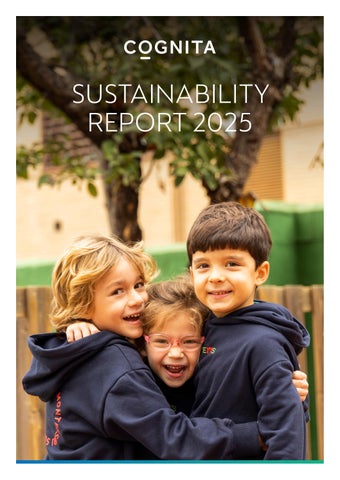
SUSTAINABILITY REPORT 2025
cognita.com | 1
Contents 2
About this report
3 Welcome by David Baldwin, Group Chief Executive Officer 4 Foreword from Jamie Delaney, Head of ESG and Group Ethics & Compliance Officer 5
2025: Sustainability highlights
6
About Cognita
7
Our strategic direction
8
Our approach to sustainability
9
ESG governance
13 2025 activity by priority: 14. Sustainable Learning Environments 29. Nurturing Responsible Learners 44. Fair & Sustainable Workplaces 58. Impacting Global Education 68. Leading Responsibly 76 Appendix 1: Materiality Assessment 77 Appendix 2: Sustainability Metrics 83 Appendix 3: Alignment with UN Sustainable Development Goals
10 ESG performance & external recognition 11
Our sustainability strategy
12
Materiality
12 Alignment with UN Sustainable Development Goals
About this report This is Cognita’s third annual Sustainability Report, outlining our approach to environmental, social and governance activity as well as our performance for the period 1 January to 31 December 2025. We also include significant developments after the reporting period and up to the date of publication where these provide relevant context for our ongoing sustainability strategy and priorities. References to “financial year” or “FY” refer to the period 1 September to 31 August of the specified year (e.g. “FY25” refers to 1 September 2024 to 31 August 2025). This report is prepared on a consolidated basis and includes Cognita business operations globally, unless otherwise stated. It remains aligned with our materiality assessment, which was conducted in 2023 and reviewed in 2025 to ensure continued relevance to our stakeholders, business and operating context. Our reporting approach continues to draw on recognised global frameworks and standards, including the Greenhouse Gas Protocol (for emissions reporting) and the relevant United Nations Sustainable Development Goals (SDGs).
cognita.com | 2
Welcome It is a privilege to introduce Cognita’s 2025 Sustainability Report. Education is our core business, and at its heart is the responsibility to help shape a better future. Through the young people we educate, the people we employ and the communities we serve, our impact extends far beyond the school gates. That is why sustainability is not separate from what we do; it is part of what it means to deliver a great education responsibly. Since stepping into the role of Group Chief Executive Officer, I have had the opportunity to spend time in schools and offices around the world, listening to colleagues, students, families and partners across our global community. Those conversations have reinforced for me how much strength, opportunity and potential there is across Cognita. Across our schools, I have seen truly wonderful and dedicated people doing fantastic things every day. There is a huge amount to be proud of: great teachers, strong schools, distinctive communities and enormous promise. At Cognita, our job is simple: to make schools better. That means creating the conditions for our schools to thrive, measurably and meaningfully. When that happens, students also thrive – and thereby acquire the tools to make a positive impact on the world. This report sets out the progress we made during 2025 across our sustainability priorities: creating sustainable learning environments, nurturing responsible learners, supporting fair and sustainable workplaces, expanding our impact on global education, and leading responsibly. It also recognises that there is more to do. Meaningful progress requires focus, consistency, accountability and collaboration across our global community.
The report comes at an important moment for Cognita. During 2025, we continued to build on strong foundations while shaping the next phase of our journey. Following the reporting period, we launched a refreshed strategic framework, focused on our mission to build the world’s most trusted global schools platform. We want to see classrooms and school communities where curiosity, creativity and care can flourish – supported by great people with the full strength of Cognita behind them. Our ambition, however, is not limited to our own schools. Through Cognita Impact, we want to use our shared expertise and position in the world to support the children who need it most. These efforts are underpinned by our culture: how we treat each other, how we lead, and how we keep our promises. By working collaboratively with kindness and openness, we can create lasting positive impact for children far beyond our own school communities. I would like to thank everyone across Cognita who has contributed to the work reflected in this report. The progress we outline here has been driven not only by the care and commitment of our colleagues, and the energy of our students, but by the support of our families, partners and communities.
David Baldwin Group Chief Executive Officer
cognita.com | 3
Foreword This is Cognita’s third annual Sustainability Report, and for me, it represents an important step in developing our approach to sustainability across a large and diverse global schools group. In 2025, much of our work focused on strengthening our ESG foundations. We continued to improve the quality and consistency of our data, developed the role of the ESG Taskforce, reviewed our materiality assessment, and worked with colleagues across Cognita to better understand both the progress being made and the areas where we need to go further. Those foundations matter, because sustainability at Cognita is broad-ranging. It includes how we manage our environmental impact, but it also extends to how we educate our students, how we champion our colleagues, and how we use our scale and expertise to contribute to education beyond Cognita. This report shows practical progress across each of those areas. We improved emissions intensity, increased renewable electricity consumption and saw more schools reporting solar generation. Schools continued to engage with sustainability through local action plans, student leadership and the early adoption of our Sustainability Action Framework. Students also continued to lead and participate in fundraising, volunteering, advocacy and social impact initiatives, showing the important role young people play in shaping more responsible communities. At a Group level, we strengthened our approach to colleague experience and development with the appointment of a Group Chief People Officer, the phased rollout of OneCognita, and the continued development of leadership programmes.
We also continued to build the foundations for Cognita Impact, which aims to positively impact the lives of over 100,000 children outside Cognita by 2035. There is also more to do. Some areas of our sustainability approach are still developing, and we know that better data, clearer ownership and stronger systems will be essential if we are to track progress consistently and make better decisions over time. Our focus is on moving from ambition to implementation, embedding sustainability more consistently into everyday decision-making across our schools and support teams. I am grateful to everyone who contributed to the work outlined in this report – from colleagues collecting and improving data, to schools leading local initiatives and students using their voices to make a difference. I also want to recognise the support of our shareholders, partners, suppliers and consultants, whose contribution has been invaluable as we continue to mature our approach and build a more responsible and sustainable business for the long term. Looking ahead, our focus is on continuing to improve data quality, strengthen governance, share good practice and embed sustainability priorities more consistently across our global platform. This report reflects not only progress but also the next stage of the journey.
Jamie Delaney Head of ESG and Group Ethics & Compliance Officer cognita.com | 4
Sustainability highlights SUSTAINABLE LEARNING ENVIRONMENTS
IMPACTING GLOBAL EDUCATION
Emissions intensity improved to 0.45 MT CO2e per student, down from 0.50 MT CO2e per student in FY24.
Launched Cognita Impact, a global platform to extend Cognita’s educational expertise beyond its own schools.
Renewable electricity consumption increased to 12,250 MWh – up from 5,040 MWh in FY24 – representing 12% of total electricity consumption.
Developed Cognita Impact’s strategy, Theory of Change and governance model to guide future partnerships and measurement.
16 schools reported solar generation in FY25, up from 12 in FY24. Cognita Chile launched its first Property & Facilities Sustainability Report, setting out a structured roadmap to 2030.
NURTURING RESPONSIBLE LEARNERS
Completion of the Sparkle Early Childhood Development Curriculum Framework in Malawi, with 1,040 learners and 40 educators supported through the Early Childhood Development intervention to date. Widened access through Cognita schools initiatives in Colombia and Greece, supporting 206 learners facing economic or social barriers.
£557,648 was raised for charitable causes. Students completed an average of 17.8 volunteering hours per student in the past year. 48.8% of schools reported running a Model United Nations group, strengthening global citizenship and advocacy skills. 19.5% of schools are already using the Sustainability Action Framework, with a further 46.3% planning to adopt.
FAIR & SUSTAINABLE WORKPLACES Introduction of a new Group Chief People Officer role to lead Cognita's people strategy.
LEADING RESPONSIBLY Recognised again as one of Sustainalytics’ Top-Rated Companies for ESG, based on Cognita’s latest available ESG Risk Rating. Launched a Group-wide AI Policy, setting out principles, acceptable uses and prohibited applications of AI across Cognita’s schools and business operations. Strengthened fraud risk management, including development of a Group-level fraud risk register, senior management training and Group reporting.
Began the phased rollout of OneCognita, our new employee experience platform. More than 70 educators participated in Middle Leadership Programme pilot cohorts: 96% strongly agreed they would recommend the programme. Mean and median global gender pay gaps showed a small downward trend year-on-year. cognita.com | 5
About Cognita At Cognita, we believe every school and student is unique. Our ambition is to create the conditions for schools to thrive and for students to build inspiring futures. Through outstanding teaching and learning, strong leadership, empowered colleagues and the strength of our global community, we support our schools to deliver an education that goes beyond academic outcomes. Founded in 2004, Cognita is one of the world’s leading global schools groups, supporting over 90 schools across 21 countries. Our schools retain their own identity and culture while being united by a shared commitment to quality, care and continuous improvement. By sharing expertise, using evidence-based practice and learning from across our global platform, we help students build confidence, agency, adaptability and positive attitudes – so they are prepared not only for the next stage of learning, but for the wider world.
Austria
Qatar
Oman
Saudia Arabia
cognita.com | 6
Our strategic direction During 2025, Cognita’s sustainability work continued to be shaped by the strategic approach in place during the reporting period. This focused on school quality, education beyond academic outcomes, strong leadership, effective operations and responsible growth. Together, these priorities helped guide how we supported our schools and strengthened the wider Cognita community. At the same time, Cognita continued to develop the thinking that would inform the next phase of our global strategy. This work built on the strengths of the existing approach, while sharpening our focus on the conditions schools need to thrive moving forward. In 2026, following the reporting period, Cognita launched a refreshed strategic framework. Our vision is Thriving Schools. Inspiring Futures. and it is built around four strategic choices: transformational education, empowered people and leadership, high performance operations, and expanding impact.
This direction is closely connected to our sustainability strategy. Sustainable schools are well-led, inclusive, responsible and resilient. They reduce environmental impact, support fair and sustainable workplaces, prepare tudents to contribute positively to society, and are underpinned by strong governance, safeguarding, ethics and responsible risk management. In this way, sustainability is not separate from Cognita’s strategic direction. It is part of how we strengthen our schools, support inspiring futures and create long-term value for our students, colleagues, families and wider communities.
VISION
Thriving Schools. Inspiring Futures.
MISSION
To build the world's most trusted global schools platform, creating the conditions for schools to thrive; measurably and meaningfully.
(Why we exist)
(What we are building to achieve it)
STRATEGIC CHOICES (What we will excel at to enable this)
MINDSETS
(How we will work to enable this)
Transformational Education
We Put Schools First
Empowered People & Leadership
High Performance Operations
We Go Together
Expanding Impact
We Keep Our Promises
cognita.com | 7
Our approach to sustainability Cognita’s approach to sustainability brings together our ESG priorities in the areas we believe we can make the greatest difference: • Reducing the environmental impact of our operations. • Preparing students to understand and act on the challenges of a changing world. • Supporting colleagues through fair and sustainable workplaces. • Expanding access to quality education beyond Cognita. • Maintaining strong foundations in governance, safeguarding, ethics and responsible risk management. Our approach is practical and education-led. It focuses on the actions we can take as a global schools group: how we operate our schools, how sustainability is embedded in teaching and learning, how we support our colleagues, how we make responsible decisions, and how we contribute to the wider world. Within this broader approach, Cognita Impact represents an important part of our ambition to expand our impact on global education. Through partnerships, scholarships and education programmes, Cognita Impact aims to positively impact the lives of over 100,000 children outside Cognita’s schools by 2035. It also connects with our work to nurture responsible learners by creating opportunities for students to engage with social impact, service, fundraising, volunteering and advocacy. Together, our sustainability priorities provide a framework for action. They help us focus our efforts, measure progress, share good practice and embed responsible decision making across our global community of schools. cognita.com | 8
ESG governance Strong governance is essential to embedding sustainability across Cognita. Our ESG governance structure is designed to connect Group-level priorities with implementation across our schools and support teams, while ensuring appropriate oversight by senior leadership and the Board. Our ESG Taskforce Established in 2024, the ESG Taskforce brings together Group colleagues, including members of the Executive Leadership Team (ELT) and finance representatives from the operating structure in place during the reporting period. It supports delivery of Cognita’s sustainability priorities by monitoring progress, reviewing ESG data and reporting, and developing proposals for future initiatives and targets. The Taskforce meets six times a year and is chaired by the Head of ESG and Group Ethics & Compliance Officer. The involvement of finance and operational leaders helps ensure Group-level priorities are adapted to local contexts and connected to business planning, operational decision-making and financial oversight. In 2025, the Taskforce focused on improving data quality, strengthening governance and embedding ESG priorities more consistently across Cognita. Reporting to Leadership and the Board The ELT approves Cognita’s sustainability strategy and targets and oversees implementation and progress. The Head of ESG and Group Ethics & Compliance Officer reports to the ELT quarterly, providing updates on progress and presenting initiatives or targets for approval. ESG is also reported to Cognita’s Board of Directors as a standing agenda item within the Group CFO’s quarterly finance update.
In addition, the Head of ESG and Group Ethics & Compliance Officer presents to the Board annually on sustainability progress, approved initiatives and targets, and future plans. The Board scrutinises and monitors Cognita’s sustainability efforts, helping ensure that we continue to make progress while supporting the long-term success of the business and representing the interests of our stakeholders.
ESG governance structure OARD OF DIRECTORS B Scrutinises and monitors sustainability strategy, priorities and targets. Chair: Jacob Polny, Chairman of the Board of Directors EXECUTIVE LEADERSHIP TEAM Approves sustainability strategy and targets; also oversees implementation and progress. Chair: David Baldwin, Group Chief Executive Officer ESG TASKFORCE Supports delivery, monitors progress and reporting, develops proposals for initiatives and targets, and helps embed ESG priorities across schools and offices. Chair: Jamie Delaney, Head of ESG and Group Ethics and Compliance Officer
cognita.com | 9
ESG performance & external recognition In 2025, Cognita continued to strengthen its ESG performance with progress in the areas most relevant to our schools and stakeholders – including environmental management, student wellbeing and agency, responsible employment, safeguarding, governance, business ethics and access to quality education. Receiving external recognition for these achievements provides Cognita with an additional perspective on our progress, as well as helping us to identify opportunities for continued improvement. In 2025, Cognita was shortlisted as a finalist in the ESG & Impact category at the EducationInvestor Awards, recognising work delivered during 2024. Following the reporting period, Cognita was again shortlisted in 2026 for work delivered during 2025. This recognition reflects progress across our sustainability priorities, including responsible operations, student-led social and environmental initiatives, and our work to expand access to quality education through partnerships and scholarship programmes. This year we also continued to engage with external ESG assessment processes such as Morningstar’s Sustainalytics. This not only supports transparency, but also helps us to understand our strengths, as well as areas which may require further development.
In Cognita’s latest full ESG Risk Rating, completed in December 2024, Cognita achieved an overall risk rating score of 11.4, placing our Group in the Low Risk category. Sustainalytics’ ESG Risk Rating assesses the extent to which a company’s enterprise value may be exposed to material financial impacts from ESG factors. Cognita’s exposure to ESG risks was rated as low – and crucially, improvements in the management of those risks were a key driver of the rating.
Following the reporting period, Cognita was recognised by Sustainalytics as a 2026 Industry ESG Leader, reflecting its position among the top-performing companies globally in the Consumer Services sector. This recognition was based on Sustainalytics’ latest available ESG Risk Rating assessment and rules-based methodology. Sustainalytics has confirmed that companies may receive routine operational updates to their scores during the year, while comprehensive updates involving a full review of all data points take place less frequently.
cognita.com | 10
Our sustainability strategy is organised around four interconnected priorities, underpinned by our foundational principle: Leading Responsibly.
Reduce the environmental impact of our operations and infrastructure.
Empower students to understand, care and take action.
Be fair, inclusive and supportive to all colleagues.
Support better education globally.
Drive environmental excellence, improve resource efficiency and build climate resilience across our schools and operations.
Support students to develop the knowledge, values and agency to contribute positively to their communities and the wider world.
Create a workplace culture that supports engagement, inclusion, wellbeing, professional growth and responsible employment.
Use our global scale, expertise and partnerships to expand access to quality education beyond Cognita.
Achieve Net Zero emissions by 2050.
• All schools will have adopted our Sustainability Action Framework by 2027 and embedded it by 2030. • All schools will continue to develop and embed a pathway to support Cognita students to graduate as responsible learners.
Continue developing a strategic pathway that supports Cognita’s ambition to be recognised as a leading employer in the education sector.
Positively impact the lives of over 100,000 children outside Cognita by 2035.
• Climate • Energy • Sustainable design & infrastructure • Transport & air • Waste & circularity • Food & consumption • Ecosystems & biodiversity • Water
• Sustainability in action • Embedding sustainability into the curriculum • Student agency & global citizenship • Global engagement & partnerships • Student wellbeing & voice
• Leadership • Employee engagement • Inclusion • Pay equality & gender pay gap • Learning, development & talent • Employee benefits & wellbeing
• Cognita Impact • Strengthening education beyond Cognita • Equitable access to education
Leading Responsibly - Govern with care, safety and integrity.
Maintain strong foundations in governance, safeguarding, safety, ethics, compliance and responsible risk management.
Responsible governance, board composition and independence; Safeguarding; Health & safety; Data security & privacy; Business ethics; Systemic risk management; Critical incident risk management; Management of the legal and regulatory environment cognita.com | 11
Materiality Our sustainability strategy remains informed by the materiality assessment that we first conducted in 2023. This assessment was subsequently reviewed in 2025 to examine its continued relevance to our business, stakeholders and operating context. The results of our review confirmed that our existing sustainability priorities remain appropriate to guide our strategy, reporting and areas of focus. These include climate and resource use, student wellbeing and agency, responsible employment, safeguarding, governance, ethics, and access to quality education. Further detail on our materiality process and matrix is included in Appendix 1.
Alignment with UN Sustainable Development Goals The United Nations Sustainable Development Goals (SDGs) provide a global framework for addressing some of the world’s most significant social, environmental and economic challenges. These include climate change, inequality, health and wellbeing, responsible consumption and access to quality education. Cognita’s sustainability strategy aligns with a number of SDGs across our four sustainability priorities and our foundational principle of Leading Responsibly. We feature SDG icons throughout this report to show where our activities and material topics support relevant goals. In Appendix 3, we outline how our sustainability strategy and underlying material topics relate to the SDGs in more detail.
cognita.com | 12
SUSTAINABLE LEARNING ENVIRONMENTS cognita.com | 13
Sustainable Learning Environments Cognita is committed to creating sustainable learning environments that support educational excellence, student wellbeing and environmental responsibility. Across our global family of schools, this means reducing the environmental impact of our buildings, operations and infrastructure, while also creating healthy, inclusive and resilient places to learn.
While our overall reported Scope 1 and 2 emissions increased from FY24 to FY25 – largely due to improved data collection, new schools and a more complete view of refrigerants – our emissions intensity improved.
Our schools depend on energy, water, food, transport, technology and natural resources every day. Managing these impacts responsibly is therefore central to how we prepare young people for the future.
This means we are reducing emissions relative to the size of our school community.
In 2025, we continued to strengthen the data, systems and local action needed to support our long-term ambition of achieving Net Zero greenhouse gas emissions by 2050.
Just as importantly, sustainability continues to be brought to life by our schools. From student-led energy audits and food waste campaigns to biodiversity projects and sustainable campus design, our communities are showing how operational change and learning can reinforce one another.
KEY HIGHLIGHTS FOR 2025 • Emissions intensity improved to 0.45 MT CO2e per student, down from 0.50 MT CO2e per student in FY24. •R enewable electricity consumption increased to 12,250 MWh – up from 5,040 MWh in FY24 – representing 12% of total electricity consumption. • 16 schools reported solar generation in FY25, up from 12 in FY24. • Cognita Chile launched its first Property & Facilities Sustainability Report, setting out a structured roadmap to 2030.
cognita.com | 14
Climate Reducing greenhouse gas emissions across Cognita’s schools and offices remains central to our sustainability strategy and our pathway to Net Zero by 2050. Our schools rely on energy every day to heat, cool and ventilate buildings, power technology and equipment, prepare food, and support safe and comfortable learning environments. Managing these emissions is therefore an essential part of creating sustainable schools. In FY25, Cognita's reported Scope 1 and 2 emissions increased year on year. This was driven by a combination of factors, including improved data collection, changes in the reporting boundary, corrections to the previous year’s data and a more complete understanding of emissions sources such as refrigerants.
To better understand our underlying year-on-year movement, we worked with an external consultant to prepare a normalised comparison. This adjusted the FY24 baseline to reflect the FY25 reporting boundary, improved data approach and known prior-year inconsistencies. On this basis, our underlying Scope 1 and 2 emissions reduced by approximately 9%. Separately, our published emissions intensity also improved year on year, even though our reported absolute emissions increased.
Published FY24 reported emissions
Normalised FY24 baseline
Normalised FY25 emissions
MT CO2e
MT CO2e
MT CO2e
40,699
48,693
Reported FY25 emissions
44,457 MT CO2e
44,212
Underlying movement
~9% reduction
Published emissions intensity
0.50→0.45 MT CO2e per student
• Scope 1 emissions include direct emissions from sources we own or control, such as fuel used in buildings, company vehicles and refrigerants. Scope 2 emissions include indirect emissions from purchased electricity. • Purchased electricity remains our largest source of emissions in FY25. Refrigerants, building fuel and company vehicles also contributed to our footprint. The increase in reported refrigerant emissions reflects improved data collection and gives us a more complete basis for managing this source in future years. cognita.com | 15
Energy Energy use is one of the largest contributors to Cognita’s environmental footprint. Across our schools, electricity and fuel are used for lighting, cooling, heating, ventilation, catering, technology, and specialist learning equipment. Improving energy efficiency therefore has both environmental and operational benefits: it reduces emissions, lowers costs, and helps create more comfortable and resilient learning environments. In FY25, Cognita consumed 144,281 MWh of energy in total, including electricity, stationary fuel and vehicle fuel. This increase from FY24 reflected changes in the reporting boundary, school operations, and improved data collection. Renewable electricity continued to grow, supported by reported solar generation across 16 schools. This progress reflects our focus on increasing renewable electricity where feasible, while recognising that opportunities vary by location, infrastructure and local energy market.
Individual school projects Many schools are taking practical action to reduce energy use through a combination of infrastructure improvements, operational controls and behaviour change. These include setting energy reduction targets, transitioning to LED lighting, installing motion sensors, improving heating, ventilation and air-conditioning systems, introducing smart controls, using energy monitoring systems, conducting student-led energy audits, and running awareness campaigns to encourage staff and students to switch off lights, equipment and cooling systems when not in use.
In 2025, for example, The British School of Barcelona achieved an overall 4.6% reduction in energy consumption, saving 33,000 kWh and avoiding six tonnes of CO2 emissions. Its Sitges and Castelldefels campuses each achieved a 10% reduction in energy consumption, while energy intensity across all sites fell by 11%.
cognita.com | 16
Energy Non-renewable energy consumption: 131,760 MWh
Total energy consumption: 144,281 MWh
Renewable electricity consumption: 12,250 MWh
Total electricity consumption: 106,570 MWh
Renewable electricity share of total energy consumption: 9%
Energy consumption intensity: 130 MWh / £1m revenue
Renewable electricity share of total electricity consumption: 12%
Non-renewable share of total energy consumption: 91% cognita.com | 17
CASE STUDY
CHIREC International School, India At CHIREC International School’s Kondapur Campus in India, students, staff and parents worked together to reduce energy use during the 2024-25 academic year.
This campaign demonstrates how practical operational changes, student leadership and community engagement can combine to reduce environmental impact – and how a successful initiative at one campus can catalyse wider action across a school network.
The school set a clear objective to reduce electricity consumption by 5% compared with the previous year.
Between December 2024 and April 2025, Kondapur reduced its average monthly energy consumption by 11% year-on-year, saving 31,309 kWh of electricity and avoiding more than 20,000 kg of CO2 emissions.
Progress was driven by a practical action plan that included a school-wide energy awareness campaign, new air-conditioning standard operating procedures, and regular student-led energy audits. The initiative also encouraged behaviour change beyond the school gates: 86% of staff reported taking action for sustainability, while one in four parents said their child had taken sustainability-related action at home. Building on this success, CHIREC expanded the campaign to three additional campuses from June 2025. Across the four campuses, the initiative delivered a further 7% reduction in energy use, saving more than 100,000 kWh of electricity and avoiding 70,528 kg of CO2 emissions between June 2025 and February 2026. As one student reflected in the 2025 end-of-year survey: “I learned that even small actions from each person can create big results.”
cognita.com | 18
Sustainable design & infrastructure As a global schools group, Cognita’s buildings and campuses play a central role in our sustainability performance. The way schools are designed, constructed, refurbished and operated affects energy use, water consumption, emissions, student wellbeing, and long-term resilience. In 2025, we have given greater focus to sustainable design and infrastructure as part of our reporting, recognising that long-term environmental impact is shaped not only by day-to-day operations, but also by the choices we make when we build, expand and improve our schools. The approach we take to these decisions focuses on reducing environmental impact while creating healthy, inclusive and inspiring spaces for learning. This includes considering energy efficiency, renewable energy, natural light, ventilation, thermal comfort, accessibility, green space, sustainable materials and adaptability over time.
New builds and major refurbishments provide important opportunities to embed sustainability from the outset. Where relevant, we also continue to explore the role of external standards such as Building Research Establishment Environmental Assessment Methodology (BREEAM) (or equivalent certification schemes) as a way to support good practice and demonstrate performance. Key areas for focus • Sustainable new builds and major refurbishments. • BREEAM or equivalent certifications. • Design features that reduce long-term environmental impact. • Healthy, inclusive and flexible learning spaces. • Green outdoor areas and connection with nature. • Infrastructure that supports operational resilience.
cognita.com | 19
CASE STUDY Spain – embedding sustainability into school design and infrastructure Across Spain, Cognita has taken a more systemic and structured approach to sustainable design and infrastructure. Recent expansions, greenfield developments and refurbishment projects have been defined in collaboration with ESG experts to help ensure best practice is applied across the full building lifecycle – from the design phase through to operations. This approach can be seen across major projects including The British School of Barcelona (BSB) City Campus, the British School of Valencia (BSV) Nexus building, The English Montessori School (TEMS) Explorer Campus and BSB Maresme, showing how sustainability considerations are being embedded into both new buildings and the long-term improvement of school environments. Completed in 2022, BSB City Campus remains a strong example of sustainable school design. The campus incorporates extensive glass and vegetation on the façade to maximise natural daylight and connection with nature, supporting student wellbeing and comfort. It also includes a 50,000-litre rainwater harvesting tank beneath the playground, collecting rainwater for irrigation, and 91 photovoltaic solar panels.
In 2025, TEMS opened its new Explorer Campus, a 10,000-square-metre campus designed to support environmental responsibility and wellbeing. It incorporates on-site solar panels, green outdoor zones, and flexible learning spaces that encourage innovation and connection with nature. This work builds on progress at BSV’s Nexus building, which achieved BREEAM certification, recognising its approach to sustainable building design and performance. Looking ahead, sustainability is also being embedded into the development of BSB Maresme, a new campus in Cabrera de Mar due to open in September 2026. The campus is being developed with lower-impact materials, a green roof with rainwater collection, an 80-panel solar installation, and acoustic, thermal and lighting systems designed to support efficiency and comfort. Alongside major projects, Cognita has also improved existing schools through infrastructure upgrades, including solar panel installations and heating, ventilation and air-conditioning improvements.
" By integrating sustainable design principles into our developments, we are creating schools that not only reduce their environmental footprint but also provide healthier, more inspiring spaces for students and staff,” said Leire Fàbrega Montobbio, Head of Properties, Spain & Italy.
cognita.com | 20
Transport & air Transport is an important part of the environmental impact associated with school life. Emissions can arise from a number of sources, including vehicles owned or operated by Cognita, third-party transport providers, staff commutes, parent drop-off and pick-up, student travel, and public transport use. Reducing these transport-related emissions requires a combination of infrastructure adjustment, behaviour change and community engagement. While not all schools have the same transport options available, many are taking practical steps to encourage lower-carbon travel and improve air quality around school sites. Actions taken by our schools include: • Promoting walking to school, where appropriate. • Installing bicycle racks and encouraging cycling. • Providing electric vehicle charging points. • Working with transport providers to explore electric or lower-emission vehicles. • Optimising school bus routes. • Encouraging school transport services where available. • Supporting parent-led carpooling initiatives. • Running awareness campaigns to reduce engine idling during pick-up and drop-off. As Cognita continues to strengthen its understanding of Scope 3 emissions, transport will remain an important area of focus. Understanding how students, families and colleagues travel to and from school will help us identify opportunities for more sustainable commuting and better air quality.
cognita.com | 21
Waste & circularity Reducing waste and improving circularity are important parts of creating sustainable learning environments. Our schools use a wide range of resources every day, from classroom materials and technology to catering supplies, uniforms, furniture and construction materials. Managing these resources responsibly helps reduce environmental impact and encourage more sustainable habits among students and staff. In 2025, Cognita schools worked to reduce the amount of waste generated, increase recycling, improve waste segregation, and identify opportunities to reuse materials wherever possible. Actions taken by our schools include:
• Measuring and monitoring waste. • Setting waste reduction targets. • Removing or reducing single-use plastics. • Ordering resources in bulk to reduce packaging. • Installing recycling points for general waste, e-waste and specialist waste streams. • Introducing water fountains to encourage reusable bottles. • Reusing or repurposing furniture, equipment and construction materials. • Running student-led campaigns on waste reduction and recycling. • Introducing composting initiatives. Waste reduction is also a powerful area for student engagement. When students take part in audits, campaigns, assemblies and peer education, they gain practical experience of environmental problem-solving and see the impact of their actions in real time.
cognita.com | 22
Food & consumption Since Cognita schools serve thousands of meals every week, food systems play an important role in our environmental footprint. Reducing food waste helps lower greenhouse gas emissions and promote more responsible consumption – while also supporting student wellbeing and healthier eating habits. Alongside operational improvements, our approach places a strong emphasis on education and behavioural change. Students and staff are encouraged to understand the environmental and social impacts of food, and to take practical action. Actions taken by our schools include:
• Measuring and tracking food waste. •O ffering different portion sizes based on age or appetite. • I mproving stock control. •D esigning menus around student preferences to reduce plate waste. • I ntroducing composting where appropriate. •R unning meat-free days or lower-carbon menu options. •E ncouraging healthier and more sustainable eating habits. •U sing assemblies, surveys and student campaigns to raise awareness.
MEASURABLE RESULTS IN OUR SCHOOLS In FY25, schools continued to show how practical changes deliver results. At St. Andrews International School Dusit in Thailand, student survey responses showed that pupils understood why reducing food waste matters and how they could contribute to this personally, for example by only taking what they would eat. The school reduced food waste by 11% in one year, while half of parents reported that their children had taken action to protect the environment at home. In the UK, Colchester High School achieved a 35% reduction in food waste through student-designed campaigns, assemblies, surveys and collaboration with catering partner Thomas Franks and Planet Mark. Students were named regional winners of the Thomas Franks Great Food Waste Challenge, recognising their creativity and impact. The initiative also strengthened links with the local food bank and helped students understand the carbon impacts of food waste.
cognita.com | 23
Ecosystems & biodiversity Healthy ecosystems provide essential services, including clean air and water, food security, climate regulation, and wellbeing benefits. They also support biodiversity, which is vital for a resilient planet. By helping students to connect with nature and to understand their responsibility as environmental stewards, Cognita schools have an important role to play in protecting and enhancing local ecosystems. Across the group, schools are taking action to improve biodiversity on campus and in their local communities, including:
• Planting native species. • Creating gardens and green outdoor learning areas. • Installing bird feeders, water stations and habitats for wildlife. • Using organic fertilisers and pesticides (where possible). • Planting trees to provide shade and cooling. • Organising beach cleans and local habitat protection activities. • Creating outdoor learning opportunities. • Encouraging students to monitor and protect biodiversity.
cognita.com | 24
CASE STUDY
Biodiversity in schools In Dubai, Horizon English School focused on boosting on-campus biodiversity during the 2024-2025 academic year, using the school grounds as a practical setting for student learning and environmental action. Students were involved in sustainability projects throughout the year, including a Year 6 science project on composting as well as curriculum lessons which enhanced children’s understanding of biodiversity.
Biodiversity is also becoming part of wider school decision-making, including operational planning for future tree planting projects. Student survey data showed growing engagement:
• 93% of students said the school was doing very well or somewhat well in sustainability (up from 80% in June 2024).
The school planted up 100% of planters around the campus, including native species, helping to create greener outdoor spaces and support local biodiversity.
• Approximately 30% reported taking action to support biodiversity at home or at school.
The Green Team also participated in biodiversity excursions, including the 100 (Bee)Hives launch at Dubai Expo 2024, where students learned about the importance of bees and pollinators.
This work shows how practical biodiversity action can strengthen both the school environment and student understanding, helping young people see that they can contribute to environmental change at school and at home.
cognita.com | 25
Water Water is a vital shared resource, and reducing water consumption is essential for environmental sustainability, ecosystem protection and long-term resilience. Many Cognita schools operate in regions where water availability, climate conditions and infrastructure pressures make responsible water use especially important. In FY25, Cognita reported total water withdrawal of 1,522,544 cubic metres. This represents a significant increase from FY24, largely due to data collection improvements and a substantial subsequent increase in the number of schools responding to the water survey request. As a result, FY25 water withdrawal is not directly comparable with FY24. Improving the completeness and quality of water data, however, gives us a stronger foundation for identifying opportunities to reduce consumption and improve efficiency across our school estate.
Actions taken by our schools to monitor and reduce water consumption include: • Tracking daily water consumption to identify leaks or irregularities. • Installing water aerators and sensor-operated taps. • Collecting air-conditioning condensate for irrigation. • Harvesting rainwater where feasible. • Using drought-tolerant or native planting. • Improving irrigation efficiency. • Raising awareness among students and staff about responsible water use.
Water stewardship is closely linked to climate resilience. As extreme weather and water stress become more common in many regions, efficient water management will remain an important part of maintaining safe, sustainable and resilient school environments.
cognita.com | 26
CASE STUDY Integrating sustainability across learning environments in Chile In 2025, Cognita Chile launched its first Property & Facilities Sustainability Report, formalising a structured approach to embedding sustainability across infrastructure and operations. Aligned with Cognita’s global ESG framework, the programme establishes a roadmap to 2030 grounded in materiality and defined KPIs. Rather than focusing on a single theme, Chile’s approach integrates climate mitigation, resource efficiency, wellbeing and resilience into a coherent infrastructure strategy.
At Pumahue Chicauma, Cognita Chile installed its first on-site solar plant with a projected capacity of 79.2 kWp. In 2025, it generated 66.41 MWh of clean electricity, avoiding an estimated 26.56 MT CO2e.
This real-time data supports ventilation management, safer outdoor planning and more efficient resource use. Infrastructure upgrades have also prioritised inclusive design, including sensory rooms and improvements aligned with universal accessibility standards. Actions on water, waste and circularity include efficient fixtures, landscaping choices, rainwater capture, reuse of construction materials, and responsible recycling and repurposing of technological equipment. In 2025, water consumption per person across 13 schools decreased by 42.7% compared with the same period in 2024, demonstrating the impact of operational management measures implemented across these schools. This integrated model demonstrates how local action can translate global ESG commitments into measurable environmental progress and improved wellbeing.
This investment is complemented by improvements to building thermal envelopes, LED lighting, energy-efficient systems and climate control solutions, supporting emissions reduction while enhancing indoor comfort.
" This programme is more than a technical initiative; it reflects our commitment to the future of education. Today, we are taking a significant step forward by officially launching our Sustainability Policy, which will guide every project, investment, and decision across our schools.” Victor Barahona, CEO of Cognita Chile.
Cognita Chile has also introduced environmental monitoring sensors in five schools, tracking CO2 levels, UV radiation, temperature, humidity, water consumption and energy use.
cognita.com | 27
Looking to the future Cognita’s long-term goal is to achieve Net Zero greenhouse gas emissions by 2050. In the years ahead, we will continue to strengthen the data collection, systems and governance needed to support this transition. Our immediate priority is to improve the quality and completeness of our environmental data across emissions, energy, water, waste and other key impact areas. Improved data will allow us to identify the greatest opportunities for reduction, track progress more consistently, and support schools with practical, evidence-based action.
At school level, we will continue to support student and staff engagement through sustainability action plans, student leadership, curriculum links and partnerships. The strongest examples from 2025 show that operational change and learning are most powerful when they occur together.
We will also continue to develop our approach to carbon reduction. This includes deepening our understanding of Scope 1 and 2 emissions, identifying region-specific opportunities, investing in energy efficiency and renewable energy where feasible, and embedding sustainability into building design, refurbishment and facilities management.
Improved data, sustainable infrastructure and active school community engagement will allow us to continue creating learning environments that are healthier, more resilient and more environmentally responsible.
Having established a strong foundation for Scope 1 and 2 reporting, we are now beginning our Scope 3 data collection journey. This will help us better understand emissions associated with areas beyond our direct operations, including purchased goods and services, transport, waste, food and other parts of our value chain. As this work progresses, we will focus on identifying the most material Scope 3 categories for Cognita and developing practical data collection approaches that can be implemented across our diverse global school network.
cognita.com | 28
NURTURING RESPONSIBLE LEARNERS cognita.com | 29
Nurturing Responsible Learners At Cognita, nurturing responsible learners means preparing students not only for academic success, but to thrive and participate meaningfully in the world around them. This supports our vision of Thriving Schools, Inspiring Futures, as well as our strategic focus on Transformational Education – helping students develop the knowledge and values to shape their futures and contribute positively to society and the planet. The World Economic Forum’s Future of Jobs Report 2025 highlights that technological advancement, the green transition, demographic shifts and economic pressures are reshaping the future of work. In this context, a world where skills are evolving and uncertainty is increasing, students need strong academic foundations alongside capabilities such as analytical thinking, resilience, creativity, curiosity, social influence and environmental stewardship. Our work in this area is guided by two long-term commitments: • S upporting all schools to adopt our Sustainability Action Framework (SAF) by 2027 and embed it by 2030.
In 2025, we continued to strengthen the foundations of our responsible learners pathway. This included progress on the Sustainability Action Framework, student leadership and volunteering, global citizenship programmes, student voice, wellbeing, and the development of Cognita’s proposed Globally Responsible Learners standard within our emerging Standards for Transformational Education.
KEY HIGHLIGHTS FOR 2025 • £557,648 was raised for charitable causes. • 17.8 volunteer hours on average were completed per student in the past year. • 48.8% of schools reported running a Model United Nations group, strengthening global citizenship and advocacy skills. • 19.5% of schools are already using the Sustainability Action Framework, with a further 46.3% planning to adopt.
•B y the end of 2026, we aim to establish the foundations of a clear pathway to ensure Cognita students graduate as globally responsible learners.
cognita.com | 30
Introducing Globally Responsible Learners During 2025, Cognita began developing its Standards for Transformational Education, a framework defining what high-quality education looks like across all our schools. One of the thirteen standards is Globally Responsible Learners:
This section brings together four connected areas: • Sustainability in action: Giving schools the structure to embed environmental responsibility through the Sustainability Action Framework.
" Globally responsible learning is about helping students understand the world around them, think carefully about their choices, and develop the confidence to contribute positively. Through our Standards for Transformational Education, we are creating a clearer shared language for this work across Cognita, while allowing each school to bring it to life in ways that reflect its own context and community." Dr Simon Camby, Group Chief Education Officer
• Curriculum and learning: Helping students understand sustainability, citizenship, digital change and global challenges through classroom and experiential learning.
The work already taking place across our schools – in sustainability, student agency, digital learning, wellbeing and community engagement – is helping build these capabilities. Responsible learning is not a single programme or subject, but is developed through the way that students learn, lead, act and reflect across school life.
Together, these areas form the foundations of our responsible learners pathway. They help students understand their responsibilities to themselves, to others, to their communities and to the planet – and develop the confidence to make a positive difference.
• Student agency and global citizenship: Giving students opportunities to lead, volunteer, advocate and take action on issues that matter. • Wellbeing and connection: Supporting students to care for themselves, build positive relationships and contribute to caring communities.
With the expected launch of our Standards for Transformational Education in 2026, Globally Responsible Learners will provide a more consistent way to evaluate, evidence and strengthen this work across Cognita’s schools.
cognita.com | 31
Sustainability in action The Sustainability Action Framework is Cognita’s structured approach to whole-school sustainability. Developed in partnership with Sustainability at School*, it supports schools to move from individual initiatives to coordinated, community-owned action.The Framework is designed primarily for school leadership teams, recognising that meaningful progress requires alignment between academicand operational decision-making. It helps schools embed sustainability across four interconnected areas of school life:
• Campus: Reducing operational impact through action on areas such as energy, water, waste and procurement. • Curriculum: Integrating sustainability knowledge, skills and systems thinking into learning. • Community: Engaging students, families and local partners in meaningful action. • Culture: Building the behaviours and mindsets that support long-term change.
Progress in one area reinforces progress in others. Operational improvements on campus can create authentic learning opportunities; curriculum integration can strengthen student leadership; and community engagement can help sustainability become part of everyday school life. To support consistent progress, the Framework emphasises six enabling conditions: •L eadership commitment
• Clear action planning
• Effective governance
• Data and monitoring
• Student leadership
• Transparent communication
Together, these conditions help ensure sustainability is embedded within school strategy and improvement planning, rather than delivered through isolated activities.
" We developed the Sustainability Action Framework with Cognita to help schools turn sustainability ambition into practical, lasting change. By connecting operational action with learning and leadership, the Framework supports schools to embed sustainability in ways that reflect their own context, while developing the student and staff leadership needed to sustain progress.” – Clare Garey, Founder & Director at Sustainability at School
* Sustainability at School is a purpose-driven social enterprise which supports schools to drive a whole-school approach to sustainability through an experience-based model for change. Since 2020, Sustainability at School has been working with Cognita schools around the world, supporting them to drive impactful environmental action and develop student and staff leadership for sustainability. cognita.com | 32
Annual planning cycle The Sustainability Action Framework operates through a structured annual cycle. Schools review their current position using surveys and operational data, establish a cross-functional Sustainability Action Team, create student sustainability leadership structures, develop a measurable action plan, monitor progress, share impact updates, and celebrate achievements before planning the next cycle. This approach strengthens accountability and supports continuous improvement across the school year.
Measuring maturity In 2025, we continued to strengthen how schools assess and evidence their sustainability progress. The Whole School Sustainability Evaluation Rubric gives schools a structured way to understand where they are on their sustainability journey and what progress looks like in practice. Aligned with Cognita’s wider evaluation approach – from “inconsistent” to “progressing” to “embedded”, with leading practice captured through open response – the rubric enables schools to benchmark current practice, identify priorities, track year-on-year progress and evidence impact to their communities. Rather than acting as a compliance checklist, the rubric supports continuous improvement. It provides a shared language across our global system and helps schools move from emerging practice towards embedded, strategically aligned sustainability.
2025 snapshot In 2025, 19.5% of schools reported that they were already using the Sustainability Action Framework, with a further 46.3% planning to adopt it. Reported maturity levels show that many schools are actively developing or refining their approach, while a smaller proportion are already demonstrating more established practice.
This provides a clear foundation for targeted support and peer learning as we progress towards our 2027 adoption target.
cognita.com | 33
CASE STUDY
El Limonar International School Murcia (Spain) With the support of Sustainability at School, El Limonar International School (ELIS) Murcia has been strengthening environmental sustainability through structured planning and student leadership. Over this period, the school has delivered initiatives across areas such as waste, food waste and energy. In 2024-25, however, the most significant development was the school’s shift towards a more embedded, whole-school model aligned to the Sustainability Action Framework.
Student leadership During the academic year, ELIS Murcia deepened its focus on student voice and leadership, ensuring sustainability is not simply delivered to students, but shaped by them. The school now has more than 40 elected student members in secondary alone, forming an Eco Committee that plays a central role in driving Sustainability@ELIS.
Ownership and agency In June 2025, Sustainability at School hosted a Sustainability Innovation Symposium with eco-leaders, particularly students, from three Cognita schools: ELIS Murcia, CHIREC International School and Downsend School. The event gave students an opportunity to share sustainability progress across their schools and collaborate on a vision for a “Sustainable School of the Future”, built around three pillars: values, campus and curriculum. For ELIS students, the symposium strengthened leadership capability and student ownership, contributing to a culture in which students see sustainability action as something they can shape and improve. ELIS Murcia demonstrates the value of combining structure with student agency. By strengthening governance and student leadership simultaneously, the school is embedding sustainability more deeply, supported by action planning, regular progress review and transparent communication.
The committee has defined roles and responsibilities and works in partnership with staff and operations teams to identify priorities, plan actions and maintain engagement across the year. A key strength of the school’s approach is that students are supported not only to run campaigns, but to understand sustainability as a strategic process. Student leaders have worked alongside Sustainability at School to strengthen their advocacy and influence skills, learning how to design initiatives that mobilise peers, communicate effectively with adults, and sustain momentum beyond a single event. cognita.com | 34
Embedding sustainability into the curriculum Curriculum is one of the four interconnected areas of action within the Sustainability Action Framework. While operational improvements and governance structures are essential, long-term impact depends on what students learn and practise every day. Embedding sustainability into the curriculum ensures that environmental and social responsibilities are not treated as stand-alone topics or occasional projects. Instead, they become part of subject learning and real-world application. Across Cognita schools, sustainability is integrated in diverse ways depending on local context, age range and curriculum model. Examples include inquiry-led exploration of climate systems and biodiversity; applied learning on the circular economy, sustainable enterprise and resource management; cross-curricular projects linking science, humanities, technology and the arts; and student-led research connected to campus operations. This integration strengthens coherence between what students learn and how the school operates. It also supports the development of systems thinking, critical analysis, ethical reasoning and agency – capabilities that are increasingly important for responsible learners.
cognita.com | 35
CASE STUDY
St. Andrews International School Green Valley, Thailand At St. Andrew’s International School Green Valley, sustainability is embedded across the curriculum from early years through to secondary education. In early years, students explore plant cycles, composting, and community planting to build a foundational understanding of ecosystems and stewardship. Carefully nurtured allotments with ripening vegetables reflect student agency, responsibility and daily routines of care. In primary, sustainable food cycles continue through initiatives such as Grow2Give, which saw more than 750 plants donated to local families this year, while vegetables grown during co-curricular activities are used in ‘Field to Fork’ dishes in the school canteen. Through inquiry-led units, Key Stage 1 students investigate biodiversity and conduct environmental observations, recording their findings using playground tally charts. In Key Stage 2, weekly Forest School sessions give students opportunities to build and explore innovations such as renewable energy solutions and bamboo water purification systems.
As one Year 7 student reflected: "I want to learn about global challenges in more depth across different subjects.” Hands-on initiatives such as eco-art advocacy, paper upcycling, soap-making and hydroponics systems installations reinforce learning through real-world scenarios. The school’s weekly Farmer’s Market allows students to explore circular economies, while sustainability themes across the school connect learning with community engagement and enterprise. This whole-school approach strengthens eco-literacy while building creativity, collaboration and problem-solving skills essential for future pathways.
As Rosie E. Giordano, Whole School Ecoliteracy Coordinator, explains: “ Developing a strong sense of place through experiential learning opportunities integrated throughout the curriculum is key to student understanding and appreciation of our local communities and environment. Connection cultivates care and motivation to drive change.”
In secondary, learning becomes increasingly applied, with projects focused on circular systems, regenerative agriculture, sustainable enterprise and ecological research. Students are actively involved in the regeneration of ecosystems through the on-site Pond Project Rescue, where science inquiry is brought to life and bamboo is repurposed through design technology lessons. In Key Stage 3, a transdisciplinary approach provides a framework for eco-literate learning across multiple subjects, with termly “exit points” creating a platform for student action.
cognita.com | 36
Student agency & global citizenship If curriculum builds understanding, student agency translates that understanding into action. At Cognita, we believe responsible learners should understand their role in the world and feel empowered to act with purpose. Across our schools, students are given structured opportunities to lead, collaborate and respond to real-world social and environmental challenges. In 2025, this culture of action remained strong. More than nine in ten schools reported having active student councils, while almost half offered Model United Nations programmes. Our schools raised £557,648 for charitable causes, slightly less than in the previous year. Students also volunteered an average of 17.8 hours each. This new per-student measure provides clearer insight into individual student participation than the collective volunteering total reported previously. These experiences develop empathy, resilience, collaboration and ethical reasoning, alongside academic achievement. They also help students see that they can make a positive difference within their schools, communities and wider world.
Cognita Student Challenge During the 2024-2025 academic year, students across Cognita schools worldwide took part in the annual Cognita Student Challenge under the theme Making a Difference. The Cognita Student Challenge encourages learners to apply creativity, critical thinking and compassion to real-world social and environmental issues. Projects addressed themes including food security, education equity, sustainable materials, wellbeing and mental health, access to clean water, and STEM accessibility. Winning initiatives ranged from community gardens and sustainable construction prototypes to campaigns improving access to learning and wellbeing support. Collectively, these projects demonstrated how students are translating classroom learning into practical community impact.
cognita.com | 37
Global engagement & partnerships Students also engaged in global platforms that amplify voice and collaboration. Participation in initiatives such as CNN International’s Call to Earth Day enabled students to connect local sustainability action with international audiences, strengthening advocacy and communication skills. Across the group, examples of student-led initiatives included:
• Colegio Olinca (Mexico) – installation of a hydroponics system to explore sustainable agriculture and resource efficiency. • Dasman Bilingual School (Kuwait) – Grade 5 leavers’ legacy tree planting initiative. • St. Andrew’s International School Green Valley (Thailand) – coastal clean-up campaigns linking environmental stewardship with local action. • North Bridge House Senior School & Sixth Form Hampstead (UK) – redesign of school grounds into a productive allotment, shared through live media segments.
These initiatives reflect the diversity of contexts across the Cognita system, while reinforcing a shared emphasis on agency and impact.
cognita.com | 38
CASE STUDY
Repton Al Barsha, UAE – Zero Hunger Garden Project At Repton Al Barsha in the UAE, student Sarav developed the Zero Hunger Garden Project, one of the winning initiatives in the 2025 Cognita Student Challenge. The project began in Kenya, where Sarav created a vegetable garden with his family to help provide food for children in the local community. Building on this experience, he is now launching a school gardening initiative at Repton Al Barsha, where students will grow crops and donate the produce to local communities during Ramadan. Through the initiative, students can explore sustainability, food systems, community responsibility, and the impact of local action. The Zero Hunger Garden Project responds to the challenge of food insecurity while creating a practical opportunity for responsible learning. It shows how students can connect personal experience, school-based action and community impact to contribute to a more sustainable and caring society. Judges were impressed by the project’s reach and Sarav’s long-term commitment to making a difference. The initiative reflects the purpose of the Cognita Student Challenge: helping students to identify real-world issues and use creativity and compassion to respond.
cognita.com | 39
Student wellbeing & voice Student wellbeing remains central to Cognita’s transformational education approach. Responsible learners need the knowledge and confidence to care for themselves and develop positive relationships, while also supporting the wellbeing of others. Listening to students is an important part of this work. Across Cognita’s student voice surveys, we received more than 63,000 student responses in 2025, giving schools valuable insight into students’ experiences, wellbeing and educational journeys.
Voice of the Student Care and Wellbeing Survey The Voice of the Student Care and Wellbeing Survey captures current students’ views on their school’s care and wellbeing culture, their overall school experience, and the six areas of the Cognita Be Well Charter: sleep, diet, exercise, connecting, doing and giving. In 2025, the overall Care result in the Care and Wellbeing Survey increased to 75.1%, compared with 74.7% the previous year. This result reflects average scores across the main areas of the survey: sentiment, safety, concerns and care.
82.2%
86.1%
87.5%
82.2% of students said their school helps prepare them for the future.
86.1% of students said they can make good friends, up from 85.4% in 2024/25.
87.5% of students said they feel good about regularly helping others, remaining very strong year-on-year.
77.7%
80.6%
77.7% of students said their school gives them opportunities to be kind and help others in school and out of school, up from 76.8% in 2024.
80.6% of students said they are physically active for at least one hour in total most days.
of students
of students
of students
of students
of students
cognita.com | 40
Global Be Well Day In September 2025, more than 100,000 students and 21,000 colleagues across over 100 Cognita schools in five regions marked Global Be Well Day, now in its seventh year. The 2025 theme was Connecting – with oneself and with others – which reflected the importance of relationships, belonging and community in lifelong wellbeing. This theme also aligns with Cognita’s Be Well Charter, our six-step framework for lifelong mental health and a core part of our transformational education approach. Schools brought the theme to life in ways that reflected their local communities. Students created murals and paper chains to symbolise connection, took part in yoga, arts and mindfulness activities, hosted thank-you events for support staff, connected virtually with peers in other countries, collected food donations for local families, and completed a 24-hour fitness challenge linked to Cognita’s partnership with the Sparkle Foundation in Malawi. Global Be Well Day supports our responsible learners pathway by helping students understand that wellbeing is not only personal, but also relational. Caring for oneself, building positive relationships and contributing to a supportive community are all part of becoming a responsible learner.
cognita.com | 41
CASE STUDY Cognita in Conversation – student voice on future skills and AI In 2025, Cognita launched Cognita in Conversation, a new roundtable series bringing students together with global education leaders to explore the ideas shaping teaching and learning today and into the future. The series places student voice at the centre of discussions about the skills and mindsets young people need for the future. Early episodes focused on two themes closely linked to responsible learning: future skills and artificial intelligence (AI). The first episode explored future skills, with students from Stamford American International School, Singapore, and Australian International School, Singapore, reflecting on capabilities such as analytical and creative thinking, leadership, empathy and active listening. Students emphasised the importance of learning how to adapt to new information, rather than simply memorising content.
As Harshini, a student from Australian International School, Singapore, reflected: “ The information that we know now is always changing and we learn things now that are considered incorrect. That’s why how you think is so important because you have to keep adapting to new information.”
A Middle East edition focused on the role of AI in education. Students from Repton Dubai and Royal Grammar School Guildford Dubai discussed how AI can support learning when used responsibly, while also recognising its limitations and the human skills technology cannot replace. Together, these conversations show how student voice can help shape Cognita’s approach to responsible learning by preparing students to think critically and respond thoughtfully to change, including the opportunities and responsibilities created by emerging technologies.
cognita.com | 42
Looking to the future Our work in 2025 – across sustainability, student agency, and wellbeing – has built strong foundations for a clearer responsible learners pathway. In 2026, we expect to take a significant step forward through the launch of Cognita’s Standards for Transformational Education, including the Globally Responsible Learners standard. For the first time, schools across the Cognita system will have a shared definition of what responsible learning looks like, a common framework for evaluating progress, and a consistent way to evidence and communicate this to parents and communities. This gives the work already happening in our schools – the student councils, the sustainability action, the wellbeing programmes, and the community projects – a clearer home and a stronger purpose. We will also continue to accelerate adoption of the Sustainability Action Framework towards our 2027 target, supported by more structured peer learning and targeted support for schools earlier in their sustainability journey.
As this work develops, we will continue to strengthen the evidence we gather through the Voice of the Student survey, the Cognita Student Challenge, volunteering data and participation in global programmes. This will help ensure that our reporting on responsible learning is grounded in what students are actually experiencing.
Our goal is not only to define what a globally responsible learner looks like, but to make that a reality for every student in every Cognita school, regardless of where they are in the world.
cognita.com | 43
FAIR & SUSTAINABLE WORKPLACES
cognita.com | 44
Fair & Sustainable Workplaces Cognita is built on the commitment, care and professionalism of colleagues across our global family of schools. Every day, our educators, leaders and support teams help create the conditions for schools to thrive and for students to achieve measurable and meaningful outcomes. Their contribution is central to our purpose and to the quality of education we provide. We believe that the same level of care and commitment must be reflected in how we support our colleagues. Our wider strategic framework recognises the importance of empowered people and leadership in creating the conditions for schools to thrive. Through our Fair & Sustainable Workplaces priority area, our focus is on creating fair, inclusive and sustainable workplaces where people feel valued, heard, supported, and able to grow. In 2025, we continued to advance our ambition to be recognised as a leading employer in the education sector. A key development was the introduction of a new Group Chief People Officer role to lead Cognita’s people strategy, with a focus on culture, employee experience, inclusion and high-performing teams.
We also continued to invest in leadership development, colleague voice and fair people practices.
KEY HIGHLIGHTS FOR 2025 • Introduction of a new Group Chief People Officer role to lead Cognita’s people strategy. • Launch of phased rollout of OneCognita, our new employee experience platform. • More than 70 educators participated in Middle Leadership Programme pilot cohorts, with 96% strongly agreeing they would recommend the programme. • Mean and median global gender pay gaps showed a small downward trend year-on-year.
cognita.com | 45
Leadership Strong leadership at every level is fundamental to creating fair and sustainable workplaces. At Cognita, leadership is understood as both a formal responsibility and a shared capability that exists across all colleagues who influence culture and practice through their daily actions. In 2025, we continued to invest in leadership development across our global community by bringing school leaders together through conferences and system-wide forums. These events create space for strategic alignment, collaboration, and shared learning – supporting leaders to respond to complex challenges while staying grounded in Cognita’s values and purpose. Throughout the year, Cognita also convened senior leaders with a series of leadership conferences. These events supported leaders to respond effectively to local priorities while remaining connected to Cognita’s global vision.
Across all events, leaders engaged with themes such as educational quality, colleague wellbeing, evidence-informed school improvement, and leading sustainably in complex and evolving contexts. These conferences strengthened leadership networks and reinforced Cognita’s commitment to inclusive, purpose-driven leadership. We also recognise that leadership is not limited to senior roles or structured programmes. Many of the most meaningful contributions come from colleagues who lead within their schools, championing sustainability, wellbeing, inclusion, and innovation alongside their professional responsibilities. By valuing both structured leadership development and values-led leadership in practice, Cognita is building a resilient leadership culture that supports colleagues and strengthens school communities.
Leadership events in 2025 included: • Middle East Senior Leadership Conference, Dubai, August 2025 • Latin America Educational Leadership Conference, Santiago, August 2025 • Europe & USA Education Summit, Hertfordshire, October 2025 • Asia Leadership Conference, Bangkok, November 2025
cognita.com | 46
CASE STUDY
Values-led leadership at school level At Downsend School (UK), Natasha Ludlam, a Year 4 teacher and Eco Lead, demonstrates how leadership at school level can drive meaningful and sustained change. Alongside her teaching role, Natasha leads the school’s Sustainability Action Team, developing and monitoring a whole-school sustainability action plan and ensuring that student voices are central to decision-making.
Natasha has created diverse opportunities for students to lead and participate in environmental action, including eco clubs, energy-saving campaigns, Race to Zero activities and Earth Hour. Downsend also took part in an Innovation Symposium alongside CHIREC International School and ELIS Murcia, helping students connect sustainability with innovation and practical problem-solving.
During 2025, Natasha continued to build momentum for sustainability across the school, expanding and embedding the Sustainability Action Team and bringing in colleagues from areas including games, communications and operations. Through her leadership, Downsend has achieved measurable environmental outcomes, including a 20% reduction in general waste and an increase in recycling rates from 21% to 25%.
With support from colleagues, Natasha also strengthened project management, communications, and data review, helping to ensure that sustainability activity is better coordinated and more embedded in school life.
The school also strengthened its approach to monitoring electricity and gas usage, creating a better foundation for understanding consumption and identifying opportunities for improvement. This work has contributed to visible changes in behaviour across the school, including students and colleagues taking greater care to close windows, turn off radiators and switch off lights.
In 2025, Natasha's contribution was recognised externally when she received the Unsung Hero Award at the Education Estates Awards, highlighting the critical role that values-led leadership plays in creating positive, sustainable school cultures. Looking ahead, Downsend will continue to monitor and act on waste reduction and energy use, while placing increased focus on biodiversity with support from its longstanding partner, Surrey Wildlife Trust. This example reflects Cognita’s belief that leadership is not defined by title alone. By empowering colleagues to lead with purpose and supporting leadership at every level, Cognita is strengthening its workplaces and helping schools create positive change from within.
cognita.com | 47
Employee engagement Engaging our colleagues is essential to building fair and sustainable workplaces. By listening to employees, understanding their experiences and acting on feedback, we can continue to create working environments where people feel well supported and able to do their best work. Voice of the Employee Our annual Voice of the Employee survey remains one of our most important global feedback tools. It helps us understand how colleagues are experiencing life at Cognita and provides insight at school, regional and global levels. Feedback is reviewed across key areas including culture of care, performance and development, workplace environment, leadership, and meaningful action. Following strong improvement in 2024, results remained broadly stable in 2025, with positive sentiment continuing across key areas of the employee experience. Leadership showed the strongest positive movement, while Culture of Care remained high. The survey also highlighted areas for continued focus, including work-life balance. Survey findings continue to be reviewed across Cognita, with action planning used to respond to feedback and support continuous improvement across the organisation.
81.4%
Leadership score, up 3.2 percentage points
82.3%
agreed they work in an environment of collaboration and teamwork
80.3% Culture of Care score
83.6%
agreed Cognita has a culture of care and support
73.5% Performance and Development score
80.6%
described themselves as a happy employee
74.6% Workplace Environment score
85.9% response rate
cognita.com | 48
CASE STUDY
OneCognita – connecting colleagues across our global community In 2025, Cognita began the phased rollout of OneCognita, a new employee experience platform designed to give colleagues a clearer, more consistent way to find information and stay connected. As Cognita continues to grow, colleagues need a trusted place to find key information. Existing tools and channels have supported the organisation well, but our increased scale created the need for a more modern platform that could work across schools and support teams. OneCognita brings together personalised navigation, application links, tailored news, a people directory, communities and collaboration spaces. It also includes Kudos, a recognition feature that enables colleagues to celebrate one another across the organisation. Schools can also have their own branded sites, helping balance global consistency with local identity. The initial rollout included Group teams, the Middle East regional office, EnrichME and selected schools. Local OneCognita Champions act as a link between colleagues and the platform team, helping colleagues use the platform and sharing feedback on how it can continue to improve.
855 users
Early feedback from pilot teams has been positive, with colleagues describing the platform as easy to navigate, user-friendly and a helpful “one stop shop” for information. One colleague commented:
“ It’s so much easier to navigate and find things now. Definitely a game changer.” Between the pilot launch at the end of November and the end of December, OneCognita had 855 users, 76,229 site visits and 360 Kudos awarded, demonstrating strong early engagement with the platform. Looking ahead, Cognita is working with a further 18 schools with a view to launching their sites by September 2026. Planned enhancements include translation into corporate languages, additional communities, improved search functionality, an expanded Champions network, and new joiner journeys to support onboarding. By investing in OneCognita, we are strengthening the employee experience and creating a more connected digital workplace for colleagues across our global family of schools.
76,229 site visits
360
Kudos awarded
cognita.com | 49
Inclusion Inclusion is central to creating fair and sustainable workplaces. At Cognita, we want colleagues to feel respected, valued and able to contribute fully – regardless of background, identity, role or location. We also recognise that inclusion must be embedded in everyday decisions, from recruitment and development to leadership and culture. In 2025, we continued to build on the foundations established in previous years, including our Inclusive Recruitment Guide, Internal Recruitment Guide and improvements to workforce data collection (where legally permitted). These tools were live during the year and supported more consistent and inclusive people practices while also allowing for local legal and cultural differences. Our approach continues to focus on how we attract, retain and develop diverse talent. This includes strengthening recruitment processes, supporting fair access to development opportunities and building awareness through locally relevant inclusion activity. In the Middle East, centralised recruitment practices continued to be embedded through Centres of Excellence, supported by standardised recruitment and safer recruitment processes. In Asia, an Applicant Tracking System was rolled out across schools, improving the candidate experience and supporting greater consistency in recruitment. Inclusion work also continued through school-level learning and leadership activities. At International School Ho Chi Minh City in Vietnam, 2025 professional learning included intercultural competency, inclusive education and universal design for learning. At Stamford American International School in Singapore, inclusion awareness continued to build through school-level conversations and colleagues putting themselves forward for leadership-building opportunities. As we continue to strengthen our people practices, we will use data and feedback to better understand where further action is needed and how inclusion can be embedded more consistently across Cognita.
cognita.com | 50
Pay equality & gender pay gap Cognita supports the principle of equal opportunities in employment. Colleagues should receive equal pay where they are doing like work in an alike location, work rated as equivalent, or work that is proven to be of equal value. This principle is central to fair employment and supports our wider commitment to inclusive and transparent people practices. Across the Group, we continue to strengthen the structures and processes that support fair and consistent pay decisions, while recognising that employment markets and legal requirements differ by country. In 2025, this included reviewing local pay frameworks, legacy practices and emerging requirements in selected parts of the Group. Equal pay and the gender pay gap are different measures. Equal pay relates to whether colleagues receive equal pay for equal work, or work of equal value. The gender pay gap measures the difference in average pay between men and women across the organisation, regardless of role or seniority. It is therefore influenced by the distribution of men and women across lower-paid, higher-paid and senior roles.
Gender Pay Gap In 2025, we completed our third annual global Gender Pay Gap review. As in previous years, women represented the majority of our workforce, while our overall gender pay gap continued to favour men. Our 2025 results show a small downward trend in both the mean and median pay gaps, indicating positive movement in base pay while also showing that further work remains. The mean pay gap reduced from 22.8% in 2024 to 20.6% in 2025, while the median pay gap reduced from 26.9% to 20.3%.
cognita.com | 51
The data shows that our gender pay gap is driven primarily by representation at the most senior and highest-paid levels of the organisation. Women are strongly represented across Cognita overall, but are proportionally more represented in lower-paid and support roles; men remain more represented in senior leadership and top-tier roles. This pattern is reflected in both school and corporate roles. Within school leadership, women represented 54% of headteachers overall and 45% of the highest-paid headteachers, an improvement on previous years. In corporate roles, women held a slight majority overall, but men made up 62% of Senior Manager and Executive-level roles.
By contrast, bonus pay did not show the same trend. Although the proportion of colleagues receiving a bonus remained broadly balanced, the mean bonus gap increased from 62.1% in 2024 to 66.5%, while the median bonus gap increased from 7.9% to 13.3%. This reflects the concentration of men among the highest earners, where bonus payments are higher than the organisational average. Taken together, these findings show that Cognita’s key challenge is not overall female representation, but progression into the most senior and highest-paid roles. We will continue to use gender pay gap data, local analysis, talent and succession planning, inclusive recruitment practices and leadership development programmes to support more balanced representation at senior levels.
Overall gender split
Pay Quarters
Male
Female
Quarter 4 (Highest Paid)
30.6%
69.4%%
Quarter 3
28.2%
71.8%%
26% Male
Quarter 2
20.1%
79.9%
Quarter 1 (Lowest Paid)
24.8%
75.2%
74% Female
Pay Gap Mean Pay
24,108
30,357
20.6%
Median Pay
18,953
23,792
20.3%
Mean Bonus
1,873
5,583
66.5%
Median Bonus
795
917
13.3%
Receiving Bonus
35%
36%
Key Statistics - All figures in GBP
cognita.com | 52
Learning, development & talent At Cognita, we invest in the professional development of our people because great teaching, leadership and support transform lives. We are building a culture of lifelong learning in which colleagues have access to opportunities that help them grow and feel confident in their roles. Professional development
Talent development
Professional development is central to our employee experience. It supports retention, strengthens leadership capacity and improves educational quality. In 2025, this remained a key focus, with continued investment in leadership development for educators.
In 2025, we continued to strengthen the structures that support internal progression. This included using the Internal Recruitment Guide and the Group Talent Mapping Policy, both of which were in effect during the year and supported more consistent approaches to identifying potential and creating development opportunities.
Regional learning opportunities also continued to support professional growth. In Latin America, Learning Beyond Borders enabled 13 educators in 2025 to participate in professional development experiences across Cognita schools in Spain, the UK, Colombia and Mexico. In Asia, schools also delivered middle leadership and management training, including programmes focused on leadership style, delegation, performance, communication and coaching. Our investment in the Middle Leadership Programme is an important part of this wider approach. By supporting colleagues in middle leadership roles, we are helping to build future senior leaders, retain institutional knowledge and support progression within Cognita.
Talent mapping continued to mature across Cognita, with around 1,000 colleagues mapped compared with approximately 300 the previous year, reflecting a wider review across school and corporate roles. In Latin America, more than 240 leaders were included in talent mapping, with 30% of high performers and successors identified through the process. Talent mapping also supported internal progression, with 10 leaders previously identified as high-impact, growth employees or future leaders moving into new roles. In Asia, talent mapping continues to be embedded as a live process, with work underway to translate the data into clearer measures of leadership bench strength. Let’s Talk, Cognita’s global check-in process, also continued to support conversations on goals, performance, professional development and wellbeing. Together, these initiatives help make Cognita a place where talented people can build meaningful careers over time.
cognita.com | 53
CASE STUDY
Middle Leadership Programme
Application in schools
In 2025, Cognita launched a new Middle Leadership Programme, reflecting our commitment to building sustainable leadership capacity across our schools and strengthening the employee experience at every level of our organisation.
The programme’s phased design allows leaders to apply learning in their schools between sessions, strengthening impact and supporting sustained professional growth. The final phase of the programme focuses on leading school improvement and evidenceinformed action, reinforcing Cognita’s commitment to continuous development and reflective practice.
Designed by educators for educators, the four-day programme supports year-group, subject and pastoral leaders – colleagues who play a critical role in shaping teaching quality and school culture. The programme has been piloted across Europe, the Middle East and Latin America, enabling regional relevance while also fostering global connection and shared learning.
By investing in middle leadership, Cognita is strengthening the leadership pipeline across the organisation, supporting colleague development and wellbeing, and building resilient school communities equipped to thrive in a rapidly evolving educational landscape.
Reflective leadership learning More than 70 educators participated in the pilot cohorts, engaging in reflective, discussion-based learning focused on leadership of self, leadership of others, and the effective leadership of pedagogy. Sessions were intentionally grounded in real school contexts, equipping participants with practical tools to respond to authentic leadership challenges within their roles. Feedback from participants has been overwhelmingly positive. The programme received a five-star rating overall, with 96% of participants strongly agreeing they would recommend it to a colleague. One participant from the UAE reflected:
“ I was encouraged to think deeply about the different elements of the programme and had ample opportunity to reflect on how it links to my current role. It was very engaging and interactive.”
cognita.com | 54
Employee benefits & wellbeing Cognita’s focus on wellbeing is grounded in our culture of care. We want colleagues to have access to the support, resources and working environments they need to thrive professionally and personally. Our Cognita Be Well Charter continues to underpin our wellbeing approach for both colleagues and students. For colleagues, this includes attention to mental health, financial wellbeing, psychological safety and work-life balance. Across our global platform, colleagues have access to wellbeing resources and support mechanisms, adapted to local needs. These may include Employee Assistance Programmes, mental health awareness resources, wellbeing guidance for line managers, menopause awareness training, financial wellbeing resources and practical sessions on topics such as emotional intelligence and difficult conversations. Wellbeing also remained an important theme within leadership conversations and employee engagement work. Through the Voice of the Employee survey, action planning and leadership forums, we continued to listen to colleagues and identify opportunities to strengthen the employee experience. This includes the physical environments we create for colleagues, recognising that workplace design can impact wellbeing and a sense of belonging.
PH
YS
ICA
L CONTRIBUT
OR
N ME
S
Exercise
CONTRIB U TO
RS
Connecting
Sleep
Diet
TAL
The sense of feeling content: socially, emotionally and physically thriving
Doing
Giving
cognita.com | 55
CASE STUDY
The Hubb – a workplace designed for connection, wellbeing and growth The Cognita Middle East office, known as The Hubb – a name inspired by the Arabic word for “love” – was designed to feel like a second home for colleagues. Located in Dubai, the space reflects Cognita’s belief that the physical working environment plays an important role in supporting colleague wellbeing and shaping a positive employee experience. The Hubb was developed through close collaboration between Cognita’s Middle East Executive team and our selected fit-out partner. Planning began in early 2024, with a soft launch in summer 2024 before the office became fully operational in autumn 2024. The aim was to create a workplace that supports daily working life and welcomes visitors from across Cognita, while embodying the culture we want to build.
The physical environment plays an important role in this. The Hubb maximises natural light and external views, with floor-to-ceiling windows overlooking Dubai. The workplace is organised into flexible “neighbourhoods”, offering settings for focused work, meetings, informal conversations and team activity, so colleagues can choose the environment that best supports their work. Wellbeing is reflected throughout the design. Natural planting, warm materials, acoustic comfort and varied work settings help create a calmer environment, while details such as curated music and carefully selected scents support a positive workplace experience. The location within Media One Tower also gives colleagues access to nearby amenities and social spaces. At the heart of The Hubb is a large social area with adaptable furniture that can be reconfigured for different uses. Throughout 2025, the space hosted activities including yoga sessions, candle-making workshops, wellbeing talks and guest speakers. It also serves as a hub for resources, office guidance and community updates, helping colleagues feel informed and welcome whether they are based there regularly or visiting for the day. Regular pulse surveys are used to understand how colleagues experience the office and identify where adjustments may be needed. The result is a workplace that colleagues are proud of and want to come to — one that supports wellbeing, strengthens regional identity and helps attract and retain talent in a growing market. cognita.com | 56
Looking to the future As we look ahead to 2026 and beyond, we will continue to strengthen the fairness and sustainability of our workplaces in line with our ambition to be recognised as a leading employer in education. Our priorities include expanding the rollout of OneCognita, continuing to strengthen leadership development, embedding inclusive and fair people practices, and using colleague feedback to inform meaningful action across Cognita. We will continue to review our approach to rewards and pay practices, recognising the importance of fairness and transparency. Through continued investment in our people, our focus remains clear: to create workplaces where colleagues feel supported and inspired to make a positive difference every day.
cognita.com | 57
IMPACTING GLOBAL EDUCATION
cognita.com | 58
Impacting Global Education As a global education group, we recognise the responsibility and opportunity we have to contribute to stronger, more inclusive education systems. Impacting Global Education focuses on extending Cognita’s educational impact beyond our own classrooms, aligning with Cognita’s wider strategic focus on Expanding Impact. In last year’s report, we set out our ambition to use our expertise and global network to improve access to quality learning, strengthen educator practice and support better outcomes for children and young people in communities beyond Cognita. In 2025, this ambition became more formalised through the launch of Cognita Impact, a global platform designed to provide structure, governance and focus for this work. It brings together partnerships, knowledge sharing and programmes that support educational improvement in underserved communities. Through Cognita Impact, we aim to improve the quality of education for 100,000 learners in underserved communities by 2035. In 2025, we made progress in establishing the strategy, governance and measurement foundations needed to deliver this ambition over time.
KEY HIGHLIGHTS FOR 2025 • Launch of Cognita Impact, a global platform to extend Cognita’s educational expertise beyond its own schools. •D evelopment of Cognita Impact’s strategy, Theory of Change and governance model to guide future partnerships and measurement. •C ompletion of the Sparkle Early Childhood Development Curriculum Framework in Malawi, with 1,040 learners and 40 educators supported through the Early Childhood Development intervention to date. • Widened access through Cognita schools initiatives in Colombia and Greece, supporting 206 learners facing economic or social barriers.
cognita.com | 59
Work to establish Cognita Impact began in 2025, with the initial phase focused on building the strategic foundations for the platform. Cognita Impact’s strategy focuses on three areas where Cognita can make a meaningful contribution:
This foundational phase has established the strategic direction, governance and measurement approach required to scale Cognita’s contribution to educational improvement through partnerships and knowledge sharing.
1. strengthening educator practice;
At the same time, several existing partnerships and school-led initiatives have continued to demonstrate how Cognita’s expertise can support educational development in different contexts. These programmes have informed the development of Cognita Impact and provide important learning for future growth.
2. increasing learner engagement; and 3. improving learner outcomes. Its approach is guided by two core design principles. The first is community partnership: ensuring that programmes are developed with local stakeholders and respond to local needs. The second is sustainable change: prioritising initiatives that build lasting local capacity rather than short-term support.
During the year, key milestones included: • Development of the Cognita Impact strategy and Theory of Change. • Establishment of a governance structure, including a cross-group Steering Committee. • Creation of a partnership strategy to guide collaboration with external organisations. • Development of a learning and visibility strategy to capture insight and share impact.
In practice, Cognita Impact brings together two connected routes to educational impact. The first is strengthening education beyond Cognita: working with external partner organisations, public education systems and local communities to share educational expertise, support educator practice and improve learning opportunities. The second is widening access through Cognita schools: reducing financial, social or displacement-related barriers so that more children can benefit from high-quality, inclusive learning environments. " At the heart of Cognita Impact is a belief that education expertise should be shared. Our role is not to arrive with ready-made answers, but to work alongside partners, understand their context and build approaches that strengthen local capacity over time.” Lizzie Varley, Head of Cognita Impact
cognita.com | 60
Strengthening education beyond Cognita Strengthening education beyond Cognita focuses on working with external partners to share educational expertise where it can support lasting improvement. These partnerships are designed around local needs, with the aim of building capacity over time rather than providing short-term support. This work may include curriculum development, teacher professional learning, classroom-based coaching or support for new approaches to learning. he aim is to help partners strengthen their own education provision in ways that are practical, context-specific and sustainable.
" The partnership with Cognita has strengthened the way our teachers plan, deliver and reflect on learning. By combining local knowledge with Cognita’s educational expertise, we are building approaches that work for our children and our communities.” Sarah Brook, Founder and CEO of The Sparkle Foundation
cognita.com | 61
CASE STUDY
The Sparkle Foundation, Malawi Cognita’s partnership with The Sparkle Foundation in Malawi remains a leading example of how educational expertise can support long-term local impact. The Sparkle Foundation works to create equal opportunities for communities in Malawi to live healthy, self-sufficient lives. Cognita’s partnership focuses particularly on improving early childhood education through curriculum development, teacher professional learning and classroom-based support.
Curriculum development and implementation In 2025, Cognita completed the design of the Sparkle Early Childhood Development Curriculum Framework, aligning it with Malawi’s national Early Childhood Development framework and supplementing it with a pedagogy framework and assessment system adapted to the local context. A Cognita teacher was seconded full-time to support curriculum development and implementation. This work was complemented by an ongoing teacher mentoring programme, with Cognita educators from Dubai delivering online professional development focused on curriculum delivery, pedagogy and assessment. In-person visits to Malawi have also assisted classroom-based training and coaching. To date, the partnership has supported 1,040 learners and 40 educators through the Early Childhood Development intervention. Evidence from classroom observations indicates improved teacher confidence and capability in delivering structured learning and assessing student progress.
Next phase In 2026 and beyond, the partnership will focus on adapting the Sparkle Curriculum Framework for rural learning contexts, beginning with the Namatembo school. Cognita will support lead teachers to deliver training across additional Sparkle sites, as well as developing a structured primary learning support programme for students attending government schools. Additionally, we will explore opportunities to expand community-based programmes that support women, young people and school leavers to build skills and become more economically self-sufficient.
cognita.com | 62
CASE STUDY
Bilingual Education Partnership, Temuco, Chile A second initiative informing the development of Cognita Impact is a bilingual education partnership led by Colegio Pumahue Temuco, a Cognita school working in collaboration with the local public education system. In Chile, English teaching in public schools typically begins in Grade 5, with around three hours of instruction per week. To expand access to language learning, Colegio Pumahue Temuco established a collaboration with Temuco City Council, which oversees public schools in the region. The partnership supports English language education by: • Sharing English curriculum plans and programmes for adaptation in the public school system. • Delivering professional development on English language teaching methodologies. •E nabling classroom modelling and observation. Public school teachers have also visited Colegio Pumahue Temuco to observe lessons and participate in collaborative learning with Cognita educators.
The programme has supported more than 300 students and contributed to a significant increase in English language exposure over time: • In 2023, English instruction began in Grade 5 with three hours per week. • In 2024, provision expanded to seven hours per week from early years. • In 2026, provision is expected to increase to eight hours per week from early years. Teachers have reported improved student confidence using English, higher levels of student engagement, and increased teacher confidence in communicative teaching approaches.
Next phase In 2026, the partnership will continue to provide training for English teachers on language instruction methodologies, including approaches to literacy development in reading and writing. Teachers will continue to have opportunities to observe classes at Colegio Pumahue Temuco, while Cognita educators will also visit the public school to provide feedback and support classroom practice.
cognita.com | 63
Equitable access to education Alongside partnerships that support education systems beyond Cognita, our schools also play an important role in improving access to learning within their local communities. Across the Group, schools support initiatives that aim to reduce barriers to education and ensure that more children can access high-quality, inclusive learning opportunities. These programmes focus on students facing economic, social or displacement-related challenges, and often combine financial support with wider pastoral, academic and family support.
cognita.com | 64
CASE STUDY
Programa Amparo, Colombia Redcol schools in Colombia continue to support students from underserved communities by providing financial and practical support that enables them to access and remain in education. The programme reflects Redcol’s belief that high-quality, inclusive education can be a route to positive change for students, families and local communities. The programme provides long-term support throughout each student’s school journey, combining financial assistance with wider academic, pastoral and family support. This includes tuition fees, transport to and from school, learning materials, meals, tutoring where required and wraparound support for families. By supporting students over time, the programme helps reduce the risk that financial or social barriers interrupt their education. Each year, additional students are welcomed into the programme and supported along their educational pathway. Students are selected through a process that considers family commitment, student potential and the presence of a safe and supportive home environment.
This helps ensure that the programme reaches families who value the opportunity and can use it as a foundation for long-term development.
In 2025, Programa Amparo supported 186 students. By addressing both financial and social barriers to education, Programa Amparo enables students to remain engaged in learning and progress successfully through school. The programme recognises that access involves both supporting student participation and unlocking the broader opportunities of a Redcol education. With hundreds of students already supported, the programme represents a sustainable model of inclusive education, locally driven social impact, and routes to opportunity for economically disadvantaged families. It also demonstrates the wider role schools can play in their communities: creating pathways for students to thrive, and strengthening the link between education and social mobility through family support.
cognita.com | 65
CASE STUDY
Education Without Borders, Doukas School, Greece At Doukas School, the Education Without Borders initiative was created to support children who have been displaced by the war in Ukraine and sought refuge in Greece. Many families arriving in Athens faced disrupted education, language barriers and significant emotional strain. Preschool-aged children in particular lacked access to stable learning environments while their families worked to secure housing, employment and essential services. In response, Doukas School opened a dedicated classroom to welcome refugee children free of charge, following contact with the Embassy of Ukraine and collaboration with the United Diaspora of Ukraine, the Union of Ukrainian Organisations in Athens. The aim was to help children begin to integrate into Greek social and school life, while also giving their parents time and support as they coordinated their stay in Athens.
The initiative was embraced by the wider school community. Teachers volunteered to support the programme, the Parents’ Association became involved, and external partners helped provide transport, meals, insurance and educational materials. Children travelled to and from school by bus and were provided with meals during the school day. By creating a nurturing learning environment, these children were enabled to rebuild routines and develop social, emotional and cognitive skills. At the same time, their families formed meaningful connections with the school community, benefiting from stability and supportive relationships. Education Without Borders reflects the role a school can play within its wider community. It shows how schools can respond to immediate need while putting values such as respect, inclusion and children’s rights into practice.
The programme provided 20 refugee children with structured early years learning in a safe and supportive environment. Students followed a daily Kindergarten programme that included creative play, music, English, Greek, physical education, movement and other age-appropriate learning activities. As well as access to learning materials and academic support, students benefited from inclusive learning spaces that prioritised emotional wellbeing, routine and connection.
cognita.com | 66
Looking to the future Following the launch of Cognita Impact in 2025, the next phase will focus on implementation, scaling and evidence. Existing partnerships, such as those with The Sparkle Foundation in Malawi and the bilingual education initiative in Chile, will be integrated within the Cognita Impact framework and will inform the development of future programmes. A key priority for 2026 will be the implementation of Cognita Impact’s Monitoring, Evaluation and Learning Framework. This framework will support consistent measurement and shared learning across interventions by tracking reach, gathering quantitative and qualitative evidence, and capturing insights from educators, students and partners. The framework will enable Cognita to monitor the reach and outcomes of interventions, identify successful approaches that can be adapted or scaled in other contexts, and capture evidence of changes in educator practice, learner engagement and learner outcomes. It will also support external knowledge sharing through the publication of articles and case studies.
In 2026, Cognita Impact will focus on: • Implementing the Monitoring, Evaluation and Learning Framework across interventions. • Expanding Cognita Impact programmes across the Cognita network. • Establishing one or more new strategic partnerships with international education organisations. • Scaling elements of the Sparkle curriculum model into additional partnership contexts. • Publishing initial external knowledge-sharing outputs based on programme learning.
With these priorities, Cognita Impact will continue to build a coherent, scalable approach to educational improvement while also contributing valuable learning to the wider education community.
cognita.com | 67
LEADING RESPONSIBLY
cognita.com | 68
Leading Responsibly Responsible leadership underpins every part of Cognita’s sustainability approach. As a global schools group, we have a responsibility to ensure that our schools are safe, well governed and ethically managed – and that decisions are made in the best interests of our students, colleagues, families and communities. In 2025, we continued to strengthen the governance and accountability structures that support our sustainability work. This included ongoing oversight of safeguarding, health and safety, management of legal and regulatory risks, development of ethics and compliance frameworks, and continued improvement in the way we collect, monitor and report sustainability information. Strong governance enables us to make progress across all areas of our framework – from nurturing responsible learners and creating fair and sustainable workplaces, to developing sustainable learning environments and contributing to global education.
It also helps us manage risk, protect the people in our care, and maintain the trust of the communities we serve.
KEY HIGHLIGHTS FOR 2025 •C ognita was again recognised as one of Sustainalytics’ Top-Rated Companies for ESG in 2025, with its latest full ESG Risk Rating placing the Group in the Low Risk category. •W e launched a Group-wide AI Policy, setting out principles, acceptable uses and prohibited applications of AI across Cognita’s schools and business operations. •W e strengthened fraud risk management, including the development of a Group-level fraud risk register, senior management training and Group reporting.
cognita.com | 69
Responsible governance, board composition and independence Material topics addressed: Board composition and independence; systemic risk management; business ethics Cognita’s sustainability work is supported by clear governance and accountability structures. The Board of Directors provides oversight of the Group’s strategic direction, governance principles and key areas of risk. The Board includes members with a range of relevant experience across education, business, governance and international operations. The Executive Leadership Team reports to the Board and is responsible for setting direction, allocating resources and ensuring organisational accountability. During the reporting period, Regional Chief Executive Officers played an important role in ensuring that Group policies and priorities are implemented consistently across Cognita’s schools, while also remaining responsive to local legal, regulatory and cultural contexts. This governance structure is particularly important for the areas that are most material to Cognita as a schools group, including safeguarding, health and safety, education quality, colleague wellbeing, legal and regulatory compliance, data protection, ethical conduct and environmental responsibility.
Safeguarding Material topics addressed: Critical incident risk management; management of the legal and regulatory environment; systemic risk management Safeguarding is central to Cognita’s responsibility as a global schools group. We are committed to maintaining safe and supportive environments in which every child can thrive physically, socially, emotionally and academically. Our safeguarding framework and practices are informed by globally recognised standards, including the United Nations Convention on the Rights of the Child, the International Task Force on Child Protection, and leading safeguarding principles drawn from stringent UK standards. Our Group Framework on Safeguarding Governance and Oversight sets out clear accountabilities at Group, regional and school level. At school level, each Head of School is accountable for safeguarding standards, supported by at least one Designated Safeguarding Lead. During the reporting period, Regional CEOs were accountable for safeguarding arrangements across their regions and for overseeing the effective implementation of policies and practices across their schools. At Group level, the Chief Education Officer is responsible for setting and overseeing the safeguarding framework, with reporting to the Board including through termly meetings of the Board’s Education & Safeguarding Committee. Cognita also engages Independent Safeguarding Reviewers for all schools. These reviews assess safeguarding and child protection practice against Cognita policies and relevant statutory or regulatory requirements. Findings are shared with schools to support continuous improvement and are reported through regional and Group governance channels to maintain oversight and accountability. cognita.com | 70
Health & safety Material topics addressed: Critical incident risk management; management of the legal and regulatory environment; systemic risk management Cognita is committed to providing safe and healthy learning and working environments for students, colleagues and visitors. Our Group Framework on Health & Safety Governance and Oversight sets out responsibilities across the organisation and supports a consistent approach to identifying and managing health and safety risks. Independent Health & Safety Reviews are conducted across Cognita schools and offices. These reviews help us share effective practice across the Group, identify areas for development, and assess compliance with relevant policies and local requirements. During 2025, health and safety governance was also supported by regional assurance processes, school-level management and regular reporting. This helps ensure that risks are identified, actions are followed up, and learning is shared across schools and regions.
Data security & privacy Material topics addressed: Data security and privacy; business ethics; management of the legal and regulatory environment; systemic risk management Cognita recognises the importance of using and protecting personal data in a lawful and responsible way. This is especially important given the nature of our work with children and families. We maintain a range of data protection policies and processes, including privacy notices for parents, prospective parents, students and colleagues. Our approach is tailored to local legislation in the countries where we operate, while being informed by strong data protection principles, including those reflected in European data protection legislation. In January 2025, Cognita rolled out a Group-wide AI Policy to support the responsible use of artificial intelligence across our schools and business operations. The policy sets out guiding principles, acceptable uses and prohibited applications of AI and generative AI, with a focus on human oversight, academic integrity, data protection, student safety and responsible use in teaching and learning contexts. The policy also provides guidance on AI tutoring tools and the use of AI in providing feedback to students, and is kept under regular review given the pace of change in this area. Data protection governance is managed through a combination of central and local support. In Europe, Cognita has a dedicated data protection team, supported by Data Protection Coordinators where required. In other jurisdictions, data protection matters are managed locally, with support from local counsel and relevant Group teams.
cognita.com | 71
Business ethics Material topics addressed: Business ethics; ethical marketing; labour practices; management of the legal and regulatory environment Cognita maintains high standards of business ethics and regulatory compliance. Our approach is supported by Group policies, local implementation, training and reporting channels that help colleagues understand their responsibilities and raise concerns where needed. In our 2024 Sustainability Report, we noted that Cognita was working towards the adoption of a global Code of Ethics. During 2025, this work continued as part of our effort to bring existing ethics and compliance policies into a clearer framework for responsible conduct across the Group. Our ethics and compliance framework includes policies and processes relating to anti-bribery and corruption, sanctions, modern slavery, professional conduct, labour standards and ethical marketing. Cognita has a zero-tolerance approach to bribery and corruption and maintains approval processes for higher-risk expenditure, including hospitality, gifts, entertainment and donations above defined thresholds. During 2025, Cognita strengthened fraud risk management in preparation for the new “failure to prevent fraud” offence under the UK Economic Crime and Corporate Transparency Act. Legal and Finance worked jointly to assess the offence, develop a Group-level fraud risk register, review existing policies and procedures, train relevant directors and senior managers, issue internal guidance and update the Board. In 2026, Cognita will continue this work through the development of a formal Group Fraud Policy and supporting guidance for relevant teams. We also take compliance with economic sanctions seriously. Our Group Sanctions Policy applies across the organisation. It sets expectations for screening higher-risk counterparties, including customers, suppliers, contractors and other third parties acting for or on behalf of Cognita. Each year, Cognita publishes a Modern Slavery Statement covering its UK operations, outlining our commitment to addressing modern slavery and human trafficking risks in our operations and supply chain. Cognita also complies with local labour regulations in the countries where we operate and expects our schools to uphold essential employment rights. Further detail on colleague experience, inclusion, engagement, retention and fair employment practices is included in the Fair & Sustainable Workplaces section. Colleagues play a critical role in maintaining safe and ethical school environments. Each country or relevant operating area has a professional Code of Conduct, which sets expectations for colleague behaviour and minimum standards of professional conduct. Colleagues are required to read and sign the Code of Conduct as part of the annual declaration process. Cognita also takes care in how it presents its capabilities and results. Claims relating to school performance, inspection outcomes or other areas of excellence are expected to be accurate, evidence-based and supported by reputable sources.
cognita.com | 72
Systemic risk management Material topics addressed: Systemic risk management; board composition and independence; management of the legal and regulatory environment Effective risk management is an important part of responsible leadership. During 2025, Cognita's primary risk management process is the Group risk register, which brought together risks identified by regional Senior Leadership Teams and the Group Executive Team. The register covers key business functions including finance, tax, safeguarding, education, operations, health and safety, human resources, IT, and legal. Regional risk registers are consolidated into a Group risk register and reviewed with the Group Executive Team. Higher-risk topics are assigned ownership, mitigation actions and monitoring steps where required. The Group risk register is presented to the Board, with actions reviewed at regular intervals. This process helps ensure that risks are identified consistently, considered at the appropriate level of the organisation, and managed through clear ownership and follow-up.
Critical incident risk management Material topics addressed: Critical incident risk management; safeguarding/health and safety governance; systemic risk management During 2025, Cognita used Serious Incident Report Forms (SIRFs) to report serious safeguarding and health and safety incidents, including non-recent incidents. The SIRF process supported timely escalation, appropriate involvement from regional and Group colleagues, and a consistent approach to learning from serious incidents. Incidents were categorised by severity, with clear escalation routes for moderate, important and critical incidents. Under the governance model in place at the time, Regional CEOs ensured escalation to the Group team where there were immediate reputational, legal, enforcement, external or public implications. For incidents outside safeguarding and health and safety, Cognita followed its Critical Incident Response Protocol. This sets out how critical incidents should be escalated and managed. The response was led by the relevant Regional CEO for a regional incident, or by the Group CEO (or an appointed delegate) for a Group-wide incident. Once a critical incident has concluded, a “lessons learned” process provides an opportunity to reflect on the response, identify improvements and agree actions. This learning approach helps strengthen our processes for the benefit of students, colleagues and the wider Cognita community.
cognita.com | 73
Management of the legal and regulatory environment Material topics addressed: Management of the legal and regulatory environment; systemic risk management; business ethics Cognita operates in a complex international legal and regulatory environment. The Group Legal Team monitors legal and regulatory compliance across the Group, supported by regional lawyers in Europe, the Middle East, Asia and Latin America. We also work with local law firms, financial advisors and tax advisors in the countries where we operate. In 2025, the Group Legal Team continued to support the business in monitoring and responding to emerging legal and regulatory requirements, working with Group and regional colleagues to translate new obligations into practical steps for the business. Education, operations, health and safety, safeguarding, and property and facilities teams all play a part in supporting compliance with relevant licences, accreditations, building requirements and operational standards. Independent safeguarding/health and safety reviews have an additional role in providing assurance across our schools; we also work with local consultants where appropriate, such as for pre-inspection support or advice on local regulatory expectations.
Looking to the future Responsible leadership will remain essential to the continued development of Cognita’s sustainability approach. In 2026, we expect to continue strengthening governance, assurance, risk management and reporting processes, with particular attention to the areas that are most material to our role as a global schools group. These include safeguarding, health and safety, data protection, ethical conduct, legal and regulatory compliance, and sustainability governance. Our planned areas of focus include continued development of a global Code of Ethics, a formal Group Fraud Policy, further work on anti-bribery and corruption training and declarations, and a continued review of third-party due diligence, conflicts of interest, sanctions, whistleblowing and modern slavery risk management. We also expect to continue readying our Group for evolving sustainability reporting requirements, as well as improving the quality and completeness of ESG data across the Group. Across all areas of responsible leadership, our focus will remain on protecting the children and colleagues in our care, meeting our legal and ethical responsibilities, and maintaining the trust of the communities we serve.
cognita.com | 74
APPENDICES cognita.com | 75
Appendix 1: Materiality Assessment Cognita’s sustainability strategy is informed by the materiality assessment first conducted in 2023 and subsequently reviewed in 2025. The matrix below provides further detail on the environmental, social and governance topics considered most relevant to Cognita’s business, stakeholders and operating context. These topics inform our sustainability priorities, reporting and areas of focus.
Materiality Matrix
Critical Incident Risk Management Health & Nutrition Management of the Legal and Regulatory Environment Impact on Education
Business Ethics
Major
Systemic Risk Management Wellness & Mental Health
Labour Practices
Waste Management Water Management
Negligible
GHG Emissions / Carbon Footprint
Access and Affordability Ethical Marketing
Diversity, Equity, and Inclusion
Ecological Impacts/ Biodiversity
Moderate
Significant
Community Relations/Engagement
BUSINESS IMPACTS
Data Security and Privacy
Employee Engagement & Retention
Air Emissions
Fleet Management
Negligible
Moderate
Significant
Energy Management
Major
Physical Impacts of Climate Change
Board Composition & Independence
Priorities: Sustainable Learning Environments Nurturing Responsible Learners Fair & Sustainable Workplaces Impacting Global Education Foundational Principle: Leading Responsibily
STAKEHOLDER IMPACTS
cognita.com | 76
Appendix 2: Sustainability Metrics The metrics below provide year-on-year data for Cognita’s key sustainability indicators. FY25 environmental figures reflect changes in the reporting boundary: these include data from new schools as well as continued improvements in data collection as our emissions calculation process matures. Figures have been rounded for reporting purposes and totals may not sum exactly due to rounding.
KPI
Unit
2022
2023
2024
2025
Students
Number
75,000
90,000
95,000
~98,500
Employees¹
Number
10,440
13,723
15,520
13,362
Schools
Number
103
107
108
93
Countries
Number
16
17
17
21
Academic curricula
Number
12
12
13
13
Languages of instruction
Number
7
8
9
8
Examination systems
Number
13
13
13
13
Sustainalytics overall ESG risk score
Score
N/A
15.1 (Low)
11.4 (Low)
11.4 (Low)
Sustainalytics risk exposure score
Score
N/A
19 (Low)
19 (Low)
19 (Low)
Sustainalytics risk management score
Score
N/A
21.5 (Weak)
42.2 (Average)
42.2 (Average)
About Cognita
Sustainable Learning Environments Greenhouse Gas Emissions (GHG) Total Direct (Scope 1)²
MT CO2e
6,518.08
8,888.39
9,110.18
14,267
Total Energy Indirect (Scope 2) – location-based²
MT CO2e
19,888.35
32,264.01
31,001.62
30,189
Total Scope 1 & 2 – location-based²
MT CO2e
26,406.42
44,958.25
40,699.32
44,457
Emissions intensity per student²
MT CO2e / student
N/A
0.55
0.50
0.45
Number of units cancelled
N/A
N/A
1,070
N/A
Certified Emission Reductions³
cognita.com | 77
KPI
Unit
2022
2023
2024
2025
Normalised Scope 1 and 2 comparison4 Normalised Scope 1 and 2 emissions – location-based
MT CO2e
N/A
N/A
48,693
44,212
Underlying movement on a normalised basis
Percentage
N/A
N/A
N/A
Approx. 9% reduction
CO2 emissions
MT CO2
24,014
41,636.85
37,982.70
36,681
CH4
MT CH4
1.01
1.42
1.37
1.50
N2O
MT N2O
0.28
0.35
0.33
0.30
Refrigerants5
MT CO2e
2,303.07
3,532.18
1,998.58
7,653
Total energy consumption6
MWh
75,201.83
111,376.78
120,302.79
144,281
Renewable electricity consumption from reported solar generation7
MWh
4,103.44
3,643.83
5,039.71
12,250
Renewable electricity as a share of total electricity consumption8
Percentage
7.6
4
6.1
12
Renewable energy share of total energy consumption8
Percentage
N/A
N/A
N/A
9
MWh
N/A
N/A
N/A
131,760
Non-renewable share of total energy consumption6
Percentage
N/A
N/A
N/A
91
Energy consumption intensity9
MWh / £1m revenue
N/A
N/A
N/A
130
Schools reporting solar generation7
Number
N/A
11
12
16
Cubic meters
105
843,763
767,059
1,522,544
GHG Emission by Type
Energy Consumption
Non-renewable energy consumption6
Water Withdrawn Total Water Withdrawn10
cognita.com | 78
KPI
Unit
2022
2023
2024
2025
Nurturing Responsible Learners11 Schools with Sustainability Leads
Percentage
N/A
N/A
51
N/A
Schools with student councils
Percentage
N/A
N/A
92
92.68
Schools running Model UN
Percentage
N/A
N/A
N/A
48.78
School student councils that drive initiatives in environment and/or social sustainability
Percentage
N/A
N/A
67
N/A
Amount raised for charity
GBP
N/A
400,000+
577,097
557,648
Schools raising funds
Percentage
N/A
N/A
77
77
Student volunteering
Hours
N/A
N/A
139,572
N/A
Average volunteer hours per student
Hours / student
N/A
N/A
N/A
17.8
Schools using the Sustainability Action Framework
Number
N/A
9
11
16
Schools using the Sustainability Action Framework
Percentage
N/A
N/A
N/A
19.5
Schools planning to adopt the Sustainability Action Framework
Percentage
N/A
N/A
N/A
46.3
Schools that have won an environmental award and/ or gained an environmental accreditation
Percentage
N/A
50
38
N/A
cognita.com | 79
KPI
Unit
2022
2023
2024
2025
Students completing Voice of the Student Survey12
Number
33,000+
48,000+
59,000+
63,000+
Overall Care result in the Voice of the Student Care and Wellbeing Survey13
Percentage
76.1
74.6
74.7
75.1
Students stating that their school helps prepare them for the future
Percentage
82.4
82.3
82.3
82.2
Students stating that they are able to make good friends
Percentage
85.3
85.2
85.4
86.1
Students stating that they feel good about regularly helping others in their family, their local community, or those across the world
Percentage
87.1
87.1
87.2
87.5
Students stating that their school gives them opportunities to be kind and help others in and out of school
Percentage
79.3
77
76.8
77.7
Students stating that they eat fruits and vegetables most days
Percentage
75.4
75.7
75.8
77.4
Students stating that they are physically active for at least one hour in total most days
Percentage
78
79.1
79.6
80.6
Students stating that their school helps them understand how screen time impacts their wellbeing
Percentage
N/A
60.6
61.8
64.1
Voice of the Student
cognita.com | 80
KPI
Unit
2022
2023
2024
2025
Fair & Sustainable Workplaces14 Our workforce Male employees
Percentage
N/A
26
26
26
Female employees
Percentage
N/A
74
74
74
Survey response rate
Percentage
80
85
87
85.9
Culture of care
Percentage
78.8
78.7
80.6
80.3
Performance & Development
Percentage
70.1
69.9
72.9
73.5
Workplace Environment
Percentage
71.4
71.5
74.2
74.6
Leadership
Percentage
77.0
75.8
78.2
81.4
Men in quarter 4 (highest paid)
Percentage
N/A
24.3
19.5
30.6
Women in quarter 4 (highest paid)
Percentage
N/A
75.7
80.5
69.4
Men in quarter 3
Percentage
N/A
22.8
22.0
28.2
Women in quarter 3
Percentage
N/A
77.2
78.0
71.8
Men in quarter 2
Percentage
N/A
27.2
25.7
20.1
Women in quarter 2
Percentage
N/A
72.8
74.3
79.9
Men in quarter 1 (lowest paid)
Percentage
N/A
29.9
31.8
24.8
Women in quarter 1 (lowest paid)
Percentage
N/A
70.1
68.2
75.2
Pay gap – mean pay
Percentage
N/A
19.3 in favour of men
22.8 in favour of men
20.6 in favour of men
Pay gap – median pay
Percentage
N/A
24.9 in favour of men
26.9 in favour of men
20.3 in favour of men
Pay gap – mean bonus
Percentage
N/A
58.4 in favour of men
62.1 in favour of men
66.5 in favour of men
Pay gap – median bonus
Percentage
N/A
10.9 in favour of men
7.9 in favour of men
13.3 in favour of men
Men receiving a bonus
Percentage
N/A
35
36
36
Women receiving a bonus
Percentage
N/A
32
34
35
Employee engagement
Gender pay
KPI
Unit
2022
2023
2024
2025
Impacting Global Education15 Educators supported through external education impact initiatives
Number
N/A
9
28
40
Learners supported through external education impact initiatives
Number
552
562
758
1,340+
Learners supported through access to Cognita schools initiatives
Number
N/A
N/A
N/A
206
Total learners supported through selected Cognita Impact programmes
Number
N/A
N/A
N/A
1,546+
Cognita colleagues involved in education impact programmes
Number
N/A
15
33
39
AED
~10,000
~30,000
490,000+
250,000+
Funds raised for The Sparkle Foundation
Notes ¹ Employee headcount includes permanent and non-permanent colleagues in employment at 31 December. This methodology has been applied to the 2025 figure and will be used consistently in future reporting. Prior-year figures were prepared based on the data available at the time. ² Scope 1 and Scope 2 emissions are reported using the location-based method. MT CO2e refers to metric tonnes of carbon dioxide equivalent. FY25 figures reflect continued improvements in data collection and changes in the reporting boundary. 3
Certified Emission Reductions relate to cancelled carbon credit units. The 2024 figure is equivalent to 1,070 tonnes of CO2e. ormalised Scope 1 and 2 emissions are provided for comparison purposes only. The normalised FY24 baseline adjusts the published FY24 figure to N reflect the FY25 reporting boundary, improved data collection approach and known prior-year data inconsistencies. It does not replace the published FY24 reported figure.
4
5
F Y25 refrigerant emissions are not directly comparable with FY24 due to improved data collection and a more complete view of refrigerant-related emissions. Total energy consumption includes electricity, stationary fuel and vehicle fuel. Non-renewable energy consumption is calculated on the same basis.
6 7
Renewable electricity consumption in FY25 relates to reported on-site solar generation. No renewable fuels were reported in FY25.
8
enewable electricity share is calculated as renewable electricity consumption as a percentage of total electricity consumption. Renewable energy R share of total energy consumption is calculated against total energy consumption, including electricity, stationary fuel and vehicle fuel.
9
Energy consumption intensity is calculated as total energy consumption per £1 million revenue. FY25 water withdrawal is not directly comparable with FY24 due to a significant increase in schools responding to the water survey request following data collection improvements.
10
Data in the Nurturing Responsible Learners section draws from Cognita’s Annual School Context Survey, Sustainability Action Framework reporting and Voice of the Student survey, covering the relevant academic year unless otherwise stated. For example, the 2024 column refers to Academic Year 2023/24. SAF adoption and planning figures are based on schools responding to the relevant survey question. N/A indicates that the relevant question was not included in the previous year’s survey or reporting process, so no comparable data is available.
11
12
Response figures include the Voice of the Student Care and Wellbeing Survey and the Voice of the Graduate Survey.
13
The overall Care result reflects average scores across the main areas of the Care and Wellbeing Survey: sentiment, safety, concerns and care. Workforce, employee engagement and gender pay data are based on Cognita’s internal people reporting and survey processes for the relevant reporting year. Gender pay gap figures measure differences in pay between men and women across the organisation and do not measure equal pay for equal work. Voice of the Employee figures should be read in the context of survey methodology, response rates and regional participation.
14
I mpacting Global Education metrics include a combination of annual activity data and cumulative programme reach. Sparkle Foundation learner and educator figures are reported as cumulative reach through the Early Childhood Development intervention to date. External education impact initiatives include The Sparkle Foundation partnership in Malawi and the bilingual education partnership in Temuco, Chile. Access to Cognita schools initiatives include programmes such as Programa Amparo in Colombia and Education Without Borders in Greece. Cognita Impact was formally launched in 2025; future reporting will be strengthened through the implementation of its Monitoring, Evaluation and Learning Framework.
15
Appendix 3: Alignment with UN Sustainable Development Goals The table below provides further detail on how Cognita’s sustainability priorities and material topics align with relevant United Nations Sustainable Development Goals (SDGs). This mapping is intended to show areas of strategic alignment and contribution.
SDG
SDG description
Materiality topic
Cognita sustainability priority
Cognita report section
Take urgent action to combat climate change and its impacts
GHG Emissions / Carbon Footprint; Physical Impacts of Climate Change; Energy Management; Fleet Management; Air Emissions
Sustainable Learning Environments; Nurturing Responsible Learners
Climate; Energy; Sustainable design & infrastructure; Transport & air; Sustainability in action
Ensure access to affordable, reliable, sustainable and modern energy for all
Energy Management; GHG Emissions / Carbon Footprint
Sustainable Learning Environments
Energy
Build resilient infrastructure, promote inclusive and sustainable industrialization, and foster innovation
Physical Impacts of Climate Change; Energy Management; GHG Emissions / Carbon Footprint; Impact on Education
Sustainable Learning Environments; Nurturing Responsible Learners
Sustainable design & infrastructure
Make cities and human settlements inclusive, safe, resilient and sustainable
Physical Impacts of Climate Change; Fleet Management; Air Emissions; Waste Management
Sustainable Learning Environments
Sustainable design & infrastructure; Transport & air; Waste & circularity
Ensure sustainable consumption and production patterns
Waste Management; Health & Nutrition
Sustainable Learning Environments; Nurturing Responsible Learners
Waste & circularity; Food & consumption; Sustainability in action
Conserve and sustainably use the oceans, seas and marine resources for sustainable development
Waste Management; Water Management; Ecological Impacts/ Biodiversity
Sustainable Learning Environments; Nurturing Responsible Learners
Waste & circularity; Water; Ecosystems & biodiversity
End hunger, achieve food security and improved nutrition, and promote sustainable agriculture
Health & Nutrition; Waste Management
Sustainable Learning Environments; Nurturing Responsible Learners
Food & consumption
cognita.com | 83
Protect, restore and promote sustainable use of terrestrial ecosystems; sustainably manage forests, combat desertification; halt and reverse land degradation; and halt biodiversity loss
Ecological Impacts/ Biodiversity; Water Management; Physical Impacts of Climate Change
Sustainable Learning Environments; Nurturing Responsible Learners
Ecosystems & biodiversity; Sustainable design & infrastructure ; Water
Ensure availability and sustainable management of water and sanitation for all
Water Management
Sustainable Learning Environments
Water
Ensure inclusive and equitable quality education, and promote lifelong learning opportunities for all
Impact on Education; Access and Affordability; Community Relations/ Engagement
Nurturing Responsible Learners; Impacting Global Education
Sustainability in action; Embedding sustainability into the curriculum; Student agency & global citizenship; Cognita Impact; Strengthening education beyond Cognita; Equitable access to education
Ensure healthy lives and promote wellbeing for all at all ages
Wellness & Mental Health; Health & Nutrition; Labour Practices
Nurturing Responsible Learners; Fair & Sustainable Workplaces
Student wellbeing & voice; Food & consumption; Employee benefits & wellbeing
Promote sustained, inclusive and sustainable economic growth, full and productive employment, and decent work for all
Labour Practices; Employee Engagement & Retention; Diversity, Equity and Inclusion; Business Ethics
Fair & Sustainable Workplaces; Leading Responsibly
Leadership; Employee engagement; Inclusion; Learning, development & talent; Employee benefits & wellbeing; Business ethics
Achieve gender equality and empower all women and girls
Diversity, Equity and Inclusion; Labour Practices
Fair & Sustainable Workplaces; Impacting Global Education
Inclusion; Pay equality & gender pay gap
Reduce inequality within and among countries
Diversity, Equity and Inclusion; Access and Affordability; Community Relations/Engagement; Impact on Education
Fair & Sustainable Workplaces; Impacting Global Education; Nurturing Responsible Learners
Inclusion; Pay equality & gender pay gap; Student agency & global citizenship; Equitable access to education
Promote peaceful and inclusive societies, provide access to justice for all and build effective, accountable and inclusive institutions.
Business Ethics; Ethical Marketing; Data Security and Privacy; Systemic Risk Management; Critical Incident Risk Management; Management of the Legal and Regulatory Environment; Board Composition & Independence
Leading Responsibly
Responsible governance, board composition and independence; Safeguarding; Health & safety; Data security and privacy; Business ethics; Systemic risk management; Critical incident risk management; Management of the legal and regulatory environment
cognita.com | 84
Find out more about our global family cognita.com
cognita.com | 85