VOL. 16 8 JAN/FEB 2021 CHRIST’S MISSION, OUR MISSION www.CofChrist.org ALSO IN THIS ISSUE: Love, More than Rules | Financial Update | Discerning the Peaceful One, Here Toward the Peaceful One: Worth of All Persons


Discerning the Peaceful One, Here
Nothing is outside the scope of God’s presence and activity.
Toward the Peaceful One: Worth of All Persons
God views all people as having inestimable and equal worth.
12 Building Relationships for Advocacy and Peace
Participating in mission and spirituality with other faith groups energizes and brings a sense of wholeness.
A chance meeting in the Philippines leads to a new church plant.
16 Love, More than Rules
Living in companionship with Christ is a trek into increas ing spiritual freedom, not a descent into a religious policy manual.
20 My Bromance
Jesus fixed what was broken in me. He fixed me by loving me and helping me love myself. He fixed me by bringing me home to Community of Christ.
Music is ministry for the soul, and we never know how much it affects those who hear it.
24 Dawn
I trust that the promised day of love and justice is already here…and still coming.
Even in times of hardship, the church’s generosity provides much to be grateful for.
departments
O fficial
Mission, Our Mission
Holistic Mission
Milestones
cover
New life and healing through acceptance, love and peace of Jesus. Illustration by Amy Rich.
On December 1, 2020, Community of Christ invited members and friends to celebrate Giving Tuesday by contributing to Worldwide Mission Tithes. Through their generous support, the church received more than $773,000 USD. This amount includes $355,000 USD in matching contributions. Thank you for your amazing generosity!

After two November hurricanes, Honduras was left with damaged roads and bridges and unreliable communications.
Community of Christ sent $40,000 in Oblation aid to assist in the recovery. Oblation aid is part of the Worldwide Mission budget.
“We had not yet woken up from Hurricane Eta (November 4) when Hurricane Iota arrived (November 11),” Apostle Carlos Mejia said. “This was an experience never lived for some generations.”
He said several members and many families lost everything. “Reaching some neighborhood communities is like reaching a war zone; everything is [destroyed].
“Thank you to the entire church for your support in these difficult times.”
Supporting Worldwide Mission Tithes helps meet needs created by the COVID-19 pandemic, storms, and fires around the world.
How long, O Lord? Will you forget me forever? How long will you hide your face from me? How long must I bear pain in my soul, and have sorrow in my heart all day long? How long shall my enemy be exalted over me? Consider and answer me, O Lord my God! Give light to my eyes, or I will sleep the sleep of death, and my enemy will say, “I have prevailed”; my foes will rejoice because I am shaken. But I trusted in your steadfast love; my heart shall rejoice in your salvation. I will sing to the Lord, because he has dealt bountifully with me.
“How long will you hide” from us God? Yet, we acknowledge a loving and gracious God, and our heart rejoices! We seem to glide back and forth along the spectrum of lament to hope frequently.
in times like these. It speaks truth—an honest, sincere, authentic cry to God in personal ways. It is confession and petition. Yet, lament must move from hurt, pain, and suffering to a transformative experience of gratitude, trust, and ultimately hope.
ife is messy and complicated. We live in an uncertain time, don’t we? Allegations of fake news, conspiracy theories, divisiveness, lies, hyperpartisanship, COVID-19, and political rancor unsettle us.
Words like ambiguity, disorientation, sadness, trouble, anxiety, nostalgia, fear, and distress describe our mindset and emotional state. Theologians, philosophers, and sociologists argue that humanity is undergoing a transition as significant as the Reformation or Enlightenment. In coping with these feelings and unsettling times, we proclaim as in this psalm,
One of my favorite expressions of this phenomenon is “Ach ja.” German theologian Eberhard Jüngel used this phrase to express hope throughout the struggles of life. It merges our suffer ing with optimism. This expression is best translated as “Oh, yes.” The first part, “Ach” or “Oh,” expresses anguish, disappointment, and lament. The second word, “ja” or “yes,” is an expres sion of hope—of action and of moving forward to healing, reconciling, and restoring relationships with God.
I pray the Psalms as a spiritual practice and recognize that they do not just speak to us; they speak for us. They proclaim the “Ach ja” in our lives. Psalm 13 is no different. It is a psalm of lament. The psalmist expresses panic and desolation. Yet, the psalm proclaims hope as it moves from grievance to assured devotion. It speaks for us. Listen!
Lament is when we pray to God in moments of confusion, anger, sadness, and trouble. Lament is going to God
Hope is an assurance of God’s love. It is to share joyously in the gospel, to witness of God’s gifts of grace and generosity with unbounded love, to struggle against violence and inequality. It is to enter into solidarity with all who suffer and to take risks for freedom, peace, and justice for all. True Christian hope is action in which we wholeheartedly work toward the consummation of life in communion with God and all of creation.
We live in unsettling times. The year 2021 is just beginning. We can’t know what will happen in the coming months. Regardless of what the future might bring, the spirit of lament and Christian hope calls us to share honestly and joyously the mission of Jesus Christ in the midst of the messiness of life.
Ach ja, my friends. Ach ja!
—David Anderson High Priest Quorum president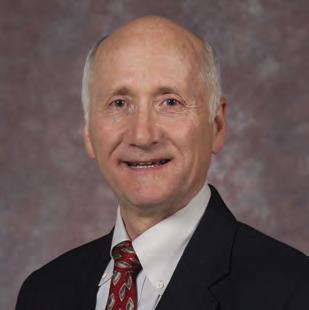

The pervasive element in our two-thousand-year pastoral tradition is not someone who “gets things done” but rather the person placed in the community to pay attention and call attention to “what is going on right now” between men and women, with one another and with God—this kingdom of God that is primarily local, relentlessly personal, and prayerful “without ceasing.”
—Eugene Peterson, The PastorMy life in ministry has been a constant call to grow in attention. As I have companioned people and communities over the years, I increasingly have become convinced there is never “nothing happening.”
The discernment mantra, God in all things, is a true and reliable guide. The power of this wisdom is that it is both universal and particular.
God in all things can be applied to the whole cosmos, to what is vast and unfathomable, to the places and people we never will encounter. Yet, it is also here, exactly where we are and how we are that God is at work, that Jesus, the peaceful One is seeking to be embodied. This year, we invite you to join us as we focus on the here of wherever we are. We want to be open and get specific. We want to see the whole landscape and sift through the details that otherwise might go unnoticed in our hurried lives.
Seeking God in this way, whether as a process or a posture, is an act of discernment. This is the journey to which we are called as we embrace our discipleship in this fluid, complex moment in our history. The question we have been asking—“Are we moving toward Jesus the peaceful One?”—is meant to guide the church as a global family, but it also is stunningly precise as it points directly to our local contexts. Anywhere we are, we can be moving closer to Jesus, the peaceful One, who seeks to become incarnate in every moment and place. When this awareness moves from head to heart and becomes a way of seeing the world, the abstract becomes clearer. Right here, where
and as you are, is where your faith demands to be lived.
When this belief moves from our head to our heart and becomes a way of seeing the world, suddenly what was abstract becomes clearer. Clarity does not mean ease, but it does make our faith more real, relevant, costly, consequential, more personally and communally transformative.
This is the kind of vibrant, vital discipleship our world hungers for. It is the kind of journey to substantive relationship with God that our own souls crave. It is naturally life-giving, energizing, hope-filled even in difficult times because it grows our capacity for seeing the abundance of the Spirit here, where we are.
From the substance of ordinary places, people, and elements—mud and spit on the blind man’s eyes, a conversation at the well, dinner at the table of a tax collector—Jesus continu ally demonstrated how the kin-dom of God is not far off but has come near. This way of seeing is a powerful integrative force in our lives because it reveals that nothing is outside the scope of God’s presence and activity. It includes what is most deeply personal that has never been named aloud and what is unimaginable to us that is reality for someone else.
The promise and possibility of God’s kin-dom is already among us, in the details, the relationships, the encounters of our ordinary lives. Our faith is inviting us to precision and particularity as we embrace the all-encompassing, inclusive presence of Jesus, the peaceful One inviting us closer exactly where we are.

As a prophetic church we seek to uphold and restore the Worth of All Persons individually and in the community, challenging unjust systems that diminish human worth.
For many HIV positive women—especially minorities— unjust systems and social marginalization prevent them from being respected and cared for as creations of God. They are mistreated.
When I (Robyn) was working on my master’s degree, I joined a research team. It sought to reduce racial and gender disparity in HIV-positive minority women. The idea was to find ways to challenge oppressive structural and social systems. Our research data helped identify actions that increased self-esteem and strengthened community support systems in this vulnerable population.
As the primary interviewer, I got to know women in the study. I learned about their desires, their fears, and what they believed their future could hold as minority females living with HIV. I remember one woman we’ll call Deborah. She had been living with HIV for five years. She was raised by a single mother. At 18, upon graduating from high school, she looked forward to a life of hope, love, and prosperity. She felt she checked all the boxes for starting a successful path. She had a job, was living on her own, and was saving money to start community college.
But life changed after meeting a man we’ll call Jacob. She found herself caught between cycles of beatings and reconciliation. Desperate for love, something she never was convinced she deserved, she stayed in the abusive relationship, waiting for the caring man she fell in love with to reemerge.
They had three children. She lost her job and had to spend the money she had saved for community college to support her new family. During her third pregnancy her doctor told her she was HIV positive. She learned the transmission was through Jacob, who disappeared from her and their children’s lives.
Deborah talked about being devastated because she couldn’t break the cycle of her youth: poverty, raising three children in a single-parent home—compounded by living with HIV. She spoke of difficulty in navigating a healthcare system with a heavily stigmatized pre-existing medical condition and without steady employment or health insurance.
I cringed as I transcribed words that demeaned her self-worth and showed how she believed she never could break the cycle. “There is no future for me,” she would often say.
But she persevered in the program, going to great lengths to come to our many seminars and meetings, even without a car or reliable child-care options. Deborah, like many women in the study, sought ways to better her future.
We held seminars that focused on life skills such as financial management, community resources, and healthy health-care behaviors. Among the most important aspects was providing a safe place for women with HIV to share, showing they were not alone. For the first time in many interviews, I heard Deborah express a vision for her future, how she would provide for her children as a single parent. She became more engaged, often mentoring other women.
After the first batch of seminars, she started talking about how she didn’t deserve Jacob’s physical and emotional abuse, and that what he did was wrong.
I did not need to be shown the data; I knew by interviews with Deborah and other women that our research team’s hypothesis was correct: Interventions that increased self-esteem and provided community support produced better outcomes. God views all people as having inestimable and equal worth. Stories like Deborah’s demonstrate that addressing the wholeness of body, mind, spirit, and relationships shows the oppressed they have worth, that there is Worth of All Persons.
This important value is one of our nine Enduring Principles. Fundamentally, we define it as “God views all people as having inestimable and equal worth.” We consider this a key value of who we are. It is part of our essence. We commit to upholding the mistreated in our world and restoring them from “unjust systems that diminish human worth” to human dignity.
It is, as Bosnian theologian Miroslav Volf argues, the will to embrace: “to give ourselves to others and ‘welcome’ them, to readjust our identities to make space for them.” Through this lens we profess our Christian discipleship and prophetically oppose society maladies such as racism and domestic violence.
Another key lens for dealing with issues related to mistreatment is that of imago Dei. This Latin term means image of God. The concept comes from the creation story. Genesis 1:26–28 NRSV states: “Then God said, “Let us make humankind our image…so God created humankind in his image.” Other verses, such as Genesis 9:6, reemphasize that humanity is created in God’s image. They’ve all had a powerful influence over the church.
Although Biblical scholars and theologians have inter preted the concept differently over the years, today we look at this concept as a role for humanity—as partners of God to “image” divine nature. We reflect God as a mirror. Our Community of Christ theologian, Anthony Chvala-Smith, shares in his excellent book, A Way of Life: Understanding Our Christian Faith:
We are created to “image” the Living God—to reflect divine glory and live God’s just and compassionate purposes. In other words, humanity is to be God’s mirror in the world. This is a signal honor.
If we diminish people—or allow others or systems to mistreat, we are making, as Christian activist Jim Wallis says, “a brutal assault on the image of God.”
The principle of imago Dei calls us to oppose adamantly the mistreatment of others. Fundamentally, it calls us to live in healthy relationships. Doctrine and Covenants 163:2b reminds us of that important point:
The restoring of persons to healthy or righteous relationships with God, others, themselves, and the earth is at the heart of the purpose of your journey as a people of faith.
Those who mistreat often fear “the other.” As a faith community, we recognize the importance of diversity—it is beautiful. Our Enduring Principle of Unity in Diversity acknowledges that we are a “diverse, international family of disciples, seekers, and congregations.” We embrace the diverse and unifying nature of the Holy Spirit. We are called to invite all to God’s table, not to make others the same as us, but to be a community enhanced by others in furthering the reign of God.
Diversity of talent, thought, nature, language, and culture enriches society. This otherness blesses us. We should never suppress “the other.” Rather we must welcome and demonstrate hospitality.
However, influences in our world desire to dehumanize or demonize “the other.” They intentionally engender and instill fear. If people are not seen as human or are viewed as substandard, it is much easier to mistreat and abuse them. As Matt Frizzell reminded us in the introductory article
in this series (“Toward the Peaceful One,” May-June 2020 Herald ): “Following Jesus today means discerning Christian voices, some of which aren’t of God.”
Anytime we hear or read of a perspective that dehumanizes or demeans, we must recognize it as being contrary to God’s desires for creation. In fact, dehumanization often leads to the mistreatment of others. Matt reminded us that Doctrine and Covenants 163:3c offers counsel:
There are subtle, yet powerful, influences in the world, some even claiming to represent Christ, that seek to divide people and nations to accomplish their destructive aims. That which seeks to harden one human heart against another by constructing walls of fear and prejudice is not of God.
As we move toward the peaceful One by professing that God weeps for “the mistreated,” we acknowledge another truth about ourselves: We admit our complicity. We confess:
• M istreatment comes in many forms and often in subtle ways.
• At times, we mistreat in our families, our workspaces, and our relationships.
• O ur silence and non-action contribute to mistreatment.
• O ur own implicit bias (unconscious attitudes and stereotypes) blinds us from seeing clearly our ignorance, prejudice, and fear of others.
• We fall prey to subtle political, economic, and social influences and structures that create fear and engage in mistreatment.
However, we also share freely the truths we know about God. In other words, we profess God’s love, grace, and reconciliation.
• Jesus Christ demonstrated self-giving love. We are to mirror that trait. “…be of the same mind, having the same love, being in full accord, and of one mind. Do nothing from selfish ambition or conceit, but in humility regard others as better than yourselves. Let each of you look not to your own interest, but to interests of others” (Philippians 2:2–4 NRSV).
• Jesus Christ’s central teaching was the reign of God. We are called to proclaim and live into Zion, the peaceable reign. “He has told you, O mortal what is good; and
what does the Lord require of you but to do justice, and to love kindness, and to walk humbly with your God?” (Micah 6:8 NRSV).
• Jesus Christ prophetically challenged the leaders of his day. We are called to “strive to be faithful to Christ’s vision of the peaceable Kingdom of God on earth. Courageously challenge, cultural, political, and religious trends that are contrary to the reconciling and restoring purposes of God. Pursue Peace” (Doctrine and Covenants 163:3b).
We all can agree that people are mistreated throughout our world. We need only to look closely in our lives, read the newspaper, listen to the daily news, or check the Internet. Mistreatment rears its ugly head in every facet of our lives—in our families, schools, workspaces, communities, cities, societies, and nations.
Our community is called to model the Worth of All Persons and reflect God’s love and grace to our world. We are to respect “the others” and invite them to enrich us as we live into the reign of God. We must confess and acknowledge our complicity in the influences that divide and harden hearts. May we be attentive to our own fears and ignorance. May we lay bare our implicit and unconscious biases, which prevent us from seeing the world clearly and contribute to mistreatment. Lastly, may we repudiate theological, economic, political, and social distortions that demonize and demean.
As we reflect on Deborah, who felt degraded, hopeless, and uncertain as to whether she could break the cycle of “there is no future for me,” we hope that each of us—individually and in community—will prophetically challenge those influences that mistreat. Let us pray that we demonstrate the will to embrace “the other” so all may flourish in God’s creation. Shalom to each of you.
Acore goal of the Community of Christ Ecumenical and Inter faith Ministries team is exploring and recommending ways congregations and jurisdictional areas might become more involved in such activities.
As early as 1980, WCR 1157 noted: The strength and voice of the church should be added to those of other Christian organizations and movements when they are engaged in ministries which are consistent with our own ministries and beliefs.
In 1992, WCR 1222 encouraged the church to begin moving toward membership in the National Council of Churches (NCC) in the USA and explore interfaith memberships. It also suggested church members participate in local ministerial associations. In 2002 WCR 1275 established this team to create a link between Community of Christ and ecumenical/interfaith groups. In 2010, NCC membership was achieved, assisted by the leadership of former Apostles Dale Luffman and Gail Mengel.
Under the leadership of Kerry Richards and John Hamer, the church in Canada now is an “observer church” in the Canadian Council of Churches, working toward full membership. Peter Noteboom, general secretary for the Canadian Council of Churches, said in a recent address to the Canada East Mission Centre Conference:
You belong in this community…we value the insights your traditions and teachings bring to an ever deeper and ever fuller community of Christ; how we work for peace in Canada and the world.
Also, Community of Christ in the United Kingdom and Europe is work ing on peace and justice issues involv ing many ecumenical and interfaith groups. Apostle Catherine Mambwe shares connections with the African Council of Churches.
W hy ?
We’re not in this mission of peace alone. We’re not too small. Commu nity of Christ’s Mission Initiatives
and Enduring Principles call us to this work. Many congregations work with other faith groups in sponsoring food and clothing pantries, assisting the homeless, sharing in peace parades/ marches. They report increased inter est in their own congregations due to reaching out. Participating in mis sion and spirituality with other faith groups energizes and brings a sense of wholeness to those who engage, as well as the entire congregation.
For Brian Carwana of Encounter World Religions in Toronto, Canada, it is about taking people to where they are not comfortable and then having a good time there. Liken it to travel— call and ask what you need to know, then visit Islamic mosques, Jewish synagogues, Sikh gurdwaras, or Hindu temples. Seek to learn about them and then come home knowing more about yourself and your own.
Team member Ryan Pitt relates this experience:
We came from all over the country to begin our training as Chaplain
Candidate Program Officers in the US Navy. Roman Catholic, Baptist, Lutheran, Methodist, and Community of Christ in the common pursuit of compassion, love, and peace. As I looked into the eyes of my colleagues, I didn’t focus on religion. Nor did I see one “absolute truth.” What I saw was deeper, more profound, and mysterious. As we stood in formation, diverse perspectives stood together as one.
Doctrine and Covenants 161:6b urgently calls us “to become a global family united in the name of the Christ…” Interfaith and ecumenical participation does not devalue our identity in the Restoration; rather, our presence amplifies Christ’s message of peace already echoing. The path of the disciple is not limited to one person or faith. Yet, we are an essential drop in the living water of Christ.
Community of Christ congrega tions are sponsoring members of the Ecumenical Ministries of Oregon (EMO). It’s one of the most successful statewide ecumenical groups in the USA, and its website, www.emoregon .org, offers ideas of ecumenical and interfaith social-justice ministries and education opportunities.
In commenting on what has caused a national downturn in state ecumeni cal groups, EMO Director Jan Elfers pointed to a concentration on policy and education without hands-on, grassroots efforts to live up to mis sion. Some ministerial groups in local areas may lose interest when group work centers only on gathering for the sake of gathering. Yes, relationships are essential, but they should extend to a missional purpose to maintain and grow interest beyond clergy to congre gation members.
Team member Tami Perryman relates this story of building relation ships with other congregations in more rural areas.
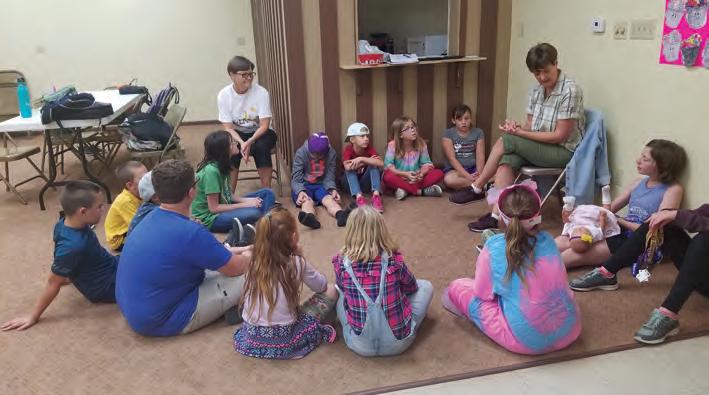
They met originally in the library, a few women from different denominations who were part of a book club, part of a community. The talk of the day was what to do with the gift of Chromebooks, which had been donated to the elementary school by a business. The problem: Many students in the small community of Norway, Illinois, did not have Internet access at home. Chromebooks were useless without the Internet.
These individuals approached their pastors and the Norway Improvement League and said, “This is how we can
help in our community.” Thus Norway after the Bell Connection began. The Norway Improvement League donated the use of its building and installed Internet access for students. The Methodist Church applied for a Keagy Grant and was blessed to receive it. The Community of Christ Mission Congregation received a Chicago USA Mission Center Strategic Goals Grant and matched it with congregational funds.
Others came forward with additional funding, and we hired a retired teacher as our part-time director. Originally, we had only three students. Some people asked if helping three kids
was worth the time and effort. Before long, teachers and parents heard about the tutoring program, and the numbers increased. Volunteer tutors came from various community churches. The tutoring program expanded to include a summer day camp, then a reading program for the early elementary students.
We realized we were affecting the lives of these children. What more could we do? We started praying with the kids, allowing them to direct the conversation between God and us. We worked on antibullying by instituting the “Bucket Program.” It encouraged students to “fill each other’s imaginary buckets” with caring actions and positive affirmations. Relationships were building between denominations and between volunteers, students, and families.
Although the focus was on education, we quickly became part of the students’ families, celebrating the passing of a test, a new brother or sister, new jobs for parents, birthdays, and holidays. We were there in difficult times, offering support. We truly care about all the children and their families.
This is our fourth year with Norway after the Bell Connection, and we continue to brainstorm for ways to support our students, though we cannot gather together. The school is meeting virtually as I write this. Pandemic stimulus resources were used to provide Internet access in every home to enable virtual learning. The talk no longer is about Chromebooks and Internet access. It’s about how we can support our teachers and school staff as they navigate teaching in a virtual world. How do we continue to develop nurturing relationships with students and families when we are isolated? Our focus is changing, but our determination to work together as
community churches remains strong. We have our own identities, evident during the local car show, where the Community of Christ booth gave away lemon shakeups, next to the Lutheran church booth selling popcorn and the Methodist church providing games on the lawn.
We pray together for our community, for the children and their families. We collect supplies for the teachers so they will have what they need when classes resume. This is what ecumenical cooperation and worship can look like in a small rural community. It can look like a group of neighbors gathering to meet a need.
Susan Gregory, a Community of Christ member and former chair of the Interfaith Network of Central Oregon (INCO), notes the following about interfaith ministry:
Most of us are aware of the differences between world religions, but interfaith organizations like INCO focus on the commonalities. Also, “rubbing shoulders” with people of
different faiths makes that religion less foreign. People now can visualize a face, say they’ve met a Jew, or Muslim, or…
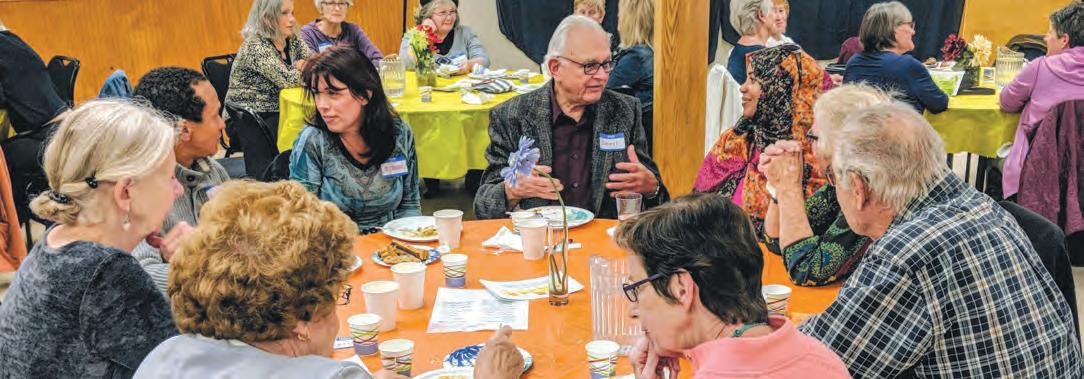
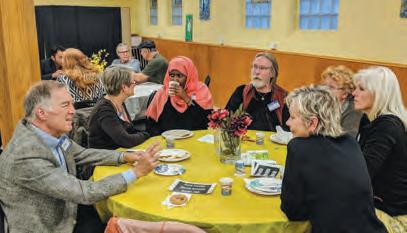
INCO put on an event called “Eat with Muslims,” which was a roaring success. Two Muslim women came to town, provided the meal, and talked about themselves and a bit about Islam. It was not in the spirit of having anyone convert, but to understand a little more. It was amazing. Eat with Muslims is based out of Seattle, Washington.
Sharing food is a wonderful way to build interfaith relationships. Sep tember 21 is known worldwide as the United Nations International Day of Peace. An interfaith potluck celebrat ing a day of peace introduces people to new tastes and traditions.
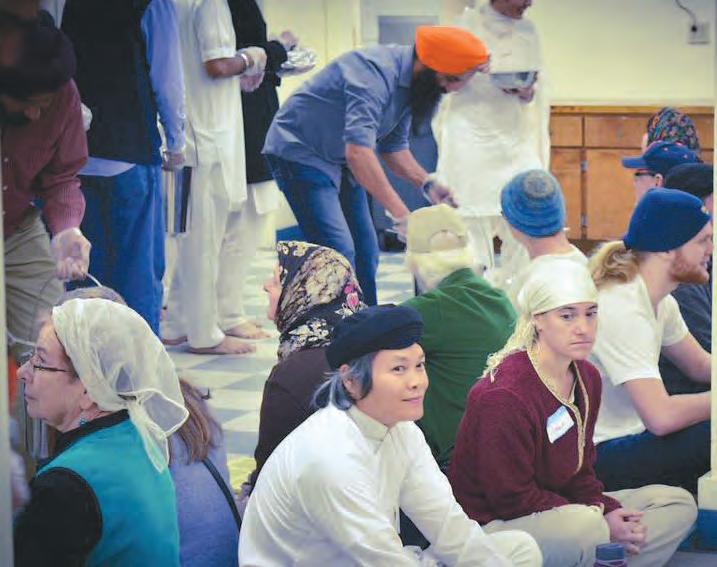
A beautiful celebration of peace was experienced in Portland, Oregon. Mul tiple faith traditions shared their ver sions of the Golden Rule—Treat others as you would have them treat you—in a joint worship service of Prayers for Peace. Another way to include food is to invite a Sikh group (if available) to prepare and share a traditional langar meal. It is a generous spiritual expe rience that promotes all participants equally—and it accommodates dietary restrictions.
How are you building interreli gious relationships for ministry in your community? Send your stories to team co-chairs Val Walker at valpas tor61@sbcglobal.net, or Zac HarmonMcLaughlin at zmclaugh@graceland. edu.
Other members of the Ecumenical and Interfaith Ministries Team: Erve lyne Bernard, Brian Carwana, Neil DeAtley, Stephen Donahoe, Catherine Mambwe, Susan Naylor, Tami Perry man, Ryan Pitt, Kerry Richards, Kathy Sharp, Gillian Vincent.
One Sunday at noontime, as I was heading home from a worship service, I saw a woman who seemed to be crawling in the dirt along the road. I pulled over, hopped down from my truck, and went to offer help.
“No thank you, sir. I’m OK,” she said.
While talking with her, I noticed her physical condition. Then I understood why she was crawling. It touched my heart when she said, “I am waiting for my husband to carry me to the other side of the creek.”
You see, the woman was a polio victim, married with one child. She was waiting to cross the creek back to their house, perhaps a hundred yards away.
We said our goodbyes, and I went home, carrying that encounter deep in my thoughts. So many things were swirling in my mind. As I was reflecting, I remembered the story about Jesus healing a woman who had been afflicted for years. But this woman said she was OK. I told myself, if only she would have asked me to carry her to the other side of the creek, I would have done it.
That encounter began a new church mission in her community weeks later.
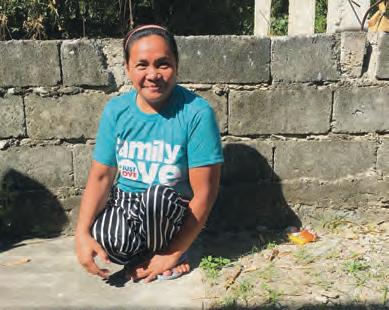
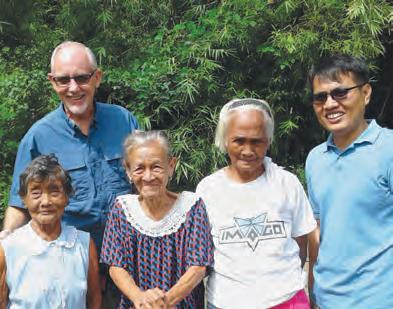

With the help of one church member in the community where the woman lives, I crossed the creek and formally visited her home. It was a joyful and pleasant reunion for both of us. I learned her name: Mila. She shared a lot of things about her life. One thing struck my heart. She said: “I have never been to a church since I was christened.”
At one point, I looked at her as she sat on the dirt floor, with a big smile and a baby on her lap. I thought, “This is who she is, a child of God.” Because of her condition, I wondered if anyone had noticed her worth as a person. Did
she need healing? Obviously, the answer was yes because she had not received the benefits of being in a community that would embrace and love her.
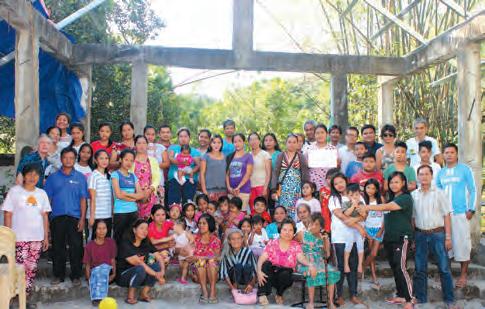
My visits to Mila and her husband, Joel, became more frequent. They were always full of inspiring conversation and sharing about our church’s mission. With the help of my wife, Josie, they and six other adults and young people, lovingly and faithfully accepted our invitation for fellowship, hymn singing, Bible studies, and studies on church principles of faith.
Gathering in Mila’s small yard became an important part of her life, and she was grateful for each moment of hearing the gospel. In the shade of a mango tree, she became the cornerstone of our gatherings as a community began to emerge. She started to invite others in the neighborhood to join us.
Soon, we needed a larger place to meet. We wanted to build a chapel. The overflowing generosity of people resulted in donations of land, materials, and funds for the first phase of construction.
Gatherings of church activities such as worships and other meetings are being held in the homes of church members while the chapel is being built. Construction is only partly done, and we’re looking to the local community to help complete the building in coming months.
The atmosphere of the gathered people is compelling, strong, and full of God’s Spirit, helping them journey toward becoming the newest congregation of our church in the Philippines. Mila, Joel, and 35 others have been baptized within the community, and I know our mission will yield many more.

I thank my God every time I remember you, constantly praying with joy in every one of my prayers for all of you, because of your sharing in the gospel from the first day until now. I am confident of this, that the one who began a good work among you will bring it to completion by the day of Jesus Christ. It is right for me to think this way about all of you, because you hold me in your heart, for all of you share in God’s grace with me, both in my imprisonment and in the defense and confirmation of the gospel. For God is my witness, how I long for all of you with the compassion of Christ Jesus. And this is my prayer, that your love may overflow more and more with knowledge and full insight to help you to determine what is best, so that in the day of Christ you may be pure and blameless, having produced the harvest of righteousness that comes through Jesus Christ for the glory and praise of God.
—Philippians 1:3–11 NRSV
Nothing helps focus the mind like the prospect of one’s imminent execution. So observed the 18th-century English writer Samuel Johnson. I don’t know the context of his remark, but he easily could have had St. Paul in mind. The apostle wrote Philippians from an imperial prison, uncertain of the outcome of his case. Execution was a real possibility, because a few lines later, Paul contends with the likelihood of his death. Mortality and impermanence aside, the opening verses of the letter plunge us into a four-chapter love fest. Even the casual reader can tell that Paul and this community shared a bond of deep affection.
Concerned for his well-being, the Philippians had sent support in the form of money. There’s a complicated backstory, but Paul wrote this letter partly to thank the congregation for its kindness and generosity. Ever a conscientious pastor, he also wrote to assure the Philippians that whatever his fate, God would see them through.
The letter’s opening is like a big verbal hug, which means it’s easy to gloss over a specific remark:
And this is my prayer, that your love may overflow more and more with knowledge and full insight to help you to determine what is best….
—Philippians 1:9–10a
Paul rehearses here his ongoing prayer for the Philippians. “I’m praying that your love may overspill so much, that it gives you every-
thing you need to help you determine what’s best….” Savor these words: You…determine…what is best!

It’s shocking to say—scandalous, really. Don’t rely on me, the apostolic authority figure, implies Paul: helping you figure out what’s best is no longer my department. Not the Bible (because there was no New Testament yet, and these non-Jewish Christians in Philippi likely didn’t know their way around the Jewish scriptures very well, if they had access to them at all). Not a code of conduct Paul drew up for them, which any reader of his other letters knows Paul is quite capable of doing. Instead, Paul writes the Philippians, knowing it could be the last thing they ever hear from him. And what he so surprisingly tells them is, in the Christian spiritual journey, you have to plan on figuring a lot of things out for yourself.
It’s as if Paul were saying, I can’t give you a list of bylaws for the journey ahead. There are no blueprints, no statutes, no decrees, no Google maps with steps. I’ll pray for you, but not that you’ll “win”; succeed; make no mistakes; manage it all perfectly; have an easy, conflict-free passage into the future; or no discomfort or uncertainty. And I’m definitely not praying that the signposts will always be crystal clear for you, or that there’ll be signposts at all.
Rather, I’m asking God that your love may overflow— indeed, that in its superabundance, you’ll have what you need to figure out what’s best, step by step, as you go.
In a few extraordinary but easily bypassed words, Paul unveils his vision of the Christian life. What Paul wanted the Philippians to see could hardly be more vital for us today: The great journey of living in companionship with Christ is a trek into increasing spiritual freedom, not a descent into a religious policy manual. This glimpse is so breathtaking that a few translations fudge on accuracy and make Paul sound like he’s locking infants in a car seat, rather than daring us to claim as part of adult faith that we and God will have to puzzle out a lot of things while on the road.
Candidly, more often than we care to admit the spiritual journey is frustratingly devoid of signposts. Historians have noted that when Alexander the Great led his Macedonian armies across ancient Persia nearly to the edge of India, he ran out of, shall we say, route information. Necessity required him to “march off the maps.” A trip into foreign territory, without signage, pointers, landmarks, mile-markers, or road atlases.
The Christian life often is exactly that kind of expedition—minus (one should hope) the conquest, violence, and empire-building. Long stretches of our pilgrimage are all about improv.
When we have to wing it, though, we know at least one thing: the one thing that matters. Because the journey we’re on is in, with, and toward God whom we know in Jesus Christ, it can be only about love. Love, of course, can make rules and sometimes has to; but love is infinitely, inexhaustibly more than rules. Paul tells his readers: Let your life together on this journey with the Spirit be about love, more than rules. Appropriately, he prays “that your love may overflow more and more with knowledge and full insight to help you to determine what is best….”
Evelyn Underhill, the early 20th-century spiritual guide, author, and scholar of the mystical tradition, expresses it this way:
[The spiritual life] is produced by [God’s] steady attraction and our humble, self-forgetful response to it. It [the spiritual life] consists in being drawn, at God’s pace and in God’s way, to the place where God wants us to be; not the place we fancied for ourselves….
Spirituality, as Underhill regards it, is not all about our activity, but really is an act of divine creation in and with us. Creativity is key: The spiritual life is not some kind of “mass production”—as in a factory. God is not in the business of stamping our identical “spiritual” people. Rather, Underhill says, spiritual formation and growth are more like the “creation of a salad,” and “no two salads are ever quite alike.”
It’s a great image. We shouldn’t be surprised that whatever the commonalities, no two paths on our shared journey into God’s life are ever quite alike. On the contrary,
they often will be markedly different. Paul knew this when he wrote Philippians: Thus, he says the way ahead for you is loving discernment in community. An overflow of divine love in our midst is precisely what we need to live unbegrudgingly with the fact that there’s more than one way to the top of the mountain.
Paul prayed in his letter for an abundant runoff of compassion so the Philippians would have all they needed to manage the uncertain way ahead. We need that, too. We need to be reminded, as much as they did, that it’s about love, more than rules.


Rules have their place, of course. (I have been a camp counselor more than once.) But rules can immobilize the spiritual life. The 17th-century writer Brother Lawrence was a latecomer to devotional life. A simple man whose injuries from military service left him with a limp, he joined a Carmelite monastery and became the cook.
Over time it was noticed that the good brother who ran the kitchen had a deep, visible, contagious connection with God. People, including his superiors, wanted to know his secret. Brother Lawrence admitted that the rigorous style of prayer—done in a certain way following a set pattern— had left him cold. The rules were killing his spiritual life.
He finally decided that what he really wanted was simply to “practice the presence of God,” by which he meant bringing his thoughts and intentions constantly back into the presence of God. Whether washing pans, dealing with his brothers, or making unwelcome journeys to get provisions for the monastery, he always could think about God. The rules had not helped him find the thing he wanted most: to know God. But love, expressed as a constant turning of the heart toward God, had. It wasn’t in the Carmelite
playbook, but it worked (which is why one still can read Brother Lawrence’s little book, The Practice of the Presence of God, today).
Love, more than rules, is key to deeper life with God. Those who seek this deeper life at some point will encounter a curious, intensely devoted, odd assortment of figures from the ancient church called the “desert fathers and mothers.” By the fourth century, as Christianity was becoming the favored religion in the Roman Empire, some followers of Jesus found the churches increasingly to be home to superficial Christianity. These disciples wanted more.
So they withdrew from the big churches in the cities for the solitude of the Egyptian and Syrian deserts. Imitating Jesus and Paul, who both had done a stint in the desert, these monastics yearned for a radical spirituality that touched the deepest roots of their lives. The collected sayings of the desert fathers and mothers have captivated spiritual seekers for over 15 centuries.
The life of these monks was severe. Living in the harsh landscapes in solitary huts, eating little, working hard plaiting palm leaves into baskets to sell for meager rations, they spent much of each day and night in prayer and reflection. Commonly on Sunday, these solitaries would gather at a synaxis—a common solemn worship gathering at a desert church.
There’s a noteworthy story about one of these gatherings and a monk name Abba Poemen. Some old, experienced monks came to Abba Poemen, asking how to deal with a problem at weekly gatherings. They asked, “What should we do about brothers who sleep during the synaxis? Shouldn’t we wake them up so they can be watchful?”
Basically, they were tattling and wanted a regulation for dealing with the slackers. Abba Poemen replied, “Well, for my part, when I see a brother dozing, I put his head on my knees and let him rest.”
The disciple’s journey is not a forced march. You don’t get extra credit for staying up all night in prayer and censuring those who couldn’t. Compassion, not outing the sleepers, is the way ahead. That’s good news because it’s a long, long trackless way into the infinite depths of God. We’re often going to get lost, turned around, and weary. Sometimes we just need a traveling partner to tell us, “Take a nap. There’s no rush. It’s really OK to rest.”
Much more than rules, we need that kind of love because it’s really about God on this journey we’re all on. So, let’s relish Paul’s prayer. He surely won’t mind if we apply it to ourselves. When we must march off the maps, may our love overflow. May we boldly embrace the scandalous freedom we have in Christ to decide what’s best: for our communities, for us, for this time, for our imperiled world, for the sake of the reign of God, which is changing everything.
Note: Thanks to Denise Esch of Regina, Saskatchewan, Canada, who used this title for an early draft of this article.
The great journey of living in companionship with Christ is a trek into increasing spiritual freedom, not a descent into a religious policy manual.


have a bromance with Jesus. My co-pastor, Maggie, began using that term a while back, and it just stuck. What is a bromance? Wikipedia defines it as “a close but non-sexual relationship between two or more men. It is an exceptionally tight, affectional…relationship exceeding that of usual friendship…”
Jesus is my best friend, my Lord, my Savior, my constant companion, my protector, my Everything. However, we weren’t always so close.
I met Jesus in the woods that surrounded the hollow (or holler if you are from Appalachia) in southern Ohio, where I grew up. My family wasn’t religious. Jesus was just a guy we talked about at Christmas and Easter, after Santa and the Easter Bunny. I was the weird kid in the holler with my head always in a book or the clouds. I donned bracelets made of aluminum foil and a golden lasso made from leftover yellow cord used to make a clothesline.
I was “different,” and everyone knew it. I hated sports of every kind, though I was faster than most other boys. Of course, getting chased by members of the junior and varsity football team daily gives you lots of practice.
It was in those woods that I became aware God existed, and that I met Jesus. I had begun reading C.S. Lewis’ The Chronicles of Narnia on an old tree stump along the banks of the Scioto River. I picked up pretty quickly that Aslan was actually Jesus. I was 14 when I realized that it wasn’t only my love of reading and books, Wonder Woman, and the woods that made me weird. I also knew I didn’t want a girlfriend…I wanted a boyfriend.
I got called names every day at school during gym class. I heard that being gay was bad, a sin, an abomination. And I knew Jesus could fix me, just like he fixed the broken characters in Narnia.

So, I went to a church the following Sunday and asked Jesus to save me, knowing I was well on my way to being a born-again heterosexual Christian teenage dude!
Eventually, I joined another church and became a superstar nearly overnight. My passion and love for Jesus was obvious and contagious. I was asked to teach little kids in Sunday School, was seen as a role model to the other teens, was asked to sit on a board, and became a member of the church’s drama team.
One Sunday I went to the altar because I felt God calling me, telling me I was to be a minister.
Sundays came and went, and I often found myself standing behind the pulpit, giving a message, speaking to youth at another church, and leading devotionals at my high school or college. I would stand behind the pulpit and stare at the stained-glass windows that lined the sanctuary. I noticed the stains of bird droppings, the leaves caught in a spider’s web outside. I saw the burned mark near the main window, which depicted Jesus ascending to heaven. Lightning had struck the church, but the window held strong.
I remember thinking how I was like those windows, stained. What if the church found out? What if the pastor told everyone that I was meeting with him weekly for counseling, not understanding why Jesus wasn’t fixing me. Did they know I was lying to them, to God, to myself? Did they know I was in love with my best friend, a tall, beautiful, blond farm boy with sky-blue eyes (swoon). Did they know I was a hypocrite?
After high school, I began attending a university in my hometown. I planned to graduate with a bachelor’s in English and then attend seminary. On the outside, I appeared to be this confident Christian guy who dressed the right way, had the right type of haircut, and “liked” girls. On the inside I was dying.
I was racked with guilt, shame, turmoil. I knew Jesus hated me. I wanted to die. Ironically, I came across James 1:5 and the story of Joseph Smith Jr. going into the woods. At the time, I did not have a lot of respect for Smith. But I followed his lead and went to the woods—not to ask God for wisdom, but to have a come-to-Jesus moment. I was sick of wearing a costume, and I was tired hating myself.
I said, “God, you don’t answer prayers, or you have just been ignoring me all these years! Either you fix me and make me straight, give me peace about being gay, or you leave me alone!” I left those woods, leaving God and Jesus behind.

That night I was about to crawl into bed when the air in my room changed. It clung to me, thick and sticky, but warm and peaceful. There was a presence in my room. I wanted to run but couldn’t move. I found myself
in a beautiful meadow, honeysuckle wafting on a gentle breeze, and beside me was Jesus. He looked nothing like his picture by the way. He smiled at me (swoon). “Bennie, walk with me.”
“Why?”
“I want to talk to you,” he replied, holding out his hand. I reluctantly followed Jesus with my arms crossed, about to spout something rude.
“I heard your prayers…all your prayers.” My heart leapt into my throat. Busted.
“Oh…” I muttered.
“Not only did I hear them, I have been answering them. Just not how you wanted or expected. You asked me to fix you, to make you attracted to women. I am afraid I can’t do that.”
“But why? You said that if I asked then I shall receive. Being attracted to guys when you are a guy is a sin! An abomination!”
“Who said that?” Jesus asked.
I was dumbfounded. “The Bible! The people at church! Pat Robertson!”
Jesus laughed. He actually laughed! Then he smiled at me and reached up to my face. I flinched but was still. He wiped the tears flowing down my cheeks. I was so mad and
broken that I hadn’t realized I was crying. “Bennie, do you want to know what I say?”
I shook my head.
“You asked me in the woods today to fix you, give you peace, or to leave you alone. Well, I don’t go around fixing what isn’t broken.” My eyes were burning. “I will never leave you alone, so consider yourself stuck with me.” Jesus laughed. “But I will give you peace. Bennie, yes, you are attracted to men. You long for a man’s companionship, his love, and yes, his body. I haven’t fixed you, because you aren’t broken. I made you just as you are. You are my beautiful child, my Bennie. I have so many wonderful plans for you. There are many, just like you, who will need your love, guidance, and wisdom, and they’ll find me through you. Bennie, I love you exactly as you are, and that is what I say.”
Jesus wrapped his arms around me and whispered “You are my child, my disciple, and my best friend.”
The next morning, I woke up. My eyes were wet from crying, but I was smiling. I laughed. All of those years of guilt, shame, self-loathing, and desire to kill myself were gone. It no longer mattered what the Bible or the church said, because I knew what Jesus said. A week later I told my best friend and parents. That all went great.

But my conversation with my friend was overheard. In
a week, I went from three people knowing that I was gay to 500 when I was outed during a Sunday worship service. I was told I could continue to come, but I would have to sit in the back—and under no circumstances near the boys. I walked out.
For years, I walked with my Jesus alone—until, I found Portsmouth’s Welcoming Congregation in Community of Christ. Jesus did fix what actually was broken in me. He fixed me by loving me and helping me love myself. He fixed me by bringing me home to Community of Christ. I was ordained to the office of elder in August 2019, a gay man… ordained. He fixed that. I love my Jesus and our bromance.
 Photo © Right 3 | Adobe Stock Photo
In years past, mother and I would go to nursing homes every Sunday afternoon, set up our equipment, and sing to residents for an hour or so.
Mother passed a few years ago. A new journey of music ministry began in January 2020, when I headed for Truman Medical Center-Lakewood in Lee’s Summit, Missouri. The previous year, I had played there at a birthday party for a friend’s mother from Stone Church. Afterward, the activity director expressed interest in bringing my music to all the residents in the long-term care facility. I accepted.
The residents and I enjoyed an hour of gospel, oldies rock, and country music. Afterward, Jylian Hudson, their music therapist director, offered me three more 2020 dates—April, July, and November.
But because of restrictions forced on medical facilities by COVID-19, the programs were canceled. I had continued practicing and planning a program for the April performance. My daughter, Sheila, and her husband had approached me about learning to play guitar, so I began teaching them. They would have joined me had the performance became a real ity. Feeling disappointed that the program was canceled, I reflected on how the residents would feel.
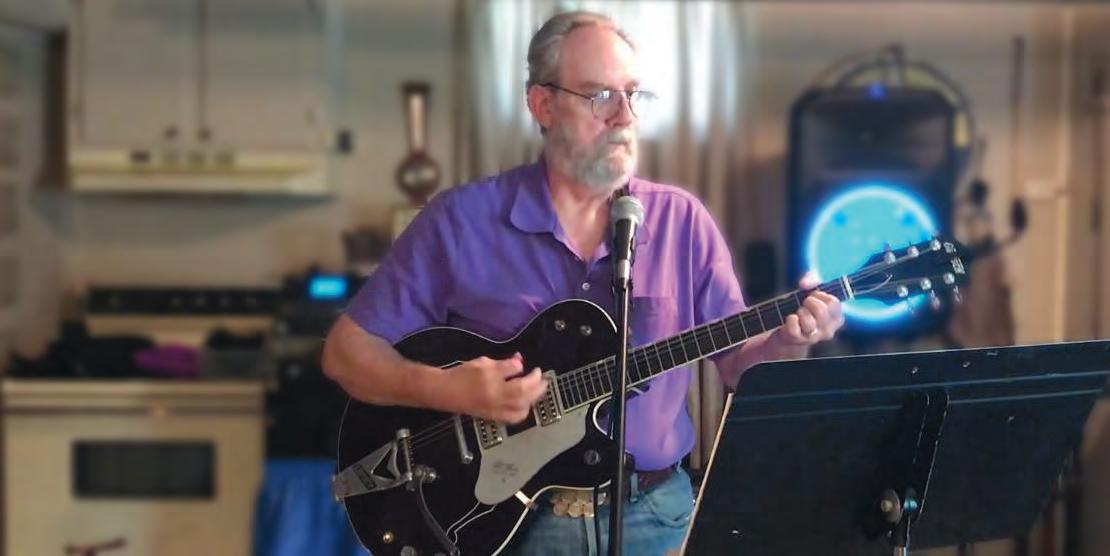
I became concerned about them being cooped with no visitors allowed. So, using my knowledge of technology and music, I created a one-hour video with pictures, song intro ductions, and live “one-man band” performances of gospel, folk, country, and oldies rock.
Because of my gifts in technology and music, I’ve acquired
equipment to allow me to bring harmony with a digital har monizer, organ drum, and bass-line accompaniments with devices and pedals, along with my guitar, and video technol ogy through computers, my iPhone, and software.
To date, I have submitted three hour-long videos for the residents. I continue to record in my basement, and I antici pate more videos in the future. I’ve added to a YouTube chan nel of Sermons and Music Ministry and posted videos on Facebook, on my timeline, the Sharier Family page, and a page called Christian Karaoke Quarantine. Some videos have been viewed by more than 300 people. Feedback has been positive, and the response from TMC Lakewood has been humbling. I received a thank you note signed by each resident there.
Each video has taken hours to develop with the quality necessary for ministry.
My life as a musician began when I was young. Mother would play guitar and sing to us four boys each evening, instead of reading bedtime stories. We would sing together at church, at the Barberton Congregation in Ohio, and I learned to play the guitar at a young age. Two of my older brothers and I formed a band in the mid to late ’60s, and we played throughout Northeast Ohio.
I’ve continued to develop my gifts and skills and con tinue to offer music ministry with my lovely wife at local congregations. Music is ministry for the soul, and we never know how much it affects those we sing to. While I continue to practice and sing, I pray for long life so that I might con tinue to bring music ministry to those in need.
Igrew up a ranch and farm kid in Kansas, Missouri, and Idaho, an upbringing for which I am grateful. But it wasn’t much preparation for a summer of work in a church-sponsored youth service corps in Chicago’s inner city. It was 1970, and “The Age of Aquarius,” sung at the rock-musical Hair to which I reluctantly was dragged, was dawning. But I was barely awake. From the moment I arrived in the “City of the Big Shoulders” I was wide-eyed— every day, all day, and long after lights out many nights.
But the night is long, and I am full of tossing until dawn.
—Job 7:4 NRSV
The Temptations released their hit, “Ball of Confusion,” that summer. It defined so much of my experience; mine and surely that of tens of millions others:
Segregation, determination, demonstration, integration Aggravation, humiliation, obligation to our nation. Ball of confusion. Oh yeah, that’s what the world is today.
That summer was no gradual, gentle coming of the light over an eastern horizon. It was a sudden, relentless, burn ing, blinding, shield-your-eyes spotlight. As my eyes adjusted to that urban landscape, as I encountered The Other America of poverty, prejudice, and injustice that Michael Harrington revealed in the early ’60s, I couldn’t turn away. Confusion changed to conviction, and I was not the same.
Fifteen years later, living in East Africa, I watched sunrises over the savannah on the night train from Nairobi as it made its way on the narrow-gauge railway to a morning arrival in the ancient port city of Mombasa. Africa and its peoples woke me to suffering, as well as hope; to faith born of my doubt; to the rhythms of life lived in a God-soaked world, even in times of devastating drought.
“…let us press on to know the Lord; his appearing is as sure as the dawn; he will come to us like the showers, like the spring rains that water the earth.”
—Hosea 6:3 NRSV
Another decade on, following a time of depression and a bout with cancer, I sat on a log at the shore of Pomme de Terre Lake at Hermitage in the Missouri Ozarks. A heron stood—still and silent, a few yards away…for the longest time. Long enough for the water to reflect the varieties of blue, magenta, red, pink, and orange that defined a new day, a new dawn.
Warm cup of coffee in hand, I sensed a wise invitation to wake up, to drink all of it in.
Be grateful. Be open to the next surprise. See the silence. Taste the colors of the morning.
I was living inside Czeslaw Milosz’s poem, “Recovery”:
Here it is still dark
…But the dawn on bright stilts wades in from the shore And the ball of the sun, ringing, rolls.

Now, in this decade, I sing “Light dawns on a weary world” with other sisters and brothers in Christ. “The promised day of justice comes.” Some days I can point to where God’s justice is a river rolling down. But there are other days.

The promised day comes? Really, God? When? Where? Certainly not today. Certainly not now. It’s still a ball of confusion out there. Give us a sign midst the mess we too often mire our planet in. Shine us a light or at very least show us a shadow that precedes the coming of the light. My wife told me she loved me this morning. And she does. Our daughter called to ask how we were doing and to catch us up on her workday. I received a photo of a friend as he was holding his young-adult son’s hand in the hospital bed just before brain surgery—less than a year after his wife was taken by cancer. Friends are surrounding them, standing watch, and surgeons are at work.
Dedicated colleagues are working in schools, homes, churches, and state legislatures to address the “impossible” goal of ending gun violence in our nation. Don’t ask me why or how, but today I trust the promised day of love and justice is already here…and still coming.
So we have the prophetic message more fully confirmed. You will do well to be attentive to this as to a lamp shining in a dark place, until the day dawns and the morning star rises in your hearts.
This article is an excerpt of the full Presiding Bishopric Financial Update from the December 5 World Church Finance Board meeting. The uncondensed article is at www.CofChrist .org/financial-updates . All dollars are reported in USD.
The year 2020 has been difficult. World Church leaders began the year anticipating budget cuts in June 2020 as World Church ministries and services were reduced to fit within the projected income for 2021 through 2023. This multiyear period provides a longer discernment process for supporting the church’s mission in the coming decade and beyond. Before the new budget plan could be implemented, the impact of the COVID-19 pandemic began to be felt around the world. The pandemic has created significant losses of health, in-person worship, loved ones, income, school routines, employment, physical togetherness, finan cial stability, and travel, to name just a few.
As we come to the close of 2020, we know a lot of uncertainty will remain as to what will unfold in 2021. What we know, based on our experience in 2020, is that working together we can navigate what is ahead. World Church leaders are grateful for the faithful and generous response as Community of Christ works to support Christ’s mission locally and globally. The church’s generosity of time, talents, treasures, and testimonies has been amazing.
Thank you for your ongoing support of Mission Tithes, Local and Worldwide, during this very difficult year while also working toward the Bridge of Hope goal.
As of 31 October 2020, $12,097,000 had been received for Local Mission Tithes. Based on simple projections, Local Mission Tithes should meet or exceed 80 percent
of the average amount given in 2018 and 2019. Given the multi-decade downward trend in Local and Worldwide Mission Tithes, the bishopric would have projected a decline for 2020 even without the pandemic.
The Presiding Bishopric continues to provide monthly updates about Worldwide Mission Tithes at www.CofChrist .org/contributions-update. The 2020 goal range for Worldwide Mission Tithes is $12 million to $12.9 million. The 31 October 2020 projections indicate the church probably will share more than $12 million by the end of the year. Given World Church leaders’ concerns early in the year, we are grateful the church is working together to support worldwide mission and needs during a very difficult year.
Worldwide Mission Budget managers are doing an excellent job in limiting expenses as we move through this unprecedented year. The Presiding Bishopric projects that the available 2020 income will cover the 2020 expenses.
A year ago, the Presiding Bishopric provided the following summary:
1. C ommunity of Christ contributors to Mission Tithes are very generous.
2. R egardless, contributions to Mission Tithes have been declining for more than 25 years.
3. T he decline is based on the loss of contributors.
• I n 2014, about 9,100 USA households supported Worldwide Mission Tithes, and 12,800 supported Local Mission Tithes.
• I n 2018, those numbers dropped to 7,600 USA households supporting Worldwide Mission Tithes and 10,700 supporting Local Mission Tithes.
We reported that World Church leaders were bringing together a team to explore innovative ways to fund the current and future mission of the church with those under the age of 60. We started this exploration early in 2020. Then the decision was made to pause this particular exploration until 2021, waiting for insights from the World Church leadership discernment process considering the question: God, where does your Holy Spirit lead us next as we embody the soul of Community of Christ? The discernment process has continued through the complexities created by the global pandemic.
As we look toward 2021 and beyond, World Church leaders are concerned about how the economic impact of the global pandemic may add to the church’s declining trend. In the middle of these realities, we have the continued challenge to meet the retirement responsibility through the Bridge of Hope Project.

Funding the retirement responsibility is the first of two priorities for Bridge of Hope. Growing the endowments is the second. As of 30 June 2020, $76,000,000 had been raised for the retirement responsibility, leaving $44,000,000 to be raised by 1 January 2024. Meeting the retirement responsibility remains the top priority of World Church leaders. We are grateful to the attention being placed on meeting the goal across the fields of the church.
local and worldwide mission. World Church leaders continue to look for ways to meet the retirement responsibility and support future mission.
We have a growing concern that we need to meet the retirement responsibility in ways that will limit the impact on resources to support mission. As an example, the Presiding Bishopric continues to evaluate potential historic-asset
sales. As announced at World Conference, World Church leaders prayerfully are considering all church assets to decide the best way to align them with financial and missional needs in the future.
There is significant financial uncertainty as we look to 2021 and beyond. World Church leaders are being attentive to what is unfolding and open to new ways of supporting the church’s mission in the future. As a church, we know that living Christ’s mission is not always easy, and the choices that need to be made often have varying perspectives on the best way forward. What’s important is our call to work together as we faithfully respond.
On behalf of the World Conference, the World Church Finance Board approved the Community of Christ independent audit report for 1 July through 31 December 2019. This audit process was for a six-month period, the final step in moving the World Church accounting cycle to a calendar year starting 1 January 2020. The board approved the report at an online meeting 24 September 2020, which included presentations from the Presiding Bishopric and RSM, the church’s independent auditing firm. RSM issued a “clean/unmodified opinion” for Community of Christ and consolidated affiliates as of 31 December 2019. This audit report is available at www.CofChrist.org/resources?tags =budget|Audit#/.
As previously reported, Worldwide Mission Tithes were down for calendar year 2019b, but there was a budget
surplus based on other income being above budget and expenses being managed below budget. The budget contributed almost $400,000 to the Bridge of Hope—retirement responsibility, and the surplus was used to add $1.25 million to the Operating Reserve Fund. The church also sold another portion of the Harmony investment real estate holding for 27 percent above book value. Last, the church bought the 39th Street property from the Defined Benefit Trust, so all the trust assets are invested in more liquid form.
Net assets increased from 30 June 2019 to 31 December 2019 by approximately $7 million. The increases were based on contributions to Bridge of Hope and changes in actuary assumptions. Here is a summary of the change in net assets and the retirement responsibility:
Rounded in millions
6/30/19 (audited) 19-19b Change 12/31/19 (audited)
Without Donor Restrictions $ 34.4 $ 6.4 $ 40.8
With Donor Restrictions $ 25.4 $ 0.6 $ 26.0
Total Net Assets $ 59.8 $ 7.0 $ 66.8
Pension / Defined Benefit Plan $ 1.3
Post-Retirement Plan 2.2
Multi-Nation Retirement Plan 3.3
Other Net Asset Changes 0.2
Total $ 7.0
Benefit obligation (liability
Fair value of plan assets
Total
$ 4.3 $ 106.1
37.9 Unfunded liability
Planning for the 2021 Worldwide Mission Budget was done as part of a three-year plan for 2021–2023 that began before the global pandemic. In May 2020, the World Church Finance Board approved income and expense assumptions for the 2021 Worldwide Mission budget. They required staff reductions through elimination of empty positions, planned retirements, and involuntary staff reductions.
Early in the pandemic, leaders worried additional staff reductions might be required. Thanks to the church’s continued generous support, the World Church Finance Board agreed that additional staff reductions were not required for 2021. World Church leaders reviewed giving trends with the finance board at an online meeting 24 September 2020. The board decided to develop the 2021 budget based on the original three-year plan. World Church leaders and the board will continue to monitor income before setting the 2022 budget assumptions at the May 2021 finance board meeting.
On Saturday, 5 December 2020 at an online meeting, the World Church Finance Board approved the 2021 Worldwide Mission Budget. The budget is posted online at www.CofChrist.org/resources?tags=budget|Audit#/. The Worldwide Mission Budget has a new format that provides greater detail on how income is used to cover expenses. World Church leaders hope people can review and celebrate the many ways their generous support of Worldwide Mission Tithes—including Abolish Poverty, End Suffering— are helping Christ’s mission, our mission.
The approved 2021 income assumption is $15,051,000. As a reminder, the income includes use of a spending rate only on World Church endowments in Canada. The World Church endowments in the USA are not being used to provide income to the budget because most of the funds are held in the World Church’s investment properties, such as Harmony and 39th Street. Here’s a summary of the income budget:
• $11,700,000 in Worldwide Mission Tithes including, Abolish Poverty, End Suffering
• $350,000 in Designated Gifts
• $3,001,000 Other Income such as rentals, fees, endowment spending rates, and Herald House
The approved 2021 expense amount is $14,051,000 as compared to an expense budget of $14,807,000 for 2020.
Here’s a summary of what is included:
• L oss of about 18 positions including eight involuntary reductions
• I ncrease in staffing expenses based on pay and benefit increases around the world after evaluating various economic contexts
• O perations of historic sites as budget neutral, meaning annual expenses equal to or less than annual income
• Reduced support of Bridge of Hope
• $1,000,000 extra income to be used to cover projected shortfalls possible in 2022 and 2023 based on the threeyear plan
Almost a year ago President Steve Veazey shared the image of metamorphosis with the December 2019 World Church Finance Board and then with the church in the January-February 2020 Herald. Through the year as people have explored the idea that the church is experiencing metamorphosis, there have been a lot of different reactions. The image of metamorphosis helps us make sense of what is happening around us and to us and how we can respond. It connects with the counsel given at the last World Conference to “Trust what is being born.”
It also connects with our understanding of transformation from Doctrine and Covenants 161:3d:
Understand that the road to transformation travels both inward and outward. The road to transformation is the path of the disciple.
More recently we were encouraged in Doctrine and Covenants 164:9b:
When your willingness to live in sacred community as Christ’s new creation exceeds your natural fear of spiritual and relational transformation, you will become who you are called to be. The rise of Zion the beautiful, the peaceful reign of Christ, awaits your whole-hearted response to the call to make and steadfastly hold to God’s covenant of peace in Jesus Christ.
As the church journeys into 2021, we know the way will not always be easy, and significant decisions must be made. We know we will not always agree on the best response to specific challenges. However, hopefully vision of the rise of Zion the beautiful, the peaceful reign of Christ, will continue to unite us and bind us together as we embody and live Christ’s mission, our mission.
The five Mission Initiatives are bless ings to the church. They guide us directly onto paths that help us make Christ’s mis sion our mission. Though the initiatives carry great importance and value individu ally, they work best in congregations and ministries that honor all five. In this holis tic fashion, they help us know, be, and do as we serve Christ.
It was a parent’s worst nightmare. They had been visiting in another city and departed caravan-style with family and friends. After a day’s travel toward home, the frightening realization hit: Our child is missing! Where is Jesus?
“I thought he was with you!” Mary must have exclaimed to Joseph. They rushed back to Jerusalem to search for their son.
We often have sympathized with parents on television, pleading for help from the public in finding their missing child. Sometimes the child is missing in the mountains or woods; sometimes the child is missing in another country; sometimes the child simply went outside to play and never returned home. Although Jesus was far from home, he was “in his Father’s house.”
Imagine the high emotions for these parents to find their boy after days of travel. Anger and frustration must have been mixed with relief and joy in their reunion. Luke’s young Jesus is gifted, but not all-knowing. He stuns those who hear his responses, but he also listens to the scholars and asks questions.
Jesus at 12 is student and teacher, foreshadowing his later
role as the supreme teacher. Jesus sets an example for lifelong learners; increasing in wisdom is a deliberate choice. The path of discipleship is a path of learning—it calls us to learn about this remarkable Jesus, to study his teachings, and to seek stewardship over the gifts and resources in our lives.

How will we apply what we learn? We have listened to each other and learned some important things for the jour neys ahead. We have learned that we have a purpose! God has created us for something special…and our job is to figure out what that is. But we don’t have to figure that out by our selves.
Through prayer, we can come closer to God and even become co-creators with God in the ongoing creation of our own life’s journey. We have learned that we are as unique as our names! We are individuals. Even more important, we are individuals who are dearly loved by God.
Remember this: NOTHING you can do can make God love you less. Nothing! So what is our response to this won derful love? We respond by trying our best to be like Jesus. Good gals and good guys DO make history.
These adapted testimony excerpts originally appeared in the Crumb Donors newsletter, a ministry of Community of Christ in Chattanooga, Tennessee.
Iget tired being told and made to feel I am ruined because of being molested and raped.
When people find out you’ve been raped or molested, they treat you as if you are already ruined. You begin to believe it’s the truth.
Please don’t say, “You need to go to more counseling.” Or worse, “You need to go to college.” College and counseling are good. I’ve done both. But they will not set you free from the feeling of being ruined. Why does everyone think a college education heals all wounds? I’m beginning to believe it is their escape from getting involved.
I’ve been in two abusive relationships with college-educated men. I married one of these men. If my bedroom performance wasn’t to his liking, his verbal abuse caused me to feel it was my fault, and I was ruined to be a wife.
For 48 days, I was made to sleep in a walk-in closet while this husband watched porn. On the night I decided to leave, he pulled me from the car, crushing both of my hips and a wrist. My walking is ruined now.
I will not mention my court “injustice” experiences. When you’ve been raped and molested, court reminds you that you are ruined.
Speaking of abusive relationships, I want to tell you something. Have you ever seen a woman backing into a parking spot? You might be thinking she is doing this to be cool. After nearly being beaten to death by one of the men I mentioned, my safety counselor told me to always back into parking spaces. It’s quicker to escape. I cannot tell you how many times I have been honked and cussed at for taking the time to back in and feel a little safer.
One day a man got out of his car and cursed me because I backed in, causing him to wait 30 seconds. I sat in my car and cried for an hour because I wanted him to understand how twice I’ve been dragged from my car. That impatient man’s verbal attack made me feel ruined again.
I am a member of the Chattanooga Congregation in Tennessee. Here you hear a wonderful group of very imperfect, yet very real persons constantly say: “You are priceless. You have a very important purpose for goodness. God is madly in love with you. Jesus is more than a story; he’s your best friend.”
You will not find a church building of great beauty. But you will find a very sacred place. It’s messy because messy people are welcome and embraced. Those speaking will provide a simple message ringing deep truth.
God didn’t bring Community of Christ to Chattanooga only for those who have life figured out. No, God put Community of Christ in Chattanooga mainly for those who have been told, treated, and convinced they are ruined. God put Community of Christ in Chattanooga to believe we are priceless.
This church introduced us to the Jesus Christ, who shows us how to be better humans. Thank you, Community of Christ!
Michigan Interfaith Power and Light is a statewide organization that helps faith communities promote steward ship of creation. When the Capital Congregation heard of this organization, it seemed like an obvious fit with Community of Christ’s Enduring Principle of Sacredness of Creation.
Through IPL the congregation received support in creating a “Green Team” to assess its energy usage. We received an evaluation, switched to LED light bulbs, and added sensors to the bathroom lights. The congregation, with the support of generous members, leased enough solar panels to supplement all of our energy usage.
We’ve made efforts to reuse paper, and we set up a recycling center in the congregation. Families committed to bringing their own reusable plates and silverware for potlucks. Congregation leaders have attended statewide train ings on topics of faith and the environment. We’ve created worship services that highlight the Sacredness of Creation. Thanks in part to this partnership, Capital Congregation is trying to reduce waste, decrease energy usage, and continue to be educated on environmental issues. May we all find people and groups that can challenge us and encour age us as we “take action that fosters the healing of earth” (
Community of Christ Sings, 108, “Now Sing to Our God,” Kenneth L. McLaughlin).
When I was in the fourth grade, my parents took me to the eye doctor because they thought I was not seeing as I should. We lived in a small, southern-Iowa town, and we had to travel to the big, unfamiliar city, a two-hour drive away.
After I got my eyes tested, we took the script to the place that would grind the lenses and set them in the frames. It wasn’t a one-hour wait like it is at some places today; it was going to take the rest of the day. But we were assured the new glasses would be ready by closing time.
I remember the ride home with my new glasses. It already was getting dark. When we got away from the bright lights of the city and rode through the dark countryside, I looked out the car window. I then realized for the first time that those fuzzy white blobs I had been seeing were really pinpoints of light, sparkling and dancing in the sky. Then the song made sense to me:
Twinkle, twinkle, little star How I wonder what you are Up above the world so high like a diamond in the sky
Those stars had been there all the time. I just couldn’t see them until I put on my new “eyes” and looked upward. Then they came clearly into focus.
I wonder how many more diamonds I would see if I took the responsibility, like the blind man in the scriptures, for washing the mud from my eyes.
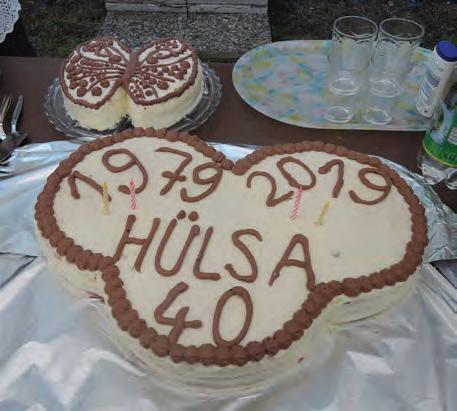 By Michael Botts, Hannover, Germany
About 50 years ago a young American serviceman introduced the idea of a yearly reunion to Germany.
After trying a few locations, members found a village more or less in the middle of the western part of the then-split Germany. People slept in bed-and-breakfasts or hotels, and the meetings were in a pas ture…if it wasn’t raining. A few years later a school was used in the summer. Even so, these places just didn’t seem to be the best solution for a reunion with about 100 people.
So in the mid ’70s someone bought land in the town. Soon a build ing was put up. Professionals did some work; so did church members. It had beds for 18 people, a kitchen, dining room, baths, a large meet ing room, and a meadow for tents down the hill.
Most people still stayed in bed-and breakfasts or hotels, but in 1979 the church in Germany named the Hülsahaus after the Hessian village it was located in.
Since then, there have been 40 reunions and uncounted other gatherings—study weekends, planning meetings, conferences, chil dren’s camps, youth camps, and more. Sometimes part of a camp has been dedicated to fixing the roof, mending stairs or a ramp, painting, or doing other maintenance.
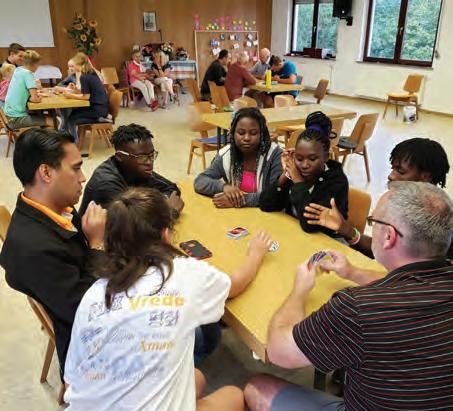
Much more important than the location or the building has been the spiritual renewal in the Hülsahaus. Sacraments such as Commu nion, confirmations, and ordinations have taken place there. (Bap tisms are in a swimming pond in the next village.) People from many nations have met God in Hülsa: Germany, the Netherlands, USA, Brit ain, France, Spain, Belgium, Russia, Ukraine, Congo, and more.
Let’s not forget spiritual growth and peacemaking activities, Temple School courses, preparations for national conferences, and gatherings of youth from across Europe.

People have sung for hours in the gathering room or around camp fires. They have played volleyball on a slippery, mushy slope, walked in the dark from the tents to the house, prayed, shared joys and concerns, spoken in devotions. They’ve sat through sermons on camp chairs, wooden chairs, and even blankets.
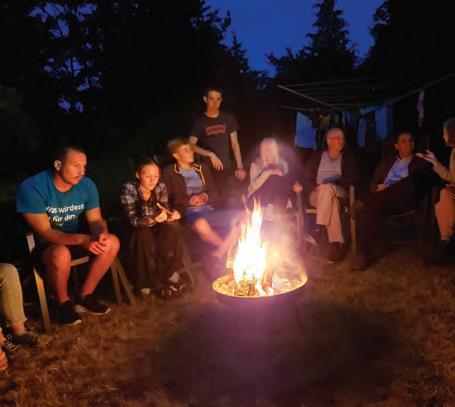
In short, Hülsahaus has celebrated 40 years of being a place where God dwells, because members from Germany and elsewhere have brought the Divine with them.
You’re free to visit and seek God’s Spirit. Und Ihr seid willkommen! (And you are welcome!)
One of my favorite scriptures is Matthew 25:35–40 NRSV:
…for I was hungry and you gave me food, I was thirsty and you gave me something to drink, I was a stranger and you welcomed me, I was naked and you gave me clothing, I was sick and you took care of me, I was in prison and you visited me.
I grew up in a small town in Michi gan. My family comes in many colors and faiths. In this time of so much unrest, I think we need to see ourselves through the eyes of those less fortu nate than ourselves.
I worked in home care and spe cial-needs child care everywhere my husband was stationed while in the service. We moved back to Michigan on retirement, and I resumed work. I was placed with a family to help with child care, giving a grandparent a break each week.
The client’s daughter was working on the other side of the state as a parttime CNA in a nursing home. She was an inmate on work release.
Over time the grandmother devel oped health issues and had difficulty walking. She went several times for treatment near Detroit. I often took her.
Surgery was done, and several months later the daughter returned
home to care for her mother. I often was in the home while the daughter worked because the child and grandmother still needed care. By this time, we had become close friends.
I learned from the daughter that she had helped my brother when he was in a nursing home. She knew my older brother and younger sister very well.
One morning the daughter called me at 2:30 because her mother was doing poorly. Living in a black neigh borhood, they had called an ambulance, but the service said it would go to that area only during daylight.
I woke up everyone in my household. I knew it would take three adults to lift the client into my car. We drove two vehicles full of children to her home.
We loaded the grandmother into my vehicle. She was having a lot of pain. I asked her daughter if she would she like to ride with us. She said she needed to get her toddler back to bed, and I left.
At the next corner, police pulled us over. They asked that we get everyone out of my car. I explained that I was going to the hospital with a very sick patient. I even volunteered to hand over my car keys and let one of them drive her to the emergency room.
I let the officers search my whole vehicle. They asked why I had not called the ambulance. I told them. The police
said we would have to take her our selves.
When we arrived at the hospital the grandmother received an IV and medica tions. I stayed 3½ hours until the grand mother was stabilized. I heard her pray: “Dear Jesus, come and take me home. Lord I’m ready for you to take me now.”
I sat and prayed with her, as we had done many times:
Dear heavenly Father, guide the hands of the care providers and medi cal staff. Bless them to see she is loved and needed by her family. Holy Com fort, come and rest upon her this hour that she may find peace and comfort in you. In Jesus’ name. Amen.
As the hours passed, she became calm and coherent. I knew she was get ting better.
When I got home, I told the daugh ter the hospital would keep her until she could be transferred to the specialty hospital where her surgery was done. I told the daughter I would be willing to take her on our off hours to visit. We made several trips.
Would I do it again? Yes. This lady was a prayer warrior.
When the grandmother came home, she mentioned Matthew 25:40 and said, I know why that is your favorite scripture. It’s because that’s how you show your faith, not by prayer, but by action.
When we faithfully respond to the minis try of Jesus Christ, we become account able to one another, God, and ourselves.
Our response to God’s gifts of love and grace is to serve others and let generos ity become part of our nature.
—A Disciple’s Generous Response Guidelines
Two Missouri congregations— Columbia of the Gateway USA Mission Center and Raytown of the Central USA Mission Center—recently joined efforts to answer a call for minis try and helped a family in need.
The family, which lives about an hour south of Columbia, needed financial and spiritual support. The family, (mother, father, and a severely autistic son) live on disability and caretaker income.
The mother entered University Hospital in Columbia at the end of January 2019 to have a brain tumor removed. Many types of resources were necessary for the father and son to stay in Columbia during her recovery.
A call went out when the family fell into a social-service gap without services to help in Columbia. The Ray
town Congregation contacted Apostle Janné Grover, who sent a message to the Gateway leadership team. Gate way’s leadership contacted the Colum bia Congregation’s pastorate.
The successful outcome was based on the dedication of both congrega tions to Abolish Poverty, End Suffering.
The Columbia Congregation pro vided resources for the motel bill and food, and the Raytown Congregation provided gas money and necessary resources in case of an emergency.
Both answered the call to ministry.
With a little help from the past, the 2020 Valentine dinner of the Mesquite Congre gation in Texas reflected several Enduring Principles and Mis sion Initiatives. Among them: Develop Disciples to Serve, Experience Congregations in Mission, Blessings of Commu nity, and Grace and Generosity.
As for the past, that came in the form of a special guest (Elvis).
The congregation’s youth served the food and waited on the diners. In turn, the dona tions helped pay for the youth to go to camp.
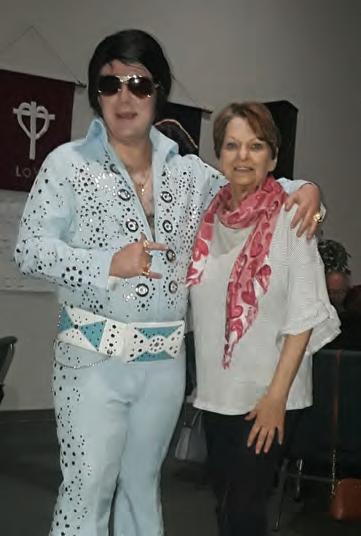
…but those who wait for the Lord shall renew their strength, they shall mount up with wings like eagles, they shall run and not be weary, they shall walk and not faint.
—Isaiah 40:31 NRSV
There is no failure for the faithful.
Real faith does not grow weary. When I was running marathons, I never cared about winning. To me, the thing I was faithful to was finishing the race. That’s the only thing that moti vated me to keep running, long after my strength had left, long past exhaustion, and long after my muscles’ store of gly cogen had been depleted. The goal was always to finish.
Remaining faithful to my goals has been the main motivating force of my
life. Staying faithful and finishing the race.
In 2 Timothy 4:7 NRSV we read:
I have fought the good fight, I have finished the race, I have kept the faith.
The marathon is 26.2 miles, named in honor of Pheidippides, a Greek sol dier and messenger famed for running from the Battle of Marathon to Athens in Greece. He completed the distance to tell officials in Athens they had won. He finished the race and kept the faith. That was his task. To go the distance and announce the victory. To this task he was faithful to the end.
I remember the memorial service in Stewartsville, Missouri, for my fatherin-law Orrice McCord. He was a man of
God and a faithful family man. Those were the two most important things in his life, the things that motivated him throughout his 91 years. At the close of the service, the pastor quoted Matthew 25:21 KJV:
Well done, thou good and faithful ser vant: thou hast been faithful over a few things, I will make thee ruler over many things: enter thou into the joy of thy Lord.
I could never begin to match the love and devotion to God and family of that great man. I think of him every day. I look up to him as my spiritual father and mentor. He visits me often in my dreams. I know he is watching over me. May he rest in peace.
With distance learning programs that have been in place for decades, Graceland is uniquely positioned to offer online programs tailor-made for today. That way, we can focus on you. And you can focus on achieving your goals and advancing your career.

This program provides benefits to both rural and urban communities in a field that is not only growing, but extremely needed in today’s world.
Data Science and Analytics
Graceland's program prepares students to transform data into information so that insight is gained for addressing real-world problems.
Religion The Community of Christ Seminary builds a strong foundation of formation in Christian scripture, tradition and mission and offers three concentrations for focused development through this program: Christian Theology, Spiritual Leadership, Peace and Justice.
world is different.
As I took two blackberry pies out of the oven, I heard on the radio that heavy fog shrouded our area. I got ready for church, loaded my car, and backed out of the garage.
It was then that I saw the reality of the dense fog.
I attend church in Holden, Mis souri, about 40 miles from my home i n Concordia. That distance seemed even farther after I stopped at the end of my driveway and scarcely could see the road. At that moment, I wanted very much to go back into that garage. But I had those pies! I baked them for two community events that day in Holden. I had to go.
As I ventured out, I realized my vis ibility was limited to two car lengths in
front of me. Fear, dread, and uncertainty seized me. I began to pray for skill in driving, for the Holy Spirit to surround me, and for peace and assurance.
When I reached the highway, I could see nothing from either direction. I turned left and began meeting oncom ing traffic. Most cars were proceeding with caution. However, I was shocked to see many vehicles driving with no lights on.
Once in a while, I glimpsed a road sign or familiar landmark. They told me my location. Several curves and two roundabouts added to my concern. It was a small victory each time I made it through one.
When I saw I was in Holden, I sighed in relief and said a prayer of thanks. I still had a way to go before I could see that beautiful, old, white building. My jour ney had lasted one hour, five minutes.
Driving home later in bright sun shine was a blessing—one I have taken for granted many times. Once safely home, I began to relate a parallel to this experience. My late husband, Tom, and I endured difficult periods of unem ployment, financial worries, serious i llnesses, grief, and more. Prayer was always our center. In those trying times we asked for direction. Some experi ences required total faith. It was a joy when those familiar signs of assurance and remembrance of earlier blessings came to us.
These were times of dense fog when a loving God walked with us, times when our parents, close friends, a neighbor, or even a stranger lent a helping hand or listening ear.
Fog is temporary and is lifted by the sun. Foggy times in life are lifted by God’s Son.

An amazing thing about how God works is that our weaknesses often are transformed into strengths. What we, and so often the world, see as imperfection, a flaw, or shortcoming, God sees as a wonderful tool for bring ing wholeness.
I have struggled with hearing loss since my early 20s. My lifelong dream of being a full-time teacher, working with children every day, just didn’t seem possible. But a few years ago, right after I had completed my degree, I was asked to do a long-term subbing job for an English Language Learn ers teacher at an elementary school in Boise, Idaho.

This school had many refugee chil dren, and I looked forward to teach ing them. It was a real challenge! The teacher I was replacing had left little in the way of lesson plans. Many children
spoke no English. Those who did speak some English had accents that my lessthan-great hearing made difficult to understand.
I began to feel like a failure. I ques tioned why God even wanted me to be teaching. Then one day, I learned the reason.
A group of the deaf and hard-ofhearing students started to walk past me in the hallway. One boy, Ryan, stopped, grabbed my arm, turned his sweet face to me, and signed, “You have hearing aids like me! Are you deaf, too?”
I smiled and said through his inter preter, “No, I’m not deaf, but I am hard of hearing.” As he turned to join his lunch group, Ryan gave a big, toothy smile and said, “Cool!”
Later that day, Ryan’s interpreter told me why Ryan had been so excited about seeing me with hearing aids. She
said, “Almost all the children in the pro gram have never seen a hard-of-hearing or deaf adult in a professional job. When they see you, they realize their futures have way more possibilities than they had once thought.”
I don’t like being hard of hear ing. (Although I now have a cochlear i mplant, and things are much better!) Sometimes, hearing is exhausting, frustrating, and difficult. But that day, God used my perceived flaw or weak ness in a way I never would have imag ined. God used it as a witness to that young boy of the enormous possibilities ahead of him. And God used that day to encourage me to become bolder and less self-conscious, to become a witness of perseverance and determination.
I hadn’t planned it, but God knew what that young boy and I needed, and God blessed us both.
Psalm 46:10 NRSV says, “Be still, and know that I am God!” I’m not the “still” type. In fact when I was 5, my uncle said, “If you can sit still for five minutes, I’ll give you a dime.” And in 1950, that was a big deal. I can’t imagine I ever succeeded.
But in recent weeks the Covid-19 pandemic has forced me to halt…or reroute. But I still found purpose in vol unteering with the food bank, discipline and strengthening in Yoga and Bone Builders, and community in church.
I can’t say I’m a huge fan of this change, especially with the fear of venturing out, getting sick, and losing friends and loved ones. But I’ve gained insights I wouldn’t have been privy to otherwise.
I’ve had some anxious moments. Like the day I told myself, “Tomorrow morning I’ll go for groceries during the senior hour.” But during the night I was flooded with anxious questions:
Is it better to go for food when I abso lutely need it or get ahead of the game? What if the virus is hitting its peak at the exact moment I enter the store? And where should I set the bags of groceries when I bring them in?
I hardly slept. When the alarm went off, I was so tired from my nighttime worry fest that I got up, then went back to bed.
The following day I went for gro ceries with my mask and gloves, wiped everything down and mopped the floor where I’d put the bags. And both Lucy, my cat, and I are fine. The upshot: I’ve had a chance to let go of controlling things and to practice trusting life—and myself.
In this stay-at-home time, I’ve been more grateful for those who keep things going—the trash and recycling collec tors, mail carriers, and repair people And I had a brief reminder of the pres sure health-care workers are under. On Easter I saw a neighbor’s mom, standing in the condo parking lot. An emergencyroom nurse in Cedar Rapids, Iowa, she looked exhausted. When I yelled, “How
are you doing?” she said, rather tenta tively, “I’m OK, if I don’t think about it.” Those on the front lines have courage I can’t imagine.
I’ve recognized anew how important staying connected is, and I’ve realized how important it is for me to not let con flicts go unresolved. A friend brought me food on my birthday. We were planning to walk—distanced from each other. But his idea of distance and mine were different. Later, as he headed to his car, he said sarcastically, “Well that was way more fun than I thought it would be.”
I felt badly. He had expected dis tance but not “two blocks apart.” I decided I wasn’t sorry for distancing, but I was sorry for not being clear about what I expected. So I called him and apologized. He listened, and we were back to normal.
Normal. Those moments are spe cial. The world has changed, and I’ve had to look at new ways of being of use to others and to care for myself.
Yes. “Be still and know that I am God.”
Over the past few years our small congregation in Red Wing, Minnesota, occasionally has closed its doors to take ministry to other congre gations in the Headwaters USA Mission Center.
Generally, we also give a “miracle jar” to con gregations we visit. We encourage members to drop in extra change each week, watch the money grow, and then use it for a special outreach.
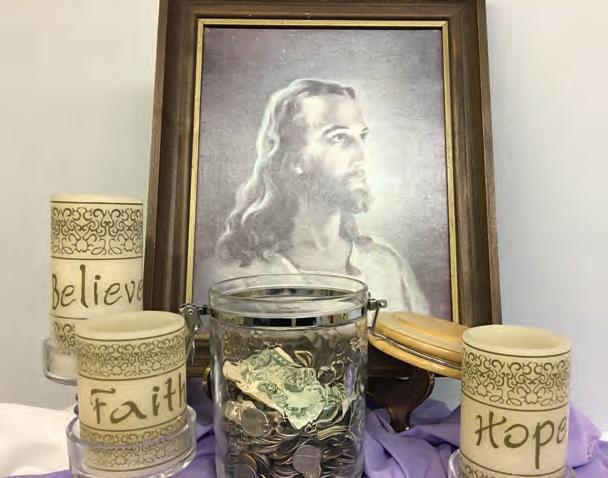
In Red Wing we have donated our miracle money to a women’s shelter, given it to Outreach International, and supported the Mission Initia tive of Abolish Poverty, End Suffering.
A few months ago, a news story told of the public humiliation of a student whose lunch tray was taken away and exchanged for a peanut butter sandwich when the cashier discovered the child had no money in his lunch account. We decided to use our miracle jar collection to help fund kids’ lunch accounts that were empty.
In just five months, we distributed nearly $800 to local schools. The thanks from the schools is gratifying—but the real joy comes from using God’s generosity to us to then touch the life of a child of God.
Free or Nominal Rate Inside-county
Total
or Nominal Rate Distribution:
Total Distribution:
Total
Paid Electronic Copies: 10,335; Total Print Distribution Plus Paid Electronic
Print and Electronic Copies):
Number Copies of Single Issue Published Nearest Filing Date: 9,258; Mailed Outside-county Subscriptions Stated on
Form 3541:
Mailed
Stated on
Form
Paid Distribution Outside the Mails Including Sales through Dealers and Carriers, Street Vendors,
Sales and Other
Distribution by Other Classes of Mail: 841; Total Paid Distribution: 10,099; Free or Nominal Rate Outside-county Copies on PS Form 3541:
Free or Nominal Rate In-county
on PS Form 3541:
Free or Nominal Rate Copies Mailed at Other Classes Through the USPS: 94; Free or Nominal Rate Distribution Outside the Mail:
Total Free or Nominal Rate: 645; Total Distribution: 10,744; Copies Not Distrib uted: 1,177; Total: 11,921; Percent Paid: 94%; Paid Electronic Copies: 56; Total Paid Print Copies Plus Paid Electronic Copies: 10,155; Total Print
• Howard Hawkins of the Grandview Congregation in Missouri celebrated his 92nd birthday September 16.
• Bill Ashwell of the Cambridge Congregation in Ontario, Canada, celebrated his 90th birthday July 6.
• Bob and Pat Maile of the Bonner Springs Congregation in Kansas celebrated their 60th anniversary October 28.
• Grace and Archie Hill of the Corinth Congregation in Ontario, Canada, celebrated their 64th anniversary August 11.
• Howard and Carol Hawkins of the Grandview Congregation in Missouri celebrated their 65th anniversary July 16, 2020.
• Betty and Johnnie Mack Mitchell Sr. of the Willow Creek Congregation in Hurst, Texas, celebrated their 70th anniversary September 2.
• R ay and Ann Hogue of North Richland Hills, Texas, celebrated their 65th anniversary November 6.
• Roger and Betty Parrish of the Mission Road Congregation in Prairie Village, Kansas, celebrated their 68th anniversary August 17.
• Charles and Margaret Athey of the Mission Road Congregation in Prairie Village, Kansas, celebrated their 63rd anniversary August 28.
All ministries, personnel, and resources of the worldwide church are aligned with five Mission Initiatives. All five are needed to be true to the whole mission of Jesus Christ, but we know some hold special places in the hearts of individuals and congregations. We’d like to give them a voice in the Herald Please send photos (one megabyte or larger) and stories of
Submission policy: All stories—invited and unsolicited—will be edited for clarity, conciseness, accuracy, and other qualities. Because of deadlines and capacity, contributors typically will not be involved in the editorial process. Publication dates for specific articles may change based on organiza tional priorities. We prefer that copy be submitted electronically in Microsoft Word.
Photos and visuals are best submitted as jpg or tif attachments. Scanned images need to be 300 dots per inch (dpi) or higher, or one megabyte or larger. Photos need to be taken by a digital camera with at least 4-megapixel capacity, though larger is better. Please check your email to make sure the settings are not automatically compressing the photos. Prints and slides are acceptable. Include the photographer’s name.
News items, features, and testimonies related to individuals, congregations, and groups whose activities express mission are welcome. Submis sions may range from 1,000–6,000 characters with spaces. Accompanying photographs usually are essential.

Milestones highlight significant events, people, and groups. In general, sacraments are not pub lished because of the volume performed. Notices of major awards, priesthood emeritus status, anni versaries of 60 or more years, and birthdays of 90 or more years may be submitted, but photos will not run. Death notices will not be published.
Release: By submitting written, graphic, or photographic materials to the Herald, the submit ter consents and authorizes the Herald and Com munity of Christ to copyright, use, and reproduce the submission (written, photographic, illustrative, electronic, and/or digital image), and circulate and use the same for any and all official resources, uses, or purposes including but not limited to print, film, or electronic media, and reproduction or digital rep resentation of every description on the Internet/ World Wide Web. Consideration hereby is waived in perpetuity, and no further claim of any nature what soever may be made by the submitter. The submitter retains the right to reproduce his or her submission.
Please submit news and feature items to Herald@CofChrist.org. Mail to: Herald, 1001 W. Walnut St., Independence, MO 64050; phone (816) 833-1000, ext. 1143.

















 By Robert Cook, Macomb, Illinois, USA
Today is Thanksgiving Day, and after weeks of carrying on my heart the question, “Why do I invite people to Christ?” it is time to write what I am feeling.
I believe we were created and allowed to live on Earth to find “The Way” to life in Christian community. I invite people to seek the Living Christ not because it is easy. Rather, it’s the most difficult, most joyful, and most rewarding thing we can do.
I was blessed to spend my early life in a Christian community on our reunion grounds at Onset, Massachu setts. I thought it was normal to live with people who shared one faith and one desire to live the way the Living Jesus taught us. As I ventured into the world, I had to accept that this was not a
framework shared by most people. Perhaps I took my faith heritage a bit for granted in my early years. But as I wrestled with the meaning of life and my relationship with other people, I came to understand that when the gospel was restored through Joseph Smith Jr., gathering became a key fea ture.
Those who knew Jesus in the flesh gathered in community, as described in the Acts of the Apostles. This gather ing is an earmark of the gospel—and the early Restoration. It wasn’t because it was the easiest way; perhaps it was the most difficult and most rewarding. Those early Restoration communities were not composed of perfect people, but people who constantly strived to live the gospel. They called it the king dom of God here on Earth. They called it Zion. They wrote and sang about yearning for Zion.
Some from inside and many from outside those communities attacked what they saw as a threat to their secu lar way of life. Those opposing forces caused many tragedies, but the yearn ing for Zion was so strong that the gath ering continued.
Many years ago, we lived that desire by gathering in reunions. This was the way we lived the gospel in the world in which we found ourselves.
Today, we gather in congregations, online, and at conferences. But I still invite people to gather for reunions on our campgrounds—to try living the gospel in a community of people sup porting each other while following the Living Jesus.
I can smell the turkey cooking, and I’m thankful for so many things. But I’m most thankful for all those with whom I have shared community while trying to follow the Living Jesus.