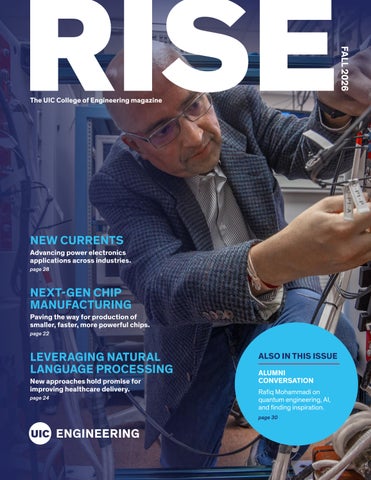
The UIC College of Engineering magazine
NEW CURRENTS
Advancing power electronics applications across industries. page 28
NEXT-GEN CHIP MANUFACTURING
Paving the way for production of smaller, faster, more powerful chips. page 22
LEVERAGING NATURAL LANGUAGE PROCESSING
New approaches hold promise for improving healthcare delivery. page 24
ALSO IN THIS ISSUE ALUMNI CONVERSATION Rafiq Mohammadi on quantum engineering, AI, and finding inspiration. page 30
FALL 2026
RISE
ONLINE MASTER OF ENGINEERING with a concentration in AI and Machine Learning 100% ONLINE | 9 COURSES | NO GRE
“I highly recommend the online MEng program at UIC for its quality of education and its curriculum designed to cover the latest developments in AI and ML.” — Luis Cuello, 2024 MEng alum
Graduate in as few as 12 months.
Solve complex problems with a wide range of AI and Machine Learning tools and develop applications that include AI and ML functionality.
Admission is now open for Spring 2027. Classes start January 11, 2027.
Visit go.uic.edu/rise-meng or call an enrollment specialist at (866) 772-2268.
Dear Friends and Colleagues, With this issue of Rise, I’m excited to debut a new feature: a conversation with one of our visionary alumni. Our first interviewee, Rafiq Mohammadi, shares his perspective on quantum engineering, AI, how he finds inspiration, and what’s on his reading list. I was not surprised to learn he has many books on his Kindle and that one of them is a textbook. Rafiq, like many of us, is a passionate lifelong learner. The textbook he’s reading is Quantum Mechanics: Third Edition by David J. Griffiths and Darrell F. Schroeter, suggested to him by our very own Thomas Searles, professor of electrical and computer engineering and leader in quantum materials, metamaterials, and quantum information science and engineering. Turn to page 30 to hear from Rafiq, including what book he reads every few years, the best decision he’s ever made, best advice he’s received, and more. With Rafiq’s support of our new integrated laboratory for quantum research and teaching and our innovative faculty like Thomas Searles and others, UIC Engineering is accelerating quantum engineering in Chicago. Like Rafiq, I am inspired by students and their drive to pursue new knowledge and solve challenges. There’s no better place to experience that than in a classroom on the first day of the semester. Visiting undergraduate courses has become one of my favorite activities as dean. This year, I visited ECE 265: Introduction to Logic Design taught by new faculty member Jason Streeter and BME 101: Introduction to Bioengineering with Zhinan Wang. The energy and excitement in the classroom were palpable. If you’ve been to campus lately and sensed this too, you’re not imagining it. We have welcomed more students to campus and the college. This fall, UIC achieved the highest enrollment in its history for the second straight year: 37,000 students enrolled for the fall 2026 semester. In the College of Engineering we have seen consistent growth in our undergraduate programs for more than a decade. For fall 2026, the number of undergraduate engineering students increased by 4.9% to 5,692. That includes a 2.6% rise in first-year students (1,088) and an 11.8% increase in transfer students (532). It’s rewarding to see students thrive in our classrooms and laboratories and find a home away from home in places like our EIEP Lounge. One of the many faces behind that welcoming space is Elsa Soto, director of Equity and Inclusion in Engineering Programs. Elsa was recently selected for the Chancellor’s Academic Professional Excellence Award. She will be celebrated at the campus ceremony along with Award of Merit recipients Kassem Zeeb Saad, Technical Services Supervisor with Civil, Materials & Environmental Engineering, and Jan Raphael M. Sagun, Laboratory and Computers Manager in Chemical Engineering. Congratulations to these staff members on their well-deserved rewards. We are indeed cultivating a caring, connected community and culture of excellence. RISE Managing Editor Emily Ayshford and Christine des Garennes Graphic Design The Motion Agency UIC Chancellor Marie Lynn Miranda Cover photo: Jim Young
As always, thank you for your continued support of the college. Here’s to an inspiring semester of learning, innovation, and community! Sincerely,
RISE welcomes your comments and suggestions. Email engcomm@uic.edu. Opinions expressed in this magazine may not necessarily reflect those of the University of Illinois Chicago faculty or administration. Copyright © 2026, University of Illinois Chicago College of Engineering.
Lola Eniola-Adefeso Dean, UIC College of Engineering
Letter from the Dean
This magazine is published by the Office of the Dean of the University of Illinois Chicago College of Engineering, with offices at 851 S. Morgan Street, Chicago, IL 60607.
Our fall issue is packed with stories about high-impact research initiatives. For example, Arunkumar Subramanian and his team in the Chip Manufacturing Lab are developing new lithographic techniques for microchip manufacturing. Their work holds promise for production of smaller, faster, and more powerful chips. Sudip Mazumder, who has been at the forefront of power electronics, shares his perspective on the field and updates on his own projects, from energy transmission to optical devices. Natalie Parde, Barbara Di Eugenio, and Shweta Yadav are creating a number of exciting tools through natural language processing to improve healthcare delivery. Our four recent NSF CAREER awardees also introduce us to their inventive projects. I can’t wait to see how their research unfolds in the coming years.
3
6
Zooming in Welcome to the Arcade, a new space in the Computer Design Research and Learning Center
22
Advancing Microchip Manufacturing
24
Leveraging Natural Language Processing to improve healthcare delivery
4
Paving the way for smaller, faster, more powerful microchips
News Briefs Meet the new BME department head
p. 8
Nanotube membranes reveal unusually fast lithium-ion transport
p. 10
New device measures blood pressure on the go
p. 11
Reusing space materials to enable deep-space exploration
p. 12
In London and Milan, engineering students get in-depth look at tech industries p. 13
28
New AI curriculum initiatives
p. 15
NSF CAREER Awards
p. 17
‘AL-STARS’ system to help transportation planners in Illinois
p. 20
Driving new applications in power electronics A look at Sudip Mazumder’s latest projects
30
Contents
A conversation with alumnus Rafiq Mohammadi (BS ’83, MS ’95, computer science), entrepreneur and lifelong learner
5
6
Visualization Lab
PhD student Hossein Fathollahian and Research Associate Professor Luc Renambot, both of the Electronic Visualization Laboratory (EVL) at UIC, step in front of BioSET, a set-based visual analytics tool developed in collaboration with NYU and Stuttgart Technical University of Applied Sciences. On the high-resolution display wall, they trace 70 protein markers across a 1.48 TB volume of human melanoma tissue, rendered in 3D at true cellular resolution. EVL’s new collaboration space, called Arcade, with its scale and clarity, brings immune-tumor regions of interest into focus that would otherwise remain obscured in a desktop view, allowing researchers to move seamlessly between whole-tissue context and individual cell interactions. More information: arcade.evl.uic.edu/web Photograph: Jim Young
Visualization Lab
7
Minerick named Head of Richard and Loan Hill Department of Biomedical Engineering
Professor Adrienne Minerick is the new head of the Richard and Loan Hill Department of Biomedical Engineering. Minerick arrives at UIC after 16 years at Michigan Technological University, where she was a Distinguished Professor of Chemical Engineering with an affiliated appointment in biomedical engineering. As department head, Minerick hopes to expand collaborations, educational and research efforts, and developmental opportunities for students. “There’s so much that the current faculty are already doing, and UIC is uniquely positioned to really grow that even further, so I’m excited to explore what’s possible and enhance team science,” she said.
A record of leadership
News Briefs
Minerick earned her PhD and MS in chemical & biomolecular engineering from the University of Notre Dame, and her BS in chemical engineering from Michigan Technological University.
8
She brings a strong history of honors and recognition in engineering. She served as president of the American Society for Engineering Education (ASEE) from 2021 to 2022 and was inducted into the ASEE Hall of Fame in 2023. She is a fellow of the American Institute of Chemical Engineers (AIChE) and the American Association for the Advancement of Science (AAAS) and was inducted into the AIMBE College of Fellows in April 2026, an honor reserved for the top two percent of medical and biological engineers nationally. She has also received the AES Electrophoresis Society’s Lifetime Achievement Award and an NSF CAREER Award early in her career.
Minerick also brings her many leadership experiences to UIC, including her time as the MTU College of Engineering associate dean for research and innovation, the MTU School of Technology dean, founding dean of the MTU College of Computing, and as interim dean of MTU Pavlis Honors College during an institutional reorganization.
Positioning the department for success in research and education As head, Minerick hopes to strengthen the department’s ties across both the College of Medicine and to other departments within the College of Engineering. “I’m excited to learn in greater detail about everyone’s research,” Minerick said. “It’s a bit of a jigsaw puzzle— fitting the pieces together and seeing how they’re related and what opportunities exist to further advance knowledge in biomedical engineering.” Her own research focuses on electrokinetics, using electrical fields to investigate live cells, including recent projects on the gut microbiome and Caco-2 intestinal lining cells, as well as a novel Vitamin D electrochemical biosensor. Electrokinetics applies electric fields to manipulate fluids, cells, proteins, and DNA inside microscale devices. Minerick uses electric fields to conduct medically critical measurements including vitamins in tears, hematocrit (red blood cell concentration), stem cell purification, viral infection cycle stages, smallscale protein separations for hemoglobinopathies, and ABO-Rh blood typing. Growing research collaborations and developing research centers that focus on cross-cutting areas, like the intersection of biomedical engineering with artificial intelligence and quantum technologies, is key, she said.
Photograph: Jim Young
engineering is related to when the calculator came out, the standard at that time was a slide rule.” During this transition there was resistance: many thought that a calculation couldn’t be rigorously understood if it was done with a calculator, because there was no physical evidence of the calculations. “Simultaneously, we have a challenge that a lot of these AI tools have gotten to the point where the need to generate your own code no longer exists,” Minerick said. “But students need to know how to prompt and direct a large language model, to test the code to make sure that it is functioning properly, and to assess the output to ensure it is correct in context.”
Giving students the skills they need to succeed The challenge in academia, she said, is teaching foundational skills that can be built upon and showing students how those skills relate to career pathways into different fields. “There’s a lot of curricular opportunities building from the strong foundations that are already at UIC and BME and the existing concentrations within the major,” she said. Minerick’s passion is mentoring graduate students. She remains in touch with many of her former students: five have become faculty, two have earned their own NSF CAREER Awards, and one received an NIH K-award.
“Leveraging AI is not limited to research,” she said. “I think there are opportunities for innovations in BME education as well. An analogy for AI’s growing utilization in
Minerick took this advice to heart, which led to her involvement with the American Society for Engineering Education. Her love of teaching and mentoring is apparent in everything she does. “I’ve always worked for the students,” she said. Keeping this in mind, with every opportunity Minerick approaches, she always asks herself two key questions: “Can I make the institution and the world, a better place? And could I really make a difference—leaving it better than how I found or received it?” Minerick is driven through her passion not only of mentoring but helping position every student for success and equipping them with the resilience and navigational tools needed to navigate their educational careers and simultaneously juggle the other dimensions of life that make each of them unique assets to the world.
News Briefs
With every opportunity Minerick approaches, she asks herself, “Can I make the institution and the world, a better place? And could I really make a difference — leaving it better than how I found or received it?”
In fact, Minerick’s own experiences with one of her mentors, Rich Felder, taught her that the education component of her career plan needs to be as scholarly as the research portion.
9
New nanotube membranes reveal unusually fast lithium-ion transport UIC Engineering researchers have developed a novel class of nanotube membranes that enable ultrafast ion transport. The findings open new pathways for high-efficiency clean energy generation, lithium recovery and molecular separation. The study, published in Nature Nanotechnology, shows that tiny, tube-shaped channels called boron nitride nanotubes can transport certain ions much faster than expected. These tubes selectively move lithium ions over other types, acting like a highway express lane. The findings suggest a promising platform for applications ranging from “blue energy” generation, in which power is harvested from the convergence of salt and fresh water, to lithium extraction for batteries. “This is a unique mechanism that transports lithium ions very quickly through nanotubes,” said Sangil Kim, associate professor of chemical engineering and an author of the paper. “The ion transport is much higher than the theoretical estimation, and also existing experimental systems.”
News Briefs
Ion transport is central to many industrial processes. When salts dissolve in water, they separate into positively and negatively charged ions that can move across nanochannels at different speeds. Controlling how these ions move through membranes is important for technologies such as batteries, desalination, critical mineral recovery and renewable energy systems. However, achieving both fast and selective ion transport remains a major scientific and engineering challenge.
10
In their new study, the researchers created membranes with millions of tiny tubes made of boron nitride nanotubes, which behave unusually and carry a charge on their surfaces. When the scientists placed the membranes between ionic solutions with different salinities, they found that ions moved through the pores much faster than predicted. Lithium ions, in particular, moved 31 times faster than the researchers expected. Also surprising was how ions moved in relation to each other: lithium ions sped through the channels much faster than other ions.
To further test the system, Kim and his colleagues showed that their small membranes could power everyday electronics using only salt solutions. “They can operate a watch and a calculator,” Kim said. The idea of generating electricity from ion movement isn’t new. “This is how an electric eel generates electricity,” Kim said. In nature, eels produce bursts of electricity by controlling the flow of ions across specialized cells in their bodies called electrocytes. These cells use ion channels to convert chemical gradients into electricity. Scientists have long explored how to recreate similar processes in engineered devices, like in the membranes used in this study. Moving ahead, Kim and his colleagues hope to test further applications of the membranes, particularly the tubes’ lithium-separation abilities. “We could apply these findings to lithium recovery from waste batteries,” he said. They also plan to drill down on exactly how this abnormal ion transport occurs. Kim began studying boron nitride nanotubules when he first came to UIC a decade ago. He credits the interdisciplinary collaboration and support from the College of Engineering, as well as the skill and dedication of student researchers at the university, with moving the project forward. “My talented students, including former PhD students Aaditya Pendse and Kun Wang, should be acknowledged for their contributions to this study,” Kim said. “The quality of students here at UIC is very, very high.” In addition to Kim, Pendse and Wang, the other UIC coauthors of the study are Pavel Rehak, Volodymyr Koverga, Selva Selvaraj, Naveen K. Dandu, Roya Jafari, Anh T. Ngo and Petr Kral. Photograph: Jim Young
A new device measures blood pressure on the go, without a cuff
In a new study, UIC researcher Benjamin Sanchez Terrones asked healthy adults to run, walk or bike while wearing a special smartwatch on their left wrists. This smartwatch incorporates Sanchez Terrones’ latest innovation: a cuffless, electrical way to monitor blood pressure throughout the day. Published in Nature Communications, the technology is designed to provide health information without disrupting daily life. “This is a behemoth of work; a tour de force from my lab,” said Sanchez Terrones, an associate professor in the College of Engineering with appointments in the Department of Electrical and Computer Engineering and Richard and Loan Hill Department of Biomedical Engineering. “Cardiovascular disease is the leading cause of death worldwide, but high blood pressure often goes undetected. Engineers refer to measuring blood pressure as a ‘Holy-Grail problem.’”
into measures of blood pressure and velocity. The model is guided by the laws of physics to ensure accuracy. To test the new device, Sanchez Terrones recruited 77 healthy adults and 88 adults with hypertension or cardiovascular disease. With promising results so far, the next step will be a clinical trial where participants use the technology in a real-world setting. The devices will also be evaluated in larger, more diverse groups and across longer-term physical changes in body temperature, dehydration or weight. The University of Utah, where Sanchez Terrones conceived the idea before joining UIC in 2025, holds the intellectual property to this invention. Albert Fabregas, a researcher in Sanchez Terrones’s lab, contributed to this study. Photograph: Jim Young
That’s because current blood pressure monitoring methods are not infallible, Sanchez Terrones said. Checking your blood pressure at a doctor’s appointment only captures one moment in time — “like trying to guess the plot of a movie from a single screenshot.” Daily at-home testing paints a more realistic picture, but many patients have trouble operating an inflatable blood pressure cuff on their own. Measurements by cuff must be taken at rest, which does not reflect how patients move throughout the day. Cuffless technologies work well in theory but don’t always account for daily activities and differences among patients. “No matter how good the technology is, it needs to reflect reality and be usable for people,” Sanchez Terrones said.
Equipped with stainless steel electrodes, the watch applies an imperceptible electrical current to the patient’s wrist. Then, Sanchez Terrones uses a machinelearning model to convert the body’s electrical response
News Briefs
His fully wireless smartwatch monitors blood pressure and blood flow at the wrist. Via Bluetooth, the smartwatch streams data to a computer (a clinician’s, for example), which collects data offline.
11
Reusing space materials to enable deep-space exploration A major challenge in space exploration is the limited availability of resources. At UIC Engineering, Yayue Pan, professor in the Department of Mechanical and Industrial Engineering, and her team of researchers in the NASA MIRO Center for InSpace Manufacturing: Recycling and Regolith Processing are investigating new ways to use and re-use materials found in space. The team is developing advanced manufacturing technologies to both enable the recycling of waste materials in space and process planetary regolith, a blanket of loose deposits covering solid rock. It includes dust, broken rocks, and related materials that can be found on Earth’s Moon, Mars, some asteroids, and other planets and moons. “We are investigating the use of regolith simulants and UV light — both abundant in extraterrestrial environments — to fabricate ablators for thermal protection systems that could support space launch and atmospheric re-entry missions,” said Yinong Chen, a PhD student in the lab. An ablator is a protective material designed to burn away, melt, or vaporize to dissipate intense heat on spacecraft during atmospheric reentry. It protects the structure beneath by absorbing and carrying heat away during controlled destruction.
News Briefs
To achieve their goal, the research team developed a UV-curable composite called ReCPA, combining regolith-like particles, carbon, and a light-activated resin.
12
“This material can be processed using UV light, including potentially natural solar radiation, enabling energy-efficient 3D printing directly on extraterrestrial surfaces. Designed as a layered structure, ReCPA withstands extreme heat by gradually sacrificing itself while protecting the structure underneath,” Chen said. The research includes high-temperature flame testing of the fabricated materials. During tests using a 1300°C flame, a 6 mm-thick sample maintained the
backside temperature below 200°C, demonstrating strong thermal protection. “These results highlight a promising pathway toward lightweight, scalable, and locally manufacturable thermal protection materials, supporting future deepspace missions while reducing launch mass and reliance on Earth-based resources,” said undergraduate student Alex Guha. The researchers presented their findings at the 2026 ASME Manufacturing Science and Engineering Conference in Pennsylvania. • Photograph: Jim Young
Photo courtesy of Hananeh Esmailbeigi
In London and Milan, engineering students get in-depth look at biomed industry Students interested in the fast-growing field of biomedical and artificial intelligence technology spent several weeks in England and Italy learning from leading innovators, including UIC alumni.
“Before this trip, I never would’ve imagined myself wanting to work or study in a different country. It always seemed unattainable to me,” Garcia said. “After hearing from all the people we met and learning about the opportunities that are offered, I realized that moving to a different country is doable.”
News Briefs
During the two-and-a-half-week study abroad program in June, the 10 students saw Prince William, the British Prime Minister and London’s mayor speak at London Tech Week, a conference for tech entrepreneurs.
Carolena Garcia, a third-year biomedical engineering student, said the program helped her envision working abroad. She and other students spoke with UIC alumni who work in Milan and learned about their experiences.
13
In London and Milan (continued)
Jam-packed program
What students learned
Hananeh Esmailbeigi, clinical professor of biomedical engineering and director of industry and alumni engagement, organized and led the program for the College of Engineering and the UIC Study Abroad Office. The program, in its second year, gave students six credit hours, she said.
Garcia participated in the study abroad program after recently changing her major to biomedical engineering. Now her career goal is to design medical devices, she said.
“I wanted them to come back thinking about the fact that entrepreneurs have different stories, but their most important characteristic is knowing how to pivot,” Esmailbeigi said. “Every time you encounter a problem, you can use your creativity and find a different solution, which was something that was reinforced throughout.” At London Tech Week, students heard from industry leaders and the country’s leadership about artificial intelligence, its applications in healthcare and the future job market. They also met with people from leading artificial intelligence companies and startups to gain insight into the evolving AI landscape. The highlight for some was getting to see Prince William, whose speech challenged the tech industry to help prevent homelessness by making data available to service providers and using technology to help detect early risk factors leading to homelessness. The group also visited Imperial College in London and Cambridge University, where they attended presentations by engineering students of their capstone work. And they visited major companies in London, including LinkedIn, and companies working on wearable technology and e-textiles — digital components embedded in fabrics. They visited Cambridge Glasshouse, an “incubator” where several startups, such as Parkinson’s medical device company Charco Neurotech, are being developed.
Over to Italy After England, the group traveled to Milan, Italy, where they were hosted by the Moon Rabbit Lab, a startup that integrates computational design and AI to create highperformance footwear. Design was also part of the itinerary. In Milan, a fashion capital of the world, the students attended a jewelry-making workshop where they learned to make wearable tech. They also toured and met with representatives of Armani, the famed Italian fashion design house.
News Briefs
In addition, they visited a smartwatch startup that’s developing seizure-detection technology, Politecnico di Milano where they learned from a leading biomedical engineering researcher, and an immersive rehabilitation hospital for children where they saw how prosthetics are fitted to children and toured a playground outfitted with sensors to monitor children as they play.
14
“They showed us how they make it a playful experience for kids needing rehabilitation due to complications,” Esmailbeigi said.
“I saw that this course teaches about medical wearable devices, which was perfect for me, and also entrepreneurship,” Garcia said. Tiffani Curry, a fourth-year biomedical engineering student, said the trip exceeded her expectations. A highlight was connecting with innovators, especially Lucy Jung, a Cambridge engineer who shared her story about creating and securing funding for the Charco Neurotech startup.
“Before this trip, I never would’ve imagined myself wanting to work or study in a different country. It always seemed unattainable to me.” Carolena Garcia Third-year biomedical engineering student
Another important moment for Curry was touring the children’s rehabilitation hospital with Dr. Giuseppe Andreoni, the director of technology and design for healthcare who developed the playground that gathers biometric data from the children playing there. “As a student who has conducted research at UIC, I have always understood that our work has the potential to improve lives; however, in the laboratory, that impact often feels distant,” said Curry. “I could never have predicted that I would meet such supportive peers while also learning from some of the most accomplished innovators and engineers in the world.” The group met up with several UIC computer science and biomedical engineering alums currently working in Italy and learned how they ended up in Europe. Fourth-year biomedical engineering student Alexis Willhite said learning about their career paths helped her better understand how the biomedical industry works and the variety of research niches within it. “This has inspired me to explore different areas and career paths for my future,” said Willhite. “The cultural aspect of studying abroad has been life-changing for me because I have been able to connect with many people around the world.” •
Photograph: Jim Young
UIC Engineering launches AI curriculum initiatives
To give students tools to harness the transformative power of generative AI in computing, the college has established new AI courses and specialization tracks this fall. For students across the university, the UIC Department of Computer Science offers a new course in AI literacy. For computer science students, the department remodeled its foundational curriculum into two AI tracks. Advanced students can choose from three different levels of AI engagement. These new efforts allow both computer science students and students from across the university to tailor their AI education to their interests and career goals. “As the foundations of computer science evolve, we want to balance responsiveness with a commitment to careful, evidencebased progress,” said Shanon Reckinger, director of undergraduate studies for computer science. “This initiative will ensure that students across disciplines are equipped with the knowledge and skills necessary to effectively use AI in their fields while also ensuring our core curricula reflects the realities of an evolving computing workforce.”
News Briefs
Increasing AI and computing literacy for all students is one of the goals of UIC Engineering’s Strategic Plan, and this new initiative builds on the wide array of AI focused technical electives already taught by more than 25 AIspecialized faculty within the department. •
15
UIC Engineering Launches AI Curriculum Initiatives (continued)
AI literacy for all To ensure students across the university understand the foundations of AI, a new course titled AI Literacy was launched in fall 2026 for students outside of computer science. The course explores how AI systems work, their applications in everyday contexts, and their broader social and ethical implications.
“As the foundations of computer science evolve, we want to balance responsiveness with a commitment to careful, evidence-based progress.” Shanon Reckinger Director of Undergraduate Studies for Computer Science
The course builds on the Department of Computer Science’s efforts to provide broad access to AI literacy for students across campus. This past academic year, a new two-course sequence, Data + AI, was offered through the Chicago Tech Circle initiative. The sequence introduced students from across disciplines to data and AI skills and included an experiential, team-based project course, where students collaborated with industry partners to address real problems.
AI within the foundations of computer science The department has developed its foundational computer science curriculum into two distinct tracks.
News Briefs
The first, called Early AI Integration, introduces core computer science concepts and programming through the use of generative AI tools from the outset. This track involves a single course and is meant for students who will not major in computer science, but who want some experience with programming.
16
The second track, called Progressive AI Integration, is part of a five-year curriculum redesign effort supported by a $1 million grant from the National Science Foundation. This track focuses on building strong foundational knowledge in computer science while integrating generative AI more gradually across a four-course programming sequence.
It is intended for students pursuing computing-focused majors, including computer science, data science, CS + Design, and CS + Linguistics.
AI expertise for computer science students Students who major in computer science will now be able to choose from three levels of AI engagement: Foundational, Specialization, and Advanced. The Foundational level will serve as the baseline for all computer science majors. Students will be required to complete technical electives and will be encouraged to take AI courses. This track offers maximum flexibility, allowing students to explore AI as much or as little as they wish. The Specialization level introduces a formal AI concentration. Students in this track will select four out of six technical electives in the field of AI. This concentration provides targeted expertise, enhancing students’ marketability in a rapidly evolving job market. The Advanced level enables students to pursue a fiveyear BS+MS program. Building on the concentration, this track develops advanced AI skills and prepares students for careers beyond entry-level positions. “What we are building at UIC is shaped not only by national trends but also by our own unique context,” said Baoxin Li, head of the Department of Computer Science. “By offering different levels of engagement, we are using our strengths at UIC to prepare students to excel after graduation.” •
NSF Career Award Winners Congratulations to College of Engineering faculty who recently received National Science Foundation CAREER awards. These prestigious awards support early-career faculty who have the potential to serve as academic role models in research and education and lead advances in the missions of their departments.
Closing the gap between defect physics and materials thermodynamics Materials engineer Sara Kadkhodaei is developing a new physics-based thermodynamic framework to predict how defects behave under various conditions. The research, “FirstPrinciples Thermodynamic Models for Defect Phase Diagrams,” is supported by an NSF CAREER Award. Kadkhodaei, associate professor in the Department of Civil, Materials, and Environmental Engineering and director of the Computational Materials Research Laboratory, is investigating a way to bridge a longstanding gap between two approaches to materials science. “Understanding and predicting defect thermodynamics in materials is essential for determining their functional properties and underlying phenomena,” she said. “However, first-principles thermodynamic models for defective phases are lacking due to the disconnect between fundamental defect chemistry and physics and macroscopic thermodynamic descriptions.” First-principles thermodynamic models for defective phases are computational tools that use basic quantum mechanics to predict how atomic imperfections — missing atoms, extra atoms, and other irregularities in materials — change the stability and energy of materials at different temperatures.
To bridge this gap, Kadkhodaei plans to develop a physicsbased thermodynamic framework that derives model
The work will also expand the CALculation of PHAse Diagram (CALPHAD) methodology to materials with defects and nonstoichiometric compositions. The researchers will account for structural changes caused by defects and long-range interactions that can influence material stability.
“Understanding and predicting defect thermodynamics in materials is essential for determining their functional properties and underlying phenomena.” Sara Kadkhodaei Associate Professor in the Department of Civil, Materials, and Environmental Engineering
“We plan to develop a new supercell structure to make firstprinciples calculations of structural disorder more efficient. The approach could be used to study defect-induced disorder as well as bulk amorphous and liquid materials,” she said. The project includes an education component where she will develop learning resources integrated with the research activities, including tutorials that connect defectlevel physics and chemistry to materials’ thermodynamic stability, automated workflows for literature-based defect data mining, and an artificial intelligence educator focused on materials defects. All of the resources will be available through open access and a custom educational website.
News Briefs
“While some models can accurately explain defects at the atomic and electronic levels, they are not well-connected to larger-scale models. These larger models describe how defective materials behave and usually rely on experimental and computer data to adjust their settings and predict changes in the material,” she said.
parameters from fundamental atomic and electronic interactions rather than fitting them to experimental defect data. The framework will be demonstrated on materials with different defect types and chemical compositions.
17
NSF Career Award Winners (continued)
Researching the design of programmable materials Jida Huang, assistant professor in the Department of Mechanical and Industrial Engineering, has received an NSF CAREER Award for the project, “Generative Design of Additively Manufacturable Structured Materials with Neural Process Encoding and Geometric Artificial Intelligence.” The research focuses on architected structured materials (ASMs), which are highly engineered, often 3D-printed materials with internal architectures — like lattices or meshes — designed to control mechanical, thermal, or electromagnetic properties. These materials possess properties not found in natural materials, such as high stiffness-to-weight ratios and enhanced energy absorption, and they can be used in areas like medicine, energy, and aviation. Right now, ASMs are designed as if they will be made perfectly, without defects. However, due to the ASMs’ intricate topologies and manufacturing process uncertainties, defects and imperfections are inevitable in the manufactured structures, severely degrading the ASMs’ effective properties. “This project, our goal, is to fix that problem by improving how these materials are designed,” said Huang, director of the DREAM Lab at UIC. “Instead of assuming everything will be perfect, we want to design materials while taking real-world manufacturing errors into account. We will study how the material’s structure, how it is made, and its final properties are connected. The goal is to make materials that turn out exactly as planned when they are manufactured.” To accomplish their goal, Huang and his team plan to create better design automation methods that include how design for 3D printing actually works, study how defects form and how they affect material performance, and use geometric artificial intelligence to design manufacturedas-designed structural materials.
News Briefs
“We believe we can speed up the design of custom materials and devices, improve 3D printing techniques, and create smarter, more advanced materials in the future,” Huang said.
18
The project also focuses on education. Huang will create hands-on learning tools, including virtual reality design platforms, to help students learn about engineering and AI. “We are implementing an immersive hands-on learning environment and easily accessible design tools to broaden
“We believe we can speed up the design of custom materials and devices, improve 3D printing techniques, and create smarter, more advanced materials.” Jida Huang Assistant Professor in the Department of Mechanical and Industrial Engineering
participation in design-for-additive manufacturing and AI in engineering design,” he said. “This project will support the development of a virtual reality-assisted interactive design platform, the involvement of undergraduate researchers, and the integration of K-12 and NASA outreach activities.”
Investigating traumatic brain injury John Finan, associate professor in the Department of Mechanical and Industrial Engineering, received an NSF CAREER Award to study how a genetic variant affects traumatic brain injury. The project is titled, “An investigation of the role of Piezo1 polymorphisms in traumatic brain injury pathology using isogenic human in vitro models.” The human body contains the Piezo1 protein, which allows cells to feel mechanical forces such as stress, strain, and trauma. Cells use Piezo1 to drive the sense of touch and to direct joints, muscles, and tendons to gain strength when they are overloaded. But one genetic variant of the Piezo1 gene, E756del, makes individuals highly sensitive to mechanical loads. For example, athletes with this variant develop stronger tendons, enabling them to run faster and jump farther than others. But individuals with the variant may also have an excessive response to mechanical load on the brain associated with concussion and traumatic brain injury. “I want to understand how the E756del variation affects brain cells during injury,” Finan said. “I think it may cause worse outcomes after someone sustains a traumatic brain injury.”
Reseachers plan to make human stem cells – derived from blood draws, not embryos – and split them into two populations that are nearly genetically identical. One group, however, will have the single genetic difference the research team is interested in. “We will turn the stem cells into brain organoids – little balls of living, communicating brain cells – subject them to trauma in a petri dish, and measure how their health declines afterward,” Finan said. “These experiments are part of our larger effort to understand why some people recover well after a traumatic brain injury while others have persistent, debilitating symptoms.”
Corey recently received the NSF CAREER award, “Spatial Signal Processing for Group Conversation Enhancement,” to develop hearing technology to assist listeners in group conversations. This research will help the roughly 50 million Americans with hearing loss to more fully participate in important career and social activities.
“This area tends to be interesting to undergraduates because many of them have witnessed widely varying outcomes from mild traumatic brain injury events among their peers in high school sports programs,” Finan said.
Traditional hearing technology focuses on sounds directly in front of the listener, but in group settings, sound can come from many directions. Corey’s team in the Listening Technology Lab is developing proximity-based hearing technology that will enhance sounds close to the listener and turn down more distant noises that make it difficult to hear. These algorithms will use a combination of adaptive filtering, geometry-based parametric models, and machine learning.
The project also includes an education and outreach plan to engage high school students through hands-on demonstrations and activities to understand how genes and trauma contribute to traumatic brain injuries.
To ensure that the system sounds natural, the project will incorporate techniques from virtual-reality audio rendering, which can capture and reproduce complex spatial audio patterns.
The research will create opportunities for UIC graduate students to learn about human brain organoid models, a rapidly expanding area of neuroscience research. It will also create undergraduate research opportunities.
“These experiments are part of our larger effort to understand why some people recover well after a traumatic brain injury while others have persistent, debilitating symptoms.” John Finan Associate Professor in the Department of Mechanical and Industrial Engineering
Better hearing in group settings It can be hard to follow group conversations in crowded restaurants and in social gatherings such as parties or networking events, especially for people with hearing loss.
Human behavioral studies will evaluate the impact of noise, reverberation, and spatial acoustic cues on group conversation difficulty using virtual reality and live, unscripted group conversations in the team’s variableacoustic chamber. The project will also train students to design assistive technology based on input from people with disabilities and will develop educational materials on assistive listening technology for the hearing loss community. This is Corey’s second young-investigator-level award. In September 2025, he received an Early Career Research Award from the National Institute on Deafness and Other Communication Disorders, a division of the National Institutes of Health, to study the effects of delay in wireless hearing assistive devices in theaters, classrooms, and other public spaces. •
News Briefs
“Most hearing aids today are designed for one-on-one conversations, but they don’t work very well for groups, and that’s where people need the most help,” said Ryan M. Corey, assistant professor in the Department of Electrical and Computer Engineering.
“Sometimes these advanced hearing technologies sound distorted, like you’re in a tunnel, or like you’re on a conference call with the people sitting right next to you,” Corey said. “We want it to sound transparent, like you’re hearing through your own two ears, but with the noise turned down.”
19
Researchers develop “AL-STARS’ to support, improve transportation surveys in Illinois Travel demand surveys are important tools used to help plan transportation systems. They collect information about how people travel, including why they travel, how often they travel, and the type of transportation they use. In the U.S., the National Household Travel Survey (NHTS) collects travel data across the country, while local surveys like the Chicago Metropolitan Agency for Planning’s 2019 My Daily Travel provide more detailed information for the region.
News Briefs
However, fewer people are participating in these surveys than in the past. For example, only about 0.04% of people in the Chicago area responded to recent My Daily Travel surveys.
20
“This makes it harder to create accurate transportation models and can lead to bias, especially in smaller communities,” said Sybil Derrible, a professor in the Department of Civil, Materials, and Environmental Engineering who is working directly with the Illinois Department of Transportation on its 2026 NHTS collection effort. “Surveys often miss important groups, such as low-income residents, people who rely on public transit, and minority populations. In developing countries, travel surveys face even more challenges because of limited resources, cultural differences, and economic barriers.”
In addition, new transportation options and technologies, such as ride-sharing and micromobility — bicycles, e-bikes, and e-scooters — require faster and more detailed data collection methods. To address these issues, Derrible is developing a new platform called Agentic LLM-powered Synthetic Transportation Agent Response System, or AL-STARS. The platform will allow planners and researchers to test survey questions and transportation scenarios using a synthetic population that represents Illinois residents. It will also generate realistic synthetic travel survey data to help improve transportation planning. Funded with a $400,000 grant from the Illinois Center for Transportation and the Illinois Department of Transportation, the project includes an AI-powered review of existing research, development of the ALSTARS framework, and the creation of a web-based AL-STARS tool. “The goal of AL-STARS is not to replace traditional household travel surveys in Illinois, but to support and improve them,” Derrible said. At UIC, students will directly contribute to the research. Three research assistants are expected to work on the project. AL-STARS may also be used in the classroom to train students to develop surveys and transportation models. •
News Briefs Photograph: Jim Young
21
Advancing Microchip Manufacturing New technique could enable production of smaller, faster, more powerful chips. Photograph: Jim Young
By David Staudacher
Imagine a printer nozzle small enough to print thousands of tiny objects across the width of a human hair. It seems impossible, but that is the type of technology researchers at UIC are developing for the microchip industry. Professor Arunkumar Subramanian and his team in the Chip Manufacturing Lab at UIC are advancing new lithographic techniques for microchip manufacturing that could propel the industry forward, enabling manufacturers to produce smaller, faster, and more powerful chips.
Feature Story
“We are advancing chip manufacturing in the singledigit nanometer regime, near the limits of solid-state miniaturization,” said Subramanian, associate professor in the Department of Mechanical and Industrial Engineering. Subramanian has patented one of the techniques.
22
In the semiconductor industry, two types of chips are manufactured: logic chips and memory chips. They are used in nearly all modern electronics, from pocket-sized gadgets to massive data centers. They work in tandem, with logic chips processing data and executing commands while memory chips store information.
“Chip manufacturing is all about making the smallest patterns possible. The smaller the chip patterns, the faster the chips will be. They’ll also be more powerful and can do more processing,” Subramanian said. Manufacturing companies are trying to make patterns smaller and smaller. At this point, the chip industry can make patterns as small as 10 nanometers wide using an extreme ultraviolet lithography machine. Unfortunately, the machine is made by only one company in the Netherlands, it’s the size of a school bus, and it cost $350 million to $400 million to manufacture. “The chip manufacturing industry is looking for new solutions for making smaller patterns. And then there’s this other market that’s not being fully served – research centers. They don’t have access to this complex tool. It’s too expensive, and it’s very large,” Subramanian said. Making these types of patterns is very challenging. Each research group has its own technique for making them, but their capabilities and materials are limited, leaving the market without a product for sale. “There are gaps in industry and research labs’ capabilities for making patterns in the single-digit nanometer regime, and we are working to solve this problem,” Subramanian said. “We have new lithography techniques that we are working to advance. Instead of using ultraviolet light, we are developing new beam sources that can be used to create patterns.”
The researcher is using nanodroplets to print structures on silicon chips. And at the core of the technique is the ability to create extremely tiny apertures or nozzles that measure about 20-30 nanometers in width. These nozzles are electrified using electrostatic lenses built on silicon chips. “The idea is you can push different states of matter through the nozzles and use the electrostatic lenses to extract the matter and focus it downstream,” Subramanian said. “It’s the extent of miniaturization that we are able to achieve. We make nozzles that are at least an order of magnitude smaller than what’s been reported.” The team is making nozzles and electrostatic lenses in close proximity on a single silicon chip, enabling the generation of large electric fields at low voltages, thereby extracting matter at extremely low power. “We rely on a phenomenon called electrohydrodynamic nanoprinting. With electrohydrodynamics, the smallest droplets that we can extract are about a tenth of the nozzle width,” he said. “By making the nozzle smaller, we can extract smaller droplets and print smaller patterns. We can extract single-digit-nanometer droplets from the nozzles and use them to print patterns on chips using a new beam source based on droplets. That’s the key innovation here. We’ve made the smallest electrifiable nozzles or apertures that have been reported so far.” “Other benefits are precision, which is needed in manufacturing, and material manipulation. It can manipulate material at the nanoscale more effectively than other applications, and with fewer defects,” added Md Ruhul Amin Shikder, a packaging research and development engineer at Intel who conducted chip manufacturing research as a PhD student in Subramanian’s laboratory. The new technique will impact nearly every industry that uses chips, including micro- and nano-electromechanical systems, cell phones, computers, automobiles, industrial spraying, and artificial intelligence. It even has the potential to impact health care. “We can make these patterns onto a flexible substrate that can be used in flexible electronics. In the medical field, it could be used in wearable health monitors, such as smart patches, biosensors, and medical implants. It can also be used to create new microscale medical devices,” said Sachin Kumar Singh, a packaging module research development engineer at Intel who worked on the research as a PhD student under Subramanian’s direction. Making the chips smaller will consume less energy, making the products they’re used in more efficient.
With smaller chips, more transistors can be packed into a given area of a device, increasing its processing power, too.
The new technique will have multiple positive impacts on the companies that make them. The current way to manufacture chips is a subtractive process that uses many highly caustic chemicals to etch away material. “The method Professor Subramanian developed is like additive manufacturing. It’s depositing material little by little, so you’re not wasting material,” Singh said. “This is a much more environmentally friendly way of manufacturing, rather than using corrosive materials.
Looking forward The research, funded by a National Science Foundation grant, provides students with interdisciplinary training and opportunities at a national laboratory.
“The scientific contributions and broader impacts of this research will advance economic prosperity and national security through technology as well as longterm workforce development in nanomanufacturing” Arunkumar Subramanian Associate Professor in the Department of Mechanical and Industrial Engineering
“The work that I did at Subramanian’s lab exposed me to cutting-edge technologies, and I was fortunate enough to work with the electron microscope at UIC, as well as in the clean room facility at Argonne National Lab,” Shikder said. “That was a once-in-a-lifetime opportunity for me, getting exposed to that kind of quality of a facility.” Subramanian is investigating K-12-centered outreach programs that also emphasize serving minority and underrepresented students. His ideas include organizing a summer school on nanomanufacturing and engaging with industry as part of technology transfer initiatives. “The scientific contributions and broader impacts of this research will advance economic prosperity and national security through technology as well as long-term workforce development in nanomanufacturing,” Subramanian said. •
Feature Story
“We are trying to make chips smaller and smaller so less electricity will be used, and less electrical energy is dissipated through heating. It will need less energy for cooling, too,” Singh said.
Going Green
23
Leveraging Natural Language Processing to improve healthcare delivery
Feature Story
By Andrea Poet
24
Photograph: Jim Young
The team, which includes Associate Professor Natalie Parde, Barbara Di Eugenio, the Collegiate Warren S. McCulloch Professor of Computer Science and Assistant Professor Shweta Yadav, works in natural language processing. NLP is a subfield of computer science that allows computers to understand and respond to human language. Models created using NLP have quickly become indispensable in healthcare for tasks including clinical documentation, medical coding, and patient monitoring.
Feature Story
UIC researchers are developing an array of new methodologies to improve healthcare delivery and benefit medical professionals, patients, and caregivers alike. They have created models that integrate notes from multiple healthcare professionals and provide a synopsis for care teams, chatbots that help patients better follow medical advice, and caregiver forums where members share with each other methods they employ with children who have special needs, among other innovations.
25
Leveraging Natural Language Processing to improve healthcare delivery (continued)
NLP is the branch of artificial intelligence used most frequently in healthcare, which has uniquely complex challenges. Although large language models such as ChatGPT and Claude allow medical professionals and the general populace to quickly access medical information, domain-specific and task-specific large language models offer much more accurate tools for healthcare.
More targeted healthcare delivery When we think about medical care, we often think about doctors and nurses, but many other clinicians are involved, and their expertise, findings, and recommendations are crucial to patient care. Di Eugnio and Parde are part of a team developing an algorithm that provides clinical summaries integrating health data and notes from a patient’s entire care team — doctors and nurses, physical and occupational therapists, speech and language pathologists, and lab results. The result combines structured and free text notes to create all-team care summaries that ultimately improve care and treatment. Simply pooling text from a patient’s health records often leads to incoherent summaries. The same term may have different meanings based on the medical specialty, or a patient’s history. For example, the abbreviation “RA” means rheumatoid arthritis to a rheumatologist; to a cardiologist it stands for right atrium. The new model understands those differences. Their research is part of a collaboration between UIC, University of Iowa, University of Missouri, Loyola University, Microsoft, and Tackle AI, and is supported by a $10 million grant from Advanced Research Projects Agency for Health, an agency within the U.S. Department of Health and Human Services. Other UIC collaborators include Andrew Boyd, UIC’s associate vice chancellor for research and chief research information officer; Miiri Kotche, a clinical professor of biomedical engineering; and David Chestek, associate professor of clinical emergency medicine.
Feature Story
“People lose memory of things, such as their emotions at a specific time. This can help therapists understand someone’s mental health earlier in the treatment process.”
26
Shweta Yadav Assistant Professor in the Department of Computer Science
Di Eugenio is also working on an opportunistic screening model which aims to catch patients where they are, alerting a patient’s care team to items in their medical history that may be of consequence. Using temporal relation modeling, connections between events based on their timing are considered. Signals in a patient’s records could alert the attending physician to dig a bit deeper and order additional screening tests, even if the issue for which the patient sought care may seem unrelated. Researchers developed their models on more than 100,000 patient records, including one million clinical notes. Only about 1.5% of these patients have type 2 diabetes. For patients lacking health insurance, that opportunistic screening could be conducted during a visit to the emergency room. This research was made possible by a grant from the U.S. National Science Foundation. It includes Di Eugenio; Boyd; Brian Layden, chief of the Division of Endocrinology, Diabetes, and Metabolism in UIC’s Department of Medicine; and Carolyn A. Dickens, the associate dean for practice in nursing and a patient educator in the Department of Medicine. Researchers from Illinois Institute of Technology are collaborators on this grant.
Helping mental health professionals help their patients Yadav is developing an AI model that allows mental health care providers to obtain a clearer view of their patients. With a patient’s consent, their social media accounts are combed for details that can help a therapist better understand mental health issues beyond the snapshot provided in a standard 50-minute appointment. Her model uses computational tools and techniques based on generative AI and machine learning that go beyond the literal meaning of text-based communication, such as dark humor, memes, and GIFs. On social media, people don’t use text much, relying on more creative means of communication. “People lose memory of things, such as their emotions at a specific time,” Yadav said. “This can help therapists understand someone’s mental health earlier in the treatment process.”
Ask a question, get better answers People are increasingly turning to AI models for healthcare information. But AI models are trained on the whole of the internet, and although these models are constantly improving, they scour medical and non-medical sites. Along with vetted medical advice, the models ingest whatever laypeople, including supplement devotees and people who object to vaccinations, consume. Yadav is developing a multimodal consumer health questionand-answer system tailored to a user’s persona. A person with limited medical knowledge may launch into a lengthy question, replete with images and audio, when seeking medical information. A medical professional will ask a more succinct question, peppered with medical terminology. Her
model aims to clarify the question, match the persona of the person asking the question, and provide an answer in simple terms to the layperson, including a more nuanced answer that uses medical terminology for the healthcare professional. Her model also uses trusted medical sources, which are linked to in the system’s answers.
A chatbot for heart failure patients Di Eugenio, Boyd, and Carolyn Dickens, the associate dean for Faculty Practice and Partnerships and a clinical associate professor in the Department of Biobehavioral Nursing Science at UIC, worked on a patient education chatbot specifically for Black or Hispanic patients with heart failure. In fact, the team developed two dialog systems. One was based on ChatGPT, and the other was created in-house.
“It needs to work for the patients.”
“We’re not making a diagnosis here, but we are detecting some language changes that are consistent with Alzheimer’s disease,” Parde said. “It’s a good guide of whether grandma is doing okay, or if you should follow up with her doctor.”
“There are children with special needs everywhere, and we solicited feedback from people in different demographic groups to convey their needs and develop a tool that would be helpful to them.” Natalie Parde Associate Professor in the Department of Computer Science
Barbara Di Eugenio Collegiate Warren S. McCulloch Professor of Computer Science on chatbot dialogue systems
The system helps patients with care questions. In this case, if they were instructed to watch sodium intake, the system could not only suggest low-sodium foods, but it can also assist with food preparation techniques and recipe suggestions. The team conducted a study in the hospital, and patients interacted with both systems (though the patients didn’t know which system was being used at any time). Both agents were accurate, and the ChatGPT model was more fluent — but it wasn’t very good at following instructions. “Our prompt said that the answer should be under 40 words, and the ChatGPT model averaged 51 words,” Di Eugenio said. “It needs to work for the patients.”
Caregiver assistants Parde is developing two tools that can help caregivers; one aimed at those taking care of children with special needs, the other for using spoken language to detect Alzheimer’s disease.
“There are children with special needs everywhere, and we solicited feedback from people in different demographic groups to convey their needs and develop a tool that would be helpful to them,” Parde said. The chatbot walks people through the process of developing a care plan, which is essential for a patient’s care team, by answering questions and providing multiple examples. Their tool also includes caregiver strategy matching, drawing from a base of strategies that helped people with their child. For example, the caregiver of a child with autism may be looking for strategies to help their child cope with shyness. Di Eugenio, Parde, and Yadav are grateful for their proximity to the University of Illinois hospital, and the opportunities for collaboration with university-affiliated medical professionals. “It has just been so easy to find collaborators,” Parde said. “They all have interesting projects to work on and it’s great to partner on research.” •
Feature Story
Parde used large language models to review spokenlanguage transcripts from various data sets, including free-form conversations and structured interviews where a person may describe what they see in a particular image. The tool she developed notes how many times a person hesitates, and other indicators of Alzheimer’s disease.
Parde and Mary A. Khetani, a professor of occupational therapy and rehabilitation sciences at UIC, are developing an application to help caregivers of children with special needs plan their care. While there are many tools in this space already, those tools largely involved a wealthier, white demographic during development.
27
Powering up
UIC engineer Sudip K. Mazumder develops power electronic technologies across some of the most demanding applications in modern engineering
Photograph: Jim Young
By Andrea Poet
Power transmission has been built around a simple idea: generate energy, transmit it, and deliver it where it’s needed. Since the days of Edison and Tesla, electric power systems have largely been designed around continuous energy flow.
Feature Story
Power electronics changed that assumption. They essentially serve as a power processor, relying on semiconductor switches capable of turning on and off thousands to millions of times per second, allowing energy flow to be interrupted, redirected, and precisely controlled.
28
Every day, these devices quietly manage the flow of energy through our computers, phone chargers, and household appliances. They connect us to the power grid and to data centers powering AI. Sudip K. Mazumder, a distinguished professor and the Robert Uyetani Collegiate Professor in the Department of Electrical and Computer Engineering, has spent much of his
career at the center of that transformation, developing power electronic technologies across some of the most demanding applications in modern engineering. “Power electronics is a field which makes a humongous societal difference, environmental difference, and difference for humanity, but it does not always get the limelight,” Mazumder said. “It’s almost impossible to think about a power/energy application that power electronics does not affect.”
Powering the grid Power electronics streamline energy distribution. Semiconductors route energy, creating a switchable flow of energy and power in contrast to older power systems that are based primarily on continuous power flow. Power electronics also opened the door to renewable energy integration. In solar energy, light falls on a photovoltaic cell creating a continuous current, but the power output is DC. Power electronics convert that energy to AC before it’s sent to the grid. AI data centers consume vast amounts of power and comprise of a huge number of computing racks containing
multiple processors, running computations at a breakneck speed. The processors rely on DC, but energy is coming from the grid at AC 60-hertz, which is very slow — and these processors operate in gigahertz. Additionally, their computational load is everchanging, based on time of day and the type of software being run. Through power electronics such as solid-state transformer technologies, converters, uninterruptible power supply, and voltage regulator modules, load management can be automated, and impacts to the grid minimized.
“Power electronics is a field which makes a humongous societal difference, environmental difference, and difference for humanity, but it does not always get the limelight.” Sudip K. Mazumder Distinguished Professor and the Robert Uyetani Collegiate Professor in the Department of Electrical and Computer Engineering
Electric systems integration Applications of Mazumder’s work go well beyond energy transmission. His research areas include electric vehicles, aerospace, defense systems, naval systems, and medical technology. Mazumder has received over 60 sponsored grants and millions of dollars in research funding from federal agencies, industries, and laboratory partnerships. He holds multiple patents and has graduated close to 30 PhD students. Mazumder has worked on offboard and onboard chargers for electric vehicles and developed fuel cell energy technologies. He has conducted research on high-frequency computing processors called voltage-regulated modules, which can serve as power supplies for laptop computers. Power electronics typically make things lighter, a direct advantage in electric ships and aerospace applications.
He has also developed very-high-frequency precision-power inverters for biomedical applications in electrosurgery. Rather than using a scalpel blade, a surgeon utilizes an electro scalpel, which can be used for cutting and for blood coagulation. The tool is more precise than a mechanical tool, minimizing tissue damage and reducing recovery time. Mazumder envisions use of the electrosurgery-based electro scalpel to conduct basic surgery to stabilize someone suffering an injury in an accident or emergency, and for soldiers injured on a battlefield.
Optical devices While power electronics manage high voltages and currents to convert and control electrical power, optical devices send energy as photons. Mazumder’s initial foray into optical devices and associated photonic power electronics was focused on eliminating susceptibility to electromagnetic interference. His work also has cybersecurity implications, as optical sensing, communications, and actuation can be more reliable than their electrical counterparts against cyberattacks. “This is a radically new type of technology. Right now, power electronics is primarily an electronic technology,” Mazumder said. “The shift will happen in phases, but now we are talking about systems which will ultimately be all-optical.” Optical devices and photonic power electronics are not only reliable, but they can potentially operate 50 to 100 times faster than traditional power electronics.
60-Hz AC, DC, or … neither? Mazumder has also developed a new technology that defies both Edison and Tesla. His team has demonstrated that energy can flow in an entirely different way than DC or conventional 60-hz AC. The energy can be sent as discretized packets rather than as a continuously available flow. Devices would receive small, timed amounts of energy, and temporarily store them using local energy storage components. As those energy reserves are used, the system would automatically deliver additional packets based on needs of the loads. The power network could determine when, where, and how much energy to deliver in real time. While still an emerging area of research, Mazumder believes this Boolean packetized energy approach could represent a fundamental shift in how future energy systems are designed. He and his team have several patents related to this research. “When you do a revolutionary technology, it does not happen overnight,” Mazumder said. “New applications come in. They bring new challenges. That is something I genuinely enjoy.” •
Feature Story
When powering a drone, more energy translates to longer flying time, but it requires a heavier power management unit, which ultimately becomes counterproductive. Power electronics can fill the gap, helping balance weight with load capacity.
The U.S. Air Force and the U.S. Navy have been moving away from mechanical, hydraulic, and fluid mechanics-driven systems to all-electric or hybrid electric systems. Mazumder has worked with both defense agencies on power electronics to aid in integrating these electric systems into their fleets.
29
ALUMNI SPOTLIGHT
Checking in with ...
Rafiq Mohammadi (BS ’83, MS ’95, computer science) For our first conversation with an engineering alum, we caught up with Rafiq Mohammadi, serial entrepreneur, lifelong learner, and generous supporter of UIC and the College of Engineering. Mohammadi arrived in Chicago in December 1978, an eighteen-year-old, first-generation immigrant from Pakistan. UIC is where he learned the value of experiential learning and developed a keen interest in innovation, history, and big ideas, not to mention an appreciation for brutalist architecture.
Early in his career, he was a software engineer at Telesystems and Teradyne. In 1984, he co-founded M/H Group to create an application for electronically transferring documents from dedicated Word Processors to the new IBM personal computers. He later cofounded iManage, now a leader in cloud-based, documentmanagement software for professional services. He retired from iManage in 2022 but remains engaged in Chicago’s tech ecosystem. He is a member of the College of Engineering Advisory Board and was the college’s May 2023 Commencement speaker. He also serves on UIC Chancellor’s Advisory Board.
With your gift of support for an integrated laboratory for quantum research and training at UIC Engineering, you are helping us achieve a key strategic goal — accelerate quantum engineering in Chicago. You’ve been a part of the city’s start-up community for decades, how are we well-positioned to become a leader in quantum science
30
Photograph: Jim Young
and engineering? What’s the promise of quantum? We’re surrounded by extraordinarily interesting labs that do a phenomenal amount of work. The promise of quantum is not just quantum computing, but all the other areas like encryption, sensors, and new materials that are all fused into what we define as quantum engineering. Training engineers to have expertise in the various quantum domains — quantum information, quantum computing, quantum sensors, quantum encryption — ensures that these engineers will be able to participate in the technologies of tomorrow in a very meaningful way. Engineering is an applied discipline; so, the school must anticipate where new industries and new opportunities are being created. Illinois is investing significantly to create a collaborative ecosystem between private companies and federally supported agencies to commercialize quantum information and advanced microelectronics. And so UIC is well positioned to train people to participate in these exciting opportunities. Too many brilliant engineers from Illinois go away to other places, and if we want to see the derivative benefits of these extraordinarily talented people, we must ensure that they participate in the industries within Illinois.
As a technology entrepreneur, what excites you about the business opportunities related to AI? What are the possible pitfalls? AI doesn’t have any ambition. It doesn’t have empathy. All the traits that make us uniquely human are not there yet, such as judgement when things are ambiguous or ethics
and morality. It’s good at a lot of procedural things. It can sequence things. It can apply logic. And so, the most interesting thing for me is the human-AI combination that helps society. For example, Pakistan’s largest economic sector is agriculture. However much of the rural population cannot write, making traditional computer interfaces useless. AI enables us to extract the best local knowledge for agriculture practices and deliver it in a conversational interface via smartphones. I like applications where AI augments what is uniquely human to enhance productivity and create new industries. There is an active debate on the type of oversight needed to harness AI to improve society as a whole and avoid significant economic dislocation and ever-growing disparity between the rich and poor.
Tell us about one of the best decisions you’ve made. For me, the comfortable, logical decision [after graduating from UIC] would have been to continue as an electrical engineer with a large company that provided a stable livelihood. I was working at a very good company, and they had a nice career development plan for engineers. Then an opportunity came to write applications for personal computers. I read The New York Times every day, and there were plenty of articles saying these machines were very powerful but didn’t have enough software. The probability of failure in a technology startup can be as high as 90% in the first few years, so an argument could have been made, why would you make a decision with such a high probability of failure when you had a stable job working for a great manager interesting in your career? I’m glad I chose the other path. It created a lot of opportunities and a lot of experiences that I value enormously.
In your commencement address, you said failures are a rite of passage. A failure is not a badge of shame. Can you talk more about that? One of the most interesting aspects of American industry and the American economy is the number of entrepreneurs we produce. If you look at any sphere of life, you’ll see that entrepreneurs play a very big role. So, this kind of reinforcement — that trying to be successful is just a rite of passage — encourages people to take risks. There were many businesses where I failed, but those have been forgotten with the passage of time. What stands is that ultimately, some of the things I did were very successful. If I’d been paralyzed by the fear of failing, trying out new ventures would have been more difficult.
What’s the best advice that you received? If we agree that we live in the age of knowledge, then that means knowledge gets obsolete very quickly. You must keep on learning, particularly as an engineer. If you don’t devote time to continuous learning, you’ll find that within 10 or 15 years, things get very difficult. The idea that
getting your degree means you’ve learned everything you can is preposterous. Continuous learning in my early career was a bit more difficult, but with all the tools available now, the opportunities are remarkable.
What does continuous learning look like for you now? I was encouraged by Thomas Searles [in 2025], associate professor of electrical and computer engineering at UIC, to learn more about quantum physics and quantum engineering. I’ve been spending an enormous amount of time looking into the field and learning much in the same way as a senior [in college] or a first-year graduate student would. My experience in AI and software did not imply an easy transition to quantum technologies. At the base of the pyramid when it comes to quantum technologies is quantum physics, and I had to learn it the old-fashioned way — lots of homework problems every week! That postretirement requires both patience and humility.
What are you reading right now? I’m finishing the first part of a book that is standard in quantum physics education: Quantum Mechanics: Third Edition by David J. Griffiths and Darrell F. Schroeter. I just finished the book, 1929: Inside the Crash by Andrew Ross Sorkin. I found that to be a very interesting read. There are countless books on the Great Depression, and this is a very valuable addition to that literature. It’s very relevant to many of the issues that are being discussed today. One of the books that I like to read every three or four years is Team of Rivals: The Political Genius of Abraham Lincoln. The reason is to read Lincoln’s speeches — there’s a lyrical quality to them that is absolutely astounding.
How do you stay inspired? It could be anything. I’ve got friends at my age who are brilliant golfers, and I cannot get a hold of them in summer. You must find an outlet. For me, it’s intellectual, but it can be artistic or sports or travel adventures, etc. The most important thing is to be interested and to be connected. I am intrigued by how we will reshape education in the AI age. I am also acutely interested in how climate change will impact societies.
What’s your favorite spot on campus? The campus I went to in 1978 was cited as the primary example of a style of architecture called brutalism. It was the perfect place to shoot a dystopian science fiction movie. (“Blade Runner” could have been made on the UIC campus). A lot of those walkways have been torn down. The UIC library — that’s one of my favorite spots. Coming from Pakistan, that was the most sophisticated library I’d encountered. •
31
Strategic Plan UIC Engineering has launched a new strategic plan that builds on the school’s strengths while unlocking its future potential. “UIC Engineering Rising: Rooted in Chicago, Reaching the World” elevates the school’s profile and enhances its impact by defining its mission, vision, values, priorities, and goals for the next five years. Taking advantage of UIC Engineering’s defining assets—including its dynamic Chicago location, leading-edge research portfolio, diverse academic community, and commitment to inclusive excellence in education—the plan outlines four strategic priorities: ■ ■
■
■
Prepare Next-Generation Engineers Catalyze Signature Interdisciplinary Research Initiatives Be the Destination for Collaboration, Expertise and Problem-Solving Cultivate a Caring, Connected Community and Culture of Excellence
Learn more about our priorities and goals at engineering.uic.edu/about/strategic-plan.
32
851 S. Morgan St., MC 159 Chicago, IL 60607
As part of the summer 2026 the Women in Engineering Summer Program, high school students design, build, and experiment with hands-on projects and corporate partner visits. They meet worldrenowned professors, current UIC COE students, and build lasting friendships with fellow students.
Photograph: Jim Young