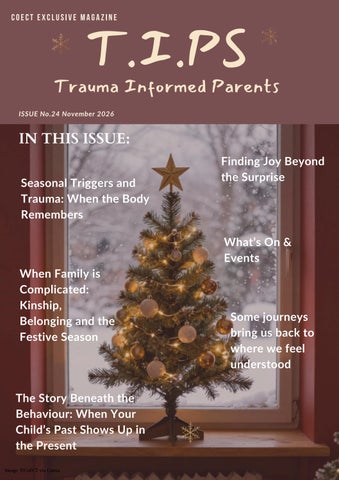
T.I.PS
COECT EXCLUSIVE MAGAZINE
Trauma Informed Parents ISSUE No.24 November 2026
IN THIS ISSUE: Seasonal Triggers and Trauma: When the Body Remembers
Finding Joy Beyond the Surprise
What’s On & Events When Family is Complicated: Kinship, Belonging and the Festive Season
The Story Beneath the Behaviour: When Your Child’s Past Shows Up in the Present Image: ©CoECT via Canva
Some journeys bring us back to where we feel understood
Meet the Team! Executive Editor - Sarah Naish
Executive Editor - Sair Penna
Managing Editor - Kathryn Talbot
Contributor - Saskia Joss
Contributor - Rowan Aderyn
Contributor - Jessica Spenceley
Contributor - Enza Smith MBE
Contributor - Amanda MaugerJones Amanda is a therapeutic foster parent who is trained in empathic listening and is a Dyadic Developmental Psychotherapy (DDP) informed Practitioner. She is also a Trauma-Informed Trainer for the Centre of Excellence in Child Trauma.
Sarah is a Therapeutic Parent, an Adopter of five siblings, Best selling international Author, Keynote Speaker and founder of three Independent Therapeutic Fostering Agencies. Sarah is also and cofounder and CEO at The Centre of Excellence in Child Trauma C.I.C.
Kathryn is co-founder and managing editor of the TIPs magazine, at The Centre of Excellence in Child Trauma C.I.C specialising in public relations.
Rowan is a mum of two who writes about family life, neurodiversity, care experience and finding joy in the everyday.
Enza is Chief Executive of Kinship Carers UK and co-author of The Essential Guide to Kinship Care. She is a passionate advocate for kinship families. Drawing on lived and professional experience, she works to ensure that children raised by relatives and family friends receive the recognition, support and opportunities they deserve.
Sair (Sarah) is a Therapeutic Parent, Author, Parent Coach and Havening practitioner. Sair is also co-founder and Director of Training, Qualifications & Quality at The Centre of Excellence in Child Trauma C.I.C
Saskia is a BACP-registered child and adolescent therapist, school emotional wellbeing consultant and Author based in London. She runs the Mill Hill Therapy Hub, a network of therapeutic spaces supporting adults, children, couples and families both online and in person across London.
Jessica is a therapeutic social worker with over 20 years of experience helping adoptive parents navigate their parenting journeys using the attachment-based, traumainformed parenting approach of TBRI®.
Contributor - Laura Taylor Laura Taylor is an independent Social Worker, Trauma Informed and Responsive Trainer, Practice Educator, Author and Key Note Speaker. You may have seen Laura in some of our training and webinars as she regularly supports COECT.
ISSUE 24
T.I.P'S MAGAZINE
1
TRAUMA-INFORMED PARENTS
CONTENTS 4 Seasonal Triggers and Trauma: When the Body Remembers
9 When Family is Complicated: Kinship, Belonging and the Festive Season
16 Finding Joy Beyond the Surprise
3 Editor's Note 12 Taking our message to Australia – Sarah Naish and Sarah Dillon at the Adopt Change Healing Homes for Kids Roadshows 13 The Story Beneath the Behaviour: When Your Child’s Past Shows Up in the Present 15 What’s On - CoECT Upcoming Events 19 A letter for the Festive Season 21 Some journeys bring us back to where we feel understood.
ISSUE 24
T.I.P'S MAGAZINE
2
From its beginnings as a Therapeutic Parenting Group on Facebook a decade ago, we have evolved into a Community Interest Company dedicated to supporting parents of children who have faced early life trauma and display neurodiverse characteristics. This edition focuses on the topic of the festive season and how it can affect parents and families.
Editor’s Note Welcome to our November edition of TIPS. Over the years, we have intentionally chosen not to dedicate an edition of TIPS Magazine to Christmas. However, we've become increasingly aware of just how difficult this time of year can be for some of the families we support, and we felt it was time to dedicate an Issue to the topic. Whether you celebrate Christmas or not, it's difficult to escape it. Everywhere we look, we're surrounded by images of happy families, excited children, presents under the tree and pictureperfect Christmas mornings. But for many of the children and families in our community, the reality can look very different. Some children may never have experienced Christmas in the way it's often portrayed. Others may associate it with difficult memories, loss or changes in family relationships. Parents and carers may want to give their children the Christmas they feel they've missed out on, but the excitement, changes and expectations can sometimes bring challenges of their own. For children who have experienced trauma, and for neurodivergent children, changes to routine, busy environments, sensory demands and unfamiliar traditions can make the festive season particularly difficult. This is why we've chosen Christmas as the focus of this edition. We wanted to explore some of these experiences, offer understanding, and hopefully provide a little reassurance to families who might find this time of year harder than others realise. In this edition, we've brought together a range of perspectives to explore the festive season. Our contributors look at seasonal triggers and the way trauma can affect children's experiences, as well as the complexities of family relationships, kinship and belonging. We also explore the story beneath children's behaviour, consider how neurodivergent children might experience Christmas, and share reflections on the year in therapeutic parenting. We hope you'll find something in this Issue that feels helpful, reassuring or simply reminds you that you're not alone.
Sair Penna Executive Editor
Wherever and however you spend this festive season, we wish you moments of peace and happiness.
Kathryn Talbot
Best wishes
Managing Editor
Sair, Sarah & The Team at The Centre of Excellence in Child
TIPs Magazine
Trauma C.I.C
ISSUE 24
T.I.P'S MAGAZINE
3
Seasonal Triggers and Trauma: When the Body Remembers Image: ©S Joss
Helping children navigate celebrations, changing routines and the complicated emotions of the festive season Written By Saskia Joss Christmas is supposed to be wonderful, isn't it? Presents, decorations, family gatherings, special meals and the excitement of doing things a little differently. But what if doing things differently is exactly what makes Christmas difficult? For children who have experienced trauma, neglect or significant changes in their family circumstances, celebrations can bring up a whole range of emotions. Some may find Christmas incredibly difficult, while others might experience their first truly wonderful Christmas in a new home. All children are different. All experiences of trauma are different. And not every child who has experienced trauma will find Christmas traumatic. A child who has never celebrated Christmas before might find the decorations, presents and family traditions absolutely magical. Another might desperately miss the way Christmas used to be, the people they celebrated with or the traditions that made them feel connected to their family. For a child whose family didn't celebrate Christmas for religious or cultural reasons, unfamiliar traditions might bring excitement, confusion or questions about their identity. We cannot assume how a child will feel based simply on their history. What we can do is approach them with curiosity.
Why celebrations bring up complicated feelings Celebrations can encourage children to reflect on their lives in ways that ordinary days don't. Think about how adults feel around New Year's Eve or significant birthdays. We find ourselves thinking about what's changed, who's missing and what we thought our lives might look like.
ISSUE 24
Children experience something similar. I've worked with children who have lost parents or whose family circumstances differ from their classmates. Mother's Day and Father's Day can be particularly difficult because they place a spotlight on family relationships and sometimes on the people who are absent. Christmas, birthdays and other celebrations can do exactly the same thing. Children, like adults, can feel two things at once. They can be happy and sad, excited and anxious, grateful and disappointed. Our job isn't to persuade them that one feeling is more appropriate than another. It's to help them understand that all these feelings can exist together.
Nice experiences aren't always easy experiences One of the biggest misunderstandings adults can have is assuming that because something is nice, it will automatically be easy. We know a child desperately wants a scooter for Christmas. We've bought the scooter. We've arranged a wonderful family gathering. What could possibly go wrong? But children don't predict what will happen next based on what we know. They predict it based on what they've experienced before. If family celebrations have previously involved arguments, frightening behaviour or broken promises, the idea of a happy Christmas might be difficult to trust. Sometimes the difficulty has nothing to do with a traumatic memory.
T.I.P'S MAGAZINE
4
Perhaps a child is autistic and finds unfamiliar sensory environments overwhelming.
become unusually quiet, withdrawn or appear to switch off.
Perhaps they have ADHD and worry about following the rules at Grandma's house. Perhaps they're anxious about when lunch will be served, where the toilet is or how long they'll have to stay.
Even wonderful experiences can become too much. Opening presents, playing with cousins and spending hours surrounded by noise and excitement can be enormous fun, but eventually exhausting.
These might seem like small concerns, but they're often the very things that help children feel safe.
Our job is to notice when children are approaching their limits and help them recover.
Think about starting a new school year. Children worry about where they'll sit, whether they'll understand the rules and what happens if they need help.
Sometimes that's a snack, a quiet room, a walk outside or simply sitting together for a few minutes.
"Will I know how to look after myself in this situation?"
And remembering our own window of tolerance matters too. When we're overwhelmed, it becomes much harder to offer the calm and patience our children need.
Christmas at somebody else's house can raise exactly the same questions.
Prepare for Christmas like a long-haul flight
Understanding the window of tolerance
Imagine taking your child on a 18-hour flight to Australia.
The window of tolerance, developed by psychiatrist Dr Dan Siegel, is a useful way of understanding how much we can emotionally manage at any given time.
Would you expect them to sit quietly, eat whatever was offered and behave beautifully for the entire journey?
Imagine an invisible window representing our capacity to cope. This window isn't fixed. It changes depending on what's happening in our lives.
Of course not!
They're trying to answer a very important question:
If you've slept well, eaten properly, had a nice morning, and everything seems to be going smoothly, your window of tolerance is likely to be quite big. But if you've slept terribly, argued with your partner, struggled at work and spent the morning rushing around, your window might be much smaller. Now imagine your child accidentally knocks over a glass of juice.
You'd pack snacks, books, games, comfortable clothes, headphones and probably a fully charged tablet. You'd explain how long the journey would take and what would happen when you arrived. So why don't we approach Christmas at Grandma's house in exactly the same way? Before the holidays, create a simple schedule showing what the days might look like.
On a good day, you might say, "Oh no! Never mind, let's clean it up." On a difficult day, you might snap, "For goodness' sake! Why are you always spilling things?" The child has done exactly the same thing. What's changed is your capacity to cope with it. Children are no different. Their window changes depending on their sleep, hunger, experiences at school, relationships and how safe they feel. When children move beyond what they can comfortably manage, they might become tearful, restless, argumentative or overwhelmed. Others ISSUE 24
Image: ©COECT via Canva
T.I.P'S MAGAZINE
5
Talk about where you're going, who will be there and what usually happens. Show photographs, explain meal arrangements and discuss where everyone will sleep if you're staying overnight. Let children pack familiar things that help them feel comfortable. Most importantly, ask them what they need to know. We might assume they're worried about the journey, when actually they're worried about which bed they'll sleep in. Ask, "What would help you feel comfortable?" or "What could we do if things start feeling too much?" You might agree on a secret signal that means, "I need a break." This doesn't mean offering endless choices or abandoning family traditions. Sometimes it's simply, "We're going to Grandma's for lunch, and when we get home you can choose the film we watch." Children need to know that the adults have a plan, understand their needs and will help if something becomes difficult.
When things don't go to plan Even with careful preparation, Christmas can be overwhelming. A child might refuse dinner, argue with a cousin, become upset about a present or say something deeply hurtful. As carers, it's understandable to feel disappointed, embarrassed or rejected, particularly when we've worked so hard to make the day special. But when a child is overwhelmed, their words and behaviour may be telling us just how difficult things feel for them. They aren't necessarily trying to hurt us. They may simply be unable to manage everything they're feeling. We can feel upset. We can ask for support, take a moment for ourselves and return to difficult conversations when everyone is calm. But we're the adults, and sometimes we need to remind ourselves just how young these children are.
Image: ©COECT via Canva They're still children, and they need us to remember that, particularly when they're finding life difficult. Sometimes that means stepping away from cousins, going outside for a walk or allowing a child to eat something familiar. Other adults might not understand. They may have different expectations about manners, discipline or participation. It's perfectly reasonable to say, "I know this child and I know what they need right now."
Helping children at school The final weeks of term can be among the least predictable of the school year. Nativity rehearsals, Christmas jumper days, carol services, parties and performances all change the usual routine. Teachers can make an enormous difference by updating visual timetables, explaining changes in advance and providing somewhere quiet for children who need a break. It's also worth considering how children participate. An autistic child might find a crowded carol service overwhelming. A child with ADHD might struggle to stand still throughout a performance.
I sometimes encourage adults to look at a child's hands.
Could they have a role involving movement? Could they stand near a familiar adult or step away when needed?
Look at their tiny hands, their little shoes. Think about the silly programmes they watch and the things that make them laugh.
Inclusion isn't expecting every child to manage the same thing. It's helping every child participate successfully.
ISSUE 24
T.I.P'S MAGAZINE
6
A new way to celebrate For children who have experienced trauma, building trust takes time. Some have learnt that adults can be unpredictable, promises can be broken and relationships can feel frightening. We cannot simply tell them that things will be different now. We have to show them. PACE, developed by clinical psychologist Dr Dan Hughes, stands for Playfulness, Acceptance, Curiosity and Empathy. These principles can help us build the trust and connection that children need. We can be playful when things don't go perfectly, accepting of complicated feelings, curious about what behaviour is communicating and empathetic when something feels difficult.
We can show children that celebrations can be safe and enjoyable. That adults can listen, keep their promises and help when things become overwhelming. And that enjoying new experiences doesn't mean leaving behind their history, identity or the people they love. We aren't simply helping children get through Christmas. We're helping them discover new ways to celebrate, new ways to connect and new reasons to trust. Sometimes the most meaningful gift we can offer isn't the one underneath the tree. It's the feeling that, whatever happens, they have an adult who understands them and will help them feel safe.
About the author Saskia Joss is a BACP-registered child and adolescent therapist, anxiety specialist and author of Help! My Child's Anxiety is Giving Me Anxiety. She also co-hosts the weekly parenting podcast Help! My Child's Anxious with Vanessa Feltz, exploring childhood anxiety, emotional wellbeing and the everyday challenges of raising children. She founded the Mill Hill Therapy Hub, providing therapeutic support for children, families and adults, and co-founded SchoolBudi, a daily emotional wellbeing check-in platform for schools. www.millhilltherapyhub.co.uk | www.schoolbudi.co.uk
About SchoolBudi SchoolBudi is an app offering schools practical, therapyinformed resources and materials to support children. It encourages adults to look beyond a child’s behaviour and consider what might be going on for them, and what could help them feel safer, more settled and ready to learn. Every child is different, so a curious and individual approach is important. SchoolBudi’s resources can support adults working with an individual child, as well as contribute to a more supportive approach across the school. The app may also complement plans such as an EHCP, My Plan or My Plan+, and could support wider provision, including work funded through Pupil Premium Plus. Its aim is to make practical therapeutic ideas more accessible to the people supporting children in school.
ISSUE 24
www.schoolbudi.co.uk
T.I.P'S MAGAZINE
7
Did you know? A CoECT TIPs Hub Membership gives you access to courses and webinars that help parents and carers better understand trauma, attachment, emotional regulation, and therapeutic parenting. Learn at your own pace, whenever it suits you. www.coect.co.uk/join
98% That’s the percentage of SAfER foster families who stay together, year after year. In a system where children too often move between homes and lose vital relationships, stability is everything. At SAfER, we’re here to help families stay strong so that children can stay where they belong—in safe, loving homes that last. Stability is possible. We’ll help you get there. https://saferfostering.org.uk ISSUE 24
T.I.P'S MAGAZINE
8
When Family is Complicated: Kinship, Belonging and the Festive Season Written By Enza Smith MBE As winter approaches and homes fill with lights, decorations, festive smells, excitement, and anticipation, many families look forward to gathering and celebrating. Yet for many children in kinship care, and for the relatives or family friends who have stepped in to provide a safe, loving home, this time of year can bring a complex mixture of joy, hope, loss, and longing. The festive season often shines a spotlight on family. For children in kinship care, family is rarely simple. They may feel safe and deeply loved in their kinship home while still missing a parent or grieving the family life they imagined. Even amid the excitement of Christmas morning, questions about absent parents, past experiences and changed relationships can surface. For kinship families, these mixed emotions are a natural part of living with the impact of trauma, separation and loss. Kinship carers are grandparents, aunts, uncles, siblings, family friends, and connected adults who step forward when parents have either passed away or can no longer provide safe, consistent care. Across the country, Kinship Carers create stable, nurturing homes where children can heal and thrive. They manage school meetings, complex family relationships and the lasting effects of trauma, often with limited support or recognition. As with all families, the festive season can intensify challenges. Family gatherings may raise sensitive questions, contact
ISSUE 24
Image: ©ESmith arrangements can create uncertainty, and financial pressures may feel greater than usual. Yet kinship families continue to demonstrate remarkable resilience. A sense of belonging is central to a child's wellbeing. It comes from knowing you are valued, accepted and secure. It is strengthened through everyday moments such as decorating the tree, baking mince pies or a Christmas cake, sharing meals and creating family traditions together. For children who have experienced instability or trauma, belonging provides emotional security. It helps them understand their story, express difficult feelings and build confidence in their future. One of the greatest gifts carers can offer is permission: permission to miss loved ones, such as siblings and other family members, ask difficult questions, feel sad and happy at the same time, and enjoy moments of celebration without guilt. Children should never feel they must choose between loving the family raising them and their parents. Giving them quiet moments to sit, think and talk when they are ready can help them feel safe, understood and accepted. Professionals, faith groups and community organisations also play an important role by recognising the contribution of kinship carers and helping families feel understood and supported. The Christmas story offers a reflection on welcome, hope and
belonging. Joseph chose to love, protect, and nurture a child who was not biologically his own, reminding us that parenting is rooted not only in genetics but in commitment, sacrifice, and unconditional love. Throughout the Bible, we see God's concern for children and those who are overlooked. For kinship carers, this message carries particular significance. Each time a relative or family friend steps forward to provide a safe, stable home, they help a child learn an essential truth: they are valued, loved, and never alone. For kinship families, the Christmas season often combines celebration with reflection. Yet their experiences reveal something powerful: even when family life is complicated, love, stability and belonging can help children flourish.
Supporting Kinship Families in Worcester At Kinship Carers UK, we know that a sense of belonging comes not only from family relationships but also from community. Alongside our national advocacy work, we provide both online and face-to-face support groups, offering kinship carers a safe space to share experiences, reduce isolation and connect with others who understand the unique challenges and rewards of raising a friend or relative's child. We provide this service year-round; bring yourself, a
T.I.P'S MAGAZINE
9
soothing hot drink, and enjoy time talking with people who are just as wonderful as you. This Christmas season, we are delighted to be hosting our annual Kinship Family Christmas Party on 28th November from 3:00 pm to 5:30 pm at Woodgreen Church, Worcester, WR4 0SR. The event brings kinship families together to celebrate, enjoy festive activities and build connections with others who share similar experiences.
If you are a kinship family and would like to attend, or if you would be willing to volunteer your time or donate to help make the event special for local children and families, please email enza@kinshipcarersuk.com. This Christmas, may we look beyond idealised images of family and recognise the courage, compassion and resilience found within kinship care because true belonging is not found in perfect families. It is found in love. And love can transform lives.
Enza Smith MBE is Chief Executive of Kinship Carers UK and coauthor of The Essential Guide to Kinship Care.
SUPPORTING KINSHIP FAMILIES IN WORCESTER Kinship Carers UK provides both online and face-to-face support groups for kinship carers. To book, please visit www.kinshipcarersuk.com. KINSHIP FAMILY CHRISTMAS PARTY 28th November 2026 3:00 pm- 5:30 pm Woodgreen Church, Hastings Drive, Worcester, WR4 0SR Join us for festive fun, family activities and connection with other kinship families. Attend or volunteer: Email: enza@kinshipcarersuk.com or pop onto our Contact Us page on our website at www.kinshipcarersuk.com
Are you part of an organisation seeking trauma-informed therapeutic parenting training for your staff?
We invite you to explore our brochure to book training with Sarah Naish or our other trainers https://www.coect.co.uk/organisational -support
ISSUE 24
T.I.P'S MAGAZINE
10
COECT SILVER MEMBERSHIP: FOR FOSTER AGENCIES Supporting the people who foster Helping foster parents feel more informed, confident and supported in their fostering journey. Foster parents play a vital role in helping children feel safe, build relationships and begin to heal from difficult early experiences. But fostering can bring complex challenges, and foster parents need ongoing understanding and support. CoECT Silver Membership gives your fostering service an affordable way to extend access to trauma-informed learning, practical resources and peer support for the foster parents you work with.
How can Silver Membership help your fostering service? Develop understanding of trauma: Help foster parents explore how early experiences can affect children's emotions, behaviour and relationships. Strengthen therapeutic parenting: Provide learning and resources to support compassionate, trauma-informed responses to children's needs. Complement your existing support: Give foster parents additional opportunities to learn and access resources beyond training sessions and supervision. Reduce feelings of isolation: Offer opportunities for connection and shared understanding with other parents and carers. Support your wider team: Help professionals and foster parents develop a shared understanding of children's needs.
What's included? Online learning hub with courses and webinars Trauma-informed learning resources Online wellbeing resources Parent peer-support opportunities TIPs Magazine digital archive and meet-ups Discounts on selected learning and support An affordable way to extend your support £9 per person, per month £108 per person, per year Bulk membership discounts are available for organisations
Help foster parents feel better supported Give the families you work with additional opportunities to build knowledge, access resources and feel less alone in their parenting journey.
info@coect.co.uk
www.coect.co.uk
Membership benefits and access arrangements are subject to CoECT's membership terms and agreed arrangements. ISSUE 24
T.I.P'S MAGAZINE
11
CoECT News
Taking our message to Australia – Sarah Naish and Sarah Dillon at the Adopt Change: Healing Homes for Kids Roadshows We were delighted that Sarah Naish and Sarah Dillon had the opportunity to speak at the Adopt Change Roadshows in various locations across Australia, sharing their knowledge, experience and passion for supporting adoptive and foster families with an international audience. The conferences brought together professionals, adopters, foster parents and others who share a commitment to improving the lives of children and young people who have experienced trauma and adversity. Sarah and Sarah shared their insights and experiences, highlighting some of the challenges families face and the importance of understanding, connection and having the right support in place at the right time. Events like this are valuable for bringing people together, sharing ideas, and learning from one another. Although we may work in different countries and communities, the experiences of many adoptive and foster families are remarkably similar. The need for understanding, support and a sense of belonging is something that reaches far beyond borders. We are incredibly proud of Sarah Naish and Sarah Dillon for taking this important work to an international audience and helping to ensure that the voices and experiences of families continue to be heard.
Connecting with Families Across Australia Following Sarah Naish and Sarah Dillon's visit to the Adopt Change Roadshows, we're delighted to be connecting with more families and professionals across Australia. We're welcoming Australian families to join our CoECT TIPs Hub Silver Membership, offering access to trauma-informed resources, online courses, webinars, peer support and opportunities to connect with others who understand. Whether you're an adoptive parent, foster parent, kinship carer or professional, there's a place for you in our community. Find out more at www.coect.co.uk/coect-australia ISSUE 24
T.I.P'S MAGAZINE
12
Image: ©JSpenceley
The Story Beneath the Behaviour: When Your Child’s Past Shows Up in the Present Written By Jessica Spenceley You ask your child to turn off the television, get ready for school, or come to dinner. Suddenly, they’re shouting, refusing, throwing things, or telling you they hate you. You explain, repeat the request, and offer reassurance. Yet the more you try to bring things under control, the bigger their reaction becomes. When behaviour is this intense, it takes over. Your attention goes to keeping everyone safe and getting through the moment. But the situation in front of you may only be one part of what your child is responding to.
The Past Does Not Stay in the Past Moving into a safe and loving adoptive family doesn’t erase what your child experienced before they arrived. Those experiences shape what they expect from adults, how safe it feels to depend on someone, and what they believe will happen when they’re upset or lose control. This can show up in ordinary family life. Being told “no” may connect with earlier experiences of having no say. A change of plan may bring back the uncertainty of never knowing what would happen next. Your frustrated expression may feel like the beginning of rejection. Being asked to wait may stir up fear that their needs will be forgotten. Your child may be responding to what’s happening now, alongside fear, powerlessness, or loss from the past. This is why their reaction can seem so much bigger than the situation itself.
Looking Beyond What Just Happened Sometimes it can help to think of behaviour as part of the story your child is carrying about themselves, adults, and relationships. ISSUE 24
That story may sound something like: Adults leave. My needs don't matter. I have to stay in control. If I get things wrong, people won't want me. I have to look after myself. Your child may never say these things out loud. They may not even consciously think them. But earlier experiences can shape what they expect to happen, particularly when they feel frustrated, powerless, or unsure. In those moments, behaviour can communicate something your child doesn’t yet have the words to explain. Instead of asking, “How do I stop this behaviour?” you can also wonder, “What might my child be communicating through it?”
Using TBRI® in the Moment Understanding where behaviour may come from is important. Trust-Based Relational Intervention® (TBRI®) helps you respond to the behaviour while supporting the deeper needs that have been stirred up. Connecting Principles help you remain emotionally available when your child expects anger, rejection, or disconnection. Your expression, tone of voice, and willingness to stay close can communicate: I’m still here. I can handle this moment. Our relationship isn’t at risk. Connection doesn’t mean allowing unsafe behaviour. It means holding the boundary without sacrificing the relationship. Empowering Principles help increase felt safety. Predictability, preparation, appropriate
T.I.P'S MAGAZINE
13
choices, and attention to physical and sensory needs can reduce fear and uncertainty. A child who has experienced powerlessness may cope better when given some influence: “The television needs to go off now. Would you like to switch it off, or would you like me to?” The boundary remains, but your child has a voice within it. Correcting Principles help you guide behaviour without shame or fear: “It’s okay to be angry. It’s not okay to hit. I’m going to help you keep everyone safe.” The behaviour needs to change, and your child will not be left alone to manage it.
Over time, these experiences can begin to change the story your child carries about themselves and about relationships. The old story may have been shaped by fear, uncertainty, or having to cope alone. Through hundreds of ordinary moments of connection, safety, boundaries, and repair, a different story can begin to take shape: I can have a voice. Someone will help when things feel too big. Difficult moments can be repaired. I still belong. You cannot rewrite what happened before your child came to you. But you can help them make sense of how that past still shows up in the present and, through the relationship you build together, help them experience a different story about what comes next.
Helping a Different Story Take Shape One calm response will not undo the impact of trauma and adversity. Change develops through repeated experiences. When you listen while holding a boundary, your child experiences an adult who can be in charge without overpowering them. When you remain present through conflict, they learn that anger doesn’t have to end a relationship. When you help them repair a mistake, they discover that getting something wrong doesn’t threaten their place in the family.
Jessica Spenceley is a therapeutic social worker and the founder of Nurtured Belonging. She writes weekly about adoption, trauma, and healing on her Substack, Adoption Beneath the Surface. Jessica is also an Associate with The Centre of Excellence in Child Trauma C.I.C. (CoECT) To connect with Jessica, visit jessicaspenceley.substack.com
Supporting the adults who support our children Children who have experienced trauma or have complex needs often need more than understanding and patience – they need adults around them who feel confident, supported and equipped to help. Our Therapeutic Parent Coaching Diploma Course gives practitioners, family support workers, educators, and therapists the knowledge and practical skills to help parents and carers better understand their children's needs, make sense of their behaviour, and build stronger, more connected relationships. Using a trauma-informed approach, the course explores practical ways to support families through challenging times, strengthen emotional connections and help parents feel more confident in their role.
Take a look at our course here: https://trauma-informedparenting.learnworlds.com /accreditation-and-cpd
When we support adults, we also support children.
ISSUE 24
T.I.P'S MAGAZINE
14
This month’s training & events We have a range of live online training sessions and opportunities to connect through November, December and January: Self-Harm, Regulation & Safety Planning Monday 23rd November 2026 12:00 – 14:00 (GMT) Live Online
📅 💻
TIPs Consult Wednesday 16th December 2026, 10:00 – 11:00 (GMT) Live Online
Disassociation, Shutdown & Meltdown Monday 30th November 2026 10:00 AM – 12:00 (GMT) Live Online
Digital Safety Foundations for Neurodivergent Children Thursday 7th January 2027, 10:00 – 13:00 (GMT) Live Online
📅 💻
The Calm Reset Thursday 3rd December 2026 20:00 - 20:20 (GMT) Virtual Event
📅 💻
Dual Diagnosis: Complex Needs Navigation Monday 7th December 2026 10:00 - 12:00 (GMT) Live Online
📅 💻
Trauma-Informed Practice When You Are Dysregulated Tuesday 8th December 2026 11:30 – 13:30 (GMT) Live Online
📅 💻
The Calm Reset Thursday 10th December 2026 20:00 – 20:20 (GMT)) Virtual Event
📅 💻
Trauma-Informed Practice When You Are Dysregulated Monday 14th December 2026 19:00 – 21:00 (GMT) On Demand Building Resilience & Flourishing Families Tuesday 15th December 2026 10:00 – 12:00 (GMT) Live Online
📅 💻
ISSUE 24
📅 💻 📅 💻
Online Grooming & Exploitation Monday 11th January 2027, 10:00 – 12:00 (GMT) Live Online
📅 💻
Neurodivergence in the Workforce & Professional Identity Wednesday 13th January 2027, 10:00 – 12:00 (GMT) Live Online
📅 💻
Gaming, Online Worlds & Addiction-Like Behaviours Monday 18th January 2027, 10:00 – 12:00 (GMT) Live Online
📅 💻
Neurodivergence in the Workforce & Professional Identity Wednesday 20th January 2027, 19:00 – 21:00 (GMT) On Demand
📅 💻
Burnout, Compassion Fatigue & Secondary Trauma Friday 22nd January 2027 10:00 AM – 12:00 PM Live Online
📅 💻
T.I.P'S MAGAZINE
15
Finding Joy Beyond the Surprise I get so excited for Christmas. I started shopping months ago; we are well into the debate of what will be the second meal on Christmas Day, and I am warming up my Christmas playlist, although I will only let myself watch Christmas movies from the 1st of November. Growing up, Christmas was a complex and tricky time. Something that so many people looked forward to, I learnt to navigate the best I could. There were common Christmas challenges, like one of the three or so visits to my mum, who was staying in a secure psychiatric hospital, and there were unexpected challenges. One year I burnt the Christmas dinner and found myself as a teenager walking to Spar to buy tinned veg. Hoping that if I managed to serve up something, I would avoid the wrath of my alcoholic father. Of course there were things I adored. The singing, the lights, and that quiet sense of everyone trying to bring some Christmas cheer. Now, as a mum of two wonderful neurodivergent children, I have learnt the importance of tradition. Creating anchors in childhood which build comfort, joy and memories. We may forget the details when we grow, but we remember traditions.
Image: ©RAderyn
Written By Rowan Aderyn
calendar waking up each morning excited to discover what the activity would be. However, our youngest autistic little girl really struggled. For the first couple of years trying to continue the tradition we had tears and anxiety. I did not understand how such a nice surprise could be causing so much stress. In my head surprises could be good or bad. And these were always good. I have learnt that for her there is no good or bad. All surprises are unknown, unprepared anxiety monsters. I was so disappointed that the joy I had once created around the festive season was no longer working and honestly, I was a little put out. I would spend months in advance booking activities, buying craft, trying to find new and fun things to do. But I took a moment and asked myself what was the intent behind our advent calendar. It was there to give us time together as a family, there to offer us positive memories, and there to create that rhythm and drum beat in life. The element of surprise was never an essential ingredient. It had just been a vehicle
to deliver moments together. I sucked up my desire to hold onto something that I had loved, and I tried to figure out a way to make it accessible and joyful for her. Now she helps me plan the activities in advance. I still organise them on days that work, but every night before if she wants to she can take a sneak peek at the activity for the next day. It gives her time to prepare, to ask questions and sometimes creates even more excitement as she looks forward to what is coming. Parenting a neurodivergent child through a time of year that changes the standard routines, creates lots of peaks and troughs in energy, makes unknowns, and offers surprise as a common expectation has been tricky. We have learnt to adapt many things which to us feel vastly different to the norm. But in doing so we have also found new joy and reaffirmed our intention as a family to explore, to enjoy and to come together. Here are some of my other top tips over the Christmas season parenting either a neurodiverse child or a child in care.
Image: ©RAderyn
One tradition is especially important to our family: the family advent calendar. It hangs on the wall in our hallway, and each pocket holds a festive gift tag. Written on the back is an activity. This can vary from a craft activity, driving to spot the best Christmas lights, to afternoon tea with Santa, or this year's highlight: a trip on the Polar Express. My eldest always adored the advent ISSUE 24
T.I.P'S MAGAZINE
16
1. Structure is still key - As school timetables change and time at home becomes quite different make sure to anchor down as much of your regular structure or routine. If they have a bath before bed every night, try and keep that. If they go to Brownies on a Wednesday try and avoid booking activities then. 2. Surprise is not always fun - It is okay for there to be no surprise gifts from family. You can ask them to get specific things. Or consider using coloured cellophane for wrapping paper. 3. Go at their pace - If they want to take a break from socialising or want to tear through their presents in a matter of minutes, let them.
Children often intuitively know when things are getting too much; support them in learning that it is okay to rest and return. 4. Traditions matter -Create new ones or adopt theirs. Traditions offer us a way to look forward and to look back. They do not need to be expensive or grand, just consistent. 5. Offer flexibility - Do they really have to eat the same as you at Christmas dinner? Isn’t the point on Christmas Day to have a meal you love? If that is pizza or chips, why not offer them their favourite food? 6. Do not expect enjoyment - Even if you go to loads of effort, they can absolutely get afraid meeting Santa
or hate the movie you thought they would love. The goal is not gaining recognition for your effort or ideas. They will not always react the way you expect. It is not a judgement on you. Christmas in our house can look quite different to others. There are less surprises, more planning and a lot of flexibility. But we have found new ways to build memories, create joy and be together, which for us is what Christmas is all about. Rowan Aderyn is a mum of two who writes about family life, neurodiversity, care experience and finding joy in the everyday. You can find more of their writing at www.rowanaderyn.com
One for the Bookshelf The Very Wobbly Christmas by Sarah Naish Christmas can bring lots of excitement, but for some children it can also bring worries, uncertainty and big feelings. The Very Wobbly Christmas is a lovely story to share with children who might find the festive season a little overwhelming. It helps open up conversations about Christmas worries and offers parents and carers ideas for providing reassurance and support. A thoughtful addition to the bookshelf, particularly for families who want to help their children feel safe, understood and included at Christmas. A little festive reading with a therapeutic message. Available on Amazon. ISSUE 24
T.I.P'S MAGAZINE
17
Day Retreat for Weary Parents A Day Retreat for exhausted Parents and Carers looking for ways to interrupt the signs and symptoms of Compassion Fatigue & Burnout Date: Friday 29th January, 2027
What's Included:
Venue: Delta Marriott Hotel, Shurdington Rd, Brockworth, Gloucester GL3 4PB, UK
Opportunity to Offload, Reflect and Make a Plan
Cost: £100 per person plus VAT* *Coect members' discount applies
Join us for a morning filled with engaging conversations among likeminded parents. You will also have the opportunity to dedicate time to developing a plan that supports your well-being as you move forward in our Therapeutic Coaching Workshop.
Two-course Lunch Relaxation Exercise
Experience guided imagery and calming techniques to soothe your nervous system and restore balance.
Afternoon Access to Spa Facilities
Indulge in well-deserved rest and rejuvenation in a peaceful, supportive environment.
www.coect.co.uk
Written By Mandie Mauger-Jones & Laura Taylor
Image: ©CoECT via Canva
Dear Santa...
As Christmas approaches, Laura and I have been reflecting on what we'd like in our stockings this year. We're not asking for diamonds. We're not asking for world peace. Frankly, we'd settle for a Christmas gathering where nobody argues about Monopoly rules. As hosts of the Roots & Resilience Therapeutic Parenting Podcast, we've come to realise that Christmas in therapeutic families is a wonderfully complicated affair. Alongside the sparkle, excitement and anticipation often comes sensory overload, disrupted routines, heightened emotions and enough festive pressure to make even the hardiest parent reach for another mince pie. We know you've already delivered twelve gifts of Christmas in song form and, having recently created our own therapeutic adaptation of the Twelve Days of Christmas, we suspect our listeners have had quite enough counting by now. So instead of another list, we'd simply like to suggest a few things that might be useful for the grown-ups this year: A little less pressure to create the "perfect" Christmas. A little more confidence to trust that connection matters more than perfection.
ISSUE 24
T.I.P'S MAGAZINE
19
Permission to laugh when the Christmas plans go spectacularly off-script. A reminder that the memories children treasure most are rarely the ones that came from carefully colour-coded festive spreadsheets. And perhaps a gentle reassurance that nobody has ever won Parent of the Year because their wrapping paper matched their tree decorations. Failing that, we'll settle for enough tea to see us through until January. Over the festive season, the Roots & Resilience Christmas episodes will be sharing practical ideas, therapeutic insights and plenty of gentle humour for parents, carers and professionals supporting children impacted by trauma, loss and attachment difficulties. We'll be revisiting our therapeutic take on The Twelve Days of Christmas, sharing festive reflections and exploring how connection often grows in the moments that don't quite go according to plan. Because if therapeutic parenting teaches us anything, it's that Christmas perfection was always a myth. The real magic is found in the child who manages one more minute at the table. The teenager who accepts your offer of hot chocolate. The small repair after a difficult moment. The laugh you share when everything else has gone slightly sideways. So, Santa, if you're listening, we'd like a Christmas with fewer expectations, more connection and perhaps a little extra patience wrapped under the tree. And if that's not possible, we'll be over at Roots & Resilience, talking about it together. Yours hopefully, Amanda & Laura P.S. If you happen to know where the therapeutic parents' Christmas survival kit is kept, we've looked everywhere. It's definitely not with the spare batteries.
Image: ©AMauger-Jones
You can check out Mandie and Laura’s podcast by visiting their YouTube channel. Laura and Mandie are also associate coaches and trainers with The Centre of Excellence in Child Trauma CIC. Roots and Resilience YouTube
ISSUE 24
T.I.P'S MAGAZINE
20
Image: ©CoECT via Canva
Some journeys bring us back to where we feel understood. Written By Sair Penna As the year draws to a close, we may want to pause and reflect on the journey we've been on. We think about the challenges we've faced, the progress we've made, the milestones we've celebrated and the moments that tested us more than we ever expected.
Over time, things may settle. Families find their routines, gain confidence, develop new strategies and feel ready to take a step back. They may become less involved, attend fewer sessions or move on to focus on other areas of family life.
For some, the year may have brought positive changes, new achievements and reasons to feel proud. For others, it may have been a year of uncertainty, difficult decisions, unexpected challenges and moments when simply getting through the day felt like an achievement. And for many families, particularly those raising and supporting children with additional or complex needs, the journey is (rarely) straightforward.
And that's okay.
There are highs and lows; you take steps forward, and sometimes everything seems to fall into place, while other times new challenges appear just as you think you've found your feet. Just when you feel you understand one stage, another brings different questions, different emotions, and a whole new set of things to navigate.
One thing we've noticed at COECT is that people often come back when they need support most. Parents and carers who were once active members, who stepped away when life felt more manageable, sometimes return months or even years later when new challenges emerge. Perhaps their child has reached a new developmental stage. Perhaps circumstances at school or at home have changed. Maybe new needs have become apparent, or perhaps they find themselves needing the reassurance and connection they once found within our community.
At CoECT, we've come to recognise that families don't always need support in the same way. Needs change, circumstances change, and family life moves through different seasons.
Raising and supporting children with complex needs is not a straight path. It is an evolving journey, and the support families need can change along the way. Sometimes the challenges we face when our children are younger are very different from those we encounter as they grow.
Sometimes families join us because they are looking for answers, reassurance or a listening ear. They may feel overwhelmed, unsure where to turn, or simply look for others who understand what life can be like when your child's needs differ from those of their peers.
New transitions bring new emotions, new expectations and new uncertainties. What worked yesterday may not work tomorrow, and that doesn't reflect anyone's ability as a parent or carer. It is simply part of navigating a journey that doesn't always come with a map.
ISSUE 24
T.I.P'S MAGAZINE
21
We also understand that asking for support isn't always easy. Parents and carers often spend so much of their time looking after everyone else that their own needs can quietly move to the bottom of the list.
There is no right or wrong way to be part of our community, and there is no expectation that support should only be accessed when things reach a crisis point.
They become used to managing, adapting, advocating and finding ways through difficult situations, sometimes without stopping to acknowledge just how much they are carrying.
You are welcome when things are going well, when you are looking for new ideas, when you need a little encouragement, and when life feels particularly difficult.
There can be a feeling that we should be able to manage on our own, that we shouldn't need help again, or that returning to a support network somehow means we haven't made enough progress.
As we look ahead to a new year, we hope families give themselves permission to recognise how far they have come, while also understanding that it's okay if there are still things they are working through.
But we believe the opposite.
Take time to appreciate the little wins, because they are just as important as the big milestones. Be kind to yourself on difficult days, and remember that progress doesn't always look the way we expect. Whatever your journey has looked like, remember how far you've come and give yourself credit for it.
Recognising when you need support is a strength. Reaching out again is a positive step. And knowing where you can turn when things become difficult is something worth holding on to. When members return to CoECT, they often tell us how much they missed being part of a community that truly understands. A place where they don't need to explain every detail, justify their feelings or find the right words to describe what life can sometimes be like. A place where conversations feel familiar, experiences are shared without judgement, and people understand that behind every family is a different story. Sometimes it's the practical advice that makes the difference. Sometimes it's learning something new, hearing about another family's experience or discovering a different way of approaching a challenge. And sometimes, it's simply knowing that someone else understands. It's having somewhere to talk openly, feel heard, and ask questions without feeling like you should already know the answers. It's being reminded that you are not the only family navigating these experiences and that there is no expectation to have everything figured out. Every family's journey is different. Some people will be with us for a short time, others for many years, and some will come and go as life changes.
And, most importantly, remember that you don't have to wait until things become difficult to reach out. Perhaps the most important reminder as another year comes to an end is this: You don't have to do this alone. Whether you're a current member, a former member or someone considering joining CoECT for the very first time, there will be a place for you here. You don't need to wait for the perfect moment to reconnect. Sometimes life takes us in different directions, and sometimes it brings us back to the places where we feel understood, accepted and supported. And if your journey brings you back to CoECT, we will be here to welcome you. Here's to a new year filled with connection, understanding, shared experiences and the reminder that no family should ever feel they have to navigate their journey alone. From all of us at CoECT, thank you for being part of our community. We look forward to continuing the journey with you.
Happy New Year from CoECT
The greatest gift is knowing you're not alone. www.coect.co.uk