UNIVERSITY OF COLORADO ANSCHUTZ CANCER CENTER
OFFICE OF COMMUNITY OUTREACH & ENGAGEMENT
JULY 7, 2026
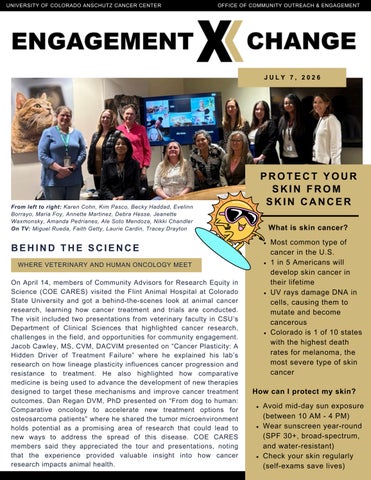
From left to right: Karen Cohn, Kim Pasco, Becky Haddad, Evelinn Borrayo, Maria Foy, Annette Martinez, Debra Hesse, Jeanette Waxmonsky, Amanda Pedrianes, Ale Soto Mendoza, Nikki Chandler On TV: Miguel Rueda, Faith Getty, Laurie Cardin, Tracey Drayton
BEHIND THE SCIENCE WHERE VETERINARY AND HUMAN ONCOLOGY MEET
On April 14, members of Community Advisors for Research Equity in Science (COE CARES) visited the Flint Animal Hospital at Colorado State University and got a behind-the-scenes look at animal cancer research, learning how cancer treatment and trials are conducted. The visit included two presentations from veterinary faculty in CSU’s Department of Clinical Sciences that highlighted cancer research, challenges in the field, and opportunities for community engagement. Jacob Cawley, MS, CVM, DACVIM presented on “Cancer Plasticity: A Hidden Driver of Treatment Failure” where he explained his lab’s research on how lineage plasticity influences cancer progression and resistance to treatment. He also highlighted how comparative medicine is being used to advance the development of new therapies designed to target these mechanisms and improve cancer treatment outcomes. Dan Regan DVM, PhD presented on “From dog to human: Comparative oncology to accelerate new treatment options for osteosarcoma patients” where he shared the tumor microenvironment holds potential as a promising area of research that could lead to new ways to address the spread of this disease. COE CARES members said they appreciated the tour and presentations, noting that the experience provided valuable insight into how cancer research impacts animal health.
PROTECT YOUR SKIN FROM SKIN CANCER What is skin cancer? Most common type of cancer in the U.S. 1 in 5 Americans will develop skin cancer in their lifetime UV rays damage DNA in cells, causing them to mutate and become cancerous Colorado is 1 of 10 states with the highest death rates for melanoma, the most severe type of skin cancer How can I protect my skin? Avoid mid-day sun exposure (between 10 AM - 4 PM) Wear sunscreen year-round (SPF 30+, broad-spectrum, and water-resistant) Check your skin regularly (self-exams save lives)