I am pleased to provide you with this annual report about your drinking water quality. These reports are also known as Consumer Confidence Reports and are provided to customers as one of the requirements of the Safe Drinking Water Act.
Reading this report will help you become more knowledgeable about your water supply and the high-quality drinking water we provide. This report explains where your drinking water comes from, test results from monitoring conducted between Jan. 1, 2023-Dec. 31, 2025, and what we are doing to ensure our community continuously has clean, safe drinking water.
We are proud to report that, once again, our water has met all federal and state requirements, one of several factors that helped College Station maintain its Superior ranking from the Texas Commission on Environmental Quality. There is a lot of information in this report. If you have any questions or concerns about anything you read, please call 979.764.3660 or visit cstx.gov/water.
John Nichols Mayor
INFORMACIÓN EN ESPAÑOL Este reporte incluye información importante sobre el agua para tomar. Para asistencia en español, favor de llamar al telefono 979.764.3435.
SPECIAL NOTICE FOR ELDERLY, INFANTS, AND IMMUNO-COMPROMISED PEOPLE:
You may be more vulnerable than the general population to certain microbial contaminants, such as Cryptosporidium, in drinking water. Infants, some elderly, or immunocompromised persons such as those undergoing chemotherapy for cancer; persons who have undergone organ transplants; those who are undergoing treatment with steroids; and people with HIV/AIDS or other immune system disorders, can be particularly at risk from infections. You should seek advice about drinking water from your physician or health care providers. Additional guidelines on appropriate means to lessen the risk of infection by Cryptosporidium are available from the Safe Drinking Water Hotline at 800.426.4791
WHERE DOES OUR WATER COME FROM?
The sources of drinking water (both tap water and bottled water) include rivers, lakes, streams, ponds, reservoirs, springs, and groundwater wells. As water travels over the surface of the land or through the ground, it dissolves naturally occurring minerals and, in some cases, radioactive material, and can pick up substances resulting from the presence of animals or from human activity.
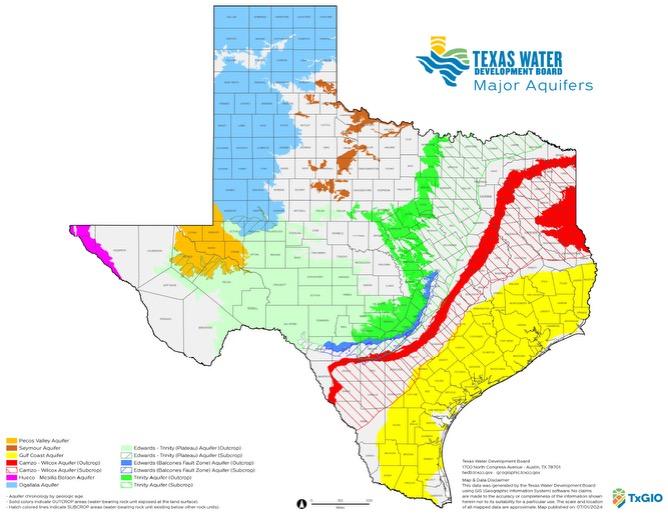
College Station relies entirely on groundwater for its drinking water supply, pumping water from eight deep wells in the Simsboro Aquifer, and one well each in the Carrizo and Sparta Aquifers, located in northwest Brazos County. Source water protection is important in making and keeping water safe to drink. The Texas Commission on Environmental Quality (TCEQ) has completed an assessment of your source water, which describes the susceptibility and types of constituents that may come into contact with your drinking water source based on human activities and natural conditions.
Results indicate that some of our sources are susceptible to certain contaminants. The sampling requirements for your water system are based on this susceptibility and previous sample data. Any detection of these contaminants may be found in this Consumer Confidence Report. For more information on source water assessments and protection efforts at our system, contact Jennifer Nations at jnations@cstx.gov or call 979.764.6223
For more information about your sources of water, please refer to the Source Water Assessment Viewer available at tceq.texas.gov/gis/swaview
Further details about sources and source-water assessments are available in Drinking Water Watch at dww2.tceq.texas.gov/DWW.
SUBSTANCES EXPECTED IN DRINKING WATER
Drinking water, including bottled water, may reasonably be expected to contain at least small amounts of some contaminants. The presence of contaminants does not necessarily indicate that water poses a health risk.
More information about contaminants and potential health effects can be obtained by calling the Safe Drinking Water Hotline at 800.426.4791
CONTAMINANTS THAT MAY BE PRESENT IN SOURCE WATER INCLUDE:
• Microbial contaminants, such as viruses and bacteria, which may come from sewage treatment plants, septic systems, agricultural livestock operations, and wildlife.
• Inorganic contaminants, such as salts and metals, which can be naturally-occurring or result from urban storm water runoff, industrial or domestic wastewater discharges, oil and gas production, mining, or farming.
• Pesticides and herbicides, which may come from a variety of sources such as agriculture, urban storm water runoff, and residential uses.
• Organic chemical contaminants, including synthetic and volatile organic chemicals, which are by-products of industrial processes and petroleum production, and can also come from gas stations, urban storm water runoff, and septic systems.
• Radioactive contaminants, which can be naturally-occurring or be the result of oil and gas production and mining activities.
To ensure that tap water is safe to drink, EPA prescribes regulations which limit the amount of certain contaminants in water provided by public water systems. FDA regulations establish limits for contaminants in bottled water which must provide the same protection for public health.
Contaminants may be found in drinking water that may cause taste, color, or odor problems. These types of problems are not necessarily causes for health concerns. For more information on taste, odor, or color of your drinking water, call 979.764.3660
WHAT DO THESE TERMS MEAN?
The following tables contain scientific terms and measures, some of which may require explanation.
AL
Action Level - The concentration of a contaminant which, if exceeded, triggers treatment or other requirements which a water system must follow. Lead and Copper have Action Levels, for example.
Level 1 Assessment
A Level 1 assessment is a study of the water system to identify potential problems and determine (if possible) why total coliform bacteria have been found in a water system.
Level 2 Assessment
A Level 2 assessment is a very detailed study of the water system to identify potential problems and determine (if possible) why an E. coli MCL violation has occurred and/or why total coliform bacteria have been found in a water system on multiple occasions.
MCL
Maximum Contaminant Level - The highest level of a contaminant that is allowed in drinking water. MCLs are set as close to the MCLGs as feasible using the best available treatment technology.
MCLG
Maximum Contaminant Level Goal - The level of a contaminant in drinking water below which there is no known or expected risk to health. MCLGs allow for a margin of safety.
MRDL
Maximum Residual Disinfectant Level - The highest level of a disinfectant allowed in drinking water. There is convincing evidence that addition of a disinfectant is necessary for control of microbial contaminants.
MRDLG
Maximum Residual Disinfectant Level Goal - The level of a drinking water disinfectant below which there is no known or expected risk to health. MRDLGs do not reflect the benefits of the use of disinfectants to control microbial contaminants.
ND
Not Detected
PPB
Micrograms per liter or parts per billion. Equivalent to one ounce in 7,350,000 gallons of water (think of it like 1 drop of water in an Olympic-size swimming pool)
PPM
Milligrams per liter or parts per million. Equivalent to one ounce in 7,350 gallons of water (think of it like 1 drop of water in a hot tub.)
COLIFORM TESTING RESULTS
UNDERSTANDING COLIFORM TESTING
Total coliform bacteria are not disease-causing organisms themselves, but they are often found in association with other microbes that can cause disease. They are used as indicators of microbial contamination of drinking water because their absence from water is a good indication that the water is microbiologically safe for human consumption. In 2025, a total of 1319 samples, at least 110 per month, were collected by licensed operators and analyzed by an independent accredited laboratory. Out of these 1319 samples, one routine sample tested positive for Total Coliform Bacteria. The positive location was immediately re-sampled and two additional samples adjacent to the positive location were sampled. All repeat samples tested negative and College Station maintained its perfect compliance record with the Revised Total Coliform Rule.
WHAT YOU NEED TO KNOW ABOUT LEAD IN DRINKING WATER
REGULATED AT THE CUSTOMER’S TAP
If present, elevated levels of lead can cause serious health problems, especially for pregnant women and young children. Lead in drinking water is primarily from materials and components associated with service lines and home plumbing. The City of College Station is responsible for providing high-quality drinking water but cannot control the variety of materials used in plumbing components. When your water has been sitting for several hours, you can minimize the potential for lead exposure by flushing the tap for 30 seconds to 2 minutes before using water for drinking or cooking. If you are concerned about lead in your water, you may wish to have your water tested. Information on lead in drinking water, testing methods, and steps you can take to minimize exposure is available from the Safe Drinking Water Hotline at or visit epa.gov/safewater/lead.
LEAD AND COPPER TEST RESULTS
Erosion of natural deposits; Leaching from wood preservatives; Corrosion of household plumbing
Corrosion of household plumbing systems; Erosion of natural deposits.
WATER SERVICE LINE INVENTORY
In compliance with the Lead and Copper Rule Revisions (LCRR), College Station has developed an inventory of both city-owned and customer-owned service lines. The city-owned portion of the service line runs from the water main to the meter, and the customer-owned portion runs from the meter to the entrance to the home. This inventory serves as a crucial foundation for water systems to address a significant source of lead in drinking water. College Station’s service line inventory is updated regularly as we continue to investigate and classify our service line material. To access the inventory, please visit experience.arcgis.com/experience/52e6ca7071f047238ff07cf152d3e24a
To identify the material of your own service line you may conduct a scratch and magnet test at your water meter, which is generally located at or near the property line. Using a tool such as a flathead screwdriver, scratch the service line to expose the material. A copper service line will look much like a penny. A lead pipe will be dull or gray in color, but shiny after being scratched. A magnet will stick to a galvanized service line but will not stick to a copper or lead service line.
DISINFECTANT RESIDUAL
Source in Drinking Water
Water additive used to control microbes.
Public water systems in Texas are required to maintain a minimum disinfectant to kill microbes that can cause waterborne disease. The upper limit of disinfectant is the Maximum Residual Disinfectant Level (MRDL). Compliance for the MRDL is based on a running annual average of all samples collected in the distribution system. The range in the data table above is the range of all the individual samples collected.
DISINFECTION BYPRODUCTS
Haloacetic Acids (HAA5)
Total Trihalomethanes (TTHM)
goal for the total
N By-product of drinking water disinfection.
ppb N By-product of drinking water disinfection.
*The value in the Highest Level column is the highest average of all sample results collected at a location over a year.
INORGANIC CONTAMINANTS
Discharge of drilling wastes; Discharge from metal refineries; Erosion of natural deposits
Erosion of natural deposits; Water additive which promotes strong teeth; Discharge from fertilizer and aluminum factories.
SECONDARY CONSTITUENTS
Secondary
SECONDARY CONSTITUENTS
IS COLLEGE STATION’S WATER HARD, OR SOFT?
UNREGULATED CONTAMINANT MONITORING
Under the Safe Drinking Water Act (SDWA), every five years the EPA issues a list of unregulated contaminants to be monitored by public water systems (PWSs). These contaminants come from the contaminant candidate list, which is a list of drinking water contaminants that are known or anticipated to occur in public water systems but not yet regulated by the EPA. Unregulated contaminant monitoring assists EPA in determining the occurrence of unregulated contaminants in drinking water and whether future regulation is warranted. Between 2023 and 2025, public water systems collected water samples to test for 30 different chemical contaminants including PFAS chemicals and Lithium. College Station’s monitoring was conducted in May and November 2023 and those results are listed below. For more information about the Unregulated Contaminant Monitoring Rule please visit https://www.epa.gov/ dwucmr/learn-about-unregulated-contaminant-monitoring-rule
UNREGULATED CONTAMINANTS
A NOTE ABOUT PFAS
PFAS is a shortened name for per- and polyfluoroalkyl substances, a group of chemicals that have been used since the 1940’s. PFAS are found in firefighting foam, waterproofing products, nonstick cooking equipment, stain-resistant carpets and furniture, plastic products, and more. Due to their widespread manufacture and use, exposure to PFAS comes from many avenues. But there is good news: the manufacture of many PFAS chemicals has been phased out, drinking water monitoring technology is now sophisticated enough to detect a wide array of contaminants at very low levels, and in April 2024 the Environmental Protection Agency established standards for six PFAS chemicals. The MCL for PFOA and PFOS is four parts per trillion, or PPT. For the other PFAS chemicals the MCL is ten parts per trillion. The table above shows detections of very small amounts of four of the PFAS chemicals, which were only detected in one of the two rounds of UCMR5 monitoring.
Contaminants in drinking water can be measured - and are regulated - in very small amounts. To help you understand the concentrations, we’ve provided this comparison table.
UNDERSTANDING PARTS PER MILLION, BILLION, AND TRILLION
1
MEASURING WATER LOSS
The Texas Legislature requires all retail public water suppliers to file a water loss report annually and notify their customers of the water loss audit results. In the most recent water loss audit submitted to the Texas Water Development Board for the period of January – December 2025, the City of College Station water system recorded an estimated total water loss volume of 30.28 gallons per connection per day (11 gallons per person per day).
Water losses are attributed to water line breaks, leaks, inaccurate meter registration, and other causes. If you have any questions about the water loss audit, please contact Jennifer Nations at 979.764.6223. You can help conserve limited water resources by reporting suspected water leaks to Utility Dispatch 24 hours per day at 855.528.4278 or submitting a leak report through the convenient SeeClickFix app.
Did you know that College Station has many services available to help customers manage water use? For many years we’ve offered free irrigation checkups, teaching customers all about their irrigation system. Qualifying WaterSense labeled irrigation equipment can receive a rebate of 50% of the cost! Learn more about irrigation checkups and rebates here: cstx. gov/living-here/utilities/water-services/saving-water/irrigationinformation/
You can also sign up to receive weekly weather-based landscape watering recommendations at bvwatersmart.org.
FOR MORE INFORMATION REGARDING THIS REPORT OR COLLEGE STATION WATER SERVICES, CONTACT:
Jennifer Nations, Water Resource Coordinator jnations@cstx.gov • 979.764.6223
COLLEGE STATION UTILITIES ACCOUNT / BILLING QUESTIONS:
REPORT WATER, WASTEWATER & ELECTRIC ISSUES TO OUR 24/7 HOTLINE 855.528.4278
CITY COUNCIL MEETINGS
College Station Water Services is part of the City of College Station city government. City Council meetings are open to the public and held on the 2nd and 4th Thursday of each month, unless otherwise posted, at College Station City Hall Agenda details are available at cstx.gov/council or by calling the City Secretary’s Office at 979.764.3541.