NEWSACCOUNT
COCPA MEMBERS GATHER TO CELEBRATE THE PROFESSION, RECOGNIZE 2026 AWARD HONOREES PAGE 8 CRAIG STANLAND: WHAT CAME BEFORE THE FRAUD PAGE 20
COLORADO SOCIETY OF CPAs • FALL 2026
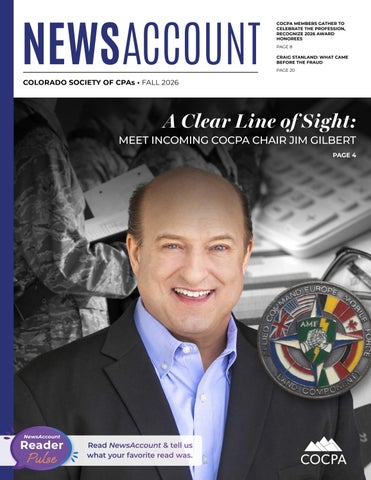
A Clear Line of Sight:
MEET INCOMING COCPA CHAIR JIM GILBERT PAGE 4
Read NewsAccount & tell us what your favorite read was.
Trimble & Associates Recruiting Executive recruiters specializing in the placement of accounting, tax, and corporate finance professionals Contingency search firm focused in the Denver and Boulder Metro areas and the broader colorado and intermountain region family owned and operated for over 25 years PO Box 3992 Greenwood Village, CO 80155-3992 info@trimbleassociates.com 303-779-5800
Call or email us today to see if we can be of assistance!
Employers and job seekers residing in or relocating to Colorado also can find more information about Trimble & Associates, Inc. at our website: www.trimbleassociates.com
4 Contents
20
Featured Articles 4
A Clear Line of Sight: Meet Incoming Chair Jim Gilbert Get to know Jim Gilbert, CPA, CITP, CGMA, who on Nov. 16 will begin his term as COCPA Chair. Beyond his wide-ranging professional experience, there’s another side to him: He’s also a former airborne infantryman who graduated from both French Commando School and German Sniper School. And he’s laser-focused on bettering the future of the accounting profession.
8
COCPA Members Gather to Celebrate the Profession, Recognize 2026 Award Honorees Members gathered at the Denver Museum of Nature and Science to celebrate the accounting profession and the 2026 COCPA Women to Watch and Everyday Heroes. Meet the eight members who are making a difference in their organizations, their communities, and the profession.
20
Craig Stanland: What Came Before the Fraud Author and speaker Craig Stanland – who previously served time in federal prison for corporate fraud – wants CPAs to look closely at financial crimes and understand the pressures, rationalizations, and small choices that can lead individuals to make decisions they never thought possible.
26
30
8
Trust at Machine Speed: How Audit, Security, and Governance Must Evolve for the Age of Agentic AI Amidst today’s rise of artificial intelligence and autonomous systems, how do auditors, compliance professionals, and security leaders govern systems that operate faster than humans can observe and at scales humans can no longer fully inspect? How are Accounting Firms Growing? New Data from 15,000+ Firms Offers Answers COCPA Silver Partner TaxDome shares insights on growth within the accounting profession, as gleaned from its Accounting Industry Index (Q1 2026 Edition), based on operational data from more than 15,000 tax, bookkeeping, and full-service accounting firms.
30 Departments 2
Chair Column
24
DE&I Spotlight
32
Career Chronicles
34
Welcome, New Members
35
Movers & Shakers
35
Classifieds Ads
36
Around the COCPA
37
In Memoriam
What was your favorite read this issue? Scan & tell us!
CHAIR COLUMN
Celebrating a Year of Connection
NEWSACCOUNT A publication of the Colorado Society of Certified Public Accountants Vol. 72, No. 2 Fall 2026
Officers
Alexandra "Alexie" Tune, Chair Jim Gilbert, Vice Chair Tiffany Davis, Treasurer Tobias "Toby" Clary, Immediate Past Chair Alicia Gelinas, Secretary
Directors
Paul Elggren, Lindsay Holliday, Tiffany Knight, Dana Lambert, Doug Reeb, Stephanie Simon, Kelly Watson
Editorial Board
Isaac Adamu, Piyali Chatterjee, Ken Fichter, Laura Theiss, Michael West, Charlie Wright
Kelli Davis, Editor Tori Fogliano, Blue Ocean Ideas, Design NewsAccount (ISSN #10899952) is published quarterly by the Colorado Society of Certified Public Accountants, 720 S. Colorado Blvd., Suite 500N, Glendale, CO 80246. NewsAccount is published in Winter, Spring, Summer, and Fall and reports information, news, and trends in the accounting profession. The Colorado Society of CPAs assumes no liability for readers’ business decisions in reference to advertisements or other information included in this publication. Links to external websites are provided for convenience and are not under the control of the COCPA. The inclusion of such links does not constitute an endorsement of the content or the views expressed therein. Membership dues include a $2.00 one-year subscription to NewsAccount. 303-773-2877 • 800-523-9082 Fax: 303-773-6344
NewsAccount is available online at www.cocpa.org.
BY ALEXANDRA TUNE, CPA, MACC, CHAIR
As my term as Chair of the Colorado Society of CPAs wraps up, I find myself reflecting not only on what we accomplished, but also on the people and relationships that made this year meaningful.
T
he Chair role provides an incredible vantage point. I’ve had the opportunity to see how our organization operates from the inside out: the dedication of our staff, the engagement of our members, and the behindthe-scenes work happening every day to strengthen our profession. I am deeply grateful to each of you who showed up, shared your ideas, and supported the COCPA this year.
THE POWER OF IN-PERSON CONNECTION One of the highlights of my year was the energy at the COCPA PEAK Conference last November. There is something powerful about gathering in person. Attendance was strong, great conversations took place, and for many of us, it was a chance to reconnect with colleagues we hadn’t seen in years. We simply connect differently when we’re face to face. Conversations go deeper. Ideas spark more naturally. And sometimes the most meaningful interactions aren’t planned at all – you run into someone between sessions, and that unexpected exchange leads to a new opportunity or renewed perspective. This year has reminded me just how essential those member-to-member connections are. They are the heartbeat of the COCPA. I encourage you to make plans now to attend the 2026 PEAK Conference , Nov. 11-12 at the Sheraton Denver West. Yes, the content is exceptional, but it’s the relationships that truly set this event apart.
EVOLVING OUR ADVOCACY EFFORTS It has also been exciting to watch the COCPA grow and evolve over the past year. From moving into our new office space in Glendale to welcoming talented additions to the team, there’s renewed energy within the organization, and expanding our advocacy role has been especially important. Seeing key CPA licensure modernization legislation signed into law by Colorado Gov. Jared Polis on May 4 was both reassuring and energizing. It’s a reminder that when we work together as staff, volunteers, and members, we can help shape a regulatory environment that supports and elevates the profession. Advocacy isn’t just about protection. It’s about continuing to position CPAs to expand our value and influence in a rapidly changing world.
LESSONS IN JUDGMENT AND LEADERSHIP Early in my career, I learned a lesson that has stayed with me: Technical expertise will open doors, but professional judgment and strategic thinking are what sustain trust. That truth feels especially relevant today. There is a great deal of conversation around artificial intelligence (AI) and whether it will fundamentally change, or even replace, what we do. After spending this year talking with members from firms of all sizes, industries, and technology sectors, I feel confident in our future.
AI will absolutely make us more efficient by streamlining processes and surface insights faster than ever before, but it won’t replace professional judgment, experience, or the strategic thinking that clients and organizations rely on us to provide. In fact, it may elevate those qualities even further. Technological and legislative change is happening quickly. Staying informed and involved is no longer optional; it is essential. As we navigate this moment, I encourage you to ask yourself: How are you keeping up? How are you harnessing AI to enhance your effectiveness and remain relevant? How are you staying engaged in the advocacy efforts that protect and advance our profession? As CPAs, we’re technicians who are grounded in data, compliance, and precision, but we’re also strategic advisors. We’re often the lifeblood of the organizations we serve,
helping leaders make critical decisions based on reliable, relevant information. The public trust that we uphold remains foundational, but our value extends far beyond reporting. We are problem solvers, innovators, and leaders, and we must continue to demonstrate the importance of those skillsets.
LOOKING TOWARD THE FUTURE As I transition from this role, I will continue to monitor three areas: 1. Advocacy, and ensuring that any regulation sets our profession up for success rather than creating unintended barriers. 2. The evolution of AI, particularly around ethics, bias, and the integrity of information. As these tools become more embedded in our work, we must remain vigilant stewards of quality and objectivity.
3. Connection. The strength of this profession has always rested in its people. Continuing to create opportunities for in-person engagement, mentorship, and collaboration will be vital.
THANK YOU Serving as your COCPA Chair has been an honor, and the experience has deepened my appreciation for the resilience, intelligence, and integrity of our profession. I leave this role more confident than ever in our collective future. Thank you for your trust and time, and for caring so deeply about this profession. Alexandra Tune, CPA, MAcc, leads Deloitte’s Denver Office Audit & Assurance Technology and Emerging Growth Practices, specializing in the technology, healthcare, and health technology industries. Reach her at atune@deloitte.com.
IF YOU ARE READInG THIS...
So Is Your Buyer! CONNECTING MORE SELLERS AND BUYERS
Scan Here
Delivering Results - One Practice At a time Kevin Overberg, CPA/PFS Practice Transition Consultant
(720) 988-4334 Kevin@APS.net
800-859-8250
www.APS.net Fall 2026 | www.cocpa.org
3
COCPA LEADERSHIP
A Clear Line of Sight: Meet Incoming Chair Jim Gilbert BY NATALIE ROONEY
A
pparently, Jim Gilbert, CPA, CITP, CGMA, “looks exactly like an accountant.” That’s according to his 21-year-old daughter, Marissa, anyway. She laughs at people’s perception of her dad, because what they don’t see when they meet this CPA, business owner, and self-described gym rat is that he’s also a
former airborne infantryman who graduated from both French Commando School and German Sniper School. It’s just not the background most people expect from an accountant, and Marissa enjoys watching others try to reconcile these two sides of her dad.
FUN FACT A trained sniper thanks to his military background, Gilbert is getting ready to apply his wideranging professional experience and laser focus to bettering the future of the accounting profession.
“She says, ‘Dad, when they hear you were an Airborne Infantry soldier in the Army, they pause,’” Gilbert says, laughing. “And she’s right. There’s a very pregnant pause.” Gilbert, who begins his term as COCPA chair Nov. 16, acknowledges his past life experiences aren’t exactly typical. How often do you see schools and certifications like U.S. Army Airborne, U.S. Army Air Assault, German Airborne, and Expert Infantry Badge – all on the same résumé? Gilbert has worked his way from billing clerk to chief financial officer (CFO), helped prepare a technology company for sale to Lockheed Martin, and held accounting and leadership roles across industries ranging from engineering and construction to automotive and healthcare. For the past 12 years, he has run his own practice, Jim Gilbert, CPA LLC, providing outsourced CFO, accounting, and technology services. Gilbert’s career has focused on looking ahead, anticipating how technology would
4
NewsAccount | Fall 2026
change the work of CPAs, and encouraging the profession to move with it. Now, he brings that perspective to his role as COCPA chair.
THE GUY WITH A POCKET PROTECTOR Gilbert grew up in Westminster, Colo. His father owned an auto body shop, and his mother was a stay-at-home mom. Gilbert was the first in his family to graduate from college, and he knew pretty early on that he wanted to be a CPA, thanks to John Matula, an audit partner with what was then Price Waterhouse. Matula taught accounting to high school students as part of his community service with the firm. Gilbert had exhausted his school’s math offerings, so he took Matula’s class as a sophomore, junior, and senior. “John told me that accounting was a great math drill and said it would challenge me,” Gilbert recalls. “He told me there was so much you could do with an accounting degree, and that there would always be jobs for accountants.” Matula was, in Gilbert’s affectionate description, a traditional accountant who actually wore a pocket protector. He made a lasting impression on Gilbert, who was beginning to think about future career options. “He was the greatest guy. He got me into accounting,” Gilbert says. “If I could see him now, I’d give him the biggest hug.”
Gilbert, far right, enjoys lobster in Denmark with his fellow NATO unit members in June 1993.
The opportunities kept coming. Gilbert trained with several countries’ militaries and was promoted to sergeant within two years.
$1,500 to their name. The plan: He would work and attend the University of New Mexico (UNM).
It was while serving with the NATO unit in Germany that Gilbert was selected to attend French Commando School and German Sniper School. He trained with paratroopers and traveled throughout Europe.
But soon, a former company commander recruited Gilbert to work at a business in Georgia. The Gilberts picked up and moved for the opportunity, and Gilbert continued to work on his accounting degree at Kennesaw State University.
He was also the guy who kept track of the money. “They knew I already had some college experience, so I just became the finance guy,” he says. “We did crazy stuff. We were buying bullets!”
Gilbert mapped out a life plan that included three goals: He wanted to become a CPA and earn $100,000 a year, a salary that sounded impossibly high at the time. And after being stationed with the Army in Germany, he added the third goal, “own a Porsche.”
The sniper training makes for a great surprise when people learn about it, but everything Gilbert learned during those opportunities has continued to impact his professional insight over the years: He studies the terrain, keeps the objective in view, and prepares for what’s coming.
He has achieved two of the goals.
FOLLOWING THE OPPORTUNITIES
“I still don’t drive a Porsche,” he laughs. “That third one doesn’t go with having kids.”
Gilbert was preparing to reenlist in the Army when a reduction in the size of the military prompted him to reconsider. He and his wife, Denise, discussed his choices: police work, the CIA, and the FBI were all possibilities. And then there was accounting.
FROM AIRBORNE INFANTRY TO ACCOUNTING After high school, Gilbert spent two years at Metropolitan State University of Denver, then shifted gears by joining the Army. At Airborne School, he was one of six soldiers pulled from a formation of roughly 650 and reassigned to Germany. A sergeant major told Gilbert he had hit the lottery and was headed to join a premier NATO unit.
“She said, ‘Being an accountant is for you,’” Gilbert says. “I think she thought it sounded less risky.” The route to his accounting degree would continue to include a few detours. The Gilberts settled in Albuquerque with just
When the company closed, however, the Gilberts returned to Albuquerque, where he was finally able to complete his degree at UNM. During the early years of his career, Gilbert moved through accounting and operational roles in businesses ranging from engineering to healthcare. He liked the variety. “I’ve always loved seeing the different things you can do and rising to the challenge,” he says. “I’ve always tried to be the best accountant I could be. I wanted to be in there and be a part of the business.”
NEVER “JUST” THE ACCOUNTANT One of Gilbert’s career stops was working as a controller for one of 28 businesses owned by an entrepreneur. While other accounting graduates were headed into large public accounting firms, he was already functioning as what he describes as a “mini CFO.” He asked a group of KPMG partners whether he, too, should switch gears and pursue audit or tax at a public firm. They asked whether he truly wanted to prepare tax returns or perform audits.
CONTINUED ON PAGE 6 Fall 2026 | www.cocpa.org
5
COCPA LEADERSHIP CONTINUED FROM PAGE 5 “I said, ‘No, I want to be a CFO. I want to get involved in a business,’” he recalls. “They told me I should do something different from the other kids. They knew what I should do before I did.” At one job, Gilbert spent 17 weeks traveling the country, visiting offices, and learning what the company’s surveyors, architects, and engineers did. He has carried that experience into every industry and mentoring relationship since. His advice to young professionals: “I don’t care what your business is. Learn it. Try to understand what’s going on, or else you’ll be labeled ‘just’ the accountant. Good accountants learn the business in addition to having the technical accounting skills. That’s how you bring value to the table.” Gilbert’s military experience frequently opened new doors. When one company was considering 120 candidates for a position, many from public accounting, the controller was drawn to Gilbert because his background stood out. He got the job. Gilbert still hears the advice his father gave him growing up: “You may not be as smart or as good-looking as other people, but you can control how hard you work. You have to outwork the person next to you.”
ENVISIONING CHANGE Gilbert’s love for and focus on technology began before most accountants had considered how profoundly computers would alter their work. In 1997, his Georgia employer told him the company was going
paperless … and he would also be responsible for servicing his own computer. “I thought, ‘What? I’m an accountant. I live by paper. And I have to fix my own computer?’” he says. “Those guys knew then that things were changing.” Technology became a thread running through his work and has ultimately led to the outsourced CFO and advisory services his firm provides today. In 2016, he approached COCPA leaders about creating a group for CPAs interested in technology. The result was the formation of the COCPA Technology Users Group . Now, AI is accelerating the shift he has been a part of for decades. Gilbert expects tax and audit to remain essential, but he believes many of the underlying tasks will change quickly. “We have to repurpose ourselves toward looking at data and being business advisors,” he says. “Trust is still the No. 1 thing, but we have to be careful not to be left behind.” Gilbert wants the COCPA to continue to evolve alongside its members. What services will members need? How can the COCPA create value for young professionals? How can it represent CPAs whose work falls outside the traditional areas of audit and tax? His own experience gives him a personal connection to those conversations. “I understand what it means to be a controller, and I understand what it’s like to be a firm owner,” he says.
TAKING A RISK Gilbert says being a CPA has given him choices. In 2013, Denise was experiencing health problems, and her doctor urged Gilbert to get his arms around what his wife and their 8-year-old daughter needed from him. At the time, Gilbert had a good corporate job. He was in line to become CFO at a great salary. After prayer and considerable thought about his family, he resigned and started his own accounting firm. “I was so nervous. I wondered how I was going to provide,” he reflects. “But because I was a CPA, I could pivot and create my own company. That’s what this profession has provided for me.” The move allowed him to be present for Denise and Marissa while using all the experience he had accumulated to help clients. It has changed the way he thinks about success. Today, faith and servant leadership guide how Gilbert approaches his family, firm, clients, and COCPA service. Every time he interacts with someone, he asks himself: What can I do for this person? “It’s about caring for the people around you,” he says. “If we show we care about our members and our profession, that goes a long way toward bringing camaraderie among CPAs.”
SETTING UP FOR FUTURE SUCCESS Serving roughly 6,000 members is a responsibility Gilbert doesn’t take lightly, particularly as the profession works to engage younger CPAs. During his term as COCPA chair, he hopes members will share the professional issues they’re facing and let COCPA leaders know how the organization can help. He’s also already thinking beyond his own term and how he can leave the next chair with a strong handoff and the opportunity to further improve the Society. He compares it to raising children. “When the next generation does better, you’ve done your job,” he says. “The role of a CPA is so massive. There’s so much you can do,” Gilbert says. “You don’t have to do the same old thing everyone else does. Being a CPA gives you options and choices. It gives you the chance to change course, create an opportunity you might not have had, and influence people’s lives. How great is this profession?”
Jim Gilbert is joined by his daughter, Marissa, at the 2024 CPAs Make a Difference celebration, where he was honored as an Everyday Hero.
6
NewsAccount | Fall 2026
E X C L U SI V E OU TSO U R C I N G PA RTN ER OF T H E C OL O RA D O CP A S O CI ET Y
The Capacity Your Practice Needs, Without the Hiring Cycle. KMK Ventures is the extended back-office for U.S. CPA and accounting firms.
18+
300+
350+
2,000+
YEARS OF EXPERIENCE
FIRMS SUPPORTED
CPAs, EAs and CAs
PROFESSIONALS
WHERE WE TAKE WORK OFF YOUR DESK Tax Preparation
Finance & Accounting
Audit Support
Individual, S and C corporation, partnership, trust and Form 990
Bookkeeping, AP and AR, reconciliations, month-end close
Audit schedules, workpapers, data preparation and post-audit follow-
returns, prepared in your tax
support, payroll support and FP&A reporting in QuickBooks, NetSuite,
up, so your senior staff spend their
software and delivered for your review.
Sage Intacct and more.
conversations.
time on review and client
BUILT TO FIT HOW YOUR PRACTICE WORKS White-label delivery
Part-time or full-time
Overlap with U.S. hours
Your systems and SOPs
Your brand and your client
Add capacity for busy season
Shifts run 4:30 am to 1:00 pm ET
We follow your software and
relationships, always.
and scale back after.
and 8:00 am to 4:30 pm ET.
your review process.
SOC 2
ISO/IEC 27001:2022
PCI DSS
IRS Pub. 4557 adherence
Try KMK on one defined workload. 30-day risk-free trial. No long-term commitment. Judge us on real work.
BOOK A CONVERSATION
941-877-2835 · info@kmkventures.com · kmkventures.com
SCAN TO BOOK
Fall 2026 | www.cocpa.org
7
CPAS MAKE A DIFFERENCE
COCPA Members Gather to Celebrate the Profession, Recognize 2026 Award Honorees BY NATALIE ROONEY
The COCPA’s annual CPAs Make a Difference gala – a celebration of the accounting profession and its Women to Watch and Everyday Heroes award honorees – moved this year to summertime and an iconic location: The Denver Museum of Nature and Science. In addition to the eight Women to Watch and Everyday Heroes profiled here, the Aug. 27 event shined the spotlight on COCPA Educational Foundation scholarship recipients and welcomed newly licensed Colorado CPAs to the profession. We applaud the accomplishments of our award honorees and the difference they’re making in their communities and workplaces. Top row below: Among the evening's festivities, attendees offer well wishes and high fives to newly licensed Colorado CPAs.
8
NewsAccount | Fall 2026
2026 WOMEN TO WATCH The COCPA Women to Watch Award shines a spotlight on women who are shaping the future of accounting, whether as established trailblazers (Leaders of Note) who are mentoring others, driving change, and pushing boundaries, or as rising stars (Emerging Leaders) who demonstrate leadership and have made significant contributions to the profession and their communities. We celebrate this year’s honorees for their accomplishments, their leadership, and their promise for the future. They remind us that leadership comes in many forms, and that a profession thrives when it draws on all of its talent and perspectives. LEADERS OF NOTE
Amanda Good, CPA
Jennifer Klebold, CPA
Director, Kundinger, Corder & Montoya, P.C.
Managing Director, KPMG LLP
A
J
manda Good brings serious expertise to Single Audits, a talent for making complex topics understandable, and a welcome sense of humor to the way she teaches and mentors others at Kundinger, Corder & Montoya, P.C. (KCM), a Denver-based firm.
ennifer Klebold’s career path at KPMG has taken her from Colorado to New Zealand and into a national leadership role, helping to shape the firm’s audit practices. Recently promoted to managing director, Jen has become a role model for emerging CPAs, women in the profession, and working mothers.
Amanda joined KCM in 2021 after spending five years with a regional public accounting firm in Maryland. She was promoted to director in 2025, reflecting both her deep technical knowledge and her positive impact on clients and colleagues.
Before transferring to KPMG’s national office in 2022, Jen established a strong reputation in the firm’s audit practice, serving public and private companies in many industries, including telecommunications.
As one of the firm’s resident Single Audit experts, Amanda helps those she works with navigate an area that can feel complex and overwhelming. She has streamlined audit procedures, improved efficiencies, and developed practical templates and resources that help teams implement new and existing standards with greater consistency and confidence. Her technical expertise is matched by her talent for teaching. As a sometime presenter at KCM’s in-house CPE programs and the Rocky Mountain Nonprofit Conference, Amanda has a gift for making specialized subjects understandable, engaging, and even entertaining. Perhaps Amanda’s greatest impact is the investment she makes in other people. She takes a genuine personal interest in the development of team members who seek her advice, challenging them to raise their expectations of themselves while giving them the support and confidence to do so. Nominator Steve Corder says Amanda is “probably the best person at our firm for mentoring staff,” adding that many team members look up to her and seek her guidance. Whether she is helping someone work through a difficult audit issue, preparing a team member for a new challenge, or simply making time to listen, Amanda consistently makes people feel that their growth matters. A graduate of the University of Oklahoma, Amanda serves on the Finance Committee at the Women’s Bean Project. When she’s ready to recharge, she enjoys visiting national parks, hiking, and exploring with her ever-curious beagles.
Her experience also includes more than four years with KPMG New Zealand, where she worked with clients, supported local teams serving U.S. audit clients, and helped lead the implementation of one of the firm’s first global electronic workpaper platforms. Jen has continued to take on increasing responsibility in KPMG’s national office and now serves as a topic leader. She led the update of KPMG’s handbook for management teams responsible for implementing and maintaining internal control over financial reporting. She also represents the firm on external task forces focused on audit methodology. Most recently, Jen served as KPMG’s point person for implementing the Public Company Accounting Oversight Board’s new auditing standard on confirmations. She has become a leading voice within the firm on the standard and its practical application. Jen serves as a mentor to both permanent members of her national-office team and professionals completing rotational assignments. “Jen Klebold is an outstanding role model for women across many professions, in particular CPAs and working mothers,” says nominator Roy Steward. He praises her for taking a personal interest in her colleagues and finding creative ways to recognize and support them within a hybrid work environment. A lifelong Coloradan and a University of Colorado graduate, she prioritizes spending time with her young family and supporting aging relatives. Inspired by their years abroad, Jen and her husband enjoy introducing their daughter, who already has an impressive collection of passport stamps, to different countries and cultures around the world.
CONTINUED ON PAGE 10 Fall 2026 | www.cocpa.org
9
CPAS MAKE A DIFFERENCE CONTINUED FROM PAGE 9 LEADER OF NOTE
EMERGING LEADER
Christine McLeod, CPA
Teresa Plaugher, CPA
Shareholder, Haynie & Company
C
hristine McLeod’s rise from seasonal employee to shareholder at Haynie & Company shows what’s possible when a CPA returns to the profession ready for a new chapter.
After beginning her career with Arthur Andersen’s Dallas office in 1991 and subsequently moving into private industry, Christine stepped away from full-time employment while raising her children. During this time, she remained professionally engaged via consulting and contract work, and in 2013 returned to public accounting at Haynie – first as a seasonal employee and later advancing to manager and then partner. Today, as a shareholder, she helps lead the firm’s government practice and serves on multiple peer review teams, evaluating audit quality and compliance for accounting firms across the profession. She is a trusted resource in governmental and nonprofit accounting. Christine implemented firmwide scheduling software to improve resource planning, and she leads recurring workflow meetings that strengthen coordination among teams across the firm. Mentorship has defined Christine’s leadership, both at Haynie and in her community. She guides professionals at every level and supports the Haynie Women’s Leadership Initiative. She also serves on the University of Denver Accounting Advisory Council and regularly mentors University of Colorado – Denver students. One employee sent Christine a handwritten note thanking her for showing kindness and empathy during a difficult time: “You are certainly exemplifying the Haynie values of a leader. I appreciate it, and it makes me want to become a better employee.” Nominator Bill Lajoie describes Christine as a “quiet role model” whose leadership demonstrates the meaningful impact of consistent, behind-the-scenes contributions. He also calls her a “connector among professional, nonprofit, and academic communities.” Christine serves on the Haynie Foundation Committee and has captained the firm’s Climbing for Kids team, benefiting Children’s Hospital Colorado. Through St. Thomas More Church, she brings communion to people who are sick or homebound. She also supports Hope Communities by encouraging volunteerism and firm sponsorship. When she’s not at work, Christine enjoys paddleboarding, ballet barre classes, and time with her husband of 34 years, their three grown children and their spouses, siblings, and friends.
10
NewsAccount | Fall 2026
Managing Partner, ClearPath Advisors
W
ith more than 20 years’ experience in tax, accounting, payroll, and business advisory services, Teresa Plaugher has made it her mission to make accounting more accessible to Colorado entrepreneurs. She teaches financial literacy in both English and Spanish, and helps small business owners turn complex financial information into practical steps toward achieving their goals. Many of her clients are immigrant and Latino entrepreneurs who have historically had limited access to trusted, culturally responsive financial guidance. Teresa's path into the profession shapes how she serves others today. She immigrated from Mexico and left high school at 15 to help financially support her family. She married at 16 and had her first child at 18. Later, as a first-generation college student raising a family, she attended Regis University part time for eight years before earning her accounting degree. By the time she was studying for the final section of the CPA exam, she had already launched her own firm. During that stretch, she was diagnosed with multiple sclerosis, and her doctor told her plainly: Stop, or risk ending up in a wheelchair. Refusing to give up on becoming a CPA, Teresa passed the exam, earned her license, and built her firm – now known as ClearPath Advisors – into a flexible practice that lets her manage her health and family while continuing to serve her community. Teresa regularly offers free classes such as Accounting Bootcamp, Tax Updates for Small Business Owners, and AI Basics for Small Businesses. She has partnered with the Center for Community Wealth Building and Mi Casa Resource Center to help entrepreneurs build lasting skills and tools for success. "Teresa does not merely view accounting as a transactional business; she approaches it as a vehicle for community empowerment," says nominator Elena Vasconez. Teresa also participates in several COCPA groups and has served as a COCPA PEAK Conference ambassador. When she's not working, she is usually keeping up with her toddler, exercising, or mapping out her family's next trip.
Top row below, COCPA CEO Alicia Gelinas, far left, and 2025-26 Chair Alexie Tune, far right, celebrate with 2026 Women to Watch Jennifer Klebold, Amanda Good, Christine McLeod, and Teresa Plaugher.
CONTINUED ON PAGE 12 Fall 2026 | www.cocpa.org
11
CPAS MAKE A DIFFERENCE CONTINUED FROM PAGE 11
2026 EVERYDAY HEROES Behind every ledger, audit, and tax return, there are CPAs who quietly make a difference, whether by mentoring a team, volunteering in their local community, guiding a nonprofit through financial uncertainty, or leading business innovations. The COCPA Everyday Heroes Award acknowledges those who silently change businesses and lives. This year’s winners represent the very best of that spirit. We salute their dedication, humility, and deep commitment to making a meaningful difference. Their stories remind us that excellence in accounting isn’t only about technical skill; it’s also about people, purpose, and progress.
Bruce Gray, CPA
Lance Grothe, CPA/PFS, CFP®
Sole proprietor
Founder, Grothe Financial Services, P.C.
A
s a volunteer leader with the Faith Church Loveland Youth Group, Everyday Hero Bruce Gray mentors teens and helps plan positive experiences for them. When a teenager in the youth group needed supervised driving time to earn his license, Bruce climbed into the passenger seat and spent 50 hours in a variety of conditions to ensure that the teen driver met the requirement. Bruce’s dedication extends to his community, including his service as a planning commissioner for the Town of Milliken and as a board member for Centennial Crossing Metropolitan District No. 2. In those roles, he has helped review development proposals, evaluate projects, and promote responsible community stewardship. Bruce earned his accounting degree from the University of Denver in 1984 and began his accounting career with Arthur Young & Co., working in the banking, software, and nonprofit sectors. His professional accomplishments include handling the accounting for two multimillion-dollar acquisitions and creating financial reporting processes that saved clients time and money. He opened his own practice in 2000. Throughout his career, Bruce has devoted hundreds of hours to strengthening the accounting profession. In California, he served the California Society of CPAs as a state council member, state technology chair, financial literacy committee member, and Educational Foundation trustee. Bruce taught individual taxation at Chaffey Community College for 14 years and has presented on behalf of the AICPA. Forty years into his career, he remains active with the COCPA’s CDOR Working Group and the Independent Accountants Alliance. Nominator Caitlyn O’Neil has experienced Bruce’s support personally. When she was navigating a career transition and grieving the loss of her grandfather, she says Bruce’s kindness helped her remain positive. “He truly does the work without expecting anything in return,” she says.
12
NewsAccount | Fall 2026
T
hanks to Everyday Hero Lance Grothe, a new tree grows in Bennett, Colo., every Arbor Day. His annual donation perfectly represents the lasting investment he has made in the Eastern Plains community he has served for more than 30 years. Lance’s dedication to Bennett is apparent during his daily walk to and from his office. He picks up litter along the way, doing his part to keep the town clean and welcoming. “Lance takes an exceptional interest in his community,” says nominator Tara Palmer, a longtime member of his firm, who describes him as an important pillar of Bennett. “He hasn’t slowed down a bit.” Lance’s hands-on commitment extends to his many community leadership roles. He serves as president of the local Lions Club, participates in the I-70 Corridor Chamber of Commerce, and supports area 4-H programs and the young people involved in them. His community-focused mentality has shaped his accounting practice as it has grown. For 33 years, he and his team have provided accounting, tax, and financial guidance to clients along the eastern I-70 corridor. Growing up in Brighton, Colo., Lance, whose family ran a small business, knew early on that he wanted to pursue a business career. He earned a bachelor’s degree in business with an emphasis in finance from the University of Colorado – Boulder and later studied accounting at the University of Nebraska – Omaha. Lance’s commitment to learning has continued throughout his career. In addition to his CPA licensure he is also a Certified Financial Planner (CFP®), and at age 65 he earned a Master of Professional Accountancy degree from Metropolitan State University of Denver. A 34-year COCPA member, Lance is also active in the AICPA and the Financial Planning Association.
Everyday Heroes Tim O’Brien, Bruce Gray, Todd Mihelich, and Lance Grothe gather to be recognized for their contributions to their firms, their communities, and the accounting profession.
Todd Mihelich, CPA, CGMA Shareholder and Vice President, McPherson, Goodrich, Paolucci & Mihelich, PC
I
f someone needs help, Todd Mihelich doesn’t hesitate to step in. When nominator Dana Lambert’s mother began losing her sight, Todd helped Lambert’s parents navigate the unfamiliar financial and personal challenges that followed. He offered practical guidance while treating them with patience and dignity during an emotional time.
With more than 31 years of experience in public accounting, industry accounting, and business management, Todd is a shareholder and vice president with McPherson, Goodrich, Paolucci & Mihelich, PC, in Pueblo. He leads the firm’s governmental practice and serves as its quality management director. His work encompasses services for governmental entities, nonprofits, businesses, estates, and individuals.
“This act was not unusual for Todd; it reflects who he is,” Lambert says. “He consistently goes the extra mile for others, quietly helping those in need without seeking recognition or reward. He is a role model whose actions embody the spirit of the Colorado Society of CPAs Everyday Heroes Award.”
Todd earned his bachelor’s degree from Colorado State University – Fort Collins, and in addition to his CPA licensure, he also earned the Chartered Global Management Accountant designation. He is a member of both the COCPA and the AICPA and currently serves as president of the COCPA Educational Foundation Board of Trustees. Through that role, he helps support the profession’s future by expanding opportunities for accounting students.
Todd brings that same commitment to his numerous local government and business clients. As an outside CPA consultant, he provides financial guidance and stewardship that helps these organizations maintain strong financial practices and keep resources focused. He also manages a tax practice, assisting individuals and businesses navigate this ever-changing regulatory landscape.
When Todd isn’t serving clients or community organizations, you’ll find him outdoors, fly fishing or camping. He also enjoys classic cars and hot rods, plays music in a Pueblo-area band, and loves spending time with his wife and two sons.
CONTINUED ON PAGE 14 Fall 2026 | www.cocpa.org
13
CPAS MAKE A DIFFERENCE CONTINUED FROM PAGE 13
Tim O’Brien, CPA, MBA, CFA, CGMA Denver Auditor, Office of the Auditor, City and County of Denver
T
im O’Brien has spent much of his career making sure government works for the people it serves. Elected Denver Auditor in 2015 and reelected in 2019 and 2023, Tim oversees the city’s Audit Services Division and Denver Labor. His office works to bring greater accountability and transparency to city government while protecting the rights and interests of Denver workers. In 2025 alone, Denver Labor recovered more than $2.31 million in restitution for workers and protected thousands of employees across the city. Beginning in 2026, city employees who believe their labor rights have been violated also gained the ability to file complaints with the Auditor’s Office. Tim previously served for 11 years as Colorado State Auditor, overseeing more than 750 financial and performance audits that identified more than $940 million in potential savings. He also championed the Great Colorado Payback program, which returned nearly $400 million in unclaimed property to its rightful owners.
Tim’s active listening, curiosity, and respect for others have also earned him the admiration of his employees. “When you meet Tim, you feel his consideration of you as a person deserving of his interest,” says nominator Betty Lehman. “We are all so fortunate to be served by Tim’s dedication to his fellow Colorado citizens.” Tim’s many leadership roles have included service with Colorado PERA, the Colorado Housing and Finance Authority, the Lions Club of Denver, and the COCPA, where he previously served as Board chair. In 2025, he was appointed to the U.S. Comptroller General’s Advisory Council on Government Auditing Standards. For Lehman, Tim’s record of public service is inseparable from the way he treats people. “Tim is cheerful, an active listener, sympathetic, generous, and compassionate,” she says. “His curiosity and actions produce outstanding results. I am honored to know him.”
Under Tim’s leadership, the Denver Auditor’s Office has received multiple Knighton Awards from the Association of Local Government Auditors for audits addressing issues such as homelessness, affordable housing, preschool programs, and city transportation.
COCPA Educational Foundation Executive Director Crystal Adams, center, presents the Battle of the Brains to Colorado State University - Fort Collins faculty members Lisa Kutcher and Michelle Draeger. CSU - Fort Collins took the title for the third consecutive year in a friendly fundraising competition among Colorado colleges and universities that benefits the COCPA Educational Foundation scholarship program.
14
NewsAccount | Fall 2026
SOME THINGS WORK BETTER TOGETHER. Just like a good peanut butter and jelly sandwich, insurance and risk management work better together. When you purchase CAMICO’s Accountants Professional Liability insurance, you are not just insuring your business. You also have access to CPA-focused risk management services and resources — such as unlimited guidance from in-house specialists, education and training, an online library of loss prevention resources (sample letters, articles, archived issues of CAMICO’s newsletter, alerts, and much more), and proactive claims support. With 40 years of experience protecting CPAs there is very little that CAMICO’s team of experts hasn’t seen.
Visit www.camico.com to learn more. What CPAs say about CAMICO.
CPA PROFESSIONAL LIABILITY INSURANCE AND RISK MANAGEMENT SOLUTIONS
Alpa (Keily) Evans, CIC Senior Account Executive T: 800.652.1772 Ext. 6720 E: aevans@camico.com W: www.camico.com Accountants Professional Liability Insurance may be underwritten by CAMICO Mutual Insurance Company or through CAMICO Insurance Services by one or more insurance company subsidiaries of W. R. Berkley Corporation. Not all products and services are available in every jurisdiction, and the precise coverage afforded by any insurer is subject to the actual terms and conditions of the policies as issued. ©CAMICO Services, Inc., dba CAMICO Insurance Services. All Rights Reserved.
Fall 2026 | www.cocpa.org
15
EDUCATIONAL FOUNDATION OF THE COCPA
At the Aug. 27 CPAs Make a Difference celebration, first-generation college student and Community College Transfer Scholarship recipient Roberto Erives thanks the COCPA Educational Foundation for supporting his educational goals.
I stand before you today because one person vouched for me. One organization offered to support me financially. One day, I will be able to give back to a profession that opened a door otherwise closed to low-income families who cannot afford this kind of opportunity. To everyone who teaches, mentors, or donates, know you are creating opportunities for students like me to rewrite our futures.” 16
NewsAccount | Fall 2026
COCPA Educational Foundation Scholarships Top $100,000, Benefitting 38 Students BY CRYSTAL ADAMS
Thirty-eight Colorado accounting students are pursuing their educational dreams thanks to the generosity of donors to the COCPA Educational Foundation’s scholarship program, with this year’s awards totaling $105,000. These scholarships provide critical support to students as they pursue their degrees and work toward becoming CPAs. The funds allow them to spend more time focused on their studies, pursuing professional development, gaining experience, and preparing for CPA licensure. But these scholarships are about more than financial assistance. They are investments in the future of the accounting profession, and their impact goes beyond dollars. As one scholarship recipient shared, “As a nontraditional student putting myself through school, any financial support that helps offset the cost of my education has a tremendous impact. This scholarship will allow me to focus more of my time and energy on my academic and professional goals rather than the financial challenges that often accompany higher education. I am incredibly grateful to the COCPA Educational Foundation for this opportunity and support as I work toward becoming a CPA.” Another recipient reflected on the sense of community that comes with receiving a Foundation scholarship. “This scholarship means a great deal to me. Being chosen by members of the Colorado accounting community reminds me that I’m not simply working toward a profession on my own; I’m becoming part of a community of colleagues and mentors who genuinely want to see others succeed. The support COCPA has shown me inspires me to become more invested in that community myself and, as I move forward in my career, to find ways to give that same encouragement and support to others. I’m incredibly grateful not only for the opportunities this scholarship gives me today, but also for the example it sets for the kind of colleague I hope to become.”
The Foundation also supports programs and initiatives that provide students with opportunities to connect with the profession, including awards, mentorship opportunities, and outreach efforts. Through these programs, the Foundation works to introduce students to the possibilities within accounting and help them build meaningful connections with professionals who can encourage and guide them along the way.
HELP US INVEST IN THE NEXT GENERATION Every student supported today represents an investment in the strength of Colorado’s accounting profession tomorrow. Whether you are a CPA, accounting professional, educator, employer, or someone who simply believes in the power of education, your donation to the Foundation’s scholarship program can make a difference. The Foundation extends a special thanks to the COCPA Educational Foundation trustees who served on this year’s scholarship review committee: Blaise Wabo, Haleigh L. Gonzalez, Justin Schmitz, and Keely Gohl. We appreciate the significant time, thoughtful consideration, and care they dedicated to reviewing scholarship applications and helping select this year’s recipients. Together, we are helping to build the next generation of Colorado accounting professionals. Crystal Adams is the executive director of the COCPA Educational Foundation. Reach her at crystal@cocpa.org.
MORE THAN SCHOLARSHIPS Scholarships are just one way by which the COCPA Educational Foundation promotes accounting education and supports the future of the profession in Colorado.
CONTINUED ON PAGE 18 Fall 2026 | www.cocpa.org
17
EDUCATIONAL FOUNDATION OF THE COCPA CONTINUED FROM PAGE 17 MEET THE 2026 SCHOLARSHIP RECIPIENTS
The Educational Foundation is proud to recognize the 38 students who have earned scholarships this year. These students represent colleges and universities across Colorado. We are proud to support their educational journeys and look forward to watching them grow as students, professionals, and future leaders within Colorado’s accounting community. SCHOLARSHIP RECIPIENT
SCHOLARSHIP TYPE/DONOR
COLLEGE/UNIVERSITY
Yajaira Ruby Acosta
General scholarship
Colorado State University – Fort Collins
Boston Adams
Plante Moran
Colorado Mesa University
Gabe Asleson
General scholarship
University of Denver
Parker Ayres
Xero
Colorado State University – Pueblo
Shelby Brubaker
Past Presidents
Colorado State University – Fort Collins
Denise Carson
General scholarship
University of Colorado – Denver
Darby Castillo-Gonzalez
General scholarship
University of Denver
Claire Chesher
General scholarship
University of Denver
Joseph Ivan Cooper
Plante Moran
University of Colorado – Denver
Olivia Dannhaus
Hugh C. Braly
Colorado State University – Pueblo
Karen Lucero De La O
Mark and Victoria Smith Family Foundation
University of Denver
Roberto Erives
Community College Transfer Scholarship
University of Colorado – Denver
Sarahellen Farfan
General scholarship
University of Colorado – Denver
Caitlynn Garcia
Eide Bailly LLP
Metropolitan State University of Denver
Mariya Giganova
Moss Adams LLP
University of Colorado – Boulder
Polina Giganova
Deloitte LLP
University of Colorado – Boulder
Jackson Ryan Grace
General scholarship
University of Colorado – Boulder
Ryan Green
EY
University of Denver
Logan Grout
Crowe LLP
University of Colorado – Boulder
Chloe Hart
Otto and Betty Butterly
University of Colorado – Boulder
Janette Rodriguez Ibanez
Angela Roberts, David Loucks, and Ron and Lynette Goodrich
University of Colorado – Boulder
Ahmed Ibrahim-shukri
Community College Transfer Scholarship
University of Colorado – Denver
Montserrat Jimenez
PricewaterhouseCoopers LLP
University of Colorado – Boulder
Kennedy Larson
Mira J. Fine, CPA, and Mary Medley
University of Denver
Owen Bernard Lovell
General scholarship
University of Denver
Reyna Macaluso
Mark and Victoria Smith Family Foundation
Colorado State University – Pueblo
18
NewsAccount | Fall 2026
SCHOLARSHIP RECIPIENT
SCHOLARSHIP TYPE/DONOR
COLLEGE/UNIVERSITY
Conrad Todd Mata
David Dirks Memorial Scholarship (MSU)
Metropolitan State University of Denver
David Neas
General scholarship
Colorado State University – Fort Collins
Claire O'Leary
Gordon Scheer
University of Denver
Andrew Thomas Olsen
Deloitte LLP
University of Colorado – Colorado Springs
Julius Petersen
Plante Moran
Colorado Mesa University
Firaol Sado
BDO
Metropolitan State University of Denver
Vivian Siewert
KPMG LLP
University of Colorado – Colorado Springs
Avery Sparenberg
General scholarship
Colorado State University – Fort Collins
Christie Le Tran
General scholarship
University of Denver
Hailey Wong
Mark and Victoria Smith Family Foundation
University of Colorado – Denver
Nami Yi
The Theresa Christensen Scholarship (Funded by the Davisson Family)
Colorado State University – Fort Collins
Irina Zigray
Plante Moran
Colorado State University – Fort Collins
MEMBERSHIP PROGRAM Support Your Team. Support the Profession. The COCPA 100% Membership Program helps save your team time and money. At the same time, it demonstrates your organization’s commitment to the profession. Together, we are 100% strong. Benefits include: CONCIERGE-STYLE attention from COCPA’s membership team RECOGNITION of your firm and team (both online and in print) DISCOUNTS towards training that helps make your team smarter STREAMLINED dues processing So much MORE!
T H A N K YO U to our 100% Member Firms
Cherry, Ogle & Quinn, PC Crowe LLP Eide Bailly LLP FORVIS, LLP Grant Thornton LLP Haynie & Company Johnson and Associates, CPAs, PC Kundinger, Corder & Montoya, PC Marrs Sevier & Company LLC
MGPM, PC Plante Moran LLP Red Cedar Advisory Services Reese Henry & Company, Inc. Rubin Brown, LLP Smith, Brooks, Bolshoun & Co, LLP Soukup Bush & Associates CPAs, PC WhippleWood CPAs, PC
Learn more about the 100% Membership Program at COCPA.ORG/100-PERCENT
Fall 2026 | www.cocpa.org
19
PEAK
Craig Stanland: What Came Before the Fraud BY NATALIE ROONEY
Craig Stanland wants CPAs to learn to look closely at financial crimes and understand the pressures, rationalizations, and small choices that can lead individuals to make decisions they never thought possible.
A
t 3 am, the fire alarms began blaring through the new townhome community where Craig Stanland lived with his wife.
The development had three buildings, each three stories high, and many residents were older. Knowing no one should be using elevators during a fire, Stanland ran through all three buildings to make sure no one was stranded. The alarm system went off repeatedly, and even though it was determined that the system was faulty and there was no fire, Stanland continued to respond as though the buildings might be burning, just in case people needed help. It’s the kind of person he is. And yet, at the same time he was committed to saving lives, Stanland was committing an $800,000 fraud against a Fortune 500 company – a crime that would eventually send him to federal prison. Today, Stanland is the author of Blank Canvas: How I Reinvented My Life After Prison and a speaker who helps organizations understand the human side of fraud risk. This contradiction in behaviors is central to the story he’ll share when he presents at PEAK: The Accounting and Finance Summit , Nov. 11-12 at the Sheraton West Denver. For Stanland, the two aren't mutually exclusive: Someone can be a good person and still commit a serious crime. “I was a person doing a good thing and a bad thing,” Stanland says. “Both can be true.” His story raises an uncomfortable question: How does someone who never imagined themselves capable of fraud gradually become the person who commits it? Stanland says pressure can alter a person’s thinking. Rationalization makes a troubling choice feel temporarily acceptable. The micro decisions that follow slowly change what feels normal. He hopes his perspective will help business leaders understand fraud through a different lens.
BENEATH THE PRESSURE
Craig Stanland
20
NewsAccount | Fall 2026
Stanland describes fraud as a series of doorways. Opportunities to act dishonestly appear in front of people every day, yet most don’t choose to walk through them. Why is that? He points to the fraud triangle, the familiar model built around pressure, opportunity, and rationalization. In Stanland’s view, pressure is often the least understood leg of the triangle.
“People think opportunity is the primary driver of fraud,” he says. “But we don’t walk through the door to fraud without the pressure driver.”
“My fraud wasn’t one big, massive decision to click a button and submit,” he says. “It was micro decisions. Puzzle pieces coming together.”
Weak controls can be corrected, he notes. Pressure is harder to see because its meaning depends on the person experiencing it.
Those decisions also served as rehearsal.
In Stanland’s situation, the visible pressure was financial. He was selling computer equipment through resellers, and changes in the market caused his paychecks to shrink. His colleagues were feeling the same effects, which made the decline appear to be an ordinary business reality. Internally, it felt much more personal. “The financial pressure was actually identity pressure that I thought money could solve,” he explains. Stanland had attached his earnings to how he believed others saw him. Less income became a threat to both the lifestyle he had built and his sense of worth.
“When you continually say yes to them, something happens,” he says. “It’s a rehearsal of who you’re becoming. The second and third decisions get easier until you’re not really violating your inner voice. It just feels normal.” A person who has convinced themselves that they’re solving a problem can continue to feel productive and useful. Their self image may not shift as quickly as their conduct. “If you’ve convinced yourself that you’re not committing fraud, you haven’t shifted that far internally,” Stanland says. “That’s the danger. Rationalization allows human risk and occupational fraud to scale and grow into the headlines no organization ever wants.”
CONTROLS AND THE PERSON BEHIND THEM
“The truth was that I was earning less,” he says. “The story I told myself was that I would be seen as less than, that I wasn’t worthy of my marriage, or that I wasn’t seen as the man I should be.”
Stanland is clear that organizations need strong internal controls. Every added control creates another barrier that someone must cross.
Statistically, organizations can track when compensation drops, jobs change, or a business unit struggles. However, organizations are less likely to understand the private story an employee is experiencing in the wake of those circumstances. Those stories might involve a divorce, an addiction, or a fear of failure, Stanland emphasizes.
“Your internal controls are only as strong as a person’s willingness to protect their identity,” he says. “If someone feels a deep enough emotional pressure, they will find a way.”
He’s equally clear about their limits.
That means behavioral awareness is an essential companion to controls.
“As we outsource more of our thinking to models and technology, we can miss the connections and the dots that create pressure,” Stanland says. “When we foster human connection, we’re more aware of the pressures employees are going through.” MAKING THE UNACCEPTABLE FEEL ACCEPTABLE Stanland defines rationalization as “an illogical thought disguised as logic to make our illogical actions feel logical.” It becomes an internal justification for a decision that a person already senses is wrong. “We’re not trying to make something magically OK,” he says. “We just want to feel OK about it.” The inner-voice language can sound harmless: It’s not a big deal. No one will get hurt. I’ll fix it later. Stanland’s fraud didn’t begin with one dramatic act. He spent roughly four months assembling the scheme through smaller decisions. Many weren’t illegal on their own, but each moved him closer to an illegal outcome.
Stanland’s PEAK keynote session, “How I Got Caught: A Deep Dive Into an $800K Fraud,” will examine the systems and processes he learned as he moved from the lower levels of a sales organization to near the top. He’ll discuss how he exploited a contract, the red flags that emerged, and the evidence investigators used to build their case.
PEAK Conference attendees should be prepared to be a part of the investigation, because once Stanland presents the facts of the case, he turns to his audience to ask: How would you have caught me?
It’s a unique opportunity to learn how to look past policy language and identify the most important point of intervention.
CONTINUED ON PAGE 22 Fall 2026 | www.cocpa.org
21
PEAK CONTINUED FROM PAGE 21 Stanland will then explain three specific ways his fraud was identified, along with other controls that strengthened the case against him. “Systems may detect an anomaly, but people still need to understand the behavior surrounding it,” he says.
THE AI CAT-AND-MOUSE GAME Stanland says he has remained curious as to whether today’s technologies could have detected his fraud sooner. He has identified five AI tools that might have been applied to the case and used the FBI complaint against him to explore when they could have surfaced suspicious activity. The exercise convinced him that AI could help organizations identify patterns earlier. “I’m not an AI expert, and I’ll never play one on TV,” he says. “AI offers great and amazing tools, but we’re getting too far away from the human experience. Understanding the mindset and the behavioral clues brings that back in.”
Pausing creates space to separate truth from story. A reduced paycheck may be true. The belief that reduced income makes someone unworthy is a story. When the story goes unchallenged, it can begin driving decisions.
LOOKING PAST LABELS Before he committed fraud, Stanland remembers driving past prisons and thinking, “Those people are not good people.” The words “those people” created distance. He viewed himself as separate from them and, he now acknowledges, superior. “The second we label someone, we’re already looking at that individual through our own unique definition of the label,” Stanland says. “When we bring humanity into an experience like this, we can see behavioral changes we would otherwise miss.”
He expects the same AI technology that will help hunt down fraud will help people commit more sophisticated fraud in the future.
Stanland remembers the morning everything changed. He was hired by a competing company and was setting up his new office when he noticed a missed call. The voicemail was from the FBI. Agents were at his home executing a search warrant, and there was a warrant for his arrest.
Stanland compares the cycle to the radar detectors he read about as a car-obsessed fourth grader. Police developed better radar guns. Drivers bought better detectors. Each side adjusted, and the circle continued.
“I was terrified,” he says. “My inner voice said, ‘I told you so.’ I knew what I was doing was wrong, but I didn’t know the FBI would get involved.”
“That’s how I see AI now,” he says. “It’s a back-and-forth, cat-andmouse game.”
He encourages accountants to hear his story and then ask the awkward questions they may be hesitant to ask. “I’m an open book,” he says, adding that he considers the Q&A portion of his presentation as one of the most valuable parts of the program because every question reflects a different experience.
Large organizations may have more resources, but they also move slowly. Stanland likens them to cruise ships that have to begin turning long before reaching their destination. An insider acting alone, or a coordinated fraud operation, can behave more like a speedboat. “They’re nimble,” he says. “They can do things the cruise ship can’t keep up with.” AI can narrow that gap, but Stanland doesn’t believe technology can replace the human aspect – observations that come from knowing employees, recognizing changes in behavior, and creating an environment where people can speak honestly about pressure.
THE MISSING FOURTH PANEL
Stanland’s experience has taught him how poorly people make decisions when emotions are elevated. Through a white-collar support group he has spoken with hundreds of people who committed fraud or other white-collar crimes. The common theme? Most never believed they would make the decisions that changed their lives.
“I pour it all out during this presentation,” he says. “Come and be open to learning.” Stanland doesn’t expect attendees to leave the conference thinking they now know how to identify “the kind of person” who commits fraud. Rather, he hopes they’ll leave questioning whether there is such a person at all, and that no matter what, people have the capacity to change and create a purpose-driven, meaningful, fulfilling life. “It can happen to any one of us,” he says. “Every single one of us is capable of making a horrific decision we never thought we’d make in our lives. That’s a hard pill to swallow, and it’s one of the most important conversations we can have.”
His advice to those feeling pressure begins simply: Stop. Slow down. Step outside the immediate situation.
HEAR CRAIG STANLAND SPEAK
“Don’t operate from elevated emotions, including happiness and joy,” he says. “It never works well. Operate from a place of discernment and neutrality.”
Hear from Stanland and others at PEAK: The Colorado Accounting and Finance Summit , Nov. 11-12 at the Sheraton Denver West in Lakewood. Designed to inspire, educate, and connect Colorado’s accounting and finance professionals, PEAK will bring together CPAs, financial leaders, and industry experts for a rich collection of engaging programs focused on professional development, innovation, and leadership. Register today!
He describes pressure, rationalization, and decision-making as a four-panel comic strip. People often fill in only three panels: the source of the pressure, the plan to remove the pain, and the immediate relief they expect. The fourth panel contains the consequences. That’s when he wants people to stop and think. “What are the long-term consequences outside of immediately removing the discomfort?” he asks. “When you map it out to the worst-case scenario, it gives you pause to reflect.”
22
NewsAccount | Fall 2026
INTRODUCING
COCPA Coaching Collaborative REAL GROWTH. REAL SUPPORT. JUST FOR MEMBERS.
The COCPA Coaching Collaborative (CCC) offers targeted, small-group experiences led by expert coaches who understand the accounting profession inside and out. Whether you’re transitioning into a new chapter in your life (or career), building your firm, looking to regain your energy/focus, or working on leveling up your leadership, the CCC gives you a trusted space to grow with guidance and accountability.
MEET YOUR COACHES
3 Focus Areas: Working Mothers Transitions CPA Practice Strategies 6 Interactive Sessions: per cohort
Carla Greenan
Kenya Haupt
Doug Slaybaugh
With the COCPA Coaching Collaborative, you’ll be guided by a team of CPAs and experienced professional coaches who understand both the challenges of the accounting profession and the deeper personal journeys behind professional growth. With backgrounds spanning public accounting, to holistic wellness, our coaches bring a powerful blend of empathy and real-world insight to ignite your potential, and build lifelong skills.
Just 5-10 Members: Per Group Special Member Rate: $997 New cohorts launching December 2026. .
Let’s create a career – and life – that truly fits you.
2026 | www.cocpa.org 23 Get started today →Fallcocpa.org/coaching
DE&I SPOTLIGHT
Valuing Life in its Fullness: What a Neurosurgeon’s Memoir Teaches Us About Purpose and Joy BY PIYALI CHATTERJEE, CPA, MBA
In his profoundly moving memoir, When Breath Becomes Air, Dr. Paul Kalanithi, a brilliant 36-year-old neurosurgeon of Indian descent, chronicles his sudden transformation from an elite medical insider to a vulnerable, terminal cancer patient and new father who is confronting his own mortality.
T
his book is about more than the tragedy it narrates; it resonates deeply on several levels. As accounting professionals, we understand managing the grind of busy seasons, meeting tight deadlines, growing client relationships, and building practices with utmost focus. Our passion for professional success often overtakes our lives, and we frequently live as if our entire identities center around our careers. How do we navigate life when that identity is stripped from us? The memoir also invites us to reflect on the forces that shape ambition. Dr. Kalanithi's parents were immigrants from India; his father became an esteemed cardiologist and his mother was a trained physiologist. Education was clearly a deeply held value within the family. When the family relocated from New York to a rural, underfunded public school district in Kingman, Ariz., his mother worried that her sons might fall behind academically. She responded by compiling college-preparation reading lists and encouraging Paul and his brothers to read classic literature extensively. It would be too simplistic to attribute Dr. Kalanithi's extraordinary professional drive solely to his immigrant upbringing. Yet one
24
NewsAccount | Fall 2026
wonders how his family's emphasis on education, discipline, and achievement shaped the person he became. His lifelong passion for literature, combined with his pursuit of excellence in medicine, ultimately produced a neurosurgeon who also read poetry and contemplated the deepest questions of human existence. It is undeniable that high-pressure cultures demand perfectionism, and Dr. Kalanithi’s grueling path to professional success is familiar to many of us. While it is a blessing to have the opportunity to dream big, and equally satisfying to watch that vision become reality, the book reminds us to embrace life with grace.
SWITCHING ROLES WITH GRACE In the book, we observe how Dr. Kalanithi faces the extreme challenge of moving across the operating table: from being the neurosurgeon who delivers hope and positive outcomes during complex, highly technical surgeries, to being the patient.
We must value not just the milestones of success, but each failure and the journey in its entirety.
It is deeply moving to glimpse the difficult journey in which he turns the hopelessness and fear of his terminal diagnosis into a gracious acceptance and displays extreme bravery in sharing his story. His life and memoir serve as a gentle reminder to value each moment despite the ups and downs. Equally heartbreaking is the fact that Dr. Kalanithi passed before completing the book. His widow, Dr. Lucy Kalanithi, took upon herself the task of bringing his work to completion. The epilogue that she wrote is beautiful. Love, respect, agony, loss, heartbreak, comfort, and resilience are all portrayed in a vulnerable yet serene bouquet of human emotions. She carries forward the book’s central message with the same delicacy, courage, and thoughtfulness that characterize her husband’s memoir.
LESSONS FOR THE WORKPLACE When we take a deeper look into our own lives, we learn to find meaning and joy in the entirety of the journey, not just when we summit the mountains of our dreams. Professionally, we can also begin to uncover how our own firms can build a more inclusive, sustainable culture – one that also values professionals for who they are, not just what they produce. Perhaps a more sustainable professional culture is one that does not ask people to choose between meaningful careers and meaningful lives – a culture that recognizes that professionals are parents, children, spouses, friends, caregivers, mentors, and human beings long before they are titles on an organizational chart. Oftentimes, we get so engulfed in our responsibilities and ambitions that we forget to find joy in the present. As humans, all
of our breaths will become air one day; we don’t know exactly when. The finiteness of our experiences in life is precisely what gives them beauty and meaning. When Breath Becomes Air is a great reminder to blend hard work with intentional pauses, allowing us to build not only a career with vision, but also a life with purpose and joy. Piyali Chatterjee, CPA, MBA, is a former audit director with experience building and leading teams in alternative investments and complex accounting environments. She serves on the COCPA Diversity, Equity, and Inclusion Committee; Professional Development Committee; and Editorial Board. Reach her at piyalichatterjee@yahoo.com. To learn more about the DE&I Committee’s activities, contact Stacy Svendsen at stacy@cocpa.org.
Fall 2026 | www.cocpa.org
25
TECHNOLOGY
Trust at Machine Speed: How Audit, Security, and Governance Must Evolve for the Age of Agentic AI BY BLAISE WABO, CPA, CITP, CISA
F
or decades, the professions of audit, cybersecurity, governance, risk management, and compliance have evolved alongside technology. We adapted from mainframe computing to the internet, from on-premises infrastructure to the cloud, and from traditional cybersecurity to enterprise resilience. Today, we are entering another major transition: the rise of artificial intelligence and autonomous systems. Unlike previous technology advancements, modern AI is not merely assisting humans. Increasingly, agentic AI systems can generate software code, modify infrastructure configurations, interact with enterprise applications, execute workflows, and make decisions with limited human intervention. As organizations adopt these capabilities, software development and operational changes are occurring at speeds that challenge traditional auditing and governance models. This shift raises an important question for auditors, compliance professionals, and security leaders: How do we govern systems that operate faster than humans can observe and at scales humans can no longer fully inspect?
THE END OF HUMAN-SCALE REVIEW Historically, governance relied heavily on human oversight. Developers wrote code, managers approved changes, security teams reviewed deployments, auditors assessed samples of activity and validated controls. The underlying assumption was that people created changes and people could review them. That assumption is quickly becoming outdated. AI-powered development tools can generate thousands of lines of code in 26
NewsAccount | Fall 2026
minutes. Autonomous agents can connect directly to cloud environments, APIs, workflow engines, and business applications.
Trust will increasingly be established through:
The volume and velocity of change are increasing beyond the practical capacity of manual review processes.
• Continuous monitoring
Organizations are beginning to experience new forms of risk:
• Real-time visibility and auditability
• AI-generated code that has never been fully reviewed by a human
In short, organizations must move from governance by inspection to governance by design.
• Autonomous changes to infrastructure and cloud resources • Complex interactions between multiple AI systems • Expanded software supply chain exposure • New attack vectors such as prompt injection and toxic workflows • Increased regulatory attention on AI governance and accountability The challenge is no longer whether technology can move quickly. Rather, it is whether auditing and governance can keep pace.
FROM REVIEWING EVERY CHANGE TO GOVERNING THE SYSTEM Many organizations initially respond by requiring additional approvals and oversight. While understandable, this approach often creates bottlenecks that undermine the very efficiencies AI promises to deliver. A more sustainable approach is to shift the focus of governance. Instead of asking, "Can we review every change?" organizations should ask, "Can we trust the system that generates, tests, and deploys those changes?" This distinction is important. These are questions that belong at the center of the CPA profession. In the future, governance will depend less on reviewing every output and more on validating the controls, policies, and guardrails embedded within development and operational processes.
• Automated policy enforcement • Security and compliance testing • Strong access controls • Resilience and recovery mechanisms
WHAT THIS MEANS FOR AUDITORS The auditing profession has long recognized that reviewing every transaction is neither practical nor necessary. Instead, auditors evaluate whether internal controls provide reasonable assurance that risks are effectively managed. A similar approach will be required in AI-enabled environments. Rather than focusing solely on individual software changes, auditors will increasingly assess the systems and controls governing autonomous activity. Key areas of focus include: 1. Agent accountability: Every AI agent should have a clearly defined owner, documented responsibilities, and authorized operating boundaries. Organizations must be able to answer a simple question: Who is accountable for this agent's actions? 2. Explainability and traceability: When autonomous systems make decisions or execute changes, organizations must be able to reconstruct what happened, why it happened, and what controls were applied. Without traceability, meaningful assurance becomes difficult. 3. Policy-as-code: Many compliance and security requirements can now be automated directly into development pipelines. Auditors should evaluate how effectively these controls are enforced
rather than relying solely on manual evidence collection. 4. Continuous assurance: Annual reviews and point-in-time assessments may no longer provide sufficient visibility into rapidly changing environments. Continuous monitoring and ongoing control validation will become increasingly important components of effective assurance programs.
THE EVOLVING ROLE OF SECURITY Security teams face similar challenges. Traditional security models often positioned cybersecurity teams as final approvers of significant technology changes.
The goal is not to eliminate risk entirely; the goal is to ensure that security controls operate at the same speed as the technology they govern.
THE CONVERGENCE OF AUDIT AND SECURITY Among the most significant developments emerging from this transformation is the convergence of audit and cybersecurity. Traditionally, these functions were viewed as distinct disciplines, with security focused on protection and audit focused on assurance. Today, both disciplines are increasingly working toward the same objective: establishing trust.
In an AI-driven environment, that model simply does not scale. No security team can manually review every AI-generated code change or infrastructure modification. Instead, security leaders must focus on building secure systems that enable innovation rather than slow it down.
Both groups seek to answer important questions:
This includes embedding security directly into development and deployment pipelines through:
• Can the organization recover from failures?
• • • • • •
Automated testing and validation Vulnerability management Secrets detection Dependency analysis Infrastructure compliance checks Continuous monitoring
• Are controls operating effectively? • Can risks be measured and managed? • Are autonomous systems behaving within approved boundaries?
• Can stakeholders trust the outcomes being produced? The most mature organizations are creating integrated approaches that bring security, audit, compliance, and risk management together around these shared objectives.
LOOKING AHEAD As AI continues to reshape business operations, the most important skill may not be technical expertise alone. It may be the ability to govern systems we can no longer fully inspect. The organizations that succeed will not be those that attempt to manually review every line of code or approve every change. They will be the organizations that build accountability, visibility, resilience, and trust directly into the systems themselves. The next era of IT risk, compliance, and security will not be defined by artificial intelligence alone, it will be defined by our ability to govern it responsibly. That is a challenge uniquely suited to CPAs, auditors, risk professionals, compliance leaders, and cybersecurity practitioners alike. Blaise Wabo, CPA, CITP, CISA, is Director of Sales Engineering at A-LIGN in Denver. He is a member of the COCPA Technology Users Group (TUG) and serves on the COCPA Educational Foundation Board of Trustees. Reach him at blaise.wabo@a-lign.com. To learn more about TUG, contact Stacy Svendsen at stacy@cocpa.org.
Meet the 2026 Keynote Speakers JEN WILSON
RICH WOBBEKIND Economic Update — Back by Popular Demand
November 11 – 12, 2026
Avoid AI Sameness: Delivering Truly Transformative Value to Clients
Sheraton Denver West
RANDY CRABTREE
CRAIG STANLAND
Up to 16 CPE Credits
The Unique CPA — Live Podcast Recording
How I Got Caught: A Deep Dive Into an $800K Fraud
Two full days of programming Lakewood, Colorado
Across multiple fields of study
Fall 2026 | www.cocpa.org
27
LOOKING FORWARD
Putting the Rise2040 Vision Report to Work for Your Organization BY LEXI WEBER, CPA
L
ike finance and accounting professionals themselves, the Rise2040 initiative isn’t static.
“Rise2040 is not about predicting a single future, it’s about equipping the profession to actively shape it,” AICPA President and CEO Mark Koziel, CPA, CGMA, said in June when launching the Rise2040 Vision Report .
Whether you’re leading a firm, managing a finance team, advising clients, preparing future talent, or charting your path as a student or emerging professional, Rise2040 can help you test strategies, identify emerging risks, and prepare for the changes already reshaping the profession. This article explores the report’s major themes and outlines a few ways to maximize the collective insights of the ongoing Rise2040 initiative to drive value in your organization.
WHAT YOU’LL FIND IN THE RISE2040 VISION REPORT The Rise2040 Vision Report is based on virtual and in-person discussions in 2025 and 2026, along with data gathering that involved accounting and finance professionals around the world, including COCPA Board of Directors and facilitated member discussions. Discussions leveraged futurist Daniel Burrus’s Anticipatory Organization® framework to distinguish between hard trends, which are based on “future facts” that will happen, and soft trends, which
28
NewsAccount | Fall 2026
may happen but can be influenced by strategic choices. Two advisory groups helped validate the findings and synthesize the key takeaways. The Vision Report identifies five interconnected drivers shaping the profession’s future: • Technology and data infrastructure • Value model transformation • Talent and workforce dynamics • Regulatory and trust architecture • Market and societal expectations Together, these forces are transforming how accounting and finance work is performed, how value is created, and how professionals lead. Rise2040 participants were clear that ethics, integrity, and human judgment remain the profession’s most enduring assets. “In a world of accelerating automation and intelligent systems, trust does not diminish, it appreciates,” the report states. Technology’s influence and the pace of innovation and adoption are a major theme in the report. Participants envision a profession that blends finance and accounting expertise with data fluency, strategic insight, and human-centered leadership, a concept that was expressed as “Human in the Lead™.” “What emerged from this global effort is a profession that is not retreating from change but rising to meet it with humans in the lead,” said Tom Hood, EVP, Business Engagement and Growth at AICPA and CIMA.
“What emerged from this global effort is a profession that is not retreating from change but rising to meet it with humans in the lead." - Tom Hood, EVP, Business Engagement and Growth at AICPA and CIMA
THE RISE NAVIGATOR: TURNING INSIGHTS INTO ACTION Rise2040 is designed as a starting point for an ongoing platform, not a one-time report. It is a continuous system for capturing insights and translating them into action across the global profession. Findings have fueled the Rise Navigator™ , a proprietary generative AI model that synthesizes data and insights from the Rise sessions. The Rise Navigator provides a secure large language model (LLM) that can be used by students, members, and other organizations. It’s designed to help users explore insights, not to extract definitive answers. Here are a few examples of ways to leverage the Rise Navigator: • Peruse the prompt gallery, where choices include areas such as generating questions for board or leadership discussions or assessing risk. • Generate a discussion guide to explore Rise2040 with your team. • Upload and test your personal or staff development plan by asking what critical skills needed in the future should be added or expanded. • Compare your strategy and business context to Rise2040 data to identify areas of opportunity. While Rise2040 can function as the profession's map to the future, the Rise Navigator works as a GPS, helping us locate ourselves, recognize emerging routes, and navigate in real time.
PREPARING TOMORROW’S TALENT TODAY When it comes to skills needs and the talent outlook, Rise participants see a future in which finance and accounting professionals: • Provide strategic guidance through anticipatory and scenario modeling, stress testing, and decision enablement.
• Supervise and audit AI systems rather than simply use them. • Translate data into insight and insight into action. • Deliver human-centric advisory grounded in trust and judgment. Even entry-level professionals in 2040 will be expected to manage AI agents capable of processing reams of information. To help prepare emerging talent for shifting skills requirements, the AICPA launched the Profession Ready Initiative: a researchdriven project to identify the skills early-career CPAs need now and in the years ahead, then translate those insights into practical resources for employers, educators, and emerging professionals. (For more on the Profession Ready Initiative, including ways to get involved, consider reading this blog .) “We are at a defining moment,” Koziel said when the Rise2040 Vision Report was released. “As AI reshapes how work gets done, our value will increasingly be defined by human judgment, trust, and the ability to lead in complexity.”
EXPLORING THE FUTURE In closing, consider these ways to use Rise2040 this fall: • Hold a leadership discussion on the five drivers noted in Rise2040: Shaping the Future of Finance & Accounting . • Use the Rise Navigator to stress test a strategic initiative. • Identify one future-focused skill your team should begin developing. Lexi Weber, CPA, is Senior Manager, Emerging Professionals Initiatives, for AICPA. She is a member of the Rise2040 Project Team.
Fall 2026 | www.cocpa.org
29
BENCHMARKING
How are Accounting Firms Growing? New Data from 15,000+ Firms Offers Answers BY JEFF NICHOLS
W
hile many benchmarking research in the accounting profession is often built on surveys, with firms describing – at times imprecisely – their own performance, the Accounting Industry Index (Q1 2026 Edition ), published by COCPA Silver Partner TaxDome , is the first benchmarking report for the profession built entirely on real operational data from more than 15,000 tax, bookkeeping, and full-service accounting firms. The result is the largest dataset of its kind ever published in accounting, and its findings challenge firm leaders’ assumptions about what to offer clients, how competitors are growing, and how best to build a more profitable practice.
30
NewsAccount | Fall 2026
Below are some key findings from the Index report.
IN FIRMS OF ALL SIZES, DEMAND EXCEEDS CAPACITY Across all firms in the dataset, client bases grew 22% year over year from 2024 to 2025, while team size grew 10% over the same period. Firms are adding clients at more than twice the rate they are adding staff. While some of that reflects ongoing pressure on the CPA talent pipeline, the revenue data tells a more optimistic story. Gross merchandise value (GMV), the total billing processed through the TaxDome platform, grew 27% year over year, outpacing both client and team growth. Firms are not just adding volume. They are generating more revenue per client and per team member than before, suggesting that the capacity gap is being closed through operational efficiency rather than headcount alone.
THE ASSUMPTION HOLDING FIRMS BACK FROM DIGITAL ADOPTION IS WRONG Some firm owners hesitate before asking clients to shift from email and phone calls to a centralized digital system. The concern is understandable: What if clients resist? What if older clients disengage? What if the friction of change creates churn? The data says this fear is costing firms. Among clients who log into a client portal even once, 90% return for future activity rather than reverting to email, phone calls, or paper. That reflects near-universal continued engagement. And the effect compounds quickly: Clients who open the TaxDome mobile client app even once are six times less likely to become inactive on the digital platform over the long term. The Index report frames it directly: Adoption is an activation problem, not a resistance problem. Clients are not refusing digital systems; most firms simply have not yet designed the first interaction that gets clients through the door. Once they do, retention follows almost automatically.
BILLING STRUCTURE DETERMINES HOW FAST FIRMS GET PAID There is a measurable difference between firms that link invoices to completed deliverables and firms that do not. Firms using this structure collect payment in an average of 4.4 days while firms that do not link delivery to billing wait an average of 11 days. That is a 2.5-times difference in time to payment, driven entirely by how the billing workflow is set up. The difference between collecting in under a week versus nearly two weeks is not a minor convenience. It is a material operating advantage that compounds across hundreds of engagements per year.
GROWTH DOESN’T LOOK THE SAME FOR ALL FIRMS
While the industry-wide averages tell one story, the cohort data drills things down even further. Solo practitioners, which the Index calls "the high-leverage growth cohort," posted the highest GMV growth in the dataset, at 37% year over year, outpacing every other firm size.
Firms in the 10-to-24-employees range grew their client base faster than any other cohort, at 23%, but show a billing cycle lag as revenue capture works to keep pace with client onboarding speed. The Index calls this group "the operational inflection cohort" — firms in which demand is strong and hiring is accelerating but billing systems need to catch up. Firms with two to four employees are what the Index calls "the balanced expansion cohort." They are expanding in multiple dimensions simultaneously in a way that no other cohort is, with implications for how they should be thinking about their next stage of growth. Firms with five to nine employees tell a different story. The Index calls them "the transitional scaling cohort" because they are generating revenue that rivals the largest firms in the dataset (25-plus employees), while operating on billing and proposal structures that still look more like those of smaller firms. The gap between those two things is exactly what the cohort section examines. The full report breaks down each cohort, allowing firms to benchmark their performance against others of the same size.
DATA INSIGHTS FUEL PERFORMANCE IMPROVEMENTS
“When we looked at how accounting firms measure growth, we saw that many are flying blind. They feel like they’re growing, but don’t know how their growth compares — or whether it’s efficient and sustainable,” says Petar Iliev, TaxDome chief revenue officer. “This Index shares those benchmarks, replacing guesswork with clarity,” Download the full Accounting Industry Index report here out how your firm stacks up.
to find
Jeff Nichols is a TaxDome writer who specializes in the B2B SaaS space, with a particular interest in customer relationship management CRM in fintech. provides practice manageCOCPA Silver Partner TaxDome ment software to help tax, bookkeeping, and accounting professionals run their firms, from back-end workflows to client-facing services. To learn more, visit taxdome.com .
COCPA INDEPENDENT ACCOUNTANTS ALLIANCE The Independent Accountants Alliance (IAA) supports the journey of accounting professionals who’ve chosen an entrepreneurial career path. The Alliance is dedicated to connecting independent accountants in support of their business, technology, and operational needs. Click here or contact Stacy Svendsen at stacy@cocpa.org to learn more.
Helping Guide Your Business. Your Network. Your Future.
Fall 2026 | www.cocpa.org
31
CAREER CHRONICLES
Technical Skills Get You There. Soft Skills Take You Further. BY A. TOM HALL, CPA, CFA
Securing a senior leadership position requires something special beyond technical skills.
I
was hired several years ago in a senior position at a large asset manager. I worked – and shared a boss – with an incredibly intelligent and hardworking man on an adjacent team. We became close friends and remain so to this day.
To say that my friend was intelligent is an understatement. He was extraordinarily talented, and I’m convinced that even though I might have been technically qualified to do what he did, I would have struggled to fill his shoes. He worked in a far more intense daily reporting environment than I did, and he handled his responsibilities and his team with consummate skill. However, I began to notice a particular character trait in my friend. As with many talented and brilliant people, he didn’t suffer fools gladly. He had strong opinions (usually based on solid evidence), and this sometimes caused him to clash with other staff members outside his team. On one occasion, I was in a room with my friend and another very capable and intelligent colleague when I observed my friend becoming unnecessarily verbally abrasive toward our colleague over a disagreement. Afterward, I pulled my friend aside and asked him about it. He didn’t report to me, and I had no authority over him, but I suggested that while I agreed with what he had said, how he had said it seemed unnecessarily harsh. Was he trying to pick a fight? I observed this type of behavior in my colleague on a few other occasions as well.
32
NewsAccount | Fall 2026
TECHNICAL SKILLS AREN’T EVERYTHING My friend was a vice president (VP), and one year he was up for promotion to senior vice president (SVP). But promotions came and went, and he was passed over. The next year, the same thing happened. Of course, my friend became very frustrated, especially when he saw who had been promoted over him. He didn’t know what else he could have done. He couldn’t have worked any harder, and I doubt anyone had better technical skills for the role. Eventually, he left the company. Shortly after the second round of promotions came and went, and before my friend exited the firm, our supervisor’s boss invited me to lunch. During lunch, completely unprompted, he said, “Tom, I won’t promote anyone above vice president based solely on their technical skills. They made it to VP because we already know they’re smart. If they want to go above VP, they need to show us what else they have — what other ‘soft’ skills they possess, like staying calm in a crisis, getting along with everyone, including difficult people, having excellent communication skills, the ‘likeability’ factor, etc.” While he never once mentioned my friend’s name or explained why he was telling me this, I could tell he was talking about my friend and his missed promotion to SVP.
LESSONS FOR ADVANCEMENT The experience reinforced something I had already begun to learn: Technical skills may get you to the next level, but soft skills often determine whether you can continue advancing. I have since seen several talented and hardworking colleagues’ careers plateau because they lacked certain soft skills. I’ve even seen an extreme deficiency in one particularly important soft skill cause a career to implode. How can you develop soft skills? Here are a few places to start: 1. Seek feedback. This is my strongest suggestion: Ask a trusted co-worker, mentor, or supervisor what you could do differently to become a more effective leader and colleague. And the most important part: Resist the temptation to dismiss it simply because you might disagree with it. 2. Watch yourself under pressure. Pay close attention to how you communicate when you disagree, are challenged, or are under stress. Those moments often reveal the soft skills you need to develop.
3. Practice deliberately. Work on listening intently, communicating clearly, managing conflict, and adapting your approach to different personalities. Like technical skills, soft skills can be developed and will improve with practice. NFL Hall of Fame coach and three-time Super Bowl champion Bill Walsh once said, “Champions behave like champions before they’re champions; they have a winning standard of performance before they are winners.” Walsh was talking about football, but the lesson applies equally well to a business career: Technical skills may get you into the room, but soft skills determine whether you're invited to lead it. If you want to be an SVP, start behaving like one before you become one. With substantial experience in both public accounting and industry, Tom Hall, CPA, CFA, is a Professor of the Practice with the University of Denver School of Accountancy, and a regular NewsAccount columnist. Reach him at tom.hall@du.edu.
Fall 2026 | www.cocpa.org
33
PROFESSIONAL COMMUNITY Know any of these members? Reach out and welcome them to our community!
Welcome, New COCPA Members The COCPA welcomes the following new members, who joined between June and August 2026.
Visit the COCPA Member Directory at cocpa.org/member-directory.
ACCOUNTING OR FINANCE PROFESSIONALS
ACTIVE FELLOWS Ashley Aguilera
Samuel Fowler
Mia McGrath
Jarrod Anders
Ronald James
Nicole Anderson
Greg Hobbs
Kayla Moon-Henao
Chad Davis
Joseph McNeal
Noah Antonneau
David Hooston
Sarah Protos
Jarek Eaton
Darius Moradi
Erika Aufiero
Donald James
Thaddaeus Reeves
Barb Francis
Christina Piazza
Katelyn Bailey
Jennifer Kilpatrick
Jeremy Reiser
Kimberlee Hoover
Alex Barry
Sarah Koder
Madisen Robbins
Diedre Blenden
Petro Kushniryk
Ian Rule
Jeremy Burgess
Vincent Ling Chen
Mason Skaja
Jessica Cook
Justin Lockwood
David Small
Kimberly Erb
Ryan May
Elizabeth Stapleton
Joseph Felicicchia
Emily McGrail
Jason Warr
CPA CANDIDATES Parker Adams Mitchell Atencio Brooke Gray
Francis Lynch Luke Thomas Matthew Underwood
STUDENTS
34
Makenzie Ashworth
Diego Jeffers
Saul Nabor
Caleb Richardson
Erick Avila Echegollen
Montserrat Jimenez
Julia Neuschwanger
Firaol Sado
Jake Berk
Liam Knott
John Nowosad
Mikayla Scott
Anthony Borrego
Conrad Mata
Kimberly Organsky
Sam Silva
Timothy Boyles
Caroline McConnell
Yileng Payne
Stella Slotemaker
Polina Giganova
Allison Measer
Kaitlynn Perez
Julia Soechtig
Mariya Giganova
Holly Kuehn
Alyssa Perkins
Kelli Sottnik
Kayley Gill
Mary Liakas
Carolyn "Dallas" Pierce
Kelvin Suh
Will Grauberger
Tristan Morris
Jack Plusker
Taylar Tillman
Owen Hart
Daniel Mueller
Alyssa Prince
Ally Whatley
Emily Hawkins
Esther Myung
Catherine Remington
Nami Yi
NewsAccount | Fall 2026
MOVERS & SHAKERS The Denver Business Journal named EY Denver Office Managing Partner Andrea Lovelady, CPA, to its list of 2026 Outstanding Women in Business.
The Colorado State University Foundation named Christopher Schmidt, CPA, MBA, CITP, to its Board of Directors. Based in Denver, Schmidt is Deloitte’s Managing Partner – Colorado Marketplace.
Colorado Gov. Jared Polis appointed Ahni C. Smith, CPA, to the Colorado Lottery Commission. Smith is the chief operations officer with the Fire and Police Pension Association of Colorado.
Loveland-based Mueller Pye & Associates, CPA, promoted Kelli Estrada, CPA, to owner and Director of Tax Services.
RubinBrown promoted Max Haberkorn, CPA, to partner in its Assurance Services Group, and Morgan Wuthrich, CPA, to partner in its Tax Services Group. Both are based in Denver.
Kacey Lynn Weberg Hertel, CPA, and Stephanie Simon, CPA, are among 36 professionals chosen nationwide to attend the AICPA 2026 Leadership Academy, Dec. 1-4, 2026. Weberg Hertel is an assurance manager with Whipplewood CPAs in Littleton. Simon is an assurance manager in RubinBrown LLP's Denver office. Grand Junction-based DWC CPAs and Advisors announced the following promotions: Jennifer S. Barnhill, EA, to principal; Alec N. Trotter and Kayla V. Williams to audit senior; Meghan A. Foster to bookkeeping senior; and Shelby M. Geisert, Remington K. McLean, and Gabriel C. Saturno to tax senior.
CLASSIFIEDS D&R ASSOCIATES OF COLORADO CPA Firms or Partners. We represent a number of quality CPA firms and sole practitioners who are looking to merge, acquire, or sell their practices to other CPA firms. Locations are in the Metro Denver, Boulder, Colorado Springs and Evergreen areas. This is an opportunity to ensure your future as well as help your clients by expanding your services to them. Why settle when you can select? Established in 1939. For further information, please contact Phil Rubeck at D&R Associates of Colorado: 720-446-7020, or email dandrassociatesofco@aol.com.
SELLING YOUR FIRM IN 2026? LET’S TALK! Sell with Confidence. Exit with Ease. With over 34 years of combined experience, we know how to assist you in selling your firm with confidence. Our processes are proven, personalized and confidential helping you find the “win-win” deal you are seeking. As Certified Business Intermediaries, we’re dedicated to providing a seamless experience, combining professional wisdom with a personal touch. Our brokers are the only Certified Business Intermediaries (CBI) specializing in the sale of CPA firms in the country. When you are ready to sell, we have the buyers, financing contacts and the experience to assist you with the successful sale of your firm! Contact us TODAY to take the first step! Contact us TODAY to take the first step. Kathy Brents, CPA, CBI, at 866-260-2793 or Kathy@ AccountingBizBrokers.com, or visit our website at www.AccountingBizBrokers.com.
CURRENT LISTINGS: Virtual Colorado-Based Attest Client List $243k (NEW) Albuquerque Firm Gross $303k (NEW) Fort Collins Virtual Gross $225k (SOLD) Colorado Based Virtual Payroll Service Gross $703k (SOLD)
SHARE YOUR NEWS!
Albuquerque, NM Virtual Gross $730k (SOLD)
Do you have good news to share about your organization, such as a staff promotion, award, or new hire? Send your Movers & Shakers announcements to Kelli Davis at kelli@cocpa.org. Fall 2026 | www.cocpa.org
35
AROUND THE COCPA
Updates and Opportunities Related to COCPA Committees and Other Groups DIVERSITY, EQUITY, AND INCLUSION COMMITTEE
NONPROFIT WORKING GROUP
During PEAK: The Colorado Accounting and Finance Summit, Nov. 11-12, the Nonprofit Working Group will collect gently used professional attire for donation to the nonprofit community. Please consider supporting this drive with your donations.
New this year, the DE&I Committee is highlighting monthly that will AICPA DE&I holiday themes with monthly blogs also be shared via NewsQuick and COCPA social media channels. Read Isabella Zhu’s blog post, “Women’s Equality Day: Moving from Opportunity to Advancement,” here . Zhu reminds us that equality is not an attained goal. Rather, it is an ongoing commitment that calls us to recognize talent, remove barriers, and build leadership pathways through which all professionals have the opportunity to succeed. Watch for our October blog post celebrating Hispanic Heritage Month. Attending PEAK: The Colorado Accounting and Finance Summit , Nov. 11-12 in Lakewood? Make plans to attend The DE&I-themed session, “Difference in Action: Turning Diverse Perspectives into Better CPA Decisions,” with Brenda J. Allen, author and University of Colorado – Denver professor emerita. Allen’s session is slated for Nov. 12 at 11:35 am. See page 24 for DE&I Committee member Piyali Chatterjee’s review of the book, When Breath Becomes Air, in which Dr. Paul Kalanithi, a 36-year-old neurosurgeon of Indian descent, chronicles his sudden transformation from an elite medical insider to a vulnerable, terminal cancer patient who is confronting his own mortality. According to Chatterjee, the book reminds us to find meaning and joy in the entirety of the journey, not just when we summit the mountains of our dreams.
In August, the Independent Accountants Alliance (IAA) sponsored the session, “The Decision of Visibility: Make Your Value Visible, Not Just Valuable,” during the COCPA Women’s Summit, with a happy hour to follow. Speaker Bernadette McClelland shared how influence is the differentiator, and it doesn't go to the loudest or most charismatic person in the room. Rather, it goes to the professional who made a deliberate decision to make what they know accessible to others. Mark your calendar for IAA’s next virtual meeting, Nov. 19, 2026, 9-10 am via Zoom.
36
NewsAccount | Fall 2026
The COCPA Tax Study Group meets virtually, alongside the occasional in-person meeting, to discuss the latest issues facing sole practitioners and small- to medium-sized CPA firms. Engage in multiple roundtable discussions each month: → Wednesday Tax Study Group: Generally meets online from noon to 1 pm the first Wednesday of every month. → Tuesday Tax Study Group: Generally meets online from noon to 2 pm the second-to last-Tuesday of every month.
Visit the COCPA Tax Study Group page and register.
Helping Guide Your Business. Your Network. Your Future.
• Topic TBD, Dec. 17, 2026, 11:30 am-2 pm
Upcoming Tax Study Group Meetings
Upcoming virtual meetings include: → Tuesday, Oct. 20 → Wednesday, Nov. 4 → Wednesday, Dec. 2
INDEPENDENT ACCOUNTANTS ALLIANCE
IAA has some in-person meetings coming as well, with lunch included: • October IAA In-Person Meetup: Collaborative Solutions Lab Oct. 23, 2026, 11:30 am-2 pm
Whether you're a CPA who's picked up a new nonprofit client or you're on a nonprofit board or staff trying to make sense of the numbers, join members of the Nonprofit Working Group for a free online panel discussion, "Ask a Nonprofit CPA: Office Hours," Oct. 29 from noon to 1 pm. Bring your questions on financial statements, audits, board responsibilities, compliance, Form 990, and more, and we'll tackle them in a relaxed setting where there's no such thing as a dumb question.
,
NewsAccount
Reader
Pulse
What was your favorite read this issue? Scan & tell us!
to learn more
TECHNOLOGY USERS GROUP Along with its monthly virtual meetings, the Technology Users Group also holds quarterly luncheon meetings, including its August meeting, which focused on “AI Prompting to Agentic AI: A Hands-On Playbook”, presented by Jim Gilbert and David Konigsberg.
IN MEMORIAM We extend our sympathies to the family and friends of the following COCPA Life members:
Mark your calendar for these upcoming virtual monthly meetings, held from noon to 1 pm MT: • Oct. 26, 2026 • Nov. 16, 2026 Watch for these upcoming in-person events: • PEAK: The Colorado Accounting and Finance Summit : Watch for technology-focused sessions throughout the Summit, along with a Nov. 10 preconference session at the COCPA office, "AI Workshop," with Wes Hartman . • In-person meeting and lunch, Dec. 14, 2026, 11:30 am-1:30 pm at the COCPA office, 720 S. Colorado Blvd., Suite 500N, Glendale.
Sandra L. Elliott Durango member since 1982
,
Lawrence M. Jensen Longmont , member since 1969
See page 26 for the article, “Trust at Machine Speed: How Audit, Security, and Governance Must Evolve for the Age of Agentic AI,” by TUG member Blaise Wabo.
MEMBER CONNECTIONS COMMITTEE
Thanks for the memories! Members brought their friends, colleagues, and even their fur babies to enjoy the 2026 Summer of Fun events. Keep an eye out for more MCC-sponsored opportunities to connect and socialize with your COCPA colleagues.
Fall 2026 | www.cocpa.org
37
Faster payments. Easier billing. Get paid faster and simplify billing with 8am CPACharge, trusted by 25k+ accounting professionals. Purpose-built for accounting professionals Faster reconciliation with next-business-day deposits Preferred by AICPA and 30+ state CPA societies
Built for accounting. Trusted by CPAs.
Learn more at cpacharge.com/cocpa