Missouri’s Cattlemen Foundation www.mocattlemenfoundation.org
2026 MCA Officers
Anita Vanderwert, President 573-808-3000 • 620 State Route P, Fayette, MO 65248
Deb Thummel, President-Elect 660-541-2606 • 12601 Hwy. 46, Sheridan, MO 64486
Alex Haun, Vice President 816-345-0005 • 1031 SW 600 Rd., Holden, MO 64040
Vance Keaton, Treasurer 417-825-4853 • 5863 W. State Hwy 76, Anderson, MO 64831
Chris Cloud, Secretary 417-358-8459 • 7825 CL 173, Carthage MO 64836
Jeff Reed, Past MCA President 903-279-8360 • P.O. Box 35, Williamsville, MO 63967
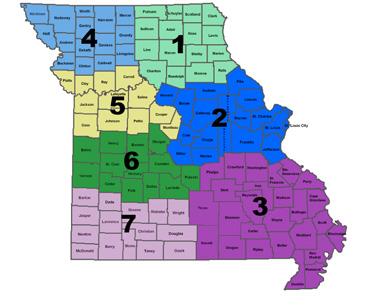
2026 MCA Regional Vice Presidents
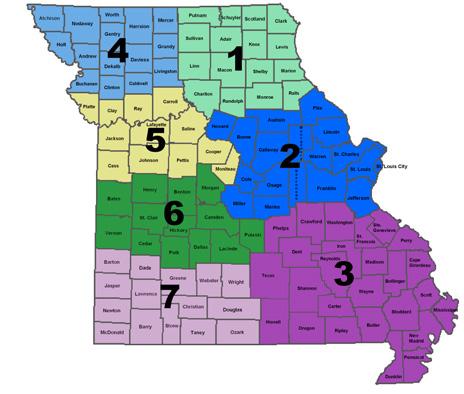
Region 1: Ethan McNeill, 325 McMurry St. Paris, MO 65275 636-544-9943
Region 2: Blake McDonald, 250 Clonts Rd. Sullivan, MO 63080 • 573-205-7914
Region 3: Danny Ross, 5514 Gaston Rd Eunice, MO 65468 • 417-932-4964
Region 4: Dale Buhman, 3751 SW Taylor Rd. Clarksdale, MO 64430 • 816-244-9249
Region 5: David Wolfe, 7761 Mount Vernon Rd Pilot Grove, MO 65276 • 660-834-3232
Region 6: Warren Love, 8381 NE Hwy ZZ Osceola, MO 64776 • 417-830-1950
Region 7: Nathan Isakson, 20706 Lawerence 2022 Everton, MO 65646 • 573-578-2518
Co.
Director At-Large: Stephanie Gable, 5622 State Hwy E Oak Ridge, MO 63769 • 573-256-3279
MCA Regional Grazing Coordinators
Region 1 - Kyle Viers 660-346-1084 kyle@mocattle.com
Region 2 - Doug Mertens 573-489-5261 doug@mocattle.com
Region 3 - Kenneth Ball 417-818-6400 kenneth@mocattle.com
Region 4 - Micah Hans 636-201-6846 micah@mocattle.com
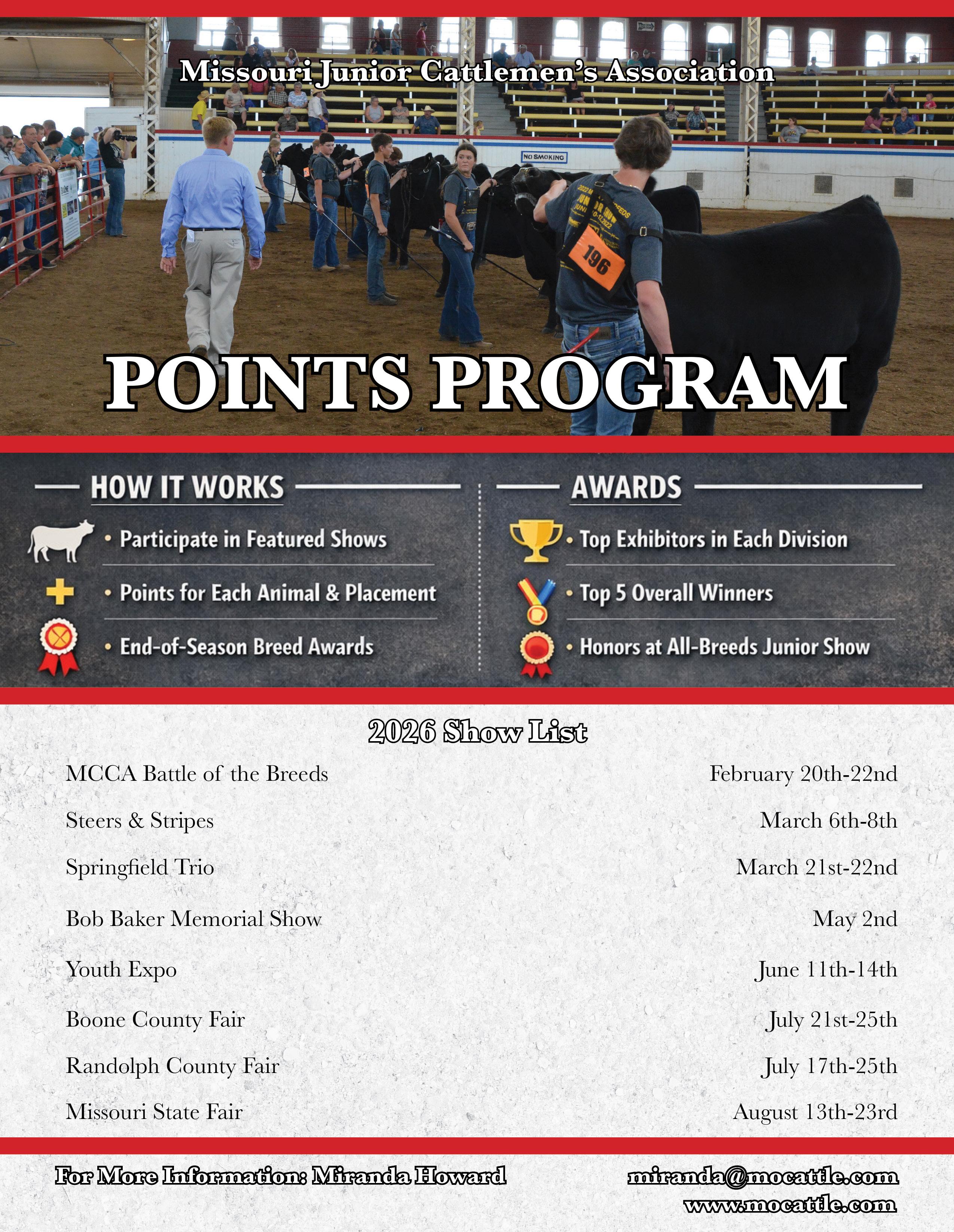
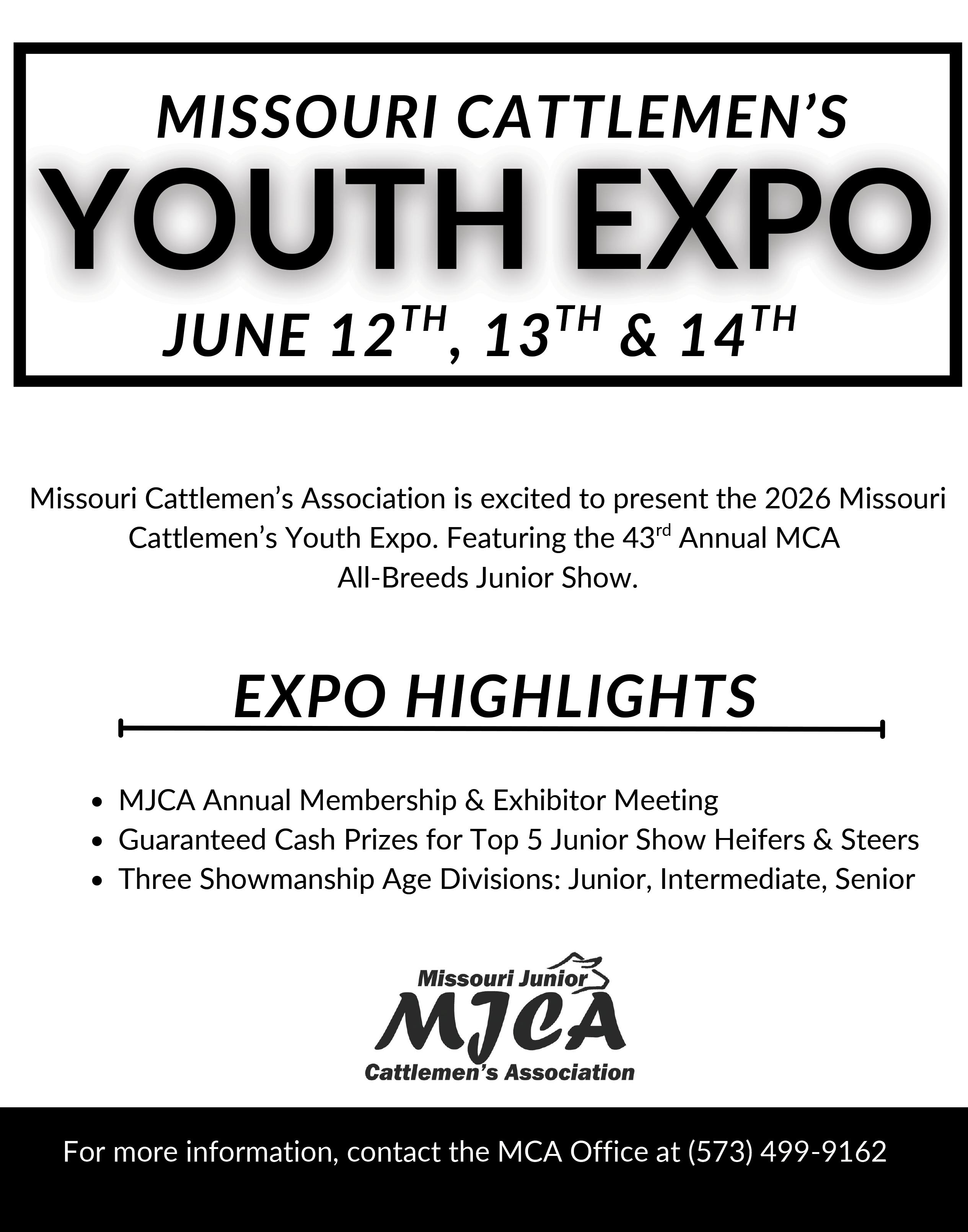
Missouri Cattlemen’s Youth Expo
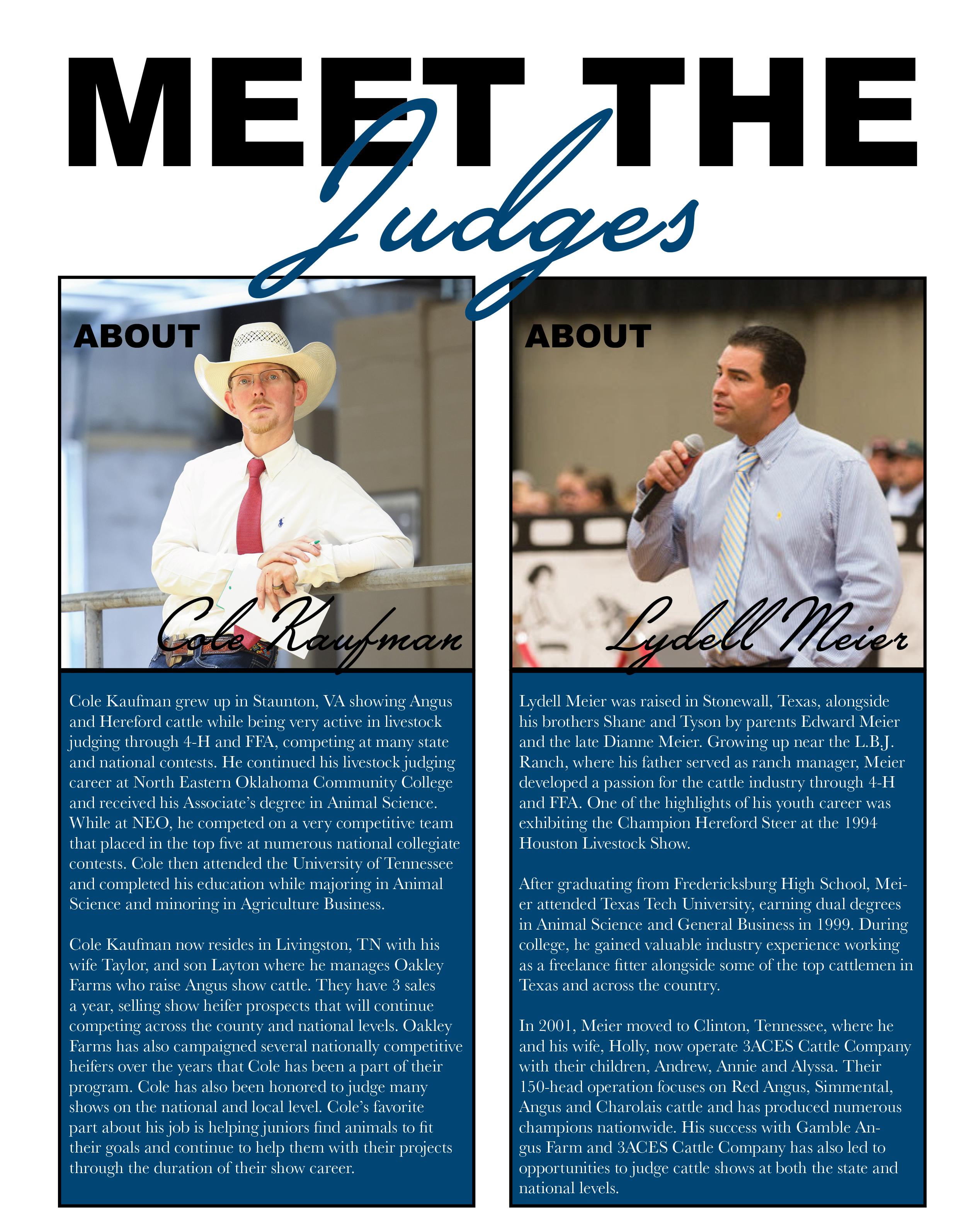
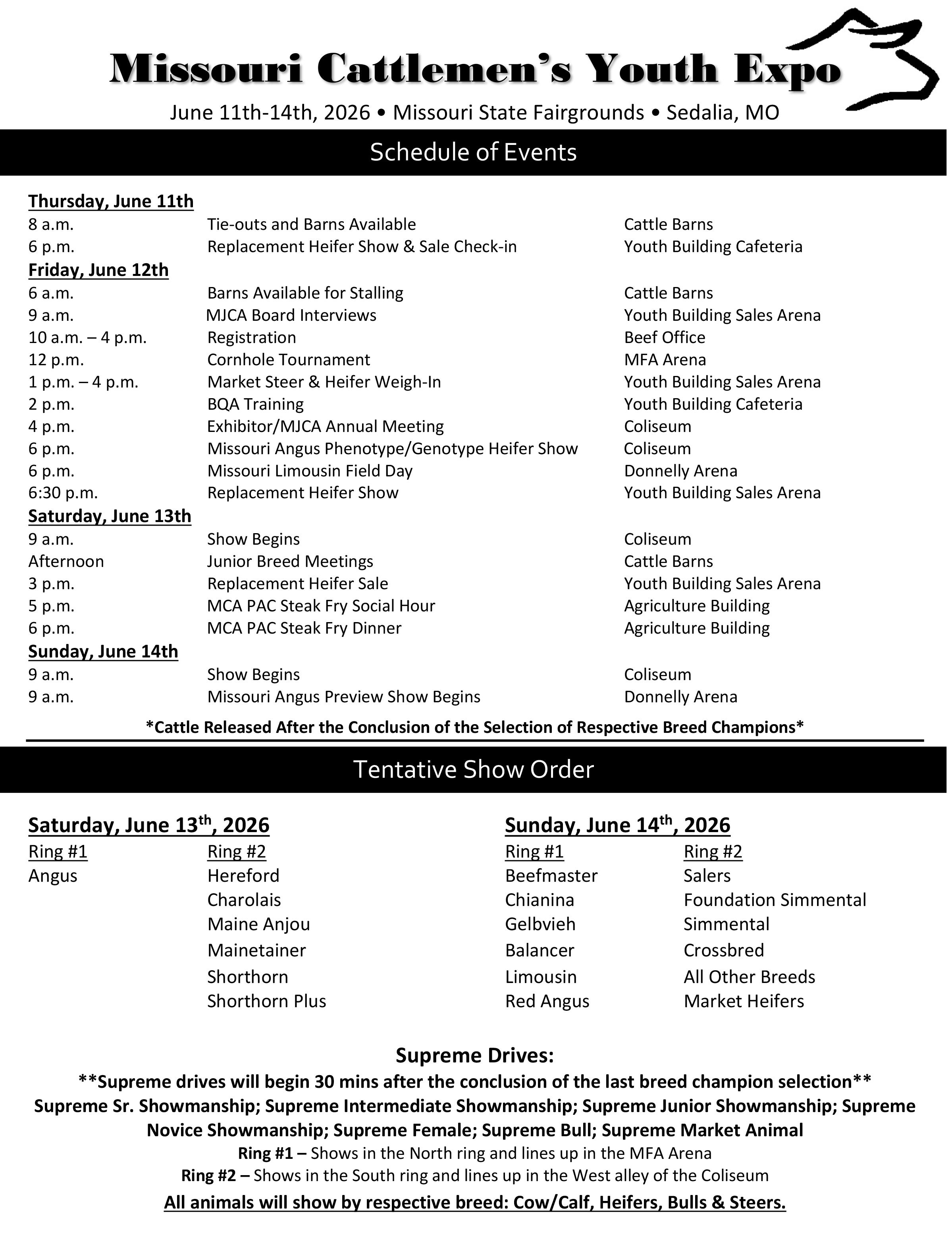
It is almost time for the “can’t miss” weekend of the summer. The weekend will include the 43rd Annual MCA AllBreeds Junior Show and much more. The expo will feature long-held traditions such as the MJCA Photo Contest, MJCA board interviews and elections, and the MJCA annual meeting while also bringing in new opportunities for junior members to feature their hard work at the state level. To learn more about this weekend, please turn to PAGES 37-40 or visit mocattle.com under junior programs.
23rd Annual Cattlemen’s Steak Fry
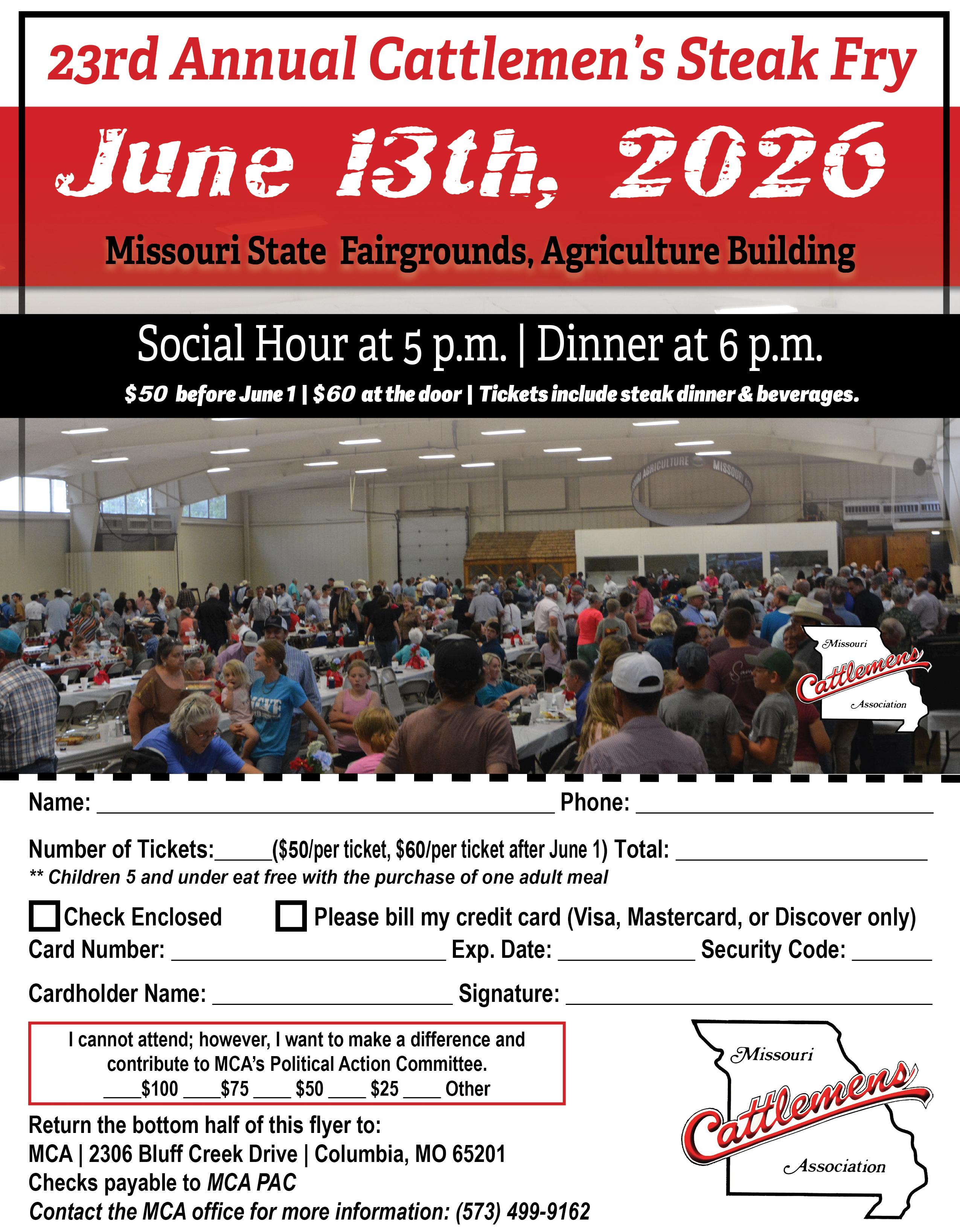
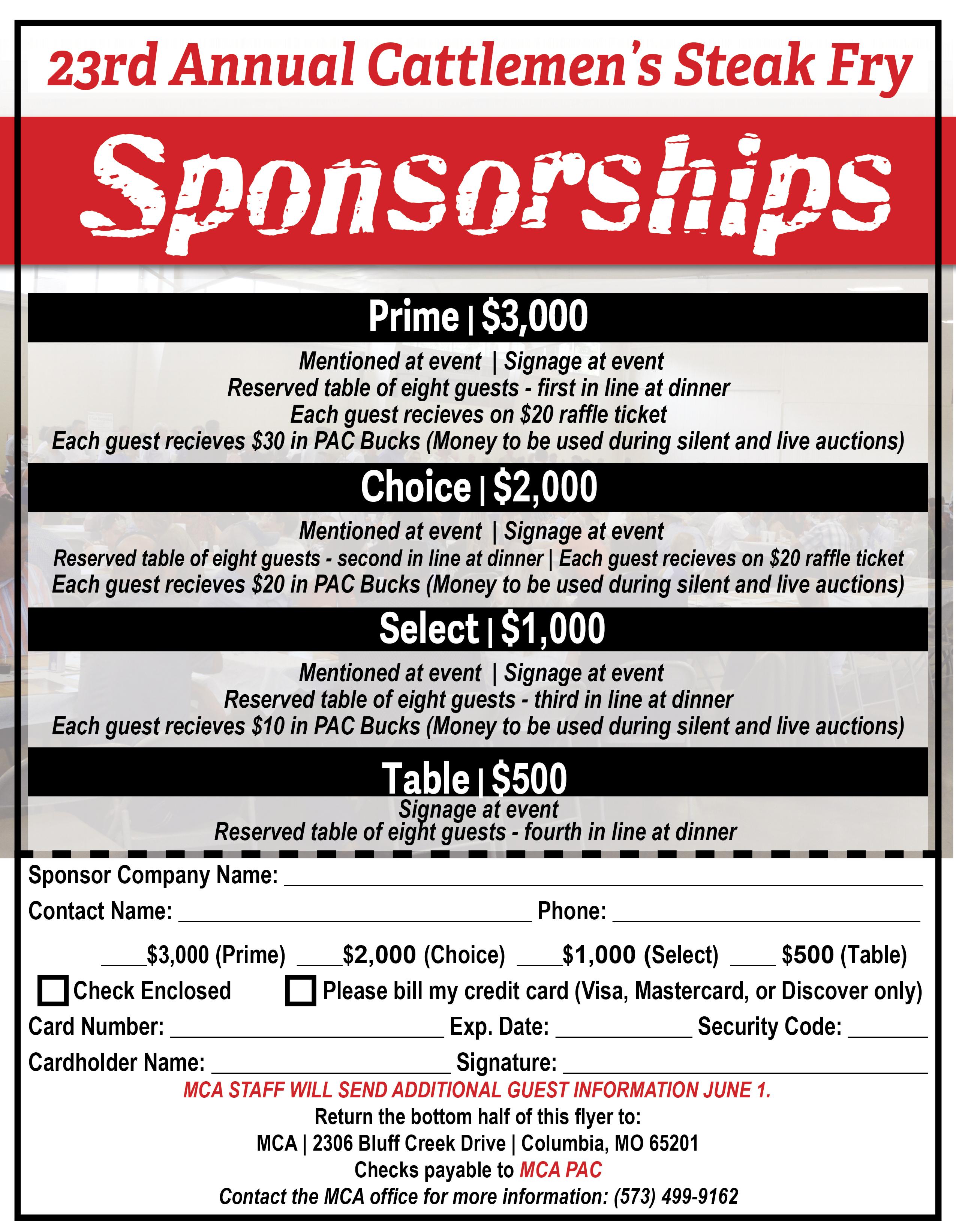
The Cattlemen’s Steak Fry will be held on Saturday, June 13th at the Missouri State Fair Agricultural Building. Join us for a great steak dinner, raffles, live and silent auctions, and great conversation. You’ll find the details in this month’s magazine and on our website. This event is open to the public and we welcome anyone who wants to celebrate Missouri’s beef industry. Funds raised will benefit the MCA Political Action Committee to help elect leaders who understand and value agriculture to guide our state’s policy, now and in the future. For more information and registration instructions, see PAGE 42.
Show-Me-Select Heifer Replacement Program
We are partnering with Show-Me-Select again this year for an exclusive new member promotion drawing. All new Missouri Cattlemen’s Association members will be entered into a drawing for a $2,000 credit to a Show-Me-Select Replacement Heifer sale. To be considered a new member, you must not have been an MCA member within the last 12 months. Credit must be redeemed in the same calendar year at any of the spring or fall sales. Learn more on PAGE 71.
Member Benefits
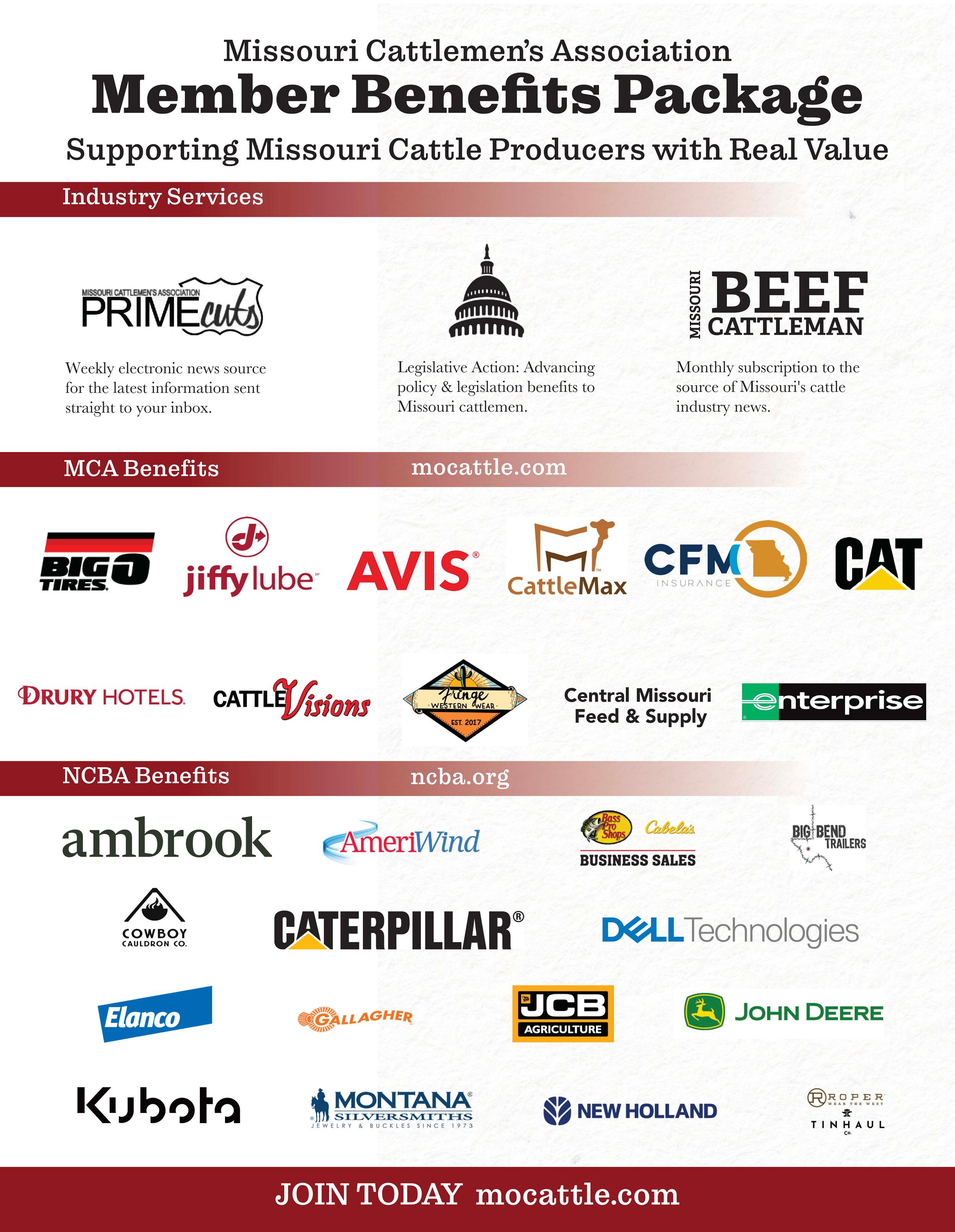
With your MCA, MJCA and NCBA membership producers receive multiple discounts, benefits and educational opportunities. Each membership receives our weekly Prime Cuts newsletter and monthly magazine the Missouri Beef Cattleman. Other benefits for MCA and MJCA members include, Fringe Western Wear is offering 10% off total purchase in store and Jiffy Lube is offering a 15% discount to all locations across the United States, download the welcome letter online to show at your nearest Jiffy Lube. Visit mocattle.com for a full list of all member benefits or see PAGE 74.
MCA Executive Committee Council Chairs
AG AND FOOD COUNCIL
Jason McCann (417) 827-7499 Sclandandcattle@gmail.com
ANIMAL HEALTH
CARE/WELLNESS COUNCIL
Linda Hickam (573) 819-9469
COUNCIL
Linda_hickam@yahoo.com CATTLE MARKETING
COUNCIL
Bruce Mershon (816) 289-3765 bruce@mershoncattle.com
Nate Lamberson, Nate Lamberson Farms, Kingdom City, MO
Sam Sullivan, Hardscrabble Farms, Silex, MO
Tami Thomas, Neosho, MO
Darrick & Rachel Barnes, Down Range Processing, Neosho, MO
Josh Redburn, Anderson, MO
Kash Scroggins, Anderson, MO
Caden Klumpp, Bronaugh, MO
Richard Sloan, Warsaw, MO
Richard McDaniel, Edwards, MO
Scott & Joanna Siercks, Lincoln, MO
Larry Siercks, Windsor, MO
Seth Roberts, Mooresville, MO
Luke Romine, Romine Beef Products, Centralia, MO
Brett Threlkeld, Threlkeld Cattle Co, Shelbyville, MO
David Dolan, Sikeston, MO
Rick Day, Fairview, MO
Clayton Loyd, Clayton Loyd Cattle LLC, Sheldon, MO
Patrick Schmidt, Monett, MO
Tim Schmidt, Monett, MO
Wendy Loges, BTC Bank, Sedalia, MO
CharliAnne Damouth, Rogersville, MO
Michael Hendren, Madison, MO
Mark & Nicole Riegel, Stewartsville, MO
Carson Bray, Cameron, MO
Malainey Bray, Cameron, MO
Mike & Kana Wake, Warsaw, MO
Tim & Emily Hines, Coon Foot Farm, Neosho, MO
Chris Daniel, Rockin’ D Farms LLC, Lockwood, MO
Kharigan Fuemmeler, Huntsville, MO
Eric Wiles, Agrowise Crop Insurance, Liberty, MO
Dennis Williams, Clear Creek Cattle CO, Lincoln, MO
Colt Nelson, Clarinda, IA
Mikah Anderson, Ash Grove, MO
Mike Steinmeyer, Sugar Creek, MO
Brennan Anderson, Ash Grove, MO
Brittany Anderson, Ash Grove, MO
Milly Pamperien, Mtn. Grove, MO
Presley Pamperien, Mtn Grove, MO
President’s Perspective with Anita Vanderwert
Communicate. Collaborate. Connect.
Investing in Our Future and Sharing Our Story
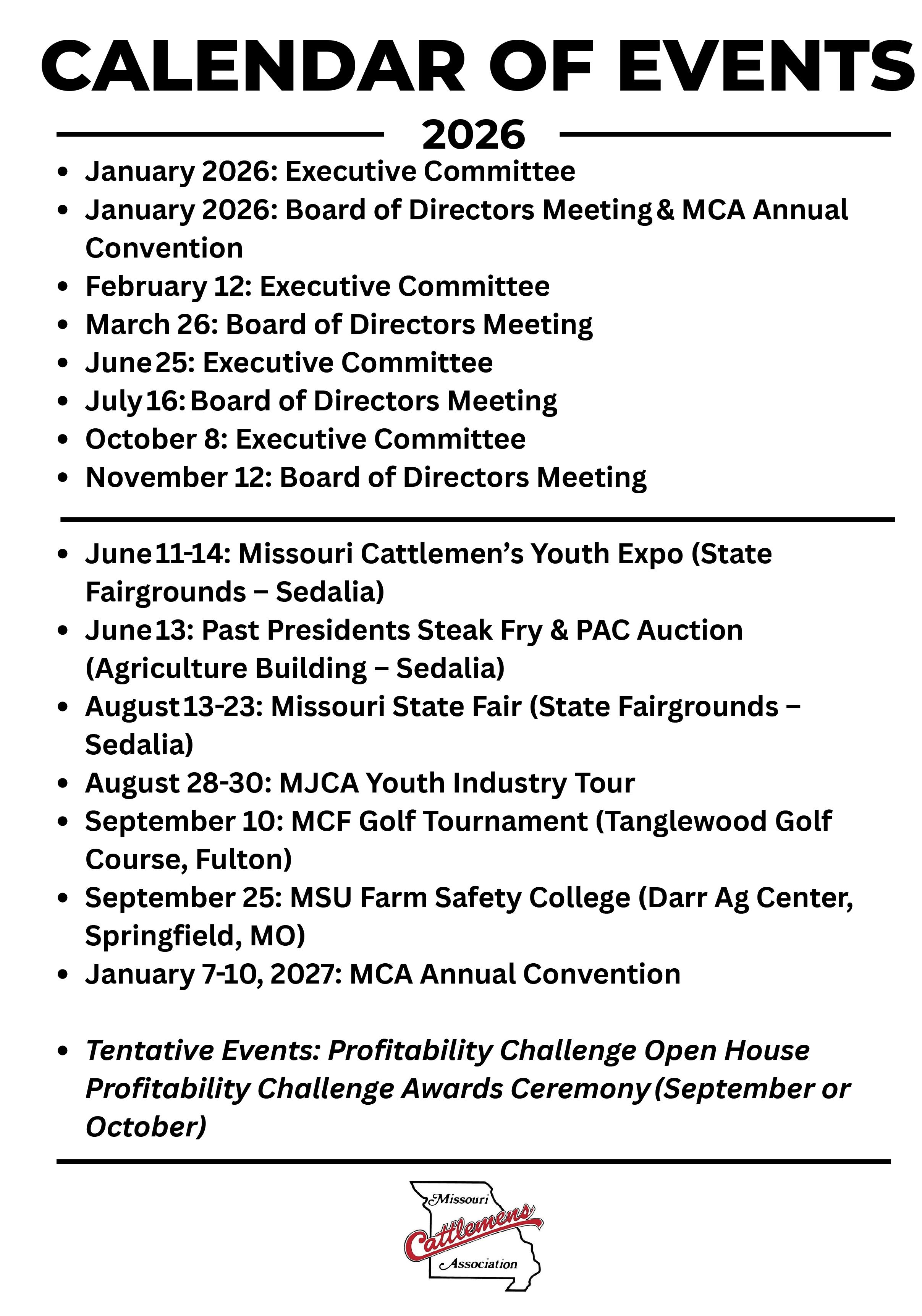
June is an important month for the Missouri Cattlemen’s Association as it highlights two things that are critical to our success, investing in the next generation and continuing to advocate for our industry. We will be hosting another MCA Youth Expo and Cattlemen’s Steak Fry, June 11th-14th, 2026.
These events are more than just a competition and a chance to eat another great steak. We talk often about the importance of connection and this is where it starts. This MCA weekend is an opportunity where young producers can gather and develop relationships that will carry them forward in agriculture. When we show up to support our juniors through participation, encouragement or simply being present, we are reinforcing that they belong in this industry. Those connections matter and they are often what keep young people engaged long-term.
At the same time, our annual Cattlemen’s Steak Fry on Saturday night (June 13th) is a great opportunity for you to support those legislators that are supporting you. The funds we raise Saturday night will all go toward those who will be supportive of agriculture via our MCA PAC. This event serves as a reminder that advocacy is just as essential to our future as education and youth development.
If we want to protect and advance the cattle industry, we must be willing to communicate our value and collaborate in the policy arena. A strong PAC ensures
MCA President
that we have a voice in the decisions that impact our operations every day. It allows us to build relationships, support leaders who understand agriculture and stay engaged in the legislative process.
Both of these events reflect our theme: Communicate. Collaborate. Connect.
We connect by investing in our juniors and building the next generation of leaders.
We collaborate through efforts like our PAC to ensure agriculture has a seat at the table.
And we communicate the value of what we do through our actions, our involvement and our willingness to show up.
The future of the Missouri cattle industry depends on both efforts. Our juniors will carry the industry forward and our advocacy today will help shape the environment they step into tomorrow.
I encourage each of you to get involved this month. Support our junior members and their activities. Attend the Steak Fry. Stay engaged. Strong participation leads to a stronger association and a stronger future for all of us.
— President, Missouri Cattlemen’s Association
A Rare Breed CattleWomen’s Corner with Jennifer Poor
Picture this with me: your alarm goes off long before the sun comes up. You pour a cup of coffee, head out the door and make your way to the shop to get chores done before the “herd” arrives. Once they do, the day kicks off with complaints about being up too early, being hungry, thirsty or simply not wanting to be there, yet you press on, with a smile on your face.
As the afternoon rolls around and most people are wrapping up their 9-5 jobs, heading home to a warm supper and time to unwind, your workday is far from over. There are still projects to finish, numbers to review, trainings to attend and a dozen other tasks waiting to be completed before you can finally head home yourself.
And when you do finally walk through the door, supper is often sitting on the counter under a piece of foil waiting to be reheated, while your kids are already tucked into bed — just waiting for a sleepy goodnight and an “I love you” before the day finally comes to a close. You may think I’m talking about a cattle rancher, but I’m not. I’m talking about a rare breed all their own, an ag teacher.
Ag teachers sacrifice a lot to pour into our kids, grandkids, nieces, nephews and ultimately the FUTURE of agriculture. What many people don’t
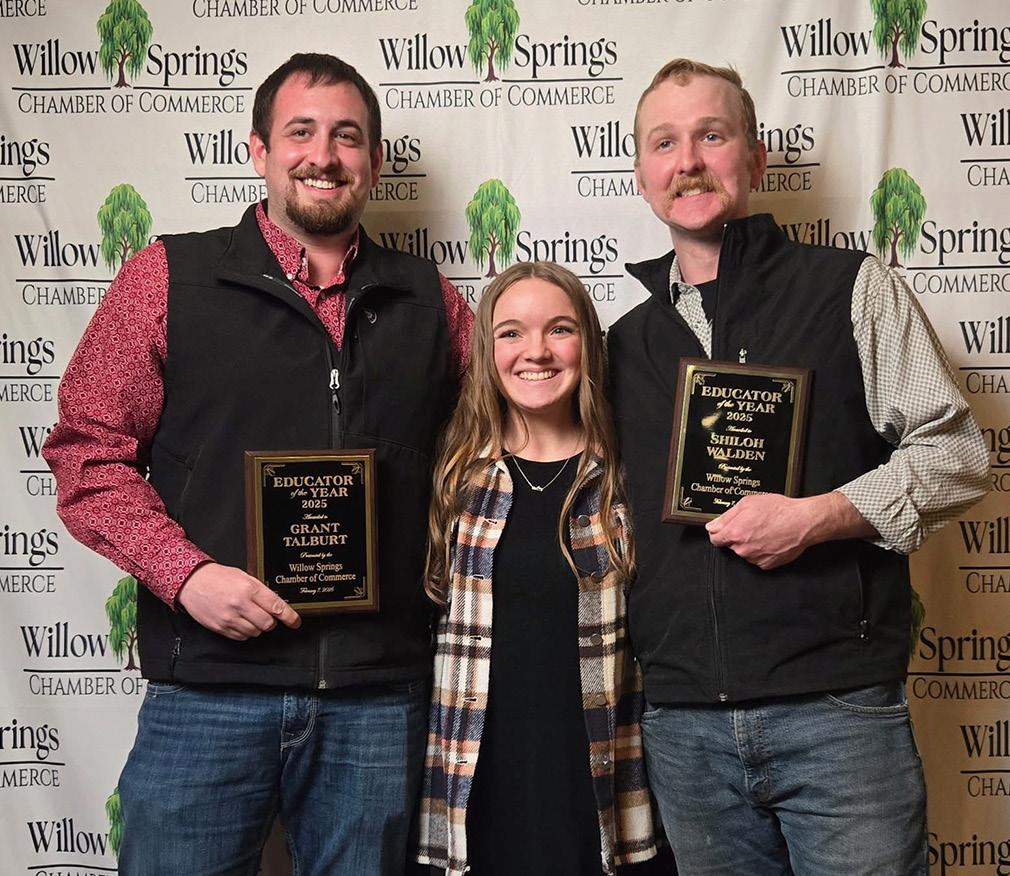
L to R:Willow Springs FFA/Ag Advisor Grant Talburt; Area 13 FFA President Katy Spence Willow Springs FFA/Ag Advisor Shiloh Walden
realize is that ag teachers are 12-month employees, unlike most teachers who are on 10-month contracts. And even then, the work never really stops. Most ag teachers put in 60-80 hours a week doing far more than just teaching in a classroom. They’re helping students with projects, preparing teams for LDEs and CDEs, getting kids and livestock ready for county and state fairs, organizing banquets and taking officers to regional and state meetings. Somewhere in between all of that, they also become mentors, encouragers and sometimes even counselors for the students who need them most. They handle criticism from parents, long nights and packed schedules, but they keep showing up because they care deeply about their students and they truly love what they do.
The average salary for a Missouri ag teacher is around $57,000 a year, depending on the district. And before anyone throws out the old “well, they get summers off” line — they really don’t. Summer is filled with SAE visits, fairs, contests, chapter activities and planning for the next school year. Most ag teachers rarely step away from the job completely.
At the end of the day, ag teachers are doing more than teaching agriculture. They’re helping raise the next generation of leaders for our industry and our rural communities.
You are probably wondering why I am writing about Ag teachers. The reason is they need our support and one way you can do that is through your local FFA Alumni group. If your high school has an FFA Alumni group, I encourage you to become a member. Even if you were never in FFA, they are very welcoming. If your local FFA does not have a FFA Alumni, it sounds like you have your next project…START ONE! The Alumni are there to support the FFA members and teachers in any way possible. The Alumni will be the ones at contests, cooking for the advisors and kids. The Alumni volunteer to be judges at contests. The Alumni help pay for the blue and gold FFA jackets for the kids who can’t afford one. The Alumni may sponsor a special dinner for the teachers and kids that go to state or national convention. The Alumni show up to the local annual banquet to serve dinner to the kids and their parents. The Alumni show up to school board meetings to protect their schools’ FFA and/or Ag program. Basically, the FFA Alumni do what needs to be done when it needs to be done. It shows the kids and the teachers that you care. It shows the teachers that they have a support system.
I hope this article sparks a fire in you to show your support for a rare breed known as The Ag Teacher. Trust me when I say they will appreciate it. Go Blue & Gold!
Grilled Skirt Steak with Creamy Citrus Sauce
Beef Skirt Steak marinated in fresh orange juice, cilantro and Mexican spices can turn your ordinary dinner into extraordinary, especially when you enjoy it with this creamy citrus sauce
Combine orange juice, cilantro and Mexican seasoning in small bowl. Place beef steak and 1/3 cup orange juice mixture in food-safe plastic bag; turn steak to coat. Close bag securely and marinate in refrigerator 6 hours or as long as overnight, turning occasionally.
Combine remaining orange juice mixture with sour cream and green onion. Cover and refrigerate until ready to serve. (May be refrigerated as long as overnight.)
Remove steak from marinade; discard marinade. Place steak on grid over medium, ash-covered coals. Grill, covered, 7 to 12 minutes (over medium heat on preheated gas grill, 8 to 12 minutes) for medium rare (145°F) to medium (160°F) doneness, turning occasionally.
Carve steak diagonally across the grain into thin slices; season with salt and pepper, as desired. Serve with citrus sauce.
Straight Talk
with Mike Deering
Made in America
As America approaches its 250th birthday, we are reminded that the nation’s story is not just written in declarations and battlefields, but also in the fields, farms, and ranches that helped sustain a growing republic. Few industries are more closely tied to America’s fabric than the beef cattle industry. That connection is evident in our state.
Long before Missouri became a state in 1821, cattle moved across its rolling hills and fertile river bottoms. Early settlers recognized what generations of ranchers still know today - Missouri’s geography was built for livestock production. Period. Past MCA President Jim McCann was exploring moving to Missouri from Arizona when he met longtime University of Missouri Extension Specialist Eldon Cole who told Jim there was no better place on the planet to run cows. Jim said he was right and never looked back in 2004. Abundant fescue, reliable water resources and located right in the middle of the country created ideal conditions for raising cattle. As America expanded westward, Missouri became a true gateway to agriculture.
By the mid-1800s, cattle production had become central to Missouri’s economy. Herds moved along trails leading west, while stockyards and rail lines connected Missouri ranchers to markets across the country. Kansas City emerged as one of the nation’s great livestock centers. Cattlemen helped feed a rapidly industrializing America. Beef was more than food—it was fuel for national growth.
Yet the history of Missouri’s cattle industry is about more than economics. It is about families and resilience. Through droughts, floods, uncertain markets and
Executive Vice President
shifting regulations, Missouri ranchers adapted while preserving traditions passed down through generations. The image of a ranch family waking up super early to tend cattle is not a relic of the past—it remains a daily reality across our state.
Today, Missouri ranks in the top three cow/calf states in the nation with thousands of family farms contributing billions to the economy each year. Our industry’s impact reaches beyond balance sheets. Beef production supports local feed stores, veterinarians, truckers, sale barns, meat processors, banks, and rural communities that continue to form the backbone of our state and country.
As we celebrate 250 years of American independence, the beef cattle industry reminds us of the values that built this country: hard work, self-reliance, innovation and faith. America’s 250th birthday is an opportunity to honor those contributions. From frontier trails to modern cattle operations, Missouri cattlemen and cattlewomen have played a lasting role in shaping our nation’s success. Their story is the American story.
Come celebrate this story with us on June 13 at MCA’s Annual Cattlemen’s Steak Fry where we honor our past presidents, cheer on the next generation and raise funds for the organization. Sign up today! All information is on page 42.
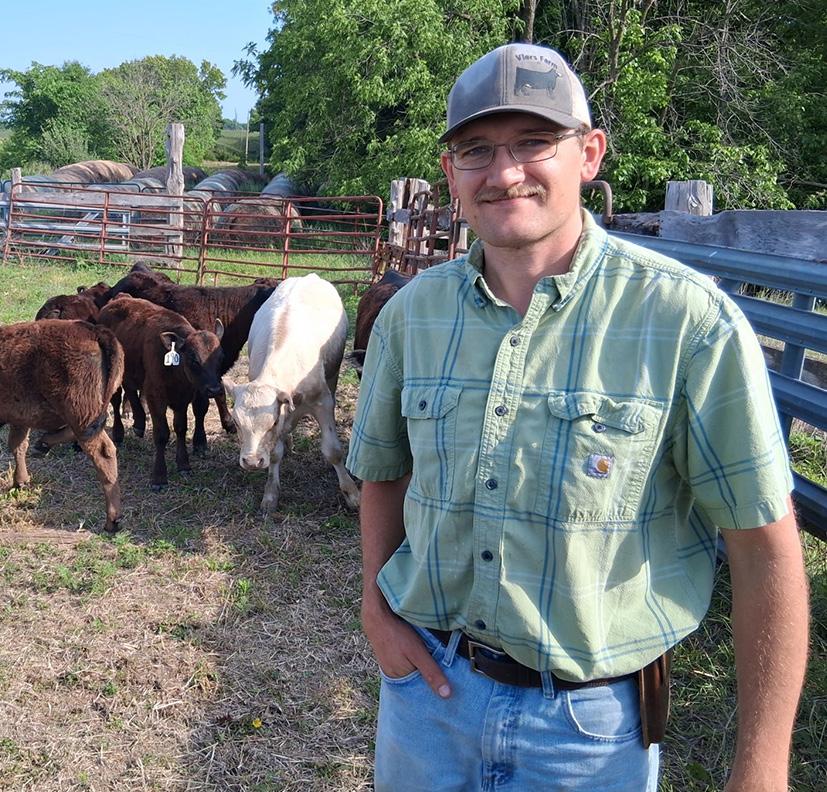
Meet Kyle Viers MCA’s Region 1
Grazing Coordinator
Kyle Viers
Growing up between Macon and Sullivan counties, I was fortunate enough to be raised with deep agricultural roots and an appreciation for the outdoors from an early age. I attended Atlanta C-3 Schools in Macon County, where both of my parents worked while we lived on a small acreage. Even then, my family made sure I spent as much time outside as possible. In fact, my mom and grandfather took me on my first deer hunt when I was just six weeks old, which probably tells you all you need to know about the kind of upbringing I had.
While Macon County was home during my school years, Sullivan County was where our family’s agricultural foundation truly took shape. My
grandfather operated a stock farm with a commercial herd of Angus and Charolais cross cattle, transforming worn-out ground into productive pasture through good stewardship and cattle management. Watching that process laid out the groundwork for my interest in agronomy, soil health and livestock production from a very young age.
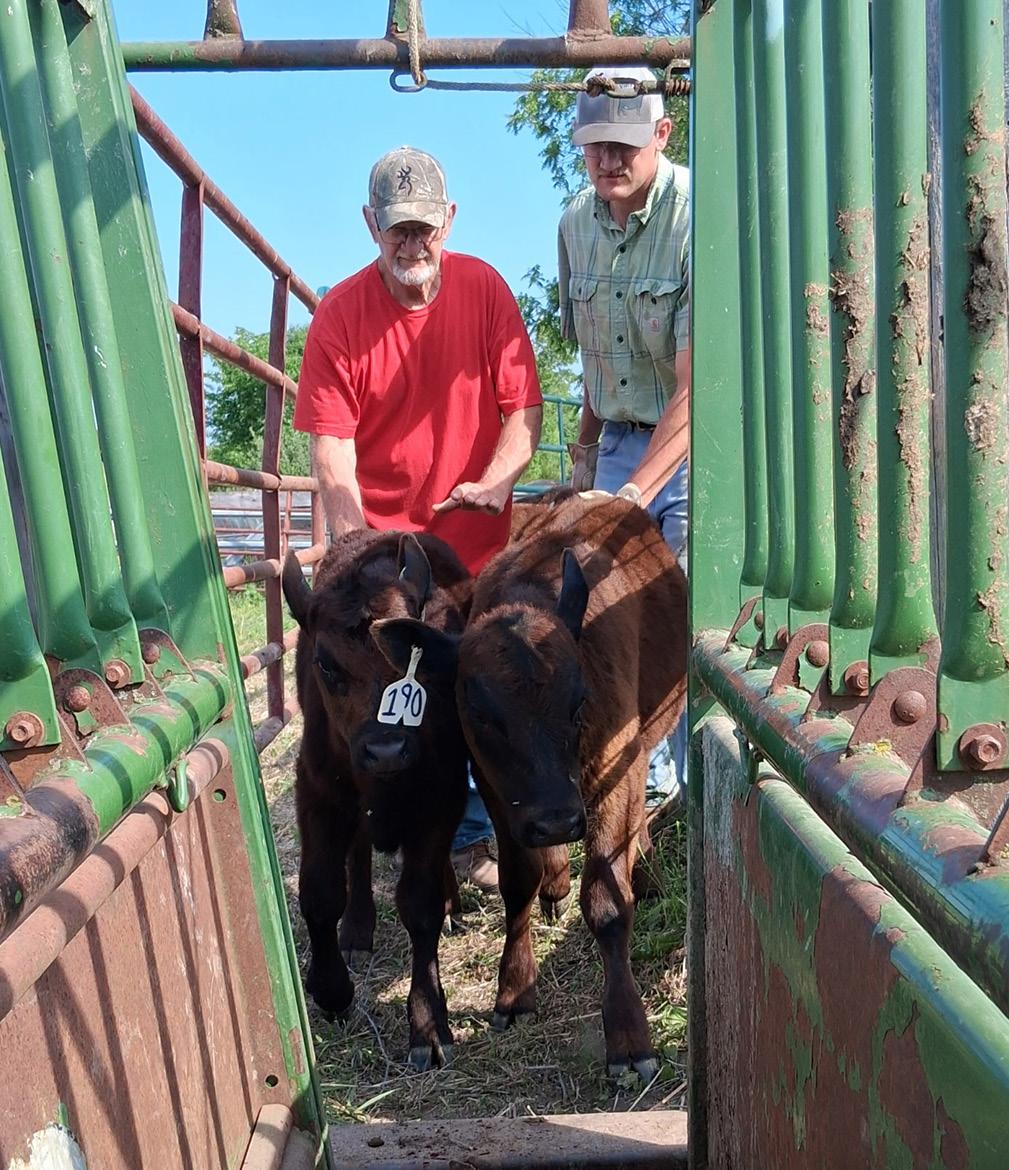
Back on our small acreage, affectionately known as “the nursery”, my dad put me in charge of bottle calves, and that responsibility sparked a lifelong passion for the cattle industry.
One of the most formative moments in my life came when I joined FFA. For $15 and the guidance of an exceptional agricultural education instructor, Susan Marsh, I found direction and purpose. Through agriculture classes, FFA involvement and experiences alongside my family, I realized I wanted to dedicate my life to working on the land and serving people connected to it. Mrs. Marsh also inspired me to become the kind of mentor and advocate for others that she was for me.
I earned my degree in Agricultural Education from Northwest Missouri State University, where I gained invaluable experience learning how to communicate agriculture’s story to those who may not have firsthand exposure to it. Beyond the classroom, I sought opportunities to broaden my understanding of the industry through what I often call “my other education.” Those experiences included working as a dairy hand at R.T. Wright Farm, helping at a sale barn, spending a spring at a cattle operation in Nebraska and processing poultry at Coleman Farms in Callao.
Three days after graduating college, I began teaching agricultural education at Adair County R-1 in Novinger, MO. During the four years I was there, my students became my greatest source of pride and joy. They provided countless memories, challenges and lessons-many of which no college course could fully prepare you for. Teaching agriculture showed me the true value of mentorship, service and investing in the next generation. It is demanding work, but anyone who dedicates themselves to agricultural education will never have to question whether they made a difference.
When the opportunity arose to serve as Region 1 Grazing Coordinator, I knew it was something I wanted to pursue. Having previously served as president of the Northwest Collegiate Cattlemen’s affiliate, I already understood the value of the Missouri Cattlemen’s Association and its commitment to supporting producers and advocating for our industry.
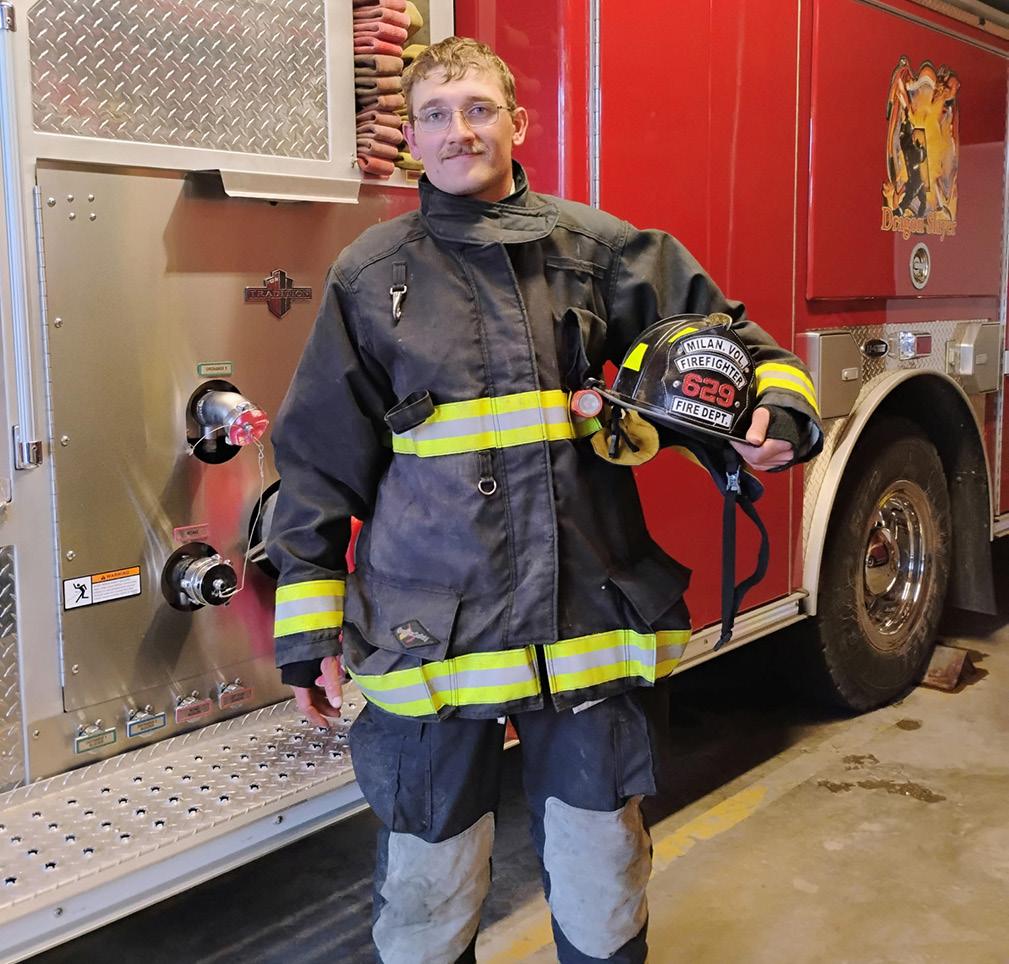
Today, I’m blessed to live west of Milan on family land in a small cabin where I spend my days caring for livestock, growing things and investing time in the people who matter most to me. I’m proud to call this part of Missouri home and grateful for the community that surrounds it. Alongside my professional role, I also serve as a volunteer firefighter, first responder and deacon at Green City Christian Church.
As your Region 1 Grazing Coordinator, my goal is simple: to serve producers however I can, whenever I can and wherever I can. I look forward to working alongside you and helping support your grazing and cattle operation needs in the years ahead.
One piece of advice my ag teacher often shared still sticks with me today: “There’s no such thing as a wrong question.”
See you down the road, Kyle Viers
Observations from the Field
with Kyle Viers, Region One Grazing Coordinator
Here We Go…
After writing my introductory article, I found myself wondering what to cover for my first official coordinator report. Being new to the role, I figured the best place to start was simply sharing what I’ve been doing to prepare for the job and offering a practical piece of farm management advice along the way.
I officially accepted this position back in January, but at the time I was still in the middle of the school year teaching agriculture. I knew I couldn’t leave my students hanging, so I committed to finishing out the year before stepping fully into this role. Thankfully, the Missouri Cattlemen’s Association has been incredibly supportive throughout that process, allowing me to transition in after school let out while also encouraging me to attend training opportunities along the way.
Since then, I’ve had the chance to learn from several outstanding people across the state. In February, I spent time riding along with Doug, who set a tremendous example of both the expectations and the heart behind this position. In March, I traveled to Columbia to meet with the rest of the team, and I walked away impressed by the genuine commitment everyone has toward serving producers and doing the job the right way.
In April, I attended a fencing and watering systems workshop with Doug at the MU Cornett Research Farm in Linneus, MO. That experience reinforced just how advanced and intentional Missouri producers can be when it comes to managing cattle, forage and natural resources. We discussed everything from virtual fencing collars to different electric fence and watering system setups, all tools designed not only to improve grazing efficiency, but also to protect soil health and strengthen long-term forage management.
I’ve also spent time learning more about programs such as NRCS EQIP and the University of Missouri CRCL program, both of which provide producers
with additional resources and incentives to implement rotational grazing practices and maximize forage utilization, especially during challenging conditions like drought years.
At the same time, all this learning has reminded me that while new technology and advanced management tools are valuable, sometimes the simplest lessons still matter most.
A few weeks ago, we finally caught a cow that had spent months avoiding every attempt to move her into a smaller pasture closer to our working facilities. After battling illness last summer, she became nervous and high-strung, running at the slightest disturbance and teaching her calf to do the same. Thankfully, she delivered a healthy calf, and for that we’re grateful, but she also became a good reminder of how temperament can directly impact efficiency within a herd.
When a cow constantly runs, stresses easily and disrupts gathers, the costs add up quickly, not just in feed consumption, but also in labor, time and overall herd management. A difficult cow can influence the behavior of others, reduce efficiency and make rotational grazing systems harder to manage effectively. Even productive cows have to be evaluated honestly when their behavior creates challenges that outweigh their value within the operation.
That experience reinforced an important principle for me: good management is often about balancing innovation with practical, common-sense decision making.
While I may be on the younger side stepping into this role, my goal is to bring both tried-and-true management principles and an openness to new grazing technologies to the table. If you’re located in Region 1, I’d love the opportunity to visit, listen, help where I can and maybe give you something to think about along the way.
For help with management of native grass, or for help identifying plants or weeds (feel free to text pictures) contact Missouri Cattleman’s Association Grazing Coordinators:
Region 1 • NW MO Region 2 • NE MO Region 3 • SW MO Region 4 • SE MO
Kyle Viers
Kyle@mocattle.com
660-346-1084
Doug Mertens
Doug@mocattle.com
573-489-5261
Kenneth Ball
Kenneth@mocattle.com
417-818-6400
Micah Hans
Micah@mocattle.com
636-201-6846
Regional Range Report
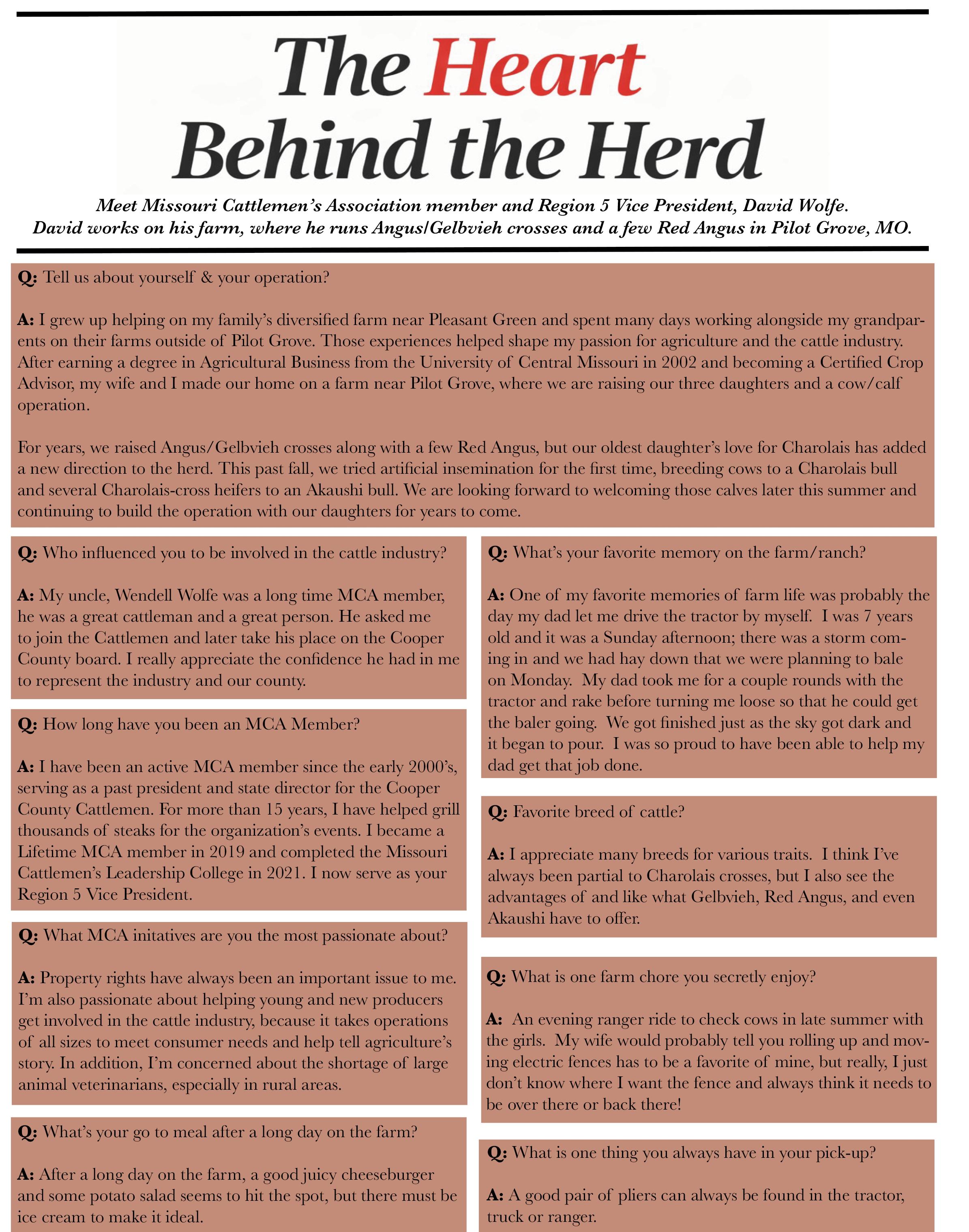
by David Wolfe, Region 5
Spring Has Arrived
If there is one thing producers in west central Missouri can count on, it’s that spring weather will keep us guessing. One week we are hauling feed through mud and wondering if winter will ever let go, and the next we are turning cattle out onto green grass with temperatures pushing into the 80’s. While the moisture has slowed field work at times, most pastures across the region are beginning to respond well, and many producers are seeing cool season grasses come on strong heading into May. The recent rains have certainly created challenges, especially those trying to get spring calving wrapped up or prepare hay ground. At the same time, the moisture has helped recharge ponds and provided much needed growth for pastures after several years of inconsistent rainfall patterns. As always, Missouri weather reminds us to stay flexible and appreciate the good days when they come. Across the region, spring calving season is keeping many producers busy as warmer temperatures and green grass are helping pairs settle into pasture, many producers are beginning to think about hay season and summer grazing management. Summer grazing conditions will be something many producers are watching closely as the freeze in late March seems to have stunted some growth in both cover crop and grassland forages. However, if moisture continues, forage production could be excellent across much of the region.
In addition to cattle operations, row crop producers across mid-Missouri are also making steady progress this spring whenever weather conditions allow. Corn planting moved quickly during the early warm stretches, while soybean planting has begun to pick up pace across much of the region. Like livestock producers, crop farmers have had to work around frequent rains and changing temperatures, but overall soil moisture conditions are providing optimism heading into the growing season. The connection between row crop and cattle operations remains important throughout our region, as many producers rely on both enterprises
to support their operations. Strong forage production, cover crop utilization, and grazing opportunities on crop acres continue to provide benefits for both soil health and livestock performance. As summer approaches, producers will be watching weather patterns closely, hoping for timely rains and moderate temperatures to support both pasture growth and crop development throughout the season.
This spring has also been a busy one for the Missouri Cattlemen’s Association. MCA leadership and members continue working to ensure the voices of Missouri cattle producers are heard on issues impacting our industry both at the state and national level. Our affiliate organizations across the region have hosted several successful meetings and events this spring, bringing producers together for fellowship, education and discussion about the future of the cattle business in Missouri. As we move into summer, there are several exciting opportunities ahead for MCA members. Remember that the Cattlemen’s Youth Expo and Steak Fry are coming up June 11th-14th at the Missouri State Fairgrounds in Sedalia. This is a great opportunity to see our youth in action as well as some outstanding cattle, we hope you can make it by. Summer county fairs, cattle shows and youth activities will soon be underway across the state, highlighting the next generation of Missouri cattle producers. MCA will continue supporting youth leadership and scholarship opportunities while also working to promote beef production and advocating for policies that protect Missouri farm families.
Despite ongoing challenges in agriculture, optimism remains strong across Missouri’s cattle industry. Cattle markets have continued to provide opportunities for producers, and demand for quality beef remains encouraging. The resilience and dedication of Missouri cattlemen and cattlewomen continue to be one of the greatest strengths of our industry. I appreciate the opportunity to serve Region 5 Vice President and look forward to seeing many of you at events throughout the summer.
Your BEEF CHECKOFF NEWS
Inspired by Missouri, Created for
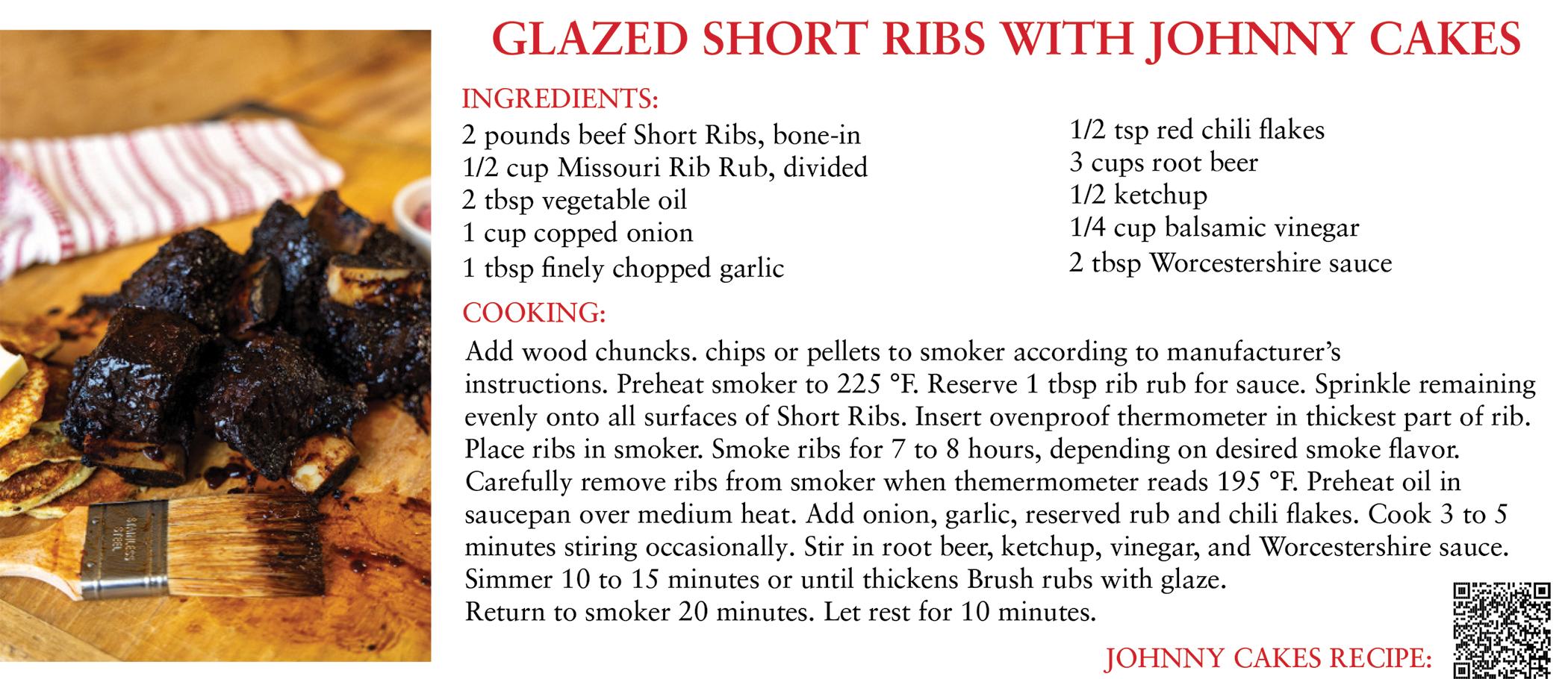
Through a partnership with the Federation of State Beef Councils, housed under the National Cattlemen’s Beef Association and a contractor of the Beef Checkoff, the Missouri Beef Industry Council had the opportunity to collaborate with one of the top culinary teams in the country. NCBA’s Culinary Center is led by professional chefs who spend their days developing innovative beef recipes and consumer-friendly cooking inspiration, much of which is featured on the Beef. It’s What’s For Dinner. website. This year, Missouri Beef Industry Council staff decided to take that partnership one step further by creating recipes highlighting Missouri’s rich food culture and regional flavors.
Over the course of several months, the culinary team and MBIC staff worked to develop recipes that reflected some of Missouri’s most recognizable dishes and barbecue traditions. After extensive testing, collaboration, and consideration, the team created three personalized recipes for Missouri: Glazed Short Ribs with Johnny Cakes, Burnt Ends with Mac and Cheese, and Slinger Smashburgers. To complete the lineup, the chefs also developed a custom Missouri-inspired beef rub.
The Glazed Short Ribs with Johnny Cakes recipe takes inspiration from the St. Louis region. Using beef short
Beef Lovers
ribs from the rib primal, the dish highlights a cut known for rich flavor and fall-off-the-bone tenderness. A root beer glaze ties the recipe back to St. Louis history and culture, creating a sweet and savory flavor combination that complements the smoked beef perfectly. The recipe utilizes a smoker, saucepan, and skillet to bring all the elements together. In addition to bold flavor, the dish also delivers strong nutritional value, with one serving providing 19.5 grams of protein and 25 percent of the daily recommended value of iron.
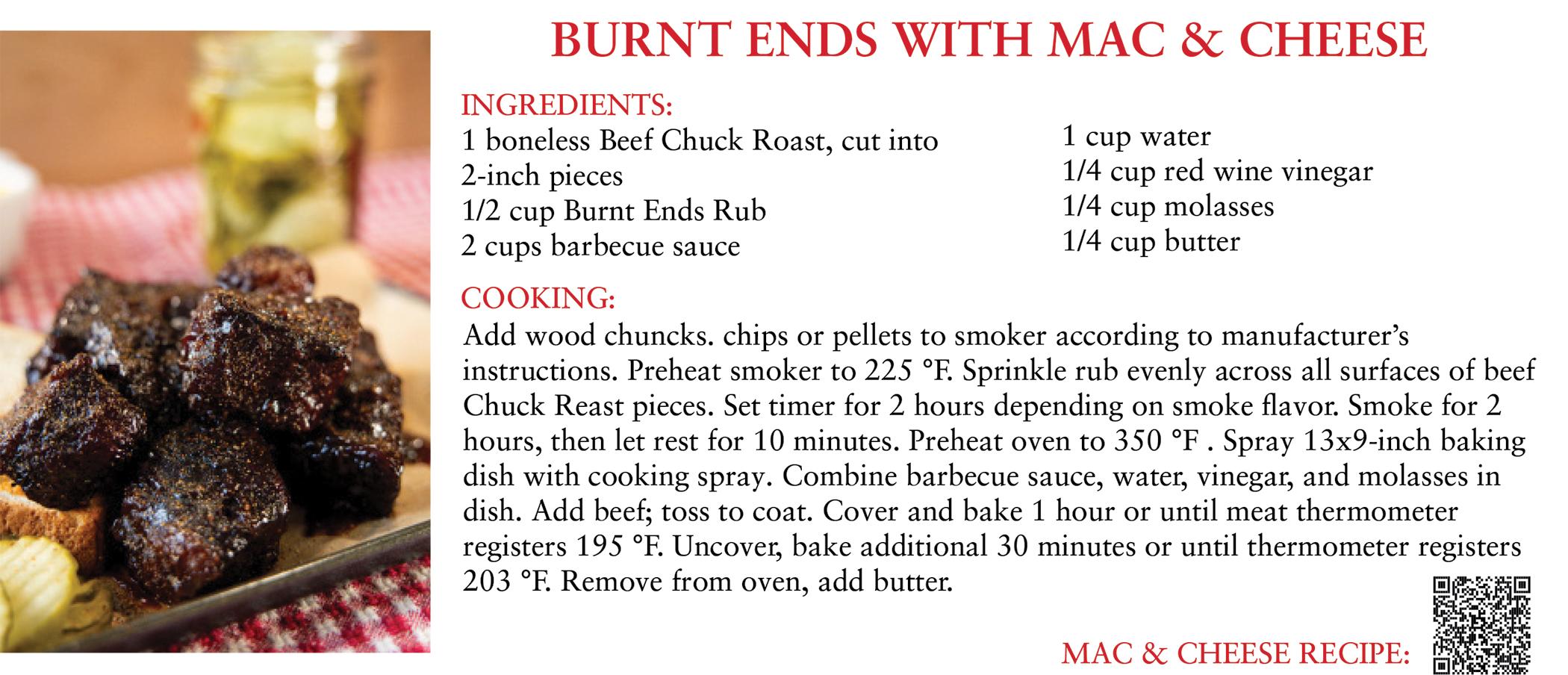
Another recipe inspired by Missouri traditions is Burnt Ends with Mac and Cheese, which pays tribute to Kansas City barbecue culture. Featuring chuck roast cooked low and slow, the burnt ends are coated in a sticky barbecue sauce that makes them ideal for gatherings, cookouts, and family meals. Paired alongside the beef is a rich and hearty mac and cheese made with beef tallow, two varieties of cheese, and wagon wheel pasta for a unique twist on a classic side dish. The recipe combines comfort food with iconic barbecue flavors that Kansas City is known for nationwide.
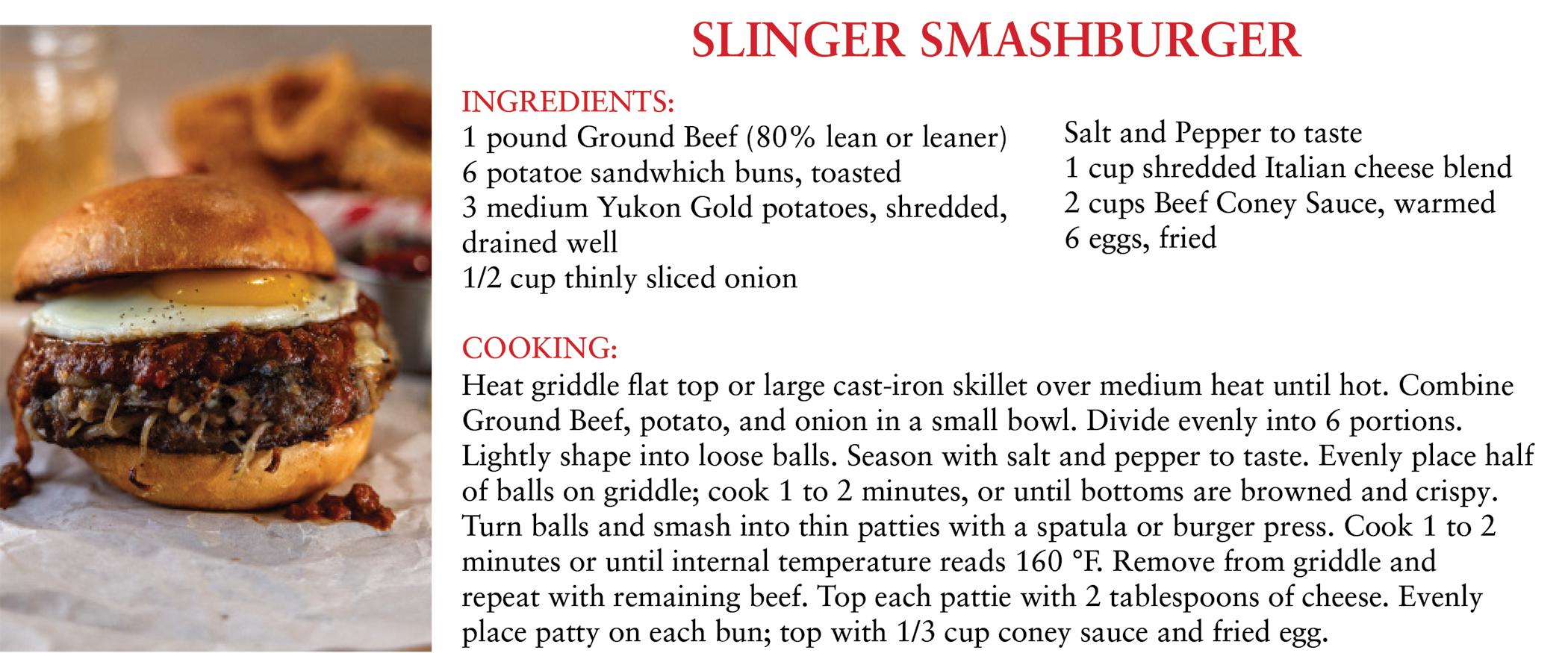
The final recipe, Slinger Smashburgers, is another nod to St. Louis cuisine. Inspired by the classic St. Louis “slinger,” the culinary team transformed the well-known dish into a creative burger concept. Using ground beef, coney sauce, and eggs, the recipe captures the flavors of the original slinger while introducing them in a new format. The thin, crispy smashburger provides an estimated 40 grams of protein per serving along with 60 percent of the recommended daily value of zinc, making it both flavorful and nutrient-dense.
Missouri Beef Industry Council is grateful for the collaboration and expertise provided by the national culinary team. These Missouri-inspired recipes not only celebrate the versatility of beef, but also highlight the flavors and traditions that make Missouri unique. From backyard cookouts to family dinners, these recipes were created to be shared around the table, and MBIC hopes Missouri families will enjoy them for years to come.
COUNTY NEWS
See What’s Happening in Your County
Dallas County
June looks to be a busy month for the Dallas County Cattlemen’s Association (DCCA). We are proud to sponsor the Dallas County Cattlemen’s Beef Show Clinic in Buffalo on June 2nd. The event will focus on building the next generation of cattle leaders and is open to all youth interested in the beef industry. The day-long event will take place at the Dallas County Fairgrounds.
DCCA members always look forward to the Cattlemen’s Steak Fry in Sedalia. We wish all the juniors the best of luck with their cattle at the MCA Jr. Show.
Our cook crew will be firing up the grill for three days June 25th-27th during the Dallas County Fair Jr. Livestock Show. As always we will feature our delicious rib-eye steak sandwiches along with hamburgers and all-beef hotdogs. Many DCCA members donate alot of
Gelbvieh and Balancer® Bulls & Females Specializing in Balancers® for the Modern Rancher Ertel Cattle Company • 660.234.2654 26694 Anchor Way • Greentop, MO 63546 www.ertelcattle.com • gertel@ertelcattle.com
time to the fair whether it be serving on the fair board, helping with the shows and sales, or working at the cook trailer. In addition, DCCA will be sponsoring two showmanship awards.
At the April Buffalo FFA banquet DCCA presented a $1,000 scholarship to Jordan Tucker. Jordan is very active in FFA having served as the past Buffalo president and most recently she was elected as a state vice-president. She will be attending the University of Missouri this fall with aspirations to become a vocational agriculture instructor. DCCA also presented the Beef Entrepreneurship Proficiency Award to Heidi Dugan and the Beef Placement Proficiency Award to Jackson Carter. Congratulations to all three outstanding youth.
“May is Beef Month” found DCCA promoting beef on May 2nd at Cash Saver grocery in Buffalo. Members Lynette Miller, Aaron Miller, and Mike O’Malley greeted customers at the store with samples of rib-eye steak. Alot of beef recipes as well as promotional items were given away. A drawing was held for gift certificates to buy beef at the store. A huge thanks to the Missouri Beef Industry Council for the $500 grant making all this possible.
A number of our members attended events throughout the week at Missouri Beef Days in Bolivar. Hats off to the Polk County Cattlemen for such a successful event promoting the beef industry.
Our board will continue to meet monthly throughout the summer.
Missouri Angus Breeders
meadangus@yahoo.com
www.meadfarms.com
Polk County Cattlemen
The Polk County Cattlemen’s Association marked an exceptionally active and impactful month as members contributed to the success of Missouri Beef Days and numerous community events throughout Bolivar. Through volunteerism, youth engagement and a strong commitment to promoting Missouri’s beef industry, the association demonstrated the vital role local producers play in strengthening both agriculture and community life.
Launching Missouri Beef Days
The festivities began on April 18th, when Polk County Cattlemen “let out the cows” across Bolivar. Wooden cows were placed at sponsoring businesses throughout town, signaling the start of Missouri Beef Days and celebrating the partnership between local agriculture and the business community. This tradition continues to be a recognizable and beloved kickoff to the week’s events.
Community Outreach at SBU
On April 21st, members served hamburgers at Southwest Baptist University, offering students and faculty a taste of high quality beef while fostering connections between producers and the next generation of consumers and community leaders.
Rodeo Participation and Food Service
The association maintained a strong presence at the Missouri Beef Days Rodeo on May 1st and 2nd, operating a food tent that featured Ribeye Steak Sandwiches and all beef hotdogs. Community turnout was outstanding both evenings, culminating in a complete sellout on Saturday night. The success of the food tent reflected not only the popularity of the products but also the dedication of the volunteers who staffed it.
Youth Engagement and Festival Activities
Saturday, May 2nd, brought additional opportunities for involvement during the Missouri Beef Days Street Festival.
• The Junior Cattlemen hosted a booth, gaining hands on experience in leadership, communication and community service.
• Polk County Cattlemen also fielded a team in the Beef Cookoff, contributing to the festive atmosphere and showcasing culinary creativity centered on beef.
Beef in the Schools: A Week of Education and Service
One of the most meaningful traditions continued during the week of May 4th–7th, as members cooked at each of the four Bolivar schools.
• Monday: Bolivar Primary
• Tuesday: Bolivar Intermediate
• Wednesday: Bolivar Middle School
• Thursday: Bolivar High School
This effort not only provided students with nutritious beef meals but also reinforced agricultural literacy and highlighted the importance of Missouri’s cattle industry to local families.
Farm Tours Cookout
On Friday evening, May 8th, the association prepared hamburgers for participants in the Missouri Beef Days Farm Tours. This event offered visitors an opportunity to learn more about local operations while enjoying a meal prepared by the very producers who help feed the community.
Concluding with the Parade and Boots & Bling Banquet
The month’s activities concluded on Saturday morning with the Missouri Beef Days Parade. Members and supporters represented the association with pride as the community gathered to celebrate agriculture, heritage and the people who make Polk County’s cattle industry strong.
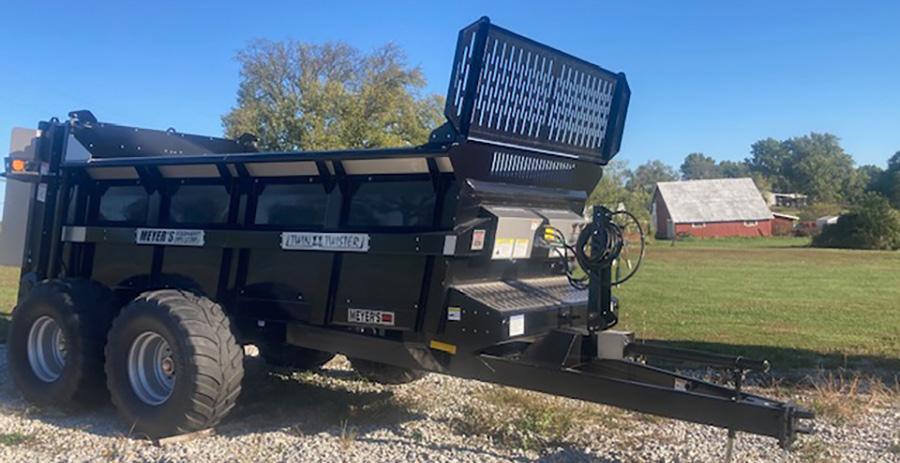
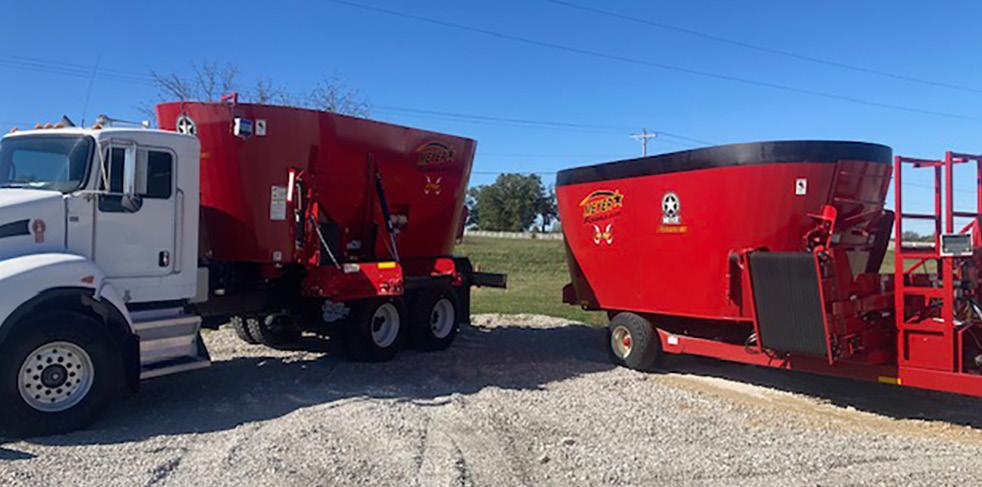
Meyers Truck Service
The month’s celebrations culminated with special recognition at the Boots and Bling Banquet, where outstanding members were honored for their contributions to the cattle industry and the Polk County community.
• Cattlemen of the Year was awarded to Bob Moreland, recognizing his dedication, leadership and longstanding service to the association.
• Pioneer of the Year was awarded to Larry Lane and Morris Westfall, both of whom have made significant, lasting impacts on local agriculture through their commitment, innovation and mentorship.
These awards reflect the deep respect and appreciation held for individuals who have shaped the strength and character of Polk County’s cattle community.
A Reflection of Commitment and Community.
The Polk County Cattlemen’s Association demonstrated exceptional dedication to service, education and community engagement. Through long hours, teamwork and a shared passion for promoting beef, members helped ensure the success of Missouri Beef Days and strengthened the association’s presence throughout the county.
Females of the Future: Rebuilding the Cow Herd from the Cow Up
Source: by Jessica Wesson for the Red Angus Magazine
Commercial cow-calf producers are staring down a rare combination of opportunity and pressure. The national beef cow herd sits at historically low numbers while demand for high-quality beef remains strong. At the same time, grazing acres continue to give way to housing developments and other competing land uses. In short, the industry is being asked to do more with less.
In that kind of environment, every female you keep or sell matters for years to come.
“Cows are the factory,” says Jamie Courter, Ph.D., assistant professor and State Beef Genetics Extension specialist at the University of Missouri. “They create the next generation of bulls, feedlot steers and replacement heifers. They’re pivotal to the amount of genetic advancement we’re able to make.”
With fewer cows in the landscape and strong prices tempting producers to sell every weaned heifer, the decisions made in today’s replacement pen will shape herd performance, efficiency and profitability for the next decade.
Now is a critical time to sharpen breeding objectives, match cows to their environment and use all the tools available to identify the females of the future.
What Really Matters in a Replacement Female?
Courter described what traits commercial producers should prioritize in replacement heifers, and the list doesn’t start with a roster of EPDs – it starts with the big picture.
“Every operation should have a breeding objective, and that breeding objective should function like the business plan for that operation from a genetic standpoint,” she said.
That objective starts with a simple question: how does your operation make money?
• If calves are sold at weaning, traits like weaning weight and growth should matter.
• If you retain ownership or sell on a grid, carcass traits come into play.
• If you keep your own replacements, traits like feet and leg structure, udder quality, docility, longevity and fertility move to the top of the list.
Whatever the goal, Courter stressed that selection decisions must align year after year.
Rick Rasby, Ph.D., professor and Extension specialist in the Animal Science Department at the University of Nebraska-Lincoln, echoed emphasis on maternal function.
“From a commercial cow-calf standpoint, reproduction is really important,” he said. “You need a calf from a
cow every year. If you’re turning over females quickly, it’s expensive.”
Cow Size, Milk and the Feed Bill
Both specialists point to cow size and milk production as make-or-break traits in today’s environment.
Feed is the single largest expense in most cow-calf budgets. Larger, higher-milking cows simply require more of it. If their added production doesn’t pay their way, they become a drag on the system.
“There’s data out there that says more moderate-sized cows are the most economically beneficial,” Courter explains.
Decades of selection for weaning weight, growth and carcass traits have tended to push mature cow size up.
“We need to make sure we’re sticking around that 1,200-lbs. cow on average,” she said. “Those 1,4001,500-lbs. cows that are consuming more forage than the calf they’re weaning, need to be culled from the herd.”
Rasby sees the same challenge from a feed-cost perspective.
“How you match cow size, weight and milking ability is really important for the resources you have available,” he said. “Cows that get too big and produce too much milk require more feed.”
He noted that somewhere between 40% and 70% of cow costs are feed costs. Matching genetics to the forage base, especially during times of drought or limited pasture, is critical for long-term sustainability.
Courter encourages producers to evaluate their cow size in terms of pounds weaned per acre, not just individual weaning weights. She often uses a simple illustration.
“If you look only at individual performance, the 1,400lbs. cow weaning a heavier calf looks like the ‘quarter’ in your hand, clearly worth more than a ‘dime,’” she said.
“But if you decrease mature cow size, you can often run more cows on the same acres. If you can have six ‘dime’ cows instead of two ‘quarter’ cows, the total value of pounds weaned can actually be higher.”
Calving
Ease Isn’t the Same as Low Birth Weight
Another place where Courter sees opportunity is how producers think about calving ease. She understands the desire to avoid pulling calves, but said the industry has leaned too heavily on birth weight as a proxy for calving ease.
“The genetic correlation between calving ease and birth weight is only about 0.33,” she explained. “Birth weight is part of calving ease, but it’s not the whole story.”
Research shows the genetic relationship between birth weight and percentage of assisted births is relatively low, while the correlation between calving-ease EPDs and assisted births is very high.
“Selecting only for low birth weight does not ensure calving ease,” she says. “What it does ensure is lighter calves – and all the problems that go along with that.”
Those problems include lower vigor, failure to thrive and reduced weaning and yearling weights.
“We really need to focus on calving-ease EPDs in bulls if we’re trying to reduce dystocia,” Courter said.
She also encourages producers to think differently about calving-ease bulls for mature cows.
“Once cows are 4-5 years old, many can handle a little more birth weight and reward you with heavier calves at weaning,” she explained.
Hair Shedding: A Simple Score with Big Consequences
Beyond the usual EPD suite, Courter highlights one trait that is gaining attention for its role in efficiency and adaptation: hair shedding.
The scoring process is simple: walk through the herd in late spring or early summer and score cows from 1 (slick summer coat) to 5 (full winter coat).
“Cows that had a hair-shed score of 1 weaned calves that weighed 45 lbs. more than cows that still carried a full winter coat,” she said.
The connection? Heat stress. Cows that hold onto winter coats longer struggle with summer temperatures, which affects body condition, milk production and fertility.
Scott Cape, Owner of Jim’s Motors in Cuba, Missouri.
“If you multiply 45 lbs. by 100 cows and then multiply again by what calves are going for right now, that’s a huge economic incentive,” she said.
In hot, humid environments, cows that shed early are better able to tolerate heat stress, maintain body condition and stay bred.
Building Longevity
Genetics can set the stage for longevity, but management has to do its part – especially for young females.
Rasby points out that many operations do a good job getting heifers bred for their first calf. The bigger challenge is getting them bred back for the second.
“The most expensive female in a herd is the one that gets bred for the first time but doesn’t get pregnant the second time,” he said.
That second breeding season lines up with some of the most demanding months in a young cow’s life. She’s recovering from calving, lactating for the first time and still growing. Rasby recommends calving first-calf heifers with BCS 6 and making sure their nutritional program, especially energy, doesn’t fall short after calving.
“We do a good job of meeting the protein requirement but not always the energy requirement,” he noted. “Going into that second breeding season, make sure they’re in good condition so they get bred for the second time as well.”
The Power of Heterosis and Early-Born Calves
On the genetic side, Rasby is a strong advocate for heterosis.
“From a commercial standpoint, a crossbred cow is ideal,” he said. “Taking advantage of heterosis is really important.”
Continued on page 58
Crossbred cows tend to excel in fertility, longevity and lifetime production, especially in tougher environments. That makes breed complementarity and smart crossbreeding systems a powerful strategy as herds rebuild.
“There are a lot of breeds, including Red Angus, that will fit into that scenario,” he adds. “Use the breed combinations that best fit the resources you have.”
Data shows that heifers out of early-calving dams tend to stay in the herd longer and produce more weaning weight over their lifetimes than contemporaries out of late-calving cows.
“It’s selection pressure that doesn’t cost anything,” he noted. “You’re just favoring females whose dams demonstrated fertility and fit.”
Tools for Picking the Right Heifers
With so much genetic variation in every calf crop, it’s risky to assume all daughters of a high-quality bull will perform the same.
“In a single full-sibling mating, there are over one quintillion possible combinations of DNA,” Courter explained. “Some heifers will ‘win the genetic lottery’ and some won’t.”
To better see what each candidate brings to the table, she advises producers to use the full toolbox: carefully chosen sires, EPDs and indexes, visual appraisal, and, where it pencils out – genomic testing.
For those using Red Angus genetics, she points to the HerdBuilder index as a useful starting point for maternal-focused bull selection.
“If someone is somewhat new to EPDs, I always direct them toward indexes,” she said. “Red Angus’ HerdBuilder index is geared toward maternal traits of interest, especially if you’re selecting bulls to make replacement heifers.”
Once replacements are on the ground, both specialists see a role for genomic tools – especially as herds rebuild from historically low inventories. Courter suggests first using traditional culling criteria: disposition, structural soundness, obvious performance issues or being born too late. The heifers remaining become “replacement candidates.”
“You can DNA test those candidates and look at the maternal traits that match your breeding objectives,” she said. “It’s another tool, alongside everything else you’re already doing, to help select heifers that move the herd in the right direction.”
Rebuilding in a High-Price Environment
Rebuilding the cow herd will not happen overnight, especially as calf and feeder prices continue to reach new highs.
“I think rebuilding is going to be slow,” Rasby said. “For a commercial cow-calf operation, the price they’re getting for weaned calves and heifers is probably going to be the highest ever. It’s hard to turn that down.”
Regions with abundant grass and more stable forage bases may begin retaining heifers sooner, he said, but overall expansion will likely be gradual. Every replacement kept today is a long-term commitment to pasture, feed and management.
Courter reminds producers that the heifers selected this year may still be in the herd seven to ten years from now – and may also raise daughters that enter the herd.
“We’ve almost gone through a genetic bottleneck,” she said. “As we go to build back, we need to make accurate, informed decisions so the gene pool we keep sets us up for the future.”
Patience, Consistency and Planning
For producers looking 5 to 10 years down the road, both specialists come back to three themes: define a breeding objective, match cows to their environment and be patient.
“Rome wasn’t built in a day,” Courter said. “Cows only have one calf per year. It takes a long time to see the benefits and the change in the genetics of your cow herd.”
Commercial herds that retain older cows replace a smaller percentage of the herd each year. That slows the pace of visible genetic change, but those older cows are often the most profitable animals in the pasture.
“The amount of change you’re able to see is directly proportional to your replacement rate,” Courter said.
Rasby’s advice is straightforward: “Take advantage of heterosis, match genetics to the feed resources you have and pay close attention to cow size and milk ability,” he says. “Those are the traits that will have the greatest impact on what it costs you to feed that cow.”
For Red Angus breeders and their commercial customers, today’s tight cow numbers and strong markets offer both risk and reward. The opportunity lies in using this rebuilding phase to create cow herds that are more moderate, fertile, better matched to their environments and backed by clear breeding objectives and sound maternal genetics – females built for the future.
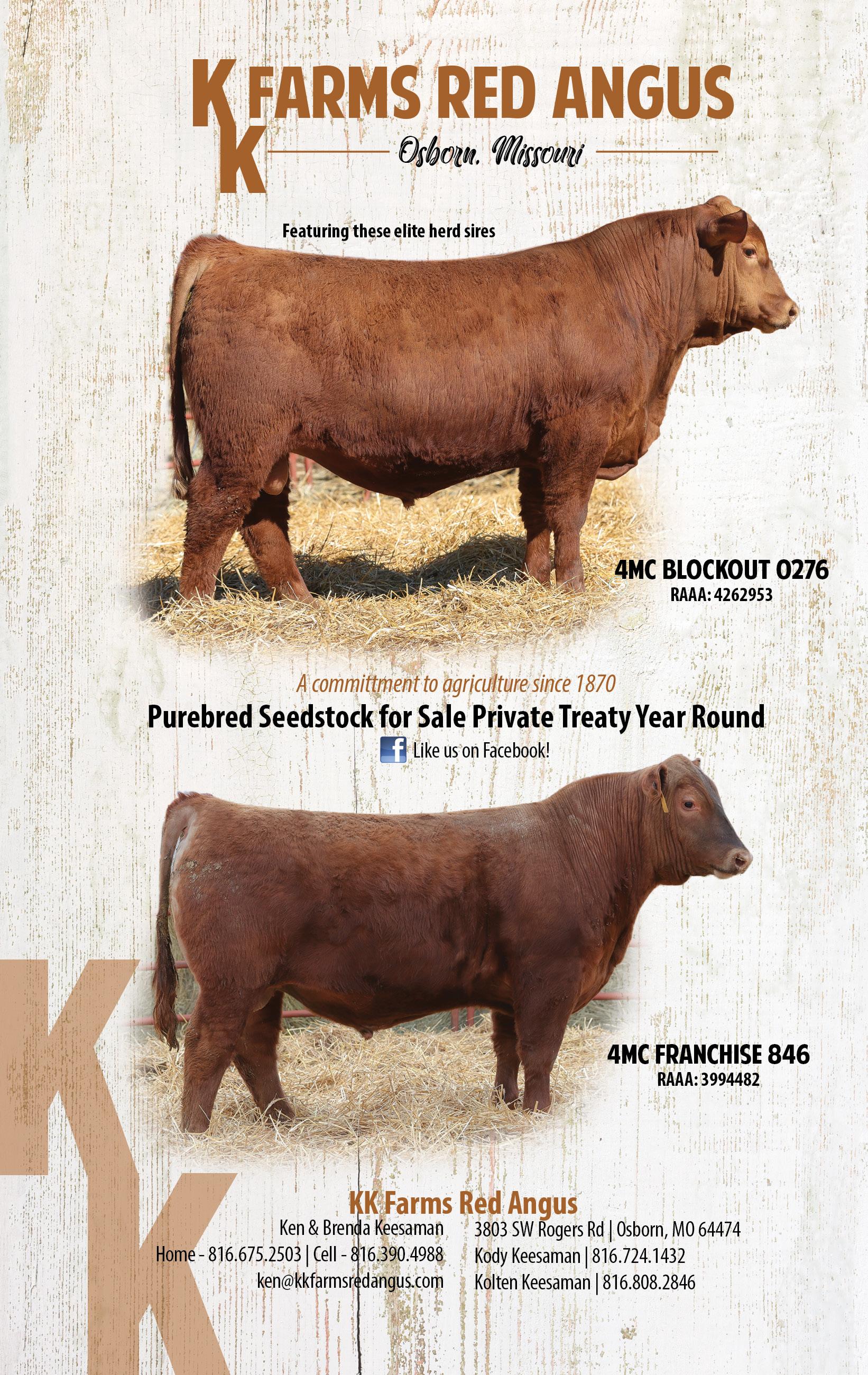
Missouri Red Angus Breeders
Ken & Brenda Keesaman
816-675-2503 • C: 816-390-4988
Kody Keesaman 816-724-1432
Kolten Keesaman 816-808-2846
3803 SW Rogers Rd. • Osborn, MO 64474
Ken@kkfarmsredangus.com www.kkfarmsredangus.com
Harris 417-389-2987 Jacob Dunn 417-434-0335
For Missouri Cattle Producers, There’s Opportunity in Red
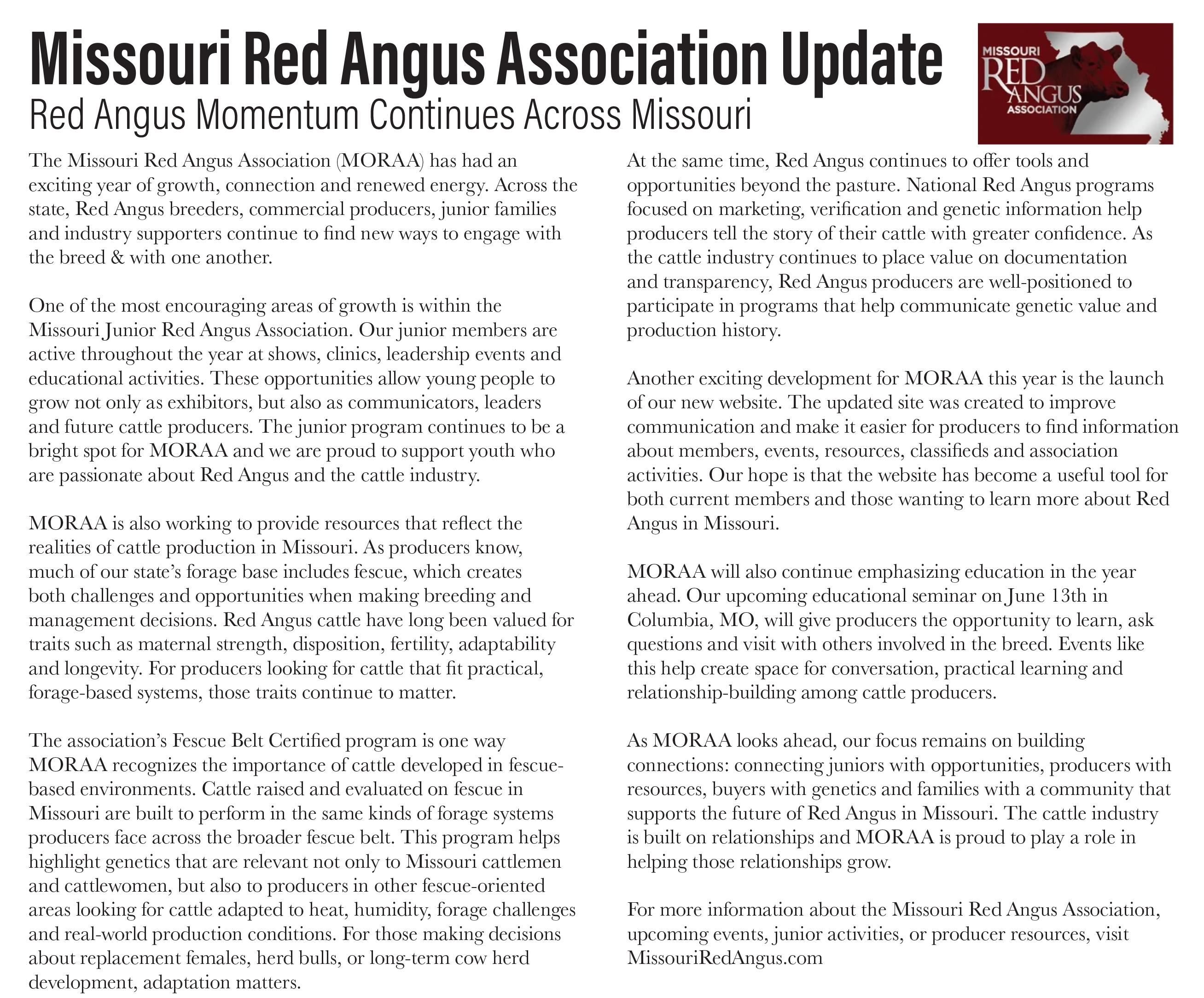
Red Angus cattle are practical, productive, and built for real-world cattle operations. The Missouri Red Angus Association helps producers make the most of that potential through education, promotion, sale opportunities, and collaboration.
MORAA Membership Connects you to:
The Show-Me Reds Sale
Our signature sale brings together quality Red Angus genetics and serious buyers from across the region.
Educational Opportunities
Join us for our next MORAA Educational Seminar on June 13 in Columbia, Missouri.
Marketing Potential
Promote your genetics, connect with buyers, and take advantage of the growing interest in Red Angus cattle.
A Statewide Network
Collaborate with seedstock breeders, commercial cattlemen, junior families, and industry supporters working together to move Red Angus forward.
Whether you are raising registered Red Angus, using Red Angus genetics in a commercial herd, or simply interested in the breed, MORAA gives you a place to connect, learn, and grow.
Red Angus Works in Missouri. MORAA Helps You Make the Most of it. Join the Missouri Red Angus Association today. https://missouriredangus.com/
March Pork Exports Third Largest on Record, Beef Variety Meat Value Reaches New High
Source: USMEF
March exports of U.S. pork were among the largest on record, concluding a very strong first quarter, according to data released by USDA and compiled by the U.S. Meat Export Federation (USMEF). While March beef exports were below last year – largely due to the ongoing lockout by China – the value of beef variety meat shipments reached a new monthly high, surpassing the previous record from January.
Monster
First Quarter for Pork to Mexico, Central America and DR; Strong Rebound in Japan
Pork exports totaled 285,567 metric tons (mt) in March, up 6% from a year ago, the largest in five years and the third largest on record. Export value increased 4% to $803.2 million, the second highest on record, trailing only April 2021. March exports increased year-over-year to leading market Mexico, as well as to Japan, Central America, the Dominican Republic, the Philippines and Taiwan. Shipments were steady to South Korea and Canada. March was an outstanding month for export value per head slaughtered, which was the third highest on record at $72.93.
Through the first quarter, pork exports were 3% above last year’s pace in both volume (778,939 mt) and value ($2.17 billion). Exports are on a record pace to Mexico and Central America.
For the Third Time in Four Months, Beef Variety
Meat Value Reaches a New High
March beef exports totaled 97,731 mt, down 11% from a year ago, while value fell 8% to $844.7 million.
Shipments increased year-over-year to Mexico, Central and South America, the Caribbean and Indonesia, and were steady to Korea and Taiwan. But these results were offset by minimal exports to China, and exports were also below last year to Japan and the Middle East. Excluding China, March exports were 4% above last year’s volume and increased 8% in value.
The March export results included 29,062 mt of beef variety meat, up 24% from a year ago and the largest since 2017. Variety meat export value increased 50% to $135.6 million, the highest on record.
March was a very robust month for per-head export value, which equated to $456.56 per head of fed slaughter.
Through the first quarter, beef and beef variety meat exports totaled 275,355 mt, down 11% from a year ago, while value fell 7% to $2.35 million. Excluding China from these results, exports were 3% higher than a year ago in volume and increased 9% in value.
“The sustained momentum for U.S. pork exports is impressive in the Western Hemisphere, but it is also encouraging to see demand climbing in key Asian markets, led by a welcome rebound in Japan,” said USMEF President and CEO Dan Halstrom. “On the beef side, while China has now been absent for more than year, the U.S. industry is making strides in other markets. The supply situation makes it difficult to grow export volumes, but exports are commanding strong prices. Expanding beef variety meat demand is especially critical, as this makes such a key contribution to the value of every animal.”
Lamb Export Volume Lower in March, But Value Up Slightly
David Patton Of fice Ross Patton Bill Patton
March exports of U.S. lamb muscle cuts totaled 247 mt, down 11% from a year ago, but value increased 4% to $1.6 million. First-quarter exports were 9% above last year’s pace in both volume (811 mt) and value ($4.5 million). Growth was primarily led by the Caribbean, but shipments also increased to Central America and Asian markets.
A detailed summary of the January-March export results for U.S. pork, beef and lamb, including marketspecific highlights, is available from the USMEF website. For More Infor mation Call…
Visit our website: www.scrsvienna.com or E-mail us: scrsvienna@gmail.com
“Make South Central your Livestock Market” Selling All classes of Cattle Wednesday • 10:00 a.m. Featuring ‘Star-Vac Program’ Cattle Weekly DVAuction Service for convenient online viewing & bidding Hwy 42 West • Vienna Missouri 65582 45 Miles South of Jefferson City
USMEF Statement on U.S.-China Beef Trade Developments
China’s General Administration of Customs (GACC) has granted a five-year registration extension to 425 overdue U.S. beef establishments in China’s Food Import Food Establishment (CIFER) system. Additionally, 77 new U.S. beef establishment registrations have been added to the CIFER system with an effective date of May 15, 2026, and registrations are valid for five years. There are 38 beef establishments which remain suspended. Of the suspended facilities, 25 were also expired and are now renewed, but remain ineligible for export.
The U.S. Meat Export Federation (USMEF) is awaiting more details from the U.S. government on these developments but offers the following comment, which can be attributed to USMEF President and CEO Dan Halstrom:
USMEF greatly appreciates U.S. beef access being prioritized at the summit meeting between President Trump and President Xi. Renewal of U.S. beef
establishment registrations is a critical step forward for U.S. beef exports to China. We await more details and a further readout from USTR’s engagements with China, and note with appreciation Ambassador Greer’s optimism for U.S. agricultural trade with China.
China’s renewal of U.S. beef establishments is excellent news for the U.S. beef industry and for the customers in China who are anxious to resume purchases. This major positive development also comes ahead of China’s huge SIAL food show, opening this weekend in Shanghai. (May 15, 2026).
Higginsville, MO 816-797-5450
mwauctions@ctcis.net
Contact: Mike Williams
FCS Financial Hits $1 Million with 2026 Scholarship Awards
Source: FCS
JEFFERSON CITY, MO – FCS Financial is investing $70,000 in the next generation of Missouri leaders, awarding $2,000 scholarships to 35 students across the state. This year’s awards mark a major milestone for the cooperative; since the program began in 2004, FCS Financial has now distributed more than $1 million in total scholarship funding to the children and grandchildren of its member-owners.
The program is designed to alleviate the financial burden of higher education for Missouri families while supporting students who demonstrate the potential to lead in their rural communities.
“Surpassing the $1 million mark in total scholarships awarded is a significant achievement that underscores our long-standing commitment to our member-owners,” said Rob Guinn, FCS Financial CEO. “These students represent the future of our agricultural industry and rural towns. We are proud to support their educational pursuits as they prepare to take on leadership roles that will drive Missouri’s economy forward”.
The following 2026 scholarship recipients were selected from a wide range of communities across Missouri.
Blair Bergsieker, Higginsville
Dane Blessing, Memphis
Ashley Bolinger, California
Carson Bray, Cameron
Jenna Brixey, Norwood
Jackson Carlson, King City
Caroline Cook, Butler
Elliott Cooley, Windsor
Brier Day, Marshfield
Zachary Deitch, Norborne
Addisen Dilly, Sheldon
Seth Engeman, Montrose
Alyvia Enright, Princeton
Bowen Force, Prairie Home
Nichole Gibson, Jefferson City
Isaac Haile, California
Henry Hauser, Milan
Brayden Henderson, Edwards
Kendrick Hulett, La Plata
Daisie Huth, Bunceton
Claire Isgrig, Mexico
Kadynce James, Appleton City
Logan Lane, Lonedell
Sophia Littleton, Brunswick
Alivia Mehler, Silex
Jenna Owen, Carrollton
Mylei Province, Irondale
Ellie Samek, Bolivar
Cole Schweizer, Savannah
Kaylee Schwoeppe, Marthasville
Kristin Waters, Norborne
Clara Williams, Tipton
Carman Woodworth, Chillicothe
Nathan Wright, Emden
The application period for the 2027 FCS Financial Scholarship Program will open on September 1, 2026. Information will be available at www.myfcsfinancial. com.
FCS Financial is Missouri’s largest ag lender, serving 102 counties through 21 branch offices. As a member of the Farm Credit System, the cooperative is part of a nationwide network with more than 100 years of experience providing agricultural credit across the United States.
American Royal Announces First Events at New Kansas City, Kansas Facility This Fall
Source: American Royal
KANSAS CITY, Kan. (April 23, 2026) – A new chapter for the American Royal will begin this fall as the organization welcomes competitors, exhibitors and the community to its new home in Kansas City, Kansas for the first time.
As part of this milestone, four of the American Royal’s cornerstone events will be held at the new facility:
• The Royal Showcase Horse Show: September 12-13
• Cutting Horse Show: September 18-21
• World Series of Barbecue®: September 30-October 4
• Fall Livestock Show: October 9-25
“This moment marks a meaningful step forward for the American Royal and the people who make it what it is,” said Pat Macy, chief executive officer of the American Royal. “These events have such deep roots, and being able to bring them to our new home is something we’ve been working toward for a long time.”
For the first time in its 127-year history, the American Royal will host events on a campus it owns. Construction on five livestock barns and an exhibition hall, which totals 390,000 square feet, is approximately 80% complete and on track for a September opening.
The new site, near 118th Street and State Avenue in Kansas City, Kansas, is being developed as a yearround destination for agriculture, education and events, bringing together competition spaces, educational
programming and community experiences in one location.
Looking ahead, the campus will include an 80,000-square-foot learning and engagement center designed to tell the full story of American agriculture and food systems. The two-story center will feature a 750-seat amphitheater, nine interactive exhibit zones, cooking and culinary labs, and dedicated galleries celebrating the history and champions of the American Royal.
“Having a campus with this kind of scale and flexibility allows us to build on what the American Royal has become over the past 127 years,” said Macy. “We’re excited to begin this transition to our new home and start hosting events here this fall, even as development continues. This is the beginning of the American Royal’s next chapter.”
The American Royal will continue transitioning additional events to the new facility as development progresses, with a goal of fully relocating by 2029. Some events and operations will remain in the West Bottoms during this transition. The organization remains committed to its deep roots in the Kansas City region and continuing its purpose of championing food and agriculture.
Event details will be updated at americanroyal.com/ about/ournewhome. For questions, contact info@ americanroyal.com and follow the American Royal Association on social media for the latest updates.
Free Online Tools Help Farmers Manage Rising Costs, Forage Challenges
Source: MU Extension News
COLUMBIA, Mo. – Frequent drought and rising input costs have livestock producers continuing to feel the pressure of finding feed for their herds. University of Missouri Extension specialists encourage farmers and ranchers to use free online tools to improve feed sourcing and budgeting decisions.
One such tool is Feedstuff Finder (www.FeedStuffFinder. org). The free, user-friendly web application connects forage producers with buyers while also helping livestock producers locate available feed products, says Ryan Milhollin, University of Missouri Extension assistant professor of agribusiness management.
The platform estimates delivery costs, helping producers compare the true cost of hay and feedstuffs delivered to their farm. Feedstuff Finder is available at no cost and is accessible to both buyers and sellers nationwide.
“Feedstuff Finder gives producers more transparency in the marketplace,” says Milhollin, “Whether you’re
trying to sell hay or secure feed during tight conditions, current information on feedstuff opportunities by location can make a significant difference in your bottom line.”
Demand for tools like Feedstuff Finder is increasing as droughts continue to limit forage availability across many U.S. regions, forcing producers to rethink both sourcing and pricing strategies, he says.
SimAngus Bred Heifers & Bulls For Sale
“When dealing with drought, having a solid inventory plan is critical,” says MU Extension agronomy specialist C. Tim Schnakenberg. “Producers should know what they have, what they’ll need and what their options are if conditions worsen.”
Risk management also is key. “Livestock producers may need to secure their hay inventory early in the season when options are abundant,” says Schnakenberg.
Beyond forage availability, rising costs are affecting nearly every aspect of agricultural production. Experts recommend that farmers revisit their enterprise budgets to better understand how these changes affect cost of production and profitability.
“Input costs have shifted significantly over the past few seasons,” says Milhollin. “Reevaluating your enterprise budget isn’t just a good practice. It’s essential for making informed decisions in today’s environment.”
Forage and other enterprise budgets are available from University of Missouri at https://mizzou.us/ MissouriAgBudgets.
Callaway Livestock Center, Inc.
On I-70, 4 miles east of Kingdom City, MO on outer road 573-642-7486
Every Monday:
Slaughter Cattle 12:00 p.m.
Selling All Classes of Cattle 12:30 p.m.
1st Thursday Nite of Each Month: 6:00 p.m. Bred Cows and Breeding Bull Sale
Jack Harrison 573-999-7197 (owner)
John P Harrison ............... 573-220-1482
Claude Niemeyer 573-470-1017
Roger Temmen 573-680-4538
Justin Oberling .................. 217-440-7724
Glenn Stegman 573-619-8495
Capitol Update with Nancy Giddens & Shannon Cooper
That’s a Wrap
The 2026 Missouri legislative session concluded May 15th, bringing an end to the second regular session of the 103rd General Assembly. Republicans maintained strong majorities in both chambers and legislative leadership kept a consistent focus on completing core priorities, passing the state budget on time and avoiding the procedural delays that have complicated recent years.
After 18 weeks of committee hearings, floor debate and negotiations, lawmakers truly agreed to and finally passed more than 100 bills, including 17 appropriations bills. The increased pace of legislative activity reflected a more efficient atmosphere in the Capitol and allowed several major policy initiatives to advance before adjournment.
For Missouri cattle producers and rural communities, the Fiscal Year 2027 state budget included several important investments. The final budget package totaled approximately $50.7 billion and included funding for large animal veterinary student loan assistance, livestock market regulation and black vulture mitigation efforts. These appropriations reflect continued recognition of the importance of Missouri agriculture and the challenges facing livestock producers across the state.
One of Governor Mike Kehoe’s top priorities in this session was advancing a proposal to phase out Missouri’s individual income tax. Lawmakers approved the measure through a proposed constitutional amendment, which now will go before Missouri voters for consideration. Supporters have described the proposal as a long-term economic development strategy aimed at improving Missouri’s competitiveness and encouraging business investment. Opponents, however, raised concerns about the long-term impact on state revenues and questioned how future lawmakers would replace funding for core government services if the tax were ultimately eliminated.
In addition to tax policy discussions, lawmakers approved several other measures affecting agriculture and rural communities. Legislation extending several agriculture related
tax credits through 2033 passed, including incentives for meat processing facilities, biodiesel production, ethanol, specialty crops and agricultural production. These programs continue to support investment and growth in Missouri’s agricultural economy.
Environmental and regulatory legislation also received significant attention during session. Lawmakers approved updates to environmental programs within the Department of Natural Resources, including provisions clarifying exemptions for agricultural stormwater discharges, irrigation return flows and agricultural nonpoint sources from certain permitting requirements. The legislation also modified provisions relating to the Clean Water Commission and water permitting processes.
Public health issues impacting rural Missouri also emerged as a focus this year. Legislation adding alpha gal syndrome to the list of reportable diseases was approved, along with new reporting and surveillance requirements related to Lyme disease. The bill also established a Lyme Disease Task Force and created additional research and public health initiatives addressing tick borne illnesses that continue to affect Missourians across the state.
Overall, the 2026 session reflected a more disciplined and productive legislative environment. While policy disagreements remained throughout session, lawmakers largely succeeded in advancing major priorities and completing the state’s work on schedule. For Missouri agriculture, the session produced several meaningful policy and budget outcomes that will continue shaping the industry and rural communities in years ahead.
In gratitude to our elected friends, Nancy and Cooper
Nancy Giddens & Shannon Cooper
Express Ranches Grass Time Sale
4.24.2026 • Yukon, OK
116 Total Registered Bulls
263 Total Registered Females
95 Commercial Bred Heifers (head) Avg. $4,518
379 Reported Sale Total $3,233,500.00........
Heart of the Ozarks Angus Ass’n Sale
4.25.2026 • West Plains, MO
19 Total Registered Bulls
12 Total Registered Females
13 Commercial Open Heifers (head)
31 Reported Sale Total $201,000.00
Cow Camp Ranch Grass Time Sale
4.25.2026 • Lost Springs, KS
104 Simmental and SimAngus Bulls ...........
97 Registered Fall Bred Heifers .....................
$3,938
Gardiner Angus Ranch Meating Demand Sale
5.4.2026 • Ashland, KS
1 AI Bull (Lot 1, GAR Market Maker) $1,050,000
17 19- to 20-month-old Registered Bulls Avg. $16,971
Wheeler Angus Bull Sale
5.7.2026 • Kingdom City, MO
$11,725
$6,923
Missouri Red Angus Assn. - Show Me Reds Sale
4.26.2026 • Springfield, MO
7 Spring Open Heifers
8 Fall Open Heifers
12 Fall Bred Heifers
8 Bred Cows
5 Spring Pairs
3
Mead Farms Female & Bull Production Sale
•
$5,429
5 Open Heifers .............................................. Avg. $4,250
9 Fall Bred Heifers ........................................ Avg. $5,844
June 6
SALE CALENDAR
Eastern Missouri SMS Sale, Palmyra, MO
June 12-14 Missouri Cattlemen’s Youth Expo, Sedalia, MO
June 13 23rd Annual Cattlmen’s Steak Fry, Sedalia, MO
Oct. 2
Birk Genetics Sale, Jackson, MO
Oct. 9 Smith Valley Angus Sale, Salem MO
Oct. 9-25
American Royal Livestock Show, Kansas City, KS
Oct. 10 East Central Missouri Angus Ass’n Fall Sale, Cuba, MO
Oct. 17
Oct. 24
Nov. 21
Gerloff Farms Bull Fest Sale, Bland, MO
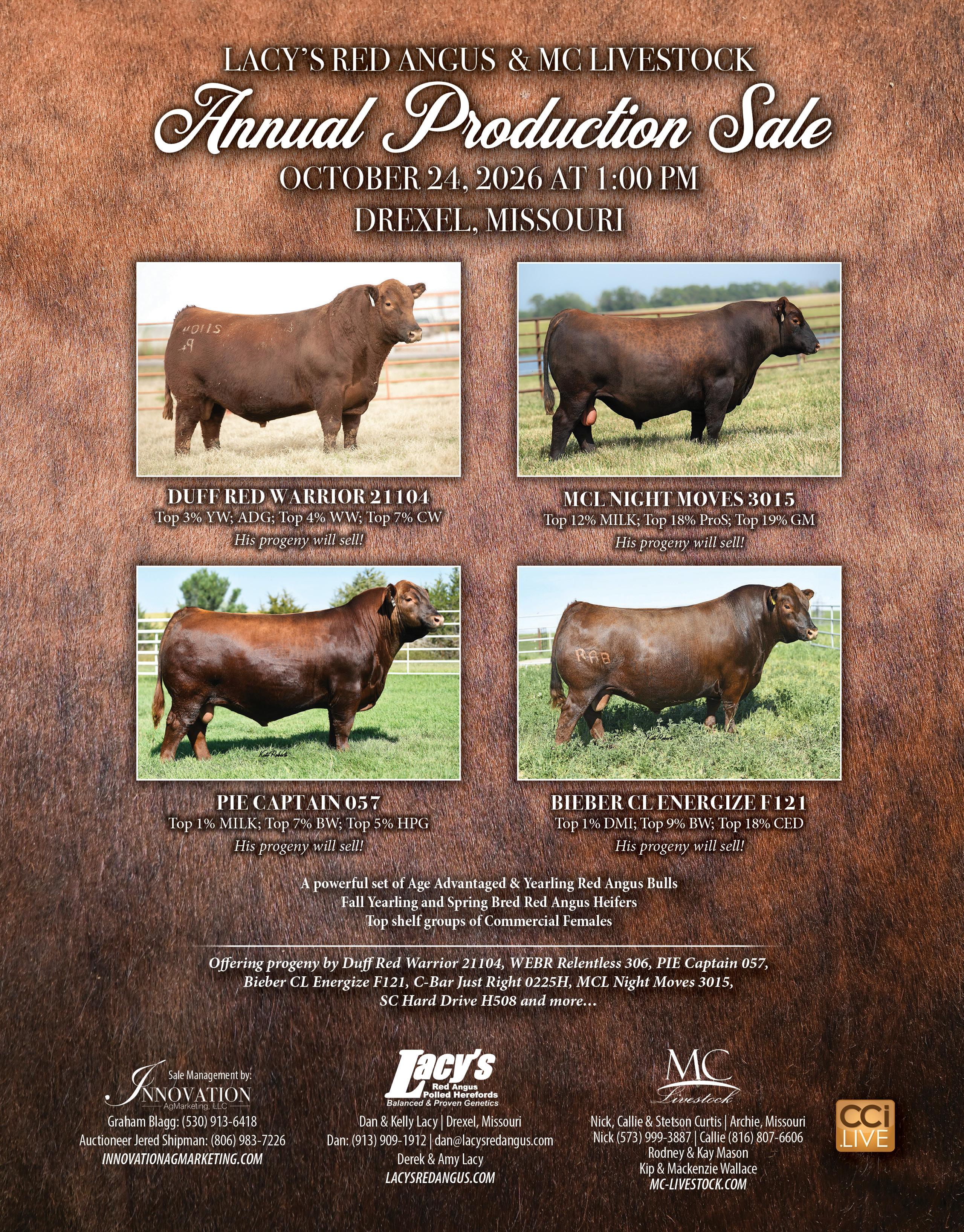
Lacy’s Red Angus and MC Livestock Annual Production Sale, Drexel, MO
Sydenstricker Genetics Fall Production Sale, Mexico, MO
MBC Classified
The MBC Classified column appears monthly. Classified advertising is only 50¢ per word. Send your check with your ad to Missouri Beef Cattleman, P.O. Box 480977, Kansas City, MO 64148. Deadline 15th of month before an issue.
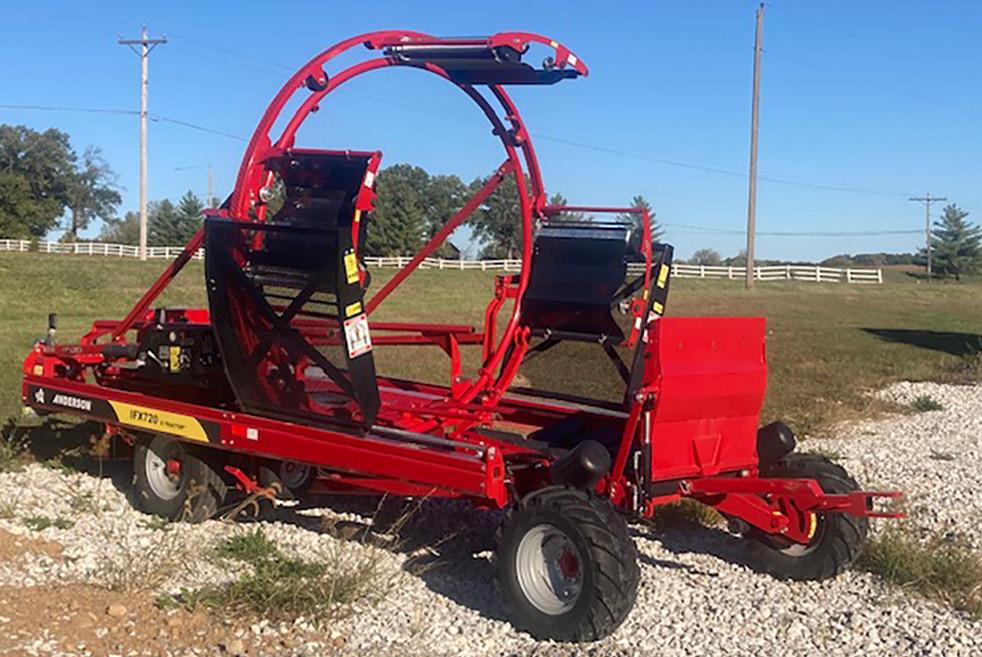
“REESE” DISC MOWERS, CADDY V-RAKES, “REESE” TUBE-LINE BALE WRAPPER, AITCHISON DRILLS, SELF-UNLOADING HAY TRAILERS, HEAVY DUTY BALE AND MINERAL FEEDERS, FEED BUNKS, BALE SPIKES, CONTINUOUS FENCING, COMPLETE CORRAL SYSTEMS, INSTALLATION AVAILABLE: Tigerco Distributing Co. 660-645-2212, 800-432-4020 or www.tigercoinc.com.
BLACK SIMMENTAL BULLS SINCE 1993: Calving Ease, Attractive, Athletic, Sound Footed and Docile. We Deliver. Mike Williams, Higginsville, 816-797-5450
SYCAMORE CREEK SIMANGUS BULLS & BRED HEIFERS FOR SALE. Great EPDs. Wayne and Anita Vanderwert -15 minutes from Columbia. 573-808-3000 or 303-506-3508
SIM-ANGUS BULLS - Top EPD’s for Calving Ease and Growth. Lynn Snow Call Matt McQuitty 660-924-8037.