Contact Us
(843) 723-8035 | action@scccl.org 131 Spring Street Charleston, SC 29403 coastalconservationleague.org
Impact Report July 1, 2019 – June 30, 2020
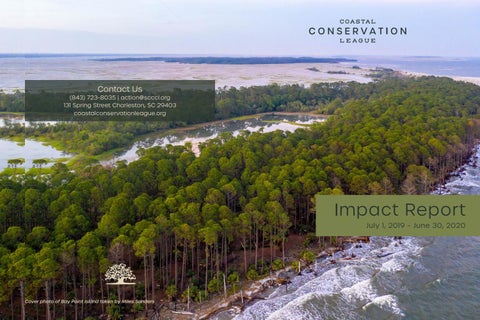
Cover photo of Bay Point Island taken by Miles Sanders
Friends, The past year has been like no other. We have all faced unprecedented challenges, and the Coastal Conservation League is no exception. But I am pleased to report that thanks to unwavering support from people like you and to the passionate commitment of our talented staff, we are meeting our challenges. The Conservation League has the resources and financial strength to keep up our work protecting and defending the South Carolina coast.
When the U.S. Army Corps of Engineers proposed building a seawall around the Charleston peninsula, we stepped in and organized virtual meetings to educate the public about the proposal and raised funds to identify more comprehensive and environmentally and culturally sen-
We are busier than ever working to make sure the coast we love is resilient in the face of climate change, sea level rise, and other threats. We are working in communities from the North Carolina border to the Savannah River, helping to protect health, safety, and quality of life. And we are focusing on making sure our work and our organization
sitive flooding solutions. When pristine Bay Point Island (front cover) was threatened with resort development, we organized virtually, partnered with the Gullah/Geechee Nation on an online petition drive, and mobilized public action for zoning meetings.
are as equitable as possible, involving and supporting the
I could go on and on.
wonderful people and places that make our coast such
As we go about our work on behalf of the coast and its
a unique and special place.
people from our home offices, living rooms, dining room
Moving forward with our mission has required adjustment
tables, and from the GrowFood Warehouse, we never forget
and adaptation. I couldn’t be prouder of how the Conservation League staff has risen to the occasion with
that you make it all possible. I am endlessly amazed by the dedication, interest, and generosity of our supporters,
so much dedication.
even in times as difficult and uncertain as these.
For example, when GrowFood Carolina’s restaurant
Thank you for all you do and for the difference you make.
customers (which accounted for 70% of sales) vanished
Onward!
almost overnight, we started packing food boxes for purchase and providing local produce free to families in need, working with donors like you and local partners like the Lowcountry Food Bank. We have supported farmers
Laura Cantral Executive Director
and communities by delivering thousands of food boxes since the pandemic began, and look forward to delivering thousands more for years to come.
Coastal Conservation League Impact Report | 1
Coastal Conservation League Impact Report | 2
Conservation Highlights July 1, 2019 – June 30, 2020
GrowFood Carolina Feeds Farmers Providing fresh produce to our neighbors
With the advent of Covid-19 earlier this year, many restaurants and institutions scaled back operations, reducing demand for produce from local South Carolina farmers. In an effort to support our 100-plus partner farmers and provide food to the community during the shutdown, GrowFood explored new opportunities, such as offering produce boxes for purchase by the public. To help farmers and our communities even more, from April to June of this year, generous donors helped us raise over $25,500 to donate food boxes—8,500 pounds of fresh, local produce—to area organizations like the Lowcountry Food Bank. Initially experimental, the success of the food box program has made it a priority project for GrowFood in the upcoming year as we continue supporting South Carolina farmers, as well as families in need, by supporting and providing fresh, healthy, local food to families in need.
$1,405,888
returned to GrowFood farmers
100+ partner farmers
18
new farming partners
2,000
food boxes donated to families in need
1 , 3 8 2
food boxes sold
Contact GrowFood Carolina General Manager, Anthony Mirisciotta—anthonym@growfoodcarolina.com Once the restaurants shut their doors, we got a call from [a distributor]. They canceled all their produce orders with us. A few days after that, I received a call from Becca, and I was so scared that GrowFood was going to follow suit. I just didn’t know what we were going to do. But she was upbeat and talking about plans to provide baskets to the public, and other ideas that would keep supporting us farmers and keep our produce moving. We began shipping our greens to GrowFood, and that kept us going. We couldn’t keep up with the eggs, we didn’t have the meat to sell. I was scared, and all of our employees were scared. Our family depends on it and their families do as well. But the orders kept coming and coming [from GrowFood], and we’re really blessed. —Joey McQuade, Sylvan Farm GrowFood Carolina Partner
Food boxes being loaded into GrowFood Carolina truck to be delivered to the Lowcountry Food Bank. Coastal Conservation League Impact Report | 3
Bay Point Island Threatened Since 2016, developers have had their sights set on developing an upscale resort on Bay Point Island, a vulnerable barrier island at the mouth of Port Royal Sound. The proposed resort, described by the developers as an “ecotourism destination,” would damage the fragile island and the local Gullah/ Geechee community. The Conservation League has been working closely with the Gullah/Geechee Sea Island Coalition, as well as with other partners, to stop the immediate threat of the resort construction. Long term, we are advocating for the permanent protection of Bay Point Island by making it more difficult to obtain a special ecotourism land use permit and by exploring opportunities for additional land protection.
Flooding in Charleston
Leading the charge in conserving Lowcountry land & wildlife
Charleston Sea Wall Study Released Working to protect the Greater Charleston Community
In February 2020, the South Carolina Supreme Court reversed a lower court’s decision that denied citizens’ ability to challenge a permit authorizing the construction of a new cruise ship terminal at Union Pier in Charleston. This was a landmark decision that allows concerned citizens who would be negatively impacted by pollution or other environmental damage to take legal action to protect their quality of life.
The Conservation League has been working on issues related to flooding and drainage for years. Earlier this year, when the U.S. Army Corps of Engineers completed its long-anticipated storm surge study and proposed a 12-foot seawall around the Charleston peninsula, we doubled down on our commitment to identify and support the best solution for our community—one that will address flooding issues by comprehensively utilizing natural resources that provide important resilience benefits and protect the city’s cultural resources. By using a design that works with water and nature, we can combine hard engineering, like concrete and steel, with ecological elements, such as marshes and oyster reefs—taking advantage of the best of both worlds for our community and the surrounding environment.
Contact Land, Water, & Wildlife Program Director, Emily Cedzo—emilyc@scccl.org
Contact Communities & Transportation Program Director, Jason Crowley—jasonc@scccl.org
Contact South Coast Office Project Manager, Juliana Smith—julianas@scccl.org
Supreme Court Sides with Citizens on Cruise Ship Standing Giving citizens the right to weigh in on environmental impacts in their neighborhoods
Coastal Conservation League Impact Report | 5
2
court rulings
6 4 , 5 5 8
new SC residents to balance with nature
Coastal Conservation League Impact Report | 6
Charleston’s Comprehensive Plan Launched Advocating for communities to get involved in planning
Mine Threats Multiplied Protecting land & communities from sand mine proliferation
As proposed mining operations continue to show up across the Lowcountry, we have been working to protect citizens, communities, and the landscape from harmful operations. We actively worked with partners in Conway to oppose the rezoning of 151 acres for a sand mining operation at the Depot Road Tract adjacent to the Waccamaw River, Waccamaw National Wildlife Refuge, and Waccamaw River Park. We are also actively engaged in the mining permit process at Pineland Mine in Dorchester County, Donmar Mine in Berkeley County, and Southern Mine in Charleston County.
5
legal cases filed
363
new donors
Contact Land, Water, & Wildlife Project Manager, Riley Egger—rileye@scccl.org Coastal Conservation League Impact Report | 7
Contact Communities & Transportation Project Manager, Betsy La Force—betsyl@scccl.org
2
state bills passed to stop offshore drilling
1 7 , 8 1 5 a c re s p ro t e c t e d
public meetings atended
500
Waccamaw River
The Conservation League reviewed and provided preliminary feedback to the City of Charleston as it began updating its Comprehensive Plan, a requirement every 10 years. This plan will serve as a vision and guide for policymaking. Its development involves an extensive public planning process— providing an opportunity for us to engage the community in planning for its future. The city has hired the Dutch Dialogues team, among other consultants, to help develop a new plan focusing on a more equitable and resilient community and to help preserve this part of the Lowcountry’s unique character and natural conditions. The Conservation League held a debate the impacts of sea level rise; hosted a series of free, public events including a candidate forum to address targeted questions about flooding in Charleston; the Winthrop Civic Forum where authors Gilbert M. Gaul and Orrin H. Pilkey debated the impacts of sea level rise; The Dutch Dialogues, a presentation of the Dutch Dialogues team’s findings and a Mayoral Debate focused around the study and the topic of flooding, leading up to the 2019 November election.
1 Energy Freedom Act Passed Coastal Conservation League Impact Report | 8
Atlantic Coast Pipeline Defeated
I-526 Went to Court
Moving toward clean energy for the state and the climate
Protecting rural islands from further development
Since 2014, we have been part of a coalition of conservation groups across the Southeast fighting against the proposed Atlantic Coast Pipeline—a project that would have paved the way for future gas infrastructure and development along the coast of South Carolina. On July 5, 2020, the companies behind the $8 billion pipeline project announced its cancellation, marking a victory for environmentalists. The 600-mile transmission pipeline, which would have stopped 21 miles from the South Carolina border, was a controversial project that proposed disrupting public lands and communities, like the Appalachian Trail, as well as places like Union Hill, VA, a historic Black community.
The Interstate 526 extension onto the Sea Islands involves spending hundreds of millions of dollars of taxpayer money, displacing residents, and altering the landscape and communities of the affected area forever. The project would divert sales tax dollars— possibly taking resources away from important flood management and traffic improvements. The Conservation League and two Charleston County residents challenged Charleston County Council’s decision to use sales tax dollars for I-526 in court last year. We continue to work through the legal process to protect taxpayers’ dollars so that funds are used in the way Charlestonians were promised.
Crab Bank Restoration Progress
104
partner organizations
1 , 0 0 3 action-taking advocates
comments & Marsh land on Johns Island
In 2018, you helped us to raise $2 million to save Crab Bank, a narrow slice of sand near the mouth of Shem Creek that is critically important and is one of only five protected Seabird Sanctuaries in the state. Restoration at Crab Bank is currently planned to take place in 2021. We can look forward to enhanced habitat protections not only at Crab Bank, but at other important habitats like Cape Romain. At Cape Romain, the S.C. Coastal Bird Conservation Program, working with the U.S. Fish and Wildlife Service and Cape Romain National Wildlife Refuge, recently provided an extra layer of protection for birds and habitat by hiring a Shorebird Steward to monitor the area and educate visitors.
103
Restoring bird habitat with the dredge material from the Charleston Harbor deepening
testimonies given
Coastal Conservation League Impact Report | 9
Coastal Conservation League Impact Report | 10
Financial Report
As of June 30, 2020
July 1, 2019 – June 30, 2020
Total Assets Total Liabilities Net Assets Change in Net Assets
FY 2019/2020 Revenues
FY 2019/2020 Functional Expenses Administration 14%
Investments 14% Produce Sales 8%
$17,651,795 $1,188,421 $16,463,374 $67,295
Fundraising 12% Programs 74%
Public Support 78%
Energy & Climate 13%
Grants 18%
Land, Water, & Wildlife 15%
Agriculture/ GrowFood Carolina 32%
Contributions 60%
Communities & Transportation 14%
FY 2019/2020 Public Support Breakdown
FY 2019/2020 Program Expense Breakdown
Coastal Conservation League Impact Report | 11
Coastal Conservation League Impact Report | 12
Our Team
as of June 30, 2020 Board of Directors Ceara Donnelley, Chair Katharine Hastie, Vice Chair R. Kent Griffin, Treasurer John Thompson, Secretary Johnston C. Adams J. Anderson Berly, III Daniel W. Boone, III Bill Brenizer Lee Edwards George Gephart
Staff
Columbia
Communications
Laura Cantral, Executive Director
Merrill McGregor, Director of
Adam Findeisen, Communications
South Coast
Jasmine Gil, Outreach Coordinator
Jessie White, South Coast Office
Diane Knich, Communications
Juliana Smith, South Coast Office
Catie Lucey, Creative Services
GrowFood Carolina
Development
Anthony Mirisciotta, General Manager
Nancy Appel, Development Director
Shaunda Fifer, Sales & Marketing
Kati McArdle, Grants & Donor
Richard Finne, Warehouse Ops &
Tes Myrie, Major Gift Officer
Programs Lisa Turansky, Chief Strategy Officer Land, Water, & Wildlife Emily Cedzo, Land, Water, & Wildlife Program Director
Riley Egger, Land, Water, & Wildlife Project Manager
Rachel Hawes, Land, Water, & Wildlife Project Manager
Communities & Transportation Jason Crowley, Communities &
Transportation Program Director
Betsy La Force, Communities &
Cynthia Kellogg
Transportation Project Manager
W. Jefferson Leath, Jr.
Robby Maynor, Berkeley County
Pierre Manigault Jeremiah Milbank, III Margot T. Rose David Westerlund Stephen Zoukis
Project Manager
Energy & Climate Eddy Moore, Energy & Climate Program Director
Alan Hancock, Energy & Climate Advocacy Director
Government Relations
Director
Associate
Director
Communications Manager
Distribution Manager
Administration
Kevin Gilly, Warehouse Ops &
Tina Allen, Chief Financial Officer
Distribution Manager
Paul Haire, Inventory Control & Quality Assurance Specialist
Katie Kuhn, Sales & Marketing Associate Austin Lucas, Warehouse Ops & Distribution Manager
Benton Montgomery, Operations Manager
Caroline Rothkopf, Sales & Marketing Deirdre Tanner, Supply Chain Wizard
George Gephart is a native of Baltimore who has served on the Boards of Natural Lands Trust, The Nature Conservancy (PA), and the Curtis Institute of Music.
Manager
Project Manager
Assistant
Welcome to our new Board members
Director
Brita Von Fossen, Sales & Marketing
Deb Davidson, Human Resources Officer
Andy Hollis, Director of Technology & Operations
Kim Larson, Accountant Staci Loeffler, Database Administrator
Reed Rayborn, Executive Assistant & Board Liaison
DeAnna Ridley, Bookkeeper Jamie Roschal, Office Coordinator
Manager
Interns
Rebecca Watson, Farm Coordinator
Ginny Naughton, Energy Justice
Maxwell Williams, Warehouse Intern
Fellow
Ashwin Sanzgiri, Government Relations Intern
Bill Brenizer is originally from Charlotte, NC. His interest in the Conservation League was sparked by his 20-year tenure on the Board of Nantucket Land Council, an environmental organization whose mission and activities are very similar to those of the Conservation League. Coastal Conservation League Impact Report | 13
Coastal Conservation League Impact Report | 14