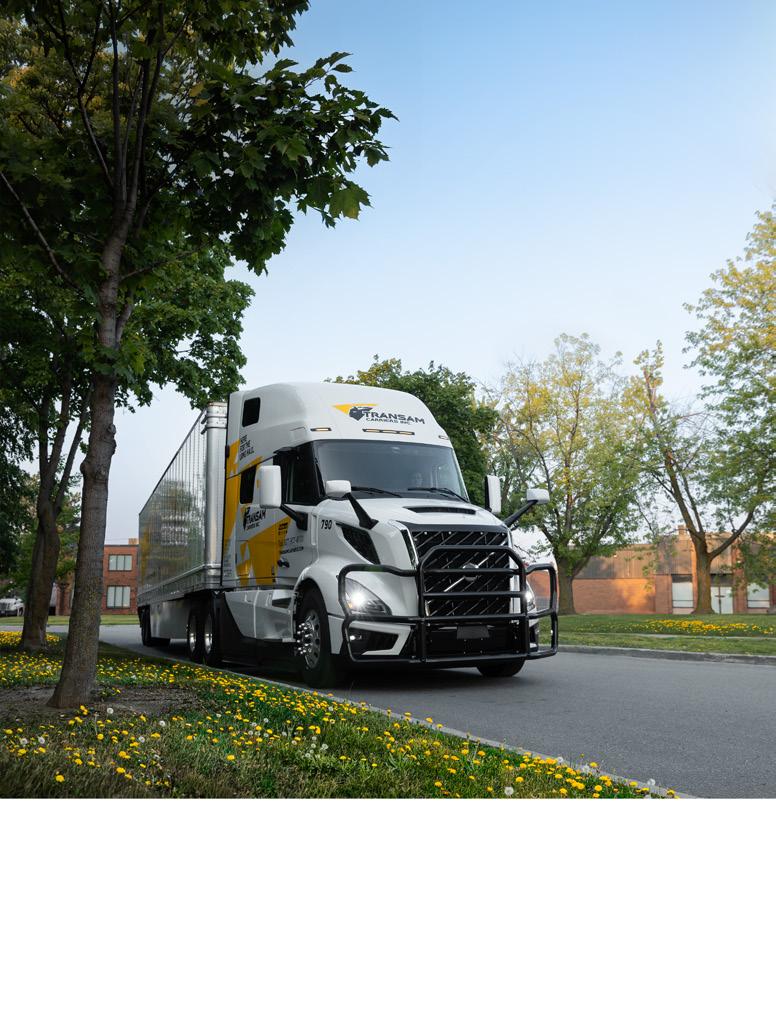
Our dedicated transportation division ensures each client’s portfolio encompasses tailor-made coverages; from private auto, cargo and pollution to D&O, bonding and warehousing. Our unique relationships with major transportation insurers, allows us to negotiate enhanced coverages at the most competitive rates available. Our in-house claims manager follows every claim along to a successful conclusion and is available 24 hours a day, 7 days a week.
If you have any questions concerning a competitive quote on your transportation insurance, or would like to set up a fleet or prorate account, please contact our Commercial Division and speak with one of our transportation specialists.
FROM THE EDITOR’S DESK
BY JOHN WHITE
Eight Years After Humboldt… and We’re Still Talking?
It’s been eight years since Humboldt. Sixteen of some of our best young people gone in an instant, families changed forever, and a country that said, “never again.” There were promises made back then — real ones — about fixing training, raising standards, and making sure something like that never happened again. And yet here we are, eight years later, and Saskatchewan is back in the news talking about changing Class 1 driver training. Talking about graduated licensing. Talking about something closer to a Red Seal-style system. Talking again. And that’s the problem — we’re still talking.
And let’s be clear about one thing — Saskatchewan isn’t alone here. All of Canada is in the same boat. Same patchwork system, same reliance on minimum standards, same conversations happening over and over again with very little changing where it matters. Every province sets its own standards for driver certification through its own Transportation Ministry, and that’s part of the problem. Trucks don’t stop at provincial borders. Drivers don’t stay in one province. This is a national industry being run under provincial rulebooks, and until everyone gets on the same page, nothing meaningful will change.
After Humboldt, Saskatchewan, rolled out MELT — Mandatory Entry-Level Training. Minimum hours, set curriculum, and a baseline to get a Class 1 licence. On paper, it looked like progress, and to be fair, it was a step up from what we had. But better than nothing isn’t the same as good enough. Out on the road, where this job actually happens, drivers will tell you straight — not much has really changed where it counts. You can still take your training, pass your test, get your licence, and before you’ve even had time to learn what you don’t know, you’re out there running loads, maybe in conditions you’ve never seen before, figuring it out as you go. That’s not training. That’s being thrown in the deep end and told to swim.
EDITOR-IN-CHIEF
John White: john@ptmag.ca
PUBLISHER
Coast2Coast Business Pages Ltd.
ADVERTISING/MARKETING
Tony Arora: tony@coast2coastpages.com
John White: john@ptmag.ca
CONTRIBUTING WRITERS
• Colin Black • Greg Evasiuk
• Scott Casey • Dave Madill
• Glen Millard • Myrna Chartrand
• Andy Roberts
PHOTOGRAPHY
Ben Proudley • Alicia Cornish
David Benjatschek wowtrucks.com
There is a story that comedian Bob Hope apparently told when he went back to perform in his hometown. He said, “I learned to swim in the river here. I found that the toughest part about learning how to swim was getting out of the gunny sack.” Why are we throwing our new drivers into the proverbial gunny sack and telling them to drive? COAST2COAST BUSINESS PAGES
#235 - 8138 128th St. Surrey BC V3W1R1 P: 604-724-8976 | F: 604-598-9264
tony@coast2coastpages.com I www.driverschoice.ca
The contents of this publication may not be reproduced by any means, in whole or in part, without prior written consent of the publisher. The advertiser agrees to protect the publisher against legal action based upon libelous or inaccurate statements; the unauthorized use of materials or photographs; and/or any other errors or omissions in connection with advertisements placed in the Magazine. The publisher can and will refuse any advertising which in his opinion is misleading or in poor taste. The publisher does not endorse or make claim or guarantee the validity or accuracy of any advertisement herein contained. All materials submitted for publication are subject to editing at the publisher’s discretion. The act of mailing or e-mailing material shall be considered an expressed warranty by the contributor that the material is original and in no way an infringement on the rights of others.
Publications Mail Agreement #42378023. Return Undeliverable Canadian Address to: #235 - 8138 128th St. Surrey BC V3W1R1.
The real issue is consistency — or the lack of it. Some drivers come out of training solid. Some don’t. And the scary part is, on paper, they all look the same. Same licence, same qualification, same box checked. Companies don’t know what they’re getting until it’s sitting in the driver’s seat, and by then it’s too late. Hiring a new driver shouldn’t feel like rolling the dice, but right now, that’s exactly what it is. A licence today tells you someone passed a test — it doesn’t tell you if they can actually do the job when things go sideways.
And let’s be honest about the training side of things. There are good schools out there doing it right, no question. But there are others cutting corners, pushing people through, and in some cases turning out drivers who simply aren’t ready. Everyone in the industry knows it, but the system keeps moving along like it’s acceptable. That’s the part that hasn’t been fixed. MELT raised the floor a bit, but it didn’t build a profession. It didn’t guarantee competence. It didn’t give companies confidence. It gave us a minimum, and minimum is exactly what we’re still getting.
Meanwhile, the ripple effect is hitting drivers where it hurts most — in the wallet. When training standards are weak, wages follow. Undertrained drivers come in cheaper, good operators get undercut, and the whole industry slides a little further down. We’ve all watched it happen. You can’t build a strong industry on weak standards, and you can’t expect professionalism when the system itself is built around “good enough.”
Now Saskatchewan is talking again — about doing something bigger, something better. A graduated system like Europe. A Red Seal-style certification. A real path into the job instead of a quick pass-through. And the truth is, none of those ideas are new. The industry has been pointing in that direction for years. What’s been missing isn’t the idea — it’s the follow-through.
Because the fix isn’t complicated. Treat truck driving like what it is — a skilled trade. That means proper progression, real-world experience before full responsibility, and a certification that actually means something when a driver walks through the door. Call it Red Seal, call it graduated licensing, call it whatever you want — just make it real.
Eight years ago, we said things would change. Now we’re back at the table, talking about it again. The only question left is whether Saskatchewan — and the rest of Canada — is finally ready to stop patching the system and actually fix it, or if we’re going to be having this same conversation ten years from now.
Because drivers are tired of hearing it. The public is tired of waiting. And more talk, with a distinct lack of real action, is nothing short of a slap in the face to the families, the friends, and the close-knit community still living with the loss and the injuries from that day.
RIG OF THE MONTH
Pictures by: David Benjakschek www.wowtrucks.com
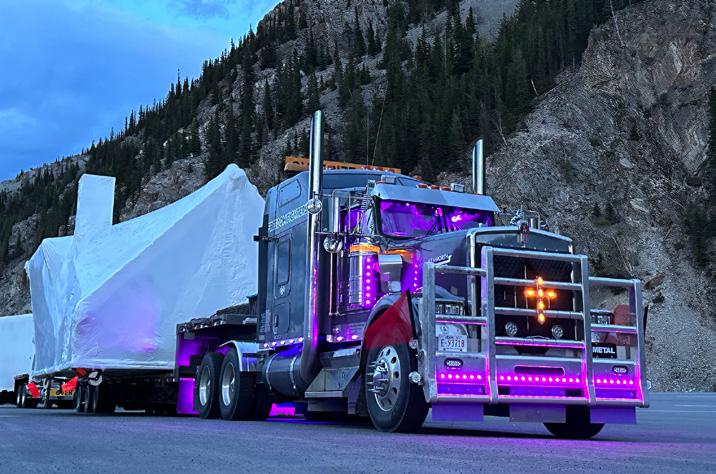
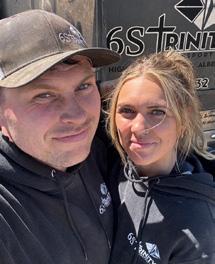
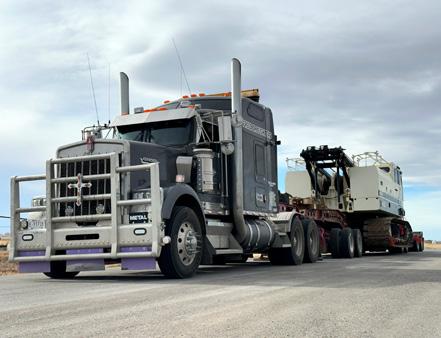
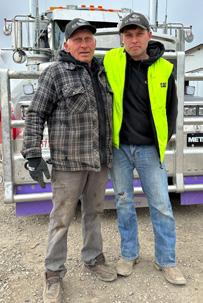
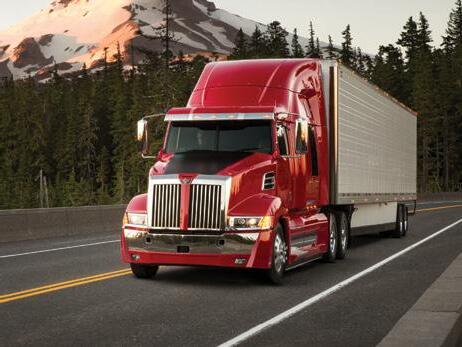
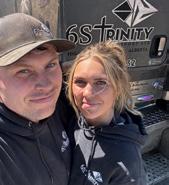
When I am contacted by an old stick and told about a young driver who was brought up in the industry and shows all the qualities of an old-school driver, I listen. Myles Forman sent me such a message that said, “I met him at the Haig scale when I had trailer scale issues and was overweight and had to reduce my back bundle. He jumped in to help me, and I never heard a word of complaint about anything other than discussing the lack of professional drivers out there. He and his dad have their own trucks and hire several others. I’m encouraged because he’s part of a dying breed that I grew up in and don’t see very often. He obviously loves the business and uses it to support his young family, whom he’s very attached to.” This is Mike Skory’s story:
My dad was a firm believer in learning by seeing and being involved. He didn’t teach step by step or give hours of lessons; you watched, he showed you things and you figured it out. Questions would always be answered of course, but there was always an element of independence. The importance of “doing” and making mistakes in order to learn from them and get better. This concept applies to everything, and I’m realizing now, as I
write this, that the way my dad taught me gave me irreplaceable confidence.
I always remember dad saying, “don’t ever claim to know everything” , “don’t carry yourself as a know-it-all”, “prove yourself by doing”, “don’t build expectations, under sell and over deliver”, “don’t ever claim to have it all figured out”. These tag lines stuck with me throughout my life, and I realized they are all centred on humility. How you carry yourself and how you show
up to others are integral to building good relationships. Presenting yourself with humility conveys the attitude that you’re not better than anyone else and that everyone has something to bring to the table. I didn’t realize it then, but my journey in humility would become paramount later in life. After all, we are called to patience, kindness, goodness, gentleness and self-control; the fruits of the Holy Spirit.
Michael Skory
Crop years were bad for quite a few years in a row, and my dad got tired of the losses. He bought a semi, hauled grain for a little while, and did a few other commercial transport endeavours. At the time, I was working for a farmer in Saskatchewan, helping manage a 5,000-acre grain operation. Dad called me up and said he was going to sell a quarter section, buy a double drop and asked me if I was in. I had gained a lot of experience at the farm in Saskatchewan and had a lot of independence there, exactly how my dad taught me how to learn. I had brought my dad’s set of bulkers and one of his trucks to make seeding with the 60’ Bourgault we used more efficiently. Again, there were countless situations that I found myself in where I didn’t have a clue what the right answer was, or the right move to make. You made decisions, sometimes they were mistakes, and then you made more decisions to rectify the mistakes. You learned by doing, by failing and not giving up. Every single time, without fail, if you thought you had it all figured out, around the corner was a catastrophe that would pound humility into you. Humility, after all, is a biblical concept and the way we are called to carry ourselves. It just so happens I’m a pretty stubborn guy, with a big head: it took a lot of lessons to drive the point home.
So we ventured into the commercial world together and started hauling down to Nevada to service a few mines there. CMS Trinity Transport presented many challenges, and I often didn’t know what I was doing, but we figured it out one job or one problem at a time. We got so busy that we started supplying loads for a couple of other trucks. I was clearing customs, ordering permits, invoicing and chasing money down, all from the driver’s seat; it was a whirlwind. Eventually, I reached out to a couple of people my dad knew, who had worked for them in the past, and I asked them for a couple of hours a week from one of their office staff to relieve some pressure. This went on for a few weeks
before Stacey, at the time the owner of 6S Transport, came to me and said, “It’s not making any sense to build 2 business, why don’t we merge?” So we did. We formed 6S Trinity Transport LTD, melded our equipment and office roles together and set out to “make trucking personal”. To be a light in a dark world and deliver not only freight, but also integrity. Building lasting relationships on trust with the model of the cross and an embodiment of humility.
My third load, I think, as a commercial driver, back when Dad and I were on our own, was a 14’6 W rig deck, Alberta – Texas. I had a pilot in Alberta and Colorado, but none in Montana, set in the middle of winter with icy road conditions. I was green as green could be, had no idea what I was doing, but had to get the job done. I pinned the trailer in the yard, as my dad had loaded it for me, and the kingpin didn’t latch. I went to pull away, and the trailer fell to the ground. There I was, in -25, trying to jack the trailer up to re-hook it before my pilot showed up and saw what I had done. Blown up fan belt, Denver traffic and single lane highways, with bridges every 3 miles where I needed the
entire road; it was one for the books. In the end, though, I got the job done. I gained confidence and realized once again that I was never going to have it all figured out.
Shortly after we merged to form 6S Trinity Transport, I faced one of the biggest challenges of my life. I had started doing 5-10K runs and injured my calf in the process, or so I thought. Dad was bringing up a screen deck from Arizona on a 9 axle that I was to deliver to the Yukon. We were waiting on a superload permit from British Columbia when I moved the load to Demmitt, Alberta, to wait at the border. During the drive, I became entirely unable to put the clutch to the floor with my left leg. 85% of my left leg power was gone. I unhooked at the border scale and made my way back home to High River. I told my dad I wasn’t going to be able to complete the move myself, and so when we got permits, we went together; I wasn’t much help. I spent 2 weeks in the bunk, throwing up, in pain and unable to stand by myself; all the while my dad was fighting harsh conditions, chain-ups and winter blizzards on the 37. It was a nightmare; however, we got the job done again.
I got back, and my chiropractor sent me to emerge. He didn’t tell me at the time, but he knew I didn’t just have a calf injury; I was walking with a spinal cancer gate. Scans and 2 gruelling weeks in the foothills neurosurgery wing would reveal I had a mass in my spine at L4-L5 and a webbing in my head around my pineal gland. The hospital didn’t know if what they planned to do would work, as they had limited experience with my condition, which was extremely rare. Faith really steps in, in a big way. Diagnosis was 2 months to live, likely never walk again; God had other plans. Yet again, throughout my life, I have been put in situations that force me to realize I don’t have it all figured out, and humility is an aptitude that should lead.
Here I was at 30, in the cancer ward on the 11th floor; 13 rounds of chemo, the hardest they had to penetrate through the blood-
brain barrier and then a stem cell transplant, my own. I can’t begin to describe what this process was like. One moment everything is fine, and in the next, the future is a question mark. I remember after the diagnosis, before I started treatment, I sent an audio recording to my family. They were devastated by the news, but there was strength and confidence inside of me bursting at the seams. I told them this battle had already been won, God’s already cured me of this, I just have to walk through it. Humility took the lead, and again I didn’t have it all figured out, but knew someone who did.
For 5 years now, I have been in remission, and I tell you the truth, yesterday, before I wrote this article, I ran a half-marathon. You may wonder what this all has to do with trucking, but I don’t think it matters what you do. It’s about how you show up, how you carry yourself. I love
driving, I always have, and I love a challenge; countless hours in my life spent driving aimlessly around and countless hours attempting difficult things to prove to myself I could. Transport puts me in places I normally wouldn’t be, in front of people I normally wouldn’t see or deal with, and I have an opportunity in that. An opportunity to demonstrate humility, show a stranger love, and show up for somebody. That’s a privilege I don’t take lightly.
This business has given me countless opportunities to make an impact, delivering integrity along with the freight on the trailer. If I can encourage a single person with my testimony, it’s all worth it. It’s not about what I do, though I love it dearly, but a matter of where my heart is in the process. I don’t have it all figured out, and around every corner in life, that has been resoundingly true; my dad’s words ring loud in my ears, “Stay humble,” “never claim to know everything”. Whether it’s a delivery or a phone call with a customer or a random interaction at the truck stop, I choose how I show up. In integrity and in love, undersell and overdeliver.
Letters to the Editor
Training Is the Problem — Not Who’s Driving
Hello John,
I’m a dispatcher, and I don’t want my name used for this — not because I’m wrong, but because I still need a job.
I’ve been reading the last few issues and the letters coming in, and I’ll tell you straight — what you’re saying about training is dead on. We’re not dealing with a people problem out here, we’re dealing with a training problem, and it’s getting harder to ignore from this side of the desk. I see it every day. Drivers coming in with a fresh Class 1 who look good on paper, but once they’re actually put to work, you can tell pretty quick something’s missing. Backing’s rough, trip planning’s shaky, and if things don’t go sideways, they’re fine — but the minute something changes, they’re in over their head. That’s not on them — that’s on how they were trained.
Years ago, a lot of the good drivers came off the farm or had a dad or uncle who drove. They’d been around machinery their whole lives, knew how things worked, had some common sense before they ever climbed into a truck. That’s not always the case anymore — and there’s nothing wrong with that — but it means training matters more now than it ever did.
And right now, it’s not cutting it.
MELT was supposed to fix this, but let’s be honest, it’s a mess. Different provinces, different standards, and somehow it all ends with the same licence. From where I sit, that licence doesn’t mean what it used to, and everyone knows it even if they won’t say it out loud.
The pressure then lands on us to figure it out on the fly. Who can handle what load, who needs babysitting, who’s going to screw up at a customer or worse, out on the road. That’s not how this industry should be running.
There are a lot of good drivers out there, no question. But there’s also a growing number being pushed through a system that’s more about filling seats than making sure people are actually ready.
You want to fix what’s going on? Start with training. Make
Pro-Trucker Driver’sChoiceMagazine
it real, make it consistent, and make it worth something again.
Because right now, it’s not.
— Name Withheld (Dispatcher)
Judge the Driver, Not the Skin
Hello John,
Been reading the garbage on Facebook and hearing the same crap on the radio, and honestly, it’s getting hard to listen to.
I’m a white driver, born and raised here, been doing this job a long damn time. And I’m sick of everything getting blamed on the colour of someone’s skin like that’s what’s screwing things up out here. It isn’t.
I’ve seen wrecks—real bad ones—and I’ll tell you straight, they weren’t all one kind of driver like people keep hinting at. I’ve seen white guys roll trucks, blow corners, drive tired, make stupid calls, and wreck gear just as fast as anybody else. And yeah, I’ve seen overpasses get smashed too—and not just by the people everyone likes to blame. Bad driving is bad driving. Doesn’t matter what colour you are.
What matters is whether you were trained right, whether you actually know what you’re doing, and whether you give a damn when you’re behind the wheel. You rush someone through or hand out a licence they didn’t earn, you’re asking for trouble. Simple as that.
That’s the real problem—training all over the place, different rules depending where you got your licence, and too many shortcuts. That’s what’s biting us, not skin colour.
Most of us are just trying to do the job, get paid, and get home in one piece. Maybe it’s time we start judging drivers by how they handle the truck instead of what they look like climbing into it.
—Dave L., Prince George, BC
WESTERN CANADA’S STEERING SPECIALISTS
Quality Parts for All Your Steering Solutions
Trust the Experts
Editor’s reply: Dave, blunt but fair. The truck doesn’t care who you are—it’ll show real quick if you know what you’re doing.
Another Overpass, Same Story
Hello John,
Well, here we go again—another overpass ripped open. Another round of “how did this happen?” like nobody’s seen it a dozen times already.
This isn’t bad luck anymore. It’s stupidity, plain and simple. The signs are there. The heights are posted. You’re supposed to know your load before you even roll. Yet somehow guys keep driving straight into bridges like they’re not even paying attention.
And the worst part? Nothing changes. Same weak fines, same shoulder shrug, same “we’ll look into it,” and then right back to business. No wonder it keeps happening.
You want it to stop? Start hitting people where it actually hurts. Not these joke fines that get written off like fuel. I mean real money—enough to make a driver and a company think twice before they take a shortcut.
You hit an overpass? You’re done for a while. Parked. No arguing. Want back in the seat? Go take proper retraining, not some half-assed online course you click through in an hour.
And if a company keeps putting guys out there who don’t even know their height? Hammer their safety rating, jack their insurance, shut them down if you have to. Because they’re just as responsible.
Right now, it’s the same cycle—bridge gets hit, everyone swears it won’t happen again, then a few months later, boom, another one. It’s getting ridiculous.
One of these days it’s not just going to be concrete getting wrecked. People will die.
Enough talk. Make it hurt, or it keeps happening.
—Mark T., Abbotsford, BC
Editor’s Note: Mark, you’re saying what a lot of drivers are thinking. The problem isn’t a mystery—it’s a lack of real consequences.
Can You Hear us Now?
There’s a quiet reckoning happening on Canada’s highways, and it isn’t coming from regulators, enforcement agencies, or industry boards. It’s coming from the people who live the job every day.
Skilled Truckers Canada, a grassroots social media initiative, has become an unexpected focal point in the national conversation around commercial vehicle safety. What began as a place to share photos and firsthand accounts of incidents has evolved into something far more consequential: a living, crowdsourced record of risk on Canadian roads.
Every post tells a story. A jackknifed trailer on an icy stretch of highway. A preventable collision on bare and dry pavement. A near-miss that could have ended lives. But unlike the fleeting nature of most social media content, these incidents don’t disappear into the scroll. They’re documented, categorized, and tracked.
The page compiles detailed data tied to each incident: company names, provinces, the number of commercial vehicles involved, their jurisdictions, and whether injuries or fatalities occurred. Over time, this growing dataset begins to reveal patterns that are difficult to ignore.
And that’s where the real impact lies.
For years, concerns within the trucking industry have circulated in fragmented conversations: driver lounges, truck stops, and private forums. Issues like inconsistent training standards, regulatory loopholes, economic pressures, and the rise of questionable safety practices have all been discussed, often passionately, but rarely with consolidated evidence.
By Scott Casey Scott,
our Rig of The Month for May 2003 has written “Ghostkeepers” a book about his years as a gun toting truck driver while serving as a Canadian Peacekeeper in the former Yugoslavia.
Skilled Truckers Canada is changing that dynamic.
By turning anecdotal experience into structured information, the platform bridges the gap between “everyone knows it’s happening” and “here’s the proof.” It gives form to the frustrations of experienced drivers who have watched standards erode, and it creates a reference point for conversations that have too often been dismissed as isolated complaints.
What makes this effort particularly compelling is its origin. This isn’t top-down oversight, it’s straight from the roadways’ accountability.
Drivers are not only contributing content; they’re validating it.
Firsthand accounts are supported by images, location details, and peer input. In many cases, those within the industry recognize the companies, the routes, even the patterns of behaviour. There’s a level of credibility that comes from lived experience, something no external audit can fully replicate.
At the same time, in some people’s minds, the initiative might walk a fine line.
Publishing company names and incident details raises questions about fairness, liability, and due process. Or does it? While not every collision tells the full story in a single frame or perspective, the repeat offenders are not slandered, only named as being involved. And while there is always the risk of misinterpretation or incomplete context, for many supporters, the alternative—silence or selective reporting—has proven to be far more dangerous.
The broader issue being exposed
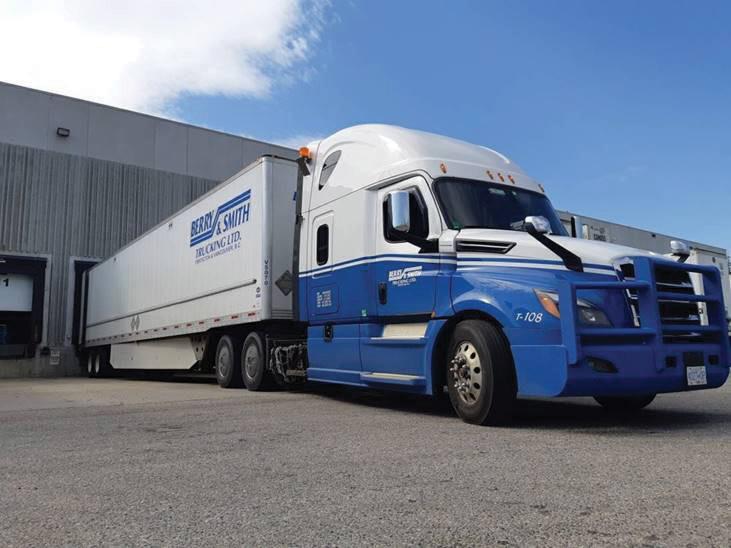
Join our winning team.
• $300 0 sign on b onus
• Increased mileage rate 10/2021
• Fuel Cap of 47 cent s p er litre
• Fuel p er formance pay pro gram
• Dire c t dep osit, paid t wice monthly
• Fas t cards and passp or t s preferre d
• N o cos t s atellite communication s ys tem
• Insurance/ license subsidy is upto 50 % , e qual monthly pay ment s, no interes t
i s H I R I N G Owne r O pe ra tor s To r un Canada & USA
• Late model tractor preferred
• Safet y b onus paid quar terly
• Scales/tolls/f a xes paid
• Group insurance
• Excellent home time and exible dispatch
• Paid pick ups and drops
• All miles paid/prac tical miles
Please call Dina or Kaolin at 1- 8 0 0- 66 3 -2339 or Send resumes to kaolinm@berryandsmith.com dinae@berryandsmith.com
• Stable company in business since 1954
Safe driving record • Mechanically sound tractor • Cross bo rde r ca pa bilit y • Cu s to m e r se r v ice focu s
isn’t just about individual incidents. It’s about the overall industry systemic pressure.
Tight delivery timelines, economic competition, and shifting labour dynamics have created an environment in which corners can be cut and risks normalized. In that context, incidents are not anomalies; they’re symptoms. And symptoms, when tracked consistently, become data.
That data has the potential to influence more than just online discussion. It can inform policy debates, support calls for standardized training, and reinforce the need for stronger enforcement mechanisms. It can also empower responsible carriers and drivers who
are too often overshadowed by those operating outside acceptable safety margins.
Perhaps most importantly, it brings visibility to an issue that directly affects every driver who shares the road.
Trucking is the backbone of the country’s supply chain. Its safety is not an industry-specific concern; it’s a public one. When something goes wrong, the consequences extend far beyond the cab of a truck.
What Skilled Truckers Canada represents is not just a critique of the industry, but a call to recalibrate it.
It’s a reminder that those closest to the problem are often closest to
the solution. That accountability doesn’t always require formal authority; sometimes it just requires persistence, transparency, and a willingness to document what others would rather overlook.
In an era where information is abundant but often relegated to government bureaucracy, this initiative stands out by doing something simple and powerful: keeping a record.
And in doing so, it ensures that the conversation about safety on Canada’s highways is no longer easy to ignore. So we aren’t left asking the same question, Can you hear us now?
Looking Back, Rolling Forward
Idid it. I am officially in the halfcentury club! The big five oh, fitty, or whatever the kids are calling it these days. Not sure why we attach more significance to these birthdays as milestones, nonetheless, they feel to me like measuring sticks. Not the type for personal accomplishments or wealth, but for how much my world has changed. Having been around trucking since I was born and since this is a trucking magazine, I got to thinking about how far we’ve come.
When I was 4 years old (1980), I took a trip with my dad from Millar Western in Whitecourt to Nelson Lumber in Lloydminster. Given my age, I don’t remember a whole lot about the trip other than it was a Freightliner cabover, and we left early, got home really late, and we stopped at Grandma and Grandpa’s. What I know from talking to dad is that, despite being loaded the previous day, it was a 14-hour day, and he only talked to mom once and never called the office.
At 16 (1992), I had my license, and that summer, I was working full-time for my dad. A couple of times a week, they would send me to
Edmonton in a 5-ton deck truck to go do pickups when they needed an extra deck. At that point, there was a gas station and restaurant about every 20 miles on Highway 43. That truck had an AM/FM radio with a cassette Player, a two-way radio, and sometimes I had a phone. The phone was one of those brick-shaped things that plugged into the cigarette lighter, and it was only to be used for calling in after a pickup to get instructions. Oh, and I’d best be brief because they got charged by the minute!
Flash forward a few more years, around 1999, I was hauling seedlings from the Lower Mainland and the Okanagan back to Whitecourt. It was a job I had done for a few summers. I drove an old FLD with a 48 flattop and lived out of a duffel bag. It had a 6CD changer, a hard-mount phone, and I carried one of my own (although there was pretty much no service from Hinton to Kamloops). The big tech advance I remember was trying my dad’s satellite radio for the first time. What a game changer! You could listen to the same channel uninterrupted all the way through the mountains! How could it be any better?
A guy walks into a bar in Calgary with a robot bartender.
The robot asks, “What’ll you have?” “Whiskey.”
It serves the drink and asks, “What’s your IQ?” “168.”
The robot starts talking physics, space travel, and medical breakthroughs.
The guy leaves, curious, and comes back later. “Whiskey.”
“What’s your IQ?” “100.”
By Greg Evasiuk
Greg is a 3rd generation trucker with over 1 million miles and 22 years in trucking.
I just had to recount some of these periods of time as I sat in my truck for 2 days to remind myself life on the road is pretty damn good now. My truck has a fridge, 3 different cooking appliances, a 37in TV, a Starling satellite, a printer, navigation, and enough closet space to keep 2 weeks’ worth of clothes. It’s really better than my first apartment!
As much as I love the convenience of it all, there are times when I just want to roll back to when it was simpler. So I just unplug my technology and disconnect until I get that 1992 or 1980’s feeling, take a twolane drive with the windows down, maybe read a magazine… That’s why we’re lucky to be living now: we can enjoy all the conveniences of today, but unplug and take a dirt road when we need to unwind.
Now the robot chats about NASCAR, Budweiser, the Flames, and the Jays.
The guy decides to try once more.
“Whiskey.”
“What’s your IQ?” “50.”
The robot leans in close and says, “So… are you people still happy with Trump?”
own the day
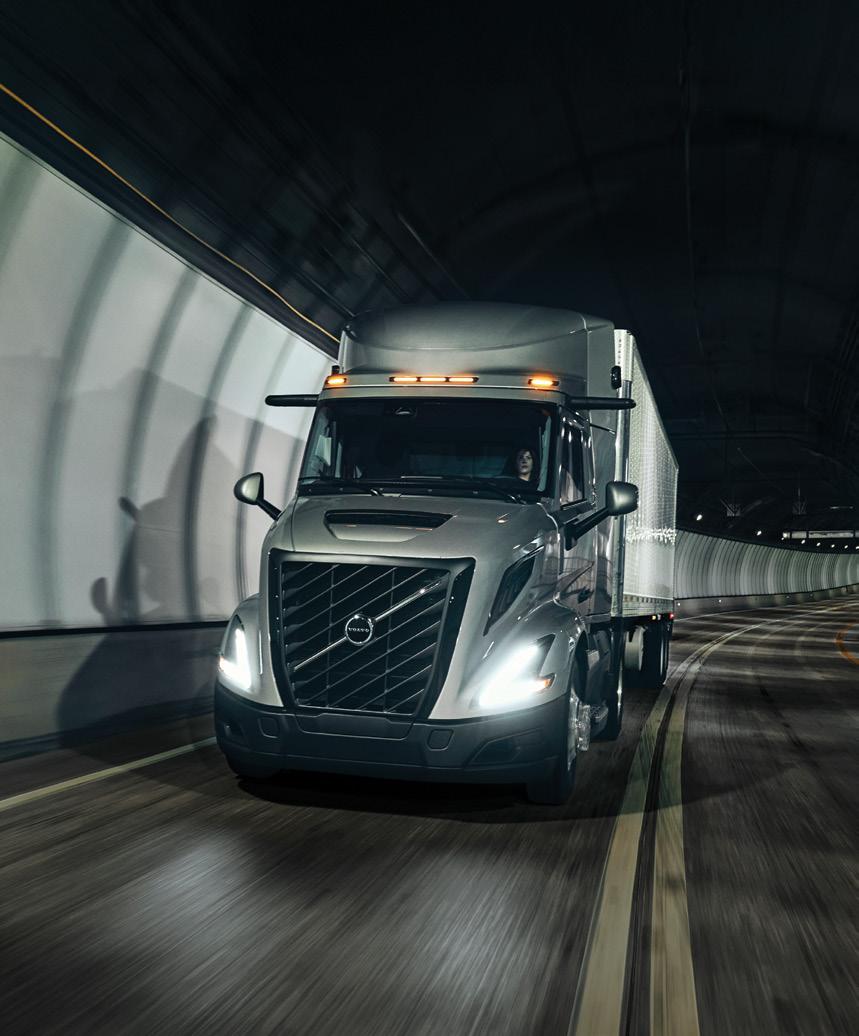
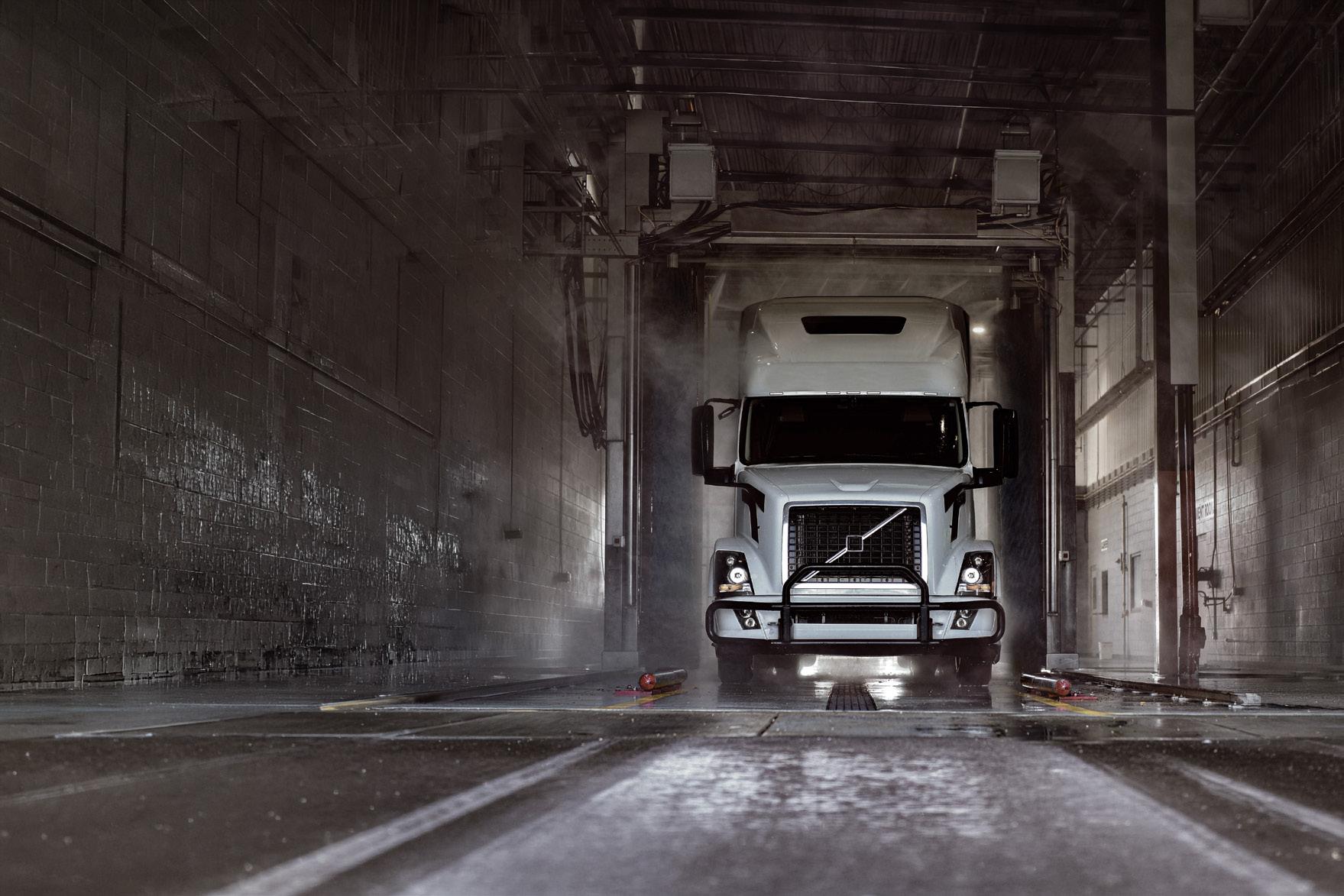
Introducing the all-new Volvo VNR
The new Volvo VNR promises to redefine your expectations for productivity, safety, and maneuverability. Boasting up to 7.5% improved fuel efficiency compared to our legacy model. A new era is arriving for Class 8 local and regional haul. Learn more at volvotrucks.ca
Volvo Trucks. Driving Progress
JUNE 13 & 14
TRADEX CENTRE
ABBOTSFORD, BC
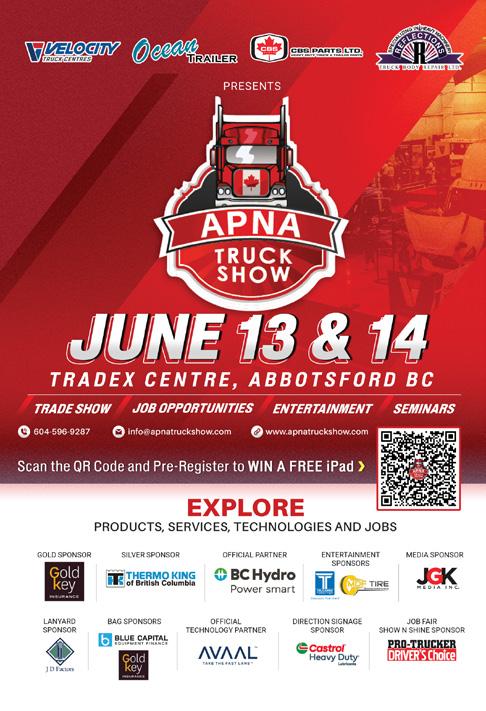
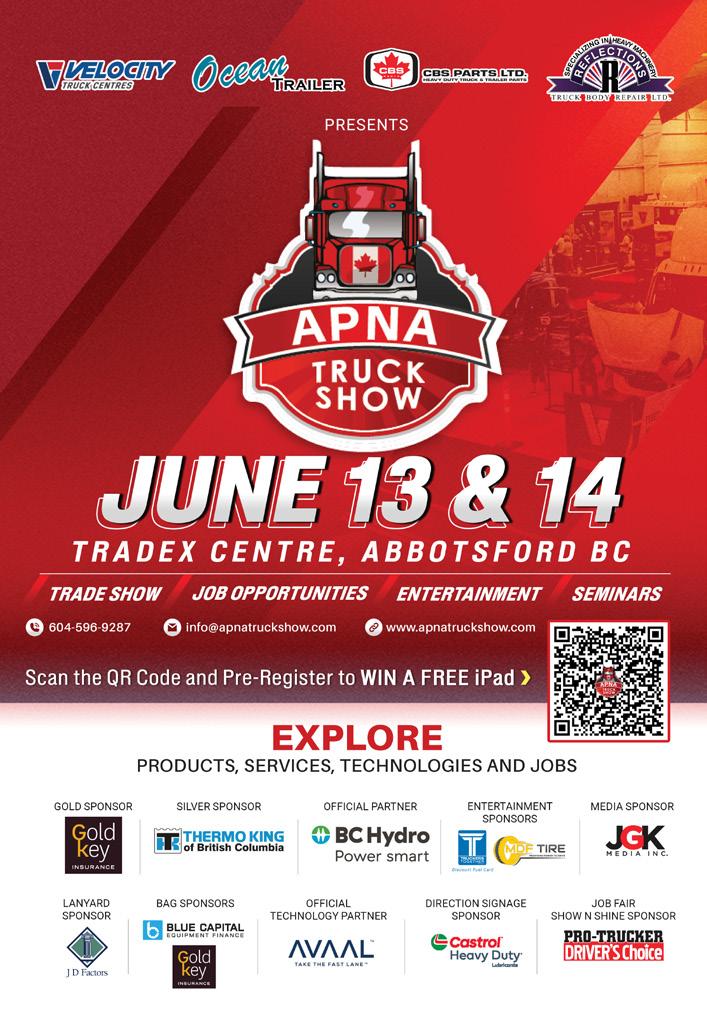
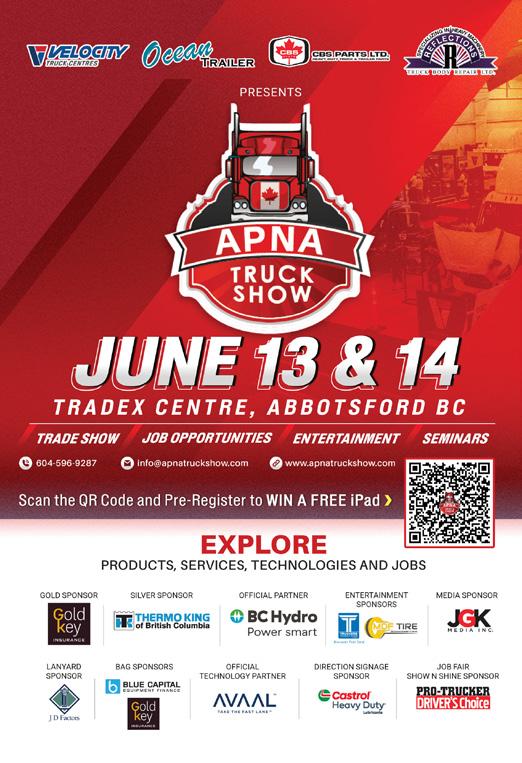
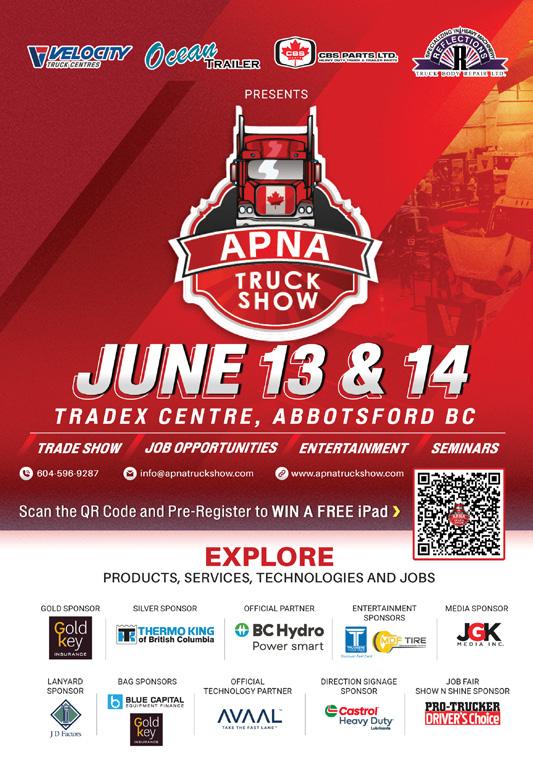
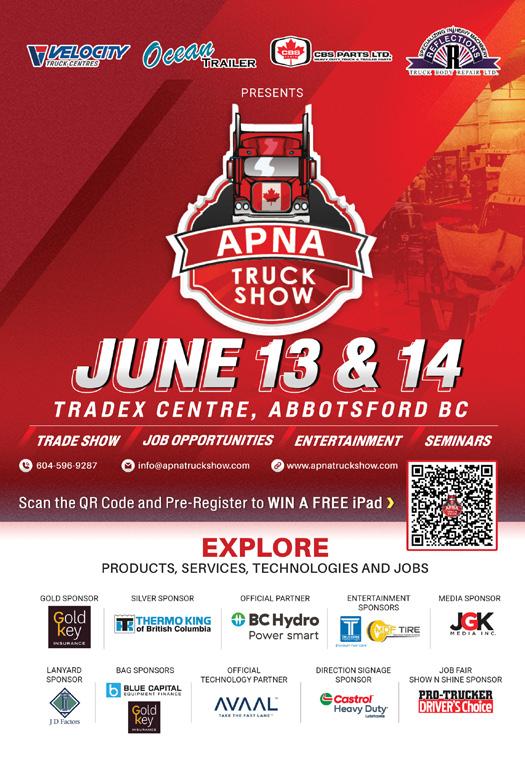
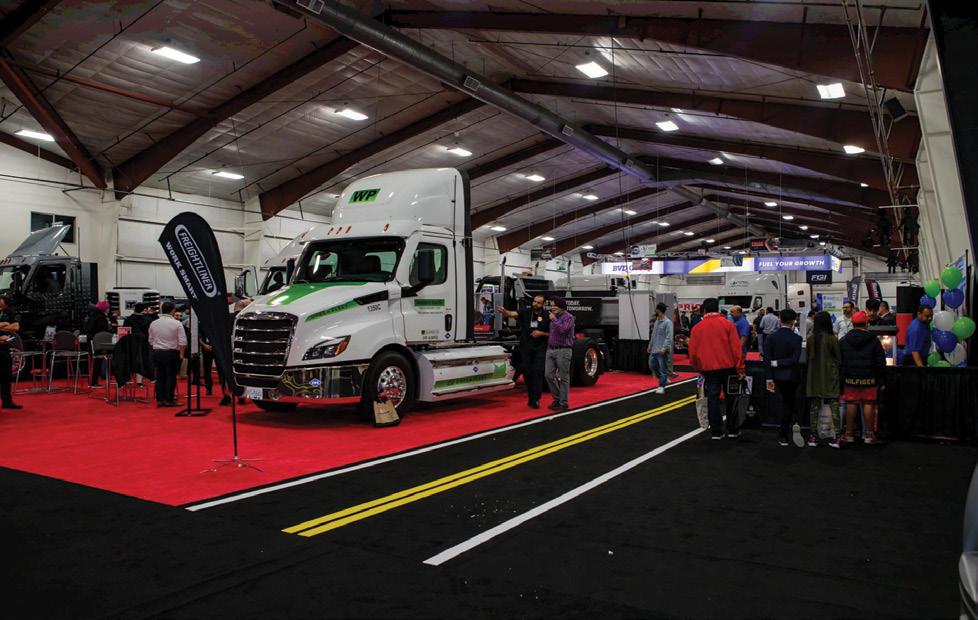
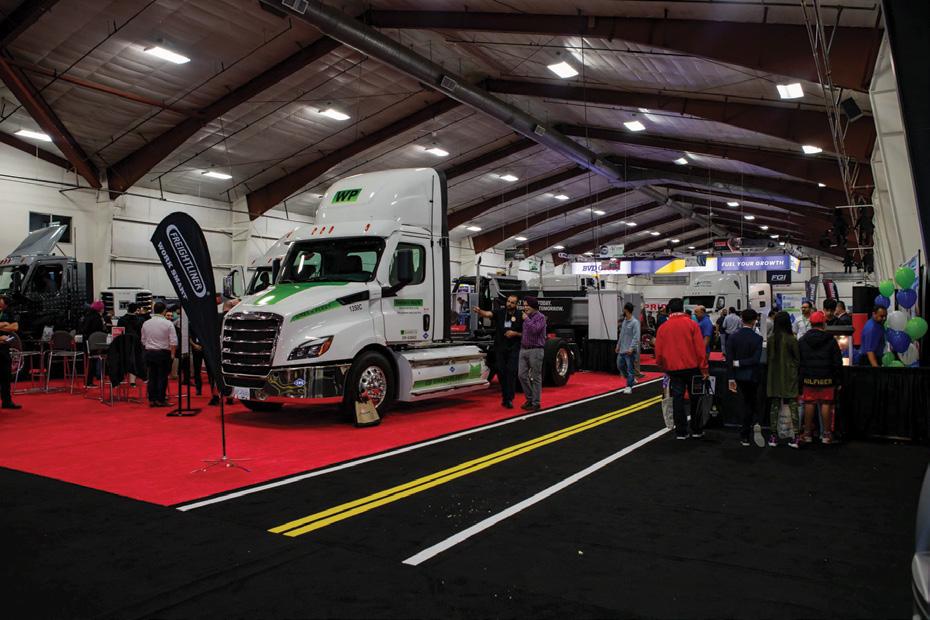
Iwant to personally invite you to come join me at the 2026 APNA Truck Show in Abbotsford. Every year this event just keeps getting better, and honestly, it’s one of those shows I always look forward to.
This year, it’s happening June 13th and 14th at the Tradex in Abbotsford, so mark your calendar now.
If you’re in trucking in any way—driver, owner-operator, fleet owner, or just someone who loves the industry—this is the place to be. It’s not just another trade show either. It’s actually the only trucking trade show in Western Canada, which makes it a pretty big deal for all of us out here.
What I like most about the APNA Truck Show is that it’s not just about trucks and equipment (even though there’s plenty of that). Yeah, you’ll see the latest gear, new technology, custom builds, and all kinds of vendors—but for me, it’s really about the people.
This is the spot where you run into old friends from the industry— the ones you haven’t seen in a while because everyone’s busy out on the road. Somehow, they all end up here. You shake hands, catch up, share a few stories, and it feels like no time has passed. That alone makes it worth coming out.
There’s also a great mix of everything going on. You’ve got some incredible trucks on display, live entertainment, food, and a really good atmosphere all around. It’s one
of those events where you can take your time, walk around, and actually enjoy yourself—not just rush from booth to booth.
And don’t come alone—bring your family or make it a boys’ day out with a group of guys from the industry. Seriously, it’s a great day out for everyone. Whether your kids want to check out the trucks or your crew just wants to hang out and take it all in, there’s something here for all ages.
I’ll be there for sure, and I’d really like to see you there too. If you’re coming, reach out, send me a message, or just come say hi when you see me. It’s always good to connect in person.
So make a plan, lock in the dates—June 13th and 14th at the Tradex in Abbotsford—and come out for the 2026 APNA Truck Show. It’s one of the best ways to stay connected to the industry and be part of what’s happening in Western Canada.
Hope to see you there. John White.
Marcel Larouche
There is nothing impressive about my looks. Not an athlete, a bodybuilder, or an intimidating structure in any way. What I do train for is to maintain good health, or as I often quote, “ healthy till I die”. I do have my preferred exercises (lifting my young grandkids), but diverse movements help maintain muscles often forgotten. Creative fitness means looking around, seeing a heavy rock, a piece of lumber, or an abandoned tire, and lifting it a bunch of times or taking it for a walk. Push-ups, squats and many other simple exercises are always available, unless you are shy, of course, someone might see you! Excuses for not working out are much easier to come up with than motivation and dedication, but I live with my motivational word “something”. That word forces me to find an hour to do something fitnessrelated. There is time while getting loaded/unloaded, pulled over for a break, walking around the yard with a backpack, or finding some way to do a creative exercise or take a nap.
Naps are great. That always
The GPS Argument
Driver’s GPS says, “Turn right.”
Driver says, “Nope.”
GPS: “Recalculating.”
feels good too. I really appreciated the vast collection of adventures that trucking has provided me. Provinces and states in all seasons but no matter what type of trucking you do there is a good chance that proper sleep was not a ritual you were known for, neither am I. Eating well takes discipline, fitness requires commitment but SLEEP!
Unless you have a 9-to-5 trucking routine, there is little chance that “circadian rhythm” has ever been part of your professional life! Not sure how many years I will lose due to that lack of organized sleep, but it doesn’t look promising, so I will stay focused on things that I can... Best quality nutrition possible in disciplined quantities, along with regular challenging exercises. It will have to do until my last trucking keys are pulled away from my cold, dead hands. Indeed, regular sleep matters, but ... is it just something I tell myself? When the load has to be there on schedule because we sure don’t want to upset our dispatcher, “go, go, go... no worries, you can sleep later” is BS. Yeah, sure, sleep later, LoL
Driver: “I’ve been running this route since before you were programmed.”
By Marcel Larouche
I tell my grandson that “later never happens,” and yet I really should listen to what I tell him! Take a nap,
Circadian rhythm matters... so yeah, do as I say... not as I do. I’ll sleep later. LoL
Whatever is your challenge, make sure it isn’t an excuse not to push yourself to be one notch better than you were yesterday. Just do it.
Check with your Doctor, not your lawyer!
GPS: “Make a U-turn.”
Driver: “Not happening.”
GPS: “Proceed to the highlighted route.”
Driver sighs and shuts it off.
Two miles later, he hits construction and a detour. He turns it back on.
GPS says, “Told you so.”
Computers
It seems to me that computers are taking over all the systems in cars and trucks. Something as simple as changing a light bulb on some cars requires you to plug in to a computer to reset the system after a new part is fitted. Although I thought the new LED lights were everlasting. Got a flat battery? You just can’t buy and fit a new one like you used to, the new one requires a hook-up to a computer so the system recognizes the new part that has been fitted. Need to fit new injectors? The long number on each injector has to be entered into the computer before the injectors will operate. There’s a lot to be said for running an older classic car or truck, especially if you like to do your own repairs, thereby saving money by avoiding paying the dealer’s prices.
I’ve noticed more and more new trucks over here have exterior cameras instead of mirrors. They say it’s better in bad weather because the normal mirrors outside the truck get wet and dirty. But with cameras outside, mounted high up on the cab away from the spray off the front wheel, and screens attached to the corner posts inside the cab, you get a clear view all the time. Until, of course, a relay or a fuse blows, then you’re blind on one side, or maybe
both. And if you’re driving on a three-lane highway in the middle lane, how do you know when it’s clear to pull over and stop?
At least if you break a mirror, you can maybe buy a new mirror glass, or tape some of the broken mirror back on as a getyou-home workaround. Although the days when drivers did their own running repairs are fading fast. I remember when I drove for a company called Lep Transport. I was coming home after a delivery and a reload in England, and I decided to stop for a break at a service station. I put my hand on the gearstick to change down, but it was disconnected and flopping about. At the time, this was a fairly modern cabover in which the gear lever was attached to the cab rather than to the gear linkage on the engine. I managed to use my momentum to get into the service station and parked off to the side, only using the brakes when I needed to.
At the time I was driving a day cab, a Seddon Atkinson with a Rolls Royce 265 hp diesel, the gearbox was clear of the cab, so it didn’t take much looking to see the rear engine mount
By Colin Black
Colin Black lives in Bellshill, Lanarkshire, Scotland and has been driving truck for over 40 years. His story shows us once again that the problems drivers face are universal.
was loose, the bolt was missing and the engine had dropped to the driver’s side taking the receiver for the gear stick with it, that was why the gearstick was flopping about.
There was no point looking for the nut and bolt; it might be miles away. I decided the best plan was to get the gearbox jacked up and tie the two halves of the mounting together with a rope. But I didn’t have a jack, back then spare wheels were considered unnecessary weight. If the truck’s tare weight is lower, more payload weight can go on the truck. But no spare wheel meant no need for a jack and tools to loosen the lug nuts. If you got a puncture, you phoned for a tyre man and waited an hour or two.
I asked around in the truck park and found a driver who had a jack. He let me borrow it for the time it took me to make the repair. Luckily, the rope lasted for the three hours it took to get back to my yard.
MADE FOR WHERE YOU’RE HEADED.
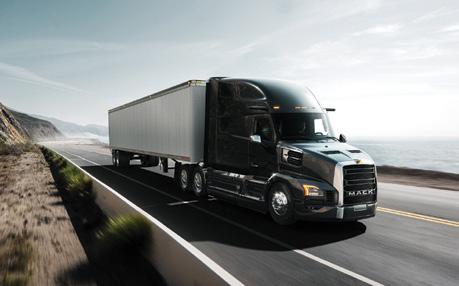
When the haul is long, every drop of fuel counts. Pioneerʼs enhanced aerodynamics and powertrain deliver up to 11% better fuel economy, engineered to go the distance without compromise.
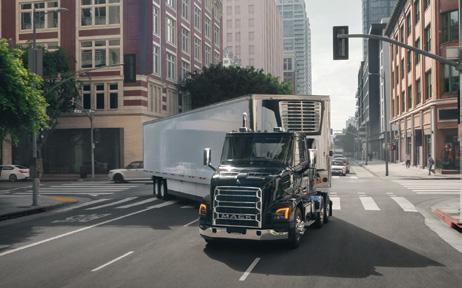
When regional routes get tight, precision matters. Anthemʼs redesigned frontal profile and reduced bumper-to-cab dimensions keep you in control through every turn, every block, and every delivery.
EXPLORE HIGHWAY
PERFECTED FOR THE ROAD AHEAD.
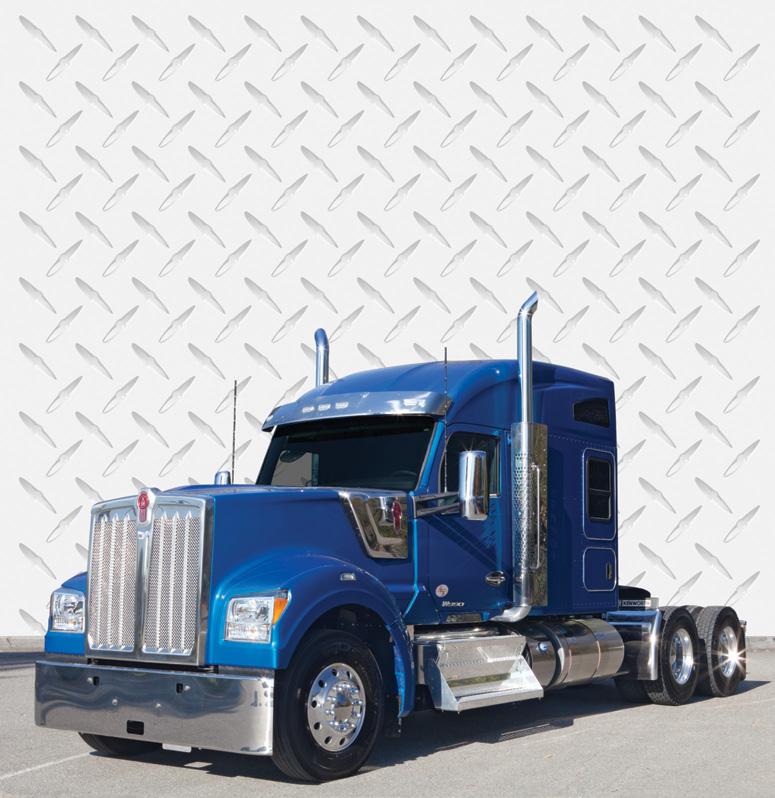
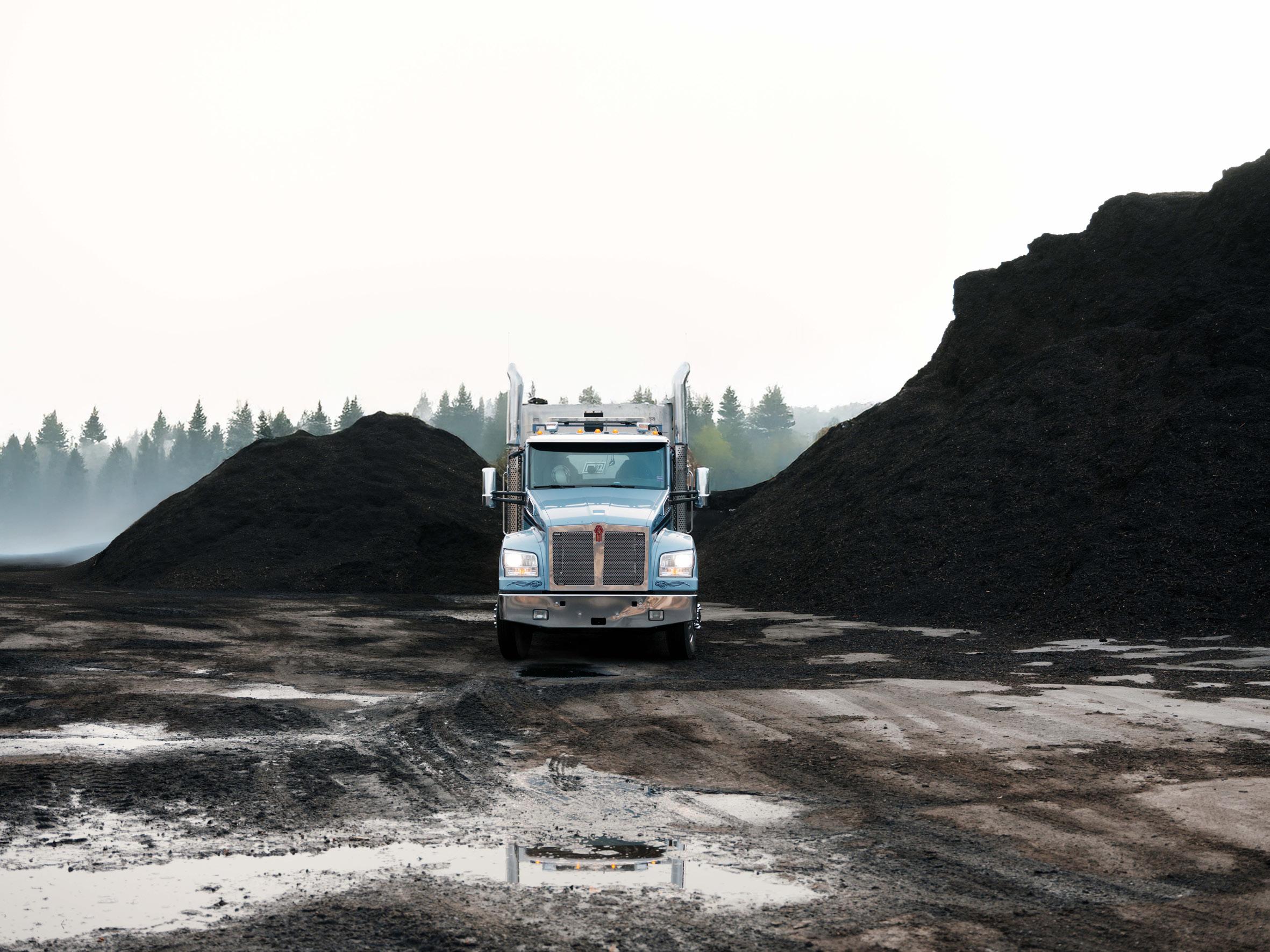
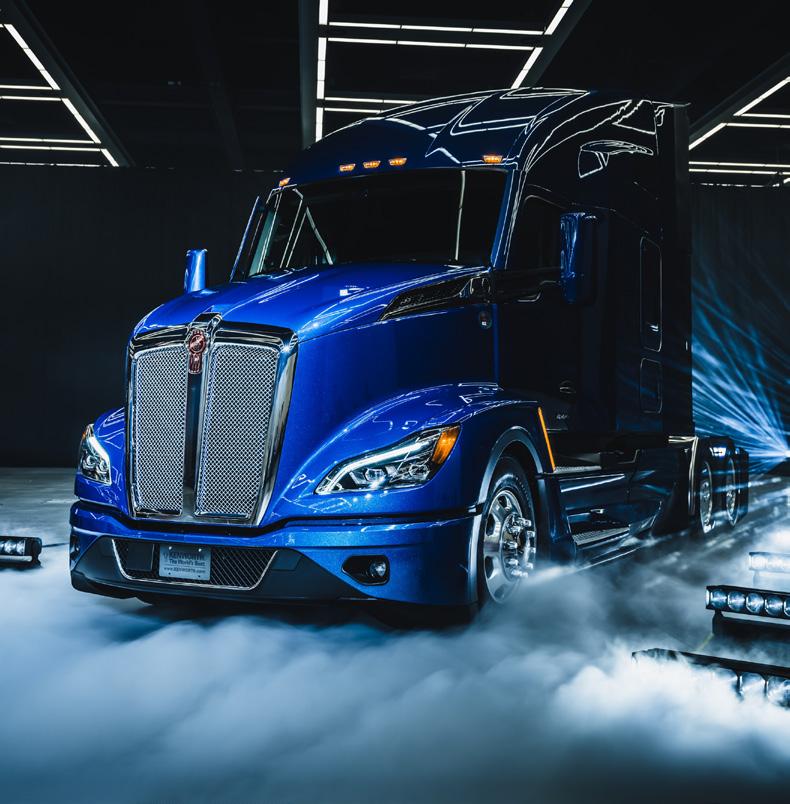
The pinnacle of Kenworth’s engineering: the T680, a masterpiece of aerodynamics designed for long-haul efficiency. This tractor combines a high-perfomance PACCAR powertrain with durable, easy-to-maintain components for unparalleled uptime. Enhanced with cutting-edge technology, it offers a driving experience that’s both intuitive and safe, reducing driver fatigue. The cabin, akin to the luxury found in top-tier automobiles, elevates comfort to new heights. Welcome to the next level of trucking with the Kenworth T680.
BCTA Brings “Ask an Expert” Sessions to APNA Truck Show
The BC Trucking Association (BCTA) is pleased to once again be part of the APNA Truck Show, taking place June 13–14. As one of the province’s most wellattended industry events, the show brings together carriers, suppliers, and stakeholders for two days of connection, business development, and insight into the issues shaping trucking in BC.
As part of this year’s event, BCTA will be sponsoring the Ask an Expert seminar series— an interactive feature designed to bring practical, real-world knowledge directly to
attendees. Rather than traditional presentations, these sessions focus on live Q&A, giving participants the opportunity to engage directly with subject matter experts and get answers to the questions that matter most to their operations.
The goal is simple: make expert insight more accessible. Whether it’s compliance requirements, safety considerations, or navigating dayto-day operational challenges, these sessions are intended to provide clarity and actionable information in a format that encourages open dialogue.
”Old age comes at a bad time.” (Ed Sullivan)
BCTA is currently working to bring together a strong lineup of experts from across the industry, including regulatory, safety, and insurance perspectives. More details on speakers and session timing will be shared in the lead-up to the show.
For BCTA, participation in the APNA Truck Show is about meeting industry where it is— on the ground, in conversation, and focused on practical solutions. Be sure to stop by on June 13 -14 and bring your questions. See you at the show!
”Old age is like a plane flying through a storm. Once you are aboard, there is nothing you can do about it.” (Golda Meir)
”The older I get, the more clearly I remember things that never happened. (Mark Twain)
”First you forget names, then you forget faces, then you forget to pull your zipper up; then, you forget to pull your zipper down.” (Rob Reiner)
”At age 20, we worry about what others think of us... at age 40, we don’t care what they think of us... at age 60, we discover they haven’t been thinking of us at all.” (Ann Landers)
”It’s paradoxical that the idea of living a long life appeals to everyone, but the idea of getting old doesn’t appeal to anyone.”(Andy Rooney)
”The older I get, the better I used to be.” (Lee Trevino)
”When your friends begin to flatter you on how young you look, it’s a sure sign you’re getting old.” (Mark Twain)
”Looking fifty is great — if you’re sixty.” (Joan Rivers)
”Time may be a great Healer, but it’s a lousy Beautician.” (Zsa Zsa Gabor)
Life’s journey is not to arrive at the grave safely in a well-preserved body, but rather to skid sideways, totally used up and worn out, shouting, ”Man, what a ride!” (Hunter Thompson)
PROUDLY CANADIAN
Peterbilt’s versatile lineup of medium duty and heavy duty trucks is designed to exceed the needs of customers in virtually any application. Our trucks feature durable construction, innovative safety technologies, spacious, comfortable interiors and a selection of proprietary PACCAR engines and transmissions for outstanding performance and efficiency. And, our trucks are proudly Made in Canada at our world-class facility in Ste. Therese, Quebec.
Visit your Peterbilt dealer to order your new trucks today!
Driving for Fuel Savings
One of the hardest things to do in the Trucking Industry is to get a customer to agree to a rate increase. As a driver or an owner-operator, you have little to no control over this. To ensure that you maximize the available profit on any run, you can choose to give the least amount of money possible to the Oil Companies. Driver wages and fuel are the two biggest expenses in any trucking operation. As an owner-operator, you pay the fuel bill, and as a company driver, you are responsible for ensuring the vehicle you operate stays profitable; otherwise, your pay cheque may bounce.
The easiest way to save fuel is to shut the truck off. Sounds simple enough, but for whatever reason, many drivers never do it. Trucks idling at the fuel island, idling while waiting to load or unload, and even idling while coupling and uncoupling trailers. Shutting a tractor off while coupling seems a bit extreme, but every minute counts, and if you are serious about saving fuel, those minutes add up to hours amazingly quickly. I have saved over an hour a day of idle time by shutting my truck off anytime the engine wasn’t doing something productive, including while at brake checks. A typical diesel engine burns four litres of fuel per hour of idling (more if you set it to high idle). Before Trump’s war, the price of diesel was about $2.00 per litre, (which hopefully will go down again soon.) At $2.00 per litre, the cost equals $8.00 per hour. I’m sure most drivers would like an eight-
dollar-per-hour raise.
Cutting back on your idle time is a first step to better fuel economy, the next is operating your vehicle as efficiently as possible. Rule one: never use the brakes while going uphill and never use the fuel while going downhill. Using the momentum of the vehicle to your advantage is a skill that takes practice and commitment to master.
When computer programs for engines are designed, they establish two key settings that a driver should understand if they want to operate efficiently. The engine RPM range that will give you Peak torque to the wheels and Peak Horsepower , as well as the maximum or governed RPM. Most big block diesel engines (12 to 16 litre engines) have a rated RPM of 2100, and the medium duty engines are typically 2600 RPM but check the specification plate on your engine to be sure. Understanding how torque and Horsepower impact your driving is key to driving efficiently.
Torque
In the trucking industry, torque is measured in foot-pounds and is a rotational force or twist that gets your drive shaft and tires moving. The higher the number, the more power the engine generates. It increases from the idle speed of the engine to the RPM that generates peak torque according to your engine’s spec. Commonly, today’s new big-block engines achieve peak torque at 900 to 1000 RPM and maintain it right through to 1500 to
By Andy Roberts President Mountain Transport Institute
Horsepower (HP)
The definition of HP is the rate at which work is done. One HP is equivalent to 550 foot-pounds per second of work. Most of our big block diesel engines develop peak HP between 1500 and 1700 RPM.
Engine Brake (Jake Brake)
To slow your vehicle down or hold it back while descending mountains and hills, most engines are equipped with a compression brake. These brakes are most powerful at high RPM, typically up to 2100 for big-block diesels. It is important to note that when the engine brake is activated, you are not using any fuel.
Using all of this information to operate your vehicle efficiently is quite simple if you understand a couple of things. Every revolution of the engine (RPM) results in fuel being injected into each cylinder (except engine brake usage or coasting in gear). Your transmission (torque multiplier) allows you to optimize the use of your power and use the least amount of fuel. The more gears you have, the easier it is to optimize fuel economy. The less RPM you use, the less fuel you burn. Progressive shifting is a technique
that saves fuel, gets you up to speed quicker and makes the transmission easier to shift. The definition of progressive shifting is “Shifting to the next highest gear at the lowest possible engine RPM that will allow you to keep accelerating.”
When starting out in low or first
Sadly Dave Madill passed on May 1st, 2025. He will always be fondly remembered and missed.
gear, even with a fully loaded supertrain, you don’t require peak torque or peak HP to get the load moving. The gear reduction available with the transmission and rear axle ratio combination will allow it to start out easily. Accelerating to 8 or 900 RPM is enough to allow you to select the next highest gear and repeat for the
next gears until you get into the high side of the transmission. Once you are in high range, there is more road speed in every gear, and you now need to accelerate to about 1400 RPM, so when you finish your next upshift, you will still be in the peak torque to allow.
JUNE 13 & 14
GET YOUR FREE TICKET TODAY!
Wander
I roam across the nation from sea to shining sea
The highways and the byways are old, old friends to me.
Across mountains and across plains, through forest and shifting sand,
I never cease to wonder at the glory of this land.
The beauty of a sunset, the wonder of a storm
The beauty of this nation makes me glad that I was born.
The vision through my windshield shows the beauty of this land, A land of peace and plenty, touched by God’s mighty hand.