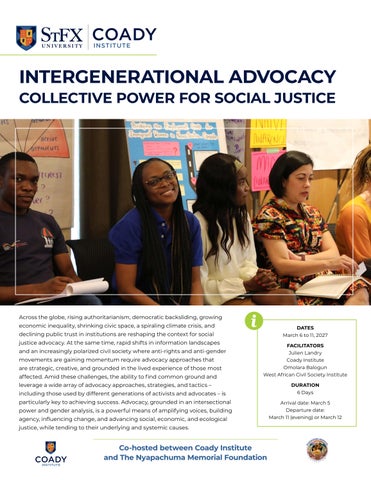
INTERGENERATIONAL ADVOCACY COLLECTIVE POWER FOR SOCIAL JUSTICE
Across the globe, rising authoritarianism, democratic backsliding, growing economic inequality, shrinking civic space, a spiraling climate crisis, and
DATES March 6 to 11, 2027
declining public trust in institutions are reshaping the context for social justice advocacy. At the same time, rapid shifts in information landscapes and an increasingly polarized civil society where anti-rights and anti-gender movements are gaining momentum require advocacy approaches that are strategic, creative, and grounded in the lived experience of those most affected. Amid these challenges, the ability to find common ground and
FACILITATORS Julien Landry Coady Institute Omolara Balogun West African Civil Society Institute
leverage a wide array of advocacy approaches, strategies, and tactics – including those used by different generations of activists and advocates – is
DURATION 6 Days
particularly key to achieving success. Advocacy, grounded in an intersectional
Arrival date: March 5
power and gender analysis, is a powerful means of amplifying voices, building
Departure date: March 11 (evening) or March 12
agency, influencing change, and advancing social, economic, and ecological justice, while tending to their underlying and systemic causes.
Co-hosted between Coady Institute and The Nyapachuma Memorial Foundation
This six-day course is a response to this challenge, focusing on the potential of intergenerational learning, collaboration, and struggle to strengthen advocacy. Every generation of advocates bring distinct experiences, knowledge, relationships, perspectives, and approaches to social change: from the wisdom and legacies of elders who have participated in liberation and anticolonial struggles to the courage, creativity, and leadership of young people, who are showing from Kenya to Kathmandu, that broadbased advocacy can lead to transformative change. Through an intersectional and decolonial lens, the course aims to equip people of all genders with a rights-based and strategic framework for advancing justice, while strengthening connections, knowledge exchange, and opportunities for collective action across generations. Through dialogue, experience sharing, reflection, and practical application, participants will explore how established and evolving forms of advocacy – from evidencebased policy engagement and community organizing to digital activism, storytelling, and movement-building – can be combined to build collective power for social change. It explores advocacy as a purposeful practice for challenging unequal power and influencing the policies, decisions, practices, and narratives that shape people’s lives. Participants will deepen their understanding of power, gender, human rights, and intersecting inequalities while developing practical skills to design, implement, communicate, and assess effective advocacy strategies. The course uses an experiential, learner-centred approach that draws on participants’ knowledge and experiences. Through dialogue, case studies, small-group discussions, field visits, and practical exercises, participants will strengthen their advocacy skills and apply an advocacy planning process to issues relevant to their own work.
y Are interested in exploring how intergenerational approaches could strengthen their work; and y Are committed to actively participating in the course and applying their learning afterward. Young people (age 35 and under) who meet these criteria are especially encouraged to apply. There are no geographic restrictions for participation. Participants are responsible for arranging and paying for their travel to Lusaka, Zambia. The course is delivered in English, and participants require sufficient English proficiency to participate fully in course activities.
Time requirement The course is delivered over six days in Lusaka, Zambia. Participants must attend all six days to complete the course.
Fees and Expenses: The tuition fee is $2500.00 CAD, payable by bursary. The Coady Institute is committed to ensuring that practitioners and community members dedicated to community-led development worldwide have access to its courses. With the generous support of individual, institutional, and corporate donors, accepted participants will receive a full tuition bursary for the course. The bursary covers: y Full course tuition ($2500.00 CAD) y Hotel accommodation and applicable taxes during the course.
Personal benefits
y Return ground transportation between Lusaka Airport and the hotel
By the end of this course, participants will be able to:
y Lunches during the program
y Define advocacy and explain the different types and approaches used by advocates;
y Breakfast at the hotel
y Apply an intersectional power/gender analysis to advocacy issues in the context of your own work; y Explain the principles, practices, and benefits of peoplecentered and intergenerational advocacy;
y Dinner one group dinner during the course. Participants are responsible for all personal expenses and incidental costs, including: y Additional hotel nights outside the course travel dates
y Describe the key steps in applying a strategic planning framework for intergenerational advocacy;
y Personal and other incidental expenses
y Analyze a variety of advocacy strategies, tactics, and tools used to enhance agency, equity, and justice;
y Transportation expenses, including:
Produce a learning project to support (intergenerational) advocacy planning in your own work towards social justice.
y Bus, train or car service transportation, where applicable
Who can apply?
y Travel and emergency medical insurance
This course is designed for advocates and activists, members of organizations and social movements, and allies in the public and private sectors who:
y Meals while travelling/in transit
y Have at least two years of experience working toward equitable social change; y Are currently involved in advocacy;
y Guest-related expenses y Return airfare y Visa fees
y Dinners in Lusaka, except for the one group dinner
For more information, and to apply, visit coady.stfx.ca.
Established in 1959, Coady Institute is committed to accompanying generations of global leaders skilled in the application of citizen-led, asset-based, and community-driven leadership for economic and social change. Located in Mi’kma’ki, the ancestral and unceded territory of the Mi’kmaq People, on the campus of St. Francis Xavier University, Antigonish, Nova Scotia. Coady Institute includes a network of leaders in 130 countries globally.