2026
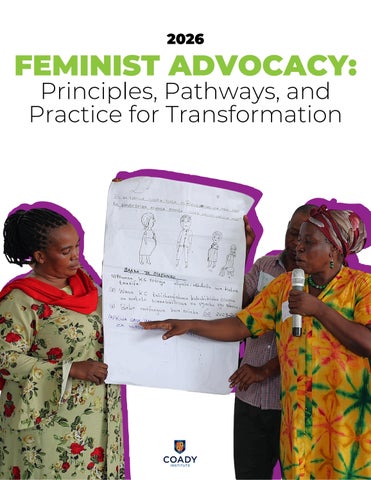
FEMINIST ADVOCACY: Principles, Pathways, and Practice for Transformation
This research was conducted by Coady Institute and partners with the Christian Commission for Development Bangladesh (CCDB), and the Tanzania Gender Networking Programme (TGNP) as part of the Engage! Women’s Empowerment and Active Citizenship Initiative.
2026 © Coady Institute, St. Francis Xavier University (StFX)
Creative Commons Attribution-NonCommercial-ShareAlike 2.5 Canada License http://creativecommons.org/licenses/by-nc-sa/2.5/ca/
All or parts of this publication may be copied and distributed for non-commercial purposes without requesting written permission, provided the author(s) and Coady Institute are explicitly acknowledged as the source of the material. Any work adapted from this material must also be made available to others under identical terms.
This study is part of the Engage: Women’s Empowerment and Active Citizenship project and is funded by Global Affairs Canada.
For more information about the research and the report, please contact: Coady Institute
www.coady.stfx.ca
St. Francis Xavier University
coady@stfx.ca
P.O. Box 5000
+1 902 867 3960
Antigonish, NS, Canada, B2G 2W5
1 866 820 7835 (within Canada)
Feminist Advocacy: Principles, Pathways, and Practice for Transformation S. Sinha1, J. Landry1, M.Y. Munniara2, A. Sangai3, R. Das Gupta2, F. Ndaba3, J. Ghosh2
1
Coady Institute, Canada Christian Commission for Development in Bangladesh 3 Tanzania Gender Networking Programme 2
Introduction In an era of shrinking democratic spaces, growing divisions, rising ethnonationalism and deepening colonial patterns, feminist advocacy is central to amplifying the voices of the most excluded people in society, sustaining hope through social movements, and advancing demands for justice. In this Learning Paper, we attempt to unpack feminist advocacy by articulating guiding principles and patterns (or pathways) in how it is practiced. We draw from the work of people’s organisations in Tanzania and Bangladesh to co-develop understandings of feminist advocacy that are mindful of, and grounded in, the contexts and lived experiences of the communities doing it. We approach this task critically, mindful of the role of repressive institutions, policies, social norms, and development itself. While feminist advocacy seeks positive change in all these arenas, questions emerge about whose voices are amplified, whose labour sustains the advocacy efforts, and whose priorities shape the agenda. We examine advocacy through an intersectional and decolonial lens, arguing that transformative feminist advocacy must operate on both levels: pushing against oppressive systems, while remaining rooted in, and driven by, the communities most affected by those systems.
About this Learning Paper From the outset, many questions arose for us: What does feminist advocacy mean to communities and collectives across vastly different cultural and sociopolitical contexts? What does it mean to those who don’t (or can’t openly) identify as feminists? How can feminist advocacy be practiced, adapted, and reinvented in support not only of intersectional justice and structural transformation, but also of improved governance, public services, and infrastructure? What are feminist advocacy’s key tactics, strategies, challenges, and impacts? We also recognized that exploring these becomes particularly poignant at a time when populist and authoritarian politics, anti-rights movements, exclusionary capitalist paradigms, and a spiralling climate crisis are gaining momentum as compounding barriers to meaningful inclusion across gender, race, class, caste, religion, and many more dimensions.
4
As such, in this Learning Paper, we outline a set of pathways towards feminist advocacy and how they are expressed across diverse contexts. We begin by articulating principles to guide feminist practice generally; second, we present pathways for applying a feminist practice to advocacy based on the voices and interpretations of feminist advocacy efforts we have directly or indirectly supported in local, grassroots communities in Tanzania and Bangladesh; and finally, we offer a few critical reflections, and conclusions based on those experiences. Throughout the paper, we reflect some of what we have learned alongside communities and collectives, hoping it provides insights that can be taken forward and adapted further by other feminist advocates.
Who are “We”? We are a team of feminists (whether that term is used or not - see Challenges section), practitioners, advocates, educators, activists, learners, researchers, and allies from Bangladesh, Canada, India, and Tanzania, some with a nascent relationship to feminism, others with decades practicing its core principles. Since 2022, we have facilitated and/or participated in workshops and trainings on feminist advocacy, and have accompanied cohorts and collectives of advocates from across Sub-Saharan Africa, South Asia, and the Caribbean on their paths towards feminist advocacy. Specifically, the work and findings we present here took place as part of an initiative called ENGAGE! – Women’s Empowerment and Active Citizenship (see Coady Institute, n.d.) and was co-led by Coady Institute (Canada), the Christian Commission for Development in Bangladesh (CCDB), and the Tanzania Gender Networking Programme (TGNP). In each country, the coleading organizations either implicitly (e.g., CCDB) or explicitly (e.g., TGNP and Coady Institute) apply feminist principles and collective mobilization to their work with communities. CCDB’s work with ‘Women’s Groups’ is aimed at enhancing the collective voice and agency of grassroots women in shifting local social norms, influencing public budgets, and directly advocating with local decision makers (CCDB, 2026). TGNP’s work with ‘Knowledge Centres,’ as feminist learning and organizing hubs, anchors its transformative feminist approach and Intensive Movement Building Cycle (TGNP, 2021). Coady Institute, as a social justice oriented educational institution, weaves feminist principles and practice into many of the courses, workshops, programs, and partnerships it supports, including its trainings on Feminist Advocacy.
5
How did we go about this? Coady Institute facilitated two 6-day feminist advocacy workshops in Tanzania (October, 2022) and Bangladesh (March, 2023) respectively, bringing together advocates interested in applying a feminist approach to their advocacy. In Tanzania, five staff from TGNP and a representative from three allied civil society organizations – Participatory Ecological Land Use Management Association (PELUM), Binti Makini, and Glaring Future Foundation – participated, while 33 staff participated from CCDB in both workshops combined. These workshops facilitated critical learning aimed at: contextualizing feminism across diverse social-political and cultural realities; developing the analytical and practical skills for strategic advocacy planning; and, designing strategies for feminist advocacy based on those two pillars. About a year later, building on our program monitoring, evaluation and learning, we gathered groups of workshop participants in facilitated discussions to explore how they had applied their learning in their feminist advocacy practice. We explored what feminism and feminist advocacy means to them now, what it looks like, and the challenges and successes along the way. In Tanzania, we also conducted focus group discussions (FGD) with training participants, and with members of TGNP’s Knowledge Centre in the community of Majohe. In Bangladesh, we conducted two FGDs with training participants, including the use Photovoice (see, e.g., Rutgers, 2006), a methodology for creative reflection, analysis, and visual storytelling related to feminist advocacy. At the community level, we facilitated one FGD with women’s advocacy groups (Women’s Group members), and two key informant interviews – with a local government official and a local civil society leader – in two coastal subdistricts (upazilas) where CCDB has supported feminist advocacy campaigns and capacity building: Shyamnagar and Patharghata. What follows are some of our learnings: themes and reflections that emerged from our analysis of these conversations, which were validated and refined in dialogue among our team. Against this backdrop, we outline principles that can guide effective feminist practice, and set out a few pathways for towards a feminist advocate1 practice.
1
In this publication we us the term “advocate” to refer broadly to the individuals and groups leading or participating in any advocacy effort, as opposed to its narrower definition referring to a legal professional.
6
Debunking the F-Word: Myths, Principles, and Transformation First, we let go of the myth that feminism is just about women. This view is a product of a capitalist, racist, colonial, and patriarchal view, which eclipses feminism’s inclusive and intersectional nature and its concern about entire spectra of marginalized communities, including men, LGBTQIA+ individuals, people with disabilities, and many others. Conceptualizing feminism as a dynamic and diverse ideology grounded in lived experience, confronting stigma, and aiming at structural transformation, positions it as a justice-oriented frame through which to strategize, plan, and, of course, do advocacy. So, what are some guideposts to do this? Based on collective and experiential learning with groups of advocates and grounded in core values of respect, inclusion, equality, sustainability, and peace, a few principles emerge to guide a feminist practice that is:
INTERSECTIONAL Apply a power analysis that is intersectional in nature and recognizes the full range of identities (e.g., gender, race, caste, ability, religion, ethnicity) and issues (e.g., gender-based violence, land rights, climate vulnerability) that compound exclusion.
EMPOWERING Build agency for any and all excluded groups, (de-)centring on the most disadvantaged.
PARTICIPATORY Draw on participatory approaches and knowledge co-creation that value lived experience and a plurality of knowledges from a decolonial standpoint.
7
PEOPLE-LED Guided by these values and principles, the process of feminist transformation thus involves reframing issues through an intersectional lens, challenging social and cultural norms, often pushing against organizational structures and cultures, centring ownership and decision making in communities, and drawing on horizontal leadership, movement building, and collective strength to shift power (Brown, 2016; hooks, 2014). In other words, the means (process, strategy, tactics) must reflect the ends (gender, economic, political and ecological justice).
Entrust power and leadership in the hands of the most affected people in the communities and constituencies.
NONVIOLENT Ground the work in nonviolence and solidarity.
REFLEXIVE Foster critical (self-) reflection and dialogue.
RELATIONAL Nurture relationships based on mutual respect and unity in diversity.
8
Feminist Advocacy: Pathways and Practice What does advocacy look like when guided by the above principles? In this section, we outline seven pathways that can inform and be woven into feminist advocacy practice. These highlight the multidimensional nature of advocacy, especially across contexts where gender, power, and community issues intersect in diverse ways.
Awakening Consciousness, Agency, and Voice At the heart of feminist advocacy is the awakening and strengthening of agency, voice, and leadership from the standpoint of the most excluded people. Personal transformation, confidence-building, finding one’s voice and feminist consciousness is often a precursor to engaging in advocacy. This process of conscientization (Freire, 1970/2017) – through tactics like popular education, Theatre of the Oppressed (Boal, 1979), Photovoice, leadership training – enables individuals to recognize their oppression and to develop skills and strategies to take action against it. Self-advocacy, sharpened communication and negotiation skills, and identity reclamation become powerful levers in doing this.
“ N ow we a re n o l o n g e r a f ra i d . We c a n s p e a k , we c a n m e e t l e a d e r s , eve n t h e m e m b e r s o f Pa r l i a m e n t .” - Co m m u n i t y m e m b e r o f T G N P ’s K n ow l e d g e Ce n t re i n M a j o h e , Ta n z a n i a .
“ Wo m e n h a ve n ow l e a r n e d h ow to s p e a k u p. T h ey u n d e r s ta n d e q u a l i ty, j u s t i c e , a n d r i g h t s . Eve n w i t h o u t b e i n g e l e c te d , t h ey k n ow h ow to a p p ro a c h t h e Pa r i s h a d to c l a i m t h e i r r i g h t s . T h i s i n s p i re s m e to wo r k f o r t h e m .” - U n i o n Pa r i s h a d Co u n c i l l o r , S h ya m n a g a r , B a n g l a d e s h
9
Agency through Advocacy and Community Service “ S h e [ a c o m m u n i ty m e m b e r] re c e i ve d l e a d e r s h i p d eve l o p m e n t a n d a d vo c a c y t ra i n i n g f ro m t h e CC D B E n g a g e p ro j e c t . S i n c e then, she has been boldly participating in va r i o u s d eve l o p m e n ta l a c t i v i t i e s i n t h e s o c i e ty. S h e re c e n t l y a d vo c a te d f o r a wa te r p l a n t . S hya m n a g a r U p a z i l a o f S a t k h i ra d i s t r i c t i s a d i s a s te r- p ro n e a re a . D i s a s te r s a re a c o n s ta n t c o m p a n i o n h e re . W h e n va r i o u s d i s a s te r s o c c u r, s h e d o e s n o t s i t a t h o m e . W h e n s h e re c e i ve s a s i g n a l o f d a n g e r, s h e u s e s a m i c ro p h o n e to m a ke eve r yo n e a wa re a n d ta ke s t h e e l d e r l y [ i n p h o to ] a n d c h i l d re n to t h e c yc l o n e c e n t re . I n t h i s wa y, s h e i s s e r v i n g t h e p e o p l e o f t h e s o c i e ty.” – CC D B s t a f f , S h ya m n a g a r , B a n g l a d e s h
Challenging Power Across the Private-Public Nexus Feminist advocacy involves challenging power in both its visible and invisible forms, and across the private-public continuum. It often begins with women pushing for change within the family and home life (e.g., resisting domestic violence, balancing care work with public life, negotiating with husbands), alongside advocating in public. Negotiating invisible power, such as patriarchal and gender norms in private, becomes significant in liberating women’s and girls’ participation in confronting formal power structures in public. This pathway also highlights the importance of working with men and boys towards shifting gender norms, reinforcing positive masculinities, and addressing invisible power across the private-public continuum.
10
Challenging Power in the Home “ I ex p e r i e n c e d d o m e s t i c v i o l e n c e . M y h u s b a n d u s e d to l i s te n o n l y to h i s s i s te r, w h o wo u l d t u r n h i m a g a i n s t m e . H e wo u l d b e l i eve h e r w i t h o u t a s k i n g m e a n d to r t u re m e . Eve n t u a l l y, I d e c i d e d I ’d s ta n d f o r a l l wo m e n f a c i n g s u c h a b u s e . I l e f t my h u s b a n d ’s h o m e a n d to o k s h e l te r i n a B R AC f a c i l i ty. N ow I s u p p o r t o t h e r wo m e n .” – M e m b e r o f Wo m e n ’s G ro u p, S h ya m n a g a r
“ I n my f a m i l y, I c o nv i n c e d my h u s b a n d to c h a n g e . H e u s e d to spend all his income helping others, leaving nothing for our h o u s e h o l d .” – M e m b e r o f Wo m e n ’s G ro u p, S h ya m n a g a r
“ N ow o u r h u s b a n d s s e e t h a t we k n ow m a ny t h i n g s a n d h a ve i n f o r m a t i o n . T h ey va l u e u s . T h ey d o n ’ t o b j e c t to u s g o i n g o u t a n d d o i n g s o c i a l wo r k .” – M e m b e r o f Wo m e n ’s G ro u p, Pa t h a rg h a t a
“A d vo c a c y a l s o s ta r t s a t h o m e . M y i n - l a w s n eve r u s e d to va l u e my o p i n i o n . B u t n ow t h ey l i s te n a n d eve n a s k f o r my t h o u g h t s .” - M e m b e r o f Wo m e n ’s G ro u p, S h ya m n a g a r
“ C h a n g e b e g i n s w i t h t h e f a m i l y a n d t h e n s p re a d s to s o c i e ty.” - M e m b e r o f Wo m e n ’s G ro u p, Pa t h a rg h a t a
11
From Voicelessness to Budget Advocate and Standing Committee Member “ Wo m e n i n o u r a re a s a re d e p r i ve d eve r y w h e re : i n t h e f a m i l y a n d i n s o c i e ty. N o o n e h e a r s t h e i r vo i c e . N o p a r t i c i p a t i o n i n d e c i s i o n making. We a re ra i s i n g t h e i r a wa re n e s s a b o u t t h e i r r i g h t s a n d e n t i t l e m e n t s . I n o u r wo r k i n g a re a , s o u rc e s o f s a f e d r i n k i n g wa te r a n d s a n i ta t i o n a re ve r y m u c h a f f e c te d by d eva s ta t i n g c yc l o n e s , m a k i n g wa te r s a l i n e a n d d a m a g i n g s a n i ta t i o n i n f ra s t r u c t u re e a c h a n d eve r y ye a r. Wo m e n d o n ’ t k n ow l o c a l g ove r n m e n t h a s a Wa te r a n d S a n i ta t i o n ( WATS A N ) Co m m i tte e a n d f u n d a l l o c a t i o n to i m p rove t h e s e c to r.
A f te r re c e i v i n g f e m i n i s t a d vo c a c y t ra i n i n g , we s a t to g e t h e r a n d s h a re d t h e i n f o r m a t i o n w i t h t h e m . O u r wo m a n l e a d e r s we n t to U n i o n Pa r i s h a d a n d f o u n d o u t t h a t t h e d eve l o p m e n t b u d g e t wa s ve r y p o o r a c c o rd i n g to t h e U n i o n p o p u l a t i o n . I n a p re - b u d g e t m e e t i n g a t t h e wa rd l eve l , wo m e n ra i s e d t h e i r vo i c e to i n c re a s e t h e b u d g e t i n t h e s e c to r a n d s o u g h t re p re s e n ta t i o n i n t h e WATS A N Co m m i tte e . T h ey b o u n d t h e U n i o n Pa r i s h a d to h o s t a n O p e n B u d g e t m e e t i n g w h e re a g a i n t h ey ra i s e d t h e i r vo i c e to i n c re a s e t h e wa te r, s a n i ta t i o n a n d h e a l t h ( WA S H ) b u d g e t . T h e l o c a l g ove r n m e n t re s p o n d e d w i t h a 1 5% i n c re a s e ove r t h e p rev i o u s ye a r a n d i n c l u d e d two wo m e n i n t h e WATS A N Co m m i tte e . A s a re s u l t , c o m m u n i ty p e o p l e a re g e tt i n g ra i nwa te r h a r ve s te r s , s o l a r p o n d s a n d f i l te r s , hyg i e n e to i l e t s , a n d g ra d u a l l y, d r i n k i n g wa te r s o u rc e s - a n d hyg i e n e c o n d i t i o n s a re i m p rov i n g .” - A d a p te d f ro m CC D B s t a f f ’s P h o tovo i c e s u b m i s s i o n
12
Engaging Men and Masculinities “ Wo m e n m a y b e p e rc e i ve d [ a s ] p owe r f u l r i g h t n ow b u t t h e re a re s o m e o t h e r c o n n o ta t i o n s b ro u g h t a b o u t f o r t h e m b e i n g p owe r f u l . T h e re ’s t h e i s s u e o f t h e m a l e p a r t n ow, wa n t i n g m o re i nvo l ve m e n t , f e e l i n g l i ke t h ey ’ re n e g l e c te d i n a wa y. [ M a y b e ] b e c a u s e [ t h e wo m e n ] f e e l ve r y we l l e m p owe re d a n d w h e n t h ey g o b a c k a t h o m e , m a y b e t h ey ’ re p e rc e i ve d d i f f e re n t l y by t h e i r p a r t n e r s . Fo r t h e m , wa n t i n g t h e m e n to b e a p a r t o f t h e p ro j e c t , t h e n i t ’s m o re a b o u t b r i n g i n g s o m e s o r t o f b a l a n c e i n a wa y w i t h i n t h e f a m i l y o f t h e h o u s e h o l d l eve l .” – T G N P s t a f f , Ta n z a n i a
“ Wo m e n c o m e f o r wa rd . Prev i o u s l y, m e n t r i e d to s to p u s , b u t n ow t h ey c o m e w h e n we c a l l t h e m . T h ey s u p p o r t u s a n d h e l p u s .” – M e m b e r o f Wo m e n ’s G ro u p, Pa t h a rg h a t a
“A s a d a u g h te r, a s a s i s te r, I wa s re a d y to a c c e p t m a ny t h i n g s b u t a f te r f e m i n i s t a d vo c a c y t ra i n i n g , I s h o u l d s p e a k n o t o n l y f o r m e b u t f o r m a ny g i r l s . I a l s o c h a n g e d my m i n d s e t a b o u t m a l e p i e c e . I a l wa y s [ t h o u g h t ] a b o u t m a s c u l i n i ty [ i n te r m s o f ] m a l e s a l wa y s [ d o m i n a t i n g ] t h e g i r l s . I l ove t h e wa y [ to s h ow ] t h e m e n t h a t re s p e c t i s re a l m a s c u l i n i ty.” – CC D B s t a f f , B a n g l a d e s h
Fostering Collective Action, Leadership, and Allyship Feminist advocacy is effective when it moves from an individual focus to collective, strategic action. As such, spaces where women and other constituencies already coalesce (e.g., Women’s Groups, savings and credit cooperatives (SACCO), associations, Knowledge Centres) serve as platforms for existing collective leadership and decision-making that can be leveraged towards advocacy. Alongside collective leadership, the role of supporting allies and intermediaries (e.g., values-aligned NGOs, supportive men and boys) is key in navigating power, amplifying advocacy messages, brokering relationships (e.g., with local governments and policymakers) showing strength through unity, and influencing institutions.
13
The Power of Numbers and Pressure Tactics “A f te r o u r t ra i n i n g o n f e m i n i s t a d vo c a c y, we b ro u g h t to g e t h e r c o m m u n i ty m e m b e r s f ro m M o r re l g a n j to ra i s e vo i c e f o r t h e c o m m o n i s s u e s . S o, t h ey a r ra n g e d a h u m a n c h a i n a n d p e t i t i o n e d l o c a l a n d n a t i o n a l a u t h o r i ty to p re s s u re f o r a n n u a l r i ve r b a n k e ro s i o n p ro te c t i o n . A s a re s u l t , t h e g ove r n m e n t h a s ta ke n i n i t i a t i ve s to p ro te c t r i ve r b a n k e ro s i o n ( e .g , g e o b a g f i l l i n g , c e m e n t c o n c re te b l o c k s o l i n g ) .” – A d a p te d f ro m P h o tovo i c e s u b m i s s i o n , CC D B , B a n g l a d e s h
“ I t ’s i m p o r ta n t b e c a u s e t h ey we re a b l e to i d e n t i f y t h e p ro b l e m a n d p re s e n t t h e d e m a n d to t h e c h a i r m a n . N ow, i f [ a wo m a n ] h a d g o n e a l o n e , s h e wo u l d n ’ t eve n h a ve b e e n a b l e to e n te r t h e o f f i c e . E i t h e r s h e wo u l d n ’ t b e a l l owe d i n , o r s h e ’d b e to l d to c o m e b a c k l a te r. B u t w h e n t h ey we n t a s a g ro u p, t h ey we re a l l owe d i n . I t c re a te d p re s s u re , a n d t h e c h a i r m a n l i s te n e d to t h e m .” – L o c a l N G O S t a f f , Pa t h a rg h a t a , B a n g l a d e s h
14
Effective Allyship and Responsiveness “ I a s ke d ‘ W hy d o yo u n e e d h i g h e r a u t h o r i ty a p p rova l ? ’ T h e re ’s n o l a w t h a t s a y s wo m e n c a n ’ t b e f i s h e r s . I f s o m e o n e i s a f i s h e r w h e t h e r m a l e o r f e m a l e , t h ey s h o u l d b e i n c l u d e d . … A f te r t h a t , I b ro u g h t 1 0 wo m e n f i s h e r s f ro m B a d u r ta l a to m e e t t h e C h a i r m a n . I t wa s c l e a r w h e n t h e s e wo m e n c a m e to g e t h e r, t h ey we re l i s te n e d to o n o t h e r m a tte r s , b u t w h e n i t c a m e to b e i n g l i s te d o r re c e i v i n g f i s h e r I D c a rd s , t h e i r vo i c e s we re i g n o re d . I to l d t h e c h a i r m a n , ‘ T h e l aw s ay s ‘ f i s h e r ’, n o t ‘ m a l e f i s h e r ’ s o t h e s e wo m e n q u a l i f y l e g a l l y.’ I b ro u g h t t h e f o r m s , to l d h i m to s i g n a n d p rov i d e I D c a rd s f o r t h e wo m e n . N ow t h e i r vo i c e s a re h e a rd , a n d i t ’s b e c a u s e p re s s u re h a s b u i l t u p f ro m va r i o u s p l a c e s .
C h a i r m e n a tte n d d i f f e re n t p u b l i c eve n t s , t h ey s e e wo m e n ’s p a r t i c i p a t i o n i n p ro g ra m s , a n d t h ey ’ re n ow a wa re o f w h a t wo m e n wa n t , a n d w h a t t h e g ove r n m e n t ex p e c t s re g a rd i n g wo m e n ' s r i g h t s a n d i n c l u s i o n . Fro m t h i s re a l i z a t i o n , t h ey ’ ve n ow u n d e r s to o d t h a t wo m e n ’s vo i c e s m u s t b e h e a rd to o.” – L o c a l N G O S t a f f , Pa t h a rg h a t a , B a n g l a d e s h
Framing Resistance to Challenge the Invisible How advocacy is framed – including the use or avoidance of the term “feminist” – is a strategic choice in itself, and should respond to the context. Advocates sometimes avoid using “feminism” explicitly to reduce resistance or backlash and keep communication lines open with certain stakeholders. Similarly, challenging gender norms on a cultural and symbolic plane (e.g., instrumentalizing traditional dress, supporting girls in male-dominated sports) can be a less threatening and more effective means to open dialogue around a culture’s approach to gender, and ways in which it could be more just. Pre-empting and navigating resistance from communities, institutions, and intermediaries requires education and persuasion strategies and dialogic tactics.
15
Women as Autonomous Beings “ [ O u r] t ra d i t i o n a l a n d s o c i a l s t r u c t u re s [ t h a t ] i d e n t i f y a wo m a n [ i n re l a t i o n to ] t h e m a l e ’s i d e n t i ty : l i ke , ‘ P h i l i p ’s M o t h e r,’ ‘ J o h n ’s Wi f e ,’ ‘ R a ta n ’s G ra n d m o t h e r.’ T h u s , a wo m a n l o s e s h e r ow n i d e n t i ty – i n s o m e c a s e s f a m i l y m e m b e r s eve n f o rg e t h e r n a m e ! We [ g i ve ] wo m e n a c c e s s to h o l d a n d ex p re s s t h e i r ow n i d e n t i ty…T h i s h e l p s t h e i r c o n f i d e n c e a n d t h e u s e o f t h e i r l e a d e r s h i p s k i l l s .” - A d a p te d f ro m P h o tovo i c e s u b m i s s i o n , CC D B , B a n g l a d e s h
“I am PRESIDENT of Daudnagar forum”
“I am SISTER” “I am MOTHER” “I am WIFE”
Using Cultural Symbols to Challenge Social Norms and Gender Roles
Combining women’s dress with the bow and arrows, typically used by men, Dinajpur, Bangladesh.
Forging a space and supporting girls to play football, Dinajpur, Bangladesh.
16
Acknowledging the Personal is Political (and Economic) Economic empowerment is a driver of civic and political engagement and participation in decision-making – and vice versa (Mathie et al., 2017). Economic independence (e.g., through savings groups or income-generating activities) and advocacy around equality in reproductive work enables women to participate in civic and political life, including as (feminist) advocates. Economic and financial literacy also support feminist advocacy around gender-responsive budgeting, advocating through the entire budget cycle and engaging with duty bearers (e.g., in Bangladesh’s open budget forums, in budget negotiations). However, a tension can emerge as women take on more “political labour,” and men remain in traditional income-earning roles and/or risk disengaging.
“ I t ’s o n l y wo m e n w h o a re f a r m i n g . A f te r t h ey c o m e o u t f ro m t h e f a r m , t h ey g o a n d d o t h e i r d o m e s t i c wo r k . [ T h ro u g h f e m i n i s t a d vo c a c y ] i n te r ve n t i o n s , i t ’s w h e re t h e wo m e n c o m e to re a l i z e t h a t we h a ve a l o t o f g e n d e r ro l e s . We a re s u p p o s e d to g o to t h e f a r m . We a re s u p p o s e d to wo r k f o r t h e d o m e s t i c wo r k . T h ey [ a re ] claiming men should also support them with other farming duties b e c a u s e i t g i ve s t h e m a l o t o f a c t i v i t i e s to d o…T h ey [ a re ] c l a i m i n g t h a t m e n s h o u l d b e s u p p o r t i ve to h e l p t h e m , [ a n d ] t h a t m e n s h o u l d a l s o p a r t i c i p a te i n f a r m i n g s o t h a t wo m e n c a n g o a l s o a n d d o s o m e o t h e r e c o n o m i c a c t i v i t i e s to s u p p o r t t h e i r f a m i l i e s .” – T G N P s t a f f , Ta n z a n i a
17
Economic Empowerment Fuelling Political Agency “ Prev i o u s l y, we h a d to a s k [ o u r h u s b a n d s ] f o r p o c ke t m o n ey e ve n f o r c o m i n g to m e e t i n g s . To d a y, I c a m e w i t h my ow n m o n ey. I c a n eve n b u y s o m e t h i n g o n my wa y h o m e w i t h o u t a s k i n g t h e m .” – M e m b e r o f Wo m e n ’s G ro u p, Pa t h a rg h a t a
“ I f m e n we re m o re a wa re a n d s e n s i t i ve , wo m e n wo u l d n ’ t n e e d to c o m e f o r wa rd l i ke t h i s . [ … ] Fo r exa m p l e , I p ro u d l y s a y t h a t I wa s a b l e to s e n d my h u s b a n d a b ro a d f o r wo r k w i t h t h e m o n ey I e a r n e d .” – M e m b e r o f Wo m e n ’s G ro u p, Pa t h a rg h a t a
Collective Income Generation alongside Collective Advocacy (Left) Members of the Majohe Knowledge Centre, in Tanzania, explain how a new composter will work to generate income for the group.
(Right) Packaging and branding of products members in Majohe have developed as an economic activity.
18
Bridging Across Spaces While Remaining Grounded Linking local advocacy to national and global struggles is important, but scaling and linking needs to be grounded in local realities and community agency. As feminist advocacy navigates and translates across cultures, worldviews, levels of governance, as well as digital spaces, interventions must adapt to local power dynamics, linguistic and cultural frames, as well as institutional and political landscapes.
“ We c a n n ow l i n k a d vo c a c y a t t h e l o c a l l eve l , [ a n d ] n a t i o n a l l eve l , a s yo u c a n s e e . We h a ve b e e n i nv i te d to t h e Pa r l i a m e n t a n d we h a d a s e s s i o n w i t h o u r M e m b e r o f Pa r l i a m e n t .” – Wo m a n m e m b e r o f T G N P ’s K n ow l e d g e Ce n t re , M a j o h e , Ta n z a n i a a
Women’s Voice Across Different Spaces: f rom Women’s Group to Climate Resilience “ Wo m e n a re n o t l i m i te d to j u s t to t h e wo m e n g ro u p s o f ‘ E n g a g e .’ T h ey a re n ow p a r t i c i p a t i n g a n d ta k i n g l e a d e r s h i p ro l e s [ i n ] o t h e r s o c i a l c o m m i tte e s [ l i ke ] t h e Co m m u n i ty C l i m a te R e s i l i e n c e Ce n t re c o m m i tte e .” – CC D B s t a f f , Pa t h a rg h a t a
Translating Gender Responsive Budgeting (GRB) CC D B i n B a n g l a d e s h s o u g h t s u p p o r t f ro m TG N P to b u i l d c a p a c i ty to l i n k i n g g e n d e r- re s p o n s i ve b u d g e t i n g ( G R B ) w i t h t h e i r l o c a l a d vo c a c y. TG N P s h a re d t h e i r a p p ro a c h e s a n d d e c a d e s - l o n g ex p e r i e n c e l i n k i n g l o c a l a d vo c a c y to n a t i o n a l b u d g e t s i n Ta n z a n i a , s h i f t i n g CC D B s t a f f ’s u n d e r s t a n d i n g f ro m “ G R B wa s l i ke a b u d g e t t h a t i s f o r wo m e n ,” to a re c o g n i t i o n t h a t “ i t ' s l i ke a b u d g e t w h e re t h e re i s a m o u n t a l l o c a te d f o r eve r y k i n d o f p e r s o n , e i t h e r t h a t wo u l d b e m e n , wo m e n , c h i l d , d i s a b l e d p e r s o n , t ra n s g e n d e r, a nyo n e .” CC D B then c o n tex t u a l i z e d this a p p ro a c h within B a n g l a d e s h ’s G R B f ra m ewo r k , l i n k i n g i t to p rov i s i o n s i n U n i o n Pa r i s h a d A c t ( 2 0 0 9 ) t h a t “ t h e b u d g e t m u s t b e p re p a re d i n c o n s u l ta t i o n w i t h t h e p e o p l e .” T h e s e exc h a n g e s t h e n p ro m p te d TG N P to t ra n s l a te a n d rev i s e s o m e o f t h e i r ow n t ra i n i n g m a te r i a l s i n l i g h t o f q u e s t i o n s t h a t c a m e u p i n l o o k i n g a t h ow G R B c a n a d a p t to d i f f e re n t c o n tex t s . 19
Embedding and Evolving: Feminist Advocacy Is Not an Island Feminist advocacy is not a standalone process. It is embedded in broader community change processes around service delivery, civic engagement, and community development. Feminist advocacy works alongside (and can be complemented with) training and awareness raising, disaster preparedness and climate resilience initiatives, organizing and mobilizing around elections, participatory approaches like asset-based and community-driven development (ABCD) and gender-responsive budgeting. Feminist advocacy itself remains a learning journey, evolving with each issue, challenge, and success – especially at the local level and in contexts of marginalization.
Advocacy + ABCD = Improved Inf rastructure “ I n M a j o h e , t h e re i s a p ro b l e m w i t h a ro a d , e s p e c i a l l y d u r i n g t h e ra i n s . To a d d re s s t h i s , t h e c o m m u n i ty o rg a n i z e d a m e e t i n g , i d e n t i f i e d t h e p o te n t i a l s ta ke h o l d e r s , a n a l yz e d w h o h a d p owe r a n d i n f l u e n c e ove r t h i s i s s u e , a n d a p p ro a c h e d t h e m . T h ey f ra m e d t h e i s s u e , l o o k i n g a t t h e c o n tex t , s t r u c t u re s , a n d c u l t u re , a n d i nvo l ve d t h e l o c a l Co u n c i l l o r a n d t h e Vi l l a g e Exe c u t i ve O f f i c e r s g e t t h e ro a d f i xe d . T h ey j u s t h a d a m e e t i n g a n d f i n a l l y t h ey we re a b l e to g e t p ro p e r ro a d .” - TGNP Staff
Community meeting convened by Knowledge Centre with Ward Councillor and Village Executive Officer (Local Government Authorities) to address the road challenge.
20
Community meeting convened by Knowledge Centre with Ward Councillor and Village Executive Officer (Local Government Authorities) to address the road challenge.
In Shyamnagar, women advocated for road improvements by going directly to the Chairman:
In both cases, advocacy played a key role in resolving road issues, and in both cases, the community groups were also drawing on learning and experience with ABCD, an approach that encourages collective action based on a community’s existing strengths and resource (in this case, people’s time, labour, tools, and skills in road building).
“ T H E M A I N R OA D I N O U R VI L L AG E WA S I N A T E R R I B L E CO N D I T I O N EVE N WA L K I N G WA S D I F F I C U LT. WH E N WE A PPR OAC H E D T H E C H A I R M A N , H E S A I D TO CO M E B AC K L AT E R . WH E N WE R E TU R N E D, H E TO L D U S T H AT WH I L E H E H A D THE BUDGET FOR M AT E R I A L S , H E D I D N ’ T H AVE F U N D S F O R L A B O U R . S O WE S A I D : ‘ G I VE U S T H E M AT E R I A L S , WE ’ L L R E PA I R T H E R OA D O U R S E LVE S ! ’ I T WA S T H AT U R G E N T. ” – WO M A N A DVO CAT E , S H YA M N A G A R
21
Situating Feminist Advocacy: A Few Critical Reflection In this section, we take a step back, consider the interconnected approaches, examples, and practices described above, and offer a few critical reflections. We situate feminist advocacy (and the principles that guide it) through the lenses of broader personal and social transformation, of power analysis, and of whose voice and knowledge count. We end by affirming key values and acknowledging a few challenges related to feminist advocacy in practice.
Feminist Advocacy: An (Inward) Journey and a (Transformative) Destination As we have seen, feminist advocacy is about transformation. While its aim may be societal or systemic change, it also prompts change in oneself, as it involves developing a critical analysis, understanding one’s positionality, and challenging one’s own privileges. Many participants spoke in some way about a change in their own attitudes, way of thinking, or worldview. In other words, advocating through a feminist lens led to a form of conscientization (Freire, 1970/2017) not just in the constituencies mobilizing for change, but also in the allies and advocates playing a supportive or facilitative role. This self-transformation is crucial, and is perhaps the most disrupting and most important site of feminist advocacy, as it can unsettle and challenge deep-rooted and normalized beliefs. While advocates speak about their ability to challenge the power structures that shape social injustice,(e.g., the state, religious institutions, cultural norms), they also acknowledge how difficult it is to examine and challenge one’s own positionality and privilege within those power structures. One aim of feminism – to develop agency, consciousness, and autonomy and to enhance resistance to normalized notions of power (Foucault, 1976/1998; Kabeer, 1999; Sen, 1999) – also resonated with participants, both at the intimate, organizational, and community level. In their advocacy, communities questioned widely-accepted social and cultural norms. Their interventions aimed not only at enhancing quality of life in terms of basic services, but also pertained to
22
addressing structural and normalized forms of injustice like domestic violence and identity-based exclusion of women (and other groups), as we saw with the use of traditional and cultural symbols to reclaim identity and equity. Alongside purpose, advocates also recognize the importance of process: both the means and the ends matter. The experience of practicing feminist advocacy contributed to developing a critical “big picture” analysis of development, and a critique of largely donor-driven, top-down, and Western-centric models and discourses. Recognizing the limitations of these project-based approaches aligns with a focus on constituency-driven approaches to feminist advocacy and perhaps underlies many groups’ parallel participatory development practice. In doing so, centring the voices, priorities, and standpoint of the most excluded groups contributes to a decolonial practice and worldview that both elevate communities’ visions of development, while challenging dominant development models based on external interests and mediated by increasingly despondent governments. At the societal level, then, the aims of feminist advocacy, in which the most affected communities are at the helm, go beyond inclusion within an existing (unjust) system. Rather, these aims move towards structural transformation in governance and policy frameworks, as well as in the intimate and private spheres where these systems impinge on the daily lives of women and excluded groups. Women’s groups sought to transform both public and private spaces, moving beyond their basic (and often patronizing) inclusion or recognition. We heard examples of advocates seeking to transform workspaces, public services, as well as their own homes. We saw men and elected representatives in both Tanzania and Bangladesh taking note of these shifts and becoming vocal allies. In both contexts, movement-building was highlighted as a key lever to push for policylevel changes, challenge discriminatory and patriarchal policies, and align with a process of feminist social transformation.
(Challenging) Power Is at the Core of Analysis Feminist advocacy recognizes institutions as power holders, whether in visible forms (e.g., the state and its agencies, from which communities claim basic rights, service, and infrastructure) or operating in more subtle, invisible, and internalized ways (e.g., the acceptance of a second-rate position of women and excluded communities at home and in society) (Butler, 1990; Gaventa, 2005). Building on this, advocates also challenge these internalized forms of repressive social relations based on how identities intersect in different contexts (e.g., caste,
23
religion, gender). Advocacy is not simply limited to a reductionist notion of donordriven ‘women’s issues’; rather it engages women – and community members of diverse identities – in critical and meaningful participation across a spectrum of issues and spaces where power excludes. Through advocacy around basic services like water, sanitation, and road construction, and through resistance to domestic violence, or reclamation of women’s identity and autonomy, we see practices that challenge power in the public, private, and intimate domain respectively. Meanwhile, power is relational, and is nurtured and wielded by communities as they challenge the status quo and imagine a just order. Power is claimed by women who rise up against violence and claim their entitlements, not just as citizens, but as independent human beings (Batliwala, 2007) and by men and other excluded communities who move to support women’s agency (Foucault, 1982). As such, power ceases to be only a repressive force: it is wielded as a productive and positive force (of resistance), through enhanced consciousness, sharper analysis, collective action, and effective advocacy. Hence, feminist advocacy involves redistributing power. And this raises critical questions around its approach: Who in the community leads in the advocacy? Who gets to speak for the community, who is excluded in the process? When women’s groups come forward to facilitate processes of change, is it their active agency at work, or are they instrumentalized by another agenda? As feminist advocates, our focus on power requires that we apply the same analytical lens to these types of questions, so that the approach to feminist advocacy does not act counter to its purpose.
Voice, Intersectionality, and Epistemic Justice The examples and experiences discussed in this paper raise a deeper question about who gets to know, who gets to speak, and who gets to be heard and believed – or, the notion of epistemic justice. Because systems of domination (e.g., gender, race, class, caste, religion, ability, histories of colonialism) are intertwined (or intersect) and impact on individuals in ways that can compound exclusion (or privilege), they impact on governance and political structures, and on who has a voice in shaping these. A feminist advocacy perspective gives participants the ability to connect their ground-level issues with these larger, intersecting systems. For example, a simple livelihood generation activity – e.g., developing a composting system in Majohe – is connected to the politics of economic self-sufficiency and food sovereignty (resisting capitalist models of
24
local agriculture), ecological stewardship, and climate resilience, issues that often exclude women’s voice and participation, whose lives are most impacted. The voice of the constituency – those most affected by the advocacy issue – is central to feminist advocacy, as they often lead or co-create influencing strategies and advocacy agendas. In Bangladesh, for instance, the local community’s knowledge and well-established forms of peaceful protests (e.g., human chains, marches) were used to make themselves heard in a creative, non-confrontational, and uncompromising way. Further, as communities and constituencies set advocacy agendas based on their own knowledge, skills, and tactics, as priorities are set locally and influence higher-level political spaces, and as economic activities increasingly ensure that excluded groups can secure a dignified livelihood, then social transformation moves beyond representation. It moves towards a process of epistemic justice: the perspectives, voices, and knowledges of typically marginalized groups are brought into the centre of discourse and action in pursuit of equal rights.
Love and Dignity Another realization among feminist advocates was around balancing the head and the heart. In a rational, patriarchal, and capitalist world, there is higher value attached to the matters of the head (e.g., expertise, rationality, logic) and less to the hands (e.g., skills, practices, including in traditional, cultural realm) and the heart (e.g., clarity around values, principles, relationships). For instance, labour of the hand and heart (like care work) has little value and thus, the economic and political structure excludes and marginalizes the labour of workers and women (Fraser, 2016). Along these lines, many participants and community members affirmed that a feminist advocacy approach is not aggressive, but loving and relational. It fosters mutual respect, humility, and dignified ways of working. Thus, it not only challenges mainstream economics and development discourse, but also reimagines relationships. Co-creation based on modalities of affection and leadership from a perspective of solidarity (as in Patharghata, where women were able to get the solidarity and support of male leaders without using confrontational tactics) were vivid examples of how affinity is built into this process. Further, by putting such values at the centre, feminist advocacy reimagines with empathy and care a world from the standpoint of the people who are constantly pushed to the margins.
25
But Challenges Remain… In this section, we revisit some of the principles and pathways to highlight some of the challenges and setbacks faced in practice by feminist advocates. It’s still the “F-word” Firstly, as mentioned above, there often remain challenges in simply using the word feminism. The context for advocacy is shaped by capitalist, patriarchal, and increasingly xenophobic and racist values and norms in ways that often stigmatize and misconstrue feminism as prejudiced against men, and meant solely for the advancement of women. On the contrary, in reality, advocacy informed by feminist principles aims at a structural transformation of all systems of dominance, and towards the creation of a just world (in which men are also liberated). This perspective thereby asks men to critically examine how they, also, are stereotyped and instrumentalized by a patriarchal system. Some men, as we witnessed, expressed solidarity with women and acknowledged their denial of rights. Meanwhile, every group – men, women and others – felt that the meaning of feminist advocacy was variable depending on their context and lived experience. With an understanding that feminist advocacy is contextual, collective, and an ongoing process, advocates are empowered to reimagine the boundaries of their work. They move towards including men and people with other intersecting identities in their interventions – as we see with the participation of men and youth in Knowledge Centres across Tanzania, for instance. This was often met with a positive reciprocation by men, as with the recognition by Chairmen in Patharghata that “women’s voices must be heard too.” On one hand, many advocates cited personal comfort zones and pervasive social stigma to explain why they practice the principles and pathways of feminist advocacy while choosing not to explicitly call it feminist. This in itself can be seen as a strategy to avoid potential backlash, to build relationships and mutual understanding, and to recognize that while the term may be grossly misunderstood, the principles and practices of feminist work are – paradoxically – best employed using other language. On the other hand, a few participants very clearly said that they now loved being called a feminist, since they are better able to articulate what that really means.
26
An elusive intersectional analysis While many examples involved advocacy for, with, and by groups of people with intersecting dimensions of oppression (e.g., class, caste, age, ethnicity, religion), there was less evidence of participation by gender-diverse groups. We did not always delve as deeply into the details of the advocates and constituencies’ intersecting identities, since “the community” or “women” are not homogenous categories. Our positionality as researchers from around the world limited our ability to question people around all intersecting identities. As such, in most of the examples and testimonials, gender remains framed as a binary between men and women. So the question of whose voice and whose agency – specifically – should be unpacked further. The “personal is (still very) political” In terms of navigating the private-public continuum, some participants felt that the communities they work with were more willing to understand and adapt the principles of feminism than their own organizations, where they faced more pushback and harsher critiques. Similarly, it was more difficult for some to bring about changes within their own intimate and private (household) spaces. They also acknowledged that in some cases, the closer the oppressor, the more difficult it is to bring about the change in them: and so, the “personal is political” and the “political is personal.” Conflating ‘women’ and ‘feminism’ Some participants recognize that ‘women's initiatives’ are often framed interchangeably with feminist initiative. Much beyond a focus on women only, feminism is about justice for all marginalised groups. We also realised that the “women’s movement” (which could be for any issue, since all issues impact them) is often termed as a feminist movement. While women’s movements can be nonfeminist or even anti-feminist (e.g., women can come together in support of patriarchal positions, policies, and institutions), a feminist movement is always aimed towards challenging hegemonic power.
27
Sustaining gains Despite notable achievements through feminist advocacy, sustaining women’s rights and gains remains challenging in the context of ongoing political uncertainty and unrest. In many cases where advocates succeed in claiming spaces and entitlements, these can be fragile when they depend on broader social and political structures. For instance, in Patharghata, women successfully advocated for a dedicated space in the local market to sell their produce directly, reducing dependence on middlemen. However, following political instability of 2024-25 in Bangladesh, this space was withdrawn, limiting women’s continued access to market. “WE ADVOCATED FOR A SEPARATE WOMEN’S MARKETPLACE IN PATHARGHATA BAZAAR SO WOMEN FARMERS COULD SELL VEGETABLES DIRECTLY. WE ACHIEVED IT, BUT DUE TO POLITICAL CHANGES, WOMEN NO LONGER HAVE EXCLUSIVE USE OF THAT SPACE. ” – PATHARGHATA GROUP MEMBER
28
Conclusions In this Learning Paper, we have proposed principles and pathways for feminist advocacy practice, as well as some additional reflections based on what we heard from advocates, organizations, and communities pushing to advance change. Feminism is a scholarship, a principled worldview, and advocacy is a process, a practice, a set of strategies and actions. Combining the two, from the standpoint of the people who have the most to gain or lose, is what makes feminist advocacy enriching in both imaginations and capabilities. Through this emergent, practice-based research, we put forth that advocates and the constituencies and communities they stand with gave feminist advocacy a voice and a contour from their own diverse contexts and perspectives. We have articulated these here as pathways, recognizing that there is no definitive formula for feminist advocacy; rather, the specific way feminist advocacy takes shape depends on the advocates who walk those pathways, at what time and in what place, what momentum they create, and the setbacks they might face. If people are truly at the centre, then they define (and re-define) this practice over time and across contexts. Again, this is in part why we have offered guideposts and reflections, rather than tools, handbooks, or authoritative definitions. The examples herein affirm that bringing a critical feminist lens to advocacy means interrogating power, centring intersectional injustices, valuing marginalized knowledges, and seeking transformative change by challenging the structural conditions that produce inequalities, rather than merely including women within existing systems. We explored a feminist advocacy practice that is not limited only to women, or women’s issues, but involve tackling any injustice, from access to basic rights and services, to reclaiming the usurped identities of marginalised women. At a time where many communities are plagued with conflict, repression, and entrenched patriarchal norms, we maintain that this work must be grounded in feminist principles as well as in values of peace, love, and relationality. In this vein, we also invite the reader to reflect on your own experience related to feminist advocacy, and what additional insights you draw from it. As mentioned, feminist advocacy involves the unsettling work of developing a deeper inward gaze, beginning with looking at oneself. From there, the question becomes, How do we centre the most marginalized and embark on the (multiple!) pathways towards peace, transformation, and justice?
29
30
References Batliwala, S. (2007). Taking the power out of empowerment: An experiential account. Development in Practice, 17(4–5), 557–565. Boal, A. (1979). Theatre of the oppressed. Urizen. Brown, L. S. (2016). Basic principles of feminist supervision. In Supervision essentials for the feminist psychotherapy model of supervision (pp. 11–40). Butler, J. (1990). Gender trouble: Feminism and the subversion of identity. Routledge. Christian Commission for Development in Bangladesh (2026). “Engage.” Retrieved from https://ccdbbd.org/engage/. Coady Institute. (No Date): “Engage! Women’s Empowerment & Active Citizenship.” Retrieved from https://coady.stfx.ca/engage/. Foucault, M. (1998). The will to knowledge: The history of sexuality volume 1 (R. Hurley, Trans.). Penguin Books. (Original work published 1976) Foucault, M. (1982). The Subject and Power. In Critical Inquiry, Vol. 8, No. 4, pp. 777-795. The University of Chicago Press. Chicago. Fraser, N. (2016). Contradictions of capital and care. New Left Review, 100, 99–117. Freire, P. (1970/2017). Pedagogy of the oppressed. Penguin Classics. Gaventa, J. (2005). Reflections on the uses of the ‘power cube’ approach for analyzing the spaces, places, and dynamics of civil society participation. Institute of Development Studies. hooks, b. (2014). Feminism is for everybody (2nd ed.). Routledge. Kabeer, N. (1999). Resources, agency, achievements: Reflections on the measurement of women’s empowerment. Development and Change, 30(3), 435–464. https://doi.org/10.1111/14677660.00125 Mathie, A., Alma, E., Lee, N., Peters, B., and von Lieres, B. (2017). Pathways towards political and economic agency: A synthesis of findings from five scoping studies. Innovations Series, No.6. Coady International Institute. https://coady.stfx.ca/wp-content/uploads/pdfs/IS6.pdf Rutgers. (2016). Photovoice Facilitator’s Guide. Rutgers International. Retrieved from https://rutgers.international/resources/photovoice-facilitators-guide/ Sen, A. (1999). Development as freedom. Knopf. Tanzania Gender Networking Programme. (2021). Strategic Plan 2021–2025. TGNP.
31
To learn more:
coady.stfx.ca/engage
Organizations participated in this research:
Funding provided by: