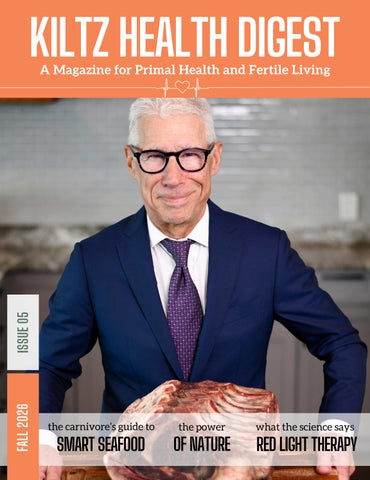
KILTZ HEALTH DIGEST
FALL 2026
ISSUE 05
A Magazine for Primal Health and Fertile Living
the carnivore’s guide to
the power
what the science says
SMART SEAFOOD
OF NATURE
RED LIGHT THERAPY
a note from dr. rob kiltz
GET READY FOR FALL! As the light shifts and the air finally cools, I find myself, as I do every autumn, thinking about rhythm. Fall has always felt like nature's own invitation to reset. The harvest winds down, sunset comes earlier, and our bodies, if we let them, naturally want to slow down and turn inward. It's no accident that so many ancient traditions built fasting and simplicity into this season. There's real wisdom in eating less as the world around us does the same.
Every year I'm inspired by my fellow speakers and attendees alike. There's so much to learn, share, and discover when this community comes together — new research, hard-won personal breakthroughs, and the kind of honest conversation you don't find anywhere else. I always leave Tampa with more questions than I arrived with, and I mean that as the highest compliment. That curiosity is what keeps this work alive for me, year after year.
In recent years, I’ve found myself relying on fasting — not as a punishment or a quick fix, but as a tool for clarity. A regular fasting practice, whether it's a daily eating window or a longer stretch once a week, gives our metabolic machinery a chance to catch its breath. It lowers insulin, sharpens focus, and reminds the body how to burn fat for fuel again after a summer of cook-outs, vacations, and looser routines. I've seen it in my own life and in patients again and again: a little discipline in the fall sets the tone for how we feel straight through the holidays.
Here's to a fall of resets, real food, and rhythm. I'm glad to be on this journey with you!
September, October, and November are also when I think hardest about foundations: sleep as the days shorten, movement as it gets easier to stay indoors, and community as the year's busyness picks up. Feeling your best isn't about one heroic effort; it's about small, repeatable choices that stack over weeks and months. This is also the season I look forward to most personally, because it means it’s time for Hack Your Health. I'm honored to once again deliver a keynote in Tampa this November, and I hope to see many of you there. There's nothing quite like standing in a room with thousands of people who've decided to take their health into their own hands.
2
~ Dr. Rob
Scan to subscribe KiltzHealth.com
what’s inside
02 a note from dr. rob kiltz
08 red light therapy
carnivore’s guide to 04 the smart seafood
nutritional 11 bebbis coaching
06 Hack Your Health 2026
12 success stories
07 outside all year
15 good reads
Preview
what the science actually says
build a consistent routine
3
Why Seafood Deserves a Spot in a Carnivore Diet
THE CARNIVORE’S GUIDE TO SMART SEAFOOD
For many carnivore and animal-based eaters, seafood already has a natural place at the table. It's animal protein, after all, often rich in fat and micronutrients that are harder to get from land animals alone. But not all seafood is created equal, either nutritionally or environmentally. Some popular choices carry real mercury concerns, especially relevant if you're also trying to conceive. Others come from fisheries or farms that put real strain on ocean ecosystems. The good news: the seafood that tends to be best for your body is very often the same seafood that's best for the planet. Why Seafood Deserves a Spot in a Carnivore Diet Fish and shellfish bring some nutrients to the table that are genuinely hard to match elsewhere in an animal-based diet: Long-chain omega-3s (EPA and DHA) — critical for reducing inflammation, supporting brain health, and, notably, supporting egg and sperm quality for those pursuing fertility treatment Iodine and selenium — key for thyroid function, which underpins metabolic and reproductive health Zinc and B12 — abundant in shellfish especially, both essential for fertility and immune function Astaxanthin — the pigment responsible for salmon's color, and a potent antioxidant in its own right That said, seafood isn't uniform. Bigger, longerliving predatory fish accumulate more mercury over their lifespans, and certain farming practices 4 carry a heavier environmental footprint than
others. That's where a little label-reading goes a long way. How to Think About "Sustainable" The Monterey Bay Aquarium's Seafood Watch program has spent over two decades rating seafood using a simple system: green means "Best Choice," yellow means "Good Alternative," and red means "Avoid," based on how a fishery or farm is managed and its impact on the surrounding ecosystem. In recent years, Seafood Watch partnered with nutrition researchers at Tufts University to build a "Super Green List" — seafood that scores well on both fronts at once: high in omega-3s, low in mercury, and sustainably sourced. Smart Choices: High in Nutrients, Ocean-Friendly Wild-caught Alaska salmon: Alaska's salmon fisheries are widely considered some of the bestmanaged wild fisheries in the world. Salmon delivers a dense combination of omega-3s, B vitamins, and astaxanthin, and Alaska sockeye or coho are excellent everyday choices. Sardines, anchovies, and Atlantic mackerel: Small, fast-reproducing fish that sit low on the food chain accumulate very little mercury and reproduce quickly enough that their populations hold up well under fishing pressure. They're also some of the most omega-3-dense fish available, ounce for ounce. Skip king mackerel, which is a different, much larger and longer-lived species with high mercury levels.
Arctic char: Farmed in closed, land-based systems, Arctic char has a very light environmental footprint and offers a flavor and nutrient profile similar to salmon, making it a good rotation option. U.S. farmed rainbow trout and catfish; Both are raised domestically under strong environmental oversight, offer solid protein and omega-3 content, and tend to be more affordable than wild-caught options. Alaska flounder and sole, and Alaska pollock: Wellmanaged, lower-mercury whitefish options that work well for anyone wanting variety beyond fattier fish. A Word on Mercury and Fertility If you're actively trying to conceive or undergoing fertility treatment, mercury deserves special attention, since it can accumulate in the body over time and cross the placenta. Larger, longer-lived predatory fish — shark, swordfish, marlin, king mackerel, tilefish, bigeye tuna, and orange roughy — carry the highest mercury loads and are worth avoiding or eating only rarely. The good news is that the fish on the sustainable list above also happen to be lower-mercury choices, so building meals around them serves both goals simultaneously. Practical Tips for Shopping and Ordering Out Look for the Seafood Watch app or printable guide, which lets you check a specific species against current ratings for your region When shopping, ask your fishmonger where and how the fish was caught or farmed — a simple question that signals demand for better sourcing Favor "U.S. farmed" labels for trout, catfish, char, and shellfish, since domestic aquaculture tends to operate under stricter environmental standards Rotate your choices rather than relying on one or two species — this reduces pressure on any single fishery and gives you a broader nutrient profile
Scan to see the Monterey Bay Aquarium’s guide on popular seafood you should choose, avoid, and ocean-friendly swaps:
The Takeaway Seafood can be a genuine asset to a carnivore or animal-based way of eating — as long as you're selective. The species that top the list for nutrient density and low contaminant load are, encouragingly, often the very same ones that responsible fisheries and fish farms have made available in abundance. A little intention at the seafood counter lets you eat well and support the health of the oceans your food comes from.
5
latest news
November 13 – 15, 2026 | Tampa, FL Mark your calendars: Hack Your Health returns to the Tampa Convention Center November 13–15, 2026, and it's shaping up to be the biggest one yet. Since 2017, this three-day gathering has become the premier destination for anyone serious about optimizing their health, bringing together thousands of attendees with the world's leading voices in nutrition, biohacking, fitness, and longevity. We're proud to announce that Dr. Robert Kiltz will once again take the keynote stage, sharing his insights on fertility, metabolic health, and the low-carb, ketogenic approach to reclaiming vitality that Kiltz Health Digest readers know well. Beyond the keynotes, attendees can expect breakout sessions across multiple stages covering the latest research in metabolic health, longevity science, hormone optimization, and holistic wellness. Hands-on workshops let you learn directly from practitioners shaping the future of health optimization, while the expo hall—home to 100+ exhibitors—offers hands-on experiences like cold plunges, metabolic testing, and red light therapy.
VISIT H A C K YO U R H E A LT H . C O M FOR MORE INFO ON T H I S YE A R ’S CONFERENCE
6
Just as valuable as the content is the community. Past attendees consistently describe Hack Your Health as feeling like a homecoming, where you'll rub shoulders with fellow health seekers, connect with practitioners and innovators, and walk away with real, actionable strategies rather than just inspiration. Whether you're deep into your own health journey or just starting to explore keto, carnivore, or metabolic healing, this is the event to be at in 2026. Tickets are on sale now, so don't wait, as passes have sold out in previous years. Register today at hackyourhealth.com and join us in Tampa this November.
It's tempting to treat outdoor time as a fair-weather habit. something for spring hikes and summer evenings, not gray November afternoons. But the science says the benefits of nature exposure don't pause when the temperature drops, and skipping it seasonally may mean missing out on one of the simplest, most evidence-backed tools for health available.
TIPS FOR MAKING IT A HABIT
A 2019 study of nearly 20,000 people in England, published in Scientific Reports, found that people who spent at least 120 minutes in nature per week were significantly more likely to report good health and higher psychological well-being than those with no nature contact at all. and it didn't matter whether that time came from one long outing or several short ones spread across the week (White et al., 2019). Benefits leveled off between 200 and 300 minutes, meaning there's a real, attainable target, not an all-ornothing standard. Time in nature also has a measurable effect on stress physiology. A University of Michigan study published in Frontiers in Psychology found that just 20 to 30 minutes of sitting or walking somewhere that felt natural produced the sharpest drop in cortisol, the body's primary stress hormone, with benefits continuing to build at a slower pace beyond that window (Hunter et al., 2019).
"But in every walk with Nature one receives far more than he seeks." — John Muir
OUTSIDE ALL YEAR: why nature time shouldn’t take a seasonal break
7
RED LIGHT THERAPY: FACT OR FICTION? If your social feed is any indication, red light therapy is having a moment — glowing masks promising younger-looking skin, panels marketed for pain relief and recovery, and, more recently, devices claiming to improve egg quality for people trying to conceive. Some of these claims are backed by real, replicated science. Others are riding the coattails of legitimate research into territory it hasn't earned yet. Here's how to tell the difference. The Mechanism, Briefly Red light therapy, also called photobiomodulation, uses red and near-infrared wavelengths (roughly 600–1000 nanometers) that penetrate skin and are absorbed by mitochondria, specifically an enzyme called cytochrome c oxidase. This absorption appears to boost ATP production, the cell's energy currency, while also reducing oxidative stress. That mechanism is well-documented at the cellular level and forms the basis for every claim made about red light therapy, whether the evidence behind a specific claim is strong or thin. Where the Evidence Is Solid: Skin Multiple randomized, controlled clinical trials — including a widely cited split-face study using 633 nm and 830 nm light over roughly 12 weeks — have documented measurable increases in intradermal collagen density alongside visible improvements in fine lines and skin texture. A 2025 expert consensus from 35 dermatologists further affirmed photobiomodulation as a safe, effective option across several skin conditions. Researchers do note real
8
inconsistencies across studies in wavelength, dose, and protocol, meaning results vary by device and treatment plan. The takeaway: the collagen and skintexture benefits are genuine, but "which device, how often, for how long" still isn't fully standardized.. Where the Evidence Is Arguably Strongest: Pain and Recovery Skin is what gets the ad spend, but pain relief and physical recovery are where red light therapy actually has some of its most robust clinical support — and it's a reasonable option for people who couldn't care less about anti-aging. For knee osteoarthritis, a 2024 network metaanalysis of 13 randomized trials involving 673 patients found near-infrared light delivered the largest pain reduction among treatments compared. A separate meta-analysis pooling 22 randomized trials and over 1,000 participants found properly dosed treatment significantly reduced knee OA pain compared to placebo, with effects holding at followup. For neck pain, a landmark 2009 meta-analysis in The Lancet reviewing 16 trials found low-level light therapy reduced pain immediately after treatment, with benefits persisting for weeks afterward — a notably durable result for a non-drug treatment. For rheumatoid arthritis, a Cochrane review found moderate-quality evidence supporting short-term relief of pain and morning stiffness, though it doesn't address the underlying autoimmune process driving the disease.
Where the Evidence Is Early: Fertility and Egg Quality This is where marketing has outpaced research. The underlying logic is reasonable — oocytes contain more mitochondria than any other cell in the body, and mitochondrial decline is a known driver of agerelated fertility loss, so a mitochondria-boosting therapy is a plausible candidate. Preliminary lab studies support the mechanism: one study found that near-infrared light increased ATP content and mitochondrial activity in human granulosa cells (which support developing eggs) without added oxidative damage. But this remains cell-culture and mechanistic research, not evidence that red light therapy improves pregnancy rates or live birth outcomes in real patients. There are no large, wellpowered randomized trials showing that red light therapy improves fertility outcomes in humans. If you're considering it, think of it as a plausible-butunproven adjunct — not a substitute for guidance from your fertility care team. At-Home Device or Medspa? This mostly comes down to irradiance — how much light energy actually reaches your tissue, measured in mW/cm². Professional medspa systems typically deliver noticeably higher irradiance than consumer devices, allowing shorter, more concentrated sessions. Lower-end at-home devices can require significantly longer sessions to deliver a comparable dose, and output drops off quickly with distance from the skin. Some higher-quality home panels now approach clinical-grade output. If you're shopping for one, look past marketing language and check the actual irradiance specs and wavelength range (aim for something in the 630–850 nm zone with legitimate third-party testing) rather than price or design.
For skin benefits, a decent at-home device used consistently can rival occasional medspa visits, since frequency partly offsets lower per-session power. For pain and joint issues, at-home panels are a reasonable, low-risk starting point given the strong trial support for regular home-based use — a medspa may still make sense for deeper or more acute concerns. Who Benefits Most Red light therapy has its best evidence for: knee osteoarthritis and other joint pain, muscle recovery for athletes and active people, mild-to-moderate skin aging, and some inflammatory skin conditions. For people who couldn't care less about anti-aging claims, the pain and recovery use case stands on its own — this is arguably the therapy's most evidence-backed application, not a consolation prize. For fertilityspecific claims, treat it as an area to watch rather than a proven intervention, and loop in your provider before adding it to a treatment plan. This article is for general information and isn't a substitute for individualized medical advice.
9
f u el yo u r fer t i l i ty on e m ol e c u l e a t a t i m e TM
FULL FERTILITY SYSTEM FOR MEN & WOMEN Sign up for emails & learn first about promotions
Shop
10 10
Available at MolecularFer tility.com and Amazon.com
BEBBIS NUTRITIONAL COACHING Let's optimize your body with Dr. Kiltz's BEBBIS Diet to reduce inflammation. Book 30-minute 1:1 sessions with a BEBBIS Nutritional Kiltz Health Coach to receive a personalized roadmap on Dr Kiltz’s Nutritional Protocol What to expect in your 30-minute sessions: Personalized Troubleshooting Nutritional Fine-Tuning A Concrete Action Plan Support & Accountability
HOW THE PROCESS WORKS At Kiltz Health, coaching is built on connection and consistency. It usually starts with an assessment of your current habits and your health goals. From there, you work together to build a roadmap. WHO NEEDS A KILTZ HEALTH COACH? You might benefit from a coach if: You’re tired of "Yo-Yo" dieting: You want a lifestyle, not a 30-day challenge. You’re feeling a bit stuck on your Keto/Carnivore journey: Maybe you’re dealing with the "noise" of old habits and need a clarifying voice. You struggle with inflammation: You’re dealing with joint pain, brain fog, or digestive issues and want to use food as medicine. You need a "Buddy": You thrive when you have someone to check in with, celebrate wins, and navigate setbacks. You’re trying to conceive and need to figure out what lifestyle choices will support your goals. You’re a "Student of Life": You want to understand the why behind the God-Flow and the fatty-meat lifestyle.
Book a Single Session ($39 for half and hour)
ONE SESSION
Book a Discounted 3 Session Package
3 SESSIONS
11
SUCCESS STORIES
MEET KORDELIA HUNTAS I celebrated my 3-year anniversary of carnivore eating by taking the Kiltz Health Coaching training. I love this lifestyle and how makes me feel. I have true food freedom. No more constant eating and snacking on high carbohydrate foods. I know now why I feel better on low-carb, high-fat foods. At this point this is a lifestyle and I instinctively know to handle social situations and conversations about my eating patterns. I wanted to be able to more intelligent discussion when people ask me questions about the mechanisms on how the lifestyle works inside the body so I decided to take the training with Kiltz Health.
“I know now why I feel better on lowcarb, high-fat foods.”
12
When I started carnivore, I was doing it wrong. I thought it was about lean meat. I watched Dr. Kiltz’s 5 am show and he basically answered the question as to why I had no energy. I had to switch from lean meat to the fatty red meat - adipose tissue. Then it all changed for me. I think the Kiltz Coaching course is all-encompassing and challenging. I’ve learned a great deal. Thank you Dr. Kiltz, Dr. Nelson, Alia Wells, and the supporting coaches.
SUCCESS STORIES
MEET ERIC DUANE
Like many Americans, I spent much of my life treating my body like an amusement park rather than the powerful, finely tuned machine it is. This course helped me reframe that perspective: my body is a temple, and honoring it requires understanding how to fuel it properly. I had always known the human body was an incredible machine, but this program helped me appreciate just how extraordinary it is. With the right fuel, the body can do remarkable things. Learning about those fuels and their effects was eye-opening, life-changing, and deeply empowering. The Kiltz Health Coach Program built on what I had already learned through my carnivore journey and gave me the depth of knowledge, confidence, and practical tools I need to continue improving my own health while helping others pursue theirs. Nearly two years ago, my wife and I began our carnivore journey at her suggestion. She lives with several autoimmune conditions, including lupus, celiac disease, gluten ataxia, and reactivated EpsteinBarr virus, and she had spent a great deal of time searching for answers. Through autoimmune support groups and online communities, she kept seeing stories from people who had experienced meaningful relief through a carnivore way of eating. Those stories gave her hope, and she asked whether I would be willing to make the change with her. At the time, I was 53 years old and the heaviest I had ever been at 223 pounds, living on the standard American diet. I had dealt with chronic back pain for most of my life, had multiple knee surgeries from a long military career, had undergone a full right hip replacement, and lived with many other physical pains. I had also been taking statins for 20 years. When my wife asked if we should try something different, I realized I had very little to lose and potentially everything to gain. The day after Thanksgiving 2024, we began. Fortunately, we had the support of a wise and dear friend, John Thomas, who helped guide us. He had followed a ketogenic and carnivore-style approach for as long as I could remember, and when I reached
out to him, he generously shared his knowledge, encouragement, and experience. His support helped us stay grounded as we learned how to make this way of eating sustainable. Today, I weigh a strong and healthy 190 pounds, my body feels better than it has in years, and under medical supervision, I am no longer taking prescribed medications. My lab results have improved, and my mental clarity is strong. My wife has also experienced meaningful progress: she has lost 40 pounds, reduced inflammation, and seen significant improvement in her autoimmune symptoms. She is still navigating additional health challenges, including recovery from cervical spine surgery, but overall, life is good. This course gave me far more than information. It gave me language, structure, and confidence to explain what we have experienced and to support others with greater clarity and responsibility. I now feel better equipped to help people understand the power of nutrition, consistency, and personal commitment as they work toward their healthiest lives. My own transformation, and my wife’s continued progress, have strengthened my desire to serve others as a health coach and help them pursue the kind of life-changing health improvements we have been blessed to experience.
13
SUCCESS STORIES
MEET KAREN SPENCER
First of all, thank you for putting together such a great course. The modules provided very valuable and practical information. This course expounded on what I learned through Dr. Berry's PHD course, helping me feel more confident in my knowledge to help others on their health journey as well as my own. The hyperinsulinemia and T2DM modules stood out as being particularly helpful and gave me better understanding for applying what I learned to real-life applications. I also found the "How to set up your coaching business" module helpful as it provided important insight into the legal and professional responsibilities involved in health coaching. Overall, I felt Dr. Kiltz's Health Coaching course provided very valuable information to help coaches move forward in their coaching practice. Highly Recommend!!
MEET JUAN PAREDES Having just completed the [Kiltz Health Coaching] course, I can definitely say that this has not been expensive at all and that I would sign up again and again if the occasion would came around once again. As a bit of an introduction and for pure perspective, I have been a carnivore for almost 2 years now, and need to say it has been one of the best decisions I have made. Taking into consideration that I have been prioritizing my health heavily for the past 8 years, I am also quite versed in details about human physiology and biology, as I like to investigate and understand how our body works and what is best for it. This is how I came across the carnivore diet and why I have been sharing right, left, and center with anyone ready to listen (which does not mean ready to change). However, since I am not a doctor, (quite the opposite, actually, as I am an Engineering Project Manager by trade) people do not really take me that seriously, even though I am telling them raw truths that made a lot more sense than what is out there (and I think subconsciously they know them to be true), so I wanted to get some sort of certification for my knowledge, when I stumble upon this course. I did not even think once about signing up, as this way I could get to know the exact details of it all, and that is exactly what the course delivered. This alone for me was more than worthwhile. Now, the best of it is what I got beyond – the whole Coach framing, relationship with the client and even business structure parts were, are and will be hyper valuable to me, as these give the tools I need in order to work with the clients I will have in the not-so-distant future. I am super grateful I have had the chance to do this course, so massive thank you to the whole team.
14
GOOD READS Breath: The New Science of a Lost Art by James Nestor shows us that making even slight adjustments to the way we inhale and exhale can jump-start athletic performance; rejuvenate internal organs; halt snoring, asthma, and autoimmune disease; and even straighten scoliotic spines. None of this should be possible, and yet it is.
The Healing Power of Resiliance by Dr. Tara Narula pinpoints that there’s something missing in patient care: the need to address mental health alongside physical health. To thrive when faced with a medical challenge, a patient must be mentally prepared to face it. This realization transformed Dr. Narula’s career and led her down an eye-opening path, studying landmark medical trials and the latest advancements in the field as well as interviewing patients, doctors, researchers, and thought leaders.
The Well-Lived Life by Dr. Gladys McGarey, cofounder of the American Holistic Medical Association, shares her six actionable secrets to enjoying lives that are long, happy, and purpose-driven.
Stay Off My Kitchen Table by Dr. Philip Ovadia & Joshua Lisec reveals the best-kept secret in nutrition science: Your gut health and nutrient absorption matter just as much as the food on your plate. If you're stuck on a plateau, struggling with inflammation, or wondering why your "healthy" choices aren't working, this book explains exactly why.
15
Get these recipes and more, plus all of the science behind carnivory! Humanity's oldest way of eating isn't a fad—it's a return to what works. Dr. Kiltz's Guide to Carnivore Cooking combines science, history, and mouthwatering recipes to help you embrace the transformative power of animal-based nutrition. Dr. Kiltz teams up with Austin Cavelli, PA-C and Jacie Gregory (Lady Carnivory) for a refreshing look at cooking for your favorite carnivore.
Order your copy today: 16
Amazon.com
THE CHICAGOLAND HOLIDAY MEAT-UP DECEMBER 20,2026 Join us for the Chicagoland Holiday Meat-Up from 12:30-2:30 PM, at Fogo de Chão in Rosemont, Illinois (located just 5 minutes away from O'Hare Airport). Private dining featuring all-you-can-eat meat. Whole families are welcome. Hosted by Alia with special guest Jenny Mitich (and Dr. Kiltz will be joining if he is on the East Coast). Only 25 seats remaining. Standard Ticket ($99): https://buy.stripe.com/dRmcN65kM51PedP2OY0481n Kids (Ages 6–12) ($45): https://buy.stripe.com/bJeaEYeVm3XLfhTahq0481o Children Under 6: FREE, but please email Alia at alia@doctorkiltz.com to add them to the official list.
KILTZ MERCH PACKAGE $99 Get all 4 items for one low price: 1. Kiltz Health Hoodie 2. Dr. Kiltz’s Guide to Carnivore Cooking - his newest book! 3. Kiltz Health Hat (OSFT – color and style may vary) 4. Meat My Food Short-Sleeve T-shirt 17
JOIN KILTZ MIGHTY TRIBE And start a journey to revolutionize the world of health through Dr. Kiltz's Carnivore Way™! We’ve created a space for engagement between Ketovores, Carnivores, Fatovores, and anyone/everyone looking to reclaim their health. Get direct access to high-quality keto/carnivore-related content, community events, keto/carnivore eating guides, recipes, groups, specialized programs, and more!
KILTZ HEALTH COACHING CERTIFICATION
Ready to turn your personal keto/carnivore healing journey into a powerful way to help others?
N O W
O N
D EM A N D !
Build new relationships, share ideas, and stay inspired!
What to Expect:
Use code FALL to get the course for $99 (a savings of $398)
Register today!
Access exclusive content: We've designed Kiltz Health Coaching Certification to inspire, instruct, and engage. Week-by-week lessons that include a mix of selfpaced videos and lessons you can complete on your own schedule. Dive deep into: Kiltz Keto Is Carnivore (KKIC) and Beef, Butter, Eggs, Bacon, Intermittent Fasting, and Salt (BEBBIS) approaches, ketogenesis, reversing Type 2 Diabetes and other metabolic disorders, essential coaching skills and principles, and much more!