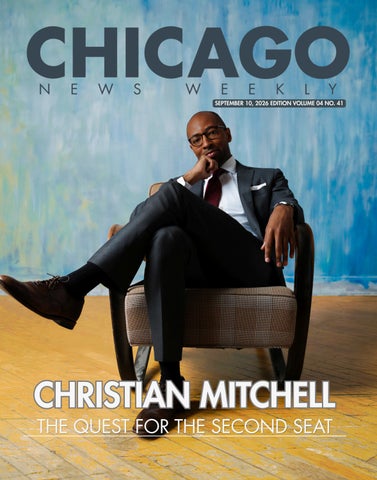
SEPTEMBER 10, 2026 EDITION VOLUME 04 NO. 41
CHRISTIAN MITCHELL THE QUEST FOR THE SECOND SEAT
E-NOTES Publisher Cheryl Mainor Norman Editor-In-Chief
Kai EL’ Zabar
Associate Publisher/ Laura Miller Managing Editor D. Hunter Art Direction Zada Johnson, PhD Staff Writers Candi McCrary Mila Marshall, PhD C. L. Blackburn Ryan Willis Mare Evans Columnists
Sanja Rickett Stinson David Seaton
Cover Photography
Raji Vela, ROQI Productions
Videography Podcast Production
Caveroom Entertainment
Chicago Weekly News 2147 S. Lumber St. Chicago, IL 60615 (312) 877-5151 Volume 04 No. 41 SEP 10, 2026 - SEP 23, 2026. Chicago News Weekly is published on Thursday and a product of CNW Network www.cnwmedia.com advertising@cnwmedia.com editorial@cnwmedia.com
CHECK OUT LAST WEEK’S ISSUE AT WWW.CNWMEDIA.COM/E-EDITIONS
Worth the Time: Finding Peace Through Meditation and Prayer When Life Gets Busy Kai EL’ Zabar - Editor-In-Chief
“Meditating more when our plates are full” was how I initially began this piece. But as I reflected deeper, I realized I needed to include prayer as well, because I actively practice and rely on both in my daily life. To understand their power, let’s begin by defining them: Prayer is active, direct communication with a higher power. Meditation is the practice of quiet inner awareness, presence, and observing the moment as it unfolds. The Subtle Trap of Busy Days Ironically, when life becomes overwhelming, the very first thing we tend to cut back on is our mindfulness practice. Many of us try to find moments of peace in other ways, reading a book, soaking in a warm bath, or sitting in a sauna. These activities are wonderful; they offer a much-needed mental break. Deep down, we are seeking refuge from the weight of our daily responsibilities and trying to rise above fear-driven thoughts about scarcity, finances, and relentless to-do lists.
The Power of Prayer Where meditation creates inner space, prayer opens a conversation. Rooted in spiritual traditions, prayer allows us to express our deepest needs, gratitude, and intentions directly to God. Consider the comfort found in Psalm 23, traditionally attributed to King David. It uses the imagery of a loving shepherd and a welcoming host to illustrate complete trust and guidance:
While stepping away is natural, dropping our spiritual practices during chaotic times ultimately works against us. Experience teaches us that we function best when we give ourselves daily moments of silence. In fact, the busier our schedules become, the more essential that quiet time is. Sitting in stillness allows us to listen to the universe and receive the strength and clarity needed to navigate the day ahead.
“The Lord is my shepherd; I shall not want” reminds us that we have everything we truly need. Just as sheep rely on their shepherd, we can surrender the burden of self-reliance and trust in higher provision. “Green pastures and quiet waters” evoke profound physical, emotional, and spiritual rest. “He restores my soul” speaks to God healing our exhaustion and guiding us back toward peace and purpose.
Making the Time Count Committing to a practice doesn’t require a complete lifestyle overhaul. Adding just 10 minutes to your morning routine, or incorporating brief, micromeditations throughout the day, can transform your outlook. Unless we are in an active emergency, almost all of us can find five or ten minutes. The real shift happens when we recognize that spending time in meditation is the most fruitful choice we can make. Meditation clears out mental clutter and restores focus, helping you align with your true intentions. Start small, even setting an intention like “I want to meditate for 10 minutes daily” can help you build momentum. As you ground yourself in centered calm, you will find that a few minutes of meditation leads to significantly less anxiety, panic, and stress throughout the day. It is always worth the time. 2 SEP 10, 2026 - SEP 23, 2026
Praying with intention and understanding transforms us, offering the same calming grounding that meditation provides, but through a personal connection to the Divine. Bringing Both into Your Life Incorporating meditation and prayer into your daily routine is easier than it seems. You can wake up 15 minutes earlier or prepare breakfast the night before to free up quiet time in the morning. Alternatively, try beginning your morning with meditation to center your mind, and closing your evening with prayer to release the day’s burdens. Both practices encourage deeper sleep, sharp focus, and emotional resilience, and most importantly, they ground you firmly in your faith and purpose.
SEP 10, 2026 - SEP 23, 2026
3
CITY NEWS
An Illinois Bill Would Open the Door to Municipal Bankruptcy. What Could It Mean for Chicago? Chicago has not filed for bankruptcy, but a proposal in Springfield would create a pathway for financially distressed Illinois municipalities to seek federal protection. LAURA MILLER - MANAGING EDITOR Chicago is not bankrupt, nor has the city filed for bankruptcy protection. But as the city confronts another substantial budget gap, legislation sitting in Springfield raises a consequential question: Should financially distressed Illinois cities be allowed to restructure their debts in federal court? House Bill 3212, introduced by Republican state Rep. Steven Reick of Woodstock in February 2025, would create a process through which an Illinois municipality or other local public entity could eventually seek protection under Chapter 9 of the federal bankruptcy code. The bill remains in the House Rules Committee and has not received a floor vote. The proposal would not place Chicago or any other municipality into bankruptcy. It would give qualifying local governments an option they generally do not have under current Illinois law. Harvey’s Search for Help Although the legislation could apply to Chicago, the type of financial emergency it contemplates is more closely reflected in smaller municipalities with limited revenue and fewer options. Harvey declared itself financially distressed in October 2025 and asked Illinois to take control of its finances. The Illinois Department of Revenue denied that request in February, according to an ABC7 Chicago report. Harvey officials said the city needed approximately $51 million to operate but received only about $30 million. As of October 2025, its property tax collection rate stood at approximately 52%, while the state comptroller was diverting 35% of certain state and restricted revenue to the city’s fire pension fund. The city also laid off approximately 10% of its municipal workforce. “If we can bring brighter minds to our community to help us to move forward, if we can find ways to deal with such a sizeable amount, then we welcome that,” then-Harvey Mayor Christopher Clark said when the city requested the financially distressed designation. Reick has not publicly identified Harvey or another municipality as the reason he introduced HB 3212. The bill’s language, however, describes circumstances already confronting several Illinois communities: governments struggling to meet their financial obligations while maintaining essential services. 4 SEP 10, 2026 - SEP 23, 2026
Where Chicago and Harvey Differ Chicago operates on an entirely different scale. Its approximately $17 billion budget is supported by a broad tax base, major corporate and commercial activity, tourism, conventions and entertainment. The city also retains access to municipal bond markets and continues to make its required payments. Those strengths give Chicago financial options that a smaller municipality such as Harvey does not possess. They do not, however, erase the city’s recurring budget deficits or pension burden. Chicago is preparing to confront a projected $882.4 million budget gap for 2027 after closing a roughly $1.2 billion gap in its 2026 spending plan. According to the Johnson administration, the new shortfall includes $70 million in additional bond payments, $90 million in increased pension obligations and higher personnel and commodity costs. “We will not balance this budget on the backs of working people,” Mayor Brandon Johnson said while releasing the forecast. “We will continue to fight for progressive, equitable revenues that ask those who can afford to contribute more to actually do more, while protecting the essential services Chicagoans depend on.” Johnson has not endorsed municipal bankruptcy. His administration is pursuing a different strategy centered on additional revenue, continued pension contributions and protection of city services. What the Bill Would Change Chapter 9 is reserved for municipalities and allows a financially insolvent government to propose a plan for restructuring its debts while continuing to operate. Federal law requires a municipality to receive specific authorization from its state before filing. HB 3212 would provide that authorization after a distressed local government completed a confidential evaluation with pension funds, unions, bondholders and other creditors. A municipality could also proceed after declaring a fiscal emergency and determining that it would be unable to pay obligations coming due within 60 days. That threshold is far more severe than facing a projected deficit in an upcoming budget. Based on publicly available information, Chicago has not reached that point.
Photo By Canva
The bill describes bankruptcy as a last resort, and its potential consequences explain why. A Chapter 9 proceeding could affect pension benefits, labor agreements, bondholders, vendors and a municipality’s future borrowing costs. Chicago’s financial challenges warrant scrutiny, but they should not be confused with an imminent inability to pay its bills. HB 3212 would create an emergency exit for Illinois governments that have exhausted their alternatives. Whether Chicago would ever need that exit remains an entirely different question.
CITY NEWS Chicago Opens $15 Million Storm Relief Program for Residents Still Facing 2023, 2024 Losses Eligible households can receive up to $15,000 for documented housing and utility expenses tied to qualifying storms CNW STAFF REPORT Chicago residents still carrying financial losses from severe storms in 2023 and 2024 may now qualify for up to $15,000 in financial assistance through a new $15 million city relief program. Mayor Brandon Johnson and the Chicago Department of Family and Support Services announced Sept. 9 the opening of applications for the Disaster Relief Assistance Program, or DRAP. The program is intended for current Chicago residents who lived in the city during qualifying storms and can document financial hardship resulting from storm damage. The eligible storm periods are June 29 through July 2, 2023; Sept. 17 through Sept. 18, 2023; and July 13 through July 16, 2024. “Chicagoans who have suffered from severe storms deserve the support and resources they need to recover,” Johnson said. “For too many families, the financial impact does not end when the storm passes.” Qualifying households may receive reimbursement for documented expenses including rent or mortgage payments and utility bills. Residents who previously received help from the Federal Emergency Management Agency, insurance companies or other assistance programs are not automatically excluded. They may still qualify if they can demonstrate remaining unmet financial needs related to the storms. The program is funded by the U.S. Department of Housing and Urban Development through its Community Development Block Grant Disaster Recovery program. Chicago developed its disaster recovery plan using damage data collected during and after the storms, and HUD approved the city’s plan on Sept. 15, 2025.
Photo Credit: Shutterstock
Although residents throughout Chicago may apply, the city identified five ZIP codes as among the areas disproportionately affected by flooding, high winds and other storm damage: 60644, 60651, 60639, 60641 and 60624. The selection process will give additional weight to applicants from those communities as well as renters and residents age 60 and older. “We are proud to extend this new opportunity for assistance to households in need that were never made whole after experiencing storm-related financial losses in 2023 and 2024,” DFSS Commissioner Angela Green said.
Applicants must meet the program’s household income requirements and provide documentation showing that their financial hardship resulted from one or more of the qualifying storms. The city did not include the specific income limits in its announcement, directing residents to the program website for the full eligibility requirements. Applications will be accepted on a rolling basis. Residents can review eligibility requirements and apply at chi.gov/drap.
SEP 10, 2026 - SEP 23, 2026
5
NATIONAL NEWS Trump’s Mail-Ballot Fight Moves From Congress to the Postal Service With the SAVE America Act stalled in the Senate, the Trump administration is asking the Supreme Court to permit a new federal system requiring states to share voter information before mailing ballots. CNW STAFF REPORT President Donald Trump’s effort to reshape mail-in voting is no longer limited to rhetoric or legislation awaiting action in Congress. It has become an urgent court battle over whether the federal government can require states to provide the U.S. Postal Service with identifying information about mail-ballot voters before their ballots enter the mail.
The resulting Postal Service rule would require election authorities to provide USPS with the name and address of each person receiving a mail-in or absentee ballot, along with unique barcodes assigned to the outgoing and return envelopes. That information would be entered into a federal portal and compiled into a state-specific Mail-In and Absentee Participation List.
On March 31, Trump signed Executive Order 14399, directing federal agencies to create new citizenship-verification and ballot-mail systems ahead of the Nov. 3 midterm elections. The order came as Congress debated the SAVE America Act, legislation that would require documentary proof of citizenship when registering to vote and identification when casting a federal ballot.
The rule also requires newly designed ballot envelopes carrying the official Election Mail logo and serialized barcodes approved by USPS. When election authorities present ballots for mailing, postal workers would check the mailing against the state’s submission. A mailing that does not satisfy the requirements could be returned to the election authority instead of being delivered to voters.
The SAVE America Act passed the House in February but has not cleared the Senate. Trump’s order, however, moves parts of the administration’s broader election agenda through federal agencies rather than waiting for Congress.
Separately, the order directs the Department of Homeland Security, working with the Social Security Administration, to create a “State Citizenship List” for each state using citizenship, naturalization, Social Security and other federal records. States would receive the federal lists at least 60 days before a regularly scheduled federal election and could recommend corrections or additions. The distinction matters. The SAVE America Act would generally place the burden on voters to produce documents proving citizenship. Trump’s executive order creates a back-end verification system involving federal databases, state election officials and the Postal Service. The two approaches are not identical, but they pursue overlapping citizenship-verification objectives.
The White House says the changes are necessary to enforce existing prohibitions against noncitizen voting and protect confidence in elections. In the order, Trump argued that unique ballot-envelope identifiers, including barcodes, would provide “a reliable, auditable mechanism” to ensure that only eligible citizens receive and cast ballots.
6
SEP 10, 2026 - SEP 23, 2026
That timing has raised the question of whether the administration is attempting to secure through executive action what it has not yet secured through legislation. Courts have not ruled that Trump acted specifically to circumvent the SAVE America Act, but they are considering the larger constitutional issue: whether the president and USPS possess authority that Congress never granted them to change state-administered election procedures. USPS initially proposed its ballot-mail regulations on June 2 and issued a final rule on Aug. 21. On Aug. 24, the Supreme Court lifted an earlier injunction after finding that the legal challenge had been premature because the final Postal Service rule had not yet been published. Once the final rule became available, opponents returned to court. On Sept. 4, U.S. District Judge Indira Talwani issued a preliminary injunction blocking mandatory portions of the system for elections occurring on or before Nov. 3. The Trump administration filed a new emergency Supreme Court application on Sept. 6 seeking permission to enforce the rule while its appeal proceeds. Responses were due to the court by 4 p.m. Eastern time on Sept. 9. As of publication, the disputed requirements remain blocked.
The stakes are particularly high in a state where mail voting is available without an excuse and ballots postmarked by Election Day may be counted if election officials receive them within 14 days. Chicago News Weekly’s earlier examination of mail voting found that 111,611 vote-by-mail ballots were cast in Chicago’s March 17 primary. Of those, 1,046 were rejected, representing less than 1%. Nearly half, or 55,334 ballots, were returned through secure drop boxes, while approximately 28,000 were counted after Election Day under Illinois’ existing review period. Those figures showed a system shaped by several layers of protection, including drop boxes, ballot-review procedures and the 14-day arrival window. The latest federal proposal introduces another potential point of failure before voters even receive their ballots. For Illinois voters, nothing has changed yet. The state’s current mail-ballot rules remain in place while the federal requirements are blocked. What happens next rests with the Supreme Court, which must decide whether USPS may begin imposing the new system less than two months before Election Day while the broader constitutional challenge continues.
SPECIAL ANNOUNCEMENT Calling Chicago's Next Generation of Visual Storytellers
Chicago has never lacked talent. Every day, photographers across our city capture moments that deserve to be remembered. They document neighborhood festivals, family traditions, entrepreneurs building businesses, artists creating culture, young athletes chasing dreams and the everyday moments that make Chicago unlike anywhere else. Some have built impressive portfolios. Others have quietly honed their craft without the recognition their work deserves. At Chicago News Weekly, we believe great storytelling isn't limited to those who already have the biggest platform. Some of the city's most compelling visual storytellers simply haven't had the opportunity to publish their work in a newsroom. That's why we're launching CNW Through the Lens, a new initiative created to discover photographers whose work reflects the heart of Chicago. We're looking for photographers with a distinctive perspective, a passion for visual storytelling and a commitment to documenting the people and communities that make this city extraordinary. Whether you're self-taught, a student, an experienced creative or someone who has simply been waiting for the right opportunity, we want to see the city through your lens. The selected photographer will have the opportunity to photograph an upcoming Chicago News Weekly cover story, receive a published editorial feature highlighting their work and be considered for future assignments as a contributing photographer. This isn't simply about finding great photographs. It's about opening the door for talented creatives whose work deserves a wider audience and creating another pathway into Chicago's media community. Submission guidelines, deadlines and application details will be announced in our next issue. Until then, start curating your strongest work and share this opportunity with a photographer whose talent deserves to be seen. Every published photographer had a first assignment. Make yours at CNW!
SEP 10, 2026 - SEP 23, 2026 7
NATIONAL NEWS National News Roundup: Late August–Early September 2026 Covering August 31 – September 10, 2026 CNW STAFF REPORT The past two weeks brought a mix of the historic and the unresolved a three-decade-old murder case finally got an answer, a closely watched trial ended without one, a legendary institution lost its longtime leader, and another headline-grabbing case is still awaiting its verdict. Here's a look at four of the biggest national stories from the period. 1. Duane "Keffe D" Davis Found Guilty in Tupac Shakur's Murder Monday, August 31 — Clark County District Court, Las Vegas, Nevada Nearly 30 years after Tupac Shakur was gunned down on the Las Vegas Strip, a jury has finally convicted someone in his killing. Duane "Keffe D" Davis, 63, was found guilty of firstdegree murder with a deadly weapon after an 11-day trial — the first and only successful prosecution in one of hip-hop's most infamous cold cases. Jurors deliberated for less than three hours. Prosecutors didn't accuse Davis of firing the fatal shots; instead, they argued he organized the 1996 drive-by attack in retaliation after his nephew was beaten by Shakur's entourage, then acquired a gun and directed the shooting from inside a white Cadillac. Much of the case rested on Davis's own words — years of interviews, a 2019 memoir and recorded conversations with investigators in which he placed himself at the scene. His defense called that account "fiction, not fact," but the jury wasn't persuaded. Davis faces up to life in prison and is scheduled to be sentenced on October 13. He has said he plans to appeal. 2. Mistrial Declared in Lindsay Clancy Case Friday, September 4 — Plymouth County Superior Court, Plymouth, Massachusetts After seven days of deliberation and a dramatic last-minute appeal, a Massachusetts judge declared a mistrial in the murder trial of Lindsay Clancy, the Duxbury mother accused of killing her three young children in 2023. The jury of nine women and three men couldn't reach a unanimous verdict, telling the judge in a note that "it is with a heavy heart that we report we are unable to come to a unanimous decision." Clancy does not dispute that she strangled 5-year-old Cora, 3-year-old Dawson and 8-month-old Callan. Her defense argued she was in the grip of postpartum psychosis and not criminally responsible; prosecutors maintained she knew what she was doing. On Friday morning, her attorney made an emergency appeal to the Massachusetts Supreme Judicial Court to prevent the mistrial, but the high court declined to intervene. A status hearing is set for September 29, when prosecutors will decide whether to seek a retrial. The case has sparked wide discussion about postpartum mental health and how the justice system handles it.
8 SEP 10, 2026 - SEP 23, 2026
3. Smithsonian Secretary Lonnie Bunch Announces Retirement Tuesday, September 8 — Smithsonian Institution, Washington, D.C. The Smithsonian Institution is losing its top leader. Secretary Lonnie G. Bunch III announced this week that he will retire at the end of the year, capping 38 years of work at the institution and seven years as its secretary. Bunch, 73, made history in 2019 as the first African American and the first historian to lead the Smithsonian. Before that, he spent 11 years as the founding director of the National Museum of African American History and Culture, widely seen as the crown jewel of his career. In a statement, Bunch called the decision bittersweet, saying he'd spent "nearly half of my life" as part of the Smithsonian family. His exit comes at a fraught moment for the institution, which has faced sustained pressure from the Trump administration over how it presents American history — pressure Bunch addressed candidly in interviews this week, while stressing his decision was about timing, not retreat. The Smithsonian's Board of Regents says it will name an acting secretary soon and launch a national search for Bunch's permanent successor. 4. Lil Durk's Murder-for-Hire Trial Goes to the Jury Developing as of Thursday, September 10 — U.S. District Court for the Central District of California, Los Angeles Closing arguments wrapped up Wednesday, September 9, in the federal murder-for-hire trial of Chicago rapper Lil Durk (legal name Durk Banks), and jurors have been deliberating since. Prosecutors allege Durk orchestrated a 2022 shooting at a gas station near the Beverly Center in Los Angeles, targeting rapper Quando Rondo in retaliation for the 2020 killing of fellow Chicago rapper King Von. The gunmen missed Rondo but killed his cousin, Saviay'a "Lul Pab" Robinson. Three of Durk's alleged associates pleaded guilty and testified against him at trial, while the defense argued one of those cooperating witnesses was the real mastermind looking to cut a deal with prosecutors. Durk has pleaded not guilty and faces a potential life sentence if convicted. As of publication, no verdict had been reached.
HEALTHY LIVING Protecting Our Health: Understanding and Addressing HIV Disparities Among Black Women CANDI MCCRARY For Black people, carrying a heavy load regarding health and well-being is a familiar reality. For Black women in particular, understanding the complexities of HIV is vital due to the intersecting social, economic, and healthcare disparities that heighten vulnerability. By exploring current statistics, systemic root causes, and Rae Lewis Thornton was diagnosed with AIDS and graced the cover of ESSENCE's December preventative measures like PrEP, we can empower Black 1994 issue. She still lives. Photo Credit: ESSENCE Magazine women with the knowledge to protect their health and Despite these guidelines, PrEP utilization remains low among Black women due to a advocate for their well-being. Furthermore, the community lack of awareness, provider hesitation, and high costs for uninsured or underinsured often relies on the leadership of Black women to educate individuals. Because healthcare providers may not proactively bring up PrEP, it is their partners, children, parents, and siblings, making essential for Black women to advocate for themselves and initiate conversations about community-wide awareness all the more critical. So educating HIV prevention options. the Black woman is a tool through which Black communities Taking Action and Moving Forward are educated. Empowering ourselves with accurate knowledge helps combat the HIV epidemic within Identifying the Root of HIV Disparities our community. By acknowledging unique risk factors, utilizing tools like PrEP, and Black women are disproportionately affected by systemic challenges, including poverty, limited access to quality demanding equitable healthcare, we take proactive steps to protect our sexual health. healthcare, and educational gaps. These socioeconomic factors heavily influence an individual's ability to access HIV Fostering open dialogue is equally essential. This includes creating spaces where bisexual men can participate in these conversations without fear, because open prevention, testing, and treatment services. communication is key to collective advancement. Ultimately, we are all in this together. Recognizing that these disparities pose a real threat to our community's overall well-being is the first step toward effective intervention. Historically, mainstream HIV prevention efforts have maintained a narrow focus, concentrating primarily on men who have sex with men (MSM) and transgender women. Consequently, Black women are often left out of these critical conversations despite alarming infection rates. Compounding this issue are the complex emotional and cultural realities of Black life. Many Black men continue to feel pressured to conceal non-conforming sexualities due to lingering condemnation—often rooted within institutions like the Black church. As a result, some men who have sex with men also have sex with or marry Black women, creating an invisible layer of risk. Another major challenge lies in the suboptimal use of biomedical prevention tools. pre-exposure prophylaxis (PrEP) is a highly effective medication used to prevent HIV, yet Black women are significantly less likely to be prescribed or request it due to barriers such as: • Unconscious bias from healthcare providers • Underestimated personal risk of contracting HIV • Fear of medication side effects • A fundamental lack of awareness Understanding PrEP Use Among Black Women PrEP is remarkably effective at preventing HIV when taken as prescribed. While older prevention methods focused primarily on behavior modification and condom use, modern advancements rely heavily on antiretroviral (ART) drug therapies. PrEP is recommended for high-risk groups, including HIVnegative heterosexual women who: • Do not consistently use condoms • Have multiple sexual partners • Have an HIV-positive partner • Have been diagnosed with an STD in the past 6 months
SEP 10, 2026 - SEP 23, 2026
09
COVER STORY
Christian Mitchell The Quest for the Second Seat
Christian Mitchell has spent much of his political life learning how power moves behind the scenes. Now, as Governor JB Pritzker’s running mate, the former state representative and deputy governor is preparing for an office defined by partnership, possibility and proximity to the state’s highest seat. BY LAURA MILLER, MANAGING EDITOR
COVER STORY PHOTOGAPHY, RAJI VELA ROQA PRODUCTIONS
Christian Mitchell arrived for his Chicago News Weekly cover shoot wearing his grandfather’s Army dog tags. It was his first major photo shoot, an admission he made with the mild embarrassment of someone more accustomed to standing beside the person being photographed. The cameras made him feel awkward. The dog tags did not.
His biography is filled with institutions that confer authority: the Illinois House, the governor’s office, the Democratic Party of Illinois, the University of Chicago and the Illinois Air National Guard. Yet when asked to explain himself, Mitchell begins with Debbie’s son and James’ grandson.
His grandfather, James Gist, stood “in the gap” after Mitchell’s father left when he was young. A union steelworker with an eighth-grade education, Gist worked at Reynolds Metals near the Stevenson Expressway and became the father in Mitchell’s house. Wearing his dog tags brought the private architecture of Mitchell’s life into a decidedly public moment. “My mother is my hero, but my grandfather really stood in the gap for me,” he said. “I wear those tags on days when I need good luck or I wear them on days when times are hard.” The photograph captures something useful about Mitchell’s candidacy for lieutenant governor. He is stepping into a campaign built around the considerable political identity of Gov. JB Pritzker, but he wants voters to understand the people and experiences that shaped him before Pritzker selected him as a running mate. 10 SEP 10, 2026 - SEP 23, 2026
Mitchell represented Illinois’ 26th House District from 2013 until 2019, became the first Black executive director of the state Democratic Party, served as one of Pritzker’s deputy governors and later joined the University of Chicago as vice president for civic engagement. In 2023, he entered the Illinois Air National Guard as a judge advocate, a decision inspired partly by his grandfather’s military service. Mitchell once wanted to become an F-16 pilot, but his eyesight disqualified him. Decades later, while overseeing the National Guard as part of his deputy-governor portfolio, he spoke with then-Adjutant General Richard Neely about joining. Mitchell protested that he was already 36. “He said, ‘Well, I know the guy who signs the waivers because it’s me,’” Mitchell recalled.
As a judge advocate, Mitchell has provided legal assistance to Guard members, including preparing wills and trusts for those facing deployment. The experience reinforced his belief that people who disagree politically can still be required to trust one another when called to serve. “When I go to the National Guard, a whole bunch of people, I’m quite sure, are not voting for me and don’t vote Democratic, and we still work together,” he said. “We get each other’s backs, and if we’ve got to go overseas and go downrange, we are going to make sure that flag on our shoulder is more important than any differences that we may have.” Learning the Pace of Power Mitchell speaks about public policy with the patience of someone who has watched his ideas fail before watching versions of them return under different bill numbers, sponsors and governors. During his six years in the Illinois House, several of his most ambitious proposals stalled or were vetoed. He now describes those losses as an education in how government changes.
COVER STORY
One of the clearest examples is teacher pay. Mitchell was the principal House sponsor of Senate Bill 2892, which would have raised Illinois’ statutory minimum teacher salary from $9,000, where it had remained since 1980, to $40,000 over several years. The General Assembly passed it in 2018, but Gov. Bruce Rauner vetoed it, and lawmakers failed to override him.
His early cash-bail proposal followed a similar path. In 2017, Mitchell introduced House Bill 3421, the Equal Justice for All Act, which sought to eliminate monetary bonds while allowing judges to detain people considered dangerous. The bill did not pass. Illinois later eliminated cash bail through the Pretrial Fairness Act, part of the SAFE-T Act enacted in 2021 and implemented in September 2023.
In 2019, after Mitchell entered the Pritzker administration, lawmakers passed House Bill 2078, which phased the minimum salary up to $40,000 for the 2023-24 school year. The new measure accomplished the central goal of the bill Mitchell had carried, although it was separate legislation. The original bill was sponsored in the Senate by Andy Manar, carried in the House by Mitchell and vetoed by Rauner in 2018.
“One good example is I was the first person to introduce a bill to end cash bail,” he said. “What’s important about that is not, ‘Oh my God, we’re letting everybody out.’ It is: Is what’s keeping you in prison about risk, about danger to the public, or is it about your ability to pay?”
“I passed a bill to raise the minimum wage for teachers through both houses,” he said. “Governor Rauner vetoed that bill. Later, that bill got passed when I was deputy governor and then (Gov) JB Pritzker was in office, and now it is the law of the land.” Mitchell also introduced the Fund Education First Act, an unsuccessful proposal to prioritize elementary and secondary education in the state budget. He later participated in the broader legislative effort that produced Illinois’ evidence-based school-funding formula in 2017, although his bill was not the measure that ultimately became law.
Mitchell also co-sponsored a 2015 bill to decriminalize possession of up to 15 grams of cannabis. Rauner returned it with changes, and Illinois enacted a narrower decriminalization law the following year. Mitchell later helped the Pritzker administration negotiate the 2019 law legalizing adult use, establishing expungement procedures and directing a share of cannabis revenue toward communities disproportionately harmed by drug enforcement. “None of that happens without some of those failures, some of those setbacks and learning how to overcome them,” he said.
As of July 2026, Illinois State Police reported expunging more than 780,000 qualifying cannabis charges. The social-equity licensing process, however, has faced delays, litigation and criticism over whether ownership opportunities reached the communities most harmed by cannabis enforcement. “Sometimes your role is to start the conversation and sometimes your role is to finish it,” he said. “You’ve got to do the work, build the coalition, put in the time, and then over time you can see real progress. But you’ve got to be willing to take incremental change as well as take the big swings.” The Work Behind the Governor “Deputy governor” sounds like an office one campaigns to win. In Illinois, it is an appointed senior staff position, closer to a high-level manager than a constitutional successor. Under Pritzker, several deputy governors divided major agencies and policy areas among them. Mitchell’s portfolio included infrastructure, energy and public safety. He coordinated agencies including the Illinois Department of Transportation, State Police, Department of Corrections, Environmental Protection Agency, National Guard and Capital Development Board. According to the Pritzker administration, he played a central role in negotiating the Climate and Equitable Jobs Act, overseeing the Rebuild Illinois capital program, implementing cannabis legalization and advancing the state’s assault-weapons prohibition.
SEP 10, 2026 - SEP 23, 2026
11
His clearest policy imprint may be on the Climate and Equitable Jobs Act. Mitchell represented the governor in negotiations among lawmakers, utilities, environmental organizations, labor unions, consumer advocates and nuclear-energy interests. The 2021 law established a path toward carbon-free electricity, expanded renewable-energy programs, funded workforce development and set closure deadlines for fossil-fuel power plants. The negotiations also helped produce Mitchell’s reputation as a forceful operator. Veteran Illinois political reporter Rich Miller wrote that Mitchell became known in Springfield for an “in-your-face negotiating style” and fierce loyalty to Pritzker. Miller reported that Mitchell angered powerful participants during the energy negotiations, although the bill ultimately passed. Mitchell has since conceded that determination sometimes crowded out diplomacy. Asked by Miller whether he had relationships to repair, he acknowledged there were times when he spoke when he should have listened. He said leaving government in 2023 changed him and promised to approach former adversaries with greater openness. Former state Rep. Mike Zalewski, a western and southwestern suburban lawmaker who sat beside Mitchell in the Illinois House, said Mitchell’s reputation for sharp elbows must be considered alongside the demands of his former job. Deputy governors are required to make difficult decisions about policy, personnel and agency administration, Zalewski told The Illinoize, and Mitchell had been assigned an unusually heavy portfolio.
Mitchell was trusted with consequential work because he could withstand conflict, but the qualities that made him useful behind the scenes may require adjustment in an office that asks him to build a public constituency of his own. Mitchell also oversaw implementation of Rebuild Illinois, the approximately $45 billion capital program that invested in roads, bridges, public transit, universities and broadband. The assignment required him to coordinate agencies responsible for turning a sprawling legislative package into visible projects across the state. Mitchell is now seeking an office whose influence depends heavily on the governor. The lieutenant governor is elected and stands first in the line of succession, but the office possesses relatively few independent constitutional powers. Its practical importance is determined by the responsibilities a governor is willing to delegate. Mitchell’s greatest advantage is also the central difficulty of his candidacy. He knows the Pritzker administration from the inside, but the achievements he cites are inseparable from the governor whose name appears above his on the ticket. He must persuade voters that years spent beside power gave him more than proximity to it.
He says he wants to continue Lt. Gov. Juliana Stratton’s work with agriculture, rural affairs and community development while focusing on economic growth, workforce preparation and the everyday experience of dealing with state government. He points to a University of Chicago partnership with Malcolm X College that creates pathways from associate degrees into life-science careers. He also talks about improving routine interactions, from securing a Taken together, the assessments produce a more professional permit to applying for help from complicated portrait. the Department of Children and Family Services, because those encounters shape how residents understand government. “Those may sound like little things,” he said, “but all those added up help bring life and vitality to our communities.”
12 SEP 10, 2026 - SEP 23, 2026
COVER STORY
What It Means to Be Seen Mitchell was not a child who always expected to enter politics. In 2004, he was playing a computer game with the television running in the background when Barack Obama walked onto the stage at the Democratic National Convention. A young state senator began speaking about Illinois as the land of Lincoln and the crossroads of a nation. Mitchell heard the cadence and turned toward the television. “In my lifetime, I’d never seen somebody like that,” he said. “That speech changed the trajectory of my life.” He recognized pieces of his own experience in Obama’s story. Mitchell had grown up partly in Westchester, where his family was among the few Black families in town, and partly in Maywood, where Blackness was not an exception requiring explanation. “It’s really, really hard to be something you can’t see,” he said.
For Mitchell, representation is not only about encouraging Black children to imagine themselves as elected officials. It also changes what other children learn to regard as ordinary. White children who grew up seeing a Black president, he said, may be less likely to perceive a Black woman, Asian woman or Latino executive as an aberration. “Representation matters not just for the people who are inspired by the people, but for the people for whom it makes it normal,” he said. He struggles to understand how a person of color can support the current Republican Party when he finds its positions on civil rights and racial identity hostile. Still, he stops short of denying anyone the choice. “Part of freedom is freedom to make a choice,” he said. “While I can’t see that, if it works for you, we’re a free country.” What the Campaign Trail Taught Him Mitchell has spent the campaign traveling beyond the Chicago political circles in which his career began. A fiveday bus tour carried the Pritzker-Mitchell ticket from Chicago through southern, central and northern Illinois before returning to the city. What he found was not ideological sameness. It was shared anxiety about whether ordinary life had become too expensive to sustain. “Everybody’s struggling, kind of no matter where you are in the state,” he said. “People really are very concerned about the cost of gas, the cost of groceries.” He talks about cattle farmers worried about markets and the rising price of beef, soybean and corn producers in McLean County, and Black farmers in Pembroke Township. He describes counties with one grocery store and local retailers caught between higher wholesale prices and customers who can no longer afford to buy as much. In different communities, the details change, but the pressure does not. Continued on page 13.
Medical and prescription costs surface repeatedly. Residents have told him that insulin-price limits and medical-debt relief changed decisions inside their homes, particularly for families that had been choosing between medicine and food. He said people across Illinois are concerned about whether their wages can keep pace with inflation.
COVER STORY
Campaigns are built to sort voters into categories, but Mitchell said the road reminded him that most people want recognizable things: stable families, better lives for their children and enough money to afford the necessities in between. Shouting Into the Void Near the end of the conversation, Mitchell was asked Chicago News Weekly’s “shouting into the void” question: If every person in Illinois were listening and he could tell them anything, what would he say? He began with Kendrick Lamar: “We’re gonna be all right.”
Yet he measures that investment less by how close it carried him to power than by what happened to the people who later worked for him. He points to Bria Scudder, who once served as his deputy and is now a deputy governor, as one of his proudest examples. “When I think about my proudest accomplishments, it’s not CEJA (Climate and Equitable Jobs Act) or infrastructure, cannabis or the assault-weapons ban,” he said. “It’s the fact that Bria Scudder, who was my deputy, is now deputy governor and a much better deputy governor than I ever was.” He mentions his first assistant, now working at the Illinois Commerce Commission, and a former deputy campaign manager who became an attorney for the campaign. His staff is noticeably young because, he said, he wants them to receive the opportunities others created for him.
He acknowledged that prices are high and wages feel compressed, then moved into the argument he wants the campaign to carry. He and Pritzker would govern for the entire state, he said, working to lower costs, raise wages and challenge insurance, technology and data companies when their interests conflict with those of Illinois residents. The answer eventually became partisan. Mitchell contrasted the ticket with Republican gubernatorial nominee Darren Bailey and criticized the teachings associated with Bailey’s private school, including material about slavery and creationism. Before reaching for his opponent, however, he returned to what he said he had discovered by moving through the state.
Then Mitchell summoned what he jokingly called the wisdom of “the great political philosopher Jay-Z”: “Young Carter, go farther, go further, go harder.” His interpretation of the lyric is straightforward. The person being mentored should not merely reproduce the mentor’s career. The point is to pass him.
“People in Illinois are good and they are decent,” Mitchell said. “We don’t all agree on everything, but for the most part, the things that pull us together are so much bigger than the things that pull us apart.” The unavoidable question surrounding Mitchell’s candidacy has less to do with the traditional work of a lieutenant governor than with what might come afterward. Pritzker has developed a national profile, and speculation about a future presidential campaign has made the Illinois line of succession more than a constitutional abstraction. If the ticket wins and Pritzker eventually leaves office, Mitchell could become Illinois’ first Black governor. When asked whether he is ready, Mitchell does not engage the hypothetical directly. He emphasizes that1Pritzker is running for governor and that a lieutenant governor’s first 6 responsibility is to be capable of assuming the office if necessary.
Going Farther For all his talk of legislation and administration, Mitchell becomes most animated when discussing mentorship. He names the people who helped turn politics from an abstraction into a profession: Brown University sociologist John Eason, Ald. Will Burns, former Illinois Senate President Emil Jones Jr., Cook County Board President Toni Preckwinkle, former Attorney General Lisa Madigan, political strategist David Axelrod and Pritzker Chief of Staff Anne Caprara.
“If you want to be sitting in this chair, I want that for you,” he said. “If you want to be sitting in the chair above my chair, I want that for you.”
“With the experience I have being a legislator, being a deputy governor, I will be ready for whatever,” Mitchell said. “My view has always been you do the job you have in front of you well, and the future takes care of itself.”
The thought returns Mitchell to the curious, self-described nerd who found political instruction in science fiction, video games, hiphop and the example of a steelworker who taught him to box after he came home with a black eye. He learned early that falling was not the end of the lesson. What mattered was understanding how to stand again and, eventually, helping someone else rise higher. SEP 10, 2026 - SEP 23, 2026
13
AROUND TOWN
JAZZ FEST 2026 CNW STAFF REPORT
Festivalgoers fill the Jay Pritzker Pavilion during the 2026 Chicago Jazz Festival.
Dee Dee Bridgewater on opening night
Paquito D'Rivera & Diego Urcola Thaddeus Tukes
PHOTO CREDIT: DARNELL PULPHUS
SEP 10, 2026 - SEP 23, 2026
14
AROUND TOWN
Munyungo Jackson
Mayor Johnson and his family honoring Miles Davis
Robert Glasper
Theo Croker & Antoine Roney PHOTO CREDIT: DARNELL PULPHUS
15 SEP 10, 2026 - SEP 23, 2026
Ari Brown & Conway Campbell Jr.
ARTS & CULTURE 5 Can’t-Miss Chicago Shows to See This October While Tickets Are Still Available From Dance Theatre of Harlem’s long-awaited Chicago return to the inaugural AACM Ubuntu Festival, October’s calendar offers plenty of reasons to get out of the house. LAURA MILLER - MANAGING EDITOR October in Chicago has a habit of filling up before you realize it. One minute, the month looks wide open. The next, the best seats are gone, the group chat is scrambling and somebody is asking why no one bought tickets when they were still available. Consider this an early warning. From an intimate evening with Alice Smith to Dance Theatre of Harlem’s first Chicago engagement in nearly a decade, October moves easily between theater, soul, funk, ballet and some of the most inventive music Chicago has produced. Tickets were still available for the performances below as of Sept. 9, but several are limited engagements.
Black Girl From a White Suburb
Alice Smith
Oct. 3-4 | American Blues Theater, 5627 N. Lincoln Ave. | Tickets: $34.50-$64.50
Oct. 10 at 7 and 9:30 p.m. | Garcia’s Chicago, 1001 W. Washington Blvd. | Tickets still available
There are only two October opportunities to catch Tania Richard’s world-premiere solo show before it closes Oct. 4. Adapted from her memoir, Black Girl From a White Suburb: Finding My Light, Using My Voice, the production explores growing up Black in a predominantly white Chicago suburb through humor, social commentary and the uncomfortable calculations that can come with trying to fit into spaces where you rarely see yourself reflected.
Alice Smith is one of those singers whose live show makes the argument for itself. The Grammynominated singer-songwriter brings her fouroctave range and genre-blurring mix of soul, rock, R&B and pop to the intimate Garcia’s Chicago for two performances Oct. 10.
Directed by J. Nicole Brooks, the 65-minute production places Richard alone at the center of a story in which Black women are too often expected to occupy supporting roles. American Blues Theater currently lists performances and tickets through the production’s Oct. 4 closing date.
Smith’s critically acclaimed debut, For Lovers, Dreamers & Me, introduced a wider audience to a voice capable of moving from restrained and smoky to startlingly powerful. Its single “Dream” earned a Grammy nomination, and Smith has continued to build a devoted audience without allowing her music to settle neatly into one category. Garcia’s currently lists both the 7 and 9:30 p.m. performances for sale. Alice Smith at the Apollo Theater. Photo by Rhododendrites.
You Can’t Fake the Funk: A Journey Through Funk Music Through Oct. 25 | Black Ensemble Theater, 4450 N. Clark St. | Tickets: $69 Black Ensemble Theater has spent decades proving that music history works particularly well when it is performed instead of simply remembered. During its 50th anniversary season, the company turns its attention to one of Black music’s most irresistible inventions: funk. Written and directed by Daryl D. Brooks, You Can’t Fake the Funk: A Journey Through Funk Music moves through music associated with Sly and the Family Stone, Parliament-Funkadelic, Earth, Wind & Fire and other artists whose sound helped define an era of Black music, style and dance. Performances continue Fridays, Saturdays and Sundays through Oct. 25, making this one of the easiest selections on the list to work into a busy calendar. Tickets are $69, including fees.
AACM Ubuntu Festival
Dance Theatre of Harlem Oct. 17 at 7:30 p.m. | The Auditorium, 50 E. Ida B. Wells Drive | Tickets: $44-$154 This is the date to circle. Dance Theatre of Harlem returns for its first Chicago engagement since November 2016, bringing one of America’s most significant ballet companies back to The Auditorium. Founded by Arthur Mitchell and Karel Shook, Dance Theatre of Harlem expanded ideas about who could occupy the center of classical ballet while building a repertoire that stretches from George Balanchine to contemporary choreography. The Chicago program will include the company’s celebrated Firebird, choreographed by John Taras to Igor Stravinsky’s score and reimagined in a lush Caribbean setting through Geoffrey Holder’s vibrant sets and costumes. The Auditorium continues to list tickets for the Oct. 17 performance. Tickets and additional information are available at auditoriumtheatre.org. Stephanie Dabney in "Firebird." Photo by Martha Swope.
Oct. 22-24, 5-9 p.m. nightly | Jacob H. Carruthers Center for Inner City Studies at NEIU, 700 E. Oakwood Blvd. | Tickets: $40 per evening There may be no October event more distinctly Chicago than the first AACM Ubuntu Festival. The Association for the Advancement of Creative Musicians was founded here in 1965 and has spent more than six decades pushing experimental and improvisational Black music far beyond conventional categories. Its inaugural festival takes its name from Ubuntu, the African philosophy centered on shared humanity and the idea, “I am because we are.” Across three nights, the festival will present 12 headliner concerts featuring artists including Dee Alexander, Thaddeus Tukes, Ernest Dawkins, Coco Elysses, Ugochi Nwaogwugwu, Mwata Bowden and Renée Baker, along with AACM ensembles and other musicians. At $40 per evening for four headliner concerts, it is also one of the strongest values on the calendar. AACM continues to define its mission around the celebration of “Great Black Music,” creative experimentation and cultivating younger musicians. October does not need another endless things-to-do list. These five performances offer something better: a month that moves from a one-woman stage to an intimate music room, from funk to ballet and finally into three nights of musical experimentation rooted in Chicago itself. The only hard part is deciding which tickets to buy first. Ticket prices and availability are subject to change. Availability was checked Sept. 9, 2026. 16 SEP 10, 2026 - SEP 23, 2026
COMMENTARY Process, Product & People: The Human Integrity Question at the Center of AI DR. SANJA RICKETTE STINSON, D. MIN., M.ED.
Artificial intelligence is often discussed as though there are only two possible positions: embrace it enthusiastically or fear it completely. In my opinion, that narrow framing prevents us from having the deeper, human-centered conversation we need.
AI was not entirely absent from our imaginations. We watched versions of it through movies, television programs, and the futuristic technology used by Marvel superheroes. What once appeared to belong only to science fiction is now readily available on our phones, computers, and other everyday devices.
As I enter this next chapter of training individuals, businesses, educators, and nonprofit organizations, I believe the central question is no longer whether artificial intelligence will affect these ecosystems. The reality is that it already has. The more important question is how we use AI while keeping people, human judgment, ethical responsibility, and critical thinking at the center.
I could explore that history more deeply, but I want to keep this article focused. I mention it simply as an invitation for us to pause and think: the technology we once watched for entertainment has entered our classrooms, workplaces, and daily lives. The challenge before us is not merely learning how to use it, but deciding how to use it without losing the thinking, creativity, and human development that education is intended to cultivate.
As I often explain when teaching and training people to use various AI tools, I am not there to convince anyone that they must use AI. Nor am I suggesting that every AI tool is good, fair, accurate, or even ethical. My role is to help people understand the technology—its possibilities, limitations, and risks—so they can make informed and responsible decisions about whether, when, and how to use it. In my opinion, the foundation of humancentered AI is that technology should support people, not silence their voices, replace their judgment, or remove their responsibility. Yet there is still an important question that must be brought to the forefront of what is being described as the AI revolution: That question is: “How do we benefit from artificial intelligence without surrendering the human thinking, judgment, creativity, and integrity that give our work meaning?” To answer that question, we must examine three interconnected dimensions of AI: process, product, and people. The Process: What Are We Learning—and What Are We Losing? In education, the process matters. Let me be clear: during my years as a student, we did not have access to the powerful twenty-firstcentury tools available to learners today. We certainly did not have generative AI ready to answer questions, organize ideas, or produce written assignments within seconds.
Today’s students do not attend school simply to produce completed assignments. They are there to learn how to think, question, analyze, communicate, solve problems, and develop their own intellectual voices. An essay is not merely a product. It reflects the process of gathering information, organizing ideas, wrestling with uncertainty, revising weak arguments, and reaching a reasoned conclusion. When AI completes too much of that work, educators have a legitimate concern. A polished paper does not necessarily prove that learning occurred. A student can submit an impressive product without developing the knowledge or abilities the assignment was intended to measure. This is where an important question of integrity arises: “Did the student use AI to support the learning process or to avoid it?” Some may believe the solution is to ban AI entirely. However, prohibition alone will not prepare students for a world in which artificial intelligence will increasingly influence how they work, communicate, conduct research, solve problems, and make decisions. Instead, educational institutions might consider shifting their learning ecosystems by redesigning instruction and assessment around transparency, critical thinking, verification, application, and reflection
Students might be asked to explain how they used AI, identify errors in an AI-generated response, compare its claims with credible sources, defend their conclusions, or demonstrate how their thinking developed throughout an assignment. This approach could shift the educational focus from simply trying to catch students using AI to teaching them how to use it responsibly without allowing the technology to replace the thinking, effort, and learning they are responsible for doing. The Product: What Are We Producing— and Can We Trust It? In businesses and nonprofit organizations, the emphasis is a bit different. Organizations use AI to accomplish more with limited time, staffing, and resources. It can help draft communications, summarize meetings, support grant research, organize information, analyze feedback, automate repetitive tasks, and improve workflows. This increased productivity is not automatically a threat. It can give employees more time to serve clients, build relationships, solve problems, and make strategic decisions. However, efficiency does not remove the need for integrity. Therefore, the organizational question becomes: “Is the AI-assisted product accurate, ethical, useful, secure, and accountable?” An AI-generated report can appear professional and still contain inaccurate information. A policy may sound authoritative while overlooking important legal, cultural, or human considerations. An automated message may save time but lack the empathy required by the situation, especially when addressing sensitive circumstances involving hardship, personal growth, or someone who deserves a second chance in life. The People: Who Is Being Prepared— and Who Is Being Left Behind? People are and must remain the most urgent part of this conversation. Inclusion is not optional; it must be a fundamental requirement of responsible AI adoption.
Employees hear that AI can increase productivity, yet many also fear that it may eliminate their jobs. Educators are being asked to integrate AI while they are still determining what responsible integration should look like. Older adults and community members are sometimes made to feel that the technology is advancing too quickly for them to understand it, much less participate in shaping how it is used. Here is where fear grows, because fear grows when people believe change is happening to them rather than with them. Some tasks will be automated, positions will change, and organizations may restructure how work is performed. We should not dismiss these realities with the easy promise that AI will make everyone’s job better. However, the critical point is this: we must not allow uncertainty about the future to become an excuse for leaving people unprepared, regardless of their age, gender, educational background, economic circumstances, or level of technical experience. While understanding prompting is helpful, AI readiness must extend beyond teaching people how to enter prompts. It requires critical thinking, digital confidence, ethical awareness, adaptability, communication, and the ability to decide when AI should and should not be used. Organizations must ask not only what AI can do, but what it should do, what people must continue to own, and how dignity, fairness, and accountability will be protected. In education and the workplace, the goal should be thoughtful adoption, using AI to accelerate and support human work without surrendering human judgment. The future of AI will be shaped as much by our values and leadership as by the technology itself.
SEP 10, 2026 - SEP 23, 2026
17
FOOD & WINE
Try Stuffed Butternut Squash MARE EVANS - STAFF WRITER The season of goblins, witches, and ghosts is upon us, signaling that fall is here. In the Midwest, pumpkins, gourds, squash, and cornucopias decorate our front yards and dining room tables. Apples may get plenty of attention this time of year, but for savory fall cooking, butternut squash is hard to beat. We’re drawn to it because it’s naturally sweet, hearty, and incredibly versatile. So let’s do it—let’s make this stuffed butternut squash, filled with thick, robust, and heavily seasoned sausages like Italian sausage, kielbasa, chorizo, or bratwurst. They are filling, packed with flavor, and a crowd favorite. Prepare the sides, rice, and kale along with the sausage for what just happens to be one of the coziest, most satisfying butternut squash recipes around. You’ve got this: there’s no peeling or cubing involved. Just cut the squash in half, scoop out the seeds, and let the oven do most of the work. While it roasts, you can make the hearty filling with sausage, mushrooms, kale, brown rice, sage, and Gruyère cheese. And if you want that extra lil’ somethin’ somethin’, brush a little olive oil onto the squash before adding the other ingredients. Once the squash is tender, scoop out a little room for the filling, pile it high, and bake until everything is hot and the cheese is melted. It’s a hearty fall dinner that looks impressive without requiring hours in the kitchen. Got time? Got plans? You can roast the squash and make the sausage, mushroom, kale, and rice filling up to 1 day ahead. Store them separately in the refrigerator, then fill the squash and bake until the cheese is melted and the filling is heated through. Sides to Serve with Stuffed Butternut Squash Stuffed butternut squash is meaty enough to serve as a main dish, especially with sausage, brown rice, kale, mushrooms, and cheese in the filling. Pair it with a simple green salad, roasted vegetables, or crusty bread for a cozy fall dinner and enjoy!
Ingredients 2 Tbsp. olive oil 2 medium butternut squash, halved and seeded Kosher salt and freshly cracked black pepper 1 lb. spicy breakfast sausage 4 cloves garlic, minced 1 small red onion, diced fine 6 oz. cremini mushrooms, trimmed and chopped 2 Tbsp. chopped fresh sage 1 cup chiffonade kale (from 3 to 4 large leaves) 1 (8.5-oz.) bag microwaveable brown rice 1 cup grated Gruyère cheese (about 4 oz.) ¼ cup chopped fresh parsley, divided ¼ cup freshly grated Parmesan cheese
18
SEP 10, 2026 - SEP 23, 2026
The Directions 1.Preheat and Prep: Preheat your oven to 400°F. Line a rimmed sheet pan with parchment paper. 2.Roast the Squash: Rub the squash all over with the olive oil and season with a generous pinch of salt and pepper. Place the squash cut-side down on the prepared sheet pan. Pierce the outside of the skin with a sharp paring knife several times. Roast until the squash is fork-tender, 40 to 45 minutes. 3.Make the Filling: Meanwhile, brown the sausage in a large skillet over medium-high heat, crumbling it as it cooks, 5 to 6 minutes. Transfer to a bowl. In the same skillet, add the garlic, onion, mushrooms, and sage. Cook, stirring, until the mushrooms release their moisture and the onions soften, 5 to 6 minutes. Add the kale and brown rice, season with a pinch of salt and pepper, and stir well to combine and heat through. Transfer the mixture to the bowl with the sausage, then add the Gruyère and 2 tablespoons of the parsley. Stir everything together. 4.Stuff and Bake: Remove the squash from the oven and carefully flip them cut-side up. Using a spoon, scrape a little of the flesh from the neck of the squash to create a wider trench, adding the removed flesh to the bottom of the seed well. Divide the filling mixture evenly between the squash halves, packing it into the seed well and up the neck. Return the squash to the oven and bake until the cheese is fully melted and the filling is hot throughout, 10 to 12 minutes. Serve: Garnish hot with the Parmesan cheese and remaining parsley, and enjoy!
BLACK FLATS
FASHION
Black flats are not going anywhere because they are more than a wardrobe essential. This fall they just happen to be a trending making them a mainstay on and off the runway. C.L. BLACKBURN CONTRIBUTING WRITER
Black flats are not going anywhere because they are more than a wardrobe essential. This fall they just happen to be a trending making them a mainstay on and off the runway. Of course, this is led by celebrities who just can’t seem to get enough of these simple yet functional shoes in their everyday lives. Of course, this can’t be new news to all us folk with feet on the ground. Apparently the A-listers are sporting them with everything from daily ensembles, such as effortless T-shirts and jeans to dressier combinations with a little more polish. The incorporation of black flats into your own wardrobe is practical and sensible. I have always kept black flats, mainly loafers in the mix, given the comfort factor and ease of styling. They’re also a clever transitional footwear choice. footwear choice. When shopping for your selections, consider the texture, fabric and style… loafer, ballet, mule, maryjane etc to pair with your outfits will give you a polished look more intentional than accidental. Be in the know with whether you favor Kaia Gerber and Sarah Pidgeon’s penchant for simple ballerinas trimmed with delicate ribbons, are drawn to the high-vamp glove flats. Such styles are adored by Kendall Jenner and Sienna Miller. If you prefer the thin-strapped Mary Janes from The Row that Margot Robbie is often spotted in, you’ll find classic black flat options within this list of favorites—all Vogue-approved.
The High Shine
The Square Toe
Reformation Tia flats $278
Quince Italian leather flats $94
The Buckled Style
The Modern Day Mary Jane
Miu Miu croco-print ballerinas $1,170
The Row elastic ballet slippers $820
The Under-$300 Mainstay
The Glove Flat
Margaux The Demi flat $290
Khaite Jane flats $840
The Classic Fit
The Ballet Heel
Repetto Cendrillon ballerina flats $380
Maryam Nassir Zadeh 40 Roberta flats $390 SEP 10, 2026 - SEP 23, 2026
19
SEP 10, 2026 - SEP 23, 2026
20