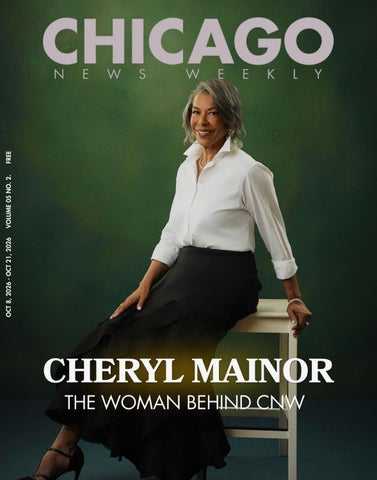
CHERYL MAINOR
THE WOMAN BEHIND CNW
OCT 8, 2026 - OCT 21, 2026
VOLUME 05 NO. 2.
FREE
E-NOTES
Publisher Cheryl Mainor Norman Editor-In-Chief
Kai EL’ Zabar
Associate Publisher/ Laura Miller Managing Editor D. Hunter Art Direction Staff Writers Zada Johnson, PhD Candi McCrary Mila Marshall, PhD C. L. Blackburn Ryan Willis Mare Evans Malachi Webster Columnists Cover Photography Cover Story MUA
Sanja Rickett Stinson Raji Vela, ROQA Productions Veronica Wormley
Videography Podcast Production Social Media
Caveroom Entertainment
The Publisher at a Glance
Cree Rivera Chicago News Weekly 2147 S. Lumber St. Chicago, IL 60615 (312) 877-5151 Volume 05 No. 2 OCT 08, 2026 - OCT 21, 2026 Chicago News Weekly is published on Thursday and a product of CNW Network www.cnwmedia.com advertising@cnwmedia.com editorial@cnwmedia.com
CHECK OUT LAST WEEK’S ISSUE AT WWW.CNWMEDIA.COM/E-EDITIONS
2 OCT 08, 2026 - OCT 21, 2026
Kai EL’ Zabar - Editor In Chief
This issue, I had the privilege and the honor of interviewing and writing the cover story of my friend and colleague Cheryl Nicole Mainor. It was challenging and refreshing at once. You don't know you know someone until you commit to a labor of love. On the following pages, you will meet the woman behind the title of Publisher and discover who she is, has always been, and will continue to be. In place of my usual E-Notes, I've included a look at Cheryl Mainor's remarkable career. Thank you to Cheryl for trusting me... Cheryl Mainor at a Glance Publisher • Media Executive • Entrepreneur • Creator Cheryl Mainor’s career spans newspaper publishing, advertising, national media services, community engagement, and multimedia development. Selected career milestones Built her first structured neighborhood business as a teenager. Learned newspaper production, photography, typesetting, and advertising through hands-on work and mentorship. Helped establish NNPA Media Services to expand national advertising opportunities for Black-owned newspapers. Co-created the national “Lift Every Voice and Vote” campaign. Co-created Lifelines: The Journal of African American Health, which reached a reported distribution of 2.5 million. Helped produce Data News Weekly during Hurricane Katrina, providing displaced residents with vital information. Served as publisher of the historic Chicago Defender, overseeing financial renewal, program expansion, and archival preservation. Co-founded Chicago News Weekly, legally established in 2017 and formally launched in print on Sept. 12, 2022.
Led CNW’s evolution toward a multimedia platform encompassing print, digital publishing, video podcasts, short-form documentaries, and projects in development. Selected honors Presidential Lifetime Achievement Award from President Joe Biden. Leaders for a New Chicago 2026 Award, presented by the Field Foundation and the MacArthur Foundation. Ethnic Pulitzer from New America Media, Diamond Chrysler Entrepreneur of the Year Award, and First Responders Award associated with the Data News Weekly hurricane-response work. PR Multicultural Advertising Campaign of the Year for “Lift Every Voice and Vote.” Did you know Cheryl worked at Harpo Studio? Ask her about her stint there as an intro to a conversation... .. Now let's dive in!
OCT 08, 2026 - OCT 21, 2026
3
CITY NEWS
Chicago Skyline to Turn Purple in Support of Children Impacted by Domestic Violence Chicago’s skyline will take on a different meaning later this month as buildings across the city illuminate in purple to draw attention to domestic violence and the children left navigating its aftermath. CNW STAFF REPORT Love & Protect Wisdom, a Chicago nonprofit supporting survivors and families affected by domestic violence, will hold its second annual Tower Over Domestic Violence campaign Oct. 23 through Oct. 29 as part of Domestic Violence Awareness Month. The campaign asks Chicago residents, businesses, schools, churches and community organizations to light their buildings, storefronts, offices and homes in purple in solidarity with survivors and families affected by domestic violence. The campaign is included on BOMA Chicago’s October skyline lighting calendar, which designates purple as the color for Tower Over Domestic Violence from Oct. 23 through Oct. 29. Willis Tower also lists purple lighting in recognition of the campaign from Oct. 25 through Oct. 29. But organizers say the effort is intended to do more than change the appearance of Chicago’s skyline. Money raised through the campaign will support TLC: The Love Continues, a Love & Protect Wisdom initiative serving children and young adults from birth through age 22 who have lost a parent or primary caregiver to domestic violence homicide.
Williams with youth in TLC program at Christmas
The program is being developed to provide longer-term support to families after the immediate crisis has passed, including connections to grief and trauma support, mental health services, educational resources, family assistance and other community services.
LPW Youth Workshop at Westside Youth Empowerment Conference
“When Chicago lights up purple, we want survivors and families to look around this city and know they are seen, supported and not alone,” said Loné Williams, founder of Love & Protect Wisdom. “This campaign is about more than lighting buildings. It is about illuminating an issue that too often remains hidden and turning awareness into action.” Williams founded Love & Protect Wisdom after losing her mother to domestic violence in 2023. The Chicago-based organization focuses on domestic violence awareness, survivor support, education and community engagement. The organization will also host a Tower Over Domestic Violence fundraiser from 6 to 9 p.m. Monday, Oct. 26, at VU Rooftop, 133 E. Cermak Road. The event will raise money for TLC while bringing together advocates, community members, and supporters. 4 OCT 08, 2026 - OCT 21, 2026
LPW 2025 Pamper and Power Event
The date, time, and location have also been publicly confirmed by the organization. Chicagoans who want to participate without attending the fundraiser are being encouraged to put purple lights in their windows or illuminate homes, businesses and other visible spaces during the campaign. Participants can share photographs using #TowerOverDomesticViolence.
“We don’t want people to simply see the purple skyline. We want them to become part of it,” Williams said. “Every action helps us remind survivors and families that an entire city is standing with them, and reminds these children that the love and support for them continues.” The Tower Over Domestic Violence campaign runs Oct. 23–29. Information about the campaign, TLC and the Oct. 26 fundraiser is available through Love & Protect Wisdom at loveprotectwisdom.com.
CITY NEWS Illinois Utility Assistance Opens as Winter Costs Approach
Illinois’ LIHEAP program is accepting applications from priority households now, with other income-eligible residents able to apply beginning Nov. 1. CNW STAFF REPORT As colder weather approaches, Illinois residents who may need help paying their utility bills can begin applying for assistance through the state’s Low-Income Home Energy Assistance Program. If you know a family or individual who needs assistance, please share this information., please share this information. Known as LIHEAP, the program helps eligible households pay for natural gas, propane and electricity. Illinois opened its 2026-27 application period Oct. 1 for older adults age 60 and older, people with disabilities, households with at least one child age 5 or younger and households facing certain utility emergencies. Residents whose utilities have already been disconnected, who have a disconnection date within seven days or who have less than 25% remaining in a propane tank are also eligible to apply during the first phase. All other incomeeligible households can begin applying Nov. 1. The program is scheduled to remain open through Aug. 13, 2027, or until available funding is exhausted. For customers of Ameren Illinois, ComEd, Nicor Gas, North Shore Gas and Peoples Gas, household gross income for the 30 days before applying must generally be at or below 300% of the federal poverty guidelines. For example, the current limit listed by the Illinois Department of Commerce and Economic Opportunity is $3,990 in 30-day income for a one-person household, $5,410 for two people, and $8,250 for a fourperson household. Different income standards apply to customers of federally funded utilities and energy vendors. Residents who rent may also qualify even if heat is included in their rent. The state advises applicants to have several documents ready, including proof of income for the previous 30 days, a recent heating or electric bill, and identifying information for household members.
Renters whose heating costs are included in their rent may also need a rental agreement showing the monthly rent, landlord contact information, and which utilities are included. Photo Credit: Shutterstock Applicants can begin the process through Help Illinois Families or apply directly through their local administering agency.
That means households that do not ultimately qualify for a traditional LIHEAP benefit may still want to ask their utility company about other income-based discount programs. For those eligible now, however, waiting for the first large winter bill may not be the best strategy. LIHEAP funding is limited, and the program closes once those funds are exhausted.
After an online Request for Services form is submitted, the local agency contacts the household to verify eligibility and determine The Help Illinois Families Call Center is available at 1-833the amount of any benefit. The state cautions 711-0374 for residents who need assistance completing the that completing a request does not guarantee application process. assistance. Eligibility must still be confirmed, and benefits remain subject to available funding. LIHEAP customers of several major Illinois utilities may have another form of assistance available this year. DCEO says incomeeligible customers of Ameren Illinois, ComEd, Nicor Gas, North Shore Gas and Peoples Gas can receive monthly low-income utility discounts. Ameren’s new Electric Service Discount Program also took effect Oct. 1 and bases monthly payments on a percentage of income.
OCT 08, 2026 - OCT 21, 2026
5
NATIONAL NEWS U.S. Hiring Slowed Sharply in September. What Workers Should Watch Now CNW STAFF REPORT
U.S. hiring slowed in September, with employers adding just 29,000 jobs while the unemployment rate held at 4.2%, according to the U.S. Bureau of Labor Statistics report released Oct. 2. Approximately 7.1 million Americans were unemployed in September. Among Black workers, the unemployment rate climbed to 7%, highlighting continued disparities in the labor market.
For workers, the slowdown underscores the importance of preparation. With fewer positions being added, job searches could become more competitive, making updated résumés, professional relationships and financial planning increasingly valuable.
Employees should document measurable accomplishments, refresh professional profiles and maintain connections with former colleagues and industry contacts. Understanding workplace benefits, including The report also revealed weaker employment health insurance, retirement accounts and growth than previously reported. July's unused paid leave, is equally important should numbers were revised from a gain of 21,000 employment circumstances change. jobs to a loss of 10,000, while August's gains were reduced from 162,000 to 133,000. The report does not suggest widespread Together, the revisions eliminated 60,000 layoffs are imminent. Employment across previously reported jobs. most major industries remained relatively stable. However, workers considering a Health care remained a source of voluntary job change should recognize that employment growth, adding 17,000 positions securing another position may take longer in in September, although that was below the a slower hiring environment. sector's average monthly gain of 33,000 over the previous year. Wages increased modestly, The next federal employment report is with average hourly earnings rising 5 cents to scheduled for Nov. 6. For more information $37.81. Compared with September 2025, and a closer look at what these numbers wages were up 3%. mean for workers, read the full story at cnwmedia.com.
6
OCT 08, 2026 - OCT 21, 2026
SPECIAL ANNOUNCEMENT Calling Chicago's Next Generation of Visual Storytellers
Chicago has never lacked talent. Every day, photographers across our city capture moments that deserve to be remembered. They document neighborhood festivals, family traditions, entrepreneurs building businesses, artists creating culture, young athletes chasing dreams and the everyday moments that make Chicago unlike anywhere else. Some have built impressive portfolios. Others have quietly honed their craft without the recognition their work deserves. At Chicago News Weekly, we believe great storytelling isn't limited to those who already have the biggest platform. Some of the city's most compelling visual storytellers simply haven't had the opportunity to publish their work in a newsroom. That's why we're launching CNW Through the Lens, a new initiative created to discover photographers whose work reflects the heart of Chicago. We're looking for photographers with a distinctive perspective, a passion for visual storytelling and a commitment to documenting the people and communities that make this city extraordinary. Whether you're self-taught, a student, an experienced creative or someone who has simply been waiting for the right opportunity, we want to see the city through your lens. The selected photographer will have the opportunity to photograph an upcoming Chicago News Weekly cover story, receive a published editorial feature highlighting their work and be considered for future assignments as a contributing photographer. This isn't simply about finding great photographs. It's about opening the door for talented creatives whose work deserves a wider audience and creating another pathway into Chicago's media community. Submission guidelines, deadlines and application details will be announced in our next issue. Until then, start curating your strongest work and share this opportunity with a photographer whose talent deserves to be seen. Every published photographer had a first assignment. Make yours at CNW!
OCT 08, 2026 - OCT 21, 2026 7
NATIONAL NEWS CNW Poll: Pritzker Leads Bailey by 20 Points, Democrats Ahead in Four Other Statewide Races
Public Policy Polling survey of 569 Illinois voters also finds larger Democratic margins among voters most enthusiastic about casting ballots this fall LAURA MILLER - MANAGING EDITOR Gov. JB Pritzker holds a 20-point lead over Republican challenger Darren Bailey, while Democratic candidates are ahead in four other statewide races surveyed in the first statewide election poll commissioned by Chicago News Weekly. The survey, conducted by Public Policy Polling from Sept. 30 through Oct. 1, included 569 Illinois voters. Pritzker received 54% support in the governor’s race, compared with 34% for Bailey. Independent candidate Collin Corbett received 6%, while another 6% of respondents were undecided. Democratic candidates also led each of the other four statewide contests included in the poll. In the U.S. Senate race, Democrat Juliana Stratton received 49% support to Republican Don Tracy’s 36%, with 15% of respondents undecided. Attorney General Kwame Raoul received 52% support, compared with 38% for Republican Bob Fioretti, while 11% were undecided. Secretary of State Alexi Giannoulias led Republican Diane Harris 55% to 37%, with 8% undecided. In the comptroller race, Democrat Margaret Croke received 48% support to Republican Bryan Drew’s 37%, while 15% had not selected a candidate. The percentage of undecided voters varied across the five contests. The governor’s race had the smallest share at 6%, followed by the secretary of state race at 8% and attorney general race at 11%. The Senate and comptroller contests each recorded 15% undecided. The poll also examined how enthusiastic Illinois voters were about participating in this fall’s election. Fifty-four percent of respondents said they were very excited to vote, while 23% said they were somewhat excited, and another 23% said they were not too excited. Among those who described themselves as very excited, Pritzker received 59% support to Bailey’s 35%, a 24-point advantage. Among somewhat excited voters, Pritzker led 56% to 33%. The margin narrowed among respondents who said they were not too excited, with Pritzker receiving 40% and Bailey 33%.
These findings suggest that candidate preferences differ according to voters’ reported enthusiasm. However, enthusiasm expressed during a survey does not necessarily translate into voter turnout, nor does it guarantee an election outcome. The CNW poll also asked respondents to evaluate President Donald Trump’s job performance. Thirty-three percent approved of the job Trump is doing as president, while 61% disapproved, and 6% were unsure. The survey included voters from across Illinois. Eighteen percent of respondents lived in Chicago, 19% resided in the remainder of Cook County, 26% were from the collar counties, and 37% lived elsewhere in the state. Respondents identified politically as 42% Democratic, 27% Republican, and 30% independent. The sample included 52% women, 46% men, and 2% gender non-binary respondents. By race and ethnicity, 70% identified as white, 13% as Black, 13% as Hispanic or Latino, and 4% as another race or ethnicity.
Similar differences appeared in the U.S. Senate contest. Stratton received 56% support among very excited voters, compared with Tracy’s 37%. Among somewhat excited voters, Stratton led 48% to 32%. However, among respondents who were not too excited about voting, Tracy led Stratton 39% to 33%, with 28% undecided.
The poll also included voters across age and education groups. Thirty-one percent of respondents were between ages 18 and 45, 36% were between 46 and 65, and 33% were older than 65.
The pattern extended to the remaining statewide contests. Among voters most enthusiastic about casting ballots, Raoul led Fioretti 56% to 38%, Giannoulias led Harris 58% to 38%, and Croke led Drew 54% to 38%.
Twenty-eight percent reported a high school education or less, 26% had attended some college without completing a degree, 7% held a two-year degree, 22% held a four-year degree, and 17% had earned a postgraduate degree.
8 OCT 08, 2026 - OCT 21, 2026
Understanding the Poll: How Many Voters Does It Take? A common question about political polling is how several hundred people can reflect the opinions of millions of voters. The answer lies in how participants are selected and how accurately they represent the population. Professional polling organizations use statistical sampling to measure public opinion without interviewing every voter. Surveys of approximately 500 to 1,000 respondents can provide useful estimates when appropriate methods are used. Researchers examine geography, age, race, gender, and political characteristics to assess representation. Statistical weighting may also account for differences between respondents and the broader population. For Chicago News Weekly's statewide survey, Public Policy Polling collected responses from 569 Illinois voters across Chicago, suburban Cook County, the collar counties, and the remainder of the state. Participants represented different racial, educational, and age groups during the two-day polling period. No poll predicts an election with certainty. Sampling methods, voter turnout, undecided voters, and changing opinions can influence results. Polling instead captures where voters stand at a particular moment. Poll methodology: Public Policy Polling conducted the CNW survey Sept. 30 through Oct. 1, 2026, among 569 Illinois voters statewide. Seventy-two percent responded by text, and 28% by landline.
HEALTHY LIVING Breast Cancer Awareness Month : Centering the Health and Survival of Black Women and Me LEE DAVIS - CONTRIBUTING WRITER
CNW looks at October, Breast Cancer Awareness Month—a vital global initiative from October 1 to October 31 dedicated to increasing education, emphasizing early detection, and supporting everyone affected by the disease. Our goal is to provide our readership with information that directly informs the Black community about what affects our overall well-being and health. While breast cancer impacts all communities, the conversation within the Black community carries unique urgency. Due to distinct biological factors, systemic barriers, and persistent healthcare inequities, Black women and men face unique, disproportionate challenges that require targeted awareness and aggressive advocacy. ‘The Reality for Black Women and Men Disproportionate Mortality: Although Black women have a slightly lower overall incidence rate of breast cancer compared to white women, they experience roughly a 38% to 40% higher mortality rate. Early-Onset and Aggressive Subtypes: Black women are more frequently diagnosed at a younger age (under 40) and have a significantly higher incidence of Triple-Negative Breast Cancer (TNBC)—an aggressive subtype that lacks common hormone receptors, making it harder to treat and more prone to recurrence. The Overlooked Risk in Men: Breast cancer is often viewed exclusively as a women’s health issue, leaving Black men vulnerable to latestage diagnoses. Because men also have breast tissue, they can develop breast cancer, but symptoms are frequently ignored or dismissed until the disease has progressed. Although actor Richard Roundtree died from Pancreatic cancer, following a brief battle, he previously survived male breast cancer after being diagnosed in 1993. He later became an advocate for raising awareness about the disease in men. To that point, we must make sure that Black men are aware of breast cancer in men as well as Pancreatic cancer.
The good news is that medical research has evolved, and the advancement is quite astounding, extending the life expectancy of those with some of the more aggressive cancers. If a loved one is diagnosed with cancer, it can be confusing to know what some of the terms mean. Incurable cancer is not necessarily the same as a terminal cancer. Breast cancer is curable. Some cancers, like pancreatic cancer and the rare lung cancer mesothelioma, do not have serious symptoms until they are quite progressed. This makes them less likely to be detected until they have spread, and more difficult to treat. Key Focus Areas and Dates to Remember Early Detection & Screening: For individuals at average risk, annual mammograms should begin at age 40. However, Black women should discuss their individual family histories and potential early-onset risks with their doctors even earlier. Metastatic Breast Cancer (Stage IV): Recognized nationally on October 13, Metastatic Breast Cancer Awareness Day highlights advanced cancer that has spread beyond the breast to distant organs like the bones, lungs, liver, or brain. While incurable, advancements in targeted therapies aim to prolong life and maintain quality of life. Men's Breast Cancer Awareness (October 17–23): This week explicitly shines a light on breast cancer in men, trans men, and nonbinary individuals, breaking the stigma that men cannot get diagnosed. How to Take Action in Our Communities Know Your Normal: Whether you are a woman or a man, pay close attention to physical changes. Report persistent lumps, skin dimpling, nipple discharge, or unexplained pain to a healthcare provider immediately. Prioritize Screenings & Advocacy: Commit to booking your mammograms on schedule, and encourage the men and women in your family to take symptoms seriously rather than writing them off.
Support organizations like Sisters Network Inc. and broader groups focused on disparities in communities of color. Medical Disclaimer: This information is educational. Consult a healthcare professional for personal or family medical concerns. Areas to explore for support: Local screening resources and lowcost mammograms Signs, symptoms, and risk factors for Triple-Negative or Metastatic breast cancer Support networks for Black patients and caregivers Ask your doctors questions Evolving cancer terminology: Medical language can be confusing, and advances in research are improving cancer survival rates, changing the conversation about the disease. Discuss any uncertainties about your diagnosis with your healthcare team. Some cancers, like pancreatic cancer and mesothelioma, often show no serious symptoms until advanced, complicating detection and treatment. OCT 08, 2026 - OCT 21, 2026 09
THE WOMAN BEHIND CHICAGO NEWS WEEKLY
COVER STORY GROOMED FOR THE ROLE
BY KAI EL ZABAR EDITOR IN CHIEF
COVER STORY PHOTOGRAPHY, RAJI VELA ROQA PRODUCTIONS
Driven to Create From neighborhood entrepreneur to publisher of historic Black newspapers, Cheryl Mainor has spent a career recognizing what is missing, building what is needed, and turning ideas into lasting opportunities. Her journey to Chicago News Weekly is the story of a woman whose preparation began long before she received the title of publisher. In 2026, Chicago News Weekly (CNW) celebrates its fourth anniversary as a print publication. Behind the milestone is the story of Cheryl Mainor, its conceptualizer, co-founder and publisher—a media executive whose journey has been shaped by entrepreneurship, mentorship, family responsibility and an enduring commitment to the Black press. Ask Mainor how Chicago News Weekly came to be, and she is likely to describe it as a continuation of what she has always done. That is not to diminish the significance of CNW. Rather, it is to understand the publication through the experiences, decisions, and instincts that prepared her to create it. Throughout her career, Mainor has repeatedly entered situations, assessed what was missing and developed practical solutions. She has built sales teams, created revenue-generating programs, expanded national advertising opportunities, helped preserve historic archives and used newspapers to connect people with information when they needed it most. Her journey also reveals something less visible than a résumé: the making of a publisher. Long before she held the title, she was learning the business, observing its leaders and testing her abilities while in training for a role she could not yet fully see. For Mainor, that process was a kind of casting—a succession of experiences that trained, tested, and positioned her for the work ahead. And at every stage, one quality remained constant: she was a creator. Foundational Life Lessons “Family is the foundation from which I have evolved to become,” Mainor says. “I grew up in a traditional Black family led by my father and mother. Faith was central to our home; we were raised with a deep love for God, grounded in Christian values, and supported by a close-knit extended family.” 10 OCT 08, 2026 - OCT 21, 2026
Her grandfather was a pillar in her life until his death when she was 30. He consistently emphasized the importance of church, community and strong family bonds—principles that would remain with her through the demands of professional life and the responsibilities of caregiving. Her earliest lessons in business came from her parents, both entrepreneurs. While working outside the home, her father pursued undergraduate and graduate degrees. After completing graduate school, he launched Lynn & Associates Contracting. Her mother managed the company’s books from home. “My observations of them began early in my childhood,” Mainor explains. “Watching a business be born, grow, and become the sustainer of our household shaped us.” Her father encouraged his five children to think like business owners and build something of their own. Mainor took the lesson to heart. As the eldest daughter, she also learned responsibility early. She often oversaw her siblings when her parents were away, developing organizational and caregiving skills that would later serve her in both business and family life. At 16, she turned babysitting into a structured neighborhood enterprise. Rather than accepting occasional babysitting jobs, she organized two designated evenings each month when parents could bring their children to one house and plan a night out. She arranged pizza, supervised the children, and charged a per-child hourly rate. The business continued successfully until she graduated from high school. Around the same time, her father secured a lawncare contract for local county facilities. When her older brother was unavailable because of summer football, Mainor stepped in. She was running track and had more flexibility, so she equipped herself with an eight-track player and oversized headphones, climbed onto a riding lawn mower, and cut grass across the county. The work was practical, but the lesson was larger: when there was a job to do, she could find a way to do it.
COVER STORY
By college, business had become second nature. Mainor bought an electric typewriter and began a papertyping service for students. Later, when Apple Macintosh computers arrived at the library, her friend Paul Thompson introduced her to the technology. The ability to correct errors without liquid paper and print clean pages almost instantly opened a new world. She did not yet know where the experience would lead, but media and technology were beginning to converge in her life. Mainor had been raised in an entrepreneurial environment that valued family, initiative, and selfreliance. Those early experiences supplied more than business skills. They established a way of approaching life: recognize the need, accept responsibility, and get to work. The Master Class: Mentors and Mechanics Mainor credits two teachers, Mrs. Katerina Kenworthy and Mrs. Cheryl Kaechele, with helping lay the foundation for her professional future. In ninth grade, her mother insisted she study Latin. Mainor struggled with its complex verb conjugations and found it difficult to grasp a language she could not hear spoken around her. Kenworthy, an Italian immigrant who took a genuine interest in her student, suggested that Mainor switch to Spanish in tenth grade while remaining active in the Latin Club. The change proved transformative. “ The moment I started Spanish, everything clicked,” Mainor recalls. “It unlocked not only Spanish and Latin, but also English grammar, communication, and creative writing. It revealed a lifelong gift for listening to and absorbing languages quickly.” That ability to recognize patterns and absorb information would prove valuable in a field built on communication. Her entrance into professional publishing came through Kaechele. When asked what she could do, Mainor mentioned her knowledge of typesetting—a skill she had developed through Documakers, a small typesetting venture she operated with her friend Tammy Aguado using a Macintosh computer purchased with a loan from her father.
Kaechele already had typesetting covered. Then came another question: “Can you take photos?” Mainor had no formal photography experience, but she accepted the challenge. Her then husband, photographer Paul Mainor, had helped her learn layout and graphic design on Macintosh computers at Kinko’s. Kaechele handed her a camera, sent her into the field and instructed her to develop the film in the darkroom. Mainor remembers the determination that followed. With her baby, Andrew, strapped to her back in a carrier, she entered the darkroom, closed the door, and put Paul on speakerphone; he guided her step by step through mixing chemicals, timing the agitation, and producing the prints. She got the job. From there, she learned the many facets of newspaper production. Sales, however, became her passion. It showed her the business engine beneath the journalism: advertising, revenue, and legal notices were essential to sustaining the publication. When Mainor prepared to return to Chicago as a mother of two, Kaechele expressed a prediction that would stay with her:
“Now you know how to do everything in a newspaper. One day, you will be a publisher.” It was more than encouragement. It was recognition that the combination of skills Mainor was assembling could prepare her to lead an entire operation. Chicago and the Making of a Publisher Back in Chicago, Mainor joined N’DIGO Magapaper for the Urbane as advertising sales manager. She built a high-performing sales team and helped navigate a strategic partnership with the Chicago Tribune. Watching enormous rolls of newsprint move through the facility gave her a firsthand view of the scale and mechanics of newspaper production. Continued on page 12.
OCT 08, 2026 - OCT 21, 2026
11
She was learning constantly, she says, gathering Recognizing her work, he appointed her associate information about every part of the business and publisher and sent her to Washington, D.C., to work with taking another step toward becoming a publisher. the National Newspaper Publishers Association (NNPA), which represented more than 200 Black-owned Her next opportunity came through Bill Garth newspapers nationwide. Working alongside NNPA and the Citizen Group. Newly divorced and President Jake Oliver and Executive Director Ben Jealous, raising two young children, Mainor accepted a she saw the need for a unified national advertising and sales position with expanded responsibilities. revenue operation. Within days, she was traveling to Columbus, Ohio, for a Midwest Black Publishers workshop. This was where Mainor’s instincts as a creator became especially evident. She did not simply learn to manage There, she found herself amongst some of the existing systems. She studied how those systems worked, most influential figures in Black newspaper identified their limitations, and sought ways to make them publishing. She observed industry leaders more effective. negotiate advertising deals with major corporations, including General Motors and She helped establish NNPA Media Services, serving Coca-Cola. Among those she encountered were first as director of media services and later as deputy Dorothy Leavell of the Chicago Crusader, Bob director. She relocated her family to Alexandria, Bogle of the Philadelphia Tribune, Tom Virginia, and worked with Garrison Jackson of Watkins, and Walter Smith. Circulation Experti, who handled back-office functions including placement, insertion orders, and financial Mainor was one of the youngest people in the distribution. Together, they helped transform the way room, where she was welcomed into the national advertising buys could effectively reach Black conversation. Garth recognized her ability to community newspapers across the country. The work use emerging technology, including PowerPoint, required business judgment, operational discipline, and slide presentations, and reports. He began an understanding of the value of a collective national assigning her responsibility for presentations to audience. It also reflected a recurring principle in major accounts such as General Motors, Coca- Mainor’s career: a solution could meet a community’s Cola, Philip Morris and Brown-Forman. needs while creating a sustainable financial opportunity for the institutions serving that community. Mainor became the voice delivering the presentations, but the strategic foundation came Alongside her professional responsibilities, she from Garth. She learned to identify the was raising her children, who were growing problems facing executives and offer solutions into adolescence, and continuing to shoulder that address their needs. family responsibilities. After moving to Atlanta, her younger sisters joined her. In time, “I needed somewhere to land and be able to she became a caregiver to her youngest sister, utilize and execute all that,” she recalls. The Marie, who needed assistance with daily selfCitizen Group gave her that opportunity—and care, and to her niece. much more. Only later did she fully understand what Garth had been doing. “Now I know what Caregiving was another dimension of the Mr. Garth was doing because I watched how he responsibility she had learned early. moved and how he put me in places to be the voice and to build that muscle. I get it now, Creating Lift Every Voice and Vote because I’m doing it. I have become him. And I have someone who I am grooming.” Mainor’s work with the NNPA led to an initiative that combined public Garth instinctively knew that she was a rising service, coalition building, and a new star. He gave her room to learn, lead, develop, model for generating revenue for and express her own voice. In doing so, he Black newspapers. modeled a form of leadership that Mainor would later practice herself: recognizing They brought in Paul Mainor to potential and creating space for someone else to design the campaign’s visuals, secured permission from the rise. Clinton White House to use specific historical imagery, and traveled to He also introduced her to a range of influential the NAACP National Convention organizations and publishing opportunities, in Baltimore to present their including Operation PUSH, founded by the Rev. proposal. Continued on page 13. Jesse Jackson, which published PUSH Magazine. Garth directed Mainor to oversee the publication.
12 OCT 08, 2026 - OCT 21, 2026
COVER STORY
Their strategy was built upon a broader coalition. It united the NAACP under Kweisi Mfume, the National Urban League under Hugh Price, the National Council of Negro Women under Dr. Dorothy Height, the National Coalition on Black Civic Participation led by Melanie Campbell, and national Black church denominations. “Our strategy won the bid because it looked beyond any single organization,” Mainor says.
COVER STORY
The resulting campaign was a multimilliondollar effort. It included full-page advertisements in Black newspapers across the country, placements on city transit systems, features in Ebony and Essence, national radio spots and a voter guide inserted into NNPA publications. Mainor also expanded the advertising effort by selling space across Democratic political organizations—including the Democratic National Committee, Democratic Senatorial Campaign Committee and Democratic Governors Association—as well as nonpartisan political action committees during the Gore-Bush presidential race.
Mainor and Paul laid out the newspaper in Atlanta and transmitted digital files to the Gannett printing facility in Shreveport, Louisiana, which remained operational. Copies were then trucked to shelters, relief centers, and displaced communities. For people searching for family members, the newspaper became more than a source of news. It offered a tangible way to reconnect. Mainor recalls displaced residents in shelters in Kennesaw, Georgia, and Houston scanning the pages for the names of missing grandmothers, children, and neighbors. She also welcomed displaced families into her home for Sunday dinners, witnessing the relief that came when people found information about their loved ones.
Mainor describes the campaign as the first time every Black-owned newspaper in America received direct advertising revenue from a national election cycle. The effort received the PR Multicultural Advertising Campaign of the Year award. Its importance extended beyond voter outreach. The campaign demonstrated the power of coordinating Black media nationally and connecting that collective reach to a substantial advertising opportunity. It remains an achievement whose place in the history of Black publishing deserves careful documentation. Lifelines: Information With a Business Model Building on that approach, Mainor and Jackson launched Lifelines: The Journal of African American Health, a specialty publication designed as an insert in NNPA newspapers. The journal addressed a need for accessible health information while creating a new revenue stream for member publishers. It attracted pharmaceutical advertising from companies including GlaxoSmithKline and Pfizer. Participating newspapers received fees based on circulation, while a Local Lifelines template helped them attract regional advertising. For eight years, Lifelines operated as a widely circulated specialty publication, reaching a reported distribution of 2.5 million. Once again, Mainor had connected two objectives: delivering information that mattered to Black communities and building a financial model that could benefit the newspapers delivering it.
In coordination with New Orleans Mayor Ray Nagin and Louisiana Gov. Kathleen Babineaux Blanco, the team obtained shelter manifests from locations including the Houston Astrodome, facilities in Chicago and Fort Custer in Battle Creek, Michigan. With telephone service disrupted, families often had no reliable way to learn where loved ones had been taken —or whether they were safe. The newspaper gathered missing-person information, shelter rosters, city updates, neighborhood reports, and instructions about returning home. “We transformed Data News Weekly into a vital relief pipeline,” Mainor says. “We gathered lists of missing persons, shelter rosters, city updates, neighborhood status reports, and return instructions—information national news outlets like CNN or MSNBC simply could not provide.”
Mass × velocity = momentum. “We have momentum.” This was another example of her ability to recognize an unmet need and develop a structure that served readers, advertisers, and publishers at the same time.
Amid the upheaval, Jones faced another devastating question:
What would happen to the newspaper that had defined his working life for 30 years? Mainor remembers his question: Hurricane Katrina: When a Newspaper “What am I supposed to do now? The Became a Lifeline paper is all I’ve done for 30 years.” Her answer was immediate. In August 2005, Mainor was consulting in Atlanta when Hurricane Katrina “We know how to do this. Paul is here, struck the Gulf Coast on Aug. 29.Her I’m here—we’re going to get the paper cousin, friend, and colleague Terry Jones produced.” Mainor moved into action. was visiting Atlanta for a birthday Because she was still publishing weekend. Jones was the son of Joseph Lifelines, the production and “Scoop” Jones, founder of New distribution relationships were already in Orleans’ Data News Weekly. place. She and Paul helped establish an emergency publishing operation in As the hurricane’s destruction spread Atlanta, working to turn Data News and the levees broke, Jones’ family and Weekly into a practical source of newspaper employees were evacuated information for people displaced by the and scattered across the country. Mainor disaster. and Jones spent days tracking down relatives and trying to verify that loved ones were safe.
The work earned Data News Weekly the Ethnic Pulitzer from New America Media, the Diamond Chrysler Entrepreneur of the Year Award and the First Responders Award, according to Mainor. Transforming the Chicago Defender Mainor continued working with Jones on Data News Weekly for 17 years. Then, in late 2013, Hiram Jackson, chief executive officer of Real Times Media, contacted her about the Chicago Defender. After consulting trusted peers in Detroit and receiving the encouragement of her longtime mentor Bill Garth, she accepted the role of publisher in May 2014. Taking the helm of a historic institution was a profound responsibility. Continued on page 14.
OCT 08, 2026 - OCT 21, 2026
13
COVER STORY Mainor brought Kai EL’Zabar on as executive editor. Both considered restoring the newspaper a responsibility to its community, not a matter of personal ambition. Mainor and the executive team sought to preserve the Chicago Defender’s editorial mission, not just its finances. Founded by Robert Sengstacke Abbott, the newspaper advocated for Black people and helped spur the Great Migration. At the 2016 opening of the Smithsonian’s National Museum of African American History and Culture, Mainor found her story as the first woman publisher prominently displayed, highlighting the newspaper's significance in Black history. Despite corporate pressures to shift toward digital and light entertainment, Mainor insisted on the need for serious news coverage addressing critical issues in Black Chicago, while also incorporating lifestyle content without losing the paper's core mission. Inspired by the magazine supplement of The New York Times, she gave the nod to publish CD Magazine as a home for lifestyle and culture content, keeping the main publication focused on its founding promise: to defend the Black community. The distinction mattered. A newspaper could evolve its formats and expand its offerings without abandoning the purpose that made it essential. During this period, Mainor’s children were becoming young adults, completing college and pursuing their own interests. She continued to manage the responsibilities of caring for her sister Marie and their mother while carrying the demands of leadership. Her work at the Defender brought together many of the lessons accumulated across her career: financial discipline, operational knowledge, cultural stewardship and the ability to create new possibilities without losing sight of an institution’s purpose.
Mainor understood that surviving would require more than repeating familiar business practices. CNW would need to adapt its revenue model, build partnerships and broaden the ways it served its audience. The organization has received different forms of financial and training or consultation support from media and philanthropic institutions including Press Forward Chicago, Field Foundation, MacArthur Foundation, Chicago Community Trust, Lenfest Institute, Poynter Institute and Medill. CNW has also developed relationships with academic institutions, including Northwestern and DePaul University, to encourage peer learning and operational innovation. The strategy is not to abandon print, but to expand beyond it. CNW’s work now encompasses its print newspaper, an upgraded digital platform, video podcast series, short-form documentaries, and an animated documentary series in development. The objective is to build a multimedia company capable of serving audiences across platforms while maintaining the publication’s commitment to community-centered news. “Publishing is not a field for the faint of heart,” Mainor says. “It requires resilience, adaptability, and an unyielding commitment to the mission. Over 35 years in this business—navigating 9/11, Hurricane Katrina, economic shifts, and structural revolutions —I’ve learned that when the formula changes, you don’t break; you pivot.” Creating the Next Chapter For Mainor, the future of CNW is about more than sustaining a newspaper. It is about creating opportunities for the people who will shape the next generation of media.
“As we look ahead, our mission is to open doors for the next generation—inviting young creatives, filmmakers, journalists, and investors to build on this platform,” she says. “This journey has been the greatest labor of love of my life, and the future ahead is exceptionally bright.” That commitment reflects the pattern running through her life. She began by organizing a neighborhood babysitting business, learned the mechanics of publishing from mentors who recognized her potential, and went on to build systems that connected Black newspapers with advertisers, readers and communities. She helped deliver information during a national disaster, worked to preserve a historic newspaper’s archives, and developed a new publication in a difficult media economy. Again and again, she has recognized a gap and asked how it might be filled—not simply for herself, but for others who could benefit from what she created. Her journey has not been without obstacles. She acknowledges that business is hard, and its challenges never disappear. There are wrong turns, unexpected setbacks, and moments when a plan must be reconsidered. “Failure is not an option,” she says. Success, she explains, requires preparation, sound choices, grace and faith—and the willingness to get back up after a wrong turn or a crash. Over time, she has developed a formula of her own: Mass ×
velocity = momentum. “We have momentum.”
The statement is both a business assessment and a reflection on the journey that brought her here. Every experience, mentor, challenge, and creation has contributed to her career's forward movement. The work continues, but she is no longer simply preparing for the role. She is living it, shaping it and making room for others to follow. And after all the years of learning, building, leading, and carrying responsibility, Mainor closes with a smile and a simple declaration: “I am now having fun!”
By 2017, Mainor’s chapter at the Chicago Defender had reached its conclusion, but she believed Chicago still needed a strong Black-owned news publication —one that could serve readers in print and digitally. The Birth and Future of Chicago News Weekly Chicago News Weekly was legally established on paper in 2017 with Terri Winston, Cree Rivera and Kai EL’ Zabar. In its early phase, CNW operated as a Facebook page that encouraged interactive exchange of news and information. The next chapter came in 2022, when CNW began operating as a newspaper business and formally launched in print on Sept. 12. But the media environment was changing rapidly. Retail closures, including those of major chains and local grocery businesses, shifting advertising spending and broader industry consolidation created additional pressure on local news. The financial challenges were particularly serious for newspapers dependent on traditional advertising models. Since 2005, the American local news ecosystem has lost nearly 3,500 newspapers, according to research from the Medill State of Local News Project at Northwestern University. The loss has left communities across the country with fewer sources of local reporting and made the sustainability of independent news organizations increasingly urgent.
OCT 08, 2026 - OCT 21, 2026
14
BUSINESS & FINANCE The Appetite—Private Equity at Every Table MALACHI WEBSTER - CONTRIBUTING WRITER Believe it or not, there was a time when sporting events, a Saturday league sign-up, and a visit to the vet were not only affordable but untouched by private equity. The gym, the clinic, and the store still look the same from the parking lot. What changed is who they feed. To see it, start with how private equity eats. A firm gathers money from investors, borrows far more, and buys a company. The borrowed money then becomes the purchased company's debt, carried inside it the way a meal is carried inside a body, while the firm collects fees and dividends and prepares, within a few years, to sell. PetSmart shows the whole method in one meal. In 2014, BC Partners led an $8.7 billion buyout of the pet-store chain. The loans pushed PetSmart's debt near seven times its annual earnings, past the six-times line federal regulators had marked as a concern. The aisles stayed the same, and so did the kibble. The body underneath now carried the bill. From the store shelf, the appetite moved into the exam room. A decade ago, corporations owned about 10% of U.S. veterinary practices. Today estimates run from 30% to 50%, and as high as 75% in emergency and specialty care, PBS NewsHour reported. Private equity firm KKR is among the owners. Over roughly the same stretch, veterinary costs climbed about 60%. If an animal's care can be bought and resold, so can a person's.
In 2010, Cerberus Capital Management bought six Catholic hospitals in Massachusetts for $246 million and grew them into Steward Health Care.Six years later, Steward sold its own hospital buildings to a landlord for $1.25 billion and began paying rent on the ground beneath its patients. Cerberus tripled its money and left. Steward filed for bankruptcy in May 2024, and two Massachusetts hospitals closed. Cornell professor Rosemary Batt said such deals "turn healthcare organizations into financial assets to be bought and sold."
In September, parents filed a proposed class action accusing youth hockey operator Black Bear Sports Group, owned by Blackstreet Capital, of requiring designated hotels, hiding fees, and taking kickbacks. Investors read the same fields as opportunity.
What that ownership does inside a hospital has been measured on patients themselves. A 2023 JAMA study of 51 hospitals bought by private equity found Medicare patients suffered 25.4% more hospital-acquired conditions after the sale, including 27.3% more falls, 37.7% more central-line bloodstream infections, and double the surgical-site infections, even as surgeries fell. The American Investment Council, the industry's lobbying group, called it unfairly slanted. The buying continued regardless: in 2025, the Private Equity Stakeholder Project counted 1,029 private equity health care deals in the United States.
The children who come up through those tournaments are headed toward a professional game that has opened its own doors. In August 2024, NFL owners voted unanimously to let approved private equity funds buy up to 10% of a team and hold it at least six years. Commissioner Roger Goodell called it "an appropriate thing to give teams that liquidity." The Bears play in that league.
The appetite has also learned where families spend without counting. American households put more than $40 billion a year into youth sports, and that spending rose 46% from 2019 to 2025, according to the Aspen Institute. KKR paid $4.8 billion for Varsity Brands, the cheer competition company. Unrivaled Sports, built by Philadelphia 76ers owners Josh Harris and David Blitzer, now holds more than 20 companies.
Drew Weatherford, whose firm backs a youth baseball platform, called the tournament system "the most inefficient way that you can run a network of anything."
Against that spread, Illinois has started setting rules for the table. House Bill 5000, effective Jan. 1, 2027, requires parties to notify the attorney general before health care deals close, and it names private equity outright, including partial and indirect ownership of providers that earn $10 million or more a year from Illinois patients. The store, the clinic, the hospital, and the field were each sold one deal at a time, and each deal left paper behind: state filings, bankruptcy dockets, the next press release. That paper trail is the public record of who’s eating.
The House and the Exchange—Prediction Markets, Sportsbooks, and Who Collects MALACHI WEBSTER - CONTRIBUTING WRITER Put $20 on the Bears through DraftKings and you have placed a bet. Put $20 on the same game through Kalshi and, according to Kalshi and the federal government, you have bought a financial contract. Illinois has spent most of this year insisting those are the same thing, because the answer decides who gets paid.
A sportsbook takes the other side of your wager, sets the odds and keeps a margin, while a prediction market matches you with another customer. Each contract trades somewhere between a penny and 99 cents and pays out a dollar if the event happens, and the exchange takes a fee on the trade. Industry figures cited by SBC Americas put prediction-market margins around 1%, compared with 15% to 20% at traditional sportsbooks. ‘ That thin margin rides on enormous volume. Kalshi and Polymarket together passed $150 billion in lifetime trading in April 2026, and in June, with the World Cup underway, they moved $44.8 billion in a single month, $31.5 billion of it on Kalshi. Most of it is sports. The Pew Research Center found sports contracts have made up 80% of Kalshi's volume since July 2024. Bernstein analyst Gautam Chhugani has projected $240 billion in industry volume for 2026, and Kalshi, now past $2 billion in annualized revenue, raised $1 billion at a $22 billion valuation before reports surfaced of a new round near $40 billion.None of that money passes through Illinois the way sportsbook money does. Sportsbooks here have been licensed and taxed by the state since 2020, starting at a flat 15% of gross gaming revenue, with higher rates and a per-wager tax layered on since. Prediction markets answer instead to the Commodity Futures Trading Commission, the federal agency that oversees futures, and argue state gambling law can't reach them. None of that money passes through Illinois the way sportsbook money does. Sportsbooks here have been licensed and taxed by the state since 2020, starting at a flat 15% of gross gaming revenue, with higher rates and a perwager tax layered on since.
15 OCT 08, 2026 - OCT 21, 2026
Prediction markets answer instead to the Commodity Futures Trading Commission, the federal agency that oversees futures, and argue state gambling law can't reach them. Illinois has been pushing back since spring. In April, the Illinois Gaming Board sent cease-and-desist letters to Kalshi, Polymarket, Crypto.com and Robinhood. In June of this year, Gov. JB Pritzker signed Senate Bill 3019, which folds sports "exchange wagers" into the state's definition of sports wagering, requires a license that costs $15 million up front, and taxes each trade at 1.75% for a company's first 5 million wagers in a fiscal year and 3.5% after that. Kalshi went to federal court in Chicago to stop it. "Kalshi is fundamentally different from state-regulated sportsbooks and casinos," spokesperson Jacki McGavick told the Chicago Sun-Times. The CFTC has sued Illinois too, and state lawmakers, expecting a long fight, left any prediction-market tax revenue out of the budget. Kalshi does have precedent on its side: a federal appeals court upheld an injunction in its favor against New Jersey, though that ruling doesn't bind a court in Illinois. Other states are testing the same question. Ohio's Casino Control Commission fined Kalshi $5 million, alleging it avoided the state's 20% sports betting tax and fell short on age verification.
Kentucky proposed a 14.25% excise tax on prediction-market trades, and the CFTC sued to block that as well. Traditional sportsbooks are caught in the middle. When Illinois added its per-wager tax on them, the Sports Betting Alliance warned that customers "will be the ones to bear the cost of this new tax." Some operators have decided to join rather than fight; FanDuel partnered with Chicago's own CME Group to offer event contracts. Then there is the question of who knows what before they trade. Pritzker signed an executive order barring state employees from using nonpublic government information to trade on prediction markets, and Kalshi and Polymarket have both said they are working to block insider trading on their platforms. On Oct. 2, U.S. District Judge Martha M. Pacold granted Kalshi and Coinbase a preliminary injunction blocking Illinois from enforcing its sports-wagering license and related criminal provisions against them, finding event contracts are likely swaps under federal commodities law. "Swaps are swaps whether they are used to gamble," she wrote. She did not rule on the 1.75% to 3.5% transaction tax, ordering more briefing and signaling it may not conflict with federal law. Illinois can appeal to the 7th Circuit, where a conflicting Wisconsin ruling is already headed.
ARTS & CULTURE A New Portrait of Richard Hunt Takes Its Place in Hyde Park Richard Hunt’s work has long been part of Chicago’s landscape. Now, the celebrated sculptor has become part of it in a different way. LAURA MILLER - MANAGING EDITOR
A new mural honoring Hunt has been completed in Hyde Park by Chicago artist Chris Devins, working in collaboration with historian and author Michelle Duster. Located at 1515-19 E. 54th St. and visible from Lake Park Avenue, the portrait places Hunt’s image in a neighborhood already surrounded by reminders of his extraordinary body of work. That includes “Book Bird,” one of Hunt’s final sculptures, now installed at the Obama Presidential Center. The mural is based on original photographs Devins took of Hunt before his death in 2023. Unlike many of the historic figures Devins has painted through his Legends Initiative, he had the opportunity to spend time with Hunt in his studio, photographing the artist whose sculptures have become fixtures across Chicago and beyond. “Richard Hunt was a giant in the arts world and people need to see what he looked like and be inspired by his legacy,” Devins said. Duster’s connection to Hunt is equally personal. The great-granddaughter of Ida B. Wells, she worked closely with Hunt as he created “Light of Truth: Ida B. Wells National Monument” in Bronzeville. The experience left her believing that Chicago should also create space to honor the man responsible for so much public art throughout the city. Hunt created more than 160 public commissions during his career, with dozens of works located throughout Chicago.
16 OCT 08, 2026 - OCT 21, 2026
As people visit the Obama Presidential Center, downtown Hyde Park, and many other historically significant parts of the South Side of Chicago, they will enjoy seeing an image of someone we know whose legacy will continue to grow over time and be a model for future artists and all-around wonderful human beings,” Duster said. For a man whose art has stood in public spaces for generations, there is something particularly fitting about the tribute. Chicago has long known Richard Hunt through his work. Now, Hyde Park gives the city a chance to see the man behind it.
TECH We Have Been Afraid Before—AI and the Long Habit of Racing Ghosts MALACHI WEBSTER
Fear has a weight. In 1957 it weighed 184 pounds, and it circled the planet every 96 minutes. That was Sputnik, launched by the Soviet Union on October 4, 1957. Nuclear physicist Edward Teller said the United States had lost "a battle more important and greater than Pearl Harbor." By 1960, presidential candidate John F. Kennedy was campaigning on a "missile gap" in the Soviets' favor. Classified U-2 flights over Soviet territory showed the gap ran the other way. The United States held the lead. The fear was real. The gap was not. The ghost is older than Sputnik. During World War II, the Manhattan Project ran on the dread that Nazi Germany would build an atomic bomb first. The United States built it in 1945. Allied intelligence teams sent into Germany found the German program had never come close. After Sputnik, the Moon. In 1962, Kennedy stood at Rice University and said, "We choose to go to the Moon." Apollo 11 landed in 1969. The race was won, and it left behind satellite weather forecasting, advances in computing, and the federal science- Sputnik replica Courtesy of NSSDC, NASA education money that followed the 1958 National Mustafa Suleyman, chief executive of Microsoft AI Defense Education Act. and a co-founder of Google DeepMind, wrote in 2025, "There's zero evidence of AI consciousness After September 11, 2001, the ghost wore a today." His worry runs the other direction, toward uniform. Congress created the Department of people who will believe chatbots are conscious Homeland Security in 2002, folding 22 federal anyway. Scientists who study consciousness say the agencies into one. In 2003, the United States field still has no reliable way to detect it. invaded Iraq, citing intelligence that the country held weapons of mass destruction. The Iraq Survey The machine also stumbles. In 2025, Apple's Group reported in 2004 that it found no stockpiles. machine-learning researchers published "The Illusion The urgency was real. The weapons were not there. of Thinking." They gave leading reasoning models Then the ghost moved into the airwaves. from OpenAI, Anthropic, and DeepSeek puzzles of rising difficulty. Past a certain point, the models In 2019, the Pentagon's Defense Innovation Board suffered what the researchers called a "complete warned that China was positioned to lead 5G the accuracy collapse," falling to zero. Handing them the way the United States had led 4G, and the Defense correct method did not help. Other researchers Department made 5G a top research priority. published a rebuttal arguing the test design Michael Griffin, then undersecretary of defense for contributed to the collapse, and the debate continues. research and engineering, offered his own caution: "It's not like a race, like a running race." Seven years In business, the harvest is thinner than the headlines. on, 5G sits in ordinary pockets, and no war has been A 2025 MIT report, "The GenAI Divide," drew on decided by it. 150 interviews with leaders, a survey of 350 employees, and 300 public AI deployments. About Now the race is artificial intelligence, and the ghost 95% of corporate generative AI pilots produced little has a new face: the machine that wakes. The record, to no measurable effect on profit and loss. Lead so far, has not seen it open its eyes. author Aditya Challapally said the failures had less to do with the models than with how companies tried to use them.
None of this means AI carries no risk. Suleyman's warning is about people, not machines. The documented risks today are human ones: misplaced trust, wasted money, errors spoken with confidence. Every race here began with the same sentence: be first, or be finished. What came after each one is on the record, and that record is worth a second look as another high-stakes race gets underway.
OCT 08, 2026 - OCT 21, 2026 17
FOOD & WINE Sweet Potato Shepherd’s Pie MARE EVANS - STAFF WRITER “This is one of those recipes where when we took our first bite, my husband and I just looked at each other with wide eyes. It is SO delicious!” wrote a reader about Lidey Heuck’s Moroccan-inspired. shepherd’s pie, in which a savory-sweet filling of ground lamb, chickpeas, dates, cumin and smoked paprika is topped with mashed sweet potatoes. This recipe is a playful twist on traditional shepherd’s pie, swapping in sweet potatoes for the mashed potatoes and a Moroccan-inspired filling for the usual carrots and peas. With warming spices such as cumin and smoked paprika, along with ground lamb, chickpeas, and dates, the filling is both savory and a little sweet, and the perfect partner for the mashed sweet potato topping. Because sweet potatoes contain more water than Yukon Gold or russet potatoes, the topping will be softer here than in a traditional shepherd’s pie. It will firm up as it cools, but make sure to cook any excess moisture from the potatoes before mashing to ensure the mash is thick. If you have access to them, white or Japanese sweet potatoes tend to be drier and starchier than conventional “yams” and work particularly well here. Ready in: About 1 hour and 15 minutes
Ingredients Yield:4 to 6 servings 1 ½ pounds sweet potatoes, peeled and cut into 1 ½-inch chunks (about 2 large potatoes) 3 tablespoons unsalted butter, diced 2 teaspoons smoked paprika Salt and black pepper 3 tablespoons extra-virgin olive oil 1 large yellow onion, chopped 1 teaspoon ground cumin ½ teaspoon ground cinnamon ⅛ teaspoon ground cayenne, plus more to taste 3 large garlic cloves, minced 1 pound ground lamb (or beef) 1 (15-ounce) can chickpeas, rinsed ½ cup pitted dates, chopped 3 tablespoons chopped fresh parsley, plus more for serving 2 tablespoons tomato paste 2 tablespoons all-purpose flour 1 cup beef broth Recipe credit: Lidey Heuck 18
OCT 08, 2026 - OCT 21, 2026
Preparation Step 1 Bring a large pot of water to a boil over medium-high heat. Add the sweet potatoes and cook for 15 to 20 minutes, until fork tender. Drain, then return the potatoes to the pot and cook over medium heat for 1 to 2 minutes, until any remaining moisture has evaporated. Using a potato masher, mash the potatoes until smooth. Add the butter and ½ teaspoon of the paprika; mix until smooth. Season to taste with salt. Step 2 Meanwhile, heat the oven to 375 degrees and make the filling: In a large (12-inch) skillet, heat the olive oil over medium-low. Add the onion, cumin, cinnamon, cayenne and the remaining 1½ teaspoons paprika, and cook, stirring occasionally, until tender and lightly browned, 8 to 10 minutes. Add the garlic and cook for 1 more minute. Step 3 Increase the heat to medium-high and add the lamb. Cook, breaking up the meat with a spoon, until browned, 3 to 5 minutes. Stir in the chickpeas, dates and parsley. Add the tomato paste and cook, stirring, until it’s incorporated, 1 to 2 minutes. Sprinkle on the flour and cook until no more flecks of flour are visible, about 1 minute. Add the broth and cook over medium-low, stirring occasionally, until the sauce thickens, 3 to 5 minutes. Step 4 Transfer the filling to a 9-inch or other 2-quart baking dish with 2-inch sides. Dollop spoonfuls of the mashed sweet potatoes on top, covering the surface, then use a spatula to spread them into an even layer. Step 5 Bake, uncovered, for 25 to 30 minutes, until the filling is bubbling up around the edges of the pan. To brown the top slightly, broil on high for 2 minutes, watching carefully. Cool for 15 minutes, then serve, garnished with more parsley.
The Blueprint for Quiet Luxury
FASHION
Some people are born with an innate understanding of form, fabric, color, and style. They navigate the world looking effortlessly flawless, as though elegance were as natural as breathing. Carolyn Bessette-Kennedy was undeniably that girl. C.L. BLACKBURN CONTRIBUTING WRITER
3. Elevate Outerwear and Tailoring Bessette-Kennedy had a rare talent for elevating everyday basics into formalwear through the art of layering. Treat your outerwear—trench coats, wool car coats, bombers, and structured blazers—as the ultimate finishing pieces rather than mere afterthoughts. 4. Perfect the Accessories True luxury lives in the details. Keep accessories intentional: minimalist leather belts, structured handbags, classic sunglasses, and delicate jewelry. Finish the look with winter and autumn essentials like a structured black coat, sleek sunglasses, and a timeless pair of leather riding boots or knee-high black boots.
As the director of publicity for Calvin Klein during the height of 1990s minimalism, and later thrust into the global spotlight following her 1996 marriage to John F. Kennedy Jr., she mastered the art of understated dressing. Decades after her tragic passing, her legacy remains fixed in the fashion firmament. She is celebrated not merely for her corporate resume, but for an effortless, polished grace that continues to define the modern concept of "quiet luxury." The Three Cornerstones of Her Style Bessette-Kennedy’s wardrobe was built upon a definitive pyramid of style principles that bypassed fleeting trends in favor of enduring sophistication. Minimalism as a Foundation: The philosophy that less is more kept her far away from the gaudy or costume-like. Her beauty lay in simplicity—a crisp white button-down, a fluid black skirt, or a perfectly tailored pair of trousers. Refinement and Proportion: She understood the power of clean lines. Whether styling a deceptively simple black dress or layering outerwear, her silhouettes always flattered her frame with precise tailoring. Authenticity Over Trends: Never one to chase the masses, she stayed true to a signature look. Her greatest fashion secret was simple: she knew herself, dressed for her own happiness, and invested in traditional, high-quality pieces designed to last a lifetime.
Translating the Aesthetic: How to Channel Carolyn Today Capturing Bessette-Kennedy's iconic 90s minimalism in a modern wardrobe is less about buying new things and more about curation. Here is how to build your own timeless capsule:
Ultimately, Carolyn Bessette-Kennedy’s wardrobe taught us that true style does not shout; it whispers. By focusing on quality, fit, and unwavering personal authenticity, you can create a signature look that feels eternally cool.
1. Master the Neutral Basics Invest in a versatile neutral color palette. Build a collection of foundational black tops suitable for every occasion—from crewnecks and turtlenecks to sleek V-necks and sleeveless silhouettes. Pair them with expertly tailored trousers, midi skirts, or classic denim. 2. Embrace the Slip Dress A staple of 90s style, the silk or satin slip dress is the ultimate fashion chameleon. Wear it solo during warm summer evenings, layer it under a structured blazer for transitional weather, or style a shorter version over ankle-length jeans for a playful, textured look. OCT 08, 2026 - OCT 21, 2026
19
OCT 08, 2026 - OCT 21, 2026
20