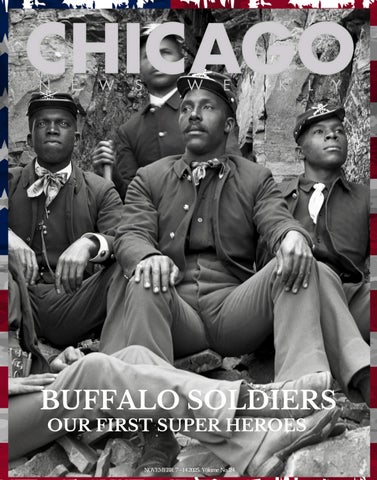
BUFFALO SOLDIERS OUR FIRST SUPER HEROES NOVEMEBR 7 –14 2025. Volume No. 24
2 NOV 7 --- NOV 14, 2025
Publisher
E-NOTES
Cheryl Mainor Norman
Editor-In-Chief
Kai El Zabar
Chief Content Officier Laura Miller Malachi Webster Editorial Assistant Creative Direction
CNW Studio, LLC
Sales Manager Sales Manager Copy Editor Staff Writers19
Kevin Ross Michael Toliver Max Blaisdell Mila K. Marshall PhD. Candi McCrary Neffer Kerr Cabryl Breotti CL. Blackburn
24
Columnists
Intern & Illustrator
Dr. Sanja Rickette Stinson David Seaton Elijah Lee
Cover Photography Chicago News Weekly, LLC 700 N Sacramento Blvd Suite 320 Chicago, IL 60612 (312) 877-5151 Volume 3 No. 21 October 15, 2025 Chicago News Weekly is Published on Thursday www.cnwmedia.com advertising@cnwmedia.co m editorial@cnwmedia.com
CHECK OUT LAST WEEK’S ISSUE AT WWW.CNWMEDIA.COM/E-EDITIONS
Sweep the Past, to the Trash Kai El Zabar - Editor-In-Chief
Sweeping the entrance every morning is an important cleansing ritual — one that prepares the atmosphere for new energy. In many of our lives, sweeping has become a routine task performed without much thought. Yet for some, it remains a ritual act — one that calms the mind and sets the tone for the day ahead. In countless cultures and spiritual traditions, sweeping the front or back porch each morning is seen as an essential cleansing practice, clearing the way for new energy on every level: physical, spiritual, emotional, and mental. This seemingly simple act reminds us that power manifests in many forms. The motion of sweeping has the ability to clear away what is old and stagnant, making space for the new. When done with intention — holding in mind that you are releasing the old and welcoming the new — the act becomes a meditation. It stirs up energy in a space, removing the subtle “astral buildup” that accumulates naturally wherever people dwell. This kind of sweeping is not about removing dust or dirt. In fact, the broom doesn’t even need to touch the ground to be effective. It’s a spiritual sweeping — symbolic rather than physical. You may wish to keep two separate brooms: one for household cleaning, and another dedicated to energetic clearing. If you feel inspired, you can decorate your ritual broom — much like a wedding broom — carving or painting the handle, adorning it with ribbons or charms, or even crafting one yourself from branches, twigs, or pine boughs. Personalizing your broom transforms it into a sacred tool, much like incense used to purify the air. It becomes an extension of your intention to release what no longer serves you and invite in what does.
Making sweeping part of your morning practice can serve as both meditation and prayer. Preparing to sweep becomes a conscious act — a shift into sacred awareness. Each stroke of the broom grounds you in spiritual energy, deepens your mindfulness, and reinforces the lesson of letting go of the past to embrace the present. As we clear the energy of our surroundings, we clear our own. In doing so, we create an environment that feels clean, open, and welcoming to all who enter. Be sure to hold positive thoughts as you sweep, manifesting the energy you need for the day. I often recite: “As I sweep away the unwanted energy of yesterday, I release all that is negative and ungodly. I welcome the blessings of today and the promise of tomorrow.” By making sweeping a daily ritual, we tune ourselves to the ongoing cycle of release and renewal — the rhythm that keeps both our spaces and our spirits vibrant and alive.
NOV 7 --- NOV 14, 2025 3
NATIONAL NEWS What’s Behind MSNBC’s New Name? CNW Staff Report MSNBC is changing its name to MS NOW as part of a major corporate restructuring that will spin the network off from parent company Comcast into a new, publicly traded company called Versant. The rebranding is meant to clearly distinguish the cable news channel from NBC News, which remains under Comcast’s NBCUniversal division, and to give the network its own independent identity. According to company executives, the move will “avoid any potential confusion” between the newly separated entities. The reorganization will also place several other NBCUniversal cable networks — including CNBC, Oxygen, Syfy, and Golf Channel — under the Versant umbrella when the company officially launches in 2026. Why the Change Corporate split: The name change reflects Comcast’s decision to divide NBCUniversal into two companies. Versant will oversee the cable networks, while NBCUniversal retains the movie studio and theme parks. Avoiding confusion: The rebrand helps clarify that NBC News and the cable channel are now independent of each other. New identity: Executives say MS NOW will chart its own course while maintaining its existing programming and editorial mission. No more peacock: The familiar NBC “peacock” logo will disappear from the network’s branding following the split.
4 NOV 7 --- NOV 14, 2025
The new acronym, MS NOW, stands for “My Source for News, Opinion and the World.” The “MS” nods to the network’s original name — MSNBC, founded in 1996 as a joint venture between Microsoft and NBC. Microsoft fully withdrew from the partnership in 2012. The $20 Million Rebrand Replacing a name as recognizable as MSNBC is no small feat — or expense. The transition reportedly carries a price tag of $20 million, covering a nationwide marketing campaign featuring billboards, television spots, and digital ads across New York, Chicago, and Los Angeles. The campaign aims to reassure viewers — particularly MSNBC’s loyal base of baby boomer audiences (median age: 72) — that while the name is changing, the network’s mission remains the same. The new commercials showcase Americans of diverse backgrounds speaking about the country’s shared values, with an emphasis on unity and civic engagement. According to the marketing agency, the creative concept seeks to “reclaim the idea of patriotism” from the divisive rhetoric associated with former President Donald Trump and the Republican Party.
A Familiar Transition
Face
Leads
the
The “Goodbye MSNBC, Hello MS NOW” campaign features anchor Rachel Maddow reciting the Preamble to the U.S. Constitution, interspersed with archival footage of Maya Angelou reading her poem “Human Family” — “We are more alike, my friends, than we are unalike.” Maddow, the network’s most prominent on-air figure, acknowledged some initial hesitation about the change. “ Eventually, I came around to the need for having a hook — to reintroduce ourselves to the country and remind our viewers what it is they like about us,” she said. The rebrand coincides with MSNBC’s upcoming 30th anniversary in 2026, marking a symbolic moment for the network as it adapts to an evolving media landscape increasingly dominated by streaming and on-demand viewing. Facing a Shrinking Audience Like many traditional cable outlets, MSNBC has struggled to retain viewers. Ratings have dropped 34 percent from 2024, according to Nielsen. CNN’s audience fell 21 percent in the same period, while Fox News saw an 18 percent increase. Some observers attribute MSNBC’s decline to the reduced on-air presence of Maddow, who now hosts her show just once a week, as well as to viewer fatigue during President Trump’s second term.
Same Mission, New Name Behind the scenes, the network has been expanding its newsroom and hiring additional journalists as it prepares to operate independently from NBC News. Its new slogan, “Same Mission. New Name.,” underscores the effort to reassure loyal audiences that the network’s editorial standards and lineup remain unchanged. Promotional spots feature familiar faces including Maddow, Ari Melber, Joe Scarborough, Mika Brzezinski, Nicolle Wallace, Jen Psaki, and Ali Velshi — all emphasizing continuity amid transformation. As the network prepares to turn the page on nearly three decades as MSNBC, executives hope the rebrand will help MS NOW define a new era in cable news — one that balances loyalty to its roots with the realities of a rapidly changing media world.
Shutdown Deal
NATIONAL NEWS
Senate Passes Shutdown Deal: What Chicago Gains and Loses Malachi Webster - Staff Writer The longest government shutdown in American history moved toward its conclusion Monday night when the Senate voted 60-40 to approve funding legislation that will reopen federal agencies after 41 days of paralysis. The package now advances to the House, where Speaker Mike Johnson has directed members to return for a vote by November 12 despite Veterans Day travel chaos caused by the very shutdown they aim to end. President Trump has indicated he will sign the measure. For Chicagoans, the deal delivers immediate relief on aviation and food assistance while creating looming uncertainty on healthcare costs that could devastate middle-class families in 2026. The legislation's architecture reveals the political compromises required to break a standoff that Democrats initiated to force action on expiring Affordable Care Act subsidies— a battle they ultimately lost. The funding structure splits federal agencies into two categories. The Department of Agriculture, Food and Drug Administration, Veterans Affairs, military construction projects, and the legislative branch receive full appropriations through September 2026. All other agencies operate under a continuing resolution extending current funding levels until January 30, providing breathing room for broader budget negotiations.SNAP benefits emerge as the deal's clearest Chicago victory. The legislation guarantees full Supplemental Nutrition Assistance
Program funding through next September, ending the legal warfare that left two million Illinois residents in limbo about November benefits. The bill automatically provides $30 billion annually to the Commodity Credit Corporation, which funds mandatory farm programs and could finance additional agricultural aid. Illinois families depending on SNAP— disproportionately concentrated in Chicago's South and West sides—will see uninterrupted benefits after weeks of uncertainty caused by the Trump administration's attempts to withhold funding despite court orders. Air travelers at O'Hare and Midway airports should see gradual improvement, though Transportation Secretary Sean Duffy has warned that safety metrics must improve before the FAA lifts its unprecedented flight reduction orders. More than 700 flights were canceled at Chicago airports Monday alone as the shutdown forced air traffic controllers to work six weeks without pay. The Federal Aviation Administration had ordered airlines to cut flights by 4% initially, escalating to 10% by week's end at 40 major airports including O'Hare and Midway. With federal workers guaranteed back pay and rehiring, controller staffing should stabilize—but the union president warns some officers have already quit for more stable employment.The cascading trauma is worth noting. Parents raced from their jobs. The facility closed for the day. Children were exposed to violence—yes, state violence counts—during what was supposed to be the ordinary, safe beginning of their day.
Teachers questioned whether their coworkers were secure. The entire infrastructure of trust that makes early childhood education possible shattered in minutes. And then there's the question nobody wants to ask directly: What message does this send about who belongs? A woman with documentation. A teacher with a job. A person embedded in a community. Removed from that community in front of children. The signal isn't subtle. It's not about who's legal or illegal. It's about who can be removed, at any moment, regardless of status. It's about establishing a hierarchy of security and belonging, with some people permanently vulnerable. Federal employee protections represent the deal's other clear win. The legislation reverses more than 4,000 reductions in force issued during the shutdown and prohibits new layoffs through January 30. All federal workers—whether furloughed or required to work—receive guaranteed back pay as mandated by a 2019 law the Trump administration had suggested ignoring. Senator Tim Kaine of Virginia explicitly cited federal worker protections as his reason for supporting the deal despite objections to other provisions. But the bill's most significant consequence may be what it omits: any extension of enhanced Affordable Care Act premium tax credits expiring December 31, 2025. Instead, Senate Majority Leader John Thune committed only to holding a vote in early December on extending the subsidies—with no guarantee of passage and no equivalent promise from House Speaker Johnson. Republicans have consistently opposed extension, setting up premium increases that will hit Chicago's substantial ACA marketplace enrollment particularly hard. The numbers paint a stark picture. Average annual premium payments for subsidized enrollees will jump from $888 to $1,904 —a 114% increase. A 60-year-old couple earning $82,000 will see monthly premiums surge from about $750 to over $2,100. Approximately 4.8 million Americans could lose coverage entirely. For middle-income Chicago families above 400% of federal poverty level, the "double whammy" of losing subsidies while absorbing premium increases could force impossible choices between healthcare and housing, food, or other necessities. Illinois Senator Dick Durbin was among eight Democrats who broke ranks to advance the legislation, triggering immediate criticism from Governor JB Pritzker. "This is not a deal—it's an empty promise," Pritzker wrote. "Time for Democrats to stand tall for affordable healthcare." Yet Durbin defended his vote, arguing that securing SNAP funding and reversing federal layoffs justified compromise. "Now that Democrats secured these wins, it's time for Leader Thune to keep his promise," Durbin said. The political calculus hinges on whether that December vote materializes and whether it can pass. Senate Republicans need only sustain a filibuster to kill any ACA extension, and House passage appears even less likely. Democrats who voted for the shutdown-ending deal essentially traded guaranteed relief on food assistance and federal employment for uncertain prospects on healthcare subsidies—a gamble that Chicago families will either celebrate or regret when 2026 insurance bills arrive.
NOV 7 --- NOV 14, 2025 5
CITY NEWS Chicago Sues DOJ Over ‘Unlawful’ Policing Grant Restrictions CNW Staff Report
Mayor says federal limits on DEI and immigration policies “put the safety of Chicagoans in jeopardy.”
The City of Chicago, joined by the City of St. Paul, has filed a federal lawsuit challenging what it calls unlawful restrictions imposed by the U.S. Department of Justice on a $6.25 million community policing grant.
The City of Chicago, joined by the City of St. Paul, has filed a federal lawsuit challenging what it calls unlawful restrictions imposed by the U.S. Department of Justice on a $6.25 million community policing grant.
Filed in the Northern District of Illinois, the lawsuit seeks to block new conditions placed on the Department of Justice’s Office of Community Oriented Policing Services (COPS) Hiring Program. The restrictions require cities to certify they do not operate diversity, equity and inclusion (DEI) programs that the federal government deems unlawful, and that they do not limit cooperation with federal immigration enforcement.
City officials argue the new DOJ requirements were never authorized by Congress and effectively hold community policing funds “hostage” to political agendas. The case continues a long-running legal standoff between Chicago and the federal government over grant conditions tied to immigration and social equity policies. What’s at Stake?
Mayor Brandon Johnson said the new Funding in Question: $6.25 million federal conditions threaten both public from the DOJ’s Office of Community safety and Chicago’s core values. Oriented Policing Services (COPS) “Chicago will not be intimidated into Hiring Program. abandoning our values or compromising our safety,” Johnson Federal Conditions: Cities must certify said. “Putting the safety of Chicagoans they have no DEI programs deemed in jeopardy in pursuit of political ends “discriminatory” and must comply is simply reprehensible. Community with all presidential executive orders. policing is fundamental to building a safer city and upholding diversity is an City’s Position: The DOJ’s restrictions essential part of who we are as a city. are unconstitutional, unauthorized by We will not back down from that Congress, and politically motivated. commitment, and we will fight to Impact: Could affect Chicago’s ability ensure that we receive every single to expand community policing and dollar that is entitled to Chicago. My officer recruitment. administration will continue to hold the Trump administration accountable Legal Context: Adds to a series of for their attempts to withhold vital lawsuits challenging federal efforts to public safety resources for Chicagoans.” tie local funding to national immigration and equity policies.
6 NOV 7 --- NOV 14, 2025
COVER STORY
Photo Credit: Library of Congress
The Untold Story of the Buffalo Soldiers CECIL EGBELE - CALIFORNIA LOCAL FELLOW/NNPA NEWSWIRE he reggae beats from Bob Marley’s “Buffalo Soldier” still echo across decades. When he sang about a soldier “stolen from Africa, brought to America,” he immortalized a chapter of American military history that too often remains in the shadows, the story of the Buffalo Soldiers, the nation’s first peacetime African American military regiments. This Veterans Day, as we honor those who served, it’s essential to remember these pioneering warriors who helped shape the American West while fighting for a country that denied them basic civil rights. Their contributions are an essential part of our history.
Many enlisted with the promise of full citizenship under the 14th Amendment. But despite their service, sacrifice, and achievements, these African American soldiers were systematically denied equal rights, particularly in the ReconstructioneraSouth. They fought for a nation that refused to recognize them as full citizens, a bitter irony that would define their service for generations to come.
Yet their combat record was exemplary. Sergeant Emanuel Stance became the first Black Medal of Honor recipient in 1870. The statistics tell a sobering story both service and systemic racism. According to the National Park Service, they often received inferior horses, supplies, and equipment.
Builders of the West The Buffalo Soldiers’ duties extended far beyond combat. They performed routine garrison chores, patrolled the frontier, built roads and other infrastructure, escorted settlers and cattle herders, protected mail service, built telegraph lines, and patrolled frontiers.
Buffalo Soldiers: The Genesis and A Name Born of Respect
Guardians of California’s Natural Treasures
The nickname “Buffalo Soldiers” is said to have been given to Black soldiers by Native American tribes. Some accounts suggest that it referred to the soldiers’ brave and fierce fighting spirit, which resembled that of the buffalo, while others claim it stemmed from their physical characteristics. Whatever its origin, the name came to symbolize respect and admiration. What began in 1866 as six regiments was soon consolidated into four: the 9th and 10th Cavalry and the 24th and 25th Infantry. These units would come to be known collectively as the “Buffalo Soldiers.” These units were comprised of formerly enslaved people, freemen, and Black Civil War soldiers; these were the first African Americans to serve during peacetime.
Despite being noted for their courage and discipline, they faced constant prejudice. Retired Col. Frank Knox of the 1st U.S. Volunteer Cavalry, better known as the “Rough Riders,” during the Spanish-American War, famously declared of the Buffalo Soldiers: “I never saw braver men anywhere.”
Perhaps their most remarkable and leastknown contribution came in California’s Sierra Nevada. Eight troops of the 9th Cavalry Regiment and one company of the 24th Infantry Regiment served in California’s Sierra Nevada as some of the first national park rangers. Guardians of California’s Natural Treasures Fighting Against All Odds Although Buffalo Soldiers comprised 12% of the U.S. Army infantry force and 20% of the cavalry force in this era, they were awarded 18 of the 417 medals presented during the /Indian Wars. This is less than 5% of recipients.
President George H.W. Bush acknowledged in his 1992 Buffalo Soldiers Day proclamation, saying, “Although they often received the worst food and equipment and labored without the respect and recognition that were their due, the Buffalo Soldiers served.”
Perhaps their most remarkable and leastknown contribution came in California’s Sierra Nevada. Eight troops of the 9th Cavalry Regiment and one company of the 24th Infantry Regiment served in California’s Sierra Nevada as some of the first national park rangers.
“They served with distinction in the face of discrimination, built infrastructure that still serves us today, and protected natural wonders that millions now enjoy.” NOV 7 --- NOV 14, 2025 7
COVER STORY
A Legacy in Song and Screen
In church service commemorating the 2025 Veterans Day, Lieutenant General Dee Slade, of the Buffalo Soldiers Fort Bakersfield Command, recounts some of their oftenforgotten role in rebuilding America.
The Buffalo Soldiers’ legacy is celebrated in works like Bob Marley’s song “Buffalo Soldier,” where Marley connects their struggle to a broader symbol of Black resistance and survival Spike Lee’s 2008 film “Miracle at St. Anna” tells the story of four “The Buf falo Soldiers played a African American soldiers from key role in rebuilding the West the 92nd Infantry Division, and parts of the South, particularly known as the Buffalo Soldiers, during fires. They were the first during World War II’s Italian firefighters in some towns that Campaign in Tuscany, Italy. had never seen Black soldiers before, and remarkably, they did The Legacy Lives On in Kern not lose a single person or soldier. County The U.S. Congress then Today, the spirit of the Buffalo commissioned them to Alaska Soldiers endures in Southern and the Yukon, where conditions California through dedicated were severe. Again, they managed community organizations that to keep both townspeople and keep their memory alive. their own soldiers safe during conflicts,” Slade said.
“The Buffalo Soldiers didn’t just serve their country. They transformed it, guarding its borders, building its infrastructure, protecting its treasures, all while fighting for the right to be called Americans.” 8 NOV 7 --- NOV 14, 2025
An End and a New Beginning President Harry Truman issued an executive order to end racial segregation in the military, and by the mid-1950s, the remaining all-black units were officially disbanded. The last of the Buffalo Soldiers, Mark Matthews, passed away in 2005 at the age of 111. This Veterans Day, as we reflect on service and sacrifice, the Buffalo Soldiers remind us that patriotism often means fighting not just for what your country is, but for what it could become. They served with distinction in the face of discrimination, built infrastructure that still serves us today, and protected natural wonders that millions now enjoy.
Their story mirrors America’s story, complicated, painful, but ultimately one of perseverance, courage, and an unwavering commitment to building a better future. We honor them not just on Veterans Day, but every time we visit a national park, travel a road they built, or benefit from the nation they helped construct, which gives them the recognition and thanks they deserve. The Buffalo Soldiers didn’t just serve their country. They transformed it, guarding its borders, building its infrastructure, protecting its treasures, all while fighting for the right to be called Americans.
Photo Credit: LibrarF Company, 24th Infantry, at Fort Bayard, New Mexico, 1892 (Original Image Courtesy National Archives and Records Administration)
CITY NEWS Quarter-Century of Giving: Black McDonald's Operators Mark 25 Years of Holiday Service Malachi Webster Staff Writer For a generation of Chicago families, Thanksgiving preparation begins not at the grocery store but at specific McDonald's locations on the city's South and West sides, where the Black McDonald's Operators Association has distributed free turkeys every November since 2000. This Veterans Day week marks the 25th anniversary of "Food for the Body & Spirit," a program that has quietly become one of the city's most enduring holiday traditions. The weeklong initiative kicked off Tuesday at the McDonald's on West Madison Street in the South Austin neighborhood, the first of five locations that will distribute 3,000 turkeys, baked goods, food gift cards, and winter gloves to families and veterans through November 12. Veterans receive priority service upon presenting military identification—a fitting gesture during a week that honors those who served while addressing food insecurity that disproportionately affects veteran households. "It's a pleasure to see everybody here today," said Akins Aknnagbe of the Black McDonald's Operators Association at Thursday's kickoff event. "We're giving out turkeys. We're giving out bread. We gave out some doughnuts this morning, and we can't wait to do this five other times at different locations". The logistical operation reflects both the scale of need and the association's institutional knowledge built over two and a half decades of distribution. The timing carries particular weight in 2025. With the federal government only now emerging from a 41-day shutdown that left two million Illinois residents uncertain about their November SNAP benefits, supplemental food assistance has never been more critical. While legal battles raged over whether the Department of Agriculture would fund Supplemental Nutrition Assistance Program benefits at all this month, the Black McDonald's Operators Association's commitment never wavered. The McDonald's locations serving as distribution hubs span Chicago's historically Black neighborhoods and extend into the south suburbs and northwest Indiana: the Bronzeville location on 47th Street hosts Monday's Veterans Day distribution, followed by sites in Maywood, Chicago Heights, and Hammond. Each represents a deliberate choice to serve communities where food insecurity rates remain stubbornly elevated and where commercial grocery options have contracted.
What began as a single-location experiment in 2000 has evolved into a sophisticated operation that feeds thousands annually while maintaining the personal touch that characterizes community-based mutual aid. The association's decision to include winter gloves alongside holiday meal staples reflects an understanding that poverty presents compounding challenges— cold hands and empty stomachs are not separate problems but interconnected manifestations of economic precarity. The program's longevity distinguishes it from shorter-lived corporate philanthropy initiatives. Twenty-five years of uninterrupted service through recessions, pandemics, and political upheaval demonstrates institutional commitment that transcends individual franchisees or shifting market conditions. The Black McDonald's Operators Association has made Thanksgiving turkey distribution as reliable as the holiday itself for thousands of Chicago families. Veterans Day 2025 also arrives as flight cancellations at O'Hare and Midway airports continue disrupting travel plans due to the recently ended government shutdown. For veterans unable to reach family celebrations because of the air traffic control crisis, Monday's prioritized turkey distribution at the Bronzeville McDonald's offers both practical support and symbolic recognition. The association's quarter-century milestone invites reflection on the persistent need for such programs. That 3,000 turkeys distributed across five locations represent essential support rather than surplus generosity speaks to structural inequities in food access and economic security. Yet the program's existence also demonstrates the power of consistent, communityrooted responses to those inequities—a model of sustained mutual aid that neither depends on nor waits for government action. As families line up this week at McDonald's locations transformed temporarily into distribution centers, they participate in a tradition older than the youngest adults now collecting turkeys. Some recipients likely remember their own parents bringing them to these same events years ago. That intergenerational continuity— families returning year after year, the same commitment renewed across two and a half decades—represents the program's true measure of success.
NOV 7 --- NOV 14, 2025 9
10 NOV 7 --- NOV 14, 2025
Senate Passes Shutdown Deal: What Chicago Gains and Loses Malachi Webster - Staff Writer
CITY NEWS
Rafael Veraza's Saturday morning shopping trip ended with his oneyear-old daughter gasping for air in a hospital bed, her eyes swollen shut from chemical spray deployed by federal Border Patrol agents outside a Cicero Sam's Club. The November 9 incident—captured on cellphone video that has since circulated widely —represents the latest flashpoint in Operation Midway Blitz, the Trump administration's escalating immigration enforcement campaign targeting Chicago's predominantly Mexican neighborhoods. Veraza, who suffers from asthma, says agents sprayed directly into his vehicle as he attempted to exit the parking lot after noticing the federal presence. "I'm not even doing a thing," he told reporters at a community gathering the following day. "I'm trying to exit." His daughterArianna, strapped in her car seat, inhaled the chemical agent and struggled to breathe. Both required brief hospitalization.
Chicago Mayor Brandon Johnson condemned what he called, "reckless behavior and indiscriminate use of chemical agents" that have "caused chaos and fear in our communities". Yet his statement also condemned violence against federal agents, reflecting the political tightrope local officials must walk. Illinois Governor JB Pritzker has been more pointed in his criticism, particularly regarding Senator Dick Durbin's recent cooperation with Republicans on shutdown negotiations.
The Department of Homeland Security disputes any wrongdoing, releasing a detailed timeline claiming Border Patrol agents faced "unprecedented" violence during the operation. According to DHS Assistant Secretary Tricia McLaughlin, a driver in a black Jeep Wrangler opened fire on agents around 9:30 a.m. in the Little Village neighborhood, prompting the deployment of crowd control measures. The agency asserts that over the course of three hours, agents endured gunfire, four vehicle rammings, brick-throwing, and attempts by "rioters" to breach an FBI facility perimeter. Yet the federal account contains a conspicuous gap: no explanation for whyVeraza's family—who had no apparent connection to the earlier confrontations—were sprayed while attempting to leave a commercial parking lot. DHS acknowledges that "individuals stalked and followed the convoy into the parking lot" and that a vehicle rammed a Border Patrol vehicle there, resulting in three arrests. But the Veraza family's video tells a different story, showing agents approaching their vehicle without apparent provocation. The incident comes one week after a federal judge issued a preliminary injunction tightening restrictions on immigration agents' use of force against Chicago residents and journalists during enforcement operations. The Justice Department has since appealed that order. U.S. Representative Jesús "Chuy" García, who represents the area, characterized the federal operations as a "campaign of terror" while urging protesters to avoid violence that could undermine their message. "If we succumb to violence, we will lose our battle," García said at Sunday's community gathering.
The Veraza family's experience raises urgent questions about proportionality and accountability in immigration enforcement. A one-year-old child hospitalized for breathing difficulties after chemical agent exposure represents either catastrophic collateral damage or evidence of reckless disregard for civilian safety— perhaps both. Cicero sits directly adjacent to Little Village, often called the "Mexico of the Midwest" for its heavily Mexican-American population. The neighborhood has been continuously targeted since Operation Midway Blitz commenced, creating an atmosphere of sustained tension that erupted Saturday morning.
Federal officials have provided no timeline for investigating the Veraza incident specifically. As of Monday, Rafael Veraza and his daughter were recovering at home. The cellphone footage continues to circulate, showing the moment chemical spray enters the family's vehicle and hearing Veraza's voice describing what happened: "He started spraying from the front of the car towards the back. Basically, I got sprayed all over my face". The video ends before showing the full impact on his infant daughter, but hospital records confirm she required emergency treatment. As we support youth invisual arts, check out Eli's latest work, our illustrator.
DHS reports that eight of the nine people arrested during Saturday's operation were U.S. citizens. The agency has not disclosed whether any have been formally charged. Border Patrol agents claimed they faced continuous attacks from what they termed "Antifa terrorists," invoking President Trump's September designation of the decentralized anti-fascist movement as a domestic terrorist organization. Yet independent verification of the government's narrative remains incomplete, and a federal court recently found immigration enforcement agents lacked credibility in describing both their own conduct and that of Chicago residents.
NOV 7 --- NOV 14, 2025 11
The Power of the Pivot Part 2
EMPOWERMENT
Dr. Sanja Rickette Stinson - Columnist If the pause is where clarity begins, then the pivot is where courage steps in. By the time most of us reach a major life transition—retirement, reinvention, empty nest, leadership shifts, or the ending of a season we’ve already felt the tug that something is shifting. The pause gives us space to breathe, but the pivot requires us to move. And I’ll be honest: when I stepped into retirement after more than three decades as a founding nonprofit CEO, I thought the pivot would be gentle. I expected rest, reflection, and maybe a few quiet hobbies. But God had other ideas. Suddenly, what I thought would be a slowdown became a spiritual and professional acceleration. The same calling that once fueled my nonprofit work began whispering in newways. That’s when I found myself pivoting into unexpected territories—leaning intoAI strategy, digital innovation, teaching, and using all the wisdom I once poured into a community to now pour into emerging leaders, women 50+, and nonprofit visionaries stepping into their own next chapters. No, I haven’t landed every dream assignment yet—and some opportunities are still unfolding—but the pivot taught me somethingvital: you don’t wait for the full picture to move.You move with what God puts in your hands right now. My pivot didn’t lead me backward—it expanded me forward. For many leaders—especially those of us who have poured decades into the work of service—the pivot can feel both exciting and terrifying.You’ve spent years building systems, solving problems, filling gaps, and carrying the weight of entire communities on your shoulders. Your identity becomes intertwined with the work, the mission, and the people you’ve served. And then, almost without warning, the familiar rhythm is interrupted. Although, the calendar lightens and the phone stops ringing. That structure that once guided your days suddenly dissolves into silence. That’s when the real question rises to the surface—one you never expected to ask after a lifetime of purpose:What now? I faced that same question after retiring from more than three decades as a founding nonprofit CEO. I thought I knewwhat came next. I imagined rest. Quiet. Ease. But instead, I found myself standing in a space that felt both empty and wide open at the same time.
12 NOV 7 --- NOV 14, 2025
And that’s when the pivot began to unfold. Instead of retreating, God nudged me toward new passions—AI strategy, digital learning, leadership development, writing, and equipping women and nonprofit leaders in fresh, innovative ways. I didn’t go looking for these lanes; they found me in the pivot. They reminded me that purpose evolves, assignments shift, and calling has layers we often don’t discover until life forces us to make space for them. The truth is, the pivot becomes unavoidable not because something ends—but because something new begins to rise. Apivot doesn’t always announce itself politely. Sometimes it comes dressed as disruption, disappointment, or even discomfort. It arrives when what worked before no longerworks now —when the strategies, environments, or callings that once fit perfectly suddenly feel too tight. Apivot is God’s way of saying, “it’s time for something difference, and I trust you with the next chapter.”This is not the kind of change you can muscle through. It is the kind of change you must discern. Because while the pause gives you clarity, the pivot asks you to take that clarity and act on it. And let’s be honest—acting on clarity is much harder than receiving it.When the old way stops serving the newYOU! After over three decades of serving as a founding nonprofit CEO, I learned something that every seasoned leader eventually confronts: legacy doesn’t stop when your role changes. But your assignment does.And when the assignment shifts, so must you. The truth is, we often try to drag old tools into new seasons.We hold onto past identities because they’re comfortable.We cling to routines because they’re familiar.We stay connected to roles that God is gently trying to transition us out of because we’re afraid of stepping into a territory where our title no longer does the talking. But a pivot is an invitation to grow beyond what was. It’s permission to evolve without apology. This is why pivoting is essential: Your calling is still alive. Yourwisdom is still valid. Yourvoice still carries weight. Your experience is still needed —just in a new form. And if you don’t pivot, you stay locked inside of an old chapter, even though God has already turned the page. Let’s view it from a biblical lens: Scripture is full of divine pivots.
Abram becameAbraham only after pivoting away from the familiar into the unknown. Ruth pivoted from loss to legacywhen she chose a new direction. Paul pivoted from persecutor to preacherwith one encounter. The disciples pivoted from fishermen to world-changers because Jesus said, “Follow Me.” Biblically and life shows us that a pivot is rarely comfortable but it is always purposeful. If God trusted them with a pivot, He can trust you with one too. The pivot is not just external it’s internal. It requires you to confront: Your identity beyond your title Yourworth beyond your productivity Yourvision beyond your past Your courage beyond your comfort So, as we move through these final months of 2025, keep your heart open to divine redirection. The pivot might feel unfamiliar, but it is fertile ground. It’s the place where wisdom meets courage, where clarity meets action, and where purpose gets a second wind. Part 3—The Shift—is coming next.
AROUND TOWN Alyson Cambridge Photo Credit Kyle Flubacker
Kenneth Overton
BLAC @ the Lyric Opera of Chicago CNW attended the "Echoes of Excellence" event, marking BLAC's Chicago debut at the Lyric Opera on November 8, 2025. The recital featured celebrated Black opera singers performing works by both classic and pioneering Black composers. This event celebrated Chicago's rich artistic heritage and highlighted a new generation of exceptional Black talent.
NOV 7 --- NOV 14, 2025 13
HEALTHY LIVING
Mental Health Inequities Deepen Struggles in the Black Community CNW Staff Report The African American community continues to suffer disproportionately from mental illness—an outcome deeply tied to social inequities that limit access to health, wealth, and opportunity.
Misdiagnosis and Bias
The World Health Organization defines health as “a state of complete physical, mental, and social well-being—not merely the absence of disease.” How health is distributed among social and economic groups reveals much about the development of a society.
Systemic and Social Barriers
The Path Toward Healing
Despite similar actual prevalence While prevalence may not differ by race, outcomes do— across racial groups, Black and they reflect systemic inequities. Achieving true mental Americans are 2.4 times more likely health equity requires culturally competent care, stronger to be diagnosed with schizophrenia community resources, and a holistic approach to wellness Health equity depends on access to the than White Americans—often due that includes nutrition, exercise, and social support. social determinants of health: wealth, to bias and misunderstanding rather power, and prestige. When communities than biology. Anyone experiencing symptoms of bipolar disorder or are systematically deprived of these, they schizophrenia should seek a professional diagnosis and face worse health outcomes. Equality Clinician bias, both conscious and build a care plan with medical providers, family, and means offering everyone the same unconscious, can cause community allies. Healing is possible—but it begins with resources; equity means providing misinterpretation of symptoms. access, understanding, and a commitment to equity. resources according to need. Anger or irritability linked to bipolar disorder, for instance, may be misread as signs of schizophrenia. A simple example: imagine a young athlete Cultural differences in expressing drafted to the NBA. After repeated bone distress—such as focusing on injuries, doctors find a long-term calcium physical pain rather than emotions deficiency from childhood due to poor —can further lead to misdiagnosis nutrition. No one can undo that early deprivation—it’s a reminder that what we lack when providers lack cultural competence. early in life can shape our health forever.
Mental Illness Diagnosed at Alarming Rates Among Black Americans Within the Black community, bipolar disorder and schizophrenia are among the most common chronic mental illnesses. Bipolar disorder is marked by alternating periods of mania (high energy, impulsivity, sleeplessness) and major depression (low energy, sadness, loss of interest). Schizophrenia is defined by psychosis— hallucinations, delusions, disorganized thinking, and social withdrawal. Although they are distinct conditions, research shows overlap. Both can involve psychosis, and there is evidence of shared genetic risk. Schizoaffective disorder bridges the two, combining symptoms of both schizophrenia and mood disorders.
14 NOV 7 --- NOV 14, 2025
The root causes extend beyond the clinic. Racial trauma and chronic stress: Persistent discrimination creates what researchers call “weathering,” the wear and tear on the body and mind from cumulative stress. Socioeconomic barriers: Limited access to insurance, stable housing, and quality care compounds mental health challenges. Mistrust and stigma: A legacy of medical racism, from Tuskegee to present-day inequities, fosters deep mistrust. Within the community, stigma often delays treatment. Criminalization: Too often, those in crisis are met with police rather than healthcare providers, leading to incarceration instead of recovery.
When Sports, Violence, and Gambling Collide: A Culture at Risk
SPORTS
MALACHI WEBSTER - Staff Writer
Antonio Brown's extradition from Dubai last week on attempted murder charges represents a spectacular implosion in a career defined by volatility. But it shares investigative space with something more insidious: evidence that sports gambling has metastasized from isolated player misconduct into systematic corruption reaching NBA coaching ranks and organized crime. While Brown’s and Sanchez’s cases stem from personal violence not directly linked to betting, the recent NBA scandals spotlight how sports gambling can fuel systemic corruption and organized crime.
Perry Tole in a drunken fight over parking at an Indianapolis hotel. According to police affidavits, Sanchez—reeking of alcohol at 12:30 a.m.—entered Tole's truck without permission, then physically blocked and shoved the driver. When Tole deployed pepper spray, Sanchez continued attacking, forcing Tole to use a knife in self-defense. Both men were hospitalized. Sanchez faces felony battery charges carrying one to six years in prison, with trial scheduled for December 11. He had traveled to Indianapolis to cover the Colts-Raiders game for Fox. His employer’s termination underscores both the severity of the charges and the impossibility of maintaining broadcast credibility while facing felony prosecution for drunken assault.
Before Charlotte's March 23, 2023 game against New Orleans, prosecutors claim Rozier informed associates he would exit early claiming injury. Co-conspirators placed more than $200,000 in prop bets on Rozier’s underperformance. Rozier played nine minutes, scored five points, then left. The betting action triggered alerts from sportsbooks and U.S. Integrity, but conspirators had locked in tens of thousands in profits.
Rozier allegedly orchestrated the most brazen player manipulation. Before Charlotte's March 23, 2023 game against New Orleans, Brown faces up to 15 years for prosecutors claim Rozier informed allegedly firing two shots at a man associates he would exit early following a fistfight outside a claiming injury. Co-conspirators Miami celebrity boxing event on placed more than $200,000 in May 16. According to the arrest prop bets on Rozier’s Individual acts of violence among underperformance. Rozier played warrant, Brown grabbed a handgun and shot at Zul-Qarnain sports figures often have complex, nine minutes, scored five points, Kwame Nantambu, with one bullet personal roots; by contrast, the web then left. The betting action grazing his neck. Brown claims self- of NBA gambling infractions triggered alerts from sportsbooks demonstrates how professional defense—asserting through his and U.S. Integrity, but conspirators sports can be exploited for attorney that he was attacked by had locked in tens of thousands in financial gain through betting individuals attempting to steal his profits. manipulation. jewelry. U.S. Marshals arrested FBI agents arrested Miami Heat Brown in Dubai on November 6, Federal prosecutors allege guard Terry Rozier, Portland Trail Chauncey Billups provided insider then flew him to New Jersey Blazers head coach Chauncey pending Miami trial. The former details about a March 24, 2023 Trail Billups, and former player Damon Blazers-Bulls game, telling bettors wide receiver, who last played in 2021 after stripping off his uniform Jones on October 23 as part of a that key Portland players would sit sprawling investigation connecting and the team planned to lose and running shirtless off the field, NBA gambling to organized has accumulated battery deliberately to improve draft crime. accusations, domestic violence position. But Billups faces even charges, and child support more serious charges: participating violations. His trajectory from Hall The charges reveal coordinated in rigged high-stakes poker games schemes involving 34 defendants, controlled by the Mafia. of Fame certainty to international including members of the fugitive took less than a decadeMark Sanchez's fall proved Bonanno, Genovese, and swifter. Fox Sports fired the former Gambino crime families.ance but in collective identity. Rozier NFL quarterback and network allegedly orchestrated the most analyst on November 6, one brazen player manipulation. month after he allegedly attacked 69-year-old truck driver
Prosecutors allege he helped organized crime families lure victims into games with modified shuffling machines, contact lenses reading marked cards, and X-ray tables—cheating players out of approximately $7 million. Bank records show a co-defendant transferred $50,000 to Billups following rigged games in late 2022. Damon Jones allegedly sold nonpublic injury information about Lakers players, including Anthony Davis’s limited playing time, for $2,500—information that enabled a co-conspirator to place approximately $100,000 against Los Angeles. These schemes extend a pattern established by Jontay Porter, the Toronto Raptors center banned for life in April 2024 after betting on NBA games and manipulating his own performance. Porter pleaded guilty to conspiracy to commit wire fraud, admitting he withdrew early from games to satisfy prop bet outcomes. His case triggered investigations that ultimately ensnared Rozier, Billups, and Jones. The Senate Commerce Committee launched its own probe on October 27, seeking answers about NBA internal investigations and whether the league protected players despite evidence of rule violations. News reports indicate the NBA cleared Rozier to play after investigating gambling allegations, finding no violations—a conclusion federal prosecutors clearly reject.
NOV 7 --- NOV 14, 2025 15
ARTS & CULTURE
A Very Good Week for Art Kai El Zabar Editor-In-Chief Chicago has always possessed a thriving entertainment, arts, and cultural scene—and this year is no exception, though, like any art form, it experiences its natural ebb and flow. This fall has been busy, but last week, in particular, brought me great joy with a wonderful array of performances that reminded me why Chicago remains one of the nation’s cultural gems. The Joffrey Ballet presented two ballets choreographed by women of color as part of its contemporary program “Matters of the Heart,” which premiered at the Harris Theater. Under that theme, “Broken Wings” by Annabelle Lopez Ochoa captured the life and spirit of Frida Kahlo—a superbly performed ballet that dove deep into the emotional landscape of love, passion, and tragedy. We all know the story of Kahlo’s resilience and triumph over adversity, but this performance brought it to life with profound beauty. The dance, costume, set design, staging, color, and music were all mesmerizing. It would be difficult for anyone to remain unmoved. Naturally, it concluded with a standing ovation and prolonged applause. Part II of Matters of the Heart was the world premiere of “Wabash & You,” choreographed by Chanel DaSilva, whom I had the pleasure of interviewing. The love story unfolds in Chicago, with the band The Main Squeeze performing live on stage as narrators through music. The dancers performed blended classical ballet with hip-hop, jazz, and modern dance techniques—creating a fresh, innovative fusion that felt distinctly Chicago. It was different from what I’ve come to expect from Joffrey, but wonderfully so. The piece delivered, and the audience responded with a warm standing ovation. The second highlight of the week was “Echoes of Excellence: Celebrating the Legacy of Chicago’s Black Voices,” a stunning introduction of the Black Leadership Arts Collective (BLAC) to the Chicago opera community. The recital, held at the Lyric Opera of Chicago on Saturday, November 8, 2025, featured some of the most celebrated Black opera singers who have graced Chicago stages over the years. If you’re not an opera regular, you may not have realized the depth of brilliance among these artists —but by the end of the evening, there was no doubt. The house was full, the audience beautifully diverse, and notably, the Black audience seemed to outnumber the rest that night—a joyous sight in itself. The lineup of vocalists included Angela Brown, Chaz’men Williams-Ali, Lucia Bradford, Lester Lynch, Laquita Mitchell, Jacqueline Echols, Kenneth Overton, Alyson Cambridge, Reginald Smith Jr., and Kevin Short—all accompanied by the brilliant pianist Kevin Miller, whose mastery anchored the evening with grace and precision.
16 NOV 7 --- NOV 14, 2025
Xavier Núñez and Amanda Assucena. Photo by Kyle Flubacker
Each performance was worthy of a standing ovation, yet one in particular stood out: Jacqueline Echols’ rendition of “Thaïs: C’est toi, mon père.” Her voice lifted the audience to its feet in a thunderous ovation before she had even finished the aria. It was simply magnificent. Stay tuned for our upcoming podcast featuring conversations with choreographer Chanel DaSilva and BLAC members Kenneth Overton and Kenneth Kellogg.
FYI Why Small Businesses Feel Economic Shocks the Hardest CNW STAFF REPORT
LET US KNOW Small businesses are the backbone of our economy, employing more than 40 percent of America’s workforce. But when financial trouble hits, they often feel it much harder than big corporations. Why is that? Economists and financial experts agree—it comes down to a few key factors that make small businesses more vulnerable when the economy takes a turn.
Tougher lending conditions: Banks often see small businesses as riskier borrowers, so they raise interest rates or cut back on loans when times get tough. Fewer funding options: Unlike big corporations that can issue stock or bonds, small businesses mostly rely on bank loans, personal savings, or credit cards.
Limited Financial Reserves and Cash Flow
Lack of collateral: With fewer assets to put up as collateral, many small firms can’t secure the larger loans they might need in an emergency.
Most small businesses simply don’t have a big financial cushion to fall back on.
Less Flexibility in the Market
Low cash reserves: Many operate on tight margins, with just enough in the bank to cover a few weeks of expenses. That means any unexpected drop in sales or delay in payments can quickly turn into a crisis.
We’d love to hear from you! Send your thoughts to chicagonewsweekly@gmail.com
Smaller operations have less room to maneuver when challenges arise. Local dependence: Many small businesses serve neighborhood customers or niche markets, so a slowdown in local demand can hit hard.
Cash flow dependence: Because day-to-day operations depend on steady income—paying workers, rent, inventory—any disruption can cause big problems fast.
Limited bargaining power: They often can’t negotiate better prices or payment terms from suppliers, or push customers to pay faster.
Personal finances at risk: In many cases, the owner’s personal savings are tied directly to the business, so a downturn can hit both at once.
Smaller staff: With fewer hands on deck, it’s harder to adapt quickly or explore new opportunities while also managing a crisis.
Limited Access to Capital
In short, small businesses play a big role in our economy—but their size often works against them when the unexpected happens. With less cash on hand, fewer funding sources, and limited market leverage, they’re more exposed to economic ups and downs than their corporate counterparts.
When the economy slows or credit tightens, small businesses have fewer places to turn for help.
What do you think the future looks like for Chicago’s small business community?
NOV 7 --- NOV 14, 2025 17 17
FOOD & WINE Seriously — Thanksgiving is that time of year when families bring out their most competitive spirit. It’s also the one day when home cooks are expected to pull off an elaborate meal, perfectly timed so every dish hits the table hot. Given the high stakes and stress, that’s no easy feat — especially for those without a commercial kitchen. Between the dressing, green beans, macaroni and cheese, and sweet potato pie, your oven can only handle so much. But there are ways to make the day less chaotic, starting with prepping as much as you can in advance. For casseroles and sides, you can assemble them in their baking dishes, cover, and refrigerate until ready to bake. The real challenge, though, is the main event: the turkey. Cooking it the traditional way often risks a dry bird and flabby skin. Make It Easy To simplify your make-ahead turkey, skip the whole bird and use two skin-on, boneless breasts and two bone-in, skin-on legs instead. This approach saves fridge space and makes carving much easier. You’ll usually find these cuts in the poultry section of most grocery stores or at a butcher counter. Here’s the secret: an old-school French cooking technique involving parchment paper — en papillote. You may remember your grandmother using parchment to keep food from sticking, but in this case, it’s used as a flavor-locking pouch for roasting. Cooking proteins inside parchment paper creates a steamy environment that keeps them juicy and tender — the perfect way to prep turkey ahead. Start by rinsing and seasoning the turkey with paprika, maple syrup (for sweetness and shine), garlic powder, salt, and pepper. Then bake it enclosed in parchment paper packets — the en papillote method. Toss in some orange slices, onions, and thyme for extra flavor. The parchment pouches create a tight seal that locks in moisture, allowing the turkey to gently cook in its own juices while basting itself. The result: evenly cooked, flavorful meat that stays tender without drying out. Make-Ahead Magic Here’s the best part — you can do this up to three days in advance. Keep the parchment packets on sheet pans, tightly wrapped in plastic, and refrigerate. The butter and drippings inside the packets keep the turkey moist and flavorful. If fridge space is tight, you can stack both packets on one tray. On the big day, take your prepared turkey packets out, brush the skin with oil, and pop them into a hot oven to finish. This final roast crisps the skin and remelts the butter, giving you that perfect golden finish. The result? A turkey that’s not just as good as freshly roasted — it’s even better. The meat stays juicy and tender beneath shatteringly crisp, bronzed skin. Spoon the melted butter and drippings over the sliced meat, and serve the roasted oranges and shallots alongside for a stunning presentation.
12 NOV 7 --- NOV 14, 2025
It’s Get Your Game On Time Mari Evans - Staff Writer
RECIPE INFORMATION Total Time: 2 hours 45 minutes (plus cooling) Yield: 6–8 servings Ingredients Turkey 2 skin-on, boneless turkey breasts (2–4 lb. total), patted dry 2 skin-on, bone-in turkey legs (3–4 lb. total), patted dry ¾ cup (1½ sticks) unsalted butter, melted and slightly cooled ¼ cup pure maple syrup 3 Tbsp. garlic powder 3 Tbsp. smoked paprika 3 Tbsp. Worcestershire sauce 2 Tbsp. Diamond Crystal or 1 Tbsp. + ½ tsp. Morton kosher salt 2 Tbsp. freshly ground black pepper 3 small oranges, halved or quartered if larger 3 shallots, unpeeled, halved through root ends 6 sprigs thyme To Serve ⅓ cup extra-virgin olive oil Additional thyme sprigs (optional)
PREPARING THE TURKEY Step 1: Let the turkey breasts and legs sit at room temperature for 30 minutes. Step 2: Position two oven racks in the middle; preheat oven to 325°F. In a small bowl, whisk together butter, maple syrup, garlic powder, smoked paprika, Worcestershire sauce, salt, and pepper. Spread evenly over the turkey on all sides — especially the skin. Step 3: Line two rimmed baking sheets with large sheets of parchment paper. Divide the oranges, shallots, and thyme between them. Place the turkey breasts on one sheet and the legs on the other. Cover each with another large sheet of parchment, folding and crimping the edges tightly to form airtight packets. (If needed, overlap multiple sheets or use parchment roasting bags.) Step 4: Bake the packets, rotating sheets halfway through, until an instant-read thermometer inserted into the thickest part of the turkey reads 150°F — about 60–80 minutes. The turkey will continue to cook as it rests. Cool the unopened packets, consolidate onto one baking sheet, wrap tightly, and refrigerate. Heating Back Up Step 1: About 30 minutes before serving, preheat oven to 475°F. Remove turkey from the refrigerator, discard the top parchment sheet, and let it sit at room temperature while the oven heats. Step 2: Brush half the olive oil over the turkey skin. Roast, rotating once and brushing with the remaining oil halfway through, until the skin is deep golden brown and the meat reaches about 130°F — 25–30 minutes. Rest for 15 minutes before carving. Step 3: Arrange turkey on a platter. Spoon the melted butter and pan juices over the top, and garnish with roasted oranges, shallots, and fresh thyme sprigs.
Behind Ralph Lauren Steps Into the AI Era With 'Ask Ralph' Mare Evans - Staff Writer
FASHION
If you’re a moderate conservative with style and swagger, chances are Ralph Lauren speaks your fashion language. I’ve always admired the label’s elegant, high-end collegiate aesthetic — the effortless transition from jeans and a blazer to trousers and a sweater, from a crisp blouse and skirt to a coat dress and riding boots, and finally to that stunning evening slip or full-length gown. It’s that sophisticated, sexy preppy sensibility that makes Ralph Lauren timeless. But with busy schedules, even loyal fans like myself can find it hard to make time for in-store shopping. Enter Ralph Lauren’s latest innovation: the 2026 collection, accompanied by a sleek new digital companion — the “Ask Ralph” AI styling tool. Chief Branding and Innovation Officer David Lauren is betting on generative AI to redefine personalization and deepen customer engagement at the heritage brand. Nearly 25 years after Ralph Lauren debuted Polo.com — the first luxury e-commerce site launched in partnership with Microsoft — the company is once again merging tradition with technology. Now, through the Ralph Lauren mobile app, U.S. customers can interact with Ask Ralph, a conversational shopping and styling assistant that feels as polished as the brand itself. Unlike other AI shopping bots, Ask Ralph comes across as genuinely knowledgeable, intuitive, and refreshingly pleasant to use. Usually, I find myself abandoning AI avatars in frustration — but this experience was elevated, smooth, and surprisingly human. If your past encounters with AI felt clunky or uninspired, forget them. This one is different. For those who appreciate Ralph Lauren’s enduring sense of class, Ask Ralph delivers that same refinement in digital form. When I consulted Ask Ralph about four specific outfits, I was impressed by its insight, accuracy, and attention to fit and detail — making the shopping process not just efficient, but enjoyable. As always, the fashion itself holds true to Ralph Lauren’s impeccable standards: timeless design, effortless sophistication, and an unshakable sense of American style — now paired with the precision of modern technology. Here are some examples that showcase those qualities:
NOV 7 --- NOV 14, 2025 19 19