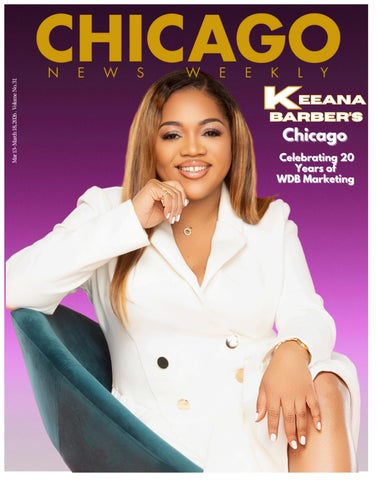
Mar 13- March 18, 2026 . Volume No. 31
eeana K Barber’s
Chicago Celebrating 20 Years of WDB Marketing
Publisher Cheryl Mainor Norman
Editor-In-Chief
Kai EL’ Zabar
Chief Content Officer Managing Editor
Laura Miller
Editorial Assistant Creative Direction Art Director
Malachi Webster CNW Studio, LLC L.D. Hunter
Copy Editor Staff Writers
Columnists Intern & Illustrator Cover Photography
Prayer and Meditation
E-NOTES
Kai EL’ Zabar - Editor-In-Chief
At first thought, one may be inclined to think that prayer and meditation are one and the same. Yet if you seek the definitions of each, you will find they are different, though the intended outcome is similar. I was taught through Bible school throughout my youth that prayer is the act of presenting a solemn request for guidance, help, a specific need, or an expression of thanks addressed to God.
I paid attention, and what resonated with me was the use of the word “universe” rather than Father or The use of the word “meditation” came later in God. I knew then that I had to embrace, as I always Max Blaisdell life for me, as having a direct meaning or had, what my family minister had taught me. Malachi Webster. connection to the action or practice of focused I grew up with Geechee folks around me from Zada Johnson, PhD. thought, whether written or spoken, expressing South Carolina, and they had their ways. They considered thoughts on a subject. So it came to knew things. They read tea leaves, healed with Candi McCrary mean a form of concentration on something to prayer and salve mixtures, and I saw them make Mila Marshall. PhD. me. things better not by magic but by manifesting one’s Cabryl Breotti I remember asking my minister whether faith in the physical world. That is why it is C.L. Blackburn meditation was different from prayer. The important to know under whose covenant you Ryan Willis come. Pray to the one true God, always. Dr. Sanja Rickette Stinson Morehouse-trained Baptist minister informed me that originally it was not. However, over the Meditation, on the other hand, has a silent quality Elijah Lee years, it had become essentially different and that honors the art of receptivity. This is especially associated independently of the one true God why it is important to direct your meditation to our Jason McCoy we know to be our Creator and Father. Father, to God, because we have asked, and in
Chicago News Weekly, LLC 700 N Sacramento Blvd Suite 320 Chicago, IL 60612 (312) 877-5151 Volume 3 No. 30 FMarch 5 - March 12, 2026 Chicago News Weekly is Published on Thursday www.cnwmedia.com advertising@cnwmedia.com editorial@cnwmedia.com
CHECK OUT LAST WEEK’S ISSUE AT WWW.CNWMEDIA.COM/E-EDITIONS
He advised me always to pray, in our tradition, directly to our Father/God, Son and Holy Ghost, and then meditate upon that which I prayed for. Later, the Rev. Booth introduced me to words that referred to meditation in the original Hebrew of the Old Testament, or Tanakh, scripture, of which there are several, with the most prominent being Hāgâ and Sîach.
meditating, we are directing our prayer by holding a consistent thought. For example: “God is my Savior.” You actually say this repeatedly in your mind. “God is my Savior and my salvation.”
As I matured in my biblical studies, I embraced the depth and distinction. When we pray, we always ask our God directly. People who meditate do not always do so. They often simply state what they want, meaning that any entity, good or bad, can enter their stream of consciousness. In fact, you can actually experience the interference of Satan if you do not ask directly, in the name of the Holy Spirit and the Trinity.
Think of prayer as the ask and meditation as the act of seeking and engaging. Prayer is directing your request for help, and meditation is the act of pursuit. If we choose to do one instead of both, prayer or meditation, we may find that the equation is not balanced, and we might benefit from exploring the missing form of communication. Thus is the meaning of the saying, “God helps those who help themselves.” God has given us the tools.
When we meditate, we cease movement and allow the desires of our minds and hearts to continue without the interference of ego, allowing God to guide us. Eventually, we enter a deep silence, a space that is the spiritual foundation of our essence amid all He then explained that, in a biblical context, the noise and fray of daily human existence. meditation and prayer are not just aligned; they are the completion of one thing. Think of them In this place, it becomes possible for us to hear the as a breathing exercise: voice of God as it speaks to us specifically, responding Meditation is the inhale. You take in the Word, to our questions, or simply being one with us in its the character of God, or a specific truth. You silent way. Both prayer and meditation are “chew” on it until you understand its flavor. indispensable tools for navigating our relationship with God and with ourselves. They are also natural Prayer is the exhale. This is your response. Once complements to one another, as long as you direct you have inhaled the truth through meditation, them to the one true God. Then prayer makes way for you speak back to God based on what you have meditation, opening the door to all that connects us as realized. one with the One.
Asking and Receiving
I began my pursuit of yoga and was informed that prayer and meditation are similar practices in that they both offer us a connection to the divine, but they also differ from one another in significant ways. Put simply, prayer is when we ask for something, and meditation is when we listen.
2 MAR 13- MARCH 18, 2026
When we pray, we use language to express our innermost thoughts and feelings to a higher power. At other times, we pray words that were written by someone else but still express what we want to say. Prayer is reaching out with requests for help, gratitude and praise.
There are times when we need to reach within, fully releasing the baggage inside our spirit, such as anger, hurt, disappointment, fear, hatred and revenge. When we let go of our attachment to such things, we can more readily become vessels of love, grace and goodness, and we receive. When we allow ourselves to do both, we begin to have a true conversation with God.
MAR 5 - MAR 12, 2026 03
CITY NEWS You're Paying ComEd's Lawyers. Illinois Wants to Stop That MALACHI WEBSTER - STAFF WRITER
There is a line on your utility bill—buried inside what's called the delivery charge—that pays for the attorneys ComEd and Peoples Gas hire to fight against you at the Illinois Commerce Commission. You are, in effect, funding both sides of your own rate case. That is the substance of what consumer advocates brought to Springfield last month, and what two pieces of Illinois legislation are now trying to fix. House Bill 4781 and Senate Bill 3497—collectively known as the Utility Transparency Act and sponsored by state Rep. Theresa Mah and state Sen. Suzy Glowiak Hilton—would prohibit investor-owned utilities from passing along to ratepayers the costs of trade association memberships, shareholder insurance, goodwill advertising, and outside legal services used to advocate for rate increases. A Citizens Utility Board analysis of rate cases filed with the Illinois Commerce Commission between 2023 and 2025 found those costs add up to roughly $40 million a year. Connecticut, Colorado, and Maine have already passed similar reforms. "It's hard to believe, but when we pay our monthly bills we are bankrolling utility memberships in trade associations that push the utilities' anti-consumer agenda." — Rep. Theresa Mah
A separate bill moving through the legislature targets a different but related problem. HB 4313, the No More Utility Bill Rip-Offs Customer Protection Act, sponsored by Rep. Kimberly Neely Du Buclet, takes aim at the state's deregulated energy market, where over 150 alternative electric and gas suppliers operate. Research from CUB found that customers who switched to these alternative suppliers have lost approximately $2 billion over the last decade— often after door-to-door sales representatives promised lower bills that never materialized. The bill would cap alternative supplier rates at 25 percent above the standard rate, require signed consent before contracts auto-renew at higher prices, and ban commission-based sales compensation—a structure critics say incentivizes slamming, or the unauthorized switching of customers' accounts. For Chicago-area residents, the timing is pointed. ComEd customers saw triple-digit increases in some June electricity bills last summer. Peoples Gas is currently seeking a rate hike of roughly $11 per customer per month from the ICC. Nicor Gas filed a $221 million rate increase request last month. ComEd has submitted a $15.3 billion, four-year grid plan that, by its own estimates, would add $3 per month to residential bills beginning in 2028.
An Ameren Illinois spokesperson pushed back, saying all costs are reviewed by the ICC in open proceedings and that some targeted expenses help customers access beneficial programs. The utilities have not publicly opposed the bills outright. The legislation now moves toward a floor vote expected later this spring. Sen. Glowiak Hilton, whose constituents have seen bills double, put it plainly: what utilities should be doing is delivering energy to homes and businesses—not asking people to pay for extra things that don't do that.
The Light Is Actually Coming Back. Here's Why MALACHI WEBSTER - STAFF WRITER
LIVING CHICAGO After the equinox, the Northern Hemisphere continues tilting toward the sun through June 20 —the summer solstice, our longest day—before the cycle reverses. The whole process repeats, has repeated, will repeat, governed by nothing more than gravity and the geometry of an orbit. What daylight saving time does is administrative. It shifts the clock an hour forward so that the afternoon holds more usable light for modern schedules. But the actual sunrise and sunset — the positions of the sun against the horizon at any given latitude — are determined entirely by where Earth sits in its orbit and how it is tilted. The clocks are a human convenience layered on top of a planetary fact.
This week, Chicago will gain roughly three minutes of daylight per day. By the time March 20 arrives—the vernal equinox—we will have crossed the threshold into days longer than their nights. None of that has anything to do with daylight saving time, which we recently observed. The clocks moved. The sun did not.
In December, Chicago sits near its furthest lean away— solar rays arrive at a low angle, spreading heat and light thinly across a wide surface area, giving us short days and cold. As Earth moves through its orbit over winter and into spring, that angle steepens. The sun climbs higher in the sky each day, its energy striking more directly, warming more efficiently.
The light returning is older than any human institution. It is a matter of physics and orbital geometry, operating on Earth is closest to the sun in early January—in the middle the same schedule it has for billions of years. of winter. Distance is not the mechanism. The tilt is everything. The reason we have seasons at all comes down to a single, almost accidental fact: Earth's axis is tilted 23.5 degrees The equinox on March 20 is the midpoint in this story. relative to its orbital plane around the sun. That tilt—not On that day, Earth's axis will be perpendicular to the line our distance from the sun, which is actually slightly greater between Earth and the sun—neither hemisphere tilting in July than January—is what governs how much light any toward nor away. The result: roughly 12 hours of daylight given place on the planet receives throughout the year. and 12 of darkness nearly everywhere on the planet, Right now, the Northern Hemisphere is in the middle of from the equator to the poles. The word equinox comes from the Latin for 'equal night.' its tilt back toward the sun.
4
MAR 13- MARCH 18, 2026
In the mid-latitudes, where Chicago sits, the equinox is also the moment when daylight is increasing fastest—about three minutes per day, according to the astronomical record. That rate slows as summer approaches and we near the solstice, when daylight peaks and barely changes from one day to the next. So the evenings are getting longer. The mornings are arriving earlier. The difference you noticed this week is material, and it will keep going for another three months. It was always going to happen. The earth was already on its way.
NATIONAL NEWS
The Price at the Pump Has a Body Count MALACHI WEBSTER - STAFF WRITER
Ten days ago, oil was trading at $70 a barrel. As of Monday morning, Brent crude briefly touched $120. The math is simple. The politics are not. On February 28, U.S. and Israeli forces launched strikes on Iran, killing the country's supreme leader and setting off a regional conflict that has since pulled in nearly every nation in the Middle East. Iran's response was swift and targeted: the Strait of Hormuz, a narrow channel through which roughly 20 percent of the world's oil and liquefied natural gas passes each day, is now effectively closed. Ships carrying approximately 20 million barrels of oil sit stranded in the Persian Gulf, unable to move without risking drone strikes, mines, and missile fire. The national average for gasoline climbed from $2.98 to $3.45 in a single week, according to AAA. Analysts at Kpler warn that prices could reach $150 a barrel by month's end if Hormuz traffic does not resume. In Europe, diesel prices doubled. In Asia, jet fuel rose nearly 200 percent. "We have gone from traders with ice in their veins to traders with panic in their veins." — Rebecca Babin, CIBC Private Wealth
Qatar declared force majeure on its enormous gas export operations after drone attacks on its facilities. Roughly nine million barrels per day are off the market, according to Rystad Energy's chief economist Claudio Galimberti.. Amid all of it, a quieter story has been consolidating. Russia—still mired in its invasion of Ukraine, still bleeding under Western sanctions—is watching this war with something that looks, if you squint, like relief. The Kremlin spokesman announced that Russia is seeing a significant increase in demand for its energy resources. The White House simultaneously issued India a 30day waiver to buy Russian crude—the same India that had faced U.S. tariff pressure for doing exactly that. Analysts at TIME observed that higher oil prices, global distraction from Ukraine, and U.S. munitions being redirected to the Middle East all constitute short-term wins for Moscow. President Trump, for his part, called rising oil costs a 'very small price to pay' for security. Seven American soldiers have died so far. Sgt. Benjamin N. Pennington, 26, of Kentucky, was the seventh.
In Chicago, where residents already faced some of The cascade is not accidental. Iraq and Kuwait have the country's steepest utility bills entering 2026, the already curtailed production. Analysts at Societe pump is not an abstraction. It is a commute. It is a Generale warned Monday that the UAE could be delivery driver's margin. forced to shut in output within the next five to seven days..
It is the cost of a tank of gas that hasn't been this high since Russia invaded Ukraine in 2022—a war, it is worth remembering, that also never quite ended.
MAR 13- MARCH 18, 2026 5
6 MAR 13- MARCH 18, 2026
COVER STORY
KEEANA BARBER’S CHICAGO
Before the sold-out rooms, the polished signage and one of the city’s most coveted tickets, there was a young woman with a promise to keep. Two decades later, Keeana Barber has built far more than a business. She has built legacy.
Keeana Barber imparts the inspiration for the birth of WDB Marketing that materialized out of what could have simply been a grave loss. “Most people don’t know that WDB Marketing was established to honor an idea my brother, Bobby Barber had expressed before his untimely death in November 2004. I was 22, and he was 27.” She breathes deeply and says, “as I experienced his missing from our lives, I knew that his death and the life denied him would not be in vain. Before his passing he had shared his desire to start a promotional company called What’s Da Bizniz” Barber’s story unfolds like a lot of triumphant Black Chicago stories with family, hustle and a sense of purpose that arrived before there was a formal plan. It seemed to take on a life of its ownthough she was the driving force behind it, pushing through the birth pains. Barber sighs, a deep breath releasing a memory of the two of them discussing his idea before his passing after which she prayed and asked God to place within her spirit whatever the inspiration her brother had not gotten the chance to fulfill. The company would emerge from her passion to have her brother live on through his idea and her invested intentionality. Today, what began as the intention to fulfill an idea her brother had aspired to has blown up to become a full-service marketing company, WDB Marketing which specializes in brand management, graphic design, marketing solutions and full-service printing. Reflecting Barber admits, “I am proud to say we manufacture all of our print services in-house, making us the first African American owned fullservice printing manufacturing in the South Suburbs. To date WDB Marketing has proudly serviced over 5,000 businesses and entrepreneurs in industries such as retail, professional services and not-for-profits. Our past and current clients include the Chicago Urban League, Flavor Restaurant, the Chicago Defender, Just Turkey franchise and WVON 1690AM. “I lost Bobby November 2004, and hosted my first event in February 2005,” she says looking back in retrospect at that pivotal moment and surmises, “That’s crazy. I was so fueled by purpose.” That adrenalin rush was like running a race almost as if she had to get in front of it to meet the assignment. The last thing she did not want to happen was to lose steam or enthusiasm to accomplish the goal. She was driven. She reminisced, “Even the first flyer reflected that unstoppable drive. It was literally a silhouette of my brother, modeled from one of the last photos he had taken. As the business grew, Barber was busy sharpening herself like a fine tool, which included taking graphic design classes at South Suburban College to strengthen her design skills. She recognized the skill as an important detail in a story that is as much about discipline as it is about vision. Clearly WDB did not grow on instinct alone but rather Barber’s determination to continue building the skill set to match the ambition. She grew up between Roseland and the south suburbs in a family where entrepreneurship was practical and constant. Her mother sold clothes. Her father sold odds and ends. Barber learned early that hustle was not theory. It was business tied directly to survival.
“I was always the brain,” she shares, “I loved books. If I couldn’t go to school, I d cry. I did not want to miss school.” That mix of ambition and discipline provides insight into the staying power of her story. That tenacity explains how Barber built a business through her 20s and 30s, long before entrepreneurship had the cultural shine it carries now, and she did it with the kind of confidence that had been nurtured early and had been cultivated to meet the moment. That tenacity explains how Barber built a business through her 20s and 30s, long before entrepreneurship had the cultural shine it carries now, and she did it with the kind of confidence that had been nurtured early and had been cultivated to meet the moment. “My family was always super proud to look at my report card and tell people how smart I was,” she recalls with a smile. “I never had to dim my light. They wanted me to shine.” Street Teams and Humble Beginnings To understand what Keeana Barber built, you have to understand the Chicago she came up in. During the 2000 era, old school promotions were still physical, local, and relentless. Street teams moved through neighborhoods with stacks of flyers like locusts. People left them on windshields, dropped them in barbershops and beauty salons, slipped them into corner stores and restaurants, passed them out on sidewalks and stood outside talking directly to people, encouraging them to come out. They even placed them in mailboxes. When Barber talks about the promotion business of the past she describes the mechanics of that era. “In 2004 when we opened our doors, people were still printing 20,000 flyers also referred to as pluggers placing them on cars,” she explains. “Circulation was different.” Graduation from college was a different landscape than that of many of her peers who were seeking jobs to compliment their training. What powers her story is not that that she ventured into business so young but rather that she had the tenacity and commitment to stay in pursuit of her vision. Real Belief Barber smiles as she recalls, “I often tell people that our very first office was about as big as this studio ( describing CNW’s podcast studio) noting the size as 150 square feet in South Holland. The rent was $300 a month; utilities included. It was shared and modest. “Immediately after graduating from Northwestern my friends were doing well in corporate America. A lot of them were working downtown, and there I was in that tiny suburban office, yet I knew that it didn’t define me. I told myself, I’m on the path to doing what I know God wants me to do.”
MAR 13- MARCH 18, 2026 7
COVER STORY What stands out in Barber’s telling is how firmly she believed in her destination before the visible proof arrived. “I believed we would occupy a 10,000 square feet office facility one day.” That conviction shaped how she served clients out the gate. I saw my clients all the same. “I didn’t care if you’re the mayor or college student producing a house party,” she hesitates, “You come to our tiny space, place your order, and I respect each person equally as I will in my 10,000 square feet space because you’re going to walk with me as we grow.” Five Years In, the Operation Expands About five years into building WDB, James Wheeler entered the story. Today, Wheeler serves as chief operations officer, and Barber credits him with helping to accomplish the company’s goals “James Wheeler, now my partner and I met along the way,” she establishes. “WDB was a legitimate business approximately five years in when we began working together. He really brought the production vision to life.” If Barber carried the original spark, Wheeler helped build the machinery around it. WDB began adding production capacity piece by piece, learning what made sense to bring inhouse and how to grow without losing control of the work. Barber describes Wheeler as the steady hand behind the scenes, the one focused less on attention than on execution. He is, in her words, “tried and true,” always making sure the work is ready and that WDB shows up the way it intends to. That partnership helps explain how WDB evolved from early hustle into infrastructure. Let the Business Tell You Barber is candid about the mistakes she made early, including getting an office before she really needed one. “I made a mistake. I don’t talk about it a lot, but I had a very first office about a year before that,” she said. “I didn’t even have a business yet. I was there for all of two months before I had to move out because I wasn’t bringing in any money.” That experience shaped one of her clearest principles. “You seek what you can actually afford,” she said. “Don’t go looking for a big fancy office to impress others if you can’t really afford it.” “Once we had 200 consistent customers, we were busting at the seams,” she said. “I couldn’t stock the flyer orders in the office. Let your business tell you it’s busting at the seams. Bigger isn’t always better especially if You want to look like you’re doing better than you are.” She has little patience for the performance of entrepreneurship. “Everything is amplified. Everything is on social media, and business is just fancier than ever,” she said. “When we began our business we printed flyers and provided a DJ. It was simple. Now people feel that when they come out, they have to have a full brand launch. They need a new logo and a range of things.’ She pauses, then continues, “It’s all those added outside pressures that make us open and close businesses so quickly.” Barber and Wheeler - Photo Credit : Milli Frick
8 MAR 13 - MARCH 18, 2026
COVER STORY
Barber and Wheeler and their team. . Photo Courtsey of Keeana Barber
From South Holland came Calumet City. From shared production space came owned equipment. From gradual expansion came a building. From suburban roots came a second location in the South Loop. It was layered, deliberate, and earned. More Than a Business Today, the markers of success are there: two brick-andmortar locations, an owned building, a nonprofit, longtime clients and a business substantial enough to make something like Legacy possible in the first place. “WDB Marketing is the reason Legacy Awards was able to happen,” she said. “We did the entire event ourselves. We had no sponsorship. We relied on ticket sales and hope.” Because WDB was a printing company, they capability to build much of the event themselves. “We could produce our own signage, our own graphics, and that allowed us to host that first event and still make it look like we had a full budget,” she said. “It looked polished.” This year’s celebration stretches beyond a single evening. The 2026 L.E.G.A.C.Y. Weekend is a three-day convening rooted in leadership, education, growth, advocacy, community and youth. It opens with a Friday business mixer and panel discussion at the DuSable Black History Museum and Education Center, continues with Saturday’s 10th annual gala, and closes with a Sunday brunch takeover. Chicago News Weekly is the official media sponsor of the weekend. Because WDB was a printing company, they could build much of the event themselves. “We could do our own signage, our own graphics, and that allowed us to host that first event and still make it look like we had a full budget,” she said. “It looked polished.” This year’s celebration stretches beyond a single evening. The 2026 L.E.G.A.C.Y. Weekend is a three-day convening rooted in leadership, education, growth, advocacy, community and youth. It opens with a Friday business mixer and panel discussion at the DuSable Black History Museum and Education Center, continues with Saturday’s 10th annual gala, and closes with a Sunday brunch takeover. Chicago News Weekly is the official media sponsor of the weekend.
8 DEC 4 ---DEC 10, 2025
Among the gala’s highlights is the WDB Cares Young Then she arrives at the deeper point behind Entrepreneur of the Year competition, which will award Legacy. $25,000 in cash and prizes, including direct funding and professional services. This year’s honorees include “The greatest reason I produce Legacy is to Robert Townsend, veteran actor, director, writer and expose all the greatness that’s actually going on producer; Stephanie Hart, founder and owner of in Chicago,” she said. “All the great businesses, Brown Sugar Bakery; Jimmy Akintonde, founder of all the great brands.” UJAMAA Construction; Lisa McKay, founder of Culinary Education Academy and executive That belief also shapes the way Barber talks about chef/owner of Lisa Kaye Catering; Pam Blackman, Black business. She is clear that support has to president and CEO of Building Brighter Futures Center mean more than slogans or a one-time purchase. for the Arts; Pamela Robinson, founder of the 40+ It has to include grace. Double Dutch Club; and Gus Rickett Sr., founder of Uncle Remus Saucy Fried Chicken. “One of my biggest pet peeves is when people say, ‘Oh, this Black-owned business did this, and WDB Cares extends Barber’s work beyond branding are ready to no longer support them,” she states and production into direct support for entrepreneurs. sadly, “because we have bad experiences Through accelerator programs, mentorship, practical everywhere we go. White, Asian, Indian, Jewish business education and its Young Entrepreneur of the businesses all have a moment.” Year initiative, the nonprofit helps emerging founders access capital, services and the kind of real-world guidance Barber says she wishes more young business She makes the point plainly, “I’ve gone to the grocery store and had to wait too long and been owners had when she was starting out. little peeved , but I return to Mariano’s. We walk “I tell people If I could do anything all day long, to help into a lot of places and think, this took longer than our businesses,” I would give advice.” it should have. But we don’t say, ‘Oh, this is the total commentary on that business’s reputation, “I teach the hard knocks of what I’ve learned, how we’ve like forever.’ We’ve got to give each other grace, scaled, and how we’ve maintained two different brands, just like we need grace in life.” a nonprofit and multiple locations,” she said. “No, we’re not perfect, but I’ll share the knowledge I have to this point, and hopefully it helps you.” It is also a philosophy shaped by relationships. Near the end of the interview, Barber pointed to the people who have poured into her, challenged The Chicago She Believes In her and checked on her behind the scenes, One of the strongest things Barber says in the interview including Robbie Smith, Trez Pugh, Pam Blackman and others in her circle who have is about Chicago itself. She talks about the city as offered support beyond what the public sees. someone who has spent years in close proximity to its builders, the small businesses, organizers, neighborhood What she values, she suggested, is not just applause, but the people who reach out with anchors and people doing the work even when the honesty and care, the ones who ask how things work is not glamorous enough to trend. are really going beneath the polish. “I felt like I was in such a great place,” she said. “People And she never forgets who helped build WDB in complain about Chicago and say nobody is trying to the first place. help the violence. Well, you don’t know Diane Latiker “ with Kids Off the Block. Anybody doing anything with We were built on foundation of Black people Black fathers? I just did a flyer for Sheldon Smith from who intentionally wanted to support a BlackDovetail Project, so he’s paying Black fathers to be part owned business,” she muses, “That is 100 percent of the program. Anybody developing our community? of the reason we’re here.” I know Phil Beckham is working on something on 43rd right now that will make a difference.”
MAR 13- MARCH 18, 2026 9
COVER STORY Keeana Barber’s Chicago is not a city reduced to its loudest dysfunctions. It is a city of builders, of people in motion, of work that often goes unseen unless someone is intentional enough to name it. It is also a city that, at its best, knows how to sustain its own. It is the city after all where Robert Sengstacke Abbott published the Chicago Defender through which he single handedly promoted and caused The Great Migration while John Johnson published EBONY/JET Magazines that introduce the Black Americans to the world.
Want to hear the full interview? Check out our latest podcast Behind The Cover Episode featuring Keeana Barber on the CNW Network. Scan below!!
“I just started working,” Barber said.
Musicans and Attendees Legacy Weekend Pinky Cole
Mayor Brandon Johnson
Keeana Barber
Keeana Barber
8 DEC 4 ---DEC 10, 2025
MAR 13- MARCH 18, 2026 10
WOMEN ON THE MOVE CNW STAFF REPORT
Women on the Move
It’s Women’s History Month, and at CNW, we’re taking time to spotlight women by the decades, women who are on the pulse, moving the needle, and creating real change while balancing every role with purpose and precision. This week, we’re giving flowers to the women in their 30s and 40s, leaders, builders, mothers, entrepreneurs, and changemakers who are showing us what dedication really looks like. As Dolly Parton sang, “It’s a rich man’s game no matter what they call it,” and these women know that better than most. Still, they continue to rise, lead, build, and make space for others to do the same. They are not just making moves. They are making history in real time. Shanetta Davis is a strategist, connector, and community leader with nearly two decades of experience in marketing, recruitment, and operations. A graduate of the University of Illinois Urbana-Champaign, she earned a Bachelor of Science in public health and later an MBA, building a career grounded in strategy, systems thinking, and business growth. As founder of The Davis Connect, an experiential marketing agency, Davis helps entrepreneurs and organizations strengthen brand positioning, elevate customer experience, and expand visibility, with a particular passion for supporting Black-owned businesses. In 2023, she became the youngest executive director in the 45-year history of the South Holland Business Association, where she leads initiatives that support local commerce, partnerships, and economic development. Her civic leadership also includes service on the South Holland Economic Development Commission and the executive committee of the Heritage Community Party Political Organization. Davis is also co-founder of T.I.T.T.S. (Taking It To The Streets), a breast cancer awareness initiative marking 10 years of community impact. Her service has earned her the Presidential Lifetime Achievement Award. At 40, Davis continues to build a legacy defined by leadership, service, and lasting community impact. Serita Love is a strategist, business matchmaker, and a creative, innovative person with keen foresight, capable of imagining and shaping the future through strategic thinking and, often, risktaking with a servant’s heart and a focus on turning ambition into aligned opportunity. As the founder of Success Junkie™, she works at the intersection of strategy, influence, and connection, helping entrepreneurs and changemakers elevate their positioning, partnerships, and long-term impact by bringing the right people and opportunities together. She is also the mother of a 21-yearold son, Aníus, who is studying at University of Illinois Urbana-Champaign. A proud member of Alpha Kappa Alpha Sorority, Incorporated, Serita’s commitment to service extends into civic and community leadership. She serves as Rotary President for Social Equity and Impact within Rotary International and is the Assistant Governor–Elect for Rotary District 6450. She also serves on the Board of Directors for Chicago Scholars, the organization she credits with helping shape her early leadership foundation. Her dedication to volunteerism and community impact has been recognized with the prestigious President's Lifetime Achievement Award. In her 40s and entering a powerful season of expansion, Serita represents purpose-driven, community-centered, and ambitious leadership. Through strategy, matchmaking, and opportunity design, she remains committed to helping others expand visibility, build meaningful partnerships, and experience their own bankable breakthroughs. Michelle Thames is a visibility and monetization strategist who has helped countless women transform from best-kept secrets into go-to experts. Michelle L. Thames is a marketing strategist, business coach and digital entrepreneur dedicated to helping multi-passionate entrepreneurs get visible, attract clients and monetize their expertise. With more than 15 years of experience in social media and digital marketing, she has helped thousands of entrepreneurs and global brands scale their online presence and revenue. After being unexpectedly fired from her corporate job, Thames turned her blogging side hustle into a thriving full-time business. She later led social media strategy for Mielle Organics, helping the brand grow a vibrant online community. Now, as CEO of Thames Media Solutions, she is on a mission to empower women entrepreneurs to build profitable, passion-driven businesses on their own terms. Thames is also the host of the popular Social Media Decoded podcast and the author of From Fired to Featured, where she shares her journey of turning setbacks into success. When she’s not strategizing, Thames enjoys training for her next 5K or traveling with her family. Featured by major media outlets, host of a top-ranked podcast and trusted by global brands to drive engagement and sales, Michelle Thames’ proven track record speaks for itself. For entrepreneurs ready to elevate their brand with clarity and confidence, her work provides the roadmap.
11 MAR 13- MARCH 18, 2026
Janel Carrington Jackson is a Chicago-based entrepreneur, marketer, model, and storyteller whose career sits at the intersection of family legacy, creative storytelling, and modern entrepreneurship. Alongside her mother, Jackie Jackson, she helps lead marketing, partnerships, and community collaborations for Kilwins Chocolate, Fudge and Ice Cream Chicago, a family-owned franchise group with seven locations across the city and an eighth on the way. Having started in the family business at just 14, Janel developed an early understanding of what it takes to build and sustain a successful business in Chicago. Today, she plays a key role in expanding Kilwins Chicago’s visibility through partnerships and relationships across the city’s tourism, hospitality, and business communities. She also contributed to bringing the first Fatburger to Chicago’s South Side in Chatham, helping support the revitalization of the historic Seaway Bank building. Beyond the family business, Janel has built a creative career of her own. Signed with ONE Management Chicago, she works as a professional model and content creator, partnering with brands including Wynn Las Vegas, Prada Beauty, Valentino Beauty, and Adidas. By blending entrepreneurship with storytelling, Janel is helping shape a new chapter of family legacy, one where creativity, culture, and commerce come together. Her guiding belief: “Your mind is your magic. Dr. La’Shawn Littrice, 53, is a South Side Chicago native from Englewood whose life’s work blends entrepreneurship, scholarship, and social justice. She earned her bachelor’s degree in accounting from National Louis University, began her career in the corporate sector, and went on to build and operate a full-service accounting firm for nearly 20 years. Committed to community impact, Littrice and her husband launched a nonprofit and several businesses that helped college-bound youth develop entrepreneurial skills and funding opportunities, while also supporting formerly incarcerated men through employment and mentorship. Her advocacy work led her to pursue a master’s degree in public policy, focused on alternatives to mass incarceration, and later a Ph.D. in community psychology from National Louis University. Her dissertation examined incarceration, family separation, and reunion among African American parents and children. Littrice is the founder and president of Collaborative Community Consulting, Inc. and founder of Make Noize for Change, NFP, where she leads grassroots efforts addressing inequitable education, racism, homelessness, poverty, and violence against Black and Brown communities. She also serves as director of mass incarceration, criminal justice reform, and restorative justice for the International Congress on Faith and Social Justice. A published author, Littrice’s first book, Unleash The Queen Within, became a No. 1 bestseller. She has also been published in the American Journal of Community Psychology and received the Presidential Medal of Freedom for her commitment to social justice. Alexus A. Rucker is an entrepreneur, community builder, and humanitarian helping shape the future of Dolton, Illinois. She is the owner and operator of The Weekend Winery & Brunch, a popular downtown destination that has created a vibrant space for gathering, celebration, and connection. She also owns Rucker Cigar & Hookah Lounge and recently launched Rucker Athletics, a fitness and training facility focused on developing athletes, strengthening families, and promoting health, discipline, and confidence. In addition, she holds a leadership role with A&D Rucker Management, helping guide strategy and growth across a broader portfolio of ventures. Beyond business, Rucker is committed to community impact through job creation, mentorship-minded leadership, and investments that keep resources circulating locally. She is also a real estate investor with a portfolio of more than 22 properties, reflecting her focus on wealth-building, neighborhood revitalization, and generational impact. One of her most notable achievements is leading Containment Services of America, a third-party containment company that supports manufacturers through inspection and quality compliance. She recently became UAW unionized with Lear Automotive, marking a major milestone in her leadership within a traditionally male-dominated industry. Above all, Rucker is a devoted mother, wife, and advocate for her community. Continued on page 14.
12 MAR 13- MARCH 18, 2026
ARTS & CULTURE
A Review: Bernadette, the Musical ZADA JOHNSON, PH.D. - STAFF WRITER
Photos Courtesy of Bernadette, The Musical
If first impressions can make or break a play, take note that the opening of one of the most talked about theatrical events of the season, “Bernadette the Musical,” is unforgettable. Its creative use of modern digital technology takes the audience to thecountryside of France and you’re in the fields with Bernadette. Sadly the musial is wrapping up its North American premiere at Chicago's Athenaeum Center for Thought and Culture on March 15th. The musical is an intriguing chronicle of St. Bernadette Soubirous, the teen visionary who witnessed apparitions of the Virgin Mary in 19th century Lourdes, France and went on to become a nun. With its outstanding vocal performances as well as heartfelt portrayals of family and faith, “Bernadette the Musical” will be a compelling experience for religious believers and general theater enthusiasts alike.
For both religious believers and general theater enthusiasts alike, Bernadette, the Musical is a fascinating testament of faith and strength. This writer is certain that this fabulous musical presentation is on it’s way to Broadway so don’t miss it. Chicago performances run through March 15th at the Athenaeum Center for Thought and Culture (2936 N. Southport). For more information visit www.athenaeumcenter.org.
Based on historical accounts of interrogations and investigations conducted by government authorities and church officials, the musical centers on young Bernadette’s steadfast faith in the visions of a Marian figure that appeared to her on several occasions at a local cave-grotto in Lourdes. French singer and actress Eyma is a captivating Bernadette, bringing both vulnerability and gravitas to the role. Her strong vocals masterfully explore the emotional weight of being doubted by the clergy, community, and family and the courage it takes to remain true to what you believe. Bernadette’s visions cause great controversy throughout the community of Lourdes. Government authorities harass her povertystricken family. Community members and church officials ostracize her and deem her visions unworthy of their belief. Her peers laugh and tease her, convinced that she is crazy. During these scenes, the supporting cast does an outstanding job advancing the storytelling of the musical. Steven Martella is a villainous Commissioner of Jacomet, the Lourdes police commissioner who cruelly interrogates Bernadette and derides her family. Jeremie Roy and Jessie Macbeth offer poignant moments of family struggle as Bernadette’s parents, particularly her father’s pleas to the commissioner that he has done his best to provide for his family as they faced debilitating poverty. Thomas James illuminates as Father Peyramale, the Lourdes parish priest who initially dismisses Bernadette, but is later convinced of her visions and becomes her greatest supporter. His moving vocal contributions to “I Believe in You” underscore Bernadette’s triumph over her community of naysayers. In addition to its outstanding vocal performances, the stagecraft of Bernadette is also noteworthy. The innovative use of digital stage design including projections of sheep on the countryside and special effects of the events that occurred at the grotto bring 1850s Lourdes to life. Religious believers will be particularly moved by archival images of Bernadette and footage of pilgrims visiting the modern-day Sanctuary of Our Lady of Lourdes.
MAR 13- MARCH 18, 2026 13
Women on The Move Nuda Stewart explains that her first Nuda gifted her its meaning which is 'New Day.' As the Community Relations Director at Royal Estates Assisted Living, she played a pivotal role in expanding the number of paraticpating senoirs from 17 to 100. The loss of her Mother Denise Stewart at the young age 56, inspired her pursuit with a passion for helping seniors. She expresses that she advocates for the benefits of transitioning into supportive living environments for better quality of life when engaged in enrollment. She breaks down the advantages of being in a community of like age people with whoim they can share, converse and enjoy one anothers company. In addition to her work at Royal Estates, she also serves as an Event Coordinator for Noble Entertainment, where she brings clients' visions to life through creative event planning. As the owner of Seniors in Motion Inc, a nonprofit organization dedicated to promoting healthy living and active lifestyles for seniors. She works tirelessly to inspire others to stay active while embracing the aging process. You got to keep it moving otherwise you stop,' is her message to her clients. "I'm deeply committed to my community and believe in the power of connection and support, allowing seniors to thrive during their golden years of life."
Know an amazing lady that deserves a mention? Email us at CNWNewsNow@gmail.com!
March, we celebrate Women’s History Month
EMPOWERMENT
DR. SANJA STINSON - COLUMNIST March, we celebrate Women’s History Month .Why Women’s History Month Still Matters and why it’s more than a celebration. Every March, timelines fill with quotes, black-and-white photos, and colorful graphics declaring, “Happy Women’s History Month.” We celebrate pioneers. We repost icons. We applaud progress. And then, if we’re not careful, we move on. But Women’s History Month was never meant to be decorative. It was born out of advocacy out of a recognition that women’s contributions were consistently minimized, miscredited, or erased. What began as Women’s History Week in 1980, proclaimed by President Jimmy Carter, expanded in 1987 to a full month because leaders and educators believed women’s impact deserved more than a passing mention. It deserved institutional recognition. That origin alone tells us something powerful. Women’s History Month exists because women were left out. Which means it is not simply about celebration. It is about correction. It is about restoring narrative, it about reclaiming and maintaining our voice, it’s about honoring impact that a system if give permission will overlook, because it has happened. Why it matters more than ever. As a retired nonprofit founder, I have seen firsthand how easily women’s labor becomes invisible. Women lead organizations, hold communities together, raise funds, solve crises, and build systems often without applause. The work is real. The impact is measurable. But recognition? That is not always automatic. Women’s History Month reminds us that visibility is not vanity. It is validation. When we tell the stories of women who built movements, launched businesses, wrote books, preached sermons, or advanced science, we are doing more than honoring individuals. We are expanding what leadership looks like. We are telling young girls and seasoned women. “There is room for you here.” But this month is also more than looking backward. It is a mirror. It asks us: What are we building now that history will record later? As an AI Certified Consultant working in emerging technology spaces, I see a new frontier forming. Artificial intelligence is reshaping industries, redefining work, and reorganizing influence. The question is not whether history is being written it is who is writing it. If women are absent from innovation tables, funding conversations, digital transformation strategies, and policy discussions, then future history books will reflect that absence. Women’s History Month is a reminder that participation matters. Not symbolic participation. Substantive participation. This includes boardrooms, pulpits, tech labs, nonprofit strategy sessions, author platforms and community coalitions.
14 MAR 13- MARCH 18, 2026
Women must be present and prepared. As a minister, I also understand that this month has a spiritual undertone. Many women of faith have carried extraordinary responsibility in their homes, churches, and communities without formal titles or compensation. They have taught, organized, counseled, prayed, fundraised, and led quietly. Women’s History Month affirms that calling and contribution do not require permission to be legitimate. And as an author, I know the power of narrative. When women tell their stories especiallystories of disruption, resilience, and reinvention they shift generational thinking. A written story becomes documentation. Documentation becomes legacy. This month is not simply about famous names. It is about everyday disruptors: The woman who pivoted her business during economic downturn. The nonprofit leader who kept doors open when funding fell short. The grandmother learning new technology to remain relevant. The entrepreneur who refused to shrink her expertise in maledominated spaces. The woman who rebuilt her life after loss, betrayal, or transition. History is not only shaped by those who make headlines. It is shaped by those who hold steady in purpose. Women’s History Month still matters because inequities still exist. Leadership gaps still exist. Pay disparities still exist. Underrepresentation in technology and venture capital still exists. Celebration without reflection becomes performance, reflection without action becomes nostalgia. Women’s History Month invites both. We celebrate our pioneers, study their patterns, correct the omissions, then we continue to step forward.
It is not enough to admire women who changed history. We must ask how we are changing systems in our own spheres of influence. For some, that may look like launching the nonprofit you have been postponing. For others, it may look like mentoring the next generation. For others, it may look like learning new tools so your voice remains relevant in a digital age. For others, it may look like speaking truth in rooms that expect silence. Women’s History Month is not a decorative calendar event. It is a call. A call to remember. A call to participate. A call to lead. Because history is not something we inherit passively. It is something we co-author daily. And one day, someone will study the decisions we are making right now. The question is not whether Women’s History Month matters. The question is whether we are living in a way that proves it does.
SPECIAL FEATURE
Park Manor 75 Is More Than a Lounge — It’s Home RYAN WILLIS - CONTRIBUTING WRITER On the corner of 75th Street and St. Lawrence, Park Manor 75 is quietly redefining what a Black-owned hospitality space can be — not just in Chicago, but nationally. Founded by Jacare Thomas and Charlette Stanton, Park Manor 75 is not built on exclusivity or pretension. It’s built on intention. Ask about the dress code and you won’t get rules — you’ll get freedom. “The space is going to dress you up,” Thomas explained. “You can come as you are or you can dress up — whatever makes you comfortable. Just don’t come in here trying to be pretentious.” That philosophy sets the tone. The room itself establishes expectations: respect, presence, and ease. The result is a different type of crowd and a different type of experience — one rooted in comfort without chaos. A Space That Teaches Without Lecturing Park Manor 75 doesn’t shame familiarity — it expands it. Many patrons walk in knowing Hennessy and Don Julio. They leave discussing regions, varietals, and Black-owned vintners they had never encountered before. Education happens organically, through conversation and exposure, not judgment. That’s by design. Curating wines and spirits exclusively from Black producers was a non-negotiable for Thomas and Stanton — not as a marketing angle, but as a reflection of who they are. “We’re very Black,” Stanton said plainly. “And this fits how we move in everything.” Building an all–Black-owned beverage program wasn’t easy. It required working with nearly a dozen distributors — far more than the industry norm. But the difficulty revealed something important.
The Third Space the Community Has Been Asking For
The risk runs deeper than daily operations. Both owners lost their parents — parents who Regulars often refer to Park Manor 75 as a “third space” — lived independently and left behind not home, not work, but somewhere you can exist resources. Opening Park Manor 75 meant comfortably. risking inherited stability in pursuit of something larger. Thomas and Stanton didn’t set out to create the label. It revealed itself. In a city where many Black professionals “That money was meant to be passed down,” travel outside their neighborhoods to network, unwind, Thomas said. “So we had to build something or have unfiltered conversations, Park Manor 75 offers that honored that.” something rare: freedom within community. Fear and faith couldn’t coexist. They chose faith. Here, people talk openly about money, politics, history, and strategy — without shrinking or code-switching. Rewriting the Narrative From the Inside Out Conversations spark naturally. Someone overhears something insightful, steps in respectfully, and When Park Manor 75 opened, skeptics connections form. “These are pivotal times,” Stanton said. questioned why a concept like this belonged “Everything feels upside down — politically, on 75th Street. Today, those voices are quieter. economically. We need spaces where we can fellowship, Thomas and Stanton see their work as ear hustle, and figure things out together.” counter-narrative: invest where you live. Build The goal isn’t answers. It’s space to wrestle with the value before outsiders arrive. Shape the future questions. instead of reacting to it. Culture That Connects — Not Just Self Events at Park Manor 75 are designed to widen the circle. Wine tastings draw one audience. DJ nights draw another. Their recurring Ladies First series highlights women DJs, while Black Talk creates space for candid conversations about issues impacting Black communities. Fashion shows, creative showcases, and collaborative gatherings emerge naturally. “Black people aren’t monolithic,” Thomas said. “So the offerings shouldn’t be either.” Some guests arrive to support a DJ. Others come for conversation. Many simply come to sit, listen, and belong. That’s the point.
“It showed us there was a real need,” Thomas said. “A need The Cost of Doing It Right for spaces where Black brands are curated honestly and Behind the elegance is sacrifice. unapologetically.” Operating a space like Park Manor 75 means navigating That need became tangible when Black wine and spirit skepticism — especially around Black-owned hospitality. makers began visiting the space themselves. One producer, Thomas and Stanton are keenly aware of the double overcome with emotion, sat at the bar and said quietly, standard. “There’s this idea that Black spaces won’t be professional,” Stanton said. “So if anything goes wrong, it’s “These are all my friends. This doesn’t happen for us.” ‘See? I knew it.’ That mindset hurts us.” Moments like that solidified the mission. Every purchase is an investment — not just in product, but in Black families They don’t claim perfection. They claim accountability. If something misses, they address it — but they refuse to and Black futures. accept people entering the space looking for failure instead of beauty.
“If property is affordable here,” Stanton said, “why wouldn’t we invest? Why let someone else come later and profit off what we already know is valuable?” In just a few months, conversations inside the space have sparked ideas, partnerships, and confidence in others considering entrepreneurship. The owners don’t gatekeep information — they share it. More Than a Lounge Five years from now, Thomas and Stanton envision Park Manor 75 as a national destination — a hub for Black makers, creatives, and thinkers. A place visitors seek out when they want to experience Black Chicago done right. But when asked to finish the sentence — Park Manor 75 is more than a lounge… — the answer came without hesitation. “It’s home.” And in a city where too many people have had to leave home to feel whole, that may be the most powerful offering of all.
MAR 13- MARCH 18, 2026 15
AN HONEST LEADER YOU CAN TRUST! Integrity Matters. Leadership Matters. Trust Matters. AttorneyRichardBoykin has built his career onhonesty, strong moral values and a commitment to do what’s right not what is easy. From fighting for transparency in government to standing up for working families, he has always put community first. When others chose politics as usual, Boykin chose principle. When tough decisions had to be made, he chose integrity over expediency. Becauserealleadershipisn’taboutpromises - it’saboutcharacter.
NOW IS THE TIME! PUNCH #39 Endorsed by Treasurer Maria Pappas, Ald. Ray Lopez, Ald. Silvana Tabares, Hon. Billy Marovitz, Dr. Willie Wilson, Paul Vallas, Rabbi Barry Axler, Hon. Anan Abu Taleb, Hon. Jim Taglia PAID FOR BY RICHARD BOYKIN FOR CONGRESS 16 MAR 13- MARCH 18, 2026
COMMENTARY My millennial independent take on tariffs and the SOTU MILA K. MARSHALL, PHD. -STAFF WRITER Tariffs are often framed as a way to protect American industry. “Made in America,” is meant to signal strength, independence, and opportunity flowing back into our own communities. In theory, that rallying cry should benefit everyone. But in practice, tariffs function like a hidden tax. When the cost of imported materials rises, businesses raise prices. Consumers absorb the difference. Families pay more for food, construction supplies, clothing, appliances, gas everyday necessities. The burden lands hardest on people with the least room in their budgets. That dynamic mirrors what’s often called the “Black tax” the structural reality that Black communities often pay more to access the same goods, services, and capital due to systemic inequities. Higher borrowing costs, limited access to credit, underinvestment, and fewer banking relationships all compound over time. Here’s where the contradiction becomes clear. We say “support American businesses.” We encourage people to buy domestic, shop local, invest at home. But when there is consistent banking inequity, that call is not equally accessible.
Many Black-owned businesses are systematically undercapitalized not because of lack of talent or demand, but because of limited access to traditional lending, venture funding, and lines of credit. So when tariffs raise input costs and capital becomes more expensive, who can absorb it? Well-capitalized firms with strong banking relationships. Who cannot? Businesses already operating with thin margins and constrained credit. The result is that “Made in America” can unintentionally reinforce existing gaps. The businesses most able to expand under protectionist policies are often the ones that already had access to capital. Those locked out of equitable financing struggle to scale, compete, or even survive rising costs. Meanwhile, parts of the private sector compound the issue by passing every increase directly to consumers sometimes beyond what costs justify. Small businesses are under pressure, yes. But when rising prices become the default solution instead of innovation, collaboration, or margin adjustment, the instability spreads. If we truly want American-made opportunity, we must confront American-made inequity.
Economic patriotism without capital access reform is incomplete. Supporting domestic production must include dismantling systemic barriers in banking and lending. Otherwise, “support American business” becomes a slogan that uplifts some while unintentionally excluding others. A strong nation doesn’t just produce more at home. It ensures that all of its entrepreneurs have a fair shot to build, scale, and compete. If we care about stability, we have to care about equity in who gets to participate in growth. You must ask yourself, 'Do I care.? Do you? So what comes after that? As a Millennial each of us must choose how we want to live, lean in and create the America we want. What do we want for our future selves?
MAR 13- MARCH 18, 2026 17
FOOD & WINE Lean, Mean and Healthy MARE EVANS - STAFF WRITER
I know it’s been a moment since the holidays but some of you are still eating like they haven’t come or gone. The truth is post-holiday eating should focus on nutrient-dense, fiber-rich foods to counteract heavy, high-sodium meals. Especially for all you recently, new body selves who have put in the work to restore your good health. Prioritize lean proteins (fish, chicken), leafy greens, roasted vegetables, and hydration (water, herbal tea). Rehydrate with detoxifying foods like celery, cucumber, and berries to reduce inflammation and bloat. And please stay away from all that processed junk. It’s poison Key Strategies to Be ready for Spring & Summer Emphasize Hydration: Drink plenty of water or green tea (no sweetner) to counteract salt and sugar, helping to reduce bloating. Fiber-Packed Foods: Consume vegetables like broccoli, Brussels sprouts, celery, and radishes, which are high in fiber and aid in digestion. Lean Protein & Complex Carbs: Incorporate fish, lean meats, and whole grains. Reduce Sugar/Salt: Avoid processed, highsodium, and high-sugar foods that cause sluggishness. Use the "Plate Method": Fill half your plate with veggies, one-quarter with protein, and one-quarter with complex carbs. Specific Meal Ideas & Tips Soups and Stews: Try a curried lentil, tomato, and coconut soup for a restorative, easy meal. Salads: Create fresh salads using celery, pear, hazelnuts, and Manchego. Leftover Upgrades: Turn leftovers into new meals, such as using turkey in a fresh winter salad or in a broth-based soup. Light Breakfasts: Opt for smoothies with frozen berries, yogurt, and oats. Other Considerations Reset Habits: Start with smaller, consistent meals to prevent extreme hunger. Gentle Activity: Pair better eating with light exercise like walking or yoga to boost metabolism. Reduce Leftovers: If you have leftover holiday food, freeze it or consume it in moderation. Use the list below As a Guide Lean protein foods, crucial for muscle repair and weight management, are low in saturated fat and cholesterol.
18 MAR 13- MARCH 18, 2026
Top choices include skinless chicken/turkey breast, white fish (cod, haddock), shellfish (shrimp, scallops), egg whites, fat-free dairy (Greek yogurt, cottage cheese), legumes (lentils, beans), tofu, and lean beef cuts like sirloin or 93% ground beef. Top Lean Protein Sources Poultry: Skinless chicken breast (27g protein per 3oz), turkey breast. Fish & Seafood: Cod, halibut, haddock, tilapia, and shellfish like shrimp and scallops (very low in fat). Fish High in Omega-3s: Salmon, mackerel, sardines, and albacore tuna. Meat: Lean beef (sirloin, tenderloin, 93% lean ground beef), pork tenderloin, and game meats like venison or bison. Dairy: Non-fat Greek yogurt, low-fat cottage cheese. Plant-Based: Tofu, tempeh, edamame, lentils, and beans. Eggs: Egg whites are pure protein; whole eggs are nutritious but higher in fat. Healthy Preparation Tips Cooking Methods: Grill, bake, broil, or poach instead of frying. Seasoning: Use herbs, spices, lemon juice, or garlic instead of heavy sauces to keep it lean. Meat Selection: Trim visible fat from beef and pork before cooking. Plant-Based Prep: Rinse canned beans to remove excess sodium
Fashion Anifa Mvuemba Innovator Founder of Hanifa
FASHION
C.L. BLACKBURN CONTRIBUTING WRITER This is the second article of aseries to come identifying leading contemporary Black fashion designers who are shaping global style across luxury, streetwear, and sustainability. Last issue we introduced Jason Rembert. Over the next few months, we will introduce you to key Black designers including Telfar Clemens, Christopher John Rogers, Grace Wales Bonner, LaQuan Smith, and Brandon Blackwood who really made a big splash in 2025. They are redefining modern, inclusive fashion, often blending cultural heritage with bold, innovative designs, making significant impacts at events like New York Fashion Week. Let’s take a look at those who create fabulous work in specific areas of clothing lines and feature some of their creations. Luxury and Contemporary Designs Christopher John Rogers and Grace Wales Bonner Fuses European and Afro-Atlantic style, known for intellectual, tailored collections .LaQuan Smith; Sergio Hudson; Victor Glemaud;and Anifa Mvuemba (Hanifa) Streetwear and Emerging Labels Telfar Clemens (Telfar); Denim Tears (Tremaine Emory);Brandon Blackwood; Pyer Moss (Kerby Jean-Raymond); Daily Paper:and; Bianca Saunders: Innovative and Niche Designers Brother Vellies; Ashya; Fe Noel; Ahluwalia (Priya Ahluwalia; Dapper Dan; These designers are frequently featured on the runways of the CFDA and New York Fashion Week, representing a shift towards greater diversity and, in many cases, making the industry more inclusive.
The Timeline of the Announcement March 2, 2026: Mvuemba releases a deeply personal open letter and interview with The Cut. In it, she famously states, "I don’t really feel inspired right now," and explains that she is choosing "humanity over performance." Late 2025 - Jan 2026: The brand faced intense social media backlash over "Hanifa Friday" (Black Friday) shipping delays. Mvuemba had to cut her maternity leave short in January to address these issues after giving birth in December 2025. March 2026: The announcement marks a "radical" pivot for the designer, who decided to prioritize her mental health and family over the relentless pace of the fashion industry. Previous Notable Appearances in The Cut Anifa has been an interesting force in the fashion history with her Congolese heritage front and center as the undercurrent her innovative approach to design. Just check her unexpected suprise on the runway. September 2020: A major feature titled "The Designer Who Sent Ghost Models Down the Runway," which covered her groundbreaking 3D digital fashion show during the height of the COVID-19 pandemic.
We’re looking at Anifa Mvuemba (Hanifa) who took the fashion world by storm however recently stepped away from all that for a moment or not.... Background Anifa Mvuemba officially launched Hanifa in 2012, though the seeds of the brand were planted in 2011. The "take off" moment is most likely her decision to pursue fashion full-time at the age tender age of 21. After taking a fashion course during her junior year of high school, she began sewing custom pieces for friends. That same year she posted a photo on Instagram of a dress she made from fabric scrapsand the response was so overwhelming that she realized she had a viable business. About that moment, Anifa says, “We just wanted to share our collection, but it took the internet by storm. That moment was beyond my wildest dreams.” Hanifa’s 3D fashion show wasn’t just a collection debut. It redefined innovation in the fashion industry. At a time when the world was at a standstill, Anifa Mvuemba and her team created a groundbreaking virtual runway experience that captivated global audiences and inspired millions. Anifa Mvuemba "made The Cut" (published her viral announcement and open letter) on March 2, 2026. While she has been featured by the publication multiple times over her 15-year career, this specific, "making the cut" refers to her bombshell announcement that her label, Hanifa, is pausing production indefinitely.
MAR 13- MARCH 18, 2026 19
Born and raised on the South Side of Chicago, Juliana Stratton has worked hand in hand with Governor JB Pritzker to fight back against Trump: raising the minimum wage, banning assault weapons, protecting the right to choose, and so much more to make life better for families across the state. ENDORSED BY Governor JB Pritzker
Senator Tammy Duckworth
A fighter for Illinois AsU.S.Senator,Julianawill give the people what they want:
Secure Medicare for All Fight for a $25
Address rising costs Cut taxes for the
minimum wage Reject Corporate
middle class Stand up to Donald
PAC money
Trump
Join the fight at julianastratton.com 20 MAR 13- MARCH 18, 2026
PAID FOR BY JULIANA FOR ILLINOIS