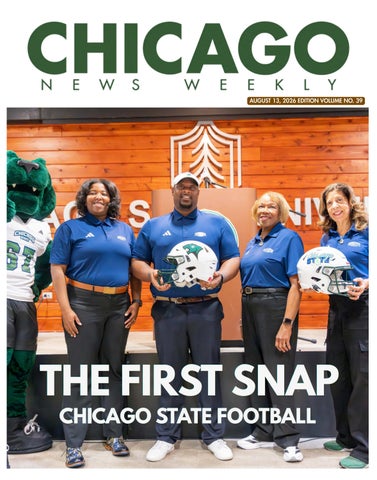
AUGUST 13, 2026 EDITION VOLUME NO. 39
THE FIRST SNAP CHICAGO STATE FOOTBALL
E-NOTES Publisher Cheryl Mainor Norman
Confronting Spring, Summer, Winter, or Fall Voyages Kai EL’ Zabar - Editor-In-Chief
Editor-In-Chief
Kai EL’ Zabar
Associate Publisher/ Laura Miller Managing Editor Staff Writers
Columnists
Zada Johnson, PhD. Candi McCrary Mila Marshall. Ph.D. C.L. Blackburn Ryan Willis Laura Miller Mare Evans Dr. Sanja Rickett-Stinson David Seaton
Cover Photography
Courtesy of Chicago State Athletics
Videography Podcast Production
Caveroom Entertainment
It’s summer, fall is upon us, followed by winter, then spring —and so it goes with the seasons. Most of us focus on summer travel because traditionally it has been viewed as vacation time. However, that tradition has expanded over the years as times have advanced and the workplace has evolved to meet ever-changing lifestyles. Imagine the numerous work-from-home jobs available to the workforce today. You can work anywhere and get paid— even travel and continue working. The new world offers a wide range of possibilities never before considered. Those of us who run small businesses have assistants living abroad who work for us from home and handle things efficiently. Such is this current life journey, full of possibility and wonder. What is it that we can’t accomplish? As I sit in traffic and observe the Waymo self-driving cars, I am in awe of how far we have come. Such life experiences are also journeys.
The journeys we take are often as exhausting as they are exhilarating. The challenge depends on our attitude. The Chicago Weekly News thrill we feel as we travel to a new environment may be 700 N Sacramento Blvd undercut by our sensitivity to change, strange Suite 320 surroundings, and forced shifts in our usual habits. Air, Chicago, IL 60612 (312) 877-5151 road, and sea travel can be extremely taxing, and many people find sleeping soundly in a strange bed exceedingly Volume No. 39 AUG 13, 2026 - AUG 26, difficult. Though the type of stress we experience from 2026 actual travel may be different from that caused by life’s constant changes, it remains stressful, invigorating, and Chicago News Weekly is Published on Thursday and even exciting. a product of CNW Network www.cnwmedia.com advertising@cnwmedia.com editorial@cnwmedia.com
CHECK OUT LAST WEEK’S ISSUE AT WWW.CNWMEDIA.COM/E-EDITIONS
Yes, change is change, as is the journey of growing older. Life is experienced from a different perspective brought on by age, or by life-altering changes—like the loss of a limb or a life partner—that impact our journey and how we experience the world differently than before. Knowing how to manage travel can assist us in situations like the ones previously mentioned should we face them; you apply the same practices to get you through. There are, however, numerous ways to take the stress out of both short voyages and lengthy sojourns that entail actual travel. We can examine those first, and then look at other forms of journeys to recognize the similarities and the differences in the ways we manage stress. Since much of the comfort we feel in our day-to-day lives stems from enjoying the regularity of routine, adapting our typical customs to correspond with our travel schedule can alleviate the unease we experience while away from home. Likewise, when you ground yourself by honoring the rituals that are a part of your daily life, you’ll no longer feel like you’re out of your element. That’s the key: maintaining your personal rituals, which provide a foundation for how we move through the day. So, what’s your routine or daily practice? Do you wake up and rise immediately, or do you pause, pray, or exercise, then shower, and so on?
2
AUG 13, 2026 - AUG 26, 2026
If you find yourself disconcerted by the foreignness of your surroundings when traveling, packing a few reassuring items from home in your luggage can help you stay balanced.
Photographs of loved ones, a favorite tea or snack, soft slippers, or even your own pillow can soothe the rigors associated with travel by plane, car, train, and ship while en route. Balancing these obligations is a skill that starts with situational awareness—knowing whether you are in the boardroom, at the dinner table, or on television. Today’s casual, lackadaisical attitude among news anchors, talk show hosts, and even the U.S. President has become far too loose. Using profanity on broadcasting networks—socially offensive, taboo, or irreverent language regarding bodily functions, sex, or religion—is unprofessional and entirely voids social etiquette. I am appalled, woefully disgusted, and disappointed in my media contemporaries who participate in this. Have we not considered the youth who are listening? Such behavior is totally unacceptable, particularly from the President of the United States. These are examples of items, actions, or practices that ground us at home base no matter where we are, providing a sense of comfort. Holding a crystal, gemstone, a cross, or a medicine bag in your hand during particularly stressful periods of travel can help you stay calm and alert. Other items imbued with healing or calming energy can help you de-stress once you reach your destination. Such is the power of water: a soothing or invigorating shower, a relaxing whirlpool massage, a swim, or the sound of waterfalls (real or recorded) can all bring the calm you seek. As you unpack your travel altar—creating light with a stick of sweet-smelling incense, or basking in the glow of a meditation candle—you’ll gradually begin to feel more grounded and serene in your new location. During the course of your journey, whether it’s an actual trip or an imposed physical challenge that slows your roll, try not to forget to indulge in those activities that center you and sustain your emotional equilibrium. If you tend to sleep and wake at the same time each day, maintaining that schedule will ensure you stay strong and healthy. The same regard should be given to the times you eat and maintaining some similarity in the types of foods you consume to provide the balance of nutrition you require. All of these considerations affect your body, mind, and emotional psyche. Taking time out while on your voyage agenda to write in a journal, meditate, do yoga, read an engaging book, or walk can help you reconnect with yourself in an unfamiliar setting. In conclusion, however you restore your tranquility, your conscious choice to surround yourself with comforting familiarity and focus on your well-being will make travel—and change—joyful.
3 AUG 13, 2026 - AUG 26, 2026 3
CITY NEWS
South Suburbs Hit Again as Multiple Tornados Confirmed After Tuesday Storms CNW STAFF REPORT
Communities still recovering from late-July storms are again clearing downed trees, damaged homes and power lines after another round of severe weather. CHICAGO — For parts of Chicago's In Flossmoor, village officials reported south suburbs, Tuesday's severe weather flooded roads, downed trees and blocked brought an unsettling repeat of a scene streets following the storm. Emergency crews residents experienced just two weeks ago. spent Tuesday clearing roadways and assessing The National Weather Service has damage, while Village Hall opened its board confirmed at least five tornadoes touched room Wednesday as a cooling and charging down across southern Cook and Will center for residents without power. Officials counties on Aug. 11, bringing destructive warned residents to stay away from downed winds, downed trees, damaged homes and power lines and limit unnecessary travel while widespread power outages to communities cleanup continued. including Flossmoor, Mokena, Monee and Crete. That number is up from an initial Homewood and Lansing also reported trees count of three, as damage assessments falling onto homes and vehicles, while continued into Wednesday. Survey teams Homewood-Flossmoor High School were still working to confirm additional announced its campus would be closed possible tornadoes near Homer Glen, Wednesday because of storm damage and Tinley Park, Crete and Manhattan, meaning power outages. Hundreds of thousands of the total could rise further. customers across the Chicago area and Northwest Indiana lost electricity during the One tornado traveled through eastern Will broader storm system. Across the state line, a County near Monee and Crete, where home in Portage, Indiana, caught fire and was surveyors found damage consistent with an destroyed after being struck by wind gusts EF-1 tornado. A second moved through estimated near 99 mph. southern Cook County near Oak Forest and Flossmoor, with damage consistent The damage comes only 15 days after another with at least EF-1 strength. A third was destructive storm swept through many of the confirmed in the Mokena area, also same communities. On July 27, the National producing EF-1 damage. EF-1 tornadoes Weather Service confirmed seven tornadoes carry estimated winds between 86 and 110 across its Chicago forecast area. An EF-1 mph. tornado moved through Country Club Hills, Hazel Crest, Markham, Harvey, East Hazel A separate, large rain-wrapped tornado Crest and Homewood. Another EF-1 traveled tracked through Flossmoor, Homewood, through Lynwood and Lansing before Thornton and Glenwood before crossing continuing into Munster, Indiana. Southern into northwest Indiana. Local Cook and eastern Will counties also meteorologists and radar data suggested experienced straight-line wind gusts between that tornado may have reached EF-2 80 and 105 mph during that outbreak. strength, based on wind speeds picked up Tuesday's tornadoes add to what has already by Doppler radar, though it was difficult to become a historic year for severe weather in see due to heavy rain. Final ratings from Illinois. Preliminary National Weather Service the National Weather Service are still figures show the state had recorded 198 pending. tornadoes as of Aug. 11 — surpassing the previous single-year record of 142, set in The tornadoes were embedded within a 2024. larger, fast-moving storm system that produced damaging straight-line winds The threat has not fully passed. A severe throughout the Chicago region. A 99 mph thunderstorm watch was issued Wednesday wind gust was recorded in Gary, Indiana, for Joliet, Kankakee and DeKalb, with while gusts reached 91 mph in Mokena, forecasters warning some areas could see wind according to storm reports. In Tinley Park, gusts up to 70 mph, though conditions were the Credit Union 1 Amphitheater sustained not expected to match Tuesday's intensity. damage to its pavilion roof and grounds, For residents still clearing branches and and multiple homes near 183rd Street and repairing damage from July, Tuesday's storms Oak Park Avenue lost portions of their restarted the cleanup almost before the last roofs. Downed trees were also reported one had ended. National Weather Service within Chicago's city limits, including in the crews were expected to continue surveying Irving Park neighborhood, where a large additional areas in the days ahead as tree fell on several vehicles. communities across the south suburbs assessed the latest damage.
4
AUG 13, 2026 - AUG 26, 2026
CITY NEWS Roll call: The race for the next Chicago mayor has started CNW STAFF REPORT Chicago’s next mayoral race is taking shape early, and the field is already packed with familiar political names, repeat candidates and political newcomers. The election is set for Feb. 23, 2027, with a runoff on April 6 if no one wins outright. Susana Mendoza, the Illinois comptroller, is among the most prominent Democrats in the race. A former Chicago city clerk and state legislator, Mendoza is leaning on her budget and government oversight experience as she tries to present herself as a steady alternative for voters looking for a reset at City Hall. Her campaign also carries historical weight: if elected, she would be Chicago’s first Latina mayor. Alexi Giannoulias, the Illinois secretary of state, entered the race in early August and quickly became one of the field’s best-funded and most visible candidates. Giannoulias has criticized Mayor Brandon Johnson’s leadership and is pitching himself as a coalition builder who can unite the city around public safety, government stability and basic services. U.S. Rep. Mike Quigley, who represents Chicago’s North Side in Congress, is also running. Quigley is expected to emphasize experience, fiscal discipline and reform-minded governance as he campaigns to move from Washington to City Hall. Willie Wilson, a businessman and philanthropist, is in the race for mayor for the fourth time.
Wilson has built his campaigns around outsider politics and a message aimed at working-class voters, and his return adds another recognizable name to an already crowded contest. Other declared candidates include George Cardenas, a Cook County Board of Review commissioner; Matt Brewer, former CEO and board chair of the Chicago Housing Authority; Joe Holberg, a businessman and former educator; Liam Stanton, a small business owner; John Kelly Jr., a lobbyist; and Dr. Lisa Nee, a former cardiologist and whistleblower. Cook County Treasurer Maria Pappas has also been mentioned as a possible candidate. The race is unfolding as Mayor Brandon Johnson faces ongoing scrutiny over public safety, city finances and basic services. Johnson has not yet said whether he will seek reelection, but many challengers are framing the contest as a chance to change direction at City Hall. Public opinion remains split: supporters say Johnson inherited deep structural problems, while critics argue the city needs stronger management and clearer priorities. The field is still fluid, and more names could be added before petitions are due. For now, Chicago voters are looking at a mayoral race defined by a mix of established officeholders, repeat candidates and newcomers, all trying to sell themselves as the person who can lead the city forward.
AUG 13, 2026 - AUG 26, 2026 5
NATIONAL NEWS James J. Carter Installed as 84th President of the National Bar Association DATA NEWS WEEKLY - NNPA PRESSWIRE
James J. Carter was installed as the 84th President of the National Bar Association on July 30, 2026, following an introduction by attorney James Williams and swearing-in by Judge Kern Reese. After a rousing introduction by Stellar New Orleans Attorney James Williams and swearing in by the Legendary Judge Kern Reese, the National Bar Association on July 30, 2026 installed nationally accomplished Trial Attorney and Civic Leader James J. Carter as its 84th President. In addition to NBA Past Presidents, leaders, members, friends and family from around the world, the great international leader, President and CEO of the National Urban League, Marc H. Morial, was in attendance, who gave James his first significant leadership opportunity more than 30 years ago. James’s presidency begins a term shaped by the responsibility of leading the organization as it continues its fight for Equal Justice Under the Law. He will be only the second person in the NBA’s 101-Year History, after the late Justice Revius Ortique, to serve as President while residing in Louisiana. President Carter’s bar year theme is “Meeting the Moment: A Continuing Legacy of Social Engineering and Empowerment.” “I accept this responsibility with a clear understanding of what the National Bar Association has represented for generations of Black Lawyers and for the communities we serve,” Carter said. “Our next century requires courage, discipline and practical action.
6 6 AUG 13, 2026 - AUG 26, 2026
We will strengthen civic activism, defend access to the ballot, advance financial independence, and address the conditions that affect the health and safety of our communities.” Founded in 1925 after Black Attorneys were excluded from membership in the American Bar Association, the National Bar Association has spent a century advancing Civil Rights, professional excellence and equal access to justice. Carter assumed the presidency at a consequential point in that history, with a mandate to honor the institution’s legacy while preparing it for the demands of the next 100 years. During his term, Carter will work with NBA members, affiliates, sections, divisions, law schools, corporate partners and community organizations to translate the Association’s national reach into measurable civic and economic impact. “The National Bar Association begins its next 100 years with a strong foundation and a clear obligation,” Carter said. “We will protect what prior generations built, respond to the realities facing our communities now, and create the systems the next generation will need.”
James J. Carter, Esq.
SPECIAL ANNOUNCEMENT
Calling Chicago's Next Generation of Visual Storytellers Chicago has never lacked talent. Every day, photographers across our city capture moments that deserve to be remembered. They document neighborhood festivals, family traditions, entrepreneurs building businesses, artists creating culture, young athletes chasing dreams and the everyday moments that make Chicago unlike anywhere else. Some have built impressive portfolios. Others have quietly honed their craft without the recognition their work deserves. At Chicago News Weekly, we believe great storytelling isn't limited to those who already have the biggest platform. Some of the city's most compelling visual storytellers simply haven't had the opportunity to publish their work in a newsroom. That's why we're launching CNW Through the Lens, a new initiative created to discover photographers whose work reflects the heart of Chicago. We're looking for photographers with a distinctive perspective, a passion for visual storytelling and a commitment to documenting the people and communities that make this city extraordinary. Whether you're self-taught, a student, an experienced creative or someone who has simply been waiting for the right opportunity, we want to see the city through your lens. The selected photographer will have the opportunity to photograph an upcoming Chicago News Weekly cover story, receive a published editorial feature highlighting their work and be considered for future assignments as a contributing photographer. This isn't simply about finding great photographs. It's about opening the door for talented creatives whose work deserves a wider audience and creating another pathway into Chicago's media community. Submission guidelines, deadlines and application details will be announced in our next issue. Until then, start curating your strongest work and share this opportunity with a photographer whose talent deserves to be seen. Because every published photographer had a first assignment. Make yours at CNW!
AUG 13, 2026 - AUG 26, 2026
7
NATIONAL NEWS Zuckerberg Pushes Wider AI Access as Industry Debates Safety Limits Meta CEO Mark Zuckerberg is calling for broader access to advanced AI as developers and lawmakers debate where safety limits should begin. CNW STAFF REPORT Meta founder and CEO Mark Zuckerberg entered the national debate over artificial intelligence regulation this week with a basic question: What happens if the most powerful AI systems are controlled by too few people? In an essay published Aug. 10 on Meta’s official newsroom, “The Future is for Everyone,” Zuckerberg outlined his case for what he calls personal superintelligence: advanced AI designed work on behalf of individual users. He argues those systems should be broadly available rather than concentrated among governments, corporations or a small group of experts. “The defining questions of our age are who will have access to superintelligence and what will we direct it towards,” Zuckerberg wrote. The essay arrives as AI companies, researchers and lawmakers debate how much oversight should exist as models become more capable. The dispute is increasingly about where regulation should begin and who should have authority to draw the line. According to the 2026 International AI Safety Report, general-purpose AI systems are becoming more capable in areas including programming and scientific research, while their abilities remain uneven. The report describes an “evidence dilemma” for policymakers: acting before risks are well understood can create ineffective restrictions, while waiting for definitive evidence may leave governments responding after serious harm occurs. Power in More Hands Zuckerberg’s argument starts with the distribution of power. He says concentrating advanced intelligence among a limited number of institutions can create its own safety problem and favors a model in which individuals, businesses and governments have access to comparable tools. Cybersecurity is one example. Zuckerberg argues that if only one actor had access to superior cybersecurity capabilities, that actor could exploit systems others could not adequately defend. If defenders had comparable tools, they could use those capabilities to find vulnerabilities and strengthen systems. Meta’s vision goes beyond an AI assistant that answers questions. Zuckerberg describes personal agents that could help people learn, work, start businesses and contribute to scientific research. He also addresses cybersecurity, biological and chemical threats, job disruption, surveillance and the possibility of humans losing control of advanced systems. His response generally favors stronger defenses, government cooperation and targeted safeguards rather than broad restrictions on individual access.
8 8 AUG 13, 2026 - AUG 26, 2026
On biological and chemical threats, Zuckerberg says developers should reduce dangerous capabilities in their models while governments focus on controlling the physical production and distribution of harmful materials. Where Should the Threshold Be? Other AI developers place the line earlier. Anthropic, the company behind Claude, says in its Advanced AI Framework that frontier developers should test powerful models, disclose safety findings, submit systems to independent evaluation and maintain security programs. For models presenting a significant risk of catastrophic harm, Anthropic says government should have authority to “block or deter” deployment. The company also says that authority should include safeguards against government overreach. The distinction is central. Zuckerberg warns that restricting powerful AI can concentrate power among the institutions allowed to possess it. Anthropic argues that some capabilities may become consequential enough that waiting for misuse is not sufficient. OpenAI has also supported a larger federal role. In a June blueprint on frontier AI governance, the company proposed a national framework, a strengthened federal institution focused on frontier AI safety and broader government preparation for national security and public safety risks. According to the International AI Safety Report, AI systems are already being used in fraud, cybercrime and manipulation. At the same time, many capabilities raising concern are dualuse. A model that identifies software vulnerabilities can help an attacker or help defenders repair weaknesses. AI can also make complex biological and chemical information easier to understand while supporting legitimate research. Illinois Draws Its Own Line Illinois has placed much of the regulatory responsibility on companies building frontier systems. Gov. JB Pritzker signed the Artificial Intelligence Safety Measures Act into law July 6. According to the Illinois General Assembly, it requires large frontier AI developers to maintain frameworks addressing catastrophic risks, cybersecurity and governance, along with transparency, independent audit and critical safety incident reporting requirements. The law takes effect Jan. 1, 2027. State Sen. Mary Edly-Allen, the measure’s chief Senate sponsor, said the legislation was intended to establish safeguards without stopping AI development. “Power has to be matched with wisdom, transparency and responsibility,” Edly-Allen said. “This law is not about stopping innovation.”
The law does not broadly determine what an individual may ask an AI system. Instead, it increases obligations on certain developers as their systems become more capable. Who Decides? The emerging debate leaves a basic question: Should regulation focus on the information an AI system provides, the actions it can perform, the company that develops it, the person who uses it or the illegal conduct that may follow? Technology companies understand the systems they build but also have financial interests in deploying them. Governments can enforce limits, but authority over access to advanced technology raises questions about surveillance, political power and control over information. The line may also depend on capability. An AI system helping a student understand calculus presents different concerns from one identifying vulnerabilities in critical infrastructure. A system assisting scientists with protein research presents different risks from one that lowers barriers to harmful biological work. The International AI Safety Report similarly distinguishes between beneficial and harmful uses of the same underlying capabilities. Zuckerberg’s position is that advanced intelligence should be broadly distributed while governments and defenders are strengthened to counter misuse. Anthropic argues that some systems may warrant intervention before deployment. OpenAI has called for federal oversight, while Illinois has begun placing new requirements on developers. The debate is no longer only about whether AI should be regulated. It is increasingly about where the line belongs and who gets to draw it.
HEALTHY LIVING What’s Really on Your Plate?
An Illinois-linked lettuce outbreak is raising a larger question about food safety: How much control do consumers really have over what reaches their plates? CNW STAFF REPORT A bag of lettuce does not look dangerous. Neither does a jalapeño. Yet recent federal food-safety alerts show how quickly ordinary groceries can become part of a public-health investigation. As of Aug. 13, federal officials were investigating 9,481 Cyclospora illnesses across 17 states, including Illinois, linked to iceberg lettuce sourced from central Mexico and recalled by Taylor Farms de Mexico. At least 398 people were hospitalized, and two deaths were reported in Michigan. Both people who died had significant underlying health conditions that may have been adversely affected by cyclosporiasis and dehydration, according to the FDA. The lettuce was recalled July 17, with food-service distribution confirmed in Illinois and more than two dozen other states. The FDA says the recalled product should no longer be available in stores or restaurants. And lettuce is not the only produce under scrutiny. A separate Salmonella outbreak has been linked to jalapeño peppers grown in Sinaloa, Mexico and distributed by Coast Citrus Distributors. As of Aug. 13, 345 illnesses had been reported across 27 states, including Illinois, with 36 hospitalizations and no deaths. Whole Foods recalled prepared foods containing affected jalapeños sold in Illinois, while Taylor Fresh Foods recalled additional products distributed in the state.
The two outbreaks expose one of the hardest realities of modern food safety: Consumers may not know there is a problem until contaminated food has already moved through growers, processors, distributors, restaurants and kitchens. Cyclospora is a microscopic parasite that can cause prolonged diarrhea, cramps, fatigue and dehydration. Washing produce remains important, but the FDA says washing alone cannot guarantee its removal. Heating produce to at least 158 degrees Fahrenheit can kill the parasite. That is useful advice for some vegetables. It is considerably less practical for a bowl of iceberg lettuce. Foodborne illness is already widespread. The CDC estimates 48 million Americans become sick from foodborne illness every year. About 128,000 are hospitalized and 3,000 die. Norovirus causes the most illnesses, while nontyphoidal Salmonella leads foodborne germs in deaths. Those numbers describe an established microbial danger. Pesticides require a different conversation. What the pesticide numbers actually show The U.S. Department of Agriculture found that more than 99% of samples tested in 2024 contained pesticide residues below Environmental Protection Agency tolerances. In 42.3% of samples, no pesticide residue was detected.
FDA testing also found most samples within federal standards: 97.2% of domestic samples and 86.5% of imported samples tested in fiscal year 2023 complied. The agency notes that its import program intentionally targets products considered more likely to have violations. Detection does not automatically mean a food is unsafe. EPA tolerances establish the maximum amount of a pesticide residue permitted on food. Washing under running water can reduce bacteria and traces of chemicals, although not every pesticide residue can be removed. Microplastics Microplastics may be the least settled part of the modern food-safety debate. The FDA says studies have detected microplastics in foods and in human blood and organs. But detection is not proof of harm. Current scientific evidence, the agency says, does not demonstrate that levels found in food pose a risk to human health. Scientists also lack standardized methods for consistently measuring the particles. In 2026, the FDA made reliable testing methods a Human Foods Program priority. So is food becoming more dangerous? The evidence does not support such a simple conclusion. Foodborne pathogens present an established threat. Most pesticide samples tested fall within federal safety limits. Microplastics are increasingly detectable, but scientists are still determining what their presence means for human health.
What can consumers actually do? Consumers can follow recalls, rinse fresh produce, keep raw foods separated from ready-to-eat foods, cook foods to safe temperatures and refrigerate perishables promptly. Produce should not be washed with soap, detergent or bleach. When a product has been recalled, washing it is not the solution. It should be discarded. But the burden cannot stop at the kitchen sink. A family in Chicago cannot wash away contamination introduced before food reaches the grocery store, and consumers cannot inspect lettuce for microscopic parasites or determine whether a pepper carries Salmonella. The safest grocery cart is not necessarily the most expensive one or the one covered in the most health claims. It is an informed one, backed by a food system expected to catch hazards before dinner is served. Because the question is no longer simply whether we are cooking our food correctly. It is how much of the risk was already there before we ever turned on the stove.
AUG 13, 2026 - AUG 26, 2026
09
COVER STORY
KICKOFF
After generations without a Division I football program inside Chicago city limits, Chicago State is bringing the game back. Dr. Monique Carroll and Coach Bobby Rome II spent years getting here. Now the South Side is ready to play. BY LAURA MILLER, MANAGING EDITOR
10 AUG 13, 2026 - AUG 26, 2026
COVER STORY
Dr. Monique Carroll
Chicago has never needed anyone to teach it how to love football. It is there beneath the Friday night lights, where high school rivalries have spent generations turning teenagers into neighborhood names. It lives in the arguments that spill out of barbershops and bars on Sundays, in Bears loyalties inherited like family recipes, and in a city perfectly willing to spend an entire winter debating who should be under center next fall. What Chicago has not had for generations is an NCAA Division I football program based at a university within the city itself. The historical trail leads back to 1939, when the University of Chicago played its final football season as a member of the Big Ten before President Robert Maynard Hutchins abolished the program. The Maroons had once been among the giants of college football, winning seven Big Ten championships and producing Jay Berwanger, the first recipient of the trophy that would become the Heisman. Eighty-seven years later, another Chicago university is stepping into that opening. At Chicago State University, near 95th Street and King Drive, a roster of young men is preparing to do something no Cougar before them has done. On Aug. 29, Chicago State will play the first football game in university history and become the only NCAA Division I FCS football program based in the City of Chicago. The Cougars will compete as an independent during their inaugural season before beginning Northeast Conference football play in 2027.
That it is happening on Chicago's South Side, at Illinois' only four-year federally designated Predominantly Black Institution, gives the moment significance beyond another addition to a college athletics schedule. Chicago State is betting that football can draw new students, bring alumni back, create a Saturday destination for families and give the wider city another reason to pay attention to the university.
She knew what football looked like from the stands, but more importantly for Chicago State, she knew what it looked like on a spreadsheet. Carroll also credits Chicago State President Zaldwaynaka “Z” Scott with giving her room to lead.
“She gave me the keys to the athletic department,” Carroll said. “Every now and then she's in the front seat with me, Before the tailgating and the soulful but typically she sits back and lets me do trumpetry of the Marching Soul of what I need to do and lead the program Chicago, let’s learn how CSU got here. the way I want to lead.” That work began with Dr. Monique That trust mattered because football was Carroll. not simply an athletic department Before the First Snap Carroll arrived at Chicago State in 2022 decision. It required presidential with more than 14 years in college support, board approval, fundraising athletics and experience on both sides and an understanding that adding one of the sideline. She competed in sport could affect an entire university. volleyball, track and field and bowling at Almost immediately after Carroll the University of Arkansas at Pine Bluff arrived, Chicago State began examining before continuing in track and field at whether its athletic offerings should Langston University, where she set grow. Football quickly entered the school records in the high jump, triple conversation. “It was almost the day I walked in the jump and heptathlon. door,” Carroll said. What followed were years of Her career then moved into the less projections, feasibility studies and visible side of college sports: conversations about staffing, facilities compliance, fundraising, sponsorships, and sustainability. Carroll described the ticketing, operations and budgets. internal analysis she worked from as 186 Carroll spent nine years at Prairie View pages, weighing the risks and A&M University, where her tenure opportunities of launching football. included the opening of a 15,000-seat “It never wavered,” she said. “Even with football stadium and a year in which the cons and the challenges we knew we Panther athletics generated more than would have to overcome, it was always $17.8 million in revenue. She later the pros column.” worked at South Carolina State and became athletic director at HustonTillotson University, where she increased fundraising and expanded corporate partnerships.
There was one line Carroll and university leadership did not want to cross. Starting football could not simply mean sending the bill to Chicago State students. “You don't want to tax the students,” Carroll said. “You don't want to make it a burden on the university. So we fundraised for the entire startup cost of the program.” Donor support ultimately covered approximately $4 million in startup costs, following roughly two years of fundraising. The price tag makes sense when considering what an established program already owns. Chicago State had no football equipment room, no stockpile of helmets and no existing infrastructure waiting to be reused. It also had never moved, housed, fed and supported a football roster. Before Chicago State could play football, it had to become a football school. And Carroll still needed a coach. Finding the First One There is a certain appeal to coaching a program with no predecessor, no old offensive philosophy and no fan base comparing you to the person who came before you. There is also no returning quarterback, no depth chart and no senior class to set the standard. At Chicago State, there wasn't even an old jersey.
AUG 13, 2026 - AUG 26, 2026
11
COVER STORY The coaching search attracted hundreds of applicants from professional, college and high school football. Bobby Rome II kept rising to the top. Carroll remembers how the search committee felt after his first interview. “We left that first interview feeling like we wanted to suit up that day and play football.” Rome's résumé fit the assignment. At Florida Memorial University, he took a program that had struggled to win in conference play to consecutive appearances in the Sun Conference championship game. Earlier coaching stops had already earned him a reputation as someone comfortable with programs still defining themselves. His understanding of football was also shaped by an unusual playing career. Rome arrived at the University of North Carolina as a quarterback before moving to fullback. The shift required him to see the game from a completely different angle, though he says his father had prepared him for that long before college. “The first thing my father taught me in football was to learn every position on the field,” Rome said. “Learn what they do and why they're important.” As a quarterback, Rome had to understand where everyone was supposed to be. When he moved into the backfield, he already understood the timing, motions and responsibilities developing around him. After college, he spent time in professional football before the sport eventually took him overseas and into coaching. That ability to see the whole field would become useful at Chicago State, where his assignment was not to repair a football culture but create one. Carroll and Rome eventually spent almost a full day together reviewing the university's football plan. By the end of the search, Chicago State had its inaugural head coach. Building Without a Blueprint Rome talks about coaching as a ministry and a calling, language that makes more sense when he talks about his father. A Norfolk State graduate, his father had worked as a graduate assistant in baseball and once hoped to coach at the college level. Family responsibilities ultimately took him in another professional direction, but he never stopped coaching his son. “My father is a big influence on me and my life,” Rome said. “Even now, as a 40year-old man, he's still raising me.” Now Rome is asking another group of young men to take on something unfamiliar.
12 AUG 13, 2026 - AUG 26, 2026
Dr. Monique Carroll Vice President and Director of Intercollegiate Athletics
Coach Bobby Rome II
Established programs can sell recruits He rejected the premise almost on history. Coaches point to immediately. championship banners, famous alumni, “I care about the wins rivalry games and generations of players and losses.” Then he who wore the uniform before them. Chicago State could offer something went further. “Chicago is different: the chance to decide what that not a city for losers.” history would eventually become. Rome needed players willing to accept the imperfections of being first, commit to Chicago State and establish standards future players could inherit. For him, those standards include far more than what happens at practice. He talks about where his players sit in class, how they train and how they represent the university. “Everything we do is going to be important,” Rome said. “We're going to do it with a championship mindset.” College football has changed dramatically since Rome played it. Athletes now navigate the transfer portal, NIL opportunities and far more freedom of movement. Rome acknowledges that reality, but says part of coaching is still teaching young men how to commit to something larger than themselves.
Rome believes the players he recruited can compete now, not simply after several recruiting classes have matured. “We didn't recruit one young man who can't come out there and compete at that level,” he said. “We know exactly what we signed up for.” He even joked that if the Bears showed up, the Cougars would line up and play them. Fortunately, the Bears are not on the schedule. Carroll approaches the question of Year One differently. She wants to win, but her assessment will also include something Rome does not have to measure on the scoreboard: what the university learns from doing this for the first time. “We definitely want to win, but I think when we sit down and say, ‘OK, the first season is over,’ we'll really ask, ‘What did we learn?’” Carroll said. “What did we learn about ourselves, about the university, about the team?”
“Anybody can go out there and organize these guys to play football,” Rome said. “But getting these young men prepared for the next phase of life, which I think they'll be in longer than they'll be here at Chicago State, is the most important For Carroll, those answers will help thing.” determine what comes next. “Football is year-round,” she said. “So He is equally clear about another we'll take some time, and then we'll go responsibility. Winning. right back at it for next year.” It was, as I told her in the moment, the Chicago Is Not a City for Losers athletic director answer. There is a familiar vocabulary available to coaches taking over first-year Football Changes More Than Saturdays programs. They can talk about progress, One of the most revealing lessons of development and patience while asking building a football program is how everyone to look beyond the record. quickly football stops being solely an So I gave Rome the opportunity. athletics project. Imagine the season is over, I told him. Forget the wins and losses for a moment. What would make Year One successful?
Zaldwaynaka ("Z") Scott President, Chicgao State University
Rome pointed to something fans probably never consider: the cafeteria. More than 100 football players require food, housing, admissions support, training, equipment and transportation. The change reaches across campus. “It's not just the football players and the football team that's new to football,” Rome said. “It's the entire institution.” Carroll sees the difference most clearly in scale. Before football, men's soccer was Chicago State's largest team, with roughly 30 to 35 players. A football travel party can approach or exceed 100 people, requiring multiple itineraries, more equipment and even charter flights. “You can't break it into pieces,” Carroll said. “You have to move a team.” The change is visible even in the student population. Carroll said Chicago State's campus is roughly 70 percent female, making the arrival of more than 100 football players a noticeable demographic shift. Football is not simply being added to Chicago State. It is changing the daily rhythm of the university. A South Side Saturday Carroll already knows what she wants Saturdays to feel like. Not an imitation of somebody else's college football experience. A Chicago State one. “If you've ever experienced Black college football,” she said, “that's what we are.” The Marching Soul of Chicago will be there. Carroll envisions families, food and football, with a game-day atmosphere reflecting the identity of a predominantly Black university on Chicago's South Side.
SPECIAL FEATURE Cheryl Mainor Norman Among Eight Named 2026 Leaders for a New Chicago CNW STAFF REPORT
Chicago News Weekly Co-Founder, President and Publisher Cheryl Mainor Norman is among eight community leaders selected for the 2026 Leaders for a New Chicago Award, an honor recognizing people helping shape the city through journalism, advocacy, organizing, education and the arts. The Field Foundation, in partnership with the MacArthur Foundation, announced the 2026 recipients Aug. 11. Each of the eight leaders will receive a $50,000 unrestricted award, while their affiliated nonprofits will receive $25,000 in general operating support. The award, now in its eighth year, recognizes community-based leaders bringing new voices, creativity and innovation into the institutions and decisions shaping Chicago. This year’s recipients represent work ranging from housing justice and immigrant rights to disability advocacy, local journalism, arts and neighborhood engagement. “The awards are a gift to these leaders, who have given so much to our communities,” Field Foundation President Daniel O. Ash said. “We want them to invest in themselves, to rest, to dream. Because Chicago needs their brilliance.” For Norman, the recognition marks another chapter in a 35-year publishing career centered on the Black Press and expanding the reach of stories serving Chicago’s Black communities. Norman leads Chicago News Weekly and CNW Media and previously made history as the first woman president and publisher of the Chicago Defender. During her tenure there, she helped return the historic publication to profitability, according to the Field Foundation’s announcement.
“This recognition is deeply meaningful because I have spent my career believing the Black Press should do more than document our communities. We have a responsibility to serve them, elevate their voices and make sure their stories are never treated as an afterthought,” Norman said. “To be recognized alongside seven leaders doing such important work across Chicago is an incredible honor. I am grateful to the Field and MacArthur foundations, and I see this award as an affirmation of the work we are building at Chicago News Weekly and the communities that continue to trust us with their stories.” Norman joins a class of leaders whose work reaches communities across Chicago. Candace Coleman, community strategy specialist at Access Living, is a nationally recognized disability rights advocate and organizer with more than 15 years of experience working at the intersection of disability justice, racial justice and systems change. At Access Living, Coleman develops advocacy campaigns and works to increase the influence of disabled leaders in public policy. Infiniti Gant, organizing director at Southside Together, has built her work around housing and tenant power. Gant has led two prominent tenant union campaigns supporting Chicago residents facing displacement. Danae Kovac, executive director of HANA Center, works on immigrant rights and civic participation. Kovac leads a team serving Korean, Asian American and multiethnic immigrant communities while organizing around broader systemic change.
Janell Nelson, creative strategist and director of the Englewood Arts Collective, is a Chicago artist whose work includes public art, curriculum design, event production and community engagement. Nelson is also founder of JNJ Creative and cofounder and director of the Englewood Arts Collective. Xanat Sobrevilla, co-founder and strategic programs coordinator at Organized Communities Against Deportations, organizes around immigrant justice and leads campaigns supporting families navigating detention and deportation. Sobrevilla immigrated from Mexico after being displaced from her home country at age 9. Ivan Vega, co-founder and executive director of UrbanTheater Company, has spent more than two decades building opportunities for Latiné and BIPOC artists. His leadership helped grow UrbanTheater Company from a grassroots collective into an established Chicago cultural institution. Adriana Velázquez, co-director of the Parent Engagement Institute at the Southwest Organizing Project, has spent more than a decade working in education equity, parent leadership and immigrant justice. Through the Parent Engagement Institute, a partnership between the Southwest Organizing Project and Palenque LSNA, Velázquez leads the Parent Mentor Program and works to expand parent leadership infrastructure across Illinois.
The eight recipients were selected following a review of more than 150 nominations by a selection committee made up of community peers. “These eight leaders have earned the recognition of their peers through their unwavering commitment, clear vision, and steady leadership in building a more equitable Chicago,” said Jonathan VanderBrug, MacArthur Foundation program officer for Chicago Commitment. He said the unrestricted award is intended not only to recognize their contributions but also to give recipients room to “rest, reimagine, and invest in themselves and their continued leadership.” Since the Leaders for a New Chicago Award began in 2019, the Field and MacArthur foundations have committed $4.45 million to 81 recipients and their organizations. This year’s class reflects a wide view of what civic leadership can look like in Chicago: protecting tenants from displacement, helping immigrant families navigate complicated systems, ensuring disabled residents have a voice in policy, developing parent leaders, building cultural institutions and making sure communities have journalism that tells their stories. For Chicago News Weekly, Norman’s selection places the work of the Black Press within that larger civic landscape and recognizes journalism not simply as coverage of a community, but as one of the institutions helping that community see, understand and speak for itself.
AUG 13, 2026 - AUG 26, 2026 13
COMMENTARY One by One: The Slow Disappearance of Black Voices in Mainstream Media
Stephen A. Smith has no problem finding words. But when Ryan Clark left ESPN, all he could say was: “It hurts. It really does.” Clark’s exit follows Joy Reid, Don Lemon and others—each departure different, but the pattern impossible to ignore STEPHAN ODUNTAN - BLACK PRESS USA - NNPA NEWSWIRE Stephen A. Smith rarely struggles for words. One of the most recognizable voices in sports media, he has built a career on passionate opinions and unfiltered commentary. But when ESPN parted ways with Ryan Clark, Smith’s reaction was strikingly simple. “It hurts. It really does,” Smith said. Smith called Clark “arguably the best NFL analyst in America,“ and said he opposed ESPN’s decision. At the same time, he acknowledged that layoffs have become an unavoidable reality across the television industry. “The bosses know I’m not happy about this decision,” Smith said. “But it’s also important that myself and anybody else in the world of business be grown-ups and understand that these are the kind of things that happen when layoffs happen.” Clark’s departure followed the exits of several nationally recognized Black media personalities, including Joy Reid at MSNBC and Don Lemon at CNN. It also came after Clark publicly reflected on his years at ESPN, saying there were times he felt he “couldn’t be too “Black.” While” each departure occurred under different circumstances, together they have renewed questions about the future of Black representation in mainstream media and whether the industry’s changing landscape is reducing the number of Black voices on the nation’s most influential platforms. Networks have cited restructuring and layoffs or, in some cases, have declined to publicly explain personnel decisions. Some journalists have pointed to workplace culture, while others argue the changes reflect broader economic forces reshaping the media business. “Because of the economic contraction, you have corporate consolidation and costcutting,” Reynolds said.
14
AUG 13, 2026 - AUG 26, 2026
“If your viewers aren’t there, your advertisers aren’t there. If your advertisers aren’t there, then you can’t pay your talent to be on those platforms anymore.” Those financial realities help explain why media companies are making difficult personnel decisions, Reynolds said. But they do not fully explain why those departures matter. “It doesn’t matter whether they fired [Clark] or whether they laid him off,” Reynolds said. “The effects of it are the same.” As prominent Black personalities disappear from major platforms, Reynolds said the consequences extend far beyond the careers of individual journalists. “When there are fewer prominent Black personalities with authority, as well as the resources, to be on these large platforms that have natural distribution to shape the mainstream conversation, then you have less of a voice in those spaces,” he said. Award-winning entertainment journalist Keith L. Underwood agreed that economics is reshaping the media industry. But he said an equally important transformation is taking place among audiences themselves. Rather than relying on a handful of nationally recognized journalists and civil rights leaders, Black Americans now consume information across countless digital platforms, creating a media landscape that is more fragmented —and, in many ways, more difficult for any single voice to influence. “I think the landscape is changing,” Underwood said. “People have so many different ways of getting their news, whether it be television, radio, social media, or word of mouth.”
“It’s not like it used to be when you had civil rights leaders who were the generalized voice of the people,” he said. “That’s gone.” Underwood said that fragmentation has increasingly given way to celebrity-driven news and viral culture. “It’s become more focused on the gossip,” Underwood said. “Celebrity scandal has become our news because those same voices are not there.” At the same time, Underwood said major media organizations continue to influence which stories and perspectives reach the broadest audiences. “If you’re dealing with mainstream outlets, then you also have to take into consideration what they’re allowing you to say,” he said, pointing to former MSNBC host Tiffany Cross as an example of someone who believed she would have greater editorial latitude than she ultimately experienced. When asked specifically about Clark’s remarks that he often felt he “couldn’t be too Black” while working at ESPN, Underwood declined to speculate about Clark’s personal experience. “I can’t speak to his specific situation because that’s his truth,” Underwood said. Still, Underwood said professionalism and authenticity are not mutually exclusive. He pointed to former NFL star and television host Michael Strahan as someone who has successfully navigated mainstream media without losing his identity.
“I don’t think Michael Strahan has become less Black,” Underwood said. “He’s still Michael Strahan. He’s just learned how to communicate in different spaces.” Underwood said the larger challenge is preserving authenticity while working within institutions that often shape how stories are told and who gets to tell them. The picture, however, is more nuanced than a simple decline in Black representation. Fox News continues to feature prominent Black anchors, including Harris Faulkner and Lawrence Jones, both of whom have built long careers on one of cable television’s highest-rated news networks. Their continued prominence suggests the conversation is not simply about whether Black journalists remain on television, but how newsroom decisions, audience demand and editorial culture shape which voices endure and influence the national conversation. For Underwood, however, the future of Black journalism may depend less on the decisions made inside corporate boardrooms than on the willingness of Black journalists and entrepreneurs to build platforms of their own. “I think that too often Black folks are reactionary as opposed to being proactive,” Underwood said, arguing that the community should invest more aggressively in creating and supporting independent Black-owned media rather than waiting for opportunities from legacy institutions. He pointed to YouTube, podcasts, streaming services and emerging artificial intelligence tools as technologies making it easier than ever for journalists to reach audiences without relying on traditional gatekeepers. “If you create your own platform and you’re speaking truth to the news, you can be your authentic self,” Underwood said. Looking ahead, Underwood believes the next generation of influential Black journalists will be defined not only by where they work, but by the platforms they own. “Black folks need to start embracing these tools that are available to us in order to have a voice, in order to share our creativity and in order to benefit and enrich our communities,” he said. As legacy media continues to evolve, the debate sparked by Ryan Clark’s departure suggests the future of Black journalism may depend not only on who is hired by major networks but also on who builds the next generation of platforms.
COVER STORY “We're going to bring the Black college football experience to our fans,” Carroll said. “The atmosphere we're going to create is going to be one for family, family fun and football.” Chicago State will have to earn that audience. This is a city with nearly endless competition for a Saturday afternoon, from professional sports and concerts to festivals and neighborhood events. The inaugural home game against Roosevelt University will be played Aug. 29 at SeatGeek Stadium in Bridgeview. Carroll wants those five home dates to become destinations and believes one good Saturday can create a returning fan. Can Chicago State build not just a team, but a football culture? The First of Everything There is something unusual about entering a season with no previous season against which to measure it. No Cougar holds a passing record. There is no longest field goal or famous fourthquarter comeback. There is no senior class telling freshmen what wearing a Chicago State football jersey is supposed to mean. Those things are waiting to be created. Carroll wants the university to appreciate that moment rather than hurry through it.
1 6
“This is our time,” Carroll said. “We're not going to pass the moment by. We're not going to let anybody else pass it by. We're going to sit in it.” Rome is more direct about what happens when that moment reaches the field. “I'm here to develop young men, but I'm also here to win football games.” That combination of possibility and expectation may best explain what Chicago State is attempting. In 1939, one Chicago university decided major-college football no longer belonged in its future. Eighty-seven years later, another is making a very different decision about what the game can mean to an institution and the city around it.
Soon, the studies, fundraising meetings, and recruiting pitches will fade into the background. The band will play. Families will arrive in Chicago State gear. And players who have spent months preparing for something their university has never experienced will finally take the field. Carroll believes they'll give Chicago a reason to return. “If you come on the 29th, we'll have a good experience,” she said. “And you'll come back to see us.” Rome's promise is simpler. “August 29, our young men will be ready,” he said. “They'll be ready when we put toe to football.” After nearly four years of planning, millions raised, hundreds of coaching applicants and generations without a Division I football program based inside Chicago city limits, there is only one thing left to do.
This time, the story begins on the South Side. It begins with President Zaldwaynaka Scott supporting the vision, Carroll spending years determining whether it could work, Rome accepting the challenge of creating a team without inherited traditions and a group of young men willing to become the answer whenever somebody asks who played football at Chicago State first.
AUG 13, 2026 - AUG 26, 2026
15
Wedding Preparation Mini-Series
SPECIAL FEATURE
Documenting the Making of Your Wedding CANDI MCCRARY - CONTRIBUTING WRITER You’re planning a wedding, and you’re realizing that it’s a journey just like your marriage will be. You aren’t just planning a single day; you’re curating a mini-series, from the proposal and engagement party to the shower, reception, and even the honeymoon to the thank-you notes that follow! It may take place on a single day, but to make it happen, it takes time, planning, and serious research and preparation. If your family is committed religious practitioners, your preparation may require numerous special steps that are specific to the religious practice or cultural observances like jumping the broom or breaking the glass. Each moment opens the door to new opportunities to infuse the mini-series with personal details from brides and grooms to the friends and family supporting these special occasions. The emerging interest in weddings as more than a one-day event has opened the door to expanding shopping trends and tips for tapping into these moments, causing an inventory expansion, merchandising, and more. The Starting Point: Proposals and Engagements You’ve felt your heart race what seems like a trillion times now, and it never gets old. You’ve asked yourself whether this will ever get old. Will my face always smile when I see my fiancé; will I always be this joyful? Though falling in love marks the proposal, proposals and engagements mark the starting point of the wedding journey— and are often the first wave of wedding-related shopping. As couples share the news with friends and family, comes a strong demand for items that feel personal, celebratory, and worthy as a gift. For example, searches for engagement party signs have increased 34% year after year. This mini-series is less a transformation in the wedding planning perspective and end result. It’s about logistics and more about storytelling: how the moment is captured, announced, and remembered. Beyond parties, wedding planners/shoppers are also looking for meaningful ways to commemorate the experience, from custom artwork to keepsakes and thoughtful gifts. There’s a clear opportunity in products that help couples announce their engagement, celebrate with loved ones, and begin building anticipation for the wedding itself. Maybe it all began with mobile phones and the opportunity to document. Whatever the inspiration, it’s a thing now to offer personalized items like custom portraits— note illustrated save-the-dates, or engraved gifts that are attractive keepsakes. As a gift, are special. Today, many couples begin their marriage journey with a pet dog or cat (maybe both), so offer to gift them a portrait, photo, or painting of their merging family. You will be shocked at the reception for such an offer. So, yeah, it’s a thing. And don’t knock the illustrated save-the-date and/or engraved gifts mentioned... People love all this sort of thing, 16 AUG 13, 2026 - AUG 26, 2026
Creating tiered options at different price points to capture casual gift buyers and higher-intent buyers should be considered. Digital downloads can also be a great option for shoppers looking to spread the word about their engagement.
Bridal Showers and Bachelor Parties Not surprising is the reality that prewedding celebrations remain a major driver of group planning—and group purchasing power! In fact, the notion has grown. And because you may have different groupings of friends, you may have several of these sorts of parties! The question is why not? Bridal showers and bachelor/bachelorette parties are being treated as highly curated, shareable experiences, with an emphasis on cohesive themes, personalization, and photo-ready details, thus creating a strong demand for coordinated items across decor, gifts, attire, and accessories. Imagine you have a group of rollers (the people with whom you “roller-skate, ice-skate or ski”or the ‘Steppers’ you step with...A separate gathering based on its unique theme is attractive to your different group of friends. The interesting thing is wedding shoppers aren’t just buying one-off items;they’re also looking for cohesive sets that make planning easier and elevate the overall aesthetic. Emerging is the clear opportunity in personalization (names, locations, dates) and niche themes (like coastal, disco, or western and whatever you desire). Wedding Reception and After Parties Blooming botanicals, gothic romance, and more have made a major statement in 2026 and continue to trend. This being noted, the wedding industry has created countless ways to help shoppers extend their theme beyond the ceremony. Who knows, it may even help to keep the loving energy flowing.
It could... Growing interest in personalized favors, decor, and bridal party gifts is a category we see climbing year over year, with no end in sight. It is perceived that storytelling matters more than ever. Highlighting customization options and showcasing real-life use—through stylized shoots or customer photos—can help couples imagine their own ministory. For many, this is their day in the sun, their time in the lights when they are the center of the universe. The memory captured in photos, video, social media platforms, etc, is a constant reminder of the happiest and maybe the most important day in the couple’s life. Planning for your Wedding Journey mini-series, told in episodes, can help you produce the greatest mini-series ever
SPORTS COMMENTARY Why LeBron James and Jaylen Brown will make the Philadelphia 76ers Bigger than Basketball A.R. SHAW - NNPA NEWSWIRE
LeBron James’ decision to join the Philadelphia 76ers instantly made his new team title contenders on the court. But with Jaylen Brown as his teammate, it will be a win for Black initiatives off the court. After several weeks of contemplating his new destination, James bypassed the Golden State Warriors, Miami Heat, and Cleveland Cavs to finish his illustrious career in Philly, a city with a significant Black community and culture. James, 41, will join a 76ers team that features former MVP Joel Embiid, Tyrese Maxey, VJ Edgecombe, and Brown, who made his way to Philly one month ago via a trade from the Boston Celtics. If Embiid can minimize his days missed due to injuries, the 76ers will be in prime position to challenge for an NBA championship. Beyond the basketball court, James and Brown have both embraced leadership roles. In an era when many athletes are encouraged to “shut up and dribble” rather than speak out against injustice or invest in their communities, James and Brown have taken the opposite path, dedicating themselves to empowering the communities they represent. To this generation, James and Brown are what Muhammad Ali and Kareem Abdul-Jabbar were to theirs. Since 2004, James and the LeBron James Family Foundation have created tangible initiatives that continue to serve the community. The iPromise school, located in his hometown of Akron, Ohio, provides education and mentorship for over 1,200 students. James also opened a Starbucks Community Store blocks away from the I Promise school, where workers earned a salary and job-training certificates for the hospitality industry. And in 2017, the NAACP awarded James with the Jackie Robinson Sports Award for his “contributions in the pursuit of social justice, civil rights and community involvement.” Through his 7uice Foundation, Brown launched The Bridge Program, an initiative that equips young people with skills in science, technology, and innovation. Hosted at MIT’s Media Lab, the week-long program immerses students in handson learning focused on robotics, artificial intelligence, climate change, food insecurity, and data visualization. “There’s fascinating research in early childhood development showing that exposing children to new sounds and experiences helps strengthen brain development,” Brown shared during a recent keynote speech at The Gathering Spot in Atlanta. “Those new experiences stimulate neuroplasticity, strengthen neural pathways, and support cognitive development during the years when the brain is growing most rapidly…For me, that’s community. It’s investing in the next generation.”
During his keynote address, Brown also discussed the importance of integrity and revealed why so many prominent figures are incapable of speaking out against injustices. “I’ve turned down opportunities worth millions of dollars—not because I don’t like money or don’t need it, but because I understood what came attached to those deals,” Brown shared. “A lot of people only look at the number; I look at the fine print. Many contracts with major corporations don’t just pay you. They also dictate what you can say, how you use your platform, and what opinions you’re allowed to express. Sometimes there’s language that says if you say something considered controversial—or something that could affect the company’s image—they can terminate the agreement. That’s why so many public figures stay silent. It’s not always because they don’t care. Sometimes it’s because speaking honestly could cost them their career, their endorsements, or their income.”
Photo by: U.S. Embassy, Jakarta from Jakarta, Indonesia - Pemain Bola Basket NBA dari Amerika Melatih Pelajar SMA di Jakarta, Public Domain
Brown and James have remained vocal on social issues, disregarding any pushback that may follow. In an effort to mobilize Black voters and fight voter suppression, James helped to establish “More Than Vote” and was a staunch supporter of President Barack Obama. He also took a stand following the deaths of Eric Garner and Trayvon Martin, leading teammates to wear “I can’t breathe” shirts in honor of Garner and hoodies for Martin. During the 2020 protests following the murder of George Floyd, Brown drove 15 hours from Boston to his hometown Atlanta to participate in a march. “I drove 15 hours to get to Georgia, my community,” Brown shared during a live stream at the march. “This is a peaceful protest. Being a celebrity, being an NBA player don’t exclude me from no conversations at all. First and foremost I’m a black man and I’m a member of this community… We’re raising awareness for some of the injustices that we’ve been seeing. It’s not OK.” Brown has also spoken out against environmental justice. While speaking at MIT, Brown said, “We’re here to talk about something that affects us all, climate change. Today marks a very pivotal moment in time. The decisions that we make now will have an impact on future generations. Climate change isn’t just an environmental issue. It’s a social justice issue. It’s an economic issue, and it’s also a moral imperative. As someone who prides himself on influence and responsibility, what an honor it is to talk about this topic.” James and Brown will put in hours of work on the court in an effort to lead the 76ers to an NBA championship. But once they get an opportunity to sit down together, share resources, and implement plans to improve Black communities, their impact will be immense. “No matter where my career goes, my integrity has to walk through the door before I do,” Brown shared during his recent keynote in Atlanta. “So when opportunities come along, I ask one question: ‘Will this allow me to remain authentic?’ If the answer is no, then I respectfully walk away. Because I’d rather keep my voice than sell it.”
Photo By: Erik Drost
AUG 13, 2026 - AUG 26, 2026 17
FOOD & WINE Garlic Lemon Shrimp Skewers Summer Food Fun MARE EVANS - STAFF WRITER
Summertime and the living is Ingredients easy... so let’s get busy and start For the Skewers: 1.5 lbs large shrimp (peeled and living it up with juicy, tender deveined, tails on or off) 1 large lemon, sliced into thin rounds shrimp marinated in a zesty 1 tbsp olive oil (for brushing grates or pan) garlic, lemon, and herb blend, Wooden or metal skewers (Note: Soak grilled or broiled to perfection. wooden skewers in water for 30 minutes before grilling to prevent These Garlic Lemon Shrimp burning) Skewers are light, packed with For the Garlic Lemon Sauce & Marinade: flavor, and very easy to pull 1/3 cup extra-virgin olive oil together in under 20 minutes! 4 cloves garlic, minced Zest and juice of 1 large lemon That’s not bad for a tasty, filling 2 tbsp fresh parsley, finely chopped 1 tsp dried oregano meal to complete a beautiful 1/2 tsp red pepper flakes (optional, for a slight kick) summer day. 1/2 tsp kosher salt 1/4 tsp freshly cracked black pepper
Instructions Prepare the Marinade
In a medium bowl, whisk together the extra-virgin olive oil, minced garlic, lemon zest, lemon juice, chopped parsley, dried oregano, red pepper flakes, salt, and black pepper. Marinate the Shrimp Reserve about 2 tablespoons of the sauce in a small bowl to use for basting later. Add the peeled shrimp to the remaining marinade, tossing to coat evenly. Let them sit at room temperature for 10 to 15 minutes (do not marinate much longer, as the lemon juice can start to "cook" the shrimp texture). Assemble the Skewers Thread the shrimp onto the skewers, alternating them with folded lemon rounds if desired. Piercing each shrimp through both the tail and the thick end helps keep them flat and secure on the skewer. Cook the Skewers Choose your preferred method: To Grill: Preheat your grill to medium-high heat (about 400°F). Lightly oil the grates. Place the skewers on the grill and cook for 2 to 3 minutes per side, or until the shrimp are opaque and pink. To Broil: Position your oven rack about 6 inches from the broiler element and preheat to high. Place skewers on a foil-lined baking sheet and broil for 4 to 5 minutes, flipping halfway through. Finish and Serve Transfer the cooked skewers to a serving platter. Brush the reserved fresh garliclemon sauce over the hot shrimp immediately for an extra burst of flavor. Garnish with a little extra fresh parsley and lemon wedges. 18 AUG 13, 2026 - AUG 26, 2026
Chef Tips Don't overcook: Shrimp cooks extremely fast. As soon as they curl into a "C" shape and turn pink and opaque, they are done! Serving suggestions: Pair these skewers with a refreshing Greek salad, garlic butter rice, or roasted asparagus.
Fashion Star Edward Enninful’s Next Chapter
FASHION
C.L. BLACKBURN CONTRIBUTING WRITER
Under her leadership, the magazine has run stories on the British rapper Skepta; Royal Ballet star Francesca Hayward; and Tom Ford's new creative director, Haider Ackermann; and so the list goes. Many of us … Black folk in the U.S, were drawn to the fact that his skin was black and made us proud, causing us to scratch our heads at the same time, asking ‘where is that Black American who is all that?’ His six-year tenure at British Vogue was, in many ways, a decisive break from fashion’s exclusionary past. He did the unexpected and broke down what had previously been an issue, like having Judi Dench as the oldest cover star, at 85, and the transgender actress Laverne Cox and the plus-size model Paloma Elsesser as covers. Each cover–a controversy that began a transformative effect on society and business—a cultural shift. Which raises a question: Why move into print media when the medium is on life support?
If you're in the know and want to know where media and fashion are headed, fashionsavvy folk just look at what Edward Enninful is presenting. He was made fashion director of i-D at just 18—a title he held for 20 years —followed by stints at Italian Vogue, American Vogue, and, later, W, all the while styling global fashion campaigns on the side. Was it just a hustle? Edward Enninful, the former editor of British Vogue and the first Black editor-inchief in Condé Nast’s history, now sports his EE72, the media company he cofounded with his sister Akua, named for his initials and birth year. The magazine, launched almost a year ago, in September, is a culmination of everything Enninful has stood for. From the outset, Enninful was most adamant that 72’s focus would be “a celebration of culture and creativity today … where street meets couture and heritage meets the avant-garde,” point out that fashion is the connector that brings it all Clearly, together.he has a market and a very specific audience he is targeting…Sarah Harris—his former fashion-features director at British Vogue—is on board as editorial director, overseeing day-to-day operations.
As a writer for a print publication, it’s a natural question. “I initially didn’t want to do a magazine,” Enninful says. “But I like to think of 72—which is ad-free—as the shop window to a wider business.” Clearly, Enninful has his plan in the works, which includes film, TV, and documentary content, as well as brand campaigns and creative partnerships. In 2025, he designed a 60-look collection for Moncler and is currently working with Levi’s, the Rosewood Hotel Group, and Google Shopping. A separate, film-related project, he says, is imminent. Well, those of us familiar with his special brand of magic are awaiting with bated breath. He shares in conversation three words that he holds in high esteem: “commerce,” “creativity,” “merchandise.” He explains, “I want to bring all three together into a digital platform for a new generation. That says it all." VOGUE 2023 When Enninful stepped down from British Vogue, rumors ran amok trying to hit the wall with something that would stick. Had he been fired? Amongst the sweeping staff cull at Condé Nast, spearheaded by its C.E.O., Roger Lynch, to stop the bleeding from the steady decline of both print sales and ad revenues.
The editors-in-chief of Vogue international titles were replaced by “Heads of Editorial Content,” who now all report to Anna Wintour. That explained their much lower salaries distinct from their predecessors who bore different titles and possessed power that they do not. Enninful kept quiet. He didn’t talk about it, which is the telltale that distinguishes him from the rest. His proactive exit was a planned move that he had put in motion, and that time had come. The inner calling to do his own thing was greater than the Vogue experience, so the six-year run had come to an end. He did not act in a vacuum rather, he called on close friends, one of whom was Oprah Winfrey. He recalls that Oprah said, ‘If this is what you want, make it clear.’” A meeting with Wintour and Lynch followed shortly after, and they were not ready for his departure. They extended offers, but when you’re ready, you’re ready. He was warned that he was making a mistake…and to that he responds, “I think people have underestimated me my whole career,” he says. “And I would think, ‘Okay, I’ll prove you wrong.” Today Enninful is in the proving stage, and we’re excited about what’s next.
AUG 13, 2026 - AUG 26, 2026
19
20 AUG 13, 2026 - AUG 26, 2026