THE MOST WIDELY CIRCUL ATED CARIBBEAN AMERICAN NEWSPAPER IN FLORIDA
CNWEEKLYNE WS.COM
THURSDAY SEPTEMBER 17, 2026
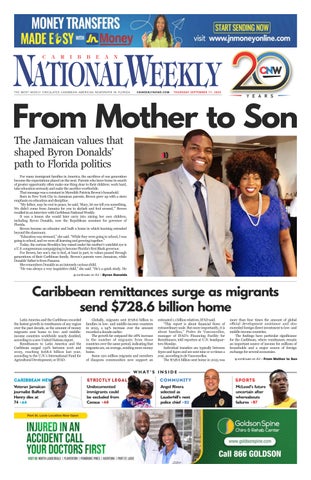
From Mother to Son The Jamaican values that shaped Byron Donalds’ path to Florida politics For many immigrant families in America, the sacrifices of one generation become the expectations placed on the next. Parents who leave home in search of greater opportunity often make one thing clear to their children: work hard, take education seriously and make the sacrifice worthwhile. That message was a constant in Meredith Patricia Brown’s household. Born in New York City to Jamaican parents, Brown grew up with a stern emphasis on education and discipline. “My father, may he rest in peace, he said, ‘Mary, let me tell you something. We didn’t come from Jamaica for you to skylark and fool around,’” Brown recalled in an interview with Caribbean National Weekly. It was a lesson she would later carry into raising her own children, including Byron Donalds, now the Republican nominee for governor of Florida. Brown became an educator and built a home in which learning extended beyond the classroom. “Education was stressed,” she said. “While they were going to school, I was going to school, and we were all learning and growing together.” Today, the curious Brooklyn boy raised under his mother’s watchful eye is a U.S. congressman campaigning to become Florida’s first Black governor. For Brown, her son’s rise is tied, at least in part, to values passed through generations of their Caribbean family. Brown’s parents were Jamaican, while Donalds’ father is from Panama. She remembers Donalds as an intensely curious child. “He was always a very inquisitive child,” she said. “He’s a quick study. He continues on A3 – Byron Donalds
Caribbean remittances surge as migrants send $728.6 billion home Latin America and the Caribbean recorded the fastest growth in remittances of any region over the past decade, as the amount of money migrants sent home to low- and middleincome countries worldwide nearly doubled, according to a new United Nations report. Remittances to Latin America and the Caribbean surged 132% between 2016 and 2025, reaching $168.6 billion last year, according to the U.N.’s International Fund for Agricultural Development, or IFAD.
Globally, migrants sent $728.6 billion to families in low- and middle-income countries in 2025, a 94% increase over the amount recorded a decade earlier. The growth far outpaced the 28% increase in the number of migrants from those countries over the same period, indicating that migrants are, on average, sending more money home. Some 220 million migrants and members of diaspora communities now support an
estimated 1.1 billion relatives, IFAD said. “This report is about financial flows of extraordinary scale. But more importantly, it is about families,” Pedro de Vasconcellos, manager of IFAD’s Financing Facility for Remittances, told reporters at U.N. headquarters Monday. Individual transfers are typically between $300 and $400 and are sent nine or 10 times a year, according to de Vasconcellos. The $728.6 billion sent home in 2025 was
more than four times the amount of global official development assistance and also exceeded foreign direct investment to low- and middle-income countries. The findings have particular significance for the Caribbean, where remittances remain an important source of income for millions of households and a major source of foreign exchange for several economies. continues on A3 – From Mother to Son
W H AT ’ S I N S I D E
CARIBBEAN NEWS Veteran Jamaican journalist Balford Henry dies at 74 a4
STRICTLY LEGAL Undocumented immigrants could be excluded from Census A8
COMMUNITY Angel Rivera selected as Lauderhill’s next police chief B2
SPORTS McLeod’s future uncertain after whereabouts failures B7
A2 – NATIONAL WEEKLY | THURSDAY, SEPTEMBER 17 – SEPTEMBER 23, 2026 | CNWNETWORK.COM
PAGE A2 These patrons having a ‘lime’ at Caribbean City’s ‘Fet Factory’ whcih was held at the Roo op at Hard Rock last Saturday
Lauderhill Mayor Denis Grant joins Commissioner S. Ray Mar n for the 6th Annual Ella's Day — A Day of Pampering for Cancer Survivors.
Miami-Dade County Commissioner Kionne McGhee poses with dancers at Miami-Dade County’s 2026 Na onal Hispanic Heritage Month Kickoff.
These two beau es having a blast at Caribbean City’s ‘Fete Factory’ last Saturday
2 e g a P More entertainers pictured at Miami-Dade County’s 2026 Na onal Hispanic Heritage Month Kickoff earlier this week.
Miramar Commissioner Yve e Colbourne is pictured with seniors at this year’s Senior Resource Fair.
Oblique Seville pictured with the legendary Usain Bolt at the World Athle cs Ul mate Championship in Budapest.
Miami Gardens walks for sickle cell. Vice Mayor Robert Stephens, Councilwoman Katrina Baskin and Councilman Paul Wilson came out to support and help shine a light on the importance of educa on, advocacy, access to care and con nued research.
CNWNETWORK.COM | NATIONAL WEEKLY | THURSDAY, SEPTEMBER 17 – SEPTEMBER 23, 2026 –
A3
NEWSMAKER
From Mother to Son cont’d read very early.” Once, Donalds dismantled the clock on his mother’s bedside table with a pair of tweezers — then managed to put it back together. “And it worked,” Brown recalled. “This kid has a good brain,” she remembered thinking. Learning beyond the classroom Brown was deliberate about finding places for that curiosity to grow. “I mean, my kids did not grow up on the street,” she said. “I kept them actively engaged.” Before he was 10, Donalds became involved with Kids Crew at the Brooklyn Children’s Museum, where Brown said he was the youngest member.
“I knew from the look that my son had in his eyes, he was looking to go further.... If you study hard, you work hard and you apply yourself, you can go very far.” – Brown “Byron, when he was 10 years old, he was explaining the exhibits to a group of parents that came in with their children at the museum,” she said. Brown also took Donalds to staff development sessions with the Department of Education and exposed him to government and civic institutions. Brown, who has a background in labor relations and labor law, was a Model United Nations-trained teacher and sometimes took her son to activities connected to her work. “He was exposed to the General Assembly and the Security Council,” she said. Those experiences were part of an upbringing in which education, government
Byron Donalds with his mother Meredith Patricia Brown
and public affairs were familiar territory. “Education levels the playing field,” Brown said. That belief was rooted in Brown’s own upbringing. She recalled traveling between Jamaica and the United States as a child and a period when her Jamaican accent could affect how she was perceived in American schools. Those experiences reinforced her family’s emphasis on education and achievement. From Brooklyn to Florida politics Donalds eventually left New York for Florida, graduating from Florida State University with a degree in finance and marketing before working in finance, insurance and banking. He served in the Florida House of Representatives from 2016 to 2020 and was elected to Congress in 2020, taking office the
Meredith with Byron as a baby.
following year. Donalds won the Republican nomination for Florida governor in August and is set to face Democrat David Jolly in the Nov. 3 general election. If elected, he would become Florida’s first Black governor. For Brown, the ambition that carried her son from Brooklyn to state politics, Congress
and now a gubernatorial campaign was visible early. “I knew from the look that my son had in his eyes, he was looking to go further,” she said. Her message to him was simple. “If you study hard, you work hard and you apply yourself, you can go very far,” Brown said. Brown has kept reminders of her son’s political journey around her home, including congressional material from his early days in Washington. “This is number 20, Honorable Byron Donalds of Florida,” she said while pointing to one item. “I have that sitting on my wall.” But long before the congressional elections, campaign staff and speeches, there was Brown — and before Brown, there were her Jamaican parents. Her father’s warning about why the family had come from Jamaica reflected an outlook familiar across generations of Caribbean immigrant families: opportunity came with an obligation to make something of it. Brown carried that expectation into her own home, where education was stressed and curiosity encouraged. Now, one of those children is seeking to become Florida’s first Black governor. Whether Donalds wins in November will be decided by Florida voters. But the journey that brought him to the ballot began decades earlier in a Brooklyn household shaped, in part, by the expectations of a Jamaican immigrant family. For Brown, the formula she passed on was the same one she learned growing up: study hard, work hard and apply yourself. And, as her father put it all those years ago, there was no time to “skylark and fool around.”
Scan the Code to read more. CNWnetwork.com
A4 – NATIONAL WEEKLY | THURSDAY, SEPTEMBER 17 – SEPTEMBER 23, 2026 | CNWNETWORK.COM
CARIBBEAN NEWS
Veteran Jamaican journalist Balford Henry dies at 74 Veteran Jamaican journalist Balford George Henry, whose career spanning more than five decades included award-winning coverage of politics, labor, culture and some of the country’s defining events, has died. Henry died Monday after a brief illness. He was 74. A respected parliamentary and labor relations reporter, Henry worked in several capacities at both of Jamaica’s national newspapers, The Gleaner and the Jamaica Observer, and was widely recognized for his contribution to Jamaican journalism. In 2011, he was conferred with the Order of Distinction in the rank of Officer for distinguished service to journalism. Henry began his career in the summer of 1971 while he was a sixth-form student at Wolmer’s Boys’ School in Kingston. In a 2011 interview with the Jamaica Information Service ahead of receiving his national honor, Henry said he “simply loves to write” and recalled responding to a Gleaner advertisement seeking trainee journalists. “At that time, The Gleaner advertised for trainee journalists. I was among scores of
young people from across Jamaica who sat the initiative tests, coincidently held at Wolmer’s Boys’ School auditorium. Fortunately, I was among the handful of successful candidates,” he recalled. Henry entered the profession at a time when Jamaica had no journalism school and The Gleaner served as an important training ground for young print journalists. There, he learned from prominent journalists including Ken Allen, Calvin Bowen, L.K. Southerland and then Editor-in-Chief Theodore Sealy. He credited veteran journalist and broadcaster Barbara Gloudon with recognizing his talent for feature writing early in his career. “Barbara Gloudon, in particular, discovered very early in my career that I enjoyed writing features, and encouraged and nurtured my efforts,” Henry said in the JIS interview. Henry went on to cover a wide range of beats, including general and local government elections, Parliament, labor relations, the economy, entertainment and local government. Early in his career, he reported on
Henry
meetings of the then Kingston and St. Andrew Corporation and major social and cultural events. He later became a veteran labor reporter, covering major industrial disputes and strikes during Jamaica’s turbulent 1970s. His work also earned him several journalism awards. Henry won the Press Association of Jamaica's Best Story Award for his coverage of reggae icon Bob Marley’s funeral in 1981. He later received the association’s first Cultural Story Award for “Fall of a Superstar,” a feature
examining the rise and fall of reggae singer Junior Byles. He also received a PAJ honorary award for a series examining the social and economic challenges facing Jamaican youth in Britain’s inner cities, drawing on his experiences while living there in 1977. His career extended beyond Jamaica. Henry was a Commonwealth Press Union fellow in London in 1977 and earned a diploma in journalism as a Thomson Foundation scholar in Cardiff, Wales, that same year. In 1983, he was one of 12 journalists from around the world selected by the World Press Institute for a fellowship at Macalester College in St. Paul, Minnesota. Henry also worked with the New York Daily News and served as a correspondent for WLIB Radio in New York. During the 1990s, he was editor of Reggae Times and a reporter for The Overseas Gleaner’s North America edition. He later served as a consulting editor at the Jamaica Information Service. Henry is survived by his widow, Claudia Stockhausen-Henry, and four children — two sons and two daughters.
Guyana retains power to reject migrants under US agreement, President Ali says Guyana retains the authority to reject any migrant proposed for relocation under a new migration cooperation agreement with the United States, President Irfaan Ali has said, insisting that the arrangement does not compromise the country's sovereignty. Guyana recently finalized the one-year migration cooperation framework with the United States, with the first group arriving in the country on Sept. 4 through the International Organization for Migration's Assisted Voluntary Return Program. Speaking during an interview with Al Jazeera, Ali said Guyanese authorities conduct their own vetting and have final approval over who is allowed to enter the country under the agreement. “We can reject. We can say that we are not accepting this. That has not been taken away. The agreement is one in which Guyana has full control over what we accept,” Ali said. All members of the first group were vetted by Guyanese authorities and determined to have no criminal records before they were accepted. “We do our vetting to our own satisfaction, and then we agree with the names,” Ali said. “This is not a situation where the US turns up with a plane and just show[s] people off on our shores.” Under the framework, the U.S. government bears the full financial cost of relocating the migrants, while the IOM manages and funds their reception, housing, access to health care and other support services during their stay. The Guyanese government has stressed that the arrangement is not a permanent resettlement program. Those accepted under the framework are expected to remain in Guyana while their immigration status is determined. They could subsequently return to their countries of origin or relocate elsewhere. Foreign Secretary Robert Persaud has said the agreement followed months of negotiations between Georgetown and Washington. U.S. Ambassador to Guyana Nicole Theriot previously said Washington was “grateful to Guyana for agreeing to assist us in resolving our migration issues.” Ali also defended Guyana's broader treatment of migrants and its human rights record during the interview.
CNWNETWORK.COM | NATIONAL WEEKLY | THURSDAY, SEPTEMBER 17 – SEPTEMBER 23, 2026 –
A5
CARIBBEAN NEWS
Trinidad and Tobago to revive ZOSO bill as state of emergency ends The Trinidad and Tobago government plans to return controversial Zones of Special Operations legislation to Parliament as the country prepares to end its state of emergency on Sept. 17. Homeland Security Minister Roger Alexander announced the move in the House of Representatives, saying the government will not seek another extension of the state of emergency. His announcement followed a meeting between Prime Minister Kamla PersadBissessar and the National Security Council. Alexander said the state of emergency was one part of the government's broader strategy to tackle crime and outlined several measures that will be pursued after it ends, including another attempt to introduce Zones of Special Operations, or ZOSOs. He said the legislation is intended to provide “special measures to uphold the rule of law, public order, citizens’ security and public safety” in specifically designated areas. “The Zones of Special Operations is not simply about sending law enforcement into a community. It is about security and commu-
Alexander
nity development working together,” Alexander said. The announcement marks the government's second attempt this year to secure passage of the legislation. The Law Reform (Zones of Special Operations) (Special Security and Community Development Measures) Bill, 2026 was first introduced in the House by Attorney General
John Jeremie on Jan. 16. It passed the House the following day by a 27-11 vote but required a three-fifths majority to become law. The measure was defeated in the Senate on Jan. 27 after four sittings of debate when the government failed to secure the necessary support. The proposed legislation faced criticism over the broad powers it would give authorities and concerns about safeguards for residents of communities designated as special operations zones. Under the previous version of the bill, the prime minister would have been able to designate high-crime communities as ZOSOs for periods of up to 180 days. The designation would allow joint police and military operations in those communities and provide authorities with additional powers, including warrantless searches, curfews lasting up to 72 hours and detention powers. The legislation also included a social intervention component aimed at addressing some of the underlying problems facing
vulnerable communities. It proposed establishing a Social Committee to coordinate interventions in areas including housing, health care and infrastructure within communities designated as ZOSOs. During debate on the previous bill, concerns were raised about human rights protections and oversight of the enhanced security powers. The government also declined to accept nearly 50 proposed amendments during the committee stage. Alexander sought to emphasize the social component of the initiative as he announced its return, arguing that ZOSOs should not be viewed solely as a law enforcement measure. The decision to revive the legislation comes as the government prepares to transition away from the state of emergency, which expires Sept. 17. Alexander said the government will instead rely on a wider range of anti-crime measures as it continues efforts to address violent crime and improve security.
Bahamas Central Bank dismisses rumors of impending U.S. sanctions on local bank The Central Bank of The Bahamas has dismissed as false claims circulating on social media that a major bank operating in the country is facing impending sanctions from the United States, assuring depositors that the domestic financial system remains stable. In a statement issued Monday, the Central Bank said a flyer being shared on social media and messaging platforms falsely suggested that the stability and operations of major commercial banks in The Bahamas were under threat because of proposed U.S. sanctions. The regulator said the claims were misleading and unsupported by any credible source, adding that banks in the country remain secure and fully operational. The rumors appear to have followed comments from the U.S. Treasury secretary on Sept. 10 indicating that Washington intended to sanction an unnamed “large bank” on Sept. 14 as part of a wider effort targeting financial networks supporting the Iranian government. However, the Central Bank said the financial institutions targeted in the U.S. campaign have been linked to Iranian sanctions evasion elsewhere in the world and that the actions have no connection to The Bahamas, its financial system or any bank licensed in the country. The flyer reportedly referenced three Canadian-affiliated banks operating in The Bahamas. The Central Bank said all three are established, capitalized institutions that it licenses and supervises, and that their banking services continue to operate normally. The regulator also sought to reassure customers about the broader health of the financial sector, describing the Bahamian banking system as sound and well-regulated. It said institutions are required to comply with global sanctions requirements as well as regulations covering anti-money laundering, counter-financing of terrorism and antiproliferation financing. The Central Bank regularly issues sanctions notices requiring supervised financial institutions to review their records for assets connected to sanctioned people and entities. The bank also noted that Bahamian-dollar deposits held at banks and credit unions are protected under the country's deposit insurance system. The Central Bank said it takes the spread of false financial information seriously because of its potential to create unnecessary public concern and pledged to issue updates if any development arises that could genuinely affect depositors in The Bahamas.
A6 – NATIONAL WEEKLY | THURSDAY, SEPTEMBER 17 – SEPTEMBER 23, 2026 | CNWNETWORK.COM
HAITI NEWS
CARICOM group raises concerns over Haiti election preparations, security The CARICOM Eminent Persons Group (EPG) has raised concerns about voter registration, election requirements and worsening security in Haiti as the country prepares to hold its first round of elections on Dec. 13. The group, which visited Haiti from Sept. 2-9, said Monday that it met with a broad range of political and civil society stakeholders, including representatives of the business community, youth, women and human rights organizations, as well as government institutions and the leadership of the Gang Suppression Force (GSF). The visit allowed the EPG to assess Haiti's political situation and preparations for elections as the country attempts to restore democratic governance after more than a decade without national elections. The group said it observed several positive developments, including efforts to restart the electoral process and preparations by political parties to participate in the upcoming polls. Some parties are also forming political groupings ahead of the elections. However, stakeholders raised concerns
about new requirements under the amended Electoral Decree, describing some of the measures as unwieldy and onerous. Among the concerns were the number of documents candidates must submit to the Provisional Electoral Council (CEP) and the slow pace of voter registration. According to the EPG, stakeholders reported that the registration process was
falling short of expectations, partly because some areas of the country remain outside state control. They also called for greater public awareness of the electoral process and more voter registration centers. While political parties are working to meet the requirements for participating in the elections, some have called for changes to procedures and requirements that could result
in the Dec. 13 election date being postponed. Despite those concerns, the EPG said stakeholders expressed a desire for "fair, credible, impartial and inclusive elections" that could bring an end to the successive transitional arrangements that have characterized Haiti's prolonged political crisis. Security remains a major obstacle to holding nationwide elections. The EPG pointed to a recent spread and spike in deadly violence and kidnappings, as well as challenges slowing the deployment of the GSF. Stakeholders stressed that improved security would be necessary to allow voter registration across the country, political campaigning and freedom of movement, as well as to ensure citizens can safely cast their ballots. The group said the deployment of additional personnel and resources pledged by other countries, along with strategic coordination between those forces and Haitian security services, would be critical to creating the conditions necessary for elections.
Caribbean-American NYC council member urges Congress to restore TPS for Haitians New York City Council Member Farah Louis is calling on Congress to restore Temporary Protected Status for Haitians, citing worsening violence and humanitarian conditions in Haiti and the potential impact of ending the protections on thousands of Haitian families in New York. Louis, who is the first Haitian and Bahamian American Council Member in New York City history, is introducing a New York City Council resolution urging the U.S. Senate to pass S.4814 and the president to sign the measure into law. The federal legislation would require the secretary of homeland security to designate Haiti for TPS.
The push comes as Haiti continues to grapple with widespread gang violence, political instability, displacement, food insecurity and a broader humanitarian crisis. According to 2026 United Nations figures cited in the resolution, nearly 1.47 million people have been displaced by violence, while 5.8 million face food insecurity. TPS allows eligible nationals of designated countries to remain in the United States and obtain authorization to work when conditions in their home countries make their safe return impossible. Haiti was first designated for TPS following the devastating 2010 earthquake,
which killed an estimated 220,000 people, injured more than 300,000 and left approximately 1.5 million homeless. Louis said ending the protections would have significant consequences for New York, which is home to one of the largest Haitian immigrant communities in the United States. An estimated 350,000 Haitian nationals have held TPS nationwide, including about 40,000 in New York. “Haiti is facing a profound humanitarian and security crisis, and sending Haitian families back into these conditions is unconscionable,” Louis said. “Haitian New Yorkers are our neighbors, our workers, our
business owners, our parents, and our community leaders. They have built lives and contributed to the fabric of this city, and they deserve the opportunity to continue doing so safely and legally. New York City must stand with our Haitian community, and we must use every level of government to demand that TPS protections are restored.”
Scan the Code to read more. CNWnetwork.com
CNWNETWORK.COM | NATIONAL WEEKLY | THURSDAY, SEPTEMBER 17 – SEPTEMBER 23, 2026 –
OPINION
A7
EDITORIAL
What’s the status of Jamaica’s plan to be a republic? The visit of a Jamaican delegation to England to present a petition for reparations for the atrocities of slavery to King Charles, and the King’s unavailability to meet with the delegation, have some people asking again: Why is independent Jamaica still subservient to the King of England instead of being a republic? The Jamaican government formed a Constitutional Reform Committee (CRC) in 2023 to plan a new republican constitution. Some now want to know the status of that process. Jamaica is still formally pursuing republican status, but the process has slowed considerably. The CRC was also given responsibility for examining the wider constitutional structure and recommending how the transition should occur. The CRC submitted its major report in May 2024. Its principal recommendations were quite significant: • Jamaica should abolish the constitutional monarchy. • The British monarch should cease to be Jamaica’s head of state. • Jamaica should become the Republic of Jamaica. The new republic should retain a parliamentary system, rather than adopt an American-style presidential system, with a non-executive Jamaican president as head of state and the prime minister as head of government. The president would perform the constitutional and ceremonial functions presently performed by the governor-general. A new constitution would replace the 1962 Constitution. In 2024, the government introduced the Constitution (Amendment) (Republic) Bill, 2024. A Joint Select Committee began examining it in Parliament in 2025, and there were public submissions and discussions. As recently as June 12, 2026, Justice Minister Delroy Chuck publicly urged Parliament to restart consideration of the bill. He said Jamaica needs to become a republic and there is no need to delay the process. He appealed to Opposition Leader Mark Golding, who opposes segments of the proposed bill, for renewed cooperation, indicating that without parliamentary consensus, the process makes little sense. In his Throne Speech in February, the governor-general reiterated that constitutional reform toward a republic remains a legislative priority for 2026-27. There are three phases to the government’s plan to make Jamaica a republic: First, replace the monarchy, establish the Republic of Jamaica and deal with the constitutional provisions requiring a referendum.
Second, implement broader constitutional reform. Third, eventually produce a modern Constitution of Jamaica to replace the 1962 Constitution. While some Jamaicans want Jamaica to become an independent republic, others question what difference becoming a republic would make. There is a legitimate argument that, 64 years after independence, Jamaica should no longer have the British monarch as its constitutional head of state. The King isn’t governing Jamaica. There is no need to have a foreign hereditary monarch as Jamaica’s formal head of state. Having a Jamaican head of state would complete an important psychological stage of independence. Nonetheless, becoming a republic won’t change Jamaica’s economic circumstances. It won’t create jobs, increase productivity, reduce crime, improve schools, reduce the national debt, lower food prices, improve the health system, stop corruption or increase foreign investment. Jamaica could become a republic tomorrow and the average Jamaican’s economic circumstances would be unchanged. Still, a president as head of state, a prime minister as head of government and a Parliament adequately representing the Jamaican people would preserve the Westminster parliamentary tradition while removing the monarchy. The main hurdle to Jamaica becoming a republic is the lack of consensus on constitutional reform between the ruling Jamaica Labour Party (JLP) and the opposition People’s National Party (PNP). The prevailing controversy concerns the final appellate court for the Jamaican republic. Golding and the PNP have consistently argued that Jamaica becoming a republic should involve more than a change from a British monarch to a Jamaican president. They argue that constitutional reform should also remove the U.K.-based Judicial Committee of the Privy Council as Jamaica’s final court of appeal, replacing it with the Caribbean Court of Justice (CCJ). Golding argues that Jamaica cannot realistically claim to be an independent republic if Jamaicans continue taking their final appeals to a British court.
The JLP government is adamant that the Privy Council should remain in place until after Jamaica becomes a republic and that the issue should be dealt with then. That disagreement was so profound that the PNP withdrew its participation from the CRC. In August, Golding reaffirmed that the PNP continues to support replacing the Privy Council with the CCJ. The Privy Council has a long-established reputation for judicial independence. The CCJ, meanwhile, was created specifically to provide a Caribbean institution capable of performing that role. The PNP argues that appeals to London are expensive and cumbersome and that the CCJ is geographically and culturally closer to Jamaica. The debate between the two parties over Jamaica’s final appellate court has been ongoing for years. Although the reformed constitution would be required to be approved in a Jamaican referendum, it seems the prevailing public opinion is that the CCJ can provide Jamaica with an equally independent, competent and respected final court and, therefore, should ultimately be the nation’s final appellate court. The republic itself isn’t the prize; rather, it’s a better Jamaican constitutional democracy. Removing the British monarch is an appropriate and overdue step in Jamaica’s independence. But if Jamaica spends enormous political energy replacing the King with a president while leaving weaknesses in governance, accountability, corruption control, Parliament and the justice system essentially untouched, then Jamaicans will rightly ask: “What did we really gain?”
Scan the Code to read more. CNWnetwork.com
A8 – NATIONAL WEEKLY | THURSDAY, SEPTEMBER 17 – SEPTEMBER 23, 2026 | CNWNETWORK.COM
STRICTLY LEGAL US reaches H-2B visa cap for first half of fiscal 2027 U.S. immigration authorities have received enough petitions to reach the H-2B visa cap for the first half of fiscal year 2027, closing the regular application window for employers seeking additional temporary foreign workers for jobs starting before April 1. U.S. Citizenship and Immigration Services (USCIS) announced that Sept. 4 was the final receipt date for new capsubject H-2B petitions requesting employment start dates before April 1, 2027. Any new cap-subject petitions received after Sept. 4 for workers with start dates before April 1 will be rejected, the agency said. The H-2B program allows U.S. employers who meet specific requirements to hire foreign nationals for temporary nonagricultural jobs when there are not enough U.S. workers who are able, willing, qualified and available to perform the work. The visas are commonly used by employers in industries with seasonal labor needs, including hospitality, landscaping, construction and seafood processing. Congress has established an annual H-2B visa cap of 66,000, generally divided equally between the two halves of the fiscal year. The first 33,000 visas are available for workers beginning employment between Oct. 1 and March 31, while the remaining allocation is for employment beginning between April 1 and Sept. 30. USCIS also reminded U.S. and H2B workers that suspected fraud, abuse and other potential violations involving the program can be reported through the agency's online tip form.
Undocumented immigrants could be excluded from Census The U.S. government has proposed major changes to the 2030 Census that would exclude undocumented immigrants and some other noncitizens from the population count used to determine how seats in the U.S. House of Representatives are divided among states. Under a proposed rule released by the U.S. Census Bureau last week, the population used for congressional apportionment would be limited to U.S. citizens and lawful permanent residents. That means some immigrants who are legally present in the United States but do not have permanent resident status would also be excluded. To make the change, the Census Bureau is proposing to revise its definition of a person’s “usual residence,” the standard used to determine where someone is counted in the census. In another significant change, the Census Bureau is proposing to prohibit questions about race and ethnicity on the short-form census questionnaire and other forms used to enumerate the population. Questions about sexual orientation would also be prohibited. The proposals could have significant implications for congressional representation and redistricting if approved and implemented for the 2030 Census. Census population totals determine how the 435 House seats are apportioned among states following each decennial count and provide the basis for congressional redistricting. Race and ethnicity data collected through the census are also used to produce population data provided to states for redistricting and in the enforcement of the Voting Rights Act and other civil rights laws. Immigration organizations have raised concerns about how the proposed changes could affect states and cities with large immigrant populations. Murad Awawdeh, president and CEO of the New York Immigration Coalition, or NYIC, said the proposed changes raise constitutional
and civil rights questions. “The proposed rule change raises serious constitutional and civil rights concerns,” Awawdeh told the Caribbean Media Corporation. The 14th Amendment states that representatives are to be apportioned among states according to their respective populations, counting the “whole number of persons in each State.” Awawdeh said excluding some residents from the apportionment count could affect political representation and the allocation of federal resources. He also raised concerns about the proposed changes to the collection of race and ethnicity data. New York City Council Speaker Julie
Menin similarly pointed to the role census data play in determining federal funding for schools, hospitals, housing, transportation and social services. “The Census touches every piece of New Yorkers’ lives, which is why an accurate count is crucial,” Menin said. New Jersey Gov. Mikie Sherrill also raised concerns about the proposal’s potential effect on New Jersey’s congressional representation and share of federal funding. The proposal comes as the Census Bureau continues preparations for the 2030 Census. The changes are not yet final and would have to proceed through the federal rulemaking process before they could be implemented.
CNWNETWORK.COM | NATIONAL WEEKLY | THURSDAY, SEPTEMBER 17 – SEPTEMBER 23, 2026 –
B1
STRICTLY LEGAL
DHS expands green card eligibility for certain US-born children of foreign government employees The U.S. Department of Homeland Security has issued a new rule allowing certain children born in the United States to foreign government employees who are not U.S. citizens to register as lawful permanent residents. The interim final rule took effect Sept. 4 and applies to children born on or after that date. It expands existing regulations that allow U.S.-born children of foreign diplomatic officers to register as lawful permanent residents. Under the change, the provision will extend to eligible children when neither parent is a U.S. citizen and at least one parent is a foreign government employee at the time of the child's birth. The change is consistent with President Donald Trump's Executive Order 14418, according to DHS. The rule replaces the term “foreign diplomatic officer” with the broader designation “foreign government employee.” Under the new definition, foreign government employees can include diplomatic officers accredited to the
United States, certain foreign embassy or consulate employees who are nationals of the country they represent, people working for a foreign government in an official capacity and employees of international organizations that have international-organization immunity. However, not everyone associated with a foreign government qualifies. The rule excludes categories including personal employees or attendants of foreign officials, certain employees of state-owned enterprises, third-country nationals working for foreign governments, certain contractors and foreign government employees who are in the United States in a personal capacity. DHS is also updating Form I-485, the Application to Register Permanent Residence or Adjust Status, and its
instructions to reflect the expanded regulations. References to “Individuals Born in the United States Under Diplomatic Status” will be replaced with “Individuals Born to a Foreign Government Employee in the United States.” Form G-325R, Biographic Information (Registration), is also being updated to account for U.S.-born children who do not acquire U.S. citizenship at birth, do not register for permanent residence under the amended regulations and are subject to registration requirements under the Immigration and Nationality Act. Implementation of the rule is currently subject to a federal court injunction, however. DHS said that because of the preliminary injunction in Casa Inc. v. Trump, it will not apply the rule to members of the certified class in that case or take other actions that conflict with the injunction. If the federal government obtains relief from the injunction, DHS said it will implement the rule accordingly.
Scan the Code to read more. CNWnetwork.com
US Embassy in Jamaica updates list of prohibited items for visa appointments The United States Embassy in Jamaica has updated its list of prohibited and permitted items for visitors attending visa and other appointments, with cellphones, earbuds and smartwatches now among the electronic devices allowed inside the embassy. In an advisory issued September 1, the embassy said all visitors should arrive 15 minutes before their scheduled appointments to allow enough time for airport-style security screening before entering the building. Among the prohibited items are computers, intelligent eyewear and electronic devices other than those specifically permitted by the embassy. Visitors are also barred from bringing media and storage devices, including CDs, thumb drives, memory cards and USB flash drives, as well as headphones and speakers. Cameras, video equipment and flashlights are also prohibited. The embassy also prohibits purses and bags larger than 18 inches by 18 inches, as well as alcoholic beverages of any kind. Liquids, gels, aerosols, oils, lotions and powders generally cannot be taken inside, although exceptions apply for certain necessary items. Some commonly used electronic devices are now permitted. Visitors may bring cellphones, earbuds and smartwatches, although the embassy said they should observe signage in waiting areas governing how those devices may be used. Necessary medical devices and non-liquid medications, such as pills, are also permitted but must be declared before security screening. Parents traveling with babies may carry small quantities of baby formula, baby food and milk, as well as small quantities of diapers. Baby carriers and strollers are allowed as long as they can be folded small enough to pass through an X-ray machine.
Helping You Achieve The American Dream! Family Based Filings Lawful Permanent Residence Abuse Spouse/VAWA Visa Extension Removal of Condition Interview Preparation Hardship Waivers Citizenship Deportation Defense
BOOK YOUR CONSULTATION NOW! CALL:
786-309-7038 261 N. UNIVERSITY DRIVE SUITE 500, PLANTATION, FLORIDA
WWW.HINKSONIMMIGRATIONLAW.COM
B2 – NATIONAL WEEKLY | THURSDAY, SEPTEMBER 17 – SEPTEMBER 23, 2026 | CNWNETWORK.COM
COMMUNITY & THE DIASPORA Miami-Dade elections ofce partners with Farm Share for free food distribution Miami-Dade County Supervisor of Elections Alina Garcia is partnering with Farm Share, the city of Doral and local community organizations to host a free food distribution on Tuesday, Sept. 15. The event will begin at 9 a.m. at the MiamiDade County Supervisor of Elections headquarters, located at 2700 NW 87th Ave. in Doral, and will continue while supplies last. Organizers said food and essential items will be distributed to local families on a first-come, first-served basis. The initiative coincides with National Voter Registration Day, giving the Supervisor of Elections Office an opportunity to provide residents with voter information and encourage eligible citizens to register to vote. “Serving our community goes beyond administering elections. It means being present, accessible and engaged with the people we serve,” Garcia said. “On National Voter Registration Day, we are especially proud to bring our community together with Farm Share, Mayor Fraga and our local partners. Whether we are helping a voter prepare for an election or helping a family put food on the table, our goal is to maintain an active, community-centered office that MiamiDade residents know they can count on.” The distribution is being organized in partnership with Farm Share and Doral Mayor Christi Fraga. Representatives from the Doral Police Department, City of Doral Parks and Recreation and the Miami-Dade Sheriff’s Office are also expected to participate. Officials said the event is part of the elections office's broader effort to maintain a visible presence in communities across Miami-Dade County and connect residents with information and resources. Drivers attending the distribution must enter the vehicle queue through Doral Central Park using the entrance on NW 92nd Avenue. From there, participants will be directed to the food distribution site.
Angel Rivera selected as Lauderhill’s next police chief The City of Lauderhill has selected veteran law enforcement official Angel Rivera as its next chief of police, succeeding Chief Constance Stanley, who is retiring in November after 32 years of service to the city. City Manager Kennie Hobbs Jr. announced Rivera’s selection Monday following a national search and a two-day finalist process that included input from residents, elected officials, police command staff and city leadership. Rivera, who has more than 26 years of law enforcement experience, will take office Nov. 2. “All three of our finalists were exceptionally qualified and ready to lead a department of this caliber,” Hobbs said. “Each brought a record of accomplishment that any city would be proud to have.” “After careful consideration of their experience, their vision, and the feedback we received from our residents, elected officials, and our team, I am confident that Chief Rivera is the right fit for Lauderhill,” he added. Rivera currently serves as assistant chief of police with the North Miami Police Department, where he has spent more than a decade as a police executive. As secondin-command, he shares oversight of a $39 million operating budget and is responsible for departmentwide performance and accountability. According to the city, North Miami recorded all-time lows in Part I crimes under Rivera’s command. He also developed and continues to oversee the department’s five-year strategic plan. Rivera served as North Miami’s interim police chief in 2023, overseeing the department’s operations and coordinating with the city manager and outside agencies. During his career with the department, he has served in several leadership roles. As
Rivera
a police major, Rivera modernized North Miami’s CompStat reporting system to improve crime-trend analysis and datadriven deployment. As a police commander, he led the Investigative Section to what the city described as the highest case clearance rate in department history and chaired the Region 7 Gang Initiative. Rivera also previously served as SWAT commander, authoring the department’s Active Shooter Action Plan and serving as incident commander during barricadedsubject and hostage-rescue operations. “I am humbled by the confidence that City Manager Hobbs, the Mayor and Commission, and the residents of Lauderhill have placed in me,” Rivera said. “I want to thank Chief Stanley for her 32 years of dedicated service and for building something truly worth protecting,” he added. “I also want to recognize the men and women of this department, who earn this community’s confidence every day through their hard work. I look forward to serving alongside them.” Rivera said he would work to build strong relationships, lead with integrity and keep the Lauderhill community safe. He holds a Master of Arts in public safety from the University of Virginia and a
Bachelor of Science in criminal justice administration from Florida International University. He graduated first in his class from the Broward County School of Justice police academy. Rivera is also a graduate of the FBI National Academy and the Senior Management Institute for Police at Boston University and is a certified assessor for the Commission for Florida Law Enforcement Accreditation. He serves as an adjunct professor of criminal justice at Miami Dade College and is fluent in English and Spanish. Rivera was selected from three finalists, alongside Easton L. McDonald and Richard Perez. The candidates participated in a two-day process Sept. 8 and 9, meeting with Mayor Denise D. Grant, Vice Mayor Richard Campbell, city commissioners, Stanley, police command staff and the city’s executive team. Residents were also given an opportunity to meet and speak with the finalists during a public meet-and-greet. “This was a team effort from beginning to end,” Hobbs said. “Our Mayor and Commission, our command staff, our executive team, and our residents each gave their time to this search, and the perspective every one of them brought made this a better-informed decision.” The city retained Civic Leadership Search Partners LLC to conduct the executive search, with support from Cedric Alexander. Hobbs also praised Stanley’s service to Lauderhill as she prepares to retire. “Chief Stanley has given 32 years to this city, and she leaves behind a department that is stronger for her leadership,” he said. “Her commitment to this search, and to the department she has spent her career building, tells you everything about the kind of public servant she has always been.”
CNWNETWORK.COM | NATIONAL WEEKLY | THURSDAY, SEPTEMBER 17 – SEPTEMBER 23, 2026 –
B3
COMMUNITY & THE DIASPORA
Trinidadian Carole Boyce-Davies named to prestigious Howard University chair Trinidadian-born scholar Carole BoyceDavies has been named to a prestigious endowed chair at Howard University in Washington, D.C., recognizing her international scholarship and contributions to Caribbean and African diaspora studies. Howard University announced that Boyce-Davies will become the Eric Eustace Williams, Ph.D., Endowed Chair in Caribbean Studies, a position named in honor of the renowned historian who became Trinidad and Tobago’s first prime minister. Boyce-Davies currently serves as chair and professor of African Diaspora Literatures in Howard’s Department of Literature and Writing. She is also the H.T. Rhodes Professor of Humane Letters emerita and professor of Africana Studies and Literatures in English at Cornell University and a distinguished visiting professor at the University of Havana. The endowed chair honors the legacy of Eric Williams, who taught at Howard before entering Caribbean politics and eventually becoming Trinidad and Tobago’s first prime
Boyce-Davis
minister following the country’s independence from Britain on Aug. 31, 1962. Howard said the appointment continues the historically Black university’s longstanding intellectual relationship with Trinidad and Tobago and the wider Caribbean. The chair will provide a platform for scholarship, teaching, research and dialogue examining the Caribbean and its global influence. “Eric Williams understood that scholarship carries its greatest power when it moves beyond the academy and is put into service to people, communities and nations,” Howard University President Emeritus and Interim President Wayne A. I. Frederick said. “His years at Howard were an important chapter in a remarkable journey that ultimately helped shape the future of Trinidad and Tobago and the Caribbean.” Frederick said Boyce-Davies, who divides her time between Miami and Washington, represents a similar tradition. “Through this endowed chair, Howard University is ensuring that Dr. Williams’
intellectual legacy will continue through new scholarship, new ideas and generations of students who will deepen the connections between Howard, the Caribbean and the broader African diaspora,” he said. The appointment also has personal significance for Frederick, who was born and raised in Trinidad and Tobago before enrolling at Howard as a student. Boyce-Davies joined Howard’s faculty in 2023 after an academic career that included positions at Cornell University, Northwestern University and Florida International University. At FIU, she served as director of African New World Studies from 1997 to 2006 and cofounded the Eric Williams Lecture Series with Williams’ daughter, Erica Williams Connell. The series was held at FIU for 19 years before moving to the University of Texas in 2021. She will be formally installed as the Eric Eustace Williams, Ph.D., Endowed Chair in Caribbean Studies during a ceremony at Howard University on Sept. 17.
Remittances from A1
In Jamaica, remittances reached a record US$3.49 billion in 2025, up 3.8% from US$3.36 billion a year earlier, according to Bank of Jamaica data reported by The Gleaner. Remittances were equivalent to about 15.3% of Jamaica's gross domestic product in 2024 and exceeded tourism receipts and foreign direct investment. More recent data show that those flows have continued to grow in 2026. Net remittances to Jamaica rose 9.3% year over year to US$292.8 million in June, the strongest monthly increase recorded during the first half of the year. Total inflows for January through June reached US$1.78 billion, 4.2% higher than during the same period in 2025. However, the increase has not been evenly distributed across the island. The Gleaner reported this month that Jamaicans overseas sent US$1.85 billion through remittance companies during the seven months following Hurricane Melissa, from November 2025 through May 2026, an increase of 7.7% over the same period a year earlier. Kingston and St. Andrew accounted for US$79.6 million of the US$132.5 million increase — about 60 cents of every additional dollar sent to Jamaica during the period. Remittance inflows to the capital climbed 11.8%. That contrasted sharply with some of the western parishes hardest hit by Melissa. St. James, Hanover, Trelawny and Westmoreland collectively received US$223.2 million during the sevenmonth period, an increase of just US$9 million, or 4.2%. St. Elizabeth, where Black River was devastated by the hurricane, recorded an increase of 4.1%, or US$4.4 million. St. James, which includes Montego Bay, received US$82.4 million — unchanged from the amount received during the seven months before the storm. The geographic shift predates Melissa. Between 2021 and 2025, remittances collected in Kingston and St. Andrew increased 15.3%, while inflows to the rest of Jamaica declined 4.8%, according to the parish-level Bank of Jamaica data cited by The Gleaner. The United States remains by far the most important source of remittances for Jamaica and the wider Latin American and Caribbean region. In June, about two-thirds of Jamaica's inflows originated in the United States, followed by the United Kingdom at 10.8%, Canada at 9.3% and the Cayman Islands at 6.3%. That dependence also creates vulnerabilities, IFAD warned, as deportations, restrictions on migrant employment or weaker labor demand in the United States could reduce both the number of people sending money and the amount they are able to send.
Scan the Code to read more. CNWnetwork.com
B4 – NATIONAL WEEKLY | THURSDAY, SEPTEMBER 17 – SEPTEMBER 23, 2026 | CNWNETWORK.COM
COMMUNITY & THE DIASPORA Former Florida City police ofcer arrested after allegedly threatening to shoot up station A former Florida City police officer was arrested Friday after authorities said she threatened to shoot at the police station, city officials and law enforcement officers. The Florida City Police Department said 54-year-old Rocquel McCray was arrested at approximately 1:58 a.m. after officers located her at a local restaurant. Police said the threats were initially made on social media and were immediately reported to law enforcement. During the investigation, officers learned that McCray had traveled from Jacksonville to Miami International Airport on Thursday before using a private transportation service to travel to Florida City. Authorities said McCray later contacted the Florida City Police Department and made additional threats while speaking with a dispatcher, including threatening to shoot at the police station. Officers located McCray shortly afterward at a restaurant, where police said she resisted arrest before being taken into custody on multiple felony charges. The department did not specify the charges in its initial news release. McCray previously worked as a Florida City police officer. Her employment with the department ended in 2019. A Florida City Police Department spokesperson said Saturday that McCray was hospitalized after complaining of chest pains. She is expected to be booked into jail once she is medically cleared.
CNWnetwork.com
JWOF to host Run-A-Boat festival in Tamarac The Jamaican Women of Florida (JWOF) will bring its annual Run-A-Boat Culture & Food Festival to a new location in Tamarac this November, with Jamaican cuisine, live entertainment, family activities and new People's Choice Awards among the attractions planned. The 2026 Run-A-Boat Culture & Food Festival will be held Saturday, Nov. 14, from 3 to 9 p.m. at Tamarac Park, 7501 N. University Drive, Tamarac, Florida. This year's festival is being presented in partnership with the City of Tamarac and Commissioner Dr. Kicia Daniel, bringing the annual celebration to Tamarac residents and surrounding South Florida communities. The family-friendly event will celebrate Jamaican heritage through food, music, art and cultural activities, with guests able to enjoy Jamaican and Caribbean cuisine, live entertainment, a Kids Zone, art and artisan vendors and opportunities to connect with members of the community. Among the new additions for 2026 is the debut of the People's Choice Awards, which will allow festivalgoers to vote for participating culinary favorites. Awards will be presented in three categories: Fan Favorite, Best Jamaican Dish and Best Jamaican Dessert. Organizers said the competition is intended to add an interactive element to the festival while highlighting the Jamaican flavors and culinary traditions at the heart of Run-ABoat. “Run-A-Boat is more than a cultural celebration—it is a powerful expression of
Jamaican heritage that brings generations together through food, music, and community,” said Dr. Venessa Walker, president of the Jamaican Women of Florida. “It reflects JWOF’s mission to preserve our culture, strengthen families, and empower women while creating a lasting impact throughout South Florida.” Beyond the cultural celebration, Run-ABoat also supports JWOF's community initiatives. Proceeds from the festival will benefit the organization's scholarship fund and its efforts with Melody House, helping JWOF continue its work in education, women's empowerment and community service. Tickets are available in three tiers, with
early-bird admission priced at $15, general admission at $20 and tickets at the gate costing $25. Early-bird availability is limited. Tickets and additional information are available through the official Run-A-Boat E v e n t b r i t e p a g e a t JWOFRunABoat.eventbrite.com. The Jamaican Women of Florida is a nonprofit organization dedicated to empowering women, strengthening communities and preserving Jamaican culture through leadership, mentorship, education and service. Its work includes scholarships, community initiatives, cultural programming and opportunities for connection throughout Florida.
CNWNETWORK.COM | NATIONAL WEEKLY | THURSDAY, SEPTEMBER 17 – SEPTEMBER 23, 2026 –
B5
ENTERTAINMENT
Bedward The Musical brings story of Jamaican religious leader to South Florida South Florida audiences will get a chance to explore the life and legacy of Jamaican religious and social leader Alexander Bedward this weekend when Bedward The Musical takes the stage at the Lauderhill Performing Arts Center. The production, a revival of a work by celebrated Jamaican playwright Louis Marriott, will be presented Sept. 19 and 20 by the Louise Bennett-Coverley Heritage Council. Acclaimed Jamaican actor Ricky Rowe stars as Bedward, the preacher and healer who emerged as a prominent religious leader in Jamaica during the late 19th and early 20th centuries. Bedward built a large following among working-class Jamaicans and became known for challenging the colonial establishment and advocating for Black Jamaicans at a time of significant social and economic inequality. The musical uses acting, music, movement and Jamaican cultural traditions to tell his story and introduce audiences to a historical figure who is less widely known today than some of the Jamaican leaders who followed
Cast members of Bedward the Musical
him. “You know Garvey. Now meet Bedward,” organizers said in promoting the production, drawing a connection between Bedward and the better-known Jamaican political leader
and Pan-Africanist Marcus Garvey. Rowe is joined by an ensemble that includes Dr. Allan Cunningham, Malachi Smith, Father Horace Ward, Phillip Cross, Neville Williams, Nadine Brady-Taylor and
Lena Lawrence, along with the Jamaican Folk Revue. Michael Forrest directs the production, with choreography by Yvonne JonesGoodridge and musical direction by Dr. Floyd Antonio. Born in St. Andrew, Jamaica, Bedward became the leader of the Jamaica Native Baptist Free Church and attracted thousands of followers. His religious movement also developed into a vehicle for criticism of colonial rule and the racial and economic conditions facing Black Jamaicans. His prominence eventually brought him into conflict with colonial authorities. Bedward died in 1930, but his movement and influence have remained part of discussions about the development of Black nationalism, religious resistance and social activism in Jamaica. The Lauderhill performances come as South Florida's large Jamaican community continues to serve as an important audience for Caribbean theater and cultural productions. Bedward The Musical will be staged at the Lauderhill Performing Arts Center on Saturday, Sept. 19, and Sunday, Sept. 20. Tickets are available now at www.louisebennettheritage.com and the Lauderhill Performing Arts Theater Box Office. With only two performances, audiences are encouraged to secure their seats today. The production is presented with support from Broward County Cultural Affairs and the Broward County Board of County Commissioners.
Damian Marley to receive honorary doctorate from UWI Grammy-winning reggae star Damian “Jr. Gong” Marley is set to receive an honorary Doctor of Letters from The University of the West Indies in recognition of his contribution to Caribbean culture. Marley, the youngest son of reggae legend Bob Marley and former Miss World Cindy Breakspeare, is among four Jamaicans who will receive honorary degrees during UWI Mona's graduation ceremonies, scheduled for Nov. 5-7. The honor adds another distinction to a career that has seen Marley emerge from the shadow of one of music's most famous families to establish himself as one of reggae's most internationally successful artists. Born in Kingston in 1978, Marley began performing at 13 as a member of The Shepherds before later touring with his brothers Stephen, Ky-Mani, Julian and Ziggy Marley. He released his debut album, Mr. Marley, while still a teenager. His major breakthrough came with his second album, Halfway Tree, which fused reggae and dancehall with hip-hop influences and earned him his first Grammy Award for Best Reggae Album in 2002. But it was 2005's Welcome to Jamrock that transformed Marley into a global reggae star. Driven by its hard-hitting title track, which examined poverty, violence and inequality in Jamaica, the album reached No. 7 on the Billboard 200 and earned Marley two Grammys in 2006 — Best Reggae Album and Best Urban/Alternative Performance for “Welcome to Jamrock.”
B6 – NATIONAL WEEKLY | THURSDAY, SEPTEMBER 17 – SEPTEMBER 23, 2026 | CNWNETWORK.COM
MARKETPLACE PROBATE / INHERITANCE LAW EDUCATION LAW MEDIATION 1451 West Cypress Creek Road, Suite 300, Ft. Lauderdale, FL 33309
954.535.0827
Helping You Achieve The American Dream!
CRIMINAL DEFENSE IMMIGRATION LAW PERSONAL INJURIES
Family Based Filings Lawful Permanent Residence Abuse Spouse/VAWA Visa Extension Removal of Condition Interview Preparation Hardship Waivers Citizenship Deportation Defense
EXPERIENCED ATTORNEY YOU CAN COUNT ON! Over 17 years of State and Federal Criminal Defense
954-730-8393 954-548-9902
www.MarkDouglasLaw.com
,ESQ.
786-309-7038
261 N. UNIVERSITY DRIVE SUITE 500, PLANTATION, FLORIDA
Gentles Realty & Management Experienced Professionals you can trust to help meet your Real Estate needs. We credit 20% of our Buying Commissions towards Selling Buyer’s Closing Costs. Renting Property Management
!
954.261.9859
Joy Rogers, LCAM Managing Broker
5300 Powerline Rd. Unit 11, Ft. Lauderdale, FL 33309
BANKRUPTCY - FORECLOSURE DEFENSE
MEDIX URGENT CARE CENTER Don’t spend hours in the emergency room. Come to us for...
www.DsouzaLegalGroup.com
Email: dtdlaw@aol.com
8751 W. Broward Blvd St 301, Plantation FL 33324
Free Initial Consultation
Payment Plans Available
The hiring of a lawyer is an important decision that should not be based solely upon advertisement. Before you decide, ask us to send you free written information about our qualifications and experience.
Cough, Colds, Flu, Pregnancy Tests Suture Repair & Removal G License Physical Medication Re ills Immunizations
CPR Inservices ... and more
School, Sports and Work Physicals Mon.-Fri: 9am – 7pm
N. State Rd. 7, Ste 102, 954.484.8444 2331 Lauderhill, FL 33313
NEW TO THE AREA!
MADAM BELLA
Love Marriage Business Health Divorce Lawsuits Happiness Luck Money Evil Spirits
CNWNETWORK.COM | NATIONAL WEEKLY | THURSDAY, SEPTEMBER 17 – SEPTEMBER 23, 2026 –
B7
SPORTS
Omar McLeod’s future uncertain after reported whereabouts failures Omar McLeod’s remarkable career as Jamaica’s most successful sprint hurdler could be overshadowed by a potential two-year suspension after he reportedly accumulated three whereabouts failures within a 12-month period, according to a report by the Jamaica Gleaner. The Olympic and world champion has not competed this season, and the reported antidoping violation has cast fresh uncertainty over his future in the sport.
Under WADA rules, a combination of three missed tests or filing failures within a 12month period constitutes an anti-doping rule violation with suspension of up to two years
Three failures reportedly recorded According to the Gleaner, McLeod missed one anti-doping test and recorded two filing failures between 2025 and 2026. The missed test is understood to have occurred in Europe, where McLeod had been training. The reported failures could have serious consequences under World Anti-Doping Agency (WADA) regulations, which allow for a suspension of up to two years when an athlete accumulates three whereabouts failures within a 12-month period. The alleged violation has reportedly been brought to McLeod’s attention in recent months. However, sources said he has yet to indicate whether he intends to challenge the finding. McLeod could not be reached for a comment. The paper added that the Jamaica AntiDoping Commission (JADCO) had been advised of the alleged violation. As of Monday afternoon, however, officials of the Jamaica Athletics Administrative Association (JAAA) had not confirmed
McLeod
whether they had received notification of the case. The absence of official confirmation means that the details of any potential disciplinary proceedings, including their status and outcome, remain unclear.
Champion’s competitive future in question McLeod’s reported anti-doping troubles come against the backdrop of a career that has placed him among Jamaica’s greatest track and field athletes. He won the 110-meter hurdles at the 2016 Olympic Games in Rio de Janeiro, secured the world title in 2017 and captured the 2016 World Indoor Championships crown. He also holds Jamaica’s national record in the event, having clocked 12.90 seconds and last raced at the Paavo Nurmi Games in Finland on June 17, 2025.
Athletes included in a registered testing pool must submit detailed whereabouts information every quarter. This includes their home address, contact details, overnight accommodations, regular activities and competition schedule. They must also identify a daily one-hour period during which they are available for outof-competition testing. Under WADA rules, a combination of three missed tests or filing failures within a 12month period constitutes an anti-doping rule violation. If the reported case is confirmed and a sanction is imposed, McLeod could face a suspension of up to two years, a development that would further complicate the competitive future of the former Olympic and world champion.
WE HAVE GONE DIGITAL!
Trevor ‘Jumpy’ Harris, star of KC’s unbeaten golden era, dies Trevor “Jumpy” Harris, one of the defining footballers of Kingston College’s golden era, has died in Atlanta after battling illness for the last few years. Harris was a central figure in the KC team that swept Jamaica’s schoolboy football landscape in 1964 and 1965, producing a level of dominance that has rarely, if ever, been matched. The side captured the Manning Cup, Walker Cup and Olivier Shield in both seasons, completing the Triple Crown twice while remaining unbeaten over the two-year period. For Harris, however, his legacy extended far beyond the trophies. He was one of the outstanding products of Kingston College and later earned Hall of Fame recognition at Michigan State University in the United States, further cementing a career that bridged Jamaican schoolboy football and the American collegiate game. Harris played alongside a remarkable collection of talent, including Tony Keyes, Neville Oxford, Frank “Bowla” Morant, Dennis Johnson, Mickey Vernon, Winston Davidson, Lloyd McLean, Ossie Bailey, Malee Miller and Baldwin “Winty” Fisher.
Harris
Together, they formed a KC side that became synonymous with excellence. Their achievement was not simply a matter of winning championships. The scale of their success and the quality of the players within the squad made the 196465 team a benchmark against which generations of KC footballers would be measured. Ten members of the squad were selected to the All-Manning team, while eight went on to represent Jamaica’s senior national team, even while they were still schoolboys.
A legacy that returned to North Street
CaribbeanNationalWeekly.com CaribbeanNationalWeekly CNWNetwork
954.739.6618
Harris's connection with Kingston College did not end when his playing days were over. He eventually returned to the school as a coach, extending his influence to another generation of KC footballers. The family connection continued when his son, Wolde Harris, followed the same path, playing for and later coaching Kingston College. In that sense, Harris's relationship with KC was never simply about the glory years of the 1960s. It became part of a family legacy tied to the institution's football tradition. Trevor “Jumpy” Harris leaves behind the memory of a player who helped define one of the most celebrated periods in Jamaican schoolboy football, a period in which Kingston College conquered every major local competition, went unbeaten for two seasons and stood toe-to-toe with a Brazilian side loaded with future World Cup players.
CNWnetwork.com
B8 – NATIONAL WEEKLY | THURSDAY, SEPTEMBER 17 – SEPTEMBER 23, 2026 | CNWNETWORK.COM ADVERTISEMENT