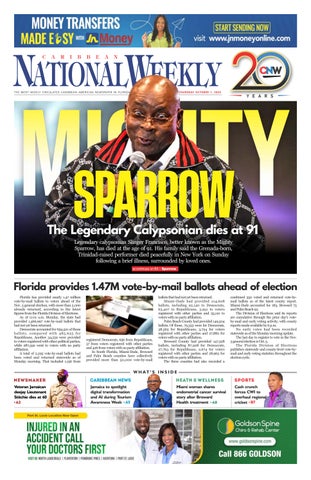
MIGHTY SPARROW
THE MOST WIDELY CIRCUL ATED CARIBBEAN AMERICAN NEWSPAPER IN FLORIDA
CNWEEKLYNE WS.COM
THURSDAY OCTOBER 1, 2026
The Legendary Calypsonian dies at 91 Legendary calypsonian Slinger Francisco, better known as the Mighty Sparrow, has died at the age of 91. His family said the Grenada-born, Trinidad-raised performer died peacefully in New York on Sunday following a brief illness, surrounded by loved ones. continues on B3 – Sparrow
Florida provides 1.47M vote-by-mail ballots ahead of election Florida has provided nearly 1.47 million vote-by-mail ballots to voters ahead of the Nov. 3 general election, with more than 2,000 already returned, according to the latest figures from the Florida Division of Elections. As of 11:01 a.m. Monday, the state had provided 1,466,997 vote-by-mail ballots that had not yet been returned. Democrats accounted for 659,521 of those ballots, compared with 485,625 for Republicans. Another 34,259 were provided to voters registered with other political parties, while 287,592 went to voters with no party affiliation. A total of 2,295 vote-by-mail ballots had been voted and returned statewide as of Monday morning. That included 1,156 from
registered Democrats, 656 from Republicans, 57 from voters registered with other parties and 426 from voters with no party affiliation. In South Florida, Miami-Dade, Broward and Palm Beach counties have collectively provided more than 511,000 vote-by-mail
ballots that had not yet been returned. Miami-Dade had provided 214,608 ballots, including 92,140 to Democrats, 63,407 to Republicans, 3,951 to voters registered with other parties and 55,110 to voters with no party affiliation. Palm Beach County had provided 149,504 ballots. Of those, 79,333 were for Democrats, 38,565 for Republicans, 3,724 for voters registered with other parties and 27,882 for voters with no party affiliation. Broward County had provided 147,328 ballots, including 87,928 for Democrats, 27,763 for Republicans, 2,674 for voters registered with other parties and 28,963 for voters with no party affiliation. The three counties had also recorded a
combined 350 voted and returned vote-bymail ballots as of the latest county report. Miami-Dade accounted for 183, Broward 75 and Palm Beach 92. The Division of Elections said its reports are cumulative through the prior day's voteby-mail and early voting activity, with county reports made available by 6 p.m. No early votes had been recorded statewide as of the Monday morning update. The last day to register to vote in the Nov. 3 general election is Oct. 5. The Florida Division of Elections publishes statewide and county-level vote-bymail and early voting statistics throughout the election cycle.
W H AT ’ S I N S I D E
NEWSMAKER Veteran Jamaican deejay Lieutenant Stitchie dies at 60 a3
CARIBBEAN NEWS Jamaica to spotlight digital transformation and AI during Tourism Awareness Week A5
HEATH & WELLNESS Miami woman shares endometrial cancer survival story after Broward Health treatment A8
SPORTS Cash crunch forces CWI to overhaul regional cricket B7
A2 – NATIONAL WEEKLY | THURSDAY, OCTOBER 1 – OCTOBER 2, 2026 | CNWNETWORK.COM
PAGE A2 Paule e (le ) at her birthday celebra on posing with her daughter, Lauderhill Mayor, Denise D. Grant. – Luke Ballen ne Photo
Jamaica’s Minister of Foreign Affairs Kamina Johnson Smith (third le ) and State Minister, Ministry of Health and Wellness, the Hon. Krystal Lee (third right) sharing a moment with (from le ) Head of Delega on and Ac ng Chief Nurse, Evelyn Amoako; nurse specialist, Joana Abaka Yamoah; President, Ghanaian Associa on of Jamaica, Dr. William Brown and Consultant Physician, Dr. Francis Kpormego at a recep on in honor of the first cohort of 43 nurse specialists from Ghana on Monday (Sept. 28), at the Jamaica Pegasus Hotel in New Kingston.
Paule e cu ng the cake on her birthday with grandson Chris an Davy, and God-grandson, Guy Meneus. Credit: Luke Ballen ne
Tamarac Commissioner Marlon Bolton spo ed doing cleanup in the city recently.
Miramar Commissioner Eddy Edwards pictured with Miss Miami Broward Carnival Pageant par cipants at the event over the weekend.
Broward County Commissioner Alexandra Davis and her son all dressed up for this year’s Broward Urban League’s Annual Fundraising Gala.
2 e g a P This past Saturday, Keep Miami Gardens Beau ful celebrated Emerald Lodge with their official Adopt-A-Road Sign Reveal!
Members of Jamaica United Relief Associa on (JURA) paid courtesy call today on Officer in Charge, Jamaica Consulate in Miami, Mrs Angella RoseHowell (2nd le ) From le Mr Len Johnson, President JURA and Mrs Roxanna Blisse Execu ve Director, JURA; Consul Mrs Chantal Edwards.
CNWNETWORK.COM | NATIONAL WEEKLY | THURSDAY, OCTOBER 1 – OCTOBER 7, 2026 –
A3
NEWSMAKER
Veteran Jamaican deejay Lieutenant Stitchie dies at 60 doctors expected to release him once his treatment was completed. His death marks the end of a career that bridged Jamaica’s dancehall era of the 1980s and the country’s gospel reggae movement, while spanning music, education and Christian ministry. Prime Minister Andrew Holness paid tribute, saying: "Clive Laing, better known as Lieutenant Stitchie, was one of Jamaica’s greatest DJs of the dancehall genre. However, he could very well have been described as one of Jamaica’s best storytellers and humourists. His discography forms part of the soundtrack of the 1980s and 1990s. I recall fondly attending a concert at my high school at which he performed. In the latter part of his career, he would also make his mark in gospel music. My sincere condolences to his family and loved ones. May his soul rest in peace." Opposition Leader Mark Golding also expressed sadness at the passing of Stitchie. “I am deeply saddened by the passing of Lt. Stitchie, a beloved son of Jamaica whose talent and music touched lives at home and across the world. His contribution to Jamaican music and culture will forever be remembered, and his legacy will continue to inspire generations. I extend heartfelt condolences to his family, friends, loved ones and those in the music fraternity mourning his passing. May his soul rest in eternal peace. Walk Good! ,” Golding said.
Veteran Jamaican dancehall and gospel reggae artist Lieutenant Stitchie has died at age 60 after a career spanning more than four decades. Stitchie, whose given name was Cleveland “Cleve” Laing, died at a hospital in Kingston on Monday, one day before his 61st birthday. He had been ailing since suffering a debilitating stroke in September 2024 and had been receiving care at a medical facility. The Spanish Town, St Catherine, native leaves behind a musical legacy that took him from the classroom and competitive sound system circuit to the international stage and, later, Christian ministry. A former athlete and schoolteacher, Laing graduated from GC Foster College of Physical Education and Sport and was a past student of Tivoli Gardens High School. Before pursuing music full time, he worked as a high school teacher, teaching biology, physical education, English and history. He began making a name for himself on the competitive sound system circuit in Spanish Town in the early 1980s, alongside fellow aspiring deejays including Papa San, Wickerman and Major Worries. His mainstream breakthrough came in 1986 with Wear Yuh Size, a humorous track that showcased the rapid-fire delivery and witty wordplay that would become hallmarks of his style. He followed it with Natty Dread, another popular song that helped establish him as one of dancehall’s distinctive voices. Stitchie, who became known as “The Governor,” released his debut album, Great Ambition, in 1987. He signed with Atlantic
Records in 1988 and released three albums with the label, including the well-received Wild Jamaican Romances. His career took a significant turn after a 1997 car accident, when he became a bornagain Christian. He subsequently transitioned into gospel reggae and released a series of inspirational recordings, including To God Be the Glory in 1999 and Real Power in 2000. Despite the change in musical direction, Stitchie retained the energetic delivery and lyrical dexterity that had defined his dancehall career, becoming one of Jamaica’s betterknown gospel reggae performers. In 2012, he received an honorary doctorate, and in 2014 he published his autobiography. He was awarded the Order of Distinction in the rank of Officer in 2021 for his contribution to music. News of Stitchie’s deteriorating health had drawn concern from supporters in recent days. On Sunday, his wife, Sophia Laing, confirmed to The Jamaica Observer that
Stitchie was receiving a blood transfusion after his blood count fell. She appealed to close friends, family members and members of the church community to donate blood, saying
Scan the Code to read more. CNWnetwork.com
A4 – NATIONAL WEEKLY | THURSDAY, OCTOBER 1 – OCTOBER 2, 2026 | CNWNETWORK.COM
CARIBBEAN NEWS
T&T proposes higher legal ages for alcohol, smoking and gambling The Trinidad and Tobago Government is proposing to raise the minimum legal age for alcohol and tobacco from 18 to 21, while increasing the legal age for cannabis and gambling from 18 to 25. Prime Minister Kamla Persad-Bissessar announced the proposed changes Monday, saying the measures are intended to strengthen protections for young people. The government is expected to introduce a bill in Parliament on Wednesday to amend several laws, including the Dangerous Drugs Act, Tobacco Control Act, Liquor Licences Act, Gambling (Gaming and Betting) Control Act and Cannabis Control Act. Under the proposed amendments, the minimum legal age for the sale, purchase, possession or consumption of alcohol and tobacco would increase from 18 to 21.
Persad-Bissessar
The minimum legal age for the sale, purchase, possession or consumption of cannabis would rise from 18 to 25, while the minimum age for gambling would also increase from 18 to 25. Persad-Bissessar said the government was
acting to protect young people from the effects of early exposure to alcohol, tobacco, cannabis and other drugs, as well as gambling. “These measures are not arbitrary,” the prime minister said, describing them as part of the government’s commitment to the health and safety of young people. The proposed cannabis age limit is higher than the 21-year threshold Persad-Bissessar announced in January, according to TTT News. She had previously said the government intended to raise the legal age for cannabis from 18 to 21. The government’s proposed legislation would amend seven pieces of legislation: the Dangerous Drugs Act, Registration of Clubs Act, Tobacco Control Act, Children Act, Liquor Licences Act, Gambling (Gaming and Betting) Control Act 2021 and Cannabis Control Act 2022. The changes remain proposals until the legislation is passed and comes into force.
Mottley says Barbados, Caribbean responsibilities inuenced UN sec-gen decision Barbados Prime Minister Mia Mottley says her responsibilities to Barbados and the wider Caribbean were among the main reasons she decided not to enter the race to become the next United Nations secretarygeneral. Mottley addressed the issue earlier this week during a discussion hosted by the Council on Foreign Relations in New York, where she was asked why she chose not to seek the position currently held by António Guterres.
Mottley
“I have a country to run and a region to take care of,” Mottley said, pointing to her responsibilities as prime minister and her work on regional issues. She also joked about whether the international community was ready for her outspoken style. “I’m not sure that the world wants somebody whose tongue is as heavy as mine,” she said. Mottley has become a prominent voice internationally on climate finance, reform of the global financial system and the challenges facing vulnerable developing countries. At the Council on Foreign Relations event, she discussed the difficulties faced by climate-vulnerable countries and efforts to expand access to development financing and reform the international financial architecture. Instead of pursuing the UN post herself, Mottley has backed Guyana’s UN Ambassador Carolyn Rodrigues-Birkett for secretary-general. Addressing the UN General Assembly this week, Mottley said Rodrigues-Birkett has the experience, skills and understanding required to serve the wider UN membership. Barbados’ support is aligned with the Caribbean Community’s (CARICOM) endorsement of the Guyanese diplomat. The race is underway to select Guterres’ successor, with his second term set to end on December 31, 2026. Under the UN Charter, the Security Council recommends a candidate to the General Assembly. The council’s five permanent members — China, France, Russia, the United Kingdom and the United States — can block a recommendation by exercising their veto. Mottley said that despite speculation about a possible candidacy, she intends to remain focused on her responsibilities as Barbados’ prime minister and on issues affecting the Caribbean. No woman has served as secretarygeneral of the United Nations since the organization was established in 1945.
CNWnetwork.com
CNWNETWORK.COM | NATIONAL WEEKLY | THURSDAY, OCTOBER 1 – OCTOBER 7, 2026 –
A5
CARIBBEAN NEWS
Jamaica welcomes first cohort of 43 Ghanaian nurses Hanover, while SERHA covers Kingston and St. Andrew, St. Thomas and St. Catherine. The nurses have specialties including critical care, paediatrics, operating theatre, nursing and midwifery, emergency care, oncology and mental health and psychiatric care. Others will be assigned to the island’s other health regions and the University Hospital of the West Indies. The four-year agreement was signed during a Jamaican delegation’s visit to Ghana in May by Foreign Affairs and Foreign Trade Minister Kamina Johnson Smith and Tufton, along with their Ghanaian counterparts. Beyond workforce recruitment, Jamaica and Ghana plan to expand health cooperation in areas including primary care reform, national health insurance and the management of non-communicable diseases. The Ministry of Health and Wellness said the broader partnership will facilitate the sharing of knowledge, expertise and resources between the two countries.
Jamaica welcomed its first cohort of 43 Ghanaian nurses on Monday as part of a four-year bilateral health agreement aimed at strengthening the country’s healthcare workforce. The nurses arrived at Norman Manley International Airport in Kingston as Jamaica begins implementing an agreement with Ghana that targets the recruitment and temporary deployment of up to 400 healthcare workers to the island. The agreement, signed earlier this year, provides a framework for the voluntary recruitment of Ghanaian health professionals, particularly nurses and doctors, while promoting cooperation between the two countries and ethical international recruitment practices. Health and Wellness Minister Christopher Tufton said the arrival of the first group marks an important step in efforts to strengthen Jamaica’s healthcare workforce. “We warmly welcome the Ghanaian nurses and look forward to the valuable contribution they will make to our health system and the people we serve,” Tufton said. The ministry said the recruitment is aligned with its Vision for Health 2030 plan
and Human Resource for Health Stabilization Strategy. The nurses will be assigned to public hospitals across the island, with the majority expected to work in facilities under the
Western Regional Health Authority (WRHA) and South East Regional Health Authority (SERHA). WRHA oversees public health facilities in St. James, Westmoreland, Trelawny and
Jamaica to spotlight digital transformation and AI during Tourism Awareness Week Week of activities
Artificial intelligence (AI), digital transformation and the future of Jamaica’s tourism economy will take centre stage during Tourism Awareness Week 2026, as the Ministry of Tourism and industry partners examine how technology is reshaping the sector. Tourism Awareness Week will run from September 27 to October 3 under the theme “Digital Agenda and Artificial Intelligence to Redesign Tourism,” which mirrors the United Nations Tourism theme for World Tourism Day. The week will focus on how AI and other digital tools can strengthen destination management, visitor services, workforce development, resilience and decision-making, while exploring the opportunities and challenges created by emerging technologies. Tourism Minister Edmund Bartlett said the theme reflects the pace at which technology is changing the global tourism industry. “Tourism is being transformed, and the pace of technological change means that Jamaica must not simply respond to the future, we must help to shape it,” Bartlett said. “Tourism Awareness Week 2026 gives us an opportunity to look closely at how artificial intelligence, and digital technology can strengthen our tourism industry while ensuring that people remain at the heart of the experience.” Bartlett said the focus on technology forms part of the Ministry’s broader Tourism 3.0 growth agenda, which seeks to position tourism as a platform for national economic transformation. “Tourism 3.0 is about using innovation, technology and stronger local participation to create greater value for Jamaica in this new era of tourism,” he said. He added that the goal is to build a tourism sector that is more resilient while creating opportunities for workers, entrepreneurs, communities and local
“Our hospitality, authenticity, creativity and human connection remain central to what visitors come here to experience. The opportunity is to use AI to make that experience even more meaningful.” – Bartlett businesses. “The technology is the tool; the people and the value we create for Jamaica are the purpose,” Bartlett said. Director of Tourism Donovan White said Jamaica’s adoption of AI must be balanced with preserving the human elements that distinguish the destination. “The digital future of tourism is already here, and Jamaica is preparing to participate in that future with purpose,” White said. He pointed to potential applications including destination marketing, visitor assistance, data analytics and workforce preparation, saying technology could make the industry more responsive, accessible and competitive. At the same time, White said AI should complement rather than replace the Jamaican tourism experience.
The program began with a Thanksgiving Church Service at Faith Temple Assemblies of God in Montego Bay on Sunday, September 27, which also marked World Tourism Day. Throughout the week, full-page print and digital advertorials will highlight how the Ministry, its public bodies and tourism stakeholders are using technology and AI in areas including destination marketing, tourism services, workforce development and destination management. A Speaker Series, scheduled for September 28-29 and October 1-2 at selected Tourism Action Club schools, will bring tourism leaders, policymakers, technology experts and industry representatives together with students to discuss the opportunities, challenges and implications of AI for Jamaica’s tourism industry. Young people will also be the focus of the Tourism AI Youth Forum on September 30. The annual event will challenge students to explore ways emerging technologies can address tourism-related challenges and reshape the visitor experience. The forum will include an AI Challenge, exhibitions, entertainment and discussions with tourism and technology experts. The Tourism Enhancement Fund, through the Jamaica Centre for Tourism Innovation, will also host the Hospitality & Tourism: AI in Tourism Workshop on October 1. The workshop will feature concurrent sessions examining AI’s implications for hospitality, workforce development, service excellence, education, skills and the future of work. An Innovation Corridor will also showcase technology companies offering solutions for tourism businesses. The Ministry is encouraging Jamaicans, tourism stakeholders and young people to participate in the week’s activities and follow its social media channels for updates.
CNWnetwork.com
Scan the Code to read more. CNWnetwork.com
Antigua releases US proposal, counterproposal on thirdcountry nationals The Antigua and Barbuda Government has released the United States’ proposal for the possible transfer of third-country nationals removed from the US, along with its own counter-proposal setting out conditions for any arrangement. The documents are to be tabled in Parliament by Attorney General and Minister of Legal Affairs Sir Steadroy Benjamin. The government stressed that no agreement has been reached and that discussions with Washington are continuing. Under Antigua and Barbuda’s counterproposal, each person proposed for transfer would require prior written approval from the government and would be considered on a caseby-case basis. Transfers would also be limited to a maximum of seven people in any three-month period. Officials said the figure represents a ceiling, not a quota or obligation. The proposed procedures include criminal and security screening, health assessments, immigration history, protection claims and valid travel documents. Individuals would also have to be informed that Antigua and Barbuda is their destination, understand that their stay would be temporary and provide written consent to the transfer. Their admission and stay would be governed by local laws. The counter-proposal also calls for financial arrangements to ensure costs associated with receiving and supporting transferred individuals do not fall on Antigua and Barbuda taxpayers. It further requires provisions for their lawful return or onward placement when their temporary stay ends. The government would retain the right to suspend transfers over concerns involving national security, public order, public health, capacity or finances. Antigua and Barbuda said the sovereign right to accept or reject any proposed individual would remain with the government. The documents follow the establishment of a parliamentary framework in July requiring any arrangement with Washington to avoid an automatic or open-ended program. The government said releasing the proposals is intended to provide transparency on an issue involving sovereignty, security, law, public finances and the national interest.
A6 – NATIONAL WEEKLY | THURSDAY, OCTOBER 1 – OCTOBER 2, 2026 | CNWNETWORK.COM
HAITI NEWS
Haitians eager to return home and vote, says Prime Minister Haitian Prime Minister Alix Didier FilsAimé says Haitians are eager to regain security, return to their homes and participate in long-delayed elections as the country continues to grapple with widespread gang violence. “There is a people. A people who can wait no longer. A people waiting to regain security, to return home to work, to send their children to school, and to freely choose their leaders,” Fils-Aimé said at a special United Nations meeting on Haiti’s security situation on Thursday. Armed gangs continue to carry out widespread violence across the Caribbean country, including killings, kidnappings and sexual violence. About 6.4 million people require humanitarian assistance, while nearly 1.5 million have been displaced, according to the United Nations. Gangs control large parts of the capital, Port-au-Prince, as well as key transport routes, restricting access to essential services and the delivery of humanitarian aid. Fils-Aimé called for greater international cooperation to address the illicit flow of weapons, ammunition and other resources
that fuel gang violence in Haiti. “Haiti's security depends on our collective ability to combat the illicit flows that fuel violence: weapons, ammunition, trafficking, and transnational criminal networks,” he said. The Haitian government and UN officials also backed extending the mandate of the UN Security Council-authorised Gang Suppression Force (GSF), which is tasked with combating armed gangs, protecting critical infrastructure and facilitating the delivery of
humanitarian assistance. However, the mission remains significantly under-resourced. UN Special Representative for Haiti Carlos Ruiz Massieu said only 1,083 personnel are currently deployed, compared with the 5,500 authorised by the Security Council. He called for the force to reach full deployment as soon as possible. At the same time, Haitian officials stressed that international security assistance must
ultimately strengthen the capacity of Haitian institutions rather than replace them. “Haiti must ultimately rest on the capabilities of the Haitian state,” Fils-Aimé said. He said security operations were only the first step toward resolving the country’s crisis. “The real test is whether we can hold those gains and translate them into lasting change for the Haitian population,” he said. “When an area becomes accessible again, the State and basic services need to follow: police and local authorities, but also schools, justice institutions and economic activity.” Fils-Aimé said Haiti is working to strengthen its security forces through the recruitment and training of additional police officers and soldiers. He also highlighted two specialised judicial units focused on tackling impunity, financial crime, mass atrocity crimes and sexual violence. The protection of children was another major focus of the UN meeting. UN Economic and Social Council President Amar Bendjama called for greater protection for children exposed to gang violence, including those recruited or otherwise associated with armed groups. “Protecting children from violence, from gang recruitment, while providing safe pathways for children associated with armed groups, must be a priority across our efforts,” Bendjama said. “They need access to protection, to education, to essential services. They also need opportunities to build for themselves a safe and secure future.” Ruiz Massieu similarly called for “differentiated pathways” for children associated with gangs, stressing that efforts to dismantle armed groups and prosecute those responsible for serious crimes must also account for the needs of children caught up in the violence.
OAS states call for renewal and full deployment of Haiti gang force All 32 active member states of the Organization of American States (OAS) have called on the United Nations Security Council to renew the mandate of the Gang Suppression Force (GSF) in Haiti and provide the resources needed for its full deployment. The joint statement, issued Sept. 25, reaffirmed support for Haiti’s sovereignty and stressed that solutions to the country’s security and political crisis must remain Haitianled.The statement follows an August mission to Haiti led by OAS Secretary General Albert R. Ramdin, who identified security and elections as urgent and closely linked priorities. Ramdin said the GSF is helping Haitian authorities regain territory, secure critical infrastructure and improve public safety, but warned that renewing the mandate alone would not be enough.“A mandate, by itself, does not produce results,” he said, stressing the need for personnel, financing, equipment, logistics and sustained political support. The OAS states called for the GSF to support the Haitian National Police and Armed Forces of Haiti in restoring state authority in gang-controlled areas, securing the airport and port, reopening key transport routes and protecting civilians. They also urged the establishment of a permanent police presence in strategic locations and areas recovered from gangs. Haiti’s Permanent Representative to the OAS, Jean Josué Pierre, said the declaration sends a clear message to strengthen security institutions while creating conditions for credible elections. The OAS states said preparations for elections should continue as security conditions improve, including voter registration, electoral logistics and an OAS Electoral Observation Mission.
CNWNETWORK.COM | NATIONAL WEEKLY | THURSDAY, OCTOBER 1 – OCTOBER 7, 2026 –
OPINION
A7
EDITORIAL
The UN is most relevant to Caribbean nations L
ast week, the 81st United Nations General Assembly (UNGA) met, marked by speeches in the General Debate from many world leaders. But who really listens? Is the UN really involved in solving today’s global issues and crises? More importantly, what is the real relevance of the UN to the Caribbean region? The UN is both more important and less powerful than the speeches at the GA make it appear. The GA isn’t really a meeting where the U.S., China, Russia, Britain, France, India, Caribbean states, etc., meet and collectively decide how to solve the world’s problems. It’s partly a diplomatic forum; a place for countries to publicly state their positions; a negotiating arena for treaties and resolutions; a place where smaller countries can put issues on the international agenda; and, frankly, a very large international public-relations stage. The UN isn’t a world government sitting above sovereign countries. When major powers disagree, particularly the permanent members of the Security Council, the UN can become extremely constrained. That limitation was acknowledged quite bluntly last week when Suriname’s President Jennifer Geerlings-Simons said the UN hasn’t been able to prevent or end continuing armed conflicts, arguing that trust in the organization needs to be restored. It’s fair to say countries are listening to the UNGA, but listening isn’t the same thing as obeying those speaking. For small Caribbean nations, the UN provides a collective voice considerably larger than their individual physical size. Imagine Barbados trying to negotiate climate policy directly with the U.S., China, India and the European Union. It would have very little leverage. But when Barbados joins other Caribbean countries within the Small Island Developing States (SIDS) grouping at the UN, its arguments become part of an internationally recognized category of vulnerable nations. The UN explicitly recognizes that small island states face particular problems because of their small economies, remoteness, dependence on imports, debt pressures and climate vulnerability. Climate change is probably the clearest example. Caribbean nations contribute little to global greenhouse-gas emissions yet suffer disproportionately from hurricanes, rising sea levels, coastal erosion, coral degradation, damage to tourism infrastructure, agricultural disruption and enormous rebuilding costs. But after a hurricane, a country can acquire significant reconstruction assistance through the UN. The UN offers Caribbean countries a place to argue that they didn’t create climate change problems but are among those paying heavily for them. Whether wealthy countries provide sufficient financing is a different question. This is where Caribbean governments have become increasingly frustrated. CARICOM is currently pushing specifically
for climate finance, including a 2026–2030 climate-finance action plan designed to make international climate funding more accessible. Haiti is perhaps the most important Caribbean example of the importance and limitations of international institutions. Haiti’s crisis cannot realistically be solved by Haiti acting alone. CARICOM is working with Haitian authorities, the UN, the OAS and other international partners on security, elections and restoring constitutional government. While the UN doesn’t possess the power to fix Haiti, it can coordinate, authorize, facilitate, finance, monitor and provide humanitarian assistance. But ultimately, political will and action must come from countries themselves. The UN matters enormously to Caribbean countries in international law. They don’t have aircraft carrier fleets capable of protecting their interests against major powers. Their protection is largely through international law, diplomacy and collective institutions. That is why the Bahamian prime minister’s speech at the GA was particularly revealing, arguing that small countries cannot survive in a world where rules apply only to weak states, while emphasizing the Caribbean as a zone of peace. Suriname made essentially the same argument, saying smaller, vulnerable states depend upon a rules-based international order because, without it, their sovereignty is much more precarious. Barbados’ PM Mia Mottley is one of the Caribbean’s most prominent voices on the international stage, particularly on climate finance, the international financial system and the position of small states. At this year’s GA, she again raised climate vulnerability, financing and the Caribbean’s position as a zone of peace. The Caribbean cannot exercise much influence through military or economic power, but exercises influence through diplomacy, coalition-building and international institutions. That’s precisely where the UN is useful. CARICOM has endorsed a Caribbean candidate, Guyanese diplomat Carolyn Rodrigues-Birkett, for the next UN SecretaryGeneral. She would be the first Caribbean candidate for the position. This indicates the Caribbean views the UN as indispensable to small states, but it needs to work better.
That’s probably the most accurate assessment. Wars, geopolitical rivalry, climate change, humanitarian disasters and international economic inequality clearly demonstrate the limits of the UN, but failure to solve problems isn’t the same as irrelevance. For the Caribbean, the UN provides a diplomatic megaphone, a framework for international law, access to development and humanitarian agencies, climate negotiations, disaster assistance, development financing discussions and a mechanism through which they can participate in decisions affecting the world. UN agencies have worked in the Caribbean for six decades on precisely these areas. The UN shouldn’t be judged by GA speeches, which some find irrelevant. In between the speeches, off camera, are very relevant negotiations, treaties, agencies, financing arrangements, Security Council decisions and international agreements. For small, geographically exposed and economically vulnerable Caribbean nations, the UN remains considerably more relevant than the spectacle of GA speeches might suggest.
Scan the Code to read more. CNWnetwork.com
A8 – NATIONAL WEEKLY | THURSDAY, OCTOBER 1 – OCTOBER 2, 2026 | CNWNETWORK.COM
HEALTH & WELLNESS
Miami woman shares endometrial cancer survival story after Broward Health treatment Know the symptoms
Lizbeth Muller had not had a menstrual period in years when she began experiencing slight spotting and vaginal discharge in early 2023. The 60-year-old Miami Shores resident knew something was unusual and consulted her OB-GYN. Tests revealed that she had stage 1 endometrial cancer, a cancer that develops in the lining of the uterus. "It was an aggressive form," Muller said. "It scared the living daylights out of me." Muller was referred to Scott Jordan, M.D., a gynecologic oncologist with the Broward Health Physician Group. She underwent robotic-assisted surgery at Broward Health Medical Center, where Jordan removed her cervix, uterus, ovaries, fallopian tubes and some nearby lymph nodes. She later completed several weeks of radiation therapy in the fall of 2023. Now cancer-free, Muller continues to see Jordan and says she is focused on enjoying life. "I want women to be aware of their bodies," she said. "If you see or feel something that isn't quite right, even if you're healthy and take care of yourself, see your doctor."
Endometrial cancer on the rise Endometrial cancer is the most common gynecologic cancer in the United States. According to the American Cancer Society, new cases have increased for more than a decade, while the death rate has also been rising.
Symptoms of gynecologic cancers vary depending on the type of cancer. Possible warning signs include: • Abdominal or back pain • Constipation • Frequent urination • Pelvic pain • Unusual vaginal bleeding or discharge • Vulvar pain, itching, burning or skin changes For endometrial cancer specifically, abnormal vaginal bleeding — including bleeding after menopause — is an important warning sign that should be evaluated by a health care provider.
Risk factors and prevention Treatment depends on the stage and characteristics of the cancer and can include surgery, radiation, chemotherapy, immunotherapy or a combination of treatments. “In endometrial cancer, we started combining immunotherapy and chemotherapy for patients with advanced disease about three years ago," Jordan said. "We're seeing massive improvements in patients' outcomes as a result." Robotic-assisted surgery is also increasingly used in gynecologic cancer treatment. Such minimally invasive procedures can reduce recovery time for some patients, potentially allowing them to begin additional treatment sooner when needed. Jordan described Muller’s outcome as “fantastic."
"It was an aggressive form. It scared the living daylights out of me. I want women to be aware of their bodies. If you see or feel something that isn't quite right, even if you're healthy and take care of yourself, see your doctor." – Muller
Obesity is a major risk factor for endometrial cancer, and maintaining a healthy weight may reduce the risk. Risk factors differ among gynecologic cancers. Smoking and a weakened immune system are among the risk factors for cervical cancer, while inherited genetic mutations and a family history of hereditary breast and ovarian cancer syndromes can increase the risk of ovarian cancer, according to Jordan. Regular visits with an OB-GYN can help with prevention and early detection of some gynecologic cancers. Pap tests and human papillomavirus (HPV) tests are used to screen for cervical cancer and identify precancerous changes. HPV causes most cervical cancers. Clinical trials can also provide eligible cancer patients with access to treatments being studied.
CNWNETWORK.COM | NATIONAL WEEKLY | THURSDAY, OCTOBER 1 – OCTOBER 7, 2026 –
B1
HEALTH & WELLNESS
Caribbean women are facing breast cancer younger.
Can health systems keep up? Breast cancer is often discussed as a disease of older women, but a significant share of women diagnosed in Latin America and the Caribbean are under 50, raising questions about whether health systems across the region are prepared to detect and treat the disease early. According to the Pan American Health Organization (PAHO), 32 percent of women with breast cancer in Latin America and the Caribbean are diagnosed before age 50, compared with 19 percent in North America. Breast cancer is the most common cancer among women in the Americas. In 2020, more than 210,000 women in Latin America and the Caribbean were diagnosed with the disease and nearly 68,000 died from it, PAHO reports. More recent estimates from the International Agency for Research on Cancer show that the burden remains substantial. In 2024, an estimated 218,121 women in Latin America and the Caribbean were diagnosed with breast cancer, while 61,565 died from the disease. Breast cancer accounted for 26.7 percent of all new cancer cases among women in the region. The figures point to a problem that goes beyond awareness. For a woman who discovers a lump or notices another change, the next steps can determine how quickly she receives a diagnosis and begins treatment. That means access to mammography and other diagnostic services, pathology, oncology specialists, medicines and surgery can be just as important as recognizing the warning signs. PAHO says early detection and access to effective treatment remain challenges in
Breast cancer is the most common cancer among women in the Americas. In 2020, more than 210,000 women in Latin America and the Caribbean were diagnosed with the disease and nearly 68,000 died from it, PAHO reports.
countries with limited resources, despite the availability of proven and cost-effective interventions. For Caribbean women, those challenges can be compounded by geography. In countries made up of multiple islands, accessing specialist care may require travel between islands or overseas. Even within larger Caribbean countries, women in rural communities may have fewer options for diagnostic testing and specialist treatment than those living in capital cities. The financial consequences can also extend beyond medical bills. A cancer diagnosis can mean time away from work, transportation costs, childcare expenses and additional costs associated with repeated appointments and treatment. For families with limited savings or inadequate insurance coverage, those expenses can
become another barrier to care. The problem is particularly important because breast cancer does not affect only women with obvious risk factors. PAHO notes that about half of breast cancer cases occur in women with no identified risk factors other than being female and aged 40 or older. That makes timely access to health services especially important. October is Breast Cancer Awareness Month, and campaigns across the Caribbean will once again encourage women to learn the signs of breast cancer and seek medical attention for changes in their breasts. But awareness is only one part of the equation. A woman who seeks help still needs a health system capable of moving her from suspicion to diagnosis and, if necessary, treatment. PAHO has highlighted early detection and standardized treatment as important components of improving breast cancer outcomes. In high-income countries, breast cancer mortality rates fell substantially between 1980 and 2020 following the introduction of early detection programmes and standardized treatment protocols. The challenge for Caribbean countries is ensuring that those advances are accessible to women regardless of where they live or how much they earn. That means looking at the entire journey — from the first doctor's visit to diagnostic testing, treatment and follow-up care. For the Caribbean, the question is no longer simply whether women know about breast cancer. It is whether, when a woman recognizes something is wrong, the health system is ready to respond.
CNWnetwork.com
The Caribbean is getting older. Who will care for its elderly? in many countries. Younger people frequently migrate for education or employment, leaving parents and grandparents behind. More women — traditionally the main providers of unpaid family care — are also participating in paid employment. That creates a potential gap between the number of people who need care and the number of relatives available to provide it. PAHO has identified limited service coverage, shortages in the care workforce and insufficient data as some of the challenges facing long-term-care systems across the region.
The Caribbean is getting older, and the demographic shift is creating a question that health systems and families will increasingly have to confront: who will care for the region's elderly? Across Latin America and the Caribbean, about 8 million people aged 65 and older — an estimated 14.4 percent of that age group — currently require long-term care, according to the Pan American Health Organization (PAHO). The organization projects that the share will increase to 16 percent by 2050 as populations age and more people live with chronic illnesses, disabilities and conditions that affect their ability to manage everyday activities independently. Long-term care can include assistance with basic activities such as bathing, dressing, eating, using the bathroom, moving around and taking medication. It can also involve support with other everyday tasks and rehabilitation. For many Caribbean families, that care is already being provided at home. PAHO says nearly 70 percent of long-term care in the region is provided by women in families, often without pay or adequate support. That means the region's aging population is also likely to increase the demands placed on family caregivers. A daughter may be caring for an elderly parent while holding down a full-time job. A son may be sending money home from overseas while another relative provides day-
Who pays for care? to-day care. In other families, an older spouse may become the primary caregiver for a partner who has become frail or developed dementia. As the number of older people grows, those arrangements could become harder to sustain.
A Changing Caribbean The aging trend is not new, but its scale is becoming increasingly important. A United Nations report on population aging in the Caribbean found that the region is undergoing significant demographic change and warned that countries need to adapt policies and services to the growing number of older people. At the same time, Caribbean societies are changing. Families are smaller than they once were
Care also comes with a financial cost. An older person who needs help several times a day may require a home health aide or other paid assistance. Families may also face expenses for medication, transportation, medical equipment, home modifications and specialist appointments. For families unable to pay for private care, the alternatives can be limited. PAHO's new guidance on long-term care calls for countries to strengthen governance and financing, expand the care workforce and integrate health and social protection services. The organization says long-term care should not be limited to institutional settings but should primarily be available in homes and communities, while respecting the dignity, autonomy and preferences of older people. That could become increasingly important as Caribbean countries confront the realities of aging. The issue is not simply whether there will be enough nursing homes.
It is whether countries can build systems that support older people who want to remain in their communities, while also supporting the relatives and workers who provide their care.
The caregiver is also a patient The burden of caregiving can be overlooked because it often happens inside families and outside formal health systems. PAHO says the fact that women provide nearly 70 percent of long-term care in the region highlights persistent gender inequalities and the need for policies that address the needs of caregivers as well as those receiving care. That makes caregiving a public health issue, not simply a private family responsibility. As Caribbean populations age, governments will have to consider how many trained caregivers are available, what services families can access and how those services will be financed. The region's demographic future is already taking shape. The question now is whether its health and social-care systems will be ready for it.
Scan the Code to read more. CNWnetwork.com
B2 – NATIONAL WEEKLY | THURSDAY, OCTOBER 1 – OCTOBER 2, 2026 | CNWNETWORK.COM
COMMUNITY & THE DIASPORA
Miami-Dade County sues Reworld for over $750M over Doral incinerator fire Miami-Dade County has sued Reworld Dade LLC and its parent company, Reworld Holding Corporation, seeking more than $750 million in damages related to the February 2023 fire that destroyed the county’s Resource Recovery Facility in Doral. The lawsuit, filed September 28, alleges that Reworld failed to address longstanding fire-safety deficiencies at the facility despite repeated warnings and inspections. The county also alleges that the company failed to properly maintain critical fire-protection systems and disabled or failed to maintain shut-off control valves and water pumps serving multiple sprinkler systems. According to the complaint, the problems contributed to a fire that began as a relatively small blaze but spread through the facility, ultimately destroying much of the operation. Reworld was paid approximately $60 million annually to operate and maintain the facility, according to the county. Miami-Dade Fire Rescue issued six notices of violation for fire-code violations at the facility between October 2019 and September
The aftermath of the re that destroyed the Resource Recovery Facility in Doral in 2023
2022, the lawsuit says. The county also alleges that Reworld received repeated warnings from the county’s bond engineer and other inspectors. At the time of the fire, at least five fire-
protection systems in the garbage-processing area were impaired and could not be relied upon to suppress a fire, according to the complaint. “The destruction of this facility has had
enormous consequences for Miami-Dade. Reworld was responsible for operating and maintaining it, and the allegations in this lawsuit point to serious failures to meet those responsibilities. We are taking this action to recover the damages our County has suffered and protect our taxpayers,” Miami-Dade County Mayor Daniella Levine Cava said. The fire began on February 12, 2023, and burned for approximately three weeks. The facility processed nearly half of Miami-Dade County’s municipal solid waste and generated electricity for the county, Florida Power & Light and several municipalities. Its destruction forced the county to find alternative ways to dispose of its municipal waste, resulting in what the lawsuit describes as significant additional costs. The county is asserting nine claims against Reworld, including breach of contract, breach of guarantee, gross negligence, violations of the county’s False Claims Ordinance and fraud in the inducement. The county is seeking damages exceeding $750 million and has requested a jury trial.
Miami-Dade Homeless Trust says Citrus Health employee charged in alleged theft of $1.2 million A Citrus Health Network employee has been arrested and charged with allegedly stealing more than $1.2 million in funds intended to assist households experiencing homelessness, according to the Miami-Dade County Homeless Trust. Ron Book, chairman of the Homeless Trust, said the organization identified irregularities in invoicing and subsequently worked with investigators to determine the extent of the alleged wrongdoing. Citrus Health Network also conducted an
Book
internal investigation and has reimbursed the Homeless Trust more than $1.2 million, Book said. “The Homeless Trust is saddened and angered following the arrest of a rogue administrator at Citrus Health Network who seemingly used funding intended for households experiencing homelessness for his own enrichment,” Book said in a statement. Book thanked State Attorney Katherine Fernandez-Rundle, the Miami-Dade Inspector General and the Miami-Dade Sheriff's Office
for their work on the investigation. He said the incident should not overshadow Citrus Health Network’s work on behalf of Miami-Dade’s Continuum of Care, while warning other providers against diverting public funds intended to support people experiencing homelessness. The statement did not identify the employee or provide details about the specific charges. The case remains an allegation, and the employee is presumed innocent unless proven guilty in court.
Mayor Denise D. Grant has served Lauderhill with distinction — first on the City Commission since 2018, now as our Mayor. A proud Jamaican-American and devoted mom to her son Joshua, Denise leads with heart, fighting for lower property taxes, safer and cleaner neighborhoods, thriving businesses, and programs that support our children and seniors. If you're voting by mail, keep an eye out — your ballot should be arriving soon. Please fill it out and return it as soon as possible so your voice is counted for Denise on November 3rd.
CNWNETWORK.COM | NATIONAL WEEKLY | THURSDAY, OCTOBER 1 – OCTOBER 7, 2026 –
B3
COMMUNITY & THE DIASPORA
AFJ to honour Adam Stewart, Sheryl Lee Ralph at NY gala The American Friends of Jamaica (AFJ) will honour Sandals Resorts Executive Chairman Adam Stewart and Emmy Awardwinning actress Sheryl Lee Ralph at its 2026 Hummingbird Gala in New York City on October 16. The gala will be held at The Plaza Hotel and will celebrate the longstanding ties between Jamaica and the United States. Prime Minister Andrew Holness is expected to attend, according to the AFJ. Stewart will receive the AFJ’s International Achievement Award for his contributions to business and institution-building in Jamaica and the wider Caribbean. Through the Sandals Foundation, We Care Foundation and Sandals Corporate University, Stewart has supported initiatives in healthcare, education and disaster recovery in Jamaica. Ralph will receive the International Humanitarian Award for her work raising awareness of HIV/AIDS and supporting education and community initiatives in
Stewart
Ralph
Jamaica. She has also supported Chantilly Primary School in Manchester, her mother Ivy Ralph’s alma mater. Ralph is being recognized alongside her decades-long career in film, television and Broadway and her advocacy for Jamaican heritage. The evening will begin with a cocktail reception and auction, followed by dinner, the presentation of the awards and entertainment. Reggae and dancehall pioneer Sister Nancy and her brother Brigadier Jerry are scheduled to perform, highlighting Jamaican music and culture. The AFJ supports education, healthcare and economic development projects across Jamaica through grants and partnerships with local organizations. Tickets and tables for the gala are available through the organization, which is also accepting sponsorships.
Sparrow from A1
“It is with great sadness that we announce the passing of Trinidad and Tobago’s Calypso icon, Slinger Francisco, known to the world as ‘The Mighty Sparrow’,” the family said in a statement. Sparrow, widely regarded as one of the most influential figures in Caribbean music, enjoyed a career spanning more than seven decades and became internationally known for his distinctive voice, sharp wit and social and political commentary. Born Slinger Francisco on July 9, 1935, in the fishing village of Grand Roy, Grenada, he moved to Trinidad as a young child and grew up in Laventille, near Port of Spain. He began singing as a child and performed in his school choir. At 14, he joined a steel band made up of neighborhood boys and began performing during Carnival. His energetic stage performances earned him the nickname “Little Sparrow,” which he later shortened to the Mighty Sparrow. After leaving school, he worked for the Trinidad government while continuing to perform calypso. A residency at the Lotus Club helped establish him as a local star. Sparrow emerged as one of Trinidad and Tobago’s leading calypsonians in the mid-1950s. In 1956, he won both the Calypso Monarch and Road March titles with “Jean and Dinah,” a song that became his first major hit and addressed the social changes that followed the closure of U.S. military bases in Trinidad. The song helped propel Sparrow to international attention during a period when calypso was enjoying growing popularity in North America and Europe. He later travelled to New York and recorded for RCA Victor, while continuing to build his career between Trinidad, the United States and other international markets. Sparrow eventually made New York a base for his recording and touring career and became a regular presence at Brooklyn’s Labor Day Carnival. He also maintained strong connections to Jamaica, recording the 1968 album “Sparrow Meets the Dragon” with Jamaican bandleader Byron Lee. Their recording of “Only a Fool Breaks His Own Heart” became an international hit. He went on to become one of calypso’s most decorated performers, winning Trinidad and Tobago’s Calypso King or Monarch title eight times and the Carnival Road March competition on eight occasions. He also won the Calypso King of Kings competition twice, in 1985 and 1988. Sparrow was remarkably prolific, releasing dozens of albums throughout the 1960s and 1970s alone. His catalogue explored politics, social issues, relationships, race, class, culture and everyday Caribbean life, often using humour and satire to address subjects that might otherwise have been difficult to discuss publicly. His music helped take calypso to audiences well beyond Trinidad and Tobago and established him as one of the Caribbean’s most recognizable cultural figures. CARICOM described him as a social commentator and cultural ambassador whose work chronicled the region’s political culture, history, people and struggles. Known by many as the “Calypso King of the World,” Sparrow was also regarded as a mentor and inspiration to successive generations of Caribbean performers. His family said his importance extended beyond the stage. “He was also a husband, father, grandfather, great-grandfather, life partner and friend,” the statement said. The family also said that in his final days, Sparrow had embraced Christianity, giving his life to Jesus Christ and being baptised into the Seventh-day Adventist faith. Sparrow’s death brings to a close one of the most celebrated careers in the history of calypso, with his music and performances helping to define the art form for generations.
B4 – NATIONAL WEEKLY | THURSDAY, OCTOBER 1 – OCTOBER 2, 2026 | CNWNETWORK.COM
COMMUNITY & THE DIASPORA Jamaica promotes investment opportunities at New York town hall Jamaican government officials highlighted development and investment opportunities in the country during a town hall meeting with members of the Jamaican diaspora in New York on Friday. The Sept. 25 meeting was held at the Consulate General of Jamaica in New York as part of activities surrounding the 81st United Nations General Assembly. Minister of Foreign Affairs and Foreign Trade Kamina Johnson Smith, who was leading Jamaica's delegation to the UN General Assembly, attended the meeting alongside Minister of Water, Environment and Climate Change Matthew Samuda and Jamaica's Consul General in New York, Oliver Mair. Samuda used the forum to discuss Jamaica's investment in water infrastructure, telling attendees that the government is investing approximately J$16 billion in the sector this year. He said the figure represented a significant increase from the less than J$1 billion invested annually in the sector about a decade ago, although he acknowledged that substantially more investment is needed to address Jamaica's water infrastructure needs. Samuda also addressed the prospect of desalination as Jamaica seeks to strengthen its water supply, noting that the technology remains costly for the country at present. The meeting also highlighted investment opportunities across sectors including environmental sustainability, water projects, land and real estate, agriculture, healthcare management, stocks and trading, film and creative services.
Tamarac adopts 22.2% lower budget for 2026-27 fiscal year The City of Tamarac has adopted a $228.7 million budget for fiscal year 2026-27, representing a 22.2% reduction in spending from the current fiscal year. The new budget totals approximately $228,742,147, down $65,415,315 from the current budget of $294,157,462. City officials said the reduction is intended to preserve essential services while addressing residents’ concerns about rising costs and maintaining the city’s long-term financial stability. The adopted budget includes $99,160,157 for the General Fund, which supports daily operations, public safety, infrastructure, neighborhood services, quality-of-life programs and other community priorities. Mayor Michelle J. Gómez thanked city staff for their work on the budget and said further reductions could be possible while protecting city employees and essential service providers.
Bolton
“This is a start. I know we can reduce more while making sure we protect the backbone of our thriving City – our dedicated employees and essential service providers,” Gómez said. Vice Mayor Marlon Bolton said the reductions were driven by residents’ financial concerns. “We didn’t make these budget cuts for public perception or political optics. We made
them because residents are genuinely hurting in their wallets, and we have a responsibility to respond,” Bolton said. Commissioner Morey Wright also thanked city staff for their work in producing a balanced budget. Commissioner Krystal Patterson said the lower spending plan reflects what she described as community priorities and a commitment to managing taxpayer funds. “I am proud to have led the charge to reduce the budget, particularly given the current state of the economy,” Patterson said. Commissioner Dr. Kicia Daniel said she pushed for a lower budget after hearing concerns from residents about their finances. “These are difficult times, and I heard directly from residents who are feeling the pressure in their wallets. That is why I pushed for a lower City budget – to deliver real savings for the people we serve,” Daniel said. The new fiscal year begins Oct. 1, 2026.
BSO reports 23% decline in Part One crime since 2019 The Broward Sheriff’s Office (BSO) says overall Part One crime in areas it serves has declined 23% since 2019, with violent crime down 18% and property crime down 24%. The figures were highlighted by Broward County Sheriff Dr. Gregory Tony as the agency outlined its approach to crime reduction, which combines patrols, investigations, crime analysis, targeted enforcement and prevention programs. "Keeping our community safe is my top priority," Tony said, adding that BSO's approach includes responding to crimes, holding offenders accountable and preventing offenses before they occur. BSO said its district-based policing model allows deputies and detectives to combine knowledge of local neighborhoods with crime analysis to identify trends and emerging issues
and determine where resources should be deployed. When crimes occur, detectives gather evidence, pursue investigative leads and work to connect cases and identify suspects, according to the agency. The sheriff's office also highlighted several crime prevention and community policing programs. Under its While You Were Sleeping initiative, deputies identify preventable security concerns during routine patrols and leave residents with information on steps they can take to improve security. BSO's Neighborhood Support Team and Park, Walk and Talk programs are also designed to increase interaction between deputies and residents, address community concerns and provide crime prevention information.
The agency said reducing crime requires multiple strategies rather than a single program, including visible patrols, proactive policing, investigations, data analysis, targeted enforcement and partnerships with residents and businesses. Tony said the agency intends to continue using crime data to guide its operations and direct resources toward areas where they can have the greatest impact. "Public safety has no finish line," Tony said, adding that BSO's approach will continue to evolve as crime trends and challenges change. BSO defines Part One offenses using the FBI's Uniform Crime Reporting (UCR) program. The offenses are divided into violent and property crimes and are considered among the most serious offenses tracked for crime-reporting purposes.
CNWNETWORK.COM | NATIONAL WEEKLY | THURSDAY, OCTOBER 1 – OCTOBER 7, 2026 –
B5
ENTERTAINMENT M I A M I
C A R N IVA L
Why Caribbean women turn out in such numbers Women make up 70 per cent of the revelers at Miami Carnival, a statistic that offers an interesting glimpse into the relationship between Caribbean women and Carnival in the diaspora. As the Miami-Broward Carnival prepares for its 2026 staging from October 3 to 11, more than 18,000 masqueraders are expected to take part in the Parade of Bands, with 16-plus masquerade bands taking to the road on October 11. The strong female presence at Miami Carnival is part of a much wider Caribbean tradition. Across the region and its diaspora, women have long been highly visible participants in Carnival, particularly through masquerade, dance, music and the social life surrounding the festival. In Miami, however,
the organisers' own figure puts that participation into striking perspective: seven out of every 10 revelers are women. What draws so many women to the road? There is no published Miami Carnival study establishing a single reason, but the organisation itself describes the experience in terms of safety and freedom. That freedom can be seen in the way women participate in mas — moving through public space in elaborate and often revealing costumes, dancing and celebrating within a cultural environment where such forms of expression are part of the tradition. Carnival provides a setting in which women can express themselves physically and creatively while participating in a collective celebration rooted in Caribbean culture. The cultural connection is equally important. Miami Carnival brings together traditions from across the region, including masquerade, soca, steelpan, food and other
elements of Caribbean life. For women living away from the islands, Carnival provides an opportunity to maintain connections to family heritage while participating in a broader Caribbean identity. That connection is particularly relevant in South Florida, one of the major centres of Caribbean life in the United States. Miami Carnival brings together communities with roots across the region, including Jamaica, Trinidad and Tobago, Haiti, Barbados, Guyana, Grenada, Saint Lucia and the Bahamas. The celebration is also deliberately intergenerational. Junior Carnival, scheduled for October 3, introduces children to mas and Carnival, with organisers expecting more than eight children's mas bands in 2026. For Caribbean women in Miami and across the diaspora, the numbers therefore tell part of a larger story: Carnival remains a place where culture can be celebrated publicly,
identity can be expressed collectively and traditions can continue to move from one generation to the next. Miami-Broward Carnival 2026 runs October 3–11, culminating in the Parade of Bands and Concert at Central Broward Park & Broward County Stadium in Lauderhill on October 11.
Delroy Lindo’s Jamaica-set directorial debut wraps production Winston Duke, Marianne JeanBaptiste, Wendell Pierce and rising actor Seyi Andes-Pelumi are starring alongside Delroy Lindo in Jabari’s People, a Jamaican-set family drama that marks Lindo’s directorial debut. The film recently wrapped production in Kingston, Jamaica, following a 22-day shoot, according to The Hollywood Reporter.
Lindo
Written by Daoud Abeid and Dakhil Hausif, Jabari’s People follows Jabari, a gifted but defiant Brooklyn teenager who is sent to live with his estranged grandparents in Jamaica’s Blue Mountains after the sudden death of his mother. The intergenerational drama moves between Brooklyn and Jamaica, exploring family, grief and identity. For Lindo, the project carries a personal connection to Jamaica. The 73-year-old actor was born in London to Jamaican parents whose family has roots in Ocho Rios, St Ann, and has spent years looking for an opportunity to contribute to the country’s creative industry. The screenplay first came to Lindo in 2015, but it took more than a decade for the project to reach production. The production also placed a strong emphasis on Jamaican talent, with local actors and crew members working on the film. Lindo has praised the depth of talent on the island and encouraged greater investment in Jamaica’s film industry. Lindo has also made the involvement of Jamaican talent a priority. The production employed Jamaican cast and crew members, with the actor-director using the project to highlight the depth of talent available on the island. “Do not sleep on the talent that is here,” Lindo told the Jamaica Observer, while calling on the Jamaican Government and continues on B7 – Delroy Lindo
B6 – NATIONAL WEEKLY | THURSDAY, OCTOBER 1 – OCTOBER 2, 2026 | CNWNETWORK.COM
MARKETPLACE PROBATE / INHERITANCE LAW EDUCATION LAW MEDIATION 1451 West Cypress Creek Road, Suite 300, Ft. Lauderdale, FL 33309
954.535.0827
Helping You Achieve The American Dream!
CRIMINAL DEFENSE IMMIGRATION LAW PERSONAL INJURIES
Family Based Filings Lawful Permanent Residence Abuse Spouse/VAWA Visa Extension Removal of Condition Interview Preparation Hardship Waivers Citizenship Deportation Defense
EXPERIENCED ATTORNEY YOU CAN COUNT ON! Over 17 years of State and Federal Criminal Defense
954-730-8393 954-548-9902
www.MarkDouglasLaw.com
,ESQ.
786-309-7038
261 N. UNIVERSITY DRIVE SUITE 500, PLANTATION, FLORIDA
Gentles Realty & Management Experienced Professionals you can trust to help meet your Real Estate needs. We credit 20% of our Buying Commissions towards Selling Buyer’s Closing Costs. Renting Property Management
!
954.261.9859
Joy Rogers, LCAM Managing Broker
5300 Powerline Rd. Unit 11, Ft. Lauderdale, FL 33309
BANKRUPTCY - FORECLOSURE DEFENSE
MEDIX URGENT CARE CENTER Don’t spend hours in the emergency room. Come to us for...
www.DsouzaLegalGroup.com
Email: dtdlaw@aol.com
8751 W. Broward Blvd St 301, Plantation FL 33324
Free Initial Consultation
Payment Plans Available
The hiring of a lawyer is an important decision that should not be based solely upon advertisement. Before you decide, ask us to send you free written information about our qualifications and experience.
Cough, Colds, Flu, Pregnancy Tests Suture Repair & Removal G License Physical Medication Re ills Immunizations
CPR Inservices ... and more
School, Sports and Work Physicals Mon.-Fri: 9am – 7pm
N. State Rd. 7, Ste 102, 954.484.8444 2331 Lauderhill, FL 33313
NEW TO THE AREA!
MADAM BELLA
Love Marriage Business Health Divorce Lawsuits Happiness Luck Money Evil Spirits
CNWNETWORK.COM | NATIONAL WEEKLY | THURSDAY, OCTOBER 1 – OCTOBER 7, 2026 –
B7
SPORTS
Cash crunch forces CWI to overhaul regional cricket
JOA President Samuda sets out blueprint for new era in sport
Cricket West Indies (CWI) is preparing for a sharply reduced regional competition calendar as financial pressure forces the governing body to abandon, merge and restructure several tournaments in 2026. Among the biggest changes, CWI’s Under-17 competition has been scrapped, the women’s tournaments will be consolidated, while the Combined Campuses and Colleges and West Indies Academy have been removed from the men’s competition structure. The measures were outlined Wednesday by CWI Chief Executive Officer Chris Dehring and Director of Cricket Miles Bascombe, who acknowledged that the organization is facing a difficult financial year.
More cricket, fewer resources Dehring said CWI is scheduled to stage more than 33 events during the year, including international tours involving Sri Lanka, New Zealand and Pakistan. However, hosting those series will not necessarily translate into additional income. Under the International Cricket Council’s financial model, Dehring said the West Indies is not expected to benefit financially from hosting any of the three tours, forcing CWI to reassess what it can realistically afford. The financial boost generated by co-hosting the 2024 Men’s T20 World Cup has also been exhausted, leaving fewer resources to maintain the existing competition structure. As a result, CWI has opted to reduce its commitments rather than sustain a calendar its finances cannot support.
Development takes a hit The changes will be felt most sharply in the development pathway. Eliminating the Under-17 tournament removes an important level of regional competition for young players, while merging the women’s competitions will reduce the number of separate tournaments available to female cricketers. On the men’s side, the removal of the Combined Campuses and Colleges and West Indies Academy represents another significant change to the pathway between emerging talent and senior cricket. The cuts raise questions about how CWI will balance immediate cost control with the need to continue developing future West Indies players.
Dehring
Jamaica Olympic Association (JOA) President Christopher Samuda has called for a major transformation of Jamaica’s sporting sector, with greater investment in infrastructure, athlete welfare, commercial development and ethical governance. Speaking at the Kiwanis Club of Friends Across Border’s ninth anniversary and installation ceremony in St. Andrew, Samuda said sport should become a stronger contributor to national development.
Dehring calls for long-term reset Dehring said CWI cannot continue operating as it has in previous years and called for a long-term strategy based on the resources available.“We have to take an honest look at ourselves and understand that we’re not going to get out of where we are without a long-term vision, a long-term plan, and an execution of those plans based on the resources that we have.“… The year 2025-2026 is going to be a very challenging financial year for us,” Dehring said. For Bascombe and the cricket department, the restructuring means working within a tighter framework while still providing meaningful opportunities for players across the region. CWI must manage a packed program of international tours and domestic competitions while operating under an income model that does not always reward the region for hosting major international engagements. With the 2024 T20 World Cup gains no longer available, the organization is entering the new cycle with a much narrower financial margin. For CWI, the immediate priority is ensuring that the competitions it can afford remain sustainable while laying the groundwork for longerterm recovery. But the adjustment comes at a clear cost: fewer tournaments, consolidated competitions and a reduced development structure as West Indies cricket navigates one of its most financially challenging periods in recent years.
Delroy Lindo from B5
private sector to invest more heavily in the local film industry. Jamaican-Canadian costume designer Antoinette Messam, whose credits include The Harder They Fall, Creed and The Book of Clarence, also worked on the production. She said keeping production spending in Jamaica could help strengthen the wider film ecosystem by creating opportunities for local actors, hair and makeup professionals, vendors and other businesses. Prime Minister Andrew Holness also visited the set, where he met Lindo and other cast and crew members. In a social media post, Holness wrote: "Jamaica has long drawn filmmakers with its landscapes and stories. Our actors, writers, crew, culture and music help shape what audiences see and hear. That Jamaican presence is evident in Jabari’s People, with local cast and production talent contributing to a story that brings the Blue Mountains and the people who call them home to the screen." Lindo, who recently received his first Academy Award nomination for his performance in Ryan Coogler’s Sinners, said he has had several “pinch me” moments while watching the cast bring the screenplay to life. “I’ve had a pinch me moments as actors have had turned in performances or said lines in a certain way that was on the page,” Lindo told The Hollywood Reporter in a call from the set. “They’re bringing the actual words to life. I’m pinching myself and saying, ‘Oh, it’s really happening.’” Jabari’s People is Lindo’s first feature as a director and was filmed on location in Jamaica.
LOG ON TO cnweeklynews.com
Blueprint for a new sport industry Samuda proposed a sport ecosystem connecting investment, tourism, entertainment, culture and athlete development. He called for high-performance and wellness centers, sport-science incubators and commercial sport hubs, along with the transformation of sport colleges into “Universities of Sport.”He also proposed international knowledge-transfer programs and a pension plan to complement the
Samuda
national health plan for athletes.“We must end with a sport ecosystem that connects the dots of sport economics, investment, tourism, entertainment and culture,” Samuda said.
Ethics must drive development Samuda said the industry must be guided by transparency, accountability, respect, fairness, inclusion, equality, excellence and integrity.“These ten commandments must form the ethical cornerstones for the architecture of a sport industry,” he said. He also warned against allowing money and personal ambition to undermine sporting values, declaring that improper practices would not be tolerated “under my Olympic watch.”
Diaspora ties and infrastructure Samuda announced plans to propose an amendment allowing a limited number of non-voting JOA directors from the Jamaican Diaspora in cities that have hosted Olympic Games.“The Diaspora is black, green and gold irrespective of geographical residence,” he said. He also outlined plans for the JOA’s facility at 9 Cunningham Avenue, which is expected to include a sporting retail operation, wellness station, sporting “Chancery,” restaurant and conference facilities. A museum and commercial dormitories are planned for a later phase. Samuda also disclosed plans with the Jamaica Paralympic Association for a High Performance Centre of Excellence serving para and ablebodied athletes. Samuda urged sport leaders to focus on building sustainable systems f o r f u t u r e g e n e r ations.“Responsibility, obligation and duty must transcend personal appetite,” he said.
B8 – NATIONAL WEEKLY | THURSDAY, OCTOBER 1 – OCTOBER 2, 2026 | CNWNETWORK.COM ADVERTISEMENT
At 17, Byron Donalds arrived at FAMU on a Greyhound bus from Brooklyn with a trunk full of clothes and a determination to build a better future. Raised by a single mom working two jobs, he learned the American Dream isn’t given. It’s built. That’s the Florida Dream Byron is fighting to preserve, for his family and yours.