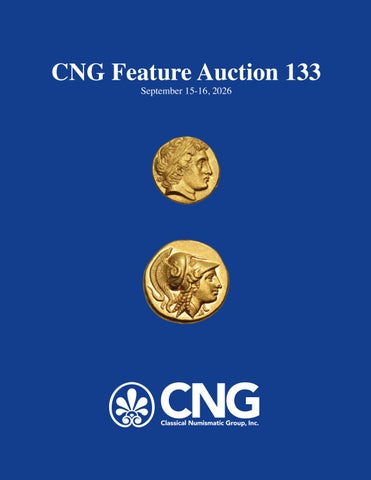
CNG Feature Auction 133 September 15-16, 2026
CNG Classical Numismatic Group, Inc.
CNG Feature Auction 133 September 15–16, 2026
To Be Conducted Live and Online at the CNG Lancaster Auction Center Featuring: Selections from the Colin E. Pitchfork Collection Greek Coins from and the Santa Monica Collection and Collection JLT Diverse Selection of Kyzikene Electrum Third Known Gold Oktadrachm of Antiochos, Son of Seleukos IV Extremely Rare Gold Stater of Menander I Soter Roman Republican, Imperatorial, and Imperial Coins from the Bem Jamin Collection Further Selections from the Dr. Thomas E. Beniak Collection of Alexandrian Coins Roman and Celtic British Coins from the Chris Bailey Collection An Offering from the Best Collection of Byzantine Coins World, U.S., and British Coins from the Laird U. Park, Jr. Collection Carlisle AR Three Shillings Siege Coin from the Cope and Archbishop Sharp Collections
CNG Classical Numismatic Group, Inc.
US Office
UK Office
PO Box 479 Lancaster, PA 17608-0479 Phone (717) 390.9194 • Fax (717) 390.9978
De Morgan House, 57-58 Russell Square London WC1B 4HS, UK Phone +44.20.7495.1888 Fax +44.20.7499.5916
California Office CNG Authorized Partner 4040 Macarthur Blvd., Suite 307 Newport Beach, CA 92660 Phone (949) 932.0500
EU Office Noordeinde 64a 2514GK, The Hague, NL Phone +31.851.301.541
EMAIL & WEBSITE cng@cngcoins.com • www.cngcoins.com Pennsylvania License Number AY002406
Grading Conditions English
Proof Mint State/Uncirculated Extremely Fine (EF) Very Fine (VF) Fine Good/Fair
Deutsch
Polierte Platte Stempelglanz Vorzüglich Sehr Schön Schön Gut
Common Abbreviations AD Æ AE AH AR AV BBS BC BCE
BE BI CE Cf. c/m CY EL FPL g
Anno Domini Bronze Actian Era Anno Hegirae Silver Gold Buy or Bid Sale Before Christ Before the Common Era
Français
Flan Bruni Fleur de Coin Superbe Très Beau Beau Bien
IY MBS mm PB p. pl. RPE RY SE
Bithynio-Pontic Era Billon Common Era Confer (compare) Countermark Civic Year (Era) Electrum Fixed Price List Gram
Italiano
Fondo Specchio Fior di Conio Splendido Bellissimo Molto Bello Bello
Indictional Year Mail Bid Sale Mintmark Lead Page Plate Roman Provincial Era Regnal Year Seleukid Era
See Bibliography on our website, www.cngcoins.com, for a complete list of reference abbreviations.
Bank Accounts Beneficiary: Classical Numismatic Group, Inc. US$ Account:
€ Account:
Northwest Bank 100 Liberty St., Warren PA 16365 Account Number: 7216021910 ABA Number: 243374218 BIC or SWIFT: NWBIUS33
£ Account:
HSBC Bank plc 60 Queen Victoria Street, London EC4N 4TR Account Number: 84309198 Sort code: 40 12 76 IBAN: GB82HBUK40127684309198
HSBC Bank plc 60 Queen Victoria Street, London EC4N 4TR Account Number: 71170910 Sort code: 40 11 60 IBAN: GB45HBUK40116071170910
BIC or SWIFT: HBUKGB4B BIC or SWIFT: HBUKGB4B
Classical Numismatic Group, Inc. is a United States limited company. Auction license number AY002406. United Kingdom Registration No. FC035702, Branch No. BR020787. All lots in this auction were in the possession of CNG in CNG’s Lancaster, Pennsylvania office no later than 20 July 2026. This information is provided for the protection of buyers in the event that US import restrictions are introduced subsequent to that date on any of the types of coins that are included in this auction.
Notice Regarding “Slabs”
Coins that have been encapsulated (“slabbed”) by a grading and/or authentication service may not be returned for any reason, including authenticity, if they have been removed from the encapsulation (“slab”).
Acknowledgement CNG would like to thank Jan Moens (jan.moens@bvdmc.com) for creating and providing the Numismatica Medievalis font used in this sale.
AUCTION TERMS
This is a public and Internet auction conducted by Classical Numismatic Group, Inc. (CNG). Bidding in the auction constitutes acceptance of the following terms:
1. The property listed in this catalogue is offered for sale by CNG for itself and as agent for various owners and other consignors. We reserve the right to reject any bid, to determine the opening price, to set bidding increments, to vary the order of the auction, to reopen bidding in the case of a dispute, to withdraw any lot, to bid on behalf of CNG, to bid on behalf of the consignor, to permit the auctioneer to bid on his own behalf, and to permit the consignor, where reserves have been agreed, to bid on his own lots. CNG may loan or advance money to consignors or prospective bidders, and may have an interest other than commission charges in any lot. CNG may bid on its own account as an “insider” with information not available to the public. 2. A buyer’s fee will be charged to all successful bidders as follows on the hammer price: A. 25% for written, fax, email, and telephone bids. B. 22.5% for floor bids placed in person at the auction and electronic bids placed directly on www.cngcoins.com. All written bids, email bids, nonlive telephone bids, live internet bid registrations, and live telephone bid registrations must be received before 5PM Eastern time on the day before the auction begins. CNG reserves the right to change the format of www. cngcoins.com at any time. 3. All coins are guaranteed genuine. Attribution, date, condition, and other descriptions are the opinion of the cataloguer, and no warranty is expressed or implied. Please note that an auction sale is not an approval sale. Grading is subjective and the opinion of the cataloger. The photographs and videos (when available) of each coin provide additional information for the bidder and supplement the written description found in the catalog. It is the responsibility of the bidder to view photographs and videos and draw their own conclusion as to the quality of the coin they are bidding on. CNG expressly makes no guarantee that our grade and coin descriptions will match those provided by others. No refund will be provided due to grade or “adjectival” comments by a third-party grading service if a coin is submitted for grading after the sale. Any claim of lack of authenticity must be made in writing by the original purchaser immediately after discovery that an item is not authentic, and upon making such a claim the original purchaser must immediately return the lot to CNG in the same condition as at the time of the auction. Any coin returned as “not authentic” which CNG feels is genuine will be submitted to the International Association of Professional Numismatists Authentication Bureau (IBSCC) for final decision of authenticity. No refund shall be made on such coins until the IBSCC makes their determination. This includes coins that have been submitted to a third-party grading service after the auction. Coins that have been previously encapsulated (“slabbed”) by a grading and/or authentication service may not be returned for any reason, including authenticity, if they have been removed from the encapsulation (“slab”). If payment is made by credit card, rights of return are governed by these Auction Terms which supersede any rights of return promulgated by the card issuer. Estimates are intended as a guide only and not as a statement of opinion of value. 4. Invoices are due and payable immediately upon receipt. Interest and late fees of 2.0% per month, or at the highest rate permitted by law, whichever is less, from the date of the auction, shall be payable on invoices not settled within 30 days of the auction date. Payment may be made by check or bank wire. Credit cards (Visa or MasterCard) will be accepted; credit card payments will not be accepted more than 14 days after the sale date. Payment by credit card for printed sale auctions will be charged a 2.5% handling fee. Payment by check must be made in either US dollars ($) drawn on a US bank or British sterling (£) drawn on a British bank. All successful bidders outside North America and the United Kingdom will be charged an additional $20 fee for bank charges that are the result of international wire transfer fees; this fee will be deducted for credit card or check payment as described above. CNG may reduce or compromise any charge or fee at its discretion. 5. Bidders not known to us must provide us with satisfactory credit references or pay a deposit as determined at CNG’s discretion before bidding. Minors are not permitted to bid without written consent of a parent guaranteeing payment. CNG may require payment in full from any bidder prior to delivery of lots. Title does not pass until lots are paid in full. Upon receipt of lots, the buyer assumes full responsibility for loss or damage. Delivery to the buyer’s address of record shall constitute receipt by the buyer regardless of the identity of the person accepting delivery.
6. Estimates are in U.S. dollars ($US) and bids must be in even dollar ($) amounts. CNG will execute mail bids on behalf of mail bidders. Subject to reserves and opening prices, mail bids will be executed at one bidding increment (approximately 10%) over the next highest bid. In the case of identical bids, the earliest bid wins. A mail bid has priority over an identical floor bid. Bid by lot number. No lots will be broken. Bidders are responsible for errors in bidding. Check your bid sheet carefully. 7. All lots are subject to reserve unless otherwise indicated. 8. Bidders personally guarantee payment for their successful bids, including bidders executing commission bids from other parties and bidders representing corporations or other entities. Buyers accepting commission bids from other parties do so at their own risk and remain responsible for payment under these Auction Terms. 9. At the conclusion of bidding for each lot, the sale contract is concluded and the successful bidder becomes liable for immediate payment under these Auction Terms. In the event a successful bidder fails to make full payment within 30 days of the auction date, CNG reserves the right either: (a) to require payment as provided under these Auction Terms; or (b) to deem the sale incomplete and to re-auction the material, in which case the successful bidder agrees to pay for the reasonable cost of such a sale and also to pay any shortfall between the re-auction price and the successful bidder’s purchase price. CNG reserves all rights that it is entitled to under the Pennsylvania Uniform Commercial Code, including the right to offset any sums due from a successful bidder against any future consignment or purchase or monies or goods in possession of CNG. 10. Sales tax, postage, handling and insurance are the responsibility of the buyer and are added to all invoices where appropriate. For buyers in the United Kingdom, CNG may import lots into the United Kingdom prior to shipment and charge buyers the import Value Added Tax. On any tax not paid by the purchaser which should have been paid, even if not invoiced by CNG, the purchaser agrees to pay the same on demand together with any interest or penalty that may be assessed. It is the responsibility of the buyer to comply with foreign customs and other regulations. 11. Prices realized are published after the sale and are mailed with CNG’s next publication. Prices realized are also posted after the sale on CNG’s web site: www.cngcoins.com 12. Bidders hereby waive any claim for incidental, consequential or exemplary damages arising from this auction. The sole remedy that any participant in the auction shall have for any claim or controversy arising out of the auction shall be a refund, without interest, of all or part of the purchase price paid by the participant. 13. All rights granted by CNG or otherwise available to bidders and purchasers, under these Auction Terms or otherwise, are personal and may not be assigned or transferred to any other person or entity, whether by operation of law or otherwise. No third party may rely on any benefit or right conferred by these Auction Terms. Bidders acting as agents must disclose the agency in writing to CNG prior to the auction; otherwise rights are limited to the agent and are not transferable to the undisclosed principal.
14. Any dispute regarding this auction shall be governed by the laws of Pennsylvania and shall be adjudicated only by the Lancaster County Court of Common Pleas or the U.S. District Court for the Eastern District of Pennsylvania; all bidders submit themselves to the personal jurisdiction of these courts for this purpose, consent to service of process by registered or certified mail, and waive any contrary provisions of Articles 14 or 15 of the French Civil Code and any similar provisions in any jurisdiction. All bidders consent to the confidentiality of consignors’ identities and waive any right to require disclosure of the name of the consignor or owner of any auction lot, whether such right is based on New York GOL §5-701(a) or any other provision in any jurisdiction. In any dispute regarding this auction, the prevailing party shall be entitled to recover its reasonable costs and attorney fees.
Meet the Team
Mike Gasvoda
Victor England
Eric McFadden
Neal Rongione
Paul Hill
Max Tursi
Steve Lloyd
Travis Markel
Lance Hickman
Bill Dalzell
Dave Michaels
Kan Liu (Vera)
Caroline Holmes
Julian Okun-Dubitsky
Katie Vint
Aleeza Brown
Marten Scherpenzeel Miles Thompson
Oliver Reece
Angelien Ponsioen
President
Director, EU
Manager Shows & Consignments
Numismatist Consignments
Consulting Director
Numismatist Islamic Specialist
Manager Consignments
Numismatist Consignments
Consulting Director
Vice President Operations
Numismatist Consignments
Numismatist Consignments
Chief Financial Officer
Vice President Sales
Numismatist Consignments
Numismatist Consignments British & World Coinage
Director, London
Vice President Numismatics
Numismatist Consignments
Numismatist Consignments
Meet the Team
Bradley R. Nelson
D. Scott VanHorn
Jeffrey B. Rill
Tom Mullally
Daniel Burch
Jared Goldfarb
Christian Ventura
David James III
Nate Penwell
Dylan Ossman
Siska Goldfarb
Katie Hunt
Kate Rill
Julia Motter
Jennifer Ventura
Senior Numismatist Cataloging
Librarian/Numismatist Cataloging
Administration & Shipping
Senior Numismatist Cataloging
Lead Photographer
Accounting
Numismatist Cataloging
Photographer
Customer Relations Manager
Numismatist Cataloging
Photographer
Shipping
Numismatist Cataloging
Office Manager, London
Shipping
Additional Support A.J. Gatlin IT Consultant
Tim Wilkes
Islamic Consultant
John W. Yurchak
Luisa Pichardo Shipping
Stephan Scott Office Clerk
Lynn Gasvoda Administrative Assistant 5
Printing Control
Jeffrey B. Rill
Auctioneer PA License No. AU006206
Brian Callahan
Auctioneer PA License No. AU005870
Participate in CNG 133 using CNG’s Bidding Portal
With the CNG Bidding Portal, you can: • Log on and bid at any time at auctions.cngcoins.com • View the lots, follow the bidding, and see hammer prices as they are sold • Hear and see the auctioneer live • Enjoy all the advantages of an auction room bidder to win your favorite lots To bid live in this Feature auction: • Visit our new Bidding Portal before the auction at auctions.cngcoins.com • Register online with your email address and a password • Once approved, you may place pre-bids up until the moment the lot opens in the auction room • On the auction day, login to join the auction and participate live Please Note • If you have not already registered for our bidding platform, you must create a new registration at auctions.cngcoins.com/register. Your old cngcoins.com handle and password will not allow you to log on or bid. • You must register to bid before 5PM EST on Monday, September 14, 2026 • All lots won through the CNG Bidding Portal will be subject to a 22.5% buyer’s fee
Download our APP now to browse and participate in our auctions! App Store
Follow us for more information!
YouTube
Google play
X
Lot Viewing Lancaster, PA
Auction lots may be viewed at our Lancaster Office from August 17 – September 14, 2026, by appointment only, except when they are on exhibition at the viewing below. Lancaster Office Hours: 10 AM - 5 PM (Monday - Friday).
Newport Beach, CA
Auction lots may be viewed at our California Office from September 2 – September 7, 2026, by appointment only.
Online Viewing Enlargements of all single lots and selected multiple lots may be viewed on the internet at
CNGCOINS.COM SIXBID.COM NumisBids.com We are sorry, but photographs of individual coins in multiple lots cannot be provided.
Auction Location This sale will be conducted live online from our Lancaster, PA Auction Center
Lot Pickup Lots will be mailed from our Lancaster, PA office subsequent to the sale
7
ORDER OF SALE Session One – Tuesday Morning – September 15 – 9:00 AM Celtic Coinage. . . . . . . . . . . . . . . . . . . . . . . . . . . . . . . . . . . . . . . . . . . . . . . . . . . . . . . . . . . . . . 1–7 Greek Coinage (Part 1). . . . . . . . . . . . . . . . . . . . . . . . . . . . . . . . . . . . . . . . . . . . . . . . . . . . . 8–308
Session Two – Tuesday Afternoon – September 15 – 2:00 PM Greek Coinage (Part 2). . . . . . . . . . . . . . . . . . . . . . . . . . . . . . . . . . . . . . . . . . . . . . . . . . . 309–406 Oriental Greek Coinage . . . . . . . . . . . . . . . . . . . . . . . . . . . . . . . . . . . . . . . . . . . . . . . . . . 407–431 Central Asian Coinage . . . . . . . . . . . . . . . . . . . . . . . . . . . . . . . . . . . . . . . . . . . . . . . . . . . 432–441 Roman Provincial Coinage. . . . . . . . . . . . . . . . . . . . . . . . . . . . . . . . . . . . . . . . . . . . . . . . 442–482 Roman Republican Coinage. . . . . . . . . . . . . . . . . . . . . . . . . . . . . . . . . . . . . . . . . . . . . . . 483–527 Roman Imperial Coinage (Part 1). . . . . . . . . . . . . . . . . . . . . . . . . . . . . . . . . . . . . . . . . . . 528–594
Session Three – Wednesday Morning – September 16 – 9:00 AM Roman Imperial Coinage (Part 2). . . . . . . . . . . . . . . . . . . . . . . . . . . . . . . . . . . . . . . . . . . 595–640 Byzantine Coinage . . . . . . . . . . . . . . . . . . . . . . . . . . . . . . . . . . . . . . . . . . . . . . . . . . . . . . 641–729 Early Medieval Coinage. . . . . . . . . . . . . . . . . . . . . . . . . . . . . . . . . . . . . . . . . . . . . . . . . . 730–739 Islamic Coinage . . . . . . . . . . . . . . . . . . . . . . . . . . . . . . . . . . . . . . . . . . . . . . . . . . . . . . . . . . . . 740 World Coinage . . . . . . . . . . . . . . . . . . . . . . . . . . . . . . . . . . . . . . . . . . . . . . . . . . . . . . . . . 741–781 World Medals. . . . . . . . . . . . . . . . . . . . . . . . . . . . . . . . . . . . . . . . . . . . . . . . . . . . . . . . . . 782–784 United States Coinage. . . . . . . . . . . . . . . . . . . . . . . . . . . . . . . . . . . . . . . . . . . . . . . . . . . . 785–817 United States Ingots . . . . . . . . . . . . . . . . . . . . . . . . . . . . . . . . . . . . . . . . . . . . . . . . . . . . . 818–819 Cryptocurrency. . . . . . . . . . . . . . . . . . . . . . . . . . . . . . . . . . . . . . . . . . . . . . . . . . . . . . . . . 820–821 British Coinage. . . . . . . . . . . . . . . . . . . . . . . . . . . . . . . . . . . . . . . . . . . . . . . . . . . . . . . . . 822–894 British Tokens. . . . . . . . . . . . . . . . . . . . . . . . . . . . . . . . . . . . . . . . . . . . . . . . . . . . . . . . . . . . . . 895 British Medals. . . . . . . . . . . . . . . . . . . . . . . . . . . . . . . . . . . . . . . . . . . . . . . . . . . . . . . . . . . . . . 896
8
Herbert L. Kreindler (1935-2026)
Herbert Lewis Kreindler, an internationally renowned numismatist, passed away on April 25, 2026 in Burlington, Vermont, after a short illness. He was 91 years old. Born in Manhattan in 1935, but raised in Liberty, in the Catskill region of New York State, Herb graduated from Carnegie Tech in 1957 with a degree in Engineering. Employed by the Grumman Aircraft Engineering Corporation and recently married he moved to Suffolk County on Long Island, New York where he continued to live with his wife and family until shortly before his death. However, in the early 1970s, he boldly changed careers having decided to become a full-time professional numismatist specializing in ancient coins. From 1974-1983 he joined in partnership with David Hendin as proprietors of Amphora Coins after which he established a highly successful solo practice that remained active until his retirement some two years ago. Though expert in the full range of classical ancient coinage, and in later years even extended his interest to include medieval bracteate coinage as well as Jewish medals, Herb was particularly interested in coins of the Holy Land. In 1976 he collaborated with David Hendin providing the valuations for Guide to Ancient Jewish Coins, which in subsequent editions became Guide to Biblical Coins. “Herb’s knowledge of the value of ancient coins in general, and especially of Biblical coins was unsurpassed,” Hendin said. Herb was a proud and confident individual, scrupulously honest, and trustworthy in his commercial dealings. He was also widely known as “the numismatic auctioneer” in the United States having been invited to call hundreds of auctions by several premier American auction houses. In December 1997 Herb served as the auctioneer for the premier auction for Classical Numismatic Group – Triton I. He continued to bid call all of our Triton auctions through Triton XXIII in January 2020. His stamina was remarkable. He could stand at a podium all day and call an auction, taking very few breaks. Herbert Kreindler is survived by his wife of 69 years, the former Barbara Baker, two sons and a daughter, seven grandchildren and three great-grandchildren. Besides family and his many friends, Herb will be greatly missed by appreciative numismatic colleagues and fellow-collectors world-wide. Classical Numismatic Group, Inc. joins the whole numismatic community in mourning Herb’s passing.
9
Chris Bailey, an Appreciation Chris attended Secondary school in Deal (East Kent) where he obtained an O Level in Ancient British History and Geography, presaging his lifelong interest in ancient coins. He went on to serve as a Medic in the Royal Army Medical Corps (RAMC), followed by a year in Libya, working as a Medic for Esso. He then went on to work for Shepway Council as an environmental health officer. Although his main interests lay within the fields of Iron Age and, particularly, Roman coins, Chris was an avid collector of a wide range of coins of all periods from ancient to medieval to modern. His collection has recently been painstakingly catalogued by David Holman, a leading numismatist in Kent. Sam Moorhead first met Chris around 1980 when he used to sell coins in the back of an antique shop in Sandgate. We spent many happy hours talking about coins and I learnt a great deal from him. Chris was also then an active member of the Kent Numismatic Society. There is no doubt that his favourite coins were those struck for the ‘British’ emperors, Carausius and Allectus. Not only did he acquire their pieces, but he also researched their coinage. In a short article in Spink’s Numismatic Circular (October 1981), Chris discussed various aspects of the coinage of Carausius. In direct contradiction to numerous scholars, many of them residing on the Continent, Chris suggested that the ‘Rouen’ coinage of Carausius dated to the beginning of his reign rather than later, as was commonly believed. His argument was taken up by John Casey and Andrew Burnett three years later in the British Numismatic Journal where they were able to use hoard evidence to show that Chris was correct. This early dating is now commonly accepted and Chris is given due credit in my recent edition of Roman Imperial Coinage for Carausius and Allectus. Chris also discussed the ‘C’ Mint, suggesting that C might stand for Classis (fleet) or Castrum (fort). His argument, like all those for identifying the ‘C’ Mint, has some problems but his suggestion of Classis did promulgate the concept of a moving mint, a possibility which is given serious consideration in RIC. His discussion of the ‘unmarked’ pieces of Carausius also gives food for thought about a highly complex group of coins. Chris is, therefore, one of several collectors who has made enormous contributions to our understanding of the coinage of Carausius and Allectus. If Chris’ contribution to the studies of Carausian coinage is significant, his collection of coins has proven to be equally important in the production of the new edition of Roman Imperial Coinage. I was kindly allowed to photograph several hundred pieces, many of which feature in the volume, some being the only specimen known. Because of the enormous number of varieties for the coinage of Carausius, every major collection will have unique or very rare specimens. Whilst photographing the coins, Chris was also able to impart a wealth of extra information about his coins, hoards and other finds. Amongst Chris’ collection was a small parcel of Tetrarchic nummi which David Holman realised were part of the famous Fyfield Hoard (Oxon), the major part which resides in the Ashmolean Museum at Oxford. Chris has very kindly donated these coins to the Ashmolean so they can be reunited with the rest of the coins. David Barwell, a local detectorist, first met Chris in 1985, having been introduced to him as “the” local coin expert! They became friends, and later Chris attended metal detecting rallies, carrying out coin identifications. As time progressed into the 1990s, David introduced Chris to the metal detecting club circuit where he was pleased to be involved and became a very respected and well-liked numismatist, especially when the recording of coins and artefacts gathered momentum with the advent of the Portable Antiquities Scheme (PAS). David writes: “The enjoyment for Chris, and myself, was being with our late summer detecting group for 10 days. Here, Chris would gaze at coins as they were found and recorded one by one. We would endure — and enjoy — the dry Chris Bailey humour and wit throughout the day and into the evening. Chris appears to many to be a very private person and is extremely modest, especially about his knowledge of coins. However, having spent many happy hours with him, I can say he is also a very sociable and likeable person. Listening to him as he identifies coins and talks about the Roman Emperors, anyone would think he knew them personally. I have even known Chris identify Roman coins over the telephone and then have the identification confirmed as accurate upon seeing the coin at a later date!” Chris is indeed an extremely kind, generous and modest person whose quiet demeanour conceals a razor-sharp mind. I hope that he will be able to appreciate the vital contribution his scholarship and collection have made to the understanding of the coinage of Carausius, and also his many days of coin identification which have contributed so much to our understanding of the past in Kent. Sam Moorhead, with contributions by David Barwell and David Holman.
10
Laird U. Park, Jr. Laird grew up in Germantown, PA in a home full of books and antiques. From a young age, he followed his mother, Irene Dearnley Park, to all the local antique shops. He later became passionate about maritime art, rare books, American and ancient gold coins, Colonial paper money, and objets de vertu. A quintessential curator of all his collections, Laird kept the receipts for everything he bought as well as detailed inventory lists and even letters from the respected dealers he patronized. He had a keen eye for beauty and quality in everything he acquired. Laird served in the US Navy during WWII, then graduated from Princeton University with a degree in Economics. In the late 1950s he purchased and was CEO of Troemner, Inc, originally a manufacturer of precision weights and balances, now located in Thorofare, NJ. He and his wife, Lucy Lynch, raised four daughters in Villanova, PA. They loved animals, their pets, and enjoyed travel, tennis and summers boating in Chatham, MA.
The Santa Monica Collection The Santa Monica Collector has a BS with a physics major from Iowa State University, and spent 44 years in the Aerospace Industry. The first 12 years were spent on core physics of nuclear reactors, intended for flight, mainly the Aircraft Nuclear Propulsion Program (ANP) and the Satellite Nuclear Auxiliary Program (SNAP) reactor, neither of which ever flew. He then transitioned to be a thermal analyst on the Command-Service Module of the Apollo Spacecraft, and was very much involved in that program. He then went to Rocketdyne, where he became the manager of the Space Shuttle Main Engine (SSME) aerothermodynamics analysis, and later manger of thermal analysis of the Space Station electric power supply. This is why a major portion of the net proceeds from the SM Collection will go to the Iowa State University Foundation for Physics Scholarships and faculty support. His coin collecting interests started young, with a collection of mostly modern world coins gifted from brothers who had served in the military during World War II. The only ancients purchased at that time were a Roman Republican and an Imperial denarius, purchased in December of 1945. He notably had a Roman Imperial coin before his friend Barry Rightman, and a Republican coin before Ken Freidman. These facts were brought up during many personal exchanges with these good friends! Whereas Barry Rightman’s focus was on very high grade and well-struck Roman Imperial coins with great eye appeal, the SM Collection was focused on Greek, mainly silver, with an emphasis on artistic and numismatic interest. As the SM Collector approached retirement, he renewed his interest in coins. Since he had precious metal as an inflation hedge, and had an interest in Greek mythology, particularly goddesses and nymphs, an interest in Greek numismatics naturally followed. Accordingly, he became active in the Ancient Coin Club of Los Angeles, where he met the aforementioned Mssrs. Rightman and Freidman. The first Greek coin he purchased from a Joel Malter auction in 1992 featured the patron nymph of Terina. Along these lines, he endeavored to become a numismatic scholar, and made presentations to the ACCLA. One presentation was titled “Why the Staters of Olympia Should Be Considered Among the most Varied and Artistic of the Greek Coin Series.” A second presentation was titled, “How the Staters of Corinth Reflect the Changes in Greek Art from Archaic to Classical and Hellenistic Periods.” Both presentations were fully illustrated with coins from the Santa Monica Collection. The Santa Monica Collector looks forward to a substantial portion of his proceeds benefitting the Iowa State University Foundation and his other favored charities, and to seeing a new generation of collectors enjoy the fruits of his 30-year pursuit.
11
Collection JLT The curator of Collection JLT is a retired physician. When he was ten years old, he found interesting US coins in change and started collecting foreign coins. Like many other collectors, he has always been more interested in coins related to historical topics. He got his first ancient coins at a show from David Michaels 30 years ago. Since that time, he has focused on ancient Greek coins with an interest in finding provenances not listed in recent auction descriptions, like some of the Magna Graecia coins in this sale. Since retirement, he has become president of a prominant ancient coin club and become more involved with numismatic research, having published three articles so far.
The Best Collection of Byzantine Coins The Best Byzantine Collection was assembled and curated by a dedicated collector in California’s Bay Area. The collector was born in Fullerton, California, and, after Catholic grade and high school, enrolled at Cal-State Fullerton, where he majored in Biology and minored in Political Science. After college he moved to the SF Bay Area where he took an entry level position as an air pollution testing technician with a testing laboratory. After about eight years he started his own consulting firm and soon thereafter created his own testing laboratory to provide emissions testing services for local industries to demonstrate compliance with EPA, state and local environmental regulations. In the year 2000, he was going through a box of old curios and saw something he had forgotten: As a boy he had, like so many others, filled his Whitman folders with pennies, nickels and dimes. When he was eleven and doing some yard work for an elderly neighbor, the man mentioned that he had been in Italy during WWII. Once, when he and his fellow soldiers were under artillery fire, they were startled when a shell burst went off nearby and, along with the dirt raining down on them, they were showered with coins! He offered three of them as partial payment for the yard work. It would be much later that he learned that they were rather common late Roman bronzes. The collector has always been interested in ancient history. Finding these coins from his childhood sparked an interest, and entering “ancient coins” on his computer led him to Harlan J. Berk. The rest, as they say, is history. He attended a numismatic bourse in SF where he met Frank Kovacs, Ed Waddell, Victor England, Dave Michaels and other major dealers. Over the next 20-25 years he assembled an extensive collection mainly of Roman coins, with an emphasis on dynastic and architectural types, Greek coins favoring those of Sicily and southern Italy, and Byzantine as opportunities arose. The collector is mainly retired now and spends his time reading, checking off his extensive travel bucket list or lounging around the beach at his condo in Los Cabos.
12
Session 1 – Tuesday, September 15, 2026 — 9 AM
CELTIC COINAGE
1
2
1. EASTERN EUROPE, Imitations of Philip II of Macedon. 2nd century BC. AR Tetradrachm (25mm, 12.59 g, 4h). ‘Kreuzelreiter’ (Cross rider) type. Mint in southern Serbia or Moldavia. Celticized laureate head of Zeus right / Celticized horseman right; c behind. OTA 108/1-3; Lanz 408; KMW 1067; CCCBM I 144-5. Lightly toned. Good VF. ($500) 2. EASTERN EUROPE, Imitations of Philip II of Macedon. 2nd century BC. AR Tetradrachm (24mm, 10.10 g, 7h). ‘Kreuzelreiter’ (Cross rider) type. Mint in southern Serbia or Moldavia. Celticized laureate head of Zeus right / Celticized horseman right; c behind. OTA 108/1-3; Lanz 408; KMW 1067; CCCBM I 144-5. Lightly toned. Good VF. ($500)
3. EASTERN EUROPE, Imitations of Philip II of Macedon. 3rd century BC. AR Tetradrachm (23mm, 13.05 g, 12h). ‘Baumreiter’ (Tree rider) type. Mint in the Carpathian region. Celticized head of Zeus right, S-like ornament in hair / Plumed horseman riding left, holding branch or scepter, annulet at point of plume, pellet below horse’s tail; animal before, triple leaf ornament below. OTA 129/2; Lanz 417; KMW 1083-1085c; CCCBM I 65-6. Toned, edge mark, a few faint scratches. Near EF. ($750)
Unusual ‘Vogelreiter’ Variety
4. EASTERN EUROPE, Imitations of Philip II of Macedon. 3rd century BC. AR Tetradrachm (25mm, 13.47 g, 4h). ‘Vogelreiter’ (Bird rider) type. Mint in the Carpathian region. Celticized laureate head of Zeus right / Celticized horseman right; to upper left, bird perched right on branch. OTA 340/2 var. (wreath orientation); Lanz 675 var. (same); KMW 1267-70 var. (same); CCCBM I –. Toned, scratch. Near EF. Very rare. ($1000) Though stylistically closer to the ‘Verkehrter Lorbeerkranz’ (inverted wreath) group, this unusual variety features a head of Zeus wearing a wreath with the normal, upright orientation.
13
5. EASTERN EUROPE, Imitations of Philip II of Macedon. Late 2nd-early 1st century BC. AR Tetradrachm (23mm, 12.59 g, 10h). ‘Lockenkopf’ (Curly head) type. Mint in western Hungary/middle Burgenland. Head of male (Apollo?) left / Rider, showing only his torso, on horse walking left; torque-like ground line below. OTA –; KMW –; Lanz –; CCCBM –; Flesche 531; Triton XXI, lot 549 (same dies). EF. Rare. ($2000) Ex Gorny & Mosch 185 (8 March 2010), lot 2. This type is clearly related to the Reiterstumpf/Kroisbach type by virtue of the close similarity of their reverse types, as well as the overall style and characteristics of their flans. The obverse type has a stylistic affinity with the left-facing male heads on the Apollokopf/Leierblume type, particularly in the details of the face and jaw line (cf. Göbl, OTA 396-398). Both the Reiterstumpf and Apollokopf types are attributed to the same general region and time frame, so a new type combining elements of both is not unexpected.
Attractive Vindelici Stater
6. CENTRAL EUROPE, Vindelici. Early 1st century BC. AV Stater (17mm, 7.62 g, 4h). Triskeles within wreath-like torc / Pyramid of eight annulets, five with pellets within, three with annulets; all within torque. Kellner Type IX A; cf. KMW 467-9 (for type in silver); Flesche 402. EF. ($7500) The Vindelici were a Celtic tribe living on the plains of modern-day upper Bavaria. They were conquered by the Romans during the reign of Augustus in 16-15 BC, after which Tiberius and Drusus founded the city of Augusta Vindelicum, known today Augsburg.
Very Rare Gallo-Belgic Import
7. GAUL, Northeast. Ambiani. 2nd century BC. AV Stater (25mm, 7.27 g, 10h). Celticized bust of Apollo left, wearing broad wreath and drapery with linear designs / Celticized Nike driving quadriga left; star and ornaments in field, rosette-like device and two pellets-in-annulets below; zig-zag pattern in exergue. Sills Gallo-Belgic Ab, Class 4a; D&T 67; Depeyrot, NC VI, 129; ABC 4; Van Arsdell 12-1; SCBC 2. Minor edge marks. VF. Well centered on a broad flan. Very rare Sills Class 4a variety. ($4000) Ex Nomos FPL (Winter-Spring 2010), no. 1.
14
GREEK COINAGE
8. ETRURIA, Populonia. 3rd century BC. AR 20 Asses (23mm, 8.49 g). Diademed facing head of Metus; oc/≈o (mark of value) below / Blank. EC Group XII, Series 55.33 (O26 – this coin, illustrated); HN Italy 152. Old cabinet tone. Good VF. ($1000) Ex Lanz 97 (22 May 2000), lot 79. Like the Romans, the Etruscans of northern and central Italy were latecomers to the Greek concept of coinage. The origins of the Etruscans are still regarded as enigmatic, and their language survives only in the form of relatively short inscriptions. When they did begin striking coins in the mid 4th century BC, many of the distinct and whimsical qualities of their culture came through. Only five Etruscan cities struck coins in any quantities, with Fufluna, called Populonia by the Romans, by far the most prolific.
Pedigreed to 1923
9. CAMPANIA, Neapolis. Circa 300 BC. AR Nomos (20.5mm, 7.49 g, 8h). Head of nymph right, hair in band; astragalos behind neck / Man-headed bull standing right, head facing; above, Nike flying right, crowning bull. Sambon 464; HN Italy 579. Lovely old cabinet tone. Good VF. ($1000) From Collection JLT, purchased from Edward J. Waddell, 9 August 1998. Ex Naville V (18 June 1923), lot 178. Neapolis, modern-day Naples, located in Southwestern Italy in the region of Campania on the Bay of Naples, an arm of the Tyrrhenian Sea, was founded from Cumae (Cuma) by the Greeks in 650 BC, including the little island of Megaris (the Castel dell’Ovo). Further colonists came from Chalkis in Euboea, from Pithecusae (Ischia) beside the Gulf of Cumae, and from Athens. An extension of the city was laid out in a rectangular grid pattern toward the northeast, which was given the name Neapolis. That city was conquered around 327/6 BC by the Roman general, Quintus Publilius Philo. After this, Neapolis became an ally of the Romans, issuing bronze coins, with legends in Greek. The city extended help during the hostilities against Pyrrhos of Epeiros (280-275 BC), and supported Rome against Hannibal during the Second Punic War (218-201 BC).
15
Ex Rockefeller University / Mirsky and Nitsch Collections – Pedigreed to 1939
10. CALABRIA, Tarentum. Circa 465-455 BC. AR Nomos (18.5mm, 7.80 g, 11h). Phalanthos, nude, holding wreath in extended hands, riding dolphin right; cockle shell below / Hippocamp right; crab below. Fischer-Bossert Group 7, 117p (V62/R79 – this coin); Vlasto 131 (same dies); HN Italy 827; SNG ANS 839 (same dies); SNG Ashmolean 209 = SNG Lockett 126 (same dies); SNG Copenhagen 777 (same dies); SNG Lloyd 119 = Bement 70 (same dies); McClean 537 = Warren 19 (same dies). Old cabinet tone, a few old cleaning marks, light scuff on edge. VF. ($1000) From the Santa Monica Collection, #162. Ex Rockefeller University / Dr. Alfred E. Mirsky Collection (Gemini VII, 9 January 2011), lot 16; Helbing 83 (19 August 1941), lot 21; Dr. Eugen Nitsch Collection (A. Hess 236, 3 April 1939), lot 56. The city of Tarentum was founded in the late 8th century BC by Spartan colonists on the north coast of the gulf of the same name, on a rocky islet at the entrance to the only secure harbor. It was Sparta’s only colony and maintained close relations with its mother city. The official founder of the city was believed to be the Spartan leader Phalanthos. Ancient tradition, however, tells how Taras, the son of Poseidon and a local nymph, Satyra, was miraculously saved from a shipwreck by his father, who sent a dolphin on whose back he was carried to shore, at which spot he founded a city. Blessed with fertile land, Tarentum became famous for olives and sheep. It possessed a fine harbor, great fisheries and profitable exports of wool, purple dye, and pottery. It adopted a democratic form of government circa 475 BC, and thereafter became the leading Greek city in southern Italy. Its success led to continual difficulties with its neighbor cities, though, and on four occasions Tarentum required expeditions from Greece to help overcome its aggressors. The last of these expeditions was led by the famed Epeirote, Pyrrhos. Following his withdrawal from the city, Tarentum was occupied by the Romans.
Ex Vlasto (†1936) Collection
11. CALABRIA, Tarentum. Circa 385-380 BC. AR Nomos (21mm, 7.88 g, 5h). Nude youth, holding rein and crowning horse he rides left; Å-r below / Phalanthos, nude, holding kantharos in extended hand, riding dolphin left; c above tail, W below. Fischer-Bossert Group 31c, 472a (V200’’/R354) = Vlasto 419 (this coin); HN Italy 875. Old collection tone, numerous light scratches, graffito (ΔAZIOΣ) in field on reverse. VF. ($500) From the Santa Monica Collection, #81. Ex Kirk Davis FPL 29 (Winter 2000), no. 3; Michel Pandely Vlasto (†1936) Collection.
Ex Vlasto (†1936) Collection
12. CALABRIA, Tarentum. Circa 344-340 BC. AR Nomos (21mm, 7.78 g, 1h). Warrior, nude but for crested helmet, holding shield, on horse galloping left; small d below / Phalanthos, nude, holding kantharos, riding dolphin left; below, E above dolphin left above waves. Fischer-Bossert Group 46, 647r (V251/R499) = Vlasto 387 (this coin); HN Italy 870; SNG ANS 904 (same dies); SNG BN 1748 (same dies); Nanteuil 92 (same dies). Old collection tone, overstruck on uncertain type, graffito on reverse, edge mark. Good VF. ($1000) From Collection JLT. Ex Classical Numismatic Group inventory 721405 (July 2000); Michel Pandely Vlasto (†1936) Collection.
16
Ex Moretti, Vlasto, and Luneau Collections – Pedigreed to 1922
13. CALABRIA, Tarentum. Circa 325/0-315 BC. AR Nomos (20mm, 7.46 g, 3h). Warrior, nude but for crested helmet, wearing shield on arm and holding spear, on horse prancing left; to left, Nike standing facing, restraining horse; below, M above kŬ above [W] / Phalanthos, nude but for drapery over arm, holding spear and trident, riding dolphin right; below, kŬ above waves. Fischer-Bossert Group 63, 793c (V310/R615) = Basel 92 = Vlasto 532 (this coin, illustrated in all); HN Italy 893. Deep old iridescent tone, some porosity, light scratches and marks under tone. VF. ($750) From the Santa Monica Collection, #68. Ex A. D. Moretti Collection (Numismatica Ars Classica 13, 8 October 1998), lot 92; Michel Pandely Vlasto (†1936) Collection; Victor Luneau Collection (Part 1, Platt, 27 March 1922), lot 74.
Ex Vlasto (†1936) Collection
14. CALABRIA, Tarentum. Circa 325-280 BC. AR Diobol (11.5mm, 1.08 g, 1h). Helmeted head of Athena right; d below / Herakles, nude, kneeling right, holding club overhead, struggling with the Nemean Lion to right. Vlasto 1338 (this coin); HN Italy 976. Old cabinet tone, hairline flan crack. Near EF. ($500) From Collection JLT. Ex Pegasi Auctions VI (8 April 2002), lot 72; Michel Pandely Vlasto (†1936) Collection.
15. CALABRIA, Tarentum. Circa 325-280 BC. AR Diobol (12mm, 0.97 g, 1h). Head of Herakles facing slightly left, wearing lion skin, club to left / Herakles, nude, standing facing, torso right, strangling the Nemean Lion to right; club to left, f between legs. Vlasto 1348 (same dies); HN Italy 977. Old collection tone with some iridescence. Good VF. ($500) From Collection JLT. Ex Asta del Titano 74 (27 September 1998), lot 18.
16. CALABRIA, Tarentum. Circa 302 BC. AR Nomos (21.5mm, 7.85 g, 12h). Nude youth, crowning himself and holding rein, on horse he rides right; below, sÅ above Ionic capital / Phalanthos, nude, holding serpent and whip, riding dolphin left; ˚o@ below. Fischer-Bossert Group 75, 970 (V377/R746); Vlasto 655; HN Italy 942; Côte 281 (same dies). Light iridescent tone over lustrous surfaces, some die wear. EF. Well centered. ($750) From the Santa Monica Collection, #171. Ex Goldberg 72 (5 February 2013), lot 4278.
17
Ex Vlasto (†1936) Collection – Pedigreed to 1905
17. CALABRIA, Tarentum. Campano-Tarentine series. Circa 281-272 BC. AR Nomos (20mm, 6.72 g, 5h). Diademed head of Satyra left / Nude youth, holding rein and crowning horse he rides right; tÅ to upper left; below, dolphin right above tripod. Vlasto 1025 (this coin); HN Italy 1098. Toned, area of smoothing on obverse. Good VF. ($500) From the Santa Monica Collection, #83. Ex Classical Numismatic Group 53 (15 March 2000), lot 46; Michel Pandely Vlasto (†1936) Collection; J. Hirsch XIV (27 November 1905), lot 71.
Pedigreed to 1930
18. CALABRIA, Tarentum. Campano-Tarentine series. Circa 281-272 BC. AR Nomos (19mm, 6.90 g, 7h). Diademed head of Satyra left / Nude youth, holding rein and crowning horse he rides right; star to upper left; below, dolphin left; tÅ below raised foreleg. Vlasto 1036–7; HN Italy 1098. Old collection tone, light marks under tone, edge marks. Good VF. ($500) Ex Ball FPL 39 (April 1937), no. 56; Grabow [6] (9 July 1930), lot 82.
19. CALABRIA, Tarentum. Circa 280-272 BC. AR Nomos (22mm, 6.42 g, 8h). Reduced standard. Nude youth on horseback left; to left, attendant standing right, crowning horse; PU to right, År5>st5 in two lines below / Phalanthos, nude, holding bow and arrow, riding dolphin right; below, d5 and elephant standing right. Vlasto 732–5 var. (obv. legend); HN Italy 1000 var. (same). Attractive iridescent tone, minor marks. Near EF. ($750) From the Santa Monica Collection, #19. Ex Malter 55 (7 November 1993), lot 21.
18
Ex Lockett and Côte Collections – Pedigreed to 1929
20. CALABRIA, Tarentum. Circa 280-272 BC. AR Nomos (19mm, 6.52 g, 12h). Reduced standard. Warrior, holding shield decorated with stellate pattern and two spears, on horse prancing left; zW to right; [Åπo¬]¬W below / Phalanthos, nude, holding grapes and distaff, riding dolphin left; to right, Å@Q and serpent coiled left. Vlasto 799 (same dies); HN Italy 1013; SNG Lockett 224 = Côte 415 (this coin). Old cabinet tone. Good VF. ($750) From the Santa Monica Collection, #82. Ex Cederlind 118 (17 February 2000), lot 1195; Richard Cyril Lockett Collection (Greek Part I, Glendining, 25 October 1955), lot 191 (part of); Claudius Côte Collection (R. Ratto, 28 January 1929), lot 415.
Ex Jameson and Evans Collections
21. CALABRIA, Tarentum. Circa 280-228 BC. AR Diobol (12mm, 1.03 g, 10h). Head of Athena facing slightly right, wearing triple-crested helmet decorated with Skylla / Herakles, nude, standing facing, torso right, strangling the Nemean Lion to right; to left, club above [amphora]; EUr between legs of Herakles. Vlasto 1438–9; HN Italy 1062; Jameson 121 (this coin). Deep iridescent tone. VF. ($500) From Collection JLT. Ex Pegasi Numismatics BBS 119 (30 May 2000), lot 37; Robert Jameson Collection (publ. 1913); Sir Arthur J. Evans Collection.
22. CALABRIA, Tarentum. Circa 272-240 BC. AR Nomos (19.5mm, 6.58 g, 3h). Nude youth, holding rein and crowning horse he rides right; ¬EW@ below / Phalanthos, nude, holding grape bunch and trident, riding dolphin left; å to right; below, lion advancing left. Vlasto 857–8; HN Italy 1030. Attractively toned, underlying luster. EF. Well centered strike and an early die state. ($500) From the Santa Monica Collection, #144. Ex Goldberg 36 (28 May 2006), lot 3478.
Ex Côte and Ashburnham (†1878) Collections
23. CALABRIA, Tarentum. Circa 240-228 BC. AR Nomos (20.5mm, 5.99 g, 2h). Reduced standard. Nude youth, holding rein and placing hand on mane, on horse leaping right; below, zW∏Ur5W@ and facing boukranion surmounted by %W / Phalanthos, nude, holding hippocamp and trident, riding dolphin left; to right, head of Silenos left above 2. Vlasto 941 (same dies); HN Italy 1054; Côte 555 (this coin). Old cabinet tone, some light scratches under tone, edge marks. Good VF. ($1500) Ex Vinchon (11 April 1988), lot 153; Claudius Côte Collection (R. Ratto, 28 January 1929), lot 555; Bertram Ashburnham, 4th Earl of Ashburnham (1797-1878) Collection (per Côte, not in 1895 Sotheby’s sale).
19
24. CALABRIA, Tarentum. Circa 240-228 BC. AR Nomos (18.5mm, 6.36 g, 9h). Reduced standard. Dioskouros, head facing, raising hand and holding rein, on horse stepping left; T and pileos to right; [$]E-@o˚rÅ>[t]-˙s in two lines below / Phalanthos, nude, head and torso facing, holding trident over shoulder and lifting drapery, riding dolphin left; to right, S above cuttlefish; waves below. Vlasto 955 (same dies); HN Italy 1058. Beautiful old cabinet tone. Near EF. ($750) Ex Numismatic Fine Arts IX (10 December 1980), lot 16.
25. CALABRIA, Tarentum. Circa 240-228 BC. AR Nomos (20mm, 6.45 g, 1h). Reduced standard. Dioskouros, head facing, wearing military attire, raising hand and holding rein, on horse stepping left; T and pileos to right; $E-@o˚rÅ>t˙s in two lines below / Phalanthos, nude, head and torso facing, holding trident over shoulder and lifting drapery, riding dolphin left; S to right; waves below. Vlasto 959–61; HN Italy 1058. Toned, underlying luster, with some iridescence. EF. ($750) From the Santa Monica Collection, #170. Ex Goldberg 67 (31 January 2012), lot 3097.
Unique Early Straight-Winged Griffin Issue
26. LUCANIA, Herakleia. Circa 390-340 BC. AR Nomos (19.5mm, 7.37 g, 1h). Head of Athena right, wearing Attic helmet decorated with griffin with straight wings right / Herakles, nude, standing facing, torso right, wrestling the Nemean Lion to right; [rE] and shell to left. Cf. Work 29 (Skylla on helmet); cf. Van Keuren 47 (same); cf. HN Italy 1376. Deeply toned, edge mark. Good VF. Unique. ($1000) From Collection JLT. Ex Goldberg 42 (24 September 2007), lot 13; Classical Numismatic Group 72 (14 June 2006), lot 82; A.D. Moretti Collection (Numismatica Ars Classica O, 13 May 2004), lot 1090. A griffin adorns Athena’s helmet on a variety of issues from the earlier series at Herakleia (cf. HN Italy 1366-1368), but is unknown on the later full-weight nomoi. This unpublished coin is not a hybrid struck with an earlier obverse die, as the earlier forms of the griffin have a distinctly curling wing, unlike here where the wing is straight. This straight-winged griffin appears regularly on the reduced-weight nomoi struck in the early-mid 3rd century BC.
20
27. LUCANIA, Herakleia. Circa 390-340 BC. AR Nomos (22.5mm, 7.77 g, 5h). Helmeted head of Athena right, helmet decorated with Skylla hurling a stone; d>˚>f to right / Herakles, nude, standing facing, torso right, wrestling the Nemean Lion to right; club and ˚Ŭ to left; between Herakles’ legs, owl standing right, head facing. Work 38 (same dies); Van Keuren 50; HN Italy 1377; SNG ANS 63 (same dies); McClean 824 (same dies); Ward 44 (same dies). Lightly toned. VF. Well centered and struck. ($1500) Ex J. Olphin Collection (Triton XIII, 5 January 2010), lot 18; Classical Numismatic Group 36 (5 December 1995), lot 1689; Numismatica Ars Classica 8 (3 April 1995), lot 49. Herakleia was founded relatively late compared to the other cities in the region. Diodorus gives the founding to 432 BC, by the Tarentines. Under the care of their mother city, the people of Herakleia quickly became wealthy and prosperous. The city became very involved with the affairs of Tarentum, often aiding the mother city in its frequent wars with the Massapians and Lucanians. We know that right around the striking of this coin, Tarentum became engaged in a major war with the Massapians. In fact, the Tarentines sent out for help, inviting the Spartan king Archidamos to their city to fight the Massapians. A few years after Archidamos was killed in battle, the Tarentines invited Alexander, king of Epeiros, to come and fight alongside them as well, and he was finally able to convince the Massapians to make peace.
28. LUCANIA, Herakleia. Circa 281-278 BC. AR Nomos (21.5mm, 6.41 g, 5h). Reduced standard. Head of Athena right, wearing crested Corinthian helmet [decorated with Skylla] throwing a stone; ŬE above, EU behind neck / Herakles standing left, hand set on grounded club to left, holding bow, lion skin draped over arm; to upper left, owl flying right, head facing. Van Keuren 105; HN Italy 1402. Old collection tone with some iridescence, a couple of light scratches on obverse. Good VF. ($500) From Collection JLT, purchased from Tom Cederlind, July 2000.
29. LUCANIA, Herakleia. Circa 281-278 BC. AR Drachm (16mm, 3.69 g, 1h). Helmeted head of Athena facing slightly right; ± below left crest / Owl standing right, head facing, on olive branch; [År5sto to left], ^Å to left of club. Van Keuren 118 (same dies as illustration); HN Italy 1415. Lightly toned, area of light roughness at edge on reverse. Good VF. ($500) From Collection JLT, purchased from Tom Cederlind, 1 April 2000.
21
30. LUCANIA, Metapontion. Circa 540-510 BC. AR Nomos (27mm, 7.87 g, 12h). Barley ear with eight grains / Incuse barley ear with eight grains. Noe Class VI, 75–6; HN Italy 1479. Thin flan crack. VF. ($750) From the Santa Monica Collection, #165. Ex Goldberg 63 (31 May 2011), lot 2416; Goldberg 55 (29 October 2009), lot 5. Metapontion was an Achaian colony of very early foundation, though the precise details of its origin are shrouded in uncertainty. Following the destruction of its first foundation by the Samnites, it was refounded as Metapontion, early in the 7th century BC by settlers under the leadership of Leukippos, who was thereafter revered as the city founder. The great prosperity of the city — attested by the extent of its archaic silver coinage commencing in the mid 6th century BC — was based on agriculture. Situated on the Gulf of Tarentum, Metapontion occupied a plain of extraordinary fertility watered by the rivers Bradanos and Kasuentos. Its standard coin type is an ear of barley, a tribute to the source of Metapontine wealth.
31. LUCANIA, Metapontion. Circa 430-400 BC. AR Nomos (22.5mm, 7.68 g, 1h). Wreathed head of Apollo Karneios right / Grain ear with leaf to left. Noe 337 (same dies); HN Italy 1508; SNG Fitzwilliam 478 (same dies); SNG Lockett 381 = Bement 169 (same dies); Jameson 272 (same dies); de Luynes 472 (same dies); Sartiges 33 = Warren 71 (same dies); Weber 748–9 (same dies). Toned, a few light scratches, traces of horn silver on obverse. VF. ($1500) From Collection JLT. Ex Colosseum Coin Exchange MBS 5 (29 February 2009), lot 23.
Pedigreed to 1913 – Referenced by Noe
32. LUCANIA, Metapontion. Circa 400-340 BC. AR Nomos (19mm, 7.59 g, 11h). Head of Demeter right, hair in topknot / Grain ear with leaf to left; palmette above leaf. Noe 480k (this coin); HN Italy 1540; SNG ANS 363 (same dies); SNG Lockett 399 (same dies); BMC 86 (same dies); de Luynes 491 (same dies); McClean 976 (same dies). Old cabinet tone with slight iridescence, small scuff on obverse, a little roughness on reverse. VF. ($750) From Collection JLT. Ex Rockefeller University / Dr. Alfred E. Mirsky Collection (Gemini VII, 9 January 2011), lot 34; Egger XLV (12 November 1913), lot 148 (possibly ex Telese Collection per Gemini sale).
22
Lovely Style
33. LUCANIA, Metapontion. Circa 400-340 BC. AR Nomos (19.5mm, 7.64 g, 9h). Head of female right, hair in ampyx and ornamented sphendone; @5˚Å to right / Grain ear with leaf to left; pomegranate above leaf. Noe 495 (same dies); HN Italy 1526; SNG ANS 373 (same dies); SNG Fitzwilliam 490 (same dies); SNG Lloyd 360–1 (same dies); BMC 141 (same dies); Basel 143 (same dies); de Luynes 489 (same dies). Old collection tone with slight iridescence, minor edge marks. VF. Lovely style. ($1000) From Collection JLT, purchased from Kirk Davis, 2001. Ex Kricheldorf XXVI (19 February 1973), lot 16.
34. LUCANIA, Metapontion. Circa 340-330 BC. AR Nomos (22mm, 7.69 g, 3h). Wreathed head of Demeter left / Barley ear with leaf to right; kerykeion and ¬U to left. Johnston Class A, 1.10 = Bement 184 (same rev. die); HN Italy 1556; Basel 154 (same rev. die). Toned, underlying luster, light scratch on obverse. Near EF. Excellent portait. ($750) From Collection JLT. Ex Classical Numismatic Group 103 (14 September 2016), lot 39.
Pedigreed to 1932
35. LUCANIA, Metapontion. Circa 340-330 BC. AR Nomos (20.5mm, 7.97 g, 8h). Helmeted head of Leukippos right; [to left, hound seated left]; s below / Barley ear with leaf to right; above leaf, dove flying right; ÅÂ below. Johnston Class B, 3.21 (same dies); HN Italy 1576; SNG München 983 (same dies). Old collection tone, a few scratches on reverse. Good VF. ($500) Ex Gallice Collection (E. Bourgey, 5 December 1932), lot 34.
36. LUCANIA, Metapontion. Circa 340-330 BC. AR Nomos (19mm, 7.90 g, 12h). Head of Leukippos right, wearing Corinthian helmet; ŵ5 to left / Ear of barley with eight grains and leaf to right; [thunderbolt above leaf]. Johnston Class B, 4.1 (same dies); HN Italy 1577. Iridescent tone. Near EF. Fine style portrait. ($750) Ex Triton XIV (4 January 2011), lot 7; Triton X (9 January 2007), lot 41; Classical Numismatic Group 46 (24 June 1998), lot 57.
23
37. LUCANIA, Poseidonia. Circa 530-500 BC. AR Half Nomos – Drachm (19mm, 3.50 g, 12h). Poseidon, beardless and nude but for chlamys draped over both arms, standing right, preparing to cast trident / Incuse of obverse type, but trident and ethnic are in relief. Gorini 11 var. (ethnic on obv.); HN Italy 1108; SNG ANS 619 (same obv. die). Toned. Near VF. ($1500) From Collection JLT. Ex Colosseum Coin Exchange MBS 5 (29 February 2009), lot 31; Coin Galleries (16 April 1997), lot 59. Poseidonia, later called Paestum, was a coastal city on the front instep of the Italian “boot.” Founded circa 600 BC by colonists expelled from nearby Sybaris, it took its name from a shrine to Poseidon they erected on the Tyrrhenian coast. The site today features three beautifully preserved Doric temples.
38. LUCANIA, Poseidonia. Circa 470-445 BC. AR Nomos (17.5mm, 8.06 g, 3h). Poseidon, nude but for chlamys draped over both arms, holding trident aloft, advancing right; no border / Bull standing right within incuse circle. HN Italy 1114; SNG ANS 646. Toned, with light iridescence. VF. ($1000) From Collection JLT. Ex Malter 72 (23 November 1997), lot 36; Classical Numismatic Group 43 (24 September 1997), lot 81.
Pedigreed to 1910
39. LUCANIA, Thourioi. Circa 443-400 BC. AR Nomos (20mm, 7.98 g, 12h). Helmeted head of Athena right, bowl decorated with laurel wreath; small x above visor / Bull butting left; in exergue, fish left. Jörgensen –; HN Italy 1767. Old cabinet tone, scratches and marks under tone including along edge. VF. ($750) From Collection JLT. Ex Classical Numismatic Group inventory 868741 (April 2010); Künker 168 (12 March 2010), lot 7093; Vinchon (11 April 1988), lot 196 (part of); Ars Classica XV (2 July 1930), lot 193; Dr. Paul Hartwig Collection (Santamaria [2], 7 March 1910), lot 286. In 446 BC, with the aid of Athens, the refugee population of the destroyed city of Sybaris returned to the location of their previous home, and founded a new city, giving it the name Thourioi. The new city quickly regained the prosperity enjoyed by its former incarnation, as evidenced by the extensive series of coins it issued over the following two centuries. Although its perennial rival had been Kroton, the new city grew close to its former enemy, and Tarentum as well. Good relations with the latter were probably responsible for the weakening of Thourioi’s historical connection to Athens, and she turned to Sparta during the Peloponnesian War. Although supported by Tarentum, the city suffered at the hands of the Lucanians and Brettians during the 4th century. In need of a more robust ally, the Thourians turned to Rome in 285 BC. Unlike many cities in southern Italy, Thourioi’s support of Rome was steadfast during both the time of Pyrrhos and Hannibal’s invasion, even though the Thourians suffered heavily at the hands of the latter. The coinage of Thourioi was diverse in both its denominations and metals. The primary types were the head of Athena, probably due to the city’s initial close relationship with Athens, and a standing or butting bull, which had been the civic type on the coins of Sybaris.
24
40. LUCANIA, Thourioi. Circa 350-300 BC. AR Nomos (21.5mm, 7.72 g, 12h). Helmeted head of Athena right, bowl decorated with Skylla throwing stone / Bull butting right; above, Nike flying right, crowning bull; s-5-Â between legs. HN Italy 1845; cf. SNG Copenhagen 1463 (same obv. die); CNG 87, lot 175 (same dies). Lightly toned, underlying luster. EF. Very rare. ($500) From the Santa Monica Collection, #88. Ex Dr. Jon Kardatzke Collection (Goldberg 5, 7 June 2000), lot 3040.
41. LUCANIA, Thourioi. Circa 280-213 BC. AR Nomos (21mm, 6.44 g, 10h). Reduced standard. Laureate head of Apollo right / Bull butting right; Ŭ above, tripod in exergue. HN Italy 1898; SNG ANS 1107 var. (letters on rev.); Weber 901. Lightly toned. Good VF. Well centered. ($500) From Collection JLT. Ex Classical Numismatic Group inventory 851455 (July 2009); J. Olphin Collection; Classical Numismatic Group 37 (20 March 1996), lot 73.
Ex Curtis, John Hopkins University, Garrett, and Bement Collections Pedigreed to 1923
42. LUCANIA, Velia. Circa 510-465 BC. AR Drachm (14mm, 3.82 g). Forepart of lion right, devouring leg of stag / Quadripartite incuse square. Williams Period I, Section 3, 36a (O25/R19) = Bement 239 (this coin, illustrated in both); HN Italy 1259. Toned, granular surfaces. Good VF. Well centered. ($1000) From Collection JLT. Ex Matthew Curtis Collection (Classical Numismatic Group 112, 11 September 2019), lot 53; Johns Hopkins University Collection [inv. 44.5.59] (Part III, Numismatic Fine Arts & Bank Leu, 29 March 1985), lot 15; John Work Garrett Collection [inv. 41]; Clarence S. Bement Collection (Naville VI, 28 January 1923), lot 239. Velia, situated on the Tyrrhenian coast of southern Italy south of Poseidonia, was founded circa 540 BC by colonists from Phokaia in western Asia Minor who had fled their homeland following the Persian conquest. Its coinage commenced soon after the city’s foundation and its types (forepart of lion devouring prey/incuse square) and denomination (Phokaian silver drachm) reflect the Asian origin of the early citizenry of Velia. Later, in the 5th century, the weight standard of the Velian coinage was assimilated to that of the Achaian cities of Magna Graecia producing a nomos of about 8 grams. The type of a lion, or a lion attacking its prey, remained popular at Velia throughout the two and a half centuries of its silver coinage, which ceased just prior to the city’s alliance with Rome negotiated circa 275 BC.
25
43. LUCANIA, Velia. Circa 340-334 BC. AR Nomos (22.5mm, 7.54 g, 7h). Theta Group. Head of Athena right, wearing crested Attic helmet decorated with griffin; Q behind neck / Lion standing right; f above, Q below. Williams Period V, 290 (O162/R224); HN Italy 1284; SNG Ashmolean 1222 (same dies); SNG Fitzwilliam 659 (same dies); BMC 51 (same dies). Lightly toned. Good VF. ($500) Ex Roma E-Sale 70 (7 May 2020), lot 245; Nomos 19 (17 November 2019), lot 39.
44. LUCANIA, Velia. Circa 334-300 BC. AR Nomos (21.5mm, 7.55 g, 12h). Kleudoros group. Helmeted head of Athena left; 4 behind neck / Lion standing left, head right, holding head of ram in its forepaws; 4 below. Williams Period VI, 378 (O190/R266); HN Italy 1297; SNG ANS 1317 (same dies); SNG Ashmolean 1242 (same dies); SNG Delepierre 415 (same dies); SNG München 861 (same dies); BMC 68 (same dies); Hunterian 15 (same dies); Jameson 394 (same dies); Winterthur 345 = Pozzi 252 (same dies). Old cabinet tone with light iridescence, edge marks. VF. ($1000) From Collection JLT, purchased from Nilus Coins, 13 December 2013. Ex Elvira Elisa Clain-Stefanelli (“Demarete”) Collection (Stack’s Bowers and Ponterio 172, 13 November 2012), lot 11528.
Ex Pitchfork and Hermitage Museum Collections – Pedigreed to 1935
45. LUCANIA, Velia. Circa 300-280 BC. AR Nomos (21mm, 7.46 g, 10h). Philistion Group. Head of Athena left, wearing crested Attic helmet decorated with a wing; [f below chin], ˚ behind neck guard / Lion standing left; above, triskeles between f and 5. Williams Period VII, 466c (O233/R329) = Hermitage Sale II 132 (this coin); HN Italy 1308. Deep iridescent tone. VF. ($500) From Collection JLT. Ex Colin E. Pitchfork Collection (Classical Numismatic Group 84, 5 May 2010), lot 88; Hermitage Museum Collection (Schlessinger 13, 4 February 1935), lot 132.
26
Recalling the Popular Siculo-Punic “Dido” Tetradrachm
46. LUCANIA, Velia. Circa 300-280 BC. AR Nomos (20.5mm, 7.36 g, 12h). Philistion group. Helmeted head of Athena right; π above visor, f below chin / Lion standing left, head facing; palm tree in background; above, f and 5 flanking palm tree. Williams Period VII, 490 (O244/R345); HN Italy 1310; SNG ANS 1383 (same dies); SNG Ashmolean 1357 (same dies); SNG Copenhagen 1576 (same dies); SNG Lockett 563 (same dies); Berlin 85 (same dies); Gulbenkian 114 (same dies); Jameson 399 (same dies); Winterthur 347 (same dies). Attractive old collection tone. VF. Rare. ($1000) From Collection JLT, purchased from Tom Cederlind, 3 April 2008. Ex Gorny & Mosch 114 (4 March 2002), lot 16. The reverse of this interesting nomos features a palm tree added in the background behind the lion, recalling the popular Siculo-Punic tetradrachm type with Dido(?) on the obverse and a lion and palm tree on the reverse. While it is not known precisely why this type appears here at Velia, it is tempting to interpret some connection or alliance with the Punic cities in Sicily.
47. LUCANIA, Velia. Circa 280 BC. AR Nomos (21mm, 7.46 g, 2h). Kerykeion-Thunderbolt Group. Helmeted head of Athena left, f on neck guard; 6 behind neck / Lion stalking right; above, kerykeion with fillet right. Williams Period VIII, 528 (O266+/R370); HN Italy 1316; SNG Ashmolean 1388 (same dies); SNG Copenhagen 1856 (same dies); SNG München 891 (same dies); Boston MFA 160 (same dies); Hermitage Sale II 135–6 (same dies). Deep old cabinet tone with light iridescence. Good VF. ($750) From Collection JLT. Ex Kirk Davis FPL 21 (Winter 1998), no. 14.
Ex Polese, Cajaniello, and Riche Collections – Pedigreed to 1923
48. LUCANIA, Velia. Circa 280 BC. AR Nomos (21.5mm, 7.48 g, 7h). IE Group. Helmeted head of Athena left; Å before crest, [f before neck], 5E within incuse square behind neck guard / Lion attacking stag left. Williams Period IX, 561j (O281/R394); HN Italy 1318; SNG Ashmolean 1394 (same dies); SNG Lockett 571 (same dies); Hunterian 18 (same dies). Old cabinet tone with some iridescence, edge gouge. Good VF. ($750) Ex Sotheby & Co. (7 May 1975), lot 24; Polese Collection (Canessa 5, 12 June 1928), lot 372; Cajaniello Collection (Sambon & Canessa, 27 June 1927), lot 452; Riche Collection (Part 1, R. Ratto, 25 January 1926), lot 617; Naville V (18 June 1923), lot 629.
27
49. LUCANIA, Velia. Circa 280 BC. AR Nomos (20mm, 7.23 g, 3h). IE Group. Helmeted head of Athena left; Å before crest, [f before neck], 5E within incuse square behind neck guard / Lion attacking stag left. Williams Period IX, 564 (O282/ R395); HN Italy 1318; Dewing 474 (same dies); Gulbenkian 117 (same dies); Nanteuil 194 (same dies). Old cabinet tone, a few minor marks under tone, edge marks and filing (likely to round coin for prior bezel). Good VF. ($750) From Collection JLT. Ex Classical Numismatic Group 43 (24 September 1997), lot 92.
50. BRUTTIUM, Kroton. Circa 500-480 BC. AR Nomos (23.5mm, 7.64 g, 3h). Tripod, legs surmounted by wreaths and terminating in lion’s feet, set on basis of two lines, the upper dotted / Incuse eagle flying right. Gorini 7; Attianese 14 (same dies as illustration); HN Italy 2095; BMC 33; McClean 1662 (same dies). Iridescent tone, some roughness, cleaning scratches and marks. Good VF. ($1000) Ex Artemide XLIII (6 June 2015), lot 81. As with many cities in Magna Graecia, Kroton was established by colonists from mainland Greece. Myskellos, obeying a directive of the oracle of Delphi, led a group of Achaian settlers to the site and founded the city around 710 BC. This divine sanction is represented by the tripod of the oracle, which became the civic badge of Kroton and is featured on its coinage. Kroton was among the first cities to produce coinage in Italy, its earliest being of the incuse type struck on the Achaian standard. As evidenced by its bountiful coinage, Kroton was one of the most important and wealthy cities of southern Italy. Although its fortunes rose and fell over the centuries, it maintained its production of a wide array of denominations and metals until the Roman period.
51. BRUTTIUM, Kroton. Circa 480-430 BC. AR Nomos (18mm, 7.92 g, 9h). Tripod, legs surmounted by wreaths and terminating in lion’s feet / Incuse eagle flying right. Gorini 27; Attianese 56 var. (eagle left); HN Italy 2108. Deep iridescent tone, some find patina, a few spots of light roughness. Good VF. ($500) From the Colin E. Pitchfork Collection. Ex Triton XIV (4 January 2011), lot 9.
28
Pedigreed to 1937
52. BRUTTIUM, Kroton. Circa 400-325 BC. AR Nomos (20mm, 7.46 g, 5h). Laureate head of Apollo right / The Herakliskos Drakonopnigon: the Infant Herakles, nude, crouching facing on rock, head left, strangling a serpent in each hand. Attianese 163; HN Italy 2157; SNG ANS 384; SNG Lloyd 618 (same obv. die); Bement 449 (same dies); Gillet 301 (same obv. die); Gulbenkian 133 (same obv. die); Kraay & Hirmer 271. Toned, a few marks. VF. ($2000) From Collection JLT. Ex Robert Schonwalter Collection (Triton V, 15 January 2002), lot 1134; G. Hirsch 16 (16 April 1958), lot 45; Münzhandlung Basel 8 (22 March 1937), lot 88. The figure of Herakliskos Drakonopnigon was depicted in Greek art from the first half of the 5th century BC and represents an important event in the early life of the Greek hero. The birth of Herakles, son of Zeus and Alkmene, enraged Zeus’ wife Hera, who tried to kill the infant by sending two serpents to strangle the sleeping baby in his crib. The following morning, the nurse discovered Herakles playing with the serpents’ lifeless bodies: he had strangled one in each hand.
Ex Ward Collection – Published in 1901
53. BRUTTIUM, Kroton. Circa 400-325 BC. AR Nomos (23mm, 7.32 g, 7h). Laureate head of Apollo right / Tripod with high neck surmounted by wreaths and legs terminating in lion’s feet; filleted laurel branch to left. Attianese 143; HN Italy 2177; Ward 112 (this coin). Light iridescent tone. Good VF. ($1000) From Collection JLT. Ex Metropolitan Museum of Art Collection (Part II, Sotheby’s Zurich, 4 April 1973), lot 86; John Ward Collection (publ. 1901).
54. BRUTTIUM, Kroton. Circa 350-300 BC. AR Nomos (22.5mm, 7.76 g, 6h). Eagle, with wings displayed and head raised, standing left on olive branch / Tripod with high neck surmounted by wreaths and legs terminating in lion’s feet; d to right. HN Italy 2172; SNG ANS 364. Lightly toned, underlying luster, a couple of marks on reverse. Good VF. ($500) From the Santa Monica Collection, #139. Ex Gemini I (11 January 2005), lot 19; Superior (9 December 1989), lot 2373.
29
Ex Philipsen Collection – Pedigreed to 1906
55. BRUTTIUM, Lokroi Epizephyrioi. Circa 344-318 BC. AR Stater (21.5mm, 8.58 g, 11h). Pegasos flying left; kerykeion below / Helmeted head of Athena left. Spinelli Period I, Group I, 1b, 16 (same dies); Pegasi 12 (same dies); HN Italy 2342. Iridescent tone, some marks. Near EF. Well centered. ($1000) Ex Triton IV (5 December 2000), lot 74; Gustav Philipsen Collection (J. Hirsch XXV, 29 November 1909), lot 1130; Egger XVIII (10 December 1906), lot 343.
56. BRUTTIUM, Lokroi Epizephyrioi. Circa 344-318 BC. AR Nomos (22.5mm, 8.89 g, 5h). Pegasos flying left; thunderbolt below / Helmeted head of Athena left. Spinelli Period I, Group I, 1b, 44 = SNG Ashmolean 1551 (same dies); Pegasi 13; HN Italy 2342. Lightly toned, hairlines. Near EF. ($750) From Collection JLT, purchased from Tom Cederlind, July 2008. Ex Lanz 125 (28 November 2005), lot 69; Kurpfälzische Münzhandlung 41 (12 December 1991), lot 43.
57. BRUTTIUM, Lokroi Epizephyrioi. Circa 344-318 BC. AR Nomos (21.5mm, 8.66 g, 11h). Pegasos flying left / Helmeted head of Athena right. Spinelli Period I, Group I, 1b, 68 = SNG ANS 504 (same dies); Pegasi 6 (same dies); HN Italy 2342. Attractive light toning with underlying luster around the devices, a few light cleaning marks. Good VF. Rare issue with both wings displayed. ($750) From Collection JLT. Ex Leu Numismatik AG Web Auction 31 (7 September 2024), lot 227.
58. BRUTTIUM, Lokroi Epizephyrioi. Circa 317-279 BC. AR Nomos (21.5mm, 7.60 g, 11h). Laureate head of Zeus right / Eagle, wings spread, standing left on, and tearing at, upturned dead hare. Spinelli Period II, Group V, 9.85; HN Italy 2323. Deeply toned, with some iridescence, edge bump. Good VF. ($1000) From Collection JLT. Ex Berk BBS 184 (7 May 2013), lot 45, purchased by the consignor from St. Louis Stamp & Coin Co., 1950s.
30
59. BRUTTIUM, Lokroi Epizephyrioi. Circa 317-279 BC. AR Nomos (20mm, 7.64 g, 8h). Eagle, wings spread, standing left on, and tearing at, upturned dead hare / Thunderbolt; kerykeion below. Spinelli Period II, Group V, 10a, 8 (same dies); HN Italy 2313. Deep iridescent tone, earthen deposits, light graffiti on reverse. VF. ($500) From Collection JLT. Ex Gorny & Mosch 245 (7 March 2017), lot 1076.
60. BRUTTIUM, Lokroi Epizephyrioi. Circa 317-279 BC. AR Nomos (20.5mm, 6.59 g, 9h). Eagle, wings spread, standing left on, and tearing at, upturned dead hare / Thunderbolt. Spinelli Period II, Group V, 10a, 8 (same dies); HN Italy 2317. Deeply toned, a few light scuffs on obverse. VF. Rare. ($500) From Collection JLT. Ex Künker 318 (11 March 2019), lot 519; G. Hirsch 183 (20 September 1994), lot 93.
61. BRUTTIUM, Lokroi Epizephyrioi. Circa 317-279 BC. AR Dilitron or Triobol (12mm, 1.05 g, 6h). Eagle standing left, head right, wings spread; kerykeion to left / Thunderbolt. Spinelli Period II, Group V, 11, 4–6 (same rev. die [dilitron]); HN Italy 2330 (triobol). Toned. Near EF. Well centered and struck. Rare. ($500) From Collection JLT. Ex Savoca 16 (25 June 2017), lot 19.
62. BRUTTIUM, Rhegion. Circa 415/0-387 BC. AR Drachm (15.5mm, 3.84 g, 2h). Facing head of lion / Laureate head of Apollo right; ivy leaf behind neck. Herzfelder 114 (D70/R96); HN Italy 2497; SNG ANS 667 (same dies); BMC 29 (same dies). Toned, minor marks. VF. Very rare issue with ivy leaf rather than olive spray. ($500) From Collection JLT. Ex Pegasi Numismatics BBS 112 (15 March 1999), lot 42. Rhegion (modern Reggio Calabria), a Chalkidian colony established in the eighth century BC, was among the earliest Greek settlements in southern Italy. Situated on a harbor at the mouth of the river Apsias at the tip of Italy along the Sicilian Strait opposite Zankle (Messana), the city was perfectly located to facilitate trade with the Greek cities in Sicily. Very little is known of its early history. The poet Ibykos was born there in the sixth century BC, and the city was ruled by an oligarchy until 494 BC, when Anaxilas became tyrant. During his rule, Rhegion seized Zankle from the Samians in 488 BC, renaming it Messana. Rhegion also sided with the Carthaginians in their war against Syracuse circa 480 BC. After the death of Anaxilas, control of Rhegion passed to his sons, until they were ousted from the city in 461 BC. In 433 BC, the city allied with Athens, providing the latter with a base in 427 BC, but it did not assist Athens during the disastrous Sicilian Expedition in 415 BC. Regardless, Rhegion pursued an anti-Syracusan policy thereafter, resulting in the sacking of the city by the Syracusan tyrant Dionysios I in 387 BC. In 358 BC, Rhegion was rebuilt under the name Phoibeia, and later supported Timoleon during his successful bid to wrest control of Syracuse from Dionysios II and Hiketas. Rhegion first came into the Roman sphere of influence in 280 BC, when the Rhegians asked for a Roman garrison to help resist Pyrrhos’ attempts to take the city. Rhegion became a civitas foederata of Rome in 270 BC, and was a steadfast ally of Rome during the Second Punic War. In 90/89 BC, the city finally became a Roman municipium.
31
Pedigreed to 1926
63. BRUTTIUM, Terina. Circa 440-425 BC. AR Nomos (21mm, 7.64 g, 8h). Head of the nymph Terina left, wearing ampyx, within laurel wreath / Nike seated left on amphora, holding wreath and kerykeion. Regling, Terina 7 (dies F/ζ); Holloway & Jenkins 12; HN Italy 2575. Beautiful old cabinet tone with slight iridescence, light marks under tone. Good VF. ($2000) From Collection JLT. Ex Goldberg 91 (7 June 2016), lot 1713; Riche Collection (Part 1, R. Ratto, 25 January 1926), lot 808. The high artistry evident on Terina’s coinage seems out of all proportion to any historical accounts for this city atop the “toe” of Italy, which so thoroughly disappeared from record that no systematic excavations were undertaken on its site until 1997. Its coinage has been known and collected since the Renaissance, where the delicate beauty of its female heads and the graceful seated Nikes were greatly admired. As author R. R. Holloway noted, “the nymphs of Terina recalled the maidens of the Parthenon frieze and the Victories of the reverses were the numismatic counterparts of the Victories of the Nike Temple balustrade.”
64. SICILY, Akragas. Circa 485-480/78 BC. AR Didrachm (20mm, 8.81 g, 6h). Sea eagle standing left / Crab within incuse circle. Westermark, Coinage, Period I, Group III, 205 (O75/R131); Jenkins, Gela, Group III; HGC 2, 94; SNG ANS 944 (same dies); SNG Ashmolean 1658 (same dies). Toned, with some iridescence and underlying luster, patches of find patina, cleaning scratches. Near EF. Excellent depiction of a crab. ($1000) Ex Artemide XLII (12 December 2014), lot 43. Akragas, Roman Agrigentum, was situated close to the southern coastline of Sicily midway between Gela and Selinos. Founded by colonists from Gela circa 580 BC, Akragas grew to become the second most important city on the island after Syracuse, deriving much of its wealth from the export of agricultural produce to Carthage, which lay about 200 miles to the west. Its coinage commenced in the closing years of the 6th century and principally consisted of silver didrachms down to about 440 BC, after which the tetradrachm became the principal denomination. The first series of tetradrachms, though, coincided with the last period of didrachms, with all featuring the same types that had persisted since the beginning of the city’s coinage: on the obverse, an eagle, sacred to Olympian Zeus, to whom the city dedicated an immense temple, and a reverse with an overhead view of a crab, harvested from the sea as a delicacy in the region. After 440 BC, as with many of the coinages of the great Sicilian cities, the designs became more complex and artistic, with one or two eagles shown devouring a hare on the obverse, and a galloping quadriga ultimately replacing the crab on the reverse. In the final decade of the 5th century, as the artistry of it coinage reached its zenith, Akragas suffered the same fate as many of the other Greek cities of Sicily when it was stormed and sacked by the invading Carthaginians (406 BC). Though its coinage continued thereafter, the scale and beauty of its 5th century series were never attained again.
65. SICILY, Gela. Circa 490/85-480/75 BC. AR Didrachm (19.5mm, 8.71 g, 10h). Horseman riding right, preparing to cast javelin / Forepart of man-headed bull right within circular incuse. Jenkins, Gela, Group Ic, 69 (O21/R32); HGC 2, 363; SNG Copenhagen 256 (same dies); SNG München 261 (same dies). Attractive old cabinet tone, some cleaning scratches. VF. ($1000) Ex Kirk Davis FPL 61 (Summer 2012), no. 8; Gorny & Mosch 164 (17 March 2008), lot 49. Situated on the Gela river on the southern coast of Sicily, Gela was founded in 688 BC by Cretans and Rhodians. Although the city had a Creto-Rhodian foundation, the name of the river is of local Sikanian origin, meaning very cold, as the water runs from the Heraei mountains to the north.
32
Ex Seltman & Cajaniello Collections – Pedigreed to 1927
66. SICILY, Gela. Circa 480/75-475/70 BC. AR Tetradrachm (22.5mm, 17.25 g, 3h). Charioteer, holding kentron and reins, driving slow quadriga right; above, Nike flying right, crowning horses / Forepart of man-headed bull right. Jenkins, Gela, Group IIa, 115.7 (O34/R68 – this coin, rev. enlarged on pl. 53); HGC 2, 338. Old cabinet tone, minor spots of roughness on reverse. VF. ($1000) From the Santa Monica Collection, #41. Ex Classical Numismatic Group 36 (5 December 1995), lot 1752; J. Seltman Collection; L. Hamburger 98 (3 April 1933), lot 181; Cahn 71 (14 October 1931), lot 140; Cajaniello Collection (Sambon & Canessa, 27 June 1927), lot 741.
67. SICILY, Gela. Circa 480/75-475/70 BC. AR Tetradrachm (23mm, 17.15 g, 1h). Charioteer, holding kentron and reins, driving slow biga right; above, Nike flying right, crowning horses / Forepart of man-headed bull right. Jenkins, Gela, Group IId, 161 (O44/R97); HGC 2, 338; SNG Copenhagen 254 (same dies). Toned, some porosity. VF. ($1000) From Collection JLT. Ex Classical Numismatic Group 51 (15 September 1999), lot 138.
Ex Bauer Collection – Pedigreed to 1960
68. SICILY, Gela. Circa 430-425 BC. AR Tetradrachm (24mm, 17.50 g, 1h). Charioteer, holding kentron and reins, driving slow quadriga right; [above, Nike flying right, crowning horses] / Forepart of bearded man-headed bull right; below, swan left. Jenkins, Gela, Group VI, 398 (O82/R167); HGC 2, 347; SNG ANS 81 (same dies); SNG Ashmolean 1737 (same dies); BMC 44 (same dies). Toned, some find patina. VF. ($750) Ex George J. Bauer Collection (Numismatic Fine Arts [E. Gans] 16, 19 April 1960), lot 133.
33
Ex American Numismatic Society Collection
69. SICILY, Himera. Circa 483/2-472/1 BC. AR Didrachm (19.5mm, 7.88 g, 8h). Cock standing left / Crab within shallow incuse circle. Westermark, Himera, Group II, 67 (O11/R57); HGC 2, 438; SNG Fabricius 202 (same dies). Toned, a couple of scratches and delaminations on reverse. VF. ($750) From Collection JLT, purchased from Jencek Historical Enterprises, March 2011. Ex Duplicates from the American Numismatic Society Collection (Gemini VII, 9 January 2011), lot 1105 (part of, since professionally conserved); ANS inventory 1984.65.28 (weight listed with thick horn silver deposits). Founded circa 649 BC by settlers from Zankle, Himera was the only Greek colony on the north coast of the island. On evidence of its late 6th century coinage it would appear to have enjoyed a high degree of prosperity at this time, despite the relative isolation of its position. As at the other two Chalkidian colonies (Naxos and Zankle), the standard denomination of Himera’s archaic coinage was the drachm of about 5.73 grams, being one-third of the Euboeic stater of 17.2 grams. It is generally assumed that the cock was the civic ‘badge’ of Himera, having been adopted in honor of the Euboian city of Karystos, perhaps the original home of many of the first colonists. In 483 BC, Himera was captured by Theron, tyrant of Akragas, and thereafter the crab of Akragas appeared as the reverse type on the coinage of Himera.
Ex Hardy & Rosen Collections
70. SICILY, Leontini. Circa 476-466 BC. AR Didrachm (20.5mm, 8.21 g, 11h). Nude horseman riding right / Head of roaring lion right; four barley grains around. Boehringer, Münzgeschichte 12 (same dies); HGC 2, 679; SNG ANS 210 (same rev. die); Rizzo pl. XXII, 20 (same dies); Rosen 59 (this coin). Toned, light porosity. Near VF. ($750) From the Santa Monica Collection, #142. Ex Tony Hardy Collection (Classical Numismatic Group 69, 8 June 2005), lot 88; Auctiones AG 26 (16 September 1996), lot 50; Jonathan P. Rosen Collection (Münzen und Medaillen AG 72, 6 October 1987), lot 453. Leontini was founded in 729 BC by settlers from Naxos, the first Greek colony in Sicily, which itself had been established just a few years earlier. In the first decade of the 5th century the city was captured by the tyrant Hippocrates of Gela whose successor, Gelon, transferred his seat of government to Syracuse in 485. Thereafter, Leontini usually remained within the Syracusan sphere of influence, though its 5th century coinage was on a considerable scale attesting to the independent wealth of the community.
Ex Proschowsky Collection – Pedigreed to 1953
71. SICILY, Leontini. Circa 455-425 BC. AR Tetradrachm (25mm, 16.92 g, 2h). Laureate head of Apollo right / Head of roaring lion right; four barley grains around. Maltese Period III, 111g (D29/R84 – this coin); HGC 2, 667; Gillet 447 (same dies); Ognina 106 (same dies); Weber 1382 (same dies). Toned, some marks. VF. ($1000) From Collection JLT, purchased from Apollo Numismatics. Ex Paul M. Proschowsky Collection (Bruun Rasmussuen 245, 10 March 1970), lot 384; Glendining (25 November 1953), lot 42.
34
72. SICILY, Leontini. Circa 425-415 BC. AR Tetradrachm (25mm, 17.24 g, 3h). Laureate head of Apollo left / Head of roaring lion left; three barley grains and leaf around. Maltese Period IV, 139b (D34/R107 – this coin); Boehringer, Münzgeschichte 55 (same obv. die); HGC 2, 671; SNG ANS 256 (same dies); SNG Lloyd 1063 (same dies). Lightly toned, scratch on obverse. VF. ($750) From the Santa Monica Collection, #132. Ex Freeman & Sear MBS 10 (11 February 2004), lot 55.
Ex Proschowsky Collection (1970)
73. SICILY, Messana. 425-421 BC. AR Tetradrachm (26mm, 17.06 g, 7h). Charioteer, holding kentron and reins, driving slow biga of mules right; above, Nike flying right crowning mules; olive leaf and berry in exergue / Hare springing right; below, dolphin right. Caltabiano Series XIII, 494 (D201/R202); HGC 2, 787; SNG Lloyd 1094 (same dies); Hermitage Sale II 294 (same dies). Old cabinet tone, edge marks. VF. ($2000) From Collection JLT, purchased from John Gomer, 14 May 1999. Ex Paul M. Proschowsky Collection (Bruun Rasmussen 245, 10 March 1970), lot 389. In 493 BC, the city of Zankle invited a group of Samian refugees to settle in the region following Samos’ fall to the Persians. The Samians, at the behest of Anaxilas of Rhegion, chose instead to seize Zankle itself. After doing so, the Samians betrayed Anaxilas and allied themselves with Hippokrates of Gela. Anaxilas managed to suppress the Samians around 488 BC, seized Zankle, and resettled it with colonists from Peloponnesian Messenia. In honor of their loyalty, Anaxilas renamed the city Messana, after their homeland. The standard coinage of Messana, as at Rhegion during Anaxilas’ reign, carried a biga of mules on the obverse and a hare on the reverse. The biga scene refers to the victory of Anaxilas’ mule cart at the Olympic games of 480 BC. The origin of the hare type is less certain, although it is thought that Anaxilas introduced the animal to Sicily. Though the types at Rhegion changed following Anaxilas’ death, the types at Messana continued to be used on all precious metal coinage for the remainder of the Classical period.
74. SICILY, Segesta. Circa 475/0-455/0 BC. AR Didrachm (20.5mm, 8.17 g, 1h). Hound standing right, on the scent / Head of Aigiste right. Hurter, Didrachmenprägung, Period I, Series 3, 50 (V15/R28); HGC 2, 1113. Lightly toned. Near VF. ($500) From Collection JLT. Ex David Wray Collection (Classical Numismatic Group Electronic Auction 374, 11 May 2016), lot 127. Segesta was the principal city of the Elymi in north-west Sicily. The Segestans wrote their Elymian language in Greek characters, as witnessed by their coins. They developed a traditional hostility with Selinos, in the pursuit of which they allied themselves with Athens in 418/7 BC (Thuc. 6. 6-8 and 46). In 409 BC, Segesta passed into the Carthaginian sphere of influence in another attempt to combat the encroachments of Selinos. Carthage captured and sacked Selinos in that same year.
35
75. SICILY, Selinos. Circa 540-515 BC. AR Didrachm (20mm, 8.59 g). Selinon leaf; pellets to upper [left] and right, and flanking stem / Incuse square divided into ten sections. Arnold-Biucchi Group I; Selinus Hoard 15 (same dies); HGC 2, 1209. Toned. Near EF. ($750) From Collection JLT. Ex Classical Numismatic Group 49 (17 March 1999), lot 122. Situated on the southwest coast of Sicily at the mouth of the Selinunte River, Selinos was founded by Dorian colonists from Megara Hyblaia, a town on the eastern coast of the island. Selinos is believed to be the first city on Sicily to strike coins, introducing its didrachms circa 540 BC, less than a decade after Aegina had introduced the concept of coinage to Europe. Based on the Corinthian weight standard, the initial coinage of Selinos regularly featured a tri-lobed wild parsley leaf, since the ancient Greek name for this, selinos, provided an allusive pun on the town’s name.
76. SICILY, Syracuse. Hieron I. 478-466 BC. AR Tetradrachm (25.5mm, 17.15 g, 6h). Struck circa 478-475 BC. Charioteer, holding kentron and reins, driving slow quadriga right; above, Nike flying right, crowning horses with wreath / Head of Arethousa right, wearing pearl tainia; four dolphins around. Boehringer Series VIIIb, 143–4 var. (V64/R98); HGC 2, 1306; Randazzo 303–9 (same obv. die). Toned. Near EF. ($1500)
Pedigreed to 1912
77. SICILY, Syracuse. Hieron I. 478-466 BC. AR Tetradrachm (25mm, 17.02 g, 4h). Struck circa 478-475 BC. Charioteer, holding kentron and reins, driving slow quadriga right; above, Nike flying right, crowning horses / Head of Arethousa right, wearing pearl tainia; four dolphins around. Boehringer Series VIIIb, 145–9 var. (V65/R– [unlisted rev. die]); HGC 2, 1306. Old collection tone. Good VF. ($1000) Ex. J. M. Heberle (H. Lempertz’ Sohne) (11 November 1912), lot 1996.
36
78. SICILY, Syracuse. Hieron I. 478-466 BC. AR Tetradrachm (25mm, 16.72 g, 9h). Struck circa 478-475 BC. Charioteer, holding kentron and reins, driving slow quadriga right; above, Nike flying right, crowning horses with wreath / Head of Arethousa right, wearing pearl tainia; four dolphins around. Boehringer Series VIIIb, 159 (V71/R110); HGC 2, 1306. Toned, some roughness on obverse, small delamination on reverse, minor edge mark. VF. ($1000) Ex Classical Numismatic Group Electronic Auction 269 (30 November 2011), lot 5.
Ex Randazzo Hoard
79. SICILY, Syracuse. Hieron I. 478-466 BC. AR Tetradrachm (24mm, 17.07 g, 1h). Struck circa 478-475 BC. Charioteer, holding kentron and reins, driving slow quadriga right; above, Nike flying right, crowning horses with wreath / Head of Arethousa right, wearing pearl tainia; four dolphins around. Boehringer Series IXa, 180 (V180/R124); HGC 2, 1306; Randazzo 348 (this coin, illustrated); Weber 1560 (same dies). Lightly toned, underlying luster. Good VF. ($1500) From the Santa Monica Collection, #66. Ex Superior (3 June 1998), lot 6246; Randazzo/Sicily, 1980 Hoard (CH VII, 17).
New Die Combination
80. SICILY, Syracuse. Second Democracy. 466-405 BC. AR Tetradrachm (25mm, 16.90 g, 1h). Struck circa 430420 BC. Charioteer, holding kentron and reins, driving quadriga right; above, Nike flying right, crowning horses / Head of Arethousa right, hair in thin bands; four dolphins around. Boehringer Series XXII, – (V337/R466 [unlisted die combination]); HGC 2, 1320. VF. Extremely rare die combination, no others in CoinArchives. ($1000) Ex Roma E-Sale 8 (31 May 2014), lot 55.
37
81. SICILY, Syracuse. Second Democracy. 466-405 BC. AR Drachm (17mm, 3.99 g, 7h). Reverse die signed by Eu–. Struck circa 425 BC. Leukaspis attacking right with sword and shield / Head of Arethousa right; ¨-E flanking neck and four dolphins around. Kreutzer, Syrakusische, Group I, Type 1, 1.2 (dies A/a – this coin, illustrated); HGC 2, –; SNG Copenhagen 665 (same dies). Toned, patches of find patina on obverse, a little porosity, edge scratches and scrapes from prior bezel. VF. ($750) From the Santa Monica Collection, #126. Ex Goldberg 21 (15 September 2003), lot 1479; Triton I (2 December 1997), lot 333.
82. SICILY, Syracuse. Second Democracy. 466-405 BC. AR Tetradrachm (22mm, 17.18 g, 4h). Struck circa 425-420 BC. Charioteer, holding kentron and reins, driving slow quadriga right; above, Nike flying left, crowning charioteer / Head of Arethousa right, hair in ornate sakkos; four dolphins around. Boehringer Series XXIII, 692 (V342/R471); HGC 2, 1322. Old collection tone, some marks under tone. VF. Fine style head of Arethousa. ($1000) From the Santa Monica Collection, #119. Ex Münzen und Medaillen GmbH 12 (10 April 2003), lot 24.
83. SICILY, Syracuse. Second Democracy. 466-405 BC. AR Tetradrachm (23.5mm, 16.85 g, 1h). Struck circa 425420 BC. Charioteer, holding kentron and reins, driving quadriga right; above, Nike flying left, crowning charioteer / Head of Arethousa right, hair in sphendone; four dolphins around. Boehringer Series XXIII, 704 (V345/R482); HGC 2, 1323; Bement 484 (same dies). Toned, patches of find patina, small scuff on reverse. VF. Fine style head of Arethousa ($750) From the Santa Monica Collection, #123. Ex Freeman & Sear 9 (16 July 2003), lot 43.
84. SICILY, Syracuse. Second Democracy. 466-405 BC. AR Litra (10mm, 0.87 g, 6h). Struck circa 418-413 BC. Head of Arethousa left, wearing ampyx and sphendone; barley grain behind neck / Octopus. Kreutzer, Syrakusische 6.2 (dies C/b ε – this coin); HGC 2, –; BMC 235; Boston MFA 406. Iridescent tone, edge mark. Near EF. ($500) From Collection JLT. Ex Classical Numismatic Group 54 (14 June 2000), lot 361.
38
85. SICILY, Syracuse. Second Democracy. 466-405 BC. AR Tetradrachm (25mm, 16.87 g, 10h). Obverse die signed by Euainetos, reverse by Eu[kleidas]. Struck circa 415-409 BC. Charioteer, holding kentron and reins, driving fast quadriga right; above, Nike flying left, crowning charioteer with wreath; EUÅ5@Eto in tiny letters on exergue line (only a trace visible), wheel in exergue / Head of Arethousa left; E¨ below, four dolphins around. Fischer-Bossert, Coins 36p (O12/R19) = Tudeer 36i = SNG ANS 265 (this coin); HGC 2, 1330; SNG Lockett 964 (same dies); BMC 151 (same dies); Hirsch 600 (same dies); McClean 2710 (same dies); Morgan 146 (same dies); Weber 1598 (same dies). Toned, light cleaning scratches under tone. VF. ($2000) From the Santa Monica Collection, #94. Ex Stack’s (5 December 2000), lot 68; Numismatica Ars Classica I (19 May 1999) lot 1201.
Appealing Twice-Signed Tetradrachm
86. SICILY, Syracuse. Second Democracy. 466-405 BC. AR Tetradrachm (23mm, 17.08 g, 12h). Obverse die signed by Euainetos, reverse die signed by Eumenes. Struck circa 415-409 BC. Charioteer, holding kentron and reins, driving fast quadriga right; above, Nike flying left, holding wreath from which hangs a tablet inscribed E¨Å5@>Eto in two lines; two dolphins confronted in exergue / Head of Arethousa left, hair in ampyx and sphendone; EUÂE-@oU below, four dolphins around. FischerBossert, Coins 45 (O14/R27); Tudeer 45; HGC 2, 1333; SNG ANS 272 (same dies); SNG München 1057 (same dies); BMC 150 (same dies); Gillet 620 = Jameson 795 (same dies); Gulbenkian 278 (same dies). Lightly toned. VF. ($3000) From the Santa Monica Collection, #204. Ex Herbert & Aphrodite Rubin Collection (Goldberg 96, 14 February 2017), lot 1543; Numismatic Fine Arts [XVII] (27 June 1986), lot 118.
87. SICILY, Syracuse. Second Democracy. 466-405 BC. AV 10 Litrai – Didrachm (9mm, 0.67 g, 1h). Struck circa 406 BC. Helmeted head of Athena left / Aegis with facing gorgoneion in center. Boehringer, Münzprägungen, pl. 1, 5 (Dionysios I); HGC 2, 1290; Rizzo pl. XLVIII, 6. Toned. Near EF. ($2000) Ex Goldberg 26 (6 September 2004), lot 2075; Numismatic Fine Arts XXXIII (3 May 1994), lot 60.
39
A Lovely Portrait of Arethousa
88. SICILY, Syracuse. Dionysios I. 405-367 BC. AR Dekadrachm (34mm, 40.25 g, 5h). Unsigned dies in the style of Euainetos. Struck circa 405-380/67 BC. Charioteer, wearing long chiton, holding kentron in extended right hand and reins in left, driving fast quadriga left; above, Nike, wearing long chiton, flying right, crowning charioteer with wreath held in her extended hands; below heavy exergual line, [military harness, shield], greaves, cuirass, and crested Attic helmet, all connected by a horizontal spear; [ÅQ¬Å below] / Head of Arethousa left, wearing wreath of grain ears, triple-pendant earring, and pearl necklace; sUr-Åk-[o-s-5W@] above, pellet below chin, four dolphins swimming around. Scavino 62 (D19/R33); Gallatin dies R.XXII/J.IV; HGC 2, 1299; Bement 517 (same dies); Hunterian 54 (same dies); Rizzo pl. LIII, 17–8 (same dies). Toned, roughness and smoothing on obverse. Good VF. A lovely portrait of Arethousa. ($15,000) Dionysios seized power in 405 BC and immediately set out to make Syracuse the greatest and most heavily fortified city in all Sicily. He was defending against the renewed imperialistic expansion of Carthage. Three times he defeated the Carthaginians, bringing further prestige and wealth to Syracuse. During his reign, the Syracusan navy became the most powerful in the Mediterranean, allowing Syracuse to expand her territorial control over much of southern Italy. Dionysios reintroduced the large and ostentatious silver dekadrachms, a denomination that had not been used in Syracuse since the issue of the Demareteion type decades earlier. Dionysios entrusted two of the greatest local numismatic artists, Kimon and Euainetos, to design these impressive pieces. The regard for these coins in modern times is reflected by the fact that they are considered a must for any first-rank collection of Greek coins.
40
Ex H. Otto and Jameson Collections – Pedigreed to 1906
89. SICILY, Syracuse. Dionysios I. 405-367 BC. AR Tetradrachm (26mm, 17.04 g, 8h). Unsigned dies in the style of Eukleidas. Struck circa 400/395-390 BC. Charioteer, holding kentron and reins, driving fast quadriga left; above, Nike flying right, crowning charioteer; in exergue, dolphin left, its dorsal fin breaking the exergual line / Head of Arethousa left, hair in broad band and welling upwards in wavy locks; four dolphins around. Fischer-Bossert, Coins 94 (O34/R62); Tudeer 94; HGC 2, 1345. Toned, some porosity, edge scuff. Good VF. ($3000) From the Santa Monica Collection, #48. Ex Superior (2 June 1996), lot 1586; Stack’s (7 December 1989), lot 3069; A. Hess 257 (12 November 1986), lot 56; Kommerzienrat H. Otto Collection (A. Hess 207, 1 December 1931), lot 183; Robert Jameson Collection Duplicates (Rollin & Feuardent, 20 June 1906), lot 537.
Ex Vierordt Collection (1918)
90. SICILY, Syracuse. Timoleon and the Third Democracy. 344-317 BC. AR Stater (19.5mm, 8.52 g, 2h). Struck under Timoleon, 344-339/8. Pegasos flying left / Head of Athena right, wearing Corinthian helmet. Pegasi 2; HGC 2, 1400. Deep iridescent tone. Good VF. ($1000) From the Santa Monica Collection, #191. Ex Goldberg 80 (3 June 2014), lot 3253; Ars Classica & Naville XII (27 June 1928), lot 977; Vierordt Collection (A. Hess, 18 March 1918), lot 584. In the early 4th century BC, Syracuse had become highly factionalized, and the political turmoil was taken advantage of by the Carthaginians, who supported Hiketas against Dionysios I. Eventually a delegation was sent by the Syracusans to Corinth to appeal to their mother city for help. Timoleon was chosen to take control of Syracuse, drive the Carthaginian-backed government from power, and restore the tranquility and prosperity of the great Sicilian city. In this endeavor Timoleon was successful, and his rule sparked a cultural and political revival. This revival is reflected in the city’s coinage, with the advent of many new types and denominations.
91. SICILY, Syracuse. Timoleon and the Third Democracy. 344-317 BC. AR Hemidrachm (14mm, 1.96 g, 9h). Attic standard. Helmeted head of Athena facing slightly left; three dolphins around / Horseman riding right. HGC 2, 1370; SNG ANS 519. Toned, some find patina, a couple of light scuffs, edge marks. VF. ($500) From Collection JLT. Ex Classical Numismatic Group 54 (14 June 2000), lot 370; Classical Numismatic Group 37 (20 March 1996), lot 136.
41
92. SICILY, Syracuse. Timoleon and the Third Democracy. 344-317 BC. AR Dilitron (13.5mm, 1.51 g, 10h). Janiform female head; two dolphins to right / Horse galloping right; grain ear above, @ below. HGC 2, 1373; SNG ANS 518. Old collection tone, much find patina on obverse. VF. ($500) From Collection JLT, purchased from Joel Malter, 17 November 2001. Ex Sternberg XVII (9 May 1986), lot 66.
93. SICILY, Syracuse. Agathokles. 317-289 BC. AR Tetradrachm (24.5mm, 16.89 g, 11h). Struck circa 317-310 BC. Wreathed head of Arethousa left; three dolphins around, @5 below neck / Charioteer, holding kentron and reins, driving fast quadriga left; triskeles above, [ in exergue. Ierardi 37 (O7/R20); BAR Issue 2; HGC 2, 1348; Hirsch 660 (same dies). Good VF. ($2000) Ex Pegasi Auctions XXI (24 November 2009), lot 62. Agathokles was born in Himera circa 361 BC, the son of a potter who moved the family to Syracuse in the 340s BC. Tiring of his father’s trade, Agathokles became a soldier and quickly established himself as an able leader. Agathokles seized power at the head of a mercenary army in a bloody coup in 317 BC. Over the next few years, he strengthened his army and created a formidable navy, and used them to expand his power base throughout Sicily. This inevitably led him into conflict with Carthage, which still controlled territory in western Sicily. The war lasted from 311-306 BC and only resulted in each side becoming more entrenched in their respective parts of Sicily, with the border between them established along the Halycus River. In 304 BC, imitating the famous Diadochs in the east, Agathokles declared himself king of Sicily, though his power only extended across the eastern part of the island. His later years were more concerned with the consolidation of his power than with expansion. Seeing that none of his progeny could effectively rule in his place, in 289 BC, upon his death bed, Agathokles restored the Syracusan democracy.
94. SICILY, Syracuse. Agathokles. 317-289 BC. AR Tetradrachm (25mm, 16.99 g, 4h). Struck circa 317-310 BC. Wreathed head of Arethousa left; three dolphins around, @5 below neck / Charioteer, holding kentron and reins, driving fast quadriga left; triskeles above, [ in exergue. Ierardi 40 (O7/R23); BAR Issue 2; HGC 2, 1348; SNG ANS 639 (same dies). Iridescent tone, some underlying luster. Good VF. ($2000) From the Santa Monica Collection, #30. Ex Malter LXIX (6 November 1994), lot 31.
42
95. SICILY, Syracuse. Agathokles. 317-289 BC. AR Tetradrachm (26mm, 17.17 g, 2h). Struck circa 310-306/5 BC. Wreathed head of Kore right / Nike standing right erecting trophy to right; triskeles to lower left. Ierardi 148–55 var. (O39/R– [unlisted rev. die]); BAR Issue 23; HGC 2, 1536. Lightly toned. Near EF. ($1500) From the Santa Monica Collection, #89. Ex Dr. Jon Kardatzke Collection (Goldberg 5, 7 June 2000), lot 3063.
Ex Magnaguti Collection (1949)
96. SICILY, Syracuse. Agathokles. 317-289 BC. AR Tetradrachm (24mm, 16.89 g, 5h). Struck circa 310-306/5 BC. Wreathed head of Kore right / Nike standing right erecting trophy to right; triskeles to lower left. Ierardi 182b (O49/R121 – this coin, rev. illustrating the die); BAR Issue 23; HGC 2, 1536; SNG ANS 676 (same obv. die). Toned. Good VF. ($1000) Ex Conte Alessandro Magnaguti Collection (Part I, Santamaria, 12 October 1949), lot 407.
97. SICILY, Syracuse. Agathokles. 317-289 BC. AR Stater (20mm, 6.68 g, 9h). Reduced standard. Struck circa 304289 BC. Helmeted head of Athena right / Pegasos flying left; triskeles below. Pegasi 19; BAR Issue 32; HGC 2, 1408. Old collection tone, horn silver on reverse. Good VF. ($750) From Collection JLT, purchased from Classical Ancient Coins, 22 January 2000.
43
Illustrated in HGC
98. SICILY, Syracuse. Hieron II. 275-215 BC. AV Drachm – 100 Litrai (14.5mm, 4.27 g, 1h). Struck circa 269-263 or 217-215 BC. Wreathed head of Persephone left; poppy to right / Charioteer, holding kentron and reins, driving fast biga right. Carroccio 51 (D21/R24); BAR issue 55; HGC 2, 1540 (this coin illustrated); Gulbenkian 352. Lightly toned, minor edge marks from prior mount, tiny nick on reverse. Good VF. Rare, this variety absent from most major collections. ($4000) Ex Classical Numismatic Group inventory 864985 (March 2010); Triton XIII (5 January 2010), lot 73; Triton XI (8 January 2008), lot 71. Hieron II started life as the illegitimate son of a noble father, allegedly a distant descendant of the Syracusan tyrant Gelon I. Later legends claim Hieron was exposed as an infant, but swarms of bees fed him honey until his father, warned by an astrologer, came and rescued the boy. As a young man, he served as a mercenary soldier in the army of Pyrrhos of Epeiros. When his commander elected to abort his Sicilian expedition in 275 BC, Hieron stayed behind and convinced a cabal of fellow soldiers to choose him as leader and seize power in Syracuse. He went on to rule the city and much of Sicily, first as a military tyrant, later as an enlightened and successful king, for nearly 50 years. He is most famous as the king who patronized the brilliant polymath Archimedes in his “eureka!” discovery, the principle of displacement. Hieron’s coinage is widely varied, interesting, and in many ways inspired by that of his Hellenistic ally, the Ptolemaic Kingdom of Egypt.
99. SICILY, Syracuse. Philistis, wife of Hieron II. 275-215 BC. AR 16 Litrai – Tetradrachm (27.5mm, 13.16 g, 1h). Struck circa 217-215 BC. Diademed and veiled head left; star to right / Nike, holding reins, driving slow quadriga right; star above, ˚ to right. CCO – (D7/R35 [unlisted die combination]); BAR Issue 65; HGC 2, 1556. Toned, some find patina, trace deposits, small edge chip, some crystallization. Good VF. ($1000) Philistis was the daughter of an influential Syracusan named Leptines. Hieron, a mercenary refugee from the army of Pyrrhos of Epeiros, took control of Syracuse after Pyrrhos’ withdrawal from the city in 275 BC. Hieron immediately sought out and married Philistis to secure his position with the city’s elite. His coinage in her name commenced after he was proclaimed king (and she queen) in 265 BC and reflects the strong influence of Ptolemaic Egypt, depicting her veiled head in a manner reminiscent of Egyptian queens Arsinöe II and Berenike II.
100. SICILY, Syracuse. Philistis, wife of Hieron II. 275-215 BC. AR 16 Litrai – Tetradrachm (25.5mm, 13.03 g, 4h). Struck circa 218/7-215 BC. Diademed and veiled head left / Nike, holding reins, driving slow quadriga right; crescent above, [Å to right]. CCO – (D20/R“21” [unlisted die combination, matches second instance of D21 noted for CCO 213, but it is actually a different die]); BAR Issue 65; HGC 2, 1555. Toned, flan crack, some roughness and scratches. Good VF. ($1000) Ex New York Sale LVII (10 January 2023), lot 20; Classical Numismatic Group Electronic Auction 484 (27 January 2021), lot 75.
44
Ex Lloyd Collection (1926)
101. SICILY, Tauromenion. Circa 214-212 BC or later. AR 4 Litrai (17mm, 3.06 g, 5h). Laureate head of Apollo right; star to left / Tripod; 65 to upper left; all within linear circle border. Campana 21b; BAR Issue 11; HGC 2, 1575. Attractive old iridescent tone, a couple of light marks, small nick at edge on reverse. VF. ($500) From Collection JLT. Ex Heritage 3024 (18 April 2013), lot 24580; Cahn 65 (15 October 1929), lot 100; Dr. A.H. and M.E.H. Lloyd Collection (Helbing [55], 8 November/1926), lot 3705.
102. SICULO-PUNIC, “The Camp”. Circa 345/38-320/15 BC. AR Tetradrachm (24.5mm, 16.99 g, 2h). Possibly Entella mint. Wreathed head of Kore left; M (Punic M) behind neck / Horse advancing left; palm tree in background. Jenkins, Punic, Series 2a, 63–4 var. (O17/R– [unlisted rev. die]); CNP 208c; HGC 2, 268. Lightly toned, areas of roughness. VF. ($1500) Ex Goldberg 69 (29 May 2012), lot 3039 (further pedigree noted there is erroneous).
103. SICULO-PUNIC, “The Camp”. Circa 345/38-320/15 BC. AR Tetradrachm (26mm, 17.27 g, 4h). Possibly Entella mint. Wreathed head of Kore right / Horse advancing right; palm tree in background. Jenkins, Punic, Series 2a, 83 (O26/R74); CNP 205; HGC 2, 270; Bement 590 (same dies). Lightly toned. VF. ($1000) Ex Hagen Tronnier Collection (Künker 94, 27 September 2004), lot 475.
104. SICULO-PUNIC, “The Camp”. Circa 345/38-320/15 BC. AR Tetradrachm (21.5mm, 16.96 g, 4h). Possibly Entella mint. Wreathed head of Kore right; three dolphins around / Horse standing right; palm tree in background, [kerykeion to right]. Jenkins, Punic, Series 2b, 87 (O30/R78); CNP 204 var. (no symbol of Tanit); HGC 2, 271; SNG Ashmolean 2154 (same dies); SNG Copenhagen 79 (same dies). Light porosity, a few scratches. VF. ($1000) 45
105. SICULO-PUNIC, “The Camp”. Circa 320/15-300 BC. AR Tetradrachm (25mm, 16.77 g, 12h). Possibly Entella mint. Wreathed head of Arethousa left; four dolphins around / Head of horse left; palm tree to right, M (Punic M = “People of the Camp” in abbreviated form) below. Jenkins, Punic, Series 3d, 254 (O79/R215); CNP 264; HGC 2, 289. Deep iridescent tone, small scrape on reverse. VF. ($1500) Ex Roma E-Sale 18 (27 June 2015), lot 62; Gorny & Mosch 203 (5 March 2012), lot 94; Vedrines (21 July 1994), lot 28.
106. SICULO-PUNIC, “The Camp”. Circa 300-289 BC. AR Tetradrachm (22mm, 17.10 g, 9h). Possibly Entella mint. Head of Herakles right, wearing lion skin / Head of horse left; palm tree to right, †nJM∆M` (‘MHMḤNT = “People of the Camp” in Punic) below. Jenkins, Punic, Series 5a, 308 (O97/R256); CNP 271; HGC 2, 295; Hunterian 12 (same dies). In NGC encapsulation 4935666-003, graded AU, Strike: 4/5, Surface: 4/5. ($1500) Ex Stack’s (5 August 2020), lot 20031; Classical Numismatic Group XXVII (29 September 1993), lot 423.
107. SICULO-PUNIC, “Cape of Melkart”. Circa 330-305 BC. AR Tetradrachm (23mm, 17.22 g, 6h). Probably Lilybaion mint. Charioteer, holding kentron and reins, driving fast quadriga right; above, Nike flying left, crowning charioteer; [teQ¬Mße (RŠMLQRT = “Raš Melqart” in Punic) in exergue] / Wreathed head of Arethousa right; three dolphins swimming around. Jenkins, Punic 37 (O14/R28); CNP 308a; HGC 2, 741 corr. (some dies with three dolphins). Toned. Near EF. ($1500) From the Santa Monica Collection, #121. Ex Pegasi Auctions VIII (29 April 2003), lot 873; Vecchi 8 (4 December 1997), lot 38.
108. SICULO-PUNIC, “Cape of Melkart”. Circa 330-305 BC. AR Tetradrachm (23mm, 16.92 g, 12h). Probably Lilybaion mint. Charioteer, holding kentron and reins, driving fast quadriga right; above, Nike flying left, crowning charioteer; [teQ¬Mße (RŠMLQRT = “Raš Melqart” in Punic) in exergue] / Wreathed head of Arethousa left; five dolphins swimming around. Jenkins, Punic 64 (O21/R49); CNP 304; HGC 2, 742. Lightly toned. Good VF. ($1500) Ex Goldberg 53 (25 May 2009), lot 1600; Berk BBS 76 (21 April 1993), lot 144.
46
109. SICULO-PUNIC, “The Camp”. Circa 300-289 BC. AR Tetradrachm (25mm, 16.57 g, 9h). Possibly Entella mint. Head of Herakles right, wearing lion skin / Head of horse left; palm tree to right, †nJM∆M` (‘MHMḤNT = “People of the Camp” in Punic) below. Jenkins, Punic, Series 5a, 321 (O104/R263); CNP 271; HGC 2, 293 corr. (varying legend); Gulbenkian 375 = Jameson 916 (same dies); Pozzi 3303 (same dies). Lightly toned, with some iridescence, a couple of light scratches on reverse. Good VF. ($3000) Ex Elsen 83 (12 March 2005), lot 94.
110. CARTHAGE. Circa 350-320 BC. AV Stater (17.5mm, 9.37 g, 10h). Carthage mint. Wreathed head of Tanit left, wearing necklace with eight pendants / Horse standing right on ground line; pellet below belly, three pellets above ground line to right of forelegs. Jenkins & Lewis Group IIIa, 8 (same dies); CNP 1.0h; MAA 4. Faintly toned. Good VF. ($3000)
111. CARTHAGE. Circa 310-290 BC. EL Stater (18.5mm, 7.25 g, 12h). Carthage mint. Wreathed head of Tanit left, wearing necklace with ten pendants / Horse standing right on double ground line; two pellets above back, pellet before forelegs. Jenkins & Lewis Group V, 249/253 (same obv./rev. dies); CNP 2.7h; MAA 10. VF. ($1500) Ex Baldwin’s inventory HM52684 (2014); Coin Galleries (20 August 1986), lot 6.
112. CARTHAGE. Circa 310-290 BC. EL Stater (19mm, 7.31 g, 12h). Carthage mint. Wreathed head of Tanit left, wearing necklace with nine pendants / Horse standing right on double ground line; two pellets above back, pellet before forelegs. Jenkins & Lewis Group V, 264 (same dies); CNP 2.7a; MAA 10. Iridescent tone, light graffito in field on reverse. VF. ($1500) Ex Goldberg 21 (15 September 2003), lot 1656.
47
113. CARTHAGE. Circa 290-270 BC. EL Stater (18.5mm, 7.40 g, 12h). Carthage mint. Wreathed head of Tanit left, wearing necklace with nine pendants / Horse standing right. Jenkins & Lewis Group VI, 313; CNP 2.6a; MAA 13. Toned, trace deposits, flan crack. VF. ($1500) Ex ArtCoins Roma 4 (5 December 2011), lot 660.
114. CARTHAGE. Circa 290-270 BC. EL Stater (19mm, 7.30 g, 12h). Carthage mint. Wreathed head of Tanit left, wearing necklace with eight pendants / Horse standing right; two pellets on exergue line behind fore hooves. Jenkins & Lewis Group VI, 326; CNP 2.6e; MAA 13. Toned, flan crack, a few light scratches. VF. ($1500) From the Santa Monica Collection, #118. Ex Cederlind 127 (27 March 2003), lot 98.
115. CARTHAGE, Libyan Revolt. Circa 241-238 BC. BI Shekel (23.5mm, 7.41 g, 11h). Head of Herakles left, wearing lion skin / Lion standing right; M (Punic M) above. Carradice & La Niece 1; CNP 433b; MAA 53. Deeply toned. Good VF. ($750) Ex Hauck & Aufhäuser 20 (16 October 2007), lot 228; Künker 23 (30 September 1992), lot 240; Numismatic Fine Arts X (17 September 1981), lot 261. At the end of the First Punic War in 246 BC, Carthage found herself confronted with a dilemma. Large numbers of Greek, Italian, and African mercenaries had been hired to pursue the war with Rome, and now Carthage, defeated and bankrupt, had no money for the pay owed to them. Rebellion broke out in Sardinia and Africa. The latter situation became critical when one of the leaders, Matho, a native Libyan, inspired the native population to join the mercenaries against their Punic overlords. Hamilcar Barca, the great Carthaginian general, finally suppressed the revolt in 238 BC.
116. CARTHAGE, Libyan Revolt. Circa 241-238 BC. BI Shekel (23mm, 7.61 g, 11h). Head of Herakles left, wearing lion skin / Lion standing right; M (Punic M) above. Carradice & La Niece 1; CNP 433b; MAA 53. Toned, indications of undertype. Near EF. ($500) Purchased by the consignor from Corner Alley Collectables, 22 April 2021. Ex H.M.F. Schulman (23 June 1961), lot 1299.
48
Extremely Rare Early Abdera Oktadrachm
117. THRACE, Abdera. Circa 500-475 BC. AR Oktadrachm (28mm, 28.69 g). Apol–, magistrate. Griffin seated left, forepaw raised; to right, Åπo[¬] above [head of African left] / Quadripartite incuse square. May, Abdera, Period II, – (unlisted issue); C-N –; CN Online Type –; cf. HGC 3, 1126; S. Fried, “The Decadrachm hoard, an introduction” in I. Carradice, Coinage and Administration in the Athenian and Persian Empires (Oxford, 1987), pl. I, 7 (same dies). Toned, rough surfaces, some porosity. VF. Extremely rare, possibly the second known. ($2000) From the Santa Monica Collection, #214. Ex Roma E-Sale 44 (3 March 2018), lot 130. Abdera has its mythological foundation in the Labors of Herakles, who founded the city in honor of his companion Abderos after the latter was killed by the mares of Diomedes. Historically, the first recorded settlement was a failed colonization effort by Klazomenaians under the leadership of Timesias in 656 BC, but neither of these events have left any concrete traces in the later history. It was in 541 BC that citizens of Teos, fleeing the Persian conquest of Ionia, established a long-lasting civic entity. The unchanging numismatic symbol of Abdera, the griffin, was adopted from the coinage of the lost home city, Teos, but turned to face left instead of right as at Teos. Abdera’s production of massive silver oktadrachms begins within a decade of the founding of the city, and reflects the reason for the success of this foundation as opposed to the earlier failure: at the beginning of the 6th century BC the prolific silver mines of Thrace started coming online, and trading cities such as Abdera and Thasos were well positioned to claim their portion of the wealth. While producing large quantities of silver coins, the city also introduced one of the earliest series of signed coinage by annual magistrates. While the obverse type was invariably a griffin, the reverses, once they evolved beyond the simple quadripartite square in the late 5th century, seem to have been left to the whim of the magistrates, who responded with a delightful repertoire of varied types, mythological and naturalistic, a number featuring visual puns on the magistrates’ names. This was the period of Abdera’s greatest achievements, of well known citizens such as Demokritos, the ‘laughing philosopher,’ and Protagoras, the most celebrated of the sophists. The failed revolt against Athens in 411 BC proved only a slight hiatus in the city’s prosperity. However, the final end would come within a generation, as the production of the Thracian silver mines began to slow (or was diverted to the growing power of Macedon) and the Thracian tribes became increasingly restive. In 375 BC, the Abderan army was destroyed by the Triballoi, and only a closer confederacy with Athens preserved the city. Its annual coinage issues ceased, and after this period little precious metal coinage was struck in Abdera.
118. THRACE, Abdera. Circa 395-360 BC. AR Drachm (15mm, 2.82 g, 5h). Nymphagores, magistrate. Griffin springing left / Dolphin diving left within dotted square. May, Abdera, Period VI, 380 (A271/P314); CN Online Type 5829; HGC 3, 1219; SNG Copenhagen 335 (same dies). Attractive light iridescent tone, die break on obverse. EF. ($500) From the Santa Monica Collection, #177. Ex Goldberg 72 (5 February 2013), lot 4330.
119. THRACE, Abdera. Circa 336-311 BC. AR Tetradrachm (25mm, 10.30 g, 11h). Aigialeos, magistrate. Griffin couchant left / Laureate head of Apollo right. C-N Period IX, 44 var. (unlisted dies); May, Abdera, Period IX, 529; CN Online Type –; HGC 3, 1211d corr. (magistrate); New York Sale XXXIV, lot 50 = Pecunem 8, lot 73 (same dies). Toned, much find patina remaining. VF. ($750) Ex Classical Numismatic Group Electronic Auction 409 (8 November 2017), lot 69.
49
Ex Hermitage or Moscow Museum Collection – Pedigreed to 1931
120. THRACE, Abdera. Circa 336-311 BC. AR Drachm (15mm, 2.49 g, 12h). Pythokles, magistrate. Grffin couchant left / Laureate head of Apollo right in linear square. C-N Period IX, 59b (D3/R2 – this coin); May, Abdera, Period IX, 550 (same rev. die); CN Online Type 6405; HGC 3, 1227d. Some granularity, delamination on reverse. Good VF. ($500) Ex Foreign Museum [Hermitage or Moscow] Collection (Hess 208, 14 December 1931), lot 117.
121. THRACE, Ainos. Circa 473/2-471/0 BC. AR Drachm (14mm, 4.13 g, 3h). Head of Hermes right, wearing petasos / Goat standing right within incuse square. May, Ainos 6 (A4/P4); CN Online Type 1889; Traité IV 1499 (same dies as illustration); Berlin 12 (same dies). Deep iridescent tone. Good VF. Very rare, from the first issue of drachms at Ainos. ($1000) From the Colin E. Pitchfork Collection. Ex BRN Collection (Classical Numismatic Group 88, 14 September 2011), lot 46; Classical Numismatic Group inventory 851478 (June 2009); J. Olphin Collection; Triton VII (13 January 2004), lot 160. The legendary founder of Ainos was said to be Ainios, a son of the god Apollo; the Roman poet Virgil apparently confused this name with that of the Trojan hero Aeneas and credits the city’s foundation to him. The main deity of the city was Hermes Perpheraios (”the wanderer”), and it is he who is depicted on the city’s early coinage.
Extremely Rare Symbol
122. THRACE, Ainos. Circa 380/79-378/7 BC. AR Tetrobol (14mm, 2.47 g, 12h). Head of Hermes facing slightly left, wearing petasos with studded rim / Goat standing right; to right, head of ram right; all within shallow incuse square. May, Ainos –; CN Online Type –; HGC 3, 1281. Iridescent tone, light porosity. Good VF. Extremely rare issue with ram’s head unknown to May; one of four in CoinArchives. ($500) From the Santa Monica Collection, #172. Ex Goldberg 67 (31 January 2012), lot 3167; Coin Galleries (18 July 2007), lot 461; David Herman Collection (Triton X, 9 January 2007), lot 111; Classical Numismatic Group 49 (17 March 1999), lot 269; I. Vecchi 10 (24 March 1998), lot 263.
123. THRACE, Maroneia. Circa 365-330s BC. AR Tetradrachm (22.5mm, 10.88 g, 3h). Kallikrates, magistrate. Horse prancing left, trailing rein; below, dog left / Grape arbor in linear square; magistrate’s name around; all within shallow incuse square. Schönert-Geiss 488 (V33/R58); CN Online Type 979; HGC 3, 1533; SNG Copenhagen 603 (same dies); Jameson 1061 (same dies). Small flan flaw on reverse. VF. ($1000) From the Santa Monica Collection, #127. Ex Goldberg 21 (15 September 2003), lot 1512.
50
124. THRACIAN MONETARY ZONE. Circa 500-463 BC. AR Stater (22.5mm, 9.58 g). Ithyphallic satyr advancing right, carrying off protesting nymph / Quadripartite incuse square. Daehn TMZ 2; Le Rider, Thasiennes 2; CN Online Type 20745; HGC 6, 332. Toned, granular surfaces. Good VF. ($500)
125. THRACIAN MONETARY ZONE. Circa 463-380 BC. AR Stater (21mm, 8.96 g). Ithyphallic satyr advancing right, carrying off protesting nymph / Quadripartite incuse square. Daehn TMZ 10; Le Rider, Thasiennes 5; CN Online Type 20746; HGC 6, 334. Small test cut on edge. VF. ($500) From the Santa Monica Collection, #179. Ex Kelly J. Krizan, M.D. Collection (Classical Numismatic Group 93, 22 May 2013), lot 109; Classical Numismatic Group 54 (14 June 2000), lot 536.
126. THRACIAN MONETARY ZONE. Circa 411-380 BC. AR Third Stater – Drachm (16mm, 3.64 g). Ithyphallic satyr advancing right, carrying off protesting nymph / Quadripartite incuse square. Daehn TMZ 13; Le Rider, Thasiennes 7; CN Online Type 20749; HGC 6, 335. Toned, hairline flan crack. Good VF. ($500) From the Santa Monica Collection, #187. Ex Kirk Davis FPL 62 (Fall 2013), no. 12; Paul Rynearson Collection; Golden Horn Collection (Stack’s, 12 January 2009), lot 2168.
Extremely Rare Silver in the Name of Amatokos
127. KINGS of THRACE, Odrysian. Amatokos II. Circa 359-351 BC. AR Hemidrachm (13mm, 2.03 g). Chersonesos (Thrace) mint. Forepart of lion right, head left / Quadripartite incuse circle; two opposing quarters raised, containing a pellet and Å; the other two opposing quarters containing a [labrys] and µÅ. Peykov –; CN Online Type –; Topalov, Political, p. 382, 63 = Topalov, Odrysian, pp. 94–6; HGC 3, 1703; McClean 4109. Toned. Near VF. Extremely rare, only one in CoinArchives (CNG 93, lot 116). ($750) This is the sole silver issue in the name of Amatokos. According to Topalov, this issue was struck as a tax payment to the king by the towns of Thracian Chersonesos (cf. Topalov, Political, pp. 445–6).
51
128. KINGS of THRACE, Macedonian. Lysimachos. 305-281 BC. AR Tetradrachm (30mm, 16.95 g, 12h). Lampsakos mint. Struck 297/6-282/1 BC. Diademed head of the deified Alexander right, with horn of Ammon / Athena Nikephoros seated left, arm resting on shield, transverse spear in background; to inner left, É above crescent. Thompson 60; Müller 396; HGC 3, 1750b; SNG BN –. In NGC encapsulation 8231658-019, graded AU, Strike: 5/5, Surface: 3/5, Fine Style. ($2000) Lysimachos, a Macedonian noble of great strength and stature, was born circa 360 BC and rose to prominence as a bodyguard for Alexander the Great, although he was a generation older than the young king. When Alexander’s territories were parceled out in 323 BC, Lysimachos was given control of Thrace, the Chersonese, and the intervening Black Sea coast. Much of this territory was claimed by various Thracian tribes, forcing him to spend decades in a largely fruitless effort to subdue them. By the time he assumed the royal title in 306/5 BC, his kingdom consisted of little more than the southern portions of Thrace. But he soon experienced a late-career revival as he plunged fully into the wars of the Diadochi, carving out an ever-expanding realm largely at the expense of his main rivals, Antigonos I Monophthalmos and his son Demetrios I Poliorketes. This territory was rich with both bullion and mint cities, enabling Lysimachos to begin striking a voluminous coinage on his behalf, initially patterned on the coins of Alexander, but with his own name and royal title.
129. KINGS of THRACE, Macedonian. Lysimachos. 305-281 BC. AR Tetradrachm (31mm, 17.07 g, 12h). Lampsakos mint. Struck 297/6-282/1 BC. Diademed head of the deified Alexander right, with horn of Ammon / Athena Nikephoros seated left, arm resting on shield, transverse spear in background; to inner left, É above crescent. Thompson 61 var. (monogram); Müller 392; HGC 3, 1750b; SNG BN 2545. Iridescent tone, underlying luster. Near EF. Attractive portrait. ($1500) Ex Classical Numismatic Group 100 (7 October 2015), lot 1307; Albert Hofer Collection (Tradart, 18 December 2014), lot 73.
130. KINGS of THRACE, Macedonian. Lysimachos. 305-281 BC. AR Tetradrachm (25.5mm, 16.96 g, 11h). “Alexandreia Troas” mint. Struck circa 297/6-282/1 BC. Diademed head of the deified Alexander right, with horn of Ammon / Athena Nikephoros seated left, arm resting on shield, transverse spear in background; to inner left, head of ram left; star on throne. Meadows, Earliest 5 (obv. die 5); Thompson 151; Müller –; HGC 3, 1750h. Lightly toned. Good VF. ($1000) Ex Triton XIII (5 January 2010), lot 1062. In his die study of the lifetime Lysimachoi attributed to Alexandreia Troas, A. Meadows doubted that the attribution of this coinage to that mint was correct, and suggested it be left uncertain. A. Ellis-Evans, in his new die study of the Hellenistic coinage of Alexandreia Troas, agrees that this coinage should no longer be given to that mint.
52
High Relief Portrait
131. KINGS of THRACE, Macedonian. Lysimachos. 305-281 BC. AR Tetradrachm (28mm, 17.05 g, 6h). “Alexandreia Troas” mint. Struck circa 297/6-282/1 BC. Diademed head of the deified Alexander right, with horn of Ammon / Athena Nikephoros seated left, arm resting on shield, transverse spear in background; È to inner left and / in exergue. Meadows, Earliest 14 (uncertain dies); Thompson 157; Müller 486 var. (left field monogram); HGC 3, 1750h. Toned. Good VF. High relief portrait. An impressive coin in hand. ($1000) Ex Demeter Collection (Classical Numismatic Group Electronic Auction 505, 1 December 2021), lot 80; Gemini VI (10 January 2010), lot 84; Classical Numismatic Group 81 (20 May 2009), lot 229.
132. KINGS of THRACE, Macedonian. Lysimachos. 305-281 BC. AR Drachm (20mm, 4.26 g, 12h). Ephesos mint. Struck circa 294-287 BC. Diademed head of the deified Alexander right, with horn of Ammon / Athena Nikephoros seated left, arm resting on shield, transverse spear in background; tripod to inner left, z in exergue. Thompson 170 var. (monogram); Müller –; HGC 3, 1753d. EF. ($1000)
133. KINGS of THRACE, Macedonian. Lysimachos. 305-281 BC. AR Tetradrachm (34mm, 17.04 g, 9h). Amphipolis mint. Struck 288/7-282/1 BC. Diademed head of the deified Alexander right, with horn of Ammon / Athena Nikephoros seated left, left arm resting on shield, transverse spear in background; Ę to inner left, Œ to outer right. Thompson 201; Müller 542; HGC 3, 1750l. Dark find patina. Near EF. ($1000) From the Colin E. Pitchfork Collection. Ex Freeman & Sear 9 (16 July 2003), lot 91.
53
Referenced by Fischer-Bossert
134. KINGS of THRACE, Macedonian. Lysimachos. 305-281 BC. AR Tetradrachm (29mm, 16.51 g, 10h). Uncertain mint in Thrace (Kabyle?). Struck under Skostokos, circa 285-281 BC. Diademed head of the deified Alexander right, with horn of Ammon / Athena Nikephoros seated left, arm resting on shield, transverse spear in background; herm to inner left, %˚o%to˚oU in exergue. Fischer-Bossert, Lysimacheier 6i (V1/R6 – this coin); Youroukova 103 (same obv. die); CN Online Type 5190; HGC 3, 1471. Toned. Good VF. Rare. ($750) From the Colin E. Pitchfork Collection. Ex Gemini I (11 January 2005), lot 119. While previous scholars viewed Skostokos as a dynast who took control of parts of Thrace following Lysimachos’ death, Fischer-Bossert’s die study demonstrates that Skostokos was most likely a local ruler in the vicinity of Kybele, under Lysimachos, who was permitted to strike these coins near the end of Lysimachos’ reign.
Rare with “A” on Obverse
135. KINGS of THRACE, Macedonian. Lysimachos. 305-281 BC. AR Tetradrachm (31mm, 17.09 g, 1h). Uncertain mint. Struck 3rd-early 2nd centuries BC. Diademed head of the deified Alexander right, with horn of Ammon; Å below / Athena Nikephoros seated left, left arm resting on shield, transverse spear in background; to inner left, QE above Ó. Thompson –; Müller 315; cf. HGC 3, 1750 (for type); SNG Berry 408 corr. (Byzantion; letter on obv. off flan). Minor deposits. Good VF. Very rare with Å on obverse. ($750) From the Colin E. Pitchfork Collection. Ex Giessener Münzhandlung 92 (20 November 1998), lot 93.
136. KINGS of THRACE, Macedonian. Lysimachos. 305-281 BC. AR Tetradrachm (34mm, 16.42 g, 11h). Uncertain mint. Struck 3rd-early 2nd centuries BC. Diademed head of the deified Alexander right, with horn of Ammon / Athena Nikephoros seated left, left arm resting on shield, transverse spear in background; to inner left, traces of erased monogram above bearded head left; 1 in exergue. Thompson –; Müller 452; cf. HGC 3, 1750 (for type); CNG 102, lot 200 (same obv. die). Toned, slight roughness on reverse. Good VF. Very rare. ($750) From the Colin E. Pitchfork Collection. Ex Freeman & Sear 12 (28 October 2005), lot 115.
54
137. THRACO-MACEDONIAN TRIBES, Orreskioi. Circa 500-480 BC. AR Stater (18.5mm, 8.48 g). Centaur right, carrying off protesting nymph; traces of ethnic to left / Quadripartite incuse square. Cf. Tzamalis, Ethné, Groups C.2–C.4; Peykov A0560; HPM pl. V, 17–9; CN Online Type 4444; HGC 3, 314. Toned, rough and granular surfaces. VF. Rare. ($1000) Ex Classical Numismatic Group Electronic Auction 414 (14 February 2018), lot 25. Only traces of the legend are visible, but the orientation and fine style of the ethnic are only consistent with issues naming the Orreskioi.
Ex Asyut Hoard
138. THRACO-MACEDONIAN TRIBES, Uncertain. Circa 500-480 BC. AR Stater (20mm, 9.77 g). Mint in the region east of Mt. Pangaion. Centaur advancing right, carrying off protesting nymph / Quadripartite incuse square. Tzamalis, Ethné, Group A.2, 19 (D8/R5) = Asyut 80 (this coin); Peykov Type I, A0600 (Orreskioi); HPM pl. VI, 17; HGC 3, –. Lightly toned, test cut on obverse. Near EF. ($1000) From the Santa Monica Collection, #3. Ex Numismatic Fine Arts XXXI (18 March 1993), lot 102; 1968/9 Asyut Hoard (IGCH 1644 = CH 2, 17 = CH 4, 11 = CH 8, 44 = CH 9, 680). The centaur-nymph motif was used by a number of Thraco-Macedonian tribes, and at least three tribes – the Orreskioi, Letaioi, and the Zaelioi – inscribed their ethnic on the obverse. The present coin, though, belongs to the unsigned issues that cannot yet be assigned to a particular tribe. Although Peykov and the cataloger of the ANS sylloge assumed these uninscribed issues were from the Orreskioi, Tzamalis’ die study asserts that such a conclusion is not supported by the evidence. The hoard evidence does support the prevailing dates for this coinage, though, and also indicates that the mint is likely located in the region just east of Mt. Pangaion. Such a location in close proximity to Thasos is also suggested by a close association between this coinage and the satyr-nymph coins struck on or nearby that island.
139. THRACO-MACEDONIAN REGION, Uncertain. 5th century BC. AR Tetrobol (11mm, 2.25 g). Horse galloping left / Quadripartite incuse square. HPM –; Traité I 542; Lanz 106, lot 71; Roma 6, lot 616 = Roma 4, lot 276. Lightly toned, minor flan flaws, roughness. VF. Very rare. ($750) Ex Roma IX (22 March 2015), lot 274.
140. MACEDON, Chalkidian League. Circa 383/2 BC. AR Tetrobol (16mm, 2.40 g, 9h). Olynthos mint. Laureate head of Apollo right / Kithara. Robinson & Clement Group H, 69 (A51/P47); HGC 3, 502. Lustrous. EF. ($500) From the Santa Monica Collection, #215. Ex Baldwin’s FPL (Spring 2018), no. 8.
55
141. MACEDON, Neapolis. Circa 500-480 BC. AR Stater (18.5mm, 9.40 g). Facing gorgoneion with protruding tongue / Quadripartite incuse square. AMNG III/2, 6; HGC 3, 583. Toned, granular surfaces. Good VF. ($1500) From the Colin E. Pitchfork Collection. Ex Noble 125 (24 November 2020), lot 4489; Classical Numismatic Group 93 (22 May 2013), lot 137.
142. MACEDON, Neapolis. Circa 500-480 BC. AR Stater (19mm, 9.68 g). Facing gorgoneion with protruding tongue / Quadripartite incuse square. AMNG III/2, 6; HGC 3, 583. Toned, some granularity, a couple of shallow cuts on obverse. VF. ($1000) Ex Triton XIV (4 January 2011), lot 65.
143. KINGS of MACEDON. Archelaos. 413-400/399 BC. AR Stater (22mm, 10.68 g, 4h). Aigai mint. Head of Apollo right, with short hair, wearing tainia / Horse advancing right, trailing rein, in linear square within shallow incuse square. Westermark, Staters, Group II, Series 1, dies O13/R– (unlisted rev. die); AMNG III/2, 3; HGC 3, 795. Good VF. ($750) Ex Gorny & Mosch 302 (4 March 2024), lot 109; Dr. Fritz Collection (Kölner Münzkabinett 115, 29 October 2021), lot 38. Archelaos was one of early Macedon’s most early capable kings. His reign saw major changes to state administration, the organization of the kingdom’s military, and significant developments in commerce that helped stabilize the kingdom’s finances. Perhaps the most important event of his reign was a rapproachment with Athens, historically an opponent to the Macedonian kings. Relations had soured between the two in 424 BC when Macedon under Perdikkas II took control of Amphipolis, which provided Athens with much of its timber for shipbuilding. In 413 BC, Athens suffered a devastating defeat at Syracuse that destroyed most of its fleet of ships. Rather than see the Athenians struggle to rebuild Archelaos used this as an opportunity to normalize relations with Athens as an equal power, and supplied them with the timber they required. This single act greatly enriched his kingdom, and ingratiated Archelaos with the Athenians such that they honored him and his family with the titles of proxenos and euergetes. Other significant events were his relocation of the Argead capital from Aigai to Pella, and the expansion of trade with various cities in Greece. This trade greatly increased the influence of Hellenic culture in Macedon, and many Greek artists, poets, musicians, and tragedians were brought to Archelaos’ court. Archelaos was murdered in 399 BC, but the sources differ on the circumstances.
56
144. KINGS of MACEDON. temp. Philip II – Alexander III. Circa 340/36-328 BC. AV Stater (18mm, 8.55 g, 4h). In the name and types of Philip II. Amphipolis mint. Laureate head of Apollo right / Charioteer holding kentron and reins, driving fast biga right; barley grain below. Le Rider Group II, 18 (D7/R17); SNG ANS 244. Light roughness, small scuff on obverse. VF. ($2000) Ex Baldwin’s inventory FM45235 (2012).
145. KINGS of MACEDON. temp. Philip II – Alexander III. Circa 340/36-328 BC. AV Stater (17mm, 8.61 g, 6h). In the name and types of Philip II. Amphipolis mint. Laureate head of Apollo right / Charioteer, holding kentron and reins, driving fast biga right; ivy leaf below. Le Rider Group II, 81 (D37/R62); SNG ANS 250–4. Lustrous. Superb EF. Well centered and struck. ($3000)
146. KINGS of MACEDON. Alexander III ‘the Great’. 336-323 BC. AR Tetradrachm (26mm, 14.47 g, 4h). In the name and types of Philip II. Amphipolis mint. Struck circa 336-333/26 BC. Laureate head of Zeus right / Youth, holding palm and reins, on horseback right; prow below. Le Rider Group II B, 398 (D204/R351); SNG ANS 533-42. Attractively toned. Near EF. ($1000) Ex Spink Numismatic Circular CI.1 (February 1993), lot 13; Stack’s (9 December 1992), lot 3090.
147. KINGS of MACEDON. Alexander III ‘the Great’. 336-323 BC. AR Tetradrachm (24.5mm, 13.97 g, 2h). In the name and types of Philip II. Amphipolis mint. Struck circa 336-333/26 BC. Laureate head of Zeus right / Youth, holding palm and reins, on horseback right; bee below horse’s belly, janiform head below raised foreleg. Le Rider Group II B, 451 (D225/R402); SNG ANS 555 (same dies). Toned, with a hint of iridescence, granular surfaces, a couple of minor marks. Good VF. ($750) Ex Pierre & Angélique Amandry Collection (Phidias, 8 December 2021), lot 12.
57
148. KINGS of MACEDON. Alexander III ‘the Great’. 336-323 BC. AV Stater (18mm, 8.63 g, 9h). Amphipolis mint. Struck under Antipater, circa 328/5-323 BC. Helmeted head of Athena right / Nike standing left, holding wreath and stylis; thunderbolt in left field. Price 164; Troxell, Studies, Series 2, 512 (O22/F7). In NGC encapsulation 8232370-017, graded Ch AU, Strike: 5/5, Surface: 4/5. ($4000)
149. KINGS of MACEDON. Alexander III ‘the Great’. 336-323 BC. AV Stater (18mm, 8.60 g, 12h). Amphipolis mint. Struck under Antipater, circa 328/5-323 BC. Helmeted head of Athena right / Nike standing left, holding wreath and stylis; trident head downward in left field. Price 172; Troxell, Studies, Series 2, 512 (O22/T17); Paeonia Hoard 269 (same dies). In NGC encapsulation 8559543-014, graded AU, Strike: 5/5, Surface: 5/5. ($4000)
Lovely Alexander Distater
150. KINGS of MACEDON. Alexander III ‘the Great’. 336-323 BC. AV Distater (22mm, 17.21 g, 8h). Amphipolis mint. Struck under Antipater, circa 325-323/2 BC. Head of Athena right, wearing crested Corinthian helmet decorated with a coiled serpent, single-pendant earring, and pearl necklaces / ŬE$Å@droU, Nike, wearing long chiton, standing left, holding wreath in extended right hand, cradling stylis in left arm; kantharos in left field. Price 167; Troxell, Studies, Group A, 531; Hirsch 1047 (same obv. die); Naville V, lot 1386 (same obv. die); Ars Classica XIII, lot 498 (same obv. die). Lustrous. In NGC encapsulation 8559532-001, graded AU, Strike: 5/5, Surface: 4/5, Fine Style. ($50,000) Alexander III the Great’s distater was the largest gold coin yet seen in the Greek world, and was tariffed at 40 silver drachms. Although distaters had apparently been struck earlier in Alexander’s reign, the largest output commenced after circa 325 BC, as he was wrapping up his Indian campaign and en route back to Babylon. Around the same time, Alexander formally retired 10,000 of his veterans and sent them home to Macedon with all their accumulated pay over a decade’s service, plus a bonus of a talent, or 6,000 drachms, for each man. The bonus alone represented 15 years of wartime pay, an unimaginable sum to these career warriors. It is tempting to think the gold distaters may have been struck as part of this settlement, as the equivalent of a talent in silver could be paid out rather conveniently in 150 distaters. However, most of the distater mintage took place in Macedon proper, at the mints of Amphipolis and Aigai, rather than at the eastern mints like Babylon or Tarsos along the line of march. Perhaps the impressive new denomination was intended only for senior officers; alternatively, rather than being forced to carry their newfound wealth with them, the soldiers might have been issued a special form of scrip that entitled them to receive full payment once they reached home.
58
An Appealing Selection of Alexander Gold
Lot 149
Lot 153
Lot 148
Lot 154
Lot 161 Lot 160
Lot 162
Lot 150 Lot 163
Lot 166
Lot 165
Lot 164
Lot 167
Lot 170 Lot 168
Lot 169
59
151
152
151. KINGS of MACEDON. Alexander III ‘the Great’. 336-323 BC. AR Drachm (15mm, 4.35 g, 11h). Lampsakos mint. Struck under Kalas or Demarchos, circa 328/5-323 BC. Head of Herakles right, wearing lion skin / Zeus Aëtophoros seated left; star in left field. Price 1350; ADM II Series IV, 13a (same dies). In NGC encapsulation 8558179-017, graded MS, Strike: 4/5, Surface: 5/5, Fine Style. ($500) 152. KINGS of MACEDON. Alexander III ‘the Great’. 336-323 BC. AR Drachm (17mm, 4.34 g, 11h). Lampsakos mint. Struck under Kalas or Demarchos, circa 328/5-323 BC. Head of Herakles right, wearing lion skin / Zeus Aëtophoros seated left; in left field, Artemis Phosphoros standing facing, holding two torches; ∂ below throne. Price 1356; ADM II Series V. In NGC encapsulation 8558179-039, graded MS, Strike: 5/5, Surface: 4/5. ($500)
153. KINGS of MACEDON. Alexander III ‘the Great’. 336-323 BC. AV Stater (18mm, 8.60 g, 6h). Miletos mint. Struck under Philoxenos, circa 325-323 BC. Helmeted head of Athena right; thunderbolt below / Nike standing left, holding wreath and stylis; M in left field. Price 2077; ADM I Series I, 8a (same obv. die); SNG Delepierre 972 (same obv. die). In NGC encapsulation 8559543-011, graded Ch AU, Strike: 5/5, Surface: 5/5. ($5000)
Extremely Rare Issue
154. KINGS of MACEDON. Alexander III ‘the Great’. 336-323 BC. AV Stater (17mm, 8.60 g, 1h). Miletos mint. Struck under Philoxenos, circa 325-323 BC. Helmeted head of Athena right; thunderbolt below / Nike standing left, holding wreath and stylis; M below right wing. Price 2082; ADM I Series I, 12a (same obv. die as 15); CNG E-591, lot 56 (same dies; hammer $5500). In NGC encapsulation 8559543-005, graded Ch AU, Strike: 4/5, Surface: 4/5, die shift. Extremely rare, only two in ADM (including the one in Pella and the two in the ANS Photofile), three additional in CoinArchives. ($4000)
155 156 155. KINGS of MACEDON. Alexander III ‘the Great’. 336-323 BC. AR Drachm (16mm, 4.35 g, 11h). Miletos mint. Struck under Philoxenos, circa 325-323 BC. Head of Herakles right, wearing lion skin / Zeus Aëtophoros seated left, legs parallel; M in left field. Price 2090; ADM I Series I, 74 (same obv. die). In NGC encapsulation 8558179-050, graded MS, Strike: 4/5, Surface: 5/5. ($500) Price 2090 comprises two varieties, one with Zeus’ legs parallel (or spread), the other with his legs crossed, though this distinction is not differentiated in his corpus.
156. KINGS of MACEDON. Alexander III ‘the Great’. 336-323 BC. AR Drachm (15.5mm, 4.33 g, 12h). Sardes mint. Struck under Menander, circa 330/25-324/3 BC. Head of Herakles right, wearing lion skin / Zeus Aëtophoros seated left; kantharos in left field. Price 2542; ADM I Series VII. In NGC encapsulation 8558179-074, graded Ch AU, Strike: 4/5, Surface: 5/5. ($500) 60
157 158 157. KINGS of MACEDON. Alexander III ‘the Great’. 336-323 BC. AR Drachm (15.5mm, 4.29 g, 12h). Sardes mint. Struck under Menander, circa 324/3 BC. Head of Herakles right, wearing lion skin / Zeus Aëtophoros seated left; bee in left field, Ö below throne. Price 2563; ADM I Series X, 110a (same dies). In NGC encapsulation 8558179-020, graded Ch AU, Strike: 5/5, Surface: 5/5, Fine Style. ($500) 158. KINGS of MACEDON. Alexander III ‘the Great’. 336-323 BC. AR Drachm (16mm, 4.27 g, 12h). Sardes mint. Struck under Menander, circa 324/3 BC. Head of Herakles right, wearing lion skin / Zeus Aëtophoros seated left; torch in left field, ! below throne. Price 2565; ADM I Series X, 116a (same dies). In NGC encapsulation 8558179-079, graded Ch AU, Strike: 5/5, Surface: 5/5, Fine Style, flan flaw. ($500)
159. KINGS of MACEDON. Alexander III ‘the Great’. 336-323 BC. AR Tetradrachm (26mm, 17.15 g, 12h). Tarsos mint. Struck under Menes or Philotas, circa 327-323 BC. Head of Herakles right, wearing lion skin / Zeus Aëtophoros seated left; upright plow in left field, ivy leaf downward below throne. Price 3024; Newell, Tarsos 33, dies XXXV/171. Lightly toned. EF. ($750)
160. KINGS of MACEDON. Alexander III ‘the Great’. 336-323 BC. AV Stater (17mm, 8.59 g, 11h). Tarsos mint. Struck under Balakros or Menes, circa 332/1-327 BC. Helmeted head of Athena right / Nike standing left, holding wreath and stylis; star below right wing. Price 3463a (Sidon; same dies); Newell, Sidon 5, dies J/α. In NGC encapsulation 8559543-002, graded AU, Strike: 5/5, Surface: 4/5. Rare. ($4000)
161. KINGS of MACEDON. temp. Alexander III – Philip III. Circa 325-319 BC. AV Stater (18.5mm, 8.61 g, 8h). In the name and types of Alexander III. Amphipolis mint. Helmeted head of Athena right / Nike standing left, holding wreath and stylis; kantharos in left field. Price 168; Troxell, Studies, p. 127 and pl. 25, E. In NGC encapsulation 8232370-014, graded Ch AU, Strike: 5/5, Surface: 4/5. ($4000)
61
162. KINGS of MACEDON. temp. Alexander III – Philip III. Circa 330/25-320 BC. AV Stater (18mm, 8.58 g, 12h). In the name and types of Alexander III. Uncertain mint in western Asia Minor. Helmeted head of Athena right / Nike standing left, holding wreath and stylis; spearhead in left field. Price 3137 (Salamis); Troxell, New, Group I, 4, dies 4/c. In NGC encapsulation 8559703-001, graded Ch AU, Strike: 5/5, Surface: 4/5, brushed. ($4000)
163. KINGS of MACEDON. temp. Alexander III – Philip III. Circa 330/25-320 BC. AV Stater (19mm, 8.59 g, 12h). In the name and types of Alexander III. Uncertain mint in western Asia Minor. Helmeted head of Athena right / Nike standing left, holding wreath and stylis; harpa in left field. Price 3136 (Salamis); Troxell, New, Group I, 6, dies 2/a. In NGC encapsulation 8559702-008, graded AU, Strike: 5/5, Surface: 4/5. ($4000)
164. KINGS of MACEDON. temp. Alexander III – Philip III. Circa 330/25-320 BC. AV Stater (18mm, 8.61 g, 12h). In the name and types of Alexander III. Uncertain mint in western Asia Minor. Helmeted head of Athena right / Nike standing left, holding wreath and stylis; below left wing, eagle standing left. Price 3125 (Salamis); Troxell, New, Group II, 27, dies 14/– (unlisted rev. die). In NGC encapsulation 8559702-003, graded AU, Strike: 5/5, Surface: 5/5. ($4000)
165. KINGS of MACEDON. temp. Alexander III – Philip III. Circa 330/25-320 BC. AV Stater (18mm, 8.60 g, 12h). In the name and types of Alexander III. Uncertain mint in western Asia Minor. Helmeted head of Athena right / Nike standing left, holding wreath and stylis; below left wing, eagle standing left. Price 3125 (Salamis; same obv. die as illustration); Troxell, New, Group II, 30, dies 16/– corr. (Group II, not III; unlisted rev. die). In NGC encapsulation 8559702-001, graded Ch AU, Strike: 4/5, Surface: 4/5, Fine Style. ($4000)
62
166. KINGS of MACEDON. temp. Alexander III – Philip III. Circa 330/25-320 BC. AV Stater (18mm, 8.60 g, 12h). In the name and types of Alexander III. Uncertain mint in western Asia Minor. Helmeted head of Athena right / Nike standing left, holding wreath and stylis; in left field, eagle standing left. Price 3126 (Salamis); Troxell, New, Group II, 23, dies 12/c. In NGC encapsulation 8559701-001, graded Ch AU, Strike: 5/5, Surface: 4/5, Fine Style. ($5000)
167. KINGS of MACEDON. temp. Alexander III – Philip III. Circa 330/25-320 BC. AV Stater (17.5mm, 8.61 g, 12h). In the name and types of Alexander III. Uncertain mint in western Asia Minor. Helmeted head of Athena right / Nike standing left, holding wreath and stylis; below left wing, eagle standing right. Price 3129 (Salamis); Troxell, New, Group II, 26, dies 14/e. In NGC encapsulation 8232370-011, graded MS, Strike: 4/5, Surface: 4/5, die shift. ($6000)
168. KINGS of MACEDON. temp. Alexander III – Philip III. Circa 330/25-320 BC. AV Stater (17mm, 8.66 g, 12h). In the name and types of Alexander III. Uncertain mint in western Asia Minor. Helmeted head of Athena right / Nike standing left, holding wreath and stylis; below left wing, eagle standing right. Price 3129a (Salamis; same dies); Troxell, New, Group II, 28, dies 15/i. In NGC encapsulation 8559701-008, graded Ch AU, Strike: 5/5, Surface: 4/5, Fine Style. ($5000)
169. KINGS of MACEDON. temp. Alexander III – Philip III. Circa 330/25-320 BC. AV Stater (18mm, 8.59 g, 1h). In the name and types of Alexander III. Uncertain mint in western Asia Minor. Helmeted head of Athena right / Nike standing left, holding wreath and stylis; below left wing, eagle standing left. Price 3125 (Salamis); Troxell, New, Group III, 31, dies 17/n. In NGC encapsulation 8559701-002, graded AU, Strike: 5/5, Surface: 4/5, Fine Style. ($4000)
63
170. KINGS of MACEDON. temp. Alexander III – Philip III. Circa 330/25-320 BC. AV Stater (17mm, 8.55 g, 1h). In the name and types of Alexander III. Uncertain mint in western Asia Minor. Helmeted head of Athena right / Nike standing left, holding wreath and stylis; below left wing, eagle standing left. Price 3125 (Salamis); Troxell, New, Group III, 31, dies 17/n. In NGC encapsulation 8559543-008, graded AU, Strike: 5/5, Surface: 4/5, Fine Style. ($4000)
171. KINGS of MACEDON. Philip III Arrhidaios. 323-317 BC. AV Stater (18mm, 8.56 g, 12h). In the name and types of Philip II. Kolophon mint. Struck under Menander or Kleitos, circa 322-319 BC. Laureate head of Apollo right / Charioteer, holding kentron and reins, driving biga right; kerykeion below, spearhead in exergue. Thompson, Philip 10; Le Rider pl. 90, 14; cf. SNG ANS 307–8. Lightly toned. Near EF. ($2500) Ex Classical Numismatic Group 84 (5 May 2010), lot 280.
Fine Style Portrait
172. KINGS of MACEDON. Philip III Arrhidaios. 323-317 BC. AV Stater (17mm, 8.64 g, 11h). In the types of Philip II. Kolophon mint. Struck under Menander or Kleitos, circa 322-319 BC. Head of Apollo right, with the features of Alexander III, wearing laurel wreath / f5¬5ππoU, charioteer, holding kentron in extended right hand, reins in left, driving fast biga right; tripod below. Thompson, Philip 12 = Jameson 978 = Kunstfreund 232 = Gillet 785 (same obv. die); Le Rider pl. 90, 16 and pl. 93, 26; SNG ANS 309; SNG Alpha Bank 260 = Alpha Bank, Hellenic 72 = Alpha Bank, Macedonia 26 = Alpha Bank, Alexander 57 (same dies); Kraay & Hirmer 565. Faintly toned, a few minor marks on obverse, scuffs on reverse. EF. Fine style. ($7500) This beautiful gold stater belongs to the period following the death of Alexander the Great when his half-brother, Philip III Arrhidaios, was the nominal head of state together with the conqueror’s infant son by Roxanne, Alexander IV. The gem-like delicacy of the engraving of these extraordinary dies singles this issue out as belonging to one of the mints of the Ionian coastal region of western Asia Minor, an area which, of course, was not controlled by the Macedonian monarchy in the time of Philip II. Kolophon is the city to which it is tentatively attributed, the tripod symbol linking it to an issue in the name of Philip III (cf. Price P41).
64
173. KINGS of MACEDON. Philip III Arrhidaios. 323-317 BC. AR Drachm (16mm, 4.36 g, 12h). In the name and types of Alexander III. Sardes mint. Struck under Menander, circa 323/2 BC. Head of Herakles right, wearing lion skin / Zeus Aëtophoros seated left; in left field, Ñ above torch. Price 2599; ADM I Series XIII, obv. die 183. In NGC encapsulation 8558179-078, graded Ch AU, Strike: 4/5, Surface: 5/5, Fine Style. ($500)
174. KINGS of MACEDON. Antigonos I Monophthalmos. As Strategos of Asia, 320-306/5 BC. AR Tetradrachm (26mm, 17.12 g, 3h). In the name and types of Alexander III. Babylon mint. Struck under Peithon, circa 315-311 BC. Head of Herakles right, wearing lion skin / Zeus Aëtophoros seated left; ü in left field, ˚¬ below throne. Price 3713; Waggoner Issue VIII, Series 6, Group A, dies 474/d; ANS inv. 1944.100.80986 (same dies). A couple of light scuffs on obverse, area of toning on reverse. EF. High relief. ($750) After Perdikkas, Antigonos Monophthalmos (“one-eyed,” so-called for having lost an eye to a catapult bolt) was perhaps the most powerful of the Diadochi upon Alexander’s death. Having been entrusted with overseeing Macedonian rule in Asia Minor, Antigonos was left in control of vast resources that enabled him to persevere through the wars of the Diadochi. At the height of his power, his territories stretched from the Hellespont to Babylon. While his military prowess was keen, so too were his diplomatic skills. In fact, his skill of using the other Diadochs against one another was more attributable to his success in building his domains than his military victories. By 306 BC, Antigonos was so certain of his dominance that he proclaimed himself king, the first of the Diadochi to do so. It was this event, which he thought to be his triumphant moment, that proved his undoing. From that moment, the other Diadochi clearly saw Antigonos and his son, Demetrios Poliorketes, as their primary opponents. Putting aside their differences for the first time, all the other Diadochi – Ptolemy, Seleukos, Lysimachos, and Kassander – joined forces against Antigonos. For a year the allies pressured the Antigonid forces around the Aegaean. Finally, at the battle of Ipsos in 301 BC, Antigonos was defeated by the combined forces of Seleukos and Lysimachos. Antigonos was killed in the battle, but Demetrios was able to escape and continue fighting the others for years, though he never regained the sizeable territory that his father had once ruled.
175. KINGS of MACEDON. Kassander. As regent, 317-305 BC. AV Stater (17.5mm, 8.56 g, 2h). In the name and types of Philip II. Pella mint. Struck circa 317/6-315/4 BC. Laureate head of Apollo right / Charioteer, holding kentron and reins, driving fast biga right; thunderbolt and s below. Le Rider 557 (D235/R403); SNG ANS 185. Underlying luster, a few minor marks. Near EF. ($2000) From the Santa Monica Collection, #109. Ex Freeman & Sear 7 (22 February 2002), lot 50. Kassander was the son of Alexander III’s regent in Macedon, Antipater. By the end of Alexander’s reign, Antipater had fallen under suspicion of treason, and thus the Macedonian king treated Kassander, who was with him in the East, disfavorably. Thankfully for Kassander, Alexander died before dealing with Antipater. At Triparadeisos, Kassander was named chiliarch, while his father remained regent in Macedon. Although Kassander wanted to succeed his father, when Antipater died, the regency was given to Polyperchon instead. In response, Kassander allied himself with the powerful Antigonos Monophthalmos, who supported him in establishing a power base in Piraios and the Peloponnesos. From these bases, Kassander launched invasions against Polyperchon, and eventually succeeded in overthrowing the regent in 317 BC. Kassander quickly established his firm dominion over Macedon, and had Alexander’s mother, Olympias, put to death. He also married Thessalonike, the daughter of Philip II, to ingratiate himself with the families who had long ties to Alexander’s father, and who exerted much power over the local countryside. His consolidation of power also included the murder of Alexander III’s wife, Roxanne, and the young Alexander IV in 310 BC. His success in controlling Macedon, though, was seen as a threat by Antigonos, who still had the Macedonian throne as his own goal. In response to Kassander’s rise in Macedon, Antigonos proclaimed that the Greek cities were free from Macedonian control, an act that ingratiated him to them. Antigonos used their gratitude to foment dissent againt Kassander throughout Greece and Peloponnesos. Antigonos also allied himself to Polyperchon, who had sought refuge in the Peloponnesos, and now supported his attempts to overthow Kassander. Although he lost power in Greece, Kassander maintained his control of Macedon thoughout the Diadochi Wars. He died of dropsy in 298 BC.
65
176. KINGS of MACEDON. Kassander. As regent, 317-305 BC, or king, 305-298 BC. AR Tetradrachm (29.5mm, 16.86 g, 12h). In the name and types of Alexander III. Amphipolis mint. Struck circa 307-297 BC. Head of Herakles right, wearing lion skin / Zeus Aëtophoros seated left; in left field, ¬ above torch; below throne, dolphin right. Price 485; Ehrhardt 47. Toned, some horn silver, light marks. Good VF. ($1000) Purchased by the consignor from Pars Coins, 25 August 2005.
177. KINGS of PAEONIA. Lykkeios. Circa 358/6-335 BC. AR Tetradrachm (23.5mm, 12.72 g, 5h). Astibos or Damastion mint. Laureate head of Zeus right / Herakles standing left, hand raised to strike the Nemean Lion, which he has in a strangle-hold; [bow and quiver to right]. Paeonian Hoard 63 (same obv. die); Peykov E1000; NBRM Paeonia 31–4 (same obv. die); HGC 3, 142. Iridescent tone. EF. ($1000) From the Santa Monica Collection, #75. Ex Malter 74 (28 March 1999), lot 95. After the death of Perdikkas III of Macedon in 359 BC, the Paeonians, one of the tribes surrounding Macedon, began to rebel. While he consolidated his own hold on the Macedonian throne, Philip II of Macedon temporarily kept them in check with bribes and promises. The Paeonians, fearful of Philip’s designs, sought the assistance of Athens. In the summer of 356 BC, the king of Paeonia, Lykkeios, signed a treaty of alliance with the city-state. This proved fruitless as the Macedonians, again under Parmenio, recaptured Paeonia, and for the remainder of the 4th century BC it was an “allied” state, maintaining a sense of semiautonomy while supplying the armies of Alexander III of Macedon with mercenaries. In the confusion and civil war in Macedon following the death of Alexander IV, Paeonia once again became independent. Kassander, wearied by the struggle to make himself king of Macedon, secured his northern border by assisting Audoleon in defeating the Autariatai. This alliance worked for the Paeonians as well; Audoleon acquired a powerful ally. That Audoleon continued to build such connections with his neighbors is clear through the marriage of his daughter to Pyrrhos, King of Epiros and cousin to the Macedonian royal house through Olympias, the mother of Alexander III. Shortly after the death of Audoleon, however, Paeonia reverted to Macedonian control under Antigonos II Gonatas.
178. KINGS of PAEONIA. Lykkeios. Circa 358/6-335 BC. AR Tetradrachm (23.5mm, 12.50 g, 3h). Astibos or Damastion mint. Laureate head of Apollo right with short hair / Herakles strangling the Nemean Lion; bow and quiver to right. Paeonian Hoard 66; Peykov E1030 (same dies as illustration); AMNG III/2, 6; HGC 3, 140; Zhuyuetang 80 (this coin). Deeply toned. EF. ($3000) Ex Zhuyuetang Collection; Classical Numismatic Group inventory 61691 (June 1995).
66
Pedigreed to 1927
179. ILLYRIA, Dyrrhachion. Circa 375-280 BC. AR Stater (21mm, 10.86 g, 6h). Cow standing right, looking back at suckling calf standing left below / Vertical double stellate pattern, divided by line, in double linear square border; club below. Meta Series II, Group II, dies D48/R93 (this coin referenced); HGC 3, 34. Old cabinet tone. VF. ($500) From the Santa Monica Collection, #22. Ex Classical Numismatic Group XXVIII (8 December 1993), lot 83; R. Ratto (4 April 1927), lot 1070.
180. ISLANDS off ILLYRIA, Pharos. Pharos. Circa 350-320 BC. Æ (14.5mm, 2.49 g, 2h). Head of Persephone left / Goat standing left. Visonà, Greek-Illyrian, Ph 15; HGC 6, 26. Dark brown surfaces. Near VF. Very rare. ($500)
Signed Obverse Die
181. THESSALY, Larissa. Circa 400-370 BC. AR Drachm (17mm, 6.02 g, 9h). Obverse die signed by Simo–. Head of the nymph Larissa facing slightly right; s5Âo above / Horse grazing right. L-S Group 3, Head Type 9, dies O23/R4, d (this coin); BCD Thessaly II 196 (same obv. die); HGC 4, 430; SNG Ashmolean 3877 = Weber 2857 (same dies). Lightly toned. VF. ($500) From the Santa Monica Collection, #111. Ex Classical Numismatic Group 61 (25 September 2002), lot 561. The name Larissa likely derives from a pre-Greek word for “citadel” or “fortress.” One of the largest cities in Thessaly, Larissa produced a large and varied coinage beginning in the early-fifth century BC. Starting about 404 BC, inspired by Kimon’s Syracusan facing-head portrait of the spring nymph Arethousa, Larissa introduced a new design also featuring a facing female head, probably intended to represent a local spring nymph bearing the city’s name. The nymph heads feature on nearly all Larissan coinage, including bronzes, tiny fractions, silver drachms (by far the most numerous coins struck and surviving), and staters of two drachms. The larger staters, in particular, are closely modeled on Kimon’s Arethousa, lacking only the dolphins surrounding the portrait on the original. Perhaps also inspired by the Syracusan masters, a few Larissan engravers seemed to have signed their dies, as evidenced by this obverse die with the partial name ΣIΜO inscribed above Larissa’s head.
182. THESSALY, Larissa. Circa 365-356 BC. AR Drachm (18mm, 6.14 g, 6h). Head of the nymph Larissa facing slightly left, with hair in ampyx / Horse standing left, preparing to lie down; plant below. Lorber, Beginning, Series 2, dies O5/ R5; BCD Thessaly II 288; HGC 4, 452. Light iridescent tone. Good VF. ($750) Ex Artemide XXXIV (10 December 2011), lot 26.
67
183. THESSALY, Larissa. Circa 365-356 BC. AR Drachm (20mm, 6.01 g, 12h). Head of the nymph Larissa facing slightly left, with hair in ampyx / Horse standing left, preparing to lie down; plant below. Lorber, Beginning, Series 2, dies O7/ R2; BCD Thessaly II 288; HGC 4, 452. Lightly toned. Good VF. Attractive portrait. ($500) Purchased by the consignor from Richard Pearlman.
Rare Brockage
184. AKARNANIA, Anaktorion. Circa 350-300 BC. AR Stater (21mm, 8.52 g). Obverse brockage. Pegasos flying left; J (civic monogram) below / Incuse and reverse of obverse. Cf. HGC 4, 763 (for type). A few spots of roughness. Near EF. ($1000)
185. LOKRIS, Lokri Opuntii. Circa 350-340 BC. AR Stater (21mm, 12.14 g, 1h). Opous mint. Wreathed head of Persephone left / Ajax, nude but for crested Corinthian helmet, holding sword, shield, decorated with coiled serpent, on arm, advancing right on rocks; wreath to upper left. H&D Group 7, 86 (O8/R22); BCD Lokris 455.6; HGC 4, 990; ANS inv. 1944.100.19585 (same dies). Lightly toned. Good VF. ($1500) From Collection JLT, purchased from Pegasi Numismatics, May 1999.
Attractive Style Portrait
186. LOKRIS, Lokri Opuntii. Circa 350-340 BC. AR Stater (24mm, 12.05 g, 1h). Opous mint. Wreathed head of Persephone right / Ajax, nude but for crested Corinthian helmet, holding sword, shield decorated with griffin on arm, advancing right on rocks; spear below. H&D Group 21, 158 (O25/R63); BCD Lokris 457.2 (same obv. die); HGC 4, 991. Iridescent toning. VF. Attractive style. ($1500) From the Santa Monica Collection, #174. Ex RCM Collection (Triton XVI, 8 January 2013), lot 377; Forestier I (8 June 2007), lot 30; Sternberg XII (18 November 1982), lot 152.
68
Illustrated in HGC
187. PHOKIS, Delphi. Early 5th century BC. AR Trihemiobol (9.5mm, 1.36 g, 3h). Head of ram right; below, dolphin right / Head of goat facing; dolphin upward to left and right; all within incuse square. Svoronos, Delphi –; BCD Lokris 374 (this coin); HGC 4, 1121 (this coin illustrated). Toned. Good VF. Rare. ($500) From the Santa Monica Collection, #157. Ex BCD Collection (Numismatica Ars Classica 55, 8 October 2010), lot 374.
Ex BCD Collection
188. PHOKIS, Delphi. Early 5th century BC. AR Obol (10.5mm, 0.85 g). Tripod / Omphalos phiale within incuse square. Svoronos, Delphi –; BCD Lokris 372.1 (this coin); HGC 4, 1129. Old collection tone, some granularity, a few light marks on reverse. VF. Rare. ($500) From the Santa Monica Collection, #160. Ex Kirk Davis FPL 58 (Fall 2010), no. 32; BCD Collection (Numismatica Ars Classica 55, 8 October 2010), lot 372.1.
189. PHOKIS, Delphi. Late 5th century BC. AR Trihemiobol (11.5mm, 1.26 g, 9h). Head of ram left; below, dolphin left / Head of goat facing; dolphin downward to left and right; all within incuse square. Svoronos, Delphi –; BCD Lokris 384 (this coin); HGC 4, 1126. Toned, granular surfaces. Good VF. ($500) From the Santa Monica Collection, #159. Ex BCD Collection (Numismatica Ars Classica 55, 8 October 2010), lot 384; Leu 45 (26 May 1988), lot 156.
Ex BCD and Weber Collections – Pedigreed to before 1918
190. BOEOTIA, Tanagra. 457-448 BC. AR Hemidrachm (14.5mm, 2.63 g). Boeotian shield / Forepart of horse right within incuse square. BCD Boiotia 622g = Weber 3230 (this coin); HGC 4, 1285. Old cabinet tone, light granularity, some marks, edge marks. VF. ($750) From the Colin E. Pitchfork Collection. Ex BCD Collection (Triton IX, 10 January 2006), lot 622g; Schweizerische Kreditanstalt 2 (27 April 1984), lot 168; Sir Hermann Weber Collection (†1918).
69
191. BOEOTIA, Thebes. Circa 425-395 BC. AR Stater (20.5mm, 12.05 g). Boeotian shield / Bearded head of Dionysos right, wearing ivy wreath, within incuse square. BCD Boiotia 443; HGC 4, 1326. Old collection tone, a few light marks, edge marks. VF. ($1000) Ex Dr. Hans Maag Collection (Peus 439, 4 November 2024), lot 236; Em. Bourgey (21 March 1972), lot 38.
192. BOEOTIA, Thebes. Circa 364-362 BC. AR Stater (23mm, 12.24 g). Epa(minondas), magistrate. Boeotian shield / Amphora within concave circle. Hepworth, Epaminondas, pl. 3, 2 = BCD Boiotia 540 (same dies); Hepworth 34; HGC 4, 1333. Lightly toned, faint graffito on reverse. VF. ($1000) From the Colin E. Pitchfork Collection. Ex Superior (5 December 1997), lot 1416; Numismatic Fine Arts XXXIII (3 May 1994), lot 172.
193. BOEOTIA, Thebes. Circa 364-362 BC. AR Stater (22mm, 11.64 g). Epami(nondas), magistrate. Boeotian shield / Amphora; rosette above; all within concave circle. Hepworth, Epaminondas, pl. 3, 5 (same rev. die); Hepworth 33 (same rev. die); BCD Boiotia 544 (same rev. die); HGC 4, 1333. A couple of light scratches, minor marks on obverse. Good VF. ($1000) From the Colin E. Pitchfork Collection. Ex Collection C.P.A. (Classical Numismatic Group 78, 14 May 2008), lot 572; Classical Numismatic Group 58 (19 September 2001), lot 457.
Ex BCD, Lockett, and Pozzi Collections – Pedigreed to 1921
194. EUBOIA, Euboian League. Circa 357-338 BC. AR Hemidrachm (13mm, 1.95 g, 11h). Head of the nymph Euboia left / Head and neck of bull, fillets hanging from horns, right, slightly facing. Wallace 138 (dies LXI/71 – this coin referenced); BCD Euboia 28 (this coin) = SNG Lockett 1780 = Pozzi 1501; HGC 4, 1422. Old cabinet tone. Good VF. ($750) From the Santa Monica Collection, #137. Ex Coin Galleries (14 December 2004), lot 133; BCD Collection (Lanz 111, 25 November 2002), lot 28; Richard Cyril Lockett Collection (Greek Part III, Glendining’s, 27 May 1959), lot 1617 (part of); Prof. S. Pozzi Collection (Naville I, 14 March 1921), lot 1501.
70
Ex BCD and Wallace Collections
195. EUBOIA, Karystos. Circa 300-250 BC. AR Stater (21mm, 7.71 g, 11h). Cow standing right, head reverted, suckling calf / Cock standing right. Robinson, Carystus, Group I, 20–1 (A2/P7); BCD Euboia 568–9; HGC 4, 1552. Old collection tone. VF. ($750) From the Colin E. Pitchfork Collection. Ex BCD Collection (Lanz 114, 26 May 2003), lot 156; W. P. Wallace Collection.
“Wappenmünzen”
196. ATTICA, Athens. Circa 515-510 BC. AR Obol (7.5mm, 0.65 g). “Wappenmünzen” type. Scarab beetle / Quadripartite incuse square, divided diagonally. Seltman pl. IV, μ; Svoronos, Monnaies, pl. I, 39–40; HGC 4, 1649. Find patina, scuff on obverse. Fine. Very rare. ($750) From the Santa Monica Collection, #101. Ex Classical Numismatic Group 57 (4 April 2001), lot 309. “Wappenmünzen” (“Blazon money”) is a German term used to describe the earliest coinage of Athens. Although modern scholars have convincingly demonstrated that Seltman’s hypothesis that Wappenmünzen types represent the coats-of-arms of Athens’ leading families is incorrect, numismatic cataloguers have been hard-pressed to find a more suitable designation to describe the series.
197. ATTICA, Athens. Circa 515-510 BC. AR Obol (8mm, 0.66 g). “Wappenmünzen” type. Facing gorgoneion / Quadripartite incuse square, divided diagonally. Seltman pl. IV, υ; Svoronos, Monnaies, pl. I, 66–7; HGC 4, 1655. Toned, some find patina and granularity. Near VF. ($500) From the Santa Monica Collection, #60. Ex Malter 72 (23 November 1997), lot 31.
Ex Newell Collection – Pedigreed to 1968
198. ATTICA, Athens. Circa 515-510 BC. AR Obol (8.5mm, 0.59 g). “Wappenmünzen” type. Wheel with four spokes / Quadripartite incuse square, divided diagonally. Seltman pl. IV, ρ; Svoronos, Monnaies, pl. I, 54–6; HGC 4, 1654. Find patina, granular surfaces. Near EF. ($500) From the Santa Monica Collection, #104. Ex Classical Numismatic Group 58 (19 September 2001), lot 481; Hyla Troxell Collection; Edward T. Newell Collection (Parke-Bernet Galleries, 16 October 1968), lot 141 (part of).
71
199. ATTICA, Athens. Circa 515-510 BC. AR Obol (9mm, 0.56 g). “Wappenmünzen” type. Wheel with four spokes / Quadripartite incuse square, divided diagonally. Seltman pl. IV, ρ; Svoronos, Monnaies, pl. I, 54–6; HGC 4, 1654. Deep iridescent tone. Good VF. ($500) From the Santa Monica Collection, #106. Ex Coin Galleries (10 December 2001), lot 2107.
Ex Asyut Hoard
200. ATTICA, Athens. Circa 500/490-485/0 BC. AR Tetradrachm (22mm, 17.33 g, 2h). Helmeted head of Athena right, with frontal eye / Owl standing right, head facing; olive spray to left; all within incuse square. Seltman Group M or G (unlisted dies); Asyut Group 4d, 299 (this coin); HGC 4, 1590. Toned. VF. ($1500) From the Santa Monica Collection, #79. Ex Classical Numismatic Group 51 (15 September 1999), lot 277; 1968/9 Asyut Hoard (IGCH 1644 = CH 2, 17 = CH 4, 11 = CH 8, 44 = CH 9, 680).
201. ATTICA, Athens. Circa 475-465 BC. AR Tetradrachm (23.5mm, 17.18 g, 10h). Helmeted head of Athena right, with frontal eye / Owl standing right, head facing, legs parallel; olive sprig and crescent to left; all within incuse square. Starr Group II.C, unlisted dies; HGC 4, 1593. Lightly toned, some marks and scrape on obverse. VF. ($1500)
Attractive Full Crest
202. ATTICA, Athens. Circa 454-404 BC. AR Tetradrachm (23mm, 17.18 g, 9h). Helmeted head of Athena right, with frontal eye / Owl standing right, head facing, closed tail feathers; olive sprig and crescent to left; all within incuse square. Kroll 8; HGC 4, 1597. Lightly toned, small flaw on obverse. EF. Attractive compact head, showing full crest. ($1500) Ex Classical Numismatic Group 117 (19 May 2021), lot 131.
72
203. ATTICA, Athens. Circa 454-404 BC. AR Tetradrachm (25mm, 17.20 g, 1h). Helmeted head of Athena right, with frontal eye / Owl standing right, head facing, closed tail feathers; olive sprig and crescent to left; all within incuse square. Kroll 8; HGC 4, 1597. Attractive iridescent tone, underlying luster. EF. High relief. ($1000) From the Santa Monica Collection, #217. Ex Goldberg 128 (28 June 2022), lot 937.
Pedigreed to 1959
204. ATTICA, Athens. Circa 454-404 BC. AR Tetradrachm (23mm, 17.15 g, 1h). Helmeted head of Athena right, with frontal eye / Owl standing right, head facing, closed tail feathers; olive sprig and crescent to left; all within incuse square. Kroll 8; HGC 4, 1597. In NGC encapsulation 8731331-002, graded Ch AU, Strike: 5/5, Surface: 3/5. ($1000) Ex Hess-Leu [11] (24 March 1959), lot 209.
205. ATTICA, Athens. Circa 454-404 BC. AR Tetradrachm (23mm, 17.20 g, 1h). Helmeted head of Athena right, with frontal eye / Owl standing right, head facing, closed tail feathers; olive sprig and crescent to left; all within incuse square. Kroll 8; HGC 4, 1597. Toned over fully lustrous surfaces. EF. Fine style. ($1000)
206. ATTICA, Athens. Circa 454-404 BC. AR Tetradrachm (24mm, 17.15 g, 1h). Helmeted head of Athena right, with frontal eye / Owl standing right, head facing, closed tail feathers; olive sprig and crescent to left; all within incuse square. Kroll 8; HGC 4, 1597. Faintly toned. EF. Struck on a broad flan, showing much of the crest. ($1000) Ex Classical Numismatic Group inventory 851075 (August 2009).
73
207 208 207. ATTICA, Athens. Circa 454-404 BC. AR Tetradrachm (22.5mm, 17.18 g, 8h). Helmeted head of Athena right, with frontal eye / Owl standing right, head facing, closed tail feathers; olive sprig and crescent to left; all within incuse square. Kroll 8; HGC 4, 1597. Faintly toned. EF. ($1000) Ex Classical Numismatic Group inventory 942409 (January 2013).
208. ATTICA, Athens. Circa 454-404 BC. AR Tetradrachm (22.5mm, 17.21 g, 7h). Helmeted head of Athena right, with frontal eye / Owl standing right, head facing, closed tail feathers; olive sprig and crescent to left; all within incuse square. Kroll 8; HGC 4, 1597. Toned, underlying luster. Near EF. ($750) From the Santa Monica Collection, #219. Ex Goldberg 137 (29 January 2024), lot 1228; Leu Numismatik Web Auction 10 (7 December 2019), lot 248.
209 210 209. ATTICA, Athens. Circa 454-404 BC. AR Tetradrachm (23.5mm, 17.24 g, 1h). Helmeted head of Athena right, with frontal eye / Owl standing right, head facing, closed tail feathers; olive sprig and crescent to left; all within incuse square. Kroll 8; HGC 4, 1597. In NGC encapsulation 6836558-002, graded AU, Strike: 4/5, Surface: 4/5. ($600) 210. ATTICA, Athens. Circa 454-404 BC. AR Tetradrachm (24mm, 16.94 g, 10h). Helmeted head of Athena right, with frontal eye / Owl standing right, head facing, closed tail feathers; olive sprig and crescent to left; all within incuse square. Kroll 8; HGC 4, 1597. Old collection tone, a couple of minor flan flaws. Good VF. ($500) From the Santa Monica Collection, #4. Ex Numismatic Fine Arts XXXI (18 March 1993), lot 171.
211 212 211. ATTICA, Athens. Circa 353-294 BC. AR Tetradrachm (20mm, 17.25 g, 8h). Helmeted head of Athena right, with profile eye and pi-style palmette / Owl standing right, head facing; olive sprig and crescent to left. Bingen Pi Phase IV; Kroll –; HGC 4, 1599. Traces of find patina, minor marks on obverse. EF. ($500) 212. ATTICA, Athens. Circa 353-294 BC. AR Tetradrachm (22.5mm, 17.24 g, 8h). Helmeted head of Athena right, with profile eye and pi-style palmette / Owl standing right, head facing; olive sprig and crescent to left. Bingen Pi Phase V; Kroll –; HGC 4, 1599. Underlying luster. EF. ($500)
213. ATTICA, Athens. Circa 353-294 BC. AR Tetradrachm (20mm, 17.21 g, 8h). Helmeted head of Athena right, with profile eye and [pi-style palmette] / Owl standing right, head facing; olive sprig and crescent to left. Bingen Pi Phase uncertain; Kroll –; HGC 4, 1599. Underlying luster. EF. ($500) 74
214. ATTICA, Athens. Circa 165-42 BC. AR Tetradrachm (31mm, 16.83 g, 11h). New Style coinage. Timarchos, Nikago–, and Arches–, magistrates. Struck 134/3 BC. Helmeted head of Athena Parthenos right / Owl standing right, head facing, on amphora; magistrates’ names in fields, anchor and star to left, ˙ on amphora, ÂE below; all within wreath. Thompson 364e (same obv. die); HGC 4, 1602. Lightly toned. EF. Fine style. ($1000) Ex Classical Numismatic Group inventory 967667 (November 2013); Classical Numismatic Group 94 (18 September 2013), lot 365; Triton XIV (4 January 2011), lot 201.
215. ATTICA, Athens. Circa 165-42 BC. AR Tetradrachm (28.5mm, 17.01 g, 12h). New Style coinage. Charinautes, Aristeas, and Nika–, magistrates. Struck 112/1 BC. Helmeted head of Athena Parthenos right / Owl standing right, head facing, on amphora; magistrates’ names in fields; to right, Demeter(?) standing facing, holding two torches, Å on amphora, %W below; all within wreath. Thompson 688a–b (same obv. die); HGC 4, 1602. Deep iridescent tone. Good VF. ($750) From the Santa Monica Collection, #24. Ex Numismatic Fine Arts XXXIII (3 May 1994), lot 192.
Ex Selinute Hoard
216. ISLANDS off ATTICA, Aegina. Circa 525-480 BC. AR Stater (18mm, 12.35 g). Sea turtle, head in profile, with thin collar and row of dots down its back / Incuse square with “Union Jack” pattern. Selinus Hoard 111 (this coin); Meadows, Aegina, Group IIa; HGC 6, 428. Lightly toned. VF. ($1000) From the Santa Monica Collection, #18. Ex Numismatic Fine Arts XXXII (9 September 1993), lot 242; Selinute, 1985 Hoard (CH VIII, 35). The first coins produced on the island of Aegina depicted a sea turtle (emblematic of the marine interests of the Aeginetans) on the obverse, while bearing on the reverse the imprint of the punch used to force metal into the obverse die. The production of turtles decreased as silver from the island of Siphnos was no longer available and Mediterranean trade was now dominated by Athens, the new mistress of the Aegean. In 457 BC, Athens conquered Aegina and stripped her of her maritime powers. Following the loss of her naval autonomy, Aegina produced staters with a land tortoise on the obverse in lieu of her former emblematic sea turtle. Subsequently in 431 BC, the Aeginetans were expelled from their homeland by the Athenians, only returning after the conclusion of the Peloponnesian War.
75
217. ISLANDS off ATTICA, Aegina. Circa 480-457 BC. AR Stater (18mm, 12.17 g, 3h). Sea turtle, head in profile, with ‘T-back’ design on shell / Large square incuse with skew pattern. Meadows, Aegina, Group IIIa; HGC 6, 448. Faintly toned, light granularity, banker’s mark on obverse. Good VF. ($2000) Ex Berk BBS 198 (7 July 2016), lot 95; Gemini XII (11 January 2015), lot 123.
Interesting Ant Countermark
218. ISLANDS off ATTICA, Aegina. Circa 456/45-431 BC. AR Stater (18.5mm, 12.38 g, 1h). Land tortoise with segmented shell; c/m: ant within incuse square / Large square incuse with heavy skew pattern. Meadows, Aegina, Group IIIb; HGC 6, 437. Iridescent tone, graffito in field on reverse. VF. Interesting and clear countermark. ($1500)
219. ISLANDS off ATTICA, Aegina. Circa 456/45-431 BC. AR Stater (21.5mm, 12.46 g, 9h). Land tortoise with segmented shell / Large square incuse with heavy skew pattern. Meadows, Aegina, Group IIIb; HGC 6, 437. Lightly toned, banker’s mark on obverse. Good VF. ($1000) From the Santa Monica Collection, #180. Ex Kelly J. Krizan, M.D. Collection (Classical Numismatic Group 93, 22 May 2013), lot 301; Classical Numismatic Review XXIII/2 (Fall/Winter 1998), no. 30.12b.
220. ISLANDS off ATTICA, Aegina. Circa 456/45-431 BC. AR Stater (20mm, 12.27 g, 11h). Land tortoise with segmented shell / Large square incuse with heavy skew pattern. Meadows, Aegina, Group IIIb; HGC 6, 437. Toned. VF. ($1000) From the Colin E. Pitchfork Collection.
76
221. CORINTHIA, Corinth. Circa 525/10-490 BC. AR Stater (20.5mm, 8.13 g). Pegasos flying left / Quadripartite incuse square with swastika pattern. Ravel Period I, Class 2, 35; Pegasi 17; BCD Corinth 3; HGC 4, 1815. Toned, delaminations on reverse. VF. ($1000) In terms of population, wealth and political clout, Corinth was the second city in Greece throughout the Classical era, outshone only by Athens. A Mycenaean settlement on the narrow Isthmus of Corinth, it was seized by the Dorian Greeks in circa 900 BC and by the fifth century BC the city boasted two fine harbors, a host of imposing public buildings, and a population of about 100,000. Corinth’s military innovations included the trireme, a warship powered by three banks of oarsmen, and a popular style of enclosed bronze helmet (“Corinthian”) that became ubiquitous throughout Greece. Corinth’s colonies abounded in Greece proper and Magna Graecia, chief among them Syracuse, Korkyra, Ambrakia, and Apollonia. From the late sixth century BC, Corinth’s coinage featured the winged horse Pegasos and a fine head of Athena wearing a Corinthian helmet. In mythology, Pegasos was captured and tamed by the hero Bellerophon, who went on to become king of Corinth. Corinthian “pegasi” staters were struck in enormous numbers both in the mother city and its colonies, rivaling the Athenian “owl” as an international trade coin.
Ex Lockett and Vogel Collections – Pedigreed to 1929 – Referenced by Ravel
222. CORINTHIA, Corinth. Circa 525/10-490 BC. AR Stater (22mm, 8.15 g). Pegasos stepping left / Quadripartite incuse square with swastika pattern. Ravel Period I, Class 2, 59b (P47/T43) = SNG Lockett 2021 (this coin); Pegasi 28; BCD Corinth 1; HGC 4, 1814. Old cabinet tone, light granularity, scattered marks, edge filing. VF. ($750) From the Santa Monica Collection, #40. Ex Malter 66 (14 August 1995), lot 498; Richard Cyril Lockett Collection (Greek Part III, Glendining’s, 27 May 1959), lot 1774; Hermann Vogel Collection (A. Hess 194, 25 March 1929), lot 188.
Pedigreed to 1933
223. CORINTHIA, Corinth. Circa 450-400 BC. AR Stater (17mm, 8.53 g, 1h). Pegasos flying right / Helmeted head of Athena right within incuse square. Ravel Period III, Class 1, 241; Pegasi 79; BCD Corinth 22; HGC 4, 1825. Old collection tone. Good VF. ($750) From the Santa Monica Collection, #25. Ex Numismatic Fine Arts XXXIII (3 May 1994), lot 196; Numismatic Fine Arts XII (23 March 1983), lot 56; Ars Classica XVI (3 July 1933), lot 1247.
77
224. CORINTHIA, Corinth. Circa 400-350/45 BC. AR Stater (21.5mm, 8.49 g, 2h). Pegasos flying left / Helmeted head of Athena right; to left, forepart of horse left. Ravel Period IV, 433 (P211/T321); Pegasi 143; BCD Corinth 55; HGC 4, 1833. Toned, a few hairlines on reverse. EF. ($750)
225. CORINTHIA, Corinth. Circa 400-350/45 BC. AR Stater (23.5mm, 8.35 g, 6h). Pegasos flying left / Helmeted head of Athena right; QUE above; to left, chimaera at bay right. Ravel Period IV, 617 (P293/T413); Pegasi 160; BCD Corinth –; HGC 4, 1834; BMC 348 (same dies). Find patina. Good VF. ($500) From the Santa Monica Collection, #206. Ex Goldberg 96 (14 February 2017), lot 1660.
Illustrated in Ravel and Pegasi – Pedigreed to 1923
226. CORINTHIA, Corinth. Circa 400-350/45 BC. AR Stater (20.5mm, 8.53 g, 1h). Pegasos flying left / Helmeted head of Athena right; EUÂÅ above, tripod to left. Ravel Period IV, 677a (P311/T440) = Pegasi 258/1 (this coin, illustrated in both); BCD Corinth 79 var. (letter on obv.; same rev. die); HGC 4, 1833. Lovely old collection tone, minor edge marks. Good VF. ($1000) From the Santa Monica Collection, #43. Ex Freeman & Sear 2 (31 January 1996), lot 411; Peus 282 (30 October 1973), lot 124; Naville V (18 January 1923), lot 2089.
227. CORINTHIA, Corinth. Circa 350/45-285 BC. AR Stater (21mm, 8.50 g, 1h). Pegasos flying left / Helmeted head of Athena left; Å-r flanking neck truncation, aegis to right. Ravel Period V, 1009; Pegasi 427; BCD Corinth –; HGC 4, 1848. Lightly toned. Good VF. ($750) Ex Chaponnière & Hess-Divo 1 (18 May 2010), lot 124.
78
228. CORINTHIA, Corinth. Circa 350/45-285 BC. AR Stater (21mm, 8.58 g, 7h). Pegasos flying left / Helmeted head of Athena left; Å-r flanking neck truncation, cornucopia to right. Ravel Period V, 1012; Pegasi 430; BCD Corinth 103; HGC 4, 1848. In NGC encapsulation 8230614-007, graded Ch XF★, Strike: 5/5, Surface: 5/5. ($1500) Ex Heritage 61518 (30 June 2025), lot 23040.
229. CORINTHIA, Corinth. Circa 350/45-285 BC. AR Stater (21.5mm, 8.52 g, 9h). Pegasos flying left / Helmeted head of Athena left; 5 below chin; to right, Nike flying left, holding fillet. Ravel Period V, 1030; Pegasi 420; BCD Corinth 111; HGC 4, 1848. Iridescent tone, small patches of find patina. Near EF. ($750)
230. CORINTHIA, Corinth. Circa 330-300 BC. AR Trihemidrachm (18mm, 3.99 g, 3h). Bellerophon, holding spear aloft, on Pegasos flying right / Chimaera at bay left; d5 between hind legs, kantharos below. Warren, Trihemidrachms, Group V.A, dies 1/2; BCD Corinth 145 (same dies); HGC 4, 1854; Boston MFA 1151–2. Toned, with faint iridescence around the devices. VF. Rare. ($1000) From Collection JLT. Ex Classical Numismatic Group inventory 729376 (January 2002); Giessener Münzhandlung 55 (14 May 1991), lot 231.
231
232
231. CORINTHIA, Uncertain colony. Late 4th-mid 3rd century BC. AR Stater (21.5mm, 8.48 g, 1h). Pegasos flying left; no control marks / Helmeted head of Athena right; no control marks. Pegasi II p. 631, 9. Iridescent tone, some marks on edge. Good VF. ($750) From the Colin E. Pitchfork Collection. Ex Gorny & Mosch 117 (14 October 2002), lot 235.
232. ELIS, Olympia. 78th-80th Olympiad. 468-460 BC. AR Stater (20.5mm, 11.63 g, 6h). Eagle flying left, holding serpent in talons / Thunderbolt with wings above, volutes below, within incuse circle. Seltman, Temple 10 (dies H/κ); BCD Olympia 6; HGC 5, 288; Pozzi 1815 (same dies). Old cabinet tone, bankers’ marks, test cut on reverse. Fine. Very rare. ($750) From the Santa Monica Collection, #53. Ex Berk BBS 93 (14 November 1996), lot 187; Giessener Münzhandlung 78 (13 June 1996), lot 155. Located on the northwest corner of the Peloponnesos, the sacred shrine of Olympia became established as the site of the most important Greek festival of athletics in the eighth century BC. The first Olympic Games were held in 776 BC, consisting solely of a foot race, or stadion, won in that year by Koroibus of Elis. As time went on, more events were added, including wrestling, boxing, long jump, javelin, discus, and chariot races. The contests became so important that Greek cities at war would declare a temporary truce to allow athletes to cross their lines. Soon a permanent complex was built to house the games, and a magnificent temple of Zeus containing a statue ranked as one of the Seven Wonders of the World was completed in 463 BC. The first coins of Olympia date to the games of 468 BC, and new types were issued at four year intervals (to coincide with the games) thereafter. Three basic types were struck, depicting a head of Zeus, Hera, or an eagle. The finest die engravers were employed in their production and coins of Olympia rank as some of the greatest masterpieces of Greek coinage.
79
233. ELIS, Olympia. 83rd-87th Olympiad. 448-432 BC. AR Stater (24mm, 11.27 g, 2h). Eagle, wings raised, standing right on, and tearing at, dead hare / Thunderbolt with wings above, volutes below, within incuse square. Seltman, Temple 96 (dies AX/βπ); cf. BCD Olympia 40; HGC 5, 314 (same dies as illustration); BMC 19 (same dies). Old collection tone, banker’s mark on obverse. Fine. ($1500) From the Santa Monica Collection, #90. Ex Goldberg 5 (4 June 2000), lot 3144.
Very Rare
234. ELIS, Olympia. 87th Olympiad. 432 BC. AR Stater (23mm, 11.29 g, 2h). Eagle, wings raised, standing left on ground line; dead heron to lower left / Nike seated right, legs crossed, supporting head and holding wreath, within incuse square. Seltman, Temple 120 (dies BF/γβ); BCD Olympia 47 (same dies); HGC 5, 331 (same dies as illustration); Jameson 1226 (same dies); de Luynes 2242 (same dies); Rhousopoulos 2520 (same dies); Weber 4028 (same dies). Old cabinet tone, a few minor scratches, bumps on edge. Fine. Very rare. ($1500) From the Santa Monica Collection, #141, purchased from Kirk Davis. Ex Classical Numismatic Group 67 (22 September 2004), lot 595.
235. ELIS, Olympia. 89th-90th Olympiad. 424-420 BC. AR Stater (24.5mm, 11.65 g, 7h). Obverse die signed by Da–. Eagle, wings spread, standing right on ground line, standing on and biting serpent that raises its head to strike / Thunderbolt with volutes above, wings below, in dotted circle within incuse circle. Seltman, Temple 138 (dies BN/γθ); BCD Olympia 58 (same obv. die); HGC 5, 341 (same obv. die as illustration); BMC 27 (same dies); Boston MFA 1201 = Warren 917 (same dies); Weber 4035 (same dies). Iridescent tone, scratches. Near VF. Rare. ($1500) From the Santa Monica Collection, #54. Ex Berk BBS 93 (14 November 1996), lot 188.
80
236. ELIS, Olympia. 97th Olympiad. 392 BC. AR Tetradrachm (23mm, 11.80 g, 8h). “Hera” mint. Head of Hera right, wearing stephane ornamented with palmettes / Vertical flaming thunderbolt within olive wreath. Seltman, Temple 276 (dies EL/ηθ); BCD Olympia 91 (same obv. die); HGC 5, 357 (same obv. die as illustration). Old collection tone, banker’s mark on obverse. Fine. ($750) From the Santa Monica Collection, #85. Ex Pegasi Numismatics BBS 119 (30 May 2000), lot 110.
237. ARGOLIS, Argos. Circa 270-260/50 BC. AR Trihemiobol (13mm, 1.15 g, 3h). Wolf at bay left; Q above / Crested Corinthian helmet left; π-U flanking. BCD Peloponnesos 1114–5; HGC 5, 674. Iridescent tone, underlying luster. Near EF. ($750) From the Colin E. Pitchfork Collection. Ex Classical Numismatic Group inventory 831981; BCD Collection (not in prior BCD sales).
Overstruck on Knossos – Illustrated by Le Rider
238. CRETE, Gortyna. Circa 330-270 BC. AR Stater (23.5mm, 11.60 g, 12h). Europa seated right in tree, resting head in hand / Bull standing three-quarters right, head left. Svoronos, Numismatique 57; Le Rider, Crétoises, p. 57, 13a (this coin, illustrated); SNG Copenhagen –. Toned, overstruck on a stater of Knossos. VF. ($1000) Ex Myers & Adams 6 (6 December 1973), lot 159. Seen in commerce in London, 1966, per Le Rider. While the myth of Europa as one of Zeus’ numerous trysts is well-known and has been the subject of literature and art since at least the fifth century BC, certain portions of the entire episode received more attention than others. What occurred when Zeus brought Europa to Crete is one such part. According to the later authors Theophrastos (371-ca. 287 BC) and Pliny the Elder (AD 23-79), Zeus consummated his abduction of Europa in a plane-tree (ἡ πλάτανος), an event commemorated on a series of silver and bronze issues from the Cretan city of Gortyna, traditional site of that event. According to the traditional account, Europa was the daughter of Agenor, king of Tyre, the sister of Kadmos, the legendary founder of Corinth, and Kilix, for whom Cilicia was named, and was a descendant of Io, one of Zeus’ numerous other mortal female trysts. Europa, too, attracted the eye of Zeus, who, transforming himself into a white bull, seduced the young girl, carrying her across the Aegean Sea to the region of Gortyna on Crete, where she was made the first queen of Crete. Gortyna’s special involvement in this myth - it was claimed the plane-tree was still extant centuries after the event - made its depiction on the civic coinage an important reminder of the city’s role in Crete’s early history.
81
Pedigreed to 1928
239. CRETE, Gortyna. Circa 330-270 BC. AR Stater (24.5mm, 11.75 g, 12h). Europa seated right in tree, resting head in hand / Bull standing right, head reverted. Svoronos, Numismatique 63; Le Rider, Crétoises pl. V, 9-13 (same dies); SNG Copenhagen –. Toned. Near VF. ($1000) From the Santa Monica Collection, #175. Ex RCM Collection (Triton XVI, 8 January 2013), lot 402; Gorny & Mosch 142 (10 October 2005), lot 1464; Ars Classica & Naville XII (27 June 1928), lot 1616.
240. KINGS of PONTOS. Mithradates VI Eupator. Circa 120-63 BC. AV Stater (21.5mm, 8.28 g, 12h). First Mithradatic War issue. In the name and types of Lysimachos of Thrace. Tomis mint. Struck circa 88-86 BC. Diademed head of the deified Alexander right, with horn of Ammon; pellet to left / Athena Nikephoros seated left; QEÂ to inner left, to on throne; in exergue, ornate trident left. Tachev 34 and 36 (O11/R23); De Luca dies D3/R12; Callataÿ p. 141, dies D4/R1; HGC 7, 1931. Trace deposits. Good VF. ($1500) Ex Bertolami E-Auction 105 (21 October 2021), lot 958. Mithradates was a fascinating Hellenistic ruler at a time when Roman power was ascendent. His career, driven by megalomaniacal ambitions, led to murderous assaults upon family and followers alike and disastrous foreign adventures against superior forces. His portraiture attempts to mimic the gods with its bold staring gaze and unruly, free-flowing hair, but at its most extreme is a personification of hysteria in its Dionysiac sense. At the age of 18, Mithradates overthrew his mother’s regency and embarked on a career of conquest, bringing most of the lands around the Black Sea into his domain. His expansionist aims inevitably brought him into conflict with Rome, and in preparation for the coming war he built up the largest army in Asia, unleashing it in 88 BC in what would be the First Mithradatic War. He sought to undermine the Roman power base by ordering the massacre of every Roman citizen in Asia, in which nearly 80,000 people perished. The Romans were not intimidated, and when Mithradates crossed over to Greece proper as ‘Liberator,’ the Roman legions under Sulla smashed his army. Mithradates retreated to Pontus, from where he continued to skirmish with the Romans, suffering more defeats to the general Lucullus. In 63 BC, having suffered a final defeat by Pompey and facing a revolt by his own son Pharnakes, the elderly king tried to commit suicide by taking poison, but he had inured himself to its affects by years of small counterdoses, and so had to be stabbed to death by one of his mercenaries.
241. BITHYNIA, Herakleia Pontike. Circa 530-520 BC. EL Hekte – Sixth Stater (9.5mm, 2.61 g). Head of Herakles left, wearing lion skin / Quadripartite incuse square. Fischer-Bossert, Electronhekten, Group 6, 34 (V15/R25); HGC 7, –; SNG Berry 1025 (same dies). Earthen deposits. Good VF. Well centered. ($500)
82
The Electrum Coinage of Kyzikos The celebrated electrum coinage of Kyzikos began in the first half of the sixth century, and from the beginning the coinage was notable for the variety and inventiveness of its designs. These staters and fractions were regarded as gold coins and circulated throughout a large area along with the gold darics of the Persian Empire. On all of the coins of Kyzikos, large or small, was engraved the tunny-fish (θυννος), which constituted an important product in the Kyzikene economy. The long awaited corpus initiated by the late Friedrich Bodenstedt is now being continued by Maria Kaiser-Raiss. In the meantime, we must rely on the synthesis of material put together by Hans von Fritze in 1914, augmented (and corrected) by the articles by Sylvia Hurter and Hans-Joachim Liewald. Hurter studied the electrum coinage of Kyzikos for some time before her untimely death in 2008. It was her conviction that the arrangement of the coins by Agnes Baldwin Brett in the catalog of the Boston Museum of Fine Arts was the most accurate to date (reflected in the “Editor’s note” at the beginning of the article on the Kyzikene coins in Moscow and St. Petersburg in SNR 2007). Thus, the coinage of Kyzikos below is arranged accordingly.
242. MYSIA, Kyzikos. Circa 600-550 BC. EL Hekte – Sixth Stater (12mm, 2.72 g). Head of tunny left; below, tail of tunny left / Quadripartite incuse square. Hurter & Liewald III 12.2; Von Fritze I 6; Boston MFA –; cf. CN Online Type 11686 (hemihekte); HGC 8, 250. Irregular flan. Near EF. ($750)
Unique Early Kyzikos Hemihekte
243. MYSIA, Kyzikos. Circa 600-550 BC. EL Hemihekte – Twelfth Stater (8mm, 0.79 g). Head of tunny left above head of tunny right / Incuse square. Hurter & Liewald III 20.1 (this coin referenced and illustrated), otherwise unpublished. A few deposits. VF. Unique. ($500) From the Santa Monica Collection, #155. Ex Classical Numismatic Group 85 (15 September 2010), lot 389 Jonathan P. Rosen Collection (Münzen und Medaillen 72, 6 October 1987), lot 170.
Very Rare Hekte
244. MYSIA, Kyzikos. Circa 600-550 BC. EL Hekte – Sixth Stater (11mm, 2.66 g). Tunny left with wing of griffin above / Quadripartite incuse square. Hurter & Liewald III 37.2; cf. Von Fritze I 33 (stater and hemihekte); Boston MFA –; CN Online Type –; HGC 8, 263. Lightly toned. Good VF. Very rare. ($2000) Ex Triton XVI (8 January 2013), lot 419; Berk BBS 154 (24 May 2007), 10.
245. MYSIA, Kyzikos. Circa 600-550 BC. EL Hemihekte – Twelfth Stater (8mm, 1.36 g). Tunny left with wing of griffin above / Quadripartite incuse square. Hurter & Liewald III 37.3; Von Fritze I 33; cf. Boston MFA 1405 = Warren 1583 (stater); CN Online Type –; HGC 8, 392. Good VF. ($500) Ex Classical Numismatic Group 102 (18 May 2016), lot 354.
83
246. MYSIA, Kyzikos. Circa 550-450 BC. EL Hekte – Sixth Stater (9.5mm, 2.61 g). Harpy in flight to left, [holding tunny] / Quadripartite incuse square. Von Fritze I 24; Boston MFA –; CN Online Type 19447; HGC 8, 260. Good VF. Not to be confused with the more common Von Fritze I 23, of the same type, but with additional tunny below the harpy. Very rare, one of only six in CoinArchives. ($1000) Ex Gorny & Mosch 203 (5 March 2012), lot 201.
Illustrated in HGC
247. MYSIA, Kyzikos. Circa 550-450 BC. EL Hekte – Sixth Stater (10mm, 2.68 g). Forepart of griffin left; below, tunny left / Quadripartite incuse square. Cf. Von Fritze I 56 (stater); cf. Boston MFA 1406 = Warren 1562 (stater); CN Online Type 11262; HGC 8, 283 (this coin cited and illustrated). VF. ($750) Ex Classical Numismatic Group Electronic Auction 322 (12 March 2014), lot 204.
248. MYSIA, Kyzikos. Circa 550-450 BC. EL Stater (19mm, 15.97 g). Double-bodied sphinx with one head facing, wearing ouraios; below, tunny left / Quadripartite incuse square. Cf. Von Fritze I 128 (unlisted denomination); Boston MFA –; CN Online Type –; HGC 8, 154. Faintly toned. Near VF. Rare. ($2500) Ex Classical Numismatic Group Electronic Auction 423 (27 June 2018), lot 160; Roma E-Sale 41 (2 December 2017), lot 283.
249. MYSIA, Kyzikos. Circa 550-450 BC. EL Hekte – Sixth Stater (10.5mm, 2.71 g). Double-bodied sphinx with one head facing, wearing ouraios; below, tunny left / Quadripartite incuse square. Von Fritze I 128; Boston MFA –; CN Online Type –; HGC 8, 342. In NGC encapsulation 4276134-001, graded AU, Strike: 4/5, Surface: 5/5. ($1000)
250. MYSIA, Kyzikos. Circa 550-450 BC. EL Hekte – Sixth Stater (11mm, 2.69 g). Triton left, holding wreath, on tunny left / Quadripartite incuse square. Von Fritze I 126; Boston MFA 1425; CN Online Type 11291; HGC 8, 340. Minor flan flaw on obverse. Near EF. ($1000) 84
251. MYSIA, Kyzikos. Circa 550-450 BC. EL Hekte – Sixth Stater (10.5mm, 2.63 g). Forepart of winged stag left; to right, tunny downward / Quadripartite incuse square. Von Fritze I 102; Boston MFA 1435–6 = Warren 1550–1; CN Online Type –; HGC 8, 319. Iridescent tone, banker’s mark(?) on reverse. VF. ($750) Ex Triton XIX (5 January 2016), lot 161.
252. MYSIA, Kyzikos. Circa 550-450 BC. EL Stater (18mm, 15.97 g). Griffin seated left, raising right forepaw, on tunny left / Quadripartite incuse square. Von Fritze I 101; Boston MFA 1437 = Warren 1573; CN Online Type 11256; HGC 8, 133. Near VF. ($3000)
Illustrated in HGC
253. MYSIA, Kyzikos. Circa 550-450 BC. EL Hemihekte – Twelfth Stater (8mm, 1.32 g). Griffin seated left, raising right forepaw, on tunny left / Quadripartite incuse square. Cf. Von Fritze I 101 (unlisted denomination); cf. Boston MFA 1437–8 (stater and hekte); CN Online Type –; HGC 8, 422 (this coin illustrated). Lightly toned. VF. Very rare denomination for issue. ($500)
254. MYSIA, Kyzikos. Circa 550-450 BC. EL Stater (19mm, 16.04 g). Forepart of griffin left, with curved wing; to left, tunny downward / Quadripartite incuse square. Von Fritze I 98; Boston MFA –; CN Online Type –; HGC 8, 130. Rotated double strike on obverse. VF. ($2500) Ex Classical Numismatic Group Electronic Auction 456 (13 November 2019), lot 158.
255. MYSIA, Kyzikos. Circa 550-450 BC. EL Stater (18.5mm, 15.97 g). Forepart of winged lion left; to right, tunny upward / Quadripartite incuse square. Von Fritze I 96; cf. Boston MFA 1438 (hekte); CN Online Type –; HGC 8, 128. Light roughness. VF. Well centered. ($3000) Ex Siren Collection (Classical Numismatic Group 115, 16 September 2020), lot 191.
85
256. MYSIA, Kyzikos. Circa 550-450 BC. EL Stater (20mm, 16.00 g). Forepart of winged boar left; below, tunny diagonally downward left / Quadripartite incuse square. Von Fritze I 61; Boston MFA 1440 = Warren 1563; CN Online Type –; HGC 8, 93. VF. ($3000) Ex Triton XIX (5 January 2016), lot 153.
257. MYSIA, Kyzikos. Circa 550-450 BC. EL Stater (18mm, 16.08 g). Facing gorgoneion, her mouth open with tongue protruding through her teeth, six coiled serpents rising from her head and another two from below her ears; below, tunny left / Quadripartite incuse square. Von Fritze I 129; Boston MFA 1445 = Warren 1492; cf. CN Online Type 11244 (hekte); HGC 8, 155. VF. Well centered. ($3000) Ex Classical Numismatic Group Electronic Auction 453 (2 October 2019), lot 89.
258. MYSIA, Kyzikos. Circa 550-450 BC. EL Stater (20mm, 16.18 g). Half length bust of winged female figure (Harpy?) left, touching her chin with her left hand, and holding tunny in her right / Quadripartite incuse square. Von Fritze I 75; Boston MFA 1448 = Warren 1519; CN Online Type –; HGC 8, 108. Lightly toned. VF. ($2000) Ex Triton XIX (5 January 2016), lot 157.
259. MYSIA, Kyzikos. Circa 550-450 BC. EL Stater (19mm, 16.18 g). Sphinx with curved wing, raising right forepaw, crouching left on tunny left / Quadripartite incuse square. Von Fritze I 72; Boston MFA 1450 = Warren 1522; CN Online Type 12100; HGC 8, 105. VF. ($3000) Ex Classical Numismatic Group Electronic Auction 471 (1 July 2020), lot 53.
260. MYSIA, Kyzikos. Circa 550-450 BC. EL Stater (17mm, 16.17 g). Sphinx with curved wing, raising right forepaw, crouching left on tunny left / Quadripartite incuse square. Von Fritze I 72; Boston MFA 1450 = Warren 1522; CN Online Type 12100; HGC 8, 105. A few light marks. VF. ($3000) Ex Classical Numismatic Group Electronic Auction 473 (29 July 2020), lot 73.
86
261. MYSIA, Kyzikos. Circa 550-450 BC. EL Hekte – Sixth Stater (9.5mm, 2.72 g). Sphinx with curved wing, raising right forepaw, crouching left on tunny left / Quadripartite incuse square. Von Fritze I 72; Boston MFA 1451; CN Online Type 11426; HGC 8, 296. Iridescent tone. VF. ($750) Ex Triton XIX (5 January 2016), lot 156.
262. MYSIA, Kyzikos. Circa 550-450 BC. EL Hekte – Sixth Stater (10.5mm, 2.65 g). Griffin, with straight wing, seated left on tunny left / Quadripartite incuse square. Von Fritze I 58; cf. Boston MFA 1453 (stater); CN Online Type 11263; HGC 8, 285. Overstruck on uncertain type. VF. Rare as a hekte. ($500) Ex Classical Numismatic Group Electronic Auction 380 (10 August 2016), lot 210.
263. MYSIA, Kyzikos. Circa 550-450 BC. EL Stater (14.5mm, 16.03 g). Sphinx with curved wing, raising right forepaw, standing left on tunny left / Quadripartite incuse square. Von Fritze I 127; Boston MFA 1456 corr. (“lacking in von Fritze”); CN Online Type –; HGC 8, –; SNG BN 277. A few light scuffs on obverse. VF. ($3000) Ex Classical Numismatic Group 103 (14 September 2016), lot 205.
264. MYSIA, Kyzikos. Circa 550-450 BC. EL Hekte – Sixth Stater (11mm, 2.70 g). Sphinx with curved wing, raising right forepaw, standing left on tunny left / Quadripartite incuse square. Von Fritze I 127; cf. Boston MFA 1456 (stater); CN Online Type –; HGC 8, 341. Faintly toned, brush marks. Good VF. ($1000) Ex Classical Numismatic Group 103 (14 September 2016), lot 206.
87
Interesting Depiction of a Deity Local to Asia Minor
265. MYSIA, Kyzikos. Circa 550-450 BC. EL Stater (18.5mm, 16.02 g). Winged male mythological creature runningkneeling left, head right, holding tunny by its tail / Quadripartite incuse square. Von Fritze I 123; Greenwell 57; Boston MFA 1457 = Warren 1471; CN Online Type 11460; HGC 8, 152. A few hairlines. Good VF. ($7500) While the identification of this creature, certainly of local significance, is unknown today, it has traditionally been referred to as “Phobos” or a “Daimon.” In his catalog of the Gulbenkian collection, Jenkins sees an Egyptian or near-Eastern influence, while Bivar, in his article on Mithra (“Mithra and Mesopotamia,” Mithraic Studies [Manchester, 1975], pp. 275-89), suggests that the creature corresponds to the Mithraic Areimanios (Ahriman). One also may see an assimilation of the ubiquitous Persian lion-headed griffin, adapting the head, wings, and tail to a human body. Although some references note the head as being that of a wolf, other examples clearly show a mane that is directly influenced by the lion heads on the common early Lydian electrum, supporting Bivar’s (and others’) contention that it is a lion head. At the same time, the ear is not fully visible on most examples, but on some, such as the present piece, it clearly is that of a griffin (compare to its depiction on the coins of Teos and Abdera). The wings and posture of the creature are mythological archetypes, commonly found on displays of various deities and creatures on pottery and coins. An excellent example of an archaic representation of a local deity of Asia Minor.
Very Rare With Excellent Archaic Style
266. MYSIA, Kyzikos. Circa 550-450 BC. EL Stater (17mm, 15.92 g). Herakles, holding club overhead in right hand and bow in left, in kneeling-running stance right; to left, tunny upward / Quadripartite incuse square. Von Fritze I 107; Greenwell 65; Boston MFA 1462 = Warren 1480; CN Online Type –; HGC 8, 139. Lightly toned, a few light scratches on reverse. VF. Very rare, only four in CoinArchives. ($10,000)
88
267. MYSIA, Kyzikos. Circa 550-450 BC. EL Stater (19.5mm, 15.97 g). Goat kneeling left on tunny left / Quadripartite incuse square. Von Fritze I 92; Boston MFA 1464 = Warren 1559; cf. CN Online Type 11277 (hekte); HGC 8, 124. Light cleaning mark on obverse. Near VF. Very rare. ($2000)
Illustrated in HGC
268. MYSIA, Kyzikos. Circa 550-450 BC. EL Hekte – Sixth Stater (10mm, 2.67 g). Head of griffin left between two upright tunnies / Quadripartite incuse square. Von Fritze I 57; Boston MFA –; CN Online Type –; HGC 8, 284 (this coin illustrated). Lightly toned. VF. Rare. ($500) Ex Classical Numismatic Group Electronic Auction 322 (12 March 2014), lot 206.
269. MYSIA, Kyzikos. Circa 550-450 BC. EL Stater (21mm, 16.28 g). Lioness or panther at bay left on tunny left / Quadripartite incuse square. Von Fritze I 86; cf. Boston MFA 1472 = Warren 1529 (hekte); CN Online Type 11436; HGC 8, 118. Lightly toned. Near VF. ($2000)
270. MYSIA, Kyzikos. Circa 550-450 BC. EL Stater (16.5mm, 15.99 g). Nude youth, holding tunny by its tail, riding dolphin left; below, tunny left / Quadripartite incuse square. Von Fritze I 110; Boston MFA 1486 = Warren 1430; CN Online Type 11437; HGC 8, 141. VF. ($3000) This rare issue from Kyzikos depicts a nude youth riding a dolphin. Greenwell is of the opinion that this youth is Taras, son of Poseidon, and the coin is another example of the Kyzikene habit of copying the well-known designs of other states’ coins. In this case, the stater likely is copying the famous design of the Tarentine didrachm with the addition of the tunny. What the purpose was for emulating Taras’ style is unknown, but it gives us a delightful coin with a Kyzikene flavor to a Tarentine design.
89
Rare Man-Headed Bull Stater
271. MYSIA, Kyzikos. Circa 550-450 BC. EL Stater (20mm, 16.03 g). Forepart of man-headed bull right; to left, tunny upward / Quadripartite incuse square. Von Fritze I 174; Greenwell 51; Boston MFA 1491 = Warren 1468; CN Online Type –; HGC 8, 198. Good VF. Well centered. Rare. ($10,000) Imagery of a man-headed bull were visual represents of Potamoi or river-gods, as Strabo described, the ancient Greeks believed the uncontrollable rushing rivers roar like the bellowing of a raging bull and had horns that carved paths across the land. It is likely that the potamos depicted on this coin is Aisepos. Aisepos was mentioned by name in the Iliad, and was the god of the eponymous river that ran through Mysia and was local to Kyzikos.
Extremely Rare
272. MYSIA, Kyzikos. Circa 450-330 BC. EL Stater (19.5mm, 15.89 g). Skylla left, holding tunny; below, tunny left / Quadripartite incuse square. Von Fritze I 175; Boston MFA 1495; CN Online Type –; HGC 8, 199. Near VF. Extremely rare, only two in CoinArchives. ($3000)
273. MYSIA, Kyzikos. Circa 450-330 BC. EL Stater (18mm, 15.98 g). Kekrops left, holding branch in right hand; below, tunny left / Quadripartite incuse square. Von Fritze I 158; Boston MFA 1499 = Warren 1450; CN Online Type 11308; HGC 8, 183. VF. Rare. ($5000) Kekrops was a snakelike being who was the mythical first king of Athens; his name became synonymous with Attica. He is credited with introducing writing and customs in Athens.
274. MYSIA, Kyzikos. Circa 450-330 BC. EL Hekte – Sixth Stater (10mm, 2.62 g). Kekrops left, holding branch in right hand; below, tunny left / Quadripartite incuse square. Von Fritze I 158; cf. Boston MFA 1499 = Warren 1450 (stater); cf. CN Online Type 11308 (stater); HGC 8, 360. VF. Well centered. ($1000) Ex Classical Numismatic Group 105 (10 May 2017), lot 189.
90
Three Very Rare Silenos Type Staters
275
276
277 275. MYSIA, Kyzikos. Circa 450-330 BC. EL Stater (15.5mm, 16.09 g). Silenos crouching right on tunny right, supporting amphora on left leg and with left hand pouring wine into cup he holds in his right / Quadripartite incuse square. Von Fritze I 172; Greenwell 42; Boston MFA 1505–6 = Warren 1462–3; CN Online Type –; HGC 8, 196. Good VF. Well centered. Very rare, only three in CoinArchives. ($10,000) Silenos was the oldest, wisest, and most drunken of the satyrs. He was portrayed as half-man and half-goat who was often balding with a prominent beard and actively drinking or pouring wine, as on this type.
276. MYSIA, Kyzikos. Circa 450-330 BC. EL Stater (17mm, 16.01 g). Silenos crouching right on tunny right, supporting amphora on left leg and with left hand pouring wine into cup he holds in his right / Quadripartite incuse square. Von Fritze I 172; Greenwell 42; Boston MFA 1505–6 = Warren 1462–3; CN Online Type –; HGC 8, 196. VF. Very rare, only three in CoinArchives. ($7500) 277. MYSIA, Kyzikos. Circa 450-330 BC. EL Stater (18mm, 16.07 g). Bearded satyr kneeling left, drinking from amphora he holds in his hands, on tunny left / Quadripartite incuse square. Von Fritze I 173; Greenwell 43; Boston MFA 1507 = Warren 1464; CN Online Type –; HGC 8, 197. VF. Well centered. Very rare, only four in CoinArchives. ($5000) 91
Extremely Rare Issue
278. MYSIA, Kyzikos. Circa 450-330 BC. EL Stater (19.5mm, 15.95 g). Head of female left, hair in sakkos; below, tunny left / Quadripartite incuse square. Von Fritze I 137; Greenwell 84; Boston MFA –; CN Online Type –; HGC 8, 163. Good Fine. Extremely rare, none in CoinArchives. ($2000)
279. MYSIA, Kyzikos. Circa 450-330 BC. EL Stater (21mm, 16.07 g). Bull standing right, head lowered, on tunny right / Quadripartite incuse square. Von Fritze I 178; Boston MFA 1513 = Warren 1545; CN Online Type 12394; HGC 8, 202. Good VF. ($3000)
Very Rare and Exquisite Helios Stater
280. MYSIA, Kyzikos. Circa 550-450 BC. EL Stater (18mm, 16.10 g). Diademed and radiate Helios, kneeling right, holding back his two prancing horses, to left and right in background; below, tunny right / Quadripartite incuse square. Von Fritze I 148; Greenwell 23; Boston MFA 1515; CN Online Type 11459; HGC 8, 174. Good VF. Well centered with full type visible. Very rare, six in CoinArchives. ($15,000)
281. MYSIA, Kyzikos. Circa 450-330 BC. EL Stater (17mm, 16.05 g). Head of Zeus-Ammon right; on neck truncation, tunny right / Quadripartite incuse square. Von Fritze I 130; Boston MFA 1520 = Warren 1423; CN Online Type –; HGC 8, 156. A few minor marks. VF. ($5000) 92
Very Rare & Artistic Dionysos Type
282. MYSIA, Kyzikos. Circa 450-330 BC. EL Stater (15mm, 15.91 g). Head of Dionysos right, wearing diadem decorated with ivy wreath; below, tunny right / Quadripartite incuse square. Von Fritze I 138; Boston MFA 1529 = Warren 1455; CN Online Type 12272; HGC 8, 164. Near VF. Very rare. ($5000) This type is glowingly referred to by Greenwell (p. 67), “Head of Dionysus, as noble in expression as it is beautifully executed. The god is here presented as manifesting the strength and repose of nature, not as when she appears in the activity and tumult of production, but when she has provided all that sustains and gladdens the life of man, and rests, though without fatigue, from her labor. It may be contrasted, and much to its advantage, with the head of the god on the coins of the Sicilian Naxus, which, beautiful as it is, does not possess the calm dignity of the Cyzicene picture. It may be compared with the head on the tetradrachms and drachms of Thasus, which for breadth of treatment and majestic quietness with strength, is not surpassed by any head in the whole Greek coin series.”
The Delphic Omphalos
283. MYSIA, Kyzikos. Circa 450-330 BC. EL Stater (17mm, 16.08 g). Two eagles standing facing each other on ornamented omphalos; below, tunny right / Quadripartite incuse square. Von Fritze I 220; Boston MFA 1535 = Warren 1440; CN Online Type 11306; HGC 8, 245. Good VF. Rare. ($7500) This rare type depicts the legend of the omphalos (navel) stone, which marked the sacred precinct of the sanctuary of Apollo at Delphi as the physical center of the earth. According to tradition, two eagles, which had been released by Zeus, one flying from the east, and the other from the west, met exactly at the site of Apollo’s sanctuary. This spot was marked for all to see by the stone omphalos, and designated as the center of the earth. The omphalos was a white stone ornamented with stripes of various kinds, and upon it were the representations of the two eagles (as seen on this coin type – the tunny fish below is the city-badge of Kyzikos). This scene was frequently represented in vase-paintings, but is extremely rare on coinage. The omphalos probably stood on the sacred hearth that was in the center of the temple. The origins of Apollo’s temple at Delphi are described in the Homeric Hymn to Apollo. Apollo descended from Mt. Olympos and made his way through northern and central Greece until he finally found the proper site for the foundation of his oracle at Crisa under the snow-capped Mt. Parnassos. He laid out his temple and then slew a she-dragon which inhabited the area. The name of the site was subsequently called Pytho (and Apollo, the Pythian) due to the rotting body of the slain dragon. (The verb πύθειν, in Greek, means ‘to rot’.) Interestingly enough, Zeus punished Apollo for the murder of the dragon by exiling him to Thessaly for nine years. A religious festival called the Stepteria was celebrated every ninth year at Delphi to commemorate these events associated with the founding myth of the sanctuary. After Apollo established his sanctuary, he went about the business of recruiting attendants for the temple. He noticed a ship passing by, manned by Cretans from Knossos, and on their way to Pylos. Apollo transformed himself into a dolphin (ἡ δελφίς, hence the name of the city) and leaped aboard the Cretan ship. At first the men tried to throw the dolphin back into the sea, but they were “awed” by it into a “fearful submission.” After a lengthy voyage, Apollo led the ship to Crisa, where “he leaped ashore and revealed himself as a god amid a blaze of fiery brightness and splendor.” He ordered the Cretan men to perform sacrifices and to pray to him as Apollo Delphinius. He then led them to his sanctuary and placed the Cretans in charge, predicting great wealth and prestige for his temple. This story linked the early cult of Apollo to Crete and promoted Apollo as the god of sailors and colonization. His oracle at Delphi played a major role as the religious impetus for the Greeks in establishing their colonies, hence its importance to the residents of Kyzikos, itself a colony of Miletos. The importance of this coin type to Kyzikos may also be found in another story that has the city being settled by the Pelasgi from Thessaly, who were driven from Thessaly by the Aeolians. Their king and leader was Kyzikos, a son of Apollo, who gave his name to the city and thus established its link to Apollo and his temple at Delphi.
93
284. MYSIA, Kyzikos. Circa 450-330 BC. EL Stater (15.5mm, 16.00 g). Two eagles standing facing each other on ornamented omphalos; below, tunny right / Quadripartite incuse square. Von Fritze I 220; Boston MFA 1535 = Warren 1440; CN Online Type 11306; HGC 8, 245. Faintly toned. Good VF. Rare. ($7500)
Three Very Rare Sphinx Staters
285. MYSIA, Kyzikos. Circa 450-330 BC. EL Stater (21mm, 15.85 g). Sphinx standing left, raising right forepaw, on tunny left / Quadripartite incuse square. Von Fritze I 217; Boston MFA 1536 = Warren 1521; CN Online Type –; HGC 8, 242. Near VF. Very rare type with straight-winged standing sphinx, only one in CoinArchives (CNG 105, lot 204). ($3000)
286. MYSIA, Kyzikos. Circa 450-330 BC. EL Stater (17.5mm, 15.84 g). Sphinx seated left on tunny left / Quadripartite incuse square. Hurter & Liewald I 27a = Mildenberg, Cyzicenes 21; Pozzi 2190; otherwise unpublished in the standard references. Near VF. Very rare, Hurter & Liewald note only four examples, three additional in CoinArchives. ($3000) Ex Classical Numismatic Group Electronic Auction 391 (15 February 2017), lot 204.
287. MYSIA, Kyzikos. Circa 450-330 BC. EL Stater (17.5mm, 15.88 g). Sphinx seated left on tunny left / Quadripartite incuse square. Hurter & Liewald I 27a = Mildenberg, Cyzicenes 21; Pozzi 2190; otherwise unpublished in the standard references. Light marks. Near VF. Very rare, Hurter & Liewald note only four examples, three additional in CoinArchives. ($2000) 94
288. MYSIA, Kyzikos. Circa 450-330 BC. EL Stater (18mm, 16.01 g). Pegasos flying right; below, tunny right / Quadripartite incuse square. Von Fritze I 176; Boston MFA 1537 = Warren 1548; CN Online Type –; HGC 8, 201. A few light scuffs. Near VF. ($3000) Ex Classical Numismatic Group Electronic Auction 391 (15 February 2017), lot 205.
Kerberos – Guardian of the Underworld
289. MYSIA, Kyzikos. Circa 450-330 BC. EL Stater (18mm, 16.07 g). Kerberos standing left on tunny left / Quadripartite incuse square. Von Fritze I 103; Boston MFA 1538 = Warren 1569; CN Online Type –; HGC 8, 135. VF. ($3000) This uncommon type depicts Kerberos, the guardian of the entrance to the Underworld. It was the monstrous offspring of Echidna, the mother of all monsters, and Typhon, the deadliest monster of Greek mythology. Kerberos is the focus of the last of the Twelve Labors of Herakles and is also central to the story of Orpheus’ journey to the Underworld to retrieve his love Eurydike. While a well known part of Greek mythology, depictions of Kerberos in coinage are rare, found only on coins minted in this period by Epeiros, Cumae, and Kyzikos. Due to this rarity, the type serves as an incredibly beautiful example of an important subject of Greek mythology.
290. MYSIA, Kyzikos. Circa 450-330 BC. EL Hekte – Sixth Stater (11.5mm, 2.70 g). Kerberos standing left on tunny left / Quadripartite incuse square. Von Fritze I 103; Boston MFA 1538 = Warren 1569; CN Online Type –; HGC 8, 135. Toned, light marks. Good VF. ($1000) Ex Classical Numismatic Group 85 (15 September 2010), lot 393; Gemini VI (10 January 2010), lot 135.
Extremely Rare Satyr Hemihekte
291. MYSIA, Kyzikos. Circa 450-330 BC. EL Hemihekte – Twelfth Stater (8mm, 1.32 g). Bearded head of satyr left, wearing ivy wreath; below, tunny left / Quadripartite incuse square. Cf. Von Fritze I 191 (unlisted denomination); cf. Boston MFA 1564 (stater); HGC 8, 443; Hurter & Liewald II 191 = Leu 76, lot 149 = Münzen und Medaillen AG 41, lot 144 (same dies); Nomos 42, lot 440 = Triton XVII, lot 266 = Roma 5, lot 384 = Roma 3, lot 272 (same dies). Minor marks. Good VF. Well centered. Extremely rare, only two examples known. ($1500)
95
Among the Most Artistic Kyzikos Staters
292. MYSIA, Kyzikos. Circa 450-330 BC. EL Stater (16mm, 16.02 g). Head of Apollo, wearing laurel wreath, facing slightly right; below, tunny right / Quadripartite incuse square. Von Fritze I 132; Greenwell 17; Boston MFA 1492 = Warren 1436; CN Online Type –; HGC 8, 158. Near VF. Among the most artistic types in the series. ($7500)
293. KINGS of PERGAMON. Eumenes I. 263-241 BC. AR Tetradrachm (31mm, 17.04 g, 12h). In the name of Philetairos. Pergamon mint. Struck circa 255/0-241 BC. Laureate head of Philetairos right / Athena enthroned left, left elbow resting on shield to right, crowning dynastic name with wreath; transverse spear in background, ivy leaf to outer left, v to inner left, bow to right. Westermark Group IVA, unlisted obv. die; CN Online Type 8455 (Attalos I); HGC 8, 789. Lightly toned. EF. High relief. ($1000) Ex Classical Numismatic Group inventory 446782 (January 2017); Classical Numismatic Group 103 (14 September 2016), lot 219. When Lysimachos established the mint of Pergamon, he entrusted its treasury to the eunuch Philetairos. Philetairos changed his allegiance to Seleukos I, probably shortly before the Battle of Korupedion in 281 BC, where Seleukos defeated Lysimachos. Philetairos continued to acknowledge Seleukid primacy for some time, but soon struck a coinage with his own portrait and name. Similar to what was done in Ptolemaic Egypt, all of the subsequent kings of Pergamon continued to use these types on the coinage, and even kept Philetairos’ name. In 261 BC his successor, Eumenes I, defeated Antiochos I in battle near Sardis in Lydia, securing Pergamene independence. The remainder of Eumenes’ reign saw an expansion of Pergamene power, including the foundation of a number of cities, at the expense of the Seleukids. The city of Pergamon was built into a magnificent metropolis, complete with some of the finest buildings and artworks of the Hellenistic world and a library rivaling that of Alexandria.
294. AEOLIS, Kyme. Circa 151/0-143/2 BC. AR Tetradrachm (31.5mm, 17.00 g, 12h). Stephanophoric type. Euktemon, magistrate. Head of the Amazon Kyme right, wearing taenia / Horse prancing right; one-handled cup below; all within laurel wreath. E-E&E-Ö, Phase I, 6; Oakley obv. die 57; BMC 77 (same obv. die). Lightly toned, underlying luster. Near EF. ($1000) From the Santa Monica Collection, #35. Ex Superior (30 May 1995), lot 7919.
96
295. AEOLIS, Kyme. Circa 151/0-143/2 BC. AR Tetradrachm (35.5mm, 16.71 g, 12h). Stephanophoric type. Straton, magistrate. Head of the Amazon Kyme right, wearing tainia / Horse prancing right; one-handled cup below raised foreleg; all within wreath. E-E&E-Ö, Phase II, 8; Oakley obv. die 39; SNG von Aulock 1638. Lightly toned over lustrous surfaces. Good VF. ($750) From the Colin E. Pitchfork Collection, purchased from Classical Numismatic Group, 1995.
296. AEOLIS, Myrina. Circa 155-143 BC. AR Tetradrachm (33.5mm, 16.75 g, 12h). Stephanophoric type. Laureate head of Apollo right / Apollo Grynios standing right, holding filleted laurel branch and phiale; Ĉ to left, omphalos and amphora at feet; all within laurel wreath. Sacks Issue 22, obv. die 20. Attractively toned, with some iridescence around the devices, underlying luster. EF. ($1000)
297. AEOLIS, Myrina. Circa 155-143 BC. AR Tetradrachm (35mm, 16.83 g, 12h). Stephanophoric type. Laureate head of Apollo right / Apollo Grynios standing right, holding filleted laurel branch and phiale; w to left, omphalos and amphora at feet; all within laurel wreath. Sacks Issue 29, obv. die 33; Hermitage Sale II 1211 (same obv. die); Weber 5565 (same obv. die). Lightly toned over lustrous surfaces. Good VF. ($750) From the Colin E. Pitchfork Collection, purchased from Classical Numismatic Group, 1995.
97
298. AEOLIS, Myrina. Circa 155-143 BC. AR Tetradrachm (35mm, 16.78 g, 12h). Stephanophoric type. Laureate head of Apollo right / Apollo Grynios standing right, holding filleted laurel branch and phiale; Ě to left, omphalos and amphora at feet; all within laurel wreath. Sacks Issue 36, obv. die 17 (unlisted for issue). Toned over lustrous surfaces. Good VF. ($750) From the Colin E. Pitchfork Collection, purchased from Classical Numismatic Group, 1995.
299. LESBOS, Mytilene. Circa 521-478 BC. EL Hekte – Sixth Stater (10.5mm, 2.58 g, 6h). Forepart of winged lion left / Incuse head of cock left; rectangular punch to right. Bodenstedt Em. 9.1; HGC 6, 933. Near EF. Well centered. ($1000) Ex Classical Numismatic Group Electronic Auction 367 (27 January 2016), lot 202.
300. LESBOS, Mytilene. Circa 521-478 BC. EL Hekte – Sixth Stater (10mm, 2.58 g, 7h). Forepart of winged boar right / Incuse head of roaring lion right; rectangular punch to left. Bodenstedt Em. 15; HGC 6, 940. Near EF. Well centered. ($1000) Ex Classical Numismatic Group Electronic Auction 383 (28 September 2016), lot 165.
Unpublished Issue
301. LESBOS, Mytilene. Circa 454-428/7 BC. EL Hekte – Sixth Stater (10mm, 2.54 g, 10h). Laureate head of Apollo right / Head of lion facing in deep incuse square within larger incuse square. Unpublished, but same obverse die as Bodenstedt Em. 57, b = Em. 59, b. Lightly toned. VF. Apparently unique. ($750)
302. LESBOS, Mytilene. Circa 412-378 BC. EL Hekte – Sixth Stater (10.5mm, 2.56 g, 6h). Forepart of winged lion left / Sphinx seated right in linear square within incuse square. Bodenstedt Em. 63; HGC 6, 989 corr. (winged lion, not boar). Faintly toned. Near EF. ($1000) Ex Classical Numismatic Group Electronic Auction 408 (25 October 2017), lot 173.
98
303. LESBOS, Mytilene. Circa 412-378 BC. EL Hekte – Sixth Stater (10mm, 2.55 g, 3h). Forepart of winged lion left / Sphinx seated right in linear square within incuse square. Bodenstedt Em. 63; HGC 6, 989 corr. (winged lion, not boar). Spots of toning on obverse. Good VF. ($1000) Ex Classical Numismatic Group Electronic Auction 335 (24 September 2014), lot 184.
304. LESBOS, Mytilene. Circa 377-326 BC. EL Hekte – Sixth Stater (11mm, 2.52 g, 9h). Head of Hermes right, wearing petasos / Lion standing right in linear square within shallow incuse square. Bodenstedt Em. 83; HGC 6, 1009. Toned. VF. ($500) From the Santa Monica Collection, #201. Ex Nomos Obolos 3 (15 November 2015), lot 198; Lanz 74 (20 November 1995), lot 207.
305. LESBOS, Mytilene. Circa 377-326 BC. EL Hekte – Sixth Stater (10.5mm, 2.52 g, 1h). Veiled head of Demeter right, wearing wreath of grain ears / Tripod tied with fillet in linear square within incuse square. Bodenstedt Em. 91; HGC 6, 1017. Lightly toned. Good VF. ($500) From the Santa Monica Collection, #198. Ex Roma VIII (28 September 2014), lot 575.
306. LESBOS, Mytilene. Circa 377-326 BC. EL Hekte – Sixth Stater (11mm, 2.55 g, 5h). Half length bust of Maenad right, hair in sphendone / Race torch in linear square within shallow incuse square. Bodenstedt Em. 92; HGC 6, 1018. Toned. Good VF. ($750) From the Santa Monica Collection, #189. Ex Apollo Numismatics inventory 2130 (January 2014).
307. LESBOS, Mytilene. Circa 377-326 BC. EL Hekte – Sixth Stater (10mm, 2.54 g, 6h). Head of Kabeiros right, wearing pileos; two stars flanking / Head of Persephone right within linear square. Bodenstedt Em. 99; HGC 6, 1025. Toned, traces of undertype on obverse. VF. ($750) From the Santa Monica Collection, #193. Ex Goldberg 80 (3 June 2014), lot 3335.
308. LESBOS, Mytilene. Circa 377-326 BC. EL Hekte – Sixth Stater (10.5mm, 2.54 g, 8h). Head of Apollo Karneios right, with horn of Ammon / Eagle standing right, head reverted, in linear square within shallow incuse square. Bodenstedt Em. 104; HGC 6, 1030. Faintly toned. Good VF. ($750) From the Santa Monica Collection, #207. Ex Pars Coins inventory G5588; Goldberg 96 (14 February 2017), lot 1711.
End of Session 1 99
Session 2 – Tuesday, September 15, 2026 — 2 PM
309. IONIA, Ephesos. Phanes. Circa 625-600 BC. EL Hemihekte – Twelfth Stater (8.5mm, 1.15 g). Forepart of stag right, head left / Incuse square with raised lines within. Fischer-Bossert, Phanes 34 (O21/R34s); Weidauer 38. Underlying luster. Near EF. ($1500) The celebrated coins of Phanes – the first coins on which a legend appears – are known to be among the earliest Greek coins, as a hemihekte (twelfth stater) of the issue was found in the famous foundation deposit of the temple of Artemis at Ephesos, built circa 550 BC. It is this find spot, along with the design of the grazing stag, that suggests Ephesos as the mint. If indeed a person, the mysterious “Phanes” named on this piece was likely an Ephesian treasury minister or a private individual wealthy enough to strike his own coinage. An alternative reading of the legend as “Phaneos” (light-bringer) has also been proposed, perhaps referring to an aspect of Artemis or her brother, Apollo.
310. IONIA, Ephesos. Phanes. Circa 625-600 BC. EL Myshemihekte – Twenty-fourth Stater (5mm, 0.57 g). Forepart of stag right, head reverted / Abstract geometric pattern within incuse square. Fischer-Bossert, Phanes 45i (O26/R42T – this coin); SNG von Aulock 7773 (same dies); SNG Kayhan 1218 (same dies). VF. ($1000) From the Santa Monica Collection, #161. Ex Triton XIV (4 January 2011), lot 278.
Ex Pixodarus Hoard
311. IONIA, Ephesos. Circa 390-325 BC. AR Tetradrachm (23mm, 15.15 g, 12h). Kallikrates, magistrate. Class G, struck circa 350-340 BC. Bee / Forepart of stag right, head left; palm tree to left. Karwiese II, Series 11.1, 376 (O125/R1 – this coin referenced). Deeply toned, some find patina. Good VF. ($1500) From the Santa Monica Collection, #49. Ex Superior Galleries (2 June 1996), lot 1629; Berk BBS 89 (14 February 1996), lot 157; Pixodarus Hoard (CH 9.421).
312. IONIA, Erythrai. Circa 360-342 BC. AR Tetradrachm (24mm, 15.06 g, 12h). Rhodian standard. Phannothemis, magistrate. Head of Herakles right, wearing lion skin / Club and bowcase; to upper left, owl standing right, head facing; % to lower left. Kinns Period II, Phase II, 29; SNG Ashmolean 625. Toned, a little porosity. Good VF. ($1500) 100
313. IONIA, Herakleia ad Latmon. Circa 140-135 BC. AR Tetradrachm (33mm, 16.80 g, 9h). Stephanophoric type. Helmeted head of Athena Parthenos right / Club; below, owl standing right, head facing, flanked by b and c; all within oak wreath. Lavva, Silberprägung, Group I, 3–5 var. (V3/R– [unlisted rev. die]); BMC 71 (same obv. die). Deep iridescent tone. EF. ($1500) Ex Argo Collection (Stack’s Bowers & Ponterio 182, 10 January 2014), lot 67; Numismatic Fine Arts Publication 35 (Summer 1988), no. 64.
314. IONIA, Magnesia ad Maeandrum. Circa 225-200 BC. AR Tetradrachm (25mm, 16.94 g, 1h). In the name and types of Alexander III of Macedon. Head of Herakles right, wearing lion skin / Zeus Aëtophoros seated left; \ in left field; below throne, head of horse right; maeander pattern in exergue. Vădan Group 2, dies 32/105, 6 (this coin); Price –. Iridescent tone. EF. Very rare, one of only nine examples noted by Vădan of this issue missing from Price. ($500) Ex Classical Numismatic Group Electronic Auction 321 (26 February 2014), lot 124.
101
Published by Ellis-Evans
315. IONIA, Magnesia ad Maeandrum. Mid 140s BC. AR Tetradrachm (31.5mm, 17.03 g, 12h). Stephanophoric type. Euphemos, son of Pausanios, “magistrate.” Diademed and draped bust of Artemis right, bow and quiver over shoulder / Apollo standing left, resting on tall tripod to right, holding branch tied with fillet; maeander pattern below; all within laurel wreath. Ellis-Evans, Wreathed, dies 9/EP15, 2 (this coin); Jones dies 8/– (unlisted rev. die). Attractive iridescent tone, underlying luster. Superb EF. ($2000) Ex Sovereign Rarities inventory EM17067; Harmers 1 (25 September 2020), lot 9; G. Hirsch 195 (5 May 1997), lot 289; Auctiones AG 27 (10 December 1996), lot 318. Magnesia was founded on the banks of the Lekathos, a tributary of the Maeander river, in southwestern Ionia during the 700s BC by a tribe from Thessaly known as the Magnetes. The local farmland was rich and the city soon grew enough in prosperity to challenge nearby Ephesos. Sometime between 726 and 660 BC, the Cimmerians swept into the region, destroyed Magesia and enslaved the original populace; however the site was rebuilt within a few years by colonists from Miletos and Ephesos, who retained the original name. Magnesia came under Persian control in the 540s BC and was given by King Artaxerxes I to the Athenian exile Themistokles to govern from 470 BC to his death 11 years later. Themistokles struck the first coin attributed to Magnesia, a didrachm, now extremely rare, in the 460s BC. During the Hellenistic period, Magnesia came under control of the Pergamene Kingdom, along with nearby Ephesus. In the mid-2nd century BC, Magnesia was among the cities that took part in a revival of classical Greek coinage, issuing large and beautiful stephanophoric (“wreath bearing”) silver tetradrachms, the obverse of which bore a lovely head of the city’s patron goddess, Artemis, while the reverse depicted her brother Apollo standing atop a maeander pattern, representing the winding course of the nearby river. These coins carried the names of a series of magistrates (or, as suggested by Nicholas F. Jones, wealthy civic patrons who financed the coinage), including probably the same Euphemos and Pausanios named on this stunning tetradrachm.
316. IONIA, Phokaia. Circa 625/0-522 BC. EL Hekte – Sixth Stater (10mm, 2.59 g). Head of griffin left; to right, small seal upward / Incuse square. Bodenstedt Em. 12. Light iridescent tone, a few light marks on reverse. Good VF. ($1000) Ex Classical Numismatic Group Electronic Auction 334 (3 September 2014), lot 89.
317. IONIA, Phokaia. Circa 521-478 BC. EL Hekte – Sixth Stater (11mm, 2.60 g). Head of warrior left, wearing Corinthian helmet decorated with vine tendril on the bowl; below, small seal left / Quadripartite incuse square. Bodenstedt Em. 30. Light scratch on reverse. EF. ($1500) 102
318. IONIA, Phokaia. Circa 521-478 BC. EL Hekte – Sixth Stater (10mm, 2.57 g). Head of ram left; below, small seal left / Quadripartite incuse square. Bodenstedt Em. 37. Near EF. ($1000)
319. IONIA, Phokaia. Circa 521-478 BC. EL Hekte – Sixth Stater (10mm, 2.60 g). Forepart of griffin left, with curled wing; behind, seal downward / Quadripartite incuse square. Bodenstedt Em. 39. Good VF. ($750) Ex Classical Numismatic Group Electronic Auction 370 (9 March 2016), lot 148.
320. IONIA, Phokaia. Circa 521-478 BC. EL Hekte – Sixth Stater (9mm, 2.54 g). Forepart of griffin left; to right, seal downward / Quadripartite incuse square. Bodenstedt Em. 42. Toned. VF. ($1000) Ex Classical Numismatic Group 96 (14 May 2014), lot 450.
321. IONIA, Phokaia. Circa 478-387 BC. EL Hekte – Sixth Stater (11mm, 2.54 g). Lion’s head left; below, small seal left / Quadripartite incuse square. Bodenstedt Em. 52. EF. ($750)
322. IONIA, Phokaia. Circa 478-387 BC. EL Hekte – Sixth Stater (9.5mm, 2.55 g). Head of Io left; [below, small seal left] / Quadripartite incuse square. Bodenstedt Em. 96. Attractively toned. Near EF. ($500) From the Santa Monica Collection, #195. Ex Goldberg 80 (3 June 2014), lot 3339.
323. IONIA, Phokaia. Circa 387-326 BC. EL Hekte – Sixth Stater (9.5mm, 2.55 g). Head of Artemis left, with quiver over shoulder; [below, seal small seal left] / Quadripartite incuse square. Bodenstedt Em. 99. Lightly toned, a few light marks on reverse. VF. ($750) From the Santa Monica Collection, #190, purchased from Classical Ancient Coins. Ex Heritage 3032 (10 April 2014), lot 23243; Goldberg 60 (12 October 2009), lot 2321; Museum of World Treasures, Wichita, Kansas Collection.
103
324. IONIA, Phokaia. Circa 387-326 BC. EL Hekte – Sixth Stater (10mm, 2.53 g). Head of Artemis left, with quiver over shoulder; [below, seal small seal left] / Quadripartite incuse square. Bodenstedt Em. 99. Faintly toned. VF. ($500) From the Santa Monica Collection, #197. Ex Roma VIII (28 September 2014), lot 538.
325. IONIA, Phokaia. Circa 387-326 BC. EL Hekte – Sixth Stater (10mm, 2.54 g). Wreathed head of Demeter left, hair in sakkos; below, small seal left / Quadripartite incuse square. Bodenstedt Em. 109.1. Toned. Good VF. ($750) From the Santa Monica Collection, #196. Ex Classical Numismatic Group 97 (17 September 2014), lot 199; Gorny & Mosch 186 (8 March 2010), lot 1391; Helios 2 (25 November 2008), lot 157; Numismatica Ars Classica 11 (29 April 1998), lot 86; Peus 299 (6 May 1980), lot 178.
326. IONIA, Teos. Late 6th-early 5th century BC. AR Stater (22mm, 12.03 g). Griffin seated right, raising forepaw / Quadripartite incuse square. Matzke Series Bc1; Balcer Group I, 5 var. (A5/P– [unlisted rev. die]); Traité I 495, pl. XIII, 1 (same obv. die). Toned, with some iridescence, area of porosity on obverse, some granularity on reverse. VF. ($500) Ex Classical Numismatic Group Electronic Auction 253 (6 April 2011), lot 164. A member city of the Ionian Dodekapolis, Teos was a thriving seaport with two fine harbors. It was the birthplace of Anakreon the poet, Hekataios the historian, Protagoras the sophist, Skythinos the poet, Andron the geographer, and Apellikon, the preserver of the works of Aristotle. When the Persians under Cyrus invaded circa 540 BC, many Teans fled, resettling in Abdera. The griffin was the badge of the city of Teos and is present on the coins of both cities.
327. IONIA, Teos. Late 6th-early 5th century BC. AR Stater (20.5mm, 11.86 g). Griffin seated right, raising forepaw / Quadripartite incuse square. Matzke Series Bc1; Balcer Group I, 1–7 var. (unlisted dies); SNG von Aulock 2252. Faintly toned, lightly granular surfaces. VF. ($500) Ex Classical Numismatic Review L.2 (Summer 2025), no. 5722593; G. Savonarola Collection (Classical Numismatic Group 587, 21 May 2025), lot 257; Classical Numismatic Group inventory 797794 (January 2010).
328. IONIA, Teos. Late 6th-early 5th century BC. AR Quarter Stater – Hemidrachm (13mm, 2.99 g). Griffin seated right, raising forepaw / Quadripartite incuse square. Matzke Series Bc3; Balcer Group XXI, 54–6 var. (unlisted dies); Dewing 2314. Attractive iridescent tone. Near EF. Well centered. ($750) From the Santa Monica Collection, #145. Ex Goldberg 36 (28 May 2006), lot 3521; Superior (9 December 1994), lot 753; Lawrence M. Cutler Collection (Numismatic Fine Arts [XXIV], 18 October 1990), lot 320; Tkalec & Rauch (14 April 1986), lot 129.
104
329. IONIA, Uncertain. Circa 650-600 BC. EL Hekte – Sixth Stater (8.5mm, 2.30 g). Lydo-Milesian standard. Flattened striated surface / Two incuse squares. Weidauer Group II, 6–8; Artemision 29; Traité I 12; SNG Ashmolean 49–50. As made. ($1500) From the Santa Monica Collection, #136. Ex Classical Numismatic Group 67 (22 September 2004), lot 706.
330. IONIA, Uncertain. Circa 650-600 BC. EL Myshemihekte – Twenty-fourth Stater (5mm, 0.61 g). Lydo-Milesian standard. Flattened striated surface / Incuse square. Weidauer Group II, unlisted denomination; Artemision 4; Traité I 14–5; SNG Ashmolean 51–2. As made. ($750) From the Santa Monica Collection, #117. Ex Edward J. Waddell inventory 39441 (March 2003).
331. IONIA, Uncertain. Circa 650-600 BC. EL Trite – Third Stater (13mm, 4.67 g). Lydo-Milesian standard. Plain globular surface / Two incuse squares. Cf. Weidauer Group II (unlisted denomination); Artemision –; Traité I 11; SNG Kayhan 673. Light marks. As made. ($1000) Ex Classical Numismatic Group 94 (18 September 2013), lot 549.
332. IONIA, Uncertain. Circa 650-600 BC. EL Trite – Third Stater (12mm, 4.64 g). Lydo-Milesian standard. Globular surface with cluster of pellets / Two incuse squares. Weidauer –; Artemision –; Traité I 3; SNG Ashmolean 2. As made. ($1000) Ex Classical Numismatic Group Electronic Auction 405 (6 September 2017), lot 183 (hammer $4,750).
333. IONIA, Uncertain. Circa 650-600 BC. EL Hekte – Sixth Stater (9mm, 2.30 g). Lydo-Milesian standard. Globular surface with cluster of pellets / Two incuse squares. Weidauer –; Artemision –; Traité I –; SNG Ashmolean 3. Lightly toned. As made. ($750) 105
334. IONIA, Uncertain. Circa 650-625 BC. EL Trite – Third Stater (13mm, 4.68 g). Lydo-Milesian standard. Pegasos walking left / Two incuse squares. Fischer-Bossert, Horses, Series II, 7d (dies P7/P11-P12 – this coin); Weidauer 149; Linzalone 1129 (same dies). Lightly toned. Good Fine. ($1000) Ex Berk BBS 182 (3 January 2013), lot 2.
Extremely Rare Hemihekte
335. IONIA, Uncertain. Circa 625-600 BC. EL Hemihekte – Twelfth Stater (7.5mm, 1.29 g). Phokaic standard. Clockwise swastika pattern; crescent-like ornaments at sides / Quadripartite incuse square. Weidauer –; Traité I 235; cf. SNG Ashmolean 74 (myshemihekte); BMC 48; Pozzi 2359. Hairlines. Superb EF. Extremely rare. ($2000)
336. IONIA, Uncertain. Circa 600-550 BC. EL Hekte – Sixth Stater (10mm, 2.21 g). Lydo-Milesian standard. Two conjoined, stylized serpents’(?) heads, with open jaws and lolling tongues / Single divided punch with volute design. SNG Kayhan 1540–1; otherwise, unpublished in the standard references. Lightly toned. VF. ($500) From the Colin E. Pitchfork Collection. Ex Classical Numismatic Group 61 (25 September 2002), lot 709.
337. IONIA, Uncertain. Circa 600-550 BC. EL Hekte (9mm, 2.62 g). Phokaic standard. Head of griffin left and head of female right, conjoined at neck / Incuse square. SNG Kayhan 1535 (same dies); Pozzi 2376 (same dies). VF. Extremely rare. ($750) Ex Classical Numismatic Group 79 (17 September 2008), lot 358.
Extremely Rare Myshemihekte
338. IONIA, Uncertain. Circa 600-550 BC. EL Myshemihekte – Twenty-fourth Stater (6mm, 0.69 g). Phokaic standard. Head of male left, wearing crested diadem(?) / Irregular incuse square. Numismatica Ars Classica 54, lot 118; otherwise, unpublished in the standard references. Minor marks. Near EF. Extremely rare. ($1000)
106
Ex Pixodarus Hoard
339. ISLANDS off IONIA, Samos. Circa 408/4-380/66 BC. AR Tetradrachm (23mm, 14.86 g, 6h). Epikrates, son of Acheloio(s), magistrate. Facing lion scalp / Forepart of bull right; laurel branch to left. Barron 151 (A80/P– [unlisted rev. die]); HGC 6, 1218; Pixodarus 16 (this coin, illustrated). In NGC encapsulation 6157519-003, graded Ch VF, Strike: 5/5, Surface: 3/5, edge marks. ($1500) Ex Münzen und Medaillen AG 75 (4 December 1989), lot 268; Pixodarus Hoard (CH 9.421).
Very Rare KUKALIṂ Hemihekte
340. KINGS of LYDIA. Kukas (Gyges). Circa 680-early 640s BC. EL Hemihekte – Twelfth Stater (7.5mm, 1.16 g). Lydo-Milesian standard. Sardes mint. Head of lion right; traces of legend to right / Incuse square. Weidauer Group XVIII (unlisted denomination); cf. Wallace, KUKALIṂ, pl. I, 2 (trite; same punch as that on left in photo); Artemision –; Kurth –; ANS 1969.156.1 corr. (same rev. die; incorrect Weidauer numbers [but correct Group]); Triton XXIV, lot 695 (same dies); CNG 132, lot 431 (same dies); cf. Triton XX, lot 296 (trite; same rev. die as that on left in photo). Good VF. Very rare KUKALIṂ hemihekte. ($2000) Ex Triton XXIV (19 January 2021), lot 695 (hammer $4,750). For the reattribution of the KUKALIṂ-signed coinage to Gyges, see W. Fischer-Bossert, “43. FALFET and KVKALEM” in: J. Bodzek, A. Bursche, and A. Zapolska, eds. Proceedings of the XVI International Numismatic Congress, 11-16.09.2022, Warsaw, Vol. I: Greek Numismatics (Turnhout, 2025).
341. KINGS of LYDIA. Walwetes (Alyattes) II (Ardys). Early 640s-circa 620s BC. EL Trite – Third Stater (13mm, 4.67 g). Lydo-Milesian standard. Sardes mint. Confronted heads of roaring lions, “sun” on foreheads (die positioned to feature the right side lion); [√]AÒ√eT (WALWET in retrograde Lydian) downward on left, read from outside-in / Two incuse sqaures. Weidauer Group XVII, 93–4 and 96 var. (orientation of legend); Artemision 77 var. (same); Kurth G16. Good Fine. Nearly full legend visible. ($3000) Ex Classical Numismatic Group Electronic Auction 487 (10 March 2021), lot 177 (hammer $6,500).
342. KINGS of LYDIA. temp. Walwetes (Alyattes) II (Ardys) – Walwetes (Alyattes) III. Late 640s-early 6th century BC. EL Trite – Third Stater (13.5mm, 4.69 g). Lydo-Milesian standard. Sardes mint. Head of roaring lion right, “sun” with four rays on forehead / Two incuse squares. Weidauer Group XV, 59 (same rev. punches); Kurth G24. In NGC encapsulation 5767978-006, graded AU, Strike: 4/5, Surface: 4/5. ($1000) 107
343. KINGS of LYDIA. temp. Walwetes (Alyattes) II (Ardys) – Walwetes (Alyattes) III. Late 640s-early 6th century BC. EL Hekte – Sixth Stater (10.5mm, 2.23 g). Lydo-Milesian standard. Sardes mint. Head of roaring lion right, “sun” with four rays on forehead / Two incuse squares. Weidauer Group XV, 76 (same die and punches); Kurth G28. Hairlines. VF. ($750)
344. KINGS of LYDIA. temp. Walwetes (Alyattes) III – Kroisos. Late 7th-early 6th centuries BC. EL Trite – Third Stater (12.5mm, 4.72 g). Lydo-Milesian standard. Sardes mint. Head of roaring lion right, “sun” with multiple rays on forehead / Two incuse squares. Weidauer Group XVI, 86–7; Kurth G26. Some light marks. Good VF. ($1000)
345. KINGS of LYDIA. temp. Walwetes (Alyattes) III – Kroisos. Late 7th-early 6th centuries BC. EL Trite – Third Stater (13mm, 4.69 g). Lydo-Milesian standard. Sardes mint. Head of roaring lion right, “sun” with multiple rays on forehead / Two incuse squares. Weidauer Group XVI, 89; Kurth G26. Faintly toned. Good VF. ($1000) Ex Triton XVI (8 January 2013), lot 484 (hammer $3,300).
346. KINGS of LYDIA. Kroisos. 2nd quarter 6th century-547/30 BC. AV Stater (15mm, 8.03 g). Light standard. Sardes mint. Confronted foreparts of lion and bull / Two incuse squares. Berk 3; Kurth G51. Some marks and light scrapes. Near VF. ($6000) Ex Classical Numismatic Group Electronic Auction 278 (25 April 2012), lot 114.
347. KINGS of LYDIA. Kroisos. 2nd quarter 6th century-547/30 BC. AV Trite – Third Stater (11mm, 2.69 g). Light standard. Sardes mint. Confronted foreparts of lion and bull / Two incuse squares. Kurth G52; Berk 6. Near EF. ($5000)
108
348. KINGS of LYDIA. Kroisos. 2nd quarter 6th century-547/30 BC. AR Stater (21.5mm, 10.39 g). Lydo-Milesian standard. Sardes mint. Confronted foreparts of lion and bull / Two incuse squares. Berk 20; Kurth S1. Toned, a hint of granularity and shallow test cut on reverse. Good VF. Well centered. ($1500)
349. KINGS of LYDIA. Kroisos. 2nd quarter 6th century-547/30 BC. AR Stater (19.5mm, 10.46 g). Lydo-Milesian standard. Sardes mint. Confronted foreparts of lion and bull / Two incuse squares. Berk 20; Kurth S1. Toned, granular surfaces. VF. Well centered. ($1000)
350. CARIA, Kaunos. Circa 410-390 BC. AR Stater (24.5mm, 11.93 g, 11h). Winged female figure, in kneeling-running stance left, head right, holding kerykeion and wreath / Baetyl(?); ∂ ˝ (K B in Carian) across upper field; all within incuse square. Konuk Period V, Type 4, 114 (O53/R54); Konuk, Coin M26; HN Online 220; SNG von Aulock 2350 = Jameson 1601 (same dies). Toned. Near EF. Struck on a broad flan. ($1500)
351. CARIA, Knidos. Circa 500-490 BC. AR Drachm (15mm, 6.12 g, 6h). Head of lion roaring right / Head of Aphrodite right, wearing stephane, within incuse square. Cahn Series II, 47 (V26/R36); HN Online 602; SNG Ashmolean 60 (same dies); SNG Copenhagen 213 (same dies); SNG Lockett 2883 (same dies); Pozzi 2576 (same dies). Lightly toned. VF. ($500) From the Santa Monica Collection, #9. Ex Superior (30 May 1993), lot 1925; Classical Numismatic Auctions XX (25 March 1992), lot 142.
352. CARIA, Mylasa. Circa 520-490 BC. AR Stater (22.5mm, 10.88 g). Forepart of lion left / Two rectangular incuses. HN Online 210; SNG von Aulock 2337. Toned, granular surfaces, minor marks. VF. ($500)
109
The Colossus
353. ISLANDS off CARIA, Rhodos. Rhodes. Circa 305-275 BC. AR Didrachm (19mm, 6.68 g, 12h). Radiate head of Helios right / Rose with bud to right; to left, cornucopia above [E]U. Ashton 165; Ashton, Colossus, Series 2A, 4 (A3/P1); HGC 6, 1436; SNG Ashmolean 570 (same dies); Gulbenkian 1006 = Jameson 1554 (same dies); Hermitage Sale II 1351 (same dies); Pozzi 2692 (same dies). In NGC encapsulation 6833810-024, graded XF, Strike: 4/5, Surface: 3/5, flan flaw. ($750) As noted by Ashton, the profile head of Helios on these issues is quite different from the usual facing heads, and is thought by some scholars to be a representation of the head of the famous Colossus, one of the seven wonders of the ancient world, which was under construction at the time this coin was struck.
354. ISLANDS off CARIA, Rhodos. Rhodes. Circa 229-205 BC. AR Tetradrachm (25.5mm, 13.77 g, 12h). Ameinias, magistrate. Radiate head of Helios facing slightly right / Rose with bud to right; to left, prow right. Ashton 212; HN Online 387; HGC 6, 1432. Deep iridescent tone. Near EF. ($1500) Purchased by the consignor from Atlantis Ltd., 2002.
355. LYCIA, Phaselis. 4th century BC. AR Stater (21.5mm, 10.35 g, 6h). Prow of galley right / Stern of galley left. Heipp-Tamer Series 6, unlisted variety; CNG 130, lot 183 (same dies, hammer $3500). In NGC encapsulation 4371769-027, graded MS, Strike: 4/5, Surface: 4/5, die shift. ($1500) Phaselis was founded in 690 BC by settlers from the island of Rhodos. In the same year, the great Rhodian seafarers also founded Gela, on the island of Sicily, thus extending their influence across the Greek world. The colony of Phaselis was the one purely Greek city in Lycia and differed in language, culture, and alphabet from the adjacent cities of the region.
356. LYCIA, Tlos. temp. Vekhssere II. Circa 410/00-390/80 BC. AR Stater (22mm, 8.39 g, 9h). Facing scalp of lion / Two lions seated confronted, heads facing, each raising forepaw; diskeles between; all in dotted circle within incuse circle. Cf. Müseler VI, 22–3 (sixth staters); Falghera 189 (same dies); SNG Copenhagen Supp. –; CNG 130, lot 184. Toned. VF. ($750) From the Colin E. Pitchfork Collection. Ex Künker 54 (7 March 2000), lot 2111; Kurpfälzische Münzhandlung 50 (12 June 1996), lot 130.
110
357. PAMPHYLIA, Aspendos. Circa 330/25-300/250 BC. AR Stater (25mm, 10.36 g, 1h). Two wrestlers, nude, grappling; ∏o between / Slinger in throwing stance right; to right, forepart of horse right above spearhead right; all within dotted circular border. Tekin Series 5; SNG BN 112–4 var. (symbol below horse); Boston MFA 2101. Attractively toned, with some iridescence, hairline flan crack, light scratch on obverse. Good VF. ($500) As renderings of athleticism and action, the coins of Aspendos have seldom been matched. Aspendos was a colony of Argos located at the southern coast of Asia Minor on the navigable river Eurymedon, which made it an important emporium and naval base. Its famous wrestler coinage commences circa 410 BC. Wrestling was one of the premier events of Greek sports, practiced at the Olympic Games and at gymnasia throughout the ancient world.
358. PAMPHYLIA, Aspendos. Circa 330/25-300/250 BC. AR Stater (22mm, 10.16 g, 11h). Two wrestlers, nude, grappling; E between / Slinger in throwing stance right; to right, triskeles above club; all in pelleted circle. Tekin Series 5; SNG BN 124. Toned. Good VF. ($500) From the Santa Monica Collection, #182. Ex Classical Numismatic Group 93 (22 May 2013), lot 437.
359. CILICIA, Kelenderis. Circa 410-375 BC. AR Stater (20mm, 10.60 g, 10h). Nude youth, holding whip, dismounting from horse rearing right / Goat kneeling right, head left, within shallow incuse circle. Casabonne Type 4; Celenderis Series IV, unlisted variety; SNG BN 69–70. In NGC encapsulation 6557523-004, graded AU, Strike: 5/5, Surface: 4/5. ($750)
360. CILICIA, Nagidos. Circa 400-385/4 BC. AR Stater (24mm, 10.61 g, 10h). Aphrodite seated left, holding phiale over altar to left; to right, Eros standing left, crowning her with wreath / Dionysos standing left, holding grape bunch on vine and thyrsos. Casabonne Type 4; Lederer 25 (same dies); SNG BN –; SNG Levante –; BMC 12 (same dies). Faintly toned over lustrous surfaces. EF. ($750) Ex Classical Numismatic Group inventory 491355 (November 2018).
111
361. CILICIA, Nagidos. Circa 400-385/4 BC. AR Stater (23mm, 10.82 g, 3h). Aphrodite seated left, holding phiale over altar to left; to right, Eros standing left, crowning her with wreath / Dionysos standing left, holding grape bunch on vine and thyrsos. Casabonne Type 4; Lederer 25 (same dies); SNG BN –; SNG Levante –; BMC 12 (same dies). Lustrous. EF. ($750) From the Santa Monica Collection, #36. Ex Superior (30 May 1995), lot 7948.
362. CILICIA, Nagidos. Circa 385/4-375 BC. AR Stater (27mm, 9.99 g, 11h). Aphrodite seated left, holding phiale; to left, small Eros flying right, crowning her; below throne, mouse left / Dionysos standing left, holding grape bunch on vine and thyrsos; g to upper left, ∏o¬U to lower left. Casabonne Type 3; Lederer Group X, 59; SNG BN –; SNG Levante –; BMC 23 = BM museum no. RPK,p137B.2.Nag (same obv. die). Toned. Near EF. ($750) Ex Leu Numismatik AG Web Auction 18 (18 December 2021), lot 1344.
363. CILICIA, Tarsos. Circa 389-375 BC. AR Stater (22mm, 10.04 g, 12h). Athena seated left on rocks, holding spear, resting arm on shield; olive tree to right / Female kneeling left, tossing astragaloi; [lotus plant to right]. Casabonne Type K1; SNG BN 237; SNG Levante 64. Toned. VF. ($750) From the Santa Monica Collection, #76. Ex Malter 74 (24 March 1999), lot 206.
364. CILICIA, Tarsos. Mazaios. Satrap of Cilicia, 361/0-334 BC. AR Stater (22mm, 10.79 g, 3h). Baal of Tarsos seated left, head and torso facing, holding eagle, grain ear, grape bunch and lotus-tipped scepter; rt (TN in Aramaic) to left, M (M in Aramaic) below throne / Lion left, attacking bull left; å below. Casabonne Series 2, Group C; SNG BN –; SNG Levante 106. Iridescent tone, patch of horn silver on obverse. Near EF. ($750) Ex Kelly J. Krizan, M.D. Collection (Classical Numismatic Group Electronic Auction 304, 12 June 2013), lot 148.
112
The Ninth Labor – The Golden Girdle of Hippolyte
365. SOUTHERN ASIA MINOR or CYPRUS, Uncertain. Circa 500-450 BC. AR Stater (18mm, 8.98 g, 10h). Herakles, nude, standing right, [bow hanging from arm], with club held overhead preparing to strike Amazon, nude but for her helmet, fallen to right; I (Aramaic zayin?) to left / Bull standing right in dotted square within incuse square. CNG E-340, lot 193 (same obv. die); Künker 376, lot 4786 = Roma XVI, lot 334 (same obv. die); Nomos 19, lot 182 (same obv. die); Nomos Obolos 13, lot 408 (same obv. die); otherwise, unpublished in the standard references. Toned, granular surfaces, die break on obverse. Near VF. Extremely rare. ($750) At the request of Admete, Eurystheus’ daughter, Herakles as his Ninth Labor went to seize the golden girdle of Hippolyte, a garment that gave power and supremacy to the wearer. The daughter of Otrera and the god Ares, Hippolyte was the queen of the Amazons, an all-female race who lived near the slopes of the Caucasus. To carry off this labor, Herakles organized an expedition, which included the Athenian hero Theseus. Upon the heroes’ arrival, the Amazon women greeted them warmly, while Hippolyte offered the girdle as a gift. Hera, on hearing this, took the form of an Amazon, spreading a rumor that Herakles had come to steal away their queen, and take her back with him to Greece. The female warriors, in protection of their queen, began fighting the heroes. In the melee that followed, Herakles slew Hippolyte, thinking she had betrayed him. Winning the battle, Herakles headed back for Mycenae. On the way, he saved the life of Hesione, daughter of Laomedon, king of Troy. Laomedon, however, refused to reward the hero for his service. In retribution, Herakles slew the king and most of his sons.
Extremely Rare
366. CAPPADOCIA, Eusebia or Kaisareia(?). Late 2nd-1st centuries BC. AR Hemidrachm – Triobol (12mm, 1.43 g). Triangular object with pellet at corners (Mt. Gerazim?) / Two vertical clubs; & between; all within wreath. Unpublished, but for simiar diobols, cf. CNG E-573, lot 271; cf. CNG E-514, lot 186; and cf. Obolos 5, lot 448. Lightly toned, minor marks. Near EF. Extremely rare. ($750) The attribution of this issue to Cappadocia is predicated upon a close association of the obverse type with the triangular representation of Mt. Gerazim on some issues of Archelaos (cf. Simonetta 7–8), as well as civic issues of Kaisareia (cf. Simonetta 26 and 28).
367. KINGS of CAPPADOCIA. Archelaos Philopatris Ktistes. 36 BC-AD 17. AR Drachm (20mm, 3.45 g, 12h). Dated RY 20 (17/6 BC). Diademed bust right, drapery on far shoulder / Vertical club; ˚ (date) to right. Simonetta 1; HGC 7, 857; DCA2 531; RPC I 3601. Lightly toned. Near EF. Well centered. ($750)
Extremely Rare Timocharis Obol
368. CYPRUS, Paphos. Timocharis. Circa 385 BC. AR Obol (9.5mm, 0.79 g, 2h). Attic standard. Crowned head of Aphrodite right / Dove flying right; (pa-si in Cypriot) flanking tail, (ti-mo-ke in Cypriot) above. Zapiti & Michaelidou –; cf. Tziambazis 88 (tetrobol); Heritage 3061, lot 29253. Faintly toned, some porosity. Good VF. Extremely rare. ($750) 113
369. CYPRUS, Salamis. Evagoras I. Circa 411-374/3 BC. AR Stater (21mm, 10.62 g, 10h). Bearded head of Herakles right, wearing lion skin / Ram couchant right; barley grain above. McGregor Group K.AR.II.d, 538–51; Zapiti & Michaelidou 6; cf. Tziambazis 113. Toned, some porosity, indications of undertype on obverse, die break on reverse. Good VF. ($1000)
370. SELEUKID EMPIRE. Seleukos I Nikator. Second satrapy and kingship, 312-281 BC. AR Tetradrachm (27.5mm, 17.03 g, 3h). Susa mint. Struck circa 300-295 BC. Head of hero (Alexander or Seleukos?) right, wearing helmet covered with panther skin and adorned with the ear and horns of a bull / Nike standing right, holding wreath she places on trophy to right; g to lower left, ( in lower middle field. SC 173.5b; ESMS Tr.37 (A29/P4); HGC 9, 20. Lightly toned, graffito in field on reverse. Good VF. ($1000) The Trophy coinage of Susa began circa 300 BC, in the aftermath of the pivotal Battle of Ipsos, ending the Fourth Diadoch War, which saw the final defeat of Seleukos’ most formidable enemy, Antigonos I Monophthalmos, whose power in Asia Minor posed the greatest threat to the nascent Seleukid empire. Traditionally, this coinage was thought to have begun slightly earlier, marking the successful end of Seleukos’ Indian campaign in 305 BC, but a recent analysis of the iconography recognized that details of the trophy indicated that a Macedonian enemy was defeated; the star on the shield was an Argead device, which clearly identifies the vanquished opponent as the Antigonid enemy that fell at Ipsos (see P. Iossif, “Les monnaies de Suse frappées par Séleucos Ier: Une nouvelle approche” in QT XXXIII [2004], pp. 249–71). The portrait on the obverse has long been the subject of debate, with numismatists identifying him as Dionysos, Alexander, or Seleukos. The arguments for each identification have merit, and indeed they are probably all correct; the image is an assimilation of all three into a singular portrait, as Iossif argues. In contrast to the reverse, which relates to the western victory of Seleukos, the obverse portrait relates to Seleukos’ eastern victory and ties his mythology to that of both Dionysos, the first conqueror of India, and Alexander, the second conqueror of India. Thus, this issue celebrates the totality of Seleukos’ victories in the east and west, solidifying his new empire, and also further establishes his dynastic heritage by tying his exploits to that of the great conqueror, Alexander, in an effort to legitimize Seleukos’ right to rule over these vast lands.
Unique Obol for Issue
371. SELEUKID EMPIRE. Seleukos I Nikator. Second satrapy and kingship, 312-281 BC. AR Obol (9mm, 0.65 g, 5h). Uncertain mint in Persis. Struck circa 295-281 BC. Head of hero (Alexander or Seleukos?) right, wearing helmet covered with panther skin and adorned with the ear and horns of a bull / Nike standing right, holding wreath she places on trophy to right; ˙ to lower left, ®d (DW[?] in Aramaic) in lower middle field. Cf. SC 195 (tetradrachm); cf. HGC 9, 21 (same). Lightly toned. VF. Unique obol for this interesting Persis mint issue. ($500)
114
372. SELEUKID EMPIRE. Seleukos I Nikator. Second satrapy and kingship, 312-281 BC. AR Tetradrachm (27mm, 16.96 g, 4h). In the types of Alexander III of Macedon. Ekbatana mint. Struck circa 295-281 BC. Head of Herakles right, wearing lion skin / Zeus Aëtophoros seated left; in left field, , above horizontal anchor above forepart of horse left; O below throne. SC 204.6b corr. (no horse forepart) var. (anchor upright [see note below]); HGC 9, 12k. Lightly toned, scratch in field on reverse. Good VF. Attractive style. Very rare. ($500) SC 204.6b unfortunately has a couple of different errors. The entry references ESM 503, but that coin has no horse forepart, so SC 204.6b should be corrected to there being no horse forepart on the issue. That said, the present coin suggests that the authors of SC knew of this variety and conflated it with ESM 503. However, it would still be erroneous, as SC 204.6b notes that the anchor is upright, rather than horizontal.
Unpublished Variety
373. SELEUKID EMPIRE. Seleukos I Nikator & Antiochos I Soter. Coregency, 294-281 BC. AR Tetradrachm (26mm, 16.42 g, 7h). In the name of Antiochos I, types of Alexander III of Macedon. Ekbatana mint. Head of Herakles right, wearing lion skin / Zeus Aëtophoros seated left; in left field, forepart of horned elephant left; q(?) below throne. SC 205.6 var. (monogram); HGC 9, 13c. Deep iridescent tone, test cut on edge. Good VF. Extremely rare. ($2000)
Unique Coregency Trophy Tetradrachm
374. SELEUKID EMPIRE. Seleukos I Nikator & Antiochos I Soter. Coregency, 294-281 BC. AR Tetradrachm (26mm, 16.50 g, 10h). In the name of Antiochos I, types of Seleukos I. Uncertain mint, possibly in Drangiana. Head of hero (Alexander or Seleukos?) right, wearing helmet covered with panther skin and adorned with the ear and horns of a bull / [Å]@ t5oco[U] ∫Å%5¬EW%, Nike standing right, holding wreath she places on trophy to right; E∫˙ in lower middle field. Cf. SC 227b (hemidrachm with similar control mark); otherwise, unpublished. Toned, patches of find patina, rough surfaces. VF. Unique. ($1000)
115
Ex Boston Museum of Fine Arts, Bement, and Sevastopoulos Collections Pedigreed to 1923
375. SELEUKID EMPIRE. Antiochos I Soter. 281-261 BC. AR Tetradrachm (29mm, 17.00 g, 10h). Seleukeia on the Tigris mint. Diademed head right / Apollo, testing arrow and placing hand on grounded bow, seated left on omphalos; Û to outer left, A to outer right. SC 379.3a; HGC 9, 128g; Boston MFA 2150 (this coin). Toned, some patches of find patina, some scratches and scrapes. Good VF. ($500) From the Colin E. Pitchfork Collection. Ex Nelson Bunker Hunt Collection (Part IV, Sotheby’s, 19 June 1991), lot 623 (part of); Boston Museum of Fine Arts Collection [acc. no. 35.128] (Numismatic Fine Arts VIII, 6 June 1980), lot 329; Clarence S. Bement Collection (Naville VI, 28 January 1923), lot 1668; Sevastopoulos Collection, Athens.
376. SELEUKID EMPIRE. Antiochos I Soter. 281-261 BC. AR Tetradrachm (28mm, 16.85 g, 6h). Ekbatana mint. Diademed head right / Apollo, testing three arrows and placing hand on grounded bow, seated left on omphalos; to inner left, é above arm, 5 and forepart of horse grazing left below. SC 409.2g; ESM 529α = BMC 20 (same obv. die); HGC 9, 128h. Toned, areas of roughness, cleaning scratches. Good VF. ($500) From the Colin E. Pitchfork Collection. Ex Triton II (1 December 1998), lot 469; Stack’s (9 December 1991), lot 161; Athena 3 (15 May 1990), lot 230.
116
Unique Variety With An Attractive High Relief Portrait
377. SELEUKID EMPIRE. Antiochos II Theos. 261-246 BC. AR Tetradrachm (27.5mm, 16.55 g, 1h). Sardes mint. Diademed head of Antiochos I right / Apollo, testing two arrows and resting hand on grounded bow, seated left on omphalos; D and 5 in exergue. SC 518d var. (one arrow); WSM 1387 var. (one arrow); HGC 9, 236f; Hunterian 27 var. (one arrow; same obv. die). Lightly toned. EF. High relief portrait. Apparently unique variety with two arrows. ($3000) Ex Deer Creek Collection (Classical Numismatic Group 130, 23 September 2025), lot 215 (hammer $7000); MNL Collection (Classical Numismatic Group 114, 13 May 2020), lot 388, purchased from Gorny & Mosch, January 2012. Ex G. Hirsch 275 (22 September 2011), lot 3987; Giessener Münzhandlung 36 (8 April 1987), lot 272. Of all the issues of SC 518, 518d is the only one recorded with Apollo testing only one arrow. However, the present piece clearly shows two arrows; apparently the only example known.
Ex Abramowitz Collection
378. SELEUKID EMPIRE. Antiochos Hierax. Circa 242-227 BC. AR Tetradrachm (30mm, 16.77 g, 11h). Parion mint. Diademed head right / Apollo, testing arrow and placing hand on grounded bow, seated left on omphalos; ®O in exergue. SC 836.7; Seyrig, Parion 30 var. (dies VIa/F [obv. unlisted for issue]); WSM 1464β, pl. LXI, 13 (same dies); HGC 9, 403a. Toned, cleaning scratches. VF. ($750) From the Colin E. Pitchfork Collection. Ex Abramowitz Family Collection (Superior Galleries, 8 December 1993), lot 283.
379. SELEUKID EMPIRE. Seleukos IV Philopator. 187-175 BC. AR Tetradrachm (29.5mm, 16.93 g, 12h). Uncertain “Wreath” mint, probably Damaskos. Diademed head right; wreath to left / Apollo, testing arrow and placing hand on grounded bow, seated left on omphalos; [ in exergue. SC 1329.2b; Mørkholm, Monnayage 7, dies A5b/R9; HGC 9, 580g; CSE 906 (same obv. die). Deep iridescent tone, minor roughness. Good VF. ($500) From the Colin E. Pitchfork Collection, purchased from Spink, 11 December 1997.
117
Third Known Oktadrachm of Antiochos, Son of Seleukos IV 380. SELEUKID EMPIRE. Antiochos, son of Seleukos IV. 175 BC. AV Oktadrachm (31mm, 34.25 g, 1h). Antioch on the Orontes mint. Jugate busts right of Laodike, veiled and wearing diademed stephane, and Antiochos, diademed and draped, in fillet border / ∫Å%5¬EW% Å@t5ocoU, Apollo, nude, testing arrow in extended right hand and placing left hand on grounded bow to right, seated left on omphalos; tripod to outer left, A in exergue. SC 1368a; Le Rider, Antioche 1 (A1/P1); HGC 9, 608; G. Le Rider, “L’enfant-roi Antiochos et la reine Laodice” in BCH CX (1986), fig. 1 (same dies). In NGC encapsulation 3762713-001, graded Ch VF, Strike: 5/5, Surface: 3/5, scratches. Extremely rare, only two oktadrachms of this issue previously known (the Le Rider specimen above, and CSE 91 [the latter with a different monogram]). ($150,000) This remarkable and exceptionally rare gold oktadrachm, one of three known examples, bears testament to the complex dynastic politics and marital practices of the Seleukid ruling family. Portrayed on the obverse are Laodike IV, daughter of one Seleukid king and wife to two others, along with her son, a child of between three and five years of age, whose ephemeral reign did not merit a regnal number, leaving him known to history only as “Antiochos, son of Seleukos IV” or “Antiochos the Child.” By the early second century BC, the Seleukid Empire had begun to adopt the practices of the rival Ptolemaic Kingdom of Egypt, including the striking of huge gold coins, such as this example, and the custom of brother-sister marriage. The latter was initiated by Antiochos III “the Great” (225-187 BC), who, in 196 BC, wed his eldest son, also named Antiochos, to his daughter Laodike IV. When the younger Antiochos died only three years later, Laodike was married to the next brother in line, Seleukos, who went on to inherit the throne in 187 BC as Seleukos IV Philopator (187-175 BC). The sibling union produced at least three children: a daughter, Laodike V, likely born circa 190 BC; a son, Demetrios, born about 185 BC and soon sent to Rome as a royal hostage; and another son, Antiochos, likely born between 181 and 176 BC. Seleukos IV’s reign was largely spent trying to repair the damage caused by his father’s disastrous defeat by the Romans, who had imposed a substantial indemnity of 12,000 talents. To help repay this, Seleukos sent his chief minister, Heliodoros, to secure funds from religious sanctuaries throughout the kingdom, including the Second Temple in Jerusalem. The episode is recounted in the Biblical book of 2 Maccabees, chapter 3, which claims Heliodoros and his entourage were driven from the temple by a divine apparition. This account was lent credence in recent years by the discovery of the Heliodoros Stele, a long stone inscription relating correspondence between Seleukos IV, Heliodoros, and other Seleukid officials in managing financial affairs in Coele Syria and Phoenicia (Israel Museum, 2006-52/1 and 2009-1488/1-3). In September of 175 BC, Seleukos IV died, possibly assassinated by Heliodoros in the wake of his failed mission to Jerusalem. With the eldest son, Demetrios, far away in Rome, the young Antiochos was elevated to the throne, with his mother, Laodike, as co-ruler; Heliodoros, however, declared himself regent and was surely the real power behind the newly minted regime. Coins, including silver tetradrachms and drachms, were struck at the main mint of Antioch on the Orontes mint bearing the new king’s juvenile portrait to pay the common soldiery, while high-ranking officers and government officials were gifted with gold oktadrachms depicting Laodike with her son. These were the first gold coins of any kind struck by the Seleukids since the reign of Antiochos III; their great rarity today indicates profound difficulties in securing sufficient bullion for the issue. The type employs the standard Seleukid reverse design of Apollo seated on the omphalos and is struck in the name of “King Antiochos” (∫Å%5¬EW% Å@t5ocoU), with no mention of the queen; however, her diademed portrait is clearly placed in the foreground, protectively looming over her son. Like Ptolemaic queens, she is shown wearing a veil; however, it is pulled far back on her head “in the north Syrian manner” (Seleucid Coins II, p. 35). However, the new regime was immediately challenged by Seleukos IV’s adult surviving brother, yet another Antiochos, who had been living in exile in Athens. He quickly gathered enough support to have himself enthroned as Antiochos IV Epiphanes. By the late fall of 175 BC, he had married his brother’s widow and adopted the infant Antiochos to secure himself in power; the fate of Heliodoros is unknown but unlikely to have been benign. Thus the joint reign of the young Antiochos and his mother can have only lasted, at most, a few weeks. By July of 170 BC, the young Antiochos had been assassinated by his uncle; Laodike’s reaction to her son’s murder is unrecorded, but she remained married to Epiphanes for the rest of his erratic reign. Seleukid gold oktadrachms weigh about seven grams more than their Ptolemaic counterparts, being minted on the heavier Attic weight standard. In Egypt, these immense gold pieces were tariffed at 100 silver drachms, or a mina, and were thus termed “mnaieions,” but it is not known what they were called in the Seleukid realm. The modern term “oktadrachm” refers to their theoretical weight of eight Attic drachms, or 34 grams. Each coin represented about 100 days’ pay for an average soldier or skilled craftsman. Although the Seleukid Empire, at its peak, was vast and wealthy, it had fewer sources of gold bullion than did the Ptolemies, and oktadrachms struck under the Seleukids are seldom encountered, with this type ranking among the rarest and most historically important.
118
119
New Variety of an Extremely Rare Mallos Issue
381. SELEUKID EMPIRE. Demetrios I Soter. 162-150 BC. AR Tetradrachm (30mm, 16.40 g, 12h). Mallos mint. Diademed head right; Â to left / Cult figure of Athena Magarsia standing facing, wearing aegis, holding spear; rosettes over shoulders, É to outer left, Ĝ to outer right. SC 1618–9 var. (portrait type, unlisted monograms); Houghton, Mallus –; HGC 9, 801. Toned. Good VF. Apparently unique with these monograms. ($3000) According to A. Houghton, C. Lorber, and O. Hoover in SC, Mallos issued its first Seleukid coinage for Demetrios I, although the dating is uncertain. Two portrait types are represented: an early “lean” type (SC 1618), and a “fleshy” later type (SC 1619). The portrait here, though, does not resemble either of these, and more like the portraits found on subsequent kings’ issues at Mallos. This suggests that the present coin is likely the latest struck there under Demetrios Soter. The unusual reverse “show[s] a representation of the syncretic goddess Athena Magarsia, standing in rigid frontality on a basis with her arms outstretched in the manner of many cult figures of Anatolian and North Syrian origin; the rosettes to either side appear to be drawn from iconography associated with the Mesopotamian goddess Ishtar (Astarte).”
382. SELEUKID EMPIRE. Demetrios II Nikator. First reign, 146-138 BC. AR Tetradrachm (26mm, 14.18 g, 1h). Phoenician standard. Sidon mint. Dated SE 168 (145/4 BC). Diademed and draped bust right / Eagle standing left; palm frond over far shoulder; to left, ˙$r (date) above w; to right, s5dW above aphlaston. SC 1954.2b; HGC 9, 969; DCA2 91. Iridescent tone, light scuff on obverse. EF. ($500) Ex North River Collection (Classical Numismatic Group 121, 6 October 2022), lot 512, purchased from Brian Kritt, January 2000. After establishing himself in power over the Seleukid Empire by rather brutal means, Demetrios II undertook to reclaim his eastern territories from the Parthians in 138 BC. At first successful, his forces were ambushed in the Iranian mountains and Demetrios was taken prisoner by the Parthian King Mithradates I. He remained in captivity for eight years, during which time Mithradates treated him honorably and even married him to a Parthian princess. He was released in 130 BC to sow discord within the ranks of the invading Seleukid army of his brother and successor, Antiochos VII. However, Antiochos was killed in the ensuing military debacle, leaving Demetrios II as sole ruler for the second time. His years among the Parthians had changed him visibly – he emerged with a long, flowing beard, much against Greek fashion of the day. His pro-Parthian policies made his countryman regard him suspiciously, leading to his overthrow in 125 BC. Despite his troubled regime, his coin portraits from the second reign are some of the best in the entire Seleukid series.
383. SELEUKID EMPIRE. Antiochos VII Euergetes (Sidetes). 138-129 BC. AR Tetradrachm (31mm, 16.66 g, 12h). Ptolemaïs (Ake) mint(?). Diademed head right / Athena Nikephoros standing left, cradling spear in arm and resting hand on grounded shield; to outer left, n above pellet; all within wreath. SC 2118 var. (no pellet); HGC 9, 1067r. Toned. VF. Very rare variety. ($750) From the Colin E. Pitchfork Collection, purchased from Fred Shore, 2 December 1997.
120
384. SELEUKID EMPIRE. Demetrios III Eukairos. 97/6-88/7 BC. AR Tetradrachm (27.5mm, 14.22 g, 1h). Antioch on the Orontes mint. Diademed head right / Zeus Nikephoros seated left; to outer left, @ above [Å]; monogram below throne. SC 2445; HGC 9, 1303. Toned, light porosity. VF. Rare. ($500)
End of the Seleukids
385. SELEUKID EMPIRE. Antiochos XIII Philadelphos (Asiatikos). Second reign, 65/4 BC. AR Tetradrachm (26mm, 15.06 g, 12h). Antioch on the Orontes mint. Diademed head right / Zeus Nikephoros seated left; 7 to inner left; all within laurel wreath. SC 2487a; HGC 9, 1340. Lightly toned. Good VF. ($750) Antiochos XIII “Asiatikos” was the last of the great line of Seleukid kings. He spent his youth in Asia and Rome, and, following the withdrawal of Tigranes II from Syria, he was placed on the Seleukid throne by the Romans. His reign was turbulent, and in 64 BC he was ousted by Pompey. Thereafter, Syria became a Roman province.
386. SELEUKID EMPIRE. Antiochos XIII Philadelphos (Asiatikos). Second reign, 65/4 BC. AR Tetradrachm (24.5mm, 15.35 g, 12h). Antioch on the Orontes mint. Diademed head right / Zeus Nikephoros seated left; 7 to inner left, r below throne; all within laurel wreath. SC 2487b; HGC 9, 1340. Lightly toned. Good VF. ($750) From the Colin E. Pitchfork Collection. Ex Dr. L. J. Sherwin Collection (Noble 128, 23 November 2021), lot 2613; Elsen 76 (13 September 2003), lot 186.
121
Fresh Dies
387. PHOENICIA, Arados. Uncertain king. Circa 420-400 BC. AR Shekel (20.5mm, 10.26 g, 5h). Laureate head of Ba’al-Arwad right, with frontal eye / Galley right above waves; ` 2 (M A in Aramaic) above. E&E-A Group III.1.1, C13; HGC 10, 29. Lightly toned. EF. Struck with fresh dies. ($750) Arados, located on a small island off the northern coast of Phoenicia, was one of the most important centers of commerce in the region, and controlled a number of smaller towns located in its vicinity. Although much is known of the city in the Hellenistic and later periods, its origin and history during the Persian period is relatively obscure. Strabo noted that it was founded by colonists from Sidon in the 8th century, but other literary and archaeological evidence place the founding much earlier. Nevertheless, by the 5th or early 4th century Arados was under the hegemony of the Persian Empire. Evidence of the city’s coinage in this period is quite obscure, and our understanding of it is primarily based upon comparisons with the more firmly researched coinages of Sidon, Biblos, and Tyre (see Betlyon, pp. 77-8).
388. PHOENICIA, Arados. Uncertain king. Circa 420-400 BC. AR Third Shekel (16mm, 3.44 g, 1h). Laureate head of Ba’al-Arwad right, with frontal eye / Galley right above waves; ` 2 (M A in Aramaic) above. E&E-A Group III.1.2, C14; HGC 10, 40 var. (profile eye). Lightly toned. Near EF. Exceptional for issue. ($500)
389. PHOENICIA, Byblos (Gebal). temp. ’Urimilk II – Yehawmilk. Circa 460/59-450 BC. AR Quarter Shekel (13mm, 3.10 g). Sphinx, wearing double-crown of Egypt, couchant left / Double lotus flower in dotted circle within incuse square. E&E-B Group I.2; HGC 10, 120. Faintly toned, light roughness. VF. Very rare. ($500)
390. PHOENICIA, Tyre. Uncertain king. Circa 357-349 BC. AR Shekel (20.5mm, 8.69 g, 12h). Dated RY 4 (346/5 BC). Deity, holding reins and arched bow, riding hippocamp right above two lines of waves; below, dolphin right / Owl standing right, head facing; crook and flail in background; in right field, (4 [date] in Phoenician) above (Ṣ in Phoenician). E&E-T Group II.2.1.10, 871 (O27/R36); HGC 10, 342; DCA2 927. Lightly toned. Near EF. ($750) One of the great cities of Phoenicia, Tyre was founded on an island just off the Levantine coast circa 2750 BC and rose to wealth and prominence from its extensive trade network and colonies, including Carthage. Effectively autonomous, it paid only tacit tribute to the Assyrian, Neo-Babylonian and Persian Empires before Alexander the Great arrived in 332 BC. Confident in their defenses, the civic leaders offered only to remain neutral in the conflict and refused Alexander entry to its famous Temple of Melkart. When he tried negotiations again, his envoys were slain and thrown from the walls. Enraged, Alexander subjected Tyre to a titanic seven-month siege. The causeway he built from the mainland to the island citadel forever altered the city’s geography, turning the island into a peninsula. After taking savage reprisals on the city’s populace, he pardoned King Azemilkos and returned him to the throne as a client king to Macedon. Upon Alexander’s death in 323 BC, Tyre was subject first to the Ptolemies and then the Seleukids and was an important mint for both dynasties.
122
391. PHOENICIA, Tyre. ‘Ozmilk (Azemilkos). Circa 349-311/0 BC. AR Shekel (20.5mm, 8.65 g, 11h). Dated RY 3 (347/6 BC). Deity, holding reins and arched bow, riding hippocamp right above two lines of waves; below, dolphin right / Owl standing right, head facing; crook and flail in background; ‹‹‹ o (’ [for ‘Ozmilk] and 3 [date], in Phoenician) in right field. E&E-T Group II.2.1.14, 887–916 var. (unlisted dies); HGC 10, 349; DCA2 928. Toned, some horn silver. Near EF. ($750)
392. PHOENICIA, Tyre. ‘Ozmilk (Azemilkos). Circa 349-311/0 BC. AR Shekel (21mm, 8.59 g, 4h). Dated RY 3 (347/6 BC). Deity, holding reins and arched bow, riding hippocamp right above two lines of waves; below, dolphin right / Owl standing right, head facing; crook and flail in background; ‹‹‹ o (’ [for ‘Ozmilk] and 3 [date], in Phoenician) in right field. E&E-T Group II.2.1.14, 887 var. (O1/R– [unlisted rev. die]); HGC 10, 349; DCA2 928. Toned, some horn silver, a few minor marks. Good VF. ($500)
393. SAMARIA. Late 5th-early 3rd centuries BC. AR Ma’ah – Obol (9mm, 0.59 g, 11h). Head of Pharnabazos left, wearing satrapal cap / Forepart of Pegasos or hippocamp right. CSC Category I.1, 39; Meshorer & Qedar 1; HGC 10, 397. Toned. VF. Very rare. ($500) Ex Roma XIV (21 September 2017), lot 403; Numismatica Ars Classica 84 (21 May 2015), lot 705.
394. PHILISTIA (PALESTINE), Uncertain mint. Mid 5th century-333 BC. AR Drachm (14mm, 4.18 g, 9h). Imitating Athens. Head right (of uncertain identification) / Owl standing right, head facing; olive spray and crescent to right; to right, lion(?) upward; all within incuse square. Cf. Gitler & Tal group XII or XIV, unlisted variety. Toned, irregular flan, remnants of find patina. VF. ($750)
123
Extremely Rare Arabian Gold Stater
395. ARABIA, Northern. Uncertain. 2nd-1st centuries BC(?). AV Stater (23mm, 12.72 g, 11h). Head of bearded(?) male left; staff surmounted by flower(?) to right; letters of an uncertain script around / Head of female left; staff surmounted by flower(?) to right; letters of an uncertain script around. M. Huth, “The Gold Coins” in CCK, 10–10a (same dies?). Slight bend in flan, edge marks. Fine. Extremely rare, only two published examples, one in CoinArchives (Nomos 35, lot 517). ($1000)
396. ARABIA, Northwestern. Lihyan. 2nd–1st centuries BC. AR Tetradrachm (21.5mm, 14.98 g, 9h). Imitating Athens. Helmeted head of Athena right, with frontal eye; upward crescent on cheek / Owl standing right, head facing; olive spray and crescent to left; all within incuse square. Huth, Athenian, fig. 5, a = Huth 39; CNG 126, lot 350 (hammer $2250). VF. Distinctive style. ($750)
397. PERSIA, Achaemenid Empire. temp. Darios II to Artaxerxes II. Circa 420-375 BC. AV Daric (15.5mm, 8.35 g). Lydo-Milesian standard. Sardes mint. Persian king or hero, wearing kidaris and kandys, quiver over shoulder, in kneelingrunning stance right, holding spear in right hand and bow in left / Incuse punch. Carradice Type IIIb, Group C (pl. XIV, 42); cf. Bodzek pl. I, 15; cf. Meadows, Administration 323; BMC Arabia pl. XXV, 12; Sunrise 28. Near EF. Well centered on a broad flan. ($1500) From the Laird U. Park, Jr. Collection, purchased on 15 June 1960. The Achaemenid series began in the late sixth century BC, deriving from the famous Kroiseid coinage, and lasted until the conquest of Persia by Alexander the Great in the 330s BC. The term “daric” dates from the fifth century BC, and was used by the Greeks as a term for Persian coinage, particularly the gold (see Herodotos 7.28). Its name derives from that of the Persian king Darios I, under whom the Persian coinage began. Ian Carradice’s study, “The ‘Regal’ Coinage of the Persian Empire” in: Coinage and Administration in the Athenian and Persian Empires (BAR International Series 343 [Oxford. 1987]) forms the modern basis for our understanding of this interesting coinage.
124
Ex Curtis and Burrage Collections – Pedigreed to 1926
398. PERSIA, Alexandrine Empire. temp. Stamenes – Seleukos. Satraps of Babylon, circa 328/3-311 BC. AV Daric (13mm, 8.34 g). In the types of the Achaemenid Empire. Babylon mint. Persian king or hero, wearing kidaris and kandys, quiver over shoulder, in kneeling-running stance right, holding spear in right hand, bow in left; to left, Φ above Λ / Patterned incuse punch. Cf. Nicolet-Pierre 7 (double daric); cf. Babelon, Perses 119 = Traité II 761 = de Luynes 2817 (double daric); Triton IX, lot 1067; CNG 130, lot 270; CNG 111, lot 409. VF. Extremely rare, one of four known of this issue. ($2000) Ex Matthew Curtis Collection (Classical Numismatic Group 112, 11 September 2019), lot 366; Numismatic Fine Arts XXV (29 November 1990), lot 195; Russell Burrage Collection (Part I, Morgenthau 338, 10 October 1934), lot 224; Ars Classica XII (18 October 1926), lot 2576. See B. Kritt, Andragoras, Double Darics, and the coinage of Alexandria on the Oxus (Lancaster, PA: Classical Numismatic Group, 2022), pp. 85–6, for a discussion of the connection of this extremely rare issue of darics to the double darics struck in Baktria.
399. PTOLEMAIC KINGS of EGYPT. Ptolemy I Soter. As satrap, 323-305/4 BC. AR Tetradrachm (27mm, 17.24 g, 12h). In the name and types of Alexander III of Macedon. Arados mint. Struck circa 320/19-315 BC. Head of Herakles right, wearing lion skin / Zeus Aëtophoros seated left, legs crossed; 1 in left field. Price 3426 (Byblos mint); Taylor, Reattribution, Group 4.1, 189–90 (A35/P91); ANS 1944.100.35041 (same dies). In NGC encapsulation 2400668-001, graded AU, Strike: 4/5, Surface: 5/5. ($750) Ex Stack’s Bowers Galleries (15 January 2021), lot 20024. Ptolemy I Soter, the son of a Macedonian nobleman, was a friend and intimate of Alexander III the Great from boyhood and accompanied him on his great career of conquest, from 333-323 BC. Upon Alexander’s death in 323 BC, Ptolemy was granted the prized satrapy of Egypt, the richest of the formerly Persian provinces. Alone among the Diadochi (”successors”), he was content with his sphere of influence and did not risk all to succeed Alexander. However, he was not above using the great conqueror’s image and reputation to secure his own position. He hijacked Alexander’s funeral cortege as it was proceeding back to Macedon and had his embalmed corpse formally interred at Memphis in Egypt; later the body was relocated to a splendid mausoleum in Alexandreia. Ptolemy declared his own kingship in 305/4 BC and was the only one of Alexander’s successors to die peacefully, in his bed, in 282 BC, having founded a dynasty that would last three centuries.
125
Extremely Rare Salamis Mint Issue
400. PTOLEMAIC KINGS of EGYPT. Ptolemy I Soter. As satrap, 323-305/4 BC. AR Tetradrachm (25.5mm, 17.02 g, 11h). In the name and types of Alexander III of Macedon. Salamis mint. Struck under Nikokreon or Menelaus, circa 315-306 BC. Head of Herakles right, wearing lion skin / Zeus Aëtophoros seated left; ò and rudder in left field, , below throne. CPE p. 293; cf. Price 3164 (stater with these controls); cf. Newell, Some 23 (stater, but same obv. die as the illustration of no. 22, a tetradrachm). Good VF. Extremely rare, one of three known (the others: Roma E-Sale 107, lot 536; The Coin Cabinet 23, lot 160). ($750)
Extremely Rare Elephant Quadriga Stater
401. PTOLEMAIC KINGS of EGYPT. Ptolemy I Soter. 305/4-282 BC. AV Stater (16.5mm, 7.09 g, 1h). Alexandreia mint. Struck early 290s BC. Diademed head right, wearing aegis around neck / ∏to¬EÂÅ5oU ∫Å%5¬EW%, Alexander, holding thunderbolt in right hand, standing left in chariot drawn by four elephants left; Ğt5 in exergue. CPE 99; Svoronos 133; Zervos Type VI, Issue 97, dies 763/a; SNG Copenhagen –; Boston MFA 2259 (same dies). Light roughness, a few scrapes and scratches, edge marks. VF. Extremely rare. ($10,000) Ex Cleopatra Numismatics inventory M9455 (2024). Traditionally, this gold coinage was thought to have been a special issue that Ptolemy struck in 305/4 BC to commemorate his assumption of the royal title. Lorber’s analysis of the early Ptolemaic coinage, however, has clearly shown that this series was begun circa in the early 290s BC. In any event, the coinage is remarkable for several reasons. First, the new gold staters were struck at a reduced weight (7.12 grams), an initial step toward the new standard introduced circa 294 BC which would become known as the Ptolemaic standard. Second, and more importantly, Ptolemy became the first Hellenistic king to place his own portrait on his coinage. Finally, the coins exhibit a typological innovation in the Ptolemaic series. The obverse shows Ptolemy wearing the royal diadem and the aegis, a symbol implying a special relationship with Zeus. This portrayal of Ptolemy was used on his subsequent silver coinage, and a stylized version continued to be the standard obverse type on the silver of all the following Ptolemaic rulers down to Kleopatra VII. The reverse type, king in elephant chariot, was not novel among Greek coinage, and also appears around the same time in the coinage of Seleukos I. However, its appearance as a type in Egypt was new, and was likely used to emphasize a connection between Ptolemy and Alexander the Great (the elephants being a reference to Alexander’s eastern anabasis). These staters were simultaneously issued in Alexandreia and Kyrene, and are differentiated only by style and the monograms that appear in the exergue of the reverse. In his study of the Alexander coinage of Egypt, Zervos noted 15 distinct issues at Alexandreia struck from 20 obverse dies. Although there certainly must have been a substantial quantity that was struck, the subsequent reducing of the standard, circa 294 BC, must have resulted in many of these coins being melted down (see Lorber, op cit. p. 60). As such, only a handful of each issue are known today.
126
Excellent Kleopatra Portrait
402. PTOLEMAIC KINGS of EGYPT. Kleopatra VII Thea Neotera. 51-30 BC. Æ Diobol – 80 Drachmai (28mm, 19.30 g, 12h). Alexandreia mint. Series 10, circa 47–30 BC. Diademed and draped bust right / Eagle standing left on thunderbolt; cornucopia to left, ∏ (mark of value) to right. CPE B825; Svoronos 1871; SNG Copenhagen 419–21. Dark redbrown and green surfaces. Good VF. Excellent portrait for issue. ($1500) Kleopatra VII, Queen of Egypt, was one of the most celebrated personalities of the ancient world. She is depicted here in her jubilant years, shortly after her ascension to the throne, circa 49 to 46 BC. This portrait of Kleopatra corresponds to the rare original marble, with its mutilated nose, which is preserved in the Vatican Museum (Museo Gregoriano Profano, Inv. 38511) – it was found in 1784 at the Villa dei Quintili on the Via Appia near Rome.
403. PTOLEMAIC KINGS of EGYPT. Kleopatra VII Thea Neotera. 51-30 BC. Æ Obol – 40 Drachmai (21mm, 8.57 g, 12h). Alexandreia mint. Series 10, circa 47–30 BC. Diademed and draped bust right / Eagle standing left on thunderbolt; cornucopia to left, Â (mark of value) to right. CPE B826; Svoronos 1872; SNG Copenhagen 422–4. Brown surfaces, small flan flaw on obverse. VF. Clear portrait. ($750)
404. KYRENAICA, Kyrene. temp. Ophellas. Ptolemaic governor, first reign, circa 322-313 BC. AV Hemistater (14.5mm, 4.28 g, 11h). Chairios, magistrate. Horseman, petasos hanging from neck, riding right / Silphion plant; cicada to lower left. Naville 106; BMC 131; McClean 9943; Pozzi 3275; Sarties 384; Ward 907; Weber 8438 (all from the same dies). Near VF. Rare. ($1500) Ex Astarte Web Auction 9 (30 March 2025), lot 149. Kyrene was a city on the coast of North Africa founded by colonists from Thera. By the end of the sixth century BC, the city had developed into a thriving trading center, particularly due to the export of its native silphion plant. So important was this plant that it was the principal type on most of its coinage.
127
405. KINGS of NUMIDIA. Massinissa. 203-148 BC. Æ 2 Units (32.5mm, 25.59 g, 12h). Laureate and bearded head left / Horse standing left; kerykeion in background. Mazard 43; MAA 17; SNG Copenhagen 494. Dark brown surfaces, a couple of flan flaws, a few minor marks. VF. Very rare, only six in CoinArchives, and this coin in better condition than all six. Exceptional for issue. ($500)
406. KINGS of MAURETANIA. Juba II. 25 BC-AD 24. AR Denarius (17mm, 2.76 g, 5h). Caesarea mint. Dated RY 41 (AD 16/7). Head right, wearing lion skin, club over shoulder / Mint and date in three lines within wreath. Spoerri-Butcher Group 34, dies K11/R3; MAA 165; Mazard 232; SNG Copenhagen 586. Find patina. EF. Well struck. ($750) Juba II was born about 50 BC, the son of King Juba of Numidia who lost his kingdom and his life following Caesar’s victory over the Pompeians at Thapsus in 46 BC. The child was brought to Rome to adorn the dictator’s triumph and then remained in the capital, where he received his education and was later granted Roman citizenship. During this time, he became a close friend of Octavian, thirteen years his senior. In 25 BC, Octavian, now Rome’s first emperor under the name of Augustus, granted his friend Juba the North African Kingdom of Mauretania, which had been annexed by the Romans following the death of Bocchus III in 33 BC. About five years later, Juba II married the 20-year-old Kleopatra Selene, daughter of Mark Antony and Queen Cleopatra VII of Egypt, who had been brought up by the emperor’s sister, Octavia, following her parents’ suicide in Alexandria in 30 BC. Their rule over Mauretania was benevolent, and quite prosperous, though there were constant border security problems. Juba survived to an advanced age and was eventually succeeded by Ptolemy, his son by Kleopatra Selene, in AD 24.
128
ORIENTAL GREEK COINAGE
407. KINGS of PARTHIA. Mithradates I. 165-132 BC. AR Tetradrachm (29mm, 15.41 g, 12h). Seleukeia on the Tigris mint. Struck circa 141/0 BC. Diademed and draped bust right, within bead-and-reel border / Diademed and beardless young Herakles standing left, holding skyphos in extended hand and cradling club in lion skin-draped arm; Q in exergue. Sellwood 13.2; Sunrise 260; Shore 35. Scattered marks, scrapes, and scratches. VF. ($750) Ex Classical Numismatic Group Electronic Auction 318 (15 January 2014), lot 364.
Published in SNP 2
408. KINGS of PARTHIA. Mithradates II. 121-91 BC. AR Tetradrachm (31mm, 15.38 g, 12h). Seleukeia on the Tigris mint. Phase I, circa 122/121-119/18 BC. Diademed bust left / Archer (Arsakes I) seated right on omphalos, holding bow; d5 behind throne; t¨ in exergue. SNP Type Iab/1a.γ, 21A (this coin); Sellwood –; Sunrise –; Shore –. Hint of porosity. EF. Very rare. ($1500) Ex Pars Coins inventory; Gorny & Mosch 134 (11 October 2004), lot 1606; Gorny & Mosch 130 (8 March 2004), lot 1362; Triton V (15 January 2002), lot 1624.
129
409. BAKTRIA, Greco-Baktrian Kingdom. Euthydemos I Theos Megas. Circa 225-200/195 BC. AR Tetradrachm (29.5mm, 16.22 g, 12h). Mint B (“Baktra”). Struck circa 210-206 BC. Diademed head right / Herakles seated left on rock, holding club set on knee; } to lower right. MPHB B Group IV and V, 390 var. (O107/R– [unlisted rev. die]); Kritt B14; Bopearachchi 9A; SNG ANS 136; HGC 12, 4. Light porosity. Near EF. ($1000) Euthydemos, the third Greco-Baktrian king, presents an interesting picture of a ruler. We know three things about him—he was bold, he was honest, and he was stubborn. We know he was bold because he took the initiative to overthrow his overlord, Diodotos II, and make himself king. We can say he was honest, as least as far as his appearance goes, because he is one of the few rulers who actually ages on his coins. His early coins depict him as a relatively smooth-faced young man as seen here. By the end of his reign, he is aged and care-worn. As for stubborn, Euthydemos is mentioned by the second-century BC historian Polybius in his life of the Seleukid king Antiochos III the Great (222187 BC). According to Polybius, Antiochos decided to march east and reconquer all the lands that had been lost by his forebears. In 208 BC, he arrived in Baktria, ruled by Euthydemos. The Baktrian ruler commanded a huge cavalry, more than 10,000 riders. But these were routed by the Seleukid army and Euthydemos took refuge in the city of Baktra, where he remained under siege for more than two years. Eventually, Antiochos wearied of the siege and cut a deal, allowing Euthydemos to retain power. His stubbornness had paid off.
Cited in MPHB – Struck on a Broad Flan
410. BAKTRIA, Greco-Baktrian Kingdom. Demetrios I Aniketos. Circa 200-185 BC. AR Tetradrachm (37mm, 16.29 g, 12h). Diademed and draped bust right, wearing elephant skin; all within bead-and-reel border / Nude Herakles standing facing, lion skin draped over left arm, crowning himself with right hand and holding club in left; } to inner left. MPHB Group IIIA, 243 corr. (obv. die; O63/R155 – this coin); Bopearachchi 1C or 1D; SNG ANS 189; HGC 12, 63. Toned. Good VF. Struck on a broad flan. ($1000) Ex Pars Coins inventory PCW-G432; Classical Numismatic Group 67 (22 September 2004), lot 1013. Demetrios, son of Euthydemos I, succeeded to the Greco-Baktrian throne circa 200 BC, probably after a period of joint rule with his father. In his account of the campaigns of Antiochos III, Polybios mentions that the Seleukid king was impressed with the qualities of Demetrios and betrothed one of his own daughters, named Laodike, to him. A Greek inscription discovered in Tajikistan, dated to circa 200 BC, identifies Euthydemos as “greatest of kings” and names Demetrios as “his son, the glorious, victorious and remarkable.” A period of turmoil in the Mauryan Kingdom of India apparently encouraged Demetrios to launch an invasion of northern India, conquering a huge swath to the north of the Peninsula and establishing the basis for future Greek rule in the region. His coins show him wearing an elaborate headdress in the form of an elephant’s head, including trunk and tusks. This is not just a reference to his Indian conquests, but also an homage to Alexander the Great, the first Westerner to enter India. The figure of Herakles crowning himself on the reverse alludes to tales of the demigod hero’s travels to India. His adopted epithet of Aniketos (“Invincible”) was apparently accurate, as he appears never to have been defeated in battle.
130
Cited in MPHB
411. BAKTRIA, Greco-Baktrian Kingdom. Agathokles Dikaios. Circa 185-175 BC. AR Tetradrachm (30mm, 16.66 g, 12h). Diademed and draped bust right / Zeus, standing facing, holding scepter and figure of Hekate, holding a torch in each hand; D to inner left. MPHB Series I, Group I, 88 (O10/R40 – this coin); Bopearachchi 1D; SNG ANS 230; HGC 12, 81. Toned, light marks. VF. ($1000) Ex Artemide XXXIV (10 December 2011), lot 36; Leu 65 (21 May 1996), lot 261. Agathokles Dikaios (“the Just”) is a near complete mystery to us in terms of his origins, rise to power and the extent of his realm. On his rare “pedigree” coinage he claims the previous Baktrian Kings Diodotos I, Euthydemos and Demetrios, as well as the Seleukid King Antiochos III the Great as his ancestors; however these were from rival houses and unlikely to be his true relations. The available evidence supports the conclusion that he was a usurper who seized control, or was appointed to rule, a portion of the vast, unwieldy kingdom along with his contemporaries Antimachos Theos, Pantaleon and Apollodotos I, whose coins were struck in the same 20 year span.
Pedigree Tetradrachm
412. BAKTRIA, Greco-Baktrian Kingdom. Agathokles Dikaios. Circa 185-175 BC. AR Tetradrachm (31.5mm, 16.42 g, 12h). Commemorative issue struck for Antiochos III of Syria. Å@t5o≈oU to right, @5kÅtoro% to left, diademed head of Euthydemos right / ∫Å%5¬Eo@to% to right, Å˝Åœok¬EoU% to left, d5kÅ5oU in exergue, Zeus Bremetes, seen from behind, advancing left, extended left arm draped with aegis, preparing to hurl thunderbolt in right hand; in inner left field, wreath above above eagle standing left; D to inner right. MPHB Group I, 121–28 var. (O21bis/R– [unlisted rev. die]); Bopearachchi 13A; SNG ANS –; HGC 12, 84; Triton XII, lot 402 (same obv. die). Toned, cleaning marks, horn silver. VF. ($1000) Ex Leu Numismatik AG Web Auction 30 (13 July 2024), lot 1182 (since cleaned); Classical Numismatic Group 123 (23 May 2023), lot 341. The attribution of the individual on this tetradrachm, one of the series of pedigree issues struck by Agathokles, has been the subject of much discussion. Based on his own coinage, the portrait here is that of Euthydemos I. The legend – ANTIOXOY NIKATOPOΣ – suggests one of the early Seleukid kings of that name, and attempts have been made to associate the Antiochos on this tetradrachm with Antiochos II, who is named on the issues of Diodotos I. Jens Jakobsson (“Antiochus Nicator, the Third King of Baktria?”, NC 170 [2010], p. 25), while rightly arguing against Antiochos II as the person commemorated, offered no alternative. Brian Kritt, who recently has revisited the issue (New Discoveries in Bactrian Numismatics, Chapter 5), convincingly suggests Antiochos III as the mostly likely candidate. Antiochos III, whose historical epithet is Megas (the Great), conducted a vigorous series of campaigns in the East, including the subjugation of the Parthians, his victories in Bactria, including the capture of Aï Khanoum, and his subsequent campaigning in India (p. 80). Like Alexander before him (who also figures in the pedigree series), Antiochos would have been a figure worthy of emulation by Agathokles and with whom he would wish to be associated.
131
413. BAKTRIA, Greco-Baktrian Kingdom. Antimachos I Theos. Circa 180-170 BC. AR Tetradrachm (32mm, 16.94 g, 12h). Diademed and draped bust right, wearing kausia / Poseidon, laureate, standing facing, holding trident and filleted palm; } to inner right. MPHB Group I, 35 = Fitwilliam inv. Y 1086-1936 (O7/R– [unlisted rev. die]); Bopearachchi 1B; SNG ANS –; HGC 12, 106. Toned. EF. ($1500) Thanks to his coinage, the genial face of Antimachos is more familiar to us than the visages of many Hellenistic rulers, although only a single surviving tax receipt provides any other evidence for his reign. The distinctive head gear he sports is a kausia, a Macedonian sun hat, showing his connection to the distant homeland of his race. The most unusual feature of his nomenclature is the epithet Theos, “God,” unusual even in an era of grandiose titles and egos, and incongruous juxtaposed with the king’s very human portrait. Another mystery is the presence of Poseidon, god of the sea, as Baktria was almost entirely land-locked. Since Poseidon was also the god of earthquakes, his appearance here may be an appeal for protection.
414. BAKTRIA, Greco-Baktrian Kingdom. Eukratides I Megas. Circa 170-145 BC. AR Tetradrachm (34mm, 16.94 g, 12h). Helmeted, diademed, draped, and cuirassed bust right; all in bead-and-reel border / The Dioskouroi, holding spears and palm fronds, on horses rearing right; T to lower right. Bopearachchi 6W; SNG ANS 469–71; HGC 12, 131. In NGC encapsulation 6601771-007, graded MS, Strike: 5/5, Surface: 3/5. ($1000) Ex Heritage 3106 (17 January 2023), lot 33145, purchased from Tamco Numismatics. True to his self-granted title, Eukratides Megas was perhaps the greatest of the Greco-Baktrian kings. His origins are obscure; he seems to have been the son of one Heliokles and a woman named Laodike, who may have been related to the Diodotid or Seleukid royal houses. This tincture of blue blood enabled him to attain a leading position in the army or civil service of the Greco-Baktrian realm, which had by circa 170 BC broken into several sub-kingdoms ruled by Antimachos I and II, Agathokles, Apollodotus I, and Demetrios II. Eukratides revolted against Demetrios and, despite being heavily outnumbered, succeeded in seizing his throne. Then, methodically, he defeated the other Baktrian rulers and annexed their realms, ultimately assuming the title Megas (“Great”). Only Menander I Soter, who controlled northern India, seems to have held out against him. Often depicted on his coins wearing a broad-brimmed helmet, his image spread far and wide, and the splendor of his reign was noticed by the Hellenistic states far to the west. The second century AD historian Justin wrote a brief, garbled account of his reign, noting that he “carried out several wars with great spirit,” but that he ultimately was murdered by one of his own sons while on campaign: “He was killed on his march by his son, with whom he had shared his throne, and who was so far from concealing the murder... he drove his chariot through his blood, and ordered his body to be cast out unburied.” Which of his three sons (Eukratides II, Plato and Heliokles I) carried out the patricide remains a mystery.
132
415. BAKTRIA, Greco-Baktrian Kingdom. Eukratides I Megas. Circa 170-145 BC. AR Tetradrachm (33mm, 16.97 g, 12h). Helmeted, diademed, draped, and cuirassed bust right / The Dioskouroi, holding spears and palm fronds, on horses rearing right; à in lower right field. Bopearachchi 6X; SNG ANS 472; HGC 12, 131. EF. ($1000) Ex Classical Numismatic Group Electronic Auction 299 (27 March 2013), lot 241.
416. BAKTRIA, Greco-Baktrian Kingdom. Eukratides I Megas. Circa 170-145 BC. AR Drachm (19mm, 4.23 g, 12h). Helmeted, diademed, draped, and cuirassed bust right; all in bead-and-reel border / The Dioskouroi, holding spears and palm fronds, on horses rearing right; D to lower right. Bopearachchi 7G; SNG ANS 476-8; HGC 12, 136. In NGC encapsulation 6772019-002, graded AU, Strike: 5/5, Surface: 5/5. ($500)
Heroic Bust
417. BAKTRIA, Greco-Baktrian Kingdom. Eukratides I Megas. Circa 170-145 BC. AR Tetradrachm (31mm, 16.95 g, 12h). Diademed and helmeted heroic bust left, seen from behind, brandishing spear in right hand; all within bead-and-reel border / The Dioskouroi, holding spears and palm fronds, on horses rearing right; D to lower right. Bopearachchi 8B; SNG ANS 485; HGC 12, 132. Toned. Good VF. ($2000) Ex Pars Coins inventory PCW-G390; Classical Numismatic Group 60 (22 May 2002), lot 1114.
133
Dynastic Issue
418. BAKTRIA, Greco-Baktrian Kingdom. Eukratides I Megas. Circa 170-145 BC. AR Tetradrachm (31mm, 16.85 g, 12h). Helmeted, diademed, draped, and cuirassed bust of Eukratides right / Conjoined draped busts of Heliokles and Laodike right; D to left; [all within bead-and-reel border]. Bopearachchi 15A; Bopearachchi & Rahman –; SNG ANS 527; MIG Type 182a; HGC 12, 133. Toned, light marks. Good VF. ($2000) Ex Pars Coins inventory PCW-G1781.
Extremely Rare
419. BAKTRIA, Greco-Baktrian Kingdom. Eukratides I Megas. Circa 170-145 BC. AR Drachm (17.5mm, 2.41 g, 12h). Helmeted, diademed, draped, and cuirassed bust right; all in bead-and-reel border / The Dioskouroi standing facing, each holding spear, pellet between; = to left. Bopearachchi 17B; Bopearachchi & Rahman 265; SNG ANS –; HGC 12, 142. Toned, brushed, scrapes. VF. Extremely rare. ($1000)
134
420. BAKTRIA, Greco-Baktrian Kingdom. Demetrios II. Circa 150-145 BC. AR Tetradrachm (35mm, 16.77 g, 12h). Diademed and draped bust right / Athena standing facing, wearing triple crested helmet, holding spear and shield set on ground; D to left of spear. Bopearachchi 1D; SNG ANS 392 = NFA (14 December 1989), lot 755 (same dies); HGC 12, 126; Zeno 259245 = Roma XX, lot 347 var. (monogram – same obv. die). Toned. EF. ($1500) Ex Neil Collection (Roma E-Sale 99, 7 July 2022), lot 584.
Very Rare Plato Tetradrachm
421. BAKTRIA, Greco-Baktrian Kingdom. Plato Epiphanes. Circa 145-140 BC. AR Tetradrachm (34mm, 16.72 g, 12h). Diademed and draped bust right, wearing helmet adorned with bull’s horn and ear / Helios standing facing in quadriga; M to right, ;Z in exergue. Bopearachchi 3A; Bopearachchi & Rahman –; SNG ANS 631 (same obv. die); Mitchiner Type 197a; HGC 12, 167. Lightly toned, edge loss. Near EF. Very rare. ($1500) Ex Album 52 (15 May 2025), lot 13.
135
Very Rare Menander Gold Stater
422. BAKTRIA, Indo-Greek Kingdom. Menander I Soter. Circa 155-130 BC. AV Stater (18mm, 8.12 g, 12h). Draped bust of Athena right, wearing crested helmet adorned with wing; all within bead-and-reel border / Owl standing right on ground line, head facing; ~ to left; all within bead-and-reel border. Bopearachchi 1A; MIG Type 211a (second example) = BM 1939.0512.1 ([ex R.B. Whitehead bequest] same dies); SNG ANS 682; Boston MFA Supp. 312; Treasures of Ancient Bactria (Miho Museum), 46a; HGC 12, 494. Numerous cleaning marks. Good VF. Extremely rare. Not suitable for encapsulation. ($15,000) Unlike his silver and bronze issues, the gold coinage of Menander I Soter is very rare (as is the case with Baktrian gold issues in general). This stater, with the helmeted head of Athena on the obverse and an owl on the reverse, is among the rarest. This series has been known since the first specimen in the BM was reported in 1888, and a handful of others have come to light over the past century. More recently, though, there has been debate regarding the authenticity of some examples of this issue. Mitchiner questioned the authenticity of some of the examples he recorded (noted below), but did not doubt the 1888 British Museum specimen. Bopearachchi, in a note on the series, repeated Mitchiner’s reservation without further elucidation. Some examples, such as the two in the ANS, have been condemned, but many of the known pieces remain as likely genuine. A thorough study of this issue is currently in production for publication. 1. A/a
(a) Triton XXVIII, lot 425 (early obverse die state)
2. A/b (examples in order of obverse die state) (a) Bombay, Prince of Wales Museum [A.S. Altekar, JNSI 11 (1949), pp. 45–6 (1917 Howell purchase)] (b) CNG 102, lot 706 (c) Koka, Miho Museum [Treasures of Ancient Bactria 46a] 3. A/c (examples in order of obverse die state) (a) London, British Museum, inv. 1939,0512.1 [R. B. Whitehead, NC 1940, 5 = Haughton 395 (questioned by Mitchiner)] (b) Oxford, Ashmolean HCR6543 (L.S. Forrer exchange 1954) (c) Oxford, Ashmolean HCR653 (de S. Shortt bequest 1975) (d) New York, ANS 1997.9.185 [JDL bequest, purchased from Spink = Haughton 395] (e) CNG 133, lot 422 (this coin) 4. A/d
(a) London, British Museum, inv. 1888,1208.283 [MIG Type 211a (top photo)] transitions from these earlier examples (note the horseshoe marks behind the head)
5. A?/a? (a) ANS 1955.51.100 [HWF bequest = SNG ANS 682] 6. C/f
(a) Boston, Museum of Fine Arts [Boston MFA Supp. 312 = Haughton Collection 397]
7. Unseen (a) Varanasi, Banaras Hindu University [A.S. Altekar, JNSI 11 (1949), p. 46]
136
Very Rare
423. BAKTRIA, Indo-Greek Kingdom. Diomedes Soter. Circa 115-105 BC. AR Drachm (17mm, 2.29 g, 12h). Diademed, draped, and cuirassed bust right, wearing crested helmet adorned with bull’s horn and ear / The Dioskouroi standing facing, each holding spear and with hand on baton; G to inner left. Senior G-20a; Bopearachchi 9B; Bopearachchi & Rahman –; SNG ANS 1231; MIG –; HGC 12, 285. Lightly toned, cleaning marks, pitting. Good VF. Very rare. ($750) Like his near-contemporary Philoxenos, Diomedes seems to have ruled over parts of the Paropamisadai, Punjab and Gandhara. His reverse type evokes the famous issues of Eukratides I the Great. But whether this implies a familial connection or simply seeks to portray Diomedes as a great ruler and conqueror like Eukratides is unknown.
Two Extremely Rare Drachms of Agathokleia
424. BAKTRIA, Indo-Greek Kingdom. Agathokleia. Circa 105-85/0 BC. AR Drachm (18mm, 2.21 g, 12h). Draped bust right, wearing hair in long plait / Strato advancing right, extending hand and holding spear, bow, and arrow; n to inner right. Bopearachchi 1A var. (monogram – same obv. die as illustration); Haughton, Silver –; Bopearachchi & Rahman –; SNG ANS –; MIG Type 304 var. (same); Zeno –; cf. HGC 12, 315. Toned, roughness, light cleaning scratches. Good VF. Extremely rare. ($750)
425. BAKTRIA, Indo-Greek Kingdom. Agathokleia. Circa 105-85/0 BC. Fourrée AR Drachm (16mm, 1.89 g, 12h). Draped bust right, wearing hair in long plait / Strato advancing right, extending hand and holding spear, bow, and arrow; S to inner right. Cf. Bopearachchi Série 1 (for type; monogram unlisted) and 5A (tetradrachm; for monogram); Haughton, Silver –; Bopearachchi & Rahman –; SNG ANS –; MIG –; Zeno –; cf. HGC 12, 315. Lightly toned, cleaning scratches, silver plating broken in a few areas on reverse. Good VF. Very rare. ($1500) Ex Classical Numismatic Group 78 (14 May 2008), lot 1030.
137
Rare Agathokleia & Strato I Soter
426. BAKTRIA, Indo-Greek Kingdom. Agathokleia & Strato I Soter. Circa 105-85/0 BC. AR Tetradrachm (27mm, 9.62 g, 12h). Jugate draped busts right of Strato I, also diademed, and Agathokleia / Athena Alkidemos standing left, brandishing thunderbolt and aegis; _ to inner left. Bopearachchi 6A; Haughton, Silver, pp. 135-6 and pl. VIII, 2; Bopearachchi & Rahman 418; SNG ANS 987; MIG Type 306a; HGC 12, 314. Toned, tiny delaminations, hairlines. EF. Rare. ($3000) The numismatic evidence suggests that Strato and Agathokleia co-ruled a portion of the Indo-Greek Kingdom, likely encompassing western Ghandara and parts of the Punjab, sometime in the later second century BC, but their possible connection with the other Indo-Greek dynasts remains entirely conjectural. The early consensus was that Agathokleia was the wife or sister of Menander I Soter (circa 155-130 BC), and that Strato was their son, for whom she served as regent in the early part of the reign. Further studies indicated that a gap of at least 20 years came between the reign of Menander and that of Agathokleia and Strato, precluding a direct succession. Agathokleia’s name suggests she may be a descendant of the earlier Greco-Baktrian king Agathokles. Her prominence is indicated by a small coinage with her portrait alone on the obverse (see the previous two lots), making her the only female to appear by herself on a coin of the series.
A Pair of Very Rare Tetradrachms
427. BAKTRIA, Indo-Greek Kingdom. Strato I Soter. Circa 105-85/0 BC. AR Tetradrachm (28mm, 9.80 g, 12h). Diademed and draped beardless bust right; one diadem tie angled / Athena Alkidemos standing left, brandishing thunderbolt and aegis; h to inner left. Bopearachchi 9D; cf. Haughton, Silver 1 and pl. VIII, 3 (same dies); Bopearachchi & Rahman –; SNG ANS –; MIG Type 320a; HGC 12, 324. Toned, hairlines. EF. Very rare. ($2000) Like most Indo-Greek rulers, Strato I is unknown to history apart from his coins, which suggest his rule encompassed Gandhara and the Punjab. His earliest coins show a youthful bust jugate with Agathokleia, possibly his mother. His solo portraits show a somewhat older visage, some sporting a broad-rimmed helmet like that of Eukratides. Athena appears in several poses on the reverses of his coins, here in the traditional stance of Athena Alkidemos, preparing to hurl a thunderbolt.
428. BAKTRIA, Indo-Greek Kingdom. Strato I Soter. Circa 105-85/0 BC. AR Tetradrachm (26.5mm, 9.73 g, 11h). Diademed and draped beardless bust right; one diadem tie angled / Athena Alkidemos standing facing, brandishing thunderbolt and aegis; h to inner left. Bopearachchi 13A; Haughton, Silver 4; Bopearachchi & Rahman –; SNG ANS –; MIG Type 324; HGC 12, 324; CNG 111, lot 464 (same dies, but later die state). Toned, hairlines. EF. Very rare. ($3000) 138
429. BAKTRIA, Indo-Greek Kingdom. Telephos Euergetes. Circa 80-70 BC. AR Drachm (18mm, 2.17 g, 12h). Anguipede, the limbs terminating in lotus blossoms / Helios, radiate and holding scepter, standing left, and Selene, wearing crescent diadem, standing right; Ï to lower right. Bopearachchi 1A; Bopearachchi & Rahman 645; SNG ANS –; HGC 12, 409. Toned, deposits, banker’s mark on obverse. VF. Very rare. ($1000) Ex Southern Pathologist Collection (Classical Numismatic Group 99, 13 May 2015), lot 424; Classical Numismatic Group 70 (21 September 2005), lot 485; Triton VIII (11 January 2005), lot 666.
Extremely Rare
430. BAKTRIA, Indo-Greek Kingdom. Demetrios III Aniketos. Circa 65 BC. Æ (20x21mm, 5.51 g, 12h). Square module. Diademed and draped bust right, wearing elephant skin headdress / Winged thunderbolt; õ to right. Bopearachchi 3A; Bopearachchi & Rahman –; SNG ANS 1159; MIG Type 112; HGC 12, 447. Dark green surfaces, smoothed. Good VF. Extremely rare. ($1000)
431. BAKTRIA, Indo-Greek Kingdom. Hippostratos Soter. Circa 65-55 BC. AR Tetradrachm (30.5mm, 9.79 g, 12h). Afghanistan. Diademed and draped bust right / Hippostratos, in military attire, on horse rearing right on ground line; 2 below. Bopearachchi 3A; SNG ANS 1622-3; HGC 12, 449. Toned, light scratches. Near EF. ($1000) Ex Classical Numismatic Group 78 (14 May 2008), lot 1032; Triton III (30 November 1999), lot 714. Hippostratos “the Savior” reigned in the waning years of Greek power in India, but his coinage projects great strength and confidence. Find spots suggest he reigned in Gandhara and the Western Punjab, perhaps continuing the Greek revival begun by Apollodotos II. He is shown on the reverse astride a horse, helmeted and in full Macedonian-style armor, reflecting the tradition of great cavalry begun by Alexander the Great nearly three centuries earlier.
139
CENTRAL ASIAN COINAGE Ex Sunrise Collection
432. INDIA, Kushan Empire. Kujula Kadphises. Circa AD 50-90. AR Tetradrachm (29mm, 15.44 g, 1h). Diademed and draped bust right / “Heraios” on horseback right; behind, Nike flying right, crowning him with wreath; % å@ å∫ below horse. Loeschner fig. 6a; Cribb, Heraus –; Senior B1.2T; cf. Alram 1263; cf. Donum Burns 9; Sunrise 520 (this coin). Toned, a few marks under tone. Good VF. ($750) Ex Sunrise Collection (Triton XVIII, 6 January 2015), lot 265, purchased from Warden Numismatics, 2002.
433. INDIA, Kushan Empire. Vima Kadphises. Circa AD 113-127. AV Dinar (21mm, 7.99 g, 12h). Bilingual issue. Main mint in Baktria. Diademed and crowned half-length bust of Vima Kadphises right on clouds, holding mace-scepter over shoulder; flames at shoulder; 9 to left / Ithyphallic Siva standing facing, head left, holding composite trident with ax in right hand, he-goat skin draped over left arm; 9 to left, 0 (Buddhist triratana [Three Jewels]) to right. Bopearachchi, Premiers –; MK 18 (dies 5α/18 [unlisted die combination]); ANS Kushan 269; Donum Burns 81. Scuff at edge on obverse. VF. ($1500)
434. INDIA, Kushan Empire. Vima Kadphises. Circa AD 113-127. AV Dinar (21mm, 7.96 g, 12h). Bilingual issue. Main mint in Baktria. Diademed and crowned half-length bust left on clouds, holding mace-scepter in right hand; flames at left shoulder; 9 to right / Ithyphallic Siva standing facing, head left, holding trident in right hand and flask in left; he-goat skin draped over left arm; 9 to left, 0 (Buddhist triratana [Three Jewels]) to right. Bopearachchi, Premiers, Série VIII, 13; MK 9 (O6/R- [unlisted rev. die]); ANS Kushan 268; Donum Burns 82. VF. ($1500)
140
One of Two Recorded – Published in Cribb & Bracey
435. INDIA, Kushan Empire. Huvishka. Circa AD 151-190. CU Tetradrachm (29mm, 14.53 g, 12h). Elephant Rider Type. Subsidiary mint in Gandhara (Peshawar?). Late phase, second part. Huvishka on elephant right, holding trident and ankuśa (elephant goad) / Nimbate eight-armed god (Vishnu), wearing tripartite crown, standing facing, holding various symbols, including, conch, chakra, crescent, club, and stems of lotus growing between feet; ? to left. Cribb & Bracey 127B (dies 1A/26a) = CKS 45 (this coin); MK –; ANS Kushan –; Donum Burns –; Zeno –. Earthen dark green and brown patina. Near VF. Extremely rare, one of two recorded. ($500)
436. INDIA, Kushan Empire. Vasudeva II. Circa AD 267-300. AV Dinar (20mm, 7.83 g, 12h). Main mint in Mathura/ Gandhara. Vasudeva standing left, sacrificing over altar and holding filleted staff; filleted trident to left; trace of t (bha in Brahmi) to right of altar; 1 (ga in Brahmi) below Vasudeva’s left arm; 2 (vasu in Brahmi) to outer right / Ardoxsho enthroned facing, holding diadem and cradling cornucopia; 6 to left. MK 577; ANS Kushan 1649; Donum Burns 726. Lightly toned. Near EF. ($750) Ex Pars Coins inventory PCW-I064.
437. SASANIAN KINGS. Vahrām (Bahram) I. AD 273-276. AV Dinar (21mm, 7.36 g, 3h). Uncertain mint. Bust right, wearing diadem and radiate crown with korymbos / Fire altar; flanked by two attendants, the one on the left wears crown with korymbos, the other wears crown with rays. SNS type I(1)/1bb, Styles incertains et indéterminés; Saeedi –; Sunrise –; Zeno –. Near EF. Very rare. ($3000)
438. KUSHANO-SASANIANS. Ardaxšīr (Ardashir) (I–II). Circa AD 230-245. AV Dinar (23mm, 7.97 g, 12h). Imitating Kushan King, Vasudeva I. Uncertain mint in Baktria. Early series. Vasudeva standing left, flames on shoulder, holding filleted standard, sacrificing over altar; filleted trident to left, ≥ to right of altar, o on altar, tamgha to right / Ithyphallic Siva standing facing, holding a garland or diadem and trident with o on shaft; behind, the bull Nandi standing left; • and tamgha to upper left, ≥ below Nandi’s head. MK 650; ANS Kushan –; Donum Burns –. Toned. Near EF. ($750) Ex. Harlan J. Berk inventory cc41329.
141
439. KUSHANO-SASANIANS. Ardaxšīr (Ardashir) (I–II). Circa AD 230-245. AV Quarter Dinar (17mm, 1.98 g, 12h). Imitating Kushan King, Vasudeva I. Uncertain mint in Baktria. Early series. Vasudeva standing left, flames on shoulder, holding filleted standard, [sacrificing over altar]; filleted trident to left, pellet between legs, pellet and 0 to right / Ithyphallic Siva standing facing, holding a garland or diadem and trident with o on shaft; behind, the bull Nandi standing left; 6 to upper left. MK 678 (Vasudeva II); ANS Kushan 1703; Donum Burns –. Toned, multiple strikes. Near EF. Rare. ($500)
Extremely Rare – Possibly Finest Known
440. HUNNIC TRIBES, Alkhan (Alchon). Dharma Jayatu. Mid-late 5th century. AR Drachm (25.5mm, 3.01 g). Dharma Jayatu type. Diademed bust right, set on large wings; large serpent above / Blank. Vondrovec [Göbl, Hunnen] Type 307B; Zeno 78881 = Triton XIII, lot 1393. Toned. Good VF. Extremely rare and possibly the finest known. ($750)
Extremely Rare
441. HUNNIC TRIBES, Alkhan (Alchon). Purvaditya. Mid-late 5th century. AR Drachm (24.5mm, 3.59 g, 3h). Crowned bust right, set on vegetal element; to right, goddess (Lakshmi?) standing left on lotus / Fire altar with ribbons; attendants flanking. Vondrovec [Göbl, Hunnen] Type 91B; Zeno –, but cf. 280104 (attributed to Type 70). Toned, light roughness. Good VF. Extremely rare. ($1000)
142
ROMAN PROVINCIAL COINAGE
442. GAUL, Nemausus. Augustus, with Agrippa. 27 BC-AD 14. Æ Dupondius (25mm, 6.70 g, 6h). Struck circa 16/5-10 BC. Heads of Agrippa and Augustus back to back; that of Agrippa wearing combined rostral crown and laurel wreath, that of Augustus bare / Crocodile right chained to palm frond; wreath with long ties above, palm fronds below. B&B, Group Ib; RPC I 523; SNG Copenhagen 698. Brown patina, minor marks. Good VF. ($750) Marcus Agrippa was Octavian’s boyhood friend, lieutenant, and eventual chosen heir, adopted by Augustus in 17 BC to ensure a smooth succession. Agrippa’s prominence in political affairs was emphasized in 13 BC, when two of the three moneyers included Agrippa on their coin types. Succession was not to be, however, as Agrippa died the following year. This coin commemorates the subjugation of Egypt after the Battle of Actium.
443. GAUL, Nemausus. Augustus, with Agrippa. 27 BC-AD 14. Æ Dupondius (28.5mm, 12.77 g, 12h). Struck circa 9/8-3 BC. Heads of Agrippa and Augustus back to back; that of Agrippa wearing combined rostral crown and laurel wreath, that of Augustus wearing laurel wreath / Crocodile right chained to palm frond; wreath with long ties above, palm fronds below. B&B, Group II; RPC I 524; SNG Copenhagen 699. Brown patina with earthen highlights, flan preparation marks. Good VF. ($750)
Very Rare Issue of Q. Braetius Sura
444. ISLANDS off THRACE, Thasus. Q. Braetius Sura. Proquaestor, 88-87 BC. AR Tetradrachm (32mm, 15.75 g, 11h). Wreathed head of young Dionysos right / Herakles standing left, holding club, lion’s skin on arm; ÍJ to inner left. Callataÿ, More, p. 62, 1 var. (unlisted dies); Prokopov, Silberprägung, Group XVI, 1196 var. (V DD1var.1/R– [unlisted rev. die; obv. die unlisted for issue]); Daehn Type 42M-2; HGC 6, 360 var. (q above ÍJ). Lightly toned, minor marks, graffito on obverse; overstruck on uncertain type, traces of wreath visible. EF. Extremely rare, especially without q on revesre. ($1000) Ex Nomos 23 (30 November 2021), lot 57. Q. Braetius Sura was the first Roman commander to find success in the First Mithradatic War. In 88 BC, while serving as a legate to Gaius Sentius Saturninus, the Roman propraetor of Macedon. Sura was given command of a detachment of Saturninus’s legionnaires, and tasked to stop the advance of the Mithradatic general Archelaos, who had invaded mainland Greece and occupied Athens. After a successful naval engagement, Sura captured the isle of Skiathos, which had been used as a supply point by Archelaos. He then positioned his forces in Boeotia, where his small detachment successfully fought against Archelaos for three days, preventing the Mithradatic general’s army from advancing further before the arrival of Lucius Cornelius Sulla and his large Roman army in early 87 BC. As Sulla’s advanced force arrived under his lieutenant, L. Licinius Lucullus, Sura was ordered to return to Macedon.
143
445. MACEDON, Roman Republican period. First Meris. Late 2nd-early 1st centuries BC. AR Tetradrachm (32mm, 16.98 g, 12h). Amphipolis mint. Diademed and draped bust of Artemis right, bow and quiver over shoulder, in the center of a Macedonian shield / Club right; monogram above, two monograms below; all within oak wreath; thunderbolt to left. Prokopov, Silver, Group II.A, 357 (O77/R282); HGC 3, 1103. Toned, minor marks and scratches. Near EF. ($750) Ex Gorny & Mosch 141 (10 October 2005), lot 115; Gorny & Mosch 129 (8 March 2004), lot 98.
Pedigreed to 1932 – Cited in Bauslaugh
446. MACEDON, Roman Republican period. Aesillas. Quaestor, circa 95-70 BC. AR Tetradrachm (29.5mm, 16.50 g, 12h). Uncertain mint. Head of the deified Alexander the Great right; Θ to left / Money chest, club, and chair; all within wreath. Bauslaugh Group II, 11h (this coin, O7/R41); HGC 3, 1110. Toned with iridescence, minor marks and die breaks. Near EF. ($750) Ex Bourgey 9 (5 December 1932), lot 145.
447. ACHAEA, Uncertain. Mark Antony. Late summer-autumn 38 BC. Æ Dupondius (27mm, 14.78 g, 9h). Fleet Coinage. Heavy series. Marcus Oppius Capito, consul designatus. Bare head of Antony right vis-à-vis bust of Octavia left / Two ships sailing right; caps of the Dioscuri above; B below. Amandry, Bronze I Series 1C; RPC I 1464; CRI 287. Green patina, roughness, fields smoothed with details enhanced. Good Fine. ($500) 144
448. KINGS of PONTUS. Pythodoris, with Divus Augustus. Circa 29 BC-AD 38. AR Drachm (18.5mm, 3.70 g, 12h). Struck under Tiberius and Rhoemetalces I. Dated CY 60 (AD 22/3 or 23/4). Laureate head of Divus Augustus right / Capricorn right, globe between its forehooves; ETOYΣ Ξ (date) in legend. Leschorn, Antike Ären 1a; RPC I 3803; RG 19. Lightly toned, porosity, scratches. Near EF. Rare. ($750) Leschorn notes that the new dating era for the Kingdom of Pontus begins with the reign of Polemon I, the first Pontic King. He also suggests that the obverse portrait on the coinage of Pythodoris is either Augustus or Tiberius, but the strike date indicates it was struck by Tiberius with a portrait of the deified Augustus. He notes that all of the Augustus portraits in this series may be posthumous.
One of the Finest Known – RPC Online Feature Coin
449. BITHYNIA, Nicaea. Messalina. Augusta, AD 41-48. Æ (31.5mm, 22.09 g, 12h). Gaius Cadius Rufus, proconsul. Struck under Claudius, circa AD 47-48. Draped bust left, hair in long plait / Façade of basilica: a two story tetrastyle central bay with two story wings flanking; entablature inscribed NEIKAIEΩN above, clippeus in pediment. RPC I 2034.8 (this coin); RG 33 var. (bust right). Green patina, slight roughness, minor smoothing. Good VF. Rare, one of the finest known examples. RPC Online feature coin. ($3000) Claudius was unlucky in marriage, but his third wife caused him the most scandal. Valeria Messalina was only 14 or 15 when she married the emperor, who at the time was about 50 years old. Although she bore Claudius two children (Claudia Octavia and Britannicus), she appears to have felt little attraction to her much older husband and was notoriously promiscuous, according to ancient accounts. While the emperor was traveling to Ostia in AD 48, he was informed that Messalina had secretly taken a second husband, a senator named Gaius Silius, who was said to be the handsomest man in Rome. Claudius returned to Rome and swiftly had Silius executed. Messalina was ordered to commit suicide, but could not muster the courage to do so, and a soldier promptly ran her through. A damnatio memoriae was pronounced against her name. No imperial issues with the portrait of Messalina were struck. As for the small number of provincial issues that carry her portrait, the largest and most impressive are from Nicaea in Bithynia. The elaborate building depicted on the reverse may represent the city’s gymnasium, which stood in the city center. The geographer Strabo mentions the building as being especially magnificent, with a tower at its center from which all four city gates could be seen.
145
The Death of Ajax
450. BITHYNIA, Prusa ad Olympum. Caracalla. AD 198-217. Æ Diassarion (25mm, 9.51 g, 1h). Struck under Septimius Severus. Laureate head right / Ajax the Great, wearing helmet and balteus, falling on his sword before a rocky outcropping; shield on ground before him. RG 102; RPC V.2 Online 6799 = Cornell 100 (this coin cited); SNG von Aulock 873. Dark green patina, slight roughness. Good VF. ($500) Ex David Simpson Collection (Triton V, 16 January 2002), lot 1713; Lanz 20 (13 April 1981), lot 674. Ajax was regarded as the second greatest Greek warrior after Achilles. Following Achilles’ death in battle with Paris (who was assisted by Apollo), Ajax and Odysseus secured the hero’s body and armor from the Trojans. A feud erupted as to which of the two deserved Achilles’ armor and, after intense competition, the prize was awarded to Odysseus. Ajax, consumed with anger and disappointment, took his own life by falling on his sword.
Unique Acrasus Medallion – Kurth Plate Coin and RPC Online Feature Coin
451. LYDIA, Acrasus. Septimius Severus. AD 193-211. Æ Medallion (47mm, 53.55 g, 12h). Philodemos, son of Maschianos, strategos. Laureate, draped, and cuirassed bust right, seen from behind / Cult statue of Artemis Ephesia standing facing in biga drawn by two stags galloping right. Kurth 51 = RPC V.2 Online 86097 (this coin). Brown patina, light porosity, minor flan flaws. Near VF. Unique. Only this coin known to Kurth and RPC. ($750) Ex Marcel Burstein Collection (Peus 366, 29 October 2000), lot 687; Schulten (20 October 1987), lot 635.
452. PHRYGIA, Laodicea ad Lycum. Hadrian. AD 117-138. AR Cistophorus (28mm, 11.00 g, 12h). Struck circa AD 128-132. Bare head right / Zeus Laodiceus standing left, holding eagle and long scepter. Metcalf, Cistophori, type 56, – (O4/ R4 [unrecorded die pair]); RPC III 1399; RSC 275. Toned, minor graffiti and delaminations on reverse; overstruck on a cistophoric temple type of Augustus. VF. ($500) Ex Berk BBS 210 (1 April 2020), lot 194; Berk BBS 168 (16 March 2010), lot 386; Berk BBS 152 (19 December 2006), lot 265; Berk BBS 145 (14 September 2005), lot 484.
146
The City Gate of Isaura
453. CILICIA, Isaura. Septimius Severus. AD 193-211. Æ (30mm, 12.58 g, 6h). Laureate head right / City gate with three towers; within; statue of Tyche seated left, wearing kalathos, holding grain ears in right hand, cornucopia in left; at feet right and behind, prow. RPC V.3 Online 74813; SNG BN 490; SNG Levante 259. Dark brown patina, slight roughness. Near EF. A pretty coin in hand. ($1000) Isaura was the chief city of the region of Isauria, which became part of the province of Cilicia in Severan times. Isaura gained the honorific of Metropolis at some point in this period, and all its Severan coinage has this title.
454. CILICIA, Tarsus. Antinoüs. Died AD 130. Æ (33mm, 24.38 g, 12h). Struck under Hadrian. Draped bust left, wearing hem-hem crown; to left, star / Antinoüs, as river-god Kyndos, crowned with sedge, reclining left, holding branch and reed, resting elbow on urn from which water flows. RPC III 3294 corr. (branch described as cornucopia); SNG BN 1415; Blum 11. Green patina, scratches, scrape on obverse. Near VF. Very rare. ($2000) One of the most remarkable cults of the ancient world was that which was formed around Antinoüs, a handsome youth from Claudiopolis in Bithynia who attracted the attention of the emperor Hadrian and became his constant companion. Hadrian apparently encountered Antinoüs during a visit to Bithynia circa AD 123 and brought him back to Rome for higher education. He became one of the emperor’s pages and, by AD 128, an important part of his traveling retinue. During the emperor’s tour of Egypt in October AD 130, Antinoüs fell into the Nile and drowned, resulting in suspicions of suicide or ritual murder. The distraught Hadrian had his favorite immediately deified, and the worship of Antinoüs became an important facet of the imperial cult in the eastern Roman Empire.
455. CILICIA, Tarsus. Caracalla. AD 198-217. Æ (34mm, 23.73 g, 6h). Bust right, wearing crown and garments of the demiourgos, seen from the front; below, pellet / Perseus, holding harpa, and Herakles, holding club and lion’s skin, standing facing each other, supporting between them a bust of Caracalla facing left. RPC V.3 Online 84801; SNG BN 1539; SNG Levante 1069. Brown surfaces, light porosity, smoothed and tooled. Good VF. ($500) 147
Unique – RPC Feature Coin
456. CAPPADOCIA, Caesarea-Eusebia. Caracalla. AD 198-217. AR Tetradrachm (26mm, 9.17 g, 12h). Dated RY 19 (AD 216). Laureate head right / Mount Argaeus surmounted by radiate figure standing left, holding globe and scepter; ЄT IΘ in exergue. Ganschow, Münzen 605 = RPC V.3 66580 (this coin); Sydenham, Caesarea –. Lightly toned, peripheral roughness. Good VF. Unique, only this coin known to RPC and the only tetradrachm recorded for year 19 of Caracalla. ($750) Ex Berk BBS 169 (1 June 2010), lot 391.
457. ASIA MINOR, Uncertain. Mark Antony and Octavia. Summer-autumn 39 BC. AR Cistophorus (26mm, 11.73 g, 12h). Ephesus mint(?). Conjoined heads right of Mark Antony, wearing ivy wreath, and Octavia, slight drapery / Dionysos, holding kantharos in right hand and thyrsos in left, standing left on cista mystica, flanked by interlaced serpents. Hiltmann, Type 2; RPC I 2202 (Cistophoric Mint); CRI 263; Sydenham 1198; RSC 3. Toned with hints of iridescence, minor marks and scratches. Good VF. ($500) Ex Forum Ancient Coins inventory SH86609. Shortly after the Battle of Philippi in 42 BC, cracks began to appear in the Second Triumvirate. Antony’s affair with Cleopatra, queen of Egypt, and his designs on Rome’s eastern holdings, prompted Octavian to formulate a binding agreement that would buy him time. At Brundisium a pact was signed, bringing about a reconciliation and some semblance of peace. As a condition of this reconciliation, Antony was married to Octavian’s widowed sister, Octavia. She stayed with him in Athens while he continued to prepare for a war against Parthia, and where, in 39 BC, he was associated with the “New Dionysus.” In 37 BC, she helped negotiate the Pact of Tarentum, which renewed the triumvirate until 33 BC. Antony, by this time, however, had renewed his affair with Cleopatra. He remained in the East, where he married the queen, and subsequently fathered several children. In 32 BC, as a renewal of civil war became imminent, Antony divorced Octavia. In the aftermath of Antony’s death, Octavia, known for her loyalty and nobility, brought Antony’s surviving children to Rome to live with her.
148
458. SELEUCIS and PIERIA, Antioch. Mark Antony & Cleopatra VII of Egypt. 36 BC. AR Tetradrachm (27mm, 15.25 g, 1h). Struck circa 36-34 BC. BACIΛICCA KΛЄOΠATPA ΘЄA NЄωTЄPA, diademed bust of Cleopatra right, wearing earring, necklace, and embroidered dress / ANTωNIOC AVTOKPATωP TPITON TPIωN ANΔPωN, bare head of Marc Antony right. McAlee 174; RPC I 4094; Prieur 27; HGC 9, 1361. Toned, porosity, surface cracks and scratches. VF. ($10,000) These remarkable silver tetradrachms were probably struck at Antioch during the Parthian / Armenian campaign of 36-34 BC to honor perhaps the most famous “power couple” of all time. The talented die engraver has taken particular care to give Cleopatra a powerful, almost masculine profile to complement Antony’s pugnacious portrait. Ancient historians note that Cleopatra was not incomparably beautiful (although none suggest she was anything less than pleasing to gaze upon), but her remarkable mind, her musical voice, and the vast wealth of her kingdom made her irresistible to two of the most powerful men of the age: Julius Caesar and Mark Antony. The titles display Cleopatra’s dominance in the relationship, depicting her on the obverse and touting her as “Queen Cleopatra, new (or “young”) goddess,” while Antony remains only a mortal “victorious general and Triumvir.”
Cited in Nurpetlian
459. SELEUCIS and PIERIA, Emesa. Uranius Antoninus. Usurper, AD 253-254. BI Tetradrachm (27mm, 12.76 g, 12h). Laureate, draped, and cuirassed bust right, seen from behind / Eagle standing facing on ground line, head and tail left, wings displayed, holding wreath in beak; S C across field. Baldus pl. I, 4; RPC IX 1865.6 (this coin); Prieur 1032; Nurpetlian, Orontes 49.8 (this coin cited). Toned, light roughness and deposits on reverse. VF. Rare. ($1500) Ex Classical Numismatic Group Electronic Auction 442 (17 April 2019), lot 806; Classical Numismatic Group 60 (22 May 2002), lot 1369. Uranius Antoninus is unknown from the ancient literary sources, although Zosimus perhaps confuses this usurper with two usurpers he names as Uranius and Antoninus during the reign of Severus Alexander. He established his government at Emesa, probably in response to repeated Persian attacks rather than as a challenge to Rome. In any event, it appears he was finally subdued when Valerian marched to recover the East.
460. COELESYRIA, Chalcis sub Libano. Mark Antony and Cleopatra VII of Egypt. 32-31 BC. Æ (20mm, 5.09 g, 12h). Dated RY 21 (Egyptian) and 6 (Phoenician) of Cleopatra (32/1 BC). Diademed and draped bust of Cleopatra right, wearing pearl necklace / Bare head of Mark Antony right. RPC I 4771; Rouvier 440; Svoronos 1887; Sofaer 43. Green patina, flan flaw on obverse. VF. ($750) All of Cleopatra’s coinage from Chalcis is dated by her Egyptian and Phoenician regnal years (corresponding to 32/1 BC). While the larger denominations featured the portrait of Antony, smaller denominations were issued with Cleopatra’s portrait alone.
149
461. PHOENICIA, Tripolis. Mark Antony, with Fulvia. 42/1 BC. Æ (25mm, 10.15 g, 12h). Dated year 23 of the Pompeian Era (42/1 BC). Bare head of Mark Antony right / Draped bust of Fulvia right; L ΓK (date) behind. RPC I 4509; Rouvier 1641. Brown patina, roughness, some smoothing. Good Fine. Rare. ($750) Fulvia was first married to P. Clodius, a Roman firebrand, who was confronted and violently assassinated by his political enemies along the Appian way in 52 BC. She then quickly remarried to C. Scribonius Curio, a close friend of her deceased husband, who likewise met an untimely end in Africa, only three years later in battle. She subsequently married Mark Antony in 44 BC, and became an outspoken defender of his interests in Rome while he campaigned in the east (and enjoyed the attentions of Cleopatra). By 40 BC, Fulvia’s strident attacks on Octavian had provoked a reaction, and she had to flee first to southern Italy and then to Greece. She met Antony at Athens, where he upbraided her for antagonizing Octavian when he was trying to maintain a semblance of cordial relations. Fulvia died at Sicyon shortly thereafter.
462. JUDAEA, Herodians. Herod IV Philip. 4 BCE-34 CE. Æ (12mm, 1.17 g, 11h). Caesarea Panias (Caesarea Philippi) mint. Dated RY 34 (CE 30/1). Bare head of Herod Philip right / L ΛΔ (date) within laurel wreath. Meshorer 108; Hendin 6263; RPC I 4950; Sofaer 143. Brown and green surfaces, some roughness. Near VF. Very rare. ($500) Herod Philip was the first Jewish ruler to place his portrait on coins. Hendin (p. 257) notes: “Philip was able to immortalize his face on his coins largely because so few Jews lived in the territories over which he ruled. Jews would have taken this act as an insult and violation of the Mosaic Law against ‘graven images.’”
463. JUDAEA, Herodians. Herod III Antipas. 4 BCE-39 CE. Æ Unit (23mm, 13.19 g, 12h). In the name of Gaius (Caligula). Tiberias mint. Dated RY 43 (39/40 CE). ΓAIΩ/ KAICAP/ ΓEPMA/NIKΩ in four lines within wreath / Palm tree with two date clusters; ETO/C - MΓ (date) flanking. K&F Type 18, Series B, dies O–/R4 (obv. die unrecorded); Meshorer 91; Hendin 6246; RPC I 4934. Earthen red surfaces. VF. ($500)
Amicus Caesaris
464. JUDAEA, Herodians. Agrippa I, with Gaius (Caligula). 37-43 CE. Æ (23mm, 13.21 g, 12h). Caesarea Panias (Caesarea Philippi) mint. Dated RY 5 of Agrippa I (40/1 CE). Laureate head of Gaius Caligula left / Germanicus in triumphal quadriga right, holding eagle-tipped scepter; L E (date) in exergue. Burnett, Agrippa 4976; Meshorer 116; Hendin 6270; RPC I 4976; Sofaer –. Brown patina with red earthen highlights, slight roughness. Near VF. Rare. ($500) The grandson of Herod I, Agrippa I, so-named in honor of the victor of Actium, spent much of his youth in the Roman imperial court. Popular with the imperial family, including the emperor Tiberius, Agrippa passed much of his time in the home of Antonia Minor, the mother of Germanicus and the future emperor Claudius. There, the boys became great friends, and as an older man, Agrippa became attached to the future emperor Gaius, being appointed governor of the territories of Batanaea and Trachonitis upon Gaius’ accession. Unfortunately contemporary politics placed a significant strain on the relationship between the king and Rome. In 39 CE Agrippa’s uncle, Antipas, was accused of plotting with the Parthians and was exiled. Agrippa’s loyalty gained him his uncle’s forfeited territories. In 40 CE renewed riots between Greeks and Jews broke out in Alexandria, and Gaius, clearly unhappy with his Jewish subjects, provocatively ordered the installation of a statue of himself within the Holy of Holies in Jerusalem. Agrippa, who had been unsuccessfully involved in trying to quell similar riots in Alexandria before, sought to emphasize his loyalty to local Roman officials by striking coinage which commemorated his long-standing friendship with Gaius and, especially, Germanicus. Based on the dupondii struck in honor of the emperor’s father Germanicus, this coin includes the great general riding in his triumphal car in honor of his recovery of the standards lost by Varus, rather than portraying Agrippa himself, an identification emphasized by the specific inclusion of the word NOMISMA in the legend. By avoiding self promotion, Agrippa hoped to successfully navigate the treacherous waters which might result in his own removal from power.
150
465. JUDAEA, Herodians. Agrippa I, with Gaius (Caligula). 37-43 CE. Æ (22mm, 10.25 g, 12h). Caesarea Panias (Caesarea Philippi) mint. Dated RY 5 of Agrippa I (40/1 CE). Laureate head of Gaius Caligula left / Germanicus in triumphal quadriga right, holding eagle-tipped scepter; L E (date) in exergue. Burnett, Agrippa 4976; Meshorer 116; Hendin 6270; RPC I 4976; Sofaer –. Dark green patina, some roughness. Good Fine. Rare. ($500)
The Children of Claudius
466. JUDAEA, Roman Administration. Claudius, with Britannicus, Antonia, and Octavia. 41-54 CE. Æ 8 Units (22.5mm, 13.56 g, 12h). Pre-royal issue of Agrippa II. Caesarea Panias (Caesarea Philippi) mint. Struck before 49 CE. Laureate head left / The children of Claudius – from left to right: Antonia, Britannicus, and Octavia, the daughters each holding a cornucopia. Meshorer 350; Hendin 6289; RPC I 4842; Sofaer 83. Red-brown patina, porosity, smoothing, details enhanced. VF. Rare. ($750)
Rare Britannicus
467. JUDAEA, Roman Administration. Britannicus. Caesar, 41-55 CE. Æ 2 Units (13mm, 3.18 g, 12h). Caesarea Panias (Caesarea Philippi) mint. Struck under Claudius. Bare head right / Large S•C within laurel wreath. Meshorer 352; Hendin 6291; RPC I 4844; Sofaer 85. Red-brown surfaces, light roughness. Near VF. Rare. ($500) Tiberius Claudius Germanicus was born on 12 February AD 41, only a few weeks after his father, Claudius, became emperor. After Claudius’ conquest of Britain in AD 43, the boy’s name was changed to Tiberius Claudius Caesar Britannicus, and the sources refer to him simply as Britannicus. In AD 55, while dining with friends, he was poisoned and died. The murder was almost certainly ordered by Nero who wanted to remove a potential rival.
468. JUDAEA, Aelia Capitolina (Jerusalem). Macrinus. 217-218 CE. BI Tetradrachm (24mm, 15.19 g, 12h). Laureate, draped, and cuirassed bust right, seen from the front / Eagle standing facing on filleted thyrsos, head and tail left, with wings displayed, holding wreath in beak; between legs, wine jar. Meshorer, Aelia 96 var. (obv. legend); RPC V.3 Online 91459; Prieur 1639 var. (same). Lightly toned with underlying luster, minor marks. EF. Rare variety. ($500) 151
Very Rare Caligula Dichalkon
469. EGYPT, Alexandria. Gaius (Caligula). AD 37-41. Æ Dichalkon (11mm, 0.63 g, 12h). Dated RY 3 (AD 38/9). Radiate head right; L Γ (date) across field / ΓAI/OY above crescent. Köln –; Dattari (Savio) 108; K&G 11.1; RPC I 5106; Emmett 4254.3 (R4). Earthen green patina. VF. Very rare, four recorded in RPC, none in CoinArchives. Superior to any recorded in RPC. ($750)
Very Rare Nero Drachm – Ex Dattari Collection
470. EGYPT, Alexandria. Nero. AD 54-68. Æ Drachm (36mm, 29.53 g, 1h). Dated RY 14 (AD 67/8). Laureate head right; L I∆ (date) below chin / Serapis seated left, wearing kalathos, holding long scepter, extending hand over Kerberos seated at his feet to left. Köln –; Dattari (Savio) 280 = RPC I 5318B.1 (this coin); K&G 14.117; Emmett 139.14 (R5) R. Pincock, “Nero’s Large Bronze Coinage For Egypt” in NC 155 (1995), Type I. Dark brown patina, light porosity. Near VF. Very rare, four recorded in RPC. ($1000) From the Dr. Thomas E. Beniak Collection. Ex Münzen und Medaillen GmbH 1 (16 September 1997), lot 508; Kunst und Münzen AG XXII (2 April 1981), lot 265; Giovanni Dattari (†1923) Collection. This coin is one of the great rarities of the Alexandrian series. Nero issued a prodigious amount of billon tetradrachms at the Alexandria mint. It has been speculated that this was part of his fund-raising campaign to rebuild Rome after the devastating fire of AD 64 (he melted down the higher silver content tetradrachms already in circulation, and replaced them with the lower silver content billon tetradrachms). As a result, bronze coinage in general was neglected during Nero’s reign in Alexandria, especially the larger denominations – hemidrachm and drachm.
Extremely Rare Nesyt Nome Drachm
471. EGYPT, Alexandria. Trajan. AD 98-117. Æ Drachm (34mm, 22.96 g, 12h). Nesyt nome. Dated RY 12 (AD 108/9). Laureate, draped, and cuirassed bust right, seen from behind / NOMOC NECYT, Isis-Hatmehit standing facing, head left, wearing solar disk with horns, holding goat wearing crown and lotus flower; L I B (date) across lower field. Köln –; Dattari (Savio) 11059; RPC III 6503.2 (this coin); K&G N34.1; W&G I.1; Emmett 770.12 corr. (rev. description; R5). Brown patina, light porosity, scratches. Near VF. Extremely rare, three known to W&G, one of two recorded in RPC. ($500)
152
Extremely Rare Barge of Serapis
472. EGYPT, Alexandria. Trajan. AD 98-117. Æ Drachm (32mm, 15.54 g, 12h). Dated RY 15 (AD 111/12). Laureate bust right, aegis on left shoulder / Barge of Serapis – Galley left set on base, upon which rests a square shrine, surmounted by falcons; within windows of shrine, four figures; to left, Serapis standing right, wearing kalathos; all within Greco-Egyptian distyle temple, solar disk flanked by uraei in pediment; L IE (date) across field. Köln –; Dattari (Savio) 1158; K&G 27.419; RPC III 4632; Emmett 426.15 (R5). Red-brown surfaces, slight roughness, smoothing. Near VF. Very rare. ($1000) From the Dr. Thomas E. Beniak Collection.
Unpublished Year
473. EGYPT, Alexandria. Trajan. AD 98-117. Æ Drachm (36mm, 21.90 g, 12h). Dated RY 19 (AD 115/6). Laureate heroic bust right, wearing aegis on left shoulder / Trajan, laureate and wearing military attire, seated left on curule chair, holding Nike in extended hand and spear; to left, Armenian captive kneeling right before trophy; L IΘ (date) above. Köln –; Dattari (Savio) –; K&G –; RPC III –; Emmett 457 var. (unlisted date). Green and red patina, some roughness. VF. Unpublished from this regnal year. Unique ($500) From the Dr. Thomas E. Beniak Collection.
474. EGYPT, Alexandria. Hadrian. AD 117-138. Æ Diobol (25mm, 10.25 g, 12h). Dated RY 11 (AD 126/7). Laureate bust right, drapery on left shoulder / Bull butting right; L ENΔEKA T OV (date) above and around. Köln 977; Dattari (Savio) 2046; K&G 32.428; RPC III 5675; Emmett 1116.11. Dark brown patina. Near EF. ($500) Ex Dr. Thomas E. Beniak Collection; CNG inventory 730494 (4 May 2002).
153
475. EGYPT, Alexandria. Hadrian. AD 117-138. Æ Obol (18mm, 5.24 g, 12h). Arsinoite nome. Dated RY 11 (AD 126/7). Laureate bust right, drapery on left shoulder / APCI, head of the pharaoh Premarres (Amenemhet III) right, wearing nemes with uraeus; L IA (date) to right. Köln 3381-2; Dattari (Savio) 6210, 10876-80; K&G N6.6; RPC III 6296; W&G III.2b; Emmett 1221.11. Green patina, slight roughness, minor deposits. VF. ($500) Ex Dr. Thomas E. Beniak Collection; Classical Numismatic Group 61 (25 September 2002), lot 1080.
476. EGYPT, Alexandria. Hadrian. AD 117-138. Æ Drachm (32mm, 25.16 g, 12h). Dated RY 18 (AD 133/4). Laureate, draped, and cuirassed bust right, seen from behind / Laureate and draped bust of Serapis right, wearing kalathos; L IH (date) across field. Köln –; Dattari (Savio) 1819-20; K&G 32.593; RPC III 5900; Emmett 1025.18 (R4). Brown patina, flan crack. Good VF. Fine style bust of Serapis. Rare. ($500) From the Dr. Thomas E. Beniak Collection. Ex Peter Lowrek Collection (Triton VI, 14 January 2003), lot 586; Numismatica Ars Classica H (30 April 1998), lot 1971.
Rare Depiction of Tutu
477. EGYPT, Alexandria. Hadrian. AD 117-138. Æ Drachm (35mm, 25.37 g, 12h). Dated RY 18 (AD 133/4). Bare head left / Tutu, as a sphinx, wearing tni crown of solar disk, ram’s horns, and ostrich feathers and aegis, striding right, crocodile emerging from his chest, trampling his own cobra tail; on his back, Petbe, as a griffin, seated right, left paw on wheel; L IH (date) across field. Köln –; Dattari (Savio) 2002; K&G 32.599; RPC III 5911; Emmett 1057.18. Red-brown patina, some roughness, smoothing. Near VF. Rare. ($1000) From the Dr. Thomas E. Beniak Collection, purchased from Frank Kovacs, 12 August 1999. The god Tutu was a late arrival to the Egyptian pantheon of deities, not gaining popularity until the Ptolemaic and Roman periods. He was originally the protector of tombs and guarded the sleeping from danger or bad dreams. He was responsible for human fate and fortune and was the slayer of demons, the crocodile and cobra tail represent such demons.
154
478. EGYPT, Alexandria. Hadrian. AD 117-138. Æ Drachm (35mm, 25.92 g, 12h). Dated RY 19 (AD 134/135). Laureate, draped, and cuirassed bust right, seen from behind / Bust of Zeus-Ammon right, wearing ram’s horn and solar disk, drapery on left shoulder; L ЄN NЄAK Δ (date) around. Köln 1157-8; Dattari (Savio) 1887; K&G 32.629; RPC III 5944; Emmett 1070.19. Brown patina, slight roughness. VF. ($500) From the Dr. Thomas E. Beniak Collection. Ex Numismatica Ars Classica M (20 March 2002), lot 2716.
One of the Finest Known
479. EGYPT, Alexandria. Antoninus Pius. AD 138-161. Æ Drachm (34mm, 27.10 g, 12h). Dated RY 8 (AD 144/5). Laureate head right / Nike advancing right, holding trophy in both hands; L H (date) across field. Köln –; Dattari (Savio) 2704; K&G –; RPC IV.4 766; Emmett –. Red-brown surfaces. EF. Among the finest known specimens. Rare. ($2000) Ex Naville Numismatics 84 (8 October 2023), lot 267.
155
480. EGYPT, Alexandria. Antoninus Pius. AD 138-161. Æ Drachm (32mm, 13.31 g, 12h). Zodiac series. Dated RY 8 (AD 144/5). Laureate head right / Venus (Aphrodite) in Libra – Draped bust of Aphrodite (Venus) left, wearing stephane; to left, star of eight rays; below, Libra floating left, looking up over his shoulder, holding scales; L H (date) across field. Köln 1901; Dattari (Savio) 2970; K&G 35.281; RPC IV.4 860; Emmett 1451.8 (R5). Brown patina, red deposits. Good Fine. Rare. ($750)
481. EGYPT, Alexandria. Crispina. Augusta, AD 178-182. BI Tetradrachm (26mm, 10.96 g, 12h). Dated RY 21 of Commodus (AD 180/1). Draped bust right / Tyche enthroned left, holding rudder and double cornucopia, wheel below throne; L KA (date) to upper left. Köln 2262; Dattari (Savio) 3974; K&G 42.8; RPC IV.4 3384; Emmett 2629.21. Toned, some silvering. Near VF. Rare. ($750) Ex Dr. Thomas E. Beniak Collection; Philip DeVicci Collection (Triton IV, 5 December 2000), lot 371 (hammer $1300); Classical Numismatic Auctions IV (21 September 1988), lot 306; Empire Coins 3 (5 May 1985), lot 237.
482. EGYPT, Alexandria. Maximianus. First reign, AD 286-305. Potin Tetradrachm (18mm, 5.89 g, 12h). Undated, struck circa AD 297-299. Laureate head right / IC IC, Isis standing facing, turreted head left, holding a sistrum and long scepter. Köln –; Dattari (Savio) –; K&G 120.144; RPC X Online 86772; Emmett 4166 (R5). Brown patina, some roughness on reverse. VF. Rare. ($750) From the Dr. Thomas E. Beniak Collection. Ex Lanz 74 (20 November 1995), lot 782.
156
ROMAN REPUBLICAN COINAGE Extremely Rare Tarquinii Mint Æ Aes Grave As
483. Anonymous. Circa 275 BC. Æ Aes Grave As (64.5mm, 213.60 g, 3h). Tarquinii (Etruria) mint. Forepart of boar left / Spearhead. ICC 121; HN Italy 215. Green-brown patina, minor roughness. VF. Extremely rare. ($2000) Bronze was, from very early times, the traditional medium of exchange for the peoples of central Italy. Economically and artistically the region was behind when compared with the highly developed monetary systems of the Greek colonies in the south. Initially, the population of this area, including the Romans, made do with irregular lumps of bronze, known as Aes Rude, for their currency requirements. Toward the close of the 4th century BC, they advanced to producing cast bronze bars with designs on both sides. These large and cumbersome pieces are known today by the term Aes Signatum. Later still, probably around 280 BC, cast bronze coinage on circular flans (Aes Grave) was introduced and gradually superseded the bars as the 3rd century progressed, the transition being complete by about the time of the end of the First Punic War (241 BC). Aes Grave were produced in a range of denominations, initially from the As (weighing approximately 324 grams or one Roman pound) down to its twenty-fourth part, the Semuncia. The large Aes Grave issues, commencing circa 225 BC, were on a somewhat reduced standard, with the As weighing about 275 grams, although they were still quite massive and likely inconvenient for use in everyday commerce. At the same time, for convenience, a bimetallic monetary system was introduced with the inclusion of silver didrachms, known as quadrigati, and a smaller denomination called quinarii. As inflation took its toll the Romans replaced the smaller bronze denominations with struck coins, introducing new bronze and silver denominations when they reformed circa 212-211 BC.
High Relief Portraits
484. Anonymous. Circa 270 BC. Æ Aes Grave As (67mm, 293.50 g, 12h). Rome mint. Diademed head of Apollo right; i (mark of value) above; all on raised disk / Diademed head of Apollo left; i (mark of value) above; all on raised disk. Crawford 18/1; ICC 33; HN Italy 279; RBW 20. Dark green patina, trace deposits, casting flaws, a few chips in the patina, added fill, smoothing. Near EF. High relief portraits. ($3000) Ex Artemide LX (28 October 2023), lot 310.
157
485. Anonymous. Circa 265 BC. Æ Aes Grave Quadrans (38mm, 65.20 g, 12h). Rome mint. Open right hand; •/•/• (mark of value) to left / Open left hand; •/•/• (mark of value) to right. Crawford 21/4; ICC 44; Sydenham 34; HN Italy 291; RBW 26. Dark green-brown patina, casting voids, cleaning marks, area of edge smoothing. Good VF. ($750) Ex Albert M. Potts Collection (Gemini IV, 8 January 2008), lot 277.
486. Anonymous. Circa 240 BC. Æ Aes Grave As (68mm, 332.40 g, 12h). Sickle series. Rome mint. Janiform head of the Dioscuri on raised disk / Head of Mercury left, wearing winged petasus; sickle to right; all on raised disk. Crawford 25/4; ICC 48; HN Italy 300; RBW 41. Dark green and red patina, some roughness. Near VF. ($1500) Ex Albert M. Potts Collection (Gemini IV, 8 January 2008), lot 279.
Attractive Aes Grave Triens
487. Anonymous. Circa 225-217 BC. Æ Aes Grave Triens (45mm, 98.79 g, 12h). Rome mint. Helmeted head of Minerva left; •••• (mark of value) below; all on a raised disk / Prow of galley right; •••• (mark of value) below; all on a raised disk. Crawford 35/3a; ICC 78; Sydenham 74; HN Italy 339; RBW 87. Earthen dark green patina. VF. ($500) Ex Künker eLive 87 (20 May 2025), lot 6153; Kölner Münzkabinett 24 (16 October 1978), lot 172.
158
Ex John A. Seeger Collection
488. Anonymous. Circa 225-217 BC. Æ Aes Grave As (65mm, 258.40 g, 12h). Rome mint. Head of bearded Janus; – (mark of value) below; all on a raised disk / Prow of galley right; i (mark of value) above; all on a raised disk. Crawford 35/1; ICC 74; Sydenham 71; HN Italy 337; RBW 83. Green patina, some earthen deposits. VF. ($1500) Ex John A. Seeger Collection (Classical Numismatic Group 76, 12 September 2007), lot 3161.
Ex Christopher Morcom Collection
489. Anonymous. Circa 225-217 BC. Æ Aes Grave As (64mm, 268.20 g, 12h). Rome mint. Head of bearded Janus; no mark of value; all on a raised disk / Prow of galley right; i (mark of value) above; all on a raised disk. Crawford 35/1; ICC 75; Sydenham 72; HN Italy 337; RBW 84–5. Attractive dark green patina, some earthen deposits. Good VF. ($2000) Ex Christopher Morcom Collection (Classical Numismatic Group 76, 12 September 2007), lot 1154.
159
Dramatic Obverse Double Strike
490. Anonymous. Circa 225-212 BC. AR Didrachm – Quadrigatus (20mm, 6.65 g, 12h). Rome mint. Laureate head of Janus; curved truncation / Jupiter, hurling thunderbolt and holding scepter, in galloping quadriga driven right by Victory; rOÂA in relief within a linear frame in exergue. Crawford 28/3; Sydenham 64; HN Italy 334; RSC 23; RBW 63 and 65. Light iridescence, double struck on obverse. Near EF. ($750) This, the first truly extensive Roman coinage in silver, began shortly before the outbreak of the Second Punic War and continued until it was superseded by the denarius reform of circa 211 BC. Some early Roman imperial texts refer to a coin called a “quadrigatus” that was used to make payments during the war against Hannibal; this is clearly the type that commenced circa 225 BC, bearing a youthful, laureate janiform head (likely representing the Dioscuri) on the obverse and a quadriga carrying Jupiter and Victory on the reverse. The issue was quite large and included a number of variant subtypes, indicating several mints were involved in the production. Later issues were struck on smaller flans in debased silver, no doubt due to wartime shortages.
491. Anonymous. Circa 225-212 BC. AR Didrachm – Quadrigatus (21mm, 6.70 g, 6h). Uncertain mint. Laureate head of Janus, no annulets at top of head, with slightly curved truncation / Jupiter, hurling thunderbolt and holding scepter, in galloping quadriga driven right by Victory; rOÂa raised on solid tablet below. Crawford 29/3; Sydenham 64d; HN Italy 334; RSC 23/24; RBW 75–6. Underlying luster. Near EF. ($750) Ex Gorny & Mosch 310 (3 March 2025), lot 397.
Pedigreed to 1936
492. Anonymous. Circa 217-215 BC. Æ Sextans (30mm, 25.31 g, 6h). Rome mint. She-wolf standing right, head left, suckling the twins Remus and Romulus; •• (mark of value) in exergue / Eagle standing right, holding flower in beak; •• (mark of value) to left. Crawford 39/3; Sydenham 95; RBW 107. Dark brown patina. VF. ($500) Ex J. Schulman (30 March 1936), lot 212.
Pedigreed to 1927
493. Anonymous. 207 BC. AR Denarius (20mm, 4.83 g, 11h). Crescent (first) series. Rome mint. Helmeted head of Roma right; x (mark of value) to left / The Dioscuri, each holding spear, on horseback riding right; crescent above. Crawford 57/2; Sydenham 265; RSC 20i; RBW 218. Deeply toned with iridescence. Good VF. ($500) Ex Peus 355 (27 April 1998), lot 1130; R. Ratto FPL (1927), no. 97.
160
Pedigreed to 1937
494. Q. Marcius Libo. 148 BC. AR Denarius (19mm, 3.62 g, 6h). Rome mint. Helmeted head of Roma right; x (mark of value) below / The Dioscuri, each holding spear, on horseback riding right. Crawford 215/1; Sydenham 395; Marcia 1; RBW 915. In NGC encapsulation 3959401-058, graded XF★, Strike: 5/5, Surface: 5/5. ($500) Ex Ball FPL 39 (April 1937), no. 1003.
496 495 495. M. Aburius M.f. Geminus. 132 BC. AR Denarius (19mm, 3.93 g, 10h). Rome mint. Helmeted head of Roma right; • (mark of value) below chin / Sol, holding reins and whip, driving quadriga right. Crawford 250/1; Sydenham 487; Aburia 6; RBW 1027. Iridescent toning. EF. ($500) Ex Roma E-Sale 76 (5 November 2020), lot 867; Numismatica Ars Classica Spring Sale 2020 (25 May 2020), lot 469; Numismatica Ars Classica 52 (7 October 2009), lot 223. The gens Aburia was a plebeian family, who rose to prominence in the late 2nd century BC, when Marcus Aburius was the colleague of Tiberius Sempronius Gracchus, as tribune of the plebs in 187 BC. In 176 BC, this same Aburius held the prestigious post of praetor peregrinus, or judge who decided the cases of foreigners. The cognomen of our moneyer, Geminus, means twin and suggests that he was a twin. Another Aburius Geminus was Caius who hed the same post about two years prior. As both were known from other sources to be the sons of a Marcus (M. f.), it is attractive to posit that these two moneyers were twin offspring of the earlier Marcus Aburius.
Illustrated in CNR 496. L. Pomponius Cn.f. 118 BC. AR Serrate Denarius (20mm, 3.88 g, 10h). Narbo mint. Helmeted head of Roma right; x (mark of value) to left / Gallic warrior (Bituitus?), hurling spear and holding shield and carnyx, driving galloping biga right. Crawford 282/4; Sydenham 522; Pomponia 7; RBW –; CNR Pomponia 10/3 (this coin). Deeply toned, tiny scuff on reverse. Good VF. ($500) Ex Kurpfälzische Münzhandliung 64 (25 June 2003), lot 240 (part of); Kress 119 (6 September 1961), lot 730.
Illustrated in CNR – Ex Haeberlin Collection (1933)
497. C. Fundanius. 101 BC. AR Quinarius (14mm, 1.82 g, 6h). Rome mint. Laureate head of Jupiter right; C/: to left / Victory standing right, crowning trophy; between, Gallic captive kneeling left; carnyx to right, œ (mark of value) in exergue. Crawford 326/2; Sydenham 584; King 31; Fundania 2; RBW –; CNR Fundania 2/1 (this coin). Deeply toned, minor edge mark. VF. ($500) Ex Kurpfälzische Münzhandliung 46 (9 June 1994), lot 62 (part of); Ernst Justus Haeberlin Collection (Cahn-Hess 84, 17 July 1933), lot 952.
498. C. Naevius Balbus. 79 BC. AR Serrate Denarius (18.5mm, 3.87 g, 6h). Rome mint. Diademed head of Venus right / Victory driving galloping triga right, holding reins; C%xxxuii above. Crawford 382/1b; Sydenham 769b; Naevia 6; RBW –. Deep iridescent toning. EF. ($500) Ex Nomos 23 (30 November 2021), lot 194. One of the few appearances of a triga on a Roman coin.
161
499. Q. Fufius Calenus and Mucius Cordus. 68 BC. AR Serrate Denarius (21mm, 3.88 g, 6h). Rome mint. Jugate heads right of Honos, laureate, and Virtus, wearing crested helmet / Italia standing right, holding cornucopia vis-à-vis Roma standing left, foot on globe and holding scepter, clasping hands; winged caduceus to left. Crawford 403/1; Sydenham 797; Fufia 1; RBW 1445. Deep cabinet tone with iridescence, small scrape on obverse. Good VF. ($750) Ex CLA Collection.
Pedigreed to 1928
500. C. Hosidius C.f. Geta. 64 BC. AR Denarius (17.5mm, 3.83 g, 7h). Rome mint. Diademed and draped bust of Diana right, with bow and quiver over shoulder / Calydonian Boar standing right, pierced by spear and harried by hound below. Crawford 407/2; Sydenham 903; Hosidia 1; RBW 1456. Deeply toned, with iridescence. Good VF. ($500) Ex R. Ratto (8 February 1928), lot 1177. The reverse of this type features the Calydonian Boar, a famous boar hunted by many mythic heroes including several of the Argonauts.
Sibyl of Cumae
501. L. Torquatus. 58 BC. AR Denarius (21mm, 3.98 g, 6h). Rome mint. Head of Sibyl right, wearing ivy wreath, within wreath / Tripod surmounted by amphora between two stars; all within ornamented torque. Crawford 411/1a; Sydenham 837; Manlia 11; RBW 1489. Toned, with light iridescence. Good VF. ($750) The Sibyl of Cumae was a legendary prophetess whose poetical pronouncements, codified in three books kept at the Temple of Jupiter on Capitoline Hill, were consulted in times of crisis. According to Ovid, as a beautiful young woman, she captivated the god Apollo, who offered to grant her any wish in return for her virginity. She scooped up a handful of sand and asked to live as many years as the number of grains within it. However, she had neglected to ask for eternal youth, and so, over 1,000 years, her body withered away until only her voice remained.
502. M. Plaetorius M.f. Cestianus. 57 BC. AR Denarius (18mm, 3.95 g, 5h). Rome mint. Draped bust of Ceres(?) right; pigeon to left / Capis and lighted torch. Crawford 405/4b; Sydenham 803; Plaetoria 7; RBW 1452 var. (control symbol). Attractively toned. Near EF. ($500) 162
Melpomene, Muse of Tragedy
503. Q. Pomponius Musa. 56 BC. AR Denarius (19.5mm, 3.79 g, 6h). Rome mint. Laureate head of Apollo right; scepter to left / Melpomene, the Muse of Tragedy, standing right, wearing sword, holding club and tragic mask. Crawford 410/4; Sydenham 816; Pomponia 14; RBW 1486. Lustrous, light hairlines. EF. ($750) From the Bem Jamin Collection. Although the moneyer Q. Pomponius Musa is unknown to history, his choice of Hercules Musarum and the nine Muses as coin types is remarkable and clear canting pun on his cognomen. The Muses were nine divine maidens, the daughters of Zeus and Mnemosyne (Memory), who the human arts and sciences personified. They were Calliope (Epic Poetry), Clio (History), Erato (Erotic Poetry), Euterpe (Music, lyric poetry), Melpomene (Tragedy), Polyhymnia (Hymns), Terpsichore (Dance), Thalia (Comedy), and Urania (Astronomy).
Ex Signorelli Collection (1952)
504. Faustus Cornelius Sulla. 56 BC. AR Denarius (20mm, 3.87 g, 6h). Rome mint. Diademed and draped bust of Diana right; crescent above, lituus to left / Sulla seated left on raised seat; to left, Bocchus, king of Mauretania, kneels, offering an olive branch; to right, Jugurtha, king of Numidia, also kneeling, his hands tied behind him. Crawford 426/1; Sydenham 879; Cornelia 59; RBW 1525; CNR Corneliaa 77/7 (this coin). Deeply toned, with iridescence, areas of deposits. Good VF. ($1000) Ex Prof. Angelo Signorelli Collection (Part II, Santamaria, 4 June 1952), lot 327. Faustus was the son of Lucius Cornelius Sulla, the famous general and dictator of Rome (138-78 BC). The coin portrays Sulla’s first great victory, in which he ended the Jugurthine War. Jugurtha, grandson of Massinissa of Numidia, had claimed the entire kingdom of Numidia and divided it between several members of the royal family, in defiance of Roman decrees. Rome declared war on Jugurtha in 111 BC, but for five years the wily king frustrated all efforts to bring him to heel. Finally, in 106 the popular general Marius was assigned command, with Sulla as quaestor in charge of cavalry. Before Marius could take to the field against the enemy, however, Sulla arranged with his ally Bocchus of Mauretania to have Jugurtha ambushed and captured. Sulla was acclaimed for the bloodless end of the war, gaining his first victory and the eternal enmity of Marius.
Pedigreed to 1956
505. Q. Cassius Longinus. 55 BC. AR Denarius (20mm, 3.94 g, 6h). Rome mint. Young male head of Bonus Eventus (or Genius Populi Romani?) right; scepter to left / Eagle with wings spread standing right on winged thunderbolt; lituus to left, capis to right. Crawford 428/3; Sydenham 916; Cassia 7; RBW 1535. Iridescent toning. Good VF. ($500) Ex G. Hirsch 104 (14 April 1977), lot 2329; Kress 100 (6 February 1956), lot 429.
163
Illustrated in CNR – Ex Nicolas Collection
506. Q. Cassius Longinus. 55 BC. AR Denarius (21mm, 4.14 g, 3h). Rome mint. Veiled head of Vesta right / Curule chair within Temple of Vesta; urn to left, voting tablet inscribed AC (Absolvo Condemno) to right. Crawford 428/1; Sydenham 917; Cassia 9; RBW 1533; CNR Cassia 30/5 (this coin). Deeply toned with iridescence. Good VF. ($500) Ex Dr. E. P. Nicolas Collection (Leu 17, 3 May 1977), lot 617. The reverse scene depicts the Temple of Vesta, where the Vestal Virgins maintained the Immortal Flame and attended to the duties of the worship of the goddess. In one incident in 114 BC, three of the virgins: Emilia, Marcia, and Licinia were accused of incestum and were deemed unfit to serve. Emelia was immediately sentenced to death. The fate of the other two were put to a vote by the people who decided that they too were guilty and and should receive the same sentence. The three were sentenced to be buried alive by the new preator, Cassius Longinus. The A C on the tablet are abbreviations for absolvo and condemno.
Illustrated in CNR
507. Q. Pompeius Rufus. 54 BC. AR Denarius (17.5mm, 4.23 g, 12h). Rome mint. Curule chair flanked by arrow and laurel branch / Curule chair flanked by lituus and wreath. Crawford 434/2; Sydenham 909; Pompeia 5; RBW 1545; CNR Pompeia 9/9 (this coin). Iridescent toning, a couple of bankers’ marks. Good VF. ($500) Ex Aufhäuser 9 (7 October 1992), lot 255; Münzen und Medaillen AG 52 (19 June 1975), lot 400.
The Gallic Chieftain – Vercingetorix
508. Moneyer issues of Imperatorial Rome. L. Hostilius Saserna. 48 BC. AR Denarius (18mm, 3.68 g, 4h). Rome mint. Head of Gallic captive (Vercingetorix?) right; Gallic shield to left / Two warriors in galloping biga right: one driving, holding whip and reins, and the other, facing backward, holding shield and brandishing spear. Crawford 448/2a; CRI 18; Sydenham 952; Hostilia 2; RBW 1569. Toned, a couple of scratches on the obverse. VF. ($1000) From the Bem Jamin Collection. The portrait on the obverse has sometimes been identified as the famous chief of the Arverni, Vercingetorix, whom Julius Caesar captured in 52 BC in Alesia. It is difficult to imagine anyone placing such a dramatic portrait of a defeated foe on their coinage, but it is clear from surviving sources of the period that the Romans had a good deal of respect for the Gauls as honorable warriors. Crawford and Sear believe this identification is unlikely, but the large, distinctive, and carefully engraved head suggests the die cutter worked with an eye toward creating an individualized portrait, rather than a stylized personification of a Gaul. The reverse is also of particular historical interest, in that it depicts the manner in which chariots were used in Celtic Gaul, and perhaps in Britain as well.
164
Interesting Human-Headed Owl
509. Moneyer issues of Imperatorial Rome. L. Valerius Acisculus. 45 BC. AR Denarius (17mm, 4.11 g, 10h). Rome mint. Diademed head of Apollo Soranus right, surmounted by star; acisculus to left; all within laurel wreath / Human-headed owl standing right, wearing crested Corinthian helmet, carrying two spears and shield; all within laurel wreath. Crawford 474/2b; CRI 91a; Sydenham 999a; Valeria 18; RBW 1660. Attractive iridescent toning. Good VF. ($750)
The Venatio
510. Moneyer issues of Imperatorial Rome. L. Livineius Regulus. 42 BC. AR Denarius (17mm, 3.8 g, 10h). Rome mint. Bare head right / Venatio scene: in foreground, lion charging right toward a bestiarius who spears it; in background on left, a wounded bear sits right; on right, another bestiarius, holding sword and shield, defends himself against a tiger charging left. Crawford 494/30; CRI 179; Sydenham 1112; Livineia 12; RBW 1735. Attractively toned. Good VF. ($500) This popular type depicts a venatio, a contest between bestiarii and various animals. Such activities served as the morning entertainment during a day at the games, with the “main event” – the gladiatorial contests – taking place in the afternoon.
511. The Pompeians. Cnaeus Pompey Jr. Summer 46-Spring 45 BC. AR Denarius (18.5mm, 3.90 g, 6h). Corduba mint; Marcus Poblicius, legatus pro praetore. Helmeted head of Roma right within bead and reel border / Hispania standing right, shield on her back, holding two spears over shoulder and presenting palm frond to Pompeian soldier standing left on prow, armed with sword. Crawford 469/1a; CRI 48; Sydenham 1035; RSC 1 (Pompey the Great); RBW –. Iridescent tone. Near EF. ($500) Ex Classical Numismatic Review XLVI.1 (Winter 2021), no. 559027; Classical Numismatic Group 115 (16 September 2020), lot 592. The elder son of Pompey the Great, Gnaeus Pompey the Younger took up the banner of Republican resistance to Julius Caesar after his father’s defeat and death. He was born in 75 BC to Gnaeus Pompeius Magnus, Rome’s leading general, and Mutia Tertia, his third wife. Unlike his more charming younger brother, Sextus Pompey, Gnaeus lacked his father’s brilliance and had a vicious streak which disturbed his father’s supporters. When Julius Caesar crossed the Rubicon in 49 BC to seize control of the state, Pompey and both his sons fled Rome along with most of the Senate. The elder Pompey placed Gnaeus in charge of a fleet summoned from Egypt that sank several of Caesar’s ships as they attempted to land troops and supplies in Greece. Despite this victory, Caesar defeated Pompey at Pharsalus and pursued him to Egypt, where the old general met his end. Gnaeus and Sextus at first fled to Africa, where they helped Cato and Metellus Scipio raise a new army. Again defeated by Caesar at Thapsus in 46 BC, the Pompey brothers took ship to Spain, where they joined forces with Titus Labienus and raised yet another army. Once again, Caesar pursued. The battle of Munda on March 17, 45 BC was an extremely close-run affair that could have gone either way, but a timely cavalry charge led by one of Caesar’s allies won the day. As at Thapsus, Gnaeus and Sextus managed to escape. But after they parted ways, Gnaeus’ ship was chased down by Caesar’s fleet, and Gnaeus was captured and summarily executed. Sextus managed to give the Caesarians the slip and survived to resist the rule of Caesar and his successors for another decade.
165
512. The Caesarians. Julius Caesar. April-August 49 BC. AR Denarius (18.5mm, 3.80 g, 2h). Military mint traveling with Caesar. Elephant advancing right, trampling on horned serpent / Emblems of the pontificate: simpulum, aspergillum, securis, and apex. Crawford 443/1; CRI 9; Sydenham 1006; RSC 49; RBW 1557. A few scratches. Good VF. ($750) This is the first coinage to bear Julius Caesar’s name, commencing after Caesar crossed the Rubicon on 10 January 49 BC and seized control of the bullion stores in the public treasury left behind by the panic-stricken senate and their champion, Pompey the Great. Despite being the most widespread of all Caesar’s coins, the types still are somewhat mysterious. Authorities have even debated which side is which: Crawford describes the elephant as the obverse, but other experts dispute this. The symbolism is commonly held to show the triumph of good (elephant) over evil (serpent or dragon). Alternatively, the “horned serpent” may represent a carnyx, a dragon-shaped horn used by the Celtic tribes in Gaul, whom Caesar had recently overcome in his epic eight-year conquest, in which case the elephant would represent Caesar himself or Rome. Unlike Pompey, Caesar brazenly placed his own name on the coinage without having the constitutional authority to do so, as Sulla had done 33 years before. The reverse depicts the emblems of the Pontifex Maximus, an office Caesar had possessed since 63 BC.
513. The Caesarians. Julius Caesar. January-April 46 BC. AR Denarius (18mm, 3.80 g, 6h). Uncertain mint, possibly Utica. Wreathed head of Ceres right / Emblems of the augurate and pontificate: simpulum, aspergillum, guttus, and lituus; D (donativum = largess) to right. Crawford 467/1a; CRI 57; Sydenham 1023; RSC 4a; RBW 1637. Lightly toned, underlying luster. Good VF. ($500) Ex Classical Numismatic Group 105 (10 May 2017), lot 730. A parallel issue contains an “M” (munus = gift) in place of the “D.” Both types were struck to pay Caesar’s successful legions after the battle of Thapsus, 6 April 46 BC. Ceres is emblematic of Africa and its grain producing wealth.
514. The Caesarians. Julius Caesar. Late 46-early 45 BC. AR Denarius (19.5mm, 3.78 g, 12h). Military mint traveling with Caesar in Spain. Draped bust of Venus left, wearing stephane; small Cupid at point of bust; lituus to left, scepter to right / Trophy of Gallic arms, holding a shield and carnyx in each hand; on left, kneeling bearded male captive seated left, looking right; on right, seated female captive right, resting head in hand. Crawford 468/2; CRI 59; Sydenham 1015; RSC 14; RBW 1640. Toned, with iridescence, small area of light smoothing on reverse. Good VF. ($750) Ex Gorny & Mosch 125 (13 October 2003), lot 359. Julius Caesar traced his descent all the way back the goddess Venus, her son Aeneas, the Trojan hero, and grandson, Ascanius, also known as Iulus. Aeneas, the legendary leader of the Romans, was the product of a liaison between the goddess Venus and Anchises, a herdsman who was a member of the Trojan royal family. The depiction of Venus on his coinage was a nod to his nomen Iulia, and the familial connection to the goddess herself.
166
January-March 44 BC
515. The Caesarians. Julius Caesar. January-February 44 BC. AR Denarius (18.5mm, 3.57 g, 10h). Lifetime issue. Rome mint; M. Mettius, moneyer. Laureate head right; lituus and simpulum to left / Venus Victrix standing left, holding Victory and scepter, resting her left elbow on shield set on celestial globe to right; control letter to left. Crawford 480/3; Alföldi Type III, 6366, 76, 78-79 (A23/R30); CRI 100; Sydenham 1056; RSC 34; RBW –. Toned, bankers’ marks on obverse. VF. ($1500) From the Bem Jamin Collection. Before 44 BC, Roman coin portraiture had been confined to various deities and historic figures of renown, these usually ancestors of the moneyers appointed each year to strike coins. The very few portraits of living Romans were reserved for coins minted and circulating outside of Italy. But early in 44 BC, the Senate granted Julius Caesar, recently appointed dictator for the fourth time, the honor of having his portrait placed on silver coinage struck in Rome. The break with tradition was sudden, startling and, as it turned out, enduring, for Caesar’s successors (and even his assassins!) soon adopted the practice. Shortly thereafter, Caesar was named Dictator Perpetuo, “Dictator in Perpetuity,” though Caesar would bear the title for only a month before his assassination on the Ides of March (15 March) 44 BC.
516. The Caesarians. Julius Caesar. January-February 44 BC. AR Denarius (19mm, 4.03 g, 4h). Lifetime issue. Rome mint; P. Sepullius Macer, moneyer. Laureate head right; star of eight rays to left / Venus Victrix standing left, holding Victory and scepter resting on star. Crawford 480/5b; Alföldi Type V, 25-30 (A2/R7); CRI 106a; Sydenham 1071; RSC 41; RBW 1679. Deeply toned, small lamination on obverse. VF. ($2500)
517. The Caesarians. Julius Caesar. February-March 44 BC. AR Denarius (19mm, 3.66 g, 8h). Lifetime issue. Rome mint; L. Aemilius Buca, moneyer. Laureate head right / Fasces and winged caduceus in saltire; clasped hands in the angle to left, globe above, axe below. Crawford 480/6; Alföldi Type XIII, 1-2, 4, 6-8, 12 (A1/R1); CRI 103; Sydenham 1063; RSC 25; RBW 1680. Toned, marks, banker’s mark on obverse, edge marks. VF. An excellent portrait. ($2000) From the Bem Jamin Collection.
167
Pedigreed to 1930
518. The Republicans. Brutus. Early 42 BC. AR Denarius (18.5mm, 3.69 g, 12h). Military mint, probably at Smyrna; P. Cornelius Lentulus Spinther, legatus. Emblems of the pontificate: securis, simpulum, and secespita / Capis and lituus. Crawford 500/7; CRI 198; Sydenham 1310; RSC 6; RBW 1766. Deep old cabinet toning with iridescence, banker’s mark and collector’s inventory number 635 in red on obverse, slightly granular surfaces, light marks, a couple of shallow edge test cuts. VF. ($750) Ex 1930’s Collection of Robert W. Hubel of Michigan (Triton XXVIII – Session 5, 22 January 2025), lot 5640; Ars Classica XV (2 July 1930), lot 1313. The obverse depicts the symbols of the college of pontifices to which Brutus belonged, while the reverse bears the symbols of the augures, the priestly college to which P. Cornelius Lentulus Spinther was elected in 57 BC.
Illustrated in CNR – Pedigreed to 1914
519. The Republicans. Brutus. Spring-early summer 42 BC. AR Denarius (19mm, 3.87 g, 12h). Military mint traveling with Brutus in southwestern Asia Minor; L Sestius, proquaestor. Veiled and draped bust of Libertas right / Tripod; securis to left, simpulum to right. Crawford 502/2; CRI 201; Sydenham 1290; RSC 11; RBW 1768; CNR I 26/1 (this coin). Near EF. ($1000) Ex Kricheldorf XX (16 May 1969), lot 229; J. Hirsch XXXIV (5 May 1914), lot 776. This coinage was issued for an army under the command of L. Sestius Quirinalis, son of a Pompeian commander, who joined forces with the tyrannicides. After the downfall of Brutus, Sestius was pardoned by Octavian and later became a consul (23 BC). Sestius is also known as the dedicatee of one of Horace’s odes (Carmina 1.4). Sestius and Horace both served under Brutus (Horace as a tribunus militum), and it may be during this service together that their friendship developed.
Brutus and Longus – Fellow Conspirators
520. The Republicans. Brutus. Late summer-autumn 42 BC. AR Denarius (18mm, 3.86 g, 11h). Military mint traveling with Brutus and Cassius in western Asia Minor or northern Greece; P. Servilius Casca Longus, moneyer. Laureate and bearded head of Neptune right; trident below / Victory advancing right on broken scepter, holding palm frond and broken diadem bound with fillet. Crawford 507/2; CRI 212; Sydenham 1298; RSC 3; BMCRR East 63-5; Kestner 3779; RBW 1780. Attractive iridescent toning. Near EF. ($3000) From the Bem Jamin Collection. P. Servilius Casca Longus was one of the leading conspirators against Caesar and was actually the first to plunge his dagger into the dictator on the Ides of March, 15 March, 44 BC. He later joined Brutus in the East and was entrusted with the command of a fleet. He fought bravely at Philippi, but when it became clear that all was lost he emulated his commander by committing suicide. This remarkable type, issued in the months preceding Philippi, graphically symbolizes the anticipated defeat of the forces of tyranny which, in the view of the ‘liberators,’ were aiming at the destruction of Rome’s republican constitution and its replacement by an autocratic form of government. It is ironic that while Casca’s denarius depicts Victory breaking the diadem of royal power, his aureus shows Brutus’ portrait surrounded by a similar symbol of regal or even divine status. The appearance of Neptune, god of the sea, is probably in celebration of Cassius’ naval exploits against the Rhodians.
168
Illustrated in CNR – Ex Signorelli Collection – Pedigreed to 1932
521. The Republicans. Brutus. Late summer-autumn 42 BC. AR Denarius (19mm, 3.77 g, 12h). Military mint traveling with Brutus and Cassius in western Asia Minor or northern Greece; P. Servilius Casca Longus, moneyer. Laureate and bearded head of Neptune right; trident below / Victory advancing right on broken scepter, holding palm frond and broken diadem bound with fillet. Crawford 507/2; CRI 212; Sydenham 1298; RSC 3; RBW 1780; CNR I 13/1 (this coin). Deeply toned with iridescence. Good VF. ($2000) Ex Prof. Angelo Signorelli Collection (Part II, Santamaria, 4 June 1952), lot 805; L. Hamburger 95 (10 May 1932), lot 334.
Pedigreed to 1938
522. The Triumvirs. Mark Antony. Summer 38 BC. AR Denarius (19.5mm, 3.86 g, 6h). Athens mint. Mark Antony, veiled, and wearing the priestly robes of an augur, standing right, holding lituus / Radiate head of Sol right. Crawford 533/2; CRI 267; Sydenham 1199; RSC 13a; RBW 1820. Deeply toned with iridescence. Good VF. ($750) Ex Münzhandlung Basel 10 (15 March 1938), lot 499.
523. The Triumvirs. Mark Antony. Late summer-autumn 38 BC. AR Denarius (20mm, 3.69 g, 12h). Military mint moving with Antony in northern Syria. Bare head right / Trophy holding two oblong shields; two round shields flanking base. Crawford 536/4; CRI 270; Sydenham 1202; RSC 17a; RBW –. Iridescent toning. VF. ($500) Purchased by the consignor from Baldwin’s, 2016. Ex Numismatica Ars Classica 78 (26 May 2014), lot 1907; Millon (8 December 2008), lot 105.
169
524. The Triumvirs. Mark Antony. Autumn 32-spring 31 BC. AR Denarius (17mm, 3.82 g, 7h). Legionary type. Patrae(?) mint. Praetorian galley right / Aquila between two signa; LeG ui across lower field. Crawford 544/19; CRI 356; Sydenham 1223; RSC 33; RBW 1841. In NGC encapsulation 6827189-001, graded Ch XF, Strike: 5/5, Surface: 5/5. ($750) From an American Academic Collection.
525. The Triumvirs. Mark Antony. Autumn 32-spring 31 BC. AR Denarius (18.5mm, 3.80 g, 6h). Legionary type. Patrae(?) mint. Praetorian galley right / Aquila between two signa; LeG ii across lower field. Crawford 544/14; CRI 349; Sydenham 1216; RSC 27; RBW 1838. Iridescent toning. Good VF. ($500) Ex Aufhäuser 9 (7 October 1992), lot 267; Sternberg III (29 November 1974), lot 7.
LEG XVIIII – Rarest of Antony’s Legionary Denarii
526. The Triumvirs. Mark Antony. Autumn 32-spring 31 BC. AR Denarius (19mm, 3.37 g, 12h). Legionary type. Patrae(?) mint. Praetorian galley right; ANT • Aug above, iii • uir • r • p • C below / Aquila between two signa; Leg xuiiii across lower field. Crawford 544/34; CRI 379; Sydenham 1241; RSC 54; RBW –. Toned, some scratches on obverse, a few minor delaminations on reverse, edge marks. Near Fine. Extremely rare. ($750) Not to be confused with a similar legion under the command of Octavian, this Antonian legion was either disbanded or incorporated into another legion after Actium. Antonian legionary denarii were hammered out in such great numbers that uniformity in die engraving suffered; hence some engravers chose different ways of depicting the same Roman numeral – XIX and XVIIII are both seen, although the longer form is considerably rarer.
Commemorating Victory at Actium
527. The Triumvirs. Octavian. Autumn 30-summer 29 BC. AR Denarius (19mm, 4.02 g, 3h). Uncertain mint in Italy (Rome?). Laureate head of Octavian, as Apollo, right / Rostral column ornamented with two anchors and six beaks of galleys, surmounted by a statue of Octavian, holding spear and parazonium. CRI 423; RIC I 271; RSC 124. Lightly toned, some underlying luster and faint hairlines. EF. ($1500) Purchased by the consignor from Sovereign Rarities, 2017. This issue depicts the column decreed by the Senate in recognition of Octavian’s victory over Antony and Cleopatra at Actium. The monument stood on the Palatine Hill, before the temple of Apollo.
170
ROMAN IMPERIAL COINAGE
528. Augustus. 27 BC-AD 14. AR Denarius (17.5mm, 3.80 g, 9h). Emerita mint; P. Carisius, legatus pro praetore. Struck 25-23 BC. Bare head right / Celtiberian helmet decorated with face and crest; short dagger pointing downward on left; bipennis slanting upward on right. RIC I 7a; RSC 406. Lightly toned. Good VF. ($750) From the Bem Jamin Collection.
529. Augustus. 27 BC-AD 14. AR Denarius (20mm, 3.63 g, 6h). Uncertain Spanish mint (Colonia Patricia?). Struck circa 20-19 BC. Head right, wearing oak wreath / Rectangular altar inscribed FORT • RED/ CAES • AVG/ S • P • Q • R in three lines. RIC I 54a; RSC 104. Toned, flan crack. VF. ($500) From the Bem Jamin Collection. This coin commemorates the establishment of the new cult to Fortuna Redux and the dedication of the altar to the goddess by Senate in 19 BC to celebrate the safe return of Augustus from the East. She was given her own holiday to be celebrated on 12 October, which was named Augustalia after Augustus’ death.
Temple of Mars Ultor
530. Augustus. 27 BC-AD 14. AR Denarius (18.5mm, 3.66 g, 7h). Uncertain Spanish mint (Colonia Patricia?). Struck circa 18 BC. Laureate head left / Temple of Mars Ultor: round-domed, hexastyle temple with acroteria set on podium of three steps; within, aquila between two signa. RIC I 105b; RSC 192; cf. Elkins, Monuments Figure 52 (for rev. type). Toned, light marks, a couple of scratches on reverse. Good VF. ($750) From the Bem Jamin Collection. This issue was one of many that were struck to commemorate the recovery by Augustus of the standards lost by Crassus to the Parthians.
171
531. Augustus. 27 BC-AD 14. AR Denarius (19mm, 3.81 g, 6h). Uncertain Spanish mint (Colonia Patricia?). Struck circa 18 BC. Laureate head right / Temple of Mars Ultor: round-domed, tetra-style temple set on podium of three steps; within, a chariot, carrying an aquila and a miniature, galloping quadriga right. RIC I 115; RSC 280; Elkins, Monuments Figure 53. Attractive iridescent tone, minor scratches on reverse. Near EF. ($750) Ex Stack’s (2 December 1998), lot 152; Frederick J. Woodbridge Collection (Sotheby Zürich, 7 May 1975), lot 302.
532. Augustus. 27 BC-AD 14. AR Denarius (16.5mm, 3.81 g, 8h). Lugdunum (Lyon) mint. 2nd emission, 10 BC. Laureate head right / Apollo Citharoedus of Actium standing right, holding lyre and plectrum. RIC I 193a; Lyon 60; RSC 163. Lightly toned. Near EF. ($750) From the Bem Jamin Collection. This type commemorates Augustus’ most famous victory, his defeat of the combined naval forces of Antony and Cleopatra at the Battle of Actium in September of 31 BC.
533. Augustus. 27 BC-AD 14. AR Denarius (18mm, 3.80 g, 9h). Lugdunum (Lyon) mint. Struck 8 BC. Laureate head right / Caius Caesar on horseback galloping right, holding sword and reins; to left, aquila right between two signa. RIC I 199; Lyon 69; RSC 40. Attractive iridescent toning. EF. ($750) From the Bem Jamin Collection. In 17 BC, Augustus adopted the sons of Agrippa and Julia, Caius and Lucius, as his heirs. This coin commemorates Caius’ accompaniment of Tiberius on the latter’s campain against the Germanic Sicambri. Although Caius was still only twelve years old at the time and must have had little to do with the actual affairs of the campaign, this issue depicts the explicitly-named “son of Augustus” heroically charging into battle.
534. Augustus. 27 BC-AD 14. AR Denarius (18.5mm, 3.77 g, 8h). Rome mint; L. Aquillius Florus, moneyer. Struck circa 18 BC. Bare head right / Open six-petalled flower. RIC I 309; RSC 364. Porosity, a few scratches on obverse. Good VF. ($500) 172
535. Augustus. 27 BC-AD 14. AR Denarius (19.5mm, 3.83 g, 5h). Rome mint; L. Mescinius Rufus, moneyer. Struck 16 BC. Laureate head right / Mars, holding spear and parazonium, standing left on low pedestal inscribed S • P • Q • R/ V • PR RE/ CAES in three lines. RIC I 351; RSC 463a. Toned, some marks under tone. VF. ($500) From the Bem Jamin Collection.
536. Augustus. 27 BC-AD 14. AR Denarius (20mm, 3.39 g, 12h). Pergamum mint. Struck 27 BC. Bare head right / Bull standing right. RIC I 475; RSC 28. Toned, some roughness, bankers’ marks on obverse. Good VF. ($1000) From the Bem Jamin Collection.
537. Augustus. 27 BC-AD 14. AR Denarius (18.5mm, 3.50 g, 6h). Uncertain eastern mint. Struck circa 17 BC. Youthful, bare head right; all within oak wreath / Candelabrum, ornamented with rams’ heads and surmounted by a crescent; all within a floral wreath entwined with two bucrania and two pateras. RIC I 540; RSC 2 (Caius Caesar). Lightly toned, minor porosity, a few small scratches. Good VF. ($750) Ex Classical Numismatic Group Electronic Auction 516 (18 May 2022), lot 480.
538. Divus Augustus. Died AD 14. Æ As (28mm, 11.38 g, 12h). Rome mint. Struck under Tiberius, circa AD 34-37. Radiate head left / Winged thunderbolt, upright. RIC I 83 (Tiberius). Dark brown patina. EF. Detailed thunderbolt. ($1000) Ex Triton XIV (3 January 2011), lot 626 (hammer $2400).
173
539. Tiberius. As Caesar, AD 4-14. Æ As (28mm, 13.33 g, 11h). Lugdunum (Lyon) mint. Struck under Augustus, AD 10. Bare head left / The Great Altar of Lugdunum: altar enclosure; panels decorated with corona civica flanked by figures holding laurel branches; decoration along roofline; altar flanked by columns surmounted by statues of Victory standing vis-à-vis, each holding palm frond and wreath. RIC I 237 (Augustus); Lyon 101/4a (Augustus; dies D506/R– [unlisted rev. die]); cf. Elkins, Monuments, Figure 66 (for rev. type). Dark green and brown patina, some roughness, mark on obverse. Good VF. Rare. ($500) The son of Augustus’ wife Livia by her previous marriage to a member of the Claudian family, Tiberius Claudius Nero, was born in 42 BC in the last days of the Roman Republic. Augustus had ambivalent feelings toward his stepson, finding him dour and humorless, but still provided him with an excellent education and an accelerated career. He found his true calling as a soldier, where he spent years in the field with his legions expanding the Empire’s holdings in the Balkans and Germany. In 12 BC, Augustus arranged for his widowed daughter Julia to marry Tiberius, seemingly a mark of high favor. But Julia was promiscuous and capricious, and the marriage was a failure. A despairing Tiberius went into exile in Rhodes in 6 BC, seemingly ending his public life. With the deaths of Augustus’ two grandsons, Tiberius was recalled to Rome in AD 4, officially adopted and granted the Tribunican power, marking him out clearly as successor. From then forward, he was essentially co-emperor and succeeded to the throne without challenge upon Augustus’ death on August 19, AD 14. The Altar of Lugdunum issues of Augustus and his designated successor, Tiberius, were struck circa AD 9-14. Nothing remains in situ of the Altar in modern Lyon; however, various fragments do survive, including the two columns seen on the coins. These were cut in half and reused, now as four columns, in the medieval 12th century church of Saint Martin d’Ainay, which still stands today. Altar fragments also have been found and are on display elsewhere in the city.
Fantastic Portrait
540. Tiberius. AD 14-37. AR Denarius (17.5mm, 3.90 g, 6h). “Tribute Penny” type. Lugdunum (Lyon) mint. Group 4, AD 18-35. Laureate head right, one ribbon on shoulder / Livia (as Pax) seated right on chair, feet on footstool, holding scepter and olive branch; ornate chair legs, single line below. RIC I 30; Lyon 150; RSC 16a. Attractively toned, underlying luster. Superb EF. Excellent portrait. ($2000) From the Bem Jamin Collection. Is it lawful to give tribute to Caesar, or not? Shall we give, or shall we not give. But He, knowing their hypocrisy, said unto them, “Why tempt ye me? Bring me a penny, that I may see it.” And they brought it. And he saith unto them, “whose is this image and superscription?” And they said unto him, Caesar’s. And Jesus, answering, said unto them, “Render to Caesar the things that are Caesar’s, and to God the things that are God’s.” (Mark 12:14-17) Since Tiberius was the reigning Caesar at the time this famous incident took place in Jerusalem, it is believed by many that the famous “penny” (a King James-era English translation of “denarius”) was a silver denarius of Tiberius.
Fine-Style Portrait – Exceptional Strike
541. Tiberius. AD 14-37. AR Denarius (18.5mm, 3.79 g, 10h). “Tribute Penny” type. Lugdunum (Lyon) mint. Group 5, AD 36-37. Laureate head right; short, parallel ribbons / Livia (as Pax) seated right, holding scepter and olive branch, feet on footstool; ornate chair legs, single line below. RIC I 30; Lyon 152; RSC 16a. Toned. EF. Fine-style portrait. Exceptional strike. ($2000) Ex Barry N. Rightman Collection (Triton XXIX, 13 January 2026), lot 685; Malter IV (29 October 1978), lot 108.
174
542. Germanicus. Died AD 19. Æ As (29mm, 11.50 g, 6h). Rome mint. Struck under Claudius, AD 42-43. Bare head right / Legend around large S • C. RIC I 106 (Claudius); von Kaenel Type 79. Dark brown surfaces, minor smoothing. Near EF. Pleasing portrait. ($1000) From the Colin E. Pitchfork Collection. Ex Classical Numismatic Group 75 (23 May 2007), lot 987.
Two Bold Portraits
543. Gaius (Caligula), with Germanicus. AD 37-41. AR Denarius (18.5mm, 3.61 g, 12h). Lugdunum (Lyon) mint. 2nd emission, 2nd phase, late AD 37-early 38. C CAESAR • AVG • GERM • P • M • TR • POT, laureate head of Gaius (Caligula) right / GERMANICVS • CAES • P • C • CAES • AVG • GERM, bare head of Germanicus right. RIC I 18; Lyon 172; RSC 2; BMCRE 19-20; BN 28-9. Attractive toning, some porosity. Good VF. Two bold portraits. ($10,000) From the Bem Jamin Collection. The fair-haired young hope of his generation, Germanicus Caesar was the son of the great general Nero Claudius Drusus, famed for “conquering” Germany in the last decade BC, although most of this was undone by the Varian disaster of AD 9. Germanicus was raised in the household of Augustus and proved talented both in political and military endeavors. He won a spectacular triumph in AD 17 for his punitive expeditions into Germany the previous two years, which restored Roman honor. Seemingly destined to become emperor himself, Germanicus died at the age of 34, under mysterious circumstances, while on a diplomatic tour of the Roman East. His marriage to Augustus’s granddaughter Agrippina Senior produced nine children, including the future emperor Gaius ‘Caligula,’ who struck this coin in his father’s honor.
544. Claudius. AD 41-54. Æ As (25mm, 12.66 g, 6h). Restitution issue. Rome mint. Struck under Titus, AD 80-81. Bare head of Claudius left / Minerva advancing right, brandishing spear and shield. RIC II.1 489; Komnick Type 59.0. Attractive green surfaces. Near EF. ($500) Ex Classical Numismatic Group 51 (15 September 1999), lot 1213. The primary purpose of restored coins was to provide substitutes in circulation for coin types that had become familiar, but that the emperor was calling in, melting down, and restriking, because the originals were worn out and sometimes also because they contained more precious metal than current coins, so the emperor could make a profit. When selecting the types for the restored coins, however, a secondary purpose kicked in: to present a full picture of earlier Roman coinage, and to honor worthy earlier emperors, even if the earlier coins in question were not actually being called in and restruck, either because they were so old that they were no longer in circulation, or because they were so recent that they were still in excellent condition and contained no more bullion than the mint’s current production. This explains why Titus’ restored bronzes included coins for Galba, whose original bronzes were also only a dozen years old. As Mattingly wrote regarding Titus’ selection of emperors for restoration: “The list of persons whose coins were to be restored was evidently drawn up with deliberate care. Tiberius, Claudius, and Galba were included, Caligula, Nero, Otho, and Vitellius omitted. The list is something like a roll of honour of the early Empire, preserving all memories that deserved to be remembered” (BMC II, p. lxxviii).
175
Pedigreed to 1928
545. Nero. AD 54-68. Æ Sestertius (35mm, 25.84 g, 5h). Rome mint. Struck circa AD 64. Laureate bust right, wearing aegis / Annona standing right, holding cornucopia, facing Ceres seated left, holding grain ears and torch; between them, modius on garlanded altar, ship’s stern in background. RIC I 139; WCN 104. Brown surfaces, areas of fill, smoothing. Near EF. ($1000) Ex Dr. Giorgio Giorgi Collection (M. Ratto, 26 January 1955), lot 276; Baranowsky (9 December 1929), lot 447; Baranowsky FPL (1928), no. 494.
546. Nero. AD 54-68. AR Denarius (17mm, 3.24 g, 5h). Rome mint. Struck circa AD 65-66. Laureate head right / Hexastyle temple of Vesta with domed roof, set on podium of four steps; within, statue of Vesta seated left, holding patera and scepter. RIC I 62; RSC 335; cf. Elkins, Monuments Figure 81. Find patina, light scratches, some roughness. Good VF. Bold portrait. ($750)
The Temple of Janus
547. Nero. AD 54-68. Æ Sestertius (35mm, 25.44 g, 6h). Rome mint. Struck circa AD 65. Laureate bust right, wearing aegis / Temple of Janus with latticed windows to left and garland hung across closed double doors to right. RIC I 266; WCN 139; Elkins, Monuments Figure 77. Dark brown patina, smoothing, minor porosity, hairline flan crack. Good VF. ($750) Ex Wild Rose Collection (Classical Numismatic Group 126, 28 May 2024), lot 681; Lanz 158 (5 June 2014), lot 495; Heritage 3021 (6 January 2013), lot 21365; Heritage 3020 (6 September 2012), lot 25194; Roma II (2 October 2011), lot 597. The Temple of Janus was one of Rome’s most ancient centers of worship. It was said that Romulus had built it after he made peace with the Sabines, and that it was king Numa who decreed that its doors should be opened during times of war and shut during times of peace. In all of Roman history until the reign of Nero, the temple doors had been shut perhaps five or six times – once under king Numa (who originated the tradition), once at the end of the Second Punic War, three times under Augustus, and, according to Ovid, once under Tiberius. In AD 65, when peace had been generally established in the Empire, Nero understandably requested the closing of the temple’s doors. He marked the event with great celebrations and trumpeted his policy of peace by issuing a large and impressive series of coins. The inscription on this issue announces “the doors of Janus have been closed after peace has been procured for the Roman People on the land and on the sea.” The doors of the temple probably remained closed for less than a year, being opened again with the onset of strife in Judaea in AD 66.
176
548. Galba. AD 68-69. AR Denarius (16.5mm, 3.31 g, 8h). Uncertain Spanish mint (Tarraco?). Struck circa April to late AD 68. Galba, bareheaded, in military dress, riding left, right hand raised / Laureate and draped bust of Hispania right; two javelins above a round shield to left; two grain ears to right. RIC I 2; CSB 21; RSC 77. Deep iridescent toning, cleaning marks, scrape on obverse under tone. VF. ($750) Purchased by the consignor from Kirk Davis, 1 March 2023. By AD 68, Servius Sulpicius Galba had governed Hispania for nearly eight years with a single Roman legion, VI Victrix, under his command. In April of that year, with Nero’s support crumbling, Galba proclaimed himself as representing the Senate and People of Rome, in opposition to Nero, thus taking the first steps that would lead to his brief, chaotic reign as emperor. However, the final collapse of Nero’s regime took several months, during which the Roman coinage reflected the uncertain political climate.
549. Galba. AD 68-69. AR Denarius (17mm, 2.93 g, 9h). Uncertain mint in Gaul. Struck circa April to late autumn AD 68. Galba, bareheaded, in military dress, on horseback riding right, brandishing javelin / Roma, helmeted and in military dress, advancing right, holding Victory on globe and transverse eagle-tipped scepter. RIC I 88; RSC 216a. Iridescent toning. VF. Rare. ($1000) Ex Cederlind 138 (23 March 2006), lot 206.
550. Galba. AD 68-69. AR Denarius (19mm, 3.64 g, 7h). Uncertain Spanish mint (Tarraco?). Struck circa April-late AD 68. Laureate head right / Concordia standing left, holding branch and cornucopia. RIC I 49; CSB 7; RSC 34. Toned, faint hairlines. Near VF. Rare. ($500) Ex Classical Numismatic Group 64 (24 September 2003), lot 997.
551. Galba. AD 68-69. AR Denarius (17.5mm, 3.41 g, 6h). Rome mint. Struck circa July AD 68-January 69. Bare head right / S P Q R/ OB/ C S in three lines within oak wreath. RIC I 167; RSC 287. Lightly toned, underlying luster. Good VF. ($750) Ex Classical Numismatic Group 72 (14 June 2006), lot 1407.
177
Ex Niggeler and Lejeune Collections – Pedigreed to 1932
552. Vespasian. AD 69-79. Æ Sestertius (33.5mm, 25.62 g, 6h). Lugdunum (Lyon) mint. Struck AD 72. Laureate head right / S P Q R/ P • P/ OB CIVES/ SERVATOS in four lines within oak wreath. RIC II.1 1184; Lyon 64. Green patina, roughness and some cleaning scratches on obverse. Near EF. ($1000) Ex Walter Niggeler Collection (Part 3, Leu & Münzen und Medaillen AG, 2 November 1967), lot 1157; Emil Ernst Alfred Lejeune Collection (Rosenberg 72, 11 July 1932), lot 980.
Very Rare Titus As – RIC II.1 Plate Coin
553. Titus. As Caesar, AD 69-79. Æ As (29.5mm, 13.71 g, 8h). Lugdunum (Lyon) mint. Struck under Vespasian, AD 7778. Laureate head left, globe at point of neck / Victory standing right on prow, holding wreath and palm frond. RIC II.1 1286 (R2; this coin illustrated); Lyon –. Brown patina, light roughness. Good VF. Very rare with head left. Exceptional high-relief portrait. ($500) Ex Burgan (21 November 1987), lot 311.
Ex Vogel Collection (1929)
554. Trajan. AD 98-117. AV Aureus (19.5mm, 7.21 g, 7h). Rome mint. Struck circa spring AD 113-summer 114. Laureate, draped, and cuirassed bust right / Bonus Eventus, nude, standing left, holding patera and grain ears. RIC II 275 var. (bust type); Beckmann, Early, Group 2, Type IX, 15a (b19/BE8 – this coin); Woytek 420f1; Calicó 1092a. A few marks and edge marks. VF. ($3000) Ex Numismatik Naumann 85 (5 January 2020), lot 482; Spink 106 (11 October 1994), lot 168; Münzen und Medaillen AG 44 (15 June 1971), lot 61; R. Ratto FPL XII (1934), no. 2057; Hermann Vogel Collection (A. Hess 194, 25 March 1929), lot 800. Marcus Ulpius Traianus was one of the greatest of all Roman emperors and came from a family that had long been settled in Italica, Spain. His father had a distinguished senatorial career, becoming consul in AD 70 and proconsul of Asia in AD 79/80. His son was born in Italica on 18 September AD 53 and followed a military career, rising to high rank under Domitian. After Domitian’s assassination the elderly emperor Nerva realized his position was insecure and adopted Trajan as his successor in fall AD 97 to preclude any military moves against him. When Nerva died on 27 January AD 98, Trajan became emperor without any opposition.
178
Ex Walters Collection – Pedigreed to 1932
555. Diva Marciana. Died AD 112/4. AR Denarius (18.5mm, 3.13 g, 8h). Consecration issue. Rome mint. Struck under Trajan, September AD 112-117. Draped bust right, wearing stephane / Eagle with wings spread, standing left on bar or scepter, head right. RIC II 743 (Trajan); Woytek 7193 (same dies); RSC 4. Attractive old collection toning. In NGC encapsulation 1883452-002, graded VF, Strike: 4/5, Surface: 4/5. ($750) Ex Heritage 3053 (17 January 2017), lot 35289; Heritage 3049 (8 September 2016), lot 30257; Frederick A. Walters Collection (A. Hess 211, 9 May 1932), lot 735. There is very little in the historical record of Ulpia Marciana, Trajan’s sister. Unlike many other imperial relatives during the Empire, she is reputed to have been of very high character. During Trajan’s reign, Marciana lived as a widow and did not take another husband. She was a close friend of Trajan’s wife, Plotina, and both jointly accepted the title of Augusta in AD 105 (which they had both rejected in AD 98). The date of her death is debatable, and although some scholars believe she died in the year she was hailed Augusta, her death is commonly placed in AD 112 or 114.
Ex Magnaguti Collection (1950) – Illustrated in Calicó
556. Hadrian. AD 117-138. AV Aureus (19mm, 7.22 g, 6h). Rome mint. Struck circa late AD 120-121. Laureate, draped, and cuirassed bust right / Mars, in military dress, cloak over left arm, wearing crested helmet, standing facing, holding reversed vertical spear and resting hand on shield set on ground to right. RIC II.3 319; Calicó 1312a (this coin illustrated). Some scratches on reverse, minor edge marks. VF. ($3000) Ex Sternberg XXVI (16 November 1992), lot 320; Conte Alessandro Magnaguti Collection (Part III, Santamaria, 26 June 1950), lot 194. Publius Aelius Hadrianus, born to an aristocratic family in Roman Spain, lost his biological parents by AD 86 and became the ward of the future emperor Trajan, another Spaniard. As a young man, Hadrian began a career in the Roman government and military, and in about AD 100 married Sabina, a favored great-niece of Trajan. He also cultivated the friendship of Trajan’s wife Plotina. Though widely regarded as a favorite for the succession, Hadrian was not formally named Caesar until Trajan fell fatally ill in Cilicia while returning from his great eastern campaign. It was not a universally popular choice, and rumors immediately spread that Hadrian’s adoption was stage-managed by Plotina after Trajan had already died. Hadrian, serving as governor of Syria, took immediate action to secure the throne, inducing the eastern legions to acclaim him as emperor by means of a hefty bonus. He then wrote to the Senate declaring his accession a fait accompli, but requesting his formal designation as emperor along with the deification of Trajan. With no real alternative, both requests were readily granted.
179
Very Rare Hadrian Aureus Depicting The Temple of Hercules in Gades
557. Hadrian. AD 117-138. AV Aureus (20mm, 6.96 g, 7h). Rome mint. Struck late AD 121-123. Laureate head right / Hercules standing with head right, resting on club and holding apples(?); flanked by two female figures (Hesperides?) within distyle temple. Below temple, river-god (Baetis?) reclining right; to left, prow left. RIC II.3 575 (same dies as illustration); Calicó 1321; BMCRE 99, pl. 48, 19 (same dies); Adda 152 (same dies); cf. Elkins, Monuments Figure 126. Gouge on obverse. Good Fine. Very rare. ($3000) This aureus refers to the shrine of Hercules located in Gades (mod. Cadíz). The figure of Hercules is sometimes flanked by two female figures, who may represent the Hesperides, the mythical people to whom Hercules went in fulfilment of his penultimate labor to recover the Golden Apples of the Hesperides. Gades was not only an ancient and wealthy port city, and the ancestral home of Hadrian’s mother, but it was also the edge of the known world. Beyond lay the Atlantic Ocean, possibly represented by the water-god at the shrine’s base. Thus, Hadrian proclaims not only his Spanish origin, but also his kinship with Hercules through his own labors of traveling the whole of the Empire.
558. Hadrian. AD 117-138. AR Denarius (17mm, 3.65 g, 6h). “Travel series” issue (“Provinces cycle”) – The province alone. Rome mint. Struck circa AD 130-133. Laureate head right / AFRICA, Africa reclining left, leaning on rock, wearing elephant-skin headdress, holding scorpion and cornucopia; basket of grain ears to left. RIC II.3 1494; RSC 138. Toned. EF. Well struck with fresh dies. ($500) Between the years AD 119 and 136, the emperor Hadrian travelled throughout the Roman Empire, visiting various provinces to take stock of his inheritance and calm the disquiet which had arisen in the later years of Trajan’s reign. His travels can be divided into two major episodes. The first tour was designed to shore-up Rome’s northern borders and began sometime around AD 119 when Hadrian first visited the provinces of Gaul and Germania Inferior and Superior. The emperor then crossed the Channel to Britannia where, during his stay, construction began on a 73-mile long wall across the north of the province. In AD 122-123, Hadrian spent time in Hispania, then traveled East to Asia Minor. The remainder of this first tour was spent in the Balkans and Greece, touring such areas as Dacia and Achaea, before returning to Rome, via Sicily, in AD 126. Hadrian’s second tour began in AD 128, when he set out on a short tour of the provinces of Africa and Mauretania. Returning for a brief stay in Rome, Hadrian then went again to Asia Minor, and continued into the Levant. In AD 130, Hadrian moved on to Egypt, where he visited Alexandria. It was while Hadrian was on tour in Egypt that his favorite, Antinoüs, mysteriously drowned in the Nile. The Bar Kochba revolt in Judaea may have forced Hadrian to return in the region circa AD 133/4, but this is uncertain. By AD 134, Hadrian’s journeys had ended and he spent his remaining years at his grand villa in Tivoli, which he stocked with mementos from his travels.
559. Aelius. Caesar, AD 136-138. AV Aureus (18.5mm, 7.12 g, 5h). Rome mint. Struck under Hadrian, AD 137. Bare head left / Concordia seated left, feet on footstool, holding patera and leaning on cornucopia set on ground. RIC II.3 2707 var. (bust type; same rev. die as second illustration); Calicó 1446 var. (same; same rev. die as illustration); Künker 419, lot 449 (same dies). Minor marks and edge marks. VF. ($3000)
180
Distribution Scene
560. Antoninus Pius. AD 138-161. AV Aureus (18mm, 6.76 g, 6h). Rome mint. Struck circa AD 141. Bareheaded, draped, and cuirassed bust right / Antoninus, togate, seated left on chair set on low platform in center; to left on platform, Liberalitas, draped, standing left, with both hands emptying coins out of cornucopia into the fold of a toga, held out in both hands by citizen, togate, standing right on the ground. RIC III 74b; Calicó 1560 (same obverse die as illustration); Adda 193 (same obv. die); iNumis 48, lot 160 (same dies). VF. Rare. ($3000) The scene in which the emperor makes liberal distributions to citizens is known as a congiarium. Despite his proverbial frugality, Antoninus Pius held nine such distributions during his 22-year reign..
Ex Mazzini and Trau Collections – Pedigreed to 1935
561. Antoninus Pius. AD 138-161. AV Aureus (19mm, 6.91 g, 5h). Rome mint. Struck AD 147-148. Laureate head right / Liberalitas standing left, holding abacus and cornucopia. RIC III 169a; Calicó 1577; Mazzini 504 (this coin). Traces of deposits, edge marks. VF. ($2500) Ex Gorny & Mosch 195 (7 March 2011), lot 439; Kunst und Münzen [1] (7 December 1967), lot 271; Giuseppe Mazzini Collection (publ. 1957); Franz Trau Collection (Gilhofer & Ranschburg – A. Hess, 22 May 1935), lot 1443 (photograph errantly numbered 1343).
562. Antoninus Pius. AD 138-161. AV Aureus (18.5mm, 7.22 g, 12h). Rome mint. Struck AD 148-149. Laureate head right / Aequitas standing left, holding scales and cornucopia. RIC III 177d; Calicó 1502a. Some light scratches on reverse. Good VF. ($2000) From the Chris Bailey Collection.
563. Antoninus Pius. AD 138-161. AV Aureus (19mm, 7.64 g, 6h). Rome mint. Struck AD 153-154. Laureate head right / Antoninus Pius, togate, standing left, holding globe and volumen. RIC III 233b; Calicó 1527a (same obv. die as illustration). Faint hairlines, slight bend in flan. Near EF. ($2500) The mild, civilian nature of Antoninus’ government is exemplified by this aureus, which depicts him on the reverse wearing the toga, traditional garb of a Roman civil magistrate, and holding a globe and volumen, or scroll. The globe had been a symbol of universal rule since the emergence of classical Greece.
181
564. Diva Faustina Senior. Died AD 140/1. AV Aureus (19.5mm, 7.17 g, 6h). Rome mint. Struck under Antoninus Pius, AD 145-147. Draped bust right, wearing hair bound in pearls on top of her head / Ceres, veiled and draped, standing left, holding torch and scepter. RIC III 356a (Pius); Beckmann dies df50/CA6; Calicó 1763a. Near EF. ($2500) Born into an aristocratic Roman senatorial family of Spanish descent, Annia Galeria Faustina was distantly related to the Emperor Hadrian. In about AD 115, she married Titus Fulvius Antoninus, a respected senator, and through her connections he was drawn into Hadrian’s inner circle and eventually chosen as his successor, achieving the throne in AD 138. Faustina was acclaimed Augusta, or Empress, and Antoninus honored her extensively on the coinage. Her vivacity and compassion for the poor made her popular with the Roman people. Her distinctive hairstyle, with a tight coil atop her head, was adopted by women throughout the Empire. Only two years into the reign, Faustina died of an unknown illness. The grief-stricken Antoninus secured her deification and issued an immense coinage in her name, the largest for any Roman woman to that point. This attractive aureus and the following examples were minted as part of the posthumous series.
Unique Æ Medallion – Pedigreed to the 18th Century
565. Marcus Aurelius. As Caesar, AD 139-161. Gilt Æ Medallion (35mm, 24.24 g, 11h). Rome mint. Struck under Antoninus Pius, circa AD 153-154. AVRELIVS CAE SAR AVG PII FIL, bareheaded and draped bust right / Hercules standing facing, head slightly right, wrestling Antaeus, holding and lifting him at his hip; to left, lion’s skin hanging from tree; to right, Africa seated left. Mittag, Römische II – (–/R94); Gnecchi –; Banti –. Dark brown patina, gilt, some smoothing, holed. Near VF. Unique. This reverse type known only from a single example (Mittag II 132 [V57/R94]), there paired with an obverse of Antoninus Pius. ($1000) Ex Earl Fitzwilliam’s Wentworth Estates Company Collection (Christie’s, 30 May 1949), lot 354; Charles Watson-Wentworth, second Marquis of Rockingham (1730-1782) Collection. This medallion was part of the highly important collection of Roman Brass Coins and Medallions originally formed in the mid-eighteenth century and sold by order of The Earl Fitzwilliam’s Wentworth Estates Company. Charles Watson-Wentworth, second Marquis of Rockingham (1730-1782) was an avid coin collector who purchased a number of coins from Abbé Visconti, President of the Society of Antiquaries in Rome, in 1774. Charles Watson-Wentworth served two terms as Prime Minister (1765-1766 and 1782). A giant of Libya and the son of Poseidon and Gaia (the earth goddess), Antaeus would challenge travelers to wrestling matches, easily killing his opponents and collecting their bones to construct a temple to his father. It was en route to the Garden of Hesperides to complete his eleventh labor that Hercules met Antaeus. A wrestling match ensued, but Hercules was unable to finish his opponent as Antaeus regained his strength each time the hero threw him to the ground. Realizing Antaeus’ strength waned as he left the earth (i.e., the protective realm of his mother), Hercules lifted the giant aloft while crushing him to death.
566. Marcus Aurelius. As Caesar, AD 139-161. AV Aureus (19.5mm, 7.22 g, 6h). Rome mint. Struck under Antoninus Pius, AD 153-154. Bareheaded and draped bust right / Roma standing left, holding Victory and parazonium. RIC III 460 (Pius); Calicó 1949. Cleaning marks on reverse, irregular edge, edge marks. VF. ($2500) Ex Áureo & Calicó 430 (24 April 2024), lot 1033; Numismatica Ars Classica 51 (5 March 2009), lot 1021.
182
Very Rare
567. Faustina Junior. Augusta, AD 147-175. AV Aureus (19mm, 7.09 g, 6h). Rome mint. Struck under Marcus Aurelius, AD 161-164. Draped bust right / Faustina the Younger standing left, holding two infants in her arms; four children standing, two on either side. RIC III 718 var. (number of children standing); Beckmann, Faustina (dies fm8/T1); MIR 18, Fa 31-2a; Calicó 2076. VF. Very rare, Calicó illustrates this type with a line drawing. ($2000) Ex Tauler & Fau 158 (23 May 2025), lot 2078. Annia Galeria Faustina the Younger was born in about AD 129 to Antoninus Pius and his wife, Faustina the Elder. In AD 138, the emperor Hadrian arranged for her betrothal to Lucius Verus, also about eight. After Antoninus inherited the throne, he broke the engagement and instead betrothed her to his other adoptive son, Marcus Aurelius. The couple were wed in AD 145 to great rejoicing. Faustina was named Augusta in AD 147, replacing her late mother. Her coinage commences that year and continues for the next three decades, showing her passage from a fresh-faced princess to a mature matron, and providing a pageant of Roman feminine hairstyles over that span. It is believed that the reverse of this coin portrays Faustina Junior herself, as she is recorded to have had more than six children, and not the personification of fertility, Fecunditas. It is interesting to note that Fecunditas’ first appearance was on the coins of Faustina Junior. Fecunditas’ prominence on the coins continued for about a century, ending with the coins of Salonina (wife of Gallienus).
568. Faustina Junior. Augusta, AD 147-175. AV Aureus (20mm, 7.37 g, 12h). Rome mint. Struck under Marcus Aurelius, circa AD 170-175/6. FAVSTINA AVGVSTA, draped bust right, hair waved and fastened in bun on back of head / MATRI MAGNAE, Cybele, towered, draped, seated right on throne between two lions, holding drum balanced in left hand and on left knee. RIC IV 704 (Aurelius); Beckmann, Faustina (dies fm31/M2); MIR 18, 25-2(c); Calicó 2071; BMCRE 132-3 (Aurelius and Verus); Biaggi 934; Jameson 140; Mazzini 168. Some hairlines. Near EF. ($5000) The cult of Cybele, known by a variety of names including ‘The Great Mother,’ was brought to Rome in the late third century BC, where she was worshipped in the form of a sacred stone. Her rituals were characterized most notably through ecstatic rituals where her worshippers became insensitive to pain and her priests castrated themselves in homage to her mythical lover Attis. Cybele’s role as life-giver and sustainer made her especially attractive to women, and she first features on coins of the Imperial women, beginning with Diva Faustina. Cybele is often shown riding in a chariot pulled by lions or, as on this example, sitting on a throne flanked by lions.
Exceptional High-Relief Portrait
569. Manlia Scantilla. Augusta, AD 193. AR Denarius (17mm, 2.89 g, 6h). Rome mint. Struck under Didius Julianus. Draped bust right / Juno standing left, holding patera and scepter; at feet, peacock standing left. RIC IV 7a (Julianus); RSC 2. Some roughness, a couple of flan cracks. Near EF. Exceptional high-relief portrait. ($1000) Ex Eid Mar 7 (26 January 2025), lot 206. Little is known for certain about Manlia Scantilla, the wife of the brief-reigning Didius Julianus. Her name suggests a connection to the prestigious Manlia gens. After securing the throne via the infamous “auction of empire” by the Praetorian Guard in March of AD 193, Didius Julianus granted the title of Augusta to both his wife Scantilla and their daughter, Didia Clara, a renowned beauty. Scantilla, in contrast is depicted as more mature and matronly. Scantilla had little time to enjoy her new status as Augusta, since her husband reigned only 66 days. On 1 June AD 193, he was murdered in the palace by his own Praetorians upon the approach of Septimius Severus, whom the Senate proclaimed Augustus in his stead. Julianus was declared a usurper, although he had been approved, however reluctantly, by the Senate. Scantilla and Clara fared marginally better: they were spared but stripped of their titles and inheritance. Severus gave them the body of Julianus for burial in the family crypt. Scantilla reportedly died in obscurity only a month later. The coinage of Manlia Scantilla in all metals is accordingly quite scarce due to the brevity of the reign.
183
Rare Denarius of Pescennius Niger
570. Pescennius Niger. AD 193-194. AR Denarius (17.5mm, 2.67 g, 6h). Caesarea in Cappadocia mint. Laureate head right / Three vexilla, the center one bearing a medallion inscribed VI/C AV/G in three lines. RIC IV 19 var. (bust type); RSC 20 var. (same). Toned, porosity. VF. Rare. ($750) Ex SPQR Collection 5 (16 January 2025), lot 359. Following the death of Pertinax in AD 193, and the “sale” of the Roman throne by the Praetorian Guard to Didius Julianus, the legions of Syria hailed their governor, Pescennius Niger, as emperor. Septimius Severus, who had been proclaimed emperor by the Danubian legions at about the same time, first secured his power by subduing Rome, then marched to encounter Niger. In the ensuing battles, Severus proved to be the stronger adversary, and Niger was overtaken as he attempted escape to Parthia. He was executed, and his head was sent to Severus, who then ruthlessly slaughtered the rest of Niger’s family.
571. Pescennius Niger. AD 193-194. AR Denarius (17mm, 2.73 g, 11h). Antioch mint. Laureate head right / Bonus Eventus (or Fides) standing left, holding up plate of fruit and two grain ears. RIC IV 5f; RSC 10f. Attractive deep toning. Good VF. ($750)
Extremely Rare
572. Pescennius Niger. AD 193-194. AR Denarius (17.5mm, 2.58 g, 6h). Antioch mint. IMP CAES C PES NIGER IVS AV, laureate head right / VICTOR I ΛE ΛVG, Victory flying left, holding wreath and palm frond. RIC IV 88b; RSC 75e. Toned. Near EF. Extremely rare. Only one other example in CoinArchives. ($1000) Ex Gorny & Mosch 280 (11 October 2021), lot 636.
184
Very Rare Septimius Severus Denarius
573. Septimius Severus. AD 193-211. AR Denarius (19mm, 4.00 g, 6h). Rome mint. Struck AD 208. Laureate head right / Septimius Severus seated facing on curule chair, holding small Victory and leaning on shield (or orb), born by small figure (Atlas?) kneeling left; above to right, Victory flying left crowning the emperor. RIC IV 301; RSC 717. Lightly toned, small delamination on reverse. VF. Very rare. ($500) Although Septimius Severus is often described as first of the “soldier emperors,” his early career was almost entirely civilian, rising steadily through the ladder of Roman magistracies, much like his predecessors. Nevertheless, his reign proved a major step in militarizing Roman government and life. He entered the Senate in AD 173 and gained some early military experience as a legionary officer in Africa and Syria, where he served under the later Emperor Pertinax. After reaching the consulship in AD 190, he was appointed as governor of Pannonia Superior, which placed him in command of Legio XIIII Gemina Martia Victrix, strategically located within easy march of Italy and Rome. With the assassination of Commodus in AD 193, followed within weeks by the murder of his mentor Pertinax, Severus was hailed as emperor by the XIIIIth at Carnuntum. A lightning march to Rome deposed the pathetic Didius Julianus and placed Severus in firm control of the capital, whereupon he immediately prepared for civil war against two rivals who had likewise been proclaimed in the provinces, Clodius Albinus and Pescinnius Niger. Though wealthy and connected, Severus was from a “new” family and relied heavily on the army to cement his power. He raised military pay and showed his troops many preferments, including ending the longtime ban on marriage for regular soldiers. The army began to think of him as one of their own and, after disposing of Niger and Albinus, he suffered no revolts or serious internal threats for the rest of his reign.
574. Septimius Severus, with Caracalla and Geta as Caesar. AD 193-211. AV Aureus (19.5mm, 7.13 g, 6h). Rome mint. Struck AD 209. SEVERVS PIVS AVG, laureate head right / CONCORDIA AVGVSTORVM, Caracalla and Geta, both laureate and togate, standing facing one another, supporting between them a globe surmounted by Victory standing left, holding wreath in right hand and palm frond in left. RIC IV 255; Calicó 2435. Water worn, small edge bump. VF. ($3000) Ex Classical Numismatic Group Electronic Auction 484 (27 January 2021), lot 831. This coin likely reflects the desire of Septimius for peace and harmony between his sons in leading Rome after he had passed. Unfortunately that wish did not reflect the reality that would follow, as less than a year after Septimius’s death, Caracalla would have Geta assassinated. Afterward, Caracalla ordered Geta’s damnatio memoriae, removing him from family portraits, monuments, and coins.
185
575. Julia Domna. Augusta, AD 193-217. Æ Sestertius (31mm, 26.48 g, 12h). Rome mint. Struck under Caracalla, AD 215. Draped bust right, wearing stephane / Felicitas standing left, holding long, vertical caduceus and sacrificing out of patera over garlanded and lighted altar to left. RIC IV 590 (Caracalla); Banti 42. Dark green and brown patina. EF. ($1500) Ex Classical Numismatic Group 117 (19 May 2021), lot 577; Jack A. Frazer Collection (Triton XXIII, 14 January 2020), lot 797; James Fox Collection (Classical Numismatic Group 40, with Numismatica Ars Classica, 4 December 1996), lot 1573; Leu 50 (25 April 1990), lot 335. Julia Domna was of Syrian-Arab ancestry, the daughter of the hereditary high priest of Elagabal at Emesa, a wealthy caravan city in the Syrian desert. Beautiful, cultured, and highly educated, she was made even more of a prize by a horoscope that proclaimed she would marry a king. Septimius Severus probably encountered her family while serving as a general in Syria in the AD 180s. When he learned of the horoscope, the recently widowed Severus, then serving as governor of Gaul in Lugdunum, immediately wrote to Julia’s father and secured her hand in marriage. She gave him two sons, Bassianus (later renamed Antoninus and known to history as Caracalla) in AD 188, and Geta the following year. Upon Severus’ ascension as Roman Emperor in AD 193, Julia was named Augusta and became his closest advisor and confidant. She frequently accompanied Severus and their sons on military campaigns, for which the soldiers granted her the title Mater Castrorum (“Mother of the Camp”). Her love of art, learning, and philosophy fostered a cultural revival in Rome, with Julia serving as patroness of a diverse salon circle. Julia Domna’s coinage was more vast and diverse than that of any previous Roman empress, beginning soon after her acclamation as Augusta in AD 193.
Ex Vierordt Collection – Pedigreed to 1923
576. Julia Domna. Augusta, AD 193-217. Æ Dupondius or As (25mm, 13.15 g, 12h). Rome mint. Struck under Caracalla, AD 215-217. Draped bust right, wearing stephane / Luna Lucifera, with billowing veil, driving biga of horses left. RIC IV 600 (Caracalla). Green-brown surfaces. Near EF. ($500) Ex M. L. Vierordt Collection (Part I, J. Schulman [139], 5 March 1923), lot 1869. Julia Domna was associated with Luna Lucifera, “the light-bearing Moon”, while Septimius Severus associated himself with Sol, god of the Sun. The concept of identifying themselves with Sun and Moon speaks of the eternal nature of the imperial house.
186
Outstanding Caracalla Aureus
577. Caracalla. AD 198-217. AV Aureus. Rome mint. Struck AD 199. ANTONINVS AVGVSTVS, laureate, draped, and cuirassed bust right / PONT TR P II, Securitas, draped, seated right on throne, propping head on right hand and resting right elbow on back of throne, holding transverse scepter in left hand; at feet to right, lighted and garlanded altar. RIC IV 29; Calicó 2793 (same obv. die as illustration); BMCRE p. 184, note 156; Biaggi 1211 (same dies); Mazzini 497 (same dies). In NGC encapsulation 2189892-001, graded Ch AU★, Strike: 5/5, Surface: 5/5, Fine Style. Outstanding Caracalla Aureus, struck artistic dies. Rare. ($20,000)
Rare Dynastic Denarius
578. Caracalla, with Septimius Severus. AD 198-217. AR Denarius (18mm, 3.12 g, 11h). Dynastic issue. Rome mint. Struck 199-201. Laureate, draped, and cuirassed bust of Caracalla right / Busts of Septimius Severus, laureate and draped right, facing Caracalla, laureate and draped left. RIC IV 32 var. (bust types on rev.); RSC 2 (Caracalla and Septimius Severus) var. (same). In NGC encapsulation 8243320-002, graded AU, Strike: 5/5, Surface: 4/5. Rare. ($750) Ex Leu 59 (17 May 1994), lot 302; Sotheby’s (22 March 1990), lot 102.
187
Ex d’Este Collection
579. Caracalla. AD 198-217. Æ Sestertius (31mm, 25.73 g, 12h). British Victory issue. Rome mint. Struck AD 210. Laureate bust right, slight drapery; c/m: Este countermark in the form of an imperial eagle in an oval field / Victory, winged and draped, standing right, left foot on helmet, left knee bent, resting right hand on trophy, consisting of helmet, cuirass, spears, shields, and greaves; on right, Britannia, towered and draped, standing facing; to her left, captive seated left, hands tied behind back. RIC IV 464; Banti 132; SCBC 659. Brown patina, light smoothing. Host coin: Near VF; c/m: VF. ($1500) From an American Academic Collection. Ex Sotheby’s (5 October 1989), lot 169; d’Este Collection (countermarked circa 1563-1614). For many centuries, numismatists and scholars have debated the attribution of the distinctive eagle collector’s mark, found on the obverse of a small number of predominantly Greek and Roman coins. Attribution has been generally divided between two Italian noble families: the Gonzaga’s, rulers of Mantua, which proclaims itself as the birthplace of the poet Virgil, and the Este family of Ferrara in northern Italy, which could trace its ancestry back to the 10th century. Much of the confusion stems from the intermingling of the Gonzaga and Este family collections in the 17th century. During the War of the Mantuan Succession (1628-1631), the Gonzaga coin collection was used as collateral by the embattled Duke Charles II Gonzaga of Nevers (1609-1631). It was during this tumultuous time in late Renaissance Italy that the Este family acquired the Gonzaga collection. The Gonzaga’s subsequently failed to recover their collection from the Este’s. Leonello d’Este (1407-1450), Marquis of Ferrara, initially formed what grew into a massive generational collection that was passed down through the Este family for centuries. Leonello began his collection with mostly bronze coins, such as the example offered here. Leonello acquired these earliest coins as a young man prior to 1430. Ercole I d’Este (14311505), Leonello’s half-brother, and Duke of Ferrara from 1471-1505, owned a collection of 437 gold coins by 1494. Some were notably acquired from the collection of Pope Paul II (d. 1471). Ercole’s son, Alfonso I d’Este, Duke of Ferrara from 1505-1534, enlisted the assistance of the lauded artist Raphael (painter of the famous The School of Athens in the Vatican library) to help him track down “antique medals, heads and figures.” A rough catalogue of the d’Este family collection was compiled between 1538-1541 under the direction of Ercole II d’Este (1508-1559), Duke of Ferrara from 1534-1559. The 1541 catalogue lists 783 ancient gold coins in the collection. The collection continued to expand and reached its zenith under Alfonso II d’Este (1533-1597), Duke of Ferrara from 1559-1597. Some of the gold coins that are known today that feature the eagle inset appear in the 1541 manuscript. The absence of some of the coins that today bear the eagle inset supports a date for the inset’s application sometime after 1541. Enea Vico (1523-1567), who directed acquisitions for the d’Este family, referenced the collection in a 1563 writing that makes no mention of the inset. This again supports a slightly later date post 1563. A good possibility for the catalytic event that resulted in the inset’s application to these coins is an exhibition prepared by the famous artist and architect Pirro Ligorio (c. 1510-1583). Ligorio, author of a number of famous manuscripts, worked under the patronage of the d’Este family in Ferrara between 1568 and 1574. It was while he worked for the d’Este’s, organizing the duke’s collections in his Antichario, that he compiled many of his famous manuscripts. Ligorio also served as the Vatican’s Papal Architect under Popes Paul IV and Pius IV. From this evidence, scholars have concluded that the eagle inset did indeed belong to the Este family and was likely applied sometime between 1563-1614, perhaps during the tenure of Pirro Ligorio’s employment from 1568-1574. Later, in 1647, the Estes recovered 710 pawned aurei with the eagle inset. Additionally, out of the 12,000–15,000 coins which at one time constituted the collection in its entirety, only around 1,500 were chosen to bear the eagle inset, applied in either silver or gold. Bronze coins, such as this one, are less commonly found from the d’Este collection wearing the eagle inset. Portions of the d’Este collection made their way into collections and museums in Milan, Modena, and Paris, as well as in Queen Christina of Sweden’s (1626-1689) personal cabinet of Roman coins. Apart from those collections, the remaining coins featuring the inset irregularly and infrequently appear on the market, such as this example. This is a rare chance to own a coin from a verifiable, famous, and coveted 16th century collection.
580. Caracalla. AD 198-217. AR Denarius (19.5mm, 3.23 g, 6h). Rome mint. Struck AD 215. Laureate and bearded head right / Jupiter standing right, holding thunderbolt and scepter. RIC IV 258c; RSC 279b. In NGC encapsulation 4535105-015, graded MS★, Strike: 5/5, Surface: 5/5. ($500) Ex Numismatica Ars Classica 1 (29 March 1989), lot 913.
188
The Sacred Stone of Emesa
581. Elagabalus. AD 218-222. AR Denarius (18.5mm, 3.73 g, 11h). Uncertain eastern mint. Struck AD 218-219. Laureate head right / Slow quadriga right, bearing the sacred Stone of Emesa, upon which is an eagle, surrounded by four sacred parasols. RIC IV 196; RSC 269. VF. ($500) At the age of fourteen, Varius Avitus Bassianus (better known as Elagabalus or Heliogabalus) inherited the office of high priest of the sun god El-Gabal at Emesa in Syria. The deity was worshipped in the form of a conical sacred stone, or baetyl, likely a large meteorite. When an unlikely coup made him emperor in June of AD 218, Elagabalus determined to take the stone with him to Rome and introduce its worship to the whole empire. During his reign, the emperor was devoted to promoting the cult of El-Gabal, building a lavish temple on the Palatine Hill to house the stone. For a brief period, the exotic eastern deity nearly came to dominate the Roman Pantheon. This issue, struck in AD 218-219, likely refers to the journey from Emesa to Rome. The procession was repeated every year in the transfer of the stone from its principal temple in Rome to its “summer home,” a large and richly decorated temple in the suburbs. Describing the transfer, Herodian (V.6.7) writes: A six-horse chariot bore the sun god, the horses huge and flawlessly white, with expensive gold fittings and rich ornaments. No one held the reins, and no one rode in the chariot; the vehicle was escorted as if the sun god himself were the charioteer. Heliogabalus ran backward in front of the chariot, facing the god and holding the horses’ reins. He made the whole journey in this reverse fashion, looking up into the face of his god.
582. Maximinus I. AD 235-238. AR Denarius (21mm, 2.60 g, 11h). Rome mint. Special emission, AD 236. Laureate, draped, and cuirassed bust right / VOTIS/ DECENNA/ LIBVS in three lines within laurel wreath. RIC IV 17; BMCRE 38-9; RSC 117. Toned. Near EF. Rare. ($500) Ex Roma E-Sale 25 (27 February 2016), lot 418 (hammer £1400).
Excellent Portrait
583. Diva Paulina. Died before AD 235. AR Denarius (22mm, 2.72 g, 11h). Consecration issue. Rome mint. 2nd emission of Maximinus I, AD 236. Veiled and draped bust right / Peacock standing facing, head left, tail in splendor. RIC IV 1 (Maximinus); BMCRE 135 (Maximinus); RSC 1. Lustrous. EF. Excellent portrait, struck with a fresh die. ($750) As with many other empresses of the later Roman Empire, very little is known about Caecilia Paulina, wife of Maximinus I Thrax. Maximinus is said to have worn his wife’s bracelet as a ring on his thumb, an anecdote intended to emphasize his enormous size. Paulina died either before her husband’s accession or shortly thereafter, as all her coins are posthumous and name her as Diva, or goddess. Some of her portraits appear to be feminized versions of her husband, although this example has a more delicate and distinctive visage.
189
584. Gordian I. AD 238. AR Denarius (20mm, 2.35 g, 6h). Rome mint. Struck 1-22 April. Laureate, draped, and cuirassed bust right / Roma seated left on throne, holding Victory and scepter; oval shield below throne. RIC IV 4; BMCRE 8-9; RSC 8. Toned, roughness. Good VF. ($1500) Gordian I and his son Gordian II share the dubious distinction of having the shortest reigns of any “legitimate” Roman emperors, together ruling a mere 22 days. Despite their brief production run, coins of Gordian I and II are notable for their excellent portraiture. The elder Gordian appears as a distinguished older gentleman with thin, hawkish features, while Gordian II is shown as a younger, plumper and prematurely balding man with a slight beard. This may indicate that official effigies of both were already at the Rome mint when their rebellion against Maximinus I broke out in Carthage, suggesting the whole episode was not as spontaneous as contemporary historians claimed.
585. Gordian II. AD 238. AR Denarius (18.5mm, 2.85 g, 11h). Rome mint. Struck 1-22 April. Laureate, draped, and cuirassed bust right / Providentia standing left, legs crossed, leaning on column, holding wand over globe set on ground to left and cornucopia. RIC IV 1; BMCRE 19-20; RSC 5. Lightly toned. Near EF. ($2000) Ex KD Collection (Triton XX, 9 January 2017), lot 818; Berk BBS 173 (15 March 2011), lot 246; Classical Numismatic Group 82 (16 September 2009), lot 1051.
586 587 586. Gordian II. AD 238. Æ Sestertius (30mm, 19.52 g, 12h). Rome mint. Struck 1-22 April. Laureate, draped, and cuirassed bust right / Roma seated left on throne, holding Victory and scepter; oval shield in front of throne. RIC IV 5; BMCRE 23-6; Banti 4. Dark green surfaces, roughness. VF. ($1000) 587. Gordian III. As Caesar, AD 238. Æ Sestertius (30mm, 20.57 g, 12h). Rome mint. 1st emission of Balbinus and Pupienus. Bareheaded and draped bust right / Emblems of the pontificate: lituus, secespita, patera, guttus, simpulum, and aspergillum. RIC IV 3; BMCRE 64-6 (Balbinus and Pupienus); Banti 59. Dark green-brown surfaces. Good VF. ($500) Gordian III’s six year reign was period of relative tranquility in the turbulent mid-third century AD. He was the grandson of Gordian I Africanus, patriarch of an immensely wealthy and influential family, who in AD 238 was proclaimed emperor in revolt against the cruel Maximinus I Thrax. The regime collapsed almost immediately, and, through an improbable series of events, the 13-year-old Gordian III was eventually saluted as emperor, the only one of AD 238’s six Roman rulers to survive the year. Due to his youth, he was at first dominated by his mother and a board of senators, who had to walk a tightrope to avoid the fate of previous short-lived regimes. In AD 241, Gordian appointed as Praetorian Prefect the capable Timesitheus, whose daughter Tranquillina became his bride. Timesitheus became a beneficent mentor who kept Gordian’s weak government on an even keel. But in the same year, the Sasanian Persians under Shapur I crossed Rome’s desert frontier and threatened Antioch, forcing young Gordian to take up arms. His army engaged Shapur at Rhesaena in Syria and won a signal victory early in AD 243. But the death of Timesitheus that winter brought Roman progress to a grinding halt. Supplies dwindled, and the new prefect, Philip, blamed the shortage on Gordian’s incompetence. The soldiers grew rebellious. Gordian reportedly offered to abdicate in Philip’s favor, but Philip instead simply seized the throne and had Gordian quietly murdered early in AD 244. Gordian’s youth and gentle nature had proven unsuited to the demands of hard times.
190
Pacatian, Usurper In Moesia
588. Pacatian. Usurper, circa AD 248-249. AR Antoninianus (21.5mm, 3.12 g, 8h). Viminacium mint. 1st emission. Radiate, draped, and cuirassed bust right / Fortuna seated left on cuirass, wheel at side, holding rudder set on ground and cornucopia. RIC IV 4 var. (obv. legend); Szaivert, Beginn 3 var. (same); RSC 5 var. (same). Toned, some porosity. Good Fine. Rare. ($2000) Ex Classical Numismatic Group Electronic Auction 389 (18 January 2017), lot 729. Very little is known of the usurper Tiberius Claudius Marinus Pacatianus, who seized power in Upper Moesia in AD 248. Most of our information about Pacatian comes from his coinage. Viminacium is the most probable site for his mint, and a comparison with the local bronze coinage shows remarkable similarity of style. Seven different reverses were used on the antoniniani of Pacatian – Concordia, Felicitas, Fides, Fortuna, Pax, Roma and Victory – all common themes in the third century. Such a variety of reverse types would suggest a large issue of coins, though today all coins of Pacatian are very rare, with only about 100 specimens of all varieties known.
The Usurper Jotapian
589. Jotapian. Usurper, circa AD 248-249. Antoninianus (20mm, 2.84 g, 12h). Nicopolis in Seleucia mint. IM C M F R IOTAPIANVS AV, radiate and cuirassed bust right / VICT O R IA AV G, Victory advancing left, holding wreath and palm frond. RIC IV 2b var. (obv. legend); Bland 9 (Obv. die IV/Rev. die vi); RSC 1b var. (same). Dark gray patina, typical rough surfaces, earthen deposits. Near VF. Very rare. ($3000) Ex S & S Collection (Triton XXVI, 10 January 2023), lot 805; Classical Numismatic Group inventory 718419 (January 2000). Jotapian led a short-lived revolt in Syria in the autumn of AD 249 while Philip I was still emperor. Little is known of Jotapian’s background. It was said that he boasted of a relationship to Severus Alexander, and his unusual name, although otherwise unknown for a man, is attested in its feminine form “Jotape” in the royal houses of Commagene and Emesa. The revolt was brief, and the crude style proves that the revolt was geographically confined, for Jotapian plainly did not control a major Roman mint. His head was brought to Rome and shown to Trajan Decius “as was customary, although Decius had not asked for it” (Aur. Vict., Caes. 29.4).
Very Rare Dryantilla – Illustrated in GMP
590. Dryantilla. Augusta (Usurper), AD 260. AR Antoninianus (19mm, 2.34 g, 2h). Carnuntum mint. Struck under Regalianus. Draped bust right, wearing stephane, set on crescent / Juno standing left, holding patera and scepter. RIC IV 2; GMP 25 (this coin); MIR 43, 1722a (same obv. die as illustration); RSC 1. Toned, roughness, some edge loss, wavy flan. Near VF. ($2500) Ex Conti Collection (Classical Numismatic Group 121, 6 October 2022), lot 930; Phil Peck (Morris) Collection (Heritage 3071, 6 January 2019), lot 32221. Sulpicia Dryantilla was the wife of of the usurper Regalianus. Little is known about her other than that she was the daughter of Sulpicius Pollio, an officer and senator under Caracalla, and Claudia Ammiana Dryantilla, a possible descendent of the Lycian senator Claudius Dryantianus. Shortly after her husband’s usurpation, she was given the title of Augusta. She was most likely killed along with her husband following his defeat.
191
Extremely Rare Postumus Sestertius
591. Postumus. Romano-Gallic Emperor, AD 260-269. Æ Sestertius (30mm, 19.05 g, 6h). Treveri (Trier) mint. 3rd emission, 1st phase, circa late AD 260-circa mid 261. IMP C POSTVMVS P F AVG, laureate, draped, and cuirassed bust right / FELICITAS on pediment of arch of triumph, surmounted by trophy flanked by two prisoners seated left and right, with hands tied behind back; [AVG in exergue]. RIC V.4 109; cf. Bastien 236 (for Double Sestertius of same type); cf. Banti 5 (same). Red-brown surfaces, flan preparation marks in fields and on edge. VF. Extremely rare, only two examples cited in RIC. ($750) By AD 260, Rome had divided her military forces between the east, where Valerian campaigned against the Sasanians, and the forests of Germania, where Gallienus was engaged with Alemanni, Franks, and Jugunthi. While the war in the east went poorly for the Empire, the army met with success in the north as Postumus and his troops crushed a Jugunthian army returning from raiding Italy. The troops were ordered to deliver the spoils to the emperor, but refused, raising Postumus to the purple. Rather than claiming the entirety of Roman dominion as his own, the usurper instead consolidated his territory and focused his efforts on controlling Germania, Gaul, Britain, and Hispania. This tactic proved successful. Postumus reigned in Gaul for eight years, duplicating Roman governmental structures such as the senate and the office of consul and securing his borders from both barbarians and Rome until 269, when he was assassinated at Mogontiacum (Mainz) amidst internal unrest.
Laelianus – Romano-Gallic Usurper
592. Laelianus. Romano-Gallic Usurper, AD 269. Antoninianus (20.5mm, 2.91 g, 2h). Colonia Agrippinensis (Cologne) mint. 1st emission, circa early AD 269. Radiate and cuirassed bust right / Victory running right, holding wreath and palm frond. RIC V.4 472; Gilljam dies XXXIII/27; AGK 1c. Brown patina. VF. ($500) Ex Civitas Galleries inventory AC59355. The Gallo-Roman usurper Ulpius Cornelius Laelianus was apparently a high-ranking officer under Postumus at the city of Mogontiacum (modern Mainz, Germany) on the Rhine, home base of Legio XXII Primigenia. In February or March of AD 269, his legion proclaimed him emperor in revolt against Postumus. His family name of Ulpius suggests a distant connection to the Spanish imperial line of Trajan, perhaps supported by his use of Hispania as a reverse type on one of his gold aurei. His revolt against Postumus apparently came after his soldiers repulsed a German invasion, and may have had the tacit support of the legitimate Roman Emperor Claudius II Gothicus. Postumus, however, quickly placed Mogontiacum under siege and Laelianus was soon killed by his own soldiers, but Postumus was himself slain when he refused to let his soldiers plunder the city. The turmoil led to a rapid turnover of rulers in the Gallo-Roman realm and the loss of Spain to the central Roman Empire.
192
593. Divus Nigrinian. Died circa AD 284. Antoninianus (22.5mm, 3.89 g, 7h). Consecration issue. Rome mint, 1st officina. 5th emission of Carinus, November AD 284. Radiate half-length bust right / Eagle standing facing, head left, with wings spread; KAA. RIC V 472; Pink VI/2, p. 38. In NGC encapsulation 4253753-007, graded Ch XF, Strike: 5/5, Surface: 3/5, smoothing. ($1000) Ex Heritage 3049 (8 September 2016), lot 30277; Hess-Divo 314 (4 May 2009), lot 1605; Münzen und Medaillen AG 88 (17 May 1999), lot 454.
Julian of Pannonia, Usurper
594. Julian of Pannonia. Usurper, AD 284-285. Antoninianus (22mm, 3.56 g, 6h). Siscia mint, 1st officina. Struck December AD 284. Radiate, draped, and cuirassed bust right / Victory advancing left, holding wreath and palm frond; S|A// XXI. RIC V 5; Venèra 4396. Attractive silvering, minor porosity, short flan crack. Near EF. Rare. ($2500) Ex Triton XX (10 January 2017), lot 842. Marcus Aurelius Sabinus Julianus, was a corrector in Northern Italy under Carus. In AD 284, during the struggles surrounding the succession between Carinus and Diocletian, Julian usurped imperial authority in Pannonia for a brief period and began issuing coins from Siscia. Carinus marched from his base in Britain to deal with the usurpation, dispensing with Julianus early in AD 285 near Verona.
End of Session 2
193
Session 3 – Wednesday, September 16, 2026 — 9 AM Extremely Rare & Exceptional London Mint Follis
595. Diocletian. AD 284-305. Æ Follis (26mm, 10.15 g, 6h). Londinium (London) mint. Struck circa AD 295-296. Laureate head right / Genius standing left, loins draped, holding patera and cornucopia; LON. RIC VI –; RML 14; C&T 1.01.001A. Dark brown patina, partial silvering, hard green deposits at edge, minor cleaning scratches. Near EF. Extremely rare. In exceptional condition for this very difficult issue. ($750) Diocletian’s tetrarchy (‘rule of four’) was devised to replace the unstable system of family dynasties which was greatly responsible for the military chaos of the previous century. Central to this system was the founding of two imperial houses, each with an Augustus and Caesar, which would oversee respective portions of the empire. Another Tetrarchic reform was the establishment of new mints throughout the Roman Empire, including one at Londinium in Britannia. The earliest Tetrarchic issues of Londonium carried no mint mark; after that, LON was briefly employed before being replaced by PLN and other letter combinations. Early folles with the LON mintmark are among the rarest Roman London mint issues.
Unique
596. Diocletian. AD 284-305. Antoninianus (22mm, 4.20 g, 6h). ‘C’ mint. Struck under Carausius, circa AD 291-293. Radiate and cuirassed bust right / Victory advancing left, holding wreath and palm frond; S|P//C. RIC V.5 3592 (this coin cited and illustrated); Bourne –. Dark brown patina. VF. Unique. The only example cited in RIC V.5. ($500) From the Chris Bailey Collection.
597. Maximianus. First reign, AD 286-305. AV Aureus (17mm, 5.24 g, 12h). Aquileia mint. Struck AD 296-303. Laureate head right / VOT/ XX/ AVGG in three lines within laurel wreath; below, eagle facing with wings spread. RIC VI 7b; P&Z 25 (R3); Depeyrot 2/2; Calicó 4763; Adda 552; Biaggi 1807. In NGC encapsulation 8559842-003, graded AU, Strike: 5/5, Surface: 2/5, edge damage. Rare. ($3000)
194
Cited in Gautier
598. Maximianus. First reign, AD 286-305. AR Argenteus (20mm, 3.21 g, 12h). Nicomedia mint, 3rd officina. 4th emission, AD 298-299. Laureate head right / City gate with four turrets, doors open, and star above archway; SMNΓ. RIC VI 25b; Gautier, Argent 20q (this coin); RSC 553c. Toned, hairline flan crack, scrape on reverse. EF. Well struck on a broad flan. ($500) Ex CGB e-Monnaies 3 (30 June 2015), lot 127; CGB 59 (19 August 2013), lot 426. In AD 294-295, the newly formed Tetrarchy introduced a new silver coin with a high purity that was the same size and weight as the denarii of Nero struck 230 years earlier. The new coin, called an argenteus nummus, was a critical part of Diocletian’s plan to restore confidence in the economy and government. These argentei were issued with the names and portraits of all four rulers of the First Tetrarchy—the senior emperors (Augusti) Diocletian and Maximianus, and the junior emperors (Caesares) Galerius and Constantius Chlorus. Rendered in the “hard” artistic style of the time, the portraits appear very similar, creating a visual representation that emphasized the government’s unity. Their portraits were portrayed with subtle differences that distinguish the four rulers while maintaining cohesion. Reverses stressed the Empire’s new status as a secure fortress, showing either the four Tetrarchs sacrificing before a circuit of walls, or a military camp gate surmounted by turrets. Intended to stabilize the Roman economy and eliminate inflation, the argenteus seems to have had the opposite effect, as the coins were widely hoarded for their silver content, rather than circulating in daily commerce.
Unique Carausius Denarius
599. Carausius. Romano-British Emperor, AD 286-293. AR Denarius (18.5mm, 4.13 g, 6h). ‘RSR’ mint. Struck circa AD 286-287/88. IMP CARAVSIVS P F AVG, laureate, draped, and cuirassed bust right / RENOVAT ROMANV, she-wolf standing right, head facing, suckling the twins (Romulus and Remus); RSR. RIC V.5 119 (this coin cited and illustrated); Shiel –. Toned, minor marks. Good VF. Unique. The only example cited in RIC V.5. ($1500) From the Chris Bailey Collection, purchased 17 October 1997. Found at St. Albans, Theatre Field.
195
A Collection of Extremely Rare or Unique Carausian Antoniniani
600 601 600. Carausius. Romano-British Emperor, AD 286-293. Antoninianus (19.5mm, 3.18 g, 6h). Uncertain mint (Miscellaneous Mint Marks I). Struck circa AD 286-287. Radiate, draped, and cuirassed bust right / Aequitas-Moneta standing left, holding scales and cornucopia; XXID. RIC V.5 (714) (this coin cited and illustrated). Dark green patina. Near VF. Extremely rare, one of two examples cited in RIC V.5. Both from the same dies. ($500) From the Chris Bailey Collection, purchased 25 October 1990. Found at Lewes, Sussex.
601. Carausius. Romano-British Emperor, AD 286-293. Antoninianus (24mm, 4.39 g, 12h). Londinium (London) mint. Struck circa AD 287-288 (and later). Radiate, draped, and cuirassed bust right / Fides standing left, holding a signum in each hand; ML. RIC V.5 1862 (this coin cited and illustrated). Dark green and brown patina. VF. Unique. ($500) From the Chris Bailey Collection, a present from George B., 1984.
602 603 602. Carausius. Romano-British Emperor, AD 286-293. Antoninianus (18mm, 3.89 g, 6h). Legionary issue. Londinium (London) mint. Struck circa AD 287-288 (and later). Radiate, draped, and cuirassed bust right / LEG [XXX V]LPIA, Neptune seated left on dolphin, holding anchor set on ground to left and trident; ML. RIC V.5 1918 (this coin cited and illustrated). Dark green-brown patina. VF. Extremely rare. ($500) From the Chris Bailey Collection, purchased in 1979.
603. Carausius. Romano-British Emperor, AD 286-293. Antoninianus (23.5mm, 4.81 g, 7h). ‘C’ mint. Struck circa AD 287-290. Radiate, draped, and cuirassed bust right / Hilaritas standing left, holding long palm frond and cornucopia; C. RIC V.5 2368 (this coin cited). Dark brown patina. Good VF. Extremely rare. One of four examples cited in RIC V.5. ($500) From the Chris Bailey Collection, purchased from J. Cummings. Ex 1987 Hoard (RIC V.5, pp. 34–6).
Extremely Rare RESTIT BRITAN Antoninianus
604. Carausius. Romano-British Emperor, AD 286-293. Antoninianus (27mm, 4.55 g, 7h). ‘C’ mint. Struck circa AD 287-290. Radiate, draped, and cuirassed bust right / RESTIT[...] BRITAN, Carausius, wearing military attire, standing left, holding spear and raising kneeling Britannia to left; C. RIC V.5 2531 (this coin cited and illustrated). Dark brown patina. VF. Struck on a broad flan. Extremely rare, one of three examples cited in RIC V.5. ($500) From the Chris Bailey Collection. Ex Brian Grover Collection; R. Williams Collection.
605. Carausius. Romano-British Emperor, AD 286-293. Antoninianus (22.5mm, 4.24 g, 6h). ‘C’ mint. Struck circa AD 291-292. Radiate, draped, and cuirassed bust right / Hilaritas standing left, holding long palm frond and cornucopia; S|P//MC. RIC V.5 3216 (this coin cited and illustrated); Bourne –. Dark green-brown patina. Good VF. Unique. ($500) From the Chris Bailey Collection, purchased from Baldwin’s, 1974.
196
606 607 606. Carausius. Romano-British Emperor, AD 286-293. Antoninianus (22.5mm, 5.65 g, 6h). ‘SC’ mint. Struck circa AD 290-291. Radiate, draped, and cuirassed bust right / Fides standing left, holding a signum in each hand; S|C//–. RIC V.5 3342 (this coin cited and illustrated). Dark brown patina with some green. VF. Heavy flan. Extremely rare, one of two examples cited in RIC V.5. ($500) From the Chris Bailey Collection, purchased from J. Cummings, 1987.
607. Carausius. Romano-British Emperor, AD 286-293. Antoninianus (23mm, 4.38 g, 8h). ‘SC’ mint. Struck circa AD 290-291. Radiate, draped, and cuirassed bust right / Genius, turreted, standing left, feeding serpent coiled about and rising from altar set at his feet to left and holding cornucopia; S|C//–. RIC V.5 3344 (this coin cited and illustrated). Dark browngreen patina, minor flan crack. Good VF. Extremely rare, one of two examples cited in RIC V.5, the other residing in a public collection. ($500) From the Chris Bailey Collection, purchased from Ken Elks. Reportedly found in Belgium circa 1979.
Rare Reverse Type
608. Carausius. Romano-British Emperor, AD 286-293. Antoninianus (23mm, 3.40 g, 7h). ‘SC’ mint. Struck circa AD 290-291. Radiate, draped, and cuirassed bust right / Mercury standing left, holding purse and caduceus; S|C//–. RIC V.5 3384 (this coin cited and illustrated). Dark brown-green patina, spot of roughness. Good VF. Unique. ($500) From the Chris Bailey Collection. Ex Classical Numismatic Review 18.2 (Second Quarter 1993), no. 53.
Ex 1873 Blackmoor Hoard
609. Carausius. Romano-British Emperor, AD 286-293. Antoninianus (18.5mm, 4.38 g, 2h). Earlier style. Unmarked mint. Struck circa AD 286-287. Radiate, draped, and cuirassed bust right / Britannia standing right, holding standard and clasping hands with Carausius, wearing military attire and holding spear, standing left. RIC V.5 (864) (this coin cited and illustrated); CHRB III, 20271 (this coin). Dark brown-green patina. Near VF. Extremely rare. ($500) From the Chris Bailey Collection. Ex Blackmoor Hoard (Christie’s, 9 December 1975), lot 255; Blackmoor, Selborne, October 1873 Hoard (IRBCH 914).
610. Carausius. Romano-British Emperor, AD 286-293. Antoninianus (21.5mm, 2.77 g, 7h). Earlier style. Unmarked mint. Struck circa AD 286-287. Radiate, draped, and cuirassed bust right / Fortuna standing left on wheel, holding rudder set on the ground to left and cornucopia. RIC V.5 927 (this coin cited and illustrated). Dark green patina, flan crack. VF. Unique. ($500) From the Chris Bailey Collection, purchased in November 1990.
197
611
612
613
611. Carausius. Romano-British Emperor, AD 286-293. Antoninianus (20mm, 3.72 g, 2h). Legionary issue. Earlier style. Unmarked mint. Struck circa AD 286-287. Radiate, draped, and cuirassed bust right / LEG II II FL ⱯVIⱯ, two lions standing facing one another; above, young diademed head right. RIC V.5 1066 (this coin cited and illustrated). Dark brown surfaces, some porosity. Near VF. Unique. ($500) From the Chris Bailey Collection. Found between Richborough and Wingham.
612. Carausius. Romano-British Emperor, AD 286-293. Antoninianus (19.5mm, 5.00 g, 7h). Earlier style. Unmarked mint. Struck circa AD 286-287. Radiate, draped, and cuirassed bust right / Salus standing left, sacrificing out of patera over altar set at her feet to left and holding vertical scepter. RIC V.5 1580 (this coin cited and illustrated). Dark green patina. Near VF. Extremely rare, one of two examples cited in RIC V.5. ($500) From the Chris Bailey Collection.
British Mint Tutela 613. Carausius. Romano-British Emperor, AD 286-293. Antoninianus (18.5mm, 2.96 g, 6h). Earlier style. Unmarked mint. Struck circa AD 286-287. Radiate, draped, and cuirassed bust right / Tutela standing left, sacrificing at altar set at her feet to left and holding cornucopia. RIC V.5 1654 (this coin cited and illustrated). Dark green patina. Near VF. Extremely rare British mint Tutela type, one of three examples cited in RIC V.5. ($500) From the Chris Bailey Collection. Tutela is the concept and personification of guardianship or stewardship. Under Roman law, tutela was granted to women and minors legally emancipated from their paterfamilias. While often added as an epithet to other gods and goddesses, she makes a rare appearance fully personified on coins, mainly on coins of Carausius. The Tutela type is more common at Rotomagus, with this the only issue from a British mint.
615 616 614 614. Carausius. Romano-British Emperor, AD 286-293. Antoninianus (21mm, 4.64 g, 1h). Transitional style. Unmarked mint. Struck circa 287-288. Radiate, draped, and cuirassed bust right / Providentia standing left, holding wand over globe set at feet to left and cornucopia. RIC V.5 1485 (this coin cited and illustrated). Even green patina. Good VF. Unique. The only example cited in RIC V.5. ($500) From the Chris Bailey Collection.
615. Carausius. Romano-British Emperor, AD 286-293. Antoninianus (21.5mm, 4.15 g, 7h). Transitional style. Unmarked mint. Struck circa AD 287-288. Radiate, draped, and cuirassed bust right / Felicitas standing left, holding long caduceus and cornucopia. RIC V.5 1629 (this coin cited and illustrated). Dark green patina. VF. Unique. The only example cited in RIC V.5. ($500) From the Chris Bailey Collection, purchased from I. Vecchi, September 1981.
Ex 1873 Blackmoor Hoard – Illustrated with a Line Drawing in NC 1877 616. Carausius. Romano-British Emperor, AD 286-293. Antoninianus (22.5mm, 3.77 g, 7h). Later style. Unmarked mint. Struck circa AD 288-290/1. IMP [...] G, radiate, draped, and cuirassed bust right / [...]OV S [...] AVG, Hilaritas standing left, holding long palm frond and cornucopia. RIC V.5 –; Lord Selborne, “On a Hoard of Roman Coins Found at Blackmoor, Hants” in NC 1877, p. 153, 148 and pl. II, 12 (this coin). Dark brown patina, some deposits. Good VF. An unusual seemingly aberrant Hilaritas type with a reverse legend most similar to those of Jupiter. Unique. ($500) From the Tony Holmes Collection. Ex Blackmoor, Selborne, October 1873 Hoard (IRBCH 914).
198
617. Constantine I. AD 307/310-337. AV Aureus (20mm, 5.52 g, 12h). Thessalonica mint. Struck AD 310. CONSTANTIN VS AVGVSTVS, laureate head right / IOVI CONSER VATORI AVGG, Jupiter standing left, holding thunderbolt and long scepter, at feet to left, eagle standing left, head right, holding wreath in beak; –|%//•SM•TS•. RIC VI 44c; Depeyrot 5/4; Calicó 5172; Biaggi 1980; Mazzini 305. Some faint hairlines, area of repair, minor edge marks. EF. Not suitable for encapsulation. ($7500)
618. Constantius II. AD 337-361. Æ (15.5mm, 1.72 g, 6h). Festival of Isis Issue. Rome mint. Struck 26 September AD 352-6 November 355. Pearl-diademed, draped, and cuirassed bust right / Isis Pharia standing left on galley, head right, holding billowing sail with both hands. RIC VIII 479; Bricault & Mondello (forthcoming) E75.3 (this token); Alföldi, Festival –; Vagi 3443; Tesorillo 14/11, 374 (this token). Brown patina, some roughness. VF. ($500) From the Dr. Thomas E. Beniak Collection. Ex Phil Peck (“Morris”) Collection (Heritage 271933, 18 August 2019), lot 35459. The Ptolemaic cult of Serapis and Isis enjoyed great popularity throughout Hellenistic and Roman times, and indeed the Romans, like the Greeks and Persians before them, were fascinated by the culture and monuments of ancient Egypt. The Ptolemies and the Roman emperors were not content with just being the foreign rulers of Egypt, but wanted to be viewed as legitimate successors of the Pharaohs. To this end, they portrayed themselves as Pharaohs to the native population and even promoted the import of certain aspects of Egyptian culture and religion to their own native lands. The Egyptian concept of the Pharaoh as a god was appealing to the Roman emperors (the aging Julius Caesar was especially taken with this concept during his romance with Cleopatra). The Isis festival was a major celebration in Rome in the 3rd and 4th centuries AD, heralding the arrival of the ship of Isis (navigium Isidis) from Alexandria on 5 March. Besides Isis and Horus, other members of the Egyptian pantheon appear such as Serapis, Anubis, Harpocrates, and Nilus. Tokens with imperial busts were struck at Rome to mark the arrival of the ship, and the tradition continued through the 4th century; the latest imperial bust to appear is that of Valentinian II. Alföldi proposed that in the Middle Ages the festival associated with the Isis ship (also known as carrus navalis) became the carro navale, and the possible origin of the word carnival, though that etymology has been disputed.
Extremely Rare Festival of Isis Issue
619. Festival of Isis. Mid 4th century AD. Æ (18.5mm, 2.27 g, 6h). Rome mint. Draped bust of Serapis right, wearing modius / Serapis standing front, looking left, raising right hand and holding globe in left. Bricault & Mondello (forthcoming) S141.3 (this token); Alföldi, Festival –; Vagi –; Tesorillo 3a/2, 371 (this token). Green patina, smoothing. VF. Extremely rare. ($500) From the Dr. Thomas E. Beniak Collection, purchased from Delphi Coins (David Vagi), 27 April 2007.
199
620. Valentinian I. AD 364-375. AV Solidus (21.5mm, 4.48 g, 6h). Nicomedia mint, 6th officina. Struck AD 364. Rosette-diademed, draped, and cuirassed bust right / Valentinian, wearing military attire, standing facing, head right, holding labarum and Victory on globe left; SMNS. RIC IX 2b.2; Depeyrot 10/1. Toned. EF. ($1000)
621. Valentinian I. AD 364-375. AV Solidus (21.5mm, 4.34 g, 6h). Nicomedia mint, 5th officina. Struck October AD 367. Pearl-diademed, draped, and cuirassed bust right / Valentinian, wearing military attire, standing facing, head right, holding labarum and Victory on globe left; SMNЄ. RIC IX 2a.2; Depeyrot 18/1. Toned, some luster, minor marks. EF. ($1000)
622. Valentinian I. AD 364-375. AV Solidus (21.5mm, 4.52 g, 6h). Nicomedia mint, 10th officina. Struck October AD 367. Pearl-diademed, draped, and cuirassed bust right / Valentinian, wearing military attire, standing facing, head right, holding labarum and Victory on globe left; SMNI. RIC IX 2a.6; Depeyrot 18/1; Biaggi –. Toned, a couple of minor edge marks. Near EF. ($750) Ex Spink 121 (7 October 1997), lot 401.
623. Valens. AD 364-378. AV Solidus (21.5mm, 4.48 g, 6h). Arelate (Arles) mint. Struck AD 365-366. Pearl-diademed, draped, and cuirassed bust right / Valens, wearing military attire, standing facing, head right, holding labarum with palm on shaft and Victory on globe left; KONS(TAN). RIC 1c.1; Depeyrot 14/2. Toned, some luster. EF. Very rare. ($1000)
Extremely Rare
624. Valens. AD 364-378. AV Solidus (21.5mm, 4.48 g, 6h). Constantinople mint. Struck AD 364. Pearl-diademed, draped, and cuirassed bust right / Valens, wearing military attire, standing facing, head right, holding labarum and Victory on globe left; CONSPd. RIC IX 3c; Depeyrot 11/3. Toned, hairlines. EF. Extremely rare, only four noted by Depeyrot. ($1000) 200
625. Valens. AD 364-378. AV Solidus (20.5mm, 4.47 g, 6h). Nicomedia mint, 9th officina. Struck October AD 367. Pearldiademed, draped, and cuirassed bust right / Valens standing facing, head right, holding labarum and Victory on globe; SMNΘ. RIC IX 2d.4; Depeyrot 18/3. In NGC encapsulation 2405970-001, graded Ch AU★, Strike: 5/5, Surface: 5/5. ($1500)
Very Rare Theodosius I Tremissis
626. Theodosius I. AD 379-395. AV Tremissis (14.5mm, 1.47 g, 12h). Constantinople mint. Struck AD 388-393. Pearl-diademed, draped, and cuirassed bust right / Victory advancing facing, head left, holding wreath and globus cruciger; CONOB. RIC IX 75b; Depeyrot 50/2. Lightly toned, a couple of minor edge marks, light hairlines. EF. Very rare and difficult issue. ($750)
627. Arcadius. AD 383-408. AV Solidus (20mm, 4.47 g, 12h). Mediolanum (Milan) mint. Struck AD 395-402. Pearldiademed, draped, and cuirassed bust right / Arcadius standing right, holding labarum and Victory on globe left, foot spurning captive to right; M|D//COMOB. RIC IX 35b and RIC X 1205d; Toffanin 500/2; Depeyrot 16/1. In NGC encapsulation 2405970-003, graded AU, Strike: 4/5, Surface: 5/5. ($750) Born in AD 377 to the able Theodosius I (AD 379-395), Arcadius was proclaimed co-emperor with his father on January 19, AD 383. His education was entrusted to the foremost scholars of the day, but Arcadius proved slow-witted and uninterested in academic or military affairs. In AD 393, his equally dull younger brother Honorius was raised to the rank of co-Augustus. When Theodosius left in AD 394 to put down the usurper Eugenius in Italy, he took Honorius with him and left Arcadius in titular charge of Constantinople. Theodosius never returned, dying in Milan on January 17, AD 395, and suddenly both halves of the Roman Empire were under the nominal rule of two untried youths. Although the fiction of imperial unity was maintained, Arcadius and Honorius were both dominated by powerful military men, Rufinus in the East and Stilicho in the West, whose personal enmity created a cold war atmosphere between the two courts. The conflict only deepened after Stilicho arranged for Rufinus’ murder late in AD 395; his replacement, Eutropius, was even more hostile toward the West. While the two regimes squabbled, the Visigoths, who had settled in Thrace, rebelled under their charismatic king Alaric and began ravaging Greece. Arcadius was forced to name Alaric as Master of Soldiers for the Balkans to keep him in check. In AD 399, Arcadius’ energetic wife, Aelia Eudoxia, asserted control over his government and enticed Alaric to attack the poorly defended West, a move that ultimately caused the sack of Rome. Eudoxia gave Arcadius a son in AD 401, but died of a miscarriage in AD 404, placing the regime in the hands of the capable Anthemius. Arcadius’ death in AD 408 due to an unknown illness caused barely a ripple at Constantinople, and the Byzantine bureaucracy that had taken root during his listless rule continued to manage affairs under his son, Theodosius II.
201
Extremely Rare
628. Aelia Eudoxia. Augusta, AD 400-404. AV Solidus (19.5mm, 4.44 g, 6h). Constantinople mint. Struck under Arcadius, AD 400-402. Rosette-diademed and draped bust right, wearing earring and necklace; being crowned by manus Dei above / Victory seated right on cuirass, supporting shield set on knee and cippus with hand and inscribing a Christogram on it with stylus; CONOB. RIC X 12 (Arcadius); Depeyrot 55/5; Füeg, Corpus 6; Biaggi –; Triton IV, 738 (same dies). Toned, trace deposits. Near EF. Extremely rare, only two examples cited by Füeg. ($3000) Aelia Eudoxia was a devout Christian and opponent of the heretical Arians. Nonetheless, Eudoxia sometimes found herself at odds with other Christian leaders. Her husband, the emperor Arcadius, showed little interest in serving as the benefactor of Christianity in the empire. Eudoxia subsequently stepped in to fill the void and became quite active in Church patronage. However, after the consul Eutropius was banished from the imperial court and subsequently executed, a friction developed between Eudoxia and the beheaded consul’s ally, the Patriarch of Constantinople, John Chrysostom. Eutropius had initially helped install Eudoxia as empress by arranging her marriage to Arcadius. However, the consul fell out of favor with Eudoxia and other officials and additionally developed a bad reputation leading to his downfall. John Chrysostom’s efforts delayed Eutropius’ execution, but within a year the consul lost his head. A damnatio memoriae was additionally issued against the disliked consul. Tensions worsened between the two major figures in Constantinople’s church life, the Empress and the Patriarch, when Eudoxia took umbrage at comments made by John in his sermons condemning women’s elaborate dress, which Eudoxia took as aimed at herself. Eudoxia found cause against John on account of his failure to rebut Origen, the famous scholar from Alexandria whose teachings had found him out of favor with a number of church officials. Eventually, Eudoxia and her allies succeeded in ousting the Patriarch. However, his exile was short-lived. The populace threatened revolt and an earthquake suddenly struck, which Eudoxia interpreted as a sign of God’s displeasure. The reconciliation was not to last. Not long thereafter John denounced the dedication of a statue of Eudoxia (one pillar of which survives to this day) and compared her to Herodias demanding the head of John the Baptist. The lawyer and historian Salamanes Hermias Sozomenos, or Sozomen, recounts the incident in his Historia Ecclesiastica, writing, “Herodias is again enraged; again she dances; again she demands the head of John in a basin” (Sozomen, Book VIII, Chapter 20). This led to a second trial of John. After the second trial “John held no more assemblies in the church, but quietly remained in the episcopal dwelling-house” (ibid, Chapter 21). He subsequently survived an assassination attempt before being ordered into exile. Once the people discovered his exile, a riot broke out and amidst the chaos “the church was suddenly discovered to be on fire.” Subsequently, “[both] parties mutually accused each other of incendiarism” (ibid, Chapter 22). A mass arrest of John’s allies followed. Eudoxia’s victory was not to last, however, and she died shortly thereafter from an infection due to a failed seventh pregnancy.
629. Magnus Maximus. AD 383-388. AV Solidus (21mm, 4.44 g, 6h). Treveri (Trier) mint. Struck AD 383-384. Rosettediademed, draped, and cuirassed bust right / Maximus, wearing military attire, standing facing, head right, holding labarum and Victory on globe left; d|–//SMTR. RIC IX 76.2; Depeyrot 50/1 corr. (position of star); Biaggi 2309. Toned, minor marks. Near EF. ($2500) From the Chris Bailey Collection. A capable general of Spanish birth, Flavius Magnus Clemens Maximus was appointed military commander of Britain in AD 380. Three years later, Maximus made a bid for the throne of the Western Roman Empire, then ruled by the teenaged Gratian and his young brother Valentinian II. After disposing of Gratian, Maximus proposed a three-way division of the Empire, with himself ruling Britain, Gaul, Germany and Spain, Valentinian II ruling Italy and Africa, and Theodosius I, another Spaniard, holding the East. This uneasy equilibrium lasted about three years but, thereafter, Maximus began encroaching upon Valentinian II’s territory. In AD 387, Maximus raised his son Flavius Victor to the rank of Augustus and launched an invasion of Italy, provoking a final showdown with Theodosius. But in a lightning campaign, Theodosius struck eastward and defeated Maximus before he could fully martial his forces. Both Maximus and Victor were summarily executed by Theodosius, who restored Valentinian II to the Western throne.
202
630. Theodosius II. AD 402-450. AV Solidus (21.5mm, 4.48 g, 5h). Constantinople mint, 4th officina. Struck AD 408430. Pearl-diademed, helmeted, and cuirassed bust facing slightly right, holding spear over shoulder and shield decorated with horseman motif / Constantinopolis seated right on throne, right foot on prow, holding scepter and Victory on globe; d to left; Δ//CONOB. RIC X 202; Depeyrot 73/2. In NGC encapsulation 2405970-004, graded Ch AU, Strike: 5/5, Surface: 4/5, adjusted flan. ($750)
The Usurper Maximus of Spain
631. Maximus of Spain. Usurper, AD 409-411. AR Siliqua (14mm, 0.95 g, 12h). Barcino (Barcelona) mint. Struck AD 410-411. Pearl-diademed, draped, and cuirassed bust right / Roma seated left on cuirass, holding Victory on globe right and reversed spear; SMBA. RIC 1601; King, Fifth, p. 291; ACIP 4437; RSC 1b. Toned, edge chip, roughness on reverse. VF. Rare. ($3000) Ex Conti Collection (Classical Numismatic Group Electronic Auction 525 – Session 2, 20 October 2022), lot 1349; Hess-Divo 309 (28 April 2008), lot 245. Maximus was the domesticus (household manager) and probably a relative of the general Gerontius, who revolted against Constantine III in AD 409. Basically a non-entity and Gerontius’ puppet, Maximus was allowed to retire into private life when his master committed suicide in AD 411. However, if this Maximus is the same person as the “Maximus Tyrannus” who unsuccessfully attempted to seize power in Spain around AD 420, his good fortune did not last. Said Maximus was captured and publicly executed at the games celebrating Honorius’ tricennalia at Ravenna in AD 422 as an example for any other would-be traitors. According to Philip Grierson (DOCLR, p. 219), there were about twenty known coins of Maximus at the time, though more have since surfaced.
The Usurper Jovinus
632. Jovinus. Usurper, AD 411-413. AR Siliqua (14.5mm, 2.08 g, 12h). Lugdunum (Lyon) mint. Pearl-diademed, draped, and cuirassed bust right / Roma seated left on curule chair, holding Victory on globe and reversed spear; [...]. Cf. RIC 1715-6; cf. King, Fifth p. 290 a-b and pl. 22, 7-8; cf. Lyon 256d; cf. RSC 4†b-c. Toned, a few scratches, minor deposits on reverse. VF. Rare. ($1500) Ex Conti Collection (Classical Numismatic Group Electronic Auction 525 – Session 2, 20 October 2022), lot 1350; Bonhams & Vecchi II (23 September 1980), lot 375. Jovinus was a Gallo-Roman noble who, with the support of Burgundians, Alemanni, and Franks, usurped power in Gaul during the autumn of AD 411. Virtually nothing is known of Jovinus’ short reign, although it is apparent that he enjoyed substantial support as he controlled the mints at Lugdunum, Trier, and Arles. In 412, he proclaimed his brother Sebastianus co-emperor, but before the end of the following year they were both dead as a result of the treachery of the Goth Athaulf.
203
633. Marcian. AD 450-457. AV Solidus (20mm, 4.48 g, 5h). Constantinople mint, 7th officina. Struck AD 450-457. Pearl-diademed, helmeted, and cuirassed bust facing slightly right, holding spear over shoulder and shield decorated with horseman motif / Victory standing left, holding long, jeweled cross; d to right; Z//CONOB. RIC X 510; Depeyrot 87/1. In NGC encapsulation 2405970-005, graded MS, Strike: 4/5, Surface: 5/5. ($1500) A career soldier in the East Roman army, Marcian was chosen to succeed the long-reigning Theodosius II through the influence of the Alan generalissimo Aspar and the empress Aelia Pulcheria, sister to Theodosius, who legitimized his position by marrying him. Marcian proved a a stern and able ruler, particularly in his dealings with the Huns. He refused to pay Attila the annual indemnity of 2,100 pounds of gold promised by his weakling predecessor, remarking “I have iron for Attila, but no gold.” He prepared the army to meet the inevitable Hun attack, but Attila promptly died on his wedding night, and his huge Hunnic empire disintegrated. Marcian spent most of his reign in reform and retrenchment, husbanding the East Roman Empire’s resources against the coming storms. He was so fondly remembered that future East Roman emperors were sworn in with the admonition to “reign like Marcian!” His coinage conforms to the East Roman convention of the times, with a more or less “generic” frontal portrait on the obverse and a figure of Victory holding a cross on the reverse.
634. Leo I. AD 457-474. AV Solidus (20mm, 4.47 g, 6h). Constantinople mint, 2nd officina. Struck circa AD 468-October 473. Pearl-diademed, helmeted, and cuirassed bust facing slightly right, holding spear over shoulder and shield decorated with soldier on horseback motif; spear point between ET in legend / Victory standing left, holding long jeweled cross; d to right; B//CONOB. RIC X 630; Depeyrot 93/1. In NGC encapsulation 2405970-006, graded MS, Strike: 5/5, Surface: 3/5, slight bend. ($1000)
635. Aelia Verina. Augusta, AD 457-484. Æ (20mm, 4.20 g, 6h). Constantinople mint, 5th officina. Struck under Leo I. Pearl-diademed and draped bust right / Victory seated right, supporting shield set on knee and cippus with hand and inscribing a Christogram on it with stylus; CONE. RIC X 655; LRBC 2253. Dark brown patina, light smoothing. VF. Rare. ($500) Aelia Verina, the wife of Leo I, had an extraordinary personal history. She was engaged in numerous plots both for and against her relatives in various intrigues either to control the succession or seize the throne. From the limited historical sources available, Verina appears to have been the consummate imperial schemer who regularly instigated and switched sides in deadly dynastic disputes. She notably conspired after the death of her husband Leo I against her son-in-law, the Isaurian Zeno, who became emperor after the death of his son (Verina’s grandson), Leo II. During the short reign of Leo II, the young ruler raised his father to the rank of co-Augustus alongside him. But upon Leo II’s untimely death, Verina took part in a conspiracy in which her brother Basiliscus successfully usurped the lawful emperor Zeno. The deposed emperor escaped the capital with his wife and fled to his native region of Isauria. This conspiracy, however, ultimately failed and Zeno orchestrated a successful return to power. Zeno’s second reign lasted another fifteen years until his death in AD 491. However, his second reign was not without incident. Verina, not dissuaded, emerged again in AD 484 for one last intrigue against her son-in-law, this time conspiring with the general Illus (who was also an Isaurian soldier). Zeno crushed the revolt, and Verina died during the siege of Papyrius, the last holdout of the rebel forces.
204
636. Libius Severus (Severus III). AD 461-465. AV Solidus (20.5mm, 4.32 g, 5h). Ravenna mint. Rosette-diademed, draped, and cuirassed bust right / Crowned facing figure of Severus, wearing military attire, placing foot on human-headed serpent coiled below, holding long cross and Victory on globe left; R|V//COMOB. RIC X 2719; Lacam pl. 16, 25; Ranieri 156; Depeyrot 24/1. Toned. In NGC encapsulation 8584299-007, graded Ch VF, Strike: 3/5, Surface: 2/5, Flan flaw, clipped, brushed, edge bend. Very rare. ($3000)
Very Rare Julius Nepos Tremissis
637. Julius Nepos. AD 474-475/480. AV Tremissis (14mm, 1.44 g, 5h). Ravenna mint. Struck AD 474-475. Pearldiademed, draped, and cuirassed bust right / Cross within wreath; COMOB. RIC X 3214; Lacam 69; Depeyrot 40/1; DOCLR 940; Biaggi 2389. Short flan crack, minor die rust on obverse, light scrape on reverse. Good VF. Very rare. ($3000) Ex Conti Collection (Classical Numismatic Group 121, 6 October 2022), lot 1057; Classical Numismatic Review XXVII (June 2002), lot 83; Classical Numismatic Group 55 (13 September 2000), lot 1497. Julius Nepos was the last claimant to the western throne, exiled to his native Dalmatia. In 474 AD Nepos, then the governor of Dalmatia, removed the usurper Glycerius from the throne and reasserted Constantinople’s authority in Italy. Between AD 475-480, Nepos was nominally emperor, but residing again in Dalmatia. The Gothic commander, Odovacar, while proclaiming his loyalty by striking coinage in the names of Zeno, Nepos, and Romulus, was the real master of Italy.
638. Zeno. Second reign, AD 476-491. AV Solidus (19mm, 4.50 g, 7h). Constantinople mint, 2nd officina. Pearldiademed, helmeted, and cuirassed bust facing slightly right, holding spear over shoulder and shield decorated with soldier on horseback motif / Victory standing left, holding long, jeweled cross; d to right; B//CONOB. RIC X 911 and 930; Depeyrot 108/1. In NGC encapsulation 2405970-007, graded MS, Strike: 5/5, Surface: 4/5. ($1000) Zeno’s ascent to the throne in the east followed an interesting path. The succession of Emperor Leo I during the latter part of his reign was not secure as he had no surviving son. His hope rested in an heir being produced from his daughter Ariadne’s marriage to the Isaurian soldier Zeno. The couple produced a son and heir for Leo I who was also given the name Leo. When Leo I’s health began to fail, he elevated his grandson to the rank of Caesar in October AD 473 and subsequently to Augustus in January 474. Leo I died a few days later. This left the young and sickly Leo II as sole emperor. Leo I’s widow Aelia Verina arranged for Leo II to appoint his own father, Zeno, as co-emperor on 9 February AD 474. This arrangement lasted until the young Leo II died in November of the same year. This left Zeno as sole ruler. Zeno was thrust into a difficult political climate in Constantinople that required one to possess great political acumen to survive. He was ultimately deposed and fled with his wife to Isauria on 9 January AD 475. Zeno, however, was an adept survivor and successfully navigated a return to power. His second reign lasted from late August 476 until his death in 491. Upon his death, the question of succession again arose. This time, his widow, Ariadne appointed a court official named Anastasius as his successor who she then married, continuing her tenure as empress. Thus the page turned to the reign of Anastasius who reformed the currency system and ushered in what is now widely divided from late Roman coinage and instead referred to as Byzantine coinage. This distinction leaves Zeno as the final late Roman emperor in the east.
205
Very Rare Odovacar Tremissis
639. Odovacar. King, AD 476-493. AV Tremissis (14mm, 1.43 g, 6h). In the name of the Eastern Emperor Zeno. Mediolanum (Milan) mint. Struck AD 476-489. Pearl-diademed, draped, and cuirassed bust right / Cross within wreath with large central jewel; COMOB. RIC X 3609; Lacam –. Slight wave in flan. Good VF. Very rare. ($750) Ex Trausnitz Collection (Nomos 19, 17 November 2019), lot 461; Lanz 80 (26 May 1997), lot 788. Traditionally, the reign of Flavius Odovacar (AD 476-493) has been viewed as the end of the Western Roman Empire and the beginning of the Middle Ages in the West. A member of the foederati – allied Germanic tribes who served in the Roman army in return for land – Odovacar was appointed their leader in Italy in AD 475 by the magister militum Orestes, who promised in return a third of the Italian peninsula if Odovacar and his Germans would assist Orestes’ revolt against the western emperor, Julius Nepos. Following the defeat of Nepos, Orestes elevated his son, Romulus, to the rank of Augustus, and immediately set about revoking his earlier arrangement with the foederati. Consequently, Odovacar revolted against Orestes, who was ultimately defeated and executed. Subsequently, Odovacar was proclaimed rex Italiae and, on 4 September AD 476, he compelled the young Romulus to abdicate, sending the imperial insignia to Zeno in Constantinople, and thus ending Roman imperial rule in the West. Zeno, however, insisted that the exiled Julius Nepos was still the legitimate western ruler and refused to recognize Odovacar’s reign as legitimate. For his part, Odovacar instituted a number of wise policies during his reign, provided his foederati with lands in Italy and made them beneficiaries of a special tax. He retained the Roman administration, senate, legal institutions, and tax system – all of which gained him the support of the senate and people. This popularity, along with Odovacar’s military successes against the Vandals and his alliances with the Visigoths and Franks, prompted Zeno, the Roman emperor in the East, to push for Odovacar’s removal from power. In AD 488, Zeno called on the Ostrogothic king, Theoderic, to overthrow Odovacar. Over the next five years, Theoderic slowly pushed Odovacar back to the old Roman capital at Ravenna where, after a protracted siege, in AD 493, Odovacar surrendered. Under the terms of the peace, Theoderic and Odovacer would share the rule of Italy. At the banquet arranged to celebrate this treaty, however, Theoderic killed Odovacar with his own hands and promptly proceeded to eliminate Odovacar’s family and supporters.
Very Rare – RIC X Plate Coin
640. Odovacar. King, AD 476-493. Æ (10mm, 1.20 g, 6h). Ravenna mint. Bareheaded, [draped, and cuirassed] bust right / Large Odovacar monogram. RIC X 3502 (this coin illustrated); Ranieri 235. Dark brown surfaces. Near VF. Very rare. ($750) From the James A. Lock Collection.
206
BYZANTINE COINAGE The Foundations of the Byzantine Empire Upon the death of Emperor Zeno, his widow, Aelia Ariadne, was tasked with appointing a successor to the throne. She selected Anastasius, a competent court official, and married him, cementing her continued position as empress. Anastasius proved to be an effective ruler for his time, particularly in the area of finances. He completely reformed the coinage and his reforms fundamentally shaped the history of Byzantine coinage which then stood as a model system in stark contrast to the deteriorating situation in the west. Anastasius was also notably Greek Orthodox, a requirement the people requested during the appointment process. He is considered to be the first Byzantine ruler on account of both the developments during his rule, and due to the diverging paths the eastern and western portions of what had long stood as the Roman Empire took during this time. This distinction, is however, largely convenient. The rulers and citizens of the eastern empire, ‘Byzantines,’ thoroughly considered themselves to be Romans and referred to themselves as such on their coinage. It was not until after the fall of the Byzantine state in the mid 15th century AD that western historians began referring to the eastern empire at this time as the ‘Byzantine’ Empire rather than the continuation of the Roman. In fact, it was even used as a derogatory distinction. Nonetheless, distinguished as the first Byzantine emperor, Anastasius laid the foundational groundwork essential for a successful civilization that is often overlooked or underappreciated. In but one facet, the financial largess that his policies created enabled Justinian I’s bold plans of reconquest and his expensive campaigns just a decade after Anastasius’ reign. Ultimately, the groundwork that Anastasius laid set the stage for a thriving civilization that endured for a millennium.
641. Anastasius I. 491-518. AV Solidus (20.5mm, 4.48 g, 6h). Constantinople mint, 8th officina. Struck 492-507. Helmeted and cuirassed bust facing slightly right, holding spear over shoulder and shield decorated with horseman motif / Victory standing left, holding long jeweled cross; d to right; H//CONOB. DOC 3g; MIBE 4a; SB 3. Toned. In NGC encapsulation 2405970-008, graded Ch AU, Strike: 5/5, Surface: 4/5. ($750)
642. Anastasius I. 491-518. AV Solidus (20.5mm, 4.43 g, 6h). Constantinople mint, 10th officina. Struck 492-507. Helmeted and cuirassed bust facing slightly right, holding spear over shoulder and shield decorated with horseman motif / Victory standing left, holding long jeweled cross; d to right; I//CONOB. DOC 3i; MIBE 4a; SB 3. Lustrous, slightly clipped, trace deposits. Superb EF. ($750) From the Best Collection of Byzantine Coins. Ex William H. Williams Collection (Berk BBS 122, 6 September 2001), lot 19.
643 644 643. Justin I. 518-527. AV Solidus (20.5mm, 4.46 g, 6h). Constantinople mint, 3rd officina. Struck 518-522. Helmeted and cuirassed bust facing slightly right, holding spear over shoulder and shield decorated with horseman motif / Victory standing left, holding staff surmounted by reversed staurogram; d to left; Γ//CONOB. DOC (1b); MIBE 2; SB 55. Toned. In NGC encapsulation 2405970-009, graded MS, Strike: 5/5, Surface: 4/5. ($750) 644. Justin I. 518-527. AV Solidus (20.5mm, 4.49 g, 6h). Constantinople mint, 10th officina. Struck 522-527. Helmeted and cuirassed bust facing slightly right, holding spear over shoulder and shield decorated with horseman motif / Angel standing facing, holding long cross and globus cruciger; d to right; I//CONOB. DOC 2i; MIBE 3; SB 56. Toned, fully lustrous. Superb EF. ($500) From the Best Collection of Byzantine Coins. Ex Berk BBS 120 (10 May 2001), lot 25.
207
Joint Reign Solidus
645. Justin I & Justinian I. 527. AV Solidus (21mm, 4.48 g, 6h). Constantinople mint, 10th officina. Struck 4 April-1 August. Justin and Justinian, both nimbate, enthroned facing, both resting hand on chest and holding globe / Angel standing facing, holding long cross and globus cruciger; d to right; I//CONOB. DOC (8c); MIBE 1d; Metcalf, Joint Group Id (O8/I3); SB 124. Toned, a couple of spots of weakness. Near EF. ($2000) From the Best Collection of Byzantine Coins, purchased from Harlan J. Berk, 14 March 2002. Ex Berk BBS 124 (3 January 2002), lot 31. Justin was an illiterate peasant from Thrace who acquired the throne through his natural strengths and cunning. Though of little learning himself, he understood the value of education, especially for his relatives. Consequently, his nephew Peter was sent to Constantinople for his education. When Justin became emperor, his nephew was renamed Justinian and served as his trusted advisor. Justinian was the real driving force behind many of the wise policies adopted under the reign of his uncle and his true brilliance would come to light during his future sole reign. When Justin’s health began to fail in 527, Justinian was readily accepted as co-emperor and the transition of power was uneventful. The coming change was advertised by an extensive series of joint reign solidi, judging by the number of dies known. Presumably, these pieces were withdrawn from circulation after the accession of Justinian, accounting for their rarity today.
Very Rare – The Finest Example in CoinArchives
646. Justinian I. 527-565. AR Heavy Miliarense (23mm, 4.87 g, 6h). Constantinople mint. Struck 527-537. Diademed, draped, and cuirassed bust right / Justinian, nimbate and wearing military attire, standing facing, head left, holding spear and resting hand on shield set on the ground to right; d to right; COB. DOC (23); MIBE 46; SB 149. Toned, light horn silver, minor porosity. Good VF. This example the finest in CoinArchives. Very rare, especially so in such high grade. ($750) From the Best Collection of Byzantine Coins. Ex Christov Family Collection (Goldberg 53, 24 May 2009), lot 1996; Malcolm W. Heckman Collection (Triton VIII, 11 January 2005), lot 1301; Baldwin’s FPL 38 (May 2002), no. 5.
Reverse Brockage
647. Justinian I. 527-565. AV Solidus (20.5mm, 4.28 g, 12h). Reverse brockage. Constantinople mint, 2nd officina. Struck 542-565. Incuse and reverse of reverse / Angel standing facing, holding long staff surmounted by staurogram and globus cruciger; d to right; B//CONOB. Cf. DOC 9b (all references for regular strike); cf. MIBE 7; cf. SB 140. Toned, a few scratches and marks. VF. Very rare as a reverse brockage. ($1000) 208
Very Rare
648. Justinian I. 527-565. Æ Follis (26mm, 15.96 g, 6h). Rome mint, 1st officina. Struck 537-542. Diademed, draped, and cuirassed bust right / Large M, cross above; stars flanking; A below; ROMA; all within wreath. DOC 324; MIBE 218; SB 296. Dark green and earthen patina, heavy cleaning scratches and smoothing. Good VF. The right star recut in the die over a cross. Very rare. ($1000)
649. Justin II. 565-578. AV Solidus (19mm, 4.46 g, 6h). Constantinople mint, 7th officina. Struck 567-578. Helmeted and cuirassed bust facing, holding Victory on globe and shield decorated with horseman motif / Constantinopolis seated facing on throne, head right, holding scepter and globus cruciger; Z//CONOB. DOC 4f var. (officina not retrograde); MIBE 5; SB 345 var. (retrograde officina not noted). Toned. In NGC encapsulation 2405970-011, graded MS, Strike: 5/5, Surface: 5/5. ($750)
650. Justin II, with Sophia and Tiberius. 565-578. Æ 8 Pentanummia – Follis (29mm, 13.34 g, 6h). Cherson mint. Struck 570-578. Justin, holding globus cruciger, and Sophia, holding cruciform scepter in both hands, standing facing; both nimbate / Tiberius Caesar, nimbate, standing facing, holding long staff surmounted by staurogram; cross above large H (denomination) to right. DOC 299 (Maurice); MIBE 158c; SB 605 (Maurice); cf. W. Hahn, “The Numismatic History of Cherson in Early Byzantine Times–A Survey” in NumCirc LXXXVI.9-11 (September-November 1978) (for reattribution to Justin II, with Sophia and Tiberius). Dark green patina, smoothed. EF. ($500) From the Best Collection of Byzantine Coins. Ex Christov Family Collection (Goldberg 53, 24 May 2009), lot 2080; Malcolm W. Heckman Collection (Triton VIII, 11 January 2005), lot 1328. Hahn reattributed the issues reading XЄP CωNOC as belonging to the first series of the coinage at Cherson under Justin II and Sophia with those with legends for Maurice coming later under his reign. Formerly, both series were attributed to Maurice Tiberius, with Constantina and Theodosius.
651. Tiberius II Constantine. 578-582. AV Solidus (20mm, 4.47 g, 6h). Constantinople mint, 5th officina. Crowned and cuirassed facing bust, holding globus cruciger and shield decorated with horseman motif / Cross potent set on four steps; Є//CONOB. DOC 4e; MIBE 4; SB 422. Toned. In NGC encapsulation 2405970-012, graded MS, Strike: 5/5, Surface: 3/5. ($500) 209
652. Tiberius II Constantine. 578-582. AV Solidus (18.5mm, 4.43 g, 6h). Constantinople mint, 6th officina. DmI TIЬ CONS TANT PP AVI (sic), crowned and cuirassed bust facing, holding globus cruciger and shield / VICTORI A AVCC, pelleted cross potent set on four steps; S//CONOB. DOC 4f; MIBE 4; SB 422. Toned, minor marks. Good VF. An unusual obverse legend spelling with the I in dominus included. ($750) From the Best Collection of Byzantine Coins. Ex Ponterio 117 (18 January 2002), lot 156.
653. Tiberius II Constantine. 578-582. AV Solidus (20mm, 4.30 g, 6h). Constantinople mint. Crowned facing bust, wearing consular robes, holding mappa and eagle-tipped scepter surmounted by cross / Cross potent set on four steps; CONOB. DOC 2; MIBE 2; SB 420. Toned. Good VF. ($750)
654. Maurice Tiberius. 582-602. AV Solidus (21.5mm, 4.42 g, 6h). Consular issue. Constantinople mint, 8th officina. Struck 583/4-602. Maurice enthroned facing, wearing crown and consular robes, holding mappa and cross / Angel standing facing, holding long staff surmounted by staurogram and globus cruciger; H//CONOB. DOC (2c); MIBE 2 (same dies as illustrated example); SB 474 (same dies as illustrated example). Toned, a few minor edge marks, faint ‘R’ graffito. Near EF. ($1500) From the Best Collection of Byzantine Coins. Ex Christov Family Collection (Goldberg 53, 24 May 2009), lot 2037; Classical Numismatic Group 61 (25 September 2002), lot 2221.
Interesting Flip Over Double Strike
655. Maurice Tiberius. 582-602. AV Solidus (25mm, 4.40 g, 7h). Constantinople mint, uncertain officina. Struck 583/4602. Helmeted, draped, and cuirassed bust facing, holding globus cruciger / Angel standing facing, holding long staff surmounted by staurogram and globus cruciger; [...]//CONOB. DOC 5 (but cf. 149 for Antioch mint attribution); MIBE 6; SB 478 (but cf. 524 same). Toned, slightly wavy flan, light scratch on obverse, flip over double strike on reverse. Good VF. ($750) 210
Extremely Rare – Cited in MIBE
656. Maurice Tiberius. 582-602. AR Siliqua (19.5mm, 2.31 g, 6h). Constantinople mint. Struck 583/4-602. Crowned, draped, and cuirassed bust facing / Cross within wreath. DOC 238 (Carthage); MIBE 53 (this coin cited); SB 491A. Deeply toned. Near VF. Extremely rare. ($750) From the Best Collection of Byzantine Coins. Ex Helios 5 (25 June 2010), lot 487; Helios 2 (25 November 2008), lot 519.
657. Maurice Tiberius. 582-602. AV Solidus (20mm, 4.43 g, 6h). Carthage mint. Dated IY 6 (AD 587/8). Helmeted, draped, and cuirassed bust facing, holding globus cruciger; AN S (date) at end of legend / Angel standing facing, holding long staff surmounted by staurogram and globus cruciger; S//CONOB. DOC 220 var. (officina not retrograde); MIBE 25a; SB 548. Toned. EF. ($750) From the Best Collection of Byzantine Coins. Ex Elsen 67 (15 September 2001), lot 937.
658. Phocas. 602-610. AV Solidus (21mm, 4.29 g, 7h). Constantinople mint, 8th officina. Struck 604-607. Draped and cuirassed bust facing, wearing crown without pendilia, holding globus cruciger / Angel standing facing, holding long staff surmounted by staurogram and globus cruciger; H//CONOB. DOC 5h; MIBE 7; SB 618. Toned, some luster, clipped. Good VF. ($500) From the Best Collection of Byzantine Coins. Ex Elsen 66 (16 June 2001), lot 684.
Multiple Mint Errors
659. Phocas. 602-610. AV Solidus (23mm, 4.42 g, 7h). Constantinople mint, 9th officina. Struck 607-609. Crowned, draped, and cuirassed bust facing, holding globus cruciger / Angel standing facing, holding long staff surmounted by staurogram and globus cruciger; Θ//CONOB. DOC 10i; MIBE 9; SB 620. Toned with some luster, both sides double struck, both sides additionally flip over rotated double struck, lightly clipped. EF. ($750) 211
Extremely Rare Revolt of the Heraclii Solidus
660. Revolt of the Heraclii. 608-610. AV Solidus (17mm, 4.45 g, 6h). Carthage mint. Dated IY 13 (AD 609/10). D N HЄRACΛI CONSVΛI IΓ, bareheaded busts of Heraclius the younger, beardless, and the exarch Heraclius, bearded, both wearing consular robes; cross above / VICTORIA CONSVΛI, cross potent set on three steps; IΓ//CONOB. DOC (3); MIBE 1; SB 710. Toned, a few small edge marks, short scuff on reverse. Good VF. Extremely rare, especially so for this date. ($7500) From the Best Collection of Byzantine Coins. Ex Hess-Divo 328 (22 May 2015), lot 328. The episode known as the “Revolt of the Heraclii” marked one of the few times the East Roman Empire witnessed a “constitutional” coup d’etat. Phocas, a low-ranking officer in the Byzantine army, had seized power in AD 602, but within six years his incompetence in dealing with escalating crises had badly weakened the empire’s military position, crippled the economy, and alienated much of of society. Beginning in 608, the aged exarch of Africa and his son, both named Heraclius, began issuing coinage in opposition to Phocas at Carthage and Alexandria. This coinage named both Heraclii as consuls, an old Republican title that hadn’t been held by anyone outside the imperial family in nearly a century. The two men are shown without crowns or diadems and wearing consular robes, the age-old dress of office. By what authority the Heraclii held that title remains unclear; the Senate of Carthage could not legally bestow it, the Senate of Constantinople was under the thumb of Phocas, and the last recorded act of the Senate of Rome was to erect statues of Phocas and his wife Leontia in the Forum in AD 603. Still, even if self-appointed, the reticence of the Heraclii to claim the full imperial title and their adherence to old Republican forms bespeaks their respect for constitutional government, as opposed to the outright tyranny of Phocas. Aided by this “champions of the people” pose, the revolt gained support in the provinces and the younger Heraclius was ultimately able to enter Constantinople and depose Phocas in October of AD 610. The younger Heraclius was proclaimed emperor; the elder Heraclius passed away peacefully soon after receiving word of his son’s accession. The Carthage solidi of the Revolt of the Heraclii are far rarer than the Alexandria mint issues and are distinguished by the younger Heraclius, and future emperor, being depicted beardless.
661. Heraclius, with Heraclius Constantine. 610-641. AV Solidus (19mm, 4.50 g, 7h). Constantinople mint, 4th officina. Struck 613-circa 616. Crowned facing busts of Heraclius and Heraclius Constantine, both wearing chlamys; cross above / Cross potent set on three steps; Δ//CONOB. DOC 8d; MIB 8a; SB 734. Toned, some luster, hairlines. EF. ($750) From the Chris Bailey Collection. Ex Nicholas Rhodes Collection, purchased in 1993.
662. Heraclius, with Heraclius Constantine. 610-641. AV Solidus (19.5mm, 4.32 g, 7h). Constantinople mint, 8th officina. Struck circa 616-circa 625. Crowned facing busts of Heraclius and Heraclius Constantine, both wearing chlamys; cross above / Cross potent set on three steps; H//CONOB. DOC (13g); MIB 11; SB 738. Toned. In NGC encapsulation 2405970-015, graded MS, Strike: 4/5, Surface: 3/5, clipped. ($500) 212
663. Heraclius, with Heraclius Constantine and Heraclonas. 610-641. AV Solidus (20mm, 4.47 g, 7h). Constantinople mint, 5th officina. Struck circa 639-641. Heraclonas, Heraclius, and Heraclius Constantine standing facing, each wearing crown and chlamys and holding globus cruciger / Cross potent set on three steps; â to left; Є//CONOB. DOC 43d; MIB 50; SB 769. Toned, some luster. Superb EF. ($600) From the Best Collection of Byzantine Coins. Ex William H. Williams Collection (Berk BBS 122, 6 September 2001), lot 39.
664. Heraclius, with Heraclius Constantine. 610-641. AV Solidus (21.5mm, 4.50 g, 8h). Uncertain eastern military mint. Dated IY 11 (AD 622/23). Crowned facing busts of Heraclius and Heraclius Constantine, both wearing chlamys; cross above / Cross potent set on three steps; IX//CONOB. DOC 187c var. (no exergual line; Alexandria); MIB 77 var. (same; Cyprus?; or eastern military mint); Bendall, Jerusalem, Type 4, fig. 15 (Uncertain eastern military mint?); D. Woods, “Once More on the Solidi of an Eastern Military Mint Under Phocas and Heraclius” in RN 173 (2016), p. 361, fig. 5 (same obv. die); SB 852 (Jerusalem). Toned, lustrous. EF. ($600) From the Best Collection of Byzantine Coins. Ex Harlan J. Berk inventory CC16900. David Woods suggests in his 2016 article that this issue belongs to the uncertain eastern military mint and that the corresponding coins signed ‘IX’ most likely represent indiction year eleven.
665. Constans II. 641-668. AV Solidus (19mm, 4.46 g, 6h). Constantinople mint, 3rd officina. Struck 651-654. Crowned facing bust, with long beard and mustache, wearing chlamys, holding globus cruciger / Cross potent set on three steps; Γ// CONOB+. DOC 21 var. (unlisted officina); MIB 24; SB 958. Toned, some luster. In NGC encapsulation 2405959-005, graded MS, Strike: 5/5, Surface: 2/5, graffito. ($500)
666. Constans II. 641-668. AV Solidus (19mm, 4.41 g, 6h). Constantinople mint, 8th officina. Struck 651-654. Crowned facing bust, with long beard and mustache, wearing chlamys, holding globus cruciger / Cross potent set on three steps; H// CONOB. DOC (19h); MIB 23; SB 956. Lustrous, hairlines. EF. ($500) From the Best Collection of Byzantine Coins.
213
667. Constans II. 641-668. AR Siliqua (19.5mm, 2.19 g, 7h). Constantinople mint. Struck circa 651-circa 654. Crowned facing figure of Constans, with long beard and mustache, wearing chlamys, holding globus cruciger / Cross potent set on three steps; palm fronds flanking. DOC –; MIB –; Aue, Silbermünzen Ad 139.1 (this coin); SB –; S. Bendall, “A New Silver Ceremonial Coin of Constans II (A.D. 641-668)” in NumCirc CXIII.5 (October 2005), p. 306. Toned, minor scratches. Good VF. Very rare. ($1000) From the Best Collection of Byzantine Coins. Ex Numismatica Ars Classica 56 (8 October 2010), lot 631.
668. Constans II, with Constantine IV, Heraclius, and Tiberius. 641-668. AV Solidus (18.5mm, 4.48 g, 7h). Constantinople mint, 8th officina. Struck 659-circa 661. Crowned facing busts of Constans, wearing plumed helmet, with long beard and mustache, and Constantine, both wearing chlamys; cross above / Long cross on globe, flanked by crowned facing figures of Heraclius and Tiberius, both wearing chlamys and holding globus cruciger; H//CONOB. DOC 28f; MIB 29; SB 962. Toned. Superb EF. ($600) From the Best Collection of Byzantine Coins. Ex Glenn W. Woods inventory 02737 (14 August 2003).
Extremely Rare Eighth Siliqua
669. Constans II. 641-668. AR Eighth Siliqua – 30 Nummi (8.5mm, 0.33 g, 6h). Rome mint. Struck circa 650-circa 668. Crowned facing bust, with long beard and mustache, wearing chlamys, holding globus cruciger / Rm; cross above, star below. DOC 192; MIB 159; Aue, Silbermünzen 159A; M. D. O’Hara, “A Find of Byzantine Silver from the Mint of Rome for the Period A.D. 641-752” in SNR 64 (1985), p. 122, Type 4c; SB 1125C. Deeply toned. Good VF. Extremely rare. ($1000) Ex Triton XX (9 January 2017), lot 1080.
670. Constantine IV Pogonatus. 668-685. AR Miliarense (18mm, 4.18 g, 6h). Constantinople mint. Struck 674-681. Helmeted and cuirassed bust facing slightly right, holding spear over shoulder and shield decorated with horseman motif / Cross potent set on globe on three steps; palm fronds flanking. DOC 20 corr. (three steps not two); MIB 61; SB 1165. Toned, somewhat irregular flan. Near EF. ($750) From the Best Collection of Byzantine Coins. Ex Helios 6 (9 March 2011), lot 274. Given that this coin’s weight tends towards the heavier end of the spectrum for this issue, it is likely that the flan was reduced during flan preparation resulting in this somewhat jagged shape.
214
671. Constantine IV Pogonatus. 668-685. AV Solidus (20mm, 4.45 g, 6h). Constantinople mint, 7th officina. Struck 681-685. Helmeted and cuirassed bust facing slightly right, holding spear over shoulder and shield decorated with horseman motif / Cross potent set on three steps; Z//CONOB. DOC 14 var. (unlisted officina); MIB 10; SB 1157. Toned, some luster. In NGC encapsulation 2405959-006, graded MS, Strike: 4/5, Surface: 4/5. Fine style. ($750)
672. Constantine IV Pogonatus. 668-685. AV Solidus (19mm, 4.41 g, 6h). Constantinople mint, 9th officina. Struck 681-685. Helmeted and cuirassed bust facing slightly right, holding spear over shoulder and shield decorated with horseman motif / Cross potent set on three steps; Θ//CONOBA. DOC 15d; MIB 11; SB 1158. Toned. EF. Fine style. ($750) From the Best Collection of Byzantine Coins. Ex William H. Williams Collection (Berk BBS 122, 6 September 2001), lot 52.
673. Constantine IV Pogonatus, with Heraclius and Tiberius. 668-685. AV Solidus (19mm, 4.01 g, 6h). Syracuse mint. Struck 668-673 (?). Helmeted and cuirassed bust facing slightly right, holding spear over shoulder and shield decorated with horseman motif / Cross potent set on three steps flanked by crowned facing figures of Heraclius and Tiberius, both wearing chlamys and holding globus cruciger; C•/•//CONOB:·. DOC –; cf. MIB 33 (for similar); Anastasi 230 var. (number of pellets after CONOB); SB 1203 var. (letter at end of rev. legend). Toned, clipped, minor marks. Near EF. Very rare. ($750) From the Best Collection of Byzantine Coins. Ex Elsen 66 (16 June 2001), lot 700; Triton IV (5 December 2000), lot 768; Classical Numismatic Group 39 (18 September 1996), lot 1920 (illustrated on the back cover).
MIB Plate Coin – Pedigreed 1964
674. Justinian II. First reign, 685-695. AV Solidus (20mm, 4.39 g, 6h). Constantinople mint, 2nd officina. Struck 692695. Nimbate facing bust of Christ Pantokrator, raising hand in benediction and holding Gospels / Justinian standing facing, wearing crown and loros, holding cross potent set on two steps and akakia; B//CONOP. DOC 7b var. (officina not retrograde); MIB 8a (this coin illustrated); SB 1248. Toned. EF. ($2500) From the Best Collection of Byzantine Coins. Ex New York Sale IV (17 January 2002), lot 428; Hess-Leu 24 (16 April 1964), lot 413. The portrait of Christ that appears on this solidus issue marks the first portrait of Christ on a coin. The Council in Trullo, or the Quinisex Council, was held during the reign of Justinian II in Constantinople following the Fifth and Sixth Ecumenical Councils. The assembly was called partly in order to address diverging practices in the east and west and to set church policy explicitly in written canons in order to discipline those who continued to engage in contrary practices. One of the canons set during the council concerned appropriate portrayals of Christ. Canon 82 cites 1st Corinthians 13:10 and makes use of similar language in Hebrews 10:1 to specify that “we decree that the figure in human form of the Lamb who takes away the sin of the world, Christ our God, be henceforth exhibited in images” (Quinisex Council, Canon 82). The text goes on to specify that Christ as a man ought be used in icons and visual depictions rather than the Agnes Dei. That same year, this issue of solidi was released into circulation by Justinian. The Council was very poorly received in the West and even denounced by some western thinkers. This monumental decision, however, greatly shaped the future of Byzantine coinage and concurrently stood in sharp contrast to the emergent Umayyad Caliphate’s contemporary practice of not depicting religious figures on coinage.
215
675. Justinian II. First reign, 685-695. AV Solidus (20mm, 4.33 g, 6h). Constantinople mint, uncertain officina. Struck 692-695. Nimbate facing bust of Christ Pantokrator, raising hand in benediction and holding Gospels / Justinian standing facing, wearing crown and loros, holding cross potent set on two steps and akakia; [...]//[CONOP]. Cf. DOC 7; MIB 8a; SB 1248. Toned, clipped. Near EF. ($2500) From the Laird U. Park, Jr. Collection.
Very Rare Hexagram Struck From Solidus Dies
676. Justinian II. First reign, 685-695. AR Hexagram (22mm, 6.53 g, 7h). Constantinople mint, 6th officina. Struck circa 692-695. Nimbate facing bust of Christ Pantokrator, raising hand in benediction and holding Gospels / Justinian standing facing, wearing crown and loros, holding cross potent set on two steps and akakia; S//CONOP. DOC 17; MIB 40; Yannopoulos Type II, 3-12; SB 1259. Toned. Near EF. Very rare. These hexagrams are struck from solidus dies. An excellent example of this desirable issue. ($7500) From the Best Collection of Byzantine Coins. Ex Numismatica Ars Classica 59 (4 April 2011), lot 1223.
Overstruck on an Augustus As – 700 Years Later
677. Justinian II. First reign, 685-695. Æ Follis (28mm, 10.03 g, 6h). Syracuse mint. Struck circa 686. Justinian standing facing, wearing crown and chlamys, holding globus cruciger / Large M; monogram above; SCL. DOC 58; MIB 66; Anastasi 271; SB 1298. Dark green-brown patina. VF. Overstruck on a Rome mint Augustus Æ As of moneyer Cn. Piso Cn. F., struck 15 BC (RIC I 382). ($750) Ex Gorny & Mosch 208 (16 October 2012), lot 2442. An incredible overstrike, 700 years removed, with significant portions of the undertype visible including part of the C in SC as well as the start of the obverse legend TRIBVNIC P[...] and [PI]SO • CN • F. III[...] on the reverse.
216
678. Leontius. 695-698. AV Solidus (18.5mm, 4.45 g, 6h). Constantinople mint, 2nd officina. Crowned facing bust, wearing loros, holding akakia and globus cruciger / Cross potent set on three steps; B//CONOB. DOC 1b; MIB 1; SB 1330. Toned. EF. ($1000) From the Best Collection of Byzantine Coins. Ex Ponterio & Associates 112 (27 April 2001), lot 73. Leontius was appointed as the strategos of the Anatolic Theme by Justinian II’s father Constantine IV. Continuing into Justinian’s reign, Leontius was dispatched to combat the threat of the Umayyads. However, at the battle of Sabastopolis in 692, Leontius was defeated by the Umayyad army when the majority of his Anatolian Slavic forces defected. He was imprisoned by Justinian for this failure but released in 695 and appointed the strategos of Hellas. Not long thereafter, Leontius exploited dissatisfactions with Justinian’s reign among various factions and led a successful rebellion. Leontius subsequently had Justinian mutilated and exiled to Cherson, the Byzantine enclave in Crimea. However, soon thereafter the Umayyads invaded Byzantine North African and ultimately captured Carthage. The Byzantine naval forces that Leontius dispatched to recapture Carthage were unsuccessful. Fearing reprisal from the Emperor, the navy rebelled and proclaimed the droungarios of the Cibyrrhaeot Theme, Apsimar, as Emperor. Apsimar successfully besieged Constantinople and had Leontius mutilated and exiled to a monastery. However, Justinian II ultimately returned to power with the backing of the Bulgars. Upon reassuming imperial power, he had both usurpers, Leontius and Apsimar, executed.
679. Tiberius III (Apsimar). 698-705. AV Solidus (19mm, 4.47 g, 6h). Constantinople mint, 4th officina. Crowned and cuirassed facing bust, holding transverse spear and shield decorated with horseman motif / Cross potent set on three steps; Δ// CONOB. DOC 1c; MIB 1; SB 1360. Toned, light hairlines. EF. ($1000) From the Best Collection of Byzantine Coins. Ex Berk BBS 118 (17 January 2001), lot 62.
The End of the Heraclian Dynasty
680. Justinian II. Second reign, 705-711. AV Solidus (20.5mm, 4.41 g, 6h). Constantinople mint. Struck 705. Nimbate facing bust of Christ Pantokrator, raising hand in benediction and holding Gospels / Crowned facing bust of Justinian, wearing loros, holding cross potent set on three steps and patriarchal globus cruciger inscribed PAX. DOC 1; MIB 1; SB 1413. Some luster, minor metal flaw. EF. ($2000) Justinian II returned to power with a vengeance and, rather than attending to urgent matters of state, such as the Arab threat, was more preoccupied with settling scores from his initial overthrow. His second reign devolved into a reign of terror full of reprisals and revenge. Amidst these reprisals, Justinian dispatched an army to punish Cherson, were he had been initially imprisoned. The army, however, rebelled and proclaimed its general Bardanes as Emperor. Bardanes successfully took Constantinople and executed Justinian and his son Tiberius, thus ending the Heraclian dynasty.
217
681. Justinian II, with Tiberius. Second reign, 705-711. AV Solidus (19mm, 4.46 g, 6h). Constantinople mint. Nimbate facing bust of Christ Pantokrator, raising hand in benediction and holding Gospels / Crowned facing half-length busts of Justinian and Tiberius, both wearing chlamys, together holding cross potent set on two steps between them. DOC 2a; MIB 2a; SB 1414. Some luster. Superb EF. ($2000)
682. Justinian II, with Tiberius. Second reign, 705-711. AV Semissis (17.5mm, 2.06 g, 6h). Constantinople mint. Nimbate facing bust of Christ Pantokrator, raising hand in benediction and holding Gospels / Crowned facing busts of Justinian, and Tiberius, both wearing chlamys and holding cross potent set on globe between them. DOC 4b; MIB 4b; SB 1418. Toned, clipped. EF. Rare. ($1000) From the Best Collection of Byzantine Coins. Ex R. M. Smythe & Co. inventory 3020564635 (30 April 2003); Leu 83 (6 May 2002), lot 896.
683. Philippicus (Bardanes). 711-713. AV Solidus (19.5mm, 4.45 g, 6h). Constantinople mint, 2nd officina. Crowned facing bust, wearing loros, holding globus cruciger and eagle-tipped scepter / Cross potent set on three steps; B//CONOB. DOC 1b; MIB 1; SB 1447. Toned. Good VF. ($1000) From the Best Collection of Byzantine Coins. Ex Cederlind 122 (28 June 2001), lot 256; P. J. Donald Collection (Baldwin’s 5, 11 October 1995), lot 165. During the first overthrow of Justinian II in 695, Bardanes made a tacit play for the throne. However, Leontius successfully took the purple before he could solidify his position. Under Tiberius III Apsimar, Bardanes was reassigned far away from the political scene at Constantinople and sent to the Ionian island of Cephalonia. However, Justinian later reassigned him to Cherson during his second reign following his resumption of power. It was during this campaign that the army revolted and proclaimed Bardanes as Emperor. Following his overthrow of Justinian, Bardanes (who took the regnal name Philippicus) attempted to assert control over all of Byzantium’s possessions. However, he failed to secure the support of the Pope in Italy which led to a continuing deterioration of the untenable situation in Italy. Harboring heretical monophysite beliefs, Philippicus was additionally not readily accepted in Orthodox circles and went so far as to remove the Patriarch in favor of one favoring the monothelete heresy. His precarious position as Emperor was ultimately undone when the Bulgar Khanate under Khan Tervel invaded with the casus belli of avenging his ally Justinian. A military revolt broke out from the Opsikion theme in Thrace and Philippicus was overthrown.
218
684. Anastasius II Artemius. 713-715. AV Solidus (19mm, 4.42 g, 6h). Constantinople mint, 6th officina. Crowned facing bust, wearing chlamys, holding globus cruciger and akakia / Cross potent set on three steps; SΘ//CONOB. DOC 3 var. (unlisted officina); MIB 3 var. (same); Füeg 2.Q.3 (same dies as illustration; this coin cited in corpus); SB 1464. Lustrous. EF. Extremely rare from this officina. One of three cited by Füeg in his corpus. ($1500) From the Best Collection of Byzantine Coins. Ex William H. Williams Collection (Berk BBS 122, 6 September 2001), lot 62; Berk BBS 98 (7 October 1997), lot 42. An effective court bureaucrat, Artemius was elevated to the throne following a revolt by the Opsikion theme against Philippicus. Many of the policies adopted by Artemius, who took the regnal name Anastasius II, were wise and helped stabilize the empire following two decades of tumult. He was additionally Orthodox and removed Philippicus’ heretical appointee as Patriarch, John VI. However, during his campaigns against the Arabs (which included dispatching future emperor Leo III to Syria), the Opsikion theme revolted a second subsequent time while on campaign at Rhodes. Anastasius was deposed and fled to Nicaea but was allowed to live and retire to a monastery at Thessalonica. However, in 719, Anastasius revolted against then Emperor Leo III from Thessalonica in an effort to retake the throne. Receiving support from the Bulgars, Anastasius orchestrated a plot to have the gates of Constantinople opened for his mercenary army; for, the walls and defenses that Anastasius himself had rebuilt and constructed during his reign would have been an immense obstacle to overcome in taking the city. Unfortunately for him, his message was intercepted, the plot exposed, and his conspirators in Constantinople were executed. With the siege unsuccessful, Anastasius was handed over to Leo by his Bulgar army. He was then executed along with the chief coconspirators of his revolt including the archbishop of Thessalonica, Niketas Xylinitas.
Extremely Rare Late Silver Ceremonial Issue
685. Theodosius III of Adramytium. 715-717. AR Miliarense(?) (20mm, 2.74 g, 6h). Constantinople mint, 5th officina. Crowned facing bust, wearing loros, holding patriarchal globus cruciger and akakia / Cross potent set on three steps; Є// CONOB. DOC (2) note var. (unlisted officina); MIB 12 var. (same); SB 1491 var. (same). Deeply toned, some porosity, fragile. Good VF. Very rare issue, extremely so from this officina. These ceremonial silver issues are struck from solidus dies. They are furthermore far too light to be hexagrams. ($1500) From the Best Collection of Byzantine Coins, purchased from Tom Cederlind, 6 December 2008. Ex Cederlind 146 (3 April 2008), lot 315; Peus 393 (31 October 2007), lot 715. An obscure tax-collector, Theodosius was elevated to the throne following the Opsikion theme’s revolt against Anastasius II. Many of the other powerful themes, however, did not acknowledge Theodosius despite his successful capture of Constantinople and removal of Anastasius II. Namely, the Anatolic theme under its strategos, Leo, and the Armenian theme headed by the strategos, Artavasdus. These two allied together to challenge Theodosius. Following Leo’s capture of Nicomedia along with Theodosius’ son, Theodosius sued for peace and abdicated. Within two years, Leo had successfully supplanted Theodosius and was crowned as Emperor Leo III. Soon, the turmoil of the previous twenty years of constant usurpations and revolts would be replaced by a new religious controversy – the iconoclastic.
686. Leo III the “Isaurian”. 717-741. AV Solidus (20mm, 4.39 g, 6h). Constantinople mint, 6th officina. Struck 717720. Crowned facing bust, wearing chlamys, holding globus cruciger and akakia / Cross potent set on three steps; SC// CONOB. DOC (2) var. (unlisted officina); MIB 2 var. (same); Füeg 1.A.16; SB 1503 var. (same). Toned with some luster, faint hairlines. EF. An excellent obverse strike. Extremely rare from this officina. Only two cited by Füeg in his corpus (erroneously as 1.A.15 but correctly in the text as 1.A.16). ($1000) From the Best Collection of Byzantine Coins, purchased from Harlan J. Berk, Ltd.
219
Very Rare Ceremonial Silver Issue – Flip Over Rotated Double Struck
687. Leo III the “Isaurian”. 717-741. AR Miliarense(?) (21.5mm, 2.68 g, 6h). Constantinople mint, 6th officina. Struck 717-720. Cuirassed bust facing slightly right, wearing plumed helmet, holding spear over shoulder and shield decorated with horseman motif / Cross potent set on three steps; S//CONOB. DOC 20 var. (unlisted officina); MIB 23 var. (same); Füeg 2.4 (this coin cited in corpus); SB 1511 var. (same). Toned, a couple of flan cracks, both sides flip over rotated double strike. VF. Very rare. Only three examples (including this coin) recorded by Füeg in his corpus. This type was struck from solidus dies, the obverse of which was ultimately not struck in gold. ($1000) From the Best Collection of Byzantine Coins. Ex Gemini XI (12 January 2014), lot 584; Gemini VIII (with Heritage, 14 April 2011), lot 518; Berk BBS 166 (15 October 2009), lot 461; Christov Family Collection (Goldberg 53, 24 May 2009), lot 2203.
688. Leo III the “Isaurian”, with Constantine V. 717-741. AV Solidus (20mm, 4.44 g, 6h). Constantinople mint. Struck circa 737-741. Crowned facing bust of Leo, wearing chlamys, holding globus cruciger and akakia; Δ at end of legend / Crowned facing bust of Constantine, wearing chlamys, holding globus cruciger and akakia; B at end of legend. DOC 7b var. (unlisted “officina”); Füeg 7.D.4; SB 1504. Toned, some luster. EF. Very rare with these terminal letters. Only three cited by Füeg in his corpus. ($750) From the Best Collection of Byzantine Coins. Ex Glenn W. Woods inventory 02824 (14 August 2003). Leo III proved to be a more capable ruler than most of his recent predecessors. He successfully defended Constantinople from the Arab forces and subsequently defeated them decisively at the battle of Akroinon in Phrygia. He is, however, more well known as the promulgator of the first iconoclastic controversy. The iconoclasts were strictly opposed to the use of religious icons in worship and went so far as to destroy sacred works of religious art in their zealous prescription of their policies. The controversy was more pronounced later in Leo’s reign but was continued fervently by his son and successor Constantine V who was given the moniker, Copronymos, i.e. “the dung-named,” by his later detractors for reportedly befouling his baptismal font.
Unlisted Terminal Letter
689. Constantine V Copronymus, with Leo IV and Leo III. 741-775. AV Solidus (20mm, 4.43 g, 6h). Constantinople mint. Struck circa 757-775. Crowned facing busts of Constantine V and Leo IV, both wearing chlamys; cross above, • between / Crowned facing bust of Leo III, wearing loros, holding cross potent; S at end of legend. DOC 2 var. (unlisted terminal letter); Füeg 5.A var. (same); SB 1551 var. (same). Toned, some luster. Near EF. This terminal letter unrecorded. Very rare thus. ($600)
220
690. Constantine V Copronymus, with Leo III. 741-775. AV Solidus (20.5mm, 4.48 g, 6h). Constantinople mint. Struck 741-751. Crowned facing bust of Leo, wearing chlamys, holding cross potent and akakia / Crowned facing bust of Constantine, wearing chlamys, holding cross potent and akakia. DOC 1d; Füeg 2.B.6; SB 1550. Lightly toned, with some luster. EF. ($750)
691. Constantine V Copronymus, with Leo IV and Leo III. 741-775. AV Solidus (21mm, 4.46 g, 6h). Constantinople mint. Struck circa 757-775. Crowned facing busts of Constantine V and Leo IV, both wearing chlamys; cross above, • between / Crowned facing bust of Leo III, wearing loros, holding cross potent; Φ at end of legend. DOC 2g.1; Füeg 6.A.1 (this coin cited in corpus); SB 1551. Toned. EF. ($750) From the Best Collection of Byzantine Coins. Ex William H. Williams Collection (Berk BBS 122, 6 September 2001), lot 69.
692. Leo IV the Khazar, with Constantine VI, Leo III, and Constantine V. 775-780. AV Solidus (19.5mm, 4.46 g, 6h). Constantinople mint. Struck 776-778. Crowned facing busts of Leo IV and Constantine VI, both wearing chlamys; cross above, • between; Θ at end of legend / Crowned facing busts of Leo III and Constantine V, both wearing loros; cross above, • between. DOC 1b; Füeg 2.A.1; SB 1583. Toned, some luster. Near EF. ($750)
693. Leo IV the Khazar, with Constantine VI, Leo III, and Constantine V. 775-780. AV Solidus (18.5mm, 4.46 g, 6h). Constantinople mint. Struck 776-778. Crowned facing busts of Leo IV and Constantine VI, both wearing chlamys; cross above, • between; no letter at end of legend / Crowned facing busts of Leo III and Constantine V, both wearing loros; cross above, • between. DOC 1 var. (no letter at end of obv. legend); Füeg 2 var. (same); SB 1583. Toned, some luster. EF. ($1000)
221
694. Leo IV the Khazar, with Constantine VI, Leo III, and Constantine V. 775-780. AV Solidus (21mm, 4.37 g, 6h). Constantinople mint. Struck 778-780. Leo IV and Constantine VI enthroned facing, both wearing crown and chlamys; cross above / Crowned facing busts of Leo III and Constantine V, both wearing loros; cross above, • between. DOC 2; Füeg 1.B.2 (Constantine VI; this coin cited in corpus); SB 1584. Toned, minor marks, deposits. Good VF. ($600) From the Best Collection of Byzantine Coins. Ex Gorny & Mosch 141 (10 October 2005), lot 393.
Ex Williams and Conte Collections – Pedigreed to 1979
695. Constantine VI & Irene. 780-797. AV Solidus (21.5mm, 4.38 g, 6h). Constantinople mint. Struck 792-797. Crowned facing bust of Irene, wearing loros, holding globus cruciger and cruciform scepter / Crowned facing bust of Constantine, wearing chlamys, holding globus cruciger and akakia; Θ at end of legend. DOC 3a; Füeg 5.A (this coin cited in corpus [erroneous Berk sale number listed]); SB 1594. Toned, some luster. EF. ($2000) From the Best Collection of Byzantine Coins. Ex William H. Williams Collection (Berk BBS 122, 6 September 2001), lot 70; Vecchi 4 (5 December 1996), lot 627; William J. Conte Collection (Baldwin’s 2, 5 October 1994), lot 91; Leu 22 (8 May 1979), lot 438.
696. Constantine VI & Irene. 780-797. AV Solidus (18.5mm, 4.41 g, 6h). Constantinople mint. Struck 792-797. Crowned facing bust of Irene, wearing loros, holding globus cruciger and cruciform scepter / Crowned facing bust of Constantine, wearing chlamys, holding globus cruciger and akakia; Θ at end of legend. DOC 3a; Füeg 5.A; SB 1594. Toned, some luster. EF. ($1500)
222
The Rise of Irene Tyrannos & Her Coinage
697. Irene. 797-802. AV Solidus (19mm, 4.46 g, 6h). Constantinople mint. Crowned facing bust, wearing loros, holding globus cruciger and cruciform scepter / Crowned facing bust, wearing loros, holding globus cruciger and cruciform scepter; Θ at end of legend. DOC 1b; Füeg 1.A.1; SB 1599. Toned, some luster, slight rotated double strike on reverse. EF. ($2000) Like Empress Aelia Eudocia of four centuries earlier, Irene hailed from Athens. The wife of the prematurely deceased Emperor Leo IV the Khazar, Irene took over affairs of state as regent on behalf of their son Constantine VI. This taste of imperial dynamism made Irene reluctant to give up her status and power. Meanwhile Constantine became increasingly at odds with his mother and her agenda (which included ending iconoclastic policies) as his rule developed. Ultimately, Irene was banished; however, within approximately a year, she managed to reassert herself as effective co-ruler of the empire. This failure to remove Irene from power would prove to be Constantine’s undoing. He was deposed and gruesomely blinded by his own mother’s courtiers. The accession of Irene, the first sole empress to rule the Byzantine state, caused some difficulty for those tasked with creating her coinage. It would be difficult to continue the previous status quo of the coinage depicting the new ruler on one side while concurrently honoring their predecessor or displaying an associate ruler on the other side. Consequently, Irene elected to have her visage represented twice on both the obverse and reverse of her solidi. The precedent this set would see the technique employed again in future reigns. As an additional difficulty to overcome, this time linguistic, Irene was titled on her coinage in the dative (although Grierson does note in DOC III.1 that she titled herself as basileus in her legislation). Following the Greek meaning of the word and given the nature of her unusual rise to power, her detractors may well have thought of her as Irene Tyrannos rather than as the Irene Basileus she desired to be.
698. Irene. 797-802. AV Solidus (19.5mm, 4.42 g, 6h). Constantinople mint. Crowned facing bust, wearing loros, holding globus cruciger and cruciform scepter / Crowned facing bust, wearing loros, holding globus cruciger and cruciform scepter; X at end of legend. DOC 1c; Füeg 2.A; SB 1599. Toned, short scrape. Near EF. ($1500)
699. Irene. 797-802. AV Solidus (19mm, 4.34 g, 6h). Constantinople mint. Crowned facing bust, wearing loros, holding globus cruciger and cruciform scepter / Crowned facing bust, wearing loros, holding globus cruciger and cruciform scepter; X at end of legend. DOC 1c; Füeg 2.A (this coin cited in corpus); SB 1599. Toned, deposits. Good VF. ($1500) From the Best Collection of Byzantine Coins. Ex Gorny & Mosch 141 (10 October 2005), lot 396.
223
The Demise of Nicephorus & Stauracius
700. Nicephorus I, with Stauracius. 802-811. AV Solidus (19.5mm, 4.49 g, 6h). Constantinople mint. Struck 803-811. Crowned facing bust of Nicephorus, wearing chlamys, holding cross potent and akakia; • at beginning of legend / Crowned facing bust of Stauracius, wearing chlamys, holding globus cruciger and akakia; Θ at end of legend. DOC 2a.4; Füeg 2.B.1; SB 1604. Toned, slight die clashing on reverse. EF. ($1000) Nicephorus came to power during a palace revolt against Irene. Upon stabilizing domestic affairs, the new emperor turned his attention towards the empire’s foreign adversaries. With the Bulgarians continuing to be a major threat to the Byzantine’s at this time, Nicephorus determined to subdue the Bulgar threat. His promising career, however, came to an abrupt end at the battle of Pliska on 26 July 811 during the ensuing Bulgarian campaign. The initial campaign was a rousing success, and the battle came immediately after the sack of Pliska (the Bulgarian capital) by Byzantine forces. The Bulgarian Khan Krum attempted to sue for peace after the disastrous loss of his capital city, but Nicephorus, confident from his great victory, refused and planned to retake all of Bulgaria. While the Byzantines were plundering the city, Krum blocked their exit from the valley with traps and fortifications including a wooden palisade. Nicephorus was unwilling to assault the newly-constructed battlements and elected to set up camp. This proved unwise. The Bulgarians spent the next few days across in their camp rattling their shields in an effort to intimidate the Byzantine forces. By the time the two armies met in battle, the Byzantine army’s morale had evaporated. Despite the Byzantine’s possessing superior numbers, the army was completely routed by the Bulgarian Khanate. Very few members of the approximately 30,000 strong Byzantine army escaped the slaughter. Emperor Nicephorus himself was slain (notably as the first Roman Emperor to die in battle against foreign enemies since Valens’ demise over four centuries earlier at the hands of the Goths); concurrently, Nicephorus’ son and successor, Stauracius, received a serious wound to his spine which left him partially paralyzed and caused his death six months later. Theophanes the Confessor summarized the aftermath of the disaster in his Chronographia as follows: “Among the victims were ... the patrician Romanus, who was strategos of the Anatolics, and many protospatharioi and spatharioi, the commanders of the tagmata, including the domestic of the excubitors and the drungarios of the Imperial Watch, the strategos of Thrace, many officers of the themata, and an infinite number of soldiers so that the flower of Christendom was destroyed ... May not Christians experience another time the ugly events of that day for which no lamentation is adequate” (Theophanes, 491). Nicephorus’ body was not recovered and Theophanes records that the Khan Krum “cut off the head of Nikephoros and for several days hung it on a pole so as to exhibit it to the tribes that came before him ... After that, he bared the skull, reveted it on the outside with silver and, in his pride, made the chieftains of the Sklavinians drink from it” (Theophanes, 491-2). This follows the ancient Skythian custom recorded by Herodotus in The Histories Book 4.65. Thus ended the reign of Nicephorus and Stauracius.
701. Nicephorus I, with Stauracius. 802-811. AV Solidus (19mm, 4.46 g, 6h). Constantinople mint. Struck 803-811. Crowned facing bust of Nicephorus, wearing chlamys, holding cross potent and akakia / Crowned facing bust of Stauracius, wearing chlamys, holding globus cruciger and akakia; X at end of legend. DOC 2c; Füeg 2.A.2; SB 1604. Toned, some luster. Near EF. ($1000)
702. Nicephorus I, with Stauracius. 802-811. AV Solidus (18.5mm, 4.41 g, 6h). Constantinople mint. Struck 803-811. Crowned facing bust of Nicephorus, wearing chlamys, holding cross potent and akakia; • at beginning of legend / Crowned facing bust of Stauracius, wearing chlamys, holding globus cruciger and akakia; X at end of legend. DOC 2c; Füeg 2.B.3; SB 1604. Toned, some luster, minor deposits. Near EF. ($750) 224
703. Leo V the Armenian, with Constantine. 813-820. AV Solidus (21.5mm, 4.47 g, 6h). Constantinople mint. Crowned facing bust of Leo, wearing chlamys, holding cross potent and akakia / Crowned facing bust of Constantine, wearing chlamys, holding globus cruciger and akakia; X at end of legend. DOC 2b; Füeg 2.B.2; SB 1627. Toned, a few faint scratches on reverse. EF. ($1500) From the Best Collection of Byzantine Coins. Ex Gorny & Mosch 146 (6 March 2006), lot 554. Following the disastrous battle of Pliska in 811, in which Emperor Nicephorus I was slain and his son Stauracius mortally wounded, Stauracius’ bother-in-law Michael I assumed the throne. Michael’s reign, however, was short-lived as his regime was also toppled following a failed military venture against the Bulgar Khan Krum, this time at the battle of Versinikia in 813. Consequently, Leo V, strategos of the Anatolic Theme, came to power. He achieved more success against the Bulgars than his two direct predecessors, however, the real diminishment of Bulgar power came with the death of the formidable Khan Krum during Leo’s reign in 814. This allowed Leo to focus his attention on domestic issues; namely, a renewed prosecution of iconoclasm. At this point, however, enthusiasm for the iconoclastic controversy was diminishing and Leo’s zealous persecution of this policy led to public sentiment shifting against him. He was ultimately assassinated before the high altar of the Hagia Sophia on Christmas Day 820.
704. Theophilus, with Constantine and Michael III. 829-842. AV Solidus (19.5mm, 4.46 g, 6h). Constantinople mint. Struck 830/1-840. Crowned facing bust of Theophilus, wearing chlamys, holding patriarchal cross and akakia; * at beginning of legend, Θ at end / Crowned facing busts of Michael and Constantine, both wearing chlamys; cross above. DOC 3d; Füeg 3.H.2.y; SB 1653. Toned, scratch under tone. Near EF. An early strike with the die engraver’s spacing marks and centering circle still partially visible. ($750) From the Best Collection of Byzantine Coins. Ex Ponterio & Associates 123 (14 November 2002), lot 412. Second emperor of the Amorian dynasty, Theophilus ascended the Roman throne at the age of 16 or 17. He had been carefully educated by his father Michael II and styled himself as an ardent defender of justice. Although an admirer of Arab culture, he spent much of his reign fighting bitterly against Islamic armies on several fronts, notably in Sicily and Asia Minor, with mixed results. Theophilus sought to revive education within the Empire and brought scholars to Constantinople who would later establish the university under his successor. A fervent iconoclast, he was the last emperor to suppress the veneration of sacred images. Nevertheless, he was a careful and judicious ruler whose administrative reforms strengthened the state. Upon his death in 842, power passed to his wife Theodora as regent for his infant son Michael III; she soon ended the persecution and effectively closed the divisive iconoclastic era.
225
705. Michael III “the Drunkard”, with Theodora. 842-867. AV Solidus (20mm, 4.34 g, 6h). Constantinople mint. Struck circa 843-856. Nimbate facing bust of Christ Pantokrator, raising hand in benediction and holding Gospels / Crowned facing half-length figures of Michael, wearing chlamys, and Theodora, wearing loros; cross above. DOC 2; Füeg 2.B (this coin cited in corpus); SB 1687. Toned, edge mark. VF. Rare. This coin is erroneously listed in the Füeg corpus under 2.A. Furthermore, the pedigree to the Goodacre Collection (Christie’s, 22 April 1986), lot 229 = The Coin Cabinet Kallista 4 (14 May 2026), lot 411 is likewise in error. ($5000) From the Best Collection of Byzantine Coins. Ex Numismatica Ars Classica 24 (5 December 2002), lot 437; Classical Numismatic Group XXXIII (15 March 1995), lot 1419; Spink 106 (with Christie’s, 11 October 1994), lot 246. Michael III was only two years old when his father Theophilus died in 842. His mother Theodora as regent was the effective ruler of the empire, and the first coinage of his reign gives her prominence on the obverse, relegating Michael to the reverse. Michael was generally kept in the background, and is even overshadowed on the coinage by his sister Thecla on his first solidus issue (SB 1686). With Michael in isolation, Theodora maintained the empire with the assistance of her brothers, Bardas and Petronas, along with Theoktistos, the logothete of the dromos. During Theodora’s regency, she brought an end to the second iconoclastic controversy and demonstrated herself as an effective and capable ruler. However, in a typical example of Byzantine family intrigue, Theoktistos moved against Bardas, who in turn conspired with the young emperor in 856 to remove his mother’s regency and eliminate Theoktistos. Theoktistos was ultimately killed and Theodora was removed from power and confined to a convent. The conspiracy continued and Bardas was murdered in 865 by Basil, an ambitious court official who befriended Michael and soon became co-emperor. Basil proceeded to promptly eliminate his benefactor shortly thereafter. Although Michael was given the unflattering epithet the “Drunkard,” this smear on his name was perpetuated by Basil to justify his seizure of power. Michael appears to have been a conscientious ruler and capable military leader, his only fatal failing being that he was too easily swayed by his unscrupulous associates.
Very Rare Solidus of Alexander
706. Alexander. 912-913. AV Solidus (21.5mm, 4.36 g, 6h). Constantinople mint. Christ Pantokrator enthroned facing on suppedion, nimbate, raising hand in benediction and holding Gospels / Crowned facing figure of Alexander, wearing loros decorated with a cross at end and holding globus cruciger, being crowned by St. Alexander, to right, holding cross. DOC 2; Füeg 2.A; SB 1737. Toned. NGC Photo Certificate 4375568-004, graded VF, Strike: 5/5, Surface: 4/5. Very rare. ($10,000) From the Best Collection of Byzantine Coins. Ex Goldberg 120 (2 February 2021), lot 1193; William Oldknow Collection. Alexander, the third son of Basil I, was co-emperor throughout his brother Leo VI’s reign, although he took no part in actual governing. Upon Leo’s death, he succeeded to the position of senior emperor, ruling alongside Leo VI’s young son Constantine VII. Contemporary sources are unanimous in proclaiming Alexander a self-indulgent drunkard, feckless and unfit to rule. In contrast to his brother Leo VI deemed “the wise,” Alexander was anything but. He dismissed nearly all of Leo’s ministers and generals, whose diplomatic skills had kept the empire relatively stable and prosperous for the previous twenty-five years. He additionally broke a peace treaty with the Bulgarians by refusing to pay tribute upon his accession which prompted a long and destructive war. Alexander also reportedly considered having his nephew (and prospective successor) Constantine castrated in order to end his line out of spite. Ultimately, Alexander was spared witnessing the consequences of his foolish decisions after he reportedly either contracted a stomach ailment or suffered internal bleeding from an injury during a ball game. He died after only a year and a month as senior ruler before he could do further damage to the empire. In his final act of disdain for his successor, Alexander set up a regency council on his deathbed in order to hamper the new ruler Constantine VII. Constantine’s mother Zoe was notably excluded from this first regency. Despite Alexander’s notorious career as emperor, his very rare gold solidi are notable, however, for featuring a new reverse type for Byzantine coinage. This solidus features Saint Alexander, who is shown crowning the emperor on the reverse. This likely represents Alexander of Constantinople, the first archbishop of the city, who lived during the time of Constantine the Great. The reverse type of the emperor being crowned by a saint (often a namesake) would be adopted in future reigns. Additionally, this series of solidi was the first to feature a saint other than the Theotokos on Byzantine coinage.
226
Pedigreed to 1957
707. Constantine VII Porphyrogenitus, with Romanus I and Christopher. 913-959. AV Solidus (19mm, 4.25 g, 6h). Constantinople mint. Struck 921. Crowned facing figure of Romanus, wearing loros decorated with a cross at end and holding globus cruciger, being crowned by Christ, nimbate, to right, holding Gospels / Crowned facing busts of Constantine, wearing loros, and Christopher, wearing chlamys, together holding long patriarchal cross between them. DOC 6; Füeg 6 (this coin cited in corpus); SB 1743. Toned. NGC Photo Certificate 4375568-005, graded VF, Strike: 5/5, Surface: 3/5, marks. Rare. ($2000) From the Best Collection of Byzantine Coins. Ex Goldberg 120 (2 February 2021), lot 1194; William Oldknow Collection; “Late Foreign Ambassador” Collection (Glendining, 7 March 1957), lot 637. Constantine VII’s tenure as emperor had a very complex path to his eventual sole reign. Following the death of his uncle Alexander, Constantine began his reign under the regency of the Patriarch of Constantinople, Nicolas Mystikos. However, Nicolas’ regency was short-lived. After the Tsar of Bulgaria, Symeon, appeared outside Constantinople with a massive army, Nicolas capitulated to the Bulgarians’ demands and granted them numerous concessions. This lack of strength by Nicolas led to a palace revolt in which Nicolas’ regency was removed and replaced with that of Constantine’s mother, Zoe Karbonopsina. This change in government led Symeon to invade the Byzantine empire and lay waste to numerous provinces. His destructive campaign was eventually stymied by the capable general Romanus Lecapenus. Upon Romanus’ initial victories, he assumed the regency from Zoe, whom he forced into a convent. Romanus additionally married his daughter Helena to Constantine. In December of 920, Romanus assumed the title of co-Augustus and, though he did not depose Constantine, he kept all the power for himself. Romanus and Symeon continued to war against each other until Symeon’s death in 927, which seriously diminished the Bulgarians’ power and left Romanus free to turn his attention towards matters of state. Between 921 and 945, Romanus elevated his three sons, Christopher, Stephen, and Constantine, as co-Augusti. The former senior Augustus, Constantine VII, was sidelined for over thirty years. Romanus officially displaced Constantine as senior Augustus around 921. This solidus, struck in 921, features Romanus, who appears on the obverse as senior Augustus, with Constantine VII as his associate along with the newly elevated Christopher. This multi-ruler status quo eventually changed, however, when Stephen and Constantine turned on their father and deposed him in December 944 (Christopher had predeceased his father at this point). This revolt by Romanus’ surviving sons was precipitated by Romanus drafting a will in which he intended to leave Constantine VII as sole Augusutus following his death. Constantine VII seized his chance and in turn successfully deposed Stephen and Constantine that following January. Finally, in the thirty-first year of his reign in 945, Constantine VII was free of his domineering associates and became sole Augustus. Later that year, he added his own son Romanus II as coAugustus. Constantine reigned for an additional fourteen years after he finally deposed the Lecapeni before dying in 959 after reigning for a total of forty-six years.
708. Constantine VII Porphyrogenitus, with Romanus I and Christopher. 913-959. AV Solidus (20mm, 4.32 g, 6h). Constantinople mint. Struck 921-931. Christ Pantokrator enthroned facing on suppedion, nimbate, raising hand in benediction and holding Gospels / Crowned facing busts of Romanus, wearing loros, and Christopher, wearing chlamys, together holding long patriarchal cross between them. DOC 7; Füeg 7.B; SB 1745. Toned. EF. ($750) From the Best Collection of Byzantine Coins. Ex William H. Williams Collection (Berk BBS 122, 6 September 2001), lot 86.
227
709. Nicephorus II Phocas. 963-969. AV Histamenon Nomisma (21mm, 4.43 g, 6h). Constantinople mint. Nimbate facing bust of Christ Pantokrator, raising hand in benediction and holding Gospels / Facing half-length busts of the Theotokos and Nicephorus, wearing crown and loros, together holding patriarchal cross between them. DOC 4; Füeg 3.B.1 (this coin cited in corpus; corr. additional pedigree to Berk BBS 124 is erroneous); SB 1778. Toned, edge mark. Near EF. ($1000) From the Best Collection of Byzantine Coins. Ex Berk BBS 121 (10 July 2001), lot 85. The untimely death of Constantine VII’s son, Romanus II, at the young age of twenty-four led to an interlude of military emperors before Romanus’ own young sons, future emperors Basil II and Constantine VIII, could assume the purple. Nicephorus II Phocas was a capable, albeit aging, ruler and commander. He notably oversaw the reconquest of Crete, Cyprus, and Antioch. During his successful campaigns, he also sacked Aleppo and forced the city to pay tribute. Additionally, Nicephorus married Romanus II’s widowed empress, Theophano. This would prove central to his undoing as the much younger empress took a lover, Nicephorus’ own nephew, the prominent military commander, John Tzimisces. Nicephorus consequently stripped John of his titles and command but ultimately fell victim to an assassination plot orchestrated by the conniving couple. In the aftermath, John was crowned as Emperor John I. However, the Patriarch, Polyeuctus, only did so on the condition that John banish his scheming lover. John thus sent Theophano into exile and instead married Romanus II’s sister, Theodora.
Basil II the ‘Bulgar-Slayer’
710. Basil II Bulgaroktonos, with Constantine VIII. 976-1025. AV Histamenon Nomisma (21mm, 4.40 g, 6h). Constantinople mint. Struck 977-circa 989. Nimbate facing bust of Christ Pantokrator, raising hand in benediction and holding Gospels; • at end of each extremity of nimbus quarters / Crowned facing half-length busts of Basil, wearing loros, and Constantine, wearing chlamys, together holding long patriarchal cross between them. DOC 2e; Füeg II 2.E; SB 1796. Toned. EF. ($1000) From the Best Collection of Byzantine Coins. Ex Berk BBS 118 (17 January 2001), lot 75. The son of Romanus II, Basil II theoretically inherited the purple at the age of five when his father died in AD 963. However, he was overshadowed by regents and co-emperors until AD 976. He had to fight off several challenges to his rule and was not fully secure until AD 989. The experience made a hard, austere man of him. Monastic in tastes and militant in manners, he never married and devoted his whole reign to administering the state and leading armies into battle. He expended enormous efforts toward destroying the Bulgarian menace once and for all. At the Battle of Kleidion in 1014, he acquired his nickname “Bulgar–slayer” (Bulgaroktonos) when he captured and blinded 15,000 Bulgarians; the Bulgarian Tsar Samuel reportedly died of a heart attack when he beheld the fate of his men. The Fatamids and Arabs also felt Basil’s wrath, and he oversaw the annexation of Georgia to the Empire. He kept wealthy aristocrats on a short leash and favored peasants and small farmers, the backbone of the army. By Basil’s death in 1025, the medieval Byzantine Empire had reached its greatest size, power, and prestige. Maintaining it would require rulers possessing similar devotion to duty; regrettably, this character was lacking from many of his successors who proceeded to squander away his legacy with astonishing speed.
228
Very Rare Tetarteron – Berk Plate Coin
711. Basil II Bulgaroktonos, with Constantine VIII. 976-1025. AV Tetarteron Nomisma (20.5mm, 3.95 g, 6h). Constantinople mint. Struck 977. Nimbate facing bust of Christ Pantokrator, raising hand in benediction and holding Gospels; •• in each quarter of nimbus / Crowned facing half-length busts of Basil, wearing loros, and Constantine, wearing chlamys, together holding long patriarchal cross between them. DOC (7) and 14 corr. (denomination); Füeg II 8.A (this coin cited in corpus); Berk, Roman 290 (this coin); SB 1801. Toned, faint graffito ‘6.’ Good VF. Very rare. ($1000) From the Best Collection of Byzantine Coins. Ex William H. Williams Collection (Berk BBS 122, 6 September 2001), lot 94; “An Important Private Collection of Byzantine Coins” (Sotheby’s New York, 2 November 1998), lot 504; Harlan J. Berk Collection.
712. Basil II Bulgaroktonos, with Constantine VIII. 976-1025. AV Histamenon Nomisma (26mm, 4.42 g, 7h). Constantinople mint. Struck 1005-1025. Nimbate facing bust of Christ Pantokrator, raising hand in benediction and holding Gospels, upturned crescent in upper two quarters of nimbus / Crowned facing half-length busts of Basil, wearing loros, with suspended crown above head, and Constantine, wearing chlamys, together holding long cross between them. DOC 6a; Füeg II 6.B; SB 1800. Toned. EF. ($1000)
713. Constantine VIII. 1025-1028. AV Histamenon Nomisma (24.5mm, 4.42 g, 6h). Constantinople mint. Nimbate facing bust of Christ Pantokrator, raising hand in benediction and holding Gospels; upturned crescent in upper two quarters of nimbus / Crowned facing bust of Constantine facing, wearing jeweled loros, holding labarum and akakia; pellet on shaft. DOC 2; Füeg II 2.A.7; SB 1815. Toned. EF. ($1000) From the Best Collection of Byzantine Coins. Ex Pegasi Numismatics BBS 123 (30 July 2001), lot 17. Basil II’s younger brother, Constantine VIII, had been kept in the background during Basil’s long reign as senior emperor, for good reason. As lazy and pleasure-addicted as Basil had been diligent and austere, Constantine VIII became sole emperor as a 65-year-old widower upon his brother’s death in 1025. Long accustomed to the genteel pleasures of court life, he showed little interest in actually governing and did little of note during his brief sole reign except to begin dismantling the edifice his brother had created. On his death bed in 1028, he arranged for his daughter Zöe to marry an elderly aristocrat, Romanus Argyrus, ensuring he would be succeeded by another ineffectual court functionary. Despite his weak character, Constantine VIII’s gold coinage projects strength, confidence and artistic prowess, with some of the best renditions of Christ Pantokrator to be found in the Byzantine series.
229
714. Constantine VIII. 1025-1028. AV Histamenon Nomisma (26mm, 4.45 g, 7h). Constantinople mint. Nimbate facing bust of Christ Pantokrator, raising hand in benediction and holding Gospels; upturned crescent in upper two quarters of nimbus / Crowned facing bust of Constantine facing, wearing jeweled loros, holding labarum and akakia; pellet on shaft. DOC 2; Füeg II 2.A.6 (this coin cited in corpus); SB 1815. Toned, a few light scratches at periphery. EF. ($1000) From the Best Collection of Byzantine Coins. Ex William H. Williams Collection (Berk BBS 122, 6 September 2001), lot 95; Classical Numismatic Group 51 (15 September 1999), lot 1706.
715
716
715. Romanus III Argyrus. 1028-1034. AV Histamenon Nomisma (23.5mm, 4.38 g, 6h). Constantinople mint. Christ Pantokrator enthroned facing on suppedion, nimbate, raising hand in benediction and holding Gospels / Crowned facing figure of Romanus, wearing loros with five pellets at end, placing hand on chest and holding globus cruciger, being crowned and blessed by the Theotokos, nimbate; MΘ, with single macron above, in upper field. DOC 1c; Füeg II 1.D.5.z; SB 1819. Toned. VF. ($600) From the Best Collection of Byzantine Coins.
716. Romanus III Argyrus. 1028-1034. AV Histamenon Nomisma (23mm, 4.41 g, 6h). Constantinople mint. Christ Pantokrator enthroned facing on suppedion, nimbate, raising hand in benediction and holding Gospels / Crowned facing figure of Romanus, wearing loros with four pellets at end, placing hand on chest and holding globus cruciger, being crowned and blessed by the Theotokos, nimbate; MΘ, with single macron above, in upper field. DOC 1d; Füeg II 1.D.4.z; SB 1819. Toned. In NGC encapsulation 2405959-007, graded Ch AU, Strike: 5/5, Surface: 4/5. ($750)
717. Romanus III Argyrus. 1028-1034. AV Histamenon Nomisma (24mm, 4.41 g, 6h). Constantinople mint. Christ Pantokrator enthroned facing on suppedion, nimbate, raising hand in benediction and holding Gospels / Crowned facing figure of Romanus, wearing loros with four pellets at end, placing hand on chest and holding globus cruciger, being crowned and blessed by the Theotokos, nimbate; MΘ, with macron above, in upper field. DOC 1d; Füeg II 1.D.4.z; SB 1819. Lightly toned, lustrous. EF. A high-grade example. ($750) Ex D.K. Collection; Pars Coins inventory PCW-B968.
230
718. Constantine IX Monomachus. 1042-1055. AV Histamenon Nomisma (26.5mm, 4.43 g, 6h). Constantinople mint. Christ Pantokrator enthroned facing on suppedion, nimbate, raising hand in benediction and holding Gospels / Crowned facing bust of Constantine, wearing loros, holding labarum and globus cruciger. DOC 2a; Füeg II 2.A; SB 1829. Toned. In NGC encapsulation 2405959-008, graded MS, Strike: 5/5, Surface: 4/5. ($500)
Ex Williams, Fox, and Hunt Collections – Pedigreed to 1974
719. Constantine IX Monomachus. 1042-1055. AV Tetarteron Nomisma (17mm, 4.05 g, 6h). Constantinople mint. Nimbate facing bust of Christ Pantokrator, raising hand in benediction and holding Gospels / Crowned facing bust of Constantine, wearing jeweled chlamys, holding scepter surmounted by trefoil and globus cruciger. DOC 5a; Füeg II 5.A.2 (this coin cited in corpus; corr. pedigree in two separate entries); SB 1832. Toned. EF. ($750) From the Best Collection of Byzantine Coins. Ex William H. Williams Collection (Berk BBS 122, 6 September 2001), lot 104; James Fox Collection (Classical Numismatic Group 40, 4 December 1996), lot 1937; William Herbert Hunt Collection (Sotheby’s New York, 5 December 1990), lot 779; Robert Myers 9 (5 December 1974), lot 396. An amiable aristocrat with a taste for luxury, Constantine IX Monomachus married the Empress Zoë in 1042 and thus ascended the throne. He and his equally decadent wife enjoyed the extravagant life of the palace (along with his mistress, to whom he gave a special state title) and paid scant attention to affairs of state. Instead of strengthening the Empire’s defenses against the emerging Seljuq and Norman threats, he drastically cut military spending and reduced the size of the army. He was twice challenged for the throne by far more capable military men, but won both brief civil wars by happenstance. An attempt to enlist the Pope’s aid against the Normans backfired and resulted in a final schism between the Roman and Orthodox Churches in 1054. His one positive accomplishment was promoting higher learning by endowing chairs of philosophy and law at the university in Constantinople.
720. Constantine IX Monomachus. 1042-1055. AV Tetarteron (19mm, 4.02 g, 6h). Constantinople mint. Nimbate facing bust of Christ Pantokrator, raising hand in benediction and holding Gospels / Crowned facing bust of Constantine, wearing jeweled chlamys, holding labarum-tipped scepter and globus cruciger. DOC 6; Füeg 6.B9; SB 1833. Lightly toned. Near EF. ($750)
231
The Supernova of 1054
721. Constantine IX Monomachus. 1042-1055. AV Histamenon Nomisma (24.5mm, 4.44 g, 6h). Constantinople mint. Struck circa 1054-1055. Nimbate facing bust of Christ Pantokrator, raising hand in benediction and holding Gospels; upturned crescent in upper two quarters of nimbus / Crowned facing bust of Constantine, wearing jeweled chlamys, holding globus cruciger and sword by the scabbard; two stars flanking crown. DOC 4a; Füeg II 4.B.1 (this coin cited in corpus); SB 1831. Toned. EF. Rare. A popular type. ($3000) From the Best Collection of Byzantine Coins. Ex William H. Williams Collection (Berk BBS 122, 6 September 2001), lot 103. The meaning of the stars that appear on these rare histamena flanking the imperial bust has been a matter of some discussion. Hendy (DOC III, p. 734) suggested that they represented the 1054 appearance of SN 1054, a celestial event that was widely seen and recorded by Chinese, Japanese, and Arab astronomers, as well as the Mimbres and Anasazi in North America. Visible even in daylight from when it first appeared in the constellation of Taurus on 4 July 1054 until it faded in April 1056, Grierson (DOC III, p. 736) concluded that the supernova could not have escaped the notice of anyone interested in astronomy and “may conceivably have found its way onto the coins [since] the dates, at all events, seem to agree.”
722. Theodora. 1055-1056. AV Tetarteron (17.5mm, 4.02 g, 6h). Constantinople mint. Nimbate facing bust of Christ Pantokrator, raising hand in benediction and holding Gospels / Crowned facing bust of Theodora, wearing jeweled loros, holding jeweled scepter and globus cruciger. DOC 2; Füeg II 2.z var. (unlisted rev. legend); SB 1838. Toned. Near EF. ($1500)
723. Isaac I Comnenus. 1057-1059. AV Histamenon Nomisma (24.5mm, 4.40 g, 6h). Constantinople mint. Christ Pantokrator enthroned facing on suppedion, nimbate, raising hand in benediction and holding Gospels / Crowned facing figure of Isaac, wearing military attire, holding drawn sword and resting hand on scabbard. DOC 2; Füeg II 2.B; SB 1843. Toned, some luster. Near EF. ($750) From the Best Collection of Byzantine Coins. Ex Berk BBS 118 (17 January 2001), lot 82. Isaac I Comnenus grew up in a powerful military household and became a successful general. He came to resent the weak rule of the civilian aristocracy in Constantinople and seized power in a coup in June, 1057. At first he had the support of the Patriarch, Michael I, but his seizure of church property to finance the army soon put him them at odds. Although he did much to strengthen a military that had been badly neglected in the previous reigns, and though he led successful campaigns against the Hungarians and Pechenegs on the Danube frontier, he offended too many powerful interests and was forced to abdicate in December of 1059. He entered a monastery and died in 1061. A later member of the same family, Alexius I Comnenus, sized the throne twenty years later and was far more successful in transforming the Byzantine state.
232
724. Constantine X Ducas. 1059-1067. AV Histamenon Nomisma (24.5mm, 4.37 g, 6h). Constantinople mint. Christ Pantokrator enthroned facing on suppedion, nimbate, raising hand in benediction and holding Gospels / Crowned facing figure of Constantine standing on suppedion, wearing loros, holding labarum and globus cruciger. DOC 1a; Füeg II 1.A; SB 1847. Some luster. In NGC encapsulation 2405959-009, graded MS, Strike: 5/5, Surface: 3/5, clipped. ($750)
726
725
725. Constantine X Ducas. 1059-1067. AV Histamenon Nomisma (26.5mm, 4.40 g, 6h). Constantinople mint. Christ Pantokrator enthroned facing on suppedion, nimbate, raising hand in benediction and holding Gospels / Constantine standing facing on suppedion, wearing crown and loros, holding labarum with pellet on shaft and globus cruciger. DOC 1b; Füeg II 1.B.1; SB 1847. Some luster. EF. ($750) From the Chris Bailey Collection. Ex Nicholas Rhodes Collection, purchased in 1993.
726. Constantine X Ducas. 1059-1067. AV Histamenon Nomisma (25mm, 4.40 g, 6h). Constantinople mint. Christ Pantokrator enthroned facing on suppedion, nimbate, raising hand in benediction and holding Gospels / Crowned facing figure of Constantine, wearing loros, placing hand on chest and holding globus cruciger, being crowned by the Theotokos to right. DOC 2; Füeg II 2; SB 1848. Toned, some luster. In NGC encapsulation 6772019-006, graded Ch XF, Strike: 5/5, Surface: 5/5. ($500)
727. Romanus IV Diogenes, with Eudocia, Michael VII, Constantius, and Andronicus. 1068-1071. AV Histamenon Nomisma (25.5mm, 4.41 g, 6h). Constantinople mint. Crowned facing figures of Michael, holding labarum and akakia, flanked by Constantius and Andronicus, both holding globus cruciger and akakia; each ruler wearing loros and standing on double linear and pelleted base / Christ standing facing on suppedion, crowning Romanus to right and Eudocia to left, both wearing loros and holding globus cruciger. DOC 2; SB 1861. Toned. Near EF. ($500) From the Best Collection of Byzantine Coins. Ex Glenn W. Woods inventory 01677 (19 April 2003). A distinguished general from Cappadocia, Romanus IV was backed by the military caste against the aristocratic civilian faction that had driven the Empire close to ruin. In January 1068 he compelled the Empress Eudocia, widow of Constantine X, to marry him, and thus secured the throne. From the beginning, he saw his main task as reversing the advance of the Seljuq Turks, who were raiding Asia Minor at will. Over several years, he rebuilt the depleted Byzantine field army with mercenaries and raw recruits. In 1071 he led 40,000 men on a grand campaign into eastern Anatolia, where, almost by accident, he encountered a smaller force led by the brilliant Seljuq Sultan Arp Aslan. In the resulting battle of Manzikert, the polyglot Byzantine army disintegrated and the Seljuqs captured Romanus on the field. Arp Aslan treated him with civility and released him, but the aristocratic faction at Constantinople deposed and blinded him.
728. Romanus IV Diogenes. 1068-1071. AV Tetarteron (18.5mm, 4.09 g, 6h). Constantinople mint. Facing bust of the Theotokos, holding medallion containing nimbate facing bust of the Holy Infant / Crowned facing half-length figures of Romanus and Eudocia, both wearing loros and together holding globus surmounted by jeweled long cross between them. DOC 3; SB 1862. Lightly toned. Near EF. ($750) 233
Extremely Rare
729. John V Palaeologus. 1341-1391. AR Basilikon(?) (12.5mm, 0.46 g, 1h). Uncertain mint. Struck circa 1376/91391. ωA Xω TO Θ, crowned facing figure of John, wearing loros, holding cruciform scepter in right hand and resting hand on chest / M, Saint Michael the Archangel, nimbate and winged, on horseback riding right, holding sword and reins. SB – (but cf. 2546 for similar issue of Andronicus IV); LBC –; LPC –; cf. PCPC (326) (Provincial mint?; same); T. Popov, “ВИЗАНТИЙСКИ НИСКОТЕГЛОВНИ СРЕБЪРНИ МОНЕТИ ОТ 70-ТЕ И 80-ТЕ ГОДИНИ НА XIV В. ВЪВ ВИЗАНТИЯ” in Numismatics, Silligraphy and Epigraphy 21 (2025), figs. 3 var. (= Triton XXVII, lot 970) and 4 var. (both obv. legend). Lightly toned, marks. VF. Extremely rare, one of three known. ($1500) This new example of this extremely rare issue features a different obverse legend variety from the Triton 27 coin. Here, the legend reads around counterclockwise instead of clockwise. Additionally, John’s name is abbreviated to just A followed by the hyper-abbreviated
ω
Xω TO Θ for “[In] Christ the Godhead.” The remainder of the inscription, found on other silver denominations of this period, is entirely omitted, likely for space. The longer version concludes with, “faithful sovereign and emperor of the Romans.”
EARLY MEDIEVAL COINAGE Extremely Rare Imitation
730. MIGRATION PERIOD, Pseudo-Imperial coinage. Circa 5th century AD. AR Half Siliqua (14mm, 1.16 g, 6h). Contemporary imitation . Copying a Mediolanum (Milan) mint issue of Honorius, struck circa AD 395-402. [D N H]ONO[RI] VS Λ J ΛVC (sic), pearl-diademed, draped, and cuirassed bust right / [VIC[TOR I]Λ ΛVCCC, Victory advancing left, holding wreath and palm; MD. Cf. RIC X 1234-6 (all references for official issue); cf. Ulrich-Bansa, Moneta 73-4; cf. Toffanin 496/2. Toned, light roughness. VF. Extremely rare imitation of an extremely rare issue. ($500)
731. OSTROGOTHS. temp. Athalaric to Witigis. 526-540. AV Tremissis (17mm, 1.46 g, 6h). In the name of Justinian I (527-565). Rome or Ravenna mint. D N IVSTINI ΛNVS P Γ ΛVC, pearl-diademed, draped, and cuirassed bust right / VICTORIΛ ΛVCVSTORVM, Victory advancing right, head left, holding wreath and cross on globe; star to right, two pellets at each end of ground line; COMOB. COI 37 (Athalaric-Witigis); cf. MIB I, pl. 37, 29a; cf. MEC 1, 123. Lightly toned, scratch on obverse, small edge flaw. Near EF. ($750)
732. OSTROGOTHS. Baduila. 541-552. AR Quarter Siliqua (11mm, 0.56 g, 6h). In the name of the Byzantine emperor Anastasius I. Ticinum mint. Struck 549/550-552. D N ΛNΛI TΛIIVI (sic), pearl-diademed and draped bust right / D N/ BΛDV/ILΛ/RIX in four lines; all within wreath with large central jewel. Cf. COI 71a (all references for type); cf. MIB 64; cf. MEC 1, 156; cf. BMC 21 and pl. 11, 11. Deeply toned. VF. ($750) From the James A. Lock Collection.
234
Extremely Rare Avar Issue
733. AVARS. Uncertain king. Late 8th century. AR “Solidus” (20mm, 1.85 g, 5h). Imitating a Byzantine issue of Constantine V, with Leo III and IV. Two crowned facing busts / Crowned facing bust. Jónas fig. 9 (same obv. die?); Bóna –. Toned, off-center, thin flan crack. Near VF. Extremely rare. ($500) From the James A. Lock Collection. Ex Classical Numismatic Group XXXIII (15 March 1995), lot 1198. The example published by Jónas was found in Kiskőrös, Hungary, though he suggested it was copying an issue of Constantine IV. The types are much more similar to those of Constantine V, with Leo III and IV, making this extremely rare type a very late issue for the Avars.
Denier of the Church of Sainte-Trophime
734. MEROVINGIANS, Arles. Church of Sainte-Trophime. Circa 730-740. AR Denier (9mm, 1.00 g, 7h). Cross surmounting BS / Cross surmounting TR monogram. NM 2; Belfort 287 and 6650; MEC 1, –; Cimiez Hoard 117; Lafaurie, Lyon 242. Deeply toned. VF. Extremely rare, three examples known to Depeyrot, with none in CoinArchives. ($500) From the James A. Lock Collection. The legends on this extremely rare denier can be read as Beatus Trophimus, referring to Saint Trophimus, the first bishop of Arles who was sent to that city in the mid 3rd century by Pope Fabian. Though clearly an ecclesiastical issue, the main cathedral in Arles was the Basilica of Saint-Étienne, dedicated in the 5th century, and it was not until the 12th century that the current Romanesque cathedral was dedicated to the local Saint Trophime.
Sigefrid, Bishop of Paris
735. MEROVINGIANS, Paris. Sigefrid. Bishop of Paris, 691-693. AR Denier (11mm, 1.08 g, 2h). + DOmINATO, bust right / + SI GOFRIDVS, cross ancrée with pendilia hanging from left crossbar, + over S from right. NM 3; Belfort 3464; MEC 1, –; Plassac Hoard 43. Find patina. Good VF. Extremely rare, only three recorded by Depeyrot, and one additional in CoinArchives. ($750) From the James A. Lock Collection.
Well-Struck Quentovic Tremissis
736. MEROVINGIANS, Quentovic. Circa 635-660. AV Tremissis (13mm, 1.36 g, 5h). Dutta, moneyer. XIX VVICOS +, bare head right / + DVTTA MONETA, small cross pattée; ΛXΛ below. Lafaurie, VVic Group IXc, 86 (same dies); NM 9; Belfort 2198 var. (metal); MEC 1, 473 (same dies). Superb EF. Well-struck from a fresh reverse die. Rare. ($1500)
235
737
738
737. CAROLINGIANS. Charlemagne (Charles the Great). As Charles I, King of the Franks, 768-814. AR Denier (17mm, 1.14 g, 9h). Class 2. Medolus (Melle) mint. Struck 771-793/4. ⍛A⌴/ǮVs in two lines / Ȗ&pJŰ around central ornament. Coupland, Charlemagne –; Depeyrot 605; M&G –; Prou 6837; cf. MEC 1, 728. Toned, cleaning marks. VF. Rare. ($750) From the James A. Lock Collection. Charlemagne’s father, Pépin ‘le Bref’ (the Short), having deposed the last Merovingian king, paved the way for Charlemagne to become the most powerful Western monarch since the fall of Rome, formalized by his proclamation as Holy Roman Emperor by Pope Leo III on Christmas Day in the year 800, while being acknowledged as Imperator twelve years later by Byzantine emperor Michael II. This facilitated the introduction of the silver denier, which became the mainstay of early medieval commerce.
738. CAROLINGIANS. Louis, with Angilberga. As Emperor Louis II, 855-875. AR Denier (19mm, 0.93 g, 2h). Beneventum mint. Struck circa 866/7-870/1. แ ǮVē⌴VIæVs Iȵʖ, Augustus monogram/ แ _nŷIǮBeʽŷ_ Iȵʖ. Grierson, Coins of Medieval Europe 99; M&G 1179; MEC 1, 1118. Find patina, striking perforation. Good VF. Very rare. ($750) From the James A. Lock Collection.
739. CRUSADERS, Antioch. Levon I of Armenia. 1198-1219. BI Denier (19mm, 0.82 g, 6h). Sis mint, but struck for use in Antioch. + LЄO DЄI GR[...]TIA, cross pattée / + RЄX ARMЄNOR, crowned facing head; crown with pendilia. AC 281 var. (rev. legend); CCA 10; MAC 33 var. (same); CCS 133b. Toned, deposits, slight roughness. Good VF. Extremely rare. ($750) When Levon was granted the title of King of Armenia by Byzantine Emperor Alexius III Angelus-Comnenus, he took the assumption that this entitled him to the crusader principality of Antioch as well. Despite two assaults on the city in 1203 and 1208, Levon was never able to capture it and enforce his claim against Bohémond IV. These rare western-style deniers were most likely struck at Sis for circulation in the Antiochene territory that Levon did hold.
ISLAMIC COINAGE
740. Isma’ilis of Alamut (Batinids). ‘Ala’ al-Din Muhammad III. AH 618-653 / AD 1221-1255. Æ Fals (16mm, 2.01 g, 4h). Without mint-name. Dated AH 62[...]. al-mawla / al-a‘zam in two lines / Bird formed out of the words Muhammad bin alHasan. Cf. Album Auction 49, lot 554; Hamdan & Vardanyan –; Album –. Brown surface, some porosity. VF. ($1000)
236
WORLD COINAGE
Australian Convict Token
741. AUSTRALIA, Private Token Issues. Humphrey Wormleighton, convict, transported 1830. Æ Convict Token (36mm, 23.57 g, 11h). Figure standing facing wearing top hat, holding pipe and cup; Humphrey Wormlaton above, aged 23 across field / when/ this you see/ remember mee/ and have mee/ in your mind/ let the world/ say what they/ will Speak/ of me as/ you find stipillated on a smoothed copper penny. Brown surfaces. Very lightly engraved. VF. Rare. ($750) Humphrey Wormleighton (or Wormlaton) was born in 1806 to William and Mary Wormleighton and baptized in Birmingham, England on 18 August. On 13 July 1829, in a trial at the Warwick Quarter Session, Humphrey was convicted of stealing lead and sentenced to 14 years transportation to Australia. The transportation records provide a description: about 5’5”, with hazel eyes and red-brown hair and whiskers. He had several tattoos, including an anchor and fish on his right arm, a mermaid, flower pot, and man’s head on his left arm, a ring on his middle finger, and stars on the back of his left hand and his left forefinger. Traveling aboard the David Lyon, he arrived in Van Dieman’s Land (Tasmania) on 18 August 1830, where he would reside for most of his life. Humphrey married Alfrada Rollings in 1836, with whom he had six children. Humphrey Wormleighton died in Parramatta, New South Wales on 22 November, 1877.
237
Potosí Royal Presentation 8 Reales
742. BOLIVIA, Colonial (as Alto Perú). Carlos II. King of Spain, 1665-1700. AR 8 Reales (41mm, 26.96 g, 10h). Royal presentation strike (Redondo). Cob type. Potosí mint. Dated 1670 P E. Coat-of-arms / Crowned Pillars of Hercules set on ocean waves. Lázaro 184 (same dies); Menzel Po-288; ME 7546; Calicó y Triga 306; KM R26. Toned, holed. Good VF. Rare. ($4000) Many assayers at the Spanish crown’s new world mints struck “royal” or “presentation” pieces. Particular care was taken in the striking of these coins, which generally exhibit full or nearly full legends and careful, well-centered strikes. Often found holed, these coins, “...give an idea of what the mints were actually capable of doing when they devoted the necessary effort to minting full-design, high-quality cob coins” (Menzel p. 31)
Last Year for Type
743. BRAZIL, Colonial. Joao V. King of Portugal, 1706-1750. AV Dobrão – 20,000 Réis (38mm, 53.49 g, 12h). Minas Gerias mint. Dated 1727 M. Crowned coat-of-arms / Jerusalem cross. Gomez 38.04; KM 38.04; Friedberg 33. In NGC encapsulation 8419618-001, graded AU 58. The last year of the type before the introduction of the potrait designs. ($5000) Ex NumisCorner 2 (15 July 2024), lot 1753.
238
744. CANADA. George V. 1910-1936. AV Ten Dollars (28mm, 12h). Ottawa mint. Dated 1914. Crowned and mantled bust left / Coat-of-arms atop two crossed maple branches. KM 27; Friedberg 3. Toned, fully lustrous. In PCGS encapsulation 28802919, graded MS 63+. ($1000)
745. CHINA, Eastern Zhou dynasty - Warring States Period. State of Qí. Circa 400-220 BC. Æ Qi Knife (178x28mm, 48.57 g). qi fa hua (= Qi Legal Money) in jīnwén (bronzeware script) characters / Three lines (or san?) and dao? in jīnwén (bronzeware script) characters. Cf. BN, Chinoises I 339-42; cf. Hartill 4.6-7 (unlisted rev. character). Green patina with thick green and brown earthen deposits. Good VF. ($1000) Ex J.P. Righetti Collection.
746. COLOMBIA, Colonial. Carlos IV. King of Spain, 1788-1808. AV 8 Escudos (36mm, 26.90 g, 12h). Popayán mint. Dated 1806 P JF. Armored and draped bust right / Crowned and collared coat-of-arms. Calicó, Onza 1252; KM 62.2; Friedberg 52. In NGC encapsulation 8451776-002, graded AU 55. ($2000) From the Laird U. Park, Jr. Collection.
239
Cnut, King of the Danes
747. DENMARK. Knud II den Store (the Great). 1019-1035. AR Penny (19mm, 1.30 g, 8h). Imitating the Quatrefoil type of Cnut. “Winchester” mint; “Leofnoth,” moneyer. Struck after 1016. ม ün⎍Ϳ ʽዞҟ ዝ®nɭʽ⎍ዦ ¨, crowned and draped bust left within quatrefoil / ม ⌦ዞ ɭዟn Ḧ ɭT ዦ ɭ ዩዢn, voided long cross with triple-crescent ends and pellet at center; all over quatrefoil. Malmer chain 137, 738.1917; Hauberg 3; Hede –; Becker Collection –; Harvey 1020 (dies B/a). Light golden toning, a few minor peck marks. Near EF. Very rare REX DÆNORVM type. ($1000) Knud II was proclaimed king by the Danish army in England in 1014 upon the death of his father Svend Forkbeard. In 1016, upon the death of Edmund Ironside (son of the exiled Aethelred II), all of England passed to Knud. He succeeded to the Danish throne after the death of his half-brother Harald II (1014-1018).
748. DENMARK. Svend II Estridsen. 1047-1075. AR Penny (17mm, 1.05 g). East Danish standard. Roskilde mint. Openwork cross fleurée with central pellet-in-annulet, triple pellets in three of the voids and trefoil terminals on three of the bars, upper bar consisting of small globe set on larger globe; all within large open linear convex cross with pellet terminals and joined at ends by double line / Ornate “tapestry” pattern: central design consisting of pellet-in-annulets joined by double lines; on either side, IIIIIOIII and IICIIDII within pelleted border; at outer ends, cross pattée within pelleted border; pellet and crescent in outer voids. Becker Collection 104 (same obv. die); Hede II 53; cf. Hauberg 36 (for type). Richly toned. EF. ($1000)
749. FRANCE, Royal. Charles IX. 1560-1574. AV Écu d’or au soleil (26mm, 3.35 g, 1h). Paris mint; différents: martlet & couronnelle. Dated 1565 A (in Roman numerals). Crowned coat-of-arms / Cross fleurée; A at center. VG 442; Duplessy 1057; Friedberg 378. In NGC encapsulation 8583599-003, graded MS 63. ($1000)
240
750. GERMANY, Sachsen (Duchy & Electorate [Albertine line]). Johann Georg I. Elector, 1611-1656. AV Doppeldukat (29mm, 6.53 g, 10h). Commemorating the Centenary of the Augsburg Confession. Dresden mint. Dated 25 June 1530 and 1630. Capped half length bust of Johann Georg right, holding sword; coat-of-arms below / Capped half length Johann der Beständigen, holding sword over shoulder; four coats of arms around. Clauss & Kahnt 312; KM 421; Friedberg 2701. Marks, traces of mount. Near EF. ($1500) Born in Dresden to the powerful House of Wettin, Johann Georg I (1585 - 1656) became the Elector of Saxony upon the death of his brother, Christian II. He was an important figure throughout the Thirty Years War, on both sides of the conflict. Initially supporting the Habsburg Ferdinand II, his Lutheran faith resulted in a schism as the Habsurgs became increasingly hostile to Protestants. He did little to combat their hostility, primarily deferring to the authority of the emperor, only agreeing to a military alliance with the Swedish King Gustavus Adolphus after Saxony had been invaded. He later betrayed this alliance, realigning himself with Ferdinand, and in the process declared war on Sweden. Peace was eventually restored through the Peace of Westphalia, and Johann Georg would remain as Elector of Saxony until his death in 1656.
751 752 751. GUATEMALA, Colonial. Carlos IV. King of Spain, 1788-1808. AR 2 Reales (26mm, 12h). Nueva Guatemala mint. Dated 1794 NG M. Laureate, draped, and cuirassed bust right / Crowned coat-of-arms between Pillars of Hercules. KM 51. Iridescent toning with underlying luster. In PCGS encapsulation 55995019, graded MS 62. ($500) From the Alexander Christopher Collection.
752. GUATEMALA, Colonial. Carlos IV. King of Spain, 1788-1808. AR 2 Reales (26mm, 12h). Nueva Guatemala mint. Dated 1799 NG M. Laureate, draped, and cuirassed bust right / Crowned coat-of-arms between Pillars of Hercules. KM 51. Deep iridescent toning. In PCGS encapsulation 55995021, graded MS 61. Top Pop. ($500) From the Alexander Christopher Collection.
753. HUNGARY, Kingdom of Hungary. Mátyás Hunyadi. 1458-1490. AV Florin – Goldgulden (21mm, 3.40 g, 2h). Nagyszeben (Sibiu/Hermannstadt) mint. Struck 1468-1469. Coat-of-arms / St. Ladislaus I standing facing, holding ax and globus cruciger; n to left, coat-of-arms to right. Lengyel 36/31; Frynas H 34.2; Huszár 674; Friedberg 20. Good VF. Rare. ($1500) Ex Leipziger & Höhn 105 (12 November 2024), lot 831 .
241
Unique
754. INDIA, Medieval (Northern India). Yadavas of Tribhuvanagiri (Bayana). Kumarapala. Circa 1145-1171. Pale AV 2 1/4 Masha (12mm, 2.07 g, 12h). Lakshmi seated facing / śrima ku/marapala/deva in Devanagari; two pellets at end of legend. Cf. Deyell 150 (AV 4 1/2 Masha); cf. MNI 441 (same [listed as Chalukyas of Anahillapataka]); Friedberg –; Zeno –. Toned, light die rust. Good VF. Unique. ($750)
Top Pop
755. INDIA, Islamic Sultanates. Gujarat. Qutb al-Din Bahadur Shah. AH 932-943 / AD 1525-1537. AV Tanka (11mm, 4h). Dated AH 942 (AD 1535/6). al-sultan legend and AH date; all within scalloped border / bahadur legend within scalloped border. Cf. CIS G 340 (AV fractional tanka) and G357 (AR third tanka); cf. Rajgor Type 2331 and 2318 (same); Friedberg 589 var. (date unlisted). In NGC encapsulation 6657305-001, graded MS 64. Top Pop. ($1000)
756. INDIA, Mughal Empire. Shihab al-Din Muhammad Shah Jahan. AH 1037-1068 / AD 1627-1658. AV Mohur (24mm, 10.96 g, 2h). Surat mint. Dated Azar Ilahi year 2 (23 November-21 December AD 1628). Kalima, mint formula, Ilahi month and year, and mint formula / Couplet citing Shah Jahan. IMC (Wright) –; Hull –; KM 255.6. Lightly toned. EF. ($1500) Ex James Fox Collection (Classical Numismatic Group 94, 18 September 2013), lot 1772.
Recovered from the 1822 Fame Wreck
757. INDIA, Colonial. British India. Madras Presidency. AV Mohur – Ashrafi (21mm, 12h). Madras (Chennai) mint. Struck 1819. ENGLISH EAST INDIA COMPANY, coat-of-arms with leonine supporters / Denomination and name of East India Company in Persian. Edge; |||||. CEEIC 4.4; Pridmore 241; KM 421.2; Friedberg 1587. In NGC encapsulation 8369688003, graded AU 55, Shipwreck Certification. ($1000) Ex 1822 Fame Wreck.
242
758. ITALY, Milano (Duchy). Filippo Maria Visconti. 1412-1447. AV Ducato – Fiorino (21mm, 3.53 g, 2h). Third period. Struck 1436-1447. Armored figure of duke on caparisoned horse right, holding sword and reins / Ornately crested helmet left surmounting coat-of-arms; crowned FI mA flanking; all within arched and angled quadrilobe with annulets in spandrels. MIR 150/1a; Crippa 1/C; cf. MEC 12, 672-4 (for type); Friedberg 681. Minor edge marks. EF. ($750)
The Second and Finest Known
759. ITALY, Modena (Duchy). Cesare d’Este. 1597-1628. AR Ottavo di tallero – Giulio da 8 bolignini (26mm, 3.53 g, 4h). For circulation in the Levant. Struck circa 1599-1606. : CAESAR DVX : · MVTINAE : REG, armored half-length bust right, holding scepter in right hand and resting left on hilt of sword / : NOBILITAS : ESTENSIS :, crowned eagle facing with wings spread, head left. MIR – (but cf. 680 for Talleri of the same issue); CNI –; KM –; Nomisma S.p.a. 54 (30 August 2016), lot 1201 (same dies; hammer €5000). Lustrous. AU. Extremely rare and apparently the second and finest known. ($2000) In April 1599, Pietro Porto proposed to the Duke a plan to mint coins for circulation in the Levant. Mint records show that two denominations were struck, Talleri and Giuli of 8 bolognini, roughly equivalent in weight to an eighth of a Tallero. The design of the Tallero was to include an armored figure of the Duke bearing a scepter, with the crowned coat-of-arms of d’Este on the reverse. Contemporary documents do not describe the design of the Giulio, but note that it should have an indication of its value of 8 bolignini, a prescript that was evidently not followed. (A. Crespellani, La Zecca di Modena [Modena, 1884], p. 77 and 79) While the Talleri are extremely rare today, no examples of the Giuli were known until 2016. The present coin is significantly finer.
760. ITALY, Napoli (Kingdom). Alfonso I il Magnanimo (the Magnanimous) d’Aragona. 1442-1458. AV Alfonsino – 1.5 Ducato (29mm, 5.22 g, 1h). Gaeta or Napoli mint. Coat-of-arms / Knight riding right on caparisoned horse, holding reins and raised sword. MIR 53; Pannuti-Riccio 2; cf. MEC 14, 848 (for type). In NGC encapsulation 2904375-004, graded AU 55. ($3000) The son of Ferdinando I de Aragon and Eleanor de Alburquerque, Alfonso V de Aragon became one of the most prominent figures in the Renaissance as well as a knight in the Order of the Dragon. Initially the chosen heir of Jeanne d’Anjou, the Queen of Napoli, their allegiance suddenly worsened and Alfonso eventually abandoned those prospects for over a decade until after Jeanne’s death, mounting an attack upon her successor, René I d’Anjou. Once he had been driven back to France, Alfonso was able to hold not only the kingdom of Napoli, but also Sardegna.
243
761. ITALY, Papal (Papal state). Benedict IV, with Ludovico II, Holy Roman Emperor. 900-903. AR Denaro (18mm, 1.13 g, 6h). Rome mint. BENDT monogram; pellets above and below / ROMA monogram. MIR 64; Muntoni 2; Berman 54; MEC 1, 1066-7. Lightly toned, slightly wavy flan, edge marks. VF. ($1500) From the Colin E. Pitchfork Collection. Ex Dr. L.J. Sherwin Collection (Noble 128, 23 November 2021), lot 1802; Elsen 95 (15 March 2008), lot 1026.
762. ITALY, Parma & Piacenza (Duchy). Ranuccio I Farnese. 1592-1622. AV Due doppie (29mm, 13.14 g, 5h). Piacenza mint. Dated 1617 PP(?). Draped and cuirassed bust left / She-wolf standing left; behind, three branches surmounted by crown. MIR 1152/16(?); KM (MB) 35; Friedberg 907. Flan crack, double struck, hairlines. VF. ($1000) From the Laird U. Park, Jr. Collection.
Frederick II Hohenstaufen, “Stupor Mundi” (Wonder of the World)
763. ITALY, Sicilia (Kingdom). Federico I (Federico II, Holy Roman Emperor). 1198-1250. AV Augustale (20mm, 5.24 g, 6h). Brindisi mint. Struck circa 1231-1250. / æģ˨⌈ʼ ⌈⎍Ż / Ʊ⍵ዩ ʼɭ⍵, laureate, draped, and cuirassed bust right / / ๘ ŖʼƱዝዞ ʼƱæ⎍˨ / , eagle standing left, head right, with wings spread; two pellets above. Kowalski 163 (dies U71/A29); MIR 266; Spahr 102; MEC 14, 516; Friedberg 134. Lightly toned, edge marks, minor hairlines. Good VF. ($4000) From the Laird U. Park, Jr. Collection. Frederick II Hohenstaufen, “Stupor Mundi” (Wonder of the World), was the most enlightened ruler of medieval Europe. Besides encouraging the study of both the ancient and natural worlds, Frederick was instrumental in improving relations with the Muslims, negotiating free access to Christian holy sites in Palestine, where all Crusader armies had been unsuccessful. One of his innovations was a gold coinage comparable in style and quality to the gold of the ancient Caesars. The classical motifs proclaimed his inheritance of the legacy of Rome, and the augustale and its fractions were issued concurrently with the publication of the Constitution of Melfi, his codification of Norman law meant to follow the famous Roman law codes. These coins were struck until Frederick’s death in 1250, and may have been continued by his successors for about another fifteen years.
244
The Siege of Breda
764. LOW COUNTRIES, Breda. Besieged by the Spanish under Ambrosio Spínola, Marqués de los Balbases, July 1624-5 July 1625. AR 40 Stuiver Klippe (25x27mm, 9.53 g). Eighty Years’ War issue. Emission of January 1625. Dated 1625. • BREDA • OBSESSA • 1625 •, crowned coat-of-arms of Maurits van Oranje; all within pearl border; 40 stamp above, civic coat-of-arms stamp to left and right, rose stamp below / Blank. Korchnak 112; Maillet pl. XVII, 13; CNM 2.09.9; Delmonte, Argent 322. Toned. Good VF. ($750) Breda, a town in the Spanish Netherlands, was one of the lands of William the Silent, Prince of Orange, a major figure in the struggle for Dutch independence in the Eighty Years’ War. Maurice of Nassau, William’s son, was in command of the town when it was besieged in August of 1624 by Spanish troops under Ambrosio Spinola. The well-defended town eventually fell to the Spanish in June of 1625. Not long after the fall of Breda, however, the tide of the war began to turn against Spain. The Dutch and their allies grew increasingly powerful, and in 1637, Prince Frederick Henry of Orange retook the city. In 1648, the Dutch United Provinces were officially declared independent of Spain in the Treaty of Münster. The Surrender of Breda, a painting by Diego Velásquez, vividly captures the end of the Spanish siege. The painting depicts the surrender of the Dutch by Justin of Nassau to the Spanish army. In his painting, Velásquez emphasizes the graciousness of the Spanish. He shows the two adversaries, Justin of Nassau and Ambrosio Spinola, meeting as if they are old friends. Spinola puts his hand on Justin’s shoulder, preventing him from kneeling, as if to reassure him that he will be treated with respect. The painting, completed ten years after this klippe was struck, is a fascinating depiction of the ideals of 17th century chivalry.
765. LOW COUNTRIES, Groningen. Besieged by Christoph Bernhard Freiherr von Galen, Bishop of Münster, 1672. AR 12½ Stuiver Klippe (24x24mm, 7.15 g). Franco-Dutch War issue. Dated 1672. · IVRE · · ET · TEMPORE · 1672 ·, crowned coat-of-arms; 12½ and ST (mark of value) flanking / Blank. Korchnak 243; Maillet pl. XLIV, 13; P&W Go19; CNM 2.20.4; Delmonte, Argent 738. Toned. Good VF. ($500) In the Franco-Dutch War (1672-1678), France and its allies invaded the United Netherlands in an attempt to capture land from the weaker Dutch forces. Ever eager to increase his influence and power, Christoph Bernhard von Galen, bishop of Münster, joined the French and besieged the Dutch city of Groningen in 1672. The siege was ultimately unsuccessful, and Bishop von Galen retreated on 28 August of the same year. This coin was struck afterward to commemorate the end of the siege. 28 August is still celebrated as a local holiday in Groningen; it is called “Bomm’n Berend” after the nickname given to Bishop von Galen by the townspeople.
245
766. LOW COUNTRIES, Spanish Netherlands. Filips IV. 1621-1665. AV Souveren – Souverain (28mm, 5.53 g, 12h). Brussels (Bruxelles) mint in Brabant; mm: angel’s head. Dated 1650. Crowned and collared coat-of-arms / Crowned lion standing left, holding raised sword and resting paw on globe. Vanhoudt 638.BS; G&H 325-3; Delmonte, Or 179; KM 77.2; Friedberg 108. Toned, faint hairlines. AU. ($1000) From the Laird U. Park, Jr. Collection.
767. LOW COUNTRIES, Republic of the Seven Netherlands (Dutch Republic). Holland. 1581-1795. AV 2 Dukaten – Scheepjesschelling off-metal strike (27mm, 6.86 g, 11h). Dated 1770. Ship under sail right / Crowned coat-of-arms. P&W Ho74.2; CNM 2.28.116; Delmonte, Or 816; KM 45a; Friedberg –. Lustrous, a few minor scratches. UNC. ($2000)
768. LOW COUNTRIES, Republic of the Seven Netherlands (Dutch Republic). Zwolle. 1581-1795. AV Ducat (22mm, 3.35 g, 2h). Zwolle mint. Struck circa 1590-circa 1597/1600. Crowned confronted busts of Ferdinand and Isabella; S between / Crowned coat-of-arms. P&W Zw02.1; CNM 2.52.11; Delmonte, Or 1130; Friedberg 210. VF. ($500)
769. MEXICO, Colonial. Carlos III. King of Spain, 1759-1788. AR 8 Reales (38mm, 26.97 g, 12h). Mexico City mint. Dated 1776 Mo FM. Laureate, draped, and cuirassed bust right / Crowned coat-of-arms between garlanded Pillars of Hercules. BW 28.6; KM 106.2. Deeply toned, scratches. AU. ($1000) 246
770. MEXICO, First Republic. 1823-1863. AR 8 Reales (36mm, 26.88 g, 12h). ‘Hookneck’ type. Mexico City mint. Dated 1824 Mo JM. Eagle standing left on cactus, grasping snake in beak and right talon; all atop laurel and oak wreath / Liberty cap with glory of rays in background. Hubbard & O’Harrow dies MO13/MR13; BW –; KM A376.2. Toned. In NGC encapsulation 8451907-003, graded AU Details, obv scratched. ($1000)
The Largest Gold Issue Maximilian I, Emperor of Mexico
771. MEXICO, Second Mexican Empire. Maximilian I von Habsburg. 1864-1867. AV 50 Pesos (35mm, 6h). Mexico City mint. Dated 1866 Mo. Bare head right / Crowned coat-of-arms over scepter and sword crossed in saltire; with griffin supporters. BW 231; KM 389; Friedberg 62. In NGC encapsulation 2736270-002, graded AU 55. ($5000)
247
Famed Waitangi Proof Set
a
b
c
d
e
f
772. NEW ZEALAND. George V. 1910-1936. AR Proof Set. London mint. Dated 1935. Includes: AR ‘Waitangi’ Crown. In PCGS encapsulation 56901502, graded PR 63 // AR Halfcrown. In PCGS encapsulation 56901501, graded PR 66 // AR Florin. In PCGS encapsulation 56901500, graded PR 66 // AR Shilling. In PCGS encapsulation 56901499, graded PR 65// AR Sixpence. In PCGS encapsulation 56901498, graded PR 66 // AR Threepence. In PCGS encapsulation 56901497, graded PR 65. KM PS3. Attractive, uniform toning. All in PCGS encapsulation. With original box of issue. A popular set with a mintage of 468. Six (6) coins in lot. The Florin and Sixpence both Top Pop. ($7500) In 1935, at the urging of the New Zealand Numismatic Society, the Royal mint issued a silver crown commemorating the Treaty of Waitangi, an agreement between the indigenous Maori chiefs of the North Island and the British crown that established British sovereignty over the island and guaranteed the Maori the rights of British subjects. While some privately preferred to wait until the centennial of the Treaty in 1940, New Zealand authorities opted instead to capitalize on a recent burst in historical interest and to instead issue coin as soon as possible. A design committee was established and several proposals were considered before they ultimately selected an Art Deco design by Percy Metcalfe. Minister of Finance Gordon Coates also took an active hand in the process, demanding several seemingly minor modifications to the design’s execution that delayed striking until December 1934. The final design depicts Maori chief Tāmati Waka Nene, holding a taiaha and standing right, shaking hands with Captain William Hobson, Lieutenant-Governor of New Zealand. Ultimately, only 660 crowns were struck for circulation, with an additional 468 proofs struck for sets. Today, the Waitangi crown is among the most popular and valuable of all New Zealand coins. For further detail, see M. Stocker, “The New Zealand ‘Waitangi’ Crown of 1935,” in BNJ 80 (2010), p. 176-188.
773. PERU, Colonial. Ferdinand VI. King of Spain, 1746-1759. AV 8 Escudos (36mm, 26.88 g, 12h). Lima mint. Dated 1754 L(IMA) JD. Armored and draped bust right / Crowned and collared coat-of-arms. Calicó, Onza 718; KM 59.1; Friedberg 20. Toned. In NGC encapsulation 8451776-001, graded XF 40. ($2000) From the Laird U. Park, Jr. Collection.
248
774. PERU, Colonial. Carlos III. King of Spain, 1759-1788. AV 8 Escudos (38mm, 27.00 g, 1h). Lima mint. Dated 1789 (LIMÆ) IJ. Armored and draped bust right / Crowned and collared coat-of-arms. Calicó, Onza 940; KM 82.1a; Friedberg 32. Lustrous, faint hairlines. AU. ($2500) Ex Classical Numismatic Group 58 (19 September 2001), lot 1650.
775. POLAND, Monarchy. Jan II Kazimierz. 1648-1668. AR Talar (45mm, 28.26 g, 10h). Gdansk (Danzig) mint. Dated 1649 GR. Crowned and mantled bust right / Coat-of-arms with leonine supporters; above, flower and two palm fronds within wreath. D&S 300-Id; Kopicki 7641; MP 1757a; Davenport 4358; KM 40. Old cabinet toning, minor scratches, edge marks. VF. ($2000)
776. SPAIN, Castile & León. Fernando V & Isabel I (Los Reyes Católicos - the Catholic royals). 1474-1504. AV Dobla excelente (27mm, 6.95 g, 5h). Sevilla (Seville) mint. Struck after 1497. Crowned confronted busts of Fernando and Isabel; above, cross flanked by pellets / Crowned coat-of-arms; behind, eagle facing, head left, with wings spread and wearing nimbus crown. Cf. MEC 6, 772 (for type); Calicó y Triga 74; ME 2938; Friedberg 129. VF. ($750) From the Laird U. Park, Jr. Collection, purchased June 1960.
777. SPAIN, Kingdom. Felipe II el Prudente. 1556-1598. AR 4 Reales (36mm, 13.34 g, 12h). Segovia mint; mm: aqueduct. Dated 1598. Crowned coat-of-arms / Quartered arms within polylobe. Calicó y Triga 373; ME 3812. Toned. Good VF. ($750) 249
778. SRI LANKA (CEYLON), Colonial. British. temp George III. 1760-1820. Proof CU 1/48 Rix Dollar (30mm, 6h). Soho (Birmingham) mint. Dated 1802. Elephant standing left / Large 48. Pridmore 83A; KM 75. In PCGS encapsulation 41532171, graded PR 63 BN. ($1000)
Two Rare Square Pennies of Olof Skötkonung
779. SWEDEN. temp. Olof Skötkonung (the Treasurer). 995–1022. AR Penny (18x17mm, 2.06 g, 2h). Imitating an Æthelred II Long Cross type. Sigtuna mint. Struck circa 1000/5-1020. Draped bust left / Voided long cross, with triple-crescent ends. Malmer, Svenska 200 (same dies); Malmer chain S, 4.248.641. Peck marks. VF. Square flan. Rare. ($1000) Also known as Olof Eiríksson, Olof Skötkonung (the Treasurer) was the first Christian King of Sweden. The epithet Skötkonung refers to Olof’s role as a treasure king: taxes, a tributary relationship, the minting of coins, or an ancient land ownership ceremony have all been suggested as possible explanations. Much of what is known about him comes from the great Icelandic historian and mythographer, Snorri Sturulson, as well as the German medieval chronicler, Adam of Bremen. Olof’s reign was spent in negotiating the complicated politics of eleventh century Scandinavia. At one point Olof participated in a Viking raid into northern Germany. There, he captured Edia, the daughter of a local West Slavic chieftain. Becoming his mistress, Edia gave birth to King Emund of Sweden (1050-1060) and Astrid Olofsdotter, Queen of Norway (d. 1035). Olof appears to have not always been interested in maintaining his territories. He lost control of Denmark (which his father had conquered) to Sweyn I Forkbeard and, in 1000, formed and alliance with him. When war erupted between Sweden and Norway following Olaf II Haraldsson’s reestablishment of the latter kingdom, it became a personal family feud, since Olaf II Haraldsson had been married to Astrid Olofsdotter and later engaged to Ingegerd Olofsdotter. No one on either side wished the war to go on, apart from Olof Skötkonung. The Swedes became so incensed at Olof’s obstinacy that one of his revered advisers, Thorgny Lawspeaker, threatened to kill the king if he did not cease and turn his attention eastward toward the old areas once controlled by his ancestors. Olof was thereupon compelled to share power with his son, Anund, and submit to the terms of the peace treaty forged at Kungahälla in 1020. Olof also betrothed his daughter Ingegerd to Yaroslav I the Wise. In 1008, Olof Skötkonung was baptised a Christian by St. Sigfrid at Husaby. Olof’s death in the winter of 1021/2 was, according to legend, the result of his refusal to sacrifice to the pagan gods. He was later canonized as St. Olof of Sweden.
780. SWEDEN. temp. Olof Skötkonung (the Treasurer). 995–1022. AR Penny (19x19mm, 1.94 g, 10h). Imitating an Æthelred II Helmet type. Sigtuna mint. Struck circa 1000/5-1020. ม ዞዝዞ⌦ዞʽዝ ʽዞҟ ¨é /, draped bust left / ม ዞዝ Ḧ ዩዢɉ> ዦቸ∂ ⌦⎍ë, voided long cross, with triple-crescent ends. Malmer, Svenska 519 (same dies); Malmer chain S, 4.311.801. Toned, peck marks, wavy flan. VF. Square flan. Rare. ($1500) 250
Top Pop Double Imadi Riyal of al-Mutawakkil Yahya
781. YEMEN, North. Mutawakkilite Kingdom. al-Mutawakkil Yahya. As Imam and king, AH 1344-1367 / AD 19261948. AV Double Imadi Riyal – 10 Lira (47mm, 34.25 g, 12h). Presentation issue. Sana’a mint. Dated AH 1358 (AD 1939). amir al-muminin al-mutawakkel ’ala Allah rabb al-’alamin (commander of the faithful, the mutawakkil from Allah, Lord of the worlds) in Arabic, pair of tangent double linear circles: Allah nasrahu 1322 (Allah his help 1322) in Arabic in the smaller; yahya bin muhammad hamid al-din (Yahya son of Muhammad Hamid al-Din) in Arabic in the larger; large ornate flower in outer legend in exergue / zarb fi dar al-khalifat al-mutawakkiliya bi-sana’a ’asimat al-yaman sanat 1358 (struck in the abode of the Mutawakkilite Caliphate in Sana’a, capital of Yemen, year 1358) in Arabic, two pair of Mutawakkilite Kingdom flags crossed; all within double linear circular border. KM (Y) N10; Friedberg 7a; Adams III 2744 (this coin). In NGC encapsulation 8440890-001, graded MS 67. Top Pop. ($7500) Ex Dr. Lawrence A. Adams Collection (Part III, Triton XIX, 6 January 2016), lot 2744; Schweizerischer Bankverein 41 (12 September 1996), lot 2384.
251
WORLD MEDALS
A Prophetic Vision of the War of Spanish Succession
782. AUSTRIA, Holy Roman Empire. Josef I. Emperor, 1705-1711. AR Medal Klippe (38x38mm, 14.62 g, 12h). Prophetic Visions of the War of Spanish Succession. By G. F. Nürnberger. Dated 7 February 1536 and 1706. Two armored figures fighting in the clouds; REGNABO (I will reign) inscribed over the upper figure’s shield; REGNAVI, (I reigned) inscribed over the lower figure’s shield; four people watching the fight from below; D. 7 FEBR. / 1536 / RE/GNABO./ CAROLVS/ III . REX HISPA/NIAE./ MDCCVI/ MDXXXVI/ over crossed palm fronds, below, CLX and, inverted, RE/ GNAVI/ ANIO V/ MDCCVI. Van Loon (new ed.) 1706.8. Iridescent toning, hairlines. EF. Rare. ($750) After the death of the Spanish Hapsburg king Charles II in 1700, the French Bourbon dynasty sought to press their own claim and install Philip V. According to Charles’ will, Philip of Anjou, grandson of Maria Theresia and Louis XIV of France, was to become king of Spain. However, the Austrian Habsburgs did not recognize Philip’s claim to the throne. In the ensuing military conflict between Austria and France, Spain lost the Southern Netherlands to Austria. The obverse of this medal refers to a vision that was recorded by Conrad Lycosthenes in his Prodigiorum ac ostentorum chronicon, a collection of omens and predictions published in Basel in 1557. The account of the vision, which occurred on 7 February 1536, describes two armored figures fighting in the sky, each holding a shield, one inscribed REGNABO (“I will reign”), and the other inscribed REGNAVI (“I reigned”). On this medal, the upper figure is holding a shield decorated with a double eagle, while the lower figure, holding a shield inscribed with a sun, lies prostrate below him. The upper figure represents the Hapsburgs and the Holy Roman Empire in its victory over France’s Sun King, Louis XIV. The reverse records the name of Spain’s new ruler, Charles III (later Holy Roman Emperor Charles VI). According to the legend on the medal, Charles assumes power over Spain 170 years after the vision recorded in Lycosthenes’ chronicles.
252
783. GERMANY, Hamburg (Free & Hanseatic City). 17th century. AR Medal – Doppelter Hochzeitstaler (59mm, 57.47 g, 12h). Struck 1620-1634. (name of God in Hebrew) QUOS + DEUS + CONNIUNXIT HOMO + NON + SEPARET + (rosette), Christ standing facing between man and woman standing facing one another and clasping hands / * IESUS CHRISTUS · MACHET · WASSER · Z : WEIN : IN CANA · GAL : IOH : II, marriage at Cana: Christ seated right at table, Mary seated to back left beside woman, man seated left; to right, man standing left, pouring wine from jug to cup; at Christ’s feet, five water jugs; curtain above. Gaedechens 1543/1544 (obv./rev.); KM 142/143 (obv./rev.). Toned, hairlines, edge marks. Good VF. ($750)
784. GERMANY, Hamburg (Free & Hanseatic City). Johannes Versmann. Burgermeister, 1897. AV Medal (50mm, 87.00 g, 12h). General Horticultural Exhibition – Prize Medal. Dated 1897. IOHANNES · VERSMANN · I · U · D · BÜRGERMEISTER · VON · HAMBURG ·, bust left, wearing ruff; small coat-of-arms to right / ALLGEMEINE GARTENBAU AUSTELLUNG IN HAMBURG 1897, personification of Hamburg seated facing slightly left on raised dais, holding raised wreath; two lions at feet, below, coat-of-arms on laurel branches; to left, STAATS-/PREIS. In NGC encapsulation 8451750-001, graded MS 64. ($7500) From the Laird U. Park, Jr. Collection.
253
UNITED STATES COINAGE
785. Colonial. 1652 Massachusetts Oak Tree Shilling. IN at left. Salmon 1-A; Noe 1; W-430. Rarity 3. PCGS VF35 CAC Green. 25054640 (26.5mm, 5h). An attractive example, the tree has a full, balanced canopy. According to Dr. Christopher J. Salmon, the Salmon “1-A Oak Tree shilling is apparently the earliest rocker press variety.” ($1500)
786. Colonial. 1652 Massachusetts Pine Tree Threepence. Salmon 2-B; Noe 36; W-640. PCGS VF25. 20313799 (16mm, 12h). The second and third Ss tilt forward. According to Dr. Christopher J. Salmon, “the dies of this variety... show great balance in tree, inner and outer circles of dots, and the frieze which bears the finely-wrought inscription. Based on style it is likely that the engraver of this variety was also responsible for the iconic Salmon 1-A large planchet Pine Tree shilling.” ($750)
787. Colonial. 1652 Massachusetts Pine Tree Shilling. Large Planchet, Monogram NE. Salmon 7-E; Noe 8.2; W-740. Rarity 4. PCGS VF35. 81123030 (27mm, 67.9 grs, 12h). Called the “Monogram NE” variety, the letters NE in NEW are combined to form a single glyph. The 5 in the date has a strongly curved upper stroke. This example exhibits a die break confluent with the letters GL and the inner circle, confirming a late die state. A pleasing example. ($2000)
High Relief 1794 Half Cent
788. 1794 Liberty Cap Half Cent. High-Relief Head. C-9, B-9. Rarity 2. PCGS XF40 BN. 29710200. Die crack through tops of IBERTY. Die state IV. Attractive dark chocolate brown. ($2000) 254
1955 Doubled Die Obverse Lincoln Cent
789. 1955 Lincoln Cent. Doubled Die Obverse. FS-101. PCGS MS63BN. CAC Green. 27984061. On the obverse there is very strong doubling on all lettering and the date, clearly visible without magnification, making this one of the most popular varieties in American numismatics. ($2000)
790. 1887/6 Nickel Three-Cent Piece. Strong Overdate. JD-1; FS-302. Rarity 1. PCGS PR65CAM. 81865848. Strong remnants of the underlying 6 are visible on either side of the lower portion of the 7, with the 1 and the 8s clearly repunched. A very attractive coin in hand. ($500)
791. 1795 Flowing Hair Half Dime. LM-9; V-6. Rarity 4. PCGS AU58. 50062172. Diagnostics: die crack from rim through right side of Y to nose, through face and neck through top of 7 to rim. One inner berry under left wing, confirming the variety. This coin type was struck for only two years. An important opportunity for the collector building a U.S. Coin Type Set. ($4000)
Rarest Die Marriage 1795 Half Dime
792. 1795 Flowing Hair Half Dime. LM-2; V-10. Rarity 7. PCGS XF Details. 54939880. (98 - Damage). Diagnostics: digit 9 repunched, star 1 touches curl 1 and curl 2, star 2 joined to curl 3, stars 4 and 5 recut, RT distant at base. On reverse, 3 inner berries, no outer berries under left wing. The rarest die marriage 1795 Flowing Hair Half Dime. Valentine said he had never seen an example of this rarity. Extremely Rare. ($1000)
793. 1800 Draped Bust Half Dime. LM-1; V-1. Rarity 3. PCGS AU55. 25202168. This is the rare late die state with rim break through dentils below 00 in date and with a die break from rim to left side of first 0 to bust. On the reverse, there is a light die crack from rim to M, through ribbon and wing, through upper part of shield and continues to I1 and rim. ($3000) 255
795
794
794. 1837 Liberty Seated Half Dime. No Stars, Large Date. PCGS MS64. 25037590. Lustrous. An attractive coin in hand. ($500) 795.
1858 Liberty Seated Half Dime. PCGS MS65. 81383535. Rich luster with attractive iridescent toning. ($500)
796
797
796. 1875 Twenty-Cent Piece. JD-2. BF-2. Rarity 4. PCGS PR63CAM. CAC Green. 25228994. Diagnostics include: shield point over right part of 1, repunched 1 and die line on denticle below 1. On reverse, there is a diagonal gouge left of the denticle next to the second T in STATES, horizontal die file lines are found just left of the claw and tail feathers (lap dishing). This very scarce die pair forms a small minority of proofs and a much smaller minority of circulation strikes. Perhaps 10% of proofs. ($1000) 797. 1806 Draped Bust Quarter. B-9. Rarity 1. NGC AU 50 CAC Green. 3581499-002. Die state b: crack from rim through 1 in date through hair extends to E in LIBERTY. Rim breaks on reverse above AT and OF. An attractive example. ($1500)
Overdate
798. 1853/4 Liberty Seated Quarter. Arrows & Rays. Briggs 1-A; FS-1301. PCGS AU58. 25694156. The year numerals 1853 were repunched over 854 and the right arrow was repunched. Early die state. Colorful iridescent toning. ($500)
799.
799 800 1877-S Liberty Seated Quarter. PCGS MS65. 21841399. A wonderful example of the type.
($500)
800. 1881 Liberty Seated Quarter. JD-1; Briggs 2-B; Flynn-RPD-001. PCGS PR66+CAM. CAC Green. 25359509. Repunching is visible within the top loop of the first 8 and in the bottom loop of the second 8. Die scratch runs up from right knee into drapery. Mintage of only 975 proofs. A stunning coin. ($500)
256
801
802
801. 1795 Flowing Hair Half Dollar. Two Leaves. O-103. Rarity 5. NGC VF 25. 2719931-004. Diagnostics include: 10 berries on left, 7 berries on right. M is widely cut at left serifs. A small defect line joins ribbon knot to rock above and also shows below right ribbon. A fine die crack from edge through A2. Another from edge through C. ($1500) 802. 1795 Flowing Hair Half Dollar. Two Leaves. O-110. Rarity 3. PCGS VF25. 26061884. Diagnostics include: 9 is widely recut at outer loop. Raised lines are visible between curls above star 2. Center dot near junction of right wing and body; all confirming this Overton variety. ($1500)
803
804
803. 1807 Draped Bust Half Dollar. O-110. Rarity 2. PCGS AU50. 08720674. Diagnostics include: large 180 and small 7. Center dot in hair 2mm below and slightly left of ear. Fine die cracks encircle legend and stars. On reverse, crack from ED in UNITED touches tip of wing, STATES at top and extends down through last S to clouds; all confirming this variety. ($1000)
Clear Overdate 804. 1836/1336 Capped Bust Half Dollar. Lettered Edge. O-108a. Rarity 2. NGC AU 58. 8451962-003. The 8 is over an erroneously cut earlier 3. The knob of the latter clearly shows inside the lower loop of 8. Die crack at base of date and another joining all stars on right, confirming this Overton variety. ($500) From the Laird U. Park, Jr. Collection, purchased 29 May 1959.
805 805.
806
1912 Barber Half Dollar. NGC MS 64. 8451962-001. Lightly toned.
($500)
806. 1795 Flowing Hair Silver Dollar. Two Leaves. BB-20; B-2. Rarity 3. PCGS Fine Details. 81422026. Cleaned. ($1500)
257
807. 1799 Draped Bust Silver Dollar. BB-158; B-16a. Rarity 2. PCGS AU50. 25039907. Diagnostics include: left stars distant from curl and L, numerals 1 and 7 close, star 6 has raised die defect or trace of extra ray to left of topmost ray. On reverse, U in UNITED defective at upper left part, which is cut off, point of star touches point of lower part of eagle’s beak, star under cloud 1 is smaller than any other. BB Die State III, with incuse “waves” above date caused by impression of reverse clouds on obverse die, additional clash marks between bust and star 13. On the reverse, incuse marks from obverse die include lower drapery line (which appears as a die crack, which it is not, through OF), and date 1799 between ES and OF. An attractive coin with some luster. ($2000)
808.
808
809
1875-S Trade Dollar. Type I/I. PCGS MS64. 25523734. Lustrous. A pleasing example of the type.
($1000)
809. 1877 Trade Dollar. JD-1. Rarity 1. PCGS PR64+CAM. CAC Green. 25377147. Right side of 1 under right side of O, lump on lower right side of upright of first T in STATES, lump near left top of upright of E in AMERICA, confirming the variety. Mintage of only 510 proofs. An attractive coin in hand. ($2000)
810. 1834 Classic Head Quarter Eagle. Large Head, Wide A M. HM-2. Rarity 3. NGC AU 55. 8451962-004. Toned. An attractive example of the type. ($750) From the Laird U. Park, Jr. Collection, purchased from Art and Paul Kagin, February 1960.
811.
811 1882-CC Liberty Head Half Eagle. EF. Some faint hairlines.
812.
1908 Liberty Head Half Eagle. NGC MS 64. 6944842-002. Rich luster over attractive surfaces.
Ex Classical Numismatic Group 124 (19 September 2023), lot 985.
258
812
($1000) ($500)
813. 1852/1852 Liberty Head Double Eagle. Repunched date. FS-301. PCGS AU Details. 31494710. Cleaned. The entire date was repunched south of the first impression. ($3000)
Top Pop
814. 1872/1 California Fractional Gold Indian Head Round Quarter Dollar. BG-870. Rarity 3. NGC MS 66. 8451962-008. Die State II: Rim break at 72. None graded higher by NGC. Top Pop. ($500) From the Laird U. Park, Jr. Collection.
815. 1874 California Fractional Gold Indian Head Octagonal Quarter Dollar. BG-795. Rarity 3. NGC MS 65. 8451962-009. Only 3 graded higher by NGC. ($500) From the Laird U. Park, Jr. Collection.
816. 1871 California Fractional Gold Liberty Head Round Half Dollar. BG-1011. Rarity 2. NGC MS 66. 8451962012. An attractive example. ($500) From the Laird U. Park, Jr. Collection, purchased 1 March 1963.
Top Pop
817. 1855 California Fractional Gold Liberty Head Octagonal One Dollar. BG 533. Low Rarity 4. NGC MS 63. 8451962-010. Die State I. According to Breen and Gillio, this issue is usually found in VF to AU, evidently rare in Mint State. None graded higher by NGC. Top Pop. ($1000) From the Laird U. Park, Jr. Collection.
259
UNITED STATES INGOTS
818. New Hope Gold & Silver. Silver ingot. Undated. .999+ FINE SILVER/ NEW HOPE/ GOLD & SILVER/ 10.27 TROY OZ. in four lines on the face. Blank on the back. G25 on the top edge. The ingot itself measures 57mm wide, 36mm tall, 14.5mm deep. According to the Vintage Silver website, New Hope Gold & Silver was based out of New Hope, PA in the 1970s. ($500)
Very Rare Serial Number Placement
819. San Francisco Mint. Silver ingot. Undated (Early 1930s to mid 1940s). Type One Oval Hallmark/ Curved Stem 9s in 999.5/ Serial # 331/ FINE on the face. 5.48/ OZS in two lines on the back. Poured. The ingot itself measures 31mm wide, 50mm tall, 10mm deep. This ingot shows a bold eagle in the well-centered hallmark, slightly weak impression on the far right, a couple of casting voids on the face. This ingot is unusual for the series in that the serial number was placed between 999.5 and FINE. On most the serial number is directly under the hallmark, followed by 999.5 and FINE. Very rare as such. ($1000)
CRYPTOCURRENCY Top Pop
820. 2016 BTCC “Poker Chip” White 0.001 Bitcoin. Loaded. Serial number U01164. Series C. Clay Composite. PCGS MS70. 56997364. Flawless. Top Pop. ($750) BTCC began in 2011 as BTCChina. Within a few years it was rebranded as BTCC. Now headquartered in London, it is the longest-lasting cryptocurrency exchange in the world.
821. 2016 BTCC “Poker Chip” White 0.001 Bitcoin. Loaded. Serial number U01167. Series C. Clay Composite. PCGS MS69. 56997360. ($500) 260
BRITISH COINAGE Exceptional Specimen of British Celtic ‘Ring Money’
822. CELTIC. ‘Ring Money’. Circa 1150-750 BC. Gold Plated Bronze Penannular Ring (23x18x10mm, 22.53 g). Plain. Van Arsdell 1-3; ABC p. 202; SCBC p. 117; cf. Quiggin p. 279-81; Opitz p. 280. A few minor marks. VF. An impressively large and heavy example, with thick gold plating. ($2000) Prior to the use of regular round struck or cast coinage, the Celts employed items of various shapes and metals for trade. Although not conclusively identified as an early form of money, these rings have been found in coin hoards and do bear some resemblance to other Celtic objects accepted as “proto-money,” such as small bronze or potin wheels. R.D. Van Arsdell, in his book Celtic Coins in Britain, notes that precious-metal rings such as this “may have had multiple functions; as items of personal adornment (many were hair ornaments), as a means of displaying wealth, and as a medium of exchange. The weights and diameters vary, making it difficult to establish whether denominations existed.” The authors of ABC, on the other hand, regard these as jewelry and ornaments, albeit with some ceremonial wealth-storage value attached.
823. CELTIC, Cantii. Dubnovellaunus. Circa 30-10 BC. AV Stater (17mm, 5.48 g). Serpent type (Cantian K). Plain field with slight banding / Horse leaping right; bucranium above, serpent below. ABC 303; Van Arsdell 169-1; SCBC 177. Minor flan flaw on obverse, large die cud on reverse. VF. ($750) From the Chris Bailey Collection.
824. CELTIC, North-Eastern Thames area. Uninscribed. Circa 60-20 BC. AV Quarter Stater (12mm, 0.88 g). Gold Tit type. Pellet in annulet / Horse leaping right; sun above, pellets-in-annulets around. ABC 2252; Van Arsdell –; SCBC –. A few marks. Good VF. Extremely rare. ($750) From the Chris Bailey Collection.
825. CELTIC, Trinovantes & Catuvellauni. Uninscribed. Circa 60-20 BC. AV Quarter Stater (12mm, 1.11 g, 6h). Bishop’s Wreath type. Wreath with ring at center; three double crescents below, stylized hair above / Celticized horse right; wing above, sun below. CCI 98.1179 (this coin); ABC 2365 (this coin illustrated); Van Arsdell –; SCBC –. Near EF. Extremely rare. ($500) From the Chris Bailey Collection. Found at Bletchley, Buckinghamshire, 1998.
261
826. CELTIC, Trinovantes & Catuvellauni. Dubnovellaunus. Circa 30-10 BC. AV Stater (18mm, 5.48 g, 12h). Dubnovellaunos Branch type (Trinovantian L). Mint in Essex. Open wreath; two outline crescents back to back at center, pellet-in-annulets above and below / Horse leaping left; pellet to left, pellet-in-annulet above, branch below. CCI 97.1864 (this coin); Kretz, Trinovantian, Group D, dies D3-2 (this coin cited); ABC 2392; Van Arsdell 1655-1; SCBC 207. Marks. Good VF. ($1000) From the Chris Bailey Collection. Found Braughing, Hertfordshire, 1990s.
827. CELTIC, Trinovantes & Catuvellauni. Tasciovanus. Circa 20 BC-AD 10. AV Stater (17mm, 5.47 g). Tasciovanos Hidden Faces type (Trinovantian M). Crossed vertical and horizontal wreaths with opposed crescents at center; annulets and sprays forming hidden faces in quarters / Horse leaping right; bucranium and annulet within ring of pellets above; hook-like object below. Kretz, Early obv. type B, rev. type II (dies H/11); ABC 2553; Van Arsdell 1680-1; SCBC 214. Toned. Good VF. ($1500) From the Chris Bailey Collection.
Exceptional Portrait
828. CELTIC, Trinovantes & Catuvellauni. Andoco. Circa 10 BC-AD 10. AR Unit (12mm, 0.90 g, 1h). Andoco Pegasus type (Trinovantian Q). Bearded male head left; intertwined border / Pegasus flying left. CCI 97.1867 (this coin); Kretz, Problem fig. 4 (this coin illustrated); ABC 2721; Van Arsdell 1868-1; SCBC 264. Light granularity. Near EF. Exceptional portrait. Very rare. ($500) From the Chris Bailey Collection. Found Braughing, Hertfordshire, 1990s.
Extremely Rare “Solidu” Unit
829. CELTIC, Trinovantes & Catuvellauni. Cunobelin. Circa AD 10-43. AR Unit (12mm, 1.35 g, 7h). Solidus type (Trinovantian W). Mint in Kent. Struck after AD 41. ÍOLiDu within chain border / Neptune standing left, holding scepter (or trident?) and uncertain object. De Jersey, Silver F3; ABC 474; Van Arsdell 2073-1 (Catuvellauni, Cunobeline); SCBC 351 (Catuvellauni). Deeply toned. Near EF. Extremely rare – only six examples in CCI. ($500) From the Chris Bailey Collection. The obverse legend is usually interpreted as a mint name, possibly Solidu[non?] (fort of the sun). The location was likely a maritime stronghold of Cunobelin, considering the naval themes on this and the related minim (ABC 477), and certainly in Kent, based on known find spots. ABC interprets the obverse legend as referring to an individual named Solidus, possibly a sub-king of Cunobelin in Kent. The reverse type is derived from the Roman bronze asses of Gaius (Caligula), struck AD 37-41, providing a more precise date for this rare silver issue.
262
830. CELTIC, Trinovantes & Catuvellauni. Cunobelin. Circa AD 10-43. AV Stater (18mm, 5.37 g, 10h). Wild type (Trinovantian V). Camulodunum (Colchester) mint. Grain ear / Horse prancing right; branch above, annluet to upper right. Allen, Cunobelin – (dies G/– [unlisted rev. die]); ABC 2777; Van Arsdell 1931-9; SCBC 285. Scratches. VF. ($750) From the Chris Bailey Collection. After succeeding to the throne of the Catuvellauni circa AD 9-10, Cunobelin, the son of Tasciovanus, extended his control over several other tribes in Southeastern Britannia. He controlled so much of the island that the Roman historian Suetonius later referred to him as “king of the Britons.” Whether this expansion was by conquest or mutual accord is not known. His extensive coinage was struck at Camulodunum (modern Colchester), capital of the Trinovantes tribe, as well as at Verlamion (St. Albans), a Catuvellaunian town. His coinage features Latin inscriptions and uses many Roman motifs, indicating that he at least had friendly relations with the Romans, if not the status of client king. Britons seemed to thrive during his long reign, and the island did a lucrative cross-channel trade in grain, precious metals, iron, hides and hunting dogs. His physical decline and death circa AD 40-43 touched off a dynastic dispute between his sons, Adminius, Togodumnus, and Caratacus that became the pretext for a full-scale Roman invasion under Claudius in 43, with Caratacus becoming leader of the resistance. In later centuries Cunobelin’s reign took on the sheen of a “golden age,” and he entered mythology under several different variants of his name, including Shakespeare’s Cymbeline.
831. CELTIC, Trinovantes & Catuvellauni. Cunobelin. Circa AD 10-43. AV Stater (17mm, 5.33 g, 2h). Plastic type (Trinovantian W). Camulodunum (Colchester) mint. Grain ear / Horse prancing right; branch above, pellet-in-annulet below. Allen, Cunobelin 100-2 (dies E/d); ABC 2786; Van Arsdell 2010-1; SCBC 286. Lightly toned, minor marks. Good VF. ($750) From the Chris Bailey Collection.
832. CELTIC, Trinovantes & Catuvellauni. Cunobelin. Circa AD 10-43. AV Stater (16mm, 5.43 g, 10h). Classic type (Trinovantian X). Camulodunum (Colchester) mint. Grain ear / Horse prancing right; branch above. Allen, Cunobelin 143 (dies K.p); ABC 2786; Van Arsdell 2010-1; SCBC 286. Scrapes. VF. Fine style. The reverse die with the highest-leaping horse in the entire series. ($750) From the Chris Bailey Collection.
833. CELTIC, North-Eastern series (‘Corieltauvi’). Uninscribed. Circa 60-20 BC. AV Stater (17mm, 5.58 g, 2h). North East Coast, right type (Corieltauvian A). Devolved head of Apollo right / Disjointed horse right with spiral decoration below neck; below, pelleted sun over line with wavy pattern; pellets around, sun to right. ABC 1719; Van Arsdell 800-9; SCBC 28. Slightly ragged flan. Good VF. A better variety with the spiral below the horse’s neck. ($750) From the Chris Bailey Collection.
263
Second Known Freckenham Cross Wheel Type
834. CELTIC, Iceni. Uninscribed. Circa 20 BC-AD 10. AV Stater (18mm, 5.44 g). Freckenham Cross, wheel type (Icenian B). Pelleted cross with annulet center / Horse prancing right; corded crescent above, eight-spoked wheels above and below. MtF Plouviez, Die-group 2, dies D/10; ABC 1414; Van Arsdell 624-1; Hobbs 3390 (same dies); SCBC 427. Good VF. Extremely rare, only the British Museum example previously known, and this the only one in private hands. ($1500) From the Chris Bailey Collection.
835. CELTIC, Iceni. Uninscribed. Circa 20 BC-AD 10. AV Stater (17mm, 5.32 g). Freckenham Flower, crescent type (Icenian B). Three-petalled flower in central ring set on pelleted spokes / Horse prancing right; triple pellets and crown-like motif above, six-spoked wheel below. MtF Irstead, Die-group 3, dies F/7; ABC 1423; Van Arsdell 626-1; SCBC 428. Toned, flan crack. Good VF. Rare. ($1500) From the Chris Bailey Collection.
836. ANGLO-SAXON, Continental Sceattas. Circa 715-800/20. AR Sceatt (12mm, 0.89 g, 12h). Series X, type 31. Ribe mint. ‘Wodan’ head facing; pellet above, short cross pommée to left and right / Fantastic creature left, head right, with tail coiled leftward; pellet below chin and at end of tail. Abramson 103-10; MEC 8 Series X; North 116; SCBC 797. Find patina, scuff. VF. ($500) From the James A. Lock Collection.
837. ANGLO-SAXON, Kings of Kent. Cuthred. 798-807. AR Penny (19mm, 1.61 g, 11h). Cross-and-wedges type. Canterbury mint; Heremod, moneyer. Struck 805-807. Diademed bust right / ม ዡዞʼዞȮɭዝዢ ȮɭnዞͿ², cross pommée, wedges in angles. Naismith C32d (this coin); SCBI 67 (BM), 690 (same obv. die); North 211; SCBC 877. Toned, minute chip at edge. Near EF. Rare. ($4000) Found at West Hythe, Kent, 1998. Cuthred, King of Kent (798-807) succeeded as a vassal of his older brother Coenwulf, King of Mercia. During his reign, the Archbishopric of Canterbury regained its status as primate of England, which had earlier been transferred to the Archbishop of Lichfield by Offa.
264
838. ANGLO-SAXON, Mercia. 820-840. AV Ecclesiastical Ring. With symbol and name of St. John the Evangelist. A gold ring with central rondel engraved with head of eagle left (symbol of St John the Evangelist). Reverse is inscribed I◊/ HANN/IZ. Dimensions: 23mm in diameter; weight 4.84g. See J. Linzalone, “A Ring Re-Attributed: Gold Ecclesiastical Ring of 9th Century Anglo-Saxon Mercia,” January 2021 (https://independent.academia.edu/JosephPLinzalone). Lacking niello inlay otherwise much as made. Displays exquisite craftsmanship typical for Church regalia. ($15,000) Ex Classical Numismatic Group 117 (19 May 2021), lot 986; Faire Collection, purchased from Simon Bendall, December 1990 (sold as a Viking ring); acquired by Bendall from a private California collector. A solid gold ring with central rondel. On the face, an eagle’s head faces left in fine style and detail. Surrounding, a border that would have had niello inlay. On the back of the ring, on the rondel face, is inscribed in stylized script IO HANN IS. The ring, made at the time of Wessex ascendancy and its later alliance with Mercia, offers significant symbolistic reference to John the Apostle, St. John the Evangelist. The eagle, a zoomorphic reference to John, prominently presides as the central figure of the ring. On the reverse, the name, Iohannis is written in script found specifically in Mercia on religious plates and titles in books such as the famed Book of Cerne (please see the Cambridge Digital Library copy of the text, on several full-page illustrated plates and several titles on Introductions of sections of the text), which dates comparatively to 820-840 AD. The ring is beautifully made and shows care of craftsmanship. That it is made in gold of substantial weight suggests that the owner was wealthy and a significant figure in the early Mercian church, perhaps a bishop. The ring is of significant rarity as well; Anglo-Saxon gold is extremely rare. The ring is attributable to Mercia and to the early Church, and could well have been worn by someone in the court of the scholar and warrior king Alfred the Great, when Wessex and Mercia fought together against the threat of the Viking Great Army.
Very Rare London Mint Coenwulf
839. ANGLO-SAXON, Kings of Mercia. Coenwulf. 796-821. AR Penny (19mm, 1.48 g, 11h). Three-line type. London mint; Ibba, moneyer. Struck 796-797/8. /Ḧ M Ḧ/ /üℽዞኋ⎍⎍ዥዟ//ያ/ዞҟ ዟ/ in three lines divided by two beaded bars with opposed hooks in center / Ɨዛ/ ዛ ḦAḦ in angles of three-lined tribrach moline, inner line beaded. Naismith L3a = EMC 1997.001 = Coin Register 1997, 116 (this coin); SCBI –; North 343; SCBC 912A. Toned, small flan crack, slightly wavy. Good VF. Very rare. An early type from the London mint. ($2000) Ex Dr. Irving Schneider Collection; P. Finn FPL 13 (1998), no. 71. Found near Laceby, Lincolnshire, 1997. Ruling over the early medieval kingdom of Mercia for a quarter century, Coenwulf served as the final Mercian king to exercise dominance over some of the surrounding kingdoms of the Anglo-Saxon Heptarchy, such as East Anglia and Kent. During his reign, Mercia remained one of the dominant forces in dark age England. Following his death, however, the kingdom quickly fell permanently out of his family, and the rise of the Kingdom of Wessex began under Egbert, eventually leading to a unification of the various kingdoms under the Wessex king, Aethelstan, nearly a century later in 927.
265
840. ANGLO-SAXON, Kings of Mercia. Burgred. 852-874. AR Penny (19.5mm, 1.45 g, 11h). Lunette type D (BMC d). London mint; Coenræd, moneyer. Phase IIb, circa 866-868/70. Diademed bust right / ม üዞnʽዞዝ across central field; ዦɭn ($1000) ዞͿ_ in lunettes above and below. MacKay H7 (unlisted dies); North 426; SCBC 941A. Deeply toned. EF. Burgred, King of Mercia (852-874), son-in-law of King Aethelwulf of Wessex, faced internal rebellions, raids by the Welsh, and the invasion of the Viking Great Army in 867. He was rescued by his brother-in-law Aethelred I of Wessex. In 874, Burgred, driven into exile by the Vikings, abdicated and retired to Rome. His successor Ceolwulf agreed to partition the kingdom with the Viking invaders.
841. ANGLO-SAXON, Anglo-Viking (Danish East Anglia). St. Edmund memorial coinage. Circa 895-918. AR Penny (18mm, 1.30 g, 6h). Mint in East Anglia (Ipswich). ม ˞⌐ ዞ¨ዢዝn, large / ม ˞⌐ ዞ¨ዝ, cross pattée. Cf. BMC 106-8 (for similar); North 483/1; SCBC 961. Light iridescent toning. Near EF. Excellent style and composition. A rare variety omitting the moneyer’s name. ($500)
842. ANGLO-SAXON, Anglo-Viking (Danish Northumbria). Cnut. Circa 900-905. AR Penny (18mm, 4h). Class IIe/ Cunneti type. York mint. Legend arranged around inverted patriarchal cross with pellets in upper angles / Short cross pattée with pellets in second and third quarters. North 501; SCBC 993. Old cabinet toning. In PCGS encapsulation 56003471, graded AU 58. ($1000) Ex Stack’s (9 December 1981), lot 1039.
843. ANGLO-SAXON, Anglo-Viking (Danish Northumbria). Cnut. Circa 900-905. AR Penny (20mm, 1.32 g, 10h). Class IId/Cunneti type. York mint. Long cross pattée / Short cross pattée with pellets in second and third quarters. North 499; SCBC 990. Old cabinet toning. Good VF. ($750)
266
844. ANGLO-SAXON, Kings of Wessex. Æthelwulf. 839-858. AR Penny (21mm, 1.31 g, 6h). Inscribed Cross type. Canterbury mint; Hunræd, moneyer. Struck circa 854-858. ม ¨ዞTዞ⌦⎍⎍⌦ዟ ያዞҟ, draped bust right / ዡ⎍nያ ዞዝ ዦɭ n ዞ ˸ ¨ arranged on limbs of, and around, beaded cross. Naismith C145e (this coin); SCBI 2 (Hunterian), 551; North 618; SCBC 1051. Toned. Near EF. Rare. ($4000) Ex Dr. Irving Schneider Collection; Spink Numismatic Circular LXXIX.6 (June 1971), no. 6794. Likely also ex Spink Numismatic Circular LXXVIII.2 (February 1970), no. 1403; Spink Numismatic Circular LXXVII.4 (April 1968), no. 2785. Æthelwulf (839-858), King of Wessex and son of Ecgberht, sealed a marriage alliance with King Burgred of Mercia, which later proved decisive in checking the Viking Great Army. A pious man, he not only consolidated royal power, but also managed to make a pilgrimage to Rome in 855-856.
Rare Æthelberht Penny
845. ANGLO-SAXON, Kings of Wessex. Æthelberht. 858-865/6. AR Penny (21mm, 1.26 g, 7h). Inscribed Cross type. Canterbury mint; Hereferth, moneyer. Struck circa 858-864. ม ¨ዞTዞ⌦ዛዞ¨ያh ያዞҟ, draped bust right / ม Hያዞዟያ ዞT ዦɭ n ዞ ˸ ¨ arranged on limbs of, and around, beaded cross. Naismith C188b (this coin); SCBI 4 (Copenhagen), 664; North 620; SCBC 1053. Toned. EF. Rare. ($7500) Ex Dr. Irving Schneider Collection; Spink Numismatic Circular LXXIX.6 (June 1971), no. 6795. When King Æthelwulf of Wessex went on a pilgrimage to Rome in 855-856, he appointed his two sons to rule in his absence, Æthelbald as King of Wessex and Æthelberht as king of the newly acquired territory in Kent. This division was to persist following the death of Æthelwulf in 858, but only for two years, as Æthelbald died in 860, making the surviving Æthelberht the sole king of all of the territory of Wessex.
846. ANGLO-SAXON, Kings of All England. Eadgar. 959-975. AR Penny (20mm, 1.24 g, 6h). Horizontal-Trefoil 1 (HT 1) type (BMC i). North Eastern V dies; Hereger, moneyer. Small cross pattée / HARC/ER MO in two lines; three crosses pattée between, trefoils above and below. CTCE 51; SCBI 34 (BM), 928; North 741; SCBC 1129. Lightly toned. Near EF. Rare moneyer and spelling as ‘Harcer.’ ($500) King Eadgar, the son of Edmund and his first wife Ælfgifu, from 957 ruled the lands north of the Thames, while his older brother Edwig (955959) ruled the ancestral kingdom of Wessex. With Edwig’s death in 959, Eadgar reigned over a united kingdom of England.
267
Superb Fine Style Maldon Mint Quatrefoil Penny
847. ANGLO-SAXON, Kings of All England. Cnut. 1016-1035. AR Penny (19mm, 1.02 g, 9h). Quatrefoil type (BMC viii, Hild. E). Maldon mint; Ælfwine, moneyer. Struck circa 1016-1023. Crowned and draped bust left within quatrefoil / ม ®⌦ ዩዢnዞ ɭn ዦ®⌦ዝ⎍, voided long cross with triple-crescent ends and pellet at center; all over quatrefoil; pellet in third spandrel. Blackburn & Lyon style Lon.Al; SCBI 66 (Norwegian), 2257 var. (rev. legend; same obv. die); North 781; SCBC 1157. Lustrous. Superb EF. An exceptionally high grade example in fine late London A style, with detailed stippling and line work depicting the hair (absent from most other dies in the series). Rare mint. ($500)
Extremely Rare Trefoil Variety
848. ANGLO-SAXON, Kings of All England. Cnut. 1016-1035. AR Penny (18mm, 1.09 g, 10h). Quatrefoil type (BMC x, Hild. Ei). Northampton mint; Leofwine, moneyer. Struck circa 1016-1023. Crowned and draped bust left within quatrefoil / ม ⌦ዞ ɭዟዩዢ nዞ ዦ∂ ዡ©, voided long cross with triple-crescent ends and pellet at center; all over quatrefoil with triple pellets at apex of cusps. Blackburn & Lyon style Nhmp.A; SCBI –; North 786; SCBC 1157 var. (rev. type); William J. Conte Collection (Classical Numismatic Group 60, 22 May 2002), lot 2204 (same dies). Toned. Near EF. Extremely rare – no examples of this trefoil variety in SCBI, only one in CoinArchives. ($500)
849. ANGLO-SAXON, Kings of All England. Cnut. 1016-1035. AR Penny (19mm, 1.04 g, 2h). Quatrefoil type (BMC viii, Hild. E). Norwich mint; Thorfrithr, moneyer. Struck circa 1016-1023. Crowned and draped bust left within quatrefoil / ม T⎍ ʽዞዟ ዞʽT ɭ nɭ, voided long cross with triple-crescent ends and pellet at center. Blackburn & Lyon type Thet.A; SCBI 66 (Norwegian), 2293 var. (style); North 781; SCBC 1157. In NGC encapsulation 8662275-003, graded MS 62. Well struck. ($500)
Extremely Rare Bust to Edge Variety with Crosses
850. ANGLO-SAXON, Kings of All England. Cnut. 1016-1035. AR Penny (18mm, 0.90 g, 3h). Quatrefoil type (BMC viiic, Hild. Eb). Sudbury mint; Mansige, moneyer. Struck circa 1016-1023. Crowned and draped bust left breaking shallow quatrefoil and legend / ม ዦ© nӲዢዢ ɭn Ӳ ⎍ዛʼ /, voided long cross with triple-crescent ends and pellet at center; all over quatrefoil; additional small crosses in first and fourth quarters. Blackburn & Lyon style Thet.C; SCBI 15 (Copenhagen), 3732 (same dies); North 783; SCBC 1157 var. (bust to edge, crosses on reverse); Classical Numismatic Group 127 (17 September 2024), lot 1023 (same dies; hammer $4250). Toned, slight wave. Near EF. Extremely rare, arguably finer than the example in CNG 127. ($2000) 268
Very Rare Thetford Variety
851. ANGLO-SAXON, Kings of All England. Cnut. 1016-1035. AR Penny (18mm, 0.95 g, 6h). Quatrefoil type (BMC viiic, Hild. Eb). Thetford mint; Wulfgæt, moneyer. Struck circa 1016-1023. Crowned and draped bust left breaking shallow quatrefoil / ม ዩዟ űዢZ ˸ ɭ T ዞɭዝ, voided long cross with triple-crescent ends and pellet at center; all over quatrefoil; pellet in second quarter. Blackburn & Lyon style Thet.C; SCBI –; North 983 var. (bust breaks only quatrefoil); SCBC 1157 var. (same); Millenia Collection (Golberg 46, 26 May 2008), lot 239 (same dies; hammer $1450). Lustrous. EF. Crisply struck from fresh dies. Very rare variety and moneyer. ($750)
852. ANGLO-SAXON, Kings of All England. Cnut. 1016-1035. AR Penny (19mm, 1.47 g, 6h). Quatrefoil type (BMC viii, Hild. E). York mint; Hildræd, moneyer. Struck circa 1016-1023. Crowned and draped bust left within quatrefoil / ม ዡዢ ⌦ዝʽ ዞዝ ዦ ɭ ዞɭ, voided long cross with triple-crescent ends and pellet at center; all over quatrefoil. Blackburn & Lyon style York m; SCBI 13 (Copenhagen), 738 = Bruun 145 (this coin); North 781; SCBC 1157. Iridescent toning, peck marks. Good VF. ($500) Ex L.E. Bruun (1852-1923) Collection.
853. ANGLO-SAXON, Kings of All England. Cnut. 1016-1035. AR Penny (19mm, 1.16 g, 6h). Pointed Helmet type (BMC xiv, Hild. G). Oxford mint; Leofing, moneyer. Struck circa 1023-1030. Bust left, wearing pointed helmet; trefoil-tipped scepter before / ม ⌦ዢዟዢnüü Ḧ ɭn ɭüҟዞnዞ, voided short cross, limbs united at base by two concentric circles with pellet in center; in each angle, broken annulet enclosing pellet. Stainer 17; SCBI 15 (Copenhagen), 3286 (same dies); North 787; SCBC 1158. Lustrous. Superb EF. Struck from fresh dies. ($750)
854. ANGLO-SAXON, Kings of All England. Cnut. 1016-1035. AR Penny (18mm, 1.00 g, 3h). Pointed Helmet type (BMC xiv, Hild. G). Winchester mint; Ælfheah, moneyer. Struck circa 1023-1030. Bust left, wearing pointed helmet; trefoiltipped scepter before / ม ®⌦/ዟዞዡ ∂n ዩዢnüüS Ḩ, voided short cross, limbs united at base by two concentric circles with pellet in center; in each angle, broken annulet enclosing pellet. Harvey 1161a (dies B/a) = SCBI 15 (Copenhagen), 4001 = Bruun 1016 (this coin); North 787; SCBC 1158. Iridescent toning, a few discrete peck marks. Near EF. ($500) Ex L.E. Bruun (1852-1923) Collection.
269
855. ANGLO-SAXON, Kings of All England. Cnut. 1016-1035. AR Penny (17mm, 1.17 g, 9h). Short Cross type (BMC xvi, Hild. H). Wallingford mint; Godwine, moneyer. Struck circa 1029-1035. Diademed and draped bust left; scepter to left / ม űɭዝዩዢnዞ ɭn ዩዞ⌦/ዢዢ, voided short cross; circle with pellet in center. SCBI 15 (Copenhagen), 3939 (same dies); North 790; SCBC 1159. Lightly toned with underlying luster, minor marks. Superb EF. ($750)
856. ANGLO-SAXON, Kings of All England. Harold I Harefoot. 1035-1040. AR Penny (18mm, 1.09 g, 8h). Fleur-delis type (BMC vc, Hild. B). Lewes mint; Eadwine, moneyer. Struck circa 1038-1040. Diademed bust left; shield and lis-tipped scepter to left / ม ዞዝ ዩዢɉ ɭn ⌦ ®ዩዞ, voided long cross; pellet in circle in center, fleur-de-lis (flanked by pellets) in angles. King 192 (this coin cited); SCBI 18 (Copenhagen), 180 = Bruun 1108 (this coin); North 803; SCBC 1165. Deep cabinet toning. In NGC encapsulation 8223349-008, graded MS 61. Very rare. ($1000) Ex L.E. Bruun (1852-1923) Collection. Harold I Harefoot, son of Cnut the Great and his first wife Aelgifu of Northampton, was acclaimed King by the Anglo-Danish nobility headed by Godwin, Earl of Wessex in 1037. Harthacnut was preoccupied battling Magnus the Good of Norway to secure his claim to the English throne until the premature death of Harold Harefoot in 1040. Harold’s pennies (with two successive types) were minted for a period of three years.
Interesting Small Flan Long Cross Die Variety
857. ANGLO-SAXON, Kings of All England. Edward the Confessor. 1042-1066. AR Penny (14mm, 1.36 g, 9h). Small Flan type (BMC ii, Hild. B). Winchester mint; Eadwig, moneyer. Struck circa 1048-1050. Diademed and draped bust left / ม ዞዝ ዩዢű ɭn ዩ ዢü, voided long cross with pellet at center. Harvey 1562-3 var. (unlisted dies; long cross); Freeman 114; SCBI 42, 1179 var. (legends, long cross); North 818 var. (same); SCBC 1175 var. (same). Find patina. EF. Extremely rare. An unrecorded reverse variety. ($750) The previously known dies of this moneyer for the Small Flan type were read “+ EDPIE...” by Harvey, who followed Freeman and others who interpreted it was Eadwine, but noted that Eadwig was also a possibility. The present coin more clearly reads + EDPIG, supporting the later interpretation. The reverse type is also notable in having a voided long cross, rather than a short cross, likely an individual mistake or variation by the engraver.
858. ANGLO-SAXON, Kings of All England. Harold II. 1066. AR Penny (18mm, 1.35 g, 11h). Pax type (BMC i, Hild. A). York mint; Ulfketill, moneyer. Crowned head left, scepter to left / ม ⎍⌦üዞ˸ዞ⌦ ɭn ዞɭ, ዩ a ҟ across central field. SCBI 21 (Yorkshire), 693 (same dies); North 836; SCBC 1186. Iridescent toning, wavy flan, scuff, hairlines. Good VF. ($2500) Harold II Godwinson was the last Anglo-Saxon king of England (5 January - 14 October 1066). The reverse type of PAX was a hopeful pledge to his subjects that he could defend England from the two other contenders: Harald Hardrada of Norway and William, the Duke of Normandy. Harold won a decisive victory over Harald Hardrada at Stamford Bridge (25 September 1066), but risked battle against Duke William too soon and fell at Hastings.
270
William the Conqueror Bonnet Penny
859. NORMAN. William I ‘the Conqueror’. 1066-1087. AR Penny (18mm, 1.24 g, 9h). Bonnet type (BMC ii). Winchester mint; Godnoth, moneyer. Struck circa 1068-1070. Crowned facing bust / ม űɭዝnɭT ɭn ዩዢnüዞ, voided cross, with annulet at center, pile in each quarter, and pellet-between-crescents at each end. Harvey 1910 (dies B/b) = BMC 159; SCBI 21 (York), 1185 var. (rev. legend); North 842; SCBC 1251. Old cabinet toning, small chips. EF. Attractive portrait. ($1000) On the death of Edward the Confessor in early 1066, three claimants attempted to attain the throne. Harold Godwinson, Earl of Wessex, was elected and crowned by Archbishop Aldred. However, two neighboring and more powerful rulers also sought the English throne: Duke William of Normandy, and King Harald Hardraada of Norway. Harald was the first to act, invading Northern England while the King was in the south, awaiting an invasion from Normandy. Learning of the Norwegian’s plans, Harold quickly rode north, gathering an army en route. On September 25, 1066, the English army thoroughly routed the invading Norwegians at the Battle of Stamford Bridge, securing Harold’s throne on one front. Yet Harold Godwinson still had another claimant to contend with, and three days after the victory in Yorkshire Norman forces under Duke William landed at Pevensey. He proceeded to Hastings, where he built a castle and awaited the English king. On October 14, 1066 William and Harold finally met in the famous Battle of Hastings, resulting in Harold’s death and beginning the Norman conquest of England. William was crowned King of England by the same Archbishop Aldred on Christmas day 1066. The whole episode took less than a year.
860. NORMAN. William I ‘the Conqueror’. 1066-1087. AR Penny (18mm, 1.33 g, 12h). Canopy type (BMC iii). Norwich mint; Thorgrimr, moneyer. Struck circa 1070-1072. Crowned facing bust within canopy of two columns / ม Tዢዢʽűʽዢዦ ɭn nɭʽዢዢ, double quadrilateral, with incurved sides, annulet at center, and fleur at each limb. EMC 2016.0066 (this coin); SCBI 12 (Ashmolean), 49 (same obv. die); BMC –; North 843; SCBC 1252. Toned, die break, slightly wavy flan. Good VF. Rare. ($1500) Found Tivetshall St Mary, Norfolk, 2016.
861. NORMAN. William I ‘the Conqueror’. 1066-1087. AR Penny (19mm, 1.37 g, 3h). Two Stars type (BMC v). Wallingford mint; Svertingr, moneyer. Struck circa 1074-1077. Crowned facing bust; stars flanking / ม Sዩዞɭʽ˸nü ɭn ዩዢዢ⌦ዢ, cross botonnée with central annulet over quadrilateral with incurved sides. SCBI 12 (Ashmolean), 98 (same dies); BMC 380 var. (rev. legend); North 845; SCBC 1254. Toned, minor marks. Good VF. Rare. ($750)
271
Very Rare Bath Mint Penny – Pedigreed to 1833
862. NORMAN. William I ‘the Conqueror’. 1066-1087. AR Penny (19mm, 1.36 g, 6h). Paxs type (BMC viii). Bath mint; Osmær, moneyer. Struck circa 1083-1086. Crowned facing bust, holding scepter; annulet on right shoulder / ม ɭSዦዢዞʽ ɭn ዛዢዢTዢዢዢ, cross pattée; letters of ዩ a ҟ S in annulets within quarters. Grinsell 2; SCBI 26 (East Anglia), 1371 (same dies); BMC 504 (same dies); North 850; SCBC 1257. Old cabinet toning. In NGC encapsulation 6676615-007, graded MS 61. Very rare mint and moneyer. ($1000) Ex Alfred Leonard Fuller (1870-1941) Collection (Spink 24014, 17 December 2024), lot 7; Spink Numismatic Circular VII.80 (July 1899), no. 55412; Alexander Durlacher Collection (20 March 1899), lot 6 (part of); 1833 Beauworth, Hampshire Hoard.
Unrecorded Moneyer for PAX Type at Chichester
863. NORMAN. William I ‘the Conqueror’. 1066-1087. AR Penny (19mm, 1.44 g, 6h). Paxs type (BMC viii). Chichester mint; Godwine, moneyer. Struck circa 1083-1086. Crowned facing bust, holding scepter; annulet on right shoulder / ม űɭዝዩዢnዞ ɭn üዢዢüዢ, cross pattée; letters of ዩ a ҟ S in annulets within quarters. King –; SCBI –; BMC –; North 848; SCBC 1257. Toned. Near EF. Extremely rare – Godwine unrecorded for this issue at Chichester. ($750) Though unrecorded for type 8, Godwine is known for types 5 and 6 of William I and 2-5 of William II
864. NORMAN. William I ‘the Conqueror’. 1066-1087. AR Penny (20mm, 1.39 g, 9h). Paxs type (BMC viii). Salisbury mint; Osbern, moneyer. Struck circa 1083-1086. Crowned facing bust, holding scepter; annulet on right shoulder / ม ዞSዛዞያn ɭn Sዢዞያዛዢ, cross pattée; letters of ዩ a ҟ S in annulets within quarters. Shortt, p. 177; SCBI 24 (West Country), 802 (same rev. die); BMC 891-1 var. (rev. legend); North 848; SCBC 1257. Toned, slightly wavy flan. VF. ($750)
865. NORMAN. William I ‘the Conqueror’. 1066-1087. AR Penny (20mm, 1.44 g, 3h). Paxs type (BMC viii). Winchester mint; Æthelstan, moneyer. Struck circa 1083-1086. Crowned facing bust, holding scepter; annulet on right shoulder / ม ዢዞSͿዢዢn ɭn ዩnüü, cross pattée; letters of ዩ a ҟ S in annulets within quarters. Harvey 2006 (dies D/a); SCBI 12 (Ashmolean), 163 (same rev. die); BMC 1073 (same dies); North 848; SCBC 1257. Old cabinet toning. Near EF. ($750) 272
Very Rare Type IX Penny
866. NORMAN. Henry I. 1100-1135. AR Penny (19mm, 1.37 g, 3h). Cross in Quatrefoil type (BMC ix). Thetford mint; Godwine, moneyer. Struck circa 1109. Crowned and diademed facing bust, holding scepter; to right, star above quatrefoil / ม űɭዝዩዢnዞ ɭn ͿዞͿ, short cross pattée within pointed quatrefoil; small quatrefoil in each quarter. SCBI –; BMC –; North 865; SCBC 1270. Find patina, official edge snick. VF. Very rare – none in SCBI. ($1500) Reportedly found near Thetford, circa 2000. Henry I married Matilda of Scotland (Good Queen Maud), who was the granddaughter of Edward Aethling, the son of Edmund Ironside. By this marriage, Henry united the Norman royal family to the house of Wessex. In 1106, at the Battle of Tinchebray (28 September 1106), Henry defeated his elder brother Duke Robert Curthose and so united the thrones of England and Normandy.
867. PLANTAGENET. Edward III. 1327-1377. AV Quarter Noble (19mm, 1.75 g, 10h). Fourth coinage, Transitional Treaty period. Tower (London) mint. Struck 1361. Coat-of-arms; all with double polylobe with annulets at cusp, trefoils at spandrels / Cross fleurée, with lis-in-quadrilobe at center; in each angle, lion passant above lis; all within double polylobe with trefoils at spandrels. Schneider 69 var. (trefoils in spandrels on rev.; same obv. die); North 1224; SCBC 1501. Deposits. VF. ($500) Edward II was crowned as a minor upon his father’s death, but once he came of age, he asserted his control by executing his father’s murderer (Roger Mortimer, his mother’s lover), exiling his mother, Isabella of France, and putting-down a number of rebellions. His initial military successes began with a major defeat of the Scots at Halidon Hill in 1333. His most illustrious successes, though, were against the French. Through his mother, the daughter of the French king Philip IV, Edward had a legitimate claim to the French crown after Charles IV died without an heir. The French did not recognize maternal bloodlines, so they chose Charles’ cousin, Philip de Valois, as their new king. In 1337, Edward pressed his claim and invaded France, beginning the Hundred Years War. The initial invasion was only moderately successful, but a second invasion in 1346 yeilded great success. Edward scored a number of victories including a crushing defeat of the French at Crécy that same year. The campaign continued over the next ten years, culminating in the capture of the French king, Jean II (son of Philip V, who died in 1350), after the successful seige of Poitiers in 1356. A lull in the war followed, but unsuccessful negotiations led Edward to invade again in 1359. At the time, the Black Death was ravaging Europe, and the campaign ground to a halt, forcing both sides to negotiate a treaty at Brétigny in 1360, with Edward giving up his claim in exchange for the recognition of the English territories in France (mainly, Aquitaine and Calais). It was during the second invasion that Edward established his magnificent court at Windsor Castle, modelled on the Arthurian legend. He created the Order of the Garter, which was based on the Knights of the Round Table, with his elder son, Edward the Black Prince, as the first inducted. Chivalry and knighthood were promoted, and tournaments flourished throughout the kingdom, resulting in an unprecedented level of esprit-de-corps between Edward and his nobles. Another great feat of Edward was that he was able to maintain the finances and administration of England during the plague. After 1360, though, his fortunes began to wane: the plague made a resurgence in 1361, Jean II died in English captivity in 1364, and Jean’s son, Charles V, successfully rallied the French, who began a strong campaign to retake Aquitane. Most devastating to Edward, personally, were the deaths of his beloved wife Philippa in 1369 and the Black Prince in 1376. By the end of his reign, the Black Death and the ongoing struggle with France drove England into near ruin, and led to the collapse of the Plantagenet dynasty (his decendants’ rival claims to the throne led to the War of the Roses). Nevertheless, his reign reinvigorated the English national identity and placed the kingdom securely on a level with the greatest monarchies of Europe, which endured long past his time.
273
Lovely Portrait
868. LANCASTER. Henry VI. First reign, 1422-1461. AR Groat (26mm, 3.82 g, 6h). Trefoil-pellet issue. London (Tower) mint; im: cross fleurée/–. Struck 1443-1445. Crowned facing bust within tressure of arches with trefoils at cusps; trefoils flanking neck, pellets flanking crown / Long cross pattée; triple pellets in quarters, extra pellets in second and third quarters. North 1501; SCBC 1913. Iridescent toning. Good VF. Lovely portrait. Tied for the finest example in CoinArchives. ($750) Ex Dr. Irving Schneider Collection, purchased March 1997.
869. YORK. Edward IV. First reign, 1461-1470. AV Quarter Ryal (21mm, 1.86 g, 9h). London (Tower) mint. Coat-ofarms; E above, sun to left, rose to right; all within quatrefoil with trefoils in spandrels / Long cross fourchée, with rose at center and lis in two forks; all over radiate sun; lions passant left in quarters. Schneider 410 (same dies); North 1560; SCBC 1965. Minor mark. VF. ($750)
Henry VIII Angel
870. TUDOR. Henry VIII. 1509-1547. AV Angel (28mm, 5.12 g, 12h). First coinage, fine gold. Tower (London) mint mint; im: castle. Struck circa 1509-1513. Archangel Michael slaying dragon to lower right, spear topped by cross-crosslet / Ship bearing shield and cross; ƌ and rose flanking cross. Schneider 557 var. (stops); North 1760; SCBC 2265. Lightly toned, edge marks. VF. ($3000) Ex Jonathan P. Rosen Collection (Triton XXI, 9 January 2018), lot 1416; Classical Numismatic Group 102 (18 May 2016), lot 1513 (incorrect im and references noted).
274
Henry VIII and Jane Seymour
871. TUDOR. Henry VIII, with Jane Seymour. 1509-1547. AV Crown of the Double Rose (26mm, 3.71 g, 10h). Second coinage. Tower (London) mint; im: arrow. Struck 1536-1537. Ⴏ ƌENriý‹ # ѝƩƩƩ‹ # r⎍ͿƱ⌦⍒NS # rɨS⍒ # SƱE # SʖƱ⍒=, crowned double rose; crowned ƌ Ʊ flanking / Ⴏ dEƱ # Ż= # ʽ= # ⍒Ż⌦ƱE= # Z # fr⍒Næ= # dNS= # ƌƱÙErNƱE, crowned coat-of-arms; crowned ƌ Ʊ flanking. Whitton iv, var. 6; cf. Schneider 591-2 (for type); North 1790; SCBC 2279. Toned. Good VF. Rare. ($4000) From the Laird U. Park, Jr. Collection, purchased from Art and Paul Kagin, April 1956. Though no portrait issues were ever struck for any of Henry VIII’s eight wives, three were commemorated on Henry crown gold coinage and the silver harp types struck for use in Ireland. On this example, the crowned letter I to the right of the devices represents Henry’s third wife, Jane Seymour. She would die only a few weeks after the birth of her first child, the future king Edward VI.
872. TUDOR. Henry VIII, with Katharine of Aragon. 1509-1547. AV Halfcrown (21mm, 1.47 g, 7h). Second coinage, crown gold. Tower (London) mint; im: arrow. Struck 1526-1529. Crowned coat-of-arms / Crowned double rose; crowned ƌ k flanking. Cf. Schneider 604 (for type); North 1794; SCBC 2285. Bent and straightened. VF. Rare. ($1000)
275
Wonderful Equestrian Crown
873. TUDOR. Edward VI. 1547-1553. AR Crown (42mm, 31.04 g, 8h). Third period, fine silver issue. London (Tower) mint; im: У. Dated 1551. Edward, armored and holding sword, on caparisoned horse right / Coat-of-arms over long cross fourchée. Woodbridge A/4; North 1933; SCBC 2478. Richly toned, a few minor marks in fields and at edge. VF. Well struck with a pleasing profile of the king. ($4000) Ex St. James’s 1 (13 October 2004), lot 437. The young Edward VI is known to have taken a direct role in the production of his Fine Silver coinage. The king himself had drawn a design for the new crowns and halfcrowns, though it is not certain if the image that ultimately prevailed was his own. What is certain is that the distinct shape of the numeral 5 was directly recommended by Edward. For further discussion, see: C. E. Challis, “Presidential Address 1993,” in BNJ 63 (1993), p. 175-6.
874. STUART. Charles I. 1625-1649. AV Unite (34mm, 9.05 g, 10h). Group B. Tower (London) mint; im: heart. Struck 1629-1630. Crowned, armored, and draped bust left, wearing ruff; XX (mark of value) to right / Crowned coat-of-arms. Cf. Brooker 58-60 (for type); cf. Schneider 128 (same); North 2149; SCBC 2688. Hairlines, graffiti. VF. ($1000) 276
Prooflike ‘Fine Work’ Shilling – Pedigreed to 1880
875. STUART. Charles I. 1625-1649. Prooflike Shilling – ‘Fine Work’ (30mm, 5.95 g, 2h). Group D, type 3b. London mint; im: bell. Struck 1634-1635. Crowned fourth bust left; XII (mark of value) to right / Coat-of-arms; plumes above. Sharp (HLL) E2/3 and p. 175; Brooker 491A/490 (same obv./rev. dies); North 2226; SCBC 2793. Toned with underlying brilliance. EF. Struck with great care on a perfectly round flan. Very rare and among the finest known. ($10,000) Ex Slaney Collection (Part I, Spink 163, 15 May 2003), lot 47; Virgil M. Brand Collection; T. Bliss Collection (Sotheby, Wilkinson, & Hodge, 15 May 1916), lot 375; H. Clark Collection (Sotheby, Wilkinson, & Hodge, 23 May 1898); lot 224; S. Rostron Collection (Sotheby, Wilkinson, & Hodge, 16 May 1892), lot 266; Lord Hastings Collection (Sotheby, Wilkinson and Hodge, 15 November 1880), lot 500 (part of). Among the Tower shillings of Charles I are a group of extraordinarily well made and struck coins. Termed “pieces of fine work” in the catalog of the Brooker Collection, these coins were always struck from the finest dies, often on specially prepared, perfectly round machine-made flans. More so than mere ‘fine work,’ those coins struck on machine-made flans pieces warrant further designations of ‘proof’ or ‘prooflike,’ depending on the quality of the particular issue. Whatever their purpose, they are only found with the first mintmark for a new portrait or reverse type and were clearly made with exceptional care. Four issues of full proof quality strikes can be identified: Sharp D1/1 (im harp. Brooker 471), Sharp E2/3 (im bell. Brooker 491A), Sharp F1/1 (im tun. Brooker 514A), and Sharp B5/2 (im heart. Brooker 454). The present coin exhibits a proof obverse die of Sharp E2/3 paired with a circulation issue reverse die of the special plumes type used to indicate a Welsh source of the silver. Seemingly struck on a machine-made flan, this coin is fitting of the ‘prooflike’ designation.
277
Ex Ryan, Clark, & Rostron – Pedigreed to 1892
876. STUART. Charles I. 1625-1649. AR Half Pound (45mm, 4h). Declaration type. Shrewsbury mint; im: plumes. Dated 1642. (plumes) · CAROLVS : D: G : MAG : BRIT : FRAN : ET : HIB : REX ·, Charles on horseback left, holding reins in left hand and sword in right, trampling arms below / ::·:: EXVRGAT DEVS · DISSIPENTVR · INIMICI, RELIG : PROT : LEG/ ANGL : LIBER : PAR; three plumes and X (mark of value) above, 1642 below. Morrieson, Shrewsbury F/6 (same dies as illustration); Brooker 805 (same dies); North 2368; SCBC 2924. Richly Toned. In PCGS encapsulation 52799786, graded AU 53. Top Pop. ($5000) Ex V.J.E. Ryan Collection (Part II, Glendining, 22 January 1952), lot 1274; T.A. Bearman Collection (purchased en bloc by Baldwin’s, 1922); H. Clark (Sotheby, Wilkinson & Hodge, 23 May 1898); lot 290; S. Rostron Collection (Sotheby, Wilkinson & Hodge, 16 May 1892), lot 325.
877. STUART. Charles I. 1625-1649. AR Crown (41mm, 10h). Truro mint; im: rose. Struck 1642-1643. Charles on horseback left, holding reins and sword / Coat-of-arms. Besly A1; Brooker 1008-9 (same dies); North 2531; SCBC 3045. Toned. In PCGS encapsulation 52720959, graded VF 30. ($750) Ex Dix Noonan Webb 101 (21 June 2012), lot 677; Dix Noonan Webb 97 (7 December 2011), lot 276.
278
Ex Cope & Archbishop Sharp (1644-1714) – SCBC Plate Coin
878. STUART, Siege money. Carlisle. 1644-1645. AR Three Shillings (33mm, 15.61 g, 1h). In the name of Charles I. Dated 1645. Crown over * C : R */ · III · S / */ · OBS ·/ ·: CARL :/ · 1645 ·/ *. Brooker 1219 (same obv. die); Hird –; North 2633; SCBC 3137 (this coin illustrated). A few marks on reverse under deep, old tone. VF. Very rare. ($25,000) Ex Geoffrey Cope Collection; Archbishop Sharp (1644-1714) Collection (Glendining, 5 October 1977), lot 189. This coin exhibited in Coins, Crown & Conflict, American Numismatic Association Money Museum, 2007. Due to its location along the Scottish-English border, the city of Carlisle became a strategic location and was periodically besieged. During the English Civil War Carlisle was besieged twice. The first siege took place in 1644, when Scottish Presbyterians, or the Covenanters, attempted to take the city from the Royalists and their commander, James Graham, 1st Marquess of Montrose. Being unsuccessful in this attempt, they tried again the following year. This time, the Covenanters were led by Alexander Leslie, 1st Earl of Leven. A man of great military experience because of his service in both the Dutch and Swedish armies, Leslie successfully led the siege early in 1645. The garrison and the townspeople were put on short allowance by the end of February, but although they suffered almost unexampled distresses, they held out until all hopes of relief had vanished after the Battle of Naseby in mid-June, though they did not surrender until two weeks later.
879. COMMONWEALTH. 1649-1660. AR Sixpence (27mm, 3.10 g, 8h). Tower (London) mint; im: sun. Dated 1656. Coat-of-arms within wreath / Two coat-of-arms; · VI · (mark of value) above. Bull 204; ESC 204; North 2726; SCBC 3219. Old cabinet toning. Near EF. ($750) 279
Elephant & Castle Guinea
880. STUART. James II. 1685-1688. AV Guinea. Dated 1688. Second bust. Elephant & castle. Bull, Gold 33 var. (no overdate); MCE 131; SCBC 3403. In PCGS encapsulation 5440206, graded VF 20. ($1500) In 1660, the Royal Africa Company was given a monopoly of English trade in West Africa with the particular aim of exploiting the gold fields of the upper Gambia River. Coins were struck at the Royal Mint with gold from these endeavors, bearing the Company’s badge of an elephant and castle (sometimes an elephant only) under the effigy of the monarch. Initially these issues were so plentiful that the new milled gold issues were given the popular name the Guinea. After 1689, the Company lost its monopoly and in the 18th century elephant and castle coins were issued more infrequently. The Royal Africa Company was dissolved in 1752.
881. STUART (ORANGE). William III & Mary. 1688-1694. AR Crown. Dated 1692 and RY QVARTO. Bull 822; ESC 83; SCBC 3433. Toned, hairlines, adjustment marks. Near VF. ($500)
882. STUART (ORANGE). William III & Mary. 1688-1694. AR Halfcrown. Dated 1689 and RY PRIMO. First busts. Caul & interior frosted, with pearls. Bull 826; ESC 503; SCBC 3434. Iridescent toning, minor marks, light flecking. Near EF. ($500)
280
High Grade George II Crown
883. HANOVER. George II. 1727-1760. AR Crown. Dated 1741 and RY D QVARTO. Young head. Roses in angles. Bull 1666; ESC 123; SCBC 3687. Toned. In NGC encapsulation 6770224-001, graded MS 64. ($7500) From the reign of Charles I in the early 17th century, the Royal mint used provenance marks to indicate the sources of the metal used for that issue. The roses on the reverse of this coin designate the silver as originating from mines in the west of England, where silver was extracted both from dedicated silver mines and as byproduct from sites primarily exploiting lead and copper deposits. Other marks includes plumes and feather (Welsh silver), roses and plumes (silver from the Company for Smelting Down Lead with Pit Coale and Sea Coale), WCC (the Welsh Copper Company), SSC (the South Seas Company), LIMA (silver from Spanish ships captured by Commodore George Anson), VIGA (silver captured from the Spanish at Vigo Bay), and the elephant and castle (gold from the Royal Africa Company, see lot 880).
884. HANOVER. George III. 1760-1820. AV Guinea. Dated 1813. ‘Military’ type. Sixth bust. Bull, Gold 737; MCE 404; SCBC 3730. Beautiful reddish toning. In NGC encapsulation 8534314-006, graded AU 58+. ($4000) Ex Pallas Collection; Seaby Coin & Medal Bulletin 680 (April 1975), no. G220.
281
885. HANOVER. George III. 1760-1820. Proof Pattern CU Farthing (23mm, 6.56 g, 6h). Soho (Birmingham) mint. Dies by Droz and Taylor. Dated 1790. Taylor restrike. GEORGIVS III · D · G · REX (leaf), laureate head right / BRITAN (NIA) leaf, Britannia seated left on globe, resting hand on shield and holding spear; · 1790 · in exergue. Peck 1031. In NGC encapsulation 8451907-002, graded PF 62 BN. Top Pop. Rare. ($750)
886. HANOVER. Victoria. 1837-1901. Proof AR Florin. Dated 1887. Bull 2954; ESC 869; SCBC 3925. Deep iridescent toning. In NGC encapsulation 8451907-001, graded PF 64. ($500)
a
b
c
d
e
f
g
h
i
j
887. WINDSOR. George V. 1910-1936. Proof Set. Dated 1911. Includes: AV Sovereign. In NGC encapsulation 6671687001, graded PF 64 Cameo // AV Half Sovereign. In NGC encapsulation 6671687-002, graded PF 63 // AR Halfcrown. In NGC encapsulation 6671688-001, graded PF 62 // AR Florin. In NGC encapsulation 6671688-002, graded PF 62 // AR Shilling. In NGC encapsulation 6671688-003, graded PF 62 // AR Sixpence. In NGC encapsulation 6671688-004, graded PF 62 // AR Maundy Fourpence. In NGC encapsulation 6671688-005, graded PF 63 // AR Maundy Threepence. In NGC encapsulation 6671688-006, graded PF 62 // AR Maundy Twopence. In NGC encapsulation 6671688-007, graded PF 62 // AR Maundy Penny. In NGC encapsulation 6671688-008, graded PF 64. Attractive and uniform deep blue iridescent toning on the silver. All in NGC encapsulation. With original case of issue. Ten (10) coins in lot. ($3000) 282
888. WINDSOR. George VI. 1936-1952. Proof AV Five Pounds. Dated 1937. Edge: plain. W&R 435; SCBC 4074. Hairlines, a few scratches on edge. Proof. ($4000) From the Laird U. Park, Jr. Collection. Ex Stack’s (8 December 1986), lot 1794.
Ex Sazama & de Wit
889. SCOTLAND. Alexander III. 1249-1286. AR Penny (18mm, 1.49 g, 6h). First coinage. Long Cross and Stars, type VII. Perth mint; Ion Cokin, moneyer. Struck 1250-circa 1280. Crowned head right; scepter to right / Voided long cross; stars in quarters (4 stars of 6 points). Burns 36 (fig. 99); SCBI 35 (Ashmolean & Hunterian), 152; SCBC 5047. Toned. VF. ($500) Ex J. Sazama Collection (Part I, Dix Noonan Webb 93 (26 September 2011), lot 1292; G. W. de Wit Collection (Part III, Künker 137, 11 March 2008), lot 3344; Spink Numismatic Circular LXXXIX.5 (May 1981), no 4040
890. SCOTLAND. James VI. 1567-1625. AV Sword (27mm, 4.96 g, 4h). Eighth coinage. Edinburgh mint. Dated 1602. Crowned coat-of-arms / Sword and scepter crossed in saltire; crown above, thistle to left and right. Burns 3; SCBC 5460. Near EF. ($2000) Ex Heritage 61403 (8 September 2024), lot 25327; Heritage 3076 (5 September 2019), lot 32198.
283
891. SCOTLAND. James VI. 1567-1625. AV Unite (37mm, 9.97 g, 5h). Tenth coinage. Edinburgh mint; im: thistle. Struck 1609-1625. Half-length crowned and armored bust right, holding sword and globus cruciger / Crowned coat-of-arms with Scottish arms in first quarter. Burns 4 (fig. 990); SCBC 5464. Toned, hairlines, marks, minor edge marks. Good VF. ($2000) From the Laird U. Park, Jr. Collection, purchased in January 1961.
Extremely Rare Sihtric Penny
892. IRELAND, Hiberno-Norse. Sihtric III Olafsson. Circa 995-1036. AR Penny (18mm, 1.24 g, 9h). Phase I coinage, Short Cross type. Dublin mint; ‘Wæremin’ moneyer. Struck circa 1010-1016. ๘ ӲƟƏ˸ʽƟù ʽ⌓๘ ĕӃŊǹ⍵n, diademed and draped bust left / ๘ P® ዡʽ⌓⍵Ɵn ⍵∂ ĕӃŊǹƩ, small cross pattée. SCBI 8 (BM), –; SCBI 22 (Copenhagen), –; SCBI 32 (Ulster), –; SCBC 6117; cf. CNG 105 (10 May 2017), lot 1236 (for another example). Lightly toned, peck marks. Good VF. Extremely rare moneyer for this variety. Absent from the three major SCBI collections. ($1500) Sihtric III Silkbeard (Old Norse Sigtryggr) struck pennies imitating the types of Aethelred II and Cnut the Great. He patronized Norse poets, promoted Christianity, and aspired to match his contemporary Cnut the Great. He wisely avoided the Battle of Clontarf (23 April 1014), and ruled in Dublin until his death in 1035.
284
Two Extremely Rare Gunmoney Pieces in Silver
893
894
893. IRELAND. James II. 1685-1691. ‘Proof’ AR Halfcrown (28mm, 11.34 g, 2h). ‘Gunmoney’ coinage. Dublin mint. Dated May 1690. Withers 2s6d small May 90, 26/28 and p. 363 (this coin illustrated); D&F 400; SCBC 6580B9. Toned. VF. Extremely rare – these dies known only from five examples, all in silver. ($6000) From the Gasvoda Collection, purchased from Del Parker, August 2022. Ex John Rainey Collection (Dix Noonan Webb 250, 3 March 2022), lot 173, purchased from Baldwin’s, June 2013; Vecchi 2 (12 September 1996), lot 1494; H.M Lingford Collection. In 1688, James II fled from England to France and the English crown passed to his daughter, Mary, and her husband, William of Orange. After drumming up Catholic support on the Continent, James launched an invasion of Ireland in March 1689 to regain his throne. Having insufficient funds to underwrite his war efforts, a plan was devised to issue official base metal token coins which would be exchanged for sterling silver once the war was won. Shortly after the coins’ inception, months were added to the dates to facilitate a staggered redemption plan, once the war was won. The coins were made of brass from old cannon, bells and other scrap metal and later become known as ‘Gunmoney’ coins. William III seized the Dublin mint after the Battle of Boyne, the coins were demonetized. A very small number of the ‘gunmoney’ coins were struck in silver. Some of these off-metal strikes were made contemporaneously at the Dublin mint and share dies with regular base metal issues, as with the following lot. Others, including this example, are struck from dies only known for silver pieces. These were likely made from dies captured in Dublin and then taken to England, were the they were used by William’s supporters to strike souvenir pieces.
894. IRELAND. James II. 1685-1691. ‘Proof’ AR Shilling (26mm, 7.53 g, 12h). ‘Gunmoney’ coinage. Dublin mint. Dated March 1690. Withers 1s Mar 90, 17/18 and p. 361 (this coin illustrated); D&F 431; SCBC 6581J4. Toned, edge marks. Near VF. Extremely rare – only three known in silver, one in base metal. ($1500) From the Gasvoda Collection, purchased from Del Parker, August 2022. Ex John Rainey Collection (Dix Noonan Webb 250, 3 March 2022), lot 230; Dix Noonan Webb 132 (15 September 2015), lot 301; H. Manville Collection (26 April 1980), lot 186.
285
BRITISH TOKENS
895. 19th CENTURY, Sussex. Chichester. Henry Comper, draper, and Benjamin Charge, harness maker. AR Five Shillings Token (40mm, 19.71 g, 12h). Dated 1811. Clasped hands / Legend in six lines within wreath. Dalton 3; Davis 3. Toned, a few scratches, edge marks. VF. Rare. ($1000)
BRITISH MEDALS
896. STUART (ORANGE). William III. 1694-1702. AR Medal (48mm, 49.40 g, 12h). Coronation. By J. Smeltzing. Dated 1689. (rosette) GULIELM : III D · G · BRITANN : R · RELIG : LIBERTATISQ : RESTITUT ·, laureate head right / ITE MISSA EST, British coat-of-arms suspended from orange tree, entwined with rose and thistle; from clouds above, lightning directed toward James II, fleeing to left, and Father Petre, carrying pyx and prince James and fleeing to right; INAUGURATIS MAIESTATIBUS/ EIECTO PAPATU/ EXPULSA TYRANNIDE/ BRITANNIA FELIX/ 1689 in four lines in exergue. MI 671/43; Eimer –. Beautiful iridescent toning. EF. Very rare. ($2000)
End of Session 3
286
GENERAL BIBLIOGRAPHY
Please refer to our online bibliography at www.cngcoins.com for a complete listing of specialized and general references used, and abbreviations.
ANCIENT Banti BMC BMCRE BN Bodenstedt Boehringer Bopearachchi Depeyrot Calicó CNS Crawford CRI Fischer-Bossert Flament Hendin HN Italy Kumar Meshorer MK MIR Price Prieur RIC RPC RSC SC Sellwood SNG ANS SNG BM Black Sea SNG Copenhagen SNG BN SNG Kayhan SNG Levante SNG Lloyd SNG Lockett SNG München SNG von Aulock Starr Svoronos Traité Weidauer
A. Banti. I grandi bronzi imperiali. 9 Vols. Florence. 1983-1986. Various authors. Catalogue of Greek Coins in the British Museum. 29 Vols. London. 1873-1927. H. Mattingly et al. Coins of the Roman Empire in the British Museum. 6 Vols. London. 1932-1962. J. Giard. Bibliothèque Nationale, catalogue des monnaies de l’empire romain. 3 Vols. Paris. 1976-present. F. Bodenstedt. Die Elektronmünzen von Phokaia und Mytilene. Tübingen. 1981. E. Boehringer. Die Münzen von Syrakus. Berlin and Leipzig. 1929. O. Bopearachchi. Monnaies Gréco-Bactriennes et Indo-Grecques. Paris. 1991. G. Depeyrot. Les monnaies d’or (Diocletian à Constantin I, Constantin II à Zenon). Wetteren. 1995-1996. X. Calicó. The Roman avrei catalogue. 2 Vols. Barcelona. 2002. R. Calciati. Corpus Nummorum Siculorum: la monetazione di bronzo. 3 Vols. Italy. 1983-87. M. Crawford. Roman Republican Coinage. 2 Vols. Cambridge. 1974. D. Sear. The History and Coinage of the Roman Imperators 49-27 BC. London. 1998. W. Fischer-Bossert. Chronologie der Didrachmenprägung von Tarent 510-280 v.Chr. Berlin 1999. C. Flament. Le monnayage en argent d’Athènes. De l’époque archaïque à l’époque hellénistique (c. 550-c. 40 av. J.-C.). Lovainla-Neuve. 2007. D. Hendin. Guide to Biblical Coins. 6th Edition. New York. 2021. N.K. Rutter, ed. Historia Numorum. Italy. London. 2001. S. Kumar. Treasures of the Gupta Empire. A Catalogue of Coins of the Gupta Dynasty. San Francisco. 2017. Y. Meshorer. A Treasury of Jewish Coins from the Persian Period to Bar Kokhba. Jerusalem. 2001. R. Göbl. Münzprägung des Kušanreiches. Vienna. 1984. R. Göbl, et al. Moneta Imperii Romani. 5 Vols. Vienna. 1984-present. M.J. Price. The Coinage in the Name of Alexander the Great and Philip Arrhidaeus. London. 1991. M. Prieur. A type corpus of the Syro-Phoenician tetradrachms and their fractions from 57 BC to AD 253. Lancaster. 2000. H. Mattingly, et al. The Roman Imperial Coinage. 10 Vols. London. 1923-1994. A. Burnett, et al. Roman Provincial Coinage. 9 Vols. London and Paris. 1992-present. D. Sear, et al. Roman Silver Coins. 5 Vols. London. 1978-1987. A. Houghton & C. Lorber. Seleucid Coins: A Comprehensive Catalog. 2 Parts. Lancaster. 2002 and 2008. D. Sellwood. An Introduction to the Coinage of Parthia. 2nd edition. London. 1980. Sylloge Nummorum Graecorum, American Numismatic Society. New York. 1969-present. Sylloge Nummorum Graecorum, British Museum, 1: The Black Sea. London. 1993. Sylloge Nummorum Graecorum, Danish National Museum. Copenhagen. 1942-1979. Sylloge Nummorum Graecorum, Cabinet des Médailles, Bibliothèque Nationale. Paris. 1993-2001. Sylloge Nummorum Graecorum, Turkey 1: The Muharrem Kayhan Collection. Istanbul. 2002. Sylloge Nummorum Graecorum, Switzerland; E Levante - Cilicia. Bern. 1986. Sylloge Nummorum Graecorum, Lloyd Collection. London. 1933-1937. Sylloge Nummorum Greacorum, Lockett Collection. London. 1938-1949. Sylloge Nummorum Graecorum, München Staatlische Münzsammlung. Berlin. 1968-present. Sylloge Nummorum Graecorum, Sammlung Hans Von Aulock. Berlin. 1957-1968. C. Starr. Athenian coinage 480-449 BC. London. 1970. J. Svoronos. Τὰ νομίσματα τοῦ κράτους τῶν Πτολεμαίων. Athens. 1904-08. E. Babelon. Traité des monnaies grecques et romaines. 9 Vols. Paris. 1901-1932. L. Weidauer. Probleme der frühen Elektronprägung. Fribourg. 1975.
BYZANTINE, MEDIEVAL, WORLD, and BRITISH Album Biaggi Bitkin BMC Vandals CIS CNI Davenport ESC Friedberg KM Levinson Lunardi MEC MIB MIBE MIR NM North SB SCBC SCBI
S. Album. A Checklist of Popular Islamic Coins. 3rd ed. Santa Rosa. 2011. E. Biaggi. Monete e zecche medievali italiane dal seculo VIII al seculo XV. Torino. 1992. V. Bitkin. Composite Catalogue of Russian Coins. 2 vols. Kiev. 2003. W. Wroth. Catalogue of the Coins of the Vandals, Ostrogoths and Lombards and of the Empires of Thessalonica, Nicaea and Trebizond in the British Museum. London. 1911. (Reprinted as Western and Provincial Byzantine Coins in the British Museum.) S. Goron and J.P. Goenka. The Coins of the Indian Sultanates. New Delhi. 2001. Corpus Nummorum Italicorum. 20 Vols. Rome. 1910-1943. J.S. Davenport. Various works on European crowns. H.A. Seaby & P.A. Rayner. The English Silver Coinage from 1649. London. 1992. R. Friedberg. Gold Coins of the World. 8th ed. Clifton. 2009. C.L. Krause & C. Mishler. Standard Catalogue of World Coins. Krause Publications. Iola. R.A. Levinson. The Early Dated Coins of Europe. Clifton, NJ. 2007. G. Lunardi. Le monete delle repubblica di genova. Genoa. 1975. P. Grierson & M. Blackburn. Medieval European Coinage. Cambridge. 1986. W. Hahn. Moneta Imperii Byzantini. 3 Vols. Vienna. 1973-81. W. Hahn and M.A. Metlich. Money of the Incipient Byzantine Empire. Vienna. 2000. Various. Monete Italiane Regionali. 5 Vols. Pavia. ND. G. Depeyrot. Le numéraire mérovingien. 5 vols. Wetteren. 1998-2001. J.J. North. English Hammered Coinage. 2 Vols. London. 1963, 1975. D. Sear, et al. Byzantine Coins and Their Values. 2nd edition. London. 1987. Standard Catalogue of British Coins. London. Annually. Various authors. Sylloge of the Coins of the British Isles.
287
Classical Numismatic Group Inc. Announces of the publication of Handbook of Coins of Western and Southern Anatolia. Part 1: Mysia and Troas, Sixth to First Centuries BC (The Handbook of Greek Coinage Series, Volume 8, Part 1)
The newest volume in Oliver D. Hoover’s acclaimed Handbook of Greek Coinage series. Includes the coinage of Kyzikos, one of the most important Greek mints (see lots 242-292 in this catalog)! Whether you collect the coinage of Asia Minor specifically or are building a complete HGC library, this volume is an indispensable addition to your numismatic references!
Also available again, after long being out of stock: Handbook of Sicilian Coins (HGC Volume 2) One of the most important and popular volumes in the series! Order your copies from CNG today! www.cngcoins.com
CNG Classical Numismatic Group, Inc.
US Office
UK Office
PO Box 479 Lancaster, PA 17608-0479 Phone (717) 390.9194 • Fax (717) 390.9978
De Morgan House, 57-58 Russell Square London WC1B 4HS, UK Phone +44.20.7495.1888 Fax +44.20.7499.5916
California Office CNG Authorized Partner 4040 Macarthur Blvd., Suite 307 Newport Beach, CA 92660 Phone (949) 932.0500
EU Office Noordeinde 64a 2514GK, The Hague, NL Phone +31.851.301.541
EMAIL & WEBSITE
cng@cngcoins.com • www.cngcoins.com Classical Numismatic Group, Inc. (PA License Number AY002406) Jeffrey B. Rill (PA License No. AU006206); Brian Callahan (PA License No. AU005870)