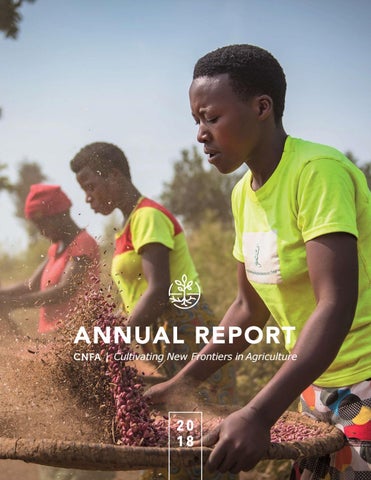
| Cultivating New Frontiers in Agriculture
Cultivating New Frontiers in Agriculture is an international agricultural development organization that specializes in the design and implementation of sustainable, enterprise-based agricultural initiatives. We work with businesses, foundations, governments and communities to build customized local and global partnerships that meet the world’s growing demand for food. Since our inception in 1985, we have designed and implemented enterprisebased, agricultural development initiatives to facilitate market access, enhance agribusiness competitiveness, increase productivity, and improve access to inputs and financing in 45 countries around the world.
04–––––––––Letter From Board Chair & CEO 06—————————––––——–———Team 08———————————–———Expertise 12————––––———-Technology Spotlight 14––––––––––––––––––––––––– Youth Spotlight 16––––––––––––––––––––––––––2018Highlights 18–––––––––––––––--––––––-Program Spotlights 28––––––––––––––––––––––––-–CNFA Europe 30–––––––––––––––––––––Board of Directors 31–––––––––––––––––––––––––––––Financials
Every year when we develop our Annual Report, we also use this opportunity to step back and reflect on our positive impact in the developing world. In reviewing the cumulative results of our work in CNFA’s 25 countries of operation over the past year, we are proud of our achievements, and of the profound effect we have on our beneficiaries by offering technical and business training, facilitating business-to-business dialogue, and engaging in rural and agriculture policy reforms. Our endeavors on these multiple fronts coalesce to achieve one major goal: Improving the lives of millions of smallholder farmers and rural entrepreneurs. At the end of 2018, we were eager to welcome and applaud USAID’s new Private Sector Engagement Policy, which lays the groundwork for USAID to collaborate more closely with the private sector in all phases of the agency’s approaches—from project design to implementation. This “new” approach closely follows our own, as demonstrated by the many examples of CNFA’s engagement with the private sector reviewed in this report, a few of which are detailed below. In Rwanda, the USAID-funded Feed the Future Hinga Weze project implemented by CNFA supports smallholder farmers to improve productivity and connect
directly with market actors. In 2018, Hinga Weze helped nearly 5,000 micro, small and medium-sized enterprises to receive agriculture-related credit, providing them with working capital to purchase produce from farmers and fund agricultural inputs for both farmer organizations and agro-dealers. In September, we proceeded with the closeout of our Restoring Efficiency of Agriculture Production (REAP) project in the country of Georgia. From 2013 to 2018, REAP co-invested alongside 70 agribusinesses through its $6 million grants portfolio, created 2,017 jobs—and added $37.5 million in new private-sector investment. REAP also helped 43 companies to receive international standard certificates. In August, USAID/Georgia awarded CNFA the five-year USAID Agriculture Program in Georgia. This new program will capitalize on more than 13 years of continued CNFA presence in Georgia to create at least 3,000 new jobs within some of the most promising high-value horticultural value chains. The program also aims to generate more than $60 million in new sales of horticultural products in both the domestic and international markets. In Nigeria, CNFA continues its partnership with USAID and Nestlé through the Feed the Future Nigeria and Nestlé Maize Quality Improvement Partnership. In 2018, the project trained a total of 18,622 people in the mitigation of aflatoxin, fumonisins, and aluminum across each level of the maize and
Elin D. Miller Chair of CNFA, Board of Directors Sylvain Roy CNFA President & CEO
soy value chains—resulting in 660 metric tons of maize and soy meeting the highest quality thresholds for contaminants set by Nestlé. Other highlights of 2018 included the conclusion of the five-year Farmer-to- Farmer Program in Southern Africa, and the start-up of a similar program that covers five Southern African countries, as well as Moldova in Eastern Europe. Deploying American volunteers in developing countries—as these programs do—is part of CNFA’s DNA, and one of our core approaches to international development. Since 1991, CNFA has fielded 2,913 volunteers—representing 40,000 days of technical assistance in 22 countries. Altogether, our volunteer programs benefited 3 million people living in rural areas. Yes, 2018 was another successful year. Thanks to the support of our main partners, including USAID and USDA, we once again accomplished our mission to stimulate economic growth and improve livelihoods
by cultivating entrepreneurship. And of course, none of this would have been possible without the hard work and steadfast dedication of our CNFA team around the world. Some of our team members perform their work under arduous and challenging conditions in remote rural areas, while others toil long hours behind a desk—but we commend them all for their efforts in making CNFA the top-tier organization we are today. As we now review the successes of 2018 chronicled in this report, we can rest assured that these accomplishments—while in the past—nonetheless point our way forward, and will serve as the foundation on which to build even more achievements in 2019. CNFA will continue to work hard with our partners to rid the world of poverty and hunger—the two relentless incentives that drive our mission. But we will persist in our efforts. Because that is the CNFA way.
CNFA’s dedicated team works to stimulate growth and improve livelihoods by championing the entrepreneurial spirit at all levels, and embraces the notion that bold development solutions can come from many sources. CNFA has a diverse workforce comprised of development experts, entrepreneurs, agronomists, and farmers whose collective knowledge shapes and informs our work, and whose passion and commitment to support smallholder farmers, entrepreneurs, women, children, and youth underlies the success of our organization.
Agro-dealers & service providers assisted
Value-chain actors trained in improved agricultural practices
New jobs created with CNFA support
Associations of farmers, producers and agro-dealers formed or strengthened
U.S. volunteers fielded in four countries
Facilitated in loans to agribusinesses, including farmers
Improving access to high-quality agricultural inputs and services is key to increasing agricultural productivity and addressing food security challenges. CNFA has developed market-oriented, private sector models and tools to support improved delivery of farm supplies, services, and technologies. To fill critical service gaps, CNFA’s Farm Service model provides one-stop-shop access to agricultural inputs, machinery services, training, credit, veterinary services and products, and marketing assistance for agricultural outputs. CNFA supports improvements across existing input and service networks—from village-level agro-dealers, regional wholesalers, as well as major input manufacturersand distributors—and facilitates investments in business expansions and startups.
Women’s empowerment is fundamental to CNFA’s mission of stimulating economic growth and improving rural livelihoods. By building programs around measurable targets, CNFA works not only to increase women’s participation and benefits from program interventions, but also to increase women’s empowerment in the agricultural sector. By supporting women- owned and women-operated businesses, and training women in business skills and entrepreneurship, CNFA helps increase women’s access to inputs, information and markets, boost women’s share of household income, and increase women’s control of income and household decision-making. This leads to increased spending on nutrition and schooling, improved food security, and better quality of life for women and their families. Constructive male engagement is also a critical piece of women’s empowerment. CNFA works with men, women, and caretakers to increase understanding in all members of the household of the elements that enable women’s access to resources that improve economic and nutritional outcomes for the whole family.
CNFA integrates a market-systems approach across all of its programming by focusing on inclusive, resilient, and sustainable interventions that identify systemic gaps in markets and reflect a deep understanding of the incentives and behaviors that motivate market actors. As part of this approach, CNFA ensures that actors are competitive in the local and global system, that the benefits to actors are inclusive of smallholder farmers, women, youth, and other disadvantaged groups, and that programs are able to overcome market shocks. CNFA’s market systems interventions correspond to the areas of greatest need, closely monitoring results to ensure evidence-based approaches and leveraging new technologies, partnerships, and practices to maximize impacts, therefore improving the ability of households and communities to access income.
CNFA recognizes that agricultural development and nutrition are intimately interconnected. To promote the interaction between agriculture and nutrition, CNFA presents opportunities for practical and economically sound agricultural diversification systems. We adopt a gender lens and use social behavior change to improve accessibility and affordability of food. CNFA enables program beneficiaries to improve their intake of nutritious foods critical for human development, particularly for pregnant and lactating women, and children under the age of two.
CNFA engages private sector partners to build inclusive market systems and drive solutions that achieve lasting impact, facilitating improved capacity, sustainability, and wealth creation across the agricultural market system. To achieve this, CNFA works with the private sector to build and strengthen market-based agricultural systems in developing countries by harnessing expertise and capital resources, facilitating business-to-business connections, developing the capacity of small and medium enterprises, and building the entrepreneurial skillsets of farmers and communities.
CNFA’s work enhances the ability of individuals, households, and communities to mitigate, withstand, and recover from crises resulting from social, economic, and environmental challenges. CNFA supports smallholder farmers and their communities to increase food security and manage risk by diversifying livelihoods, improving access to functional markets, building social and systemic support systems, and promoting disaster risk reduction strategies. CNFA builds household and community assets as well as partners with governments and the private sector to improve the capacity of all actors to withstand shocks.
CNFA promotes sustainable agricultural practices by sharing expertise that enables farmers to increase productivity, improve quality, and enhance market value of their crops to meet the economic and nutritional needs of families and communities. By utilizing its technical expertise and corporate partnerships with the private sector, CNFA provides access to inputs and information on climate-smart natural resource management such as improved water conservation, soil fertility, and integrated pest management practices.
CNFA recognizes the value of technology in increasing agricultural productivity and competitivity. As part of our program design, we forge partnerships that scale up technology and innovation to improve global food security.
In October 2018, CNFA’s Vice President of Program Development, Ed Keturakis, spoke about increasing agricultural quality and efficiency through the use of technology at the U.S. Chamber of Commerce Foundation’s Food Forward Summit, a future-looking platform that highlights trailblazers who are reimagining the food system to feed a growing and changing population. Keturakis explained how CNFA teamed up with Mobile Assay, the creator of a rapid diagnostic test for aflatoxins, to improve the soy and maize supply chain in Nigeria.
Smallholder farmers in developing and emerging economies often have limited access to agricultural information for improved farm management, planning, and coordination for informed decision making. In their submission for the John H. Costello Award—an award bestowed upon the winner of an organization-wide competition that provides financing for a field level innovation to be developed and tested—CNFA employees, Nega Berecha and Valeri Gulbani, aimed to address this issue by developing a Farmers’ Appreciation and Rewards Management (FARM) database, an ICT based customer management and reward management system that provides smallholder farmers with access to agricultural information through mobile phone SMS support. The FARM database was piloted with customers of Farm Service Centers—CNFA’s market-oriented model for delivery of farm services and supplies– in Ethiopia and in Georgia, resulting in improvements in access to inputs and price information that is critical to increasing agricultural productivity and quality.
CNFA creates opportunities for youth by providing hands-on trainings to build business and professional skills, offering internship programs to gain practical experience, and fostering leadership to empoweryouth to become productive members of their communities. Through the USAID Strengthening Agricultural Value Chains andYouth (SAVY) project in Guinea, CNFA teamed up with partners to launch the AVENIR program—an eight-month apprenticeship program that helps build entrepreneurship skills in Guinean youth through training and internships in the agricultural value chain. Since its inception, the AVENIR program trained 143 youth in agro-business skills. These trainees have developed more than 100 business plans and established 12 formal companies that provide agricultural services and products in rural areas of Guinea.
The Feed the Future Hinga Weze Activity provides Rwandan youth with the opportunity to gain professional experience and skills through internship programs. In 2018, Hinga Weze hired 36 interns to support terracing and irrigation activities throughout the project’s 10 targeted districts. Interns
also provided support to extensionand livestock activities, nutrition and social behavior change communication, and programmatic financial management. Interns gained skills working with agrodealers while playing a fundamental role in assisting agro-input marketing and delivering such inputs to farmers in remote areas of Rwanda.
11 university students received financial support from the USAID Restoring Efficiency to Agriculture Production (REAP) project’s Mariam Kutelia Research Grant for their research aimed at advancing agriculture in Georgia. Nine students also participated in research on the brown marmorated stinkbug infestation that threatens hazelnuts and other crops in Georgia. Duringan international science conference hosted by REAP, U.S. and Georgian scientists commended these students for their insightful findings.
a five-year program in fielded 294 volunteer
2020), CNFA is redefining
five-year project that and efficiency of actors
access, and diversification
businesses refine their fine chocolate market,
In early 2018, CNFA piloted a new assessment tool designed to evaluate the professionalism of agro-retailers. The new SCOPE Input Retailer tool—developed by CNFA in collaboration with the Dutch firm SCOPEinsight, the World Bank’s International Finance Corporation, and Bayer—measures and scores skills ranging from financial and inventory management to business planning and marketing strategy. The scores help retailers identify
gaps in their own capacity and aids global agribusiness companies in deciding how and where to distribute products through a reliable network of retailers. CNFA piloted the use of SCOPE Input Retailer with 60 agro-retailers in Ethiopia and used the findings to inform the structure of the final assessment tool. CNFA is now working with the International Finance Corporation to design a suite of training materials that correspond with the assessment criteria in order to deliver tailored training programs for agro-retailers in emerging economies in Latin America, Africa, and Asia.
LADA Beneficiary Boosts Capacity, In July 2018, Patom Enterprise — a 100 percent female-owned food processing business in Paynesville, Liberia — obtained a variety of food-processing equipment due to the efforts of CNFA’s Liberia Agribusiness Development Activity (LADA). LADA, a USAID Feed-the-Future initiative, provided equipment that will help the company scale up its capacity to package and distribute dried fruits and vegetables, as well as diversify its product offerings for domestic and international markets. LADA also assisted Patom in creating a marketing and rebranding plan and aided the company in pitching its business plan to Liberia’s Chamber of Commerce. These efforts led to Patom CEO Patricia Ganta’s selection to participate in the African Growth and Opportunity Act Expo in New York in September 2018, where she established business relationships that will leverage her company’s new production capacity. Thanks to LADA’s efforts, Patom Enterprise now has the capacity to start exporting dried pineapple and spices to the United States.
Amalima—a USAID-funded program that aims to increase and diversify the incomes of vulnerable households by improving agricultural productivity, strengthening disaster risk reduction systems, and improving linkages to markets and financial services—worked with community groups to support female ownership of assets in Zimbabwe. The Hanani group (whose name means “happiness”) is a Village Savings and Lending (V&SL) group, a group who save together and offer small loans to one another, that raises improved breeding goats as an income generating project to support the empowerment of women and their households. Through Amalima, the Hanani Goat Project received trainings on the V&SL model, business planning, conservation agriculture, livestock management, and farming as a business. The Hanani Goat Project received a matching grant to expand their project further by building a goat breeding and service center. Their project now serves as a source of improved goat breeds in the community and a small livestock learning center.
Côte d’Ivoire is the largest cacao-producing country in the world, and earnings from the cultivation and sale of cocoa support 3.5 million Ivorians, including many smallholder farmers and their families. These smallholder cocoa farmers have limited capacity to increase the amount of quality beans they can sell, which would otherwise be a viable means of increasing their income and improving their livelihoods. To support the cocoa sector in addressing these and other challenges, CNFA is implementing the three-year Maximizing Opportunities in Cocoa Activity (MOCA). This United States Department of Agriculture (USDA) Food for Progress activity provides capacity-building, training,
and support services to cocoa producers, cooperatives, and exporters in Côte d’Ivoire with the aim of improving the supply of high-quality cacao beans and increasing farm incomes. Activities to improve and expand the trade of cocoa and cocoa products focus on improving the quality of the crop, the processing and post-harvest handling techniques, and strengthening the market linkages and organization of producer groups towards more adequately meeting existing market demand. The project is also improving market access by targeting support to unorganized farmers, associations, and cooperatives that do not currently have formal relationships with exporters and facilitating linkages with reputable cocoa processors and buyers, all with the aim to boost farmers’ incomes from these high-value commodities.
Although Rwanda has made strides in improving nutritional intake for women and children, there are still numerous challenges to overcome. To combat this, USAID’s Feed the Future Rwanda Hinga Weze Activity, implemented by CNFA, created nutrition care groups that focus on disseminating nutrition messages, encouraging members to save income for the purchase of nutritious foods, and improving hygiene and food safety practices. As a mother and community leader in Gatsibo, Denyse Nyirabakunzi joined the local care group established by Hinga Weze in order to learn more about how to mobilize her community to improve their nutrition. “I have learned to prepare a balanced and diversified diet and how to preserve vegetables to be used during dry seasons,” Denyse shared. She created a kitchen garden near her home to serve as a model for other community members as well as to provide vegetables for her own family. Denyse’s group is just one of the 1,326 nutrition care groups that Hinga Weze has established, reaching more than 37,000 households that are coached by community health workers and farmer promoters. Through education and extension programs, care groups, and Social Behavior Change Communication (SBCC) messages
related to nutrition-sensitive agriculture, the project is on track to increase the nutritional status of 200,000 households in the ten Activity districts by 2022. After just one year, the project has increased the dietary diversity score for women of reproductive age by 8%, the average percentage of children 6-23 months receiving a minimum acceptable diet (MAD) by 5.8%, the income to purchase nutritious foods for 9,015 households, and the ability to adopt improved food safety behaviors for 6,493 households.
In its first year
in dietary diversity score for women of reproductive age
in the average percentage of children 6-23 months receiving a minimum acceptable diet
saw an increase in income to purchase nutritious foods
saw an increase in the ability to adopt improved food safety behaviors
Alaa, Hajar, and Mariam are just three of the young women hired by El Baiaho Agricultural Community Development Association in Egypt to support their post- harvest operations sorting, packaging and storing a variety of crops, including grapes, pomegranates, tomatoes, and garlic for export. In June of 2018, these three young women paused their work to participate in a training focused on nutrition for women in the agro-processing workforce. Across Egypt, undernutrition and stunting rates for children remain high, which results in economic costs that hinder the development of the nation.
To address this issue, USAID’s Feed the Future Egypt Food Security and Agribusiness Support (FAS) project organized trainings aimed at educating participants on the types of food that are critical for improving health and child development as well as good hygienic practices to ensure food safety. “I learned about the food pyramid which helped me to know what types of food and how much to eat to stay healthy,� said Alaa. In 2018, the FAS nutrition team delivered trainings on effective nutrition practices to over 2,000 FAS participants, including women and girls working at similar packing houses and attending input supply fairs and events hosted by FAS. The project plans to continue outreach to improve the nutritional status particularly of women and children in Egypt.
Accessibility and Efficiency CNFA is working with leading U.S. and multi-national agriculture and technology companies to ensure food security for a growing global population. In 2018, CNFA signed a Memorandum of Understanding with Corteva Agriscience, a part of the Agriculture Division of DowDupont – a global producer of seeds, crop protection products, and digital tools for growers. Together Corteva and CNFA aim to improve smallholder farmer livelihoods by facilitating market access, enhancing agribusiness competitiveness, increasing productivity, and improving access to inputs.
CNFA is also teaming up with Innové, a Virtual Reality (VR) firm that designs solutions for training and operations. At CNFA’s first ever Small Business Day event, Innové provided a live demo of their VR goggles. In Rwanda, Innové is working with CNFA’s Feed the Future Hinga Weze Activity to conduct a training pilot for agrodealers using their virtual reality training system to build skills on the business management of retail operations and inventory management.
Throughout 2018, the USAID-funded Amalima program supported Village Savings and Lending (VS&L) groups, like the women of Thembisa VS&L Group, in communities that were impacted by the tropical cyclone Dineo which destroyed community assets like property, livestock, and personal documents (national identification cards and health cards) in Western Zimbabwe. Amalima works with VS&L groups to improve access to disaster risk reduction knowledge and savings, especially for women, and to build community resilience to shocks like the 2017 cyclone. The disaster risk reduction training is focused on hazard identification, mapping, ranking, and strategizing of mitigation measures and plans. Additionally, Amalima trains groups on managing group funds and providing community loans. Through assistance from the Amalima program, members of Thembisa VS&L Group have been able to raise funds to construct flood- proof housing worth $1,105 USD each to better protect themselves against future flooding. Seven other groups in the village are also in the process of saving up funds for the construction of similar flood-proof structures.
In Burkina Faso and Niger, the production of poultry and small ruminants plays a major role in livelihood strategies and income generation, particularly for women, to save, invest, and manage risk for household needs and emergencies. In an effort to improve this resilience, the USAID Resilience Economic Growth in the Sahel – Accelerated Growth (REGIS-AG) program is scaling up a private sector led model for establishing animal health service networks to train and strengthen animal health knowledge and capacity. Each network provides services such as technical advice, vaccination, deworming, and wound care through Community Animal Health Workers, female village-level vaccinators, and veterinary stores. Additionally, the project facilitates opportunities to access finance by helping veterinarians develop business plans and linking them to financial institutions. Since 2015, REGIS-AG helped establish nine animal health networks and strengthened the capacity of four others.
In Angola, constraints to improving the quality and marketability of horticulture products exist across the value chain. In response to these challenges, USAID’s Farmer-to-Farmer program, implemented by CNFA in Southern Africa, fielded volunteers Ann Savage (Oregon) and Courtney Jallo (California) to provide technical assistance to improve the management practices and overall structure of the Lukunga Association, a farmer association that produces a variety of crops for local consumption. Ann Savage, small business development expert, provided assistance to the association by advising on improved administrative and financial skills. Courtney Jallo, an agricultural development specialist and postharvest educator, trained the association members on soil regeneration and testing, and helped the farmers construct a compost pit which was useful in improving soil structure, fertility, and water retention. The Lukunga Association has since restructured and is utilizing improved managerial skills and soil regeneration techniques to improve its business practices. At its core, Farmer-toFarmer is aimed at generating sustainable economic growth and food security by fostering such people-to-people diplomacy.
USAID’s Farmer-to-Farmer program, implemented by CNFA in Southern Africa, fielded volunteers Ann Savage (Oregon) and Courtney Jallo (California) to provide technical assistance to improve the management practices and overall structure of the Lukunga Association.
The Twigire Muhinzi national extension model, launched in August 2014 by the Government of Rwanda, was developed to ensure that all farmers have access to agricultural advisory services. Under the Rwanda Hinga Weze Activity – a USAID- funded project that sustainably increases smallholder farmer income, improves the nutritional status of Rwandan women and children, and increases the resilience of the agriculture and food systems to the changing climate – CNFA collaborated with the Government of Rwanda to conduct the Twigire Muhinzi Needs Assessment and identify the model’s strengths and opportunities for improvement. The assessment made recommendations to improve attendance at existing and new
demonstration plots, increase input-supply delivery and outreach to disadvantaged communities, and strengthen Farmer Field Schools (FFS), a group of farmers that meet under the guidance of a trained facilitator to learn agricultural best practices through hands-on trainings and demo plot planting. Guided by the results of the Twigire Muhinzi Needs Assessment, Hinga Weze trained over 400 government, non-profit, and private sector extension agents and over 2,000 FFS facilitators and farmer promoters on Integrated Soil Fertility Management, Climate-Smart Agriculture practices and technologies, nutrition, and gender and youth inclusion. The Twigire Muhinzi Needs Assessment continues to guide the Hinga Weze objective of sustainably improving agricultural productivity in the project’s ten implementation districts.
non-profit organization EU RO P E
growth and diversification, as well as advancing field-driven
With support from GIZ, the German development agency, CNFA Europe is strengthening the resilience of agropastoralists against drought and climate change in the Afar region of Ethiopia by increasing access to markets and improving agricultural inputs. To accomplish this, CNFA Europe piloted activities that build the capacity of private sector actors in the areas of forage production, charcoal production, oil crop production and processing, and the trade of veterinary drugs.
CNFA Europe serves as one of three partners in the Agriconsulting Europe SA consortium for the market-driven “Technical Assistance to Support the Implementation of Investment Promotion and Business Linkages in Ghana” project funded by the European Commission. In their role, CNFA Europe provides oversight and backstopping support, as well as administrative and management counsel.
Funded by the Millennium Challenge Corporation, CNFA Europe conducted a livestock study in Niger to assess the different types of complementary investments which will modernize up to 22 livestock markets in Niger. The study analyzes income opportunities for herders in livestock markets as well as the availability of technologies and resources for herders to obtain more accurate livestock weighing and pricing information.
CNFA Europe is supporting Agriconsulting Europe SA on the “Technical Assistance for the Coffee and Cocoa Value Chains in Uganda” project funded by the European Commission. In their role, CNFA Europe provides oversight and backstopping support, as well as administrative and management counsel to the field team in Uganda.
David Kirvalidze
David Kirvalidze
$310,493
$78,960
$4,390,870
$4,573,511