Forging paths of healing & hope
COVER STORY
When Children Go Hungry
4
38
Providing sustenance in Ethiopia text by Samuel Getachew with photographs by Petterik Wiggers
FEATURES
CNEWA Forges a New Path
Deploying new methods of aid by Michael J. La Civita
Isolated and Afraid
Holding on in South Lebanon by Laure Delacloche
Ending the Poverty Loop
Perspectives from the president by Msgr. Peter I. Vaccari 20 26 14 32 6
Giving children in India a hopeful future text by Anubha George with photographs by Sajeendran V.S.
Trying Times in Taybeh
Surviving in West Bank’s last Christian village text by Leila Warah with photographs by Samar Hazboun
DEPARTMENTS
Connections to CNEWA’s world
The Last Word
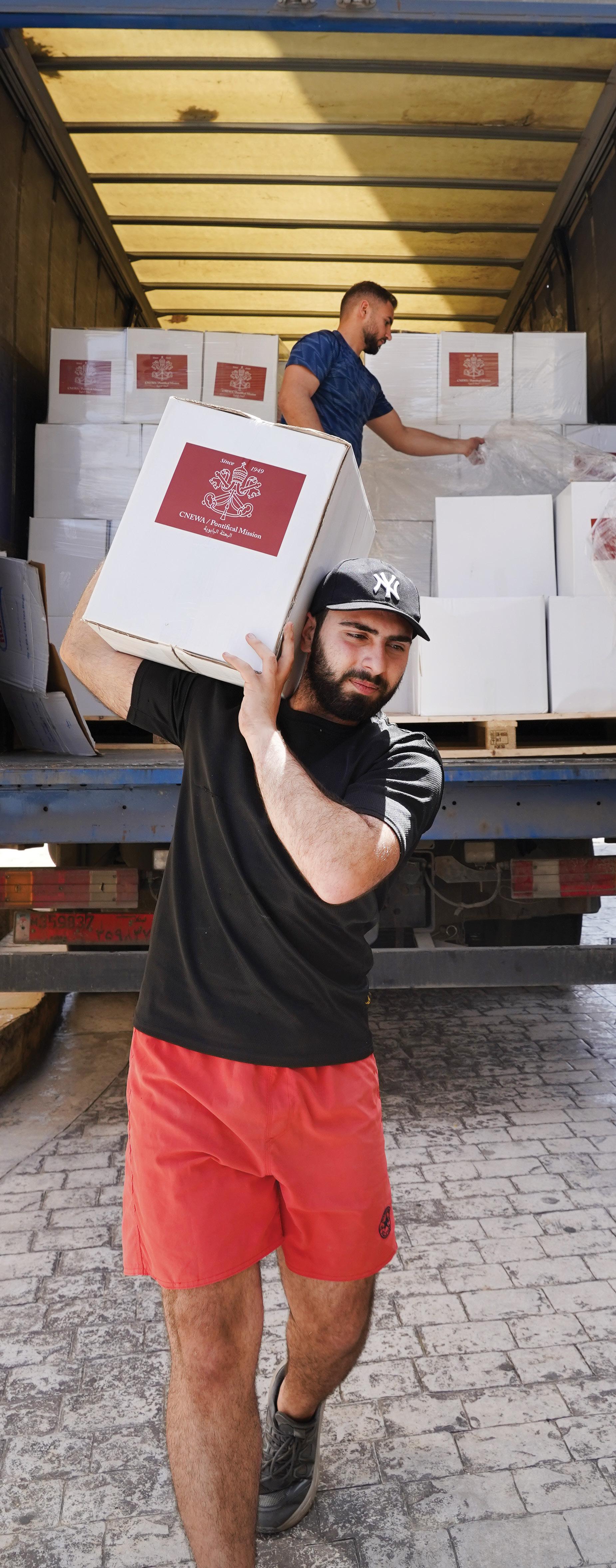
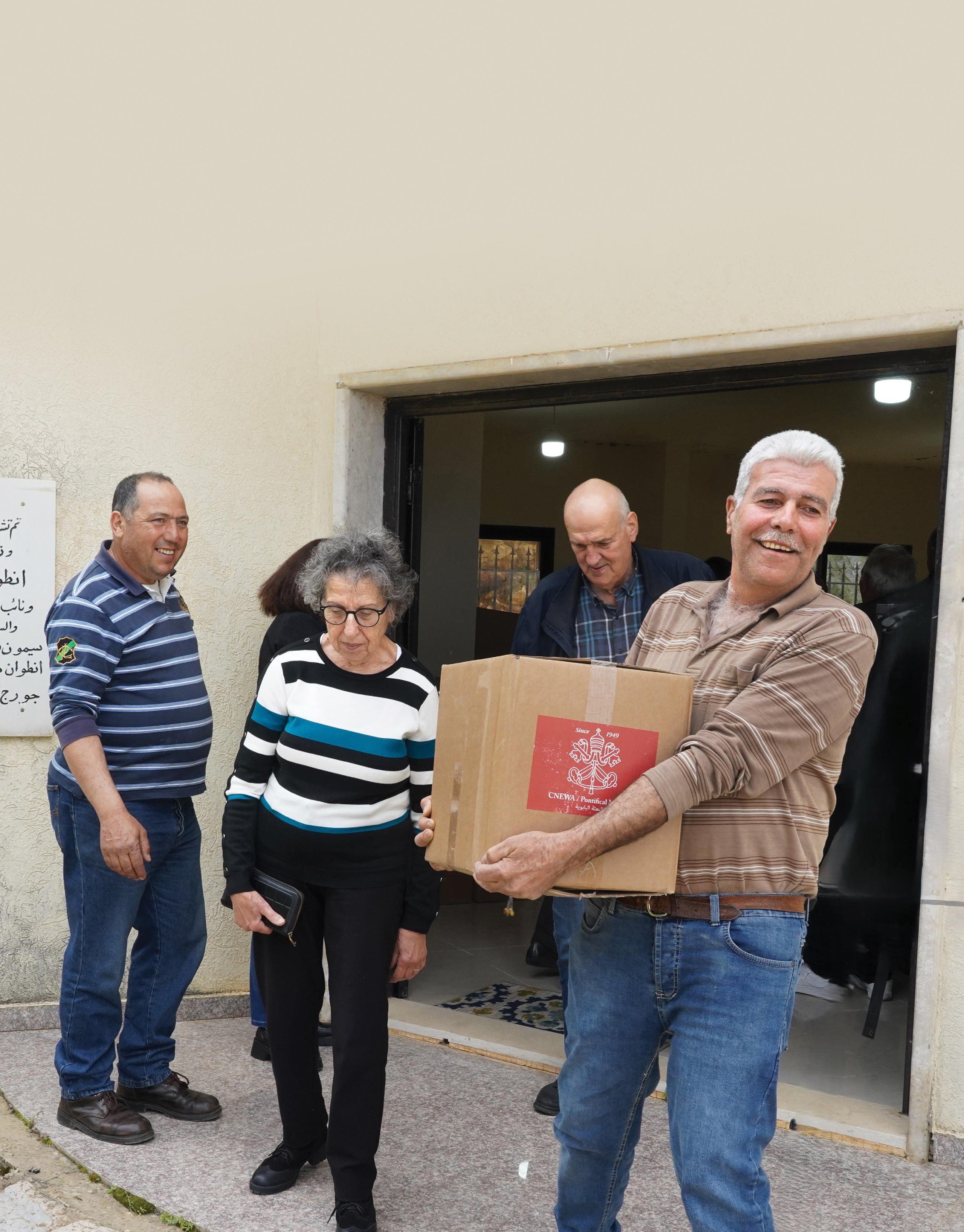
t Workers unload food boxes, provided by CNEWAPontifical Mission, in Qaitouli, southern Lebanon.


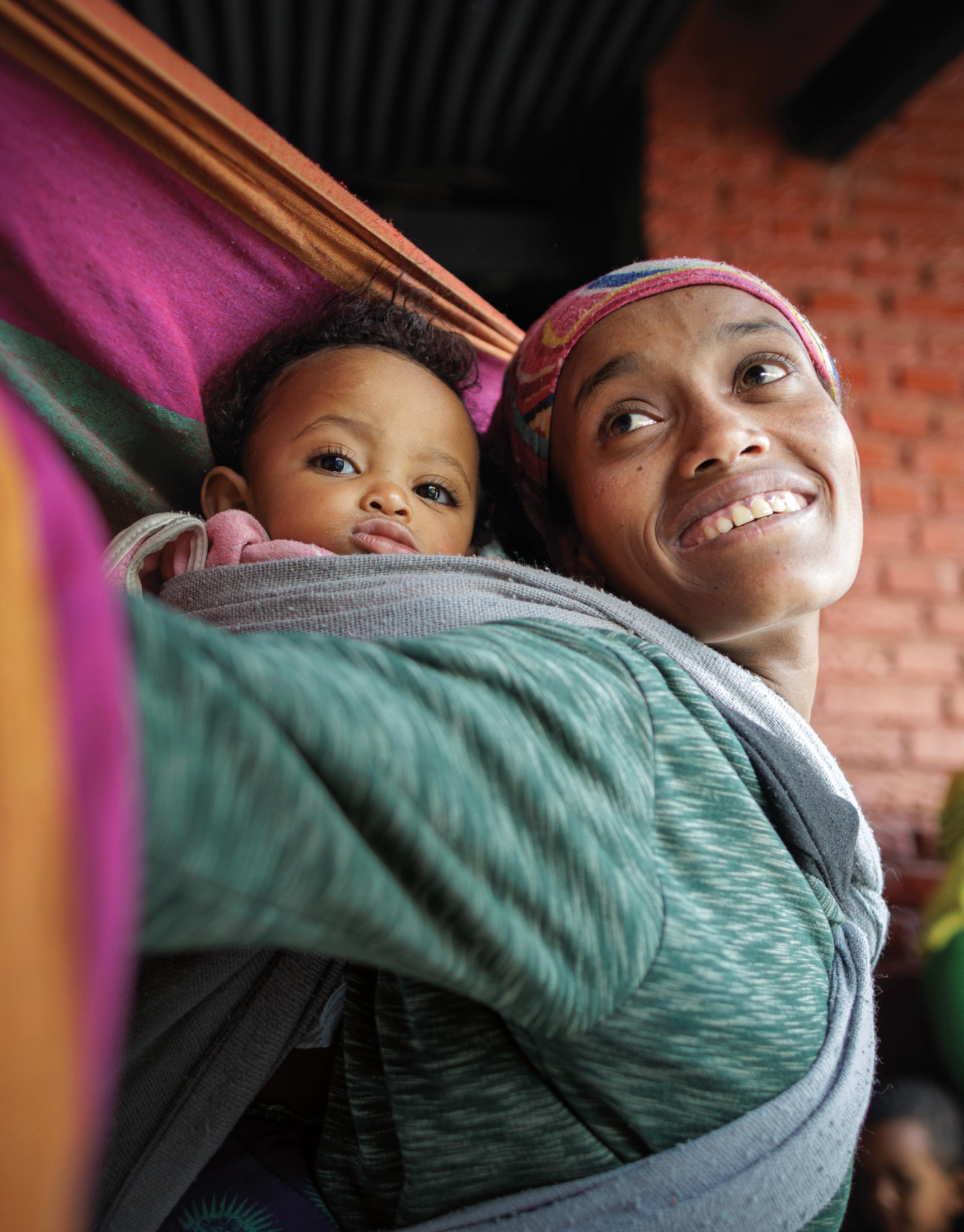
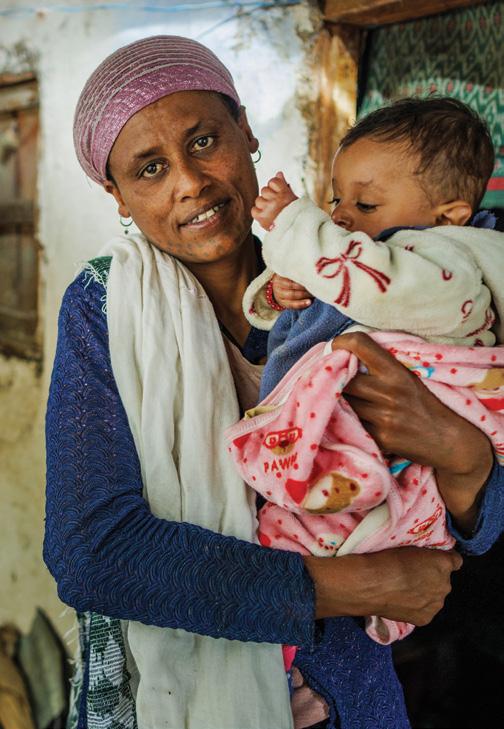
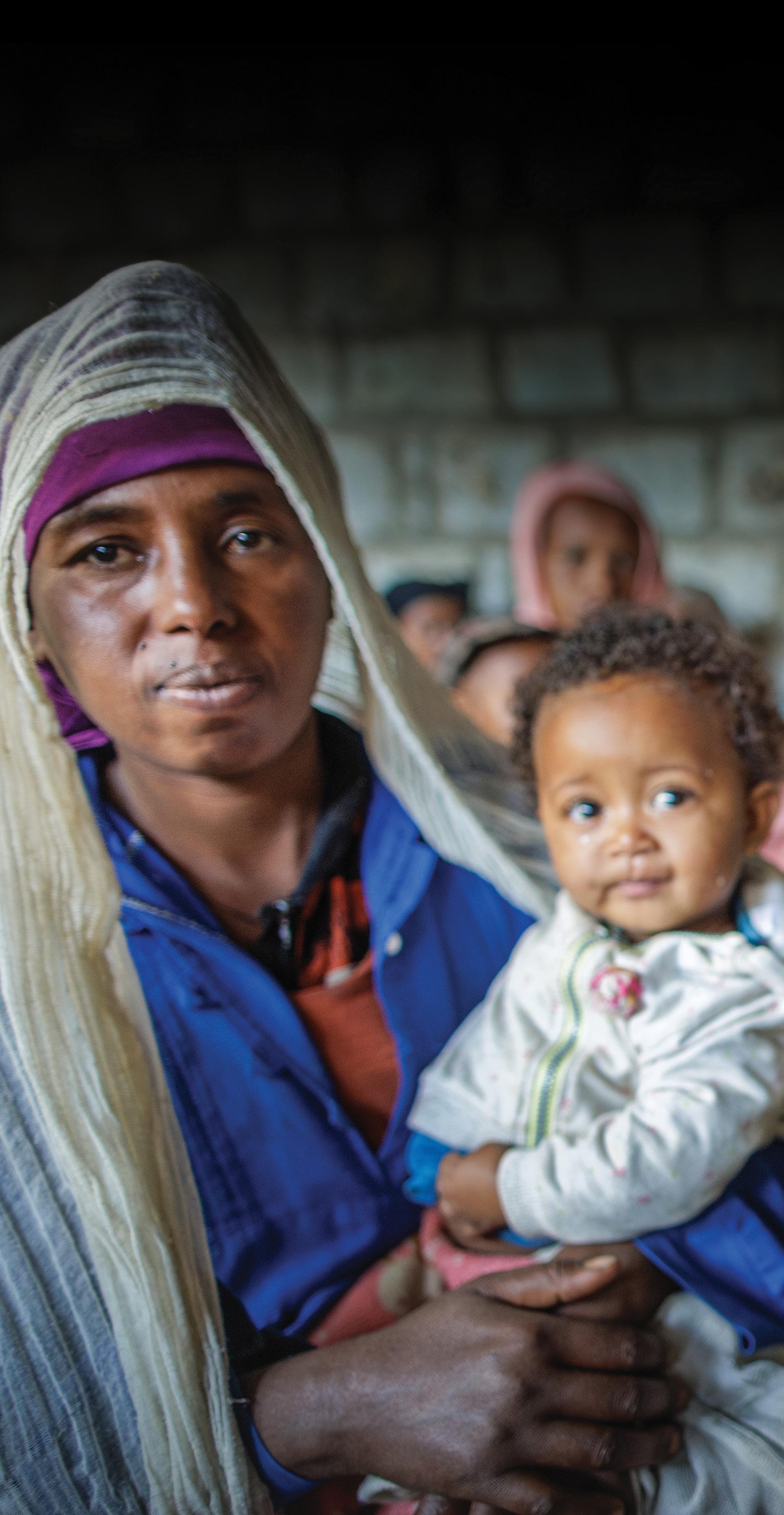
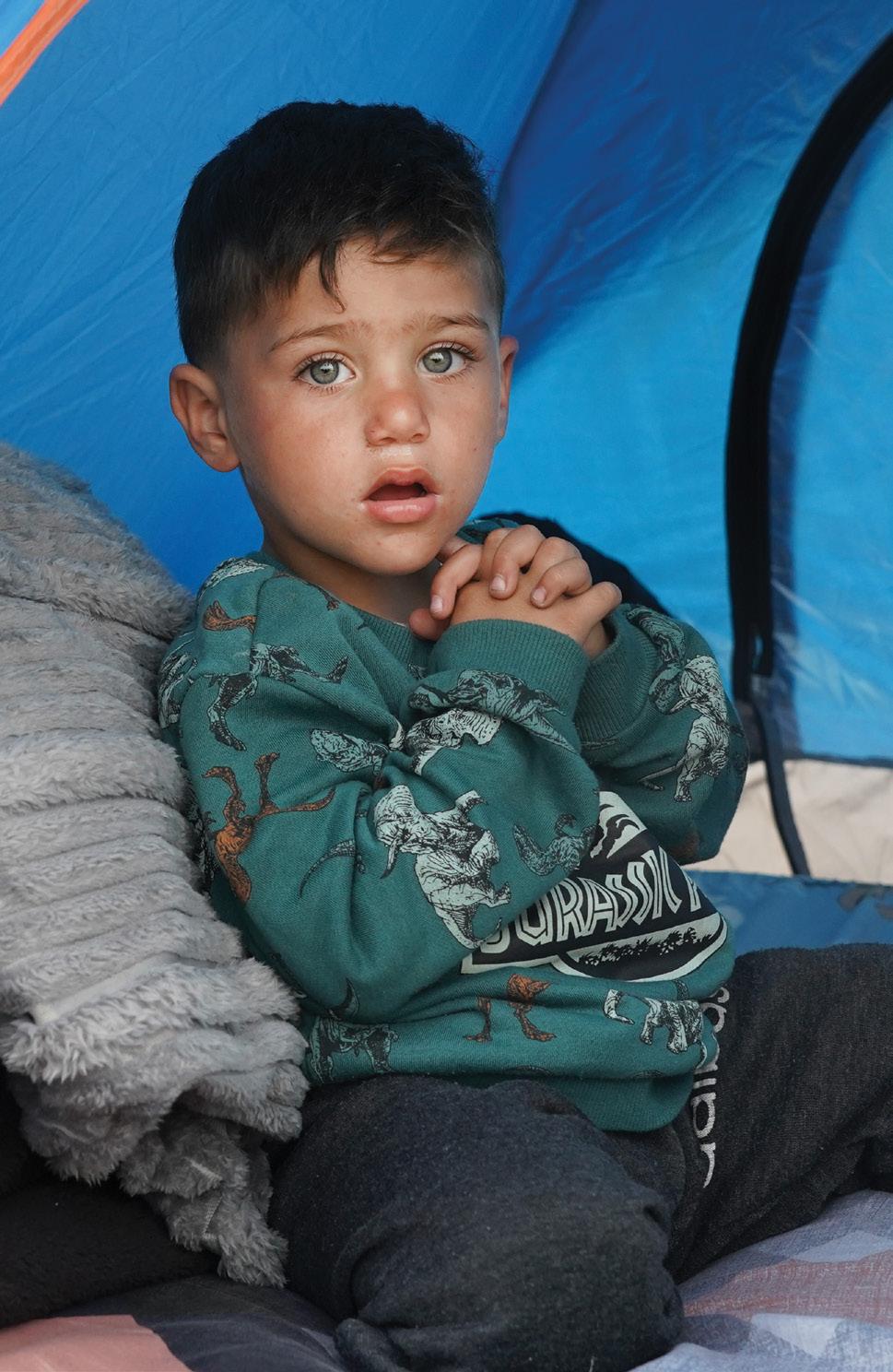
Front: A mother and child find food assistance at a church-run center in Mendida, Ethiopia.
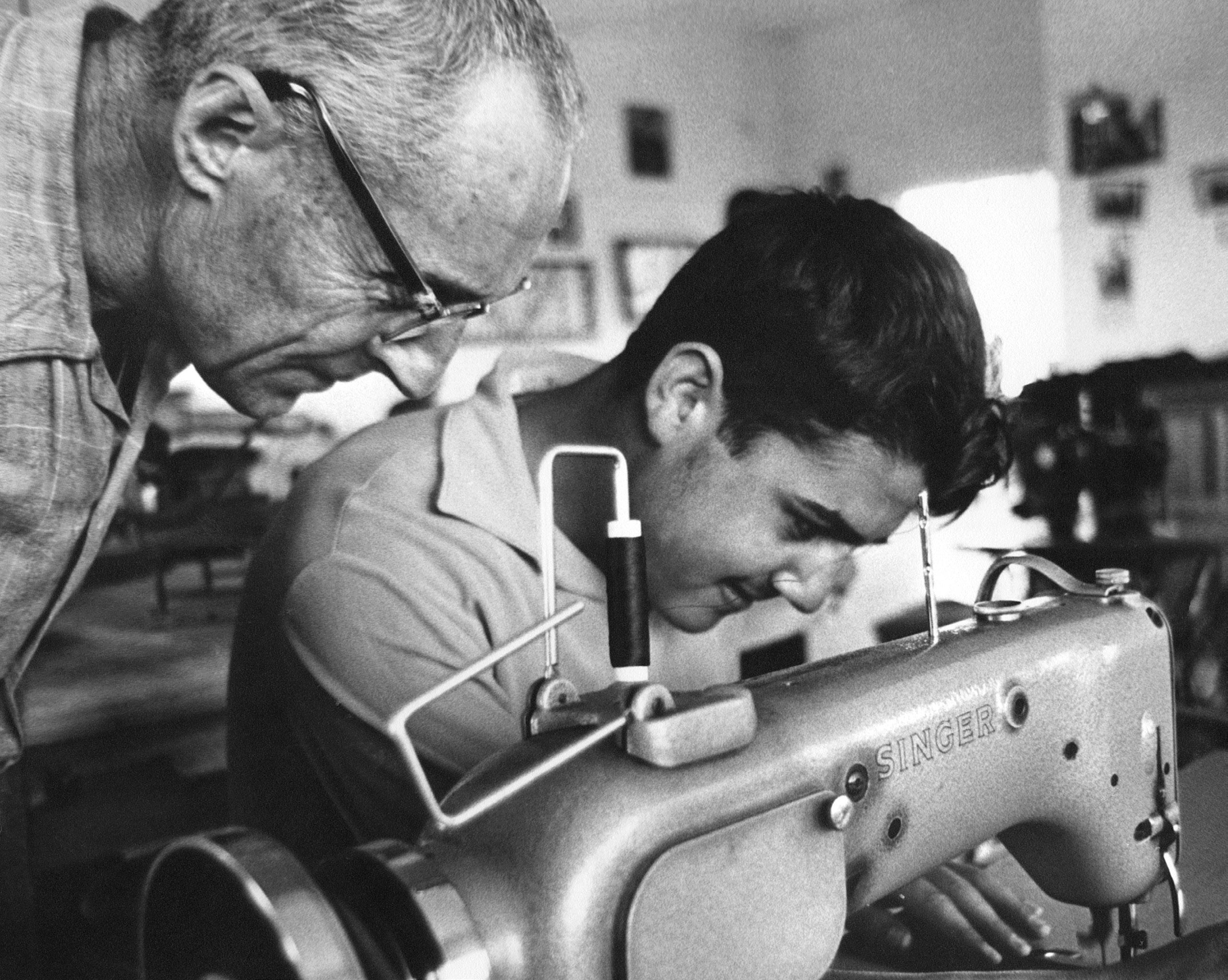
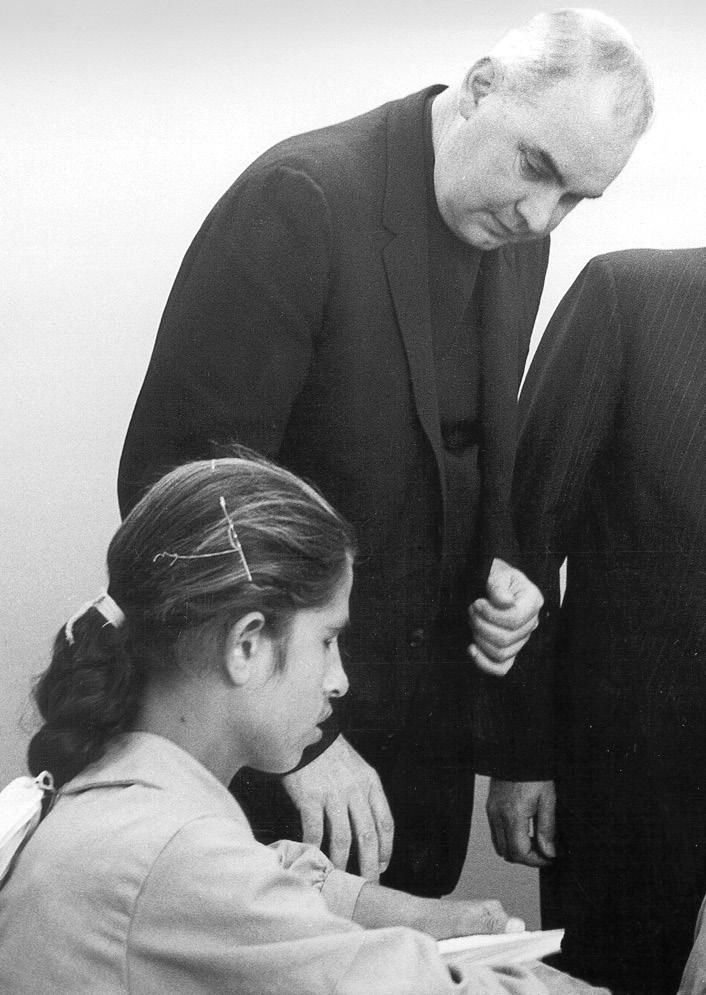
Back: In this undated photo, a student learns how to work a sewing machine at the Salesian Technical School in Bethlehem, West Bank.
Photo Credits
Front cover, pages 3 (upper right), 14-19, 38-39, Petterik Wiggers; pages 2, 22-24, Raghida Skaff; page 3 (top), Maria Grazia Picciarella/SOPA Images/LightRocket via Getty Images; pages 3 (upper left), 8, 10-13, back cover, CNEWA archives; pages 3 (lower left and far right), 26-31, Sajeendran V.S.; pages 3 (lower right), 32, 34-37, Samar Hazboun; page 4, Gregory A. Shemitz, Knights of Columbus; page 7, Bettman/ Getty Images; page 9, Michael J. La Civita; pages 20-21, Riad El Hajj.
ONE is published quarterly. ISSN: 1552-2016
CNEWA
Founded by the Holy Father, CNEWA shares the love of Christ with the churches and peoples of the East, working for, through and with the Eastern churches.
CNEWA connects you to your brothers and sisters in need. Together, we build up the church, affirm human dignity, alleviate poverty, encourage dialogue — and inspire hope.
Volume 52 Number 2
Publisher
Msgr. Peter I. Vaccari
Executive Editor
Michael J. La Civita
Editorial
Laura Ieraci, Editor
David Aquije, Contributing Editor
Barb Fraze, Contributing Editor
Elias D. Mallon, Contributing Editor
Creative
Timothy McCarthy, Digital Assets Manager
Paul Grillo, Senior Graphic Designer
Samantha Staddon, Graphic Designer
Elizabeth Belsky, Copy Writer
Officers
Archbishop Ronald A. Hicks, Chair and Treasurer
Msgr. Peter I. Vaccari, Secretary
Tresool Singh-Conway, Chief Financial Officer
Editorial Office
220 East 42nd St, New York, NY 10017
1-212-826-1480; www.cnewa.org
©2026 Catholic Near East Welfare Association. All rights reserved. Member of the Catholic Media Association of the United States and Canada.
Connections to CNEWA’s world
Emergency Aid Continues
CNEWA continues to rush food, water, bread, bedding and medicines for people displaced by war and natural disasters in regions throughout the world. More than 1 million people — mostly from southern Lebanon — have been displaced in the ongoing war in Lebanon between Israel and Hezbollah. Many are sheltering in church facilities.
Archbishop Paolo Borgia, apostolic nuncio to Lebanon, has led at least 14 aid convoys to the country’s south since 2 March, in coordination with the U.N.’s Interim Force in Lebanon. The Beirut-based CNEWA-Pontifical Mission team has helped organize the convoys with its partners, including L’Oeuvre d’Orient and Caritas Lebanon.
CNEWA’s regional team in Ethiopia is responding to a growing food crisis. More than 10 million people are facing serious food insecurity, after years of tribal conflict, civil unrest and climate-related disasters displaced millions of people in a region still reeling from the COVID-19 pandemic. The elimination of both European and USAID-funded programs has crippled aid efforts, which depend almost entirely on aid from privately funded charities such as CNEWA.
CNEWA Hosts Ukraine Event
Three prominent church agencies gathered at CNEWA’s administrative center in New York on 5 May for a livestreamed event on the situation in Ukraine and their work to provide aid to those in need. They included CNEWA, the Knights of Columbus and the U.S. Conference of Catholic Bishops’ Subcommittee
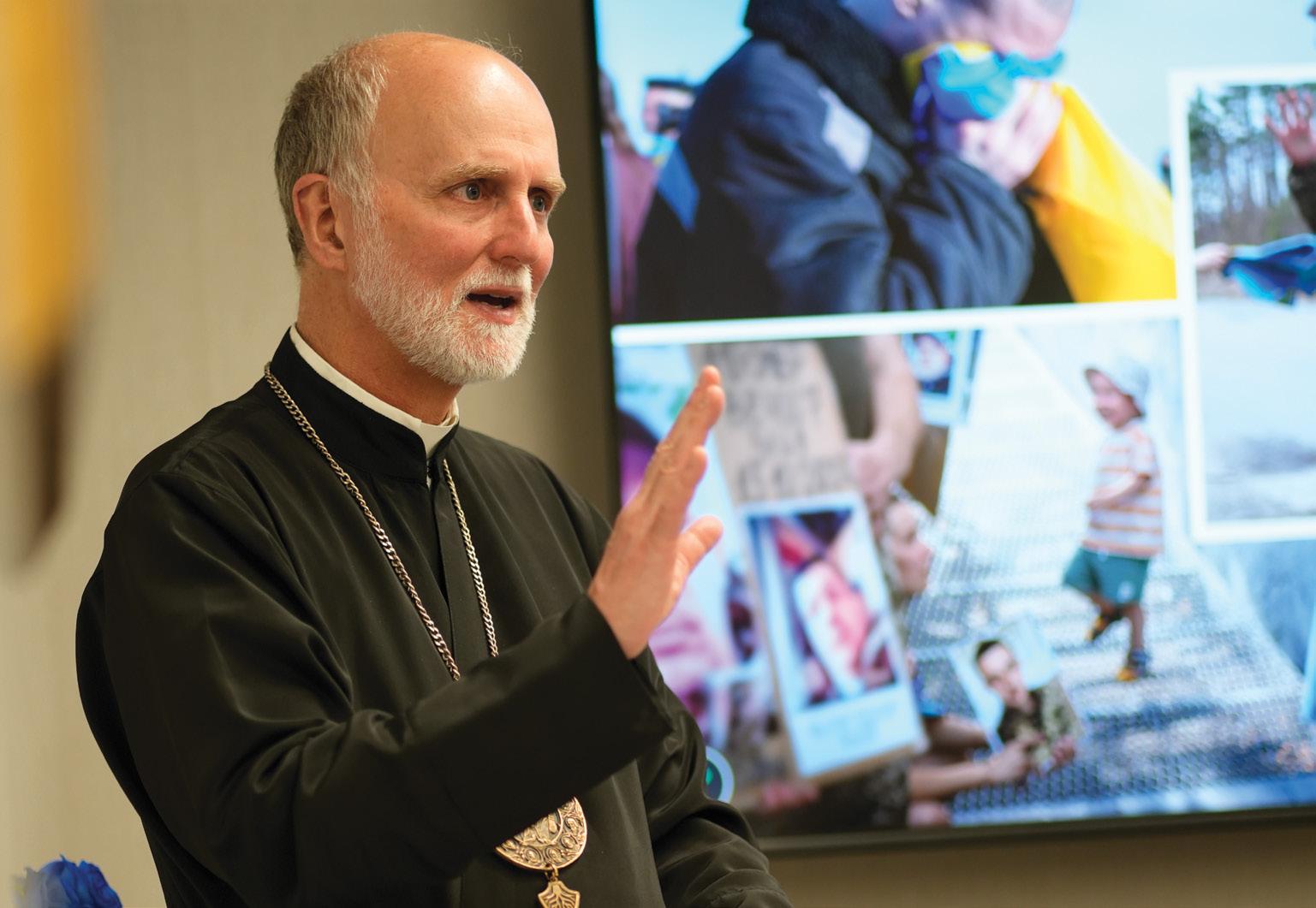
Archbishop Borys Gudziak addresses those gathered for the event, “United for Ukraine,” hosted at CNEWA’s administrative center in New York City on 5 May.
on the Church in Central and Eastern Europe.
Metropolitan Archbishop Borys A. Gudziak of the Ukrainian Greek Catholic Archeparchy of Philadelphia addressed the gathering, describing Catholic aid to Ukraine as “steadfast.” He said the support provided “has been heart to heart, person to person, community to community” and “church to church.” The archbishop, who has traveled to Ukraine 55 times since the outbreak of hostilities with Russia began in 2014, said Ukrainians tell him to “please thank the people that pray, inform, act and help.”
First Cardinal Dolan Award
CNEWA bestowed its first Timothy Michael Cardinal Dolan International Leadership Award to the award’s namesake at a gathering in Rome on 15 April.
Cardinal Dolan served as archbishop of New York for nearly 17 years and ex officio as CNEWA’s chairman. Trustees Amanda Caroline Bowman and Marina C. Perna thanked the cardinal, whose leadership opened the way for laypeople to serve on the board, and praised his long-term service to CNEWA. Cardinal Dolan said he first learned about CNEWA when he served at the apostolic nunciature in Washington with Cardinal Pio Laghi, “who loved, loved, loved CNEWA, knowing its work well in the Holy Land.”
Two days later, in Naples, CNEWA hosted donors and friends for events that included a presentation on Caravaggio’s “The Seven Works of Mercy”; a guided private visit to the Museum of the Treasury of St. Januarius, the city’s patron, located in the cathedral dedicated to the Assumption of Mary; and a charity dinner at the Grand Hotel Vesuvio.
Eastern Bishops Meet
Msgr. Peter I. Vaccari, CNEWA president, traveled to St. Louis, 17-19 March, for the annual meeting of the Eastern Catholic bishops in the United States, where he spoke about CNEWA’s mission, the challenges facing the Eastern churches in their homelands, and the work of CNEWA in Eastern Europe, Northeast Africa, India and the Middle East
Save the Date! CNEWA Gala
CNEWA’s centennial will be highlighted at its annual Healing & Hope Gala at The Plaza Hotel in New York City on 15 December. The guest of honor will be Frá John T. Dunlap, prince and grand master of the Sovereign Military Order of Malta, who has propelled the order “into a force of compassion, encounter and dialogue, touching the lives of the marginalized and vulnerable across the globe.”
CNEWA’s Faith & Culture Award will be conferred to Sister Raffaella Petrini, F.S.E., president of both the Pontifical Commission for Vatican City State and the Governorate of Vatican City State. A noted academic and administrator, Sister Raffaella oversees the operations of Vatican City State, making her the highestranking woman in the Vatican.
High School Supports CNEWA
Msgr. Peter I. Vaccari celebrated Mass at St. Joseph by-the-Sea High School in Staten Island for the feast of the Ascension 14 May. After Holy Communion, members of the student government, on behalf of the 1,400 students at the Mass, presented him with a check for $28,211 toward the mission of CNEWA. This donation represented the 2026 Lenten
sacrifice of students, faculty, staff, parents and donors.
Msgr. Vaccari commended the students for upholding CNEWA’s mission of supporting the vulnerable and the marginalized. This donation was the latest in a series of efforts by the student body — including a Concert for Peace and a video project — to raise funds and awareness for CNEWA since 2022, when Msgr. Vaccari first visited the school. To date, the school has donated about $115,000 to CNEWA.
Grant Funds Received
The Koch Foundation has awarded CNEWA a grant for $450,000. More than half, $250,000, will fund the humanitarian and pastoral work of the church in Gaza; $100,000 will support the formation of novices and seminarians in Ethiopia and Eritrea; and $100,000 will fund Catholic schools in Ethiopia and youth faith formation in Palestine.
“In a spirit of faithful stewardship and service to the Gospel, the Koch Foundation is honored to support the work of CNEWA in Africa and the Holy Land,” said Andrew LoFaro, the foundation’s executive director. “At the heart of our mission is a deep desire to strengthen the church’s evangelical witness and to bring Christ’s
message of hope and charity to the farthest reaches of the world.
“It is a true privilege to continue our longstanding partnership with CNEWA, whose tireless service so beautifully embodies this mission by offering hope, healing and accompaniment to those most in need,” he said.
‘Journalism
at its Best!’
Judges for the annual Religion News Association (R.N.A.) contest said ONE ’s reporting is “Journalism at its best!” in awarding the magazine second place for reporting for religious audiences and third place for photography. The awards were conferred at the conclusion of the R.N.A.’s annual conference in Atlanta, 25 April.
“These reporters for ONE magazine take readers to where the news we all hear about is happening and offer affecting make-me-see stories,” the judges noted. “Heartbreaking stories, powerful writing.”
“This is a strong and thoughtful documentation of global stories shaped by religious and cultural conflict,” the judges said in their comments about ONE ’s photography. “The images don’t just report on events; they show how belief systems and identity influence real-world outcomes.”
A CENTURY OF HEALING AND HOPE
by Michael J. La Civita
CNEWA Forges a New Path
From the editors: This edition of ONE features the second in a series highlighting CNEWA’s 100-year history. These articles will be assembled into a special commemorative book titled, “A Century of Healing and Hope,” to be published in 2027.
Adecade after the violent expulsion of Palestinians that followed the founding of Israel in May 1948, more than a million survivors (of whom nearly half were under the age of 15) of the Nakba — or “Catastrophe,” as it is known in Arabic — remained in camps in Gaza, Jordan, Lebanon and Syria. Unable to work legally, they depended on international aid for their survival. With no diplomatic settlement between Israel and the Arab world in sight, nor any resolution for a peaceful return to their homes, the international aid community was confronted with the permanence of instability in the Holy Land, rising hostility toward the presence of refugees by host nations, and the subsequent social, economic and political impact.
These realities in the Middle East significantly altered the course of Catholic Near East Welfare Association (CNEWA), to which Pope Pius XII had entrusted the leadership and administration of Pontifical Mission for Palestine when he launched this emergency response effort in 1949. Through the 1950s, the affairs of the two had become inextricably intertwined, culminating with the appointment of Msgr. Joseph T. Ryan as CNEWA’s national secretary in January 1961, after serving as head of Pontifical Mission’s field operations in Beirut since June 1958.
When the priest of the Diocese of Albany, New York, first arrived in Beirut, he encountered the nation of Lebanon embroiled in civil strife, a prelude to the 15-year drama that began in earnest in 1975, the effects of which remain to this day. Msgr. Ryan was no stranger to violence: He served in the chaplaincy corps of the U.S. Navy during World War II and participated in the Marine landing at Okinawa, Japan. Eventually, he became chancellor of the U.S. Catholic Military Ordinariate, then under the leadership of the archbishop of New York and chair of CNEWA, Francis Cardinal Spellman.
In Beirut, Msgr. Ryan wasted no time in getting to work, reorganizing the complex financial and administrative functions of the operation, which had administered projects for the United Nations Relief and Works Agency for Palestine Refugees in the Near East (UNRWA), Catholic Relief Services (C.R.S.) and the International Catholic Migration Commission. It also had carried out CNEWA-coordinated funding for the support of schools, health care facilities, food and clothing distribution, and the provision of pastoral care for Palestinian Catholic refugees, most of whom had fled their Melkite Greek Catholic communities in Galilee.
His understanding of the situation on the ground and his broad interpretation of what kind of aid was needed, however, set CNEWA-Pontifical Mission for Palestine on a new path. In 1959, in a letter to
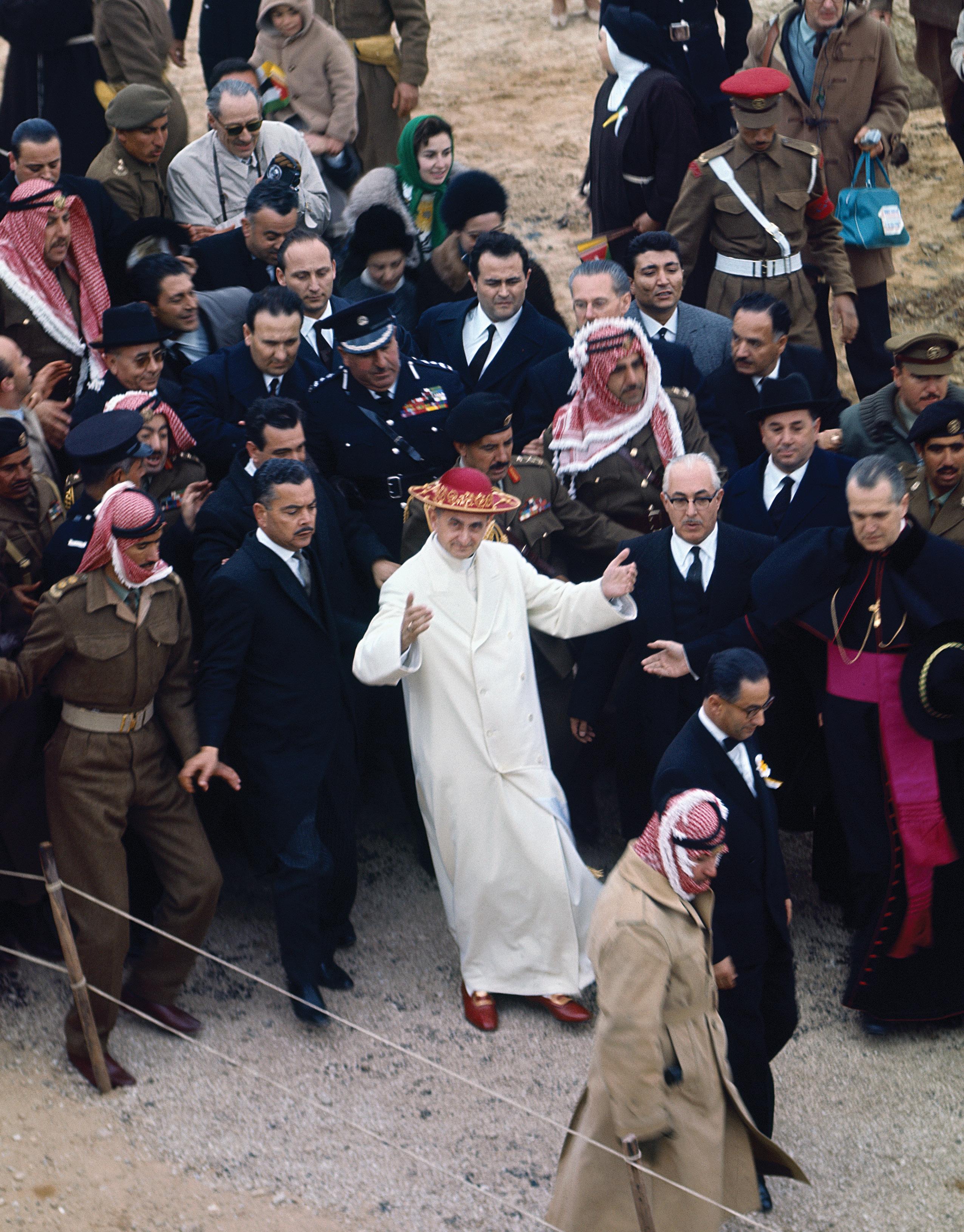
Pope Paul VI visits the baptismal site along the Jordan River during his pilgrimage to the Holy Land in January 1964.
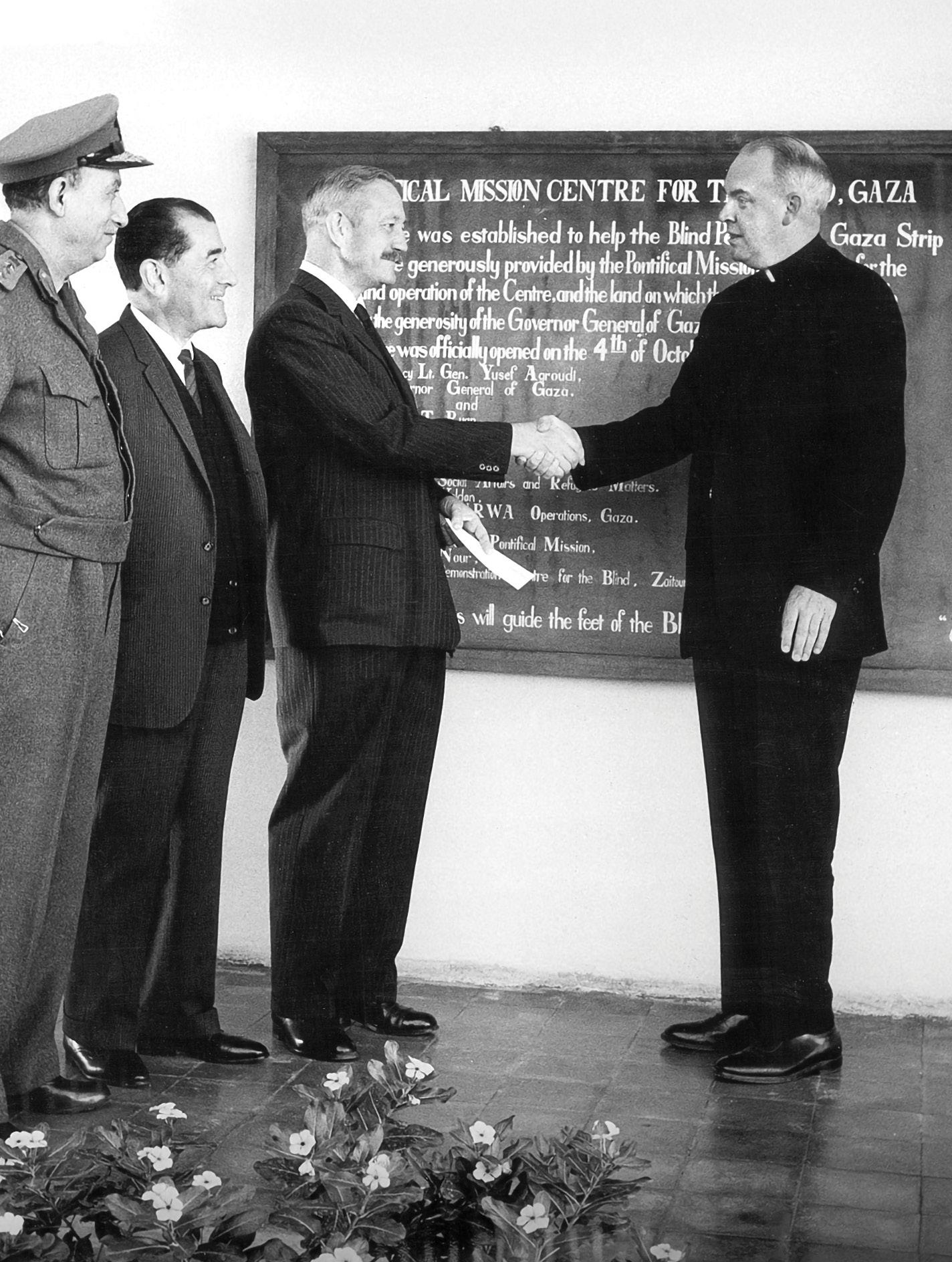
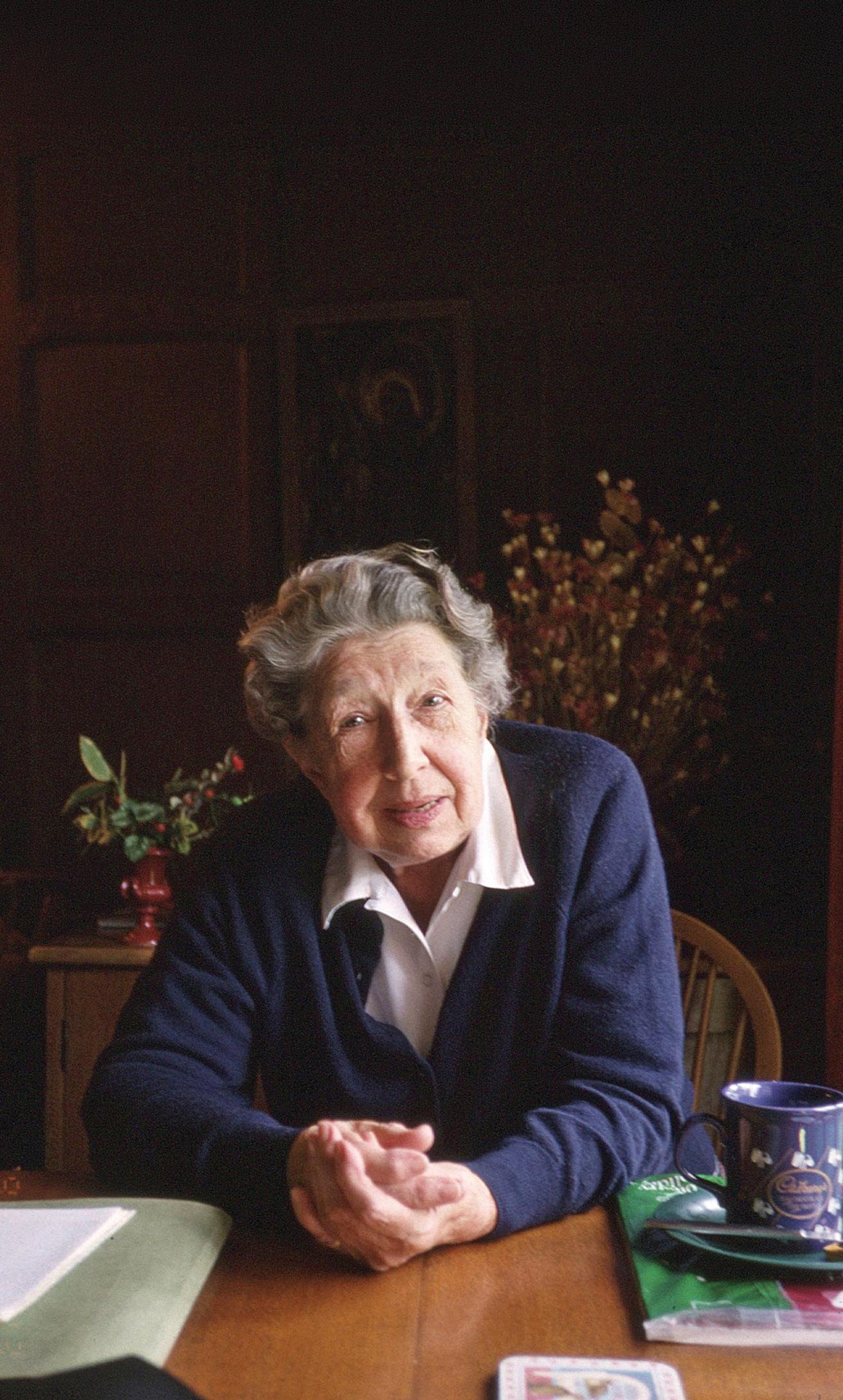
In this November 1965 file photo, Msgr. Joseph T. Ryan, former president of Pontifical Mission for Palestine, thanks John Reddaway, then acting commissioner-general of UNRWA, after the presentation a $10,000 check at the Pontifical Mission Center for the Blind in Gaza. Opposite, Carol Hunnybun, pictured here in retirement in 1993, worked for CNEWA-Pontifical Mission from 1963 to 1982.
Jean J. Chenard, a C.R.S. representative in Geneva, Msgr. Ryan wrote that the goal of CNEWA’s Pontifical Mission was to “render every possible assistance to all refugees irrespective of race or creed.”
Despite the successes of CNEWA’s coordination of global Catholic aid in support of refugees, Msgr. Ryan found wanting resources and solutions to address the long-term needs of the permanently displaced.
In the same letter, he continued, “Thousands of refugee children receive primary and secondary education in free schools specifically organized by the Pontifical Mission or in existing schools subsidized by the Pontifical Mission. It is, however, unfortunate that some of the refugee students, specially gifted, cannot pursue their education beyond the highschool level.”
He recognized the existing health care facilities subsidized by Pontifical Mission provided medical care to thousands of refugees annually, but noted that funds were inadequate for specialized treatment:
“We have at present several young people — paralyzed, blind — who have good chances of recovery should funds [and treatment] become available.”
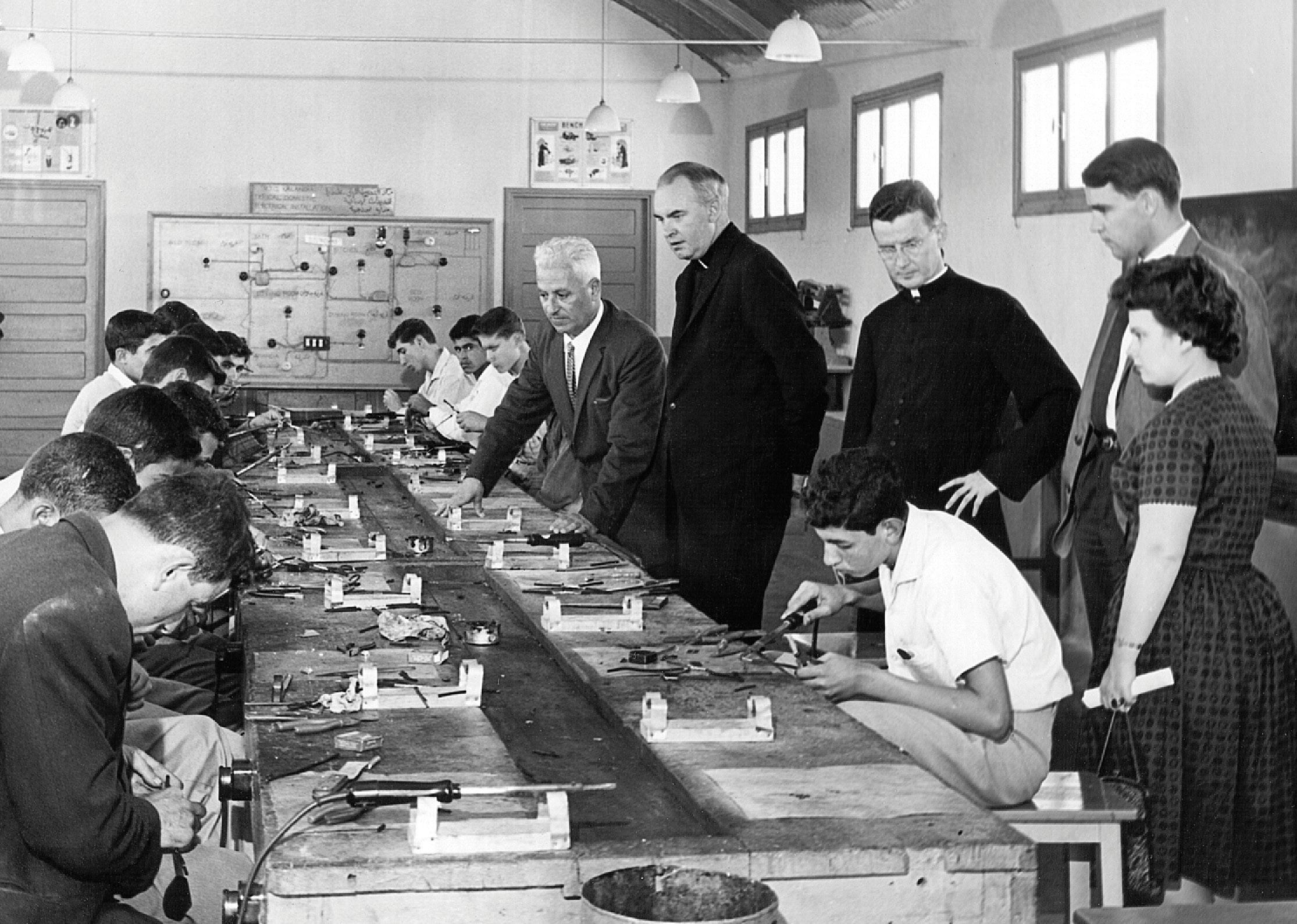
Finding permanent employment for the refugees, especially in countries where governments forbade refugees from working legally, also concerned the priest. He concluded that for heads of households to care for their families sustainably, charities would need significant funds “to provide the necessary machines and tools (tailoring, shoemaking, carpentry, etc.) … to a larger number of deserving cases who will then become self-supporting.”
Illness cut short Msgr. Ryan’s tenure in Beirut. He was succeeded by a priest of the Archdiocese of New York, Msgr. Stephen J. Kelleher, who, as Msgr. Ryan recuperated in New York, continued his predecessor’s assessment of the work of Pontifical Mission in letters to Cardinal Spellman, all while shepherding through projects and programs.
“There is very little indication of any effort on the part of the church to alert the Moslems, the overwhelming proportion of the population, to her charitable presence by assisting them in their social, educational and economic development,” he wrote in one letter. “It would be of considerable value if there was some coordination … of the money spent in the Middle East through the Oriental Congregation, the Franciscan Commissariat of the Holy Land, the Pontifical Mission and numerous other Catholic organizations.”
When Cardinal Spellman secured from the Holy See Msgr. Ryan’s appointment as national secretary of CNEWA and president of Pontifical Mission for Palestine, the two monsignors quickly got to work.

“For the last five years, the operation of the Pontifical Mission has been more or less static,” the new president wrote to Cardinal Spellman in early 1961. “This is not to say that no good work has been done for there has been much charity … there could be more done, however, by a broadening of our relief and welfare programs. An extension of operations in Jordan to include all Jordanians … would be a very fine thing. I would also like to see an extension of our program in Gaza.”
CNEWA’s national secretary concluded his letter suggesting the work of Pontifical Mission for Palestine be clarified by the Congregation for the Eastern Church, expressing his hope that such a clarification “would concern itself directly with relief work in a variety of concrete forms.”
“With specific aims and a competent man in the field (and we have one in Monsignor Kelleher),” he added, “programs could be initiated to give material aid that would benefit all the underprivileged of the countries concerned.”
In an interview in 1993, Carol Hunnybun — whom Msgr. Ryan had recruited, with her colleague Helen Breen, to serve CNEWA-Pontifical Mission in 1963 — noted that in the beginning, “Pontifical Mission was established to work for ‘Arabs in need as a result of war.’ Originally this meant Palestinian refugees, but of course afterwards it included the local population.
“Need not creed was our yardstick, and the Pontifical Mission would have nothing to do with Catholic cows and Catholic meadows producing purely Catholic milk.”
CNEWA’s establishment of the Pontifical Mission Center for the Blind in Gaza in September 1961 became its first human development project in the Middle East to reflect the strategy of the new administration. The center, which combined primary schooling with job training, was a joint project of CNEWA-Pontifical Mission, UNRWA and the government of Egypt, which had occupied Gaza until it lost to Israel during the Six-Day War in 1967.
Having secured the necessary support on the ground, Msgr. Ryan launched a fundraising campaign in North America, writing as CNEWA national secretary to every Catholic school for the blind in the United States and to members of the American Federation of Catholic Workers for the Blind.

“Blindness is a curse throughout the Near East,” he wrote. “The percentage of blind people in Gaza is extraordinarily high. With few exceptions, the blind in Gaza are not equipped to earn their own living. The Pontifical Mission for Palestine proposes, accordingly, to erect for the blind a vocational school. Under Catholic auspices, in this area that is almost 100 percent Moslem, the blind will be taught to read, to write, to do carpentry, make baskets, weave baskets, etc.”
Thanks to his weekly CNEWA column in the Catholic press and his direct appeal to Catholic apostolates for the visually impaired, enthusiastic responses enabled
“Need not creed was our yardstick, and the Pontifical Mission would have nothing to do with Catholic cows and Catholic meadows producing purely Catholic milk.”
CNEWA-Pontifical Mission to open the center within months of launching the campaign.
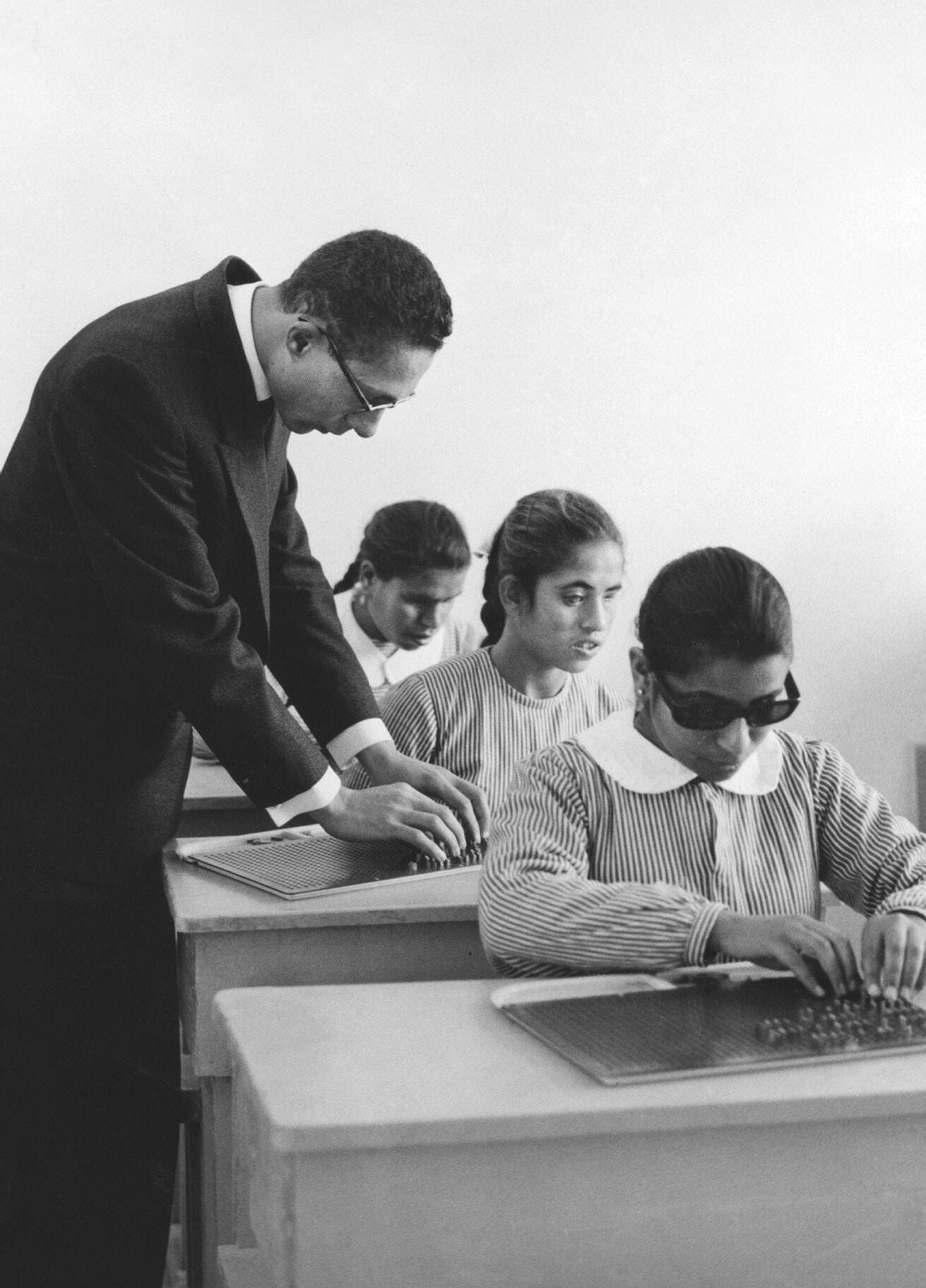
“At one time,” remarked Ms. Breen, who, with Ms. Hunnybun, administered the CNEWA-Pontifical Mission office in Jerusalem from 1966 to 1982, “the only way a blind man could make any money was to sit on a street corner and beg. Now those blind adults are trained to work in the refugee camps at special ‘service centers’ run from the Pontifical Mission Center for the Blind.”
Over time, 99 percent of the graduates, who first enrolled in the program at the age of 5, found employment. Girls learned to weave and knit, boys learned carpet-making and cane work.
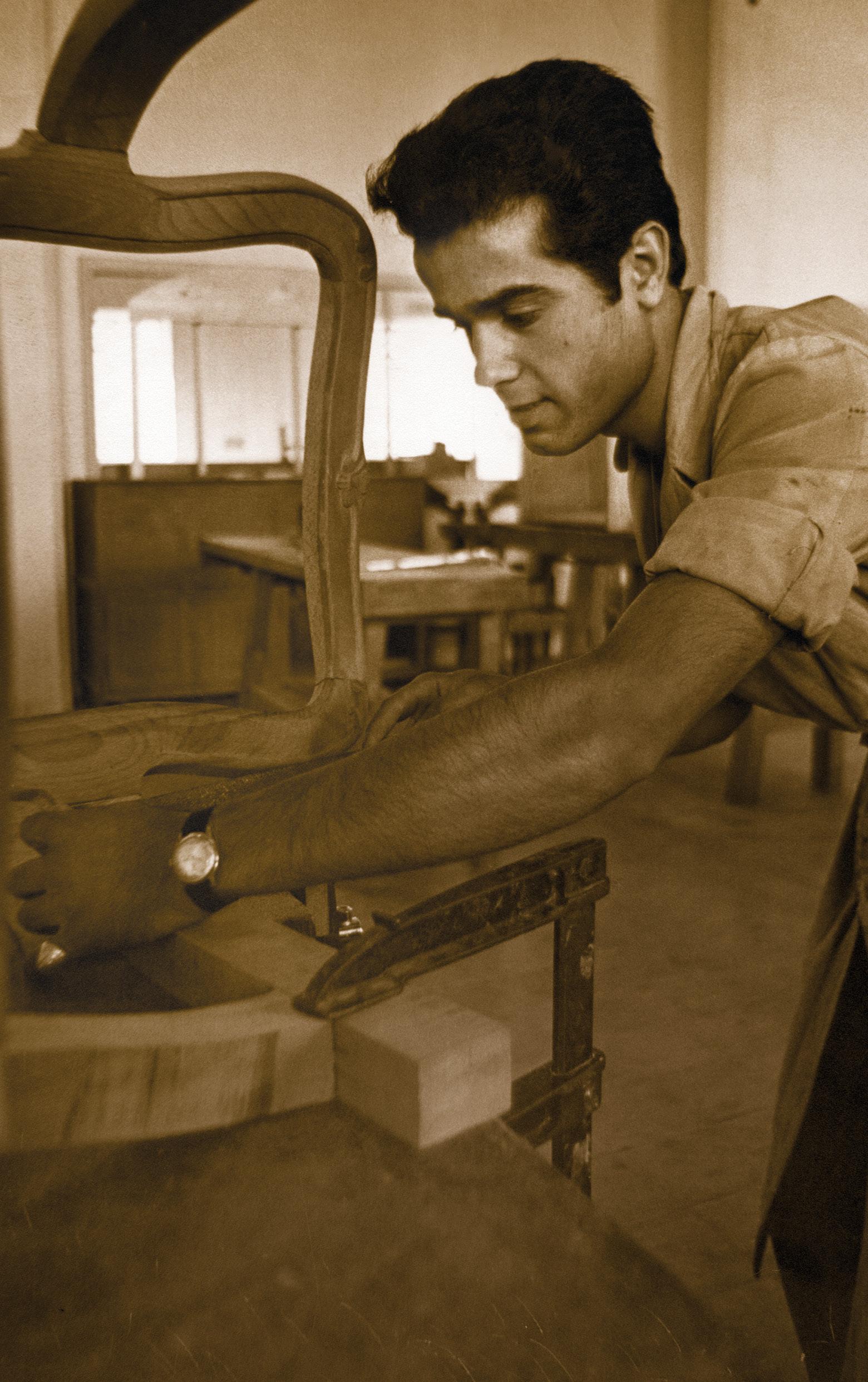
A teacher, himself blind, teaches arithmetic at the Pontifical Mission Center for the Blind in Gaza. Opposite, Msgr. Joseph T. Ryan and Msgr. Stephen J. Kelleher visit with students at the Salesian Technical School in Bethlehem, circa 1963.
Many continued their academic studies, enrolling in secondary schools and universities.
In 1987, CNEWA-Pontifical Mission passed on the administration and operation of the center to UNRWA. The U.N. agency continues to operate the facility — now known as the Rehabilitation Center for the Visually Impaired — which the Israeli Defense Forces destroyed in the Israel-Hamas war.
In seeking additional European Catholic support, Msgr. Kelleher reached out to the relief and development agency of the German Catholic bishops, Misereor, suggesting they use Pontifical Mission as its “agent and liaison” in the region. He also forged ties to Swiss Caritas, which began construction of a specialized pediatric facility in Bethlehem, Caritas Baby Hospital, for which CNEWA-Pontifical Mission provided financial support toward its founding.
Entrusted to and subsidized by Kinderhilfe Bethlehem, a Swiss and German Christian organization that has long supported CNEWA-Pontifical Mission’s motherand-child programs, Caritas Baby Hospital remains the only pediatric center in the West Bank, providing more than 50,000 children with quality inpatient and outpatient medical services.
Following through on their concern for the host nonrefugee populations, Msgr. Ryan and Msgr. Kelleher partnered CNEWA-Pontifical Mission with Misereor and the Near East Foundation. Together, in 1962, they launched a rural development program among the Bedouin who hailed from ancient nomadic Christian families and settled in the Kerak Governorate of central Jordan in the late 19th century. Named for the four participating village communities of Judayyda, Ader, Smakieh and Hmoud, JASH introduced the Bedouin to new livestock breeds and crop varieties — such as grapes, figs and drought-resistant vegetables — and provided women with literacy, sewing and embroidery courses.
“One of the important benefits of this project since its inception has been the development of local leadership,” said project manager James E. Johnson

in 1965. “One of the major factors contributing to poverty in this area was the lack of leadership.”
CNEWA-Pontifical Mission has remained active in the region ever since. “Many Catholic priests have come from the Hijazine family, at least 16, and many sisters over the last several decades,” Ra’ed Bahou, CNEWAPontifical Mission’s regional director based in Amman, said in an interview in September 2017. Ader, Hmoud and Smakieh in particular, he added, have supplied historically the bulk of Latin and Melkite Greek Catholic and Orthodox priests and religious for Jordan, Israel and the Palestinian territories.
In Jerusalem, Msgr. Ryan invited members of an international Catholic association of the laity,
commonly known as the Teresians, to administer a lending library that began in the back room of Pontifical Mission’s office in the Old City. In 1956, French Canadian Brother Eugene Bilodeau, O.F.M., who directed Pontifical Mission’s Jerusalem office, began a reading and music program for students living near the Old City, then under Jordanian control.
“Everybody read and studied because that was the only thing [a Palestinian refugee] could do in the camps,” he recalled in 1994. Word of the program, then the only one of its kind for the refugee community, spread, and eventually Pontifical Mission libraries opened in Amman and Bethlehem. The latter two facilities remain important community centers administered by the Teresians.
As CNEWA’s program development efforts in the Middle East — centered on its teams running Pontifical Mission offices in Beirut and Jerusalem — gathered steam, its sponsorship of Eastern Catholic liturgies and conferences that began during the 1940s contracted to the observance of an annual liturgy at St. Patrick’s Cathedral in New York City. Donors, however, continued to sponsor Eastern Catholic novices and seminarians through the Congregation for the Eastern Church, which also forwarded “mission pages” that listed the needs of the various churches outlined by the Holy See’s legates in each country.
Using the Catholic media in North America, CNEWA raised awareness and funds to cover these needs, sending the monies to the congregation to build and
furnish churches and chapels, support orphanages, and provide liturgy stipends. In December 1964, Msgr. Ryan visited the southwestern Indian state of Kerala, calling on the leaders of the Syro-Malabar and Syro-Malankara Catholic churches and visiting the many churches and chapels, schools and convents built, furnished or renovated by CNEWA’s donors.
One event during Msgr. Ryan’s pivotal tenure dramatically affected CNEWA-Pontifical Mission for Palestine: the election in June 1963 of Giovanni Battista Cardinal Montini of Milan as bishop of Rome.
Before being named the archbishop of Milan in 1954, Msgr. Montini served as substitute secretary of state for Pope Pius XII. In that role, he helped shape the church’s work with the vulnerable and the marginalized. He organized relief efforts, as well as the rescue of political refugees and members of the Jewish community during World War II. He also assisted with the founding of Caritas Internationalis, the International Catholic Migration Commission and Pontifical Mission for Palestine, entrusting the latter to CNEWA for its leadership and administration.
Not long after his election, the new pope urged Msgr. Ryan in a letter to continue his work with Pontifical Mission, reminding him of his own role in creating this unique initiative of the Holy See.
“We esteem highly the efforts and admirable achievements of that Mission, which we helped establish, and which you, beloved son, now direct with the aid of selfless collaborators,” he wrote.
“For the past fourteen years, the Pontifical Mission for Palestine has carried on this noble apostolate, by providing spiritual and material relief for the victims of war in the Holy Land. We exhort relief agencies everywhere to assist your Mission in accomplishing its important work,” he continued. “And, in this regard, we address particularly those bodies to whom this appeal was made from the beginning: Catholic Near East [Welfare] Association, Catholic Relief ServicesNational Catholic Welfare Conference, the Custody of the Holy Land and the Equestrian Order of the Holy Sepulchre.”
Later, in December, the pope announced his intention to begin the first full year of his pontificate with a “pilgrimage of prayer and penance” to the Holy Land, stating just hours before he left, on 4 January 1964,
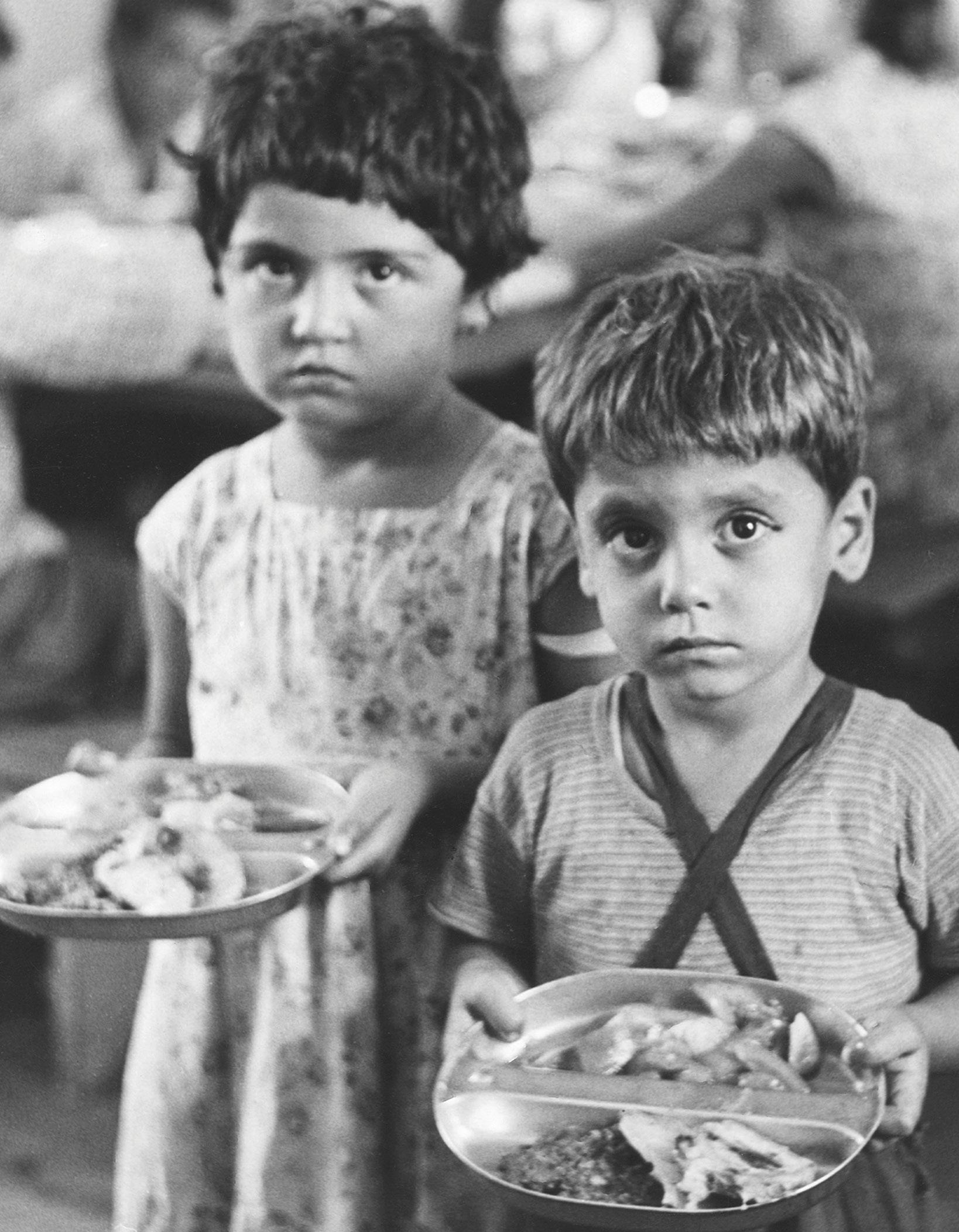
Palestinian children receive a hot midday meal at Dbayeh refugee camp, northeast of Beirut, circa 1960.

that “we will bring to the Holy Sepulchre and to the Grotto of the Nativity the desires of individuals, of families, of nations; above all, the aspirations, the anxieties, the sufferings of the sick, the poor, the disinherited, the afflicted, of refugees, of those who suffer, those who weep, those who hunger and thirst for justice.”
Msgr. Ryan joined the pontiff when he arrived in Amman, the capital of the Hashemite Kingdom of Jordan, and accompanied him as he visited the holy sites in Bethlehem, Galilee, Jerusalem and Nazareth, including his now famous greeting and embrace with the spiritual head of the Orthodox communion of churches, Athenagoras I, ecumenical patriarch of Constantinople, on the Mount of Olives.
“The pace of the whole thing was so terrific that we all [the staff of CNEWA-Pontifical Mission in Beirut and Jerusalem] returned to Beirut completely exhausted,” he later recalled. “All in all, the Holy Father’s pilgrimage was a triumph.”
The staff worked closely with the media, some 1,800 of whom registered for access to the many stops on the pilgrimage. “We who were there find it hard to imagine how anybody could have written a news story on it,” Msgr. Ryan later said.
Ms. Breen worked with Ms. Hunnybun in the press office located in the basement of the National Hotel.
Ms. Breen recalled later, before her death in 1993, that the journalists were “absolutely, desperately tired. Most had just left Cyprus, where there were troubles [civil war]. And prior to that, they were in Rome covering the Vatican Council.
“One man came into the press office, sat down at one of the tables, and went fast asleep. … I felt so sorry for this man that I pounded away on a typewriter, too, and made a story in which we gave his byline,” she said, laughing. “I do not think he ever knew who had done it.”
Before the pope left Jerusalem, he received Msgr. Ryan and his team at the residence of the apostolic delegation on the Mount of Olives.
“He opened his arms,” Msgr. Ryan remembered, “and said, ‘I have been waiting to see you.’ ”
“We cannot but recall the pilgrimage we made to the land of Jesus in January 1964,” the pontiff wrote in
MOVING FORWARD, TOGETHER
his apostolic exhortation “Nobis in Animo” more than 10 years later. “Nor can we forget the meeting with those Christian religious leaders, including the Greek Patriarch and the Armenian Patriarch of Jerusalem, and with the crowds of the faithful who pressed about us in, as it were, an exuberant embrace of faith and charity.”
That embrace of faith and charity was soon to be returned by the Holy Father — through his special Pontifical Mission for Palestine — to the people of the land of Jesus.
Read the next installment in the September issue.
Executive Editor Michael J. La Civita is director of communications and marketing.
When
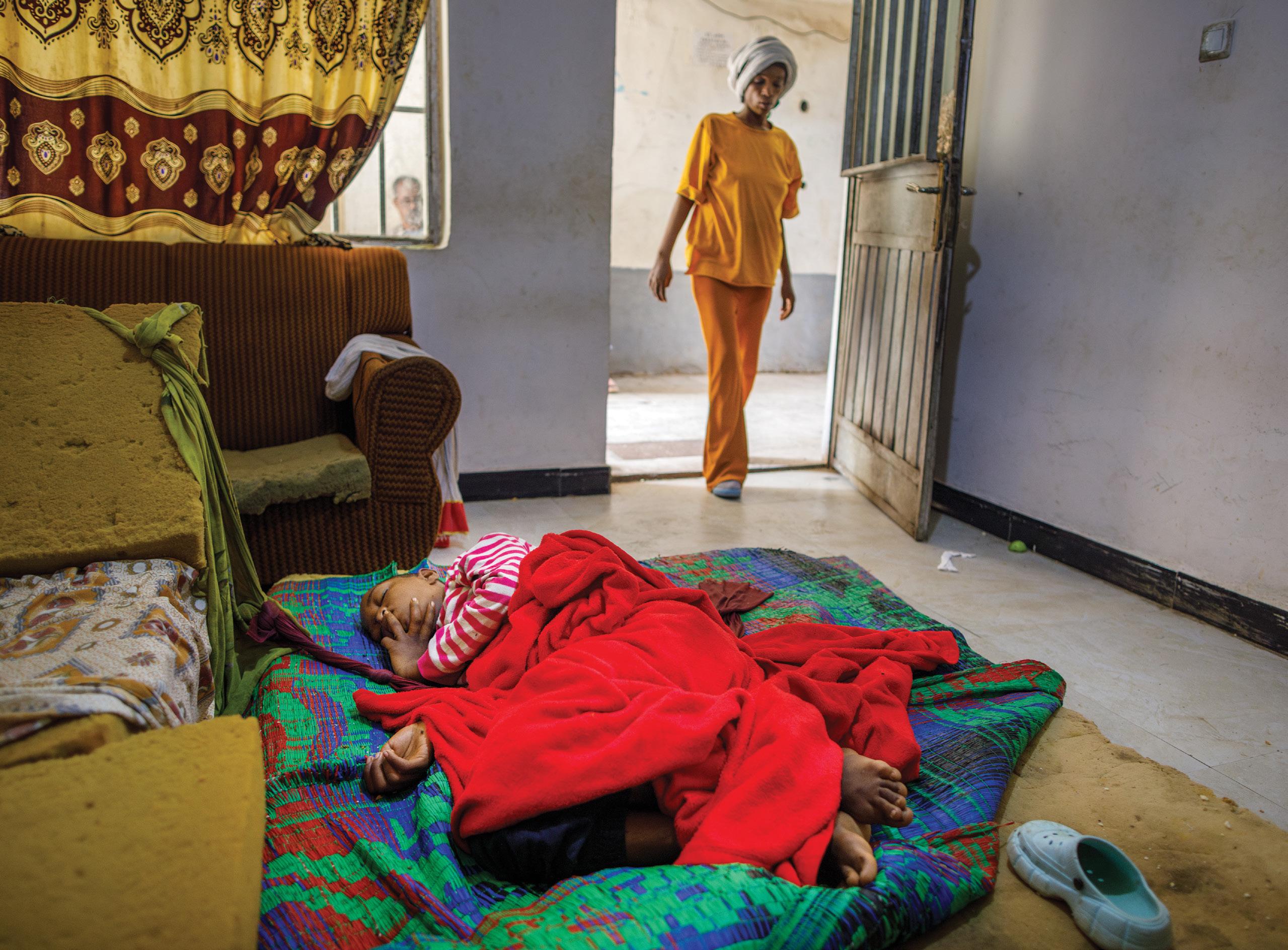
Feven Alem is at a breaking point. The single mother of three lives in a neglected rental unit in the suburbs of Addis Ababa, the Ethiopian capital. Two of her three children suffer from autism and need round-theclock care.
As an Eritrean refugee, she lacks the legal status to work in Ethiopia. With little hope for employment, her immediate worry is the looming prospect of homelessness.
Ms. Alem’s mental well-being is strained. Support for children with autism is rare in Ethiopia. With little access to resources, and when neighbors are not available to help, she often chains her children to their bed for their own safety when she heads out on her own to scrounge for aid.
“My life has been going downhill. Food is becoming scarce, and my children are going to bed hungry, and there is little that I can do to help them,” she says as she waits inside the compound of Jesuit Refugee Service (J.R.S.) in Addis Ababa for the monthly financial support she receives.
She worries about how long she can sustain her family and wonders if she will be forced to abandon her children.
Frail yet determined, the 32-yearold prays and says fate has forced her to pause her ambition to go back to school and become a health practitioner, perhaps a nurse, to improve her family’s circumstances. But a lifetime of hardship has made that difficult.
The charity ecosystem in Ethiopia that once helped sustain
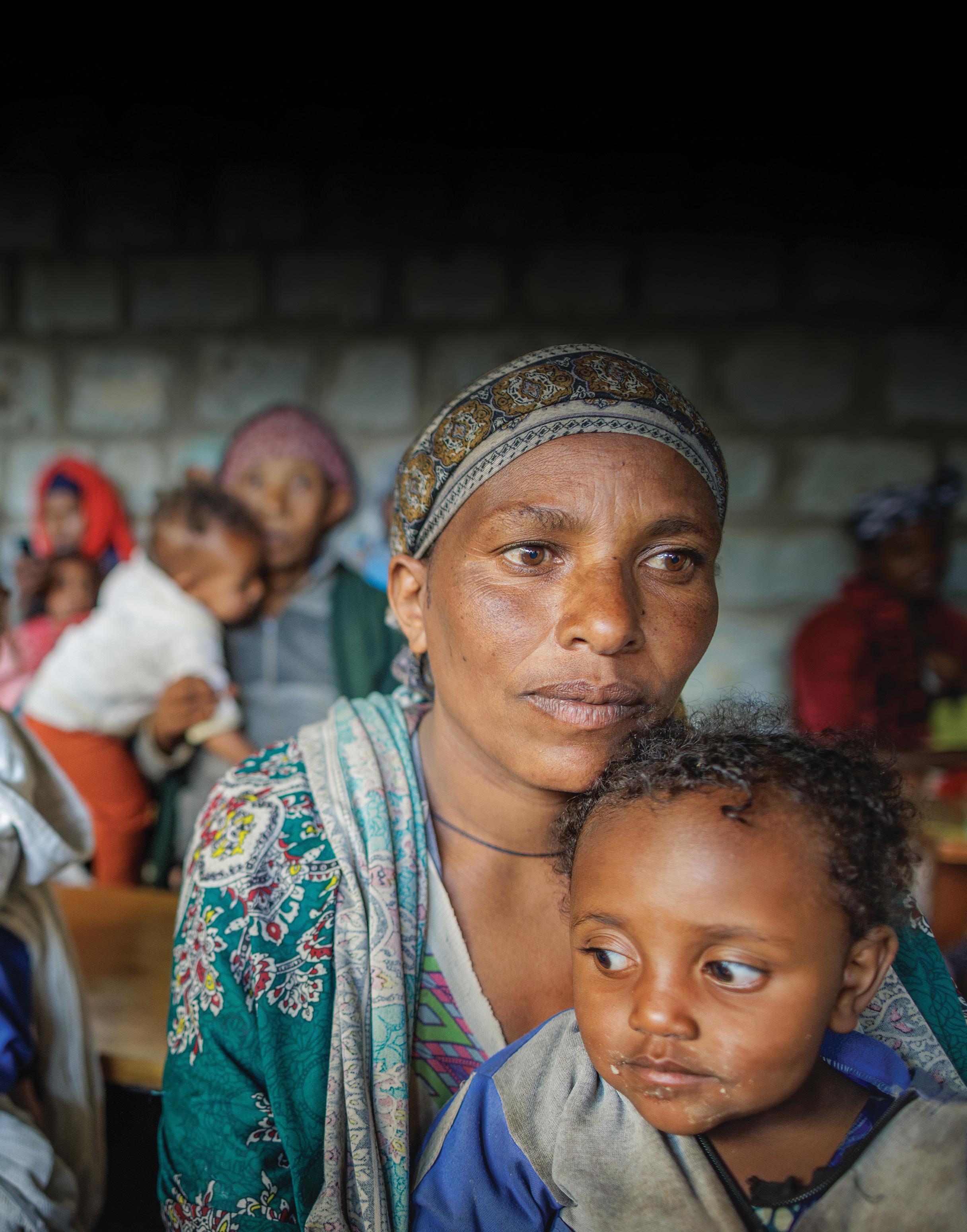
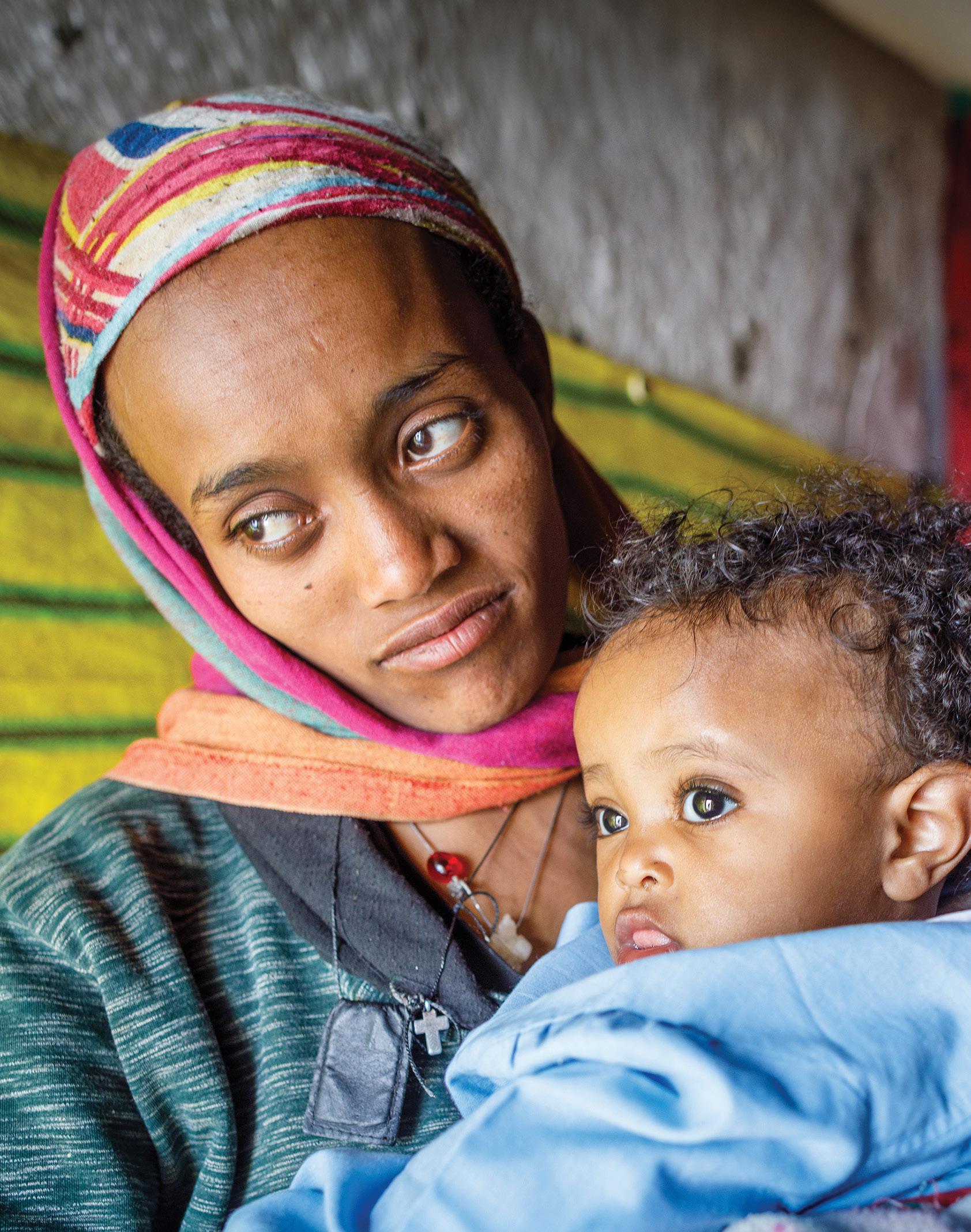
Mothers and children receive food assistance at a church-run center in Mendida, Ethiopia.
Children Go Hungry
The babies cry from hunger, and mothers cannot produce milk. As some international aid groups leave Ethiopia, church-run programs remain.
RUSHING EMERGENCY AID
text by Samuel Getachew with photographs by Petterik Wiggers
“Food is becoming scarce, and my children are going to bed hungry, and there is little that I can do to help them.”
Ms. Alem and her children has been spread thin since U.S. aid was abruptly frozen in January 2025. Many refugees from warscarred nations, such as Sudan, South Sudan and Eritrea, who were supported previously by J.R.S., say the aid cutbacks have meant fewer people are getting the support they need.
That has meant less food on the table, less psychological support —
especially for those who have experienced violence — less educational support for children, and less support staff to help refugees find affordable housing, resulting in considerable suffering.
In Mendida, about 96 miles north of Addis Ababa, the situation is no different. With larger Ethiopian cities overwhelmed by need, tens of
thousands of vulnerable people have moved to remote villages or have returned to their villages of origin, desperately hoping for a miracle.
A nondescript rural hamlet with minimal infrastructure, Mendida has become a hotspot for people from different parts of the country fleeing ethnic and armed conflict or facing food insecurity and economic collapse.
Feven Alem walks into her home, where her eldest child, who has autism and is physically disabled, sleeps most of the time due to his medications. Opposite, Sister Dinknesh Getachew speaks to children who come to her clinic in Mendida.
In Mendida, those in need rely mostly on the tender care of the religious sisters of the Congregation of Divine Providence, who arrived 53 years ago.
Weinshet Gezaw, 30, a oncesuccessful entrepreneur in the suburbs of Addis Ababa, was abandoned by her husband, a laborer, after their home in a neighborhood of illegal housing was marked for bulldozing to make way for paved roads, parks and skyscrapers.
Three months pregnant and in despair, she moved back to Mendida, her ancestral village, where an elderly family member gave her temporary shelter — a room without electricity or running water. In mid-May, she was still living in that room with her twin sons and relying daily on the local CNEWA-funded Medhanealem Medium Clinic, run by the Congregation of Divine Providence, to support her and her malnourished children.
“We are on the verge of starvation, and my story is no different than my neighbors’,” says Ms. Gezaw, who often retires to bed hungry. “We are desperate, and the little we eat to survive comes from the Catholic Church.
“What has made the situation even more difficult is the fact we can’t find jobs. The economy is in free fall, and our life’s goal is to try to stay alive, while the dream of self-sufficiency remains elusive,” she says.
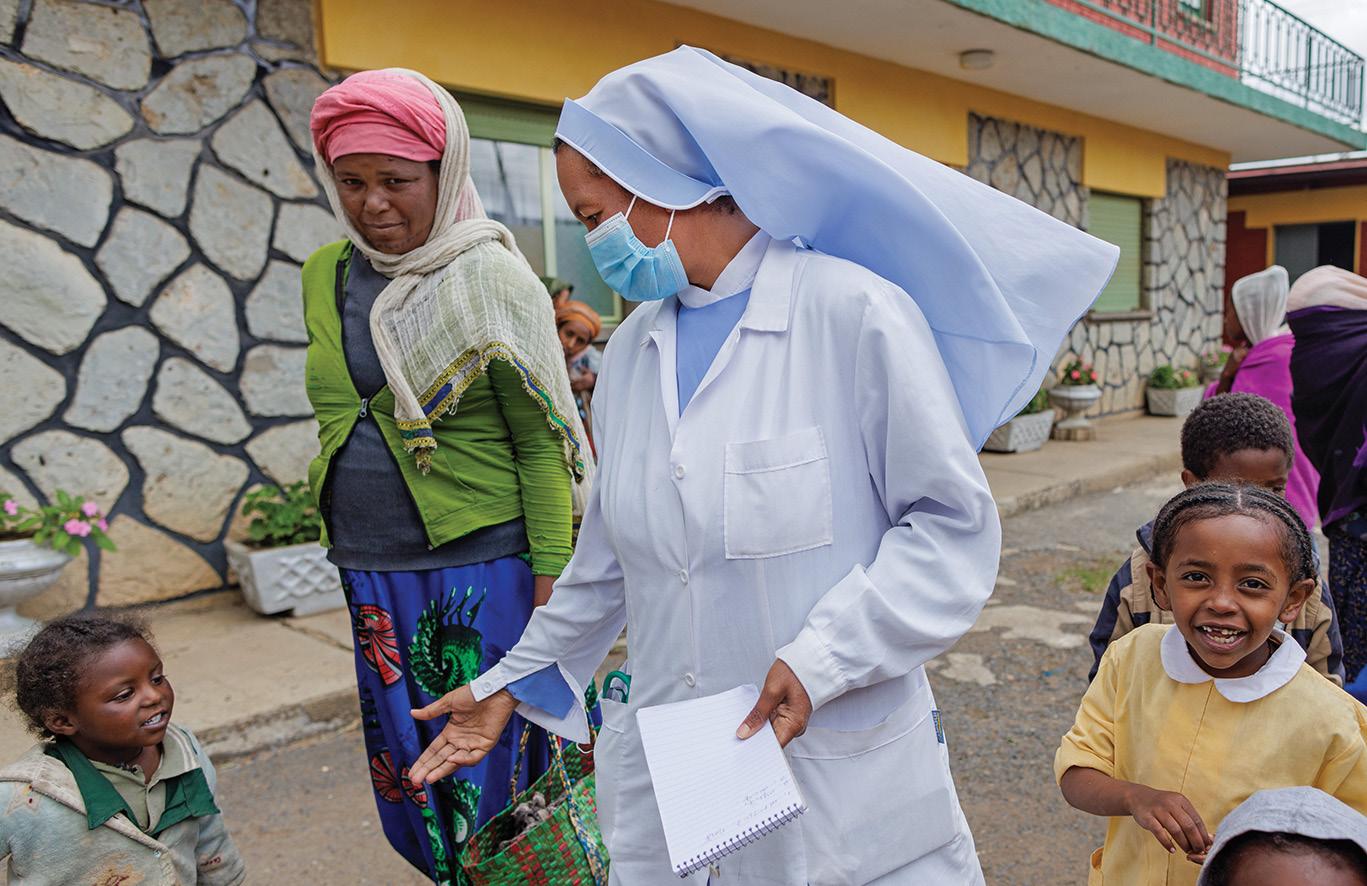
Sister Dinknesh Getachew, administrator of Medhanealem Medium Clinic, prays for more
The CNEWA Connection
CNEWA released an additional $100,000 in May to address food insecurity in Ethiopia, continuing its nutritional support with schools and parishes in Tigray, Amhara and Central Ethiopia regions. The food problem is driven by ongoing conflict and insecurity, multiyear droughts, decreases in international aid and the devaluation of the Ethiopian currency. CNEWA also supports church-run health facilities. In addition, it provides funds for Jesuit Refugee Service in the capital, Addis Ababa, which supports refugees who flee to the city.
To help CNEWA feed the hungry in Ethiopia, call 1-866-322-4441 (Canada) or 1-800-442-6392 (United States) or visit cnewa.org/donate
resources as the demand on the clinic has become overwhelming amid the influx of destitute people seeking help.
Most of the mothers and children who come to the clinic are malnourished. Sister Dinknesh explains that her community tries its best to cater to their needs. Available resources, however, do not match the growing demand for humanitarian assistance. Her work, she says, is heartbreaking.
“What we are beginning to see is the impact of lack of food,” she adds. “We are beginning to see children suffering from mental issues, such as anxiety, as a result, and acute hunger among many.
“There is a lot of hunger in the community, and many children are
not given the resources they need to live a fulfilled life,” she says.
“We are doing our very best as we produce food and offer essential services even as we race against time,” that is, before food runs out, she adds.
Feleku Agonafer, 43, says the suffering and hardship have almost broken her spirit; her daily challenge is how to feed her daughter. Partially blind since birth and now H.I.V.-positive, Ms. Agonafer walks around her neighborhood in Mendida seeking help. She often comes to the clinic, where her child receives one meal a day. The sisters have taught her how to care for her child and not expose her to the virus.
“ We are doing our very best … even as we race against time.”
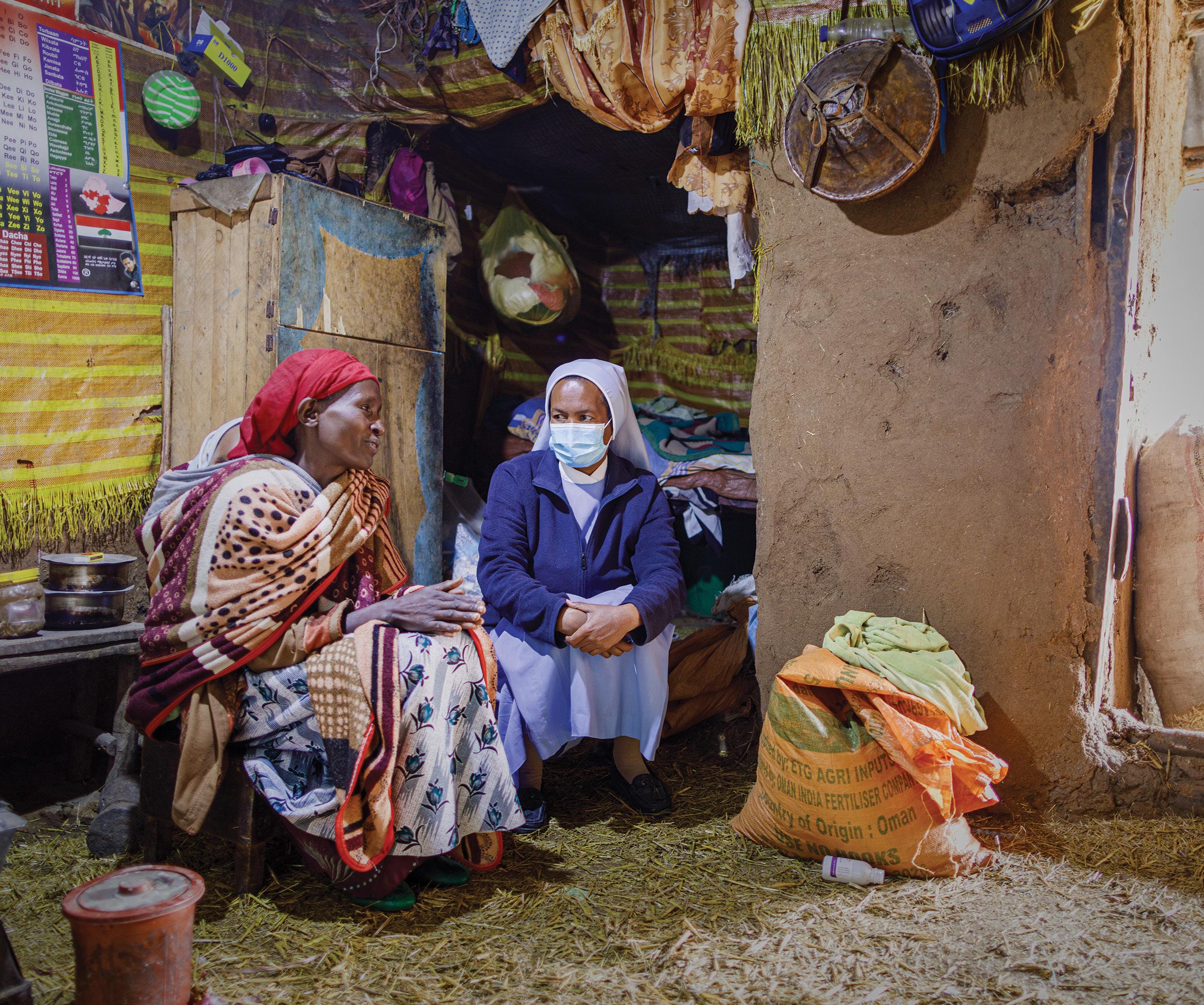
“The food that has been provided has helped a lot, and I have been able to sustain my livelihood and that of my daughter under very difficult circumstances,” she says.
Aberash Abebe, 22, lives in a small government-made mud hut in Mendida with her husband and newborn. The hut is crumbling and the roof is leaking, but she still considers herself lucky to have a home. Her husband is on disability and is unable to work.
Lack of food has made it difficult to breastfeed her daughter, who
often cries from hunger, so Ms. Abebe goes to the clinic daily for food for her baby. She is worried that a lack of aid in Mendida will mean she and her family will need to migrate to another part of the country.
Foreign aid cutbacks, natural disasters and strife in various regions of Ethiopia, including in the suburbs of the capital, have displaced an estimated 2.5 million to 4.5 million people and placed nearly 7 million people in need of emergency aid, report international
Sister Dinknesh Getachew visits with a blind woman, who receives assistance from church-run programs.
organizations that track such data, including the International Organization for Migration.
Doctors Without Borders (M.S.F.) and the World Food Program (W.F.P.) also have warned about the possibility of extreme food insecurity in the Horn of Africa.
In May, M.S.F. reported the “needs are increasing” in Ethiopia’s Somali region, where failed rainfall
over several years has “driven a severe drought emergency … pushing millions into acute food insecurity and forcing millions more from their homes.”
Malnutrition has increased among residents, as hundreds of thousands of people have lost access to potable water, the medical group said.
The Integrated Food Security Phase Classification Global Partners estimate more than 10 million people in Ethiopia will face high levels of acute food insecurity this year. This is compounded by the 2025 freeze of U.S. government funds and dismantling of the United States Agency for International Development (USAID), once Ethiopia’s largest provider of humanitarian aid; in 2024, the United States provided $480.5 million in humanitarian funding to Ethiopia.
In the past year, the lack of funds has translated into a sharp decline of food delivery by many humanitarian organizations, including the W.F.P., which has since redirected its efforts to other global hotspots, such as the Middle East and Ukraine. Security issues in Ethiopia, including a rise in kidnappings and theft amid the ongoing armed conflicts, also have made it difficult for W.F.P. staff to reach vulnerable populations.
In Mekelle, Wukro and Adigrat, cities in the northern, conflictprone Tigray region, many humanitarian organizations have left. During the civil war that ended in 2022, more than 80 percent of the region’s population depended on humanitarian aid. Today, the Ethiopian Catholic Church, the social services of which play a crucial role in education and health care, is among the few charitable institutions that remain; it is working to meet as many needs as it can with limited resources.
Nonpartisan think tanks and the United Nations have warned of a potential proxy conflict in the region involving Eritrea and a leadership dispute with the federal government, which would worsen the situation. In the Amhara, Oromia and Gambela regions, where more than a million South Sudanese refugees have found shelter, there is fear that climatechange-induced drought will exacerbate food insecurity. In addition, conflict, random kidnappings of humanitarian workers and demands for ransom payments are forcing humanitarian organizations to suspend their delivery of essential services.
A new report by Mercy Corps also warns that, with Iran’s control of the Strait of Hormuz in retaliation for U.S. and Israeli attacks on Iran in March, the disruption “is driving up food, fuel and fertilizer prices,” affecting local Ethiopian farmers ahead of the farming season and consequently impacting millions of people.
As casualties linked to hunger rise across the country, the federal government has introduced a new levy on services — including telecommunications and online money transfers — to help finance its disaster-response infrastructure and to promote self-reliance; it also has appealed to donors for funds.
Back in Addis Ababa, Ms. Alem says her biggest worry is that her children, two of whom have been attending school for years, may perish from hunger or fall victim to the ways in which people seek to exploit the most vulnerable.
“That worry has made my life unbearable,” she says. “A sort of death sentence.”
Samuel Getachew is a freelance journalist based in Addis Ababa, Ethiopia.
cnewa.org/donate
Isolated and Afraid
Civilians in southern Lebanon hold on to the little they have amid a failing ceasefire
by Laure Delacloche
The village of Snaya, just 20 miles from Lebanon’s border with Israel, was “surrounded by Hezbollah positions,” said Mayor Rima Habib. That made the community, which is Christian, nervous. “We are scared Hezbollah will launch missiles from the village and that, in response, the Israelis will strike the village,” she said. The villagers had cause for concern, as some residents have reported that had happened at least once before. By late April, six weeks of war between Hezbollah and Israel had put the lives and livelihood of the villagers at risk, Ms. Habib said, adding, “Most of them are farmers, and they cannot tend to their land.”
The latest escalation of violence in Lebanon began 2 March, two days after the United States and
Israel launched joint attacks against Iran. Hezbollah militants, who have been backed by Iran, fired rockets into Israel, which retaliated with a series of strikes on southern Lebanon, the Bekaa Valley and the southern suburbs of Beirut.
On 16 April, a 10-day aerial ceasefire officially ended the second escalation in a conflict that had begun between Israel and Hezbollah, after the Israel-Hamas war started in October 2023. Across Lebanon, few people trusted the ceasefire — later extended to mid-May and then again for 45 days — would allow them to rebuild their homes and their lives. The Israeli government confirmed southern Lebanon would remain an active war zone and, on 19 April, established a no-go zone that encompassed
62 villages south of the Litani River by early May. By the end of May, Israel had pushed beyond the buffer zone, extending evacuation orders about six miles north to the Zahrani River, thereby expanding its incursion to about one-fifth of the country.
Although more than a million people from southern Lebanon, the Bekaa Valley and the southern suburbs of the capital have fled to Beirut and other areas deemed safer, about 4,000 Christian families, such as those in Snaya, have remained in their villages, hoping that they would be spared. Up to 20 homes in Snaya were damaged when the conflict escalated between 2 March and mid-April, Ms. Habib said. The windows and tiles of her home were broken by shrapnel
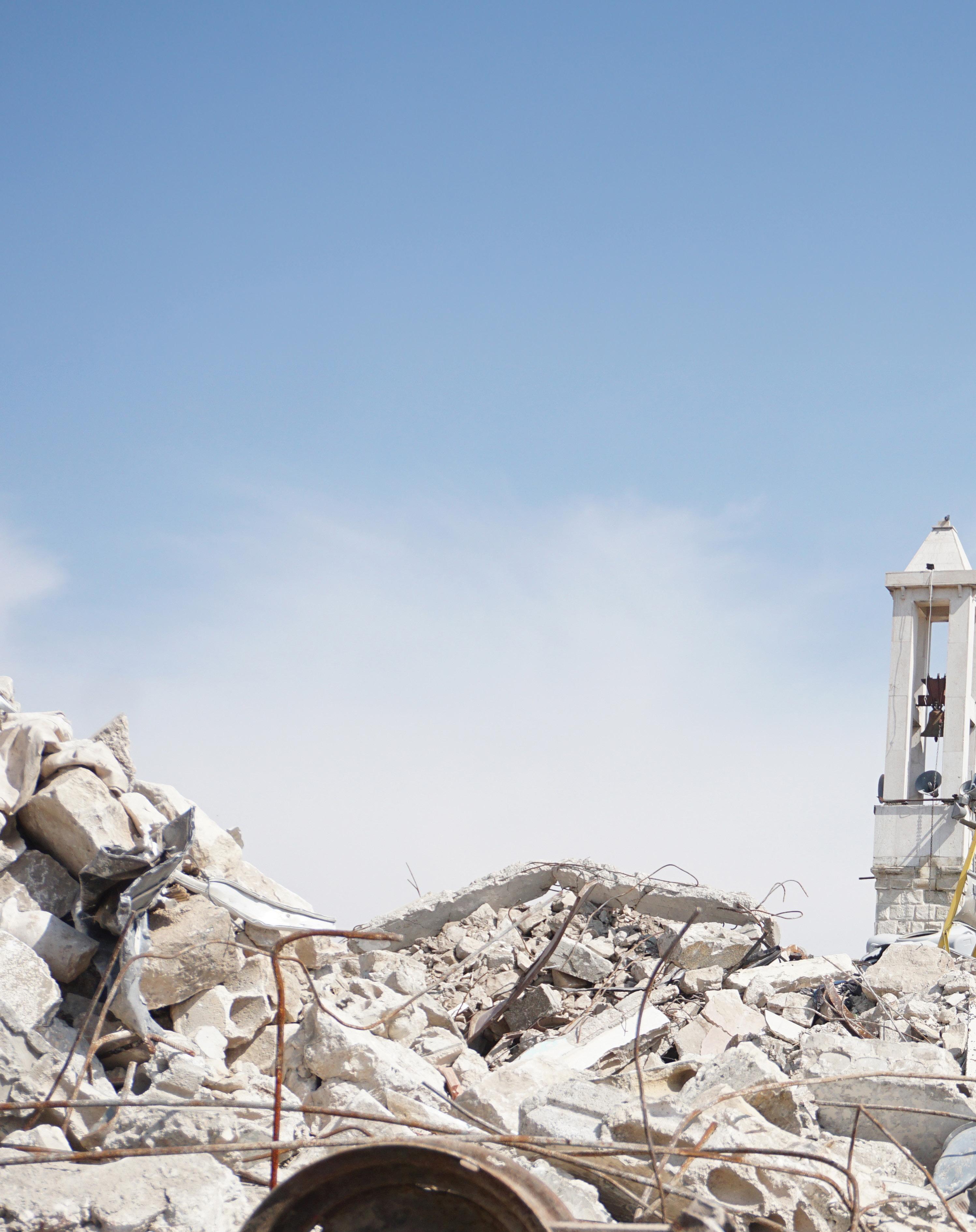
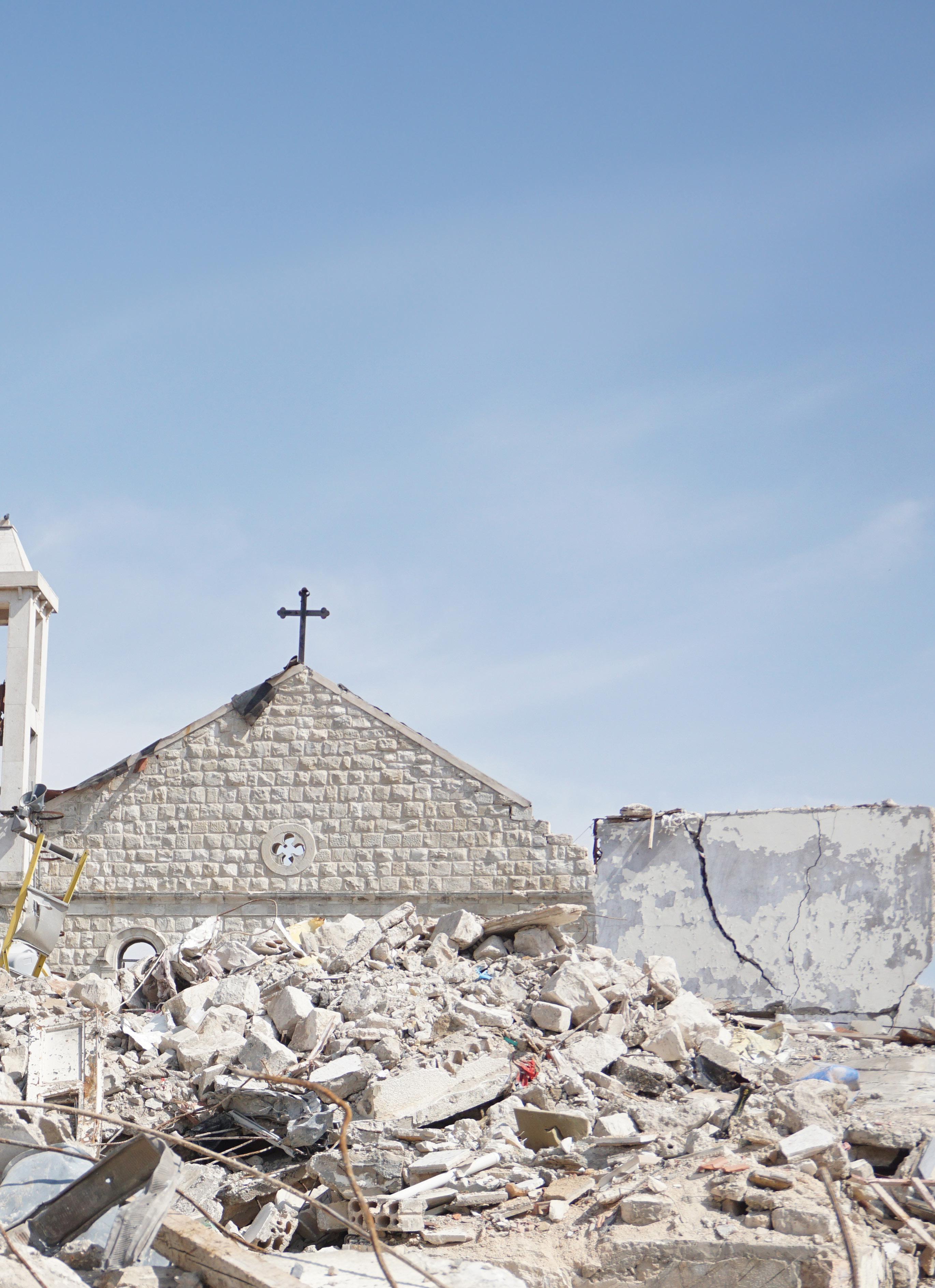
St. George Melkite Greek Catholic Church in Yaroun, southern Lebanon, has been in ruins since it was struck by Israeli fire in late 2024. On 1 May 2026, the church hall, which was serving as a makeshift chapel, the youth center, a convent and school also were destroyed.
RUSHING EMERGENCY AID
“The Christian presence, even if it is very small, is the only sign of life.”
two years earlier. Across Lebanon, 62,000 housing units were damaged or destroyed in the same period, according to the National Council for Scientific Research.
The Rev. Georges Awad of the Maronite Catholic parish in Snaya said parishioners were worried.
“They ask whether we will continue living like this or get our life back. No one knows the answer, but we need to continue living,” he said.
On the first day of the April ceasefire, the roar of warplanes and buzzing of drones were silenced. However, Snaya residents hardly felt relieved.
“After the 2024 war, we did not go back to our normal life,” resident Mirna Boutros said, referring to the ceasefire brokered in November 2024, after 66 days of all-out war, intended to end the IsraelHezbollah conflict.
“I had my suitcases packed” at all times “in case a war would happen again,” she said.
Ms. Boutros recounted how the “strikes, warplanes, drones and missiles” have impacted her mental health and shattered her home’s windows. She said she lives in a state of fear.
“When I drop my daughter off at school, I am scared,” she said.
She cares for elderly relatives and, on 2 March, stocked up on food supplies and “enough medicines for three to four months,” as Snaya only has a small convenience store. She said the security situation also has prevented her from seeking health care for her daughter, Angy, 14.
“I haven’t dared to take her to Beirut,” said Ms. Boutros, who fears military strikes on the roads as well as on the capital city.
In early May, the Lebanese health ministry reported that, since 2 March, the Israeli army killed more than 2,800 people, wounded more than 8,700 and displaced more than 1 million. More than
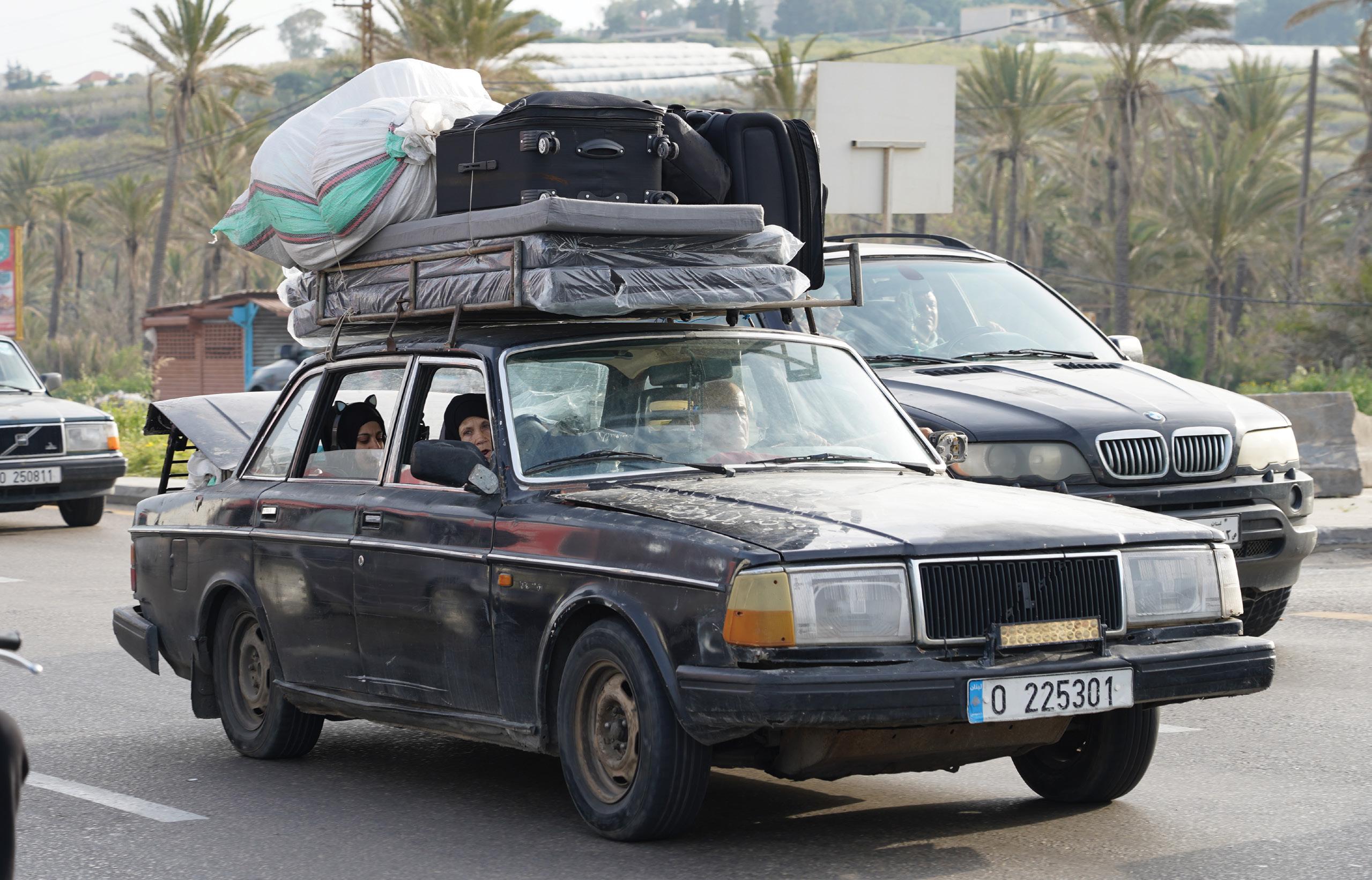
Families displaced by war head back to southern Lebanon on 17 April, the first day of the latest ceasefire between Israel and Hezbollah.
At right, aid workers sort through the contents of food boxes delivered to southern Lebanon by CNEWAPontifical Mission.
1.2 million people face varying degrees of food insecurity. Israel has reported 18 soldiers and two civilians were killed by Hezbollah in the same period.
“I was born during the Civil War. Today, Hezbollah is around the village [and] there are Israeli bombardments,” Ms. Boutros said. “I was hoping that my daughter would not live what I lived.”
When the ceasefire was announced on 16 April, church groups moved quickly. The next day, a humanitarian convoy, spearheaded by Archbishop Paolo Borgia, apostolic nuncio to Lebanon, and Cardinal Bechara Rai, patriarch of Antioch of the Maronites, headed to the district of Jezzine, southern Lebanon.
Archbishop Borgia has led at least 14 convoys to the country’s south since 2 March, in coordination with the United Nations Interim Force in Lebanon (UNIFIL). Food aid has been provided by CNEWA-Pontifical Mission and its partners Caritas Lebanon and L’Oeuvre d’Orient. This aid “is a sign of universal solidarity of the church,” Archbishop Borgia said as he greeted people in Qattine, a village that had welcome displaced people. “We must continue” to provide relief, and “be generous, as those who possess a lot must share with others.”
In Benwati, seven miles north of Snaya, CNEWA-Pontifical Mission partnered with a local organization, Fertile Desert, to distribute food parcels.
The CNEWA Connection
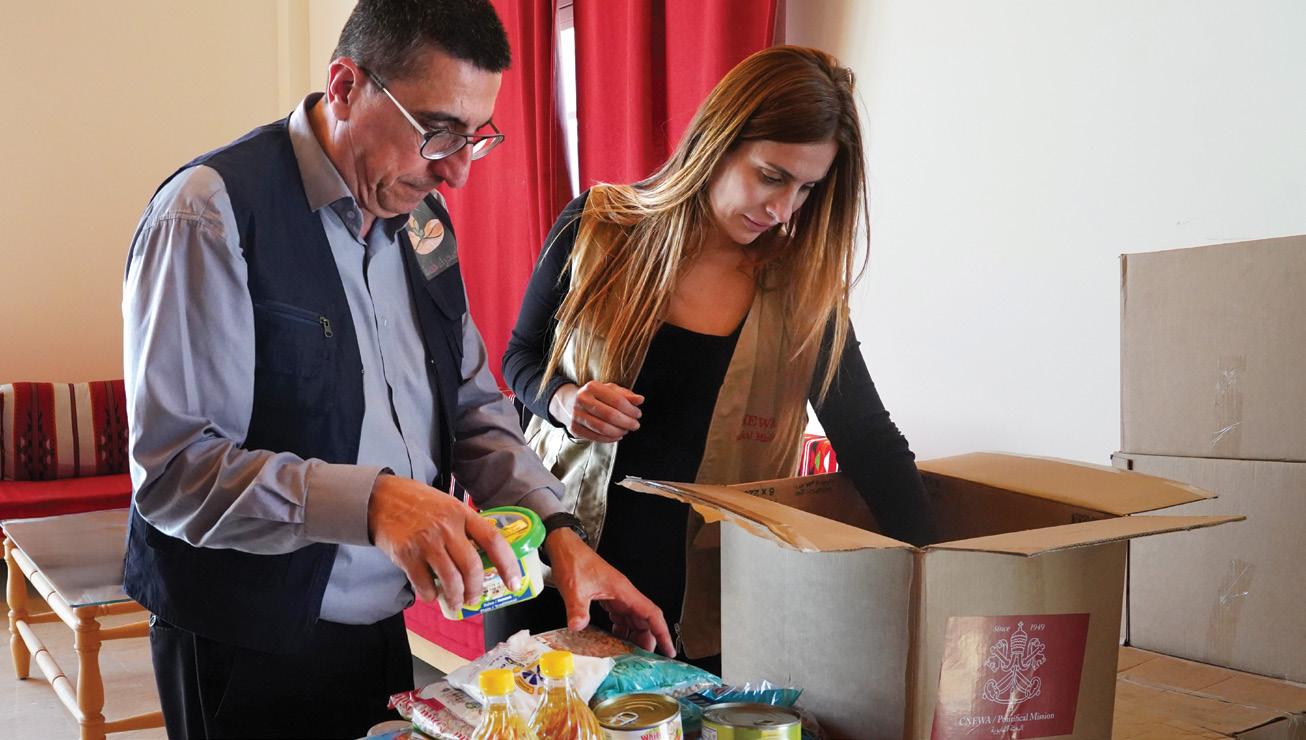
Since 2 March, CNEWA-Pontifical Mission joined the apostolic nunciature and other church-affiliated aid organizations in delivering food parcels to civilians stranded by fighting between Israel and Hezbollah. The aid convoys also carried essential supplies such as medicine and water.
With roughly 20 percent of Lebanese displaced by the war, CNEWA-Pontifical Mission also has distributed food coupons to people displaced in Beirut, Mount Lebanon, and the Dbayeh refugee camp, as well as to southern families seeking shelter in the Bekaa Valley.
To support CNEWA’s work in Lebanon, call 1-866-322-4441 (Canada) or 1-800-442-6392 (United States) or visit cnewa.org/donate.
“This war has had a greater psychological impact on me than the previous one,” said 26-year-old Luna Daher, a Benwati resident. “I was hearing a lot of sonic booms, the war was really around the village. I had a panic attack, and I cried in abnormal ways.”
Her 8-year-old sister, Tia, said she is now “used to bombardments.”
Ms. Daher, who studied social sciences and education and is looking for work, rejoiced in the ceasefire, but was “very upset because we had many martyrs” in the war. She also harbored fears for the future of the country.
“I would like the whole of Lebanon and all its people, regardless of their faith, to live in
safety,” she said. A member of the Sunni Muslim community, she noted the division among Sunnis, Shiites and Christians caused by the ongoing war, and the need for reconciliation.
During this war, Israeli military stirred up tensions by striking regions usually spared, allegedly targeting Hezbollah or Hamas members. On 6 April, for instance, the Israeli military targeted a Maronite social housing compound in Ain Saadeh, a village east of Beirut, killing the local leader of the Lebanese Forces party — a political opponent of Hezbollah — and two other civilians over Easter weekend.
“God sees everything that is happening,” Ms. Daher said.
“God sees everything that is happening.”
In Ain Ebel, a Christian village within the “yellow line,” those who lived on the north side of the village have been displaced to the south side, said Maha Farah, a French teacher at the local school. The displacement occurred on 9 April, when the Israeli army launched its offensive to take control of Bint Jbeil, located less than a mile away.
“We thought the Israeli army would likely enter Ain Ebel,” Ms. Farah said. As she spoke, the walls of her house shook from the Israeli military activities in Bint Jbeil. Border villages were being systematically leveled, as the Israeli minister of defense referenced strategies used in Gaza. At least 11 villages had been destroyed entirely as of 7 May.
When the ceasefire was announced, residents from the north side of Ain Ebel returned to their homes to find around 20 houses had been occupied by the Israeli army and vandalized, with furniture thrown onto the street, Ms. Farah reported.
Five miles away, in the village of Dibl, an Israeli soldier destroyed a statue of the crucified Jesus, sparking international outrage. It was replaced by the Italian military days later. A statue of the Virgin Mary also was desecrated. In the village of Yaroun, a convent and a school belonging to the Melkite Greek Catholic congregation of the Sisters of the Divine Savior reportedly were bulldozed by the Israeli army.
“We are civilians. Why would they do this?” Ms. Farah asked.
Michel Constantin, CNEWAPontifical Mission’s regional director in Beirut, who joined some of the humanitarian convoys, said villages such as Ain Ebel and
Families in need in Snaya receive food parcels, provided by CNEWAPontifical Mission.
Dibl are “completely isolated” from the rest of the country.
“The Christian presence, even if it is very small, is the only sign of life” across these heavily destroyed areas, he said. He expressed his concern that, if the war continued, it would become unsustainable for residents of these communities to remain on their land, as most residents would be unable to work and schools would not reopen.
Church representatives and residents from border villages met with the Maronite patriarch at his residence in Bkerke on 19 April and released a list of demands. These included opening “safe humanitarian corridors between villages,” setting up field hospitals, providing financial support to families who have remained, and preventing the destruction of border villages.
“We stay here so that other people are able to remain” on their land, Ms. Farah said.
In 2024, she was displaced to Ain Saadeh, about six miles east of Beirut, in the same compound that was targeted by an Israeli strike on 6 April. She had spent weeks teaching online, living with relatives.
“I am happy to have stayed [in Ain Ebel] this time,” she said. “When we go through very hard moments, I always keep the faith that the war will end. I have learned to let go and let God intervene.”
Ms. Farah said she and her retired husband feel supported in their choice to stay, thanks to Archbishop Borgia’s regular visits.
“We feel listened to,” she said. “The nuncio encouraged us to take life one day at a time.”
Laure Delacloche is a journalist in Lebanon. Her work has been published by the BBC and Al Jazeera.
ON THE BORDER OF DISASTER
theEndingPoverty Loop
PAVING CHILDREN’S PATHS FORWARD
Church-run programs in India offer poor and abandoned children hope for the future
text by Anubha George with photographs by Sajeendran V.S.
The road to Njarakkode — a small village in southwestern India’s state of Kerala — is lined with cashew trees in full bloom, laden with fruit. Hundreds of ripe cashew apples have fallen, and their fermented smell is perceptible a mile away. Passers-by pick up a few, wash them and eat the fruit’s sweet juicy flesh. Driving through this forest of fruit trees, fallen mangoes are for the taking, too, with flesh tender enough to bite into. Summer is a season of plenty in Kerala.
In the distance is the house of a man who was killed by a wild
elephant that came down the hill at night and gored him. Deadly encounters with wildlife, tigers, elephants and wild boars are real fears among the locals, including Anu K. Saju and her family.
Ms. Saju is studying to be a nurse. She is in the third year of her course at Sanjo College of Nursing and Allied Sciences in the town of Vellappara. The school, administered by the Syro-Malabar Catholic Eparchy of Palghat, was established four years ago and accepts 60 students annually. It sits on 45 acres, along with a college of pharmacy, an elementary school and a high school.
“I chose to study nursing because the parish priest advised it would be a good career choice,” Ms. Saju says.
“My father is a daily wage worker,” she says of her father, Saju K. Abraham, who works 24-hour shifts at Coimbatore railway station in the neighboring state of Tamil Nadu. “If he doesn’t work, he doesn’t earn,” she says. Her older brother works at a garage nearby.
“My plan is to finish the course and get a job abroad. That’s the only way we can pay off our loans,” she says.
Coconuts lie around the family’s compound. “The monkeys climb
“The entire focus is to uplift women and the economically underprivileged, irrespective of religion and caste.”
up coconut trees, throw the coconuts off the trees, drink all the water,” says Smitha Saju, Ms. Saju’s mother. As a result, the shell of the coconut, and its meaty interior, cannot develop and grow, and the meat is where the family derives coconut oil for additional income.
Kerala is considered India’s most developed state, with near universal literacy, parity among men and women in education and the highest life expectancy in the nation. Once a largely agrarian society, the state of 36 million people has changed dramatically in the past few decades. Social reforms and its robust educational systems, public and private, have driven Kerala’s economic success, which has been called the “Kerala Phenomenon.” However, poverty continues to plague millions of families.
The Rev. Jeejo Chalakkal, who manages the nursing school, says the needs of the people in the eparchy have changed over the years.
“The livelihood of the people was more agriculturally based,” he says of the recent past. “But young people want to move away from that and have more professional careers.”
Loans keep people in the poverty loop, and the level of education is low compared with neighboring districts, he adds.
“The entire focus is to uplift women and the economically underprivileged, irrespective of religion and caste,” he says. Christians account for
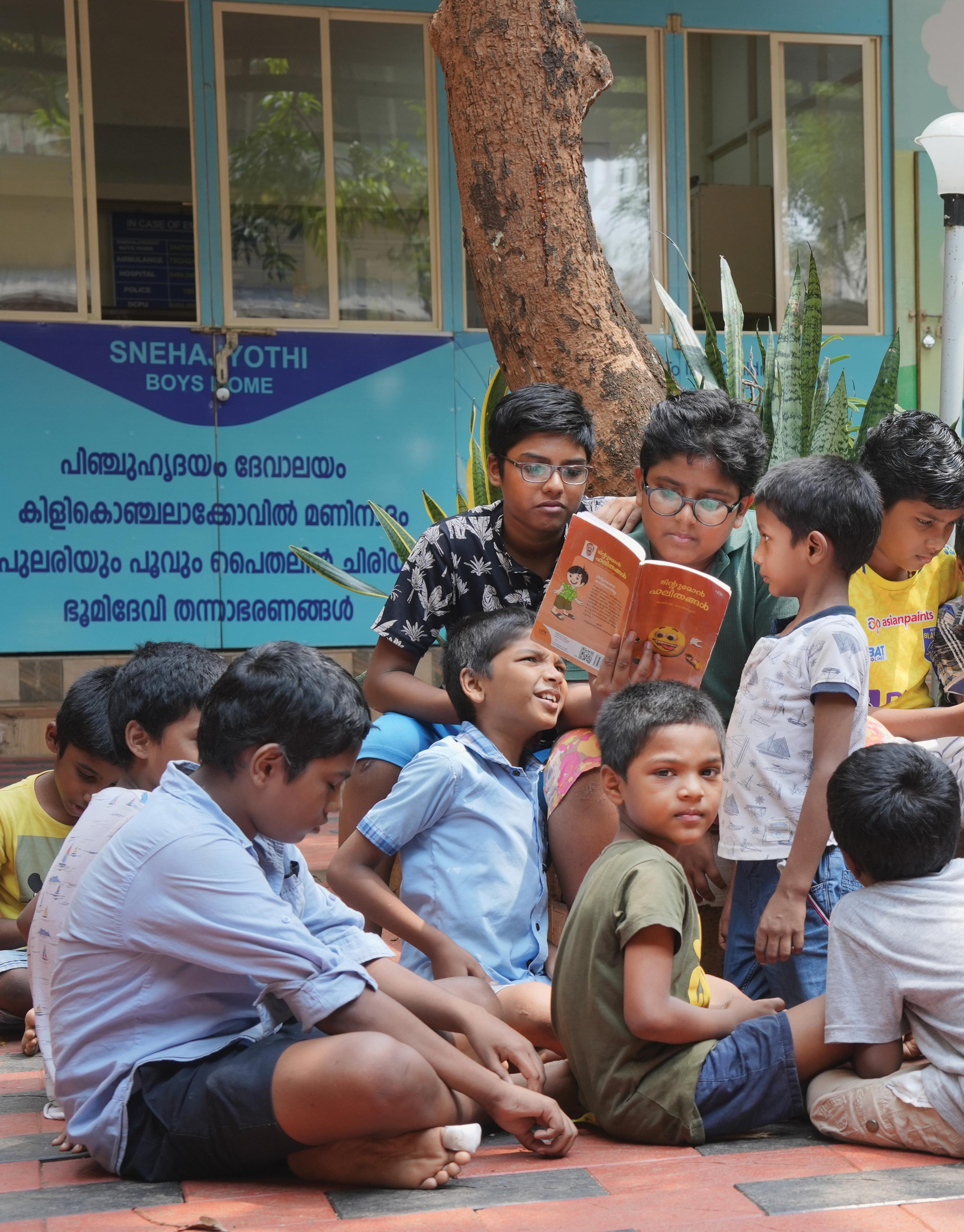
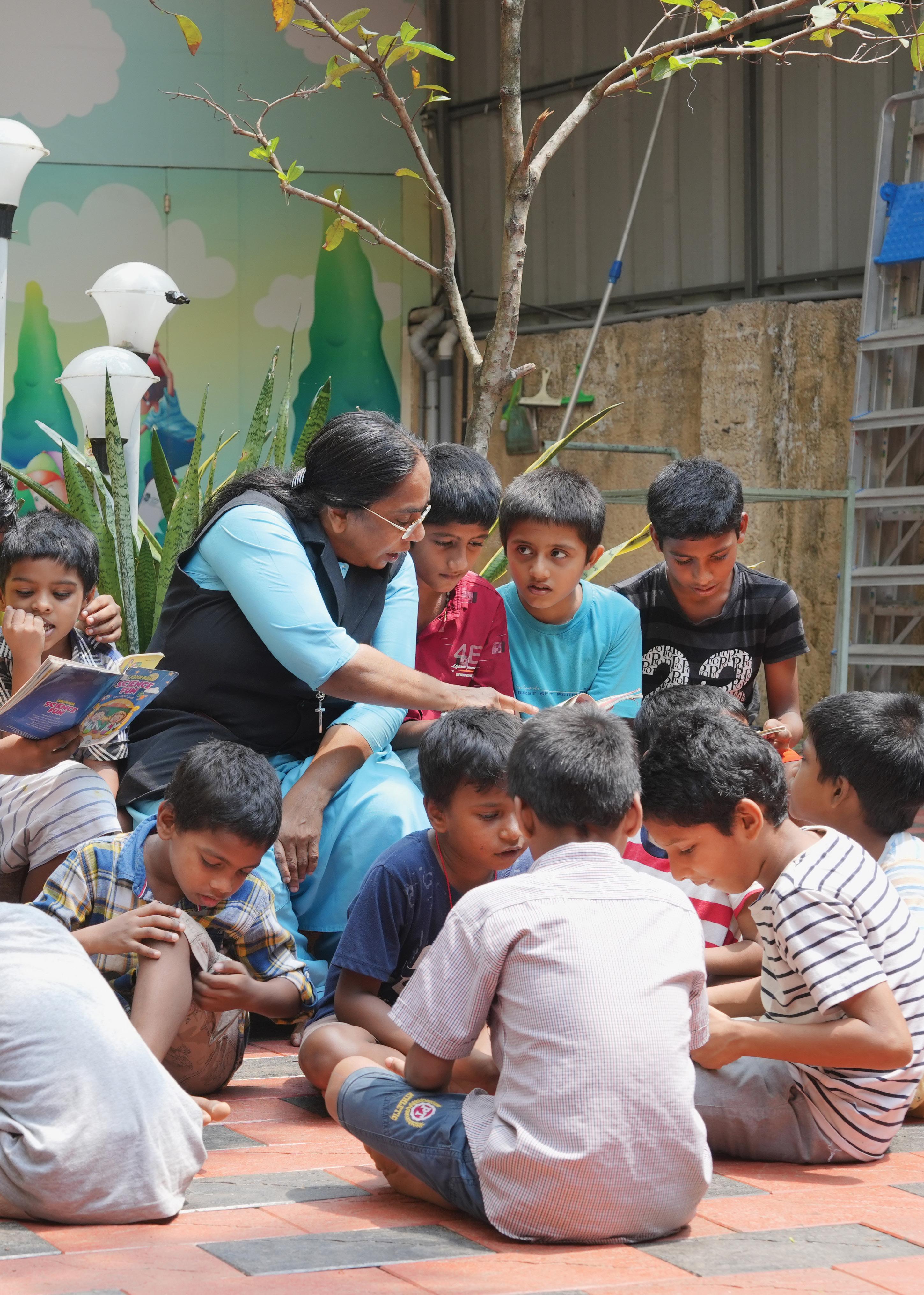
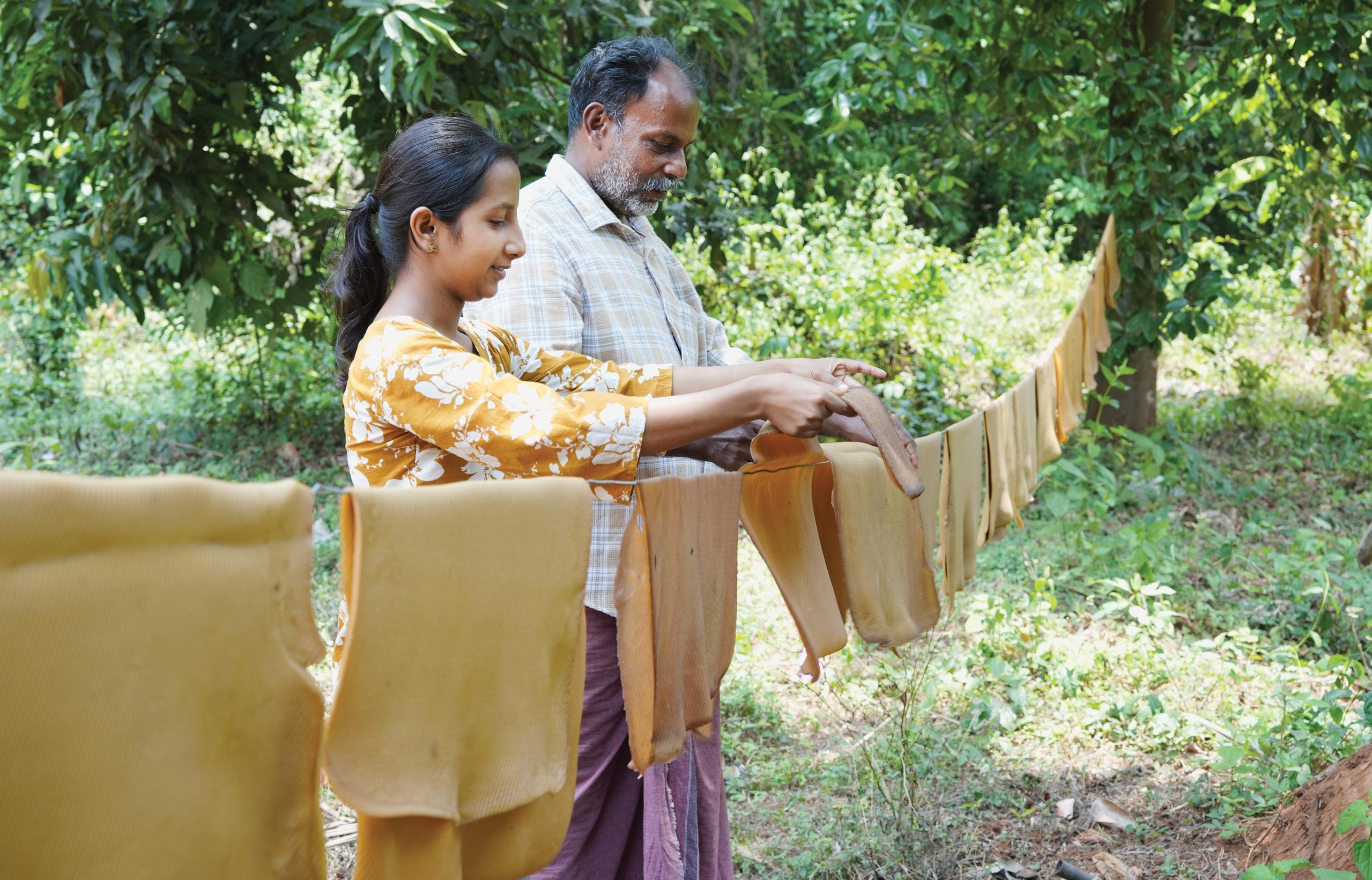
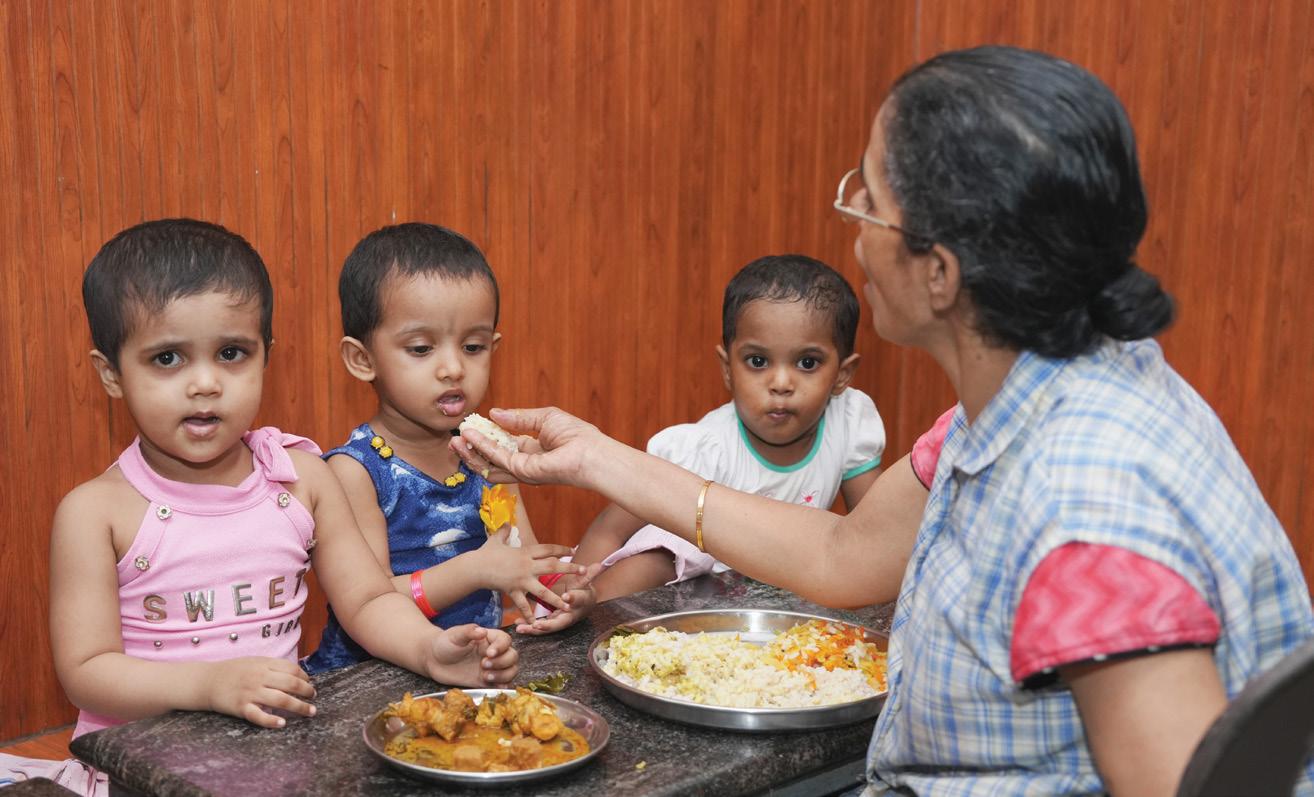
Opening spread, Sister Jisa Paul, I.J., reads with orphan children at Snehajyothy Boys Home in Pulluvazhy. At left, nursing student Ance Jiboy helps her father, a rubber tapper, process rubber sheets in Njarakkode. Top right, Reeby Sabu feeds toddlers at Snehajyothy Girls Home in Pulluvazhy.
The CNEWA Connection
CNEWA has deep roots in the care of children in need in India. Generations of its donors have supported the church’s many child care programs there, helping to propel the development and growth of the state. CNEWA donors continue to provide scholarships that help pay tuition and lodging for 77 students from underprivileged families at Sanjo College of Nursing and Allied Sciences in Kerala. These scholarships make the lives of these families slightly easier, says the Rev. Jeejo Chalakkal, manager of the nursing school.
Resources from CNEWA’s donors also allow Sister Jisa Paul, I.J., to acquire infant formula and diapers for newborns at Snehajyothi Sisubhavan, the orphanage she founded in southern India. “Newborns are expensive to look after, and the money from CNEWA is a huge help,” she says.
To help fund CNEWA’s work in India, call 1-866-322-4441 (Canada) or 1-800-442-6392 (United States) or visit cnewa.org/donate
only 4 percent of the district’s population of 2 million, according to the latest national census taken in 2011. Muslims account for about 30 percent of the population while Hindus make up the majority.
Ance Jiboy also studies at the nursing college and hopes to go abroad, either to Europe or the Gulf states, so she can support her parents. Her older brother, Alfie, is studying for the priesthood in the seminary.
Her father, Jiboy Joseph, is a daily wage worker who taps rubber from trees in the nearby
forest. Last year, one of his friends was killed by an elephant. He had set out for rubber tapping early in the morning — as days get hot and humid in this part of Kerala and the temperature climbs up to 113 degrees Fahrenheit — and the elephant came up quietly, without announcing its arrival.
“We’ve taken a few loans that need to be paid off,” Mr. Joseph says. There’s a crack on the entrance to the house, where lightning struck.
“We’ve not had the money to get it repaired,” he says.
Donia Poulose, a second-year nursing student, is following in her father’s footsteps. He had worked as a nurse throughout India in the government’s Border Security Force. When his parents got sick, however, he took voluntary retirement and returned to Kerala, where he now farms.
“I wanted to do nursing because of my father and because I like serving people. I like talking to patients and understanding their needs,” says Ms. Poulose, who has three siblings.
“There’s four of us, so providing for all of us is hard for my parents.
“I want to do post-graduate studies and teach in a nursing school,” she adds. And “I want to be able to help people here in Palakkad.”
Nearly 80 miles up the Kerala coast, in the village of Pulluvazhy, Sister Jisa Paul, I.J., is the director of Snehajyothi Charitable Society, which she founded 18 years ago to house children in need.
“Every child is an orphan here,” she says. “They’ve either never known their parents or, if their parents are around, the parents have chosen not to see their children.”
She runs three homes: one for children under 5, another for girls ages 5 through 18, and another, located a few miles away, for boys ages 5 through 18. A team of 32 people care round the clock for the 102 children living in these homes.
“I used to be a teacher,” Sister Jisa says. “Then I resigned and decided to set up Snehajyothi in 2008. Since then, it’s just grown.”
Sister Jisa is a member of the Infant Jesus Sisters, founded in Rouen, France, by Blessed Nicolas Barre. These sisters are dedicated to educating poor children and serving local communities.
“We sisters have over 350 years of history of social work and pastoral care in more than 18 countries,” Sister Jisa says.
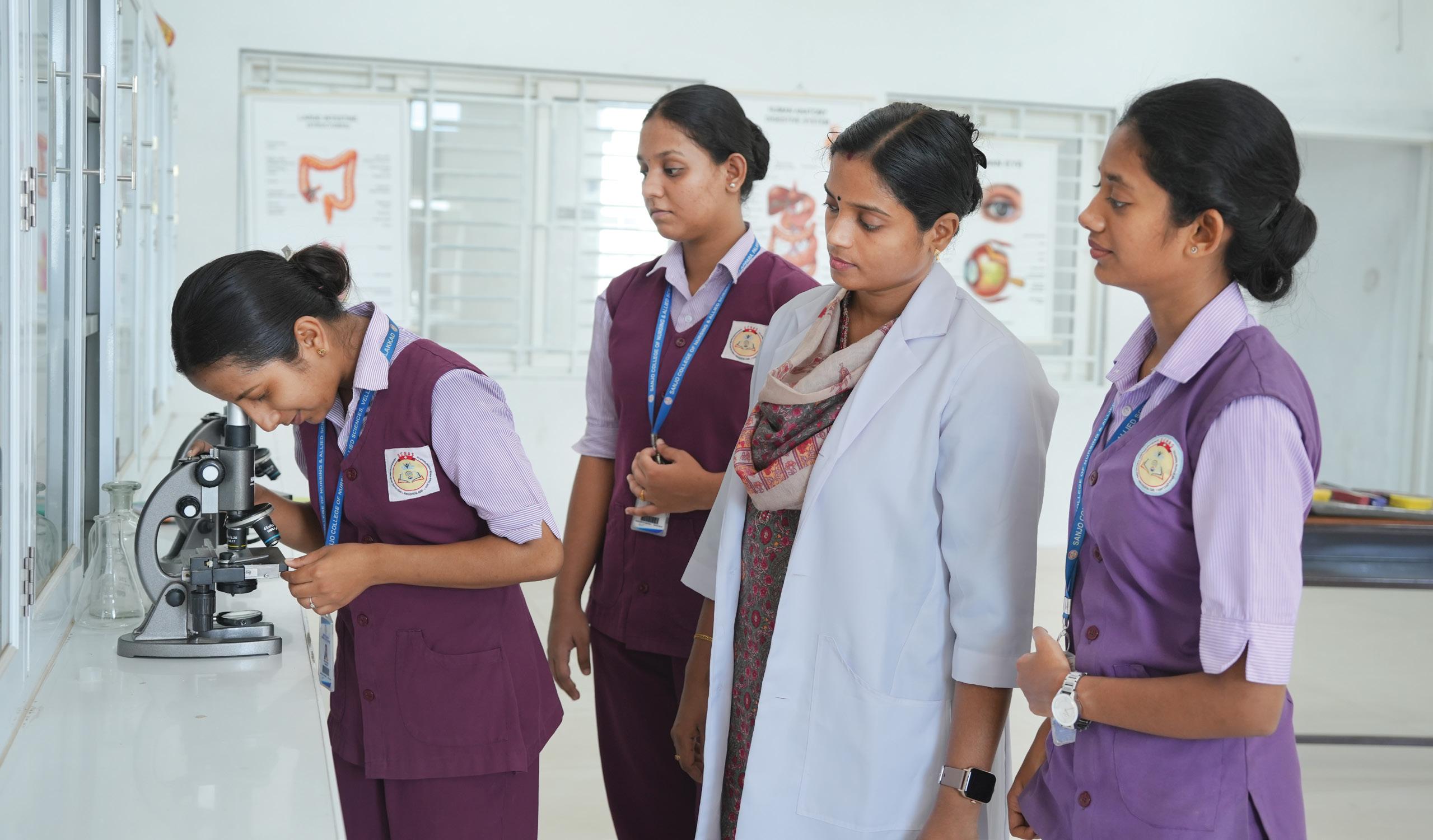
An assistant professor at Sanjo College of Nursing in Vellappara observes Ance Jiboy’s skills on the microscope while nursing students Donia Poulose, far right, and Anu K. Saju look on.
India has an estimated 30 million orphans and abandoned children, but only a fraction receives care in an organized program. The majority are homeless or in informal foster situations. The number of registered child care institutions or orphanages in the country is between 9,500 and 10,000; they assist up to 470,000 children.
In Kerala, there are about 239 registered orphanages, according to research done by a private enterprise, but nonprofit organizations estimate more than 1,000 facilities, caring for up to 75,000 children under the age of 18. Many of these children have living relatives but receive care at these institutions because of poverty and family hardship.
The government provides some aid toward food, but support comes primarily from local families and some foreign grants. With the Indian government’s laws limiting foreign funds into the country, however, orphanages and child care institutions are struggling.
The church plays a significant role in child care in the state, and Sister Jisa says church-run orphanages are seen as dependable. However, the exact number of church-run child care institutions is not available.
Sister Jisa’s program is legally recognized under India’s Juvenile Justice (Care and Protection of Children) Act of 2015. As such, each home follows a basic standard of care as stipulated by the Indian government regarding space, dormitories, regular medical checkups and segregation of children based on age.
Nonregistered orphanages in India can face fines and closure at any time.
“We have children from all religions in our orphanages,” she says. “We also run these institutions according to government rules and regulations, even if it means that it is hard on us [financially].”
“The children here have gone through so much at such a young age,” Sister Jisa says and, changing their names for privacy, shares a few stories of some of the children in the home.
Mona was left on a train as a newborn by her teenage mother. A passer-by heard her cry and found her. He then took Mona to the police, who brought her to Sister Jisa.
Lisa was sexually abused by her father until she was 7 years old. Her mother had mental health challenges. Lisa told a neighbor about the abuse and her father was reported to the police and jailed. Lisa is now 19 and is studying social work.
John’s father died when he was 9 months old. His mother started a relationship with another man and did not want John with her. She gave him up. Today, he is 18 and wants to pursue a career in law.
Nibin’s father remarried after his mother passed away. His stepmother beat him so severely she fractured his arms and legs. Police were called, and social services brought him to Snehajyothi. He has chosen not to have any contact with his family.
Jiya’s mother, born blind, was raped by her neighbor. When she gave birth, her family sent her to a home for women with disabilities and sent Jiya to Snehajyothi. Jiya is now 10 and does not know about her biological parents.
Sister Jisa says her program does not receive government support and relies on donations from CNEWA and the local parish.
“Parishioners donate a meal on special occasions, such as birthdays and anniversaries. Some donate money, too,” Sister Jisa says. Children from Snehajyothi are on the register for adoption. “So far, 66 children have been adopted,” Sister Jisa says.
India has a rigorous adoption process, regulated by the Central Adoption Resource Authority. The process involves online registration, a home study report and a waiting period, ranging from six months to more than four years. There are no shortcuts in this system. Any direct adoption from hospitals or individuals is illegal and carries a prison sentence.
“Jesus looks after all those he brings into this world,” Sister Jisa says. “I leave everything in his hands. He always takes care of the children in Snehajyothi.”
Anubha George is a columnist and writer for various publications, and a former BBC editor. She is based in Kerala, India.
Faith, work and survival endure in the West Bank’s last Christian village
text by Leila Warah with photographs by Samar Hazboun
Palestinian journalist Jirias Azar believed Taybeh, in the West Bank, was a haven — “a quiet rural area with fewer people and more nature; a place where you can live a calm and pleasant life,” he said.
In 2022, after three years of renovating a house in the ancient Palestinian Christian village, he and his wife, Celina, settled in, hoping to build a family and a peaceful life together. Their son, Sharbel, was born the next year.
However, their sense of calm began to dissipate after 7 October 2023, when Israel launched a full-scale assault on Gaza in response to Hamas attacks on Israeli border communities. As Israel’s war on Gaza intensified,
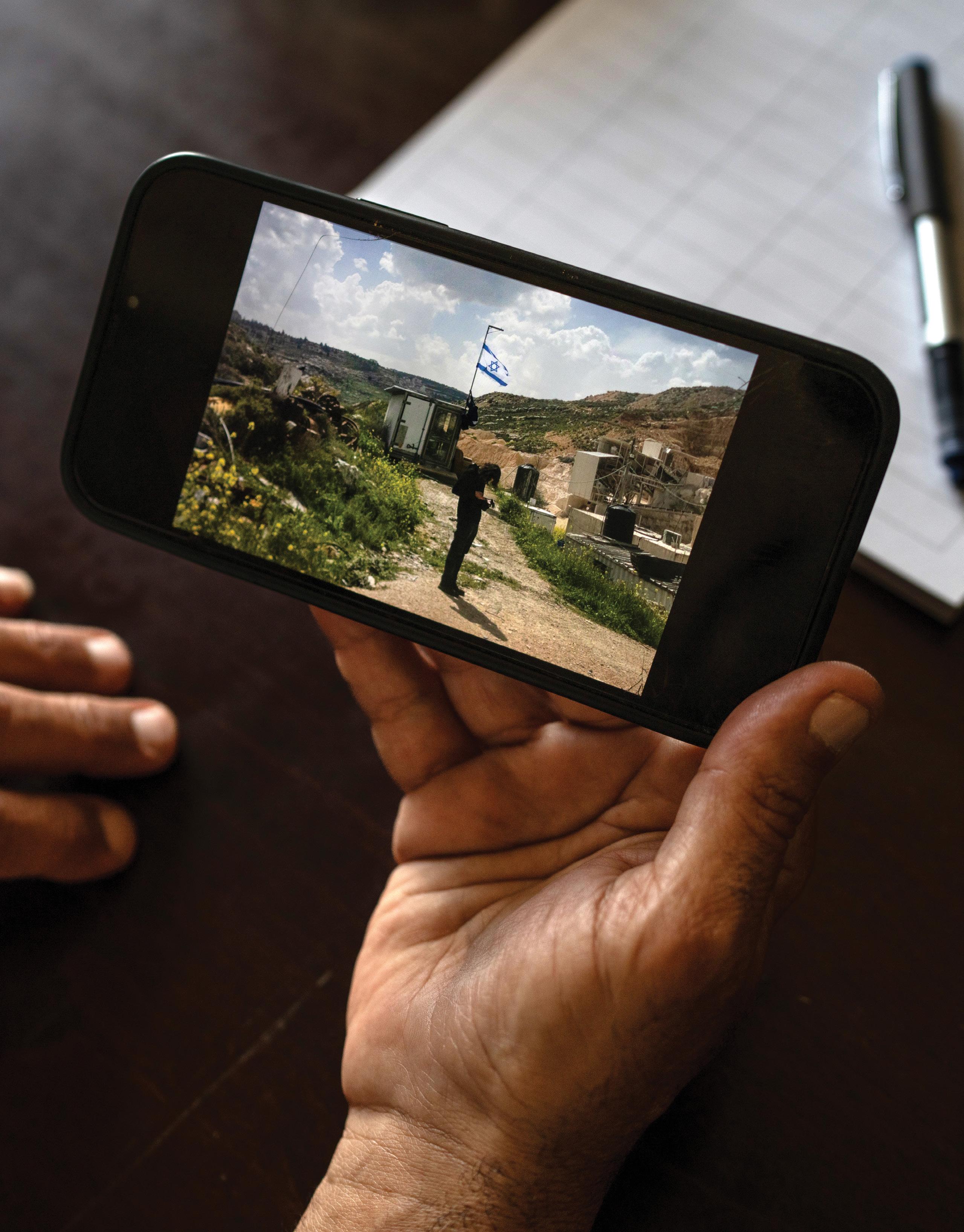
Footage on Roland Bassir’s cell phone shows Israeli settlers placing an Israeli flag on the guardhouse of his stone factory in Taybeh, West Bank.
so did Israeli military violence and settler attacks across the West Bank.
According to the United Nations, more than 1,800 settler attacks were recorded across the Palestinian West Bank last year. From January to September 2025, about 60 percent were in the governorates of Nablus, Hebron and Ramallah, where Taybeh is situated.
“I started to feel scared,” said Mr. Azar, 36. “It made me think that maybe life in Taybeh could become like those other places.”
Last summer, the couple’s sense of safety collapsed. On 28 July, just after 2 a.m., they were awakened by a series of bangs. Mr. Azar saw flames outside their kitchen window. Their car was on fire. They grabbed Sharbel and ran into the dark, their neighbor shouting: “Settlers! There are settlers!” They fled to Mr. Azar’s family home in Ramallah.
Their car and everything in it — work equipment, documents and personal belongings — had been destroyed. Graffiti in Hebrew on a neighbor’s wall declared revenge for the neighboring village, Al-Mughayyir, which has been the site of ongoing violence between Israeli settlers and Palestinian land owners for many years.
After his brother’s car was burned in another attack on their property in Taybeh three months later, the couple put their house up for sale.
“I worked for 13 years to buy a car, build a house and obtain equipment for my work, and then I lost everything in less than a minute,” he said.
Ms. Azar said she never imagined such an incident would happen to them. “We are still living that night. I still dream about it,” she said.
“I can’t go back to the house. I can’t imagine living there again.”
PROMOTING PEACE & JUSTICE
The Azars are part of a quiet exodus reshaping the ancient village of Taybeh. With a population of about 1,200, it is the West Bank’s last entirely Christian village and one of the oldest continuously inhabited communities in the Holy Land. In the Gospel of John, Jesus seeks refuge in Taybeh after the resurrection of Lazarus.
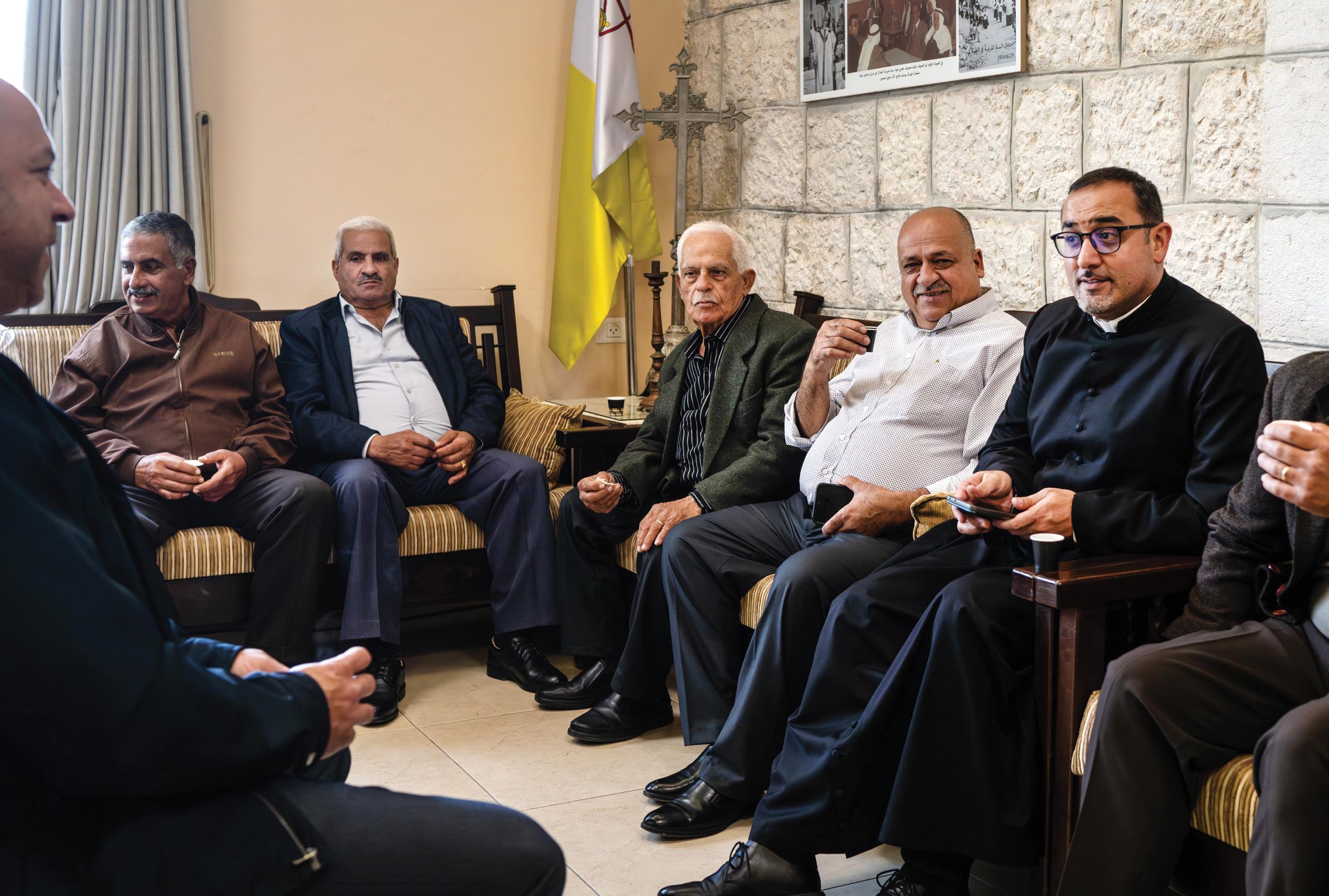
The Rev. Bashar Fawadleh, the priest at Christ the Redeemer Catholic Church in Taybeh, said 15 families — roughly 4 percent of the population — moved out in the past two years. People are leaving because of the Israeli
occupation, said the priest, who is often first to run to the aid of community members who have suffered settler violence.
“People are tired,” he explained. “People are without rights — rights to live, rights to move, rights to pray, rights to learn, rights to travel.”
As well, since 2023, settler violence and Israeli military restrictions displaced almost 3,000 Palestinians across the West Bank, including 636 in the first six months of 2025 alone, OCHA reports.
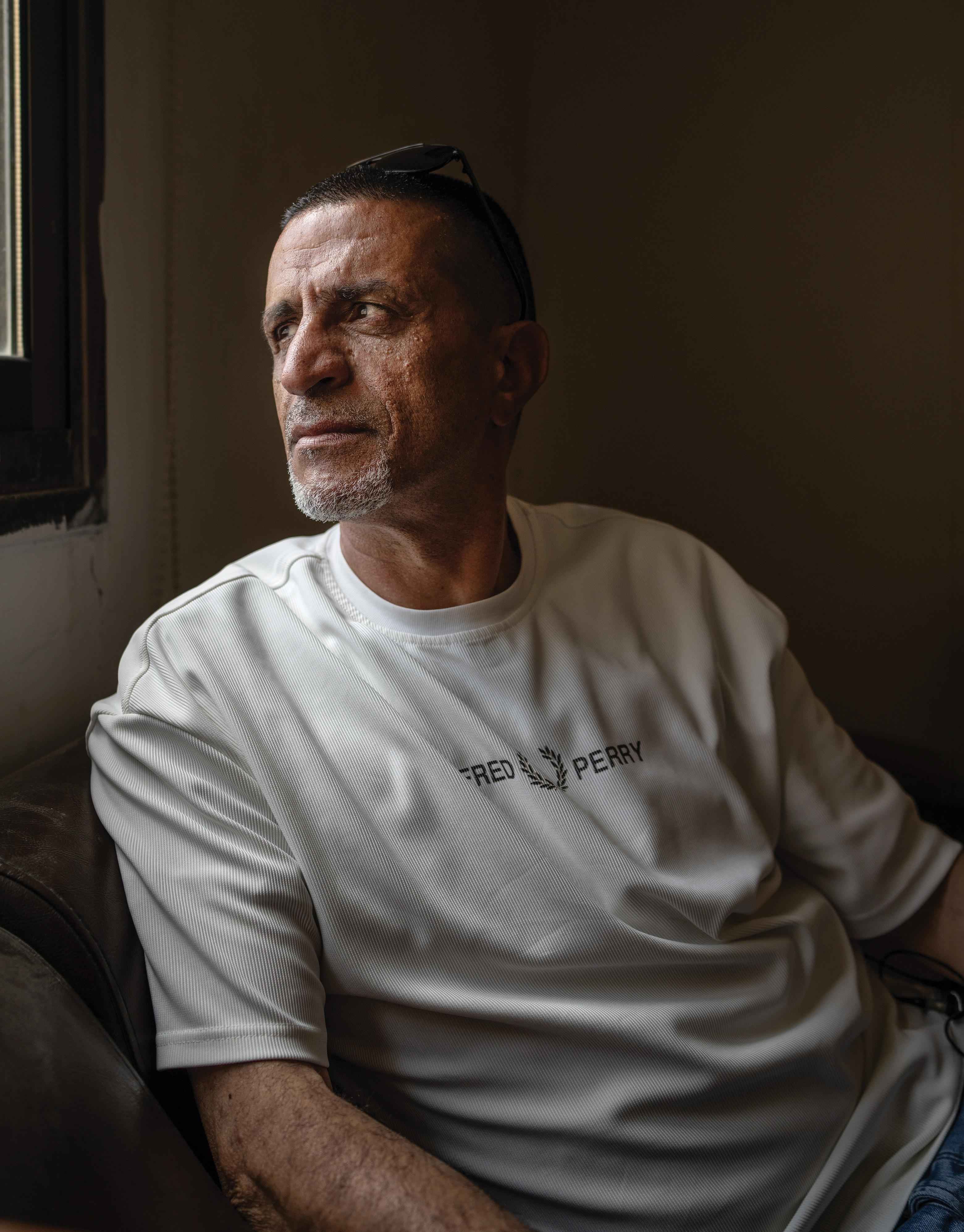
Roland Bassir has run a stoneand-concrete factory on the edge
of Taybeh for 20 years; he once employed 37 people. After the war in Gaza began, settlers known as the Hilltop Youth blocked his quarry road and grazed cattle through the site daily, until his employees were too frightened to come to work.
In mid-March, between 30 and 40 settlers stormed the site, raised Israeli flags and “prayed Talmudic prayers and rituals,” Father Fawadleh said. “That means they want to occupy the area. That’s the end.”
“I called the Israeli police. They did not respond,” Mr. Bassir said. “We called the Coordination and
“ People are tired . People are without rights ... ”
Liaison Office. After three days, the army came, stayed for 15 minutes, and left. Then the settlers returned.”
Mr. Bassir’s experience reflects a documented pattern. According to the Israeli human rights organization Yesh Din, since 2005 only 3 percent of police investigations into settler violence against Palestinians have resulted in convictions, and 94 percent of cases close without an indictment.
In mid-May, Mr. Bassir’s employees had dropped to 15, and often none were able to work.
“I have spent 20 years building this place and investing in it,” he said. “Now I can’t work there.”
While church groups are unable to stop settler attacks, they continue to provide services and support.
The Latin Patriarchate of Jerusalem and other Catholic organizations operate a school, a medical center, an elder care home, guesthouses and cultural programs in Taybeh. Eighty percent of those employed are Christian and 20 percent are Muslim. Working locally in Taybeh also spares people the unpredictable, hours-long commutes caused by Israeli military checkpoints and barriers across the West Bank.
The Catholic school has served the eastern Ramallah region since 1860 and currently draws students from surrounding villages; 70 percent of the students are Muslim. It has graduated generations of doctors, engineers and lawyers, with nearly 100 percent pass rates in the national high school exit exam for seven consecutive years, said
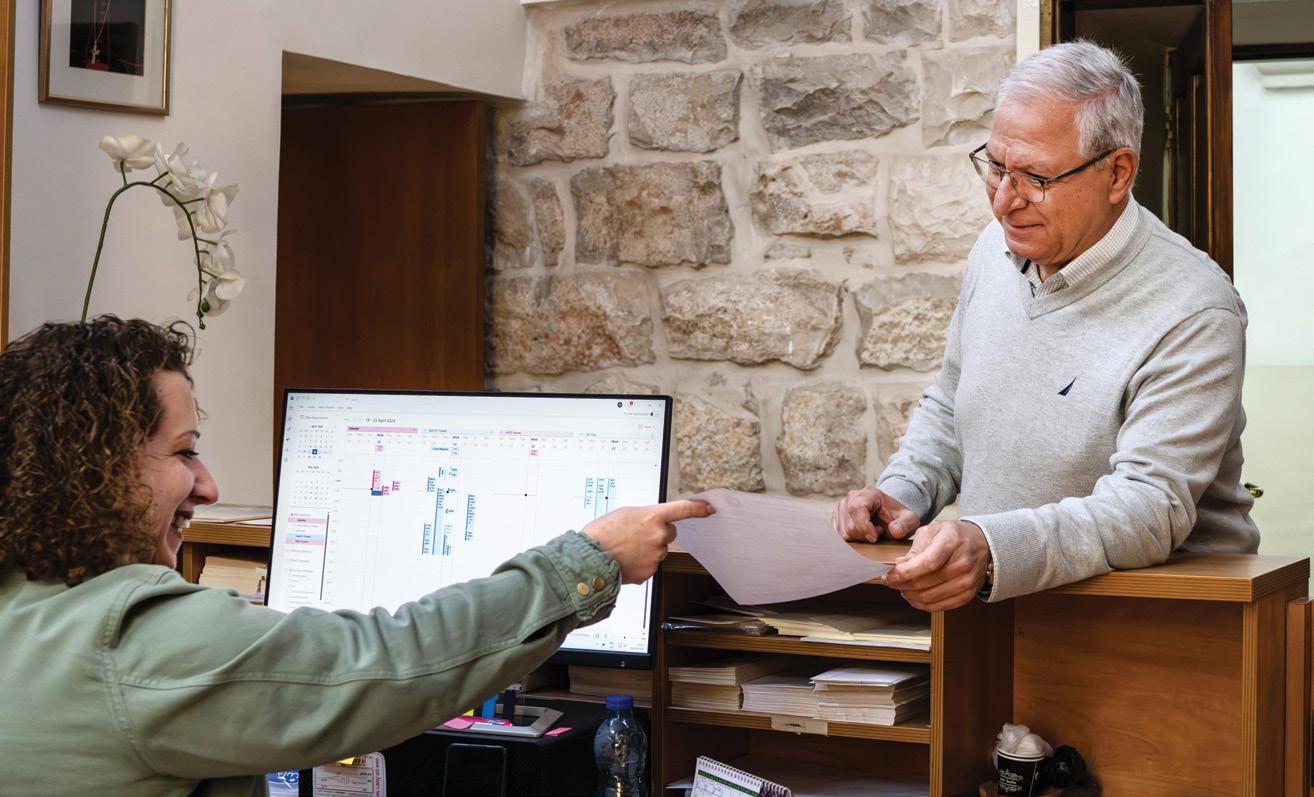
Father Bashar Fawadleh, far right, speaks with parishioners after Mass in the parish hall on 19 April. Top right, Sami El-Yousef, standing, speaks with a colleague in the Latin Patriarchate of Jerusalem office.
The CNEWA Connection
CNEWA-Pontifical Mission has worked with residents of Taybeh and other Palestinian communities across the West Bank to build a framework for survival amid the rise of Israeli settler attacks and tightening military restrictions. It has helped sustain institutions, livelihoods and pastoral life, keeping families rooted.
“Since the escalation of violence from the settlers and the continuous attacks, it has turned into a hot spot,” says Rodolf Saadeh, projects manager for CNEWA-Pontifical Mission’s Jerusalem office.
To support the mission of CNEWA-Pontifical Mission in the West Bank, call 1-866-322-4441 (Canada) or 1-800-442-6392 (United States) or visit cnewa.org/donate
a school administrator, who asked to be identified only as Mary for safety reasons.
The patriarchate’s network of 44 Catholic schools in Israel, Palestine and Jordan has a student enrollment of 19,500, said Sami El-Yousef, the chief executive officer of the Latin Patriarchate of Jerusalem, who previously served as the regional director for CNEWA-Pontifical Mission in Jerusalem. Of these schools, five are in Israel and 12 are in the Palestinian territories. Tuition does not cover all the costs, so the patriarchate absorbs the difference, offering additional support for teachers’ families and students most in need. Last year, in the spirit of the Jubilee, the
patriarchate forgave $11 million in accumulated tuition debt, despite its other numerous and heavy pastoral and humanitarian demands.
“But it was truly appreciated at a time when people were suffering,” Mr. El-Yousef said.
Despite strong schools, the region’s economic collapse translates into poor employment prospects for graduates. More than 25 percent of Palestinians are unemployed; the rate climbs to 37.5 percent for university graduates, aged 19-29, according to the Palestinian Central Bureau of Statistics.
Since October 2023, about 120,000 Palestinians lost their Israeli work permits, and only
“Our very presence here is a form of resistance.”
10,000-20,000 have been restored, Mr. El-Yousef said. Tourism, small businesses and private investment have bottomed out in successive waves since the COVID-19 lockdowns, leaving entire sectors without reliable income for years.
The public sector, including civil servants, make up about 28 percent of the West Bank workforce. However, many have not received their full salaries for several years, due to Israel’s withholding of tax revenue owed to the Palestinian Authority, a crisis that has worsened since October 2023.
“They’re getting 20 percent of their salary, 50 percent in a good month,” Mr. El-Yousef said.
To encourage families to stay, the Latin Patriarchate has created 100 permanent jobs in Taybeh. It also reopened a ceramics workshop as a women’s employment project and provided families with below-market housing. In addition, CNEWA’s $94,000 flagship project supports up to 35 farming families with greenhouses and 700 olive and fruit tree seedlings, as well as temporary work for unemployed residents.
Rodolf Saadeh, projects manager for CNEWA-Pontifical Mission’s Jerusalem office, explained the approach is less about relief and more about partnership.
“It’s protecting the land, but also we are trying to support the families,” he said. “We’re not there as donors only. We think with Father Fawadleh, with the community.”
Currently, Palestinian Christians make up only about 1 percent of the West Bank population, but they operate 297 Christian institutions
Roland Bassir invested 20 years in his business in the West Bank and is concerned he will lose it all to settler violence.
across the territory, including schools, hospitals and social services. These institutions serve an estimated 45 percent of Palestinian society, which is majority Muslim, Mr. El-Yousef said.
“You’re not talking about mere statistics of a Christian presence that is dwindling,” he said. “You’re talking about the potential risk to institutions that provide services to the whole community.”
These institutions continue because of those who are committed to the land. Ramez Al Khoury, 38, returned to Taybeh from the United Arab Emirates in 2019, so his children could grow up in the church and with the local traditions.
In February, the Israeli army held him for a week until an allegation that he attacked Israeli settlers was determined to be baseless. He thought about leaving Taybeh again but has decided against it.
“I love that my son is growing up here,” he said. “Here in Taybeh, we are all relatives. Even during holidays, the celebration sometimes feels stronger than at the Church of the Holy Sepulchre.”
However, he is concerned that the margin has become thin and “many people will leave if things stay like this.”
Christians abroad must understand that “we are protecting holy lands,” he said, and they must reciprocate “through the media, [and] humanitarian, moral, psychological and financial support, create projects that help people here remain steadfast.”
“Our very presence here is a form of resistance,” he said. “Peace is the message of Christ. So, our staying here is itself a Christian message, because we are rooted in this land.”
Leila Warah is an independent multimedia journalist in Palestine.
The Last Word Perspectives
from the president
by Msgr. Peter I. Vaccari
“He loved us.” (Rom 8:37)
With these words from St. Paul’s Letter to the Romans, the late Pope Francis opened his October 2024 encyclical letter, “Dilexit nos” (He Loved Us), which constitutes a profound reflection on the human and divine love of the heart of Jesus.
Since the 17th and 18th centuries, the church has recognized June as the month of the Sacred Heart of Jesus. Pope Pius XI, who established CNEWA in 1926, saw immense value in the consecration of nations to the Sacred Heart of Jesus.
In “Dilexit nos,” Pope Francis teaches that “Christ showed the depth of his love for us not by lengthy explanations but by concrete actions.” Throughout his earthly life and ministry, Jesus sought to encounter people. When he was about to heal someone, Pope Francis writes, “he preferred to do it, not from a distance but in close proximity … by his closeness, he shows us the depth of his tender love.”
“Jesus’ words show that his holiness did not exclude deep emotions,” the pontiff points out. “On various occasions, he demonstrates a love that was both passionate and compassionate. He could be deeply moved and grieved, even to the point of shedding tears.”
True devotion to the heart of Christ follows the prompting of the grace of the Holy Spirit. When we are attentive to the prompting of the Holy Spirit,
we become sensitized to the ways in which our hearts have been pierced by the heart of Christ. We seek the Spirit’s guidance in drawing close to the One for whom we will be instruments of the passion of Christ’s heart.
The saints and the popes have seen in the devotion to the heart of Christ both a source of intimate spiritual union with him and the cultivation of an authentic missionary zeal — a zeal that seeks to promote a more just society and an openness to engage in a culture of dialogue in the search for unity and true peace.
Pope Leo XIV identifies the need for us to pray together to the Sacred Heart, so that “each one of us might find consolation in a personal relationship with Jesus, and from his heart, learn to have compassion on the world.”
On 11 June, as part of the 250th anniversary of the signing of the Declaration of Independence, the U.S. Catholic bishops will consecrate the United States of America to the Sacred Heart of Jesus. Archbishop Alexander Sample of Portland, Oregon, a member of CNEWA’s International Board of Trustees, wrote a reflection available on the website of the United States Conference of Catholic Bishops, in which he links the importance of this consecration to a greater emphasis on God’s activity on behalf of the poor, as articulated in Leo XIV’s apostolic exhortation, “Dilexi te” (I Have Loved You).
“Wanting to inaugurate a kingdom of justice, fraternity and solidarity, God has a special place in his heart for those who are discriminated against and oppressed,” Pope Leo wrote, “and he asks us, his church, to make a decisive and radical choice in favor of the weakest.”
A reminder to us all: Consecration and authentic devotion to the Sacred Heart of Jesus must be oriented to action!
This issue of ONE is filled with stories of the actionoriented direction of CNEWA’s mission over our first one hundred years.
As you read Part II of the history of CNEWA by Executive Editor Michael J. La Civita, you will appreciate with greater depth the active missionary orientation of CNEWA in the regions we have served and continue to serve.
The articles on Ethiopia, Lebanon, India and the West Bank present the challenges put to the people in the regions where we work currently, challenges which have only expanded since the Israeli-U.S. war with Iran and the invasion of Israel into southern Lebanon.
It is CNEWA’s dedicated active missionary orientation in these troubled regions that we seek to underline during this anniversary year. Please note the following special dates for CNEWA’s centennial:
Sister Weinitu Woldesenbet and her congregation, the Daughters of Charity of St. Vincent de Paul, provide education and food for the students at Blessed Gebremichael Catholic School in Bahir Dar, Ethiopia.
21 September
Centennial Golf Tournament
Sebonack Golf Club, Southampton, New York
13 December
Centennial Mass, 10:15 a.m.
St. Patrick’s Cathedral, New York City
15 December
Centennial Gala Dinner
The Plaza Hotel, New York City
Guest of Honor: Frà John Dunlap
81st Grand Master of the Sovereign Military Order of Malta
CNEWA’s Faith & Culture Award Recipient: Her Excellency, Sister Raffaella Petrini, F.S.E.
President of the Pontifical Commission for Vatican City State and President of the Governorate of Vatican City State
With my gratitude and prayers,

Peter I. Vaccari, President
CNEWA a papal agency for humanitarian and pastoral support
220 East 42nd Street, New York, NY 10017 • 1-212-826-1480 • cnewa@cnewa.org
223 Main Street, Ottawa, Ontario K1S 1C4 • 1-866-322-4441 • www.cnewa.ca