NEWS
fall 2026
Materials Science & Engineering
From the department head Dear alumni, students, parents, and friends, I am excited to share that I have recently been appointed as Associate Dean for Strategic Initiatives and Partnerships in the College of Engineering at Carnegie Mellon. While this means that I will be stepping back from my role as Department Head in Materials Science and Engineering, I am grateful to be entering a role in which I can continue to engage and partner with our faculty and students as they work to achieve their research goals. Our department is extremely fortunate to have professor Chris Pistorius stepping in as interim Department Head. With 18 years as a professor at CMU as well as previous experience as department chair at the University of Pretoria, South Africa, Chris is well-positioned to lead our students, faculty, and staff in the months ahead. Over the last five years as Department Head, I have enjoyed the opportunity to become a part of the special CMU MSE community. From meeting alumni at events, to connecting with students in the classroom, to sharing faculty research milestones, these interactions have inspired me and reminded me what the CMU network is capable of accomplishing. Each year when we publish this magazine, it is a testament of the collaborative and interdisciplinary nature of our department. Our faculty and students are making an impact in every aspect of materials, from computational breakthroughs to advancements in implantable biomaterials to fostering meaningful relationships abroad as showcased through our Industrial Decarbonization Analysis, Benchmarking, and Action (INDABA) Partnership. As you read through this issue, I hope you take pride in being a member of our community and celebrate the accomplishments of our students, faculty, and alumni as we continue to make strides in materials discovery and innovation. I invite you to stay involved with the department however you can, whether it’s by connecting with us on LinkedIn, attending an alumni event, or visiting us the next time you are on campus.
Beth Dickey Teddy & Wilton Hawkins Distinguished Professor and Department Head of Materials Science & Engineering
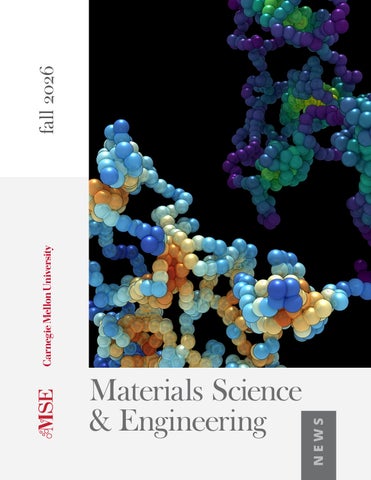
ON THE COVER
TEACHING AI THERMODYNAMIC LAWS UNLOCKS POLYMER MODELING CHALLENGE
NEW INSTRUMENTS ADVANCE MATERIALS ANALYSIS
page 4
page 18
FALL 2026
In this issue
PUBLISHER
Department of Materials Science and Engineering
02
Research
24
Outreach
02
Overcoming the body’s oxygen gap in cell-based therapies
26
Students
04
Teaching AI thermodynamic laws unlocks polymer modeling challenge
26
Penguins, polymers, and prototypes
28
From yogurt cups to building blocks
06
Innovative design unlocks resilient semiconductor materials
30
Engineering leadership skills from the track to the classroom
08
Accelerating materials innovation through AI and data science
31
MSE student wins Washington Prize
32
Summer in MSE
10
Printable aluminum alloy sets strength records
34
Student Awards
12
Carnegie Mellon awarded ARPA-H contract to develop 3D bioprinted liver
36
2026 Diploma Ceremony and Doctoral Hooding
14
Study tour showcases industrial innovation in Southern Africa
38
Alumni
38
Solving plastic pollution with proteins
16
Cracks exposed: tungsten challenges identified
40
Alumna accelerates battery discovery with AI
17
Beyond best-fit: a new approach to thermal analysis
41
Powering research to empower our grid
18
New instruments advance materials analysis
42
What a scoop! MSE alumnus thrives in the newsroom
20
Soft Materials Symposium
44
Alumni Accomplishments
21
Successful part production advances digital twin modeling project
22
Faculty Awards and Honors
EDITOR
Monica Cooney, Communications Manager WRITERS
Scottie Barsotti, Monica Cooney, Kaitlyn Landram, Sara Pecchia, Giordana Verrengia DESIGN
Debra Vieira, Senior Multimedia Designer, College of Engineering
1
Overcoming the body’s oxygen gap in cell-based therapies Medical implants of living cells that act as long-term drug producers could revolutionize treatment for chronic conditions like diabetes or autoimmune disorders. These devices have previously faced challenges associated with ensuring dosage needs while also maintaining cell functionality. When packed into the high densities required for a clinical dose, the cells often suffocate, particularly in the poorly oxygenated space under the skin. Researchers from the CMU materials science and engineering department are part of a multi-institution team that have developed the Hybrid Oxygenation Bioelectronics system for Implanted Therapy (HOBIT), which shields a sufficient number of cells from the host immune system in a small volume while also providing access to oxygen and nutrients. Working alongside collaborators at Rice University and Northwestern University, professor Tzahi CohenKarni facilitated the development of a miniaturized electrocatalytic oxygenator (ecO2) component that refined the device’s core and enhanced its capabilities. “Our collaborative efforts are highly unique, a combination of energy research with bioengineering, toward efficiently providing oxygen to the cell factories,” said Cohen-Karni. The oxygen-making machine uses an iridium oxide-based surface with electricity supplied by an on-board battery to split water present in surrounding tissue in order to generate
2
“Our collaborative efforts are highly unique, a combination of energy research with bioengineering, toward efficiently providing oxygen to the cell factories.” - Tzahi Cohen-Karni, Professor, Biomedical Engineering and Materials Science and Engineering oxygen locally, without producing harmful byproducts, such as chlorine or hydrogen peroxide. The compact device is designed to be placed under the skin, an area that can be accessed through minimally invasive surgery but tends to be poorly oxygenated compared to more vascularized tissues. “When they are packed into dense clusters, cells compete with each other for oxygen,” said Chris Wright, a Rice University doctoral student who is a first author on a publication reporting the findings. “Under the skin, there simply is not enough local supply to support the number of cells you would need for a clinically meaningful dose.” Earlier versions of the chip required external wiring, but in the new study, the oxygenator, battery, and electronics are fully integrated into a wireless, implantable system that can be remotely adjusted to modulate oxygen production. “We are producing oxygen directly where the cells need it,” said Jonathan Rivnay, professor of engineering at Northwestern University. “That allows us to support much higher cell densities
in a much smaller space.” The microfabricated device uses a two-stage encapsulation approach to protect cells from the host immune system while also allowing for nutrients and secreted biologics to flow unimpeded. The engineered cells are first microencapsulated in alginate hydrogel beads and then loaded into a larger chamber with a semipermeable membrane. The encapsulated cells were engineered to continuously produce three biologic molecules representing different therapeutic classes and halflives: an antibody, a hormone, and an exenatide, which is a GLP-1-like molecule. “In addition to solving the oxygenation and cell density problem, the HOBIT platform is also proof of concept that cell factories can be engineered to produce multiple biologic molecules simultaneously,” said Omid Veiseh, a professor of bioengineering at Rice. The HOBIT device was proven effective in a 30-day study in rats implanted with oxygenated and nonoxygenated control devices. While cells
in non-oxygenated control devices saw viability drop to 20%, 65% of the cells in the HOBIT device remained healthy and productive throughout the study. Data collected showed the sustained delivery of three types of biologics simultaneously in the experimental device, while short-half-life biologics became undetectable by day seven in animals implanted with the control device. The research team aims to further accelerate the translation of this technology into life-saving clinical treatments by pursuing larger-animal studies and disease-specific applications, such as diabetes, where transplanted pancreatic islets have high, yet variable, oxygen demands. CMU graduate students Inkyu Lee and Alex Ezerins were also contributors on this recent publication. The research was supported by Breakthrough T1D (3-SRA2024-1564-S-B), the U.S. Defense Advanced Research Projects Agency (FA8650-21-2-7119), the Carnegie Mellon University Department of Materials Science and Engineering Materials Characterization Facility and the Claire and John Bertucci Nanotechnology Laboratory. The content in this press release is solely the responsibility of the authors and does not necessarily represent the official views of funding entities.
3
Teaching AI thermodynamic laws unlocks polymer modeling challenge For more than half a century, materials scientists have struggled with how to simulate the complexity of polymer materials. An individual chain can comprise tens of thousands of atoms, a melt or composite contains billions, and the properties engineers actually care about, such as how an adhesive grips a surface, how a self-assembling block copolymer locks into a nanostructure, or how a biopolymer film stretches without tearing, emerge only over length and time scales that forcible atomistic simulation cannot reach. The standard workaround is coarse-graining: replacing groups of atoms with simpler mesoscopic particles so the model is fast enough to run. The catch is that this compression almost always sacrifices physics. Conventional coarse-grained polymer models can usually reproduce equilibrium structure or largescale dynamics, but rarely both, and they routinely fail to capture the entropic and viscous forces that govern how polymers actually flow, relax, and dissipate energy. Those are the forces that dictate mechanical performance, and they are the forces that traditional machine-learning approaches, despite their flexibility, also tend to break. Recent research published in the Proceedings of the National Academy of Sciences (PNAS) introduces a new machine-learning framework that lets coarse-grained models achieve both at once. A team from Carnegie Mellon University and the University of Pennsylvania has built an AI architecture that learns coarse-grained dynamics directly from data, whether simulated or experimental, while being mathematically incapable of violating the laws of thermodynamics. “The long-standing problem with coarse-graining polymers is that the information you throw away is exactly the information that controls how the material flows during processing or fails in applications,” said Thomas O’Connor, assistant professor of materials science and engineering at CMU, who co-led the work. “By building the laws of thermodynamics into the architecture itself, we get models that recover
4
those missing entropic and viscous forces, not as an approximation but by construction.” The key insight did not come from machine learning, but rather from decades of polymer physics. The machine learning framework is built around the metriplectic bracket, a mathematical structure originally developed within the non-equilibrium thermodynamics and complex-fluids community to describe how polymers, suspensions, and other soft materials flow and deform. By translating that structure into a neural-network skeleton, the team created a structure for training ML models that are guaranteed to conserve energy and obey the Second Law of Thermodynamics before a single parameter is fit to data. “It’s a nice example of strong domain science enabling better machine learning,” O’Connor said. “The mathematical structure we needed to make our ML models respect the laws of nature was ready and waiting in the polymer rheology literature.” A second innovation is how the framework handles what cannot be measured. Entropy and internal microstructure are essentially impossible to label directly in an experiment. The team’s self-supervised learning strategy lets the network discover these hidden variables on its own, simply by watching how particles move, making it possible to train predictive models straight from experimental trajectories rather than only from expensive atomistic simulations. The researchers tested the method on two difficult cases. For star polymers, which are branched architectures whose dynamics defy most coarsegraining strategies, the framework recovered both the radial structure and the non-equilibrium dynamics across aggressive levels of coarse-graining, where state-of-the-art graph-neural-network baselines failed. For a dense colloidal suspension imaged under oscillatory shear, the framework learned a model directly from high-speed video that captured the rare, localized rearrangement events driving emergent flow,
Polymer chains from the simulations that were used to train the AI model.
a long-elusive linkage between microstructure and macroscopic rheology. The work, supported in part by O’Connor’s U.S. Department of Energy Early Career Research Program project on polymer mechanics, is intended to give the materials community a route to coarse-grained polymer models that make quantitatively reliable predictions of polymer mechanics that could enable ground breaking research in the areas of polymer adhesion, self-assembly, selfhealing, and fracture. To make the tool immediately useful, the team has released open-source implementations in PyTorch for training and in LAMMPS for large-scale inference. LAMMPS is the standard molecular-dynamics engine used across academia, the national labs, and industry. The team’s LAMMPS implementation has been demonstrated at the scale of millions of coarse-grained particles, opening a path to thermodynamically consistent, data-driven models of polymeric materials at engineering scale.
5
Innovative design unlocks resilient semiconductor materials Semiconductors such as silicon are the cornerstone of today’s essential technologies, however the variety of materials available to power devices is limited. While metal oxides are durable, only a small subset are semiconducting as they are naturally insulators. Researchers from Carnegie Mellon University and Penn State University have made a breakthrough by which they have successfully transformed an insulating metal oxide into a high-performance semiconductor by using a technique called high-entropy mixing. Developing a complex mixture of manganese, iron, cobalt, nickel, copper, and zinc into a tungsten oxide framework within a single crystal structure, called wolframite, the researchers intentionally created a state of high configurational entropy. The new material, A6WO4, possesses both semiconducting properties and ultra-low thermal conductivity, making it an ideal formulation for thermoelectric devices. “This approach activates unique microscopic mechanisms that we believe could serve as a new set of guiding principles for future materials engineering and design of next-generation devices,” said professor Ismaila Dabo, who contributed to this research published in communications materials. High-entropy materials are created by mixing multiple elements into equivalent positions within a crystal lattice, creating a high degree of chemical disorder. This disorder not only changes the material’s composition, but it also fundamentally alters its physics. The researchers found that this “chaos” at the atomic level triggered several
6
microscopic mechanisms that narrowed the material’s band gap, or the energy barrier that prevents electrical conduction, from an insulating range down to a semiconducting range. As the researchers tested this new formula, they determined that it exhibited ultra-low thermal conductivity at levels significantly lower than many common industrial semiconductors and standard thermoelectric materials. This was attributed to chemical disorder, which prevented heat flow and disrupted the paths through which heat usually travels. The impact of this research on the semiconductor industry is significant because it provides a strategy that could turn resources that are more abundant and readily available into functional semiconductors. Thermoelectric devices that convert waste heat into electricity require materials that conduct electricity like a metal, but scatter phonons to block heat like a glass. The A6WO4 system demonstrates a design that can achieve both goals simultaneously. Additionally, metal oxides are often more resilient to heat and environmental damage than traditional semiconductors, making them ideal for applications in extreme conditions.
7
“Bringing together materials scientists and AI experts to share language, tools, and intuition is critical to unlock new kinds of functional materials.” - Michael Bockstaller, Professor, Materials Science and Engineering
Accelerating materials innovation through AI and data science The discovery of multi-functional materials has potential to answer challenges faced across many industries, including energy, healthcare, aerospace and manufacturing. Developing and testing novel combinations has been aided by developments in artificial intelligence (AI) and machine learning (ML), as the modern tools can be deployed to analyze large amounts of data and simulations as opposed to relying on trial-and-error testing. The Center for Data-Driven Design of Optimized Multifunctional Material Systems (D3OM2S) at Carnegie Mellon University was established in 2019 to explore solutions to the challenges facing materials discovery and has leveraged the expertise of CMU faculty and students alongside researchers from the Air Force Research Laboratory (AFRL). The center brings together experts in materials and artificial intelligence from materials science and engineering, civil and environmental engineering, chemical engineering, mechanical engineering, electrical and computer engineering, and machine learning departments to accelerate the discovery, design, and testing of high‑performance materials. “Bringing together materials scientists and AI experts to share language, tools, and intuition is critical to unlock new kinds of functional materials and fabrication processes that traditional approaches would likely miss,”
8
says Michael Bockstaller, professor of materials science and engineering and director of the center. The work of the center revolves around four coordinated research thrusts, each focused on addressing challenges in materials research and fabrication using AI solutions. Within each thrust, experimental and computational scientists at CMU work alongside researchers at AFRL to address materials science challenges of interest to the Air Force.
Characterizing and predicting rare events in materials systems
In this area of research, team members have studied how grain patterns form in additively manufactured metals, particularly titanium alloys used in aerospace applications, and how they crack and exhibit fatigue over time. By using image-analysis methods accelerated by computer vision (CV) and ML, connections can be made between how parts were made, their structure, and their durability.
Multimodal materials data fusion
While imaging technology has greatly advanced materials characterization in the last two decades, current methods often collect data from every point in a manner that is slow and inefficient. In this research thrust, advanced AI and signal-processing techniques
are used to detect patterns so that scanning electron microscopy (SEM), transmission electron microscopy (TEM), and high energy diffraction microscopy (HEDM) tools can be used to focus on the most critical areas of a sample, which dramatically reduces the time required to produce high‑resolution 3D images of materials.
Adaptive experimental design
Experimental design for materials discovery coordinated by humans is prone to errors, biases, and limitations, and can be costly, leading to limited data representations. This research thrust focuses on building and integrating AI systems that will learn from previous data and simulations to guide future testing and thus efficiently search and develop materials with desired properties.
Adaptive materials design in complex environments
The creation of adaptive materials that can reorganize or self-heal after damage have great promise for advances in defense and energy technologies. Such materials often feature complex microstructures that depend on a large number of variables. This research thrust has focused on establishing toolsets and protocols for the use of AI models to explore vast parameter spaces that would be impossible to search both experimentally or by using detailed computer simulation. The self-assembled brush particle-based materials studied in this area are tuned so they can achieve several desirable properties at the same time, such as strength, flexibility, or self-healing ability. In 2023, the center extended its research portfolio by funding two “seed” projects that focused on (1) the application of large language models (LLM) to design reaction campaigns that can be implemented in automated fabrication processes; and (2) the application of data-driven methods to advance composite materials made with MXenes and liquid metals (such as EGaIn), intended to sustain the extreme environments experienced in Air Force and Space Force applications. In addition to numerous publications, presentations, and open-source data and tools, one major outcome of the center has been the development of a pipeline of research talent with expertise in AI and materials science. To date, 12 students have graduated based on projects funded through the center. Three recent graduates have been awarded prestigious NRC fellowships to pursue AI solutions for materials science challenges in collaboration with researchers at AFRL
and the National Institute of Standards and Technology (NIST). Other students have joined companies such as Amazon, Seagate Technologies, and Soar Technologies in which AI solutions are being applied to accelerate innovation. “A central goal of the center has been to establish and sustain a community of AI and materials researchers that leverage the most current AI solutions to address materials challenges that are of relevance to the Air Force,” says Bockstaller. The opportunities to continue these collaborations have been demonstrated through the AFRL Regional Network Mid-Atlantic, of which Carnegie Mellon is a member, as well as through awards from the National Science Foundation’s (NSF) Designing Materials to Revolutionize and Engineer our Future (DMREF) program. As a member institution of the Center on Materials Data Science for Reliability and Degradation, researchers from Carnegie Mellon are also continuing to engage in the application of data science-informed research to better understand the reliability and performance of materials.
Center members gathered at CMU for an update meeting in 2023
9
Printable aluminum alloy sets strength records As a postdoctoral researcher, Mohadeseh Taheri-Mousavi was part of a class where students were challenged to design a printable aluminum alloy that would be stronger than any created to date. The class used computer simulations to outline a variety of combinations and to predict the resulting alloys’ strength. While the class was unable to produce a stronger alloy than current formulations, TaheriMousavi’s interest was piqued as a result of this exercise. She had an idea to combine these simulations with machine learning to efficiently explore the design space and since then she has continued to improve and apply these hybrid techniques to design higher performance alloys. Now an assistant professor of materials science and engineering at CMU, TaheriMousavi has carried on work with collaborators from her postdoctoral experience at Massachusetts Institute of Technology (MIT), and they have developed a new formula for a printable aluminum alloy that is five times stronger than its conventionally manufactured counterpart. In a study published in Advanced Materials, she used her hybrid framework to efficiently explore the design space and design an aluminum alloy with enhanced strength and thermal stability. “Machine learning tools can point you to where you need to focus, and tell you for example, which elements are controlling the formation of a microstructural feature,” said Taheri-Mousavi. “It lets you explore the design space more efficiently.”
10
Although the enhancement was not discovered after trying one million simulations without utilizing machine learning techniques, through her new approach, Taheri-Mousavi was able to identify a unique composition for the high strength printable aluminum alloy with thermal stability after evaluating only 40 possible combinations. Using this method, she was able to quickly narrow down to a formula for an aluminum alloy with higher volume fraction of extremely small (nanometer scale) precipitates, and therefore higher strength, than what previous studies have been able to identify. The prediction showed that only manufacturing methods with rapid solidification can realize this alloy in practice, so rather than using traditional metal casting to produce the new alloy, they used laser bed powder fusion (LBPF), a technique that creates complex parts by depositing powder layer by layer in a desired pattern before the layers are fused together by a high-power laser beam. The inherently rapid cooling and solidification that occurs in this process enabled the extremely small-precipitates, imparting high-strength in the alloy. “Because 3D printing can produce complex geometries, save material, and enable unique designs, we see this printable alloy as something that could also be used in advanced vacuum pumps, high-end automobiles, and cooling devices for data centers,” noted John Hart, professor and head of the Department of Mechanical Engineering at MIT, who also contributed to this research.
Source: Felice Frankel A new 3-D-printed aluminum alloy is stronger than traditional aluminum, due to a formulation that, when printed, produces aluminum (illustrated in brown) with nanometer scale precipitates (in light blue). The precipitates are arranged in regular, nanoscale patterns (blue and green in circle inset) that impart exceptional strength to the printed alloy.
After sending the powder, a mix of aluminum and five other elements, to collaborators at Paderborn University in Germany who printed small samples of the alloy, researchers at MIT ran tests to measure the alloy’s strength and analyze the samples’ microstructure. The results confirmed their predictions that the alloy was five times stronger than a casted counterpart and 50 percent stronger than alloys designed using conventional simulations without machine learning. “Usually alloys are redesigned to achieve properties of cast alloys, but here the rapid solidification during 3D printing makes alloys stronger, which is exciting.” Taheri-Mousavi says. The new printable aluminum alloy has potential to be made into stronger, more lightweight and temperatureresistant products, such as fan blades in jet engines, which are typically cast from titanium, which is heavier and more expensive than aluminum. “If we can use a lighter, high-strength material, this would save a considerable amount of energy for the transportation industry,” says Mohadeseh TaheriMousavi. “My dream is that one day, passengers looking out their airplane window will see fan blades of engines made from our aluminum alloys.” The researchers are applying the hybrid framework to further enhance the alloy and optimize its other properties.
11
Carnegie Mellon awarded ARPA-H contract to develop 3D bioprinted liver A Carnegie Mellon University-led team has secured an award of up to $28.5 million from the Advanced Research Projects Agency for Health (ARPA-H) to develop a functional, 3D bioprinted liver for patients with acute liver failure. The project, called LIVE, or Liver Immunocompetent Volumetric Engineering, aims to provide a temporary liver that supports regeneration of a patient’s own liver, reducing the need for full organ transplants. The project is under ARPA-H’s Personalized Regenerative Immunocompetent Nanotechnology Tissue (PRINT) program, which is led by ARPA-H Program Manager Ryan Spitler, Ph.D. LIVE addresses a major public health challenge. Each year in the United States, about 100,000 organ transplants are performed, while another 100,000 people remain on transplant waiting lists. Millions more would benefit from organ replacement, but do not qualify for a transplant. “The goal is to create a piece of liver tissue that you can use as an alternative to transplant, specifically for acute liver failure,” said Adam Feinberg, professor of biomedical engineering at Carnegie Mellon and principal investigator. “The liver we are creating would last for about two to four weeks. It would give patients time for their own liver to regenerate, and then, they would not need a liver transplant, freeing up those livers for other patients. The liver is just the first application, with the plan to expand to the heart, pancreas, and other organs. This innovation would fundamentally change healthcare as we know it, because most people suffer at some point from end-stage organ failure.” The team is co-led by Kelly Stevens, a professor of bioengineering at the University of Washington, together with experts in liver stem cells, biomanufacturing, biomaterials, hepatology, transplantation, pre-clinical models, and regenerative medicine from Charité – Universitätsmedizin Berlin, FluidForm Bio, Inc., Iowa State University, Mayo Clinic, the University of Pittsburgh, and the University of Washington. The project will use Carnegie Mellon’s FRESH 3D bioprinting and 3D ice
12
platforms to create biologic livers composed entirely of human cells and structural proteins, such as collagen. The livers are engineered to be immune-compatible, eliminating the need for immunosuppressive medications, which are often toxic and damaging to patients’ liver and kidney function. “The challenge is really the immune system,” Feinberg elaborated. “We are going to be using hypoimmune cells, which are engineered to be a universal donor, so anyone can have the cells and tissues we are building without needing to take immune suppression.” Within five years, the team hopes to have the bioengineered liver working at adult-scale and ready for pre-clinical testing prior to the first human clinical trials. LIVE is part of a broader effort to address organ shortages and advance bioengineered solutions for life-threatening conditions. Beyond acute liver failure, the technologies developed through the ARPA-H PRINT program could be adapted to other liver conditions and even other organs, including the heart and kidney. “The LIVE project is going to significantly advance organ biofabrication for transplant by funding our highly capable team that combines the very best engineers, biologists, and clinicians,” Feinberg added. “The technologies and capabilities we develop will also have an impact beyond the liver, enabling additional efforts to build human tissue and organs to treat congenital heart defects, heart disease, blindness, and Type I diabetes.” This project is supported by the Engineering Research Accelerator. Additional researchers on the project include Carnegie Mellon faculty members Burak Ozdoganlar, Jessica Zhang, Phil Campbell, Phil LeDuc, Tzahi Cohen-Karni, and Vickie Webster-Wood. This publication was supported by the Advanced Research Projects Agency for Health (ARPA-H) under Award Number D25AC00460-00, providing up to $28,520,065 for a 60-month period. The content is solely the responsibility of the authors and does not necessarily represent the official views of the Advanced Research Projects Agency for Health.
13
The study tour participants at HyIron’s hydrogen DRI production site in Namibia
Study tour showcases industrial innovation in Southern Africa “On the study tour, we saw an opportunity to both build on what exists and focus on what’s new and emerging. Bringing these approaches together has the potential to be very powerful.” - Valerie Karplus, Associate Director, Wilton E. Scott Institute for Energy Innovation, Professor, Engineering and Public Policy
14
In May 2026, academic and industry partners in the Industrial Decarbonization Analysis, Benchmarking, and Action (INDABA) Partnership, a global network led by Carnegie Mellon University, embarked on a study tour of iron and steelmaking, energy, and ferroalloy production sites in Southern Africa. The region’s history of technological experimentation in the iron and steel industries was apparent as the group visited production sites across South Africa and Namibia and heard from industry professionals about the region’s workforce, access to resources, and the role of policy. “The spirit of trying new things is very much alive there,” said Chris
Pistorius, professor of materials science and engineering and codirector of the Center for Iron and Steelmaking Research (CISR). Such innovations included developing ironmaking methods that don’t use coke, an emissions-intensive input. The group also toured the HyIron plant, where direct reduced iron (DRI) is produced using 100 percent hydrogen in the Namibian desert. Hydrogen offers a very low-emissions alternative to coalbased DRI production and is often regarded as a promising technology that hasn’t yet seen widespread global deployment. At HyIron, the technology is already in place. The INDABA Partnership was established in 2023 with support from the National
Science Foundation to support decarbonization of iron and steelmaking while meeting increased demand worldwide. The initiative is co-chaired by Pistorius and Valerie Karplus, a CMU professor of engineering and public policy and associate director of the Scott Institute for Energy Innovation. Joining Karplus and Pistorius from CMU were Peter Adams, professor of engineering and public policy; Quantum Zhuo, a recent Ph.D. graduate in materials science and engineering; and Zaina Merchant, a Ph.D. student in engineering and public policy. Partners involved in the trip included University of Cape Town, which is based in South Africa and hosted a technical conference during the tour; China’s Tsinghua
University; TU-Dortmund in Germany, and the Leibniz Centre for European Economic Research, both based in Germany. Faculty and students alike saw the value in observing firsthand how iron and steel production methods reflect the unique resources and capabilities in Southern Africa, a natural complement to coursework in materials science, engineering, and public policy. At ArcelorMittal South Africa’s Saldanha Works steel plant, Karplus took note of how the facility was designed to operate around unique conditions like a lack of access to natural gas or coke, each critical to iron and steel production, but located far from the facility with limited rail access. This prompted reflections
about designing flexible production setups to navigate the absence of natural resources. “The message we heard is, if you’re going to decarbonize, you also need viable iron and steelmaking assets. On the study tour, we saw an opportunity to both build on what exists and focus on what’s new and emerging. Bringing these approaches together has the potential to be very powerful,” Karplus noted. Industrial decarbonization is a focal point at the Scott Institute and CISR. INDABA advances a tradition of crossdepartmental collaboration within the College of Engineering and is also representative of Carnegie Mellon’s leadership in research of significance to global industries.
15
Cracks exposed: tungsten challenges identified Tungsten is a desirable material in many nuclear and aerospace applications because of its high density, hardness, and conductivity. It exhibits the highest melting point of any metal, making it ideal for usage in high temperature scenarios. It is also a vital alloying element, as it lends these advantageous properties to improving the qualities of steel and carbides. While tungsten affords many opportunities in modern industry, it faces limitations in regards to fabrication through additive manufacturing due to its susceptibility to cracking as temperatures decrease. Tungsten exhibits a relatively high ductile-to-brittle transition temperature (DBTT), the point at which a material shifts from absorbing energy and being able to deform to fracturing as the temperature drops, at between 200 and 500°C. This makes additively manufactured tungsten extremely susceptible to cracking during the cooling process. Research from the department of materials science and engineering investigates the processing challenges associated with tungsten, finding that solidification cracking is an additional failure, along with its previously identified DBTT. “If we understand why tungsten cracks, we can create alloys to prevent this cracking, while still maintaining the desirable properties,” said professor Bryan Webler, who contributed to this research. The research team used three methods of printing single laser‑melted lines on pure tungsten plates with varying amounts of oxygen, as the reaction between the two elements can affect the solidification process.
16
One of the methods involved using a highspeed synchrotron, transmitting an x-ray beam through the metal sample successfully used for a high-density material like tungsten for the first time. Through this method, the melt pool dynamics were able to be captured in real-time and evidence of keyhole formation, spatter, pore collapse, and crack initiation was observed. Modeling showed that the timing of cracking matched the period when the solidifying tungsten cooled below its DBTT. This observation means that in addition to the cracks caused by cooling, tungsten also experiences solidification cracking due to small amounts of oxygen infused liquid that becomes situated between solid grains. Additionally, the use of synchrotron radiography enables researchers from both experimental and modelling to understand the fabrication of these difficult to fabricate metals and alloys. The findings of this work are a step in the direction toward more reliable laser powder bed fusion of tungsten and ultimately improved hightemperature manufacturing strategies through the use of vacuum processing and the control of oxygen pickup in additive manufacturing techniques. In addition to Webler, CMU MSE graduate students Amaranth Karra and Nicholas Lamprinakos and professors Anthony Rollett and Chris Pistorius contributed to this research, along with researchers from Lawrence Livermore National Laboratory, RMIT University, The European Synchrotron Radiation Facility, and Paul Scherrer Institut.
Beyond best-fit: a new approach to thermal analysis Understanding how heat is generated and exchanged in materials is crucial to many engineering applications, including additive manufacturing and microchip design. In traditional measurement approaches for thermal transport, scientists often use a “best-fit” approach to estimate a single value for a property of interest. This method assumes that all other secondary variables describing the sample being measured, such as the thickness of a material layer, or the way that energy is being deposited, are perfectly known. If these assumptions are slightly off, the prediction can be misleadingly precise, or suggest a distinctly different value. To address these issues, members of Rachel Kurchin and Jonathan Malen’s research groups worked on applying Bayesian Parameter Estimation (BPE) to analysis of an experiment that typically relies on other techniques. Published work from team members spanning materials science and engineering and mechanical engineering explores BPE as a more robust way to analyze how heat moves through materials, applying the method to Frequency-Domain Thermoreflectance (FDTR), which uses lasers to measure material properties such as thermal conductivity and interface conductance. Instead of producing a single “best” number, BPE generates a probability distribution, offering a visual that indicates every plausible value for a property and the likelihood of each. BPE can also reflect when there is low confidence in the data fit and signal when background assumptions may be incorrect. “Using BPE offers a lot of desirable things that you would look for in an inference,” said J. Drew, a doctoral candidate in research professor Kurchin’s research group. “We use it as an uncertainty quantification proxy, and it can evaluate multiple parameters simultaneously.” In this study, the researchers looked at a sample analysis based on the thermal conductance of a gold/sapphire interface. They made an assumption
of the gold transducer layer’s thickness, based on the deposition machine’s settings. However, when they ran the BPE analysis, the model consistently indicated that the data more closely matched the behavior of a thicker gold layer. Guided by this output, the team performed measurements and determined that the gold was actually notably thicker than initially assumed, well outside the typical variation due to the roughness of the surface. This, in turn, was changing the predicted thermal response of the material. By correcting this single assumption, they were able to draw more accurate conclusions about the material’s thermal properties. The researchers have made the computational code publicly available, hoping that other labs that study thermal transport will adopt this framework as it can provide a higher level of interpretability and confidence. Kurchin’s group had previously applied BPE to analysis of solar cell measurements, and this work was the first exploration of using it to analyze other materials systems. “It was interesting for us to learn more about these thermal transport techniques and how BPE could be helpful in a totally different community,” Kurchin remarked. “The reviewers of the manuscript called it a ‘seminal paper,’ which speaks to the amazing work that the whole team put in.”
The resulting uncertainty estimates from various techniques are compared to demonstrate both the inferred (i.e., maximum-probability) value and associated uncertainty from each approach.
17
New instruments advance materials analysis The Materials Characterization Facility (MCF) recently expanded its footprint in the F-level of Hamerschlag Hall, adding two new lab spaces and three new scanning electron microscopes (SEM) in the last year. New equipment includes the Zeiss Crossbeam 550 Ga FIB-SEM, ThermoFisher Hydra Plasma FIB-SEM, and Zeiss Sigma 560 VP SEM with in situ solution. A focused ion beam (FIB) allows a user to remove material in a precise and controlled manner to see below the surface. In the Zeiss Crossbeam, ion and electron beams meet at the coincidence point on the sample so that users can cut into the sample with the ion beam and then image the crosssection with the electron beam. It is a valuable tool for failure analysis, localized patterning, sample manipulation, TEM sample preparation, and imaging. In the ThermoFisher Hydra, the imaging process is similar to that of the Crossbeam, but the source of ions is different. The plasma source allows for higher current, which means faster and larger area milling. The Hydra is an extremely versatile instrument, offering four different gases - xenon, argon, oxygen, and nitrogen- for the plasma ion species and impressive speed from high currents. The Zeiss Sigma forms images by scanning a finely focused electron beam across the sample and detecting the resulting signals at each point. The Variable Pressure (VP) allows a user to look at non‑conductive or samples with defects by letting a small amount of gas into the chamber to reduce charging. The system supports automated in‑situ experiments and unattended workflows, treating the SEM as an integrated lab where stages, detectors, and formulas can be scripted. “Now that this equipment has been installed and staff and users are learning how to operate these tools, we are looking forward to seeing how we can
18
effectively use these tools to impact materials discovery,” said professor Marc De Graef, who serves as MCF Faculty Director. In addition to the spaces that house these new tools, the MCF has also added a dedicated area to support its Atomic Force Microscopy (AFM) laboratory. In this space, users can use equipment to map the topography and properties of a sample at the nanometer scale. The new equipment and lab space in Hamerschlag Hall complement the MCF’s worldclass X-ray laboratory, which houses the Zeiss Xradia Crystal CT, Xenocs Xeuss 3.0 SAXS/WAXS, and Malvern Panalytical Empyrean XRD. In January, the MCF hosted an event to highlight the new equipment and space, as well as the work of student and faculty researchers. The daylong event included instrument demonstrations, facility tours, and a poster session. “We are proud to be able to showcase the breadth of the work that is accomplished in the MCF, across colleges and departments,” said MCF Managing Director Betsy Clark. “The new additions to our facility will further strengthen our collaborative efforts in academia, industry, and government partners.”
“The new additions to our facility will further strengthen our collaborative efforts in academia, industry, and government partners.” - Betsy Clark, MCF Managing Director
19
Soft Materials Symposium
The MSE Department cohosted the Molecular Engineering of Soft Materials Symposium in December 2025 along with the Chemistry and Chemical Engineering departments.
20
The day-long event included faculty presentations and concluded with a student poster session. The event was made possible through support from the PPG Foundation. The second annual symposium will take place on December 9, 2026.
Successful part production advances digital twin modeling project CMU researchers have completed their first successful production of a challenge part in conjunction with their NASA Space Technology Research Institute (STRI), which will advance efforts to optimize additive manufacturing of custom components used in aeroengines. Established in 2023, the STRI seeks to shorten the cycle required to design, manufacture, and test custom vehicle parts that can withstand the conditions of space travel through the development of models for qualification and certification. This work was highlighted in the Spring 2026 College of Engineering Magazine. Scan the QR code to read the full article.
The successfully printed challenge part in a bed of metal powder in the EOS M290.
The powder is removed to show the fully printed part in the test bed.
An aerial view of the completed challenge part on the build plate shows the design to test digital twin modeling and fatigue performance.
21
FACULTY AWARDS & HONORS
Faculty Awards and Honors Beth Dickey, Tony Rollett, and Mohadeseh Taheri Mousavi will work on recently funded projects under the National Science Foundation’s (NSF) Designing Materials to Revolutionize and Engineer our Future (DMREF) program. Their projects include “Incorporating Disorder and Defects in the Design of Ferroelectric Nitrides” (Dickey), “Structural Alloys for Fatigue Endurance (SAFE)” (Rollett), and “Thriving While Detonating – Materials for Extreme Dynamic Thermomechanical Performance” (TaheriMousavi). 1
Noa Marom was elected as a Fellow of the American Physical Society (APS). The Fellowship is a distinguished honor, recognizing excellence in physics as well as exceptional service to the physics community. The citation for Marom’s award states that the award has been conferred “for contributions to computational discovery and design of materials via the development of methods and codes for structure and property prediction of molecular crystals, as well as organic, inorganic, and hybrid interfaces.” 2
Marom was also recognized as an “Editor of Distinction” from Springer-Nature in recognition of contributions to npj Computational Materials. Adam Feinberg was named as the Robert Mehrabian Professor of Biomedical Engineering and Materials Science and Engineering. 3
Marc De Graef received a seed grant from the Scott Institute for Energy Innovation for upgrades to hardware and software tools in the Materials Characterization Facility, acquiring an integrated backscatter electron (BSE) imaging and energy dispersive x-ray spectroscopy (EDS) detector for a scanning electron microscope in the MCF, also requiring a software upgrade. 4
22
Juan Chamorro received a New Investigator Research Grant from the Charles Kaufman Foundation. The awards are designated to provide support for early career faculty who are conducting innovative, fundamental scientific research at institutions located in Pennsylvania. Chamorro will use the funding to study how frustrated electron interactions can create new quantum states by using pyrochlores, complex materials that can exhibit a variety of desirable magnetic and electrical properties. 5
Vincent Sokalski and Bryan Webler have been selected as Engineering Leadership Fellows in the College of Engineering for the 2026-27 academic year. Faculty Fellows participate in monthly sessions and leadership coaching to explore different pathways and to develop the requisite knowledge and skills to succeed in a variety of roles. 6
1
Thomas O’Connor was promoted to Associate Professor and was named as a recipient of the College of Engineering Dean’s Early Career Fellowship. 7
Tzahi Cohen-Karni received the David P. Casasent Outstanding Research Award from the CMU College of Engineering. 8
Chris Pistorius received the Steven J. Fenves Award for Systems Research from the CMU College of Engineering. 9
1
Greg Rohrer received the Outstanding Educator Award from the American Ceramics Society for his outstanding and creative work as a teacher and mentor. 10
1
5
2
8
In memoriam: Katayun Barmak
6
3
9
6
4
Katayun (Katy) Barmak, who was a professor in materials science and engineering at CMU from 1999-2011 passed away on February 5, 2026. Professor Barmak was known for her work on nanostructured films, grain boundary character distributions, and for her use of computer-aided microscopy. With the help of Microscopy Lab Supervisor Thomas Nuhfer, she was one of the first materials scientists worldwide to successfully map polycrystalline structures on a nanoscale. After her tenure at CMU, she went on to Columbia University where she was the Philips Electronics Professor of Applied Physics and Applied Mathematics. She was instrumental in establishing and leading the transmission electron microscopy facility within the Columbia Nano Initiative where she conducted her studies.
10
7
23
OUTREACH
Building the next generation of materials scientists Our department is excited to share materials science principals with the next generation of engineers, and those who educate them. Our graduate students connected with students from Pittsburgh Central Catholic, both in their school lab and at CMU, for an introduction to a variety of materials and discussion of how they are used in construction and manufacturing. Students toured lab spaces, learned how to measure tensile strength, and explored how different processes can impact a material’s hardness. For the second straight year, our department hosted the ASM Teachers Camp, where middle and high school educators have the opportunity to learn how they can incorporate materials science concepts into their existing curriculum. The program is offered at no charge to attendees through support from the ASM Education Foundation. Associate professor Thomas O’Connor facilitated an activity at Squishy Science Sunday, a free, public community event hosted annually by the American Physical Society (APS) during their Global Physics Summit, held in Minneapolis earlier this year. Associate professor Amanda Krause assisted with the CMU Gelfend Outreach Summer Series that introduced middle school students to engineering research concepts.
24
25
STUDENTS
Penguins, polymers, and prototypes In season nine of Rethink the Rink, 20 students from across Carnegie Mellon University competed in teams of four to design groundbreaking hockey goalie chest protector prototypes with guidance from experts at Covestro, a world-leading supplier of high-tech polymer materials, the Pittsburgh Penguins professional hockey team, and Bauer Hockey, the world’s leading hockey equipment manufacturer. Students worked over the course of one week to solve issues associated with goalie chest protectors, including impact absorption, mobility, and functionality. “The Penguins are proud to partner with Covestro, Carnegie Mellon University, and Bauer Hockey once again for our annual Rethink the Rink Make-a-Thon,” said Penguins Senior Vice President of Partnerships Steve Kelley. “Initiatives like Rethink the Rink are critical to ensuring that athletes’ equipment not only performs at the highest level but keeps them safe every time they step on the ice, and we’re thrilled to see how the creativity and fresh perspective from Carnegie Mellon University students can push protective equipment standards forward.” The winning team impressed judges from Covestro, the Penguins, CMU, and Bauer Hockey with their innovative design that incorporated hexagonal impact plates and a unique cooling system—critical areas of focus in hockey goalie safety and comfort. The students drew inspiration from aerospace and motorsports applications, applying engineering concepts used in highperformance environments to improve protection and breathability for goalies. “Safety is critical in everything we do, whether it is in sports, at work or in
26
daily life,” said Samir Hifri, chairman and president of Covestro LLC. “The designs the CMU students brought to life during the Rethink the Rink Make-a-thon remind us that there is always room to improve if we think creatively and work hard. This partnership unites future innovators, material science experts, and athletes with the common goal of improving safety. We’re honored to be a part of this collaboration.” The students’ designs will now be considered for further development. The team of experts at Bauer Hockey will lend their expertise as a leading hockey equipment manufacturer to potentially bring the concept to market in the future. “The level of engineering thinking these students brought to goalie chest protection, tackling weight, safety, and range of motion in the same solution, in one week, is exactly the kind of bold problem-solving our sport needs,” according to Dan Bourgeois, vice president of product innovation at Bauer Hockey. “Partnering with CMU, the Pittsburgh Penguins, and Covestro on Rethink the Rink continues to challenge our own assumptions about what protective equipment can be.” “This make-a-thon provides a unique experiential learning opportunity for our students,” explains Sandra DeVincent Wolf, CMU’s Manufacturing Futures Institute executive director. “It allows them to work in teams across disciplines to solve a real-world problem. In one exciting week, they experience a crash course in engineering design and pitching solutions. We are proud of what they have accomplished and grateful for this long-standing partnership.”
MSE students that were part of this year’s event included: Team Green (Voted Best Solution):
HEX-FLOW: Maximizing Torsional Mobility and Kinetic Ventilation Joy Ji, B.S. in Materials Science and Engineering & Biomedical Engineering - voted MVP by teammates Zachary Hopp, Ph.D. in Materials Science and Engineering
Team Blue:
AegisVest: Complete Thermal and Impact Management Vani Nigam - M.S. in Materials Science and Engineering
Team Gold:
HexCon Goalie Chest Protection: Improved Temperature and Rebound Control Evan Somlo, B.S. in Materials Science and Engineering & Biomedical Engineering - voted MVP by teammates Jihyun Park, Ph.D. in Materials Science and Engineering
Team Purple:
The Puck Stops Here Andrés Lizardo, B.S. in Materials Science and Engineering Shreedhar Todi, M.S. in Materials Science and Engineering
27
From yogurt cups to building blocks While polypropylene plastics are commonly found in everyday single use items from takeout food containers to yogurt cups, it is increasingly difficult to find municipalities that accept these items through their recycling programs. Reimagined Recycling, a Pittsburgh based non-profit, has set out to address the issue of these items ending up in landfills through their collection program that transforms the discarded plastics into durable home goods and architectural building materials. The organization recently acquired a plastic sheet press that enabled them to collect and process more plastics, creating sheets that they could sell as building materials for items such as outdoor furniture. However, they were facing issues related to the quality and durability of the sheets, so they established a partnership with a team of students from the materials science and engineering department to address challenges and provide recommendations as part of the senior capstone project. The students who took on this project, Audrey Lambert, Ellie Lowe, Aleena Siddiqui, and Eliana Szabo, were drawn in by the opportunity to connect their materials science coursework with solving a real-world problem related to plastics recycling. “As engineers, we have a responsibility to think about resilience and sustainability in all of the problems we aim to solve,” said Siddiqui, who is also majoring in environmental and sustainability studies. “I am interested
28
in how this is realized in materials science, and how we can design systems to reduce waste and extend their life.” Throughout the project, the team members characterized recycled polypropylene sheets in order to determine if they could be used for architectural or building applications. Using differential scanning calorimetry (DSC) and Fourier transform infrared spectroscopy (FTIR) characterization methods, they were able to determine the melting temperature of the recycled material and confirm that the sheets were purely composed of polypropylene without contamination from improperly sorted plastics. They conducted chemical resistance testing using common household cleaners to evaluate how the recycled polypropylene would respond to environmental stressors. They attempted tensile testing, but due to defects in the sheets, such as air bubbles and large voids, most of the samples fractured prematurely, so they were forced to rethink their testing approach. Additionally, they performed mechanical testing, including Charpy impact, Rockwell hardness, and 3-point bend tests, then comparing results to virgin polypropylene, as well as other commonly used polymers in order to establish a baseline for the recycled material. The group had the opportunity to visit the Reimagined Recycling facility, where they observed the entire production process firsthand.
“The visit helped us to gain a better understanding of how the processing conditions impacted the quality of the sheets and informed our recommendations for optimizing the sheet pressing procedure and final material properties,” said group member Audrey Lambert. Through this iterative process, the team members went beyond collecting and analyzing data as they adapted to unexpected outcomes and managed timelines and the expectations of their partner organization. “The project provided opportunities to develop our project management skills, and more importantly, our ability to adapt when things didn’t go as planned,” said Lambert. “Outside of learning about different mechanical tests and material characterization processes, we gained experience working as a team and collaborating with our organization company sponsor to meet their goals.” The findings of the group ultimately found that the recycled polypropylene material properties were generally similar to the virgin material, but that mechanical properties were sacrificed. They provided Reimagined Recycling with specific recommendations to optimize their sheet pressing procedure through processing changes that could improve the mechanical properties. “Working with this group was the highlight of our year,” said Ashley McFarland, executive director of Reimagined Recycling. “They were not only enthusiastic and knowledgeable about the tests that could be performed on our materials, they also brought a professionalism to the project in their reports and findings.” McFarland said that thanks to the group’s contributions, the organization is now creating stronger sheets with less structural and visual defects. Additionally, they have a larger database of material parameters to pull from when marketing and selling these sheets to artists, makers, and designers.
29
Engineering leadership skills from the track to the classroom In January, materials science and engineering/biomedical engineering student Kara Mathias, who is a member of the Carnegie Mellon cross country and track & field teams, was selected to attend the NCAA Division III Student Immersion Program during the organization’s annual conference in National Harbor, Maryland. The event brought together 38 student-athletes from across Division III athletics for the opportunity to gain a behindthe-scenes view of how the Division operates, engage with key leaders in college athletics, and take part in professional development programs. Mathias was drawn to take part in the program because she was eager to learn directly from athletic officials, coaches, and administrators while being surrounded by other student athletes from across the country. “I applied because it felt like a unique chance to deepen my understanding of collegiate sports, grow as a leader, and engage more fully in the athletic community,” she said. During the program, Mathias participated in sessions focused on leadership and mentorship, networked with NCAA leaders, and attended the University Athletic Association (UAA) conference meeting. Through these experiences, Mathias says she came to better understand the leadership, collaboration, and behind the scenes work that goes into supporting student athletes and maintaining the values of Division III athletics. “Being able to interact with administrators, coaches, and other student athletes helped me better understand the complexity of collegiate sports and inspired me to become more engaged within my own athletic community,” says Mathias, who plans to become involved in CMU’s Student Athlete Advisory Council as a result of her participation in the Immersion Program. Not only did her involvement with this opportunity impact her perspectives of her extracurricular activities, but it also translates to her academic pursuits. Following the program, Mathias says that she is encouraged to carry the leadership skills into her team, the classroom, and the workplace. “The program gave me a better perspective on collaboration, problem solving, and decision making in complex organizations, which directly translates to engineering projects, research, and group activities,” she said. Additionally, the experience has sparked her interest in
30
pursuing opportunities through which she can combine her career path with engineering and supporting athletics, whether through sports technology, athlete safety, board involvement, or coaching roles that contribute to improving the student athlete experience. Mathias, with CMU Athletics administrators Josh Centor (Associate Vice President of Student Affairs & Director of Athletics, Physical Education and Recreation) and Kim Kelly (Senior Associate Director of Athletics)
MSE student wins Washington Prize Angwin pictured second from right, next to dean Burcu Akinci Ellen Angwin, a senior with a dual major in materials science and engineering and engineering and public policy, was selected as the first place winner of the 2026 George Washington Prize. The award is given annually in recognition of academic excellence, commitment to service, and leadership. Ellen chose to attend Carnegie Mellon because she wanted to study sustainable materials, and as her time as a student progressed, she developed a keen interest in green steel. The catalyst for studying steel came from a study abroad experience in Switzerland, where she took an indepth metallurgy course. “Taking that course ignited my interest in metal properties and opened my eyes to the research that is being done on sustainability in metals manufacturing. It particularly sparked my interest in the developments in green steel that are happening in both industry and academia.” As a junior, Angwin was part of the inaugural cohort of PITA Fellows, through which she had the opportunity to conduct research alongside mechanical engineering professor Sneha Narra, learning to use wire arc additive manufacturing equipment. The research experience left her well-positioned to take on an internship at Nucor Steel, where she worked on a project related to the property variation of steel sheets caused by different annealing cycles. The opportunity opened up a professional pathway
for her, as she has received and accepted a job at Nucor Steel Indiana as a Product Metallurgist. “I’m excited to be working for a company that is committed to decarbonization and improving the sustainability of steel production,” said Angwin. Just as impressive as Angwin’s academic career at Carnegie Mellon is her involvement in the campus community. After playing one year of varsity basketball for the Tartans, Ellen facilitated the development of a club basketball team, which has grown to include more than 20 players from across campus who compete in a local collegiate league. She also works for CMU Athletics as an intramural referee, student supervisor, and varsity basketball scorekeeper. She’s also looking forward to continuing her role as a push captain for the Student Dormitory Council (SDC) buggy team at this year’s Carnival. “Being active in student activities and organizations has made my experience at CMU so incredible. The communities I have been part of around campus have played a huge role in my college experience, allowing me to build friendships, explore new things, and get involved in campus life outside of academics.”
31
32
Summer in MSE Our students spent the summer exploring careers, conducting research, and broadening their horizons! Here’s a sampling of the opportunities they took advantage of this year.
Summer 2026 Internship Sites: Applied Materials Cummins Ford Intel Micron Philips PIAD Precision Casting PEMEX PPG SMS Group SpaceX Westinghouse
33
Student awards
Congratulations to this year’s Krivobok Brooks Award winners for excellence in microscopy: Undergraduate winner
Caroline Vernon Title: “Traveling Macrophages”
Graduate co-winners (tie): Brandon Reese Title: “Magnetic Dentistry”
Rajib Halder Title: “Optical micrograph of the cross-section of a multi-track Ti-6Al-4V wall fabricated by laser hot-wire directed energy deposition
34
Hailey Hall, a doctoral candidate in the Krause Research Group, was named as a recipient of the American Ceramic Society’s Graduate Excellence in Materials Science (GEMS) Award. MSE Ph.D. student Brandon Reese won the Neel Smith Award (Best student paper award) at this year’s International Magnetics Conference (Intermag) in Manchester, UK. Aaditya Nandakumar won the technical talk portion for his presentation “3D Electrocatalytic Oxygenation to Support Cell-Based Therapies,” and Zhikai Liu won the poster session for his poster, “Digital Twin of a Micro Mill Continuous Caster” at the 2026 MSE Graduate Student Research Symposium.
Recipients of the College of Engineering presidential and graduate fellowships for the 2025–2026 academic year included: Claire and John Bertucci Fellowship in Engineering Sarah Birchall and Crestienne DeChaine Presidential Fellowship Yi Yang Richard King Mellon Foundation Presidential Fellowship in Energy Haoran Ni
The MSE Capstone group that included Michael Rapp, Kevin Zhang, Emma Kim, and Eisa Al Mazrouei earned the Best Design award for being thorough in engineering analysis through physical experimentation or theoretical simulation in their project “Reducing Pickleball Noise.” Group members worked on making a pickleball paddle that is quieter when hitting the ball, through 3D printing advanced internal structures and core geometries, without sacrificing power when hitting the ball.
Merajul Haque Ansari received the Josef S. Kapitan Award – Ironmaking for their paper “Evaluating the Properties of Biomass as a Blast Furnace Injectant,” published along with professors Pistorius and Bryan Webler. This award is presented to the authors of a technical paper judged by a conference review committee. Hasan Jame was named as a recipient of the Tata Presidential Scholarship for the 2026-27 academic year.
Students recognized at the 2026 ASM International Pittsburgh Chapter Young Members’ Night included: Miles Haraldsson - First Place Undergraduate Poster ASM Miles.jpg Sierra Green - First Place Graduate Poster SierraAward.heic Maile Estacion - Outstanding Junior Lily Wellener - Outstanding Sophomore
Thuy Tran received an A01 Presentation Award at the 249th Electrochemical Society (ECS) Biannual Meeting.
35
36
2026 Diploma Ceremony and Doctoral Hooding We celebrated students who completed their degrees in the 2025-26 academic year on Saturday, May 10. We are proud of our most recent graduates and look forward to seeing them thrive in their future endeavors.
The following students were honored at this year’s ceremony: William T. Lankford Jr. Memorial Scholarship Michael Rapp James W. Kirkpatrick and Jean Kirkpatrick Keelan Scholarship Anyssa Oden William W. Mullins Undergraduate Award Will Privratsky Hubert I. Aaronson Undergraduate Award Ethan Livingston John H. Perepezko Award Ellen Angwin Outstanding Senior Award Ellen Angwin Award for Research Excellence in the Master’s Program Ioannis Dalezios Award for Academic Excellence in the Master’s Program Henry Stanton The Paxton Award for Best Doctoral Dissertation Zipeng Xu
37
ALUMNI HIGHLIGHTS
Solving plastic pollution with proteins
38
Sweater made with yarn produced through biomass fermentation
The environmental impact of the materials used in clothing is significant, from the emissions and energy consumption involved with textile production, to the microplastic pollution caused through washing, to the waste generated when garments are disposed of. It is estimated that the global clothing and footwear industry represents 8–10% of global CO2 emissions, driven primarily by overproduction and the use of fossil‑fuel‑based fibers. As companies and consumers seek to reduce their carbon footprint, the development of new materials and production methods are crucial endeavors. One Carnegie Mellon materials science and engineering alumnus is at the forefront of a shift in the textiles industry toward more sustainable materials in clothing manufacturing. Melik Demirel’s work in protein science began early in his academic career, focusing primarily on computational methods. After making significant contributions to the development of the Gaussian Network Model (GNM), a coarse-grained approach for studying the structural dynamics of proteins, Demirel was invited from his home country of Turkiye to work at the National Institutes of Health. From there, he decided to pursue a doctoral degree and was drawn to Carnegie Mellon because of its reputation in materials science. “Carnegie Mellon excels in providing fundamental skills in computer science and materials engineering,” he noted as he recalled his student experience. While the idea of pursuing an entrepreneurial endeavor was not at the forefront of his mind during his time as a student, he credits the solid fundamentals and mentorship of his advisor, professor Anthony Rollett, with making a notable impact on his career path. After earning his Ph.D., Demirel went on to complete postdoctoral work at Los Alamos National Laboratory, with guidance from Rollett, before his appointment to the faculty at Penn State University. At Penn State, a significant portion of his research has been dedicated to integrating manufacturing with digital technologies. After earning tenure, he spent a year at Harvard University’s Wyss Institute, where he began to appreciate the commercial potential of synthetic biology, realizing that he could bridge the gap between deep tech and market needs. In 2018, Demirel co-founded Tandem Repeat, a startup with the mission to address the global plastic pollution crisis by replacing synthetic fibers with biomanufactured alternatives. The company was named for tandem repeat proteins, which can have better thermal properties than conventional synthetics. Tandem Repeat’s initial fiber development, Squitex, is a material inspired by squid ring
teeth proteins, which the team biomanufactures using synthetic biology as they “code” squid genes into fast-growing bacteria or yeast. The Squitex fibers are produced through a solution spinning process, offering high-strength and durability levels, with minimal use of natural resources and energy. The fabric also exhibits self-healing abilities as it can repair through applying pressure and a plasticizer, such as water, to mend punctures in the material in a quick manner. At the end of their life, the fibers are biodegradable. The material is intended to act as an alternative to polyester and nylon, which shed millions of tons of microplastics annually. Tandem Repeat has established relationships with several clothing manufacturers and retailers to use Squitex in their products, but production costs were high. His company pivoted to the development of Procell, a fiber that is designed to be a replacement for wool. Using proteins extracted from spent beer brewing yeast, they convert the biomass into a protein pulp, which is then refined and spun into yarn. This method, called biomass fermentation, is much more affordable than Squitex production. The fabric is made so that it is able to fully dissolve in soil and oceans, and is competitive in cost to traditional wool production methods when made on a large scale. Earlier this year, Tandem Repeat won the Future of Capitalism competition in London, beating out 650 applicants from 84 countries. The award included an investment of up to $1M, which will enable Tandem Repeat to expand its production of Procell to commercial scale from 500kg of yarn to hundreds of tons that are necessary for establishing partnerships with brands and textile mills. “For consumers, this growth means democratizing access to high-performance materials,” said Demirel. “What was once a costly, niche biotechnology is now being positioned as an affordable alternative to wool, offering superior durability, strength, and a complete absence of microplastics or PFAS.” Scaling Procell fibers offers a vital solution for the textile market as brands make progress toward compliance with heightened sustainability regulations. It also improved the resilience of the supply chain in commodity markets such as textiles, which are affected by the lack of wool production in the USA. By leveraging these new materials and processes and forging partnerships with industry leaders, Tandem Repeat is creating a blueprint for transforming the global supply chain.
39
Alumna accelerates battery discovery with AI Speaking to a room full of materials science and engineering students in a recent graduate seminar, alumna Yumin Zhang (Ph.D. ’22) was drawn back to her own experience more than a decade ago. As a Ph.D. student, she worked with Venkat Viswanathan, who was a professor of mechanical engineering and held a courtesy appointment in materials science at the time. Zhang was drawn to his work on Density Functional Theory (DFT), a quantum mechanical modeling method used to accelerate battery development by predicting material properties. The interdisciplinary coordination among the engineering departments is what initially drew Zhang to Carnegie Mellon, and the connections she made spurred her career. “My (thesis) project was actually very similar to what I’m doing right now, designing liquid electrolytes,” Zhang said. “At the time, it was lithium batteries, but right now I’m working on all types of batteries.” Now Head of Research and Development at SES AI, Zhang has been responsible for developing their platform Molecular Universe, an end-to-end AI platform for battery materials discovery. Her work brings together expertise in
40
materials science, machine learning, and software development. During the seminar, she demonstrated the capabilities of the platform that she describes as something she “built from zero.” The tool combines domain knowledge with AI to accelerate battery discovery, with the goal of reducing battery research timelines from years to weeks using computational models, rather than using traditional trial and error experiments. The platform is a multi-functional resource for battery scientists, allowing them to ask, search, formulate, design and predict and has shown to find novel solutions compared to GPT or Gemini models. The impetus for developing the platform came as she was a member of an experimental team that would supply hundreds of molecules for screening each month, and company leaders encouraged her to use the data to build the tool, which has grown significantly in scope since its inception. Zhang credits the network that she started to build as a student at Carnegie Mellon as an impetus for her promotion from team member to team leader, now managing 40 people, including a team in Shanghai. “I became a manager because I had strong interpersonal skills and a good
network in the battery field that I began building when I was a student at CMU,” she said, as she recalled opportunities that she had to share her work in various forums and conferences. Prior to her work with SEI, Zhang worked at ByteDance on their AI for Science team, where she was the only battery scientist, working with others with machine learning and software engineering backgrounds to study machine-learning force fields for battery liquid electrolytes. “I had gained in depth knowledge about liquid electrolytes and batteries at CMU, working on my Ph.D. thesis project and I also benefitted from ML courses I took.” Zhang thinks back to challenges that she faced as a student and now realizes the learning opportunities that they provided. “I learned how to address a research problem, ask critical questions, and design a project in a professional way,” she said. “Those skills have gone a long way.
Powering research to empower our grid As energy demand continues to grow due to technological advancement, creating batteries that can better serve our nation’s grid is a crucial endeavor. Wei Wang (Ph.D. ‘09), who is a Laboratory Fellow at Pacific Northwest National Laboratory (PNNL), is a key contributor in developing battery technologies that are safer, more cost-effective, and efficient for grid-scale energy storage applications. “Our grid wants stability. The grid needs to have a certain amount of resilience and batteries play a big role in that,” Wang says. He currently serves as the Deputy Director of the Energy Storage Research Alliance, an Energy Innovation Hub funded by the U.S. Department of Energy (DOE) that brings together national labs, industry, and academia to facilitate energy storage innovation. Another key part of Wang’s work at PNNL is leading AI automation development
for battery and energy storage material research. He led the development of PNNL’s Materials Innovation through Robotics and AI Laboratory (MIRAL) — a high throughput robotic platform that enables self-driving data generation through automated materials synthesis, screening, formulation, characterization, and optimization. After earning a master’s degree where his studies focused on carbon nanotubes and nanowires, Wang came to Carnegie Mellon with a growing interest in energyrelated materials and technologies. Eager to explore the application side of science, he chose energy storage as the focus of his Ph.D. research. When he was pursuing jobs leading up to his graduation in 2009, Wang noted that work in batteries was not as “hot” as it is in today’s industry. At the time, Wang connected with a recent alumnus of the MSE program, Daiwon Choi,
who had started working at PNNL, and informed him that batteries were an area in which the lab was looking to invest in. Wang interviewed and accepted a position to start upon the completion of his Ph.D., though he knew it would require him to pivot from working on solid-state lithium-ion batteries to redox flow batteries, a battery chemistry he had not previously studied. While the work that Wang has been involved with at PNNL is not directly related to his specific focus area from his doctoral studies, he credits his training at CMU with providing the strong foundation he’s relied on to navigate and lead a wide range of projects. “I stepped into a totally different area at PNNL, but the training from the MSE department taught me how to approach scientific inquiries and work through a project,” he said. He shared this perspective with current students when he spoke at a graduate student seminar recently, and encouraged them to consider work beyond their specific area of expertise in their future endeavors.
41
What a scoop! MSE alumnus thrives in the newsroom Many people who pursue engineering are driven by an unquenchable curiosity about how things work and a desire to solve problems in the world—but to do that, you have to be able to ask the right questions. For Darius Dixon (B.S. ’04), “asking the right questions” took an untraditional form for an engineer, leading him on a path away from the incremental progress of research and into a career that not only seeks, but demands, answers: journalism. “I grew up in Brooklyn. When you grow up in New York City, current events are always happening all around you,” said Dixon, who is now deputy managing editor, policy at POLITICO. “I always paid attention to what was going on, but I never thought of journalism as a profession.” As a self-described “typical science nerd,” Dixon recalls his days as a high school student who excelled in physics, even though there were no scientists or engineers in his family. His fascination with complex systems would find him opening The New York Times just to pore over the currency table as a proxy for world economies. “I wanted to be a college professor, that was my goal in coming to Carnegie Mellon,” said Dixon. During his time at CMU, he was exposed to many disciplines and topics across physics and materials science. Much of his work related to energy, but he also got involved in semiconductor research and electrical engineering. “The subject matter diversity in MSE really mattered to me. I loved the variety.” However, working in a lab taught him something else important about himself: “I didn’t have the patience to be a professor!” After graduating from CMU, Dixon went on to graduate school in materials science and geology, researching nuclear waste issues. But his obsession with news and information only grew over time. Before he had even finished his master’s program, he applied to journalism school at Columbia University. Stepping into his first job as a journalist, he felt right at home talking to scientists as he covered advancements in the U.S. Department of Energy’s national laboratories. His engineering background gave him confidence when diving into technical topics; if a story required that he investigate a massive dataset or complicated government system, he was unintimidated.
42
“Part of being a scientist, at heart, is figuring things out,” said Dixon. He assumed that he would eventually write for a publication like Scientific American or National Geographic but found that he wanted to focus on current events and practical applications of research and science. After all, many readers may struggle to find relevance in an abstract or speculative outcome that may be 50 years down the road. “Many people want to know why it matters now. You have to connect the dots,” said Dixon. “In materials science, for example, people generally understand things like steelmaking and ceramics, but you need a different type of steel for a building versus an appliance at home. With ceramics, you have health care applications and then you have semiconductors. You need to be able to explain that.” Whether in engineering or journalism, Dixon notes that translating information for your audience is critical for making an impact and building credibility. He also learned quickly that members of Congress are looking to connect two specific dots: “They want to know if the research you’re spinning a yarn about will lead to jobs in their state or district.” Dixon relates this skill to his first big scoop on the energy beat for POLITICO. He was covering the Federal Energy Regulatory Commission (FERC), the agency that regulates interstate electric transmission and markets, as well as proposals for new natural gas pipelines. When a presidential nominee to FERC was met with controversy and withdrew his nomination, Dixon was able to beat everyone to the story. “I had done extensive research and coverage on FERC, so when the nominee pulled his nomination he came and talked to me, and we did a story and Q&A for POLITICO,” said Dixon,
Darius Dixon (right) moderating an event with then-U.S. Secretary of Energy Ernest Moniz (center) and comoderator Mike Allen. (Source: John Shinkle/POLITICO)
who was the first person to cover the agency for the publication. “That was a big deal.” Dixon’s engineering mindset also informs his approach to workflows in the newsroom. “At POLITICO, we have hundreds of journalists and if we’re covering data centers, for example, that cuts across our energy team, our technology team, our politics team, and our White House team,” said Dixon. As a deputy managing editor, he challenges himself to create systems that allow those many teams to share information, streamline collaboration, and minimize surprises. That’s hard to do as stories emerge and evolve constantly, and often rapidly. “Carnegie Mellon is still the hardest thing I’ve done,” said Dixon, with a smile. “I have a tough job, but my time at CMU prepared me for hard things.”
43
Alumni Accomplishments Recent Alumni Service Excellence Award winner: Sloane Macklin (BS’17) Macklin was recognized with the Recent Alumni Service Excellence Award at this year’s College of Engineering Alumni Awards ceremony during Carnival weekend. The award is given to alumni who have graduated within the last decade and have dedicated significant service to the college and its departments through volunteering and engagement. Recipients have made a significant impact by generously contributing their time, talent, and expertise to support the college and its departments and enhance the student experience. Sloane was nominated for her strong leadership in revitalizing the College of Engineering’s New York Metro Alumni Network, expanding engagement opportunities, and creating meaningful events that connect alumni across the region. She is the Associate Director of Alumni Relations at Columbia University’s School of International and Public Affairs, where she strengthens alumni engagement, builds community, and advances meaningful connections across a global network of public service leaders. Known for her collaborative and thoughtful approach, Sloane is passionate about building inclusive alumni communities and driving lasting impact in higher education. A dedicated alumna leader, Sloane previously served as President of the Carnegie Mellon University NY Metro Regional Alumni Community and joined the CMU Alumni Association Board in 2025. Her favorite alumni event is the Incoming Student Social in Central Park, where she enjoys meeting incoming engineering students and hearing why they chose to become Tartans. In addition to her degree in MSE, Sloane holds a master’s degree in strategic marketing and communications from the Fordham Gabelli School of Business. During her time at CMU, she served as captain of the Ski and Snowboard Race Team, Concert Chair of the Activities Board, and pushed buggy for Fringe.
44
Alumni Advisory Council Thank you to our MSE Alumni Advisory Council members for sharing their time with our faculty, staff, and students in April. 2026 council members include: (front L-R) Rachel (Ferebee) Maher (M.S. ‘12, Ph.D., ‘16), Elizabeth Dickey, Binky (Patts) Sargent (B.S. ‘90), James Rogers (BS ‘07), Jason Harman (B.S. ‘95, M.S. ‘96) (back L-R) Stephanie Bojarski (M.S. ‘11, Ph.D. ‘14), Dylan Lew (B.S. ‘21; M.S. ‘21), Bill Slye (B.S. ‘92, M.S. ‘95, Ph.D. ‘00), Matthew Walker (M.S. ‘07, Ph.D. ‘10), and Raja Swaminathan (Ph.D. ‘05) Not pictured: Michelle Wolf (B.S. ‘14)
Allan (MS ‘67, Ph.D. ‘70) and Denise Murray visited Carnegie Mellon University Africa, where they had the opportunity to meet with several faculty and students. Mingyi Zhang (MS’19 Ph.D.’22) joined the University of Oklahoma School of Aerospace and Mechanical Engineering (AME) as an Assistant Professor. Raghav Garg (Ph.D. ‘21) joined Texas A&M University as an Assistant Professor in the Department of Electrical and Computer Engineering.
Tim Cote (BS’18) completed his doctoral degree at Northwestern University. (Pictured with Charudatta Phatak, Ph.D.’09)
Katie Eisenman (BS’25), Melinda Chen (BS’25), and Sasha Shefter (BS’25), and Will Privratsky (BS’26) were named as recipients of Graduate Research Fellowship awards from the National Science Foundation (NSF).
Last fall, a tree was planted in memory of Neeha Dev Arun (Ph.D.’25) inbetween Scott and Smith Halls along the walkway that goes past Newell-Simon. A ceremony was held in her memory as the tree was planted. Panwen Su (Ph.D.’26) received the AIME Rossiter W. Raymond Memorial Award for his paper “Slag-Based Nitrogen Removal From ThirdGeneration Advanced High-Strength Steel.” The award recognizes the best paper published in AIME’s fields where the lead author is a member under 35 years of age.
45
DEPARTMENT OF MATERIALS SCIENCE & ENGINEERING Carnegie Mellon University Materials Science & Engineering Department 5000 Forbes Avenue Pittsburgh, Carnegie MellonPennsylvania University15213 mse.engineering.cmu.edu
5000 Forbes Avenue Pittsburgh, PA 15213 mse.engineering.cmu.edu
Save the date for the inaugural Massalski Lecture In honor of Thaddeus “Ted” Massalski, emeritus professor of materials science and engineering and former department head of the Mellon Institute
Friday, April 9, 2027 Guest speaker: John Perepezko, Ph.D. ‘73
Nonprofit Org. U.S. Postage PAID Permit No. 251