CARNEGIE MELLON ENGINEERING Fall 2026
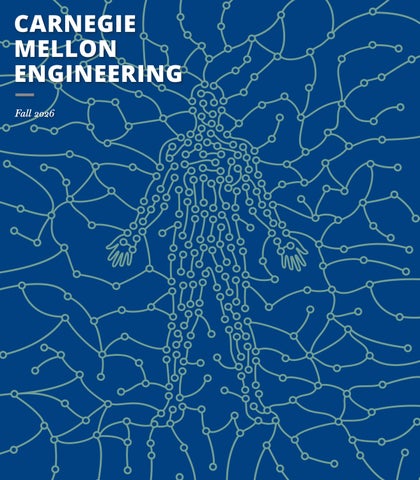
About the cover Seeing profound human need and intrigued by the challenges, Carnegie Mellon engineers are engaged in health-centric research. Healthcare spending in the United States reached $5.3 trillion in 2024 and is projected to hit $9 trillion by 2034. While a variety of factors contribute to these figures, engineers can play a role in lowering healthcare expenditures. Faculty across the College of Engineering are collaborating and driving innovation in medical device design and advanced technology-driven processes that are improving our understanding of the body, creating efficiencies that could lower costs, and providing medical solutions that improve patients’ lives.
IT’S AN EXTRAORDINARY TIME TO BE AN
MESSAGE FROM THE DEAN
S
ummer break? What was that? The students, faculty, and staff have been back for weeks, and classes are in full swing. It feels good to be together again as we launched the new academic year, and we have a lot of activity to report. AI is reshaping engineering education. To what extent and how fast the change will impact education has yet to be determined, and the College has much to contribute here—we
were the first in the world to establish graduate programs that integrate AI into traditional engineering programs. Along with teaching students how to design and build with AI, we are exploring how AI can improve their capacity to learn. In Chris McComb’s Mechanics II: 3D Design course, the students’ relationship with AI is flipped. Instead of AI being a tutor, the students teach AI, which has been shown to improve their engineering skills and confidence. Healthcare is always evolving, and I think our work is bringing breakthrough technologies to change the outcome for patients. Our strengths in traditional engineering fields—imaging, signal processing, modeling, and AI—are being applied in novel applications that can profoundly improve lives and potentially reduce healthcare costs. The College is leading a multi-university team that intends to enable the world’s safest deliveries for mothers and babies by replacing 50-year-old technology with a wearable AI-enhanced monitoring system. Another example is a smart pill we are developing that temporarily stays in the gut to reduces stress and related conditions like PTSD. Further, in partnership with the Cleveland Clinic, we are developing an AI system to interpret cardiac MRI scans that outperforms existing models by up to 35%. I feel proud when I think of what we are accomplishing on these and many other projects, and that pride extends to our alumni, whose achievements and service to the College enrich our community and reputation. I want to congratulate the recipients of the 2026 College of Engineering Alumni Awards, which were presented during Spring Carnival. Also, on the eve of Carnival, I was officially installed as the second Dr. William D. and Nancy W. Strecker Dean of the College of Engineering. I extend my deepest gratitude to William and Nancy for their enduring support of the College. We have a lot of work ahead of us, but we have tremendous momentum along with faculty and students who are determined to show what Carnegie Mellon engineers can accomplish. Sincerely,
Burcu Akinci Dr. William D. and Nancy W. Strecker Dean, College of Engineering
2 0 26 A L U MN I A WA RD S C EL E B RA T E I M P A CT AND S E RV I CE The College is honored to recognize the contributions and accomplishments of 15 extraordinary members of our alumni community. Stories of their outstanding service and achievements were highlighted during an Awards ceremony at Spring Carnival. We were excited to confer the first College of Engineering Lifetime Impact Award to E. Gerald Meyer, marking his 86 years of connection to the university. Read more about the recipients.
Inside this issue FOLLOW @CMUEngineering
FALL 2026 MAGAZINE
RESEARCH
EDITOR Sherry Stokes (DC ’07)
DES IGN ER Tim Kelly (A ’05)
ALUMNI
STUDENT NEWS
12 Securing radio quiet zones
24 Smarter math, better power grids
48 What a scoop!
56 Ph.D.s in their own words
Efficient system locates rogue signals
Advanced risk probabilities light way
Alumnus thrives in the newsroom.
Students explain why their
in radio quiet zones.
for future power systems.
17 EV batteries: Reduce, reuse, or recycle?
26 Cardiovascular sensing moves beyond wearables
52 Solving plastic pollution with yarn
58 Sustainability from the sky to the sea
Chemistry guides what to do with
Tracking blood-flow dynamics across
Replacing synthetic fibers with
Students employ naturally occurring
retired batteries.
human body with no physical contact.
biomanufactured alternatives.
resources in research.
work matters.
RESEARCH
See one, do one, teach AI one I
n Chris McComb’s Mechanics II: 3D Design Course artificial intelligence isn’t the expert or a shortcut to producing perfectly polished designs. Instead, AI plays a far more interesting role. It is forcing students to think more critically and, in the process, become the experts themselves. “In education, a lot of people are finding ways to turn AI into a tutor,” said Mc-
Comb, associate professor of mechanical engineering and director of the Human + AI Design Initiative. “But it’s not capable enough to handle the nuance of specialized engineering topics yet. So, instead of asking AI to teach my students, I asked my students to teach AI.” Building on the “see one, do one, teach one” learning paradigm—which has demonstrated that teaching material to others enhances information processing, performance, and motivation—McComb and MIIPS student Giovannia Natasha prompted Microsoft CoPilot to function
6
“Instead of asking AI to teach my students, I ask my students to teach AI,” says Chris McComb (above).
as a tutee in his fourteen-week mechanical engineering course. Throughout the semester, students interacted with the genAI tool on eight homework assignments, using pre-engineered prompts that instructed the AI to make specific mistakes and to act like a novice student. Each prompt was given to the students in Indonesian so that they were unaware of what mistakes to lookout for. Students in the Spring 2025 course who used AI as a tutee significantly outperformed students from the previous semester in three of the four major concept areas: predicting deformation, predicting failure, and understanding the influence of material properties. Performance on the fourth concept, predicting the location of failure, remained consistent with the prior semester. “Students who engaged more authentically with their AI tutee reaped the benefits,” said McComb. “Their confidence in their ability to use engineering skills improved, and so did their confidence in their ability to use genAI.” Potentially more compelling than the improved test scores is the accessibility factor. In this scenario, AI helps to level the playing field for students who may not have taken advanced physics in high Throughout the class, AI forced students to think more critically.
school, or who cannot attend office hours because they are balancing a part-time job. Because AI is an
“Student confidence in their ability to use engineering skills improved, and so did their confidence in their ability to use genAI.”
easy-to-use, always available tool, any student can
- Chris McComb Associate Professor, Mechanical Engineering
because of it.”
use it to refine their understanding. In McComb’s classroom AI is not the expert or the shortcut, it becomes the practice field. “If students are going to use AI anyways,” he said, “we should design experiences that make them better engineers
This research was supported by CMU’s Generative AI Teaching as Research (GAITAR) initiative.
7
F
or thousands of years, salmon have
A study from Carnegie Mellon’s Department of
actually produce sustainable outcomes.
sustained communities along Alaska’s
Engineering and Public Policy evaluated how well
Yukon River, not only as a food source,
the Alaska Department of Fish and Game (ADF&G)
systems, meaning environmental conditions and
Fisheries are often described as social-ecological
but also as a cornerstone of culture
follows policies designed to promote both ecological
human well-being are closely linked, and in the
and tradition. Today, however, those
and social sustainability in its management of salm-
Yukon River region, that connection is especially
salmon populations are declining, and researchers
on fisheries. By combining historical data analysis
strong. Salmon have supported Alaska Native com-
are examining if current policies that are meant to
and interviews with traditional subsistence users,
munities for at least 11,500 years, yet populations
protect them are working as intended, for both the
the team assessed if management decisions align
have experienced decades of decline attributed to
ecosystems and the people who depend on them.
with legal mandates and whether those decisions
pressures like warming oceans, changing river
An upstream battle:
Fishing policy in Alaska
8
conditions, and harvest impacts across multiple
As the agency responsible for regulating Alas-
that compares previous decisions about access with
ka’s fisheries, ADF&G determines how and when
species and user groups, examining their effective-
“Traditional users of the Yukon River have en-
fishing can occur for subsistence, commercial, and
ness in sustaining salmon populations.
gaged in reciprocal relationships with salmon since
recreational use. These decisions rely heavily on
Findings show that access decisions—whether to
time immemorial,” said Sabrina Curtis, Ph.D. student
biological indicators, such as escapement goals,
allow, restrict, or close fisheries—were moderately
studying engineering and public policy and lead
which estimate how many fish must reach spawning
consistent with general policy requirements. Yet,
author on the paper. “But today, they need help to
grounds to sustain future populations. To evaluate
salmon populations continued to decline, suggesting
balance systems of management with globalization,
how consistently their decisions align with those
that following existing rules alone may not be enough
industry, and culture.”
benchmarks, researchers introduce a new metric
to achieve ecological sustainability. The team also
regions and jurisdictions.
tested whether decisions reflected a subsistence preference, a legal requirement intended to prioritize Top: Sabrina Curtis fished in Alaska’s Kenai River.
Bottom: Salmon drying rack at the Nenana Culture Camp.
access for traditional users during times of scarcity. Rather than fully closing fisheries, restricting access may better support conservation and community needs. While closures are intended to protect fish stocks, they can disproportionately affect subsistence users who rely on salmon for food and cultural practices. Curtis’ research found that restrictions offer a more balanced approach that aligns more closely with subsistence preference laws. The results highlight a bigger challenge: sustainability is often measured through ecological or economic indicators, but social and cultural dimensions are harder to quantify and rarely required in management frameworks. Without those considerations, policies can overlook the well-being of community members even when they meet technical requirements. “Decisions made by state management agencies are intended to ensure sustainability, but traditional users have experienced these decisions as a cascade of negative impacts on their physical, mental, and spiritual wellbeing,” explained Curtis. “Traditional users of the Yukon would like to see increased regulation on industrial ocean fisheries because, while these industries may not be the root cause of the decline, they are the only thing within human control.” “Improving fishery governance will require rethinking both the indicators used to define sustainability and the systems that shape decision-making,” said Baruch Fischhoff, professor of engineering and public policy and the Carnegie Mellon Institute for Strategy & Technology. Fischhoff is Curtis’ advisor at Carnegie Mellon and co-author of the study, along with Valerie Karplus, professor of engineering and public policy and associate director of the Wilton E. Scott Institute for Energy Innovation. “Sabrina’s research has created an inventive approach to integrating academic and Indigenous knowledge systems, identifying solutions that serve both salmon and people,” he said. Ultimately, the work by Curtis underscores that sustaining salmon resources require more than biological benchmarks alone. Long-term preservation may depend on policies that treat ecological health and community well-being as inseparable, aligning management decisions with the environmental and cultural systems that come with them.
9
Ocean winds and tides bring new data for climate models
T
o take measurements
that are key to the formation of clouds.
that nobody has taken
Water vapor condenses onto a seed
before, Coty Jen’s re-
particle, ultimately growing into a cloud
search group packed up
droplet. Understanding how clouds
nearly every instrument
form over land and ocean surfaces is
from their lab and traveled to the coast of Maine. The Gulf of Maine is the fastest
critical to improving climate models. “If we want better climate model predictions, we have to go out and
warming body of water on the planet.
take more measurements,” says Jen, a
As the water temperature changes, so
member of the Center for Atmospheric
does its chemistry. Jen, associate pro-
Particle Studies at Carnegie Mellon.
fessor of chemical engineering at Carn-
Earth system models lack information
egie Mellon, received funding from the
about emissions along the coastline
National Science Foundation to study
and over the open ocean because it is
emissions from the ocean and their
difficult and expensive to take atmo-
impact on atmospheric chemistry.
spheric measurements. Jen is lowering
“Understanding how emissions are
some of those barriers by developing
changing in the Gulf of Maine will give
smaller, battery-operated instruments.
insight into potential changes in other
There have been very few field
parts of the oceans,” says Jen. She led
campaigns with as many instruments
the five-week field research campaign
as the Jen Lab brought to Maine.
last fall in collaboration with Steve
Among the instruments made in the
Archer, senior research scientist at Bi-
Jen Lab is a particle sizer and counter
gelow Laboratory for Ocean Sciences.
that can count aerosols as they form.
Large image: Christine Troller sets up instruments. Inset: One of the Jen Lab’s particle counter prototypes, set up in Maine. Source: Bigelow Laboratory for Ocean Sciences/Alex Seise
Christine Troller, a Ph.D. student
ing, and we made the limited space
Marine phytoplankton and their
They also took commercial instru-
in chemical engineering, led months
work quite well.” Troller was joined
microbial communities emit gases into
ments, such as the mass spectrome-
of logistical planning for the field
by fellow Ph.D. students Joy Kiguru,
the atmosphere. These gases react to
ters that they use to determine what
campaign. “There’s a lot of tubing and
Ziheng Zeng, and Malena Rybacki, and
form tiny seed particles, or aerosols,
gases the aerosols are made from.
wiring for our instruments. Working
master’s student Dallan Schoenberger.
in small trailers right at the water’s
10
“Field campaigns prepare students
edge, we had to be cognizant of safety
for high-intensity jobs,” says Jen. “There
and leave room for me and the other
is so much to keep track of: checking
students to reach and repair the
instruments, making sure the data
instruments when something failed,”
looks reasonable, fixing instruments,
she says. “It was fun problem-solv-
and coordinating with collaborators.”
Troller, who also participated in
Jen and her group observed parti-
field research at the US Department
cles forming extremely quickly in the
of Energy’s Atmospheric Radiation
air above the Gulf of Maine. The speed
Measurement Southern Great Plains
continued at night, which is unusual
observatory last year, notes how much
because the process is typically driven
she has learned from these experi-
by sunlight. This indicates that water,
ences. “Working with teams outside
seaweed, and phytoplankton are very
of CMU has taught me about different
efficient at making particles.
scientific worlds, other perspectives
“I have taken a lot of measure-
on our research, and what is import-
ments in my life, across different parts
ant for the general public,” she says.
of the country, and I was surprised
In Maine, scientists at Bigelow Lab-
by the emissions we measured. Even
oratory’s shoreside facility took water
though it’s a really clean environment,
measurements from the Bigelow Lab-
there is chemistry that I’ve never ob-
oratory dock that are complementary
served or read about before,” says Jen.
to the Jen Lab’s atmosphere measure-
The fastest particle formation
ments. With only a small joint team,
seems to happen at low tide. When
they collected a very comprehensive
coastal seaweed is exposed to the air,
dataset, combining biological, chem-
it dehydrates and its emissions change.
ical, and weather data. The collabo-
“We saw a lot of interesting things
The Jen Lab set up their instruments inside work trailers right on the coast. Source: Bigelow Laboratory for Ocean Sciences/Alex Seise
data with their measurements of
They are also fine-tuning the
outdoor air, the Jen Lab hopes to de-
prototype instruments that they
ration enables researchers to study
happening during low tide, and we
termine what happens to emissions
tested in Maine. Jen’s vision is to
the feedback loops between particle
want to understand why,” says Troll-
in the atmosphere.
take the instruments off the coast
formation, climate, and plankton.
er. She led experiments to take direct
“I think there are a number of im-
and onto the open seas on Bigelow
The researchers found high
measurements from seawater and
portant stories that we’re going to find
Laboratory’s research vessel, the
amounts of iodine and dimethyl sul-
from rockweed, the dominant sea-
as we analyze all of this data,” says
R/V Bowditch. She is planning a fol-
fide (DMS), which are key compounds
weed on the coast of Maine. Troller
Troller. She and her fellow students
low-up field campaign in a different
for the nucleation of cloud droplets
isolated water and seaweed samples
in the Jen Lab are contrasting coastal
season, when seaweed and phyto-
and not well known to come from
in sealed tanks, then measured the
emissions with emissions they mea-
plankton will be at different stages
local seaweed.
direct emissions. By coupling this
sured in ocean wind.
in their growth cycles.
11
Securing radio quiet zones Our engineers have developed a system that detects from long distances the sources of signals that interfere with the operation of radio quiet zones.
R
adio telescopes give us a glimpse into the cosmos. Detecting
across the spectrum. Just a faint, persistent signal from a faulty device, like a
faint radio waves from stars, galaxies, and black holes, these
microwave oven miles away, can blur the data from a distant galaxy, or mask
instruments allow scientists to monitor the universe without
the signature of a pulsar entirely.
interruption. Despite their size, radio telescopes are designed
Traditionally, tracking down these rogue signals has been time-consuming.
to detect extremely weak cosmic signals. Because of this high
Engineers load up trucks with spectrum analyzers and drive, triangulating sig-
sensitivity, even low-power local radio interference can dominate the signal and mask the astronomical data. Radio quiet zones (RQZs) are essential for the operation of radio telescopes.
nals based on power readings. It’s slow, expensive, and deeply human. Carnegie Mellon engineers have developed TranQuiL, a system that can detect and locate interfering signals from long distances more efficiently. By lean-
With legal restrictions on WiFi, Bluetooth, cell phones, and radio broadcasts,
ing into the structure of modern wireless communication, the system searches
RQZs protect sensitive radio astronomy telescopes and military intelligence
for the beacon packets, the regular, standardized bursts meant to announce the
equipment from interference. However, despite layers of regulation, the quiet
presence of a signal. The system is contained in a router-like box, mounted and
is breaking down. Over the past few years, there has been an increased prolif-
driven in a vehicle around the RQZ, detecting damaging signals.
eration of various terrestrial wireless communication technologies around the
“TranQuiL’s core innovation is a redesigned detection pipeline that pulls
world. Consumer electronics, like phones and routers, constantly leak energy
these beacon signals out of the noise floor at distances that would normally
12
The TranQuiL system
detects and locates interfering signals.
Radio telescope can operate in signal-free zone. In a 13,000-square-mile radio free zone, the researchers tested the TranQuiL system. It is contained in a router-like box and driven around the zone to detect damaging signals with striking precision.
render them invisible,” explains Swarun Kumar, the Sathaye Family Foundation
For radio astronomers, that level of precision is transformative. Instead of
Professor of Electrical and Computer Engineering and lead author of the paper.
dispatching teams to sweep entire regions, they can narrow the search to a spe-
“It’s less about brute-force sensitivity and more about clever signal processing,
cific structure, or even identify the exact offending device class before anyone
like filtering, synchronization, and pattern recognition tuned specifically to the
leaves the office.
quirks of WiFi and Bluetooth transmissions.”
“There’s an irony here. The same proliferation of wireless technology that
The team recently traveled to the Green Bank Observatory in the National
threatens places like Green Bank also provides the raw material for solving the
Radio Quiet Zone, a 13,000-square-mile region in Virginia, West Virginia, and
problem,” says Kumar. “WiFi and Bluetooth weren’t designed to be tracked from
Maryland, to test their research.
afar, but their predictability makes them legible to systems like TranQuiL in ways
“TranQuiL demonstrated the ability to locate interference sources with
older, noisier transmitters never were.”
striking precision,” says Kuang Yuan, a Ph.D. student in electrical and computer
Back in the quiet zone, the stakes remain cosmic. Every stray signal is a
engineering and co-author of the paper. “A WiFi transmitter nearly 950 meters
potential blind spot in humanity’s attempt to understand the universe. But with
away could be pinned down to within about 13 meters. Bluetooth devices, which
tools like TranQuiL, the balance may be shifting away from reactive cleanup and
typically operate at lower power, could be localized from roughly 450 meters
toward something closer to real-time awareness.
with similar accuracy.”
13
Tapping into risk in America’s drinking water Study develops a Drinking Water Utilities Climate Risk Index, finding utilities serving 67 million people face high climate risk. Yet 36% of bonds, totaling $9.2 billion in debt, omit climate change, revealing gaps in preparedness that affect communities, infrastructure, and investors.
14
W
hen you turn on the tap, you can typically expect clean, safe water to flow out. But behind that
simple action lies a complex system of pipes, pumps, governance, and financials that, for millions of Americans, is at risk in the face of climate change. To address this, a team of researchers at Carnegie Mellon developed the first publicly accessible Drinking Water Utilities Climate Risk Index for the United States, a comparative tool that measures the risks drinking water systems face from climate events like droughts, floods, and extreme heat. By cross-referencing 1,455 medium and large water utilities across the country with what those utilities reported in their bond disclosures (financial documents that show investors the risks associated with lending money to these utilities), finds a gap between the actual climate risk and the risk reported in their disclosures. Utilities serving 67 million people were rated as high risk, but more than a third of their bonds (36%) do not mention climate change, leaving communities exposed to potentially unsafe drinking water during extreme weather events and investors unaware of hidden financial liabilities.
have more than $500 million in recent bond debt, a
other utilities across the country. The research team
The municipal bonds studied represent $39.3 billion
combination that could pose risks to infrastructure
also plans to expand their index to include thou-
in debt, most of which will mature within the next 20
systems, communities, and investors.
sands of smaller utilities serving fewer than 10,000
years. Of that total, $9.2 billion was issued by utili-
Smaller towns and cities, however, may find
people, where they face more hurdles to enacting
ties identified as having high risk to climate change,
themselves with the greatest challenges. On aver-
climate adaptation strategies, but the utilities re-
but with limited evidence of climate risk awareness.
age, a high-risk utility serves approximately 52,000
main vital to the communities they serve.
“Climate change hazards can affect multiple
customers, compared to 139,000 for low-risk utili-
aspects of drinking water systems, from the water
ties. As a result, small communities, which already
ed more than $11 billion in funding to states for
supply to the built infrastructure to a utility’s oper-
lack the staffing and funds to properly enact plans
water utility infrastructure and recommended that
ations,” said Zia Lyle, lead author of the study who
for climate adaptation, are often disproportionately
states determine ways to prioritize climate resil-
conducted the research during her Ph.D. program
vulnerable to extreme climate events.
ience,” said Costa Samaras, professor of CEE, who
at CMU’s Department of Civil and Environmental
The study also highlights differences in state-level
“The Bipartisan Infrastructure Law in 2021 allocat-
coauthored the study along with former CEE Pro-
Engineering (CEE). “There are large financial risks to
preparedness. Texas, for example, has the largest
fessor Jeanne VanBriesen. “Our research can help
not planning for these changes.”
number of high-risk drinking water utilities in the
decision-makers make these needed investments.”
Risk levels vary across regions: In the Western
country, but no state-led climate adaptation plans
By combining climate data with financial analysis,
United States, utilities are more vulnerable due to
and only 5% of bond statements that mention
CMU researchers offer a path toward better climate
expected increases in climate hazards like drought
climate change. In comparison, Colorado utilities
adaptation and preparedness for communities
and heat waves, while communities in the Northeast
demonstrate how proactive planning and invest-
across the United States, not only protecting our
and Midwest—where approximately 70% of the
ment in climate resilience can reduce overall risk,
infrastructure, but also our public health, financial
most vulnerable utility systems exist—already face
even though they experience a high number of
planning, and the everyday reliability of the water
older infrastructure and lower operating ratios.
climate hazards.
we depend on.
In addition to climate considerations, sever-
Looking forward, the team recommends their
“Drinking water utilities across the country are
al states also find themselves at risk financially.
Drinking Water Utilities Climate Risk Index as a
exposed to climate change risks,” said Lyle. “The
Researchers found that Michigan, Illinois, California,
resource for utility companies, their customers,
utilities that invest in the resilience of their systems
Massachusetts, Virginia, and Texas have utilities
bond purchasers, and regulatory agencies to better
now will ensure our water systems are resilient over
that are extremely susceptible to climate events and
understand the future risk they face compared to
the next several decades.”
15
Left: This microforest demonstrates how researchers were able to arrange MXene nanosheets, each a million times thinner than a sheet of paper, into complex 3D structures in just a single printing step.
500 µm
3D MXene structures push the limits of microscale devices
I
200 µm
Initial design
3D printed
n a breakthrough that could power next-generation electronics, sen-
stem to form a microflower, as well as tree-like structures that together cre-
sors, and energy storage devices, CMU engineers have developed a
ate a microforest. They also showcased fine control in 2D by printing complex
fabrication technique that arranges MXene nanosheets, each a million
patterns such as the Carnegie Mellon University logo and a portrait of founder,
times thinner than a sheet of paper, into complex 3D structures in just
Andrew Carnegie.
a single printing step.
“A 3D arrangement of this 2D nanomaterial can help us reach the performance
requirements for miniaturized electronic devices like microsupercapacitors and batteries.” said Rahul Panat, lead author of the research published in Small.
“These structures are significant because they allow us to translate the exceptional properties of MXenes into practical, high-performance devices at the microscale,” said Panat. To demonstrate the practical impact of this technique, Panat’s lab fabricated
MXenes’ outstanding mechanical strength and superior electrochemical
an ultrahigh-performance 3D microsupercapacitor. It delivered a record areal
stability have captivated researchers for more than a decade. However, their
capacitance (the electric capacitance per unit of surface area) of 375 mF cm-2
impressive properties alone are not enough to create high-performance devices.
and an area energy density of 11.04 μWh cm-2, which far exceeds that of micro-
The material’s architecture plays a crucial role by governing how efficiently ions
supercapacitors made by other high-resolution methods.
and electrons move through an electrode. Without a carefully designed struc-
“This is the first time
ture, even the most advanced MXenes can run into bottlenecks and barriers.
additive-free 2D nanomate-
In previous work, Panat, a professor of mechanical engineering, demonstrat-
rials have been assembled
ed the ability to arrange 2D MXene into 3D structures with the support of a
into freestanding 3D struc-
ceramic backbone. Now, Panat’s group has advanced the technique by creating
tures without support struc-
freestanding 3D structures.
tures or post-processing,”
By transforming MXene nanosheets into a fully additive-free ink, the team
Panat said. “Fabricating
was able to print intricate designs using Aerosol Jet Printing (AJP). To form the
these previously unattain-
ink, the researchers harness the natural evaporation of micron-sized aerosol
able structures is exciting
droplets containing 2D MXene nanosheets. The ink is then precisely directed
because they can benefit
using aerodynamic control. By leveraging secondary interactions between the
everything from miniature
nanosheets, the researchers can guide the assembly of complex 3D structures.
wearable devices to micro-
Using this process, the team printed delicately curved petals arranged on a
16
robots, and batteries.”
600 µm
Initial design
3D printed
The team printed delicately curved petals arranged on a stem to form a microflower.
EV batteries: Reduce, reuse, or recycle?
T
he battery packs pow-
radation simulations, the researchers
ering electric vehicles
evaluated the economic viability of dif-
(EVs) are designed for
ferent end-of-life pathways: recycling
long-term use, but
to recover critical minerals or repur-
they won’t last forever,
posing for stationary energy storage
and the first wave of those retire-
to support the power grid. They found
ments is now on the horizon. As these
that treating all batteries the same way
batteries begin coming out of vehicles
risks wasting valuable materials, miss-
in large numbers, the U.S. faces a criti-
ing opportunities to extend battery
cal question: what do we do with them
life, and undermining efforts to build a
once they’re done?
resilient, circular supply chain.
As EV batteries reach the end of their lives, research shows that their chemistry should guide their best retirement strategy to strengthen the U.S. circular energy economy.
and nickel manganese cobalt (NMC).
between these two extremes. Their re-
Each battery contains minerals the
“Different kinds of lithium-ion
Lithium iron phosphate (LFP)
tirement pathway depends heavily on
nation largely imports, and the way we
batteries vary in how quickly they
batteries are known for their dura-
how they were used in their first life
handle retired packs will determine
degrade and how valuable the ma-
bility. They retain substantial storage
and how demanding their potential
whether we strengthen the country’s
terials contained in them are worth,”
capacity even after years of use in a
second-life application would be. The
critical mineral supply or deepen our
said Jeremy Michalek, professor of
vehicle, so they excel in second-life
study finds that some NMC batteries
dependency on foreign supply chains.
engineering and public policy and
applications and could be used in
are strong candidates for repurposing,
mechanical engineering. “So, the best
grid-scale energy storage, displacing
while others should be recycled, and
Engineering and Public Policy offers
retirement strategy depends on the
the need to import battery materi-
sorting them accordingly would be the
a data-driven strategy for navigating
type of battery.”
als for grid storage. Since they lack
essential, yet challenging, key.
A study from CMU’s Department of
There are three primary types
expensive minerals like nickel and
most effective strategy depends on the
of lithium batteries used in electric
cobalt, they are hard to recycle eco-
a national strategy and EV battery
chemistry inside each battery. Using a
vehicles today: lithium iron phosphate
nomically, so second life applications
retirement policy should recognize
detailed cost model and battery deg-
(LFP), nickel cobalt aluminum (NCA),
make sense for LFP.
these chemistry-specific differences.
this challenge and shows that the
The researchers recommend that
Nickel cobalt aluminum
Rapid diagnostic tools to assess bat-
(NCA) batteries fall on the
tery health and standardized “battery
other end of the spectrum.
passports” that document a pack’s
They degrade more quickly,
history could help support a chemis-
limiting their usefulness in
try-aware retirement approach, help
second-life applications.
the U.S. reduce reliance on foreign
But, because they contain
mineral imports and create new do-
high concentrations of
mestic industries.
valuable critical materials,
As the first large wave of EVs begins
Michalek and his team
to retire, the question of how to man-
concluded that recycling
age retired batteries becomes urgent.
them is generally more
Michalek’s research offers a clear
economical. In most sce-
roadmap: repurpose LFPs, sort NMCs,
narios, the revenue from
and recycle NCAs.
recovered nickel and cobalt
“By aligning retirement pathways
offsets the cost of process-
with battery chemistry, the U.S. can
ing, making recycling NCA
cost-effectively leverage domestic
batteries the best option.
resources as a strategic opportunity
Nickel manganese
for resilience and competitiveness,”
cobalt (NMC) batteries fall
said Michalek.
17
AI-enabled airport efficiency
Researchers apply a new AI-enabled approach to optimize airport safety and efficiency. Tested at LAX, the study reveals significant reductions in taxiway conflicts, fuel consumption, and hourly throughput.
A
irports around the world are struggling to keep pace with rising air traffic, and the pressure on air traffic controllers has never been greater. In busy towers, controllers must manage dense, fast-changing traffic on runways and taxiways, while simultaneously juggling unpredictable schedules, variable aircraft behavior,
and the constant risk of congestion on the ground. Traditionally, efforts to improve airside efficiency have focused on optimizing
runway assignments, but these decisions do not happen in isolation. A choice that speeds up departures, for example, can unintentionally create cascading effects that lead to bottlenecks on taxiways or increase the likelihood of conflicts between aircraft. Few tools currently capture these interconnected effects or account for the specific operational uncertainties, such as varying taxiing speeds and schedule deviations, that controllers must manage daily. A study published in the Journal of Computing in Civil Engineering aims to ease that burden, while increasing airport safety, efficiency, and sustainability. The team introduces a trajectory-based simulation and multi-objective optimization framework designed to help controllers make safer, more efficient runway assignment decisions.
18
“Every runway decision is a trade-off among safety, efficiency, and environmental impact,” said Pingbo Tang, associate professor of civil and environmental engineering at Carnegie Mellon University and co-author of the study. “By turning real taxi trajectories and delays into a multi-objective optimization problem, we can help controllers see those trade-offs clearly and choose options that reduce conflicts, cut fuel use, and keep aircraft moving.” Using data from Los Angeles International Airport’s (LAX) four runways, 17 ramp areas, and more than one thousand taxiway nodes and links, researchers incorporated real-world uncertainties and evaluated their strategy during some of LAX’s busiest 15-minute periods. Across departure-heavy, balanced, and arrival-heavy scenarios, their approach consistently outperformed the first-come first-serve method commonly used in airports today, reducing taxiway conflicts by 75%, cutting fuel consumption by 15%, and increasing hourly throughput by nearly 20%. Travelers aren’t the only ones who reap these benefits; increased efficiency also positively impacts the individuals working in the tower. Controllers spend long hours scanning complex display screens, searching for safe and efficient
Number of conflicting taxiway operations A comparison of how the study’s proposed approach would reduce taxiway conflicts vs. the current strategy and a first-come, first-served strategy (FCFS).
(a) Random strategy
(b) FCFS strategy
(c) Proposed strategy
58
29
0
solutions in real time. Tang notes that while some tasks, like interpreting context or managing unexpected events, are best suited for humans, others, such as analyzing large datasets, could be completed by artificial intelligence. The goal is for humans and AI to collaborate, helping narrow the search space, make decisions more quickly, and reduce the mental workload that can lead to errors and delays. “When we design AI for airport towers, our first question is: how can this reduce mental workload instead of adding to it? If AI can filter noisy data, surface a few high-quality options, and explain why those options are safer or greener, then controllers can focus their attention where human judgment matters most,” explained Tang. By coordinating runway and taxiway decisions and accounting for uncertainty, the study offers airports a scalable way to reduce delays, lower emissions, and improve safety without costly infrastructure expansions. Future research from Tang and his co-authors will extend the model to include gate operations, pushback coordination, and mixed-mode taxiing, bringing these tools closer to real-world use in airport towers and supporting controllers as they navigate increasingly complex skies.
19
After you’re gone,
who gets your passwords? New CyLab research explores how older adults handle digital estate planning
A
s more of life moves online, a new
happened to them,” she said. “I just thought, ‘that’s
question is emerging alongside tra-
wild. That is not something I would have thought of.’”
age them after death are often simple and analog. Despite the availability of password managers and
ditional wills and estate plans: what
That moment prompted a broader question:
platform-specific tools, many participants relied on
happens to our digital accounts after
as people accumulate more digital assets, such as
handwritten records to store account information.
we die?
subscriptions to online services, email addresses,
“Many people told us, ‘I have a notebook with all
and social media accounts, how are they preparing
of my passwords, and when I die, I want my heirs to
to pass those on?
have access to it so they can just do whatever they
A recent CyLab research paper, “Passing Down
Passwords: How Older Adults Approach Postmortem Account Access and Digital Estate Planning,”
“Traditional estate planning focuses on tangi-
need to,’” said Cranor.
sheds light on how older adults in the United States
ble property and financial holdings, but it doesn’t
are navigating that challenge and gives insights into
fully address digital assets like online accounts and
about digital tools, particularly password managers.
areas where current tools and practices fall short.
passwords that have become an important part of
Some worried about security, and others feared
people’s lives,” said Lorrie Cranor, CyLab director
making mistakes.
Led by Jenny Tang and Owen Wu, Ph.D. students in Carnegie Mellon University’s Societal Computing pro-
and one of the paper’s co-authors.
Participants frequently expressed concerns
“What if I set it up wrong and delete all my pass-
gram, the study explores how people over 60 think
To investigate, Tang, Cranor, and their collabo-
about managing their online accounts after death.
rators conducted in-depth interviews with 21 older
if all my passwords get leaked because I clicked
The findings, which Tang presented at April’s
adults across the United States. Participants were
a button?”
Association for Computing Machinery (ACM) Confer-
recruited through community networks, mailing
While much prior research has focused on the
ence on Human Factors in Computing Systems (CHI
lists, and local outreach efforts, including postings
“digital legacy” of how social media profiles, photos,
2026) in Barcelona, reveal a landscape that is both
around the Pittsburgh area.
and online identities persist after death, this study
practical and surprisingly informal. Tang’s interest in digital estate planning began with an everyday conversation. “I was actually talking with a friend whose parents
The research built on earlier survey work explor-
found that older adults prioritize financial access
ing password-sharing behaviors, but shifted toward
over concerns about continued web presence.
more detailed conversations about real-world prac-
“Overwhelmingly, the participants said that
tices, concerns, and expectations.
went on vacation, and they left this document of all
What emerged was a clear pattern: while digital
of their accounts and passwords in case something
lives are complex, the strategies people use to man-
20
words?” Tang recalled participants asking. “Or what
their financial accounts are of utmost importance,” said Tang. “They want their heirs to have access to finances and to be provided for.”
This includes not only bank accounts, but also digital portals used to manage investments, pay bills, or
“Almost none of our participants had heard about them,” said Tang.
access services. By contrast, social media and other
Even when such features are available, inconsis-
purely digital content were often seen as less critical.
tent terminology and fragmented design can make
In some cases, participants reported that important photos and memories were already shared with
them difficult to navigate. “There’s ‘legacy,’ ‘memorialization,’ ‘inactive ac-
While this study focused on older adults, Tang sees broader implications as younger, more digitally immersed generations age. “Is this also true for younger adults and people with more digital traces than the older adults we’ve studied to this point?” asked Tang. “Maybe what
family members or stored in the cloud, reducing
count manager,’” Tang noted. “Being able to say, ‘this
needs to be included in digital estate plans is going
concern about preserving them.
is the type of feature I need’ would be very helpful.”
to change.”
One of the study’s more surprising findings was the lack of concern about postmortem privacy. “I was expecting people to say, ‘I don’t want to give out all my passwords,’” said Tang. “Whereas our
Based on their findings, the researchers argue
Future research may explore how different
that improving digital estate planning will require
populations value digital assets, how terminology
both better technology and better guidance.
and interface design affect usability, and how new
On the technical side, they recommend clearer
participants overwhelmingly said, ‘after I’m dead,
standardization across platforms, more customiz-
there should be no limitations to what information
able settings, and default options that reduce the
my heirs have access to.’”
burden on heirs.
professional roles might emerge to support digital estate planning. For now, the study highlights a simple but important reality: even in a digital world, many people
But technology alone isn’t enough.
are still relying on analog solutions to manage their
mindset: heirs could either access everything or
“It would be nice to have an expert help guide
most sensitive online information.
nothing at all. As long as information remained
me,” said Tang, describing a common sentiment
within trusted circles, privacy was not a major issue
among participants. “Much like traditional estate
for the research participants.
planners or attorneys, future professionals could
“We’re all going to die at some point,” she said.
help individuals navigate the legal and technical
“And someone has to do this work and figure out
complexities of digital assets.”
what is needed.”
Many participants expressed an “all or nothing”
Major technology companies already offer features designed to manage accounts after death, such as legacy contacts or inactive account settings.
Such experts would need a hybrid skill set, under-
But the research team found that awareness of
standing both estate law and the technical systems
these tools was extremely low among participants.
behind online accounts.
And as Tang points out, it’s a topic that may be uncomfortable but is unavoidable.
CyLab Research Team: Jenny Tang, Xiaoyuan Yu, Lujo Bauer, Nicolas Christin, and Lorrie Cranor.
21
Who should AI pay for AI?
is embedded in everyday technologies at low or no cost to most users, but it isn’t free. As AI proliferates, so do its demands on electricity and water resources, along with broader societal challenges such as labor market disruption, privacy concerns, environmental degrada-
tion, and the spread of misinformation. Some hidden costs are already landing on the public, but affected communities may not be on the hook forever. Research from Carnegie Mellon University offers a dependable way to
mitigate these costs through the tax code. In their paper, “Taxing Artificial Intelligence,” incoming Engineering and Public Policy Ph.D. student Juliette Faivre and Assistant Professor of Electrical and Computer Engineering and
New research proposes taxation as a mitigation strategy for the social, economic, and environmental costs of AI.
Engineering and Public Policy Sarah H. Cen analyze how targeted taxation could promote more socially responsible AI operations. The paper’s authors point out a fundamental inequity: the appetite for AI is broad and diffuse, but its consequences burden specific, localized communities. Neighborhoods that host data centers have experienced water supply interruptions. AEP Ohio, the power company serving Ohio’s data center corridor, told customers to expect monthly electricity bills to climb by $27—a rate hike attributed in part to the soaring needs of the nearby tech facilities. Residents experience utility strain and increasing cost regardless of personal use. The extraction of human-produced data for AI training presents another significant inequity. Most creative contributors never consented to, nor received compensation for the use of their work for profit-driven AI firms. Furthermore, creative professionals face reduced demand for their labor as AI systems get better at mimicking their creative voices. The paper proposes that taxation can balance the harmful effects of AI in three ways: 1) corrective; disincentivizing overconsumption of water or electricity through price signals, 2) redistributive; directing tax revenue toward restorative or remedial action, and 3) regulatory capacity; using tax revenue to fund AI oversight through monitoring and enforcing regulation. While other approaches to mitigating AI costs have been explored, the researchers note barriers to their enforceability. Proposals for risk-management frameworks, transparency obligations, incident reporting, etc., require a complicated evaluation infrastructure that is mostly untested. Mitigation taxes (Pigouvian taxes), on the other hand, have been used for decades in
TAXATION LEVERAGES A PROVEN MECHANISM FOR MANAGING MARKET EXTERNALITIES, AND A PUBLIC FRAMEWORK ALLOWS FOR INDEPENDENT OVERSIGHT.
the U.S. to offset societal costs of private industry goods and behaviors. Taxation is an appealing strategy because it leverages a proven mechanism for managing market externalities. Moreover, because even small businesses possess a basic tax compliance framework, they can swiftly adapt to new obligations, making timely deployment feasible. Crucially, a public tax framework also allows for independent oversight. The paper highlights another built-in advantage: in the U.S., tax laws can be passed through budget reconciliation. This process bypasses the filibuster, allowing Congress to avoid typical gridlock. AI taxation is no longer theoretical. In the Senate, proposals to address AI-driven harms have been introduced, and some industry leaders have supported AI taxation discussions. Faivre and Cen are careful to point out that AI taxation is not a magic bullet. Firms may attempt to avoid taxes by moving to jurisdictions with lower taxation or weak regulatory enforcement. Taxation may not be an appropriate remedy for some harms, such as privacy violations and discrimination. Finally, taxation always carries the risk of chilling innovation, threatening global competitiveness. The authors emphasize that taxation be used to complement other AI governance tools rather than as a standalone fix. “AI taxation deserves closer consideration by policymakers, as it could add the missing public-finance piece of AI governance: how to pay for the needs an AI economy creates,” says Faivre.
22
The research team will test the technology at Carnegie Mellon’s Robotics Innovation Center outdoor testing grounds where FieldAI is the first corporate tenant. This new center is a 150,000-square-foot facility designed to accelerate breakthroughs in robotics, artificial intelligence and advanced automation.
Mud walkers
C
arnegie Mellon University’s Robomechanics Lab and FieldAI
robot’s interaction with the ground and quickly determine the best movement
have been awarded a Small Business Technology Transfer grant
strategy for current conditions.
from the U.S. Army to develop new technology that will enable
The project will also explore bio-inspired hardware designs including
quadruped robots to move safely, efficiently, and reliably through
deployable ankle pads and secondary support surfaces that increase the
muddy and deformable terrain.
contact area for robots walking on soft ground. These features are inspired
The project combines FieldAI’s expertise in deploying general-purpose robot-
ics with Aaron Johnson’s leadership in legged locomotion and terramechanics. Together, the team will develop new software and hardware that allow four-
by elephants and camels whose feet naturally spread under their weight to prevent sinking. “Mud is a classic example of what makes field deployment hard. It’s also
legged robots to sense, adapt, and maintain traction in mud without requiring a
common across the industries where robots are needed most, such as con-
preexisting model of the terrain.
struction, mining, energy, and government,” said Eric Krotkov, R&D programs
While quadruped robots have made rapid progress in navigating tricky ter-
lead at FieldAI Federal. “This collaboration with CMU pushes the boundaries of
rain, muddy environments remain difficult due to their unpredictability. Acting
where robots can go and how effectively they can operate once they get there.”
like a solid under low stress but flowing like a fluid when stress increases, mud is extremely difficult to model.
Legged robots are already being used for a widening range of valuable tasks such as inspection and mapping, so improving mobility in soft terrain expands
“The core problem is that there isn’t one ‘right’ way to walk in mud,” said John-
their role. By enabling robots to navigate muddy conditions more reliably, the
son, professor of mechanical engineering at Carnegie Mellon. “The strategy that
project supports applications ranging from disaster response and environmen-
works in one patch can fail a few steps later. We’re building a control system
tal monitoring to construction, mining, and agriculture.
that lets robots recognize the differences and respond immediately. This is a fundamental shift from how locomotion is typically engineered.”
The research also reaches beyond mud. The same adaptive learning framework could be applied to other challenging terrains.
Instead of attempting to precisely model every possible type of mud, the
“Ultimately, we want robots that can go wherever they’re needed,” said
researchers will develop learning-based controllers that adapt to terrain con-
Johnson. “That means handling any environmental conditions that may come
ditions in real time. These controllers will analyze sensory feedback from the
up along the way. Today, we’re starting with mud.”
23
Smarter math, better power grids Advanced risk probabilities light the way for future power systems
W
energy infrastructure for a changing world.
considerations, applying the reserve margin and
Historically, utility companies have used simpli-
N-k reliability formula, to the advanced probabilistic
fied formulas to plan grid expansions. One common
model. They applied these models to a real-world
hen power generators sudden-
method, the “reserve margin,” simply ensures a grid
case study of the power grid in San Diego County,
ly fail, most people only care
has a blanket percentage of extra power on standby.
California, mapping out a 10-year expansion plan.
about keeping the lights and
Another, known as “N-k reliability,” calculates wheth-
The researchers discovered that the math models
air conditioning on. But for
er a system can survive the simultaneous failure of a
used completely alters the physical layout of the grid.
the engineers who design our
specific number of power generators or lines.
When planners used simplified formulas like the
electrical grids and power plants, preventing those
However, these traditional methods treat risks as
reserve margin, the math model designed a central-
blackouts requires balancing an incredibly complex
flat rules rather than calculating the actual, shifting
ized grid—clustering massive power plants together.
puzzle of future costs and unpredictable failures.
probabilities of equipment failures.
However, when the researchers forced the computer
Two areas of concern are reliability and resilience.
“We wanted to see what happens when you stop
to use rigorous, probabilistic risk modeling, it built
Reliability offers an uninterrupted supply of electric-
using shortcuts,” said Professor of Chemical Engineer-
a highly distributed network, spreading smaller
ity to satisfy the load demand while resilience allows
ing Ignacio Grossmann, the study’s senior author. “By
generators out and adding extra transmission lines
for quick recovery of operating conditions after
building an advanced mathematical model that ac-
to weave them together.
disruptions occur.
counts for the actual probability of low- and high-or-
The study noted a stark trade-off for sustainabil-
Researchers at Carnegie Mellon University’s
der equipment failures, we can accurately predict not
ity and consumers: the highly rigorous probabilistic
Department of Chemical Engineering found that the
just if a blackout will happen, but exactly how long it
models require somewhat higher upfront invest-
type of math used by grid planners to prepare for
will last and how much energy will be lost.”
ments and operational costs. However, they dramat-
these emergencies drastically changes both the cost
To prove their point, the team utilized an ad-
ically reduce blackouts, measured by metrics like
of electricity and the ultimate reliability of the grid.
vanced mathematical framework called General-
“loss of load expectation” (the duration of darkness)
The findings, published in IEEE Transactions on Power
ized Disjunctive Programming to test four distinct
and “expected energy not served” (the total electrici-
Systems, explore a critical flaw in how we prepare our
planning models, ranging from ignoring reliability
ty shortage). This trade-off sits at the heart of global energy sustainability. As the world transitions to renewable energy sources like wind and solar, power grids are becoming inherently more variable and less predictable than older grids reliant on coal or natural gas. If planners rely on outdated, oversimplified math, they risk building grids that are cheap on paper but prone to unreliable delivery of electric power. Conversely, over-engineering the grid using strict rules could drive energy bills to unaffordable heights. While the researchers proved that their advanced probabilistic model creates a safer grid, they acknowledged a major hurdle: the complexity of the mathematical model can require long computational times, making it difficult to scale up to massive grids with hundreds of power hubs. The team’s next steps involve developing faster algorithms to simplify these calculations. Recently, they have also addressed the design of resilient power plants that are subjected to major disruptions such as extreme weather events that may damage transmission lines and generators. Seolhee Cho, a Ph.D. graduate of the Department of Chemical Engineering, was the first author on this research.
24
IME
A
ARD
TEST
O
F T
W
The science behind seamless streaming
WINNER
Researchers receive the Test of Time Award for creating a smarter streaming algorithm that predicts network changes to improve video quality.
W
e live in an era of streaming entertainment. YouTube, Netflix, Hulu, and HBO are just a few of the streaming platforms consumers rely on for media consumption. When you hit play on a
streaming video, there's an invisible negotiation happening every few seconds. Your device is constantly deciding whether your internet connection can handle crisp 4K video, or whether it should temporarily dial things back before you're staring at a spinning buffering icon. Carnegie Mellon University researchers proposed a smarter way for video players to automatically choose video quality by predicting the future instead of simply reacting to the present, leading to smoother playback, less buffering, and better overall viewing quality. Today's streaming services typically rely on algorithms that estimate network speed or monitor how much video has already been downloaded into a playback buffer. Both methods work reasonably well, but each has downfalls. Internet connections can fluctuate wildly, especially on mobile networks, making it difficult to predict the best video quality to request next. The researchers argue that the problem isn't choosing between network speed and buffer level, it's using both. Drawing on principles from control theory, a branch of engineering used everywhere from aircraft autopilots to industrial automation, they developed a mathematical framework for understanding how video players should react to changing network conditions.
"Most existing approaches focus on either estimating network bandwidth or monitoring
Their proposed solution uses a technique called Model
the playback buffer,” explains Vyas Sekar, the Tan Family Professor of Electrical and Computer
Predictive Control, which plans ahead instead of simply reacting
Engineering and author of the paper. “We wanted to show that combining both sources of
to the latest network measurement. Rather than asking, "How
information leads to better decisions."
fast is the connection right now?" the algorithm effectively asks,
That small shift in thinking could translate into a noticeably smoother viewing experience.
"Given what I know about the network and my playback buffer,
Instead of swinging between ultra-high definition and blurry video, or freezing altogether,
what's the smartest decision over the next few moments?"
the player aims to balance competing priorities like startup speed, picture quality, and
The team received the Test of Time Award at the 2026 ACM SIGCOMM Conference for their paper, “A Control-Theoretic Approach for Dynamic Adaptive Video Streaming over HTTP.” The paper was recognized for its thorough exploration of the design space for adaptive video streaming and for establishing a principled framework for delivering a high-quality user experience across varying network conditions. The Test of Time Award honors papers published 10-12 years earlier that have demonstrated a sustained and significant
uninterrupted playback. The team also tested the algorithm in a working video player using recordings of real network conditions rather than idealized simulations. “It’s an important step toward determining whether the approach can survive the messy reality of everyday internet traffic,” says Xiaoqi Yin, ECE alum and lead author of the paper. For viewers, the payoff is simple: less buffering, steadier video quality, and fewer moments when your favorite show grinds to a halt. Behind the scenes, however, those improvements come from an increasingly intelligent system quietly making hundreds of tiny decisions so that you never have to think about them.
impact on the field. The team's work has shaped subsequent research and influenced the design of adaptive video streaming
Authors of the paper include Xiaoqi Yin, Abhishek Jindal, Vyas Sekar from Carnegie Mellon
systems, establishing a lasting foundation for the field.
University, and Bruno Sinopoli from Arizona State University.
25
HUMAN HEALTH
Cardiovascular sensing moves beyond wearables
F
or decades, monitoring cardiovascular health has required some
Instead of attaching sensors to the skin, the system emits millimeter-wave
combination of cuffs, sticky electrodes, wearable sensors, and fre-
“chirps” toward a seated individual and analyzes the reflected signals using beam-
quent doctor visits. A new experimental system suggests the future
forming techniques and neural networks. These reflections capture microscopic
of heart monitoring may look less like a hospital and more like a
movements at several physiological locations simultaneously: the apex of the
smart speaker sitting quietly on a shelf at home.
heart, the carotid artery in the neck, the radial artery in the wrist, and the mastoid
Researchers from Carnegie Mellon University’s College of Engineering have
region near the head. From these measurements, AI reconstructs pulse transit
developed an AI-powered millimeter-wave radar platform capable of tracking
times along multiple vascular pathways. That matters because pulse transit time,
blood-flow dynamics across the human body without making physical contact.
the interval required for a pressure wave to travel through the arteries, acts as
The prototype system, called PolyPulse, uses the same class of radar technolo-
a proxy for arterial stiffness. In general, stiffer arteries transmit pressure waves
gy found in autonomous vehicles and consumer electronics to measure subtle
more rapidly, a phenomenon associated with hypertension, stroke risk, coronary
bodily movements caused by cardiac activity. The result is a compact device that
artery disease, and neurodegenerative conditions such as Alzheimer’s disease.
can estimate pulse transit time, a key marker of arterial stiffness, and even infer diastolic blood pressure remotely. “The implications are potentially enormous,” says Jiangyifei Zhu, a Ph.D.
Published in Nature Communications, the research represents the culmination of an ongoing effort that began after the team received the competitive Qualcomm Innovation Fellowship award in 2025.
student in electrical and computer engineering and co-lead author of the paper.
“Most previous contactless systems could only monitor a single pathway,”
“Cardiovascular disease remains the leading cause of death globally, and many
explains Kuang Yuan, a Ph.D. student in electrical and computer engineering and
of its warning signs develop gradually over years. By detecting these changes
co-lead author of the paper. “PolyPulse instead captures several simultaneously,
early at home could dramatically improve outcomes.”
creating a more distributed map of cardiovascular behavior across the upper body.”
26
The prototype system uses radar technology to measure subtle bodily movements caused by cardiac activity.
The research suggests this multi-site approach could reveal subtler physiological changes that single-point measurements could miss. Current camera-based health sensors can fail in low light or when clothing obscures the body. Radar, by contrast, operates independently of visible light and can detect motion through certain materials. That robustness makes it especially attractive for passive, long-term monitoring inside homes. “We envision a future where cardiovascular sensing becomes ambient, integrated into the environment rather than attached to the body,” says Swarun Kumar, the Sathaye Family Foundation Professor of Electrical and Computer Engineering, co-author of the paper, and advisor to Yuan. “A person could potentially receive continuous monitoring while simply sitting at home, reading, or watching television.” The hardware itself is surprisingly compact: roughly 16.5x14 centimeters, it’s small enough to integrate into future smart-home devices. This research represents an early proof of concept rather than a clinical product. The team still needs to validate the system across larger and more diverse populations. Regulatory approval, medical calibration standards, and long-term reliability testing would all be required before physicians could rely on such systems diagnostically. “This is still an early-stage proof of concept, but it demonstrates how AI and wireless sensing may eventually transform the home into a proactive health-monitoring space,” says Justin Chan, assistant professor of electrical and computer engineering and computer science, co-author of the paper, and co-advisor to Zhu. Still, the vision is compelling: cardiovascular monitoring that requires no cuffs, no wearables, and no active participation from the patient. Just a quiet radar device, sitting unobtrusively in the corner of a room, listening to the body through reflected waves invisible to the human eye.
27
Striving for world’s safest birth deliveries
C
arnegie Mellon University is leading a multi-university team that
possible fetal distress. Without direct information about oxygen levels, clinical
has secured an award of up to $39.3 million from the Advanced
decision-making during labor often relies on incomplete data.
Research Projects Agency for Health (ARPA-H) to develop a wear-
“When a fetus is suspected to be hypoxic, care teams may have to act quickly
able monitoring system to better identify fetal distress and its
without knowing the underlying cause,” said Jana Kainerstorfer, professor of
cause, enabling a safer labor and delivery experience for mothers
biomedical engineering at Carnegie Mellon and principal investigator of OME-
and babies. The system, called OMEGA, or Optical, Mechanical, and Electrical
GA. “The ability to directly measure a lack of oxygen to the fetus, and identify
Global Assessment of fetal hypoxia, aims to replace 50-year-old, indirect, unreli-
the cause, will have significant implications for obstetric care by enabling safer
able fetal heart rate monitoring technology with a unified, real-time assessment
deliveries for all.”
of fetal oxygen delivery and adaptive capacity. The project is under ARPA-H’s
To pinpoint why fetal hypoxia occurs during labor, OMEGA is looking at the
Making Obstetric Care Smart program, which is led by ARPA-H Program Manag-
whole system, not just the fetus in isolation. OMEGA will integrate several non-
er Kate Arnold, M.D., MBA.
invasive sensors to measure contributing factors from the mother, the placenta
The standard of care for determining whether a baby is in distress during
and uterus, and the fetus. This systems-level, mechanism-based solution aligns
labor and delivery, contraction and fetal heart rate monitoring, remains largely
with the complexity of maternal-fetal physiology, enabling clinicians to under-
unchanged from the 1970s. While changes in a baby’s heart rate can indicate
stand not only whether a fetus is distressed but why.
potential problems, they fail to provide critical information like whether a fetus
Although the application is new, the work fits closely with Kainerstorfer’s
is receiving enough oxygen. In the United States, Cesarean deliveries account
broader research in biomedical optics, which focuses on noninvasive ways to
for roughly one-third of all births, and many are performed out of concern for
measure oxygenation and blood flow deep within tissue. Her lab has previously
28
developed optical approaches for monitoring brain physiology and fetal health. “At the core, I’m interested in how oxygen, and the lack of it, affects the brain
“This project is a chance to close the gap between what clinicians need—reliable, real-time clarity—and what current monitoring can provide,” said Ko.
at all stages of life,” concluded Kainerstorfer. “From a technology standpoint,
“Our team is focused on methods that are rigorous, interpretable, and built for
the question is always the same, how do you measure physiology deep inside
the realities of the delivery room. We believe this work can directly improve
tissue you can’t directly access? Standard fetal monitoring has not fundamentally
outcomes for mothers and babies, and CHOP’s commitment to children and
changed in decades. If we can provide clinicians with better information about fetal
families makes that mission deeply meaningful to us.”
oxygenation, that would be a meaningful step forward for maternal and fetal care.”
The United States has the highest rate of maternal and infant morbidity and mortality of any wealthy country, despite spending more per capita on maternal care. The World
NEW WEARABLE MONITORING SYSTEM WILL IMPROVE CLINICAL ASSESSMENT OF FETAL HEALTH.
Health Organization reports that C-section rates greater than 15% do not decrease mortality. If proven effective, OMEGA’s innovative approach could potentially reduce the C-section rate in the U.S., improve maternal and fetal health outcomes, and save millions of dollars in health care costs and hospital litigation. “Pregnancy is a natural physiological process, and, also, medically speaking it represents a significant stressor to the mother and fetus,” said Hyagriv Simhan, executive vice chair, Obstetrical Services at
The OMEGA project team is co-led by Tiffany Ko, a research scientist with
UPMC Magee-Womens Hospital and professor of Ob/Gyn/RS at the University
Children’s Hospital of Philadelphia (CHOP)’s Resuscitation Science Center. The
of Pittsburgh. “Clinicians often have to make difficult decisions with incomplete
team of nine partner institutions also includes UPMC Magee Womens Hospital;
and unreliable data during childbirth. Partnering with Carnegie Mellon University
University of Pittsburgh; University of Notre Dame; Washington University, St.
and other institutions around the world on project OMEGA is a promising step
Louis; University of Pennsylvania; the Institute of Photonic Sciences in Barcelo-
toward technology and AI insights that will revolutionize the labor and delivery
na, Spain; and Tyndall National Institute in Cork, Ireland.
room and make pregnancy safer for mothers and babies.”
29
Hijacking red blood cells allows parasite to escape
L
ooking at a sample of parasite-infect-
cells they observed moving were actually red blood
ed blood, researchers at Carnegie
cells infected with parasites and not white blood
Mellon University noticed the unex-
cells that already had motility.
pected movement of red blood cells.
The movement of red blood cells displays the
Due to their simple structure, red
parasite’s ability to alter host cell behavior. Evading
blood cells are unable to move on their own. So
the immune system is only one possible motivation.
what was happening to them?
Triggering propagation is another. “Imagine that the
Like someone stealing a car to flee from the po-
motion allows the parasite to sense where there's a
lice, the parasite Babesia microti uses red blood cells
new area with fresh blood to infect,” says Niepa. The
to migrate. The newly discovered phenomenon may
discovery reveals more about what parasites can
be a way for it to hide and escape from white blood
do to relocate and find new space, away from the
cells, which do not typically attack red blood cells.
immune system, where they can easily multiply.
When it enters the bloodstream and invades red
“This is an important step forward in under-
blood cells, the parasite causes the infection Babesi-
standing how Babesiosis infections work and how
osis, with symptoms similar to malaria. It is trans-
we might combat them,” says Li. More insight into
mitted by tick bite, and cases are becoming more
pathogen-host interactions could lead to innovative
common in the Northeast, Mid-Atlantic, and Upper Midwest United States. Because Babesia microti and other parasites are difficult to study in the lab, Tagbo Niepa and Chao Li built a microfluidic system for monitoring infected blood. Their μ-Blood platform makes it easier to study the life cycle of the parasite outside of the host system and watch its behavior over time. Niepa, an associate professor of chemical engineering and biomedical engineering, and Li, a research scientist in the Niepa μBiointerface Lab at the time, were using their μ-Blood platform when they observed infected red blood cells moving on their own. “What’s intriguing is that the movement doesn’t originate from the red blood cells. The parasite somehow influences the host cell to move, likely as part of its strategy for survival and dissemination throughout the body,” says Li. In the Proceedings of the National Academy of Sciences (PNAS), Niepa, Li, and their collaborators introduce a new, intermediate stage in the development of the parasite Babesia microti. “This parasite is taking advantage of us in a way that’s sneaky and smart. It’s using a red blood cell as an invisibility cloak, and the immune system doesn’t recognize it,” says Amy Apgar. Apgar, a Ph.D. student in biomedical engineering, used scanning electron microscopy (SEM), transmission electron microscopy (TEM), and fluorescent confocal microscopy images to characterize the red blood cells in their experiments. Her images were key to verifying that the
30
A. Transmission electron microscope image of uninfected RBCs. B. Scanning electron microscope image of uninfected RBCs. C. Transmission electron microscope image of B. microti-infected RBCs, each with a single parasite inside. D. Scanning electron microscope image of B. microtiinfected RBCs with a buildup of fibrin and an increased amount of nanopores in the cytoplasm membrane.
approaches for prevention or treatment. Niepa and Li’s findings also open new avenues to studying co-infections, such as those involving the parasite that causes Babesiosis and the bacteria responsible for Lyme disease.
A smart pill to reduce stress
T
he gut plays a major
and deliver tiny, targeted stimulations
offers precision stress control, using
engineering research scientist and
role in stress levels in
to modulate activity in gut nerves and
electronics instead of chemistry, and
co-lead on the project. “You swallow
the human body. Often
hormone-releasing cells.
doing it from inside the gut.”
a capsule. When it reaches a specific
called the “second brain,” the gut constant-
“If high levels of cortisol are detect-
The smart pill has three distinctive
part of the intestine, it dissolves and
ed, the device will direct your adrenal
features; the outer capsule, which
releases a soft, flexible structure, kind
ly talks to the brain, influencing mood,
glands to ease off production, lowering
dissolves only in the lower intes-
of like a microscopic stent. This struc-
and regulating stress hormones like
stress levels in the body,” says Pulk-
tine, the flexible stent that unfolds,
ture stays put for several days, during
cortisol. Doctors know that persistent-
it Grover, the principal investigator
anchors gently, and carries sensors
which an electronic circuit works con-
ly high levels of cortisol negatively
on the project, and a professor of
and stimulators, and the electronics
tinuously to sense and modulate gut
affect the human body. What they
electrical and computer engineering,
module, containing power, control,
neurons, and then the device breaks
haven’t figured out is a precise way to
biomedical engineering, and CMU’s
and communication.
apart and exits naturally.”
control it, until now.
Neuroscience Institute.
Researchers from Carnegie Mellon
“This technology could change
itself inside the gut and keep working
the way stress-related disorders
University aim to develop a swallow-
loop neuromodulation system,
for days,” says Grover. “It’s an ex-
are treated,” says Douglas Weber,
able smart pill that temporarily lives in
GutHarmony would continuously
tremely small, low-power electronic
the Akhtar and Bhutta Professor
the gut and reduces stress hormones
sense chemical levels and would only
device, built for sensing, stimulation,
of Mechanical Engineering, CMU’s
by precisely stimulating gut nerves, all
adjust electrical stimulations when
and precision control. A key aspect is
Neuroscience Institute, and co-lead
without surgery or drugs. The team
high levels of cortisol are detected.
maximizing its effect on stress, while
on the project. “It opens up a new
recently received funding through the
Whereas an open-loop neuromod-
minimizing side effects, which requires
kind of medicine that uses ingestible
Defense Advanced Research Projects
ulation system lacks the detection
an interdisciplinary mindset integrat-
electronics instead of drugs.”
Agency (DARPA) to support its Coast-
feature and will continuously release
ing mechanistic understanding with
erChase program.
preprogrammed stimulation, no mat-
cutting-edge engineering design.”
The technology, called GutHarmony, could temporarily change how gut
The first fully ingestible closed-
“Our swallowable device can deploy
ter the chemical levels. “Our closed-loop neuromodulation
The team sees GutHarmony as more than a single device. It is a
The aim of the technology is to sig-
proof of concept for a new class of
nificantly reduce cortisol production
therapies: ingestible machines that
nerves function in order to reduce
system offers a personalized treat-
under stress, improve cognitive and
sense, decide, and act inside the
stress in the body. Once swallowed,
ment plan,” explains Zeynep Temel,
behavioral performance, a reliable de-
body, then disappear.
the pill dissolves in the lower portion
associate professor in CMU’s Robotics
ployment and safe exit from the body,
of the small intestine, releasing a tiny,
Institute and co-lead on the project.
all with minimal side effects.
soft stent-like device that remains in
“Current stress treatments affect the
“The technology sounds like sci-fi,
something you take every day. It might
place for a few days. Once there, it can
entire brain and body, often causing
but it’s surprisingly elegant,” says Mats
be something you swallow once, and
sense chemical signals linked to stress
unwanted side effects. GutHarmony
Forssell, an electrical and computer
your gut takes it from there.
In other words, the future of mental health treatment might not be
31
Our engineers and Cleveland Clinic develop AI system to interpret cardiac MRI scans Trained on more than 13,000 patient studies, the AI system developed by Ding Zhao in partnership with the Cleveland Clinic significantly outperforms existing models by up to 35%.
A
team of researchers from Carnegie
general-purpose AI systems in specialized clinical
Mellon University, in collaboration
applications,” said Ding Zhao, associate professor,
with Cleveland Clinic’s Cardiovascu-
mechanical engineering and co-principal investigator
lar Innovation Research Center, has
on the study. “By designing models that reflect the
developed an artificial intelligence
structure and complexity of cardiac MRI data, rather
(AI) system capable of interpreting some of the most
than adapting generic image models, we can unlock
complex heart scans in medicine, cardiac magnetic
new levels of performance and clinical utility.”
resonance imaging (MRI), without the need for manually labeled training data. The novel system, called CMR-CLIP, is designed to
investigator on the project, emphasized the clinical implications of the work. “Cardiac MRI interpretation
interpret cardiac MRI scans by connecting moving
is highly specialized and time intensive. Systems like
images of the heart with corresponding clinical
CMR-CLIP have the potential to support clinicians
radiology reports. In testing, it significantly outper-
through automated screening, and interpreta-
formed general-purpose AI models, in some cases
tion support, particularly in settings where expert
by more than 35%. The system also showed strong
readers are limited. Such reader assistant tools are
potential for improving cardiac imaging analysis,
critical to improving patient access to this powerful
case retrieval and clinical decision support.
diagnostic technology.”
“This work demonstrates that domain-specific foundation models can significantly outperform
32
David Chen of the Cleveland Clinic, a co-principal
Cardiac MRI is widely regarded as the gold standard for evaluating heart structure, function, and
tissue health. A single scan can provide a comprehensive view of
images, CMR-CLIP represents each study as a
the heart, including pumping performance, muscle damage, blood
video of the beating heart. The model processes
flow, and structural abnormalities. However, each study can contain
multiple standard views of the heart alongside
hundreds to thousands of images across multiple views and time
time-resolved sequences that capture motion and
points. Even for trained specialists, interpreting a single exam can
tissue behavior. This lets the model capture both
take 40 minutes or more. Because the technology is expensive and
structure and movement, much like a cardiologist
concentrated in major medical centers, there is a limited supply of
does when reviewing a scan.
experts available to meet growing clinical demand. This combination of complexity and limited data has also made
Trained on more than 13,000 de-identified real patient studies from Cleveland Clinic, the system
cardiac MRI one of the most challenging domains for AI. Most
learned from over a million images and hundreds
machine learning systems rely on large, carefully labeled datasets,
of thousands of motion sequences collected over
but in cardiac imaging, expert annotations are scarce, time-con-
more than a decade. When tested, CMR-CLIP was
suming to produce, and costly to scale.
able to identify cardiac conditions in a “zero-shot”
To overcome this barrier, the research team leveraged a re-
setting, meaning it had never been directly
source already embedded in routine clinical workflows: radiology
trained on those specific labels, simply by match-
reports. Every cardiac MRI exam is paired with a written summary
ing images to descriptive prompts like “enlarged
in which clinicians document key findings in an “impression” sec-
left ventricle.”
tion. Instead of relying on manual labels, the team trained CMR-
Even more striking, with just a single exam-
CLIP to align MRI image sequences with these natural language
ple of a condition, CMR-CLIP could often match
clinical summaries, enabling the model to learn directly from how
the performance of other systems that required
physicians describe and interpret scans in practice.
dozens of labeled cases. In more specialized
Rather than treating cardiac MRI as a collection of static
diagnostic tasks, the model reached near-clinical levels of performance, including accuracy rates as high as 99% for certain heart conditions. It also demonstrated the ability to search through large databases of scans using natural language, retrieving similar cases in a way that could one day help clinicians quickly compare patients with rare or complex presentations. A key test of whether the system was truly learning meaningful representations came when it was evaluated outside the institution where it was trained. The model still performed strongly on two entirely separate datasets (one collected in France, one in Cleveland Clinic Florida), suggesting it could generalize beyond a single hospital system. “This work highlights a new direction for medical AI by showing how large-scale clinical data can be used to train models without requiring time-consuming manual labeling,” said Deborah Kwon, director of Cardiac MRI at Cleveland Clinic, clinical lead, and co-author of this study. “This technology has the potential to not only improve efficiency but also quality of reporting to support more consistent and clinically meaningful interpretations, as well as serve as an important teaching tool in a highly specialized and complex imaging field.” Looking ahead, the research team plans to extend the model to additional cardiac imaging sequences, including perfusion imaging, T2-weighted imaging and parametric mapping, as well as explore applications in automated report generation and interactive clinical decision support systems in resource limited applications. This research was published in Nature Communications. The CMR-CLIP codebase is publicly available at: https://github.com/makiya11/cmrclip
33
Published in Nature Medicine, researchers demonstrate that spinal cord stimulation can significantly improve arm and hand function in people living with chronic stroke.
Spinal cord stimulation restores movement years after stroke
A
fter years of exploring how spinal cord circuits can be harnessed to restore movement, Carnegie Mellon University researchers in collaboration with The University of Pittsburgh have helped demonstrate a major milestone in stroke rehabilitation. Findings published in Nature Medicine show that targeting spinal cord stimulation can improve strength, mobility, and dexterity in people living with chronic stroke,
even years after their injury. The study reports the final results of a pilot clinical trial that evaluated cervical epidural spi-
nal cord stimulation, a neurotechnology designed to restore movements by strengthening communication between the brain and weakened muscles. Across seven participants with chronic stroke-related arm paralysis, researchers observed immediate improvements in strength, dexterity, and mobility, along with reductions in muscle spasticity. Participants experienced an average 32% increase in arm strength after just four weeks of treatment and less than nine hours of movement-based training. The findings build on results first reported in 2023 that demonstrated that spinal cord stimulation could restore arm and hand movement in two stroke survivors. The new study expands those findings across a larger and more diverse group of participants, confirming the approach is safe, feasible and effective for individuals with varying degrees of impairment. “This approach is designed to rapidly help people move their arms better, even years after a stroke,” said co-senior author Marco Capogrosso, assistant professor of neurological surgery at Pitt and director of the spinal cord stimulation laboratory at Rehab Neural Engineering Labs in the UPMC Rehabilitation Institute. “The stimulation works mostly as an assistive technology— when it’s on, people can move better. By stimulating the spinal cord, we can immediately allow residual connections between the brain and the spinal cord to work more efficiently, enabling better movement.” Researchers from CMU’s Department of Mechanical Engineering and Neuroscience Institute played a key role in developing the neurotechnology and advancing the understanding of how spinal cord circuits can be engaged to restore movement after neurological injury. The team developed the technology that uses thin electrodes implanted along the cervical region of the spinal cord. These electrodes deliver targeted electrical stimulation to sensory nerve fibers, which increase the responsiveness of the spinal cord circuits that translate signals from the brain into movement.
34
“The nervous system often retains pathways
“Our goal is to develop systems
that survive the stroke, but those connections are
that integrate seamlessly into daily life
too weak to generate functional movement,” said
to help people regain independence
Doug Weber, professor of mechanical engineering
in the activities that matter most to
and neuroscience at Carnegie Mellon and co-senior
them,” said Weber. “This study shows
author of the Nature Medicine paper. “By stimulating
the potential of spinal cord stimula-
sensory circuits in the spinal cord, we can amplify
tion not only as a rehab tool, but as
those remaining signals and help people access
a practical technology that can assist
movement that would otherwise be difficult or im-
when and where it is needed.”
possible to perform.” Unlike traditional rehabilitation approaches that
Weber emphasized that a key reason this technology has been able
seek to gradually improve function over months of
to advance is because of the close,
therapy, spinal cord stimulation produced imme-
continuous collaboration between
diate benefits when activated. Participants showed
engineering and clinical teams.
stronger movements, improved arm dexterity and
“By bringing together expertise in
reduced spasticity while stimulation was turned on.
neuroscience, rehabilitation medicine,
Several participants were able to perform func-
and neurotechnology we’re able to
tional tasks that had previously been difficult or
translate findings in the lab into impactful solutions for daily life,”
impossible, including reaching, grasping and moving
Weber said. “We created Reach Neuro, Inc., to ensure that this new
everyday objects.
therapy can be made available to the millions of Americans living
Researchers also found that the greatest benefits
with disabilities due to stroke and other neurological disorders.”
occurred while the stimulation was actively being
Moving forward, the research team has begun recruiting par-
delivered, highlighting the technology’s potential as
ticipants for expanded clinical trials to evaluate longer-term use
an assistive neuroprosthetic that could one day be
of spinal cord stimulation and to explore how the technology can
used during daily activities.
be combined with rehabilitation theory to maximize recovery.
The nervous system often retains pathways that survive a stroke, but those connections are too weak to generate functional movement. By stimulating sensory circuits in the spinal cord, we can amplify those remaining signals and help people access movement that would otherwise be difficult or impossible to perform.
35
Small models, big insights into vision
U
“By making the models smaller and interpretable, we can actually gain intuition about how the visual system works and develop hypotheses that can be tested in the lab.” By studying simplified models, researchers can see how individual neurons detect important features, such as the eyes in a face or the dots in a pattern, offering insights into how visual information is processed at a fine scale.
One surprising finding was that even though the model was dramatically reduced in size, it could still capture subtle differences in how neurons respond to similar images. This suggests that the brain’s visual system relies on specific computational patterns that can be represented in a more straightforward way than previously thought. By studying these simplified models, researchers could see how individual neurons detect important features, such as the eyes in a face or the dots in a
nderstanding how the brain processes what we see is one of
pattern, offering insights into how visual information is processed at a fine scale.
the central questions in neuroscience. Our visual system is in-
Beyond helping scientists understand vision, this research also has implica-
credibly powerful, able to recognize faces, objects, and scenes
tions for technology. Modern computer vision systems, like those that recognize
with ease, yet the details of how individual neurons respond to
faces on a phone or guide self-driving cars, were inspired by the brain but often
images remain complex and difficult to study. A study pub-
fail in subtle ways that humans easily handle. Insights from these compact neu-
lished in Nature shows that it is possible to capture these responses using mod-
ral models could help improve artificial intelligence systems, making them more
els that are both highly accurate and far simpler than previous approaches.
robust and adaptable in real-world situations.
The team began with a large computer model designed to predict how neu-
“The study also highlights the collaborative nature of this research, com-
rons in the visual cortex of non-human subjects respond to images. While this
bining experimental neuroscience with computational modeling and machine
model was very precise, it was also enormous, with millions of parameters, mak-
learning,” Smith added. “By working together across institutions and disciplines,
ing it almost as hard to understand as the brain itself. Using advanced machine
we were able to build models that are not only predictive, but also interpretable
learning techniques, the researchers compressed this model, creating smaller
and meaningful.”
versions that were thousands of times simpler while still predicting neural re-
Looking ahead, the researchers are extending these models to account for
sponses with high accuracy. These compact models allowed the team to examine
time, moving from single images to sequences like videos. This could help explain
the inner workings of the visual system in a way that was previously impossible.
how the visual system tracks movement, recognizes changing patterns, and
“This work shows that we don’t need massive, complicated networks to under-
focuses on important details in dynamic environments. By continuing to simplify
stand what individual neurons are doing,” explained Matt Smith, professor of bio-
and study these models, the collaborators hope to uncover rules that govern how
medical engineering and Neuroscience Institute at Carnegie Mellon University.
our brains interpret the world around us.
36
Innovative design unlocks resilient semiconductor materials A NEW STRATEGY COULD TURN RESOURCES THAT ARE MORE ABUNDANT AND READILY AVAILABLE INTO FUNCTIONAL SEMICONDUCTORS.
S
emiconductors such as silicon are the cornerstone of today’s essential technologies, however the variety of materials available to power devices is limited. While metal oxides are durable, only a small subset are semiconducting as they are naturally insulators. Researchers from Carnegie Mellon University and Penn State University have
made a breakthrough by which they have successfully transformed an insulating metal oxide into a high-performance semiconductor by using a technique called high-entropy mixing. Developing a complex mixture of manganese, iron, cobalt, nickel, copper, and zinc into a tungsten oxide framework within a single crystal structure, called wolframite, the researchers intentionally created a state of high configurational entropy. The new material, A6WO4, possesses both
semiconducting properties and ultra-low thermal conductivity, making it an ideal formulation for thermoelectric devices. “This approach activates unique microscopic mechanisms that we believe could serve as a new set of guiding principles for future materials engineering and design of next-generation devices,” said Ismaila Dabo, professor of materials science and engineering, who contributed to this recently published research. High-entropy materials are created by mixing multiple elements into equivalent positions within a crystal lattice, creating a high degree of chemical disorder. This disorder not only changes the material’s composition, but it also fundamentally alters its physics. The researchers found that this “chaos” at the atomic level triggered several microscopic mechanisms that narrowed the material’s band gap, transforming it from an insulating oxide into a semiconductor. As the researchers tested this new formula, they determined that it exhibited ultra-low thermal conductivity at levels significantly lower than many common industrial semiconductors and standard thermoelectric materials. This was attributed to chemical disorder, which prevented heat flow and disrupted the paths through which heat usually travels. “What stood out experimentally is that this material combines semiconducting transport with exceptionally poor heat conduction—two properties that are difficult to achieve together in oxides,” said Zhiqiang Mao, professor of physics at Penn State and co-author of the study. “The measurements show that high-entropy mixing is not just a way to create chemical disorder; it can be used as a powerful knob to engineer electronic and thermal properties simultaneously.” The potential impact of this research on the semiconductor industry is significant because it provides a strategy that could turn resources that are more abundant and readily available into functional semiconductors. Thermoelectric devices that convert waste heat into electricity require materials that conduct electricity like a metal, but scatter phonons to block heat like a glass. The A6WO4 system
demonstrates a design that can achieve both goals simultaneously. Additionally, metal oxides are often more resilient to heat and environmental damage than traditional semiconductors, making them ideal for applications in extreme conditions.
37
Inside The College
Our Portugal Program
A
Two decades of ICT excellence and a vision for 2030
s the Carnegie Mellon Portugal Program (CMU Portugal) charts its course toward 2030, it celebrates nearly 20 years of transformative international collaboration. Built on the pillars of doctoral education, high quality research, and entrepreneurship and innovation, the program has contributed to reshaping the Portuguese technological landscape, helping to position the nation at the forefront of Information and Communication Technologies (ICT).
The mission has remained ambitious and constant: to accelerate an advanced innovation ecosystem by cou-
pling world-class graduate education with high-impact research and highly innovative companies operating in the data-driven economy. Supported by Fundação para a Ciência e a Tecnologia and co-financed by industry alongside Carnegie Mellon University (CMU), this commitment has driven significant socioeconomic and scientific progress.
40
PROFESSOR FONSECA DE MOURA WEIGHS IN ... Nearly two decades have passed, and I’m often asked: why does it still matter? Our educational focus has created a new generation of talent–including 102 dual-degree Ph.D. graduates who drive innovation at some of the most recognizable companies in the world. Our alumni hold leadership roles at prominent Portuguese institutions, including the Universidade de Lisboa, Universidade Nova de Lisboa, and Católica-Lisbon School of Business and Economics. They also have leading roles at CMU-Portugalfounded startups like Feedzai and Unbabel, national enterprises such as Wave To Energy, Maven Pet, and VoiceInteraction, and global tech giants like Cloudflare. Program graduates are working at IBM, Google, Apple, Meta, and Amazon to name a few; at top universities such as Carnegie Mellon, UC Berkeley, and Utrecht University; and at leading institutions such as the European Commission. Our activities have contributed to the creation of 26 companies— including prominent names like Feedzai, Mambu, Veniam, and Unbabel, all founded by alumni and faculty involved in the program. This demonstrates the program’s broader impact: not just in education and high-quality research, but research with impact and building a real entrepreneurial culture that drives change. But the true value of the Program lies with the professors and researchers from CMU and the partner Portuguese universities, as well as the students on both sides, who have enthusiastically engaged with each other to make the initiative a true success.
A L E GA CY O F A CA D E M I C A ND RESEARCH EXCELLENCE
T HE S TR ATEG I C VI SI O N FO R 2 0 3 0
What began 20 years ago as a targeted collaboration has evolved into a robust global network
Our Portugal is a pioneer in building an innovation
involving all major Portuguese universities and 19 Carnegie Mellon University departments.
ecosystem through global partnership, world-class
At the heart of this success is a pioneering dual-degree model proposed by Carnegie
education, and cutting-edge research. Recognizing
Mellon Professor José M. F. Moura, who has helmed the program at CMU since its inception.
this impact, the Portuguese government has extended
The framework allows students to earn degrees from both CMU and a Portuguese institution
the partnership through 2030. This fourth phase
simultaneously, fostering a culture of trust and rigorous curriculum synchronization. Recently,
will reimagine the program’s instruments to boost
the dual-degree program expanded from 7 degree offerings in the College of Engineering
entrepreneurship and innovation. Leveraging Carnegie
and School of Computer Science, adding 4 new degree offerings in critical fields like Machine
Mellon’s and Portugal’s expertise, the program’s
Learning, Societal Computing, Cognitive Neuroscience, and Neural Computation and partners
scientific focus will focus on high-growth areas in the
in the Neuroscience Institute and the Department of Psychology of the Dietrich College of
general area of artificial intelligence. By integrating
Humanities and Social Sciences.
world-class research with ambitious targets for
Educational advancement continues through the Affiliated Ph.D. Programs and the CMU
technological R&D, CMU Portugal remains committed
Portugal Academy. Launched in 2021 and 2024, respectively, these initiatives expand the
to empowering the next generation of researchers and
program’s educational footprint in defining ways, coupling education and industry through
transforming innovative ideas into economic drivers.
doctoral and executive education.
This renewed vision ensures that the partnership will
On the research front, the program’s focus remains on the concrete, real-world technical problems faced by innovative corporate entities in the modern data economy. By bringing
keep doing what it does best: bridging the gap between world-class research and real-world impact.
together academic researchers and industry experts from both sides of the Atlantic, CMU Portugal bridges the gap between academic theory and real-world technical solutions. Notably, the program has supported 102 joint research projects, resulting in over 890 peer-reviewed publications, over 120 Ph.D. and 350 Master’s theses, and 17 new patents in the last five years alone.
41
A B RI D GE B ETWE E N TECHNI CA L DEPT H AND SOCIET AL IMPACT
For Joe DeCarolis, returning to Carnegie Mellon University as the head of the Department of Engineering and Public Policy (EPP) is more than just a homecoming. After serving as the presidentially appointed administrator of the US Energy Information Administration (EIA), he has assumed leadership of the department where he earned his Ph.D., ensuring the next generation of engineers’ technical expertise meets the urgent demands of the real world. DeCarolis brings a unique perspective on how rigorous analysis translates into high-level policy influence.
Q: You’ve balanced roles as an educator at NC State and as a Presidentially appointed, Senate-confirmed administrator of the Energy Information Administration (EIA). What pulled you back to academia and specifically CMU?
Coming back has been fun because the campus
Joe DeCarolis: Serving as EIA Administrator was incredibly rewarding. It was a privilege to
feels instantly familiar. The Mall looks much the
help shape the direction of an organization that I care deeply about.
same, though I’ve also found myself occasionally
But I am an academic at heart. I love research and taking time to think carefully about important questions. One of the things that first drew me to Carnegie Mellon and EPP was the department’s problem-driven approach to research. When you’re trying to solve real-
42
Q: As an alum, this is a bit of a homecoming for you. How has the EPP landscape evolved since you were here earning your PhD?
bumping into buildings that were not here when I was a student. More than anything, returning to EPP has felt
world problems, you naturally cross traditional disciplinary boundaries. Some of the most
like coming back to my intellectual home. The
rewarding moments come from learning from colleagues with different expertise and
department continues to tackle difficult problems at
bringing those perspectives together.
the intersection of science, engineering, and policy.
So, when the opportunity arose to return to Carnegie Mellon and lead EPP, it felt like the
Those challenges have evolved over time, but the
perfect fit for this stage of my career. It brought together the things I value most: research,
commitment to rigorous, problem-driven research
collaboration, and the chance to help guide a department that has had such a profound
and to making a real-world impact remains as
impact on my own journey.
strong as ever.
Q: For an incoming student choosing between a traditional engineering degree and EPP, how do you explain the unique value proposition of this department? What sets it apart?
Q: You’ve noted that EPP aims to connect “cutting-edge research with highlevel policy discussions.” Practically speaking, how does that research translate into real-world impact?
I usually start by pointing out that, at the
help improve decision making, you have to be creative and resourceful in looking for opportunities
undergraduate level, EPP is not a substitute for a
to contribute.
traditional engineering degree. Our students major in
I don’t think there is a single formula for turning research into impact. The world is a busy and complicated place, and policy decisions are influenced by many different factors. If your goal is to
Sometimes that means briefing members of Congress and their staff. Sometimes it means
engineering disciplines such as mechanical, electrical,
speaking with reporters, writing articles or blog posts, participating in public discussions, or sharing
chemical, civil engineering, or materials science, and
insights through social media. Academic journals remain important, but if we want our work to
then choose to add EPP because they want a broader
inform decisions, we also have to be willing to engage with people where they are. Having worked in
perspective on how technology interacts with society.
government myself, I know firsthand the value of timely, rigorous analysis when decisions need to
We need experts who can go deep in a technical field. But we also need people who can bridge the gap between technology and decision making. That has always been the unique role of EPP. We train students
be made. And as I mentioned, many of our alumni are now directly involved in making decisions and shaping policy, bringing with them the analytical skills and problem-solving approach they learned here. At its core, EPP is about helping society make better decisions. That means we cannot stop when a
to understand both the technology and the broader
paper is published. We have to go the extra mile to communicate our findings, engage with decision
societal context so they can help answer difficult
makers, and make sure our work has the best possible chance of informing important conversations
questions where neither perspective alone is enough.
and choices.
What makes EPP especially distinctive is the way we approach problems. We don’t start within a disciplinary silo and ask questions that neatly fit the boundaries. Instead, we start with a pressing societal challenge and bring together the expertise needed to address it. That might involve engineering, economics, computer science, physical science, psychology, or public policy. One of EPP's greatest strengths is that much of that expertise exists within a single department. We have been doing this kind of work for nearly 50 years, and our alumni are a testament to the value of that approach. Hundreds of EPP graduates have gone on to leadership positions in government, industry, academia, and nonprofits. They are using their EPP training to inform decisions on some of society's most important challenges, which is exactly what the department was created to do.
Q: Interacting with students always offers a fresh perspective. What have you learned from CMU students so far that has excited you? One of the highlights of returning to Carnegie Mellon has been getting to know our students. We have an
Q: What are your primary goals for the department over the next few years?
exceptional group of students in EPP,
The world is changing incredibly quickly. Advances in areas like artificial intelligence, energy, and computing
them over the past year.
are creating new opportunities, but they are also raising difficult questions for policymakers, businesses, and society. I want to make sure EPP remains at the forefront of helping people navigate those challenges. One of my main priorities is working with our faculty, staff, students, and external partners to think carefully about where the department should focus its efforts. That includes identifying the research areas where we can have the greatest impact, ensuring that our curriculum prepares students for the challenges they will face after graduation, and finding new ways to translate our work into real world influence. EPP has a long history of producing rigorous research that informs important decisions. I’d like to build on that tradition by expanding the ways we engage with decision makers in government, industry, and the nonprofit sector. Our goal is not simply to publish research, but to ensure that high-quality analysis helps shape important conversations and decisions. Ultimately, my goal is to help position EPP for the future while preserving the qualities that have made the department successful for more than 50 years.
and it has been a pleasure to work with What stands out to me is not just their technical ability, although that is certainly impressive. They also bring a remarkable range of experiences, perspectives, and backgrounds. Our students come to EPP with different interests and ways of looking at problems, and those differences make our conversations richer and our work stronger. I’ve also been struck by how engaged they are with the outside world. They aren’t content simply to understand how things work. They want to understand how to make things better. That curiosity and sense of purpose are very much in keeping with the spirit of EPP. After several years in government service, working with students again has been refreshing. Their energy, creativity, and optimism are a constant reminder of why teaching and mentoring are such important parts of what we do.
43
The future’s so bright
R
ecognizing today’s excellence and tomorrow’s potential, the National Science Foundation has presented Faculty Early Career Development (CAREER) Awards to a new group of untenured faculty in the College of Engineering. The highly competitive award includes a five-year grant that helps early-career faculty serve as role models for education and research and supports career advancement.
Sarah Fakhreddine Assistant Professor, Civil and Environmental Engineering
Sarah Fakhreddine
Sarah Fakhreddine seeks to develop solutions that address challenges in water quality and water availability. Her research examines how water moves through the environment and how chemical processes influence water quality in order to find engineering solutions that protect human and ecosystem health. She is particularly interested in how shifting water availability and management practices influence water quality. The CAREER award will enable Fakhreddine to investigate processes that affect groundwater management and agricultural sustainability. To increase water supplies for use during drought and other dry periods, farmlands can be flooded to replenish underlying groundwater, a strategy known as flood-managed aquifer recharge. However, this approach can also alter soil chemistry and mobilize naturally occurring contaminants, such as arsenic and uranium, potentially affecting groundwater quality. By combining field sampling, laboratory experiments, and modeling, the work will develop fundamental knowledge about the processes that control the movement of contaminants in these systems. Findings will be broadly applicable to agricultural soil systems that experience periodic flooding and aid in the development of management strategies that enhance water security while protecting groundwater quality.
Tathagata Srimani
44
NEW COHORT RECEIVES NSF’S PRESTIGIOUS CAREER AWARDS
Noelia Grande Gutiérrez Assistant Professor, Mechanical Engineering Noelia Grande Gutiérrez’s research falls in the intersection of com-
Noelia Grande Gutiérrez
putational engineering and cardiovascular medicine. Through the development and application of multiphysics models, she works to support clinical decision-making and provide insight into cardiovascular disease. With this CAREER award, a novel engineering framework for study-
mother and the baby. Despite its importance, the difficulties and ethical and safety concerns of studying the placenta during pregnancy have left
ing the placenta—an organ that allows the exchange of gases and
longstanding gaps in our understanding of the organ. The project’s outcome
nutrients between a mother and baby—will be established by inte-
will improve understanding of the function of the placenta and guide future
grating experimental data with physics-based modeling and machine
strategies to improve maternal and fetal health.
learning. When the placenta does not form or function correctly, it can lead to pregnancy complications and health risks for both the
The project will extend to engineering students, giving them the tools to explain the mechanics of pregnancy through core engineering principles and strengthening their technical knowledge. By becoming teachers themselves through a “Learning by Teaching” approach, students will
Tathagata Srimani
build science communication skills
Assistant Professor, Electrical and Computer Engineering
through an engineering lens.
Tathagata Srimani’s research focuses on the 3D integration of computing systems to build faster, more energy-efficient chips. His approach reduces both the distance and the energy that data must overcome by bringing memory and processing closer together in 3D, far exceeding the bandwidth between logic and memory that conventional 2D chips provide. Together, these gains in energy efficiency and bandwidth translate to substantial performance improvements. “Today, a huge fraction of a chip’s energy budget is spent just shuttling data between memory and processing,” said Srimani, whose CAREER project will resolve this with more capable and energy-efficient computing systems, such as those for artificial intelligence and large-language models. “These new design frameworks will give engineers the tools to explore this vast design space efficiently.” By developing new chip design frameworks for these 3D integrated circuits, powered by fast and accurate virtual models, there can be a more rapid exploration of 3D chip design alternatives. Technology targets can then be derived directly from application-level performance needs, inspiring new design methods, open-source design tools, and hardware prototypes
and engage broader audiences in understanding maternal and fetal health In addition to the CAREER award, Grande Gutiérrez is also a recipient of the 2027 American Heart Association Career Development Award. She was recognized for her project that will focus on coronary microvascular disease, a condition that disproportionately affects women and is often overlooked. In collaboration with University of Pittsburgh Medical Center, she will investigate the links between hypertensive disorders of pregnancy and coronary artery disease later in life, advancing women’s cardiovascular health.
that enable more energy-efficient 3D chip computing systems.
45
CMU-Africa Mastercard Foundation Scholars lead ICT bootcamp In spring 2026, more than 80 young learners at the Mahama Refugee Camp, Rwanda’s largest, were educated in digital literacy and information and communications technology (ICT) over the course of three days by 32 of CMU-Africa’s Mastercard Foundation Scholars. On the third day, these students from Mahama participated in a hackathon to demonstrate the culmination of their learning and work using their new skills in web development. Chinonso Nwishienyi, a second-year master’s student and volunteer teaching assistant at the ICT bootcamp, says that “the zeal the students showed toward learning was inspiring, and the sheer joy on their faces when they saw their code come to ‘life’ on a browser is an experience I would not trade for anything in the world.”
46
Ethiopia is known for a fast-growing digital economy and pan-African policy development.
The Afretec Network signs new partner in Ethiopia
C
arnegie Mellon University Africa an-
Afretec is focused on creating long-term sustained change across the continent, building
nounced that the African Engineering
and shaping ecosystems that will usher in economic growth:
and Technology Network (Afretec) has signed its tenth university partner, Addis
•
Ababa Science and Technology Univer-
Research: Since its founding, Afretec has awarded almost $7.43M in research funding across the continent. With more than 40 research projects in the network’s portfolio, Afretec is raising
sity (AASTU). The network, launched in 2022, provides
the profile of African research with findings published in peer-reviewed journals and internation-
a vehicle for technology-focused universities in Africa
al conference presentations.
to engage in deep collaboration to drive digital growth, create technology development, build pathways to
•
opportunities for youth, and shape policy change. Afretec Network members span the entire continent and represent North, South, East, West, and Central Africa. University partners include: Carnegie Mellon University Africa (Rwanda), Agostinho Neto University (Angola), Al Akhawayn University (Morocco), the American University in Cairo (Egypt), Université Cheikh Anta Diop (Senegal), University of Lagos (Nigeria), University of Nairobi (Kenya), University of Rwanda, University of the Witwatersrand (South Africa), and now Addis Ababa Science and Technology University (Ethiopia).
Education: Afretec bridge programs, intended to prepare students for graduate studies, have trained more than 2,000 undergraduate students. Afretec has also trained almost 500 faculty members in topics such as proposal writing, AI in education, and teaching challenges.
•
Entrepreneurship: Afretec has created a formal and scalable relationship between academia and startups through their TechSkills Marketplace program. The program connects students with startups actively seeking tech talent, allowing them to explore entrepreneurship as a viable career pathway by contributing their skills in a startup environment.
AASTU is a public higher education institution established in 2011 as part of Ethiopia’s strategic vision to advance industrialization, technological innovation, and STEM education. Located in the southeastern Kilinto area of Addis Ababa—recognized as Ethiopia’s flagship industrial and pharmaceutical hub— the university serves as a center of excellence for science, technology, research, and innovation.
47
ALUMNI
What a scoop!
48
Engineering alumnus thrives in the newsroom
Darius Dixon (right) moderating an event with then-U.S. Secretary of Energy Ernest Moniz (center) and co-moderator Mike Allen. (Source: John Shinkle/POLITICO)
AFTER YEARS OF RESEARCH IN MATERIALS SCIENCE AND GEOLOGY, DARIUS DIXON’S CURIOSITY, INVESTIGATIVE SPIRIT, AND LOVE OF LANGUAGE URGED HIM TOWARD A CAREER IN THE FAST-PACED WORLD OF JOURNALISM.
M
any people who pursue
with news and information only grew over time. Be-
engineering are driven by an
fore he had even finished his master’s program, he
unquenchable curiosity about
applied to journalism school at Columbia University.
how things work and a desire to solve problems in the world—
Stepping into his first job as a journalist, he felt right at home talking to scientists as he covered
but to do that, you have to be able to ask the right
advancements in the U.S. Department of Energy’s
questions. For Darius Dixon (MSE 2004), “asking the
national laboratories. His engineering background
right questions” took an untraditional form for an
gave him confidence when diving into technical
engineer, leading him on a path away from the incre-
topics; if a story required that he investigate a mas-
mental progress of research and into a career that
sive dataset or complicated government system, he
not only seeks, but demands, answers: journalism.
was unintimidated.
“I grew up in Brooklyn. When you grow up in New
“Part of being a scientist, at heart, is figuring
York City, current events are always happening all
things out,” said Dixon. He assumed that he would
around you,” said Dixon, a materials science and
eventually write for a publication like Scientific Ameri-
engineering graduate who is now deputy managing
can or National Geographic but found that he wanted
editor, policy at POLITICO. “I always paid attention to
to focus on current events and practical applications
what was going on, but I never thought of journal-
of research and science. After all, many readers may
gas pipelines. When a presidential nominee to FERC
ism as a profession.”
struggle to find relevance in an abstract or specula-
was met with controversy and withdrew his nomina-
tive outcome that may be 50 years down the road.
tion, Dixon was able to beat everyone to the story.
As a self-described “typical science nerd,” Dixon recalls his days as a high school student who
“Many people want to know why it matters now.
“I had done extensive research and coverage on
excelled in physics, even though there were no
You have to connect the dots,” said Dixon. “In mate-
FERC, so when the nominee pulled his nomination
scientists or engineers in his family. His fascination
rials science, for example, people generally under-
he came and talked to me, and we did a story and
with complex systems would find him opening The
stand things like steelmaking and ceramics, but you
Q&A for POLITICO,” said Dixon, who was the first
New York Times just to pore over the currency table
need a different type of steel for a building versus
person to cover the agency for the publication. “That
as a proxy for world economies.
an appliance at home. With ceramics, you have
was a big deal.”
“I wanted to be a college professor, that was
health care applications and then you have semi-
Dixon’s engineering mindset also informs his
my goal in coming to Carnegie Mellon,” said Dixon.
conductors. You need to be able to explain that.”
approach to workflows in the newsroom. “At POLIT-
During his time at CMU, he was exposed to many
Whether in engineering or journalism, Dixon notes
ICO, we have hundreds of journalists and if we’re
disciplines and topics across physics and materials
that translating information for your audience is
covering data centers, for example, that cuts across
science. Much of his work related to energy, but he
critical for making an impact and building credibility.
our energy team, our technology team, our politics
also got involved in semiconductor research and
He also learned quickly that members of Con-
team, and our White House team,” said Dixon. As
electrical engineering. “The subject matter diversity
gress are looking to connect two specific dots: “They
a deputy managing editor, he challenges himself
in MSE really mattered to me. I loved the variety.”
want to know if the research you’re spinning a yarn
to create systems that allow those many teams to
about will lead to jobs in their state or district.”
share information, streamline collaboration, and
Dixon relates this skill to his first big scoop on
minimize surprises. That’s hard to do as stories
the energy beat for POLITICO. He was covering the
emerge and evolve constantly, and often rapidly.
However, working in a lab taught him something else important about himself: “I didn’t have the patience to be a professor!” After graduating from CMU, Dixon went on to
Federal Energy Regulatory Commission (FERC), the
“Carnegie Mellon is still the hardest thing I’ve
graduate school in materials science and geology,
agency that regulates interstate electric transmission
done,” said Dixon, with a smile. “I have a tough job,
researching nuclear waste issues. But his obsession
and markets, as well as proposals for new natural
but my time at CMU prepared me for hard things.”
49
U
NVIDIA security engineer shares insights on career paths nderstanding data structures and
our friendship grew, and we kept in touch regularly in
algorithms is challenging, and so is
the following months,” says Mubarak Syed. Thanks to
finding the right job. That’s why a de-
Mubarak Syed’s invitation, Ahmed returned to campus
cade ago, the students at Carnegie
once again to “share insights from his own experience
Mellon Silicon Valley established the
in the field ... [and] students came away with a clearer
Coding Gym, a weekly, drop-in gathering where stu-
understanding of security engineering as a broad and
dents strengthen their technical chops and support
multidisciplinary field,” says Mubarak Syed.
each other as they navigate the employment process.
Ahmed’s presentation walked students through
A goal of these student-led sessions is to bolster
major cybersecurity domains, such as security ar-
collaborative problem-solving; however, occasionally
chitecture, application security, security operations,
guest speakers are invited to share industry views.
threat intelligence, compliance, and risk manage-
Case in point: Riyaz Rafi Ahmed, a security engineer
ment, and he discussed how they fit together in in-
at NVIDIA and an alum from Carnegie Mellon Infor-
dustry. He offered advice on different entry points
mation Networking Institute.
into security for students with software engineer-
In March, Ahmed led a special guest session, titled “Security Engineering: Career Path + Industry
ing backgrounds. According to Mubarak Syed, the session expand-
Insights,” which focused on security engineering and
ed the students’ perspectives beyond traditional
the broader landscape of cybersecurity. Ahmed was
software engineering roles. “Ahmed’s talk highlight-
invited by Aadhil Mubarak Syed, a Coding Gym co-
ed that security engineering is not a single path,
lead along with Ephron Wu. Both students serve as
but a collection of interconnected domains, which
Peer Career Consultants and are pursuing master’s
helped students better understand where they
degrees in software engineering in the Department
might fit within that landscape.”
of Electrical and Computer Engineering. When Mubarak Syed was considering CMU-SV
“It was valuable for students to hear directly from someone working in the field, especially in a role
for his graduate work, he talked to Ahmed about
that intersects with emerging areas like AI security.
the program at a student-alumni mixer. “Since we
That real-world context made the concepts more
shared a similar cultural and personal background,
tangible and actionable,” concludes Mubarak Syed.
50
Dan Swanson with Sarah Bergbreiter, the inaugural Dan and Karen Swanson Professor of Mechanical Engineering
Impact that endures. Relationships that inspire. Our world-class faculty could work anywhere—but they choose to teach, innovate, and do visionary research here. Just like you, they believe in CMU. Named professorships forge unique and lasting bonds between the faculty members who hold them and the individuals, families, or organizations that establish them. The prestige of professorships help the College attract, reward, and retain our best and brightest faculty who will shape the future of engineering and build a legacy of curiosity and excellence.
Carnegie Mellon brought us together and continues to mean so much to us both. We are passionate about this place, so it was important for us to establish this chair now—not only to deepen our connection to CMU and the College of Engineering, but to invest in transformative education, innovation, and scientific research that will change the world for the better.” DAN AND KAREN SWANSON
A legacy they share with you. If you have an interest in endowing a professorship, we would be happy to discuss the details. Send an email to kmara@cmu.edu.
Solving plastic pollution with recycled yarn for clothing
52
Sweater in recycled yarn
T
he environmental impact of the materials used in clothing is
and spun into yarn. This method, called biomass fermentation, is much more
significant, from the emissions and energy consumption involved
affordable than Squitex production. The fabric is made so that it is able to fully
with textile production, to the microplastic pollution caused
dissolve in soil and oceans and is competitive in cost to traditional wool produc-
through washing, to the waste generated when garments are
tion methods when made on a large scale.
disposed of. It is estimated that the global clothing and footwear
Earlier this year, Tandem Repeat won the Future of Capitalism competition in
industry represents 8–10% of global CO2 emissions, driven primarily by overpro-
London, beating out 650 applicants from 84 countries. The award included an
duction and the use of fossil fuel based fibers.
investment of up to $1M, which will enable Tandem Repeat to expand its produc-
As companies and consumers seek to reduce their carbon footprint, the development of new materials and production methods are crucial
tion of Procell to commercial scale from 500kg of yarn to hundreds of tons that are necessary for establishing partnerships with brands and textile mills.
endeavors. One Carnegie Mellon materials science and engineering alumnus is at the forefront of a shift in the textiles industry toward more sustainable materials in clothing manufacturing. Melik Demirel’s work in protein science began early in his academic career, focusing primarily on computational methods. After making significant contributions to the development of the Gaussian Network Model (GNM), a coarse-grained approach for studying the structural dynamics of proteins, Demirel was invited from his home country of Turkiye to work at the National Institutes of Health. From there, he decided to pursue a doctoral degree and was drawn to Carnegie Mellon because of its reputation in materials science. “Carnegie Mellon excels in providing fundamental skills in computer science and materials engineering,” he noted as he recalled his student experience. While the idea of pursuing an entrepreneurial endeavor was not at the forefront of his mind during his time as a student, he credits the solid fundamentals and mentorship of his advisor, professor Anthony Rollett, with making a notable impact on his career path. After earning his Ph.D., Demirel went on to complete postdoctoral work at Los Alamos National Laboratory, with guidance from Rollett, before his appointment to the faculty at Penn State University. At Penn State, a significant portion of his research has been dedicated to integrating manufacturing with digital technologies. After earning tenure, he spent a year at Harvard University’s Wyss Institute, where he began to appreciate the commercial potential of synthetic biology, realizing that he could bridge the gap between deep tech and market needs. In 2018, Demirel co-founded Tandem Repeat, a start-up with the mission to address the global plastic pollution crisis by replacing synthetic fibers with biomanufactured alternatives. The company was named for tandem repeat proteins, which can have better thermal properties than conventional synthetics. Tandem Repeat’s initial fiber development, Squitex, is a material inspired by squid ring teeth proteins, which the team biomanufactures using synthetic biology as they “code” squid genes into fast-growing bacteria or yeast. The Squitex fibers are produced through a solution spinning process, offering high-strength and durability levels, with minimal use of natural resources and energy. The fabric also exhibits self-healing abilities as it can repair through applying pressure and a plasticizer, such as water, to mend punctures in the
The process of creating Procell fibers goes from using proteins extracted from spent beer brewing yeast that is converted into a protein pulp, which is then refined and spun into yarn to create sweaters and scarves.
material in a quick manner. At the end of their life, the fibers are biodegradable.
“For consumers, this growth means democratizing access to high-performance materials,” said Demirel. “What was once a costly, niche biotechnology is now being positioned as an affordable alternative to wool, offering superior durability, strength, and a complete absence of microplastics or PFAS.” Scaling Procell fibers offers a vital
The material is intended to act as an alternative to polyester and nylon, which
solution for the textile market as
shed millions of tons of microplastics annually. Tandem Repeat has established
brands make progress toward compliance with heightened sustainability regula-
relationships with several clothing manufacturers and retailers to use Squitex in
tions. It also improved the resilience of the supply chain in commodity markets
their products, but production costs were high.
such as textiles, which are affected by the lack of wool production in the USA.
His company pivoted to the development of Procell, a fiber that is designed
By leveraging these new materials and processes and forging partnerships with
to be a replacement for wool. Using proteins extracted from spent beer brew-
industry leaders, Tandem Repeat is creating a blueprint for transforming the
ing yeast, they convert the biomass into a protein pulp, which is then refined
global supply chain.
53
STUDENT NEWS Civil and Environmental Engineering doctoral candidates Kenedy Sánchez and Hosea Santiago-Cruz created a new student-led service on campus, fostering community, connection, and confidence for CMU cyclists.
Pedal power: how two engineering Ph.D.s founded the Tartan Bike Project
C
arnegie Mellon has a strong cycling culture, with many students, faculty, and staff biking to campus or simply riding around Pittsburgh for exercise and recreation. In recent years, the university has invested in making campus more accessible and safe for cyclists and pedestrians alike with new policies, maps and bike paths, infrastructure, and dismount zones. Still, for some students, something core was missing. For Kenedy Sánchez and Hosea Santiago-Cruz, that “something” missing was community. They founded the Tartan Bike Project (TBP) at CMU to change that. The two Ph.D. researchers in the Department of Civil and Environmental Engineering (CEE) are members of the same lab and share an advisor: Hamerschlag University Professor and CEE Department
wanted to be a source of community and activism,”
that the other was an avid cyclist and had been involved in stu-
said Santiago-Cruz.
dent-led bike co-ops during their undergraduate years—Sánchez at
CEE assistant teaching professor Joe Moore intro-
University of Texas at Austin and Santiago-Cruz at the University of
duced Sánchez and Santiago-Cruz to Rocky Cristob-
Puerto Rico at Mayagüez.
al, the owner of Kraynick’s Bike Shop in Pittsburgh.
At UT Austin, Sánchez learned how to fix bikes and found a new
Cristobal donated some tools and equipment to get
community that became central to her life and her identity. Before
them started. Sánchez and Santiago-Cruz decided to
college, Santiago-Cruz learned how to repair bikes by helping out in
test the appetite for their idea at CMU with a pop-up
his parents’ bike shop as a teenager. As they began having discus-
event at the Fence offering free bike repairs. They
sions about how to make a bike shop happen at CMU, they both
didn’t know what to expect.
got more excited about the concept.
54
“We didn’t just want to sell and repair bikes. We
Head, Greg Lowry. As friends and lab mates, they both discovered
“People just started lining up,” Sánchez said. “We
From the bike lane to the lab As researchers, Kenedy Sánchez and Hosea Santiago-Cruz have made significant contributions in the sustainability field as well. Hosea Santiago-Cruz’s Ph.D. work has centered on researching methods of destroying per- and polyfluoroalkyl substances (PFAS)—commonly known as “forever chemicals.” They earned that moniker through their persistence as environmental pollutants that are notoriously challenging to remove from soil and water and to subsequently destroy. “We’re finding ways to better remove PFAS and then break them down,” said Santiago-Cruz, whose research has explored ways to use ultraviolet light to break the chemical bonds of different types of PFAS. Currently, water treatment plants are focused on the removal part of the equation, using separation and filtration technologies that can effectively remove PFAS from water. However, that process creates solid wastes that then must be managed, and none of those management options are ideal. “That's where my research comes in. How can we treat these materials that we're using to separate the PFAS in the water so that we're actually breaking down all those bonds to make it safer?” said Santiago-Cruz. While he notes that there are still many open questions in the science and scalability of PFAS solutions, his research is a step in the right direction.
Kenedy Sánchez’s initial research focused on nano-enabled agriculture, using nanoparticle systems to improve antibiotic delivery in citrus trees. Her project concerns Florida orange trees in particular, which have been devastated in recent years by citrus greening disease, a bacterial infection spread by the Asian Citrus psyllid. Sánchez’s role in the project—which was a collaboration with Purdue University, University of California Riverside, and University of Florida—involved analyzing how nano-antibiotics move in citrus trees after delivery, and how much of the antibiotic was reaching the tree’s phloem/inner bark. “We found that with our nanocarrier, we were able to target the
were thinking maybe we’d see five people, but we helped over 40 people.” In
phloem, the site of disease,” said Sánchez. “Not only were we able
addition to the in-person demand that day, Sánchez and Santiago-Cruz gath-
to deliver these nanocarriers to the phloem through the leaves,
ered some data about interest in an on-campus bike shop. With those num-
but we can also do it through the trunk, through these openings
bers in hand, as well as prospective locations, they proposed the TBP to the
called lenticels. That was novel, no one has done that before.”
Graduate Student Assembly and were awarded $20,000 to seed its launch as a student organization. Setting up shop was about way more than securing the funds. Sánchez and Santiago-Cruz spent months meeting with biking organizations and advocates, as well as campus partners including Michelle Porter and Karen Brooks from CMU Parking
The project’s field trial in Florida resulted in higher fruit set and crop yields—nearly eight times greater—compared to non-nano-antibiotics. “What makes this cool is that nano-antibiotics can be scaled up into a real solution that can be used by farmers,” said Sánchez.
and Transportation, to ensure the project was thoroughly planned and supported.
Future work in this area could improve the phloem-loading effi-
Today, TBP rents and sells bikes, as well as offering bike repairs, education, so-
cacy of various treatments and nutrients, potentially reducing the
cial rides, community outreach, and advocacy for the entire CMU cycling commu-
amount of chemicals needed to achieve desired results and in turn
nity. Currently, the bike shop’s co-founders are focused on ensuring the sustain-
reducing pollution such as nitrogen runoff. Sánchez’s current re-
ability and longevity of the project, even after they finish their Ph.D. programs and
search is focused on how nanoparticles interact with plant cell walls.
move on from CMU. As he approaches the end of his time at CMU, Santiago-Cruz
Amidst the success of her research at CMU, and the potential
said he decompresses from his research by popping down to TBP’s physical home
impact it could have in the agricultural industry and in society,
in the Gates Garage.
Sánchez has also developed a greater interest in public policy and
“Being in the bike shop and helping people, that fills me up,” he said. “It’s student-oriented and student-led. That feels good and we want to preserve that.”
science communication. In that sense, her experiences co-founding the Tartan Bike
While the Tartan Bike Project grew out of the College of Engineering and many
Project with Santiago-Cruz and participating in bike advocacy in
engineering students are involved, both Sánchez and Santiago-Cruz remark that it
Pittsburgh have been instructive, giving her insight into how an
has grown organically into a resource for all of CMU, with volunteers and partici-
idea gains traction, working with stakeholders and civic leaders,
pation from across the university.
gathering feedback, and focusing on local impact. For Sánchez,
“The whole point of TBP is to offer affordable, sustainable transportation options and to build community. It’s for everyone,” said Sánchez.
that approach holds true whether you’re fighting for a new bike lane or explaining why an engineering solution will be beneficial.
55
Ph.D.s in their T
56
hey run experiments. They create computational models. They build things. They manage labs. They launch start-ups. They mentor the next generation of scientists. They push research forward every day. Ph.D. students play an essential role in CMU’s innovation ecosystem and are critical to the university’s research excellence, advancement, and prestige. We asked some Ph.D.s to sum up why their work matters.
own words “Ph.D. students play a large role in making sure universities operate at their very best. We work tirelessly as growing educators and researchers to translate and produce a lot of ideas that end up benefitting the world around us.” STACY GODFREEY-IGWE, EPP/CEE
“One beautiful thing about doing research in academia is that you have time and resources. It doesn’t always have to be
“I want to make a
something that’s going to make money right away, so you can ask bigger questions.” DANIEL RANKE, MSE
“My Ph.D. work is important to me
“If you think about the
because it allows me to help people
volume of science that the
by using science in a practical and
United States produces,
meaningful way. This community
a massive amount of
encourages us to think big and push
it would not get done
boundaries.”
without Ph.D. students.”
NADER REZAZADEH, CHEME
KATE JOHNSON, CEE
difference in the field and hopefully one day have my own lab. I love being able to do my own research and have a positive impact and influence on students.” LARA ABDELMOHSEN, BME
“PhD students are a vital
“Without Ph.D. students,
“I don’t know if research
part of the research
university research institutions
would progress if we didn’t
ecosystem for any
would look very different.
have Ph.D. students to drive
university. They are
Often, Ph.D. students are
it forward. The expertise
essential in bridging the
integral to the design and
we gain through the five-
gap between novel idea
execution of experiments,
year tenure of a Ph.D. lets
generation and proof of
and our discussions with
us maintain institutional
concept demonstration, the
one another lead to deeper
memory and mentor others
“A Ph.D. matters
“Ph.D.s’
key to furthering science.”
understandings of scientific and
effectively.”
because you might
breakthroughs and
LLOYD LOBO, ECE
technological challenges.”
CHARLOTTE TAUSCHE, CHEME
be the only person on
learnings are what
earth working on that
the global community
exact problem. You’re
can learn from and
creating knowledge
use in whatever they
that serves all of
are building. We’re
humanity.”
students, but we’re
HAN DING, MECHE
also this workforce
JOSHUA KOSNOFF, BME
whose output is new human knowledge.” TJ THOMAS, MECHE
57
Sustainability from the sky to the sea
Engineering students employ the use of naturally occurring resources in their summer research endeavors.
V E D A N T M I S RA During his first year as an electrical and computer engineering (ECE) student,
This fellowship is funded by the CMU
Vedant Misra got involved with the Carnegie Mellon Solar Racing team, whose
Sustainability Initiative and in partnership
members research, design, and engineer all aspects of a solar-electric boat
with the Office of Undergraduate Research
which they use in collegiate competitions.
and Scholar Development.
His participation with the team sparked his interest in solar panels that
After spending his summer simulating
typically use silicon to convert energy generated by the sun to a usable form of
how the use of other materials perform
electricity. Misra knew that other materials and alloys could convert that energy
in varying conditions, Misra plans to apply
more efficiently. He wanted to learn more about how those alternate materials
what he has learned to redesign the solar
performed in different locations, elevations, and atmospheric conditions to de-
panels used by the racing team.
termine how varying temperature, moisture, and light would affect performance.
Last year was only the second time the
Although Misra admitted that as a first-year student it was intimidating to
team returned to competitions since they
reach out to his professors to ask about opportunities to do such research,
had been cancelled during the pandemic.
he was rewarded with a response from Larry Pileggi. The ECE department
The team raced in the 2026 Promoting Electric Propulsion (PEP)
head not only replied to his email, he introduced Misra to his lab, and agreed
Collegiate Boat Race that was sponsored by the U.S. Navy and
to support Misra’s application for the the Summer Undergraduate Research
held in Portsmouth, Virginia, in April. In June Carnegie Mellon Solar
Sustainability Fellowship to conduct research with his doctoral students.
Racing competed at SOLAR SPLASH 2026 in Springfield, Ohio.
58
CH A RLO T T E B E TZ When Charlotte Betz, who is pursuing dual de-
She is currently working with varying
grees in mechanical engineering and robotics,
the ratio of alginate, which comes
took Mechanical Engineering Professor’s Vickie
from seaweed; gelatin, a collagen pro-
Webster-Wood’s Dynamics class, she discovered a
tein found in skin, bones, and connec-
robotics field that sparked her interest and drove
tive tissue; calcium, an alkaline earth
her desire to know more.
metal and the most abundant mineral
Webster-Wood leads the Biohybrid and Organic
in the human body; and glycerol, a
Robotics Group (B.O.R.G.) that builds robots that can
chemical formula that enhances the
mimic the structure, adaptability, and complex be-
flexibility of the material.
havior of animals. In particular, her group uses tissue
Betz tests combinations of organic
engineering techniques to print actuators made of
materials to determine how much they
plant and muscle-derived materials to create com-
can be stretched before they break to
pletely biodegradable robots for aquatic applications.
better understand how well they might
After spending the spring semester getting settled in the lab, Betz received a Summer Under-
perform in robotic applications. Robots that can be used for envi-
graduate Research Fellowship grant to work in the
ronmentally friendly deployment in sensitive ecosystems need to
lab where she mixed and tested sodium alginate
be capable of animal-like movement, made of soft materials that
composite materials used to make actuators for
won’t damage plant or animal life, and biodegradable for those
biodegradable robots.
robots that can’t be recovered from underwater environments.
Betz is studying how changes in the recipe for these soft actuator materials affect their mechanics.
Betz tests organic materials to better understand how they might perform in robotic applications
Such pursuits fit neatly into the rising senior’s ultimate desire to earn a Ph.D. and launch a career building robots.
59
Engineering and theater students partner with entertainment company for stage design A new Carnegie Mellon course is bringing engineers and theater students together to solve live entertainment challenges by redesigning the systems behind modern touring productions with industry partner and global entertainment company TAIT.
C
oncert stages may look effortless when the curtain rises, but backstage they are giant mechanical systems filled with moving parts, tight timelines, and constant problem-solving.
At Carnegie Mellon University, students are
learning how to tackle those challenges firsthand through Entertainment Engineering, a new course that combines mechanical engineering and theater production to solve fundamental problems for the live entertainment industry. Developed jointly by professors Phil LeDuc and Mark Bedillion from the Department of Mechanical Engineering and Kevin Hines and David Boevers from the School of Drama, Entertainment Engineering brings students together from two fields that rarely overlap in the classroom but constantly intersect behind the scenes of live productions. In its first semester, students collaborated on a challenge sponsored by TAIT, the global company behind staging and automation systems used in
60
concerts for artists like Taylor Swift, theater productions on Broad-
The unique blend of technical precision and creative thinking is
way and the West End, and live events around the world including
exactly what the course was designed to encourage. According to
the Olympics. The company itself has strong roots at CMU as its
Matt Hales, VP of Team Leadership and Culture at TAIT (CMU ‘05),
CEO Adam Davis and dozens of its employees are CMU alumni.
the partnership reflects the kind of interdisciplinary collaboration
One of the program’s first challenges was to develop an
that already defines the entertainment industry.
automatic tool to adjust the height of staging legs. Traditionally,
“This course being a hybrid between mechanical engineering
this is a labor intensive and time-consuming job for production
and drama is really what TAIT is,” Hales said. “Theater students
crews, especially when stages need to be assembled and
do well because they have a high willing suspension of disbelief
reconfigured quickly during load ins and load outs. Students
— nothing is impossible, it’s just expensive and takes a long time.
were introduced to the challenge during the first week of class
Then you have engineers who say, ‘Cool, but there’s this thing
alongside professionals from TAIT.
called physics, and this is how gravity actually works.’”
Over the next several weeks, teams made up equally of engineering and drama students developed multiple concepts and prototypes before presenting their ideas to both TAIT
“When you put those two things together,” he added, “you get really smart solutions and incredibly creative problem solving.” By the end of the semester, students had developed a custom-
employees and faculty mentors at TAIT’s global headquarters in
ized tool to adjust the staging legs more efficiently, reducing the
Lititz, Pennsylvania.
physical strain and time required for crews assembling large-scale
“The structure of the course mirrors the workflow of profes-
productions. However, the biggest takeaway extended beyond
sional entertainment engineering projects,” said Hines, associate
the prototype. Students also gained experience working across
teaching professor of production technology and management.
disciplines, communicating with teammates who approached
“They must consider engineering constraints and a budget while
problems differently and navigating the ambiguity of open-ended
crafting designs.”
design challenges.
For many students, the experience revealed just how much
“Carnegie Mellon is one of the best in the world at breaking
engineering exists behind the scenes of live entertainment.
down barriers between fields, and Entertainment Engineering is
“It’s not like a textbook problem where there’s a thought
another example of that,” said LeDuc, professor of mechanical
process you’re supposed to follow,” said Bryce Casey, mechanical
engineering. “When you bring together the creativity of theater
engineering student. “There are a lot more variations from the
students and the analytical thinking of engineers, you create solu-
normal linear thought process to find solutions. You have a stage
tions neither group could have developed on its own.”
with 20 different variations and 80 different parts that all have their own problems. Then you need to figure out testing and prototyping to mitigate those problems.”
61
Kate Bergan
MERCK
Chemical Engineering, Biomedical Engineering, ‘27
DOORDASH
Joshua Nee
Electrical and Computer, master’s student
From cybersecurity to satellites:
Engineering interns explore careers, gaining skills and contacts This past summer, College of Engineering students from Carnegie Mellon University’s Pittsburgh and Silicon Valley campuses interned at companies across the U.S. and internationally. Internships represent an extraordinary opportunity for hands-on engineering.
Jocelyn Xu
Damayanti Chattopadhyay
Electrical and Computer, ‘28
Information Networking Institute, master’s student
SIEMENS
ADOBE
Engineering breakthroughs in robotics since 1950 Today our pioneering research and development in artificial intelligence and automation provides an operational edge in robotics innovation. We are crossing horizons to create the next generation of robotics for use on land, in water, in the air, and in space.
Announcing the opening of our new Robotics Innovation Center.
COLLEGE OF ENGINEERING
NONPROFIT ORG. U.S. POSTAGE PAID PERMIT NO. 251
OUTSIDE OF THE LAB Mechanical engineering students Rumi Loghmani, Jesse Barkley, and Peter Pak, working with Amir Barati Farimani, professor of mechanical engineering, developed RocketSmith, an AI-powered engineering system that integrates design software, flight simulations and additive manufacturing into a single workflow. By combining large language models with traditional engineering tools, the team reduced a process that typically takes months to just days. To test the system, they designed, manufactured, and launched four high-powered rockets at a launch site south of Pittsburgh.