Welcome to the Grand Hall. Thank you for coming to the concert. To ensure that everyone enjoys the music, please switch off your mobile phones and any other sound and light emitting devices before the performance. Unauthorized photography, audio and video recordings in the Hall are prohibited. Enjoy the concert and come again.
Presented by
Cultural Management Team, HKU Email: museinfo@hku.hk Tel: +852 3917 8165 Website: www.muse.hku.hk Office Location: Room LG.45, Run Run Shaw Tower, Centennial Campus, HKU Mailing Address: Room 9.01, Run Run Shaw Tower, Centennial Campus, The University of Hong Kong, Pokfulam, Hong Kong
HKU CMT
Supported by
Music & Fine Arts, HKU
Endowment Funds for
PROGRAMME
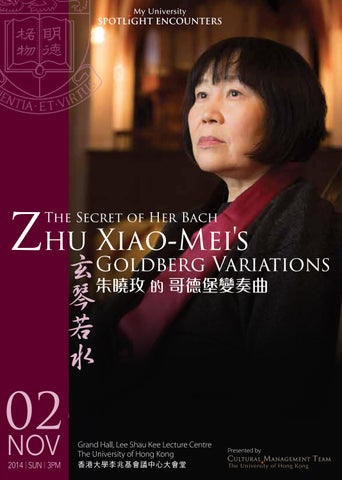
ZHU XIAO-MEI Zhu Xiao-Mei is a distinctive figure in today’s musical world. She holds limited concerts and only performs works that she considers demanding enough to be called “mountains of the soul”, and allows her interpretation to mature only after extended periods of preparation. Despite having performed at leading concert venues such as Théâtre des Champs-Élysées in Paris and Teatro Colón in Buenos Aires; at prestigious festivals including the Festival de La Roque-d'Anthéron and Schleswig-Holstein Music Festival; and with renowned ensembles such as the English Chamber Orchestra and the Sinfonia Varsovia, her career, she felt, nearly never took place.
Biography
Born in Shanghai, China, she was introduced to music by her mother. By the age of eight, she was already performing in public with her performances broadcasted on radio and television. She entered the Central Conservatory of Music when she was ten, where her education was tragically interrupted by the Cultural Revolution. For five years, she was kept in a labour camp near the border of Inner Mongolia.
4
When the Revolution ended, she completed her studies at the Conservatory and left China as soon as the regime showed its first signs of reopening to the outside world. She moved to the United States in 1980, and decided to settle in Paris, France, in 1984. Her career began to take off despite her late start, the lack of media coverage, and her tendency to go against all trends and fashions. In many ways, her life is a perfect demonstration of the Confucian adage that “life begins at forty.”
Biography
5
MUSIC IN WORDS Host: Professor Chan Hing-yan
Biography
Famed for his unique voice that mediates subtly between Chinese elements and Western idioms, Chan Hing-yan is one of Hong Kong’s leading composers. His recent works include Heart of Coral – a chamber opera in three acts, commissioned by the 41st Hong Kong Arts Festival (2013) and 'Twas the Thawing Wind – for sheng and orchestra, commissioned by the Hong Kong Sinfonietta for its North American tour (2012). For these two compositions, Chan was conferred the Best Artist Award (Music) at the "Hong Kong Arts Development Award 2013" by the Hong Kong Arts Development Council. Chan currently chairs the Music Department of the University of Hong Kong.
6
GOLDBERG VARIATIONS, BWV 988 Johann Sebastian Bach (1685 - 1750)
Programme Notes 7
Programme Notes 8
The ornamented aria that begins the piece suggests a sarabande (a dance in triple time that tends to stress the second beat). Opinions are divided between whether it is a sarabande tendre or a sarabande doublée, one is slow and the other fluent. Variation 1 has many features of a polonaise, including its distinctive semiquaver figurations that provide an atmosphere contrasting to the opening aria. Variation 2, like Variation 18, is a trio sonata. Variation 3 is the first canon, followed by other canons that serve as Variations 6, 9, 12, 15, 18, 21, 24, and 27. In the rest of the variations, seven are in the manner of a duet. Five are of mixed characters, resembling minuets, gavottes, sarabandes, and toccatas. The rest are passepied, gigue, arioso, short fugue, and French overture. The last variation ends with a quodlibet that is composed on two popular tunes: Ich bin so lang bei dir nicht g’west (It’s been so long since I’ve been at your house), and Kraut und Rüben haben mich vertrieben (Cabbage and turnips have driven me away). To some extent, Bach’s contrapuntal treatment of those joking tunes demonstrated his humour, however, to some his stunt went perhaps too far — if the story that the piece was indeed designed to make a person sleep was true. The following shows the aria and the variations at a glance: Aria, 3/4 time, sarabande Variation 1, 3/4 time, probably polonaise Variation 2, 2/4 time, trio sonata Variation 3, 12/8 time, canon at the unison Variation 4, 3/8 time, passepied Variation 5, 3/4 time, duet Variation 6, 3/8 time, canon Variation 7, 6/8 time, gigue Variation 8, 3/4 time, duet Variation 9, 4/4 time, canon at the third Variation 10, 2/2 time, fughetta Variation 11, 12/16 time, duet Variation 12, 3/4 time, canon at the fourth Variation 13, 3/4 time, sarabande
The Goldberg Variations features some of the most technically-challenging keyboard writings in the eighteenth century. It employs extravagant devices such as consecutive thirds, hand crossings, double trills, and rapid running passages. Its canonic and contrapuntal lines are complex in conception and perhaps more so in rendition. Its combination of protean characters and strict unity requires a performer to bend multiple rhythms and tone clusters at will, while not sounding mechanical, pretentious, or repressive. Originally designed for two-manual instruments, it is difficult to render on the modern piano which has only one manual.
Zhu Xiao-Mei has performed the Goldberg Variations around the world. She is among the very few Asian-born pianists who are widely acclaimed for playing Bach, especially the Goldberg Variations. The Parisian newspaper Le Figaro remarks that “you have to have heard Zhu Xiao-Mei play the Goldberg
Programme Notes
Variation 14, 3/4 time, duet Variation 15, 2/4 time, canon at the fifth Variation 16, 2/2 and 3/8 time, French overture Variation 17, 3/4 time, duet Variation 18, 2/2 time, canon at the sixth, as a trio sonata Variation 19, 3/8 time, probably minuet Variation 20, 3/4 time, duet Variation 21, 4/4 time, canon at the seventh Variation 22, 2/2 time, probably gavotte Variation 23, 3/4 time, duet Variation 24, 9/8 time, canon at the octave Variation 25, 3/4 time, arioso Variation 26, 18/16 time, probably sarabande Variation 27, 6/8 time, canon at the ninth, as a round Variation 28, 3/4 time, 2- to 4-part texture with double trill, resembling a toccata Variation 29, 3/4 time, as batterie Variation 30, 4/4 time, quodlibet Aria (reprise)
9
Variations: it is as straightforward as that!” The magazine Le Point calls her playing “sober and rigorous – that of a genius.” Le Monde reports that she “goes right to the essence, ignoring fear.” And Germany’s Die Welt calls her a “philosopher of sound.” Many critics find her interpretation uniquely attractive, perhaps because of her unusual encounters in life. In her autobiography, for instance, she describes her gloomy feelings toward the joke-like “cabbage and turnip” tune in the quodlibet (the last variation), which reminds her of the cabbages she was forced to harvest during her years in the labour camp. Zhu Xiao-Mei has recorded the Goldberg Variations with the French record label Mirare.
Programme Notes
Programme notes by Dr. Chung-Kei Edmund Cheng (Ph.D. in Music, HKU)
10
文 邵頌雄 專欄作家,近著《黑白溢彩:荷洛維茲的藝術》 答應替香港大學Cultural Management Team,跟朱曉玫做一個電話訪問。但在一個星期六早 上與她談過一個多小時以後,卻遲遲未能下筆,原本只是因為不想以問答形式來整理這次 的訪談,但又一時想不到適合的文體。朱氏多張唱片的附冊,都總有一個有關該唱片曲 目的問答記錄。再多一篇類似的訪問稿,對熟悉這位鋼琴家的樂迷而言,便顯得太形式 化了。 可是真正令我兩個星期還提不起筆的,是與她通電話後兩天,在香港掀起翻天覆地的變化。 在此所謂「大是大非」的時候,對部分人來說乃勿容置疑的「大是」,卻可以是另一些 人口中的「大非」,傳媒觀點各走極端、社會嚴重撕裂;即使在個人層面,亦有社交媒 體上的unfriend潮。這已超過黑白對錯的分野,而是非黃即藍、非抗爭即維穩,雙方劍 拔弩張,皆膨脹得容不下兩者之間的任何立足處。在此當下,對於一位中國鋼琴家從法 國來香港演奏一首兩百多年前的巴赫作品,還值得我們關注嗎?Who cares? 其後想到,歷史上最偉大的藝術作品,許多都不是在個人或社會最得意順遂、風和日麗的 環境下寫成的。貝多芬的第三交響曲,蘊釀於法國大革命之時;馬勒的交響曲,不少都創 作於種種逆境與死亡的陰霾之下。不論是文學、畫作、哲學等,都有一種共同點,就是把 人生的歷練昇華為高潔的藝術與思想。這些不朽傑作所以能歷久不衰,正在於其對後世的 深刻啟發,令我們不論面對順緣或逆境,都可以由主觀而狹翳的判斷中超脫出來,從中領 略生命的意義、生活的真諦。當社會被空泛的口號引導至極端,更需要我們把思緒沉殿下 來,冷靜探索前面的道路,且由「黃」與「藍」以外,感受斑斕繽紛的人生色彩。這也許 就是一向被認為毫不實用的人文學科的實際意義。 那倒不是說凡喜歡聽古典音樂的,其情操都高人一等。這份興趣究竟只是一份對聲響的沉 溺、對傳奇或當紅演奏家的追捧,抑或是得其熏陶啟發,而對人生衍生出別一樣的感悟、 培養出高貴的情操?那便是聽者自己的修為了,與作品無涉。我們可以做到的,就只有對 年輕一輩的,盡量把自己的所知所學,加以灌溉;當然,真能潤澤他們的心靈,肯定需花 無窮心血。但我們豈會介懷他們是否「省油的燈」?為人父母師長的,只會在意自己的油 是否足以燃亮他們的生命。 是故一場巴赫音樂會,可能比起各媒體加重社會分化的偏頗報道,來得更為實際 ── 尤 其是演奏者本身是飽經文革創傷後,於國際建立起崇高名聲的一位鋼琴家。
11
筆者兩年前到巴黎時,逛過Fnac等當地的唱片連鎖店,見到朱曉玫的多張唱片,都放 在古典音樂部門的最當眼位置;她今年推出巴赫《賦格的藝術》的新錄音,如斯艱澀 的一首大曲,竟然甫推出便登上古典唱片暢銷榜的榜首,並旋得權威法國音樂雜誌 Classica頒獲為本年度最具震撼力唱片大獎(Choc de l’année, 2014);此外,她灌錄 的《哥德堡變奏曲》(The Goldberg Variations),更是長期熱賣。甚至她以法語寫成 的自傳《河流與她的秘密》(La Rivière et son secret),亦是當地的暢銷書,其後也有 英譯版問世。說朱曉玫是法國當今古典樂壇的「living legend」,絕不為過。但她的成功 卻實在得來不易。 有關朱曉玫如何熬過文革,以及她往後於香港、美國、法國的經歷,都詳細寫於她的自 傳,在此不贅。值得一提的是,她的成名,就是源自她寂寂無聞之時所灌錄的《哥德堡 變奏曲》。那時,她還得到處借貸,籌夠五萬法郎,才得以讓那間面臨倒閉的唱片公司完 成製作她的錄音。這筆欠債,好幾年下來才得清還,而唱片則仍是乏人問津。 不過,朱曉玫手下的《哥德堡變奏曲》畢竟是別樹一格的,感情澎湃卻又出奇的灑脫幽 默,既入乎其內地帶出各變奏獨有的情感色彩、然亦出乎其外地逍遙闊達,清新雋永、言 而有物。比起許多「後Glenn Gould時代」的許多詮釋,特別顯出其自家風貌 ── 她不像 Perahia或Jandó那樣帶有濃厚Gould的影子,亦不似Schiff或Hewitt那樣為巴赫裹上打磨 精緻的糖衣。朱曉玫的演奏,卻讓我們認識到巴赫不屈不撓的堅毅精神,以及超脫自我 縛束的闊達性情。因此,唱片於多年後,就如陳年的上佳波爾多葡萄酒一樣,漸漸為人 所稱許傳誦而得知音收藏,成為此樂曲逾百錄音之中,最受好評、最為暢銷的其中一張。 我按耐不住自己的好奇心,唐突地問朱曉玫有否聽過Gould的錄音。我得到的是非常真誠 的回答:當然有,而且不止是Gould的,其他版本的錄音也盡量多聽,只是聽過後把它們 都一一忘掉。這種類似「坐忘」的境地,大概只有對道家思想有深切體會的人才能做到。 Zimerman當年聽過Horowitz的李斯特《b小調鋼琴奏鳴曲》錄音後,十年都不敢碰這首 樂曲,就是由於Horowitz的風格強烈得猶如夢寐一樣揮之不去,難以建立個人對此曲的 詮釋。然Gould對詮釋《哥德堡》的影響,又怎會不及Horowitz的李斯特奏鳴曲? 能為一部已被詮釋過千萬遍的作品賦予嶄新而具說服力的境界,真的談何容易。此中 不能缺少的,是演奏者本身的文化素養和人生歷練。跟朱曉玫交談,當會發現她最為
12
在意的,就是從演奏中所投射出來的文化氣息。也是這個緣故,她也特別因為文革對 中國造成的文化斷層,深感嘆息;即使有年輕中國鋼琴家走上國際舞台,由於缺乏文 化長養,故他們的演奏還是空洞而綻放不出藝術的異彩。
那是朱氏自抬身價的豪語嗎?恰恰相反,她對於自己成長於那時代滿目瘡痍之變化,似 有無限感概,尤其令她那一代人普遍缺乏優秀的文化熏陶,更引以為憾。話雖如此, 交談之間實不難發覺朱曉玫對西方的建築、文學、畫作,都有認識,以至如Gustav Leonhardt論證巴赫《賦格的藝術》(The Art of Fugue)乃為鍵琴而寫等等殿堂級的 音樂學論著,亦有涉獵。說自己「讀得書少」,只能理解為朱氏「學然後知不足」的 嘆謂而已。 朱曉玫雖長居法國,但對自己是「中國人」的身份認同,卻尤為深切。對於中國傳統文 化的思想,也有其個人洞見。正是這份洞見,讓她的琴音展現出無窮的動力、超然物外 的灑脫、真摯的情感、通透自然的音色。 以《哥德堡變奏曲》及《賦格的藝術》兩首巴赫的大曲為例,朱曉玫認為雖然那是德國 文化的結晶,但當中展露的境界,卻分別與《道德經》中「反者,道之動」以及易學裏 面「生生不息」的智慧,深深扣緊。於她而言,以中國文化作為詮釋巴赫的底子,沒有 半分忸怩不當。她認為道家的境界,其實跟巴赫的音樂沒有兩樣。例如《賦格的藝術》 以幾個簡單音符而幻化成十四段不同形式的賦格曲與四段卡農曲,便深具道家所說「道 生一,一而二,二而三,三生萬物」的神韻;《哥德堡變奏曲》最後重返開首的詠嘆調 (Aria),對她而言也別具道家「消息盈虛,終則有始」的理念。 我故意提及Angela Hewitt於宣傳她晚近灌錄的《賦格的藝術》時,曾說過此曲艱深, 《哥德堡變奏曲》與之相比,便顯得非常「兒戲」(“child’s play”),那她又如何理解兩 曲的分別?朱曉玫聽後,哈哈大笑,說她自己也曾把《賦格的藝術》與兩卷《平均律集》 相提並論,認為前者猶如吃力在陡坡上走,後者則如平坦大道,如是道出征服《賦格的 藝術》是何等艱難,可是若因此而貶低《哥德堡變奏曲》為「兒戲」,則究為不妥。她認 為《哥》與《賦》兩曲比較,所不同者,以《哥德堡》為生命中高低起伏、憂悲喜樂的 縮影,有如一首人生交響曲,當中蘊藏着各種情感,包括苦難、委屈、幽默、喜悅等; 《賦格》則已超越人的境界,也已脫離凡人對「美」的狹義追求,當中的意境非常的充 實而無樊籬,可姑且稱之為「神」的境界。二者,是人生層次上的分別。 此番見地,我認為遠遠超越學院派的識見;而她的彈奏,也不是現今注重洗練技巧、詮 釋正確那種一板一眼的彈法可以攀比。誠然,她的技巧絕非毫無瑕疵,但她注重的,是 形而上的音樂境界,而非形而下的人工完美。因此,當朱曉玫提到她喜歡的演奏家,都 是Edwin Fischer、Artur Schabel、Rudolf Serkin等上一個世紀的大師時,便毫不意外。
13
她認為二次大戰前後活躍的那批音樂家的演奏,特別富有人文氣質,而且都不以營造膚 淺的旋律美感為尚,演奏帶有一份真誠,有如聽他們夫子自道似的侃侃而談,無半分造 作之態,這才是她嚮往的音樂境地。她謙說距離這樣的境界還遠,但我們聽她演奏,卻 不難找到上世紀黃金時代眾位大師那種造句猶如順手拈來的神髓。她彈琴時,也一如許 多上一輩的大師,總是要有觀眾才能進入狀態,即使為唱片公司錄音,也需有聽眾在座, 因為她於演奏時,很能直覺地感受到自己的彈奏能否與聽眾交流,而他們又是否能被自 己的演奏牽引和打動。她對一次成功演奏的期許,不是如雷的掌聲,而是滿場觀眾都全 情投入時的那份寂靜。 這種境地,朱曉玫今年初於德國萊比錫聖多馬教堂(St. Thomas Church)的一場《哥德 堡變奏曲》演奏,便達到了。觀眾都屏息沉醉於她幻舞起來的音樂造境中,渾然不覺一 個多小時的逝去,一曲既畢,才喚醒過來,靜默良久,震動屋瓦的掌聲始徐徐響起。是 時有觀眾獻花,她接過後,二話不說即轉過身來,把花獻往鋼琴後方教堂中殿那塊標誌 着巴赫安葬此間的石碑,然後深深一鞠。她的謙卑和真誠打動了在座的每一位,嘉許的 掌聲與喝彩聲登時更為響亮。這一幕令我莫名的感動。 巴赫的音樂,令朱曉玫着迷之處,還有其精妙的對位法和複調結構。音樂沒有所謂「一鎚 定音」,總是有條不紊地讓樂聲流注於聽者心靈。《哥德堡變奏曲》所重的複調曲式,呈 現多聲部的同時競唱,好比人生中扮演的不同角色,以及社會容許不同意見百花齊放。 而且,澎湃動人的樂聲,都是以理性的巧妙對位為基礎,由此建構出理性與感性絕妙 平衡的音樂境界。激情,還需智慧來疏導。巴赫一生都在對權貴抗爭中渡過,其作品 卻以理性和良知(如對穹蒼的虔敬)為基調,閃爍着人性的光輝。最近社會太多扭曲 理性、甚或缺乏人性的聲音,這份對複調音樂的哲思,正是我們值得深刻反省的。
轉載自《明報》世紀版 2014年10月14日
14
06
Beautiful Africa: A New Generation 美麗的非洲:茁壯新一代
THUR | 8PM The globally acclaimed Watoto Children’s Choir from Uganda has travelled internationally since 1994 as advocates for the estimated 50 million children in Africa, orphaned as a result of HIV/AIDS, war, poverty and diseases. In their upcoming visit to HKU, they will be staging ‘Beautiful Africa: A New Generation’, a programme that features vibrant original music, dance routines and stories of transformation with exciting audiovisual effects. All is produced to celebrate the beauty of Africa and the transformational power of the love of God. Each of the children in the choir has suffered the loss of their parents and they live in Watoto Children’s Villages. Since its inception, 68 choirs have travelled globally, providing the children with a bigger worldview, an unusual opportunity they would otherwise never get. The experience gives them confidence and courage, and helps them rise up out of their own situations of sadness and despair. Free admission. Register at: www.muse.hku.hk.
07
DEC
In Praise of Elegance: Lui Pui-Yuen Pipa Guqin Recital 清雅頌:呂培原琵琶古琴演奏會
SUN | 3PM
Lui Pui-Yuen (呂培原) is one of the most important figures in the Hong Kong Chinese music circle. Being a highly respected pioneer, he is recognized for his seminal influence on the genre. The concert will feature timeless Chinese classical favourites. Lui and his longtime musical friends will take avid and faithful enthusiasts of Chinese music on a trip down memory lane. Lui Pui-Yuen is known for his virtuosity, not only in pipa and guqin but also in many other types of Chinese string and wind instruments. His style, a fine blend of strength and delicateness, exemplifies both the traditional techniques of Jiangnan music and the new pipa fingering developed after 1949. He founded the Chinese National Music Troupe in 1961, and over the past 50 years has trained many musicians and discovered new talents in Hong Kong and overseas.
$150 www.hkticketing.com | 31 288 288 Lui Pui-Yuen
$50 for HKU Students Available at HK Ticketing outlets only. Please present valid HKU ID upon purchase and entry.
To stay connected and to get info on tickets, venues and programmes: 3917 8165 museinfo@hku.hk www.muse.hku.hk