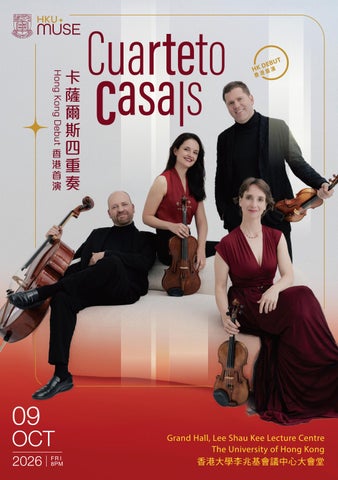
09
OCT
RI 2026 F8PM
Grand Hall, Lee Shau Kee Lecture Centre The University of Hong Kong 香港大學李兆基會議中心大會堂
Welcome to the Grand Hall
Thank you for coming to this HKU MUSE event. To ensure that everyone enjoys the music, please switch off your mobile phones and any other sound and light emitting devices before the performance. Unauthorised photography and audio/video recordings in the Hall are prohibited. Enjoy the concert and come again.
Presented by
Supported by
Today's bouquets are a gift of appreciation to the Quartet, gracefully offered by a devoted friend of MUSE.
Follow us
D
9 OCT 2026 | FRI | 8PM Grand Hall, The University of Hong Kong
Cuarteto Casals
Vera Martínez Mehner, violin | Abel Tomàs Realp, violin Cristina Cordero, viola | Arnau Tomàs Realp, cello HAYDN
String Quartet in F minor, Op. 20, 'Sun', No. 5, Hob. III: 35
Allegro moderato Menuetto – Trio Adagio Finale. Fuga a due soggetti
ELISENDA Fiery earth for string quartet (Asia Premiere) FÁBREGAS Co-commissioned by Cuarteto Casals and
the Fundació Orfeó Català-Palau de la Música Catalana.
SCHUBERT
- INTERMISSION -
String Quartet No. 14 in D minor, D. 810, 'Death and the Maiden'
Allegro Andante con moto Scherzo. Allegro molto – Trio Presto
1
2
© Pablo Rodrigo
Celebrating its 30 th anniversary during the 2026/27 season, Cuarteto Casals has established itself as one of the world's leading string quartets and a defining presence in today's international chamber music scene.
Founded in 1997 at Escuela Reina Sofía in Madrid, the ensemble appears each season at many of the world's most prestigious concert halls and festivals, including Carnegie Hall in New York, the Philharmonie and Boulez Saal in Berlin, the Konzerthaus and Musikverein in Vienna, the Salzburg Festival, Wigmore Hall in London, the Concertgebouw in Amsterdam, and the Philharmonie de Paris and Suntory Hall in Tokyo.
Its commitment to uncovering the essence of every score is reflected in more than 20 recordings for harmonia mundi, featuring works by Bach, Haydn, Mozart, Schubert, and Brahms, as well as the complete string quartets of Beethoven and Shostakovich. This artistic approach also extends to historically informed performances using Baroque and Classical bows from the London-based Borletti-Buitoni Trust. Alongside this, the Quartet maintains a strong commitment to contemporary music through the premieres of new works and long-standing collaborations with today's composers. In its anniversary season, Cuarteto Casals once again serves as Artistic Director of the Barcelona String Quartet Biennial, presented by L'Auditori. The ensemble also gives the premiere of a new string quartet by Raquel García-Tomás, jointly commissioned by Centro Nacional de Difusión Musical (CNDM), the Kölner Philharmonie, and the Musikverein Wien.
Highlights of the 2026/27 season feature tours across Asia and North America as well as extensive performances across Europe, with concerts at renowned venues such as a tribute concert for the 150th anniversary of Pau Casals' birth at Palau de la Música in Barcelona, Bozar in Brussels, Het Muziekgebouw in Amsterdam, Pierre Boulez Saal in Berlin, Auditorio Nacional de Madrid, Kölner Philharmonie, and Amici della Musica di Firenze.
Alongside its performing career, Cuarteto Casals is deeply committed to teaching and holds residencies at the Scuola di Musica di Fiesole, the Escola Superior de Música de Catalunya, and the Royal Conservatoire The Hague. The ensemble has received Spain's National Music Prize, the Medal of Honour of the Escuela Reina Sofía, Catalonia's National Culture Prize, and the Barcelona City Prize.
3
30 Seasons of Cuarteto Casals
4
JOSEPH HAYDN (1732–1809)
String Quartet in F minor, Op. 20, 'Sun', No. 5, Hob. III: 35 Hailed as 'the father of the String Quartet' and one of the greatest classical composers among Mozart and Beethoven, Haydn had a chequered history of reception. He enjoyed a successful career as a composer in Vienna and London. Composers such as Mozart and Beethoven were influenced by his works, including the Op. 20 set of string quartets, which acquires its nickname 'Sun Quartets' from an image of the sun on the title page of the score published in 1779 by Hummel in Amsterdam. Beethoven studied the set as a student when he was in Vienna. Schoenberg also performed phrase analyses of the fourth quartet of the set. However, 19th century composers and critics, such as E. T. A. Hoffmann, Schumann, and Wagner, tended to characterise Haydn's compositions as playful and childlike, yet lacking in seriousness and emotional depth. In his comment on Haydn's music, Tchaikovsky wrote: "... he never got beyond the 'miniature' and the 'pretty', and never once touches those secret heart-strings from which later composers have drawn such soul-stirring, deeply pathetic tunes". Haydn's musical pathos was much more appreciated later in the 20th century. Holst saw in his music "deep emotion as sincere as it is controlled". Haydn's deep and controlled emotion as perceived by Holst is exemplified in the F minor String Quartet. As observed by the musicologist Roger Parker, Haydn "set out to test the limits of what the minor mode could express in this newly serious instrumental combination". The Quartet opens with a mournful theme accompanied with a repeated three-note figure that imbues a sense of agitation. Unlike the monothematic first movements of many other Haydn's instrumental works, this first movement contains a second theme with a distinctive character, preceded by the first theme played in A-flat major. The modulation to the relative major is not straightforward, but rather facilitated through a harmonic excursion, which intensifies the poignancy of the exposition before presenting the short moment of bliss. The development of the two themes is more harmonic than melodic. In keys as distant as C major and G major, the thematic materials take on new characters. A more fullfledged elaboration of the themes in melody, texture, and harmony occurs in the coda, which brings the opening sense of sorrow and agitation to the climax. The emotional intensity is extended to the Menuetto. The dance juxtaposes a tragic forte passage with a melancholic piano passage, contrasting with the light and blissful trio. The F major Adagio presents a languid and peaceful theme in different variations, animated with sporadic running notes played by the first violin floating above. The Finale is a double fugue reminiscent of Bach's contrapuntal crafts. After treating the two subjects with different techniques, such as inversion and stretto, a fortissimo canon brings the movement to the climax, leading, after a contrastive piano passage, to a dramatic conclusion.
5
ELISENDA FÁBREGAS (1955–) Fiery earth for string quartet
Fiery earth for string quartet is a commission from "LA FUNDACIÓ ORFEÓ CATALÀPALAU DE LA MÚSICA CATALANA I EL QUARTET CASALS" and is dedicated to Cuarteto Casals. The premiere took place on 19 March 2025, at the concert hall of the Palau de la Música Catalana in Barcelona.
Fiery earth is an homage to the creative power of the earth, an entity envisioned as a live organism, with its repetitive cycles of transformation and regeneration. The formal structure is a one-movement based on a three-bar ostinato reminiscent of liturgical chant used in variation form developed throughout the piece, and continuously progressing in tempo and dynamics towards a dramatic finale. This thematic development is a 'metaphor' for the earth's transformations although this work is not programmatic. The musical language has some harmonic references to the music of Spain although integrated within an international musical idiom. (Notes from the composer)
6
MEET THE COMPOSER:
@ Tomoko Hidaki
(In English
ELISENDA 英語主講 FÁBREGAS )
Acclaimed Spanish-American composer Elisenda Fábregas joins HKU composition students for a round-table conversation and Q&A, following the Asian premiere of her Fiery earth by Cuarteto Casals. She will share insights into her creative process and exchange ideas with students about their own work.
FREE Admission
First Come, First Served
HKU Composers: Jeremy Feng Angus Lee Charles Lee Jing Wang
Presented by
10 OCT 2026|SAT|12 NOON
11/F Seminar Room, Run Run Shaw Tower Centennial Campus, HKU 7
muse.hku.hk
FRANZ SCHUBERT (1797–1828)
String Quartet No. 14 in D minor, D. 810, 'Death and the Maiden' In 1824, with a quartet bearing the same name and key as one of his previous songs, Schubert revisited the theme of death while confronting his own demise. In early 1823, the composer started to suffer from serious illness—widely believed to be syphilis—and was housebound for some time. A glimpse of Schubert's torment can be found in his letter on 31 March 1824 to his friend, the Austrian painter Leopold Kupelwieser (1796–1862): "feel myself to be the most unhappy and wretched creature in the world. Imagine a man whose health will never be right again, a man whose most brilliant hopes have perished, to whom love and friendship have nothing to offer but pain, whose enthusiasm for all things beautiful is gone, and I ask you, is he not a miserable, unhappy being? Each night, on retiring to bed, I hope I may not wake again [emphasis added], and each morning but recalls yesterday's grief." It seems that Schubert was longing for a comfortable death that would release him from the perpetual pain and distress inflicted by his irrecoverable disease.
Death as a state of liberating stillness is a familiar subject in Schubert's Lieder. In 'Death and the Maiden' (D. 531) and the 'Erlking' (D. 328), both composed before Schubert contracted syphilis, death is personified and imagined to possess its own subjectivity. Rather than having a menacing appearance, it presents itself as bringing forth repose, luring and calming the fearful victims with a soothing voice singing in major keys. This paradoxical depiction of death as both dreadful and peaceful can be found throughout the D minor Quartet. In the first movement, the Sturm und Drang passages that portray the psychological turmoil in facing death are interspersed with brief lyrical moments. The second movement is a theme and variation of the song 'Death and the Maiden', but the voice of the frightened maiden is omitted, retaining only the sombre and calm funeral march that opens the song and accompanies the voice of death. The theme, beginning in G minor and ending in G major, goes through a wide range of emotions in its variations. The Scherzo is a danse macabre with a beautiful minuet as the trio. The finale is a Tarantella, an Italian dance said to cure hysteria caused by fatal spider bites. But as the fearful protagonist is escaping in galloping quavers, the enticing melody of death in the 'Erlking' arises. The chase gets even more frantic in the Prestissimo, which ends with two forceful chords, seemingly asserting the triumph of death. Programme notes by
Sheryl Chow
MPhil in Musicology, The University of Hong Kong PhD in Musicology, Princeton University 8
9
10
MUSE Source of Inspiration 繆思樂季
啟迪妙思
11
12
13