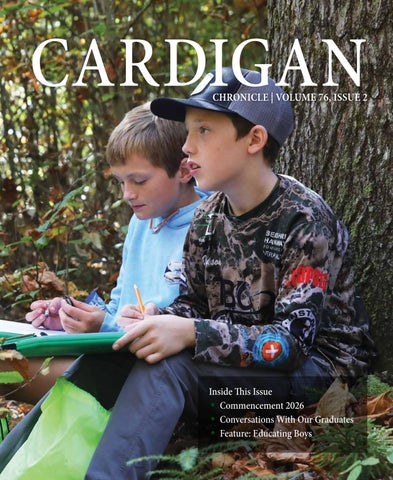
CARDIGAN
CHRONICLE | VOLUME 76, ISSUE 2
Inside This Issue • Commencement 2026 • Conversations With Our Graduates • Feature: Educating Boys
Cardigan Chronicle Spring/Summer 2026 DEPARTMENTS 2
Letter from the Head of School
24
On The Point
36
From Marrion Field
40
History’s Mysteries
42
Founders Path
44
Alumni Drive
50
Cardigan Connections
CONTRIBUTORS EDITOR Emily Magnus PHOTOGRAPHERS Chris Adams Martin Grant Emily Magnus
WRITERS Chris Adams David Grilk ’06 Matthew Kinney Jory Macomber P’12 Emily Magnus Pablo Rocha Vázquez Judith Solberg
MISSION STATEMENT Cardigan Mountain School offers a close-knit community that prepares middle school boys—in mind, body, and spirit—for responsible and meaningful lives in a global society. To achieve our mission, we reward effort and accomplishment, helping each boy realize his academic, physical, and personal potential through honoring our core values of Compassion, Integrity, Respect, and Courage in all aspects of daily life.
CONTACT US For more information about Cardigan Mountain School, please visit our website at www.cardigan.org. Letters and comments can be emailed to emagnus@cardigan.org, or mailed to Emily Magnus, Assistant Director of Communications, Cardigan Mountain School, 62 Alumni Drive, Canaan, NH 03741. The Cardigan Chronicle is published bi-annually by the Communications Office for alumni, parents, and friends of the school. It is printed by R.C. Brayshaw and Company on sustainably produced, chain-of-custody stock certified to Forest Stewardship Council (fsc) standards.
1
LETTER FROM THE HEAD OF SCHOOL
Built on Commitment, Not Nostalgia Boys have been coming—most willingly, some perhaps reluctantly at first—to Cardigan since 1945. The reasons are as simple, and as complicated, as any decision that involves collaborating on the growth of a child with a group of people—kids and adults—who can’t possibly love them as much as their parents do. While girded with the best of intentions, the clutches of parental love can sometimes inhibit and ground a child otherwise given to fly. That’s where commitment to a purposeful,
2
organized plan, and the right people to execute it, come into play. Almost any adult turning the pages of this issue of the Cardigan Chronicle will have experienced more freedom of movement than their kids. How many of you were told to “go out and play” and/or “come home when the streetlights flicker”? We didn’t have play dates or digital tracking when we were kids. We’d hop on our bikes. Mine was a metallic blue, Schwinn Sting-Ray with a banana seat. I’m sure I had a baseball
card (doubtless one of the lesser players from the pack), clothespinned in the front spokes to affect an imaginary motor sound when riding. Released from the guidance and assistance of adults, and alone with our thoughts, we honed our creativity and developed our inner voice, creating stories out of the clouds and the running commentary of our lives. We fixed our own broken chains and patched flat tires. We were untethered and disconnected.
It’s important, however, to recognize nostalgia for what it is. Each generation’s issues may seem more complicated than those experienced by their predecessors. But it is worth noting that it is those very “predecessors” who struggle with the complexity of the present—when pulled through their own filters. Any advice that requires “in those days…” as a clarifier might not pack the punch intended. The reality is that there were never—really— simpler times. Our memories soften the edges, bringing the present challenges into bolder relief. Growing boys have always been wired to outpace their own abilities and limits. The resulting scrapes, bruises, breaks, and judgmental missteps are part of the maturation process. Eventually, they/we discover their capabilities and manage the risks—and the pain. Having said that, the present challenges might just overtake us. Attempting to gain the attention of students in the spectacularly unfiltered, algorithmically cultivated (targeted?) habitats that hypnotize today’s kids is tantamount to trying to jump the Snake River Canyon with my blue Schwinn Sting-Ray—not even close. In addition, stories once told of exploits among a group of friends gathered in close proximity now appear as artificial digital realities that know virtually no boundaries. Add to this the negotiable terrain of what is an agreed-upon fact versus what is desirable fiction, and the abandonment of responsibility by far too many in our world, to whom we once looked for guidance. It’s not hard to claim that our boys are living in crisis. Cardigan is not a magical place that fixes all that…but we come as close as any place I know of. We immerse our community in the good—not the easy—but the good trouble that is the residue of living together with shared purpose and agreed-upon values and healthy habits. Instead of cocooning them in bubble wrap, Cardigan has a robust supply of bandages, ice packs, crutches, and slings…and, in case you’ve forgotten, we have never allowed our boys to have cell phones on The Point.
In the final days of the spring term, the sixth grade hosted a Pinewood Derby. Mr. Day was on hand to inspect the cars and watch the nail-biting races, won not by the length of a car but by the fraction of a bumper.
We also boast a team of educators unlike any I’ve worked with in my lifetime of educating kids. Our faculty know how to inspire through their teaching, coaching, and living. They do so by looking intentionally toward the future (not the past). Cardigan brings together this team of talented adults with boys growing through the most transformative time in their lives. Here on The Point, they are cementing their values; those they brought with them are wed to those we prize as a community—compassion, integrity, respect, and courage. In the pages of the Chronicle that follow, look at the pictures and read the words. The light in the boys’ eyes and the optimism and buoyancy of the text is not nostalgia—it’s commitment.
Christopher D. Day P’12,’13 Head of School
3
Commencement 2026
4
This is my final wish for you. Please continue trying to bring happiness to other people. That sounds simple, but I truly believe it matters. During my three years at Cardigan, I learned how to make people smile, and I’m grateful for the joy that comes with it. The little moments that seemed ordinary at the time somehow have become the memories I will carry forever. – Sosuke Imaizumi ’26, School Leader
5
6
In Act I, Scene iii of Shakespeare’s Hamlet, Polonius, like most caring and loving parents and guardians—let alone teachers—feels compelled to heap on Laertes (his son) loads of important advice as he heads off to college…The real essence lies in these two sublime lines: “Those friends thou hast, and their adoption tried/ Grapple them unto thy soul with hoops of steel.” Hold dear, hold close, to your heart—to your soul—the friends and people here at Cardigan—and at home—who have been there for you, especially those friendships that have been tested...Keep these people close, protect and cherish them. “Grapple them unto thy soul with hoops of steel.” – Bob Low, Former Faculty and Commencement Speaker
7
Your trajectory is set. Your individual characteristics–the things that make you the special person you are–are in place now and will be with you wherever you go and whatever you do. I mention this because some of you probably think that you have so far to go before the “real you,” the adult you, emerges. For sure, you have a lot to learn and do–but what I want you to be consciously aware of is that your greatness is inside of you right now…The sooner you realize that you already possess your superpower, the sooner you will learn to be the best version of yourself you can be. – Christopher D. Day P’12,’13, Head of School
8
Secondary School Destinations 2026 Avon Old Farms School Berkshire School Blair Academy (2) Brooks School Canterbury School Culver Academies Cushing Academy Deerfield Academy (4) Episcopal High School The Hill School (3) Holderness School (2) The Hotchkiss School (3) The Hun School of Princeton Kent School Kimball Union Academy (3) Lake Forest Academy The Lawrenceville School (2) The Loomis Chaffee School (2) Middlesex School (2) Milton Academy Northfield Mount Hermon School (4) The Peddie School Phillips Academy Andover Phillips Exeter Academy (3) Pomfret School Proctor Academy The Rivers School St. Andrew’s School St. George’s School (4) St. Mark’s School (2) St. Paul’s School (6) Salisbury School (3) Stevenson School Suffield Academy (3) Tabor Academy The Taft School (2) The Thacher School Walnut Hill School for The Arts Westminster School (2) The Winchendon School
9
CARDIGAN
Conversations During the last month of school, we took the time to sit down with Cardigan ninth graders and their families to learn about about their Cardigan experiences. Their trips down memory lane revealed the growth and impact the school has had on both the students and their parents. Equally important is the impact the students and their families have had on the school. These interviews have been edited for clarity and length. By Emily Magnus, Editor
CHANGING the Trajectory Finn ’24 and Gavin ’26 Donelan and their mother Emily Baldwin P’24,’26 are from New London, New Hampshire. Both Finn and Gavin were four-year boys at Cardigan. Finn is now at St. Mark’s School, and Gavin will join him for the 2026-2027 school year.
EMILY BALDWIN: I’ll start by saying that I had never considered private school for my kids. I was a product of public schools, but when Covid happened, I knew we needed a different option for Finn. He was just finishing fifth grade. We came to campus and met with Chip Audett [Director of Admissions and Financial Aid], and Finn loved it. He was so excited to be here and realized that it would change the trajectory of his life, and it did. EMILY MAGNUS: What was it that excited you about Cardigan? FINN: I don’t know. During my tour and interview, Chip talked to me about Cardigan and presented me with an opportunity to constantly improve and be a better version of myself. I think this is really the only place where I saw that. EMILY BALDWIN: Finn, do you remember your first day as a student? FINN: I was excited, but more than anything I was nervous. I had been at my previous school for three years, and I knew my friends and I knew my teachers well. But
I remember walking into Ms. Kreuzburg’s classroom and being greeted with a smile, and I immediately felt more at home.
feeling, and it made me want to be them someday and help the next sixth grader who was finishing last in conditioning.
EMILY BALDWIN: One thing that really excited me before school started for Finn his first year was the all-campus read. It was an anti-racism book, and I was just so thrilled that that was happening because public schools were restricting and changing the books in their libraries. Finn, do you remember the moment when you first felt you belonged in the Cardigan community?
EMILY BALDWIN: I love that story. Gavin, how has Cardigan changed you?
FINN: I first really felt like I belonged during a football practice in my sixth-grade year. I remember there was just one team because of Covid, and everyone was together—sixth graders through ninth graders. There was one day when we were doing conditioning. Everyone else had already finished, but I had a few more ladders and push-ups. I remember some of the ninth graders came over after they had finished and just started doing my conditioning with me to support me and be there with me. That really made me feel like I belonged in the community, having ninth graders that had my back. It was a good
GAVIN: I think it’s made me more responsible and independent. The academics, they’re very hard. They make me want to better myself and try as hard as I can. EMILY BALDWIN: I see that you’ve become so much more independent this year since you’ve lived here on campus. When you come home, I can tell that the skills that you’ve gained here also apply back home. FINN: Yeah, adding on to that, I think Gavin, what I’ve seen is also having others rely on you, being a leader this year and having the sixth graders look up to you and need you. I think that has definitely showcased your independence; you can be a pillar of support and an inspiration to the younger kids. EMILY BALDWIN: Finn, can you tell me a story about when a person’s kindness made a difference in your life at Cardigan? 11
During the traditional boutonnière pinning, Gavin, Finn, and Emily caught up with friends Max and Henry Timbrell ’25, who attended this year’s Commencement Ceremony to help hand out ties during the Alumni Tie Ceremony.
FINN: Good question. It was probably during my seventh-grade PEAKS class. In sixth grade, everyone was together and it was a very small class. But in seventh grade, we branched off into a few different sections, and I remember trying to slowly find my footing with the new students. During those first few weeks when I was just trying to make new friends, Mr. Caprow [Assistant Dean of Academics and PEAKS Department Chair] made my PEAKS classroom a supportive environment where I didn’t have to perform. I could be myself, and that definitely helped me form some friendships that I still value today. EMILY BALDWIN: Mr. Caprow is definitely the GOAT to these boys. Finn, what were the most important lessons you learned at Cardigan? FINN: Before Cardigan, I was a very self-oriented person, and I focused on what would benefit me. I think coming to Cardigan taught me to be more communityoriented. If you don’t buy in at Cardigan, you’re not going to get as much out of the experience, because you really have to value others and help others grow. 12
EMILY BALDWIN: Gavin, what about you? GAVIN: I’ve learned to make the right decisions. You always need to be kind, make the right decisions, and sometimes you have to do that by yourself. EMILY MAGNUS: How about you, Emily? Have there been any lessons that you’ve learned from Cardigan? EMILY BALDWIN: I would say that I learned that the faculty know what they’re doing; as a mom, you think that you know better. I think it says on Cardigan’s website something like, “We know middle school boys,” and it’s so true. They know what they’re doing. Sometimes, especially when they were in sixth grade, the mama bear instinct would kick in, but I learned to trust the process, that the faculty know better. One memory that I have of Gavin’s first year was being worried that he would be overshadowed by his older brother. But the funny thing was, one day Finn and I were walking on campus, and someone asked, “Oh, are you Gavin’s brother?” It was just so funny; Gavin had already established
Before Cardigan, I was a very self-oriented person, and I focused on what would benefit me. I think coming to Cardigan taught me to be more communityoriented. If you don’t buy in at Cardigan, you’re not going to get as much out of the experience, because you really have to value others and help others grow. — Finn Donelan ’24
himself as his own person, and Finn was just the brother. FINN: Yeah, it was a shot to the ego. EMILY BALDWIN: Yeah, but I was like, oh good, he’s found his own way. And Finn was just some old alumni guy. EMILY MAGNUS: Tomorrow is Commencement, and Finn, you will have the opportunity to give your brother an alumni tie. What does that tradition mean to you? FINN: I think it means being a part of something bigger, a large network of alumni. And I think tying the tie represents the culmination of your Cardigan career and moving on into a broader world. I think for me mostly it represents tradition and it represents the values that Cardigan stands for—being the best you can be, having integrity, being courageous, and being a part of a broader community.
MAKING Room for Others
Everett Lo ’26 and his parents Kevin and Brenda are from Menlo Park, California and were drawn to Cardigan through its ski program. Everett’s brother Eliott ’28 also attends Cardigan and is a member of the ski team.
EMILY MAGNUS: Do you remember your first day on campus?
was not very well made. We didn’t really have enough cardboard, so it sank.
EVERETT: I remember it rained that night before dinner. There was thunder, like really heavy thunder and lightning, so they had to shuttle us over to the dining hall from McCusker. I remember it was kind of scary, but at the same it was kind of comforting because I was in a group with everyone together, and you could just feel it; there was a strong bond forming between everyone.
KEVIN: Brenda, what surprised you about Cardigan?
KEVIN: Did you build boats? [Cardigan holds a Cardboard Boat Regatta each year during the first week of school. Each dorm is responsible for building a boat and selecting one student to captain it. Points are scored by the dorm that finishes with the fastest time…and without sinking!] EVERETT: No, boat day was the second day. We were just working on our boat in our free time. We did do pretty well. I think we got fourth overall. I was the one who paddled the boat. No one else wanted to get soaked. Then I did it again this year because no one else wanted to go again. Except our boat was—we’re a very small dorm, so our boat
BRENDA: I think there were two things. First, we were very surprised by how supportive all the adults on campus were— seeing them in action, academically and also in athletics and dorm living. It was a pleasant surprise even though we kind of expected it. And then secondly, we collectively as a family chose Cardigan because of its combination of athletics and strong academics. We thought it was going to be a great combination. And even then, we were surprised by how robust the academic offerings were. We’ve seen the classes Cardigan offers and how the teachers teach. The academics have definitely been the most impressive. EMILY: Everett, how would you describe yourself as a student, and has that changed? EVERETT: When I started out, I think I had a lot of knowledge, but I never really had the best study habits. I also was always
trying to dominate conversations. I wasn’t really giving other people room to express their ideas. BRENDA: Say more about the learning. EVERETT: I’m not really getting as distracted. Before, I didn’t really study that much, but now I’m really good at focusing, turning on my brain when I really need it, managing my energy throughout. KEVIN: Say more about your interactions in the classroom. EVERETT: I was the kid at the front of the classroom who answered everything. But now I make room for other people. I’m able to understand other people’s ideas and opinions, and now we’re able to all talk together. BRENDA: I think we are also very impressed with how Everett is able to manage his life here, because he has a lot of interests. It’s a skill that I think we all can benefit from—working with different people, different schedules, different expectations, and time management. You 13
at Cardigan, there’s a connection you build when you’re living with your teammates and coaches. The team aspect is a lot bigger here. BRENDA: The coaching is really strong and very focused on individuals. There’s development in a lot of the bigger programs, but the coaches don’t know the kids as well. The coaches at Cardigan are also dorm parents and some of them are teachers, so it’s a different dynamic. The coaches are also a very big part of the community.
have to focus on one thing, and then you have to turn your focus on something else. I think that surprised me a bit, to what extent Everett can manage his own life. EMILY: How have you chosen to be involved in the Cardigan community, and how has that impacted you? EVERETT: I joined NJHS [National Junior Honor Society] two years ago. I’ve continued doing a lot of service, helping organize a lot of events, trying to make sure everyone’s having a good time. I’ve also been trying to mentor and take care of a lot of the newer, younger students. I didn’t get a titled leadership position, so I’ve been trying to continue working from there. I also do a lot of the plays and have been in a bunch of the concerts. I co-founded the Debate Club with my friends a couple years ago, and we’ve been running that for a while. We’re hoping to pass that off to some other guys for next year. EMILY: Which of those activities do you feel has been the most impactful for you? EVERETT: I think the plays really opened my eyes. I did it for the first time in seventh grade, and I was super nervous. I thought I was going to embarrass myself. But I didn’t,
and people were super supportive in the audience. It’s been a lot of fun. EMILY: Would you be willing to talk a little bit more about not getting a leadership position and how you worked through that? EVERETT: It was pretty tough for a few days. I was really down about it because I had always wanted a leadership title, but I was able to regroup over the summer. When I came back in the fall, I was thinking, “I’m still a ninth grader, I’m still experienced,” so I tried to meet a bunch of new kids, push them in the right direction to do things—get out of their rooms, off their computers. It was just a matter of figuring out how to take negative feedback. Are you going to be down about it? Or are you going to take it and try to be better? EMILY: Can you talk a little bit about your experience here with skiing? It sounds like that was part of your decision as a family to come to Cardigan. How has that worked out? EVERETT: It’s worked out pretty well, I’d say. I’ve continued to improve. I finished in the top 20 in GS at U16 Easterns this year, which is a big deal. Back home, I would mainly spend weekends skiing—trying to get there on Fridays to train and race. But
KEVIN: Your mom and I, we know you’ve had a lot of setbacks along the way as well—injuries, races that didn’t go well. You’ve handled the disappointments really well. What advice would you give to people who are also struggling through failures and disappointments? What advice would you give to students here? EVERETT: The key is you need to have faculty members you can trust, that you’re able to go to one-on-one to just talk about the things you’re upset about. And they’ll give you advice about things. I think that’s one of the most important things you can do here at Cardigan is build relationships with the faculty. You can have a deep support network. BRENDA: We’re glad that we found Cardigan. It’s a leap of faith to send your kids across the country in seventh grade. In our case, our vision panned out even better than we expected. There’s something special, some secret sauce, here in this community that’s been going on for many years. KEVIN: How prepared do you feel? Are you ready for St. Paul’s? EVERETT: I think I’m ready. I feel a lot more prepared than if I was coming into high school without having gone to Cardigan.
Join us for more Cardigan Conversations with: • Quinn Suarez and Family • Finn and Gavin Donelan and Their Mom • Luke Elsinger and Family • Everett Lo and Family Scan here to read the complete transcripts from our spring interviews with ninth-grade families. 15
It’s Never Been More Important to Educate Boys
16
By Chris Adams, Director of Communications and Marketing
“Cardigan is where the atmosphere is conducive to the full utilization of a boy’s capacities in and out of the classroom—a unique place for a boy to get solid roots and security; to develop mental, moral, physical, social, and practical fundamentals.” — Hap Hinman, Founder
17
As boys face pressures of school, technology, sports, and adolescence itself, Cardigan’s mission feels more urgent than ever. A generation ago, being an adolescent boy seemed fairly uncomplicated. On Saturday mornings, after a quick bowl of cereal, I’d jump on my bike—fishing rod in hand, but no helmet, of course—wave to my mom, and tell her I would be home in time for dinner. When I was old enough to work, I rode that bike to my first job, washing dishes at a restaurant, hoping to save a few bucks for a new bike, or maybe even a car someday. Reflecting on it now, that bike represented space. It was the space between being a little kid and becoming a young man where curiosity and growth could ride side by side, where small victories could build confidence and mistakes were not catastrophic. It is in those moments that boys learn judgment, risk assessment, independence, how boredom can fuel creativity, and how to recover from minor failures without help from an adult. Today, that space is largely gone for too many boys. Most parents would not consider letting their twelve-year-old disappear on his bike for the day. And even if they were, chances are there is little time for such adventure, as the weekends of many kids today are highly scheduled. The rise of club sports—with year-round seasons, overloaded tournament schedules, and the expectation to perform—is just one pressure on the free time of many boys. What free time boys do have looks a lot different, increasingly viewed through the screens of their phones, laptops, and video games—passing their time playing with online “friends” instead of the real ones next door. Social media, video games, and nearly two years of pandemic isolation 18
have slowed the development of their social skills, yet they are still expected to know how to act—with each other, with adults, and with girls. It’s also around this age that many boys begin to process their first thoughts about what it means to be a man. Modern culture has made that somewhat of a moving target. Of course, it is a noble goal to teach boys empathy and a healthier version of modern masculinity. At the same time, the social media algorithm serves them a steady stream of male athlete, celebrity, and political “influencers” who too often act inappropriately, or worse, and rarely with any real consequence. The mixed messages can cause dissonance and confusion. For these reasons, school does not come easily for many of them, their social development is lagging, and they’re becoming disillusioned. For some, this does not end with school—too many young men are grappling with the transition to adulthood and a career. And it’s not just in the United States; experts are seeing evidence of this all over the world. Being a boy has become complicated.
Early Struggles and Lasting Effects Some experts note that kindergarten has become more academic—and with less free play time—than a generation ago. This is a challenge for five-year-old boys who have a greater need to move about and fidget, and less ability to sit still and focus than girls. Still, educators once believed that boys catch up over time. Unfortunately, there is evidence that this may no longer be true, and there is growing concern that boys are increasingly losing motivation in school because they don’t see themselves as “smart.” Early struggles in reading can become identityforming. A boy who decides early that school is “not his thing” may stop trying long before his ability is truly known.
Recent standardized reading tests may be the warning light that we all need to see. The current disparity is stark: girls now outscore boys at every grade level, nationwide.1 And while it’s true that girls have historically been strong readers and writers, they have now also closed the gap in science and math, subjects where boys were once stronger. The disparity in the early grades is now a trend that carries through to educational outcomes in both high school and college. Girls earn higher grade point averages, and 89 percent of them graduate on time, compared to 83% for boys. After high school, 66% of girls enroll in college compared to 57% for boys, and the girls are more likely to stay there. Of all recent bachelor’s degrees awarded by U.S. colleges, approximately 60% are earned by women, compared to 40% earned by men.2 Within the total U.S. population, 40% of women over age 25 have a bachelor’s degree vs. 37% of men.3 The data suggest that the challenges facing boys in school are not isolated or temporary. They begin early, appear across subjects, and increasingly inform the trajectory of boys through, and after, high school.
The Pull of Video Games Boys have enjoyed video games since Atari debuted Pong in 1972, but those early games were mainly a novelty—something to do when the other kids in the neighborhood were not around to play kick the can or capture the flag. Today, games are immersive, lifelike, online, and addictive. They are designed to provide the very things boys often crave: a clear metric for success, instant gratification, and a social construct that is easier to navigate than the middle school cafeteria. Boys are wired to seek challenges that help them prove certain competencies, and modern games offer exactly that. They tell a player what needs to be done and reward him instantly upon completion—something that is decidedly more difficult to replicate in school, in relationships, or in the slower work of growing up.
Science teacher and Ninth Grade Dean Kyla Joslin sees this in many new students when they arrive at Cardigan. “Teenagers have a need for instant gratification, and video games give the boys splitsecond feedback that fills their dopamine buckets,” she says. “Paired with the sense of competition, it becomes a drug they can’t put down.” The result is predictable: more boys and young men are playing video games than ever before, and they are playing for longer stretches of time; males aged 15 to 24 are playing twice as much as they were just 15 years ago.4 That time spent gaming inevitably displaces other activities vital for growth and success, including physical activity, face-to-face social development, homework, and sleep.
Recent standardized reading tests reveal a stark reality: girls now outscore boys at every grade level nationwide.
The Pressure of Youth Sports Sports yield clear benefits for boys. They foster fitness, discipline, resilience, and the understanding of working toward a goal. A great coach can change the trajectory of a boy’s life, and the team experience can help him build confidence, friendships, and habits that last a lifetime. But somewhere along the way, sports became more complicated, too. Families are increasingly committing significant time and resources to their children’s athletic pursuits, often hoping they will lead to greater opportunities—a stronger team, a better school, or even a college scholarship. For many families, there is a fear of falling behind if their son does not keep pace with the year-round demands of the sport. Sometimes these investments do open doors, but the costs are real. Many sports no longer adhere to a traditional season; most play year-round. The short ride to the Saturday afternoon game has been replaced by the hours-long drive to the three-day tournament 19
More boys and young men are playing video games than ever before, and they are playing for longer stretches of time–males aged 15 to 24 are playing twice as much as they were just 15 years ago.
in another state. Practice time has been sacrificed for tournaments and travel, often at the expense of skill development. Year-round play leaves less room for rest, free play, and boredom—the things boys need to grow. Crowded tournament schedules make weekends another performance environment and not the break from school they once were. Long travel disrupts schoolwork, sleep, neighborhood friendships, and family time–which are often replaced by staring at their phones in the back seat of the car. There is also a psychological cost. When a boy’s sport becomes his identity, every game can feel like a measurement of his value. For some boys, this pressure fuels growth. For others, it can lead to anxiety, burnout, fear of failure, and what psychologists sometimes call “identity foreclosure”—the narrowing of a young person’s sense of self before he has had enough time and experience to discover who else he might become. This is important when you consider that 93% of youth players will not play in college. Of the seven percent who do, only about three percent will play NCAA Division I.5 A boy who sees himself only as an athlete may ultimately face a painful question: If I am not an athlete, then who am I? For some young men, that identity crisis can be as difficult as any academic or social challenge they face. “Sports are incredibly important for middle school boys,” says Cardigan Director of Athletics Hal Gartner. “We support boys in pursuing their primary sports, but at this age, balance and fun are critical. Boys become better athletes by playing multiple sports— learning from different coaches, using different muscle
20
groups, playing with different teammates, and developing a broader sense of themselves beyond one sport.” The issue is not sports. Boys need to play: they benefit from teammates, coaches, competition, and the lessons learned by winning and losing. The challenge is achieving the appropriate blend of sports with other activities and free time. When they are out of balance–when they are no longer for the fun of the game, but part of a professionallike system of pressure and performance— they can be harmful for some boys.
Reality Check It’s important to take a step back and be clear that men still occupy more senior positions in the workplace and, on average, continue to earn more than women. And while the pay gap is narrowing, there is still a ways to go before women realize equal pay in the U.S. However, it is also true that young men today are increasingly facing a tougher launch into the working world. As of this summer, men ages 23–30 with a bachelor’s degree face a 6% unemployment rate, compared with 3.5% for women.6 Offshoring and automation in many industries— including manufacturing, technology, and others—have helped fuel a decline in male workforce participation. At the same time, professional opportunities in service industries and healthcare are expanding, but men are either losing the positions to women or choosing not to pursue these fields, perhaps because many of these jobs have historically been viewed—fairly or not—as work more naturally suited to women. It’s not surprising, then, that an increasing number of young men lack the financial stability to leave home: 19% of men 25 to 34 live with their parents.7 These realities complicate the familiar assumption that boys will simply find their way. Many still do, but they are struggling to gain initial traction.
What Can We Do? Comparisons between boys and girls and the analysis of a gender gap in educational benchmarks can be fraught, as some would
“Today’s middle school boys face a complex world, where algorithms are designed to tugboat their minds in directions that are manipulative, and mistakes—in judgment, speech, and actions—can have serious consequences. It’s crucial to provide boys with a more controlled and deliberate environment where they can make mistakes and learn from them; where adults can teach them with patience and an eye towards their growth. If the cost to the community isn’t outweighed by the benefit to the boy, then the consequences for missteps will lead—eventually—to more thoughtful, secure, and reflective young men.” — Chris Day P’12,’13, Head of School
like to believe that the success of girls has come at the expense of boys. Experts do not believe this is true, though they do offer insights into some of the causes and suggestions to correct the current trajectory. In 1987, 30% of U.S. teachers in grades K-8 were male. Today, that number is only 23%, and the decline is steeper in the younger grades.8 There are simply fewer men in the classroom, meaning fewer male role models to help make reading cool to a new generation of boys. Reading is the area where boys have always been weakest, and they’re getting weaker. The problem is that this affects behaviors that support learning across all subjects, including attentiveness and the ability to work independently. “Over my 21 years at Cardigan, I’ve seen students rely much more heavily on technology,” says PEAKS Department Chair Jarrod Caprow. “As a result, it takes more time and energy for students to develop the desire to learn skills such as spelling and punctuation, because autocorrect features that are standard in most applications have done much of that work for them.” If we can help boys learn to read and write better, earlier, and without relying on technology to auto-fill suggestions or correct their spelling and grammar, we can put them on the pathway to improve in other subjects, too. In the 1970s and ’80s, educators began to push STEM (science, technology, engineering, and math) programming for girls, an idea that gained momentum and formally became a federal priority when the Educate to Innovate Campaign was launched in 2009, and the Inspire Women Act was passed in 2017. Experts suggest that a similar, national focus on boys and reading, particularly in the younger grades, would yield a comparable benefit.
Regarding kindergarten and boys’ lack of readiness, Richard Reeves, author of Of Boys and Men: Why the Modern Male Is Struggling, Why It Matters, and What to Do About It, suggests that boys should start kindergarten a year later than girls. Other experts suggest that the extra pre-K year may not yield a significant benefit, and believe it’s middle school when some boys can begin to drift. Middle school is when everything in a boy’s life–homework, socializing, athletics–gets more intense, and his brain is not yet fully developed enough to prioritize his time and be successful in school. These boys can benefit from the increasingly popular decision to reclass during these years, such as repeating the eighth grade to prepare them for the rigors of high school. The gift of an extra year gives a boy time to grow into his abilities, to build maturity and confidence alongside academic motivation. Ultimately, most experts agree that the most sensible solution may be the most difficult to implement: allow and encourage more free play time that doesn’t involve screens. Free play forces boys to make their own choices, negotiate rules, and manage frustration. This builds self-discipline and impulse control, which often results in better behavior and focus in school.
The Work of Educating Boys At Cardigan, the work of educating boys has always required both structure and space. Boys thrive when mentored by adults who understand their energy, humor, uncertainty, impulsiveness, and potential. More than half of Cardigan’s faculty are men, which means boys engage with male mentors
21
“Teaching boys isn’t just about science, math, or English. Our job as women in the community is to help our boys understand that respect for everyone matters. I have found that the most important conversations are the ones that aren’t easy. They require seeing the human behind the emotion and the emotion behind the words.” – Kyla Joslin, Ninth-Grade Dean and Science Teacher every day in the classroom, in the dorms, and around the dinner table. That matters. But Cardigan boys also learn every day from the strong female role models on campus who challenge them and help them understand how thoughtful, respectful, and capable young men move through the world. Ms. Joslin notes the importance of mentors outside the classroom. “Teaching boys isn’t just about science, math, or English. Our job as women in the community is to help our boys understand that respect for everyone matters,” she says. “I have found that the most important conversations are the ones that aren’t easy. They require seeing the human behind the emotion and the emotion behind the words.” Cardigan’s phone-free campus provides relief from relentless social media noise and the pressure to always be available, always comparing, and always performing. Structured independence gives them the chance to make choices, manage responsibilities, experience consequences, and try again—with adults nearby, but not always in the way. Boys learn how to organize themselves, advocate for themselves, disagree respectfully, recover from mistakes, and become more aware of the effect they have on others. Head of School Chris Day P’12,’13 notes how this work has evolved since Cardigan’s founding. “Today’s middle school boys face a complex world, where algorithms are designed to pull their attention in directions that can be manipulative, and mistakes—in judgment, speech, and action—can have serious consequences,” he says. “It’s crucial to provide boys with a more controlled and deliberate environment where they can make mistakes and learn from them; where adults can teach them with patience and an eye toward their growth. When the cost to the community is not greater than the potential benefit to the boy, the consequences for missteps can lead, eventually, to more thoughtful, secure, and reflective young men.” 22
This is the work–not to excuse boys, and not to lower the bar for them, but to know them well enough to help them clear it by giving them the structure they need, the patience they deserve, and the challenge they quietly crave.
Final Thoughts Another reality check: many girls are struggling too, of course. Social media and other factors are helping to fuel a wave of anxiety and mental health challenges for everyone, though the available data suggest that more girls are emerging from their struggles by the end of high school and college in a way that boys are not. Indeed, standardized test scores for both boys and girls began to fall around 2015, which, perhaps not surprisingly, was around the time most of them got their first smartphone and opened their first social media account. It has never been more important to educate boys—not because their needs matter more, and certainly not because the success of girls has somehow come at their expense, but because we now understand more clearly that boys and girls often need different kinds of support at different moments in their development. The answer is not to lower expectations for boys, nor to retreat from the hard-earned progress of girls. The first step is to understand that boys need free time away from screens and sometimes away from the eyes of hovering parents. At Cardigan, that work has always begun with boys: with their uncertainty, impulsiveness, and awkwardness. The goal is not to excuse missteps, but to help boys grow into thoughtful, capable, resilient young men. And when we do that well— when we give boys the structure, patience, challenge, and space they need to mature— we help lift everyone.
WORKS CITED 1. Cain Miller, Claire. “Why Boys Are Behind at Every Age,” NYtimes.com, 2026-01-30. 2. Hanson, Melanie. “College Graduation Statistics,” EducationData.org, 2025-10-22. 3. Hurst, Kiley. “U.S. women are outpacing men in college completion, including in every major racial and ethnic group,” Pewresearch.org, 2024-11-18. 4. Cain Miller, Claire and Amy Tan. “How Video Games Are Shaping a Generation of Boys, For Better and Worse,” NYtimes.com, 2025-10-03. 5. “Probability of Competing Beyond High School,” NCAA.org, 2026-08-07. 6. Pettypiece, Shannon. “Young Men Are Struggling in a Slowing Job Market, Even If They Have College Degrees,” NBCnews.com, 2025-08-13. 7. Hemez, Paul and Channell Washington. “How Many Young and Older Adults Lived Alone?” Census.gov, 2024-05-30. 8. Smith, Ben and Richard V. Reeves. “7 Key Facts About Male Teachers,” Aibm.com, 2024-10-31. ADDITIONAL RESOURCES • The Anxious Generation, by Jonathan Haidt • “How to Solve the Education Crisis for Boys and Men,” a TED Talk by Richard Reeves • The Kids We Lose, a documentary by Lisa Quijano Wolfinger • Lost at School, by Ross W. Greene, Ph.D. • Of Boys and Men: Why the Modern Male Is Struggling, Why It Matters, and What to Do About It, by Richard Reeves 23
ON THE POINT
Why I Teach: A Silly Backup Plan? “Why I Teach” is a recurring column in which we invite Cardigan’s teachers to share their thoughts in their own words. It explores why these individuals got into teaching in the first place and what it is that gets them out of bed each morning. It is also ultimately a testament to their hard work and dedication—to all the planning and preparation, as well as the heart—that they invest in each day on The Point. BY MATTHEW KINNEY, DEAN OF STUDENTS I was always in the middle. In fifth grade, I was fortunate to go to an independent school in Seattle, Washington. It was a great school, with great teachers—strong academics and rigorous athletics—but I struggled because I was always in the middle of the pack. I worked hard, but some of my peers seemed to be succeeding with great ease—academically, athletically, and socially. Most middle school boys would have been comfortable in this dynamic, but I struggled with the feeling of working hard only to find myself seemingly below my peers. As time wore on at this school, it felt like I was labeled and destined to keep living in the average. Then in eighth grade, I was given a totally clean slate. It was a family tradition to attend boarding school on the East Coast, and I was excited at the prospect of something different: something that would motivate me and help me reach for loftier goals. What I found at boarding school was a faculty unmatched in their enthusiasm for my experience, while also being dynamic, firm, and fair. In my first year, I vividly remember my advisor telling me that I would need to attend proctored study hall. While he knew I was disappointed, it was 24
ON THE POINT
the start of a transformation. The faculty gave me structure that helped me, the average student from Seattle, work my way up from Cs to Bs to As. I also recall missing my name in my junior year during leadership chapel; I responded with a deeper respect for my role in that community, eventually receiving a senior-year dorm leadership position. And I especially remember the bittersweet joy and sadness that came with shaking hands with faculty at graduation. I needed the firm push and the strong relationships
with adults to become a leader among my peers. They provided me with a leadership development track that, over the course of four memorable years, set me up for dayone college success. I no longer felt like I was in the middle. I felt confident speaking up in my college lectures, I got involved in campus life, and I continued to push myself academically and athletically; I also intentionally tried to be an upstanding citizen. I was an economics major, and I signed a contract with an insurance company. Then,
by chance, I took Contemporary Issues in American Education; it sounded easy and fit my preferred class schedule. But I was drawn in by the professor. That one class quickly led to deeper coursework, placements in teaching positions, and extensive research on how students learn. Of course, it was a silly backup plan, right? My stint in finance was quick. There were great moments, but I struggled with a caustic corporate culture at my particular firm. I had much to be happy about and was on a steady career track, but I needed to pivot. I began to sense that I wanted the outcomes of the work in which I was involved to have a deeper impact. I thought back to my time working in college classrooms and the gravity of watching an adolescent grow and learn. Things became clear: I had a set of skills and an opportunity to pay forward the positive experiences I had had with faculty members in boarding school and college. In 2017, I joined the faculty at a boarding school and have not looked back.
Years later, a college friend stood up at my wedding and reminded everyone that my first job out of school was denying insurance claims. He said he could not picture a worse fit for the friend he grew up with. He was right. I had been good at it and miserable in it. Leaving that job was the first time I chose the work that fit who I actually was over the work I thought I was supposed to want. Those first few years as a young teacher were a challenge, but I loved the uniqueness of the boarding school community. Every day was structured but unique. The immersion in boarding school life allowed me to see dramatic transformations in students over short stretches in time. I benefited from this level of commitment, and even in the most difficult times, I began to appreciate the gravity of my role and the importance of being a strong mentor. My students were from all over the world, and I had become a part of their sphere. I began to realize that not only could my work help other students
like myself—the kid in the middle who had teachers push him toward greater heights— but that character can be developed, and that the work I was doing was incredibly important. I keep teaching because I believe in character development, and I find meaning in helping middle school boys become who they are capable of becoming. As Cardigan’s dean of students, I spend time helping boys navigate mistakes, conflicts, friendships, and identity, and every day I am tasked with providing growth and accountability while preserving the mentor relationship. Classroom teaching is fulfilling, but helping our boys navigate these longterm learning situations is the reward. Being a teacher allows me to be a steward of something larger than myself and to be the kind of mentor I was lucky enough to have. Being stuck in the middle wasn’t a bad place to start, but I’m grateful I had faculty and advisors who showed me how to be so much more.
I became aware that I wanted the outcomes of the work in which I was involved to have a deeper impact. – Matt Kinney, Dean of Students
25
Cougar Academic Teams Excel: Competing Online and On the Road
From developing business plans to designing robots to creating works of art, Cardigan’s academic teams hold their own, often against older, more experienced competitors. Their intellectual battles take place both online and during weekend meets throughout New England. Their equipment includes pencils, screwdrivers, cameras, and computers; problem-solving and creativity are their secret weapons. They are engineers, programmers, mathletes, diplomats, and artists. Here’s just a sampling of what they’ve been up to this year. level of competition,” says Ms. Sabados. “Their performance makes it clear that Cardigan is stepping confidently into the robotics arena as a force to be reckoned with.”
ROBOTICS
Cardigan’s Robotics Team begins preparation for its competitions in September when the students learn about the challenges posed by VEX Robotics, the company that sponsors local, regional, national, and world competitions annually. From there, the students begin to design and build their robots, taking into consideration both the offensive and defensive ways they can outsmart and outmaneuver their opponents. This past year Cardigan supported four teams, each with four students. “I remind the boys at every event that they are competing against primarily eleventh- and twelfth-grade teams, many of which begin building five months before our students even arrive on Cardigan’s campus,” says former Director of Gates Jenny Sabados. “Holding their own under those circumstances is a meaningful accomplishment on many levels, and one they should be proud of.” Each competition—four this year—is not just an opportunity to test the students’ construction and computer coding skills; it also gives them a chance to see how other teams from other schools are approaching the tournament challenges. The knowledge they gain through the first competition allows them to build better bots for their next competitions. This year, their season culminated in the VEX Regional Championship in Manchester, New Hampshire, on February 14. “Team Ten Degrees—Jiho Park ’26, William Zhu ’26, Allen Zhang ’26, Carlos Xie ’26—won seven out of eight matches and finished third out of 40 teams, an incredible accomplishment at this 26
ON THE POINT
GATES INNOVATORS
As part of a yearlong class, Innovators develop business plans for products and services that aim to solve real-world problems. In the fall, these eighth- and ninth-grade students research their competition, network with entrepreneurs, and develop prototypes when applicable. By the spring, students were ready to share their ideas, first visiting New Bedford Research and Robotics (NBRR), a nonprofit dedicated to providing “access to frontier technologies for entrepreneurial and social impact, through education and skill creation, economic empowerment, and corporate engagement.” In addition to touring the company’s facilities and learning about NBRR, students also had an opportunity to present their business plans to a panel of entrepreneurs, educators, and community leaders. “Our students had the chance not only to test their ideas, but to see how real-world innovators listen, refine, and build,” says Director of Gates Annie Clark. “That kind of feedback is incredibly powerful.” Then in May, the Innovators competed in the Community Changemaker’s Challenge at the University of New Hampshire. With over 20 teams from New Hampshire and Massachusetts— including Governor’s Academy, Proctor Academy, and Phillips Exeter Academy—in attendance, this year’s competition was strong and featured a variety of innovative projects.
“Each team presented with poise, clarity, and passion, and handled the Q&A portion with an impressive depth of understanding,” says Ms. Sabados. “Congratulations goes to PK Stasko ’26 and Colton MacDonald ’26 who earned first place for their outstanding work on PK Hockey Co.!” PK Hockey Co. has been an ongoing project for PK Stasko, who has utilized the Gates Program for the past three years to continue to develop an ecofriendly and sustainable hockey wax that is applied to the tape on a hockey blade, improving puck control and preventing snow buildup.
Mathletes also competed in the AMC 10 and AMC 8, also online. Through the AMC 10, two students—Jinwoo Ham ’26 and Yoonsol Yang ’27—qualified for the American Invitational Mathematics Examination (AIME); only the top 2.5% of all AMC 10 test-takers achieve this standard. In the AMC 8, the most impressive result came from Justin Shin ’27, who earned a perfect score of 25/25. “This is a major accomplishment,” says former math teacher Morgan Wilkinson. “In 2025, there were only 162 perfect scores out of approximately 275,000 test participants. Way to go, Justin!” In the spring, the Math Team continued to meet on Tuesday nights, completing weekly challenges that they could work on individually or in groups. They also attended the Deerfield Math Competition, competing against other middle school students in a live event in April.
MODEL UN
At Cardigan, students’ preparation for Model UN begins in December during winter Thursday clubs. Math teacher Danielle Fedele teaches students about the conference format and practices mock trials with them. In early February, students tested their skills against students from other schools during a three-day high school Model UN conference, BosMUN, run by Boston University students. The event is annually one of the major high school conferences and attracts thousands of delegates from around the country and the world. This year students debated topics from art theft to the Lego bankruptcy crisis to the New Deal and tested their skills in public speaking, diplomacy, and problem-solving.
ART
While not part of an official team, many of Cardigan’s student artists competed on local and national stages this year. In January, six student-artists won awards in the Scholastic Art and Writing Awards, a national competition that has been celebrating young artists for over a century. From January 8 to February 8, their works of art were on display at Stockbridge Theater at Pinkerton Academy, and on the last day of the show, Cardigan’s artists attended the awards ceremony. “It was great to see so much talent in one room,” says Art Department Chair Michael Tholen. “The works by Cardigan’s students demonstrated their creativity and skill in a very competitive contest.” In addition, in May, eight Cardigan musicians performed in the New Hampshire Middle School Honors Festival. Finalists were determined in mid-February, and the boys had about ten weeks to learn and perfect their parts.
MATH
In the fall, the 26 students on Cardigan’s Math Team began by participating in Math Madness, a virtual, team-based competition held in the United States with over 1,000 teams and 15,000 students joining annually. 27
How to Apply for a U.S. Patent During the 18th Annual Charles C. Gates Invention & Innovation Competition in April, sixth- and seventh-grade students set up shop in Wallach and pitched their ideas to judges, parents, classmates, and the community. Many of the boys were hoping their inventions would win a coveted Patent Nod—acknowledging the marketability of their inventions and initiating a yearlong U.S. Patent application process. More on the 2026 competition in a moment, but for now, let’s rewind a year to the 2025 competition, when the judges awarded four Patent Nods: • Jump Pack by Luca Carbone ’27, Jackson Vikse ’27, and Derek Zhou ’27 • Magna Guard by Baxter Hunt ’28, Ross Navins ’28, and Tom Rinkin ’28 • Night Ride by Oliver Ellis ’27, Maxwell Gu ’27, and Kross Pelletier ’27 • Backpack Buddy by JJ Cheung ’27, Angelo Chu ’27, and William Wang ’27 Many of these students are no longer part 28
ON THE POINT
of the Gates program; some admittedly are not even Cardigan students. But their projects live on, and several of their teammates are working to see their products through the patent application process.
1
TAKE A MASTER CLASS IN PATENT LAW
In October, Gates judge and patent attorney Tom Kennedy visited campus and provided Gates students with a
crash course in product design and the patent application process. Mr. Kennedy holds over 250 U.S. patents and 150+ international patents, and through his firms—Legal Innovative Solutions and Chemical Innovative Solutions—he supports clients in intellectual property and materials science. During his visit with Gates students this past fall, he helped them understand what makes something patentable. He also helped them access and navigate the U.S. Patent and Trademark Resource Center, where they could conduct searches to
ensure their ideas were unique. “One of the standout experiences,” says Mr. Kennedy, “is discussing the various components of the invention, innovation, and patent process with these young men and seeing the light of understanding and invention show in their faces. Wallach uniquely fosters this spark of creativity.” Outside of class, Mr. Kennedy also met individually with the students who had been awarded Patent Nods in 2025, reviewing their products and helping them to refine their drawings. “Watching and helping the students step over the threshold from conception to invention, going from ‘Could we?’ to ‘We can!’ is truly a thrilling and fulfilling experience,” says Mr. Kennedy.
2
REFINE DESIGNS
With their newly acquired knowledge, students got to work immediately and with a bit of urgency; inventors must file their applications within 12 months of the first public disclosure of their product (April 25, 2025, in their case). And because the patent application process is not part of the standard Gates curriculum, the students had to work with former Director of Gates Jenny Sabados during study halls and advisory blocks. “It’s nice because there was no pressure since nothing was graded,” says Baxter Hunt ’28, who is one of three members of team Magna Guard (Their invention is an ice skate guard that includes magnets for a secure fit and drain holes to prevent rust.) “Cardigan has definitely made the process easy, but it’s still been hard to find time to work on projects outside of class.”
3
students’ particular specifications. “Mr. Kennedy was really helpful,” says Ross Navins ’28, who was also on team Magna Guard. “He helped make sure that we did everything right so our application won’t be rejected for technical reasons. I learned a lot about the legal stuff involved in getting a patent.”
4
SUBMIT PATENT
Then, with the help of Mr. Kennedy and their parents’ permission, students submitted their applications to the U.S. Patent and Trademark Office. “There’s a lot of wait time,” observes Oliver Ellis ’27, one of three studentinventors of Night Ride, a collapsible light system used for mountain biking after dark. “We won’t hear if we got a patent until next year when we are ninth graders.”
5
Watching and helping the students step over the threshold from conception to invention, going from “Could we?” to “We can!” is truly a thrilling and fulfilling experience. – TOM KENNEDY, PATENT ATTORNEY AND GATES JUDGE
IN THE MEANTIME
In the meantime, one of these Patent Nod winners received a second Patent Nod in this year’s competition. Ross Navins—along with Richard Kim ’28 and Macqueen Li ’28—received a nod for their development of EcoFish, a biodegradable, nontoxic fishing lure. Other nods went to Touchpoint (textured key caps that help with identification even in the dark), ETH Lacrosse (a line of protective wrist guards), and CryoCase (a protective GoPro case that uses hand warmers to extend battery life).
SEND DESIGNS TO PATENT ATTORNEY
Once students finalized their designs, they sent them to Mr. Kennedy, who worked with a rendering company to convert them into high-quality technical digital drawings. This step allowed for back-and-forth between the students and the designers to ensure that the drawings accurately reflected the
Above is the techinical drawing team Night Ride submitted with their patent application. Night Ride is a collapsible lighting system created for mountain biking on trails after dark. Cone-shaped probes hold the lights in place.
29
30
On Their Own: Spring Break Trip Connects Students to Nature
Photos courtesy of Kroka
When Mav Duggan ’28 woke up on the last morning of his spring break trip to Utah, the campsite was eerily quiet. The trip leaders were missing; in fact, a quick check of their tents revealed they were gone—sleeping bags and personal gear nowhere in sight. Mav’s next stop was the group’s picnic table, where he found a note from the trip’s leaders. “Dear CMS students,” the note began. “The time has come…You have been gradually gaining independence, and now you are on your own. Maverick was right: you don’t need the adults.” The note went on to explain their challenge for the morning and assigned each student a specific task. The boys would be on their own to reach their final destination. Plans for this trip began over a year ago when Dean of Academics Leo Connally first contacted Kroka, an outdoor expedition school in Marlow, New Hampshire. He immediately connected with their approach to outdoor education. They could help him lead a technology-free canoe trip on the Green River in Utah; only one guide would have a camera to document the adventure. “They also emphasized student leadership,” Mr. Connally says, “which I thought was a perfect fit for Cardigan.” By March, the group included seven students—two ninth graders, four seventh graders, and one sixth grader—as well as Mr. Connally and music teacher Nate Plourde. For nine days, the group canoed 7–10 miles a day, taking breaks each day to hike up the canyon walls. For the students, the trip provided many first-time experiences—first time camping, first time canoeing, first time cooking over an open fire. “At the beginning of the trip, I ran into the sides of the canyon with my canoe a lot,” remembers Mav. He
also recalls with a smile dinner on the last night of the camping trip, when the group cooked hot dogs, skewered on sticks and wrapped in dough, over the open fire. “The dough kept falling off into the fire. It was a disaster, but we ate the hot dogs anyway.” There were plenty of moments of awe as well. Mav remembers one hike in particular during which the boys and their leaders reached the rim of the canyon. Lying on the cliff at the summit, “you could see for miles,” Mav recalls. Evenings were also special. After hours of paddling on the river during the day, the boys were exhausted, but the Kroka leaders taught them to look up. “One night we slept under the stars without our tents,” recalls Mav. “I was amazed by how quiet it was; in the canyon where there was no wind, the silence was complete. And the stars were so bright.” Tomas Bustillo ’26 remembers the stars as well. “I remember sitting next to the campfire, just looking down, and being really tired.
But then I looked up and was shocked by the 360-degree view of the stars. Mia, one of our leaders, showed us how to find the Big Dipper.” It is worth noting that Tomas almost pulled out of the trip. He had originally planned to go on the trip with several of his friends, and when they decided not to go, Tomas didn’t want
31
to go without them. A talk with his father changed his perspective. “My dad was shocked that I didn’t want to go,” says Tomas. “He hadn’t had opportunities like this as a kid and reminded me of how lucky I was to be able to go. He was right. I learned to appreciate nature and made friends with students I’d never had the opportunity to get to know at Cardigan.” As the oldest students, Tomas and Charlie Costello ’26 became the leaders of the trip, helping to keep the younger boys focused on their responsibilities in camp. “When we got into camp each afternoon, we couldn’t relax; we still had to set up camp and cook and clean,” he explains. “I learned a lot about leading, about keeping the younger boys calm and helping them finish their jobs.” These skills came in particularly handy on the last day of the trip during their group solo. While Mr. Connally and the other adult leaders looked on from afar, hidden from sight on a nearby island, Tomas and Charlie corralled the group and focused them on the tasks at hand—packing up camp and eventually canoeing downriver to their
32
ON THE POINT
final destination. Working together, they completed their group solo with flying colors. “The outdoors offers students the chance to see past the immediate demands in the classroom and on the athletic field,” reflects Mr. Connally. “Instead, they can connect and collaborate over the shared experience, forming really strong relationships. As we become more reliant on technology for classwork, entertainment, and connection, place-based experiences like this trip, and in-person human connections, will become critical.” Back on campus, Cardigan continues to organize additional outdoor adventures for students. This past year has included a winter hike up Mt. Moosilauke, a snowshoeing trip to Bear Pond Natural Area with the Canaan Conservation Committee, and short excursions up to High Camp, a wooded lot on the north side of campus. Cardigan has also made outdoor programming a priority in its most recent strategic plan. “I’d like to make outdoor programming a tradition,” says Mr. Connally. “Cardigan, I believe, can be a leader in place-based
social connections. We just need to get the word out and develop ways that all our students can experience what the outdoors and nature have to offer.” Courtney Kinney, who teaches sixth grade and is working with Mr. Connally to integrate outdoor education into Cardigan’s curriculum, agrees. “The natural world is a great equalizer,” she says. “It doesn’t matter if you are a varsity athlete or a star in the school play. In the wilderness, you have to learn to work together and make connections—across grades, across friendship groups, across ability levels. It’s what Cardigan needs; it’s what the world needs.” For Cardigan, because of its location, the possibilities are endless. And while the boys’ busy schedules present persistent challenges, the program’s advocates remain optimistic and resolved. As the boys’ letter began on that last morning of their trip down the Green River, “The time has come.”
As we become more reliant on technology for classwork, entertainment, and connection, place-based experiences like this trip, and in-person human connections, will become critical. – LEO CONNALLY, DEAN OF ACADEMICS
33
Educating the Next Generation of Teachers “The goals you have at the beginning of the year are going to change,” predicts Cardigan intern Jack Swarbrick ’16. And that’s the point; Cardigan’s interns get to explore all the iterations of living and working at a boarding school. What begins with an inkling of an interest in working with adolescents blooms into a lifelong career, custom fit to the intern’s passions and skills. Cardigan’s Habits of Learning—Growth Mindset, Self-Awareness, Coexistence, Critical Thinking, Communication, Ownership, and Creativity—form the backbone of the school’s academic program and often permeate conversations about residential life and community. But they are equally applicable to Cardigan’s two programs that welcome young adults onto campus to learn about teaching. During the summer, Director of Auxiliary Programs Matt Rinkin P’28 oversees the Aspiring Teachers program during Summer Session, inviting college students to work with mentors for four weeks and gain hands-on classroom experience. “There are countless college students every year who contact us because they want to try
34
ON THE POINT
teaching, and we give them the support they need,” says Mr. Rinkin. “We offer them seminars and workshops, pair them with veteran teachers, and help them prepare to teach at least one class period by the end of the summer. They often arrive naïve and green, but the program gives them the confidence and skills they need to manage their own classrooms.” “Summer Session requires a lot of energy,” says Ninth-Grade Dean Kyla Joslin, who helped Mr. Rinkin with the program this past summer. “The Aspiring Teachers program attracts young, energetic faculty who buy into the positive environment perpetuated by the veteran faculty. In return, we teach them about classroom management, how to write comments, how
to plan lessons, how to help roommates navigate cultural differences.” Cardigan also has an academic-year intern program that prepares recent college graduates for careers in education. Interns work in classrooms, coach three sports, advise students, and live in the dorms. “The internship is different for different people,” says Dean of Faculty Joe Doherty. “At the beginning of the year, I ask the interns what they want to get out of their experience, and then I help them make it happen; if an intern is interested in learning about admissions or athletics or advancement, I will make sure they get experience in that area. But the interns are also incredibly valuable to Cardigan; they help us by subbing for teachers and coaches when they are sick or are away from campus for professional development. By the end of the year, the interns are well-versed in time management, classroom dynamics, and dorm life, and should have the confidence and skills to work at any boarding school.” “I worry sometimes when we take risks on people with less experience,” Mr. Doherty continues, “but I’m always impressed with the interns’ maturity and ability to connect with kids with compassion and understanding. I especially love the interns who are also alumni; they can empathize with the students in a very genuine way.” Jack Swarbrick ’16 was one of those alumni. After graduating from Emory and Henry College in 2025, he wasn’t sure what he wanted to do with his MBA. When applications and job interviews in the corporate world weren’t panning out, Mr.
Swarbrick reached out to Mr. Doherty for advice. Instead of providing Mr. Swarbrick with connections to business prospects, Mr. Doherty suggested he apply to Cardigan. In the summer of 2025, Mr. Swarbrick returned to Cardigan, first as an Aspiring Teacher during Summer Session and then as an intern during the academic year. “I always knew I wanted to come back to Cardigan, but I didn’t think it’d be so soon,” he says. “As an intern, there were so many avenues I could take; I was a substitute for everything—English, Latin, history.” But as a Division II baseball player, his favorite part of his internship was coaching. “I enjoyed waking up every morning and knowing that I got to go out on the field with the students. I was once them and I know how they feel.” Fortunately for Mr. Swarbrick—and for Cardigan—his internship has led to a math position for the 2026-2027 school year. “Cardigan is a true community,” he says. “Everyone wants you to do well. You feed off that, taking that energy and giving it back to the kids. My appreciation for these people is crazy.” Zach Leeds, who interned in 2024-2025 and now teaches science, agrees that Cardigan’s culture lends itself well to the intern program. “As a middle school, we are always telling the kids that it’s okay to make mistakes,” says Mr. Leeds. “This is true for the interns as well; the pressure is off to be perfect.” Mr. Leeds, who grew up on the campus of Northfield Mount Hermon, knew he wanted to teach but found the classroom intimidating; he had watched his sister transition directly from college into the classroom and knew he wanted a more supportive structure as he started his career. As a Cardigan intern, he got that structure, first observing classes and then slowly taking on responsibilities. He was also able to visit a wide range of classes, observing different teaching styles and different classroom management methods, before taking over his own classroom. Growth Mindset, Self-Awareness, Coexistence, Critical Thinking, Communication, Ownership, and Creativity. They’re the building blocks of learning,
not just for students but for teachers as well. Cardigan is lucky to have many of its interns blossom into full-time classroom teachers on The Point. But if they do not
remain at Cardigan, they can be found at boarding schools all over New England and all over the world, setting high standards for excellence in education.
I’m always impressed with the interns’ maturity and ability to connect with kids with compassion and understanding. I especially love the interns who are also alumni; they can empathize with the students in a very genuine way. – JOE DOHERTY, DEAN OF FACULTY
35
FROM MARRION FIELD
Cardigan Ski Team Celebrates Season of Grit and Growth Alpine athletes reflect resilience, commitment, and a love of skiing. Energized by an abundance of snow and cold weather this past winter, Cardigan’s Ski Team put together an outstanding season that was defined by a supportive team culture and steady growth, and rewarded with hard-earned results. Highlights from the U12 age group included strong performances from Cedric Donovan ’29 and Luis Han ’29, both of whom qualified for the NHARA U12 State Championships. Nine of Cardigan’s U14 racers qualified for the NHARA U14 State Championships, while four skiers—Andrew Ames ’27, Reo Kelley ’28, Eliott Lo ’28, and Logan Shainker ’28—advanced to U.S. Ski & Snowboard Eastern Championships. Eliott raced to a second-place podium finish in the slalom and earned an invitation to the Can-Am Ski Championships. Ross Navins ’28 and James Harris ’28 also represented Cardigan at the U14 Francois Piche Invitational. Lastly, the U16 Cougars chose their races from an ambitious slate of 35 U.S. Ski & Snowboard events, in addition to the NEPSAC Championship. Across those races, Cardigan athletes recorded 16 top-20 finishes, 21 top-15 finishes, 20 top-10 finishes, 7 top-5 results, and 2 top-3 finishes. Perhaps most satisfying, every member of the U16 team scored at least one top-15 finish or better this season. “What stood out most this season was how willing this group was to work,” said Director of Alpine Skiing Julia Ford. “They showed up every day ready to improve, to support one another, and to trust the process. As the season progressed, they not only improved technically but also grew in confidence and composure. In many ways, this team surpassed our expectations, and that was a direct result of their effort, consistency, and belief in one another.”
36
FROM MARRION FIELD
Varsity Hockey Claims Belmont Hill Invitational Title Tournament win caps memorable 20-4-3 season. Cardigan closed out its season in fitting fashion, capturing the Belmont Hill Invitational Championship with a hard-earned 2–1 win over St. Sebastian’s School. In the process, the Cougars avenged an early-season overtime loss to St. Sebastian’s at the Belmont Hill Christmas Tournament. Head Coach Greg Shapiro summed up the season and the weekend well: “I’m incredibly proud of this group. All season, they showed resilience and a commitment to something bigger than themselves. This tournament reflected the kind of team they’ve been all year—a disciplined and connected team willing to compete for one another with courage and integrity. Finishing 20–4–3 and winning the Belmont Hill Tournament is a testament to their hard work and belief in one another. They’ve left the program in a great place and upheld the high standards of Cardigan hockey.”
Varsity Basketball Captures Tournament Championship Whether facing adversity or building momentum, they remained committed to playing their game. Cardigan’s Varsity Basketball Team put an exclamation point on an already stellar season by winning the Junior Boarding School Tournament at Suffield Academy in late February. The strong team effort required resilience, mental toughness, and the fitness to play at a high level for multiple games, and the Cougars rose to meet the challenge. To cap off the impressive title-game performance and memorable weekend, Leighton Loomis ’27 was named Championship Game MVP. What stood out most throughout the tournament was the team’s steadiness. First-year Head Coach Adonis Williams ’14 said he embraces the idea that “you don’t rise to the occasion; you rely on your training.” “We built our identity around effort, toughness, and execution,” he said. “This group was committed to getting better every day. They watched film, put in extra work outside of practice, and spent time in the weight room. They were coachable, and they held each other accountable. To see that work pay off at Suffield—and to win this tournament as an alumnus—made it incredibly special.”
37
Ryan Frost Departs Cardigan After 19 Years; Hal Gartner Appointed Interim AD After 19 years of dedicated service to Cardigan Mountain School, Athletic Director and Head Lacrosse Coach Ryan Frost P’25 has departed to become the Athletic Director at Tabor Academy in Marion, Massachusetts. Head of School Chris Day P’12,’13 has named Head Football and Wrestling Coach Hal Gartner as the school’s Interim Athletic Director.
Coach Frost has given Cardigan 19 years of loyalty and heart. He has been a mentor to our student-athletes, a trusted colleague, and a steward of our core values. He leaves with our deepest gratitude and very best wishes. – CHRIS DAY P’12,’13, HEAD OF SCHOOL 38
FROM MARRION FIELD
Ryan has been a rock for this community. Through changing times, evolving students, and the everyday demands of school life, he has led the athletic program with passion, commitment, and a relentless pursuit of excellence. He has set the highest bar—for his athletes, for his coaches, and for the school as a whole. – MATT RINKIN P’28, DIRECTOR OF AUXILIARY PROGRAMS
Clockwise from top left: Coach Frost P’25 in 2013 visits with Cardigan legends Dudley Clark H’05 and Jim Marrion H’03, P’88, GP’03,’05,’14; Coach Frost P’25 works with student leaders in October 2012; Coach Gartner celebrates a varsity football victory with wife Director of Alpine Skiing Julia Ford and their daughter in October 2025; Coach Gartner strategizes with the Varsity Football Team last fall.
39
HISTORY ’S MYSTERIES Windows to the Past:
Contact Sheets from the Archives Hold Secrets Waiting to be Discovered Cardigan Mountain School’s archival collection brings together familiar and not-so-familiar items to give us a better understanding of the school’s past. In our recurring Chronicle feature, the Cardigan community helps to shed light on both discoveries and puzzles from the archives.
BY JUDITH SOLBERG, ASSOCIATE DIRECTOR OF ADVANCEMENT One of the last frontiers of photo identification is the examination and cataloging of contact sheets. Photographers use the printed pages of negative strips to select the images that will be enlarged into full prints. Unselected images on a contact sheet may never have been seen by anyone but the photographer. If the original negatives have been lost, the contact sheets are our only surviving sources for those images. This makes contact sheets special but also frustrating, because many photographers treated them as secondary or disposable artifacts. At Cardigan, we have found some contact sheets grouped by year, making it easier to label and store them as a retrievable archival resource. More often, though, individual contact sheets make their way to us in loose, unmarked piles, tantalizing sources of images still waiting to be discovered. As time allows, we search through these “discards” for the hidden treasures that might open a new window onto the past. Do you know the story behind any of these images? As always, if you have a solution to suggest or a memory to share, we invite you to email archives@cardigan.org or visit cardigan.org/historysmysteries. 40
J1 J1: Reprinted images from an original contact sheet (see pile at right) were circled in red, but this photo of faculty members Ann and Ted Goodspeed may not exist anywhere else. J2: Although some contact sheets include areas for labeling, most were left blank, forcing us to identify images through context clues. The sign in this photo from another contact sheet identifies the location as Lonesome Lake, a remote location in Franconia Notch, New Hampshire. Do you recall any trips to Lonesome Lake and who might have been there? J3: At one point, it appears that there was a skateboard ramp on campus. Did you help build it or use it? J4: Many athletes—especially those wearing helmets—will never be identifiable. Do you recognize these tennis players?
J2
J3
J4
41
FOUNDERS PATH From the Board Chair: The Quiet Work Behind the Scenes As the 2025-26 school year drew to a close in May, I found myself reflecting with gratitude on the people whose wisdom, generosity, and steady commitment help guide Cardigan Mountain School. The work of the board is often quiet and behind the scenes, but it impacts the everyday life of this remarkable community. BY JORY MACOMBER P’12, CHAIR OF THE BOARD OF TRUSTEES This year, we extend our thanks to five retiring trustees: former Board Chair Jeremy Crigler ’79, Candyce Martin P’14, Tyler Lewis P’24,’27, Jeff Roberts P’21, and Kristi Ross P’18. There is over forty years of board service in this group! They have helped as board leaders and on the Real Estate, Strategic Planning, Investment, and School Life Committees. Their collective contributions have strengthened Cardigan in meaningful ways, most notably in the expansion of the Gates Program and the creation of Wallach. We are also pleased to welcome Tony Ward ’94 as the newest member of the Cardigan Board of Trustees. Tony was a four-year boy at Cardigan, and his family’s connection to the school is a special one.
His mother, Cynthia Ward P’94, served on the board from 1993 to 1996, and together, Tony and Cynthia are generous supporters of Cardigan’s new Armour Squash Center. Tony lives in Chicago, where he is a chef and restaurant entrepreneur. He co-founded Blackwood BBQ, a chain of fast-casual barbecue restaurants in Illinois, and brings to the board an entrepreneurial spirit, a personal understanding of the student experience, and a deep affection for Cardigan. It is an exciting time on The Point. Gregory Hall and the Armour Squash Center are nearing completion and will be opening this fall. Both projects speak to the confidence we have and the momentum we feel for Cardigan’s future. I am grateful to everyone whose service and support continue to move our school forward.
Photos from this spring’s Heart of the Cougar Dinner (facing page, clockwise from top): Former CFO and Assistant Head of School and guest speaker Steve Solberg, Dan Zinsmeyer ’83, Tony Ward ’94, Ethan Frechette, and Kevin Lo P’26,’28; former Director of Facilities and guest speaker Tim Jennings P’05, Candyce Martin P’14, and Head of School Chris Day P’12,’13; former Board Chair Jeremy Crigler ’79 and current Board Chair Jory Macomber P’12; Chris Day P’12,’13 and Tim Jennings P’05; Chris Day P’12,’13 with Pam and Jeremy ’79 Crigler; Chris Day P’12,’13, Jeremy Crigler ’79, and Steve Solberg.
42
FOUNDERS PATH
43
ALUMNI DRIVE It Was Never About the Robot On a rainy April morning in Boston’s Seaport, roughly 600 people stood out in the rain waiting for a robot. The technology was new to David Grilk ’06, but the collective anticipation and the lean of the crowd was not. In his own words, David shares with us how the lessons he learned at Cardigan have given him the curiosity and courage to start his own business—introducing people to robots while never letting go of the importance of human connection. BY DAVID GRILK ’06 The robot walked out on stage, and the crowd went quiet, and then it didn’t. You could feel the lean. People pressed forward—phones up, kids on shoulders, that collective intake of breath you get right before you see something you have never seen before. It was the same feeling I had spent years creating at finish lines and start corrals, only this time, the thing everyone was leaning toward was a machine taking its first public steps. That morning was the ProRL Combine, the first event of the company I had founded, Professional Robotics Live. And standing there in the rain, the path that brought me to that spot felt a lot longer and stranger than I ever could have planned. I should say up front that I did not grow up dreaming about robots. I grew up at Cardigan Mountain School on Marrion Field and within Turner Arena. After Cardigan, Holderness School, and St. Lawrence University, I spent over a dozen years working live events in Boston, producing road races and large public gatherings, including the J.P. Morgan Corporate Challenge and events associated with the Boston Marathon. I choreographed 44
ALUMNI DRIVE
events that brought thousands of people to one place and gave them something to feel together. I learned that a great event is not really about logistics, even though the logistics will keep you up at night. It is about a moment of shared experience, the instant a crowd decides to care about the same thing at the same time. Robots found me through that lens. Over the past few years, humanoid and quadruped robots, machines that walk on two legs and on four, have quietly become real. They are no longer only in research videos. But here was the thing that kept nagging at me. Almost no one outside of a lab had ever stood next to one. The technology was sprinting ahead in private while the rest of us watched from a distance, through a screen. The gap I saw was a human one, not a technical one. People trust what they can stand beside, look at face to face, and watch move in the same space. So I started ProRL. We are a Boston sports and entertainment company and the live distribution platform for humanoid and quadruped robotics, which is a formal way of saying we put real robots in front of real audiences in the moments that build trust. The ProRL Combine was our opening act.
It was an outdoor showcase in the Seaport that drew that soggy, delighted crowd of about six hundred. It rained almost the entire time. Pretty much nothing went exactly to plan, which is the first law of live events. And it was one of the best days of my professional life because the thing I had bet on turned out to be true. When you let people stand next to the future, they do not flinch. They lean in. Here is the part that still makes me smile. So much of what I am doing now traces straight back to The Point, and to the people there who shaped me. Associate Director of Admissions and Financial Aid John Bayreuther P’09,’15,’17 gave me my first taste of running a business when I helped manage the snack bar for the War Movies Club. It sounds small, a folding table and a cash box, but it was my introduction to entrepreneurship. Figure out what people want, deliver it, and keep the lights on. I have been doing some version of that ever since. Other faculty taught me to think for myself and, just as importantly, to connect with all kinds of people from all kinds of backgrounds. My dorm parent, Nick Creach, and my hockey coaches, Josh LeRoy P’27 and Sean Coakley, were a big part of that. They pushed me to be
a critical thinker and a good teammate, someone who could walk into any room, with anyone in it, and find common ground. In a company built on bringing strangers together around something brand new, that turns out to be the whole job. I am thrilled that today’s Cardigan boys have the Gates program and the Robotics Team and that they are designing and building and testing in ways I could only have dreamed of at their age. If any of them are reading this, here is what I want to tell them. The technical skills matter, and you should chase them hard. But the lessons that have served me most were never really about technology at all. They were about compassion, integrity, respect, and courage. They were about the simple Cardigan motto to dare to try something new. Robots are going to change a great deal about the world you are growing into. The people who shape that change well will be the ones who never lose the human thread, who remember that all of it only matters if it brings people together rather than pushing them apart. Cardigan’s school theme for the 20252026 school year was Practice is Purpose. I did not have that phrase as a student, but I have been living it. Every wet, imperfect,
exhilarating event my company runs is practice, and the purpose is the moment when the crowd leans in. When I think back to that rainy morning in the Seaport— the robot taking its first public steps, six hundred strangers holding their breath together—I keep landing on the same thought. A long time ago, on a peninsula in New Hampshire, somebody taught a kid to be curious, to work hard, and to try
the thing he had never tried before. I am still doing exactly that. I just have different company now, some of it on two legs and some of it on four. (Photos courtesy of Michael Blanchard Photography)
45
¡Qué Chille!
The Rise of Mexico’s Leading Food Creator It feels like only yesterday that the Morales brothers first joined the Cardigan Mountain School community. Andrés arrived in 2016, Roberto followed a year later, and Diego completed the trio in 2021, each bringing his own strengths, personality, and perspective to campus. They also shared a remarkable ability to navigate life far from home with kindness, confidence, and resilience. What I didn’t know at the time was how passionate they were about cooking. BY PABLO ROCHA VÁZQUEZ, DIRECTOR OF ALUMNI AND INTERNATIONAL RELATIONS I still remember Diego mentioning that his older brother Roberto was becoming popular on social media for his cooking videos. At first, I was surprised. I knew Roberto as an articulate and thoughtful student who could engage meaningfully in any conversation. One of my strongest memories of him is the outstanding Chapel talk he delivered about his experience as a Mexican student at Cardigan. His reflection demonstrated a maturity beyond his years and a deep appreciation for the opportunities that come from being part of a close-knit community. What I had not yet witnessed was Roberto’s passion for cooking and his creativity beyond the classroom and athletic field. During the Covid pandemic, he began producing short-form culinary content that combined humor, authenticity, and an enthusiasm for Mexican cuisine. His ability to make cooking both entertaining and accessible quickly attracted a large audience. Before long, his videos were reaching millions of viewers across TikTok, Instagram, and YouTube.
46
ALUMNI DRIVE
As his popularity grew, his content began appearing on my own family’s devices. I would often smile and say, “That’s a Cardigan boy.” His now-famous phrase, “¡Qué chille!”, became synonymous with his brand and reflected the energy and positivity with which audiences connected worldwide. I remember Diego returning to school wearing a hoodie emblazoned with the phrase, a small but meaningful reminder of the vision and identity the family was beginning to build. At the time, few of us could have imagined how far that vision would go. Today, that early creative spark has evolved into Grupo RobeGrill, a family-led media and consumer brand that extends well beyond social media. Under the leadership of their father, Andrés, Roberto, and Diego have developed multiple ventures spanning food, culinary products, and hospitality. What began as a passion project has become an internationally recognized enterprise built on storytelling, entrepreneurship, and a celebration of food and culture. There is something unmistakable about this family; they possess a natural ability to connect that becomes clear within minutes of meeting them. This is especially evident in Roberto, the face of
the brand, whose warmth, authenticity, and energy immediately draw viewers in. His collaborations with global figures such as Dwayne “The Rock” Johnson, Shaquille O’Neal, Scarlett Johansson, and Brad Pitt, among many others, speak not only to his reach, but to the experience he creates in the kitchen. Guests are visibly engaged, laughing, learning, and fully immersed in Mexican cuisine, often even attempting the Spanish language as they cook. At its core, his content reflects more than food; it reflects connection. Through each collaboration, Roberto continues to explore global culinary traditions while sharing the richness of Mexican culture with audiences around the world. As I travel regularly to Mexico, I continue to appreciate the strong relationships between Cardigan and the families we serve. The Mexican students who join our community each year enrich campus life and help strengthen a bond that extends far beyond graduation. The Morales family exemplifies this connection. The boys’ story reflects not only entrepreneurial success but also the values of character, community, and purpose that remain central to a Cardigan education. Watching their continued growth has been a source of great pride and a reminder that the lessons learned on The Point can resonate far beyond our campus.
47
Alumni Networking Events
Offer In-Person Opportunities to Connect In May, we came together on campus to celebrate our seniors and observe an unforgettable Commencement. Prior to the speeches and presentation of diplomas, Cardigan alumni turned out in force for the Alumni Tie Ceremony, once again demonstrating what makes the Cardigan brotherhood so special. Time and time again, these are the people who step forward, lend a hand, and support one another. BY PABLO ROCHA VÁZQUEZ, DIRECTOR OF ALUMNI AND INTERNATIONAL RELATIONS As Cardigan’s graduates begin the next chapters of their journeys, heading in many directions and to a wide range of secondary schools, they also take on new, lifelong identities: Cardigan Mountain School alumni. They now join a remarkable network of men connected by shared experiences, enduring friendships, and a commitment to one another that lasts far beyond their years on campus.
48
ALUMNI DRIVE
But staying connected after graduation has always been a challenge. Even alumni with the best of intentions struggle to stay in touch when encountering long distances, busy schedules, and competing priorities. Fortunately, today’s world offers more opportunities than ever to maintain those bonds; social media platforms help keep alumni informed about life on campus and allow us to celebrate the accomplishments and milestones of fellow Cardigan brothers around the globe. A few years ago, then Director of Alumni Relations Jeremiah Shipman ’00 set out
to build an additional way for alumni to connect, this time in real time. He began by collaborating with other boarding schools in the Lakes Region, including Kimball Union Academy, New Hampton School, Holderness School, Proctor Academy, Brewster Academy, Dublin School, and Vermont Academy. His goal was to create in-person events for alumni during which they could connect, support one another, and build meaningful professional and personal relationships. From those efforts, the Alumni Networking events in Boston and New York City were born.
This past April, the Boston gathering took place at Hampshire House on Beacon Street, while the New York City event was hosted at The Penn Club in the heart of Manhattan. Both evenings featured accomplished alumni keynote speakers who shared insights into their professional careers, reflected on their boarding school experiences, and discussed the journeys that led them to where they are today.
Following the keynote presentations, attendees broke into smaller discussion groups led by alumni from each participating school. Two outstanding members of our community proudly represented Cardigan. A special thank you goes to Armando Guzman ’14, who led an engaging and thoughtprovoking conversation on filmmaking and scriptwriting in New York City, and to
The willingness of Cardigan alumni to share their experiences, offer advice, and open doors for one another is a powerful reflection of the values instilled during their time on The Point. In a world full of noise, the need for in-person, genuine connections has never been greater.
faculty member Adonis Williams ’14, who brought energy, expertise, and inspiration to discussions on education and sports coaching in Boston. Both events were exceptionally well attended by Cardigan alumni, faculty, Summer Session faculty members, and trustees. More importantly, their conversations were deeply meaningful and led to genuine connections. By the end of the evening, alumni were already helping one another in tangible ways—setting up job interviews, offering guidance and support in apartment searches, and planning future meetups to continue building and strengthening their professional networks. What made these gatherings so special was not simply the opportunity to reconnect, but the spirit of generosity and brotherhood that was on full display. The willingness of Cardigan alumni to share their experiences, offer advice, and open doors for one another is a powerful reflection of the values instilled during their time on The Point. In a world full of noise, the need for in-person, genuine connections has never been greater. By strengthening connections among generations of Cardigan graduates, we are not only helping alumni succeed professionally and personally but also extending the reach of the Cardigan brotherhood and its positive impact on the world. Whether in Boston, New York, or beyond, the Cardigan brotherhood remains strong and continues to grow with every graduating class. We proudly represent a community in motion. My hope is that future networking events will continue to inspire our experienced and accomplished alumni to take an active role in mentoring younger generations of Cardigan men.
If you have any questions about these events or would like to help out, please contact Pablo Rocha Vázquez at prochavazquez@cardigan.org or 603.359.8977.
49
CARDIGAN CONNECTIONS Spotted These alumni have been spotted by Cardigan friends out and about. 1. Dan Burack ’63 welcomed Director of
Advancement Joe Burnett ’95, P’25 to his golf club, Tekoa Country Club in Westfield, Massachusetts.
2. Owen Gray ’67 and Director of the Annual Fund and Planned Giving Jer Shipman ’00 connected over coffee in Tribeca.
3. Jon Wakely ’75, Jer Shipman ’00, Tim Sumner P’23, and Assistant Director of International Relations Yuki Burnett P’25 met for a meal in New London, New Hampshire.
1
2
4. Former staff Cam McCusker ’10, Mark Ruelle ’76, and Henry Day ’13 cheered on the Bruins at TD Garden last October. 5. Michael Garrison ’67, P’94,’96 and Head of School Chris Day P’12,’13 connected in Naples, Florida in March.
3
4 50
CARDIGAN CONNECTIONS
5
6. Chip Haskell ’80 enjoys competing in a 1-26 glider, a popular vintage single-seat sailplane. 7. Colin Robinson ’93 and Joe Burnett ’95, P’25 hung out together in Keene, New Hampshire last fall. 8. Joe Burnett ’95, P’25 connected with
Kent’s Head of School Mike Hirschfeld and Ed Krayer ’82 in Thompson, Connecticut.
6
7
9. Jer Shipman ’00 met with Patrick Gilligan ’80 at his office in downtown San Diego, California. 10. Classmates Dan Zinsmeyer ’83 and Chris von Jako ’83 met up at TD Garden for a hockey game in January. 11. Will Hindle ’19, Caleb McCann ’88, and Director of Secondary School Counseling Kristofor Langetieg P’24,’29 celebrated the arrival of spring at an ice cream shop in Portsmouth, New Hampshire. 12. Joe Burnett ’95, P’25 and Beth Gordon P’89 connected in San Francisco, California in January.
8 9
13. Ed Hayes, who taught Cardigan Summer Session in the ’80s, posed for a photo with Ray Ramos ’91 in New York in December.
14. Joe Burnett ’95, P’25 and JJ Mazzo ’92 connected in California in January.
10
11
13
12
14 51
1. Joe Burnett ’95, P’25 posed in the Marrion Gymnasium with Michael Kramer ’93 during his visit in January.
2. Tyson Greenwood ’93 visited Joey
Rivera ’93 and his son in Bogota, Colombia.
3. Joe Bae ’96 and Joe Burnett ’95, P’25 met for a meal in Seoul, South Korea. 4. Classmates Greg Rohman ’95 and Joe Burnett ’95, P’25 caught up during a recent Cardigan event in Washington, D.C.
1
2
5. Ethan Dahlberg ’98 and Alpine Skiing U14 Head Coach Doug Clark met on the slopes in British Columbia. 6. Cam McCusker ’10 connected with Ben Lovejoy ’99 at Boch Ice Center in Dedham, Massachusetts. 7. Former staff Carl Lovejoy P’99,’04,’07
chatted with Cardigan staff child Emery Denzer at a Cardigan at Dartmouth event.
3
8. Jer Shipman ’00 connected with Eric Wald ’02 in New York City. 9. Former staff Barb Frazier H’25, P’88,’95,’00 and Mike Eastman ’01 met in Lebanon, New Hampshire in January.
4
5
6
7
8 52
CARDIGAN CONNECTIONS
9
10. With the help of Jer Shipman ’00, Tom Sullivan ’03 reunited with his former dorm parent, David Auerbach H’15, P’11. 11. Drew Philie ’06 connected with former Head of School Jamie Funnell H’09, P’07,’09 and former faculty Bob Low in October. 12. Joe Burnett ’95, P’25 and Jimmy Little ’03 caught up in Los Angeles, California. 13. Michael Doyle ’08 posed with his son
10
Michael in his Cardigan swag.
14. Joe Burnett ’95, P’25 and Bill Janes P’00 connected during a Cardigan gathering in Washington, D.C. in April.
11
15. Charlie Kissel ’10 layered for warmth with his Cardigan athletic pants in Alaska during a dog sled ride in November. 16. Family members So Young Lee P’10,’13,
Spencer Han ’10, Charlie Han ’13, and Sang Woock Han P’10,’13 gathered for a photo in the Kenerson Center during a November visit to The Point.
12
17. During a recent visit to campus, Nolan
Callahan ’11 introduced his fiancé and future mother-in-law to Assistant Director of Secondary School Counseling Cynthia Day P’12,’13 and Senior Associate Director of Admissions Jess Bayreuther P’09,’15,’17.
13
14
15
18. Director of Gates Annie Clark and Dawn Franklin P’10,’13 connected at New Bedford Research and Robotics in New Bedford, Massachusetts during a spring visit with Gates students. 19. Neil McCalmont ’11 and former faculty Suzanne Auerbach P’11 shared a meal in Vienna, Austria.
16
18
17
19
20. Charley Borek ’12, Director of Spiritual Life Cheryl Borek P’10,’12,’15, and Owen Borek ’15 posed for a family photo in Turner Arena in November.
20 53
1. Former and current faculty, staff, and alumni
reunited during the spring athletic season: Ryan Frost P’25, Steff McCusker H’16, P’09,’10, Josh Jordan ’12, former Head of School Dave McCusker ’80, P’09,’10, Cam McCusker ’10, Bob Low, Terry Langetieg ’24, and Kris Langetieg P’24,’29.
2. Director of Alumni and International Relations Pablo Rocha Vázquez and Leo Sethanant Tejavibulya ’13 connected at a temple in Bangkok. 3. Aidan White ’18 reunited with former faculty Graham Gauthier in Savannah, Georgia. 4. Elliott Watson ’25 and Hugo Turcotte ’15 met on the ice at Salisbury School.
1
5. Christian Moore ’18 and former faculty Travis Nevins connected last October. 6. Matt Pecora ’17 and math teacher Danielle Fedele caught up during a holiday gathering in New York City.
7. Steff McCusker H’16, P’09,’10, Hugo Turcotte ’15, and Dave McCusker ’80, P’09,’10 reunited at Dexter Southfield School.
2
3
8. Doug Clark and Gianluca Audia ’19 met in the lodge at the Dartmouth Skiway in February. 9. Owen Brine ’16, Director of Off-Campus and International Programs Ryan Sinclair P’29, and William Gilbert ’16 connected at Fore-UGolf in West Lebanon, New Hampshire.
4
7 54
CARDIGAN CONNECTIONS
5
6
8
9
10. Kade Goldberg ’18 and Will O’Connor ’18 reunited at the University of Michigan. 11. AJ Bourdon ’09 was on The Point for Eaglebrook Day this winter and connected with Kris Langetieg P’24,’29. 12. Brian Lee ’20, Shinshu Tozawa ’19, and Joe Burnett ’95, P’25 caught up during a Cardigan gathering in April. 11
13. Jeff Cheng ’22 rowed with his teammate in Boston, Massachusetts in April.
14. Assistant Dean of Academics Jarrod
Caprow and Charlie Knapp ’20 had a chance encounter at Blacksburg Regional Airport in Roanoke, Virginia.
15. Yuki Burnett P’25, Joe Burnett ’95, P’25, and Linda He P’19,’22 met for coffee in Burlington, Massachusetts in April. 10
12
16. Jack Hines ’20 visited campus last fall and stopped by to see his dad, Director of Dining Services Joe Hines P’20. 17. Pablo Rocha Vázquez and Ryan Sinclair P’29 reunited with Dalton Donovan ’19 on campus in June.
13
14
15
16
17 55
1. Danielle Fedele, Jay Hong ’21, and history teacher Donna Clarke connected at the Boston Model UN competition in February.
2. Former faculty members Michael
Fitzgerald and Jonathan Castillo ’06 were on hand to celebrate commencement with Preston Merrick ’22 at The Hotchkiss School. Preston will be playing basketball at Harvard University in the fall.
3. Cayden Van Dolah ’21, Andy Do ’25,
1
2
Adam Heffer ’25, and Eli Heffer ’25 hung out with the Cardigan’s Varsity Baseball Team at Westminster School this spring.
4. Pablo Rocha Vázquez checked in with Max Garland ’22 in West Lebanon, New Hampshire in late winter. 5. Preston Merrick ’22 connected with Danielle Fedele at NEPSAC playoffs in March. 6. While coaching Cardigan students at the UNH Changemaker Challenge, Annie Clark caught up with Patrick Kim ’23. 7. Kris Langetieg P’24,’29 reconnected with
3
Alexis Santini ’23, William Li ’23, and John McNair ’23 at St. Mark’s School last fall.
8. Bobby Jiang ’23, Noah Humphrey ’24,
and William Li ’23 caught up after a St. Mark’s vs. Brooks football game.
4
7 56
CARDIGAN CONNECTIONS
5
6
8
Alumni Shine in NEPSAC Postseason Play Cougar graduates helped lead their secondary school teams to success across the Elite 8, Large School, and Small School tournaments. March hockey in New England always brings excitement, and this year Cardigan had plenty to celebrate. Cardigan alumni were well represented across the NEPSAC postseason, with former Cougars contributing to teams selected for the Elite 8, Large School, and Small School tournaments. Even more impressively, these former Cougars were part of championship runs at every level. In the Elite 8, Cardigan alumni competed for some of New England’s top programs. Avon Old Farms, which went on to win the championship, featured Tucker Harris ’23 and Marshall Paul ’25, with Harris serving as a captain for the Winged Beavers. St. Mark’s School was represented by Thomas Birks ’24 and Anthony Brunetti ’24. At The Hotchkiss School, Cardigan connections included Head Coach Mike Doyle ’08 as well as Isaac Oberting ’23, Ty Higginbotham ’24, and Constantine Theocharis ’25. Kimball Union Academy featured Jackson Davies ’22 and Reid Gueldenzoph ’22, while Salisbury School included Devin Cokinos ’25 and Elliott Watson ’25. Cardigan was also represented behind the bench at Dexter Southfield School, where former Cardigan Head Coach Cam McCusker ’10 is a member of the coaching staff.
Top: Number 6 Marshall Paul ’25 and Avon Old Farms faced off against #7 Isaac Oberting ’23 and The Hotchkiss School in the second round of the Elite 8. Middle: Owen Carpino, Kanata Mori ’25, and Cam McCusker on the ice at Holderness School. Bottom: Ty Higginbotham ’24 takes a draw for Hotchkiss.
Cardigan alumni also made their mark in the Large School and Small School tournaments. Cushing, the Large School champion, was represented by Landon Nickulas ’25. St. Paul’s School featured Jaden Ficek ’23 and Max Romano ’23. At Deerfield Academy, Cardigan ties included Assistant Coach Drew Philie ’06, Captain Nate Watson ’23, and Nathan Caples ’24. Holderness School featured Kanata Mori ’25 and former Cardigan Assistant Coach Owen Carpino. Winchendon School, winner of the Small School title, included Assistant Coach Hugo Turcotte ’15. St. George’s School was represented by Cole Longfield ’24 and Matty Bowolick ’25. Berkshire School was led by Head Coach Kevin Czepiel ’04, New Hampton School featured Rupert Ingram ’23 and George Kavanaugh ’23, and The Rivers School was led by Head Coach Freddy Meyer ’97. 57
1. Asher Frankel ’23 and Michael Fitzgerald
connected after commencement at The Hotchkiss School. Asher received a MacArthur Fellowship, which “funds an international gap year for recent alumni and graduating seniors…Through interviews with professional athletes, visits to mental health organizations, and community engagement across 13 countries, Asher will explore how other countries approach mental health care for young people” (hotchkiss.com).
2. Tony He ’19 graduated from Columbia University in April.
2
3. Shortly after Cardigan Commencement,
Carson Chen ’23 visited campus and caught up with faculty members Hal Gartner, Josh Vega, and Pablo Rocha Vázquez.
4. Art faculty and snowboarding coach
1
Barrett Capistran and Aubie Robbins ’23 reunited at Ragged Mountain in Danbury, New Hampshire in December.
5. Joe Burnett ’95, P’25 and Patrick
3
Kim ’23 chatted during Cardigan’s Fall Family Weekend. Patrick was on campus to check in with his brother Richard ’28.
6. Duncan and Alison Harris P’23 and Tucker Harris ’23 connected with Danielle Fedele at the NEPSAC Elite 8 Hockey Championships. Tucker was a member of the Avon Old Farms team that captured the win. 7. Jun An ’23 and Gabriel Taylor ’22 reunited at Amherst College in May. 8. Yuki Burnett P’25 and daughter Hannah
4
5
checked in with Alex Calabro ’24 at The Taft School last October.
6 58
CARDIGAN CONNECTIONS
7
8
9. Nate Watson ’23 and Hal Gartner connected last fall. 10. Kris Langetieg P’24,’29 reunited with Brad Kim ’24 and Sunjoon Lee ’25 at Blair Academy in February. 11. Classmates Max Romano ’23 and Jaden 9
10
11
Ficek ’23 caught up with Cam McCusker ’10 on the ice at Dexter Southfield School.
12. Kris Langetieg P’24,’29, Max Romano ’23, Jaden Ficek ’23, Davis Jamison ’24, Ben Clary ’24, Terry Langetieg ’24, Josh Kim ’23, and Josh Jordan ’12 connected after a lacrosse game in April. 13. Coco Zhou P’23,’27, Yuki Burnett P’25,
and Fang Zhang P’28 got together recently in New York City.
12
14. Simon Manners ’25, Alpine Skiing U16 Head Coach Gio Fassina, and Aubie Robbins ’23 met up after a ski race at Proctor Academy. 15. English teacher and ski coach Alex
Gray H’13, P’14,’16, Nate Pieretti, Jack Pieretti ’24, and Doug Clark rode a chairlift together at Mt. Sunapee in New Hampshire.
13
14
15
16. Anthony Brunetti ’24 connected with Danielle Fedele at the NEPSAC Elite 8 Hockey championship. Anthony’s team from St. Mark’s School reached the championship game. 17. Former math teacher and Nordic ski coach Morgan Wilkinson and Clem Mikheev ’23 caught up at a race at Proctor Academy.
18. Quinn Suarez ’26, Ethan Ellis ’24, and
former School Leader Sosuke Imaizumi ’26 connected during an early season game at Salisbury School.
17
16
18 59
1. Former faculty Cooper Hemphill and
Cam McCusker ’10 were on hand to watch Alex Calabro ’24 and the Taft Varsity Boys’ Soccer Team win the NEPSAC Class A Championship soccer game held at Brooks School in November. Congratulations to Alex for earning NEPSAC Player of the Year after scoring 22 goals and 7 assists on the season.
2. Mikey Mitchell ’24 caught up with Quinn Suarez ’26 at Berkshire Academy.
3. Tony Li ’24 and James Frost ’25 connected last October.
4. Varsity Baseball Coach Corey Lawson met
1
2
up with his former players Ethan Ellis ’24 and Elliott Watson ’25 at Salisbury School after a baseball game in March.
5. Chris Day P’12,’13 and Shannon
Langrand P’24 connected during a Cardigan gathering in Chicago.
6. Pablo Rocha Vázquez caught up with Santiago Veiga Kalifa ’24 during a winter trip to Monterrey, Mexico. 7. Director of Community Life Meredith
3
Frost P’25 connected with Annabi Diallo ’24 last October.
4
8. Ethan Ellis ’24 and Elliott Watson ’25
reunited with Cardigan’s Varsity Baseball Team at Salisbury School in March.
5
8 60
CARDIGAN CONNECTIONS
6
7
9. Colton Boorda ’25 caught up with his former teammates on the Cardigan Varsity Lacrosse Team in April. 10. Classmates Bob Liu ’25 and Rio
Burnett ’25 are both students at Kent School and play on the JV Tennis Team together.
11. Chris Reimer ’25 connected with Alex Gray H’13, P’14,’16 at Waterville Valley Resort.
9
12. Andy Do ’25, Quinn Suarez ’26, Eli Heffer ’25, and Adam Heffer ’25 reunited at Westminster School in November. 13. Sunjoon Lee ’25, Jayden Oh ’24,
Assistant Director of International Relations Jungwon Park P’24,’29, and Brad Kim ’24 got together in Seoul, South Korea, during spring break.
14. Cole Longfield ’24, Cam McCusker ’10,
and Matty Bowolick ’25 caught up at Dexter Southfield after St. George’s played Dexter.
15. Kris Langetieg P’24,’29 and Davis Jamison ’24 connected at Groton School last fall. 10
11
12
14
16. Talmage Treadwell ’24 and Director of Alpine Skiing Julia Ford reunited at Holderness in May.
13
15
16 61
1. Classmates Devin Cokinos ’25 and Matty Bowolick ’25 got in some practice time together on the ice.
2. Eli Heffer ’25 and Adam Heffer ’25 caught up with Doug Clark at Mt. Sunapee in New Hampshire. 3. Constantine Theocharis ’25 and Danielle Fedele met up at the NEPSAC Elite 8 playoffs. Constantine played for The Hotchkiss School in the 2025-2026 season. 2
4. Wrestling Head Coach Hal Gartner
reconnected with his former athletes Daniel Rhee ’25 and Daniel Lee ’25 during a wrestling match at Phillips Exeter.
1
5. Cam McCusker ’10 caught up with Hotchkiss Varsity Hockey Head Coach Michael Doyle ’08 and his players Ty Higginbotham ’24 and Isaac Oberting ’23 during the NEPSAC Elite 8 playoffs. 6. Eugenio Ramonfaur Gracia ’25 and
Santiago Ganem Stenner ’25 reunited with Pablo Rocha Vázquez.
7. Joe Burnett ’95, P’25, Kanata Mori ’25, former faculty Owen Carpino, Rio Burnett ’25, and Yuki Burnett P’25 connected after a game at Holderness.
4
3
5
7 62
CARDIGAN CONNECTIONS
6
8. James Frost ’25, Meredith Frost P’25, Davis Jamison ’24, and Ryan Frost P’25 caught up at Groton School in March.
9. Cam McCusker ’10 reunited with his former players JT Tourangeau ’25 and Talmage Treadwell ’24 at Holderness School where they both play on the JV Hockey Team. 10. JT Tourangeau ’25, Julia Ford, and Talmage Treadwell ’24 caught up at Holderness School in October.
8
9
11. Classmates Kanata Mori ’25 and Paco
Souther ’25 visited Kanata’s younger brother Seiya Mori ’28 and Yuki Burnett P’25 on The Point in January.
12. Rio Burnett ’25 and Quinn Suarez ’26 reunited at Kent School in November. 13. Director of Auxiliary Programs Matt
Rinkin P’28 caught up with Brady Drury ’25 at KUA in April. Brady is a member of the school’s JV Tennis Team.
14. Julia Ford and Connor Sullivan ’25 skied together at Cannon Mountain in January.
10
11
12
13
14 63
1. Rocco Welker ’25 reconnected with his former teammates on Cardigan’s Varsity Lacrosse Team in March.
2. Maximus P. Romano ’23, Kanata
Mori ’25, and Jaden Ficek ’23 met on the ice at Holderness School.
3. Danielle Fedele and Marshall Paul ’25 caught up during the NEPSAC hockey playoffs in March.
4. PK Stasko ’26 reconnected with Daniel Rhee ’25 during a visit to Phillips Andover Academy in November.
1
5. Connor Sullivan ’25 chatted with Jungwon Park P’24,’29, Kris Langetieg P’24,’29, and English faculty Jack Kavanaugh ’15 during a visit to The Point in April. 6. Ryan Sands ’25 and Quinn Suarez ’26 connected after a KUA vs. Cardigan soccer game at KUA. 7. Tucker Harris ’23, Danielle Fedele, and Marshall Paul ’25 met up at the Avon Christmas Classic. 8. Stevie Wales ’25, Riley Caples ’25, and James Frost ’25 reunited in October.
64
CARDIGAN CONNECTIONS
2
3
4
5
6
7
8
9. James Frost ’25, Mana Petrini ’25, and Sefa Petrini ’25 met up in the Johnson-Wakely Fitness Center on The Point in December. 10. Ryan Frost P’25, Marshall Paul ’25, and sixth-grade teacher Jon Hunt P’26,’28 reunited in April. 10
11. Matt Rinkin P’28 and Henry Timbrell ’25 reconnected on the courts at New Hampton in April. Henry is a member of the school’s Varsity Tennis Team. 12. Luke Elsinger ’26, Will Frame ’26, and Ozzie Wright ’26 connected on The Point after a Holderness vs. Cardigan basketball game.
11
13. Pablo Rocha Vázquez, Manuel Rivero
Cueva ’26, Eugenio Ramonfaur Gracia ’25, Santiago Ganem Stenner ’25, Dionisio Garza Olivares ’26, Lorenzo Martinez Erhard ’26, JP Villarreal Garcia ’26 and Beto Domene ’26 gathered in February.
14. PK Stasko ’26 connected with William
Gardner ’25 during a visit to Phillips Exeter in November.
9
12
13
15. Tigger Tanglertsumphun ’25 reunited with his teammates on the Cardigan Varsity Tennis Team at St. Paul’s School in April.
14
15 65
1. School Counselor Trisha
Hutchinson P’20,’22, Summer Session alumna and faculty Tai Rivellini, Ninth-Grade Dean Kyla Joslin, Summer Session faculty Sarah Carpenter, Annie Clark, and Travel Coordinator Erzi Willems attended the AISNE Women’s Leadership Symposium in early April.
2. Former staff Sandy Hollingsworth
connected with Associate Director of Advancement Judith Solberg last fall.
3. Joe Burnett ’95, P’25 and former faculty Rory Germain met up for a bike ride last fall. 4. Pablo Rocha Vázquez and Chris and Cynthia Day P’12,’13 played golf with Dionisio Garza P’26, ’28 during a February trip to Monterrey, Mexico.
1
5. Joe Burnett ’95, P’25, Summer Session alumnus Justin DuClos, and Director of Admissions and Financial Aid Chip Audett P’16 connected on campus last fall.
2
4
3
5
WE’D LOVE TO HEAR FROM YOU! Have you recently celebrated a milestone? Share your news with the Cardigan community! Contact Director of Alumni and International Relations Pablo Rocha Vázquez at procha-vazquez@cardigan.org.
66
CARDIGAN CONNECTIONS
6. Former faculty Max Maurer visited
campus in January and stopped in to see wood shop teacher John Burritt and Gio Fassina.
7. Joe Burnett ’95, P’25 and former faculty Dan Murphy reconnected in Providence, Rhode Island in February.
7
6
8. Kris Langetieg P’24,’29 visited Bob Low at Groton School in December.
8
RITA FRANCES CAREY August 13, 1944–March 4, 2026
Rita Carey and her husband joined the faculty at Cardigan Mountain School in 1977. Rita taught history and English, and was the only full-time female faculty member at the time. She was the editor of the school yearbook and developed a theater program—no small feat on a campus of middle school boys. She was instrumental in establishing a chapter of the National Junior Honor Society and became the only female bus driver at the school. In 1988, the lure of living in Turkey proved irresistible. The opportunity to be among the founding faculty of the first co-educational boarding school in the country led to three challenging and rewarding years. Rita taught the intensive high school level English language program. After returning home, the Careys joined the faculty at Wilbraham & Monson Academy in Wilbraham, Massachusetts. Rita taught English and history and for several years was the director of student activities. She later became an assistant to the dean of students and eventually the director of communications, a position which she held until her retirement in 2012. She will be fondly remembered by students, colleagues, and friends from her more than 35 years in education. 67
Gatherings
Bangkok, Thailand November 11, 2025
Whether it is a chat at a local pizza joint, a shared meal on the other side of the globe, a fun day on the golf course, or a cup of coffee in a cozy cafe, Cardigan alumni, parents, faculty, and friends enjoy connecting with other members of this community and sharing their Cardigan stories. South Korea
December 6 and 7, 2025
68
CARDIGAN CONNECTIONS
Beijing, China
December 8, 2025
Hong Kong, China December 9, 2025
Tokyo, Japan
December 12, 2025
Shanghai, China
December 10, 2025
Shanghai, China
December 11, 2025
Lebanon, New Hampshire January 29, 2026
69
New York City, New York December 3, 2025
Seattle, Washington
Boston, Mexico City,Massachusetts Mexico February 12,October 2026 16, 2025
Seoul, South Korea
Monterrey, Mexico
January 6, 2026
March 9, 2026
February 10, 2026
Tokyo, Japan March 5, 2026
70
CARDIGAN CONNECTIONS
Naples, Florida
Ft. Pierce, Florida
March 9, 2026
March 12, 2026
Miami, Florida March 11, 2026
Washington, D.C. April 7, 2026
Lebanon, New Hampshire May 23, 2026
71
Holiday Craft Gathering
Community Walk
December 5, 2025
January 27, 2026
Parents Lake Walk March 2, 2026
Family Hike May 23, 2026
Alumni Tie Ceremony May 24, 2026
72
CARDIGAN CONNECTIONS
HOW CAN I HELP? SUPPORTING CARDIGAN For more than 80 years, Cardigan has prepared boys to lead lives of purpose, integrity, and service. This work depends on a community of alumni, parents, grandparents, and friends who believe in the school’s mission and invest in its future. Each gift helps ensure the Cardigan experience continues to transform lives today and for generations to come.
THE ANNUAL FUND Gifts to the Annual Fund make the Cardigan experience possible by supporting the dayto-day work of the school. They provide the resources for vibrant classrooms, competitive athletics at every level, artistic exploration, and a rich, engaging student life experience. They also strengthen the Cardigan community by providing financial aid to deserving families and professional development opportunities to faculty. Annual Fund gifts help ensure every boy and teacher is welcomed, challenged, and supported.
THE HERITAGE SOCIETY Planned gifts and bequests sustain Cardigan for future generations. Including the school in your estate plans can strengthen scholarships, endow programs and places, and ensure Cardigan’s continued innovation and growth, leaving a legacy that endures beyond a lifetime. Whether through an annual gift or a planned gift, your generosity makes a lasting difference. Thank you for helping carry the Cardigan mission forward today and into the future.
For more information on supporting Cardigan, contact Director of the Annual Fund and Planned Giving Jeremiah Shipman ’00 at jshipman@cardigan.org or visit www.cardigan.org/mygift.
CARDIGAN MOUNTAIN SCHOOL 62 ALUMNI DRIVE CANAAN, NEW HAMPSHIRE 03741-7210
NONPROFIT US POSTAGE PAID MANCHESTER, NH PERMIT NO. 724