13th Gershowitz Conference on Media and Governance Monday, November 17, 2025 Summary The conference explored the challenges journalists face worldwide, including legal intimidation and strategic lawsuits against public participation, with UNESCO presenting their efforts to combat these issues through various initiatives and educational programs. The discussion covered how digital technologies and artificial intelligence are impacting media freedom and democracy, particularly regarding revenue shifts from traditional media to big tech and the potential for AI to facilitate cross-border journalism. The conference concluded with conversations about defamation threats, legal challenges, and the broader implications for press freedom, emphasizing the need for collaboration among journalists, civil society organizations, and legal practitioners to address these issues. Media Freedom Under Legal Threat The meeting focused on the theme "Power and the Press: Courts, Billionaires, and the Battle for Media Freedom in Democracies." Dr. Uchenna Ekwo, President of the Center for Media and Peace Initiatives, introduced the event, highlighting the challenges journalists face worldwide, including legal intimidation and strategic lawsuits against public participation (SLAPP). Lena Fox, representing the Section for Freedom of Expression and Safety of Journalists of UNESCO in Paris, was set to speak first, followed by Dr. John Pavlik - Professor of Journalism and Media Studies Rutgers University's School of Communication and Information, and Dan Boylan Award-winning journalist and filmmaker, Washington DC who would discuss the role of courts and wealthy elites in silencing critical journalism and explore potential anti-SLAPP legislation. The virtual conference aimed to foster inclusive conversations and promote collaborative solutions to global challenges related to media freedom.
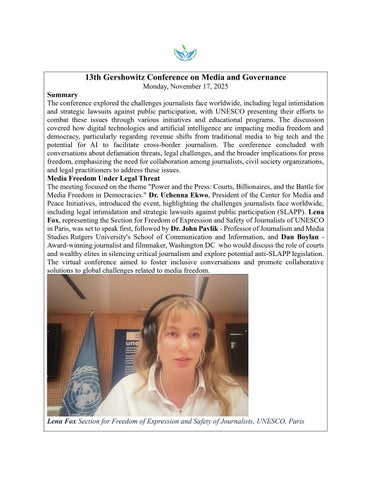
Lena Fox Section for Freedom of Expression and Safety of Journalists, UNESCO, Paris
UNESCO's SLAPPs Response Strategy Lena Fox, representing UNESCO, presented an overview of the organization's work on freedom of expression and safety of journalists, focusing on strategic lawsuits against public interest (SLAPPs). She highlighted the impact of SLAPPs on journalists, including personal and professional costs, and presented findings from UNESCO's global initiative on SLAPPs. The initiative involved engaging with 800 actors and surveyed over 300 judicial professionals, revealing trends such as rising SLAPP cases and under preparedness among legal professionals to tackle these cases. Lena outlined UNESCO's five-tiered approach to addressing SLAPPs, including legislative reforms, knowledge sharing, strengthening networks, enhancing specialization of duty bearers, and empowering journalists.
Dr. John Pavlik Professor of Journalism and Media Studies Rutgers University's School of Communication and Information
“…declining revenues have shifted power from news media to big tech, and how journalists are increasingly facing threats and legal challenges that undermine their role as the fourth estate in a healthy democracy.” AI's Impact on Media and Democracy Professor John Pavlik discussed the impact of artificial intelligence (AI) on media freedom and democracy, focusing on the significant funding by billionaires and big tech companies for AI development. He highlighted the shift in revenue from traditional media to big tech, exacerbated by AI, leading to the decline of local journalism and the rise of misinformation and digital propaganda. Pavlik also mentioned recent cyber-attacks involving AI and the potential for agentic AI to replace human workers, emphasizing the need for balanced innovation and ethical considerations in AI development. Press Freedom Under Digital Threat John Pavlik discussed the weakening of the press as an institution over the past 50 years, highlighting how declining revenues have shifted power from news media to big tech, and how journalists are increasingly facing threats and legal challenges that undermine their role as the fourth estate in a healthy democracy. Dan Boylan addressed the recent legal threats by Donald Trump against the BBC, analyzing the political motivations behind the lawsuit and explaining how Trump's damaged reputation complicates his defamation claim. The panelists agreed on the urgent need for further research to better understand and develop solutions for these challenges, while also emphasizing the importance of gatherings like the Gershowitz Conference in fighting back against digital authoritarianism. Combating SLAPPs for Media Freedom The panel discussed the global rise of Strategic Lawsuits Against Public Participation (SLAPPs), highlighting their impact on journalists and media freedom. Dan Boylan shared a personal story about a journalist friend in Asia who faced legal threats over real estate corruption reporting, emphasizing how SLAPPs can force targets to flee countries and disrupt careers. Lena from UNESCO presented data showing SLAPPs are particularly prevalent in Latin America and discussed their organization's efforts to combat them through education and support for legal defense, noting that UNESCO has worked with over 36,000 judges and 13,000 police officers on these issues. Digital Technologies and Information Governance The meeting focused on the impact of digital technologies on communication and information dissemination, particularly in developing countries like Nigeria. Dr. Augustine Okereke, the immediate past Provost of Medgar Evers College, City University of New York highlighted the challenges of misinformation spread through social media and the need for higher education institutions to engage more actively in these spaces. Lena Fox from UNESCO discussed their
efforts to promote freedom of expression and access to information through guidelines for digital platform governance and initiatives to combat misinformation, especially during elections. Im Jongwon, Program Manager, Asia-Pacific Institute of Broadcasting and Development, Kaula Lumpur, Malaysia raised concerns about UNESCO's workshops on journalist safety, suggesting a need to involve media managers and legal protections rather than focusing solely on individual journalists.
Im Jongwon, Program Manager, Asia-Pacific Institute for Broadcasting and Development, Kaula Lumpur, Malaysia Journalists' Safety and Technology Challenges The meeting focused on the challenges and solutions for journalists' safety and the role of technology in media practices. Lena Fox discussed UNESCO's efforts to train higher-level media managers to implement safety measures and promote systemic change within newsrooms. Professor John Pavlik highlighted the potential of AI in facilitating cross-border journalism and reducing economic barriers. John Cavanaugh of the University of Cincinnati Ohio and Director of Plunk Foundation emphasized the importance of open-source tools and digital literacy for journalists in dangerous environments. The group also discussed legal issues, including defamation threats and ownership pressures, and planned to explore legal literacy for independent journalists in the next session. Defamation Challenges in Media The meeting focused on discussing defamation threats and legal challenges faced by journalists and media organizations. Dr. Sirajo Yakubu, Head of Department, International Relations and Law, Nile University, Abuja, Nigeria emphasized the need for media outlets to ensure factual reporting and suggested using experts to analyze news items to avoid defamation claims. He highlighted the financial burden of defamation lawsuits on media houses, particularly in democracies where strategic lawsuits are used to silence public participation. The discussion also touched on the need for legislation to regulate defamation thresholds and protect media freedom. Chibuwuala Silwaumba, an attorney and journalist from Lusaka, Zambia, was invited to share perspectives on navigating defamation threats in the Southern African context.
Media Law and Ethics in Africa The discussion focused on the challenges and responsibilities of media practitioners in Africa, particularly regarding legal issues and ethical reporting. Chibuwuala, a journalist and legal practitioner, highlighted the need for a balance between media freedom and the protection of individuals' rights, emphasizing that trained journalists adhere to media laws and ethics, unlike many citizen journalists. The conversation also touched on the importance of legal literacy for journalists, libel insurance, and the need for basic training on defamation laws and responsible communication. Legal Threats to Media Freedom The conference participants discussed the challenges journalists face from legal threats and defamation lawsuits, with Chibuala suggesting that media houses could benefit from insurance policies to protect against such risks, though he noted the need for high professional standards to prevent abuse. The discussion highlighted the tension between trained journalists who may be constrained by fear of legal repercussions and citizen journalists who operate without formal training but sometimes produce credible investigative content. Dr. Belle Unobe of the Center for Media and Peace Initiatives, New York raised concerns about the broader implications of these legal threats, noting that even in established democracies, lawyers and academics are facing intimidation and censorship, raising questions about the state of democratic institutions and freedom of expression. Journalists' Legal Challenges and Defenses The meeting focused on the challenges faced by journalists and media practitioners in the context of legal threats, defamation suits, and the broader decline of press freedom globally. Participants discussed various strategies to address these issues, including seeking legal counsel, issuing apologies, publishing statements, and leveraging legal defense funds. The importance of collaboration and synergy among journalists, civil society organizations, and legal practitioners was emphasized as a means to provide mutual support and defense against such threats. The discussion also highlighted concerns about the perception of the United States as a champion of freedom, noting recent developments that challenge this narrative. Conclusion The meeting explored the challenges journalists face worldwide, including legal intimidation and strategic lawsuits against public participation, with UNESCO presenting their efforts to combat these issues through various initiatives and educational programs. The discussion covered how digital technologies and artificial intelligence are impacting media freedom and democracy, particularly regarding revenue shifts from traditional media to big tech and the potential for AI to facilitate cross-border journalism. The conference concluded with conversations about defamation threats, legal challenges, and the broader implications for press freedom, emphasizing the need for collaboration among journalists, civil society organizations, and legal practitioners to address these issues. About Gershowitz Conference The Gershowitz Conference is the flagship annual lecture series of Center for Media and Peace Initiatives, (CMPI) New York, a nonprofit organization in consultative status with the United Nations ECOSOC. CMPI is committed to advancing global peace, dialogue, and development through interdisciplinary research, media engagement, and policy innovation. Through this conference, CMPI brings together a diverse community of journalists, diplomats, scholars,
business leaders, and civil society actors from across the United States and around the world to foster inclusive conversations and promote collaborative solutions to global challenges.
Dr. Uchenna Ekwo, President, Center for Media and Peace Initiatives, New York