UNCLASSIFIED
APPROVED FOR PUBLIC RELEASE: DISTRIBUTION IS UNLIMITED. PATHFINDER PROJECTS | FY25 CASE STUDIES PATHFINDER PROJECTS | FY25 CASE STUDIES
1
APPROVED UNCLASSIFIED FOR PUBLIC RELEASE: DISTRIBUTION IS UNLIMITED.
1
PATHFINDER PROJECTS | FY25 CASE STUDIES
UNCLASSIFIED
2 UNCLASSIFIED
UNCLASSIFIED UNCLASSIFIED
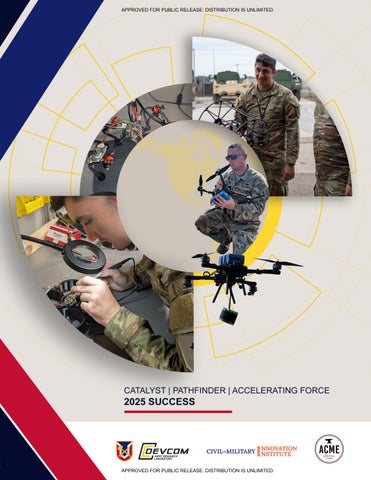
CATALYST | PATHFINDER | ACCELERATING FORCE
2025 SUCCESS
3 UNCLASSIFIED
UNCLASSIFIED UNCLASSIFIED
Fiscal Year 2025 CATALYST | PATHFINDER | ACCELERATING FORCE SUCCESS
Approved for public release: distribution is unlimited. Government Program Manager: Dr. Arwen DeCostanza DEVCOM Army Research Laboratory arwen.h.decostanza.civ@army.mil Deputy Program Managers: Mr. Dennis Day DEVCOM Aviation & Missile Center dennis.l.day12.civ@army.mil Mr. Mark Miltenberger DEVCOM Army Research Laboratory mark.d.miltenberger.civ@army.mil
4 UNCLASSIFIED
UNCLASSIFIED
TABLE OF CONTENTS Program overview...............................................................................6,7 By the Numbers FY25...........................................................................8 PATHFINDER CASE STUDIES Enhanced MRZR Modularity............................................................9 Uncrewed Aerial System (UAS) Handshake...................................10 Phantom Arctic/Tropic Variant.........................................................11 Beyond Line-of-Sight Antenna (BLOS-A)........................................12 M240 Coax Feed Mechanism (CFM)..............................................13 FORCE CASE STUDIES Buildable Innovation Shop for Operational Needs (BISON)...........14 Spectrum Exchange (SpEX)...........................................................15 Event Overviews.............................................................................16,17 In the News.....................................................................................18-28
INNOVATION IN THE DIRT ® 5 UNCLASSIFIED
EXECUTIVE SUMMARY
UNCLASSIFIED
The U.S. Army Combat Capabilities Development Command (DEVCOM) Army Research Laboratory and its Catalyst, Pathfinder, and Accelerating Future Operational Requirements, Capabilities, and Experimentation (FORCE) programs demonstrate how Soldier-driven innovation, academic partnerships, and rapid prototyping accelerate operational capability development across the Army and Special Operations. These initiatives address urgent battlefield challenges, including casualty evacuation, tactical communications, medical readiness, robotics, spectrum management, unmanned systems, sustainment, and survivability. Throughout FY25, a consistent operational model emerged across all programs: Army units identified capability gaps, interdisciplinary teams rapidly developed and tested concepts, and Soldiers refined solutions through iterative field experimentation. Close collaboration among researchers, operators, and end users enabled programs to respond effectively to evolving mission requirements and maintain operational relevance throughout development and transition. These programs directly support Army modernization by accelerating the evaluation, adaptation, and operational capabilities: •
CATALYST captures Army unit-defined challenges and Warfighter feedback, enabling research partners to develop and refine solutions through the Soldier Innovation Platform. The program offers tools and processes that connect researchers and Soldiers throughout the project lifecycle, from problem identification to technology transition.
•
PATHFINDER works directly with Soldiers to identify operational challenges, curate Army-prioritized problem sets, and integrate academic, industry, and government partners to support solution development, testing, and transition.
•
ACCELERATING FORCE identifies critical Army transformation gaps and aligns emerging technologies with operational requirements to accelerate capability development and shorten the technology transition timeline.
These programs strengthen the Army’s adaptability in evolving operational environments by integrating Soldier-driven innovation, rapid prototyping, experimentation, and collaboration with external partners. Continuous end-user feedback informs capability development, system design, and operational decision-making to ensure solutions remain relevant in contested, multi-domain scenarios.
6 UNCLASSIFIED
UNCLASSIFIED
EXECUTIVE SUMMARY
Collectively, these initiatives represent a scalable innovation ecosystem that transforms operational challenges into fieldtested capabilities. Through close collaboration with Soldiers, academia, industry, and government partners, the programs accelerate the delivery of practical, mission-ready solutions that enhance readiness, survivability, and overall combat effectiveness across the future force. This document highlights key FY25 successes and demonstrates the impact of these collaborative innovation efforts. Year-in-Review for FY25 highlights include: • • •
•
Operational Impact: Delivered production-ready operational concepts that directly improved battlefield survivability, mobility, and communications for frontline units, including the 75th Ranger Regiment, 11th Airborne Division, XVIII Airborne Corps, and Special Operations Forces. Rapid Innovation: Accelerated Soldier-driven innovation by rapidly designing, testing, and fielding low-cost, mission-adaptable technologies—including uncrewed aerial system identification systems, beyond-line-of-sight communications, and mobile drone manufacturing capabilities—across multiple combat training environments. Army-Wide Expansion: Expanded operational experimentation and Army adoption through successful deployments, major exercise participation, and transition to FY26 field testing with organizations including • U.S. Army Special Operations Command, • U.S. Indo-Pacific Command, • U.S. Central Command, • Joint Multinational Readiness Center, • U.S. Army Europe and Africa, • Western Hemisphere Command, and • Transforming in Contact units. Strategic Partnerships: Strengthened collaboration between Soldiers, academia, industry, and innovation labs to deliver scalable, National Defense Authorization Act-compliant, and cost-effective solutions that reduced logistical burdens, improved tactical effectiveness, and increased readiness across contested environments.
7 UNCLASSIFIED
BY THE NUMBERS
UNCLASSIFIED
8
*As of 30 SEP 2025 UNCLASSIFIED
UNCLASSIFIED
PATHFINDER PROJECTS | FY25 CASE STUDIES
ENHANCED MRZR MODULARITY The 75th Ranger Regiment extensively uses the Polaris MRZR Alpha 4 across multiple use cases for combat operations, including maneuver and casualty evacuation (CASEVAC) and as a mission command communication platform (requiring enhanced modularity and system capabilities), resulting in the following two FY25 Case Studies: •
•
MRZR Litter System • Challenge: The current CASEVAC MRZR configuration consists of two longitudinal litters and one transverse litter. The legacy transverse litter positioning impedes enroute casualty care from medics during evacuation. • Goal: Create a specialized modular system of stretchers, called litters, designed to safely transport 1-3 injured Soldiers in vehicles with adequate medic access MRZR Mission Command Integration Module (MCIM) • Challenge: In the current communication configuration, Rangers are task-saturated with multiple communications platforms that are not fully integrated into the MRZR. • Goal: Develop a hardware mounting solution to integrate multiple communication systems into a purposebuilt package designed specifically for the Polaris MRZR ALPHA 4. The solutions must be removable, stowable, and cross-loadable to an alternate MRZR (lightweight tactical vehicle).
Success Summary: Engineers from the Auburn University Samuel Ginn College of Engineering designed, fabricated, and delivered two fully functional prototypes to the 75th Ranger Regiment. Throughout the engineering process, experienced Special Operations medics and communicators from the 75th Ranger Regiment worked closely with Auburn engineers to provide continuous input and feedback, ensuring the Litter and MCIM systems met all operational requirements. As a result of the MRZR Litter system, the unit now has (1) an improved mobility platform capable of transporting up to three casualties (two longitudinal and one transverse), (2) a recessed tie-down points, (3) a custom IV bag holders positioned above each casualty, and (4) a fully stowable configuration compatible with air platforms as small as the CH-47 Chinook. The unit also has the option to stow the transverse litter when additional seating is required for alternate mission profiles. As a result of the MCIM, each piece of equipment has a dedicated location designed to maximize usability, accessibility, and maintainability. The system also provides continuity across communications platforms, increasing the unit’s combat effectiveness. The team designed the system to be easily cross-loaded between MRZRs by only two Rangers. The MRZR Litter system and MCIM are true bolt-on solutions that require no modifications to the stock Polaris MRZR Alpha 4 platform. What’s Next: Upon completion of the projects in August 2025, two field-tested prototypes were delivered to the 75th Ranger Regiment. Since then, Since then the MRZR Litter system and MCIM have been regularly employed in squadthrough battalion-level training exercises and are available for use during real-world missions as required. The Pathfinder Program has successfully designed, tested, and validated rapid prototypes that are now production-ready through private industry, using the technical data packages developed through the DEVCOM ARL Program. Partners: Auburn University; 75th Ranger Regiment
9 UNCLASSIFIED
PATHFINDER PROJECTS | FY25 CASE STUDIES
UNCLASSIFIED
UNCREWED AERIAL SYSTEM (UAS) HANDSHAKE Challenge: The need for improved friendly-force identification at the tactical edge was underscored by the 2024 incident at Tower 22 in Jordan. During the attack, an enemy UAS approached the outpost simultaneously with a returning U.S. Intelligence, Surveillance, and Reconnaissance platform and was mistakenly identified as friendly. The resulting confusion contributed to the deaths of three U.S. Soldiers and injuries to several others. As uncrewed systems become increasingly common across the battlefield, tactical units face growing challenges in rapidly distinguishing friendly assets from hostile threats. Friendly UASs and uncrewed ground vehicles frequently operate in contested and congested environments where identification errors can have deadly consequences. In some cases, friendly drones have been engaged by U.S. forces under the assumption they were adversary systems. In others, hostile drones have been permitted to approach because they were believed to be friendly. This operational gap highlights the need for a secure, lightweight, and interoperable identification capability that enables forces to maintain near-real-time awareness of friendly autonomous systems without increasing risk to operators or platforms. Goal: Develop a device that acts as a UAS transponder sent from UASs to friendly forces on the ground to identify the drone as friendly. The concept involves attaching a small device that can be wired or mounted onto a standard hobby drone and transmits a code and location with a low probability of detection. To interface with on-the-ground troops, an ATAK plugin would be created to receive the transmission and plot it on the user’s phone. Solving this gap requires a reliable, automated UAS Identification Friend or Foe solution that can be fed to and broadcast across ATAK, maintaining spatial awareness and increasing battlefield superiority. Success Summary: UAS Handshake addresses this challenge through a low-cost, vehicle-agnostic transmitter that provides a one-way encrypted identification “ping” to Android Tactical Assault Kit (ATAK)-enabled end users. The system broadcasts essential situational awareness data, including positional breadcrumb trails, speed, altitude, heading, platform name, and operating unit—while maintaining operational security through one-way communication architecture. Because the device does not receive inbound signals, the transmitter does not expose the location of operators or users. Information can also be shared across ATAK users and command-and-control elements to improve common operational awareness across the force. In the Seed phase, a minimal viable prototype (with components found commercially off the shelf) was constructed for under $30. The transponder provided real-time location, speed, and altitude to those watching, without control of the drone flying. This allows others on the battlefield to identify and understand the role of UAS and its intent. The U.S. Army Special Operations Command (USASOC) has used the trackers in two exercises, providing real-time position location information that could be shared with everyone on the TAK network. The current trackers are made in the USA (ensuring all components are National Defense Authorization Act-compliant) and in its fourth generation of the design, incorporating encryption and anti-tampering into the design and software. What’s Next: In FY26, the Pilot phase will continue building on the Seed phase by further developing the hardware and adding to the software within ATAK. Kits will be built for units to use and test for further iteration. Partners: North Carolina Agricultural and Technical State University , 3rd Special Forces Group (Airborne), USASOC, 44th Medical Brigade
10 UNCLASSIFIED
UNCLASSIFIED
PATHFINDER PROJECTS | FY25 CASE STUDIES
PHANTOM ARCTIC/TROPIC VARIANT Challenge: The 11th Airborne Division and the U.S. Army lack a resilient energy storage and battery solution to support Retransmission Teams (RETRANS Teams) operating Tactical Scalable Mobile Ad Hoc Networking [MANET] (TSM) and Ghost radios in Extreme Cold Weather (ECW) and Arctic conditions. The fielded communications relay solution for ECW and Arctic environments is the Variable Height Antenna (VHA) a tethered quadcopter that elevates TSM/Ghost radios to approximately 200 feet and relies on a 2-kilowattgenerator or vehicle power inverter for sustained power. Operating the VHA requires a substantial RETRANS Team footprint, including transport vehicles, life support systems, communications equipment, and security personnel. Continuous operation also depends on a steady supply of JP8 fuel to power generators or vehicle inverters throughout the mission. These operational and environmental requirements significantly increase the vulnerability of Arctic RETRANS Teams by creating detectable noise, heat, and visual signatures, while also expanding the overall logistical footprint. Additionally, the VHA becomes non-operational in sub-zero temperatures and icing conditions—conditions that characterize nearly every operational environment encountered by the 11th Airborne Division. Goal: Develop and deploy a stand-alone packaged solution to (1) enable remotely monitored retransmission communications, (2) reduce RETRANS team’s Arctic exposure and forward footprint, (3) eliminate reliance on the variable height antenna, and (4) reduce or eliminate logistical support requirements for in-field sustainment. Success Summary: Building on the Phantom Seed project successes in the Arctic, the 11th Airborne Division requested the Pathfinder Program to modify Phantom for use in other Operational Areas (Tropics). Responding to this demand, the Phantom Pilot project partnered with Montana Technical University and PEKE Engineering and Systems to design, develop, and deliver two advanced Phantom prototypes (Phantom Arctic and Tropic), including a single packaged solution capable of operating in both Arctic and Tropic environments. Prototypes were delivered to the 11th Airborne Division, 2nd Infantry Brigade Combat Team, and 3-509th Parachute Infantry Regiment for field experimentation and end-user feedback. The first Tropics variant of the Phantom prototype was successfully deployed to the U.S. Indo-Pacific Command environments, where it performed communications and data retransmission missions in Tropic environments and remained in place for 5 days without requiring maintenance, battery replacement, or Soldier care. Having validated the Topic RETRANS solution, the Phantom project team is preparing to deploy the complete system for operational experimentation during Joint Pacific Multinational Readiness Center (JPMRC) 26-02. What’s Next: The Phantom project team, in collaboration with Pathfinder Marne Innovation Lab, is manufacturing 16 Tropic/Arctic Phantom prototypes to be deployed to the field during the JPMRC 26-02 exercise in Alaska during the winter of 2026 to collect operational feedback on system performance and validate temperature-related performance data, battery life at varying temperatures, and overall operational mission impact. Researchers are conducting specimen fabrication testing, and the Pilot phase concludes in May 2026. Partners: Montana Tech, PEKE Engineering and Systems; 11th Airborne Division
11 UNCLASSIFIED
PATHFINDER PROJECTS | FY25 CASE STUDIES
UNCLASSIFIED
BEYOND LINE-OF-SIGHT ANTENNA (BLOS-A) Challenge: The Army needs the ability to rapidly extend communications beyond line of sight to make many current robotic technologies tactically relevant. The Army also needs to displace electromagnetic signatures from a unit’s physical location to enhance obfuscation and security. Goal: Develop an uncrewed aerial system or ground robotic delivered bare node fiber optic tethered IP-based radio antenna package with demonstrated ability to provide reliable communications and control robotic platforms beyond line of sight, protecting dismounted units by eliminating exposure to satellite signals and dislocating the units’ electromagnetic signature. Success Summary: Soldiers developed and refined multiple early versions, producing six prototype versions of the BLOS-A system. The current iteration incorporated lessons learned from previous versions, resulting in the most streamlined and cost-effective design to date. Additionally, Soldiers devoted significant effort to designing and constructing a Computer Numerical Control fiber-winding machine that transfers fiber from manufacturer spools onto custom, inhouse-designed cartridges with precision and consistency, resulting in 150% cost reduction from purchased spools. In June 2025, the team conducted an initial test at Driving Innovation in Realistic Training (DIRT) Days experimentation event using the SPOT dog as a remote asset linked to the antenna. The final test was successful, with the robot operating effectively at approximately 800 meters from the operator, surpassing the line of sight. Following this, the team took the package to Dragons Lair XI at the Airborne Innovation Lab in Fort Bragg, NC. The system was presented to a panel of industry professionals and 82nd Airborne Division leadership, resulting in excellent technical feedback and buy-in from potential industry partners and key leadership. What’s Next: Currently, subject matter experts (SMEs) are developing a testing concept of operations. In FY26, they plan to test the aerial deployment of the system at Fort Benning, pending completion of the next iteration, which will feature a smaller, lighter airframe, an integrated in-house-designed and manufactured dropper mechanism, and an open-source mesh radio paired with commercially available fiber spools. These updates will enable the team to produce actionable results more quickly by lowering prototype costs and increasing the number of tests that can be conducted. Accelerated testing cycles will also provide valuable feedback to the team and key stakeholders. DIRT Lab: Maneuver Innovation Lab
12 UNCLASSIFIED
UNCLASSIFIED
PATHFINDER PROJECTS | FY25 CASE STUDIES
M240 COAX FEED MECHANISM (CFM) Challenge: The M240 ammunition box in the M1A2 experiences issues reliably feeding ammunition from the box to the weapon, resulting in unexpected stoppages. The current solution is to use dunnage to fill the bottom of the ammo box, resulting in carrying less than a full combat load of ammunition. Goal: Create a solution for the consistent stoppage of the M240-CFM due to the position and design of the current ammunition storage box. Success Summary: Soldiers and Researchers showcased the M240-CFM during the Maneuver Warfighter Conference at Fort Benning, GA, presenting the system to approximately 45 Abrams Master Gunners. Soldiers received the system very well. Numerous tanks and armor personnel emphasized the importance of advancing the effort, and multiple divisionlevel master gunners expressed interest in fielding the system across training facilities. What’s Next: In FY26, subject matter experts (SMEs) will prepare a production-intent assembly for testing with the U.S. Army Test and Evaluation Command to iterate the design and integrate it into live fire events, collecting additional data to present to stakeholders for action. SMEs are also coordinating with the project manager to determine sourcing and quantities to support unit requests for National Training Center rotations and deployment. DIRT Lab: Maneuver Innovation Lab
13 UNCLASSIFIED
FORCE PROJECTS | FY25 CASE STUDIES
UNCLASSIFIED
BUILDABLE INNOVATION SHOP FOR OPERATIONAL NEEDS (BISON) Challenge: Advances in uncrewed aerial system (UAS)technology have introduced significant logistical challenges, clearly illustrated by the war in Ukraine. High operational tempo and widespread counter-UAS measures have driven severe attrition, with drones frequently lost to electronic warfare, enemy fire, environmental conditions, and mechanical failure. This constant loss creates sustainment demand for rapid resupply, maintenance, production, and operator training, placing heavy strain on supply chains already stressed by wartime conditions. In such dynamic environments, rapid mobility and increased production output remain essential for operator survival and continued UAS effectiveness. The BISON is a state-of-the-art mobile solution designed for maximum flexibility, efficiency, and rapid deployment. Goal: Develop a mobile, modular, and mission-ready workspace with adaptable solutions for dynamic operations. Success Summary: The BISON was designed to address the logistical challenges of UAS manufacturing and repair at the point of need. Soldiers in austere operational environments require the ability to conduct robust manufacturing and restoration tasks within a mobile platform. The BISON consists of mobile containerized workshops and fabrication facilities tailored for rapid construction, development, modification, training, and deployment of UAS and associated components. The system’s mobility, modularity, and integration with existing DOW assets distinguish it from other military manufacturing resources. The BISON incorporates a two-container system equipped with simulation technology, 3D printers, computeraided design stations, laser cutters, workstations, Computer Numerical Control mills, and other resources necessary for fabrication. Its modular capabilities support a wide range of materials, including metals, plastics, polymers, and steel, allowing for large-scale manufacturing. In September 2025, the 1st Infantry Division’s (1ID) UAS Platoon used the BISON during Danger Gauntlet IV (divisional training exercise) at Fort Riley, Kansas. Soldiers participating in the event trained in rapid UAS manufacturing using the BISON and deployed their 3D-printed drones as Red Air against advancing mechanized elements. Soldiers used the BISON to replace damaged airframes overnight. What’s Next: BISON-UAS systems are currently being manufactured in support of multiple Army organizations, including the 21st Troop Sustainment Command (TSC), U.S. Central Command (CENTCOM), and the Joint Readiness Training Center (JRTC). In FY26, BISON systems will support the ROID experimentation campaign through deployments to Limestone Hills, MT; Camp Grayling, MI; Lizemores, WV; and Fort Riley, KS. Additionally, a BISON system will be delivered to Fort Bragg, NC, for 3rd Special Forces Group (Airborne) SFG(A) in November 2026 to support home-station unit familiarization and preparation. The system will subsequently deploy with 3rd SFG(A) to JRTC in March 2026, followed by deployment to an operational theater during Q3–Q4 FY26. Partners: Civil-Military Innovation Institute; 1ID/Fort Riley, KS; 3rd SFG(A)/Fort Bragg, NC; 21st TSC/Germany; CENTCOM
14 UNCLASSIFIED
UNCLASSIFIED
FORCE PROJECTS | FY25 CASE STUDIES
Spectrum Exchange (SpEX) Challenge: The modern networked battlefield relies on wireless communication and sensing devices. Challenges from adversaries, particularly near-peer competitors, and the crowded nature of the radio spectrum can interfere with friendly radios. Both instances cause an availability loss of communications between friendly forces, leading to dangers to onthe-ground warfighters. Soldiers across the Army and Army leadership have identified the need for Fifth Generation and Next Generation spectrum sensing and management technologies. Goal: Create an AI-enabled scheduling appliance with a Spectrum Orchestration Automation and Response to enhance the Army’s ability to dominate NextG networks. Success Story: Accelerating FORCE directly applied emerging scientific advancements from the Defense Advanced Research Projects Agency into Army spectrum management planning and automation from 2022-2025. Through work with the 101st Airborne Division (Air Assault), rotational units at the Joint Multinational Readiness Center (JMRC), and other Army units, SpEX increased spectrum managers’ ability to support exercises by 600% as opposed to manual methods. Accelerating FORCE presented SpEX to the Transforming in Contact (TiC) 2.0 technology selection committee at the end of the calendar year 2025. What’s Next: In FY 26-27, the TiC 2.0 selection committee requested SpEX to experiment with TiC-designated units. SpEX will continue to conduct experimentation for TiC units, as well as experimentation at the JMRC in Hohenfels, Germany. Accelerating FORCE is working with the 8th Army (Korea) to establish an instance of SpEX on the Korean Peninsula to understand requirements in U.S. Indo-Pacific Command . Partner: 101st Airborne Division (Air Assault), 8th Army (Korea)
15 UNCLASSIFIED
FORCE PROJECTS | |FY25 EVENT OVERVIEWS FY25CASE CASESTUDIES STUDIES
UNCLASSIFIED
EVENT OVERVIEWS Pathfinder and Accelerating FORCE technology experimentation events engage Soldiers in evaluating emerging technologies within realistic domestic and international operational environments. By bringing together operational units, researchers, and industry partners, these events enable rapid assessment of new capabilities while ensuring Soldier feedback informs development. Through hands-on experimentation and real-time feedback, these events help accelerate innovation, improve readiness, and deliver operationally relevant solutions to the warfighter. DIRT Days 25-02 Integrating Drone Resupply and Additive Manufacturing to Enhance Readiness APRIL 2025 | Camp Arijan, Kuwait During the Driving Innovation and Realistic Training (DIRT) Days event in April 2025, the Civil-Military Innovation Institute (CMI2), in collaboration with the U.S. Army Combat Capability Development Command (DEVCOM) Army Research Laboratory and the 1st Theater Sustainment Command (1st TSC), demonstrated the operational value of the Tactical Resupply Vehicle-150 (TRV-150) drone and advanced additive manufacturing capabilities. Soldiers trained to assemble, operate, and execute tactical resupply missions using the TRV-150, which can deliver up to 150 pounds of critical supplies to forward locations while reducing risk to personnel. The event culminated in realistic sustainment scenarios, including the aerial delivery of a 3D-printed vehicle repair component produced by the Army Innovation and Manufacturing Center (AIM-C), a Design, Innovation, Research, and Technology Lab within the Pathfinder Program. The demonstration showcased how autonomous logistics and expeditionary manufacturing can improve readiness, accelerate sustainment operations, and enhance battlefield effectiveness. To read the original U.S. Army article, click here: https://www.army.mil/article/286124/1st_tsc_displays_technological_advancements_with_trv_150_drone DIRT Days 25-03 Advancing Soldier-Centered Experimentation JUNE 2025 | CMI2 Adaptive Experimentation Facility, West Virginia, USA From 6–10 June 2025, the Pennsylvania Army National Guard’s 1-109th Infantry Regiment, in partnership with the DEVCOM ARL and CMI2, conducted DIRT Days 25-03 at the CMI2 Adaptive Experimentation Facility at Fort Andrew, West Virginia. The event involved 43 Soldiers, researchers, and technology developers evaluating emerging capabilities in realistic operational environments. Participants assessed prototype technologies from DEVCOM innovation hubs, academia, and industry while operating under contested conditions designed to replicate modern battlefield challenges. Daily feedback sessions enabled Soldiers to provide operational insights that informed capability refinement and accelerated technology maturation. By combining experimentation with realistic training, DIRT Days 25-03 supported the rapid assessment of emerging technologies while ensuring Soldier perspectives remained central to development. The event reinforced CMI2’s commitment to advancing operationally relevant innovation through hands-on experimentation and user-driven feedback. To learn more, watch the event video: https://youtu.be/6lcfjTAJ294?si=PaMzJR4qHzBCpksh
16 UNCLASSIFIED
UNCLASSIFIED
EVENT OVERVIEWS | FY25 CASE STUDIES
Danger Gauntlet 2025 Demonstrating Point-of-Need Manufacturing to Enhance Readiness SEPTEMBER 2025 | Fort Riley, Kansas, USA From September 7–15 at Fort Riley, Kansas, CMI2 partnered with DEVCOM and the 1st Infantry Division to support the Danger Gauntlet Experimentation Event, providing on-site support and documenting Soldier engagement with emerging technologies. A key focus was the Buildable Innovation System for Operational Needs (BISON), a mobile manufacturing platform that enables rapid prototyping and field production of mission-critical equipment, including point-of-need manufacturing and mobile uncrewed aerial system (UAS) production capabilities. By capturing Soldier feedback in realistic operational environments, CMI2 helps accelerate Army modernization, inform future capability development, and demonstrate how agile manufacturing can reduce logistics burdens, increase tactical agility, and enhance readiness at the point of need. Watch the recap video from the 1st Infantry Division: https://www.facebook.com/share/v/1C2P8dQKm4/
17 UNCLASSIFIED
IN THE NEWS | FY25 CASE STUDIES
UNCLASSIFIED
2025 IN THE NEWS
CATALYST | PATHFINDER | ACCELERATING FORCE
In FY25, the collective program accomplishments garnered regional, national, and trade media coverage in notable publications.
18 UNCLASSIFIED
UNCLASSIFIED
IN THE NEWS | FY25 CASE STUDIES
Forging a Path to Modernization and Excellence HUNTER ARMY AIRFIELD, Ga. -- On Nov. 18, 2024, the Marne Innovation Challenge took center stage during Marne Week, showcasing the ingenuity and technical expertise of 3rd Infantry Division Soldiers. Hosted by the Marne Innovation Center (MIC), the competition featured groundbreaking projects aimed at advancing modernization within the Army. The event served as a powerful reminder of the Army’s slogan, “Be All You Can Be,” by showcasing soldiers’ innovative solutions to complex challenges. Established in November 2021, the Marne Innovation Center is more than just a hub for groundbreaking ideas; it is a dynamic space where Soldiers become inventors, tackling challenges that directly affect the Army’s operational capabilities. With over 62 active projects and 26 completed, the center has become a catalyst for soldier-driven modernization.
Soldier creates device that speeds up Apache missile system rearming Sgt. Travis Rogers took note of the excessive manpower, time and safety requirements each time his team had to swap out a key piece of gear on an Apache helicopter during rapid refueling and rearming.
Tactical Innovation The Key to Executing Continuous Transformation The outcome of war is ultimately decided by the soldiers on the front lines of the battlefield. These young men and women have the most intimate knowledge of the problems they face and often have the best ideas to solve them. 19 UNCLASSIFIED
IN THE NEWS | FY25 CASE STUDIES
UNCLASSIFIED
USARCENT INNOVATION AND MANUFACTURING CENTER (AIM-C) DOCUMENTARY - 2025 Maj. Gen. Eric P. Shirley, commanding general, 1st Theater Sustainment Command, explains the capabilities of the U.S. Army Central Innovation and Manufacturing Center in the U.S. Central Command area of responsibility. Soldiers and Army Civilian employees discuss and demonstrate the creative ways that Soldiers use new technology to maintain readiness. 1st TSC synchronizes continuous transformation and modernization efforts across the Joint Logistics Enterprise to sustain the joint force across the CENTCOM area of responsibility. (U.S. Army video and graphics by Bianka Lathan) Marne Innovation Collaboration/ KAPS project
20 UNCLASSIFIED
UNCLASSIFIED
IN THE NEWS | FY25 CASE STUDIES
Fort Moore to Open Maneuver Innovation Lab to Advance Military Innovation The U.S. Army Maneuver Center of Excellence at Fort Moore, in partnership with the U.S. Army Combat Capabilities Development Command, Maneuver Battle Lab, Columbus State University, and the Civil-Military Innovation Institute, will host the grand opening of the Maneuver Innovation Lab at 11 a.m. on Feb. 7, 2025.
2025 02 07 2025 Maneuver Innovation Lab Opening Maj. Gen. Colin Tuley, commanding general U.S. Army Maneuver Center of Excellence, Dr. Patrick Baker, Director of DEVCOM Army Research Laboratory, Dr. Stuart Rayfield, President of Columbus State University, and Mr. Craig Kuphall, Deputy Pathfinder Program Manager provide remarks at the opening of the Maneuver Innovation Lab, Feb. 7, 2025, at the Maneuver Battle Lab on Fort Moore, Georgia. The Maneuver Innovation Lab was initiated nearly eight months ago, in May of 2024, by signing a memorandum of understanding between the Maneuver Center of Excellence and U.S. Combat Capabilities Development Command (DEVCOM) Army Research Laboratory. (U.S. Army photo by Joey Rhodes II)
Fort Moore forms new partnership with Columbus State University A new lab and partnership with a local university aims to develop cutting-edge, life-saving drones and robotics technology. The Maneuver Center of Excellence hosted the grand opening of the Maneuver Innovation Lab at Fort Moore on Friday unveiling its new logo and demonstrating prototypes of drones, robots and other devices. The Maneuver Innovation Lab is the first of its kind in Georgia and is a result of mutual collaborations with DEVCOM Army Research Laboratory, Civil Military Innovation Institute, Auburn University and most recently Columbus State University. *Fort Benning was renamed to Fort Moore from May 11, 2023 to March 3, 2025. UNCLASSIFIED
21
IN THE NEWS | FY25 CASE STUDIES
UNCLASSIFIED
Maneuver Innovation Lab at Fort Moore hosts open house
Fort Moore opens cutting-edge Maneuver Innovation Lab FORT MOORE, Ga. — The Maneuver Center of Excellence and Fort Moore, in partnership with the Maneuver Battle Lab, U.S. Army Combat Capabilities Development Command, the Civil-Military Innovation Institute and Columbus State University, celebrated the grand opening of the Maneuver Innovation Lab Feb. 7, 2025, on post. The first-of-its-kind opened on a U.S. Army Training and Doctrine Command installation, the MIL serves as a collaborative hub to unite Soldiers, academics, and industry leaders in driving innovation and modernization. U.S. Army partnership with local university could speed up tech development FORT MOORE, Ga. (WRBL) — Drone technology is already changing the way the U.S. Army operates. A new on-post lab and partnership with a local university could speed up that progress, according to Fort Moore officials.
“You start looking at a center like this, which is all about innovation of capabilities, that we can actually help our soldiers of their future.” - Maj. Gen. Colin Tuley, the commanding general of the MCoE.
Fort Moore commander: New innovation lab focusing on progress, not numbers FORT MOORE, Ga. (WRBL) — The thing about innovation is that not every solution is a success. There’s a lot of trial and error involved. That’s okay, according to Maneuver Center of Excellence Commander Maj. Gen. Colin Tuley. *Fort Benning was renamed to Fort Moore from May 11, 2023 to March 3, 2025.
22 UNCLASSIFIED
UNCLASSIFIED
IN THE NEWS | FY25 CASE STUDIES
US Army experimental unit to begin testing precision-strike UAS A new hunter-killer unmanned aircraft system (UAS) configuration will begin testing in February with the 1st Battalion, 29th Infantry Regiment, the unit’s air section leader told Janes on 7 February. While the unit has already experimented with the first iteration of the weapon, the next generation, which contains several upgrades, is expected to begin testing in the second week of February, Sergeant Evin Gries, air section leader for the Experimental Force (EXFOR), told Janes in an interview on the sidelines of a ribboncutting ceremony for the Maneuver Innovation Lab at Fort Moore, Georgia. The mortar-dropping UAS is one of several new technologies the unit has been asked to experiment with in recent years. Military Lab Partnership to Train Columbus, Auburn Students Through Columbus State University’s partnership with the new Maneuver Innovation Lab at Fort Moore, Georgia, robotics and engineering students have the opportunity to research and develop new technology.
‘LIMITLESS POTENTIAL’: Fort Moore, Columbus State partnership to fuel Army robotics innovation Columbus State University is now part of a collaborative technology hub at the Maneuver Center of Excellence and Fort Moore, where its Robotics Engineering Program serves a key role in uniting soldiers, academics and industry to drive U.S. Army innovation and modernization.
Fort Moore Fosters Innovation With New Collaborative Hub The Maneuver Center of Excellence and Fort Moore have inaugurated the Maneuver Innovation Lab, marking the first time a collaborative hub has opened in the U.S. Army Training and Doctrine Command, or TRADOC, installation. *Fort Benning was renamed to Fort Moore from May 11, 2023 to March 3, 2025.
23 UNCLASSIFIED
IN THE NEWS | FY25 CASE STUDIES
UNCLASSIFIED
Researchers simulate battlefield blast exposures to reduce impact on soldiers Vanderbilt researchers are using BIHF — a Biofidelic Instrumented Head Form — to study the impact of blast exposures in the military, an idea that could translate to research in other areas, including contact sports such as football and hockey.
24 UNCLASSIFIED
UNCLASSIFIED
IN THE NEWS | FY25 CASE STUDIES
New Marne DFAC app helps modernize DFAC services Fort Stewart is in the process of modernization through the testing of a new dining facility (DFAC) web application, aimed at enhancing the meal-ordering experience for Soldiers. The initiative, spearheaded by the Marne Innovation Center, is currently undergoing its first round of user testing.
“Soldiers have expressed nothing but positivity. They already have enough work in a day. A little bit of convenience like this can actually go a long way.” First Lieutenant Brenden Shutt, Innovation Officer with the Marne Innovation Center
Picatinny Arsenal Leaders Emphasize Munitions Modernization at Executive Summit PARSIPPANY, N.J. — Senior leaders from Picatinny Arsenal and defense industry executives convened this week at the National Defense Industrial Association’s 2025 Munitions Executive Summit, highlighting ambitious efforts to modernize and expand America’s ammunition industrial base amid rising global tensions.
Army partners with Auburn to close capability gaps in light tactical vehicles One of the main motivations for establishing the Auburn University Applied Research Institute (AUARI) in Huntsville in 2022 was to take Auburn Engineering’s commitment to national defense to the next level. Another was to provide a pipeline between the Department of Defense (DOD) and the best and brightest young Auburn engineering talent. Mission accomplished.
4th Tactical Innovation Symposium, hosted at the United States Military Academy at West Point on April 23, 2025
25 UNCLASSIFIED
IN THE NEWS | FY25 CASE STUDIES
UNCLASSIFIED
APSU, EagleWerx form dynamic partnership for military innovation CLARKSVILLE, Tenn. - When opportunities for real-world experience intersect with cutting-edge military innovation, unique learning experiences emerge. This is precisely what students from Austin Peay State University’s College of Science, Technology, Engineering, and Mathematics (STEM) are discovering through their collaboration with Fort Campbell’s EagleWerx Applied Tactical Innovation Center, a hub for solving military challenges with practical and innovative solutions.
Catalyst Pathfinder, Accelerating FORCE fiscal 2024 report released ADELPHI, Md. – The U.S. Army Combat Capabilities Development Command Army Research Laboratory released its fiscal 2024 report of two DEVCOM programs, Catalyst Pathfinder and Accelerating FORCE (Future Operational Requirements, Capabilities and Experimentation). The report highlights tactical innovation and technology transition achievements from the two programs that are designed for enhanced lethality, an increase in readiness and improved military modernization by integrating public and private sector innovators and Soldiers in collaborative teams to solve technical problems.
1st TSC displays technological advancements with TRV-150 drone USCENTCOM- The 1st Theater Sustainment Command coordinated with the Civil Military Innovation Institute and the U.S. Army Combat Capabilities Development Command (DEVCOM) during a Driving Innovation and Realistic Training (DIRT) event. This event showcased the capabilities of the Tactical Resupply Vehicle-150 drone and the U.S. Army Central Innovation and Manufacturing Center. 26 UNCLASSIFIED
UNCLASSIFIED
IN THE NEWS | FY25 CASE STUDIES
Soldiers Drive Innovation at DIRT Days Soldiers hone decision-making, operational skills through technology engagement at DIRT Days The Civil-Military Innovation Institute (CMI2), in collaboration with the 1-109th Infantry Regiment of the Pennsylvania Army National Guard and the U.S. Combat Capabilities Development Command (DEVCOM) Army Research Laboratory, successfully hosted the third Fiscal Year 2025 iteration of its Driving Innovation in Realistic Training (DIRT) Days program, designated as DD25-03, from 06 to 10 JUNE 2025. Held at the CMI2 Adaptive Experimentation Facility at Fort Andrew in Lizemores, WV, this dynamic field exercise showcased cutting-edge military technologies through immersive training and experimentation scenarios. The event provided 43 Soldiers with vital exposure to advanced systems aimed at reshaping the future battlefield.
Fort Benning’s Maneuver Innovation Lab enhances Abrams lethality with Soldier-driven solution FORT BENNING, Ga. – A persistent issue plagues Abrams tank crews during training exercises and at the gunnery range: ammunition jams on the M240 coaxial weapon system. The scenario is all too familiar: the loader fills the ammo box — sometimes using makeshift false bottoms like MRE boxes or ammo can lids — and charges the weapon. The gunner fires a few rounds, only to be interrupted by the unmistakable “clink!” of a jam. *Fort Benning was renamed to Fort Moore from May 11, 2023 to March 3, 2025.
27 UNCLASSIFIED
IN THE NEWS | FY25 CASE STUDIES
UNCLASSIFIED
Soldier-Driven Innovation Shines Again at Dragon’s Lair XI The U.S. Army’s commitment to Soldier-led innovation continues to flourish, this time with another standout performance at Dragon’s Lair XI, the military’s premier innovation competition. Tactical solutions developed through the Pathfinder Program, a joint effort by the U.S. Army Combat Capabilities Development Command Army Research Laboratory (DEVCOM ARL) and the Civil-Military Innovation Institute (CMI2), have now clinched top honors in five consecutive events: Dragon’s Lair VII through XI.
25th Infantry Division Leads the Way in Army Modernization with xTechPacific 2025 SCHOFIELD BARRACKS, Hawaii – From September 9–18, 2025, the 25th Infantry Division transformed its training areas into a living laboratory for the U.S. Army’s modernization efforts, hosting the xTechPacific 2025 competition.
Innovative firms vie at Hawaii competition for Army’s attention and cash prizes FORD ISLAND, Hawaii — Technicians for defense tech firm ZeroMark strapped an M134 machine gun on the deck of an Army landing craft prototype moored Thursday in Pearl Harbor a few hundred yards from Ford Island.
“xTech was launched in 2018 as a tool to scout and identify innovative technology, but also to create a friendly front door for industry to be able to come and work with us versus the traditional acquisition process that can be very daunting.” Jess Stillman, the Army’s xTech Program manager
28 UNCLASSIFIED
UNCLASSIFIED
IN THE NEWS | FY25 CASE STUDIES
29 UNCLASSIFIED
FORCE PROJECTS | FY25 CASE STUDIES
UNCLASSIFIED
2025 SUCCESS
CATALYST | PATHFINDER | ACCELERATING FORCE
Government Program Manager: Dr. Arwen DeCostanza DEVCOM Army Research Laboratory arwen.h.decostanza.civ@army.mil Deputy Program Managers: Mr. Dennis Day DEVCOM AvMC dennis.l.day12.civ@army.mil Mr. Mark Miltenberger DEVCOM Army Research Laboratory mark.d.miltenberger.civ@army.mil
30 UNCLASSIFIED